THE CHANGING ROLE OF HUMAN RESOURCE FUNCTION by  DR JANEFRANCIS I. DURU B.A, MPA, Ph.D, MNIM, ACIPM, MNITAD [email_address] 0803 3210968
Course Objectives By the end of this session, participants will be able to: Define HR management  List and define the seven categories of HR activities. Describe the new four roles of HR management. Identify three causes of the changing HR Roles.
What is Human Resources?   Human Resources  are the people in the organization
What is Human Resources Management? Human Resource Management  can be defined as the implementation of the strategies, plans and programs required to attract, motivate, develop, reward and retain the best people to meet the organizational goals and operational objectives of the organization.
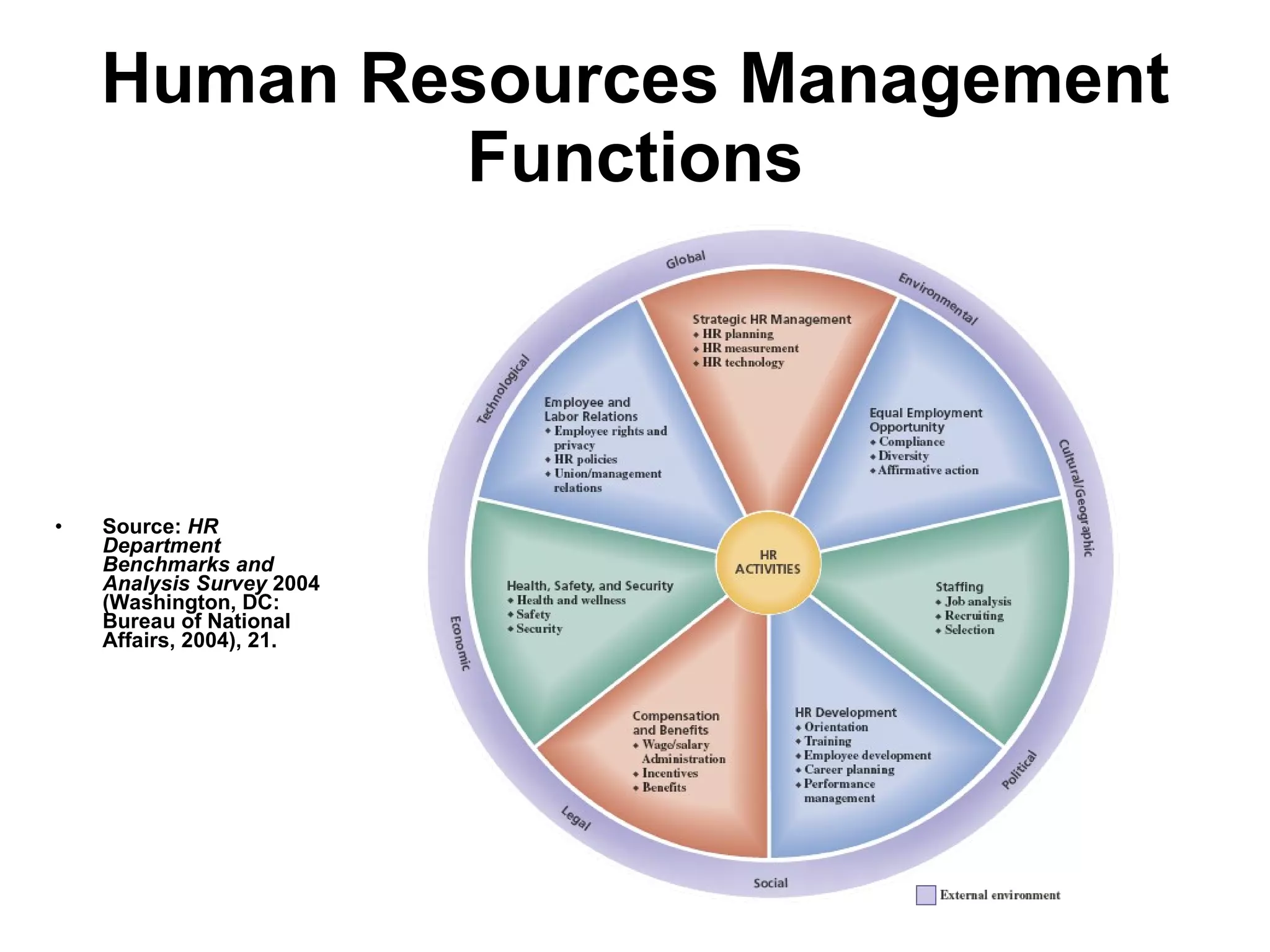
Human Resources Management   Functions Strategic HR Management Equal Employment Opportunity Staffing HR Development Compensation and Benefits Health, Safety, and Security Employee and Labor Relations
Human Resources Management   Functions Source:  HR Department Benchmarks and Analysis Survey  2004 (Washington, DC: Bureau of National Affairs, 2004), 21.
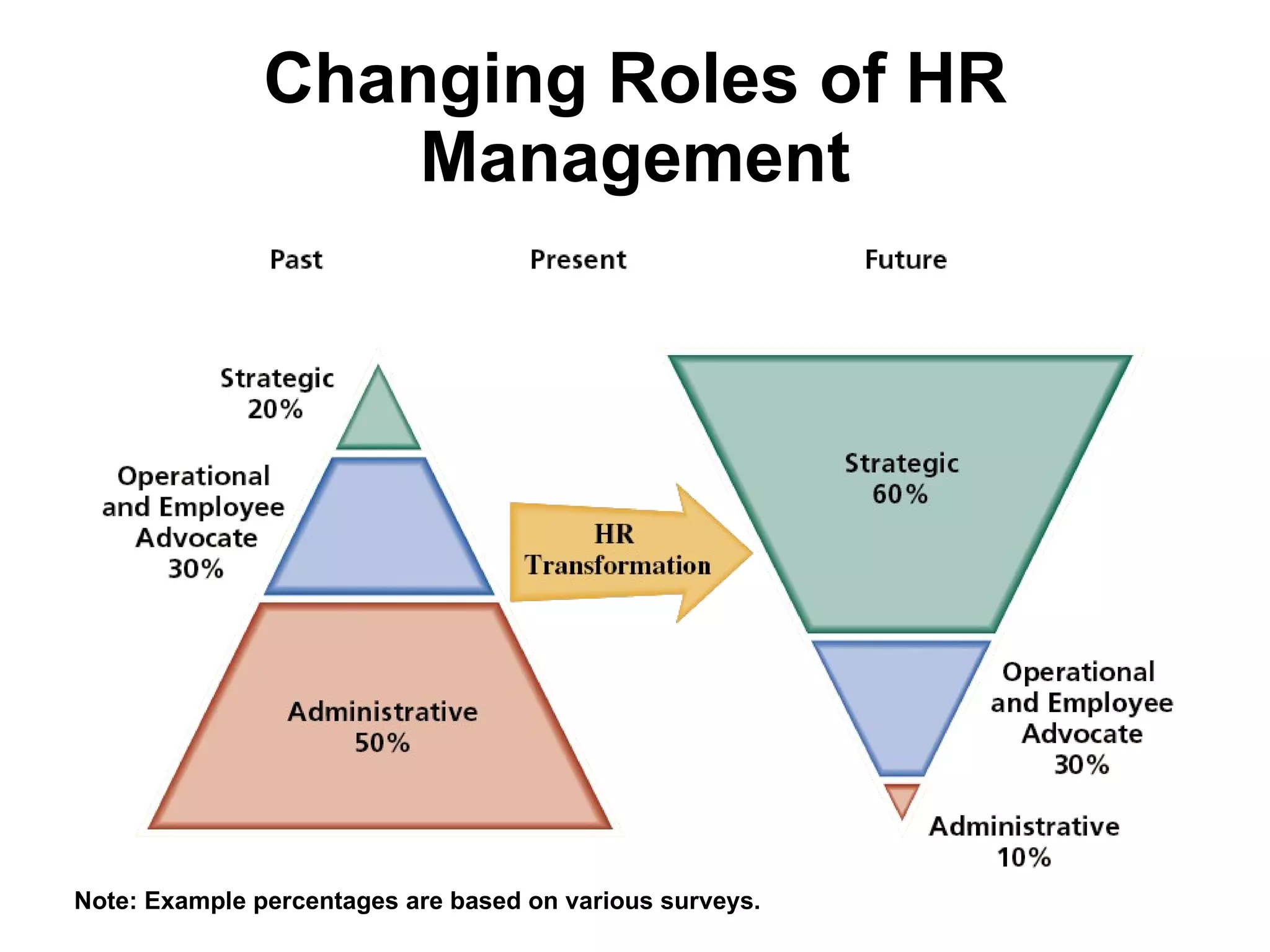
The Changing Human Resources Role The role of the HR professional is changing. In the past, HR managers were often viewed as the systematizing, policing arm of executive management.  Their role was more closely aligned with personnel and administration functions that were viewed by the organization as paperwork.
Changing Roles of HR Management Note: Example percentages are based on various surveys.
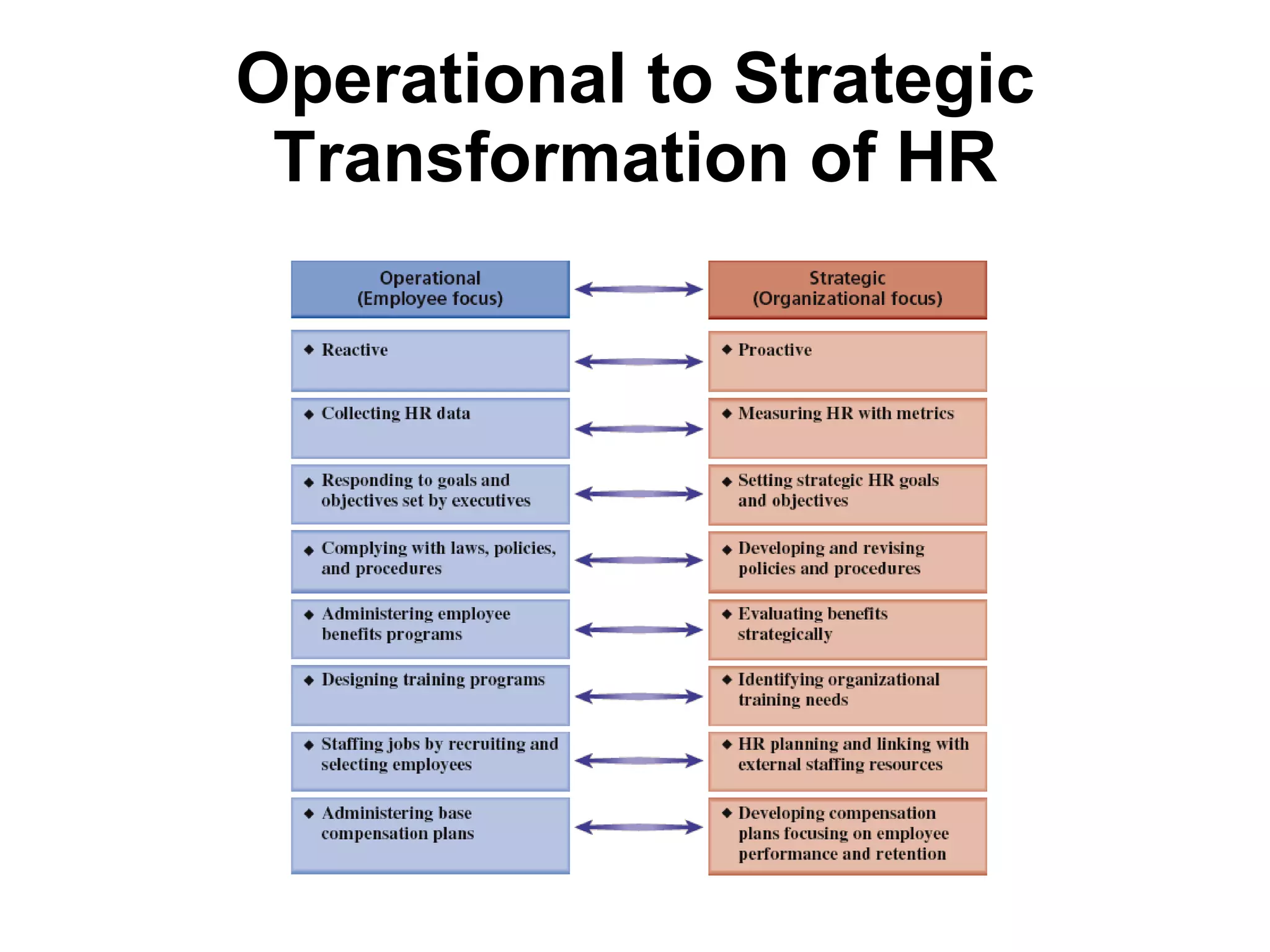
Operational to Strategic Transformation of HR
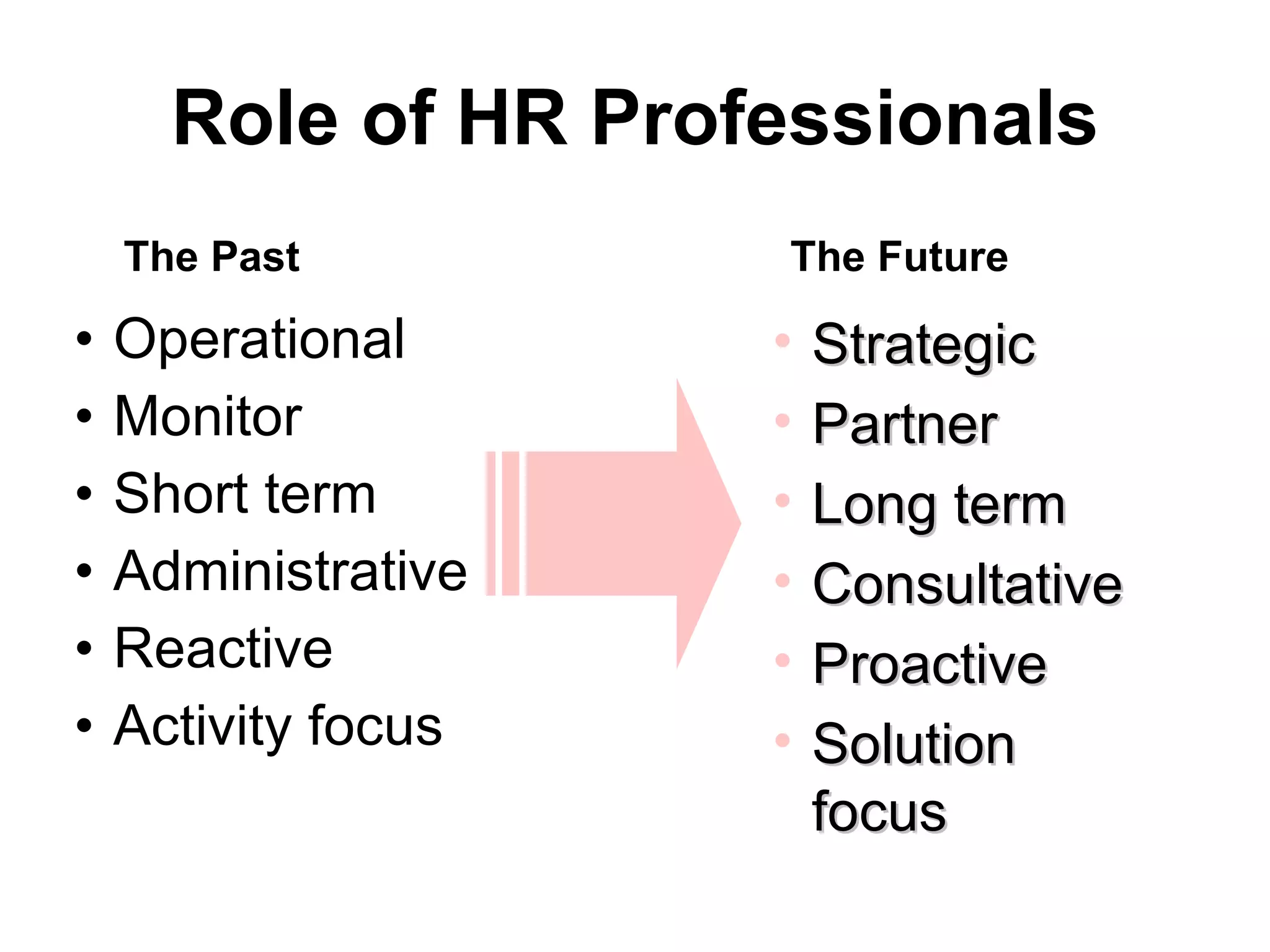
Role of HR Professionals Operational Monitor Short term Administrative Reactive Activity focus The Past The Future Strategic Partner Long term Consultative Proactive Solution focus
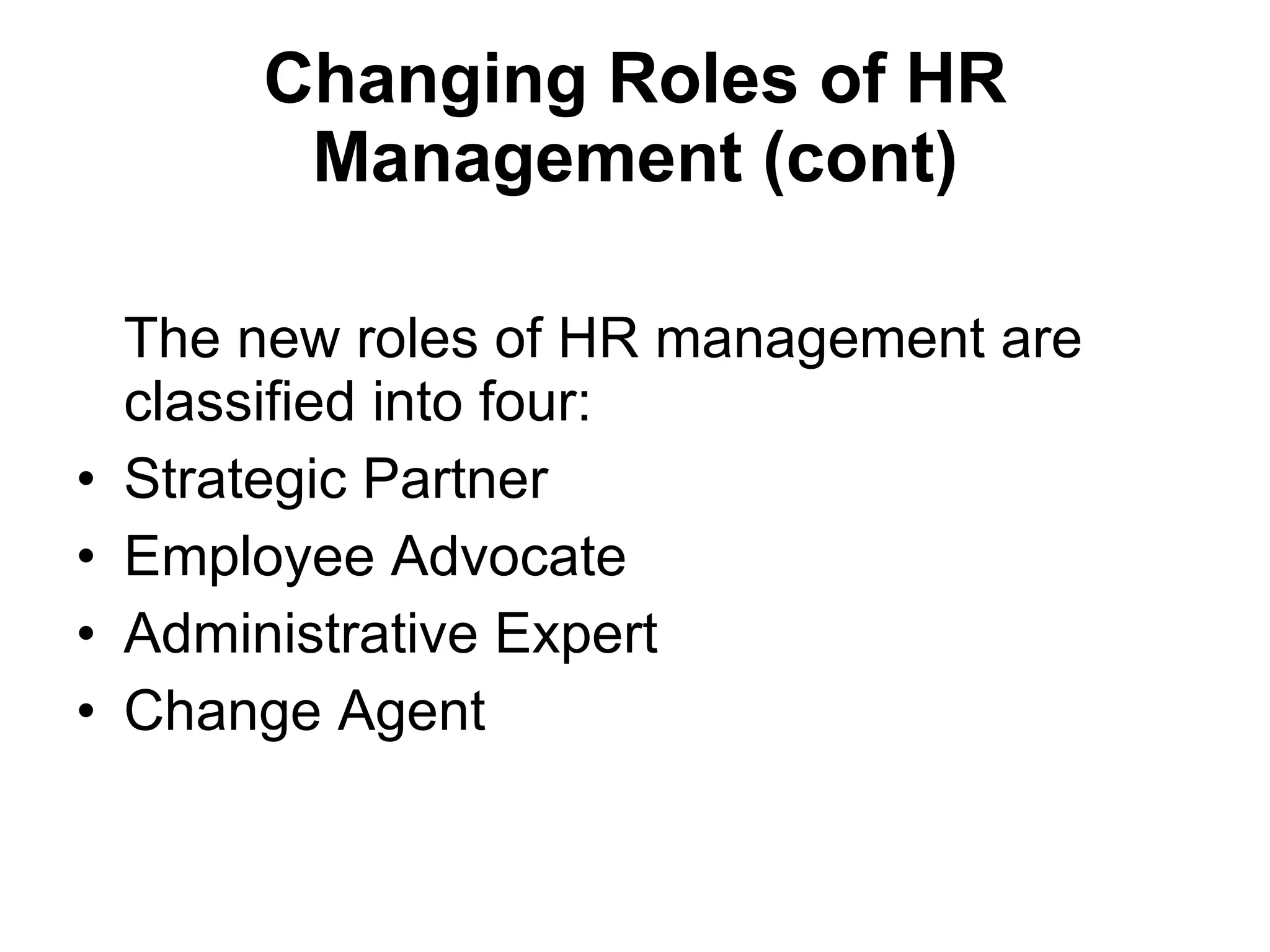
Changing Roles of HR Management (cont) The new roles of HR management are classified into four: Strategic Partner Employee Advocate Administrative Expert Change Agent
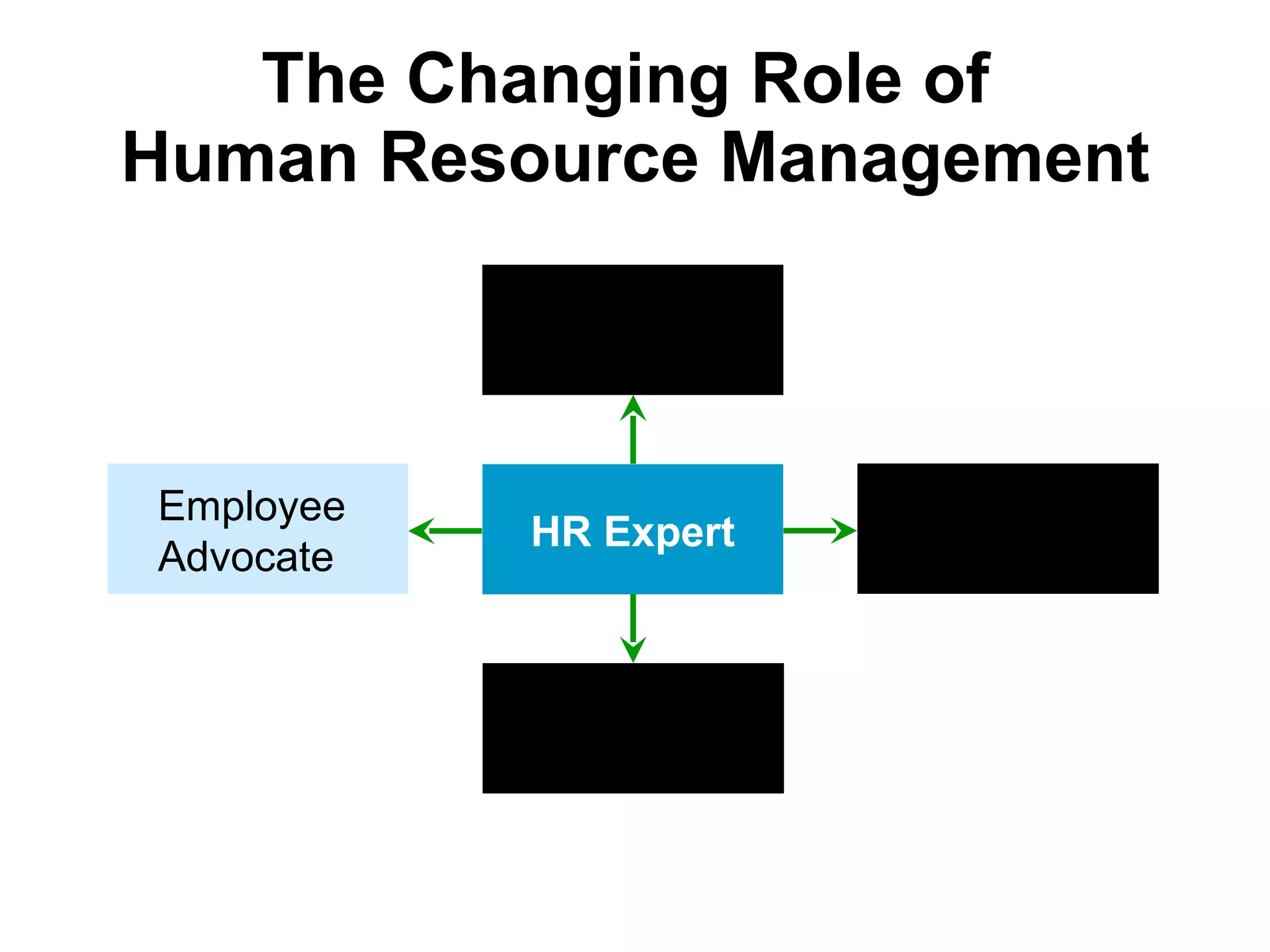
The Changing Role of  Human Resource Management HR Expert Change Agent Employee  Advocate Administrative Expert Strategic  Partner
The Changing Human Resources Role (cont) Strategic  Partner In this role, the HR person contributes to the development of and the accomplishment of the organization-wide business plan and objectives.
The Changing Human Resources Role (cont) Strategic  Partner To be successful business partners, the HR staff members have to think like business people, know finance and accounting, and be accountable and responsible for cost reductions and the measurement of all HR programs and processes.  It's not enough to  ask for a seat at the executive table ; HR people will have to prove they have the business savvy necessary to sit there.
The Changing Human Resources Role (cont) HR requires some competencies to  become a strategic partner. These are: Leadership competencies Knowledge of business Strategic Thinking Process skills Technology
The Changing Human Resources Role (cont) Leadership competencies Understand the nature and styles of leadership, and display appropriate leadership characteristics in performance of professional responsibilities. Demonstrate leadership at multiple performance levels: Individual Team Unit or Organization
The Changing Human Resources Role (cont Knowledge of business Understand corporate business (structure, vision and values, goals, strategies, financial, and performance characteristics). Understand the unit’s business, including special knowledge of competitors, products, technology, and sources of competitive advantage.
The Changing Human Resources Role (cont Knowledge of business   (cont) Understand internal and external customers. Understand the environment (external and internal) of corporation and individual businesses. Understand key business disciplines Nature, scope, and HR implications of business globalization Information technology as it affects competitiveness and business processes
The Changing Human Resources Role (cont Strategic Thinking Understand the strategic business planning process. Understand and be able to apply a systematic HR planning process. Be able to select, design, and integrate HR systems or practices to build organizational mindset, capability, and competitive advantage for the business. Be able to develop and integrate business unit HR strategies within framework of corporate HR strategies.
The Changing Human Resources Role (cont Process skills All HR professionals should be competent in key corporate processes and understand management processes critical to particular business units. Understand key process skills such as consulting, problem solving, evaluation/diagnosis, workshop design, and facilitation.
The Changing Human Resources Role (cont Process skills (cont) Understand the basic principles, methodologies, and processes or organizational change and development.  Facilitate and manage organizational change. Balance, integrate, and manage under conditions of uncertainty and paradox .
The Changing Human Resources Role (cont Technology Maintain HR documentation using knowledge management and technology Build firm’s capability using info systems Provide training in use of technology
The Changing Human Resources Role (cont) Administrative Expert HR expert will be working to improve organizational processes and deliver basic HR services,
The Changing Human Resources Role (cont) Employee Advocate As an employee advocate, the HR manager plays an integral role in organizational success via his knowledge about and advocacy of people.
The Changing Human Resources Role (cont) Employee Advocate (cont) This advocacy includes expertise in how to: Builds employee ownership of the organization. Establish the organizational culture and climate in which people have the competency, concern and commitment to serve customers well.  Create a work environment in which people will choose to be motivated, contributing, and happy.
The Changing Human Resources Role (cont) Change Agent HR executives sponsors change in other departments and in work practices.  They champion the identification of the organizational mission, vision, values, goals and action plans in other to promote the overall success of his organization. They help determine the measures that will tell the organization how well it is succeeding in all of this.
Reasons for Human Resources Changing Role There are various reasons for human resource changing role, including: The acceptance by many large organizations that people are their most important asset The search for more effective ways in managing  diverse employees .
Reasons for Human Resources Changing Role The strategic position of people in leveraging organization' competitive advantage based on their skills, knowledge and personalities The fear that the HR Department and HR professionals will fade into insignificance.
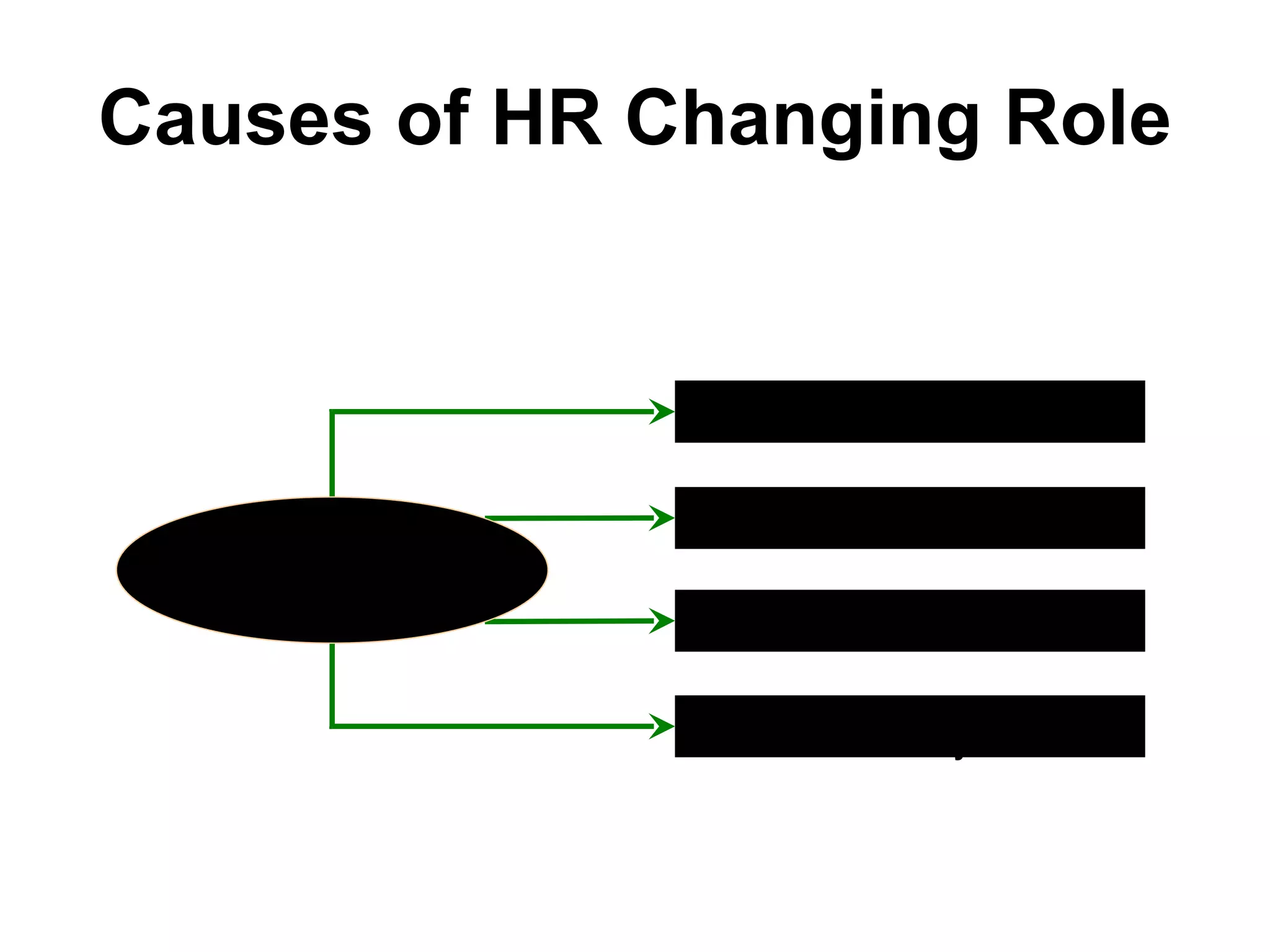
Causes of HR Changing Role Globalization  Technological Advances Trends in the Nature of Work Workforce Demographic & Diversity Causes of Human Resource  Mgt  Changing Role
Causes of HR Changing Role (cont) Globalization: T endency of firms to extend their sales and manufacturing to new markets abroad  Technological advances: T echnology has been forcing and enabling firms to become more competitive (skilled employee, empowerment)
Causes of HR Changing Role (cont) The nature of work: Human capital(knowledge, education, training, skills and expertise of a firm’s worker) provides competitive advantage The workforce  diversity : I ncreased diversity provide challenges for HR management
The Implications  Changing Roles Of HR Management The changing role of human resources has tremendous implications not just for businesses, but for the human resources function and for all human resources professionals.
The Implications  Changing Roles Of HR Management (cont) The implications of this are that:   Administrative skills are no longer enough; human resources now demands a skill mix that also includes consulting, coaching and communication, along with broad understanding of business issues.
The Implications  Changing Roles Of HR Management (cont) Human resource professionals will be expected to demonstrate an enhanced set of core competencies to effectively handle their expanded responsibility.
The Implications  Changing Roles Of HR Management (cont) Organizations will seek human resource professionals who can align human resources strategy with business strategy to make a positive impact on the bottom line.
Thank You

The changing role of human resource function

  • 1.
    THE CHANGING ROLEOF HUMAN RESOURCE FUNCTION by DR JANEFRANCIS I. DURU B.A, MPA, Ph.D, MNIM, ACIPM, MNITAD [email_address] 0803 3210968
  • 2.
    Course Objectives Bythe end of this session, participants will be able to: Define HR management List and define the seven categories of HR activities. Describe the new four roles of HR management. Identify three causes of the changing HR Roles.
  • 3.
    What is HumanResources? Human Resources are the people in the organization
  • 4.
    What is HumanResources Management? Human Resource Management can be defined as the implementation of the strategies, plans and programs required to attract, motivate, develop, reward and retain the best people to meet the organizational goals and operational objectives of the organization.
  • 5.
    Human Resources Management Functions Strategic HR Management Equal Employment Opportunity Staffing HR Development Compensation and Benefits Health, Safety, and Security Employee and Labor Relations
  • 6.
    Human Resources Management Functions Source: HR Department Benchmarks and Analysis Survey 2004 (Washington, DC: Bureau of National Affairs, 2004), 21.
  • 7.
    The Changing HumanResources Role The role of the HR professional is changing. In the past, HR managers were often viewed as the systematizing, policing arm of executive management. Their role was more closely aligned with personnel and administration functions that were viewed by the organization as paperwork.
  • 8.
    Changing Roles ofHR Management Note: Example percentages are based on various surveys.
  • 9.
    Operational to StrategicTransformation of HR
  • 10.
    Role of HRProfessionals Operational Monitor Short term Administrative Reactive Activity focus The Past The Future Strategic Partner Long term Consultative Proactive Solution focus
  • 11.
    Changing Roles ofHR Management (cont) The new roles of HR management are classified into four: Strategic Partner Employee Advocate Administrative Expert Change Agent
  • 12.
    The Changing Roleof Human Resource Management HR Expert Change Agent Employee Advocate Administrative Expert Strategic Partner
  • 13.
    The Changing HumanResources Role (cont) Strategic Partner In this role, the HR person contributes to the development of and the accomplishment of the organization-wide business plan and objectives.
  • 14.
    The Changing HumanResources Role (cont) Strategic Partner To be successful business partners, the HR staff members have to think like business people, know finance and accounting, and be accountable and responsible for cost reductions and the measurement of all HR programs and processes. It's not enough to ask for a seat at the executive table ; HR people will have to prove they have the business savvy necessary to sit there.
  • 15.
    The Changing HumanResources Role (cont) HR requires some competencies to become a strategic partner. These are: Leadership competencies Knowledge of business Strategic Thinking Process skills Technology
  • 16.
    The Changing HumanResources Role (cont) Leadership competencies Understand the nature and styles of leadership, and display appropriate leadership characteristics in performance of professional responsibilities. Demonstrate leadership at multiple performance levels: Individual Team Unit or Organization
  • 17.
    The Changing HumanResources Role (cont Knowledge of business Understand corporate business (structure, vision and values, goals, strategies, financial, and performance characteristics). Understand the unit’s business, including special knowledge of competitors, products, technology, and sources of competitive advantage.
  • 18.
    The Changing HumanResources Role (cont Knowledge of business (cont) Understand internal and external customers. Understand the environment (external and internal) of corporation and individual businesses. Understand key business disciplines Nature, scope, and HR implications of business globalization Information technology as it affects competitiveness and business processes
  • 19.
    The Changing HumanResources Role (cont Strategic Thinking Understand the strategic business planning process. Understand and be able to apply a systematic HR planning process. Be able to select, design, and integrate HR systems or practices to build organizational mindset, capability, and competitive advantage for the business. Be able to develop and integrate business unit HR strategies within framework of corporate HR strategies.
  • 20.
    The Changing HumanResources Role (cont Process skills All HR professionals should be competent in key corporate processes and understand management processes critical to particular business units. Understand key process skills such as consulting, problem solving, evaluation/diagnosis, workshop design, and facilitation.
  • 21.
    The Changing HumanResources Role (cont Process skills (cont) Understand the basic principles, methodologies, and processes or organizational change and development. Facilitate and manage organizational change. Balance, integrate, and manage under conditions of uncertainty and paradox .
  • 22.
    The Changing HumanResources Role (cont Technology Maintain HR documentation using knowledge management and technology Build firm’s capability using info systems Provide training in use of technology
  • 23.
    The Changing HumanResources Role (cont) Administrative Expert HR expert will be working to improve organizational processes and deliver basic HR services,
  • 24.
    The Changing HumanResources Role (cont) Employee Advocate As an employee advocate, the HR manager plays an integral role in organizational success via his knowledge about and advocacy of people.
  • 25.
    The Changing HumanResources Role (cont) Employee Advocate (cont) This advocacy includes expertise in how to: Builds employee ownership of the organization. Establish the organizational culture and climate in which people have the competency, concern and commitment to serve customers well. Create a work environment in which people will choose to be motivated, contributing, and happy.
  • 26.
    The Changing HumanResources Role (cont) Change Agent HR executives sponsors change in other departments and in work practices. They champion the identification of the organizational mission, vision, values, goals and action plans in other to promote the overall success of his organization. They help determine the measures that will tell the organization how well it is succeeding in all of this.
  • 27.
    Reasons for HumanResources Changing Role There are various reasons for human resource changing role, including: The acceptance by many large organizations that people are their most important asset The search for more effective ways in managing diverse employees .
  • 28.
    Reasons for HumanResources Changing Role The strategic position of people in leveraging organization' competitive advantage based on their skills, knowledge and personalities The fear that the HR Department and HR professionals will fade into insignificance.
  • 29.
    Causes of HRChanging Role Globalization Technological Advances Trends in the Nature of Work Workforce Demographic & Diversity Causes of Human Resource Mgt Changing Role
  • 30.
    Causes of HRChanging Role (cont) Globalization: T endency of firms to extend their sales and manufacturing to new markets abroad Technological advances: T echnology has been forcing and enabling firms to become more competitive (skilled employee, empowerment)
  • 31.
    Causes of HRChanging Role (cont) The nature of work: Human capital(knowledge, education, training, skills and expertise of a firm’s worker) provides competitive advantage The workforce diversity : I ncreased diversity provide challenges for HR management
  • 32.
    The Implications Changing Roles Of HR Management The changing role of human resources has tremendous implications not just for businesses, but for the human resources function and for all human resources professionals.
  • 33.
    The Implications Changing Roles Of HR Management (cont) The implications of this are that: Administrative skills are no longer enough; human resources now demands a skill mix that also includes consulting, coaching and communication, along with broad understanding of business issues.
  • 34.
    The Implications Changing Roles Of HR Management (cont) Human resource professionals will be expected to demonstrate an enhanced set of core competencies to effectively handle their expanded responsibility.
  • 35.
    The Implications Changing Roles Of HR Management (cont) Organizations will seek human resource professionals who can align human resources strategy with business strategy to make a positive impact on the bottom line.
  • 36.