Case Analysis:
Patagonia
Team 2: Jerad Stahlinski
Aneesh Jain
Aidan Kanell
Brian Long
Elena Pappas
•Patagonia
o Back-of-the-car Operation (1957)
 Yvon Chouinard
o Chouinard Equipment (1966)
 Largest supplier of outdoor climbing equipment
(1970)
 Patagonia (Apparel Line, 1972)
 Chouinard Equipment was sold (1980’s)
Patagonia
• Patagonia Co. (1979)
o 1972-1980’s Patagonia grew sales from 20 to 100
million
o Expanded Internationally
o Grossing 200 million in net sales by 2000
• Patagonia Philosophy
o Patagonia strives to build the best product, cause
no unnecessary harm, and use business to inspire
and implement solutions to the environmental
Patagonia cont...
•CEO
 Rapid Turnover in Sr. Mgmt. between 1990’s-
2000
 Casey Sheahan took over in 2005
• Long time friend of the Chouinard’s
•Growth
o Average 6% growth sales 2000-2010
o 2010-2015 Target goal of 10% annual growth
Patagonia cont...
•External Environmental Analysis
•Internal Analysis
•Business-level / Corporate-level Strategy
•Firms Performance
Strategic Management Process
•Macro Level (PESTEL)
•Industry Environment (Porters Five
Forces)
•Competitive Environment
External Environmental Analysis
● Political
● Economic
● Sociocultural
● Technology
● Ecological
● Legal
PESTEL Analysis
● Threat of Entry
● Power of Suppliers
● Power of Buyers
● Threat of Substitutes
● Rivalry Among Existing Competitors
● Complements
Porter’s Five Forces
● Many Firms
○ The North Face Inc., Marmot Mountain Ltd.,
Mountain Hardware, and ARC’TERYX
● Differentiated Products
○ High End outdoor apparel
● Obstacles to Entry
● Can raise prices for a unique product
Monopolistic Competition
•Resources, Capabilities and Competencies
•VRIO Analysis
•Value Chain
Internal Analysis
•Goal is to apply environmentally sustainable
methods to better use resources
•With these better resources, brings greater
appeal, and ultimately more money from
consumer
•Including:
Conventional & Organic Cottons
Less damaging dyes and fabrics
Resources
• “Never be happy playing by the normal rules of
business”
• Appeal to the “dirtbags” (core-users)
• Simplicity being the main goal
• Strive to consume less, yet consume better
• Being a private company, money can be
distributed however Patagonia pleases
Capabilities
“Build the best product, cause no unnecessary harm, and use business
to inspire and implement solutions to the environmental crisis”
‘5 Pronged Business Initiative’
1.Lead examined life
2.Clean up own act
3.Do our penance
4.Support civil democracy
5.Influence other companies
Balance between environmental commitment & business
Consume less, but consume better!
Competencies
• Valuable:
o ‘Product Life Cycle Initiative’, ‘1% for the
Planet’, Organic Cotton
• Rare:
o Donates revenue to environmental org’s worldwide
o Pioneer of organic cottons, leading to industry shift
o Leader in field of recycling and sustainability
VRIO Analysis
• Imitation costs:
o Risked 20% companies stake ($20 million) on organics
o Organics cost triple the price of conventional cotton (500-100%)
o Recycling initiative costs over $60,000 yearly
o Invests $3 million yearly for innovations ( R&D )
• Organized to Capture Value:
o Sold 8% more with organic products over competitors comparable
products
VRIO Analysis cont...
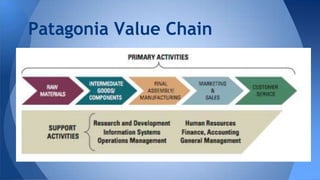
Primary
•Raw Materials
•Intermediate Goods/Components
•Marketing/Sales
•Customer Service
Support
•R&D
•H/R
•General Management
Value Chain
•Patagonia uses a focused differentiation strategy.
•They focus on a narrow segment of customers, who are willing to pay a
premium price.
•They compete in the high end outdoor apparel industry.
•Patagonia’s product line consists of four main product categories: Sports
wear (casual clothing including cotton shirts), Technical Outerwear
(insulation garments such as technical shells), Technical Knits (baselayers
with special fabric treatment), and Hard Goods (packs, luggage, and
accessories).
Business Level Strategy
1.Quality
2.Environmental Impact
3.Innovation
•Patagonia believes that these elements allowed it to charge prices
roughly 20% higher than those of other outdoor apparel and 50% higher
than mass- market brands for comparable products in both performance
wear and sportswear
•Chouinard states that, “Our goal is to offer only viable, excellent
products that are as multifunctional as possible so a customer can
consume less but consume better.”
When developing their products Patagonia
focuses on 3 main criteria:
•Patagonia built products for it’s core users, which they
define as customers who follow the “dirtbag lifestyle”.
•They meet these customers needs by producing
products that are simple, functional, and
multifunctional.
• In order to ensure such quality Patagonia spent
$100,000 on field testing performed by ambassadors
that assessed the quality of their different products.
Quality
• Patagonia makes business decisions based on
environmental impact. They are committed to
reducing their environmental impact at every level of
production.
o Common Threads Recycling Program
• An example of this commitment is when In 1996
Patagonia made the expensive switch to organic cotton
and remained committed to this decision despite a loss
in profit in the first two years.
Environmental Impact
•Patagonia is an industry leader in technological innovation. They
invested $3 million annually in research and development, which
includes a lab developing and testing new materials.
•They have developed many fabrics that have been adopted across the
industry.
•Their most successful patented technologies and designs, include
Synchilla (recycled polyester fleece), Capilene (moisture-wicking
polyester fabric), and most recently, a wetsuit lined with chlorine-free
wool for increased insulation.
Innovation
•Patagonia operates more as a single business company rather than a
diversified business.
•They have mostly stuck to the outdoor apparel industry. The
diversification Patagonia displays is to their product line and numerous
environmental initiatives the company is involved in.
•One example of Patagonia's diversification is their Textile Exchange
program, which brings together product brands, retailers, farmers, and
key stakeholders to teach about social and environmental benefits of
environmentally friendly textiles.
Corporate-Level Strategy
•Patagonia average customer is 38 years old with an average household
income $160,000.
•In 2010 Patagonia recorded their highest net sales in the North
American Market.
•Their second largest global market by net sales is Japan, which is then
followed by European and the somewhat newly established South
American market.
•Patagonia serves the international customers by offering online orders
available internationally.
International Scope
•Financial Performance
•Industry Comparison
•What trends are evident over the past
three to five years
•Internal/External Stakeholders
•Competitive Advantage
Analyze the Firms Performance
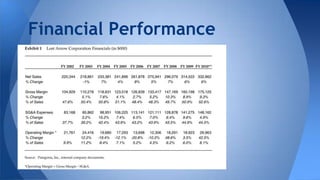
Financial Performance
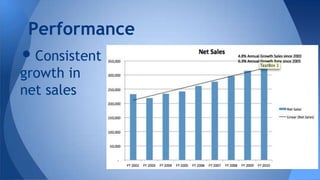
•Consistent
growth in
net sales
Performance
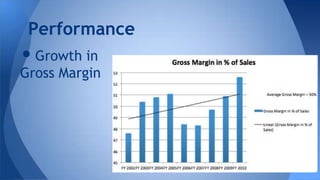
•Growth in
Gross Margin
Performance
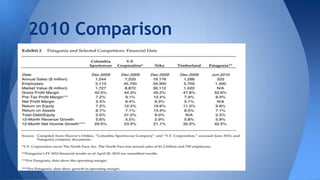
2010 Comparison
External
o Triple Bottom Line:
Social, Economic, Ecological
o Continuous Innovation
o Better quality and reduced effect on earth
Stakeholder Perspective
Internal
oEnergy efficient buildings
oOrganic Cafeteria
oPaid sabbatical
oSubsidy for purchase of Hybrid vehicle
oBail payment for arrested employees of nonviolent
activism
oMaternity/Paternity leave
oOn site day-care for employees
Stakeholders Perspective cont...
•Higher quality product=higher value
added to the customer
•Higher cost to produce along with higher
quality allows for higher price of product
Competitive Advantage
•Highest % Net Income growth for industry
at 42.5%
•Private Company
•Leading Innovator makes competitors
follow and catch-up
Competitive Advantage
•Gross Margin: 50% average between
2002-2010
•Return on assets(ROA): 7.1%
•Return on Equity(ROE): 9.6%
•Return on revenue(ROR): 8.1%
Financial Ratios
•Resources and Capabilities vs External
Environment
•Competitive Advantage
•Value Chain
•SWAT Analysis
Making the Diagnosis
•Problems
o High costs
o Limited suppliers
o Expensive raw materials
o Costly innovation
o Costly mission to be environmentally
friendly
Resources and Capabilities vs
External Environment
•Environmental commitment
•Sustainability
•Innovation
Competitive Advantage
SWOT Analysis
Strengths
● Environmental Reputation
● High quality products
● Patented Innovative products
● Private structure
● Low employee turnover
● Strong community relationship
Weaknesses
● Political views
● Low customer accessibility
● Limited suppliers
● Limited product lines
● Environmental focus
Opportunities
● International Markets
● Going Public
● Increase retail stores
Threats
● Public Companies
• Problems/Solutions
o Political views
o Low customer accessibility
o Limited suppliers
o Limited product lines
o Environmental focus
Formulation: Proposing A
Feasible Solutions
Patagonia Value Chain
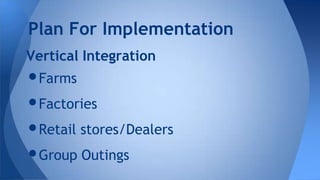
Vertical Integration
•Farms
•Factories
•Retail stores/Dealers
•Group Outings
Plan For Implementation
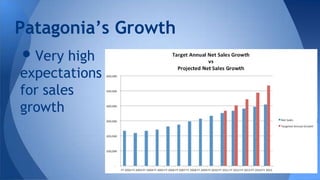
•Very high
expectations
for sales
growth
Patagonia’s Growth
Do not go public!
• Environmental Practices and Image
• Corporate Structure
• What would happen?
• Business model applied to other industries

Patagonia: Case Analysis

  • 1.
    Case Analysis: Patagonia Team 2:Jerad Stahlinski Aneesh Jain Aidan Kanell Brian Long Elena Pappas
  • 2.
    •Patagonia o Back-of-the-car Operation(1957)  Yvon Chouinard o Chouinard Equipment (1966)  Largest supplier of outdoor climbing equipment (1970)  Patagonia (Apparel Line, 1972)  Chouinard Equipment was sold (1980’s) Patagonia
  • 3.
    • Patagonia Co.(1979) o 1972-1980’s Patagonia grew sales from 20 to 100 million o Expanded Internationally o Grossing 200 million in net sales by 2000 • Patagonia Philosophy o Patagonia strives to build the best product, cause no unnecessary harm, and use business to inspire and implement solutions to the environmental Patagonia cont...
  • 4.
    •CEO  Rapid Turnoverin Sr. Mgmt. between 1990’s- 2000  Casey Sheahan took over in 2005 • Long time friend of the Chouinard’s •Growth o Average 6% growth sales 2000-2010 o 2010-2015 Target goal of 10% annual growth Patagonia cont...
  • 5.
    •External Environmental Analysis •InternalAnalysis •Business-level / Corporate-level Strategy •Firms Performance Strategic Management Process
  • 6.
    •Macro Level (PESTEL) •IndustryEnvironment (Porters Five Forces) •Competitive Environment External Environmental Analysis
  • 7.
    ● Political ● Economic ●Sociocultural ● Technology ● Ecological ● Legal PESTEL Analysis
  • 8.
    ● Threat ofEntry ● Power of Suppliers ● Power of Buyers ● Threat of Substitutes ● Rivalry Among Existing Competitors ● Complements Porter’s Five Forces
  • 9.
    ● Many Firms ○The North Face Inc., Marmot Mountain Ltd., Mountain Hardware, and ARC’TERYX ● Differentiated Products ○ High End outdoor apparel ● Obstacles to Entry ● Can raise prices for a unique product Monopolistic Competition
  • 10.
    •Resources, Capabilities andCompetencies •VRIO Analysis •Value Chain Internal Analysis
  • 11.
    •Goal is toapply environmentally sustainable methods to better use resources •With these better resources, brings greater appeal, and ultimately more money from consumer •Including: Conventional & Organic Cottons Less damaging dyes and fabrics Resources
  • 12.
    • “Never behappy playing by the normal rules of business” • Appeal to the “dirtbags” (core-users) • Simplicity being the main goal • Strive to consume less, yet consume better • Being a private company, money can be distributed however Patagonia pleases Capabilities
  • 13.
    “Build the bestproduct, cause no unnecessary harm, and use business to inspire and implement solutions to the environmental crisis” ‘5 Pronged Business Initiative’ 1.Lead examined life 2.Clean up own act 3.Do our penance 4.Support civil democracy 5.Influence other companies Balance between environmental commitment & business Consume less, but consume better! Competencies
  • 14.
    • Valuable: o ‘ProductLife Cycle Initiative’, ‘1% for the Planet’, Organic Cotton • Rare: o Donates revenue to environmental org’s worldwide o Pioneer of organic cottons, leading to industry shift o Leader in field of recycling and sustainability VRIO Analysis
  • 15.
    • Imitation costs: oRisked 20% companies stake ($20 million) on organics o Organics cost triple the price of conventional cotton (500-100%) o Recycling initiative costs over $60,000 yearly o Invests $3 million yearly for innovations ( R&D ) • Organized to Capture Value: o Sold 8% more with organic products over competitors comparable products VRIO Analysis cont...
  • 16.
    Primary •Raw Materials •Intermediate Goods/Components •Marketing/Sales •CustomerService Support •R&D •H/R •General Management Value Chain
  • 17.
    •Patagonia uses afocused differentiation strategy. •They focus on a narrow segment of customers, who are willing to pay a premium price. •They compete in the high end outdoor apparel industry. •Patagonia’s product line consists of four main product categories: Sports wear (casual clothing including cotton shirts), Technical Outerwear (insulation garments such as technical shells), Technical Knits (baselayers with special fabric treatment), and Hard Goods (packs, luggage, and accessories). Business Level Strategy
  • 18.
    1.Quality 2.Environmental Impact 3.Innovation •Patagonia believesthat these elements allowed it to charge prices roughly 20% higher than those of other outdoor apparel and 50% higher than mass- market brands for comparable products in both performance wear and sportswear •Chouinard states that, “Our goal is to offer only viable, excellent products that are as multifunctional as possible so a customer can consume less but consume better.” When developing their products Patagonia focuses on 3 main criteria:
  • 19.
    •Patagonia built productsfor it’s core users, which they define as customers who follow the “dirtbag lifestyle”. •They meet these customers needs by producing products that are simple, functional, and multifunctional. • In order to ensure such quality Patagonia spent $100,000 on field testing performed by ambassadors that assessed the quality of their different products. Quality
  • 20.
    • Patagonia makesbusiness decisions based on environmental impact. They are committed to reducing their environmental impact at every level of production. o Common Threads Recycling Program • An example of this commitment is when In 1996 Patagonia made the expensive switch to organic cotton and remained committed to this decision despite a loss in profit in the first two years. Environmental Impact
  • 21.
    •Patagonia is anindustry leader in technological innovation. They invested $3 million annually in research and development, which includes a lab developing and testing new materials. •They have developed many fabrics that have been adopted across the industry. •Their most successful patented technologies and designs, include Synchilla (recycled polyester fleece), Capilene (moisture-wicking polyester fabric), and most recently, a wetsuit lined with chlorine-free wool for increased insulation. Innovation
  • 22.
    •Patagonia operates moreas a single business company rather than a diversified business. •They have mostly stuck to the outdoor apparel industry. The diversification Patagonia displays is to their product line and numerous environmental initiatives the company is involved in. •One example of Patagonia's diversification is their Textile Exchange program, which brings together product brands, retailers, farmers, and key stakeholders to teach about social and environmental benefits of environmentally friendly textiles. Corporate-Level Strategy
  • 23.
    •Patagonia average customeris 38 years old with an average household income $160,000. •In 2010 Patagonia recorded their highest net sales in the North American Market. •Their second largest global market by net sales is Japan, which is then followed by European and the somewhat newly established South American market. •Patagonia serves the international customers by offering online orders available internationally. International Scope
  • 24.
    •Financial Performance •Industry Comparison •Whattrends are evident over the past three to five years •Internal/External Stakeholders •Competitive Advantage Analyze the Firms Performance
  • 25.
  • 26.
  • 27.
  • 28.
  • 29.
    External o Triple BottomLine: Social, Economic, Ecological o Continuous Innovation o Better quality and reduced effect on earth Stakeholder Perspective
  • 30.
    Internal oEnergy efficient buildings oOrganicCafeteria oPaid sabbatical oSubsidy for purchase of Hybrid vehicle oBail payment for arrested employees of nonviolent activism oMaternity/Paternity leave oOn site day-care for employees Stakeholders Perspective cont...
  • 31.
    •Higher quality product=highervalue added to the customer •Higher cost to produce along with higher quality allows for higher price of product Competitive Advantage
  • 32.
    •Highest % NetIncome growth for industry at 42.5% •Private Company •Leading Innovator makes competitors follow and catch-up Competitive Advantage
  • 33.
    •Gross Margin: 50%average between 2002-2010 •Return on assets(ROA): 7.1% •Return on Equity(ROE): 9.6% •Return on revenue(ROR): 8.1% Financial Ratios
  • 34.
    •Resources and Capabilitiesvs External Environment •Competitive Advantage •Value Chain •SWAT Analysis Making the Diagnosis
  • 35.
    •Problems o High costs oLimited suppliers o Expensive raw materials o Costly innovation o Costly mission to be environmentally friendly Resources and Capabilities vs External Environment
  • 36.
  • 37.
    SWOT Analysis Strengths ● EnvironmentalReputation ● High quality products ● Patented Innovative products ● Private structure ● Low employee turnover ● Strong community relationship Weaknesses ● Political views ● Low customer accessibility ● Limited suppliers ● Limited product lines ● Environmental focus Opportunities ● International Markets ● Going Public ● Increase retail stores Threats ● Public Companies
  • 38.
    • Problems/Solutions o Politicalviews o Low customer accessibility o Limited suppliers o Limited product lines o Environmental focus Formulation: Proposing A Feasible Solutions
  • 39.
  • 40.
  • 41.
  • 42.
    Do not gopublic! • Environmental Practices and Image • Corporate Structure • What would happen? • Business model applied to other industries