
STRATEGY EVALUATION, REVIEW AND
REDESIGN
BY
TANKO AHMED, fwc
Senior Fellow (Security & Strategic Studies)
Research Directorate, National Institute, Kuru
08037031744 – ta_mamuda@yahoo.com
A Lecture Delivered to the NIPSS Policy,
Strategy and Leadership Course 26 on Friday, 19
May, 2017
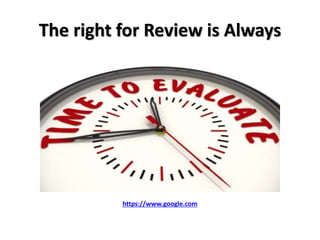
The right for Review is Always
https://www.google.com
Paper Abstract
• The combination of strategy evaluation, review
and redesign aptly captures the circular nature
of the strategic management process.
• This combination invokes the orbital but
progressive spiral path along which strategy
drives its formulation to implementation and
evaluation.
• The paper discusses strategy evaluation, review
and redesign or the point at which the cycle of
strategic management process end and restarts.
Paper’s Focus
• The paper explains the seeming similarities,
possible uniqueness and relationship of
strategy evaluation, review and redesign to
show how the trio functions as rear axles of
strategic management process.
• A simulation exercise is provided to facilitate
the application of knowledge skills on
strategy evaluation, review and redesign by
the NIPSS-PSLC Participants
Some Illustrations
Strategy without process is little more
than a wish list. – Robert Filek
However beautiful the strategy, you
should occasionally look at the results.
– Sir Winston Churchill
INTRODUCTION
“The organization does well those things that
the boss checks …” - An Old Army Adage
Background
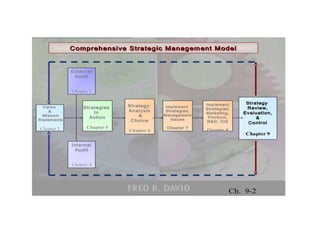
• The combination of strategy evaluation, review
and redesign aptly captures the circular nature
of the strategic management process (SMP).
• The SMP is a veritable tool for navigating the
complexity of applying the tenets of mission and
vision of organizations.
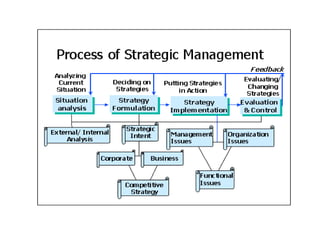
• It is conducted through routine activities, in
stages, from strategy formulation, strategy
implementation, and evaluation and control (Tse,
2010; Clayton, 2016).
Evaluation, Review and Redesign
• Strategy evaluation constitutes the final and
restarting point in completion and realignment to
the tasks of the strategic management process
cycle.
• Strategy review is the critical aspect of strategy
evaluation in which not only performance but also
possibility of redesign is put into close scrutiny.
• Strategy design or redesign helps organizations to
determine what to do next, why and how to
innovate new ways within immediate, sort or long
term periods (Duignan, n.d.).
A Living Process
• The SMP often turns stale or obsolete under
environmental impact or pressure of change making
systematic evaluation, review and redesign very
necessary (David, 2011).
• There is therefore the need for strategy to be
designed or formulated; applied or implemented;
and analysed or evaluated, in a continuous living
cycle or process.
• This paper discusses strategy evaluation, review
and redesign; or the point at which the cycle of
strategic management process ends as well as
restarts.
General Literature
• General literature on strategic management process
tends to focus on ways to counter the complexity
and obscurity of the subject for ease of clarity and
understanding.
• Guerras-Martin, Madhok & Montoro-Sanchez
(2014) trace the historical background, recent
trends and current directions of SMP and observe
the need for decipherment of its difficult terrain.
• An earlier work Hunger & Wheelen (1997) points to
managerial decisions and actions contributing to
performance toward goal attainment as aggregated
SMP.
Specific Literature
• Aremu (2003) and Parnell (2005) establish correlation
of SMP with performance as basis for strategic
philosophy of organizations.
• More recent works incline towards modelling and
breaking down of SMP stages and activities for better
understanding and more effective application (David,
2008; Vasile & Iancu, 2009; Clayton, 2015).
• Particular contributors of interest bring in contents
history of SMP and case studies with emphasis on the
need for elucidation.
• This work treads on same guiding principles as its
discourse.
General Theory
• The contingency nature of strategic management
process tends to harbour multiple but synergic
theoretical foundation including resource-based,
structure-conduct-performance, agency, and other
related approaches.
• Theories used in SMP share common core elements
of simplification, assumptions, concepts, processes
and cross-functional relationships (Parnell, 2005;
Bettis, et al. 2014).
• This paper dwells on the contingency nature of SMP
in building a theoretical framework based on cross-
functional relationship of organizational resources.
The Structure-Conduct-Performance (SCP)
Theory
• The SCP theory or paradigm was first devices by
Edward Chamberlin and Joan Robin in 1939 and
further developed into a model with theoretical
application (Faccarella & Kurz, 2016).
• The SCP theory focuses on environmental
influences capable of forcing organizations to re-
evaluate, re-view and re-design their strategies in
response to stimulus.
• It states that the structure, conduct and
performance of organizations are greatly influenced
by immediate, short and long term internal and
external environmental influence.
CONCEPTUALIZATION
Strategic Management Process
• The strategic management process (SMP) is an
objective, logical, systematic and continuous
approach for making major decisions and taking
actions in an organization (Yousuf, 2016).
• It is defined as a dynamic process of strategy
formulation, implementation, evaluation and control
(Parnell, 2005; David, 2008; Vasile & Iancu, 2009; Vatchkova,
2010; Hill, Jones & Schilling, 2015; Yousuf, 2016).
• Yousuf (2016) reflects on central cross-functional
feature of the SMP, synonymous to strategic planning,
in exploiting and creating new opportunities for the
future based on present trends or conditions.
Strategy Evaluation and Control
• Evaluation is the act of considering, examining,
assessing, calculating or appraising activities,
functions or situation to ascertain expected
value, quality, quantity, extent or condition.
• Control involves the exercise of power or
authority to oversee, manage or adjust
activities, tasks or ventures in line with set
direction.
• Strategy evaluation and control constitutes the
final tier completing the tasks of the SMP cycle.
What Strategy Evaluation Does
• This stage weighs performance data and
activity reports to appraise and adjust
undesired performance due to improper
application of the SMP for the purpose of
adjustment in line with organizational
strategy (Gomes, 2010).
• Strategy Evaluation and control is therefore
vital to an organization's survival, wellbeing
and progress (David, 2011).
Strategy Review
• A review is a critical evaluation or assessment of
activities, events, products or any subject with a
view to suggesting or applying remedies to
enhance or improve on current state.
• A strategy review examines the underlying basis
of strategy, compares actual to expected results,
and takes corrective action to address
performance or expectation gaps (Chelte, 2005).
• A standard strategy review compares expected
to actual results; investigates deviations from
plan; evaluates performance; and examines
progress toward stated objectives (David, 2011).
Strategy Redesign
• Evaluation designs or redesigns are the way in which
the evaluation ingredients like approach, purposes
and methods are put together into the final
evaluation in an attempt to answer a set of
evaluation questions.
• Evaluation design will indicate the overall evaluation
approach, the mix of formative, process and outcome
evaluation it is planned to carry out in the evaluation
and the methods and analysis to be used.
• If there is to be an outcome evaluation within the
evaluation, the design or redesign will specify which
of the many types of outcome design are to be used
(Duignan, n.d).
STRATEGY FORMULATION,
REVIEW AND REDESIGN
Challenges to Strategy Review
• The best formulated and best implemented strategies
become obsolete as the external and internal environments
of organizations change making it essential for strategists to
systematically review, evaluate, and control the execution of
strategies (David, 2011).
• Challenges to smooth strategy review include increasing
environmental complexity, difficulty in predicting the future
with accuracy, increasing number of issues and challenges,
rate of obsolesce, increase in domestic and outside events,
decreasing time span for planning with certainty (Chelte,
2005).
• These challenges capable of forcing organizations to re-
evaluate, re-view and re-design their strategies give
credence to the structure-conduct-performance theory of
organizations as the process necessitates and reinforces the
need for strategy evaluation, review and redesign.
Interplay of Design Principles and
Organizational Strategy
• Strategy design and redesign involves the
interplay of design principles and organizational
strategy to determine progress and possible
adjustment towards set goals and objectives.
• Redesigning strategy helps to promote and
adopt new ways and means like technology and
managerial system; it identifies most import
issues and challenges; and translates insights
into actionable solutions.
Other advantages
• Prioritizing the order and condition of
product and service portfolios;
• Connecting existing efforts with main
organizational strategy; and
• Integration of new strategy design as
fundamental aspect of strategic intent and
purposes (Chung, Hardy & So, 2000; Krishnan & Kumar,
2005; Buchanan, 2005; Chung & Freeze, 2008).
APPLICATION OF STRATEGY
EVALUATION, REVIEW AND REDESIGN
Emergent Processes
• Emergent processes and capabilities granted by the
Information and Communication Technology (ICT)
revolution enable and empower access to real time
situation and opportunity to contribute effectively in
current local to global events and activities.
• The tenets and attributes of strategy evaluation,
review and redesign are applicable to pressing
organizational issues and challenges at all levels of
work and existence.
• The opportunity to apply the knowledge and skills
from this lecture is situated in a simulation exercise
on the new Economic Recovery and Growth Plan
2017-2020 launched by the Federal Government of
Nigeria in February 2017.
Simulation Exercise
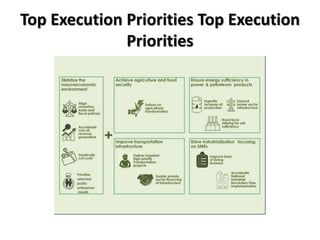
• The Top Execution Priorities of the Economic Recovery
Plan was the subject of a previous Simulation Exercise
for the NIPSS-PSLC Participants to discuss, decide and
develop possible improvements on the Plan.
• The second phase of the previous exercise requires
the Participants to apply a strategy evaluation, review
and redesign, if necessary, the Top Execution
Priorities by addressing how far has the programme
gone?
• The exercises are to be conducted by the two groups
and present to the whole house.
Top Execution Priorities Top Execution
Priorities
CONCLUSION
Summary
• The paper discusses strategy evaluation,
review and redesign within the cycle of
strategic management process.
• It takes the middle course theory of
organizational structure-conduct-
performance for its supportive attributes to
strategy evaluation, review and redesign.
Conclusion
The paper explains the seeming similarities,
possible uniqueness and relationship of
strategy evaluation, review and redesign and
shows that the trio functions as driver and
sustainer of strategic management process.
Recommendations
A simulation exercise is provided to facilitate
the application of knowledge skills on strategy
evaluation, review and redesign by the NIPSS-
PSLC Participants
THANK YOU FOR YOUR ATTENTION
Reference
Aremu, M. A. (2003). Enhancing organizational performance through strategic management: Conceptual and theoretical approach. Ilorin, NG: University of Ilorin.
http://www.unilorin.edu.ng/publications/maaremu/Ehancing-Organizational-Performance-through-Strategic-Manag.htm
Bettis, R. A., A. Gambardella, C. Helfat, & Mitchell, W. (2014). Theory in strategic management. Strategic Management Journal, June 25. Http://www.wileyonlinelibrary.com DOI:10.1002/smj.2308
Buchanan, L. (2005). From Cheap to WOW, Case Study, Thunderbird School of Global Management.
Chelte, A. F. (2005). Strategy review, evaluation and control. In David, F. Strategic Management: Concepts & Cases, 10th Edition. Retrieved from https://www.slideshare.net/opaprb/strategy-
review-evaluation-and-control-9301642?next_slideshow=1 16/5/17
Chung, K.; Freeze, K. (2008). Design Strategy at Samsung Electronics: Becoming a Top-Tier Company. Design Management Institute Case Study. Harvard Business School Publishing.
Chung, K.; Hardy, T.; So, S. (2000). Strategic Realization. Design Management Journal, Winter.
Clayton, J. (2016). The five stages of the strategic management process. Houston Chronicle. http://smallbusiness.cohn.com/five-stages-strategic-mamngement-process.18785.html
David, F. (2011). Strategic management: concepts & cases, 13th Edition. Chapter 9, Strategy Review, Evaluation, and Control.
David, F. R. (2008). Concepts of strategic management. (6th Edition). Upper Saddle River, NJ: Prince-Hall
Duan. M. (2007). Getting jump on good ideas. Silicon Valley / San Jose Business Journal, January 12.
Duignan, P. (n.d). Introduction to Strategic Evaluation: Section on Evaluation Approaches, Purposes, Methods and Designs. Retrieved from www.strategicevaluation.info/se/documents/104f.html
16/5/17
Faccarella, G. & Kurz, H. D. (2016). Handbook on the History of Economic Analysis Volume III Developments in Major Fields of Economic. Northampton, MA: Edward Elgar Publishing
Gomes, S. (2010). Strategic management process. https://xisspm.files.wordpress.com/2010/10/sm-chapter-2.pd
Guerras-Martin, L. A., Madhok, A. & Montoro-Sachez, A. (2014). The evolution of strategic management research: Recent trends and current directions. BRQ Business Research Quarterly, 17(2),
April-June, 69-76
Hill, C. W., Jones, G. R. & Schilling, M. A. (2015). Strategic management theory. (11th Edition). London, UK: Cengage Learning
Hunger, J. D. & Wheelen, T. L. (1997). Essentials of strategic management. HR Folks International. Retrieved from http://www.hrfolk.com
Krishnan, R.; Kumar, K. (2005). Capturing Value in Global Markets: The Case of Samsung Electronics. SCMS Journal of Indian Management. Indian Institute of Management, October - December.
Ologbo, A. C., O. S. Oluwatosin, & Okyere-Kwakye, E. (2012). Strategic management theories and linkage with firm competitive advantage from the human resource-based view. International
Journal of Research in Management and Technology, 2(4), August, 366-376
Parnell, J. A. (2005). Strategic philosophy and management level. Management Decision, 3(2), 157-170. Retrieved from http://www.emeraldinsight.com/0025.1747.htm
Tse, E. (2010). The China strategy: Harnessing the power of the world’s fastest growing economy. New York, NY: Basic Books
Vasile, T. & Iancu, A. (2009). A model of the strategic management process.
Vatchkova, E. (2012). Contents historical development of strategy: Strategic management. Retrieved from http://www.iuc.edu.eu./group/mba_learning/2012STRATMAN/EV-L1-introduction.pdf
Yousuf, M. (2016). The nature of strategic management Chapter I, What is strategic management. Academia.
https://www.academia.edu/6349510/THE_NATURE_OF_STRATEGIC_MANAGEMENT_I_WHAT_IS_STRATEGIC_MANAGEMENT
http://www.google.com.ng/hpinfo/globalcitizenship/08bcreport/pdf/hp_fy06_gcr.pdf
https://www.google.com.ng/search?q=STRATEGY+EVALUATION,+REVIEW+AND+REDESIGN

STRATEGY EVALUATION, REVIEW AND REDESIGN

  • 1.
    STRATEGY EVALUATION, REVIEWAND REDESIGN BY TANKO AHMED, fwc Senior Fellow (Security & Strategic Studies) Research Directorate, National Institute, Kuru 08037031744 – ta_mamuda@yahoo.com
  • 2.
    A Lecture Deliveredto the NIPSS Policy, Strategy and Leadership Course 26 on Friday, 19 May, 2017
  • 3.
    The right forReview is Always https://www.google.com
  • 4.
    Paper Abstract • Thecombination of strategy evaluation, review and redesign aptly captures the circular nature of the strategic management process. • This combination invokes the orbital but progressive spiral path along which strategy drives its formulation to implementation and evaluation. • The paper discusses strategy evaluation, review and redesign or the point at which the cycle of strategic management process end and restarts.
  • 5.
    Paper’s Focus • Thepaper explains the seeming similarities, possible uniqueness and relationship of strategy evaluation, review and redesign to show how the trio functions as rear axles of strategic management process. • A simulation exercise is provided to facilitate the application of knowledge skills on strategy evaluation, review and redesign by the NIPSS-PSLC Participants
  • 6.
    Some Illustrations Strategy withoutprocess is little more than a wish list. – Robert Filek However beautiful the strategy, you should occasionally look at the results. – Sir Winston Churchill
  • 7.
    INTRODUCTION “The organization doeswell those things that the boss checks …” - An Old Army Adage
  • 8.
    Background • The combinationof strategy evaluation, review and redesign aptly captures the circular nature of the strategic management process (SMP). • The SMP is a veritable tool for navigating the complexity of applying the tenets of mission and vision of organizations. • It is conducted through routine activities, in stages, from strategy formulation, strategy implementation, and evaluation and control (Tse, 2010; Clayton, 2016).
  • 10.
    Evaluation, Review andRedesign • Strategy evaluation constitutes the final and restarting point in completion and realignment to the tasks of the strategic management process cycle. • Strategy review is the critical aspect of strategy evaluation in which not only performance but also possibility of redesign is put into close scrutiny. • Strategy design or redesign helps organizations to determine what to do next, why and how to innovate new ways within immediate, sort or long term periods (Duignan, n.d.).
  • 11.
    A Living Process •The SMP often turns stale or obsolete under environmental impact or pressure of change making systematic evaluation, review and redesign very necessary (David, 2011). • There is therefore the need for strategy to be designed or formulated; applied or implemented; and analysed or evaluated, in a continuous living cycle or process. • This paper discusses strategy evaluation, review and redesign; or the point at which the cycle of strategic management process ends as well as restarts.
  • 12.
    General Literature • Generalliterature on strategic management process tends to focus on ways to counter the complexity and obscurity of the subject for ease of clarity and understanding. • Guerras-Martin, Madhok & Montoro-Sanchez (2014) trace the historical background, recent trends and current directions of SMP and observe the need for decipherment of its difficult terrain. • An earlier work Hunger & Wheelen (1997) points to managerial decisions and actions contributing to performance toward goal attainment as aggregated SMP.
  • 13.
    Specific Literature • Aremu(2003) and Parnell (2005) establish correlation of SMP with performance as basis for strategic philosophy of organizations. • More recent works incline towards modelling and breaking down of SMP stages and activities for better understanding and more effective application (David, 2008; Vasile & Iancu, 2009; Clayton, 2015). • Particular contributors of interest bring in contents history of SMP and case studies with emphasis on the need for elucidation. • This work treads on same guiding principles as its discourse.
  • 14.
    General Theory • Thecontingency nature of strategic management process tends to harbour multiple but synergic theoretical foundation including resource-based, structure-conduct-performance, agency, and other related approaches. • Theories used in SMP share common core elements of simplification, assumptions, concepts, processes and cross-functional relationships (Parnell, 2005; Bettis, et al. 2014). • This paper dwells on the contingency nature of SMP in building a theoretical framework based on cross- functional relationship of organizational resources.
  • 15.
    The Structure-Conduct-Performance (SCP) Theory •The SCP theory or paradigm was first devices by Edward Chamberlin and Joan Robin in 1939 and further developed into a model with theoretical application (Faccarella & Kurz, 2016). • The SCP theory focuses on environmental influences capable of forcing organizations to re- evaluate, re-view and re-design their strategies in response to stimulus. • It states that the structure, conduct and performance of organizations are greatly influenced by immediate, short and long term internal and external environmental influence.
  • 16.
  • 17.
    Strategic Management Process •The strategic management process (SMP) is an objective, logical, systematic and continuous approach for making major decisions and taking actions in an organization (Yousuf, 2016). • It is defined as a dynamic process of strategy formulation, implementation, evaluation and control (Parnell, 2005; David, 2008; Vasile & Iancu, 2009; Vatchkova, 2010; Hill, Jones & Schilling, 2015; Yousuf, 2016). • Yousuf (2016) reflects on central cross-functional feature of the SMP, synonymous to strategic planning, in exploiting and creating new opportunities for the future based on present trends or conditions.
  • 19.
    Strategy Evaluation andControl • Evaluation is the act of considering, examining, assessing, calculating or appraising activities, functions or situation to ascertain expected value, quality, quantity, extent or condition. • Control involves the exercise of power or authority to oversee, manage or adjust activities, tasks or ventures in line with set direction. • Strategy evaluation and control constitutes the final tier completing the tasks of the SMP cycle.
  • 20.
    What Strategy EvaluationDoes • This stage weighs performance data and activity reports to appraise and adjust undesired performance due to improper application of the SMP for the purpose of adjustment in line with organizational strategy (Gomes, 2010). • Strategy Evaluation and control is therefore vital to an organization's survival, wellbeing and progress (David, 2011).
  • 21.
    Strategy Review • Areview is a critical evaluation or assessment of activities, events, products or any subject with a view to suggesting or applying remedies to enhance or improve on current state. • A strategy review examines the underlying basis of strategy, compares actual to expected results, and takes corrective action to address performance or expectation gaps (Chelte, 2005). • A standard strategy review compares expected to actual results; investigates deviations from plan; evaluates performance; and examines progress toward stated objectives (David, 2011).
  • 22.
    Strategy Redesign • Evaluationdesigns or redesigns are the way in which the evaluation ingredients like approach, purposes and methods are put together into the final evaluation in an attempt to answer a set of evaluation questions. • Evaluation design will indicate the overall evaluation approach, the mix of formative, process and outcome evaluation it is planned to carry out in the evaluation and the methods and analysis to be used. • If there is to be an outcome evaluation within the evaluation, the design or redesign will specify which of the many types of outcome design are to be used (Duignan, n.d).
  • 23.
  • 24.
    Challenges to StrategyReview • The best formulated and best implemented strategies become obsolete as the external and internal environments of organizations change making it essential for strategists to systematically review, evaluate, and control the execution of strategies (David, 2011). • Challenges to smooth strategy review include increasing environmental complexity, difficulty in predicting the future with accuracy, increasing number of issues and challenges, rate of obsolesce, increase in domestic and outside events, decreasing time span for planning with certainty (Chelte, 2005). • These challenges capable of forcing organizations to re- evaluate, re-view and re-design their strategies give credence to the structure-conduct-performance theory of organizations as the process necessitates and reinforces the need for strategy evaluation, review and redesign.
  • 25.
    Interplay of DesignPrinciples and Organizational Strategy • Strategy design and redesign involves the interplay of design principles and organizational strategy to determine progress and possible adjustment towards set goals and objectives. • Redesigning strategy helps to promote and adopt new ways and means like technology and managerial system; it identifies most import issues and challenges; and translates insights into actionable solutions.
  • 26.
    Other advantages • Prioritizingthe order and condition of product and service portfolios; • Connecting existing efforts with main organizational strategy; and • Integration of new strategy design as fundamental aspect of strategic intent and purposes (Chung, Hardy & So, 2000; Krishnan & Kumar, 2005; Buchanan, 2005; Chung & Freeze, 2008).
  • 27.
  • 28.
    Emergent Processes • Emergentprocesses and capabilities granted by the Information and Communication Technology (ICT) revolution enable and empower access to real time situation and opportunity to contribute effectively in current local to global events and activities. • The tenets and attributes of strategy evaluation, review and redesign are applicable to pressing organizational issues and challenges at all levels of work and existence. • The opportunity to apply the knowledge and skills from this lecture is situated in a simulation exercise on the new Economic Recovery and Growth Plan 2017-2020 launched by the Federal Government of Nigeria in February 2017.
  • 29.
    Simulation Exercise • TheTop Execution Priorities of the Economic Recovery Plan was the subject of a previous Simulation Exercise for the NIPSS-PSLC Participants to discuss, decide and develop possible improvements on the Plan. • The second phase of the previous exercise requires the Participants to apply a strategy evaluation, review and redesign, if necessary, the Top Execution Priorities by addressing how far has the programme gone? • The exercises are to be conducted by the two groups and present to the whole house.
  • 30.
    Top Execution PrioritiesTop Execution Priorities
  • 31.
  • 32.
    Summary • The paperdiscusses strategy evaluation, review and redesign within the cycle of strategic management process. • It takes the middle course theory of organizational structure-conduct- performance for its supportive attributes to strategy evaluation, review and redesign.
  • 33.
    Conclusion The paper explainsthe seeming similarities, possible uniqueness and relationship of strategy evaluation, review and redesign and shows that the trio functions as driver and sustainer of strategic management process.
  • 34.
    Recommendations A simulation exerciseis provided to facilitate the application of knowledge skills on strategy evaluation, review and redesign by the NIPSS- PSLC Participants
  • 35.
    THANK YOU FORYOUR ATTENTION
  • 36.
    Reference Aremu, M. A.(2003). Enhancing organizational performance through strategic management: Conceptual and theoretical approach. Ilorin, NG: University of Ilorin. http://www.unilorin.edu.ng/publications/maaremu/Ehancing-Organizational-Performance-through-Strategic-Manag.htm Bettis, R. A., A. Gambardella, C. Helfat, & Mitchell, W. (2014). Theory in strategic management. Strategic Management Journal, June 25. Http://www.wileyonlinelibrary.com DOI:10.1002/smj.2308 Buchanan, L. (2005). From Cheap to WOW, Case Study, Thunderbird School of Global Management. Chelte, A. F. (2005). Strategy review, evaluation and control. In David, F. Strategic Management: Concepts & Cases, 10th Edition. Retrieved from https://www.slideshare.net/opaprb/strategy- review-evaluation-and-control-9301642?next_slideshow=1 16/5/17 Chung, K.; Freeze, K. (2008). Design Strategy at Samsung Electronics: Becoming a Top-Tier Company. Design Management Institute Case Study. Harvard Business School Publishing. Chung, K.; Hardy, T.; So, S. (2000). Strategic Realization. Design Management Journal, Winter. Clayton, J. (2016). The five stages of the strategic management process. Houston Chronicle. http://smallbusiness.cohn.com/five-stages-strategic-mamngement-process.18785.html David, F. (2011). Strategic management: concepts & cases, 13th Edition. Chapter 9, Strategy Review, Evaluation, and Control. David, F. R. (2008). Concepts of strategic management. (6th Edition). Upper Saddle River, NJ: Prince-Hall Duan. M. (2007). Getting jump on good ideas. Silicon Valley / San Jose Business Journal, January 12. Duignan, P. (n.d). Introduction to Strategic Evaluation: Section on Evaluation Approaches, Purposes, Methods and Designs. Retrieved from www.strategicevaluation.info/se/documents/104f.html 16/5/17 Faccarella, G. & Kurz, H. D. (2016). Handbook on the History of Economic Analysis Volume III Developments in Major Fields of Economic. Northampton, MA: Edward Elgar Publishing Gomes, S. (2010). Strategic management process. https://xisspm.files.wordpress.com/2010/10/sm-chapter-2.pd Guerras-Martin, L. A., Madhok, A. & Montoro-Sachez, A. (2014). The evolution of strategic management research: Recent trends and current directions. BRQ Business Research Quarterly, 17(2), April-June, 69-76 Hill, C. W., Jones, G. R. & Schilling, M. A. (2015). Strategic management theory. (11th Edition). London, UK: Cengage Learning Hunger, J. D. & Wheelen, T. L. (1997). Essentials of strategic management. HR Folks International. Retrieved from http://www.hrfolk.com Krishnan, R.; Kumar, K. (2005). Capturing Value in Global Markets: The Case of Samsung Electronics. SCMS Journal of Indian Management. Indian Institute of Management, October - December. Ologbo, A. C., O. S. Oluwatosin, & Okyere-Kwakye, E. (2012). Strategic management theories and linkage with firm competitive advantage from the human resource-based view. International Journal of Research in Management and Technology, 2(4), August, 366-376 Parnell, J. A. (2005). Strategic philosophy and management level. Management Decision, 3(2), 157-170. Retrieved from http://www.emeraldinsight.com/0025.1747.htm Tse, E. (2010). The China strategy: Harnessing the power of the world’s fastest growing economy. New York, NY: Basic Books Vasile, T. & Iancu, A. (2009). A model of the strategic management process. Vatchkova, E. (2012). Contents historical development of strategy: Strategic management. Retrieved from http://www.iuc.edu.eu./group/mba_learning/2012STRATMAN/EV-L1-introduction.pdf Yousuf, M. (2016). The nature of strategic management Chapter I, What is strategic management. Academia. https://www.academia.edu/6349510/THE_NATURE_OF_STRATEGIC_MANAGEMENT_I_WHAT_IS_STRATEGIC_MANAGEMENT http://www.google.com.ng/hpinfo/globalcitizenship/08bcreport/pdf/hp_fy06_gcr.pdf https://www.google.com.ng/search?q=STRATEGY+EVALUATION,+REVIEW+AND+REDESIGN