HOW TO CONDUCT
STRATEGIC PLANNING
BY
DR TANKO AHMED, fwc
Background
 Strategic plans involve the setting of vision, mission, goals
and objectives, guided by core values of the organisations.
 “… strategic planning should be more about collective
wisdom building than top-down or bottom-up planning.”
 Aimed at setting priorities, focusing energy and resources,
strengthening operations, co-opting and galvanising both
internal and external stakeholders in attainment of set goals
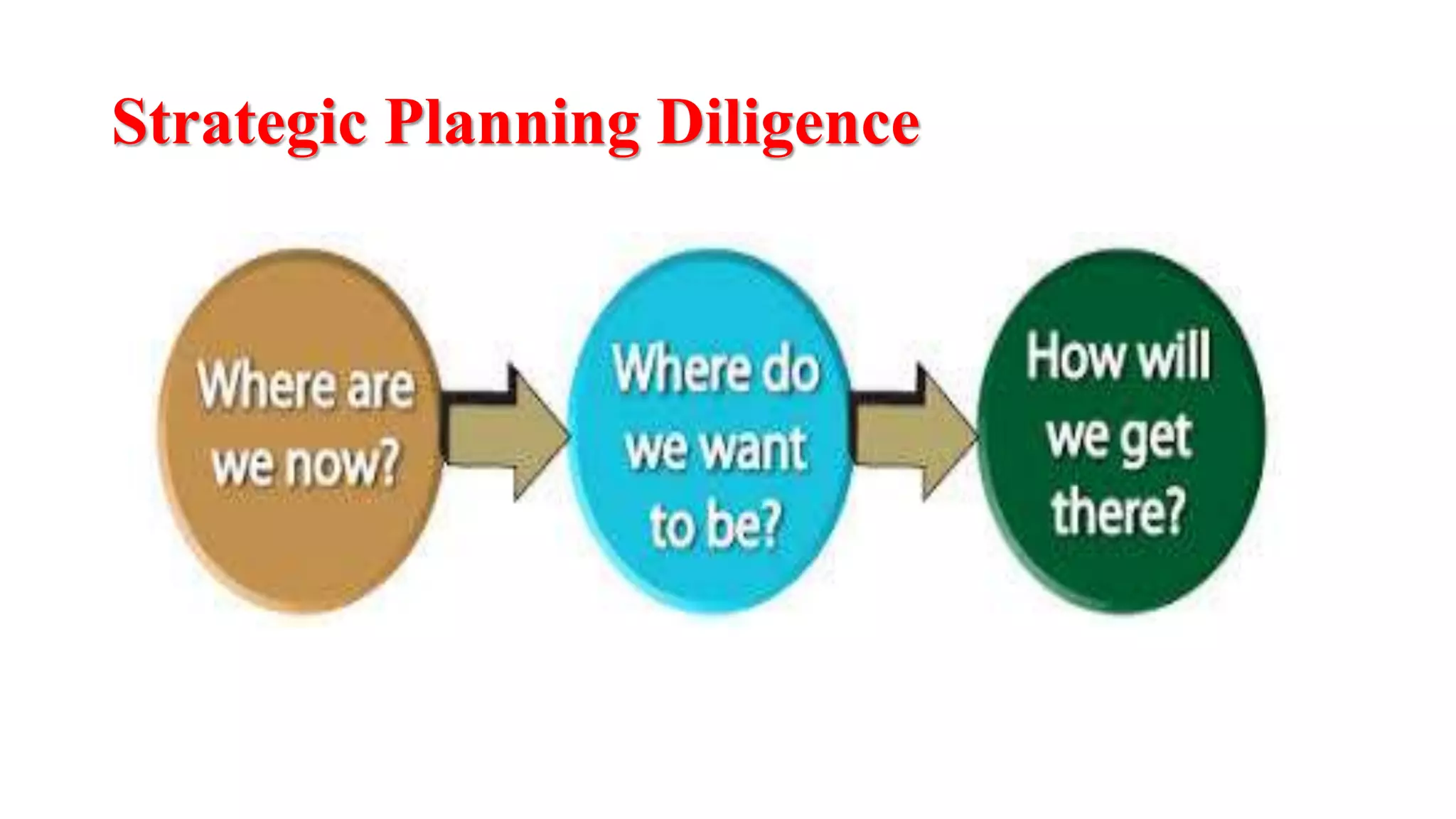
Strategic Planning Diligence
Stakeholder Buy-In
• Organisational systems, structures and processes are
generally ran on given principles or core values.
• Issues-Based strategic planning tends to identify issues
facing the organization, analyze related ideas, prepare a plan,
monitor implementation and makes needed adjustment.
• It is also necessary for all Stakeholders to agree in
collaboration, cooperation and subsequent coordination of its
initial and consequent process called ‘stakeholder buy-in’.
Guidelines for Strategic Planning Process
• Getting organized by forming a Team for organizing efforts;
• Agreement on a plan process on where the organization is,
where is it wants to be in the future, how to get there and how
to monitor progress;
• Putting the plan together for various sections of the
organization, how it will be organized and communication
strategies.
Challenges and Remedies
• Developing elements of the plan by use of organization’s
mission and vision statements, goals, objectives and
strategies;
• Application approaches based on challenges and remedies;
and
• Monitoring through performance measurement schemes.
Conduct of Strategic Plan
• A smooth conduct of strategic planning requires deliberate but clear
communication with all stakeholders to initiate and agree on the
process, identify mandates, clarify mission and values, and assess the
organisation’s environment by means of SWOT Analysis.
• Other aspects will be to identify the strategic issues at stake,
formulate strategies, review and adopt the strategic plan(s), establish
an effective vision, develop an effective implementation process, and
reassess strategies and planning process.
Pillars of the NAIDP
•Industrial infrastructure
•Skills Development
•Standards
•Investment Promotion
•Vehicle Purchase Scheme
STRATEGIC ANALYSIS - SWOT
• There is the need to subject the NIADP to strategic analysis
in which the process of policy-based strategic planning can
be executed.
• Strategic issues must be identified clearly through SWOT
Analysis before a strategic plan is ascribed.
• The Retreat Participants as ‘internal stakeholders’ are to
perform a very short exercise to reframe the vision and
mission to take new opportunities and face new challenges.

HOW TO CONDUCT STRATEGIC PLANNING.pptx

  • 1.
    HOW TO CONDUCT STRATEGICPLANNING BY DR TANKO AHMED, fwc
  • 2.
    Background  Strategic plansinvolve the setting of vision, mission, goals and objectives, guided by core values of the organisations.  “… strategic planning should be more about collective wisdom building than top-down or bottom-up planning.”  Aimed at setting priorities, focusing energy and resources, strengthening operations, co-opting and galvanising both internal and external stakeholders in attainment of set goals
  • 3.
  • 4.
    Stakeholder Buy-In • Organisationalsystems, structures and processes are generally ran on given principles or core values. • Issues-Based strategic planning tends to identify issues facing the organization, analyze related ideas, prepare a plan, monitor implementation and makes needed adjustment. • It is also necessary for all Stakeholders to agree in collaboration, cooperation and subsequent coordination of its initial and consequent process called ‘stakeholder buy-in’.
  • 5.
    Guidelines for StrategicPlanning Process • Getting organized by forming a Team for organizing efforts; • Agreement on a plan process on where the organization is, where is it wants to be in the future, how to get there and how to monitor progress; • Putting the plan together for various sections of the organization, how it will be organized and communication strategies.
  • 6.
    Challenges and Remedies •Developing elements of the plan by use of organization’s mission and vision statements, goals, objectives and strategies; • Application approaches based on challenges and remedies; and • Monitoring through performance measurement schemes.
  • 7.
    Conduct of StrategicPlan • A smooth conduct of strategic planning requires deliberate but clear communication with all stakeholders to initiate and agree on the process, identify mandates, clarify mission and values, and assess the organisation’s environment by means of SWOT Analysis. • Other aspects will be to identify the strategic issues at stake, formulate strategies, review and adopt the strategic plan(s), establish an effective vision, develop an effective implementation process, and reassess strategies and planning process.
  • 8.
    Pillars of theNAIDP •Industrial infrastructure •Skills Development •Standards •Investment Promotion •Vehicle Purchase Scheme
  • 9.
    STRATEGIC ANALYSIS -SWOT • There is the need to subject the NIADP to strategic analysis in which the process of policy-based strategic planning can be executed. • Strategic issues must be identified clearly through SWOT Analysis before a strategic plan is ascribed. • The Retreat Participants as ‘internal stakeholders’ are to perform a very short exercise to reframe the vision and mission to take new opportunities and face new challenges.