

STRATEGIC
MANAGEMENT
PROCESS
FEATURING POLICY-STRATEGY INTERLOCK
BY
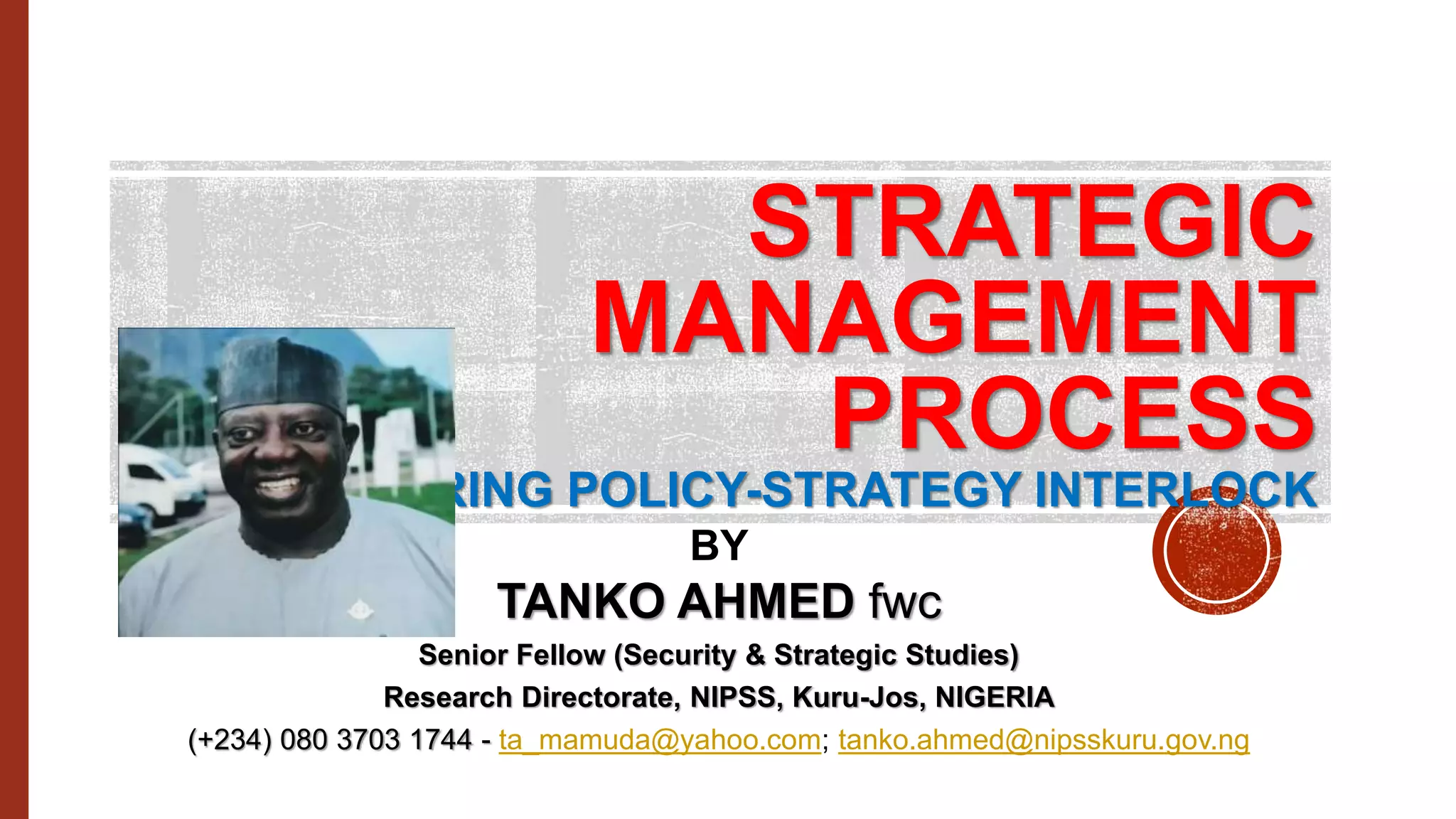
TANKO AHMED fwc
Senior Fellow (Security & Strategic Studies)
Research Directorate, NIPSS, Kuru-Jos, NIGERIA
(+234) 080 3703 1744 - ta_mamuda@yahoo.com; tanko.ahmed@nipsskuru.gov.ng
A PREAMBLE
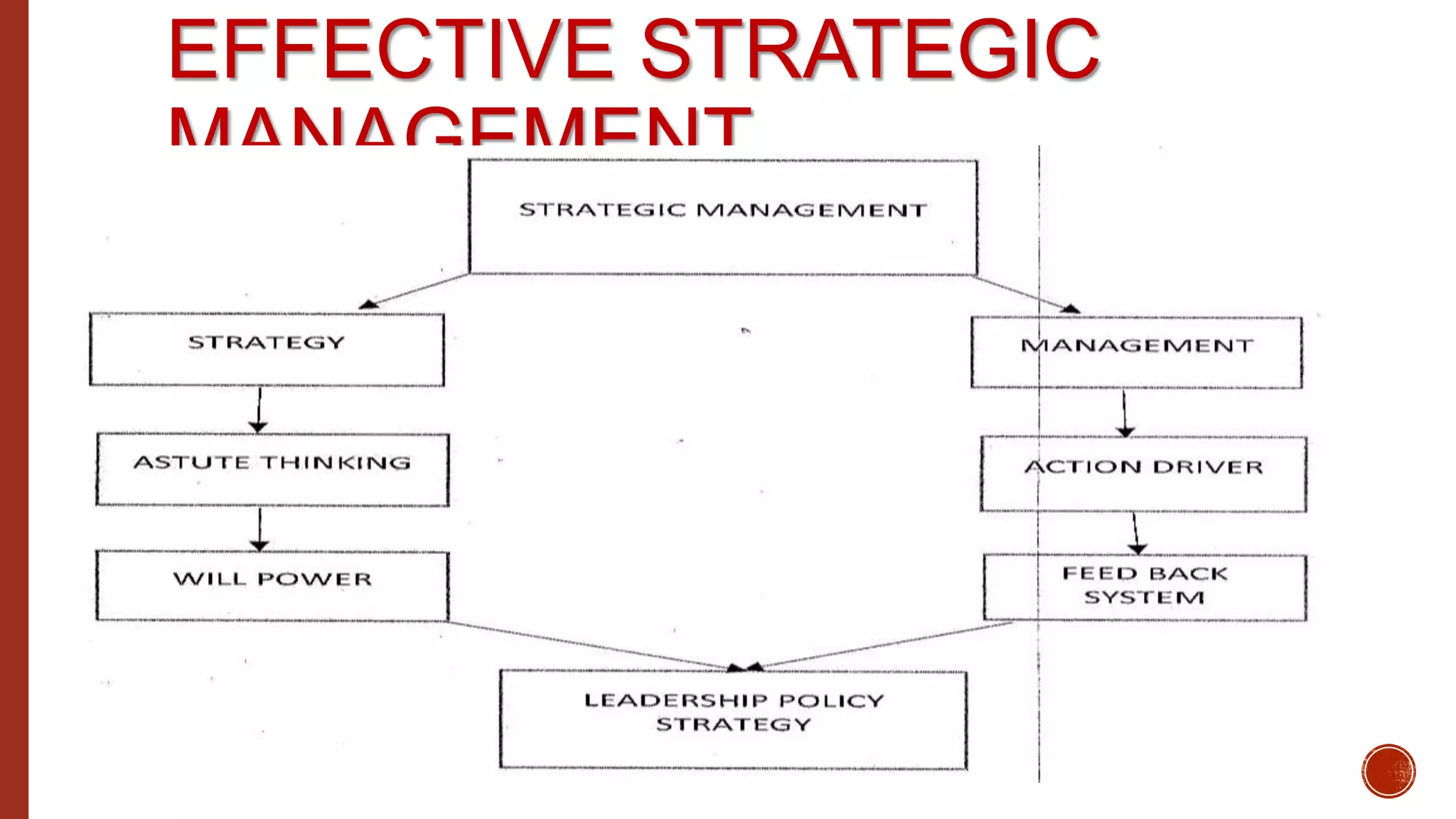
Strategic Management blends of ‘strategy’ (or
astute thinking) and ‘management’ (or action
driver).
In the hands of abled leadership with well-
articulated policy and sound strategy,
Strategic Management is a veritable
instrument for vision and mission delivery.
Strategic management is the business of
putting thinking into action to get things
done.
TYPICAL STRATEGIC MANAGEMENT
SCENARIOS
Generals in command of ‘Theatres of War’ could
actually drive the momentum, as well as, feel the heat of
raging battles by sheer will power built and sustained
on an active orbital feedback system.
The same scenarios occur among leaders in the
conduct business, industry, events, administration or
governance, at all levels.
These scenarios lucidly reflect efforts by leadership in
strategic management cycle aiming at achieving sets
goals or objectives
ABSTRACT
Strategic management involves complex cross-
functional relationships of organizational
components geared towards attainment of set
objectives.
It is a veritable tool for navigating the complexity
of applying the tenets of mission and vision of
organizations.
This paper discusses, explains and relates how
resources are harnessed in series of decisions
and actions to influence performance and results.
THEOREM
The complex and contingency
nature of strategic management
blends an agenda resource-based,
structure-conduct-performance,
agency and other theories.
LITERATURE
Literature survey on the subject
reveals emphasis on ways to
simplify and understand the
multifarious nature of strategic
management put to work for
attainment of common set
objectives.
CAPTIONS
Leaders establish the vision for the future and set the
strategy for getting there - S. P.
Kotter
Strategy without process is little more than a wish list.
– Robert Filek
However beautiful the strategy, you should occasionally
look at the results.
– Sir Winston Churchill
INTRODUCTION
“Job must be do”
(An Ethos of the Nigerian Military with emphasis
on getting the job done)
BACKGROUND
SM is not only to form a strategy that overlays the
management system, but also a form of
management-based strategy.
SM components include:
 environmental scanning,
 strategy formulation,
 strategy implementation and evaluation
Strategy and Management work here in reciprocal
domain connecting astute thinking and action,
driving determined within environmental stimulus.
THE STRATEGIC MANAGEMENT
MODELThe SMP model is useful in the prediction and
evaluation of the environment for possible
modifications to harmonize with and achieve
organizational mission and objectives (Vasile & Iancu, 2009).
The SMP Modelling originated from ‘The First
International Conference of Strategic Management’ in
1973 and still applied to facilitate organizational
leadership (Vasile & Iancu, 2009).
This model is dynamic and continuous as it seeks to
identify vision, mission, objectives and strategies for
implementation (David, 2011).
MORE RECENT WORKS
More recent works also incline towards modelling
and breaking down of strategic management stages
and activities for better understanding and more
effective application (David, 2008; Vasile & Iancu, 2009; Clayton,
2015).
These particular contributors of interest bring in
contents history of strategic management and case
studies with emphasis on the need for elucidation.
This work treads on same guiding principles in its
discourse on strategic management.
ASSUMPTIONS
This paper projects the contingency nature of
strategic management under the ‘job must be
do’ ethos on the following assumptions:
1) That policies bear specific objectives and
guidelines on implementation;
2) That strategic management produces policy
deliverables; and
3) That if there is Will and Effective strategic
management, policies are deliverable
AIM AND OBJECTIVES OF THE
PAPERThis paper aims to decipher the complex and contingent
nature of SMP for ease of understanding and application
with the following objectives:
1) To define and discuss strategic management and its
key components.
2) To break strategic management into segments for ease
of discourse and explains the complex cross-functional
relationship of organizational components.
3) To determine the challenges faced by leadership in
applying strategic management to mission and vision
for attainment of set goals.
CONCEPTUAL
DISCOURSE
STRATEGIC
MANAGEMENTSMP is an objective, logical, systematic and
continuous approach for making major decisions
and taking actions (Yousuf, 2016).
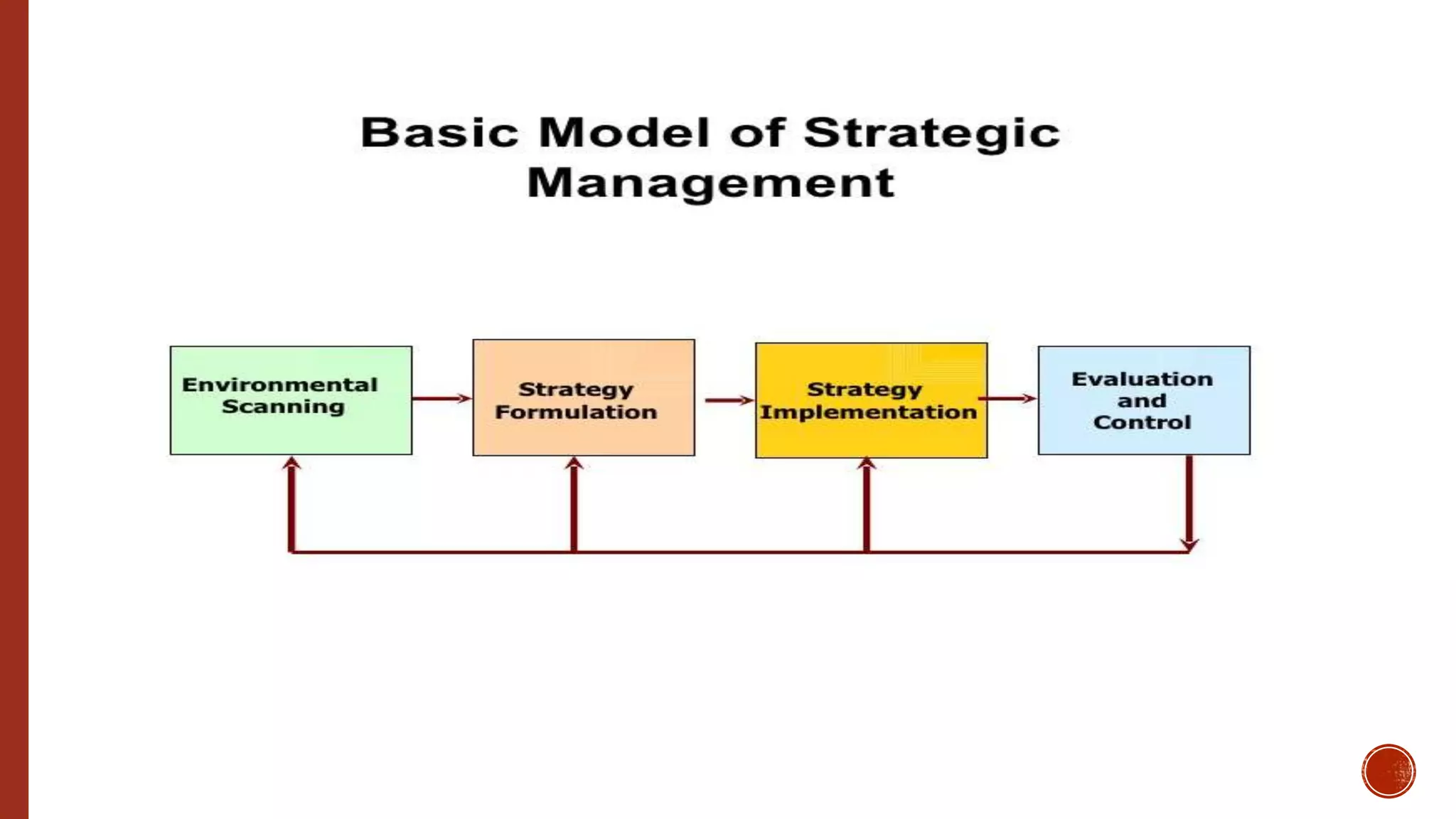
It is a dynamic process of strategy formulation,
implementation, evaluation and control (Parnell, 2005;
David, 2008; Vasile & Iancu, 2009; Vatchkova, 2010; Yousuf, 2016).
It is synonymous to strategic planning, in
exploiting and creating new opportunities for the
future based on present trends or conditions (Yousuf,
2016)
POLICY AND STRATEGY
Policy is means for achieving
objectives supported by guidelines,
rules and procedures for decision
making (David, 2011).
Strategy is the interaction of ends
(goals or objectives, means),
resources, and ways or strategic plan
of action for utilizing available means
(Owens, 2016).
POLICY AND STRATEGY INTERLOCK
Policy and strategy are intimately linked for
articulation of mode and techniques of attaining set
objectives involving:
definition or clarification of goals,
description of the trends,
analysis of conditions,
projection of future developments,
evaluation and selection of alternatives and;
 choosing of the preferred options
(Imobighe, 2014)
STRATEGY FORMULATION
The baseline task of strategic management
involves the establishment of mission and vision
statements, environmental analysis or scanning,
setting goals or objectives, and the ways and
means for attainment
Strategy formulation is the task of analyzing the
organization’s internal and external
environments, and selecting or devising
appropriate plans or strategies in setting goals or
objectives and ways of achieving them.
DATA SYNTHESIS
Data is a body of factual information in form of facts,
figures, statistics, records, or documents assembled
for use in planning, decision making or drawing
conclusions.
Synthesis is the result of combination, mixture,
amalgamation, blend or fusion of different ideas,
influences or data for the purpose of formulation.
Data Synthesis combines outcomes from different
assumptions on overall effects of particular
intervention to arrive at clear pattern for decision and
action
ENVIRONMENTAL
SCANNINGEnvironment is the surrounding influence, settings,
situation, atmosphere, conditions or circumstances
determining the activities or fate of given venture.
Scanning is the detailed or thorough examination of
given environment for the purpose of extracting much
needed data in formulation.
Environmental Scanning is the systematic process of
close monitoring or detecting for environmental signals
for use in tactical and strategic decision making, action
or formulation of tasks (Zhang, Majid & Foo, 2010; Grant, 2010).
SWOT ANALYSIS
SWOT analysis is the test of strengths,
weaknesses, opportunities and threats of
the organisation as veritable instrument or
method of strategic planning used in
strategy formulation.
It evaluates strengths as advantages over
others; weaknesses as disadvantages
relative to others; opportunities as chances
for progress; and threats as causes for
concern.
SWOT ANALYSIS AS
WORKROOM OF SMP
SWOT analysis is the work room of
strategy formulation where results of
data synthesis and environmental
scanning are put together for
evaluation.
It is used to identify strategies and
align them to available resources and
capabilities to realities of the
environment.
STRATEGY
IMPLEMENTATIONStrategy implementation involves the application or
execution of plans through series of decisions and
actions in pursue of set goals or objectives.
This task rests on the shoulders of organizational
leadership for communication of mission,
allocation of tasks and resources, and coordination
of cross-functional relationships (Brinkschroder (2014)
Strategy implementation has resource management
as pivotal challenge where planning assumptions
faces situational realities of organizations.
STRATEGY EVALUATION AND
CONTROL
Strategy evaluation and control
constitutes the final tier completing the
tasks of the strategic management cycle.
Strategy evaluation and control revolves
on principles of monitoring and
evaluation which completes the cycle or
process of strategic management – and
starts all over again and again.
STRATEGIC MANAGEMENT
AND ORGANIZATIONAL
LEADERSHIP
RESPONSIBILITIES FOR STRATEGIC
MANAGEMENT
Organizations run on multiple and overlapping
functions and components with strategic
responsibilities on certain level of leadership.
The middle-to-high level “… view strategy
formulation as an art and science.” (Parnell, 2005:157)
Organizational leadership therefore exercises
influence through timely decisions and actions
on how missions are performed and objectives
attained (Vigoda-Gadot & Drory, 2006).
SMP AND LEADERSHIP CADRE
The NIPSS-PSLC Participants are described as mid-to-
high level executives who provide key input policy
formulation and implementation.
This leadership cadre or core group facilitates general
management; relates strategy and operations; re-
orients performance to set objectives; and establishes
long-term directions and results.
By implication these Participants represent the
leadership cadre or core group charged with the
Strategic Management Process of their various
organizations.
WORKINGS AND PRACTICE OF
STRATEGIC MANAGEMENT
BENEFITS OF STRATEGIC
MANAGEMENT
The SMP helps organizations to formulate
better strategies through the use of a more
systematic, logical, and rational approach
to strategic choice.
Communication is key to successful SMP
in promoting understanding and
commitment throughout the organization.
SMP empowers the organisation in
functional decentralisation.
EFFECTIVE STRATEGIC
MANAGEMENT
THE USE OF WILL POWER
Will power is defined as the ability to resist short-
term gratification in pursuit of long-term goals or
objectives often associated strength of character
in decision making and implementation (APA, 2017).
Political Will is the totality of combined willpower
of both leaders and followers.
A strong willpower would pursue goals and
objectives in decision making and implementation.
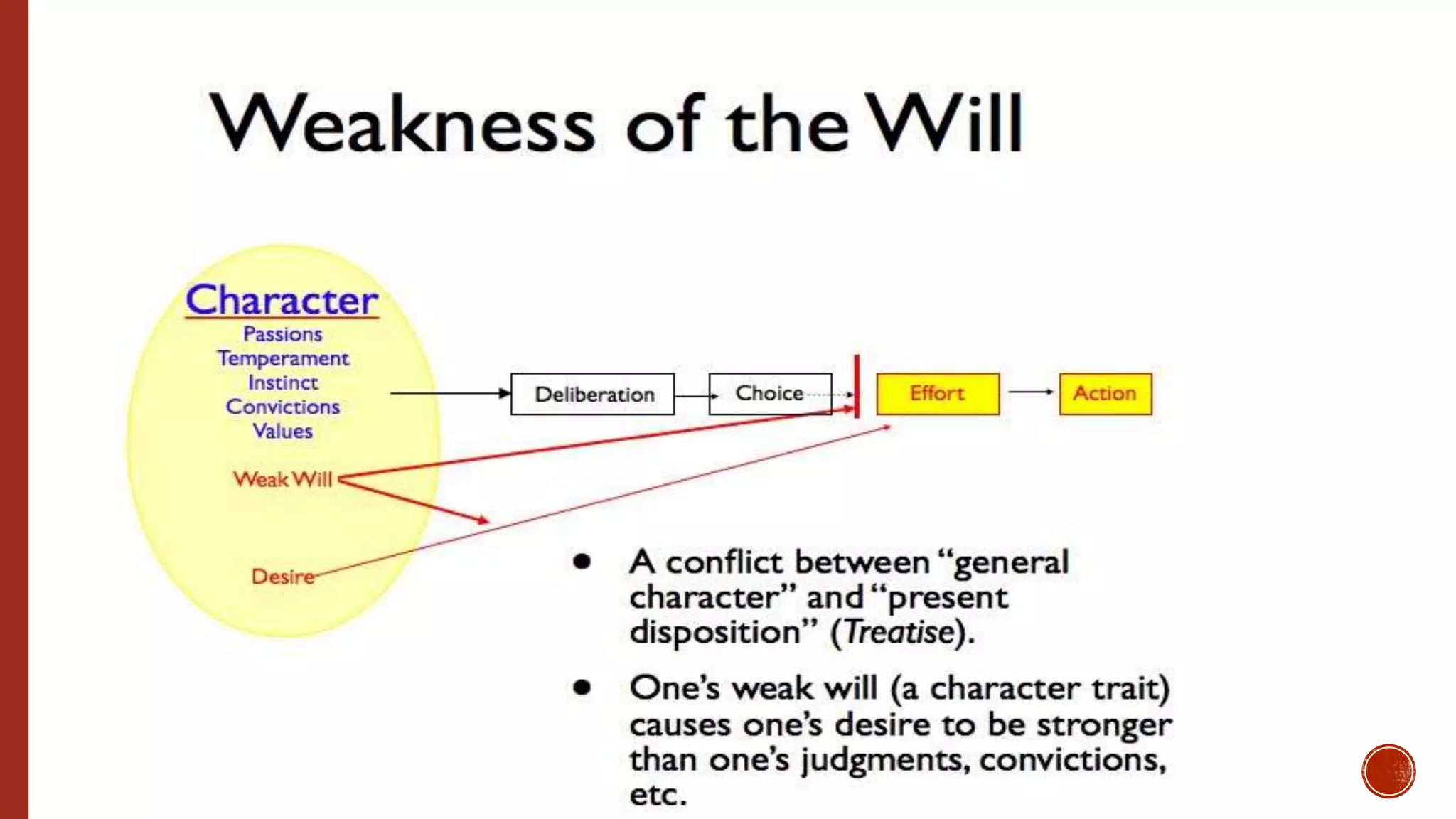
WEAKNESS OF THE WILL
The Nigerian Elite or leaders demonstrate
‘weakness of the will’ so much so that they
could not even ‘cut and paste’ development
breakthroughs they regularly seen and
experienced in other countries (Egwu, 2017).
 Resistance to commitment to execute
responsibilities borders on issues of moral
integrity on the side of those in charge.
USE OF FEEDBACK
SYSTEMFeedback is the return of output to
the input as it affects performance; it
is a response, reaction or pointer to
the next step of affairs.
An effective feedback system allows
for two-way free communication
which encourages dialogues in a top-
down and bottom-up combination
rhythm (Verma, 2017).
THE FEEDBACK LOOP
A feedback loop is a cycle of mutual
reinforcement which enables the
sensing and measurement of
activities for necessary response.
It is an instrument of leadership in
policy and strategy, particularly in
strategic management.
WILL POWER ON FEEDBACK LOOP IN
SMP
A good blend of ‘strategy’ and ‘management’ in
SMP would produce ‘astute thinking’ and ‘action
drive’ by sheer ‘will power’ on an effective
‘feedback system’.
In the hands of abled leadership with well-
articulated policy and sound strategy, SMP is a
veritable instrument for vision and mission
delivery.
Just like the General in ‘Theatre of War’ or Leaders
of Business, Industry, Public Administration or
Tertiary Education
EFFECTIVE STRATEGIC
MANAGEMENT
HINDERANCE TO EFFECTIVE
STRATEGIC MANAGEMENT
LACK OF WILL POWER
The lack of willpower is the most significant hindrance
to converting the threshold of thought, intent or policy
into goal, result or objective through strategy as
embedded in SMP.
Lack of Will Power not only hinders implementation of
decisions and responsibilities, but also responsible for
culminated high rate of policy summersault, reversal
or abandonment (Egwu, 2017).
Leaders and followers alike are often held to ransom in
a culture of powerlessness and situation of progress
trap.
LACK OF EFFECTIVE FEEDBACK
SYSTEM
The absence of an effective feedback loop leads to stagnation
in activities thus weakening functional components of the
organization.
It is also a sign of weak leadership and lack of direction,
especial when situations are devoid of the commitment of key
players in affairs of governance (Egwu, 2017; Galadima, 2017;
Bassey, 2017).
THE TOMATO EFFECT IN FAILED
SMPA failed SMP is like harvesting and
abandoning fresh tomatoes on the
farm.
The ‘Tomato Effect’ is when you spend
time, energy and materials planting
and taking care of tomato, only to let it
rot on the farm.
What was the point of doing so in the
first place.
THE WAY FORWARD
FROM INTENT TO ACTION
To avoid ‘Tomato Effect’, the SMP must be
undertaken for plans or policies to bear fruits.
SMP therefore requires astute thinking actively
driven to move ideas into results of action.
To be able to this, policy makers and
implementors need to possess audacious mind
capable of job delivery without weakness of will
power.
THE NEED FOR AUDACITY
Audacity is boldness, daring, or the
willingness to challenge assumptions or
conventions against all odds to tackle
something difficult or dangerous.
Chait (2017) describes President Obama as
audacious by amassing an array of
outstanding performances and
achievements against all odds in his tenure
at the White House.
NIGERIAN POLICIES NEED AUDACIOUS
STRATEGISTS
Nigerian policies require audacious
Strategists like the NIPSS-PSLC
Participants to put them to fruition.
Inculcating and promoting audacity
among policy makers and
implementors would therefore trigger
and sustain an effective SMP for
Nigeria’s ailing policies.
CONCLUSION
SUMMARY
The paper projects the contingency nature of
strategic management process under the
Nigerian Army ethos of ‘job must be do’.
It assumes that policies bear specific
objectives and guidelines on implementation
requiring SMP; and
SMP produces policy deliverables based on
effective use of will power and efficient
feedback loop.
CONCLUSION
The paper concludes that the
challenge and responsibility of SMP
rests on the shoulders of
organisational leadership charged
with decisions and actions; and
That effective willpower and efficient
feedback system are prerequisite for
successful strategic management
process.
ENDING QUOTE
“A true leader has the confidence
to stand alone, the courage to
make tough decision, and the
compassion to listen to the needs
of others … by the equality of his
actions and the integrity of his
intent”
Douglas MacArthur
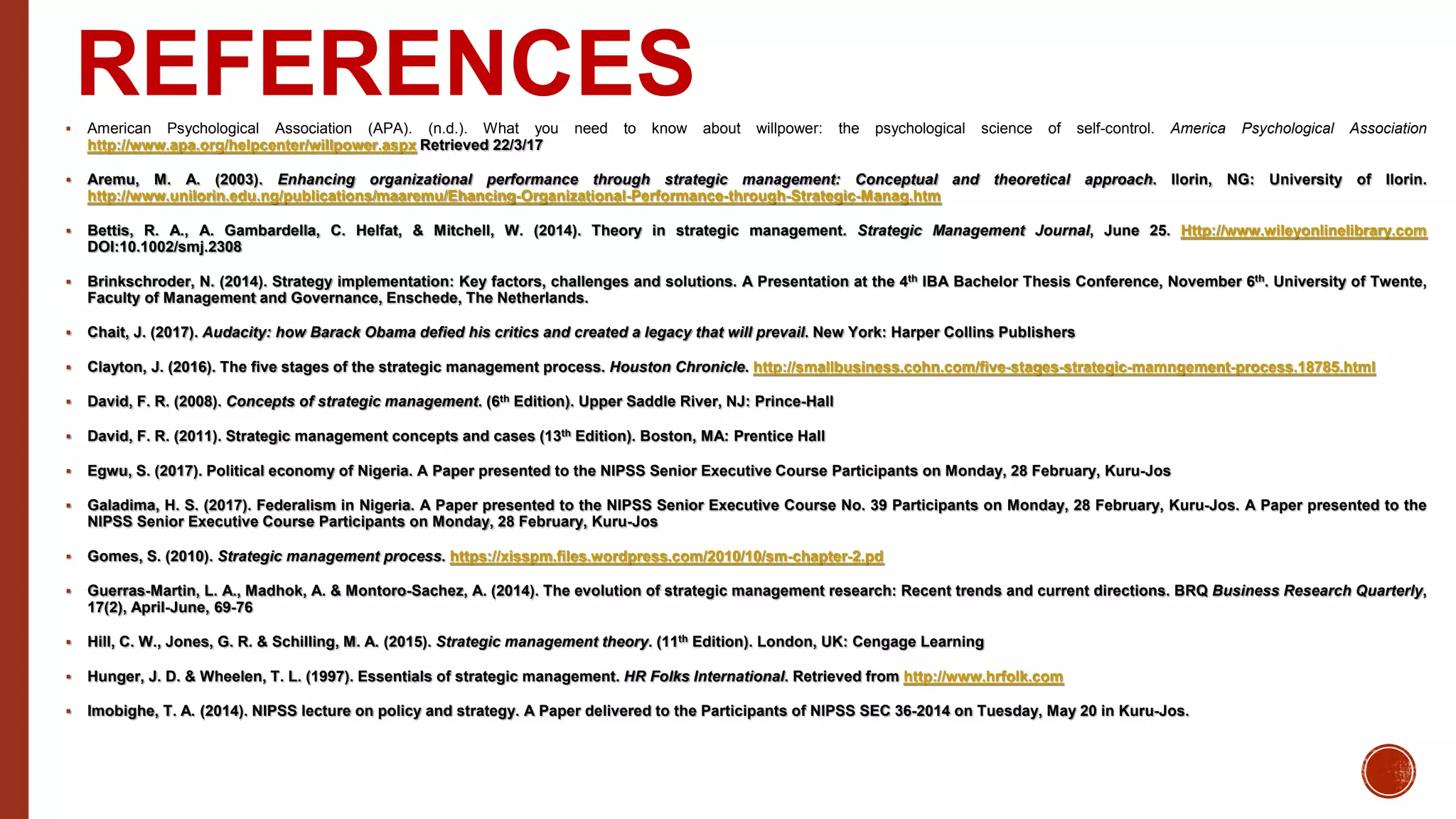
REFERENCES American Psychological Association (APA). (n.d.). What you need to know about willpower: the psychological science of self-control. America Psychological Association
http://www.apa.org/helpcenter/willpower.aspx Retrieved 22/3/17
 Aremu, M. A. (2003). Enhancing organizational performance through strategic management: Conceptual and theoretical approach. Ilorin, NG: University of Ilorin.
http://www.unilorin.edu.ng/publications/maaremu/Ehancing-Organizational-Performance-through-Strategic-Manag.htm
 Bettis, R. A., A. Gambardella, C. Helfat, & Mitchell, W. (2014). Theory in strategic management. Strategic Management Journal, June 25. Http://www.wileyonlinelibrary.com
DOI:10.1002/smj.2308
 Brinkschroder, N. (2014). Strategy implementation: Key factors, challenges and solutions. A Presentation at the 4th IBA Bachelor Thesis Conference, November 6th. University of Twente,
Faculty of Management and Governance, Enschede, The Netherlands.
 Chait, J. (2017). Audacity: how Barack Obama defied his critics and created a legacy that will prevail. New York: Harper Collins Publishers
 Clayton, J. (2016). The five stages of the strategic management process. Houston Chronicle. http://smallbusiness.cohn.com/five-stages-strategic-mamngement-process.18785.html
 David, F. R. (2008). Concepts of strategic management. (6th Edition). Upper Saddle River, NJ: Prince-Hall
 David, F. R. (2011). Strategic management concepts and cases (13th Edition). Boston, MA: Prentice Hall
 Egwu, S. (2017). Political economy of Nigeria. A Paper presented to the NIPSS Senior Executive Course Participants on Monday, 28 February, Kuru-Jos
 Galadima, H. S. (2017). Federalism in Nigeria. A Paper presented to the NIPSS Senior Executive Course No. 39 Participants on Monday, 28 February, Kuru-Jos. A Paper presented to the
NIPSS Senior Executive Course Participants on Monday, 28 February, Kuru-Jos
 Gomes, S. (2010). Strategic management process. https://xisspm.files.wordpress.com/2010/10/sm-chapter-2.pd
 Guerras-Martin, L. A., Madhok, A. & Montoro-Sachez, A. (2014). The evolution of strategic management research: Recent trends and current directions. BRQ Business Research Quarterly,
17(2), April-June, 69-76
 Hill, C. W., Jones, G. R. & Schilling, M. A. (2015). Strategic management theory. (11th Edition). London, UK: Cengage Learning
 Hunger, J. D. & Wheelen, T. L. (1997). Essentials of strategic management. HR Folks International. Retrieved from http://www.hrfolk.com
 Imobighe, T. A. (2014). NIPSS lecture on policy and strategy. A Paper delivered to the Participants of NIPSS SEC 36-2014 on Tuesday, May 20 in Kuru-Jos.
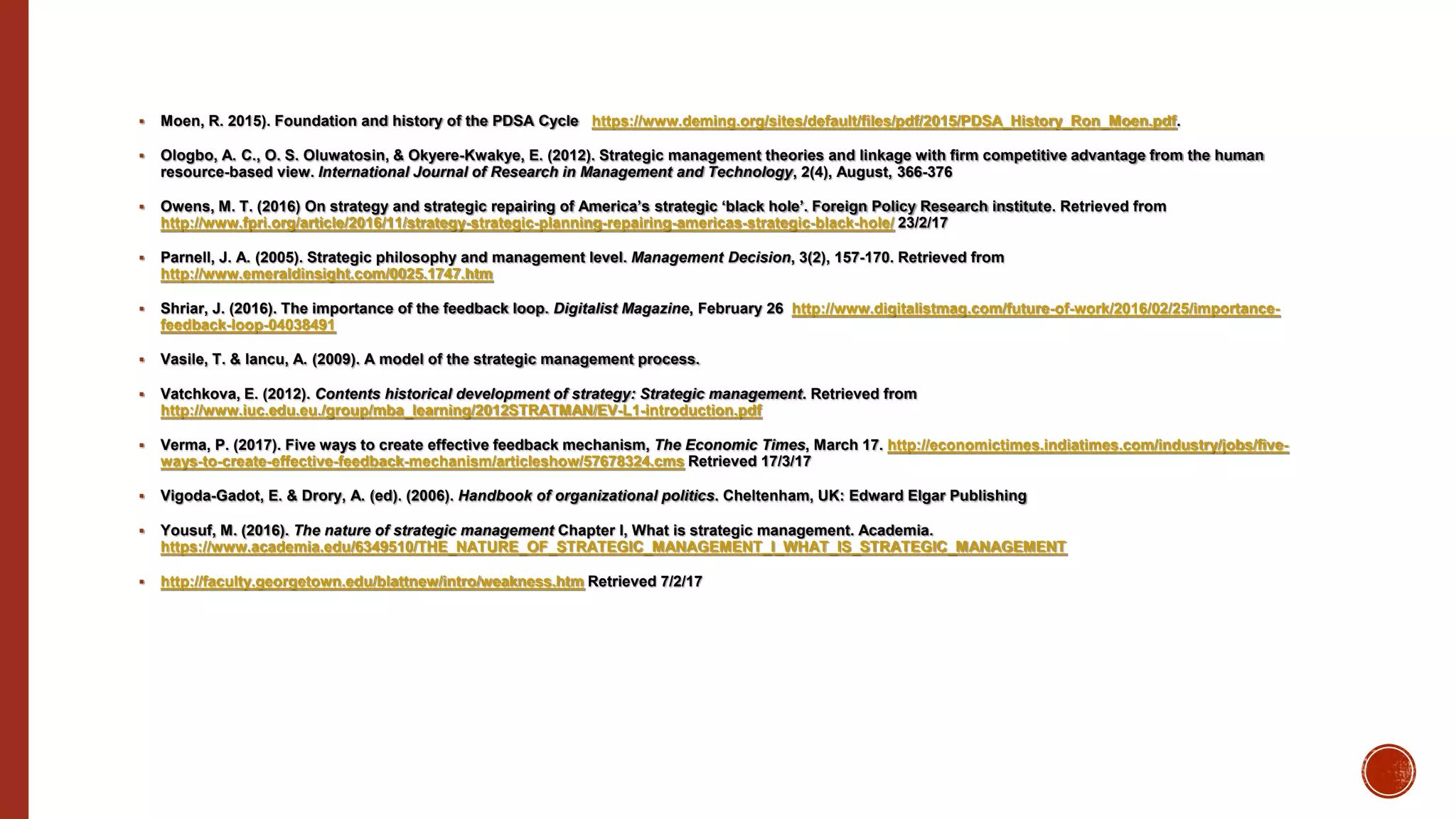
 Moen, R. 2015). Foundation and history of the PDSA Cycle https://www.deming.org/sites/default/files/pdf/2015/PDSA_History_Ron_Moen.pdf.
 Ologbo, A. C., O. S. Oluwatosin, & Okyere-Kwakye, E. (2012). Strategic management theories and linkage with firm competitive advantage from the human
resource-based view. International Journal of Research in Management and Technology, 2(4), August, 366-376
 Owens, M. T. (2016) On strategy and strategic repairing of America’s strategic ‘black hole’. Foreign Policy Research institute. Retrieved from
http://www.fpri.org/article/2016/11/strategy-strategic-planning-repairing-americas-strategic-black-hole/ 23/2/17
 Parnell, J. A. (2005). Strategic philosophy and management level. Management Decision, 3(2), 157-170. Retrieved from
http://www.emeraldinsight.com/0025.1747.htm
 Shriar, J. (2016). The importance of the feedback loop. Digitalist Magazine, February 26 http://www.digitalistmag.com/future-of-work/2016/02/25/importance-
feedback-loop-04038491
 Vasile, T. & Iancu, A. (2009). A model of the strategic management process.
 Vatchkova, E. (2012). Contents historical development of strategy: Strategic management. Retrieved from
http://www.iuc.edu.eu./group/mba_learning/2012STRATMAN/EV-L1-introduction.pdf
 Verma, P. (2017). Five ways to create effective feedback mechanism, The Economic Times, March 17. http://economictimes.indiatimes.com/industry/jobs/five-
ways-to-create-effective-feedback-mechanism/articleshow/57678324.cms Retrieved 17/3/17
 Vigoda-Gadot, E. & Drory, A. (ed). (2006). Handbook of organizational politics. Cheltenham, UK: Edward Elgar Publishing
 Yousuf, M. (2016). The nature of strategic management Chapter I, What is strategic management. Academia.
https://www.academia.edu/6349510/THE_NATURE_OF_STRATEGIC_MANAGEMENT_I_WHAT_IS_STRATEGIC_MANAGEMENT
 http://faculty.georgetown.edu/blattnew/intro/weakness.htm Retrieved 7/2/17

STRATEGIC MANAGEMENT PROCESS - Featuring Policy-Strategy Interlock

  • 1.
    STRATEGIC MANAGEMENT PROCESS FEATURING POLICY-STRATEGY INTERLOCK BY TANKOAHMED fwc Senior Fellow (Security & Strategic Studies) Research Directorate, NIPSS, Kuru-Jos, NIGERIA (+234) 080 3703 1744 - ta_mamuda@yahoo.com; tanko.ahmed@nipsskuru.gov.ng
  • 2.
    A PREAMBLE Strategic Managementblends of ‘strategy’ (or astute thinking) and ‘management’ (or action driver). In the hands of abled leadership with well- articulated policy and sound strategy, Strategic Management is a veritable instrument for vision and mission delivery. Strategic management is the business of putting thinking into action to get things done.
  • 3.
    TYPICAL STRATEGIC MANAGEMENT SCENARIOS Generalsin command of ‘Theatres of War’ could actually drive the momentum, as well as, feel the heat of raging battles by sheer will power built and sustained on an active orbital feedback system. The same scenarios occur among leaders in the conduct business, industry, events, administration or governance, at all levels. These scenarios lucidly reflect efforts by leadership in strategic management cycle aiming at achieving sets goals or objectives
  • 4.
    ABSTRACT Strategic management involvescomplex cross- functional relationships of organizational components geared towards attainment of set objectives. It is a veritable tool for navigating the complexity of applying the tenets of mission and vision of organizations. This paper discusses, explains and relates how resources are harnessed in series of decisions and actions to influence performance and results.
  • 5.
    THEOREM The complex andcontingency nature of strategic management blends an agenda resource-based, structure-conduct-performance, agency and other theories.
  • 6.
    LITERATURE Literature survey onthe subject reveals emphasis on ways to simplify and understand the multifarious nature of strategic management put to work for attainment of common set objectives.
  • 7.
    CAPTIONS Leaders establish thevision for the future and set the strategy for getting there - S. P. Kotter Strategy without process is little more than a wish list. – Robert Filek However beautiful the strategy, you should occasionally look at the results. – Sir Winston Churchill
  • 8.
    INTRODUCTION “Job must bedo” (An Ethos of the Nigerian Military with emphasis on getting the job done)
  • 9.
    BACKGROUND SM is notonly to form a strategy that overlays the management system, but also a form of management-based strategy. SM components include:  environmental scanning,  strategy formulation,  strategy implementation and evaluation Strategy and Management work here in reciprocal domain connecting astute thinking and action, driving determined within environmental stimulus.
  • 10.
    THE STRATEGIC MANAGEMENT MODELTheSMP model is useful in the prediction and evaluation of the environment for possible modifications to harmonize with and achieve organizational mission and objectives (Vasile & Iancu, 2009). The SMP Modelling originated from ‘The First International Conference of Strategic Management’ in 1973 and still applied to facilitate organizational leadership (Vasile & Iancu, 2009). This model is dynamic and continuous as it seeks to identify vision, mission, objectives and strategies for implementation (David, 2011).
  • 12.
    MORE RECENT WORKS Morerecent works also incline towards modelling and breaking down of strategic management stages and activities for better understanding and more effective application (David, 2008; Vasile & Iancu, 2009; Clayton, 2015). These particular contributors of interest bring in contents history of strategic management and case studies with emphasis on the need for elucidation. This work treads on same guiding principles in its discourse on strategic management.
  • 13.
    ASSUMPTIONS This paper projectsthe contingency nature of strategic management under the ‘job must be do’ ethos on the following assumptions: 1) That policies bear specific objectives and guidelines on implementation; 2) That strategic management produces policy deliverables; and 3) That if there is Will and Effective strategic management, policies are deliverable
  • 14.
    AIM AND OBJECTIVESOF THE PAPERThis paper aims to decipher the complex and contingent nature of SMP for ease of understanding and application with the following objectives: 1) To define and discuss strategic management and its key components. 2) To break strategic management into segments for ease of discourse and explains the complex cross-functional relationship of organizational components. 3) To determine the challenges faced by leadership in applying strategic management to mission and vision for attainment of set goals.
  • 15.
  • 16.
    STRATEGIC MANAGEMENTSMP is anobjective, logical, systematic and continuous approach for making major decisions and taking actions (Yousuf, 2016). It is a dynamic process of strategy formulation, implementation, evaluation and control (Parnell, 2005; David, 2008; Vasile & Iancu, 2009; Vatchkova, 2010; Yousuf, 2016). It is synonymous to strategic planning, in exploiting and creating new opportunities for the future based on present trends or conditions (Yousuf, 2016)
  • 17.
    POLICY AND STRATEGY Policyis means for achieving objectives supported by guidelines, rules and procedures for decision making (David, 2011). Strategy is the interaction of ends (goals or objectives, means), resources, and ways or strategic plan of action for utilizing available means (Owens, 2016).
  • 18.
    POLICY AND STRATEGYINTERLOCK Policy and strategy are intimately linked for articulation of mode and techniques of attaining set objectives involving: definition or clarification of goals, description of the trends, analysis of conditions, projection of future developments, evaluation and selection of alternatives and;  choosing of the preferred options (Imobighe, 2014)
  • 19.
    STRATEGY FORMULATION The baselinetask of strategic management involves the establishment of mission and vision statements, environmental analysis or scanning, setting goals or objectives, and the ways and means for attainment Strategy formulation is the task of analyzing the organization’s internal and external environments, and selecting or devising appropriate plans or strategies in setting goals or objectives and ways of achieving them.
  • 20.
    DATA SYNTHESIS Data isa body of factual information in form of facts, figures, statistics, records, or documents assembled for use in planning, decision making or drawing conclusions. Synthesis is the result of combination, mixture, amalgamation, blend or fusion of different ideas, influences or data for the purpose of formulation. Data Synthesis combines outcomes from different assumptions on overall effects of particular intervention to arrive at clear pattern for decision and action
  • 21.
    ENVIRONMENTAL SCANNINGEnvironment is thesurrounding influence, settings, situation, atmosphere, conditions or circumstances determining the activities or fate of given venture. Scanning is the detailed or thorough examination of given environment for the purpose of extracting much needed data in formulation. Environmental Scanning is the systematic process of close monitoring or detecting for environmental signals for use in tactical and strategic decision making, action or formulation of tasks (Zhang, Majid & Foo, 2010; Grant, 2010).
  • 22.
    SWOT ANALYSIS SWOT analysisis the test of strengths, weaknesses, opportunities and threats of the organisation as veritable instrument or method of strategic planning used in strategy formulation. It evaluates strengths as advantages over others; weaknesses as disadvantages relative to others; opportunities as chances for progress; and threats as causes for concern.
  • 23.
    SWOT ANALYSIS AS WORKROOMOF SMP SWOT analysis is the work room of strategy formulation where results of data synthesis and environmental scanning are put together for evaluation. It is used to identify strategies and align them to available resources and capabilities to realities of the environment.
  • 24.
    STRATEGY IMPLEMENTATIONStrategy implementation involvesthe application or execution of plans through series of decisions and actions in pursue of set goals or objectives. This task rests on the shoulders of organizational leadership for communication of mission, allocation of tasks and resources, and coordination of cross-functional relationships (Brinkschroder (2014) Strategy implementation has resource management as pivotal challenge where planning assumptions faces situational realities of organizations.
  • 25.
    STRATEGY EVALUATION AND CONTROL Strategyevaluation and control constitutes the final tier completing the tasks of the strategic management cycle. Strategy evaluation and control revolves on principles of monitoring and evaluation which completes the cycle or process of strategic management – and starts all over again and again.
  • 26.
  • 27.
    RESPONSIBILITIES FOR STRATEGIC MANAGEMENT Organizationsrun on multiple and overlapping functions and components with strategic responsibilities on certain level of leadership. The middle-to-high level “… view strategy formulation as an art and science.” (Parnell, 2005:157) Organizational leadership therefore exercises influence through timely decisions and actions on how missions are performed and objectives attained (Vigoda-Gadot & Drory, 2006).
  • 28.
    SMP AND LEADERSHIPCADRE The NIPSS-PSLC Participants are described as mid-to- high level executives who provide key input policy formulation and implementation. This leadership cadre or core group facilitates general management; relates strategy and operations; re- orients performance to set objectives; and establishes long-term directions and results. By implication these Participants represent the leadership cadre or core group charged with the Strategic Management Process of their various organizations.
  • 29.
    WORKINGS AND PRACTICEOF STRATEGIC MANAGEMENT
  • 30.
    BENEFITS OF STRATEGIC MANAGEMENT TheSMP helps organizations to formulate better strategies through the use of a more systematic, logical, and rational approach to strategic choice. Communication is key to successful SMP in promoting understanding and commitment throughout the organization. SMP empowers the organisation in functional decentralisation.
  • 31.
  • 32.
    THE USE OFWILL POWER Will power is defined as the ability to resist short- term gratification in pursuit of long-term goals or objectives often associated strength of character in decision making and implementation (APA, 2017). Political Will is the totality of combined willpower of both leaders and followers. A strong willpower would pursue goals and objectives in decision making and implementation.
  • 33.
    WEAKNESS OF THEWILL The Nigerian Elite or leaders demonstrate ‘weakness of the will’ so much so that they could not even ‘cut and paste’ development breakthroughs they regularly seen and experienced in other countries (Egwu, 2017).  Resistance to commitment to execute responsibilities borders on issues of moral integrity on the side of those in charge.
  • 34.
    USE OF FEEDBACK SYSTEMFeedbackis the return of output to the input as it affects performance; it is a response, reaction or pointer to the next step of affairs. An effective feedback system allows for two-way free communication which encourages dialogues in a top- down and bottom-up combination rhythm (Verma, 2017).
  • 35.
    THE FEEDBACK LOOP Afeedback loop is a cycle of mutual reinforcement which enables the sensing and measurement of activities for necessary response. It is an instrument of leadership in policy and strategy, particularly in strategic management.
  • 36.
    WILL POWER ONFEEDBACK LOOP IN SMP A good blend of ‘strategy’ and ‘management’ in SMP would produce ‘astute thinking’ and ‘action drive’ by sheer ‘will power’ on an effective ‘feedback system’. In the hands of abled leadership with well- articulated policy and sound strategy, SMP is a veritable instrument for vision and mission delivery. Just like the General in ‘Theatre of War’ or Leaders of Business, Industry, Public Administration or Tertiary Education
  • 37.
  • 38.
  • 39.
    LACK OF WILLPOWER The lack of willpower is the most significant hindrance to converting the threshold of thought, intent or policy into goal, result or objective through strategy as embedded in SMP. Lack of Will Power not only hinders implementation of decisions and responsibilities, but also responsible for culminated high rate of policy summersault, reversal or abandonment (Egwu, 2017). Leaders and followers alike are often held to ransom in a culture of powerlessness and situation of progress trap.
  • 41.
    LACK OF EFFECTIVEFEEDBACK SYSTEM The absence of an effective feedback loop leads to stagnation in activities thus weakening functional components of the organization. It is also a sign of weak leadership and lack of direction, especial when situations are devoid of the commitment of key players in affairs of governance (Egwu, 2017; Galadima, 2017; Bassey, 2017).
  • 42.
    THE TOMATO EFFECTIN FAILED SMPA failed SMP is like harvesting and abandoning fresh tomatoes on the farm. The ‘Tomato Effect’ is when you spend time, energy and materials planting and taking care of tomato, only to let it rot on the farm. What was the point of doing so in the first place.
  • 44.
  • 45.
    FROM INTENT TOACTION To avoid ‘Tomato Effect’, the SMP must be undertaken for plans or policies to bear fruits. SMP therefore requires astute thinking actively driven to move ideas into results of action. To be able to this, policy makers and implementors need to possess audacious mind capable of job delivery without weakness of will power.
  • 46.
    THE NEED FORAUDACITY Audacity is boldness, daring, or the willingness to challenge assumptions or conventions against all odds to tackle something difficult or dangerous. Chait (2017) describes President Obama as audacious by amassing an array of outstanding performances and achievements against all odds in his tenure at the White House.
  • 47.
    NIGERIAN POLICIES NEEDAUDACIOUS STRATEGISTS Nigerian policies require audacious Strategists like the NIPSS-PSLC Participants to put them to fruition. Inculcating and promoting audacity among policy makers and implementors would therefore trigger and sustain an effective SMP for Nigeria’s ailing policies.
  • 49.
  • 50.
    SUMMARY The paper projectsthe contingency nature of strategic management process under the Nigerian Army ethos of ‘job must be do’. It assumes that policies bear specific objectives and guidelines on implementation requiring SMP; and SMP produces policy deliverables based on effective use of will power and efficient feedback loop.
  • 51.
    CONCLUSION The paper concludesthat the challenge and responsibility of SMP rests on the shoulders of organisational leadership charged with decisions and actions; and That effective willpower and efficient feedback system are prerequisite for successful strategic management process.
  • 52.
    ENDING QUOTE “A trueleader has the confidence to stand alone, the courage to make tough decision, and the compassion to listen to the needs of others … by the equality of his actions and the integrity of his intent” Douglas MacArthur
  • 53.
    REFERENCES American PsychologicalAssociation (APA). (n.d.). What you need to know about willpower: the psychological science of self-control. America Psychological Association http://www.apa.org/helpcenter/willpower.aspx Retrieved 22/3/17  Aremu, M. A. (2003). Enhancing organizational performance through strategic management: Conceptual and theoretical approach. Ilorin, NG: University of Ilorin. http://www.unilorin.edu.ng/publications/maaremu/Ehancing-Organizational-Performance-through-Strategic-Manag.htm  Bettis, R. A., A. Gambardella, C. Helfat, & Mitchell, W. (2014). Theory in strategic management. Strategic Management Journal, June 25. Http://www.wileyonlinelibrary.com DOI:10.1002/smj.2308  Brinkschroder, N. (2014). Strategy implementation: Key factors, challenges and solutions. A Presentation at the 4th IBA Bachelor Thesis Conference, November 6th. University of Twente, Faculty of Management and Governance, Enschede, The Netherlands.  Chait, J. (2017). Audacity: how Barack Obama defied his critics and created a legacy that will prevail. New York: Harper Collins Publishers  Clayton, J. (2016). The five stages of the strategic management process. Houston Chronicle. http://smallbusiness.cohn.com/five-stages-strategic-mamngement-process.18785.html  David, F. R. (2008). Concepts of strategic management. (6th Edition). Upper Saddle River, NJ: Prince-Hall  David, F. R. (2011). Strategic management concepts and cases (13th Edition). Boston, MA: Prentice Hall  Egwu, S. (2017). Political economy of Nigeria. A Paper presented to the NIPSS Senior Executive Course Participants on Monday, 28 February, Kuru-Jos  Galadima, H. S. (2017). Federalism in Nigeria. A Paper presented to the NIPSS Senior Executive Course No. 39 Participants on Monday, 28 February, Kuru-Jos. A Paper presented to the NIPSS Senior Executive Course Participants on Monday, 28 February, Kuru-Jos  Gomes, S. (2010). Strategic management process. https://xisspm.files.wordpress.com/2010/10/sm-chapter-2.pd  Guerras-Martin, L. A., Madhok, A. & Montoro-Sachez, A. (2014). The evolution of strategic management research: Recent trends and current directions. BRQ Business Research Quarterly, 17(2), April-June, 69-76  Hill, C. W., Jones, G. R. & Schilling, M. A. (2015). Strategic management theory. (11th Edition). London, UK: Cengage Learning  Hunger, J. D. & Wheelen, T. L. (1997). Essentials of strategic management. HR Folks International. Retrieved from http://www.hrfolk.com  Imobighe, T. A. (2014). NIPSS lecture on policy and strategy. A Paper delivered to the Participants of NIPSS SEC 36-2014 on Tuesday, May 20 in Kuru-Jos.
  • 54.
     Moen, R.2015). Foundation and history of the PDSA Cycle https://www.deming.org/sites/default/files/pdf/2015/PDSA_History_Ron_Moen.pdf.  Ologbo, A. C., O. S. Oluwatosin, & Okyere-Kwakye, E. (2012). Strategic management theories and linkage with firm competitive advantage from the human resource-based view. International Journal of Research in Management and Technology, 2(4), August, 366-376  Owens, M. T. (2016) On strategy and strategic repairing of America’s strategic ‘black hole’. Foreign Policy Research institute. Retrieved from http://www.fpri.org/article/2016/11/strategy-strategic-planning-repairing-americas-strategic-black-hole/ 23/2/17  Parnell, J. A. (2005). Strategic philosophy and management level. Management Decision, 3(2), 157-170. Retrieved from http://www.emeraldinsight.com/0025.1747.htm  Shriar, J. (2016). The importance of the feedback loop. Digitalist Magazine, February 26 http://www.digitalistmag.com/future-of-work/2016/02/25/importance- feedback-loop-04038491  Vasile, T. & Iancu, A. (2009). A model of the strategic management process.  Vatchkova, E. (2012). Contents historical development of strategy: Strategic management. Retrieved from http://www.iuc.edu.eu./group/mba_learning/2012STRATMAN/EV-L1-introduction.pdf  Verma, P. (2017). Five ways to create effective feedback mechanism, The Economic Times, March 17. http://economictimes.indiatimes.com/industry/jobs/five- ways-to-create-effective-feedback-mechanism/articleshow/57678324.cms Retrieved 17/3/17  Vigoda-Gadot, E. & Drory, A. (ed). (2006). Handbook of organizational politics. Cheltenham, UK: Edward Elgar Publishing  Yousuf, M. (2016). The nature of strategic management Chapter I, What is strategic management. Academia. https://www.academia.edu/6349510/THE_NATURE_OF_STRATEGIC_MANAGEMENT_I_WHAT_IS_STRATEGIC_MANAGEMENT  http://faculty.georgetown.edu/blattnew/intro/weakness.htm Retrieved 7/2/17