Strategies for Reading Instruction
Holy Angel University
Jennifer V. Ocampo
Master of Arts in English Language and Literature Teaching
Strategies for Reading Instruction
Reading is a complex activity that requires the use
and coordination of many skills simultaneously.
Difficulty with any of these abilities may result in a
reading problem.
Strategies should be focused on working with the
child’s strengths.
Strategies for Reading Instruction
1. GRAPHIC ORGANIZERS
 By using graphic organizers across all
subject areas, you will be empowering
your students to master subject-matter
faster and more efficiently.
 Use graphic organizers to structure
writing projects, to help in problem
solving, decision making, studying,
planning research and brainstorming.
Strategies for Reading Instruction
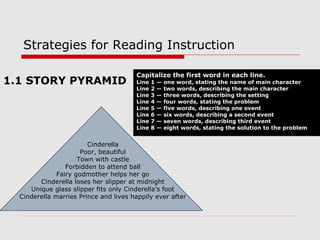
1.1 STORY PYRAMID
Capitalize the first word in each line.
Line 1 — one word, stating the name of main character
Line 2 — two words, describing the main character
Line 3 — three words, describing the setting
Line 4 — four words, stating the problem
Line 5 — five words, describing one event
Line 6 — six words, describing a second event
Line 7 — seven words, describing third event
Line 8 — eight words, stating the solution to the problem
Cinderella
Poor, beautiful
Town with castle
Forbidden to attend ball
Fairy godmother helps her go
Cinderella loses her slipper at midnight
Unique glass slipper fits only Cinderella’s foot
Cinderella marries Prince and lives happily ever after
Strategies for Reading Instruction
1.1 STORY PYRAMID
Use a story pyramid to describe
important information from a story,
such as the main character, the
setting, and the major events in the
plot. Carefully choose your words in
order to provide a precise
description. You may wish to use a
dictionary and a thesaurus.
Strategies for Reading Instruction
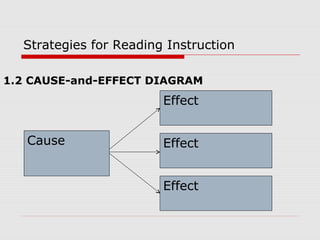
1.2 CAUSE-and-EFFECT DIAGRAM
Cause
Effect
Effect
Effect
Strategies for Reading Instruction
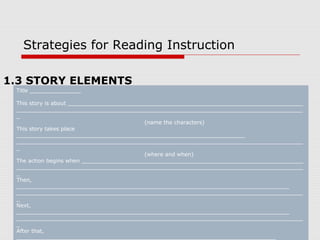
1.3 STORY ELEMENTS
Title _______________
This story is about _____________________________________________________________________
____________________________________________________________________________________
_
(name the characters)
This story takes place
___________________________________________________________________
____________________________________________________________________________________
_
(where and when)
The action begins when _________________________________________________________________
____________________________________________________________________________________
_
Then,
________________________________________________________________________________
____________________________________________________________________________________
_
Next,
________________________________________________________________________________
____________________________________________________________________________________
_
After that,
____________________________________________________________________________
Strategies for Reading Instruction
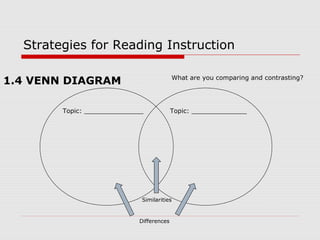
1.4 VENN DIAGRAM
Topic: _______________ Topic: ______________
What are you comparing and contrasting?
Similarities
Differences
Strategies for Reading Instruction
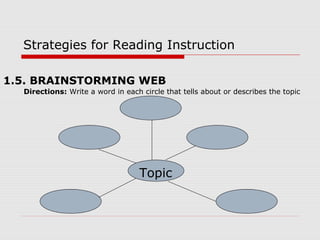
1.5. BRAINSTORMING WEB
Topic
Directions: Write a word in each circle that tells about or describes the topic
Strategies for Reading Instruction
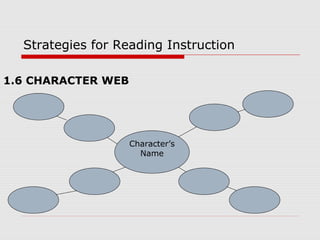
1.6 CHARACTER WEB
Character’s
Name
Strategies for Reading Instruction
2. Vocabulary Building
Strategies for Reading Instruction
2. Vocabulary Building
EVERYONE—FROM BEGINNING LEARNERS in English to veterans in
journalism—knows the frustration of not having the right
word immediately available in that lexicon one carries between
one's ears. Sometimes it's a matter of not being able to recall the
right word; sometimes we never knew it. It is also frustrating to
read a newspaper or homework assignment and run across words
whose meanings elude us. Language, after all, is power. When
your children get in trouble fighting with the neighbors' children,
and your neighbors call your children little twerps and you call their
children nefarious miscreants—well, the battle is over and they
didn't stand a chance. Building a vocabulary that is adequate to the
needs of one's reading and self-expression has to be a personal
goal for every writer and speaker.
Strategies for Reading Instruction
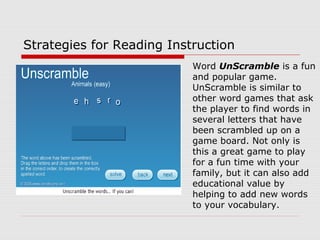
Word UnScramble is a fun
and popular game.
UnScramble is similar to
other word games that ask
the player to find words in
several letters that have
been scrambled up on a
game board. Not only is
this a great game to play
for a fun time with your
family, but it can also add
educational value by
helping to add new words
to your vocabulary.
Strategies for Reading Instruction
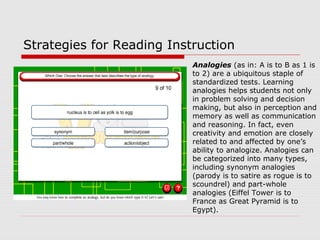
Analogies (as in: A is to B as 1 is
to 2) are a ubiquitous staple of
standardized tests. Learning
analogies helps students not only
in problem solving and decision
making, but also in perception and
memory as well as communication
and reasoning. In fact, even
creativity and emotion are closely
related to and affected by one’s
ability to analogize. Analogies can
be categorized into many types,
including synonym analogies
(parody is to satire as rogue is to
scoundrel) and part-whole
analogies (Eiffel Tower is to
France as Great Pyramid is to
Egypt).
Strategies for Reading Instruction
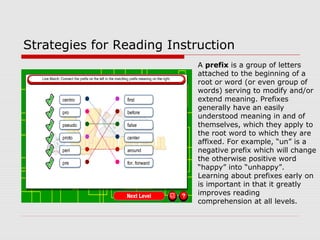
A prefix is a group of letters
attached to the beginning of a
root or word (or even group of
words) serving to modify and/or
extend meaning. Prefixes
generally have an easily
understood meaning in and of
themselves, which they apply to
the root word to which they are
affixed. For example, “un” is a
negative prefix which will change
the otherwise positive word
“happy” into “unhappy”.
Learning about prefixes early on
is important in that it greatly
improves reading
comprehension at all levels.
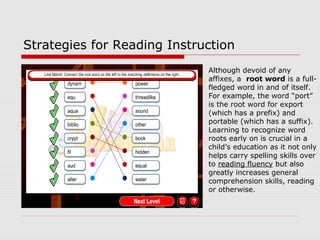
Although devoid of any
affixes, a root word is a full-
fledged word in and of itself.
For example, the word “port”
is the root word for export
(which has a prefix) and
portable (which has a suffix).
Learning to recognize word
roots early on is crucial in a
child’s education as it not only
helps carry spelling skills over
to reading fluency but also
greatly increases general
comprehension skills, reading
or otherwise.
Strategies for Reading Instruction
3. JOURNALS
 The Journal activity is a diary of
everything a child does. The Journal can
be used by children to organize work or
revisit a past project, and by teachers and
parents to assess a child's progress.
 The Journal activity provides an intuitive
interface for viewing projects and files.
Strategies for Reading Instruction
3. JOURNALS
 Who is your favorite character? Why?
 Who among the characters do you
dislike?
 Are you like some of the characters in the
story? Why?
 If you were the teacher, would you ask
your students to read the story? Why?
Strategies for Reading Instruction
4. KWL
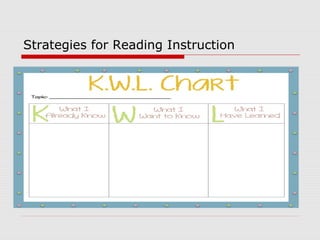
 KWL is intended to be an exercise for a
study group or class that can guide you in
reading and understanding a text. You
can adapt it to working alone, but
discussions definitely help.
It is composed of only three stages that
reflect a worksheet of three columns with
the three letters:
Strategies for Reading Instruction
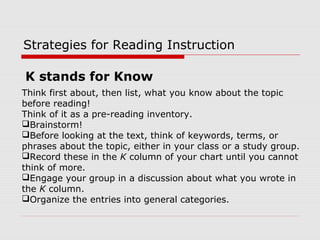
Think first about, then list, what you know about the topic
before reading!
Think of it as a pre-reading inventory.
Brainstorm!
Before looking at the text, think of keywords, terms, or
phrases about the topic, either in your class or a study group.
Record these in the K column of your chart until you cannot
think of more.
Engage your group in a discussion about what you wrote in
the K column.
Organize the entries into general categories.
K stands for Know
Strategies for Reading Instruction
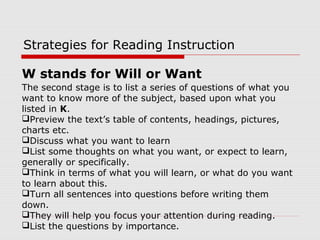
The second stage is to list a series of questions of what you
want to know more of the subject, based upon what you
listed in K.
Preview the text’s table of contents, headings, pictures,
charts etc.
Discuss what you want to learn
List some thoughts on what you want, or expect to learn,
generally or specifically.
Think in terms of what you will learn, or what do you want
to learn about this.
Turn all sentences into questions before writing them
down.
They will help you focus your attention during reading.
List the questions by importance.
W stands for Will or Want
Strategies for Reading Instruction
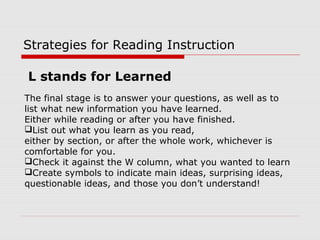
The final stage is to answer your questions, as well as to
list what new information you have learned.
Either while reading or after you have finished.
List out what you learn as you read,
either by section, or after the whole work, whichever is
comfortable for you.
Check it against the W column, what you wanted to learn
Create symbols to indicate main ideas, surprising ideas,
questionable ideas, and those you don’t understand!
L stands for Learned
Strategies for Reading Instruction
Expand this exercise beyond K W L:
Add an H!
Stands for HOW you can learn more.
Pose new questions about the topic
How can I learn more or answer questions not
answered in my worksheet
These include other sources of information, including:
organizations, experts, tutors, websites, librarians, etc.
Strategies for Reading Instruction
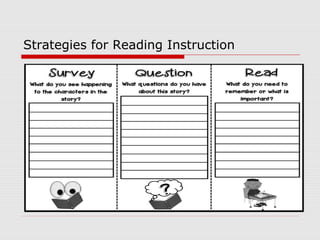
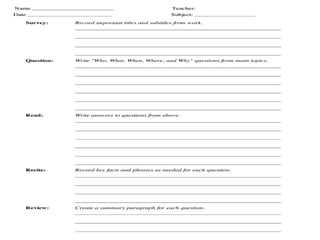
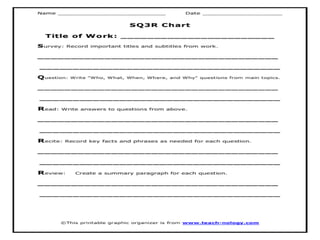
4. SQ3R READING METHOD
 SQ3R is a reading strategy formed
from its letters:
 Survey! Question! Read! Recite!
Review!
SQ3R will help you build a framework to
understand your reading assignment.
Strategies for Reading Instruction
Before you read, Survey the chapter:
the title, headings, and subheadings
captions under pictures, charts, graphs or
maps
review questions or teacher-made study
guides
introductory and concluding paragraphs
summary
Question while you are surveying:
Turn the title, headings, and/or subheadings into questions
Read questions at the end of the chapters or after each
subheading
Ask yourself,
"What did my instructor say about this chapter or subject
when it was assigned?“
Ask yourself,
"What do I already know about this subject?"
Note: If it is helpful to you, write out these questions for
consideration.
This variation is called SQW3R
Strategies for Reading Instruction
When you begin to Read:
Look for answers to the questions you first raised
Answer questions at the beginning or end of
chapters or study guides
Reread captions under pictures, graphs, etc.
Note all the underlined, italicized, bold printed
words or phrases
Study graphic aids
Reduce your speed for difficult passages
Stop and reread parts which are not clear
Read only a section at a time and recite after each
section
Strategies for Reading Instruction
Review: an ongoing process
Day One
After you have read and recited the entire
chapter,
write questions in the margins for those points
you have highlighted or underlined.
If you took notes while reciting,
write questions for the notes you have taken
in the left hand margins of your notebook.
Complete the form for a critical reading review
Strategies for Reading Instruction
Day Two
Page through the text and/or your notebook to
re-acquaint yourself with the important points.
Cover the right hand column of your text/note-
book and orally ask yourself the questions in the
left hand margins.
Orally recite or write the answers from memory.
Develop mnemonic devices for material which
need to be memorized. Make flash cards for those
questions which give you difficulty.
Strategies for Reading Instruction
Days Three, Four and Five
Alternate between your flash cards and
notes and test yourself
(orally or in writing) on the questions you
formulated.
Make additional flash cards if necessary.
Strategies for Reading Instruction
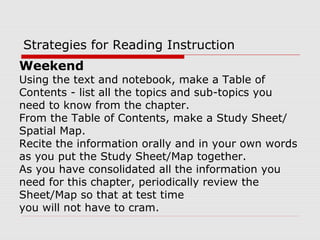
Weekend
Using the text and notebook, make a Table of
Contents - list all the topics and sub-topics you
need to know from the chapter.
From the Table of Contents, make a Study Sheet/
Spatial Map.
Recite the information orally and in your own words
as you put the Study Sheet/Map together.
As you have consolidated all the information you
need for this chapter, periodically review the
Sheet/Map so that at test time
you will not have to cram.
Strategies for Reading Instruction
References
 http://www.learningrx.com/strategies-for-reading-instruction-faq.htm
 https://www.teachervision.com/graphic-organizers/printable/6293.html
 http://www.vocabulary.co.il/
 http://www.studygs.net/texred3.htm
 http://www.studygs.net/texred2.htm

Strategies for reading instruction

  • 1.
    Strategies for ReadingInstruction Holy Angel University Jennifer V. Ocampo Master of Arts in English Language and Literature Teaching
  • 2.
    Strategies for ReadingInstruction Reading is a complex activity that requires the use and coordination of many skills simultaneously. Difficulty with any of these abilities may result in a reading problem. Strategies should be focused on working with the child’s strengths.
  • 3.
    Strategies for ReadingInstruction 1. GRAPHIC ORGANIZERS  By using graphic organizers across all subject areas, you will be empowering your students to master subject-matter faster and more efficiently.  Use graphic organizers to structure writing projects, to help in problem solving, decision making, studying, planning research and brainstorming.
  • 4.
    Strategies for ReadingInstruction 1.1 STORY PYRAMID Capitalize the first word in each line. Line 1 — one word, stating the name of main character Line 2 — two words, describing the main character Line 3 — three words, describing the setting Line 4 — four words, stating the problem Line 5 — five words, describing one event Line 6 — six words, describing a second event Line 7 — seven words, describing third event Line 8 — eight words, stating the solution to the problem Cinderella Poor, beautiful Town with castle Forbidden to attend ball Fairy godmother helps her go Cinderella loses her slipper at midnight Unique glass slipper fits only Cinderella’s foot Cinderella marries Prince and lives happily ever after
  • 5.
    Strategies for ReadingInstruction 1.1 STORY PYRAMID Use a story pyramid to describe important information from a story, such as the main character, the setting, and the major events in the plot. Carefully choose your words in order to provide a precise description. You may wish to use a dictionary and a thesaurus.
  • 6.
    Strategies for ReadingInstruction 1.2 CAUSE-and-EFFECT DIAGRAM Cause Effect Effect Effect
  • 7.
    Strategies for ReadingInstruction 1.3 STORY ELEMENTS Title _______________ This story is about _____________________________________________________________________ ____________________________________________________________________________________ _ (name the characters) This story takes place ___________________________________________________________________ ____________________________________________________________________________________ _ (where and when) The action begins when _________________________________________________________________ ____________________________________________________________________________________ _ Then, ________________________________________________________________________________ ____________________________________________________________________________________ _ Next, ________________________________________________________________________________ ____________________________________________________________________________________ _ After that, ____________________________________________________________________________
  • 8.
    Strategies for ReadingInstruction 1.4 VENN DIAGRAM Topic: _______________ Topic: ______________ What are you comparing and contrasting? Similarities Differences
  • 9.
    Strategies for ReadingInstruction 1.5. BRAINSTORMING WEB Topic Directions: Write a word in each circle that tells about or describes the topic
  • 10.
    Strategies for ReadingInstruction 1.6 CHARACTER WEB Character’s Name
  • 11.
    Strategies for ReadingInstruction 2. Vocabulary Building
  • 12.
    Strategies for ReadingInstruction 2. Vocabulary Building EVERYONE—FROM BEGINNING LEARNERS in English to veterans in journalism—knows the frustration of not having the right word immediately available in that lexicon one carries between one's ears. Sometimes it's a matter of not being able to recall the right word; sometimes we never knew it. It is also frustrating to read a newspaper or homework assignment and run across words whose meanings elude us. Language, after all, is power. When your children get in trouble fighting with the neighbors' children, and your neighbors call your children little twerps and you call their children nefarious miscreants—well, the battle is over and they didn't stand a chance. Building a vocabulary that is adequate to the needs of one's reading and self-expression has to be a personal goal for every writer and speaker.
  • 13.
    Strategies for ReadingInstruction Word UnScramble is a fun and popular game. UnScramble is similar to other word games that ask the player to find words in several letters that have been scrambled up on a game board. Not only is this a great game to play for a fun time with your family, but it can also add educational value by helping to add new words to your vocabulary.
  • 14.
    Strategies for ReadingInstruction Analogies (as in: A is to B as 1 is to 2) are a ubiquitous staple of standardized tests. Learning analogies helps students not only in problem solving and decision making, but also in perception and memory as well as communication and reasoning. In fact, even creativity and emotion are closely related to and affected by one’s ability to analogize. Analogies can be categorized into many types, including synonym analogies (parody is to satire as rogue is to scoundrel) and part-whole analogies (Eiffel Tower is to France as Great Pyramid is to Egypt).
  • 15.
    Strategies for ReadingInstruction A prefix is a group of letters attached to the beginning of a root or word (or even group of words) serving to modify and/or extend meaning. Prefixes generally have an easily understood meaning in and of themselves, which they apply to the root word to which they are affixed. For example, “un” is a negative prefix which will change the otherwise positive word “happy” into “unhappy”. Learning about prefixes early on is important in that it greatly improves reading comprehension at all levels.
  • 16.
    Although devoid ofany affixes, a root word is a full- fledged word in and of itself. For example, the word “port” is the root word for export (which has a prefix) and portable (which has a suffix). Learning to recognize word roots early on is crucial in a child’s education as it not only helps carry spelling skills over to reading fluency but also greatly increases general comprehension skills, reading or otherwise. Strategies for Reading Instruction
  • 17.
    Strategies for ReadingInstruction 3. JOURNALS  The Journal activity is a diary of everything a child does. The Journal can be used by children to organize work or revisit a past project, and by teachers and parents to assess a child's progress.  The Journal activity provides an intuitive interface for viewing projects and files.
  • 18.
    Strategies for ReadingInstruction 3. JOURNALS  Who is your favorite character? Why?  Who among the characters do you dislike?  Are you like some of the characters in the story? Why?  If you were the teacher, would you ask your students to read the story? Why?
  • 19.
    Strategies for ReadingInstruction 4. KWL  KWL is intended to be an exercise for a study group or class that can guide you in reading and understanding a text. You can adapt it to working alone, but discussions definitely help. It is composed of only three stages that reflect a worksheet of three columns with the three letters:
  • 20.
  • 21.
    Strategies for ReadingInstruction Think first about, then list, what you know about the topic before reading! Think of it as a pre-reading inventory. Brainstorm! Before looking at the text, think of keywords, terms, or phrases about the topic, either in your class or a study group. Record these in the K column of your chart until you cannot think of more. Engage your group in a discussion about what you wrote in the K column. Organize the entries into general categories. K stands for Know
  • 22.
    Strategies for ReadingInstruction The second stage is to list a series of questions of what you want to know more of the subject, based upon what you listed in K. Preview the text’s table of contents, headings, pictures, charts etc. Discuss what you want to learn List some thoughts on what you want, or expect to learn, generally or specifically. Think in terms of what you will learn, or what do you want to learn about this. Turn all sentences into questions before writing them down. They will help you focus your attention during reading. List the questions by importance. W stands for Will or Want
  • 23.
    Strategies for ReadingInstruction The final stage is to answer your questions, as well as to list what new information you have learned. Either while reading or after you have finished. List out what you learn as you read, either by section, or after the whole work, whichever is comfortable for you. Check it against the W column, what you wanted to learn Create symbols to indicate main ideas, surprising ideas, questionable ideas, and those you don’t understand! L stands for Learned
  • 24.
    Strategies for ReadingInstruction Expand this exercise beyond K W L: Add an H! Stands for HOW you can learn more. Pose new questions about the topic How can I learn more or answer questions not answered in my worksheet These include other sources of information, including: organizations, experts, tutors, websites, librarians, etc.
  • 25.
    Strategies for ReadingInstruction 4. SQ3R READING METHOD  SQ3R is a reading strategy formed from its letters:  Survey! Question! Read! Recite! Review! SQ3R will help you build a framework to understand your reading assignment.
  • 26.
    Strategies for ReadingInstruction Before you read, Survey the chapter: the title, headings, and subheadings captions under pictures, charts, graphs or maps review questions or teacher-made study guides introductory and concluding paragraphs summary
  • 27.
    Question while youare surveying: Turn the title, headings, and/or subheadings into questions Read questions at the end of the chapters or after each subheading Ask yourself, "What did my instructor say about this chapter or subject when it was assigned?“ Ask yourself, "What do I already know about this subject?" Note: If it is helpful to you, write out these questions for consideration. This variation is called SQW3R Strategies for Reading Instruction
  • 28.
    When you beginto Read: Look for answers to the questions you first raised Answer questions at the beginning or end of chapters or study guides Reread captions under pictures, graphs, etc. Note all the underlined, italicized, bold printed words or phrases Study graphic aids Reduce your speed for difficult passages Stop and reread parts which are not clear Read only a section at a time and recite after each section Strategies for Reading Instruction
  • 29.
    Review: an ongoingprocess Day One After you have read and recited the entire chapter, write questions in the margins for those points you have highlighted or underlined. If you took notes while reciting, write questions for the notes you have taken in the left hand margins of your notebook. Complete the form for a critical reading review Strategies for Reading Instruction
  • 30.
    Day Two Page throughthe text and/or your notebook to re-acquaint yourself with the important points. Cover the right hand column of your text/note- book and orally ask yourself the questions in the left hand margins. Orally recite or write the answers from memory. Develop mnemonic devices for material which need to be memorized. Make flash cards for those questions which give you difficulty. Strategies for Reading Instruction
  • 31.
    Days Three, Fourand Five Alternate between your flash cards and notes and test yourself (orally or in writing) on the questions you formulated. Make additional flash cards if necessary. Strategies for Reading Instruction
  • 32.
    Weekend Using the textand notebook, make a Table of Contents - list all the topics and sub-topics you need to know from the chapter. From the Table of Contents, make a Study Sheet/ Spatial Map. Recite the information orally and in your own words as you put the Study Sheet/Map together. As you have consolidated all the information you need for this chapter, periodically review the Sheet/Map so that at test time you will not have to cram. Strategies for Reading Instruction
  • 33.
  • 36.
    References  http://www.learningrx.com/strategies-for-reading-instruction-faq.htm  https://www.teachervision.com/graphic-organizers/printable/6293.html http://www.vocabulary.co.il/  http://www.studygs.net/texred3.htm  http://www.studygs.net/texred2.htm