Reading StrategiesReading in the Upper GradesTaken from "Reading Strategies: Helping Struggling Students"
Teaching Strategies ComprehensionLearning WallsGenerate a list of essential words, concepts, formulas, etc. and begin a word wall.Create charts and place them in a prominent place.Use color and patterns to enhance learners.Students connect new info with the learning walls.Taken from "Reading Strategies: Helping Struggling Students"
Teaching Strategies ComprehensionLearning WallsLocation:  Where the kids can see itContent:  Pictures, phrases, 4x6 index cards, color code words that share same conceptTaken from "Reading Strategies: Helping Struggling Students"
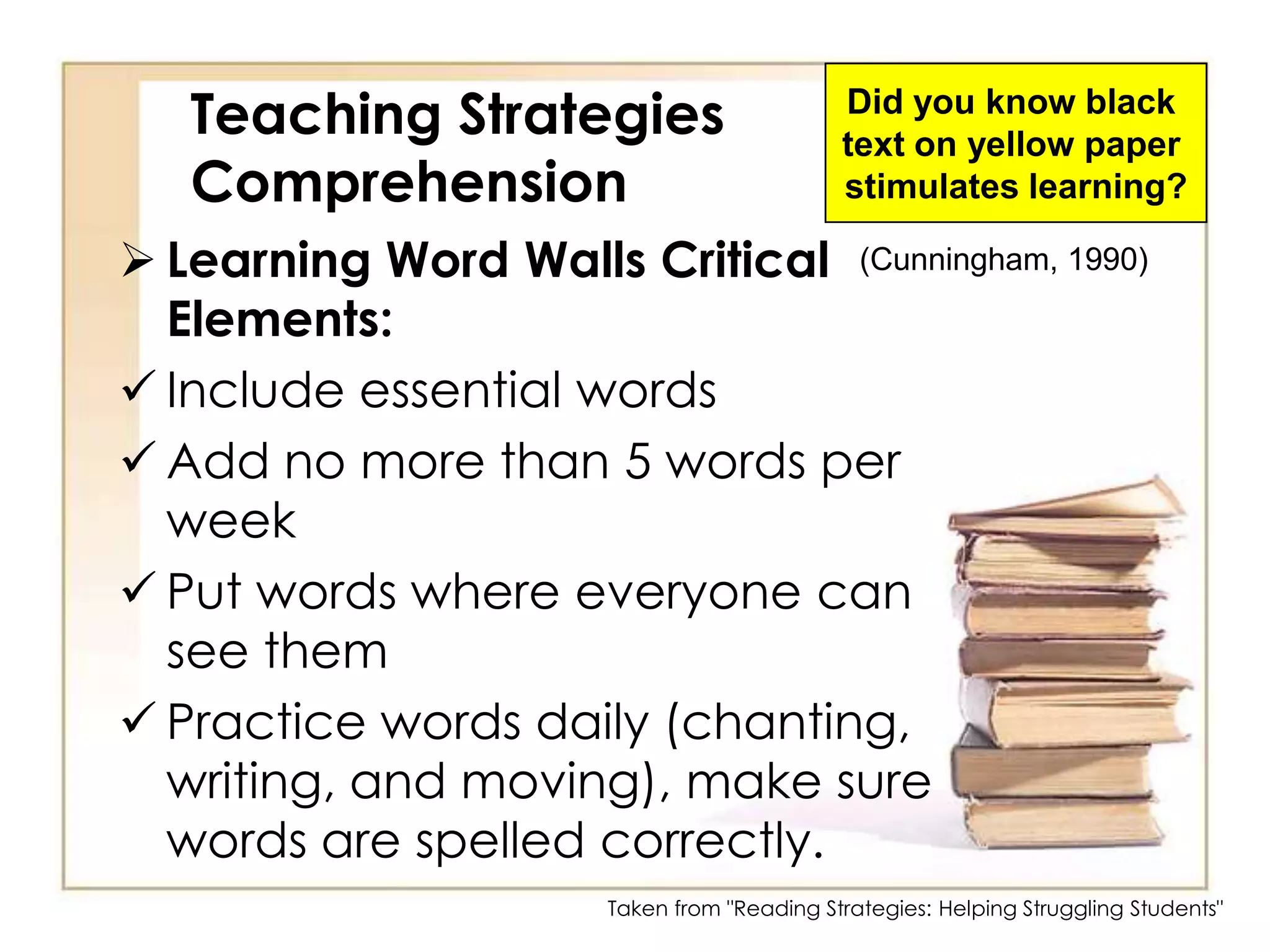
Teaching Strategies ComprehensionDid you know black text on yellow paper stimulates learning?Learning Word Walls Critical Elements:
Include essential words
Add no more than 5 words per week
Put words where everyone can see them
Practice words daily (chanting, writing, and moving), make sure words are spelled correctly.(Cunningham, 1990)Taken from "Reading Strategies: Helping Struggling Students"
Word WallsEach clue narrowsthe possible answer.Guess the Word – Students number papers 1-5.  Give 5 clues focusing on one word.
1st clue:  It is a word on the Word Wall.
After each clue have students guess the word from the word wall.
By the 5th clue students should be able to guess the word.Taken from "Reading Strategies: Helping Struggling Students"
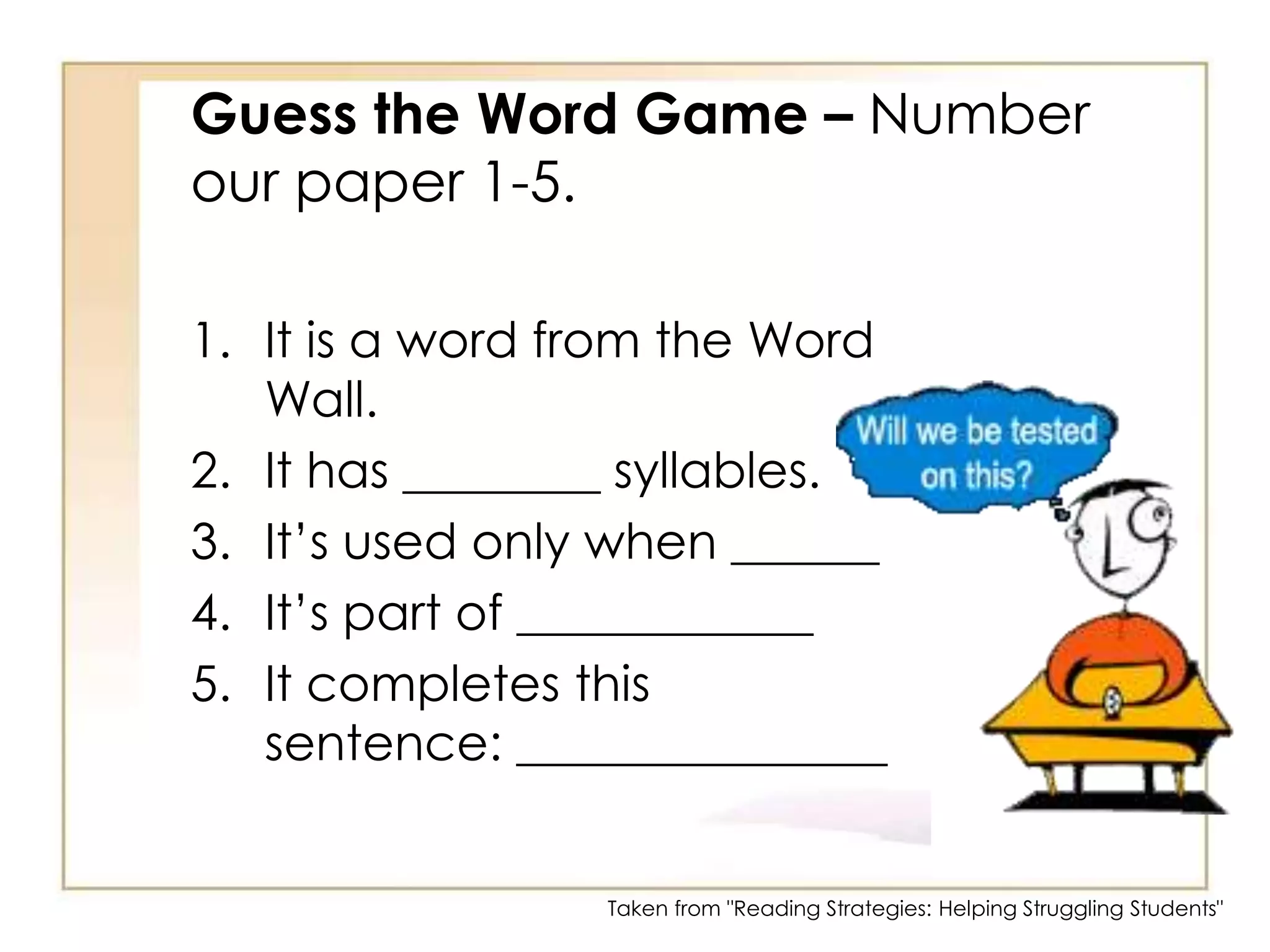
Guess the Word Game – Number our paper 1-5.It is a word from the Word Wall.It has ________ syllables.It’s used only when ______It’s part of ____________It completes this sentence: _______________Taken from "Reading Strategies: Helping Struggling Students"
WORDODownload a WORDO Template from Literacy Off Ramp.Make it harder…call out the definition, not the word.(Dr. Sharon H. Faber, 2006)This game is based on the BINGO game.  Give students a Wordo Card filled with Word Wall words (each card should be different).  Call out a word and have students cover it with a scrap of paper or cut paper squares.The first one to cover a row across, down, or diagonally, shouts WORDO.Taken from "Reading Strategies: Helping Struggling Students"
SortsDecide on the type of sort.Write 10-15 words, formulas, etc. on index cards.Students sort the words in different piles depending on the directions you give them.Sort sequentiallySort alphabetically(Dr. Sharon H. Faber, 2006)Sort by definitionSort by alike/differentTaken from "Reading Strategies: Helping Struggling Students"
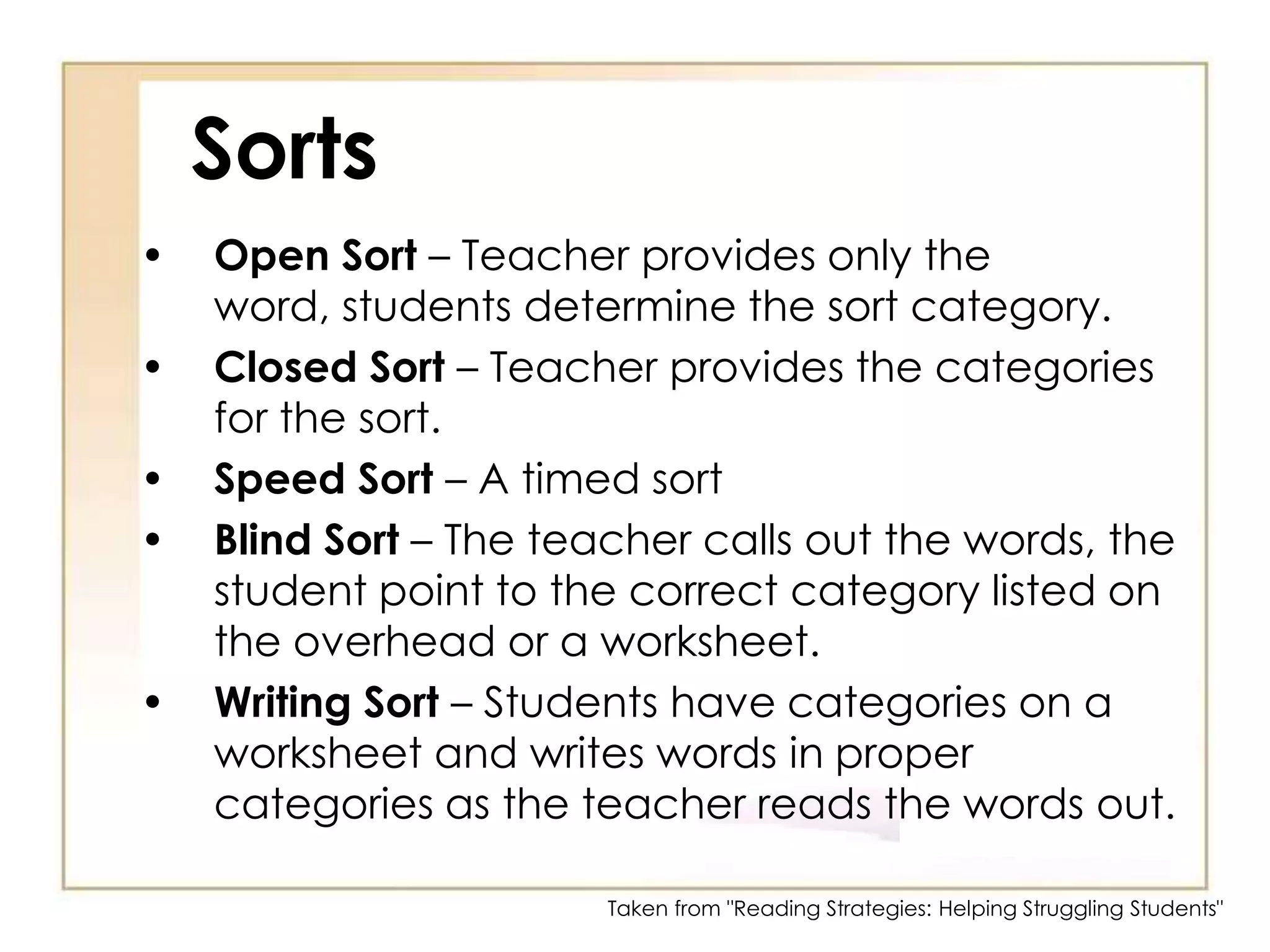
SortsOpen Sort – Teacher provides only the word, students determine the sort category.Closed Sort – Teacher provides the categories for the sort.Speed Sort – A timed sort Blind Sort – The teacher calls out the words, the student point to the correct category listed on the overhead or a worksheet.Writing Sort – Students have categories on a worksheet and writes words in proper categories as the teacher reads the words out.Taken from "Reading Strategies: Helping Struggling Students"
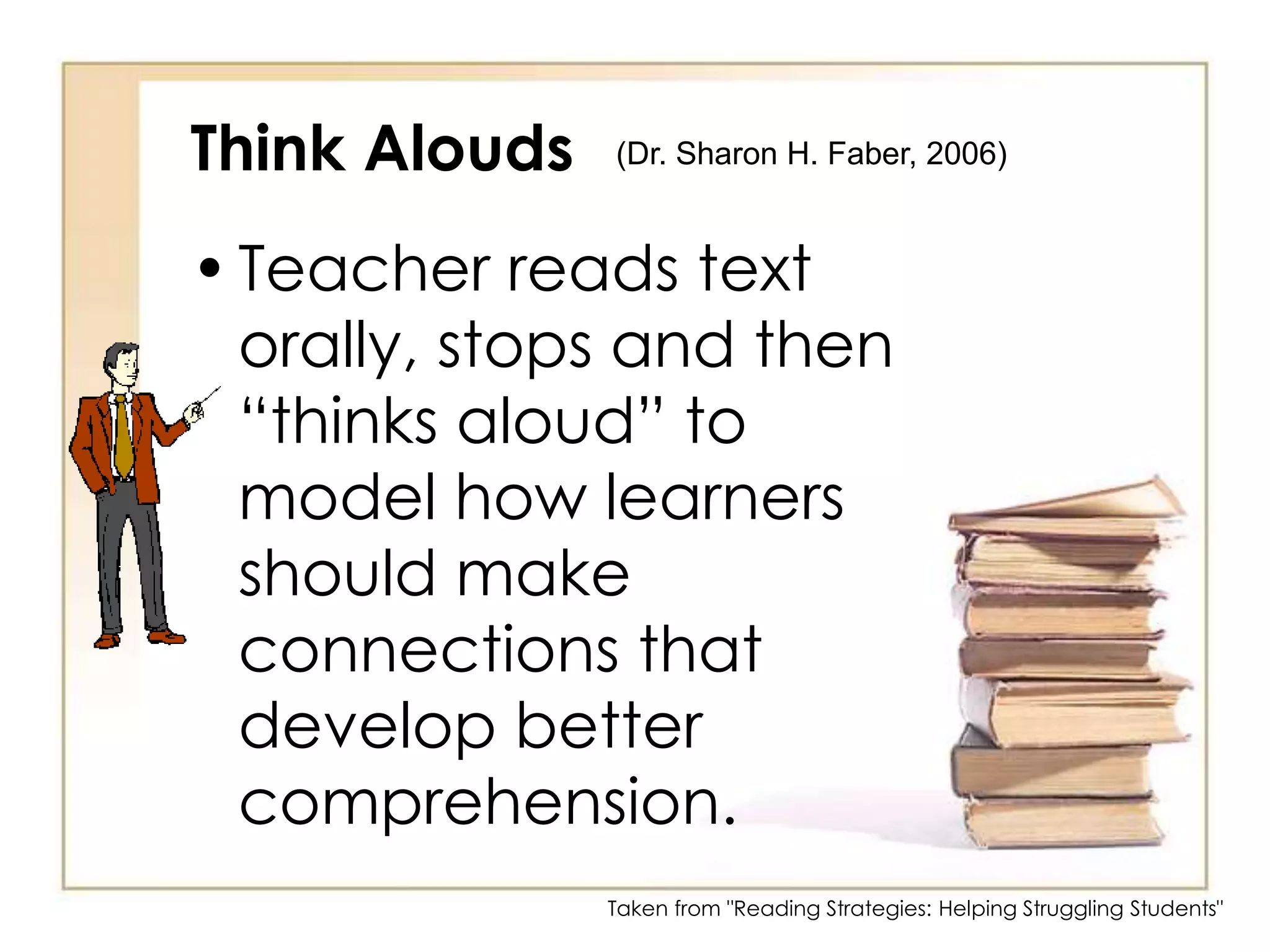
Think AloudsTeacher reads text orally, stops and then “thinks aloud” to model how learners should make connections that develop better comprehension.(Dr. Sharon H. Faber, 2006)Taken from "Reading Strategies: Helping Struggling Students"
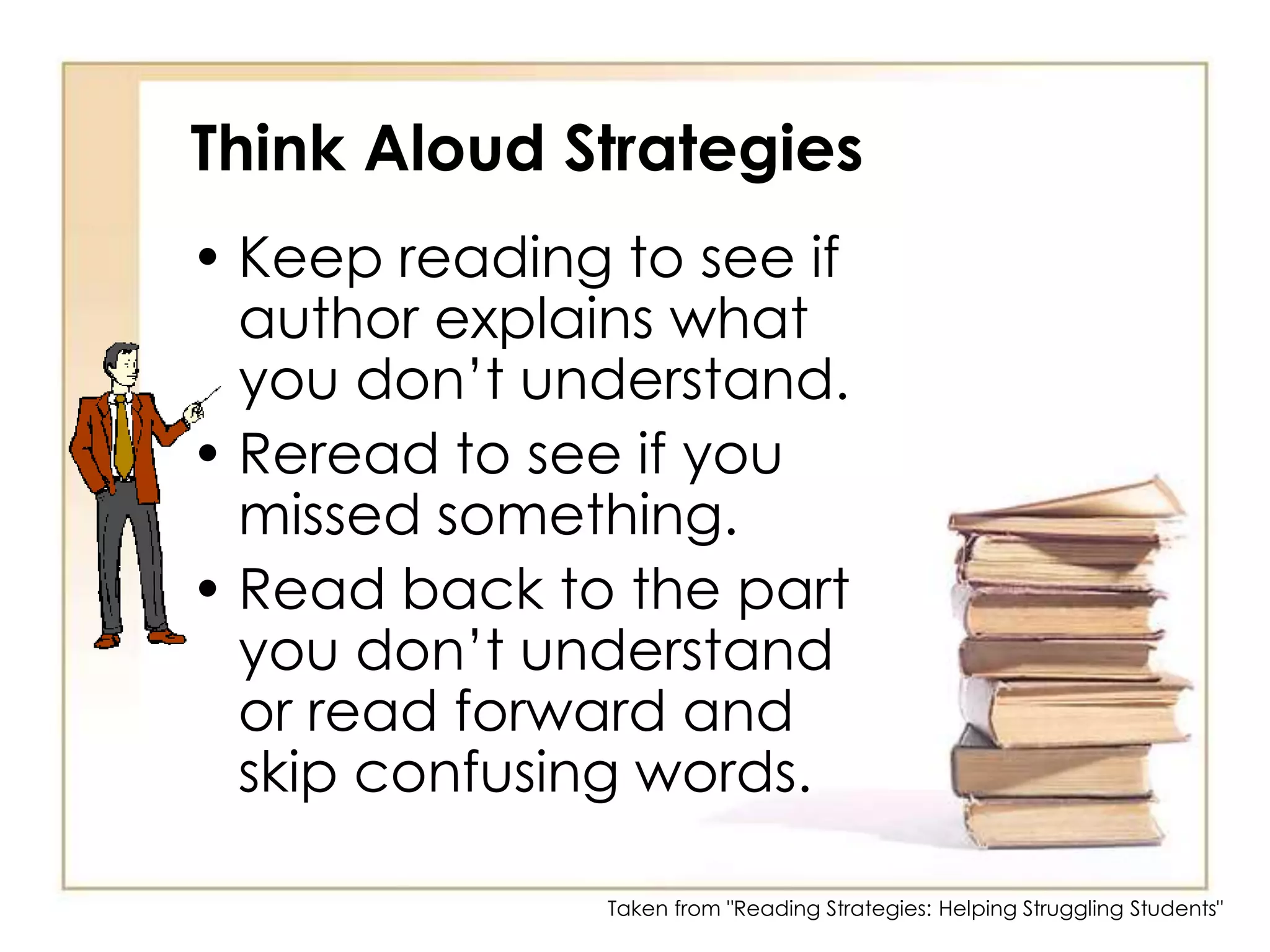
Think Aloud StrategiesKeep reading to see if author explains what you don’t understand.Reread to see if you missed something.Read back to the part you don’t understand or read forward and skip confusing words.Taken from "Reading Strategies: Helping Struggling Students"
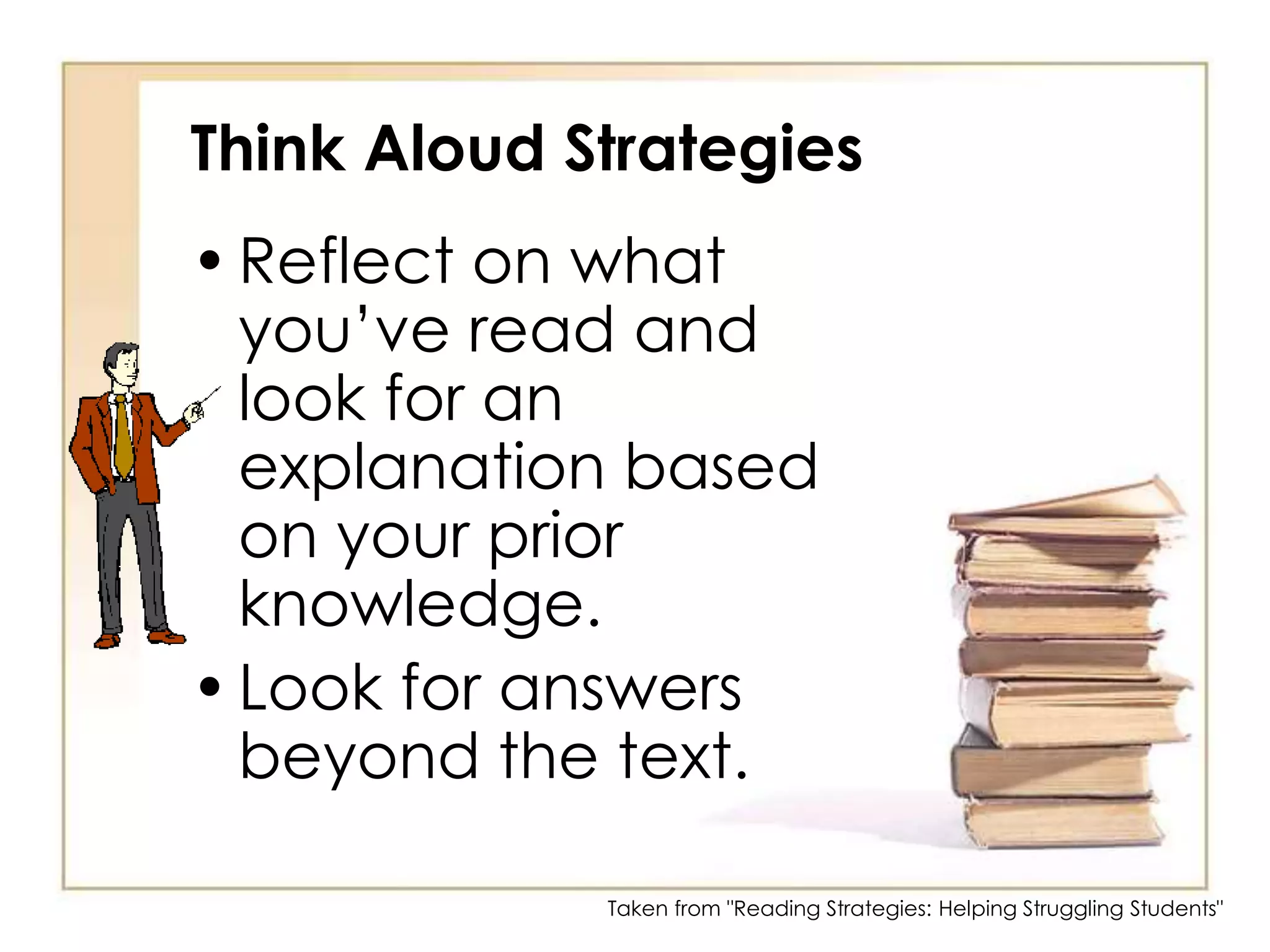
Think Aloud StrategiesReflect on what you’ve read and look for an explanation based on your prior knowledge.Look for answers beyond the text.Taken from "Reading Strategies: Helping Struggling Students"
KWL, KWHL, KWWL Charts (Ogle, 1986)K = KNOWWhat do I already know about this topic?W = WILL or WANTWhat do I want to learn about this topic? What will I learn about this topic?L = LEARNEDWhat have I learned about this topic after reading?Taken from "Reading Strategies: Helping Struggling Students"
KWL, KWHL, KWWL Charts (Ogle, 1986)Variations:H = HOWHow do I find the information?W = WHEREWhere do I find the information?KWL, KWHL, KWWLCharts can be downloaded from Literacy Off Ramp.Taken from "Reading Strategies: Helping Struggling Students"
Anticipation Guide StrategyBefore, During, and After reading strategyPreparation – The teacher develops 3-5 statements that are related to the topic.Create an anticipation guide to copy and give to studentsTierney, Readence, and DishnerAn Anticipation Guide Templatecan be downloaded from Literacy Off Ramp.Taken from "Reading Strategies: Helping Struggling Students"
Anticipation Guide StrategyPre-Reading DiscussionDistribute guides and students mark the Before Reading Agree/Disagree choices.As students read, they take notes, reading with a purpose.Tierney, Readence, and DishnerAn Anticipation Guide Template can be downloaded from Literacy Off Ramp.Taken from "Reading Strategies: Helping Struggling Students"
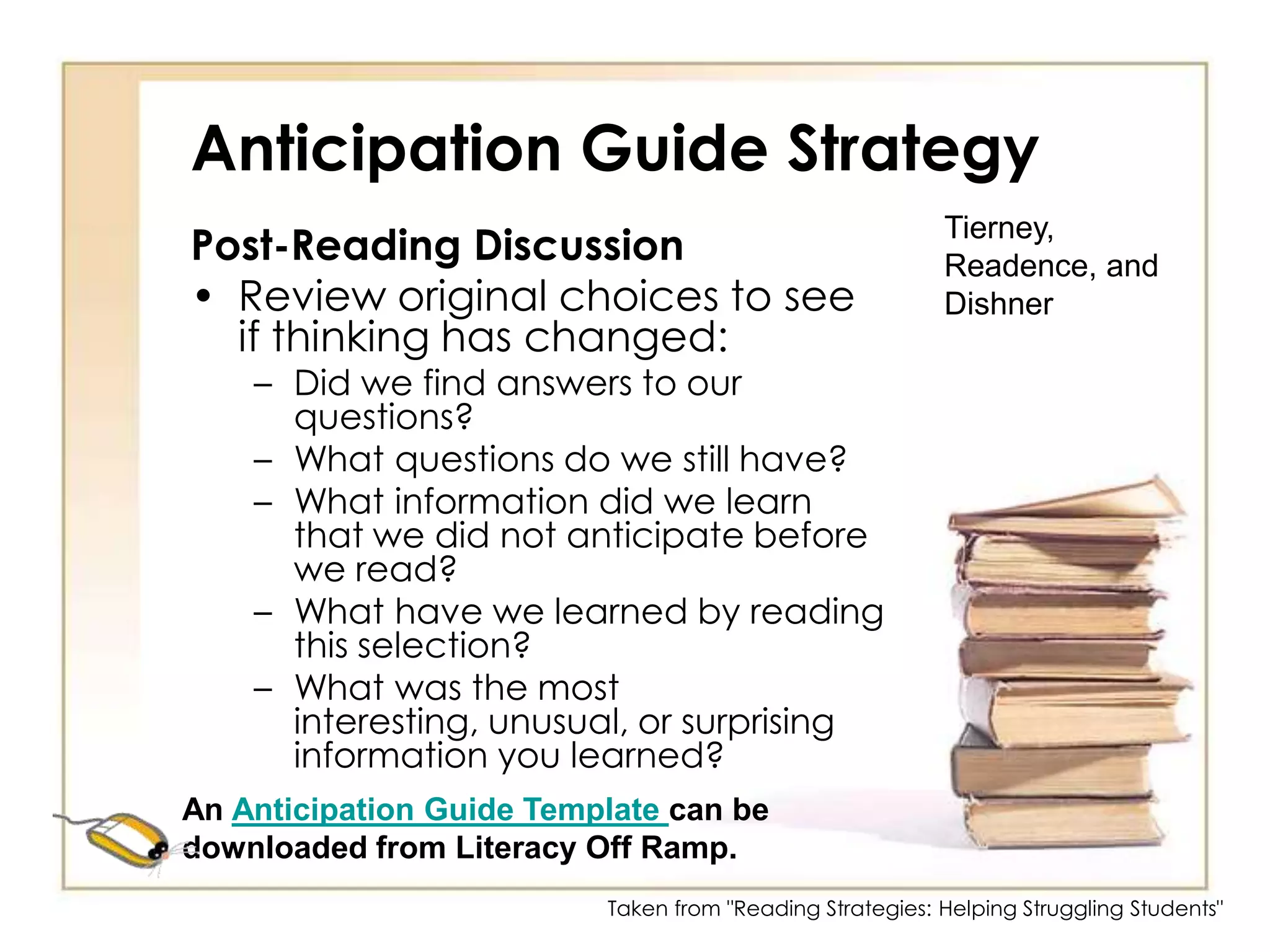
Anticipation Guide StrategyTierney, Readence, and DishnerPost-Reading DiscussionReview original choices to see if thinking has changed:Did we find answers to our questions?What questions do we still have?What information did we learn that we did not anticipate before we read?What have we learned by reading this selection?What was the most interesting, unusual, or surprising information you learned?An Anticipation Guide Template can be downloaded from Literacy Off Ramp.Taken from "Reading Strategies: Helping Struggling Students"
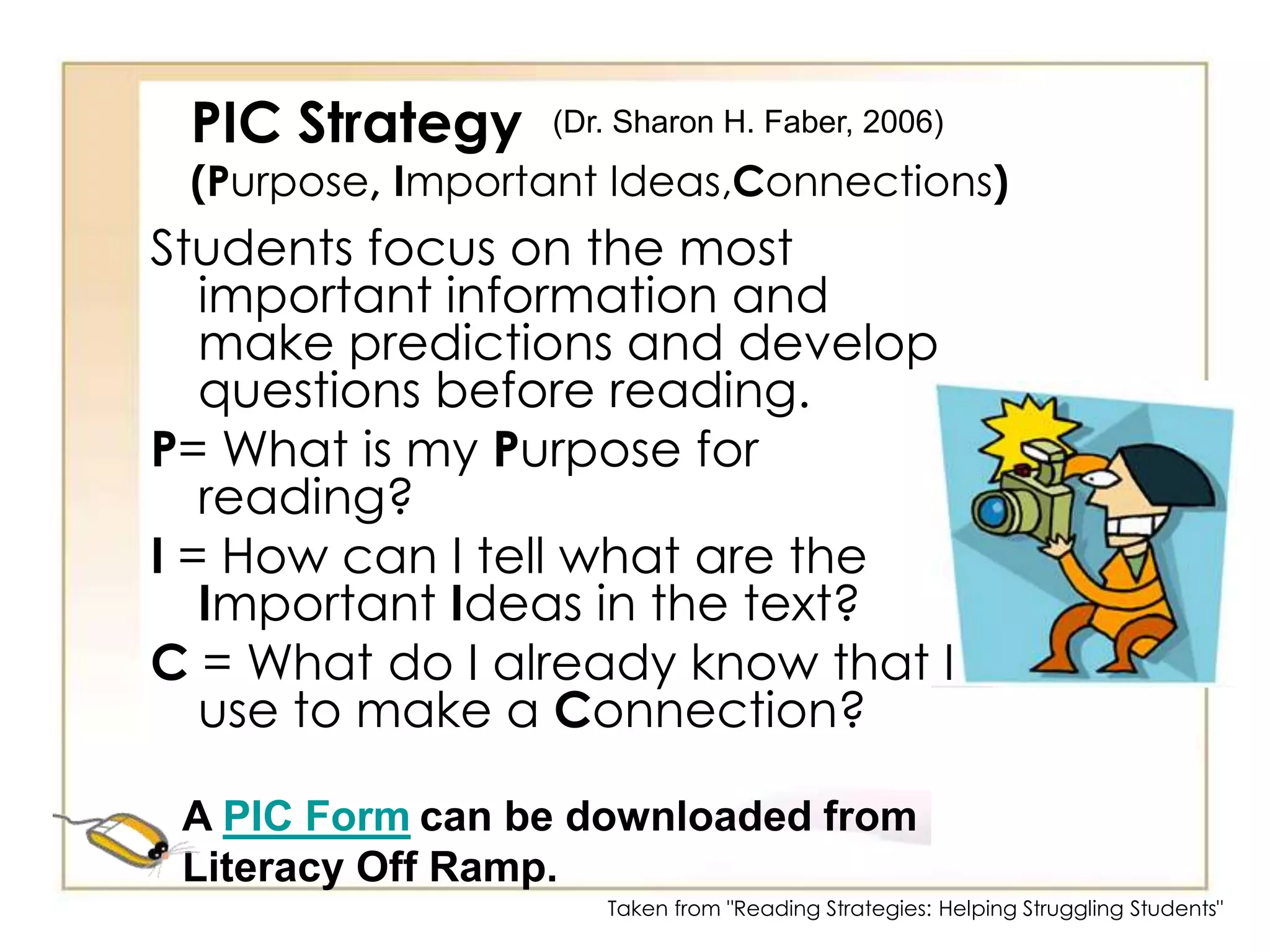
PIC Strategy(Purpose, ImportantIdeas,Connections)(Dr. Sharon H. Faber, 2006)Students focus on the most important information and make predictions and develop questions before reading.P= What is my Purpose for reading?I = How can I tell what are the Important Ideas in the text?C = What do I already know that I use to make a Connection?A PIC Formcan be downloaded from Literacy Off Ramp.Taken from "Reading Strategies: Helping Struggling Students"
3-2-1 StrategySummarizing(Dr. Sharon H. Faber, 2006)3 key ideas I found out from reading2 things that were especially interesting or especially hard to understand1 question I still haveA 3-2-1 Formcan be downloaded from Literacy Off Ramp.Taken from "Reading Strategies: Helping Struggling Students"
3-2-1 Variation(Dr. Sharon H. Faber, 2006)3 differences between ______ and _______.2 similarities between them1 question I still haveA 3-2-1 Formcan be downloaded from Literacy Off Ramp.Taken from "Reading Strategies: Helping Struggling Students"
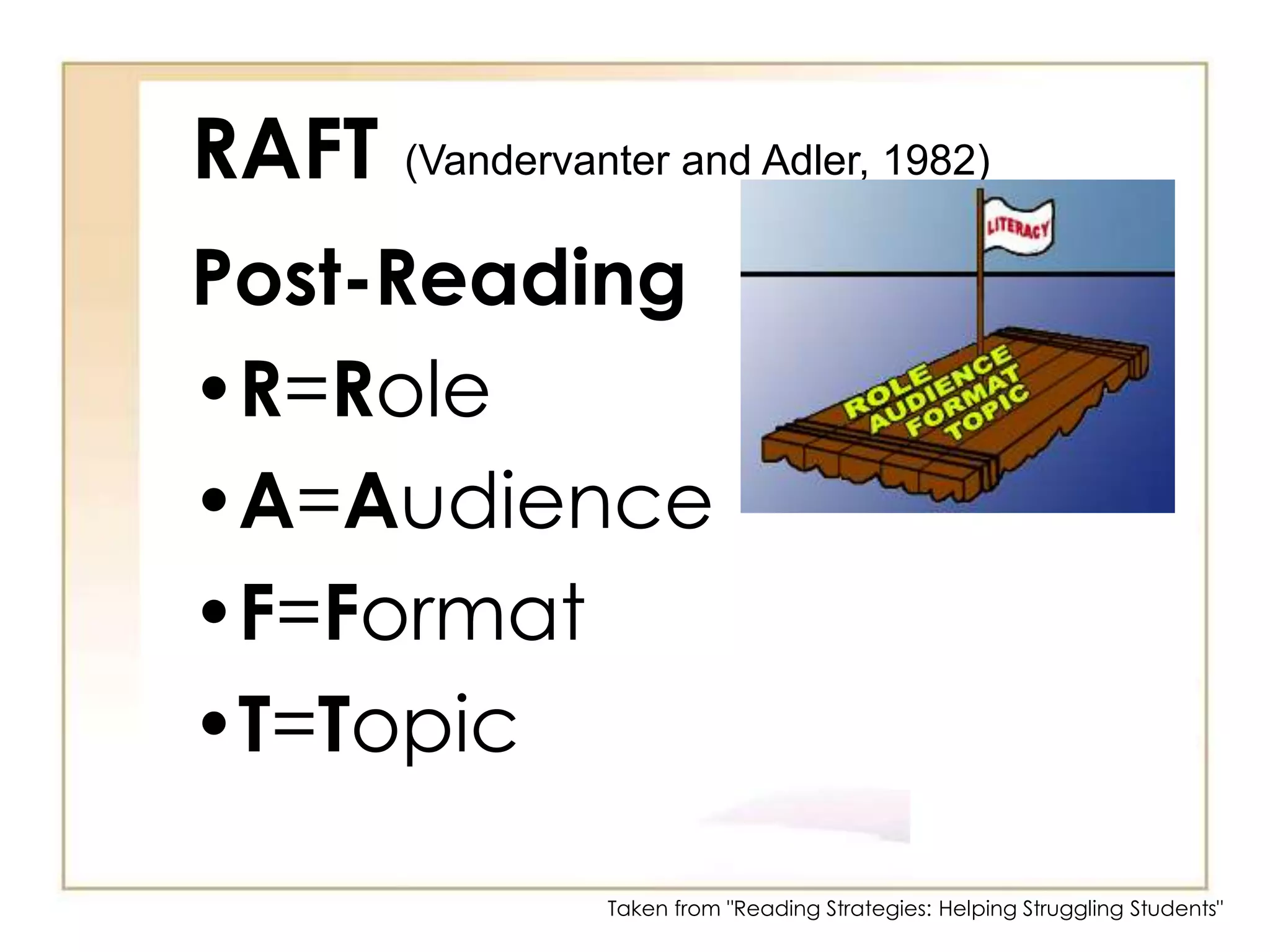
RAFTPost-ReadingR=RoleA=AudienceF=FormatT=Topic(Vandervanter and Adler, 1982)Taken from "Reading Strategies: Helping Struggling Students"
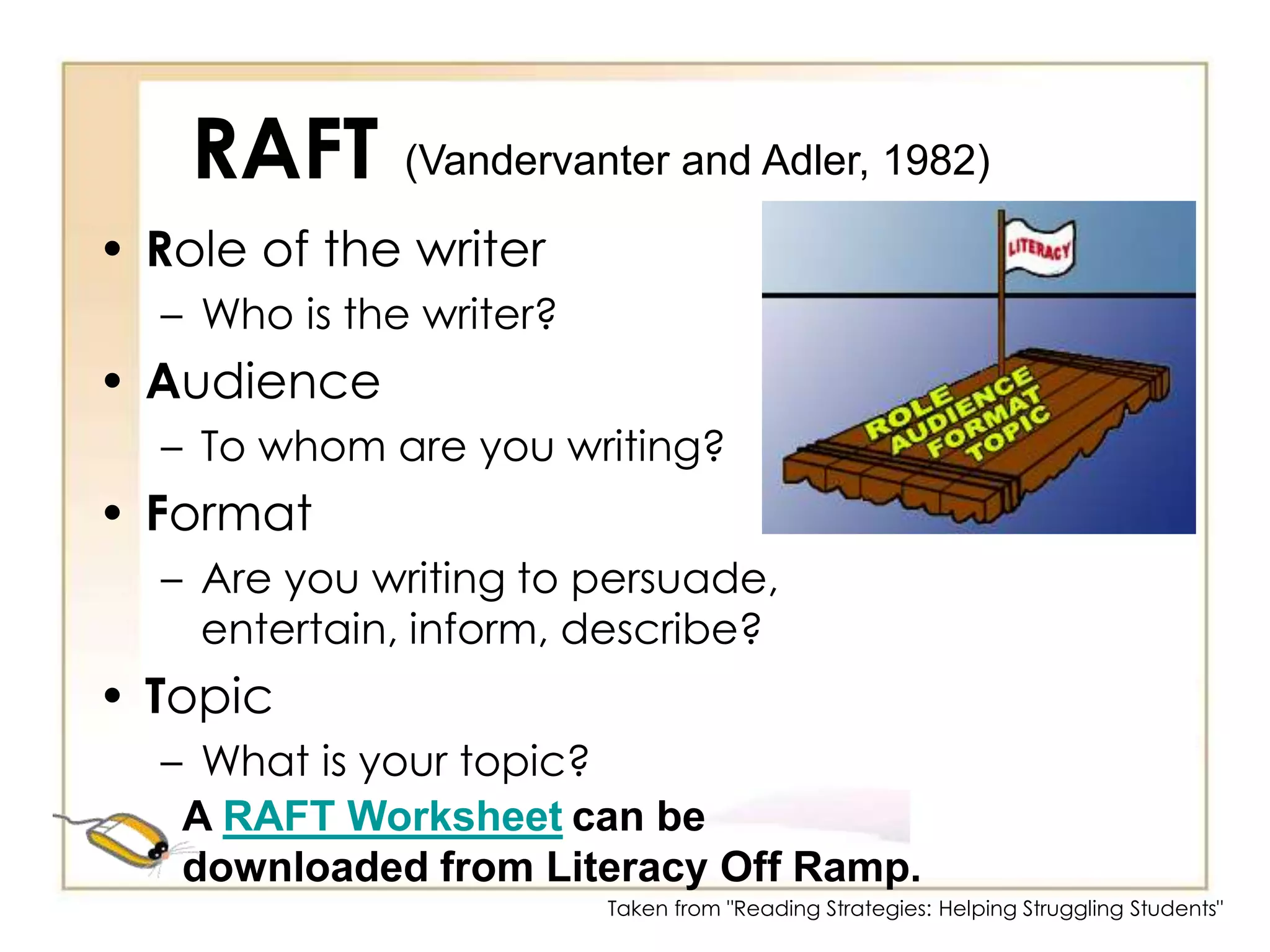
RAFT(Vandervanter and Adler, 1982)Role of the writerWho is the writer?AudienceTo whom are you writing?FormatAre you writing to persuade, entertain, inform, describe?TopicWhat is your topic?A RAFT Worksheetcan be downloaded from Literacy Off Ramp.Taken from "Reading Strategies: Helping Struggling Students"
Column Notes(Dr. Sharon H. Faber, 2006, based on Cornell Note Taking System)Change column headings     to fit objectives/materialBest for cause/effect or compare/contrast skills2-Columns – students fold paper down middle for note taking.Taken from "Reading Strategies: Helping Struggling Students"
2 Column Notes(Dr. Sharon H. Faber, 2006, based on Cornell Note Taking System)2 Column Notes can be made with:Main idea – headings – details – explanationsCause – effectVocabulary – definitionsQuestions – answersFacts – opinionsPredications – outcomes2-Column Notescan be downloaded from Literacy Off Ramp.Taken from "Reading Strategies: Helping Struggling Students"
3 Column Notes(Dr. Sharon H. Faber, 2006, based on Cornell Note Taking System)3 Column Notes can be made with:Vocabulary – definition- exampleTopic – explanation – supporting detailsProcess – procedure – resultsQuestions – notes – class discussionCause – effect - explanation3 Column Notescan be downloaded from Literacy Off Ramp.Taken from "Reading Strategies: Helping Struggling Students"
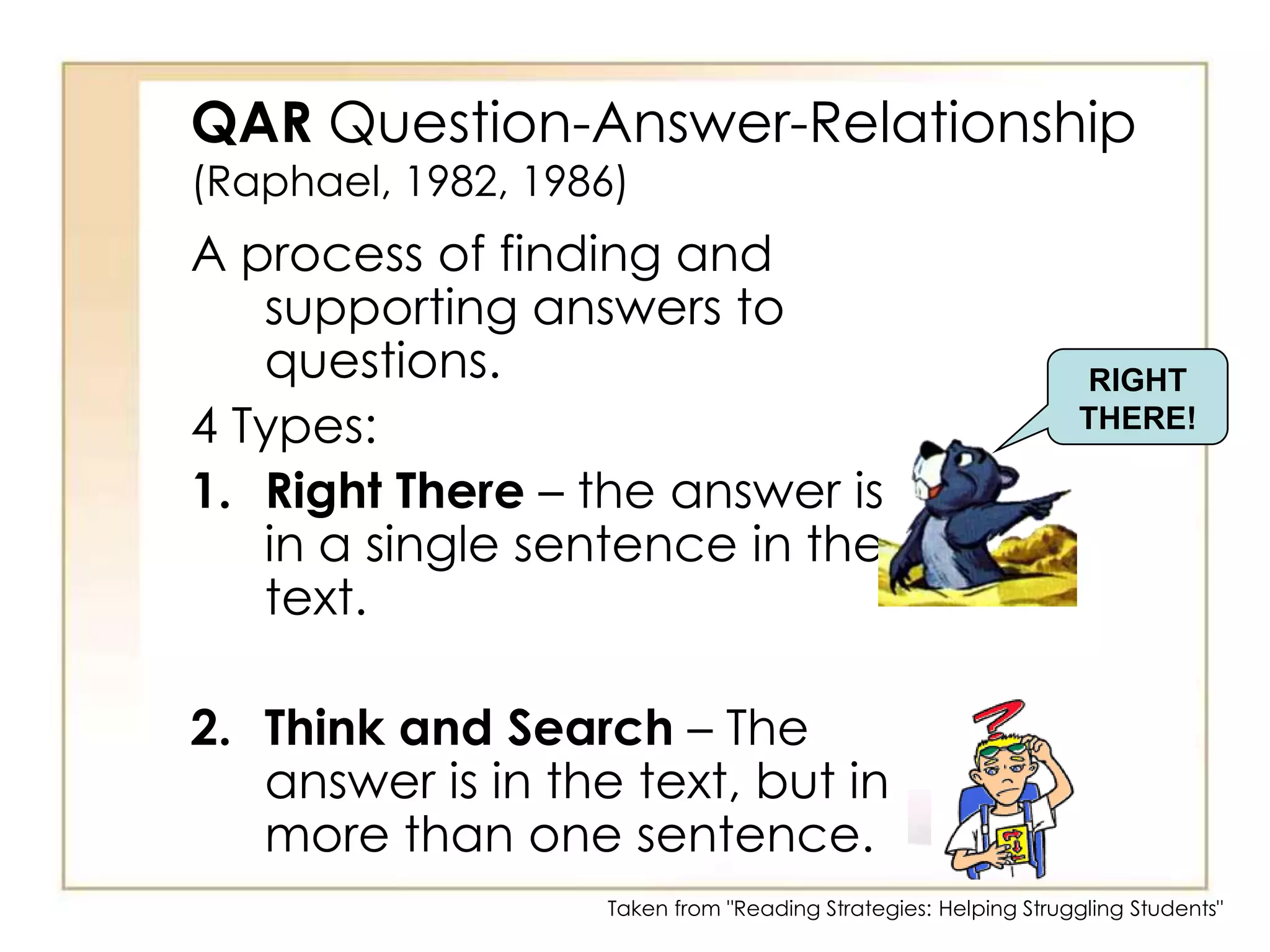
QAR Question-Answer-Relationship(Raphael, 1982, 1986)A process of finding and supporting answers to questions.4 Types:Right There – the answer is in a single sentence in the text.Think and Search – The answer is in the text, but in more than one sentence.RIGHT THERE!Taken from "Reading Strategies: Helping Struggling Students"

Reading strategies

  • 1.
    Reading StrategiesReading inthe Upper GradesTaken from "Reading Strategies: Helping Struggling Students"
  • 2.
    Teaching Strategies ComprehensionLearningWallsGenerate a list of essential words, concepts, formulas, etc. and begin a word wall.Create charts and place them in a prominent place.Use color and patterns to enhance learners.Students connect new info with the learning walls.Taken from "Reading Strategies: Helping Struggling Students"
  • 3.
    Teaching Strategies ComprehensionLearningWallsLocation: Where the kids can see itContent: Pictures, phrases, 4x6 index cards, color code words that share same conceptTaken from "Reading Strategies: Helping Struggling Students"
  • 4.
    Teaching Strategies ComprehensionDidyou know black text on yellow paper stimulates learning?Learning Word Walls Critical Elements:
  • 5.
  • 6.
    Add no morethan 5 words per week
  • 7.
    Put words whereeveryone can see them
  • 8.
    Practice words daily(chanting, writing, and moving), make sure words are spelled correctly.(Cunningham, 1990)Taken from "Reading Strategies: Helping Struggling Students"
  • 9.
    Word WallsEach cluenarrowsthe possible answer.Guess the Word – Students number papers 1-5. Give 5 clues focusing on one word.
  • 10.
    1st clue: It is a word on the Word Wall.
  • 11.
    After each cluehave students guess the word from the word wall.
  • 12.
    By the 5thclue students should be able to guess the word.Taken from "Reading Strategies: Helping Struggling Students"
  • 13.
    Guess the WordGame – Number our paper 1-5.It is a word from the Word Wall.It has ________ syllables.It’s used only when ______It’s part of ____________It completes this sentence: _______________Taken from "Reading Strategies: Helping Struggling Students"
  • 14.
    WORDODownload a WORDOTemplate from Literacy Off Ramp.Make it harder…call out the definition, not the word.(Dr. Sharon H. Faber, 2006)This game is based on the BINGO game. Give students a Wordo Card filled with Word Wall words (each card should be different). Call out a word and have students cover it with a scrap of paper or cut paper squares.The first one to cover a row across, down, or diagonally, shouts WORDO.Taken from "Reading Strategies: Helping Struggling Students"
  • 15.
    SortsDecide on thetype of sort.Write 10-15 words, formulas, etc. on index cards.Students sort the words in different piles depending on the directions you give them.Sort sequentiallySort alphabetically(Dr. Sharon H. Faber, 2006)Sort by definitionSort by alike/differentTaken from "Reading Strategies: Helping Struggling Students"
  • 16.
    SortsOpen Sort –Teacher provides only the word, students determine the sort category.Closed Sort – Teacher provides the categories for the sort.Speed Sort – A timed sort Blind Sort – The teacher calls out the words, the student point to the correct category listed on the overhead or a worksheet.Writing Sort – Students have categories on a worksheet and writes words in proper categories as the teacher reads the words out.Taken from "Reading Strategies: Helping Struggling Students"
  • 17.
    Think AloudsTeacher readstext orally, stops and then “thinks aloud” to model how learners should make connections that develop better comprehension.(Dr. Sharon H. Faber, 2006)Taken from "Reading Strategies: Helping Struggling Students"
  • 18.
    Think Aloud StrategiesKeepreading to see if author explains what you don’t understand.Reread to see if you missed something.Read back to the part you don’t understand or read forward and skip confusing words.Taken from "Reading Strategies: Helping Struggling Students"
  • 19.
    Think Aloud StrategiesReflecton what you’ve read and look for an explanation based on your prior knowledge.Look for answers beyond the text.Taken from "Reading Strategies: Helping Struggling Students"
  • 20.
    KWL, KWHL, KWWLCharts (Ogle, 1986)K = KNOWWhat do I already know about this topic?W = WILL or WANTWhat do I want to learn about this topic? What will I learn about this topic?L = LEARNEDWhat have I learned about this topic after reading?Taken from "Reading Strategies: Helping Struggling Students"
  • 21.
    KWL, KWHL, KWWLCharts (Ogle, 1986)Variations:H = HOWHow do I find the information?W = WHEREWhere do I find the information?KWL, KWHL, KWWLCharts can be downloaded from Literacy Off Ramp.Taken from "Reading Strategies: Helping Struggling Students"
  • 22.
    Anticipation Guide StrategyBefore,During, and After reading strategyPreparation – The teacher develops 3-5 statements that are related to the topic.Create an anticipation guide to copy and give to studentsTierney, Readence, and DishnerAn Anticipation Guide Templatecan be downloaded from Literacy Off Ramp.Taken from "Reading Strategies: Helping Struggling Students"
  • 23.
    Anticipation Guide StrategyPre-ReadingDiscussionDistribute guides and students mark the Before Reading Agree/Disagree choices.As students read, they take notes, reading with a purpose.Tierney, Readence, and DishnerAn Anticipation Guide Template can be downloaded from Literacy Off Ramp.Taken from "Reading Strategies: Helping Struggling Students"
  • 24.
    Anticipation Guide StrategyTierney,Readence, and DishnerPost-Reading DiscussionReview original choices to see if thinking has changed:Did we find answers to our questions?What questions do we still have?What information did we learn that we did not anticipate before we read?What have we learned by reading this selection?What was the most interesting, unusual, or surprising information you learned?An Anticipation Guide Template can be downloaded from Literacy Off Ramp.Taken from "Reading Strategies: Helping Struggling Students"
  • 25.
    PIC Strategy(Purpose, ImportantIdeas,Connections)(Dr.Sharon H. Faber, 2006)Students focus on the most important information and make predictions and develop questions before reading.P= What is my Purpose for reading?I = How can I tell what are the Important Ideas in the text?C = What do I already know that I use to make a Connection?A PIC Formcan be downloaded from Literacy Off Ramp.Taken from "Reading Strategies: Helping Struggling Students"
  • 26.
    3-2-1 StrategySummarizing(Dr. SharonH. Faber, 2006)3 key ideas I found out from reading2 things that were especially interesting or especially hard to understand1 question I still haveA 3-2-1 Formcan be downloaded from Literacy Off Ramp.Taken from "Reading Strategies: Helping Struggling Students"
  • 27.
    3-2-1 Variation(Dr. SharonH. Faber, 2006)3 differences between ______ and _______.2 similarities between them1 question I still haveA 3-2-1 Formcan be downloaded from Literacy Off Ramp.Taken from "Reading Strategies: Helping Struggling Students"
  • 28.
    RAFTPost-ReadingR=RoleA=AudienceF=FormatT=Topic(Vandervanter and Adler,1982)Taken from "Reading Strategies: Helping Struggling Students"
  • 29.
    RAFT(Vandervanter and Adler,1982)Role of the writerWho is the writer?AudienceTo whom are you writing?FormatAre you writing to persuade, entertain, inform, describe?TopicWhat is your topic?A RAFT Worksheetcan be downloaded from Literacy Off Ramp.Taken from "Reading Strategies: Helping Struggling Students"
  • 30.
    Column Notes(Dr. SharonH. Faber, 2006, based on Cornell Note Taking System)Change column headings to fit objectives/materialBest for cause/effect or compare/contrast skills2-Columns – students fold paper down middle for note taking.Taken from "Reading Strategies: Helping Struggling Students"
  • 31.
    2 Column Notes(Dr.Sharon H. Faber, 2006, based on Cornell Note Taking System)2 Column Notes can be made with:Main idea – headings – details – explanationsCause – effectVocabulary – definitionsQuestions – answersFacts – opinionsPredications – outcomes2-Column Notescan be downloaded from Literacy Off Ramp.Taken from "Reading Strategies: Helping Struggling Students"
  • 32.
    3 Column Notes(Dr.Sharon H. Faber, 2006, based on Cornell Note Taking System)3 Column Notes can be made with:Vocabulary – definition- exampleTopic – explanation – supporting detailsProcess – procedure – resultsQuestions – notes – class discussionCause – effect - explanation3 Column Notescan be downloaded from Literacy Off Ramp.Taken from "Reading Strategies: Helping Struggling Students"
  • 33.
    QAR Question-Answer-Relationship(Raphael, 1982,1986)A process of finding and supporting answers to questions.4 Types:Right There – the answer is in a single sentence in the text.Think and Search – The answer is in the text, but in more than one sentence.RIGHT THERE!Taken from "Reading Strategies: Helping Struggling Students"
  • 34.
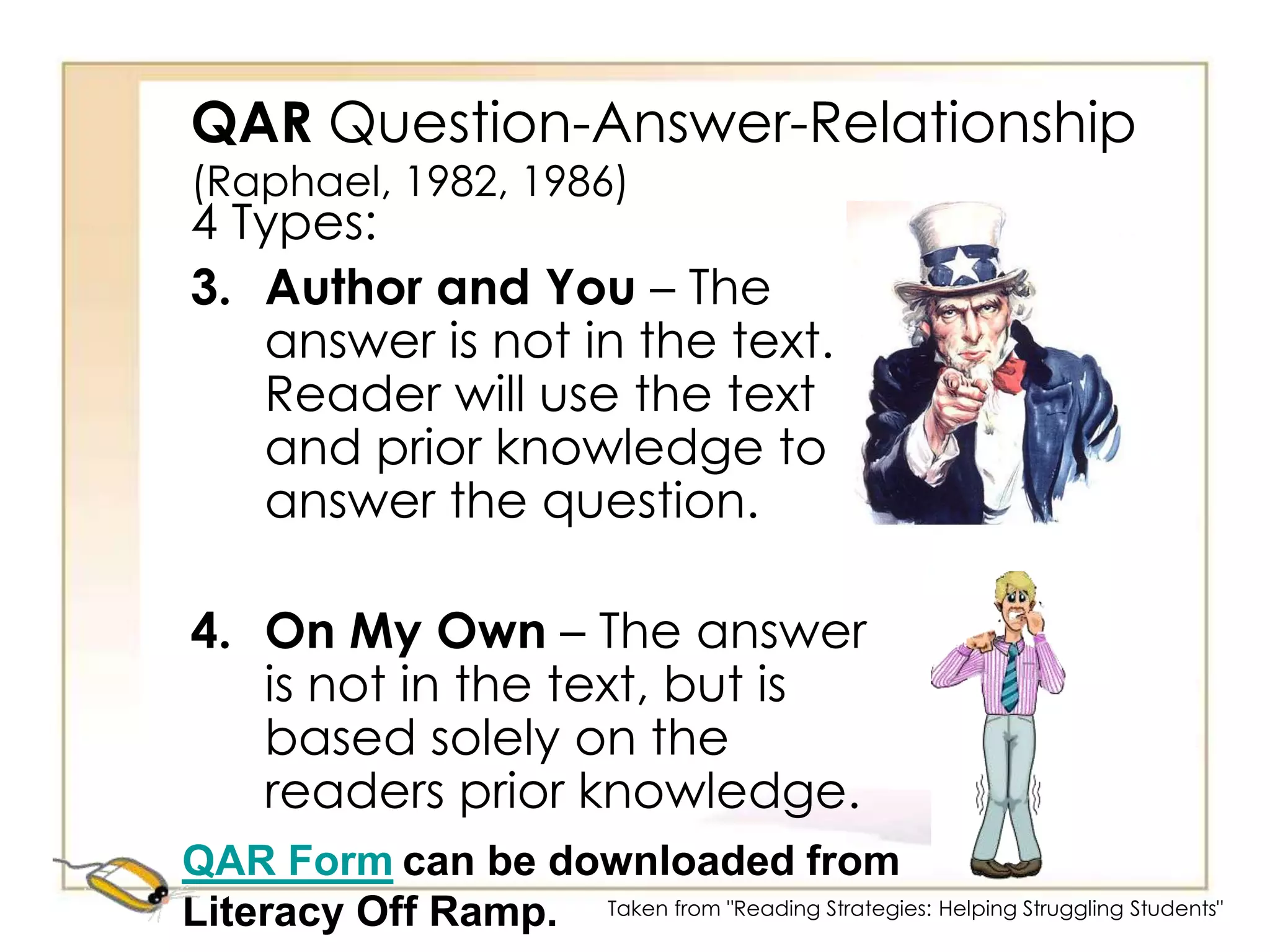
    QAR Question-Answer-Relationship(Raphael, 1982,1986)4 Types:Author and You – The answer is not in the text. Reader will use the text and prior knowledge to answer the question.On My Own – The answer is not in the text, but is based solely on the readers prior knowledge.QAR Formcan be downloaded from Literacy Off Ramp.Taken from "Reading Strategies: Helping Struggling Students"
  • 35.
    Visual Reading Guides(Stein, 1978)Used to preview the text by noting visuals such as maps, charts, graphs pictures, cartoons, etc. that relate to the content.How is the visual related to the text?Why did the author include the visual?What does the visual show me?How can I use the information from the visual to help me understand the text?Why is the information from the visual important?Visual Reading Guidecan be downloaded from Literacy Off Ramp. Rider & Aide BookmarksTaken from "Reading Strategies: Helping Struggling Students"
  • 36.
    Mapping (Johnson andPearson, 1978)Vocabulary Web (Johnson and Perason, 1978) is a mapping strategy that builds on students' prior knowledge to lead them toward relationships with new words or terms.  Vocabulary Web worksheetDISSECT(a word analysis graphic) Taken from "Reading Strategies: Helping Struggling Students"
  • 37.
    Reciprocal Teaching (Palincsar et al., 1984, 1986)Combines 4 comprehension strategies:SummarizingQuestioningClarifyingPredictingStudents are arranged in groups of 4 and given a Reciprocal Teaching worksheet. Students read a section of text and assume a role, either summarizer, questioner, clarifier, or predictor.Taken from "Reading Strategies: Helping Struggling Students"
  • 38.
    Reciprocal Teaching (Palincsar et al., 1984, 1986) Reciprocal Teaching worksheetStudents take notes on the worksheet and stop at a given point. The summarizer will then give the major pointsThe questioner will ask questions about unclear sectionsThe clarifier will discuss the confusing partsThe predictor will guess what will happen next.Taken from "Reading Strategies: Helping Struggling Students"
  • 39.
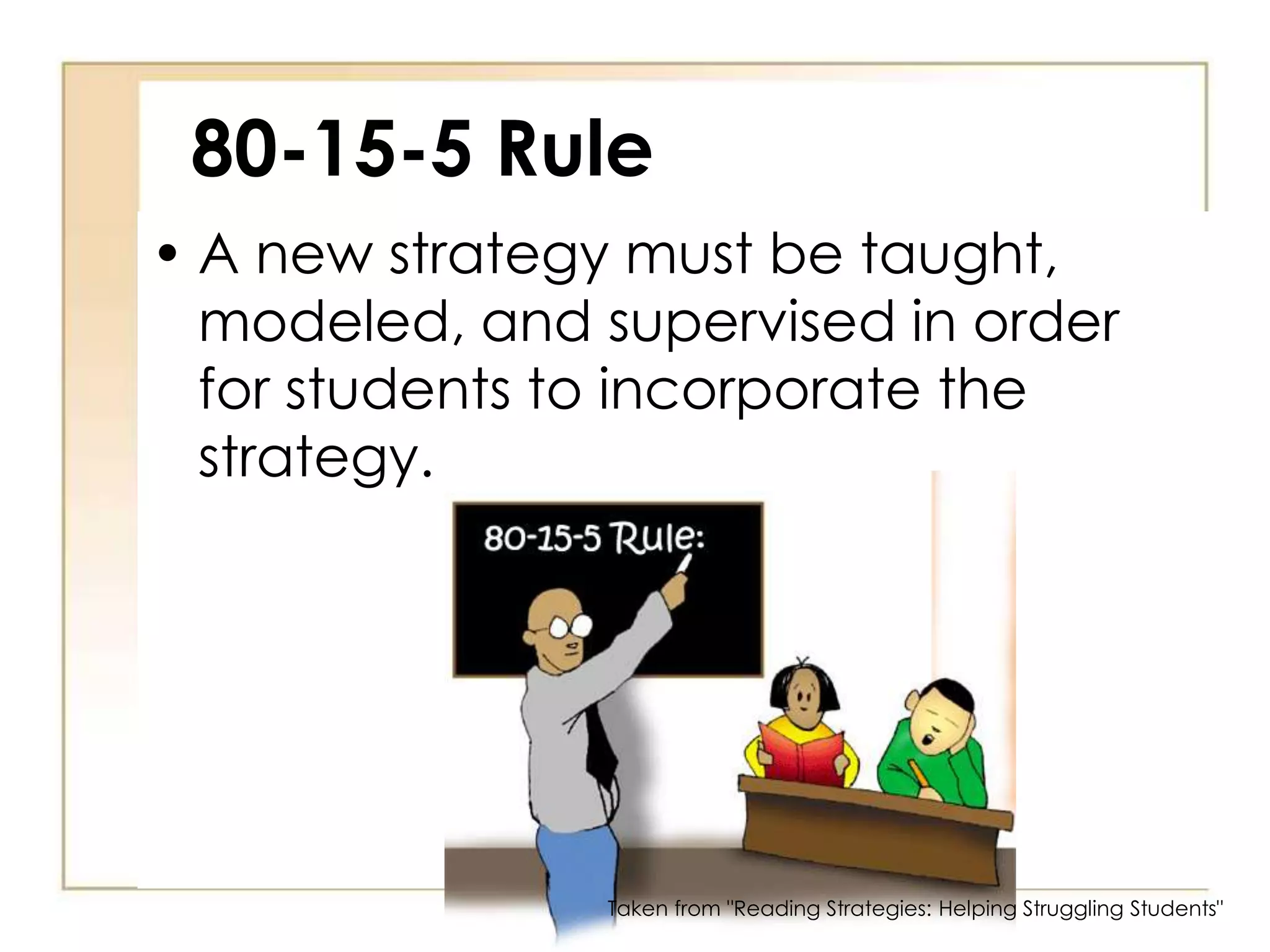
    80-15-5 RuleA newstrategy must be taught, modeled, and supervised in order for students to incorporate the strategy. Taken from "Reading Strategies: Helping Struggling Students"
  • 40.
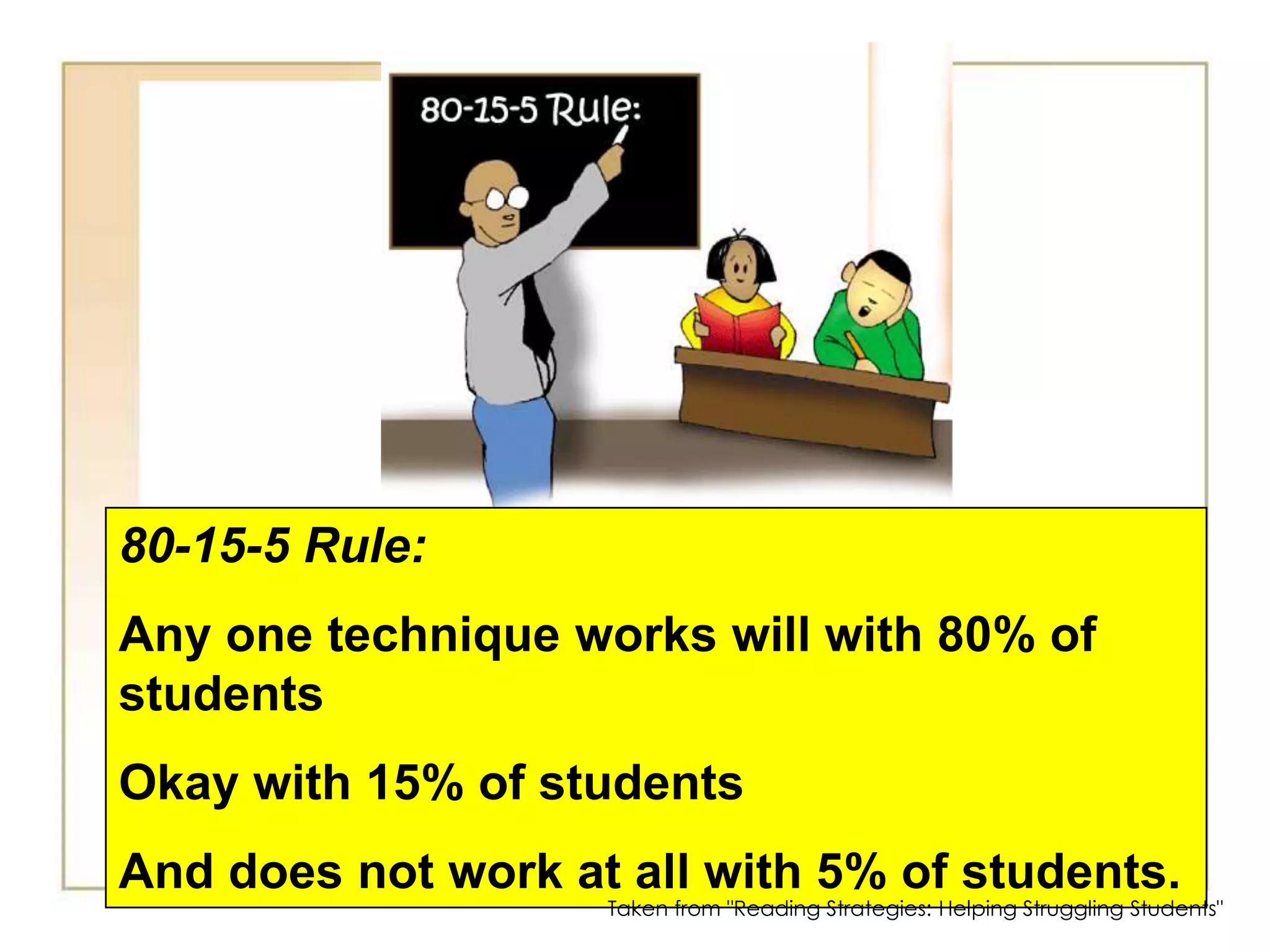
    80-15-5 Rule: Any one technique works will with 80% of students Okay with 15% of studentsAnd does not work at all with 5% of students.Taken from "Reading Strategies: Helping Struggling Students"