DEAFNESS AND WRITING
Course C 13 module 3.1
(Strategies of Developing Emergent Writing skills )
B Ed Special Education – Hearing
Impairment
University of Mumbai
Asmita Huddar
CCYM’S HASHU ADVANI COLLEGE OF
SPECIAL EDUCATION
https://www.hashuadvanismarak.org/hacse/
EMERGENT LITRACY SKILLS
• Emergent writing “means that children begin to understand
that writing is a form of communication and their marks on
paper convey a message” (Mayer, 2007, p. 35)
• Emergent literacy is a term that is used to explain a child's
knowledge of reading and writing skills before they learn how
to read and write words
• Pre-writing skills are the fundamental skills children need to
develop before they are able to write. These skills contribute to
the child's ability to hold and use a pencil, and the ability to
draw, write, copy, and colour. ... These are the pencil strokes
that most letters, numbers and early drawings are comprised of.
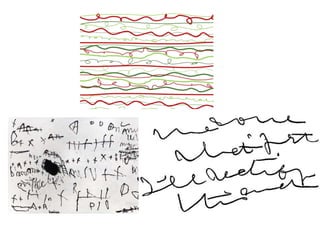
Pre writing skills: SCRIBBLING
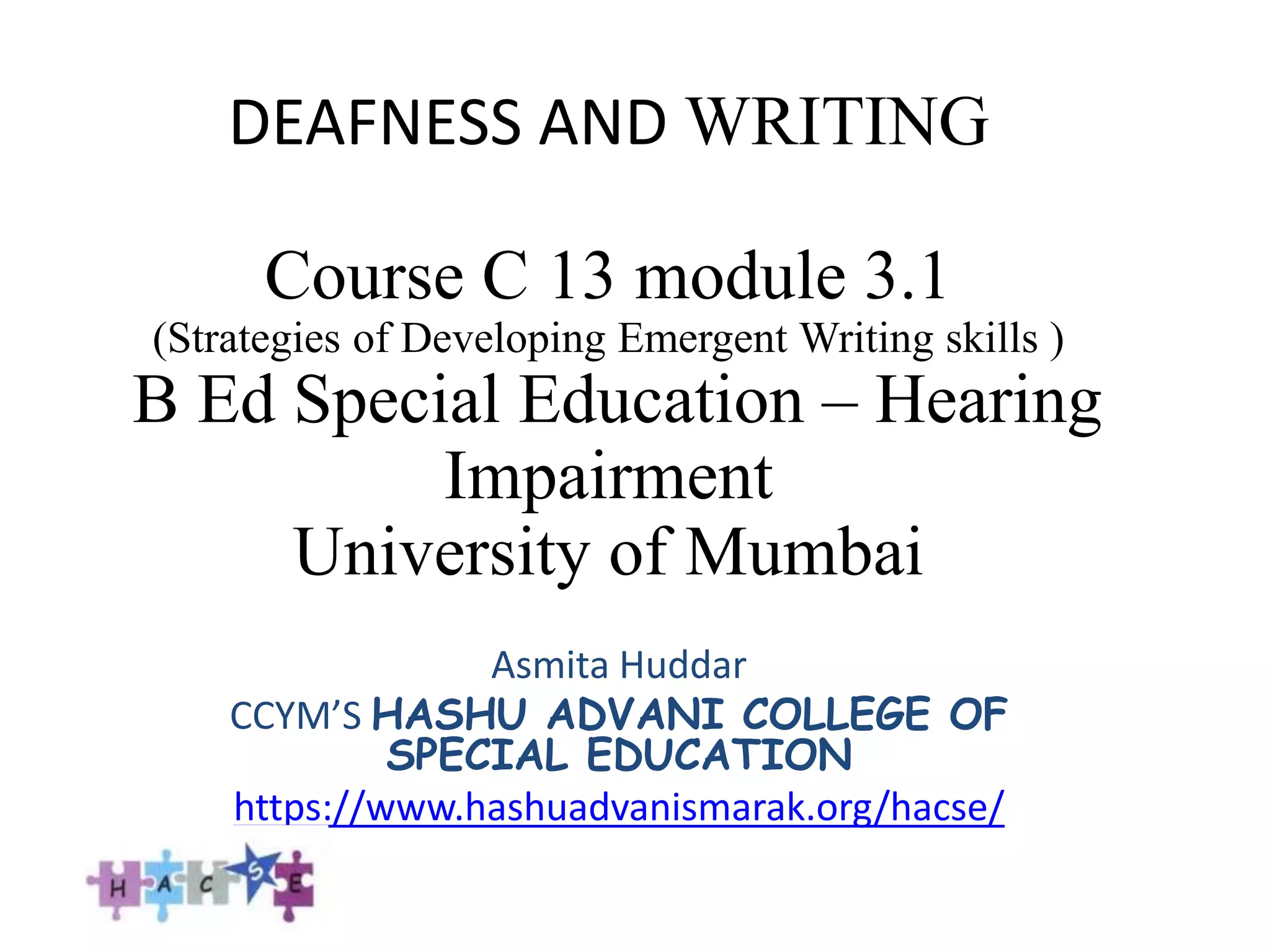
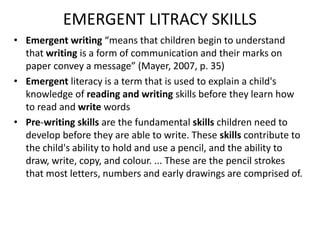
• Random
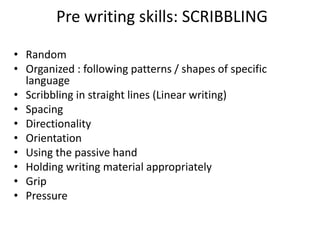
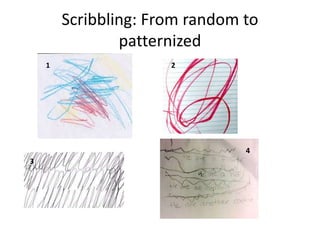
• Organized : following patterns / shapes of specific
language
• Scribbling in straight lines (Linear writing)
• Spacing
• Directionality
• Orientation
• Using the passive hand
• Holding writing material appropriately
• Grip
• Pressure
Scribbling: From random to
patternized
1
4
2
3
EMERGENT WRITING SKILLS: Strategies
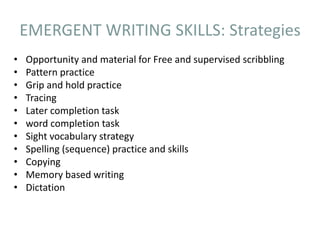
• Opportunity and material for Free and supervised scribbling
• Pattern practice
• Grip and hold practice
• Tracing
• Later completion task
• word completion task
• Sight vocabulary strategy
• Spelling (sequence) practice and skills
• Copying
• Memory based writing
• Dictation
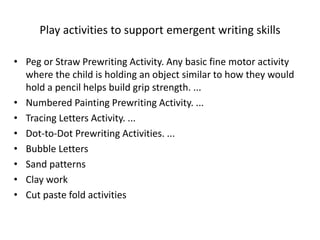
Play activities to support emergent writing skills
• Peg or Straw Prewriting Activity. Any basic fine motor activity
where the child is holding an object similar to how they would
hold a pencil helps build grip strength. ...
• Numbered Painting Prewriting Activity. ...
• Tracing Letters Activity. ...
• Dot-to-Dot Prewriting Activities. ...
• Bubble Letters
• Sand patterns
• Clay work
• Cut paste fold activities
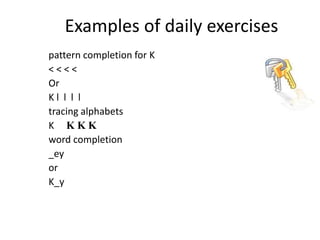
Examples of daily exercises
pattern completion for K
< < < <
Or
K l l l l
tracing alphabets
K K K K
word completion
_ey
or
K_y
Examples of daily exercises
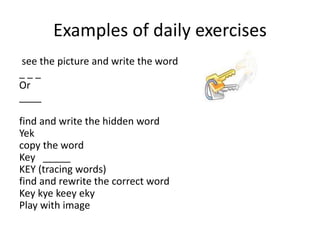
see the picture and write the word
_ _ _
Or
____
find and write the hidden word
Yek
copy the word
Key _____
KEY (tracing words)
find and rewrite the correct word
Key kye keey eky
Play with image
Points to ponder
1. Children need practice / opportunity / training
2. Regular exercises provide practice
3. These exercises need to have variety to sustain
interest and attention
4. Motivation / creativity are the keys to success.
5. Let the students find purpose and satisfaction
in the ‘task’ of writing
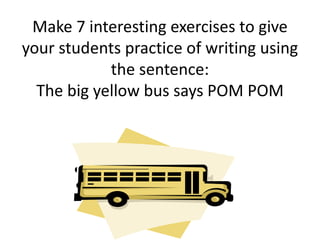
Make 7 interesting exercises to give
your students practice of writing using
the sentence:
The big yellow bus says POM POM
Probe questions for the next unit
What do you understand by independent
writing?
What can be the opposite of ‘independent
writing’?
Write 2 specific strategies to develop age
appropriate writing skills among children?
references
• Paul Peter, 2009. Language and Deafness
• May, Frank. B., 2001.Unraveling the Seven
Myths of Reading. Allen and Bacon
Thanks…. Keep reflecting

Strategies for developing emergent writing skills

  • 1.
    DEAFNESS AND WRITING CourseC 13 module 3.1 (Strategies of Developing Emergent Writing skills ) B Ed Special Education – Hearing Impairment University of Mumbai Asmita Huddar CCYM’S HASHU ADVANI COLLEGE OF SPECIAL EDUCATION https://www.hashuadvanismarak.org/hacse/
  • 2.
    EMERGENT LITRACY SKILLS •Emergent writing “means that children begin to understand that writing is a form of communication and their marks on paper convey a message” (Mayer, 2007, p. 35) • Emergent literacy is a term that is used to explain a child's knowledge of reading and writing skills before they learn how to read and write words • Pre-writing skills are the fundamental skills children need to develop before they are able to write. These skills contribute to the child's ability to hold and use a pencil, and the ability to draw, write, copy, and colour. ... These are the pencil strokes that most letters, numbers and early drawings are comprised of.
  • 3.
    Pre writing skills:SCRIBBLING • Random • Organized : following patterns / shapes of specific language • Scribbling in straight lines (Linear writing) • Spacing • Directionality • Orientation • Using the passive hand • Holding writing material appropriately • Grip • Pressure
  • 4.
    Scribbling: From randomto patternized 1 4 2 3
  • 6.
    EMERGENT WRITING SKILLS:Strategies • Opportunity and material for Free and supervised scribbling • Pattern practice • Grip and hold practice • Tracing • Later completion task • word completion task • Sight vocabulary strategy • Spelling (sequence) practice and skills • Copying • Memory based writing • Dictation
  • 7.
    Play activities tosupport emergent writing skills • Peg or Straw Prewriting Activity. Any basic fine motor activity where the child is holding an object similar to how they would hold a pencil helps build grip strength. ... • Numbered Painting Prewriting Activity. ... • Tracing Letters Activity. ... • Dot-to-Dot Prewriting Activities. ... • Bubble Letters • Sand patterns • Clay work • Cut paste fold activities
  • 8.
    Examples of dailyexercises pattern completion for K < < < < Or K l l l l tracing alphabets K K K K word completion _ey or K_y
  • 9.
    Examples of dailyexercises see the picture and write the word _ _ _ Or ____ find and write the hidden word Yek copy the word Key _____ KEY (tracing words) find and rewrite the correct word Key kye keey eky Play with image
  • 10.
    Points to ponder 1.Children need practice / opportunity / training 2. Regular exercises provide practice 3. These exercises need to have variety to sustain interest and attention 4. Motivation / creativity are the keys to success. 5. Let the students find purpose and satisfaction in the ‘task’ of writing
  • 11.
    Make 7 interestingexercises to give your students practice of writing using the sentence: The big yellow bus says POM POM
  • 12.
    Probe questions forthe next unit What do you understand by independent writing? What can be the opposite of ‘independent writing’? Write 2 specific strategies to develop age appropriate writing skills among children?
  • 13.
    references • Paul Peter,2009. Language and Deafness • May, Frank. B., 2001.Unraveling the Seven Myths of Reading. Allen and Bacon
  • 14.