Literacy in the Foundation Stage
What we will look at today… 
• Speaking and Listening 
• Phonics 
• Reading 
• Writing 
In the EYFS; 
• Communication and Language (speaking, 
listening and understanding) is a prime area. 
• Literacy (reading and writing) is a specific area.
• Children learn a great deal from other 
people. 
• As parents and carers, you are your 
child’s first teachers. You have a 
powerful influence on your child’s early 
learning.
The spoken language 
• From a very early age, children develop an 
awareness of the different sounds in our spoken 
language(s). 
• They learn how to use their voices: 
– to make contact with you 
– to let you know what they need 
– to show how they are feeling 
• As parents you will understand your child’s 
communications best. You are key in helping 
them to develop their speaking and listening 
skills.
How can you help? 
• Provide your child with lots of different opportunities to speak and 
listen with others: 
– Preparing meals 
– Tidying up 
– Putting shopping away 
– Getting ready to go out 
– Switch off the TV, radio and mobile phones 
• Show you are interested in their conversation 
• Read stories 
• Use puppets and toys 
• Use a wide range of vocabulary 
• Make comments rather than always asking questions- model 
thought process
The importance of speech sounds 
• As children grow older, they will begin to 
understand the different sounds in languages, 
and join in with stories, songs, and rhymes by 
clapping, stamping and skipping at first. 
• This is an important stage, as the ears are 
beginning to tune into the important sounds they 
can hear, and discriminate between them. 
• Over time, your child will begin to distinguish 
between different speech sounds (phonemes), 
and they will match sounds to letters 
(graphemes). This is called phonic knowledge.
Phonics in the Foundation Stage 
• We follow “Letters and Sounds” and use the 
Jolly Phonics scheme to help the children to 
learn the sounds.
Phase 1 
• Your child will be learning to: 
– Have fun with sounds 
– Listen carefully 
– Develop their vocabulary 
– Speak confidently to you, other adults and children 
– Tune into sounds 
– Listen and remember sounds 
– Talk about sounds 
– Understand that spoken words are made up of 
different sounds
Phase 1 
• Phase 1 is made up of 7 different areas: 
– Environmental sounds 
– Instrumental sounds 
– Body percussion 
– Rhythm and rhyme 
– Alliteration (words that begin with the same 
sound) 
– Voice sounds 
– Oral blending and segmenting
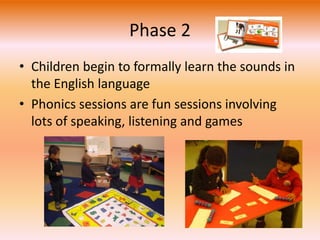
Phase 2 
• Children begin to formally learn the sounds in 
the English language 
• Phonics sessions are fun sessions involving 
lots of speaking, listening and games
• Not all children will learn at the same rate! 
• There is a very close link between difficulty 
with phonics and hearing, so if your child is 
making progress more slowly than expected, it 
is worth having their hearing checked.
Sound talk- blending 
• The separate sounds (phonemes) are spoken 
aloud, in order and are then merged together 
into the whole word. 
• The merging is called blending, and is a vital 
skill for reading. 
• Eg: c-a-t = cat
Sound talk- segmenting 
• Children will also learn to do this the other 
way round. Eg: cat = c-a-t 
• The whole word is spoken aloud and then 
broken up into its sounds (phonemes) in 
order, through the word. 
• This is called segmenting, and is a vital skill for 
spelling.
Learning the phonemes 
• Children will learn the phonemes (sounds) for 
the letters (graphemes) in the alphabet 
• They will also learn that some phonemes can 
be made up of more than one letter, 
eg: /ll/ as in b-e-ll 
• We use actions to help to remember the 
phonemes 
• Letter sounds and names. Please use sounds 
to spell and segment!
Saying the sounds 
• Your child will be taught how to pronounce 
the sounds (phonemes) correctly to make 
blending easier 
• Sounds should be sustained where possible 
(eg, sss, mmm, fff) 
• ‘uh’ sounds after consonants should be 
reduced where possible (eg, try to avoid 
saying ‘b-uh’, ‘c-uh’)
VC and CVC words 
• C = consonant, V = vowel 
• VC words are those consisting of a vowel and 
then a consonant, eg: at, in, up 
• CVC words follow the pattern consonant, 
vowel, consonant, eg: cat, dog, pet 
• Words such as tick or bell also count as CVC 
words. Although they contain four letters, 
they only have three sounds.
Making words 
• Now the children will be seeing letters and 
words, as well as hearing them 
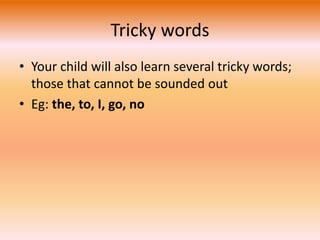
• They will be shown how to make words by: 
– Breaking up words into individual sounds (sound 
the word out) 
– Select the correct letter to represent the sounds 
– Make a phonetically plausible attempt! Use 
magnetic letters/ write
Tricky words 
• Your child will also learn several tricky words; 
those that cannot be sounded out 
• Eg: the, to, I, go, no
Phase 3 
• The main individual letter phonemes have 
now been learnt, and children are reading CVC 
words independently 
• Phase 3 teaches children to learn the 
graphemes (written sounds), made up of more 
than one letter, eg: ‘oa’ as in boat 
• Your child will also learn all the letter names in 
the alphabet and how to form them correctly
Phase 3 
• Read more tricky words and begin to spell 
some of them 
• Read and write words in phrases and 
sentences
Cursive Handwriting 
 We believe that this raises standards in the Early Years 
and across the school; developing confidence, 
accuracy, fluency and improved presentation. 
 It is better for the children so that they are not learning 
two handwriting styles. 
 It helps children’s visual memory to develop and shows 
later that it is good for spelling and fluency in writing.
However… 
• Cursive handwriting is a very fluid style of 
handwriting and it requires children to have 
good fine motor control! 
• Pencil grip 
• Follow a continuous line- “Flow” 
• We start with lots of fine and gross motor 
activities to support this in Toddlers and 
Nursery.
Writing patterns
The rules 
• All letters start on the line (except for capital 
letters.) 
• There is a lead in and lead out stroke.
Writing in Toddlers 
• Children engage in mark making activities daily 
• We focus on the children’s physical development, picking up small 
objects, and gaining motor control by holding jugs, hammers, 
turning pages in a book, and using mark making tools. 
• Children explore making marks in sand, paint, and dough and use 
various tools like pens, pencils, crayons and markers. Tweezers, and 
threading activities are also good ways to develop motor control. 
• Children explore making different marks and shapes as they explore 
in the creative area with paint and other materials. As children 
explore they are encouraged to make different shapes and marks 
such as vertical or horizontal lines and moving in a circular motion. 
• Children often hold a pen or writing tool in a whole hand grasp and 
as they develop their motor control we help adjust their grip.
Writing in Nursery 
• We undertake a writing task each week and the 
children will record letters in phonics (on 
whiteboards when we teach letter formation). 
• Not everyone is writing letters yet! 
• Mark making opportunities- Can the child ascribe 
meaning to their marks? Drawing, painting, fine 
motor activities (tweezers, threading etc). 
• Daily name writing. 
• Pencil grip and motor control.
Writing in Reception 
• Developing confidence. 
• Linking sounds to letters. 
• Spelling. 
• Letter formation. 
• Writing for different purposes. 
• Independent and teacher led writing. 
• Marking of writing
• Practice makes perfect! 
• Activities... 
– Fine motor control: threading, tweezers to sort, tracings 
– Playdough, finger paint 
– Writing patterns- try to keep a continuous line 
– Letter formation 
– Bingo! Match the initial sound!
Reading 
Ask yourselves the following… 
• Do they have favourite stories, poems or songs? 
• Can they listen to and join in with stories, one to one or in a 
group? 
• Can they suggest how stories might end? 
• Do they show interest in illustrations and print in books and the 
environment? 
• Do they handle books carefully? (holding books the correct way 
and turn pages carefully) 
• Do they know that print is telling them something? Are they 
able to point at the words one at a time? Can they tell the 
difference between words and pictures? 
• Do they like a range of books? 
• Do they know that information can be retrieved from books and 
computers?
Reading Opportunities 
• We hear children read individually and in groups 
• Children will read every day in other ways: big books, 
Words/signs from boards/classroom 
• Using CD/tapes with books and stories 
• Computer programs 
• Reading corner 
• Every child will learn at a different pace.
What you can do at home 
• Find a comfortable, quiet place to read together. 
Try to read every day- fiction, non fiction, 
poetry, not necessarily books (environmental 
print, packaging). 
• flashcards, reading records. 
• Let your child choose their OWN book (even if 
you have read it 100 times!). Confident readers! 
• Try not to interrupt by correcting every mistake. 
Encourage children to read for meaning – does it 
make sense? 
• Discuss the book together when you have 
finished. 
• Be patient! Reading and writing can be difficult 
skills to master. Don’t forget to model it to them!
Reading in Toddlers 
• Children have access to books daily 
• Children have books read to them. Stories are read using different tones of voice, 
and expression. Books are read and repeated many times. 
• Children independently look at a book, especially familiar books so they can take 
clues from the pictures and retell the story. “Tell me what you see in the pictures.” 
• Children use story boards with pieces representing objects and characters in the 
story and they can move the pieces around and interact as a story is read. We do 
this individually and together as a group. 
• We read books that children are interested in, books with drawings and books with 
real photographs. 
• Children are read a variety of books, books with no words, repetitive phrases, 
rhymes, and books with clues about what is going to come next in the story. 
• Children have the opportunity to participate in the storytelling, by repeating 
familiar words and phrases, and by predicting what is going to happen next. 
• Early on children need to develop the skills to comprehend what they are reading. 
Children are asked questions about the story, what is happening? How does the 
character feel? What do you think is going to happen next? 
• An environment rich with print is important, we use pictures with printed words.
Reading in the Nursery 
• If your child is ready to take home a reading book they will have a 
reading journal. Please write in this so that we can keep a dialogue 
going between school and home. We will make a comment on areas to 
work on as well as what they did well. 
• Flashcards; send these in each day with your child’s reading book and 
journal. Practice reading these words by sight. Some will be tricky 
words which cannot sounded out! Others are HFWs (High Frequency 
Words) which should be segmented to read first but then eventually 
read by sight. 
• In picture books: look closely at the illustrations, make up a story, use 
character names. Locate the title, front/ back cover. 
• In books with words: track the text with a finger, use illustrations and 
initial sounds to decode unfamiliar words. 
• Read for enjoyment: if your child is struggling with a book or whizzing 
through and isn’t focused or following the story then take a break. 
Practice flashcards, read a favorite story at home, look in a magazine 
and find random letters or words etc.
Reading in Reception 
Decoding 
Understanding 
Inference 
Organization 
Use of 
Language 
Author’s 
Viewpoint 
Social, cultural, 
historical 
• At the beginning of the year, your 
child will be sent home with a reading 
journal and will receive two reading 
books a week. 
• At least once a week, the children 
have a one on one reading with an 
adult. 
• The books that are sent home are set 
at an appropriate level that allow 
children to progress at the appropriate 
level, as well as for us to use as an 
assessment tool. 
• Reading print in the environment. 
• Reading a wide range of different 
types / genres of books.
General reading behaviours to develop 
across the Early Years. 
• How to treat books! 
• Features of a book; title, author, illustrator, 
blurb 
• Comprehension. 
• Reading strategies: unfamiliar words, reading 
for sense, tracking the text 
• Read for enjoyment!
How can I help to support my child’s 
Literacy skills? 
• Sing an alphabet song together 
• Play ‘I spy’ (choose to focus on sounds or letter 
name) 
• Continue to play with magnetic letters, using 
some two-grapheme (letter) combinations, eg: r-ai- 
n = rain blending for reading 
rain = r-ai-n segmenting for spelling 
• Play Metal Mike! Robot talk 
• Sing lots of nursery rhymes 
• Fine motor activities
Resources 
• Oxford owl- free ebooks 
• Phonics games- try 
http://www.ictgames.com/literacy.html 
Poop Deck Pirates 
Dinosaur’s Eggs 
• Starfall http://www.starfall.com/ 
• http://www.topmarks.co.uk/english-games/5-7- 
years/letters-and-sounds 
• https://www.gov.uk/government/uploads/system/uplo 
ads/attachment_data/file/190599/Letters_and_Sounds 
_-_DFES-00281-2007.pdf Letters and Sounds
Literacy in the Early Years

Literacy in the Early Years

  • 1.
    Literacy in theFoundation Stage
  • 2.
    What we willlook at today… • Speaking and Listening • Phonics • Reading • Writing In the EYFS; • Communication and Language (speaking, listening and understanding) is a prime area. • Literacy (reading and writing) is a specific area.
  • 3.
    • Children learna great deal from other people. • As parents and carers, you are your child’s first teachers. You have a powerful influence on your child’s early learning.
  • 4.
    The spoken language • From a very early age, children develop an awareness of the different sounds in our spoken language(s). • They learn how to use their voices: – to make contact with you – to let you know what they need – to show how they are feeling • As parents you will understand your child’s communications best. You are key in helping them to develop their speaking and listening skills.
  • 5.
    How can youhelp? • Provide your child with lots of different opportunities to speak and listen with others: – Preparing meals – Tidying up – Putting shopping away – Getting ready to go out – Switch off the TV, radio and mobile phones • Show you are interested in their conversation • Read stories • Use puppets and toys • Use a wide range of vocabulary • Make comments rather than always asking questions- model thought process
  • 6.
    The importance ofspeech sounds • As children grow older, they will begin to understand the different sounds in languages, and join in with stories, songs, and rhymes by clapping, stamping and skipping at first. • This is an important stage, as the ears are beginning to tune into the important sounds they can hear, and discriminate between them. • Over time, your child will begin to distinguish between different speech sounds (phonemes), and they will match sounds to letters (graphemes). This is called phonic knowledge.
  • 7.
    Phonics in theFoundation Stage • We follow “Letters and Sounds” and use the Jolly Phonics scheme to help the children to learn the sounds.
  • 8.
    Phase 1 •Your child will be learning to: – Have fun with sounds – Listen carefully – Develop their vocabulary – Speak confidently to you, other adults and children – Tune into sounds – Listen and remember sounds – Talk about sounds – Understand that spoken words are made up of different sounds
  • 9.
    Phase 1 •Phase 1 is made up of 7 different areas: – Environmental sounds – Instrumental sounds – Body percussion – Rhythm and rhyme – Alliteration (words that begin with the same sound) – Voice sounds – Oral blending and segmenting
  • 10.
    Phase 2 •Children begin to formally learn the sounds in the English language • Phonics sessions are fun sessions involving lots of speaking, listening and games
  • 11.
    • Not allchildren will learn at the same rate! • There is a very close link between difficulty with phonics and hearing, so if your child is making progress more slowly than expected, it is worth having their hearing checked.
  • 12.
    Sound talk- blending • The separate sounds (phonemes) are spoken aloud, in order and are then merged together into the whole word. • The merging is called blending, and is a vital skill for reading. • Eg: c-a-t = cat
  • 13.
    Sound talk- segmenting • Children will also learn to do this the other way round. Eg: cat = c-a-t • The whole word is spoken aloud and then broken up into its sounds (phonemes) in order, through the word. • This is called segmenting, and is a vital skill for spelling.
  • 14.
    Learning the phonemes • Children will learn the phonemes (sounds) for the letters (graphemes) in the alphabet • They will also learn that some phonemes can be made up of more than one letter, eg: /ll/ as in b-e-ll • We use actions to help to remember the phonemes • Letter sounds and names. Please use sounds to spell and segment!
  • 15.
    Saying the sounds • Your child will be taught how to pronounce the sounds (phonemes) correctly to make blending easier • Sounds should be sustained where possible (eg, sss, mmm, fff) • ‘uh’ sounds after consonants should be reduced where possible (eg, try to avoid saying ‘b-uh’, ‘c-uh’)
  • 16.
    VC and CVCwords • C = consonant, V = vowel • VC words are those consisting of a vowel and then a consonant, eg: at, in, up • CVC words follow the pattern consonant, vowel, consonant, eg: cat, dog, pet • Words such as tick or bell also count as CVC words. Although they contain four letters, they only have three sounds.
  • 17.
    Making words •Now the children will be seeing letters and words, as well as hearing them • They will be shown how to make words by: – Breaking up words into individual sounds (sound the word out) – Select the correct letter to represent the sounds – Make a phonetically plausible attempt! Use magnetic letters/ write
  • 18.
    Tricky words •Your child will also learn several tricky words; those that cannot be sounded out • Eg: the, to, I, go, no
  • 19.
    Phase 3 •The main individual letter phonemes have now been learnt, and children are reading CVC words independently • Phase 3 teaches children to learn the graphemes (written sounds), made up of more than one letter, eg: ‘oa’ as in boat • Your child will also learn all the letter names in the alphabet and how to form them correctly
  • 20.
    Phase 3 •Read more tricky words and begin to spell some of them • Read and write words in phrases and sentences
  • 21.
    Cursive Handwriting We believe that this raises standards in the Early Years and across the school; developing confidence, accuracy, fluency and improved presentation.  It is better for the children so that they are not learning two handwriting styles.  It helps children’s visual memory to develop and shows later that it is good for spelling and fluency in writing.
  • 22.
    However… • Cursivehandwriting is a very fluid style of handwriting and it requires children to have good fine motor control! • Pencil grip • Follow a continuous line- “Flow” • We start with lots of fine and gross motor activities to support this in Toddlers and Nursery.
  • 23.
  • 24.
    The rules •All letters start on the line (except for capital letters.) • There is a lead in and lead out stroke.
  • 27.
    Writing in Toddlers • Children engage in mark making activities daily • We focus on the children’s physical development, picking up small objects, and gaining motor control by holding jugs, hammers, turning pages in a book, and using mark making tools. • Children explore making marks in sand, paint, and dough and use various tools like pens, pencils, crayons and markers. Tweezers, and threading activities are also good ways to develop motor control. • Children explore making different marks and shapes as they explore in the creative area with paint and other materials. As children explore they are encouraged to make different shapes and marks such as vertical or horizontal lines and moving in a circular motion. • Children often hold a pen or writing tool in a whole hand grasp and as they develop their motor control we help adjust their grip.
  • 28.
    Writing in Nursery • We undertake a writing task each week and the children will record letters in phonics (on whiteboards when we teach letter formation). • Not everyone is writing letters yet! • Mark making opportunities- Can the child ascribe meaning to their marks? Drawing, painting, fine motor activities (tweezers, threading etc). • Daily name writing. • Pencil grip and motor control.
  • 29.
    Writing in Reception • Developing confidence. • Linking sounds to letters. • Spelling. • Letter formation. • Writing for different purposes. • Independent and teacher led writing. • Marking of writing
  • 30.
    • Practice makesperfect! • Activities... – Fine motor control: threading, tweezers to sort, tracings – Playdough, finger paint – Writing patterns- try to keep a continuous line – Letter formation – Bingo! Match the initial sound!
  • 31.
    Reading Ask yourselvesthe following… • Do they have favourite stories, poems or songs? • Can they listen to and join in with stories, one to one or in a group? • Can they suggest how stories might end? • Do they show interest in illustrations and print in books and the environment? • Do they handle books carefully? (holding books the correct way and turn pages carefully) • Do they know that print is telling them something? Are they able to point at the words one at a time? Can they tell the difference between words and pictures? • Do they like a range of books? • Do they know that information can be retrieved from books and computers?
  • 32.
    Reading Opportunities •We hear children read individually and in groups • Children will read every day in other ways: big books, Words/signs from boards/classroom • Using CD/tapes with books and stories • Computer programs • Reading corner • Every child will learn at a different pace.
  • 33.
    What you cando at home • Find a comfortable, quiet place to read together. Try to read every day- fiction, non fiction, poetry, not necessarily books (environmental print, packaging). • flashcards, reading records. • Let your child choose their OWN book (even if you have read it 100 times!). Confident readers! • Try not to interrupt by correcting every mistake. Encourage children to read for meaning – does it make sense? • Discuss the book together when you have finished. • Be patient! Reading and writing can be difficult skills to master. Don’t forget to model it to them!
  • 34.
    Reading in Toddlers • Children have access to books daily • Children have books read to them. Stories are read using different tones of voice, and expression. Books are read and repeated many times. • Children independently look at a book, especially familiar books so they can take clues from the pictures and retell the story. “Tell me what you see in the pictures.” • Children use story boards with pieces representing objects and characters in the story and they can move the pieces around and interact as a story is read. We do this individually and together as a group. • We read books that children are interested in, books with drawings and books with real photographs. • Children are read a variety of books, books with no words, repetitive phrases, rhymes, and books with clues about what is going to come next in the story. • Children have the opportunity to participate in the storytelling, by repeating familiar words and phrases, and by predicting what is going to happen next. • Early on children need to develop the skills to comprehend what they are reading. Children are asked questions about the story, what is happening? How does the character feel? What do you think is going to happen next? • An environment rich with print is important, we use pictures with printed words.
  • 35.
    Reading in theNursery • If your child is ready to take home a reading book they will have a reading journal. Please write in this so that we can keep a dialogue going between school and home. We will make a comment on areas to work on as well as what they did well. • Flashcards; send these in each day with your child’s reading book and journal. Practice reading these words by sight. Some will be tricky words which cannot sounded out! Others are HFWs (High Frequency Words) which should be segmented to read first but then eventually read by sight. • In picture books: look closely at the illustrations, make up a story, use character names. Locate the title, front/ back cover. • In books with words: track the text with a finger, use illustrations and initial sounds to decode unfamiliar words. • Read for enjoyment: if your child is struggling with a book or whizzing through and isn’t focused or following the story then take a break. Practice flashcards, read a favorite story at home, look in a magazine and find random letters or words etc.
  • 36.
    Reading in Reception Decoding Understanding Inference Organization Use of Language Author’s Viewpoint Social, cultural, historical • At the beginning of the year, your child will be sent home with a reading journal and will receive two reading books a week. • At least once a week, the children have a one on one reading with an adult. • The books that are sent home are set at an appropriate level that allow children to progress at the appropriate level, as well as for us to use as an assessment tool. • Reading print in the environment. • Reading a wide range of different types / genres of books.
  • 37.
    General reading behavioursto develop across the Early Years. • How to treat books! • Features of a book; title, author, illustrator, blurb • Comprehension. • Reading strategies: unfamiliar words, reading for sense, tracking the text • Read for enjoyment!
  • 38.
    How can Ihelp to support my child’s Literacy skills? • Sing an alphabet song together • Play ‘I spy’ (choose to focus on sounds or letter name) • Continue to play with magnetic letters, using some two-grapheme (letter) combinations, eg: r-ai- n = rain blending for reading rain = r-ai-n segmenting for spelling • Play Metal Mike! Robot talk • Sing lots of nursery rhymes • Fine motor activities
  • 39.
    Resources • Oxfordowl- free ebooks • Phonics games- try http://www.ictgames.com/literacy.html Poop Deck Pirates Dinosaur’s Eggs • Starfall http://www.starfall.com/ • http://www.topmarks.co.uk/english-games/5-7- years/letters-and-sounds • https://www.gov.uk/government/uploads/system/uplo ads/attachment_data/file/190599/Letters_and_Sounds _-_DFES-00281-2007.pdf Letters and Sounds