Teaching
Handwriting
Prepared By-
Israt Parvin
Importance of Handwriting
•Handwriting is an essential skill for both children and
adults
•Encouraging early writing skills at home
•Let your child use writing tools such as pencils, chalk, and
crayons. Gather and organize these materials, along with
some paper, in a box that your child can decorate and have
access to.
•Teach your child to print her first name.
This is very empowering for a preschooler
Purpose
• To make teacher/ students aware of the basic
principles of teaching handwriting and give appropriate
techniques for teaching
individual letters and joining letters
• To teach each child to write legibly, fluently, without strain,
and with sufficient speed for all practical purposes.
• To provide opportunities to use handwriting skills as an
integral part of the writing process
Why do we use verbal pathways
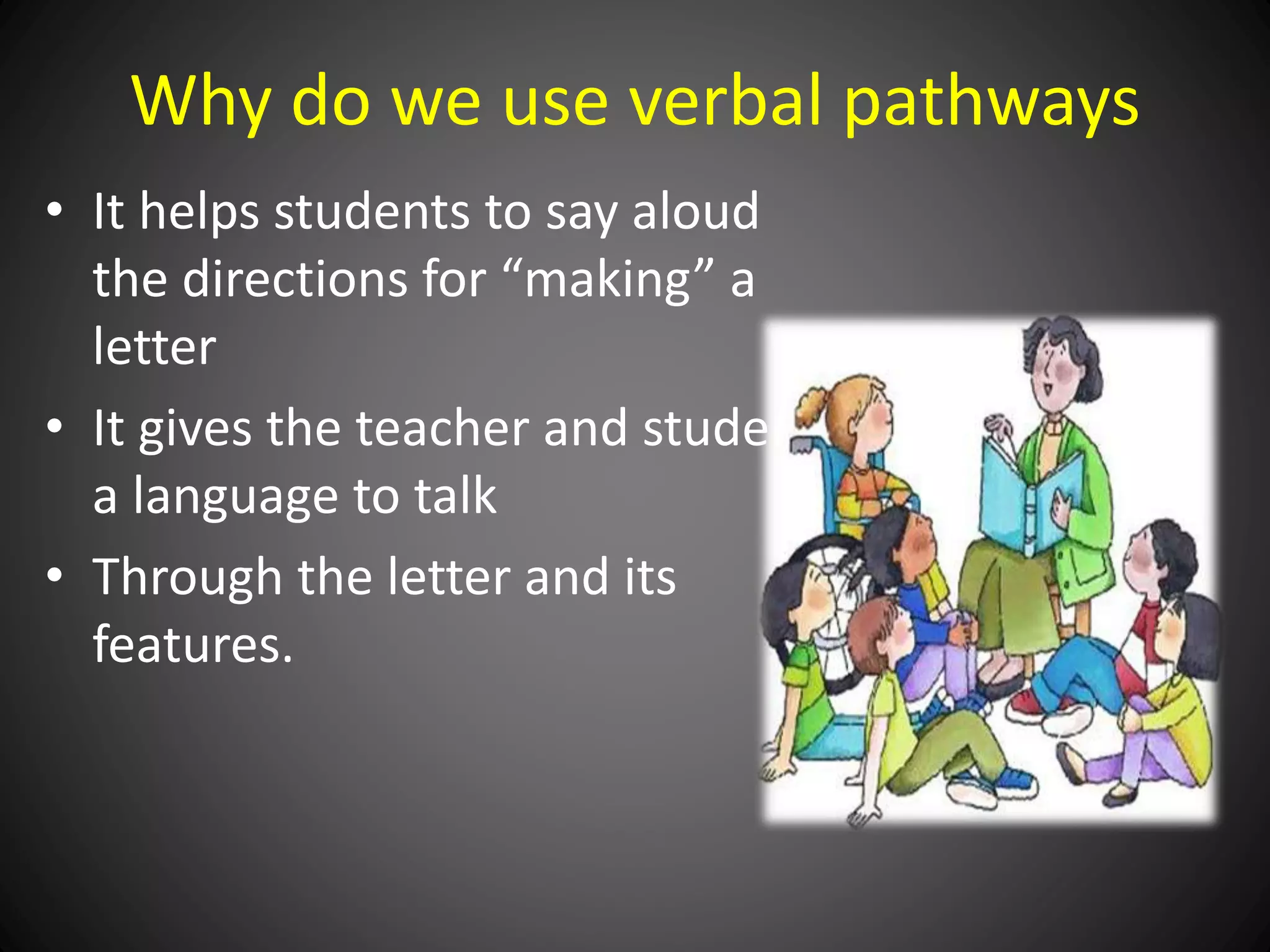
• It helps students to say aloud
the directions for “making” a
letter
• It gives the teacher and student
a language to talk
• Through the letter and its
features.
Teaching Sequence
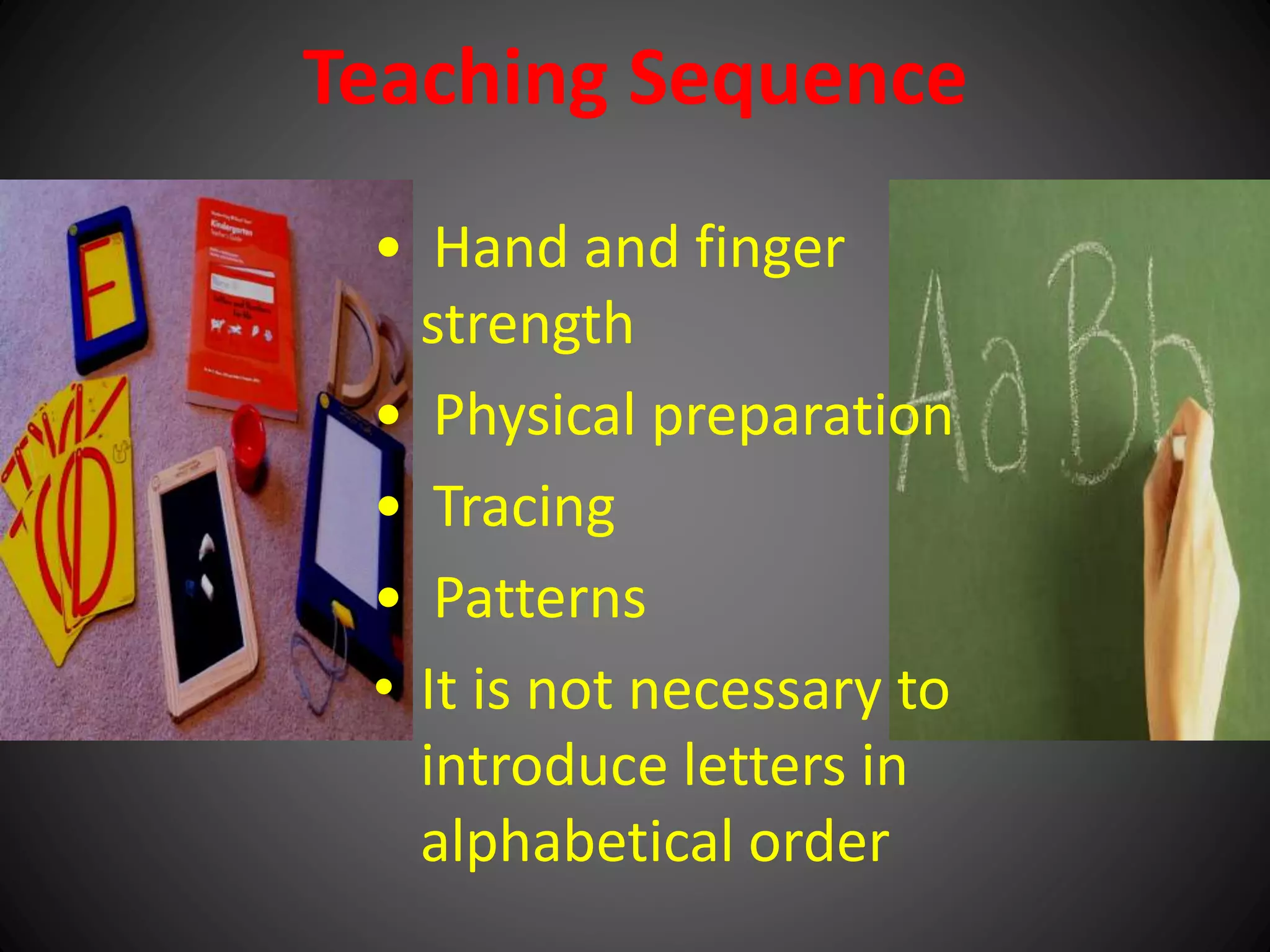
• Hand and finger
strength
• Physical preparation
• Tracing
• Patterns
• It is not necessary to
introduce letters in
alphabetical order
Techniques
1. Seating and posture
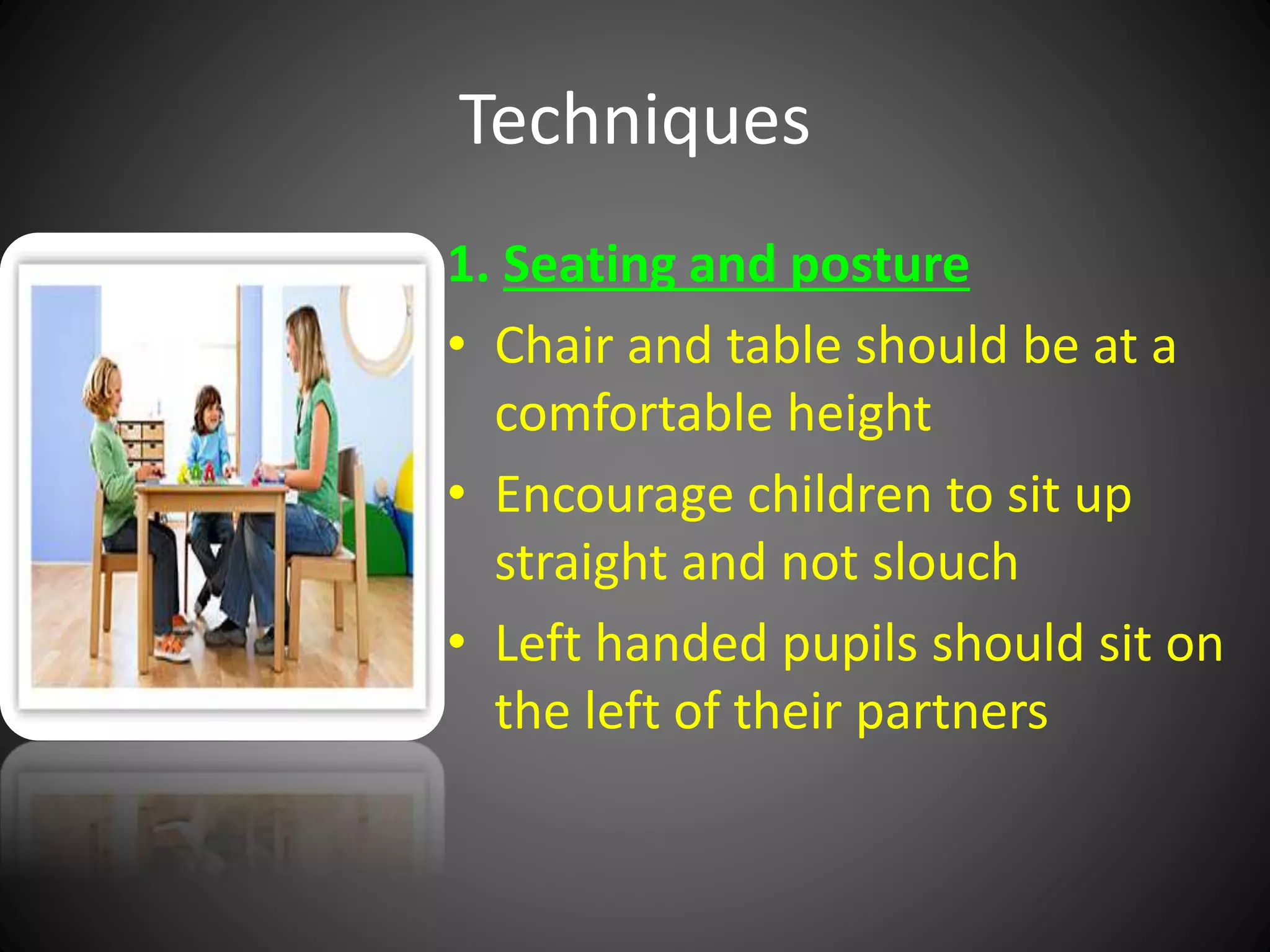
• Chair and table should be at a
comfortable height
• Encourage children to sit up
straight and not slouch
• Left handed pupils should sit on
the left of their partners
2. Pencil grip
• Children should write with a
sharp pencil.
• Make small movements of the
finger joints.
• Hold the pencil firmly enough
to control it but not so tightly as
to restrict movement.
Techniques
3. Letters
• Letters with similar shapes
are taught together. (e.g.
between 'n' and 'h')
• Vowels are introduced
near the beginning
Techniques
4. Writing 'on the line‘
• Drawing lines on the
blackboard.
• Draw four lines
• Show which letters go
above and which go
below
Techniques
Suggestions
• Teach the students to write their own name first. It
will encourage them to learn more.
• Provide opportunities for students to develop fine
motor skills using materials such as puzzles, strings,
beads, or play dough
• provide opportunities for students to play with the
alphabet. Provide alphabet cards, books, magnetic
letters, felt letters, rubber letters, etc.
• Provide models for students to follow. Letter strips on
the corner of students’ desks can be helpful
• and are much easier to refer to than letters posted on
a wall across the room.

Importance of handwriting (1)

  • 1.
  • 2.
    Importance of Handwriting •Handwritingis an essential skill for both children and adults •Encouraging early writing skills at home •Let your child use writing tools such as pencils, chalk, and crayons. Gather and organize these materials, along with some paper, in a box that your child can decorate and have access to. •Teach your child to print her first name. This is very empowering for a preschooler
  • 3.
    Purpose • To maketeacher/ students aware of the basic principles of teaching handwriting and give appropriate techniques for teaching individual letters and joining letters • To teach each child to write legibly, fluently, without strain, and with sufficient speed for all practical purposes. • To provide opportunities to use handwriting skills as an integral part of the writing process
  • 4.
    Why do weuse verbal pathways • It helps students to say aloud the directions for “making” a letter • It gives the teacher and student a language to talk • Through the letter and its features.
  • 5.
    Teaching Sequence • Handand finger strength • Physical preparation • Tracing • Patterns • It is not necessary to introduce letters in alphabetical order
  • 6.
    Techniques 1. Seating andposture • Chair and table should be at a comfortable height • Encourage children to sit up straight and not slouch • Left handed pupils should sit on the left of their partners
  • 7.
    2. Pencil grip •Children should write with a sharp pencil. • Make small movements of the finger joints. • Hold the pencil firmly enough to control it but not so tightly as to restrict movement. Techniques
  • 8.
    3. Letters • Letterswith similar shapes are taught together. (e.g. between 'n' and 'h') • Vowels are introduced near the beginning Techniques
  • 9.
    4. Writing 'onthe line‘ • Drawing lines on the blackboard. • Draw four lines • Show which letters go above and which go below Techniques
  • 10.
    Suggestions • Teach thestudents to write their own name first. It will encourage them to learn more. • Provide opportunities for students to develop fine motor skills using materials such as puzzles, strings, beads, or play dough • provide opportunities for students to play with the alphabet. Provide alphabet cards, books, magnetic letters, felt letters, rubber letters, etc. • Provide models for students to follow. Letter strips on the corner of students’ desks can be helpful • and are much easier to refer to than letters posted on a wall across the room.