UNIT-1 STRATEGIC MANAGEMENT
By : Dr. Priya Dwivedi
WHAT IS STRATEGY
• Strategy is a tactical course of action which is designed to achieve long term objectives. It
is an art and science of planning and marshalling resources for their most efficient and
effective use in a changing environment.
• Strategy of a business enterprise consists of what management decides about the future
direction and scope of the business. It entails managerial choice among alternative action
programmes, competitive moves and different business approaches to achieve enterprise
objectives.
• Strategy once formulated has long term implications. It is framed by top management in
an organization. In short, it may be called as the ‘game plan of management’.
Definition of Strategy •
Definition of
Strategy •
As per Glueck, Strategy
is unified,
comprehensive and
integrated plan relating
the strategic
advantages of the firm
to the challenges of the
environment. It is
designed to ensure that
the basic objectives of
the enterprise are
achieved.
As per Alfred D.
Chandler, Strategy is
“The determination of
basic long-term goals
and objectives of an
enterprise and the
adoption of the courses
of action and the
allocation of resources
necessary for carrying
out these goals.”
FEATURES OF STRATEGY
• Top management responsibility
• Allocation of large amount of resources
• Impact on long term prosperity of the firm
• Future oriented
• Multi-functional or multi-business consequences
• Consideration of factors in the external environment
LEVELS OF STRATEGY
1.Corporate-level Strategy At this level, strategic decisions relate to organization-wide
policies and are taken care by top-level management (BOD) with a vision of determining
‘Where the company wants to be?’
2.• It has two main aspects- Formulation of Strategy (strategic planning) and Strategy
Implementation
3. • The nature of strategy at this level tend to be value-oriented, conceptual and than other
levels.
4. • There is also greater risk, cost and profit potential as well as greater need of flexibility
associated with this level.
5.• Major financial policy decisions involving acquisition, diversification and structural
redesigning belong to this level.
• Business-Level Strategy Business-level strategy is more likely related to a unit within the
whole. It is concerned with competition in a market.
• The concerns are about what products or services should be developed and offered to
which markets in order to meet customer needs and organizational objectives.
• At this level, multifunctional strategies developed at corporate level are formulated and
implemented for specific product market in which the business operates. Thus, managers
at this level translate general directions and intent into concrete functional objectives.
• Decisions at this level include policies involving new product development, marketing mix,
research & development, personnel, etc.
Functional/Operational-Level Strategy Functional strategy involves decision-making
with respect to specific functional areas- production, marketing, personnel, finance etc.
• While corporate and business level strategies are concerned with “Doing the right
things”, functional strategies stress on “Doing things right”.
• Operating level strategy is concerned with strategic approaches for managing
frontline operating units(like plants, sales, etc) and for handling day to day tasks of
strategic significance(like advertising campaign, purchasing materials, inventory
control, maintenance, etc.). Thus, it focuses on how the different functions of the
enterprise contribute to the other levels of strategy.
• Thus, functional level strategic management is the management of relatively narrow
areas of activity, which are of vital, pervasive or continuing importance to the total
organization.
Strategic Management - Strategic management is a set of management decisions and
actions that determines the long-run performance of a corporation. It includes
environmental scanning, strategy formulation, strategy implementation and evaluation
and control to achieve the objectives of an organization.
• The study of strategic management emphasizes the monitoring and evaluating of
external opportunities and threats in light of a corporation’s strengths and weaknesses.
•
• As per Fred R. David, strategic management is an art and science of formulating,
implementing and evaluating cross functional decisions that enable an organization to
achieve its objectives.
• As per Channon, strategic management is defined as that set of decisions and actions
that result in formulating of strategy an its implementation to achieve the objectives of
the corporation
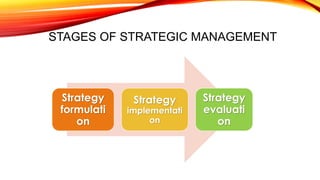
STAGES OF STRATEGIC MANAGEMENT
Strategy
formulati
on
Strategy
implementati
on
Strategy
evaluati
on
STEPS
Step 1: Strategic Intent - Vision is the statement that expresses organization’s ultimate
long-run objectives. It is what the firm ultimately like to become. Vision once formulated is
for forever and long lasting for years to come. Vision is closely related with strategic intent
and is a forward thinking process. Eg- Microsoft- ’A computer software on every desk and
in every home’.
• Mission- It tells who we are and what we do as well as what we’d like to become. Mission
of a business is the fundamental, unique purpose that sets it apart from other firms of its
kind and identifies the scope of its operations in product and market terms. Eg- Microsoft-
‘Empower every person and every organization on the planet to achieve more’.
• Objectives- These are the end results of planned activity that state what is to be
accomplished by when and should be quantified if possible and their achievement should
result in the fulfillment of a corporation’s mission. Objectives state specifically how the
goals shall be achieved. Following are the areas for setting objectives- profit objective,
marketing objective, production objective, etc.
1.Strategy Formulation Strategy formulation refers to the process of choosing the most
appropriate course of action for the realization of organizational goals and objectives and
thereby achieving the organizational vision. For choosing most appropriate course of
action, appraisal of organization and environmental is done with the help of SWOT
analysis.
2.• Environmental Appraisal- The environment of any organization is "the aggregate of all
conditions, events and influences that surround and affect it". It is dynamic and consists of
External & Internal Environment . The external environment includes all the factors
outside the organization which provide opportunities or pose threats to the organization.
The internal environment refers to all the factors within an organization which impart
strengths or cause weaknesses of a strategic nature.
3. • Organizational Appraisal- It is the process of observing an organizational internal
environment to identify the strengths and weaknesses that may influence the
organization's ability to achieve goals. The analysis of corporate capabilities and
weaknesses becomes a pre-requisite for successful formulation and reformulation of
corporate strategies. This analysis can be done at various levels: functional, divisional
and corporate.
Strategy Implementation Strategy implementation is the action stage of strategic
management. It refers to decisions that are made to install new strategy or reinforce existing
strategy.
Designing structure, process & system- Strategy implementation includes the making of
decisions with regard to organizational structure, developing budgets, programs and
procedures in order to accomplish certain activities.
Functional Implementation- Functional implementation is carried out through functional plan
and policies in five different areas- marketing, finance, operation, personnel and Information
management.
Behavioral Implementation- It denotes mobilizing employees and managers to put and
formulate strategies into action and require personal discipline, commitment and sacrifice. It
depends upon manager’s ability to motivate employees.
Operationalizing strategy- It includes establishing annual objectives, devising policies, and
allocating resources.
Strategy Evaluation & Control
Strategy evaluation- It is the primary means to know when and why particular
strategies are not working well. It is the process in which corporate activities and
performance results are monitored so that actual performance can be compared with
desired performance. Thus strategic evaluation activities include reviewing external
and internal factors that are the basis for current strategies.
Strategic control- In this step, organizations Determine what to control i.e., which
objectives the organization hopes to accomplish, set control standards, measure
performance, Compare the actual with the standard, determine the reasons for the
deviations and finally taking corrective actions and review the policies and activities if
needed.
Important Strategic Management Key Terms
• Strategists.
• Vision & Mission Statement.
• External Opportunities & Threats.
• Internal Strengths & Weaknesses.
• Long Term Objectives.
• Strategies.
• Annual Objectives.
• Policies.
Strategists
• Those people in the organization who are fully responsible for the failure r success of the
organization are referred to as strategists. Strategies are formed by strategists. Examples
of strategists include the chief executive officer, chair of the board, chief executive officer,
president & owner, entrepreneur or dean, etc
• Vision Statement
• A vision statement is quite necessary for the operation of the organization as it provides
an answer to the question of what should be the organization wants to become. The first
step in strategic planning is to develop the vision statement and after that mission
statement is prepared. Most organizations develop single-sentence vision statements.
• Mission Statement:
• A mission statement is a long-lasting statement that differentiates one organization from
another similar organization. The scope of the operations of the organization in terms of
market & product is identified through the mission statement.
External Opportunities & Threats
• External opportunities and threats are also part of strategic management’s key
terms. All those trends & events that are related to the social, economic,
environmental, cultural, demographic, political, legal, technology & technology &
competition that can harm or benefit an organization constitute external
opportunities & threats.
Internal Strengths & Weaknesses
• Those activities of the organization that is under the control of the organization, and
may show good and bad impact on the organization are known as internal strengths
& weaknesses of the organization. These are present in the marketing,
management, production/operation, finance/accounting, and information technology
& research & development activities of the organization.
Long-Term Objectives
• Long-term objectives are also one of the important strategic management key
terms. Long Term Objectives are referred to as particular results that an
organization wants to accomplish in targeting the mission. Expected results by
targeting certain strategies are represented by long-term objectives.
Strategies
• The means through which allow us to achieve long-term objectives.
• The following are included in the business strategies.
• Geographic Expansion
• Diversification
• Product development
• Acquisition
• Retrenchment
• Market penetration
• Liquidation & Joint venture
• A large amount of the resources of the organization are required along with the decisions
of top management for the application of strategies in the form of actions. Strategies are
future-oriented as these will affect the long-term prosperity of the organization.
• Annual Objectives
• Those short-term targets that help achieve the long-term objectives of the organization are
called annual objectives. The annual objectives must be quantitative, measurable, realistic,
challenging, consistent & prioritized. These must be developed at functional, divisional &
corporate levels in large organizations.
• Policies
• Annual objectives are accomplished by the means of policies. Policies contain rules,
guidelines & procedures developed to assist efforts to accomplish stated objectives.
Decision-making is guided through policies & recurring and repetitive situations are also
addressed through policies.
Why Do Strategic Plans Fail?
• Here are the top five reasons why your strategy could be creating more wastepaper than
actual value.
• 1. Lack of strategic focus
• Many companies set unrealistic goals, and that compromises their focus. Without a
strategic focus in place, it can be tricky to set a clear measure for success. That means
losing out on valuable time and wasting critical resources.
• Poor communication
• What are your organization's core goals and objectives?
• If you find that you or any of your team members are unable to communicate those clearly
— chances are, not everyone is on board with what’s going on and are unsure about what
you’re trying to achieve.
• Lack of alignment
• More than 60% of organizations do not link their strategic goals and objectives with
their budget.
• This is just one of the many areas in which a lack of alignment can make or break
the results that you’re looking to achieve. Another example is alignment between
management and teams.
• You’re not setting yourself up for success when 20% of staff members resist
implementation initiatives. If your employees are not 100% on board with your
strategic decisions, it is highly unlikely that they’ll be able to execute your plans
effectively.
1. Having a plan simply for plans sake. Some organizations go through the motions of
developing a plan simply because common sense says every good organization must have
a plan. Don’t do this. Just like most everything in life, you get out of a plan what you put in. If
you’re going to take the time to do it, do it right.
2. Not understanding the environment or focusing on results. Planning teams must pay
attention to changes in the business environment, set meaningful priorities, and understand
the need to pursue results.
3. Partial commitment. Business owners/CEOs/presidents must be fully committed and
fully understand how a strategic plan can improve their enterprise. Without this knowledge,
it’s tough to stay committed to the process.
4. Not having the right people involved. Those charged with executing the plan should be
involved from the onset. Those involved in creating the plan will be committed to seeing it
through execution.
5. Writing the plan and putting it on the shelf. This is as bad as not writing a plan at all.
If a plan is to be an effective management tool, it must be used and reviewed continually.
Unlike Twinkies or a fine vino, strategic plans don’t have a good shelf life.
6. Unwillingness or inability to change. Your company and your strategic plan must be
nimble and able to adapt as market conditions change.
7. Having the wrong people in leadership positions. Management must be willing to
make the tough decisions to ensure the right individuals are in the right leadership
positions. The “right” individuals include those who will advocate for and champion the
strategic plan and keep the company on track.
• 8. Ignoring marketplace reality, facts, and assumptions. Don’t bury your head
in the sand when it comes to marketplace realities, and don’t discount potential
problems because they have not had an immediate impact on your business yet.
Plan in advance and you’ll be ready when the tide comes in.
• 9. No accountability or follow through. Be tough once the plan is developed
and resources are committed and ensure there are consequences for not
delivering on the strategy.
• 10. Unrealistic goals or lack of focus and resources. Strategic plans must be
focused and include a manageable number of goals, objectives, and programs.
Fewer and focused is better than numerous and nebulous. Also be prepared to
assign adequate resources to accomplish those goals and objectives outlined in
the plan.
BENEFITS OF STRATEGIC MANAGEMENT
It provides the organization with consistency of action i.e. helps ensure that all
organizational units are working toward the same objectives (direction).
The process forces managers to be more proactive and conscious of their environments i.e.
to be future oriented.
It provides opportunity to involve different levels of management, encourage the
commitment of participating managers and reducing resistance to proposed change.
• PESTLE Analysis
• PEST is used to assess the external factors that might affect your company’s profitability.
Often used with SWOT. List the potential effects of these factors:
Political
Economic
Social
Technological
Environmental
Legal
PESTEL ANALYSIS IS A TOOL THAT HELPS YOU TO ANALYZE ENVIRONMENTAL
FACTORS THAT MIGHT HAVE A GREAT AFFECT ON YOUR BUSINESS IN THE FUTURE.
• How to Imitate Nike's Strategy
• Partner with other brands,
influencers, and ambassadors in
your international target markets.
Choose them carefully. For
instance, Manchester United is a
prominent cultural force in the
U.K., which helped Nike grow in
that country.
• If you sell a consumer product,
why not give the option for your
audience to customize — and
resell — the products as well?
You'll end up capturing a much
larger audience, and consumers
from different regions will capture
their region's preferences and
tastes much better.
MCDONALD'S
• How to Imitate McDonald's Strategy
• Like the other restaurant examples on this
list, opening restaurants in other regions
may be the first and most natural answer.
• If that's not feasible, especially if you run a
regional brand, celebrate the flavors of the
world by hosting an "International Day" and
posting about it on your website.
• This approach will get you on the radar of
those who enjoy those foods daily and help
you spread the word in other markets.
• McDonald's has also introduced macaroons
to its French menu.
• And added McSpaghetti to its menu in the
Philippines.
COCA-COLA
COCA-COLA IS AN EXCELLENT EXAMPLE OF A BRAND
THAT'S WELL-KNOWN FOR ITS INTERNATIONAL
MARKETING EFFORTS. THOUGH A LARGE CORPORATION,
COCA-COLA FOCUSES ON COMMUNITY PROGRAMS AND
INVESTS IN SMALL-SCALE CHARITY EFFORTS.
• How to Imitate Coca-Cola's Strategy
• Try to promote your values in your marketing efforts by
investing in communities worldwide. You can start small, such
as with a yearly sponsorship or recurring donation, and then
work your way up to launching a charity effort on the ground.
• Try to appeal to a universal human feeling as well. If you're a
marketer at a hospital, you might appeal to grief and hope in a
1-minute video about a hospital visit.
• These are feelings that transcend countries and languages,
automatically helping you reach a global audience.
• How to Imitate Spotify's Strategy
• Spotify's example is a winner because its global marketing strategy is
entirely product-based. It offers music, podcasts, and media in so
many languages. The audiences in those countries couldn't help but
start using the product.
• If your product lends itself to that, try featuring items or products that
appeal to people from different regions and countries.
• Spotify's business model is focused on helping you find something
new.
• It's one thing to select a genre of music to listen to—it's another thing
to choose a "mood" to listen to. On Spotify's "Browse" page, you can
listen to "country" and "hip-hop" but also to the music that caters to
your "workout" or "sleep" preferences
Starbucks
• When the hugely successful coffee chain Starbucks opened in the early 1970s, its
few stores in Seattle only sold coffee beans and coffee-making equipment.
Starbucks director of marketing and retail operations Howard Schultz convinced
the owners of Starbucks to sell it to him and a few investor partners to transform
it. Schultz pivoted the stores into coffee houses where you could buy prepared
coffee as well as buy beans. The company thrived under Schultz’s leadership,
and he eventually stepped down as its chief executive in 2000. Schultz
then reinvented the company again when he returned as CEO in 2008. In his
second stint as CEO, Schultz pushed Starbucks to embrace technology to
engage customers better. Today, the Starbucks app is the most regularly used
loyalty rewards app among major restaurant chains.
Amul
The multibillion dairy brand from India is the
country’s largest milk and milk products producer.
The company is known for starting The White
Revolution in India. Their most famous and
influential marketing was the creation of their
mascot, the Amul girl. The Amul girl was created as
a response to their rival Polson’s butter girl. Regular
newspaper strips with the Amul girl highlighting
famous international and political events have
tremendously helped Amul in the dairy business.
They fix to a traditional marketing strategy by
using a mascot and newspapers to communicate.
The Amul girl has been credited to be one of the
best forms of advertising in India.
Vodafone
In 2009, Vodafone brought into light an entity that
was never seen before in television. In response to
the Indian Premier League in 2009, Vodafone
created the ZooZoos as their advertisement
character. ZooZoos are white creatures having
ballooned bodies and circular heads. These
characters appeared in between matches to
promote the company’s services. This creative
marketing strategy was an instant hit. There was a
huge fan following for the ZooZoos. Several social
media outlets created fan pages for ZooZoos and
had over 250 thousand people following them. This
innovative strategy was a massive hit for the
company and continued for2 more years.
Company Mission Vision
Google
Our mission is to organize the world’s information and
make it universally accessible and useful
“To provide access to the world’s information in one
click”
Apple Inc.
“To bring the best personal computing products and
support to students, educators, designers, scientists,
engineers, businesspersons and consumers in over
140 countries around the world.”
“to make the best products on earth, and to leave the
world better than we found it.”
Microsoft
“To empower every person and every organization on
the planet to achieve more.”
“We strive to create local opportunity, growth, and
impact in every country around the world.”
Amazon
“We strive to offer our customers the lowest possible
prices, the best available selection, and the utmost
convenience.”
“to be Earth’s most customer-centric company, where
customers can find and discover anything they might
want to buy online.”
Facebook
“Give People the Power to Build Community and Bring
the World Closer Together”
“People use Facebook to stay connected with friends
and family, to discover what’s going on in the world, and
to share and express what matters to them.“
Tesla
“to accelerate the world’s transition to sustainable
energy.”
“to create the most compelling car company of the 21st
century by driving the world’s transition to electric
vehicles”
Johnson & Johnson
“Our Credo Stems from a Belief That Consumers,
Employees and the Community Are All Equally
Important”
“To help people see better, connect better, live better”
Samsung
“We will devote our human resources and technology
to create superior products and services, thereby
contributing to a better global society.”
“To inspire the world with our revolutionary
technologies, products, and design that enrich people’s
lives and contribute to social prosperity by creating a
new future,”
Walmart “To save people money so they can live better”
“Be THE destination for customers to save money, no
matter how they want to shop.
An organization’s vision and mission combined offer a broad,
overall sense of the organization’s direction. To work toward achieving these
overall aspirations, organizations also need to create —narrower aims that
should provide clear and tangible guidance to employees as they perform
their work on a daily basis. The most effective goals are those that are
Specific,
Measurable,
Achievable,
Realistic, and
Time-bound.
Thank You

Strategic Management- UNIT 1.pdf........

  • 1.
    UNIT-1 STRATEGIC MANAGEMENT By: Dr. Priya Dwivedi
  • 2.
    WHAT IS STRATEGY •Strategy is a tactical course of action which is designed to achieve long term objectives. It is an art and science of planning and marshalling resources for their most efficient and effective use in a changing environment. • Strategy of a business enterprise consists of what management decides about the future direction and scope of the business. It entails managerial choice among alternative action programmes, competitive moves and different business approaches to achieve enterprise objectives. • Strategy once formulated has long term implications. It is framed by top management in an organization. In short, it may be called as the ‘game plan of management’.
  • 3.
    Definition of Strategy• Definition of Strategy • Definition of Strategy • As per Glueck, Strategy is unified, comprehensive and integrated plan relating the strategic advantages of the firm to the challenges of the environment. It is designed to ensure that the basic objectives of the enterprise are achieved. As per Alfred D. Chandler, Strategy is “The determination of basic long-term goals and objectives of an enterprise and the adoption of the courses of action and the allocation of resources necessary for carrying out these goals.”
  • 4.
    FEATURES OF STRATEGY •Top management responsibility • Allocation of large amount of resources • Impact on long term prosperity of the firm • Future oriented • Multi-functional or multi-business consequences • Consideration of factors in the external environment
  • 5.
    LEVELS OF STRATEGY 1.Corporate-levelStrategy At this level, strategic decisions relate to organization-wide policies and are taken care by top-level management (BOD) with a vision of determining ‘Where the company wants to be?’ 2.• It has two main aspects- Formulation of Strategy (strategic planning) and Strategy Implementation 3. • The nature of strategy at this level tend to be value-oriented, conceptual and than other levels. 4. • There is also greater risk, cost and profit potential as well as greater need of flexibility associated with this level. 5.• Major financial policy decisions involving acquisition, diversification and structural redesigning belong to this level.
  • 6.
    • Business-Level StrategyBusiness-level strategy is more likely related to a unit within the whole. It is concerned with competition in a market. • The concerns are about what products or services should be developed and offered to which markets in order to meet customer needs and organizational objectives. • At this level, multifunctional strategies developed at corporate level are formulated and implemented for specific product market in which the business operates. Thus, managers at this level translate general directions and intent into concrete functional objectives. • Decisions at this level include policies involving new product development, marketing mix, research & development, personnel, etc.
  • 7.
    Functional/Operational-Level Strategy Functionalstrategy involves decision-making with respect to specific functional areas- production, marketing, personnel, finance etc. • While corporate and business level strategies are concerned with “Doing the right things”, functional strategies stress on “Doing things right”. • Operating level strategy is concerned with strategic approaches for managing frontline operating units(like plants, sales, etc) and for handling day to day tasks of strategic significance(like advertising campaign, purchasing materials, inventory control, maintenance, etc.). Thus, it focuses on how the different functions of the enterprise contribute to the other levels of strategy. • Thus, functional level strategic management is the management of relatively narrow areas of activity, which are of vital, pervasive or continuing importance to the total organization.
  • 8.
    Strategic Management -Strategic management is a set of management decisions and actions that determines the long-run performance of a corporation. It includes environmental scanning, strategy formulation, strategy implementation and evaluation and control to achieve the objectives of an organization. • The study of strategic management emphasizes the monitoring and evaluating of external opportunities and threats in light of a corporation’s strengths and weaknesses. • • As per Fred R. David, strategic management is an art and science of formulating, implementing and evaluating cross functional decisions that enable an organization to achieve its objectives. • As per Channon, strategic management is defined as that set of decisions and actions that result in formulating of strategy an its implementation to achieve the objectives of the corporation
  • 9.
    STAGES OF STRATEGICMANAGEMENT Strategy formulati on Strategy implementati on Strategy evaluati on
  • 10.
    STEPS Step 1: StrategicIntent - Vision is the statement that expresses organization’s ultimate long-run objectives. It is what the firm ultimately like to become. Vision once formulated is for forever and long lasting for years to come. Vision is closely related with strategic intent and is a forward thinking process. Eg- Microsoft- ’A computer software on every desk and in every home’. • Mission- It tells who we are and what we do as well as what we’d like to become. Mission of a business is the fundamental, unique purpose that sets it apart from other firms of its kind and identifies the scope of its operations in product and market terms. Eg- Microsoft- ‘Empower every person and every organization on the planet to achieve more’. • Objectives- These are the end results of planned activity that state what is to be accomplished by when and should be quantified if possible and their achievement should result in the fulfillment of a corporation’s mission. Objectives state specifically how the goals shall be achieved. Following are the areas for setting objectives- profit objective, marketing objective, production objective, etc.
  • 11.
    1.Strategy Formulation Strategyformulation refers to the process of choosing the most appropriate course of action for the realization of organizational goals and objectives and thereby achieving the organizational vision. For choosing most appropriate course of action, appraisal of organization and environmental is done with the help of SWOT analysis. 2.• Environmental Appraisal- The environment of any organization is "the aggregate of all conditions, events and influences that surround and affect it". It is dynamic and consists of External & Internal Environment . The external environment includes all the factors outside the organization which provide opportunities or pose threats to the organization. The internal environment refers to all the factors within an organization which impart strengths or cause weaknesses of a strategic nature. 3. • Organizational Appraisal- It is the process of observing an organizational internal environment to identify the strengths and weaknesses that may influence the organization's ability to achieve goals. The analysis of corporate capabilities and weaknesses becomes a pre-requisite for successful formulation and reformulation of corporate strategies. This analysis can be done at various levels: functional, divisional and corporate.
  • 12.
    Strategy Implementation Strategyimplementation is the action stage of strategic management. It refers to decisions that are made to install new strategy or reinforce existing strategy. Designing structure, process & system- Strategy implementation includes the making of decisions with regard to organizational structure, developing budgets, programs and procedures in order to accomplish certain activities. Functional Implementation- Functional implementation is carried out through functional plan and policies in five different areas- marketing, finance, operation, personnel and Information management. Behavioral Implementation- It denotes mobilizing employees and managers to put and formulate strategies into action and require personal discipline, commitment and sacrifice. It depends upon manager’s ability to motivate employees. Operationalizing strategy- It includes establishing annual objectives, devising policies, and allocating resources.
  • 13.
    Strategy Evaluation &Control Strategy evaluation- It is the primary means to know when and why particular strategies are not working well. It is the process in which corporate activities and performance results are monitored so that actual performance can be compared with desired performance. Thus strategic evaluation activities include reviewing external and internal factors that are the basis for current strategies. Strategic control- In this step, organizations Determine what to control i.e., which objectives the organization hopes to accomplish, set control standards, measure performance, Compare the actual with the standard, determine the reasons for the deviations and finally taking corrective actions and review the policies and activities if needed.
  • 17.
    Important Strategic ManagementKey Terms • Strategists. • Vision & Mission Statement. • External Opportunities & Threats. • Internal Strengths & Weaknesses. • Long Term Objectives. • Strategies. • Annual Objectives. • Policies.
  • 18.
    Strategists • Those peoplein the organization who are fully responsible for the failure r success of the organization are referred to as strategists. Strategies are formed by strategists. Examples of strategists include the chief executive officer, chair of the board, chief executive officer, president & owner, entrepreneur or dean, etc • Vision Statement • A vision statement is quite necessary for the operation of the organization as it provides an answer to the question of what should be the organization wants to become. The first step in strategic planning is to develop the vision statement and after that mission statement is prepared. Most organizations develop single-sentence vision statements. • Mission Statement: • A mission statement is a long-lasting statement that differentiates one organization from another similar organization. The scope of the operations of the organization in terms of market & product is identified through the mission statement.
  • 19.
    External Opportunities &Threats • External opportunities and threats are also part of strategic management’s key terms. All those trends & events that are related to the social, economic, environmental, cultural, demographic, political, legal, technology & technology & competition that can harm or benefit an organization constitute external opportunities & threats. Internal Strengths & Weaknesses • Those activities of the organization that is under the control of the organization, and may show good and bad impact on the organization are known as internal strengths & weaknesses of the organization. These are present in the marketing, management, production/operation, finance/accounting, and information technology & research & development activities of the organization.
  • 20.
    Long-Term Objectives • Long-termobjectives are also one of the important strategic management key terms. Long Term Objectives are referred to as particular results that an organization wants to accomplish in targeting the mission. Expected results by targeting certain strategies are represented by long-term objectives.
  • 21.
    Strategies • The meansthrough which allow us to achieve long-term objectives. • The following are included in the business strategies. • Geographic Expansion • Diversification • Product development • Acquisition • Retrenchment • Market penetration • Liquidation & Joint venture
  • 22.
    • A largeamount of the resources of the organization are required along with the decisions of top management for the application of strategies in the form of actions. Strategies are future-oriented as these will affect the long-term prosperity of the organization. • Annual Objectives • Those short-term targets that help achieve the long-term objectives of the organization are called annual objectives. The annual objectives must be quantitative, measurable, realistic, challenging, consistent & prioritized. These must be developed at functional, divisional & corporate levels in large organizations. • Policies • Annual objectives are accomplished by the means of policies. Policies contain rules, guidelines & procedures developed to assist efforts to accomplish stated objectives. Decision-making is guided through policies & recurring and repetitive situations are also addressed through policies.
  • 23.
    Why Do StrategicPlans Fail? • Here are the top five reasons why your strategy could be creating more wastepaper than actual value. • 1. Lack of strategic focus • Many companies set unrealistic goals, and that compromises their focus. Without a strategic focus in place, it can be tricky to set a clear measure for success. That means losing out on valuable time and wasting critical resources. • Poor communication • What are your organization's core goals and objectives? • If you find that you or any of your team members are unable to communicate those clearly — chances are, not everyone is on board with what’s going on and are unsure about what you’re trying to achieve.
  • 24.
    • Lack ofalignment • More than 60% of organizations do not link their strategic goals and objectives with their budget. • This is just one of the many areas in which a lack of alignment can make or break the results that you’re looking to achieve. Another example is alignment between management and teams. • You’re not setting yourself up for success when 20% of staff members resist implementation initiatives. If your employees are not 100% on board with your strategic decisions, it is highly unlikely that they’ll be able to execute your plans effectively.
  • 25.
    1. Having aplan simply for plans sake. Some organizations go through the motions of developing a plan simply because common sense says every good organization must have a plan. Don’t do this. Just like most everything in life, you get out of a plan what you put in. If you’re going to take the time to do it, do it right. 2. Not understanding the environment or focusing on results. Planning teams must pay attention to changes in the business environment, set meaningful priorities, and understand the need to pursue results. 3. Partial commitment. Business owners/CEOs/presidents must be fully committed and fully understand how a strategic plan can improve their enterprise. Without this knowledge, it’s tough to stay committed to the process. 4. Not having the right people involved. Those charged with executing the plan should be involved from the onset. Those involved in creating the plan will be committed to seeing it through execution.
  • 26.
    5. Writing theplan and putting it on the shelf. This is as bad as not writing a plan at all. If a plan is to be an effective management tool, it must be used and reviewed continually. Unlike Twinkies or a fine vino, strategic plans don’t have a good shelf life. 6. Unwillingness or inability to change. Your company and your strategic plan must be nimble and able to adapt as market conditions change. 7. Having the wrong people in leadership positions. Management must be willing to make the tough decisions to ensure the right individuals are in the right leadership positions. The “right” individuals include those who will advocate for and champion the strategic plan and keep the company on track.
  • 27.
    • 8. Ignoringmarketplace reality, facts, and assumptions. Don’t bury your head in the sand when it comes to marketplace realities, and don’t discount potential problems because they have not had an immediate impact on your business yet. Plan in advance and you’ll be ready when the tide comes in. • 9. No accountability or follow through. Be tough once the plan is developed and resources are committed and ensure there are consequences for not delivering on the strategy. • 10. Unrealistic goals or lack of focus and resources. Strategic plans must be focused and include a manageable number of goals, objectives, and programs. Fewer and focused is better than numerous and nebulous. Also be prepared to assign adequate resources to accomplish those goals and objectives outlined in the plan.
  • 28.
    BENEFITS OF STRATEGICMANAGEMENT It provides the organization with consistency of action i.e. helps ensure that all organizational units are working toward the same objectives (direction). The process forces managers to be more proactive and conscious of their environments i.e. to be future oriented. It provides opportunity to involve different levels of management, encourage the commitment of participating managers and reducing resistance to proposed change.
  • 29.
    • PESTLE Analysis •PEST is used to assess the external factors that might affect your company’s profitability. Often used with SWOT. List the potential effects of these factors: Political Economic Social Technological Environmental Legal
  • 30.
    PESTEL ANALYSIS ISA TOOL THAT HELPS YOU TO ANALYZE ENVIRONMENTAL FACTORS THAT MIGHT HAVE A GREAT AFFECT ON YOUR BUSINESS IN THE FUTURE.
  • 32.
    • How toImitate Nike's Strategy • Partner with other brands, influencers, and ambassadors in your international target markets. Choose them carefully. For instance, Manchester United is a prominent cultural force in the U.K., which helped Nike grow in that country. • If you sell a consumer product, why not give the option for your audience to customize — and resell — the products as well? You'll end up capturing a much larger audience, and consumers from different regions will capture their region's preferences and tastes much better.
  • 33.
    MCDONALD'S • How toImitate McDonald's Strategy • Like the other restaurant examples on this list, opening restaurants in other regions may be the first and most natural answer. • If that's not feasible, especially if you run a regional brand, celebrate the flavors of the world by hosting an "International Day" and posting about it on your website. • This approach will get you on the radar of those who enjoy those foods daily and help you spread the word in other markets. • McDonald's has also introduced macaroons to its French menu. • And added McSpaghetti to its menu in the Philippines.
  • 34.
    COCA-COLA COCA-COLA IS ANEXCELLENT EXAMPLE OF A BRAND THAT'S WELL-KNOWN FOR ITS INTERNATIONAL MARKETING EFFORTS. THOUGH A LARGE CORPORATION, COCA-COLA FOCUSES ON COMMUNITY PROGRAMS AND INVESTS IN SMALL-SCALE CHARITY EFFORTS. • How to Imitate Coca-Cola's Strategy • Try to promote your values in your marketing efforts by investing in communities worldwide. You can start small, such as with a yearly sponsorship or recurring donation, and then work your way up to launching a charity effort on the ground. • Try to appeal to a universal human feeling as well. If you're a marketer at a hospital, you might appeal to grief and hope in a 1-minute video about a hospital visit. • These are feelings that transcend countries and languages, automatically helping you reach a global audience.
  • 35.
    • How toImitate Spotify's Strategy • Spotify's example is a winner because its global marketing strategy is entirely product-based. It offers music, podcasts, and media in so many languages. The audiences in those countries couldn't help but start using the product. • If your product lends itself to that, try featuring items or products that appeal to people from different regions and countries. • Spotify's business model is focused on helping you find something new. • It's one thing to select a genre of music to listen to—it's another thing to choose a "mood" to listen to. On Spotify's "Browse" page, you can listen to "country" and "hip-hop" but also to the music that caters to your "workout" or "sleep" preferences
  • 36.
    Starbucks • When thehugely successful coffee chain Starbucks opened in the early 1970s, its few stores in Seattle only sold coffee beans and coffee-making equipment. Starbucks director of marketing and retail operations Howard Schultz convinced the owners of Starbucks to sell it to him and a few investor partners to transform it. Schultz pivoted the stores into coffee houses where you could buy prepared coffee as well as buy beans. The company thrived under Schultz’s leadership, and he eventually stepped down as its chief executive in 2000. Schultz then reinvented the company again when he returned as CEO in 2008. In his second stint as CEO, Schultz pushed Starbucks to embrace technology to engage customers better. Today, the Starbucks app is the most regularly used loyalty rewards app among major restaurant chains.
  • 37.
    Amul The multibillion dairybrand from India is the country’s largest milk and milk products producer. The company is known for starting The White Revolution in India. Their most famous and influential marketing was the creation of their mascot, the Amul girl. The Amul girl was created as a response to their rival Polson’s butter girl. Regular newspaper strips with the Amul girl highlighting famous international and political events have tremendously helped Amul in the dairy business. They fix to a traditional marketing strategy by using a mascot and newspapers to communicate. The Amul girl has been credited to be one of the best forms of advertising in India.
  • 38.
    Vodafone In 2009, Vodafonebrought into light an entity that was never seen before in television. In response to the Indian Premier League in 2009, Vodafone created the ZooZoos as their advertisement character. ZooZoos are white creatures having ballooned bodies and circular heads. These characters appeared in between matches to promote the company’s services. This creative marketing strategy was an instant hit. There was a huge fan following for the ZooZoos. Several social media outlets created fan pages for ZooZoos and had over 250 thousand people following them. This innovative strategy was a massive hit for the company and continued for2 more years.
  • 39.
    Company Mission Vision Google Ourmission is to organize the world’s information and make it universally accessible and useful “To provide access to the world’s information in one click” Apple Inc. “To bring the best personal computing products and support to students, educators, designers, scientists, engineers, businesspersons and consumers in over 140 countries around the world.” “to make the best products on earth, and to leave the world better than we found it.” Microsoft “To empower every person and every organization on the planet to achieve more.” “We strive to create local opportunity, growth, and impact in every country around the world.” Amazon “We strive to offer our customers the lowest possible prices, the best available selection, and the utmost convenience.” “to be Earth’s most customer-centric company, where customers can find and discover anything they might want to buy online.” Facebook “Give People the Power to Build Community and Bring the World Closer Together” “People use Facebook to stay connected with friends and family, to discover what’s going on in the world, and to share and express what matters to them.“ Tesla “to accelerate the world’s transition to sustainable energy.” “to create the most compelling car company of the 21st century by driving the world’s transition to electric vehicles” Johnson & Johnson “Our Credo Stems from a Belief That Consumers, Employees and the Community Are All Equally Important” “To help people see better, connect better, live better” Samsung “We will devote our human resources and technology to create superior products and services, thereby contributing to a better global society.” “To inspire the world with our revolutionary technologies, products, and design that enrich people’s lives and contribute to social prosperity by creating a new future,” Walmart “To save people money so they can live better” “Be THE destination for customers to save money, no matter how they want to shop.
  • 40.
    An organization’s visionand mission combined offer a broad, overall sense of the organization’s direction. To work toward achieving these overall aspirations, organizations also need to create —narrower aims that should provide clear and tangible guidance to employees as they perform their work on a daily basis. The most effective goals are those that are Specific, Measurable, Achievable, Realistic, and Time-bound.
  • 41.