The term‘strategic management’ is used to denote a
branch of management that is concerned with the
development of strategic vision, setting out
objectives, formulating and implementing strategies
and introducing corrective measures for the
deviations.
Strategic Management
3.
Strategic managementis the management of an
organization’s resources to achieve its goals and
objectives.
Strategic management involves setting objectives,
analyzing the competitive environment, analyzing
the internal organization, evaluating strategies, and
ensuring that management rolls out the strategies
across the organization
The strategicmanagement process defines the
organization’s strategy. It is also the process which helps
managers make a choice of a set of strategies for the
organization that will enable it to achieve better
performance.
6.
1.Vision:: First,the company managers need to
consider a set of questions – “What is our vision for
the company—where should the company be headed,
what kind of enterprise we want to become?”
2.Mission:: A mission is the long-term vision of what
an organisation wants to be and to whom it wants to
serve and what impact on the society. The mission is,
thus, the basic, unique purpose that differentiates a
business from others.
1.Strategic Intent
7.
3. SettingObjectives:
Objectives convert managerial statements of strategic
vision and business mission into “specific
performance target” —the results and outcomes the
organisation wants to achieve. Setting objectives and
then measuring whether they are achieved or not
help managers track an organisation’s progress.
8.
Strategy formulationis the process of deciding best
course of action for achieving organizational
objectives. After conducting environment scanning
process, managers formulate corporate, business and
functional strategies.
i. Defining the company mission,
ii. Analysis of the external business environment,
iii. Industry analysis,
2.Strategy Formulation:
9.
Strategy implementationis third phase in the strategic
management process. It is concerned with putting the
strategy into operation or translating the strategy into
strategic action. It necessitates three interrelated activities
of
(i) Determination of annul objectives,
(ii) Development of specific functional strategies, and (iii)
Development of policies.
For the successful implementation, the strategy must be
also institutionalised through structure, leadership, and
culture.
3.Strategy Implementation:
10.
Strategy evaluationwhich is the final step of strategy
management process involves- appraising internal
and external factors, measuring performance, and
taking remedial/corrective actions.
Evaluation assure the management that the
organizational strategy as well as its implementation
meets the organizational objectives
Strategic control is concerned with continuous
monitoring and tracking the strategy— putting the
strategy in the right path or direction
4.Strategy Evaluation and control
11.
1. IncreasingRate of Changes:
The environment in which the business operates’ is fast,
changing. A business concern which does not keep its policies
up-to-date, cannot survive for a long time in the market. In
turn, the effective strategy optimises profits over a long run.
2. Higher Motivation of Employees:
The employees (human resources) are assigned clear cut duties
by the top management viz. what is to be done, who is to do it,
how to do it and when to do it. ? When strategic management
is followed in any organisation, employees become loyal,
sincere and goal oriented and their efficiency is also increased
Need of Strategic
Management
12.
3. StrategicDecision-Making:
Under strategic planning, the first step is to set the goals or
objectives of a business concern. Strategic decisions taken
under strategic management help the smooth sailing of an
enterprise.
4. Optimization of Profits:
An effective strategy should develop from policies of a
concern. It takes into account actions of competitors. It
considers future operations in respect of market area and
opportunity, executive competence, available resources
and limitations imposed by the Government
13.
5. Miscellaneous:
Mr. H.N Broom in his book on ‘Business Policy and Strategic Action’
has mentioned that a strategy has a primary concern with the
following:
(a) Marketing opportunity: Products, prices, sales potential and sales
promotion.
(b) Available distribution channel and costs.
(c) The scale of company operations.
(d) The manufacturing process required to implement their scale of
operations (with an optimal production cost)
(e) The research and innovation programme.
(f) The type of organisation.
14.
1. Accomplishmentof Long-Term Objectives:
Business environment changes rapidly. A business concern
cannot achieve its long- term objectives of profitability — a
higher rate of return, productivity, technological leadership,
market standing, market leadership— industry leader etc.,
without formulating an appropriate strategy and without
implementing it effectively.
2. Helpful to Study the Business Environment:
Strategic management is helpful to a business concern to study
the external business environment accurately because every
incident or change in the business environment will have either
positive or negative impact on the business.
Importance of Strategic
Management
15.
3. Helpfulto Identify Business Opportunities:
Strategic management is helpful to a business concern to
identify the opportunities systematically with the help of its
analytical tools, SWOT analysis, BCG matrix etc., so that the
business concern can formulate an appropriate strategy.
4. Diagnosis of Business Environmental Threats:
Strategic management also enables a business concern to
diagnose business environmental threats systematically
with the help of its analytical tools, SWOT analysis, BCG
matrix etc., so that the business concerns can formulate a
suitable strategy to overcome threats.
16.
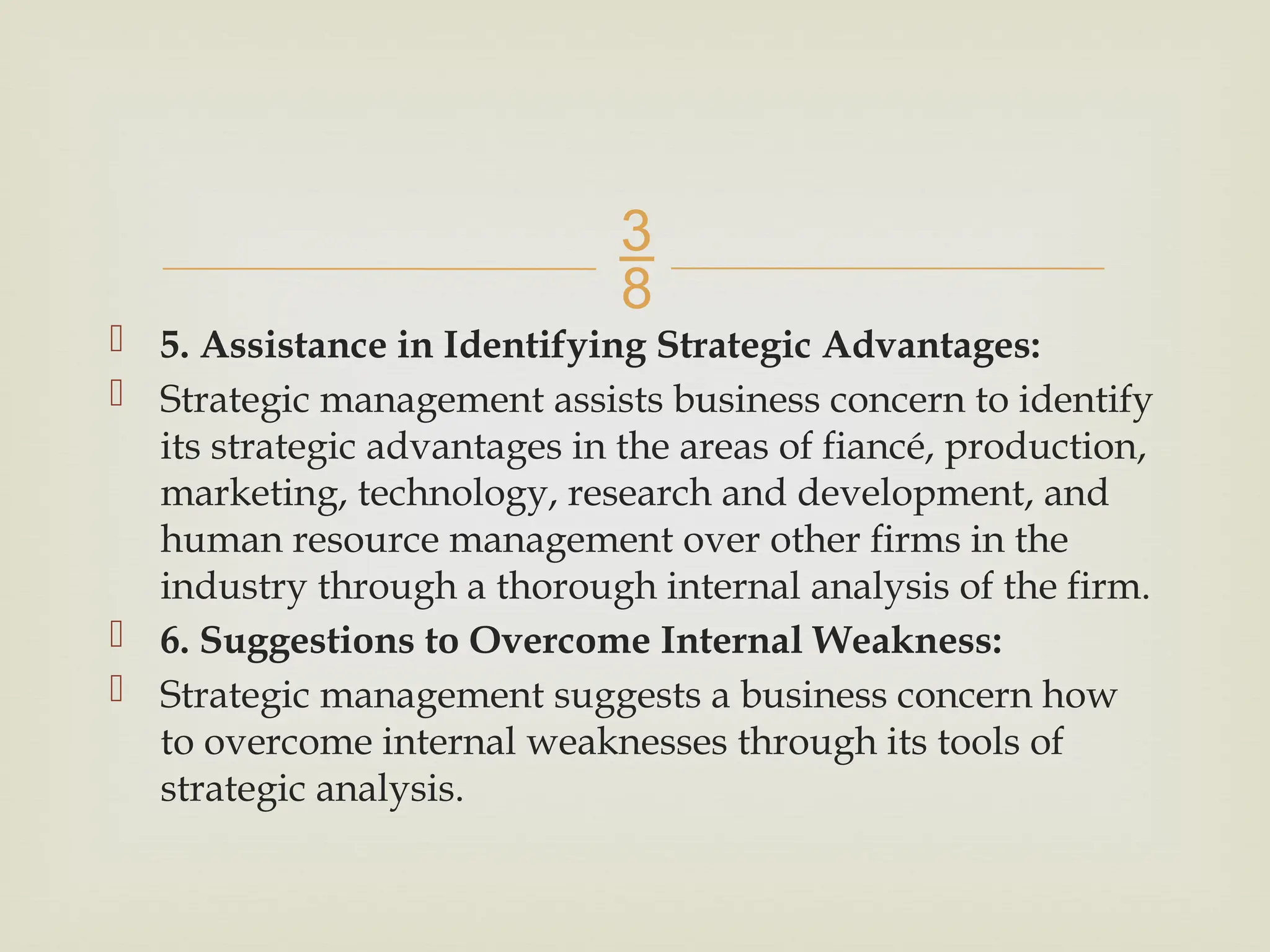
5. Assistancein Identifying Strategic Advantages:
Strategic management assists business concern to identify
its strategic advantages in the areas of fiancé, production,
marketing, technology, research and development, and
human resource management over other firms in the
industry through a thorough internal analysis of the firm.
6. Suggestions to Overcome Internal Weakness:
Strategic management suggests a business concern how
to overcome internal weaknesses through its tools of
strategic analysis.
17.
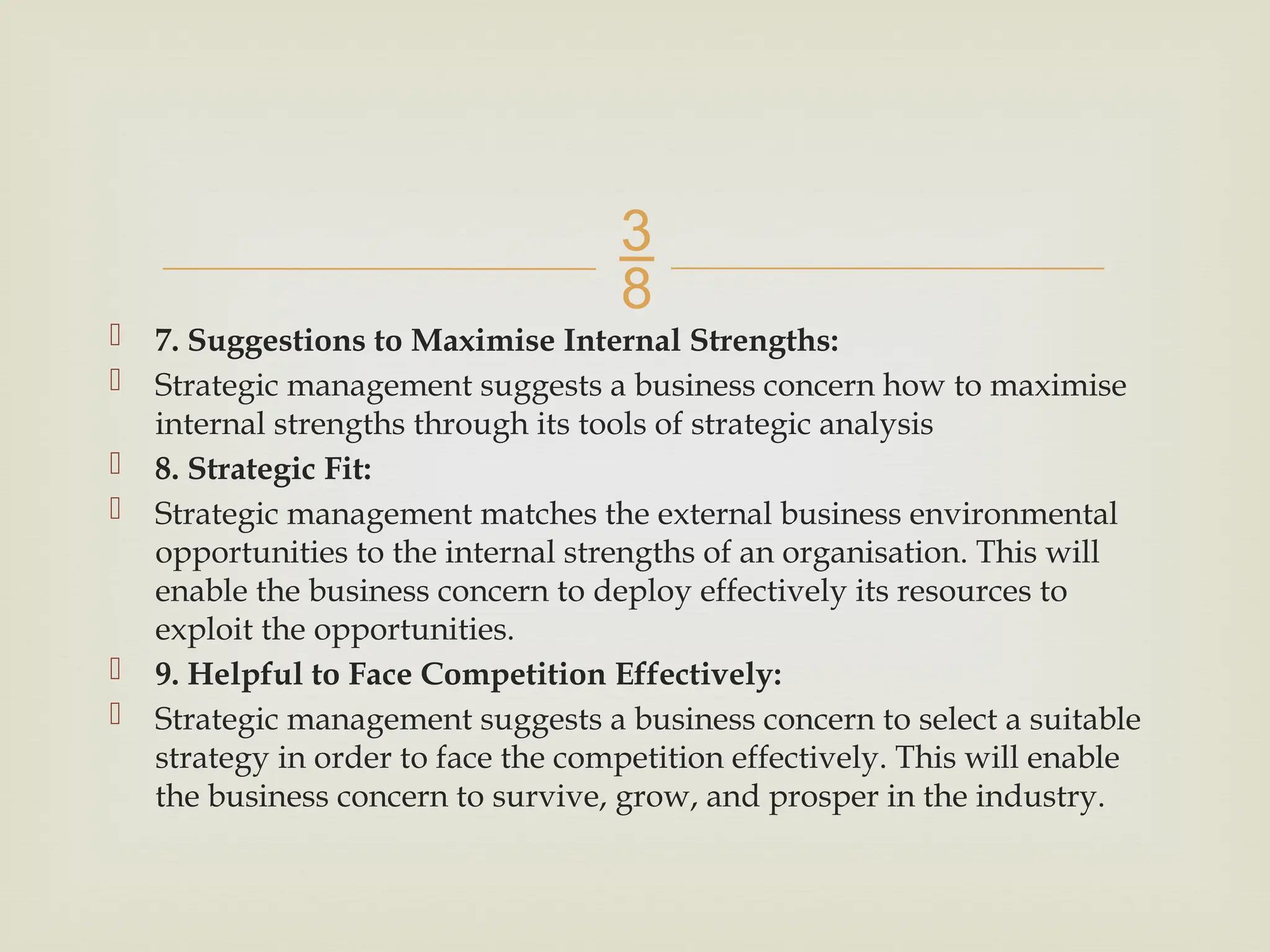
7. Suggestionsto Maximise Internal Strengths:
Strategic management suggests a business concern how to maximise
internal strengths through its tools of strategic analysis
8. Strategic Fit:
Strategic management matches the external business environmental
opportunities to the internal strengths of an organisation. This will
enable the business concern to deploy effectively its resources to
exploit the opportunities.
9. Helpful to Face Competition Effectively:
Strategic management suggests a business concern to select a suitable
strategy in order to face the competition effectively. This will enable
the business concern to survive, grow, and prosper in the industry.
18.
10. EffectiveControl:
Strategic management ensures an effective control in
an organisation by providing continuous monitoring
system and tracking the strategy. This will enable the
organisation to implement the strategy successfully
and to achieve the desired results.
11. Helpful to Face Uncertainties in Future:
Future is uncertain. But strategic management helps a
business concern to face uncertainties in the future
with the help of the techniques of business forecast.
19.
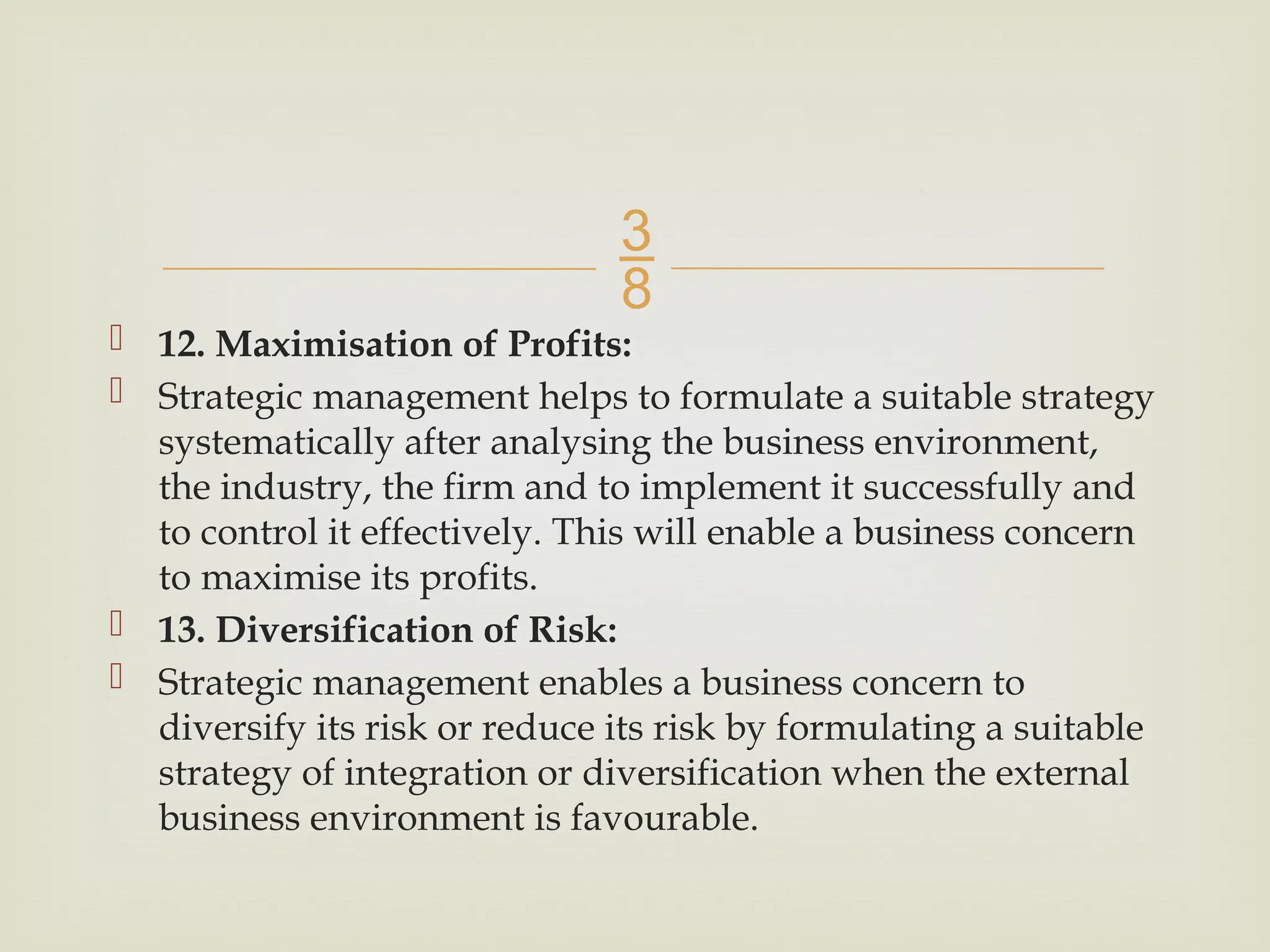
12. Maximisationof Profits:
Strategic management helps to formulate a suitable strategy
systematically after analysing the business environment,
the industry, the firm and to implement it successfully and
to control it effectively. This will enable a business concern
to maximise its profits.
13. Diversification of Risk:
Strategic management enables a business concern to
diversify its risk or reduce its risk by formulating a suitable
strategy of integration or diversification when the external
business environment is favourable.
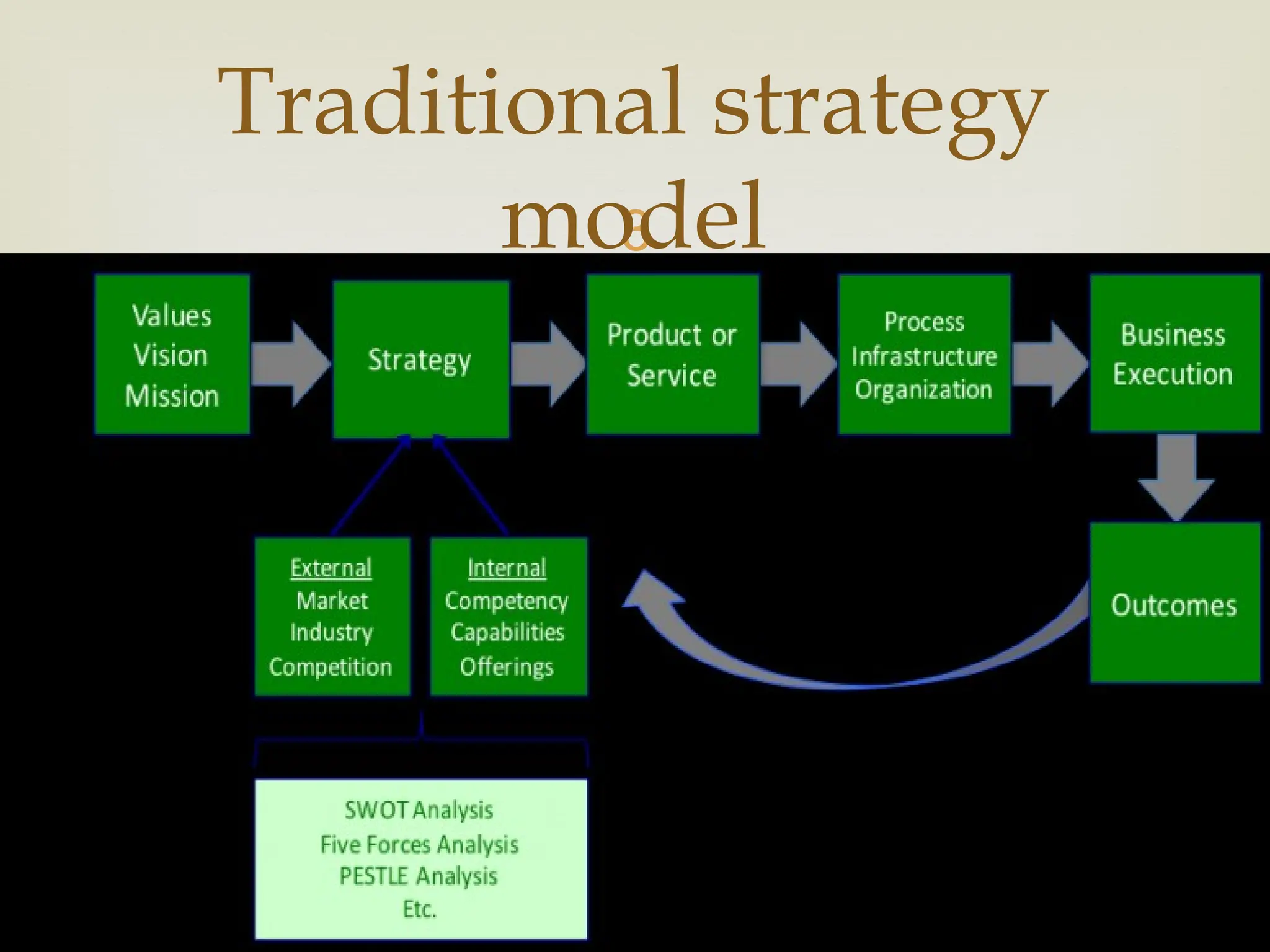
Traditional Approachto strategic planning models:
A company’s vision and mission, driven by a set of core
values, establish the framework for the development of a
strategic plan. The strategic plan is shaped by a set of
external and internal factors, the assessment of which forms
the basis for the strategy itself.
Both primary and secondary methods may be used to
understand the company’s target market(s). A variety of
tools and methods, such as SWOT analysis, PESTLE analysis,
and many more within a veritable strategic “alphabet
soup” may be deployed to facilitate the assessment.
Traditional approach
The strategyin kind drives the development and
refinement of products and/or services to meet the
perceived needs of the marketplace.
The necessary manufacturing, distribution and business
processes, infrastructure and organization are established
to develop, deliver and service these offerings.
When all of this is in place, the company executes to the
strategic plan, which will be modified periodically based
on measured outcomes.
It all seems quite straightforward, and it would be
wonderful if it worked. But it doesn’t.
24.
So what’swrong with this approach? While the list is
long, I would like to focus on seven fundamental
flaws that, taken together
More often than not, the focus is on the strategic plan.
Fundamentally, strategy is not about the plan but,
rather, it’s about the planning process.
It’s about thinking and acting strategically, as
opposed to producing a nice document that lays out
a roadmap that may or may not work at the end of
the day.
What’s Wrong with the Traditional
Strategic Planning model?
25.
It’s linear.The world is messy. Markets are messy. Business is
messy. None of this lends itself to a linear approach. What’s
needed is a non-linear process, with constant feedback loops
and opportunities to adjust to an ever-changing terrain and
the acquisition of new knowledge and insights.
It’s often complex, laborious and time-consuming. I have seen
business leaders spend months developing strategic plans,
while the market and competitive landscape shift beneath
their feet. Never has the need for rapid deployment been
greater than it is today. What’s needed is a straightforward,
non-complex approach.
26.
It’s staticand lacks agility. Things change rapidly, and
business leaders need the ability to respond in kind.
Mike Tyson is credited as having said: “Everyone
has a plan ’til they get punched in the mouth.” These
are wise words that every business leader should
never forget.
27.
A strategistplays a crucial role in shaping the long-
term direction and success of an organization. Their
primary responsibility is to develop and implement
strategies that align with the organization's goals,
mission, and competitive landscape.
The role of a strategist involves analyzing internal
and external environments, identifying opportunities
and risks, and formulating actionable plans to ensure
the organization remains competitive and achieves
sustainable growth.
Role of Strategist
28.
1. Visionand Goal Setting:
Strategists work closely with leadership to define the organization's
long-term vision and objectives.
They help translate the organization's mission into clear, actionable
goals, ensuring that all efforts are aligned with the broader purpose.
2. Market and Competitive Analysis:
Strategists analyze market trends, industry developments, and
competitive forces.
They identify opportunities for growth, potential threats, and
emerging trends that could impact the organization.
They perform SWOT analysis (Strengths, Weaknesses, Opportunities,
and Threats) to evaluate both internal and external factors.
29.
3. FormulatingStrategies:
Based on analysis, strategists develop high-level strategies that outline
how the organization will achieve its goals.
These strategies could include expansion plans, new product
development, mergers and acquisitions, marketing strategies, and
operational improvements.
They focus on leveraging the organization's strengths and mitigating
weaknesses.
4. Resource Allocation:
Strategists help allocate resources (financial, human, technological) in
the most effective way to execute the strategy.
They ensure that the right investments are made in areas that offer the
greatest potential for success.
30.
5. DecisionSupport:
Strategists provide data-driven insights and recommendations to
support key decision-making processes.
They work with different departments to ensure that decisions align
with the broader strategy and company objectives.
6. Implementation Oversight:
Strategists not only develop plans but also oversee the execution of
strategies.
They work with operational teams to ensure that strategies are
implemented effectively, and they monitor progress to track
performance against goals.
They adjust strategies as needed in response to changing conditions.
31.
7. RiskManagement:
Identifying potential risks is a key responsibility. Strategists anticipate
challenges, disruptions, or external threats that may arise and develop
contingency plans.
They ensure that the organization is prepared to respond to crises or
market shifts in a proactive manner.
8. Performance Monitoring and Evaluation:
Strategists use key performance indicators (KPIs) and other metrics to
assess the effectiveness of the strategy.
They regularly review progress and make adjustments to ensure the
organization stays on track.
They provide reports and updates to leadership on the status of the
strategy and its impact on overall performance.
32.
.
10.Innovation and Adaptation:
Strategists are responsible for fostering a culture of innovation, ensuring the
organization stays ahead in a competitive market.
They continuously seek new ways to improve the organization's products, services,
and processes, adapting strategies as market dynamics change.
11. Long-term Focus:
Unlike operational managers who focus on day-to-day execution, a strategist keeps a
long-term focus, looking several years into the future to ensure that the organization
remains competitive and relevant.
12. Communication:
Strategists effectively communicate the strategy to all stakeholders, including
employees, investors, and partners.
They ensure that everyone understands the organization’s strategic priorities and
how their work contributes to achieving those goals.