Strategy
Source – Political Science, ART OF
WAR
Act of a General
the art of planning and directing
overall military operations and
movements in a war or battle.
Assumptions
Survival of the fittest
Existence of both internal and
external environment
Environment is global as well
Mintzberg's 5 Ps for Strategy
Mintzberg provides five definitions of
strategy:
– Plan
– Ploy
– Pattern
– Position
– Perspective
Plan
Strategy is a plan - some sort of
consciously intended course of
action, a guideline (or set of
guidelines) to deal with a situation.
By this definition strategies have two
essential characteristics: they are
made in advance of the actions to
which they apply, and they are
developed consciously and
purposefully.
Policy
As plan, a strategy can
be a ploy too, really just
a specific scheme
intended to outwit an
opponent or competitor.
Pattern
If strategies can be intended (whether as general plans
or specific ploys), they can also be realised. In other
words, defining strategy as plan is not sufficient; we
also need a definition that encompasses the resulting
behaviour: Strategy is a pattern - specifically, a
pattern in a stream of actions. Strategy is
consistency in behaviour, whether or not intended.
The definitions of strategy as plan and pattern can be
quite independent of one another: plans may go
unrealised, while patterns may appear without
preconception.
Pattern
Strategy is a pattern - specifically, a
pattern in a stream of actions.
Strategy is consistency in behavior,
whether or not intended. The
definitions of strategy as plan and
pattern can be quite independent of
one another; plans may go
unrealized, while patterns may
appear without preconception.
Position
Strategy is a position - specifically a
means of locating an organisation in
an "environment". Strategy becomes
the mediating force, or "match",
between organisation and
environment, that is, between the
internal and the external context.
Perspective
Strategy is a perspective - its content
consisting not just of a chosen position, but
of an fixed way of perceiving the world.
Strategy in this respect is to the
organisation what personality is to the
individual. What is of key importance is
that strategy is a perspective shared by
members of an organisation, through their
intentions and / or by their actions. In
effect, when we talk of strategy in this
context, we are entering the realm of the
collective mind - individuals united by
common thinking and / or behavior.
Introduction to strategy and
strategic management
Strategy defined
A company's strategy consists of the
combination of competitive moves
and business approaches that
managers employ to please
customers, compete successfully and
achieve organizational objectives
PRECISELY
Strategic management
Strategic management is defined as
the set of decisions and actions
resulting in formation and
implementation of strategies
designed to achieve the objectives of
an organization.
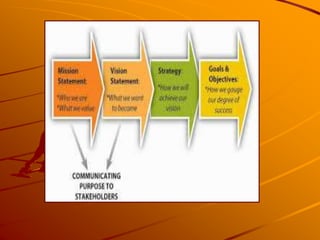
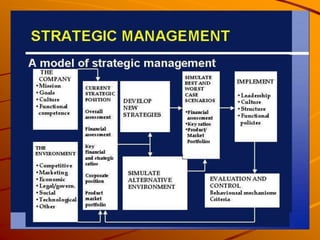
It involves attention to the
following:
Deciding Vision of the Company
Determining the mission of the
company
Developing a company profile
Assessment of the company's
external environment
Analysis of possible options
uncovered
Identifying the desired options
Strategic choice
Development of annual objectives
Implementation
Review and evaluation
Dimensions of strategic
decisions
Strategic issues require top
management decisions
Strategic issues involve the
allocation of large amount of
company resources
Strategic issues are likely to have
significant impact on the long term
prosperity of the firm
Continued….
Strategic issues are future oriented
Strategic issues have major multi-
functional or multi-business
consequences
Strategic issues necessitate
considering factors in the firm's
external environment
LEVELS OF STRATEGY
LEVELS OF STRATEGY
Levels of strategy
Corporate level strategy: This
strategy is prepared by the board of
directors, CEO and other high level
managers which includes: Deciding
the company mission, nature of
products and businesses to be
involved, setting financial and non-
financial objectives, corporate image
and social responsibility
Business (SBU) level Strategy:
Generally prepared and
implemented by middle level
managers. They translate the
general statements of direction and
intent generated at the corporate
level into concrete, functional
objectives and strategies for
individual business division or SBU.
Functional level strategy
These decisions are made by product,
geographical and functional mangers. It
is their responsibility to develop annual
objectives and short term strategies in
such areas as production, operations,
research and development, finance and
accounting, marketing and human
resources. Their prime responsibility is to
ensure the effective and efficient
implementation of strategies.
Characteristics of strategic
management decisions
Corporate level decisions are value
oriented, conceptual and less
concrete. They also involve greater
risk, cost and profit potential, long
term oriented and need for flexibility.
Functional level decisions involve
action oriented operational issues.
These decisions are made
periodically and lead directly to
implementation of some part of the
overall strategy. Therefore they are
generally short term oriented and
involve low risk and modest costs
Business level strategic decisions
fall between the two in orientation,
risks level, and cost. Examples of
such decisions are plant location,
market segmentation, and
geographic coverage and
distribution channels.
Formality in strategic
management
Formality refers to the degree to
which membership, responsibilities,
authority and discretion in decision
making are specified. The degree of
formality is usually positively
correlated with the cost,
comprehensiveness, accuracy and
success of planning.
Factors affecting formality are:
Size of the organization
Management styles
The complexity of its environment
Production process
The nature of the problems faced by
the organization
Value of strategic management
– Financial benefits: Strategic decisions
will increase the profitability and other
financial health of the organization.
Other benefits:
– It enhances the problem prevention
capabilities of the organization.
Monitoring and forecasting helps in this.
Continued…
Better decisions are made when
group based strategic decisions are
made.
Employee motivation should improve
as employees better appreciate the
productivity reward relationship
inherent in every strategic plan.
Similarly the participation in the
decision making helps better
understanding of the priorities and
operations of the organization among
the employees.
Gaps and overlaps in activities
can be reduced with the
participation in the strategic
decision making.
Resistance to change should be
reduced. This can be achieved
again by the participation of
employees in decision making.
Risks of strategic management
Strategic management process is costly
based on time, resources and energy
involvement of managers, especially at
the top level.
Problem of implementation is greater.
Strategic managers must be trained to
anticipate, minimize or constructively
respond when participating subordinates
become disappointed or frustrated over
unattained expectations.
Role of Chief Executive in
Strategic Management
The CEO plays vital role in all the aspects
of strategic management from
establishing company mission, philosophy,
objectives, development of strategic
options and choice, implementation and
control. Therefore his/her personal
characteristics plays strong role in
strategic management.
Factors that influence are
Personal ambitions
Business and individual philosophies
and values
Ethical beliefs
Risk taking behavior
Socio-cultural background of the CEO
Intro strategy
Intro strategy

Intro strategy

  • 1.
    Strategy Source – PoliticalScience, ART OF WAR Act of a General the art of planning and directing overall military operations and movements in a war or battle.
  • 2.
    Assumptions Survival of thefittest Existence of both internal and external environment Environment is global as well
  • 3.
    Mintzberg's 5 Psfor Strategy Mintzberg provides five definitions of strategy: – Plan – Ploy – Pattern – Position – Perspective
  • 4.
    Plan Strategy is aplan - some sort of consciously intended course of action, a guideline (or set of guidelines) to deal with a situation. By this definition strategies have two essential characteristics: they are made in advance of the actions to which they apply, and they are developed consciously and purposefully.
  • 5.
    Policy As plan, astrategy can be a ploy too, really just a specific scheme intended to outwit an opponent or competitor.
  • 6.
    Pattern If strategies canbe intended (whether as general plans or specific ploys), they can also be realised. In other words, defining strategy as plan is not sufficient; we also need a definition that encompasses the resulting behaviour: Strategy is a pattern - specifically, a pattern in a stream of actions. Strategy is consistency in behaviour, whether or not intended. The definitions of strategy as plan and pattern can be quite independent of one another: plans may go unrealised, while patterns may appear without preconception.
  • 7.
    Pattern Strategy is apattern - specifically, a pattern in a stream of actions. Strategy is consistency in behavior, whether or not intended. The definitions of strategy as plan and pattern can be quite independent of one another; plans may go unrealized, while patterns may appear without preconception.
  • 8.
    Position Strategy is aposition - specifically a means of locating an organisation in an "environment". Strategy becomes the mediating force, or "match", between organisation and environment, that is, between the internal and the external context.
  • 9.
    Perspective Strategy is aperspective - its content consisting not just of a chosen position, but of an fixed way of perceiving the world. Strategy in this respect is to the organisation what personality is to the individual. What is of key importance is that strategy is a perspective shared by members of an organisation, through their intentions and / or by their actions. In effect, when we talk of strategy in this context, we are entering the realm of the collective mind - individuals united by common thinking and / or behavior.
  • 10.
    Introduction to strategyand strategic management Strategy defined A company's strategy consists of the combination of competitive moves and business approaches that managers employ to please customers, compete successfully and achieve organizational objectives
  • 11.
  • 12.
    Strategic management Strategic managementis defined as the set of decisions and actions resulting in formation and implementation of strategies designed to achieve the objectives of an organization.
  • 13.
    It involves attentionto the following: Deciding Vision of the Company Determining the mission of the company Developing a company profile Assessment of the company's external environment Analysis of possible options uncovered
  • 14.
    Identifying the desiredoptions Strategic choice Development of annual objectives Implementation Review and evaluation
  • 16.
    Dimensions of strategic decisions Strategicissues require top management decisions Strategic issues involve the allocation of large amount of company resources Strategic issues are likely to have significant impact on the long term prosperity of the firm
  • 17.
    Continued…. Strategic issues arefuture oriented Strategic issues have major multi- functional or multi-business consequences Strategic issues necessitate considering factors in the firm's external environment
  • 18.
  • 19.
  • 20.
    Levels of strategy Corporatelevel strategy: This strategy is prepared by the board of directors, CEO and other high level managers which includes: Deciding the company mission, nature of products and businesses to be involved, setting financial and non- financial objectives, corporate image and social responsibility
  • 21.
    Business (SBU) levelStrategy: Generally prepared and implemented by middle level managers. They translate the general statements of direction and intent generated at the corporate level into concrete, functional objectives and strategies for individual business division or SBU.
  • 22.
    Functional level strategy Thesedecisions are made by product, geographical and functional mangers. It is their responsibility to develop annual objectives and short term strategies in such areas as production, operations, research and development, finance and accounting, marketing and human resources. Their prime responsibility is to ensure the effective and efficient implementation of strategies.
  • 23.
    Characteristics of strategic managementdecisions Corporate level decisions are value oriented, conceptual and less concrete. They also involve greater risk, cost and profit potential, long term oriented and need for flexibility.
  • 24.
    Functional level decisionsinvolve action oriented operational issues. These decisions are made periodically and lead directly to implementation of some part of the overall strategy. Therefore they are generally short term oriented and involve low risk and modest costs
  • 25.
    Business level strategicdecisions fall between the two in orientation, risks level, and cost. Examples of such decisions are plant location, market segmentation, and geographic coverage and distribution channels.
  • 26.
    Formality in strategic management Formalityrefers to the degree to which membership, responsibilities, authority and discretion in decision making are specified. The degree of formality is usually positively correlated with the cost, comprehensiveness, accuracy and success of planning.
  • 27.
    Factors affecting formalityare: Size of the organization Management styles The complexity of its environment Production process The nature of the problems faced by the organization
  • 28.
    Value of strategicmanagement – Financial benefits: Strategic decisions will increase the profitability and other financial health of the organization. Other benefits: – It enhances the problem prevention capabilities of the organization. Monitoring and forecasting helps in this.
  • 29.
    Continued… Better decisions aremade when group based strategic decisions are made. Employee motivation should improve as employees better appreciate the productivity reward relationship inherent in every strategic plan. Similarly the participation in the decision making helps better understanding of the priorities and operations of the organization among the employees.
  • 30.
    Gaps and overlapsin activities can be reduced with the participation in the strategic decision making. Resistance to change should be reduced. This can be achieved again by the participation of employees in decision making.
  • 31.
    Risks of strategicmanagement Strategic management process is costly based on time, resources and energy involvement of managers, especially at the top level. Problem of implementation is greater. Strategic managers must be trained to anticipate, minimize or constructively respond when participating subordinates become disappointed or frustrated over unattained expectations.
  • 32.
    Role of ChiefExecutive in Strategic Management The CEO plays vital role in all the aspects of strategic management from establishing company mission, philosophy, objectives, development of strategic options and choice, implementation and control. Therefore his/her personal characteristics plays strong role in strategic management.
  • 33.
    Factors that influenceare Personal ambitions Business and individual philosophies and values Ethical beliefs Risk taking behavior Socio-cultural background of the CEO

Editor's Notes

  • #22 Sbu: startegiv business unit