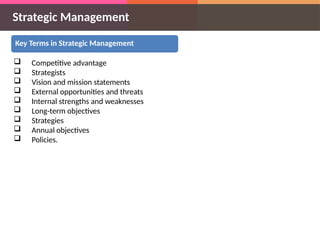
Strategic Management
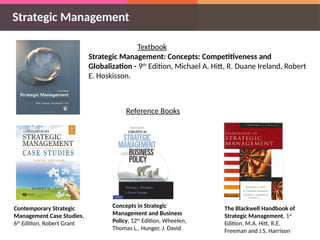
Textbook
Strategic Management:Concepts: Competitiveness and
Globalization - 9th
Edition, Michael A. Hitt, R. Duane Ireland, Robert
E. Hoskisson.
Contemporary Strategic
Management Case Studies,
6th
Edition, Robert Grant
Reference Books
Concepts in Strategic
Management and Business
Policy, 12th
Edition, Wheelen,
Thomas L., Hunger, J. David
The Blackwell Handbook of
Strategic Management, 1st
Edition. M.A. Hitt, R.E.
Freeman and J.S. Harrison
3.
Strategic Management
Four Elementsof An Effective Strategy
A unique value proposition compared to competitors.
A different tailored value chain with activities that fit together and reinforce
each other.
Clear tradeoffs, and choosing what not to do.
Continuity of strategy with continual improvement in realization
(implementation and execution).
4.
Strategic Management
Strategic Management
Definition- It is the art and science of formulating, implementing, and evaluating cross-
functional decisions that enable an organization to achieve its objectives.
Strategic Management is defined as “ a stream of decisions and actions, which leads to
the development of an effective strategy or strategies to help achieve corporate
objectives”. Glueck (1984)
Focuses on integrating management, marketing, finance/accounting,
production/operations, research and development, and information systems to achieve
organizational success.
Synonymously used with the term strategic planning.
Strategic management is used to refer to strategy formulation, implementation, and
evaluation. Strategic planning referring only to strategy formulation.
5.
Strategic Management
Stages ofStrategic Management
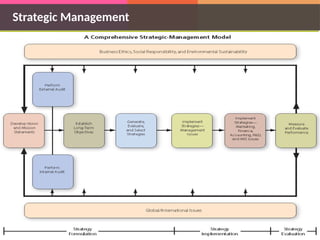
Strategic-management process consists of three stages: strategy formulation, strategy
implementation, and strategy evaluation.
Strategy formulation includes
developing a vision and mission,
identifying an organization’s external opportunities and threats,
Determining internal strengths and weaknesses,
establishing long-term objectives,
generating alternative strategies, and
choosing particular strategies to pursue.
Strategy-formulation issues includes
deciding what new businesses to enter,
what businesses to abandon,
how to allocate resources,
whether to expand operations or diversify, whether to enter international
markets, whether to merge or form a joint venture, and
how to avoid a hostile takeover.
6.
Strategic Management
Stages ofStrategic Management (contd)
Strategy implementation means to mobilize employees and managers to put formulated
strategies into action.
Strategy implementation requires a firm to
establish annual objectives,
devise policies,
motivate employees, and
allocate resources so that formulated strategies can be executed.
Strategy implementation includes
developing a strategy-supportive culture,
creating an effective organizational structure,
redirecting marketing efforts,
preparing budgets,
developing and utilizing information systems, and
linking employee compensation to organizational performance.
7.
Strategic Management
Stages ofStrategic Management (contd)
Strategy evaluation. The primary means for obtaining information about
whether particular strategies are not working well.
All strategies are subject to future modifications because external and internal
factors are constantly changing.
Three fundamental strategy-evaluation activities are
(1) reviewing external and internal factors (basis for current strategies),
(2) measuring performance, and
(3) taking corrective actions.
8.
Strategic Management
Adapting toChange
Strategic-management process is based on the belief that organizations should
continually monitor internal and external events and trends so that timely changes can be
made as necessary.
During the great depression (2007 – 2008), big companies lost their fortunes:
General Motors, stock fell by 87 percent
Citigroup lost 77 percent stock value
General Electric lost 56 percent of its value.
Organizations need to anwers key strategic-management questions, in order to adapt to
change
What kind of busines should we become ?
Are we in the right field(s)?
Should we reshape our business?
What new competitors are entering our industry?
What strategies should we pursue?
How are our customers changing?
Are new technologies being developed that could put us out of business?
Strategic Management
Key Termsin Strategic Management (Contd)
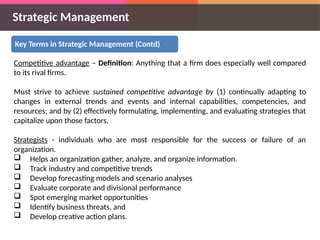
Competitive advantage – Definition: Anything that a firm does especially well compared
to its rival firms.
Must strive to achieve sustained competitive advantage by (1) continually adapting to
changes in external trends and events and internal capabilities, competencies, and
resources; and by (2) effectively formulating, implementing, and evaluating strategies that
capitalize upon those factors.
Strategists - individuals who are most responsible for the success or failure of an
organization.
Helps an organization gather, analyze, and organize information.
Track industry and competitive trends
Develop forecasting models and scenario analyses
Evaluate corporate and divisional performance
Spot emerging market opportunities
Identify business threats, and
Develop creative action plans.
11.
Strategic Management
Key Termsin Strategic Management (Contd)
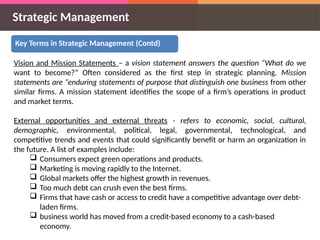
Vision and Mission Statements – a vision statement answers the question “What do we
want to become?” Often considered as the first step in strategic planning. Mission
statements are “enduring statements of purpose that distinguish one business from other
similar firms. A mission statement identifies the scope of a firm’s operations in product
and market terms.
External opportunities and external threats - refers to economic, social, cultural,
demographic, environmental, political, legal, governmental, technological, and
competitive trends and events that could significantly benefit or harm an organization in
the future. A list of examples include:
Consumers expect green operations and products.
Marketing is moving rapidly to the Internet.
Global markets offer the highest growth in revenues.
Too much debt can crush even the best firms.
Firms that have cash or access to credit have a competitive advantage over debt-
laden firms.
business world has moved from a credit-based economy to a cash-based
economy.
12.
Strategic Management
Key Termsin Strategic Management (Contd)
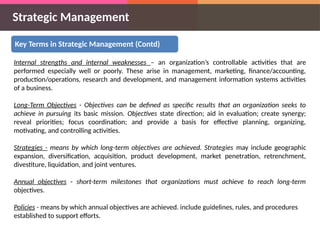
Internal strengths and internal weaknesses – an organization’s controllable activities that are
performed especially well or poorly. These arise in management, marketing, finance/accounting,
production/operations, research and development, and management information systems activities
of a business.
Long-Term Objectives - Objectives can be defined as specific results that an organization seeks to
achieve in pursuing its basic mission. Objectives state direction; aid in evaluation; create synergy;
reveal priorities; focus coordination; and provide a basis for effective planning, organizing,
motivating, and controlling activities.
Strategies - means by which long-term objectives are achieved. Strategies may include geographic
expansion, diversification, acquisition, product development, market penetration, retrenchment,
divestiture, liquidation, and joint ventures.
Annual objectives - short-term milestones that organizations must achieve to reach long-term
objectives.
Policies - means by which annual objectives are achieved. include guidelines, rules, and procedures
established to support efforts.
Strategic Management
A Modelof the Strategic Planning Process
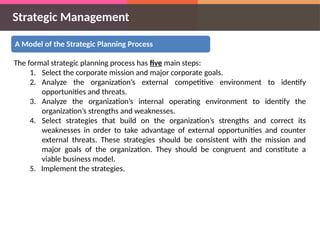
The formal strategic planning process has five main steps:
1. Select the corporate mission and major corporate goals.
2. Analyze the organization’s external competitive environment to identify
opportunities and threats.
3. Analyze the organization’s internal operating environment to identify the
organization’s strengths and weaknesses.
4. Select strategies that build on the organization’s strengths and correct its
weaknesses in order to take advantage of external opportunities and counter
external threats. These strategies should be consistent with the mission and
major goals of the organization. They should be congruent and constitute a
viable business model.
5. Implement the strategies.
15.
Strategic Management
Benefits ofStrategic Management
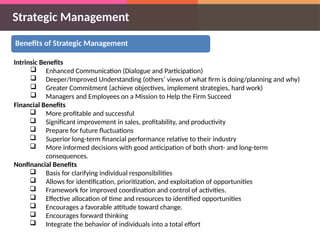
Intrinsic Benefits
Enhanced Communication (Dialogue and Participation)
Deeper/Improved Understanding (others’ views of what firm is doing/planning and why)
Greater Commitment (achieve objectives, implement strategies, hard work)
Managers and Employees on a Mission to Help the Firm Succeed
Financial Benefits
More profitable and successful
Significant improvement in sales, profitability, and productivity
Prepare for future fluctuations
Superior long-term financial performance relative to their industry
More informed decisions with good anticipation of both short- and long-term
consequences.
Nonfinancial Benefits
Basis for clarifying individual responsibilities
Allows for identification, prioritization, and exploitation of opportunities
Framework for improved coordination and control of activities.
Effective allocation of time and resources to identified opportunities
Encourages a favorable attitude toward change.
Encourages forward thinking
Integrate the behavior of individuals into a total effort
16.
Strategic Management
Why SomeFirms Fail to Do Strategic Planning
Lack of knowledge or experience in strategic planning - No training in strategic planning.
Poor reward structures—When an organization assumes success, it often fails to reward success.
When failure occurs, then the firm may punish.
Waste of time—Some firms see planning as a waste of time because no marketable product is
produced. Time spent on planning is an investment.
Too expensive—Some organizations see planning as too expensive in time and money.
Laziness—People may not want to put forth the effort needed to formulate a plan.
Content with success—Particularly if a firm is successful, individuals may feel there is no need to plan
because things are fine as they stand. But success today does not guarantee success tomorrow.
Fear of failure—By not taking action, there is little risk of failure unless a problem is urgent and
pressing. Whenever something worthwhile is attempted, there is some risk of failure.
17.
Strategic Management
Why SomeFirms Fail to Do Strategic Planning (Contd)
Overconfidence—As managers build experience, they may rely less on formalized planning. Rarely,
however, is this appropriate. Being overconfident or overestimating experience can bring demise.
Forethought is rarely wasted and is often the mark of professionalism.
Prior bad experience—People may have had a previous bad experience with planning, that is, cases in
which plans have been long, cumbersome, impractical, or inflexible. Planning, like anything else, can
be done badly.
Self-interest—When someone has achieved status, privilege, or self-esteem through effectively using
an old system, he or she often sees a new plan as a threat.