LOCAL ECONOMIC DEVELOPMENT: A PRIMER
        DEVELOPING AND IMPLEMENTING LOCAL ECONOMIC
          DEVELOPMENT STRATEGIES AND ACTION PLANS
                               BY


                       GWEN SWINBURN
                 SORAYA GOGA & FERGUS MURPHY


                                               BERTELSMANN STIFTUNG
THE WORLD BANK


                          JANUARY 2006
Local Economic Development Primer


Acknowledgements
This LED Primer was written by the Local Economic Development team based in the Urban
Development Unit of the World Bank. The methodology was developed by Gwen Swinburn,
Senior Urban Specialist and this Primer was written by Gwen Swinburn and Fergus Murphy,
consultant with contributions from Soraya Goga, Young Professional, Kate Kuper, Senior Urban
Specialist, and André Herzog, Consultant. Information used in this guide was obtained, with
permission, from ‘Local Economic Development: Good Practice from the European Union and
Beyond’ (2000), an unpublished paper prepared by Gwen Swinburn for the Urban Development
Unit of the World Bank. The Primer and methodology has benefited from peer review from a
side range of global practitioners and academics, for which grateful thanks are given here.

Should you wish to comment on the usefulness of the Primer, or suggest additional information or
case studies, do contact the World Bank urbanhelp@worldbank.org, gwen.swinburn@gmail.com
and gswinburn@worldbank.org


Reading this Primer
Where text appears in the margin of a page, this is meant to highlight a specific issue that is of
particular relevance to LED strategic planning. For the sake of consistency, this LED Primer will
refer to municipal government and municipality as the institutional level of local government with
responsibility for LED strategic planning. This Primer is suitable however for a wide range of
organizations seeking to develop a capacity for, and understanding of, local economic
development strategic planning, including national, regional and city governments, local
authorities, town councils, city hall, local government departments and public-private
partnerships. This list is not exhaustive.

Disclaimer
The findings, interpretations and conclusions expressed in this document are entirely those of the
authors and should not be attributed in any manner to the World Bank or its affiliated
organizations, members of its Board of Executive Directors, the governments they represent, or
the Bertelsmann Foundation. The World Bank and the Bertelsmann Foundation do not guarantee
the accuracy of the data contained in the document nor do they accept responsibility for any
consequences of its use.


                                              i
Local Economic Development Primer


© 2006, Bertelsmann Stiftung, Gütersloh; The World Bank, Washington, D.C.
Responsible: Gabriele Schöler, Claudia Walther
Cover Design: Boris Kessler
Layout and typesetting: Vanessa Meise
www.worldbank.org/urban/led
www.citiesofchange.net


                                           ii
Local Economic Development Primer


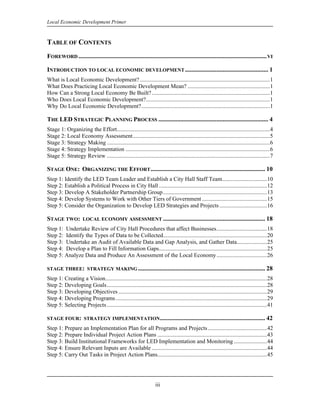
TABLE OF CONTENTS
FOREWORD ........................................................................................................................ VI

INTRODUCTION TO LOCAL ECONOMIC DEVELOPMENT ..................................................... 1
What is Local Economic Development? ..........................................................................................1
What Does Practicing Local Economic Development Mean? .........................................................1
How Can a Strong Local Economy Be Built?..................................................................................1
Who Does Local Economic Development?......................................................................................1
Why Do Local Economic Development?.........................................................................................1

THE LED STRATEGIC PLANNING PROCESS ...................................................................... 4
Stage 1: Organizing the Effort..........................................................................................................4
Stage 2: Local Economy Assessment...............................................................................................5
Stage 3: Strategy Making .................................................................................................................6
Stage 4: Strategy Implementation ....................................................................................................6
Stage 5: Strategy Review .................................................................................................................7

STAGE ONE: ORGANIZING THE EFFORT ......................................................................... 10
Step 1: Identify the LED Team Leader and Establish a City Hall Staff Team...............................10
Step 2: Establish a Political Process in City Hall ...........................................................................12
Step 3: Develop A Stakeholder Partnership Group ........................................................................13
Step 4: Develop Systems to Work with Other Tiers of Government .............................................15
Step 5: Consider the Organization to Develop LED Strategies and Projects .................................16

STAGE TWO:            LOCAL ECONOMY ASSESSMENT ................................................................. 18
Step 1: Undertake Review of City Hall Procedures that affect Businesses...................................18
Step 2: Identify the Types of Data to be Collected........................................................................20
Step 3: Undertake an Audit of Available Data and Gap Analysis, and Gather Data.....................25
Step 4: Develop a Plan to Fill Information Gaps...........................................................................25
Step 5: Analyze Data and Produce An Assessment of the Local Economy ...................................26

STAGE THREE: STRATEGY MAKING ................................................................................. 28
Step 1: Creating a Vision................................................................................................................28
Step 2: Developing Goals...............................................................................................................28
Step 3: Developing Objectives .......................................................................................................29
Step 4: Developing Programs.........................................................................................................29
Step 5: Selecting Projects ...............................................................................................................41

STAGE FOUR: STRATEGY IMPLEMENTATION ................................................................... 42
Step 1: Prepare an Implementation Plan for all Programs and Projects .........................................42
Step 2: Prepare Individual Project Action Plans ............................................................................43
Step 3: Build Institutional Frameworks for LED Implementation and Monitoring .......................44
Step 4: Ensure Relevant Inputs are Available ................................................................................44
Step 5: Carry Out Tasks in Project Action Plans............................................................................45


                                                                   iii
Local Economic Development Primer


STAGE FIVE: STRATEGY REVIEW ................................................................................... 46
Step 1: What? Why? When?...........................................................................................................46
Step 2: Monitoring..........................................................................................................................47
Step 3: Evaluation ..........................................................................................................................47
Step 4: Institutional Arrangements.................................................................................................51
Step 5: Strategy Review and The Planning Process .......................................................................52

RESOURCES....................................................................................................................... 55
Glossary of LED Terms .................................................................................................................55
Key Readings .................................................................................................................................58
Case Studies ...................................................................................................................................63
Links to External Organizations.....................................................................................................64
Links to World Bank Web Sites.....................................................................................................70
Sample Documents.........................................................................................................................71


                                                                     iv
Local Economic Development Primer


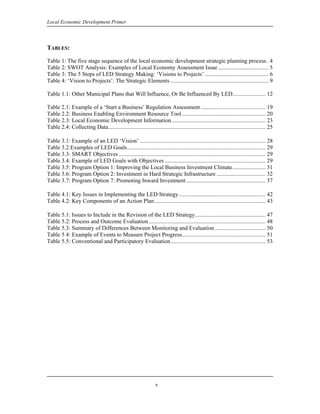
TABLES:

Table 1: The five stage sequence of the local economic development strategic planning process . 4
Table 2: SWOT Analysis: Examples of Local Economy Assessment Issue ................................... 5
Table 3: The 5 Steps of LED Strategy Making: ‘Visions to Projects’ ............................................ 6
Table 4: ‘Vision to Projects’: The Strategic Elements .................................................................... 9

Table 1.1: Other Municipal Plans that Will Influence, Or Be Influenced By LED....................... 12

Table 2.1: Example of a ‘Start a Business’ Regulation Assessment ............................................. 19
Table 2.2: Business Enabling Environment Resource Tool .......................................................... 20
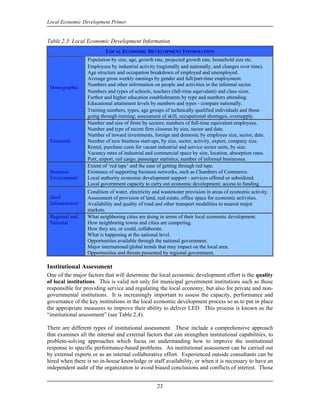
Table 2.3: Local Economic Development Information ................................................................. 23
Table 2.4: Collecting Data............................................................................................................. 25

Table 3.1: Example of an LED ‘Vision’ ....................................................................................... 28
Table 3.2:Examples of LED Goals................................................................................................ 29
Table 3.3: SMART Objectives ...................................................................................................... 29
Table 3.4: Example of LED Goals with Objectives ...................................................................... 29
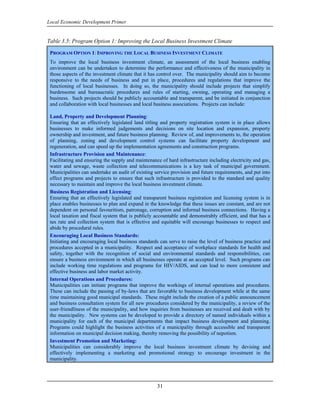
Table 3.5: Program Option 1: Improving the Local Business Investment Climate....................... 31
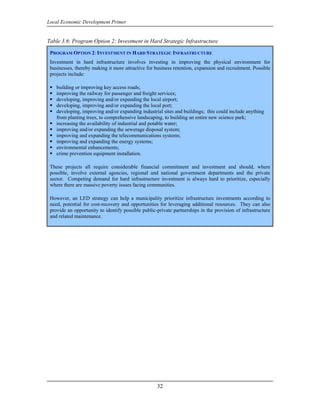
Table 3.6: Program Option 2: Investment in Hard Strategic Infrastructure .................................. 32
Table 3.7: Program Option 7: Promoting Inward Investment ....................................................... 37

Table 4.1: Key Issues in Implementing the LED Strategy ............................................................ 42
Table 4.2: Key Components of an Action Plan ............................................................................. 43

Table 5.1: Issues to Include in the Revision of the LED Strategy................................................. 47
Table 5.2: Process and Outcome Evaluation ................................................................................. 48
Table 5.3: Summary of Differences Between Monitoring and Evaluation ................................... 50
Table 5 4: Example of Events to Measure Project Progress.......................................................... 51
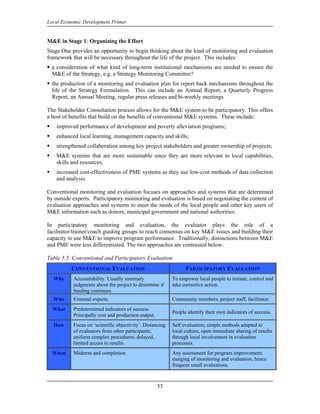
Table 5.5: Conventional and Participatory Evaluation.................................................................. 53


                                                                  v
Local Economic Development Primer


FOREWORD

The Urban Development Unit of the World Bank, in collaboration with partners including the
United Kingdom Department for International Development and the Bertelsmann Foundation and
the Soros Foundation, has developed a range of resources to enable communities to understand
and develop local economic development strategies. A key part of this effort was a pilot
program, called the Cities of Change program, an initiative that sought to foster policy and
administration reform in the areas of local economic development and environmental
management. Undertaken between 2000 and 2004 the program sought to promote democracy and
efficiency in municipalities in Central and Eastern Europe. The Cities of Change initiative was
designed to foster constructive, informal, cross-border dialogue on the role of local politicians,
the effectiveness of local administrations and the enhancement of public participation. The aim
of the Cities of Change network was to:
  Strengthen the capacity of municipalities to conduct strategic planning and develop action
  plans;
  Encourage the exchange of best practice among municipalities to provide access to
  international expertise and knowledge; and,
  Facilitate the dissemination of results.
The Local Economic Development (LED) component of the Cities of Change initiative sought to
build municipal capacity to improve local economies and generate an enabling environment for
employment generation. In doing so, the program developed and piloted the use of a five-stage
approach to the LED strategic planning process, as set out in this Primer.

The methodology and knowledge resources have since been used across the globe by World Bank
clients and others. The target communities have ranged from communities of less than 20,000
inhabitants to over 3,500,000.

Developed as a resource to assist communities to develop local economic development strategies,
the Primer has been prepared for towns, cities and communities that are new to LED and that
wish to help their local economies grow. The Primer seeks to provide municipalities,
practitioners, businesses and communities with an understanding of what local economic
development is, why and how it is practiced. It aims to identify the initial steps to starting the
local economic development planning process, and has been developed using good practice from
a number of transitioning and developing economies, as well as from North America and the
European Union. The Primer highlights examples of good practice in local economic
development strategic planning and implementation, and draws on the lessons and experiences
gained from the Cities of Change local economic development network as well as experiences
from other programs across the globe. It is hoped that the Primer will serve to explain some of
the complexities associated with local economic development strategic planning so that they are
more easily understood.

This Primer is one of a number of tools that have been developed by the World Bank to
understand better Local Economic Development. This work was done in conjunction with a
number of partners and specific thanks are due to the British Department of International
Development (DFID) that funded and supported a Capacity Building and Knowledge Sharing
Program in LED. There are many further resources, some translated that are constantly updated


                                                vi
Local Economic Development Primer


on the following web site: www.worldbank.org/urban/led. Of particular interest will be a trainers
manual and casebooks, all available for use and found on the home page.

Permission to use these materials is not required. However, should the guide be translated, the
World Bank and the Bertelsmann Foundation request that an electronic copy be forwarded to both
organizations for reference. This document is available on the World Bank, Bertelsmann
Foundation and Cities of Change Web sites. Should you wish to comment on the usefulness of
the Primer, or suggest additional information or case studies, please contact the World Bank at
urbanhelp@worldbank.org, gwen.swinburn@gmail.com and gswinburn@worldbank.org


                                               vii
Local Economic Development Primer


             INTRODUCTION TO LOCAL ECONOMIC
                     DEVELOPMENT

What is Local Economic Development?

 The purpose of local economic development (LED) is to build up the economic capacity of a
 local area to improve its economic future and the quality of life for all. It is a process by which
 public, business and non-governmental sector partners work collectively to create better
 conditions for economic growth and employment generation.

What Does Practicing Local Economic Development Mean?

The success of a community today depends upon its ability to adapt to the dynamic local, national
and international market economy. Strategically planned LED is increasingly used by
communities to strengthen the local economic capacity of an area, improve the investment
climate, and increase the productivity and competitiveness of local businesses, entrepreneurs and
workers. The ability of communities to improve the quality of life, create new economic
opportunities and fight poverty depends upon them being able to understand the processes of
LED, and act strategically in the changing and increasingly competitive market economy.

How Can a Strong Local Economy Be Built?

Each community has a unique set of local conditions that either enhance or reduce the potential
for local economic development, and it is these conditions that determine the relative advantage
of an area in its ability to attract, generate and retain investment. A community’s economic,
social and physical attributes will guide the design of, and approach to, the implementation of a
local economic development strategy. To build a strong local economy, good practice proves that
each community should undertake a collaborative process to understand the nature and structure
of the local economy, and conduct an analysis of the area’s strengths, weaknesses, opportunities
and threats. This will serve to highlight the key issues and opportunities facing the local
economy.

Who Does Local Economic Development?

Successful private enterprise and productive public-private partnerships create wealth in local
communities. Private enterprise however, requires a positive business enabling environment to
deliver prosperity. Municipal government has an essential role in creating a favorable
environment for business development and success. By its nature, local economic development is
a partnership between the business sector, community interests and municipal government.

LED is usually strategically planned by local government in conjunction with public and private
sector partners. Implementation is carried out by the public, private and non-governmental
sectors according to their abilities and strengths.

Why Do Local Economic Development?

LED evolved as a policy approach in the early 1970s in response to municipal governments
realizing that businesses and capital were moving between locations for competitive advantage.

                                                 1
Local Economic Development Primer


By actively reviewing their economic base, communities gained an understanding of the
opportunities for, and obstacles to, growth and investment. With this newfound understanding,
communities attempted to expand their economic and employment base by devising and
undertaking strategic programs and projects to remove obstacles and facilitate investment.
Today, local economies face an even greater set of challenges. These include:

International

Globalization increases both opportunities and competition for local investment. It offers
opportunities for local businesses to develop new markets but also presents challenges from
international competitors entering local markets. Multi-site, multi-national manufacturing,
banking and service corporations compete globally to find cost efficient sites in which to locate.
Technologically advanced growth industries require highly specialized skills and a supporting
technology infrastructure, but increasingly all industrial and service sectors needs highly
specialized and specific skills and business environments. Local conditions determine the
relative advantage of an area and its ability to attract and retain investment. Even small towns
and their surrounding rural regions can develop local economic opportunities at a national or
international level by building on their local economic strengths.

National

At the national level, macro-economic, fiscal and monetary reforms have directly impacted the
economy at the local level. National regulatory and legal frameworks such as tax reform,
telecommunications deregulation and environmental standards directly influence the local
business climate, either enhancing or reducing the potential for local economic development. In
many countries, national government functions continue to be decentralized thereby increasing
the responsibility of municipal governments to retain and attract private industry.

Regional

Communities within and between regions often compete to attract external and local investment.
Opportunities exist for communities across regions to collaborate with each other to help their
economies grow, for example, by supporting infrastructure or environmental improvements that
demonstrate a broad regional impact. An association of local municipalities or regional
governments can serve to facilitate these types of LED effort by acting as an intermediary
between national and municipal governments.

Metropolitan and Municipal

Businesses, both large and small, often choose to locate in urban areas because of agglomeration
economies (i.e., the benefits derived from sharing markets, infrastructure, labor pools and
information with other firms). The economic advantage of urban areas depends significantly on
the quality of urban governance and management, and on the policies affecting the availability, or
lack, of electricity, transport, telecommunications, sanitation and developable urban land. Factors
affecting labor productivity in the local economy include the availability and quality of housing,
health and1 education services, skills, security, training opportunities and public transport. These

1
  LED infrastructure comprises two main components, ‘hard’ physical infrastructure incorporating roads,
rail, water, sewerage and drainage systems, and energy and telecommunications networks; and ‘soft’
infrastructure of social, cultural and community facilities and capacity that enhance the quality of life and
encourage industry and business development.

                                                     2
Local Economic Development Primer


‘hard’ and ‘soft’ infrastructure factors are major determinants of a community’s relative
advantage. The quality and provision of ‘hard’ and ‘soft’ infrastructure forms the cornerstone of
a successful local economy.

Metropolitan areas can offer increasing opportunities through economies of scale and effort as a
result of the size of the physical and human capital available, as well as the size of its services and
internal market. Uncoordinated and disparate institutional frameworks and planning bodies in
metropolitan areas can serve to undermine area-wide economic growth. Metropolitan-wide LED
agencies, consortia and networks can be created to address these constraints. These innovative
institutional frameworks, which represent the interests of different municipalities and partner
agencies in the same metropolitan area, can bring benefits to the key actors of each municipality
(public departments, business and civil society organizations). These frameworks can serve to
unite the efforts of different localities and increase LED results, and can strengthen representation
in higher levels of decision-making. This type of cooperation has worked well for cities that
belong to common market agreements or that have common sector interests (i.e. Eurocities2,
Indonesian City Network3, South African Cities Network4).

The most important and effective local economic development activity that a municipality can
undertake is to improve the regulatory processes and procedures to which businesses are
subjected by the municipality itself. A survey of most municipalities would reveal a number of
complex, poorly managed, expensive and unnecessary business registration systems. By reducing
these, a municipality can quickly improve its local investment climate.

Disadvantaged Populations and Informal Economy
In many countries, economic growth is determined not only by the formal economy (the
economic sectors that are legally registered and pay taxes) but also by the informal economy
(those activities that are not legally registered). In some cases the size of the informal economy is
greater than the formal economy, and it interacts with the formal economy by supplying certain
goods and services. The linkages between the formal and informal sectors of the economy need
to be understood and considered in the devising of a local economic development strategy.

Communities and businesses increasingly recognize that a successful local economy requires
social, as well as economic, environmental and physical renewal. In many cities, large numbers
of low-income families work within the informal economy. However, these informal activities
are often low-growth activities as a result of a lack of access to proper infrastructure and services
(i.e., electricity, water, roads), regular means of financing, information and skills. The
development of an LED strategy should recognize and accommodate the constraints and
opportunities of the informal economy so as to broaden the appeal of a strategically planned LED
strategy. It should also encourage wider social benefits for all a community’s economic and
social sectors, both formal and informal, disadvantaged and excluded.


2
  http://www.eurocities.org/
3
  http://www.cdsindonesia.org/
4
  http://www.sacities.net/

                                                  3
Local Economic Development Primer


                                THE LED STRATEGIC PLANNING PROCESS
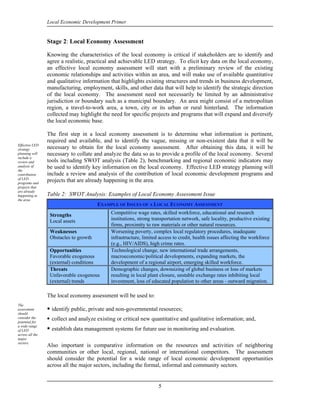
                     Good practice indicates that local economic development should always be guided by a strategy.
                     Ideally, an LED strategy will form a component of a broader strategic development plan that
                     includes social and environmental components. The LED strategy provides a focus on
                     strengthening the local economy and building local capacity. The timeframe for an LED strategy
                     is typically three to eight years and includes annual implementation plans. The logical sequence
                     of these stages is outlined in the table below.

                     THE FIVE STAGE STRATEGIC PLANNING PROCESS
                     A local economic development strategic planning process typically has five stages, and while
                                                                                                                           LED strategic
                     these are highlighted below as separate stages, in reality, LED strategic planning is a flexible      planning is a
                     process and one stage often continues in parallel with another according to local needs. If           flexible process
                                                                                                                           and one stage
                     problems are encountered during a particular stage, it may not be as a result of work in that stage   often continues
                     but the appropriateness of a previous stage. Previous and subsequent stages may need to be            in parallel with
                                                                                                                           another
                     refined or reworked to resolve problems. The strategy is a living document that should be             according to
                     changed as circumstances dictate.                                                                     local needs.


                     Table 1: The five stage sequence of the local economic development strategic planning process
                                                      LOCAL ECONOMIC DEVELOPMENT
                                                             THE FIVE STAGES
                         Stage 1: Organizing the Effort                    Stage 4: Strategy Implementation
                         Stage 2: Local Economy Assessment                 Stage 5: Strategy Review
                         Stage 3: Strategy Making

                     Stage 1: Organizing the Effort

                     To successfully organize a local economic development strategy, institutional arrangements and
                     stakeholder involvement should be agreed at an early stage of the planning process. An LED
                     team should be established in City Hall or within a partner organization and this team should
                     initially manage the strategic planning process.

                     Successful local economic development requires the collaborative effort of public
                     (governmental), private (business) and non-governmental (NGOs, trade unions, social, civic,
                     religious) sectors. The strategic planning process begins by identifying the people, public
                     institutions, businesses, industries, civic organizations, professional organizations, think-tanks,
                     training institutions and other groups that comprise and/or impact the local economy.

                     The skills, experiences and resources that stakeholder groups bring to the effort will each
Maintaining and
                     contribute to the overall strategic planning process. Establishing solid working relationships and
sustaining such      organizational structures to support the strategy planning process will lead to beneficial long-
partnerships is
often the critical   term, public, private and non-governmental partnerships. These working relationships can range
and challenging      from relatively informal working groups, to semi-formal, loosely aligned networks, to the
factor
determining the      establishment of a regional development agency or a constituted public-private partnership.
effectiveness of     Maintaining and sustaining such partnerships is often the critical and challenging factor
LED efforts.
                     determining the effectiveness of LED efforts.


                                                                     4
Local Economic Development Primer


                 Stage 2: Local Economy Assessment

                 Knowing the characteristics of the local economy is critical if stakeholders are to identify and
                 agree a realistic, practical and achievable LED strategy. To elicit key data on the local economy,
                 an effective local economy assessment will start with a preliminary review of the existing
                 economic relationships and activities within an area, and will make use of available quantitative
                 and qualitative information that highlights existing structures and trends in business development,
                 manufacturing, employment, skills, and other data that will help to identify the strategic direction
                 of the local economy. The assessment need not necessarily be limited by an administrative
                 jurisdiction or boundary such as a municipal boundary. An area might consist of a metropolitan
                 region, a travel-to-work area, a town, city or its urban or rural hinterland. The information
                 collected may highlight the need for specific projects and programs that will expand and diversify
                 the local economic base.

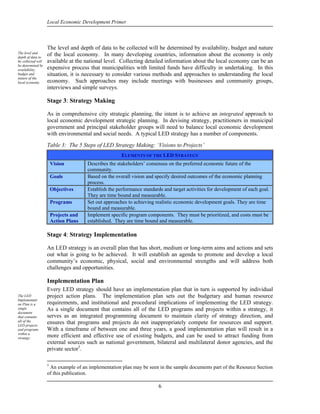
                 The first step in a local economy assessment is to determine what information is pertinent,
                 required and available, and to identify the vague, missing or non-existent data that it will be
Effective LED
strategy         necessary to obtain for the local economy assessment. After obtaining this data, it will be
planning will    necessary to collate and analyze the data so as to provide a profile of the local economy. Several
include a
review and       tools including SWOT analysis (Table 2), benchmarking and regional economic indicators may
analysis of      be used to identify key information on the local economy. Effective LED strategy planning will
the
contribution     include a review and analysis of the contribution of local economic development programs and
of LED
programs and
                 projects that are already happening in the area.
projects that
are already
happening in     Table 2: SWOT Analysis: Examples of Local Economy Assessment Issue
the area.
                                           EXAMPLE OF ISSUES OF A LOCAL ECONOMY ASSESSMENT

                     Strengths                  Competitive wage rates, skilled workforce, educational and research
                     Local assets               institutions, strong transportation network, safe locality, productive existing
                                                firms, proximity to raw materials or other natural resources.
                     Weaknesses                 Worsening poverty, complex local regulatory procedures, inadequate
                     Obstacles to growth        infrastructure, limited access to credit, health issues affecting the workforce
                                                (e.g., HIV/AIDS), high crime rates.
                     Opportunities              Technological change, new international trade arrangements,
                     Favorable exogenous        macroeconomic/political developments, expanding markets, the
                     (external) conditions      development of a regional airport, emerging skilled workforce.
                     Threats                    Demographic changes, downsizing of global business or loss of markets
                     Unfavorable exogenous      resulting in local plant closure, unstable exchange rates inhibiting local
                     (external) trends          investment, loss of educated population to other areas - outward migration.

                 The local economy assessment will be used to:
The
assessment           identify public, private and non-governmental resources; 
should
consider the         collect and analyze existing or critical new quantitative and qualitative information; and,
potential for
a wide range
of LED               establish data management systems for future use in monitoring and evaluation.
across all the
major             
sectors.
                 Also important is comparative information on the resources and activities of neighboring
                 communities or other local, regional, national or international competitors. The assessment
                 should consider the potential for a wide range of local economic development opportunities
                 across all the major sectors, including the formal, informal and community sectors.


                                                                       5
Local Economic Development Primer


                    The level and depth of data to be collected will be determined by availability, budget and nature
The level and
depth of data to
                    of the local economy. In many developing countries, information about the economy is only
be collected will   available at the national level. Collecting detailed information about the local economy can be an
be determined by
availability,       expensive process that municipalities with limited funds have difficulty in undertaking. In this
budget and          situation, it is necessary to consider various methods and approaches to understanding the local
nature of the
local economy.      economy. Such approaches may include meetings with businesses and community groups,
                    interviews and simple surveys.

                    Stage 3: Strategy Making

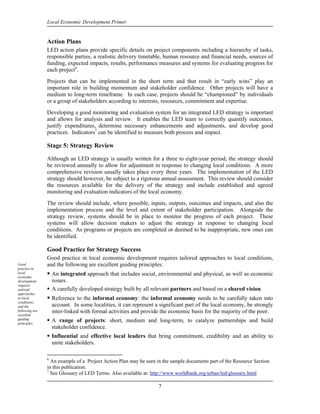
                    As in comprehensive city strategic planning, the intent is to achieve an integrated approach to
                    local economic development strategic planning. In devising strategy, practitioners in municipal
                    government and principal stakeholder groups will need to balance local economic development
                    with environmental and social needs. A typical LED strategy has a number of components.
                    Table 3: The 5 Steps of LED Strategy Making: ‘Visions to Projects’
                                                       ELEMENTS OF THE LED STRATEGY
                        Vision         Describes the stakeholders’ consensus on the preferred economic future of the
                                       community.
                        Goals          Based on the overall vision and specify desired outcomes of the economic planning
                                       process.
                        Objectives     Establish the performance standards and target activities for development of each goal.
                                       They are time bound and measurable.
                        Programs       Set out approaches to achieving realistic economic development goals. They are time
                                       bound and measurable.
                        Projects and   Implement specific program components. They must be prioritized, and costs must be
                        Action Plans   established. They are time bound and measurable.

                    Stage 4: Strategy Implementation

                    An LED strategy is an overall plan that has short, medium or long-term aims and actions and sets
                    out what is going to be achieved. It will establish an agenda to promote and develop a local
                    community’s economic, physical, social and environmental strengths and will address both
                    challenges and opportunities.

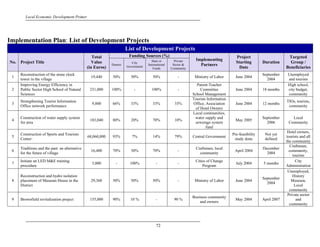
                    Implementation Plan
                    Every LED strategy should have an implementation plan that in turn is supported by individual
The LED             project action plans. The implementation plan sets out the budgetary and human resource
Implementati
on Plan is a        requirements, and institutional and procedural implications of implementing the LED strategy.
single              As a single document that contains all of the LED programs and projects within a strategy, it
document
that contains       serves as an integrated programming document to maintain clarity of strategy direction, and
all of the
LED projects
                    ensures that programs and projects do not inappropriately compete for resources and support.
and programs        With a timeframe of between one and three years, a good implementation plan will result in a
within a
strategy.           more efficient and effective use of existing budgets, and can be used to attract funding from
                    external sources such as national government, bilateral and multilateral donor agencies, and the
                    private sector5.

                    5
                     An example of an implementation plan may be seen in the sample documents part of the Resource Section
                    of this publication.

                                                                        6
Local Economic Development Primer


                Action Plans
                LED action plans provide specific details on project components including a hierarchy of tasks,
                responsible parties, a realistic delivery timetable, human resource and financial needs, sources of
                funding, expected impacts, results, performance measures and systems for evaluating progress for
                each project6.
                Projects that can be implemented in the short term and that result in “early wins” play an
                important role in building momentum and stakeholder confidence. Other projects will have a
                medium to long-term timeframe. In each case, projects should be “championed” by individuals
                or a group of stakeholders according to interests, resources, commitment and expertise.
                Developing a good monitoring and evaluation system for an integrated LED strategy is important
                and allows for analysis and review. It enables the LED team to correctly quantify outcomes,
                justify expenditures, determine necessary enhancements and adjustments, and develop good
                practices. Indicators7 can be identified to measure both process and impact.

                Stage 5: Strategy Review

                Although an LED strategy is usually written for a three to eight-year period, the strategy should
                be reviewed annually to allow for adjustment in response to changing local conditions. A more
                comprehensive revision usually takes place every three years. The implementation of the LED
                strategy should however, be subject to a rigorous annual assessment. This review should consider
                the resources available for the delivery of the strategy and include established and agreed
                monitoring and evaluation indicators of the local economy.
                The review should include, where possible, inputs, outputs, outcomes and impacts, and also the
                implementation process and the level and extent of stakeholder participation. Alongside the
                strategy review, systems should be in place to monitor the progress of each project. These
                systems will allow decision makers to adjust the strategy in response to changing local
                conditions. As programs or projects are completed or deemed to be inappropriate, new ones can
                be identified.

                Good Practice for Strategy Success
                Good practice in local economic development requires tailored approaches to local conditions,
Good            and the following are excellent guiding principles:
practice in
local               An integrated approach that includes social, environmental and physical, as well as economic
economic
development         issues.
requires
tailored            A carefully developed strategy built by all relevant partners and based on a shared vision.
approaches
to local            Reference to the informal economy: the informal economy needs to be carefully taken into
conditions,
and the             account. In some localities, it can represent a significant part of the local economy, be strongly
following are       inter-linked with formal activities and provide the economic basis for the majority of the poor.
excellent
guiding
principles.
                    A range of projects: short, medium and long-term, to catalyze partnerships and build
                    stakeholder confidence.
                    Influential and effective local leaders that bring commitment, credibility and an ability to
                    unite stakeholders.

                6
                  An example of a Project Action Plan may be seen in the sample documents part of the Resource Section
                in this publication.
                7
                  See Glossary of LED Terms. Also available at: http://www.worldbank.org/urban/led/glossary.html

                                                                   7
Local Economic Development Primer


 Capacity building of management and ‘on the ground’ teams are essential to project
 implementation.
 The LED strategy should be owned by the municipal government with a demonstrated strong
 political will to implement it.
 Political, financial and technical support from other levels of government that adds value.
 Projects and action plans should be undertaken only where a responsible manager or champion
 has been identified who is committed to successful implementation.


                                               8
Local Economic Development Primer


An Example to Show the Different Elements of a LED Strategic Plan
Table 4: ‘Visions to Projects’: The Strategic Elements8

                   VISION: THIS MUNICIPALITY WILL BECOME GLOBALLY COMPETITIVE BY 2020

     GOALS:

1.    To diversify the economic base of the municipality.
2.    To become a tourism center.
3.    To improve the built environment of the municipality.
4.    To become the most attractive municipality in the region for foreign direct investment.
5.    To become a more equal society through improved access to work for all the community.

(For each goal a series of objectives is formulated. Consider Goal 3 as an example)

     GOAL 3: To improve the built environment of the municipality.

Objective 1: To utilize and develop all brownfield sites over one quarter of an acre by 2010.
Objective 2: To adopt, within the next six months, planning policy guidelines to ensure that historic buildings
more than 100 years old may not be altered or demolished without prior local authority consent.
Objective 3: To ensure that all new applications to build industrial and commercial office space meet local,
national and international standards for safety, environment and so on.

These objectives should be time bound and quantifiable. Some should be short term (for early wins), some
longer term. Then, for each objective, there should be a program of projects and activities. These need to be
selected carefully using selection criteria.

The result could look like this, for example:

     OBJECTIVE 1: To eliminate all Brownfield sites over one quarter of an acre in size by 2010.

Program: brownfield Remediation Program
Project 1.1: To develop a register of derelict Brownfield sites in the municipality and establish ownership.
Project 1.2: To initiate a lobbying effort for national government and other funding to remediate the sites.
Project 1.3: To prioritize sites according to the severity of their pollution/prominence in the municipality.
Project 1.4: To review local and national legislation to ensure ‘polluter pays’ legislation is in place.
Project 1.5: To develop and implement a strategy to ensure landowners remediate their sites, and that they be
             encouraged to bring them into beneficial use.

Once the projects have been identified, prioritized, financed and a responsible person/group identified,
detailed action planning and implementation can take place.

     PROJECT 1.1: To develop a register of Brownfield sites in the municipality and determine ownership.

Action Plan: Ideally, these will be produced on a standard pro-forma including the following information:

1.    Name of project
2.    Short description of project
3.    Itemized actions by date
4.    Cost and budget profile
5.    Responsible project manager, and responsible person for the whole objective/program
6.    Expected outcomes
7.    Monitoring process


8
 An example of a “Vision to Projects matrix” may be seen in the sample documents part of the Resource
Section of this publication.

                                                       9
Local Economic Development Primer


                               STAGE ONE: ORGANIZING THE EFFORT

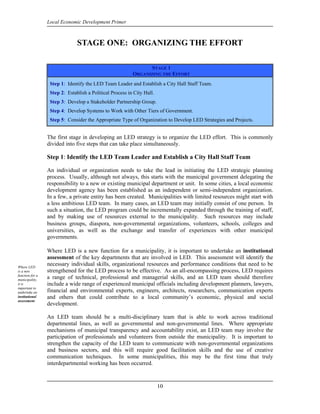
                                                                 STAGE 1
                                                          ORGANIZING THE EFFORT
                  Step 1: Identify the LED Team Leader and Establish a City Hall Staff Team.
                  Step 2: Establish a Political Process in City Hall.
                  Step 3: Develop a Stakeholder Partnership Group.
                  Step 4: Develop Systems to Work with Other Tiers of Government.
                  Step 5: Consider the Appropriate Type of Organization to Develop LED Strategies and Projects.


                 The first stage in developing an LED strategy is to organize the LED effort. This is commonly
                 divided into five steps that can take place simultaneously.

                 Step 1: Identify the LED Team Leader and Establish a City Hall Staff Team

                 An individual or organization needs to take the lead in initiating the LED strategic planning
                 process. Usually, although not always, this starts with the municipal government delegating the
                 responsibility to a new or existing municipal department or unit. In some cities, a local economic
                 development agency has been established as an independent or semi-independent organization.
                 In a few, a private entity has been created. Municipalities with limited resources might start with
                 a less ambitious LED team. In many cases, an LED team may initially consist of one person. In
                 such a situation, the LED program could be incrementally expanded through the training of staff,
                 and by making use of resources external to the municipality. Such resources may include
                 business groups, diaspora, non-governmental organizations, volunteers, schools, colleges and
                 universities, as well as the exchange and transfer of experiences with other municipal
                 governments.

                 Where LED is a new function for a municipality, it is important to undertake an institutional
                 assessment of the key departments that are involved in LED. This assessment will identify the
Where LED
                 necessary individual skills, organizational resources and performance conditions that need to be
is a new         strengthened for the LED process to be effective. As an all-encompassing process, LED requires
function for a
municipality,
                 a range of technical, professional and managerial skills, and an LED team should therefore
it is            include a wide range of experienced municipal officials including development planners, lawyers,
important to
undertake an     financial and environmental experts, engineers, architects, researchers, communication experts
institutional    and others that could contribute to a local community’s economic, physical and social
assessment.
                 development.

                 An LED team should be a multi-disciplinary team that is able to work across traditional
                 departmental lines, as well as governmental and non-governmental lines. Where appropriate
                 mechanisms of municipal transparency and accountability exist, an LED team may involve the
                 participation of professionals and volunteers from outside the municipality. It is important to
                 strengthen the capacity of the LED team to communicate with non-governmental organizations
                 and business sectors, and this will require good facilitation skills and the use of creative
                 communication techniques. In some municipalities, this may be the first time that truly
                 interdepartmental working has been occurred.


                                                                        10
Local Economic Development Primer


                    Given LED’s broad scope and the necessity to develop relationships with the private, public and
                    non-governmental sectors, true and genuine leadership of the team is necessary. Such leadership
                    will provide the team with better conditions for devizing and delivering an LED strategy. There
                    are a number of ways that LED can be managed and developed by a municipality.

                    Establishing a ‘Home’ for LED within a Municipality
                    In almost all successful local economic development case studies, a responsible person, often in
                    the Mayor’s Office or in the office of the Chief Executive Officer, is initially appointed to take
                    responsibility for LED (this may expand into a specific unit or department at a later point). This
                    initiator may spend much of his/her time initially gathering information on the local economy and
                    identifying important stakeholders. This person will ideally have LED experience and be able to
                    demonstrate a sound understanding of the needs of businesses. This is not essential however, as
                    these skills can be learned.

                    A commitment by the Mayor to appointing this person to a full-time position with responsibility
                    and necessary initial resources is important. Though available resources may initially be small,
                    they should be sufficient to begin an LED program and provide basic office equipment, training
                    in LED if necessary, and an operational budget to facilitate stakeholder meetings and gather data
                    for a preliminary SWOT analysis.

                    Municipal Task Groups to Oversee the LED Process
                    Given the cross-cutting nature of LED, cross-disciplinary, interdepartmental teams make for
Given the cross-    successful strategy making. Such task groups should include people from across the various
cutting nature of   municipal departments that have professional, technical, political or financial responsibility for
LED, cross-
disciplinary,       matters affected by the LED strategy. There should be terms of reference and a formal reporting
interdepartment
al teams make
                    system for these groups. Transparency and public access to information used or generated by the
for successful      groups is important to their overall credibility.
strategy making.

                    Links to Other Municipal Planning Processes
                    LED, as an integrated discipline, will usually have many linkages with almost all other local
                    development strategies. The coordination of the different strategies and their constituent
                    programs is therefore important as it can make better use of scarce resources, avoid duplication of
                    efforts and increase overall impact. Systems and procedures should be developed to ensure that
                    LED is integrated into all of these plans and vice versa. Importantly, businesses should not have
                    to deal with conflicting information and policies from various municipal strategies.

                    As municipalities often do not have the necessary resources to implement all LED strategies
                    simultaneously, it is important to develop technical and decision-making mechanisms to prioritize
                    and balance different local needs. Municipal decision-makers and practitioners should seek to
                    balance the local economic development, environmental and social needs of an area, and many
                    municipalities have developed different technical criteria for prioritizing and coordinating
                    investments. Others have established participatory planning mechanisms that range from
                    consultative processes to direct involvement in decision making.


                                                                    11
Local Economic Development Primer


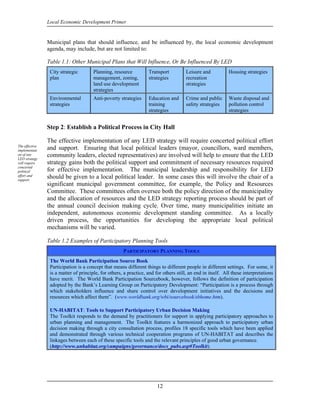
                Municipal plans that should influence, and be influenced by, the local economic development
                agenda, may include, but are not limited to:

                Table 1.1: Other Municipal Plans that Will Influence, Or Be Influenced By LED
                 City strategic        Planning, resource          Transport           Leisure and           Housing strategies
                 plan                  management, zoning,         strategies          recreation
                                       land use development                            strategies
                                       strategies
                 Environmental         Anti-poverty strategies     Education and       Crime and public      Waste disposal and
                 strategies                                        training            safety strategies     pollution control
                                                                   strategies                                strategies


                Step 2: Establish a Political Process in City Hall

                The effective implementation of any LED strategy will require concerted political effort
The effective
implementati    and support. Ensuring that local political leaders (mayor, councillors, ward members,
on of any
LED strategy
                community leaders, elected representatives) are involved will help to ensure that the LED
will require    strategy gains both the political support and commitment of necessary resources required
concerted
political       for effective implementation. The municipal leadership and responsibility for LED
effort and      should be given to a local political leader. In some cases this will involve the chair of a
support.
                significant municipal government committee, for example, the Policy and Resources
                Committee. These committees often oversee both the policy direction of the municipality
                and the allocation of resources and the LED strategy reporting process should be part of
                the annual council decision making cycle. Over time, many municipalities initiate an
                independent, autonomous economic development standing committee. As a locally
                driven process, the opportunities for developing the appropriate local political
                mechanisms will be varied.

                Table 1.2 Examples of Participatory Planning Tools
                                                      PARTICIPATORY PLANNING TOOLS
                 The World Bank Participation Source Book
                 Participation is a concept that means different things to different people in different settings. For some, it
                 is a matter of principle, for others, a practice, and for others still, an end in itself. All these interpretations
                 have merit. The World Bank Participation Sourcebook, however, follows the definition of participation
                 adopted by the Bank’s Learning Group on Participatory Development: “Participation is a process through
                 which stakeholders influence and share control over development initiatives and the decisions and
                 resources which affect them”. (www.worldbank.org/wbi/sourcebook/sbhome.htm).

                 UN-HABITAT: Tools to Support Participatory Urban Decision Making
                 The Toolkit responds to the demand by practitioners for support in applying participatory approaches to
                 urban planning and management. The Toolkit features a harmonized approach to participatory urban
                 decision making through a city consultation process, profiles 18 specific tools which have been applied
                 and demonstrated through various technical cooperation programs of UN-HABITAT and describes the
                 linkages between each of these specific tools and the relevant principles of good urban governance.
                 (http://www.unhabitat.org/campaigns/governance/docs_pubs.asp#Toolkit).


                                                                        12
Local Economic Development Primer


Step 3: Develop A Stakeholder Partnership Group

Stakeholders are individuals, businesses, organizations or groups in the public, private and not-
for-profit sectors that have an interest in strategizing and implementing LED programs and
projects. Many municipalities involve stakeholders in LED processes, from strategy formulation,
to program and project implementation, to monitoring and evaluation, as doing so can increase:

    credibility, equity and transparency, by opening the planning process to the public;
    effectiveness, as it is easier to understand the real (economic) needs when the beneficiaries
    are involved. It also contributes to building support, and overcoming resistance and mistrust;
    efficiency, as stakeholders can mobilize their own resources to support and promote local
    economic development.

For many municipalities, involving external stakeholders in the municipal decision-making
process is a new and daunting prospect. As a first step stakeholders may be invited to contribute
data, participate in surveys and focus groups and contribute ideas.

Try to find key stakeholders and understand their motivations for participating in the LED
strategic planning process, how they can participate, and how they can add value (i.e., skills,
knowledge, volunteer work, material and financial resources) to the LED effort. Engaging non-
governmental actors such as the business community, organized civil society groups and citizens
as a whole in local development planning is becoming increasingly common.

Building Stakeholder Partnerships
Building such partnerships for local economic development will enable municipalities to achieve
more, with the same Local Government inputs, to be more cost effective while potentially
identifying new ways of gaining access to additional resources. Partnerships aim to link the
various local partners that have an impact on local economic development into an agenda that can
support and sustain successful and sustainable local economic development. Partnerships should
be established to address a jointly recognised opportunity. If stakeholder partnerships are to
work, openness and the ability to work in an innovative way is important.

The Key Stakeholders and their Potential Contributions

Municipal Government

Municipalities are key agents for local economic development. Municipalities, in many places,
are responsible for providing different services and implementing regulations (e.g., zoning
regulations) that address a wide range of local economic development needs. In addition to
providing physical and other infrastructure, they may facilitate business development, retention
and attraction by marketing local products, may offer incentives to support business expansion9,
providing education and training, supporting small business development, and improving
infrastructure maintenance.

Municipalities manage a wide variety of regulatory procedures for businesses such as registration,
licensing and permitting. They may include, but are not limited to:

9
  This is a complex issue and should be very carefully considered. Good practice dictates that public
money is normally better spent upon improving the local business enabling environment for all businesses
rather than supporting specific businesses.

                                                  13
Local Economic Development Primer


     analyzing the local economy;
     providing leadership to local economic development;
     coordinating and funding the implementation of local economic development projects;
     ensuring a high standard of service delivery;
     providing incentives (fiscal, land development, marketing) to attract private investment;
     promoting local business development through procurement policies; and,
     promoting an enabling environment that stimulates business growth.

Moreover, municipalities can identify and provide the leadership necessary to organize and build
coalitions and partnerships to exchange information among local and regional actors interested in
LED. Promoting meetings and seminars, and networking with interested individuals, groups and
organizations, are important for knowledge creation and dissemination, and can serve to identify
new opportunities for economic growth.

LED strategies at the municipal level are likely to benefit from increased support (financial and
political) by working with higher tiers of government as well as across horizontal tiers of
government. As regional development is becoming increasingly important, there need to be clear
and positive synergies between local and regional strategies to maximize LED outcomes.

Private Sector and Community

As the private sector and local community are significant beneficiaries of an LED program, it is
essential to involve them in the LED strategic planning process10. Doing so can:
     Increase the effectiveness and efficiency of the strategic planning process by securing a range
     of external resources (material, financial), knowledge and experience that is often not
     available from within the municipality.
     Legitimize the process and help de-politicize LED projects. This can help to ensure long-
     term sustainability.
     Widen consensus and support for the LED strategy, thereby helping to strengthen the
     confidence of potential investors and businesses.
     Forestall problems by engaging partners and stakeholders in the process.
     Increase the understanding of the local economy, as business partners are likely to know
     much more than municipal representatives about the true state of the local economy. Local
     business leaders are likely to be informed about local problems and opportunities that could
     be addressed by the LED strategy.
     Encourage community volunteer efforts to support LED implementation programs.
     Incorporate low-income and informal economy groups and associations (i.e. slum dwellers
     and street vendors associations) into the process as they have a better understanding of the
     issues affecting their economic activities.


10
  See for example, ‘Working with Business in Local Strategic Partnerships’, a guidance note produced for
Business in the Community, British Chambers of Commerce, Local Government Association and the
Neighbourhood Renewal Unit (http://www.bitc.org.uk/docs/Guidance_note.pdf ).

                                                  14
Local Economic Development Primer


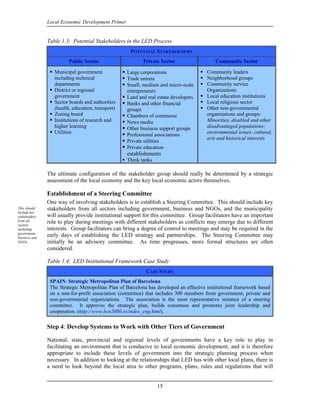
               Table 1.3: Potential Stakeholders in the LED Process
                                                     POTENTIAL STAKEHOLDERS
                         Public Sector                    Private Sector                    Community Sector

                  Municipal government             Large corporations                   Community leaders
                  including technical              Trade unions                         Neighborhood groups
                  departments                      Small, medium and micro-scale        Community service
                  District or regional             entrepreneurs                        Organizations
                  government                       Land and real estate developers      Local education institutions
                  Sector boards and authorities    Banks and other financial            Local religious sector
                  (health, education, transport)   groups                               Other non-governmental
                  Zoning board                     Chambers of commerce                 organizations and groups:
                  Institutions of research and     News media                           Minorities, disabled and other
                  higher learning                  Other business support groups        disadvantaged populations;
                  Utilities                        Professional associations            environmental issues; cultural,
                                                                                        arts and historical interests
                                                   Private utilities
                                                   Private education
                                                   establishments
                                                   Think tanks

               The ultimate configuration of the stakeholder group should really be determined by a strategic
               assessment of the local economy and the key local economic actors themselves.

               Establishment of a Steering Committee
               One way of involving stakeholders is to establish a Steering Committee. This should include key
This should    stakeholders from all sectors including government, business and NGOs, and the municipality
include key
stakeholders   will usually provide institutional support for this committee. Group facilitators have an important
from all       role to play during meetings with different stakeholders as conflicts may emerge due to different
sectors
including      interests. Group facilitators can bring a degree of control to meetings and may be required in the
government,
business and
               early days of establishing the LED strategy and partnerships. The Steering Committee may
NGOs.          initially be an advisory committee. As time progresses, more formal structures are often
               considered.

               Table 1.4: LED Institutional Framework Case Study
                                                            CASE STUDY
                SPAIN: Strategic Metropolitan Plan of Barcelona
                The Strategic Metropolitan Plan of Barcelona has developed an effective institutional framework based
                on a non-for-profit association (committee) that includes 300 members from government, private and
                non-governmental organizations. The association is the most representative instance of a steering
                committee. It approves the strategic plan, builds consensus and promotes joint leadership and
                cooperation. (http://www.bcn2000.es/index_eng.html).

               Step 4: Develop Systems to Work with Other Tiers of Government

               National, state, provincial and regional levels of governments have a key role to play in
               facilitating an environment that is conducive to local economic development, and it is therefore
               appropriate to include these levels of government into the strategic planning process when
               necessary. In addition to looking at the relationships that LED has with other local plans, there is
               a need to look beyond the local area to other programs, plans, rules and regulations that will


                                                                 15
Local Economic Development Primer


impact upon the local economic agenda. These may include national, state, provincial or regional
laws and policies, for example:

    telecommunications deregulation;
    financial regulations;
    environmental standards;
    taxation;
    land and property laws;
    national infrastructure investment plans; and,
    budget transfers (often conditional grants).

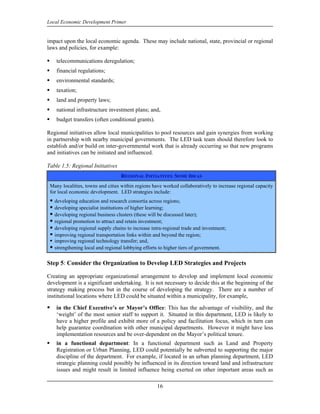
Regional initiatives allow local municipalities to pool resources and gain synergies from working
in partnership with nearby municipal governments. The LED task team should therefore look to
establish and/or build on inter-governmental work that is already occurring so that new programs
and initiatives can be initiated and influenced.

Table 1.5: Regional Initiatives
                                  REGIONAL INITIATIVES: SOME IDEAS
 Many localities, towns and cities within regions have worked collaboratively to increase regional capacity
 for local economic development. LED strategies include:
   developing education and research consortia across regions;
   developing specialist institutions of higher learning;
   developing regional business clusters (these will be discussed later);
   regional promotion to attract and retain investment;
   developing regional supply chains to increase intra-regional trade and investment;
   improving regional transportation links within and beyond the region;
   improving regional technology transfer; and,
   strengthening local and regional lobbying efforts to higher tiers of government.

Step 5: Consider the Organization to Develop LED Strategies and Projects

Creating an appropriate organizational arrangement to develop and implement local economic
development is a significant undertaking. It is not necessary to decide this at the beginning of the
strategy making process but in the course of developing the strategy. There are a number of
institutional locations where LED could be situated within a municipality, for example,

    in the Chief Executive’s or Mayor’s Office: This has the advantage of visibility, and the
    ‘weight’ of the most senior staff to support it. Situated in this department, LED is likely to
    have a higher profile and exhibit more of a policy and facilitation focus, which in turn can
    help guarantee coordination with other municipal departments. However it might have less
    implementation resources and be over-dependent on the Mayor’s political tenure.
    in a functional department: In a functional department such as Land and Property
    Registration or Urban Planning, LED could potentially be subverted to supporting the major
    discipline of the department. For example, if located in an urban planning department, LED
    strategic planning could possibly be influenced in its direction toward land and infrastructure
    issues and might result in limited influence being exerted on other important areas such as

                                                    16
Local Economic Development Primer


     improving the business enabling environment (i.e. facilitating registration and operation) and
     related aspects (i.e. promotion of cooperatives and SME development). Good management
     practice and developing multi-disciplinary approaches will help ensure both sound policy
     formulation and successful implementation of the LED strategy.

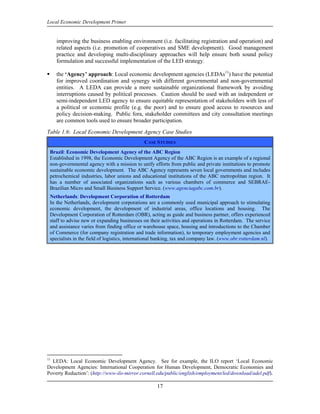
     the ‘Agency’ approach: Local economic development agencies (LEDAs11) have the potential
     for improved coordination and synergy with different governmental and non-governmental
     entities. A LEDA can provide a more sustainable organizational framework by avoiding
     interruptions caused by political processes. Caution should be used with an independent or
     semi-independent LED agency to ensure equitable representation of stakeholders with less of
     a political or economic profile (e.g. the poor) and to ensure good access to resources and
     policy decision-making. Public fora, stakeholder committees and city consultation meetings
     are common tools used to ensure broader participation.
Table 1.6: Local Economic Development Agency Case Studies
                                              CASE STUDIES
 Brazil: Economic Development Agency of the ABC Region
 Established in 1998, the Economic Development Agency of the ABC Region is an example of a regional
 non-governmental agency with a mission to unify efforts from public and private institutions to promote
 sustainable economic development. The ABC Agency represents seven local governments and includes
 petrochemical industries, labor unions and educational institutions of the ABC metropolitan region. It
 has a number of associated organizations such as various chambers of commerce and SEBRAE-
 Brazilian Micro and Small Business Support Service. (www.agenciagabc.com.br).
 Netherlands: Development Corporation of Rotterdam
 In the Netherlands, development corporations are a commonly used municipal approach to stimulating
 economic development, the development of industrial areas, office locations and housing. The
 Development Corporation of Rotterdam (OBR), acting as guide and business partner, offers experienced
 staff to advise new or expanding businesses on their activities and operations in Rotterdam. The service
 and assistance varies from finding office or warehouse space, housing and introductions to the Chamber
 of Commerce (for company registration and trade information), to temporary employment agencies and
 specialists in the field of logistics, international banking, tax and company law. (www.obr.rotterdam.nl).


11
  LEDA: Local Economic Development Agency. See for example, the ILO report ‘Local Economic
Development Agencies: International Cooperation for Human Development, Democratic Economies and
Poverty Reduction’: (http://www-ilo-mirror.cornell.edu/public/english/employment/led/download/adel.pdf).

                                                    17
Local Economic Development Primer


                               STAGE TWO: LOCAL ECONOMY ASSESSMENT

                                                                   STAGE 2
                                                          LOCAL ECONOMY ASSESSMENT
                         Step 1: Undertake Review of Regulations and Procedures that Affect Businesses in City Hall.
                         Step 2: Identify the Types of Data to be Collected.
                         Step 3: Undertake an Audit of Available Data and Gap Analysis, and Gather Data.
                         Step 4: Develop a Plan to Fill Information Gaps.
                         Step 5: Analyze Data and Produce an Assessment of the Local Economy From Available Data.


                    Knowing and understanding the characteristics of the local economy is crucial to help the
                    stakeholders strategize for the future, and make the best possible program and project choices.
                    The community should therefore be as informed as possible about its own town, city or region,
                    and its role in the regional, national and international economy. The analytical boundaries of the
                    local economy assessment should not be limited by an administrative jurisdiction such as a
                    municipal boundary, but rather by the economic relationships in a geographic area such as a
                    metropolitan region, travel-to-work area, or a city and its rural hinterland.

                    Step 1: Undertake Review of City Hall Procedures that affect Businesses

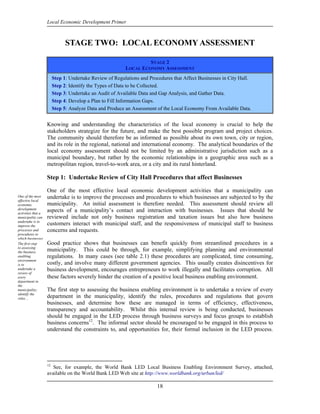
                    One of the most effective local economic development activities that a municipality can
One of the most     undertake is to improve the processes and procedures to which businesses are subjected to by the
effective local
economic            municipality. An initial assessment is therefore needed. This assessment should review all
development
activities that a
                    aspects of a municipality’s contact and interaction with businesses. Issues that should be
municipality can    reviewed include not only business registration and taxation issues but also how business
undertake is to
improve the         customers interact with municipal staff, and the responsiveness of municipal staff to business
processes and       concerns and requests.
procedures to
which businesses
are subjected to
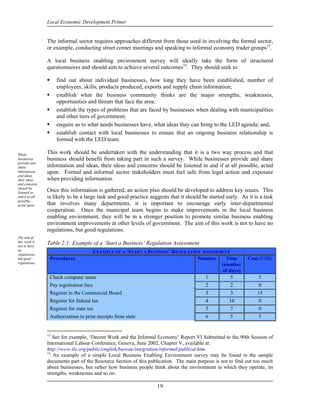
The first step      Good practice shows that businesses can benefit quickly from streamlined procedures in a
by assessing
to the
municipality.
the business        municipality. This could be through, for example, simplifying planning and environmental
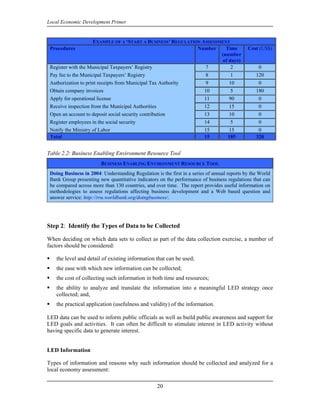
enabling            regulations. In many cases (see table 2.1) these procedures are complicated, time consuming,
environment
is to               costly, and involve many different government agencies. This usually creates disincentives for
undertake a         business development, encourages entrepreneurs to work illegally and facilitates corruption. All
review of
every               these factors severely hinder the creation of a positive local business enabling environment.
department in
the
municipality;       The first step to assessing the business enabling environment is to undertake a review of every
identify the
rules…              department in the municipality, identify the rules, procedures and regulations that govern
                    businesses, and determine how these are managed in terms of efficiency, effectiveness,
                    transparency and accountability. Whilst this internal review is being conducted, businesses
                    should be engaged in the LED process through business surveys and focus groups to establish
                    business concerns12. The informal sector should be encouraged to be engaged in this process to
                    understand the constraints to, and opportunities for, their formal inclusion in the LED process.


                    12
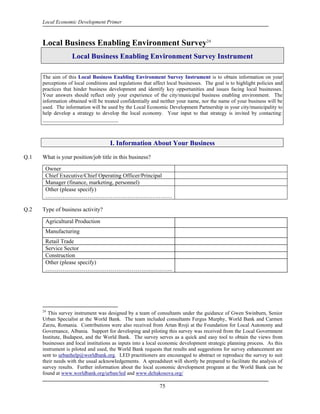
                       See, for example, the World Bank LED Local Business Enabling Environment Survey, attached,
                    available on the World Bank LED Web site at http://www.worldbank.org/urban/led/

                                                                         18
Local Economic Development Primer


                The informal sector requires approaches different from those used in involving the formal sector,
                or example, conducting street corner meetings and speaking to informal economy trader groups13.

                A local business enabling environment survey will ideally take the form of structured
                questionnaires and should aim to achieve several outcomes14. They should seek to:

                     find out about individual businesses, how long they have been established, number of
                     employees, skills, products produced, exports and supply chain information;
                     establish what the business community thinks are the major strengths, weaknesses,
                     opportunities and threats that face the area;
                     establish the types of problems that are faced by businesses when dealing with municipalities
                     and other tiers of government;
                     enquire as to what needs businesses have, what ideas they can bring to the LED agenda; and,
                     establish contact with local businesses to ensure that an ongoing business relationship is
                     formed with the LED team.

While
                This work should be undertaken with the understanding that it is a two way process and that
businesses      business should benefit from taking part in such a survey. While businesses provide and share
provide and
share           information and ideas, their ideas and concerns should be listened to and if at all possible, acted
information     upon. Formal and informal sector stakeholders must feel safe from legal action and exposure
and ideas,
their ideas     when providing information.
and concerns
should be
listened to
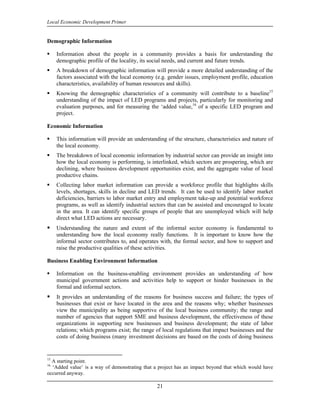
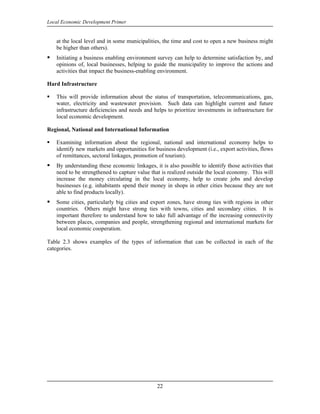
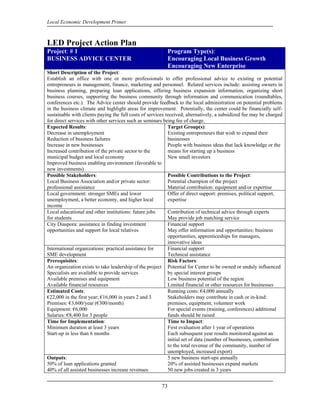
                Once this information is gathered, an action plan should be developed to address key issues. This
and if at all   is likely to be a large task and good practice suggests that it should be started early. As it is a task
possible,
acted upon.     that involves many departments, it is important to encourage early inter-departmental
                cooperation. Once the municipal team begins to make improvements in the local business
                enabling environment, they will be in a stronger position to promote similar business enabling
                environment improvements at other levels of government. The aim of this work is not to have no
                regulations, but good regulations.
The aim of
this work is    Table 2.1: Example of a ‘Start a Business’ Regulation Assessment
not to have
no                                     EXAMPLE OF A ‘START A BUSINESS’ REGULATION ASSESSMENT
regulations,
but good         Procedures                                                     Number     Time             Cost (US$)
regulations.
                                                                                         (number
                                                                                          of days)
                 Check company name                                                1          5                  5
                 Pay registration fees                                             2          2                  0
                 Register in the Commercial Board                                  3          3                 15
                 Register for federal tax                                          4         10                  0
                 Register for state tax                                            5          7                  0
                 Authorization to print receipts from state                        6          5                  5


                13
                   See for example, ‘Decent Work and the Informal Economy’ Report VI Submitted to the 90th Session of
                International Labour Conference, Geneva, June 2002, Chapter V, available at:
                http://www.ilo.org/public/english/bureau/integration/informal/publicat.htm.
                14
                   An example of a simple Local Business Enabling Environment survey may be found in the sample
                documents part of the Resource Section of this publication. The main purpose is not to find out too much
                about businesses, but rather how business people think about the environment in which they operate, its
                strengths, weaknesses and so on.

                                                                  19
Local Economic Development Primer


                     EXAMPLE OF A ‘START A BUSINESS’ REGULATION ASSESSMENT
 Procedures                                                   Number     Time                 Cost (US$)
                                                                       (number
                                                                        of days)
 Register with the Municipal Taxpayers’ Registry                 7          2                      0
 Pay fee to the Municipal Taxpayers’ Registry                    8          1                     120
 Authorization to print receipts from Municipal Tax Authority    9         10                      0
 Obtain company invoices                                         10         5                     180
 Apply for operational license                                   11        90                      0
 Receive inspection from the Municipal Authorities               12        15                      0
 Open an account to deposit social security contribution         13        10                      0
 Register employees in the social security                       14         5                      0
 Notify the Ministry of Labor                                    15        15                      0
 Total                                                           15       185                     320


Table 2.2: Business Enabling Environment Resource Tool
                         BUSINESS ENABLING ENVIRONMENT RESOURCE TOOL
 Doing Business in 2004: Understanding Regulation is the first in a series of annual reports by the World
 Bank Group presenting new quantitative indicators on the performance of business regulations that can
 be compared across more than 130 countries, and over time. The report provides useful information on
 methodologies to assess regulations affecting business development and a Web based question and
 answer service: http://rru.worldbank.org/doingbusiness/.


Step 2: Identify the Types of Data to be Collected

When deciding on which data sets to collect as part of the data collection exercise, a number of
factors should be considered:

    the level and detail of existing information that can be used;
    the ease with which new information can be collected;
    the cost of collecting such information in both time and resources;
    the ability to analyze and translate the information into a meaningful LED strategy once
    collected; and,
    the practical application (usefulness and validity) of the information.

LED data can be used to inform public officials as well as build public awareness and support for
LED goals and activities. It can often be difficult to stimulate interest in LED activity without
having specific data to generate interest.


LED Information

Types of information and reasons why such information should be collected and analyzed for a
local economy assessment:

                                                   20
Local Economic Development Primer


Demographic Information

     Information about the people in a community provides a basis for understanding the
     demographic profile of the locality, its social needs, and current and future trends.
     A breakdown of demographic information will provide a more detailed understanding of the
     factors associated with the local economy (e.g. gender issues, employment profile, education
     characteristics, availability of human resources and skills).
     Knowing the demographic characteristics of a community will contribute to a baseline15
     understanding of the impact of LED programs and projects, particularly for monitoring and
     evaluation purposes, and for measuring the ‘added value,16 of a specific LED program and
     project.

Economic Information

     This information will provide an understanding of the structure, characteristics and nature of
     the local economy.
     The breakdown of local economic information by industrial sector can provide an insight into
     how the local economy is performing, is interlinked, which sectors are prospering, which are
     declining, where business development opportunities exist, and the aggregate value of local
     productive chains.
     Collecting labor market information can provide a workforce profile that highlights skills
     levels, shortages, skills in decline and LED trends. It can be used to identify labor market
     deficiencies, barriers to labor market entry and employment take-up and potential workforce
     programs, as well as identify industrial sectors that can be assisted and encouraged to locate
     in the area. It can identify specific groups of people that are unemployed which will help
     direct what LED actions are necessary.
     Understanding the nature and extent of the informal sector economy is fundamental to
     understanding how the local economy really functions. It is important to know how the
     informal sector contributes to, and operates with, the formal sector, and how to support and
     raise the productive qualities of these activities.

Business Enabling Environment Information

     Information on the business-enabling environment provides an understanding of how
     municipal government actions and activities help to support or hinder businesses in the
     formal and informal sectors.
     It provides an understanding of the reasons for business success and failure; the types of
     businesses that exist or have located in the area and the reasons why; whether businesses
     view the municipality as being supportive of the local business community; the range and
     number of agencies that support SME and business development, the effectiveness of these
     organizations in supporting new businesses and business development; the state of labor
     relations; which programs exist; the range of local regulations that impact businesses and the
     costs of doing business (many investment decisions are based on the costs of doing business


15
  A starting point.
16
  ‘Added value’ is a way of demonstrating that a project has an impact beyond that which would have
occurred anyway.

                                                21
Local Economic Development Primer


   at the local level and in some municipalities, the time and cost to open a new business might
   be higher than others).
   Initiating a business enabling environment survey can help to determine satisfaction by, and
   opinions of, local businesses, helping to guide the municipality to improve the actions and
   activities that impact the business-enabling environment.

Hard Infrastructure

   This will provide information about the status of transportation, telecommunications, gas,
   water, electricity and wastewater provision. Such data can highlight current and future
   infrastructure deficiencies and needs and helps to prioritize investments in infrastructure for
   local economic development.

Regional, National and International Information

   Examining information about the regional, national and international economy helps to
   identify new markets and opportunities for business development (i.e., export activities, flows
   of remittances, sectoral linkages, promotion of tourism).
   By understanding these economic linkages, it is also possible to identify those activities that
   need to be strengthened to capture value that is realized outside the local economy. This will
   increase the money circulating in the local economy, help to create jobs and develop
   businesses (e.g. inhabitants spend their money in shops in other cities because they are not
   able to find products locally).
   Some cities, particularly big cities and export zones, have strong ties with regions in other
   countries. Others might have strong ties with towns, cities and secondary cities. It is
   important therefore to understand how to take full advantage of the increasing connectivity
   between places, companies and people, strengthening regional and international markets for
   local economic cooperation.

Table 2.3 shows examples of the types of information that can be collected in each of the
categories.


                                               22
Local Economic Development Primer


Table 2.3: Local Economic Development Information
                          LOCAL ECONOMIC DEVELOPMENT INFORMATION
                  Population by size, age, growth rate, projected growth rate, household size etc.
                  Employees by industrial activity (regionally and nationally, and changes over time).
                  Age structure and occupation breakdown of employed and unemployed.
                  Average gross weekly earnings by gender and full/part-time employment.
                  Numbers and other information on people and activities in the informal sector.
 Demographic
                  Numbers and types of schools, teachers (full-time equivalent) and class sizes.
                  Further and higher education establishments by type and numbers attending.
                  Educational attainment levels by numbers and types - compare nationally.
                  Training numbers, types, age groups of technically qualified individuals and those
                  going through training; assessment of skill, occupational shortages, oversupply.
                  Number and size of firms by sectors; numbers of full-time equivalent employees.
                  Number and type of recent firm closures by size, sector and date.
                  Number of inward investments, foreign and domestic by employee size, sector, date.
 Economic         Number of new business start-ups, by size, sector, activity, export, company size.
                  Rental, purchase costs for vacant industrial and service sector units, by size.
                  Vacancy rates of industrial and commercial space by size, location, absorption rates.
                  Port, airport, rail cargo, passenger statistics; number of informal businesses.
                  Extent of ‘red tape’ and the ease of getting through red tape.
 Business         Existence of supporting business networks, such as Chambers of Commerce.
 Environment      Local authority economic development support - services offered or subsidized.
                  Local government capacity to carry out economic development; access to funding.
                  Condition of water, electricity and wastewater provision in areas of economic activity.
 Hard             Assessment of provision of land, real estate, office space for economic activities.
 Infrastructure   Availability and quality of road and other transport modalities to nearest major
                  markets.
 Regional and     What neighboring cities are doing in terms of their local economic development.
 National         How neighboring towns and cities are competing.
                  How they are, or could, collaborate.
                  What is happening at the national level.
                  Opportunities available through the national government.
                  Major international/global trends that may impact on the local area.
                  Opportunities and threats presented by regional government.

Institutional Assessment
One of the major factors that will determine the local economic development effort is the quality
of local institutions. This is valid not only for municipal government institutions such as those
responsible for providing service and regulating the local economy, but also for private and non-
governmental institutions. It is increasingly important to assess the capacity, performance and
governance of the key institutions in the local economic development process so as to put in place
the appropriate measures to improve their ability to deliver LED. This process is known as the
“institutional assessment” (see Table 2.4).

There are different types of institutional assessment. These include a comprehensive approach
that examines all the internal and external factors that can strengthen institutional capabilities, to
problem-solving approaches which focus on understanding how to improve the institutional
response to specific performance-based problems. An institutional assessment can be carried out
by external experts or as an internal collaborative effort. Experienced outside consultants can be
hired when there is no in-house knowledge or staff availability, or when it is necessary to have an
independent audit of the organization to avoid biased conclusions and conflicts of interest. Those


                                                   23
Local Economic Development Primer


external consultants will analyze the internal and external institutional environment and produce
their own conclusions.

Table 2.4: Institutional Assessment Tool
                                   INSTITUTIONAL ASSESSMENT TOOL
 UNCHS: Manual for Collaborative Organizational Assessment in Human Settlement
 Organizations: The manual is designed specifically for analyzing the effectiveness and efficiency of day-
 to-day performance in agencies and authorities responsible for providing public goods and services. The
 manual       proposes     a      collaborative      approach        to      institutional     assessment.
 http://www.unchs.org/unchs1/llm/word/books/collaborativeorg.do.

In a ‘collaborative institutional assessment’, there is a continuous involvement of those that are
going to be assessed in the design, gathering of information and review of findings. The role of
external experts is mainly to guide and facilitate. Conclusions are generated from the employees
themselves. Experience shows that this approach helps to internalize the importance given to the
assessment, and increase accuracy and effectiveness of the assessment as the employees of the
organizations have more confidence in the process as a whole. Because of the characteristics of
this approach, employees are often more supportive of the institutional changes suggested by the
results of this form of assessment. It can substantially reduce the costs of the assessment as
employees undertake the majority of the work without the need for a large contingent of
expensive consultants from outside the organization. In general, a collaborative institutional
assessment will follow the following phases:

Table 2.5: Planning an Institutional Assessment
                                   Planning Institutional Assessment
 Phase                                     Actions
 Phase 1      Design and agreement of      An assessment team is created to jointly design and build
              the assessment process       consensus regarding how the organization will be assessed.
 Phase 2      Information gathering        An assessment of the quality of the products and services is
                                           carried out through interviews and group discussions with the
                                           employees, supervisors and managers. Employees assess not
                                           only their own unit, but also the units that provide other types
                                           of internal services.
                                           A second assessment is carried out with the ‘clients’ of the
                                           organization to measure the satisfaction of the
                                           services/products provided. This is normally done using
                                           questionnaires and interviews with sample customers.
 Phase 3      Analysis of information      The results are initially given ratings of either “satisfactory” or
                                           “improvement needed”. The results are then discussed with the
                                           assessment team and within each unit.
 Phase 4      Formulation of               Each unit should discuss what measures can be taken to
              improvement measures         improve the level of internal and external satisfaction. The
                                           assessment team then analyzes the proposals.
 Phase 5      Reporting                    The assessment team prepares a report summarizing the
                                           process and results from the institutional assessment with
                                           detailed and feasible action plans proposing how to improve
                                           the institution’s efficiency and effectiveness.


                                                   24
Local Economic Development Primer


               Step 3: Undertake an Audit of Available Data and Gap Analysis, and Gather Data

               Conducting a local economy assessment involves collecting strategically important information
               and then analyzing it. A preliminary assessment should determine available quantitative and
               qualitative information on the sources, structures and trends in production and employment,
               skills, and other LED resources, and identify gaps in information. A thorough local economy
               assessment fills in the gaps of information highlighted by the preliminary assessment, and
               provides the foundation for successful LED strategy development. This information should point
               towards projects and programs that will strengthen the economic base of the local area. Data
               collection is a first step to conducing a local economy assessment, and several analytical tools are
               available for this purpose. A well-known method is the SWOT analysis (strengths, weaknesses,
               opportunities, threats), which is used to assess a local area’s economic competitiveness17 (see
               Table 2.6).

               The assessment should identify public, business and non-governmental resources and institutional
               capabilities, as well as collect and analyze new or existing quantitative and qualitative
               information. It is important to establish an effective knowledge management system for
               organizing the data generated, and for future use in monitoring, evaluation and dissemination.

               Table 2.4: Collecting Data

                Data Collection Should Be Well Planned As It Can Be Costly And Time-Consuming. A Thorough
Data            Approach To Quantitative Data Collection Could Consume The Entire LED Budget, And Successful
collection
should be       Cities Are Often Strategic And Innovative About The Types And Quality Of Information Collected And
well planned    The Methodologies Used To Collect It. When Collecting Information, It Is Necessary To Consider How
as it can be
costly and
                The Information Will Be Used, Its Relevance, And Its Applicability To The Local Economy
time-           Assessment.
consuming.


               Both quantitative and qualitative data is needed. Relying solely on quantitative information can
               hide important facts about the local economy and thus hinder LED and business development.
               Qualitative methods such as focus groups and surveys with chambers of commerce, business
               association members, businesses and public sector leaders are important techniques to make an
               assessment of the local economy using the views of key beneficiaries. This is often a cost-
               effective means of collecting information, especially where economic data is not readily available
               at the local level.

               Engaging stakeholder representatives in an advisory group to oversee or guide the gathering and
               analysis of data can generate stakeholder support throughout the program. It also builds
               stakeholder trust. Sharing progress and stimulating debate on information gathered is part of the
               process of developing a shared vision. While this process is often difficult and time consuming, a
               shared vision and agreement among all stakeholders can only be achieved if all stakeholders are
               involved in developing the vision from the outset.

               Step 4: Develop a Plan to Fill Information Gaps

               There will be an endless need for information and there is rarely enough. It is important
               not to let this become a problem; as long as that information that is available is gathered,
               17
                  See for example, the SWOT analysis presented in the profile of the Ballymena Borough Council Local
               Economic Development Program 2000-2006, ‘Building Sustainable Prosperity’.
               ( http://www.ballymena.gov.uk/downloads/econ%20dev%20strategy.pdf ).

                                                                25
Local Economic Development Primer


shared and analysed this is enough for the first steps in the process. Gaps that are
identified should be put into a plan and stakeholders and governments approached about
how information gaps can be filled over the course of time. Where significant gaps are
recognized, focus groups of key business and other stakeholders should be called to at
least discover a qualitative opinion.

Step 5: Analyze Data and Produce An Assessment of the Local Economy

Analysis of the Information

The information collected provides the basis for an assessment of the community’s economic
situation. Ideally this will be undertaken with the help of an experienced LED expert or similar
professional and should, most importantly, involve stakeholder input through the establishment
of a core advisory team consisting of representatives (ideally not more than six) of
various stakeholder groups. This advisory team should guide and debate findings with
the consultant, and will play a key role in sharing the findings with wider audiences of
stakeholders. It should also begin to point to the programs and projects that are (i.)
required and (ii.) possible.

Various tools can be used to analyze the information. One of these is the SWOT (Strengths,
Weaknesses, Opportunities and Threats) analysis. The SWOT analysis is a widely used tool in
strategic planning that seeks to organize the internal and external factors that contribute to, or
hinder, development.
A SWOT analysis of the economic conditions in the community will focus on the strengths,
weaknesses, opportunities and threats to the economy. It will assist in pointing out what the focus
of a strategy should be (see Table 2.7). Ideally each component of the SWOT should be
prioritized, even if done informally. Remember to include an analysis of the data that has been
analysed, the local business enabling environment survey results, the institutional assessment
inside City Hall as well as any comments from consultations that have been gathered.
The SWOT analysis is a good tool for compiling the different assessments of a local economy in
order to formulate strategies that take advantage of a local economy’s strengths and opportunities,
and to minimize threats to, and weaknesses of, that economy. It is therefore important to
prioritize those issues that can be addressed by the local actors and those issues that are beyond
local control (i.e., exchange rates).


                                                26
Local Economic Development Primer


Table 2.6: Example of a SWOT Analysis
                    STRENGTHS                                              WEAKNESSES
 1. Favorable geographic position with good road        1. Growing number of illegally constructed
    and railway connections, located on the main           buildings as a result of a lack of an urban
    regional highway.                                      development planning system, which will cause
 2. Access to two major border crossings, with             major difficulties in allocation of the industrial
    65% of all imported goods for the territory            zone, and availability of industrial land.
    passing through these crossings.                    2. Insufficient municipal budget and capacity to
 3. Area is rich with raw materials that are used in       support the emerging private sector.
    construction industries.                            3. An unfavorable environment for investment.
 4. Young and trained population (majority of           4. Weak hard infrastructure and unreliable water,
    population is under 30 years of age with a             sewage and power supply.
    substantial number of professional high school      5. Insufficient irrigation system to cover arable
    graduates).                                            land.
 5. Geographic and climatic conditions suitable for     6. Lack of business support measures for local
    the development of mountain tourism and                farmers.
    farming (two rivers provide sufficient supply of
    water).
 6. Good relationship between public sector and
    the private sector.
 7. Area has a large number of small and profitable
    local engineering and metalworking businesses.
                  OPPORTUNITIES                                              THREATS
 1. Large diaspora providing opportunities to           1. Unwillingness to work in partnership with other
    attract investment capital and returnees from          local governments.
    abroad.                                             2. Barriers to local business development due to
 2. Growing interest of foreign companies for              the high duties and taxation system.
    investments in the local private sector.            3. Inability to agree on a legal and regulatory
 3. Rehabilitation of several previously closed            framework in the trade and business sectors.
    local factories by foreign companies.               4. Slow privatization process which results in
 4. Sufficient supply of water to facilitate the           continuous deterioration of former state owned
    establishment of an inexpensive irrigation             enterprises.
    system.                                             5. Lack of banks and legal credit for farmers and
 5. Cross-border cooperation and potential                  other local producers and businesses.
    declaration of the municipality as a free trade
    zone.
 6. Sector development of engineering and
    metalworking businesses.


                                                       27
Local Economic Development Primer


                                 STAGE THREE: STRATEGY MAKING

                                                              STAGE 3
                                                          STRATEGY MAKING
                 Step 1: Create a Vision: An agreed stakeholders’ consensus on the preferred economic future of the
                 community.
                 Step 2: Develop Goals: Identify key priority areas of action to meet vision; specify desired outcomes of
                 the LED planning process.
                 Step 3: Develop Objectives: Set performance standards and targets for development; they are time
                 bound and measurable.
                 Step 4: Develop Programs: Define and group together similar projects that collectively achieve
                 particular objectives. And,
                 Step 5: Select Projects: Implement specific program components; they are prioritized, costed, time
                 bound and measurable.


                Step 1: Creating a Vision

                The vision should be a description of the stakeholders’ preferred economic future for the
                community, that is, where the city, town or community wishes to be in the future (usually three,
                five or eight years). While the vision may not be fully achievable, it does give the community a
A vision        clear sense of direction. ‘Visioning’ (the process of creating a vision) has to be both imaginative
should be
developed       and realistic. The vision should draw on, and reflect, key issues highlighted in the local economy
and agreed      assessment. It is on the basis of the vision that goals, objectives, programs and project action
by all
stakeholders.   plans will be developed. A vision should be developed and agreed by all stakeholders. Only with
                such stakeholder “ownership” will the vision act as a strategy guide, steering the actions of the
                different stakeholders in the same direction. Many cities undertake city consultation meetings to
                present the results of the local economy assessment and create a vision (see Table 3.1).

                Table 3.1: Example of an LED ‘Vision’
                 “By 2010, this city will have a dynamic, business-oriented government and be characterized by an
                 attractive business enabling environment that provides the basis for a wide range of entrepreneurial and
                 employment opportunities.”


                Step 2: Developing Goals

                Goals point to specific outcomes the community seeks to achieve. Goals are much more
                descriptive and concrete than a vision statement, and should be directly related to the findings
                from the local economy assessment. Good practice indicates that in selecting goals, a
                manageable number is usually no more than six18.


                18
                  See for example, the goals contained in the LED Strategy of Kaçanik Municipality, Kosovo
                http://www.komuna-kacanik.org/en/strategy/.


                                                                   28
Local Economic Development Primer


Table 3.2: Examples of LED Goals
 Goal 1: To transform municipal government so that it is responsive to business customer needs.
 Goal 2: To enable the appropriate provision of business services and conditions to support the
 development and expansion of new and expanding businesses.


Step 3: Developing Objectives

Objectives are even more specific. They should be time bound and measurable. The aim is to
take advantage of strengths, overcome weaknesses, exploit opportunities and deal with threats
identified during the local economy assessment. A widely accepted way to formulate objectives
is to check whether they are SMART:

Table 3.3: SMART Objectives
                                             SMART OBJECTIVES
 Specific:         Does the object address a specific issue?
 Measurable:       Is it possible to measure the impact when the objective is achieved?
 Attainable:       Is it an objective that can be achieved?
 Realist:          Will there be the sufficient resources to achieve the objectives?
 Time bound:       Is it clear how long it will take to achieve the objective?
                   Is this timeframe realistic?

The objective takes each goal and breaks it down into separate components.

Table 3.4: Example of LED Goals with Objectives
 Goal 1: To transform municipal government so that it is responsive to business customer needs.
 Objective 1: By 2006, to improve business processes, liaison and services so that business surveys
 indicate a 90% satisfaction rating for all interactions with the municipality.
 Goal 2: To enable the appropriate provision of business services and conditions to support the
 development and expansion of new and expanding businesses.
 Objective 2: By 2006, to ensure, through business attitude surveys, that the local business enabling
 environment is considered greatly improved by 80% of businesses.


Step 4: Developing Programs

Having completed the local economy assessment and determined a vision, goals and objectives, a
community will need to decide upon the key programs that will become the core of its strategy.
Many options are in use by communities today, and the program options provided overleaf are
typical core choices. The programs discussed here cover practically all possible LED
interventions, and as communities become more sophisticated, so will the programs and projects
that they develop. Although there are many options described here, clearly programs and project
selection must be limited according to needs and resources.

Considering the level of hard and soft infrastructure provision will be important both to ensure
that an appropriate strategy including relevant programs is developed. For example, a community
with little land allocated and appropriate for industry to use would do well to focus on ensuring
an appropriate supply of serviceable land prior to selecting a program to attract foreign direct
investment. Where basic infrastructure is limited, programs that assist the municipal government


                                                    29
Local Economic Development Primer


to put in place infrastructure cost-recovery schemes and private infrastructure provision can be a
good starting point.

Programs that seek to attract foreign direct investment should be considered at length and
progressed with caution. Good practice shows that much of the effort put into foreign direct
investment is wasted unless well researched and focused. Numerous examples exist of inward
investment projects that have collapsed locally as a result of changes in national and international
economic and financial markets.19

In selecting LED programs, communities have a range of both problems and opportunities to
tackle, and selectivity and focus, though hard to achieve, are a priority. One of the most effective
ways of facilitating job creation is to develop LED programs that improve the local business
enabling environment and support the development of micro, small and medium sized
businesses.20 Thereafter, the selection will be dependent upon the results of the local economy
assessment. Communities that have suffered from the closure of a major traditional industry will
need to consider the appropriateness of developing a regeneration program based on the affected
industry or a particularly affected district of the town or city.

Another good practice is that programs should be undertaken where clear champions are
committed to being involved in leading them. Project champions may come from local
government, the private sector, community or other sectors (e.g. research or educational
institution).

Ideally, the number of program areas should be limited to six areas or less, depending on the
human and financial resources available. This will ensure that the effort of the LED team is not
overstretched. It will also force decision makers to focus on priorities.


19
   See for example, the report ‘Inward Investment in the North of England: Out of Control?’ by Keith
Burge, Economic Research Services Ltd http://www.ncl.ac.uk/~ncurds/ideas/burge.htm.
20
   See for example, CARE’s Local Economic Analysis to Promote Market Driven Enterprise (LEAP)
program http://www.careinternational.org.uk/cgi-bin/display_project_printable.cgi?project_id=69.

                                                30
Local Economic Development Primer


Table 3.5: Program Option 1: Improving the Local Business Investment Climate

 PROGRAM OPTION 1: IMPROVING THE LOCAL BUSINESS INVESTMENT CLIMATE
 To improve the local business investment climate, an assessment of the local business enabling
 environment can be undertaken to determine the performance and effectiveness of the municipality in
 those aspects of the investment climate that it has control over. The municipality should aim to become
 responsive to the needs of business and put in place, procedures and regulations that improve the
 functioning of local businesses. In doing so, the municipality should include projects that simplify
 burdensome and bureaucratic procedures and rules of starting, owning, operating and managing a
 business. Such projects should be publicly accountable and transparent, and be initiated in conjunction
 and collaboration with local businesses and local business associations. Projects can include:

 Land, Property and Development Planning:
 Ensuring that an effectively legislated land titling and property registration system is in place allows
 businesses to make informed judgements and decisions on site location and expansion, property
 ownership and investment, and future business planning. Review of, and improvements to, the operation
 of planning, zoning and development control systems can facilitate property development and
 regeneration, and can speed up the implementation agreements and construction programs.
 Infrastructure Provision and Maintenance:
 Facilitating and ensuring the supply and maintenance of hard infrastructure including electricity and gas,
 water and sewage, waste collection and telecommunications is a key task of municipal government.
 Municipalities can undertake an audit of existing service provision and future requirements, and put into
 effect programs and projects to ensure that such infrastructure is provided to the standard and quality
 necessary to maintain and improve the local business investment climate.
 Business Registration and Licensing:
 Ensuring that an effectively legislated and transparent business registration and licensing system is in
 place enables businesses to plan and expand in the knowledge that these issues are constant, and are not
 dependent on personal favouritism, patronage, corruption and informal business connections. Having a
 local taxation and fiscal system that is publicly accountable and demonstrably efficient, and that has a
 tax rate and collection system that is effective and equitable will encourage businesses to respect and
 abide by procedural rules.
 Encouraging Local Business Standards:
 Initiating and encouraging local business standards can serve to raise the level of business practice and
 procedures accepted in a municipality. Respect and acceptance of workplace standards for health and
 safety, together with the recognition of social and environmental standards and responsibilities, can
 ensure a business environment in which all businesses operate at an accepted level. Such programs can
 include working time regulations and programs for HIV/AIDS, and can lead to more consistent and
 effective business and labor market activity.
 Internal Operations and Procedures:
 Municipalities can initiate programs that improve the workings of internal operations and procedures.
 These can include the passing of by-laws that are favorable to business development while at the same
 time maintaining good municipal standards. These might include the creation of a public announcement
 and business consultation system for all new procedures considered by the municipality, a review of the
 user-friendliness of the municipality, and how inquiries from businesses are received and dealt with by
 the municipality. New systems can be developed to provide a directory of named individuals within a
 municipality for each of the municipal departments that impact business development and planning.
 Programs could highlight the business activities of a municipality through accessible and transparent
 information on municipal decision making, thereby removing the possibility of nepotism.
 Investment Promotion and Marketing:
 Municipalities can considerably improve the local business investment climate by devising and
 effectively implementing a marketing and promotional strategy to encourage investment in the
 municipality.


                                                    31
Local Economic Development Primer


Table 3.6: Program Option 2: Investment in Hard Strategic Infrastructure

 PROGRAM OPTION 2: INVESTMENT IN HARD STRATEGIC INFRASTRUCTURE
 Investment in hard infrastructure involves investing in improving the physical environment for
 businesses, thereby making it more attractive for business retention, expansion and recruitment. Possible
 projects include:

    building or improving key access roads;
    improving the railway for passenger and freight services;
    developing, improving and/or expanding the local airport;
    developing, improving and/or expanding the local port;
    developing, improving and/or expanding industrial sites and buildings; this could include anything
    from planting trees, to comprehensive landscaping, to building an entire new science park;
    increasing the availability of industrial and potable water;
    improving and/or expanding the sewerage disposal system;
    improving and expanding the telecommunications systems;
    improving and expanding the energy systems;
    environmental enhancements;
    crime prevention equipment installation.

 These projects all require considerable financial commitment and investment and should, where
 possible, involve external agencies, regional and national government departments and the private
 sector. Competing demand for hard infrastructure investment is always hard to prioritize, especially
 where there are massive poverty issues facing communities.

 However, an LED strategy can help a municipality prioritize infrastructure investments according to
 need, potential for cost-recovery and opportunities for leveraging additional resources. They can also
 provide an opportunity to identify possible public-private partnerships in the provision of infrastructure
 and related maintenance.


                                                    32
Local Economic Development Primer


Table 3.7: Program Option 3: Investment in Sites and Premises for Business

 PROGRAM OPTION 3: INVESTMENT IN SITES AND PREMISES FOR BUSINESS
 Investment in sites and premises for business involves improving the physical environment to make it
 more attractive for businesses, thereby increasing the likelihood of business retention, expansion and
 recruitment. Possible projects include:
 Derelict site reclamation programs:
 Many traditional industries were housed on large sites. They occupied large buildings and frequently,
 considerable contamination of the sites has occurred. As a first step in most regeneration programs,
 major issues such as contamination will need to be addressed. Decisions will need to be made on
 whether buildings can be effectively reused cost efficiently, how much contamination needs to be
 cleared, and what after-use programs need to be established. None of this is easy or cheap. A
 contaminated site, besides being a danger to local communities, is never likely to be bought by a
 reputable employer. A comprehensive brownfield reclamation program needs to be established within
 the LED strategy when this is an issue. This could include an initial survey of sites, identification of the
 severity of pollution, identification of ownership, prioritization of reclamation, sourcing funds for the
 reclamation effort, development of after-use programs, and the instalment of regulatory systems that
 encourage reclamation.
 Adaptation of disused buildings:
 In some instances, redundant buildings will be able to be adapted for further use such as managed
 workspaces, which can be owned by the public or private sector. Some buildings may be subdivided to
 create smaller workspaces. Often, historic buildings are hard to regenerate but this should not stop
 efforts to save all buildings of historic or architectural importance.
 Industrial and commercial site preparation:
 In most regeneration programs there will be a need to develop some land for incoming and expanding
 businesses. To accommodate these most effectively, it is better to have some sites serviced with basic
 infrastructure at the outset, if possible. There should at least be some assessment of the likely costs and
 timescales involved in installing basic infrastructure. There is significant expenditure involved with this,
 and partnerships with the private sector are ideal.
 Upgrading out-of-date or abandoned industrial premises:
 Regeneration strategies are targeted at communities that have normally suffered from structural
 adjustment and change, such as a major industry closing, a rural area in decline, or a town center
 suffering from neglect and crime.
 Developing industrial estates, business parks or science parks:
 This type of activity is normally undertaken by the private sector. However, municipalities can lead the
 way by establishing a demand for such a facility and encouraging an enabling environment within the
 municipality. Investing in servicing sites with water, electricity and sewerage is expensive, as is
 building speculative advance factory units where no tenant has been identified. Municipalities are
 therefore encouraged to seek private sector investment in this area.


                                                     33
Local Economic Development Primer


Table 3.8: Program Option 4: Investment in Soft Infrastructure

 PROGRAM OPTION 4: INVESTMENT IN SOFT INFRASTRUCTURE
 Investment in soft infrastructure involves investing in improving the commercial environment for
 businesses. Possible projects include:
 Enabling or providing skills training:
 In communities where enterprise has not been a key priority, enterprise training could be targeted at
 various groups and linked to education programs in schools and colleges. The provision of skills
 training should be demand-led, i.e., training is provided in response to identified employer skills needs.
 Providing increased business focused education and access to education:
 The more schools can do to prepare young people for the ‘world of work’ the better. Projects could
 include: work ethics, information technology, basic entrepreneurship education and sector studies where
 students can study key business sectors of importance to their communities. If adult literacy is a major
 problem, it could be addressed through education and outreach strategies.
 Supporting research and development:
 Such support can be provided through collaborative projects between businesses and institutions of
 higher learning. A local research fund could be established or a graduate placement program initiated
 where new graduates pass on their skills to local businesses.
 Providing business advisory services:
 This service could start with one person who provides and suggests source of information on available
 business services e.g., to lenders, skills training, accountants and lawyers. Clear sign posting is the key
 to good business advisory services. Good practice points to the creation of ‘one-stop shops’ as an
 effective way of providing technical and financial support. These are usually located in one building
 where local businesses may access all the technical support they need, including municipal legal and
 regulatory issues, as well as business issues. These services are often housed in buildings that have
 become redundant due to structural change, and a ‘one-stop shop’ facility may be used to house a
 business incubator or managed work or office space.
 The provision of access to capital and finance:
 At a basic level, this could be a sign-posting service providing information to businesses on all potential
 sources of finance. Municipalities rarely become involved in providing such advice as these services are
 provided by specialist institutions. However, municipalities can provide information on national
 programs in finance or similar areas.
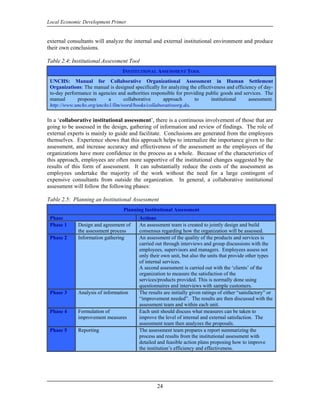
 Supporting the development of business and trade associations:
 Business associations bring considerable benefits to business development and LED efforts. Ideally, all
 towns should have a number of these, including general Chambers of Commerce. Specific groups e.g.
 town center promotion groups and groups supporting sector activities, or an exporters club are also good
 for business. Most are likely to need some initial seed-funding to start as well as capacity building.
 Improving delivery of municipal services to businesses:
 Businesses are not only drivers of the local economy but also consumers of municipal services; it is
 important that these business consumers receive efficient and effective municipal services; a key
 component in providing a supportive local business enabling environment. All aspects of regulations,
 taxation and licensing should be reviewed for efficacy.
 Social inclusion strategies:
 A primary aim should be to identify vulnerable communities, and then develop strategies to include them
 in LED efforts. Such strategies could include language programs for minority communities, women
 entrepreneurship programs and recruitment strategies for disadvantaged groups.
 Crime prevention measures:
 Introducing good citizenship classes into the school curriculum; initiating after-school activities to keep
 young people busy, and imposing curfews at night.


                                                     34
Local Economic Development Primer


Table 3.9: Program Option 5: Encouraging Local Business Growth

 PROGRAM OPTION 5: ENCOURAGING LOCAL BUSINESS GROWTH
 Most local economic growth is generated by small and medium-sized businesses that are already
 established in the community. Encouraging local business growth involves providing advice, support
 and resources to enable these existing local businesses to grow. These strategies are sometimes called
 business retention and expansion strategies. The range of initiatives to support local businesses is vast.
 Some can be expensive, but others are not. Some projects include:
 Business retention visits and surveys:
 Visits to, and surveys of, existing firms can be used to help identify problems and determine how the
 business is performing, from where it sources its supplies, and whether it is expanding. These visits can
 be used to encourage local businesses to source more inputs locally, identify skills needs, finance
 training and contribute to LED strategy development. An important role these visits can have is to
 identify factors that might forestall a business leaving the area.
 Technical assistance to business:
 This can include anything from broad based management and marketing programs, quality and
 environmental standards training and advice, to more specialized expert training or research and
 development support. The focus here should be on providing accredited, demand-led, technical
 assistance paid for on a fee-for-service basis if possible. Often these services are provided through one-
 stop business service centres and they are frequently provided by the private sector.
 Financial advice and assistance:
 One of the hardest issues for businesses is gaining access to mainstream sources of capital. An
 appropriate financial support program will be able to source advice and training on financial planning
 and how to gain access to capital and credit. In some cases, it may be possible to establish small grant or
 loan programs to encourage, for example, investment in modern technology. Care should be taken with
 these to ensure fairness, equity and transparency. Such programs are often provided at a national and/or
 state level rather than at a local level.
 Public procurement policies and ‘buy local’ campaigns:
 These are local, business friendly policies where the municipal government, public sector organizations
 and larger local businesses make their contracts more accessible to local companies. This can be
 achieved using fair-practice laws, and initiatives can include adjusting the size of contracts so that
 smaller companies may bid, encouraging and accepting bids from groups of local companies, holding
 procurement events for local businesses, and publishing local business competency directories.
 Facilitating more interaction between businesses (network facilitation) and supporting local supplier
 development programs with local industry association can also encourage local business development
 through changing procurement policies.
 Provision of sites and premises:
 Municipalities and regional governments are often significant owners of industrial and commercial land
 and property, and are in a strong position to use these resources to encourage business investment and
 expansion. A good understanding of the local property market should enable a municipality to plan for
 growth. Enabling infrastructure investments would have a resource implication, and rents and sales
 could provide a market return for the municipality. Private sector delivery or partnership should be
 examined to increase the possibility of financial leverage and ensure the best use of municipal resources.
 Export Clubs:
 Export Clubs allow businesses to share experiences, marketing efforts, information and training. They
 are often undertaken in the private sector and ‘enabled’ by the public sector. A program to help informal
 businesses establish legal operations and gain access to the corresponding benefits (e.g. support services,
 capital markets, training grants.) can unleash significant local sources of capital and fiscal revenues that
 otherwise remain hidden.


                                                     35
Local Economic Development Primer


Table 3.10: Program Option 6: Encouraging New Enterprise

 PROGRAM OPTION 6: ENCOURAGING NEW ENTERPRISE
 Encouraging new enterprises involves providing advice, technical support, information and resources to
 help individuals to set up their own businesses in the form of sole traders, partnerships, cooperatives or
 community enterprises. Projects include:
 Provision of finance for new businesses:
 Micro-enterprise financial support is key to enabling businesses to start up as they usually cannot access
 traditional lending and investment institutions. Micro-enterprise financing is a specialist area.
 Municipal governments normally become involved in these schemes by meeting with micro-enterprise
 institutions to assess the types of support needed and the appropriate method of collaboration. It is not
 usual for municipalities to be involved in micro-finance schemes as they generally do not have the skills
 and resources to do this. Their role is primarily to identify needs and encourage institutions and private
 sector players to intervene.
 Provision of micro and managed workspace:
 The provision of micro and managed workspaces to support new enterprises is one of the most effective
 ways to assist new businesses, especially when they offer as a service, technical and administrative
 support and mentoring programs. These facilities may be provided by the public or private sector.
 Providing technical advice on business management:
 In establishing a new business, the business owner should be able to understand finance, business
 planning, marketing, aspects of the law including employment, taxation, safety at work, environmental
 legislation and general business procedures. The provision of access to informal training and support in
 these areas meets a basic need and can be provided through ‘one-stop shops’ or independent advisers.
 As in most areas of technical assistance, it is usually better for the municipality to ‘enable’ the provision
 of these services rather than providing them directly. Charging for these services can be difficult and
 some agencies give a limited number of complimentary consultations and thereafter charge modest fees.
 Establishing ‘one-stop shops’ with access to market information is often extremely beneficial.
 Supporting the establishment and implementation of formal and informal business networks:
 People often learn from each other and networks can facilitate this learning. Active involvement in
 business networking is important for developing customer bases, acquiring intelligence for expanding
 businesses, and developing collaborative relationships with businesses in the same sector.
 Conducting business mentoring programs:
 Good practice suggests that by linking new and small business owners with established businesses,
 significant benefits can result for all parties. These need not be formal networks. In addition, informal
 networks of mentors and new businesses can create further benefits by developing supplier linkages and
 establishing a critical mass for specialist training.


                                                      36
Local Economic Development Primer


Table 3.7: Program Option 7: Promoting Inward Investment

 PROGRAM OPTION 7: PROMOTING INWARD INVESTMENT
 Promoting inward investment aims to attract businesses to an area from elsewhere in the country or from
 outside the country. Attracting large manufacturing and service sector employers into communities is
 one of the most difficult, frustrating, and risky of all LED strategies. This is partly because there are far
 fewer investors than there are communities seeking to attract them, and many communities are prepared
 to offer excessive incentives to inward investors. Foreign direct investors often prefer greenfield, edge-
 of-town sites, and to accommodate these wishes, communities often override planning and zoning
 policies to attract the investment. This may bring with it considerable problems for future zoning and
 may contribute to urban sprawl and transportation problems. Careful consideration should be given to
 the full costs and longevity of benefits of attracting inward investors. In selecting a site for business
 location, an inward investor seeks:
    a stable macro-economic climate;
    a stable political and regulatory environment;
    market access and open competition;
    a welcoming environment;
    available sites and premises;
    appropriate, available and reliable utilities and transportation;
    available skilled workforce;
    available local suppliers and resources;
    appropriate education, training and research facilities;
    a good quality of life, especially when bringing ex-patriots;
    manageable regulation and taxation systems;
    incentive schemes.

 The benefits when success is achieved can be significant. In addition to direct employment, an increase
 in the tax base and indirect employment, there are potential gains for the local community through up-
 skilling of the workforce, increases in wages, and opportunities for local SMEs to supply and buy from
 these investors. Inward investment strategies are likely to be successful when:

    they are a component of a broader LED strategy;
    the community has the appropriate hard and soft infrastructure in place or available to support the
    likely investments;
    targeted investments fit the competitive advantage of the receiving community (normally a
    sector/cluster approach is likely to be most successful);
    marketing strategies are carefully prepared, budgets are appropriate and follow up procedures are in
    place;
    incentive programs are considered, varied and not excessive;
    staff involved in attracting strategic investors have an understanding of investment needs and what
    their community has to offer;
    opportunities for local businesses are optimized through careful ‘aftercare’ programs. This means
    that when a new investor is attracted to a community, every opportunity is taken to encourage the
    investor to source his/her supplies locally, enabling supply chain advantages to be exploited locally.
    This is most successfully achieved through developing an investor aftercare program. Such programs
    are aimed at ensuring that investors are happy and that they are given every opportunity to source
    their inputs from the local community.


                                                      37
Local Economic Development Primer


Table 3 12: Program Option 8: Sector (and Business Cluster) Development

 PROGRAM OPTION 8: SECTOR (AND BUSINESS CLUSTER) DEVELOPMENT
 Cluster development is an approach that concentrates on encouraging and supporting inter-firm
 collaboration, institutional development and targeted industrial sectors. These are sophisticated LED
 strategies and should only be undertaken following in-depth research. The sectors are targeted at those
 that offer the most potential for local economic development. Where the local economy has existing
 clusters, this may provide a more targeted approach to improving economic development activity by
 leveraging resources in the direction of greatest potential return. These cluster strategies are undertaken
 within a broader LED strategy that would normally include the standard approaches. Possible projects
 include:
 Developing broker and network agencies:
 Special attention is paid to encouraging local people engaged in the same cluster to meet together to
 enable business development opportunities. These could include encouraging local fishermen and fish
 processors to meet and exchange ideas on improving facilities and adding more value to their products so
 they would all benefit. Another example could be to start a craft network that could jointly market their
 goods and start inter-trading with each other, building synergies.
 Supporting joint research:
 Institutions of higher learning can undertake research that benefit all in the cluster. One example of this
 would be to undertake research on minimizing losses from post-harvest losses of agricultural products.
 Developing cluster-focused public procurement and local purchasing agreements:
 The public sector is often the largest purchaser of goods and services in a city and as such there are
 opportunities to enable the local businesses community to access the tender processes more easily. It is
 often difficult for small businesses to bid for large government contracts. A cluster initiative could, for
 example, include the development of a food supplier network to supply government catering needs. A
 logical cluster development initiative would encourage suppliers of basic food products to enter into some
 form of food processing. Cluster development activities could then focus on transportation, storage and
 packaging of food products. It is then likely that businesses could start retailing and producing processed
 foods for the private sector.
 Providing cluster specific information:
 One of the most effective ways of developing a cluster is to gather information about businesses and
 institutional support systems in the cluster and then produce a document so that it can be shared.
 Thereafter, with a small amount of effort, supplier linkages can be developed. These programs do not
 need to be sophisticated.
 Developing cluster related marketing efforts:
 Once a cluster has been identified and it starts to develop as an entity, opportunities exist to promote the
 cluster and attract supporting investment, as well as extend and expand business development
 opportunities externally for cluster members.
 Developing demand-led skills and education training programs:
 A significant benefit to developing a cluster initiative is that a key outcome of business networking will be
 an appreciation of skills needs in the sector. When a number of businesses express a shared skills need, it
 is more likely that training or education will be provided. A lone business need is not likely to have as
 much an impact as a collective business need when seeking to establish a new training program for a
 specific skill need.


                                                     38
Local Economic Development Primer


Table 3.13: Program Option 9: Area Targeting/Regeneration Strategies

 PROGRAM OPTION 9: AREA TARGETING/REGENERATION STRATEGIES
 Strategies for area targeting and regeneration address specific site or small area LED issues. While most
 LED initiatives can be targeted at a municipal-wide level, area targeting examines a specific area within
 a municipality to address a specific area-based problem such as a redundant factory, a declining
 shopping area, a slum or a district. They may also be targeted at an area of economic growth potential
 such as a central business district. Although many LED initiatives are aimed at ensuring that the entire
 city becomes more competitive, there are normally areas that need special attention for one reason or
 another. An example could be a run-down town center, abandoned factory complexes, a redundant port
 complex or similar. For these situations, special measures are required. Possible projects include:
 Town center enhancement schemes:
 These can include a wide range of initiatives including developing business partnerships, marketing the
 town center, undertaking surveys, upgrading the physical environment, targeting investment, and
 establishing a business improvement district. A vital and vibrant town center is the heart of an area’s
 ability to be competitive.
 Encouraging investment into growth nodes:
 One strategy to encourage growth is to identify specific areas within a city where certain types of
 businesses will then be encouraged to locate. A growth node may then act as the center for planned
 growth and employment. However, this should not be created from nothing, but rather developed
 around an existing agglomeration of firms showing high potential.
 Encouraging investment into corridors:
 These are similar to nodes, but here growth is encouraged to expand from an area of promising economic
 activity out towards a more challenging area. By encouraging incremental investment, the aim is to
 develop an active growth corridor linking richer and poorer areas, thereby reducing social and economic
 exclusion. The implementation of effective regeneration programs and the tackling of socially and
 economically disadvantaged groups represent two of the major challenges facing contemporary policy
 makers. Regeneration strategies go some way to meet these challenges. They use all the tools available
 but because an area is in need of regeneration, specific, community-focused and often highly targeted
 policy responses are usually needed. Regeneration strategies are likely to take the longest time, be the
 most challenging, the most expensive, and the most necessary activity a municipality is likely to
 undertake.
 Retraining of redundant workers:
 Redundancy is a serious problem in most communities undergoing structural readjustment. The likely
 target populations will be older men who have clearly defined skills sets. The challenge is to ensure that
 skills training is provided on a demand-led basis. This is hard and there are no easy solutions, especially
 as there is likely to be high unemployment in the community at large.
 Job search and employment outreach:
 For redundant workers, finding a job is difficult. This is often because they do not know basic job
 search skills such as where to find opportunities. Job search programs can be very effective and can
 involve everything from confidence building, resume writing, and teaching of interview skills, to
 matching the unemployed with potential employers.
 Entrepreneurship training and SME support programs:
 The city’s mainstream programs could be adapted to meet the specific needs of this target group and
 area. Localized delivery of services could also be helpful.
 Community confidence building:
 This can include many measures such as promoting local success stories, encouraging the community to
 develop its own newsletter, and developing arts and crafts initiatives.


                                                     39
Local Economic Development Primer


Table 3.14: Program Option 10: Integrating Low Income or Hard-to-Employ Workers

 PROGRAM OPTION 10: INTEGRATING LOW INCOME OR HARD-TO-EMPLOY WORKERS
 Targeting disadvantaged groups means that measures are targeted at groups of individuals such as ethnic
 minority groups, urban poor, women, redundant workers, long-term unemployed and youths. Possible
 projects include:
 Language training:
 This is a key issue where there are groups of foreign workers and minority communities.
 Skills retraining and job placement programs:
 Skills retraining should be undertaken using a demand-led approach i.e. businesses need to be involved in
 articulating the skills needs. There is little point in retraining individuals in skill areas for which there is
 no local demand. Job placement programs assist individuals in acquiring the skills they need to access
 jobs and assist in identifying opportunities.
 Raising educational achievement:
 This is usually an issue for an entire city, but specific communities may be in need of extra targeted
 support.
 Enterprise training:
 Many disadvantaged groups have both high unemployment and a large proportion of workers in the
 informal sector. Basic training in terms of business management, finance and marketing can have a
 significant impact on these communities.
 Helping women to access employment and self-employment programs:
 Projects could include skills development, confidence building programs, and provision of crèches and
 after-school clubs.
 Micro-enterprise lending programs:
 This area of activity is also well suited to assisting disadvantaged groups to access self-employment.
 Work experience and teacher-pupil placement schemes:
 These schemes involve teachers and students working for short periods of time in businesses to gain
 practical work experience and develop a work ethic. When teachers partake in this scheme, they may
 have a better understanding of workplace requirements.
 Developing mentor programs:
 Experienced business people mentor new starters and give them support, encouragement and ideas.
 Mentor programs can be very informal and are a way of helping individuals to start their own business.
 Health awareness programs:
 Often the most disadvantaged suffer from the worst health. Besides the direct effects on individuals, poor
 health becomes a serious limiting factor when trying to gain access to employment. Health awareness
 programs can be closely targeted at, for example, specific schools and communities. They may also be
 delivered through community resource centres. HIV/AIDS programs will be a priority for many LED
 programs in areas affected by the epidemic. Prevention and care reduce the negative burden imposed on
 families, particularly the poor.
 Development of community resource centres:
 The purpose of these centres is to act as a ‘one-stop’ resource center, bringing various information
 services under one to meet the needs of the local community. These centres do not need to be
 sophisticated and services can include everything from health care, to education services, to business
 advice, to paying taxes, to LED and housing.


                                                      40
Local Economic Development Primer


Step 5: Selecting Projects

Within each program area, projects should be proposed and selected on the basis of clear criteria.
Each potential LED project should be assessed to determine whether it meets the broader LED
goals, objectives and priorities that were discussed and agreed by the stakeholders. It is also
important, especially for longer projects, to undertake a careful feasibility study to verify whether
the project can be technically and financially implemented.

Cost-benefit analysis is an important tool for prioritization, especially in expensive projects. As
there might be several competing project options, comparing the costs and expected impact of
each project should provide quantitative data to help prioritize projects. Municipalities are often
interested in comparing the benefits of a project proposal in terms of generating new jobs,
improving income, creating new enterprises, increasing revenue, and value-for-money. The
timing for achieving these impacts is a critical issue in the prioritizing of projects.

Including ‘early-win’ projects that can quickly achieve visible and tangible impacts in the short-
term will be fundamental to the overall LED strategy making process in ensuring the continued
support of the different stakeholders.

Complex projects with larger resource requirements and a longer timeframe will need to go
through a more rigorous selection process and should include an initial viability assessment,
feasibility studies, design review, business plan preparation and tailored monitoring and
evaluation program.

Documenting the Strategy
Ideally the strategy should be documented, published and consulted upon at several stages of
development including during the drafting of the LED strategy and again when the local economy
assessment has been completed. Dissemination and public consultation in a town hall setting will
serve to bring forward ideas and inputs from the broader community. When the entire strategy
has been agreed, and has included a full discussion of the nature and selection of LED projects, a
revised version of these documents should be made accessible to all members of the community
through the local media including printed copy, radio, town hall meetings and other formats
necessary to inform the local community. Where one exists, this could include a posting on a
municipal government Web site.

Feedback on the LED strategy should be encouraged and practically taken into consideration. In
communities where stakeholder participation has been particularly limited, the strategy document
should be developed in draft format and used as the basis for further consultation before
finalizing the LED strategy. The municipality should ensure that an effective communications
plan has been agreed and is in place prior to embarking on the implementation stage.


                                                 41
Local Economic Development Primer


        STAGE FOUR: STRATEGY IMPLEMENTATION

                                             STAGE 4
                                     STRATEGY IMPLEMENTATION
 Step 1: Prepare an Overall LED Strategy Implementation Plan for all Programs and Projects.
 Step 2: Prepare Individual Project Action Plans.
 Step 3: Build Institutional Frameworks for LED Implementation and Monitoring.
 Step 4: Ensure Relevant Inputs are Available.
 Step 5: Carry Out Tasks in Project Action Plans.

Step 1: Prepare an Implementation Plan for all Programs and Projects

Once the LED programs and projects have been selected, implementation planning begins.
Strategy implementation is driven by a broad Implementation Plan, which in turn is driven by
individual Project Action Plans. The Implementation Plan lays out the budgetary, human
resource, institutional and procedural implications of implementing an LED Strategy. It is thus
the point of integration of all projects and programs within an LED Strategy.

The Action Plan lays out a hierarchy of tasks, responsible parties, a realistic timetable, human
resource and financial needs, sources of funding, expected impacts and results, performance
measures and systems for evaluating progress for each project (see Step 2).

The Implementation Plan acts in the final instance as a mediator between various projects and
their action plans to ensure that they do not inappropriately compete for resources. It also
provides information on monitoring and evaluation to all parties involved, in particular, the
municipality’s chief executive officer and mayor who will eventually report to higher levels of
government and to the community.

Table 4.1: Key Issues in Implementing the LED Strategy

 KEY ISSUES IN IMPLEMENTING THE LED STRATEGY

   Who takes responsibility for each program or project?
   What are the targets in terms of outputs, timing and funding?
   What steps need to be taken to achieve the targets?
   What will the reporting structures and communication strategy consist of and how will they be put into
   effect?
   What are the performance monitoring and evaluation systems and processes?
   What has to happen to ensure they are in place and are used?
   What are the budgetary and human resource requirements for the sustained delivery of the project or
   program?
   What are the institutional implications of the LED programs and projects, including internal
   implications of the procedures and processes of the municipality?
   What new departmental and staff coordination will be necessary to fulfil the project?
   What are the new skills required for the implementation of programs and projects?


                                                  42
Local Economic Development Primer


               Step 2: Prepare Individual Project Action Plans

               After program and project selection and prioritization has been completed, it is necessary to detail
               the actions that need to be undertaken to implement each project. This should provide the Action
               Plan for operationalising each project. Each Action Plan should contain the following
               information:

               Table 4.2: Key Components of an Action Plan
                                                     Basic Elements of Action Plans
                Project Objectives        Each project should have clear objectives that meet program goals.
                Project Inputs            The necessary resources needed to implement the project, e.g. capital and
                                          revenue costs, human resource inputs and capabilities, other inputs such as land
                                          and buildings.
                List of Actions           A summary of the main actions to be undertaken in each project.
                Project Outputs           The direct result from the project, i.e., the construction of a business incubator.
                Project Outcomes          These are direct results from the outputs, e.g. an outcome of the building of a
                                          business incubator could be that four new businesses be established there.
                Project Impacts           Impacts are associated with a strategy’s goals, and the broader effect of a
                                          project over time, even after the project is completed, e.g., the development of a
                                          specific industry cluster based on the innovation center.
                Project                   Who will take financial and management responsibility for the project (internal
                Management                to the municipality or external)? Legitimate institutional mechanisms need to
                                          be in place or envisaged as part of the plan. It is important that ‘champions’
                                          take primary responsibility for managing a project. If a ‘champion’ is not
                                          forthcoming to manage a project, the project should be reassessed as being a
                                          credible LED project for inclusion in this particular LED strategy.

               By preparing a standard action planning form, decision makers can more easily compare the
               merits of individual projects as they make difficult selection choices. The following points are
               important considerations in preparing an Action Plan for each project:
By preparing
a standard
action             project name and program type;
planning
form,
decision           a short description of the project;
makers can
more easily        a hierarchy of tasks;
compare the
merits of
individual
                   stakeholders and their expected contribution;
projects…
                   realistic timetable;
                   human and financial requirements;
                   sources of funding with estimated costs;
                   expected impacts and results; and,
                   performance measures and systems for evaluating progress for each project.


                                                                     43
Local Economic Development Primer


                 Step 3: Build Institutional Frameworks for LED Implementation and Monitoring

                 Establishing and maintaining both formal and informal links with all the key stakeholders can
                 support LED implementation and monitoring. Building working relationships and trust between
                 partners assists in the process of managing perspectives and differing agenda.

                 Most broad-based, comprehensive LED strategies are delivered through public-private sector
                 partnerships that are strongly driven by the municipality, and include the private sector and
                 community groups. The private sector is often keen to manage initiatives aimed at improving the
                 vitality and viability of town centres or to be involved with business development initiatives.
                 Community groups may seek to lead initiatives to improve health or housing conditions of a
                 target group of disadvantaged individuals.

                 Strategy implementation is never as clearly defined as the strategy itself. It often takes longer
                 than expected, requires the constant maintenance and upkeep of institutional frameworks, and
                 needs constant monitoring. With each project and program that is implemented, project review
                 should occur throughout focusing on how best to advance the project in a rapidly changing
                 environment.

                 Step 4: Ensure Relevant Inputs are Available

                 In implementing an LED strategy, it is necessary to ensure that the required inputs are available
                 and in place prior to the start of strategy implementation. LED implementation requires a
                 commitment of resources, time and political support, and securing and maintaining such inputs
                 will determine effectiveness to achieve programs and projects, and therefore the overall vision.

                 Building Political Support
                 Ensuring that local political support is in place is important to successful strategy implementation.
                 Municipal leaders can use their influence to initiate and build multi-level partnerships and
                 networks to support the LED process, and make the case for LED resource allocation. By
                 including political leaders of all parties in LED strategy discussions, a municipality can greatly
                 improve the chances of strategy success and longevity by identifying the need for a program or
                 policy and its beneficiaries, and establishing necessary resource requirements. Building political
                 support will also be necessary with international donors, the private sector, and non-governmental
                 organizations to build internal and external momentum and encourage support. Building and
                 maintaining a wide range of partners early in the strategic planning process can serve to expand
                 the resource base of information, contributions and finance during the implementation stage.

                 Funding the Strategy
                 Obtaining and maintaining a sustainable, long-term source of funding for an LED strategy is a
It is also       considerable challenge as often LED is not a statutory responsibility of municipal government. In
important that
the              determining and agreeing a municipal budget, LED competes for limited resources with
municipality     departments such as housing, health and education. It is often difficult for elected officials to
fully
understands      justify allocating scarce resources to LED efforts when other decisions are often perceived as
that LED is a    being more important to the development of the municipality than LED initiatives. It is therefore
potential
contributor to   important to have political support in the municipality and the community to encourage resource
future
revenue
                 allocation. It is also important that the municipality fully understands that LED is a potential
growth…          contributor to future revenue growth, and recognizes the connection between successful LED,
                 increased local economic activity and municipal budget growth.


                                                                  44
Local Economic Development Primer


The LED strategy must have a designated budget. This may be small in the first instance and
should include opportunities for follow-up funding. Ideally in selecting particular programs and
projects, funding should be agreed for the entire life of a project, as projects are likely to span
several years. Forward, sustainability and exit strategies should also be developed.

Table 4.3: Sources of Funding for LED Initiatives
                                Sources of Funding for LED Initiatives
    Municipal revenues raised from property tax, business tax and user fees;
    Sale or renting of local municipal-owned industrial or commercial buildings and land;
    National and state government intergovernmental transfers;
    International donor grants and loans; Private sector funding such as corporate contributions and
    investments;
    Private sector funding such as corporate contributions and investments;
    Foundations, especially for environmental improvements, human resource initiatives and poverty
    alleviation; and,
    Multilateral agencies.

Step 5: Carry Out Tasks in Project Action Plans

In delivering the project action plans, it will be necessary to ensure that all key partners that were
initially identified as being a beneficiary or potential contributor to the project are still available
to support the project. Prior to the commencement of project implementation, project managers
will ideally have been selected and charged with responsibility for each project. During the
implementation of the project, constant review should be undertaken to ensure that the project is
delivering its stated aims and desired outputs. The collection of project data should be a priority
to ensure that detailed and relevant information is available for monitoring and evaluation
purposes, both during and after project implementation. The use of sound management
techniques such as project monitoring and evaluation can help to avoid delays thus ensuring the
smooth implementation of a project.

Selecting a Project Manager
A project manager will be required to manage the LED project until its completion and oversee
its development. The manager will be charged with a number of tasks including developing and
refining the project, and providing strategic and technical development of the project. Ideally, a
project manger should be able to identify, appraise and undertake liaison with other potential
resources in fulfillment of the project objective, and have the skills to plan and direct project
workflow on a day-to-day basis.

In assessing and reviewing the progress of the project against the Implementation Plan, the
project manger will be expected to report as required to internal and external parties including the
municipal government, donors, the LED steering group, and business and community partners,
and should therefore be able to develop effective professional partnerships with all of the key
stakeholders. Ideally, the project manager should have previous experience of project
management and be able to demonstrate a knowledge and understanding of the LED project area.
For example, in selecting a project manager to develop and manage a business development
center, appointing a manager who has no previous experience or knowledge of business
development or property management would not be appropriate. Clearly, the selection of the
project manager will depend on the availability and reliability of appropriately skilled local
individuals.


                                                   45
Local Economic Development Primer


                        STAGE FIVE: STRATEGY REVIEW

                                                  STAGE 5
                                              STRATEGY REVIEW
     Step 1:   What? Why? When?
     Step 2:   Monitoring
     Step 3:   Evaluation
     Step 4:   Institutional Arrangements
     Step 5:   Strategy Review and the Planning Process

Step 1: What? Why? When?

Even though LED is a relatively new discipline, there are numerous examples of bad practice that
can be highlighted to demonstrate the potential for mistakes, and many of these mistakes can be
attributed to relatively few causes:

       politics (including exclusion of key interest groups, inappropriate zoning);
       lack of commitment by Project Managers because they are not held regularly accountable;
       lack of strategic thought (resulting in inappropriate strategies);
       inadequate funding, research, monitoring and evaluation (resulting in inappropriate strategies
       and initiatives);
       grant chasing; and,
       following the latest trend.

Reviewing the strategy will enable the municipality to determine how its LED strategy is
progressing, whether it is making any mistakes in implementing its strategy, and how these
mistakes might be rectified.

The LED strategy should be regularly reviewed to reflect changes in the local economy and
lessons learnt from its implementation. Reviewing a local economic development strategy is
normally undertaken on an annual basis and usually in conjunction with the municipality’s
financial planning cycle. This revision is guided by a monitoring and evaluation plan that
establishes the procedures and indicators for assessing the LED strategy planning process, and the
implementation of programs and projects.21 Both the municipality and the steering committee
should be involved in the review process. It is important to invite public opinion in assessing the
LED strategy making and implementation processes. Surveys and focus groups are valuable
sources of information for strategy review. Political support for, and publication of,
achievements are key to sustaining momentum and generating enthusiasm and confidence within
the community.

21
   Useful information on the development of LED performance indicators is available on the United
Kingdom Library of Local Performance Indicators project Web site. The site contains information on the
development of pilot economic regeneration performance indicators and lists a technical definition
document that provides a fuller explanation of the indicators together with detailed definitions:
http://www.local‐pi‐library.gov.uk/economic_regeneration.shtml.


                                                      46
Local Economic Development Primer


Table 5.1: Issues to Include in the Revision of the LED Strategy
                       ISSUES TO INCLUDE IN THE REVISION OF THE LED STRATEGY
     Is the SWOT analysis still valid or have circumstances changed?
     Is more information available and have key issues changed as a result?
     Should changes be made to the vision, goals or objectives to reflect changing circumstances?
     Are projects achieving the expected results? If not, what can be done?
     Are performance indicators being met? If not, why not?
     What changes need to be made?
     Should the indicators be changed?
     Should there be more action on projects?
     Should the projects be changed?

Monitoring and evaluation (M&E) as discussed earlier is a key component of the LED
Implementation Plan. Indicators should be clearly laid out at the project level to measure inputs,
outputs, outcomes and impact for each project. These will be consolidated to determine program
success and provide an overall assessment of LED strategy. Repeated semi-annual and annual
meetings to discuss results are necessary as part of the ongoing planning and learning process.

A monitoring and evaluation strategic workshop should occur at the start of a program. It should
establish an M&E timetable including scheduled reviews of content and process indicators. An
independent audit of key indicators through repeated municipal and business surveys is crucial to
measuring the progress made since the baseline local economy assessment. These can be
quantitative and qualitative in nature.

Step 2: Monitoring

Monitoring is the continuous assessment of a strategy and/or project implementation in relation to
agreed schedules, and of the use of inputs, infrastructure, and services by project beneficiaries.
Monitoring provides managers and other stakeholders with continuous feedback on
implementation. It identifies actual or potential successes and problems early to facilitate timely
adjustments to project operation. Monitoring accepts the project design as given; it measures
progress, is focused on performance and occurs continuously.

Step 3: Evaluation

Evaluation is the periodic assessment of a project’s relevance, performance, efficiency, and
impact (both expected and unexpected) in relation to stated objectives. Project managers
undertake interim evaluations during implementation as a first review of progress, a prognosis of
a project’s likely effects, and as a means of identifying necessary adjustments in project design.
Evaluation challenges the design of a project, draws conclusions and makes judgments, is focused
on the effectiveness of the program or project, becomes a key milestone in the project cycle.22

Evaluations can be divided into two categories.        ‘Process evaluations’ focus on the
implementation of programs or projects, while ‘outcome evaluations’ focus on program results.
Process evaluation is concerned with how a program can be improved while outcome evaluation


22
   For additional information on monitoring and evaluation, see ‘Monitoring & Evaluation: Some Tools,
Methods and Approaches’, (2002), Operations Evaluation Department, World Bank
http://www.worldbank.org/oed/.

                                                     47
Local Economic Development Primer


is concerned with whether the program actually works. Managers of LED programs would
benefit from building both forms of evaluation into the program design.23

Table 5.2: Process and Outcome Evaluation
                   PROCESS EVALUATION                            OUTCOME EVALUATION
     monitoring        assessing    enumerating         measuring      costs and       assessing
     daily tasks       program       outcomes          effectiveness    benefits        impact
                       activities
Source: Bartik, 2002.

Process evaluations overlap with monitoring activities and both are concerned with project or
program implementation.          Process evaluation involves the systematic examination of
implementation quality on a periodic basis and programs are monitored internally with
monitoring reports generated at different levels on a weekly, monthly or quarterly basis. LED
programs may involve a mid-term process evaluation, which will include management reviews,
resource expenditure studies or financial audits. A process evaluation may recommend changes
in program activities, target groups, the management structure or financing strategy.

Outcome evaluations are centrally concerned with determining what would have happened to
program recipients and the LED task if the intervention had not occurred. Outcome evaluations
primarily seek to measure the ‘value added’ of undertaking a particular LED project intervention.

Outcome evaluations ideally cover four key parameters. Primarily, evaluations must account for
and enumerate outcomes. This can be achieved by assessing what has happened to the target
population and how it is different from before. Enumerating outcomes will also involve outlining
whether program objectives were achieved and if unanticipated outcomes occurred. Secondly,
outcome evaluations measure program effectiveness. This is achieved by assessing the degree to
which the intervention resulted in observed changes in the target population. Third, outcome
evaluations must assess whether program benefits outweigh program costs by conducting a cost-
benefit analysis. Lastly, a sound outcome evaluation will assess impact by determining whether
there has been a marked improvement in the situation that the policy or program was designed to
address.

Assessing the impact of an LED strategy also implies the need to separate the outcomes that are a
direct consequence of the LED strategy from those that are a result of external factors such as an
improvement in the national economy. For example, unemployment might decrease by 10
percent in a year after the implementation of an LED strategy; however, this figure could in part
be a result of an increase in national GDP. An approach to take in this case could be to compare
the findings from the LED strategy assessment with the same indicators selected randomly from
different localities as well as from the regional and national averages. It is possible then to
identify changes in these indicators that are common to all localities, and therefore not related to
the specific LED strategy. As result, the outcome evaluation can isolate the external deviations
from the direct impact of the LED strategy. This, however, is difficult in most countries as there
is neither data nor funds available. Nevertheless, efforts should be taken to monitor and evaluate
at a project and strategy level.


23
 Bartik, T. (2002) ‘Evaluating the Impacts of Local Economic Development Policies on Local Economic
Outcomes: What Has Been Done and What is Doable?’ Paper Presented to the OECD LEED Conference,
November 20-21, Vienna Austria http://www.upjohninstitute.org/publications/wp/03-89.pdf.

                                                  48
Local Economic Development Primer


The general rule should be to develop the most rigorous evaluation methodology taking into
account the significance of the investment as well as practical considerations related to resource
availability and technical capacity.

Why Monitoring and Evaluation?

    A well-designed monitoring and evaluation system will help answer the question ‘how do I
    know when I have reached my Objectives?’
    It provides a basis for accountability in the use of resources.
    Used carefully at all stages of the project cycle, monitoring and evaluation can help to
    strengthen strategy and project design and implementation.
    It helps to build trust with businesses, financial institutions and investors by openly sharing
    results.
    The emergence of recorded benefits early on helps reinforce ownership and early warning
    learning by all regarding emerging problems allows action to be taken before costs rise.
    A well-designed M&E allows for mid-course corrections.
    A reliable flow of M&E information during implementation enables managers to keep track
    of progress and to adjust operations to take account of experience.
    It allows for the interventions to be adapted to reflect the changing needs of target businesses,
    sectors and companies.
    It provides important information on how to use limited resources more efficiently by
    directing investments to programs and activities that have the greatest impact on productivity,
    job growth or investment.
    It allows for the benchmarking of LED interventions against examples of good practice.
    It demonstrates the impact of LED interventions in terms of poverty reduction, city GDP
    growth or employment creation to clients, citizens and potential investors.
    It can help to justify budget requests for further LED interventions.


                                                 49
Local Economic Development Primer


Table 5.3: Summary of Differences Between Monitoring and Evaluation
               SUMMARY OF DIFFERENCES BETWEEN MONITORING AND EVALUATION
                               MONITORING                                   EVALUATION
                Monitoring is the process of routinely         Evaluation involves a ‘stepping back’ to
                gathering information on all aspects of a      gain a deeper perspective on what
 What:          project or program. It is used to inform       effects and impacts have been achieved.
                decision making on project                     It informs every decision-making.
                implementation.
                   Analyse the current situation.                Determine how effective a project or
                   Identify problems and find solutions.         program has been.
                   Discover trends and patterns.                 Determine the extent to which goals
                   Keep program activities on schedule.          have been achieved.
                   Measure progress towards intermediate         Learn how efficiently things are being
 Purpose:
                   goals and revise action in order to           done.
                   achieve these goals.                          Develop ‘lessons learned’ so future
                   Formulate key questions.                      programs and projects of a similar
                   Make decisions about human, financial         nature can be improved.
                   and material resources.
                Monitoring is continuous (daily, monthly,      Evaluation is conducted periodically:
                annually). Monitoring activities should be       at or near the mid-point of
                scheduled as part of the project’s work          implementation
 When:
                plan and be a routine part of project            at the end of a project
                implementation.                                  at a point well after a project has been
                                                                 completed (3-8 years)
                Monitoring can be carried out by staff and     Internal evaluations can be carried out
                participants through field visits, review of   by the project manager and/or project
                service delivery and through a                 staff and participants. External
 How:
                Management Information System.                 evaluations are generally conducted by
                                                               external consultants, external agencies or
                                                               donors.
                Monitoring provides managers with              Evaluation is the formal process of
                information needed to analyse the current      documenting the following project
                project situation, identify and find           achievements:
                solutions, discover trends and patterns,         progress in the work plan
                keep in schedule and measure progress            establishment of systems
 Why:
                towards expected outcomes. It allows an          implementation of planned activities
                opportunity to make decisions regarding          achievement of goals
                human, financial and material resources          effectiveness of the project
                and minimize needless program costs.             impact of the project
                                                                 efficiency or cost-effectiveness
                More emphasis on quantitative data, but        More emphasis on qualitative data, but
 Information    some qualitative data is gathered to           quantitative data is gathered in
 Type:          contextualise the quantitative analysis.       indicators. Qualitative analysis can often
                                                               support the quantitative assessment.
 Information    Descriptive, analytical and documentary        Descriptive, analytical and documentary
 Category:      data should all be used to observe the         data should all be used to observe and
                ‘what’ and understand the ‘why’ of the         record the ‘what’ and understand the
                project activities.                            ‘why’ of the project achievements.


                                                  50
Local Economic Development Primer


Step 4: Institutional Arrangements

In determining institutional arrangements for measuring progress, one should focus on the people,
processes and events that will be necessary for measuring that progress at the level of both the
strategy and the individual projects and programs. In determining a formal institutional
arrangement, key questions include:

  Who are the people that should be measuring the progress?
  What type of information will they require to measure progress?

On the processes, one should consider the types of evaluation tools necessary, and the products
that will be produced, e.g. progress report etc. (see table 5.4 for examples).

Feedback
Proposals for the ways in which M&E findings will be fed into decision making process:

Table 5.4: Example of Events to Measure Project Progress
                      EXAMPLE OF EVENTS TO MEASURE PROJECT PROGRESS
                                 ANNUAL CYCLE OF EVENTS
   EVENTS        TIME               PURPOSE                      PRODUCTS              STAKEHOLDERS
 Annual        January     Define level of input,        Annual Work Plan              Management
 Planning                  outputs, indicators,          Individual Plans              Project Staff
                           related activities            Annual Budget Gantt Chart     Institutional
                                                         (Updated) Work
                                                                                       Stakeholders
                                                         Agreements
 Quarterly     May and     Progress Evaluation           Updated Implementation        Management
 M&E           October     Planned vs. Actual            Plans Performance             Project Staff
 Workshop                  Performance Monitor           Improvement Plans
                           Assumptions
 Mid-Term      June-July   Respond to New                Progress Report Adjusted      Management
 Evaluation                Opportunities                 Designs and Implementation    Project Staff
                           Review Leading                Plans
                                                                                       Donors
                           Indicators
                                                                                       Partners
                           Sustainability of
                           Assumptions
 Annual        December    Evaluate Impact               Evaluation Results Progress   Management
 Stakeholder               Progress Review               Report on Lessons Learned     Project Staff
 Meeting                   Delivery of Outputs
                                                                                       Beneficiaries
                           Verify Assumptions
                                                                                       Customers
                                                                                       Partners

Clear Objectives
Good monitoring and evaluation cannot occur unless there has been good project design where
clear statements of measurable objectives exist.

Key Performance Indicators
A clear and structured set of key performance indicators (KPIs) allows us to measure progress.
Performance indicators are conditions that signal success. They inform us how we will recognize

                                                    51
Local Economic Development Primer


the success of the project or program. Performance indicators can be both quantitative and
qualitative. Quantitative indicators will include numbers, percentages, percentage changes etc.
Qualitative indicators are more difficult to measure. They focus on aspects such as the quality of
a result or an individual’s attitude towards a new service. In order to obtain this kind of
information, appropriate measures need to be created. In designing an M&E system, there are
several types of indicators that are necessary. These include Objective Indicators that measure
the progress of a strategy or project toward its objectives; Output Indicators that measure progress
against outputs; Input Indicators that measure financial disbursement, human resources and staff
time.
Indicators should be:

  SMART - Specific, Measurable, Achievable, Relevant and Time-bound;
  valid - they are valid in the eyes of the key Participatory M&E (PME) stakeholders and should
  actually measure what they set out to measure;
  reliable - conclusions based on the indicators should be the same if measured by different
  people;
  gender sensitive - indicators should be disaggregated by gender;
  sensitive - they should be sensitive enough to measure important changes in the situation being
  observed;
  cost-effective - the information/learning should be well worth the time and money it costs to
  collect the data;
  timely - it should be possible to collect and analyse the data fairly quickly;
  in-line with local capabilities/resources - they should not be overly complex and burdensome
  to the project partners; and,
  build on what exists - indicators should not ’reinvent the wheel’ and should draw on existing
  local data collection activities, or from indicators used with other projects, where possible.

Data Collection
The type of data collection required depends on the choice of indicator. The achievement of
strategy and project objectives depends on how project beneficiaries respond to the goods or
services delivered by the project. Evidence of their response and the benefits they derive requires
consultation and data collection that may be outside the scope of management. Indications that
beneficiaries have access to, are using, and are satisfied with project services give an early
indication that the project is offering relevant services and that direct objectives are likely to be
met. Within a project however, it is necessary to measure the progress of the project in terms of
internal inputs (financial, staff weeks), outputs (the progress on the manual or the building) and
process (which of the projects are achieving their time frames). Indicators of inputs, process and
outputs are mostly generated from within project management.

Step 5: Strategy Review and The Planning Process

What Does This Mean for the LED Strategic Planning Process?
Monitoring should not be an afterthought that is undertaken at the end of a LED Strategic
Planning Process. It should be incorporated into each stage and step of the planning process.
Evaluation can occur at intervals; however, it can only occur if good monitoring information is
available. Evaluation should lead to the review of a strategy and its projects.


                                                 52
Local Economic Development Primer


M&E in Stage 1: Organizing the Effort
Stage One provides an opportunity to begin thinking about the kind of monitoring and evaluation
framework that will be necessary throughout the life of the project. This includes:
  a consideration of what kind of long-term institutional mechanisms are needed to ensure the
  M&E of the Strategy, e.g. a Strategy Monitoring Committee?
  the production of a monitoring and evaluation plan for report back mechanisms throughout the
  life of the Strategy Formulation. This can include an Annual Report, a Quarterly Progress
  Report, an Annual Meeting, regular press releases and bi-weekly meetings.

The Stakeholder Consultation process allows for the M&E system to be participatory. This offers
a host of benefits that build on the benefits of conventional M&E systems. These include:
    improved performance of development and poverty alleviation programs;
    enhanced local learning, management capacity and skills;
    strengthened collaboration among key project stakeholders and greater ownership of projects;
    M&E systems that are more sustainable since they are more relevant to local capabilities,
    skills and resources;
    increased cost-effectiveness of PME systems as they use low-cost methods of data collection
    and analysis.

Conventional monitoring and evaluation focuses on approaches and systems that are determined
by outside experts. Participatory monitoring and evaluation is based on negotiating the content of
evaluation approaches and systems to meet the needs of the local people and other key users of
M&E information such as donors, municipal government and national authorities.

In participatory monitoring and evaluation, the evaluator plays the role of a
facilitator/trainer/coach guiding groups to reach consensus on key M&E issues and building their
capacity to use M&E to improve program performance. Traditionally, distinctions between M&E
and PME were less differentiated. The two approaches are contrasted below:

Table 5.5: Conventional and Participatory Evaluation
          CONVENTIONAL EVALUATION                                PARTICIPATORY EVALUATION
  Why      Accountability. Usually summary                 To empower local people to initiate, control and
           judgments about the project to determine if     take corrective action.
           funding continues.
  Who      External experts.                               Community members, project staff, facilitator.
  What     Predetermined indicators of success.
                                                           People identify their own indicators of success.
           Principally cost and production output.
  How      Focus on ‘scientific objectivity’. Distancing   Self evaluation; simple methods adapted to
           of evaluators from other participants;          local culture; open immediate sharing of results
           uniform complex procedures; delayed,            through local involvement in evaluation
           limited access to results.                      processes.
  When     Midterm and completion.                         Any assessment for program improvement;
                                                           merging of monitoring and evaluation, hence
                                                           frequent small evaluations.


                                                     53
Local Economic Development Primer


M&E in Stage 2: The Local Economy Assessment

The Local Economy Assessment should be viewed as an opportunity to collect baseline data in
the economy (description of the economy before the implementation of the LED strategy) so that
the impact of the LED strategies can be monitored along its implementation.

M&E in Stage 3: Strategy Formulation

Strategy formulation should include the determination of key performance indicators from which
the progress toward objectives will be measured. The team should also formulate a plan, as part
of the data collection methodology, to measure progress made on the objective key performance
indicators. The strategy formulation phase is also a good time to determine who is responsible
for monitoring the strategy’s implementation. In the strategy implementation phase, the
monitoring and evaluation team should consider and develop a monitoring and evaluation plan
including:

    how they will collect data for monitoring the objective key performance indicators;
    how they will collect data for monitoring each project’s progress; and,
    the kind of events and report back mechanisms to ensure continued accountability on
    progress to all stakeholders.

M&E in Stage 4: Strategy Implementation

By this stage, the institutional arrangements for monitoring the implementation of the strategy
should be in place.

M&E in Stage Five: Strategy Review

Strategy Review is the evaluation of the relevance of the strategy and its implementation.


                                                54
Local Economic Development Primer


                                      RESOURCES

Glossary of LED Terms

Local economic development has its own language and terminology. Terms such as capacity
building, empowerment, indigenous development and social capital are common and are used by
a variety of actors in the local economic development field. However, many of the terms
associated with local economic development require a considerable amount of interpretation,
comprehension and negotiation when applied practically in different institutional settings. While
recognizing that some of these terms are not universally understood, the following list provides a
guide to this terminology by describing the more commonly used words and acronyms.

Additionality: The principle that funding from a particular source is additional to that provided
by national and municipal authorities. The additionality principle requires that funds awarded for
a project should not be used merely to substitute/replace existing funds, but should be used for
additional projects and activities.

Brownfields: This is a general term used for sites that have been developed in the past that may
or may not be contaminated. Sustainable economic development strategies encourage the
productive reuse of these sites, even though this may be more expensive than building or
developing new and presently undeveloped Greenfield sites.

Business Incubators: An economic development tool primarily designed to help create and grow
new business in a community within a specific building or location. Business incubators help
emerging businesses by providing various support services such as assistance with developing
business and marketing plans, building management skills, obtaining capital and access to more
specialized services. They also provide flexible space to rent, shared equipment and
administrative services in managed workspace.

Business Retention Strategies: Systematic efforts designed to keep local companies content and
situated at their present locations within the area. Strategies include helping companies cope with
changing economic conditions, addressing new markets and even assisting with internal company
problems.

Business Start-up Support: Includes the full range of services available to people starting in
business for the first time. Initiatives include: training, business advisory support, business
networking and mentoring and financial assistance (grants, loans, and interest rate subsidies are
traditional methods; a more innovative approach to financial support is to try and attract as much
private sector investment as possible, rather than public sector).

Clusters: An industry cluster is a grouping of related industries and institutions in an area or
region. The industries are inter-linked and connected in many different ways. Some industries in
the cluster will be suppliers to others; some will be buyers from others; some will share labor or
resources. The important thing about a cluster is that the industries within the cluster are
economically linked. They both collaborate and compete, and are, to some degree, dependant
upon each other. Ideally, synergies are produced by these clusters.


                                                55
Local Economic Development Primer


Entrepreneurial Training: Programs that provide guidance and instruction on business basics
(such as accounting and marketing) so that businesses improve their chances of success.

Export Development Services: Export assistance programs can help businesses to diversify their
customer base, expand operations and become more profitable. Export services include:
assessing company capacity for exporting; market research; information services (on exporting,
trade regulations, transportation, etc.); international lead generation and trade shows/exhibitions
or promotional marketing trips.

Foreign Direct Investment (FDI): FDI is investment that is attracted from abroad. It can mean
either Greenfield investment (i.e. investment in building new facilities on hitherto undeveloped
sites) or portfolio investment (i.e. buying into an established business). Inward investment can
take similar forms (either Greenfield or portfolio). However it may include investment from
within a country as well as from abroad.

Greenfields: Refers to land that has hitherto not been developed. Greenfield investments imply
that facilities are designed and built for investors, rather than the investor buying a facility already
built.

Growth Node: A physical location where industry and/or commercial development is
deliberately directed; done either to reduce growth pressures elsewhere in the city or to
redistribute growth within a city.

Forward Strategy: This is where arrangements are made to continue the life of projects after
initial project funding stops. Sometimes this is described as an exit or succession strategy. This
should be established at the outset of all projects that are likely to need ongoing capital or revenue
resources after the initial period of establishing the project.

Hard Infrastructure: Hard infrastructure includes all the tangible physical assets that contribute
to the economy of a city. For example, transport infrastructure (roads, railways, ports, airports),
industrial and commercial buildings, water, waste disposal, energy, telecommunications etc. See
also soft infrastructure below.

High Road Techniques: High road techniques stress the need to make more efficient use of
resources and invest in processes, technological innovation and employee skills. It views labor as
an important commodity and skill enhancement as a crucial, targeted investment. It entails the
mobilization and upgrading of local resources and the maximization of local strengths and
advantages to balance relatively higher wage rates.

Indicators: Proxy measures to provide operational definitions to the multidimensional
components of LED. Indicators are expected to serve the function of defining policy problems
and informing policy formulation. They should provide a basis for policy discussion and
planning.

Indigenous Businesses: Local businesses, usually those that have developed in the community.
Increasingly, the term refers to all businesses in an area whether they are ‘locally grown’ or not.

Informal Sector: Not within the formal or legal sector and therefore not registered.


                                                  56
Local Economic Development Primer


Labor Market Information: The body of data available on a particular labor market, including
employment and unemployment statistics, occupational statistics, and average hours and earnings
data.

Local Economic Forum: A coordinating mechanism set up to achieve the streamlining and
improvement of local economic service delivery.

Low Road Techniques: Low road techniques promote an area’s economic position through the
lowering of production costs, especially wage rates; this is not a sustainable approach.

Mobile Manufacturing (or service sector) Investment: Where manufacturing (or service)
companies have a wide choice of location choices. Consequently they are in very strong
negotiating positions when it comes to choosing where to locate their businesses.

One-stop Business Service Centres: Facilities where business persons can go to obtain advice
and support to help them establish and expand their business. Sometimes these centres also issue
licenses and permits needed by businesses to start-up, operate or expand. These centres improve
the local business environment by reducing the number of separate agencies and offices a
business may need to approach for advice or to apply for various licenses and permits. They save
public and private time and improve efficiency as a result.

Soft Infrastructure: Soft infrastructure relates to the less tangible aspects of LED such as
education and training provision, quality of life infrastructure such as park, leisure and library
services, housing, business support, business networking and financing services etc.

SMEs: This is the acronym for ‘small and medium sized enterprises’. There is no definitive
delineation between a small and medium sized business. As a general reference, small is often
from 5 to 20 employees and medium from 20 up to 200. Businesses with fewer than 5 employees
are usually called micro-enterprises. This is a guide only.

Stakeholders: Individuals and groups who have an interest in the issues in hand. They normally
represent their own interests as stakeholders.

Supply Chains: The products and processes that are essential to the production of a good or
service. For example, to produce frozen fish, the supply chain inputs will extend from fish
catching, handling, processing, and freezing to packaging, storing and distribution. These are all
elements of a supply chain. Holistic LED strategies will try and capture as much as possible of
the higher value end of the value chain in their area. In this case fish processing, packaging,
storing and distribution will be adding value and therefore be seen at the higher end of the value
chain.


                                               57
Local Economic Development Primer


Key Readings

LED Conceptual Framework

Bingham, Richard D. and Robert Mier, Eds. (1993). Theories of Local Economic Development:
Perspectives From Across the Disciplines. Sage Publications, CA.

Blair, John P. (1996). Local Economic Development: Analysis and Practice. Sage Publications,
Inc.

Canzanelli, Giancarlo. (2001). Overview and Lessons Learnt on Local Economic Development,
Human Development, and Decent Work. ILO Universitas Working Paper.
http://www.ilo.org/public/english/universitas/publi.htm.

Clarke, S.E. and Gaile, G.L. (1992). The Next Wave; Postfederal Local Economic Development
Strategies. Economic Development Quarterly. Vol. 6 No. 2. pp. 87-198, Sage Publications, CA.

Council for Urban Economic Development. February (2000). Local Economic Development in
the CEE/NIS Region. Overview Paper, Draft prepared for USAID.

Council for Urban Economic Development. January (1996). What Is Economic Development?: A
Primer.

European Commission. (1997). Towards an Urban Agenda in the European Union. ‘Directions
for the Future’. pp. 13-17. Communication from the European Commission COM (97)197, June,
Brussels http://europa.eu.int/comm/urban/documents/d004_en.pdf.

Harris, N. with L. Bulbul, K. Mainuddin, X. Meng, S. Haguib, S. Srinivas. March (2000).
Garment-Making and Urbanisation: An Introductory Study of Four Cases. Urban and Local
Government Working Paper Series No. 6. Urban Development Unit. World Bank.
http://www.worldbank.org/urban/publicat/uwp6.pdf.

Iannone, D. (1997). Introduction to Economic Development: A Training Course for Economic
Development Professionals, Washington, D.C.: National Council for Urban Economic
Development.

Kane, J. and Shinka M. (1994). Rethinking State Development Policies and Programs.
Washington DC. National Governors Association. This article describes the evolution of Local
Economic Development.

Lyons, T. and Hamlin, R. (1990) Creating an Economic Development Action Plan: A Guide for
Development Professionals. Praeger Publishing.

Mier R and Bingham R. (1993). Metaphors of Local Economic Development in Theories of Local
Economic Development: Perspectives from Across the Disciplines. pp. 284-304. Sage
Publications, CA.

OECD. (1998). Arresting Decline in Urban Areas The OECD Observer No. 210 February/March.
The OECD has published a short and informative paper on the inadequacies of urban policies in


                                             58
Local Economic Development Primer


OECD countries and how in the last two decades they are moving towards a ‘more integrated,
multi-sector policy approach which has two main characteristics. First, they explicitly recognize
the interrelationships between socio-economic factors affecting urban areas; they emphasize
endogenous development and the creation of opportunities within the deprived neighbourhood’
http://www.oecd.org//publications/observer/210/005-016a.pdf.

OECD. Local Economies and Globalisation. LEED Notebook, No. 20. Good for case studies; this
LEED Notebook, No 20 provides valuable information about Local Capacity Building.
http://www.oecd.org/tds/bis/leed.htm.

World Bank (2000). Cities in Transition: World Bank Urban and Local Government Strategy.
The World Bank has published a comprehensive strategy document to gear its assistance towards
achieving the objectives of reducing poverty, promoting broad-based growth, protecting the
environment, and supporting effective institutions. Achieving these objectives requires a closer
working relationship with the local governments that are assuming greater responsibilities for
delivering services that have direct impacts on people's daily lives, in partnership with national
governments and the communities themselves. In addition to the core urban development sectors,
the global urban agenda is expanding to include diverse issues such as local economic
development, capital market access, real estate market reform, urban cultural heritage, disaster
mitigation, and public safety.
http://www.worldbank.org/html/fpd/urban/publicat/cities_in_transition_full.pdf.

The Role of Local Economic Development Agencies

Humphreys, Eileen. (1996). LEDA Pilot Actions: Synthesis Report. Local and Regional
Development Planning. London.

ILO. (1995). Lessons from the LEDA Programme. Local and Regional Development Planning.
London.

Financing LED

Bartik, T. (1995). Economic Development Incentive Wars. Employment Research, Spring 1995.
W.E. Upjohn Institute for Employment Research. This short paper and related references
provides a sound basis from which to consider monitoring and evaluation of financial incentives.
http://www.upjohninst.org/publications/newsletter/tjb_595.pdf

Darche, Benjamin. (1997). Financing Mechanisms at the Subnational Level in Emerging
Markets: Borrowings and Privatisations/Concessions. Infrastructure Note FM9. Urban
Development Unit, World Bank. http://www.worldbank.org/urban/publicat/rd-fm9.htm

Dillinger, William. (1995). Urban Property Tax Reform: Guidelines and Recommendations.
Urban Management Program Discussion Paper No. 1. World Bank.

El Daher, Samir. (2001). The Building Blocks of a Sound Local Government Finance System.
Infrastructure Note FM8-e. Urban Development Unit. World Bank.
http://www.worldbank.org/urban/publicat/fm8e.pdf


                                               59
Local Economic Development Primer


El Daher, Samir. (2000). Specialized Financial Intermediaries for Local Governments: A Market-
based Tool for Local Infrastructure Finance. Infrastructure Note FM8-d. Urban Development
Unit. World Bank. http://www.worldbank.org/urban/publicat/fm8d.pdf

Worley International Ltd. (2000). Strategic Municipal Asset Management. Urban and Local
Government Background Series No. 5. Urban Development Unit. World Bank.
http://www.worldbank.org/urban/publicat/001-1069.pdf

Strategy Review (Monitoring &Evaluation)

Bartik, T. (2002). Evaluating the Impact of Local Economic Development Polices on Local
Economic Outcomes: What has been done and what is doable? Upjohn Institute Staff Working
Paper No.03-89. http://www.upjohninstitute.org/publications/wp/03-89.pdf

Beauregard, Robert A. (1999). The Local Employment Fulcrum: Evaluating Local Economic
Performance. Economic Development Quarterly, Vol. 13, No. 1. February 1999. pp. 23-28. Sage
Publications, CA.

Economic Development Quarterly. February (1999). For those interested in a more detailed
understanding of contemporary issues in urban local economic development monitoring and
evaluation, please note that there are a series of informative articles in this publication.

Erickcek, G. (1996). Developing Community Economic Outcomes Measures. Employment
Research, March 1996. W.E. Upjohn Institute for Employment Research. The Upjohn Institute is
keenly interested in LED and monitoring and evaluation. This paper looks at outcome measures
and how they should be used. http://www.upjohninst.org/publications/newsletter/gae_f96.pdf

Iannone, D. (1999). ‘An Assessment of the Costs, Benefits, and Overall Impacts of the State of
Ohio’s Local Economic Development Programmes’. Prepared by The Urban Centre, Maxine
Goodman Levine College of Urban Affairs, Cleveland State University, for the State of Ohio
Economic Advisory Committee. The study provides one of the most comprehensive assessments
of local economic development programs yet published. As such, it will be very helpful to all
those looking to develop national and local area economic development programs and policies
and will be referred to frequently in this report. As a universal disclaimer, the contents of the
report do not necessarily reflect the views of the state of Ohio or a consensus of the local
economic development Advisory Committee.
 http://www.state.oh.us/obm/media/articles/economicstudy.asp

Jenkins, N. and M. Bennett. (1999). ‘Toward an Empowerment Zone Evaluation’. Economic
Development Quarterly. Vol. 13 No. 1. Sage Publications, CA. An informative article on
developing evaluation methods for Empowerment Zones in the US, a type of ‘third-wave’
strategy.

Reese, Laura A and David Fasenfest. (1999). Key Perspectives on Local Development Policy
Evaluation. Economic Development Quarterly, Vol. 13 No. 1 February. 3-7 Sage Publications.
www.oecd.org/tds/bis/brownfields.htm


                                               60
Local Economic Development Primer


Improving the Local Business Investment Climate

Stanchev, K., and Yonkova, A., Eds. Legal and Regulatory Reform: Impacts on Private Sector
Growth. Institute for Market Economics, Sofia. http://www.ime-bg.org/pdf_docs/papers/lrr.pdf

Encourage Local Business Growth
Arzeni, Sergio and Jean-Pierre Pelligrin. (1997). Entrepreneurship and Local Development. The
OECD Observer, No 204 Feb./Mar 1997. This article also gives an excellent account of cluster
networking for SMEs.

Bradshaw, Ted and Edward Blakely. (1999). What are ‘Third Wave’ State Local Economic
Development Efforts? From Incentives to Industrial Policy. Economic Development Quarterly,
Vol. 13, No. 3. August 1999. pp. 229-244. Sage Publications, CA. This article presents an
analysis of the shifting emphasis of local economic development policies and practices.

Ernst & Young. (1999). Thematic Evaluation of Structural Fund Impacts on SMEs. European
Commission (DGXVI). This report goes into detail on the evaluation of SME support measures.
It includes in-depth research methodology as well as case studies; a long, detailed, useful read.
Good practice is highlighted in this report also.
 http://www.inforegio.org/wbdoc/docgener/evaluation/pdf/eval_sme.pdf

Encouraging New Enterprise

Chappell, David S. and Hugh Sherman. (1998). Methodological Challenges in Evaluating
Business Incubator Outcomes. Economic Development Quarterly. Vol. 12, No 4. November
1998. pp. 313-321. Sage Publications, CA.

Sector (and business cluster) Development

Buss, Terry F. (1999). The Case Against Targeted Industry Strategies. Economic Development
Quarterly. Vol. 13, No 4. November 1999. pp. 339-356. Sage Publications, CA. Puts forward
some interesting points including the following: ‘Targeting is central planning and local industrial
policy masquerading under different names: strategic planning, competition policy,
retention/attraction and the like.’ This paper is worth reading not least to improve techniques for
LED. www.weda.org/notes

Economic Development Administration. (1997). Cluster Based Economic Development: A key to
Regional Competitiveness. Prepared by Information Design Associates with ICF Kaiser
International. This is an excellent 4-page summary.
http://www.doc.gov/eda/pdf/1G3_5_cluster.pdf

OECD. (1997). New Directions for Industrial Policy. Policy Brief No-3. This paper gives an
overview on responses of industrial policy to the changing economic climate. It also has some
excellent recommendations for further reading as well as giving details of relevant OECD
research.

Roelandt, T. and den Hertog, P., Ed. (1998). Cluster Analysis and Cluster Based Policy in OECD
Countries: Various Approaches, Early Results and Policy Implications. Draft synthesis report on
Phase 1, OECD Focus Group on Industrial Clusters. OECD.


                                                61
Local Economic Development Primer


Area Targeting/Regeneration Strategies

Department of the Environment, Transport and the Regions. (1998). Urban Development
Corporations: Performance and Good Practice. Regeneration Research Summary 17.
http://www.odpm.gov.uk/stellent/groups/odpm_urbanpolicy/documents/pdf/odpm_urbpol_pdf_60
8119.pdf

OECD. (1999). Urban Brownfields, OECD Territorial Development Service.

European Commission. (1999). Sustainable Urban Development in the European Union: A
Framework for Action. Communication from the Commission to the Council, the European
Parliament, the Economic and Social Committee and the Committee of the Regions. COM
(98)605. The Commission advocates an area-based approach to the regeneration of deprived
urban areas under the Structural Funds, integrating economic, social, cultural, environmental,
transport and security aspects.

Integrating Low Income and Hard-to-Employ

Alcock, P, G Craig, P Lawless, S Pearson and D Robinson. (1998) Inclusive Regeneration: Local
Authorities' Corporate Strategies for Tackling Disadvantage. The Center for Regional Economic
and Social Research, Sheffield Hallam University and The Policy Studies Research Center,
University of Lincolnshire and Humberside. http://www.shu.ac.uk/cresr/index.html

Campbell, Mike with Ian Sanderson and Fiona Walton. November (1998). Local Responses to
Long Term Unemployment. Joseph Rowntree Foundation. YPS York.
http://www.jrf.org.uk/knowledge/findings/socialpolicy/sprn28.asp

Campbell, Mike. (1997). The Third System, Employment and Local Development: Volume 1,
Synthesis Report, Policy Research Institute, Leeds Metropolitan University for the EU
http://europa.eu.int/comm/employment_social/empl&esf/3syst/vol1_en.pdf. The Third system
refers to a diverse range of organizations outside the traditional public and private sectors,
encompassing co-operatives, mutuals, associations, foundations, charities, voluntary and not-for-
profit organizations.

Campbell, M. and Hutchinson, J. (1998), Working in Partnership: Lessons from the
Literature, Policy Research Institute, Leeds Metropolitan University, Research Report
63, Department for Education and Employment (June), Sheffield, England.

Lorthiois, J. (1996), Le Diagnostic Local de Ressources: Aide à la Décision, ASDIC,
Lusigny sur Ouche et Editions W, Macon.

LEDA (1991), Orientations for Local Employment Development Strategies: Rural Areas,
Local and Regional Development Planning, London, U.K.

OECD. (1998). Local Management for More Effective Employment Policy. OECD Paris.

Siegel, B. and P. Kwass. November (1995). Jobs and the Urban Poor. Publicly Initiated
Sectoral Strategies. Mt. Auburn Associates Inc., Somerville, MA.


                                               62
Local Economic Development Primer


Case Studies

International Overview

Canzanelli, Giancarlo and Giordano Dichter. (2001). Local Economic Development, Human
Development and Decent Work. ILO/Universitas Working Paper that intends to provide an
overview of LED ‘best practices’ from some international organizations and countries.
http://www.ilo.org/public/english/universitas/publi.htm

Africa

DPLG. Local Government and Economic Development: A Guide for Municipalities in South
Africa. The booklet was prepared by the Department of Provincial and Local Government of
South Africa and aims at spelling out in detail the context and the approaches which are available
for local economic development in South Africa.
 http://www.dplg.gov.za/Documents/AnnualReport/led/ledindex.htm

Europe

Bennett, R.J. and G. Krebs. (1991). Local Economic Development: Public-Private Partnership
Initiative in Britain and Germany. Belhaven London.

OECD. (1999). Best Practices in Local Economic Development LEED, OECD.
http://www.oecd.org/tds/docsword/bestpracticesLEED.doc

Pizzinato, Antonio. (1997). Industrial Restructuring and Local Development - The Case of Sesto
San Giovanni. OECD. LEED Notebook, No. 24. This paper also gives a useful overview of
trends in the delivery of local economic development in areas of industrial decline.
http://www.oecd.org/tds/bis/leed.htm

Tavistock Institute and ECOTEC Research and Consulting Ltd. February (1999). The Thematic
Evaluation of the Partnership Principle. This evaluation of the partnership principle is the first
major thematic evaluation of this guiding principal of the EU Structural Funds. The study aimed
to demonstrate the impacts of partnership at the different stages of the policy cycle as well as
highlighting areas, which have scope for improvement. The study was undertaken by means of 54
case studies across the Union conducted by teams of national experts in accordance with a
common methodology.
http://europa.eu.int/comm/regional_policy/sources/docgener/evaluation/rathe_en.htm

Wong, Celia. (1998). Determining Factors for Local Economic Development: The Perception of
Practitioners in the North West and Eastern Regions of the UK. Regional Studies. Vol.32.8. pp
707-720. This paper gives many references on research in both traditional and softer LED.

Transitional Economies

OECD. (1996). Transition at the Local Level: The Czech Republic, Hungary, Poland, and the
Slovak Republic, Paris.


                                               63
Local Economic Development Primer


International City/Council Management Association (2002). Community Based Economic
Development Guidebook. Project for Kazakhstan supported by the U.S. Agency for International
Development. The work book aims at supporting individual communities to formulate strategic
plans and establish the foundations of an economic development program.

Latin America

CEPAL. (2002). Desarrolo Economico Local y Descentralización en America Latina: analisis
comparativo. With the support of GTZ, this project report analyses the potentials offered by an
increasing number of decentralised institutions in Latin America to support local governments in
promoting local economic development. www.cepal.org

North America

Bartik, T. January (2002). Local Economic Development Policies. Upjohn Institute Staff Working
Paper No.3-91. http://www.upjohninstitute.org/publications/wp/03-91.pdf

Links to External Organizations

This section contains links to associative, governmental and non-governmental organizations
involved in LED initiatives and research. This is not, nor does it attempt to be, an exhaustive list
of institutions involved in local economic development. Active and additional links to the
organizations listed below are available at: http://www.worldbank.org/urban/led/8_links.html

Association of Cambodian Local Economic Development Agencies
http://gdrc.org/icm/country/acleda.html
The Association of Cambodian Local Economic Development Agencies (ACLEDA) is an
independent Cambodian non-government organization that promotes a range of LED programs
and initiatives through provincial branches and district offices. ACLEDA supports training in
entrepreneurship and small business management, the establishment of neighborhood and village
banks, and technical consultancy and credit for medium size enterprises.

Bertelsmann Foundation
http://www.bertelsmann-stiftung.de/
The Bertelsmann Foundation is a politically independent foundation guided by the principle that
private enterprise can lead to a more humanitarian and sustainable society. It initiates projects in
various areas, such as Economic and Social Affairs, International Relations, Education, Health,
and Culture. From 1999 to 2004, the Bertelsmann Foundation and the World Bank jointly
supported the Cities of Change initiative, an initiative that offers local municipalities in Eastern
Europe a platform to develop new management concepts for local administration. The
participating municipalities elaborated strategies in the fields of Local Economic Development or
Environmental Policy and Solid Waste Management.

Centre for Local Economic Strategies
http://www.cles.org.uk/
The Centre for Local Economic Strategies (CLES) is an independent think-tank and membership
network of subscribing organizations involved in local economic development and regeneration
activities, and local governance. CLES combines LED Policy Development with an Information
and Briefing Service.

                                                64
Local Economic Development Primer


Cities Alliance
http://www.citiesalliance.org/
Cities Alliance was created to foster new tools, practical approaches and knowledge sharing to
promote local economic development and a direct attack on urban poverty. Its activities support
the implementation of the Habitat Agenda. It is a global alliance of cities and development
partners that are committed to improving the living conditions of the urban poor.

Corporation for Enterprise Development
http://www.cfed.org/
The Corporation for Enterprise Development (CFED) promotes Asset-Building and economic
opportunity strategies primarily in low-income and distressed communities, and seeks to bring
together community practice, public policy and private markets in new and innovative ways.
CFED’s Web site contains a wealth of information on economic and community development
including resources on Enterprise Development, Individual Assets and Sustainable Economies.

Department of Housing and Urban Development
http://www.hud.gov/
The mission of the U.S. Department of Housing and Urban Development (HUD) is to ensure that
communities are empowered with the resources to pursue economic and community development
initiatives. HUD’s Office of Economic Development works with local governments, non-profit
organizations and the private sector to achieve synergy. The HUD Web site provides information
on a range of Programs including the Brownfields Economic Development Initiative, and
Economic Development Publications.

Department of Local Government, South Africa
http://www.dplg.gov.za/
The South African Department of Local Government is a national government department that
promotes sustainable development and supports provincial and local governments. The DLG
Web site contains a range of resources including a LED Web site with a Department of Local
Government LED Manual and Evaluation of Regeneration Strategies.

Department for International Development
http://www.dfid.gov.uk/
The Department for International Development (DFID) is the United Kingdom government
department responsible for promoting development and the reduction of poverty. DFID’s Web
site contains the International Development Targets and International Trade Issues as well as the
UK Government’s second White Paper on International Development entitled “Eliminating
World Poverty: Making Globalization Work for the Poor”.

Economic Development Administration
http://www.doc.gov/eda
As a Federal department of the United States Government, the Economic Development
Administration (EDA) provides grants for infrastructure development, local capacity building and
business development to help distressed communities alleviate conditions of substantial and
persistent unemployment and underemployment. The EDA Web site contains a range of LED
resources including Research Reports on EDA-funded economic development research,
Information on the practice of economic development, a Tools of the Trade section and
information on the nature of economic development planning and Planning Examples.


                                               65
Local Economic Development Primer


Economic Developers Association of Canada
http://www.edac.ca/
The Economic Developers Association of Canada (EDAC) is a national professional membership
organization for local and state economic development practitioners. EDAC offers educational
seminars, a national network for techniques, strategies and case studies and opportunities for
federal, provincial and international networking. The Web provides a range of resources
including information on LED Best Practices, Professional Development and Newsletters.

Environmental Protection Agency
http://www.epa.gov/
In leading environmental science, research, education and assessment efforts in the United States,
the Environmental Protection Agency (EPA) develops and enforces regulations that implement
environmental laws enacted by Congress. EPA is responsible for researching and setting national
standards for a variety of environmental programs, and delegates to states and tribes the
responsibility for issuing permits and for monitoring and enforcing compliance. EPA’s Web site
contains an Economics Topic Page with links to information on Economic Revitalization and
Brownfield Redevelopment.

Economic & Social Research Council CITIES Competitiveness and Cohesion Program
http://cwis.livjm.ac.uk/cities/
The United Kingdom Economic and Social Research Council with support from the U.K.
Department of the Environment and others launched in 1997 a major research program on Cities.
The “CITIES: Competitiveness and Cohesion” program consisted of four major integrated case
studies of London, Bristol, Liverpool and Manchester, Glasgow, and Edinburgh, as well as
around 20 other projects on key urban research topics. Key findings from the program are
available on the CITIES Web site.

European Association of Development Agencies
http://www.eurada.org/
The European Association of Development Agencies (EURADA) is a non profit-making
membership organization that aims to promote regional economic development through dialogue
with the European Commission. It supports the exchange of good practice among Members and
transnational co-operation between regional development agencies. EURADA has a membership
of around 150 development agencies from 25 countries of both the European Union and Central
and Eastern Europe. The Web site provides information on Benchmarking and Projects, and
access to a number of Position Papers.

European Union
http://europa.eu.int/scadplus/leg/en/s24000.htm
As the official Web site of the European Union (EU), the EU site contains extensive information
and guidance on EU policy that relates to local and regional economic development and
regeneration. The site contains links to official EU sites on Regional Policy including Interreg
III, Structural Funds and Structural Funds Reform, Rules Applicable to State Aid, and EU Action
in Support of Regional Development.

Ford Foundation


                                               66
Local Economic Development Primer


http://www.fordfound.org/
The Ford Foundation is an independent philanthropic organization that works to strengthen
democratic values, reduce poverty and injustice, promote international cooperation and advance
human achievement. It works mainly by making grants or loans to build knowledge and
strengthen organizations and networks. The Foundation’s Economic Development Unit seeks to
make durable economic improvements in the lives of the disadvantaged through efforts in
Development Finance and Economic Security, and Work-Force Development.

German Technical Cooperation
http://www.gtz.de/
As the international development agency of the German Federal Government, Deutsche
Gesellschaft fuer Technische Zusammenarbeit (GTZ) is one of the world’s largest service
enterprises in the field of development cooperation. The development projects supported by GTZ
cover a wide spectrum of Thematic Areas and Tasks. This Web site contains a freely accessible
Local Economic Development Toolkit that provides an overview of LED case studies and
theoretical perspectives of LED.

Institution of Economic Development
http://www.ied.co.uk/
The Institution of Economic Development (IED) is a United Kingdom membership organization
for economic development practitioners.        IED examines local and regional economic
development issues, highlights best practice and organizes professional economic development
training.

Inter American Development Bank
http://www.iadb.org/
The Inter-American Development Bank (IADB) was established in 1959 to help accelerate
economic and social development in Latin America and the Caribbean. The Bank was created in
response to a longstanding desire on the part of the Latin American nations for a development
institution that would focus on the pressing problems of the region. IADB has a Sustainable
Development Department that has information on such topics as state and civil society,
infrastructure, financial markets and private enterprise. The site also contains range of
information on LED presentations from a Seminar on Local Economic Development that was
held in 2001 and a Case Study on Local Economic Development in Latin America, from the
Micro, Small and Medium Enterprise Division.

International Council for Local Environmental Initiatives
http://www.iclei.org/
The International Council for Local Environmental Initiatives (ICLEI) is the international
environmental agency for local governments. ICLEI’s mission is to build and serve a worldwide
movement of local governments to achieve tangible improvements in global environmental and
sustainable development conditions through cumulative local actions.

International City/County Management Association
http://www.icma.org/
The International City/County Management Association (ICMA) is the professional and
educational organization representing appointed managers and administrators in local
governments throughout the world. The ICMA Center for Performance Measurement is
dedicated to helping local governments measure, compare, and improve municipal service

                                             67
Local Economic Development Primer


delivery. ICMA also offers in-depth information on selected local government management
issues and Community and Economic Development.

International Economic Development Council
http://www.iedconline.org/
The International Economic Development Council (IEDC) was created in 2001 following the
merger of the Council for Urban Economic Development and the American Economic
Development Council. As a membership association for economic development practitioners,
IEDC provides information to its members that build local economies by means of tools that
create, attract and retain jobs.

International Labor Organization
http://www.ilo.org/
The objective of the International Labor Organization (ILO) is to “promote and realize standards,
fundamental principles and rights at work.” To achieve this goal the ILO assists member states as
well as employers’ and workers’ organizations in ratifying ILO Conventions and implementing
international labor standards. The ILO is active in promoting Local Economic Development in
various capacities and the Web site has a range of LED resources including LED Technical
Cooperation and a range of downloadable LED Publications.

International Union of Local Authorities; Local Government Associations & Association
Capacity Building
http://www.iula-acb.org/
The International Union of Local Authorities and Association Capacity Building Program (IULA-
ACB) has existed at national and international levels since the early years of the 20th Century,
making important contributions to development, decentralization and democratization. Their
prime objective is to support and strengthen the capacity of their member local governments to
meet the needs and expectations of their local communities.

Local Economic Development South Africa Best Practices Database
http://www.iula-acb.org/
Created by the Cato Manor Development Project, Durban, and Rhodes University, Grahamstown,
this Web site has been developed in response to the growing importance of locally based LED
initiatives in South Africa’ cities, towns and villages. The site provides access to LED documents
and a Local Development and Community Economic Development Practitioners’ Newsletter.

National League of Cities
http://www.nlc.org/
The National League of Cities (NLC) provides a wide range of programs and services to
strengthen the ability of city officials to serve their communities. Many of NLC’s programs are
supported by NLC membership revenues and are made available to city officials at no cost. The
site contains information on the NLC’s Workforce Development for Poverty Reduction Project
and highlights the key findings of NLC’s Urban Poverty, Economic Development and Cities
Project.

National Congress for Community Economic Development
http://www.ncced.org/


                                               68
Local Economic Development Primer


The National Congress for Community Economic Development (NCCED) is the trade association
and advocate for the community-based development industry. NCCED represents over 3,600
community development corporations (CDCs) across the United States. CDCs seek to provide
affordable housing and create jobs through business and commercial development activities.
NCCED serves the community development industry through public policy research and
education, special projects, newsletters, publications, trainings, conferences and specialized
technical assistance.

Open Society Institute By Soros Foundation Network
http://www.soros.org/
The Open Society Institute (OSI) promotes the development of open societies around the world
by supporting an array of activities dealing with economic, educational, social, legal and health
care reform issues. OSI is a private operating and grant-making foundation that provides
administrative, financial, and technical support. The DELTA program, a joint program of the
World Bank and Open Society Institute, supports municipalities in Kosovo to design and
implement local economic development strategies to create an enabling environment for small
and medium sized enterprises. The OSI Web site details a range of OSI initiatives in economic
development.

Organization for Economic Cooperation and Development, Local Economic and
Employment Development Program
http://www.oecd.org/department/
The Local Economic and Employment Development (LEED) Program of the OECD analyzes the
dynamics of job creation and economic development through locally based initiatives. LEED
undertakes research and analysis on Territorial Economy, Labor Markets, Entrepreneurship and
Local Partnership issues. LEED also publishes a range of downloadable LED Publications.

Organization for Economic Co-operation and Development Club Du Sahel
http://www.oecd.org/department/
Club du Sahel was formed 1976 as an active forum for the Sahelian states belonging to the
Permanent Inter-State Committee for the Prevention of Drought in the Sahel. The ECOLOC
program, a joint initiative of the Municipal Development Program and Club du Sahel, aims to
revive local economies in West Africa. The ECOLOC Handbook provides information on, and
case studies of, LED in West Africa.

Partnership on Local Economic Development
http://www.parul-led.or.id/
Partnership on Local Economic Development (PARUL) is a joint project between the government
of Indonesia, the UNDP and UNCHS. PARUL’s objectives are to promote a more balanced
pattern of urban and rural development; to promote Local Economic Development of selected
regions, and to raise incomes and create productive employment opportunities for poor
households in less developed regions.

REGEN.NET
http://www.regen.net
Developed for the U.K. Office of the Deputy Prime Minister, the Department for Social
Development in Northern Ireland and the Scottish Executive, Regen.net offers a gateway to
sources of information on regeneration and a means of sharing experience and good practice. The


                                               69
Local Economic Development Primer


site provides information on city growth strategies, social enterprise, local area regeneration and
inclusion, and partnership working.

The Competitiveness Institute
http://www.competitiveness.org/
The Competitiveness Institute (TCI) is a not-for-profit international alliance of cluster
practitioners. TCI seeks to improve living standards and the local competitiveness of regions
throughout the world by fostering cluster-based development initiatives. The Web site provides a
wealth of information on sectoral cluster initiatives.

United Nations Industrial Development Organization
http://www.unido.org/
With responsibility for promoting industrialization throughout the developing world, the United
Nations Industrial Development Organization (UNIDO) generates and disseminates knowledge
relating to industrial matters and provides a platform for the various actors in the public, private
and civil society sectors to enhance cooperation. UNIDO designs and implements programs to
support the industrial development efforts of its clients and offers tailor-made specialized support
for program development. The site provides information on UNIDO’s SME Cluster/Network
Development and Business Partnership program, and Business Incubators.

United States Agency for International Development Making Cities Work
http://www.usaid.gov/
The United States Agency for International Development (USAID) is a Federal government
agency with a broad remit to support long-term equitable development in developing countries.
USAID’s Office of Urban Programs works to reduce poverty, promote local economic
development and urban prosperity in poor countries by helping cities and towns. The Making
Cities Work program sponsors pilot activities to initiate sustainable, innovative, multi-sectoral,
urban-oriented work in the developing world. The Web site contains extensive resource pages on
Local Economic Development, Regional Economic Development and Urban Poverty.

United States Conference of Mayors
http://www.usmayors.org/
The United States Conference of Mayors (USCM) is an official non-partisan organization that
represents 1,183 cities with populations of 30,000 or more. Each city is represented in the
Conference by its chief elected official, the mayor. The USCM seeks to promote the development
of effective national urban/suburban policy, strengthen federal-city relationships, provide mayors
with leadership and management tools and create a forum in which mayors can share ideas and
information. This Web site contains a USCM Best Practice Database search engine that contains
local economic development tools. It also contains information on the CitiesFirst® initiative, a
national community revitalization partnership.

Links to World Bank Web Sites

The World Bank Group undertakes a large body of work which, although applicable to the
national level, is also relevant to local areas. Listed below are some relevant links, together with a
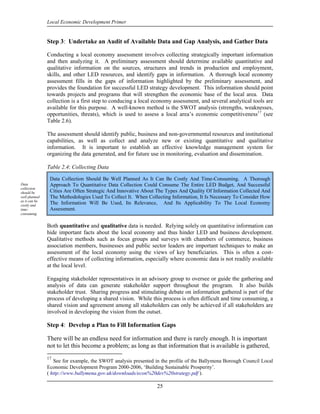
summary of their usefulness. By accessing the following site, direct Web-enabled links may be
accessed: www.worldbank.org/urban/led and then click on Links to World Bank sites.


                                                 70
Local Economic Development Primer


Organizing the Effort
The World Bank’s Participation Group Web site contains a variety of information on
participation methods including key readings, tools and resources. It also provides information
on mechanisms for the monitoring and evaluation of participation methods. Of particular interest
is the section on good practice and lessons learned. The Participation Sourcebook, the Poverty
Reduction Strategy Sourcebook, especially its chapter on participation are also key Bank
documents that provide direction on participation.

The Local Economy Assessment
The Bank has designed a number of tools to determine the economic potential of an area.
Although most of these tools are designed for determining national competitiveness, many of the
methodologies can be used to determine local competitiveness. The World Bank’s Business
Environment Web site offers tools for assessing the business environment of the local area. These
include surveys including expert and elite surveys, performance based firm level surveys, and
constraints surveys; indicators of national and regional and local competitiveness, as well as
information on transaction costs. In addition, the Bank’s database of competitiveness indicators
is a collection of 49 indicators to quickly assess economic performance and the environment for
competitive business development in a large number of countries. Of particular interest are the
infrastructure and investment climate indicators.

Strategy Making and Program Implementation: The following World Banks Web sites are
useful resources for specific programs that may be undertaken within an LED Strategy:

Foreign and Inward Investment Promotion
   Foreign Investment Advisory Service at http://www.fias.net/
   Investment Promotion Network at http://www.ipanet.net/
   Foreign Direct investment. Useful information can be discerned from the Foreign
   Investment Advisory Service Web site.
   Multilateral Investment Guarantee Agency at http://www.miga.org
   See also the MIGA Investment Promotion Toolkit.

Small medium and micro enterprise development. The IFC’s SME department Web site
contains a wealth of information including publications and an SME toolkit.

Anti-Corruption/Transparency. Corruption or lack of transparency in Local Government
negatively affects the local business environment. The governance and anticorruption Web site
contains information, tools and case studies on reducing corruption in governmental structures.
http://www1.worldbank.org/publicsector/anticorrupt/index.cfm


Sample Documents

An Example of an Implementation Plan
An Example of a Project Action Plan
An Example of a Vision to Projects Matrix
An Example of a Local Business Enabling Environment


                                               71
Local Economic Development Primer


Implementation Plan: List of Development Projects
                                                                     List of Development Projects
                                                  Total               Funding Sources (%)                                              Project                       Targeted
                                                                                     State or       Private     Implementing
No. Project Title                                 Value                 City                                                           Starting        Duration       Group /
                                                            Donors
                                                                     Government
                                                                                  International    Sector &       Partners
                                               (in Euros)                             Funds       Community                              Date                       Beneficiaries
     Reconstruction of the stone clock                                                                                                                 September     Unemployed
 1                                               19,440     50%        50%           50%              -        Ministry of Labor       June 2004
     tower in the village                                                                                                                                2004        and tourists
     Improving Energy Efficiency in                                                                              Parent-Teacher                                      High school,
 2   Public Sector High School of Natural       231,000     100%         -          100%              -            Committee           June 2004       18 months     city budget,
     Sciences                                                                                                 School Management                                      community
                                                                                                              Tourists Information
     Strengthening Tourist Information                                                                                                                              TIOs, tourists,
 3                                               9,800      66%        33%           33%            33%       Office, Association      June 2004       12 months
     Office network performance                                                                                                                                      community
                                                                                                                of Hotel Owners
                                                                                                              Local communities,
     Construction of water supply system                                                                       water supply and                        September       Local
 4                                              183,040     80%        20%           70%            10%                                May 2005
     for area                                                                                                  sewerage system                           2006        Community
                                                                                                                      fund
                                                                                                                                                                     Hotel owners,
     Construction of Sports and Tourism                                                                                              Pre-feasibility    Not yet
 5                                             68,060,000   93%         7%           14%            79%       Central Government                                    tourists and all
     Center:                                                                                                                          study done        defined
                                                                                                                                                                    the community
                                                                                                                                                                      Craftsmen,
     Traditions and the past: an alternative                                                                    Craftsmen, local                       December
 6                                               16,400     70%        30%           70%              -                               April 2004                      community,
     for the future of village                                                                                    community                              2004
                                                                                                                                                                        tourists
     Initiate an LED M&E training                                                                              Cities of Change                                           City
 7                                               3,000        -        100%            -              -                                July 2004       5 months
     procedure                                                                                                     Program                                          Administration
                                                                                                                                                                     Unemployed,
     Reconstruction and hydro isolation                                                                                                                                 History
                                                                                                                                                       September
 8   placement of Museum House in the            29,368     50%        50%           50%              -        Ministry of Labor       June 2004                       Museum,
                                                                                                                                                         2004
     District                                                                                                                                                            Local
                                                                                                                                                                      community
                                                                                                                                                                     Private sector
                                                                                                              Business community
 9   Brownfield revitalization project          155,000     90%        10 %            -            90 %                               May 2004        April 2007         and
                                                                                                                  and owners
                                                                                                                                                                      community


                                                                                        72
Local Economic Development Primer


LED Project Action Plan
Project: # 1                                                 Program Type(s):
BUSINESS ADVICE CENTER                                       Encouraging Local Business Growth
                                                             Encouraging New Enterprise
Short Description of the Project:
Establish an office with one or more professionals to offer professional advice to existing or potential
entrepreneurs in management, finance, marketing and personnel. Related services include: assisting owners in
business planning, preparing loan applications, offering business expansion information, organizing short
business courses, supporting the business community through information and communication (roundtables,
conferences etc.). The Advice center should provide feedback to the local administration on potential problems
in the business climate and highlight areas for improvement. Potentially, the center could be financially self-
sustainable with clients paying the full costs of services received; alternatively, a subsidized fee may be charged
for direct services with other services such as seminars being fee of charge.
Expected Results:                                           Target Group(s):
Decrease in unemployment                                    Existing entrepreneurs that wish to expand their
Reduction of business failures                              businesses
Increase in new businesses                                  People with business ideas that lack knowledge or the
Increased contribution of the private sector to the         means for starting up a business
municipal budget and local economy                          New small investors
Improved business enabling environment (favorable to
new investments)
Possible Stakeholders:                                      Possible Contributions to the Project:
Local Business Association and/or private sector:           Potential champion of the project
professional assistance                                     Material contribution: equipment and/or expertise
Local government: stronger SMEs and lower                   Offer of direct support: premises, political support,
unemployment, a better economy, and higher local            expertise
income
Local educational and other institutions: future jobs       Contribution of technical advice through experts
for students                                                May provide job matching service
City Diaspora: assistance in finding investment             Financial support
opportunities and support for local relatives               May offer information and opportunities: business
                                                            opportunities, apprenticeships for managers,
                                                            innovative ideas
International organizations: practical assistance for       Financial support
SME development                                             Technical assistance
Prerequisites:                                              Risk Factors:
An organization exists to take leadership of the project Potential for Center to be owned or unduly influenced
Specialists are available to provide services               by special interest groups
Available premises and equipment                            Low business potential of the region
Available financial resources                               Limited financial or other resources for businesses
Estimated Costs:                                            Running costs: €4,000 annually
€22,000 in the first year; €16,000 in years 2 and 3         Stakeholders may contribute in cash or in-kind:
Premises: €3,600/year (€300/month)                          premises, equipment, volunteer work
Equipment: €6,000                                           For special events (training, conferences) additional
Salaries: €8,400 for 3 people                               funds should be raised
Time for Implementation:                                    Time to Impact:
Minimum duration at least 3 years                           First evaluation after 1 year of operations
Start-up in less than 6 months                              Each subsequent year results monitored against an
                                                            initial set of data (number of businesses, contribution
                                                            to the total revenue of the community, number of
                                                            unemployed, increased export)
Outputs:                                                    5 new business start-ups annually
50% of loan applications granted                            20% of assisted businesses expand markets
40% of all assisted businesses increase revenues            50 new jobs created in 3 years


                                                        73
Local Economic Development Primer


‘Vision to Projects’ Matrix
Vision                  Goals                       Objectives                             Programs              Projects
By 2010, this city      G1: To transform the        G1:O1: By 2006, to improve
will have a dynamic,    local government so         business processes, liaison and
business-oriented       that it is responsive to    services so that business surveys
government and be       business customer           indicate a 90% satisfaction rating
characterized by an     needs                       for all interactions with the
attractive business                                 municipality
enabling                G2: To ensure               G2:O1: By 2006, to ensure,
environment that        appropriate provision of    through the use of business attitude
provides the basis      business services and       surveys, that the local business
for a wide range of     conditions to support       enabling environment is
entrepreneurial and     the development and         considered greatly improved by
employment              expansion of new and        80% of businesses
opportunities. The      expanding businesses
city will be home to    G3: To develop the          G3:O1: By 2010, to ensure that         G3:O1:PG1:            G3:O1:PG1: p1: Develop industrial and commercial
a diverse and           built and human             appropriate investments and            Industrial Premises   property register
growing range of        infrastructure capacity     programs are in place to have          Development           G3:O1:PG1: p2: Undertake property demand and
businesses that         needed for business         eliminated, or reduced                 Program               supply research study
provide a broad         growth                      considerably, 10 of the highest        G3:O1:PG2:            G3:O1:PG2: p1: Undertake skills needs assessment
range of                                            priority business infrastructure       Human Resource        with employers
employment                                          constraints identified by the          Enhancement           G3:O1:PG2: p2: Enable the provision of basic literacy
opportunities in the                                business survey                        Program               courses for disadvantaged
service, agricultural                                                                                            G3:O1:PG2: p3: Review the skills and skills needs of
and manufacturing                                                                                                the unemployed
sectors.                G4: To attract new and      G4:O1: To increase the amount of       G4:O1:PG1:            G4:O1:PG1: p1: Review and maintain donor program
                        inward investment           investment in the city from all        International Donor   database and contacts
                        projects from the           sectors to 10% higher than the         Investment            G4:O1:PG1: p2: Develop donor liaison program
                        private, public and third   national average by 2006               Program
                        sectors, maximizing                                                G4:O1:PG2:            G4:O1:PG2: p1: Business Location Service in City
                        opportunities from the                                             Investment            Hall
                        donor community                                                    Attraction Strategy   G4:O1:PG2: p2: Develop local business ambassadors
                                                                                                                 program
                                                                                                                 G4:O1:PG2: p3: Develop Investment Information
                                                                                                                 Database
                                                                                                                 G4:O1:PG2: p4: Develop database and liaison
                                                                                                                 program for international investors in the city
                                                                                                                 G4:O1:PG2: p5: Develop targeted marketing effort
                                                                                                                 to attract appropriate investment

                                                                                  74
Local Economic Development Primer


      Local Business Enabling Environment Survey24
                    Local Business Enabling Environment Survey Instrument

      The aim of this Local Business Enabling Environment Survey Instrument is to obtain information on your
      perceptions of local conditions and regulations that affect local businesses. The goal is to highlight policies and
      practices that hinder business development and identify key opportunities and issues facing local businesses.
      Your answers should reflect only your experience of the city/municipal business enabling environment. The
      information obtained will be treated confidentially and neither your name, nor the name of your business will be
      used. The information will be used by the Local Economic Development Partnership in your city/municipality to
      help develop a strategy to develop the local economy. Your input to that strategy is invited by contacting:
      _____________________________


                                      I. Information About Your Business

Q.1   What is your position/job title in this business?

       Owner
       Chief Executive/Chief Operating Officer/Principal
       Manager (finance, marketing, personnel)
       Other (please specify)
       …………………………………………………………

Q.2   Type of business activity?

       Agricultural Production
       Manufacturing
       Retail Trade
       Service Sector
       Construction
       Other (please specify)
       ……………………………………………….………...


      24
         This survey instrument was designed by a team of consultants under the guidance of Gwen Swinburn, Senior
      Urban Specialist at the World Bank. The team included consultants Fergus Murphy, World Bank and Carmen
      Zarzu, Romania. Contributions were also received from Artan Rroji at the Foundation for Local Autonomy and
      Governance, Albania. Support for developing and piloting this survey was received from the Local Government
      Institute, Budapest, and the World Bank. The survey serves as a quick and easy tool to obtain the views from
      businesses and local institutions as inputs into a local economic development strategic planning process. As this
      instrument is piloted and used, the World Bank requests that results and suggestions for survey enhancement are
      sent to urbanhelp@worldbank.org. LED practitioners are encouraged to abstract or reproduce the survey to suit
      their needs with the usual acknowledgements. A spreadsheet will shortly be prepared to facilitate the analysis of
      survey results. Further information about the local economic development program at the World Bank can be
      found at www.worldbank.org/urban/led and www.deltakosova.org/

                                                              75
Local Economic Development Primer


Q.3     Organizational form. (please choose one)

                        Type                           Private Enterprise               Public Enterprise
         a) Partnership
         b) Sole proprietorship
         c) Cooperative
         d) Other (please specify)
         ……………………………………..

Q.4     What are your key business products/services?
        ___________________________________________________________________________________
        ___________________________________________________________________________________
        ___________________________________________________________________________________
        ___________________________________________________________________________________

Q.5     How long has your business been active (years/months)?
        ______________________________________

Q.6     Please estimate the percentage of your products/services that are sold:

         In your town/city area                                                                                %
         In the region                                                                                         %
         Within the country                                                                                    %
         Outside the country                                                                                   %

Q.7     How many people does your business currently employ (full-time equivalents)?

               0             1-5            6-10           11-50         51-200          >201            N/a


                         II. Business Perspective on the Operating Environment

Q.8     Do you intend to expand your business?                                    YES           Go to Q.8.1
                                                                                  NO            Go to Q.9

Q.8.1   Where do you intend to expand your business? (please tick the appropriate box)
             Within the Municipality               Outside the Municipality         Outside the Country


Q.9     Are you optimistic or pessimistic about the future of your business in your community?

                                                                            OPTIMISTIC
                                                                            PESSIMISTIC

Q.10    Does the business experience difficulties in finding qualified people?    YES
                                                                                  NO


                                                            76
Local Economic Development Primer


Q.11   In which skills areas do you think your staff need training? Rank each skills area from 1 to 9 according
       to priority, with 1 being the highest and 9 being the lowest.

         a.)   Technical skills                                f.) Finance
         b.)   Accounting                                      g.) Quality Control
         c.)   Computer skills                                 h.) Budgeting
         d.)   Management                                      i.) Other (please specify)
         e.)   Marketing and Sales                             …………………………………...

Q.12   Where do you experience the main competition for your products/services? Using a scale of 1-3,
       please rank accordingly in order of importance, 1 being the most competition, 3 being the least.

         a.) Other local businesses
         b.) National businesses
         c.) Foreign goods/suppliers

Q.13   Do you think that business associations can help you develop your business?

                                                                                YES
                                                                                NO
Q.14   List any business association operating in your community.
       ___________________________________________________________________________________
       ___________________________________________________________________________________
       ___________________________________________________________________________________
       ___________________________________________________________________________________

Q.15   In which business sector would you invest in a new business?
       ___________________________________________________________________________________
       ___________________________________________________________________________________
       ___________________________________________________________________________________
       ___________________________________________________________________________________

Q.16   Please list in order of importance, the five most important factors that hinder you from expanding your
       business. (do not prompt)

       1._________________________________________________________________________________
       2._________________________________________________________________________________
       3._________________________________________________________________________________
       4._________________________________________________________________________________
       5._________________________________________________________________________________


                                 III. Perceptions of Municipal Government


Q.17   Approximately how many days per year does the owner/manager spend dealing with municipal
       government officials on regulatory requirements? _____ days.

Q.17.1 Do you consider this to be:             Too Little               Reasonable             Too much


                                                         77
Local Economic Development Primer


Q.18    Approximately how much time per year does it take you to process and receive all of the required
        licenses and permits that allow you to operate as a business (please include land, construction, waste
        water, all other permits and certifications) _____ days.

Q.18.1 Do you consider this to be:                 Too Little               Reasonable            Too much

Q.19    Based on your current experience of municipal government practices, please rate each of the following
        practices in terms of how they currently impact your business. (Using a scale of 1-5, where 1 is no
        impact and 5 is the most impact, please circle the appropriate number).

                                                        No         Little    Moderate    Major      Significant
         MUNICIPAL PRACTICES                          Impact      Impact      Impact     Impact       Impact
         Rules and regulations change too                1          2           3          4            5
         frequently
         Too much time is spent in dealing with          1          2           3          4            5
         authorities
         Overlapping, duplicating and                    1          2           3          4            5
         contradictory rules
         Rules are too complex and impossible            1          2           3          4            5
         to comply with
         Requirements are unpredictable and              1          2           3          4            5
         depend on officials
         Lack of clear regulations in some areas         1          2           3          4            5
         Costs are too high and unpredictable            1          2           3          4            5
         Use of municipal power in unfair                1          2           3          4            5
         competition
         Unregulated competition from informal           1          2           3          4            5
         sector economy
         Corruption and irregular practices              1          2           3          4            5

Q.20    Please list in order of importance, the three most important measures that the municipal government
        could introduce/undertake to make it easier for your business to grow. (do not prompt)

       1.____________________________________________________________________________________________
       2.____________________________________________________________________________________________
       3.____________________________________________________________________________________________

Q.21    From the list below and using a scale of 1-6 where 1 is the most important, please identify in order of
        importance, the measures that you would like to see introduced by the municipality that you think
        would support your business to develop and expand.

         MUNICIPAL MEASURE                                                          Rank in Importance (1-6)
         Provide training and expertise for the business
         Improve procedures for businesses
         Provide information on business development
         Improve business support infrastructure
         Reforming local taxation policies
         Other (please specify) …………………………….. ……………..


                                                             78
Local Economic Development Primer


Q.22   Based on your current experience of factors that affect the growth and effective operation of your
       business, please rate each of the following factors in terms of how they impact your business. (Using a
       scale of 1-5, where 1 is no impact and 5 is the most impact, please circle the appropriate number).

                                                     No         Little    Moderate     Major       Significant
        INFRASTRUCTURE                             Impact      Impact      Impact      Impact        Impact
        Roads                                         1           2           3           4             5
        Rail                                          1           2           3           4             5
        Air Access                                    1           2           3           4             5
        Port Access/services                          1           2           3           4             5
        Business premises/land                        1           2           3           4             5

                                                      No        Little    Moderate     Major       Significant
        PUBLIC SERVICES                             Impact     Impact      Impact      Impact        Impact
        Tax administration                            1           2           3           4             5
        Business licensing and operating              1           2           3           4             5
        permits
        Electricity supply                            1           2           3           4             5
        Water availability                            1           2           3           4             5
        Solid waste disposal                          1           2           3           4             5
        Telecommunications availability               1           2           3           4             5
        Police protection                             1           2           3           4             5
        Fire protection                               1           2           3           4             5
        Planning and zoning regulations               1           2           3           4             5

                                                      No        Little    Moderate     Major       Significant
        QUALITY OF LIFE                             Impact     Impact      Impact      Impact        Impact
        Tax rates                                     1           2           3           4             5
        Medical care and hospitals                    1           2           3           4             5
        Education system                              1           2           3           4             5
        Hotel facilities                              1           2           3           4             5
        Conference facilities                         1           2           3           4             5
        Telecommunications costs                      1           2           3           4             5
        Crime, theft and disorder                     1           2           3           4             5
        Housing costs and availability                1           2           3           4             5
        Recreation amenities                          1           2           3           4             5

                                                     No         Little    Moderate     Major       Significant
        OTHER                                      Impact      Impact      Impact      Impact        Impact
        Lack of qualified personnel                   1           2           3           4             5
        Customs and trade regulations                 1           2           3           4             5
        Corruption                                    1           2           3           4             5
        Access to, and cost of, financing             1           2           3           4             5
        Availability of effective business            1           2           3           4             5
        support services


                                                          79
Local Economic Development Primer


Q.23   Based on your current experience, how good do to you think the support to Small and Medium-sized
       Enterprises (SMEs) is in your community? (Using a scale of 1-5 where 1 is poor and 5 is excellent, please
       circle the appropriate number).

        SUPPORT TO SMEs                             Poor              Fair       Satisfactory       Good             Excellent
        Business Associations                           1               2             3              4                  5
        Professional Associations                       1               2             3              4                  5
        Municipal Government                            1               2             3              4                  5
        Central Government                              1               2             3              4                  5
        Professional Private Services                   1               2             3              4                  5
        Local Economic Development Office               1               2             3              4                  5
        Regional Economic Development                   1               2             3              4                  5
        Office
        International Organizations                     1               2             3              4                  5
        Non-Governmental Organizations                  1               2             3              4                  5

Q.24   How would you rate your relationship with the following bodies/departments? (Using a scale of 1-5
       where 1 is poor and 5 is excellent, please circle the appropriate number).

        WORKING RELATIONSHIPS                     Poor           Fair        Satisfactory   Good         Excellent        N/A
        Mayor                                       1             2               3             4           5               6
        City Council                                1             2               3             4           5               6
        LED Team in City Hall
        Municipal Finance and Tax                   1             2               3             4           5               6
        Department
        Economic Development Office of the          1             2               3             4           5               6
        Regional Government
        Prefect                                     1             2               3             4           5               6
        National/State Tax and Income Tax           1             2               3             4           5               6
        Directorate

Q.25   Which municipal government department most positively affects the development of your business and
       why?
       ____________________________________________________________________________
       ____________________________________________________________________________
       ____________________________________________________________________________
       ____________________________________________________________________________

Q.26   Which municipal government department most negatively affects the development of your
       business and why?
       ___________________________________________________________________________________
       ___________________________________________________________________________________
       ___________________________________________________________________________________
       ___________________________________________________________________________________

Q.27   Can you name one municipal government department that deals with local economic development?

                       YES                 Please provide the name of the department ____________________
                       NO

                                                            80
Local Economic Development Primer


Q.28   Which of the following groups, if any, is the most active in promoting local economic development in
       your community? (please tick/check only one)

        Municipality
        A formal incorporated public-private partnership organization
        Private business (Chamber of Commerce, Board of Trade)
        Other (please specify)
        …………………………………………………………………………………………………..
        Do not know

Q.28.1 Does the municipal government provide any LED funding for external organizations? If yes, please
       specify which organization.
                                                  YES             ______________________________
                                                  NO
                                        DO NOT KNOW

Q.29   Which of the following best describes the situation with regard the organization and delivery of local
       economic development in your municipality? (please tick/check only one)

        The office of the Mayor/chief executive officer/city manager has responsibility for local
        economic development activities
        Local economic development activities are centralized in a separate department/division
        Local economic development is decentralized and functions are carried out by several line
        departments
        Some local economic development functions are centralized while others are carried out by
        separate line departments
        Local economic development is a function of a larger agency, such as a community
        development department, that is responsible for housing, zoning, and inspections
        Do not know


                IV. Business View on the Economic Development of the Community

Q.30   In order of importance, which are the three fastest growing sectors/industries in your community?
       ____________________________________________________________________________
       ____________________________________________________________________________
       ____________________________________________________________________________

Q.31   In your opinion, which are the three sectors/industries that are declining the most in your community?
       _________________________________________________________
       _________________________________________________________
       _________________________________________________________
       _________________________________________________________


                                                         81
Local Economic Development Primer


Q.32   Which are the three most attractive businesses enabling environment features about your community for
       investors (three strengths)?
       ____________________________________________________________________________
       ____________________________________________________________________________
       ____________________________________________________________________________

Q.33   In order of importance, which are the three worst businesses enabling environment features (three
       weaknesses)?

       1.__________________________________________________________________________
       2.__________________________________________________________________________
       3.__________________________________________________________________________

Q.34   In your opinion, how has the overall business enabling environment changed over the last three years?
       (Please circle the appropriate number)

                  Improved                        Stayed the Same                    Deteriorated
                     1                                   2                                3

Q.35   What three things could you do to contribute towards the development of the local economy in your
       city?

       1.__________________________________________________________________________
       2.__________________________________________________________________________
       3.__________________________________________________________________________

Q.36   From the list below, please select the most appropriate description that describes the development of
       your community’s economy during the last five years. (please tick/check only one)

        Rapid growth
        Moderate growth
        Slow growth
        Economic base is stable; no real growth or decline
        Modest decline
        Significant decline

Q.37   Does your municipality have an official economic development plan?     YES        Go to Q.37.1
                                                                              NO         Go to end


                                                         82
Local Economic Development Primer


Q.37.1 Do you or somebody you know that participated in the economic development process, know which of
       the following methods were used to develop the plan? (check/tick all that are applicable)

        Business needs survey
        Citizen survey
        Advisory committees appointed to represent the entire community
        Special interest advisory groups (e.g., city center/downtown merchants, top
        industry representatives)
        Elected neighbourhood commissions
        Open meetings/public hearings
        Inspections/evaluations of the condition of existing facilities
        Consultant studies (please provide a brief description of what these were)
        ……………………………………………………………………………………….
        Analysis of local data on permits, employment, etc.
        Information from state agencies responsible for economic development
        Other (please specify) ………………………………………….……………………

                                                 Thank You


                                                      83

Led primer

  • 1.
    LOCAL ECONOMIC DEVELOPMENT:A PRIMER DEVELOPING AND IMPLEMENTING LOCAL ECONOMIC DEVELOPMENT STRATEGIES AND ACTION PLANS BY GWEN SWINBURN SORAYA GOGA & FERGUS MURPHY BERTELSMANN STIFTUNG THE WORLD BANK JANUARY 2006
  • 2.
    Local Economic DevelopmentPrimer Acknowledgements This LED Primer was written by the Local Economic Development team based in the Urban Development Unit of the World Bank. The methodology was developed by Gwen Swinburn, Senior Urban Specialist and this Primer was written by Gwen Swinburn and Fergus Murphy, consultant with contributions from Soraya Goga, Young Professional, Kate Kuper, Senior Urban Specialist, and André Herzog, Consultant. Information used in this guide was obtained, with permission, from ‘Local Economic Development: Good Practice from the European Union and Beyond’ (2000), an unpublished paper prepared by Gwen Swinburn for the Urban Development Unit of the World Bank. The Primer and methodology has benefited from peer review from a side range of global practitioners and academics, for which grateful thanks are given here. Should you wish to comment on the usefulness of the Primer, or suggest additional information or case studies, do contact the World Bank urbanhelp@worldbank.org, gwen.swinburn@gmail.com and gswinburn@worldbank.org Reading this Primer Where text appears in the margin of a page, this is meant to highlight a specific issue that is of particular relevance to LED strategic planning. For the sake of consistency, this LED Primer will refer to municipal government and municipality as the institutional level of local government with responsibility for LED strategic planning. This Primer is suitable however for a wide range of organizations seeking to develop a capacity for, and understanding of, local economic development strategic planning, including national, regional and city governments, local authorities, town councils, city hall, local government departments and public-private partnerships. This list is not exhaustive. Disclaimer The findings, interpretations and conclusions expressed in this document are entirely those of the authors and should not be attributed in any manner to the World Bank or its affiliated organizations, members of its Board of Executive Directors, the governments they represent, or the Bertelsmann Foundation. The World Bank and the Bertelsmann Foundation do not guarantee the accuracy of the data contained in the document nor do they accept responsibility for any consequences of its use. i
  • 3.
    Local Economic DevelopmentPrimer © 2006, Bertelsmann Stiftung, Gütersloh; The World Bank, Washington, D.C. Responsible: Gabriele Schöler, Claudia Walther Cover Design: Boris Kessler Layout and typesetting: Vanessa Meise www.worldbank.org/urban/led www.citiesofchange.net ii
  • 4.
    Local Economic DevelopmentPrimer TABLE OF CONTENTS FOREWORD ........................................................................................................................ VI INTRODUCTION TO LOCAL ECONOMIC DEVELOPMENT ..................................................... 1 What is Local Economic Development? ..........................................................................................1 What Does Practicing Local Economic Development Mean? .........................................................1 How Can a Strong Local Economy Be Built?..................................................................................1 Who Does Local Economic Development?......................................................................................1 Why Do Local Economic Development?.........................................................................................1 THE LED STRATEGIC PLANNING PROCESS ...................................................................... 4 Stage 1: Organizing the Effort..........................................................................................................4 Stage 2: Local Economy Assessment...............................................................................................5 Stage 3: Strategy Making .................................................................................................................6 Stage 4: Strategy Implementation ....................................................................................................6 Stage 5: Strategy Review .................................................................................................................7 STAGE ONE: ORGANIZING THE EFFORT ......................................................................... 10 Step 1: Identify the LED Team Leader and Establish a City Hall Staff Team...............................10 Step 2: Establish a Political Process in City Hall ...........................................................................12 Step 3: Develop A Stakeholder Partnership Group ........................................................................13 Step 4: Develop Systems to Work with Other Tiers of Government .............................................15 Step 5: Consider the Organization to Develop LED Strategies and Projects .................................16 STAGE TWO: LOCAL ECONOMY ASSESSMENT ................................................................. 18 Step 1: Undertake Review of City Hall Procedures that affect Businesses...................................18 Step 2: Identify the Types of Data to be Collected........................................................................20 Step 3: Undertake an Audit of Available Data and Gap Analysis, and Gather Data.....................25 Step 4: Develop a Plan to Fill Information Gaps...........................................................................25 Step 5: Analyze Data and Produce An Assessment of the Local Economy ...................................26 STAGE THREE: STRATEGY MAKING ................................................................................. 28 Step 1: Creating a Vision................................................................................................................28 Step 2: Developing Goals...............................................................................................................28 Step 3: Developing Objectives .......................................................................................................29 Step 4: Developing Programs.........................................................................................................29 Step 5: Selecting Projects ...............................................................................................................41 STAGE FOUR: STRATEGY IMPLEMENTATION ................................................................... 42 Step 1: Prepare an Implementation Plan for all Programs and Projects .........................................42 Step 2: Prepare Individual Project Action Plans ............................................................................43 Step 3: Build Institutional Frameworks for LED Implementation and Monitoring .......................44 Step 4: Ensure Relevant Inputs are Available ................................................................................44 Step 5: Carry Out Tasks in Project Action Plans............................................................................45 iii
  • 5.
    Local Economic DevelopmentPrimer STAGE FIVE: STRATEGY REVIEW ................................................................................... 46 Step 1: What? Why? When?...........................................................................................................46 Step 2: Monitoring..........................................................................................................................47 Step 3: Evaluation ..........................................................................................................................47 Step 4: Institutional Arrangements.................................................................................................51 Step 5: Strategy Review and The Planning Process .......................................................................52 RESOURCES....................................................................................................................... 55 Glossary of LED Terms .................................................................................................................55 Key Readings .................................................................................................................................58 Case Studies ...................................................................................................................................63 Links to External Organizations.....................................................................................................64 Links to World Bank Web Sites.....................................................................................................70 Sample Documents.........................................................................................................................71 iv
  • 6.
    Local Economic DevelopmentPrimer TABLES: Table 1: The five stage sequence of the local economic development strategic planning process . 4 Table 2: SWOT Analysis: Examples of Local Economy Assessment Issue ................................... 5 Table 3: The 5 Steps of LED Strategy Making: ‘Visions to Projects’ ............................................ 6 Table 4: ‘Vision to Projects’: The Strategic Elements .................................................................... 9 Table 1.1: Other Municipal Plans that Will Influence, Or Be Influenced By LED....................... 12 Table 2.1: Example of a ‘Start a Business’ Regulation Assessment ............................................. 19 Table 2.2: Business Enabling Environment Resource Tool .......................................................... 20 Table 2.3: Local Economic Development Information ................................................................. 23 Table 2.4: Collecting Data............................................................................................................. 25 Table 3.1: Example of an LED ‘Vision’ ....................................................................................... 28 Table 3.2:Examples of LED Goals................................................................................................ 29 Table 3.3: SMART Objectives ...................................................................................................... 29 Table 3.4: Example of LED Goals with Objectives ...................................................................... 29 Table 3.5: Program Option 1: Improving the Local Business Investment Climate....................... 31 Table 3.6: Program Option 2: Investment in Hard Strategic Infrastructure .................................. 32 Table 3.7: Program Option 7: Promoting Inward Investment ....................................................... 37 Table 4.1: Key Issues in Implementing the LED Strategy ............................................................ 42 Table 4.2: Key Components of an Action Plan ............................................................................. 43 Table 5.1: Issues to Include in the Revision of the LED Strategy................................................. 47 Table 5.2: Process and Outcome Evaluation ................................................................................. 48 Table 5.3: Summary of Differences Between Monitoring and Evaluation ................................... 50 Table 5 4: Example of Events to Measure Project Progress.......................................................... 51 Table 5.5: Conventional and Participatory Evaluation.................................................................. 53 v
  • 7.
    Local Economic DevelopmentPrimer FOREWORD The Urban Development Unit of the World Bank, in collaboration with partners including the United Kingdom Department for International Development and the Bertelsmann Foundation and the Soros Foundation, has developed a range of resources to enable communities to understand and develop local economic development strategies. A key part of this effort was a pilot program, called the Cities of Change program, an initiative that sought to foster policy and administration reform in the areas of local economic development and environmental management. Undertaken between 2000 and 2004 the program sought to promote democracy and efficiency in municipalities in Central and Eastern Europe. The Cities of Change initiative was designed to foster constructive, informal, cross-border dialogue on the role of local politicians, the effectiveness of local administrations and the enhancement of public participation. The aim of the Cities of Change network was to: Strengthen the capacity of municipalities to conduct strategic planning and develop action plans; Encourage the exchange of best practice among municipalities to provide access to international expertise and knowledge; and, Facilitate the dissemination of results. The Local Economic Development (LED) component of the Cities of Change initiative sought to build municipal capacity to improve local economies and generate an enabling environment for employment generation. In doing so, the program developed and piloted the use of a five-stage approach to the LED strategic planning process, as set out in this Primer. The methodology and knowledge resources have since been used across the globe by World Bank clients and others. The target communities have ranged from communities of less than 20,000 inhabitants to over 3,500,000. Developed as a resource to assist communities to develop local economic development strategies, the Primer has been prepared for towns, cities and communities that are new to LED and that wish to help their local economies grow. The Primer seeks to provide municipalities, practitioners, businesses and communities with an understanding of what local economic development is, why and how it is practiced. It aims to identify the initial steps to starting the local economic development planning process, and has been developed using good practice from a number of transitioning and developing economies, as well as from North America and the European Union. The Primer highlights examples of good practice in local economic development strategic planning and implementation, and draws on the lessons and experiences gained from the Cities of Change local economic development network as well as experiences from other programs across the globe. It is hoped that the Primer will serve to explain some of the complexities associated with local economic development strategic planning so that they are more easily understood. This Primer is one of a number of tools that have been developed by the World Bank to understand better Local Economic Development. This work was done in conjunction with a number of partners and specific thanks are due to the British Department of International Development (DFID) that funded and supported a Capacity Building and Knowledge Sharing Program in LED. There are many further resources, some translated that are constantly updated vi
  • 8.
    Local Economic DevelopmentPrimer on the following web site: www.worldbank.org/urban/led. Of particular interest will be a trainers manual and casebooks, all available for use and found on the home page. Permission to use these materials is not required. However, should the guide be translated, the World Bank and the Bertelsmann Foundation request that an electronic copy be forwarded to both organizations for reference. This document is available on the World Bank, Bertelsmann Foundation and Cities of Change Web sites. Should you wish to comment on the usefulness of the Primer, or suggest additional information or case studies, please contact the World Bank at urbanhelp@worldbank.org, gwen.swinburn@gmail.com and gswinburn@worldbank.org vii
  • 9.
    Local Economic DevelopmentPrimer INTRODUCTION TO LOCAL ECONOMIC DEVELOPMENT What is Local Economic Development? The purpose of local economic development (LED) is to build up the economic capacity of a local area to improve its economic future and the quality of life for all. It is a process by which public, business and non-governmental sector partners work collectively to create better conditions for economic growth and employment generation. What Does Practicing Local Economic Development Mean? The success of a community today depends upon its ability to adapt to the dynamic local, national and international market economy. Strategically planned LED is increasingly used by communities to strengthen the local economic capacity of an area, improve the investment climate, and increase the productivity and competitiveness of local businesses, entrepreneurs and workers. The ability of communities to improve the quality of life, create new economic opportunities and fight poverty depends upon them being able to understand the processes of LED, and act strategically in the changing and increasingly competitive market economy. How Can a Strong Local Economy Be Built? Each community has a unique set of local conditions that either enhance or reduce the potential for local economic development, and it is these conditions that determine the relative advantage of an area in its ability to attract, generate and retain investment. A community’s economic, social and physical attributes will guide the design of, and approach to, the implementation of a local economic development strategy. To build a strong local economy, good practice proves that each community should undertake a collaborative process to understand the nature and structure of the local economy, and conduct an analysis of the area’s strengths, weaknesses, opportunities and threats. This will serve to highlight the key issues and opportunities facing the local economy. Who Does Local Economic Development? Successful private enterprise and productive public-private partnerships create wealth in local communities. Private enterprise however, requires a positive business enabling environment to deliver prosperity. Municipal government has an essential role in creating a favorable environment for business development and success. By its nature, local economic development is a partnership between the business sector, community interests and municipal government. LED is usually strategically planned by local government in conjunction with public and private sector partners. Implementation is carried out by the public, private and non-governmental sectors according to their abilities and strengths. Why Do Local Economic Development? LED evolved as a policy approach in the early 1970s in response to municipal governments realizing that businesses and capital were moving between locations for competitive advantage. 1
  • 10.
    Local Economic DevelopmentPrimer By actively reviewing their economic base, communities gained an understanding of the opportunities for, and obstacles to, growth and investment. With this newfound understanding, communities attempted to expand their economic and employment base by devising and undertaking strategic programs and projects to remove obstacles and facilitate investment. Today, local economies face an even greater set of challenges. These include: International Globalization increases both opportunities and competition for local investment. It offers opportunities for local businesses to develop new markets but also presents challenges from international competitors entering local markets. Multi-site, multi-national manufacturing, banking and service corporations compete globally to find cost efficient sites in which to locate. Technologically advanced growth industries require highly specialized skills and a supporting technology infrastructure, but increasingly all industrial and service sectors needs highly specialized and specific skills and business environments. Local conditions determine the relative advantage of an area and its ability to attract and retain investment. Even small towns and their surrounding rural regions can develop local economic opportunities at a national or international level by building on their local economic strengths. National At the national level, macro-economic, fiscal and monetary reforms have directly impacted the economy at the local level. National regulatory and legal frameworks such as tax reform, telecommunications deregulation and environmental standards directly influence the local business climate, either enhancing or reducing the potential for local economic development. In many countries, national government functions continue to be decentralized thereby increasing the responsibility of municipal governments to retain and attract private industry. Regional Communities within and between regions often compete to attract external and local investment. Opportunities exist for communities across regions to collaborate with each other to help their economies grow, for example, by supporting infrastructure or environmental improvements that demonstrate a broad regional impact. An association of local municipalities or regional governments can serve to facilitate these types of LED effort by acting as an intermediary between national and municipal governments. Metropolitan and Municipal Businesses, both large and small, often choose to locate in urban areas because of agglomeration economies (i.e., the benefits derived from sharing markets, infrastructure, labor pools and information with other firms). The economic advantage of urban areas depends significantly on the quality of urban governance and management, and on the policies affecting the availability, or lack, of electricity, transport, telecommunications, sanitation and developable urban land. Factors affecting labor productivity in the local economy include the availability and quality of housing, health and1 education services, skills, security, training opportunities and public transport. These 1 LED infrastructure comprises two main components, ‘hard’ physical infrastructure incorporating roads, rail, water, sewerage and drainage systems, and energy and telecommunications networks; and ‘soft’ infrastructure of social, cultural and community facilities and capacity that enhance the quality of life and encourage industry and business development. 2
  • 11.
    Local Economic DevelopmentPrimer ‘hard’ and ‘soft’ infrastructure factors are major determinants of a community’s relative advantage. The quality and provision of ‘hard’ and ‘soft’ infrastructure forms the cornerstone of a successful local economy. Metropolitan areas can offer increasing opportunities through economies of scale and effort as a result of the size of the physical and human capital available, as well as the size of its services and internal market. Uncoordinated and disparate institutional frameworks and planning bodies in metropolitan areas can serve to undermine area-wide economic growth. Metropolitan-wide LED agencies, consortia and networks can be created to address these constraints. These innovative institutional frameworks, which represent the interests of different municipalities and partner agencies in the same metropolitan area, can bring benefits to the key actors of each municipality (public departments, business and civil society organizations). These frameworks can serve to unite the efforts of different localities and increase LED results, and can strengthen representation in higher levels of decision-making. This type of cooperation has worked well for cities that belong to common market agreements or that have common sector interests (i.e. Eurocities2, Indonesian City Network3, South African Cities Network4). The most important and effective local economic development activity that a municipality can undertake is to improve the regulatory processes and procedures to which businesses are subjected by the municipality itself. A survey of most municipalities would reveal a number of complex, poorly managed, expensive and unnecessary business registration systems. By reducing these, a municipality can quickly improve its local investment climate. Disadvantaged Populations and Informal Economy In many countries, economic growth is determined not only by the formal economy (the economic sectors that are legally registered and pay taxes) but also by the informal economy (those activities that are not legally registered). In some cases the size of the informal economy is greater than the formal economy, and it interacts with the formal economy by supplying certain goods and services. The linkages between the formal and informal sectors of the economy need to be understood and considered in the devising of a local economic development strategy. Communities and businesses increasingly recognize that a successful local economy requires social, as well as economic, environmental and physical renewal. In many cities, large numbers of low-income families work within the informal economy. However, these informal activities are often low-growth activities as a result of a lack of access to proper infrastructure and services (i.e., electricity, water, roads), regular means of financing, information and skills. The development of an LED strategy should recognize and accommodate the constraints and opportunities of the informal economy so as to broaden the appeal of a strategically planned LED strategy. It should also encourage wider social benefits for all a community’s economic and social sectors, both formal and informal, disadvantaged and excluded. 2 http://www.eurocities.org/ 3 http://www.cdsindonesia.org/ 4 http://www.sacities.net/ 3
  • 12.
    Local Economic DevelopmentPrimer THE LED STRATEGIC PLANNING PROCESS Good practice indicates that local economic development should always be guided by a strategy. Ideally, an LED strategy will form a component of a broader strategic development plan that includes social and environmental components. The LED strategy provides a focus on strengthening the local economy and building local capacity. The timeframe for an LED strategy is typically three to eight years and includes annual implementation plans. The logical sequence of these stages is outlined in the table below. THE FIVE STAGE STRATEGIC PLANNING PROCESS A local economic development strategic planning process typically has five stages, and while LED strategic these are highlighted below as separate stages, in reality, LED strategic planning is a flexible planning is a process and one stage often continues in parallel with another according to local needs. If flexible process and one stage problems are encountered during a particular stage, it may not be as a result of work in that stage often continues but the appropriateness of a previous stage. Previous and subsequent stages may need to be in parallel with another refined or reworked to resolve problems. The strategy is a living document that should be according to changed as circumstances dictate. local needs. Table 1: The five stage sequence of the local economic development strategic planning process LOCAL ECONOMIC DEVELOPMENT THE FIVE STAGES Stage 1: Organizing the Effort Stage 4: Strategy Implementation Stage 2: Local Economy Assessment Stage 5: Strategy Review Stage 3: Strategy Making Stage 1: Organizing the Effort To successfully organize a local economic development strategy, institutional arrangements and stakeholder involvement should be agreed at an early stage of the planning process. An LED team should be established in City Hall or within a partner organization and this team should initially manage the strategic planning process. Successful local economic development requires the collaborative effort of public (governmental), private (business) and non-governmental (NGOs, trade unions, social, civic, religious) sectors. The strategic planning process begins by identifying the people, public institutions, businesses, industries, civic organizations, professional organizations, think-tanks, training institutions and other groups that comprise and/or impact the local economy. The skills, experiences and resources that stakeholder groups bring to the effort will each Maintaining and contribute to the overall strategic planning process. Establishing solid working relationships and sustaining such organizational structures to support the strategy planning process will lead to beneficial long- partnerships is often the critical term, public, private and non-governmental partnerships. These working relationships can range and challenging from relatively informal working groups, to semi-formal, loosely aligned networks, to the factor determining the establishment of a regional development agency or a constituted public-private partnership. effectiveness of Maintaining and sustaining such partnerships is often the critical and challenging factor LED efforts. determining the effectiveness of LED efforts. 4
  • 13.
    Local Economic DevelopmentPrimer Stage 2: Local Economy Assessment Knowing the characteristics of the local economy is critical if stakeholders are to identify and agree a realistic, practical and achievable LED strategy. To elicit key data on the local economy, an effective local economy assessment will start with a preliminary review of the existing economic relationships and activities within an area, and will make use of available quantitative and qualitative information that highlights existing structures and trends in business development, manufacturing, employment, skills, and other data that will help to identify the strategic direction of the local economy. The assessment need not necessarily be limited by an administrative jurisdiction or boundary such as a municipal boundary. An area might consist of a metropolitan region, a travel-to-work area, a town, city or its urban or rural hinterland. The information collected may highlight the need for specific projects and programs that will expand and diversify the local economic base. The first step in a local economy assessment is to determine what information is pertinent, required and available, and to identify the vague, missing or non-existent data that it will be Effective LED strategy necessary to obtain for the local economy assessment. After obtaining this data, it will be planning will necessary to collate and analyze the data so as to provide a profile of the local economy. Several include a review and tools including SWOT analysis (Table 2), benchmarking and regional economic indicators may analysis of be used to identify key information on the local economy. Effective LED strategy planning will the contribution include a review and analysis of the contribution of local economic development programs and of LED programs and projects that are already happening in the area. projects that are already happening in Table 2: SWOT Analysis: Examples of Local Economy Assessment Issue the area. EXAMPLE OF ISSUES OF A LOCAL ECONOMY ASSESSMENT Strengths Competitive wage rates, skilled workforce, educational and research Local assets institutions, strong transportation network, safe locality, productive existing firms, proximity to raw materials or other natural resources. Weaknesses Worsening poverty, complex local regulatory procedures, inadequate Obstacles to growth infrastructure, limited access to credit, health issues affecting the workforce (e.g., HIV/AIDS), high crime rates. Opportunities Technological change, new international trade arrangements, Favorable exogenous macroeconomic/political developments, expanding markets, the (external) conditions development of a regional airport, emerging skilled workforce. Threats Demographic changes, downsizing of global business or loss of markets Unfavorable exogenous resulting in local plant closure, unstable exchange rates inhibiting local (external) trends investment, loss of educated population to other areas - outward migration. The local economy assessment will be used to: The assessment identify public, private and non-governmental resources;  should consider the collect and analyze existing or critical new quantitative and qualitative information; and, potential for a wide range of LED establish data management systems for future use in monitoring and evaluation. across all the major   sectors. Also important is comparative information on the resources and activities of neighboring communities or other local, regional, national or international competitors. The assessment should consider the potential for a wide range of local economic development opportunities across all the major sectors, including the formal, informal and community sectors. 5
  • 14.
    Local Economic DevelopmentPrimer The level and depth of data to be collected will be determined by availability, budget and nature The level and depth of data to of the local economy. In many developing countries, information about the economy is only be collected will available at the national level. Collecting detailed information about the local economy can be an be determined by availability, expensive process that municipalities with limited funds have difficulty in undertaking. In this budget and situation, it is necessary to consider various methods and approaches to understanding the local nature of the local economy. economy. Such approaches may include meetings with businesses and community groups, interviews and simple surveys. Stage 3: Strategy Making As in comprehensive city strategic planning, the intent is to achieve an integrated approach to local economic development strategic planning. In devising strategy, practitioners in municipal government and principal stakeholder groups will need to balance local economic development with environmental and social needs. A typical LED strategy has a number of components. Table 3: The 5 Steps of LED Strategy Making: ‘Visions to Projects’ ELEMENTS OF THE LED STRATEGY Vision Describes the stakeholders’ consensus on the preferred economic future of the community. Goals Based on the overall vision and specify desired outcomes of the economic planning process. Objectives Establish the performance standards and target activities for development of each goal. They are time bound and measurable. Programs Set out approaches to achieving realistic economic development goals. They are time bound and measurable. Projects and Implement specific program components. They must be prioritized, and costs must be Action Plans established. They are time bound and measurable. Stage 4: Strategy Implementation An LED strategy is an overall plan that has short, medium or long-term aims and actions and sets out what is going to be achieved. It will establish an agenda to promote and develop a local community’s economic, physical, social and environmental strengths and will address both challenges and opportunities. Implementation Plan Every LED strategy should have an implementation plan that in turn is supported by individual The LED project action plans. The implementation plan sets out the budgetary and human resource Implementati on Plan is a requirements, and institutional and procedural implications of implementing the LED strategy. single As a single document that contains all of the LED programs and projects within a strategy, it document that contains serves as an integrated programming document to maintain clarity of strategy direction, and all of the LED projects ensures that programs and projects do not inappropriately compete for resources and support. and programs With a timeframe of between one and three years, a good implementation plan will result in a within a strategy. more efficient and effective use of existing budgets, and can be used to attract funding from external sources such as national government, bilateral and multilateral donor agencies, and the private sector5. 5 An example of an implementation plan may be seen in the sample documents part of the Resource Section of this publication. 6
  • 15.
    Local Economic DevelopmentPrimer Action Plans LED action plans provide specific details on project components including a hierarchy of tasks, responsible parties, a realistic delivery timetable, human resource and financial needs, sources of funding, expected impacts, results, performance measures and systems for evaluating progress for each project6. Projects that can be implemented in the short term and that result in “early wins” play an important role in building momentum and stakeholder confidence. Other projects will have a medium to long-term timeframe. In each case, projects should be “championed” by individuals or a group of stakeholders according to interests, resources, commitment and expertise. Developing a good monitoring and evaluation system for an integrated LED strategy is important and allows for analysis and review. It enables the LED team to correctly quantify outcomes, justify expenditures, determine necessary enhancements and adjustments, and develop good practices. Indicators7 can be identified to measure both process and impact. Stage 5: Strategy Review Although an LED strategy is usually written for a three to eight-year period, the strategy should be reviewed annually to allow for adjustment in response to changing local conditions. A more comprehensive revision usually takes place every three years. The implementation of the LED strategy should however, be subject to a rigorous annual assessment. This review should consider the resources available for the delivery of the strategy and include established and agreed monitoring and evaluation indicators of the local economy. The review should include, where possible, inputs, outputs, outcomes and impacts, and also the implementation process and the level and extent of stakeholder participation. Alongside the strategy review, systems should be in place to monitor the progress of each project. These systems will allow decision makers to adjust the strategy in response to changing local conditions. As programs or projects are completed or deemed to be inappropriate, new ones can be identified. Good Practice for Strategy Success Good practice in local economic development requires tailored approaches to local conditions, Good and the following are excellent guiding principles: practice in local An integrated approach that includes social, environmental and physical, as well as economic economic development issues. requires tailored A carefully developed strategy built by all relevant partners and based on a shared vision. approaches to local Reference to the informal economy: the informal economy needs to be carefully taken into conditions, and the account. In some localities, it can represent a significant part of the local economy, be strongly following are inter-linked with formal activities and provide the economic basis for the majority of the poor. excellent guiding principles. A range of projects: short, medium and long-term, to catalyze partnerships and build stakeholder confidence. Influential and effective local leaders that bring commitment, credibility and an ability to unite stakeholders. 6 An example of a Project Action Plan may be seen in the sample documents part of the Resource Section in this publication. 7 See Glossary of LED Terms. Also available at: http://www.worldbank.org/urban/led/glossary.html 7
  • 16.
    Local Economic DevelopmentPrimer Capacity building of management and ‘on the ground’ teams are essential to project implementation. The LED strategy should be owned by the municipal government with a demonstrated strong political will to implement it. Political, financial and technical support from other levels of government that adds value. Projects and action plans should be undertaken only where a responsible manager or champion has been identified who is committed to successful implementation. 8
  • 17.
    Local Economic DevelopmentPrimer An Example to Show the Different Elements of a LED Strategic Plan Table 4: ‘Visions to Projects’: The Strategic Elements8 VISION: THIS MUNICIPALITY WILL BECOME GLOBALLY COMPETITIVE BY 2020 GOALS: 1. To diversify the economic base of the municipality. 2. To become a tourism center. 3. To improve the built environment of the municipality. 4. To become the most attractive municipality in the region for foreign direct investment. 5. To become a more equal society through improved access to work for all the community. (For each goal a series of objectives is formulated. Consider Goal 3 as an example) GOAL 3: To improve the built environment of the municipality. Objective 1: To utilize and develop all brownfield sites over one quarter of an acre by 2010. Objective 2: To adopt, within the next six months, planning policy guidelines to ensure that historic buildings more than 100 years old may not be altered or demolished without prior local authority consent. Objective 3: To ensure that all new applications to build industrial and commercial office space meet local, national and international standards for safety, environment and so on. These objectives should be time bound and quantifiable. Some should be short term (for early wins), some longer term. Then, for each objective, there should be a program of projects and activities. These need to be selected carefully using selection criteria. The result could look like this, for example: OBJECTIVE 1: To eliminate all Brownfield sites over one quarter of an acre in size by 2010. Program: brownfield Remediation Program Project 1.1: To develop a register of derelict Brownfield sites in the municipality and establish ownership. Project 1.2: To initiate a lobbying effort for national government and other funding to remediate the sites. Project 1.3: To prioritize sites according to the severity of their pollution/prominence in the municipality. Project 1.4: To review local and national legislation to ensure ‘polluter pays’ legislation is in place. Project 1.5: To develop and implement a strategy to ensure landowners remediate their sites, and that they be encouraged to bring them into beneficial use. Once the projects have been identified, prioritized, financed and a responsible person/group identified, detailed action planning and implementation can take place. PROJECT 1.1: To develop a register of Brownfield sites in the municipality and determine ownership. Action Plan: Ideally, these will be produced on a standard pro-forma including the following information: 1. Name of project 2. Short description of project 3. Itemized actions by date 4. Cost and budget profile 5. Responsible project manager, and responsible person for the whole objective/program 6. Expected outcomes 7. Monitoring process 8 An example of a “Vision to Projects matrix” may be seen in the sample documents part of the Resource Section of this publication. 9
  • 18.
    Local Economic DevelopmentPrimer STAGE ONE: ORGANIZING THE EFFORT STAGE 1 ORGANIZING THE EFFORT Step 1: Identify the LED Team Leader and Establish a City Hall Staff Team. Step 2: Establish a Political Process in City Hall. Step 3: Develop a Stakeholder Partnership Group. Step 4: Develop Systems to Work with Other Tiers of Government. Step 5: Consider the Appropriate Type of Organization to Develop LED Strategies and Projects. The first stage in developing an LED strategy is to organize the LED effort. This is commonly divided into five steps that can take place simultaneously. Step 1: Identify the LED Team Leader and Establish a City Hall Staff Team An individual or organization needs to take the lead in initiating the LED strategic planning process. Usually, although not always, this starts with the municipal government delegating the responsibility to a new or existing municipal department or unit. In some cities, a local economic development agency has been established as an independent or semi-independent organization. In a few, a private entity has been created. Municipalities with limited resources might start with a less ambitious LED team. In many cases, an LED team may initially consist of one person. In such a situation, the LED program could be incrementally expanded through the training of staff, and by making use of resources external to the municipality. Such resources may include business groups, diaspora, non-governmental organizations, volunteers, schools, colleges and universities, as well as the exchange and transfer of experiences with other municipal governments. Where LED is a new function for a municipality, it is important to undertake an institutional assessment of the key departments that are involved in LED. This assessment will identify the Where LED necessary individual skills, organizational resources and performance conditions that need to be is a new strengthened for the LED process to be effective. As an all-encompassing process, LED requires function for a municipality, a range of technical, professional and managerial skills, and an LED team should therefore it is include a wide range of experienced municipal officials including development planners, lawyers, important to undertake an financial and environmental experts, engineers, architects, researchers, communication experts institutional and others that could contribute to a local community’s economic, physical and social assessment. development. An LED team should be a multi-disciplinary team that is able to work across traditional departmental lines, as well as governmental and non-governmental lines. Where appropriate mechanisms of municipal transparency and accountability exist, an LED team may involve the participation of professionals and volunteers from outside the municipality. It is important to strengthen the capacity of the LED team to communicate with non-governmental organizations and business sectors, and this will require good facilitation skills and the use of creative communication techniques. In some municipalities, this may be the first time that truly interdepartmental working has been occurred. 10
  • 19.
    Local Economic DevelopmentPrimer Given LED’s broad scope and the necessity to develop relationships with the private, public and non-governmental sectors, true and genuine leadership of the team is necessary. Such leadership will provide the team with better conditions for devizing and delivering an LED strategy. There are a number of ways that LED can be managed and developed by a municipality. Establishing a ‘Home’ for LED within a Municipality In almost all successful local economic development case studies, a responsible person, often in the Mayor’s Office or in the office of the Chief Executive Officer, is initially appointed to take responsibility for LED (this may expand into a specific unit or department at a later point). This initiator may spend much of his/her time initially gathering information on the local economy and identifying important stakeholders. This person will ideally have LED experience and be able to demonstrate a sound understanding of the needs of businesses. This is not essential however, as these skills can be learned. A commitment by the Mayor to appointing this person to a full-time position with responsibility and necessary initial resources is important. Though available resources may initially be small, they should be sufficient to begin an LED program and provide basic office equipment, training in LED if necessary, and an operational budget to facilitate stakeholder meetings and gather data for a preliminary SWOT analysis. Municipal Task Groups to Oversee the LED Process Given the cross-cutting nature of LED, cross-disciplinary, interdepartmental teams make for Given the cross- successful strategy making. Such task groups should include people from across the various cutting nature of municipal departments that have professional, technical, political or financial responsibility for LED, cross- disciplinary, matters affected by the LED strategy. There should be terms of reference and a formal reporting interdepartment al teams make system for these groups. Transparency and public access to information used or generated by the for successful groups is important to their overall credibility. strategy making. Links to Other Municipal Planning Processes LED, as an integrated discipline, will usually have many linkages with almost all other local development strategies. The coordination of the different strategies and their constituent programs is therefore important as it can make better use of scarce resources, avoid duplication of efforts and increase overall impact. Systems and procedures should be developed to ensure that LED is integrated into all of these plans and vice versa. Importantly, businesses should not have to deal with conflicting information and policies from various municipal strategies. As municipalities often do not have the necessary resources to implement all LED strategies simultaneously, it is important to develop technical and decision-making mechanisms to prioritize and balance different local needs. Municipal decision-makers and practitioners should seek to balance the local economic development, environmental and social needs of an area, and many municipalities have developed different technical criteria for prioritizing and coordinating investments. Others have established participatory planning mechanisms that range from consultative processes to direct involvement in decision making. 11
  • 20.
    Local Economic DevelopmentPrimer Municipal plans that should influence, and be influenced by, the local economic development agenda, may include, but are not limited to: Table 1.1: Other Municipal Plans that Will Influence, Or Be Influenced By LED City strategic Planning, resource Transport Leisure and Housing strategies plan management, zoning, strategies recreation land use development strategies strategies Environmental Anti-poverty strategies Education and Crime and public Waste disposal and strategies training safety strategies pollution control strategies strategies Step 2: Establish a Political Process in City Hall The effective implementation of any LED strategy will require concerted political effort The effective implementati and support. Ensuring that local political leaders (mayor, councillors, ward members, on of any LED strategy community leaders, elected representatives) are involved will help to ensure that the LED will require strategy gains both the political support and commitment of necessary resources required concerted political for effective implementation. The municipal leadership and responsibility for LED effort and should be given to a local political leader. In some cases this will involve the chair of a support. significant municipal government committee, for example, the Policy and Resources Committee. These committees often oversee both the policy direction of the municipality and the allocation of resources and the LED strategy reporting process should be part of the annual council decision making cycle. Over time, many municipalities initiate an independent, autonomous economic development standing committee. As a locally driven process, the opportunities for developing the appropriate local political mechanisms will be varied. Table 1.2 Examples of Participatory Planning Tools PARTICIPATORY PLANNING TOOLS The World Bank Participation Source Book Participation is a concept that means different things to different people in different settings. For some, it is a matter of principle, for others, a practice, and for others still, an end in itself. All these interpretations have merit. The World Bank Participation Sourcebook, however, follows the definition of participation adopted by the Bank’s Learning Group on Participatory Development: “Participation is a process through which stakeholders influence and share control over development initiatives and the decisions and resources which affect them”. (www.worldbank.org/wbi/sourcebook/sbhome.htm). UN-HABITAT: Tools to Support Participatory Urban Decision Making The Toolkit responds to the demand by practitioners for support in applying participatory approaches to urban planning and management. The Toolkit features a harmonized approach to participatory urban decision making through a city consultation process, profiles 18 specific tools which have been applied and demonstrated through various technical cooperation programs of UN-HABITAT and describes the linkages between each of these specific tools and the relevant principles of good urban governance. (http://www.unhabitat.org/campaigns/governance/docs_pubs.asp#Toolkit). 12
  • 21.
    Local Economic DevelopmentPrimer Step 3: Develop A Stakeholder Partnership Group Stakeholders are individuals, businesses, organizations or groups in the public, private and not- for-profit sectors that have an interest in strategizing and implementing LED programs and projects. Many municipalities involve stakeholders in LED processes, from strategy formulation, to program and project implementation, to monitoring and evaluation, as doing so can increase: credibility, equity and transparency, by opening the planning process to the public; effectiveness, as it is easier to understand the real (economic) needs when the beneficiaries are involved. It also contributes to building support, and overcoming resistance and mistrust; efficiency, as stakeholders can mobilize their own resources to support and promote local economic development. For many municipalities, involving external stakeholders in the municipal decision-making process is a new and daunting prospect. As a first step stakeholders may be invited to contribute data, participate in surveys and focus groups and contribute ideas. Try to find key stakeholders and understand their motivations for participating in the LED strategic planning process, how they can participate, and how they can add value (i.e., skills, knowledge, volunteer work, material and financial resources) to the LED effort. Engaging non- governmental actors such as the business community, organized civil society groups and citizens as a whole in local development planning is becoming increasingly common. Building Stakeholder Partnerships Building such partnerships for local economic development will enable municipalities to achieve more, with the same Local Government inputs, to be more cost effective while potentially identifying new ways of gaining access to additional resources. Partnerships aim to link the various local partners that have an impact on local economic development into an agenda that can support and sustain successful and sustainable local economic development. Partnerships should be established to address a jointly recognised opportunity. If stakeholder partnerships are to work, openness and the ability to work in an innovative way is important. The Key Stakeholders and their Potential Contributions Municipal Government Municipalities are key agents for local economic development. Municipalities, in many places, are responsible for providing different services and implementing regulations (e.g., zoning regulations) that address a wide range of local economic development needs. In addition to providing physical and other infrastructure, they may facilitate business development, retention and attraction by marketing local products, may offer incentives to support business expansion9, providing education and training, supporting small business development, and improving infrastructure maintenance. Municipalities manage a wide variety of regulatory procedures for businesses such as registration, licensing and permitting. They may include, but are not limited to: 9 This is a complex issue and should be very carefully considered. Good practice dictates that public money is normally better spent upon improving the local business enabling environment for all businesses rather than supporting specific businesses. 13
  • 22.
    Local Economic DevelopmentPrimer analyzing the local economy; providing leadership to local economic development; coordinating and funding the implementation of local economic development projects; ensuring a high standard of service delivery; providing incentives (fiscal, land development, marketing) to attract private investment; promoting local business development through procurement policies; and, promoting an enabling environment that stimulates business growth. Moreover, municipalities can identify and provide the leadership necessary to organize and build coalitions and partnerships to exchange information among local and regional actors interested in LED. Promoting meetings and seminars, and networking with interested individuals, groups and organizations, are important for knowledge creation and dissemination, and can serve to identify new opportunities for economic growth. LED strategies at the municipal level are likely to benefit from increased support (financial and political) by working with higher tiers of government as well as across horizontal tiers of government. As regional development is becoming increasingly important, there need to be clear and positive synergies between local and regional strategies to maximize LED outcomes. Private Sector and Community As the private sector and local community are significant beneficiaries of an LED program, it is essential to involve them in the LED strategic planning process10. Doing so can: Increase the effectiveness and efficiency of the strategic planning process by securing a range of external resources (material, financial), knowledge and experience that is often not available from within the municipality. Legitimize the process and help de-politicize LED projects. This can help to ensure long- term sustainability. Widen consensus and support for the LED strategy, thereby helping to strengthen the confidence of potential investors and businesses. Forestall problems by engaging partners and stakeholders in the process. Increase the understanding of the local economy, as business partners are likely to know much more than municipal representatives about the true state of the local economy. Local business leaders are likely to be informed about local problems and opportunities that could be addressed by the LED strategy. Encourage community volunteer efforts to support LED implementation programs. Incorporate low-income and informal economy groups and associations (i.e. slum dwellers and street vendors associations) into the process as they have a better understanding of the issues affecting their economic activities. 10 See for example, ‘Working with Business in Local Strategic Partnerships’, a guidance note produced for Business in the Community, British Chambers of Commerce, Local Government Association and the Neighbourhood Renewal Unit (http://www.bitc.org.uk/docs/Guidance_note.pdf ). 14
  • 23.
    Local Economic DevelopmentPrimer Table 1.3: Potential Stakeholders in the LED Process POTENTIAL STAKEHOLDERS Public Sector Private Sector Community Sector Municipal government Large corporations Community leaders including technical Trade unions Neighborhood groups departments Small, medium and micro-scale Community service District or regional entrepreneurs Organizations government Land and real estate developers Local education institutions Sector boards and authorities Banks and other financial Local religious sector (health, education, transport) groups Other non-governmental Zoning board Chambers of commerce organizations and groups: Institutions of research and News media Minorities, disabled and other higher learning Other business support groups disadvantaged populations; Utilities Professional associations environmental issues; cultural, arts and historical interests Private utilities Private education establishments Think tanks The ultimate configuration of the stakeholder group should really be determined by a strategic assessment of the local economy and the key local economic actors themselves. Establishment of a Steering Committee One way of involving stakeholders is to establish a Steering Committee. This should include key This should stakeholders from all sectors including government, business and NGOs, and the municipality include key stakeholders will usually provide institutional support for this committee. Group facilitators have an important from all role to play during meetings with different stakeholders as conflicts may emerge due to different sectors including interests. Group facilitators can bring a degree of control to meetings and may be required in the government, business and early days of establishing the LED strategy and partnerships. The Steering Committee may NGOs. initially be an advisory committee. As time progresses, more formal structures are often considered. Table 1.4: LED Institutional Framework Case Study CASE STUDY SPAIN: Strategic Metropolitan Plan of Barcelona The Strategic Metropolitan Plan of Barcelona has developed an effective institutional framework based on a non-for-profit association (committee) that includes 300 members from government, private and non-governmental organizations. The association is the most representative instance of a steering committee. It approves the strategic plan, builds consensus and promotes joint leadership and cooperation. (http://www.bcn2000.es/index_eng.html). Step 4: Develop Systems to Work with Other Tiers of Government National, state, provincial and regional levels of governments have a key role to play in facilitating an environment that is conducive to local economic development, and it is therefore appropriate to include these levels of government into the strategic planning process when necessary. In addition to looking at the relationships that LED has with other local plans, there is a need to look beyond the local area to other programs, plans, rules and regulations that will 15
  • 24.
    Local Economic DevelopmentPrimer impact upon the local economic agenda. These may include national, state, provincial or regional laws and policies, for example: telecommunications deregulation; financial regulations; environmental standards; taxation; land and property laws; national infrastructure investment plans; and, budget transfers (often conditional grants). Regional initiatives allow local municipalities to pool resources and gain synergies from working in partnership with nearby municipal governments. The LED task team should therefore look to establish and/or build on inter-governmental work that is already occurring so that new programs and initiatives can be initiated and influenced. Table 1.5: Regional Initiatives REGIONAL INITIATIVES: SOME IDEAS Many localities, towns and cities within regions have worked collaboratively to increase regional capacity for local economic development. LED strategies include: developing education and research consortia across regions; developing specialist institutions of higher learning; developing regional business clusters (these will be discussed later); regional promotion to attract and retain investment; developing regional supply chains to increase intra-regional trade and investment; improving regional transportation links within and beyond the region; improving regional technology transfer; and, strengthening local and regional lobbying efforts to higher tiers of government. Step 5: Consider the Organization to Develop LED Strategies and Projects Creating an appropriate organizational arrangement to develop and implement local economic development is a significant undertaking. It is not necessary to decide this at the beginning of the strategy making process but in the course of developing the strategy. There are a number of institutional locations where LED could be situated within a municipality, for example, in the Chief Executive’s or Mayor’s Office: This has the advantage of visibility, and the ‘weight’ of the most senior staff to support it. Situated in this department, LED is likely to have a higher profile and exhibit more of a policy and facilitation focus, which in turn can help guarantee coordination with other municipal departments. However it might have less implementation resources and be over-dependent on the Mayor’s political tenure. in a functional department: In a functional department such as Land and Property Registration or Urban Planning, LED could potentially be subverted to supporting the major discipline of the department. For example, if located in an urban planning department, LED strategic planning could possibly be influenced in its direction toward land and infrastructure issues and might result in limited influence being exerted on other important areas such as 16
  • 25.
    Local Economic DevelopmentPrimer improving the business enabling environment (i.e. facilitating registration and operation) and related aspects (i.e. promotion of cooperatives and SME development). Good management practice and developing multi-disciplinary approaches will help ensure both sound policy formulation and successful implementation of the LED strategy. the ‘Agency’ approach: Local economic development agencies (LEDAs11) have the potential for improved coordination and synergy with different governmental and non-governmental entities. A LEDA can provide a more sustainable organizational framework by avoiding interruptions caused by political processes. Caution should be used with an independent or semi-independent LED agency to ensure equitable representation of stakeholders with less of a political or economic profile (e.g. the poor) and to ensure good access to resources and policy decision-making. Public fora, stakeholder committees and city consultation meetings are common tools used to ensure broader participation. Table 1.6: Local Economic Development Agency Case Studies CASE STUDIES Brazil: Economic Development Agency of the ABC Region Established in 1998, the Economic Development Agency of the ABC Region is an example of a regional non-governmental agency with a mission to unify efforts from public and private institutions to promote sustainable economic development. The ABC Agency represents seven local governments and includes petrochemical industries, labor unions and educational institutions of the ABC metropolitan region. It has a number of associated organizations such as various chambers of commerce and SEBRAE- Brazilian Micro and Small Business Support Service. (www.agenciagabc.com.br). Netherlands: Development Corporation of Rotterdam In the Netherlands, development corporations are a commonly used municipal approach to stimulating economic development, the development of industrial areas, office locations and housing. The Development Corporation of Rotterdam (OBR), acting as guide and business partner, offers experienced staff to advise new or expanding businesses on their activities and operations in Rotterdam. The service and assistance varies from finding office or warehouse space, housing and introductions to the Chamber of Commerce (for company registration and trade information), to temporary employment agencies and specialists in the field of logistics, international banking, tax and company law. (www.obr.rotterdam.nl). 11 LEDA: Local Economic Development Agency. See for example, the ILO report ‘Local Economic Development Agencies: International Cooperation for Human Development, Democratic Economies and Poverty Reduction’: (http://www-ilo-mirror.cornell.edu/public/english/employment/led/download/adel.pdf). 17
  • 26.
    Local Economic DevelopmentPrimer STAGE TWO: LOCAL ECONOMY ASSESSMENT STAGE 2 LOCAL ECONOMY ASSESSMENT Step 1: Undertake Review of Regulations and Procedures that Affect Businesses in City Hall. Step 2: Identify the Types of Data to be Collected. Step 3: Undertake an Audit of Available Data and Gap Analysis, and Gather Data. Step 4: Develop a Plan to Fill Information Gaps. Step 5: Analyze Data and Produce an Assessment of the Local Economy From Available Data. Knowing and understanding the characteristics of the local economy is crucial to help the stakeholders strategize for the future, and make the best possible program and project choices. The community should therefore be as informed as possible about its own town, city or region, and its role in the regional, national and international economy. The analytical boundaries of the local economy assessment should not be limited by an administrative jurisdiction such as a municipal boundary, but rather by the economic relationships in a geographic area such as a metropolitan region, travel-to-work area, or a city and its rural hinterland. Step 1: Undertake Review of City Hall Procedures that affect Businesses One of the most effective local economic development activities that a municipality can One of the most undertake is to improve the processes and procedures to which businesses are subjected to by the effective local economic municipality. An initial assessment is therefore needed. This assessment should review all development activities that a aspects of a municipality’s contact and interaction with businesses. Issues that should be municipality can reviewed include not only business registration and taxation issues but also how business undertake is to improve the customers interact with municipal staff, and the responsiveness of municipal staff to business processes and concerns and requests. procedures to which businesses are subjected to The first step Good practice shows that businesses can benefit quickly from streamlined procedures in a by assessing to the municipality. the business municipality. This could be through, for example, simplifying planning and environmental enabling regulations. In many cases (see table 2.1) these procedures are complicated, time consuming, environment is to costly, and involve many different government agencies. This usually creates disincentives for undertake a business development, encourages entrepreneurs to work illegally and facilitates corruption. All review of every these factors severely hinder the creation of a positive local business enabling environment. department in the municipality; The first step to assessing the business enabling environment is to undertake a review of every identify the rules… department in the municipality, identify the rules, procedures and regulations that govern businesses, and determine how these are managed in terms of efficiency, effectiveness, transparency and accountability. Whilst this internal review is being conducted, businesses should be engaged in the LED process through business surveys and focus groups to establish business concerns12. The informal sector should be encouraged to be engaged in this process to understand the constraints to, and opportunities for, their formal inclusion in the LED process. 12 See, for example, the World Bank LED Local Business Enabling Environment Survey, attached, available on the World Bank LED Web site at http://www.worldbank.org/urban/led/ 18
  • 27.
    Local Economic DevelopmentPrimer The informal sector requires approaches different from those used in involving the formal sector, or example, conducting street corner meetings and speaking to informal economy trader groups13. A local business enabling environment survey will ideally take the form of structured questionnaires and should aim to achieve several outcomes14. They should seek to: find out about individual businesses, how long they have been established, number of employees, skills, products produced, exports and supply chain information; establish what the business community thinks are the major strengths, weaknesses, opportunities and threats that face the area; establish the types of problems that are faced by businesses when dealing with municipalities and other tiers of government; enquire as to what needs businesses have, what ideas they can bring to the LED agenda; and, establish contact with local businesses to ensure that an ongoing business relationship is formed with the LED team. While This work should be undertaken with the understanding that it is a two way process and that businesses business should benefit from taking part in such a survey. While businesses provide and share provide and share information and ideas, their ideas and concerns should be listened to and if at all possible, acted information upon. Formal and informal sector stakeholders must feel safe from legal action and exposure and ideas, their ideas when providing information. and concerns should be listened to Once this information is gathered, an action plan should be developed to address key issues. This and if at all is likely to be a large task and good practice suggests that it should be started early. As it is a task possible, acted upon. that involves many departments, it is important to encourage early inter-departmental cooperation. Once the municipal team begins to make improvements in the local business enabling environment, they will be in a stronger position to promote similar business enabling environment improvements at other levels of government. The aim of this work is not to have no regulations, but good regulations. The aim of this work is Table 2.1: Example of a ‘Start a Business’ Regulation Assessment not to have no EXAMPLE OF A ‘START A BUSINESS’ REGULATION ASSESSMENT regulations, but good Procedures Number Time Cost (US$) regulations. (number of days) Check company name 1 5 5 Pay registration fees 2 2 0 Register in the Commercial Board 3 3 15 Register for federal tax 4 10 0 Register for state tax 5 7 0 Authorization to print receipts from state 6 5 5 13 See for example, ‘Decent Work and the Informal Economy’ Report VI Submitted to the 90th Session of International Labour Conference, Geneva, June 2002, Chapter V, available at: http://www.ilo.org/public/english/bureau/integration/informal/publicat.htm. 14 An example of a simple Local Business Enabling Environment survey may be found in the sample documents part of the Resource Section of this publication. The main purpose is not to find out too much about businesses, but rather how business people think about the environment in which they operate, its strengths, weaknesses and so on. 19
  • 28.
    Local Economic DevelopmentPrimer EXAMPLE OF A ‘START A BUSINESS’ REGULATION ASSESSMENT Procedures Number Time Cost (US$) (number of days) Register with the Municipal Taxpayers’ Registry 7 2 0 Pay fee to the Municipal Taxpayers’ Registry 8 1 120 Authorization to print receipts from Municipal Tax Authority 9 10 0 Obtain company invoices 10 5 180 Apply for operational license 11 90 0 Receive inspection from the Municipal Authorities 12 15 0 Open an account to deposit social security contribution 13 10 0 Register employees in the social security 14 5 0 Notify the Ministry of Labor 15 15 0 Total 15 185 320 Table 2.2: Business Enabling Environment Resource Tool BUSINESS ENABLING ENVIRONMENT RESOURCE TOOL Doing Business in 2004: Understanding Regulation is the first in a series of annual reports by the World Bank Group presenting new quantitative indicators on the performance of business regulations that can be compared across more than 130 countries, and over time. The report provides useful information on methodologies to assess regulations affecting business development and a Web based question and answer service: http://rru.worldbank.org/doingbusiness/. Step 2: Identify the Types of Data to be Collected When deciding on which data sets to collect as part of the data collection exercise, a number of factors should be considered: the level and detail of existing information that can be used; the ease with which new information can be collected; the cost of collecting such information in both time and resources; the ability to analyze and translate the information into a meaningful LED strategy once collected; and, the practical application (usefulness and validity) of the information. LED data can be used to inform public officials as well as build public awareness and support for LED goals and activities. It can often be difficult to stimulate interest in LED activity without having specific data to generate interest. LED Information Types of information and reasons why such information should be collected and analyzed for a local economy assessment: 20
  • 29.
    Local Economic DevelopmentPrimer Demographic Information Information about the people in a community provides a basis for understanding the demographic profile of the locality, its social needs, and current and future trends. A breakdown of demographic information will provide a more detailed understanding of the factors associated with the local economy (e.g. gender issues, employment profile, education characteristics, availability of human resources and skills). Knowing the demographic characteristics of a community will contribute to a baseline15 understanding of the impact of LED programs and projects, particularly for monitoring and evaluation purposes, and for measuring the ‘added value,16 of a specific LED program and project. Economic Information This information will provide an understanding of the structure, characteristics and nature of the local economy. The breakdown of local economic information by industrial sector can provide an insight into how the local economy is performing, is interlinked, which sectors are prospering, which are declining, where business development opportunities exist, and the aggregate value of local productive chains. Collecting labor market information can provide a workforce profile that highlights skills levels, shortages, skills in decline and LED trends. It can be used to identify labor market deficiencies, barriers to labor market entry and employment take-up and potential workforce programs, as well as identify industrial sectors that can be assisted and encouraged to locate in the area. It can identify specific groups of people that are unemployed which will help direct what LED actions are necessary. Understanding the nature and extent of the informal sector economy is fundamental to understanding how the local economy really functions. It is important to know how the informal sector contributes to, and operates with, the formal sector, and how to support and raise the productive qualities of these activities. Business Enabling Environment Information Information on the business-enabling environment provides an understanding of how municipal government actions and activities help to support or hinder businesses in the formal and informal sectors. It provides an understanding of the reasons for business success and failure; the types of businesses that exist or have located in the area and the reasons why; whether businesses view the municipality as being supportive of the local business community; the range and number of agencies that support SME and business development, the effectiveness of these organizations in supporting new businesses and business development; the state of labor relations; which programs exist; the range of local regulations that impact businesses and the costs of doing business (many investment decisions are based on the costs of doing business 15 A starting point. 16 ‘Added value’ is a way of demonstrating that a project has an impact beyond that which would have occurred anyway. 21
  • 30.
    Local Economic DevelopmentPrimer at the local level and in some municipalities, the time and cost to open a new business might be higher than others). Initiating a business enabling environment survey can help to determine satisfaction by, and opinions of, local businesses, helping to guide the municipality to improve the actions and activities that impact the business-enabling environment. Hard Infrastructure This will provide information about the status of transportation, telecommunications, gas, water, electricity and wastewater provision. Such data can highlight current and future infrastructure deficiencies and needs and helps to prioritize investments in infrastructure for local economic development. Regional, National and International Information Examining information about the regional, national and international economy helps to identify new markets and opportunities for business development (i.e., export activities, flows of remittances, sectoral linkages, promotion of tourism). By understanding these economic linkages, it is also possible to identify those activities that need to be strengthened to capture value that is realized outside the local economy. This will increase the money circulating in the local economy, help to create jobs and develop businesses (e.g. inhabitants spend their money in shops in other cities because they are not able to find products locally). Some cities, particularly big cities and export zones, have strong ties with regions in other countries. Others might have strong ties with towns, cities and secondary cities. It is important therefore to understand how to take full advantage of the increasing connectivity between places, companies and people, strengthening regional and international markets for local economic cooperation. Table 2.3 shows examples of the types of information that can be collected in each of the categories. 22
  • 31.
    Local Economic DevelopmentPrimer Table 2.3: Local Economic Development Information LOCAL ECONOMIC DEVELOPMENT INFORMATION Population by size, age, growth rate, projected growth rate, household size etc. Employees by industrial activity (regionally and nationally, and changes over time). Age structure and occupation breakdown of employed and unemployed. Average gross weekly earnings by gender and full/part-time employment. Numbers and other information on people and activities in the informal sector. Demographic Numbers and types of schools, teachers (full-time equivalent) and class sizes. Further and higher education establishments by type and numbers attending. Educational attainment levels by numbers and types - compare nationally. Training numbers, types, age groups of technically qualified individuals and those going through training; assessment of skill, occupational shortages, oversupply. Number and size of firms by sectors; numbers of full-time equivalent employees. Number and type of recent firm closures by size, sector and date. Number of inward investments, foreign and domestic by employee size, sector, date. Economic Number of new business start-ups, by size, sector, activity, export, company size. Rental, purchase costs for vacant industrial and service sector units, by size. Vacancy rates of industrial and commercial space by size, location, absorption rates. Port, airport, rail cargo, passenger statistics; number of informal businesses. Extent of ‘red tape’ and the ease of getting through red tape. Business Existence of supporting business networks, such as Chambers of Commerce. Environment Local authority economic development support - services offered or subsidized. Local government capacity to carry out economic development; access to funding. Condition of water, electricity and wastewater provision in areas of economic activity. Hard Assessment of provision of land, real estate, office space for economic activities. Infrastructure Availability and quality of road and other transport modalities to nearest major markets. Regional and What neighboring cities are doing in terms of their local economic development. National How neighboring towns and cities are competing. How they are, or could, collaborate. What is happening at the national level. Opportunities available through the national government. Major international/global trends that may impact on the local area. Opportunities and threats presented by regional government. Institutional Assessment One of the major factors that will determine the local economic development effort is the quality of local institutions. This is valid not only for municipal government institutions such as those responsible for providing service and regulating the local economy, but also for private and non- governmental institutions. It is increasingly important to assess the capacity, performance and governance of the key institutions in the local economic development process so as to put in place the appropriate measures to improve their ability to deliver LED. This process is known as the “institutional assessment” (see Table 2.4). There are different types of institutional assessment. These include a comprehensive approach that examines all the internal and external factors that can strengthen institutional capabilities, to problem-solving approaches which focus on understanding how to improve the institutional response to specific performance-based problems. An institutional assessment can be carried out by external experts or as an internal collaborative effort. Experienced outside consultants can be hired when there is no in-house knowledge or staff availability, or when it is necessary to have an independent audit of the organization to avoid biased conclusions and conflicts of interest. Those 23
  • 32.
    Local Economic DevelopmentPrimer external consultants will analyze the internal and external institutional environment and produce their own conclusions. Table 2.4: Institutional Assessment Tool INSTITUTIONAL ASSESSMENT TOOL UNCHS: Manual for Collaborative Organizational Assessment in Human Settlement Organizations: The manual is designed specifically for analyzing the effectiveness and efficiency of day- to-day performance in agencies and authorities responsible for providing public goods and services. The manual proposes a collaborative approach to institutional assessment. http://www.unchs.org/unchs1/llm/word/books/collaborativeorg.do. In a ‘collaborative institutional assessment’, there is a continuous involvement of those that are going to be assessed in the design, gathering of information and review of findings. The role of external experts is mainly to guide and facilitate. Conclusions are generated from the employees themselves. Experience shows that this approach helps to internalize the importance given to the assessment, and increase accuracy and effectiveness of the assessment as the employees of the organizations have more confidence in the process as a whole. Because of the characteristics of this approach, employees are often more supportive of the institutional changes suggested by the results of this form of assessment. It can substantially reduce the costs of the assessment as employees undertake the majority of the work without the need for a large contingent of expensive consultants from outside the organization. In general, a collaborative institutional assessment will follow the following phases: Table 2.5: Planning an Institutional Assessment Planning Institutional Assessment Phase Actions Phase 1 Design and agreement of An assessment team is created to jointly design and build the assessment process consensus regarding how the organization will be assessed. Phase 2 Information gathering An assessment of the quality of the products and services is carried out through interviews and group discussions with the employees, supervisors and managers. Employees assess not only their own unit, but also the units that provide other types of internal services. A second assessment is carried out with the ‘clients’ of the organization to measure the satisfaction of the services/products provided. This is normally done using questionnaires and interviews with sample customers. Phase 3 Analysis of information The results are initially given ratings of either “satisfactory” or “improvement needed”. The results are then discussed with the assessment team and within each unit. Phase 4 Formulation of Each unit should discuss what measures can be taken to improvement measures improve the level of internal and external satisfaction. The assessment team then analyzes the proposals. Phase 5 Reporting The assessment team prepares a report summarizing the process and results from the institutional assessment with detailed and feasible action plans proposing how to improve the institution’s efficiency and effectiveness. 24
  • 33.
    Local Economic DevelopmentPrimer Step 3: Undertake an Audit of Available Data and Gap Analysis, and Gather Data Conducting a local economy assessment involves collecting strategically important information and then analyzing it. A preliminary assessment should determine available quantitative and qualitative information on the sources, structures and trends in production and employment, skills, and other LED resources, and identify gaps in information. A thorough local economy assessment fills in the gaps of information highlighted by the preliminary assessment, and provides the foundation for successful LED strategy development. This information should point towards projects and programs that will strengthen the economic base of the local area. Data collection is a first step to conducing a local economy assessment, and several analytical tools are available for this purpose. A well-known method is the SWOT analysis (strengths, weaknesses, opportunities, threats), which is used to assess a local area’s economic competitiveness17 (see Table 2.6). The assessment should identify public, business and non-governmental resources and institutional capabilities, as well as collect and analyze new or existing quantitative and qualitative information. It is important to establish an effective knowledge management system for organizing the data generated, and for future use in monitoring, evaluation and dissemination. Table 2.4: Collecting Data Data Collection Should Be Well Planned As It Can Be Costly And Time-Consuming. A Thorough Data Approach To Quantitative Data Collection Could Consume The Entire LED Budget, And Successful collection should be Cities Are Often Strategic And Innovative About The Types And Quality Of Information Collected And well planned The Methodologies Used To Collect It. When Collecting Information, It Is Necessary To Consider How as it can be costly and The Information Will Be Used, Its Relevance, And Its Applicability To The Local Economy time- Assessment. consuming. Both quantitative and qualitative data is needed. Relying solely on quantitative information can hide important facts about the local economy and thus hinder LED and business development. Qualitative methods such as focus groups and surveys with chambers of commerce, business association members, businesses and public sector leaders are important techniques to make an assessment of the local economy using the views of key beneficiaries. This is often a cost- effective means of collecting information, especially where economic data is not readily available at the local level. Engaging stakeholder representatives in an advisory group to oversee or guide the gathering and analysis of data can generate stakeholder support throughout the program. It also builds stakeholder trust. Sharing progress and stimulating debate on information gathered is part of the process of developing a shared vision. While this process is often difficult and time consuming, a shared vision and agreement among all stakeholders can only be achieved if all stakeholders are involved in developing the vision from the outset. Step 4: Develop a Plan to Fill Information Gaps There will be an endless need for information and there is rarely enough. It is important not to let this become a problem; as long as that information that is available is gathered, 17 See for example, the SWOT analysis presented in the profile of the Ballymena Borough Council Local Economic Development Program 2000-2006, ‘Building Sustainable Prosperity’. ( http://www.ballymena.gov.uk/downloads/econ%20dev%20strategy.pdf ). 25
  • 34.
    Local Economic DevelopmentPrimer shared and analysed this is enough for the first steps in the process. Gaps that are identified should be put into a plan and stakeholders and governments approached about how information gaps can be filled over the course of time. Where significant gaps are recognized, focus groups of key business and other stakeholders should be called to at least discover a qualitative opinion. Step 5: Analyze Data and Produce An Assessment of the Local Economy Analysis of the Information The information collected provides the basis for an assessment of the community’s economic situation. Ideally this will be undertaken with the help of an experienced LED expert or similar professional and should, most importantly, involve stakeholder input through the establishment of a core advisory team consisting of representatives (ideally not more than six) of various stakeholder groups. This advisory team should guide and debate findings with the consultant, and will play a key role in sharing the findings with wider audiences of stakeholders. It should also begin to point to the programs and projects that are (i.) required and (ii.) possible. Various tools can be used to analyze the information. One of these is the SWOT (Strengths, Weaknesses, Opportunities and Threats) analysis. The SWOT analysis is a widely used tool in strategic planning that seeks to organize the internal and external factors that contribute to, or hinder, development. A SWOT analysis of the economic conditions in the community will focus on the strengths, weaknesses, opportunities and threats to the economy. It will assist in pointing out what the focus of a strategy should be (see Table 2.7). Ideally each component of the SWOT should be prioritized, even if done informally. Remember to include an analysis of the data that has been analysed, the local business enabling environment survey results, the institutional assessment inside City Hall as well as any comments from consultations that have been gathered. The SWOT analysis is a good tool for compiling the different assessments of a local economy in order to formulate strategies that take advantage of a local economy’s strengths and opportunities, and to minimize threats to, and weaknesses of, that economy. It is therefore important to prioritize those issues that can be addressed by the local actors and those issues that are beyond local control (i.e., exchange rates). 26
  • 35.
    Local Economic DevelopmentPrimer Table 2.6: Example of a SWOT Analysis STRENGTHS WEAKNESSES 1. Favorable geographic position with good road 1. Growing number of illegally constructed and railway connections, located on the main buildings as a result of a lack of an urban regional highway. development planning system, which will cause 2. Access to two major border crossings, with major difficulties in allocation of the industrial 65% of all imported goods for the territory zone, and availability of industrial land. passing through these crossings. 2. Insufficient municipal budget and capacity to 3. Area is rich with raw materials that are used in support the emerging private sector. construction industries. 3. An unfavorable environment for investment. 4. Young and trained population (majority of 4. Weak hard infrastructure and unreliable water, population is under 30 years of age with a sewage and power supply. substantial number of professional high school 5. Insufficient irrigation system to cover arable graduates). land. 5. Geographic and climatic conditions suitable for 6. Lack of business support measures for local the development of mountain tourism and farmers. farming (two rivers provide sufficient supply of water). 6. Good relationship between public sector and the private sector. 7. Area has a large number of small and profitable local engineering and metalworking businesses. OPPORTUNITIES THREATS 1. Large diaspora providing opportunities to 1. Unwillingness to work in partnership with other attract investment capital and returnees from local governments. abroad. 2. Barriers to local business development due to 2. Growing interest of foreign companies for the high duties and taxation system. investments in the local private sector. 3. Inability to agree on a legal and regulatory 3. Rehabilitation of several previously closed framework in the trade and business sectors. local factories by foreign companies. 4. Slow privatization process which results in 4. Sufficient supply of water to facilitate the continuous deterioration of former state owned establishment of an inexpensive irrigation enterprises. system. 5. Lack of banks and legal credit for farmers and 5. Cross-border cooperation and potential other local producers and businesses. declaration of the municipality as a free trade zone. 6. Sector development of engineering and metalworking businesses. 27
  • 36.
    Local Economic DevelopmentPrimer STAGE THREE: STRATEGY MAKING STAGE 3 STRATEGY MAKING Step 1: Create a Vision: An agreed stakeholders’ consensus on the preferred economic future of the community. Step 2: Develop Goals: Identify key priority areas of action to meet vision; specify desired outcomes of the LED planning process. Step 3: Develop Objectives: Set performance standards and targets for development; they are time bound and measurable. Step 4: Develop Programs: Define and group together similar projects that collectively achieve particular objectives. And, Step 5: Select Projects: Implement specific program components; they are prioritized, costed, time bound and measurable. Step 1: Creating a Vision The vision should be a description of the stakeholders’ preferred economic future for the community, that is, where the city, town or community wishes to be in the future (usually three, five or eight years). While the vision may not be fully achievable, it does give the community a A vision clear sense of direction. ‘Visioning’ (the process of creating a vision) has to be both imaginative should be developed and realistic. The vision should draw on, and reflect, key issues highlighted in the local economy and agreed assessment. It is on the basis of the vision that goals, objectives, programs and project action by all stakeholders. plans will be developed. A vision should be developed and agreed by all stakeholders. Only with such stakeholder “ownership” will the vision act as a strategy guide, steering the actions of the different stakeholders in the same direction. Many cities undertake city consultation meetings to present the results of the local economy assessment and create a vision (see Table 3.1). Table 3.1: Example of an LED ‘Vision’ “By 2010, this city will have a dynamic, business-oriented government and be characterized by an attractive business enabling environment that provides the basis for a wide range of entrepreneurial and employment opportunities.” Step 2: Developing Goals Goals point to specific outcomes the community seeks to achieve. Goals are much more descriptive and concrete than a vision statement, and should be directly related to the findings from the local economy assessment. Good practice indicates that in selecting goals, a manageable number is usually no more than six18. 18 See for example, the goals contained in the LED Strategy of Kaçanik Municipality, Kosovo http://www.komuna-kacanik.org/en/strategy/. 28
  • 37.
    Local Economic DevelopmentPrimer Table 3.2: Examples of LED Goals Goal 1: To transform municipal government so that it is responsive to business customer needs. Goal 2: To enable the appropriate provision of business services and conditions to support the development and expansion of new and expanding businesses. Step 3: Developing Objectives Objectives are even more specific. They should be time bound and measurable. The aim is to take advantage of strengths, overcome weaknesses, exploit opportunities and deal with threats identified during the local economy assessment. A widely accepted way to formulate objectives is to check whether they are SMART: Table 3.3: SMART Objectives SMART OBJECTIVES Specific: Does the object address a specific issue? Measurable: Is it possible to measure the impact when the objective is achieved? Attainable: Is it an objective that can be achieved? Realist: Will there be the sufficient resources to achieve the objectives? Time bound: Is it clear how long it will take to achieve the objective? Is this timeframe realistic? The objective takes each goal and breaks it down into separate components. Table 3.4: Example of LED Goals with Objectives Goal 1: To transform municipal government so that it is responsive to business customer needs. Objective 1: By 2006, to improve business processes, liaison and services so that business surveys indicate a 90% satisfaction rating for all interactions with the municipality. Goal 2: To enable the appropriate provision of business services and conditions to support the development and expansion of new and expanding businesses. Objective 2: By 2006, to ensure, through business attitude surveys, that the local business enabling environment is considered greatly improved by 80% of businesses. Step 4: Developing Programs Having completed the local economy assessment and determined a vision, goals and objectives, a community will need to decide upon the key programs that will become the core of its strategy. Many options are in use by communities today, and the program options provided overleaf are typical core choices. The programs discussed here cover practically all possible LED interventions, and as communities become more sophisticated, so will the programs and projects that they develop. Although there are many options described here, clearly programs and project selection must be limited according to needs and resources. Considering the level of hard and soft infrastructure provision will be important both to ensure that an appropriate strategy including relevant programs is developed. For example, a community with little land allocated and appropriate for industry to use would do well to focus on ensuring an appropriate supply of serviceable land prior to selecting a program to attract foreign direct investment. Where basic infrastructure is limited, programs that assist the municipal government 29
  • 38.
    Local Economic DevelopmentPrimer to put in place infrastructure cost-recovery schemes and private infrastructure provision can be a good starting point. Programs that seek to attract foreign direct investment should be considered at length and progressed with caution. Good practice shows that much of the effort put into foreign direct investment is wasted unless well researched and focused. Numerous examples exist of inward investment projects that have collapsed locally as a result of changes in national and international economic and financial markets.19 In selecting LED programs, communities have a range of both problems and opportunities to tackle, and selectivity and focus, though hard to achieve, are a priority. One of the most effective ways of facilitating job creation is to develop LED programs that improve the local business enabling environment and support the development of micro, small and medium sized businesses.20 Thereafter, the selection will be dependent upon the results of the local economy assessment. Communities that have suffered from the closure of a major traditional industry will need to consider the appropriateness of developing a regeneration program based on the affected industry or a particularly affected district of the town or city. Another good practice is that programs should be undertaken where clear champions are committed to being involved in leading them. Project champions may come from local government, the private sector, community or other sectors (e.g. research or educational institution). Ideally, the number of program areas should be limited to six areas or less, depending on the human and financial resources available. This will ensure that the effort of the LED team is not overstretched. It will also force decision makers to focus on priorities. 19 See for example, the report ‘Inward Investment in the North of England: Out of Control?’ by Keith Burge, Economic Research Services Ltd http://www.ncl.ac.uk/~ncurds/ideas/burge.htm. 20 See for example, CARE’s Local Economic Analysis to Promote Market Driven Enterprise (LEAP) program http://www.careinternational.org.uk/cgi-bin/display_project_printable.cgi?project_id=69. 30
  • 39.
    Local Economic DevelopmentPrimer Table 3.5: Program Option 1: Improving the Local Business Investment Climate PROGRAM OPTION 1: IMPROVING THE LOCAL BUSINESS INVESTMENT CLIMATE To improve the local business investment climate, an assessment of the local business enabling environment can be undertaken to determine the performance and effectiveness of the municipality in those aspects of the investment climate that it has control over. The municipality should aim to become responsive to the needs of business and put in place, procedures and regulations that improve the functioning of local businesses. In doing so, the municipality should include projects that simplify burdensome and bureaucratic procedures and rules of starting, owning, operating and managing a business. Such projects should be publicly accountable and transparent, and be initiated in conjunction and collaboration with local businesses and local business associations. Projects can include: Land, Property and Development Planning: Ensuring that an effectively legislated land titling and property registration system is in place allows businesses to make informed judgements and decisions on site location and expansion, property ownership and investment, and future business planning. Review of, and improvements to, the operation of planning, zoning and development control systems can facilitate property development and regeneration, and can speed up the implementation agreements and construction programs. Infrastructure Provision and Maintenance: Facilitating and ensuring the supply and maintenance of hard infrastructure including electricity and gas, water and sewage, waste collection and telecommunications is a key task of municipal government. Municipalities can undertake an audit of existing service provision and future requirements, and put into effect programs and projects to ensure that such infrastructure is provided to the standard and quality necessary to maintain and improve the local business investment climate. Business Registration and Licensing: Ensuring that an effectively legislated and transparent business registration and licensing system is in place enables businesses to plan and expand in the knowledge that these issues are constant, and are not dependent on personal favouritism, patronage, corruption and informal business connections. Having a local taxation and fiscal system that is publicly accountable and demonstrably efficient, and that has a tax rate and collection system that is effective and equitable will encourage businesses to respect and abide by procedural rules. Encouraging Local Business Standards: Initiating and encouraging local business standards can serve to raise the level of business practice and procedures accepted in a municipality. Respect and acceptance of workplace standards for health and safety, together with the recognition of social and environmental standards and responsibilities, can ensure a business environment in which all businesses operate at an accepted level. Such programs can include working time regulations and programs for HIV/AIDS, and can lead to more consistent and effective business and labor market activity. Internal Operations and Procedures: Municipalities can initiate programs that improve the workings of internal operations and procedures. These can include the passing of by-laws that are favorable to business development while at the same time maintaining good municipal standards. These might include the creation of a public announcement and business consultation system for all new procedures considered by the municipality, a review of the user-friendliness of the municipality, and how inquiries from businesses are received and dealt with by the municipality. New systems can be developed to provide a directory of named individuals within a municipality for each of the municipal departments that impact business development and planning. Programs could highlight the business activities of a municipality through accessible and transparent information on municipal decision making, thereby removing the possibility of nepotism. Investment Promotion and Marketing: Municipalities can considerably improve the local business investment climate by devising and effectively implementing a marketing and promotional strategy to encourage investment in the municipality. 31
  • 40.
    Local Economic DevelopmentPrimer Table 3.6: Program Option 2: Investment in Hard Strategic Infrastructure PROGRAM OPTION 2: INVESTMENT IN HARD STRATEGIC INFRASTRUCTURE Investment in hard infrastructure involves investing in improving the physical environment for businesses, thereby making it more attractive for business retention, expansion and recruitment. Possible projects include: building or improving key access roads; improving the railway for passenger and freight services; developing, improving and/or expanding the local airport; developing, improving and/or expanding the local port; developing, improving and/or expanding industrial sites and buildings; this could include anything from planting trees, to comprehensive landscaping, to building an entire new science park; increasing the availability of industrial and potable water; improving and/or expanding the sewerage disposal system; improving and expanding the telecommunications systems; improving and expanding the energy systems; environmental enhancements; crime prevention equipment installation. These projects all require considerable financial commitment and investment and should, where possible, involve external agencies, regional and national government departments and the private sector. Competing demand for hard infrastructure investment is always hard to prioritize, especially where there are massive poverty issues facing communities. However, an LED strategy can help a municipality prioritize infrastructure investments according to need, potential for cost-recovery and opportunities for leveraging additional resources. They can also provide an opportunity to identify possible public-private partnerships in the provision of infrastructure and related maintenance. 32
  • 41.
    Local Economic DevelopmentPrimer Table 3.7: Program Option 3: Investment in Sites and Premises for Business PROGRAM OPTION 3: INVESTMENT IN SITES AND PREMISES FOR BUSINESS Investment in sites and premises for business involves improving the physical environment to make it more attractive for businesses, thereby increasing the likelihood of business retention, expansion and recruitment. Possible projects include: Derelict site reclamation programs: Many traditional industries were housed on large sites. They occupied large buildings and frequently, considerable contamination of the sites has occurred. As a first step in most regeneration programs, major issues such as contamination will need to be addressed. Decisions will need to be made on whether buildings can be effectively reused cost efficiently, how much contamination needs to be cleared, and what after-use programs need to be established. None of this is easy or cheap. A contaminated site, besides being a danger to local communities, is never likely to be bought by a reputable employer. A comprehensive brownfield reclamation program needs to be established within the LED strategy when this is an issue. This could include an initial survey of sites, identification of the severity of pollution, identification of ownership, prioritization of reclamation, sourcing funds for the reclamation effort, development of after-use programs, and the instalment of regulatory systems that encourage reclamation. Adaptation of disused buildings: In some instances, redundant buildings will be able to be adapted for further use such as managed workspaces, which can be owned by the public or private sector. Some buildings may be subdivided to create smaller workspaces. Often, historic buildings are hard to regenerate but this should not stop efforts to save all buildings of historic or architectural importance. Industrial and commercial site preparation: In most regeneration programs there will be a need to develop some land for incoming and expanding businesses. To accommodate these most effectively, it is better to have some sites serviced with basic infrastructure at the outset, if possible. There should at least be some assessment of the likely costs and timescales involved in installing basic infrastructure. There is significant expenditure involved with this, and partnerships with the private sector are ideal. Upgrading out-of-date or abandoned industrial premises: Regeneration strategies are targeted at communities that have normally suffered from structural adjustment and change, such as a major industry closing, a rural area in decline, or a town center suffering from neglect and crime. Developing industrial estates, business parks or science parks: This type of activity is normally undertaken by the private sector. However, municipalities can lead the way by establishing a demand for such a facility and encouraging an enabling environment within the municipality. Investing in servicing sites with water, electricity and sewerage is expensive, as is building speculative advance factory units where no tenant has been identified. Municipalities are therefore encouraged to seek private sector investment in this area. 33
  • 42.
    Local Economic DevelopmentPrimer Table 3.8: Program Option 4: Investment in Soft Infrastructure PROGRAM OPTION 4: INVESTMENT IN SOFT INFRASTRUCTURE Investment in soft infrastructure involves investing in improving the commercial environment for businesses. Possible projects include: Enabling or providing skills training: In communities where enterprise has not been a key priority, enterprise training could be targeted at various groups and linked to education programs in schools and colleges. The provision of skills training should be demand-led, i.e., training is provided in response to identified employer skills needs. Providing increased business focused education and access to education: The more schools can do to prepare young people for the ‘world of work’ the better. Projects could include: work ethics, information technology, basic entrepreneurship education and sector studies where students can study key business sectors of importance to their communities. If adult literacy is a major problem, it could be addressed through education and outreach strategies. Supporting research and development: Such support can be provided through collaborative projects between businesses and institutions of higher learning. A local research fund could be established or a graduate placement program initiated where new graduates pass on their skills to local businesses. Providing business advisory services: This service could start with one person who provides and suggests source of information on available business services e.g., to lenders, skills training, accountants and lawyers. Clear sign posting is the key to good business advisory services. Good practice points to the creation of ‘one-stop shops’ as an effective way of providing technical and financial support. These are usually located in one building where local businesses may access all the technical support they need, including municipal legal and regulatory issues, as well as business issues. These services are often housed in buildings that have become redundant due to structural change, and a ‘one-stop shop’ facility may be used to house a business incubator or managed work or office space. The provision of access to capital and finance: At a basic level, this could be a sign-posting service providing information to businesses on all potential sources of finance. Municipalities rarely become involved in providing such advice as these services are provided by specialist institutions. However, municipalities can provide information on national programs in finance or similar areas. Supporting the development of business and trade associations: Business associations bring considerable benefits to business development and LED efforts. Ideally, all towns should have a number of these, including general Chambers of Commerce. Specific groups e.g. town center promotion groups and groups supporting sector activities, or an exporters club are also good for business. Most are likely to need some initial seed-funding to start as well as capacity building. Improving delivery of municipal services to businesses: Businesses are not only drivers of the local economy but also consumers of municipal services; it is important that these business consumers receive efficient and effective municipal services; a key component in providing a supportive local business enabling environment. All aspects of regulations, taxation and licensing should be reviewed for efficacy. Social inclusion strategies: A primary aim should be to identify vulnerable communities, and then develop strategies to include them in LED efforts. Such strategies could include language programs for minority communities, women entrepreneurship programs and recruitment strategies for disadvantaged groups. Crime prevention measures: Introducing good citizenship classes into the school curriculum; initiating after-school activities to keep young people busy, and imposing curfews at night. 34
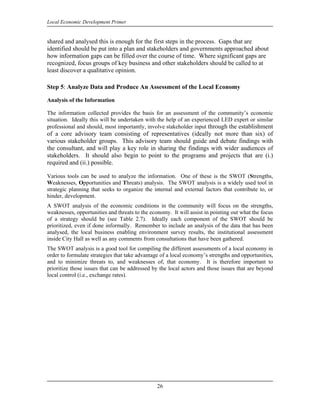
  • 43.
    Local Economic DevelopmentPrimer Table 3.9: Program Option 5: Encouraging Local Business Growth PROGRAM OPTION 5: ENCOURAGING LOCAL BUSINESS GROWTH Most local economic growth is generated by small and medium-sized businesses that are already established in the community. Encouraging local business growth involves providing advice, support and resources to enable these existing local businesses to grow. These strategies are sometimes called business retention and expansion strategies. The range of initiatives to support local businesses is vast. Some can be expensive, but others are not. Some projects include: Business retention visits and surveys: Visits to, and surveys of, existing firms can be used to help identify problems and determine how the business is performing, from where it sources its supplies, and whether it is expanding. These visits can be used to encourage local businesses to source more inputs locally, identify skills needs, finance training and contribute to LED strategy development. An important role these visits can have is to identify factors that might forestall a business leaving the area. Technical assistance to business: This can include anything from broad based management and marketing programs, quality and environmental standards training and advice, to more specialized expert training or research and development support. The focus here should be on providing accredited, demand-led, technical assistance paid for on a fee-for-service basis if possible. Often these services are provided through one- stop business service centres and they are frequently provided by the private sector. Financial advice and assistance: One of the hardest issues for businesses is gaining access to mainstream sources of capital. An appropriate financial support program will be able to source advice and training on financial planning and how to gain access to capital and credit. In some cases, it may be possible to establish small grant or loan programs to encourage, for example, investment in modern technology. Care should be taken with these to ensure fairness, equity and transparency. Such programs are often provided at a national and/or state level rather than at a local level. Public procurement policies and ‘buy local’ campaigns: These are local, business friendly policies where the municipal government, public sector organizations and larger local businesses make their contracts more accessible to local companies. This can be achieved using fair-practice laws, and initiatives can include adjusting the size of contracts so that smaller companies may bid, encouraging and accepting bids from groups of local companies, holding procurement events for local businesses, and publishing local business competency directories. Facilitating more interaction between businesses (network facilitation) and supporting local supplier development programs with local industry association can also encourage local business development through changing procurement policies. Provision of sites and premises: Municipalities and regional governments are often significant owners of industrial and commercial land and property, and are in a strong position to use these resources to encourage business investment and expansion. A good understanding of the local property market should enable a municipality to plan for growth. Enabling infrastructure investments would have a resource implication, and rents and sales could provide a market return for the municipality. Private sector delivery or partnership should be examined to increase the possibility of financial leverage and ensure the best use of municipal resources. Export Clubs: Export Clubs allow businesses to share experiences, marketing efforts, information and training. They are often undertaken in the private sector and ‘enabled’ by the public sector. A program to help informal businesses establish legal operations and gain access to the corresponding benefits (e.g. support services, capital markets, training grants.) can unleash significant local sources of capital and fiscal revenues that otherwise remain hidden. 35
  • 44.
    Local Economic DevelopmentPrimer Table 3.10: Program Option 6: Encouraging New Enterprise PROGRAM OPTION 6: ENCOURAGING NEW ENTERPRISE Encouraging new enterprises involves providing advice, technical support, information and resources to help individuals to set up their own businesses in the form of sole traders, partnerships, cooperatives or community enterprises. Projects include: Provision of finance for new businesses: Micro-enterprise financial support is key to enabling businesses to start up as they usually cannot access traditional lending and investment institutions. Micro-enterprise financing is a specialist area. Municipal governments normally become involved in these schemes by meeting with micro-enterprise institutions to assess the types of support needed and the appropriate method of collaboration. It is not usual for municipalities to be involved in micro-finance schemes as they generally do not have the skills and resources to do this. Their role is primarily to identify needs and encourage institutions and private sector players to intervene. Provision of micro and managed workspace: The provision of micro and managed workspaces to support new enterprises is one of the most effective ways to assist new businesses, especially when they offer as a service, technical and administrative support and mentoring programs. These facilities may be provided by the public or private sector. Providing technical advice on business management: In establishing a new business, the business owner should be able to understand finance, business planning, marketing, aspects of the law including employment, taxation, safety at work, environmental legislation and general business procedures. The provision of access to informal training and support in these areas meets a basic need and can be provided through ‘one-stop shops’ or independent advisers. As in most areas of technical assistance, it is usually better for the municipality to ‘enable’ the provision of these services rather than providing them directly. Charging for these services can be difficult and some agencies give a limited number of complimentary consultations and thereafter charge modest fees. Establishing ‘one-stop shops’ with access to market information is often extremely beneficial. Supporting the establishment and implementation of formal and informal business networks: People often learn from each other and networks can facilitate this learning. Active involvement in business networking is important for developing customer bases, acquiring intelligence for expanding businesses, and developing collaborative relationships with businesses in the same sector. Conducting business mentoring programs: Good practice suggests that by linking new and small business owners with established businesses, significant benefits can result for all parties. These need not be formal networks. In addition, informal networks of mentors and new businesses can create further benefits by developing supplier linkages and establishing a critical mass for specialist training. 36
  • 45.
    Local Economic DevelopmentPrimer Table 3.7: Program Option 7: Promoting Inward Investment PROGRAM OPTION 7: PROMOTING INWARD INVESTMENT Promoting inward investment aims to attract businesses to an area from elsewhere in the country or from outside the country. Attracting large manufacturing and service sector employers into communities is one of the most difficult, frustrating, and risky of all LED strategies. This is partly because there are far fewer investors than there are communities seeking to attract them, and many communities are prepared to offer excessive incentives to inward investors. Foreign direct investors often prefer greenfield, edge- of-town sites, and to accommodate these wishes, communities often override planning and zoning policies to attract the investment. This may bring with it considerable problems for future zoning and may contribute to urban sprawl and transportation problems. Careful consideration should be given to the full costs and longevity of benefits of attracting inward investors. In selecting a site for business location, an inward investor seeks: a stable macro-economic climate; a stable political and regulatory environment; market access and open competition; a welcoming environment; available sites and premises; appropriate, available and reliable utilities and transportation; available skilled workforce; available local suppliers and resources; appropriate education, training and research facilities; a good quality of life, especially when bringing ex-patriots; manageable regulation and taxation systems; incentive schemes. The benefits when success is achieved can be significant. In addition to direct employment, an increase in the tax base and indirect employment, there are potential gains for the local community through up- skilling of the workforce, increases in wages, and opportunities for local SMEs to supply and buy from these investors. Inward investment strategies are likely to be successful when: they are a component of a broader LED strategy; the community has the appropriate hard and soft infrastructure in place or available to support the likely investments; targeted investments fit the competitive advantage of the receiving community (normally a sector/cluster approach is likely to be most successful); marketing strategies are carefully prepared, budgets are appropriate and follow up procedures are in place; incentive programs are considered, varied and not excessive; staff involved in attracting strategic investors have an understanding of investment needs and what their community has to offer; opportunities for local businesses are optimized through careful ‘aftercare’ programs. This means that when a new investor is attracted to a community, every opportunity is taken to encourage the investor to source his/her supplies locally, enabling supply chain advantages to be exploited locally. This is most successfully achieved through developing an investor aftercare program. Such programs are aimed at ensuring that investors are happy and that they are given every opportunity to source their inputs from the local community. 37
  • 46.
    Local Economic DevelopmentPrimer Table 3 12: Program Option 8: Sector (and Business Cluster) Development PROGRAM OPTION 8: SECTOR (AND BUSINESS CLUSTER) DEVELOPMENT Cluster development is an approach that concentrates on encouraging and supporting inter-firm collaboration, institutional development and targeted industrial sectors. These are sophisticated LED strategies and should only be undertaken following in-depth research. The sectors are targeted at those that offer the most potential for local economic development. Where the local economy has existing clusters, this may provide a more targeted approach to improving economic development activity by leveraging resources in the direction of greatest potential return. These cluster strategies are undertaken within a broader LED strategy that would normally include the standard approaches. Possible projects include: Developing broker and network agencies: Special attention is paid to encouraging local people engaged in the same cluster to meet together to enable business development opportunities. These could include encouraging local fishermen and fish processors to meet and exchange ideas on improving facilities and adding more value to their products so they would all benefit. Another example could be to start a craft network that could jointly market their goods and start inter-trading with each other, building synergies. Supporting joint research: Institutions of higher learning can undertake research that benefit all in the cluster. One example of this would be to undertake research on minimizing losses from post-harvest losses of agricultural products. Developing cluster-focused public procurement and local purchasing agreements: The public sector is often the largest purchaser of goods and services in a city and as such there are opportunities to enable the local businesses community to access the tender processes more easily. It is often difficult for small businesses to bid for large government contracts. A cluster initiative could, for example, include the development of a food supplier network to supply government catering needs. A logical cluster development initiative would encourage suppliers of basic food products to enter into some form of food processing. Cluster development activities could then focus on transportation, storage and packaging of food products. It is then likely that businesses could start retailing and producing processed foods for the private sector. Providing cluster specific information: One of the most effective ways of developing a cluster is to gather information about businesses and institutional support systems in the cluster and then produce a document so that it can be shared. Thereafter, with a small amount of effort, supplier linkages can be developed. These programs do not need to be sophisticated. Developing cluster related marketing efforts: Once a cluster has been identified and it starts to develop as an entity, opportunities exist to promote the cluster and attract supporting investment, as well as extend and expand business development opportunities externally for cluster members. Developing demand-led skills and education training programs: A significant benefit to developing a cluster initiative is that a key outcome of business networking will be an appreciation of skills needs in the sector. When a number of businesses express a shared skills need, it is more likely that training or education will be provided. A lone business need is not likely to have as much an impact as a collective business need when seeking to establish a new training program for a specific skill need. 38
  • 47.
    Local Economic DevelopmentPrimer Table 3.13: Program Option 9: Area Targeting/Regeneration Strategies PROGRAM OPTION 9: AREA TARGETING/REGENERATION STRATEGIES Strategies for area targeting and regeneration address specific site or small area LED issues. While most LED initiatives can be targeted at a municipal-wide level, area targeting examines a specific area within a municipality to address a specific area-based problem such as a redundant factory, a declining shopping area, a slum or a district. They may also be targeted at an area of economic growth potential such as a central business district. Although many LED initiatives are aimed at ensuring that the entire city becomes more competitive, there are normally areas that need special attention for one reason or another. An example could be a run-down town center, abandoned factory complexes, a redundant port complex or similar. For these situations, special measures are required. Possible projects include: Town center enhancement schemes: These can include a wide range of initiatives including developing business partnerships, marketing the town center, undertaking surveys, upgrading the physical environment, targeting investment, and establishing a business improvement district. A vital and vibrant town center is the heart of an area’s ability to be competitive. Encouraging investment into growth nodes: One strategy to encourage growth is to identify specific areas within a city where certain types of businesses will then be encouraged to locate. A growth node may then act as the center for planned growth and employment. However, this should not be created from nothing, but rather developed around an existing agglomeration of firms showing high potential. Encouraging investment into corridors: These are similar to nodes, but here growth is encouraged to expand from an area of promising economic activity out towards a more challenging area. By encouraging incremental investment, the aim is to develop an active growth corridor linking richer and poorer areas, thereby reducing social and economic exclusion. The implementation of effective regeneration programs and the tackling of socially and economically disadvantaged groups represent two of the major challenges facing contemporary policy makers. Regeneration strategies go some way to meet these challenges. They use all the tools available but because an area is in need of regeneration, specific, community-focused and often highly targeted policy responses are usually needed. Regeneration strategies are likely to take the longest time, be the most challenging, the most expensive, and the most necessary activity a municipality is likely to undertake. Retraining of redundant workers: Redundancy is a serious problem in most communities undergoing structural readjustment. The likely target populations will be older men who have clearly defined skills sets. The challenge is to ensure that skills training is provided on a demand-led basis. This is hard and there are no easy solutions, especially as there is likely to be high unemployment in the community at large. Job search and employment outreach: For redundant workers, finding a job is difficult. This is often because they do not know basic job search skills such as where to find opportunities. Job search programs can be very effective and can involve everything from confidence building, resume writing, and teaching of interview skills, to matching the unemployed with potential employers. Entrepreneurship training and SME support programs: The city’s mainstream programs could be adapted to meet the specific needs of this target group and area. Localized delivery of services could also be helpful. Community confidence building: This can include many measures such as promoting local success stories, encouraging the community to develop its own newsletter, and developing arts and crafts initiatives. 39
  • 48.
    Local Economic DevelopmentPrimer Table 3.14: Program Option 10: Integrating Low Income or Hard-to-Employ Workers PROGRAM OPTION 10: INTEGRATING LOW INCOME OR HARD-TO-EMPLOY WORKERS Targeting disadvantaged groups means that measures are targeted at groups of individuals such as ethnic minority groups, urban poor, women, redundant workers, long-term unemployed and youths. Possible projects include: Language training: This is a key issue where there are groups of foreign workers and minority communities. Skills retraining and job placement programs: Skills retraining should be undertaken using a demand-led approach i.e. businesses need to be involved in articulating the skills needs. There is little point in retraining individuals in skill areas for which there is no local demand. Job placement programs assist individuals in acquiring the skills they need to access jobs and assist in identifying opportunities. Raising educational achievement: This is usually an issue for an entire city, but specific communities may be in need of extra targeted support. Enterprise training: Many disadvantaged groups have both high unemployment and a large proportion of workers in the informal sector. Basic training in terms of business management, finance and marketing can have a significant impact on these communities. Helping women to access employment and self-employment programs: Projects could include skills development, confidence building programs, and provision of crèches and after-school clubs. Micro-enterprise lending programs: This area of activity is also well suited to assisting disadvantaged groups to access self-employment. Work experience and teacher-pupil placement schemes: These schemes involve teachers and students working for short periods of time in businesses to gain practical work experience and develop a work ethic. When teachers partake in this scheme, they may have a better understanding of workplace requirements. Developing mentor programs: Experienced business people mentor new starters and give them support, encouragement and ideas. Mentor programs can be very informal and are a way of helping individuals to start their own business. Health awareness programs: Often the most disadvantaged suffer from the worst health. Besides the direct effects on individuals, poor health becomes a serious limiting factor when trying to gain access to employment. Health awareness programs can be closely targeted at, for example, specific schools and communities. They may also be delivered through community resource centres. HIV/AIDS programs will be a priority for many LED programs in areas affected by the epidemic. Prevention and care reduce the negative burden imposed on families, particularly the poor. Development of community resource centres: The purpose of these centres is to act as a ‘one-stop’ resource center, bringing various information services under one to meet the needs of the local community. These centres do not need to be sophisticated and services can include everything from health care, to education services, to business advice, to paying taxes, to LED and housing. 40
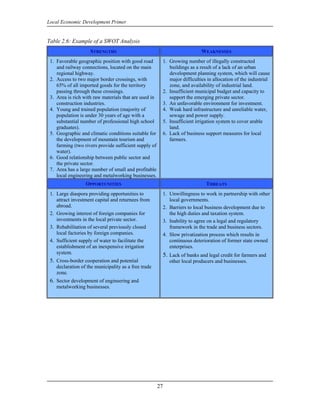
  • 49.
    Local Economic DevelopmentPrimer Step 5: Selecting Projects Within each program area, projects should be proposed and selected on the basis of clear criteria. Each potential LED project should be assessed to determine whether it meets the broader LED goals, objectives and priorities that were discussed and agreed by the stakeholders. It is also important, especially for longer projects, to undertake a careful feasibility study to verify whether the project can be technically and financially implemented. Cost-benefit analysis is an important tool for prioritization, especially in expensive projects. As there might be several competing project options, comparing the costs and expected impact of each project should provide quantitative data to help prioritize projects. Municipalities are often interested in comparing the benefits of a project proposal in terms of generating new jobs, improving income, creating new enterprises, increasing revenue, and value-for-money. The timing for achieving these impacts is a critical issue in the prioritizing of projects. Including ‘early-win’ projects that can quickly achieve visible and tangible impacts in the short- term will be fundamental to the overall LED strategy making process in ensuring the continued support of the different stakeholders. Complex projects with larger resource requirements and a longer timeframe will need to go through a more rigorous selection process and should include an initial viability assessment, feasibility studies, design review, business plan preparation and tailored monitoring and evaluation program. Documenting the Strategy Ideally the strategy should be documented, published and consulted upon at several stages of development including during the drafting of the LED strategy and again when the local economy assessment has been completed. Dissemination and public consultation in a town hall setting will serve to bring forward ideas and inputs from the broader community. When the entire strategy has been agreed, and has included a full discussion of the nature and selection of LED projects, a revised version of these documents should be made accessible to all members of the community through the local media including printed copy, radio, town hall meetings and other formats necessary to inform the local community. Where one exists, this could include a posting on a municipal government Web site. Feedback on the LED strategy should be encouraged and practically taken into consideration. In communities where stakeholder participation has been particularly limited, the strategy document should be developed in draft format and used as the basis for further consultation before finalizing the LED strategy. The municipality should ensure that an effective communications plan has been agreed and is in place prior to embarking on the implementation stage. 41
  • 50.
    Local Economic DevelopmentPrimer STAGE FOUR: STRATEGY IMPLEMENTATION STAGE 4 STRATEGY IMPLEMENTATION Step 1: Prepare an Overall LED Strategy Implementation Plan for all Programs and Projects. Step 2: Prepare Individual Project Action Plans. Step 3: Build Institutional Frameworks for LED Implementation and Monitoring. Step 4: Ensure Relevant Inputs are Available. Step 5: Carry Out Tasks in Project Action Plans. Step 1: Prepare an Implementation Plan for all Programs and Projects Once the LED programs and projects have been selected, implementation planning begins. Strategy implementation is driven by a broad Implementation Plan, which in turn is driven by individual Project Action Plans. The Implementation Plan lays out the budgetary, human resource, institutional and procedural implications of implementing an LED Strategy. It is thus the point of integration of all projects and programs within an LED Strategy. The Action Plan lays out a hierarchy of tasks, responsible parties, a realistic timetable, human resource and financial needs, sources of funding, expected impacts and results, performance measures and systems for evaluating progress for each project (see Step 2). The Implementation Plan acts in the final instance as a mediator between various projects and their action plans to ensure that they do not inappropriately compete for resources. It also provides information on monitoring and evaluation to all parties involved, in particular, the municipality’s chief executive officer and mayor who will eventually report to higher levels of government and to the community. Table 4.1: Key Issues in Implementing the LED Strategy KEY ISSUES IN IMPLEMENTING THE LED STRATEGY Who takes responsibility for each program or project? What are the targets in terms of outputs, timing and funding? What steps need to be taken to achieve the targets? What will the reporting structures and communication strategy consist of and how will they be put into effect? What are the performance monitoring and evaluation systems and processes? What has to happen to ensure they are in place and are used? What are the budgetary and human resource requirements for the sustained delivery of the project or program? What are the institutional implications of the LED programs and projects, including internal implications of the procedures and processes of the municipality? What new departmental and staff coordination will be necessary to fulfil the project? What are the new skills required for the implementation of programs and projects? 42
  • 51.
    Local Economic DevelopmentPrimer Step 2: Prepare Individual Project Action Plans After program and project selection and prioritization has been completed, it is necessary to detail the actions that need to be undertaken to implement each project. This should provide the Action Plan for operationalising each project. Each Action Plan should contain the following information: Table 4.2: Key Components of an Action Plan Basic Elements of Action Plans Project Objectives Each project should have clear objectives that meet program goals. Project Inputs The necessary resources needed to implement the project, e.g. capital and revenue costs, human resource inputs and capabilities, other inputs such as land and buildings. List of Actions A summary of the main actions to be undertaken in each project. Project Outputs The direct result from the project, i.e., the construction of a business incubator. Project Outcomes These are direct results from the outputs, e.g. an outcome of the building of a business incubator could be that four new businesses be established there. Project Impacts Impacts are associated with a strategy’s goals, and the broader effect of a project over time, even after the project is completed, e.g., the development of a specific industry cluster based on the innovation center. Project Who will take financial and management responsibility for the project (internal Management to the municipality or external)? Legitimate institutional mechanisms need to be in place or envisaged as part of the plan. It is important that ‘champions’ take primary responsibility for managing a project. If a ‘champion’ is not forthcoming to manage a project, the project should be reassessed as being a credible LED project for inclusion in this particular LED strategy. By preparing a standard action planning form, decision makers can more easily compare the merits of individual projects as they make difficult selection choices. The following points are important considerations in preparing an Action Plan for each project: By preparing a standard action project name and program type; planning form, decision a short description of the project; makers can more easily a hierarchy of tasks; compare the merits of individual stakeholders and their expected contribution; projects… realistic timetable; human and financial requirements; sources of funding with estimated costs; expected impacts and results; and, performance measures and systems for evaluating progress for each project. 43
  • 52.
    Local Economic DevelopmentPrimer Step 3: Build Institutional Frameworks for LED Implementation and Monitoring Establishing and maintaining both formal and informal links with all the key stakeholders can support LED implementation and monitoring. Building working relationships and trust between partners assists in the process of managing perspectives and differing agenda. Most broad-based, comprehensive LED strategies are delivered through public-private sector partnerships that are strongly driven by the municipality, and include the private sector and community groups. The private sector is often keen to manage initiatives aimed at improving the vitality and viability of town centres or to be involved with business development initiatives. Community groups may seek to lead initiatives to improve health or housing conditions of a target group of disadvantaged individuals. Strategy implementation is never as clearly defined as the strategy itself. It often takes longer than expected, requires the constant maintenance and upkeep of institutional frameworks, and needs constant monitoring. With each project and program that is implemented, project review should occur throughout focusing on how best to advance the project in a rapidly changing environment. Step 4: Ensure Relevant Inputs are Available In implementing an LED strategy, it is necessary to ensure that the required inputs are available and in place prior to the start of strategy implementation. LED implementation requires a commitment of resources, time and political support, and securing and maintaining such inputs will determine effectiveness to achieve programs and projects, and therefore the overall vision. Building Political Support Ensuring that local political support is in place is important to successful strategy implementation. Municipal leaders can use their influence to initiate and build multi-level partnerships and networks to support the LED process, and make the case for LED resource allocation. By including political leaders of all parties in LED strategy discussions, a municipality can greatly improve the chances of strategy success and longevity by identifying the need for a program or policy and its beneficiaries, and establishing necessary resource requirements. Building political support will also be necessary with international donors, the private sector, and non-governmental organizations to build internal and external momentum and encourage support. Building and maintaining a wide range of partners early in the strategic planning process can serve to expand the resource base of information, contributions and finance during the implementation stage. Funding the Strategy Obtaining and maintaining a sustainable, long-term source of funding for an LED strategy is a It is also considerable challenge as often LED is not a statutory responsibility of municipal government. In important that the determining and agreeing a municipal budget, LED competes for limited resources with municipality departments such as housing, health and education. It is often difficult for elected officials to fully understands justify allocating scarce resources to LED efforts when other decisions are often perceived as that LED is a being more important to the development of the municipality than LED initiatives. It is therefore potential contributor to important to have political support in the municipality and the community to encourage resource future revenue allocation. It is also important that the municipality fully understands that LED is a potential growth… contributor to future revenue growth, and recognizes the connection between successful LED, increased local economic activity and municipal budget growth. 44
  • 53.
    Local Economic DevelopmentPrimer The LED strategy must have a designated budget. This may be small in the first instance and should include opportunities for follow-up funding. Ideally in selecting particular programs and projects, funding should be agreed for the entire life of a project, as projects are likely to span several years. Forward, sustainability and exit strategies should also be developed. Table 4.3: Sources of Funding for LED Initiatives Sources of Funding for LED Initiatives Municipal revenues raised from property tax, business tax and user fees; Sale or renting of local municipal-owned industrial or commercial buildings and land; National and state government intergovernmental transfers; International donor grants and loans; Private sector funding such as corporate contributions and investments; Private sector funding such as corporate contributions and investments; Foundations, especially for environmental improvements, human resource initiatives and poverty alleviation; and, Multilateral agencies. Step 5: Carry Out Tasks in Project Action Plans In delivering the project action plans, it will be necessary to ensure that all key partners that were initially identified as being a beneficiary or potential contributor to the project are still available to support the project. Prior to the commencement of project implementation, project managers will ideally have been selected and charged with responsibility for each project. During the implementation of the project, constant review should be undertaken to ensure that the project is delivering its stated aims and desired outputs. The collection of project data should be a priority to ensure that detailed and relevant information is available for monitoring and evaluation purposes, both during and after project implementation. The use of sound management techniques such as project monitoring and evaluation can help to avoid delays thus ensuring the smooth implementation of a project. Selecting a Project Manager A project manager will be required to manage the LED project until its completion and oversee its development. The manager will be charged with a number of tasks including developing and refining the project, and providing strategic and technical development of the project. Ideally, a project manger should be able to identify, appraise and undertake liaison with other potential resources in fulfillment of the project objective, and have the skills to plan and direct project workflow on a day-to-day basis. In assessing and reviewing the progress of the project against the Implementation Plan, the project manger will be expected to report as required to internal and external parties including the municipal government, donors, the LED steering group, and business and community partners, and should therefore be able to develop effective professional partnerships with all of the key stakeholders. Ideally, the project manager should have previous experience of project management and be able to demonstrate a knowledge and understanding of the LED project area. For example, in selecting a project manager to develop and manage a business development center, appointing a manager who has no previous experience or knowledge of business development or property management would not be appropriate. Clearly, the selection of the project manager will depend on the availability and reliability of appropriately skilled local individuals. 45
  • 54.
    Local Economic DevelopmentPrimer STAGE FIVE: STRATEGY REVIEW STAGE 5 STRATEGY REVIEW Step 1: What? Why? When? Step 2: Monitoring Step 3: Evaluation Step 4: Institutional Arrangements Step 5: Strategy Review and the Planning Process Step 1: What? Why? When? Even though LED is a relatively new discipline, there are numerous examples of bad practice that can be highlighted to demonstrate the potential for mistakes, and many of these mistakes can be attributed to relatively few causes: politics (including exclusion of key interest groups, inappropriate zoning); lack of commitment by Project Managers because they are not held regularly accountable; lack of strategic thought (resulting in inappropriate strategies); inadequate funding, research, monitoring and evaluation (resulting in inappropriate strategies and initiatives); grant chasing; and, following the latest trend. Reviewing the strategy will enable the municipality to determine how its LED strategy is progressing, whether it is making any mistakes in implementing its strategy, and how these mistakes might be rectified. The LED strategy should be regularly reviewed to reflect changes in the local economy and lessons learnt from its implementation. Reviewing a local economic development strategy is normally undertaken on an annual basis and usually in conjunction with the municipality’s financial planning cycle. This revision is guided by a monitoring and evaluation plan that establishes the procedures and indicators for assessing the LED strategy planning process, and the implementation of programs and projects.21 Both the municipality and the steering committee should be involved in the review process. It is important to invite public opinion in assessing the LED strategy making and implementation processes. Surveys and focus groups are valuable sources of information for strategy review. Political support for, and publication of, achievements are key to sustaining momentum and generating enthusiasm and confidence within the community. 21 Useful information on the development of LED performance indicators is available on the United Kingdom Library of Local Performance Indicators project Web site. The site contains information on the development of pilot economic regeneration performance indicators and lists a technical definition document that provides a fuller explanation of the indicators together with detailed definitions: http://www.local‐pi‐library.gov.uk/economic_regeneration.shtml. 46
  • 55.
    Local Economic DevelopmentPrimer Table 5.1: Issues to Include in the Revision of the LED Strategy ISSUES TO INCLUDE IN THE REVISION OF THE LED STRATEGY Is the SWOT analysis still valid or have circumstances changed? Is more information available and have key issues changed as a result? Should changes be made to the vision, goals or objectives to reflect changing circumstances? Are projects achieving the expected results? If not, what can be done? Are performance indicators being met? If not, why not? What changes need to be made? Should the indicators be changed? Should there be more action on projects? Should the projects be changed? Monitoring and evaluation (M&E) as discussed earlier is a key component of the LED Implementation Plan. Indicators should be clearly laid out at the project level to measure inputs, outputs, outcomes and impact for each project. These will be consolidated to determine program success and provide an overall assessment of LED strategy. Repeated semi-annual and annual meetings to discuss results are necessary as part of the ongoing planning and learning process. A monitoring and evaluation strategic workshop should occur at the start of a program. It should establish an M&E timetable including scheduled reviews of content and process indicators. An independent audit of key indicators through repeated municipal and business surveys is crucial to measuring the progress made since the baseline local economy assessment. These can be quantitative and qualitative in nature. Step 2: Monitoring Monitoring is the continuous assessment of a strategy and/or project implementation in relation to agreed schedules, and of the use of inputs, infrastructure, and services by project beneficiaries. Monitoring provides managers and other stakeholders with continuous feedback on implementation. It identifies actual or potential successes and problems early to facilitate timely adjustments to project operation. Monitoring accepts the project design as given; it measures progress, is focused on performance and occurs continuously. Step 3: Evaluation Evaluation is the periodic assessment of a project’s relevance, performance, efficiency, and impact (both expected and unexpected) in relation to stated objectives. Project managers undertake interim evaluations during implementation as a first review of progress, a prognosis of a project’s likely effects, and as a means of identifying necessary adjustments in project design. Evaluation challenges the design of a project, draws conclusions and makes judgments, is focused on the effectiveness of the program or project, becomes a key milestone in the project cycle.22 Evaluations can be divided into two categories. ‘Process evaluations’ focus on the implementation of programs or projects, while ‘outcome evaluations’ focus on program results. Process evaluation is concerned with how a program can be improved while outcome evaluation 22 For additional information on monitoring and evaluation, see ‘Monitoring & Evaluation: Some Tools, Methods and Approaches’, (2002), Operations Evaluation Department, World Bank http://www.worldbank.org/oed/. 47
  • 56.
    Local Economic DevelopmentPrimer is concerned with whether the program actually works. Managers of LED programs would benefit from building both forms of evaluation into the program design.23 Table 5.2: Process and Outcome Evaluation PROCESS EVALUATION OUTCOME EVALUATION monitoring assessing enumerating measuring costs and assessing daily tasks program outcomes effectiveness benefits impact activities Source: Bartik, 2002. Process evaluations overlap with monitoring activities and both are concerned with project or program implementation. Process evaluation involves the systematic examination of implementation quality on a periodic basis and programs are monitored internally with monitoring reports generated at different levels on a weekly, monthly or quarterly basis. LED programs may involve a mid-term process evaluation, which will include management reviews, resource expenditure studies or financial audits. A process evaluation may recommend changes in program activities, target groups, the management structure or financing strategy. Outcome evaluations are centrally concerned with determining what would have happened to program recipients and the LED task if the intervention had not occurred. Outcome evaluations primarily seek to measure the ‘value added’ of undertaking a particular LED project intervention. Outcome evaluations ideally cover four key parameters. Primarily, evaluations must account for and enumerate outcomes. This can be achieved by assessing what has happened to the target population and how it is different from before. Enumerating outcomes will also involve outlining whether program objectives were achieved and if unanticipated outcomes occurred. Secondly, outcome evaluations measure program effectiveness. This is achieved by assessing the degree to which the intervention resulted in observed changes in the target population. Third, outcome evaluations must assess whether program benefits outweigh program costs by conducting a cost- benefit analysis. Lastly, a sound outcome evaluation will assess impact by determining whether there has been a marked improvement in the situation that the policy or program was designed to address. Assessing the impact of an LED strategy also implies the need to separate the outcomes that are a direct consequence of the LED strategy from those that are a result of external factors such as an improvement in the national economy. For example, unemployment might decrease by 10 percent in a year after the implementation of an LED strategy; however, this figure could in part be a result of an increase in national GDP. An approach to take in this case could be to compare the findings from the LED strategy assessment with the same indicators selected randomly from different localities as well as from the regional and national averages. It is possible then to identify changes in these indicators that are common to all localities, and therefore not related to the specific LED strategy. As result, the outcome evaluation can isolate the external deviations from the direct impact of the LED strategy. This, however, is difficult in most countries as there is neither data nor funds available. Nevertheless, efforts should be taken to monitor and evaluate at a project and strategy level. 23 Bartik, T. (2002) ‘Evaluating the Impacts of Local Economic Development Policies on Local Economic Outcomes: What Has Been Done and What is Doable?’ Paper Presented to the OECD LEED Conference, November 20-21, Vienna Austria http://www.upjohninstitute.org/publications/wp/03-89.pdf. 48
  • 57.
    Local Economic DevelopmentPrimer The general rule should be to develop the most rigorous evaluation methodology taking into account the significance of the investment as well as practical considerations related to resource availability and technical capacity. Why Monitoring and Evaluation? A well-designed monitoring and evaluation system will help answer the question ‘how do I know when I have reached my Objectives?’ It provides a basis for accountability in the use of resources. Used carefully at all stages of the project cycle, monitoring and evaluation can help to strengthen strategy and project design and implementation. It helps to build trust with businesses, financial institutions and investors by openly sharing results. The emergence of recorded benefits early on helps reinforce ownership and early warning learning by all regarding emerging problems allows action to be taken before costs rise. A well-designed M&E allows for mid-course corrections. A reliable flow of M&E information during implementation enables managers to keep track of progress and to adjust operations to take account of experience. It allows for the interventions to be adapted to reflect the changing needs of target businesses, sectors and companies. It provides important information on how to use limited resources more efficiently by directing investments to programs and activities that have the greatest impact on productivity, job growth or investment. It allows for the benchmarking of LED interventions against examples of good practice. It demonstrates the impact of LED interventions in terms of poverty reduction, city GDP growth or employment creation to clients, citizens and potential investors. It can help to justify budget requests for further LED interventions. 49
  • 58.
    Local Economic DevelopmentPrimer Table 5.3: Summary of Differences Between Monitoring and Evaluation SUMMARY OF DIFFERENCES BETWEEN MONITORING AND EVALUATION MONITORING EVALUATION Monitoring is the process of routinely Evaluation involves a ‘stepping back’ to gathering information on all aspects of a gain a deeper perspective on what What: project or program. It is used to inform effects and impacts have been achieved. decision making on project It informs every decision-making. implementation. Analyse the current situation. Determine how effective a project or Identify problems and find solutions. program has been. Discover trends and patterns. Determine the extent to which goals Keep program activities on schedule. have been achieved. Measure progress towards intermediate Learn how efficiently things are being Purpose: goals and revise action in order to done. achieve these goals. Develop ‘lessons learned’ so future Formulate key questions. programs and projects of a similar Make decisions about human, financial nature can be improved. and material resources. Monitoring is continuous (daily, monthly, Evaluation is conducted periodically: annually). Monitoring activities should be at or near the mid-point of scheduled as part of the project’s work implementation When: plan and be a routine part of project at the end of a project implementation. at a point well after a project has been completed (3-8 years) Monitoring can be carried out by staff and Internal evaluations can be carried out participants through field visits, review of by the project manager and/or project service delivery and through a staff and participants. External How: Management Information System. evaluations are generally conducted by external consultants, external agencies or donors. Monitoring provides managers with Evaluation is the formal process of information needed to analyse the current documenting the following project project situation, identify and find achievements: solutions, discover trends and patterns, progress in the work plan keep in schedule and measure progress establishment of systems Why: towards expected outcomes. It allows an implementation of planned activities opportunity to make decisions regarding achievement of goals human, financial and material resources effectiveness of the project and minimize needless program costs. impact of the project efficiency or cost-effectiveness More emphasis on quantitative data, but More emphasis on qualitative data, but Information some qualitative data is gathered to quantitative data is gathered in Type: contextualise the quantitative analysis. indicators. Qualitative analysis can often support the quantitative assessment. Information Descriptive, analytical and documentary Descriptive, analytical and documentary Category: data should all be used to observe the data should all be used to observe and ‘what’ and understand the ‘why’ of the record the ‘what’ and understand the project activities. ‘why’ of the project achievements. 50
  • 59.
    Local Economic DevelopmentPrimer Step 4: Institutional Arrangements In determining institutional arrangements for measuring progress, one should focus on the people, processes and events that will be necessary for measuring that progress at the level of both the strategy and the individual projects and programs. In determining a formal institutional arrangement, key questions include: Who are the people that should be measuring the progress? What type of information will they require to measure progress? On the processes, one should consider the types of evaluation tools necessary, and the products that will be produced, e.g. progress report etc. (see table 5.4 for examples). Feedback Proposals for the ways in which M&E findings will be fed into decision making process: Table 5.4: Example of Events to Measure Project Progress EXAMPLE OF EVENTS TO MEASURE PROJECT PROGRESS ANNUAL CYCLE OF EVENTS EVENTS TIME PURPOSE PRODUCTS STAKEHOLDERS Annual January Define level of input, Annual Work Plan Management Planning outputs, indicators, Individual Plans Project Staff related activities Annual Budget Gantt Chart Institutional (Updated) Work Stakeholders Agreements Quarterly May and Progress Evaluation Updated Implementation Management M&E October Planned vs. Actual Plans Performance Project Staff Workshop Performance Monitor Improvement Plans Assumptions Mid-Term June-July Respond to New Progress Report Adjusted Management Evaluation Opportunities Designs and Implementation Project Staff Review Leading Plans Donors Indicators Partners Sustainability of Assumptions Annual December Evaluate Impact Evaluation Results Progress Management Stakeholder Progress Review Report on Lessons Learned Project Staff Meeting Delivery of Outputs Beneficiaries Verify Assumptions Customers Partners Clear Objectives Good monitoring and evaluation cannot occur unless there has been good project design where clear statements of measurable objectives exist. Key Performance Indicators A clear and structured set of key performance indicators (KPIs) allows us to measure progress. Performance indicators are conditions that signal success. They inform us how we will recognize 51
  • 60.
    Local Economic DevelopmentPrimer the success of the project or program. Performance indicators can be both quantitative and qualitative. Quantitative indicators will include numbers, percentages, percentage changes etc. Qualitative indicators are more difficult to measure. They focus on aspects such as the quality of a result or an individual’s attitude towards a new service. In order to obtain this kind of information, appropriate measures need to be created. In designing an M&E system, there are several types of indicators that are necessary. These include Objective Indicators that measure the progress of a strategy or project toward its objectives; Output Indicators that measure progress against outputs; Input Indicators that measure financial disbursement, human resources and staff time. Indicators should be: SMART - Specific, Measurable, Achievable, Relevant and Time-bound; valid - they are valid in the eyes of the key Participatory M&E (PME) stakeholders and should actually measure what they set out to measure; reliable - conclusions based on the indicators should be the same if measured by different people; gender sensitive - indicators should be disaggregated by gender; sensitive - they should be sensitive enough to measure important changes in the situation being observed; cost-effective - the information/learning should be well worth the time and money it costs to collect the data; timely - it should be possible to collect and analyse the data fairly quickly; in-line with local capabilities/resources - they should not be overly complex and burdensome to the project partners; and, build on what exists - indicators should not ’reinvent the wheel’ and should draw on existing local data collection activities, or from indicators used with other projects, where possible. Data Collection The type of data collection required depends on the choice of indicator. The achievement of strategy and project objectives depends on how project beneficiaries respond to the goods or services delivered by the project. Evidence of their response and the benefits they derive requires consultation and data collection that may be outside the scope of management. Indications that beneficiaries have access to, are using, and are satisfied with project services give an early indication that the project is offering relevant services and that direct objectives are likely to be met. Within a project however, it is necessary to measure the progress of the project in terms of internal inputs (financial, staff weeks), outputs (the progress on the manual or the building) and process (which of the projects are achieving their time frames). Indicators of inputs, process and outputs are mostly generated from within project management. Step 5: Strategy Review and The Planning Process What Does This Mean for the LED Strategic Planning Process? Monitoring should not be an afterthought that is undertaken at the end of a LED Strategic Planning Process. It should be incorporated into each stage and step of the planning process. Evaluation can occur at intervals; however, it can only occur if good monitoring information is available. Evaluation should lead to the review of a strategy and its projects. 52
  • 61.
    Local Economic DevelopmentPrimer M&E in Stage 1: Organizing the Effort Stage One provides an opportunity to begin thinking about the kind of monitoring and evaluation framework that will be necessary throughout the life of the project. This includes: a consideration of what kind of long-term institutional mechanisms are needed to ensure the M&E of the Strategy, e.g. a Strategy Monitoring Committee? the production of a monitoring and evaluation plan for report back mechanisms throughout the life of the Strategy Formulation. This can include an Annual Report, a Quarterly Progress Report, an Annual Meeting, regular press releases and bi-weekly meetings. The Stakeholder Consultation process allows for the M&E system to be participatory. This offers a host of benefits that build on the benefits of conventional M&E systems. These include: improved performance of development and poverty alleviation programs; enhanced local learning, management capacity and skills; strengthened collaboration among key project stakeholders and greater ownership of projects; M&E systems that are more sustainable since they are more relevant to local capabilities, skills and resources; increased cost-effectiveness of PME systems as they use low-cost methods of data collection and analysis. Conventional monitoring and evaluation focuses on approaches and systems that are determined by outside experts. Participatory monitoring and evaluation is based on negotiating the content of evaluation approaches and systems to meet the needs of the local people and other key users of M&E information such as donors, municipal government and national authorities. In participatory monitoring and evaluation, the evaluator plays the role of a facilitator/trainer/coach guiding groups to reach consensus on key M&E issues and building their capacity to use M&E to improve program performance. Traditionally, distinctions between M&E and PME were less differentiated. The two approaches are contrasted below: Table 5.5: Conventional and Participatory Evaluation CONVENTIONAL EVALUATION PARTICIPATORY EVALUATION Why Accountability. Usually summary To empower local people to initiate, control and judgments about the project to determine if take corrective action. funding continues. Who External experts. Community members, project staff, facilitator. What Predetermined indicators of success. People identify their own indicators of success. Principally cost and production output. How Focus on ‘scientific objectivity’. Distancing Self evaluation; simple methods adapted to of evaluators from other participants; local culture; open immediate sharing of results uniform complex procedures; delayed, through local involvement in evaluation limited access to results. processes. When Midterm and completion. Any assessment for program improvement; merging of monitoring and evaluation, hence frequent small evaluations. 53
  • 62.
    Local Economic DevelopmentPrimer M&E in Stage 2: The Local Economy Assessment The Local Economy Assessment should be viewed as an opportunity to collect baseline data in the economy (description of the economy before the implementation of the LED strategy) so that the impact of the LED strategies can be monitored along its implementation. M&E in Stage 3: Strategy Formulation Strategy formulation should include the determination of key performance indicators from which the progress toward objectives will be measured. The team should also formulate a plan, as part of the data collection methodology, to measure progress made on the objective key performance indicators. The strategy formulation phase is also a good time to determine who is responsible for monitoring the strategy’s implementation. In the strategy implementation phase, the monitoring and evaluation team should consider and develop a monitoring and evaluation plan including: how they will collect data for monitoring the objective key performance indicators; how they will collect data for monitoring each project’s progress; and, the kind of events and report back mechanisms to ensure continued accountability on progress to all stakeholders. M&E in Stage 4: Strategy Implementation By this stage, the institutional arrangements for monitoring the implementation of the strategy should be in place. M&E in Stage Five: Strategy Review Strategy Review is the evaluation of the relevance of the strategy and its implementation. 54
  • 63.
    Local Economic DevelopmentPrimer RESOURCES Glossary of LED Terms Local economic development has its own language and terminology. Terms such as capacity building, empowerment, indigenous development and social capital are common and are used by a variety of actors in the local economic development field. However, many of the terms associated with local economic development require a considerable amount of interpretation, comprehension and negotiation when applied practically in different institutional settings. While recognizing that some of these terms are not universally understood, the following list provides a guide to this terminology by describing the more commonly used words and acronyms. Additionality: The principle that funding from a particular source is additional to that provided by national and municipal authorities. The additionality principle requires that funds awarded for a project should not be used merely to substitute/replace existing funds, but should be used for additional projects and activities. Brownfields: This is a general term used for sites that have been developed in the past that may or may not be contaminated. Sustainable economic development strategies encourage the productive reuse of these sites, even though this may be more expensive than building or developing new and presently undeveloped Greenfield sites. Business Incubators: An economic development tool primarily designed to help create and grow new business in a community within a specific building or location. Business incubators help emerging businesses by providing various support services such as assistance with developing business and marketing plans, building management skills, obtaining capital and access to more specialized services. They also provide flexible space to rent, shared equipment and administrative services in managed workspace. Business Retention Strategies: Systematic efforts designed to keep local companies content and situated at their present locations within the area. Strategies include helping companies cope with changing economic conditions, addressing new markets and even assisting with internal company problems. Business Start-up Support: Includes the full range of services available to people starting in business for the first time. Initiatives include: training, business advisory support, business networking and mentoring and financial assistance (grants, loans, and interest rate subsidies are traditional methods; a more innovative approach to financial support is to try and attract as much private sector investment as possible, rather than public sector). Clusters: An industry cluster is a grouping of related industries and institutions in an area or region. The industries are inter-linked and connected in many different ways. Some industries in the cluster will be suppliers to others; some will be buyers from others; some will share labor or resources. The important thing about a cluster is that the industries within the cluster are economically linked. They both collaborate and compete, and are, to some degree, dependant upon each other. Ideally, synergies are produced by these clusters. 55
  • 64.
    Local Economic DevelopmentPrimer Entrepreneurial Training: Programs that provide guidance and instruction on business basics (such as accounting and marketing) so that businesses improve their chances of success. Export Development Services: Export assistance programs can help businesses to diversify their customer base, expand operations and become more profitable. Export services include: assessing company capacity for exporting; market research; information services (on exporting, trade regulations, transportation, etc.); international lead generation and trade shows/exhibitions or promotional marketing trips. Foreign Direct Investment (FDI): FDI is investment that is attracted from abroad. It can mean either Greenfield investment (i.e. investment in building new facilities on hitherto undeveloped sites) or portfolio investment (i.e. buying into an established business). Inward investment can take similar forms (either Greenfield or portfolio). However it may include investment from within a country as well as from abroad. Greenfields: Refers to land that has hitherto not been developed. Greenfield investments imply that facilities are designed and built for investors, rather than the investor buying a facility already built. Growth Node: A physical location where industry and/or commercial development is deliberately directed; done either to reduce growth pressures elsewhere in the city or to redistribute growth within a city. Forward Strategy: This is where arrangements are made to continue the life of projects after initial project funding stops. Sometimes this is described as an exit or succession strategy. This should be established at the outset of all projects that are likely to need ongoing capital or revenue resources after the initial period of establishing the project. Hard Infrastructure: Hard infrastructure includes all the tangible physical assets that contribute to the economy of a city. For example, transport infrastructure (roads, railways, ports, airports), industrial and commercial buildings, water, waste disposal, energy, telecommunications etc. See also soft infrastructure below. High Road Techniques: High road techniques stress the need to make more efficient use of resources and invest in processes, technological innovation and employee skills. It views labor as an important commodity and skill enhancement as a crucial, targeted investment. It entails the mobilization and upgrading of local resources and the maximization of local strengths and advantages to balance relatively higher wage rates. Indicators: Proxy measures to provide operational definitions to the multidimensional components of LED. Indicators are expected to serve the function of defining policy problems and informing policy formulation. They should provide a basis for policy discussion and planning. Indigenous Businesses: Local businesses, usually those that have developed in the community. Increasingly, the term refers to all businesses in an area whether they are ‘locally grown’ or not. Informal Sector: Not within the formal or legal sector and therefore not registered. 56
  • 65.
    Local Economic DevelopmentPrimer Labor Market Information: The body of data available on a particular labor market, including employment and unemployment statistics, occupational statistics, and average hours and earnings data. Local Economic Forum: A coordinating mechanism set up to achieve the streamlining and improvement of local economic service delivery. Low Road Techniques: Low road techniques promote an area’s economic position through the lowering of production costs, especially wage rates; this is not a sustainable approach. Mobile Manufacturing (or service sector) Investment: Where manufacturing (or service) companies have a wide choice of location choices. Consequently they are in very strong negotiating positions when it comes to choosing where to locate their businesses. One-stop Business Service Centres: Facilities where business persons can go to obtain advice and support to help them establish and expand their business. Sometimes these centres also issue licenses and permits needed by businesses to start-up, operate or expand. These centres improve the local business environment by reducing the number of separate agencies and offices a business may need to approach for advice or to apply for various licenses and permits. They save public and private time and improve efficiency as a result. Soft Infrastructure: Soft infrastructure relates to the less tangible aspects of LED such as education and training provision, quality of life infrastructure such as park, leisure and library services, housing, business support, business networking and financing services etc. SMEs: This is the acronym for ‘small and medium sized enterprises’. There is no definitive delineation between a small and medium sized business. As a general reference, small is often from 5 to 20 employees and medium from 20 up to 200. Businesses with fewer than 5 employees are usually called micro-enterprises. This is a guide only. Stakeholders: Individuals and groups who have an interest in the issues in hand. They normally represent their own interests as stakeholders. Supply Chains: The products and processes that are essential to the production of a good or service. For example, to produce frozen fish, the supply chain inputs will extend from fish catching, handling, processing, and freezing to packaging, storing and distribution. These are all elements of a supply chain. Holistic LED strategies will try and capture as much as possible of the higher value end of the value chain in their area. In this case fish processing, packaging, storing and distribution will be adding value and therefore be seen at the higher end of the value chain. 57
  • 66.
    Local Economic DevelopmentPrimer Key Readings LED Conceptual Framework Bingham, Richard D. and Robert Mier, Eds. (1993). Theories of Local Economic Development: Perspectives From Across the Disciplines. Sage Publications, CA. Blair, John P. (1996). Local Economic Development: Analysis and Practice. Sage Publications, Inc. Canzanelli, Giancarlo. (2001). Overview and Lessons Learnt on Local Economic Development, Human Development, and Decent Work. ILO Universitas Working Paper. http://www.ilo.org/public/english/universitas/publi.htm. Clarke, S.E. and Gaile, G.L. (1992). The Next Wave; Postfederal Local Economic Development Strategies. Economic Development Quarterly. Vol. 6 No. 2. pp. 87-198, Sage Publications, CA. Council for Urban Economic Development. February (2000). Local Economic Development in the CEE/NIS Region. Overview Paper, Draft prepared for USAID. Council for Urban Economic Development. January (1996). What Is Economic Development?: A Primer. European Commission. (1997). Towards an Urban Agenda in the European Union. ‘Directions for the Future’. pp. 13-17. Communication from the European Commission COM (97)197, June, Brussels http://europa.eu.int/comm/urban/documents/d004_en.pdf. Harris, N. with L. Bulbul, K. Mainuddin, X. Meng, S. Haguib, S. Srinivas. March (2000). Garment-Making and Urbanisation: An Introductory Study of Four Cases. Urban and Local Government Working Paper Series No. 6. Urban Development Unit. World Bank. http://www.worldbank.org/urban/publicat/uwp6.pdf. Iannone, D. (1997). Introduction to Economic Development: A Training Course for Economic Development Professionals, Washington, D.C.: National Council for Urban Economic Development. Kane, J. and Shinka M. (1994). Rethinking State Development Policies and Programs. Washington DC. National Governors Association. This article describes the evolution of Local Economic Development. Lyons, T. and Hamlin, R. (1990) Creating an Economic Development Action Plan: A Guide for Development Professionals. Praeger Publishing. Mier R and Bingham R. (1993). Metaphors of Local Economic Development in Theories of Local Economic Development: Perspectives from Across the Disciplines. pp. 284-304. Sage Publications, CA. OECD. (1998). Arresting Decline in Urban Areas The OECD Observer No. 210 February/March. The OECD has published a short and informative paper on the inadequacies of urban policies in 58
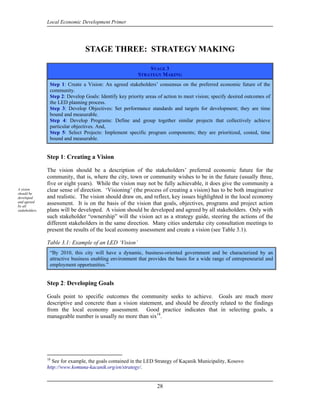
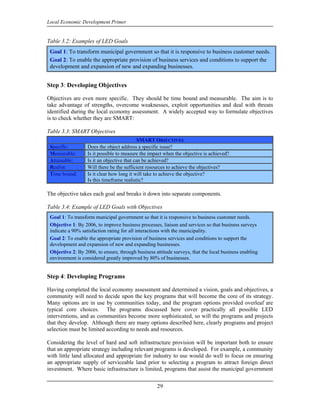
  • 67.
    Local Economic DevelopmentPrimer OECD countries and how in the last two decades they are moving towards a ‘more integrated, multi-sector policy approach which has two main characteristics. First, they explicitly recognize the interrelationships between socio-economic factors affecting urban areas; they emphasize endogenous development and the creation of opportunities within the deprived neighbourhood’ http://www.oecd.org//publications/observer/210/005-016a.pdf. OECD. Local Economies and Globalisation. LEED Notebook, No. 20. Good for case studies; this LEED Notebook, No 20 provides valuable information about Local Capacity Building. http://www.oecd.org/tds/bis/leed.htm. World Bank (2000). Cities in Transition: World Bank Urban and Local Government Strategy. The World Bank has published a comprehensive strategy document to gear its assistance towards achieving the objectives of reducing poverty, promoting broad-based growth, protecting the environment, and supporting effective institutions. Achieving these objectives requires a closer working relationship with the local governments that are assuming greater responsibilities for delivering services that have direct impacts on people's daily lives, in partnership with national governments and the communities themselves. In addition to the core urban development sectors, the global urban agenda is expanding to include diverse issues such as local economic development, capital market access, real estate market reform, urban cultural heritage, disaster mitigation, and public safety. http://www.worldbank.org/html/fpd/urban/publicat/cities_in_transition_full.pdf. The Role of Local Economic Development Agencies Humphreys, Eileen. (1996). LEDA Pilot Actions: Synthesis Report. Local and Regional Development Planning. London. ILO. (1995). Lessons from the LEDA Programme. Local and Regional Development Planning. London. Financing LED Bartik, T. (1995). Economic Development Incentive Wars. Employment Research, Spring 1995. W.E. Upjohn Institute for Employment Research. This short paper and related references provides a sound basis from which to consider monitoring and evaluation of financial incentives. http://www.upjohninst.org/publications/newsletter/tjb_595.pdf Darche, Benjamin. (1997). Financing Mechanisms at the Subnational Level in Emerging Markets: Borrowings and Privatisations/Concessions. Infrastructure Note FM9. Urban Development Unit, World Bank. http://www.worldbank.org/urban/publicat/rd-fm9.htm Dillinger, William. (1995). Urban Property Tax Reform: Guidelines and Recommendations. Urban Management Program Discussion Paper No. 1. World Bank. El Daher, Samir. (2001). The Building Blocks of a Sound Local Government Finance System. Infrastructure Note FM8-e. Urban Development Unit. World Bank. http://www.worldbank.org/urban/publicat/fm8e.pdf 59
  • 68.
    Local Economic DevelopmentPrimer El Daher, Samir. (2000). Specialized Financial Intermediaries for Local Governments: A Market- based Tool for Local Infrastructure Finance. Infrastructure Note FM8-d. Urban Development Unit. World Bank. http://www.worldbank.org/urban/publicat/fm8d.pdf Worley International Ltd. (2000). Strategic Municipal Asset Management. Urban and Local Government Background Series No. 5. Urban Development Unit. World Bank. http://www.worldbank.org/urban/publicat/001-1069.pdf Strategy Review (Monitoring &Evaluation) Bartik, T. (2002). Evaluating the Impact of Local Economic Development Polices on Local Economic Outcomes: What has been done and what is doable? Upjohn Institute Staff Working Paper No.03-89. http://www.upjohninstitute.org/publications/wp/03-89.pdf Beauregard, Robert A. (1999). The Local Employment Fulcrum: Evaluating Local Economic Performance. Economic Development Quarterly, Vol. 13, No. 1. February 1999. pp. 23-28. Sage Publications, CA. Economic Development Quarterly. February (1999). For those interested in a more detailed understanding of contemporary issues in urban local economic development monitoring and evaluation, please note that there are a series of informative articles in this publication. Erickcek, G. (1996). Developing Community Economic Outcomes Measures. Employment Research, March 1996. W.E. Upjohn Institute for Employment Research. The Upjohn Institute is keenly interested in LED and monitoring and evaluation. This paper looks at outcome measures and how they should be used. http://www.upjohninst.org/publications/newsletter/gae_f96.pdf Iannone, D. (1999). ‘An Assessment of the Costs, Benefits, and Overall Impacts of the State of Ohio’s Local Economic Development Programmes’. Prepared by The Urban Centre, Maxine Goodman Levine College of Urban Affairs, Cleveland State University, for the State of Ohio Economic Advisory Committee. The study provides one of the most comprehensive assessments of local economic development programs yet published. As such, it will be very helpful to all those looking to develop national and local area economic development programs and policies and will be referred to frequently in this report. As a universal disclaimer, the contents of the report do not necessarily reflect the views of the state of Ohio or a consensus of the local economic development Advisory Committee. http://www.state.oh.us/obm/media/articles/economicstudy.asp Jenkins, N. and M. Bennett. (1999). ‘Toward an Empowerment Zone Evaluation’. Economic Development Quarterly. Vol. 13 No. 1. Sage Publications, CA. An informative article on developing evaluation methods for Empowerment Zones in the US, a type of ‘third-wave’ strategy. Reese, Laura A and David Fasenfest. (1999). Key Perspectives on Local Development Policy Evaluation. Economic Development Quarterly, Vol. 13 No. 1 February. 3-7 Sage Publications. www.oecd.org/tds/bis/brownfields.htm 60
  • 69.
    Local Economic DevelopmentPrimer Improving the Local Business Investment Climate Stanchev, K., and Yonkova, A., Eds. Legal and Regulatory Reform: Impacts on Private Sector Growth. Institute for Market Economics, Sofia. http://www.ime-bg.org/pdf_docs/papers/lrr.pdf Encourage Local Business Growth Arzeni, Sergio and Jean-Pierre Pelligrin. (1997). Entrepreneurship and Local Development. The OECD Observer, No 204 Feb./Mar 1997. This article also gives an excellent account of cluster networking for SMEs. Bradshaw, Ted and Edward Blakely. (1999). What are ‘Third Wave’ State Local Economic Development Efforts? From Incentives to Industrial Policy. Economic Development Quarterly, Vol. 13, No. 3. August 1999. pp. 229-244. Sage Publications, CA. This article presents an analysis of the shifting emphasis of local economic development policies and practices. Ernst & Young. (1999). Thematic Evaluation of Structural Fund Impacts on SMEs. European Commission (DGXVI). This report goes into detail on the evaluation of SME support measures. It includes in-depth research methodology as well as case studies; a long, detailed, useful read. Good practice is highlighted in this report also. http://www.inforegio.org/wbdoc/docgener/evaluation/pdf/eval_sme.pdf Encouraging New Enterprise Chappell, David S. and Hugh Sherman. (1998). Methodological Challenges in Evaluating Business Incubator Outcomes. Economic Development Quarterly. Vol. 12, No 4. November 1998. pp. 313-321. Sage Publications, CA. Sector (and business cluster) Development Buss, Terry F. (1999). The Case Against Targeted Industry Strategies. Economic Development Quarterly. Vol. 13, No 4. November 1999. pp. 339-356. Sage Publications, CA. Puts forward some interesting points including the following: ‘Targeting is central planning and local industrial policy masquerading under different names: strategic planning, competition policy, retention/attraction and the like.’ This paper is worth reading not least to improve techniques for LED. www.weda.org/notes Economic Development Administration. (1997). Cluster Based Economic Development: A key to Regional Competitiveness. Prepared by Information Design Associates with ICF Kaiser International. This is an excellent 4-page summary. http://www.doc.gov/eda/pdf/1G3_5_cluster.pdf OECD. (1997). New Directions for Industrial Policy. Policy Brief No-3. This paper gives an overview on responses of industrial policy to the changing economic climate. It also has some excellent recommendations for further reading as well as giving details of relevant OECD research. Roelandt, T. and den Hertog, P., Ed. (1998). Cluster Analysis and Cluster Based Policy in OECD Countries: Various Approaches, Early Results and Policy Implications. Draft synthesis report on Phase 1, OECD Focus Group on Industrial Clusters. OECD. 61
  • 70.
    Local Economic DevelopmentPrimer Area Targeting/Regeneration Strategies Department of the Environment, Transport and the Regions. (1998). Urban Development Corporations: Performance and Good Practice. Regeneration Research Summary 17. http://www.odpm.gov.uk/stellent/groups/odpm_urbanpolicy/documents/pdf/odpm_urbpol_pdf_60 8119.pdf OECD. (1999). Urban Brownfields, OECD Territorial Development Service. European Commission. (1999). Sustainable Urban Development in the European Union: A Framework for Action. Communication from the Commission to the Council, the European Parliament, the Economic and Social Committee and the Committee of the Regions. COM (98)605. The Commission advocates an area-based approach to the regeneration of deprived urban areas under the Structural Funds, integrating economic, social, cultural, environmental, transport and security aspects. Integrating Low Income and Hard-to-Employ Alcock, P, G Craig, P Lawless, S Pearson and D Robinson. (1998) Inclusive Regeneration: Local Authorities' Corporate Strategies for Tackling Disadvantage. The Center for Regional Economic and Social Research, Sheffield Hallam University and The Policy Studies Research Center, University of Lincolnshire and Humberside. http://www.shu.ac.uk/cresr/index.html Campbell, Mike with Ian Sanderson and Fiona Walton. November (1998). Local Responses to Long Term Unemployment. Joseph Rowntree Foundation. YPS York. http://www.jrf.org.uk/knowledge/findings/socialpolicy/sprn28.asp Campbell, Mike. (1997). The Third System, Employment and Local Development: Volume 1, Synthesis Report, Policy Research Institute, Leeds Metropolitan University for the EU http://europa.eu.int/comm/employment_social/empl&esf/3syst/vol1_en.pdf. The Third system refers to a diverse range of organizations outside the traditional public and private sectors, encompassing co-operatives, mutuals, associations, foundations, charities, voluntary and not-for- profit organizations. Campbell, M. and Hutchinson, J. (1998), Working in Partnership: Lessons from the Literature, Policy Research Institute, Leeds Metropolitan University, Research Report 63, Department for Education and Employment (June), Sheffield, England. Lorthiois, J. (1996), Le Diagnostic Local de Ressources: Aide à la Décision, ASDIC, Lusigny sur Ouche et Editions W, Macon. LEDA (1991), Orientations for Local Employment Development Strategies: Rural Areas, Local and Regional Development Planning, London, U.K. OECD. (1998). Local Management for More Effective Employment Policy. OECD Paris. Siegel, B. and P. Kwass. November (1995). Jobs and the Urban Poor. Publicly Initiated Sectoral Strategies. Mt. Auburn Associates Inc., Somerville, MA. 62
  • 71.
    Local Economic DevelopmentPrimer Case Studies International Overview Canzanelli, Giancarlo and Giordano Dichter. (2001). Local Economic Development, Human Development and Decent Work. ILO/Universitas Working Paper that intends to provide an overview of LED ‘best practices’ from some international organizations and countries. http://www.ilo.org/public/english/universitas/publi.htm Africa DPLG. Local Government and Economic Development: A Guide for Municipalities in South Africa. The booklet was prepared by the Department of Provincial and Local Government of South Africa and aims at spelling out in detail the context and the approaches which are available for local economic development in South Africa. http://www.dplg.gov.za/Documents/AnnualReport/led/ledindex.htm Europe Bennett, R.J. and G. Krebs. (1991). Local Economic Development: Public-Private Partnership Initiative in Britain and Germany. Belhaven London. OECD. (1999). Best Practices in Local Economic Development LEED, OECD. http://www.oecd.org/tds/docsword/bestpracticesLEED.doc Pizzinato, Antonio. (1997). Industrial Restructuring and Local Development - The Case of Sesto San Giovanni. OECD. LEED Notebook, No. 24. This paper also gives a useful overview of trends in the delivery of local economic development in areas of industrial decline. http://www.oecd.org/tds/bis/leed.htm Tavistock Institute and ECOTEC Research and Consulting Ltd. February (1999). The Thematic Evaluation of the Partnership Principle. This evaluation of the partnership principle is the first major thematic evaluation of this guiding principal of the EU Structural Funds. The study aimed to demonstrate the impacts of partnership at the different stages of the policy cycle as well as highlighting areas, which have scope for improvement. The study was undertaken by means of 54 case studies across the Union conducted by teams of national experts in accordance with a common methodology. http://europa.eu.int/comm/regional_policy/sources/docgener/evaluation/rathe_en.htm Wong, Celia. (1998). Determining Factors for Local Economic Development: The Perception of Practitioners in the North West and Eastern Regions of the UK. Regional Studies. Vol.32.8. pp 707-720. This paper gives many references on research in both traditional and softer LED. Transitional Economies OECD. (1996). Transition at the Local Level: The Czech Republic, Hungary, Poland, and the Slovak Republic, Paris. 63
  • 72.
    Local Economic DevelopmentPrimer International City/Council Management Association (2002). Community Based Economic Development Guidebook. Project for Kazakhstan supported by the U.S. Agency for International Development. The work book aims at supporting individual communities to formulate strategic plans and establish the foundations of an economic development program. Latin America CEPAL. (2002). Desarrolo Economico Local y Descentralización en America Latina: analisis comparativo. With the support of GTZ, this project report analyses the potentials offered by an increasing number of decentralised institutions in Latin America to support local governments in promoting local economic development. www.cepal.org North America Bartik, T. January (2002). Local Economic Development Policies. Upjohn Institute Staff Working Paper No.3-91. http://www.upjohninstitute.org/publications/wp/03-91.pdf Links to External Organizations This section contains links to associative, governmental and non-governmental organizations involved in LED initiatives and research. This is not, nor does it attempt to be, an exhaustive list of institutions involved in local economic development. Active and additional links to the organizations listed below are available at: http://www.worldbank.org/urban/led/8_links.html Association of Cambodian Local Economic Development Agencies http://gdrc.org/icm/country/acleda.html The Association of Cambodian Local Economic Development Agencies (ACLEDA) is an independent Cambodian non-government organization that promotes a range of LED programs and initiatives through provincial branches and district offices. ACLEDA supports training in entrepreneurship and small business management, the establishment of neighborhood and village banks, and technical consultancy and credit for medium size enterprises. Bertelsmann Foundation http://www.bertelsmann-stiftung.de/ The Bertelsmann Foundation is a politically independent foundation guided by the principle that private enterprise can lead to a more humanitarian and sustainable society. It initiates projects in various areas, such as Economic and Social Affairs, International Relations, Education, Health, and Culture. From 1999 to 2004, the Bertelsmann Foundation and the World Bank jointly supported the Cities of Change initiative, an initiative that offers local municipalities in Eastern Europe a platform to develop new management concepts for local administration. The participating municipalities elaborated strategies in the fields of Local Economic Development or Environmental Policy and Solid Waste Management. Centre for Local Economic Strategies http://www.cles.org.uk/ The Centre for Local Economic Strategies (CLES) is an independent think-tank and membership network of subscribing organizations involved in local economic development and regeneration activities, and local governance. CLES combines LED Policy Development with an Information and Briefing Service. 64
  • 73.
    Local Economic DevelopmentPrimer Cities Alliance http://www.citiesalliance.org/ Cities Alliance was created to foster new tools, practical approaches and knowledge sharing to promote local economic development and a direct attack on urban poverty. Its activities support the implementation of the Habitat Agenda. It is a global alliance of cities and development partners that are committed to improving the living conditions of the urban poor. Corporation for Enterprise Development http://www.cfed.org/ The Corporation for Enterprise Development (CFED) promotes Asset-Building and economic opportunity strategies primarily in low-income and distressed communities, and seeks to bring together community practice, public policy and private markets in new and innovative ways. CFED’s Web site contains a wealth of information on economic and community development including resources on Enterprise Development, Individual Assets and Sustainable Economies. Department of Housing and Urban Development http://www.hud.gov/ The mission of the U.S. Department of Housing and Urban Development (HUD) is to ensure that communities are empowered with the resources to pursue economic and community development initiatives. HUD’s Office of Economic Development works with local governments, non-profit organizations and the private sector to achieve synergy. The HUD Web site provides information on a range of Programs including the Brownfields Economic Development Initiative, and Economic Development Publications. Department of Local Government, South Africa http://www.dplg.gov.za/ The South African Department of Local Government is a national government department that promotes sustainable development and supports provincial and local governments. The DLG Web site contains a range of resources including a LED Web site with a Department of Local Government LED Manual and Evaluation of Regeneration Strategies. Department for International Development http://www.dfid.gov.uk/ The Department for International Development (DFID) is the United Kingdom government department responsible for promoting development and the reduction of poverty. DFID’s Web site contains the International Development Targets and International Trade Issues as well as the UK Government’s second White Paper on International Development entitled “Eliminating World Poverty: Making Globalization Work for the Poor”. Economic Development Administration http://www.doc.gov/eda As a Federal department of the United States Government, the Economic Development Administration (EDA) provides grants for infrastructure development, local capacity building and business development to help distressed communities alleviate conditions of substantial and persistent unemployment and underemployment. The EDA Web site contains a range of LED resources including Research Reports on EDA-funded economic development research, Information on the practice of economic development, a Tools of the Trade section and information on the nature of economic development planning and Planning Examples. 65
  • 74.
    Local Economic DevelopmentPrimer Economic Developers Association of Canada http://www.edac.ca/ The Economic Developers Association of Canada (EDAC) is a national professional membership organization for local and state economic development practitioners. EDAC offers educational seminars, a national network for techniques, strategies and case studies and opportunities for federal, provincial and international networking. The Web provides a range of resources including information on LED Best Practices, Professional Development and Newsletters. Environmental Protection Agency http://www.epa.gov/ In leading environmental science, research, education and assessment efforts in the United States, the Environmental Protection Agency (EPA) develops and enforces regulations that implement environmental laws enacted by Congress. EPA is responsible for researching and setting national standards for a variety of environmental programs, and delegates to states and tribes the responsibility for issuing permits and for monitoring and enforcing compliance. EPA’s Web site contains an Economics Topic Page with links to information on Economic Revitalization and Brownfield Redevelopment. Economic & Social Research Council CITIES Competitiveness and Cohesion Program http://cwis.livjm.ac.uk/cities/ The United Kingdom Economic and Social Research Council with support from the U.K. Department of the Environment and others launched in 1997 a major research program on Cities. The “CITIES: Competitiveness and Cohesion” program consisted of four major integrated case studies of London, Bristol, Liverpool and Manchester, Glasgow, and Edinburgh, as well as around 20 other projects on key urban research topics. Key findings from the program are available on the CITIES Web site. European Association of Development Agencies http://www.eurada.org/ The European Association of Development Agencies (EURADA) is a non profit-making membership organization that aims to promote regional economic development through dialogue with the European Commission. It supports the exchange of good practice among Members and transnational co-operation between regional development agencies. EURADA has a membership of around 150 development agencies from 25 countries of both the European Union and Central and Eastern Europe. The Web site provides information on Benchmarking and Projects, and access to a number of Position Papers. European Union http://europa.eu.int/scadplus/leg/en/s24000.htm As the official Web site of the European Union (EU), the EU site contains extensive information and guidance on EU policy that relates to local and regional economic development and regeneration. The site contains links to official EU sites on Regional Policy including Interreg III, Structural Funds and Structural Funds Reform, Rules Applicable to State Aid, and EU Action in Support of Regional Development. Ford Foundation 66
  • 75.
    Local Economic DevelopmentPrimer http://www.fordfound.org/ The Ford Foundation is an independent philanthropic organization that works to strengthen democratic values, reduce poverty and injustice, promote international cooperation and advance human achievement. It works mainly by making grants or loans to build knowledge and strengthen organizations and networks. The Foundation’s Economic Development Unit seeks to make durable economic improvements in the lives of the disadvantaged through efforts in Development Finance and Economic Security, and Work-Force Development. German Technical Cooperation http://www.gtz.de/ As the international development agency of the German Federal Government, Deutsche Gesellschaft fuer Technische Zusammenarbeit (GTZ) is one of the world’s largest service enterprises in the field of development cooperation. The development projects supported by GTZ cover a wide spectrum of Thematic Areas and Tasks. This Web site contains a freely accessible Local Economic Development Toolkit that provides an overview of LED case studies and theoretical perspectives of LED. Institution of Economic Development http://www.ied.co.uk/ The Institution of Economic Development (IED) is a United Kingdom membership organization for economic development practitioners. IED examines local and regional economic development issues, highlights best practice and organizes professional economic development training. Inter American Development Bank http://www.iadb.org/ The Inter-American Development Bank (IADB) was established in 1959 to help accelerate economic and social development in Latin America and the Caribbean. The Bank was created in response to a longstanding desire on the part of the Latin American nations for a development institution that would focus on the pressing problems of the region. IADB has a Sustainable Development Department that has information on such topics as state and civil society, infrastructure, financial markets and private enterprise. The site also contains range of information on LED presentations from a Seminar on Local Economic Development that was held in 2001 and a Case Study on Local Economic Development in Latin America, from the Micro, Small and Medium Enterprise Division. International Council for Local Environmental Initiatives http://www.iclei.org/ The International Council for Local Environmental Initiatives (ICLEI) is the international environmental agency for local governments. ICLEI’s mission is to build and serve a worldwide movement of local governments to achieve tangible improvements in global environmental and sustainable development conditions through cumulative local actions. International City/County Management Association http://www.icma.org/ The International City/County Management Association (ICMA) is the professional and educational organization representing appointed managers and administrators in local governments throughout the world. The ICMA Center for Performance Measurement is dedicated to helping local governments measure, compare, and improve municipal service 67
  • 76.
    Local Economic DevelopmentPrimer delivery. ICMA also offers in-depth information on selected local government management issues and Community and Economic Development. International Economic Development Council http://www.iedconline.org/ The International Economic Development Council (IEDC) was created in 2001 following the merger of the Council for Urban Economic Development and the American Economic Development Council. As a membership association for economic development practitioners, IEDC provides information to its members that build local economies by means of tools that create, attract and retain jobs. International Labor Organization http://www.ilo.org/ The objective of the International Labor Organization (ILO) is to “promote and realize standards, fundamental principles and rights at work.” To achieve this goal the ILO assists member states as well as employers’ and workers’ organizations in ratifying ILO Conventions and implementing international labor standards. The ILO is active in promoting Local Economic Development in various capacities and the Web site has a range of LED resources including LED Technical Cooperation and a range of downloadable LED Publications. International Union of Local Authorities; Local Government Associations & Association Capacity Building http://www.iula-acb.org/ The International Union of Local Authorities and Association Capacity Building Program (IULA- ACB) has existed at national and international levels since the early years of the 20th Century, making important contributions to development, decentralization and democratization. Their prime objective is to support and strengthen the capacity of their member local governments to meet the needs and expectations of their local communities. Local Economic Development South Africa Best Practices Database http://www.iula-acb.org/ Created by the Cato Manor Development Project, Durban, and Rhodes University, Grahamstown, this Web site has been developed in response to the growing importance of locally based LED initiatives in South Africa’ cities, towns and villages. The site provides access to LED documents and a Local Development and Community Economic Development Practitioners’ Newsletter. National League of Cities http://www.nlc.org/ The National League of Cities (NLC) provides a wide range of programs and services to strengthen the ability of city officials to serve their communities. Many of NLC’s programs are supported by NLC membership revenues and are made available to city officials at no cost. The site contains information on the NLC’s Workforce Development for Poverty Reduction Project and highlights the key findings of NLC’s Urban Poverty, Economic Development and Cities Project. National Congress for Community Economic Development http://www.ncced.org/ 68
  • 77.
    Local Economic DevelopmentPrimer The National Congress for Community Economic Development (NCCED) is the trade association and advocate for the community-based development industry. NCCED represents over 3,600 community development corporations (CDCs) across the United States. CDCs seek to provide affordable housing and create jobs through business and commercial development activities. NCCED serves the community development industry through public policy research and education, special projects, newsletters, publications, trainings, conferences and specialized technical assistance. Open Society Institute By Soros Foundation Network http://www.soros.org/ The Open Society Institute (OSI) promotes the development of open societies around the world by supporting an array of activities dealing with economic, educational, social, legal and health care reform issues. OSI is a private operating and grant-making foundation that provides administrative, financial, and technical support. The DELTA program, a joint program of the World Bank and Open Society Institute, supports municipalities in Kosovo to design and implement local economic development strategies to create an enabling environment for small and medium sized enterprises. The OSI Web site details a range of OSI initiatives in economic development. Organization for Economic Cooperation and Development, Local Economic and Employment Development Program http://www.oecd.org/department/ The Local Economic and Employment Development (LEED) Program of the OECD analyzes the dynamics of job creation and economic development through locally based initiatives. LEED undertakes research and analysis on Territorial Economy, Labor Markets, Entrepreneurship and Local Partnership issues. LEED also publishes a range of downloadable LED Publications. Organization for Economic Co-operation and Development Club Du Sahel http://www.oecd.org/department/ Club du Sahel was formed 1976 as an active forum for the Sahelian states belonging to the Permanent Inter-State Committee for the Prevention of Drought in the Sahel. The ECOLOC program, a joint initiative of the Municipal Development Program and Club du Sahel, aims to revive local economies in West Africa. The ECOLOC Handbook provides information on, and case studies of, LED in West Africa. Partnership on Local Economic Development http://www.parul-led.or.id/ Partnership on Local Economic Development (PARUL) is a joint project between the government of Indonesia, the UNDP and UNCHS. PARUL’s objectives are to promote a more balanced pattern of urban and rural development; to promote Local Economic Development of selected regions, and to raise incomes and create productive employment opportunities for poor households in less developed regions. REGEN.NET http://www.regen.net Developed for the U.K. Office of the Deputy Prime Minister, the Department for Social Development in Northern Ireland and the Scottish Executive, Regen.net offers a gateway to sources of information on regeneration and a means of sharing experience and good practice. The 69
  • 78.
    Local Economic DevelopmentPrimer site provides information on city growth strategies, social enterprise, local area regeneration and inclusion, and partnership working. The Competitiveness Institute http://www.competitiveness.org/ The Competitiveness Institute (TCI) is a not-for-profit international alliance of cluster practitioners. TCI seeks to improve living standards and the local competitiveness of regions throughout the world by fostering cluster-based development initiatives. The Web site provides a wealth of information on sectoral cluster initiatives. United Nations Industrial Development Organization http://www.unido.org/ With responsibility for promoting industrialization throughout the developing world, the United Nations Industrial Development Organization (UNIDO) generates and disseminates knowledge relating to industrial matters and provides a platform for the various actors in the public, private and civil society sectors to enhance cooperation. UNIDO designs and implements programs to support the industrial development efforts of its clients and offers tailor-made specialized support for program development. The site provides information on UNIDO’s SME Cluster/Network Development and Business Partnership program, and Business Incubators. United States Agency for International Development Making Cities Work http://www.usaid.gov/ The United States Agency for International Development (USAID) is a Federal government agency with a broad remit to support long-term equitable development in developing countries. USAID’s Office of Urban Programs works to reduce poverty, promote local economic development and urban prosperity in poor countries by helping cities and towns. The Making Cities Work program sponsors pilot activities to initiate sustainable, innovative, multi-sectoral, urban-oriented work in the developing world. The Web site contains extensive resource pages on Local Economic Development, Regional Economic Development and Urban Poverty. United States Conference of Mayors http://www.usmayors.org/ The United States Conference of Mayors (USCM) is an official non-partisan organization that represents 1,183 cities with populations of 30,000 or more. Each city is represented in the Conference by its chief elected official, the mayor. The USCM seeks to promote the development of effective national urban/suburban policy, strengthen federal-city relationships, provide mayors with leadership and management tools and create a forum in which mayors can share ideas and information. This Web site contains a USCM Best Practice Database search engine that contains local economic development tools. It also contains information on the CitiesFirst® initiative, a national community revitalization partnership. Links to World Bank Web Sites The World Bank Group undertakes a large body of work which, although applicable to the national level, is also relevant to local areas. Listed below are some relevant links, together with a summary of their usefulness. By accessing the following site, direct Web-enabled links may be accessed: www.worldbank.org/urban/led and then click on Links to World Bank sites. 70
  • 79.
    Local Economic DevelopmentPrimer Organizing the Effort The World Bank’s Participation Group Web site contains a variety of information on participation methods including key readings, tools and resources. It also provides information on mechanisms for the monitoring and evaluation of participation methods. Of particular interest is the section on good practice and lessons learned. The Participation Sourcebook, the Poverty Reduction Strategy Sourcebook, especially its chapter on participation are also key Bank documents that provide direction on participation. The Local Economy Assessment The Bank has designed a number of tools to determine the economic potential of an area. Although most of these tools are designed for determining national competitiveness, many of the methodologies can be used to determine local competitiveness. The World Bank’s Business Environment Web site offers tools for assessing the business environment of the local area. These include surveys including expert and elite surveys, performance based firm level surveys, and constraints surveys; indicators of national and regional and local competitiveness, as well as information on transaction costs. In addition, the Bank’s database of competitiveness indicators is a collection of 49 indicators to quickly assess economic performance and the environment for competitive business development in a large number of countries. Of particular interest are the infrastructure and investment climate indicators. Strategy Making and Program Implementation: The following World Banks Web sites are useful resources for specific programs that may be undertaken within an LED Strategy: Foreign and Inward Investment Promotion Foreign Investment Advisory Service at http://www.fias.net/ Investment Promotion Network at http://www.ipanet.net/ Foreign Direct investment. Useful information can be discerned from the Foreign Investment Advisory Service Web site. Multilateral Investment Guarantee Agency at http://www.miga.org See also the MIGA Investment Promotion Toolkit. Small medium and micro enterprise development. The IFC’s SME department Web site contains a wealth of information including publications and an SME toolkit. Anti-Corruption/Transparency. Corruption or lack of transparency in Local Government negatively affects the local business environment. The governance and anticorruption Web site contains information, tools and case studies on reducing corruption in governmental structures. http://www1.worldbank.org/publicsector/anticorrupt/index.cfm Sample Documents An Example of an Implementation Plan An Example of a Project Action Plan An Example of a Vision to Projects Matrix An Example of a Local Business Enabling Environment 71
  • 80.
    Local Economic DevelopmentPrimer Implementation Plan: List of Development Projects List of Development Projects Total Funding Sources (%) Project Targeted State or Private Implementing No. Project Title Value City Starting Duration Group / Donors Government International Sector & Partners (in Euros) Funds Community Date Beneficiaries Reconstruction of the stone clock September Unemployed 1 19,440 50% 50% 50% - Ministry of Labor June 2004 tower in the village 2004 and tourists Improving Energy Efficiency in Parent-Teacher High school, 2 Public Sector High School of Natural 231,000 100% - 100% - Committee June 2004 18 months city budget, Sciences School Management community Tourists Information Strengthening Tourist Information TIOs, tourists, 3 9,800 66% 33% 33% 33% Office, Association June 2004 12 months Office network performance community of Hotel Owners Local communities, Construction of water supply system water supply and September Local 4 183,040 80% 20% 70% 10% May 2005 for area sewerage system 2006 Community fund Hotel owners, Construction of Sports and Tourism Pre-feasibility Not yet 5 68,060,000 93% 7% 14% 79% Central Government tourists and all Center: study done defined the community Craftsmen, Traditions and the past: an alternative Craftsmen, local December 6 16,400 70% 30% 70% - April 2004 community, for the future of village community 2004 tourists Initiate an LED M&E training Cities of Change City 7 3,000 - 100% - - July 2004 5 months procedure Program Administration Unemployed, Reconstruction and hydro isolation History September 8 placement of Museum House in the 29,368 50% 50% 50% - Ministry of Labor June 2004 Museum, 2004 District Local community Private sector Business community 9 Brownfield revitalization project 155,000 90% 10 % - 90 % May 2004 April 2007 and and owners community 72
  • 81.
    Local Economic DevelopmentPrimer LED Project Action Plan Project: # 1 Program Type(s): BUSINESS ADVICE CENTER Encouraging Local Business Growth Encouraging New Enterprise Short Description of the Project: Establish an office with one or more professionals to offer professional advice to existing or potential entrepreneurs in management, finance, marketing and personnel. Related services include: assisting owners in business planning, preparing loan applications, offering business expansion information, organizing short business courses, supporting the business community through information and communication (roundtables, conferences etc.). The Advice center should provide feedback to the local administration on potential problems in the business climate and highlight areas for improvement. Potentially, the center could be financially self- sustainable with clients paying the full costs of services received; alternatively, a subsidized fee may be charged for direct services with other services such as seminars being fee of charge. Expected Results: Target Group(s): Decrease in unemployment Existing entrepreneurs that wish to expand their Reduction of business failures businesses Increase in new businesses People with business ideas that lack knowledge or the Increased contribution of the private sector to the means for starting up a business municipal budget and local economy New small investors Improved business enabling environment (favorable to new investments) Possible Stakeholders: Possible Contributions to the Project: Local Business Association and/or private sector: Potential champion of the project professional assistance Material contribution: equipment and/or expertise Local government: stronger SMEs and lower Offer of direct support: premises, political support, unemployment, a better economy, and higher local expertise income Local educational and other institutions: future jobs Contribution of technical advice through experts for students May provide job matching service City Diaspora: assistance in finding investment Financial support opportunities and support for local relatives May offer information and opportunities: business opportunities, apprenticeships for managers, innovative ideas International organizations: practical assistance for Financial support SME development Technical assistance Prerequisites: Risk Factors: An organization exists to take leadership of the project Potential for Center to be owned or unduly influenced Specialists are available to provide services by special interest groups Available premises and equipment Low business potential of the region Available financial resources Limited financial or other resources for businesses Estimated Costs: Running costs: €4,000 annually €22,000 in the first year; €16,000 in years 2 and 3 Stakeholders may contribute in cash or in-kind: Premises: €3,600/year (€300/month) premises, equipment, volunteer work Equipment: €6,000 For special events (training, conferences) additional Salaries: €8,400 for 3 people funds should be raised Time for Implementation: Time to Impact: Minimum duration at least 3 years First evaluation after 1 year of operations Start-up in less than 6 months Each subsequent year results monitored against an initial set of data (number of businesses, contribution to the total revenue of the community, number of unemployed, increased export) Outputs: 5 new business start-ups annually 50% of loan applications granted 20% of assisted businesses expand markets 40% of all assisted businesses increase revenues 50 new jobs created in 3 years 73
  • 82.
    Local Economic DevelopmentPrimer ‘Vision to Projects’ Matrix Vision Goals Objectives Programs Projects By 2010, this city G1: To transform the G1:O1: By 2006, to improve will have a dynamic, local government so business processes, liaison and business-oriented that it is responsive to services so that business surveys government and be business customer indicate a 90% satisfaction rating characterized by an needs for all interactions with the attractive business municipality enabling G2: To ensure G2:O1: By 2006, to ensure, environment that appropriate provision of through the use of business attitude provides the basis business services and surveys, that the local business for a wide range of conditions to support enabling environment is entrepreneurial and the development and considered greatly improved by employment expansion of new and 80% of businesses opportunities. The expanding businesses city will be home to G3: To develop the G3:O1: By 2010, to ensure that G3:O1:PG1: G3:O1:PG1: p1: Develop industrial and commercial a diverse and built and human appropriate investments and Industrial Premises property register growing range of infrastructure capacity programs are in place to have Development G3:O1:PG1: p2: Undertake property demand and businesses that needed for business eliminated, or reduced Program supply research study provide a broad growth considerably, 10 of the highest G3:O1:PG2: G3:O1:PG2: p1: Undertake skills needs assessment range of priority business infrastructure Human Resource with employers employment constraints identified by the Enhancement G3:O1:PG2: p2: Enable the provision of basic literacy opportunities in the business survey Program courses for disadvantaged service, agricultural G3:O1:PG2: p3: Review the skills and skills needs of and manufacturing the unemployed sectors. G4: To attract new and G4:O1: To increase the amount of G4:O1:PG1: G4:O1:PG1: p1: Review and maintain donor program inward investment investment in the city from all International Donor database and contacts projects from the sectors to 10% higher than the Investment G4:O1:PG1: p2: Develop donor liaison program private, public and third national average by 2006 Program sectors, maximizing G4:O1:PG2: G4:O1:PG2: p1: Business Location Service in City opportunities from the Investment Hall donor community Attraction Strategy G4:O1:PG2: p2: Develop local business ambassadors program G4:O1:PG2: p3: Develop Investment Information Database G4:O1:PG2: p4: Develop database and liaison program for international investors in the city G4:O1:PG2: p5: Develop targeted marketing effort to attract appropriate investment 74
  • 83.
    Local Economic DevelopmentPrimer Local Business Enabling Environment Survey24 Local Business Enabling Environment Survey Instrument The aim of this Local Business Enabling Environment Survey Instrument is to obtain information on your perceptions of local conditions and regulations that affect local businesses. The goal is to highlight policies and practices that hinder business development and identify key opportunities and issues facing local businesses. Your answers should reflect only your experience of the city/municipal business enabling environment. The information obtained will be treated confidentially and neither your name, nor the name of your business will be used. The information will be used by the Local Economic Development Partnership in your city/municipality to help develop a strategy to develop the local economy. Your input to that strategy is invited by contacting: _____________________________ I. Information About Your Business Q.1 What is your position/job title in this business? Owner Chief Executive/Chief Operating Officer/Principal Manager (finance, marketing, personnel) Other (please specify) ………………………………………………………… Q.2 Type of business activity? Agricultural Production Manufacturing Retail Trade Service Sector Construction Other (please specify) ……………………………………………….………... 24 This survey instrument was designed by a team of consultants under the guidance of Gwen Swinburn, Senior Urban Specialist at the World Bank. The team included consultants Fergus Murphy, World Bank and Carmen Zarzu, Romania. Contributions were also received from Artan Rroji at the Foundation for Local Autonomy and Governance, Albania. Support for developing and piloting this survey was received from the Local Government Institute, Budapest, and the World Bank. The survey serves as a quick and easy tool to obtain the views from businesses and local institutions as inputs into a local economic development strategic planning process. As this instrument is piloted and used, the World Bank requests that results and suggestions for survey enhancement are sent to urbanhelp@worldbank.org. LED practitioners are encouraged to abstract or reproduce the survey to suit their needs with the usual acknowledgements. A spreadsheet will shortly be prepared to facilitate the analysis of survey results. Further information about the local economic development program at the World Bank can be found at www.worldbank.org/urban/led and www.deltakosova.org/ 75
  • 84.
    Local Economic DevelopmentPrimer Q.3 Organizational form. (please choose one) Type Private Enterprise Public Enterprise a) Partnership b) Sole proprietorship c) Cooperative d) Other (please specify) …………………………………….. Q.4 What are your key business products/services? ___________________________________________________________________________________ ___________________________________________________________________________________ ___________________________________________________________________________________ ___________________________________________________________________________________ Q.5 How long has your business been active (years/months)? ______________________________________ Q.6 Please estimate the percentage of your products/services that are sold: In your town/city area % In the region % Within the country % Outside the country % Q.7 How many people does your business currently employ (full-time equivalents)? 0 1-5 6-10 11-50 51-200 >201 N/a II. Business Perspective on the Operating Environment Q.8 Do you intend to expand your business? YES Go to Q.8.1 NO Go to Q.9 Q.8.1 Where do you intend to expand your business? (please tick the appropriate box) Within the Municipality Outside the Municipality Outside the Country Q.9 Are you optimistic or pessimistic about the future of your business in your community? OPTIMISTIC PESSIMISTIC Q.10 Does the business experience difficulties in finding qualified people? YES NO 76
  • 85.
    Local Economic DevelopmentPrimer Q.11 In which skills areas do you think your staff need training? Rank each skills area from 1 to 9 according to priority, with 1 being the highest and 9 being the lowest. a.) Technical skills f.) Finance b.) Accounting g.) Quality Control c.) Computer skills h.) Budgeting d.) Management i.) Other (please specify) e.) Marketing and Sales …………………………………... Q.12 Where do you experience the main competition for your products/services? Using a scale of 1-3, please rank accordingly in order of importance, 1 being the most competition, 3 being the least. a.) Other local businesses b.) National businesses c.) Foreign goods/suppliers Q.13 Do you think that business associations can help you develop your business? YES NO Q.14 List any business association operating in your community. ___________________________________________________________________________________ ___________________________________________________________________________________ ___________________________________________________________________________________ ___________________________________________________________________________________ Q.15 In which business sector would you invest in a new business? ___________________________________________________________________________________ ___________________________________________________________________________________ ___________________________________________________________________________________ ___________________________________________________________________________________ Q.16 Please list in order of importance, the five most important factors that hinder you from expanding your business. (do not prompt) 1._________________________________________________________________________________ 2._________________________________________________________________________________ 3._________________________________________________________________________________ 4._________________________________________________________________________________ 5._________________________________________________________________________________ III. Perceptions of Municipal Government Q.17 Approximately how many days per year does the owner/manager spend dealing with municipal government officials on regulatory requirements? _____ days. Q.17.1 Do you consider this to be: Too Little Reasonable Too much 77
  • 86.
    Local Economic DevelopmentPrimer Q.18 Approximately how much time per year does it take you to process and receive all of the required licenses and permits that allow you to operate as a business (please include land, construction, waste water, all other permits and certifications) _____ days. Q.18.1 Do you consider this to be: Too Little Reasonable Too much Q.19 Based on your current experience of municipal government practices, please rate each of the following practices in terms of how they currently impact your business. (Using a scale of 1-5, where 1 is no impact and 5 is the most impact, please circle the appropriate number). No Little Moderate Major Significant MUNICIPAL PRACTICES Impact Impact Impact Impact Impact Rules and regulations change too 1 2 3 4 5 frequently Too much time is spent in dealing with 1 2 3 4 5 authorities Overlapping, duplicating and 1 2 3 4 5 contradictory rules Rules are too complex and impossible 1 2 3 4 5 to comply with Requirements are unpredictable and 1 2 3 4 5 depend on officials Lack of clear regulations in some areas 1 2 3 4 5 Costs are too high and unpredictable 1 2 3 4 5 Use of municipal power in unfair 1 2 3 4 5 competition Unregulated competition from informal 1 2 3 4 5 sector economy Corruption and irregular practices 1 2 3 4 5 Q.20 Please list in order of importance, the three most important measures that the municipal government could introduce/undertake to make it easier for your business to grow. (do not prompt) 1.____________________________________________________________________________________________ 2.____________________________________________________________________________________________ 3.____________________________________________________________________________________________ Q.21 From the list below and using a scale of 1-6 where 1 is the most important, please identify in order of importance, the measures that you would like to see introduced by the municipality that you think would support your business to develop and expand. MUNICIPAL MEASURE Rank in Importance (1-6) Provide training and expertise for the business Improve procedures for businesses Provide information on business development Improve business support infrastructure Reforming local taxation policies Other (please specify) …………………………….. …………….. 78
  • 87.
    Local Economic DevelopmentPrimer Q.22 Based on your current experience of factors that affect the growth and effective operation of your business, please rate each of the following factors in terms of how they impact your business. (Using a scale of 1-5, where 1 is no impact and 5 is the most impact, please circle the appropriate number). No Little Moderate Major Significant INFRASTRUCTURE Impact Impact Impact Impact Impact Roads 1 2 3 4 5 Rail 1 2 3 4 5 Air Access 1 2 3 4 5 Port Access/services 1 2 3 4 5 Business premises/land 1 2 3 4 5 No Little Moderate Major Significant PUBLIC SERVICES Impact Impact Impact Impact Impact Tax administration 1 2 3 4 5 Business licensing and operating 1 2 3 4 5 permits Electricity supply 1 2 3 4 5 Water availability 1 2 3 4 5 Solid waste disposal 1 2 3 4 5 Telecommunications availability 1 2 3 4 5 Police protection 1 2 3 4 5 Fire protection 1 2 3 4 5 Planning and zoning regulations 1 2 3 4 5 No Little Moderate Major Significant QUALITY OF LIFE Impact Impact Impact Impact Impact Tax rates 1 2 3 4 5 Medical care and hospitals 1 2 3 4 5 Education system 1 2 3 4 5 Hotel facilities 1 2 3 4 5 Conference facilities 1 2 3 4 5 Telecommunications costs 1 2 3 4 5 Crime, theft and disorder 1 2 3 4 5 Housing costs and availability 1 2 3 4 5 Recreation amenities 1 2 3 4 5 No Little Moderate Major Significant OTHER Impact Impact Impact Impact Impact Lack of qualified personnel 1 2 3 4 5 Customs and trade regulations 1 2 3 4 5 Corruption 1 2 3 4 5 Access to, and cost of, financing 1 2 3 4 5 Availability of effective business 1 2 3 4 5 support services 79
  • 88.
    Local Economic DevelopmentPrimer Q.23 Based on your current experience, how good do to you think the support to Small and Medium-sized Enterprises (SMEs) is in your community? (Using a scale of 1-5 where 1 is poor and 5 is excellent, please circle the appropriate number). SUPPORT TO SMEs Poor Fair Satisfactory Good Excellent Business Associations 1 2 3 4 5 Professional Associations 1 2 3 4 5 Municipal Government 1 2 3 4 5 Central Government 1 2 3 4 5 Professional Private Services 1 2 3 4 5 Local Economic Development Office 1 2 3 4 5 Regional Economic Development 1 2 3 4 5 Office International Organizations 1 2 3 4 5 Non-Governmental Organizations 1 2 3 4 5 Q.24 How would you rate your relationship with the following bodies/departments? (Using a scale of 1-5 where 1 is poor and 5 is excellent, please circle the appropriate number). WORKING RELATIONSHIPS Poor Fair Satisfactory Good Excellent N/A Mayor 1 2 3 4 5 6 City Council 1 2 3 4 5 6 LED Team in City Hall Municipal Finance and Tax 1 2 3 4 5 6 Department Economic Development Office of the 1 2 3 4 5 6 Regional Government Prefect 1 2 3 4 5 6 National/State Tax and Income Tax 1 2 3 4 5 6 Directorate Q.25 Which municipal government department most positively affects the development of your business and why? ____________________________________________________________________________ ____________________________________________________________________________ ____________________________________________________________________________ ____________________________________________________________________________ Q.26 Which municipal government department most negatively affects the development of your business and why? ___________________________________________________________________________________ ___________________________________________________________________________________ ___________________________________________________________________________________ ___________________________________________________________________________________ Q.27 Can you name one municipal government department that deals with local economic development? YES Please provide the name of the department ____________________ NO 80
  • 89.
    Local Economic DevelopmentPrimer Q.28 Which of the following groups, if any, is the most active in promoting local economic development in your community? (please tick/check only one) Municipality A formal incorporated public-private partnership organization Private business (Chamber of Commerce, Board of Trade) Other (please specify) ………………………………………………………………………………………………….. Do not know Q.28.1 Does the municipal government provide any LED funding for external organizations? If yes, please specify which organization. YES ______________________________ NO DO NOT KNOW Q.29 Which of the following best describes the situation with regard the organization and delivery of local economic development in your municipality? (please tick/check only one) The office of the Mayor/chief executive officer/city manager has responsibility for local economic development activities Local economic development activities are centralized in a separate department/division Local economic development is decentralized and functions are carried out by several line departments Some local economic development functions are centralized while others are carried out by separate line departments Local economic development is a function of a larger agency, such as a community development department, that is responsible for housing, zoning, and inspections Do not know IV. Business View on the Economic Development of the Community Q.30 In order of importance, which are the three fastest growing sectors/industries in your community? ____________________________________________________________________________ ____________________________________________________________________________ ____________________________________________________________________________ Q.31 In your opinion, which are the three sectors/industries that are declining the most in your community? _________________________________________________________ _________________________________________________________ _________________________________________________________ _________________________________________________________ 81
  • 90.
    Local Economic DevelopmentPrimer Q.32 Which are the three most attractive businesses enabling environment features about your community for investors (three strengths)? ____________________________________________________________________________ ____________________________________________________________________________ ____________________________________________________________________________ Q.33 In order of importance, which are the three worst businesses enabling environment features (three weaknesses)? 1.__________________________________________________________________________ 2.__________________________________________________________________________ 3.__________________________________________________________________________ Q.34 In your opinion, how has the overall business enabling environment changed over the last three years? (Please circle the appropriate number) Improved Stayed the Same Deteriorated 1 2 3 Q.35 What three things could you do to contribute towards the development of the local economy in your city? 1.__________________________________________________________________________ 2.__________________________________________________________________________ 3.__________________________________________________________________________ Q.36 From the list below, please select the most appropriate description that describes the development of your community’s economy during the last five years. (please tick/check only one) Rapid growth Moderate growth Slow growth Economic base is stable; no real growth or decline Modest decline Significant decline Q.37 Does your municipality have an official economic development plan? YES Go to Q.37.1 NO Go to end 82
  • 91.
    Local Economic DevelopmentPrimer Q.37.1 Do you or somebody you know that participated in the economic development process, know which of the following methods were used to develop the plan? (check/tick all that are applicable) Business needs survey Citizen survey Advisory committees appointed to represent the entire community Special interest advisory groups (e.g., city center/downtown merchants, top industry representatives) Elected neighbourhood commissions Open meetings/public hearings Inspections/evaluations of the condition of existing facilities Consultant studies (please provide a brief description of what these were) ………………………………………………………………………………………. Analysis of local data on permits, employment, etc. Information from state agencies responsible for economic development Other (please specify) ………………………………………….…………………… Thank You 83