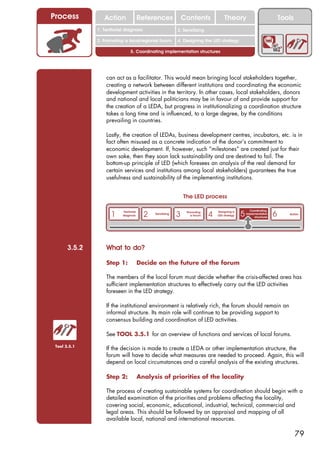
International
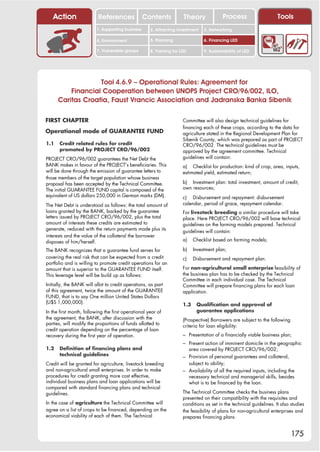
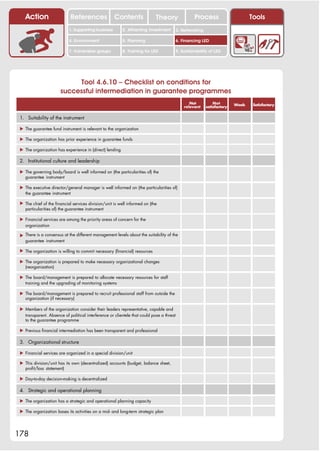
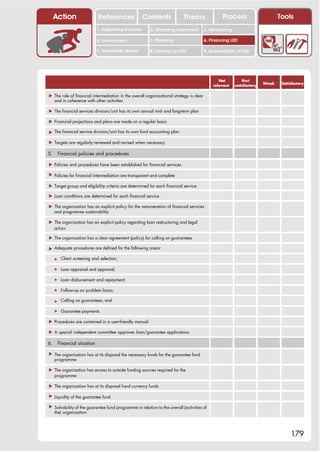
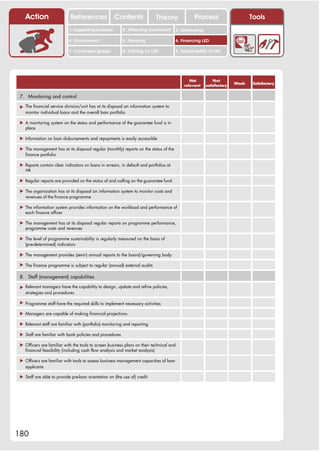
                                                       Labour
                                                       Organization


Local Economic Development
in Post-Crises Situations
    Operational Guide
                               Martin Gasser
                               Carmela Salzano
                               Roberto Di Meglio
                               Alfredo Lazarte-Hoyle


               Local Economic Development
               InFocus Programme on Social Dialogue,
               Labour Law and Labour Administration
Contents      Theory               Process              Action           References                       Tools
                                                        2. LED and the deficit
             1. Contents of the guide                      of decent jobs

             3. About this guide                       4. Symbols and acronyms


               SECTION I. CONTENTS OF THE GUIDE
     1.1       Table of contents

               SECTION I. CONTENTS OF THE GUIDE

      1.1      Table of contents ..............................................................1

      1.2      LED and the deficit of decent jobs .....................................5
     1.2.1     Crisis response within a longer-term perspective ........................................5
     1.2.2     Local economic development and the generation of
               “decent work” opportunities....................................................................6

      1.3      About this guide ..............................................................8
     1.3.1     Why a guide to local economic development in crisis-affected areas?..........8
     1.3.2     Who should use the guide?.....................................................................8
     1.3.3     How shouldthe guide be used?................................................................8
     1.3.4     Your contribution to the guide..................................................................9

      1.4      Symbols and acronyms..................................................10
     1.4.1     How to read the symbols......................................................................10
     1.4.2     How to read the headers......................................................................10
     1.4.3     Acronyms ...........................................................................................11


               SECTION II. THEORY

      2.1      Post-crisis situations: Problems and needs......................13
     2.1.1     What do we mean by “post-crisis situations”? .........................................13
     2.1.2     The SOCIAL environment ......................................................................14
     2.1.3     The POLITICAL environment...................................................................16
     2.1.4     The ECONOMIC environment...............................................................17
     2.1.5     Summary of needs...............................................................................18
               Toolkit 2.1 – Post-crisis situations: Problems and needs ....19

      2.2      Traditional development policies and their limits ............23
     2.2.1     SOCIAL limits ......................................................................................23
     2.2.2     ECONOMIC limits...............................................................................24
     2.2.3     POLITICAL limits...................................................................................25
               Toolkit 2.2 – Traditional development policies
               and their limits ..............................................................26

                                                                                                                        1
Contents     Theory               Process             Action           References                      Tools
                                                          2. LED and the deficit
                1. Contents of the guide                     of decent jobs


                3. About this guide                      4. Symbols and acronyms


         2.3     Local economic development in post-crisis situations ......28
        2.3.1    What is local economic development (LED)? ...........................................28
        2.3.2    Principles of the LED approach ..............................................................29
        2.3.3    The SOCIAL and POLITICAL dimensions of development ...........................30
        2.3.4    The ECONOMIC dimension of development...........................................31
        2.3.5    The LOCAL dimension of development ...................................................31
        2.3.6    How “big” is local? .............................................................................32
                 Toolkit 2.3 – LED in post-crisis situations.........................34


                 SECTION III. THE LED PROCESS

                 An overview ..................................................................36

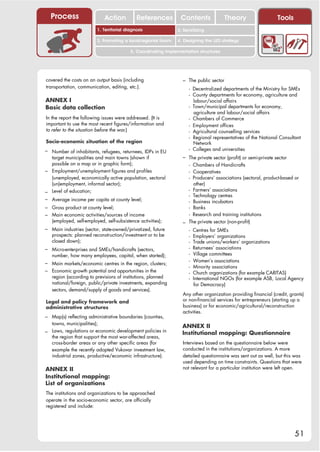
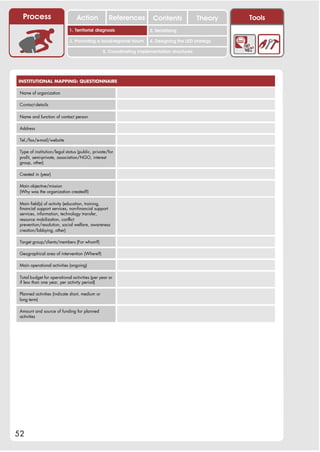
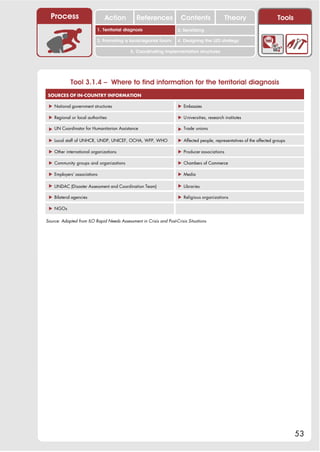
         3.1     Territorial diagnosis and institutional mapping...............39
        3.1.1    What to consider? ...............................................................................39
        3.1.2    What to do? .......................................................................................40
        3.1.3    Who should do it?...............................................................................42
                 Toolkit 3.1 – Territorial diagnosis and
                 institutional mapping ..................................................... 3
                                                                                           4

         3.2     Sensitizing .....................................................................55
        3.2.1    What to consider? ...............................................................................55
        3.2.2    What to do? .......................................................................................56
                 Toolkit 3.2 – Sensitizing ..................................................59

         3.3     Promoting a local/regional forum ..................................62
        3.3.1    What to consider? ...............................................................................62
        3.3.2    What to do? .......................................................................................63
        3.3.3    Who should do it?...............................................................................65

         3.4     Designing the LED strategy .............................................67
        3.4.1    What to consider? ...............................................................................67
        3.4.2    What to do? .......................................................................................68
        3.4.3    Who should do it?...............................................................................73
                 Toolkit 3.4 – Designing the LED strategy .........................74

         3.5     Coordinating/creating implementation structures...........77
        3.5.1    What to consider? ...............................................................................77
        3.5.2    What to do? .......................................................................................79
                 Toolkit 3.5 – Coordinating/creating implementation
                 structures .......................................................................84

2
Contents      Theory               Process             Action           References                      Tools
                                                       2. LED and the deficit
             1. Contents of the guide                     of decent jobs

             3. About this guide                      4. Symbols and acronyms


               SECTION IV. LED IN ACTION

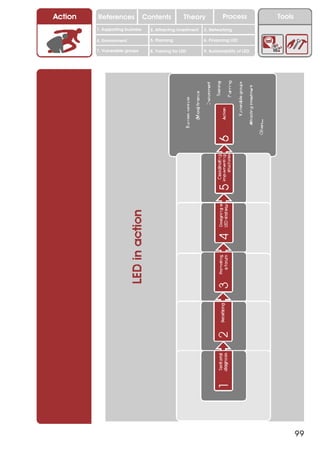
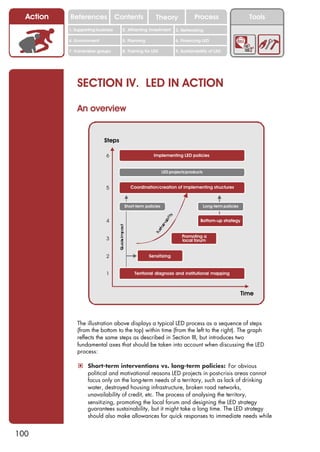
               An overview................................................................ 100

      4.1      Supporting business.....................................................103
     4.1.1     What to consider? .............................................................................103
     4.1.2     What to do? .....................................................................................108
     4.1.3     Who should do it?.............................................................................109
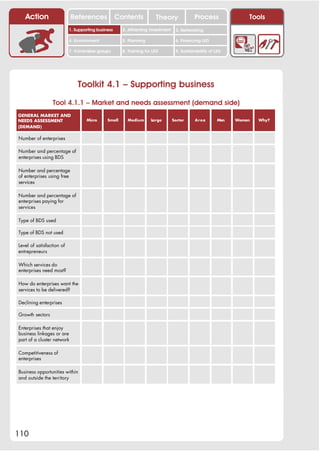
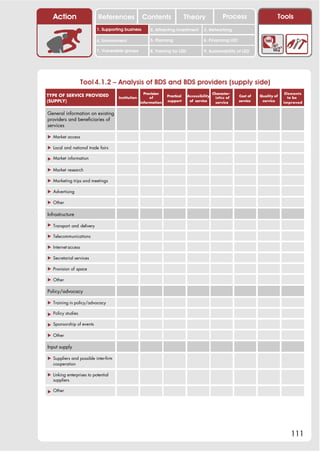
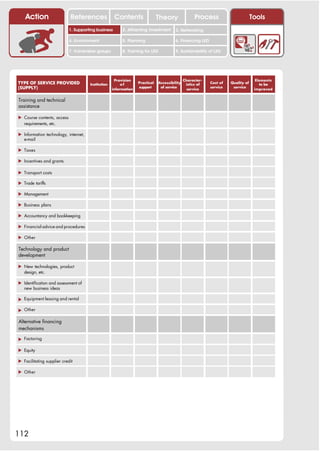
               Toolkit 4.1 – Supporting business .................................110

      4.2      Stimulating and attracting investment ..........................116
     4.2.1     What to consider? .............................................................................116
     4.2.2     What to do? .....................................................................................119
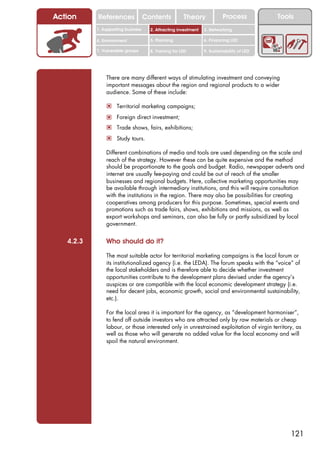
     4.2.3     Who should do it?.............................................................................120
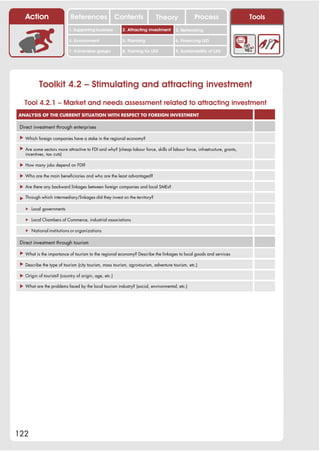
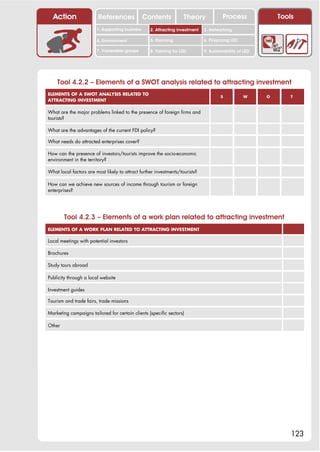
               Toolkit 4.2 – Stimulating and attracting investment ......122

      4.3      Networking and lobbying............................................ 124
     4.3.1     What to consider? .............................................................................124
     4.3.2     What to do? .....................................................................................126
     4.3.3     Who should do it?.............................................................................128
               Toolkit 4.3 – Networking and lobbying ........................ 129

      4.4      Strategic environmental assessment (SEA) ....................131
     4.4.1     What to consider? .............................................................................131
     4.4.2     What to do? .....................................................................................132
     4.4.3     Who should do it?.............................................................................133
               Toolkit 4.4 – Strategic environmental
               assessment (SEA) ......................................................... 135

      4.5      Strategic planning........................................................ 142
     4.5.1     What to consider? .............................................................................142
     4.5.2     What to do? .....................................................................................143
     4.5.3     Who should do it?.............................................................................145
               Toolkit 4.5 – Strategic planning .................................... 146

      4.6      Financing LED............................................................... 150
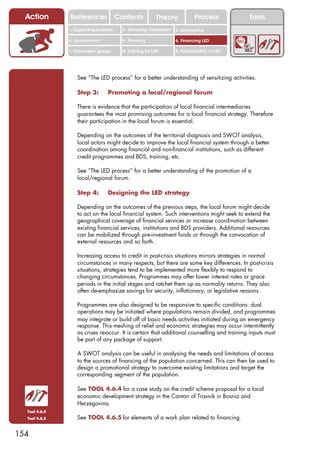
     4.6.1     What to consider? .............................................................................150
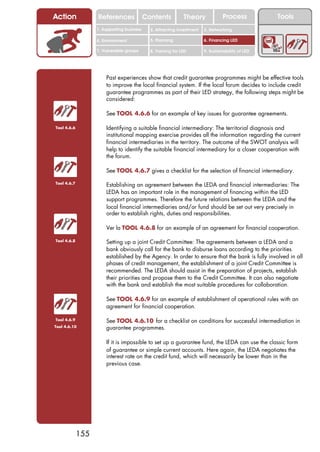
     4.6.2     What to do? .....................................................................................152
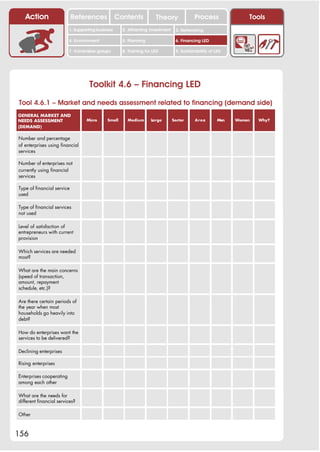
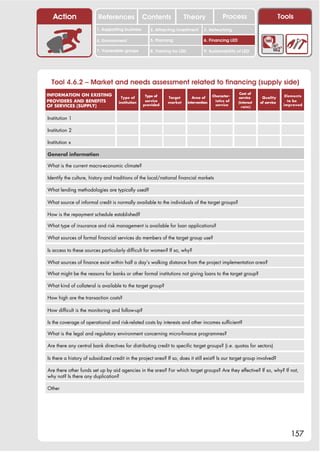
               Toolkit 4.6 – Financing LED ........................................... 156


                                                                                                                      3
Contents     Theory               Process             Action           References                      Tools
                                                         2. LED and the deficit
                1. Contents of the guide                    of decent jobs


                3. About this guide                      4. Symbols and acronyms


         4.7     Attention to vulnerable groups..................................... 181
        4.7.1    What to consider? .............................................................................181
        4.7.2    What to do? ..................................................................................... 184
        4.7.3    Who should do it?.............................................................................185
                 Toolkit 4.7 – Attention to vulnerable groups ................. 186

         4.8     Training for LED ...........................................................193
        4.8.1    What to consider? .............................................................................193
        4.8.2    What to do? ..................................................................................... 194
                 Toolkit 4.8 – Training for LED........................................197

         4.9     Sustainability of LED .................................................... 214
        4.9.1    What to consider? .............................................................................214
                 Toolkit 4.9 – Sustainability of LED .................................218


                 SECTION V. REFERENCES

         5.1     Glossary ......................................................................231

         5.2     Bibliography................................................................ 234


4
Contents         Theory               Process              Action           References                       Tools
                                                           2. LED and the deficit
                1. Contents of the guide                      of decent jobs

                3. About this guide                       4. Symbols and acronyms


     1.2          LED and the deficit of decent jobs
                  In today’s world, crises occurring from natural catastrophes, armed conflicts,
                  political and economic transitions or financial downturns are a frequent
                  occurence. The vast majority of crises take place in the developing world, where
                  some countries appear to be more vulnerable than others due to their
                  geographical, climatic, environmental or socio-economic situations, and the
                  impacts of these crises are often intensified due to poverty and
                  under-development. However, thanks to worldwide media communication and
                  faster means of travel, the international community is now more quickly informed
                  of these events and can respond accordingly.

                  Whatever their causes, most crises tend to have similar effects in that they create
                  massive social and economic dislocation, with civilian casualties, refugees and
                  internally displaced persons and the collapse of state and civil society
                  institutions. They strip away livelihoods, break up communities and hinder
                  people’s access to basic services. Humanitarian assistance plays a vital role,
                  since populations long affected by crises are unable to feed themselves, and the
                  supply and distribution of goods are often hampered because infrastructure and
                  means of transportation have either been heavily damaged or destroyed.

                  On a broader level, however, there is now recognition of the need for
                  interventions aimed at ensuring the smooth transition between relief and
                  rehabilitation and longer-term development. This implies listening to the
                  community’s needs, involving them in the institutional decision-making processes,
                  creating linkages across policy areas and greater coordination between the
                  different national development agencies, international organizations and NGOs
                  that have a role to play in a post-crisis situation.

    1.2.1         Crisis response within a longer-term perspective

                  The traditional response of the development community to crises has usually
                  been to provide emergency assistance within the shortest possible time. Given
                  the need to act quickly, this usually means hiring external staff and implementing
                  activities that are designed without a proper analysis of territorial development
                  problems or the specific needs and competencies of beneficiary groups.
                  Ultimately this can undermine the community’s own ability to become self-reliant.

                  Along with other UN agencies, the ILO has now recognized the need for a more
                  holistic and coordinated approach. The latest report of the Director-General of
                  the ILO stated that the organization is committed “to building support for a
                  balanced and integrated approach to sustainable development and growth in
                  the global economy”1. Strategies have been designed and tested that offer
                  immediate impact measures within more comprehensive packages of assistance


            1
                ILO: Reducing the Decent Work Deficit , Report of the Director-General, International Labour Conference,
                89th Session, 2001.


                                                                                                                           5
Contents     Theory               Process      Action         References                Tools
                                                   2. LED and the deficit
                1. Contents of the guide              of decent jobs


                3. About this guide               4. Symbols and acronyms


                 in local contexts. This has required greater internal coordination among ILO
                 departments and in the field, where “economic, social and environmental goals
                 can be achieved together”.

                 Such strategies recognize that relief and development do not follow one another:
                 they run side by side. Recovery not only concerns the provision of basic welfare
                 and services and the rebuilding of infrastructure, but is also a task that involves
                 and has implications for the wider political, institutional and economic
                 environment. It involves social and economic policy-makers, town planners and
                 experts in land use, land reform and administrative decentralization. In many
                 cases, it will be necessary to promote more inclusive mechanisms for
                 decision-making, introducing participatory methodologies for the first time. It
                 may also be necessary to provide assistance towards the reform of
                 administrative structures.


        1.2.2    Local economic development and the generation of
                 “decent work” opportunities
                 The World Employment Report, 2001 estimated that there are around 160
                 million unemployed people all over the planet, with a particular concentration in
                 the poorest nations.

                 Natural catastrophes, armed conflicts, political and economic transitions or
                 financial downturns hit hardest in those areas of the world where globalization
                 has not improved living conditions nor the ability of the poor to generate
                 adequate income. Communities and families engage in a number of activities to
                 increase their income, but these rarely provide any surplus income or the
                 opportunity to save towards improvements in health, education, pensions, etc.

                 Once the situation has stabilized, affected population groups face a number of
                 more critical challenges: replacing destroyed physical and productive
                 infrastructure, incrementing domestic and foreign investments, improving local
                 market demand, precarious access to finance, and more deeply-rooted problems
                 related to the lack of institutions, political instability, lack of social dialogue and
                 lingering tensions.

                 Jobs can be a real strong point for social sustainability if they are created as a
                 result of a genuine demand for employment within the local economy, seek to
                 include the most vulnerable groups, have real benefits for workers, and are
                 respectful of traditional cultures and the environment in which they are created.
                 Decent jobs enable families to make decisions unrestrained by financial
                 considerations, thus reducing tensions within the family and the community.
                 Employment creation will also play a key role in stemming the brain drain of
                 educated and skilled young people from crisis-affected areas to urban centres or
                 further afield.


6
Contents    Theory               Process     Action         References              Tools
                                             2. LED and the deficit
           1. Contents of the guide             of decent jobs

           3. About this guide               4. Symbols and acronyms


             To this end, local economic development (LED) is a concrete initiative of the ILO
             that begins in the community and attempts to create a sustainable bridge
             between relief and development in the following ways:

             ! LED gives a voice to all local actors, helping to ease and narrow down
                  what the Global Report to the Conference on Freedom of Association 2001
                  called the “representational gap”. The participatory nature of LED
                  encourages the inclusion of vulnerable groups in decision-making processes,
                  particularly women, ex-combatants and internally displaced persons as well
                  as agricultural workers, public sector workers, environmental groups, etc.;
             ! LED valorizes the development potential of local assets and
                  resources, particularly informal sector activities. The local dimension
                  of development enables the identification of informal groups of workers and
                  provides support for more formal organization;
             ! LED builds upon traditional forms of cooperation as a way of
                  addressing some of the problems faced by the crisis-affected community;
             ! LED fosters an enabling environment for decent work in terms of
                  workers’ rights and social security. In particular, LED fosters the
                  creation of enterprises and cooperatives that provide social services to the
                  local community. The process also encourages the creation of a legal
                  environment that guarantees workers’ rights for everybody while improving
                  access to social security systems;
             ! LED fosters economic development in harmony with environmental
                  sustainability. Raising awareness of environmental issues among
                  stakeholders at the beginning of the recovery process paves the way for
                  their integration into the design and implementation of a bottom-up LED
                  strategy. LED also aims at the involvement of environmental groups and
                  NGOs during the early stages of the recovery process.


                                                                                             7
Contents     Theory               Process      Action         References            Tools
                                                   2. LED and the deficit
                1. Contents of the guide              of decent jobs


                3. About this guide                4. Symbols and acronyms


         1.3     About this guide
        1.3.1    Why a guide to local economic development in
                 crisis-affected areas?

                 This operational guide is the result of a joint effort between researchers and
                 technical experts with a broad field experience in local economic development
                 (LED) around the world. It is based on practical experiences of managing
                 rehabilitation and stimulating economic recovery in post-crisis situations in many
                 different countries, and seeks to incorporate cross-cultural and sub-regional
                 experiences.

                 The major objective of the guide is to illustrate:

                  ! Why local economic development is particularly effective in post-crisis
                      situations. This question will be treated in Section II;
                  ! How to implement LED in practice. This is addressed in Sections III
                      and IV. Each chapter in the section begins with advice on different points to
                      consider before introducing practical step-by-step methodologies, enriched
                      by toolkits that contain helpful examples, contacts, questionnaires and other
                      tools for implementing everyday activities at the grassroots level.


        1.3.2    Who should use the guide?

                 The operational guide has been conceived as a tool and handbook for
                 programme managers, staff, consultants and local development partners
                 working on social and economic recovery and development interventions in
                 post-crisis situations.


        1.3.3    How shouldthe guide be used?

                 Both the theoretical and practical sections provide tools that may be used as a
                 part of fieldwork activities (i.e. slides to explain the theory to the local
                 stakeholders, checklists, best practice examples, etc.).

                 The guide is intended to be flexible enough so that it can be adapted to local
                 circumstances and used at any point during the post-crisis recovery process and
                 for any type of intervention, in isolation or in conjunction with others.
                 Development practitioners may concentrate on the development of an integrated
                 economic development strategy for the whole locality (Section III) and/or
                 concentrate on specific areas, such as business support, stimulating investment,
                 finance for development (Section IV). For this reason, the sequence of steps
                 proposed in the operational guide have been conceived broadly so that the
                 individual practitioner can adapt the mechanism to his or her own situation.


8
Contents     Theory               Process     Action         References               Tools
                                              2. LED and the deficit
            1. Contents of the guide             of decent jobs

            3. About this guide               4. Symbols and acronyms


              According to local circumstances, field staff might need to add, exclude or
              change parts of the manual and/or slides. In order to facilitate such changes,
              we have provided the following tools:

              ! A folder, which can be continuously added to in order to customize the
                   guide;
              ! A CD-ROM which will make it possible to change the text and slides quickly
                   and easily;
              ! The address of the ILO LED website that will contain all further updates of
                   the operational guide. We plan to update the original LED guide
                   periodically. The most efficient way of updating the guide will be our
                   website;
              ! An ILO LED newsletter to inform you about any changes, updates and other
                   publications relevant to the topic. If you wish to receive our newsletter,
                   please write to the following e-mail address: LED@ilo.org, indicating the
                   subject “LED newsletter”.


    1.3.4     Your contribution to the guide

              In order to update our guide we need the cooperation of people working in the
              field. Any suggestions regarding improvements, changes, good practices or
              other comments are therefore greatly appreciated.


                                                                                                9
Contents     Theory               Process                   Action                  References                      Tools
                                                             2. LED and the deficit
             1. Contents of the guide                           of decent jobs


             3. About this guide                             4. Symbols and acronyms


      1.4     Symbols and acronyms
     1.4.1    How to read the symbols

              The use of symbols aims to facilitate the use of the guide. The different symbols
              in each section distinguish its content and character. In the digital version of this
              guide, the symbols are a link to the relevant sections.


                               This symbol signals the theoretical part of the guide


                               This symbol signals the action-oriented part of the guide


                               This symbol signals the existence of tools
                               (checklists, examples, etc.)


                               This symbol signals the existence of slides (animated PowerPoint
                               or static slides) regarding a specific topic


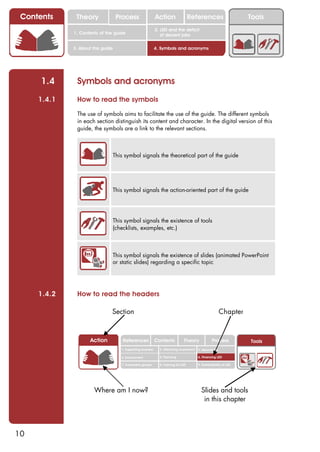
     1.4.2    How to read the headers

                               Section                                                                    Chapter


                     Action          References              Contents           Theory              Process          Tools
                                    1. Supporting business     2. Attracting investment   3. Networking

                                    4. Environment             5. Planning                6. Financing LED

                                    7. Vulnerable groups       8. Training for LED        9. Sustainability of LED


                       Where am I now?                                                      Slides and tools
                                                                                             in this chapter


10
Contents     Theory               Process             Action          References            Tools
                                                      2. LED and the deficit
            1. Contents of the guide                     of decent jobs

            3. About this guide                      4. Symbols and acronyms


    1.4.3     Acronyms

                  ACLEDA          Association of Cambodian Local Economic Development Agencies

                   ADEM           Agencia de Desenvolvimento Econômico Local da Provincia de Manica

                    BCTC          Bihac Construction Training Centre

                    BDS           Business development services

                    CBO           Community-based organization

                   COTEF          Technical Cooperation Team in Employment and Training

                    EIA           Environmental impact assessment

                     EU           European Union

                 EURADA           European Association of Development Agencies

                    FHH           Female head of household

                     IFP          InFocus Programme

                     ILO          International Labour Organization

                     IM           Institutional Mapping

                    LDC           Local Development Council

                    LED           Local economic development

                    LEDA          Local Economic Development Agency

                    MSE           Micro and small-sized enterprises

                   NGO            Non-governmental organization

                   OCHA           Office of Coordination of Humanitarian Affairs

                                  Programa de Desarrollo para Refugiados Desplazados y Repatriados en
                 PRODERE          Centroamérica

                    RNA           Rapid needs assessment

                    SEA           Strategic environmental assessment

                    SIYB          Start and improve your business

                    SME           Small and medium-sized enterprise

                   SWOT           Strengths, Weaknesses, Opportunities and Threats

                     TD           Territorial diagnosis

                    UN            United Nations

                   UNDP           United Nations Development Programme

                  UNOPS           United Nations Office for Project Services

                    WB            World Bank


                                                                                                      11
Theory     Process             Action          References Contents                     Tools
           1. Post-crisis situations: Problems and needs

           2. Traditional development policies and their limits

           3. Local economic development in post-crisis situations


            SECTION II. THEORY

    2.1     Post-crisis situations: Problems and needs
            This chapter sets out to briefly define what we mean by “post-crisis situations”
            before going on to analyse why economic development in these areas is
            particularly demanding. Each post-crisis situation has its own very specific
            characteristics and thus encounters a particular mix of difficulties during the
            recovery process. Nevertheless, an attempt is made to identify common
            characteristics from a social, economic and political perspective.


   2.1.1    What do we mean by “post-crisis situations”?


                        Post-crisis situations are territories that have previously
                        suffered from significant problems such as:
                        !    Armed conflicts and their aftermath (i.e. civil wars or
                             other violent conflicts);
                        !    Natural disasters;
                        !    Abrupt financial and economic downturns;
                        !    Social movements or political transitions.


            Crises can take on many different forms. These include natural disasters that
            occur unexpectedly or as part of a chain of events, and complex
            emergencies. By “complex emergencies” we mean any crisis that has multiple
            origins and compounding effects, where there is a total or considerable
            breakdown of authority resulting from internal or external disaster or conflict,
            and which requires an international response that goes beyond the mandate of
            any one United Nations agency or ongoing system of assistance.

            Crises have different root causes, but a common characteristic is that they disrupt
            the everyday functioning of a society. The crisis-affected groups, who may be
            internally displaced persons, refugees, retrenched workers or ex-combatants,
            employ a wide range of survival strategies in order to make sure that there
            is some food and income available. During prolonged periods of crisis or
            uncertainty, families and population groups adapt to the new situation and
            survival mechanisms tend to become a regular feature of everyday living
            patterns.


                                                                                               13
Theory      Process             Action          References            Contents                      Tools
             1. Post-crisis situations: Problems and needs

             2. Traditional development policies and their limits

             3. Local economic development in post-crisis situations


              In post-crisis situations, domestic and international financial resources mobilize
              very quickly to deal with immediate needs. The reconstruction process usually
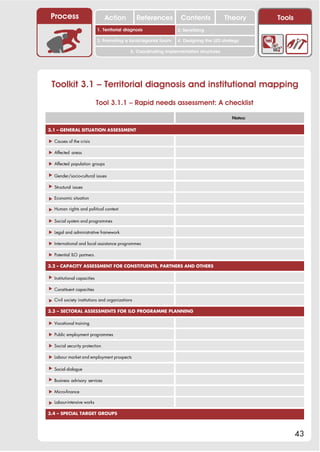
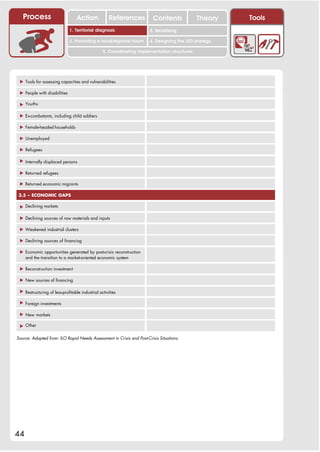
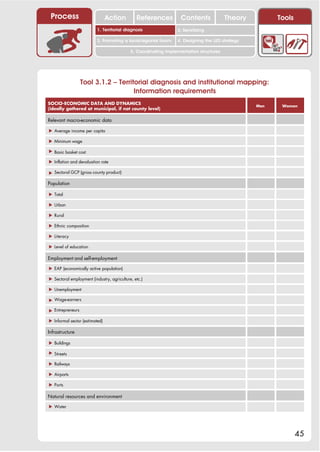
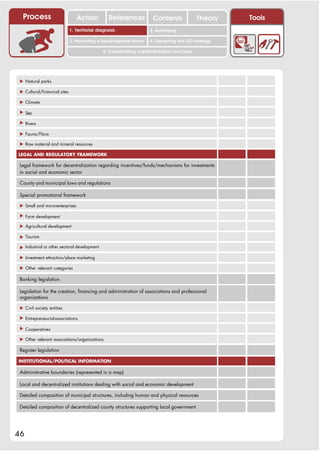
              begins with a rapid needs assessment (RNA) to define specific measures
              to save and sustain lives and to estimate short, medium and long-term
              reintegration, rehabilitation and development needs. An RNA evaluates the
              capacities of local populations and institutions to cope with crises and is
              undertaken as early as possible to lay the foundations for development
              interventions.

              In the past, a typical menu of emergency response assistance would focus
              on the provision of basic services (such as food, clothing, shelter, medicine),
              promoting the conditions for a return to political, economic and social stability in
              an effort to prevent more lives being lost. Once the situation had stabilized,
              interventions would then target the repair of physical infrastructure, such as
              transportation and communications, the rebuilding of schools, houses,
              health-care centres and churches, and the rehabilitation of systems for the
              internal provision of basic utilities such as water, food and medicines.

              The process of restoring some degree of normality to the area is highly traumatic
              and time consuming, particularly for those people who return to their
              communities to find their homes and livelihoods destroyed. But in some
              situations, the pre-crisis situation is also one to which the community may not
              wish to return, since it may have triggered the crisis in the first place.


     2.1.2    The SOCIAL environment

              When a crisis occurs within a territory, whole communities are usually displaced
              both nationally and internationally, with little choice but to go in search of
              security and food.

              One of the first, and perhaps                  HIGH LEVELS OF POVERTY: THE CASE OF
              most fundamental steps is the                  MOZAMBIQUE
              restoration of a sense of security.
              In most situations, this means                 The socio-economic context of Mozambique is
                                                             characterized by particularly unsafe and unhealthy
              providing people with the ability              living and working conditions. Particularly in the
              to return to their communities,                Sofala and Manica provinces, the population in
              rebuild their homes, pursue their              rural areas is under a constant threat of disease
                                                             (malaria, bilharzias), landmines or animals. Along
              livelihoods and benefit from                   the river Zambezi in north Sofala and Manica,
              basic services such as access to               hippopotamuses and crocodiles form an unseen
              water and safe road networks. In               danger to the peasants and fishermen that live on
                                                             the river. In addition, HIV/AIDS is advancing at a
              the case of conflicts, a culture of            horrifying pace, its biggest impact being on the
              militarization and fear often                  economically active.
              remains long after the signing of
                                                             See Geert van Boekel, Local Economic Development
              peace agreements.                              Component, PDHL Mozambique – Final Report,


14
Theory   Process                Action             References Contents                              Tools
         1. Post-crisis situations: Problems and needs

         2. Traditional development policies and their limits

         3. Local economic development in post-crisis situations


          The next step during the early response phase is to assess and meet the needs of
          the different population groups, particularly the most vulnerable. These could
          either be people who remained in their community or were settled in refugee
          camps. Many will already have suffered from a high level of poverty and
          will not have had access to basic assets and services, since they have
          been living in unplanned settlements with poor infrastructure. Difficulties related
          to obtaining sufficient food, housing, water supply, infrastructure and sanitation
          are of course exacerbated in any area that has been subjected to natural,
          conflict-related, economic or social crises.

          Once the emergency has abated and immediate needs have been met, the
          communities are still in a state of extreme vulnerability and there may be mistrust
          among different social groups, especially if one group is perceived as being
          favoured over another. Official social safety nets, meaning public measures
          to provide people with a basic level of financial and social services, are usually
          lacking. Health-care centres do not have enough medicines or are obliged to
          operate on minimal services for quite some time. Schools are forced to close
          down. There is a lack of employment or income-generation opportunities that
          can also contribute to tensions.

                                                                           In these circumstances, families or
            DISINTEGRATION OF FAMILIES AND COMMUNITY                        local communities act as
            NETWORKS: THE EXAMPLE OF PALESTINE’S
            REFUGEE CAMPS
                                                                             important nuclei of stability and
                                                                             reciprocal aid. Unfortunately
            Refugee camps have the highest incidence of poverty              many crises contribute to the
            overall. About one out of three households in refugee            disintegration of important
            camps were poor in 1998, and this is 1.6 times larger
            than the rate of poverty in cities (20 per cent) and             links within both the closer and
            villages (21 per cent). But the higher incidence of              broader family networks.
            poverty in the refugee camps is really due to the                Broken family links prevent
            higher incidence of poverty in Gaza overall — Gaza
            had higher rates of poverty regardless of place of
                                                                             reciprocal aid-giving and
            residence. This is reflected in the different contributions      discourage basic social and
            of types of residence to national poverty. A greater             economic interaction.
            proportion of the poor are in villages (43 per cent)
            and cities (33 per cent) than in refugee camps (25 per
                                                                             Geographical distances and the
            cent).                                                           lack of sufficient information from
                                                                             national governments concerning
            See UNDP, Participatory Poverty Assessment Report –              real needs at grassroots level
            Programme of Assistance to the Palestinian People,
            Geneva, 2001.                                                   hinder the progress towards
                                                                          social stability.


          Vulnerable groups experience particular difficulties in overcoming the
          obstacles associated with recovery, and if their needs remain unaddressed, their
          potential contribution to socio-economic development may well be transformed
          into a destabilizing element posing further security challenges. In crisis-affected
          areas, such groups include ex-combatants, refugees and returnees, women, the
          elderly and young people, as well as ethnic minorities, etc. There is in fact
          evidence that lack of decent work contributes to the persistence of tensions,


                                                                                                            15
Theory      Process              Action            References             Contents                        Tools
             1. Post-crisis situations: Problems and needs

             2. Traditional development policies and their limits

             3. Local economic development in post-crisis situations


              social exclusion and its
                                                                 VULNERABLE GROUPS: THE CASE OF SOMALIA
              side-effects (i.e. alcoholism,
              social apathy, criminal                            Many young boys, who are either ex-militia or
              activities,and so on).                             have become school dropouts due to the war and
                                                                 have mingled with the militia groups, are
                                                                 considered to be a particularly vulnerable group
              One of the biggest challenges,                     in various Somali regions. The young fighters
              therefore, is to repair the social                 often originate from the rural areas, but do not
              fabric so as to meet the needs of                  want to return to pastoral life anymore; they do
                                                                 not even have the skills for it. They have not learnt
              all affected groups, particularly                  any other skill but the use of a gun. Many of these
              the most vulnerable. Ultimately,                   people sit idle, often developing an addiction to
              this will depend on awareness of                   khat or becoming a social threat.
              people’s social, cultural,
                                                                 See Sub-Programme Promotion of an Enabling
              economic and psychological                         Environment and Economic Recovery in Somalia,
              needs and making use of the                        UNDP/ILO Project Document, Geneva, 1998.
              community’s skills in the design
              and implementation of long-term
              interventions.


     2.1.3    The POLITICAL environment

              Political instability, low institutional density and overlapping
              agendas at national and local levels, and the lack of grassroots participation
              in decision-making processes represent the most common drawbacks for local
              economies in post-crisis situations.

              In the immediate aftermath, governments experience increasing difficulty in
              preserving law and order. In failed states, where legal and regulatory
                                                                        frameworks may have been weak to
                                                                           begin with, the problems are
                EFFECTS OF POLITICAL INSTABILITY AND                        intensified. There may be a lack
                INSECURITY: THE CASE OF SOUTH-EAST SERBIA                    of confidence and trust in
                The security situation in the region – in particular in
                                                                             political mechanisms due to
                the project area of the municipalities of Presevo,           previous practices.
                Medvedja and Bujanovac – distorts daily life and
                affects further the already heavily weakened local
                                                                             The need for different ministries
                economy. Inhabitants living very near to the border
                with Kosovo, abandon their plots of land out of fear         and agencies to be visible
                of landmines and snipers. In the village of Oslare,          creates further political problems,
                some Albanians have been forced to stay at home
                                                                             especially if there are few local
                and the police have taken their stocks. Women
                working in companies nearby are afraid to travel to          institutions through which
                their work and their male family members                     assistance can be coordinated
                accompany them for protection. There are probably            and which can mediate between
                also incidents related to ethnic tensions in the work
                place, but this could not be confirmed during the            different sectoral interests.
                mission.

                See Carlien van Empel, Assessment of the Economic
                and Employment Situation in the Municipalities of
                P resevo, Medvedja and Bujanovac (PMB), Mission
                Report, ILO, Geneva, 2001.


16
Theory     Process              Action           References Contents                                     Tools
           1. Post-crisis situations: Problems and needs

           2. Traditional development policies and their limits

           3. Local economic development in post-crisis situations


                                                                            Consensus is the starting point
              LACK OF INSTITUTIONS: AN EXAMPLE FROM THE
              PRESEVO VALLEY IN SOUTH-EAST SERBIA
                                                                             for local economic recovery.
                                                                             However, the lack of
              The quasi non-existence of economic support institutions       grassroots participation by
              (development agencies, business support centres, and
                                                                             private sector and civil society
              local banks for SMEs) is an important obstacle for the
              creation of micro-enterprises and SMEs in the Presevo          stakeholders in post-crisis
              Valley. The Chamber of Commerce is supposed to                 decision-making also
              assist SMEs, but it suffers from an old-style, top-down        undermines recovery efforts,
              management and does not reach out to potential
              entrepreneurs at local level. Entrepreneurs indicated          since they are unable to
              having problems to access appropriate credit and               articulate the real interests of
              mentioned also the lack of assistance with the                 the community. In developing
              formulation of business plans and unfavourable tax
              regulations regarding the import of foreign raw                countries, this may be
              materials and equipment. At governmental level, there          symptomatic of the policy
              exists a Development Fund where municipalities can             environment in general, even
              submit investment plans for local industries and
              companies.
                                                                             in “normal” conditions.

              See Carlien van Empel, Assessment of the EconomicAs a consequence, long-term
              and Employment Situation in the Municipalities of
                                                               development is slowed down
              Presevo, Medvedja and Bujanovac (PMB), Mission
              Report, ILO, Geneva, 2001.                       by the cleavage between
                                                             national policies and local
                                                           priorities. Often geographical
            distances and the nature of information exchange mean that national policies
            target problems without thoroughly considering local priorities and the ability of
            local groups and actors to carry out interventions.

            The arrival of numerous international donors during and after the crisis is likely
            to distract from this situation, if only temporarily. Different agencies and NGOs
            pursue different sectoral objectives and goals. This creates overlapping agendas
            and, in many cases, the national government is only able to provide an
            administrative framework, rather than assuming a coordination function.


   2.1.4    The ECONOMIC environment

            Damage to the productive                           DAMAGE TO HUMAN AND PHYSICAL
            infrastructure and                                 INFRASTRUCTURE: THE EXAMPLE OF
            communication networks                             WAR-AFFECTED CAMBODIA
            represents the most visible impact
                                                               The LED project in Cambodia was implemented
            of crises. The magnitude of                        during a time of great political change, initiated
            physical destruction is usually                    by the signing of the Paris Peace Accords in
            greater in the case of natural                     October 1991. These brought to an end more
                                                               than 20 years of war and civil war, which had
            disasters, but it could also be                    seen much of Cambodia’s infrastructure
            susbstantial in post-conflict areas.               destroyed. The rule of the Maoist Khmer Rouge,
            The initial phase of post-conflict                 from 1975 to 1978, had also cost the lives of
                                                               some 1.5 to 2 million people, including most of
            development could also be                          the country’s educated population.
            hindered by the presence of
            landmines. At a time when                          See Roel Hakemulder, Promoting local economic
            societies need to learn to live and                development in a war-affected country: The ILO
                                                               experience in Cambodia, ILO, Geneva, 2000.
            work together, mines have the


                                                                                                                    17
Theory   Process               Action            References                 Contents                      Tools
          1. Post-crisis situations: Problems and needs

          2. Traditional development policies and their limits

          3. Local economic development in post-crisis situations


           triple effect of shattering
                                                       THE IMPACT OF A WEAK PRODUCTIVE
           individual lives, increasing
                                                       INFRASTRUCTURE ON THE LOCAL ECONOMY:
           the medical burden on                       AN EXAMPLE FROM THE DEMOCRATIC REPUBLIC OF
           families and communities                    CONGO (DRC)
           and preventing localities
                                                       For over 30 years, DRC has suffered from a highly
           from developing land and                    complicated democratic transition resulting in political
           rebuilding infrastructures.                 tensions, violence and wars with neighbouring countries.
                                                       One of the direct economic consequences of the ongoing
                                                       conflicts is the severe deterioration of the transport
           Damage to physical                          infrastructure. Poor road conditions in the Province of
           infrastructure, such as road                Bandundu severely affect the local economy. The transport
                                                       problems hinder economic activities and make the
           and rail networks, may cut                  commercialization of agricultural products barely possible.
           the whole area off from the                 As a consequence, the inhabitants returned to household
           surrounding populations,                    production as cash flow in the local economy dried up.
                                                       Today, high unemployment rates and endemic poverty
           and thus from suppliers                     characterize the rural areas in Bandundu. Moreover,
           and customers. Harbours                     population groups in expanding urban centres lack access
           and airports may be the                     to vegetables and other staple foods at reasonable prices,
           only access to external                     which aggravates health and living conditions of the
                                                       urban population.
           markets; however, even if
           they have suffered less                     See ILO, Réhabilitation d’infrastructures par des
           damage, they may not be                     groupements coopératifs, Project Document, Geneva,
                                                       May 2000.
           accessible to a broad
           section of the population.


           Broken communication networks, such as telephone, television, mail, internet,
           newspapers, etc., reduce the possibility of personal and commercial contacts
           and information exchange at the national and international levels. This is
           particularly harmful for post-crisis areas, where the local economy needs to be
           strengthened through the generation of new market opportunities.

                                                                               In cases of financial and
              LACK OF INFORMATION AND COMMUNICATION:
              THE CASE OF THE EARTHQUAKE-AFFECTED STATE OF                      socio-economic crises, it is
              GUJARAT (INDIA)                                                   common for a large number
                                                                                of industrial and
              The earthquake of 26th January 2001 caused extensive
              damage in 21 districts in the State of Gujarat. The
                                                                                manufacturing workers to be
              Government death toll figures estimate 19,466 people.             layed off, which leads to an
              An estimated 320,000 houses have been evacuated                   upsurge in unemployment
              and a very large number have been destroyed. In the
              worst affected districts, Kutch, Patan, Surendranagar
                                                                                and underemployment. The
              and Banaskantha, the earthquake has destroyed                     knock-on effect in all areas of
              people’s homes, livestock, the food stock, seeds, cattle          the economy causes extreme
              fodder and basic artisanal tools and therefore deprived
              them also of their means of livelihood. The entire
                                                                                hardship and has a
              infrastructure and public utilities such as electricity,          disproportionate impact on
              telephone services, roads, bridges, railways, ports,              vulnerable groups. Investment
              water supply, schools, health centres in 21 districts,            in productive assets tends to
              covering 7,904 villages, have been badly affected.
                                                                                dry up, no external capital
              See A Model Programme for Social and Economic                     comes in and private capital
              Reconstruction in 10 Villages of Kutch District in the State      is transferred overseas.
              of Gujarat, ILO Joint Missions in Response to the
              Earthquake in Gujarat, March-May 2001.


18
Theory   Process              Action            References Contents                                    Tools
         1. Post-crisis situations: Problems and needs

         2. Traditional development policies and their limits

         3. Local economic development in post-crisis situations


          The impact on human
                                                          DESTRUCTION OF INFRASTRUCTURE DUE TO
          infrastructure is less                          FLOODING: THE CASE OF VENEZUELA
          visible, but equally
          important. Local craftsmen                      In December 1999 the state of Vargas in Venezuela
                                                          was affected by serious flooding. The estimates of the
          and workers flee the area,
                                                          natural catastrophe’s consequences include between
          taking their special production                 20,000 and 30,000 victims. Furthermore, around
          techniques and personal                         200,000 people were seriously affected by the
          contacts with them. For those                   flooding, either losing their homes and/or their jobs
                                                          (60% of the national population); 6-7 metres of mud
          who remain, only short-term                     covered the soil of a large part of the state,
          employment opportunities in                     destroying, among others, the principal tourism areas
          the formal sector may be                        near Caracas. Also the second port and the first
                                                          international airport were seriously affected.
          available. Others engage in
          income-generation activities on                 See Programa de recuperación de empleos y de
          a subsistence level.                            reducción de la vulnerabilidad socioeconómica en
                                                          Venezuela, prepared after an ILO mission in response
                                                          to the floodings in Venezuela, Caracas, April 2000.
          The loss of income reduces
          purchasing capacity within local
          markets, and consequently the circulation of currency in the economy drops even
          further, thereby eliminating the demand for products.

          The health of capital markets, particularly the availability of financial
          support for entrepreneurs, is critical to getting markets moving again.
          However, both lenders and borrowers usually lack information and guarantees,
          a situation which inevitably hinders constructive cooperation between banks and
          entrepreneurs. No bank or other financial institution is willing to take the risk of
          offering credit if entrepreneurs are unable to put up collateral or ensure the
          safety of their investments.

          Finally, broken linkages in business networks, lack of confidence and lack of trust
          between business partners are also important obstacles since they contribute to
          the breakdown of industrial clusters or cooperative arrangements. Especially in
                                                                 post-crisis areas, business linkages
                                                                   and cooperative networks are
            LACK OF FINANCIAL MECHANISMS: THE CASE OF               highly desirable because they
            MOZAMBIQUE
                                                                    are capable of reinforcing the
            A complete lack of any formal finance mechanism         competitiveness of small and
            was one of the major problems in the LED projects in    badly-equipped sectors.
            Mozambique. In the Sofala, Manica and Maputo            Nevertheless, many cooperative
            Provinces there were no banks or formal financial
            institutions outside the main urban areas. Some         arrangements fail as a direct or
            international NGOs are operating in the field of        indirect consequence of the
            micro-finance, although their success and outreach      crisis itself.
            have been very limited so far. Individual
            moneylenders are active in the provinces; however
            their services are unreliable and often very expensive.

            See Geert van Boekel, Local Economic Development
            Component, PDHL Mozambique – Final Report,
            ILO/UNOPS, Maputo, 2001.


                                                                                                                   19
Theory      Process             Action          References            Contents       Tools
             1. Post-crisis situations: Problems and needs

             2. Traditional development policies and their limits

             3. Local economic development in post-crisis situations


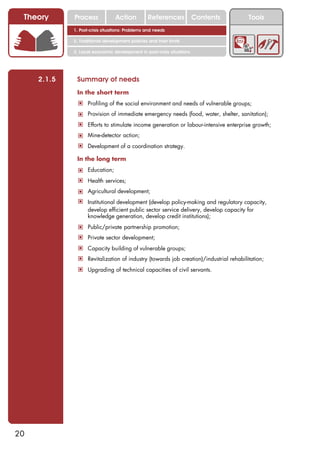
     2.1.5    Summary of needs
              In the short term
              ! Profiling of the social environment and needs of vulnerable groups;
              ! Provision of immediate emergency needs (food, water, shelter, sanitation);
              ! Efforts to stimulate income generation or labour-intensive enterprise growth;
              ! Mine-detector action;
              ! Development of a coordination strategy.

              In the long term
              ! Education;
              ! Health services;
              ! Agricultural development;
              ! Institutional development (develop policy-making and regulatory capacity,
                   develop efficient public sector service delivery, develop capacity for
                   knowledge generation, develop credit institutions);
              ! Public/private partnership promotion;
              ! Private sector development;
              ! Capacity building of vulnerable groups;
              ! Revitalization of industry (towards job creation)/industrial rehabilitation;
              ! Upgrading of technical capacities of civil servants.


20
Theory                        Process              Action              References Contents                     Tools
                               1. Post-crisis situations: Problems and needs

                               2. Traditional development policies and their limits

                               3. Local economic development in post-crisis situations


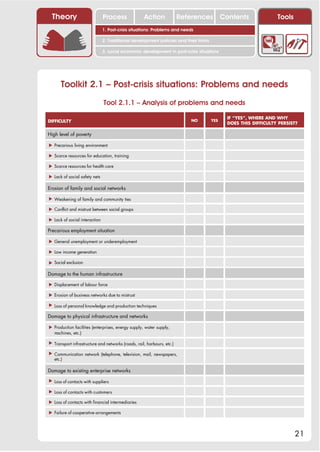
      Toolkit 2.1 – Post-crisis situations: Problems and needs
                               Tool 2.1.1 – Analysis of problems and needs

                                                                                            IF “YES”, WHERE AND WHY
DIFFICULTY                                                                 NO         YES
                                                                                            DOES THIS DIFFICULTY PERSIST?

High level of poverty

! Precarious living environment

! Scarce resources for education, training

! Scarce resources for health care

! Lack of social safety nets

Erosion of family and social networks

! Weakening of family and community ties

! Conflict and mistrust between social groups

! Lack of social interaction

Precarious employment situation

! General unemployment or underemployment

! Low income generation

! Social exclusion

Damage to the human infrastructure

! Displacement of labour force

! Erosion of business networks due to mistrust

! Loss of personal knowledge and production techniques

Damage to physical infrastructure and networks

! Production facilities (enterprises, energy supply, water supply,
  machines, etc.)

! Transport infrastructure and networks (roads, rail, harbours, etc.)

! Communication network (telephone, television, mail, newspapers,
  etc.)

Damage to existing enterprise networks

! Loss of contacts with suppliers

! Loss of contacts with customers

! Loss of contacts with financial intermediaries

! Failure of cooperative arrangements


                                                                                                                        21
Theory                       Process             Action          References               Contents             Tools
                                1. Post-crisis situations: Problems and needs

                                2. Traditional development policies and their limits

                                3. Local economic development in post-crisis situations


                                                                                              IF “YES”, WHERE AND WHY
DIFFICULTY                                                                 NO          YES
                                                                                              DOES THIS DIFFICULTY PERSIST?

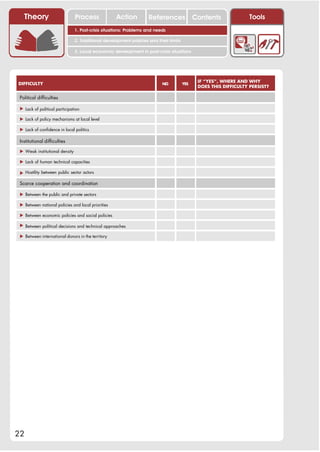
 Political difficulties

 ! Lack of political participation

 ! Lack of policy mechanisms at local level

 ! Lack of confidence in local politics

 Institutional difficulties

 ! Weak institutional density

 ! Lack of human technical capacities

 ! Hostility between public sector actors

 Scarce cooperation and coordination

 ! Between the public and private sectors

 ! Between national policies and local priorities

 ! Between economic policies and social policies

 ! Between political decisions and technical approaches

 ! Between international donors in the territory


22
Theory     Process             Action          References Contents                   Tools
           1. Post-crisis situations: Problems and needs

           2. Traditional development policies and their limits

           3. Local economic development in post-crisis situations


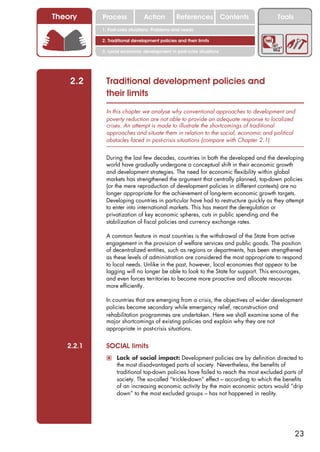
    2.2     Traditional development policies and
            their limits
            In this chapter we analyse why conventional approaches to development and
            poverty reduction are not able to provide an adequate response to localized
            crises. An attempt is made to illustrate the shortcomings of traditional
            approaches and situate them in relation to the social, economic and political
            obstacles faced in post-crisis situations (compare with Chapter 2.1).


            During the last few decades, countries in both the developed and the developing
            world have gradually undergone a conceptual shift in their economic growth
            and development strategies. The need for economic flexibility within global
            markets has strengthened the argument that centrally planned, top-down policies
            (or the mere reproduction of development policies in different contexts) are no
            longer appropriate for the achievement of long-term economic growth targets.
            Developing countries in particular have had to restructure quickly as they attempt
            to enter into international markets. This has meant the deregulation or
            privatization of key economic spheres, cuts in public spending and the
            stabilization of fiscal policies and currency exchange rates.

            A common feature in most countries is the withdrawal of the State from active
            engagement in the provision of welfare services and public goods. The position
            of decentralized entities, such as regions or departments, has been strengthened
            as these levels of administration are considered the most appropriate to respond
            to local needs. Unlike in the past, however, local economies that appear to be
            lagging will no longer be able to look to the State for support. This encourages,
            and even forces territories to become more proactive and allocate resources
            more efficiently.

            In countries that are emerging from a crisis, the objectives of wider development
            policies become secondary while emergency relief, reconstruction and
            rehabilitation programmes are undertaken. Here we shall examine some of the
            major shortcomings of existing policies and explain why they are not
            appropriate in post-crisis situations.


   2.2.1    SOCIAL limits
            ! Lack of social impact: Development policies are by definition directed to
                  the most disadvantaged parts of society. Nevertheless, the benefits of
                  traditional top-down policies have failed to reach the most excluded parts of
                  society. The so-called “trickle-down” effect – according to which the benefits
                  of an increasing economic activity by the main economic actors would “drip
                  down” to the most excluded groups – has not happened in reality.


                                                                                             23
Theory      Process             Action          References            Contents        Tools
             1. Post-crisis situations: Problems and needs

             2. Traditional development policies and their limits

             3. Local economic development in post-crisis situations


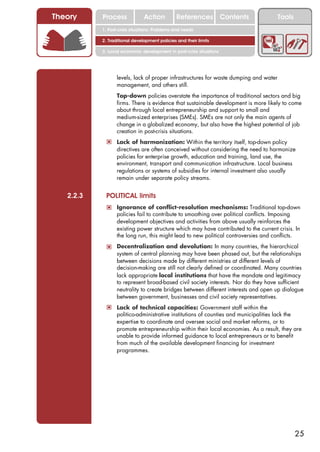
              ! Time lags: Territories in a crisis or post-crisis situation need a quick
                   response, mainly in order to meet the most urgent needs of vulnerable
                   groups. Traditional top-down policies are the result of centrally conceived
                   and managed development programmes. One of the major inefficiencies of
                   these programmes is the huge time delay between policy conception and
                   implementation, during which time social problems may get progressively
                   worse.
              ! Unsustainable job creation: Creating employment with public money
                   or funds donated by international development partners does not generate
                   decent jobs with real benefits attached. Jobs that are created as a result of a
                   real demand in the local labour market and that are negociated on the basis
                   of social partnerships are more likely to be sustainable.
              ! Lack of attention to local peculiarities: National top-down
                   approaches tend to apply identical solutions to different parts of the national
                   territory. This attempt to standardize development policies has largely failed
                   because each territory is characterized by different socio-economic, cultural
                   and political needs and characteristics.


     2.2.2    ECONOMIC limits
              ! Priority on macroeconomic variables (fiscal policy, monetary
                   interventions, etc.): Long-term programmes, which are designed to stabilize
                   the framework conditions for recovery, often have a weak or even negative
                   impact at the local level, because they tend to emphasize aggregate levels
                   of growth, but do not reflect the problems of under-performing regions and
                   their difficulties in stimulating new employment opportunities. Previous
                   economic trends, growth and declining sectors, demographic patterns and
                   the needs of vulnerable population groups are not taken into account. This
                   means that problems as they are experienced in concrete social settings can
                   go unnoticed if there is no “local voice” to highlight local needs and
                   assets and act as a barometer of progress in the crisis-affected area.
              ! Priority on physical infrastructure: Medium-term recovery strategies
                   tend to concentrate on physical infrastructures (i.e. national highways,
                   development zones, airports, etc.) and supply-side investments, without
                   regard for the equally important need to create a soft infrastructure,
                   meaning the institutional, business and commercial services that underpin
                   the local economy. This can include relevant branches of local government,
                   legal and financial frameworks, as well as business support (such as
                   development agencies, industrial parks, BDS suppliers, banks,
                   accountancy), a healthy and skilled workforce and technology.
              ! Such supply-side approaches can cause further damage if they favour
                   unbalanced power structures or repeat the socially and environmentally
                   harmful practices of the past which may have led to the present crisis.
                   Developing countries suffer from exceptional environmental problems,
                   particularly in highly populated urban areas, due to unregulated pollution


24
Theory     Process             Action          References Contents                   Tools
           1. Post-crisis situations: Problems and needs

           2. Traditional development policies and their limits

           3. Local economic development in post-crisis situations


                  levels, lack of proper infrastructures for waste dumping and water
                  management, and others still.
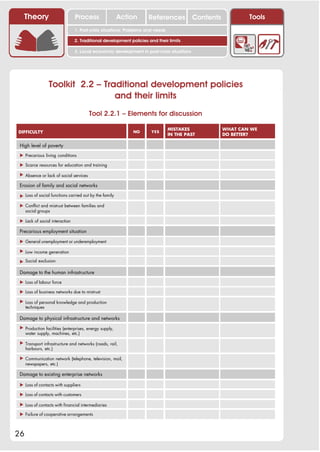
            ! Top-down policies overstate the importance of traditional sectors and big
                  firms. There is evidence that sustainable development is more likely to come
                  about through local entrepreneurship and support to small and
                  medium-sized enterprises (SMEs). SMEs are not only the main agents of
                  change in a globalized economy, but also have the highest potential of job
                  creation in post-crisis situations.
            ! Lack of harmonization: Within the territory itself, top-down policy
                  directives are often conceived without considering the need to harmonize
                  policies for enterprise growth, education and training, land use, the
                  environment, transport and communication infrastructure. Local business
                  regulations or systems of subsidies for internal investment also usually
                  remain under separate policy streams.


   2.2.3    POLITICAL limits
            ! Ignorance of conflict-resolution mechanisms: Traditional top-down
                  policies fail to contribute to smoothing over political conflicts. Imposing
                  development objectives and activities from above usually reinforces the
                  existing power structure which may have contributed to the current crisis. In
                  the long run, this might lead to new political controversies and conflicts.

            ! Decentralization and devolution: In many countries, the hierarchical
                  system of central planning may have been phased out, but the relationships
                  between decisions made by different ministries at different levels of
                  decision-making are still not clearly defined or coordinated. Many countries
                  lack appropriate local institutions that have the mandate and legitimacy
                  to represent broad-based civil society interests. Nor do they have sufficient
                  neutrality to create bridges between different interests and open up dialogue
                  between government, businesses and civil society representatives.
            ! Lack of technical capacities: Government staff within the
                  politico-administrative institutions of counties and municipalities lack the
                  expertise to coordinate and oversee social and market reforms, or to
                  promote entrepreneurship within their local economies. As a result, they are
                  unable to provide informed guidance to local entrepreneurs or to benefit
                  from much of the available development financing for investment
                  programmes.


                                                                                             25
Theory                       Process                 Action      References            Contents           Tools
                                1. Post-crisis situations: Problems and needs

                                2. Traditional development policies and their limits

                                3. Local economic development in post-crisis situations


                 Toolkit 2.2 – Traditional development policies
                                  and their limits
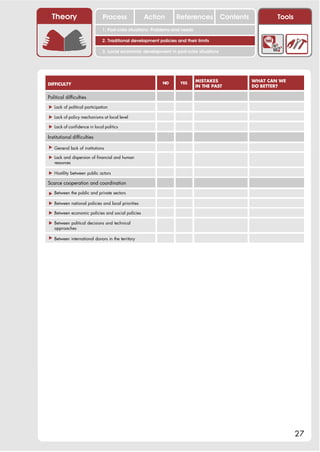
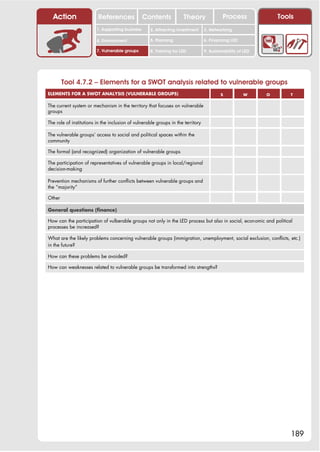
                                        Tool 2.2.1 – Elements for discussion

                                                                                MISTAKES             WHAT CAN WE
DIFFICULTY                                                   NO       YES
                                                                                IN THE PAST          DO BETTER?

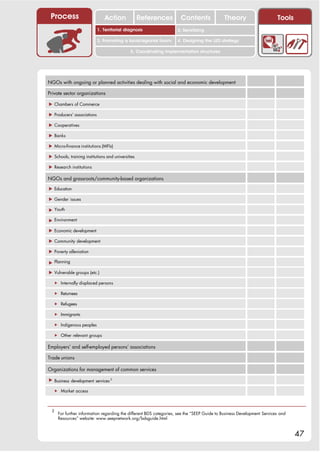
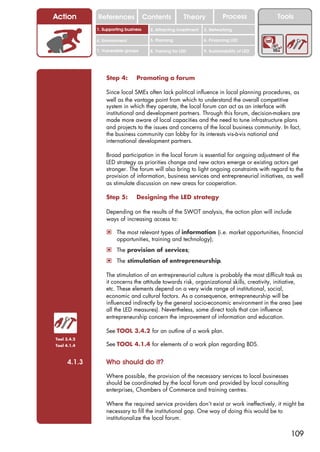
 High level of poverty

 ! Precarious living conditions

 ! Scarce resources for education and training

 ! Absence or lack of social services

 Erosion of family and social networks

 ! Loss of social functions carried out by the family

 ! Conflict and mistrust between families and
   social groups

 ! Lack of social interaction

 Precarious employment situation

 ! General unemployment or underemployment

 ! Low income generation

 ! Social exclusion

 Damage to the human infrastructure

 ! Loss of labour force

 ! Loss of business networks due to mistrust

 ! Loss of personal knowledge and production
   techniques

 Damage to physical infrastructure and networks
 ! Production facilities (enterprises, energy supply,
   water supply, machines, etc.)

 ! Transport infrastructure and networks (roads, rail,
   harbours, etc.)

 ! Communication network (telephone, television, mail,
   newspapers, etc.)

 Damage to existing enterprise networks

 ! Loss of contacts with suppliers

 ! Loss of contacts with customers

 ! Loss of contacts with financial intermediaries

 ! Failure of cooperative arrangements


26
Theory                      Process              Action         References Contents               Tools
                              1. Post-crisis situations: Problems and needs

                              2. Traditional development policies and their limits

                              3. Local economic development in post-crisis situations


                                                           NO       YES
                                                                              MISTAKES      WHAT CAN WE
DIFFICULTY                                                                    IN THE PAST   DO BETTER?

Political difficulties

! Lack of political participation

! Lack of policy mechanisms at local level

! Lack of confidence in local politics

Institutional difficulties

! General lack of institutions

! Lack and dispersion of financial and human
  resources

! Hostility between public actors

Scarce cooperation and coordination

! Between the public and private sectors

! Between national policies and local priorities

! Between economic policies and social policies

! Between political decisions and technical
  approaches

! Between international donors in the territory


                                                                                                            27
Theory      Process             Action          References            Contents          Tools
             1. Post-crisis situations: Problems and needs

             2. Traditional development policies and their limits

             3. Local economic development in post-crisis situations


     2.3      Local economic development in
              post-crisis situations
              The objective of this chapter is to examine the concept of local economic
              development (LED) and highlight its main advantages in comparison to
              traditional approaches. The major lesson learned is that local economic
              development must integrate economic issues into the political, social and
              political environments. This is particularly true in post-crisis situations, where the
              need for social dialogue and political stability is critical.


              So what are the options for the people, firms and regions that are lagging
              behind and have been further held back by crises?

              Post-crisis conditions create a special set of circumstances that represent both a
              threat and a significant opportunity to address issues such as social exclusion
              and environmental conservation. These issues should be integrated at the earliest
              stage with humanitarian and development assistance. Communities in affected
              areas can become positive agents for change in the transition from aid
              dependency to self-sufficiency.

              Government effectiveness in achieving long-term development goals in a territory
              emerging from a crisis will therefore depend to a large extent on strengthening
              local institutions and national and local frameworks in ways that encourage
              participation in decision-making and give a voice to local stakeholders, thereby
              rebuilding confidence and trust. The basic pillars of the system should be
              transparency, accountability and the rule of law.


     2.3.1    What is local economic development (LED)?

                           LED is a participatory development process that
                           encourages partnership arrangements between the main
                           private and public stakeholders in a defined territory,
                           enabling the joint design and implementation of a
                           common development strategy, by making use of local
                           resources and competitive advantages in a global
                           context with the final objective of creating decent jobs
                           and stimulating economic activity.


              The LED approach provides a comprehensive framework of initiatives and
              actions that respond to the need to integrate the economic, social, political and
              institutional dimensions of development at the local level. As a consequence LED
              is a process that will provide different solutions according to place, culture,
              economic potential and political circumstances, as well as social and institutional
              environment.


28
Theory     Process             Action          References Contents                     Tools
           1. Post-crisis situations: Problems and needs

           2. Traditional development policies and their limits

           3. Local economic development in post-crisis situations


   2.3.2    Principles of the LED approach

            The above definition reveals the importance of participation, partnership,
            territory and the valorization of local resources for employment generation and
            competitiveness. Although its adaptability does not make it possible to define
            what actions and policies a typical LED project consists of, the inalienable
            principles of the LED approach are those given below.

            ! Participation and social dialogue: The involvement of local
                  stakeholders in the development process of their own territory is a
                  prerequisite for sustainable growth. The use of participatory mechanisms
                  decreases the risk of conflicts and fosters social cohesion. Getting the local
                  stakeholders around one table through a local forum helps to build trust,
                  encourages innovation and promotes the creation of social networks and
                  activities. The design and implementation of a bottom-up strategy further
                  guarantees the most suitable solutions for the local needs and is a warranty
                  for the sustainability of the development process.
            ! Public/private partnership: Complementary investments that are
                  targeted as accurately as possible bring the highest rate of socio-economic
                  return. LED is a means to achieving the mobilization of local resources by
                  encouraging their efficient allocation. Partnerships between the private,
                  public and non-profit sectors thus become crucial for a sustainable
                  development process, allowing convergence in investment programming
                  between the different local actors. Cooperation and coordination of
                  development activities prevent ineffective go-it-alone approaches and
                  support the legitimacy and sustainability of the development process.
            ! Territory: Geographical and cultural closeness favour a whole set of ideal
                  conditions for growth, innovation and development. To begin with,
                  stakeholders from the same territory have a better knowledge of their needs
                  and resources. Secondly, the territory makes common interests and cultural
                  affinities more likely. Thirdly, the territory enables frequent social, economic
                  and political interaction among the local actors, thus generating social
                  cohesion and trust. Finally, the territory is an ideal platform for the creation
                  of a strong local voice on behalf of of its stakeholders. Unlike traditional
                  community development approaches, LED provides the means and structures
                  that represent the local voice when dealing with its national and
                  international counterparts.


                            “The LED approach provides a comprehensive framework
                            of initiatives and actions that respond to the need to
                            integrate the economic, social, political and institutional
                            dimensions of development at the local level.”


            Furthermore, the integrated LED framework acts on and responds to the
            economic, social, political and institutional dimensions of development at the
            local level, as will be examined more closely below.

                                                                                               29
Theory      Process             Action          References            Contents        Tools
             1. Post-crisis situations: Problems and needs

             2. Traditional development policies and their limits

             3. Local economic development in post-crisis situations


     2.3.3    The SOCIAL and POLITICAL dimensions of development

              According to the LED approach, sustainable development can be achieved only
              if development initiatives also take into account social and political factors,
              namely:

              ! Building upon existing social institutions: It is important to respect
                   local traditional social structures, particularly in rural areas where village
                   elders may be the persons who represent the interests of the community and
                   will be the starting point for building awareness and support for bottom-up
                   approaches. Social sensitivity also means exploring different ways of
                   adapting economic programmes that are respectful of traditional practices
                   and are culturally appropriate;
              ! Stimulating broad-based political participation in
                   decision-making: LED attempts to give a voice to, and create linkages
                   between communities, local institutions and top-level authorities so that the
                   long-term recovery process is a close reflection of actual needs. The
                   approach directs special efforts at identifying the weak and ensuring they
                   can effectively participate. A broad representation of local stakeholders
                   meets around one table through a local forum, to identify and mediate
                   between different interests;
              ! Encouraging social dialogue and cooperation: The involvement of
                   as many local stakeholders as possible in decision-making also increases
                   dialogue and cooperation between employees, workers and institutional
                   stakeholders on issues related to working conditions, wages and rights, thus
                   setting the template for socially sustainable economic models upon which
                   new kinds of local economic development can be built;
              ! Fostering the process of institutionalization: Once all the
                   stakeholders have decided to participate in the local development process,
                   the local actors might jointly decide to institutionalize the participatory
                   mechanisms. The advantages of an institutionalized local forum stem mainly
                   from its legal character and its juridical personality. Once a forum of local
                   actors enjoys internal and external legitimacy, its functions might be
                   extended beyond local activities. Often, such extension of responsibilities
                   includes networking and lobbying with international and national actors to
                   elminate ineffective go-it-alone approaches, and to obtain closer
                   harmonization with national development policies;
              ! Public/private partnership: Complementary investments that are
                   targeted as accurately as possible bring the highest rate of socio-economic
                   return. LED is a means to achieving the mobilization of local resources for
                   investment in rebuilding the locality. Public/private partnerships also
                   encourage a more efficient allocation of resources. Partnerships between the
                   private, public and non-profit sectors become crucial for a sustainable
                   development process, allowing convergence in investment programming
                   between the different local actors.


30
Theory     Process             Action          References Contents                       Tools
           1. Post-crisis situations: Problems and needs

           2. Traditional development policies and their limits

           3. Local economic development in post-crisis situations


   2.3.4    The ECONOMIC dimension of development

            The economic dimension of development is particularly important within the LED
            approach, since economic activities and interactions are a driving force that
            fosters:

            ! Social inclusion: Through self-help organizations, cooperative ventures
                  and activities to support micro-enterprises, many marginalized people and
                  vulnerable groups may be able to overcome their isolation;
            ! Poverty alleviation: The enhanced turnover and competitiveness of local
                  enterprises encourages higher levels of public and private-sector investment
                  in infrastructure. A general rise in spending power among the local
                  population is likely to improve the general living conditions of families and
                  the wider community through economic spillovers;

            ! Greater social and political stability: Revived markets for goods and
                  services in a post-crisis situation are likely to involve – sooner or later –
                  political and social actors and lead to broader discussions in which
                  strategies and actors can most effectively contribute to recovery efforts;
            ! Innovation: More than ever before, socio-economic growth depends on
                  the process of change and innovation. There is evidence that the majority of
                  enterprises undertake their most important innovation at the moment of their
                  creation. Hence, fostering entrepreneurship and enterprise creation play an
                  important role within the LED approach.


   2.3.5    The LOCAL dimension of development

            The importance of the local or territorial dimension in the LED process is vital.
            Indeed, the local dimension reflects:

            ! The degree of common interests: The geographical proximity of
                  people and actors within the same region creates common characteristics
                  and points of common concern, including language, religion, tradition,
                  access to institutions, infrastructures and resources, to name but a few;
            ! The degree of self-regulation: As a result of their stake in the territory,
                  it is quite likely that local actors also have close bonds with, and concern for
                  their immediate social and natural environment and are therefore more
                  likely to support actions that contribute to an increase in quality of the
                  business environment and overall living conditions. Their territorial interests
                  increase the likelihood of their joining a ‘club’ of possible future
                  beneficiaries of a LED policy;
            ! The degree of knowledge: Local actors are further likely to have a
                  deeper and better knowledge of local assets, constraints and needs due to
                  their geographical location, networks of contacts and daily interactions. The
                  local economic development approach seeks to listen and learn from
                  communities;


                                                                                                  31
Theory      Process             Action           References           Contents               Tools
             1. Post-crisis situations: Problems and needs

             2. Traditional development policies and their limits

             3. Local economic development in post-crisis situations


              ! The intensity and frequency of interactions: Geographical
                   proximity favours daily or frequent communication on a number of social,
                   economic and political issues, which leads to the development of strong
                   relationships based on trust and cooperation. These may then form the basis
                   for local networks;
              ! The likelihood of tapping into national and global
                   decision-making structures: Once trust and networks have grown, it
                   will be much easier for local actors to lobby and negotiate for their interests
                   with national and international partners.


     2.3.6    How “big” is local?

              As LED is a territorial approach, any LED initiative will sooner or later have to
              face the question: How big is “local” in the case of our initiative? In other words,
              the local stakeholders will have to decide the geographical dimensions of the
              territory and the size of the population the LED initiative will englobe.

              Any attempt to establish a set rule as to the dimesion of a territory or its
              population would contradict the need for flexibility to adapt to different
              circumstances and to respond to the objectives of each specific LED initiative.
              However there are some criteria that may facilitate the identification of a
              particular territory.


                                        Economic
                                        potential

                                            State                       Lobbying at
                                                                       national level


                                            Closeness
                                            to citizens
                                                                                  Economies
                                                                                   of scale


                                                 Local
                                               knowledge
                                                                          Municipality


                                                                           Coordination


              The above graph illustrates the fundamental trade-off between coordination and
              economic potential that has to be taken into account when defining the territory.
              The smaller the territory and, in most cases, its population, the easier it will be to
              achieve coordination and consensus among the major local stakeholders when
              designing a joint LED strategy and in identifying implementing arrangements.


32
Theory   Process             Action          References Contents                      Tools
         1. Post-crisis situations: Problems and needs

         2. Traditional development policies and their limits

         3. Local economic development in post-crisis situations


          However, the economic, political and institutional potential of small territories
          and populations is often lower than that of larger territories for the following
          reasons:

          ! Small territories usually have less possibility of creating economies of scale;
          ! The capacity of their “local” institutions to lobby at central government level
                is weaker; and
          ! They are at a disadvantage when competing at an international level.

          On the other hand, if a territory or a population is too big, the closeness
          between institutions and citizens will decrease, as will the institutions’ knowledge
          of real needs and problems at the grassroots level and the possibility for
          consensus building and coordination.

          Apart from the trade-off between coordination and economic potential, the
          identification of a territory should furthermore take into account the following
          elements that are likely to ease the LED approach in a specific territory:

          ! The existence of (a relatively small number of) public agencies representing
                the functional economic region;
          ! A relatively broad autonomy (in terms of jurisdiction and/or finance) of the
                institutions promoting the regional development of the territory (regional
                government, LEDA, etc.);
          ! A strong sense of cultural or political identity within the region;
          ! A willingness and tradition of cooperation between local actors;
          ! The presence of long-established local firms, especially if they own land and
                premises. Their interest in the territory make it more likely for them to join a
                ‘club’ of possible future beneficiaries of a LED-policy;
          ! Deeply-rooted local actors, such as long-established firms and
                organizations, are more likely to cooperate because they depend to a
                greater extent on social and economic interrelations that make
                non-participation relatively costly.


                                                                                              33
Theory                     Process              Action        References            Contents   Tools
                             1. Post-crisis situations: Problems and needs

                             2. Traditional development policies and their limits

                             3. Local economic development in post-crisis situations


                         Toolkit 2.3 – LED in post-crisis situations
                                     Tool 2.3.1 – Elements for discussion

TERRITORY

 Where should efforts be targeted?

 Why choose this region/area?

 ! The territory forms an economically functional area

 ! Existence of complementary economic sectors

 ! Existence of common commercial practices

 ! Uneven development that needs correcting

 What resources are available locally?

 ! Enterprise associations

 ! Farmers’ associations

 ! Public institutions

 ! NGOs and community organizations

 ! Cooperatives

 ! Natural resources

 Why should private sector stakeholders be interested in LED?

 Why should public sector stakeholders be interested in LED?

 How far are these interests complementary?

 Are there conflicts among interests?

 How can these conflicts be resolved?


34
Process      Action          References          Contents              Theory   Tools
                                                   2. DEL y el déficit de
          1. 1. Índice diagnosis
             Territorial                        2. Sensitizing decente
                                                      trabajo
          3. Promoting a local/regional forum   4. Designing the LED strategy

                          5. Coordinating implementation structures


                                                                                        35
Process      Action          References          Contents              Theory         Tools
                                                    2. DEL y el déficit de
           1. 1. Índice diagnosis
              Territorial                        2. Sensitizing decente
                                                       trabajo

           3. Promoting a local/regional forum   4. Designing the LED strategy

                           5. Coordinating implementation structures


              SECTION III. THE LED PROCESS

              An overview
              “LED fosters local ownership of development activities through a process of
              participation, information exchange, coordination of initiatives and the
              investment of time and resources by the local stakeholders”.


              Although the fluidity of the LED process makes it is impossible to prescribe a strict
              set of policies and actions, a typical LED intervention is led by a certain number
              of basic steps, which include:

              1.      Territorial diagnosis and institutional mapping (TD & IM)

              The objective of this phase is to acquire knowledge about the local economy
              and its resources. It comprises a preliminary analysis of the territorial
              socio-economic and political data through statistics, surveys and action-research
              methodologies. The institutional mapping exercise focuses on the existence,
              objectives and activities of the different local stakeholders and the dynamics
              among them. There will be a wide range of short-term economic development
              activities funded by different bilateral donors and the UN, NGOs and
              foundations – social mobilization (cooperatives, CBOs), access to credit,
              livestock management, irrigation, watershed management, and so on. There
              also needs to be an inventory and assessment of existing facilities and capacity,
              needs, recent accomplishments, and lessons learned that would provide a basis
              for filling gaps, setting priorities and scaling-up.

              The relevance and usefulness of TD & IM become apparent through the different
              stages of the LED process, since the information gathered provides the foundations
              for immediate quick-impact interventions, as well as activities with more socially
              and environmentally sustainable impacts in the medium and long terms. The
              collection of data should however be ongoing, as circumstances and development
              priorities change and new actors become more influential within the territory.

              2.      Sensitizing

              This stage involves raising awareness among different stakeholders of how their
              actions impact on other stakeholders, what adjustments need to be made and
              how closer synergies can lead towards the achievement of common
              development goals. It is hoped that dialogue among the main local stakeholders
              on major public policy and economic issues will begin to generate solutions to
              common problems and opportunities. This should lead to the crystallization of a
              vision for economic recovery and the definition of priorities for investments and
              target groups. Another major expectation of this phase is that the local
              stakeholders will slowly assume ownership of the development process.


36
Process      Action          References          Contents              Theory           Tools
                                                   2. DEL y el déficit de
          1. 1. Índice diagnosis
             Territorial                        2. Sensitizing decente
                                                      trabajo
          3. Promoting a local/regional forum   4. Designing the LED strategy

                          5. Coordinating implementation structures


              3.      Creation of a local/regional forum

              The creation of a local/regional forum is the continuation of the
              consensus-building process. The lack of forums for dialogue, where individuals
              and businesses can express their needs, may contribute or lead to underlying
              tensions and the neglect of social problems.

              A forum bringing together a number of influential people with a wide range of
              expertise in local settings facilitates the identification of contentious areas, the
              sharing of knowledge and skills at all levels, and the communication of
              information among all partners involved in the development process. It thereby
              sets in motion the process of developing a coordinated action plan,
              encompassing the strengthening of technical and managerial skills in both the
              public and private sectors and key elements needed for socially and
              environmentally sustainable recovery.

              4.      Designing the LED strategy

              During this phase, the local forum carries out an analysis focusing on the
              Strengths, Weaknesses, Opportunities and Threats (SWOT) of the territory. The
              SWOT analysis is based on the results of the territorial diagnosis and
              institutional mapping exercises and will reveal the competitive advantages of the
              affected area. The outcomes of the SWOT analysis will then generate the LED
              strategy, encompassing the long-term vision, the objectives and the action plan
              for the medium and long terms.

              5.      Coordination/implementation structures

              The local stakeholders, according to their competence, resources and capacities,
              implement the bottom-up development strategy through the LED action plan. The
              forum coordinates their actions, and revises and adjusts the strategy according
              to the needs of the local/regional stakeholders.

              But before implementing the LED strategy there is a need to decide “who does
              what” and assign responsibilities for each activity foreseen in the strategy. In the
              absence of existing implementation structures or bodies, the LED strategy might
              foresee the institutionalization of the forum or the creation of an implementation
              body that assumes responsibility for certain tasks.

              The following chapters in this section explain in more detail steps 1 to 5 in the
              LED process. Section IV will then describe the outcome of the LED process: the
              LED actions and their implementation (step 6). These actions include some of the
              most common LED policies and products used in typical LED projects.


                                                                                                37
Process      Action          References          Contents              Theory   Tools
                                                    2. DEL y el déficit de
           1. 1. Índice diagnosis
              Territorial                        2. Sensitizing decente
                                                       trabajo

           3. Promoting a local/regional forum   4. Designing the LED strategy

                           5. Coordinating implementation structures


38
Process        Action          References          Contents              Theory          Tools
                                                     2. DEL y el déficit de
            1. 1. Índice diagnosis
               Territorial                        2. Sensitizing decente
                                                        trabajo
            3. Promoting a local/regional forum   4. Designing the LED strategy

                            5. Coordinating implementation structures


    3.1         Territorial diagnosis and institutional mapping
    3.1.1       What to consider?

                The socio-economic analysis of the area and its institutions is extremely important
                for carrying out nearly all the activities related to the LED process.

                The objective of the territorial diagnosis (TD) is to collect information about
                the territory and its resources in order to understand the local context.

                The results should be used to:

                ! Sensitize local stakeholders by giving them sufficient information about the
                     territory, its assets and resources with a view to increasing the
                     understanding of the local context for enterprise development;
                ! Give advice on how existing policies can be adjusted towards more
                     economically, socially and environmentally sustainable development in the
                     long term;
                ! Formulate proposals for quick-impact measures and the genesis of a
                     longer-term LED strategy;
                ! Monitor and assess the ongoing performance and final outcomes of LED
                     interventions.

                While the territorial diagnosis will help to improve the key stakeholders’
                understanding of local realities, it is also useful to have an overview of the
                organizations and institutions that have an influence over the economic
                development of the territory.

                The institutional mapping (IM) exercise enables development partners to
                respond easily to requests from entrepreneurs and others for information on
                ongoing or planned development initiatives in the territory. This information can
                be used to create synergies between initiatives and, later on, as a tool with
                which to build consensus around priority areas for intervention. The information
                contained in the database can be presented in tailor-made packages. Some of
                the information may already be available, but not in a structured way. If the
                information is packaged well, it is not only useful to development partners, but
                also to the economic support organizations.

                The IM should set out to:

                ! Create an exhaustive map of local stakeholders in a broad range of social,
                     economic and political sectors;
                ! Establish a profile of these influential stakeholders in terms of their mission,
                     objectives, field of action, jurisdiction, geographical coverage, etc.;


                                                                                                 39
Process        Action                 References              Contents              Theory                              Tools
                                                              2. DEL y el déficit de
             1. 1. Índice diagnosis
                Territorial                                2. Sensitizing decente
                                                                 trabajo

             3. Promoting a local/regional forum           4. Designing the LED strategy

                                5. Coordinating implementation structures


                 ! Assess the adaptability and flexibility of existing institutions and
                       organizations;
                 ! Analyse the dynamics among the most important local stakeholders in order
                       to grasp where cooperation lacks and where synergies are most likely;
                 ! Facilitate coordination between existing programmes, institutions and
                       organizations, as well as identify services that do not yet exist.

                Apart from the practical implications of increasing the supply of information, the
                gathering of information on natural resources, enterprises, infrastructure,
                institutions, and other items increases the transparency of different actors and
                their agendas and assumes a vital role in the early phase of the LED process.

                The local stakeholders are the most suitable actors to identify local assets and
                priorities.

                At this early stage of the recovery process, it is appropriate to encourage as
                wide an involvement of actors as possible. The local stakeholders form the
                social, economic and institutional backbone of the territory and possess the best
                knowledge about its main characteristics, economic potential, possibilities and
                needs. For this reason, local stakeholders are the most suitable actors to identify
                local assets and priorities.


                                                               The LED process


                   1                     2                 3                4
                                                                                                     Coordinating
                                                                                               5                     6
                         Territorial                            Promoting       Designing a
                                             Sensitizing                                           implementation           Action
                         diagnosis                                a forum       LED strategy
                                                                                                        structures


     3.1.2      What to do?

                Step 1:                Territorial diagnosis

                This is carried out using the following mechanisms:

                Rapid needs assessment

                This assessment lists the most urgent problems and corresponding measures to
                be taken immediately. Although we are only at the beginning of the LED process,
                and not all local stakeholders have yet been consulted, the rapid needs
                assessment is crucial for the elaboration of short-term policies and should be
                discussed with as wide a range of local stakeholders as possible in order to
                clarify the division of roles and responsibilities. By stimulating common actions,
                cooperation and coordination, the quick-impact measures will thus contribute
                positively to the sensitization process, which takes place in parallel.


40
Process          Action           References         Contents              Theory         Tools
                                                       2. DEL y el déficit de
              1. 1. Índice diagnosis
                 Territorial                        2. Sensitizing decente
                                                          trabajo
              3. Promoting a local/regional forum   4. Designing the LED strategy

                              5. Coordinating implementation structures


                  See TOOL 3.1.1 for a checklist for a rapid needs assessment in view of the
                  design of quick-impact measures.

 Tool 3.1.1       Collection of socio-economic data

                  This step involves the collection of general data concerning:

                  ! The institutional and political environment;
                  ! The legal and regulatory framework;
                  ! Ongoing and planned initiatives;
                  ! Key statistical information.

                  See TOOL 3.1.2 for more detailed information regarding the type of data
                  required.
 Tool 3.1.2

                  Institutional mapping exercise

                  An important outcome of this exercise will be a list (or a map) of the most
                  important stakeholders in the territory, for each of which the following questions
                  will need to be answered:

                  ! How long has the stakeholder (organization, enterprise, institution, or other)
                       existed?
                  ! What is its organizational structure?
                  ! What is its mandate?
                  ! What are its activities in the field of economic development?
                  ! Who are its target groups/beneficiaries?
                  ! With which organizations does it have contact or work?

                  See TOOL 3.1.3 for an example of the terms of reference for data collection
 Tool 3.1.3
                  and institutional mapping in Eastern Slavonia and Sisak County.

                  The collection of data should be carried out very carefully. The accuracy of the
                  information gathered is crucial, since it will determine the choice of the LED
                  policies within the LED strategy (see Chapter 3.4, “Designing the LED strategy”).

                  When possible, the collection of the data should take place at municipal level.
                  When municipal data is not available, it may be undertaken at county level.
                  Where secondary statistical data is not available, it might be necessary to
                  collect it through interviews and questionnaires.


                                                                                                  41
Process             Action          References          Contents              Theory         Tools
                                                           2. DEL y el déficit de
                  1. 1. Índice diagnosis
                     Territorial                        2. Sensitizing decente
                                                              trabajo

                  3. Promoting a local/regional forum   4. Designing the LED strategy

                                  5. Coordinating implementation structures


                     Step 2:        Data analysis

                     Data analysis is essential for identifying trends, linkages and possible synergies
                     in and between different sectors and programme areas. The database can be
                     used immediately in order to identify the most important local stakeholders that
                     should be targeted during the sensitization phase. At the same time, the data
                     will be used to begin formulating the LED strategy (see Chapter 3.4, “Designing
                     the LED strategy”). As socio-economic and institutional conditions change
                     constantly, this database should be updated periodically.

                     See TOOL 3.2.1 for a list of possible contributions of different local
                     stakeholders to the LED process.

     Tool 3.2.1      See TOOL 3.1.4 for a list of sources where relevant data concerning the
     Tool 3.1.4      existence or functioning of local or regional institutions can be found.

                     It is particularly important for those carrying out the information gathering and
                     data analysis exercises to listen to what all those involved have to say and
                     learn from these perspectives. Not all groups, especially the most vulnerable
                     ones, will have the same viewpoint on how the recovery process should
                     proceed, or even be in a position to articulate their interests. Care should
                     therefore be taken to interview and research as widely as possible.


          3.1.3      Who should do it?

                     The major funding, multilateral agencies and NGOs should mobilize their
                     capacity and create an effective mechanism to carry out this assessment.
                     Emphasis should be placed on enabling local expertise and experienced
                     persons from within and outside the country to participate in this assessment and
                     lead strategy development, priority setting and programme planning.


42
Process                        Action           References         Contents              Theory        Tools
                                                                      2. DEL y el déficit de
                             1. 1. Índice diagnosis
                                Territorial                        2. Sensitizing decente
                                                                         trabajo
                             3. Promoting a local/regional forum   4. Designing the LED strategy

                                             5. Coordinating implementation structures


 Toolkit 3.1 – Territorial diagnosis and institutional mapping
                             Tool 3.1.1 – Rapid needs assessment: A checklist

                                                                                               Notes:

3.1 – GENERAL SITUATION ASSESSMENT

! Causes of the crisis

! Affected areas

! Affected population groups

! Gender/socio-cultural issues

! Structural issues

! Economic situation

! Human rights and political context

! Social system and programmes

! Legal and administrative framework

! International and local assistance programmes

! Potential ILO partners

3.2 – CAPACITY ASSESSMENT FOR CONSTITUENTS, PARTNERS AND OTHERS

! Institutional capacities

! Constituent capacities

! Civil society institutions and organizations

3.3 – SECTORAL ASSESSMENTS FOR ILO PROGRAMME PLANNING

! Vocational training

! Public employment programmes

! Social security protection

! Labour market and employment prospects

! Social dialogue

! Business advisory services

! Micro-finance

! Labour-intensive works

3.4 – SPECIAL TARGET GROUPS


                                                                                                                43
Process                        Action            References          Contents             Theory   Tools
                                                                         2. DEL y el déficit de
                              1. 1. Índice diagnosis
                                 Territorial                          2. Sensitizing decente
                                                                            trabajo

                              3. Promoting a local/regional forum     4. Designing the LED strategy

                                                 5. Coordinating implementation structures


 ! Tools for assessing capacities and vulnerabilities

 ! People with disabilities

 ! Youths

 ! Ex-combatants, including child soldiers

 ! Female-headed households

 ! Unemployed

 ! Refugees

 ! Internally displaced persons

 ! Returned refugees

 ! Returned economic migrants

 3.5 – ECONOMIC GAPS

 ! Declining markets

 ! Declining sources of raw materials and inputs

 ! Weakened industrial clusters

 ! Declining sources of financing

 ! Economic opportunities generated by post-crisis reconstruction
   and the transition to a market-oriented economic system

 ! Reconstruction investment

 ! New sources of financing

 ! Restructuring of less-profitable industrial activities

 ! Foreign investments

 ! New markets

 ! Other

Source: Adapted from: ILO Rapid Needs Assessment in Crisis and Post-Crisis Situations


44
Process                        Action         References         Contents              Theory         Tools
                                                                    2. DEL y el déficit de
                          1. 1. Índice diagnosis
                             Territorial                         2. Sensitizing decente
                                                                       trabajo
                          3. Promoting a local/regional forum    4. Designing the LED strategy

                                            5. Coordinating implementation structures


                  Tool 3.1.2 – Territorial diagnosis and institutional mapping:
                                     Information requirements
SOCIO-ECONOMIC DATA AND DYNAMICS
                                                                                                 Men    Women
(ideally gathered at municipal, if not county level)

Relevant macro-economic data

! Average income per capita

! Minimum wage

! Basic basket cost

! Inflation and devaluation rate

! Sectoral GCP (gross county product)

Population

! Total

! Urban

! Rural

! Ethnic composition

! Literacy

! Level of education

Employment and self-employment

! EAP (economically active population)

! Sectoral employment (industry, agriculture, etc.)

! Unemployment

! Wage-earners

! Entrepreneurs

! Informal sector (estimated)

Infrastructure

! Buildings

! Streets

! Railways

! Airports

! Ports

Natural resources and environment

! Water


                                                                                                               45
Process                         Action          References          Contents              Theory   Tools
                                                                        2. DEL y el déficit de
                               1. 1. Índice diagnosis
                                  Territorial                        2. Sensitizing decente
                                                                           trabajo

                               3. Promoting a local/regional forum   4. Designing the LED strategy

                                               5. Coordinating implementation structures


 ! Natural parks

 ! Cultural/historical sites

 ! Climate

 ! Sea

 ! Rivers

 ! Fauna/Flora

 ! Raw material and mineral resources

LEGAL AND REGULATORY FRAMEWORK

 Legal framework for decentralization regarding incentives/funds/mechanisms for investments
 in social and economic sector

 County and municipal laws and regulations

 Special promotional framework

 ! Small and micro-enterprises

 ! Farm development

 ! Agricultural development

 ! Tourism

 ! Industrial or other sectoral development

 ! Investment attraction/place marketing

 ! Other relevant categories

 Banking legislation

 Legislation for the creation, financing and administration of associations and professional
 organizations

 ! Civil society entities

 ! Entrepreneurial associations

 ! Cooperatives

 ! Other relevant associations/organizations

 Register legislation

INSTITUTIONAL/POLITICAL INFORMATION

 Administrative boundaries (represented in a map)

 Local and decentralized institutions dealing with social and economic development

 Detailed composition of municipal structures, including human and physical resources

 Detailed composition of decentralized county structures supporting local government


46
Process                       Action               References       Contents               Theory                      Tools
                                                                       2. DEL y el déficit de
                            1. 1. Índice diagnosis
                               Territorial                          2. Sensitizing decente
                                                                          trabajo
                            3. Promoting a local/regional forum     4. Designing the LED strategy

                                              5. Coordinating implementation structures


NGOs with ongoing or planned activities dealing with social and economic development

Private sector organizations

! Chambers of Commerce

! Producers’ associations

! Cooperatives

! Banks

! Micro-finance institutions (MFIs)

! Schools, training institutions and universities

! Research institutions

NGOs and grassroots/community-based organizations

! Education

! Gender issues

! Youth

! Environment

! Economic development

! Community development

! Poverty alleviation

! Planning

! Vulnerable groups (etc.)

  " Internally displaced persons

  " Returnees

  " Refugees

  " Immigrants

  " Indigenous peoples

  " Other relevant groups

Employers’ and self-employed persons’ associations

Trade unions

Organizations for management of common services

! Business development services 2

  " Market access


 2
     For further information regarding the different BDS categories, see the “SEEP Guide to Business Development Services and
     Resources” website: www.seepnetwork.org/bdsguide.html


                                                                                                                                47
Process                       Action         References             Contents              Theory   Tools
                                                                        2. DEL y el déficit de
                            1. 1. Índice diagnosis
                               Territorial                           2. Sensitizing decente
                                                                           trabajo

                            3. Promoting a local/regional forum      4. Designing the LED strategy

                                            5. Coordinating implementation structures


     " Infrastructure

     " Policy/advocacy

     " Input supply

     " Training and technical assistance

     " Technology and product development

 ! Finance/micro-finance

     " Loans

     " Insurance

     " Other relevant matters

 ! Irrigation systems

 ! Mechanical pool

 ! Storage facilities

 ! Other relevant matters

 Religious organizations and entities

ONGOING AND PLANNED DEVELOPMENT INITIATIVES

 International cooperation programmes with activities in the social and economic sectors

 ! Infrastructure

 ! Technical assistance

 ! Credit

 ! Training

 ! Tools and equipment

 ! Business services

 ! Other relevant matters

 National/regional/local investment plans impacting on the social and economic environment

 Private initiatives related to key strategically economic sectors

 ! Shipping

 ! Aluminium

 ! Tourism

 ! Electromechanics

 ! Other relevant sectors

 Decentralized investment programmes for social and economic infrastructures

 Preferential lines of credit available in the market


48
Process                       Action          References         Contents              Theory   Tools
                                                                    2. DEL y el déficit de
                           1. 1. Índice diagnosis
                              Territorial                        2. Sensitizing decente
                                                                       trabajo
                           3. Promoting a local/regional forum   4. Designing the LED strategy

                                           5. Coordinating implementation structures


SOCIO-ECONOMIC DYNAMICS IN THE REGION

Intra-firm cooperation and synergies/industrial clusters

! Between firms within/outside the territory

   " Number of firms

   " Number of employees

! Intra/infra-sectoral cooperation

   " Importance of sector(s)

   " Development of sector(s)

Economically dynamic segments

! Expanding segment(s)

! Declining segment(s)

Economically dynamic areas

! Expanding area(s)

! Declining area(s)

Socially sensitive segments

! Nature of problem

! Origin of problem

Socially sensitive areas

! Nature of problem

! Origin of problem

Cooperation among private and public actors

! Institutions/firms

! Nature of cooperation


                                                                                                         49
Process                    Action          References         Contents              Theory                    Tools
                                                                   2. DEL y el déficit de
                          1. 1. Índice diagnosis
                             Territorial                        2. Sensitizing decente
                                                                      trabajo

                          3. Promoting a local/regional forum   4. Designing the LED strategy

                                          5. Coordinating implementation structures


                Tool 3.1.3 – Basic data collection and institutional mapping
                     in preparation for the establishment of two LEDAs
                            in Eastern Slavonia and Sisak County

Terms of reference                                               – Vukovar County: The focus is on Vukovar town and
                                                                    EC target municipalities.
Background and objectives                                        – Sisak County: The focus is on Sisak, Petrinja and the
Within the framework of the Rehabilitation and Social               most war-affected municipalities.
Development Programme for the war-torn areas in
Croatia, three Local Economic Development Agencies                Tasks
(LEDAs) have been established in Sbenik-Knin, Eastern             Under the supervision of the ILO Geneva, UNOPS and in
Slavonia and Sisak County.                                        collaboration with IMO-Zagreb, the consultant carried out
Since Eastern Slavonia and Sisak County were new areas            the following tasks:
for the RSD Programme, data (including statistics) had to        – To collect, through research on available resources
be collected and organized on the socio-economic
                                                                    (annual reports, legislation, internet and other
situation, legal and policy framework (for example the              documentation), basic data on the socio-economic
new investment law for Vukovar county) and a map of                 situation, the legal and policy framework and
administrative boundaries (reflecting the most                      administrative structures according to Annex I;
war-affected municipalities) drawn up. For the most part,
the organization of already available information                – To collect, through interviews/questionnaires,
was the immediate objective.                                        information on the organizations/institutions/
                                                                    programmes according to Annex II;
As LEDAs are associations in which
                                                                 – To organize and analyse the information and present it
organizations/institutions from the public and private
                                                                    in a “user-friendly” way (maps, tables, overviews,
sectors are represented, the first step during the
                                                                    annexes, etc.).
pre-launch phase was the institutional mapping exercise.
This set out to make an inventory of the most important           Output
territorial organizations, institutions, training programmes,
                                                                  For each region, the results of the study were presented in
agricultural support institutions, producers’ associations,       a report containing descriptive sections illustrated with
NGOs, and other bodies.                                           tables, maps and statistics. The completed questionnaires
On the basis of this information, key stakeholders in local       were attached to the report.
economic development were identified and specific                 The final report was in English.
regional development sectors became more evident, as
did ways of improving coordination between the different
                                                                  Duration
organizations/institutions/programmes.
                                                                  The consultancy studies took three weeks to complete
The report was one of the documents with which the LEDA           (including submission of the report). The consultant was
working groups operated in order to determine the
                                                                  also available for improvements after submission of the
LEDAs’ territorial management, main services, and other
                                                                  report.
responsibilities.

Two studies were carried out: one in Eastern Slavonia             Dates
(Osijek County and Vukovar County) and one in Sisak
                                                                  September 2000.
County. As in Sisak County, a regional development plan
was elaborated by IMO with the gathering of basic data
                                                                  Institutional arrangements
directly based on this plan.
                                                                  ILO supervised the studies and briefed the consultants by
Geographical coverage                                             telephone.
– Osijek County: The focus of the study is on Baranja,            IMO advised on potential consultants (University of
   the most war-affected region in the county, and on             Osijek, Local Democracy Agency) and briefed the
   programmes/organizations/institutions covering the             consultant(s) in detail on existing sources of information
   whole county, war-affected municipalities or targeting         and contacts. UNOPS contracted the consultants and
   conflict-affected groups in particular.


50
Process                    Action          References         Contents              Theory                    Tools
                                                                  2. DEL y el déficit de
                         1. 1. Índice diagnosis
                            Territorial                        2. Sensitizing decente
                                                                     trabajo
                         3. Promoting a local/regional forum   4. Designing the LED strategy

                                          5. Coordinating implementation structures


covered the costs on an output basis (including                  – The public sector
transportation, communication, editing, etc.).                   – - Decentralized departments of the Ministry for SMEs
                                                                    - County departments for economy, agriculture and
ANNEX I                                                               labour/social affairs
Basic data collection                                               - Town/municipal departments for economy,
                                                                      agriculture and labour/social affairs
In the report the following issues were addressed. (It is           - Chambers of Commerce
important to use the most recent figures/information and            - Employment offices
to refer to the situation before the war.)                          - Agricultural counselling services
                                                                    - Regional representatives of the National Consultant
Socio-economic situation of the region                                Network
– Number of inhabitants, refugees, returnees, IDPs in EU            - Colleges and universities
  target municipalities and main towns (shown if                 – The private sector (profit) or semi-private sector
  possible on a map or in graphic form);                         – - Chambers of Handicrafts
– Employment/unemployment figures and profiles                     - Cooperatives
  (unemployed, economically active population, sectoral            - Producers’ associations (sectoral, product-based or
  (un)employment, informal sector);                                  other)
– Level of education;                                              - Farmers’ associations
                                                                   - Technology centres
– Average income per capita at county level;                       - Business incubators
– Gross product at county level;                                   - Banks
– Main economic activities/sources of income                       - Research and training institutions
   (employed, self-employed, self-subsistence activities);       – The private sector (non-profit)
– Main industries (sector, state-owned/privatized, future        – - Centres for SMEs
   prospects: planned reconstruction/investment or to be            -   Employers’ organizations
   closed down);                                                    -   Trade unions/workers’ organizations
– Micro-enterprises and SMEs/handicrafts (sectors,                  -   Returnees’ associations
   number, how many employees, capital, when started);              -   Village committees
                                                                    -   Women’s associations
– Main markets/economic centres in the region, clusters;
                                                                    -   Minority associations
– Economic growth potential and opportunities in the                -   Church organizations (for example CARITAS)
   region (according to previsions of institutions, planned         -   International NGOs (for example ASB, Local Agency
   national/foreign, public/private investments, expanding              for Democracy)
   sectors, demand/supply of goods and services).
                                                                 Any other organization providing financial (credit, grants)
Legal and policy framework and                                   or non-financial services for entrepreneurs (starting up a
administrative structures                                        business) or for economic/agricultural/reconstruction
                                                                 activities.
– Map(s) reflecting administrative boundaries (counties,
  towns, municipalities);
                                                                 ANNEX II
– Laws, regulations or economic development policies in          Institutional mapping: Questionnaire
  the region that support the most war-affected areas,
  cross-border areas or any other specific areas (for            Interviews based on the questionnaire below were
  example the recently adopted Vukovar investment law,           conducted in the institutions/organizations. A more
  industrial zones, productive/economic infrastructure).         detailed questionnaire was sent out as well, but this was
                                                                 used depending on time constraints. Questions that were
ANNEX II                                                         not relevant for a particular institution were left open.
Institutional mapping:
List of organizations
The institutions and organizations to be approached
operate in the socio-economic sector, are officially
registered and include:


                                                                                                                        51
Process                        Action            References          Contents              Theory   Tools
                                                                         2. DEL y el déficit de
                             1. 1. Índice diagnosis
                                Territorial                           2. Sensitizing decente
                                                                            trabajo

                             3. Promoting a local/regional forum      4. Designing the LED strategy

                                                 5. Coordinating implementation structures


INSTITUTIONAL MAPPING: QUESTIONNAIRE

 Name of organization

 Contact details

 Name and function of contact person

 Address

 Tel./fax/e-mail/website

 Type of institution/legal status (public, private/for
 profit, semi-private, association/NGO, interest
 group, other)

 Created in (year)

 Main objective/mission
 (Why was the organization created?)

 Main field(s) of activity (education, training,
 financial support services, non-financial support
 services, information, technology transfer,
 resource mobilization, conflict
 prevention/resolution, social welfare, awareness
 creation/lobbying, other)

 Target group/clients/members (For whom?)

 Geographical area of intervention (Where?)

 Main operational activities (ongoing)

 Total budget for operational activities (per year or
 if less than one year, per activity period)

 Planned activities (indicate short, medium or
 long term)

 Amount and source of funding for planned
 activities


52
Process                     Action           References             Contents                 Theory                    Tools
                                                                        2. DEL y el déficit de
                          1. 1. Índice diagnosis
                             Territorial                             2. Sensitizing decente
                                                                           trabajo
                          3. Promoting a local/regional forum        4. Designing the LED strategy

                                            5. Coordinating implementation structures


            Tool 3.1.4 – Where to find information for the territorial diagnosis
 SOURCES OF IN-COUNTRY INFORMATION

 ! National government structures                                    ! Embassies

 ! Regional or local authorities                                     ! U niversities, research institutes

 ! UN Coordinator for Humanitarian Assistance                        ! Trade unions

 ! Local staff of UNHCR, UNDP, UNICEF, OCHA, WFP, WHO                ! Affected people, representatives of the affected groups

 ! Other international organizations                                 ! Producer associations

 ! Community groups and organizations                                ! Chambers of Commerce

 ! Employers’ associations                                           ! Media

 ! UNDAC (Disaster Assessment and Coordination Team)                 ! Libraries

 ! Bilateral agencies                                                ! Religious organizations

 ! NGOs

Source: Adapted from ILO Rapid Needs Assessment in Crisis and Post-Crisis Situations


                                                                                                                                 53
Process      Action          References          Contents              Theory   Tools
                                                    2. DEL y el déficit de
           1. 1. Índice diagnosis
              Territorial                        2. Sensitizing decente
                                                       trabajo

           3. Promoting a local/regional forum   4. Designing the LED strategy

                           5. Coordinating implementation structures


54
Process        Action          References          Contents              Theory          Tools
                                                     2. DEL y el déficit de
            1. 1. Índice diagnosis
               Territorial                        2. Sensitizing decente
                                                        trabajo
            3. Promoting a local/regional forum   4. Designing the LED strategy

                            5. Coordinating implementation structures


    3.2         Sensitizing
    3.2.1       What to consider?

                Once all the socio-economic and institutional data has been collected and
                analysed (see Chapter 3.1), the awareness-raising and consensus-building
                phase begins.

                Many of those involved may not have a technical knowledge of the dynamics
                between economic, social, political, environmental and demographic factors on
                their territory and need to be convinced of how they can work in a more
                synergistic way with different development partners.

                At the same time, local actors, including institutional stakeholders, may not be
                used to participatory decision-making or taking the lead in suggesting different
                activities vis-à-vis national political structures. They may neither know how to go
                about formulating their ideas, nor have expertise on how to kick-start a local
                development process.

                The major objective of this phase is therefore to broadly raise awareness and
                understanding of the issues that impact on the socio-economic development of
                the territory and to slowly instil a sense of ownership of the LED process.

                During this phase, the institutional and private sector/civil society stakeholders
                should come to recognize:

                ! The usefulness of participatory mechanisms and partnership arrangements
                     for achieving common development goals and social dialogue;
                ! That dialogue and communication is a fundamental pillar of the LED
                     approach and a key to rebuilding trust in public institutions;
                ! The wider spillover benefits of entrepreneurship, productivity and innovation
                     to the local community;
                ! The significance of environmental and social sustainability issues to the
                     durability of economic development prospects (i.e. political, financial,
                     environmental sustainability);
                ! The differences compared to other development approaches.

                Institutions and prominent economic actors will readily be visible through their
                official representatives. Special attention should therefore be paid to the informal
                sector, meaning all those groups which, by definition, lack formal representation
                within the economic and political spheres. Vulnerable groups in particular should
                be targeted, meaning disenfranchised persons, returnees, ethnic minority
                groups, ex-combatants.


                                                                                                 55
Process        Action                  References              Contents              Theory                              Tools
                                                               2. DEL y el déficit de
             1. 1. Índice diagnosis
                Territorial                                 2. Sensitizing decente
                                                                  trabajo

             3. Promoting a local/regional forum            4. Designing the LED strategy

                                 5. Coordinating implementation structures


                In doing so, the LED process:

                 ! Increases the awareness of the informal sector of its importance/contribution
                       to the local economic community;
                 ! Gives informal sector actors an equal voice in decisions made about the
                       future of their territory;
                 ! Allows problems, needs and opinions to be expressed;
                 ! Facilitates the transition from the informal to the formal sector.

                It is also essential that local political and institutional stakeholders be kept fully
                aware of the different steps being taken to initialize an LED process and to avoid
                the conception that LED is external to the existing power structure and
                political/economic environment. It is crucial to explain clearly what steps have to
                be taken and why.


                                                                The LED process

                                                                                                      Coordinating
                   1                      2                 3                4                  5                     6
                          Territorial                            Promoting       Designing a
                                              Sensitizing                                           implementation           Action
                          diagnosis                                a forum       LED strategy
                                                                                                         structures


     3.2.2      What to do?

                Step 1:                 Decide who will lead the sensitization process

                The sensitization phase should begin with the identification of the people who
                will lead the consultations with local stakeholders. The team should ideally
                combine local and external technical experts. The size of the team will depend
                on the scope of operations, requirements and resources. Usually, involving a
                group of people is best because:

                 ! It encourages participation and gets more people interested in the process;
                 ! It increases the amount of time and energy participants are willing to put
                       into it;
                 ! It enhances the visibility and status of the LED process;
                 ! It provides for a broad perspective on issues.

                A country may also decide that members of an existing development steering
                committee should participate in the consultation exercises to take advantage of
                the opportunity this would give for feedback and communication.


56
Process           Action          References          Contents              Theory            Tools
                                                        2. DEL y el déficit de
               1. 1. Índice diagnosis
                  Territorial                        2. Sensitizing decente
                                                           trabajo
               3. Promoting a local/regional forum   4. Designing the LED strategy

                               5. Coordinating implementation structures


                   Step 2:        Make initial presentations of the information
                                  gathered during the TD and IM to the identified
                                  local stakeholders

                   Initial consultations should be held with the regional and local authorities
                   followed by meetings with other local stakeholders. During the meetings with the
                   stakeholders, their interest can be stimulated by presenting and explaining the
                   results of the territorial diagnosis and institutional mapping exercises and
                   introducing the basic concepts that make up the LED approach.

                   ! Use the results of the territorial diagnosis and institutional mapping
                        (see TOOL 3.1.1 and TOOL 3.1.2);
 Tool 3.1.1        ! Organize meetings in the form of workshops, presentations, study tours,
 Tool 3.1.2
                        etc., with the local stakeholders;
                   ! Adapt each presentation to the actors involved;
                   ! Give practical examples: the presentations have to be interesting and
                        stimulating. It is useful to give practical examples when explaining difficult
                        concepts. For examples of successful LED experiences, use the case studies
Bibliography            of Mozambique, Croatia and Central America (see BIBLIOGRAPHY).

                   All these activities help to stimulate the stakeholders’ involvement and
                   commitment in the LED process.

                   To ensure that the output of the discussions can be coordinated into meaningful
                   guidance, it is suggested that they centre around a number of key topics which
                   could include the following:

                   ! Coherence between policy and societal trends – demographic, cultural,
                        economic developments;
                   ! Pressing social, environmental, economic, political problems/issues affecting
                        the territory;
                   ! The extent to which issues have been addressed in the past;
                   ! Process and participation – participatory decision-making processes: who
                        participated? successful approaches: what has worked and what has not
                        worked? what is acceptable?;
                   ! Institutional capacities and needs;
                   ! Legal frameworks;
                   ! Monitoring progress;
                   ! The role of external assistance partners and NGOs – what types of
                        assistance and approaches have worked/have not worked?;
                   ! The role of the private sector.


                                                                                                      57
Process             Action          References          Contents              Theory           Tools
                                                           2. DEL y el déficit de
                  1. 1. Índice diagnosis
                     Territorial                        2. Sensitizing decente
                                                              trabajo

                  3. Promoting a local/regional forum   4. Designing the LED strategy

                                  5. Coordinating implementation structures


                     Step 3:        Begin to identify priority areas for intervention and
                                    potential actors who can be responsible for leading
                                    the LED process and implementing LED activities

                     See TOOL 3.2.1 for a more detailed explanation of the potential contribution
                     of different local stakeholders in the LED process.

     Tool 3.2.1      The objective of the meetings and presentations is NOT to find a remedy, but to
                     help the different actors analyse their present situation and look for solutions to
                     problems. It is therefore essential to think of the initial presentations as the first
                     step towards generating interest and creating possibilities for further discussions.

                     You should continuously be on the lookout for opportunities to build awareness,
                     educate and train personnel, test procedures, and involve all levels of
                     management, all departments and the entire community in the planning process.


58
Process                   Action          References         Contents              Theory                     Tools
                                                                 2. DEL y el déficit de
                        1. 1. Índice diagnosis
                           Territorial                        2. Sensitizing decente
                                                                    trabajo
                        3. Promoting a local/regional forum   4. Designing the LED strategy

                                         5. Coordinating implementation structures


                                       Toolkit 3.2 – Sensitizing
                                  Tool 3.2.1 – Local stakeholders:
                             Possible actors and potential contribution

During the sensitizing phase, interaction among local           Local government:
stakeholders can be stimulated through meetings,                The local population elects local governments. In
presentations, events, etc. During meetings, the potential      centralized states, these institutions may either not exist at
contribution of local actors to the economic development
                                                                all, or exist merely as decentralized structures of the
process will be analysed. There is no exhaustive list of
                                                                national government (see below). In their role as political
institutions and organizations, nor of the role they can
                                                                entities they are responsible for the following: identifying
play. Nevertheless the following list mentions some
                                                                new development opportunities; defining economic
common local/regional organizations and outlines some           development priorities; managing local resources:
examples of how they might be involved in a common              disseminating information, enabling coordination and
development effort.                                             cooperation at the horizontal as well as vertical levels
                                                                (institutions at regional and national level); lobbying for
Farmers’ and other producers’ associations:
                                                                the needs of the territory; promoting initiatives aimed at
In many countries in transition, farmers’ and other             attracting investments, as well as financial resources to
producers’ organizations play a central role in the local       the area; monitoring key development and other projects.
economy. This role is often reinforced by the relatively        They also represent a democratic expression of the
well-organized network of farmers’ cooperatives,                political options open to the territory. Their participation
veterinarians, agricultural schools and research                in the local economic development process is therefore
institutions. Furthermore, agricultural products often          essential.
constitute the biggest part of the local economy’s exports
and offer a great potential for economic expansion.             Local banks
Farmers’ knowledge and experience may offer great
                                                                Local financial institutions play a central role in the local
opportunities for the innovation and growth of other
                                                                economic development process. Their participation in a
sectors, such as the agro-alimentary industry
                                                                local forum is crucial, as their knowledge might reveal
(transformation of agricultural products) and the tertiary      important problems and views concerning the provision of
sector (agro-tourism).                                          finance to the local entrepreneurs. Moreover, financial
                                                                institutions may be involved in a future micro-credit
Trade unions:
                                                                scheme in cooperation with a guarantee fund.
Trade unions can offer their organizational structure and
provide important inputs on the needs of the workers. A         Grassroots community organizations and
joint strategy with employers’ representatives and              private development organizations:
government bodies can lead to innovative solutions in
                                                                These organizations are very effective in their ability to
fields such as training, employment creation, cooperation,
                                                                voice the needs of the marginalized population (women,
etc. Particularly useful may be their contacts with other
                                                                returnees, minorities, others) giving them the chance to
union bodies at regional and/or national levels.                express more powerfully their view of the conditions in
                                                                which economic development can affect the general
Employers’ and self-employed persons’                           interests of the community.
associations:

The active participation of employers and self-employed
persons in a local forum is vital. Their entrepreneurial
approach, together with their experience and knowledge
concerning problems and opportunities in the local
employment market, may offer important clues as to what
key bottlenecks to development there are and how to
overcome them.


                                                                                                                         59
Process                    Action           References         Contents              Theory                    Tools
                                                                    2. DEL y el déficit de
                          1. 1. Índice diagnosis
                             Territorial                         2. Sensitizing decente
                                                                       trabajo

                          3. Promoting a local/regional forum    4. Designing the LED strategy

                                            5. Coordinating implementation structures


Decentralized representatives of the                               Environmental organizations:
central government:                                                NGOs and other local organizations dealing with
While the local population elects local government,                environmental issues are important participants and
decentralized representatives of the State are the voice of        actors in a local forum for economic development. Since
the local options of national politics in the territory.           economic development usually stimulates physical
Particular attention should be given to their involvement in       development (building of infrastructure, deforestation, use
the LED process, as they possess effective ability to              of energy, etc.), the early consideration of environmental
mobilize resources. Furthermore decentralized                      issues helps to reduce the occurrence of unsustainable
representatives of the central government may play a key           short-term solutions.
role in the lobbying process at the central government
level and act as a useful networking actor in the territory.       Media:
                                                                   Although the media usually has a relatively minor stake in
Chambers of Commerce:                                              the local economy, its participation in a local forum
The provision of economic services and the improvement             (either active or with an observer status) carries important
of the local economic environment are in most cases the            advantages in terms of disseminating information
main goals of local Chambers of Commerce. Their                    concerning local economic development activities. This
contribution to the local economic development strategy is         function is useful in stimulating discussion and
particularly important because they generally have a               participation among local actors. On the other hand, the
deep insight concerning major trends and problems in the           media also contributes to the transparency of decisions
local economy. Another contribution would be their                 and activities carried out by a future forum for local
provision of statistical data concerning the local economy         economic development, thus guaranteeing its
(see territorial diagnosis).                                       sustainability.

Schools, training institutions and universities:                   Important!
Most of the regions in transitional economies can count            The above list of actors is neither binding nor exhaustive.
on a number of educational institutions (public and/or             It should therefore be extended where possible and if
private). An active participation of these institutions in a       necessary. It is however important that those involved
local partnership is highly desirable, insofar as they are         come from both the private and public sectors, and that
able to play an important part in the conception and               there is a balance between their interests and influence in
implementation of a local or regional training and                 the development process. Such a balance might be
education programme after careful examination and                  guaranteed through a numerous presence of stakeholders
discussion of the local needs in terms of skills and               on the one hand, and the transparency of their interaction
capacities.                                                        on the other.

Religious representatives:

Religious institutions play an important social and
economic role within many local communities. Their role
becomes even more essential in the absence of other
public or governmental institutions. The value of the
participation of religious representatives in a future local
forum lies in its contribution to a better knowledge of
social needs, mostly with regard to the socially and
economically excluded categories of the local society.
Religious institutions may represent the interests of these
groups, as they often lack their own organizational
structure.


60
Process      Action          References          Contents              Theory   Tools
                                                   2. DEL y el déficit de
          1. 1. Índice diagnosis
             Territorial                        2. Sensitizing decente
                                                      trabajo
          3. Promoting a local/regional forum   4. Designing the LED strategy

                          5. Coordinating implementation structures


                                                                                        61
Process        Action          References          Contents              Theory        Tools
                                                      2. DEL y el déficit de
             1. 1. Índice diagnosis
                Territorial                        2. Sensitizing decente
                                                         trabajo

             3. Promoting a local/regional forum   4. Designing the LED strategy

                             5. Coordinating implementation structures


     3.3        Promoting a local/regional forum
     3.3.1      What to consider?

                Actors who involve themselves early in discussions on recovery strategies have
                the opportunity to influence the institutional set-up in the post-crisis period.
                However, the noticeable absence of official discussion forums at local level in
                developing countries becomes even more apparent in territories where lines of
                communication have broken down due to a crisis.

                Representatives of the public sector, civil society and the local business
                community may have few opportunities to come together to discuss issues of
                concern, to design projects and/or to identify appropriate implementation
                structures. In many cases, there may be no history of public/private sector
                cooperation and the private sector/civil society is unaccustomed to presenting
                articulated calls for action to local policy-makers.

                Information does not flow easily, and there may be latent conflicts between the
                various actors due to the difficult conditions. As a result, there are often very
                poor perceptions about what kind of joint actions are feasible. The lack of
                communication can be deeply entrenched within political, social or cultural
                business practices.

                The LED process attempts to provide all actors with a voice, irrespective of their
                representational status within the existing power structure, and to create a
                common vision among the different agendas. An organized and coordinated
                effort is necessary to restore a degree of normality and stability to territories
                having experienced a crisis. This transformation begins with a vehicle through
                which local actors can articulate their needs to a wider audience. Two of the
                major objectives of the local/regional forum are therefore to continue the
                process of consensus building at the local level and to act as an arena in which
                common interests can be identified and differences mediated.

                Through the local/regional forum, an opportunity is provided to increase the
                understanding of how different interventions impact positively or negatively on
                the “victims” of the crisis in the long term, and the capacities of vulnerable
                groups to respond by themselves to meeting their needs before the international
                community arrives.

                The role of a local/regional forum for all interest groups, both public and
                private, is to act as a catalytic hub of information and resource sharing,
                enabling stakeholders to:

                 ! Share their perspectives on local economic development priorities;
                 ! Increase understanding of particular areas of public policy or bottlenecks
                     that impact on the territory;


62
Process        Action                 References              Contents             Theory                               Tools
                                                             2. DEL y el déficit de
            1. 1. Índice diagnosis
               Territorial                                2. Sensitizing decente
                                                                trabajo
            3. Promoting a local/regional forum           4. Designing the LED strategy

                              5. Coordinating implementation structures


                ! Identify workable solutions to these issues through joint planning and
                      cooperative ventures;
                ! Identify local resources and mobilize them more effectively;
                ! Suggest synergies to the ministries of enterprise, labour, culture,
                      communication, finance and trade in support of the territory;
                ! Formulate local economic development strategies that can draw together all
                      the different economic, social, political, trade, educational and industrial
                      elements;
                ! Build consensus around the LED strategy in coordination with the activities of
                      public institutions at the central, regional and local level;
                ! Coordinate, monitor and evaluate the implementation of the local economic
                      development strategy.


                                                              The LED process


                                                                                              5                     6
                                                                                                    Coordinating
                  1                     2                 3                4
                        Territorial                            Promoting       Designing a
                                            Sensitizing                                           implementation           Action
                        diagnosis                                a forum       LED strategy
                                                                                                       structures


    3.3.2       What to do?

                Step 1:               Make an assessment as to whether a local/regional
                                      forum is desired by stakeholders

                Make an assessment of the general feeling of local stakeholders towards
                whether such a mechanism is actually wanted or relevant at the particular stage
                of post-crisis recovery.

                This should come about through:

                ! Consultations with institutional and private sector stakeholders on the level of
                      administration that the forum is intended to cover;
                ! Consultations with national and international development partners.

                Consultations should be geared towards bringing out lessons learned from
                existing development processes, identifying areas of best practice and common
                constraints/gaps and encouraging participation.


                                                                                                                                63
Process      Action          References          Contents              Theory         Tools
                                                    2. DEL y el déficit de
           1. 1. Índice diagnosis
              Territorial                        2. Sensitizing decente
                                                       trabajo

           3. Promoting a local/regional forum   4. Designing the LED strategy

                           5. Coordinating implementation structures


              Step 2:        Identify a leadership figure who can carry the
                             process of creating the forum forward

              This means identifying a “consensus” figure or a core group of key local actors
              who can lead the consultations and create a momentum to take the creation of
              the forum forward.

              The quality of leadership at this stage is crucial, as success in establishing a
              local/regional forum will depend on the ability to command and keep the
              respect of the different groups, not all of whom share the same level of power
              and interests. The person/persons chosen should be known for their fairness,
              transparency and ability to communicate/negotiate in high-profile settings.

              Step 3:        Begin to identify potential members of the forum

              Begin to identify who could be active members of the forum and who could
              serve in an advisory capacity. In most cases, one or two people will be doing
              the bulk of the work. At the very least, you should obtain input from all functional
              areas:

               ! Local government (labour, engineering and maintenance, safety, health and
                   environmental affairs, public information officers, community relations, legal,
                   finance and purchasing);
               ! International and national development agencies;
               ! NGOs, private foundations, community-based organizations;
               ! Local economic and trade bodies (Chambers of Commerce, professional
                   associations);
               ! Village elders;
               ! Representatives of vulnerable groups.

              Step 4:        Make a proposal of the geographical area that
                             the forum will cover, and identify priorities in the
                             economic and social sectors, as well as other
                             relevant aspects of intervention

              Step 5:        Make a budget proposal for activities to take place
                             under the auspices of the forum for the initial
                             investments to be made in the framework of the
                             quick-impact measures

              This will include operational costs and capital for the projects to be promoted.


64
Process          Action          References          Contents              Theory          Tools
                                                       2. DEL y el déficit de
              1. 1. Índice diagnosis
                 Territorial                        2. Sensitizing decente
                                                          trabajo
              3. Promoting a local/regional forum   4. Designing the LED strategy

                              5. Coordinating implementation structures


                  Step 6         Promote local forums on specific issues

                  It is likely that different sub-groups of local actors will emerge, depending on the
                  issue. For example, a forum may evolve dealing specifically with the issue of
                  business development services (BDS), and this will act as a representative body
                  for lobbying on such issues with local development partners. Other sub-groups
                  may focus more on how to stimulate investment or increase networking. Different
                  actors could be members of several sub-groups, depending on how far their
                  interests are affected. However, it is critical that dialogue is ongoing and, as far
                  as possible, helps to create synergies and facilitate the process of defining
                  priorities for the LED strategy.

                  At the same time, it is vital to keep discussions going between the broader
                  constituency through the local/regional forum, which should meet periodically to
                  discuss which issues are becoming either more or less relevant, to monitor the
                  consensus-building process and to continue mapping the LED strategy.

                  It is essential to explain clearly which steps have to be taken and why, and to
                  keep the political and local authorities informed on any kind of initiative taken
                  by the LED experts. Every actor (formal or informal) should be involved and has
                  to feel the value of his or her own participation in the development process. This
                  is particularly important in order to make sure the local stakeholders want to
                  retain the ownership of the LED process.

                  See TOOL 3.2.1 for a more detailed explanation of the potential contribution
 Tool 3.2.1       of different local stakeholders to the LED process.


      3.3.3       Who should do it?

                  Initial presentations are fundamental for a successful LED approach. At this stage
                  local stakeholders might ask questions about basic concepts and methods.
                  Presentations should therefore be held by an LED expert with a wide experience
                  in the various fields of local economic development. Also, the capacity to involve
                  and to motivate should be essential qualities of the person who is doing the
                  presenting.


                                                                                                   65
Process      Action          References          Contents              Theory   Tools
                                                    2. DEL y el déficit de
           1. 1. Índice diagnosis
              Territorial                        2. Sensitizing decente
                                                       trabajo

           3. Promoting a local/regional forum   4. Designing the LED strategy

                           5. Coordinating implementation structures


66
Process        Action          References          Contents              Theory         Tools
                                                     2. DEL y el déficit de
            1. 1. Índice diagnosis
               Territorial                        2. Sensitizing decente
                                                        trabajo
            3. Promoting a local/regional forum   4. Designing the LED strategy

                            5. Coordinating implementation structures


    3.4         Designing the LED strategy
    3.4.1       What to consider?

                The LED strategy is one of the most important concrete outcomes of the
                consensus-building process among the local stakeholders. The LED strategy
                document assumes a central role in the local development process, since it will
                act as the main reference document upon which interventions are based and be
                a milestone against which progress is measured.

                The LED strategy should include the following elements:

                ! An overview of the local socio-economic environment: This
                     overview should be a synopsis of the findings of the territorial diagnosis and
                     institutional mapping exercises and the consultations held so far. It will
                     reveal the strengths, weaknesses, opportunities and threats (SWOT) for the
                     local economy. It will be the justification and benchmark for all actions that
                     follow;
                ! A LED vision statement by the local forum: The LED vision is an
                     ideal snapshot of the local economy. The local stakeholders should see it as
                     a reference point as to what kind of development path should be chosen for
                     the territory. The vision helps to maintain coherency in the development
                     process and should be taken into account each time new development
                     policies and projects are designed and implemented;
                ! Concrete LED objectives: The forum should build consensus around a set
                     of concrete medium- to long-range LED activities to achieve the LED vision.
                     The LED objectives act as development goals and are usually bound to
                     specific deadlines;
                ! LED policies, projects and products: In order to achieve the above
                     objectives, the forum proposes the corresponding policies in the third part of
                     the LED strategy paper. These policies will then be realized through specific
                     projects and products (see Section IV);
                ! LED implementation structures: The LED strategy paper should
                     foresee which implementation structures are responsible for each of the
                     agreed LED interventions. The assignment of specific responsibilities is
                     of great importance for two reasons: in the first place, it gives each local
                     stakeholder a defined position within the overall LED strategy, thereby
                     instilling development ownership; secondly, it guarantees the effectiveness
                     of the policies, because each stakeholder will be carrying out those
                     parts of the policy that correspond best to his or her knowledge and
                     capacities;


                                                                                                67
Process             Action                 References              Contents              Theory                              Tools
                                                                   2. DEL y el déficit de
                  1. 1. Índice diagnosis
                     Territorial                                2. Sensitizing decente
                                                                      trabajo

                  3. Promoting a local/regional forum           4. Designing the LED strategy

                                     5. Coordinating implementation structures


                      ! Indicators for monitoring and evaluation: The evolution of the
                            development process and its policies will depend to a large extent on the
                            capacity of the local stakeholders to learn from their positive and negative
                            experiences. Self-monitoring and evaluation are useful tools in this learning
                            process. Indicators help to benchmark the initial situation and ongoing
                            activities in order to achieve innovation and progress through
                            learning-by-doing, avoiding the repetition of mistakes and making best
                            practices more accessible to everybody.

                     In the absence of the above phases, the LED strategy would be no more than a
                     concept on paper.


                                                                    The LED process


                        1                     2                 3                4                  5                     6
                              Territorial                            Promoting       Designing a          Coordinating
                                                  Sensitizing                                           implementation           Action
                              diagnosis                                a forum       LED strategy
                                                                                                             structures


          3.4.2      What to do?

                     Step 1:                Identify challenges and prioritize activities

                     This should begin with an analysis of the results of the territorial analysis
                     and institutional mapping exercises, of the discussions held during
                     subsequent phases and of the SWOT analysis (use TOOL 3.4.1), which
     Tool 3.4.1      should cover:

                     Identification of strengths and weaknesses

                     It is important to remember that strengths and weaknesses are mainly the
                     consequence of the territory’s socio-economic profile analysed during the
                     territorial diagnosis. Eventually, this will lead to the identification of the main
                     bottlenecks in local/regional development.

                     Identification of opportunities

                     Opportunities often arise as a direct or indirect consequence of the
                     problems and weaknesses. Therefore the identification of opportunities
                     depends on the creativity and innovativeness of the local milieu. Only through
                     frequent discussions, exchanges of information and knowledge on an informal
                     basis can such a milieu be fostered. The forum guarantees the main conditions
                     for such a milieu and is therefore to be considered at the heart of the LED
                     process.


68
Process          Action          References          Contents              Theory            Tools
                                                       2. DEL y el déficit de
              1. 1. Índice diagnosis
                 Territorial                        2. Sensitizing decente
                                                          trabajo
              3. Promoting a local/regional forum   4. Designing the LED strategy

                              5. Coordinating implementation structures


                  Identification of threats

                  Future threats to the local economy should be identified by taking into account a
                  wide range of economic, political and social factors that might influence the
                  functioning of the local economy (i.e. political instability, technological
                  innovations, inflation, etc.). This exercise is without doubt the most difficult one in
                  the SWOT analysis, as it deals with uncertainties and unpredictable aspects. It
                  requires a very broad knowledge of past and present events in the global
                  economy, and of the degree to which the local economy is embedded in these
                  events.

                  Identification of the competitive advantages of the local economy

                  This exercise also has to be carried out within local forum meetings and should
                  be based on the findings of the SWOT analysis. Its aim is in fact to ascertain
                  possible policies and actions that might increase the strengths and opportunities
                  of a local economy, and prevent further weaknesses and threats that might
                  overcome the local economy from occurring. Consequently the forum will have
                  to discuss to what extent the various factors are likely to influence the competitive
                  advantage of the locality, and how they might be changed or improved
                  according to the local needs.

                  See TOOL 2.1.1 for an analysis of difficulties and possible improvements.
 Tool 2.1.1
                  Step 2:        Write the plan

                  Step 3:        Establish a work schedule and planning deadlines

                  Establish timelines for writing the LED strategy. These can be modified as
                  priorities become more clearly defined. Assign each member of the group a
                  section to write. Determine the most appropriate format for each section. Provide
                  enough time to complete the work, but not so much as to allow assignments to
                  linger on. Establish a schedule for first draft, review, second draft, final draft,
                  printing, distribution.

                  See TOOL 3.4.2 for an outline of a LED work plan.

 Tool 3.4.2       Step 4:        Develop an initial budget

                  For such things as research, printing, seminars, consulting services and other
                  expenses that may be necessary during the writing process.

                  Step 5:        Establish key areas for intervention

                  Based on the outcomes of the SWOT analysis, the local forum members should
                  begin to generate a vision for their local economy. Here it will be
                  necessary to undertake frequent negociations with the relevant local government
                  authorities to ensure their commitment, and to promote an atmosphere of


                                                                                                     69
Process      Action          References          Contents              Theory         Tools
                                                    2. DEL y el déficit de
           1. 1. Índice diagnosis
              Territorial                        2. Sensitizing decente
                                                       trabajo

           3. Promoting a local/regional forum   4. Designing the LED strategy

                           5. Coordinating implementation structures


              cooperation by “authorizing” which steps the key stakeholders are able to take
              to develop an LED strategy.

              The group responsible for writing the LED strategy should be guided by members
              of the local forum and external LED specialists. It is necessary to establish a clear
              line of authority between group members and the group leader, though this
              should not be so rigid as to prevent the free flow of ideas.
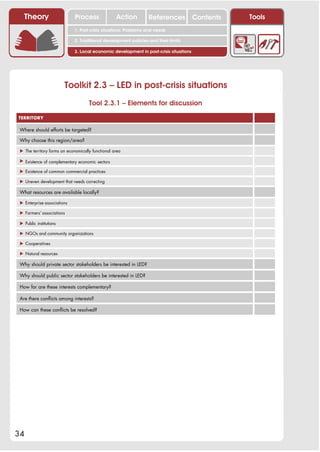
              The SWOT analysis helps to determine specific goals and milestones. Determine
              how you will address the problem areas and resource shortfalls that were
              identified. Make a list of tasks to be performed, by whom and when.

              A mix of specific policies has to be designed in order to achieve the LED vision.
              All these policies will then be implemented through a range of projects making
              use of existing or new products, whether these relate to training or finance,
              infrastructure or business development services. During this stage, it will be
              necessary to reach consensus on the budget for each of the policies.

              Interventions in the short, medium and long terms should be based on
              maximizing opportunities and strengthening weak areas. The interventions
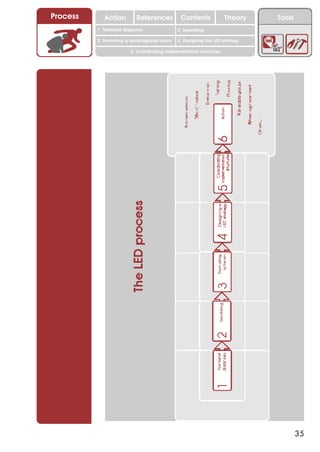
              should be agreed upon from different levels of abstraction and according to the
              LED vision. First it will be necessary to view opportunities and problems from a
              ‘helicopter’ point of view and to make trade-offs between different activities
              according to sectoral/policy priorities. It will then be possible to narrow down
              the scope of the interventions and propose the main axes towards problem
              solving, after which it will be possible to distinguish a hierarchy of objectives
              and interventions, varying from the general level for the end-goals (e.g.
              decrease of unemployment) to more specific objectives (e.g. support to small
              businesses). In this regard the construction of a hierarchy diagram might be
              illustrative.

              Any policy within the LED strategy should possess:

               ! A well-defined set of quantitative and qualitative objectives;
               ! A series of corresponding indicators.

              There are obvious difficulties when trying to estimate progress. Easy indicators
              can be created in terms of how far objectives have actually been met (i.e. how
              many enterprises do we aim to create during the next 12 months). However, it is
              much more difficult to quantify the ongoing or final results of a policy (i.e. how
              to measure increased social dialogue or decreased conflict, etc.). Nevertheless,
              discussion on how to measure the different policy outcomes and how to monitor
              them will make an important contribution to the decision-making and
              consensus-building processes.


70
Process      Action            References                   Contents                        Theory                      Tools
                                                              2. DEL y el déficit de
          1. 1. Índice diagnosis
             Territorial                                   2. Sensitizing decente
                                                                 trabajo
          3. Promoting a local/regional forum              4. Designing the LED strategy

                          5. Coordinating implementation structures


              A matrix can be helpful in improving the understanding of a structured LED
              strategy, as well as the coherence of its policies. Furthermore it will give a quick
              overview to the public, who has to be constantly informed about the progress
              made by the LED forum.


                                         How to structure a LED strategy


                     SWOT                                         Promoting
                                                                                Designing         Coordination
                                                                                                                       Work plan
                                    Vision                 Objective 1
                                             Sensitising                         the Led        Implementation
                                                                 a Forum      Policy 1.1
                                                                                Strategy             Project 1.1
                                                                                                   Structures
                    analysis                                                                                             1.1


                                                                                Designing         Coordination
                                                                                                                       Work plan
                                                                                                     Project 2.1
                                                                                 the Led        Implementation
                                                                              Policy 1.2
                                                                                Strategy           Structures
                                                                                                                         2.1

                                                                                   ...                           ...      ...
                                                                                Designing
                                                                  Promoting
                                                           Objective 2
                                                                 a Forum      Policy 2.1
                                                                                 the Led
                                                                                Strategy


                                                                ...                ...


              Step 6:          Discuss the outline of the LED strategy with all
                               relevant development partners and actors

              Meet periodically with local government agencies, development partners and
              community organizations to keep them informed of progress in the elaboration
              of the LED strategy. While their official approval may not be required, they will
              be likely to have valuable insights and information to offer.

              Step 7:          Review and revise

              Distribute the first draft to local forum members for review. Revise as needed.

              For a second review, have participants discuss their responsibilities and how
              they would implement activities. Based on these discussions, identify areas
              where there is confusion and overlapping, and modify the LED strategy
              accordingly.

              Step 8:          Seek final approval

              Arrange a briefing for members of the local/regional forum and obtain written
              approval.


                                                                                                                                   71
Process      Action          References          Contents              Theory           Tools
                                                    2. DEL y el déficit de
           1. 1. Índice diagnosis
              Territorial                        2. Sensitizing decente
                                                       trabajo

           3. Promoting a local/regional forum   4. Designing the LED strategy

                           5. Coordinating implementation structures


              Step 9:        Distribute the final plan to:
               ! Local government senior managers;
               ! Relevant national government ministries and bodies;
               ! Donors and NGOs;
               ! Chambers of Commerce and professional associations;
               ! Community leaders.

              Step 10: Implementation

              Implementation means more than simply getting the plan moving. It means acting
              on recommendations made during the territorial diagnosis and institutional
              mapping exercises and SWOT analysis, integrating the plan into the daily
              operations of local institutions and development partners, training enterprises,
              employees and community stakeholders and evaluating the plan.

              Step 11: Monitoring and evaluation

              Conduct a formal review of the LED strategy at least once a year. Among the
              issues to be considered are:

               ! How can you involve all development partners/actor/levels of government
                   in evaluating and updating the strategy?
               ! Are the problem areas and resource shortfalls identified in the TD and IM
                   exercises being sufficiently addressed?
               ! Does the LED strategy reflect lessons learned?
               ! Do members of the local forum understand their respective responsibilities?
                   Have members been trained?
               ! Does the plan continue to reflect developments in the social/economic
                   landscape of the locality? Does it reflect new actors or processes?
               ! Are steps being taken to incorporate the local economic development
                   approach into other processes?

              In addition to a yearly review, the LED strategy can be modified periodically:

               ! After each major policy intervention/training exercise;
               ! When personnel or their responsibilities change;
               ! When policies or procedures change.

              Remember to brief all stakeholders on changes to the LED strategy.


72
Process        Action          References          Contents              Theory          Tools
                                                     2. DEL y el déficit de
            1. 1. Índice diagnosis
               Territorial                        2. Sensitizing decente
                                                        trabajo
            3. Promoting a local/regional forum   4. Designing the LED strategy

                            5. Coordinating implementation structures


    3.4.3       Who should do it?

                Once consensus has been reached on the need to formulate a LED strategy, this
                should be a priority task in the recovery process. In institutionally rich
                environments, a government department or agency may take responsibility and
                the local/regional forum will assume an advisory/coordination function. In other
                cases, it may be the responsibility of the forum itself to start mapping the strategy
                in collaboration with all the stakeholders concerned. In this case, it may be
                useful to institutionalize the forum as its enlarged field of action may require a
                legal personality (see Chapter 3.5).


                                                                                                 73
Process                         Action            References                  Contents            Theory          Tools
                                                                               2. DEL y el déficit de
                               1. 1. Índice diagnosis
                                  Territorial                               2. Sensitizing decente
                                                                                  trabajo

                               3. Promoting a local/regional forum          4. Designing the LED strategy

                                                  5. Coordinating implementation structures


                          Toolkit 3.4 – Designing the LED strategy
                                    Tool 3.4.1 – Elements of a SWOT analysis
ELEMENTS OF A SWOT ANALYSIS                                                                     S           W   O       T

 Localized production techniques

 Local traditions

 Raw materials

 Competitive local suppliers

 Specialized knowledge

 Availability of local natural resources

 Specialized skills within the local work force

 Cultural milieu

 Regional identity

 Identidad regional

 Climate

 Geographical position

 Infrastructure

 Education system

 Existence of exclusive market niches

 Linkages between foreign and local enterprises

 Linkages between different sectors (i.e. agriculture, crafts, tourism, etc.)

 Political system

 National investment grants and incentives

 Regional/local investment grants and incentives

 Administration

 Regional/local institutions and organizations

 Specific questions for each action (see specific tools in Section IV)


74
Process            Action          References             Contents              Theory                       Tools
                                                             2. DEL y el déficit de
                 1. 1. Índice diagnosis
                    Territorial                           2. Sensitizing decente
                                                                trabajo
                 3. Promoting a local/regional forum      4. Designing the LED strategy

                                 5. Coordinating implementation structures


                           Tool 3.4.2 – Outline of a work plan
                ACTORS       CONTRIBUTION                                TIME FRAME (MONTHS)
  OBJECTIVES
               INVOLVED        OF ACTORS
                                              Jan   Feb      Mar   Apr   May   Jun    Jul   Aug   Sep   Oct    Nov    Dec


Objective 1

Activity 1

Activity 2

Activity 3

Activity 4

Activity 5

Objective 2

Activity 1

Activity 2

Activity 3

Activity 4

Activity 5

Objective 3

Activity 1

Activity 2

Activity 3

Activity 4

Activity 5


                                                                                                                      75
Process      Action          References          Contents              Theory   Tools
                                                    2. DEL y el déficit de
           1. 1. Índice diagnosis
              Territorial                        2. Sensitizing decente
                                                       trabajo

           3. Promoting a local/regional forum   4. Designing the LED strategy

                           5. Coordinating implementation structures


76
Process        Action          References          Contents              Theory           Tools
                                                     2. DEL y el déficit de
            1. 1. Índice diagnosis
               Territorial                        2. Sensitizing decente
                                                        trabajo
            3. Promoting a local/regional forum   4. Designing the LED strategy

                            5. Coordinating implementation structures


    3.5         Coordinating/creating
                implementation structures
    3.5.1       What to consider?
                Crisis-affected areas are not lacking in motivated local actors. What they do
                often experience, however, is an absence of institutional mechanisms for
                coordination of recovery efforts within a coherent framework. Local stakeholders
                and national/international structures will often revert to individualistic behaviour
                as they follow different sectoral interests.

                Regular meetings of the forum help to keep discussions going around the
                elaboration of an LED strategy and encourage transparency between the
                different development partners.

                At some point in time, it may be decided that it is appropriate to institutionalize
                the forum, and past LED experiences have shown that this can be a possible
                answer to the weaknesses of the local institutional environment. In countries
                where the decision has been made to create a structure, this is often called a
                LEDA (Local Economic Development Agency). Creation of a LEDA has often been
                justified by the following advantages:

                ! The LEDA might assume responsibility for coordinating some parts of the
                     relief and development strategy;
                ! The institutionalization of the forum gives it a legal personality that enables it
                     to conclude contracts with other entities, subcontract development activities
                     and make use of a defined internal structure (board, assembly, etc.);
                ! The LEDA can take over some parts of the implementation of the LED
                     strategy in areas with no pre-existing implementation structure;
                ! The legal personality and broad membership give it a mandate to lobby at
                     local, national and international levels.

                It should be remembered, however, that a key objective of the LED process is to
                use, promote and strengthen existing local implementation structures, and to
                work with and through them. For example, there may already be a policy
                coordination committee located somewhere within local government which could
                be approached to oversee the implementation of certain activities. This may also
                be lobbied to extend its membership to a broader range of actors.

                Similarly, when the LED strategy foresees business development services,
                territorial marketing or even financial services, the most appropriate and most
                qualified local institutions should assume responsibility for these activities. These
                institutions might be Chambers of Commerce, local universities, NGOs or other
                research or training institutions. It is in fact questionable whether the internal
                structure of the local forum or LEDA is the most suitable one for activities
                responding to market-based decisions.

                                                                                                  77
Process      Action          References          Contents              Theory          Tools
                                                    2. DEL y el déficit de
           1. 1. Índice diagnosis
              Territorial                        2. Sensitizing decente
                                                       trabajo

           3. Promoting a local/regional forum   4. Designing the LED strategy

                           5. Coordinating implementation structures


              In some cases, there is no option but to institutionalize the local forum or to
              facilitate the creation of other structures for the achievement of LED targets. This
              depends on the availability of financial resources (see Chapter 4.6). In the area
              of LED interventions, if the forum considers financing to be one of the major
              policy objectives and no financial institution is ready or able to carry out the LED
              policy locally, then the creation of a micro-finance institution (MFI) in
              combination with a guarantee fund might be a suitable option. Another example
              might be the creation of a training institution if there are no vocational education
              facilities, universities or other adequate institutions available in the local area.

              In El Salvador the LEDAs have turned their financing operations over to their
              member local financial institutions, which ordinarily handle other financial flows
              too. In Nicaragua, the Nueva Segovia agency has formed a company to
              manage the department’s roads that provides services to all its townships and to
              the private sector as well. In Mozambique a provincial marketing organization is
              being designed. In such cases the agency takes care of planning and promotion,
              and, in the start-up phase, holds a majority stake in the new company alongside
              other public and private shareholders. As the company grows, the agency
              recovers its investment and reduces its stake. The territory thus develops a richer
              fabric of qualified, specialized services, and the agency retains its role of
              coordination and harmonization.

              In contrast to other development actors, a LEDA is an implementation structure
              that does not have a specialized character, but rather works towards general
              and integrated development targets. In general, a LEDA assumes the following
              activities:

               ! Consensus building;
               ! Conflict prevention;
               ! Decision-making regarding the design of the LED strategy;
               ! Assigning of implementing tasks to different implementing structures;
               ! Coordination of implementation institutions;
               ! Lobbying at the local, national and international level;
               ! Networking.

              In the end, there are no hard and fast rules. If local stakeholders do decide to
              create a LEDA, then in the interim, management authority might need to be
              delegated to “steering committees” (representing the different stakeholders,
              including central governments and funding agencies), independent trust funds or
              private agencies.

              It may even be that the local stakeholders decide not (yet) to institutionalize the
              forum because some of the local actors are too powerful or, where some are
              under-represented or absent, to do so would “legitimize” an unbalanced
              situation. It might not be necessary to institutionalize a forum at all. If all the
              institutions needed to carry out the LED strategy exist in the territory, the forum


78
Process           Action                 References              Contents             Theory                               Tools
                                                                2. DEL y el déficit de
               1. 1. Índice diagnosis
                  Territorial                                2. Sensitizing decente
                                                                   trabajo
               3. Promoting a local/regional forum           4. Designing the LED strategy

                                 5. Coordinating implementation structures


                   can act as a facilitator. This would mean bringing local stakeholders together,
                   creating a network between different institutions and coordinating the economic
                   development activities in the territory. In other cases, local stakeholders, donors
                   and national and local politicians may be in favour of and provide support for
                   the creation of a LEDA, but progress in institutionalizing a coordination structure
                   takes a long time and is influenced, to a large degree, by the conditions
                   prevailing in countries.

                   Lastly, the creation of LEDAs, business development centres, incubators, etc. is in
                   fact often misused as a concrete indication of the donor’s commitment to
                   economic development. If, however, such “milestones” are created just for their
                   own sake, then they soon lack sustainability and are destined to fail. The
                   bottom-up principle of LED (which foresees an analysis of the real demand for
                   certain services and institutions among local stakeholders) guarantees the true
                   usefulness and sustainability of the implementing institutions.


                                                                 The LED process


                                                                                                 5                     6
                                                                                                       Coordinating
                     1                     2                 3                4
                           Territorial                            Promoting       Designing a
                                               Sensitizing                                           implementation           Action
                           diagnosis                                a forum       LED strategy
                                                                                                          structures


       3.5.2       What to do?

                   Step 1:               Decide on the future of the forum

                   The members of the local forum must decide whether the crisis-affected area has
                   sufficient implementation structures to effectively carry out the LED activities
                   foreseen in the LED strategy.

                   If the institutional environment is relatively rich, the forum should remain an
                   informal structure. Its main role will continue to be providing support to
                   consensus building and coordination of LED activities.

                   See TOOL 3.5.1 for an overview of functions and services of local forums.

 Tool 3.5.1
                   If the decision is made to create a LEDA or other implementation structure, the
                   forum will have to decide what measures are needed to proceed. Again, this will
                   depend on local circumstances and a careful analysis of the existing structures.

                   Step 2:               Analysis of priorities of the locality

                   The process of creating sustainable systems for coordination should begin with a
                   detailed examination of the priorities and problems affecting the locality,
                   covering social, economic, educational, industrial, technical, commercial and
                   legal areas. This should be followed by an appraisal and mapping of all
                   available local, national and international resources.

                                                                                                                                   79
Process             Action          References          Contents              Theory         Tools
                                                           2. DEL y el déficit de
                  1. 1. Índice diagnosis
                     Territorial                        2. Sensitizing decente
                                                              trabajo

                  3. Promoting a local/regional forum   4. Designing the LED strategy

                                  5. Coordinating implementation structures


                     Questions need to be asked, such as:

                      ! What are the most urgent obstacles and gaps?
                      ! Who are the key partners and agencies?
                      ! What kind of implementation structure is required?
                      ! Which comparable institutions already exist in the region?
                      ! Why are they not able to carry out the policies foreseen in the LED strategy?
                      ! What tasks could a new institution do better?
                      ! What policies, projects and products would it implement?
                      ! How would a new institution be financed/could it become self-sustainable?

                     Step 3:        Institutionalizing the forum

                     In most cases, the institutionalized form of the forum is called “Local Economic
                     Development Agency” (LEDA). Although LEDAs aren’t the only form of
                     institutionalization of a forum, evidence shows that they are a very suitable
                     platform for local actors and a formidable tool for local action.

                     See TOOL 3.5.2 for a general overview of promoting a local/regional forum
                     and its institutionalization.
     Tool 3.5.2
                     If the local stakeholders come to the decision to institutionalize the forum, this
                     step has to be taken very carefully as it contributes towards the creation of solid
                     foundations for the LED process. It is absolutely necessary that the
                     institutionalized forum reflects the socio-economic realities of the territory and
                     that the majority of the local stakeholders support it.

                     Pre-launch phase

                     Consultations and meetings: To secure the support of all stakeholders on the
                     organization and functions of a Local Economic Development Agency, rights and
                     responsibilities.

                     Investigation and research: To explore financial and credit mechanisms and
                     define financing possibilities for the LEDA, as well as arrange the support
                     infrastructure (find the premises or building, acquire the necessary office
                     equipment and the secretarial support).

                     Identify membership: Because of the integral relationship that a local
                     coordination structure has with the development of policy, there will be debate
                     about who should be included and the nature of their relationship to the State.


80
Process          Action          References          Contents              Theory           Tools
                                                       2. DEL y el déficit de
              1. 1. Índice diagnosis
                 Territorial                        2. Sensitizing decente
                                                          trabajo
              3. Promoting a local/regional forum   4. Designing the LED strategy

                              5. Coordinating implementation structures


                  Some of the most frequent questions include:

                  ! Should the coordination structure be located within the government structure
                       and be semi-autonomous, or should it be an independent profit/non-profit
                       non-governmental organization?
                  ! If the coordination structure is located within government, which particular
                       ministry should be responsible for it – Education? Industry? Information?
                       Trade and Commerce?
                  ! If the structure chosen is independent, should national coordination
                       mechanisms be totally inclusive or have more limited membership?

                  Identify support committees: Specific commissions in charge of specific tasks,
                  until the LEDA is operational.

                  See TOOL 3.5.3 for instructions for LEDA Commissions.

 Tool 3.5.3       Establish an organizational flow chart of the LEDA (in order to determine the
                  different decision-making bodies of the LEDA, their functions and
                  responsibilities). Furthermore, it is necessary to define the decision-making levels,
                  and administrative and other experts, as well as their participation and effective
                  coordination.

                  See TOOL 3.5.4 for an example of an organizational structure of a LEDA: The
                  case of Manica Province, Mozambique.
 Tool 3.5.4

                  Conceive the legal framework (Municipal Law, Urban and Rural Development
                  Law and so on). A detailed study is required to find out the “rules of the game”,
                  in order to facilitate the participation of local, regional, and central government
                  institutions and others in the LEDA. (Here it will be helpful to look at the data
                  collected previously (Section II)).

                  Initiate procedures to obtain a legal personality: In order to avoid bureaucratic
                  formalities that can restrain the process of establishing the LEDA, it is advisable
                  to begin with this as early as possible.

                  Elect a transitional governing body: From the support committees (to lay the
                  legal foundation of the LEDA and, among other things, to discuss and adapt the
                  statutes and rules).

                  Prepare the statutes and rules of operation: The preliminary draft, to be analysed
                  and discussed by the provisional governing body, assembly and subsequently by
                  the official governing body.

                  Call a General Assembly of the LEDA members: The General Assembly will be
                  the highest authority of the LEDA. In this phase, its principal function will be the
                  revision and discussion of the statutes and rules and elaboration of the
                  constitution.


                                                                                                    81
Process             Action          References          Contents              Theory             Tools
                                                           2. DEL y el déficit de
                  1. 1. Índice diagnosis
                     Territorial                        2. Sensitizing decente
                                                              trabajo

                  3. Promoting a local/regional forum   4. Designing the LED strategy

                                  5. Coordinating implementation structures


                     Internal structuring and start-up phase

                     As soon as the LEDA is established, its internal organization should be adjusted
                     to its final form, including the logistic aspects. At the same time, the LEDA should
                     identify its initial projects. In this phase, it must carry out the following activities:

                      ! Approve the internal statutes and rules with the Assembly;
                      ! Negotiate, approve and sign a technical and financial support contract
                          between the Governing Council of the LEDA and the project, to define
                          mutual obligations when the LEDA becomes operational;
                      ! Strengthen the LEDA through training workshops and seminars (Section IV);
                      ! Select and contract a technical team of the LEDA, which will review and
                          give coherence to its policies and activities, with the aim of achieving its
                          objectives;
                      ! Train the technical team of the LEDA and other specialists from the public
                          and private member institutions and organizations of the Assembly;
                      ! See TOOL 4.8.1 for more detailed information regarding the required
                          skills of the technical team.
     Tool 4.8.1
                      ! Prepare and approve the operational plan for the first few months, as well
                          as an annual operational plan;
                      ! Organize the mechanisms to select project ideas, based on a participatory
                          system that uses the criteria and priorities established by the Assembly;
                      ! Establish and sign collaboration agreements with public and private
                          institutions (i.e. with guarantee funds and/or financial institutions).

                     Consolidation phase
                      ! Process of self-evaluation (allows the review of its strategic choices, criteria
                          and priorities, and at the same time verifies the efficiency of its operational
                          structure and mechanisms);
                      ! Preparation and approval of a master plan (able to guide the actions and
                          institutional efforts with the aim of achieving the strategic vision and to
                          guarantee the sustainability of the process);
                      ! Promotion and management of initiatives with regard to the national
                          authorities and/or sources of international cooperation;
                      ! Establishing agreements with different sources of financing, in order to
                          mobilize credit resources to support productive investment (see Section IV);
                      ! Diversification of its investment promotion portfolio with projects that serve a
                          huge number of beneficiaries, and allow them to appreciate the direct
                          benefits of the LEDA (Section IV);
                      ! Diversification of sources of financing, in order to guarantee their
                          independence and economic sustainability (Section IV).


82
Process          Action          References          Contents              Theory             Tools
                                                       2. DEL y el déficit de
              1. 1. Índice diagnosis
                 Territorial                        2. Sensitizing decente
                                                          trabajo
              3. Promoting a local/regional forum   4. Designing the LED strategy

                              5. Coordinating implementation structures


                  See TOOL 3.5.5 and TOOL 3.5.6 for examples of how to promote a LEDA.

                  As opposed to the local forum, the LEDA has its own legal structure and will
 Tool 3.5.5       therefore be able to engage in contracts, and have rights and obligations
 Tool 3.5.6       towards the law. These features widen the LEDA’s field of action. Nevertheless,
                  the main elements and principles of its activities are very similar to those of the
                  forum.

                  Step 4:        Running the forum

                  This phase involves implementing the main activities of the forum or its
                  institutionalized agency (i.e. LEDA). Implementation may include, inter alia,
                  supporting initiatives to improve the policy and legal framework, lobbying for
                  the inclusion of local priorities in regional and national policies, promoting the
                  participation of excluded groups in the decision-making and planning process of
                  LED and in economic activities. More specifically, the activities of the forum will
                  be directed towards:

                  ! Mobilizing all actors, including political ones, around the LED strategy;
                  ! Intervening in the general development conditions (design of regional
                       development schemes, assistance to local groups, etc.);
                  ! Valorizing and creating a network of local resources;
                  ! Supporting initiatives to improve the legal framework (eliminating
                       complicated administrative procedures for entrepreneurs who are starting up
                       a business);
                  ! Lobbying at national and/or international level for particular investments;
                  ! Lobbying for the inclusion of local priorities in regional or national policies;
                  ! Promoting local financing mechanisms;
                  ! Establishing partnerships between training and teaching institutions and
                       enterprises;
                  ! Promoting the participation of excluded groups in the decision-making and
                       planning process of LED, as well as in economic activities;
                  ! Ensuring the elaboration of sector-related studies;
                  ! Advising local and regional authorities;
                  ! Ensuring the balance between economic development and the environment;
                  ! Promoting regional support cooperation with national and international
                       financial and developmental institutions, as well as other specialized
                       networks and bodies;
                  ! Supporting and carrying out economic and social surveys and observation
                       (keeping statistics, surveying branches, prospective studies, etc.).


                                                                                                      83
Process                     Action         References         Contents              Theory                   Tools
                                                                   2. DEL y el déficit de
                          1. 1. Índice diagnosis
                             Territorial                        2. Sensitizing decente
                                                                      trabajo

                          3. Promoting a local/regional forum   4. Designing the LED strategy

                                           5. Coordinating implementation structures


                            Toolkit 3.5 – Creating/coordinating
                                implementation structures
                        Tool 3.5.1 – Functions and services of local forums

The main purpose of a forum is to foster the economic             In keeping with the plans, they support small and
development of the territory in which it operates,                medium-sized enterprises, especially those lacking
capitalizing on endogenous resources and concentrating            know-how and capital of their own. The spread of these
on support for those groups with the most difficult access        businesses is the most secure source of jobs where neither
to regular economic and financial circuits.                       government employment nor major industrial plants are
                                                                  an alternative; and they are the most dynamic element in
This purpose comprises a number of objectives and is
                                                                  grassroots exploitation of local potential.
pursued by providing services to both private and public
sectors.                                                          In addition to business services, forums also provide
                                                                  services to local administrations, presenting themselves as
The specific objectives are:
                                                                  tools for the implementation of projects and programmes
– To foster integration and coordination of local                 that would otherwise lack resources and technical or
   institutions and associations around a shared vision of        operational capability. They also offer their support in
   local economic development;                                    conceiving and designing local development plans and
– To promote local small and medium-sized businesses;             organize the resources for realizing them.
– To plan and bring into being a system of services to            If they perform this task well, they can quickly turn
   public and private organizations that can support local        themselves into a monitoring post for the local economy, a
   economic development.                                          sensor of needs and opportunities, a crucial link between
                                                                  the developmental needs arising from economic agents
To identify the lines of production that embody the area‘s
                                                                  and the possible responses from the governmental
endogenous potential, first of all forums initiate                institutions.
negotiation between local institutions, the private sector
and civil society and assist planning bodies. This results in     Functions and services
the production of short and medium-term local economic
development plans comprising the indispensable                    To achieve these objectives, forums elaborate a series of
components of local development: entrepreneurial                  functions within three strategic areas: improving the
activities, infrastructure, financial systems and research        surrounding social and economic environment, economic
and development structures, training activities. They also        animation, and business support.
include specific projects to elicit and activate these            These functions are not always performed directly by the
components.                                                       forum’s own operational structure. Where the conditions
Special attention is devoted to identifying the most              are appropriate, i.e. where public and private bodies
vulnerable social groups, the extremely poor, and to              with the technical capabilities and resources are to be
identifying the poverty traps specific to the area. To foster     found, a variably extensive range of them may be
the inclusion of the most disadvantaged areas and                 performed by organizations that are its members or are
segments of society in the economic development                   under contract. It thus avoids overloading its own small
process, forums devise special economic animation plans           technical staff by transforming itself into a second-level
intended to create an entrepreneurial culture and                 centre for coordination and supervision.
expected to produce results in the medium term and
beyond.                                                           Improving the socio-economic environment
They also introduce special training programmes for               Forums do not claim to manage the whole economy, so
businesses, adapted to the particular conditions of the           they do not concern themselves with all of the factors
trainees, and provide technical assistance,                       affecting development. They have their own specific role
accompaniment and tutoring for new and potential                  to play. As a major forum for discussion and encounter
entrepreneurs.                                                    among local actors, they can facilitate the coordination of
                                                                  projects and foster a socio-economic and institutional
                                                                  environment conducive to development.


84
Process                    Action          References          Contents              Theory                     Tools
                                                                   2. DEL y el déficit de
                         1. 1. Índice diagnosis
                            Territorial                         2. Sensitizing decente
                                                                      trabajo
                         3. Promoting a local/regional forum    4. Designing the LED strategy

                                          5. Coordinating implementation structures


One of the most important contributions that forums have          In practical terms the information function may include:
been able to make has been to coordinate the activities of        – Creation of initial contact offices;
international cooperation agencies within their territories.
                                                                  – Creation of a bibliographical reference centre at its
Notoriously, these bodies team up only reluctantly, owing
                                                                     headquarters;
to the perceived need for national visibility, to differences
                                                                  – Creation of data banks on markets, the socio-economic
in planning and implementing procedures, to real or
                                                                     characteristics of the area, local resources;
imagined differences of approach.
                                                                  – Link-ups with international data banks;
As independent local structures, they can enter into
separate agreements with each organization that comply            – Seminars;
with the procedures and aims specific to the programme            – Carrying out or sponsoring specific studies and
of each. This function of rationalizing the international            surveys;
development efforts in a given area and enhancing the             – Link-ups with research centres and universities.
efficacy and impact of each project is invaluable.
                                                                  A second set of support functions consists of initiatives to
Planning also has major importance, not only in order to          stimulate the entire economic environment, directed
enhance local development but also, indirectly, to                particularly at potential entrepreneurs. The lack of a
strengthen a forum’s own territorial structure. By providing      culture of individual initiative is a severe limit to
project-design and intermediary services at a charge to           development. A culture of enterprise means inclinations
potential investors, they can improve their own economic          and aptitudes, such as the capacity for initiative, the
and operational situation. Forums in Central America, for         willingness to take risks, to think ahead, to make
instance, played a key role in designing local economic           decisions.
reconstruction plans in the aftermath of Hurricane Mitch,
while those in Bulgaria offered planning services for the         These abilities cannot be transferred as such because they
European Union’s PHARE and TACIS programmes.                      cannot be reduced to a set of techniques and conveyed in
                                                                  a specific training course. Economic animation is
Economic development                                              designed to create opportunities for these aptitudes to
                                                                  emerge and take root. This activity comes before that of
In the territories where forums operate, many of their            business promotion, especially when, as in the case of
potential “clients” among the more disadvantaged social           forums, the target population has traditionally been
strata face insurmountable barriers in starting up a              relegated to subsistence activities. The kinds of activity
business of their own, however modest. This is a kind of          that can make up this broader type of stimulus may
activity far outside their range of experience and existing       include:
possibilities. Thus, besides serving small operators
already in business, an essential task is precisely eliciting     – Seminars involving schools, vocational training centres,
the demand for its services, expanding the numbers of                universities and private associations to build
potential entrepreneurs, promoting a culture of enterprise.          awareness of entrepreneurial issues;

This means calling into being a well-defined, structured          – Participatory studies to locate investment opportunities;
complex of activities, chances, opportunities that                – Business simulation workshops;
constitute an overall strategy of local “economic                 – Thematic meetings;
animation”. These services are of two kinds: information
                                                                  – Guidance for training activities.
and practical stimulus to economic activity. They are at
the same time the precondition and a necessary support            Central to this sort of programme is its ability to orient
to the development of local entrepreneurship. Information         training activities as a function of the overall economic
services involve the gathering, processing and                    development strategy for the area. All countries have
dissemination of data useful to men and women who are             vocational training centres, even in the most
thinking of starting up an economic activity or expanding         disadvantaged regions, to prepare young people for the
an existing business. The information base covers                 most common trades. But very often the content of training
markets, techniques and technologies, the area’s                  courses is decided without taking the development
resources and potential, laws and regulations, and                potential of the particular area into account.
consumption. This informational activity goes beyond its
                                                                  A Local Economic Development Agency is a powerful
obvious application to all its activities and produces
                                                                  force for reorienting these training activities in view not
benefits for the area as a whole. Lack of information is in       only of the present state of the labour market but also –
fact one of the key problems of underdevelopment; in
                                                                  indeed, above all -of the lines of development for the
peripheral areas even such elementary facts as the
                                                                  future, which its own activities serve to sustain. It can thus
number of inhabitants may be unknown.
                                                                  help equip young people for gainful employment and


                                                                                                                           85
Process                    Action           References         Contents              Theory                     Tools
                                                                    2. DEL y el déficit de
                          1. 1. Índice diagnosis
                             Territorial                         2. Sensitizing decente
                                                                       trabajo

                          3. Promoting a local/regional forum    4. Designing the LED strategy

                                           5. Coordinating implementation structures


truly animate the area’s economy with creative and                 process determines whether the idea can effectively be
dynamic actors.                                                    turned into a going concern.
Equally important is the agency’s role in orienting the            If it can, the businessman will need financing. A bank
many training activities conducted by international                must provide it, and the forum acts as intermediary with
cooperation or national programmes. Here too, the                  the bank, backing the loan with its own credit fund which
initiatives are widespread, the purpose being to improve           goes on deposit as a guarantee fund.
existing economic activities and foster a new,                     However, the forum’s approval is not subject solely to
entrepreneurial attitude among local producers. The
                                                                   technical and financial criteria. It is not a bank; it is a
agency can effectively complement these initiatives by
                                                                   promoter of development with an anti-poverty
directing them along the strategic lines of local
                                                                   perspective. So, its project selection, while respecting the
development and, above all, by enabling interested
                                                                   standards of financial viability, also weighs other factors
producers to obtain credit so that they can put what they          such as employment impact, involvement of
have learned into practice and start up or expand a                disadvantaged groups, secondary economic impact and
business. Once again, it combines practical solutions with         environmental impact.
the dissemination of a new culture of local economic
development.                                                       Once the business has been set up, or the expansion
                                                                   investment put in place, the forum offers technical
Business support                                                   assistance during the initial phase. The most common
                                                                   problems are inability to meet sales and market targets,
As our account so far makes clear, the promotion and
                                                                   changes in tax and tariff rules, resource management,
support of local businesses is in a sense the “core
                                                                   falls in prices, and supply shortages.
business” of the Local Economic Development Agency.
The integrated range of services ordinarily offered by it          Ongoing business operations sometimes require massive
comprises the following:                                           technical assistance; forums must accordingly have
                                                                   sufficient human resources. When its own resources are
– Formulation of business plans;
                                                                   insufficient, the forum may draw on staff made available
– Training of human resources;                                     by its stakeholders, make a small charge on the firm’s
– Technical assistance in preparing business plans and             assisted, or provide services in common to businesses that
   during start-up and consolidation;                              have the same problem.
– Financial assistance through lending, taking stakes in           One instrument for assisting businesses in the start-up
   businesses, provision of guarantees, location of                phase is the “business incubator”. This is an organization
   sources of finance and help in gaining access to                with physical facilities, services and technical assistance
   outside credit.                                                 that hosts newly-formed businesses. Very common in the
These are the classical tools wielded by business support          industrial world, incubators perform the highly useful
                                                                   function of helping businesses over all the initial hurdles
programmes. They offer a full range of support to each
                                                                   and reducing their start-up costs. In developing countries,
single business, starting with the initial project. Often they
                                                                   however, they have proved hard to set up: their costs are
accompany the potential entrepreneur from the outset, in
                                                                   quite high compared to their benefits, fledgling businesses
the identification of the original product or service idea.
One way of going about this is to build on the                     are unlikely to be able to afford these services, and
candidate’s previous experience or trade; an alternative           governments lack the funds to allocate to such a purpose.
is to scan the lines of production that are strategic to local     So, without precluding the business incubator approach,
                                                                   as a rule the agencies arrange to support as many firms
development for new opportunities and suggest them to
                                                                   as possible with technical assistance, which may be
the candidate.
                                                                   supplied at headquarters or within the businesses
Once the business idea has been found, its viability has           themselves, and with special attention to the ones in most
to be appraised, the business plan prepared and it has to          difficulty.
be checked for market compatibility, technological
manageability, and cost-benefit performance. This sifting


86
Process                  Action            References               Contents                 Theory                         Tools
                                                                      2. DEL y el déficit de
                       1. 1. Índice diagnosis
                          Territorial                              2. Sensitizing decente
                                                                         trabajo
                       3. Promoting a local/regional forum         4. Designing the LED strategy

                                         5. Coordinating implementation structures


          Tool 3.5.2 – Promoting and institutionalizing a local/regional forum
PHASE                   INDICATORS                                                RESPONSIBILITY

Awareness-raising       ! Political acquiescence to the process by regional       The first two phases are still principally the
phase                     and local authorities, who own the process and          responsibility of the project.
                          lead it.
                        ! Regional forums constituted and elected.
                        ! A support committee for the constitution of the
                          Local Development Councils (LDCs) established.
                        ! A support committee for the constitution of a
                          LEDA created, merging economic commissions of
                          LDCs.


Promotion phase         ! Outline of the LEDA prepared and approved by            In all steps, the responsibility for supervision and the
                          the local actors.                                       rate of implementation of the activities still remains
                                                                                  with the project that is supporting the idea.
                        ! A definite decision about its establishment taken.
                                                                                  In the execution phase, it must rely on the
                                                                                  (increasing) support of the support committee, which
                                                                                  will accompany the entire process of the
                                                                                  establishment of a LEDA.

Establishment phase     ! LEDA officially established, with its normative         In this phase, the help of the project is still counted
                          agencies, advice councils, governing body and           on, since it will make viable (financially as well as
                          specialists.                                            technically) a large portion of what has been
                                                                                  advised. However, this is all consolidated through a
                        ! Internal statutes and rules approved.
                                                                                  constant dialogue between the local actors and the
                        ! Contract with the support project for setting it in     support committee.
                          motion signed and in execution.


Internal structuring    ! Technical team in operation.                            In this phase, the project maintains a coordination
and starting phase      ! Coordination network with other institutions            role, gradually transferring the responsibilities to the
                                                                                  governing body of the LEDA Assembly.
                          and/or operative organizations set up.
                        ! Mechanisms of operation support in effect.
                        ! Population identified as part and head of the
                          LEDA.
                        ! Plan of operations approved and in effect.

Consolidation phase     ! LEDA recognized as a valid and representative           All responsibility is in the hands of the LEDA and the
                          spokesperson by the different public and private        local actors.
                          institutions at the local, national and international
                          level.
                        ! Its operation is self-financed.
                        ! Its capacity to mobilize resources and investment
                          is confirmed.
                        ! Its actions are guided by its master plan.
                        ! Its social basis is consolidated through the active
                          participation of the producers’ organizations and
                          its development basis through its activities.


                                                                                                                                       87
Process                 Action          References           Contents               Theory                      Tools
                                                                 2. DEL y el déficit de
                        1. 1. Índice diagnosis
                           Territorial                        2. Sensitizing decente
                                                                    trabajo

                        3. Promoting a local/regional forum   4. Designing the LED strategy

                                        5. Coordinating implementation structures


         Tool 3.5.3 – Instructions for LEDA Commissions: The case of Croatia
The following three Commissions have been established in Croatia:
– Commission I (Legal and organizational aspects)
– Commission II (Territorial aspects)
– Commission III (Services provided by the LEDA)
The table below indicates the operational recommendations that have been prepared with the
aim of establishing the first LEDAs in the country).


                               COMMISSION I
                                                              COMMISSION II                     COMMISSION III
 COMMISSIONS                   LEGAL AND                      TERRITORIAL                       SERVICES PROVIDED
                               ORGANIZATIONAL
                                                              MANAGEMENT                        BY THE LEDA
                               ASPECTS

 OPERATIONAL                   ! Founders of the LEDA:        ! Territorial coverage, taking    ! Type of activities to be
                                                                into account economic             provided, e.g. promoting
 RECOMMENDATIONS                 " Status of the founders
                                   (legal and/or physical)       criteria, socio-cultural          discussions on economic
                                                                 homogeneity, demography,          development priorities,
                                 " Membership (public,           administrative borders and        resource mobilization,
                                   private, international)       war-affected areas                business information
                                                                                                   dissemination, services
                               ! General outline of the       ! Distribution and availability
                                 bodies (consulting                                                orientation, promoting
                                                                of human, financial and
                                 committee, board of                                               networking capacities,
                                                                technical resources in order
                                 directors, director,                                              marketing of the region,
                                                                to find synergies and
                                 assembly, technical                                               capacity building,
                                                                promote complementarity
                                 departments)                                                      promotion of
                                                                with existing programmes
                                                                                                   entrepreneurship, joint
                               ! Rules and regulations        ! Physical settlement of the         complementary services)
                                 (including the                 LEDA (including
                                                                                                ! Nature of financing
                                 decision-making process,       headquarters, branches,
                                 voting)                        focal points) according to      ! Role and contribution of
                               ! Initial contributions          the presence of actors,           existing service providers
                                                                communication facilities,         (networking between
                                 (international funds,
                                 stakeholders and other          networking and availability       stakeholders)
                                 contributions)                  of services, minimal costs
                                                                                                ! Equipment and resources
                                                                                                  (for example: software,
                                                                                                  promotional material, trips
                                                                                                  to international fairs)


88
Process                  Action          References          Contents              Theory                 Tools
                                                                 2. DEL y el déficit de
                        1. 1. Índice diagnosis
                           Territorial                        2. Sensitizing decente
                                                                    trabajo
                        3. Promoting a local/regional forum   4. Designing the LED strategy

                                        5. Coordinating implementation structures


                      Tool 3.5.4 – The organizational structure of a LEDA:
                         The case of Manica Province, Mozambique

The way in which a LEDA is structured internally, its           on the performance of its organizational tasks, such as
decision-making processes, its relationship with other          planning and goal setting, resource mobilization, etc.
local institutions and authorities at the same level            Therefore it is very difficult to present here a standard
(horizontal linkage) or with higher-level organizations         model of the organizational structure of a LEDA. However
(vertical linkages), the incentives or sanctions that tie       the following figure presents as an example the structure
members to the organization, and the composition of its         of the organization in the Mozambican case.
membership could all be expected to have some influence


                                   General
                                   Assembly

                                                                      Supervisory
                                                                        Board

   DECISION-MAKING
         LEVEL
                               Management                                                 Consultative
                                  Board                                                     Board


                                    Director

                                                                               Administration
   TECHNICAL LEVEL


                                 Technical
                                Departments


                                                                                                                    89
Process                  Action           References         Contents               Theory                      Tools
                                                                    2. DEL y el déficit de
                          1. 1. Índice diagnosis
                             Territorial                         2. Sensitizing decente
                                                                       trabajo

                          3. Promoting a local/regional forum    4. Designing the LED strategy

                                            5. Coordinating implementation structures


                                 Tool 3.5.5 – How to promote a LEDA:
                             The case of Manica Province, Mozambique

In March 1999, the PDHL (Human Development                         overseas and, in particular, to gain a better
Programme at the Local Level) began the process of                 understanding of the strengths and weaknesses of LEDAs.
creating a Local Economic Development Agency in the
                                                                   Members of the LEDA in Manica were:
three provinces of Sofala, Manica and Maputo. The PDHL
assumed responsibility for providing full financial and
technical support, at least during the first three years of          1    Metalúrgica de Chimoio            Private enterprise
operation, with PDHL personnel assigned to work closely              2    Fundo de Fomento de Pequena       Financial institution
together with the LEDA staff on implementing the work                     Industria
plan.
                                                                     3    União Provincial de               Association
Three LEDAs were officially created, including ADEL                       Camponeses de Manica
Sofala (Agência de Desenvolvimento Económico Local) in               4    Associação de Agricultores de     Association
October 2000, and ADEM Manica (Agência de                                 Manica
Desenvolvimento Económico de Manica) in November
                                                                     5    Focama – Forum das ONG’s          Association
2000. Maputo Province opened the third LEDA in the
                                                                          Nacionais
country on 20 June 2001.
                                                                     6    OMM – Organização de              NGO
In this section, the practical implications of establishing
                                                                          Mulher Moçambicana
the Local Economic Development Agency in Manica
Province are discussed.                                              7    Sports Clube                      Association

The process of creating and promoting a LEDA has been                8    PAC – Programmea de               Association
                                                                          Actividades Culturais
divided into five phases:
                                                                     9    Conselho Municipal de Chimoio     Municipality
a)    Preparation phase;
b)    Promotional phase;                                            10    Conselho Municipal de Manica      Municipality
c)    Design and juridical procedures;
d)    Start-up phase;
e)    Consolidation phase.
                                                                   b) Promotional phase
Each of these five phases can be subdivided into different
steps.                                                             When they returned from the study tour, ideas,
                                                                   impressions and experiences were exchanged between
Although the following steps seem to be quite
                                                                   the members of the support committee. Four working
chronological and structured, the promotion of the LEDA            groups were then formed and assigned the tasks of
is a long process and is accompanied by
                                                                   investigating, discussing and drumming up proposals for
capacity-building activities, including the promotion of
                                                                   the establishment of the LEDA, focusing on areas such as
financial mechanisms, the design of concrete projects and
                                                                   its mandate, the institutional context, the territorial
the first round of negotiations with local, regional and
                                                                   dimension and its legal structure.
national actors, etc.
                                                                   The discussions of the four working groups resulted in the
                                                                   formulation of a LEDA profile containing the following
a) Preparatory phase
                                                                   sections: introduction; nature of the organization; general
As part of the consensus-building campaign mentioned               and specific objectives; activities; organizational
above (see Chapter 2.2), field trips to meet with the staff        structure; participants; intervention strategy and
of existing LEDAs in other countries have proved to be             sustainability3 .
extremely successful. The ILO organized a study tour in
September 1999 to El Salvador, Portugal and Italy, in              The main results are summarized below.
which 21 representatives from both private and public              Mandate: Criteria were first proposed for the creation
sectors participated. Nearly all of the LEDA Support               of the LEDA, highlighting that: (i) the process should be
Committee members from Manica Province participated,               simple and fast; (ii) the LEDA should be non-profit; (iii) it
giving them a chance to gain insight into LED initiatives          should be open to all organizations that have a proper

  3
      See Annex.


90
Process                      Action           References             Contents              Theory                      Tools
                                                                        2. DEL y el déficit de
                           1. 1. Índice diagnosis
                              Territorial                            2. Sensitizing decente
                                                                           trabajo
                           3. Promoting a local/regional forum       4. Designing the LED strategy

                                            5. Coordinating implementation structures


juridical personality and operate in the field of economic              the provincial capital to benefit from institutional and
development; (iv) if possible, the government should                    infrastructural linkages as well as available human,
participate; and (v) its organizational structure should be             economic and financial resources. The possibility of
simple.                                                                 opening a district branch office was however not ruled
                                                                        out.
Concerning representation, a mixture of private and
public sector members was found to be vital to ensure that              Once the project profile had been developed in
the LEDA would have legitimacy in acting as a vehicle for               December 1999, different seminars and workshops were
social dialogue and coordination within the local                       organized to promote the concept of the LEDA to a wider
economy. It was also agreed that funding agencies                       audience and to attract more members.
should not participate directly, but should have an
advisory role, perhaps as part of a Consultative Board.                 c)   Design and juridical procedures
Several concerns were raised during the meetings
regarding the weak representation of the rural population               Strengthening the LEDA
(as part of the civil society), as well as of the private               As proposed by the LEDA Support Committee, a lawyer
sector. It was observed that in Chimoio, as well as in                  was contracted to analyse the proper legal structure of the
Manica Province, there are many different organizations                 LEDA and elaborate its Constitution based on the profile
representing diverse population groups, yet nearly all of               document. Several meetings were held between the
these lack a proper organizational structure and are                    committee and the lawyer to discuss and clarify different
institutionally weak4 .                                                 aspects. One of the issues analysed and discussed in
Manica Province also lacked an active and representative                detail was the type of organization that was eligible to
association of private entrepreneurs, even though a                     become a member. It was agreed that the Government
formal association was in existence. Priority was therefore             represented by the different technical provincial
given to strengthening this aspect.                                     departments could participate in the Consultative Board.
                                                                        Funding agencies, as well as international NGOs, could
A further question mark hung over the membership of                     also eventually have a role in this Committee.
private enterprises in a non-profit institution. It was
decided that local entrepreneurs could only be                          Another issue frequently raised was how long the
represented through their professional body to prevent the              membership would last for the different bodies.
concentration of too much decision-making power in one                  It was agreed that the most appropriate legal structure for
single enterprise.                                                      the LEDA would be an association. The LEDA would then
As far as fields of intervention were concerned, it                     have its own legal personality and framework, and
was agreed that the LEDA could play a key role as a                     administrative autonomy. In order to register an
coordinator between the different actors and their                      association, at least ten founding members had to be
programmes, bringing together different kinds of services               recognized.
related to the promotion and creation of small and                      The General Assembly is the most important legal body of
medium-sized enterprises and associations, as well as                   the LEDA. It defines the strategy, policy and priorities of
promoting the territory and identifying investment                      the organization. The daily operations are the
opportunities.                                                          responsibility of the Management Board (elected during
The LEDA Support Committee defined the LEDA’s target                    the first General Assembly) as well as the manager of the
group as being all the economic actors of Manica                        LEDA.
Province, paying special attention to disadvantaged or                  A Financial Control Committee monitors the financial
marginalized groups such as female heads of households,                 procedures and checks the accountability of the LEDA.
returned refugees, demobilized soldiers, etc. It was stated
clearly that the LEDA should not focus on the poorest of                A Consultative Board is involved in different strategic
the poor, as the economic development process in                        decisions, but does not have a direct vote in the
Manica Province would not depend on them!                               Management Board. The Consultative Board is composed
                                                                        of the representatives of the relevant public and
Territorial dimension: Given the population dispersal                   international institutions.
over such a wide area in Manica Province, it was agreed
that the Headquarters of the LEDA should be located in                  The technical team carries out the decisions taken at the
                                                                        level of the Assembly and Management Board.

  4
      This may be because most local organizations have not grown spontaneously as an outcome of internal market dynamics, but are the
      result of external interventions (though the church or NGOs). More worryingly, only three out of ten districts had locally elected
      governments.


                                                                                                                                  91
Process                      Action           References              Contents               Theory                       Tools
                                                                          2. DEL y el déficit de
                           1. 1. Índice diagnosis
                              Territorial                              2. Sensitizing decente
                                                                             trabajo

                           3. Promoting a local/regional forum         4. Designing the LED strategy

                                             5. Coordinating implementation structures


Legalization procedures and requisites                                   together local actors from different sides to tackle
                                                                         common, concrete problems and by stimulating the
Finding and gathering all the necessary documents
                                                                         search for solutions in the interest of all parties.
needed for the registration process was not as easy as
expected, as there was some confusion among the                          LEDAs are designed as membership organizations, made
founding members. Registration requirements also differ                  up of representatives of the public sector (local
from province to province: whereas in Sofala there were                  administration and decentralized national government
few requirements, in Manica, on the other hand, the                      agencies) as well as the private sector (organized groups
administrative demands caused some delays.5                              in civil society, such as peasant associations,
                                                                         cooperatives, employers, workers’ organizations and
At this time, the Support Committee began to think of an                 other non-governmental organizations, as well as
appropriate name for the Agency. After consultation with                 individual entrepreneurs). LED institutions, like LEDAs, are
other potential members, they finally agreed on:                         in the first place a forum for social dialogue and
Agencia de Desenvolvimento Econômico Local                               negotiation in which the public and private sectors each
da Provincia de Manica – ADEM (Local Economic                            have their interest. The public sector uses the LEDA as a
Development Agency of Manica Province).                                  means to get closer to society, to popular needs and
                                                                         opinion. It also benefits from delegating the
Following completion of the registration process, the LEDA
                                                                         implementation of political decisions to technically
Support Committee then lost its raison d’être. The role of
the PDHL also began to change from “promoter” and                        specialized institutions. On the other hand, the active
active “actor” to a more advisory and monitoring role.                   involvement of the pubic sector provides a political
                                                                         legitimacy to the LED initiatives and LEDA, and provides it
A LEDA should become an independent body as soon as                      with the necessary institutional and political links.
possible, with a separate legal structure. It is therefore
                                                                         The private sector can use the LEDA as an instrument to
important that the local actors assume responsibility for
                                                                         develop itself directly, without intermediaries. Through the
the process of creating the LEDA right from the start. In                involvement of the private sector a more adequate
order to ensure that a local community will not consider a               response to the concrete needs of the local population is
LEDA as an institution imposed from the outside, but will                guaranteed. Also a more business-like administration is
consider it as its own, the LEDA will have to be constituted             guaranteed. The LEDA is thus a tool that brings together
based on a participatory process of promotion and                        very different ideas, demands and opportunities into a
preparation, involving ad hoc committees of                              common effort to plan, establish priorities and carry out
representatives of public institutions, NGOs, local                      interventions that will benefit the economic development
authorities, small producers and entrepreneurial                         of the territory. Mixed public/private participation and a
organizations and representations from the community.                    private – autonomous – administrative status have proved
                                                                         to be factors of success in various different environments.
The fact that a LEDA is an independent legal entity has
proved to be particularly important in reducing levels of                When the public and private sectors pool resources and
conflict in areas where ordinary clashes of interest                     share risks, projects with mixed economic and social
                                                                         returns bear fruit more quickly and have a better chance
between social groups has degenerated in armed
                                                                         of success.
hostilities, expulsion or forced repatriation of populations.
LEDAs have also shown to be successful and useful in
those environments that have undergone heavy economic                    d) Start-up phase
and political transitions, where the implosion of former
                                                                         During this phase, the LEDA addressed three basic issues:
powers and the formation of new aggregations
complicate the regeneration of social organization and                   – Geographical location;
the creation of new social and economic networks. Here                   – Human resources; and
new opportunities for dialogue are created by gathering
                                                                         – The official constitution.

  5 The following documentation was requested from the founding members:
     - Legal copies of Identification cards;
     - Certificate from the criminal register;
     - Minutes of the meeting held by each founding member organization indicating who will represent the organization within the LEDA;
       if the member organization is a private enterprise, it should submit a letter indicating that the representative is working for that
       company;
     - Proof of existence of the enterprise (public register) or copy of its statutes in the case of an association.
     From the LEDA or its representative:
     - Certificate indicating that the proposed name does not yet exist;
     - Letter of application for legalization of the LEDA signed by a representative;
     - Bylaws signed by one of the representatives of the LEDA. The bylaws are copied by hand in two copies following approval from the
       Governor of the Province.


92
Process                    Action         References          Contents              Theory                     Tools
                                                                  2. DEL y el déficit de
                         1. 1. Índice diagnosis
                            Territorial                        2. Sensitizing decente
                                                                     trabajo
                         3. Promoting a local/regional forum   4. Designing the LED strategy

                                         5. Coordinating implementation structures


Location                                                         The following topics were raised:

Members of the LEDA Support Committee began to                   – Mission statement (Why create a LEDA?);
search for appropriate office space during early 2000.           – Objectives (What do we want to achieve?);
One of the main selection criteria here was geographical
location. LEDAs should be set up in a well-known,                – LEDA tools (How do we intend to do it?, i.e. situating
centrally located area where there are sufficient amenities         the LEDA within the advisory, training and information
as well as possibilities for future expansion. A list of            services already available in the Province);
criteria was drawn up, including all necessary furniture         – Organization of the LEDA (Who will do what?);
and office supplies. The PDHL agreed to finance all the          – Operational plan and time frame (Where and when
installation costs.
                                                                   will it be done?);
Recruitment of staff                                             – The budget (How much is going to cost?).

ADEM contracted one director, an office assistant and the        In the operational plan it was agreed that, in its first year
necessary technical staff. Vacancies were published in           of existence, the ADEM would concentrate on the
local newspapers and applicants were interviewed and             following areas:
selected by some of the members of the LEDA Support              – Strengthening the ADEM as an institution (human
Committee and the PDHL. A balance was found between                resources, logistics and finance);
offering salaries that were generous enough to attract
good, qualified and motivated people who were                    – Creation of a communication and information
prepared to work in difficult circumstances, and at the            dissemination strategy;
same time operating within the limits of available               – Collection, analysis, systematization and dissemination
financial resources to ensure sustainability.                      of relevant information about the Province and its local
                                                                   actors, to identify and propose investment
Constitution                                                       opportunities;
On 13 November 2000, the LEDA (ADEM) was officially              – Formulation of operational and implementation
launched in accordance with the Mozambican “Law of                 mechanisms;
Association” by the head of the Notary’s Office. The             – Identification, selection, implementation, financing,
handwritten Statutes were then signed by all ten founding           monitoring and evaluation of economic development
members. The Governor of the Province stressed the                  projects in Manica Province.
importance of the LEDA during his intervention. Four of
the original LEDA Support Committee members became               On the basis of this operational plan, UNOPS signed a
founding members.                                                contract with the ADEM to implement the activities as of
                                                                 February 2001. It was agreed that UNOPS would
One week after the legal constitution of the LEDA, a             transfer funds to the ADEM every three months, based on
seminar was organized to inform its members and staff
                                                                 a review of activities during each period to establish a
about the need to write a strategic plan and what steps
                                                                 simple accounting and reporting system.
should be taken. The members agreed on the LEDA’s
objectives and its area of intervention during this meeting.
                                                                 e) Consolidation phase
The First General Assembly was organized at the
beginning of December 2000 to elect the members of the           The ADEM Manica has now entered the so-called
different Governing Bodies. Since the LEDA Support               consolidation phase. The first concrete activities are being
Committee had already elaborated a proposal with                 carried out, while efforts are being made to strengthen
candidates for the different positions, the election went        the organization’s internal structure so that the
smoothly. During the same meeting, seven new members             administrative procedures continue to be both fair and
of the ADEM were presented to the General Assembly,              transparent. The ADEM is also working with PDHL staff to
including private enterprises as well as associations.           analyse ways in which it can gain political credibility at
Once the minimum number of technical staff had been              the national level.
appointed, the process of developing the operational
                                                                 Internal organization
plan began. It was clear that the PDHL was interested in
contracting the ADEM to carry out various activities on its      If the ADEM is to become a key provider of support
behalf; however the ADEM needed to have its                      services to the business community, and a reliable partner
operational plan in place first.                                 to implementing agencies such as GTZ and DANIDA, the
This plan focused on the priorities and activities for the       priority should now be to consolidate a well-functioning
first year of operation, together with an initial budget and     management information system (MIS), a personnel
time frame.                                                      management system and a financial/administration system.


                                                                                                                          93
Process                   Action          References          Contents              Theory                     Tools
                                                                   2. DEL y el déficit de
                          1. 1. Índice diagnosis
                             Territorial                        2. Sensitizing decente
                                                                      trabajo

                          3. Promoting a local/regional forum   4. Designing the LED strategy

                                          5. Coordinating implementation structures


The ADEM Board of Directors meets once a week to                  administrative system is already in place, monitored by a
discuss various day-to-day matters. Since contact with            part-time accountant.
partner institutions is critical to the Agency’s success
during the early start-up phase, the PDHL staff are               Launch seminar
informed on a daily basis of different matters relating to
                                                                  A seminar was organized on 14 June 2001 during which
the establishment and consolidation of the ADEM.
                                                                  the ADEM presented itself to the general public. This was
Regular contact also activates an early warning system,
                                                                  an excellent opportunity for the LEDA to promote its role
enabling the PDHL to detect possible problems and
                                                                  and to consolidate its internal organization, as the
obstacles from the outset.                                        members were all united around one concrete, public
At the present time, the internal rules and regulations of        activity.
the ADEM are still being developed. However an internal


                 Tool 3.5.6 – Example of the local economic development
                              component in PDHL Mozambique

In this document the following points will be analysed:           addition, it will search for consensus-based solutions to
                                                                  achieve a balance between various sectoral components
– Organization and structure of the component;                    and activities. Lastly, it will promote efficient exchanges of
– LED methodology;                                                information between the various sectoral actors and the
– Implementation strategy;                                        various levels. This means in practice that there will be a
– Tentative work plan;                                            very tight collaboration with the activities in the other
                                                                  components.
– Sustainable mechanism for economic development.
                                                                  The LED component, which in itself is an integrative
                                                                  approach, will also provide support to activities carried
Organization and structure                                        out at the community, district, provincial and national
of the component                                                  levels in support of the government’s decentralization
                                                                  process. This will lead to improved local capacity-building
The local economic development (LED) component will be
coordinated from the central PDHL office in Maputo. The           mechanisms through the establishment of a network of
ILO/LED expert will be based in Maputo and will be                development committees. In turn, this network can create
responsible for the overall development of the LED                concrete opportunities for interaction and feedback of
initiatives in the country. He will also give a closer            information between local intermediate and national
                                                                  levels.
follow-up to concrete LED initiatives to be developed in
the Maputo Province. Two international LED experts will
be based in the field, one in Sofala (ILO associate expert)      LED methodology
and one in Manica (UNV). They will have the support of
                                                                  The programme will operate according to the local
local LED consultants, one in each province, who will be
duly prepared and trained at the beginning of the project.        economic development methodology applied and tested
                                                                  in different PDHL projects, such as PRODERE in Central
The day-to-day work in the field will be done in close
                                                                  America. This methodology stresses a bottom-up
collaboration with the local PDHL project staff.
                                                                  approach and easy replicability of its experiences. It is
Taking into account the methodology of the PDHL project,          based on mutual agreement and consensus among local
one cannot simply isolate the activities of one component         actors concerning the direction and conditions of the
from the other components within the project. Linking with        development of the local economy, and relies to a great
the other components of the project is of fundamental             extent on locally available human resources.
importance for the overall outcome of the project, since
                                                                  In order to reach the programme’s objectives successfully,
education, health, employment, productive activities,
environmental concerns, territorial planning and                  its methodology is based on:
management and human rights are all interdependent               – Consensus building;
factors in the local development process. Therefore, the         – A bottom-up approach;
project promotes a comprehensive systems approach to
analyse local potential and limitations, for a realistic         – Human and institutional capacity building;
definition of economic and social development goals. In          – Search for synergy effects and impact;


94
Process                       Action             References             Contents              Theory                       Tools
                                                                            2. DEL y el déficit de
                            1. 1. Índice diagnosis
                               Territorial                               2. Sensitizing decente
                                                                               trabajo
                            3. Promoting a local/regional forum          4. Designing the LED strategy

                                               5. Coordinating implementation structures


– Globalization of the local level;                                        Raising public awareness boils down to the creation of a
– Raising public awareness.                                                more appropriate entrepreneurial culture and a low-risk
                                                                           atmosphere. It is one of the most difficult aspects as it
Consensus building has to be done through an active                        refers directly to the mentality of the people (at all levels).
participation of the relevant socio-economic and political
actors at the local level. This means that a process has to                Implementation structure
be created which unites and creates collaborative
linkages amongst local actors across political and cultural                The LED component must be subject to conscious
differences, ensuring a constructive exchange of ideas                     planning. Local development should not be incidental or
and opinions aimed at designing policies for sustainable                   accidental.
development of the project area.
                                                                           Spontaneous and natural evolution processes are
The bottom-up approach mobilizes to the utmost the local                   important, but it is even more important that the activities
human potential, making those involved part of and                         of local and external players focus on analysing the
responsible for the local economic development process.                    situation (potential, needs, opportunities, etc.), developing
By doing so the activities initiated are more likely to be                 a strategy and operational programme and undertaking
sustained, since these activities are conceived as                         efforts to implement them.
endogenous rather than exogenous (from an external
project) processes.                                                        The LED component should, however, develop in
                                                                           accordance with the guidelines that have already been
The element of human and institutional capacity building                   laid down in the Mozambican Provincial and District
– the upgrading of local capacities – is essential in order                Development Plans. These Plans define the long-term
to guarantee sustainability of the initiated activities and it             strategic direction of the development of a local area,
will be a constant concern of the project.                                 practical projects to be implemented, financial, material
                                                                           and technical support required to achieve the goals set
Synergy effects and impact: In order to create trust and
co-responsibility amongst the local actors for the long-term               and participation of individual entities in their
goals of the programme, it is of extreme importance to                     implementation.
make sure that short-term, concrete and visible results
(impacts) are achieved. Setting of good examples                           Work plan
contributes to raising the level of motivation and                         (May –June/August – October)
awareness of the target population. However, these
examples must have such characteristics as can easily be                   The work plan presented below is divided into two
repeated. On the other hand, complementarities are a                       different periods, May/June and August/October 1998.
continuous concern, so that other similar activities in and                This is due to two different moments of the ILO
outside the project area are not replicated.                               intervention. In May/June the ILO mission developed the
                                                                           LED component for the PDHL project, initiating several
Globalization of the local level refers to the incorporation               activities. From the end of July onwards the ILO/LED
of local experiences into a wider framework of laws and                    expert’s presence in the field is more permanent.
regulations at the national level. The methodology used
aims at preventing the creation of isolated technical                      Given the current developments, the ILO mission hopes to
exercises that cannot be repeated or united in overall                     have the personnel in the field ‘in office’ by September,
strategic development policies.                                            as the terms of reference and work plans are already in


 ACTIVITIES                                                                                                                    MONTH

 LED personnel

 ! Elaborate Terms of Reference for local personnel, as well as UNV and associate experts                                         M

 ! Start procedure requesting associate experts                                                                                   JN

 ! Start procedure for UNV                                                                                                       M-JN

 ! Select personnel (national LED consultants)                                                                                     A

 ! Prepare contracts for local personnel                                                                                           A

 ! Physically install and start activities of national LED consultants                                                             S


                                                                                                                                       95
Process                        Action            References              Contents                Theory                      Tools
                                                                            2. DEL y el déficit de
                             1. 1. Índice diagnosis
                                Territorial                              2. Sensitizing decente
                                                                               trabajo

                             3. Promoting a local/regional forum         4. Designing the LED strategy

                                                5. Coordinating implementation structures


ACTIVITIES                                                                                                                      MONTH

 Promotion of LED initiatives

 ! Organize promotional seminars                                                                                                   A

 ! Constitute working group of representatives of local institutions related to economic activities, as well as local formal       S
   and informal leaders

 LED strategy

 ! Develop guidelines for LED strategy                                                                                           M-JN

 ! Discuss LED strategy and methodology with local counterparts                                                                    A

 Organization of local society

 ! Identify productive activities around which organizational initiatives can be built                                             A

 ! Identify organizational initiatives that have an immediate impact                                                               A

 Research and analysis

 Institutional mapping

 ! Identify similar technical cooperation projects operating at national level, in the provinces of Sofala, Manica and            M-A
   Maputo and at the district level

 ! Establish contacts with the most relevant institutions and projects                                                            M-A

 ! Analyse possibilities for joint activities with these projects                                                                  A

 Financial mechanisms

 ! Analyse information on financing opportunities for the target group of project

 Economic environment

 ! Analyse the economic context of project areas                                                                                  JN-A


process. The international personnel will depend on the                    Team) and the ILO Office in Pretoria regional expertise
individual dynamics of the different international                         can be called upon whenever required. The ILO/LED
organizations (UNV and ILO) involved.                                      expert will establish contacts with the different ILO
                                                                           regional offices as soon as he is in office.
Support of the International Labour
Organization to the LED component                                          What is a Local Economic Development
                                                                           Agency (LEDA)?
ILO’s support and collaboration in the PDHL project will
not only consist of permanent technical expertise in the
                                                                           Local and the geographical coverage
field; through several Memorandums of Agreement the
LED group within the ILO also guarantees the                               LEDAs vary in their geographical coverage from one or
incorporation of additional ILO experts who can come in                    more municipalities to the level of a department. They
and strengthen the project on an ad hoc basis. Mutual                      also vary in terms of their composition. Although ‘local’ in
agreements exist with the Micro-Finance Unit and the SIYB                  the context of PDHL means ‘province’, the geopolitical
group, both of which are in the ILO’s ENTREPRISE                           unit is not the only criterion for the territorial definition of
Department. Apart from these contacts, the ILO also has                    a LEDA. Others are cultural homogeneity, socio-economic
technical expertise in SME development available in the                    coherence, income-generation capacity (to improve the
region. Through its offices in Harare (Multi-Disciplinary


96
Process                    Action           References         Contents              Theory                   Tools
                                                                   2. DEL y el déficit de
                          1. 1. Índice diagnosis
                             Territorial                        2. Sensitizing decente
                                                                      trabajo
                          3. Promoting a local/regional forum   4. Designing the LED strategy

                                           5. Coordinating implementation structures


chances of financial sustainability) and possibilities for        – Supporting the creation of a competitive business
effective community participation.                                   environment;
‘Local’ by no means indicates that LEDAs will restrict their      – Improving the technical qualification of the human
activities to the local level. Very often they will have to          resources in the area;
involve institutions at the national level in order to solve      – Improving the infrastructure;
problems, acquire capital or know-how, and so on. In
                                                                  – Building effective institutions;
short, it is clear that development cannot be achieved
without looking beyond the local frontiers!                       – Lobbing for a supportive governmental attitude for the
                                                                     region;
The objectives of LEDAs                                           – Improving health and environmental conditions.
LEDAs try to achieve a consensus among members on the
                                                                  Organizational structure of LEDAs
local economic development strategy most appropriate to
the economic opportunities, constraints and potential of          LEDAs are designed as membership organizations made
the region. LEDAs also provide technical and financial            up of representatives of the public sector (local
assistance to their members and others to help start,             administration and decentralized national government
reactivate and strengthen enterprises, particularly those         agencies), as well as the organized civil society
that have a potential for employment creation and are             (peasants’ associations, cooperatives, private sector
environmentally friendly. Since LEDAs facilitate a                employers, workers’ organizations and other
decision-making process based on the problems identified          non-governmental organizations).
by the area’s population itself, they become a key
                                                                  Though a technical cooperation programme such as PDHL
instrument for the economic development of the area.              can promote the constitution of LEDAs, they should be
They help to optimize, and sometimes even reduce the              independent bodies with a proper legal structure. It is
need for external technical cooperation, which often
                                                                  therefore important that the local actors assume
intervenes in an area in an uncoordinated and sometimes
                                                                  responsibility for the process of creating LEDAs right from
haphazard way.
                                                                  the start. In order to ensure that the local community
Although LEDAs focus their activities mainly on the               considers the LEDA as an institution of its own, LEDAs
economic development of the project area, it is also              should only be constituted after an intensive participatory
widely acknowledged that conciliation, democracy and              process of promotion and preparation has been
participation are initiated, or at least stimulated, through      conducted, involving ad hoc committees of
the LEDAs’ general processes of consensus building. Very          representatives of public institutions, NGOs, local
often LEDAs set up, for instance, in the framework of             authorities, small producers’ organizations and
PRODERE operate in geographically backward areas                  community organizations.
characterized by an institutional vacuum. Therefore they
                                                                  Ideally, the composition of a LEDA Assembly should
are one of the few, or perhaps the only active institution
                                                                  reflect the variety of organizations and agencies active in
in the area and, compared to the Church or the local
                                                                  the area, including local authorities, decentralized central
administration, they are definitely more ‘neutral’, and thus
                                                                  government agencies and organized civil society.
less conflictive. On the other hand, it is frequently found       Experiences throughout the world show, of course, that
that the local actors who are active in the LEDAs also play       there are differences between LEDAs with respect to the
an active role in health-care matters, education or general
                                                                  definition of eligible civil society organizations,
community development initiatives. Therefore LEDAs often
                                                                  considering the fact that LEDAs are about economic
find themselves involved in and functioning as a catalyst
                                                                  development. The members of a LEDA elect from their
for many other activities and events with a more social
                                                                  midst a representative board of directors; the board, in
character. The main focus of the LEDAs is, however, on
                                                                  turn, manages a small professional staff.
economic development. In general they are involved in:


                                                                                                                         97
Contents   Theory             Process       Action       References                 Tools

                   Foreword                     Acknowledgements


                    Preface


           FOREWORD
           Development strategies have undergone an almost complete overhaul over the
           last couple of decades. The evidence that traditional development policies and
           procedures were in many cases not delivering growth, and that, when economic
           growth was achieved, it was often at the expense of equality and of the creation
           of decent jobs, led to a thorough rethinking of how development problems
           should be addressed. Local economic development strategies (LED) have
           matured in recent years amidst this need to provide alternatives to traditional
           strategies. The use and valorisation of local assets, of local institutions, and the
           empowerment of local societies that LED brings to the development process are
           starting to bear fruit in different parts of the world. Many areas where LED
           strategies have been implemented over the last few years have witnessed not just
           the emergence of greater prosperity, but also a greater embeddedness of
           economic activity, and a better quality of employment. Territories that have
           followed this path are, in most cases, more capable of withstanding changes in
           the global economic environment than in the past.

           LED strategies are, however, by no means without problems and risks. The
           likelihood of success of LED actions increases in cases where solid institutions
           are already in place and where the endowment of infrastructure, local firms, and
           human resources is in a relatively good state. In fact, the most widely mentioned
           examples of LED strategies – the Third Italy in Italy, Baden-Württemberg in
           Germany, Jutland in Denmark, or the Silicon Valley in the US – already enjoyed
           excellent starting points and first-rate institutional settings on which to construct
           their success. In contrast, the building of local capacity inherent to LED strategies
           is proving much more difficult and lengthy in those areas where such conditions
           are absent. Fragile and/or corrupt local institutions, the lack of community
           networks, and the weakness of local assets contribute to disenfranchise and
           disempower local populations, thus profoundly undermining the participatory
           nature of LED and jeopardizing its future development impact. And nowhere are
           these conditions more prevalent than post-crisis situations. Armed conflict, major
           social or political upheaval, natural disasters, or abrupt financial and economic
           downturns not only have a profound negative effect on the physical and human
           assets of each territory, but also often rip right through the institutional and
           communitarian fabric of societies, profoundly limiting the potential impact of
           development efforts, in general, and LED, in particular.

           Yet, nowhere is the need for LED greater than precisely in post-crisis situations.
           Once outside the international spotlight and once humanitarian support withers
           away, LED provides the bases for a gradual rebuilding of society and for
           sustainable development in places that otherwise would normally become
           dependent on international aid and would most likely spiral again into a crisis.
           The path is neither an easy, nor a fast one to tread, but it is possibly the only
           solution in order to build the foundations of stronger and more prosperous
           societies. From this perspective, the ILO’s operational guide on “Local Economic
           Development in Post-Crisis Situations” is a welcome instrument in an essential

                                                                                                i
Contents   Theory             Process     Action      References               Tools

                        Foreword                   Acknowledgements


                         Preface


                development area that – alas – had hitherto deserved little attention. The
                commendable effort made by Martin Gasser, Carmela Salzano, Alfredo Lazarte
                Hoyle, and Roberto di Meglio in order to provide a much-needed guide for the
                implementation of holistic and co-ordinated approaches to development in
                post-crisis situations will prove priceless for all those engaged in trying to
                generate sustainable development in areas of the world that otherwise would
                harbour little hope for progress and prosperity.


                                                 Andrés Rodríguez-Pose
                                                 Professor of Economic Geography
                                                 London School of Economics


ii
Contents   Theory             Process      Action       References                Tools

                  Foreword                     Acknowledgements


                    Preface


           ACKNOWLEDGEMENTS
           This operational guide is the outcome of a close cooperation between the two
           ILO technical units COOP/LED and IFP Crisis in Geneva and counted on the
           cooperation, comments and support by various ILO colleagues from IFP SEED
           and the Social Finance Unit as well as our field specialists.

           In particular we thank Anne Posthuma, Baldwin Beenakkers, Carlien van Empel,
           Craig Churchill, Davor Ilijašic, Eugenia Date Bah, Federico Negro, Geert van
           Boekel, Giancarlo Canzanelli, Jürgen Schwettmann, Kees van der Ree, Maria
           Prieto, Merten Sievers, Mike Shone, Roel Hakemulder, Terje Tessem and Wilma
           van Esch.

           The authors gratefully acknowledge the support from Andrés Rodriguez Pose
           and to Francisco Alburquerque for their comments and support for both the
           English and the Spanish version of this operational guide.

           Finally we highly value the efforts undertaken by the ILO International Training
           Centre in Turin for the printing and disseminating the guide through its training
           courses.

           The usual disclaimer applies.


                                                                                           iii
Contents   Theory             Process       Action        References                Tools

                    Foreword                      Acknowledgements


                     Preface


            PREFACE
            Territories and populations affected by a crisis such as armed conflicts, natural
            disasters, political and economic transitions or financial downturns, have to cope
            with a range of especially acute and complex social, economic and institutional
            challenges. Emergency actions like the provision of shelter, medical care,
            security and food are only some extremely important interventions usually
            carried out by a variety of local, national and international organisations in the
            short term and require enormous organisational and logistical efforts.

            Soon after the emergency phase of a crisis, however, local people, enterprises
            and governments have to cope with medium and long term strategies for the
            socioeconomic recovery and development of their territory. There is evidence
            that these strategies identified and implemented through the participation of the
            affected population rather than through outside actors and resources are most
            likely to be successful.

            The involvement of all local stakeholders in the re-construction and recovery
            process after a crisis may have various benefits. In the first place participation of
            all interested parties may contribute to reduce previously existing tensions or
            disputes, especially in the case of post-conflict situations.

            Increasing dialogue among various stakeholders coming from both the private
            and public sector may help the identification of common interests and thus
            facilitate a more efficient use of scarce resources. In various occasions,
            channelling investments through local enterprises and promoting the use of local
            labour force during the reconstruction process has shown wide social and
            economic benefits in the medium and long term.

            Last but not least, participation by the local stakeholders creates ownership and
            ownership creates sustainability of the development process of the crisis affected
            territory.

            This operational guide proposes the Local Economic Development (LED)
            approach as a particularly suitable development process for Post-Crisis
            Situations. As opposed to traditional development approaches, LED uses
            participation, public-private partnerships and dialogue at the local level as tools
            for sustainable employment creation. It forwards processes and actions to
            achieve consensus and cooperation at the local, regional and national level,
            taking into account specific local needs without neglecting the challenges
            produced by globalisation and socio-economic restructuring.


                                                Göran Hultin
                                                Executive Director of the Employment Sector
                                                International Labour Organisation


iv
Action   References               Contents           Theory             Process           Tools
         1. Supporting business     2. Attracting investment   3. Networking

         4. Environment             5. Planning                6. Financing LED

         7. Vulnerable groups       8. Training for LED        9. Sustainability of LED


                                                                                                  99
Action   References               Contents           Theory                 Process                       Tools
           1. Supporting business     2. Attracting investment      3. Networking

           4. Environment             5. Planning                   6. Financing LED

           7. Vulnerable groups       8. Training for LED           9. Sustainability of LED


               SECTION IV. LED IN ACTION

               An overview


                            Steps

                             6                        Implementing LED policies


                                                             LED projects/products


                             5            Coordination/creation of implementing structures


                                       Short-term policies                           Long-term policies


                             4                                                   Bottom-up strategy


                                                                       Promoting a
                             3                                         local forum


                             2                      Sensitizing


                             1              Territorial diagnosis and institutional mapping


                                                                                                          Time


               The illustration above displays a typical LED process as a sequence of steps
               (from the bottom to the top) within time (from the left to the right). The graph
               reflects the same steps as described in Section III, but introduces two
               fundamental axes that should be taken into account when discussing the LED
               process:

               ! Short-term interventions vs. long-term policies: For obvious
                    political and motivational reasons LED projects in post-crisis areas cannot
                    focus only on the long-term needs of a territory, such as lack of drinking
                    water, destroyed housing infrastructure, broken road networks,
                    unavailability of credit, etc. The process of analysing the territory,
                    sensitizing, promoting the local forum and designing the LED strategy
                    guarantees sustainability, but it might take a long time. The LED strategy
                    should also make allowances for quick responses to immediate needs while


100
Action   References               Contents           Theory             Process           Tools
         1. Supporting business     2. Attracting investment   3. Networking

         4. Environment             5. Planning                6. Financing LED

         7. Vulnerable groups       8. Training for LED        9. Sustainability of LED


                  encouraging social dialogue, participation and cooperation. Quick-impact
                  measures might even be beneficial to the sensitizing process, since they
                  design and implement collective actions such as common decision-making,
                  coordination and responsibility sharing. The quick-impact measures should
                  be revised and adjusted during the design of the long-term LED strategy.
             ! LED process vs. LED policies/products: The blue boxes in the graph
                  represent the fundamental steps of the LED process. The orange boxes stand
                  for LED policies and products that are the outcome of the process.

             As explained in Section III, a key objective during the implementation of the LED
             policies and projects should be to use, promote and strengthen existing local
             implementation structures. For example, local training institutions, Chambers of
             Commerce or universities, should always carry out training activities. This also
             applies to the delivery of business services by existing enterprise development
             agencies, and the provision of financial services by local banks or other local
             financial institutions. Other implementation structures might include business and
             innovation centres, business incubators, regional development agencies, local
             economic development agencies, etc. However, in the absence of appropriate
             local implementation structures, alternative structures must be designed.

             Apart from implementation structures, the LED strategy also foresees the
             formulation of LED policies and the development of LED tools and projects (see
             table). The content of the strategy will inevitably be different for each specific
             locality, depending on the results of the territorial analyses and discussions
             among local stakeholders. Nevertheless, the most commonly used policies, tools
             and projects and their corresponding implementation structures include the
             following:


                                                                                              101
Action   References                  Contents              Theory                    Process                         Tools
           1. Supporting business        2. Attracting investment        3. Networking

           4. Environment                5. Planning                     6. Financing LED

           7. Vulnerable groups          8. Training for LED             9. Sustainability of LED


                            LED policies/                                               Existing implementation
                                                   LED tools
                            projects                                                    structures

                            Finance                ! Credit programmes                  ! Local banks
                                                   ! Guarantee funds                    ! Micro-finance institutions
                                                   ! Revolving funds                    ! Financial intermediaries

                                                   ! Joint ventures                     ! Development banks
                                                   ! Special credit lines for youths    ! Other
                                                     and women

                            Business               ! Market research                    ! Chambers of Commerce
                            development services
                                                   ! Setting-up of businesses           ! Local government
                                                   ! Databanks                          ! Private service providers
                                                   ! Business incubators                ! Universities
                                                   ! Consultancies                      ! Research institutions

                                                   ! Export promotion                   ! Business incubators
                                                   ! Cluster support                    ! Other

                            Training               ! Management courses                 ! Research institutions

                                                   ! Study tours                        ! Private/public schools
                                                   ! Distance learning courses          ! Universities
                                                   ! Special courses for women,         ! Chambers of Commerce
                                                     ex-combatants, displaced
                                                                                        ! Business service providers
                                                     persons, etc.
                                                                                        ! Other

                            Infrastructure         ! Local development plan             ! Local government
                            investment and
                            planning               ! Environmental plan                 ! NGOs
                                                                                        ! Research institutions
                                                                                        ! Other

                            Investment             ! Territorial marketing              ! Local government
                            attraction
                                                                                        ! Private marketing agencies
                                                                                        ! Chambers of Commerce

                                                                                        ! Other

                            Networking             ! Lobbying with central              ! Local government
                                                     government, international
                                                                                        ! Chambers of Commerce
                                                     organizations, NGOs,
                                                     international investors, Local     ! Local/regional development
                                                     Economic Development                 agencies
                                                     Agencies and LED networks,
                                                                                        ! Other
                                                     etc.

                            Geographical           ! Orientation and reorientation      ! Local government
                            coordination of          of investment on the territory,
                                                                                        ! Chambers of Commerce
                            local resources          cluster strategies
                                                                                        ! Local/regional development
                                                                                          agencies
                                                                                        ! Other

                            Functional             ! Delegation of development          ! Local government
                            coordination of          functions to the most
                            local resources          appropriate stakeholders           ! Chambers of Commerce
                                                                                        ! Local/regional development
                                                                                          agencies
                                                                                        ! Other


                The LED actions (policies and products) will be explained more thoroughly in
                this section.


102
Action     References               Contents           Theory             Process           Tools
           1. Supporting business     2. Attracting investment   3. Networking

           4. Environment             5. Planning                6. Financing LED

           7. Vulnerable groups       8. Training for LED        9. Sustainability of LED


    4.1        Supporting business
   4.1.1       What to consider?

               For the economy to stabilize and begin to grow in post-crisis situations,
               interventions are needed to restore political stability and security, as well as
               critical economic and financial functions. At a national level, the focus will
               nearly always be on strengthening the basic governing, regulatory and legal
               frameworks, as well as targeted interventions to restore a sound investment
               climate. In this chapter, however, we shall focus on practical ways of supporting
               business at the local level so that communities can respond quickly to the need to
               generate income and revenue.

               The contribution of SMEs to the recovery process

               It is increasingly recognized that SMEs are a key factor in local and regional
               economic development, with a strategic role in the revitalization of the local
               markets where large state-owned or monopolistic industries have downsized or
               closed. In post-crisis situations, where communities may already have been
               experiencing difficulties in stimulating new economic activity before the onset of
               the crisis, they may be the key to long-term economic recovery prospects.

               Small and medium-sized enterprises (SMEs), which are embedded in the local
               economy, are dynamic actors because they adjust easily and quickly to new
               market signals and have an enormous growth potential. Local enterprises are
               usually highly integrated into local supply and distribution networks, with
               numerous forward and backward linkages within their territory (compare with
               Chapter 4.2).

               However, during their first five years of existence, SMEs face extreme difficulties.
               Even in industrialized countries many have trouble surviving. Their “mortality
               rate” during the initial years of business activity averages 70 per cent. This often
               depends on an ill-considered or hastily planned idea, or on credit bottlenecks
               and high interest rates. But it may also depend on perfectly ordinary problems
               that the small businessman alone may not be able to solve. Lack of basic
               infrastructure, uncertainty, increasing competition, sudden changes of suppliers
               or markets and consequent financial shortages are only some of the major
               difficulties facing small enterprises.

               Entrepreneurs require support throughout the life cycle of the business idea, from
               initial conception through to product development and market expansion. Under
               normal circumstances, business development services (BDS) are usually solicited
               by enterprises to find ways of overcoming difficulties in the economic and
               productive environment. BDS are non-financial services aimed at improving the
               performance of small, medium and micro-enterprises (e.g. business training,
               counselling, advisory services, consultancy, market assessment, business linkage
               promotion, assistance in development and technology transfer). There is


                                                                                                103
Action   References               Contents           Theory              Process          Tools
           1. Supporting business     2. Attracting investment   3. Networking

           4. Environment             5. Planning                6. Financing LED

           7. Vulnerable groups       8. Training for LED        9. Sustainability of LED


               evidence that company-tailored assistance is the most effective, but it is
               fundamental that this support is coherent with the common regional strategy and
               does not undermine wider efforts to promote more socially and environmentally
               friendly business practices.

               In post-crisis situations, the types of BDS required are similar, but should also be
               seen from the broader dimension of the impact of reconstruction and
               rehabilitation on local development. In the immediate recovery period, the local
               government and community require certain products and services to be
               available in order to rebuild roads, houses, schools, churches, etc., and to
               provide food, clothes, and other necessities. In most cases, the initial response is
               overwhelmingly to supply these needs through contracts with larger national or
               international firms. However, the resumption of local economic activity could be
               given a massive boost by interventions to support the inclusion of local
               businesses in tenders for public works contracts.

               On a smaller scale, many families and individuals will begin to engage in
               economic activities that respond to everyday immediate needs and are designed
               to maximize their own income-generating opportunities. These
               micro-entrepreneurs could also benefit from packages of business support.

               However, once political and economic stability is achieved, a way must be
               found to stabilize the local economy through more institutionalized support
               services. Such activities can be formal in nature, provided through local
               government authorities and departments, or through funding agencies, NGOs
               and private foundations.

               Whichever their path or mechanism, the purpose of business support activities in
               a post-crisis situation should be to strengthen the local SME sector, which in turn
               can trigger the process of employment creation and, if carried out responsibly,
               has wider social and environmental benefits for the community. Moreover,
               large-scale domestic, and in due time foreign investment is more likely to return
               to crisis-affected areas that have demonstrated the ability to stabilize and
               support thriving local supply and demand chains.


104
Action   References               Contents           Theory             Process                    Tools
         1. Supporting business     2. Attracting investment   3. Networking

         4. Environment             5. Planning                6. Financing LED

         7. Vulnerable groups       8. Training for LED        9. Sustainability of LED


             What kinds of business development services are needed?

             Some of the main tools of business support include the following:

             Provision of information

             Most managers of SMEs
             are too busy with                PROVISION OF INFORMATION TO ENTREPRENEURS:
             everyday business                THE CASE OF MOZAMBIQUE
             problems to invest in
                                              The compilation of a Business Information Data Base at the
             market research and
                                              ADEM is a further support activity in the framework of the LED
             information-gathering            initiatives. The gathering and supply of information on
             exercises on new                 different markets, producers and buyers will be one of the
             technologies or                  principle services provided the ADEM and this will also
                                              facilitate establishing contacts between producers and clients.
             suppliers. Lack of               To date, the types of data most often requested include:
             information is also one          – Address details of companies, business institutions or
             of the most common                   administrative offices;
             problems of managers of          – Information about products, supplier or potential markets;
             small enterprises in             – Sources of funding (credit lines, assistance programmes,
             post-crisis situations. It           bank documents or procedures);

             may be that the                  – Trade events (fairs, exhibitions or commodity exchanges);

             entrepreneur is not              – Information on custom tariffs, concessions, exemptions or
                                                  quotas;
             aware of how to start            – Updated information on legal and taxation regulations;
             looking for certain types        – LED projects in the pipeline.
             of information, or is            In the future, the ADEM should look into the possibility of
             unable to use or cope            creating a databank on investment and training opportunities
             with the huge amounts of         (locally and in the region), special credit lines and specific
                                              technical assistance.
             information available.
             Collapsed business and           Van Boekel, Geert and Van Logtestijn Marjon, Applying the
             information networks             integrated LED approach: The case of Mozambique, LED case
                                              study, ILO, Geneva, 2002.
             take time and energy to
             rebuild, and business
             managers may be
             dedicating all their efforts to crisis mitigation.

             As a consequence, information services that involve the gathering, processing
             and dissemination of data to new enterprises and established businesses are a
             critical element of the services offered by BDS providers. Information can cover
             markets, technologies, the area’s resources and assets, laws and regulations, as
             well as consumer trends and behaviour.

             Practical advice on immediate recovery activities

             Most enterprises, both small and large, are continuously looking for
             opportunities to save money. Sometimes just by providing information on
             cost-saving opportunities, it is possible to become a catalyst for change. An
             effective way of helping SMEs and potential entrepreneurs is to provide advice
             on how to organize human and productive resources more effectively, to created


                                                                                                          105
Action   References               Contents           Theory              Process          Tools
           1. Supporting business     2. Attracting investment   3. Networking

           4. Environment             5. Planning                6. Financing LED

           7. Vulnerable groups       8. Training for LED        9. Sustainability of LED


               self-help forms of enterprise, for example through agricultural and manufacturing
               cooperatives that create common supply, credit and marketing systems.
               Traditional forms of cooperation can be supported during the early recovery
               period, such as systems of work sharing (e.g. at harvest time), irrigation/water
               sharing arrangements, rotating savings and loan clubs, etc. Assistance can also
               be provided in helping the local business community to create practical and
               sustainable infrastructures that enable them to increase their connectivity to
               markets and expand their business opportunities.

               In an area affected by crisis, concrete possibilities may exist for:

               ! sharing access to sites and utilities;
               ! establishing or improving common storage or processing facilities for inputs
                    or products;
               ! sharing loading equipment;
               ! improving the organization of physical production space;
               ! sharing transportation costs to wider markets;
               ! gaining access to marketing services and developing promotion strategies;
               ! gaining access to new technologies;
               ! increasing the awareness and technical competence of entrepreneurs on
                    business growth strategies.

               Another area concerns access to low-cost technologies. A sustained development
               process will not take place unless the affected territory is able to participate in
               the progress made possible by the rapid advances in science and technology
               that have characterized the global economy in recent years. Appropriate
               technologies have to be deployed and shared, not only for promoting growth,
               but also for environmental management and poverty alleviation. In the case of
               environmental disasters, the actions of businesses may have contributed to the
               present situation. It is therefore important that those technologies that may create
               further damage to the surrounding area are not used (see Chapter 4.4).

               Retrieving information as to whether support for any of the above possibilities is
               available through government or funding agency budget lines will require time to
               be spent on research and discussion with local enterprise departments and
               Chambers of Commerce. However, through the local forum or LEDA, this also
               provides an opportunity to bring local actors to discuss how businesses engaging
               in similar or complementary activities can reduce their costs through closer
               linkages. Where local businesses enter voluntarily into cooperative arrangements
               with one another, this in turn increases the stock of social capital, since it promotes
               an environment for trust and reciprocal actions (see Chapter 4.3).

               In fact, the role of business linkages in improving enterprise performance and
               creating competitive regional advantage is now recognized. Mechanisms for
               facilitating cooperation among enterprises are now accepted as a vital tool in
               many successful economies.

106
Action   References               Contents           Theory             Process           Tools
         1. Supporting business     2. Attracting investment   3. Networking

         4. Environment             5. Planning                6. Financing LED

         7. Vulnerable groups       8. Training for LED        9. Sustainability of LED


             Facilitating access to credit

             The importance of providing financial support to new enterprises and to SMEs
             cannot be overstated. Difficulty in obtaining credit may prevent small and
             medium-sized enterprises (SMEs) from making important investments in
             improving production methods and expanding markets, or in submitting bids for
             involvement in local infrastructure contracts.

             Even in developing countries, new business ventures and SMEs often face
             enormous obstacles in obtaining credit for their projects. In crisis areas, where
             traditional financial markets may shut down completely (if only temporarily), this
             problem is intensified. The main problems include insufficient information
             (transparency) regarding financial interventions to assist during the recovery
             process, low density of institutions and insufficient financial products offered by
             credit institutions and micro-finance institutions (MFIs).

             In these circumstances, the role of BDS would be to ensure that all interested
             businessmen, entrepreneurs and micro-entrepreneurs are aware of what is
             available on local financial markets (whether formal or informal), and to act as
             an intermediary for these services (see Chapter 4.6).

             Towards the stimulation of an entrepreneurial culture

             This is probably the most difficult task as it concerns the attitude towards risk,
             organizational skills, creativity, initiative and training, etc. Such competencies
             cannot be directly transferred, and in many cases the entrepreneurial attitude or
             spirit is transferred from one generation to another within the same family
             enterprise or from the boss to the employee. These elements also depend on a
             very wide range of institutional, social, economic and cultural factors.

             Nevertheless, some concrete tools to stimulate entrepreneurial activities can still
             be conceived by working on the broader socio-economic and institutional
             environment to make it more conducive to productive activities (see also Chapter
             4.8), and management training courses and better information for new
             enterprises may facilitate the first steps in creating a business.

             Such activities tend to focus on increasing:

             ! The capacity for initiative;
             ! The talent for creativity;
             ! The willingness to take risks;
             ! The gift to bear with uncertainty;
             ! The ability to make decisions.


                                                                                              107
Action       References               Contents           Theory              Process          Tools
               1. Supporting business     2. Attracting investment   3. Networking

               4. Environment             5. Planning                6. Financing LED

               7. Vulnerable groups       8. Training for LED        9. Sustainability of LED


                   The role of LEDAs

                   The revitalization or rejuvenation of a local socio-economic and institutional
                   environment embraces the whole array of measures that may stimulate
                   participation, interaction and cooperation between local actors and institutions.
                   These measures include not only support for existing SMEs and new enterprise
                   ventures explained in the current chapter, but may also include activities that
                   foster training, access to finance, infrastructure investment, FDI attraction, etc. as
                   will be explained in the following chapters.

                   In countries that have experienced a crisis, LEDAs could potentially play an
                   important role in triggering inter-firm linkages among local enterprises,
                   identifying sources of business support at the national and international levels,
                   lobbying for local business interests in discussions with different development
                   partners, and building linkages to wider markets through organizing fairs, shows
                   and seminars, or study tours for entrepreneurs to regions where clusters are
                   developed, and so on.


       4.1.2       What to do?

                   Step1:         A market and needs assessment (demand side)

                   Carry out an in-depth analysis on micro, small, medium and large enterprises as
                   well as different business sectors. The diagnosis should distinguish the needs of
                   male and female entrepreneurs in order to properly address their specific
                   requirements.

                   See TOOL 4.1.1 for a market and needs assessment.
  Tool 4.1.1
                   Step 2:        The analysis of information services
                                  and institutions (supply side)

                   See TOOL 4.1.2 for an analysis of services and service providers.

                   See TOOL 4.1.3 for a joint SWOT analysis and needs assessment.
  Tool 4.1.2
  Tool 4.1.3
                   Step 3:        Sensitizing

                   At this stage, the results of the market and needs assessment and SWOT analysis
                   should be presented to local stakeholders.

                   Discussions should raise awareness of the most pressing issues facing the local
                   business community and micro-entrepreneurs, the demand for services,
                   identification of potential resources to meet this demand, and linkages between
                   the involvement of the local private sector in recovery strategies and long-term
                   development prospects.


108
Action       References               Contents           Theory             Process           Tools
             1. Supporting business     2. Attracting investment   3. Networking

             4. Environment             5. Planning                6. Financing LED

             7. Vulnerable groups       8. Training for LED        9. Sustainability of LED


                 Step 4:        Promoting a forum

                 Since local SMEs often lack political influence in local planning procedures, as
                 well as the vantage point from which to understand the overall competitive
                 system in which they operate, the local forum can act as an interface with
                 institutional and development partners. Through this forum, decision-makers are
                 made more aware of local capacities and the need to tune infrastructure plans
                 and projects to the issues and concerns of the local business community. In fact,
                 the business community can lobby for its interests vis-à-vis national and
                 international development partners.

                 Broad participation in the local forum is essential for ongoing adjustment of the
                 LED strategy as priorities change and new actors emerge or existing actors get
                 stronger. The forum will also bring to light ongoing constraints with regard to the
                 provision of information, business services and entrepreneurial initiatives, as well
                 as stimulate discussion on new areas for cooperation.

                 Step 5:        Designing the LED strategy

                 Depending on the results of the SWOT analysis, the action plan will include
                 ways of increasing access to:

                 ! The most relevant types of information (i.e. market opportunities, financial
                      opportunities, training and technology);
                 ! The provision of services;
                 ! The stimulation of entrepreneurship.

                 The stimulation of an entrepreneurial culture is probably the most difficult task as
                 it concerns the attitude towards risk, organizational skills, creativity, initiative,
                 etc. These elements depend on a very wide range of institutional, social,
                 economic and cultural factors. As a consequence, entrepreneurship will be
                 influenced indirectly by the general socio-economic environment in the area (see
                 all the LED measures). Nevertheless, some direct tools that can influence
                 entrepreneurship concern the improvement of information and education.

                 See TOOL 3.4.2 for an outline of a work plan.
Tool 3.4.2
Tool 4.1.4       See TOOL 4.1.4 for elements of a work plan regarding BDS.


     4.1.3       Who should do it?
                 Where possible, the provision of the necessary services to local businesses
                 should be coordinated by the local forum and provided by local consulting
                 enterprises, Chambers of Commerce and training centres.

                 Where the required service providers don’t exist or work ineffectively, it might be
                 necessary to fill the institutional gap. One way of doing this would be to
                 institutionalize the local forum.

                                                                                                  109
Action                   References              Contents           Theory               Process               Tools
                           1. Supporting business     2. Attracting investment    3. Networking

                           4. Environment             5. Planning                 6. Financing LED

                           7. Vulnerable groups       8. Training for LED         9. Sustainability of LED


                               Toolkit 4.1 – Supporting business
                 Tool 4.1.1 – Market and needs assessment (demand side)
GENERAL MARKET AND
NEEDS ASSESSMENT                   Micro      Small     Medium       Large       Sector     Area        Men   Women   Why?
(DEMAND)

Number of enterprises

Number and percentage of
enterprises using BDS

Number and percentage
of enterprises using free
services

Number and percentage of
enterprises paying for
services

Type of BDS used

Type of BDS not used

Level of satisfaction of
entrepreneurs

Which services do
enterprises need most?

How do enterprises want the
services to be delivered?

Declining enterprises

Growth sectors

Enterprises that enjoy
business linkages or are
part of a cluster network

Competitiveness of
enterprises

Business opportunities within
and outside the territory


110
Action                   References               Contents                 Theory                Process                    Tools
                           1. Supporting business        2. Attracting investment       3. Networking

                           4. Environment                5. Planning                    6. Financing LED

                           7. Vulnerable groups          8. Training for LED            9. Sustainability of LED


                    Tool 4.1.2 – Analysis of BDS and BDS providers (supply side)
                                                      Provision                                Character-                           Elements
TYPE OF SERVICE PROVIDED              Institution        of       Practical    Accessibility    istics of   Cost of   Quality of      to be
(SUPPLY)                                            information   support       of service      service     service    service     improved


General information on existing
providers and beneficiaries of
services

! Market access

! Local and national trade fairs

! Market information

! Market research

! Marketing trips and meetings

! Advertising

! Other

Infrastructure

! Transport and delivery

! Telecommunications

! Internet access

! Secretarial services

! Provision of space

! Other

Policy/advocacy

! Training in policy/advocacy

! Policy studies

! Sponsorship of events

! Other

Input supply

! Suppliers and possible inter-firm
  cooperation

! Linking enterprises to potential
  suppliers

! Other


                                                                                                                                      111
Action                  References               Contents                 Theory                Process                       Tools
                            1. Supporting business       2. Attracting investment       3. Networking

                            4. Environment               5. Planning                    6. Financing LED

                            7. Vulnerable groups         8. Training for LED            9. Sustainability of LED


                                                     Provision                                Character-                            Elements
TYPE OF SERVICE PROVIDED              Institution        of       Practical   Accessibility    istics of   Cost of   Quality of       to be
(SUPPLY)                                            information
                                                                  support      of service
                                                                                                service
                                                                                                           service    service
                                                                                                                                   improved


Training and technical
assistance

! Course contents, access
  requirements, etc.

! Information technology, internet,
  e-mail

! Taxes

! Incentives and grants

! Transport costs

! Trade tariffs

! Management

! Business plans

! Accountancy and bookkeeping

! Financial advice and procedures

! Other

Technology and product
development

! New technologies, product
  design, etc.

! Identification and assessment of
  new business ideas

! Equipment leasing and rental

! Other

Alternative financing
mechanisms

! Factoring

! Equity

! Facilitating supplier credit

! Other


112
Action                   References               Contents             Theory             Process               Tools
                           1. Supporting business       2. Attracting investment   3. Networking

                           4. Environment               5. Planning                6. Financing LED

                           7. Vulnerable groups         8. Training for LED        9. Sustainability of LED


                           Tool 4.1.3 – Elements of a SWOT analysis on BDS
ELEMENTS OF A SWOT ANALYSIS (BDS)                                                          S           W      O       T


Existing BDS system

! Existing products offered by BDS institutions

! Range of products offered by the informal sector

! Number of enterprises making use of BDS products

! Characteristics of enterprises making use of BDS products

! Management capacities of BDS providers

! Management capacities of potential BDS clients

! Level of communication and knowledge sharing between BDS providers with
  other local stakeholders (business community, financial institutions, local
  government, NGOs, gender organizations, universities, etc.)

! Level of integration of BDS with financial services

! Level of competition in the BDS sector

! Level of access to BDS

! Other

General questions (BDS)

What are the major difficulties facing local SMEs?

What are their most urgent needs?

Which sectors are declining in the local economy and why?

Which sectors are expanding within the local economy and why?

Which sectors, products, and technologies, labour force or other resources enjoy competitive advantages?

How can these competitive advantages be created/improved?

How can this strategy be included in a framework of a general LED strategy that considers other fundamental issues?


                                                                                                                      113
Action                   References               Contents                Theory                Process                      Tools
                            1. Supporting business         2. Attracting investment      3. Networking

                            4. Environment                 5. Planning                   6. Financing LED

                            7. Vulnerable groups           8. Training for LED           9. Sustainability of LED


                         Tool 4.1.4 – Elements of a work plan regarding BDS
ELEMENTS OF AN ACTION PLAN (BDS)

 Activities to improve the provision of information

 ! Creation of a bibliographical reference centre at the forum’s (or LEDA’s) headquarters

 ! Creation of data banks on markets, the socio-economic characteristics of the area, local resources and other

 ! Link-ups with international data banks

 ! Seminars

 ! Elaboration of or the sponsoring of specific studies and surveys

 ! Link-ups with research centres and universities

 ! Creation of initial contact offices

 ! Other

 Activities for the productive process

 ! Assisting entrepreneurs to develop good ideas and their business plan. This means providing informa tion on business
   opportunities and offering specific technical assistance

 ! Assisting businesses during start-up and early expansion phase through supporting improvements in the organization of
   production, perfecting technology and administration, managing markets and marketing

 ! Helping the entrepreneur to access financial support on reasonable terms

 ! Facilitating technical and business training through access to available resources at the local and national level and
   channelling training resources from international cooperation programmes

 ! Supporting the creation or strengthening of professional organizations

 ! Advice on market expansion strategies and development of niche markets through LEDA networks and other associated
   institutions

 ! Technological support to local enterprises (through information, the creation of business innovation centres, contacts with
   universities, research institutes etc.)

 ! Understanding the legal framework and regulatory systems, etc.

 ! Entrepreneurial awareness raising (i.e. risk taking)

 ! Special training and vocational courses relating to management, marketing developing business ideas, etc.

 ! Assistance and training relating to research and development

 ! Study trips and visits to successful business in different sectors, but in other locations to stimulate ideas, networking,
   linkages, etc.

 ! Other


114
Action                   References              Contents               Theory              Process                          Tools
                          1. Supporting business        2. Attracting investment     3. Networking

                          4. Environment                5. Planning                  6. Financing LED

                          7. Vulnerable groups          8. Training for LED          9. Sustainability of LED


ELEMENTS OF AN ACTION PLAN (BDS)

Activities that improve productive management

! Supporting initiatives in favour of the development of the productive infrastructure (markets, communication, roads, etc.)

! Designing projects to improve the efficiency and supply of economic support services (training, rei nforcing information
  systems, business advice, etc.)

! Supporting the creation or strengthening of entrepreneurial organizations

! Supporting research and development and technology transfer

! Mobilizing financial resources for projects

! Other

Activities that help entrepreneurs who are starting a business

! Undertaking research studies on regional investment and business opportunities

! Creating databases on markets, technology, and financing systems

! Preparing needs assessments

! Providing advisory services on business plans, marketing, feasibility of projects, etc.

! Providing financial advice

! Other


                                                                                                                                   115
Action      References               Contents           Theory              Process          Tools
              1. Supporting business     2. Attracting investment   3. Networking

              4. Environment             5. Planning                6. Financing LED

              7. Vulnerable groups       8. Training for LED        9. Sustainability of LED


      4.2         Stimulating and attracting investment
      4.2.1       What to consider?

                  “Putting the region on the map” is an important step in attracting private and
                  public investment from the national and international levels, and stimulating
                  wider markets for local products and services. Enhancing the visibility of what a
                  region has to offer in terms of people, lifestyle and business opportunities is
                  increasingly related to the competitiveness of regions and the companies within
                  them.

                  Of course, in post-crisis situations, where there is political and social instability
                  and the flow of business has broken down, the difficulties involved in stimulating
                  and attracting new investments and business opportunities are increased tenfold,
                  and economic decision-making is usually reduced to questions surrounding
                  reconstruction issues, such as:

                  ! Local or international contracting companies?
                  ! Local or international inputs for materials?
                  ! Labour-intensive production or high technology?
                  ! Salaries, free employment or food for training?

                  In some cases the lack of local resources, capital, appropriate technology or
                  knowledge might represent a major obstacle to the revitalization of the local
                  markets. The other major problem is how to retain investments, since large firms
                  are unlikely to keep their money where the situation is unstable, or they are
                  unable to receive guarantees on the protection of their investments.

                  In many cases, large firms will only be attracted by the possibility of contracts for
                  large infrastructure rebuilding or maintenance projects and the supply of basic
                  goods or services. The capacity of international firms to do the job quickly and
                  efficiently enables communities to reconnect to the outside world and reclaim
                  some degree of normality. However, the involvement of larger firms can also
                  lead to spillovers in the local economy in terms of backward linkages with local
                  suppliers, transfer of technology and managerial expertise, and the temporary
                  employment of local staff.

                  In the long term, however, sustainable employment and income-generation
                  activities are needed, and local stakeholders are faced with some critical
                  questions such as how to design interventions that have an immediate impact in
                  terms of generating investment and creating employment opportunities, while at
                  the same time aiming for longer-term sustainable investment and development
                  objectives.


116
Action   References               Contents           Theory             Process           Tools
         1. Supporting business     2. Attracting investment   3. Networking

         4. Environment             5. Planning                6. Financing LED

         7. Vulnerable groups       8. Training for LED        9. Sustainability of LED


             LED instruments can be used to steer a course between the valorization of local
             assets and resources in terms of involvement in the rehabilitation process, and
             the creation of opportunities for endogenous growth in the long term, especially
             by attracting larger and more long-term investments into the region through area
             promotion, foreign direct investment or tourism promotion strategies.

             Stimulating local business growth

             In regions where basic needs (such as housing and water supply) still need to be
             met for certain population groups and where there are few large-scale
             employment opportunities, the identification of such unmet needs and their
             transformation into actual demand may possibly be a new source of SME growth
             and employment.

             Labour- intensive infrastructure and maintenance projects make optimal use of
             local contractors, services and labour to create jobs. The skills acquired during
             the construction phase remain in the local community, and can be made
             available for and applied to maintenance works elsewhere. The benefits are
             widely felt as income generated through employment is ploughed into
             consumption of goods within the local economy.

             The added challenge is further to ensure that infrastructure projects also benefit
             the informal economy – the hawkers, street vendors, flea market stallholders,
             unregistered craftspeople and service providers that are scraping a living every
             day.

             Promoting the region

             Cities and areas that portray an attractive and business-friendly environment are
             more likely to draw in and stimulate investment.

             A good territorial marketing programme identifies resources available and
             illustrates the opportunities that the area can offer to potential investors in terms
             of natural resources and economic activities. It also sets out the advantages that
             flow from the presence of the LED strategy itself, with its participatory planning
             component, logistical and technical support, services to local enterprises and
             emphasis on coherency in investment programming.

             Regional authorities will have varying amounts of funds at their disposal for
             creating a promotion strategy. Unfortunately, the strength of the regional/local
             economy is usually the main determining factor for use of the resources
             available, meaning that stronger regions have even greater chances of getting
             ahead. However, even in a post-crisis situation, economies can also be eligible
             for subsidies from national government, and there is room for significant
             improvement depending on the level of interaction/partnership with the business
             community.


                                                                                              117
Action   References               Contents           Theory                Process                      Tools
           1. Supporting business     2. Attracting investment    3. Networking

           4. Environment             5. Planning                 6. Financing LED

           7. Vulnerable groups       8. Training for LED         9. Sustainability of LED


               For example, where a region is known for its expertise or excellence in the
               supply of a certain product, it is worth getting a group of producers together
               with local institutional stakeholders to discuss the possibility of elaborating joint
               promotion strategies. These producers can create a regional brand and act as
               ambassadors for the territory.

               Stimulating investment

               Local, national and international firms are unlikely to invest in an area if they
               feel that the performance of their firm will suffer, if the situation has not stabilized
               or if their investment might not be protected. But in the local area it is important
               for the LED strategy, as “development harmoniser”, to discourage outside
               investors who are attracted only by cheap raw materials or labour, or those
               interested only in unrestrained
               exploitation of virgin territory,
               as well as those who will             THE LEDA AS A “ONE-STOP SHOP” FOR FDI
               generate no added value for           ATTRACTION: THE CASE OF WESTERN SLAVONIA,
                                                     CROATIA
               the local economy or spoil the
               natural environment.                  Rural and war-torn areas in Croatia are rarely provided
                                                            with institutions that attract investment from foreign
                                                            countries or other parts of the country. The LEDA of
               A very successful way of                     Western Slavonia is today acting as a “one-stop shop”
               attracting foreign enterprises               for information on investment opportunities in the
               that are likely to create added              region. It provides information on the labour market,
               value for the territory is by                skills, infrastructure, possible linkages with the local
                                                            business to potential foreign or national investors. As
               targeting very specific,                     many investors are keen on knowing more about
               growing market sectors. In                   Western Slavonia, the LEDA took the initiative to design
               fact, a foreign firm that “hunts             a “Regional investment guide”, in cooperation with the
                                                            Ministry of SMEs and the Soros foundation. …attraction
               down” investment grants and                  is… that are considering to establish a production plant
               tax exemptions is likely to be               in the region or who are looking for trade partners
               more footloose than a firm                   regularly approach the LEDA.
               that comes into the territory                Davor Ilijasic, Executive Director of the LEDA in Western
               because of qualitative local                 Slavonia.
               advantages.

               Apart from FDI, attracting external resources into a territory might include:

               ! Political, financial or technical support from the central government;
               ! Political, financial or technical support by international organizations, donor
                    countries, NGOs, etc.

               Tourism promotion

               Once the situation has stabilized, attracting visitors to the area is another way of
               “injecting” foreign capital into the local economy. This is particularly true in
               areas where local consumption is low, preventing the growth of local enterprises.
               The tourist industry may stimulate not only the service industry itself, but also
               indirectly other sectors such as the crafts sector, food industry, agriculture, etc.


118
Action       References               Contents           Theory             Process           Tools
             1. Supporting business     2. Attracting investment   3. Networking

             4. Environment             5. Planning                6. Financing LED

             7. Vulnerable groups       8. Training for LED        9. Sustainability of LED


     4.2.2       What to do?

                 Step 1:        Diagnosis

                 The first step (check whether this has already been done in one form or another)
                 is to work with the local business community to identify the competitive potential
                 of the region (infrastructure, growth clusters and corridors, for example). This can
                 be done either through a market and needs assessment, a SWOT analysis or
                 feasibility studies on the resource base of the area.

                 The outcome of the research should address regional strengths in terms of
                 strategic location, business opportunities available, niche products and markets,
                 quality of life, skills and education level of the workforce, universities, education
                 and training institutes, access to government policy-makers, investors and capital
                 markets, local traditions and culture, natural resources and tourism attractions.

                 In addition to the general analysis (Section III), a territorial diagnosis should
                 focus on investment attraction and stimulation.

                 See TOOL 4.2.1 for a market and needs assessment related to attracting
                 investment.

Tool 4.2.1       See TOOL 4.2.2 to get an idea of the elements used in a SWOT analysis
Tool 4.2.2       related to attracting investment.

                 Step 2:        Sensitizing

                 Based on the outputs of step 1, the sensitization activities would mainly involve
                 raising awareness and providing advice to local authorities and agencies on the
                 most suitable strategies for stimulating and attracting investment. This may involve:

                 ! Analysis and communication of existing policy opportunities and constraints;
                 ! Advice towards the upgrading of regional promotion strategies in line with
                      new development goals and priorities;
                 ! Direct advocacy on behalf of SMEs to ensure that the concerns of the local
                      business community are reflected in the policy-making process;
                 ! Provision of (on-the-job) training for key persons (decision-makers and
                      technical staff) in the design of promotion strategies as well as in the
                      prioritized thematic areas;
                 ! Helping to strengthen the links between private sector initiatives and public
                      development programmes;
                 ! Providing assistance in the institutionalization of coordination instruments
                      (round-table discussions, etc);
                 ! Bringing together stakeholders from different regions to pave the way for
                      formal institutional “twinning”.


                                                                                                  119
Action       References               Contents           Theory              Process          Tools
               1. Supporting business     2. Attracting investment   3. Networking

               4. Environment             5. Planning                6. Financing LED

               7. Vulnerable groups       8. Training for LED        9. Sustainability of LED


                   On the other hand, there may be occasions when it is necessary to work
                   exclusively with private sector actors on increasing market access through
                   regional promotion. This may take the form of:

                   ! Creating market linkages through trade fairs, product exhibitions and
                        forums, marketing trips and meetings;
                   ! Assistance in creating regional brands and marketing strategies around
                        agricultural products, handicrafts, tourism, sites, etc. for domestic trade and
                        export;
                   ! Assistance to groups of local producers in creating cooperative marketing
                        frameworks focused on the sectors of investment promotion, trade and
                        export promotion, tourism promotion, major events and the film industry;
                   ! Facilitating contacts between firms in export processing zones and local
                        small and medium-sized enterprises.

                   Step 3:        Promoting a local/regional forum

                   The involvement of the private sector in dialogue with government bodies brings
                   about a broader and firmer belief in the development potentials of the region.
                   The benefits of the strategy will be visible to the politicians and they will
                   recognize and realize their specific roles in the process.

                   It may be deemed necessary to have ongoing meetings on how to continuously
                   improve and upgrade the territorial promotion strategy. The role of the local
                   forum would be to foster a greater sense of vision for the region’s economic
                   future and to encourage the government, agencies and the private sector to work
                   more closely together in realizing this vision. This depends on participation and
                   consultation during the planning and implementation of all interventions. As with
                   any type of LED intervention, success will ultimately depend on the demand, the
                   appropriateness of the instrument for the local environment and it’s degree of
                   ownership by local stakeholders.

                   Step 4:        Designing the LED strategy

                   Armed with the information gathered during step 1, it is possible to design a
                   package of services that are finely tuned to local needs.

                    See TOOL 4.2.3 in this section for elements of a work plan related to
                   attracting investment.
  Tool 4.2.3


120
Action     References               Contents           Theory             Process           Tools
           1. Supporting business     2. Attracting investment   3. Networking

           4. Environment             5. Planning                6. Financing LED

           7. Vulnerable groups       8. Training for LED        9. Sustainability of LED


               There are many different ways of stimulating investment and conveying
               important messages about the region and regional products to a wider
               audience. Some of these include:

               ! Territorial marketing campaigns;
               ! Foreign direct investment;
               ! Trade shows, fairs, exhibitions;
               ! Study tours.

               Different combinations of media and tools are used depending on the scale and
               reach of the strategy. However these can be quite expensive and the method
               should be proportionate to the goals and budget. Radio, newspaper adverts and
               internet are usually fee-paying and could be out of reach of the smaller
               businesses and regional budgets. Here, collective marketing opportunities may
               be available through intermediary institutions, and this will require consultation
               with the institutions in the region. There may also be possibilities for creating
               cooperatives among producers for this purpose. Sometimes, special events and
               promotions such as trade fairs, shows, exhibitions and missions, as well as
               export workshops and seminars, can also be fully or partly subsidized by local
               government.


   4.2.3       Who should do it?

               The most suitable actor for territorial marketing campaigns is the local forum or
               its institutionalized agency (i.e. the LEDA). The forum speaks with the “voice” of
               the local stakeholders and is therefore able to decide whether investment
               opportunities contribute to the development plans devised under the agency’s
               auspices or are compatible with the local economic development strategy (i.e.
               need for decent jobs, economic growth, social and environmental sustainability,
               etc.).

               For the local area it is important for the agency, as “development harmoniser”,
               to fend off outside investors who are attracted only by raw materials or cheap
               labour, or those interested only in unrestrained exploitation of virgin territory, as
               well as those who will generate no added value for the local economy and will
               spoil the natural environment.


                                                                                                121
Action                   References                 Contents            Theory               Process                   Tools
                            1. Supporting business        2. Attracting investment     3. Networking

                            4. Environment                5. Planning                  6. Financing LED

                            7. Vulnerable groups          8. Training for LED          9. Sustainability of LED


           Toolkit 4.2 – Stimulating and attracting investment
   Tool 4.2.1 – Market and needs assessment related to attracting investment
ANALYSIS OF THE CURRENT SITUATION WITH RESPECT TO FOREIGN INVESTMENT

 Direct investment through enterprises

 ! Which foreign companies have a stake in the regional economy?

 ! Are some sectors more attractive to FDI and why? (cheap labour force, skills of labour force, infrastructure, grants,
   incentives, tax cuts)

 ! How many jobs depend on FDI?

 ! Who are the main beneficiaries and who are the least advantaged?

 ! Are there any backward linkages between foreign companies and local SMEs?

 ! Through which intermediary/linkages did they invest on the territory?

   " Local governments

   " Local Chambers of Commerce, industrial associations

   " National institutions or organizations

 Direct investment through tourism

 ! What is the importance of tourism to the regional economy? Describe the linkages to local goods and services

 ! Describe the type of tourism (city tourism, mass tourism, agro-tourism, adventure tourism, etc.)

 ! Origin of tourists? (country of origin, age, etc.)

 ! What are the problems faced by the local tourism industry? (social, environmental, etc.)


122
Action                 References              Contents           Theory             Process               Tools
                        1. Supporting business     2. Attracting investment   3. Networking

                        4. Environment             5. Planning                6. Financing LED

                        7. Vulnerable groups       8. Training for LED        9. Sustainability of LED


    Tool 4.2.2 – Elements of a SWOT analysis related to attracting investment
ELEMENTS OF A SWOT ANALYSIS RELATED TO
                                                                                      S           W      O       T
ATTRACTING INVESTMENT

What are the major problems linked to the presence of foreign firms and
tourists?

What are the advantages of the current FDI policy?

What needs do attracted enterprises cover?

How can the presence of investors/tourists improve the socio-economic
environment in the territory?

What local factors are most likely to attract further investments/tourists?

How can we achieve new sources of income through tourism or foreign
enterprises?


        Tool 4.2.3 – Elements of a work plan related to attracting investment
ELEMENTS OF A WORK PLAN RELATED TO ATTRACTING INVESTMENT

Local meetings with potential investors

Brochures

Study tours abroad

Publicity through a local website

Investment guides

Tourism and trade fairs, trade missions

Marketing campaigns tailored for certain clients (specific sectors)

Other


                                                                                                                 123
Action      References               Contents           Theory              Process          Tools
              1. Supporting business     2. Attracting investment   3. Networking

              4. Environment             5. Planning                6. Financing LED

              7. Vulnerable groups       8. Training for LED        9. Sustainability of LED


      4.3         Networking and lobbying
      4.3.1       What to consider?

                  Post crisis areas suffer in particular from broken social, economic and political
                  networks. As these networks are vital for the functioning of the local economy,
                  one of the main tasks of the LEDA will be strategic networking. It is important to
                  mention that any networking activity within and outside the territory has to be
                  coherent with the local economic strategy and follow agreed development
                  targets.

                  Below we examine some of the ways in which networking contributes to the
                  long-term recovery process.

                  Networking towards social capital and competitiveness

                  Certain academics have underscored that virtually all economic behaviour is
                  embedded in networks of social relationships. When these relationships are
                  sustained over time, they lead to trust and reciprocity in actions. This is what we
                  mean by social capital. In post-crisis situations, networking can make economic
                  transactions more efficient by facilitating valuable information exchange about
                  products and markets, reducing the costs of contracts and creating an
                  environment in which there is a greater degree of self-regulation. Providing
                  occasions to strengthen social capital through networking can therefore play a
                  critical role in stabilizing the situation and stimulating market activity.

                  Considering that isolation, lack of information and lack of contact with new
                  trends and technologies are factors contributing to poverty, the potential for
                  establishing wider relationships is crucial for a local economy’s success in
                  quickly recovering from the crisis. Local firms can benefit from information on
                  potential partnerships with large-scale overseas contractors, who would be able
                  to share their expertise and technology for the duration of the contract.

                  Formalized cooperative arrangements, such as cluster networks, provide a forum
                  to resolve practical issues such as training, infrastructure and procurement, and
                  to create effective public/private partnerships. Through networking with different
                  development agencies, local clusters of firms can also benefit from an improved
                  flow of information on tender procedures (which are often designed for large
                  enterprises), selection criteria, the true financing costs of projects, hidden risks
                  and other matters.


124
Action   References               Contents           Theory             Process           Tools
         1. Supporting business     2. Attracting investment   3. Networking

         4. Environment             5. Planning                6. Financing LED

         7. Vulnerable groups       8. Training for LED        9. Sustainability of LED


             Networking towards consensus building and resource
             mobilization around development goals

             In post-crisis situations, many national and international development agencies,
             organizations and NGOs arrive on the scene to carry out different types of
             interventions, whether for food security, provision of medicines, building shelters,
             re-establishing water supply and basic services. They can have conflicting and
             vested interests, and different priorities in short-term vis-à-vis long-term objectives.
             At the same time, national authorities do not often seem to be aware of the
             impact different actors have, either directly or indirectly, on the establishment of
             an enabling environment for local economic development.

             The lack of strategy and exchange of information, and the gap in technical
             understanding between policy-makers, donor agencies, civil society partners and
             the local business community lead to inefficient use of resources and hamper the
             formulation of local economic development strategies that could better serve the
             needs of territories. Civil society organizations, NGOs and the local private
             sector hold a vast store of knowledge on what types of interventions work best
             for which age groups and in which settings, but they are often excluded from the
             decision-making processes.

             More effective use of resources is required among the various governmental,
             non-governmental, funding agency, civil society and commercial sector actors
             whose activities have a direct or indirect impact on the achievement of
             development goals at the local level. This helps to avoid overlapping agendas
             and “go-it-alone” approaches to interventions. Communication and sensitization
             on the need for a holistic approach to assistance can lead to more effective joint
             strategies towards the transition from relief to development. In terms of financial
             resource mobilization, getting the institutional and international development
             partners’ backing is important when lobbying large-scale corporate and
             private sector actors and attracting investment (see Chapter 4.2).

             Networking is therefore critical to the creation of frameworks for dialogue and
             exchange of expertise. In countries where the LED process has been introduced,
             the role of the local/regional forum or the LEDAs has been to start “joining up
             the dots”. Due to their legal status, the LEDAs have been able to enter into
             negotiations with institutional and development partners to create strong linkages
             at local level and strengthen contact with similar agencies in other regions and
             countries. LEDAs not only play a major role in relations with financial
             intermediaries and/or funds in the territory, but are also the main actors in
             attracting and managing funds coming from external resources such as NGOs,
             international organizations and other donors.


                                                                                               125
Action       References               Contents           Theory              Process          Tools
               1. Supporting business     2. Attracting investment   3. Networking

               4. Environment             5. Planning                6. Financing LED

               7. Vulnerable groups       8. Training for LED        9. Sustainability of LED


       4.3.2       What to do?

                   Step 1:        Diagnosis

                   The local forum/LEDA should identify priority areas where networking can
                   facilitate the implementation of the LED strategy.

                   The local forum/LEDA should then use the institutional map to identify
                   existing linkages and networks at the local, national or international levels. In
                   particular, attention should be paid to networks that were strong before the crisis
                   and which could become the axis for post-crisis recovery strategies.

                   These could include:

                   ! Networks in the private sector;
                   ! Networks with business partners in different regions or countries, sectors,
                        etc.;
                   ! Networks with foreign investors;
                   ! Networks in the public/non-profit sectors;
                   ! Networks among local institutions, associations, NGOs in the crisis-affected
                        area;
                   ! Networks with national institutions, ministries, foundations, etc.;
                   ! Networks with international donors, governments, foundations etc.

                   See TOOL 4.3.1 for a market and needs assessment related to networking and
                   lobbying.

  Tool 4.3.1
                   See TOOL 4.3.2 for elements of a SWOT analysis related to networking and
  Tool 4.3.2       lobbying.

                   Step 2:        Sensitizing

                   The results of the territorial diagnosis and institutional mapping exercises should
                   be used to raise awareness and stimulate discussion as to how different
                   stakeholders can reach their development targets through networking activities,
                   in which areas and at which levels of decision-making.

                   Step 3:        Promoting a local/regional forum

                   Networking is an issue that touches all the local stakeholders. Everyone will
                   benefit from a networking strategy at all levels. Distinct networks in different
                   sectors don’t weaken but rather strengthen each other. The local forum will help
                   to discover existing networks and will automatically foster the strengthening and
                   creation of new ones.


126
Action        References              Contents               Theory               Process                       Tools
             1. Supporting business        2. Attracting investment     3. Networking

             4. Environment                5. Planning                  6. Financing LED

             7. Vulnerable groups          8. Training for LED          9. Sustainability of LED


                   Step 4:         Facilitating the LED strategy

                   The first step will be the analysis of the data collected previously in step 1. The
                   local forum will carry out this exercise in order to decide how different
                   networking activities can facilitate the general LED strategy.

                   Depending on the outcomes of the market and needs assessment and the SWOT
                   analysis, the process of strategic networking may embrace the following
                   activities:

                   ! Building and rebuilding interaction and relationships between the most
                         important local stakeholders. This networking function is achieved through
                         the creation of a local forum (see Section III). The immediate result of this
                         function will be social dialogue that will foster social interaction and
                         consensus building, decrease social and political conflict and lead to a wide
                         public/private partnership;
                   ! Lobbying the national ministries concerned with the territory’s social,
                         economic and political interests (i.e. labour, economy, foreign affairs,
                         education, health, etc.) in order to obtain assistance and funds for the
                         reconstruction of the territory;
                   ! Lobbying international organizations, NGOs and other donors in order to
                         obtain complementary funds for the national aid programme. The forum will
                         act as the official and unique “voice” for the socio-economic interests of the
                         local stakeholders;
                   ! Lobbying for technical assistance at the national and international level;
                   ! Acting as the major contact point for potential donors, private investors and
                         other commercial partners;
                   ! Representing the territory at conferences, discussions, trade fairs, etc.;
                   ! Participating in the existing international or regional LEDA networks such as
                         ILS-LEDA6, EURADA7 or DELNET8.

                   See TOOL 3.4.2 in “Designing a LED strategy” for an outline of a work plan.

                   See TOOL 4.3.3 for elements of a work plan related to networking and
Tool 3.4.2
Tool 3.4.3
                   lobbying.


             6 Internacional Liasion Service for Local Economic Development Agencies (www.ilsleda.com).

             7
                 European Association for Development Agencies (www.eurada.org).
             8
                 DELNET is a Programme of the International Training Centre of the ILO, Turin, in support of local
                 development (www.itcilo.it/delnet).


                                                                                                                     127
Action        References               Contents           Theory              Process          Tools
                1. Supporting business     2. Attracting investment   3. Networking

                4. Environment             5. Planning                6. Financing LED

                7. Vulnerable groups       8. Training for LED        9. Sustainability of LED


        4.3.3       Who should do it?

                    Representatives of the local forum or LEDA in territories where there are no
                    representative institutions will be expected to take the lead on networking and
                    lobbying.

                    The LEDA should draw on all existing contacts and tools to carry out its
                    functions.

                    See TOOL 4.3.4 to access the existing LEDA networks ILS-LEDA, EURADA and
                    DELNET.
  Tool 4.3.4

                    An additional available instrument for the LEDA’s networking is the European
                    Association of Development Agencies (EURADA). This Association plays an
                    important role in establishing linkages with EU programmes, exchange of
                    experiences and market opportunities between regional development agencies
                    in Western, Central and Eastern Europe, transatlantic networks and north-south
                    cooperation.

                    The ILS-LEDA has developed a twinning programme to fund feasibility studies for
                    projects agreed on by the two partners that should form the foundations for a
                    lasting relationship. The benefits of twinning are multiple. In the first place, there
                    is planning and implementation of the practical initiatives the two parties will
                    carry out together. Second, agencies in industrialized countries can help to
                    secure new funding to develop projects, expand them and increase their impact.
                    This interchange may permit the creation of joint ventures that can qualify for the
                    abundant funding allocated to this specific purpose by the industrialized
                    countries. Third, the two agencies, which ordinarily operate in quite different
                    territories, can grow together in a process of horizontal exchange, learning from
                    each other’s experiences and capacities.


128
Action                 References               Contents             Theory           Process                      Tools
                         1. Supporting business     2. Attracting investment   3. Networking

                         4. Environment             5. Planning                6. Financing LED

                         7. Vulnerable groups       8. Training for LED        9. Sustainability of LED


                       Toolkit 4.3 – Networking and lobbying
                             Tool 4.3.1 – Market and needs assessment
                                related to networking and lobbying
ANALYSIS OF THE CURRENT SITUATION

Identifying the key actors and institutions in local/regional networks

Identifying the institutions and organizations providing financial support to the territory (government ministries
and bodies, international organizations, NGOs, etc.)

Identifying the supply of private financial contributions: What external financial resources (FDI) are invested in
the territory by national and international private actors?

What is the legal and regulatory background for the receipt and management of external resources by local
institutions and organisations?

Identifying the institutions and organizations that provide commercial support to the territory (NGOs,
international organizations, funds, etc.)

In which sectors/areas do networks mostly exist?

Which sectors do networks poorly serve?

Analysis of political networks

Analysis of institutional networks

Informal networks

What effects do they have on the local economy?

Other


                                 Tool 4.3.2 – Elements of a SWOT analysis
                                   related to networking and lobbying
ELEMENTS OF A SWOT ANALYSIS (NETWORKING AND LOBBYING)                                  S           W        O            T

Networks (political, commercial, institutional, etc.) at local level

Networks at national level

Networks at international level

Use of networks in order to increase financial resources

Use of networks in order to emphasize political presence

Use of networks in order to foster technological innovation

Use of networks in order to foster training and exchange of knowledge

Use of networks in order to foster territorial marketing

Other


                                                                                                                         129
Action                 References              Contents           Theory              Process                      Tools
                         1. Supporting business     2. Attracting investment   3. Networking

                         4. Environment             5. Planning                6. Financing LED

                         7. Vulnerable groups       8. Training for LED        9. Sustainability of LED


                                   Tool 4.3.3 – Elements of a work plan
                                   related to networking and lobbying
ELEMENTS OF A WORK PLAN RELATED TO NETWORKING AND LOBBYING

 Building and rebuilding interaction and relationships between the most important local stakeholders

 Establishing contacts with national ministries (i.e. labour, economy, foreign affairs, education, health, etc.) by
 involving them in the design of the LED strategy

 Establishing contacts with international organizations and NGOs in order to create synergies and partnerships
 for projects

 Lobbying for technical assistance at the national and international level

 Acting as the major contact point in the territory for potential donors, private investors and other commercial
 partners

 Representing the territory at conferences, discussions, trade fairs, etc.

 Participating in international or regional LEDA networks such as ILS-LEDA, EURADA or DELNET

 Analysing how to get better access to the sources of external financing/donations

 Other


                     Tool 4.3.4 – Internet references for LED/LEDA networks
INSTITUTION                                                       INTERNET REFERENCES

 LED Programme – International Labour Organization                www.ilo.org/employment/led

 DELNET                                                           www.Itcilo.it/delnet

 ILS-ADEL                                                         www.ils-leda.com

 EURADA                                                           www.eurada.org


130
Action     References               Contents           Theory             Process           Tools
           1. Supporting business     2. Attracting investment   3. Networking

           4. Environment             5. Planning                6. Financing LED

           7. Vulnerable groups       8. Training for LED        9. Sustainability of LED


    4.4        Strategic environmental assessment (SEA)
   4.4.1       What to consider?

               Traditionally, development policies have focused on the provision of physical, or
               “hard” infrastructure that pays more attention to market needs, rather than the
               “soft” infrastructure that supports local economies and the impact of economic
               changes on the social and ecological environment.

               Developing countries suffer from exceptional environmental problems,
               particularly in highly populated urban areas, due to unregulated pollution levels,
               lack of proper infrastructures for waste dumping and water management, and so
               on. In general, these countries are also more prone to the impacts of natural
               disasters due to their poverty levels and underdevelopment.

               In developing countries, the need for special consideration of environmental
               issues is clear. However, even when environmental impact assessment (EIA) has
               been conducted during the planning phase, development projects have still been
               designed according to economic criteria, with checks on their environmental
               effects taking place at a later date.

               Most of the results of such an approach have been disappointing for the
               following reasons:

               ! The EIA procedure is relatively detailed and requires a huge amount of
                    data. The availability of environmental data is very limited in developing
                    countries;
               ! The EIA procedure tends to create unbearable financial burdens. Often, the
                    assessment procedure is too costly compared to the costs of the project itself.
                    Therefore many traditional development policies choose the “no assessment”
                    option;
               ! The EIA procedure is often too time-consuming, and if the development
                    project is rejected, the whole project design procedure has to start again
                    from scratch. This creates high costs in terms of time and money, and is
                    consequently undesirable to many policy-makers and business people.

               In the case of crisis situations, the lack of concern for environmental issues in
               past recovery strategies has almost certainly been related to the need for
               expediency in meeting immediate short-term social and economic needs, and the
               time needed to consider all the complex issues involved in environmental
               protection.

               The LED approach offers the chance to create a template for environmentally
               sensitive forms of economic recovery. For example, the approach favours
               profitable activities that can still be generated through agro-tourism, biological
               production through cooperatives, etc.


                                                                                                131
Action        References               Contents           Theory              Process          Tools
                1. Supporting business     2. Attracting investment   3. Networking

                4. Environment             5. Planning                6. Financing LED

                7. Vulnerable groups       8. Training for LED        9. Sustainability of LED


                    To this end, the LED approach introduces the concept of strategic environmental
                    assessment (SEA) and aims towards:

                    ! Facilitating the collection of environmental data to be used in project design;
                    ! The integration of environmental concerns throughout the LED strategy and
                         at the Policy level, as well as for single development Programmes or
                         Projects (PPP);
                    ! Fostering the establishment of institutionalized mechanisms for monitoring
                         environmental management, as a condition of “good governing”;
                    ! Providing support, and acting as the intermediary for environmental
                         organizations, so that they can encourage sound environmental
                         management at the local level through dialogue with the local
                         administration;
                    ! Facilitating the adoption and implementation of environmental guidelines by
                         both public and private companies, through regional and local
                         governments;
                    ! Ensuring the inclusion of an environmental component in local government
                         information and monitoring systems for the planning of strategic investment
                         projects.

        4.4.2       What to do?

                    Step 1:        Diagnosis

                    This involves the collection and analysis of basic environmental data that will
                    provide an overview of the most pressing environmental issues and feed into the
                    design and implementation of LED activities. Local environmental groups and
                    associations should be consulted, as these will possess a great deal of
                    environmental data already.

                    See TOOL 4.4.1 for a market and needs assessment related to SEA.

  Tool 4.4.1        See TOOL 4.4.2 for elements of a SWOT analysis related to SEA.
  Tool 4.4.2

                    Step 2:        Sensitizing

                    In this phase the local stakeholders should be made aware of the importance of
                    the protection of the natural environment for a sustainable LED approach.
                    Economic actors should be informed of the fact that economic development and
                    environmental sustainability are not a contradiction, but complement each other.

                    ! Organize environmental training courses;
                    ! Involve economic and political actors in the environmental debate.


132
Action        References               Contents           Theory             Process           Tools
              1. Supporting business     2. Attracting investment   3. Networking

              4. Environment             5. Planning                6. Financing LED

              7. Vulnerable groups       8. Training for LED        9. Sustainability of LED


                  Step 3:        Promoting a local/regional forum

                  Environmental groups should be included in the local/regional forum.
                  Furthermore, and most importantly, they should participate in the local forum in
                  order to contribute their knowledge, concerns and technical expertise in the
                  matter.

                  Step 4:        Designing the LED strategy

                  See TOOL 4.4.3 for elements of a work plan related to strategic environmental
                  assessment.
Tool 4.4.3

                  Part of this work plan should include further awareness-raising and training
                  activities.

                  See TOOL 4.4.4 for an example of LED and the environment.

Tool 4.4.4        The SEA procedure should follow a number of steps at policy, programme and
                  project level:

                  ! Deciding whether the project needs SEA;
                  ! Describing the project’s objectives and identifying alternatives for the project
                       that fulfil the strategy/objectives;
                  ! Identifying key impacts and their boundaries, therefore making it necessary
                       to establish indicators and targets and identify problem areas;
                  ! Predicting impacts and comparing alternatives;
                  ! Proposing a monitoring programme;
                  ! Reviewing the SEA report, making a formal decision;
                  ! Monitoring and evaluating impacts.

      4.4.3       Who should do it?

                  Environmental consequences of local development projects are often not
                  perceived by the local leaders and population. Gradually, the LEDA can
                  promote this awareness and help the authorities and local population recognize
                  and prevent these dangers, that are not only a menace to the environment, but
                  also in the social and economic spheres. Coordination with public and private
                  institutions is particularly important. Together with the government and private
                  organizations at the local level, as well as with the private sector, the LEDA
                  could prepare, organize and promote unified actions.


                                                                                                   133
Action   References               Contents           Theory              Process          Tools
           1. Supporting business     2. Attracting investment   3. Networking

           4. Environment             5. Planning                6. Financing LED

           7. Vulnerable groups       8. Training for LED        9. Sustainability of LED


               The key partners of the LEDA in the process of harmonizing local economic
               initiatives in line with environmental improvement should be the following:

               ! Municipal, district and provincial authorities and leaders;
               ! Local public services;
               ! Local actors;
               ! Municipalities and other local administrations.


134
Action                 References              Contents            Theory             Process           Tools
                        1. Supporting business      2. Attracting investment   3. Networking

                        4. Environment              5. Planning                6. Financing LED

                        7. Vulnerable groups        8. Training for LED        9. Sustainability of LED


         Toolkit 4.4 – Strategic environmental assessment (SEA)
                  Tool 4.4.1 – Market and needs assessment related to SEA
ANALYSIS OF THE CURRENT ENVIRONMENTAL SITUATION IN THE TERRITORY

Analysis of environmental sensibility

Existence of environmental organizations in the territory

Existence of environmental training/sensitizing courses

Existence of projects/initiatives that address environmental issues/problems

Environmental sensibility of local actors

Level of participation in the environmental debate by all local stakeholders

Levels of pollution

! Air

! Water

! Soil

! Noise

! Etc.

Source of environmental problems

! Agriculture

! Industry

! Tourism

! Households

! Conflicts

! Etc.

Existence of particular natural resources such as

! Natural parks

! Lakes

! Rivers

! Forests

! Etc.

What effects do they have on the local economy?

In which socio-economic sector does environment play a fundamental role?

Who are the key actors and institutions at the local/regional level?

Other


                                                                                                              135
Action                 References              Contents           Theory                Process               Tools
                         1. Supporting business     2. Attracting investment   3. Networking

                         4. Environment             5. Planning                6. Financing LED

                         7. Vulnerable groups       8. Training for LED        9. Sustainability of LED


                   Tool 4.4.2 – Elements of a SWOT analysis related to SEA
ELEMENTS OF A SWOT ANALYSIS (SEA)                                                      S           W         O       T


 Environment and current development policies

 Environment and the institutional framework

 Environment and agriculture

 Environment and tourism

 Environment and technological innovation

 Environment and training

 Environment and health

 Other


                      Tool 4.4.3 – Elements of a work plan related to SEA
ELEMENTS OF A WORK PLAN RELATED TO SEA

 Promoting a policy to protect the environment in harmony with the requirements of sustainable economic
 development

 Promoting the establishment of groups for the preservation of the environment

 Integrating an environmental approach in the writing of feasibility studies

 Promoting projects related to the reconstruction and rehabilitation of war-torn areas (clearing of mines,
 clearing of war damages to housing, physical infrastructure, landscape, etc.)

 Promoting entrepreneurial projects with a direct positive impact on the recovery of the environment

 Promoting the diffusion and application of soil conservation techniques

 Promoting alternative energy usage

 Promoting reafforestation programmes

 Organizing and promoting unified actions with public and private institutions

 Other


136
Action               References              Contents           Theory               Process                      Tools
                         1. Supporting business     2. Attracting investment    3. Networking

                         4. Environment             5. Planning                 6. Financing LED

                         7. Vulnerable groups       8. Training for LED         9. Sustainability of LED


                               Tool 4.4.4 – LED and the environment:
                             The example of LEDA Morazan, El Salvador

I.   INTRODUCTION                                                    the marketing of goods and services and not for
                                                                     investment projects.
The Morazan Province in the Eastern region of El
Salvador has historically been on the margins of the                 In general, the economic downturn in the Province is most
national development process. Twelve years of conflict               deeply felt in the absence of industrial agricultural
have served to widen this chasm even further, and this               business sectors, a situation that fails to generate
has particularly affected the rural zones of the Province.           permanent jobs and capital and causes the economically
                                                                     active population to migrate to other regions or go
One of the determining factors has been the structure of             overseas. There is also a lack of productive
land ownership. For the most part, the land is divided into
                                                                     diversification, an absence of institutions that would
smallholdings. However most of these have limited
                                                                     promote development and a lack of access mechanisms
productive capacity. High levels of illiteracy, health               to credit and technical assistance services.
problems, housing, and ecological deterioration further
exacerbate this imbalance.                                           Public and private investment is not very significant, given
                                                                     that only 4% of the national budget is given over to public
As a result of the conflict, many communities were forced            sector provincial costs.
to abandon their homes and relocate to precarious rural
shanty towns on the outskirts of provincial capitals/major           However, there is a potential for increasing the human
towns and other cities of the region. In 1985, the eastern           capital and material resources. This could take the form of
region represented an estimated 55% of the persons                   productive organization in a cooperative and communal
displaced by the war, although only 20% of the country’s             form, new forms of civil participation, advanced levels of
population.                                                          consciousness for socio-economic change and
The armed conflict in Morazan has continued even more                development.
intensely, thus increasing existing socio-economic                   These initiatives have been encouraged by
problems. The social fabric has been torn down, the main             non-governmental organizations (NGOs), whose joint
economic sectors have lost their production value, the               activities with other self-help organizations have achieved
economic infrastructure has become outdated, the value               great relevance in the eastern region, and particularly in
of agricultural production has dropped, and social safety            Morazan.
nets are low in quality and limited in coverage.
                                                                     NGOs have played a vital role in encouraging
The conflict has created an increasing number of widows,             cooperation within and among different population
crippled persons and orphans, leading to a growth in                 groups. This has provided space for beneficiaries to
female-headed households with the matriarch as the main              determine their own goals, develop their own approaches
provider. Figures show that 40.5% of women are heads                 and make their own decisions.
of households, and 80% of women in the rural areas of
the Province contribute to the production of crops on a              In the management of external financial resources, NGOs
commercial scale.                                                    have become receivers of requests for technical services,
                                                                     material support for concrete needs and support for
The economic activity in the Province is based on
                                                                     institutional organizational development.
cattle-raising and traditional agriculture. Growing basic
grains, henequen, exploiting the forests, coffee growing             The dual capacity of the NGOs to respond to the
and animal husbandry (cows, pigs, chickens) are the                  demands of the organized population and to encourage
main activities.                                                     organizational processes in those populations where they
                                                                     do not operate, is one of their most important
Household production is mainly intended for
                                                                     characteristics.
self-consumption. However, any surplus is sold through
intermediary agents in the main marketplaces of the                  The Chapultepec agreement marks a new phase in the
Province (Osicala, San Francisco Gotera and Corinto),                development of the country. However, the Province may
and outside the Province in the cities of San Miguel and             find itself in a situation of socio-economic instability due to:
Santa Rosa of Lima.
                                                                     – Absence of municipal development plans;
Settlement remittances are another major influence in the            – Limited presence of ministries in the conflict zones;
Province’s economy. Of the 800 million dollars that enter
the country annually, an estimated 4.5 million are                   – Legal situation of the land;
destined for Morazan, and are specifically intended for              – Deterioration of the basic infrastructure.


                                                                                                                              137
Action                 References              Contents           Theory                Process                Tools
                          1. Supporting business     2. Attracting investment     3. Networking

                          4. Environment             5. Planning                  6. Financing LED

                          7. Vulnerable groups       8. Training for LED          9. Sustainability of LED


In the economic plan, there is no organizational                     Non-governmental organizations:
mechanism that allows for the guiding of productive                  – Development Board of the El Salvador Communities
efforts, particularly the fostering of self-sustaining
                                                                           (PADECOES);
productive projects capable of generating surpluses.
                                                                     – Salvadorean Foundation for Reconstruction and
The Morazan Province must secure socio-economic                            Development (REDES);
integration with the rest of the eastern provinces, given
                                                                     – Foundation for the Self-management and Solidarity of
that the majority of the population are impoverished
                                                                           Salvadorean Workers (FASTRAS);
peasant farmers. The present situation does not favour
internal development towards the rest of the region.                 – Second Foundation (FSM).
The development of the Morazan Province should be                    Societies:
expressed in a plan connecting the central ideas of
provincial development to the rest of the region. In                 – Development Board of the Morazan and San Miguel
addition, it should facilitate the coordination and                        Communities (PADECOMS);
integration of other efforts and programmes in the region;           – Association of Salvadorean Women (AMS);
this would contribute to generating a capacity for
                                                                     – Women’s Community Movement (MCM);
planning, management and execution of regional
projects.                                                            – Association for the Development and Cooperation of
                                                                           the Salvadorean East (ADECOSAL);
Considering this situation, a Local Economic Development
                                                                     – Second Community (CSM);
Agency for the Morazan Province was created as a tool
to assist in the revitalization of local markets, and the            – Coordination for the Development of the Union and
valorization of local resources as a stimulus for                          South Morazan (CODELUM);
endogenous growth.                                                   – Council of Communities for the Development of
                                                                           Cacahuatique (CODECA).
II. NATURE
                                                                     Private enterprises:
The Local Economic Development Agency (LEDA
Morazan) is a development instrument made up of                      – Cooperative of Savings, Credit, Production and
representatives of the different economic/productive                   Agricultural Services of Limited Responsibility
organizations of the Province. It is a political body, but it          (CAPCYSA DE R.L.);
is non-profit. Its purpose is to contribute to economic              – COAGRO;
development within a socio-cultural and ecological
                                                                     – Association Cooperative of the San Carlos Agrarian
framework for development. It is based on participatory
                                                                       Reform of Limited Responsibility.;
and democratic processes and its legal personality is that
of a foundation.                                                     – PROESA.

                                                                     Support organizations (international
III. PARTICIPANTS IN THE                                             cooperation):
     PREPARATORY STAGE
                                                                     – Canadian Cooperation;
The Agency is composed of representatives from the                   – European Economic Community;
following institutions, organizations, private enterprises,
and governmental and non-governmental bodies.                        – Development Programme for Displaced, Refugee and
                                                                           Repatriated Persons in Central America (PRODERE);
Governmental institutions:                                           – Others.
– Ministry of Agriculture and Cattle;
– National Centre of Agricultural Technology CEGA
  Morazan;
– Regional Agricultural Planning Office;
– Ministry of the Interior;
– Ministry of Planning;
– Local governments (governorships and mayoralties of
   the Province).


138
Action                 References              Contents            Theory                Process                   Tools
                          1. Supporting business      2. Attracting investment     3. Networking

                          4. Environment              5. Planning                  6. Financing LED

                          7. Vulnerable groups        8. Training for LED          9. Sustainability of LED


IV. OBJECTIVES                                                         – Manage, negotiate and channel the financial and
                                                                         technical resources that will be required for the
GENERAL                                                                  implementation of the projects, under the scrutiny of
                                                                         national and international organizations;
To encourage human development within a framework of
social stability.                                                      – Foster the creation and development of productive
                                                                         community agencies, to promote consumption and
SPECIFIC                                                                 marketing that will contribute to the economic
                                                                         development of the communities.
To foster the revitalization and modernization of the
Province’s economy, taking the following policies into
account:
                                                                       V. RESULTS

– Diversify the agricultural conservation of the natural               By July 1993, the Morazan LEDA was assembled and
                                                                       operating in accordance with the planned objectives:
   resources and environment and their rational use;
– Stimulate agricultural business ventures;                            – To legalize the LEDA and make sure that LEDA
                                                                         participant organizations were installed and
– Encourage industry;
                                                                         appropriately equipped;
– Strengthen alternative financial sources;
                                                                       – To have a master plan;
– Institutionally strengthen productive agents;
                                                                       – To contract the necessary personnel and draw up
– Encourage competition and effective production;                           agreements for the organizational needs.
– Create and strengthen marketing instruments;                         An updated and integral information system was
– Apply appropriate techniques in different projects.                  established that would contain:
To strengthen the social development of the communities                – Technical, financial, national, regional and provincial
and to encourage businesses with social responsibility to:                  information;
– Invest part of their profits for the social benefit of the           – Provincial potential;
   local communities;                                                  – Directory of supply and demand for products and
– Promote savings schemes for employees;                                 services;
– Persuade employees to invest in the business assets, to              – Bank of productive projects;
   encourage economic initiatives that will increase the               – Directory of consulting businesses and technical
   capacity of consumption, to improve the quality of life                  assistance consulting agencies;
   in the communities;
                                                                       – Directory of imported and exported products;
– Integrate excluded groups, especially women, in the
                                                                       – Directory of financial organizations and backers;
   development process through their organized
   participation in local planning;                                    – Technical library.
– Strengthen the coordination mechanisms that will allow               Socio-economic impact was achieved through the
   for the participation of the State, NGOs and                        implementation of three economically profitable projects:
   businesses of the Province;
                                                                       – Strengthening of local alternative financial systems;
– Encourage the State, NGOs and businesses to supply,
                                                                       – Establishment of a marketing system and an
  through cooperation, services complementary to
                                                                            advertising office;
  development;
                                                                       – A productive cattle project.
– Encourage the participation of citizens in productive
  schemes;                                                             The cooperation mechanisms between different public
                                                                       and private institutions were consolidated.
– Facilitate, through actions promoted by the LEDA,
  conditions for the participation of women in all the                 Its economic sustainability was consolidated.
  stages of development;
                                                                       It was able to rely on financing for continuing its
– Foster and strengthen local producer organizations;
                                                                       operations and on appropriate mechanisms for financing
– Construct and institutionalize short, medium and                     new projects.
   long-term planning with the participation of the
   production agents of the Province;                                  Incentives were stimulated and provided for the
                                                                       development of the productive agents (producers’
                                                                       associations, commercial market).


                                                                                                                            139
Action                References              Contents           Theory                    Process                Tools
                         1. Supporting business     2. Attracting investment       3. Networking

                         4. Environment             5. Planning                    6. Financing LED

                         7. Vulnerable groups       8. Training for LED            9. Sustainability of LED


Jobs and income resulting from the implementation of the                  systems and existing businesses, and encouraging the
projects were generated.                                                  creation of new businesses.
The rebuilding of the productive infrastructure and of the          Medium-term strategy (consolidation and
services through governmental management was                        development)
achieved.
                                                                    The LEDA will:
It was able to rely on a productive and enterprising
investment programme that would be in agreement with                – Develop a technical and financial strategy that is able
                                                                          to sustain itself;
the integral development plan.
                                                                    – Lend continuity to the inter-institutional coordination
The formulation of an integral development plan was
                                                                          and cooperation between the participants;
agreed to and supported by all the provincial actors.
                                                                    – Develop and support agricultural diversification and a
The participation of women in the productive projects was             staggered substitution of traditional cultivation
consolidated.                                                         methods;
The creation and development of productive community                – Support new economic areas, services, industrial and
agencies was fostered, to promote consumption and                     agricultural businesses and commercial enterprises;
marketing that would contribute to the economic                     – Consolidate the organization and technical
development of the communities.                                           administrative capacity of the economic and social
                                                                          agents, in order to achieve self-sustainability;
VI. STRATEGIES                                                      – Stimulate support for the expansion and building of
                                                                          infrastructure towards the development of economic
GENERAL STRATEGY                                                          and productive activities and/or services;
To maintain strict coordination with the inter-institutional        – Contribute to the design of and agreement with the
technical committee, with the goal of drawing up concrete                 development plan of the Morazan Province;
plans and projects in a framework of integral                       – Consolidate and expand the participation of women in
development of the Province.                                              the initiatives and productive projects.
Short-term strategy (starting period)

– To legalize and strengthen the organization and
                                                                    VII. ORGANIZATION AND OPERATION
   technical administrative capacity of the economic and
                                                                    LEVELS OF DECISION AND OPERATION
   social agents presented by the LEDA;
– To encourage the participation of governmental                    Levels of decision-making and establishment of policies
  institutions, NGOs and private enterprises in the                 for fundamental strategies:
  recovery of the vital infrastructure damaged by the               – General Assembly
  war, restoration of public services, technical and
  financial support to economic, socio-cultural and                 – Board of Directors (see statutes)
  ecological projects executed by the socio-productive              – Technical Operative Units
  organization, for the benefit of the provincial                   Manager
  communities;
                                                                    Responsible for the integral coordination of the technical
– To secure technical and financial support for a
  minimum period of 36 months, through an agreement                 and administrative management of the Agency. Guides
                                                                    the functions and tasks of the different units. Reports to the
  between PRODERE and LEDA Morazan, to guarantee
                                                                    Board of Directors. Heads the Technical Committee.
  the continuation of the PRODERE programmes or their
  substitutes;                                                      Technical Committee
– To design management mechanisms for technical and
                                                                    Internal in character. Supports the Manager in the
  financial resources at the local, national and                    formulation, execution and monitoring of specific plans
  international levels;                                             and activities. Guarantees the interconnection of the
– To foster lasting inter-institutional cooperation at the          different Technical Units. It will comprise representatives
  local, national and international levels;                         from each Unit, and meet regularly and when the
– To foster productive projects of economic impact, and             Executive Director considers it pertinent. It has no line of
  socio-cultural and ecological effect, encouraging                 command.
  support to existing production, creation of marketing
  mechanisms, strengthening alternative financial


140
Action                 References              Contents           Theory               Process                     Tools
                         1. Supporting business     2. Attracting investment     3. Networking

                         4. Environment             5. Planning                  6. Financing LED

                         7. Vulnerable groups       8. Training for LED          9. Sustainability of LED


Technical Operative Units                                            – Computer Unit: This is an instrument of support to the
                                                                          identification and promotion of projects. It will operate
They will constitute the substantive axis of the LEDA. Four               a database system and physical archive on investment
basic interconnected units are proposed, to cover the
                                                                          opportunities, financing sources, technologies,
start-up phase and all the functions and responsibilities of
                                                                          structures that can provide training and technical
the LEDA:
                                                                          assistance, and market dynamics (prices, supply of
– Financial Assistance Unit: Channels the resources for                   materials, tax regulations, etc.).
   the development of businesses (pre-investment,
                                                                     Administrative Department
   assembly, realization) and supervises their application.
   It sponsors or promotes financial support mechanisms              Supports the management and administration of the
   to the projects and basically guides their application            Agency, particularly the management and internal control
   through mediation.                                                of the human, patrimonial and documentary resources.
– Planning, Pre-Investment and Evaluation of Projects                Operates the accounting and budgeting systems.
                                                                     Produces financial reports for management and internal
  Unit: Has the responsibility of identifying investment
  opportunities and prioritizing them. Supports studies to           decision-making. Proposes and manages funds for
  make them viable (profitable) and promote their                    internal (management) sustenance of the LEDA (donations,
  implementation.These functions will be performed                   external cooperation, shares, payment for services).
  within the framework of a business plan or                         Legal Advice Unit
  programme, which will be a strategic component of
  the Integral Plan of Provincial Development.                       Assistance in the management needs of the LEDA in terms
                                                                     of its institutional relations, procedures within the
– Technical Support and Training Unit: Responsible for               governmental superstructure, agreements and contracts.
  encouraging and developing new businesses or setting               Given its level and the subject matter it deals with, it
  them in motion through advising and/or managerial or               constitutes a support unit both to the Manager and to the
  technical vocational training. It will perform actions in          Board of Directors. It does not have a programme
  the administrative, financial, legal, marketing,
                                                                     advising capacity.
  organizational and technical fields.


                                                                                                                            141
Action      References               Contents           Theory              Process          Tools
              1. Supporting business     2. Attracting investment   3. Networking

              4. Environment             5. Planning                6. Financing LED

              7. Vulnerable groups       8. Training for LED        9. Sustainability of LED


      4.5         Strategic planning
      4.5.1       What to consider?

                  Planning for local economic development cannot be reduced to the
                  reconstruction of roads and bridges, to the assignment of spaces for industries,
                  to the provision of business support services and facilities, etc. Instead, it must be
                  the expression of a wider concept of economic development as defined by the
                  interests of the local stakeholders and within a long-term vision for the territory.
                  What this requires in practice is consideration as to how policies on business
                  support, investment, the environment, regional promotion, planning, employment
                  creation, credit, the integration of special groups, agriculture, tourism and
                  training all link together, and whether these impact in an environmentally and
                  socially sustainable way on the territory concerned.

                  The immediacy of the need to respond in a crisis situation means that such
                  linkages are not often made, and policies that may have contributed to the onset
                  of crisis may be replicated. For example, the quality of planning for previous
                  infrastructure may have contributed to environmental degradation, which may
                  also slow down recovery prospects. Questions should be raised as to whether it
                  is appropriate to rebuild or to reconstruct the infrastructure with the same
                  characteristics, or even rebuild in the original location.

                  It may also be an opportune moment to think about opening up connections to
                  new market locations and new sites for production, which in turn will help to
                  improve the supply of inputs and raw materials.

                  Strategic planning means asking several important questions:

                  ! Are these systems compatible with those for analysis and participation?
                  ! How do national, local and regional strategies relate to each other, and
                       how do existing strategies link into the planning and decision-making
                       systems?
                  ! Is it clear where responsibilities lie for building on existing strategies and
                       their activities, for formulating new strategies where relevant, for
                       implementing them, and for monitoring them?
                  ! Are there systems for defining priorities in environmental, economic and
                       social terms, so as to keep the number of strategy objectives manageable (at
                       any one time)?
                  ! Do the institutions concerned have sufficient rights, resources and effective
                       relationships to undertake this?
                  ! Is there continuing identification and participation of concerned stakeholders
                       – including government, civil society and market players at different levels,
                       and representatives of global environmental interests – in strategy
                       preparation, planning, implementation, monitoring and review?


142
Action       References               Contents           Theory             Process           Tools
             1. Supporting business     2. Attracting investment   3. Networking

             4. Environment             5. Planning                6. Financing LED

             7. Vulnerable groups       8. Training for LED        9. Sustainability of LED


                 ! Do fiscal and regulatory frameworks internalize social and environmental
                      costs in order to redress market failure and open doors to best-practice
                      investment? Are these frameworks efficiently monitored and enforced, by
                      government or private bodies as appropriate?


     4.5.2       What to do?

                 Step 1:        Diagnosis

                 A strategic planning initiative should start jointly with the territorial diagnosis. In
                 addition to the general diagnosis (see Section III), the first step consists of
                 collecting data and creating maps. See TOOL 4.5.1 for elements in carrying
                 out a market and needs assessment related to strategic planning.
Tool 4.5.1

                 Step 2:        Sensitizing

                 In order to obtain the above-mentioned maps, it will be necessary to conduct
                 surveys and hold workshops with the major local stakeholders. This may be
                 done at the same time as the institutional mapping process. The working groups
                 will jointly:

                 ! Analyse the maps produced;
                 ! Create a “planning profile”.

                 Step 3:        Promoting a local forum

                 The planning profile created in the previous step is presented to the local forum.
                 Nevertheless, it will be necessary to consider all the other results of territorial
                 diagnosis and institutional mapping. The planning process needs input from
                 different sectors in the local economy, and should therefore involve all the local
                 stakeholders (i.e. entrepreneurs, public stakeholders, environmental groups,
                 etc.).

                 Step 4:        Designing the LED strategy

                 Planning has to be strategic. In other words, it should not merely be limited to
                 assigning spaces to industries, roads, sports facilities, and so forth, but should
                 be the expression of a wider concept of economic development. Therefore, the
                 planning strategy should be in line with the social, economic and political
                 priorities identified in the SWOT analysis. See TOOL 4.5.2 for elements of a
Tool 4.5.2
                 SWOT analysis related to strategic planning.


                                                                                                   143
Action        References               Contents           Theory              Process          Tools
                1. Supporting business     2. Attracting investment   3. Networking

                4. Environment             5. Planning                6. Financing LED

                7. Vulnerable groups       8. Training for LED        9. Sustainability of LED


                    Once there is a wide consensus about the LED vision (long term), the objectives
                    (mid term) and priorities (short term), the local stakeholders will:

                    ! Agree upon the need for a planning strategy;
                    ! Agree upon the priorities in this matter;
                    ! Agree upon the design of the investment plan.

                    Step 5:        Coordinating/creating implementiation structures

                    Employment creation is a major issue when deciding on the implementation of
                    the investment plan. On this occasion, the forum will have to decide:

                    ! Whether the community will take on all the work itself;
                    ! Whether the work will be contracted entirely to an external organization;
                    ! Whether it will be a mixed partnership;
                    ! Which local SMEs would be suitable for the reconstruction of the local
                         infrastructure network.

                    For elements of a work plan related to strategic planning, see TOOL 4.5.3.
                    Once the contractors for the implementation of the territorial investment initiative
                    have been found, it will be necessary to choose the most adequate type of
  Tool 4.5.3        contract between the LEDA and the enterprises that will carry out the work. In
                    general terms, we can identify three types of contracts:

                    ! Community contracts between the local government (or LEDA) and a service
                         provider based in the territory, in which the work is executed entirely by the
                         community;
                    ! A mixed contract between the LEDA and an external service provider (public
                         or private), in which the work is executed jointly;
                    ! A mixed contract between the LEDA and an external service provider (public
                         or private), in which the external service provider executes the work.

                    See TOOL 4.5.4 for an example of successful planning. For a more detailed
  Tool 4.5.4
                    and practical guide to strategic territorial planning, see Van der Goes and
                    Mastwijk (2001) and other planning material listed in the BIBLIOGRAPHY.


 Bibliography


144
Action     References               Contents           Theory             Process           Tools
           1. Supporting business     2. Attracting investment   3. Networking

           4. Environment             5. Planning                6. Financing LED

           7. Vulnerable groups       8. Training for LED        9. Sustainability of LED


   4.5.3       Who should do it?

               The LEDA should carry out the design and coordination of the territorial planning
               initiative through the local forum. By doing so, the local stakeholders will have
               the opportunity to consider other objectives and priorities of the LED process,
               and to adjust them according to the planning needs.

               Where possible, the planning initiative should be implemented by local
               enterprises in order to stimulate the local economy. Otherwise, partnerships with
               external organizations may be considered.


                                                                                                145
Action                    References              Contents           Theory              Process            Tools
                             1. Supporting business     2. Attracting investment   3. Networking

                             4. Environment             5. Planning                6. Financing LED

                             7. Vulnerable groups       8. Training for LED        9. Sustainability of LED


                                   Toolkit 4.5 – Strategic planning
              Tool 4.5.1 – and needs assessment related to strategic planning
ANALYSIS OF THE CURRENT SITUATION REGARDING STRATEGIC PLANNING

 Identify local and national legislation with respect to infrastructure projects

 Identify the local and national authorities responsible for planning initiatives

 Identify other organizations responsible for planning issues (NGOs, architects, research institutions, etc.)

 Create a land tenure map, combining tenure with population density

 Create a land use map, showing the major land uses such as

 ! Commerce

 ! Industry

 ! Agriculture

 ! Transport (road, rail, sea, river, etc.)

 ! Settlements

 ! Vacant areas

 ! Other

 What effects do they have on the local economy?

 Other


146
Action                   References              Contents           Theory             Process               Tools
                          1. Supporting business     2. Attracting investment   3. Networking

                          4. Environment             5. Planning                6. Financing LED

                          7. Vulnerable groups       8. Training for LED        9. Sustainability of LED


        Tool 4.5.2 – Elements of a SWOT analysis related to strategic planning
ELEMENTS OF A SWOT ANALYSIS (STRATEGIC PLANNING)                                        S           W      O       T


Past/current territorial initiatives

Initial diagnosis

Involvement of local stakeholders in the design of strategy

Consideration/integration of other development issues (job creation, SMEs,
environment, finance, etc.)

Quality of institutions responsible for planning issues

Cooperation among institutions responsible for planning issues

Financial resources for infrastructure

Local/regional responsibility (autonomy) of planning

Other


          Tool 4.5.3 – Elements of an work plan related to strategic planning
ELEMENTS OF A WORK PLAN RELATED TO STRATEGIC PLANNING

Lobbying the national authorities for a better consideration of local concerns regarding the design and
implementation of planning initiatives

Considering employment-intensive investment programmes for small projects

Designing and implementing training programmes for SMEs in the construction sector

Considering financing mechanisms for local SMEs

Other


                                                                                                                   147
Action               References              Contents           Theory              Process                   Tools
                         1. Supporting business     2. Attracting investment   3. Networking

                         4. Environment             5. Planning                6. Financing LED

                         7. Vulnerable groups       8. Training for LED        9. Sustainability of LED


                                  Tool 4.5.4 – Example of a
                successful multi-sector integrated approach: The UNDP/ILO
                 Employment Generation Programme (EGP) in Cambodia9

This large-scale multi-sectoral programme targeted three            Thirdly, the Programme established LEDAs to
different groups of persons affected by conflict. It was            support 4,000 persons and families in five
actually found that many of the programme beneficiaries             provinces, and provided services which comprised
moved between programme areas as their needs                        business opportunity identification, training in
changed.                                                            entrepreneurship and small business management, credit
                                                                    and micro-credit, business counselling and marketing
In the first instance, the Programme targeted some
                                                                    advice and, more importantly, referrals to the ILO skills
6,000 poorly educated and often illiterate
                                                                    training programmes mentioned above.
people, who often had little to offer other than
their labour. These persons were offered training and               An association of LEDAs was also formed and is known
employment in largely community-based infrastructure                as ACLEDA. It is registered as a local NGO and today
rehabilitation projects utilizing labour-based appropriate          operates as a fully registered Bank for the Poor.
technology (LBAT). At their peak, the projects employed a
                                                                    A synergy existed between the three components of the
workforce of 6,000 workers and created some 1.2                     Programme, even though they were initially designed as
million working days of employment, 240 km of
                                                                    “stand-alone” projects. What was clearly noticeable was
secondary roads, 66 km of irrigation canals. They were
                                                                    that as the roads were built, economic revival invariably
also responsible for the major cleaning-up and partial
                                                                    followed. The improved roads provided much-needed
restoration of the World Heritage Site of Angkor, as well
                                                                    access to markets and to basic services and facilities such
as providing literacy training for 1,000 persons (most of
                                                                    as schools and health posts. The rehabilitated irrigation
whom were women).
                                                                    schemes also resulted in a significant multiplier effect on
At the institutional level, the Programme ensured that the          employment in agriculture, since more water being
Ministry of Rural Development made use of labour-based              available meant that additional crop cycles were possible
technologies in local contracts, and provided technical             and farm incomes could increase. The ILO approach to
training for more than 150 engineers and technicians.               restoring the irrigation system was to facilitate the
The Programme also established the framework for the                establishment of a water-user association so that the
national institutionalization of ILO local-level planning           operation and future maintenance of the systems was in
systems. LBAT was also incorporated into the basic                  local hands. The additional crop production also
curricula for undergraduate professional engineers                  generated more jobs and small businesses to process the
studying at the Institute of Technology of Cambodia.                agricultural products.

The second group targeted comprised more than 3,000                 In addition, as the local capacities for infrastructure works
workers who needed to upgrade their skills for                      were strengthened, the training of local small-scale
employment. The Programme focused on vulnerable                     contractors for this work meant that local enterprises were
groups, particularly female-headed households, and                  able to become involved, either in public or
involved short-cycle demand-driven training through a               community-based work projects or in the local
network of provincial training centres and outreach units           communities on private property improvements and
and a national training secretariat. This part of the               buildings.
Programme was delivered through various channels,
including existing NGOs.
Working with the Ministry of Education, the Programme
influenced curriculum development, prepared training
materials and instructor training, and left in place a
national institution forming the basis for a modern,
relevant and employment-focused skills development
capacity which evolved into a major programme funded
by development banks.


 9
     Refer to the UNDP/ILO Employment Generation Programme Evaluation Report, May 1994.


148
Action                 References              Contents           Theory              Process                    Tools
                         1. Supporting business     2. Attracting investment   3. Networking

                         4. Environment             5. Planning                6. Financing LED

                         7. Vulnerable groups       8. Training for LED        9. Sustainability of LED


Example of dynamic local markets: The                                production, livestock, tools or other non-agricultural
CARERE case (Extract of the Evaluation                               activities.
Report of September 1993)                                            The CARERE road construction training taught some 200
                                                                     people construction, basic bookkeeping and other skills
CARERE’s Project Document doesn’t identify a technical
                                                                     linked to construction activities. This constitutes an
approach for the promotion of income and employment
                                                                     important base for future business development in this
generation activities. As a consequence, each of the PSUs            field.
activities in this area reflects different strategies. It is
therefore necessary to briefly review a few examples, in             One of the main long-term impacts of road construction is
order to understand their goals and establish the basis to           its effect on market development, in the transition from a
a general approach.                                                  socialist model to a free market system. Roads had a
                                                                     significant impact on rice marketing by removing the
In Banteay Meanchey, the mission observed the positive               middlemen; hence more money is going into the
impact of road construction, de-mining and resettlement              community. The cost of inputs has also been reduced.
on employment levels and income.
                                                                     Finally, roads have attracted small businesses that supply
Over 1,500 ha have been made available for rice                      goods and inputs along the feeder roads. Roads have
production through these actions. Using conservative                 also stimulated other economic activities. For example,
estimates for labour requirements, this translates into              near the Cambodia-Thailand border one new road
90,000 to 120,000 working days of employment.
                                                                     functions as a dam. The mission observed more than 50
The labour-based methodology used by the road project                persons, mostly women, fishing at the spillway. This was
directly generated more than 600,000 working days of                 not possible prior to road construction.
employment, totalling US$ 700,000. This money in some
cases was used to finance seed or fertilizer for rice


                                                                                                                              149
Action      References               Contents           Theory              Process          Tools
              1. Supporting business     2. Attracting investment   3. Networking

              4. Environment             5. Planning                6. Financing LED

              7. Vulnerable groups       8. Training for LED        9. Sustainability of LED


      4.6         Financing LED
      4.6.1       What to consider?

                  The 1990s witnessed a growing crisis in the whole issue of financing for
                  development. Shifting development priorities and the general withdrawal of
                  governments in developed countries from welfare issues had an influence on the
                  availability of concessional flows for development, such as external development
                  loans and grants. Within developing countries themselves, there was more
                  questioning as to the legitimacy of domestic revenue raising and management
                  structures. In response, the past decades have witnessed an increase in
                  non-concessional financial flows, such as foreign direct investment (see Chapter
                  4.2) and commercial credits focusing on large-scale industry and investment
                  projects.

                  In post-crisis situations, funds flood in for emergency assistance and tend to taper
                  off as the crisis abates. Until recently, valorizing and strengthening local
                  capacities to manage the recovery process was not seen as a pressing issue.
                  The debate is now changing course, from the preoccupation with “supply”
                  issues, meaning enhancing the inflow of financial services, towards
                  “demand-side issues”, i.e. enhancing the capacities of individuals, families,
                  communities, institutions and governments to access and effectively allocate and
                  manage resources. The issue of how to create sustainable financial flows for
                  development is a contentious one, and was debated during the Finance for
                  Development Conference in Monterey in May 2002.

                  Financing LED activities

                  The LED process recognizes the importance of funding for immediate impact
                  measures. However, there is also awareness of the need to expand resource
                  mobilization methods for LED activities, focusing on the savings that can be
                  made through strengthening institutional capacities (see Chapter 4.8),
                  networking for broader resource mobilization (see Chapter 4.3), strategies to
                  stimulate and increase investment (see Chapter 4.2), and increasing access to
                  capital for small and medium-sized enterprises and micro-enterprises.

                  Invisible savings can be made from institutional strengthening towards a more
                  efficient and equitable allocation of existing resources and better coordination of
                  activities between the development partners who have complementary or
                  seemingly different sectoral interests. Networking, partnership building and
                  effective regional promotion strategies are also needed to increase the
                  effectiveness of projects and programmes.

                  This chapter focuses mainly on how to increase direct access to financing and
                  resources for small and medium-sized enterprises, and financing the activities of
                  the LEDA itself.


150
Action   References               Contents           Theory             Process           Tools
         1. Supporting business     2. Attracting investment   3. Networking

         4. Environment             5. Planning                6. Financing LED

         7. Vulnerable groups       8. Training for LED        9. Sustainability of LED


             Credit to SMEs

             While small and medium-scale credit has the potential to generate massive
             opportunities for livelihoods, small business growth and income generation, its
             supply is often viewed by commercial credit sources, such as banks, as too
             costly to provide. Most SMEs lack information on solutions offered through credit
             institutions, micro-finance institutions (MFIs) and national and international
             development partners. Often there are only a limited number of local banks that
             are able or willing to lend small amounts of money to SMEs or micro-entreprises,
             mainly for the following reasons:

             ! Small loans involve relatively high costs in terms of screening and risks;
             ! SMEs are often unable to provide evidence of their trustworthiness in terms
                  of credit history or viable business plans;
             ! Local entrepreneurs are often unable to offer collateral for the loan, either
                  because they are poor or because the legal framework is not clear on
                  ownership issues;
             ! Banks usually prefer large business customers. Dealing with bigger
                  businesses usually involves less costs and yields safer profits because they
                  are able to provide more detailed documentation and information in support
                  of their dependability.

             Experience shows that the creation of a range of innovative lending
             arrangements can help small borrowers to obtain credit more easily. Depending
             on local circumstances and traditions, there are three main lending
             arrangements, namely:

             ! Direct disbursement: The absence of intermediaries allows credit to be
                  granted at moderate interest rates, enabling the credit provider to serve the
                  neediest in the population. On the other hand, the combination of low
                  interest rates and relatively high operating expenses means that credit
                  provider adopting this approach may find it difficult to expand their credit
                  fund;
             ! Indirect channelling of credit through financial intermediaries:
                  This allows the agency to widen the geographic coverage of its credit
                  activities, fosters local saving and enhances participation by the member
                  intermediaries. This procedure involves higher interest rates than direct
                  disbursement, but also lower operating expenses for the LEDA;
             ! Indirect channelling through non-member financial
                  intermediaries: The credit provider uses its funds as a guarantee to back
                  the loans that a bank grants to borrowers, so that the bank puts up
                  resources of its own without taking on the credit risk. Most arrangements
                  provide for the guarantee fund to be leveraged. This approach implies that
                  the agency is able to place its relations with the bank on a firm and
                  professional footing, keeping their very different respective aims in mind.


                                                                                              151
Action      References               Contents           Theory              Process          Tools
              1. Supporting business     2. Attracting investment   3. Networking

              4. Environment             5. Planning                6. Financing LED

              7. Vulnerable groups       8. Training for LED        9. Sustainability of LED


                  Through the LEDA, partnerships of local firms can position themselves well to
                  take advantage of available enterprise credits, development and training
                  opportunities available through government and wider development partners,
                  and especially possibilities for participating in infrastructure contracts in the post
                  crisis situation (see Chapter 4.3 on Networking).

                  Financing the Local Economic Development Agency

                  In institutionally poor environments, the availability of funds will decide where it is
                  possible to bring together a forum or to create an institutionalized coordination
                  mechanism. The commitment of stakeholders in the beginning is crucial, as the
                  long-term success of the LEDA depends on broad-based participation, which has
                  few financial incentives in the short term. Initial start-up support will most likely
                  depend on funds that have been secured from funding agencies and on the ties
                  that have been created and maintained with institutional partners.

                  Over time, self-financing activities will be the key to the LEDA’s sustainability. This
                  includes possibilities to offer or contract out professional expertise and services to
                  public and private “clients”, to establish fees for the provision of consultancy
                  services or training, and membership dues. Through “earned income” activities,
                  the LEDAs can expand their programme activities, provide security for permanent
                  or professional staff salaries, establish endowment funds and provide opportunities
                  and support to their constituents. Earned income is a necessity if the LEDA is to
                  reduce or completely eliminate its dependency on the funding agency.

                  Not all LED activities require big budgets. What they require is analysis,
                  strategic thinking and commitment. By lobbying on issues related to the local
                  economy, such campaigns can proceed without expensive workshops and
                  conferences, provided that the will exists to pursue them. Some LEDAs thrive by
                  concentrating on a few core activities, perhaps related to business consultancy
                  services, networking or capacity building, and doing them well.


      4.6.2       What to do?

                  Step 1:        Diagnosis

                  Coherently with the LED approach, the availability of, and demand for resources
                  to achieve the goals of the LED strategy should be ascertained before taking any
                  further steps. Thus, during the territorial diagnosis and institutional mapping phase
                  (see “Territorial diagnosis”) the following basic questions should be examined:

                  ! Identify the supply of credit: One of the first step should be to identify
                       all existing finance institutions and banks in the vicinity of the crisis-affected
                       area, as well as funds available through local government departments,
                       national and international development assistance partners for SME
                       development and micro-enterprise support. What micro-finance services do
                       they provide (i.e. savings, credit, individual loans, group loans, guarantees,
                       micro-insurance, micro-leasing, etc.)?


152
Action       References               Contents           Theory             Process           Tools
             1. Supporting business     2. Attracting investment   3. Networking

             4. Environment             5. Planning                6. Financing LED

             7. Vulnerable groups       8. Training for LED        9. Sustainability of LED


                 ! Identify the demand for credit: A proper “map” of the financial
                      landscape should demonstrate that the target group concerned has sufficient
                      demand for credit at a price that both covers the cost of the lender and
                      enables the (potential) borrower to invest the loan profitably. The most likely
                      candidates for financial services appear to be those who remained in their
                      communities during the crisis and returnees, both of whom tend to have at
                      least some assets and an incentive to stay where they are if they can earn a
                      living. Internally displaced persons and refugees pose greater challenges,
                      although experience with both populations exists.

                 Demand usually reaches high levels during periods of reconstruction, and is
                 responsive to the stimulus of credit availability. Often the greatest hindrance to
                 programme growth is a lack of loan capital to meet demand.

                 See TOOL 4.6.1 for a market and needs assessment related to financing
                 (demand side).

Tool 4.6.1
                 See TOOL 4.6.2 for a market and needs assessment related to financing
Tool 4.6.2       (supply side).

                 The information necessary for the territorial diagnosis and institutional mapping
                 can be gathered from the following resources:

                  FORMAL SECTOR                                      INFORMAL SECTOR

                   ! Commercial banks                                ! Money lenders

                   ! Credit unions                                   ! Friends/relatives

                   ! Leasing/hire-purchase companies                 ! Supplier credit

                   ! (Agricultural) development banks                ! Pawn shops

                   ! (International) NGOs                            ! ROSCAs/ASCRAs

                   ! Etc.


                 A SWOT analysis and the action programme will precede the implementation of
                 the strategy.

                 Ver la TOOL 4.6.3 for elements of a SWOT analysis related to financing.
Tool 4.6.3
                 The SWOT analysis will be carried out based on the findings of the territorial
                 diagnosis and institutional mapping process.

                 Step 2:        Sensitizing

                 Efforts should also be made towards mobilizing support and widening financial
                 resource bases through broad-based partnerships with national and international
                 development partners. Chambers of Commerce, investment centres, foundations,
                 corporate bodies or individuals that support private sector development are also
                 potential collaboration partners.

                                                                                                  153
Action       References               Contents           Theory              Process          Tools
               1. Supporting business     2. Attracting investment   3. Networking

               4. Environment             5. Planning                6. Financing LED

               7. Vulnerable groups       8. Training for LED        9. Sustainability of LED


                   See “The LED process” for a better understanding of sensitizing activities.

                   Step 3:        Promoting a local/regional forum

                   There is evidence that the participation of local financial intermediaries
                   guarantees the most promising outcomes for a local financial strategy. Therefore
                   their participation in the local forum is essential.

                   Depending on the outcomes of the territorial diagnosis and SWOT analysis,
                   local actors might decide to improve the local financial system through a better
                   coordination among financial and non-financial institutions, such as different
                   credit programmes and BDS, training, etc.

                   See “The LED process” for a better understanding of the promotion of a
                   local/regional forum.

                   Step 4:        Designing the LED strategy

                   Depending on the outcomes of the previous steps, the local forum might decide
                   to act on the local financial system. Such interventions might seek to extend the
                   geographical coverage of financial services or increase coordination between
                   existing financial services, institutions and BDS providers. Additional resources
                   can be mobilized through pre-investment funds or through the convocation of
                   external resources and so forth.

                   Increasing access to credit in post-crisis situations mirrors strategies in normal
                   circumstances in many respects, but there are some key differences. In post-crisis
                   situations, strategies tend to be implemented more flexibly to respond to
                   changing circumstances. Programmes may offer lower interest rates or grace
                   periods in the initial stages and ratchet them up as normality returns. They also
                   often de-emphasize savings for security, inflationary, or legislative reasons.

                   Programmes are also designed to be responsive to specific conditions: dual
                   operations may be initiated where populations remain divided, and programmes
                   may integrate or build off of basic needs activities initiated during an emergency
                   response. This meshing of relief and economic strategies may occur intermittently
                   as crises re-occur. It is certain that additional counselling and training inputs must
                   be part of any package of support.

                   A SWOT analysis can be useful in analysing the needs and limitations of access
                   to the sources of financing of the population concerned. This can then be used to
                   design a promotional strategy to overcome existing limitations and target the
                   corresponding segment of the population.

                   See TOOL 4.6.4 for a case study on the credit scheme proposal for a local
                   economic development strategy in the Canton of Travnik in Bosnia and
                   Herzegovina.
  Tool 4.6.4
  Tool 4.6.5       See TOOL 4.6.5 for elements of a work plan related to financing.

154
Action             References               Contents           Theory             Process           Tools
                   1. Supporting business     2. Attracting investment   3. Networking

                   4. Environment             5. Planning                6. Financing LED

                   7. Vulnerable groups       8. Training for LED        9. Sustainability of LED


                       Past experiences show that credit guarantee programmes might be effective tools
                       to improve the local financial system. If the local forum decides to include credit
                       guarantee programmes as part of their LED strategy, the following steps might be
                       considered:

                       See TOOL 4.6.6 for an example of key issues for guarantee agreements.

Tool 4.6.6             Identifying a suitable financial intermediary: The territorial diagnosis and
                       institutional mapping exercise provides all the information regarding the current
                       financial intermediaries in the territory. The outcome of the SWOT analysis will
                       help to identify the suitable financial intermediary for a closer cooperation with
                       the forum.

                       See TOOL 4.6.7 gives a checklist for the selection of financial intermediary.

Tool 4.6.7
                       Establishing an agreement between the LEDA and financial intermediaries: The
                       LEDA has an important role in the management of financing within the LED
                       support programmes. Therefore the future relations between the LEDA and the
                       local financial intermediaries and/or fund should be set out very precisely in
                       order to establish rights, duties and responsibilities.

                       Ver la TOOL 4.6.8 for an example of an agreement for financial cooperation.

Tool 4.6.8             Setting up a joint Credit Committee: The agreements between a LEDA and a
                       bank obviously call for the bank to disburse loans according to the priorities
                       established by the Agency. In order to ensure that the bank is fully involved in all
                       phases of credit management, the establishment of a joint Credit Committee is
                       recommended. The LEDA should assist in the preparation of projects, establish
                       their priorities and propose them to the Credit Committee. It can also negotiate
                       with the bank and establish the most suitable procedures for collaboration.

                       See TOOL 4.6.9 for an example of establishment of operational rules with an
                       agreement for financial cooperation.

Tool 4.6.9             See TOOL 4.6.10 for a checklist on conditions for successful intermediation in
Tool 4.6.10            guarantee programmes.

                       If it is impossible to set up a guarantee fund, the LEDA can use the classic form
                       of guarantee or simple current accounts. Here again, the LEDA negotiates the
                       interest rate on the credit fund, which will necessarily be lower than in the
                       previous case.


             155
Action                   References             Contents           Theory               Process               Tools
                          1. Supporting business     2. Attracting investment    3. Networking

                          4. Environment             5. Planning                 6. Financing LED

                          7. Vulnerable groups       8. Training for LED         9. Sustainability of LED


                                    Toolkit 4.6 – Financing LED
Tool 4.6.1 – Market and needs assessment related to financing (demand side)
GENERAL MARKET AND
NEEDS ASSESSMENT                  Micro      Small     Medium       Large       Sector     Area        Men   Women   Why?
(DEMAND)

Number and percentage
of enterprises using financial
services

Number of enterprises not
currently using financial
services

Type of financial service
used

Type of financial services
not used

Level of satisfaction of
entrepreneurs with current
provision

Which services are needed
most?

What are the main concerns
(speed of transaction,
amount, repayment
schedule, etc.)?

Are there certain periods of
the year when most
households go heavily into
debt?

How do enterprises want the
services to be delivered?

Declining enterprises

Rising enterprises

Enterprises cooperating
among each other

What are the needs for
different financial services?

Other


156
Action                 References              Contents             Theory                  Process                          Tools
                         1. Supporting business      2. Attracting investment       3. Networking

                         4. Environment              5. Planning                    6. Financing LED

                         7. Vulnerable groups        8. Training for LED            9. Sustainability of LED


  Tool 4.6.2 – Market and needs assessment related to financing (supply side)
INFORMATION ON EXISTING                                                                                 Cost of
                                     Type of       Type of    Target          Area of     Character-   service      Quality       Elements
PROVIDERS AND BENEFITS              institution    service    market       intervention    istics of   (interest   of service       to be
OF SERVICES (SUPPLY)                              provided                                 service                               improved
                                                                                                         rate)


Institution 1

Institution 2

Institution x

General information

What is the current macro-economic climate?

Identify the culture, history and traditions of the local/national financial markets

What lending methodologies are typically used?

What source of informal credit is normally available to the individuals of the target groups?

How is the repayment schedule established?

What type of insurance and risk management is available for loan applications?

What sources of formal financial services do members of the target group use?

Is access to these sources particularly difficult for women? If so, why?

What sources of finance exist within half a day’s walking distance from the project implementation area?

What might be the reasons for banks or other formal institutions not giving loans to the target group?

What kind of collateral is available to the target group?

How high are the transaction costs?

How difficult is the monitoring and follow-up?

Is the coverage of operational and risk-related costs by interests and other incomes sufficient?

What is the legal and regulatory environment concerning micro-finance programmes?

Are there any central bank directives for distributing credit to specific target groups? (i.e. quotas for sectors)

Is there a history of subsidized credit in the project area? If so, does it still exist? Is our target group involved?

Are there other funds set up by aid agencies in the area? For which target groups? Are they effective? If so, why? If not,
why not? Is there any duplication?

Other


                                                                                                                                    157
Action                  References              Contents             Theory                Process            Tools
                          1. Supporting business       2. Attracting investment   3. Networking

                          4. Environment               5. Planning                6. Financing LED

                          7. Vulnerable groups         8. Training for LED        9. Sustainability of LED


               Tool 4.6.3 – Elements of a SWOT analysis related to financing
ELEMENTS OF A SWOT ANALYSIS (FINANCING)                                                   S           W      O       T


 Existing financial system in the territory

 Existing products offered by financial institutions

 Financial products offered by the informal sector

 Number of enterprises that make use of financial products

 Characteristics of enterprises that make use of financial products

 Management capacities of financial institutions

 Management capacities of potential clients of the financial sector

 Level of communication and sharing of knowledge between financial
 institutions and other local stakeholders (business community, BDS
 providers, local government, NGOs, gender organizations, universities,
 etc.)

 Level of integration of financial services with non-financial services

 Level of competition in the financial sector

 Level of access to financial services

 Other


158
Action                 References              Contents            Theory                Process                     Tools
                         1. Supporting business      2. Attracting investment     3. Networking

                         4. Environment              5. Planning                  6. Financing LED

                         7. Vulnerable groups        8. Training for LED          9. Sustainability of LED


                             Tool 4.6.4 – The credit scheme proposal
                           for a local economic development strategy
                       in the Canton of Travnik in Bosnia and Herzegovina

Introduction                                                          Banks have identified the following constraints:

The PRINT project, executed by UNOPS, is implemented                  – Uncertainty concerning the economic efficiency of
in the Canton of Travnik in Bosnia and Herzegovina and                     small enterprises (micro and small businesses,
has a territorial approach. In the field of employment                     non-irrigated crops, subsistence production and
creation and income generation, the project follows the                    non-integrated small-scale units);
local economic development (LED) strategy, towards                    – The relatively high cost of small credit operations;
which the ILO provides technical support.
                                                                      – A lack of real guarantees to underwrite the credit risks.
The credit scheme proposed in this document is part of
the LED strategy and will be an essential instrument in the           3. Principal alternatives to bypass
promotion of partnership between CeBEDA and the
financial institutions operating in the Canton of Travnik.               these constraints
                                                                      In the light of the above-mentioned constraints, the
1. General objective                                                  programme should identify, among the existing financial
                                                                      institutions, a bank that can be motivated to work with this
The credit scheme aims to facilitate access to the financial          sector in order to expand its own credit portfolio on a
market for low-income farmers and (potential)                         permanent base.
micro-entrepreneurs. This enables them to develop a
credit record that eventually leads to their graduation as            To achieve this goal, different conditions should be
mainstream borrowers of bank loans.                                   assured simultaneously:

                                                                      A. Guaranteeing an optimum repayment
2. Principal constraints to access the                                   capacity
   financial credit market
                                                                      – Selection of the economic activities to invest in, through
Since the second half of the 1980s, Bosnia has been                        market analysis and economic feasibility studies;
involved in a transition process from a centrally planned             – Reduction of the risk of poor technical management in
to a market-oriented economy. This process was
                                                                           newly introduced economic activities through
hampered by prolonged warfare during the early 1990s.
                                                                           prioritizing those activities that have proved successful
The country is presently engaged in a post-war                             in the area;
reconstruction process, but the transition process is
lagging behind compared to other Eastern European                     – Facilitating access to technical training and advisory
economies.                                                              services when necessary;
                                                                      – Facilitating the improvement of the entrepreneur’s
Initially, transition, war and reconstruction affected the
efficiency of many business support institutions. The                   management skills;
newness of private institutions, a different political                – Reduction of the items to be financed to those strictly
framework, an unfinished privatization process and an                   necessary;
insufficient knowledge of the new entrepreneurial sector,             – Reduction of the risk of credit deviation by paying
all result in a limited attention to the expanding market for              directly to external suppliers and by visiting the clients
credits.                                                                   during the investment period;
This situation explains the conservative attitude of the              – Monitoring of the whole process of credit.
financial institutions, which generally offer limited services
and give a priority to guaranteed borrowers, preferably               B.     Increasing portfolio profitability
in medium and large-scale operations. Financial
                                                                      – Transfer of some of the administrative costs of each
institutions are not particularly interested in rural small
                                                                        credit operation to the CeBEDA. Examples can be the
enterprises (agricultural or non-agricultural).
                                                                        verification of prerequisites to apply for credit, and the
                                                                        analysis of the solvency of the potential client;
                                                                      – Reduction of the operational costs regarding risk of
                                                                        operation (through insurance and special provisions);


                                                                                                                               159
Action                 References              Contents            Theory                 Process                    Tools
                            1. Supporting business      2. Attracting investment      3. Networking

                            4. Environment              5. Planning                   6. Financing LED

                            7. Vulnerable groups        8. Training for LED           9. Sustainability of LED


– Reduction of the operational costs regarding monitoring                     - The subsequent sub-accounts should be opened
     activities through promoting the organization of                        based on CeBEDA’s estimated quarterly cash flow
     potential borrowers by geographical area and type of                    in the credit programme for the first year. Three
     activities. These organizations can take part in                        categories of remuneration (passive interest rate)
     monitoring along with the bank and CeBEDA.                              should be considered: the amount estimated for the
                                                                             first quarter as a “current account”, the amount
C.     Complementing the lack of real guarantees                             foreseen in the second quarter as a “savings
       and collateral by providing fiduciary                                 account” and the rest as a medium-term deposit.
       support through a guarantee fund                                      The bank could offer an alternative treatment for the
       mechanism                                                             funds in a single mechanism, taking into account an
                                                                             average of the expected revenues of other, low-risk
4. Complementary financial                                                   investments.
   mechanisms                                                           – A joint credit committee, in which the bank and
                                                                          CeBEDA are represented, will approve or reject the
The first step in the realization of the credit programme is              credit applications. The technical/financial feasibility
to identify the most suitable financial partner. A selective              analysis carried out by CeBEDA will be one of the
analysis of different banks is therefore called for. The                  main inputs for decisions made regarding the amount
requisites should be measured in terms of technical                       of credits, mechanisms and periodicity of
expertise, attractive conditions and involvement in the                   disbursements and reimbursement plans.
programme with the aim of expanding the financial
                                                                        – The loan conditions (regarding the interest rate,
institutions’ clientele in this production sector. The
                                                                              penalties and loan duration) should be the preferential
programme should begin a process of negotiating a                             ones the bank offers to its low-risk clients.
medium-term agreement foreseen in two phases under the
following conditions:                                                   – Shortly before the end of the first phase the signatories
                                                                              of the programme should carry out a joint evaluation
THE FIRST PHASE                                                               of quality of the portfolio. In order to obtain a
                                                                              representative picture, not less than the 50% of the
– During this phase, which is expected to last one year,                      portfolio should have completed its term at the time of
     a programme of credit will be established through a                      the evaluation. If the portfolio shows a healthy
     trust fund mechanism between CeBEDA, the bank and                        performance (in relation to specific benchmarks
     the PRINT project.                                                       previously defined by both organizations), the second
– This mechanism will provide the bank with the                               phase starts automatically.
     opportunity to assess the quality of the portfolio. In this
     phase the PRINT-CeBEDA provides the financial                      THE SECOND PHASE
     resources for the credits and assumes 100% of the                  – In the second phase a guarantee fund mechanism will
     portfolio risk.
                                                                              be established. The different assets of the first phase of
– The total amount of resources available will be                             the programme (cash balance and active credit
     deposited in a special account identified as “CeBEDA,                    portfolio) should be considered as initial resources of
     Special Credit Programme”.                                               the fund.
– The main account will be divided into different                       – Under this mechanism, the bank will provide loans out
     sub-accounts:                                                            of its ordinary credit resources. The risks of individual
     - The first account, called “Operational Costs of the                    credit operations will be covered through
        Programme”, should be a savings account. This                         complementary fiduciary guarantees provided in
        amount will increase with the net deposits of the                     subsidiary terms by the most recent guarantee fund.
        different financial revenues (active and passive)               – Complementarity and subsidiarity are crucial
        generated by the programme. Savings accumulated                       characteristics in order not to reduce the responsibility
        in this account will be used to cover the operational                 of the borrowers in facing their financial obligations.
        costs of CeBEDA and the fees to the bank for                          This means that their personal assets (including those
        provision of services. These services will be defined                 purchased with the credits), mortgages or other
        in detail in the operational rules that will be part of               instruments normally accepted by the banking system
        the contract to be defined between the bank,                          will be considered as formal collateral of the credits.
        CeBEDA and PRINT. Disbursements from this                             The programme will then offer an individual fiduciary
        sub-account will be made according to CeBEDA’s                        guarantee for the difference required to reach the
        work plan and fees to the bank will be paid                           standard levels that the bank requires of its regular
        quarterly.                                                            clients.


160
Action               References              Contents           Theory                 Process                      Tools
                           1. Supporting business     2. Attracting investment      3. Networking

                           4. Environment             5. Planning                   6. Financing LED

                           7. Vulnerable groups       8. Training for LED           9. Sustainability of LED


– “Subsidiarity” means that, if it is necessary to call upon                -   The bank thus begins to share the risk of the total
  the guarantees (under the regular procedures of the                           portfolio, but this risk will be effective only in the
  bank), the first item to be affected is the collateral of                     case of a total collapse of the portfolio;
  the borrower.                                                             -   The subsequent steps are related to a progressive
– This second phase passes through different steps:                             increase of the level of leverage, which could be
                                                                                repeated several times under the same procedures.
   -    During the first step, the total amount of credits
                                                                                It is recommended not to exceed a prudent level,
        guaranteed by the guarantee fund mechanism will
        have a 1:1 ratio (it cannot be more than the total                      that should never be more than half of the “high risk
        amount of deposits in this account). In this way, one                   expectation of the credits portfolio” ratio;
        DM of deposits in the account can only support one                  -   In terms of the resources of the guarantee fund, the
        DM in guarantees for credits;                                           cash balance of the first phase, and the
   -    After a new joint evaluation of the total portfolio,                    reimbursement of capital of the portfolio of credit of
        the guarantee fund progressively takes on the role                      the first phase should be deposited in a specific
        of a credit insurance. This means that the guarantee                    account called “Guarantee Fund CeBEDA”. This
                                                                                account will be a long-term deposit account,
        fund keeps on offering complete coverage for each
                                                                                receiving the highest return available in the market.
        credit operation but, referring to the total amount of
                                                                                The interests generated for this account together
        the portfolio, it can guarantee a total amount of
        credits twice or several times more than its cash                       with those coming from the reimbursement of the
        assets;                                                                 portfolio of credit of the first phase should still be
                                                                                deposited in the “Operational Costs of the
   -    This concept, known as financial leverage, is a                         Programme” sub-account. The procedure for using
        common practice accepted by the financial                               these resources should be the same as in the first
        insurance market. This practice justifies the reason                    phase (except for the fees of the bank that are not
        why the capacity of leverage should be determined                       justified during this phase);
        in function of the “high risk expectation of the credit
        portfolio”;                                                         -   Additional resources could be added to the
                                                                                “Operational” sub-account from different sources.


                                                                                                                                  161
Action                  References              Contents             Theory              Process          Tools
                           1. Supporting business       2. Attracting investment   3. Networking

                           4. Environment               5. Planning                6. Financing LED

                           7. Vulnerable groups         8. Training for LED        9. Sustainability of LED


                      Tool 4.6.5 – Elements of a work plan related to financing
ELEMENTS OF A WORK PLAN RELATED TO FINANCING

 Establishing coordination agreements with different credit programmes

 Identifying and mobilizing additional technical resources through pre-investment funds

 Identifying and mobilizing financial resources through external resources (see “attracting investment”)

 Identifying and mobilizing resources from the financial system, through the creation of mechanisms such as
 guarantee funds for local economic activities

 Identifying new products and services and adapting existing ones

 Client protection

 ! Allowing withdrawal of savings

 ! Rescheduling of loans (but no wiping out of debts)

 ! Emergency loans

 ! Social/humanitarian relief services

 ! Remittance services

 ! Housing loans

 Portfolio protection

 ! Rescheduling of old debts

 ! Asset replenishment loans

 ! MFI crisis funds

 ! Staff training and incentives

 ! Coordinating with guarantors/donors

 Making a decision on the most suitable financial instrument

 Identifing a suitable financial intermediary

 Establishing an agreement between the LEDA and the financial intermediaries

 Setting up a joint credit committee

 Other


162
Action                  References              Contents            Theory              Process                    Tools
                          1. Supporting business      2. Attracting investment   3. Networking

                          4. Environment              5. Planning                6. Financing LED

                          7. Vulnerable groups        8. Training for LED        9. Sustainability of LED


        Tool 4.6.6 – Bank-NGO relations: Key issues for guarantee agreements

Information as a prerequisite for                                      Reduction of transaction costs
transparent negotiations
                                                                       In many countries specialized public guarantee facilities
Because banks have little information about the financial              have emerged that go beyond the mere provision of a
needs and savings behaviour of small clients, they find it             guarantee and provide other services to encourage bank
difficult to assess credit risks. In general, NGOs and their           lending. For banks unfamiliar with the sector of small
clients/members are also ill-informed about the way                    borrowers, it is extremely difficult and costly to identify
banks operate.                                                         potential borrowers and to collect the required
                                                                       information on their financial needs, their business
An initial assessment should concern loan conditions, the              proposals, their collateral situation and their management
physical distance to bank branches, quality and timeliness             orientation to ensure that the right information is given.
of services, the autonomy of bank branch managers in                   These orientations can be low in cost if done
the loan approval process and the prospects for a smooth               simultaneously with other NGO activities.
exchange of information on the guaranteed portfolio.
These criteria are generally valid. If, in addition, a                 Client/member identification and selection is normally
guarantee fund is to be deposited in the bank, it might be             assumed by the NGO, in light of its proximity to
advisable to also look at the financial situation of the               information about potential bank clients.
bank.                                                                  Possible assistance in the preparation of a business plan
Because of their developmental orientation, development                and loan application is a responsibility of the NGO.
banks appear to be the most interesting partners, but                  Banks should advise the NGO on the kind of information
experience shows that their services are often limited, the            required for loan applications. Procedures and
branch network is small, and there is always the risk of               requirements can be rather formal, particularly when
political interference. Cooperative banks and (municipal)              guarantees are issued for longer maturity loans and/or
savings banks may be better tuned to provide                           for risky target groups such as start-up businesses.
appropriate small-scale financial services.                            Information on business plans and loan applications can
                                                                       vary substantially, depending on the situation. Banks tend
                                                                       to emphasize cash flow analysis and market analysis,
What must guarantors offer?                                            while NGOs are often inclined to put more emphasis on
Guarantee funds operated by NGOs have a number of                      the profile of the entrepreneur, such as his/her character
advantages based on their proximity to clients and their               and capabilities.
capacity to offer non-financial services such as training,             Loan appraisal and approval should be undertaken by
counselling and marketing services. The availability of
                                                                       both the NGO, as guarantor, and the bank, as lender.
these services is particularly important for a bank, since
                                                                       The NGO presents a complete file on the client to the
they are likely to contribute to the viability of the business         bank for appraisal and approval after it has internally
of the borrower. These services may also produce extra                 approved the guarantee application and determined the
information on the status of the business and possible                 supplementary services it may possibly provide to the
problems faced by the borrower. This information would                 client. In other cases, banks and non-financial institutions
allow the bank to act more rapidly, if required.                       form joint committees for appraisal and approval.
                                                                       Loan contracting, loan disbursement and loan recovery is
Risk sharing
                                                                       a responsibility of the bank, often in close coordination
A guarantee scheme must effectively allow for                          with the NGO. The NGO should not interfere in loan
risk-sharing, the precise proportion of which should                   disbursement and collection, as this will hamper the
provide an incentive to the bank to monitor these loans                development of a normal bank-client relationship.
just as normally guaranteed loans, i.e. the bank must                  The bank and the NGO take care of loan supervision
bear a share of not less than 40% or so; at the same time,
                                                                       and monitoring jointly. The bank should provide
the bank’s share cannot be too large either, otherwise
                                                                       information on loan disbursements and repayments to the
there would be no point in getting involved in a
                                                                       NGO at least on a monthly basis. Annex 4 gives an
guarantee scheme.                                                      example of what such a monthly report may look like.
                                                                       Arrears and defaults need to be defined clearly, as do the
                                                                       conditions and procedures for loan restructuring and for
                                                                       following up problem loans.


                                                                                                                             163
Action                References              Contents           Theory              Process                     Tools
                         1. Supporting business     2. Attracting investment   3. Networking

                         4. Environment             5. Planning                6. Financing LED

                         7. Vulnerable groups       8. Training for LED        9. Sustainability of LED


Follow-up on problem loans should be left as much as                An annual review of the risk-sharing agreement is
possible to the bank. It should be clear to the borrower            recommended. It is important to insist on a minimum level
that the loan contract is with the bank and not with the            of risk sharing by the bank in the first year. In addition,
NGO. In addition, it will be difficult for an NGO to                the bank should make a commitment to increase risk
combine the tasks of business counselling with that of              sharing, taking into account portfolio performance.
enforcing repayment.

These loans might lead to the realization of securities.            Conditions and procedures for calling on
Legal action is costly, particularly vis-à-vis small                a guarantee
borrowers, but it may be necessary to maintain discipline.
                                                                    For a bank a guarantee is of good quality if it can be
Again, the higher the risk shared by the bank, the more it
                                                                    easily called on at minimum cost.
will be concerned with timely follow-up on problem loans.
Active monitoring and follow-up by the bank is also                 Banks often claim guarantees for loans in arrears for
important from the perspective of eventual client                   more than 90 days. The guarantor should negotiate with
graduation, as this is one of the means through which               the bank to specify clearly what can be claimed: only
banks learn about small borrowers.                                  outstanding principal, or principal plus accumulated
                                                                    interest due or also other charges, such as penalties.
In the matter of realization of securities, the NGO is
                                                                    Secondly, a guarantor should satisfy the claim only
usually in a better position to approach the debtor
personally and to mobilize extra-legal pressure, but it may         against evidence of follow-up by the bank between the
have limited capacity to take legal action. The bank                first date on which arrears were registered and the
                                                                    default date. This may entail visits by a loan officer, letters
should have more experience in legal matters, although it
                                                                    of demand to the debtor or co-guarantor, or loan
may be reluctant to take action in view of the
                                                                    restructuring. After the claim has been settled, the bank
disproportionately high costs involved.
                                                                    should continue legal action.

Bank charges, fees and commissions
                                                                    Cooperation agreement
For very small borrowers/savers the charges involved in
opening savings and current accounts as well as other               A transparent agreement enhances collaboration and
fees often create an unpleasant surprise. Given the small           avoids situations that may lead to legal disputes. A
                                                                    written agreement is in the interest of all parties
loan size of the target group, these charges may take on
                                                                    concerned. The agreement should allow for renegotiation.
unrealistic proportions. This could be negotiated. The
NGO will also have to state clearly what it will charge for
its services. Certain fees can be directly charged up front         Risk-sharing instruments
by the NGO. For commissions on the interest rate, it will
need the collaboration of the bank. If there are no interest        The bank and guarantor can choose from a variety of
ceilings or other legal restrictions, the bank may be able          risk-sharing options: international standby letters of
to charge an additional commission on the interest                  guarantee, local guarantee funds and contingency funds.
repayments, which can be subsequently passed on to the              International standby letters of guarantee: These
NGO. Depending on the bank’s involvement and costs                  guarantees, issued by a recognized international bank to
related to the scheme, the NGO may try to negotiate a               the local bank, can either take on the role of principal
part of the bank’s own margin. However, practice shows              guarantee or that of counter-guarantee (a guarantee
that banks seldom accept this.                                      re-insuring the local guarantees). These international
                                                                    guarantees can be made available by international
Leverage and risk sharing                                           guarantee institutions, which manage them on behalf of
                                                                    donors or on behalf of non-financial institutions in the
Negotiating risk sharing and leverage requires skills and
                                                                    south.
should be based on an excellent understanding of the
mechanisms of a guarantee scheme and a good                         Local guarantee funds: Guarantee funds placed in the
knowledge of the local financial market. It is important to         collaborating local bank are another option. One part is
determine the existing risk exposure of the bank prior to           put in an interest-bearing deposit account, the other
negotiations. The extent of coverage should also be                 serves as a first-call account for claims. Part of the amount
clarified, whether outstanding loan principal only or also          or the entire fund may be deposited in hard currency with
outstanding interest and bank charges. In the latter case,          a view to maintaining the real value of the fund.
the maximum number of months should be set for which                Contingency funds: These are reserve funds or provisions
such costs may be charged by the bank. If a bank does
                                                                    for unforeseen costs, which are often demanded by the
not accurately follow up on arrears, such interest and
                                                                    local bank when the principal guarantee consists of an
other bank charges can rapidly accumulate.


164
Action                References              Contents           Theory              Process                     Tools
                        1. Supporting business     2. Attracting investment   3. Networking

                        4. Environment             5. Planning                6. Financing LED

                        7. Vulnerable groups       8. Training for LED        9. Sustainability of LED


international letter of credit. The contingency fund                III
functions as a first-call account in order to avoid small           As part of the immediate objectives of PROJECT
claims having to be made on the international guarantee.            CRO/00/Q02, the following issues are considered:
In the context of the ILO-RAFAD project, NGOs used                  1. To help re-establish normal conditions for economic
capital reserves. In Peru this was done by means of a               growth and job creation, and to strengthen local
monthly commission, but it can also take the form of a              managerial and delivery capacities in the social and
one-time levy at the time when a loan is issued. In Sri             economic sectors.
Lanka, the beneficiaries of a prawn farmers’ guarantee
                                                                    2. To support the reconstruction process at the local
scheme created a contingency fund. The members of the
                                                                    level, through enhancement of decision-making capacities
association are the owners of the contingency fund.
                                                                    in a context of economic recovery.

Example of an Agreement for                                         3. To facilitate the return and reintegration of displaced
                                                                    populations as well as their participation in civic life at
Financial Cooperation
                                                                    the local level, thus complementing efforts currently
                                                                    undertaken by other United Nations agencies.
AGREEMENT FOR FINANCIAL COOPERATION
BETWEEN UNOPS PROJECT CRO/00/Q02,                                   4. To support the efforts of governmental authorities in
ILO AND SISACKA BANKA                                               promoting decentralization policies by strengthening local
                                                                    economic and administrative capabilities and promoting
Between subscribers:                                                local participation.
– The United Nations Office for Project Services, in its
  capacity of executing agency of project                           IV
  CRO/00/Q02, represented by Denis van Dam, Chief                   In order to achieve these objectives, PROJECT
  Technical Adviser of the project (hereinafter referred to         CRO/00/Q02 proposes:
  as PROJECT CRO/00/Q02);                                           1.   To strengthen institutions at local and regional levels.
– The International Labour Organization, in its capacity
  of associated agency to PROJECT CRO/00/Q02,                       2. To facilitate coordination and synergies between
                                                                    different organizations for international cooperation,
  represented by Mr. Hans Hofmeijer, Task Manager,
                                                                    especially the United Nations Agencies.
  Employment Sector (hereinafter referred to as ILO); and
– Sisacka Banka.                                                    3. To promote the non-discrimination of the target
                                                                    populations, by providing assistance to the displaced and
All of them have the legal capacity to contract and                 returnees, as well as inhabitants who stayed in the
decided to subscribe to this agreement, under the
                                                                    affected areas throughout the war period.
following considerations and clauses.
                                                                    4. An organized participation of the target population
CONSIDERATIONS                                                      in the design and execution of the different components of
                                                                    the PROJECT CRO/00/Q02.
I                                                                   5. To establish a mechanism which enables access to
The government of Croatia, with the technical
                                                                    credit.
cooperation of UNOPS and the financial cooperation of
the European Commission (EC), is executing the Project              6. To offer technical assistance for agricultural and
“Programme for the Return of Displaced Persons to the               non-agricultural small enterprise development.
War-torn Area of Banovina” – PROJECT CRO/00/Q02 -,
in order to support the income generation activities of the         V
population affected by the war.                                     The BANK has adequate experience in dealing with
                                                                    small-scale credit operations. It is interested in securely
II                                                                  extending its own portfolio, in order to attend small
Within the framework of the UN interagency                          farmers and micro-entrepreneurs who normally have no
collaboration, the ILO participates in the PROJECT                  access to the financial system, but who present
CRO/00/Q02, with the responsibility to promote the                  economically and financially feasible business plans.
development of income and employment generating
activities.                                                         VI
                                                                    The subscription and execution of this agreement is
                                                                    foreseen in the operational planning of PROJECT
                                                                    CRO/00/Q02.


                                                                                                                           165
Action                References              Contents           Theory              Process                     Tools
                          1. Supporting business     2. Attracting investment   3. Networking

                          4. Environment             5. Planning                6. Financing LED

                          7. Vulnerable groups       8. Training for LED        9. Sustainability of LED


CLAUSES                                                              (Four Hundred Twenty Thousand US Dollars) to deposit in
                                                                     the quality of a Guarantee Fund, in a special account that
1.   OBJECTIVE OF THE AGREEMENT                                      will be administrated by the BANK and PROJECT
                                                                     CRO/00/Q02 and will be called GUARANTEE FUND
The parties have decided to subscribe to the present
                                                                     PROJECT CRO/00/Q02 (hereinafter the GUARANTEE
agreement in order to constitute a Programme for                     FUND).
Financial and Technical Assistance, which will allow small
farmers and micro-entrepreneurs to access credit                     4.    INVESTMENT OF THE GUARANTEE FUND
resources on a permanent basis. (Hereinafter referred to
as the PROGRAMME).                                                   The GUARANTEE FUND will gain a yearly interest of two
                                                                     per cent (2% pa). The part of the fund that is not invested
The loans granted by the BANK as part of this                        to avoid possible liquidity problems will be deposited in
PROGRAMME are guaranteed by the mechanism which
                                                                     an interest bearing account.
is constituted by this agreement. This mechanism operates
according to the conditions given in the following clauses           Interests and other values generated by the GUARANTEE
and in its Operational Rules (Annex II), in accordance               FUND will be deposited in a special savings account. The
with Clause 9.                                                       funds deposited in this account are oriented to finance the
                                                                     maintenance of the GUARANTEE FUND, its operational
The PROGRAMME will offer technical assistance, which
                                                                     costs and part of the costs of the technical assistance that
enables the improvement of (agricultural) production, as
                                                                     is part of the PROGRAMME. The operational procedure
well as its diversification, in order to obtain better               of the deposits in the savings account will be defined and
conditions vis-à-vis the market.                                     approved by the Agreement Committee within the first 30
                                                                     days after subscribing to the present document.
2.   FINANCIAL RESOURCES OF THE PROGRAMME

The financial resources of the PROGRAMME, granted by                 5.    USE OF THE GUARANTEE FUND
the European Commission (EC), will be contributed by                 The GUARANTEE FUND will be used to back credit
UNDP/UNOPS, through the ILO, according to the
                                                                     operations of the BANK. The Fund will be subsidiary and
Interagency Agreement Letter subscribed between
                                                                     complementary to its own collateral presented by the
UNOPS and the ILO for PROJECT CRO/00/Q02.
                                                                     clients.
The total amount of resources to be deposited by the ILO,
                                                                     Economically and financially viable investments in the
on behalf of UNDP/UNOPS, for the present Agreement
                                                                     following activities will qualify for guarantee certificates:
will be Four Hundred Twenty Thousand United States
Dollars (US$ 420,000), which will be deposited in three              a.    Agriculture and livestock production;
instalments, two of U$S 150,000 each and the last of                 b.    Non-agricultural micro-enterprise;
U$S 120,000, according to the attached calendar
(Annex I).                                                           c. Other economic activities to be defined in mutual
                                                                     agreement by the parties.
Additional resources could be assigned to the
PROGRAMME as part of this Agreement (be it through                   The real basis of the guarantees is constituted by the
the ILO, the BANK or other institutions), if the parties, in         actualised value of the resources, deposited by ILO in
mutual agreement, consider this necessary. Different                 custody of the BANK, and its possible complementary
institutional contributions should be deposited in specific          contributions during the validity of the agreement. These
sub-accounts.                                                        funds will be at the disposition of the BANK for automatic
                                                                     execution in case of default payments as defined in the
The BANK agrees that this Guarantee Fund serves to
                                                                     Operational Rules of this Agreement (Annex II).
cover the real risk that can be expected from a credit
portfolio and is willing to promote credit operations for an
                                                                     6.    RESTRICTIONS ON USE OF CREDIT PROMOTED
amount that is superior to the Guarantee Fund itself. This                 BY THE PROGRAMME
leverage level will build up as follows:
                                                                     The GUARANTEE FUND is not oriented to issue
Initially the BANK earmarks an amount of funds that
                                                                     guarantees for credit operations that include:
equals the guarantee fund multiplied by two (2), that is to
say Eight Hundred Forty Thousand United States Dollars               a. The purchase of any type of used machinery or
(U$S 840,000).                                                       equipment except for the cases in which this machinery or
                                                                     equipment has been completely revised or reconstructed
3.   USE OF FINANCIAL RESOURCES                                      by a competent mechanic or mechanical firm, recognized
                                                                     by the BANK and the PROJECT, and in which it counts
The ILO transfers custody to the BANK, once subscribed               with a guarantee certificate valid for at least 12 months;
to the present agreement, the amount of US$ 420,000


166
Action                References              Contents            Theory               Process                   Tools
                          1. Supporting business      2. Attracting investment     3. Networking

                          4. Environment              5. Planning                  6. Financing LED

                          7. Vulnerable groups        8. Training for LED          9. Sustainability of LED


b. To refinance outstanding debts the client has with                  – Approve the technical guidelines for the agricultural
third parties or with the BANK;                                             activities and farming models to be financed for the
                                                                            duration of this agreement;
c.    Lease or purchase of land; or
                                                                       – Approve the Operational Rules of the agreement and
d. Payment of profits or recuperation of investments                        approve the modifications it considers necessary;
made by members of cooperatives or other associations.
                                                                       – Propose reforms and/or improvements to the
7.    LOAN CONDITIONS                                                       Agreement;
                                                                       – Obtain from the BANK and from the Technical
The operational mode established by PROJECT
                                                                            Committee any report it considers important
CRO/00/Q02, is based on granting individual
                                                                            concerning the Agreement and inform the parties
guarantees to qualified clients in order to facilitate their
                                                                            accordingly;
access to credit funds of the BANK and the national
financial system.                                                      – Request audits concerning the management of the
                                                                         financial resources mentioned in this Agreement,
The conditions that the BANK sets to the eligible
                                                                         whenever it is considered necessary; and
beneficiaries, in terms of amounts (maximum of U$S
7,000 per family/loan), interest rates (fixed at 8% pa),               – Prepare and submit to the parties, within the first 30
repayment and grace period, shall be those established                   days of each calendar year, an evaluation report on
by its regulations, by the Operational Rules (Annex II),                 the progress and the impact of the PROGRAMME.
and according with the monetary norms established by
the Central Bank of Croatia.                                           10. TECHNICAL COMMITTEE
                                                                       In order to approve the use of the Guarantee Fund for
8.    CLIENTS OF THE PROGRAMME                                         specific loans, a Technical Committee will be installed,
The beneficiaries of this PROGRAMME will be the                        composed by:
inhabitants, displaced persons and returnees who belong                – A representative of PROJECT CRO/00/Q02, who will
to the municipalities of Petrinja, Glina, Vojnic, Karlovac,
                                                                         coordinate the committee;
Turanj and Sisak in Banovina region. The clients of the
Programme’s resources will be small farmers and                        – A representative of the donor (EC), or its implementing
                                                                         Agency in Croatia, ASB; and
micro-entrepreneurs under the following conditions:
                                                                       – A representative of the BANK.
a. that they present economically and financially
feasible business plans;                                               The Technical Committee has the following main tasks:
b. that they lack the sufficient collateral for normal                 a. Select possible clients of the PROGRAMME,
access to credit resources; and                                        considering that the micro-business plans presented to be
                                                                       financed should meet the criteria established in present
c. that they comply with the other requisites as settled
                                                                       agreement, the Guarantee Rules and the Credit Rules of
in the Operational Rules of this Agreement.
                                                                       the BANK;
9.    AGREEMENT COMMITTEE                                              b. Coordinate the participating institutions in the
                                                                       technical aspects of execution of the PROGRAMME;
With the objective of overall coordination and follow-up
to the PROGRAMME, an Agreement Committee will be                       c. Design and submit to the Agreement Committee, the
installed and composed as follows:                                     technical guidelines for the agricultural crops and farming
                                                                       models to be financed; and
– A representative for the ILO, assigned by the ILO LED
     expert, who is responsible for the backstopping of the            d. Propose to the Agreement Committee modifications
     ILO activities in the context of the collaboration with           in the Operational Rules and the Guarantee Granting,
     UNOPS;                                                            considered necessary to improve the functioning of the
– A representative for PROJECT CRO/00/Q02,                             PROGRAMME.
     assigned by the national coordinator of the project;
                                                                       11. OBLIGATIONS OF THE PARTIES
– A representative of the BANK, assigned by its General
     Manager or its Executive Board.                                   The organization, operational mechanisms and functions
                                                                       of the parties in this Agreement must be explained in its
The Agreement Committee will have the following tasks                  Operational Rules, which have to be approved by the
and responsibilities:                                                  Agreement Committee within 15 days after subscribing
– Coordination of the parties that subscribe to this                   this Agreement.
     agreement;


                                                                                                                            167
Action                References              Contents           Theory              Process                   Tools
                          1. Supporting business     2. Attracting investment   3. Networking

                          4. Environment             5. Planning                6. Financing LED

                          7. Vulnerable groups       8. Training for LED        9. Sustainability of LED


11.1 ILO                                                             PROGRAMME should strictly benefit the clients described
                                                                     in clause 8;
a. To provide the BANK with the financial resources
established in clause two (2) of this Agreement;                     d. Submit to Project CRO/00/Q02 a monthly financial
                                                                     report on the state of the account;
b. Participate in the meetings of the Agreement
Committee;                                                           e. Cooperate in the implementation of annual external
                                                                     audits, or whenever the Agreement Committee considers
c. Provide technical backstopping and strategic                      it necessary; and
orientation to the project in the field of LED to support the
development of local capacities and to facilitate the                f)   Assign a representative responsible for the follow-up
long-term sustainability of the PROGRAMME;                           of the PROGRAMME and for any information the BANK
                                                                     has to submit to the Agreement Committee and the
d. Support the PROGRAMME through promoting
                                                                     Technical Committee as stated in this agreement and its
organizational strengthening and training among the
                                                                     corresponding Operational Rules.
beneficiaries; and

e. Recognize the Bank’s capacity to recuperate                       12. DURATION OF AGREEMENT
automatically the default payments made in operations
                                                                     This agreement will come into effect immediately after it is
guaranteed by the programme, according to the
                                                                     signed by the parties and will expire with the termination
procedures to be defined in the Operational Rules.
                                                                     of PROJECT CRO/00/Q02, unless the parties decide
                                                                     otherwise.
11.2 PROJECT CRO/00/Q02
                                                                     If the parties decide to the extend the agreement after the
a. Inform the beneficiaries of PROJECT CRO/00/Q02
                                                                     termination of PROJECT CRO/00/Q02 the BANK agrees
in Banovina region about the criteria, rules and                     that ILO and PROJECT CRO/00/Q02 can be substituted
regulations of the credit scheme;                                    by an institution that guarantees a sustainable follow-up to
b. Organize meetings, training sessions or workshops                 the financial and technical assistance towards the target
in order to animate and organize potential clients;                  population and that will be chosen in mutual agreement
                                                                     between the parties.
c. Assist clients with loan applications through field
visits, interviews and analysis of their loan requests;
                                                                     13. TERMINATION OF THE AGREEMENT
d. Participate, through the Technical Committee, in the
                                                                     This agreement may be terminated by any of the parties,
analysis of the qualification of clients, as stated in the
                                                                     communicating in writing to the other parties its intention
present Agreement and its Operational Rules;
                                                                     and the causes to withdraw.
e. To provide, directly or indirectly, technical assistance
                                                                     Unless the parties otherwise agree, within 30 days
to the clients of the PROGRAMME, in order to obtain a
                                                                     following the receipt of a termination notice, this
correct use of the resources;
                                                                     Agreement will be automatically terminated.
f.   To remunerate the personnel (United Nations
Volunteers) that will provide technical assistance as part           14. DISTRIBUTION OF FUNDS
of the PROGRAMME, as settled in the Operational Rules;
                                                                     Upon expiring or termination of this Agreement, or its
g. Monitor and follow up on the field all loans granted              rescission, the BANK commits itself to return the balance
to the clients and inform the technical committee and the            of the deposits in money and values that the ILO
BANK about any misuse, deviation or problems                         contributed to the PROGRAMME, along with the interest
concerning the loans; and                                            generated, deducting the discounts charged for default
                                                                     payments.
h.   Participate in the Agreement Committee.
                                                                     Also will be deducted that part of the fund that
11.3 THE BANK                                                        guarantees outstanding loans. This will be progressively
                                                                     repaid with the exception of amount charged for default
a). Participate in the Agreement Committee and in the
                                                                     payments.
Technical Committee;
b. Decide on the applications presented by the                       15. SETTLEMENT OF DISPUTES
Technical Committee, following its own mechanisms of
                                                                     Any dispute between the parties, concerning the
loan approval;
                                                                     interpretation or execution of this Agreement as well as
c. Not to substitute with the resources of the present               any claims on amount and mode of recuperation of the
Agreement the cover of its own credit schemes. The                   contribution made by ILO and its respective interests,


168
Action                 References              Contents           Theory             Process                  Tools
                         1. Supporting business     2. Attracting investment   3. Networking

                         4. Environment             5. Planning                6. Financing LED

                         7. Vulnerable groups       8. Training for LED        9. Sustainability of LED


should be submitted to arbitration if this dispute cannot be         Hans Hofmeijer
settled in mutual agreement.                                         ILO Senior Programme
                                                                     President Managing Board and Coordination Officer
Three members will form the body of arbitration; each
                                                                     Sisacka Banka dd
party will assign one. The members will assign from their
midst a president.                                                   Denis van Dam
                                                                     Project Manager
This body of arbitration will follow the norms and rules of
                                                                     CRO/00/Q02
UNCITRAL (United Nations Commission on International
Trade Law) and its decisions must be accepted as final               HONOR WITNESSES
and valid for the parties involved, and they will be
obligated to comply immediately.                                     Per Vinther, Prefect
                                                                     Head of Delegation
Nothing in this Agreement or relating thereto shall be               Sisacka – County
interpreted as constituting a waiver of the privileges or            European Commission Office in Croatia
immunities of the International Labour Organization.
                                                                     Director
                                                                     Arbeiter-Samariter-Bund


           Tool 4.6.7 – Checklist for the selection of a financial intermediary

 ELEMENTS OF A WORK PLAN RELATED TO FINANCIAL INTERMEDIARIES

 Is there a bank with experience of lending to the identified target group?

 Does the bank have procedures for sanctions in case of default?

 Are interest rates and other fees affordable to the target group?

 How promptly does the lender normally respond to a loan application?

 Are the loan amounts appropriate in view of the target group’s repayment capacity?

 Is the bank capable of collecting information to evaluate the risks?

 Are training and advisory services provided to the target group (for instance by a government structure or an
 NGO)?

 Are collateral requirements realistic?

 Can the expected self-financing requirements be met?

 Non-bank financial intermediaries

 Do they have enough qualified staff?

 Does the NGO have adequate budgetary support?

 How is the NGO perceived by other aid agencies when it comes to management of micro-credits?

 Is the collection of loan repayments a source of conflict between the NGO and the target population?

 Other


                                                                                                                     169
Action                References              Contents           Theory              Process                     Tools
                         1. Supporting business     2. Attracting investment   3. Networking

                         4. Environment             5. Planning                6. Financing LED

                         7. Vulnerable groups       8. Training for LED        9. Sustainability of LED


                     Tool 4.6.8 – Agreement for Financial Cooperation
                 between UNOPS Project CRO/96/002, ILO, Caritas Croatia,
                  Faust Vrancic Association and Jadranska Banka, Sibenik

Between subscribers:                                                1. To help re-establish normal conditions for economic
                                                                    growth and job creation, and to strengthen local
– The United Nations Office for Project Services, in its            managerial and delivery capacities in the social and
   capacity of executing agency of project
                                                                    economic sectors.
   CRO/96/002, represented by Denis van Dam, Chief
   Technical Adviser of the project (hereinafter referred to        2. To support the reconstruction process at the local
   as PROJECT CRO/96/002)                                           level, through enhancement of decision-making capacities
                                                                    in a context of economic recovery.
– The International Labour Organization, in its capacity
   of associated agency to PROJECT CRO/96/002,                      3. To facilitate the return and reintegration of displaced
   represented by Masaru Ishida, Director of the                    populations as well as their participation in civic life at
   Enterprise and Cooperative Development Department                the local level, thus complementing efforts currently
   (hereinafter referred to as ILO)                                 undertaken by other United Nations agencies.
– Jadranska Banka Sibenik, represented by Ivo Sinko, in             4. To support the efforts of governmental authorities in
   his function of General Chairman (hereinafter referred           promoting democratic institutions and decentralization
   to as BANK)
                                                                    policies by strengthening local economic and
– The Association of CARITAS Croatia, represented by                administrative capabilities and promoting local
   Slavko Mikelin, in his function of Director Caritas              participation.
   Sibenik (hereinafter referred to as CARITAS)
– The Association Drustvo Gradanja “Faust Vrancic”,                 IV
   represented by Drazen Skarica, in his function of                In order to achieve these objectives, PROJECT
   President (hereinafter referred to as FAUST VRANCIC)             CRO/96/002 proposes:

All of them in the legal capacity to contract, have decided         1.    To strengthen institutions at local and regional level.
to subscribe this agreement, under the following                    2. To support concerted action of the different
considerations and clauses.                                         organizations for international cooperation, especially the
                                                                    United Nations Agencies, in order to achieve multiplying
CONSIDERATIONS                                                      effects of the different programmes and projects.

I                                                                   3. To promote the non-discrimination of the target
The government of Croatia, with the technical                       populations, by providing assistance to the displaced,
cooperation of UNOPS and the financial cooperation of               returnees, as well as to inhabitants who stayed in the
UNDP, is executing the Project “Rehabilitation and                  affected areas throughout the war period.
Sustainable Development in War-torn Areas in Croatia” –             4. To facilitate organized participation of the target
PROJECT CRO/96/002, in order to support the national                population in the design and execution of the different
process of reconstruction through integral attention to the         components of the PROJECT CRO/96/002.
needs of the populations affected by the war.
                                                                    5. To establish a mechanism which enables access to
II                                                                  credit.
Within the framework of the UN interagency                          6. To offer technical assistance for agricultural and
collaboration, the ILO participates in the PROJECT                  non-agricultural small enterprise development.
CRO/96/002, with the responsibility to promote the
development of income and employment generating                     V
activities.                                                         CARITAS, through its office in Sibenik, has been
                                                                    developing various economic and social programmes for
III                                                                 war-affected communities in Sibenik County.
As part of the immediate objectives of PROJECT
CRO/96/002, the following issues are considered:


170
Action              References               Contents           Theory              Process                    Tools
                         1. Supporting business     2. Attracting investment    3. Networking

                         4. Environment             5. Planning                 6. Financing LED

                         7. Vulnerable groups       8. Training for LED         9. Sustainability of LED


VI                                                                   – Two hundred fifty thousand United States Dollars (US$
FAUST VRANCIC, as a local non-governmental                                250,000) as soon as this agreement is signed.
organization, sets out to support and implement activities           – Two hundred fifty thousand United States Dollars (US$
and projects in order to improve the living conditions of                 250,000) in the second semester of 1998.
the poorest rural populations and most vulnerable social
groups in Sibenik County.                                            Additional resources could be assigned to the
                                                                     PROGRAMME as part of this Agreement (be it through
VII                                                                  ILO, the BANK or other institutions), if the parties, in
The BANK has experience in dealing with small-scale                  mutual agreement, consider this necessary. Different
credit operations. It is interested in extending permanently         institutional contributions should be deposited in specific
its own portfolio in a secure way, in order to attend small          sub-accounts.
farmers and micro-entrepreneurs who normally have no                 The BANK agrees that this Guarantee Fund serves for
access to the financial system, but who present                      covering the real risk that can be expected from a credit
economically and financially feasible business plans.                portfolio and is willing to promote credit operations for an
                                                                     amount that is superior to the Guarantee Fund itself. This
VIII                                                                 leverage level will be built up as follows:
The subscription and execution of this agreement is
foreseen in the operational planning of PROJECT                      – Initially the BANK will allot to credit operations, as
CRO/96/002.                                                            part of this agreement, twice the amount of the
                                                                       guarantee fund, that is to say One million United
CLAUSES                                                                States Dollars (U$S 1,000,000).
                                                                     – In the first month, following the first operational year of
1.   OBJECTIVE OF THE AGREEMENT                                        the agreement, the BANK, after discussion with the
The parties decided to subscribe the present agreement in              parties, will modify the proportions of funds allotted to
order to constitute a Programme for Financial and                      credit operation depending on the percentage of loan
Technical Assistance, which will allow small farmers and               recovery during the first year of operation.
micro- entrepreneurs to access permanent credit resources
                                                                     3.    USE OF FINANCIAL RESOURCES
for the realization of their economically efficient
investment initiatives (hereinafter referred to as the               The ILO gives in custody to the BANK, once subscribed
PROGRAMME).                                                          the present agreement, the amount of US$ 500,000 (Five
                                                                     Hundred Thousand US Dollars) to deposit in the quality of
The loans granted by the BANK as part of this
PROGRAMME are guaranteed by the mechanism, which                     a Guarantee Fund, in a special account that will be
is constituted by this agreement. This mechanism operates            administered by the BANK and PROJECT CRO/96/002
according to the conditions given in the following clauses           and will be called GUARANTEE FUND PROJECT
and in its Operational Rules (Annex I).                              CRO/96/002 (hereinafter the GUARANTEE FUND).

The PROGRAMME will offer technical assistance, which                 4.    INVESTMENT OF THE GUARANTEE FUND
enables the improvement of (agricultural) production, as
well as its diversification, in order to obtain better               The GUARANTEE FUND will gain the highest revenues
conditions vis-à-vis the market.                                     possible that the BANK can obtain by investment. The
                                                                     part of the fund that is not invested to avoid possible
                                                                     liquidity problems will be deposited at an interest bearing
2.   FINANCIAL RESOURCES OF THE PROGRAMME
                                                                     account.
The financial resources of the PROGRAMME will be
contributed by UNDP/UNOPS, through the ILO,                          Interests and other values generated by the GUARANTEE
                                                                     FUND will be deposited in a special savings account. The
according to the Interagency Agreement Letter subscribed
on 17 February 1997 between UNOPS and the ILO for                    funds deposited in this account are oriented to finance the
PROJECT CRO/96/002.                                                  maintenance of the GUARANTEE FUND, its operational
                                                                     costs and part of the costs of the technical assistance that
The total amount of resources to be deposited by the ILO,            is part of the PROGRAMME. The operational procedure
on behalf of PROJECT CRO/96/002, for the present                     of the deposits in the savings account will be defined and
Agreement will be Five Hundred Thousand United States                approved by the Agreement Committee, referred to in
Dollars (US$ 500,000), which will be deposited as                    article 9 below, within the first 30 days after subscribing
follows:                                                             the present document.


                                                                                                                           171
Action               References              Contents           Theory                 Process                   Tools
                         1. Supporting business     2. Attracting investment      3. Networking

                         4. Environment             5. Planning                   6. Financing LED

                         7. Vulnerable groups       8. Training for LED           9. Sustainability of LED


5.   USE OF THE GUARANTEE FUND                                      8.      BENEFICIARIES OF THE PROGRAMME
The GUARANTEE FUND will be used to issue guarantee                  The beneficiaries of this PROGRAMME will be small
certificates to back credit operations of the BANK. The             farmers and micro-entrepreneurs, cooperatives and other
Fund will be subsidiary and complementary to the own                associative enterprises of inhabitants, displaced persons
collateral presented by the clients. Economically and               and returnees who belong to the municipalities of Drnis,
financially viable investments in the following activities          Unesic, Ruzic, Oklaj, Skradin and the eastern part of
will qualify for guarantee certificates:                            Vodice, under the following conditions:
a.   Agriculture and livestock production,                          a. That they present economically and financially
                                                                    feasible business plans,
b.   Non-agricultural micro-enterprise,
                                                                    b   That they lack the sufficient collateral for normal
c.   Cooperatives and other associative enterprises,
                                                                    access to credit resources,
d. Other economic activities to be defined in mutual                c. That they comply with the other requisites as settled
agreement by the parties.                                           in the Operational Rules of this Agreement.
The real basis of the guarantees is constituted by the              The Operational Rules of this Agreement may be revised
actual value of the resources, deposited by the ILO in              to include a system for catagorizing clients in light of their
custody of the BANK, and other possible complementary               credit capacity and productive potential.
contributions during the validity of the agreement. These
funds will be at disposition of the BANK for automatic
                                                                    9.      AGREEMENT COMMITTEE
execution in case of default payments as defined in the
Operational Rules of this Agreement (Annex I.)                      With the objective of coordination of and follow up to the
                                                                    PROGRAMME, an Agreement Committee will be
6.   RESTRICTIONS ON USE OF CREDIT                                  established and composed as follows:
     PROMOTED BY THE PROGRAMME
                                                                    – A representative of the ILO, assigned by the ILO
The GUARANTEE FUND is not oriented to issue                           regional Technical Adviser, who is responsible for the
guarantees for credit operations that include:                        backstopping of ILO activities in the context of the
a. The purchase of any type of used machinery or                      collaboration with UNOPS,
equipment except for the cases in which this machinery or           – A representative of PROJECT CRO/96/002, assigned
equipment has been completely revised or reconstructed                by the national coordinator of the project,
by a competent mechanic or mechanical firm, recognized              – A representative of the BANK, assigned by its General
by the BANK and the PROJECT, and in which it counts                       Manager or its Executive Board.
with a guarantee certificate valid for at least 12 months.
                                                                    The Agreement Committee will have the following tasks
b. To refinance outstanding debts the client has with               and responsibilities:
third parties or with the BANK.
                                                                    – Coordination of the parties signatory to the agreement;
c.   Lease or purchase of land.                                     – Approve the technical guidelines for each agricultural
d. Payment of profits or recuperation of investments                      activity to be financed and give follow-up to its
made by members of cooperatives or other associations.                    application;
                                                                    – Approve the Operational Rules of the agreement and
7.   LOAN CONDITIONS                                                      approve the modifications it considers necessary;
The operational mode established by PROJECT                         – Propose reforms and/or improvements to the
CRO/96/002 is based on granting individual or                             Agreement to the parties;
collective guarantees to qualified clients in order to              – Obtain from the BANK and from the Technical
facilitate their access to credit funds of the BANK and the           Committee any report it considers important
national financial system.
                                                                      concerning the Agreement and inform the parties
The conditions that the BANK sets to eligible                         accordingly;
beneficiaries, in terms of amounts, participation in total          – Request audits concerning the management of the
cost of projects, interest rates, repayment and grace                 financial resources mentioned in this Agreement,
period, shall be those established by its regulations and             whenever it is considered necessary;
according to the monetary norms established by the                  – Prepare and submit to the parties, within the first 30
Central Bank of Croatia.                                              days of each calendar year, an evaluation report on
                                                                      the progress and the impact of the PROGRAMME.


172
Action                References              Contents           Theory              Process                     Tools
                        1. Supporting business     2. Attracting investment   3. Networking

                        4. Environment             5. Planning                6. Financing LED

                        7. Vulnerable groups       8. Training for LED        9. Sustainability of LED


10. TECHNICAL COMMITTEE                                             guaranteed by the programme, according to the
                                                                    procedures defined in the Operational Rules.
In order to issue qualified guarantee certificates, a
Technical Committee will be established comprising:
                                                                    11.2 PROJECT CRO/96/002
– A representative of PROJECT CRO/96/002, who will
                                                                    a. To support the realization of technical assistance to
  coordinate the committee;
                                                                    the beneficiaries of the PROGRAMME, in order to obtain
– A representative of CARITAS;                                      a correct use of the resources;
– A representative of FAUST VRANCIC;
                                                                    b.   Participate in the Agreement Committee;
– A representative of the Local Development Council
                                                                    c. Participate, through the Technical Committee, in the
  (LDC) of the Municipality where the loan applications
                                                                    analysis of the qualification of beneficiaries, as stated in
  -to be evaluated- are originated;
                                                                    the present Agreement and its Operational Rules;
– A representative of the BANK.
                                                                    d. Transfer the methodology used for selection,
The Technical Committee has the following main tasks:               evaluation and follow-up of the credits granted to the
a. Select possible beneficiaries of the PROGRAMME,                  beneficiaries;
considering that the micro-business plans presented to be           e. Define the mechanisms, which assure the
financed should meet the criteria established in present            cooperation of the other institutions;
agreement, the Guarantee Rules and the Credit Rules of
the BANK;                                                           f.    To remunerate the institutions which provide
                                                                    technical assistance as part of the PROGRAMME, as
b. Coordinate the participating institutions in the                 settled in the Operational Rules.
technical aspects of execution of the PROGRAMME;
c. Design and submit to the Agreement Committee the                 11.3 THE BANK
technical guidelines for the agricultural crops and farming         a. Participate in the Agreement Committee and in the
models to be financed, taking into account the                      Technical Committee;
characteristics of the different areas;
                                                                    b. Decide on the applications presented by the
d. Propose modifications to the Operational Rules and               Technical Committee, following its own mechanisms of
the Guarantee Granting considered necessary to improve              loan approval;
the functioning of the PROGRAMME.
                                                                    c. Not to substitute with the resources of the present
11. OBLIGATIONS OF THE PARTIES                                      agreement the cover of its own credit schemes. The
                                                                    PROGRAMME should strictly benefit the beneficiaries
The organization, operational mechanisms and functions              described in clause 8;
of the parties in this Agreement must be explained in its
Operational Rules, which have to be approved by the                 d. Submit to the Agreement Committee a monthly report
Agreement Committee within 15 days after signing this               on the state of the account;
Agreement.                                                          e. Cooperate in the implementation of annual external
                                                                    audits, or whenever the Agreement Committee considers
11.1 ILO                                                            it necessary;
a. To provide the BANK with the financial resources                 f.   Assign a representative responsible for the follow-up
established in clause two (2) of this Agreement;                    of the PROGRAMME and for any information the BANK
b. Together with PROJECT CRO/96/002, to support                     has to submit to the Agreement Committee and the
the BANK, CARITAS and FAUST VRANCIC in training                     Technical Committee as stated in this agreement and its
their personnel in project formulation and in specific              corresponding Operational Rules.
financial and technical issues;
                                                                    11.4 CARITAS AND FAUST VRANCIC
c. Participate in the meetings of the Agreement
Committee;                                                          a. Inform the beneficiaries of PROJECT CRO/96/002
                                                                    in Sibenik’s hinterland about the criteria, rules and
d. Support the PROGRAMME through promoting                          regulations of the credit scheme;
organizational strengthening and training among the
beneficiaries;                                                      b. Organize meetings, training sessions or workshops
                                                                    in order to animate and organize potential beneficiaries;
e. Recognize the BANK’s capacity to recuperate
automatically default payments made in operations                   c. Assist beneficiaries with loan applications through
                                                                    field visits, interviews and analysis of their loan requests;


                                                                                                                           173
Action                References              Contents           Theory              Process                   Tools
                         1. Supporting business     2. Attracting investment   3. Networking

                         4. Environment             5. Planning                6. Financing LED

                         7. Vulnerable groups       8. Training for LED        9. Sustainability of LED


d. Participate in the Technical Committee for the                   Unless the parties otherwise agree within thirty (30) days
selection of beneficiaries;                                         following the receipt of a termination notification, this
                                                                    Agreement will be automatically terminated.
e. Monitor and follow up in the field all loans granted
to the beneficiaries and inform the technical committee
                                                                    14. DISTRIBUTION OF FUNDS
about any misuse, deviation or problems concerning the
loans;                                                              At the expiry or termination of this Agreement, the BANK
                                                                    undertakes to return the ILO the balance of the deposits in
f.  Prepare monthly reports to PROJECT CRO/96/002
                                                                    money and values that the ILO had contributed to the
concerning the progress of the PROGRAMME and the                    PROGRAMME, along with the interest generated,
main problems encountered in the field.                             deducting the discounts charged for default payments.
                                                                    Also will be deducted that part of the fund that
12. DURATION OF AGREEMENT
                                                                    guarantees outstanding loans. This will be progressively
This agreement will come into effect immediately after it is        repaid with the exception of amount charged for default
signed and will expire with the termination of PROJECT              payments.
CRO/96/002, unless the parties decide otherwise.
                                                                    15. SETTLEMENT OF DISPUTES
If the parties decide to extend the agreement after the
termination of PROJECT CRO/96/002, the BANK agrees                  Any dispute between the parties, concerning the
to replace the PROGRAMME by an institution that                     interpretation or execution of this agreement as well as
guarantees a sustainable follow-up to the financial and             any claims on amount and mode of recuperation of the
technical assistance towards the target population to be            contribution made by ILO and its respective interests,
chosen in mutual agreement between the parties.                     should be submitted to arbitration if this dispute cannot be
                                                                    settled in mutual agreement.
13. TERMINATION OF THE AGREEMENT                                    This body of arbitration will follow the norms and rules of
This agreement may be terminated by any of the parties,             UNCITRAL (United Nations Commission on International
communicating in writing to the other parties its intention         Trade Law) and its decisions must be accepted as final
and the causes therefore.                                           and valid for the parties involved, and they will be
                                                                    obliged to comply immediately.


174
Action                 References               Contents           Theory              Process                     Tools
                          1. Supporting business     2. Attracting investment    3. Networking

                          4. Environment             5. Planning                 6. Financing LED

                          7. Vulnerable groups       8. Training for LED         9. Sustainability of LED


                   Tool 4.6.9 – Operational Rules: Agreement for
          Financial Cooperation between UNOPS Project CRO/96/002, ILO,
      Caritas Croatia, Faust Vrancic Association and Jadranska Banka Sibenik

FIRST CHAPTER                                                         Committee will also design technical guidelines for
                                                                      financing each of these crops, according to the data for
Operational mode of GUARANTEE FUND                                    agriculture stated in the Regional Development Plan for
                                                                      Sibenik County, which was prepared as part of PROJECT
1.1    Credit related rules for credit                                CRO/96/002. The technical guidelines must be
       promoted by PROJECT CRO/96/002                                 approved by the agreement committee. Technical
PROJECT CRO/96/002 guarantees the Net Debt the                        guidelines will contain:
BANK makes in favour of the PROJECT’s beneficiaries. This             a) Checklist for production: kind of crop, area, inputs,
will be done through the emission of guarantee letters to             estimated yield, estimated return;
those members of the target population whose business
proposal has been accepted by the Technical Committee.                b) Investment plan: total investment, amount of credit,
The initial GUARANTEE FUND capital is composed of the                 own resources;
equivalent of US dollars 250,000 in German marks (DM).                c) Disbursement and repayment: disbursement
The Net Debt is understood as follows: the total amount of            calendar, period of grace, repayment calendar.
loans granted by the BANK, backed by the guarantee                    For livestock breeding a similar procedure will take
letters issued by PROJECT CRO/96/002, plus the total                  place. Here PROJECT CRO/96/002 will base technical
amount of interests these credits are estimated to                    guidelines on the farming models prepared. Technical
generate, reduced with the return payments made plus its              guidelines will contain:
interests and the value of the collateral the borrower
disposes of him/herself.                                              a)    Checklist based on farming models;

The BANK recognizes that a guarantee fund serves for                  b)    Investment plan;
covering the real risk that can be expected from a credit             c)    Disbursement and repayment plan.
portfolio and is willing to promote credit operations for an
amount that is superior to the GUARANTEE FUND itself.                 For non-agricultural small enterprise feasibility of
This leverage level will be build up as follows:                      the business plan has to be checked by the Technical
                                                                      Committee in each individual case. The Technical
Initially, the BANK will allot to credit operations, as part          Committee will prepare financing plans for each loan
of this agreement, twice the amount of the GUARANTEE                  application.
FUND, that is to say One million United States Dollars
(U$S 1,000,000).                                                      1.3    Qualification and approval of
In the first month, following the first operational year of                  guarantee applications
the agreement, the BANK, after discussion with the                    (Prospective) Borrowers are subject to the following
parties, will modify the proportions of funds allotted to             criteria for loan eligibility:
credit operation depending on the percentage of loan
recovery during the first year of operation.                          – Presentation of a financially viable business plan;
                                                                      – Present action of imminent domicile in the geographic
1.2    Definition of financing plans and                                area covered by PROJECT CRO/96/002;
       technical guidelines                                           – Provision of personal guarantees and collateral,
Credit will be granted for agriculture, livestock breeding              subject to ability;
and non-agricultural small enterprises. In order to make              – Availability of all the required inputs, including the
procedures for credit granting more cost effective,                     necessary technical and managerial skills, besides
individual business plans and loan applications will be                 what is to be financed by the loan.
compared with standard financing plans and technical
guidelines.                                                           The Technical Committee checks the business plans
                                                                      presented on their compatibility with the requisites and
In the case of agriculture the Technical Committee will               conditions as set in the technical guidelines. It also studies
agree on a list of crops to be financed, depending on the             the feasibility of plans for non-agricultural enterprises and
economical viability of each of them. The Technical                   prepares financing plans.


                                                                                                                             175
Action               References               Contents           Theory              Process                   Tools
                           1. Supporting business     2. Attracting investment   3. Networking

                           4. Environment             5. Planning                6. Financing LED

                           7. Vulnerable groups       8. Training for LED        9. Sustainability of LED


Information dissemination and guarantee approval will be              interest rate is charged for the entire loan duration,
organised as follows:                                                 including any possible grace period and over the
                                                                      outstanding loan principal in Kuna, assuming its value
– The LDCs, through their representatives in each village
                                                                      will be maintained vis-à-vis the German mark (DM).
   inform the beneficiary population about the credit
   programme and hand out a questionnaire to get an                   In case of a depreciation/devaluation of the Kuna to the
   insight in the potential need for credit;                          German mark and depending on the impact of such
– The LDCs collect these questionnaires and hand them                 change, the loan interest rate will either be adjusted or
   over to CARITAS or FAUST VRANCIC, depending on                     the difference be met by the GUARANTEE FUND in order
   the geographic area.                                               to maintain the value in German marks (DM) of the
                                                                      remaining loan principal.
– Depending on the response to the questionnaire
   (quantity) CARITAS and FAUST VRANCIC will visit
                                                                      1.6   Granting and disbursement of loans
   families interested in a loan or will make a first
   selection together with the LDCs.                                  The BANK shall refuse, grant and disburse out of its own
                                                                      resources or resources under its administration, loans that
– CARITAS and FAUST VRANCIC will visit and hand out
   loan application forms to serious candidates.                      are guaranteed by PROJECT CRO/96/002 within 15
                                                                      days after receiving the applications from the Technical
– The Technical Committee (CRO/96/002, BANK,                          Committee.
   CARITAS or FAUST VRANCIC and the LDC) will gather
   in each municipality to select applications for a loan             In principle, the BANK shall disburse the loans as much
   guarantee.                                                         as possible in kind, paying the receipts of purchase,
                                                                      presented by the borrowers, directly to the providers.
– The BANK will sign the guarantee letters.                           However, on an exceptional basis, depending on the
Applications that meet the criteria of the Technical                  loan purpose and on the situation specific circumstances
Committee are submitted to the BANK, together with a                  of a particular borrower and area, a maximum of 15% of
guarantee letter and all relevant data. The application               a loan can be provided in cash.
should reach the Bank at least 15 working days before
loans are due to be disbursed.                                        1.7   Functions of the BANK
The BANK makes the final decision on approval or                      The BANK shall open a credit file for each client that has
refusal of a loan application. The reasons for which the              been guaranteed by the Technical Committee.
BANK should refuse the application are the following:
                                                                      The BANK shall also coordinate the dates of disbursement
– The business is considered too financially risky.                   with PROJECT CRO/96/002, CARITAS and FAUST
– It has information on the borrower’s record that                    VRANCIC and shall facilitate any information these
   disqualifies him/her.                                              parties need for the follow up on the outstanding loans.
                                                                      The role of CARITAS, FAUST VRANCIC and the PROJECT
– It considers that the loan clearly contradicts one of the           in the provision of financial services shall in no way
   clauses of the Agreement or one of the operational                 replace the usual bank procedures and operations with
   rules.                                                             respect to monitoring of and follow-up to outstanding
                                                                      loans.
1.4    Loan amount
                                                                      In reference with clause four (4) of the AGREEMENT, the
The loan amounts relate to the proposed loan purpose,                 BANK shall invest the German marks of the Guarantee
the corresponding standard financing plans and technical
                                                                      Fund as stated in the CONTRACT ON FIXED-TERM
guidelines as per clause 1.2 of these OPERATIONAL
                                                                      FOREIGN CURRENCY DEPOSIT BETWEEN JADRANSKA
RULES as well as the ability to finance the investment from           BANKA AND UNOPS PROJECT CRO/002/96, signed
a borrower’s own resources.                                           on 27 February 1998.
The maximum loan amount for equipment is US$ 3,000
(three thousand US dollars), whereas any single loan will             SECOND CHAPTER
be subject to a maximum amount of US$ 7,000 (seven
thousand US dollars).                                                 Procedures for loan recovery

1.5    Interest rates                                                 2.1   Guarantee execution

The BANK will set the lowest possible market interest rates           Once loans are expired, the BANK proceeds along its
for the clients of the PROGRAMME. For the first year the              normal procedures, reporting default debt, if any, and
interest rate is set at seven percent (7%) per annum. This            legal requisitioning the direct collateral of the default
                                                                      payer.


176
Action                 References              Contents           Theory             Process                   Tools
                         1. Supporting business     2. Attracting investment   3. Networking

                         4. Environment             5. Planning                6. Financing LED

                         7. Vulnerable groups       8. Training for LED        9. Sustainability of LED


Sixty (60) days after reporting the default debt, the BANK           arrears ages and obligations, investments and returns,
can automatically cover any remaining default payments               pending operations, BANK costs incurred in connection
with resources from the GUARANTEE FUND, if the BANK                  with Guarantee Fund operations as well as any possible
and PROJECT CRO/96/002 do not mutually agree to                      graduation of borrowers.
reschedule the particular loan within these 60 days.
                                                                     CARITAS and FAUST VRANCIC will submit monthly
Default covered by the guarantee fund should not affect
                                                                     reports to PROJECT CRO/96/002, informing on the
the process of legal requisitioning the direct collateral,
                                                                     progress of the PROGRAMME, including the recovery of
which is the responsibility of the BANK. As per clause 1.1
                                                                     loan principal and interest arrears, the main problems
of these OPERATIONAL RULES, it is understood that                    encountered in the field as well as their actual cost of
collateral and personal guarantees pledged by the                    operation within the context of the PROJECT’s credit
borrower carry the risk of loan default in first line,               services. These monthly reports will include a section on
followed by the capital of the GUARANTEE FUND. In a
                                                                     planned activities for the following month.
future revision of these OPERATIONAL RULES and in
order to share the risk of loan default more equally over
                                                                     4.2   Inspections
borrower, lender and guarantor, this risk sharing
arrangement can be revised.                                          The BANK facilitates at any moment the inspection of
                                                                     accounts of the PROGRAMME by internal accountants,
In cases in which PROJECT CRO/96/002 certifies that
                                                                     United Nations accountants or any person who operates
the borrower had no influence in the reasons for default             in name of United Nations and is authorized by PROJECT
payment, it can request the BANK, within 30 days after               CRO/96/002.
reporting the default debt, not to proceed with legal
requisitioning, thus automatically assuming the repayment
                                                                     4.3   Audits
of the total debt from the GUARANTEE FUND. It can also
ask the bank to refinance the default payment.                       The BANK realizes an audit at least once a year, as part
                                                                     of its normal functions. A copy will be send to PROJECT
In the case a borrower starts repaying his/her debt after
                                                                     CRO/96/002.
the GUARANTEE FUND covered the default payment,
these payments should automatically flow back into the
GUARANTEE FUND. Default payment recovery through                     FIFTH CHAPTER
legal requisitioning should also benefit the GUARANTEE
                                                                     Duration/modification and settlement
FUND, if the GUARANTEE FUND covered this default in
the first place.                                                     of disputes

                                                                     5.1   Duration/modification of operational rules
THIRD CHAPTER
                                                                     These OPERATIONAL RULES will come into effect
Technical Assistance and follow-up                                   immediately after the Agreement Committee has adopted
                                                                     them. Unless the parties to the AGREEMENT otherwise
3.1   Remuneración por Asistencia Técnica                            decide, these Rules will expire upon termination of the
CARITAS and FAUST VRANCIC will receive a                             AGREEMENT. In accordance with clause 9 of the
remuneration of eight per cent (8%) of the outstanding               AGREEMENT, the Agreement Committee upon
loans by the Guarantee Fund. This remuneration will be               recommendation of the Technical Committee may modify
paid by UNOPS out of the interests earned by the                     these Rules at any time.
Guarantee Fund in first line (see also clause four (4) of the
                                                                     5.2   Settlement of disputes
AGREEMENT) and, if not sufficient, out of its own
programme resources.                                                 In case of differences between the text of these
                                                                     OPERATIONAL RULES in the Croatian and English version
FOURTH CHAPTER                                                       due to translation from its original in the English
                                                                     language, the text in the English version of these
Reports, inspections and audits                                      OPERATIONAL RULES will prevail.

4.1   Reports
The BANK will submit monthly reports to PROJECT
CRO/96/002, informing on the state of the guaranteed
loan portfolio and the Guarantee Fund itself on the basis
of its internal accounting. These reports include a detailed
list of all outstanding loans – including a breakdown of


                                                                                                                        177
Action                   References              Contents               Theory                  Process                     Tools
                            1. Supporting business        2. Attracting investment        3. Networking

                            4. Environment                5. Planning                     6. Financing LED

                            7. Vulnerable groups          8. Training for LED             9. Sustainability of LED


                            Tool 4.6.10 – Checklist on conditions for
                       successful intermediation in guarantee programmes
                                                                                                 Not          Not        Weak    Satisfactory
                                                                                              relevant    satisfactory


 1. Suitability of the instrument

 ! The guarantee fund instrument is relevant to the organization

 ! The organization has prior experience in guarantee funds

 ! The organization has experience in (direct) lending

 2. Institutional culture and leadership

 ! The governing body/board is well informed on (the particularities of) the
   guarantee instrument

 ! The executive director/general manager is well informed on (the particularities of)
   the guarantee instrument

 ! The chief of the financial services division/unit is well informed on (the
   particularities of) the guarantee instrument

 ! Financial services are among the priority areas of concern for the
   organization

 ! There is a consensus at the different management levels about the suitability of the
   guarantee instrument

 ! The organization is willing to commit necessary (financial) resources

 ! The organization is prepared to make necessary organizational changes
   (reorganization)

 ! The board/management is prepared to allocate necessary resources for staff
   training and the upgrading of monitoring systems

 ! The board/management is prepared to recruit professional staff from outside the
   organization (if necessary)

 ! Members of the organization consider their leaders representative, capable and
   transparent. Absence of political interference or clientele that could pose a threat
   to the guarantee programme

 ! Previous financial intermediation has been transparent and professional

 3. Organizational structure

 ! Financial services are organized in a special division/unit

 ! This division/unit has its own (decentralized) accounts (budget, balance sheet,
   profit/loss statement)

 ! Day-to-day decision-making is decentralized

 4. Strategic and operational planning

 ! The organization has a strategic and operational planning capacity

 ! The organization bases its activities on a mid- and long-term strategic plan


178
Action                 References               Contents              Theory                 Process                      Tools
                            1. Supporting business      2. Attracting investment         3. Networking

                            4. Environment              5. Planning                      6. Financing LED

                            7. Vulnerable groups        8. Training for LED              9. Sustainability of LED


                                                                                                Not          Not
                                                                                                                        Weak    Satisfactory
                                                                                             relevant    satisfactory

! The role of financial intermediation in the overall organizational strategy is clear
  and in coherence with other activities

! The financial services division/unit has its own annual mid- and long-term plan

! Financial projections and plans are made on a regular basis

! The financial service division/unit has its own fund accounting plan

! Targets are regularly reviewed and revised when necessary

5.    Financial policies and procedures

! Policies and procedures have been established for financial services

! Policies for financial intermediation are transparent and complete

! Target group and eligibility criteria are determined for each financial service

! Loan conditions are determined for each financial service

! The organization has an explicit policy for the remuneration of financial services
  and programme sustainability

! The organization has an explicit policy regarding loan restructuring and legal
  action

! The organization has a clear agreement (policy) for calling on guarantees

! Adequate procedures are defined for the following areas:

     " Client screening and selection;

     " Loan appraisal and approval;

     " Loan disbursement and repayment;

     " Follow-up on problem loans;

     " Calling on guarantees; and

     " Guarantee payments.

! Procedures are contained in a user-friendly manual

! A special independent committee approves loan/guarantee applications

6.    Financial situation

! The organization has at its disposal the necessary funds for the guarantee fund
  programme

! The organization has access to outside funding sources required for the
  programme

! The organization has at its disposal hard currency funds

! Liquidity of the guarantee fund

! Solvability of the guarantee fund programme in relation to the overall (activities of
  the) organization


                                                                                                                                    179
Action                   References              Contents               Theory                Process                     Tools
                            1. Supporting business        2. Attracting investment      3. Networking

                            4. Environment                5. Planning                   6. Financing LED

                            7. Vulnerable groups          8. Training for LED           9. Sustainability of LED


                                                                                               Not          Not
                                                                                                                       Weak    Satisfactory
                                                                                            relevant    satisfactory


 7. Monitoring and control

 ! The financial service division/unit has at its disposal an information system to
   monitor individual loans and the overall loan portfolio

 ! A monitoring system on the status and performance of the guarantee fund is in
   place

 ! Information on loan disbursements and repayments is easily accessible

 ! The management has at its disposal regular (monthly) reports on the status of the
   finance portfolio

 ! Reports contain clear indicators on loans in arrears, in default and portfolios at
   risk

 ! Regular reports are provided on the status of and calling on the guarantee fund

 ! The organization has at its disposal an information system to monitor costs and
   revenues of the finance programme

 ! The information system provides information on the workload and performance of
   each finance officer

 ! The management has at its disposal regular reports on programme performance,
   programme costs and revenues

 ! The level of programme sustainability is regularly measured on the basis of
   (pre-determined) indicators

 ! The management provides (semi-) annual reports to the board/governing body

 ! The finance programme is subject to regular (annual) external audits

 8. Staff (management) capabilities

 ! Relevant managers have the capability to design, update and refine policies,
   strategies and procedures

 ! Programme staff have the required skills to implement necessary activities

 ! Managers are capable of making financial projections

 ! Relevant staff are familiar with (portfolio) monitoring and reporting

 ! Staff are familiar with bank policies and procedures

 ! Officers are familiar with the tools to screen business plans on their technical and
   financial feasibility (including cash flow analysis and market analysis)

 ! Officers are familiar with tools to assess business management capacities of loan
   applicants

 ! Staff are able to provide pre-loan orientation on (the use of) credit


180
Action     References               Contents           Theory             Process           Tools
           1. Supporting business     2. Attracting investment   3. Networking

           4. Environment             5. Planning                6. Financing LED

           7. Vulnerable groups       8. Training for LED        9. Sustainability of LED


    4.7        Attention to vulnerable groups
   4.7.1       What to consider?

               One of the first challenges after a crisis is to make an assessment of the impact
               of crisis on different population groups within the territory.

               The main groups targeted within the rehabilitation and local development
               programmes are listed in the table below:

                VULNERABLE GROUPS THAT MIGHT BE AFFECTED BY A CRISIS

                 Resettled populations in new, internal locations

                 Returned populations who sought refuge abroad

                 Returned populations internally displaced by a conflict

                 Returned populations internally displaced by a natural disaster

                 Ex-combatants of the regular and/or irregular forces

                 Persons disabled by a war/natural disaster

                 Families/households headed by women

                 Other affected groups


               The need to develop specific programmes for these target groups is supported
               by several criteria, the most important of which are:

               ! Conditions of the peace agreements;
               ! Search for a social stability that facilitates the consolidation of the peace
                    process;
               ! International pressure for humanitarian causes and economic costs of
                    refugee programmes.


                                                                                                181
Action        References               Contents           Theory              Process                 Tools
                1. Supporting business     2. Attracting investment   3. Networking

                4. Environment             5. Planning                6. Financing LED

                7. Vulnerable groups       8. Training for LED        9. Sustainability of LED


                    The following table lists the main characteristics of such programmes:

                     CHARACTERISTICS OF TRADITIONAL REFUGEE PROGRAMMES

                     Availability of financial resources dependent on international aid

                     Very short implementation periods

                     Short-term vision

                     Strict external monitoring

                     Execution through international institutions with significant participation of
                     international personnel

                     A certain duality, in some cases, between a militarized action (e.g. housing the
                     combatants, disarmament and demobilization) and civil actions (e.g. psychological
                     care, return to places of origin, education and/or professional training)

                     Use of certain economic tools, such as professional training, more as a way of
                     redirecting the attention of these groups away from the conflict and offering them a
                     transitory source of revenue (e.g. through grants for training) without the assistance
                     appearing to be “charity”


                    For a variety of literature illustrating these processes, see the BIBLIOGRAPHY
                    for ILO experiences with different groups affected by conflicts.
 Bibliography

                    However, very often the most vulnerable groups are viewed as passive receivers
                    of emergency development assistance rather than as proactive actors capable of
                    contributing to the conception, implementation and adaptation of ongoing
                    recovery strategies. As a result, in the past vulnerable groups have often had
                    little or no say in the decisions concerning reintegration and long-term
                    development strategies, which are conceived in isolation not only from the
                    socio-economic realities in the crisis-affected area, but also from the experiences
                    and personal histories of the returnees. This means that the skills, different
                    survival strategies and the physical, emotional and social well-being of the
                    vulnerable groups that have evolved during the crisis period are not taken into
                    consideration as a potential asset or tool in the stabilization process and force
                    for recovery.

                    Some of the problems undermining the effectiveness of many recovery
                    programmes include the following:

                    ! Development strategies that do not take into account pre-crisis economic
                         trends and activities or which propose new activities for which the labour
                         market is unprepared;
                    ! Lack of experience, especially of the young population, in job skills and
                         training;


182
Action   References               Contents           Theory             Process           Tools
         1. Supporting business     2. Attracting investment   3. Networking

         4. Environment             5. Planning                6. Financing LED

         7. Vulnerable groups       8. Training for LED        9. Sustainability of LED


             ! Economic activities which reinforce existing inequalities in terms of access to
                  land or productive resources, and therefore do little to combat social
                  exclusion;
             ! Interventions which generate mistrust in the crisis-affected area by targeting
                  specific groups over others, for example those taking part in a reintegration
                  programmes.

             Social protection is particularly necessary for many vulnerable groups, including
             women, refugees and internally displaced persons, the disabled, orphans, and
             ex-combatant children. Central to the recovery strategy is the building of
             community and individual assets leading to the resumption of sustainable
             livelihoods. Activities could include public works programmes (food-for-work and
             cash-for-work), micro-credit support (especially for women), skills training and
             vocational support. In addition, support to key civil service institutions should
             include affirmative action to increase the employment of vulnerable groups at all
             levels.

             The LED approach aims to ensure that the design of recovery strategy is broad
             enough to address the needs of all population groups, particularly the most
             vulnerable. Specific programmes should be designed in collaboration with
             representatives of the groups themselves, taking into account their priorities,
             needs and potential contribution to carrying out different activities.

             For example, many women may have had to carry the burden of their family
             during the crisis and will have learned skills to cope with the shortage of food
             and income, either in the refugee camps or the community. Some may have
             become successful micro-entrepreneurs in the informal sector of the economy.
             However, these skills are often neglected by policy planners and the content and
             models of delivery of business development services and financial support in
             post-crisis situations is either gender-blind or sets a ceiling on the possibilities
             available to women entrepreneurs, relegating them to traditional, low-productive
             sub-sectors.

             Specific problems include:

             ! Women’s unequal access to finance, assets, technology and services;
             ! Their restricted access to vocational training opportunities;
             ! Culturally and socially-rooted negative perceptions towards women in
                  business;
             ! Their conflicting role demands and time constraints;
             ! Their lack of assertiveness and self-confidence.


                                                                                              183
Action       References               Contents           Theory              Process          Tools
               1. Supporting business     2. Attracting investment   3. Networking

               4. Environment             5. Planning                6. Financing LED

               7. Vulnerable groups       8. Training for LED        9. Sustainability of LED


       4.7.2       What to do?

                   Step 1:        Diagnosis

                   Programmes cannot be designed before information and socio-economic data is
                   gathered on different population groups in the crisis-affected area. This
                   assessment should attempt to identify needs, as well as skills and other assets,
                   which can be made use of in the process of reactivating local economic
                   development. Among the returnees we may find some well-to-do families who
                   could receive better help through a bank loan rather than with a pair of oxen, a
                   plough, seeds and fertiliser.

                   See TOOL 4.7.1 for detailed terms of reference for the assessment of the needs
                   of vulnerable groups in post-crisis situations.
  Tool 4.7.1

                   The institutional mapping process, on the other hand, will consist of gathering
                   information regarding existing organizations, associations, NGOs, etc. that are
                   implementing programmes targeted in particular at vulnerable groups.

                   Step 2:        Sensitizing

                   In this phase it will be important to raise awareness among the broader
                   constituency, i.e. local government departments and the business community, of
                   the particular problems facing vulnerable groups and the importance of
                   addressing these issues as part of a socially sustainable programme for
                   recovery. The data gathered in step 1 will help to provide evidence of the
                   issues facing vulnerable groups in the area.

                   Step 3:        Promoting a local/regional forum

                   The local stakeholders representing different population groups should be
                   members of the local forum. The presence of local stakeholders from different
                   backgrounds will help to stimulate discussion on the most urgent problems of the
                   most disadvantaged groups on the territory. When institutionalizing the local
                   forum, the inclusion of representatives of vulnerable groups should be taken into
                   account.

                   Step 4:        Designing the LED strategy

                   The SWOT analysis will help to integrate the needs of vulnerable groups into the
                   LED strategy.

                   The local forum will examine the data collected during the territorial diagnosis
                   and institutional mapping process and address the most urgent questions.

                   See TOOL 4.7.2 for elements that can be used to carry out a SWOT analysis
                   on the needs and strengths of vulnerable groups.
  Tool 4.7.2


184
Action       References               Contents           Theory             Process           Tools
             1. Supporting business     2. Attracting investment   3. Networking

             4. Environment             5. Planning                6. Financing LED

             7. Vulnerable groups       8. Training for LED        9. Sustainability of LED


                 Examples of particular activities may include:

                 ! The involvement of young people in educational activities, events, sports,
                      etc.;
                 ! The involvement of the elderly in social, environmental or educational
                      activities;
                 ! Consideration of the needs of vulnerable groups in processes of business
                      promotion, planning, the design of financial mechanisms or investment
                      attraction, etc.;

                 ! See TOOL 4.8.4 for an example of how to include vulnerable groups in a
                      vocational training strategy.
Tool 4.8.4
                 ! The participation of ex-combatants, returnees and refugees in the
                      implementation of the reconstruction process and social activities, according
                      to their skills and motivations;
                 ! The promotion of economic empowerment and job creation for women.
                 ! See TOOL 4.7.3 for an example of the promotion of job creation for
Tool 4.7.3            women in the Centre for Entrepreneurship, Devin, Bulgaria.


     4.7.3       Who should do it?

                 The local forum is responsible for the inclusion of vulnerable groups in the design
                 and implementation of the LED process.


                                                                                                  185
Action                  References              Contents           Theory              Process                    Tools
                          1. Supporting business     2. Attracting investment   3. Networking

                          4. Environment             5. Planning                6. Financing LED

                          7. Vulnerable groups       8. Training for LED        9. Sustainability of LED


              Toolkit 4.7 – Attention to vulnerable groups
                                     Tool 4.7.1 – Vulnerability assessment
VULNERABILITY ASSESSMENT

 General questions

 Describe the target group in terms of number, gender, age, family status and average family size

 Where do they live?

 What has been the major impact of the crisis on the group?

 Are they particularly vulnerable to additional or secondary effects of the crisis?

 What is the average working age of the group?

 What were their pre-crisis occupations, skills and levels of training?

 What are the major constraints to their employment prospects?

 What types of services or assistance are currently being provided to increase income-earning opportunities?

 Who provides these services (government, community or external assistance)?

 Are these services appropriate?

 Which coping mechanisms are used by the group?

 Are positive coping strategies recognized and supported by assistance providers?

 Which particular activities (public works, training, productive activities, etc.) would best reduce vulnerability
 and foster self-sufficiency?

 Which activities will be needed to reduce dependency as vulnerability declines?

 Try to identify the percentage of the following population groups within the vulnerable group:

 ! Women

 ! Poor

 ! Elderly

 ! Indigenous

 ! Socially isolated

 ! Children

 ! Undocumented

 ! Those with numerous dependents

 ! Chronically ill or malnourished

 ! Other

 What programmes already address their specific needs?


186
Action                 References              Contents              Theory             Process            Tools
                        1. Supporting business        2. Attracting investment   3. Networking

                        4. Environment                5. Planning                6. Financing LED

                        7. Vulnerable groups          8. Training for LED        9. Sustainability of LED


Disabled persons

How many disabled persons are there in each category of disability?

! Mobility impairments requiring adaptive equipment

! Blindness

! Deafness

! Mental disabilities

! Mental illness

! Extreme trauma

! Other

In which ways do they need help in overcoming constraints to income-earning opportunities?

Youths

What was the socio-economic situation of youths before the crisis?

What are they interested in doing?

What are their expectations?

Who is specifically supporting them?

What are the employment possibilities for young people of working age?

Ex-combatants (including child soldiers)

Has disarmament and demobilization been carried out successfully?

What are the expectations and hopes of the vulnerable groups regarding their occupations after their return to
civilian life?

What are the constraints to successful reintegration?

What is their social status in society?

What are the motivations for youth involvement in military activities?

Is it socially acceptable to target them using the available funds?

Are there any national structures in place to coordinate disarmament, demobilization and reintegration?

Which specific economic sectors could absorb ex-combatants?

Female-headed households

What are the disadvantages faced by women in the labour market and what impact has the crisis had on
their ability to work?

What is the average number of family members supported by FHH?

What is the risk of continued hardship on women’s reproductive role (difficult pregnancies, miscarriages,
stillbirths, infant mortality, etc.)?


                                                                                                                 187
Action                 References              Contents           Theory              Process                  Tools
                         1. Supporting business     2. Attracting investment   3. Networking

                         4. Environment             5. Planning                6. Financing LED

                         7. Vulnerable groups       8. Training for LED        9. Sustainability of LED


 Unemployed

 Is the level of unemployment chronic or was it brought on by the crisis?

 Have social safety nets or coping strategies alleviated the economic stress on the families of the unemployed?

 IDPs and refugees

 Are there legal barriers to their employment in the country of asylum?

 What is the expected duration of their status as refugees?

 What are their daily occupations?

 Could their time be used more productively through, for example, vocational and business training?

 What do they expect to do when they come home?

 Do they need additional skills?

 Is there any information available on the demands of the labour market from the country they are returning to?

 Is there a lack of products in the refugee camps? Assess possibilities for income-generating activities in the
 camps (soap, shoes, etc)

 Recent returnees (refugees)

 What are their expectations and hopes regarding occupation after their return?

 What are the constraints to their successful resettlement or reintegration?

 Will they have to compete with host community members for available employment?

 What assistance is planned for supporting employment prospects for the returnees as well as the host
 community?

 Returned economic migrants

 What are their expectations and hopes regarding occupation after their return?

 What are the constraints to finding employment when they return?


188
Action                 References               Contents            Theory               Process               Tools
                         1. Supporting business     2. Attracting investment      3. Networking

                         4. Environment             5. Planning                   6. Financing LED

                         7. Vulnerable groups       8. Training for LED           9. Sustainability of LED


        Tool 4.7.2 – Elements for a SWOT analysis related to vulnerable groups
ELEMENTS FOR A SWOT ANALYSIS (VULNERABLE GROUPS)                                          S           W      O       T


The current system or mechanism in the territory that focuses on vulnerable
groups

The role of institutions in the inclusion of vulnerable groups in the territory

The vulnerable groups’ access to social and political spaces within the
community

The formal (and recognized) organization of vulnerable groups

The participation of representatives of vulnerable groups in local/regional
decision-making

Prevention mechanisms of further conflicts between vulnerable groups and
the “majority”

Other

General questions (finance)

How can the participation of vulberable groups not only in the LED process but also in social, economic and political
processes be increased?

What are the likely problems concerning vulnerable groups (immigration, unemployment, social exclusion, conflicts, etc.)
in the future?

How can these problems be avoided?

How can weaknesses related to vulnerable groups be transformed into strengths?


                                                                                                                     189
Action                 References              Contents               Theory                 Process                    Tools
                          1. Supporting business         2. Attracting investment      3. Networking

                          4. Environment                 5. Planning                   6. Financing LED

                          7. Vulnerable groups           8. Training for LED           9. Sustainability of LED


                    Tool 4.7.3 – Promotion of job creation for women in the
                          Centre for Entrepreneurship, Devin, Bulgaria

The development objective of the project is:                             Project objectives and concrete results
“Promotion of economic empowerment of and job                            OUTPUT 1:           A core group of national consultants
creation for women in the Devin region. This objective                                       capable of providing consulting and
will be achieved through supporting the creation of new                                      training services to women entrepreneurs.
enterprises and the expansion of the existing ones owned
                                                                         Activity 1:         Select national professionals/consultants
by women”.
                                                                                             and support staff through an open,
The project was conceived and founded by the “Centre                                         structured selection process.
for Entrepreneurship Promotion/Business Centre/Devin”.
                                                                         Activity 2:         Train national personnel.
The core-activities of the Business Centre include:
                                                                         OUTPUT 2:           Establishment of a Centre for the
– Promotion of an entrepreneurial culture where potential
                                                                                             Promotion of Women in Business in
   businessmen and women become aware of the
   responsibilities, risks and potential of a self-run                                       Devin.
   enterprise;                                                           Activity 1:         Identify appropriate premises for the
– Delivery of a locally-based package of support                                             Centre and complete its refurbishment.
   services to potential or actual small and medium-sized                Activity 2:         Select and provide equipment for the
   enterprises;                                                                              Centre.
– Introduction of new management techniques and new
                                                                         OUTPUT 3:           Increased entrepreneurial awareness and
   technologies.
                                                                                             development of basic business skills
                                                                                             among women in Devin region.
Delivery of a wide range of
                                                                         Activity 1:         Assess the business awareness level and
information services
                                                                                             training needs of women in the region
– Consulting services to facilitate guidance in                                              through a limited survey and based on
   formulating and selecting “bankable” projects;                                            direct contacts with target beneficiaries.
– Implementing new projects or rehabilitating existing                   Activity 2:         Identify the main opportunities and
   ones;                                                                                     obstacles in business development in the
– Follow-up and counselling on projects’ operations with                                     region.
   a view to consolidating their sustainability;                         Activity 3:         Provide counselling services to existing
– Assisting in the promotion and marketing of the                                            and potential entrepreneurs in areas
   product on an international level;                                                        related to their business/project,
                                                                                             especially to unemployed women.
– Mobilization of opportunities and resources, as well as
   guidelines and procedures to facilitate access to credit              Activity 4:         Develop specially tailored training
   and incentives for employment generation and                                              programmes based on existing material
   training.                                                                                 provided by RER/97/005 (and other
                                                                                             sources, i.e. ILO’s “Start Your Own
Stimulation and support of dialogue                                                          Business”).
at the local and national level                                          Activity 5:         Periodically carry out business training
Aimed at promoting private entrepreneurship in order to                                      programmes for women in the region.
create a relationship built on confidence between the                    Activity 6:         Assist women in the production of viable
public institutions and the private sector.                                                  business proposals for expanding
The immediate target group of the project consisted of                                       enterprises so that they can obtain loans
unemployed women from the Devin region, entrepreneurs                                        from banks and other financing
in all sectors (mainly women), potential entrepreneurs                                       organizations.
(men and women), representatives and decision-makers of
local public bodies, responsible for local economic and
social development.


190
Action                References              Contents           Theory                 Process                   Tools
                        1. Supporting business     2. Attracting investment     3. Networking

                        4. Environment             5. Planning                  6. Financing LED

                        7. Vulnerable groups       8. Training for LED          9. Sustainability of LED


Activity 7:    Contact banks and other financial sources            Among the initial success stories of the project was the
               operating in the region in order to                  creation of 60 jobs for Muslim women, in large part due
               conclude cooperation arrangements,                   to the support in the establishment of a local textile
               collect information, and improve access              company.
               to funds for bankable business projects
                                                                    The loan guarantee scheme is helping to stimulate the
               developed by women or creating jobs for
                                                                    creation of small businesses while strengthening existing
               unemployed women.
                                                                    ones. It is hoped that the scheme will be a learning
OUTPUT 4:      The establishment of a carefully designed            mechanism for banks in order for them to understand that
               micro-capital scheme for women                       micro and small businesses are credit-worthy customers.
               entrepreneurs in Devin.                              The scheme could also prove to be an effective
                                                                    mechanism for SME development and poverty alleviation
Activity 1:    Define the appropriate procedures for the
                                                                    (currently, banking policy for SME credits is extremely
               operation of the micro-capital scheme.
                                                                    restrictive and it is impossible for people willing to start a
Activity 2:    Define eligibility criteria, training,               small business to access credit funds from banks).
               performance evaluation criteria, payment
               mechanisms, documents for appraisal                  Lessons learned
               and follow-up, etc.
                                                                    An integrated approach to gender mainstreaming is
Activity 3:    Launch a promotion campaign for the                  fundamental to the project’s success.
               micro-capital scheme among women in
               Devin region.                                        The bottom-up, participatory approach, involving all
                                                                    stakeholders – government, municipal authorities, local
Activity 4:    Screen proposed projects to be financed              community, private sector – is necessary for long-term
               through the micro-capital scheme.                    sustainability of the NGO and the goals behind it.
Activity 5:    Form a project appraisal committee which             For any business centre to be successful, it must be
               will evaluate and decide on approval of              socially recognized and accepted by the local community.
               grants.
                                                                    The project is executed nationally and has also made use
Activity 6:    Monitor the implementation of the                    of related initiatives and experience in Central and
               micro-capital scheme.                                Eastern Europe, through two umbrella projects:
                                                                    RER/97/005 – Regional Umbrella Programme to Support
Impact                                                              Small and Medium Enterprise Development, and
                                                                    RER/97/002 – Gender-in-Development.
The project has replicated the successful model of
Business Centre Mesta, now a fully self-sustainable                 The project has been supported by the technical
non-governmental organization. The Business Centre                  assistance provided by the ILO and by the established
Mesta provides services to the business community in the            good partnership formula for local economic development
Razlog region, as well as playing an active role in local           in Bulgaria, jointly devised and implemented by ILO and
economic development initiatives, supported by the                  UNDP (for more information please refer to the
ILO/UNDP and other donors. By replicating this                      BUL/95/001 and BUL/97/012 projects).
successful model, the project has also mainstreamed
gender as an inclusive poverty alleviation approach for             Achievements of the Centre for
unemployed women and men in Devin region.
                                                                    Entrepreneurship Devin
The project follows a bottom-up, participatory, local
economic development approach by establishing direct                 Training                         226 people (156 women)
links with the National Employment Service, municipal
authorities, CBOs and the private sector.                            Business Consulting              240 clients (139 women)

Through the provision of training, consultancy services,             Business Information Services    O 97 clients (55 women)
                                                                                                       ver
information and a loan guarantee scheme (USD 35,000
collateral for small loans and up to USD 3,000 for small             Economic Development             167 new jobs (136 women)
businesses), the project raises awareness and informs all            Support
stakeholders that this could be one mechanism for poverty
alleviation at a local level, since it tackles local
unemployment within an integrated approach.


                                                                                                                           191
Action                References              Contents            Theory              Process               Tools
                         1. Supporting business      2. Attracting investment   3. Networking

                         4. Environment              5. Planning                6. Financing LED

                         7. Vulnerable groups        8. Training for LED        9. Sustainability of LED


Excellent working relationship with:                                 The relationship between banks and small businesses
                                                                     facilitated and improved
– Municipality – counterpart
                                                                     A loan guarantee fund established
– Local labour office – counterpart
– Local bank branches                                                Fund established with $35,000 USD

Monthly Information Bulletin, since loan guarantee                   The full loan amount guaranteed
scheme                                                               Loan amounts $500 – $3.000
Access to credit increased                                           Loan period up to 36 months
Women’s and small family businesses set up


192
Action     References               Contents           Theory             Process           Tools
           1. Supporting business     2. Attracting investment   3. Networking

           4. Environment             5. Planning                6. Financing LED

           7. Vulnerable groups       8. Training for LED        9. Sustainability of LED


    4.8        Training for LED
   4.8.1       What to consider?

               As the world becomes increasingly integrated, the competitive advantage of
               regions is falling more and more on the quality of the soft infrastructure,
               including institutions, and the skills, flexibility, education and technical
               competencies within the local business environment and labour force.

               Training is one of the key elements in local economic development. Needs should
               be served through as wide a range of local training providers as possible.

               Training of trainers: All business advisers and persons assisting local
               government require skills to be able to work with enterprises throughout their life
               cycle. Although there are common areas, not all companies need the same types
               of assistance. It will be necessary to identify potential trainers and courses within
               universities, businesses and professional associations, and local training or
               industrial institutes offering courses on marketing and business development,
               entrepreneurship education, ICT, accounting. These trainers can be brought into
               the LED strategy but should first undergo some basic training so that they are
               familiar with the principles of the LED approach.

               Capacity building for institutional stakeholders: Staff of local
               government authorities may need assistance towards strengthening their
               administrative capabilities to manage the recovery process, particularly
               institutional capacities for approving and managing reconstruction contracts with
               the private sector, and for transferring resources to communities and
               strengthening local institutions. Specific skills include handling budgets, auditing
               accounts and reports, monitoring the impact of activities and their evaluation.

               Training may also be needed for technical staff within offices responsible for
               enterprise growth and labour market training in areas such as labour market
               analysis, revision of labour law and labour market information systems, the
               importance of different types of BDS and credit facilities, and participatory
               decision-making methodologies.

               Certain national and provincial level institutional structures could also be
               targeted, such as professional and vocational training institutes and employment
               centres, to make them more aware of local needs.

               Training for enterprise managers and entrepreneurs: Managers,
               particularly of small enterprises and those starting up, will probably need
               practical management skills to enhance the competitiveness, profitability and
               growth of their enterprises. Programmes can also be designed for
               micro-entrepreneurs and people engaging in informal sector activities to
               encourage them to expand. Here, the ILO’s Start and Improve Your Business
               course will play a major role.


                                                                                                193
Action        References               Contents            Theory              Process          Tools
                1. Supporting business      2. Attracting investment   3. Networking

                4. Environment              5. Planning                6. Financing LED

                7. Vulnerable groups        8. Training for LED        9. Sustainability of LED


                    Training for the labour market: The ILO has developed a
                    community-based approach to training the rural and urban poor for employment
                    and income generation. The methodology consists of a set of procedures for
                    systematically identifying employment and income-generation opportunities at
                    the local level, designing and delivering appropriate training programmes, and
                    providing the necessary post-training support services. These services include
                    credit, technical assistance and market information, with the aim of launching
                    and sustaining income-generating activities.

                    The approach differs from conventional vocational training programmes in three
                    main ways:

                    ! By identifying potential income-generating activities and related training
                         needs before designing the content and duration of specific training
                         programmes;
                    ! By involving the local community directly in each phase of the identification,
                         design and delivery process;
                    ! By facilitating the necessary post-training support services, including credit,
                         to ensure that individuals or groups can initiate and sustain the
                         income-generating activity for which training was provided.


                                 Human resource development schemes should be:
                                 !       Developed on the basis of social partnership;
                                 !       Integrated with continuing education;
                                 !       Gender sensitive;
                                 !       Managed locally and flexible;
                                 !       Delivered close to where people live.


        4.8.2       What to do?

                    Step 1:          Diagnosis and institutional mapping

                    See TOOL 4.8.1 for a more detailed list of data to be collected for the purpose
  Tool 4.8.1
                    of designing a training strategy.

                    Consider the training and information needs of small and medium-sized
                    enterprises, employees, contractors, local government departments, managers
                    and all those with a role in long-term development interventions identified in the
                    LED strategy.


194
Action       References               Contents           Theory             Process            Tools
             1. Supporting business     2. Attracting investment   3. Networking

             4. Environment             5. Planning                6. Financing LED

             7. Vulnerable groups       8. Training for LED        9. Sustainability of LED


                 Step 2:        Determine for a 12 month period:
                 ! Who will be trained;
                 ! Who will do the training;
                 ! What training activities will be used;
                 ! When and where each session will take place;
                 ! How each session will be evaluated and documented.

                 In this phase, the forum will take the responsibility for developing the training
                 programme based on a SWOT analysis.

                 See TOOL 4.8.2 for elements in carrying out a SWOT analysis on training
                 needs and activities.
Tool 4.8.2

                 Step 3:        Sensitizing

                 The analysis of the data gathered in steps 1 and 2 should be presented to the
                 local stakeholders. The sensitizing exercise will help them to get an overall
                 picture regarding the current training system and training issues that are critical
                 to achieving the objectives of the LED strategy.

                 Step 4:        Promoting and running a local forum

                 If a forum is created for dealing with training issues, this should include
                 representatives of all organizations dealing with education and vocational
                 training in the crisis-affected area (i.e. schools, training institutions, universities,
                 Chambers of Commerce, etc.).

                 Step 5:        Implementing the training plan

                 There are various possibilities for implementing training programmes.

                 Existing training institutions: The forum or LEDA may activate local and
                 national training institutions to organize specific courses, or it may seek to match
                 the training being offered locally with the needs of local businesses.

                 If there is a lack of training institutions, it will be the forum or LEDA itself that
                 takes over the most urgent needs of training.

                 Decentralized cooperation: An interesting source of training programmes is
                 decentralized cooperation, i.e. cooperation between agencies or, more
                 generally, between the local communities and their counterparts in the
                 developed countries. Initiatives have included formal technical-managerial
                 courses and training of businessmen by businessmen.

                 Networking: The role of the LEDA can be even more important in developing and
                 implementing monitoring and evaluation of the training programmes, as well as in
                 establishing networks with other training providers at the local and regional level.

                                                                                                     195
Action       References               Contents           Theory              Process          Tools
               1. Supporting business     2. Attracting investment   3. Networking

               4. Environment             5. Planning                6. Financing LED

               7. Vulnerable groups       8. Training for LED        9. Sustainability of LED


                   Other programmes: Other possibilities of providing training might be
                   distance-learning programmes, such as DELNET of the International Training
                   Centre of the ILO in Turin. See also the chapter on networking and lobbying.

                   See TOOL 4.8.3 for elements of a work plan related to training.

                   TOOL 4.8.4 provides information on the SIYB programme of training
                   packages.
  Tool 4.8.3
  Tool 4.8.4       See TOOL 4.8.5 for an example of a successful project implementing training
  Tool 4.8.5       in the Razlog region, Bulgaria.
  Tool 4.8.6

                   See TOOL 4.8.6 for results achieved in the Vocational Training Project in
                   Bihac, which is also an example of economic and financial sustainability of a
                   training programme.

                   Vocational training represents one of the most effective ways of preparing to
                   enter the workforce, and for entering into new employment areas.
                   See TOOL 4.8.7 for proposals of activities to be integrated into vocational
                   training programmes.
  Tool 4.8.7
  Tool 4.8.8
                   See TOOL 4.8.8 for an overview of some of the skills, knowledge and attitudes
                   required by stakeholders in the local development process.


                                Training activities should:
                                ! Be developed in close collaboration with the
                                  stakeholders concerned;
                                ! Be participatory, job-oriented and problem solving;
                                ! Enhance homogeneity (for disadvantaged groups);
                                ! Enhance social and economic mobility;
                                ! Be financed increasingly by means of trainee
                                  contributions.


                   Step 6:        Monitoring and evaluation

                   Consider how to involve beneficiaries in monitoring and evaluating training
                   activities on a frequent basis. What systems can be put in place for feedback
                   into the LED strategy?

                   Begin by conducting reviews after each training activity.


196
Action                   References              Contents               Theory               Process             Tools
                          1. Supporting business       2. Attracting investment       3. Networking

                          4. Environment               5. Planning                    6. Financing LED

                          7. Vulnerable groups         8. Training for LED            9. Sustainability of LED


                                     Toolkit 4.8 – Training for LED
                 Tool 4.8.1 – Market and needs assessment related to training
MARKET AND NEEDS ASSESSMENT RELATED TO TRAINING

A list of existing institutions and organizations, etc. currently providing vocational education and skills training

! Schools

! Universities

! NGOs

! Chambers of Commerce

! Associations

! Other

Resources available (financial and human) within these institutions

A list of training services provided

! Youth training. Which skills? Duration of the courses (in hours)

! Initial training for adults and young people. Which skills? Duration of the courses (in hours)

! Continuous training

! In-service training

! Special courses for specific target groups

! Training of trainers

! Support on training material development

! Business training

! Other services

Quality of the courses, judged on the following criteria:

! D the courses correspond to (local) labour market requirements?
   o

! Does the institution have links to businesses where they “place” former students?

! Is the programme offered innovative?

The current beneficiaries of the courses/training held

Condition and availability of training facilities

The existence of synergies/cooperation between training institutions and local businesses and/or employment
agencies, etc.

Other


                                                                                                                       197
Action                   References               Contents              Theory             Process             Tools
                             1. Supporting business      2. Attracting investment   3. Networking

                             4. Environment              5. Planning                6. Financing LED

                             7. Vulnerable groups        8. Training for LED        9. Sustainability of LED


                 Tool 4.8.2 – Elements of a SWOT analysis related to training
ELEMENTS OF A SWOT ANALYSIS RELATED TO TRAINING                                                S         W     O       T

 Existing training strategy

 Institutions and organizations currently involved in training activities

 Qualifications of training staff

 Synergies among training institutions and areas (finance, BDS, environment, etc.)

 Use of external resources and expertise for training activities

 Match of training activities with needs of private business and public
 administration

 Current consideration of special target groups for training

 Other


                     Tool 4.8.3 – Elements of a work plan related to training
ELEMENTS OF A WORK PLAN RELATED TO TRAINING

 Review which types of training are needed at the local level

 Identify the main target groups
 ! Unemployed adults and youths

 ! New business managers

 ! Established business managers

 ! Master trainers

 ! Labour office staff

 ! LEDA staff and staff in existing business support centres and institutions

 ! Special target groups (women, children, disabled groups, returnees, immigrants and other)

 Identify labour market needs and support the design of specific training courses

 Support employment promotion through training courses

 Support the implementation of training courses such as:
 ! Basic management skills for new businesses

 ! Business extension and follow-up training

 ! Continuous education and training

 ! Small production training

 ! Fee-for-service courses

 ! Specific tailor-made courses

 ! Vocational training and retraining

 Other


198
Action                 References              Contents           Theory               Process                   Tools
                         1. Supporting business     2. Attracting investment     3. Networking

                         4. Environment             5. Planning                  6. Financing LED

                         7. Vulnerable groups       8. Training for LED          9. Sustainability of LED


                           Tool 4.8.4 – Start and Improve Your Business –
                            Practical management for small businesses

Start and Improve Your Business                                      comprehensive set of training packages and supporting
                                                                     tools that can be used by institutions with a commitment to
The Start and Improve Your Business (SIYB) training                  supporting the small-scale enterprise sector.
programme is an ILO management-training programme
for small businesses. It develops and strengthens basic              The SIYB programme has been designed to provide a
management skills. The programme provides a                          sustainable and cost-effective method to reach substantial
comprehensive set of training materials for various target           numbers of small-scale entrepreneurs and provide them
groups in the small business sector. It also provides a              with practical management skills needed to enhance the
wide variety of supporting mechanisms and materials for              competitiveness, profitability and growth of their
trainers to conduct training and follow-up, and for                  enterprises.
institutions to monitor and evaluate their own                       ILO carries out ongoing applied research to continuously
programmes.                                                          develop the programme to reflect the latest lessons learnt
Many years of ILO experience in implementation and                   around the world and to ensure that these improvements
institutionalization of national Start and Improve Your              are made available to the growing global network of
Business programmes, primarily through ILO projects,                 participating institutions.
have contributed to the high quality of the programme: in
total, the programme has been introduced in over 80                  Target groups
countries worldwide.
                                                                     The Start and Improve Your Business programme is a
Few small enterprise development programmes are simple               system of interrelated training packages and supporting
and clear enough to be easily understood by people who               materials for small-scale entrepreneurs in developing and
have not been exposed to business training, and yet still            transition countries. The programme provides institutions
communicate the basic management skills required by                  or individuals who are involved in start-up or
entrepreneurs to start and run small businesses                      management skills development for small businesses with
successfully.                                                        a comprehensive set of materials, aimed at a variety of
The SIYB programme attempts to fill that gap.                        target groups, business extension and follow-up training,
                                                                     and programme monitoring and evaluation.
This brochure contains detailed information on:

– The ILO strategy for implementation and                            Materials currently available
  institutionalization of the programme;
                                                                     The Start and Improve Your Business programme currently
– The contents and methodologies of training and                     provides the following materials, which are presented
  supporting materials;                                              below:
– The global coverage of the programme.
                                                                     – ‘Start Your Business’ for those starting a business;
The ILO International Small Enterprise                               – ‘Improve Your Business Basics’ manuals for small-scale
                                                                          entrepreneurs with limited prior exposure to business
Programme                                                                 training;
The Start and Improve Your Business programme                        – ‘The Business Game’, which provides a practical and
packages and related services are part of the ILO                         lively experience of managing a business in a game
International Small Enterprise Programme (ISEP). The ILO                  situation. It is used in training for both new and
ISEP Programme strives to assist member countries in their                existing businesses;
efforts to meet the global employment challenge by                   – ‘Know About Business’, an extensive entrepreneurship
creating sustainable quality jobs in the small-scale private
                                                                          awareness package for young trainees at vocational
enterprise sector.
                                                                          and technical training institutions.
At a time when the absorptive employment capacities of
                                                                     Examples of adaptations:
both the agricultural, public and large-scale enterprise
sectors have reached their limit in many countries, it is            – The Improve Your Business Basics manuals for Eastern
clear that most future jobs will need to be created in the                and Southern Africa, available in English, Portuguese
small-scale enterprise sector. The ILO’s Start and Improve                and French;
Your Business programme is aimed at providing a


                                                                                                                           199
Action                References              Contents            Theory              Process                    Tools
                         1. Supporting business      2. Attracting investment   3. Networking

                         4. Environment              5. Planning                6. Financing LED

                         7. Vulnerable groups        8. Training for LED        9. Sustainability of LED


– The Start Your Business package, adapted for the                   Details on the training materials
   South Pacific region and for Eastern, Western and
   Southern Africa, respectively;                                    A recent component of the programme is ‘Know About
                                                                     Business’ (KAB). KAB aims at creating awareness of
– The Improve Your Business Handbook and Workbook,                   entrepreneurship and self-employment as a career option,
   translated into over 30 languages;                                particularly for trainees in vocational and technical
– Sectored adaptations of IYB for specific business                  training institutions. It provides knowledge of the required
   sectors such as the construction business (Improve Your           attributes and challenges for starting and operating a
   Construction Business – IYCB).                                    successful business.

Supporting tools for trainers and implementing                       The ‘Start Your Business’ (SYB) package develops the
organizations:                                                       skills necessary for starting a small business. SYB uses
                                                                     participatory training methods and brings together basic
– The Monitoring and Evaluation System that provides                 theory, relevant information and practical activities. The
   tools for the continuous assessment of programme                  course is a cost-effective means to help potential
   impact;                                                           entrepreneurs think systematically through the most
– Business Extension Services that provides methods for              important issues related to starting a business. One
   follow-up training and advice;                                    practical result of the training is a business plan for the
                                                                     potential business, in a form that can be presented to a
– The Promotional Kit that contains various tools to allow
                                                                     credit institution.
   participating organizations to promote the programme
   in a professional and responsible manner (videos,                 ‘Improve Your Business’ (IYB) is a separate but interlinked
   press releases, etc.);                                            component that can supplement the SYB training. The ‘IYB
– The Trainer’s Guide that provides guidelines on how to             Basics’ manuals cover the essentials of basic business
                                                                     management, e.g. marketing, costing, pricing, basic
  organize and conduct various training activities;
                                                                     record keeping, buying and selling. The materials are
– The Training of Trainers Kit for Master Trainers certified         highly flexible and adaptable to the specific training
  by the ILO;
                                                                     needs of the target group. The manuals use a learning
– A Guide to Production of SIYB Training Materials,                  methodology specifically meant for small business owners
   which facilitates, for example, adaptations and                   with relatively low formal education. Topics are presented
   translations.                                                     using step-by-step explanations with a large number of
                                                                     illustrations to bring out real-life situations that the
How the packages are used                                            entrepreneurs can identify with.

ILO experience from introducing the Start and Improve
                                                                     Support tools
Your Business programme around the world indicates that
to reach high levels of sustainability and cost                      The Business Game is a recent member of the Start and
effectiveness, the Programme must be institutionalized at            Improve Your Business training family. It is used in both
the national level. An important part of the programme is            Start Your Business and Improve Your Business training.
therefore concerned with providing initial assistance to             The Game is an excellent dynamic tool for creating a
the institutions which participate in the programme so that          simulated environment where the trainees can experience
they are able to fully support all aspects of the                    the consequences of their business decisions.
programme at high levels of technical and financial
                                                                     Business Extension Services is a system for follow-up
sustainability.
                                                                     training and advice after the initial training for
As part of the institutionalization process, ILO projects            entrepreneurs. The system consists of interventions varying
introducing the programme concentrate on training of                 from refresher training to group-based and individual
trainers and master trainers to create a professional pool           counselling.
of trainers at the country level. The programme is
                                                                     The Monitoring and Evaluation System provides clear
therefore particularly suitable for organizations that are
already involved in small enterprise support, such as                standard tools for the evaluation and monitoring of
                                                                     training programmes and follow-up services. In addition
small enterprise development organizations and
                                                                     to allowing institutions to closely monitor their own
employers’ organizations that have the human and
                                                                     performance, it is also a useful tool to assess the training
financial resources to implement the programme
                                                                     needs of entrepreneurs, as well as to assess the need for
independently.
                                                                     follow-up activities.


200
Action                 References               Contents           Theory                Process                    Tools
                          1. Supporting business     2. Attracting investment     3. Networking

                          4. Environment             5. Planning                  6. Financing LED

                          7. Vulnerable groups       8. Training for LED          9. Sustainability of LED


The Promotional Kit provides various promotional tools,               – Coordination of the development, translation or
e.g. brochures, video materials, posters, sample press                     adaptation of the material, and adaptations for
releases, etc., that can be utilized by partner institutions               sub-sectors, etc.
in their relations with potential clients and donors.
                                                                      Focal Point:
The SIYB Trainer’s Guide provides trainers with a
comprehensive and easy to understand tool to organize                 Coordination and promotion of the Start and Improve
and conduct SIYB training. The Guide includes a great                 Your Business programme;
number of practical tips for promoting, selecting,
organizing and concluding SYB and IYB training. It also               – Training of Master Trainers;
contains suggestions for follow-up activities by providing            – Training of Trainers;
guidelines for assessing the need for follow-up, and                  – Linkages with the ILO;
organizing and conducting follow-up services. It also                 – Promotion of networking between the user
includes guidelines on how to use the Monitoring and
                                                                           organizations.
Evaluation System (see above).
The SIYB Training of Trainers Kit is the tool for SIYB                User organizations:
Master Trainers that has been certified by the ILO. The Kit           – Organizations with experience in small enterprise
comprises all the materials necessary to conduct Improve
                                                                           training;
Your Business training of trainers.
                                                                      – Training of entrepreneurs and follow-up services, as
                                                                           part of their regular training programme;
Programme design
                                                                      – Monitoring the performance of trainers and
The national programmes design their own Start and                         entrepreneurs.
Improve Your Business programmes by adapting the
components already developed. This will enable the
national programmes to have their own Start and Improve
                                                                      Adaptation/translation and
Your Business training programmes fitted to their specific            copyright licensing
needs.                                                                The ILO encourages the adaptation and/or translation of
                                                                      any of the materials of the Start and Improve Your
National Advisory Board:                                              Business programme to the specific conditions of a
                                                                      country. Such adaptations should be based on the
Experience has shown that institutionalization requires a             international editions of SYB or IYB. The ‘Guide to the
network of interrelated institutions each assuming specific           Production of SIYB Materials’ can be useful for the
roles in the implementation of the programme. Below is a              adaptation process. However, as ILO publications enjoy
description of an example of an institutional framework               copyright, authorization to adapt or translate materials
for a national Start and Improve Your Business                        needs to be obtained from:
programme.
                                                                      Publications Bureau, Rights and Permissions,
Junta Nacional de Consulta:                                           ILO, 4 Route des Morillons,
                                                                      CH-1211 Geneva 22, Switzerland
– Comprising experts from government, non-government
   organizations (NGOs) and the private sector;                       ILO will technically screen the translation or adaptation
                                                                      prior to granting the right for publication. To benefit from
– Leadership with regard to the policy and strategy for
                                                                      the vast experience of the ILO’s use of the programme all
   the national Start and Improve Your Business
                                                                      over the world, a close cooperation with the ILO is
   programme;
                                                                      recommended for the preparation and implementation of
                                                                      local SIYB activities.


                                                                                                                             201
Action                  References              Contents            Theory                Process                  Tools
                           1. Supporting business      2. Attracting investment     3. Networking

                           4. Environment              5. Planning                  6. Financing LED

                           7. Vulnerable groups        8. Training for LED          9. Sustainability of LED


                    Tool 4.8.5 – Implementation of the training component
                                  in the Razlog region, Bulgaria

Projects: Sustainable promotion of small and                           – Declaration of the Social Summit “Requesting the
medium-sized enterprises through the creation of a                           Intentional Labour Office, which because of its
business promotion and support centre in the Razlog                          mandate, tripartite structures and expertise has a
region, Bulgaria.                                                            special role to play in the fields of employment and
                                                                             social development, to contribute to the implementation
Introduction                                                                 of the Programme of Action” (Chapter V).

The present project is the outcome and a follow-up of the
                                                                       1. Employment promotion through
ILO/UNDP Local Economic Development (LED)
Programme, which began its activities in Bulgaria in                      the NES
January 1995. In the early stages of the Programme, the                With regard to local employment and economic
aim was to follow up on the results of a seminar and a                 development, the National Employment Service (NES) has
mission funded by the ILO in February and November                     set up and implemented several schemes as follows:
1993, which were aimed at strengthening small and
medium-sized enterprises (SMES) in the tourism sector.                 – Training and retraining;
                                                                       – Youth measures (apprenticeship and subsidized
During the spring of 1995 the LED Programme
                                                                             employment);
established a Local Advisory Council (LAC) with
representation of ten of the most relevant local                       – Subsidized credits to employers;
socio-economic players from Bansko and Razlog. The                     – Support to the unemployed to start a business;
LACs mandate was to develop guidelines and                             – Employment subsidies.
recommendations for local capacity building and
development of the local economy in the project’s area,                The total effect of all employment promotion schemes in
with special emphasis on tourism in particular and the                 the project area has been limited, both in terms of the
service sector in general.                                             number of participants and expenditures. The basic
                                                                       problem was not a lack of resources but rather a
The present project following the methodology and                      blockade in the disbursement of funds, possibly resulting
achievements of the LED Programme aims at                              from the difficulties encountered by potential participants
strengthening the local economy in the Mesta region via                in formulating and defending requests and projects. In
the promotion and support of SMEs through the                          this respect, local and regional employment offices have
establishment of a Business Promotion and Support Centre               a major role to play, providing they gain experience in
(BPSC). This centre will cover the original municipalities of          self-governing, and adopting longer-term concepts.
the LED Programme, as well as new ones. It is expected
that there will be replication of this model in other local            In December 1995, the NES adopted a series of
areas in Bulgaria.                                                     measures to create a new Credit Fund for Young
                                                                       Entrepreneurs (as mentioned above) who are interested
This collaboration in the field of LED is fully justified by the       and have shown experience in establishing their own
following:                                                             business. The Leva 100 million Fund (approximately US$
– Within the framework of the increasing importance                    1.35 million) is mainly reserved for small loans up to a
  and recognition of the achievements of the local                     maximum of US$ 30,000. At this moment, the Fund is not
  approach for the generation of sustainable human                     operational but NES is very interested in establishing a
  development strategies such as poverty alleviation,                  link between this project and the Credit Fund.
  employment creation, income generation, integration                  There are, however, many concrete training needs related
  of the most vulnerable groups into the labour market
                                                                       to local economic development in the region. The
  (i.e. women, young people), improvement of working
                                                                       following is a summary of specific information provided
  and living standards (e.g. ILO Recommendation 169
                                                                       by the Mayors of Gotze Delchev, Razlog, Belitza and
  concerning Employment Policy);                                       Jakoruda, and representatives from the Bansko Tourist
– The importance of inter-agency collaboration in the                  Chamber and Chamber of Commerce (Gotze Delchev).
  field of local economic development to ensure                        The list was been made in June 1995, within the context
  integrative programme packages and programme                         of the ILO/UNDP LED Programme.
  replicability (e.g. discussions of the Governing Council
  of the UNDP, February 1993);


202
Action                 References              Contents           Theory              Process                    Tools
                         1. Supporting business     2. Attracting investment   3. Networking

                         4. Environment             5. Planning                6. Financing LED

                         7. Vulnerable groups       8. Training for LED        9. Sustainability of LED


The training needs are to be considered at two levels in             European Union’s “Cross Border Programme”. The same
relation to objectives.                                              Programme applies for Gotze Delchev. Due, perhaps, to
                                                                     its vicinity to Greece, Gotze Delchev has already been
To strengthen the local institutional structure
                                                                     “in the picture” with regard to international firms (BASF
with a view to enable it to assist potential entrepreneurs
                                                                     KZO) and programmes for a long time. It is also part of
or existing operators. Training is needed in the following
                                                                     the REMDEP Programme of the British Know-How Fund,
fields:                                                              which aims at developing a tourism strategy for Gotze
– Feasibility studies and business plans;                            Delchev, technically assisted by the Northern Ireland
                                                                     Tourist Board.
– Marketing;
– Financial management;                                              Apart from these international contacts the Pirin and Rila
                                                                     mountain regions as a whole are part of the Pirin and Rila
– Strategic planning;
                                                                     Environmental Sustainable Tourism (PREST) Programme
– Quality standards setting up and control; and                      (British Know-How Fund). This is mainly aimed at
– Commercialization of products on external markets.                 environmental aspects of the tourism industry in the areas
                                                                     mentioned above.
To update and upgrade the capabilities of the
local entrepreneurs with a view to improving
products, services, profitability and productivity in the            3. Strategy
field and their competitive position on the market.
                                                                     Strategy of regional development
Competencies are available within the country for
                                                                     Taking into consideration the full advantage of existing
language teaching and technical skills. In this respect,
external inputs would have to focus on the provision of              assets and the potential for economic development
sector-specific programmes and materials.                            potential in the area, the promotion of SMEs constitutes a
                                                                     means of generating employment. This has to be done,
                                                                     however, in a balanced and comprehensive way,
2. The role of foreign investment                                    following the logic of the market and according to
   in the project area                                               common guidelines and recommendations for local and
                                                                     regional development.
Since the end of 1989, several foreign companies have
established themselves in the Pirin and Rila regions. This           Small and medium-sized enterprises are characterized by
has not always had a positive effect on the local economy            their flexibility, which permits them to evolve even in small
as these companies mainly looked after their own                     markets. Beginning with the regional market’s potential,
interests. They benefited from the lack of clear                     by using their regional comparative advantage, the SMEs
regulations, extracting (human) capital from the area                have the possibility to grow and expand their markets in
instead of investing in it. In the near future, the local            the regions. Branches with high potential for
economy will certainly be affected by the opening of a               development, such as wood processing, food processing,
new border with Greece in Gotze Delchev.                             textile, repair and services, offer good possibilities for
                                                                     growth in the area. Tourism (in a broad sense) also offers
Between 1987 and 1990, the “Bansko Development
Company” was established as a private British initiative             a great opportunity by allowing the development of
to promote tourism in Bansko. This has resulted in a                 family-owned and managed enterprises that can provide
beautiful brochure on Bansko; however, there has not                 income-generating work for many, including women and
                                                                     young people.
been any follow-up. Some of the bigger hotels in Bansko
were ultimately bought by Greek businessmen. In Belitza,             In order to attain the global sustainable development of
there is a British interest in the Semkovo ski resort. The           the local economy, consensus and discussion are the main
Belitza municipality, on the other hand, is negotiating the          requirements among different local actors in the private
possibility of opening a plant within its municipal                  and public sectors, between the members of these sectors
boundaries with a Greek clothing factory. Jakoruda                   and at the local and national level.
houses a Dutch shrimp company employing 650 women.
                                                                     One of the achievements of the LED Programme in 1995
In Razlog, several Greek and Italian textile companies               was the constitution of a discussion forum at the local
have been established. The municipality has also been                level composed of ten representatives from public and
selected by the European Union’s Local Employment                    private institutions. The aim of the forum was to discuss
Development Action (LEDA) Programme as one of its                    and analyse different alternatives for the development of
“pilot regions” in Bulgaria. Until now, this has not led to          the local economy. The forum developed guidelines for
any concrete action. It has also established a twinning              the development of the local economy through five
agreement with Kilkis (Greece) in the context of the                 different working groups (i.e. business promotion and


                                                                                                                           203
Action                 References              Contents           Theory                  Process                   Tools
                          1. Supporting business     2. Attracting investment       3. Networking

                          4. Environment             5. Planning                    6. Financing LED

                          7. Vulnerable groups       8. Training for LED            9. Sustainability of LED


development, development of tourism, infrastructure and                constitution of a legal framework and guidelines which
communication, human resource development and                          will regulate, protect and represent the interests of
environment), centered around so-called “strategic fields              SMEs;
of action”.                                                          – Providing a constant feedback to the government on
The provision of a supportive policy framework, the                    the current problems and obstacles in the development
development of financial schemes to enable entrepreneurs               of the private sector.
to set up small enterprises and the provision of training to         These activities will culminate in a plan or “guidelines for
develop entrepreneurial and technical skills, are                    local economic development” for the project area. A
considered necessary conditions to develop the local                 consensus on these guidelines will benefit the region as a
community.                                                           whole. With clearly defined priorities (and agreement
This outcome was formulated by the working group of the              with them), a good local institutional structure and level of
Local Advisory Council of the LED Programme, the                     services and access to information, the region will have a
Business Promotion and Development group, and will                   great deal of interest for foreign investors.
serve as a starting point for the project proposal.
                                                                     Activities of the BPSC
Business Promotion and Support Centre                                The basic orientation of the BPSC’s activities will be
To contribute to addressing part of the grave                        towards the identification and implementation of
unemployment problems in the project area and to                     profitable, efficient and organized entrepreneurial
rectifying the above-mentioned “short comings”, the                  activities that contribute to a local productive and
project aims to establish a Business Promotion and                   employment development. The BPSC will support those
Support Centre (BPSC) in the River Mesta valley. This                activities or projects that associate best with the economic
Centre will promote and support SMEs with a view to                  potential in the area, utilizing endogenous resources and
maximizing employment growth and improving the                       stimulating multiplier effects towards the local economy.
standards of competitiveness of the SMEs in the area. This           According to the strategy, the BPSC’s tasks and functions
will be undertaken through:                                          will largely depend on a local diagnosis (planned to be
– Promoting an entrepreneurial culture where potential               carried out in the Spring of 1996). In general terms,
  businessmen become aware of what it means to have                  however, they will concentrate on tasks as reflected in the
  their own business and learn about the responsibilities,           outputs below, for example:
  risks and possibilities;                                           – Orientation and motivation to stimulate local economic
– Providing locally-based comprehensive support to                         initiatives;
  potential or existing small and medium-sized                       – Assistance in the preparation of business plan studies
  entreprises;                                                         for private enterprises;
– Introducing new management techniques, information                 – Support to and strengthening of existing enterprises;
   and technologies;
                                                                     – Stimulating product diversification;
– Facilitating guidance and assistance in formulating
                                                                     – Providing training and technical assistance; and
  and selecting “bankable” projects, implementing new
  projects or rehabilitating existing ones, following up             – Maintaining relations with national and international
  and counselling on the projects’ operations with a view                  institutions for technical and/or financial support.
  to consolidating their sustainability, and assisting in the        These tasks will have to be performed within a
  promotion and marketing of the product on an                       by-all-parties-agreed logical framework for local
  international level;                                               economic development. The BPSC will operate as a
– Mobilizing opportunities and resources, setting up                 catalyst in a discussion forum, or as a local planning
  temporary credit schemes as well as guidelines and                 mechanism, operating as a canal from the bottom up, in
  procedures to facilitate access to credit and incentives           the interests of local entrepreneurs (maximizing the
  for employment generation and training;                            utilization of local resources and potentials and aiming to
– Stimulating and supporting dialogue, at the local level,           satisfy local economic needs, always on the basis of
  between the public and private sectors aimed at                    “consensus”).
  promoting private entrepreneurship in order to create              Another essential task for the BPSC is directly related to
  a feeling of confidence between the local public                   this aspect: the function of gathering, processing and
  organizations and the private sector;                              making information available. To summarize, the BPSC
– Contributing to and facilitating a more appropriate                will act as a focal point, as a liaison unit, for the
   environment at the national level by stimulating the              economic development of the area.


204
Action                 References               Contents               Theory              Process                     Tools
                          1. Supporting business          2. Attracting investment    3. Networking

                          4. Environment                  5. Planning                 6. Financing LED

                          7. Vulnerable groups            8. Training for LED         9. Sustainability of LED


The BPSC will only be capable of entering into a valuable                  The Centre will receive technical backing from the ILO’s
partnership with national and international partners and                   Enterprise Department at ILO headquarters and
will only contribute to addressing the increasing problems                 collaborate with the different local institutions in the
of unemployment, underemployment, poverty and the                          region, for example, the American Peace Corps Business
deterioration of living and working standards if it receives               Centre in Blagoevgrad (the regional capital of South-West
the appropriate technical and financial assistance to local                Bulgaria). A volunteer from the Peace Corps has recently
capacity building. This means that assistance is required                  been approved by the BPSC in Razlog, which means that
to upgrade and develop the institutional, human,                           a business volunteer will be assigned to the Centre for
managerial and financial capacities and skills at a local                  two years beginning in August 1996.
level, which will lead to an “empowerment” of the local                    Apart from the technical and legal structure, the BPSC will
societies as a whole.                                                      be assisted by a Steering Committee consisting of a Local
Within Bulgaria, this development initiative can serve as                  Advisory Council of the former LED Programme, along
a model for local economic development based on local                      with members of the joining, municipalities and those
initiatives capable of decision-making at the local level                  from an association of local entrepreneurs. The
with the support of national bodies. The National                          consultative and advisory role of the Steering Committee
Employment Service is already considering the possibility                  will be defined at the start of the project.
of replicating the local economic development experience
started in Razlog and Bansko in 1995, and gained in                        Financing of the BPSC
1996 in other local areas in Bulgaria.                                     A distinction has to be made between investment capital
                                                                           (the funds necessary to create the Centre) and running
Organizational set-up of the BPSC
                                                                           costs (making the Centre operational). For the first year
The BPSC’s legal structure will be covered by the “Law on                  investment capital and running costs for the Centre will be
Children and Family” in Bulgaria as a non-profit                           covered by project funds and include training and
institution with an NGO structure. The legal registration is               execution of surveys, studies, development of training
in progress and is expected to be finalized by the end of                  material, etc. The creation of a Local Guarantee Fund to
February 1996.                                                             secure financing of entrepreneurial activities has to be
                                                                           considered and discussed with local financial institutions.
The supreme body of the BPSC will consist of an
                                                                           Two local branches of Bulgarian banks are members of
Assembly, already composed of 15 members
                                                                           the BPSC: the First Private Bank and the Balkan Bank,
representing local companies, the municipality of Razlog,
                                                                           both in Razlog (the first one is represented on the Board
local branches of Bulgarian banks, the Labour Office and
                                                                           of Directors of the BPSC). The BPSC will, on the other
one of the trade unions. The Assembly will choose a
                                                                           hand, serve as a financial service institute, facilitating
Board of Directors (at the moment consisting of five
                                                                           access to credit possibilities for reliable entrepreneurial
persons) responsible for the supervision of the Centre.
                                                                           initiatives.
The Centre itself will start work with a Manager and two                   The aim is to make the BPSC financially self-sustainable at
technical staff (supported by a bilingual secretary who                    the end of the first year, i.e. to enable it to cover its own
has to have a basic knowledge of bookkeeping). To start
                                                                           fixed costs. This can most likely be achieved through:
with, the project’s CTA will assume the role of manager.
However, this will gradually be transferred to one of the                  – Charging entrepreneurs for the BPSC’s services;
technical staff, whose tasks in the first semester will mainly                  charging for the operation of the Guarantee Fund;
be concentrated on three items as follows:                                      mobilizing external resources; and
                                                                           – Contributions from BPSC members.
     TECHNICAL
                         TRAINING             CONSULTANCY
   INFORMATION                                                             Links and twinning agreement with
 Technology          Business creation      Consultancy                    other organizations
 Products            Business improvement   Bank links                     Given the importance of developing and strengthening
                                                                           the skills and structures (i.e. managerial, educational,
 Suppliers           Business plans         Regional promotion             financial, human, institutional) at the local level so as to
                                                                           ensure development of a human sustainable democracy,
 Computer courses    Internships
                                                                           facilitate bilateral and multilateral of the BPSC and their
 Language courses    Partnerships                                          replications, international expertise, establishment of
                                                                           east-west links among enterprises and local areas,
                                                                           exchange of experience and personnel, possible
                                                                           Netherlands partners can be:


                                                                                                                                  205
Action                References              Contents             Theory               Process                   Tools
                         1. Supporting business       2. Attracting investment    3. Networking

                         4. Environment               5. Planning                 6. Financing LED

                         7. Vulnerable groups         8. Training for LED         9. Sustainability of LED


– The Dutch Institute for Small and Medium Enterprises                6. Outputs:
  (Instituut voor Midden en Klein Bedrijf – MK), which
  has a wide experience in supporting SMEs as well as                 Output 1:    The Business Promotion and Support
                                                                                   Centre is operational.
  SME-support institutions in Central and Eastern Europe;
– The Dutch Economic Institute (Nederlands Ekonomies                  Output 2:    Training programmes for those starting a
  Instituut – NEI);                                                                business and entrepreneurs developed and
                                                                                   adapted to the Bulgarian business
– The Chamber of Commerce in Amsterdam;
                                                                                   environment.
– The European Centre for Eco and Agro Tourism
   (ECEAT), for technical assistance in relation to                   Output 3:    Training activities for those starting a
   agro-tourism.                                                                   business and entrepreneurs in project area
                                                                                   undertaken.
Part of the project’s policy is also to support the
strengthening of Bulgarian institutions and organizations             Output 4:    New enterprises created and promoted with
operating in the field of SME promotion. This is why the                           assistance from the BPSC.
project will try, whenever possible, to work through
                                                                      Output 5:    Performance of existing enterprises has
Bulgarian technical institutions and consultancy firms such
                                                                                   improved with the assistance of the consulting
as the Bulgarian counterparts of the above-mentioned                               service.
Netherlands institutions.
                                                                      Output 6:    Access to credit facilities provided.
4. Target group                                                       Output 7:    Information service used by clients of the
                                                                                   BPSC.
The target group consists of representatives and
decision-makers of local public bodies responsible for                Output 8:    Information on the economic potential of the
local economic and social development, potential new                               region divulged.
businessmen, entrepreneurs (men and women) and
                                                                                   8.1 Collection of economic data of the
business associations.
                                                                                       region.

5. Objectives                                                                      8.2 Processing and printing of this
                                                                                       information.
Immediate: A BPSC will be established to provide
services for the private business community and establish                          8.3 Distribution of the material at the
links between the local administration and the private                                 national and international levels.
sector.                                                                            8.4 Investment opportunities identified.
Development: The project will contribute to reaching                  Output 9:    A forum for the development of private
the development objective as follows:                                              entrepreneurship is established.
“The economic situation of the Mesta region has                       Output 10: Contacts established between local
improved in terms of an increased number of sustainable                          organizations and institutions in the project
small and medium-sized enterprises and the reduction of                          area and similar organizations in Bulgaria
unemployment”.                                                                   and other European countries.
                                                                      Output 11: Experience gained in the pilot phase of the
                                                                                 project disseminated throughout country.


206
Action               References              Contents           Theory             Process                     Tools
                         1. Supporting business     2. Attracting investment   3. Networking

                         4. Environment             5. Planning                6. Financing LED

                         7. Vulnerable groups       8. Training for LED        9. Sustainability of LED


                                 Tool 4.8.6 – Vocational training
                        to support the employment programmes in Bihac

I.   INTRODUCTION                                                    the recent internal conflict and the Cantonal Government
                                                                     had no access to funds to cover costs such as
Project background and justification                                 transportation, board and lodging for trainees, staff costs
                                                                     and training equipment and material, and other
A large number of unemployed youths and adults in                    operational costs. Fourthly, although it was considered
Bosnia and Herzegovina have been internally displaced                highly desirable to promote fee-for-service courses to
or are returning refugees, demobilized soldiers, war                 industry, it was unrealistic to expect that funds could be
disabled and war widows, and other women affected by
                                                                     generated from this source during the project’s lifetime,
the recent internal conflict. Government policy will focus
                                                                     because of the unfavourable economic situation in the
on providing an enabling environment for economic
                                                                     Bihac region and in the country as a whole.
reconstruction and development, and a large fraction of
donors’ assistance should be devoted to generating and               The project was designed to support the Bihac
supporting large numbers of sustainable jobs in promising            Construction Training Centre (BCTC), which was rebuilt
sectors of the economy.                                              with funding from Switzerland. It was aimed at improving
                                                                     construction workers’ training and upgrading of
The government recognizes the need for training                      instructors. It was agreed that training should be at
programmes to meet existing and new employment                       semi-skilled and skilled worker level and targeted at
opportunities. However, because of the severe shortages
                                                                     unemployed youths and adults, particularly the vulnerable
of government funds and financial assistance there are
                                                                     groups.
only a few training venues. This means that the capacity
of existing training infrastructure will need to be                  One of the primary immediate objectives of the project
developed and strengthened. There is an urgent need to               was to establish cost-effective employment-oriented
reform and develop the delivery system of existing                   training programmes for the BCTC that would be
training centres to train and retrain unemployed youths              self-sustaining at the end of the project. The project
and adults based on identified skill competencies and                approach was to avoid establishing a “traditional”
employment opportunities.                                            vocational training centre, but to support the training
                                                                     programmes of BCTC by focusing on the improvement of
Occupations related to domestic building rehabilitation,             the instructional staff, development of modular
building construction and related maintenance works are
                                                                     competency-based training courses and delivery of
the areas in which unemployed returning refugees,
                                                                     employable skills through institutional and on-the job
displaced persons, demobilized soldiers and war
                                                                     training to a wide range of target groups with skills allied
disabled are able to find employment. Furthermore,
                                                                     to community/cantonal/regional/national reconstruction
different skill levels in these occupational areas are badly         and development goals.
needed so that basic housing/accommodation can be
provided in the shortest possible time.                              The most pressing issue to be dealt with was the
                                                                     development of a training delivery system which
Four main obstacles faced the development of building                combined centre-based instruction and on-the-job training
construction training in the Bihac region. Firstly, there            for unemployed youths and adults in skills at different
were few fully-operational training venues available to
                                                                     levels for various jobs so that income-earning activities
provide skills development; the existing training
                                                                     could be performed and building reconstruction work
programmes followed the traditional time-consuming type
                                                                     carried out in the quickest possible time.
of training that is not based on skills competencies and
employability nor on an adequate provision for on-the-job            The International Labour Organization has developed a
instruction and practical experience. Secondly, instructors          methodology which is designed to promote
in existing training centres had some work experience but            competency-based employment-oriented modular
no professional training to teach building construction              curricula, which also includes the introduction and
skills, particularly for the commercial and industrial               development of social skills. The methodology is known
construction sub-sectors. Thirdly, there was a lack of               as MES, or Modules of Employable Skills. The project
capital to commence the reconstruction of the communities            document foresaw that BCTC instructors were to receive
in which the project was to draw its trainees. BCTC is               training and practical experience in modular course
located in an area which was severely damaged during                 development and implementation.


                                                                                                                          207
Action                References              Contents           Theory                 Process                  Tools
                         1. Supporting business     2. Attracting investment     3. Networking

                         4. Environment             5. Planning                  6. Financing LED

                         7. Vulnerable groups       8. Training for LED          9. Sustainability of LED


The full cooperation of local authorities to provide clear          Immediate objectives
guidelines concerning the needs of the catchment area in            Three immediate objectives were specified in the project
which the project was to operate was recognized by all              document:
parties concerned at the time the project document was
drafted, including the need to develop the linkage                  – The identification of the key courses to support the
between the training institute and the labour market.                     building construction training programme to be offered
However, the network of local employment offices was                      in the training centre;
only recently established, and lacks qualified staff.               – To provide access to skilled workers and short training
The project was originally to last for 12 months. It began                courses for special target groups including, where
in July 1997. Following the tripartite project review                     possible, the disabled, war-affected widows,
meeting in September 1998, it was agreed that the                         demobilized soldiers, returning refugees and the
project was to be continued until 31 December 1998                        general unemployed population in accordance with
using savings from the project budget. Additional                         catchment area requirements;
financial assistance had been sought for the extension of           – To establish an efficient, effective and relevant training
the project. The UNDP suggested that proposals for                        programme for the training centre that will be
further extension had to take into account the technical as               self-sustaining once the project terminates”.
well as institutional and financial aspects, which are
important factors in maintaining the sustainability of              II. OUTPUTS PRODUCED
BCTC.
Recognizing that the vocational training activities which           The project document specified eight outputs, as
                                                                    reproduced below.
were started under the current project represent one of the
most effective undertakings needed for employment                   – Four existing courses for skilled workers to be
programmes and industrial infrastructure development, a                   reviewed, revised and implemented;
project extension was formulated and recently approved              – Short courses to be prepared for special skill
with financial assistance from the Government of
                                                                          requirements;
Luxembourg. This second project phase,
BIH/99/MO1/LUX, is designed to further strengthen the               – Additional selected skilled worker courses to be
capacity of BCTC, and its sustainability should be                    finalized for painting and glazing;
achieved by end of the year 2000. Its activities would              – A minimum of ten per cent (32) of all trainees to
focus on institutional capacity building at the local and             consist of persons physically disabled by war;
regional level.                                                     – A minimum of forty per cent (128) of all trainees to
The project was coordinated through the Technical                         consist of returning refugees and/or demobilized
Cooperation Team in Employment and Training (COTEF)                       soldiers;
at ILO Headquarters in Geneva. An internationally                   – A minimum of ten per cent (32) of all trainees to
recruited technical trainer was assigned twice to the                     consist of war widows and other women affected by
project, with each assignment lasting one month. A Chief                  war;
Technical Adviser was assigned to the project on a                  – A minimum of eight technical instructors to be given
short-term basis. He visited the project five times, with                 skills upgrading, pedagogical and in-service training;
each visit based on clearly defined work assignments and
lasting not more than one week. Since there was no                  – All regular and special group courses to be supervised
long-term residential expert in the project and all                       and accredited.
international staff were assigned on a fixed short-term
basis, it was important that their assignments were based           Output 1
                                                                    Four existing courses to be reviewed,
on clearly defined terms of reference.
                                                                    revised and implemented
Objectives of the project                                           The first training programme consisting of four training
                                                                    modules (building carpentry, bricklaying, tiling,
Development objective                                               drain-laying/sewage) was adopted on the basis of the
The project document specified the development objective            identified training needs and existing BCTC capacity
in the following terms: “To contribute to the peaceful and          (availability of classroom and workshop facilities,
economic recovery of the Federation of Bosnia and                   instructional staff). It was decided that 14 weeks would
Herzegovina through the provision of employment and                 be the definite duration of future courses based on the
training to vulnerable groups in the country”.                      four training modules; the first seven weeks would be
                                                                    devoted to theoretical instruction and the following seven


208
Action                 References              Contents           Theory              Process                    Tools
                         1. Supporting business     2. Attracting investment   3. Networking

                         4. Environment             5. Planning                6. Financing LED

                         7. Vulnerable groups       8. Training for LED        9. Sustainability of LED


weeks to on-the-job training. International project staff on         Neither the Central Government nor the Cantonal
curriculum development and training course organization              Government has taken measures to encourage the
and implementation provided technical advice and                     participation of disabled persons in training programmes
assistance. The ILO consultant on instructor training                such as those offered by BCTC.
provided guidance on the development/strengthening of
the four existing courses in modular form.                           Output 5
                                                                     A minimum of forty per cent (128) of all
At the time the project terminated the four modified                 trainees to consist of returning refugees
courses at BCTC were operating successfully, and the
                                                                     and/or demobilized soldiers
250 graduates were reported to have found employment:
90 per cent found jobs in the Bihac areas and the                    The project was able to stimulate the participation of
remaining 10 per cent were offered employment in the                 returning refugees and demobilized soldiers. ILO
other regions of Bosnia and Herzegovina and in Croatia               consultants carried out several activities to ensure that a
and Slovenia.                                                        large number of applicants for training were from these
                                                                     groups. These activities were: a) identification of returning
Output 2                                                             refugees and demobilized soldiers through consultation
Short courses to be prepared for                                     with Cantonal Government bodies, NGOs and
specific skill requirements                                          international organizations represented in the area; b) the
                                                                     project was active in using broadcasting media and
The project document specified that this output should be
                                                                     publication of announcements in newspapers designed to
produced on the basis of contacts and discussions with
                                                                     inform the returning refugees and demobilized soldiers,
local stakeholders and that the courses should be
                                                                     the general public and local communities about the
organized to meet local requirements. A Steering                     launching of BCTC training programmes; c) selection as a
Committee composed of stakeholders was foreseen in the               priority of trainees from these target groups; d)
project with the objective, among others, to identify the            identification of individual training requirements; e)
demand for additional training programmes. The training
                                                                     assistance and support to integrate the groups into the
course related to the self-employment/entrepreneurial
                                                                     training programmes; and f) assistance in job-placement
training and small business development which was
                                                                     and follow-up activities.
envisaged under the project did not materialize.
                                                                     Output 6
Output 3                                                             A minimum of ten per cent (32) of all trainees
Additional selected skilled worker courses                           to consist of war widows and other women
to be finalized for painting and glazing
                                                                     affected by war
Training courses in painting and glazing were added to               NGOs representing war widows and war-affected
the existing courses at BCTC. The existing classrooms at             women were contacted and informed about the training
the BCTC had to be modified and renovated so that
                                                                     programme and opportunities for women to participate in
space for theoretical lessons for the two courses could be
                                                                     training activities. Preliminary contacts have shown that
organized. The courses, which were prepared in
                                                                     there might be possibilities for women to attend training
modules, were developed each with a duration of two                  courses, particularly in glazing and painting, which were
weeks.                                                               also designed to motivate women’s participation.

Output 4
                                                                     Output 7
A minimum of ten per cent (32) of all
                                                                     A minimum of eight (8) technical instructors
trainees to consist of persons physically
                                                                     to be given skills upgrading, pedagogical and
disabled by war
                                                                     in-service training
The project staff made contact with the ‘Association of the
                                                                     The instructors attended a two-week technical skills
physically disabled’. The following activities were carried
                                                                     upgrading course at a professional training centre in
out: assessment of the training facilities and adaptation of
                                                                     building construction at Sursee, Switzerland. A study
the workshop in order to facilitate the access of disabled           tour-cum-fellowship programme in modular curriculum
trainees to BCTC; selection criteria were established to             development was organized at the International Training
give priority to disabled persons who applied for                    Centre of the ILO in Turin, Italy, which was followed by a
participation in training programmes offered by BCTC; a
                                                                     two-week study tour in Poland where the ILO has
set of priority entry requirements was developed to
                                                                     successfully implemented modular training programmes in
support the participation of disabled persons in training
                                                                     the recent past. By the end of the project the Bosnian
activities.
                                                                     instructors were able to design, organize and carry out
                                                                     centre-based and on-the-job training in carpentry,


                                                                                                                           209
Action                 References              Contents            Theory              Process                   Tools
                          1. Supporting business      2. Attracting investment   3. Networking

                          4. Environment              5. Planning                6. Financing LED

                          7. Vulnerable groups        8. Training for LED        9. Sustainability of LED


bricklaying, tiling, drain-laying/sewage as well as                   The third immediate objective was “To establish an
conducting instruction in ceramics, reinforcement, glazing            efficient, effective and relevant training programme for
and painting.                                                         the training centre that will be self-sustaining once the
                                                                      project terminates”.
Output 8
                                                                      During the lifetime of the project, emphasis was placed
All regular and special group courses
                                                                      on staff development. Although good progress was made
to be supervised and accredited
                                                                      in introducing the concept of modular competency-based
A national system of certification for skilled workers has            curriculum development, the Centre staff has yet to reach
yet to be established in Bosnia and Herzegovina. In the               an adequate level of technical and professional
absence of nationally approved curricula in building                  knowledge and skills to meet basic as well as high-level
construction, the project staff and instructors have mostly           training requirements in the building and construction
developed the courses at the BCTC. The project staff                  trades. Since the project aims at building an institutional
developed accreditation criteria and procedures after the             capacity within the BCTC to implement training
completion of the first training course. Subsequent training          programmes at increasing levels of efficiency and
courses were closely supervised and revised as necessary              effectiveness, the staff requires further relevant training
to conform to skills standards. At the end of each training           and work experience. However, economic conditions are
period, trainees were given certificates recognized by the            such that training cost recovery measures and
Cantonal Government and National Employment Institute.                fees-for-service courses are unlikely to produce the
                                                                      resources needed to operate the BCTC expanded
III. OBJECTIVES ACHIEVED                                              programme.
                                                                      The development objective was given as follows in the
The first immediate objective specified in the project
document was “The identification of the key courses to                project document: “To contribute to the peaceful and
support the building construction training programme to               economic recovery of the Federation of Bosnia and
be offered in the training centre”.                                   Herzegovina through the provision of employment and
                                                                      training to vulnerable groups in the country”.
The Bihac Construction Training Centre is operational and
provides a series of needs-based training courses in the              However, although the contribution made by the project is
building and construction sector. The limited technical skill         small in relation to the employment problems of Bosnia
                                                                      and Herzegovina, it is still highly significant that it has
of available instructors restricted the scope of occupations
                                                                      made a contribution to the development objective of
and the level of skills taught at the Centre. Contacts with
                                                                      increasing access to skills training and promoting
local employers, government ministries and development
                                                                      employment opportunities for the vulnerable groups in the
agencies, including NGOs, were made to determine
existing and potential employment opportunities as well               country. The goal of the project was to support the
as to identify potential trainees and facilities for on-the-job       vocational training programme at BCTC by adopting an
                                                                      innovative approach to skills development and by
training.
                                                                      addressing the special needs of various vulnerable
The second immediate objective in the project document                groups.
was “To provide access to skilled workers and short
training courses for special target groups including,
                                                                      IV. FINDINGS AND CONLUSIONS
where possible, the disabled, war-affected widows,
demobilized soldiers, returning refugees and the general              Capacity of the BCTC
unemployed population in accordance with catchment
area requirements”.                                                   The project’s aim was to develop the capacity of the
                                                                      BCTC to design and implement modular skill training
The criteria established for the selection of trainees clearly        programmes that are competency-based and
show that the participation of the special target groups              employment-oriented in the building and construction
was encouraged. Local contacts were made by the                       sector. In order to achieve this objective, the seven
project staff to identify potential trainees among the target         selected and appointed instructors were given skills
groups. The project was successful in encouraging the
                                                                      upgrading training and participated in fellowships and
participation in the training programme of demobilized
                                                                      in-service programmes designed to increase the
soldiers, returning refugees and the general unemployed               instructors’ knowledge and skills in designing and
youth and adults in the Canton area. However, the                     implementing competency-based modular vocational
planned training programmes for the physically war                    training courses. During the staff training, emphasis was
disabled, and war widows and other women affected by                  given to planning and designing modular curricula and
the war were not organized.
                                                                      training materials based on the ILO-MES concept and
                                                                      methodology. Instructors were also provided with


210
Action                 References              Contents           Theory              Process                     Tools
                         1. Supporting business     2. Attracting investment   3. Networking

                         4. Environment             5. Planning                6. Financing LED

                         7. Vulnerable groups       8. Training for LED        9. Sustainability of LED


assistance and advice on instructional techniques and on             Expert services
how to organize and conduct on-the-job training.                     The project document seriously underestimated the
                                                                     professional inputs required to efficiently and effectively
Training materials                                                   carry out project activities. The project Chief Technical
The lack of suitable training materials was hampering the            Adviser had five one-week assignments on the project; a
quality of instruction during the initial phase of the               strategy based on the assumption that there would be a
project. However, since ILO-MES training material on staff           full-time qualified National Project Director available. The
development has been translated into Bosnian and                     ILO Instructor Training Consultant carried out two
fellowship and in-service training conducted, instructors            one-month assignments. An international UNV was
were able to develop training materials and basic                    appointed to support and assist the National Project
modular curricula, etc. Inquiries were being made into the           Director, which helped to establish a more professional
possibility of linking this ongoing development activity             project management and promotion of on-the-job training
with other ILO projects in order to establish a framework            projects.
of technical cooperation in light of MES-based curricula             Before the UNV’s assignment expired, a national UN
design, so that BCTC would have access to training
                                                                     volunteer was recruited as an assistant to the project
material developed elsewhere for adaptation by the
                                                                     management under a UNV scheme to assist returning
BCTC instructors.
                                                                     refugees. Subsequently, it became necessary for the
                                                                     project coordination and technical supervision to be
Target groups                                                        closely monitored and assisted by ILO COTEF staff.
The training of vulnerable groups such as the war                    Hence, considerable time and effort was spent by visiting
disabled, and war widows and other women affected by                 ILO technical staff and consultants in dealing with BCTC
the war was to be given special consideration under the              technical and management issues, as well as
project to enhance their access to training programmes               administrative matters such as completing arrangements
offered at the BCTC. Several activities to stimulate their           for the procurement of material, equipment and supplies,
participation were carried out. The physically disabled              ILO/UNDP administrative and financial procedures, etc.
people were accepted in the training courses for the job
of ‘tiler’, but not in other courses, which are considered to        Training methodology
be physically demanding. As regards war widows and                   All training courses were designed on the basis of an
other women, the national project management                         employment-oriented demand-driven modular training
considered that the socio-cultural environment was not               approach. This concept resulted in a very high placement
conducive to the participation of women in employment in
                                                                     rate of trainees, which was close to 100 per cent, and is
the building and construction sector.
                                                                     an indication of a cost-effective training delivery system
                                                                     established under the project. It was observed that the
Counterpart arrangement
                                                                     types and skill levels of the training courses and the BCTC
A crucial problem encountered at the initial phase of the            mode of training delivery were meeting the needs and
project was the deficient counterpart arrangement to be              circumstances of the trainees, employers and local
made by the national project authorities. During the first           economy.
six months of the project, the Training Director faced
difficulties in cooperating and acting as National Project           Sustainability
Director. The Project Office had to be restructured
                                                                     The third immediate objective, as stated in the project
whereby the Chief Instructor was given all project
                                                                     document, assumed that activities would be undertaken to
management responsibilities and assisted in
                                                                     make the BCTC self-sustaining at the end of the project.
administrative functions by the project
                                                                     But this was not achieved due to a number of reasons.
secretary/interpreter. The Training Director had remained            Development activities to meet at least three conditions
in the project on an advisory capacity, performing mainly            have to be fulfilled: a) institutional strengthening has to be
liaison, publicity and employment generation functions.              further developed; b) training has to be linked with the
                                                                     employment market; and c) there has to be cooperation
Government commitment
                                                                     between all social partners involved in economic
A number of requirements in the project document were                development in the region. In addition, if the present
not implemented or supported fully by the Cantonal                   financial situation of the Cantonal Government continues,
Government for various reasons. In particular, no serious            it will present a serious threat to the sustainability of the
effort was made to establish a local Steering Committee              BCTC programme unless external financial assistance is
that was to be composed of representatives from the                  secured.
Government, employers’ and workers’ organizations.


                                                                                                                            211
Action                References              Contents           Theory              Process                    Tools
                         1. Supporting business     2. Attracting investment   3. Networking

                         4. Environment             5. Planning                6. Financing LED

                         7. Vulnerable groups       8. Training for LED        9. Sustainability of LED


Some NGOs and private building contractors have                     The project has been successful in demonstrating the need
shown their willingness to cooperate in providing facilities        and scope of training programmes aimed at developing
for on-the-job-training, recruiting a workforce trained in          the employable skills of the workers for the building and
the BCTC and giving financial contribution to the BCTC.             construction sector. Targeted vulnerable groups in the
Some steps have been taken to institutionalize linkages             Bihac region, such as demobilized soldiers, displaced
with the private sector with a view to introducing                  persons, returning refugees and unemployed youths and
fees-for-services courses. Training cost recovery measures          adults, were placed in employment after training. This is
have also been initiated. In this respect, it was realized          considered a major achievement of the project. The
that the long-term sustainability of the BCTC would very            results of the training delivery concept applied shows that
much depend on its ability to organize production                   there are opportunities, and the need to further develop
training through small on-the-job projects.                         modular competency-based training to meet the wider
                                                                    range of skilled workers currently required by the local
Conclusion                                                          economy and future training needs by employers.


              Tool 4.8.7 – Vocational training: Proposals for implementation

 OBJECTIVES

 To link training as early as possible to emerging opportunities in the job market, such as local contracting for
 rehabilitation projects

 To make a survey of all training providers, including enterprises, NGOs, private and public training providers
 and artisans

 To assess different forms of training delivery systems, such as training with production, training through mobile
 units or traditional apprenticeship schemes

 To design training courses that can be delivered locally

 To encourage women to look beyond their traditionally female skills, and to enrol in training for marketable
 skills as well as for management positions

 To sensitize planners and implementers to issues of equality, as well as to employing women as training
 policy-makers, training managers and trainers

 To collect information on employment opportunities and trainee profiles, surveys of other sectors or
 organizations, key informants, evaluations and projects, as soon as possible

 To design training enabling the trainees either to find or to create employment, and to develop an adequate
 curriculum that responds to the demand of the labour market and the needs of the trainees

 To assess which life skills and key competencies are crucial for the trainees to obtain, retain or create
 livelihoods

 To design “training for trainers” programmes that incorporate participatory teaching techniques and gender
 sensitization

 To set up ongoing monitoring and evaluation mechanisms such as tracer studies, which feed the results back
 into the planning process

 To envisage linkages to pre- and post-training services such as counselling, access to toolkits, credit or
 business start-up facilities


212
Action                  References              Contents                Theory                  Process                       Tools
                         1. Supporting business        2. Attracting investment       3. Networking

                         4. Environment                5. Planning                    6. Financing LED

                         7. Vulnerable groups          8. Training for LED            9. Sustainability of LED


               Tool 4.8.8 – International Training Centre of the ILO –
        LedLink Programme: Required skills, knowledge and attitudes of the
                   participants in the local development process
GROUP                           SKILLS                                 KNOWLEDGE                           ATTITUDES

External facilitators           ! Ability to design and                ! Development theory                ! Development oriented
                                   implement participatory
(e.g. EU, ILO, WB, NGOs)                                               ! Knowledge of world economy        ! Self-critical
                                   processes
                                                                       ! Best practices                    ! Gender sensitive
                                ! Ability to assess local needs
                                   and requirements                    ! Appropriate technology and
                                                                         current development in these
                                                                         fields
                                                                       ! Local context (i.e. historical,
                                                                          cultural, social and economic
                                                                          background)


Local animators                 ! Team work skills                     ! Local context (i.e. historical,   ! Self-critical
                                                                          cultural, social and economic
(chosen from among local        ! Communication skills                                                     ! Will to participate
                                                                          background)
stakeholders or local           ! Negotiation skills                                                       ! Willingness to share
                                                                       ! Continuous information on
participants, e.g. local        ! Ability to set up effective
                                                                                                              information
                                                                          other local areas
leaders)                           communication infrastructure                                            ! Will to cooperate
                                                                       ! Informed knowledge on world
                                ! Organization, management                economy                          ! Community interest
                                   and coordination skills
                                                                                                           ! Local and global awareness
                                                                                                           ! Gender sensitive


                                ! Ability to establish and run         ! Comprehensive knowledge of        ! Will to participate
Local stakeholders
                                   partnerships                           local community
(e.g. employers’ and                                                                                       ! Willingness to share
workers’ organizations,         ! Ability to set up effective          ! Knowledge of global                  information
                                   communication infrastructure           economic context, world
businesses, local                                                                                          ! Will to cooperate
                                                                          economy
government, NGOs)               ! Listening skills
                                                                                                           ! Community interest
                                                                       ! Knowledge of available
                                ! Animator skills
                                                                          services (e.g. training,         ! Local and global awareness
                                ! Team work skills                        programmes, credits and          ! Gender sensitive
                                                                          grants)
                                                                       ! Continuous information on
                                                                          developments in other local
                                                                          areas


Local participants              ! Basic education (e.g. literacy       ! Local background,                 ! Will to participate
                                   and numeracy)                          environment, traditions,
(the local population)                                                                                     ! Motivated
                                                                          culture, government
                                ! Ability to access information
                                                                                                           ! Belief in the future
                                   (i.e. training, credit, services,   ! Knowledge of global
                                   etc.)                                  economic context, world          ! Committed
                                                                          economy
                                ! Personal and organization                                                ! Self-confident
                                  development skills                   ! Cases of success and failure in   ! Open to change
                                                                          other local areas
                                ! Technical skills (e.g. business
                                                                                                           ! Willing to take risks
                                   skills, accountancy)
                                                                                                           ! Willingness to share
                                ! Vocational skills                                                           information
                                ! Team work skills
                                                                                                           ! Proactive
                                ! Self evaluation skills
                                                                                                           ! Gender sensitive


                                                                                                                                     213
Action      References               Contents           Theory              Process          Tools
              1. Supporting business     2. Attracting investment   3. Networking

              4. Environment             5. Planning                6. Financing LED

              7. Vulnerable groups       8. Training for LED        9. Sustainability of LED


      4.9         Sustainability of LED
      4.9.1       What to consider?

                  There are many forms of sustainability that are integral to rehabilitation and
                  development initiatives. The continuation of rehabilitation and development
                  initiatives should be viable on the basis of local capacities and resources,
                  without prompting the degradation of the natural resource base.

                  Sustainability also alludes to the permanence of benefits that development
                  projects bring to the local population and institutions. In this context, the LEDA,
                  with its promotion and realization of the concept of sustainable human
                  development, could carry out an important strategic role in the protection of the
                  environment.

                  The possibility for the LEDA to operate in a sustained, continuous way depends
                  on a number of interacting factors. In general it is possible to distinguish
                  between political, legal, technical, economic and financial sustainability.

                  Political and social sustainability

                  Political and social sustainability depend on the extent to which local actors
                  have made the LEDA their own. The member organizations, such as the technical
                  staff and the local population, have to feel that the LEDA is a tool for improving
                  their quality of life and living conditions. For this kind of sustainability, the
                  founding and operation of the LEDA must be based on wide participation of all
                  public and private local actors.

                  External recognition of the LEDA is also important, in the sense that public
                  authorities and international organizations must recognize its role as an
                  implementor of and mediator between actions oriented towards socio-economic
                  development. The LEDA should not be an alternative model to the economic
                  policy of the government, but should be considered as a credible instrument for
                  promoting common interests. In this regard the role of the LEDA is of key
                  importance in promoting cohesion among its members, as well as in consensus
                  and confidence building – particularly between the non-governmental and
                  governmental institutions.

                  From this point of view, inclusion as the local instrument of national economic
                  policy programmes is the most ambitious aim an agency can set for itself. The
                  goal is for the LEDA to arrive at being a credible interlocutor for the State and
                  the formal entrepreneurial sector, and this condition will allow for diversification
                  of its financial sources, thus reducing its dependence on international
                  cooperation.


214
Action       References               Contents           Theory             Process           Tools
             1. Supporting business     2. Attracting investment   3. Networking

             4. Environment             5. Planning                6. Financing LED

             7. Vulnerable groups       8. Training for LED        9. Sustainability of LED


                 See TOOL 4.9.1 for an example of interventions aimed at achieving the
                 sustainability of the Acleda Project, Cambodia.

Tool 4.9.1       See also TOOL 4.9.2 to find out more about the lessons learned through the
Tool 4.9.2       PRODERE Programme.

                 A suggested strategy for the LEDAs to enhance their social and political solidity
                 at the national level is through the organization of nation-wide networks with the
                 following objectives:

                 ! To serve as a channel for funds, projects and resources;
                 ! To share experiences with others;
                 ! To develop joint initiatives for the benefit of their respective territories.

                 Legal sustainability

                 Legal recognition is equally essential. Having legal personality from the outset is
                 a prerequisite for operating as an economic agent and undertaking obligations,
                 with full powers to enter into contracts. This is all the more important in countries
                 where the LEDA is a new concept and where the agency is launched in an area
                 that is struggling to return to normal civilian life after a conflict.

                 Technical sustainability

                 A LEDA’s technical sustainability depends on its wealth of knowledge and its
                 ability to expand its activities and provide its services autonomously. Obviously,
                 autonomy is not complete self-sufficiency, i.e. possession of all possible skills, but
                 chiefly the capacity to organize the resources needed, obtaining them from
                 outside when necessary. This applies at the local, as well as at the national and
                 international levels. The greater the agency’s ability to develop and maintain
                 external relations, the more sustainable it is.

                 Technically, the LEDA must be able to provide advanced, specialized services.
                 This means not only training and the building-up of internal know-how, but also
                 the formation of a network of relations with institutions, professionals and
                 universities, on which to draw as needed. An agency has a small nucleus of
                 technicians who must be able to take care of strategic activities themselves –
                 planning, local resource coordination, economic animation, financial assistance
                 and business creation, organizing the response to emerging needs.

                 Other, more specialized temporary tasks can be delegated to external
                 organizations and professionals under the agency’s leadership. Typical instances
                 are market surveys, feasibility studies, legal consultation and the like, for specific
                 projects.


                                                                                                   215
Action   References               Contents           Theory              Process          Tools
           1. Supporting business     2. Attracting investment   3. Networking

           4. Environment             5. Planning                6. Financing LED

           7. Vulnerable groups       8. Training for LED        9. Sustainability of LED


               The contribution of technical services, besides providing support to the
               development of production, represents an opportunity for economic
               consolidation. In order to achieve technical sustainability it is necessary to:

               ! Reinforce the technical capacity of LEDA;
               ! Diversify the range of services and refer to existing institutions for
                    specialized services;
               ! Offer innovative services to entrepreneurs.

               Economic sustainability

               Once an agency succeeds in generating a regular income that covers its
               expenses, it has achieved the final, decisive element in its sustainability. This
               aspect is crucial from the planning phase onwards. A LEDA is in fact an
               enterprise, and it must know from the outset at which point it will reach economic
               viability and be fully self-sustaining. Viewing the LEDA as an enterprise implies
               that its main source of income must be the sale of its services, i.e. the provision
               of services for payment. A compulsory way of increasing the likelihood of
               economic viability is to diversify sources of income. The most common ways are:

               ! The management of financial capital;
               ! Sales of services to institutions and companies that can afford them;
               ! Subcontracting on projects or services;
               ! Equity investment;
               ! Credit funds;
               ! Intermediation;
               ! Contributions from member organizations;
               ! Financial income on funds invested (a LEDA could be a shareholder);
               ! Direct participation in venture capital.

               Financial sustainability

               Since a LEDA is an instrument whose purpose is to offer economic opportunities
               to different population groups, in particular the weak and marginalized,
               depending on their needs, financing becomes a strategic element for the
               promotion of sustainable development. The difficulties encountered in accessing
               formal financial circuits is one of the main reasons behind marginalization.

               A financially self-sustainable institution is one that is able to cover all its
               operating costs and the imputed costs that are necessary to maintain the real
               value of its capital without subsidies. There are two hurdles to overcome in
               reaching financial self-sufficiency:


216
Action       References               Contents           Theory             Process           Tools
             1. Supporting business     2. Attracting investment   3. Networking

             4. Environment             5. Planning                6. Financing LED

             7. Vulnerable groups       8. Training for LED        9. Sustainability of LED


                 ! Operational (internal) self-sufficiency that requires the programme to cover
                      all non-financial expenses (administrative costs, salaries, depreciation and
                      loan losses) out of the programme fees and interest charges;
                 ! Full self-sufficiency that requires the programme revenues to cover both
                      non-financial and financial costs on a commercial basis, so that subsidies
                      are no longer required.

                 The financial mechanisms used by a LEDA are quite heterogeneous. However, it
                 is possible to identify the following three principal methods for channelling
                 resources:

                 ! Direct channelling of resources;
                 ! Channelling of resources through member intermediary financial institutions;
                 ! Channelling of resources through non-member intermediary financial
                      backers.

                 It is important to stress once more that a LEDA’s income or profits should be
                 invested into projects for disadvantaged groups.

                 The most original feature of a LEDA is the financial management of the credit
                 fund granted to them, generating interest income that covers their costs. This
                 innovative approach is only possible if the national or international promoters of
                 the LEDA endow it both with a fund for initial expenses and a fund for credit
                 activity.

                 A LEDA can also conduct more sophisticated operations by providing seed
                 capital. These funds are recovered when the enterprise reaches an appropriate
                 stage of development.

                 See TOOL 4.9.3 for impact and operating indicators.
Tool 4.9.3


                                                                                                  217
Action                References              Contents           Theory              Process                  Tools
                         1. Supporting business     2. Attracting investment   3. Networking

                         4. Environment             5. Planning                6. Financing LED

                         7. Vulnerable groups       8. Training for LED        9. Sustainability of LED


                              Toolkit 4.9 – Sustainability of LED
                          Tool 4.9.1 – Interventions aimed at achieving
                       the sustainability of the Acleda Project, Cambodia

PROMOTING LOCAL ECONOMIC                                            shown strong growth. Government policies have brought
DEVELOPMENT IN A WAR-AFFECTED                                       down inflation from more than 100 per cent in 1993 to
COUNTRY: THE ILO EXPERIENCE IN                                      an estimated eight to 12 per cent in 1995. Although, this
                                                                    appears to be very encouraging, a 1995 World Bank
CAMBODIA
                                                                    report noted that most of the growth has taken place in
                                                                    Phnom Penh, and its impact has been shallow. Much of
Introduction                                                        the growth can be ascribed to the presence of UNTAC,
                                                                    the activities of development agencies, and increased
The project aimed to contribute to the long-term
                                                                    demand in the hotel, catering and housing sectors.
socio-economic development of Cambodia and the
raising of living standards among disadvantaged,
war-affected population groups. Its strategy was the                2. Project strategy
promotion of local economic development by providing
                                                                    The project’s overall strategy evolved on the basis of the
financial and non-financial services to small-scale, private
                                                                    project document, during the preparatory assistance
sector economic activities. The mechanisms used for
                                                                    phase and the first six months of project implementation
service delivery were the Local Economic Development
                                                                    that followed it. This was a gradual and informal process,
Agencies (LEDAs), which were eventually established in              in response to unfolding events, the synergy that
nine provinces. They assisted thousands of micro and                developed between expatriate and Cambodian project
small enterprises (SMEs) which, as indicated by impact              staff, and increasing knowledge of the Cambodian
assessments, had a significant effect on income and
                                                                    situation.
employment. The NGO in which the LEDAs joined
together was the Association of Cambodian LEDAs                     The first cornerstone of this strategy was that an
(ACLEDA), which became the most important MSE                       immediate impact in terms of SMEs assisted and the
development organization in the country.                            creation of employment and additional income had to be
                                                                    realized as soon as possible. Such assistance would, in
1. The economic context                                             the words of the project document, enable
                                                                    “disadvantaged population groups to make use of and
The period during which the SEISP project was                       create gainful economic opportunities, and make an
implemented was one of transition from a centrally                  active contribution to the economic development of
planned to a market economy. The main objective was to              Cambodia”.
contribute towards the rehabilitation of Cambodia and to
                                                                    It was expected that this would improve living conditions,
strengthen the basis for a market economy through fiscal
                                                                    and contribute to reintegration and reconciliation, and
and monetary reform and the establishment of a legal
                                                                    therefore eventually to the consolidation of peace.
framework conducive to private entrepreneurship.
                                                                    Moreover, it was politically important for the project’s
The reality has often been a high degree of economic                supporters, the parties in the Supreme National Council
anarchy; with state assets being sold for private gain, the         in the first place, to be seen to “do something” urgently
growth of activities of dubious or criminal nature, and             for those most affected by the war.
arbitrary use of the authority of force. In spite of
government efforts, the regulatory framework and its                The main objective to be realized was an integrated small
                                                                    enterprise and informal sector programme aimed at
enforcement remain very weak.
                                                                    socially disadvantaged groups, to be delivered through
On the positive side, the country has experienced GDP               five LEDAs. Over a period of two years, the LEDAs were
growth rates. The economy has remained heavily                      to assist 1,400 potential entrepreneurs under a small
dependent on agriculture, which accounts for nearly half            business component, and 12,000 self-employed persons
of the GDP, and has shown little growth. Industry has               (micro-businesses) under an “informal sector” component.
been growing at a rate of about 10 per cent annually.               The programme had to be set up from scratch, as no
The service sector is large, accounting for 35 per cent of          basis for it existed in the country, either in the
the GDP, much of it in trading and catering, and has                Government or the NGO sector.


218
Action                 References              Contents            Theory             Process                    Tools
                         1. Supporting business      2. Attracting investment   3. Networking

                         4. Environment              5. Planning                6. Financing LED

                         7. Vulnerable groups        8. Training for LED        9. Sustainability of LED


Although the achievement of an immediate impact was                   aspects would need to be addressed. Moreover, rather
thus a priority, the project recognized that in terms of              than emphasizing financial sustainability, the project’s
overall needs its initial impact would be small, while,               approach was to give priority to interventions addressing
given time, an SME programme would be able to assist                  the other three aspects that are understood to be essential
large numbers of people. As funding for this project could            to the achievement of financial sustainability.
be expected to be finite, it was therefore necessary to aim
                                                                      A further key principle flows from this and the realization
at the institutionalization of the programme. This was
                                                                      that sustainability lies as much in people as in structures
reflected in the project document, which included, as a
                                                                      and finance: the principle of participation by and
second objective to be realized, “tested strategies for the           responsibility of the Cambodian project staff. Instead of
longer-term sustainability of the network of LEDAs”, to be            considering the Cambodians in this project, the large
finalized towards the project’s end in a strategy                     majority of whom had no experience with SMEs, since
document, which would be presented to donors and the
                                                                      staff had to be trained who would then deliver services to
Government.
                                                                      the enterprises, it was recognized that they needed to be
However, the project felt that fostering institutionalization         partners in the development and implementation of the
and sustainability from the very start would avoid the                programme from the very start.
entrenchment of a “project mode of operations”, with a
                                                                      This principle built on the strong motivation of the
project culture and attitudes, which would result in
                                                                      Cambodian staff, based on their sense of hope and
dependence on expatriate experts and managers, and                    optimism that Cambodia was entering a period of peace,
eventually act as a barrier to institutionalization. Too              democracy and development. There was an eagerness to
many projects have tried to transform themselves into                 make up for lost time by learning from the outside world
institutions, and have found it to be a long and
                                                                      as quickly as possible, and to take responsibility if it was
painstaking process which, more often than not, ends in
                                                                      offered genuinely. On the basis of the experience gained
failure. Operating the SME programme from the start as
                                                                      in the preparatory assistance phase, important benefits
an institution instead of as a project therefore became the
                                                                      were expected in terms of a sense of ownership. It would
second cornerstone of the project strategy.                           contribute to sustainability and to higher productivity and
The third cornerstone was the project analysis of the                 quality, as Cambodian staff were in a much better
concept of sustainability, which was defined as the ability           position to know or establish what was appropriate to the
to continue implementation and development of the SME                 country and target groups than the expatriates.
programme after completion of the project. This                       In order to achieve the required impact in terms of
recognized that an organization needs to be able to                   employment and income, the MSE programme had to be
change and develop in order to be sustainable: a
                                                                      need-based. As the project would start without in-depth
capacity for the static continuation of a programme would
                                                                      knowledge of the local economy, and did not foresee
not be sufficient. It was also understood that finance is just
                                                                      structured community participation in the development and
one factor in the continuation of a programme. Four                   implementation of the programme, it was the project’s
aspects of sustainability were recognized:                            strategy to gradually develop the MSE support package
– Organizational sustainability, which refers to the                  based on studies and experience gained by the project.
   legitimacy of an organization in its own eyes and in               This comprised studies of economic opportunities and
   the eyes of its environment, and its linkages with other           factors limiting MSE development in each of the areas
   organizations;                                                     covered, as well as training needs’ assessments, and a
– Managerial sustainability, which is achieved when the               process of continuous feedback. Programme elements had
  organization has the organizational structure and                   undergone a series of pilot tests, and were the subject of
  systems, as well as the managerial and administrative               ongoing evaluation and redesign, in order to ensure that
                                                                      they were need-based to the greatest extent possible. In
  capacities to function and develop as an institution
  and realize its objectives;                                         effect, this was a process similar to market research for
                                                                      product development in the commercial sector.
– Technical sustainability: an organization should have
  the technical capacity to implement and further                     An important decision on the way the programme was
  develop its programme;                                              developed and delivered was to consider the clients
– Financial sustainability: an organization should be                 themselves responsible for the success of the services they
  able to obtain funding for the implementation and                   were provided, rather than being passive recipients. It
                                                                      was expected that this would make the programme more
  development of its programme, through self-financing
                                                                      effective and appropriate, and the result more
  and/or donors.
                                                                      sustainable. The programme would therefore have to be
It was understood that, in order to achieve the                       highly participatory, and be built around the decisions
sustainability of an MSE development programme, all four              and activities of the clients.


                                                                                                                           219
Action                References              Contents           Theory                 Process                   Tools
                         1. Supporting business     2. Attracting investment      3. Networking

                         4. Environment             5. Planning                   6. Financing LED

                         7. Vulnerable groups       8. Training for LED           9. Sustainability of LED


3. Project implementation                                           loosely but pragmatically as businesses which would
                                                                    require a loan from the LEDAs of more than US$ 200;
Project implementation started in May 1992, with six                and which were likely to provide full-time employment to
months of preparatory assistance. This comprised the                the business owner, as well as providing work for one or
recruitment of Cambodian staff for the LEDAs in the                 more other people.
border camps and within the country itself, and their
training. It allowed the project to make substantial                The programme elements were joint products of the
progress in the establishment of an MSE support                     international project and LEDA staff, and the result of a
programme while the final project document had not yet              series of pilot tests and revisions. The programme
been approved, and some aspects of project design,                  included:
including the target group and the size of economic                 – A selection procedure, which focused on the
activities served, were still under discussion.                           applicant’s business idea, whether he or she had the
Three aspects of the way the preparatory assistance was                   required skills and resources, and whether he or she
carried out are worth considering. First of all, it was                   belonged to the target group. The core event was an
managed by the ILO’s Regional Office in Bangkok and                       interview. There were no written tests or assessments of
implemented with staff placed there, rather than by                       entrepreneurial potential, which were considered
recruiting staff for this purpose. This made possible the                 inappropriate to the target group;
rapid recruitment of staff in the Thai border camps, and            – A six-day basic business skills training programme,
an immediate start-up of activities in the country itself.            which revolved around the development, by the
                                                                      trainee, of a simple business plan, and included an
The second aspect is the relationship developed with
                                                                      informal market assessment. The training programme
CARE International Cambodia. CARE had a strong
                                                                      was simple, concrete, and participative;
presence in the country and was one of the few
organizations running a micro-credit programme. The ILO             – Application for credit on the basis of the business plan.
made use of this capacity by contracting CARE to set up               Loans were approved by the Local Credit Committee
a project office in Phnom Penh, and assist in the                     (up to US$ 1,000) or by a Revolving Fund
recruitment of LEDA staff. When this was successful, under            Management Committee at the national level, in
subsequent contracts CARE played a major substantive                  Phnom Penh;
and management role in the development and                          – Credit. Loans were in US dollars, required a 20 per
implementation of the training programme for LEDA staff,              cent equity contribution and were fully collateralized.
and the design of the informal sector component.                      Collateral included the capital goods purchased with
Contracting an organization with an established capacity              the loan. In addition, there was a requirement for
in the country rather than recruiting ILO staff enabled the           guarantors. The nominal interest rate was a flat 10 per
project to maintain a tight schedule at a low cost.                   cent per year. The maturity was a maximum of two
Finally, it had been foreseen that LEDA staff would be                years. The maximum loan was US$ 2,000;
trained through fellowships abroad. However, following              – Follow-up business advisory services, which made use
their recruitment and a training needs assessment, which                  of checklists, as well as loan follow-up.
made it clear that few had higher education or business
                                                                    In addition, the LEDAs could refer clients to support
experience, it was decided that a tailor-made programme
                                                                    services they did not provide, such as vocational training.
in Cambodia would be more effectively placed within the
context in which the LEDA staff would have to work. A               The informal sector component was based on research
training programme on basic principles of small                     conducted by the LEDAs and the project, in collaboration
enterprise promotion was developed and implemented                  with CARE, on the needs of micro-enterprises, and was
under ILO management, by a team of trainers from CARE               developed jointly by the project and LEDA staff. It
and the Entrepreneurial Development Institute of India,             consisted of a solidarity group-lending programme aimed
supported by Cambodian co-trainers selected from                    exclusively at women in micro-enterprise, defined as small
among the future LEDA staff. This proved essential to               economic activities which would require a loan of up to
keeping the programme relevant and on an appropriate                US$ 50, and which would generally provide part-time
level.                                                              employment to one person only.
                                                                    The main steps in the programme were:
4. The LEDA programme
                                                                    – Selection of a neighbourhood or village in which there
The programme developed with and implemented by the                       was a high concentration of target group members
LEDAs consisted of a small business and an informal                       and potential for micro-enterprise;
sector component. The objective of the former was to                – Group and individual meetings with key persons in the
support starting or expanding small businesses, defined                   village and potential clients to explain the programme


220
Action                   References            Contents           Theory                Process                    Tools
                         1. Supporting business     2. Attracting investment     3. Networking

                         4. Environment             5. Planning                  6. Financing LED

                         7. Vulnerable groups       8. Training for LED          9. Sustainability of LED


  and ensure that participants belonged to the target                indicators of clients being in a disadvantaged position,
  group;                                                             while female heads of households continued to receive
– Formation of groups of five to ten members who                     additional priority, due to their especially weak social
  guaranteed repayment of each other’s loans;                        and economic position and their childcare
                                                                     responsibilities.
– A one-day training programme to help clients decide
   how to use their loan;                                            Women’s participation in the small business component
– Application for credit – loans were in Rile – carrying             was less than expected during the first few months of
                                                                     programme implementation. A target of 50 per cent was
   an interest of 2 per cent a week on a declining
                                                                     therefore set, which forced the LEDAs to select more
   balance, and having a standard maturity of three
                                                                     women. Gender awareness programmes were run for all
   months. The joint liability of group members was the
                                                                     staff.
   only guarantee;
– Follow-up to provide basic business advice and
   address problems that might endanger repayment.                   5. The process of institutionalization

The principle of giving clients a high degree of                     With the establishment of ACLEDA, the project’s strategy
responsibility for the success of the services was realized          to institutionalize the MSE programme became focused
by making them responsible for the business ideas instead            on developing ACLEDA as an independent and
of offering such ideas to them, having them carry out                sustainable NGO for the promotion of SMEs.
market assessments themselves, and making them                       The development of a Strategic Plan for ACLEDA was a
responsible for producing business plans. Training                   keystone in this programme. It aimed at generating a
centered around individual group activity, with even the             shared sense of mission among ACLEDA staff, as well as
minimum number of brief “lecture” sessions being based               setting the general direction for the organization’s
on interaction between trainees and the trainer’s team.              development. A methodology was designed by the
Loan repayments had to be made at the LEDAs where                    project in collaboration with ACLEDA leadership, which
possible and, in the informal sector component, client               allowed all the staff to participate and contribute to the
groups were given important tasks in loan administration.            development of the Strategic Plan, while team leaders
Clients formed these groups, not the LEDA staff. Such                and the Executive Committee were responsible for the
measures proved effective in terms of learning, the                  actual drafting. Within a relatively short period of time,
appropriateness of decisions made by the clients, and                ACLEDA was transformed from an organization in name
time use of LEDA staff.                                              only into one to which its members felt a strong
                                                                     commitment, and which they believed had an important
Target groups                                                        role to fulfil in rebuilding the country. The Strategic Plan
Returned refugees, internally displaced persons,                     was accepted by the General Assembly in March 1994.
demobilized and disabled soldiers, and female heads of               A second key intervention was the agreement between
households were identified as the war-affected,                      the project and ACLEDA management on a schedule for
disadvantaged groups the project needed to target.                   the transfer of authority. This schedule identified the main
Clients were also expected to be low-income, and priority            decision-making authorities in the management of the
was accorded to women in general. In the small business              programme, and set deadlines for the project authority to
component this was reflected in the selection procedure,             become a joint authority, and finally an ACLEDA
which used a scoring system to ensure that clients would             authority. The schedule was signed by both parties as
be in a target group. The informal sector component                  part of an official Memorandum of Understanding, and
selected the localities in which it operated on the basis of         generally implemented as planned.
information on the composition of the population, and
potential clients were approached with the help of                   This approach allowed the transfer of authority to be an
knowledgeable persons in the area. It targeted                       orderly and gradual process, linked to interventions
low-income women only.                                               aimed at building capacity. The interventions included:

Over time, it became less socially acceptable to offer               – The elaboration of the organizational structure and
groups of returned refugees or demobilized soldiers such                  terms of reference for the main bodies and posts;
a privileged access to programmes, and the conviction                – The establishment of a management information
gained ground in the LEDAs that reintegration and local                   system, financial administration system and personnel
economic development were best served by a less                           management system, with the appropriate manuals;
“discriminatory” approach. It was also recognized that               – A continuous programme of management training at
most of the population groups were in fact war-affected.                  all levels in the organization: for the Board, the
Income and gender then evolved as the best general                        Executive Committee and team leaders;


                                                                                                                               221
Action                References              Contents           Theory              Process                   Tools
                         1. Supporting business     2. Attracting investment   3. Networking

                         4. Environment             5. Planning                6. Financing LED

                         7. Vulnerable groups       8. Training for LED        9. Sustainability of LED


– A continuous programme of technical training for all              Local economic development: Linking SME
   LEDA staff members as well as for the team of technical          development with vocational training and
   specialists in charge of staff and programme                     employment-intensive works programmes
   development.                                                     The Employment Generation Programme, of which the
ACLEDA management resulted in the creation of an                    SEISP project formed part, included two other
organizational culture with both comparatively open and             components (projects), on “Vocational Training for
egalitarian values, which had not been encouraged in                Employment Generation” and “Labour-Based
recent Cambodian history. The initial attitude had been             Infrastructure Rehabilitation”. Although the projects were
that it was up to management to take decisions, and up to           formulated simultaneously, they were not designed as a
the rank and file to implement them whatever the                    single system, but rather as three interlinked projects
consequences, which, if they were bad, would be                     which could also have been implemented independently.
covered up. Gradually, however, a climate developed in              The strategy was to have three “free standing” but
which issues relating to the programme and organization             coordinated projects, to ensure that each would have the
could be discussed openly and a freer flow of information           same amount of time to make use of opportunities for
was possible.                                                       collaboration and the mutual reinforcement of impact.
A consequence of ACLEDA’s growing capacity was a                    The project documents described the mechanisms of
notable decrease in the size of the expatriate team and in          coordination and stressed the need for integration. It was
the diminishing role of the project, which eventually took          left to the three project managers, however, to work out
on a purely technical and advisory function.                        what exactly needed to be integrated.

With regard to financial sustainability, the project                Each of the project managers took on the function of
prepared a paper indicating the most important options              programme coordinator on a rotational basis, and weekly
as an input into the process of formulation of the                  meetings were held to discuss issues of common concern.
Strategic Plan. This made a clear distinction between the           Coordination at this level was most effective in external
concepts of self-financing and financial sustainability.            relations, i.e. vis-à-vis UNDP, the ILO, donors and the
Rather than experimenting with a variety of                         Government, as common programme interests were clear.
income-generating activities that would detract from the            With regard to international coordination, since there
main function of providing MSE development services,                were no common programme objectives or outputs, it was
income from interest earned on loans was seen as the                difficult to agree to joint activities where there were
mainstay of self-financing. However, it accepted that               conflicting demands on time and resources.
donor support would probably be necessary, even in the
                                                                    Although project work plans were exchanged, there was
long term.
                                                                    no joint programme planning and little discussion of
The programme of micro-finance convinced them that full             substantial issues.
self-financing would be possible if there were a
                                                                    At the local level, programme coordination as such never
specialization on credit and if certain principles were
                                                                    took root. The LEDAs in particular were very protective of
applied to allow the programme to increase its scale and
                                                                    their independence, and often resisted what they felt was
decrease its costs. The principles were generally an                the imposition of the interests of the ILO project on their
extension of those which had been applied already: a
                                                                    activities. Eventually, productive relations were developed
market orientation towards the clients; decentralization,
                                                                    both at the national level and in most provinces, when
standardization and automation; giving clients
                                                                    there was a clear common interest in collaboration. This
responsibility in the implementation of services; and using
                                                                    was nearly always on a project-to-project rather than on a
group approaches to credit.
                                                                    programme basis.
Credit specialization was also felt to be appropriate
because credit was the business development service                 Sustainability
most needed by the poor in Cambodia; and a large
                                                                    The project has implemented a range of interventions
number of the poor could benefit from financial services.           aimed at increasing the organizational, managerial,
The strategy thus became to develop ACLEDA as a
                                                                    technical and financial sustainability of ACLEDA. Towards
fully self-financing, large-scale micro-finance institutio
                                                                    the middle of 1995, the project did a final assessment of
 for the poor, which was to be the main objective of
                                                                    progress made, which was included in the formulation of
the project. Interest would have to become the main
                                                                    a follow-up project whose objective was to be the full
source of income, and rates would have to be set
                                                                    sustainability of the organization. The context was a
accordingly.
                                                                    project set in motion by the ACLEDA leadership to
                                                                    redefine its role as a large-scale micro-finance institution
                                                                    for the poor.


222
Action                References               Contents           Theory             Process                    Tools
                         1. Supporting business     2. Attracting investment   3. Networking

                         4. Environment             5. Planning                6. Financing LED

                         7. Vulnerable groups       8. Training for LED        9. Sustainability of LED


This had significant implications for the analysis of                choice made by the organization in 1995 to become a
ACLEDA’s sustainability. It was found that ACLEDA had                large-scale micro-finance institution for the poor. This
realized a high degree of organizational sustainability. It          choice was aimed primarily at reaching financial
had a vision of its role in the development of Cambodia              sustainability.
and the improvement of the position of disadvantaged
target groups which was accepted and supported by its                6. Lessons learned
members as well as its environment. ACLEDA had its own
network of supporting relationships with national and
                                                                     The environment
local authorities, donors, and other NGOs. It was
perceived as an organization separate and autonomous                 The project has demonstrated that it is possible to develop
from the project.                                                    and implement a successful SME programme in an
                                                                     unstable and difficult post-war situation, provided there is
However, it was recognized that for full organizational              growth in economic opportunities for SMEs and they have
sustainability, further work needed to be done to develop            the freedom to make use of them.
ACLEDA’s vision of itself as a micro-finance institution for
the poor, and to build commitment to this vision among its           Beforehand, many potential or actual SME owners did
members. It was foreseen that this would require limited             not have the resources or skills to realize their business
support from the project, particularly at the Board and              ideas. This meant that SME development services were in
Executive Committee level.                                           demand. Economic opportunities were being created in
                                                                     spite of instability, and the programme was able to assist
With regard to managerial sustainability, this had been              disadvantaged groups in making use of them.
achieved at the existing level of operations and in the
realization of significant expansions, as demonstrated by            Other important factors were the project’s relationship
ACLEDA’s autonomous management of its programme                      with the Government, the UNDP and the ILO. The
and the establishment of additional LEDAs. The                       absence of close governmental involvement, due to its
organizational structure functioned well, and                        political preoccupations and the fluid institutional
management information and financial, administrative                 environment, allowed project management to take
and personnel systems were in place. Management skills               decisions with little bureaucratic interference.
were appropriate.
                                                                     Project design
In the framework of specialization on financial services
and scaling-up, it was considered that some                          The flexibility with which the project was implemented was
rationalizations in the organizational structure and further         also made possible by the project document. In general,
decentralization would be required. ACLEDA also needed               but especially in situations of rapid social and economic
assistance to meet the legal requirements for                        transition, project documents should provide a high degree
micro-finance institutions, which were then under                    of flexibility for strategies and methodologies to be
formulation and which could involve a change in                      changed and developed during project implementation.
ownership structure. Further computerization was
necessary, and budgeting systems needed to be                        Project implementation
developed. Additional training at the policy-making level            The project started with a period of preparatory
was considered important.                                            assistance, when project formulation was still ongoing.
ACLEDA’s technical sustainability was found to be strong:            This gave it a head start when the document was
a high degree of professionalism had been achieved in                approved, and allowed it to initiate assistance to SMEs
the LEDAs, and there was no involvement of the project at            briefly afterwards. The project developed and
that level. ACLEDA’s team of technical specialists had a             implemented a strategy which addressed the issues of
demonstrated capacity to develop and implement training              institutionalization and sustainability from the very
programmes which was being used increasingly by other                inception of the SME programme. Sustainability was not
organizations. Again, however, it was felt that the                  seen as a secondary issue, but was placed right at the
specialization in financial services would require further           heart of the project’s strategy.
project assistance, especially in the upgrading of the               The SME programme thus never had the chance to
staff’s financial skills. It was also found that the rapid           function as a project, but operated from the start as an
expansion through branch offices would require                       organization (albeit nascent, to be run by Cambodians,
additional technical inputs from the project.                        and not sustainable). Through ACLEDA’s realization of a
By the end of the SEISP project, it might therefore have             high degree of autonomy and sustainability in a short
been possible to consider ACLEDA a sustainable                       period of time, the project has demonstrated the
organization in terms of legitimacy and relations,                   feasibility and appropriateness of this approach. This
management and technical capacity, but for the strategic             may be the most important lesson to be learnt from it.


                                                                                                                          223
Action                References               Contents           Theory              Process                  Tools
                          1. Supporting business     2. Attracting investment   3. Networking

                          4. Environment             5. Planning                6. Financing LED

                          7. Vulnerable groups       8. Training for LED        9. Sustainability of LED


The project has demonstrated that the objectives of                  formulated, and guiding its use. Genuine involvement of
immediate impact and sustainability can well be                      all staff members of an organization in this process rather
combined if they are considered as two mutually                      than just its management is a powerful tool for building
reinforcing aspects of project interventions.                        an organizational culture, a feeling of ownership, and a
                                                                     commitment among staff to the organization’s goals,
The project’s approach towards institutionalization of the
                                                                     factors which are all essential for an organization’s
MSE programme has been comprehensive. Projects which
                                                                     sustainability.
aim at sustainability for the MSE programme should
include organizational audits, followed by a
comprehensive programme of capacity building and                     Programme linkages
organizational development. Achieving sustainability                 The project was implemented as part of a programme
clearly requires more than the standard interventions most           consisting of three projects. Implementation in the same
projects provide for, i.e. technical training and schemes to         geographical areas of the project on Labour-based
generate income.                                                     Infrastructure Rehabilitation probably contributed to the
It was the project’s strategy to build organizational,               creation of business opportunities. The LEDAs were able
managerial and technical sustainability first. Less priority         to support their clients in making use of these
was given to financial sustainability, and long-term                 opportunities, and in this way these projects have
dependence on donors was initially considered inevitable.            reinforced each other’s impact on local economic
                                                                     development. The linkage with the Vocational Training for
Most research done on MSE development programmes
                                                                     Employment Generation project allowed the LEDAs to
over the past ten years seems to suggest that financial
                                                                     support clients in the realization of business plans for
and non-financial services should be dealt with by                   which they did not have the vocational skills.
separate organizations. ACLEDA did find that the
combination of financial and non-financial services was              One lesson that may be learned from the project’s
appropriate to the target group and objectives of the                experience is that if the intention is to implement an
programme, as demonstrated by low business failure                   integrated programme for local economic development, it
rates, high loan recovery rates and significant impact on            should be designed as such, i.e. with programme
incomes and employment.                                              objectives and outputs, and an integrated system of
                                                                     interventions, and it should be implemented under one
On the basis of the project’s experience, it can be
concluded that projects should not develop strategic plans           manager, with joint work planning and joint monitoring
                                                                     and evaluation. Three projects do not make a
for organizations, or be involved in determining their
                                                                     programme, although three projects may be able to
contents. This is the task of an organization, while a
                                                                     achieve more than a single programme each in its own
project may play a useful role in developing a
                                                                     field of competence.
methodology by which the strategic plan can be


                               Tool 4.9.2 – Achieving sustainability:
                         Lessons learnt through the PRODERE Programme

Local Economic Development in                                        PRODERE concentrated its activities in regions averaging
Central America – PRODERE                                            250,000 inhabitants. These were either areas hard hit by
                                                                     violent conflict or those hosting a great number of
In the context of the special Economic Cooperation Plan              refugees. For the most part, the areas covered followed
for Central America, the United Nations launched the                 departmental borders and included municipalities,
Development Programme for Displaced Persons, Refugees                villages and hamlets.
and Returnees in Central America (PRODERE). The
Government of Italy decided to fund PRODERE through                  Most people in the areas covered by PRODERE used to
UNDP, which charged UNOPS with the execution of                      rely mainly on self-employment in small, family farms and
PRODERE. UNOPS in turn subcontracted specific                        to a lesser extent in non-agricultural micro-enterprises.
components of PRODERE to the ILO, UNHCR and WHO.                     Salaried employment in the private sector was practically
The programme, approved in 1989, started operations in               non-existent. Social coherence was also affected, since
1990. It was mainly active in El Salvador, Guatemala,                almost every family counted one or more deceased,
and Nicaragua but also undertook some activities in                  disappeared or refugee amongst its members. Widows,
Belize, Costa Rica and Honduras, countries which had                 orphans and war victims of all ages were highly visible in
offered asylum to those fleeing conflict.                            many villages.


224
Action                  References              Contents           Theory              Process                      Tools
                          1. Supporting business     2. Attracting investment   3. Networking

                          4. Environment             5. Planning                6. Financing LED

                          7. Vulnerable groups       8. Training for LED        9. Sustainability of LED


Strategy                                                              settlers. This in turn resulted in subsistence agriculture less
                                                                      diverse than before the conflict, leaving the farmers even
PRODERE set itself the following objectives:                          less room for manoeuvre than before. Displaced persons
– Promoting human rights;                                             who settled in urban areas flooded the urban informal
                                                                      sector, thus reducing even further the already meagre
– Building a consensus around development issues;                     income of existing informal sector operators.
– Facilitating the reintegration of returnees;
– Restoring basic services in such areas as health,                   The LED methodology
   education and housing;                                             In this post-conflict context PRODERE introduced a local
– Reactivating the local economy.                                     economic development (LED) strategy. It invited the ILO to
                                                                      implement this component of the programme in view of its
In order to achieve these objectives, PRODERE developed
                                                                      experience and mandate in this area. LED aims at
a strategy rather different from traditional technical
                                                                      employment creation and income generation through an
cooperation programmes. Instead of intervening at the
                                                                      optimal use of human and other resources in a
central government level or targeting one or more specific
                                                                      determined geographical area, the so-called “economic
groups, PRODERE adopted a local development strategy
                                                                      catchment area”. An important aspect of LED is that
based on a decentralized, integrated and bottom-up
                                                                      groups traditionally excluded from the economic
approach to development in limited geographical areas.
                                                                      development process have a chance to become active
The decision to adopt this strategy was based on the
                                                                      members and beneficiaries of the local economy.
consideration that the civil strife in Central America
affected particularly those regions that were poorest as a            A key principle of this approach is that the population
result of their neglect by national governments in the                itself, through their own institutions, undertakes the
pre-conflict period. In fact, this neglect was one of the             planning of resource utilization. This means an emphasis
main reasons for the outbreak of the conflict in the first            on strengthening existing capacities through institution
place.                                                                building, consensus and coordination as well as on
                                                                      providing new services. Usually this is achieved through
In addition it was felt that the transition towards a more
                                                                      the creation of a Local Economic Development Agency
democratic and participatory society should start at the
                                                                      (LEDA). The LED methodology thus involves: consensus
community or municipality level, since it is at this level that
                                                                      building; strengthening local capacities; a bottom-up,
government policies and interventions have an immediate
                                                                      participatory approach; a strive for synergy; acting as
impact on the daily life of citizens and that citizen
                                                                      catalyst; linking the local economy to the national and
participation in decision-making can be more easily
                                                                      global economies; and raising public awareness.
achieved.

Local economic development                                            Local Economic Development Agencies

                                                                      Objectives
The post-conflict economy
                                                                      Local Economic Development Agencies (LEDAs) aim at
The post-conflict economy in rural areas of Central
                                                                      achieving a consensus among their members on the local
America was mainly a subsistence economy. Most people
                                                                      economic development strategy most appropriate to the
in the affected areas relied heavily on self-employment in
                                                                      area. This consensus is usually arrived at following an
small, family farms, and to a lesser extent in informal
                                                                      analysis of the economic opportunities, constraints and
non-agricultural micro-enterprises. Micro- and small
                                                                      potential of the area. LEDAs also provide technical and
enterprises faced the usual obstacles: lack of finance for
                                                                      financial assistance to their members and others to help
investment, difficult market access, lack of information,
                                                                      start, reactivate and strengthen enterprises, particularly
lack of technical and basic management skills, resulting in
                                                                      those that have a potential for employment creation and
low productivity and competitiveness and inhibiting their
                                                                      are environmentally friendly. Since LEDAs facilitate a
effective linking up with the modern sector. They had also
                                                                      decision-making process based on the problems identified
been negatively affected by the conflict itself.
                                                                      by the area’s population itself, they can become a key
Returnees and ex-combatants faced tremendous difficulties             instrument for the economic development of the area.
to restart their productive activities as a result of the             LEDAs can also play an important role in channelling and
destruction of resources and infrastructure, the loss of              coordinating international technical cooperation, which
perennial crops and the disappearance of village                      often intervenes in an area in a rather uncoordinated and
markets. In addition, the land property question had                  arbitrary fashion.
become more complicated because of numerous disputes
over smallholdings between returning refugees and new


                                                                                                                              225
Action                 References              Contents           Theory              Process                    Tools
                          1. Supporting business     2. Attracting investment   3. Networking

                          4. Environment             5. Planning                6. Financing LED

                          7. Vulnerable groups       8. Training for LED        9. Sustainability of LED


Although, in general, LEDAs focus their activities mainly            Both the SWOT analysis and the investment opportunity
on the economic development of an area, in the case of               study are used to design an economic development plan.
PRODERE, LEDAs were also key instruments in promoting                This is essential, since the strategic planning concept is
consensus building, conciliation, democracy and popular              essential to the LED methodology.
participation.
                                                                     LEDAs aim to achieve synergies with other ongoing
                                                                     activities in order to make an effective use of the limited
Organization
                                                                     resources available. In practice, this means that LEDA
The LEDAs supported by PRODERE were designed as                      staff often work together with the staff of government
membership organizations composed of representatives                 agencies and NGOs.
of the public sector (including local administration and
                                                                     Essentially, LEDAs carry out two types of economic
decentralized national government agencies), as well as
                                                                     development activities. On the one hand, they provide
of the civil society (including peasant associations,                direct support in areas of entrepreneurship promotion and
cooperatives, private sector employers, workers’                     business development services. On the other hand, they
organizations and other non-governmental                             provide indirect support by promoting a more favourable
organizations). In this context, the role of PRODERE was
                                                                     climate for the creation and growth of small enterprises.
limited to promoting the constitution of the LEDAs and
                                                                     Direct support is provided in such areas as information on
providing technical assistance. For the LEDAs to function
                                                                     technology and markets, basic business management and
properly, they had to be independent bodies with a                   vocational training, counselling and financial assistance.
proper legal structure. It was therefore important that the          LEDAs also help to identify business opportunities and
local actors assume responsibility for creating the LEDAs            assist in the preparation and formulation of business plans
right from the very beginning. The LEDAs were therefore
                                                                     to facilitate the starting-up of small enterprises and
established only after an intensive, participatory process
                                                                     cooperatives. They thus provide a comprehensive range
of promotion and preparation, involving ad hoc
                                                                     of support services and help introduce new management
committees on which most of the institutions mentioned
                                                                     techniques and new technologies. They also help
above were represented.                                              mobilize resources and facilitate access to credit.
It is worth noting that a decision was made to create the
                                                                     In terms of indirect support, LEDAs can play an important
Central American LEDA Network. This network has
                                                                     role in facilitating ongoing processes of local planning
enabled the LEDAs to be represented at international                 and decentralization, promoting sectoral public and
meetings, exchange experiences, exploit trading                      private investment in the area through lobbying and
opportunities, develop joint services, realize economies of          marketing campaigns, and attracting international
scale, undertake joint training activities and mobilize
                                                                     resources and investments.
external resources.

                                                                     Credit
Activities
                                                                     The LEDA credit programmes promoted by PRODERE
The first task of a LEDA is to assess the area’s potential in
                                                                     provided small farmers and entrepreneurs with an
terms of the available natural, economic, human and
                                                                     opportunity to access credit at market rates and establish
financial resources and institutional presence. The                  a credit record that would eventually enable them to
outcome of this assessment then serves as basis for                  become regular customers of commercial financial
strategy planning and coordination of activities. All LEDA           institutions. From PRODERE, resources amounting to some
members should be involved in the assessment, for which
                                                                     $17.7 million were channelled through the LEDAs it
normally the SWOT (Strengths, Weaknesses,
                                                                     helped to establish. LEDA staff were trained in screening
Opportunities, Threats) method is used. This method is
                                                                     loan applications by checking whether their peers
often also used to analyse the strengths and weaknesses
                                                                     considered them good credit risks.
of LEDA member organizations.
                                                                     The different credit programmes all shared a set of
Following this assessment, an investment opportunity
                                                                     common goals. First of all, they sought to expand lending
study for the promotion of micro- and small enterprises is
                                                                     to help satisfy the unmet demand for credit in the areas
usually carried out. PRODERE developed a special                     covered by the LEDAs. Secondly, they strived to increase
method for this, the so-called diagnóstico preliminar de             the effectiveness of the programmes by increasing their
oportunidades de inversión (preliminary investment                   economic impact and reducing loan losses. Thirdly, they
opportunity analysis). This method is participatory and
                                                                     aimed at increasing the profitability of the borrowers,
involves all sectors of the community concerned in the
                                                                     which should help to expand employment opportunities.
identification of economic needs and in the possibilities to
                                                                     Lastly, they aimed at providing a source of income for the
satisfy them through entrepreneurial activities.
                                                                     LEDAs from the administration of their loan portfolio to


226
Action                References               Contents           Theory              Process                     Tools
                         1. Supporting business     2. Attracting investment   3. Networking

                         4. Environment             5. Planning                6. Financing LED

                         7. Vulnerable groups       8. Training for LED        9. Sustainability of LED


cover the cost of providing business development services            Technical sustainability
to farmers and local businesses.                                     Technical sustainability refers to the capacity of the LEDA
The credit activities undertaken by PRODERE produced a               staff and member organizations to handle effectively most
wide range of benefits. Not only were small farmers able             of the day-to-day services the LEDA provides. The key to
to improve the diets of their families by increasing                 technical sustainability of the LEDAs has been local
production, but also and more importantly, individual                capacity building. To this end most LEDAs set up technical
farmers and groups of farmers used the loans to introduce            committees to advise and guide LEDA staff. Training LEDA
non-traditional crops and invest in processing                       staff in technical areas, instead of relying on outside
technologies that helped to improve added value.                     organizations for the provision of services, contributed
                                                                     significantly to the independence of the LEDAs. In
Lessons learned                                                      addition, the fact that most services were provided by
                                                                     local staff was much appreciated by the members of the
From the outset, PRODERE aimed at ensuring the
                                                                     local community. Often, local staff is able to solve
sustainability of the LEDAs it helped to establish. The
                                                                     technical matters in a more appropriate (and
experience of the programme has shown that to achieve
                                                                     understandable) way than external consultants, who do
sustainability, attention needs to be paid to social,                not necessarily speak the local language and may be
political, technical and financial aspects.                          unfamiliar with local customs.
Social sustainability                                                Technical sustainability was also strengthened through a
                                                                     process of networking with similar institutions both inside
Public awareness raising was an essential activity. The              and outside Latin America. For instance, it was only after
regions where the LEDAs were launched were not only
                                                                     a study tour to Europe in 1992 that the methodology and
the least developed economically, but were also the most
                                                                     the principles of local economic development were fully
affected by violent conflict. As a result, PRODERE needed
                                                                     accepted and became the basis for PRODERE’s later
to gain acceptance and achieve a change of mentality
                                                                     interventions. In this respect it is significant to note that
before even being able to introduce the local economic               even after the end of the programme, the network of
development concept. The small farmers and                           LEDAs in Central America continued to function.
entrepreneurs who were the direct beneficiaries of the
programme, as well as local policy-makers, had to be
                                                                     Financial sustainability
made aware that in the post-conflict situation they
themselves were responsible for getting the local economy            Financial sustainability was a fundamental objective of
on track. In this context it was necessary to build faith in         the programme, since it was the only way to ensure that
their own capacities and to demonstrate that, by using               the LEDAs would continue to function after the end of the
their own local resources more effectively, they could               programme. Given their membership structure, their
attract external resources without waiting for support from          participatory character and their comprehensive range of
the central government.                                              services, LEDAs are relatively expensive to operate. Even
                                                                     in industrialized countries similar agencies often receive
The programme also had to work on policy-makers at the               considerable external subsidies, since it is not realistic to
central government level, especially since it was
                                                                     expect that LEDA members and clients can finance all
operating in politically conflicting areas. At the national
                                                                     operations. The PRODERE experience has shown that
level, decision-makers had to understand that the activities
                                                                     during a period of at least two to three years external
carried out at the local level were by no means
                                                                     support is necessary to guarantee a minimum of services
subversive, but rather were in line with national policy             and work towards full financial sustainability.
and that some of the local level initiatives could become
elements of national policies.                                       The main source of income for the LEDAs in the case of
                                                                     PRODERE was through their participation in credit
The key to ensuring the social acceptance and                        activities, particularly guarantee funds. The administrative
sustainability of the LEDAs was the identification of needs          income derived from a LEDA’s involvement in credit
by the local population. Although a time-consuming                   operations is usually sufficient to finance a number of
process, it was essential to ensure local “ownership” of
                                                                     basic services. LEDAs can generate additional income by
the LEDA and arrive at a consensus on priorities. Only in
                                                                     charging membership fees, becoming an executing
this way could the LEDA be perceived as a legitimate
                                                                     agency for international and national technical
organization and receive the necessary support as
                                                                     cooperation projects, charging for services provided
witnessed by growth in membership, active participation              (including training) and mobilizing external resources.
by members in LEDA activities and the effective provision
of services.


                                                                                                                           227
Action                  References               Contents            Theory                Process                     Tools
                               1. Supporting business      2. Attracting investment     3. Networking

                               4. Environment              5. Planning                  6. Financing LED

                               7. Vulnerable groups        8. Training for LED          9. Sustainability of LED


The PRODERE approach to credit operations was based                        – Collateral requirements were kept flexible;
on the following principles:                                               – Documentation and repayment mechanisms were kept
– Services had to be available in close proximity to the                     as simple as possible;
      clients;                                                             – Credit applications were processed and approved
– Character references played an important role in the                       locally.
      appraisal of credit applications;


                           Tool 4.9.3 – LEDA’s indicators of success –
                  Impact and operating indicators: Effectiveness and efficiency

Purpose: From this document, a LEDA should be able to                      ii)    To monitor and evaluate its efficiency in using
collect the most useful indicators:                                              the resources available in relation to the results
                                                                                 obtained.
i)     To monitor and evaluate its effectiveness in the
       promotion and support of economic development in                    The impact indicators listed below are not exhaustive.
       the implementation area (Has the LEDA achieved its
       objectives?);


     EMPLOYMENT IMPACT


     Description                                                         Indicators


     The results of the indicators depend on:                            ! Number of permanent jobs created

     ! The means available to the LEDA (credit funds and their size);    ! Number of temporary jobs created

     ! The areas in which the LEDA operates (rural, urban,
       appropriateness of labour-intensive investment);
     ! The investment needed per job;
     ! Other


     SOCIAL IMPACT


     Description                                                         Indicators


     The extent to which disadvantaged groups have been                  ! Number of LEDA members
     integrated into the process of local economic development           ! Number of members representing disadvantaged groups
     is difficult to measure quantitatively. Answers to the              ! Number of jobs generated for/by disadvantaged groups
     following questions give an idea of qualitative indicators:
                                                                         ! Number of community service enterprises created
     ! Has social tension in communities decreased?
                                                                         ! Number of services generated through cooperation with
     ! Is there more widespread confidence in governmental                 other institutions
       institutions and the LEDA?
                                                                         ! Number of people involved in economic animation
     ! How strong is the internal cohesion between LEDA members?           projects
                                                                         ! Number of people involved in training activities
                                                                         ! Number of technicians on contract or involved in the
                                                                           agency’s operational activities


228
Action                   References              Contents           Theory               Process                       Tools
                          1. Supporting business     2. Attracting investment    3. Networking

                          4. Environment             5. Planning                 6. Financing LED

                          7. Vulnerable groups       8. Training for LED         9. Sustainability of LED


TECHNOLOGICAL IMPACT


Description                                                        Indicators


Results depend on:                                                 ! Number of specialized institutions that are members of the
                                                                     LEDA
! The extent to which the integrated economic development
  approach is shared by all LEDA members and, through them,        ! Number of national specialist institutions contacted or involved
  by the population in the area;                                     in joint activities

! The capacity of the LEDA to develop networks of knowledge        ! Number of international structures contacted or involved in
  and technology transfer.                                           joint activities
                                                                   ! Number of appropriate, innovative technologies acquired by
                                                                     local organizations
                                                                   ! Number of enterprises assisted with technological innovation
                                                                   ! Number of local institutions using agency-promoted
                                                                     technologies
                                                                   ! Number of training and informational initiatives for knowledge
                                                                     transfer
                                                                   ! Number of persons, businesses and institutions requesting the
                                                                     LEDA’s services
                                                                   ! Number of national or international institutions from abroad
                                                                     which contacted the LEDA for joint programmes


ECONOMIC IMPACT


Description                                                        Indicators


Since the LEDA’s objective is to promote an appropriate            ! Number of new enterprises created
productive and infrastructural business environment                ! The volume of credit disbursed from own funds
according to the development objectives as well as
                                                                   ! The volume of credit disbursed from outside funds to which the
priorities, and based on local resources, the LEDA has to            LEDA provided assistance
answer the following qualitative questions in order to
                                                                   ! The rate of growth of the businesses assisted (in the long term):
evaluate projects and business plans:
                                                                      " How many businesses maintained, reduced or increased
! What effect will it have on the local economic environment
  (based on local potential, (new) production and services chain        their employment level?
  of value)?                                                          " How many businesses failed?
! What type of jobs and skills will it create?                     ! The number of existing businesses assisted
                                                                   ! Has a local development plan been formulated?
                                                                   ! The number of surveys and analyses of the local economy
                                                                     elaborated
                                                                   ! The number of feasibility studies
                                                                   ! The number of territorial or sectoral development projects
                                                                     funded/started/completed
                                                                   ! The number of joint ventures between firms realized
                                                                   ! The number of environmental protection projects
                                                                   ! The number of marketing agreements promoted for local firms
                                                                   ! The number of partnership agreements the agency has with
                                                                     local, national and international partners


                                                                                                                                  229
Action                  References              Contents              Theory              Process                     Tools
                           1. Supporting business       2. Attracting investment    3. Networking

                           4. Environment               5. Planning                 6. Financing LED

                           7. Vulnerable groups         8. Training for LED         9. Sustainability of LED


Time, as well as many qualitative indicators, are also useful indicators that are difficult to measure.
Experiences in other countries have demonstrated that decisive qualitative indicators are:

TIME


 Degree of social cohesion between the members (particularly the operational relationship between the
 executive bodies of the LEDA and the local government bodies represented in the LEDA)

 Degree of operational autonomy (the less the LEDA is influenced by one or two members or by outside
 organizations, the more professional legitimacy it has among the local population and financial backers)

 Human resources (the more skilled the staff, the better the effectiveness and efficiency of the Agency)

OPERATION (efficiency indicators)


 Ratio of fixed costs (operating overhead costs plus depreciation) to total expenses (including programme
 expenses). The lower the indicator, the greater the Agency’s efficiency

 Income from financial sources

 Income from sales of services

 Income from contracts (can be outsourced to ad hoc technical personnel so that an Agency’s staff can continue
 focusing on ongoing task and activities such as coordination, the territory’s development priorities, …)

 Indicators with regard to credit management:

 ! Loan repayment rate (a high repayment rate indicates the ability to generate economically sustainab le projects)

 ! Average loan size and number of borrowers (too few borrowers heighten financial risk; too many increase administrative
   costs and often correspond to small loans for projects with little economic impact)

 ! The distribution of credit between short, medium and long-term projects (the balance between the three maturity segments
   – maturity of less than six months, maturity of six to 12 months, and maturity of more than 12 months – is essential)


230
References   Contents         Theory          Process            Action                Tools

                     1. Glossary                     2. Bibliography


              SECTION V. REFERENCES

      5.1     Glossary

              Business development services (BDS): BDS refers to a set of ‘business
              services’ understood to include any services that improve the performance of the
              enterprise and its access to, and ability to compete in markets. Critical to any
              BDS intervention is an understanding of existing markets in terms of gaps,
              market distortions and the reasons behind the lack of demand for, or supply of
              goods and services. Not only does this understanding help to choose the
              intervention tool and strategy, but it can also be useful in identifying local
              institutions and networks that can be strengthened, and in providing a baseline
              for measuring progress in market development.

              Business incubators: These are an economic development tool primarily
              designed to help create and build up new businesses in a community. Business
              incubators are normally housed within a specific building or location. They help
              emerging businesses through support services such as developing business and
              marketing plans, building management skills, obtaining capital and access to
              more specialized services. They also provide flexible space to rent, shared
              equipment and administrative services in a managed workspace.

              Clusters: An industry cluster is a grouping of related industries and institutions
              in an area or region. The industries are interlinked and connected in many
              different ways. Some industries in the cluster will act as suppliers to others; some
              will act as buyers from others; some will share labour or resources. The
              important thing about a cluster is that the industries share economic linkages.
              They both compete and cooperate and are, to some degree, dependent upon
              each other.

              Entrepreneurial training: Entrepreneurial training is an aspect of business
              development services and refers to guidance and instruction on business basics
              (such as accounting and marketing) so that businesses can improve their
              competitiveness and chances of success.

              Export development services: Like entrepreneurial training, these services
              are part of the BDS family. Export assistance programmes can help businesses to
              diversify their customer base, expand operations and become more profitable.
              Export services include assessing company capacity for export markets, market
              research, information services (on exporting, trade regulations, transportation,
              etc.), international lead generation and trade shows/exhibitions or promotional
              marketing trips.


                                                                                             231
References   Contents         Theory          Process            Action                Tools

                     1. Glossary                     2. Bibliography


              Foreign direct investment (FDI): FDI is investment that is attracted from
              abroad. It can mean either ‘greenfield investment’ (i.e. investment in building
              new facilities on hitherto undeveloped sites) or portfolio investment (i.e. buying
              into an established business). Inward investment has almost the same
              meaning; however it could include investment from within a country as well as
              from abroad.

              Forward strategies: These are arrangements to continue the life of projects
              after initial project funding stops. Sometimes described as an exit or
              succession strategy. These should be established at the outset of any projects
              that are likely to need ongoing capital or revenue resources.

              Hardware: This includes all the tangible physical assets that contribute to the
              economy of an economic area. For example, transport infrastructure (roads,
              railways, ports, airports), industrial and commercial buildings, water, waste
              disposal, energy, telecommunications, etc.

              Highroad techniques: These stress the need to make more efficient use of
              resources, investment in processes, technological innovation and employee skills.
              It views labour as an important commodity and skills enhancement as a targeted
              investment. It entails the mobilization and upgrading of local resources and the
              maximization of local strengths and advantages to balance relatively higher
              wage rates.

              Indigenous potential: This refers to a set of local assets that might generate
              economic development. Indigenous potential includes local software and
              hardware, such as human resources and knowledge, natural resources,
              infrastructure, local businesses, public organizations, etc.

              Local Economic Development Agencies: These are professional institutions
              that promote and support income-generating projects. They identify development
              opportunities for the local population, mostly based on local potential, and
              mobilize the technical and financial resources required for these opportunities to
              materialize.

              One-stop shops: One-stop shops are facilities where local and foreign
              entrepreneurs and investors can obtain advice and support to help them
              establish, operate and expand their business within a geographical area.
              One-stop shop strategies aim to improve the local business environment by
              reducing transaction costs through reducing the number of separate agencies
              and business support services. They also save public and private time and
              improve efficiency.

              Small and medium-sized enterprises: There is no definitive delineation
              between a small and a medium-sized enterprise. As a general reference, ‘small’
              is often from five to 20 employees, ‘medium-sized’ from 20 to 200. Businesses
              with fewer than five employees are usually called micro-enterprises.


232
References   Contents        Theory          Process            Action               Tools

                    1. Glossary                     2. Bibliography


              Software: This relates to the less tangible aspects of LED such as education
              and training provision, quality of life infrastructure such as parks, leisure
              services, housing, business support, business networking and financing services,
              etc.

              Stakeholders: These are persons who have an interest in the immediate social
              and economic impact of activities. They may act alone, but normally represent
              the interests of a wider constituency composed of individual stakeholders.

              Supply chains: These are the products and processes that are essential to the
              provision of goods or services. For example, the elements of a supply chain for
              the provision of frozen fish would extend from catching the fish and handling,
              processing and freezing it, to packaging, storing and distribution. In this case,
              fish processing, packaging, storing and distribution will be adding value, and
              therefore will be placed at the higher end of the supply chain.


                                                                                           233
References   Contents         Theory          Process           Action               Tools

                     1. Glossary                    2. Bibliography


      5.2     Bibliography

              General

              Baden, S.: Post-conflict Mozambique: Women’s Special Situation, Population
                 Issues and Gender Perspectives to be Integrated into Skills Training and
                 Employment Promotion, Bridge Development Gender Report No 44, Report
                 of a consultancy for the Action Programme on Skills and Entrepreneurship in
                 countries emerging from armed conflict, International Labour Office
                 (Geneva) (Brighton, Institute of Development Studies, 1997).

              Bryant, C.A.: Training and employment programmes for war-affected
                  populations: Lessons from experience in Mozambique (Geneva, ILO, 1997).

              Cramer, C.; Weeks. J.: Analytical Foundations of Employment and Training
                 Programmes in Conflict-affected Countries (Geneva, ILO, 1997).

              Hakemulder, R.: Promoting local economic development in a war-affected
                 country: The ILO experience in Cambodia, Working Paper (Geneva, ILO,
                 2000).

              ILO: Réhabilitation d’infrastructures par des groupements coopératifs, Project
                  Document (Geneva, ILO, 2000).

              !!: ILO and conflict-affected peoples and countries. Promoting lasting peace
                 through employment promotion (Turin, ILO, 1997).

              !!: Report of the ILO Interregional Seminar on Reintegration of Conflict-Affected
                 Groups through Skills Training and Employment Promotion (Geneva, ILO,
                 1997).

              !!: Trade unions in conflict-affected countries: Experiences and roles in peace
                 negotiation, social healing, reconstruction and development, Report on a
                 meeting for workers’ delegates (Geneva, ILO, 1997).

              !!: Framework of Guidelines for the Reintegration of Demobilized Combatants
                 through Training and Employment, Occasional Paper (draft) (Geneva, ILO,
                 1996).

              !!: Reintegration of young ex-combatants into civilian life, Occasional Paper
                 (Geneva, ILO, 1995).

              !!: Relevance and potential of employment-intensive works programmes in the
                 reintegration of demobilized combatants, Occasional Paper (Geneva, ILO,
                 1995).


234
References   Contents         Theory          Process            Action                Tools

                     1. Glossary                     2. Bibliography


              !!: Sistematización de las metodologías y experiencias en el área de
                 Animación Económica de las ADEL’s en Centro América (Geneva, ILO,
                 1995).

              ILO/Government of Venezuela: Programa de recuperación de empleos y de
                  reducción de la vulnerabilidad socioeconómica en Venezuela, prepared
                  after an ILO mission in response to the floodings in Venezuela, Caracas
                  (Caracas, ILO, 2000).

              Krishnamurty, J.: Addressing Immediate and Short to Medium Term Needs in the
                  Solomon Islands in the Aftermath of the Recent Conflict (A draft Joint UN
                  Framework of Action, Suva, 2000).

              Lazarte, A.; Hofmeijer, H.; Zwanenburg, M.: Local Economic Development in
                  Central America – The PRODERE Experience, Working Paper (Geneva,
                  ILO, 1999).

              Lobner, S.: Life skills for the world of work: Experiences in South Africa
                  (Geneva, ILO, 1997).

              Loughna, S.; Vicente, G.: Population issues and the situation of women in
                  post-conflict Guatemala (Geneva, ILO, 1997).

              Maslen, S.: The reintegration of war-affected youth: The experience of
                 Mozambique (Geneva, ILO, 1997).

              Muhumuza, R.; Poole, J.: Guns into ox-ploughs: A study on the situation of
                 conflict-affected youth in Uganda and their reintegration into society through
                 training, employment, and life skills programmes (Geneva, ILO, 1997).

              Nagarajan, G.: Developing Financial Institutions in Conflict Affected Countries:
                 Emerging Issues, First Lessons Learnt and Challenges Ahead (Geneva, ILO,
                 1997).

              Nauphal, N.: Post-war Lebanon: Women and other war-affected groups
                 (Geneva, ILO, 1997).

              Self-Employed Women’s Association (SEWA):A Model Programme for Social
                   and Economic Reconstruction in 10 Villages of Kutch District in the State of
                   Gujarat, Final Report to the ILO for the Joint Missions in Response to the
                   Earthquake in Gujarat (Ahmedabad, SEWA, 2001).

              UNDP: Participatory Poverty Assessment Report – Programme of Assistance to
                 the Palestinian People (Geneva, UNDP, 2001).

              UNDP/ILO: Sub-Programme Promotion of an Enabling Environment and
                Economic Recovery in Somalia, Project Document (Geneva, UNDP/ILO,
                1998).


                                                                                           235
References   Contents         Theory          Process            Action              Tools

                     1. Glossary                     2. Bibliography


              van Boekel, G.: Local Economic Development Component, PDHL Mozambique –
                  Final Report (Maputo, ILO/UNOPS, 2001).

              van Boekel, G. and van Logtestijn M.: Applying the integrated LED approach:
                  The case of Mozambique, LED case study (Geneva, ILO, 2002).

              van Empel, C.: Assessment of the Economic and Employment Situation in the
                  Municipalities of Presevo, Medvedja and Bujanovac (PMB), Project
                  Document (Geneva, ILO, 2001).

              !!: Local Economic Development Agencies: Instrument for Reconciliation and
                 Reintegration in Post-Conflict Croatia , Paper prepared by the ILO for the
                 Special Event on Development Cooperation (Geneva, ILO, 2000).

              Walsh, M.: Post-conflict Bosnia and Herzegovina: Integrating women’s special
                 situation and gender perspectives in skills training and employment
                 promotion programmes, Bridge Development Gender Report No 43
                 (Brighton, Institute of Development Studies, 1997).


              Territorial Diagnosis
              ILO: Crisis Response Rapid Needs Assessment Manual, InFocus Programme on
                  Crisis Response and Reconstruction (Geneva, ILO, 2002).


              Environment
              Thérivel R.; Rosário Partidário M.: The Practice of Strategic Environmental
                  Assessment (London, Earthscan Publications Ltd, 1996).


              Planning

              Dingen, R.: A Guide to Integrated Rural Accessibility Planning in Malawi, Paper
                  prepared on behalf of the ILO (Harare, ILO/ASIST, 2000).

              Edmonds G.: Wasted Time: The Price of Poor Access (Geneva, ILO, 1998).

              Murphy, L.: Rapid Assessment of Poverty Impacts (RAPI) – Elaboration of a Rapid
                 Survey Method of Assessing the Poverty Reduction Impacts of Pilot
                 Employment-Intensive Projects, Socio-Economic Technical Paper No. 2
                 (Geneva, ILO, 1998).

              Van der Goes, A.; Mastwijk, B.: Socio-economic Development Initiative (SDI) –
                 A discussion paper on planning and implementing socio-economic
                 investments, Socio-Economic Technical Paper No. 9 (Geneva, ILO, 2001).


236
References   Contents        Theory        Process            Action             Tools

                    1. Glossary                   2. Bibliography


              Training

              ILO: Training for employment: Social inclusion, productivity and youth
                  employment. Human resources training and development: Vocational
                  guidance and vocational training, Report V, International Labour
                  Conference, 88th Session (Geneva, ILO, 2000).

              ILO/ILO Turin Centre: Community Based Training for Employment and Income
                  Generation, CBT field manual (Geneva and Turin, ILO, 1997).


                                                                                       237
LED in post crises situation operations guide

LED in post crises situation operations guide

  • 1.
    International Labour Organization Local Economic Development in Post-Crises Situations Operational Guide Martin Gasser Carmela Salzano Roberto Di Meglio Alfredo Lazarte-Hoyle Local Economic Development InFocus Programme on Social Dialogue, Labour Law and Labour Administration
  • 2.
    Contents Theory Process Action References Tools 2. LED and the deficit 1. Contents of the guide of decent jobs 3. About this guide 4. Symbols and acronyms SECTION I. CONTENTS OF THE GUIDE 1.1 Table of contents SECTION I. CONTENTS OF THE GUIDE 1.1 Table of contents ..............................................................1 1.2 LED and the deficit of decent jobs .....................................5 1.2.1 Crisis response within a longer-term perspective ........................................5 1.2.2 Local economic development and the generation of “decent work” opportunities....................................................................6 1.3 About this guide ..............................................................8 1.3.1 Why a guide to local economic development in crisis-affected areas?..........8 1.3.2 Who should use the guide?.....................................................................8 1.3.3 How shouldthe guide be used?................................................................8 1.3.4 Your contribution to the guide..................................................................9 1.4 Symbols and acronyms..................................................10 1.4.1 How to read the symbols......................................................................10 1.4.2 How to read the headers......................................................................10 1.4.3 Acronyms ...........................................................................................11 SECTION II. THEORY 2.1 Post-crisis situations: Problems and needs......................13 2.1.1 What do we mean by “post-crisis situations”? .........................................13 2.1.2 The SOCIAL environment ......................................................................14 2.1.3 The POLITICAL environment...................................................................16 2.1.4 The ECONOMIC environment...............................................................17 2.1.5 Summary of needs...............................................................................18 Toolkit 2.1 – Post-crisis situations: Problems and needs ....19 2.2 Traditional development policies and their limits ............23 2.2.1 SOCIAL limits ......................................................................................23 2.2.2 ECONOMIC limits...............................................................................24 2.2.3 POLITICAL limits...................................................................................25 Toolkit 2.2 – Traditional development policies and their limits ..............................................................26 1
  • 3.
    Contents Theory Process Action References Tools 2. LED and the deficit 1. Contents of the guide of decent jobs 3. About this guide 4. Symbols and acronyms 2.3 Local economic development in post-crisis situations ......28 2.3.1 What is local economic development (LED)? ...........................................28 2.3.2 Principles of the LED approach ..............................................................29 2.3.3 The SOCIAL and POLITICAL dimensions of development ...........................30 2.3.4 The ECONOMIC dimension of development...........................................31 2.3.5 The LOCAL dimension of development ...................................................31 2.3.6 How “big” is local? .............................................................................32 Toolkit 2.3 – LED in post-crisis situations.........................34 SECTION III. THE LED PROCESS An overview ..................................................................36 3.1 Territorial diagnosis and institutional mapping...............39 3.1.1 What to consider? ...............................................................................39 3.1.2 What to do? .......................................................................................40 3.1.3 Who should do it?...............................................................................42 Toolkit 3.1 – Territorial diagnosis and institutional mapping ..................................................... 3 4 3.2 Sensitizing .....................................................................55 3.2.1 What to consider? ...............................................................................55 3.2.2 What to do? .......................................................................................56 Toolkit 3.2 – Sensitizing ..................................................59 3.3 Promoting a local/regional forum ..................................62 3.3.1 What to consider? ...............................................................................62 3.3.2 What to do? .......................................................................................63 3.3.3 Who should do it?...............................................................................65 3.4 Designing the LED strategy .............................................67 3.4.1 What to consider? ...............................................................................67 3.4.2 What to do? .......................................................................................68 3.4.3 Who should do it?...............................................................................73 Toolkit 3.4 – Designing the LED strategy .........................74 3.5 Coordinating/creating implementation structures...........77 3.5.1 What to consider? ...............................................................................77 3.5.2 What to do? .......................................................................................79 Toolkit 3.5 – Coordinating/creating implementation structures .......................................................................84 2
  • 4.
    Contents Theory Process Action References Tools 2. LED and the deficit 1. Contents of the guide of decent jobs 3. About this guide 4. Symbols and acronyms SECTION IV. LED IN ACTION An overview................................................................ 100 4.1 Supporting business.....................................................103 4.1.1 What to consider? .............................................................................103 4.1.2 What to do? .....................................................................................108 4.1.3 Who should do it?.............................................................................109 Toolkit 4.1 – Supporting business .................................110 4.2 Stimulating and attracting investment ..........................116 4.2.1 What to consider? .............................................................................116 4.2.2 What to do? .....................................................................................119 4.2.3 Who should do it?.............................................................................120 Toolkit 4.2 – Stimulating and attracting investment ......122 4.3 Networking and lobbying............................................ 124 4.3.1 What to consider? .............................................................................124 4.3.2 What to do? .....................................................................................126 4.3.3 Who should do it?.............................................................................128 Toolkit 4.3 – Networking and lobbying ........................ 129 4.4 Strategic environmental assessment (SEA) ....................131 4.4.1 What to consider? .............................................................................131 4.4.2 What to do? .....................................................................................132 4.4.3 Who should do it?.............................................................................133 Toolkit 4.4 – Strategic environmental assessment (SEA) ......................................................... 135 4.5 Strategic planning........................................................ 142 4.5.1 What to consider? .............................................................................142 4.5.2 What to do? .....................................................................................143 4.5.3 Who should do it?.............................................................................145 Toolkit 4.5 – Strategic planning .................................... 146 4.6 Financing LED............................................................... 150 4.6.1 What to consider? .............................................................................150 4.6.2 What to do? .....................................................................................152 Toolkit 4.6 – Financing LED ........................................... 156 3
  • 5.
    Contents Theory Process Action References Tools 2. LED and the deficit 1. Contents of the guide of decent jobs 3. About this guide 4. Symbols and acronyms 4.7 Attention to vulnerable groups..................................... 181 4.7.1 What to consider? .............................................................................181 4.7.2 What to do? ..................................................................................... 184 4.7.3 Who should do it?.............................................................................185 Toolkit 4.7 – Attention to vulnerable groups ................. 186 4.8 Training for LED ...........................................................193 4.8.1 What to consider? .............................................................................193 4.8.2 What to do? ..................................................................................... 194 Toolkit 4.8 – Training for LED........................................197 4.9 Sustainability of LED .................................................... 214 4.9.1 What to consider? .............................................................................214 Toolkit 4.9 – Sustainability of LED .................................218 SECTION V. REFERENCES 5.1 Glossary ......................................................................231 5.2 Bibliography................................................................ 234 4
  • 6.
    Contents Theory Process Action References Tools 2. LED and the deficit 1. Contents of the guide of decent jobs 3. About this guide 4. Symbols and acronyms 1.2 LED and the deficit of decent jobs In today’s world, crises occurring from natural catastrophes, armed conflicts, political and economic transitions or financial downturns are a frequent occurence. The vast majority of crises take place in the developing world, where some countries appear to be more vulnerable than others due to their geographical, climatic, environmental or socio-economic situations, and the impacts of these crises are often intensified due to poverty and under-development. However, thanks to worldwide media communication and faster means of travel, the international community is now more quickly informed of these events and can respond accordingly. Whatever their causes, most crises tend to have similar effects in that they create massive social and economic dislocation, with civilian casualties, refugees and internally displaced persons and the collapse of state and civil society institutions. They strip away livelihoods, break up communities and hinder people’s access to basic services. Humanitarian assistance plays a vital role, since populations long affected by crises are unable to feed themselves, and the supply and distribution of goods are often hampered because infrastructure and means of transportation have either been heavily damaged or destroyed. On a broader level, however, there is now recognition of the need for interventions aimed at ensuring the smooth transition between relief and rehabilitation and longer-term development. This implies listening to the community’s needs, involving them in the institutional decision-making processes, creating linkages across policy areas and greater coordination between the different national development agencies, international organizations and NGOs that have a role to play in a post-crisis situation. 1.2.1 Crisis response within a longer-term perspective The traditional response of the development community to crises has usually been to provide emergency assistance within the shortest possible time. Given the need to act quickly, this usually means hiring external staff and implementing activities that are designed without a proper analysis of territorial development problems or the specific needs and competencies of beneficiary groups. Ultimately this can undermine the community’s own ability to become self-reliant. Along with other UN agencies, the ILO has now recognized the need for a more holistic and coordinated approach. The latest report of the Director-General of the ILO stated that the organization is committed “to building support for a balanced and integrated approach to sustainable development and growth in the global economy”1. Strategies have been designed and tested that offer immediate impact measures within more comprehensive packages of assistance 1 ILO: Reducing the Decent Work Deficit , Report of the Director-General, International Labour Conference, 89th Session, 2001. 5
  • 7.
    Contents Theory Process Action References Tools 2. LED and the deficit 1. Contents of the guide of decent jobs 3. About this guide 4. Symbols and acronyms in local contexts. This has required greater internal coordination among ILO departments and in the field, where “economic, social and environmental goals can be achieved together”. Such strategies recognize that relief and development do not follow one another: they run side by side. Recovery not only concerns the provision of basic welfare and services and the rebuilding of infrastructure, but is also a task that involves and has implications for the wider political, institutional and economic environment. It involves social and economic policy-makers, town planners and experts in land use, land reform and administrative decentralization. In many cases, it will be necessary to promote more inclusive mechanisms for decision-making, introducing participatory methodologies for the first time. It may also be necessary to provide assistance towards the reform of administrative structures. 1.2.2 Local economic development and the generation of “decent work” opportunities The World Employment Report, 2001 estimated that there are around 160 million unemployed people all over the planet, with a particular concentration in the poorest nations. Natural catastrophes, armed conflicts, political and economic transitions or financial downturns hit hardest in those areas of the world where globalization has not improved living conditions nor the ability of the poor to generate adequate income. Communities and families engage in a number of activities to increase their income, but these rarely provide any surplus income or the opportunity to save towards improvements in health, education, pensions, etc. Once the situation has stabilized, affected population groups face a number of more critical challenges: replacing destroyed physical and productive infrastructure, incrementing domestic and foreign investments, improving local market demand, precarious access to finance, and more deeply-rooted problems related to the lack of institutions, political instability, lack of social dialogue and lingering tensions. Jobs can be a real strong point for social sustainability if they are created as a result of a genuine demand for employment within the local economy, seek to include the most vulnerable groups, have real benefits for workers, and are respectful of traditional cultures and the environment in which they are created. Decent jobs enable families to make decisions unrestrained by financial considerations, thus reducing tensions within the family and the community. Employment creation will also play a key role in stemming the brain drain of educated and skilled young people from crisis-affected areas to urban centres or further afield. 6
  • 8.
    Contents Theory Process Action References Tools 2. LED and the deficit 1. Contents of the guide of decent jobs 3. About this guide 4. Symbols and acronyms To this end, local economic development (LED) is a concrete initiative of the ILO that begins in the community and attempts to create a sustainable bridge between relief and development in the following ways: ! LED gives a voice to all local actors, helping to ease and narrow down what the Global Report to the Conference on Freedom of Association 2001 called the “representational gap”. The participatory nature of LED encourages the inclusion of vulnerable groups in decision-making processes, particularly women, ex-combatants and internally displaced persons as well as agricultural workers, public sector workers, environmental groups, etc.; ! LED valorizes the development potential of local assets and resources, particularly informal sector activities. The local dimension of development enables the identification of informal groups of workers and provides support for more formal organization; ! LED builds upon traditional forms of cooperation as a way of addressing some of the problems faced by the crisis-affected community; ! LED fosters an enabling environment for decent work in terms of workers’ rights and social security. In particular, LED fosters the creation of enterprises and cooperatives that provide social services to the local community. The process also encourages the creation of a legal environment that guarantees workers’ rights for everybody while improving access to social security systems; ! LED fosters economic development in harmony with environmental sustainability. Raising awareness of environmental issues among stakeholders at the beginning of the recovery process paves the way for their integration into the design and implementation of a bottom-up LED strategy. LED also aims at the involvement of environmental groups and NGOs during the early stages of the recovery process. 7
  • 9.
    Contents Theory Process Action References Tools 2. LED and the deficit 1. Contents of the guide of decent jobs 3. About this guide 4. Symbols and acronyms 1.3 About this guide 1.3.1 Why a guide to local economic development in crisis-affected areas? This operational guide is the result of a joint effort between researchers and technical experts with a broad field experience in local economic development (LED) around the world. It is based on practical experiences of managing rehabilitation and stimulating economic recovery in post-crisis situations in many different countries, and seeks to incorporate cross-cultural and sub-regional experiences. The major objective of the guide is to illustrate: ! Why local economic development is particularly effective in post-crisis situations. This question will be treated in Section II; ! How to implement LED in practice. This is addressed in Sections III and IV. Each chapter in the section begins with advice on different points to consider before introducing practical step-by-step methodologies, enriched by toolkits that contain helpful examples, contacts, questionnaires and other tools for implementing everyday activities at the grassroots level. 1.3.2 Who should use the guide? The operational guide has been conceived as a tool and handbook for programme managers, staff, consultants and local development partners working on social and economic recovery and development interventions in post-crisis situations. 1.3.3 How shouldthe guide be used? Both the theoretical and practical sections provide tools that may be used as a part of fieldwork activities (i.e. slides to explain the theory to the local stakeholders, checklists, best practice examples, etc.). The guide is intended to be flexible enough so that it can be adapted to local circumstances and used at any point during the post-crisis recovery process and for any type of intervention, in isolation or in conjunction with others. Development practitioners may concentrate on the development of an integrated economic development strategy for the whole locality (Section III) and/or concentrate on specific areas, such as business support, stimulating investment, finance for development (Section IV). For this reason, the sequence of steps proposed in the operational guide have been conceived broadly so that the individual practitioner can adapt the mechanism to his or her own situation. 8
  • 10.
    Contents Theory Process Action References Tools 2. LED and the deficit 1. Contents of the guide of decent jobs 3. About this guide 4. Symbols and acronyms According to local circumstances, field staff might need to add, exclude or change parts of the manual and/or slides. In order to facilitate such changes, we have provided the following tools: ! A folder, which can be continuously added to in order to customize the guide; ! A CD-ROM which will make it possible to change the text and slides quickly and easily; ! The address of the ILO LED website that will contain all further updates of the operational guide. We plan to update the original LED guide periodically. The most efficient way of updating the guide will be our website; ! An ILO LED newsletter to inform you about any changes, updates and other publications relevant to the topic. If you wish to receive our newsletter, please write to the following e-mail address: LED@ilo.org, indicating the subject “LED newsletter”. 1.3.4 Your contribution to the guide In order to update our guide we need the cooperation of people working in the field. Any suggestions regarding improvements, changes, good practices or other comments are therefore greatly appreciated. 9
  • 11.
    Contents Theory Process Action References Tools 2. LED and the deficit 1. Contents of the guide of decent jobs 3. About this guide 4. Symbols and acronyms 1.4 Symbols and acronyms 1.4.1 How to read the symbols The use of symbols aims to facilitate the use of the guide. The different symbols in each section distinguish its content and character. In the digital version of this guide, the symbols are a link to the relevant sections. This symbol signals the theoretical part of the guide This symbol signals the action-oriented part of the guide This symbol signals the existence of tools (checklists, examples, etc.) This symbol signals the existence of slides (animated PowerPoint or static slides) regarding a specific topic 1.4.2 How to read the headers Section Chapter Action References Contents Theory Process Tools 1. Supporting business 2. Attracting investment 3. Networking 4. Environment 5. Planning 6. Financing LED 7. Vulnerable groups 8. Training for LED 9. Sustainability of LED Where am I now? Slides and tools in this chapter 10
  • 12.
    Contents Theory Process Action References Tools 2. LED and the deficit 1. Contents of the guide of decent jobs 3. About this guide 4. Symbols and acronyms 1.4.3 Acronyms ACLEDA Association of Cambodian Local Economic Development Agencies ADEM Agencia de Desenvolvimento Econômico Local da Provincia de Manica BCTC Bihac Construction Training Centre BDS Business development services CBO Community-based organization COTEF Technical Cooperation Team in Employment and Training EIA Environmental impact assessment EU European Union EURADA European Association of Development Agencies FHH Female head of household IFP InFocus Programme ILO International Labour Organization IM Institutional Mapping LDC Local Development Council LED Local economic development LEDA Local Economic Development Agency MSE Micro and small-sized enterprises NGO Non-governmental organization OCHA Office of Coordination of Humanitarian Affairs Programa de Desarrollo para Refugiados Desplazados y Repatriados en PRODERE Centroamérica RNA Rapid needs assessment SEA Strategic environmental assessment SIYB Start and improve your business SME Small and medium-sized enterprise SWOT Strengths, Weaknesses, Opportunities and Threats TD Territorial diagnosis UN United Nations UNDP United Nations Development Programme UNOPS United Nations Office for Project Services WB World Bank 11
  • 14.
    Theory Process Action References Contents Tools 1. Post-crisis situations: Problems and needs 2. Traditional development policies and their limits 3. Local economic development in post-crisis situations SECTION II. THEORY 2.1 Post-crisis situations: Problems and needs This chapter sets out to briefly define what we mean by “post-crisis situations” before going on to analyse why economic development in these areas is particularly demanding. Each post-crisis situation has its own very specific characteristics and thus encounters a particular mix of difficulties during the recovery process. Nevertheless, an attempt is made to identify common characteristics from a social, economic and political perspective. 2.1.1 What do we mean by “post-crisis situations”? Post-crisis situations are territories that have previously suffered from significant problems such as: ! Armed conflicts and their aftermath (i.e. civil wars or other violent conflicts); ! Natural disasters; ! Abrupt financial and economic downturns; ! Social movements or political transitions. Crises can take on many different forms. These include natural disasters that occur unexpectedly or as part of a chain of events, and complex emergencies. By “complex emergencies” we mean any crisis that has multiple origins and compounding effects, where there is a total or considerable breakdown of authority resulting from internal or external disaster or conflict, and which requires an international response that goes beyond the mandate of any one United Nations agency or ongoing system of assistance. Crises have different root causes, but a common characteristic is that they disrupt the everyday functioning of a society. The crisis-affected groups, who may be internally displaced persons, refugees, retrenched workers or ex-combatants, employ a wide range of survival strategies in order to make sure that there is some food and income available. During prolonged periods of crisis or uncertainty, families and population groups adapt to the new situation and survival mechanisms tend to become a regular feature of everyday living patterns. 13
  • 15.
    Theory Process Action References Contents Tools 1. Post-crisis situations: Problems and needs 2. Traditional development policies and their limits 3. Local economic development in post-crisis situations In post-crisis situations, domestic and international financial resources mobilize very quickly to deal with immediate needs. The reconstruction process usually begins with a rapid needs assessment (RNA) to define specific measures to save and sustain lives and to estimate short, medium and long-term reintegration, rehabilitation and development needs. An RNA evaluates the capacities of local populations and institutions to cope with crises and is undertaken as early as possible to lay the foundations for development interventions. In the past, a typical menu of emergency response assistance would focus on the provision of basic services (such as food, clothing, shelter, medicine), promoting the conditions for a return to political, economic and social stability in an effort to prevent more lives being lost. Once the situation had stabilized, interventions would then target the repair of physical infrastructure, such as transportation and communications, the rebuilding of schools, houses, health-care centres and churches, and the rehabilitation of systems for the internal provision of basic utilities such as water, food and medicines. The process of restoring some degree of normality to the area is highly traumatic and time consuming, particularly for those people who return to their communities to find their homes and livelihoods destroyed. But in some situations, the pre-crisis situation is also one to which the community may not wish to return, since it may have triggered the crisis in the first place. 2.1.2 The SOCIAL environment When a crisis occurs within a territory, whole communities are usually displaced both nationally and internationally, with little choice but to go in search of security and food. One of the first, and perhaps HIGH LEVELS OF POVERTY: THE CASE OF most fundamental steps is the MOZAMBIQUE restoration of a sense of security. In most situations, this means The socio-economic context of Mozambique is characterized by particularly unsafe and unhealthy providing people with the ability living and working conditions. Particularly in the to return to their communities, Sofala and Manica provinces, the population in rebuild their homes, pursue their rural areas is under a constant threat of disease (malaria, bilharzias), landmines or animals. Along livelihoods and benefit from the river Zambezi in north Sofala and Manica, basic services such as access to hippopotamuses and crocodiles form an unseen water and safe road networks. In danger to the peasants and fishermen that live on the river. In addition, HIV/AIDS is advancing at a the case of conflicts, a culture of horrifying pace, its biggest impact being on the militarization and fear often economically active. remains long after the signing of See Geert van Boekel, Local Economic Development peace agreements. Component, PDHL Mozambique – Final Report, 14
  • 16.
    Theory Process Action References Contents Tools 1. Post-crisis situations: Problems and needs 2. Traditional development policies and their limits 3. Local economic development in post-crisis situations The next step during the early response phase is to assess and meet the needs of the different population groups, particularly the most vulnerable. These could either be people who remained in their community or were settled in refugee camps. Many will already have suffered from a high level of poverty and will not have had access to basic assets and services, since they have been living in unplanned settlements with poor infrastructure. Difficulties related to obtaining sufficient food, housing, water supply, infrastructure and sanitation are of course exacerbated in any area that has been subjected to natural, conflict-related, economic or social crises. Once the emergency has abated and immediate needs have been met, the communities are still in a state of extreme vulnerability and there may be mistrust among different social groups, especially if one group is perceived as being favoured over another. Official social safety nets, meaning public measures to provide people with a basic level of financial and social services, are usually lacking. Health-care centres do not have enough medicines or are obliged to operate on minimal services for quite some time. Schools are forced to close down. There is a lack of employment or income-generation opportunities that can also contribute to tensions. In these circumstances, families or DISINTEGRATION OF FAMILIES AND COMMUNITY local communities act as NETWORKS: THE EXAMPLE OF PALESTINE’S REFUGEE CAMPS important nuclei of stability and reciprocal aid. Unfortunately Refugee camps have the highest incidence of poverty many crises contribute to the overall. About one out of three households in refugee disintegration of important camps were poor in 1998, and this is 1.6 times larger than the rate of poverty in cities (20 per cent) and links within both the closer and villages (21 per cent). But the higher incidence of broader family networks. poverty in the refugee camps is really due to the Broken family links prevent higher incidence of poverty in Gaza overall — Gaza had higher rates of poverty regardless of place of reciprocal aid-giving and residence. This is reflected in the different contributions discourage basic social and of types of residence to national poverty. A greater economic interaction. proportion of the poor are in villages (43 per cent) and cities (33 per cent) than in refugee camps (25 per Geographical distances and the cent). lack of sufficient information from national governments concerning See UNDP, Participatory Poverty Assessment Report – real needs at grassroots level Programme of Assistance to the Palestinian People, Geneva, 2001. hinder the progress towards social stability. Vulnerable groups experience particular difficulties in overcoming the obstacles associated with recovery, and if their needs remain unaddressed, their potential contribution to socio-economic development may well be transformed into a destabilizing element posing further security challenges. In crisis-affected areas, such groups include ex-combatants, refugees and returnees, women, the elderly and young people, as well as ethnic minorities, etc. There is in fact evidence that lack of decent work contributes to the persistence of tensions, 15
  • 17.
    Theory Process Action References Contents Tools 1. Post-crisis situations: Problems and needs 2. Traditional development policies and their limits 3. Local economic development in post-crisis situations social exclusion and its VULNERABLE GROUPS: THE CASE OF SOMALIA side-effects (i.e. alcoholism, social apathy, criminal Many young boys, who are either ex-militia or activities,and so on). have become school dropouts due to the war and have mingled with the militia groups, are considered to be a particularly vulnerable group One of the biggest challenges, in various Somali regions. The young fighters therefore, is to repair the social often originate from the rural areas, but do not fabric so as to meet the needs of want to return to pastoral life anymore; they do not even have the skills for it. They have not learnt all affected groups, particularly any other skill but the use of a gun. Many of these the most vulnerable. Ultimately, people sit idle, often developing an addiction to this will depend on awareness of khat or becoming a social threat. people’s social, cultural, See Sub-Programme Promotion of an Enabling economic and psychological Environment and Economic Recovery in Somalia, needs and making use of the UNDP/ILO Project Document, Geneva, 1998. community’s skills in the design and implementation of long-term interventions. 2.1.3 The POLITICAL environment Political instability, low institutional density and overlapping agendas at national and local levels, and the lack of grassroots participation in decision-making processes represent the most common drawbacks for local economies in post-crisis situations. In the immediate aftermath, governments experience increasing difficulty in preserving law and order. In failed states, where legal and regulatory frameworks may have been weak to begin with, the problems are EFFECTS OF POLITICAL INSTABILITY AND intensified. There may be a lack INSECURITY: THE CASE OF SOUTH-EAST SERBIA of confidence and trust in The security situation in the region – in particular in political mechanisms due to the project area of the municipalities of Presevo, previous practices. Medvedja and Bujanovac – distorts daily life and affects further the already heavily weakened local The need for different ministries economy. Inhabitants living very near to the border with Kosovo, abandon their plots of land out of fear and agencies to be visible of landmines and snipers. In the village of Oslare, creates further political problems, some Albanians have been forced to stay at home especially if there are few local and the police have taken their stocks. Women working in companies nearby are afraid to travel to institutions through which their work and their male family members assistance can be coordinated accompany them for protection. There are probably and which can mediate between also incidents related to ethnic tensions in the work place, but this could not be confirmed during the different sectoral interests. mission. See Carlien van Empel, Assessment of the Economic and Employment Situation in the Municipalities of P resevo, Medvedja and Bujanovac (PMB), Mission Report, ILO, Geneva, 2001. 16
  • 18.
    Theory Process Action References Contents Tools 1. Post-crisis situations: Problems and needs 2. Traditional development policies and their limits 3. Local economic development in post-crisis situations Consensus is the starting point LACK OF INSTITUTIONS: AN EXAMPLE FROM THE PRESEVO VALLEY IN SOUTH-EAST SERBIA for local economic recovery. However, the lack of The quasi non-existence of economic support institutions grassroots participation by (development agencies, business support centres, and private sector and civil society local banks for SMEs) is an important obstacle for the creation of micro-enterprises and SMEs in the Presevo stakeholders in post-crisis Valley. The Chamber of Commerce is supposed to decision-making also assist SMEs, but it suffers from an old-style, top-down undermines recovery efforts, management and does not reach out to potential entrepreneurs at local level. Entrepreneurs indicated since they are unable to having problems to access appropriate credit and articulate the real interests of mentioned also the lack of assistance with the the community. In developing formulation of business plans and unfavourable tax regulations regarding the import of foreign raw countries, this may be materials and equipment. At governmental level, there symptomatic of the policy exists a Development Fund where municipalities can environment in general, even submit investment plans for local industries and companies. in “normal” conditions. See Carlien van Empel, Assessment of the EconomicAs a consequence, long-term and Employment Situation in the Municipalities of development is slowed down Presevo, Medvedja and Bujanovac (PMB), Mission Report, ILO, Geneva, 2001. by the cleavage between national policies and local priorities. Often geographical distances and the nature of information exchange mean that national policies target problems without thoroughly considering local priorities and the ability of local groups and actors to carry out interventions. The arrival of numerous international donors during and after the crisis is likely to distract from this situation, if only temporarily. Different agencies and NGOs pursue different sectoral objectives and goals. This creates overlapping agendas and, in many cases, the national government is only able to provide an administrative framework, rather than assuming a coordination function. 2.1.4 The ECONOMIC environment Damage to the productive DAMAGE TO HUMAN AND PHYSICAL infrastructure and INFRASTRUCTURE: THE EXAMPLE OF communication networks WAR-AFFECTED CAMBODIA represents the most visible impact The LED project in Cambodia was implemented of crises. The magnitude of during a time of great political change, initiated physical destruction is usually by the signing of the Paris Peace Accords in greater in the case of natural October 1991. These brought to an end more than 20 years of war and civil war, which had disasters, but it could also be seen much of Cambodia’s infrastructure susbstantial in post-conflict areas. destroyed. The rule of the Maoist Khmer Rouge, The initial phase of post-conflict from 1975 to 1978, had also cost the lives of some 1.5 to 2 million people, including most of development could also be the country’s educated population. hindered by the presence of landmines. At a time when See Roel Hakemulder, Promoting local economic societies need to learn to live and development in a war-affected country: The ILO experience in Cambodia, ILO, Geneva, 2000. work together, mines have the 17
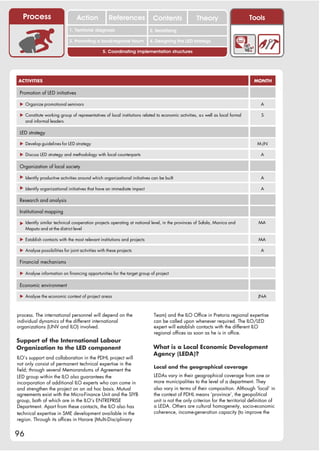
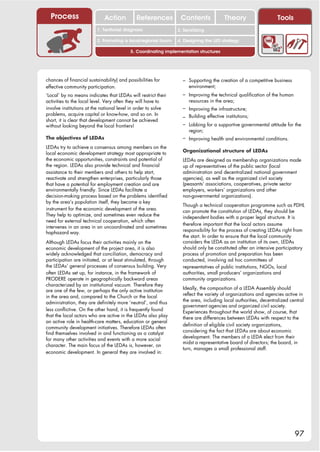
  • 19.
    Theory Process Action References Contents Tools 1. Post-crisis situations: Problems and needs 2. Traditional development policies and their limits 3. Local economic development in post-crisis situations triple effect of shattering THE IMPACT OF A WEAK PRODUCTIVE individual lives, increasing INFRASTRUCTURE ON THE LOCAL ECONOMY: the medical burden on AN EXAMPLE FROM THE DEMOCRATIC REPUBLIC OF families and communities CONGO (DRC) and preventing localities For over 30 years, DRC has suffered from a highly from developing land and complicated democratic transition resulting in political rebuilding infrastructures. tensions, violence and wars with neighbouring countries. One of the direct economic consequences of the ongoing conflicts is the severe deterioration of the transport Damage to physical infrastructure. Poor road conditions in the Province of infrastructure, such as road Bandundu severely affect the local economy. The transport problems hinder economic activities and make the and rail networks, may cut commercialization of agricultural products barely possible. the whole area off from the As a consequence, the inhabitants returned to household surrounding populations, production as cash flow in the local economy dried up. Today, high unemployment rates and endemic poverty and thus from suppliers characterize the rural areas in Bandundu. Moreover, and customers. Harbours population groups in expanding urban centres lack access and airports may be the to vegetables and other staple foods at reasonable prices, only access to external which aggravates health and living conditions of the urban population. markets; however, even if they have suffered less See ILO, Réhabilitation d’infrastructures par des damage, they may not be groupements coopératifs, Project Document, Geneva, May 2000. accessible to a broad section of the population. Broken communication networks, such as telephone, television, mail, internet, newspapers, etc., reduce the possibility of personal and commercial contacts and information exchange at the national and international levels. This is particularly harmful for post-crisis areas, where the local economy needs to be strengthened through the generation of new market opportunities. In cases of financial and LACK OF INFORMATION AND COMMUNICATION: THE CASE OF THE EARTHQUAKE-AFFECTED STATE OF socio-economic crises, it is GUJARAT (INDIA) common for a large number of industrial and The earthquake of 26th January 2001 caused extensive damage in 21 districts in the State of Gujarat. The manufacturing workers to be Government death toll figures estimate 19,466 people. layed off, which leads to an An estimated 320,000 houses have been evacuated upsurge in unemployment and a very large number have been destroyed. In the worst affected districts, Kutch, Patan, Surendranagar and underemployment. The and Banaskantha, the earthquake has destroyed knock-on effect in all areas of people’s homes, livestock, the food stock, seeds, cattle the economy causes extreme fodder and basic artisanal tools and therefore deprived them also of their means of livelihood. The entire hardship and has a infrastructure and public utilities such as electricity, disproportionate impact on telephone services, roads, bridges, railways, ports, vulnerable groups. Investment water supply, schools, health centres in 21 districts, in productive assets tends to covering 7,904 villages, have been badly affected. dry up, no external capital See A Model Programme for Social and Economic comes in and private capital Reconstruction in 10 Villages of Kutch District in the State is transferred overseas. of Gujarat, ILO Joint Missions in Response to the Earthquake in Gujarat, March-May 2001. 18
  • 20.
    Theory Process Action References Contents Tools 1. Post-crisis situations: Problems and needs 2. Traditional development policies and their limits 3. Local economic development in post-crisis situations The impact on human DESTRUCTION OF INFRASTRUCTURE DUE TO infrastructure is less FLOODING: THE CASE OF VENEZUELA visible, but equally important. Local craftsmen In December 1999 the state of Vargas in Venezuela was affected by serious flooding. The estimates of the and workers flee the area, natural catastrophe’s consequences include between taking their special production 20,000 and 30,000 victims. Furthermore, around techniques and personal 200,000 people were seriously affected by the contacts with them. For those flooding, either losing their homes and/or their jobs (60% of the national population); 6-7 metres of mud who remain, only short-term covered the soil of a large part of the state, employment opportunities in destroying, among others, the principal tourism areas the formal sector may be near Caracas. Also the second port and the first international airport were seriously affected. available. Others engage in income-generation activities on See Programa de recuperación de empleos y de a subsistence level. reducción de la vulnerabilidad socioeconómica en Venezuela, prepared after an ILO mission in response to the floodings in Venezuela, Caracas, April 2000. The loss of income reduces purchasing capacity within local markets, and consequently the circulation of currency in the economy drops even further, thereby eliminating the demand for products. The health of capital markets, particularly the availability of financial support for entrepreneurs, is critical to getting markets moving again. However, both lenders and borrowers usually lack information and guarantees, a situation which inevitably hinders constructive cooperation between banks and entrepreneurs. No bank or other financial institution is willing to take the risk of offering credit if entrepreneurs are unable to put up collateral or ensure the safety of their investments. Finally, broken linkages in business networks, lack of confidence and lack of trust between business partners are also important obstacles since they contribute to the breakdown of industrial clusters or cooperative arrangements. Especially in post-crisis areas, business linkages and cooperative networks are LACK OF FINANCIAL MECHANISMS: THE CASE OF highly desirable because they MOZAMBIQUE are capable of reinforcing the A complete lack of any formal finance mechanism competitiveness of small and was one of the major problems in the LED projects in badly-equipped sectors. Mozambique. In the Sofala, Manica and Maputo Nevertheless, many cooperative Provinces there were no banks or formal financial institutions outside the main urban areas. Some arrangements fail as a direct or international NGOs are operating in the field of indirect consequence of the micro-finance, although their success and outreach crisis itself. have been very limited so far. Individual moneylenders are active in the provinces; however their services are unreliable and often very expensive. See Geert van Boekel, Local Economic Development Component, PDHL Mozambique – Final Report, ILO/UNOPS, Maputo, 2001. 19
  • 21.
    Theory Process Action References Contents Tools 1. Post-crisis situations: Problems and needs 2. Traditional development policies and their limits 3. Local economic development in post-crisis situations 2.1.5 Summary of needs In the short term ! Profiling of the social environment and needs of vulnerable groups; ! Provision of immediate emergency needs (food, water, shelter, sanitation); ! Efforts to stimulate income generation or labour-intensive enterprise growth; ! Mine-detector action; ! Development of a coordination strategy. In the long term ! Education; ! Health services; ! Agricultural development; ! Institutional development (develop policy-making and regulatory capacity, develop efficient public sector service delivery, develop capacity for knowledge generation, develop credit institutions); ! Public/private partnership promotion; ! Private sector development; ! Capacity building of vulnerable groups; ! Revitalization of industry (towards job creation)/industrial rehabilitation; ! Upgrading of technical capacities of civil servants. 20
  • 22.
    Theory Process Action References Contents Tools 1. Post-crisis situations: Problems and needs 2. Traditional development policies and their limits 3. Local economic development in post-crisis situations Toolkit 2.1 – Post-crisis situations: Problems and needs Tool 2.1.1 – Analysis of problems and needs IF “YES”, WHERE AND WHY DIFFICULTY NO YES DOES THIS DIFFICULTY PERSIST? High level of poverty ! Precarious living environment ! Scarce resources for education, training ! Scarce resources for health care ! Lack of social safety nets Erosion of family and social networks ! Weakening of family and community ties ! Conflict and mistrust between social groups ! Lack of social interaction Precarious employment situation ! General unemployment or underemployment ! Low income generation ! Social exclusion Damage to the human infrastructure ! Displacement of labour force ! Erosion of business networks due to mistrust ! Loss of personal knowledge and production techniques Damage to physical infrastructure and networks ! Production facilities (enterprises, energy supply, water supply, machines, etc.) ! Transport infrastructure and networks (roads, rail, harbours, etc.) ! Communication network (telephone, television, mail, newspapers, etc.) Damage to existing enterprise networks ! Loss of contacts with suppliers ! Loss of contacts with customers ! Loss of contacts with financial intermediaries ! Failure of cooperative arrangements 21
  • 23.
    Theory Process Action References Contents Tools 1. Post-crisis situations: Problems and needs 2. Traditional development policies and their limits 3. Local economic development in post-crisis situations IF “YES”, WHERE AND WHY DIFFICULTY NO YES DOES THIS DIFFICULTY PERSIST? Political difficulties ! Lack of political participation ! Lack of policy mechanisms at local level ! Lack of confidence in local politics Institutional difficulties ! Weak institutional density ! Lack of human technical capacities ! Hostility between public sector actors Scarce cooperation and coordination ! Between the public and private sectors ! Between national policies and local priorities ! Between economic policies and social policies ! Between political decisions and technical approaches ! Between international donors in the territory 22
  • 24.
    Theory Process Action References Contents Tools 1. Post-crisis situations: Problems and needs 2. Traditional development policies and their limits 3. Local economic development in post-crisis situations 2.2 Traditional development policies and their limits In this chapter we analyse why conventional approaches to development and poverty reduction are not able to provide an adequate response to localized crises. An attempt is made to illustrate the shortcomings of traditional approaches and situate them in relation to the social, economic and political obstacles faced in post-crisis situations (compare with Chapter 2.1). During the last few decades, countries in both the developed and the developing world have gradually undergone a conceptual shift in their economic growth and development strategies. The need for economic flexibility within global markets has strengthened the argument that centrally planned, top-down policies (or the mere reproduction of development policies in different contexts) are no longer appropriate for the achievement of long-term economic growth targets. Developing countries in particular have had to restructure quickly as they attempt to enter into international markets. This has meant the deregulation or privatization of key economic spheres, cuts in public spending and the stabilization of fiscal policies and currency exchange rates. A common feature in most countries is the withdrawal of the State from active engagement in the provision of welfare services and public goods. The position of decentralized entities, such as regions or departments, has been strengthened as these levels of administration are considered the most appropriate to respond to local needs. Unlike in the past, however, local economies that appear to be lagging will no longer be able to look to the State for support. This encourages, and even forces territories to become more proactive and allocate resources more efficiently. In countries that are emerging from a crisis, the objectives of wider development policies become secondary while emergency relief, reconstruction and rehabilitation programmes are undertaken. Here we shall examine some of the major shortcomings of existing policies and explain why they are not appropriate in post-crisis situations. 2.2.1 SOCIAL limits ! Lack of social impact: Development policies are by definition directed to the most disadvantaged parts of society. Nevertheless, the benefits of traditional top-down policies have failed to reach the most excluded parts of society. The so-called “trickle-down” effect – according to which the benefits of an increasing economic activity by the main economic actors would “drip down” to the most excluded groups – has not happened in reality. 23
  • 25.
    Theory Process Action References Contents Tools 1. Post-crisis situations: Problems and needs 2. Traditional development policies and their limits 3. Local economic development in post-crisis situations ! Time lags: Territories in a crisis or post-crisis situation need a quick response, mainly in order to meet the most urgent needs of vulnerable groups. Traditional top-down policies are the result of centrally conceived and managed development programmes. One of the major inefficiencies of these programmes is the huge time delay between policy conception and implementation, during which time social problems may get progressively worse. ! Unsustainable job creation: Creating employment with public money or funds donated by international development partners does not generate decent jobs with real benefits attached. Jobs that are created as a result of a real demand in the local labour market and that are negociated on the basis of social partnerships are more likely to be sustainable. ! Lack of attention to local peculiarities: National top-down approaches tend to apply identical solutions to different parts of the national territory. This attempt to standardize development policies has largely failed because each territory is characterized by different socio-economic, cultural and political needs and characteristics. 2.2.2 ECONOMIC limits ! Priority on macroeconomic variables (fiscal policy, monetary interventions, etc.): Long-term programmes, which are designed to stabilize the framework conditions for recovery, often have a weak or even negative impact at the local level, because they tend to emphasize aggregate levels of growth, but do not reflect the problems of under-performing regions and their difficulties in stimulating new employment opportunities. Previous economic trends, growth and declining sectors, demographic patterns and the needs of vulnerable population groups are not taken into account. This means that problems as they are experienced in concrete social settings can go unnoticed if there is no “local voice” to highlight local needs and assets and act as a barometer of progress in the crisis-affected area. ! Priority on physical infrastructure: Medium-term recovery strategies tend to concentrate on physical infrastructures (i.e. national highways, development zones, airports, etc.) and supply-side investments, without regard for the equally important need to create a soft infrastructure, meaning the institutional, business and commercial services that underpin the local economy. This can include relevant branches of local government, legal and financial frameworks, as well as business support (such as development agencies, industrial parks, BDS suppliers, banks, accountancy), a healthy and skilled workforce and technology. ! Such supply-side approaches can cause further damage if they favour unbalanced power structures or repeat the socially and environmentally harmful practices of the past which may have led to the present crisis. Developing countries suffer from exceptional environmental problems, particularly in highly populated urban areas, due to unregulated pollution 24
  • 26.
    Theory Process Action References Contents Tools 1. Post-crisis situations: Problems and needs 2. Traditional development policies and their limits 3. Local economic development in post-crisis situations levels, lack of proper infrastructures for waste dumping and water management, and others still. ! Top-down policies overstate the importance of traditional sectors and big firms. There is evidence that sustainable development is more likely to come about through local entrepreneurship and support to small and medium-sized enterprises (SMEs). SMEs are not only the main agents of change in a globalized economy, but also have the highest potential of job creation in post-crisis situations. ! Lack of harmonization: Within the territory itself, top-down policy directives are often conceived without considering the need to harmonize policies for enterprise growth, education and training, land use, the environment, transport and communication infrastructure. Local business regulations or systems of subsidies for internal investment also usually remain under separate policy streams. 2.2.3 POLITICAL limits ! Ignorance of conflict-resolution mechanisms: Traditional top-down policies fail to contribute to smoothing over political conflicts. Imposing development objectives and activities from above usually reinforces the existing power structure which may have contributed to the current crisis. In the long run, this might lead to new political controversies and conflicts. ! Decentralization and devolution: In many countries, the hierarchical system of central planning may have been phased out, but the relationships between decisions made by different ministries at different levels of decision-making are still not clearly defined or coordinated. Many countries lack appropriate local institutions that have the mandate and legitimacy to represent broad-based civil society interests. Nor do they have sufficient neutrality to create bridges between different interests and open up dialogue between government, businesses and civil society representatives. ! Lack of technical capacities: Government staff within the politico-administrative institutions of counties and municipalities lack the expertise to coordinate and oversee social and market reforms, or to promote entrepreneurship within their local economies. As a result, they are unable to provide informed guidance to local entrepreneurs or to benefit from much of the available development financing for investment programmes. 25
  • 27.
    Theory Process Action References Contents Tools 1. Post-crisis situations: Problems and needs 2. Traditional development policies and their limits 3. Local economic development in post-crisis situations Toolkit 2.2 – Traditional development policies and their limits Tool 2.2.1 – Elements for discussion MISTAKES WHAT CAN WE DIFFICULTY NO YES IN THE PAST DO BETTER? High level of poverty ! Precarious living conditions ! Scarce resources for education and training ! Absence or lack of social services Erosion of family and social networks ! Loss of social functions carried out by the family ! Conflict and mistrust between families and social groups ! Lack of social interaction Precarious employment situation ! General unemployment or underemployment ! Low income generation ! Social exclusion Damage to the human infrastructure ! Loss of labour force ! Loss of business networks due to mistrust ! Loss of personal knowledge and production techniques Damage to physical infrastructure and networks ! Production facilities (enterprises, energy supply, water supply, machines, etc.) ! Transport infrastructure and networks (roads, rail, harbours, etc.) ! Communication network (telephone, television, mail, newspapers, etc.) Damage to existing enterprise networks ! Loss of contacts with suppliers ! Loss of contacts with customers ! Loss of contacts with financial intermediaries ! Failure of cooperative arrangements 26
  • 28.
    Theory Process Action References Contents Tools 1. Post-crisis situations: Problems and needs 2. Traditional development policies and their limits 3. Local economic development in post-crisis situations NO YES MISTAKES WHAT CAN WE DIFFICULTY IN THE PAST DO BETTER? Political difficulties ! Lack of political participation ! Lack of policy mechanisms at local level ! Lack of confidence in local politics Institutional difficulties ! General lack of institutions ! Lack and dispersion of financial and human resources ! Hostility between public actors Scarce cooperation and coordination ! Between the public and private sectors ! Between national policies and local priorities ! Between economic policies and social policies ! Between political decisions and technical approaches ! Between international donors in the territory 27
  • 29.
    Theory Process Action References Contents Tools 1. Post-crisis situations: Problems and needs 2. Traditional development policies and their limits 3. Local economic development in post-crisis situations 2.3 Local economic development in post-crisis situations The objective of this chapter is to examine the concept of local economic development (LED) and highlight its main advantages in comparison to traditional approaches. The major lesson learned is that local economic development must integrate economic issues into the political, social and political environments. This is particularly true in post-crisis situations, where the need for social dialogue and political stability is critical. So what are the options for the people, firms and regions that are lagging behind and have been further held back by crises? Post-crisis conditions create a special set of circumstances that represent both a threat and a significant opportunity to address issues such as social exclusion and environmental conservation. These issues should be integrated at the earliest stage with humanitarian and development assistance. Communities in affected areas can become positive agents for change in the transition from aid dependency to self-sufficiency. Government effectiveness in achieving long-term development goals in a territory emerging from a crisis will therefore depend to a large extent on strengthening local institutions and national and local frameworks in ways that encourage participation in decision-making and give a voice to local stakeholders, thereby rebuilding confidence and trust. The basic pillars of the system should be transparency, accountability and the rule of law. 2.3.1 What is local economic development (LED)? LED is a participatory development process that encourages partnership arrangements between the main private and public stakeholders in a defined territory, enabling the joint design and implementation of a common development strategy, by making use of local resources and competitive advantages in a global context with the final objective of creating decent jobs and stimulating economic activity. The LED approach provides a comprehensive framework of initiatives and actions that respond to the need to integrate the economic, social, political and institutional dimensions of development at the local level. As a consequence LED is a process that will provide different solutions according to place, culture, economic potential and political circumstances, as well as social and institutional environment. 28
  • 30.
    Theory Process Action References Contents Tools 1. Post-crisis situations: Problems and needs 2. Traditional development policies and their limits 3. Local economic development in post-crisis situations 2.3.2 Principles of the LED approach The above definition reveals the importance of participation, partnership, territory and the valorization of local resources for employment generation and competitiveness. Although its adaptability does not make it possible to define what actions and policies a typical LED project consists of, the inalienable principles of the LED approach are those given below. ! Participation and social dialogue: The involvement of local stakeholders in the development process of their own territory is a prerequisite for sustainable growth. The use of participatory mechanisms decreases the risk of conflicts and fosters social cohesion. Getting the local stakeholders around one table through a local forum helps to build trust, encourages innovation and promotes the creation of social networks and activities. The design and implementation of a bottom-up strategy further guarantees the most suitable solutions for the local needs and is a warranty for the sustainability of the development process. ! Public/private partnership: Complementary investments that are targeted as accurately as possible bring the highest rate of socio-economic return. LED is a means to achieving the mobilization of local resources by encouraging their efficient allocation. Partnerships between the private, public and non-profit sectors thus become crucial for a sustainable development process, allowing convergence in investment programming between the different local actors. Cooperation and coordination of development activities prevent ineffective go-it-alone approaches and support the legitimacy and sustainability of the development process. ! Territory: Geographical and cultural closeness favour a whole set of ideal conditions for growth, innovation and development. To begin with, stakeholders from the same territory have a better knowledge of their needs and resources. Secondly, the territory makes common interests and cultural affinities more likely. Thirdly, the territory enables frequent social, economic and political interaction among the local actors, thus generating social cohesion and trust. Finally, the territory is an ideal platform for the creation of a strong local voice on behalf of of its stakeholders. Unlike traditional community development approaches, LED provides the means and structures that represent the local voice when dealing with its national and international counterparts. “The LED approach provides a comprehensive framework of initiatives and actions that respond to the need to integrate the economic, social, political and institutional dimensions of development at the local level.” Furthermore, the integrated LED framework acts on and responds to the economic, social, political and institutional dimensions of development at the local level, as will be examined more closely below. 29
  • 31.
    Theory Process Action References Contents Tools 1. Post-crisis situations: Problems and needs 2. Traditional development policies and their limits 3. Local economic development in post-crisis situations 2.3.3 The SOCIAL and POLITICAL dimensions of development According to the LED approach, sustainable development can be achieved only if development initiatives also take into account social and political factors, namely: ! Building upon existing social institutions: It is important to respect local traditional social structures, particularly in rural areas where village elders may be the persons who represent the interests of the community and will be the starting point for building awareness and support for bottom-up approaches. Social sensitivity also means exploring different ways of adapting economic programmes that are respectful of traditional practices and are culturally appropriate; ! Stimulating broad-based political participation in decision-making: LED attempts to give a voice to, and create linkages between communities, local institutions and top-level authorities so that the long-term recovery process is a close reflection of actual needs. The approach directs special efforts at identifying the weak and ensuring they can effectively participate. A broad representation of local stakeholders meets around one table through a local forum, to identify and mediate between different interests; ! Encouraging social dialogue and cooperation: The involvement of as many local stakeholders as possible in decision-making also increases dialogue and cooperation between employees, workers and institutional stakeholders on issues related to working conditions, wages and rights, thus setting the template for socially sustainable economic models upon which new kinds of local economic development can be built; ! Fostering the process of institutionalization: Once all the stakeholders have decided to participate in the local development process, the local actors might jointly decide to institutionalize the participatory mechanisms. The advantages of an institutionalized local forum stem mainly from its legal character and its juridical personality. Once a forum of local actors enjoys internal and external legitimacy, its functions might be extended beyond local activities. Often, such extension of responsibilities includes networking and lobbying with international and national actors to elminate ineffective go-it-alone approaches, and to obtain closer harmonization with national development policies; ! Public/private partnership: Complementary investments that are targeted as accurately as possible bring the highest rate of socio-economic return. LED is a means to achieving the mobilization of local resources for investment in rebuilding the locality. Public/private partnerships also encourage a more efficient allocation of resources. Partnerships between the private, public and non-profit sectors become crucial for a sustainable development process, allowing convergence in investment programming between the different local actors. 30
  • 32.
    Theory Process Action References Contents Tools 1. Post-crisis situations: Problems and needs 2. Traditional development policies and their limits 3. Local economic development in post-crisis situations 2.3.4 The ECONOMIC dimension of development The economic dimension of development is particularly important within the LED approach, since economic activities and interactions are a driving force that fosters: ! Social inclusion: Through self-help organizations, cooperative ventures and activities to support micro-enterprises, many marginalized people and vulnerable groups may be able to overcome their isolation; ! Poverty alleviation: The enhanced turnover and competitiveness of local enterprises encourages higher levels of public and private-sector investment in infrastructure. A general rise in spending power among the local population is likely to improve the general living conditions of families and the wider community through economic spillovers; ! Greater social and political stability: Revived markets for goods and services in a post-crisis situation are likely to involve – sooner or later – political and social actors and lead to broader discussions in which strategies and actors can most effectively contribute to recovery efforts; ! Innovation: More than ever before, socio-economic growth depends on the process of change and innovation. There is evidence that the majority of enterprises undertake their most important innovation at the moment of their creation. Hence, fostering entrepreneurship and enterprise creation play an important role within the LED approach. 2.3.5 The LOCAL dimension of development The importance of the local or territorial dimension in the LED process is vital. Indeed, the local dimension reflects: ! The degree of common interests: The geographical proximity of people and actors within the same region creates common characteristics and points of common concern, including language, religion, tradition, access to institutions, infrastructures and resources, to name but a few; ! The degree of self-regulation: As a result of their stake in the territory, it is quite likely that local actors also have close bonds with, and concern for their immediate social and natural environment and are therefore more likely to support actions that contribute to an increase in quality of the business environment and overall living conditions. Their territorial interests increase the likelihood of their joining a ‘club’ of possible future beneficiaries of a LED policy; ! The degree of knowledge: Local actors are further likely to have a deeper and better knowledge of local assets, constraints and needs due to their geographical location, networks of contacts and daily interactions. The local economic development approach seeks to listen and learn from communities; 31
  • 33.
    Theory Process Action References Contents Tools 1. Post-crisis situations: Problems and needs 2. Traditional development policies and their limits 3. Local economic development in post-crisis situations ! The intensity and frequency of interactions: Geographical proximity favours daily or frequent communication on a number of social, economic and political issues, which leads to the development of strong relationships based on trust and cooperation. These may then form the basis for local networks; ! The likelihood of tapping into national and global decision-making structures: Once trust and networks have grown, it will be much easier for local actors to lobby and negotiate for their interests with national and international partners. 2.3.6 How “big” is local? As LED is a territorial approach, any LED initiative will sooner or later have to face the question: How big is “local” in the case of our initiative? In other words, the local stakeholders will have to decide the geographical dimensions of the territory and the size of the population the LED initiative will englobe. Any attempt to establish a set rule as to the dimesion of a territory or its population would contradict the need for flexibility to adapt to different circumstances and to respond to the objectives of each specific LED initiative. However there are some criteria that may facilitate the identification of a particular territory. Economic potential State Lobbying at national level Closeness to citizens Economies of scale Local knowledge Municipality Coordination The above graph illustrates the fundamental trade-off between coordination and economic potential that has to be taken into account when defining the territory. The smaller the territory and, in most cases, its population, the easier it will be to achieve coordination and consensus among the major local stakeholders when designing a joint LED strategy and in identifying implementing arrangements. 32
  • 34.
    Theory Process Action References Contents Tools 1. Post-crisis situations: Problems and needs 2. Traditional development policies and their limits 3. Local economic development in post-crisis situations However, the economic, political and institutional potential of small territories and populations is often lower than that of larger territories for the following reasons: ! Small territories usually have less possibility of creating economies of scale; ! The capacity of their “local” institutions to lobby at central government level is weaker; and ! They are at a disadvantage when competing at an international level. On the other hand, if a territory or a population is too big, the closeness between institutions and citizens will decrease, as will the institutions’ knowledge of real needs and problems at the grassroots level and the possibility for consensus building and coordination. Apart from the trade-off between coordination and economic potential, the identification of a territory should furthermore take into account the following elements that are likely to ease the LED approach in a specific territory: ! The existence of (a relatively small number of) public agencies representing the functional economic region; ! A relatively broad autonomy (in terms of jurisdiction and/or finance) of the institutions promoting the regional development of the territory (regional government, LEDA, etc.); ! A strong sense of cultural or political identity within the region; ! A willingness and tradition of cooperation between local actors; ! The presence of long-established local firms, especially if they own land and premises. Their interest in the territory make it more likely for them to join a ‘club’ of possible future beneficiaries of a LED-policy; ! Deeply-rooted local actors, such as long-established firms and organizations, are more likely to cooperate because they depend to a greater extent on social and economic interrelations that make non-participation relatively costly. 33
  • 35.
    Theory Process Action References Contents Tools 1. Post-crisis situations: Problems and needs 2. Traditional development policies and their limits 3. Local economic development in post-crisis situations Toolkit 2.3 – LED in post-crisis situations Tool 2.3.1 – Elements for discussion TERRITORY Where should efforts be targeted? Why choose this region/area? ! The territory forms an economically functional area ! Existence of complementary economic sectors ! Existence of common commercial practices ! Uneven development that needs correcting What resources are available locally? ! Enterprise associations ! Farmers’ associations ! Public institutions ! NGOs and community organizations ! Cooperatives ! Natural resources Why should private sector stakeholders be interested in LED? Why should public sector stakeholders be interested in LED? How far are these interests complementary? Are there conflicts among interests? How can these conflicts be resolved? 34
  • 36.
    Process Action References Contents Theory Tools 2. DEL y el déficit de 1. 1. Índice diagnosis Territorial 2. Sensitizing decente trabajo 3. Promoting a local/regional forum 4. Designing the LED strategy 5. Coordinating implementation structures 35
  • 37.
    Process Action References Contents Theory Tools 2. DEL y el déficit de 1. 1. Índice diagnosis Territorial 2. Sensitizing decente trabajo 3. Promoting a local/regional forum 4. Designing the LED strategy 5. Coordinating implementation structures SECTION III. THE LED PROCESS An overview “LED fosters local ownership of development activities through a process of participation, information exchange, coordination of initiatives and the investment of time and resources by the local stakeholders”. Although the fluidity of the LED process makes it is impossible to prescribe a strict set of policies and actions, a typical LED intervention is led by a certain number of basic steps, which include: 1. Territorial diagnosis and institutional mapping (TD & IM) The objective of this phase is to acquire knowledge about the local economy and its resources. It comprises a preliminary analysis of the territorial socio-economic and political data through statistics, surveys and action-research methodologies. The institutional mapping exercise focuses on the existence, objectives and activities of the different local stakeholders and the dynamics among them. There will be a wide range of short-term economic development activities funded by different bilateral donors and the UN, NGOs and foundations – social mobilization (cooperatives, CBOs), access to credit, livestock management, irrigation, watershed management, and so on. There also needs to be an inventory and assessment of existing facilities and capacity, needs, recent accomplishments, and lessons learned that would provide a basis for filling gaps, setting priorities and scaling-up. The relevance and usefulness of TD & IM become apparent through the different stages of the LED process, since the information gathered provides the foundations for immediate quick-impact interventions, as well as activities with more socially and environmentally sustainable impacts in the medium and long terms. The collection of data should however be ongoing, as circumstances and development priorities change and new actors become more influential within the territory. 2. Sensitizing This stage involves raising awareness among different stakeholders of how their actions impact on other stakeholders, what adjustments need to be made and how closer synergies can lead towards the achievement of common development goals. It is hoped that dialogue among the main local stakeholders on major public policy and economic issues will begin to generate solutions to common problems and opportunities. This should lead to the crystallization of a vision for economic recovery and the definition of priorities for investments and target groups. Another major expectation of this phase is that the local stakeholders will slowly assume ownership of the development process. 36
  • 38.
    Process Action References Contents Theory Tools 2. DEL y el déficit de 1. 1. Índice diagnosis Territorial 2. Sensitizing decente trabajo 3. Promoting a local/regional forum 4. Designing the LED strategy 5. Coordinating implementation structures 3. Creation of a local/regional forum The creation of a local/regional forum is the continuation of the consensus-building process. The lack of forums for dialogue, where individuals and businesses can express their needs, may contribute or lead to underlying tensions and the neglect of social problems. A forum bringing together a number of influential people with a wide range of expertise in local settings facilitates the identification of contentious areas, the sharing of knowledge and skills at all levels, and the communication of information among all partners involved in the development process. It thereby sets in motion the process of developing a coordinated action plan, encompassing the strengthening of technical and managerial skills in both the public and private sectors and key elements needed for socially and environmentally sustainable recovery. 4. Designing the LED strategy During this phase, the local forum carries out an analysis focusing on the Strengths, Weaknesses, Opportunities and Threats (SWOT) of the territory. The SWOT analysis is based on the results of the territorial diagnosis and institutional mapping exercises and will reveal the competitive advantages of the affected area. The outcomes of the SWOT analysis will then generate the LED strategy, encompassing the long-term vision, the objectives and the action plan for the medium and long terms. 5. Coordination/implementation structures The local stakeholders, according to their competence, resources and capacities, implement the bottom-up development strategy through the LED action plan. The forum coordinates their actions, and revises and adjusts the strategy according to the needs of the local/regional stakeholders. But before implementing the LED strategy there is a need to decide “who does what” and assign responsibilities for each activity foreseen in the strategy. In the absence of existing implementation structures or bodies, the LED strategy might foresee the institutionalization of the forum or the creation of an implementation body that assumes responsibility for certain tasks. The following chapters in this section explain in more detail steps 1 to 5 in the LED process. Section IV will then describe the outcome of the LED process: the LED actions and their implementation (step 6). These actions include some of the most common LED policies and products used in typical LED projects. 37
  • 39.
    Process Action References Contents Theory Tools 2. DEL y el déficit de 1. 1. Índice diagnosis Territorial 2. Sensitizing decente trabajo 3. Promoting a local/regional forum 4. Designing the LED strategy 5. Coordinating implementation structures 38
  • 40.
    Process Action References Contents Theory Tools 2. DEL y el déficit de 1. 1. Índice diagnosis Territorial 2. Sensitizing decente trabajo 3. Promoting a local/regional forum 4. Designing the LED strategy 5. Coordinating implementation structures 3.1 Territorial diagnosis and institutional mapping 3.1.1 What to consider? The socio-economic analysis of the area and its institutions is extremely important for carrying out nearly all the activities related to the LED process. The objective of the territorial diagnosis (TD) is to collect information about the territory and its resources in order to understand the local context. The results should be used to: ! Sensitize local stakeholders by giving them sufficient information about the territory, its assets and resources with a view to increasing the understanding of the local context for enterprise development; ! Give advice on how existing policies can be adjusted towards more economically, socially and environmentally sustainable development in the long term; ! Formulate proposals for quick-impact measures and the genesis of a longer-term LED strategy; ! Monitor and assess the ongoing performance and final outcomes of LED interventions. While the territorial diagnosis will help to improve the key stakeholders’ understanding of local realities, it is also useful to have an overview of the organizations and institutions that have an influence over the economic development of the territory. The institutional mapping (IM) exercise enables development partners to respond easily to requests from entrepreneurs and others for information on ongoing or planned development initiatives in the territory. This information can be used to create synergies between initiatives and, later on, as a tool with which to build consensus around priority areas for intervention. The information contained in the database can be presented in tailor-made packages. Some of the information may already be available, but not in a structured way. If the information is packaged well, it is not only useful to development partners, but also to the economic support organizations. The IM should set out to: ! Create an exhaustive map of local stakeholders in a broad range of social, economic and political sectors; ! Establish a profile of these influential stakeholders in terms of their mission, objectives, field of action, jurisdiction, geographical coverage, etc.; 39
  • 41.
    Process Action References Contents Theory Tools 2. DEL y el déficit de 1. 1. Índice diagnosis Territorial 2. Sensitizing decente trabajo 3. Promoting a local/regional forum 4. Designing the LED strategy 5. Coordinating implementation structures ! Assess the adaptability and flexibility of existing institutions and organizations; ! Analyse the dynamics among the most important local stakeholders in order to grasp where cooperation lacks and where synergies are most likely; ! Facilitate coordination between existing programmes, institutions and organizations, as well as identify services that do not yet exist. Apart from the practical implications of increasing the supply of information, the gathering of information on natural resources, enterprises, infrastructure, institutions, and other items increases the transparency of different actors and their agendas and assumes a vital role in the early phase of the LED process. The local stakeholders are the most suitable actors to identify local assets and priorities. At this early stage of the recovery process, it is appropriate to encourage as wide an involvement of actors as possible. The local stakeholders form the social, economic and institutional backbone of the territory and possess the best knowledge about its main characteristics, economic potential, possibilities and needs. For this reason, local stakeholders are the most suitable actors to identify local assets and priorities. The LED process 1 2 3 4 Coordinating 5 6 Territorial Promoting Designing a Sensitizing implementation Action diagnosis a forum LED strategy structures 3.1.2 What to do? Step 1: Territorial diagnosis This is carried out using the following mechanisms: Rapid needs assessment This assessment lists the most urgent problems and corresponding measures to be taken immediately. Although we are only at the beginning of the LED process, and not all local stakeholders have yet been consulted, the rapid needs assessment is crucial for the elaboration of short-term policies and should be discussed with as wide a range of local stakeholders as possible in order to clarify the division of roles and responsibilities. By stimulating common actions, cooperation and coordination, the quick-impact measures will thus contribute positively to the sensitization process, which takes place in parallel. 40
  • 42.
    Process Action References Contents Theory Tools 2. DEL y el déficit de 1. 1. Índice diagnosis Territorial 2. Sensitizing decente trabajo 3. Promoting a local/regional forum 4. Designing the LED strategy 5. Coordinating implementation structures See TOOL 3.1.1 for a checklist for a rapid needs assessment in view of the design of quick-impact measures. Tool 3.1.1 Collection of socio-economic data This step involves the collection of general data concerning: ! The institutional and political environment; ! The legal and regulatory framework; ! Ongoing and planned initiatives; ! Key statistical information. See TOOL 3.1.2 for more detailed information regarding the type of data required. Tool 3.1.2 Institutional mapping exercise An important outcome of this exercise will be a list (or a map) of the most important stakeholders in the territory, for each of which the following questions will need to be answered: ! How long has the stakeholder (organization, enterprise, institution, or other) existed? ! What is its organizational structure? ! What is its mandate? ! What are its activities in the field of economic development? ! Who are its target groups/beneficiaries? ! With which organizations does it have contact or work? See TOOL 3.1.3 for an example of the terms of reference for data collection Tool 3.1.3 and institutional mapping in Eastern Slavonia and Sisak County. The collection of data should be carried out very carefully. The accuracy of the information gathered is crucial, since it will determine the choice of the LED policies within the LED strategy (see Chapter 3.4, “Designing the LED strategy”). When possible, the collection of the data should take place at municipal level. When municipal data is not available, it may be undertaken at county level. Where secondary statistical data is not available, it might be necessary to collect it through interviews and questionnaires. 41
  • 43.
    Process Action References Contents Theory Tools 2. DEL y el déficit de 1. 1. Índice diagnosis Territorial 2. Sensitizing decente trabajo 3. Promoting a local/regional forum 4. Designing the LED strategy 5. Coordinating implementation structures Step 2: Data analysis Data analysis is essential for identifying trends, linkages and possible synergies in and between different sectors and programme areas. The database can be used immediately in order to identify the most important local stakeholders that should be targeted during the sensitization phase. At the same time, the data will be used to begin formulating the LED strategy (see Chapter 3.4, “Designing the LED strategy”). As socio-economic and institutional conditions change constantly, this database should be updated periodically. See TOOL 3.2.1 for a list of possible contributions of different local stakeholders to the LED process. Tool 3.2.1 See TOOL 3.1.4 for a list of sources where relevant data concerning the Tool 3.1.4 existence or functioning of local or regional institutions can be found. It is particularly important for those carrying out the information gathering and data analysis exercises to listen to what all those involved have to say and learn from these perspectives. Not all groups, especially the most vulnerable ones, will have the same viewpoint on how the recovery process should proceed, or even be in a position to articulate their interests. Care should therefore be taken to interview and research as widely as possible. 3.1.3 Who should do it? The major funding, multilateral agencies and NGOs should mobilize their capacity and create an effective mechanism to carry out this assessment. Emphasis should be placed on enabling local expertise and experienced persons from within and outside the country to participate in this assessment and lead strategy development, priority setting and programme planning. 42
  • 44.
    Process Action References Contents Theory Tools 2. DEL y el déficit de 1. 1. Índice diagnosis Territorial 2. Sensitizing decente trabajo 3. Promoting a local/regional forum 4. Designing the LED strategy 5. Coordinating implementation structures Toolkit 3.1 – Territorial diagnosis and institutional mapping Tool 3.1.1 – Rapid needs assessment: A checklist Notes: 3.1 – GENERAL SITUATION ASSESSMENT ! Causes of the crisis ! Affected areas ! Affected population groups ! Gender/socio-cultural issues ! Structural issues ! Economic situation ! Human rights and political context ! Social system and programmes ! Legal and administrative framework ! International and local assistance programmes ! Potential ILO partners 3.2 – CAPACITY ASSESSMENT FOR CONSTITUENTS, PARTNERS AND OTHERS ! Institutional capacities ! Constituent capacities ! Civil society institutions and organizations 3.3 – SECTORAL ASSESSMENTS FOR ILO PROGRAMME PLANNING ! Vocational training ! Public employment programmes ! Social security protection ! Labour market and employment prospects ! Social dialogue ! Business advisory services ! Micro-finance ! Labour-intensive works 3.4 – SPECIAL TARGET GROUPS 43
  • 45.
    Process Action References Contents Theory Tools 2. DEL y el déficit de 1. 1. Índice diagnosis Territorial 2. Sensitizing decente trabajo 3. Promoting a local/regional forum 4. Designing the LED strategy 5. Coordinating implementation structures ! Tools for assessing capacities and vulnerabilities ! People with disabilities ! Youths ! Ex-combatants, including child soldiers ! Female-headed households ! Unemployed ! Refugees ! Internally displaced persons ! Returned refugees ! Returned economic migrants 3.5 – ECONOMIC GAPS ! Declining markets ! Declining sources of raw materials and inputs ! Weakened industrial clusters ! Declining sources of financing ! Economic opportunities generated by post-crisis reconstruction and the transition to a market-oriented economic system ! Reconstruction investment ! New sources of financing ! Restructuring of less-profitable industrial activities ! Foreign investments ! New markets ! Other Source: Adapted from: ILO Rapid Needs Assessment in Crisis and Post-Crisis Situations 44
  • 46.
    Process Action References Contents Theory Tools 2. DEL y el déficit de 1. 1. Índice diagnosis Territorial 2. Sensitizing decente trabajo 3. Promoting a local/regional forum 4. Designing the LED strategy 5. Coordinating implementation structures Tool 3.1.2 – Territorial diagnosis and institutional mapping: Information requirements SOCIO-ECONOMIC DATA AND DYNAMICS Men Women (ideally gathered at municipal, if not county level) Relevant macro-economic data ! Average income per capita ! Minimum wage ! Basic basket cost ! Inflation and devaluation rate ! Sectoral GCP (gross county product) Population ! Total ! Urban ! Rural ! Ethnic composition ! Literacy ! Level of education Employment and self-employment ! EAP (economically active population) ! Sectoral employment (industry, agriculture, etc.) ! Unemployment ! Wage-earners ! Entrepreneurs ! Informal sector (estimated) Infrastructure ! Buildings ! Streets ! Railways ! Airports ! Ports Natural resources and environment ! Water 45
  • 47.
    Process Action References Contents Theory Tools 2. DEL y el déficit de 1. 1. Índice diagnosis Territorial 2. Sensitizing decente trabajo 3. Promoting a local/regional forum 4. Designing the LED strategy 5. Coordinating implementation structures ! Natural parks ! Cultural/historical sites ! Climate ! Sea ! Rivers ! Fauna/Flora ! Raw material and mineral resources LEGAL AND REGULATORY FRAMEWORK Legal framework for decentralization regarding incentives/funds/mechanisms for investments in social and economic sector County and municipal laws and regulations Special promotional framework ! Small and micro-enterprises ! Farm development ! Agricultural development ! Tourism ! Industrial or other sectoral development ! Investment attraction/place marketing ! Other relevant categories Banking legislation Legislation for the creation, financing and administration of associations and professional organizations ! Civil society entities ! Entrepreneurial associations ! Cooperatives ! Other relevant associations/organizations Register legislation INSTITUTIONAL/POLITICAL INFORMATION Administrative boundaries (represented in a map) Local and decentralized institutions dealing with social and economic development Detailed composition of municipal structures, including human and physical resources Detailed composition of decentralized county structures supporting local government 46
  • 48.
    Process Action References Contents Theory Tools 2. DEL y el déficit de 1. 1. Índice diagnosis Territorial 2. Sensitizing decente trabajo 3. Promoting a local/regional forum 4. Designing the LED strategy 5. Coordinating implementation structures NGOs with ongoing or planned activities dealing with social and economic development Private sector organizations ! Chambers of Commerce ! Producers’ associations ! Cooperatives ! Banks ! Micro-finance institutions (MFIs) ! Schools, training institutions and universities ! Research institutions NGOs and grassroots/community-based organizations ! Education ! Gender issues ! Youth ! Environment ! Economic development ! Community development ! Poverty alleviation ! Planning ! Vulnerable groups (etc.) " Internally displaced persons " Returnees " Refugees " Immigrants " Indigenous peoples " Other relevant groups Employers’ and self-employed persons’ associations Trade unions Organizations for management of common services ! Business development services 2 " Market access 2 For further information regarding the different BDS categories, see the “SEEP Guide to Business Development Services and Resources” website: www.seepnetwork.org/bdsguide.html 47
  • 49.
    Process Action References Contents Theory Tools 2. DEL y el déficit de 1. 1. Índice diagnosis Territorial 2. Sensitizing decente trabajo 3. Promoting a local/regional forum 4. Designing the LED strategy 5. Coordinating implementation structures " Infrastructure " Policy/advocacy " Input supply " Training and technical assistance " Technology and product development ! Finance/micro-finance " Loans " Insurance " Other relevant matters ! Irrigation systems ! Mechanical pool ! Storage facilities ! Other relevant matters Religious organizations and entities ONGOING AND PLANNED DEVELOPMENT INITIATIVES International cooperation programmes with activities in the social and economic sectors ! Infrastructure ! Technical assistance ! Credit ! Training ! Tools and equipment ! Business services ! Other relevant matters National/regional/local investment plans impacting on the social and economic environment Private initiatives related to key strategically economic sectors ! Shipping ! Aluminium ! Tourism ! Electromechanics ! Other relevant sectors Decentralized investment programmes for social and economic infrastructures Preferential lines of credit available in the market 48
  • 50.
    Process Action References Contents Theory Tools 2. DEL y el déficit de 1. 1. Índice diagnosis Territorial 2. Sensitizing decente trabajo 3. Promoting a local/regional forum 4. Designing the LED strategy 5. Coordinating implementation structures SOCIO-ECONOMIC DYNAMICS IN THE REGION Intra-firm cooperation and synergies/industrial clusters ! Between firms within/outside the territory " Number of firms " Number of employees ! Intra/infra-sectoral cooperation " Importance of sector(s) " Development of sector(s) Economically dynamic segments ! Expanding segment(s) ! Declining segment(s) Economically dynamic areas ! Expanding area(s) ! Declining area(s) Socially sensitive segments ! Nature of problem ! Origin of problem Socially sensitive areas ! Nature of problem ! Origin of problem Cooperation among private and public actors ! Institutions/firms ! Nature of cooperation 49
  • 51.
    Process Action References Contents Theory Tools 2. DEL y el déficit de 1. 1. Índice diagnosis Territorial 2. Sensitizing decente trabajo 3. Promoting a local/regional forum 4. Designing the LED strategy 5. Coordinating implementation structures Tool 3.1.3 – Basic data collection and institutional mapping in preparation for the establishment of two LEDAs in Eastern Slavonia and Sisak County Terms of reference – Vukovar County: The focus is on Vukovar town and EC target municipalities. Background and objectives – Sisak County: The focus is on Sisak, Petrinja and the Within the framework of the Rehabilitation and Social most war-affected municipalities. Development Programme for the war-torn areas in Croatia, three Local Economic Development Agencies Tasks (LEDAs) have been established in Sbenik-Knin, Eastern Under the supervision of the ILO Geneva, UNOPS and in Slavonia and Sisak County. collaboration with IMO-Zagreb, the consultant carried out Since Eastern Slavonia and Sisak County were new areas the following tasks: for the RSD Programme, data (including statistics) had to – To collect, through research on available resources be collected and organized on the socio-economic (annual reports, legislation, internet and other situation, legal and policy framework (for example the documentation), basic data on the socio-economic new investment law for Vukovar county) and a map of situation, the legal and policy framework and administrative boundaries (reflecting the most administrative structures according to Annex I; war-affected municipalities) drawn up. For the most part, the organization of already available information – To collect, through interviews/questionnaires, was the immediate objective. information on the organizations/institutions/ programmes according to Annex II; As LEDAs are associations in which – To organize and analyse the information and present it organizations/institutions from the public and private in a “user-friendly” way (maps, tables, overviews, sectors are represented, the first step during the annexes, etc.). pre-launch phase was the institutional mapping exercise. This set out to make an inventory of the most important Output territorial organizations, institutions, training programmes, For each region, the results of the study were presented in agricultural support institutions, producers’ associations, a report containing descriptive sections illustrated with NGOs, and other bodies. tables, maps and statistics. The completed questionnaires On the basis of this information, key stakeholders in local were attached to the report. economic development were identified and specific The final report was in English. regional development sectors became more evident, as did ways of improving coordination between the different Duration organizations/institutions/programmes. The consultancy studies took three weeks to complete The report was one of the documents with which the LEDA (including submission of the report). The consultant was working groups operated in order to determine the also available for improvements after submission of the LEDAs’ territorial management, main services, and other report. responsibilities. Two studies were carried out: one in Eastern Slavonia Dates (Osijek County and Vukovar County) and one in Sisak September 2000. County. As in Sisak County, a regional development plan was elaborated by IMO with the gathering of basic data Institutional arrangements directly based on this plan. ILO supervised the studies and briefed the consultants by Geographical coverage telephone. – Osijek County: The focus of the study is on Baranja, IMO advised on potential consultants (University of the most war-affected region in the county, and on Osijek, Local Democracy Agency) and briefed the programmes/organizations/institutions covering the consultant(s) in detail on existing sources of information whole county, war-affected municipalities or targeting and contacts. UNOPS contracted the consultants and conflict-affected groups in particular. 50
  • 52.
    Process Action References Contents Theory Tools 2. DEL y el déficit de 1. 1. Índice diagnosis Territorial 2. Sensitizing decente trabajo 3. Promoting a local/regional forum 4. Designing the LED strategy 5. Coordinating implementation structures covered the costs on an output basis (including – The public sector transportation, communication, editing, etc.). – - Decentralized departments of the Ministry for SMEs - County departments for economy, agriculture and ANNEX I labour/social affairs Basic data collection - Town/municipal departments for economy, agriculture and labour/social affairs In the report the following issues were addressed. (It is - Chambers of Commerce important to use the most recent figures/information and - Employment offices to refer to the situation before the war.) - Agricultural counselling services - Regional representatives of the National Consultant Socio-economic situation of the region Network – Number of inhabitants, refugees, returnees, IDPs in EU - Colleges and universities target municipalities and main towns (shown if – The private sector (profit) or semi-private sector possible on a map or in graphic form); – - Chambers of Handicrafts – Employment/unemployment figures and profiles - Cooperatives (unemployed, economically active population, sectoral - Producers’ associations (sectoral, product-based or (un)employment, informal sector); other) – Level of education; - Farmers’ associations - Technology centres – Average income per capita at county level; - Business incubators – Gross product at county level; - Banks – Main economic activities/sources of income - Research and training institutions (employed, self-employed, self-subsistence activities); – The private sector (non-profit) – Main industries (sector, state-owned/privatized, future – - Centres for SMEs prospects: planned reconstruction/investment or to be - Employers’ organizations closed down); - Trade unions/workers’ organizations – Micro-enterprises and SMEs/handicrafts (sectors, - Returnees’ associations number, how many employees, capital, when started); - Village committees - Women’s associations – Main markets/economic centres in the region, clusters; - Minority associations – Economic growth potential and opportunities in the - Church organizations (for example CARITAS) region (according to previsions of institutions, planned - International NGOs (for example ASB, Local Agency national/foreign, public/private investments, expanding for Democracy) sectors, demand/supply of goods and services). Any other organization providing financial (credit, grants) Legal and policy framework and or non-financial services for entrepreneurs (starting up a administrative structures business) or for economic/agricultural/reconstruction activities. – Map(s) reflecting administrative boundaries (counties, towns, municipalities); ANNEX II – Laws, regulations or economic development policies in Institutional mapping: Questionnaire the region that support the most war-affected areas, cross-border areas or any other specific areas (for Interviews based on the questionnaire below were example the recently adopted Vukovar investment law, conducted in the institutions/organizations. A more industrial zones, productive/economic infrastructure). detailed questionnaire was sent out as well, but this was used depending on time constraints. Questions that were ANNEX II not relevant for a particular institution were left open. Institutional mapping: List of organizations The institutions and organizations to be approached operate in the socio-economic sector, are officially registered and include: 51
  • 53.
    Process Action References Contents Theory Tools 2. DEL y el déficit de 1. 1. Índice diagnosis Territorial 2. Sensitizing decente trabajo 3. Promoting a local/regional forum 4. Designing the LED strategy 5. Coordinating implementation structures INSTITUTIONAL MAPPING: QUESTIONNAIRE Name of organization Contact details Name and function of contact person Address Tel./fax/e-mail/website Type of institution/legal status (public, private/for profit, semi-private, association/NGO, interest group, other) Created in (year) Main objective/mission (Why was the organization created?) Main field(s) of activity (education, training, financial support services, non-financial support services, information, technology transfer, resource mobilization, conflict prevention/resolution, social welfare, awareness creation/lobbying, other) Target group/clients/members (For whom?) Geographical area of intervention (Where?) Main operational activities (ongoing) Total budget for operational activities (per year or if less than one year, per activity period) Planned activities (indicate short, medium or long term) Amount and source of funding for planned activities 52
  • 54.
    Process Action References Contents Theory Tools 2. DEL y el déficit de 1. 1. Índice diagnosis Territorial 2. Sensitizing decente trabajo 3. Promoting a local/regional forum 4. Designing the LED strategy 5. Coordinating implementation structures Tool 3.1.4 – Where to find information for the territorial diagnosis SOURCES OF IN-COUNTRY INFORMATION ! National government structures ! Embassies ! Regional or local authorities ! U niversities, research institutes ! UN Coordinator for Humanitarian Assistance ! Trade unions ! Local staff of UNHCR, UNDP, UNICEF, OCHA, WFP, WHO ! Affected people, representatives of the affected groups ! Other international organizations ! Producer associations ! Community groups and organizations ! Chambers of Commerce ! Employers’ associations ! Media ! UNDAC (Disaster Assessment and Coordination Team) ! Libraries ! Bilateral agencies ! Religious organizations ! NGOs Source: Adapted from ILO Rapid Needs Assessment in Crisis and Post-Crisis Situations 53
  • 55.
    Process Action References Contents Theory Tools 2. DEL y el déficit de 1. 1. Índice diagnosis Territorial 2. Sensitizing decente trabajo 3. Promoting a local/regional forum 4. Designing the LED strategy 5. Coordinating implementation structures 54
  • 56.
    Process Action References Contents Theory Tools 2. DEL y el déficit de 1. 1. Índice diagnosis Territorial 2. Sensitizing decente trabajo 3. Promoting a local/regional forum 4. Designing the LED strategy 5. Coordinating implementation structures 3.2 Sensitizing 3.2.1 What to consider? Once all the socio-economic and institutional data has been collected and analysed (see Chapter 3.1), the awareness-raising and consensus-building phase begins. Many of those involved may not have a technical knowledge of the dynamics between economic, social, political, environmental and demographic factors on their territory and need to be convinced of how they can work in a more synergistic way with different development partners. At the same time, local actors, including institutional stakeholders, may not be used to participatory decision-making or taking the lead in suggesting different activities vis-à-vis national political structures. They may neither know how to go about formulating their ideas, nor have expertise on how to kick-start a local development process. The major objective of this phase is therefore to broadly raise awareness and understanding of the issues that impact on the socio-economic development of the territory and to slowly instil a sense of ownership of the LED process. During this phase, the institutional and private sector/civil society stakeholders should come to recognize: ! The usefulness of participatory mechanisms and partnership arrangements for achieving common development goals and social dialogue; ! That dialogue and communication is a fundamental pillar of the LED approach and a key to rebuilding trust in public institutions; ! The wider spillover benefits of entrepreneurship, productivity and innovation to the local community; ! The significance of environmental and social sustainability issues to the durability of economic development prospects (i.e. political, financial, environmental sustainability); ! The differences compared to other development approaches. Institutions and prominent economic actors will readily be visible through their official representatives. Special attention should therefore be paid to the informal sector, meaning all those groups which, by definition, lack formal representation within the economic and political spheres. Vulnerable groups in particular should be targeted, meaning disenfranchised persons, returnees, ethnic minority groups, ex-combatants. 55
  • 57.
    Process Action References Contents Theory Tools 2. DEL y el déficit de 1. 1. Índice diagnosis Territorial 2. Sensitizing decente trabajo 3. Promoting a local/regional forum 4. Designing the LED strategy 5. Coordinating implementation structures In doing so, the LED process: ! Increases the awareness of the informal sector of its importance/contribution to the local economic community; ! Gives informal sector actors an equal voice in decisions made about the future of their territory; ! Allows problems, needs and opinions to be expressed; ! Facilitates the transition from the informal to the formal sector. It is also essential that local political and institutional stakeholders be kept fully aware of the different steps being taken to initialize an LED process and to avoid the conception that LED is external to the existing power structure and political/economic environment. It is crucial to explain clearly what steps have to be taken and why. The LED process Coordinating 1 2 3 4 5 6 Territorial Promoting Designing a Sensitizing implementation Action diagnosis a forum LED strategy structures 3.2.2 What to do? Step 1: Decide who will lead the sensitization process The sensitization phase should begin with the identification of the people who will lead the consultations with local stakeholders. The team should ideally combine local and external technical experts. The size of the team will depend on the scope of operations, requirements and resources. Usually, involving a group of people is best because: ! It encourages participation and gets more people interested in the process; ! It increases the amount of time and energy participants are willing to put into it; ! It enhances the visibility and status of the LED process; ! It provides for a broad perspective on issues. A country may also decide that members of an existing development steering committee should participate in the consultation exercises to take advantage of the opportunity this would give for feedback and communication. 56
  • 58.
    Process Action References Contents Theory Tools 2. DEL y el déficit de 1. 1. Índice diagnosis Territorial 2. Sensitizing decente trabajo 3. Promoting a local/regional forum 4. Designing the LED strategy 5. Coordinating implementation structures Step 2: Make initial presentations of the information gathered during the TD and IM to the identified local stakeholders Initial consultations should be held with the regional and local authorities followed by meetings with other local stakeholders. During the meetings with the stakeholders, their interest can be stimulated by presenting and explaining the results of the territorial diagnosis and institutional mapping exercises and introducing the basic concepts that make up the LED approach. ! Use the results of the territorial diagnosis and institutional mapping (see TOOL 3.1.1 and TOOL 3.1.2); Tool 3.1.1 ! Organize meetings in the form of workshops, presentations, study tours, Tool 3.1.2 etc., with the local stakeholders; ! Adapt each presentation to the actors involved; ! Give practical examples: the presentations have to be interesting and stimulating. It is useful to give practical examples when explaining difficult concepts. For examples of successful LED experiences, use the case studies Bibliography of Mozambique, Croatia and Central America (see BIBLIOGRAPHY). All these activities help to stimulate the stakeholders’ involvement and commitment in the LED process. To ensure that the output of the discussions can be coordinated into meaningful guidance, it is suggested that they centre around a number of key topics which could include the following: ! Coherence between policy and societal trends – demographic, cultural, economic developments; ! Pressing social, environmental, economic, political problems/issues affecting the territory; ! The extent to which issues have been addressed in the past; ! Process and participation – participatory decision-making processes: who participated? successful approaches: what has worked and what has not worked? what is acceptable?; ! Institutional capacities and needs; ! Legal frameworks; ! Monitoring progress; ! The role of external assistance partners and NGOs – what types of assistance and approaches have worked/have not worked?; ! The role of the private sector. 57
  • 59.
    Process Action References Contents Theory Tools 2. DEL y el déficit de 1. 1. Índice diagnosis Territorial 2. Sensitizing decente trabajo 3. Promoting a local/regional forum 4. Designing the LED strategy 5. Coordinating implementation structures Step 3: Begin to identify priority areas for intervention and potential actors who can be responsible for leading the LED process and implementing LED activities See TOOL 3.2.1 for a more detailed explanation of the potential contribution of different local stakeholders in the LED process. Tool 3.2.1 The objective of the meetings and presentations is NOT to find a remedy, but to help the different actors analyse their present situation and look for solutions to problems. It is therefore essential to think of the initial presentations as the first step towards generating interest and creating possibilities for further discussions. You should continuously be on the lookout for opportunities to build awareness, educate and train personnel, test procedures, and involve all levels of management, all departments and the entire community in the planning process. 58
  • 60.
    Process Action References Contents Theory Tools 2. DEL y el déficit de 1. 1. Índice diagnosis Territorial 2. Sensitizing decente trabajo 3. Promoting a local/regional forum 4. Designing the LED strategy 5. Coordinating implementation structures Toolkit 3.2 – Sensitizing Tool 3.2.1 – Local stakeholders: Possible actors and potential contribution During the sensitizing phase, interaction among local Local government: stakeholders can be stimulated through meetings, The local population elects local governments. In presentations, events, etc. During meetings, the potential centralized states, these institutions may either not exist at contribution of local actors to the economic development all, or exist merely as decentralized structures of the process will be analysed. There is no exhaustive list of national government (see below). In their role as political institutions and organizations, nor of the role they can entities they are responsible for the following: identifying play. Nevertheless the following list mentions some new development opportunities; defining economic common local/regional organizations and outlines some development priorities; managing local resources: examples of how they might be involved in a common disseminating information, enabling coordination and development effort. cooperation at the horizontal as well as vertical levels (institutions at regional and national level); lobbying for Farmers’ and other producers’ associations: the needs of the territory; promoting initiatives aimed at In many countries in transition, farmers’ and other attracting investments, as well as financial resources to producers’ organizations play a central role in the local the area; monitoring key development and other projects. economy. This role is often reinforced by the relatively They also represent a democratic expression of the well-organized network of farmers’ cooperatives, political options open to the territory. Their participation veterinarians, agricultural schools and research in the local economic development process is therefore institutions. Furthermore, agricultural products often essential. constitute the biggest part of the local economy’s exports and offer a great potential for economic expansion. Local banks Farmers’ knowledge and experience may offer great Local financial institutions play a central role in the local opportunities for the innovation and growth of other economic development process. Their participation in a sectors, such as the agro-alimentary industry local forum is crucial, as their knowledge might reveal (transformation of agricultural products) and the tertiary important problems and views concerning the provision of sector (agro-tourism). finance to the local entrepreneurs. Moreover, financial institutions may be involved in a future micro-credit Trade unions: scheme in cooperation with a guarantee fund. Trade unions can offer their organizational structure and provide important inputs on the needs of the workers. A Grassroots community organizations and joint strategy with employers’ representatives and private development organizations: government bodies can lead to innovative solutions in These organizations are very effective in their ability to fields such as training, employment creation, cooperation, voice the needs of the marginalized population (women, etc. Particularly useful may be their contacts with other returnees, minorities, others) giving them the chance to union bodies at regional and/or national levels. express more powerfully their view of the conditions in which economic development can affect the general Employers’ and self-employed persons’ interests of the community. associations: The active participation of employers and self-employed persons in a local forum is vital. Their entrepreneurial approach, together with their experience and knowledge concerning problems and opportunities in the local employment market, may offer important clues as to what key bottlenecks to development there are and how to overcome them. 59
  • 61.
    Process Action References Contents Theory Tools 2. DEL y el déficit de 1. 1. Índice diagnosis Territorial 2. Sensitizing decente trabajo 3. Promoting a local/regional forum 4. Designing the LED strategy 5. Coordinating implementation structures Decentralized representatives of the Environmental organizations: central government: NGOs and other local organizations dealing with While the local population elects local government, environmental issues are important participants and decentralized representatives of the State are the voice of actors in a local forum for economic development. Since the local options of national politics in the territory. economic development usually stimulates physical Particular attention should be given to their involvement in development (building of infrastructure, deforestation, use the LED process, as they possess effective ability to of energy, etc.), the early consideration of environmental mobilize resources. Furthermore decentralized issues helps to reduce the occurrence of unsustainable representatives of the central government may play a key short-term solutions. role in the lobbying process at the central government level and act as a useful networking actor in the territory. Media: Although the media usually has a relatively minor stake in Chambers of Commerce: the local economy, its participation in a local forum The provision of economic services and the improvement (either active or with an observer status) carries important of the local economic environment are in most cases the advantages in terms of disseminating information main goals of local Chambers of Commerce. Their concerning local economic development activities. This contribution to the local economic development strategy is function is useful in stimulating discussion and particularly important because they generally have a participation among local actors. On the other hand, the deep insight concerning major trends and problems in the media also contributes to the transparency of decisions local economy. Another contribution would be their and activities carried out by a future forum for local provision of statistical data concerning the local economy economic development, thus guaranteeing its (see territorial diagnosis). sustainability. Schools, training institutions and universities: Important! Most of the regions in transitional economies can count The above list of actors is neither binding nor exhaustive. on a number of educational institutions (public and/or It should therefore be extended where possible and if private). An active participation of these institutions in a necessary. It is however important that those involved local partnership is highly desirable, insofar as they are come from both the private and public sectors, and that able to play an important part in the conception and there is a balance between their interests and influence in implementation of a local or regional training and the development process. Such a balance might be education programme after careful examination and guaranteed through a numerous presence of stakeholders discussion of the local needs in terms of skills and on the one hand, and the transparency of their interaction capacities. on the other. Religious representatives: Religious institutions play an important social and economic role within many local communities. Their role becomes even more essential in the absence of other public or governmental institutions. The value of the participation of religious representatives in a future local forum lies in its contribution to a better knowledge of social needs, mostly with regard to the socially and economically excluded categories of the local society. Religious institutions may represent the interests of these groups, as they often lack their own organizational structure. 60
  • 62.
    Process Action References Contents Theory Tools 2. DEL y el déficit de 1. 1. Índice diagnosis Territorial 2. Sensitizing decente trabajo 3. Promoting a local/regional forum 4. Designing the LED strategy 5. Coordinating implementation structures 61
  • 63.
    Process Action References Contents Theory Tools 2. DEL y el déficit de 1. 1. Índice diagnosis Territorial 2. Sensitizing decente trabajo 3. Promoting a local/regional forum 4. Designing the LED strategy 5. Coordinating implementation structures 3.3 Promoting a local/regional forum 3.3.1 What to consider? Actors who involve themselves early in discussions on recovery strategies have the opportunity to influence the institutional set-up in the post-crisis period. However, the noticeable absence of official discussion forums at local level in developing countries becomes even more apparent in territories where lines of communication have broken down due to a crisis. Representatives of the public sector, civil society and the local business community may have few opportunities to come together to discuss issues of concern, to design projects and/or to identify appropriate implementation structures. In many cases, there may be no history of public/private sector cooperation and the private sector/civil society is unaccustomed to presenting articulated calls for action to local policy-makers. Information does not flow easily, and there may be latent conflicts between the various actors due to the difficult conditions. As a result, there are often very poor perceptions about what kind of joint actions are feasible. The lack of communication can be deeply entrenched within political, social or cultural business practices. The LED process attempts to provide all actors with a voice, irrespective of their representational status within the existing power structure, and to create a common vision among the different agendas. An organized and coordinated effort is necessary to restore a degree of normality and stability to territories having experienced a crisis. This transformation begins with a vehicle through which local actors can articulate their needs to a wider audience. Two of the major objectives of the local/regional forum are therefore to continue the process of consensus building at the local level and to act as an arena in which common interests can be identified and differences mediated. Through the local/regional forum, an opportunity is provided to increase the understanding of how different interventions impact positively or negatively on the “victims” of the crisis in the long term, and the capacities of vulnerable groups to respond by themselves to meeting their needs before the international community arrives. The role of a local/regional forum for all interest groups, both public and private, is to act as a catalytic hub of information and resource sharing, enabling stakeholders to: ! Share their perspectives on local economic development priorities; ! Increase understanding of particular areas of public policy or bottlenecks that impact on the territory; 62
  • 64.
    Process Action References Contents Theory Tools 2. DEL y el déficit de 1. 1. Índice diagnosis Territorial 2. Sensitizing decente trabajo 3. Promoting a local/regional forum 4. Designing the LED strategy 5. Coordinating implementation structures ! Identify workable solutions to these issues through joint planning and cooperative ventures; ! Identify local resources and mobilize them more effectively; ! Suggest synergies to the ministries of enterprise, labour, culture, communication, finance and trade in support of the territory; ! Formulate local economic development strategies that can draw together all the different economic, social, political, trade, educational and industrial elements; ! Build consensus around the LED strategy in coordination with the activities of public institutions at the central, regional and local level; ! Coordinate, monitor and evaluate the implementation of the local economic development strategy. The LED process 5 6 Coordinating 1 2 3 4 Territorial Promoting Designing a Sensitizing implementation Action diagnosis a forum LED strategy structures 3.3.2 What to do? Step 1: Make an assessment as to whether a local/regional forum is desired by stakeholders Make an assessment of the general feeling of local stakeholders towards whether such a mechanism is actually wanted or relevant at the particular stage of post-crisis recovery. This should come about through: ! Consultations with institutional and private sector stakeholders on the level of administration that the forum is intended to cover; ! Consultations with national and international development partners. Consultations should be geared towards bringing out lessons learned from existing development processes, identifying areas of best practice and common constraints/gaps and encouraging participation. 63
  • 65.
    Process Action References Contents Theory Tools 2. DEL y el déficit de 1. 1. Índice diagnosis Territorial 2. Sensitizing decente trabajo 3. Promoting a local/regional forum 4. Designing the LED strategy 5. Coordinating implementation structures Step 2: Identify a leadership figure who can carry the process of creating the forum forward This means identifying a “consensus” figure or a core group of key local actors who can lead the consultations and create a momentum to take the creation of the forum forward. The quality of leadership at this stage is crucial, as success in establishing a local/regional forum will depend on the ability to command and keep the respect of the different groups, not all of whom share the same level of power and interests. The person/persons chosen should be known for their fairness, transparency and ability to communicate/negotiate in high-profile settings. Step 3: Begin to identify potential members of the forum Begin to identify who could be active members of the forum and who could serve in an advisory capacity. In most cases, one or two people will be doing the bulk of the work. At the very least, you should obtain input from all functional areas: ! Local government (labour, engineering and maintenance, safety, health and environmental affairs, public information officers, community relations, legal, finance and purchasing); ! International and national development agencies; ! NGOs, private foundations, community-based organizations; ! Local economic and trade bodies (Chambers of Commerce, professional associations); ! Village elders; ! Representatives of vulnerable groups. Step 4: Make a proposal of the geographical area that the forum will cover, and identify priorities in the economic and social sectors, as well as other relevant aspects of intervention Step 5: Make a budget proposal for activities to take place under the auspices of the forum for the initial investments to be made in the framework of the quick-impact measures This will include operational costs and capital for the projects to be promoted. 64
  • 66.
    Process Action References Contents Theory Tools 2. DEL y el déficit de 1. 1. Índice diagnosis Territorial 2. Sensitizing decente trabajo 3. Promoting a local/regional forum 4. Designing the LED strategy 5. Coordinating implementation structures Step 6 Promote local forums on specific issues It is likely that different sub-groups of local actors will emerge, depending on the issue. For example, a forum may evolve dealing specifically with the issue of business development services (BDS), and this will act as a representative body for lobbying on such issues with local development partners. Other sub-groups may focus more on how to stimulate investment or increase networking. Different actors could be members of several sub-groups, depending on how far their interests are affected. However, it is critical that dialogue is ongoing and, as far as possible, helps to create synergies and facilitate the process of defining priorities for the LED strategy. At the same time, it is vital to keep discussions going between the broader constituency through the local/regional forum, which should meet periodically to discuss which issues are becoming either more or less relevant, to monitor the consensus-building process and to continue mapping the LED strategy. It is essential to explain clearly which steps have to be taken and why, and to keep the political and local authorities informed on any kind of initiative taken by the LED experts. Every actor (formal or informal) should be involved and has to feel the value of his or her own participation in the development process. This is particularly important in order to make sure the local stakeholders want to retain the ownership of the LED process. See TOOL 3.2.1 for a more detailed explanation of the potential contribution Tool 3.2.1 of different local stakeholders to the LED process. 3.3.3 Who should do it? Initial presentations are fundamental for a successful LED approach. At this stage local stakeholders might ask questions about basic concepts and methods. Presentations should therefore be held by an LED expert with a wide experience in the various fields of local economic development. Also, the capacity to involve and to motivate should be essential qualities of the person who is doing the presenting. 65
  • 67.
    Process Action References Contents Theory Tools 2. DEL y el déficit de 1. 1. Índice diagnosis Territorial 2. Sensitizing decente trabajo 3. Promoting a local/regional forum 4. Designing the LED strategy 5. Coordinating implementation structures 66
  • 68.
    Process Action References Contents Theory Tools 2. DEL y el déficit de 1. 1. Índice diagnosis Territorial 2. Sensitizing decente trabajo 3. Promoting a local/regional forum 4. Designing the LED strategy 5. Coordinating implementation structures 3.4 Designing the LED strategy 3.4.1 What to consider? The LED strategy is one of the most important concrete outcomes of the consensus-building process among the local stakeholders. The LED strategy document assumes a central role in the local development process, since it will act as the main reference document upon which interventions are based and be a milestone against which progress is measured. The LED strategy should include the following elements: ! An overview of the local socio-economic environment: This overview should be a synopsis of the findings of the territorial diagnosis and institutional mapping exercises and the consultations held so far. It will reveal the strengths, weaknesses, opportunities and threats (SWOT) for the local economy. It will be the justification and benchmark for all actions that follow; ! A LED vision statement by the local forum: The LED vision is an ideal snapshot of the local economy. The local stakeholders should see it as a reference point as to what kind of development path should be chosen for the territory. The vision helps to maintain coherency in the development process and should be taken into account each time new development policies and projects are designed and implemented; ! Concrete LED objectives: The forum should build consensus around a set of concrete medium- to long-range LED activities to achieve the LED vision. The LED objectives act as development goals and are usually bound to specific deadlines; ! LED policies, projects and products: In order to achieve the above objectives, the forum proposes the corresponding policies in the third part of the LED strategy paper. These policies will then be realized through specific projects and products (see Section IV); ! LED implementation structures: The LED strategy paper should foresee which implementation structures are responsible for each of the agreed LED interventions. The assignment of specific responsibilities is of great importance for two reasons: in the first place, it gives each local stakeholder a defined position within the overall LED strategy, thereby instilling development ownership; secondly, it guarantees the effectiveness of the policies, because each stakeholder will be carrying out those parts of the policy that correspond best to his or her knowledge and capacities; 67
  • 69.
    Process Action References Contents Theory Tools 2. DEL y el déficit de 1. 1. Índice diagnosis Territorial 2. Sensitizing decente trabajo 3. Promoting a local/regional forum 4. Designing the LED strategy 5. Coordinating implementation structures ! Indicators for monitoring and evaluation: The evolution of the development process and its policies will depend to a large extent on the capacity of the local stakeholders to learn from their positive and negative experiences. Self-monitoring and evaluation are useful tools in this learning process. Indicators help to benchmark the initial situation and ongoing activities in order to achieve innovation and progress through learning-by-doing, avoiding the repetition of mistakes and making best practices more accessible to everybody. In the absence of the above phases, the LED strategy would be no more than a concept on paper. The LED process 1 2 3 4 5 6 Territorial Promoting Designing a Coordinating Sensitizing implementation Action diagnosis a forum LED strategy structures 3.4.2 What to do? Step 1: Identify challenges and prioritize activities This should begin with an analysis of the results of the territorial analysis and institutional mapping exercises, of the discussions held during subsequent phases and of the SWOT analysis (use TOOL 3.4.1), which Tool 3.4.1 should cover: Identification of strengths and weaknesses It is important to remember that strengths and weaknesses are mainly the consequence of the territory’s socio-economic profile analysed during the territorial diagnosis. Eventually, this will lead to the identification of the main bottlenecks in local/regional development. Identification of opportunities Opportunities often arise as a direct or indirect consequence of the problems and weaknesses. Therefore the identification of opportunities depends on the creativity and innovativeness of the local milieu. Only through frequent discussions, exchanges of information and knowledge on an informal basis can such a milieu be fostered. The forum guarantees the main conditions for such a milieu and is therefore to be considered at the heart of the LED process. 68
  • 70.
    Process Action References Contents Theory Tools 2. DEL y el déficit de 1. 1. Índice diagnosis Territorial 2. Sensitizing decente trabajo 3. Promoting a local/regional forum 4. Designing the LED strategy 5. Coordinating implementation structures Identification of threats Future threats to the local economy should be identified by taking into account a wide range of economic, political and social factors that might influence the functioning of the local economy (i.e. political instability, technological innovations, inflation, etc.). This exercise is without doubt the most difficult one in the SWOT analysis, as it deals with uncertainties and unpredictable aspects. It requires a very broad knowledge of past and present events in the global economy, and of the degree to which the local economy is embedded in these events. Identification of the competitive advantages of the local economy This exercise also has to be carried out within local forum meetings and should be based on the findings of the SWOT analysis. Its aim is in fact to ascertain possible policies and actions that might increase the strengths and opportunities of a local economy, and prevent further weaknesses and threats that might overcome the local economy from occurring. Consequently the forum will have to discuss to what extent the various factors are likely to influence the competitive advantage of the locality, and how they might be changed or improved according to the local needs. See TOOL 2.1.1 for an analysis of difficulties and possible improvements. Tool 2.1.1 Step 2: Write the plan Step 3: Establish a work schedule and planning deadlines Establish timelines for writing the LED strategy. These can be modified as priorities become more clearly defined. Assign each member of the group a section to write. Determine the most appropriate format for each section. Provide enough time to complete the work, but not so much as to allow assignments to linger on. Establish a schedule for first draft, review, second draft, final draft, printing, distribution. See TOOL 3.4.2 for an outline of a LED work plan. Tool 3.4.2 Step 4: Develop an initial budget For such things as research, printing, seminars, consulting services and other expenses that may be necessary during the writing process. Step 5: Establish key areas for intervention Based on the outcomes of the SWOT analysis, the local forum members should begin to generate a vision for their local economy. Here it will be necessary to undertake frequent negociations with the relevant local government authorities to ensure their commitment, and to promote an atmosphere of 69
  • 71.
    Process Action References Contents Theory Tools 2. DEL y el déficit de 1. 1. Índice diagnosis Territorial 2. Sensitizing decente trabajo 3. Promoting a local/regional forum 4. Designing the LED strategy 5. Coordinating implementation structures cooperation by “authorizing” which steps the key stakeholders are able to take to develop an LED strategy. The group responsible for writing the LED strategy should be guided by members of the local forum and external LED specialists. It is necessary to establish a clear line of authority between group members and the group leader, though this should not be so rigid as to prevent the free flow of ideas. The SWOT analysis helps to determine specific goals and milestones. Determine how you will address the problem areas and resource shortfalls that were identified. Make a list of tasks to be performed, by whom and when. A mix of specific policies has to be designed in order to achieve the LED vision. All these policies will then be implemented through a range of projects making use of existing or new products, whether these relate to training or finance, infrastructure or business development services. During this stage, it will be necessary to reach consensus on the budget for each of the policies. Interventions in the short, medium and long terms should be based on maximizing opportunities and strengthening weak areas. The interventions should be agreed upon from different levels of abstraction and according to the LED vision. First it will be necessary to view opportunities and problems from a ‘helicopter’ point of view and to make trade-offs between different activities according to sectoral/policy priorities. It will then be possible to narrow down the scope of the interventions and propose the main axes towards problem solving, after which it will be possible to distinguish a hierarchy of objectives and interventions, varying from the general level for the end-goals (e.g. decrease of unemployment) to more specific objectives (e.g. support to small businesses). In this regard the construction of a hierarchy diagram might be illustrative. Any policy within the LED strategy should possess: ! A well-defined set of quantitative and qualitative objectives; ! A series of corresponding indicators. There are obvious difficulties when trying to estimate progress. Easy indicators can be created in terms of how far objectives have actually been met (i.e. how many enterprises do we aim to create during the next 12 months). However, it is much more difficult to quantify the ongoing or final results of a policy (i.e. how to measure increased social dialogue or decreased conflict, etc.). Nevertheless, discussion on how to measure the different policy outcomes and how to monitor them will make an important contribution to the decision-making and consensus-building processes. 70
  • 72.
    Process Action References Contents Theory Tools 2. DEL y el déficit de 1. 1. Índice diagnosis Territorial 2. Sensitizing decente trabajo 3. Promoting a local/regional forum 4. Designing the LED strategy 5. Coordinating implementation structures A matrix can be helpful in improving the understanding of a structured LED strategy, as well as the coherence of its policies. Furthermore it will give a quick overview to the public, who has to be constantly informed about the progress made by the LED forum. How to structure a LED strategy SWOT Promoting Designing Coordination Work plan Vision Objective 1 Sensitising the Led Implementation a Forum Policy 1.1 Strategy Project 1.1 Structures analysis 1.1 Designing Coordination Work plan Project 2.1 the Led Implementation Policy 1.2 Strategy Structures 2.1 ... ... ... Designing Promoting Objective 2 a Forum Policy 2.1 the Led Strategy ... ... Step 6: Discuss the outline of the LED strategy with all relevant development partners and actors Meet periodically with local government agencies, development partners and community organizations to keep them informed of progress in the elaboration of the LED strategy. While their official approval may not be required, they will be likely to have valuable insights and information to offer. Step 7: Review and revise Distribute the first draft to local forum members for review. Revise as needed. For a second review, have participants discuss their responsibilities and how they would implement activities. Based on these discussions, identify areas where there is confusion and overlapping, and modify the LED strategy accordingly. Step 8: Seek final approval Arrange a briefing for members of the local/regional forum and obtain written approval. 71
  • 73.
    Process Action References Contents Theory Tools 2. DEL y el déficit de 1. 1. Índice diagnosis Territorial 2. Sensitizing decente trabajo 3. Promoting a local/regional forum 4. Designing the LED strategy 5. Coordinating implementation structures Step 9: Distribute the final plan to: ! Local government senior managers; ! Relevant national government ministries and bodies; ! Donors and NGOs; ! Chambers of Commerce and professional associations; ! Community leaders. Step 10: Implementation Implementation means more than simply getting the plan moving. It means acting on recommendations made during the territorial diagnosis and institutional mapping exercises and SWOT analysis, integrating the plan into the daily operations of local institutions and development partners, training enterprises, employees and community stakeholders and evaluating the plan. Step 11: Monitoring and evaluation Conduct a formal review of the LED strategy at least once a year. Among the issues to be considered are: ! How can you involve all development partners/actor/levels of government in evaluating and updating the strategy? ! Are the problem areas and resource shortfalls identified in the TD and IM exercises being sufficiently addressed? ! Does the LED strategy reflect lessons learned? ! Do members of the local forum understand their respective responsibilities? Have members been trained? ! Does the plan continue to reflect developments in the social/economic landscape of the locality? Does it reflect new actors or processes? ! Are steps being taken to incorporate the local economic development approach into other processes? In addition to a yearly review, the LED strategy can be modified periodically: ! After each major policy intervention/training exercise; ! When personnel or their responsibilities change; ! When policies or procedures change. Remember to brief all stakeholders on changes to the LED strategy. 72
  • 74.
    Process Action References Contents Theory Tools 2. DEL y el déficit de 1. 1. Índice diagnosis Territorial 2. Sensitizing decente trabajo 3. Promoting a local/regional forum 4. Designing the LED strategy 5. Coordinating implementation structures 3.4.3 Who should do it? Once consensus has been reached on the need to formulate a LED strategy, this should be a priority task in the recovery process. In institutionally rich environments, a government department or agency may take responsibility and the local/regional forum will assume an advisory/coordination function. In other cases, it may be the responsibility of the forum itself to start mapping the strategy in collaboration with all the stakeholders concerned. In this case, it may be useful to institutionalize the forum as its enlarged field of action may require a legal personality (see Chapter 3.5). 73
  • 75.
    Process Action References Contents Theory Tools 2. DEL y el déficit de 1. 1. Índice diagnosis Territorial 2. Sensitizing decente trabajo 3. Promoting a local/regional forum 4. Designing the LED strategy 5. Coordinating implementation structures Toolkit 3.4 – Designing the LED strategy Tool 3.4.1 – Elements of a SWOT analysis ELEMENTS OF A SWOT ANALYSIS S W O T Localized production techniques Local traditions Raw materials Competitive local suppliers Specialized knowledge Availability of local natural resources Specialized skills within the local work force Cultural milieu Regional identity Identidad regional Climate Geographical position Infrastructure Education system Existence of exclusive market niches Linkages between foreign and local enterprises Linkages between different sectors (i.e. agriculture, crafts, tourism, etc.) Political system National investment grants and incentives Regional/local investment grants and incentives Administration Regional/local institutions and organizations Specific questions for each action (see specific tools in Section IV) 74
  • 76.
    Process Action References Contents Theory Tools 2. DEL y el déficit de 1. 1. Índice diagnosis Territorial 2. Sensitizing decente trabajo 3. Promoting a local/regional forum 4. Designing the LED strategy 5. Coordinating implementation structures Tool 3.4.2 – Outline of a work plan ACTORS CONTRIBUTION TIME FRAME (MONTHS) OBJECTIVES INVOLVED OF ACTORS Jan Feb Mar Apr May Jun Jul Aug Sep Oct Nov Dec Objective 1 Activity 1 Activity 2 Activity 3 Activity 4 Activity 5 Objective 2 Activity 1 Activity 2 Activity 3 Activity 4 Activity 5 Objective 3 Activity 1 Activity 2 Activity 3 Activity 4 Activity 5 75
  • 77.
    Process Action References Contents Theory Tools 2. DEL y el déficit de 1. 1. Índice diagnosis Territorial 2. Sensitizing decente trabajo 3. Promoting a local/regional forum 4. Designing the LED strategy 5. Coordinating implementation structures 76
  • 78.
    Process Action References Contents Theory Tools 2. DEL y el déficit de 1. 1. Índice diagnosis Territorial 2. Sensitizing decente trabajo 3. Promoting a local/regional forum 4. Designing the LED strategy 5. Coordinating implementation structures 3.5 Coordinating/creating implementation structures 3.5.1 What to consider? Crisis-affected areas are not lacking in motivated local actors. What they do often experience, however, is an absence of institutional mechanisms for coordination of recovery efforts within a coherent framework. Local stakeholders and national/international structures will often revert to individualistic behaviour as they follow different sectoral interests. Regular meetings of the forum help to keep discussions going around the elaboration of an LED strategy and encourage transparency between the different development partners. At some point in time, it may be decided that it is appropriate to institutionalize the forum, and past LED experiences have shown that this can be a possible answer to the weaknesses of the local institutional environment. In countries where the decision has been made to create a structure, this is often called a LEDA (Local Economic Development Agency). Creation of a LEDA has often been justified by the following advantages: ! The LEDA might assume responsibility for coordinating some parts of the relief and development strategy; ! The institutionalization of the forum gives it a legal personality that enables it to conclude contracts with other entities, subcontract development activities and make use of a defined internal structure (board, assembly, etc.); ! The LEDA can take over some parts of the implementation of the LED strategy in areas with no pre-existing implementation structure; ! The legal personality and broad membership give it a mandate to lobby at local, national and international levels. It should be remembered, however, that a key objective of the LED process is to use, promote and strengthen existing local implementation structures, and to work with and through them. For example, there may already be a policy coordination committee located somewhere within local government which could be approached to oversee the implementation of certain activities. This may also be lobbied to extend its membership to a broader range of actors. Similarly, when the LED strategy foresees business development services, territorial marketing or even financial services, the most appropriate and most qualified local institutions should assume responsibility for these activities. These institutions might be Chambers of Commerce, local universities, NGOs or other research or training institutions. It is in fact questionable whether the internal structure of the local forum or LEDA is the most suitable one for activities responding to market-based decisions. 77
  • 79.
    Process Action References Contents Theory Tools 2. DEL y el déficit de 1. 1. Índice diagnosis Territorial 2. Sensitizing decente trabajo 3. Promoting a local/regional forum 4. Designing the LED strategy 5. Coordinating implementation structures In some cases, there is no option but to institutionalize the local forum or to facilitate the creation of other structures for the achievement of LED targets. This depends on the availability of financial resources (see Chapter 4.6). In the area of LED interventions, if the forum considers financing to be one of the major policy objectives and no financial institution is ready or able to carry out the LED policy locally, then the creation of a micro-finance institution (MFI) in combination with a guarantee fund might be a suitable option. Another example might be the creation of a training institution if there are no vocational education facilities, universities or other adequate institutions available in the local area. In El Salvador the LEDAs have turned their financing operations over to their member local financial institutions, which ordinarily handle other financial flows too. In Nicaragua, the Nueva Segovia agency has formed a company to manage the department’s roads that provides services to all its townships and to the private sector as well. In Mozambique a provincial marketing organization is being designed. In such cases the agency takes care of planning and promotion, and, in the start-up phase, holds a majority stake in the new company alongside other public and private shareholders. As the company grows, the agency recovers its investment and reduces its stake. The territory thus develops a richer fabric of qualified, specialized services, and the agency retains its role of coordination and harmonization. In contrast to other development actors, a LEDA is an implementation structure that does not have a specialized character, but rather works towards general and integrated development targets. In general, a LEDA assumes the following activities: ! Consensus building; ! Conflict prevention; ! Decision-making regarding the design of the LED strategy; ! Assigning of implementing tasks to different implementing structures; ! Coordination of implementation institutions; ! Lobbying at the local, national and international level; ! Networking. In the end, there are no hard and fast rules. If local stakeholders do decide to create a LEDA, then in the interim, management authority might need to be delegated to “steering committees” (representing the different stakeholders, including central governments and funding agencies), independent trust funds or private agencies. It may even be that the local stakeholders decide not (yet) to institutionalize the forum because some of the local actors are too powerful or, where some are under-represented or absent, to do so would “legitimize” an unbalanced situation. It might not be necessary to institutionalize a forum at all. If all the institutions needed to carry out the LED strategy exist in the territory, the forum 78
  • 80.
    Process Action References Contents Theory Tools 2. DEL y el déficit de 1. 1. Índice diagnosis Territorial 2. Sensitizing decente trabajo 3. Promoting a local/regional forum 4. Designing the LED strategy 5. Coordinating implementation structures can act as a facilitator. This would mean bringing local stakeholders together, creating a network between different institutions and coordinating the economic development activities in the territory. In other cases, local stakeholders, donors and national and local politicians may be in favour of and provide support for the creation of a LEDA, but progress in institutionalizing a coordination structure takes a long time and is influenced, to a large degree, by the conditions prevailing in countries. Lastly, the creation of LEDAs, business development centres, incubators, etc. is in fact often misused as a concrete indication of the donor’s commitment to economic development. If, however, such “milestones” are created just for their own sake, then they soon lack sustainability and are destined to fail. The bottom-up principle of LED (which foresees an analysis of the real demand for certain services and institutions among local stakeholders) guarantees the true usefulness and sustainability of the implementing institutions. The LED process 5 6 Coordinating 1 2 3 4 Territorial Promoting Designing a Sensitizing implementation Action diagnosis a forum LED strategy structures 3.5.2 What to do? Step 1: Decide on the future of the forum The members of the local forum must decide whether the crisis-affected area has sufficient implementation structures to effectively carry out the LED activities foreseen in the LED strategy. If the institutional environment is relatively rich, the forum should remain an informal structure. Its main role will continue to be providing support to consensus building and coordination of LED activities. See TOOL 3.5.1 for an overview of functions and services of local forums. Tool 3.5.1 If the decision is made to create a LEDA or other implementation structure, the forum will have to decide what measures are needed to proceed. Again, this will depend on local circumstances and a careful analysis of the existing structures. Step 2: Analysis of priorities of the locality The process of creating sustainable systems for coordination should begin with a detailed examination of the priorities and problems affecting the locality, covering social, economic, educational, industrial, technical, commercial and legal areas. This should be followed by an appraisal and mapping of all available local, national and international resources. 79
  • 81.
    Process Action References Contents Theory Tools 2. DEL y el déficit de 1. 1. Índice diagnosis Territorial 2. Sensitizing decente trabajo 3. Promoting a local/regional forum 4. Designing the LED strategy 5. Coordinating implementation structures Questions need to be asked, such as: ! What are the most urgent obstacles and gaps? ! Who are the key partners and agencies? ! What kind of implementation structure is required? ! Which comparable institutions already exist in the region? ! Why are they not able to carry out the policies foreseen in the LED strategy? ! What tasks could a new institution do better? ! What policies, projects and products would it implement? ! How would a new institution be financed/could it become self-sustainable? Step 3: Institutionalizing the forum In most cases, the institutionalized form of the forum is called “Local Economic Development Agency” (LEDA). Although LEDAs aren’t the only form of institutionalization of a forum, evidence shows that they are a very suitable platform for local actors and a formidable tool for local action. See TOOL 3.5.2 for a general overview of promoting a local/regional forum and its institutionalization. Tool 3.5.2 If the local stakeholders come to the decision to institutionalize the forum, this step has to be taken very carefully as it contributes towards the creation of solid foundations for the LED process. It is absolutely necessary that the institutionalized forum reflects the socio-economic realities of the territory and that the majority of the local stakeholders support it. Pre-launch phase Consultations and meetings: To secure the support of all stakeholders on the organization and functions of a Local Economic Development Agency, rights and responsibilities. Investigation and research: To explore financial and credit mechanisms and define financing possibilities for the LEDA, as well as arrange the support infrastructure (find the premises or building, acquire the necessary office equipment and the secretarial support). Identify membership: Because of the integral relationship that a local coordination structure has with the development of policy, there will be debate about who should be included and the nature of their relationship to the State. 80
  • 82.
    Process Action References Contents Theory Tools 2. DEL y el déficit de 1. 1. Índice diagnosis Territorial 2. Sensitizing decente trabajo 3. Promoting a local/regional forum 4. Designing the LED strategy 5. Coordinating implementation structures Some of the most frequent questions include: ! Should the coordination structure be located within the government structure and be semi-autonomous, or should it be an independent profit/non-profit non-governmental organization? ! If the coordination structure is located within government, which particular ministry should be responsible for it – Education? Industry? Information? Trade and Commerce? ! If the structure chosen is independent, should national coordination mechanisms be totally inclusive or have more limited membership? Identify support committees: Specific commissions in charge of specific tasks, until the LEDA is operational. See TOOL 3.5.3 for instructions for LEDA Commissions. Tool 3.5.3 Establish an organizational flow chart of the LEDA (in order to determine the different decision-making bodies of the LEDA, their functions and responsibilities). Furthermore, it is necessary to define the decision-making levels, and administrative and other experts, as well as their participation and effective coordination. See TOOL 3.5.4 for an example of an organizational structure of a LEDA: The case of Manica Province, Mozambique. Tool 3.5.4 Conceive the legal framework (Municipal Law, Urban and Rural Development Law and so on). A detailed study is required to find out the “rules of the game”, in order to facilitate the participation of local, regional, and central government institutions and others in the LEDA. (Here it will be helpful to look at the data collected previously (Section II)). Initiate procedures to obtain a legal personality: In order to avoid bureaucratic formalities that can restrain the process of establishing the LEDA, it is advisable to begin with this as early as possible. Elect a transitional governing body: From the support committees (to lay the legal foundation of the LEDA and, among other things, to discuss and adapt the statutes and rules). Prepare the statutes and rules of operation: The preliminary draft, to be analysed and discussed by the provisional governing body, assembly and subsequently by the official governing body. Call a General Assembly of the LEDA members: The General Assembly will be the highest authority of the LEDA. In this phase, its principal function will be the revision and discussion of the statutes and rules and elaboration of the constitution. 81
  • 83.
    Process Action References Contents Theory Tools 2. DEL y el déficit de 1. 1. Índice diagnosis Territorial 2. Sensitizing decente trabajo 3. Promoting a local/regional forum 4. Designing the LED strategy 5. Coordinating implementation structures Internal structuring and start-up phase As soon as the LEDA is established, its internal organization should be adjusted to its final form, including the logistic aspects. At the same time, the LEDA should identify its initial projects. In this phase, it must carry out the following activities: ! Approve the internal statutes and rules with the Assembly; ! Negotiate, approve and sign a technical and financial support contract between the Governing Council of the LEDA and the project, to define mutual obligations when the LEDA becomes operational; ! Strengthen the LEDA through training workshops and seminars (Section IV); ! Select and contract a technical team of the LEDA, which will review and give coherence to its policies and activities, with the aim of achieving its objectives; ! Train the technical team of the LEDA and other specialists from the public and private member institutions and organizations of the Assembly; ! See TOOL 4.8.1 for more detailed information regarding the required skills of the technical team. Tool 4.8.1 ! Prepare and approve the operational plan for the first few months, as well as an annual operational plan; ! Organize the mechanisms to select project ideas, based on a participatory system that uses the criteria and priorities established by the Assembly; ! Establish and sign collaboration agreements with public and private institutions (i.e. with guarantee funds and/or financial institutions). Consolidation phase ! Process of self-evaluation (allows the review of its strategic choices, criteria and priorities, and at the same time verifies the efficiency of its operational structure and mechanisms); ! Preparation and approval of a master plan (able to guide the actions and institutional efforts with the aim of achieving the strategic vision and to guarantee the sustainability of the process); ! Promotion and management of initiatives with regard to the national authorities and/or sources of international cooperation; ! Establishing agreements with different sources of financing, in order to mobilize credit resources to support productive investment (see Section IV); ! Diversification of its investment promotion portfolio with projects that serve a huge number of beneficiaries, and allow them to appreciate the direct benefits of the LEDA (Section IV); ! Diversification of sources of financing, in order to guarantee their independence and economic sustainability (Section IV). 82
  • 84.
    Process Action References Contents Theory Tools 2. DEL y el déficit de 1. 1. Índice diagnosis Territorial 2. Sensitizing decente trabajo 3. Promoting a local/regional forum 4. Designing the LED strategy 5. Coordinating implementation structures See TOOL 3.5.5 and TOOL 3.5.6 for examples of how to promote a LEDA. As opposed to the local forum, the LEDA has its own legal structure and will Tool 3.5.5 therefore be able to engage in contracts, and have rights and obligations Tool 3.5.6 towards the law. These features widen the LEDA’s field of action. Nevertheless, the main elements and principles of its activities are very similar to those of the forum. Step 4: Running the forum This phase involves implementing the main activities of the forum or its institutionalized agency (i.e. LEDA). Implementation may include, inter alia, supporting initiatives to improve the policy and legal framework, lobbying for the inclusion of local priorities in regional and national policies, promoting the participation of excluded groups in the decision-making and planning process of LED and in economic activities. More specifically, the activities of the forum will be directed towards: ! Mobilizing all actors, including political ones, around the LED strategy; ! Intervening in the general development conditions (design of regional development schemes, assistance to local groups, etc.); ! Valorizing and creating a network of local resources; ! Supporting initiatives to improve the legal framework (eliminating complicated administrative procedures for entrepreneurs who are starting up a business); ! Lobbying at national and/or international level for particular investments; ! Lobbying for the inclusion of local priorities in regional or national policies; ! Promoting local financing mechanisms; ! Establishing partnerships between training and teaching institutions and enterprises; ! Promoting the participation of excluded groups in the decision-making and planning process of LED, as well as in economic activities; ! Ensuring the elaboration of sector-related studies; ! Advising local and regional authorities; ! Ensuring the balance between economic development and the environment; ! Promoting regional support cooperation with national and international financial and developmental institutions, as well as other specialized networks and bodies; ! Supporting and carrying out economic and social surveys and observation (keeping statistics, surveying branches, prospective studies, etc.). 83
  • 85.
    Process Action References Contents Theory Tools 2. DEL y el déficit de 1. 1. Índice diagnosis Territorial 2. Sensitizing decente trabajo 3. Promoting a local/regional forum 4. Designing the LED strategy 5. Coordinating implementation structures Toolkit 3.5 – Creating/coordinating implementation structures Tool 3.5.1 – Functions and services of local forums The main purpose of a forum is to foster the economic In keeping with the plans, they support small and development of the territory in which it operates, medium-sized enterprises, especially those lacking capitalizing on endogenous resources and concentrating know-how and capital of their own. The spread of these on support for those groups with the most difficult access businesses is the most secure source of jobs where neither to regular economic and financial circuits. government employment nor major industrial plants are an alternative; and they are the most dynamic element in This purpose comprises a number of objectives and is grassroots exploitation of local potential. pursued by providing services to both private and public sectors. In addition to business services, forums also provide services to local administrations, presenting themselves as The specific objectives are: tools for the implementation of projects and programmes – To foster integration and coordination of local that would otherwise lack resources and technical or institutions and associations around a shared vision of operational capability. They also offer their support in local economic development; conceiving and designing local development plans and – To promote local small and medium-sized businesses; organize the resources for realizing them. – To plan and bring into being a system of services to If they perform this task well, they can quickly turn public and private organizations that can support local themselves into a monitoring post for the local economy, a economic development. sensor of needs and opportunities, a crucial link between the developmental needs arising from economic agents To identify the lines of production that embody the area‘s and the possible responses from the governmental endogenous potential, first of all forums initiate institutions. negotiation between local institutions, the private sector and civil society and assist planning bodies. This results in Functions and services the production of short and medium-term local economic development plans comprising the indispensable To achieve these objectives, forums elaborate a series of components of local development: entrepreneurial functions within three strategic areas: improving the activities, infrastructure, financial systems and research surrounding social and economic environment, economic and development structures, training activities. They also animation, and business support. include specific projects to elicit and activate these These functions are not always performed directly by the components. forum’s own operational structure. Where the conditions Special attention is devoted to identifying the most are appropriate, i.e. where public and private bodies vulnerable social groups, the extremely poor, and to with the technical capabilities and resources are to be identifying the poverty traps specific to the area. To foster found, a variably extensive range of them may be the inclusion of the most disadvantaged areas and performed by organizations that are its members or are segments of society in the economic development under contract. It thus avoids overloading its own small process, forums devise special economic animation plans technical staff by transforming itself into a second-level intended to create an entrepreneurial culture and centre for coordination and supervision. expected to produce results in the medium term and beyond. Improving the socio-economic environment They also introduce special training programmes for Forums do not claim to manage the whole economy, so businesses, adapted to the particular conditions of the they do not concern themselves with all of the factors trainees, and provide technical assistance, affecting development. They have their own specific role accompaniment and tutoring for new and potential to play. As a major forum for discussion and encounter entrepreneurs. among local actors, they can facilitate the coordination of projects and foster a socio-economic and institutional environment conducive to development. 84
  • 86.
    Process Action References Contents Theory Tools 2. DEL y el déficit de 1. 1. Índice diagnosis Territorial 2. Sensitizing decente trabajo 3. Promoting a local/regional forum 4. Designing the LED strategy 5. Coordinating implementation structures One of the most important contributions that forums have In practical terms the information function may include: been able to make has been to coordinate the activities of – Creation of initial contact offices; international cooperation agencies within their territories. – Creation of a bibliographical reference centre at its Notoriously, these bodies team up only reluctantly, owing headquarters; to the perceived need for national visibility, to differences – Creation of data banks on markets, the socio-economic in planning and implementing procedures, to real or characteristics of the area, local resources; imagined differences of approach. – Link-ups with international data banks; As independent local structures, they can enter into separate agreements with each organization that comply – Seminars; with the procedures and aims specific to the programme – Carrying out or sponsoring specific studies and of each. This function of rationalizing the international surveys; development efforts in a given area and enhancing the – Link-ups with research centres and universities. efficacy and impact of each project is invaluable. A second set of support functions consists of initiatives to Planning also has major importance, not only in order to stimulate the entire economic environment, directed enhance local development but also, indirectly, to particularly at potential entrepreneurs. The lack of a strengthen a forum’s own territorial structure. By providing culture of individual initiative is a severe limit to project-design and intermediary services at a charge to development. A culture of enterprise means inclinations potential investors, they can improve their own economic and aptitudes, such as the capacity for initiative, the and operational situation. Forums in Central America, for willingness to take risks, to think ahead, to make instance, played a key role in designing local economic decisions. reconstruction plans in the aftermath of Hurricane Mitch, while those in Bulgaria offered planning services for the These abilities cannot be transferred as such because they European Union’s PHARE and TACIS programmes. cannot be reduced to a set of techniques and conveyed in a specific training course. Economic animation is Economic development designed to create opportunities for these aptitudes to emerge and take root. This activity comes before that of In the territories where forums operate, many of their business promotion, especially when, as in the case of potential “clients” among the more disadvantaged social forums, the target population has traditionally been strata face insurmountable barriers in starting up a relegated to subsistence activities. The kinds of activity business of their own, however modest. This is a kind of that can make up this broader type of stimulus may activity far outside their range of experience and existing include: possibilities. Thus, besides serving small operators already in business, an essential task is precisely eliciting – Seminars involving schools, vocational training centres, the demand for its services, expanding the numbers of universities and private associations to build potential entrepreneurs, promoting a culture of enterprise. awareness of entrepreneurial issues; This means calling into being a well-defined, structured – Participatory studies to locate investment opportunities; complex of activities, chances, opportunities that – Business simulation workshops; constitute an overall strategy of local “economic – Thematic meetings; animation”. These services are of two kinds: information – Guidance for training activities. and practical stimulus to economic activity. They are at the same time the precondition and a necessary support Central to this sort of programme is its ability to orient to the development of local entrepreneurship. Information training activities as a function of the overall economic services involve the gathering, processing and development strategy for the area. All countries have dissemination of data useful to men and women who are vocational training centres, even in the most thinking of starting up an economic activity or expanding disadvantaged regions, to prepare young people for the an existing business. The information base covers most common trades. But very often the content of training markets, techniques and technologies, the area’s courses is decided without taking the development resources and potential, laws and regulations, and potential of the particular area into account. consumption. This informational activity goes beyond its A Local Economic Development Agency is a powerful obvious application to all its activities and produces force for reorienting these training activities in view not benefits for the area as a whole. Lack of information is in only of the present state of the labour market but also – fact one of the key problems of underdevelopment; in indeed, above all -of the lines of development for the peripheral areas even such elementary facts as the future, which its own activities serve to sustain. It can thus number of inhabitants may be unknown. help equip young people for gainful employment and 85
  • 87.
    Process Action References Contents Theory Tools 2. DEL y el déficit de 1. 1. Índice diagnosis Territorial 2. Sensitizing decente trabajo 3. Promoting a local/regional forum 4. Designing the LED strategy 5. Coordinating implementation structures truly animate the area’s economy with creative and process determines whether the idea can effectively be dynamic actors. turned into a going concern. Equally important is the agency’s role in orienting the If it can, the businessman will need financing. A bank many training activities conducted by international must provide it, and the forum acts as intermediary with cooperation or national programmes. Here too, the the bank, backing the loan with its own credit fund which initiatives are widespread, the purpose being to improve goes on deposit as a guarantee fund. existing economic activities and foster a new, However, the forum’s approval is not subject solely to entrepreneurial attitude among local producers. The technical and financial criteria. It is not a bank; it is a agency can effectively complement these initiatives by promoter of development with an anti-poverty directing them along the strategic lines of local perspective. So, its project selection, while respecting the development and, above all, by enabling interested standards of financial viability, also weighs other factors producers to obtain credit so that they can put what they such as employment impact, involvement of have learned into practice and start up or expand a disadvantaged groups, secondary economic impact and business. Once again, it combines practical solutions with environmental impact. the dissemination of a new culture of local economic development. Once the business has been set up, or the expansion investment put in place, the forum offers technical Business support assistance during the initial phase. The most common problems are inability to meet sales and market targets, As our account so far makes clear, the promotion and changes in tax and tariff rules, resource management, support of local businesses is in a sense the “core falls in prices, and supply shortages. business” of the Local Economic Development Agency. The integrated range of services ordinarily offered by it Ongoing business operations sometimes require massive comprises the following: technical assistance; forums must accordingly have sufficient human resources. When its own resources are – Formulation of business plans; insufficient, the forum may draw on staff made available – Training of human resources; by its stakeholders, make a small charge on the firm’s – Technical assistance in preparing business plans and assisted, or provide services in common to businesses that during start-up and consolidation; have the same problem. – Financial assistance through lending, taking stakes in One instrument for assisting businesses in the start-up businesses, provision of guarantees, location of phase is the “business incubator”. This is an organization sources of finance and help in gaining access to with physical facilities, services and technical assistance outside credit. that hosts newly-formed businesses. Very common in the These are the classical tools wielded by business support industrial world, incubators perform the highly useful function of helping businesses over all the initial hurdles programmes. They offer a full range of support to each and reducing their start-up costs. In developing countries, single business, starting with the initial project. Often they however, they have proved hard to set up: their costs are accompany the potential entrepreneur from the outset, in quite high compared to their benefits, fledgling businesses the identification of the original product or service idea. One way of going about this is to build on the are unlikely to be able to afford these services, and candidate’s previous experience or trade; an alternative governments lack the funds to allocate to such a purpose. is to scan the lines of production that are strategic to local So, without precluding the business incubator approach, as a rule the agencies arrange to support as many firms development for new opportunities and suggest them to as possible with technical assistance, which may be the candidate. supplied at headquarters or within the businesses Once the business idea has been found, its viability has themselves, and with special attention to the ones in most to be appraised, the business plan prepared and it has to difficulty. be checked for market compatibility, technological manageability, and cost-benefit performance. This sifting 86
  • 88.
    Process Action References Contents Theory Tools 2. DEL y el déficit de 1. 1. Índice diagnosis Territorial 2. Sensitizing decente trabajo 3. Promoting a local/regional forum 4. Designing the LED strategy 5. Coordinating implementation structures Tool 3.5.2 – Promoting and institutionalizing a local/regional forum PHASE INDICATORS RESPONSIBILITY Awareness-raising ! Political acquiescence to the process by regional The first two phases are still principally the phase and local authorities, who own the process and responsibility of the project. lead it. ! Regional forums constituted and elected. ! A support committee for the constitution of the Local Development Councils (LDCs) established. ! A support committee for the constitution of a LEDA created, merging economic commissions of LDCs. Promotion phase ! Outline of the LEDA prepared and approved by In all steps, the responsibility for supervision and the the local actors. rate of implementation of the activities still remains with the project that is supporting the idea. ! A definite decision about its establishment taken. In the execution phase, it must rely on the (increasing) support of the support committee, which will accompany the entire process of the establishment of a LEDA. Establishment phase ! LEDA officially established, with its normative In this phase, the help of the project is still counted agencies, advice councils, governing body and on, since it will make viable (financially as well as specialists. technically) a large portion of what has been advised. However, this is all consolidated through a ! Internal statutes and rules approved. constant dialogue between the local actors and the ! Contract with the support project for setting it in support committee. motion signed and in execution. Internal structuring ! Technical team in operation. In this phase, the project maintains a coordination and starting phase ! Coordination network with other institutions role, gradually transferring the responsibilities to the governing body of the LEDA Assembly. and/or operative organizations set up. ! Mechanisms of operation support in effect. ! Population identified as part and head of the LEDA. ! Plan of operations approved and in effect. Consolidation phase ! LEDA recognized as a valid and representative All responsibility is in the hands of the LEDA and the spokesperson by the different public and private local actors. institutions at the local, national and international level. ! Its operation is self-financed. ! Its capacity to mobilize resources and investment is confirmed. ! Its actions are guided by its master plan. ! Its social basis is consolidated through the active participation of the producers’ organizations and its development basis through its activities. 87
  • 89.
    Process Action References Contents Theory Tools 2. DEL y el déficit de 1. 1. Índice diagnosis Territorial 2. Sensitizing decente trabajo 3. Promoting a local/regional forum 4. Designing the LED strategy 5. Coordinating implementation structures Tool 3.5.3 – Instructions for LEDA Commissions: The case of Croatia The following three Commissions have been established in Croatia: – Commission I (Legal and organizational aspects) – Commission II (Territorial aspects) – Commission III (Services provided by the LEDA) The table below indicates the operational recommendations that have been prepared with the aim of establishing the first LEDAs in the country). COMMISSION I COMMISSION II COMMISSION III COMMISSIONS LEGAL AND TERRITORIAL SERVICES PROVIDED ORGANIZATIONAL MANAGEMENT BY THE LEDA ASPECTS OPERATIONAL ! Founders of the LEDA: ! Territorial coverage, taking ! Type of activities to be into account economic provided, e.g. promoting RECOMMENDATIONS " Status of the founders (legal and/or physical) criteria, socio-cultural discussions on economic homogeneity, demography, development priorities, " Membership (public, administrative borders and resource mobilization, private, international) war-affected areas business information dissemination, services ! General outline of the ! Distribution and availability bodies (consulting orientation, promoting of human, financial and committee, board of networking capacities, technical resources in order directors, director, marketing of the region, to find synergies and assembly, technical capacity building, promote complementarity departments) promotion of with existing programmes entrepreneurship, joint ! Rules and regulations ! Physical settlement of the complementary services) (including the LEDA (including ! Nature of financing decision-making process, headquarters, branches, voting) focal points) according to ! Role and contribution of ! Initial contributions the presence of actors, existing service providers communication facilities, (networking between (international funds, stakeholders and other networking and availability stakeholders) contributions) of services, minimal costs ! Equipment and resources (for example: software, promotional material, trips to international fairs) 88
  • 90.
    Process Action References Contents Theory Tools 2. DEL y el déficit de 1. 1. Índice diagnosis Territorial 2. Sensitizing decente trabajo 3. Promoting a local/regional forum 4. Designing the LED strategy 5. Coordinating implementation structures Tool 3.5.4 – The organizational structure of a LEDA: The case of Manica Province, Mozambique The way in which a LEDA is structured internally, its on the performance of its organizational tasks, such as decision-making processes, its relationship with other planning and goal setting, resource mobilization, etc. local institutions and authorities at the same level Therefore it is very difficult to present here a standard (horizontal linkage) or with higher-level organizations model of the organizational structure of a LEDA. However (vertical linkages), the incentives or sanctions that tie the following figure presents as an example the structure members to the organization, and the composition of its of the organization in the Mozambican case. membership could all be expected to have some influence General Assembly Supervisory Board DECISION-MAKING LEVEL Management Consultative Board Board Director Administration TECHNICAL LEVEL Technical Departments 89
  • 91.
    Process Action References Contents Theory Tools 2. DEL y el déficit de 1. 1. Índice diagnosis Territorial 2. Sensitizing decente trabajo 3. Promoting a local/regional forum 4. Designing the LED strategy 5. Coordinating implementation structures Tool 3.5.5 – How to promote a LEDA: The case of Manica Province, Mozambique In March 1999, the PDHL (Human Development overseas and, in particular, to gain a better Programme at the Local Level) began the process of understanding of the strengths and weaknesses of LEDAs. creating a Local Economic Development Agency in the Members of the LEDA in Manica were: three provinces of Sofala, Manica and Maputo. The PDHL assumed responsibility for providing full financial and technical support, at least during the first three years of 1 Metalúrgica de Chimoio Private enterprise operation, with PDHL personnel assigned to work closely 2 Fundo de Fomento de Pequena Financial institution together with the LEDA staff on implementing the work Industria plan. 3 União Provincial de Association Three LEDAs were officially created, including ADEL Camponeses de Manica Sofala (Agência de Desenvolvimento Económico Local) in 4 Associação de Agricultores de Association October 2000, and ADEM Manica (Agência de Manica Desenvolvimento Económico de Manica) in November 5 Focama – Forum das ONG’s Association 2000. Maputo Province opened the third LEDA in the Nacionais country on 20 June 2001. 6 OMM – Organização de NGO In this section, the practical implications of establishing Mulher Moçambicana the Local Economic Development Agency in Manica Province are discussed. 7 Sports Clube Association The process of creating and promoting a LEDA has been 8 PAC – Programmea de Association Actividades Culturais divided into five phases: 9 Conselho Municipal de Chimoio Municipality a) Preparation phase; b) Promotional phase; 10 Conselho Municipal de Manica Municipality c) Design and juridical procedures; d) Start-up phase; e) Consolidation phase. b) Promotional phase Each of these five phases can be subdivided into different steps. When they returned from the study tour, ideas, impressions and experiences were exchanged between Although the following steps seem to be quite the members of the support committee. Four working chronological and structured, the promotion of the LEDA groups were then formed and assigned the tasks of is a long process and is accompanied by investigating, discussing and drumming up proposals for capacity-building activities, including the promotion of the establishment of the LEDA, focusing on areas such as financial mechanisms, the design of concrete projects and its mandate, the institutional context, the territorial the first round of negotiations with local, regional and dimension and its legal structure. national actors, etc. The discussions of the four working groups resulted in the formulation of a LEDA profile containing the following a) Preparatory phase sections: introduction; nature of the organization; general As part of the consensus-building campaign mentioned and specific objectives; activities; organizational above (see Chapter 2.2), field trips to meet with the staff structure; participants; intervention strategy and of existing LEDAs in other countries have proved to be sustainability3 . extremely successful. The ILO organized a study tour in September 1999 to El Salvador, Portugal and Italy, in The main results are summarized below. which 21 representatives from both private and public Mandate: Criteria were first proposed for the creation sectors participated. Nearly all of the LEDA Support of the LEDA, highlighting that: (i) the process should be Committee members from Manica Province participated, simple and fast; (ii) the LEDA should be non-profit; (iii) it giving them a chance to gain insight into LED initiatives should be open to all organizations that have a proper 3 See Annex. 90
  • 92.
    Process Action References Contents Theory Tools 2. DEL y el déficit de 1. 1. Índice diagnosis Territorial 2. Sensitizing decente trabajo 3. Promoting a local/regional forum 4. Designing the LED strategy 5. Coordinating implementation structures juridical personality and operate in the field of economic the provincial capital to benefit from institutional and development; (iv) if possible, the government should infrastructural linkages as well as available human, participate; and (v) its organizational structure should be economic and financial resources. The possibility of simple. opening a district branch office was however not ruled out. Concerning representation, a mixture of private and public sector members was found to be vital to ensure that Once the project profile had been developed in the LEDA would have legitimacy in acting as a vehicle for December 1999, different seminars and workshops were social dialogue and coordination within the local organized to promote the concept of the LEDA to a wider economy. It was also agreed that funding agencies audience and to attract more members. should not participate directly, but should have an advisory role, perhaps as part of a Consultative Board. c) Design and juridical procedures Several concerns were raised during the meetings regarding the weak representation of the rural population Strengthening the LEDA (as part of the civil society), as well as of the private As proposed by the LEDA Support Committee, a lawyer sector. It was observed that in Chimoio, as well as in was contracted to analyse the proper legal structure of the Manica Province, there are many different organizations LEDA and elaborate its Constitution based on the profile representing diverse population groups, yet nearly all of document. Several meetings were held between the these lack a proper organizational structure and are committee and the lawyer to discuss and clarify different institutionally weak4 . aspects. One of the issues analysed and discussed in Manica Province also lacked an active and representative detail was the type of organization that was eligible to association of private entrepreneurs, even though a become a member. It was agreed that the Government formal association was in existence. Priority was therefore represented by the different technical provincial given to strengthening this aspect. departments could participate in the Consultative Board. Funding agencies, as well as international NGOs, could A further question mark hung over the membership of also eventually have a role in this Committee. private enterprises in a non-profit institution. It was decided that local entrepreneurs could only be Another issue frequently raised was how long the represented through their professional body to prevent the membership would last for the different bodies. concentration of too much decision-making power in one It was agreed that the most appropriate legal structure for single enterprise. the LEDA would be an association. The LEDA would then As far as fields of intervention were concerned, it have its own legal personality and framework, and was agreed that the LEDA could play a key role as a administrative autonomy. In order to register an coordinator between the different actors and their association, at least ten founding members had to be programmes, bringing together different kinds of services recognized. related to the promotion and creation of small and The General Assembly is the most important legal body of medium-sized enterprises and associations, as well as the LEDA. It defines the strategy, policy and priorities of promoting the territory and identifying investment the organization. The daily operations are the opportunities. responsibility of the Management Board (elected during The LEDA Support Committee defined the LEDA’s target the first General Assembly) as well as the manager of the group as being all the economic actors of Manica LEDA. Province, paying special attention to disadvantaged or A Financial Control Committee monitors the financial marginalized groups such as female heads of households, procedures and checks the accountability of the LEDA. returned refugees, demobilized soldiers, etc. It was stated clearly that the LEDA should not focus on the poorest of A Consultative Board is involved in different strategic the poor, as the economic development process in decisions, but does not have a direct vote in the Manica Province would not depend on them! Management Board. The Consultative Board is composed of the representatives of the relevant public and Territorial dimension: Given the population dispersal international institutions. over such a wide area in Manica Province, it was agreed that the Headquarters of the LEDA should be located in The technical team carries out the decisions taken at the level of the Assembly and Management Board. 4 This may be because most local organizations have not grown spontaneously as an outcome of internal market dynamics, but are the result of external interventions (though the church or NGOs). More worryingly, only three out of ten districts had locally elected governments. 91
  • 93.
    Process Action References Contents Theory Tools 2. DEL y el déficit de 1. 1. Índice diagnosis Territorial 2. Sensitizing decente trabajo 3. Promoting a local/regional forum 4. Designing the LED strategy 5. Coordinating implementation structures Legalization procedures and requisites together local actors from different sides to tackle common, concrete problems and by stimulating the Finding and gathering all the necessary documents search for solutions in the interest of all parties. needed for the registration process was not as easy as expected, as there was some confusion among the LEDAs are designed as membership organizations, made founding members. Registration requirements also differ up of representatives of the public sector (local from province to province: whereas in Sofala there were administration and decentralized national government few requirements, in Manica, on the other hand, the agencies) as well as the private sector (organized groups administrative demands caused some delays.5 in civil society, such as peasant associations, cooperatives, employers, workers’ organizations and At this time, the Support Committee began to think of an other non-governmental organizations, as well as appropriate name for the Agency. After consultation with individual entrepreneurs). LED institutions, like LEDAs, are other potential members, they finally agreed on: in the first place a forum for social dialogue and Agencia de Desenvolvimento Econômico Local negotiation in which the public and private sectors each da Provincia de Manica – ADEM (Local Economic have their interest. The public sector uses the LEDA as a Development Agency of Manica Province). means to get closer to society, to popular needs and opinion. It also benefits from delegating the Following completion of the registration process, the LEDA implementation of political decisions to technically Support Committee then lost its raison d’être. The role of the PDHL also began to change from “promoter” and specialized institutions. On the other hand, the active active “actor” to a more advisory and monitoring role. involvement of the pubic sector provides a political legitimacy to the LED initiatives and LEDA, and provides it A LEDA should become an independent body as soon as with the necessary institutional and political links. possible, with a separate legal structure. It is therefore The private sector can use the LEDA as an instrument to important that the local actors assume responsibility for develop itself directly, without intermediaries. Through the the process of creating the LEDA right from the start. In involvement of the private sector a more adequate order to ensure that a local community will not consider a response to the concrete needs of the local population is LEDA as an institution imposed from the outside, but will guaranteed. Also a more business-like administration is consider it as its own, the LEDA will have to be constituted guaranteed. The LEDA is thus a tool that brings together based on a participatory process of promotion and very different ideas, demands and opportunities into a preparation, involving ad hoc committees of common effort to plan, establish priorities and carry out representatives of public institutions, NGOs, local interventions that will benefit the economic development authorities, small producers and entrepreneurial of the territory. Mixed public/private participation and a organizations and representations from the community. private – autonomous – administrative status have proved to be factors of success in various different environments. The fact that a LEDA is an independent legal entity has proved to be particularly important in reducing levels of When the public and private sectors pool resources and conflict in areas where ordinary clashes of interest share risks, projects with mixed economic and social returns bear fruit more quickly and have a better chance between social groups has degenerated in armed of success. hostilities, expulsion or forced repatriation of populations. LEDAs have also shown to be successful and useful in those environments that have undergone heavy economic d) Start-up phase and political transitions, where the implosion of former During this phase, the LEDA addressed three basic issues: powers and the formation of new aggregations complicate the regeneration of social organization and – Geographical location; the creation of new social and economic networks. Here – Human resources; and new opportunities for dialogue are created by gathering – The official constitution. 5 The following documentation was requested from the founding members: - Legal copies of Identification cards; - Certificate from the criminal register; - Minutes of the meeting held by each founding member organization indicating who will represent the organization within the LEDA; if the member organization is a private enterprise, it should submit a letter indicating that the representative is working for that company; - Proof of existence of the enterprise (public register) or copy of its statutes in the case of an association. From the LEDA or its representative: - Certificate indicating that the proposed name does not yet exist; - Letter of application for legalization of the LEDA signed by a representative; - Bylaws signed by one of the representatives of the LEDA. The bylaws are copied by hand in two copies following approval from the Governor of the Province. 92
  • 94.
    Process Action References Contents Theory Tools 2. DEL y el déficit de 1. 1. Índice diagnosis Territorial 2. Sensitizing decente trabajo 3. Promoting a local/regional forum 4. Designing the LED strategy 5. Coordinating implementation structures Location The following topics were raised: Members of the LEDA Support Committee began to – Mission statement (Why create a LEDA?); search for appropriate office space during early 2000. – Objectives (What do we want to achieve?); One of the main selection criteria here was geographical location. LEDAs should be set up in a well-known, – LEDA tools (How do we intend to do it?, i.e. situating centrally located area where there are sufficient amenities the LEDA within the advisory, training and information as well as possibilities for future expansion. A list of services already available in the Province); criteria was drawn up, including all necessary furniture – Organization of the LEDA (Who will do what?); and office supplies. The PDHL agreed to finance all the – Operational plan and time frame (Where and when installation costs. will it be done?); Recruitment of staff – The budget (How much is going to cost?). ADEM contracted one director, an office assistant and the In the operational plan it was agreed that, in its first year necessary technical staff. Vacancies were published in of existence, the ADEM would concentrate on the local newspapers and applicants were interviewed and following areas: selected by some of the members of the LEDA Support – Strengthening the ADEM as an institution (human Committee and the PDHL. A balance was found between resources, logistics and finance); offering salaries that were generous enough to attract good, qualified and motivated people who were – Creation of a communication and information prepared to work in difficult circumstances, and at the dissemination strategy; same time operating within the limits of available – Collection, analysis, systematization and dissemination financial resources to ensure sustainability. of relevant information about the Province and its local actors, to identify and propose investment Constitution opportunities; On 13 November 2000, the LEDA (ADEM) was officially – Formulation of operational and implementation launched in accordance with the Mozambican “Law of mechanisms; Association” by the head of the Notary’s Office. The – Identification, selection, implementation, financing, handwritten Statutes were then signed by all ten founding monitoring and evaluation of economic development members. The Governor of the Province stressed the projects in Manica Province. importance of the LEDA during his intervention. Four of the original LEDA Support Committee members became On the basis of this operational plan, UNOPS signed a founding members. contract with the ADEM to implement the activities as of February 2001. It was agreed that UNOPS would One week after the legal constitution of the LEDA, a transfer funds to the ADEM every three months, based on seminar was organized to inform its members and staff a review of activities during each period to establish a about the need to write a strategic plan and what steps simple accounting and reporting system. should be taken. The members agreed on the LEDA’s objectives and its area of intervention during this meeting. e) Consolidation phase The First General Assembly was organized at the beginning of December 2000 to elect the members of the The ADEM Manica has now entered the so-called different Governing Bodies. Since the LEDA Support consolidation phase. The first concrete activities are being Committee had already elaborated a proposal with carried out, while efforts are being made to strengthen candidates for the different positions, the election went the organization’s internal structure so that the smoothly. During the same meeting, seven new members administrative procedures continue to be both fair and of the ADEM were presented to the General Assembly, transparent. The ADEM is also working with PDHL staff to including private enterprises as well as associations. analyse ways in which it can gain political credibility at Once the minimum number of technical staff had been the national level. appointed, the process of developing the operational Internal organization plan began. It was clear that the PDHL was interested in contracting the ADEM to carry out various activities on its If the ADEM is to become a key provider of support behalf; however the ADEM needed to have its services to the business community, and a reliable partner operational plan in place first. to implementing agencies such as GTZ and DANIDA, the This plan focused on the priorities and activities for the priority should now be to consolidate a well-functioning first year of operation, together with an initial budget and management information system (MIS), a personnel time frame. management system and a financial/administration system. 93
  • 95.
    Process Action References Contents Theory Tools 2. DEL y el déficit de 1. 1. Índice diagnosis Territorial 2. Sensitizing decente trabajo 3. Promoting a local/regional forum 4. Designing the LED strategy 5. Coordinating implementation structures The ADEM Board of Directors meets once a week to administrative system is already in place, monitored by a discuss various day-to-day matters. Since contact with part-time accountant. partner institutions is critical to the Agency’s success during the early start-up phase, the PDHL staff are Launch seminar informed on a daily basis of different matters relating to A seminar was organized on 14 June 2001 during which the establishment and consolidation of the ADEM. the ADEM presented itself to the general public. This was Regular contact also activates an early warning system, an excellent opportunity for the LEDA to promote its role enabling the PDHL to detect possible problems and and to consolidate its internal organization, as the obstacles from the outset. members were all united around one concrete, public At the present time, the internal rules and regulations of activity. the ADEM are still being developed. However an internal Tool 3.5.6 – Example of the local economic development component in PDHL Mozambique In this document the following points will be analysed: addition, it will search for consensus-based solutions to achieve a balance between various sectoral components – Organization and structure of the component; and activities. Lastly, it will promote efficient exchanges of – LED methodology; information between the various sectoral actors and the – Implementation strategy; various levels. This means in practice that there will be a – Tentative work plan; very tight collaboration with the activities in the other components. – Sustainable mechanism for economic development. The LED component, which in itself is an integrative approach, will also provide support to activities carried Organization and structure out at the community, district, provincial and national of the component levels in support of the government’s decentralization process. This will lead to improved local capacity-building The local economic development (LED) component will be coordinated from the central PDHL office in Maputo. The mechanisms through the establishment of a network of ILO/LED expert will be based in Maputo and will be development committees. In turn, this network can create responsible for the overall development of the LED concrete opportunities for interaction and feedback of initiatives in the country. He will also give a closer information between local intermediate and national levels. follow-up to concrete LED initiatives to be developed in the Maputo Province. Two international LED experts will be based in the field, one in Sofala (ILO associate expert) LED methodology and one in Manica (UNV). They will have the support of The programme will operate according to the local local LED consultants, one in each province, who will be duly prepared and trained at the beginning of the project. economic development methodology applied and tested in different PDHL projects, such as PRODERE in Central The day-to-day work in the field will be done in close America. This methodology stresses a bottom-up collaboration with the local PDHL project staff. approach and easy replicability of its experiences. It is Taking into account the methodology of the PDHL project, based on mutual agreement and consensus among local one cannot simply isolate the activities of one component actors concerning the direction and conditions of the from the other components within the project. Linking with development of the local economy, and relies to a great the other components of the project is of fundamental extent on locally available human resources. importance for the overall outcome of the project, since In order to reach the programme’s objectives successfully, education, health, employment, productive activities, environmental concerns, territorial planning and its methodology is based on: management and human rights are all interdependent – Consensus building; factors in the local development process. Therefore, the – A bottom-up approach; project promotes a comprehensive systems approach to analyse local potential and limitations, for a realistic – Human and institutional capacity building; definition of economic and social development goals. In – Search for synergy effects and impact; 94
  • 96.
    Process Action References Contents Theory Tools 2. DEL y el déficit de 1. 1. Índice diagnosis Territorial 2. Sensitizing decente trabajo 3. Promoting a local/regional forum 4. Designing the LED strategy 5. Coordinating implementation structures – Globalization of the local level; Raising public awareness boils down to the creation of a – Raising public awareness. more appropriate entrepreneurial culture and a low-risk atmosphere. It is one of the most difficult aspects as it Consensus building has to be done through an active refers directly to the mentality of the people (at all levels). participation of the relevant socio-economic and political actors at the local level. This means that a process has to Implementation structure be created which unites and creates collaborative linkages amongst local actors across political and cultural The LED component must be subject to conscious differences, ensuring a constructive exchange of ideas planning. Local development should not be incidental or and opinions aimed at designing policies for sustainable accidental. development of the project area. Spontaneous and natural evolution processes are The bottom-up approach mobilizes to the utmost the local important, but it is even more important that the activities human potential, making those involved part of and of local and external players focus on analysing the responsible for the local economic development process. situation (potential, needs, opportunities, etc.), developing By doing so the activities initiated are more likely to be a strategy and operational programme and undertaking sustained, since these activities are conceived as efforts to implement them. endogenous rather than exogenous (from an external project) processes. The LED component should, however, develop in accordance with the guidelines that have already been The element of human and institutional capacity building laid down in the Mozambican Provincial and District – the upgrading of local capacities – is essential in order Development Plans. These Plans define the long-term to guarantee sustainability of the initiated activities and it strategic direction of the development of a local area, will be a constant concern of the project. practical projects to be implemented, financial, material and technical support required to achieve the goals set Synergy effects and impact: In order to create trust and co-responsibility amongst the local actors for the long-term and participation of individual entities in their goals of the programme, it is of extreme importance to implementation. make sure that short-term, concrete and visible results (impacts) are achieved. Setting of good examples Work plan contributes to raising the level of motivation and (May –June/August – October) awareness of the target population. However, these examples must have such characteristics as can easily be The work plan presented below is divided into two repeated. On the other hand, complementarities are a different periods, May/June and August/October 1998. continuous concern, so that other similar activities in and This is due to two different moments of the ILO outside the project area are not replicated. intervention. In May/June the ILO mission developed the LED component for the PDHL project, initiating several Globalization of the local level refers to the incorporation activities. From the end of July onwards the ILO/LED of local experiences into a wider framework of laws and expert’s presence in the field is more permanent. regulations at the national level. The methodology used aims at preventing the creation of isolated technical Given the current developments, the ILO mission hopes to exercises that cannot be repeated or united in overall have the personnel in the field ‘in office’ by September, strategic development policies. as the terms of reference and work plans are already in ACTIVITIES MONTH LED personnel ! Elaborate Terms of Reference for local personnel, as well as UNV and associate experts M ! Start procedure requesting associate experts JN ! Start procedure for UNV M-JN ! Select personnel (national LED consultants) A ! Prepare contracts for local personnel A ! Physically install and start activities of national LED consultants S 95
  • 97.
    Process Action References Contents Theory Tools 2. DEL y el déficit de 1. 1. Índice diagnosis Territorial 2. Sensitizing decente trabajo 3. Promoting a local/regional forum 4. Designing the LED strategy 5. Coordinating implementation structures ACTIVITIES MONTH Promotion of LED initiatives ! Organize promotional seminars A ! Constitute working group of representatives of local institutions related to economic activities, as well as local formal S and informal leaders LED strategy ! Develop guidelines for LED strategy M-JN ! Discuss LED strategy and methodology with local counterparts A Organization of local society ! Identify productive activities around which organizational initiatives can be built A ! Identify organizational initiatives that have an immediate impact A Research and analysis Institutional mapping ! Identify similar technical cooperation projects operating at national level, in the provinces of Sofala, Manica and M-A Maputo and at the district level ! Establish contacts with the most relevant institutions and projects M-A ! Analyse possibilities for joint activities with these projects A Financial mechanisms ! Analyse information on financing opportunities for the target group of project Economic environment ! Analyse the economic context of project areas JN-A process. The international personnel will depend on the Team) and the ILO Office in Pretoria regional expertise individual dynamics of the different international can be called upon whenever required. The ILO/LED organizations (UNV and ILO) involved. expert will establish contacts with the different ILO regional offices as soon as he is in office. Support of the International Labour Organization to the LED component What is a Local Economic Development Agency (LEDA)? ILO’s support and collaboration in the PDHL project will not only consist of permanent technical expertise in the Local and the geographical coverage field; through several Memorandums of Agreement the LED group within the ILO also guarantees the LEDAs vary in their geographical coverage from one or incorporation of additional ILO experts who can come in more municipalities to the level of a department. They and strengthen the project on an ad hoc basis. Mutual also vary in terms of their composition. Although ‘local’ in agreements exist with the Micro-Finance Unit and the SIYB the context of PDHL means ‘province’, the geopolitical group, both of which are in the ILO’s ENTREPRISE unit is not the only criterion for the territorial definition of Department. Apart from these contacts, the ILO also has a LEDA. Others are cultural homogeneity, socio-economic technical expertise in SME development available in the coherence, income-generation capacity (to improve the region. Through its offices in Harare (Multi-Disciplinary 96
  • 98.
    Process Action References Contents Theory Tools 2. DEL y el déficit de 1. 1. Índice diagnosis Territorial 2. Sensitizing decente trabajo 3. Promoting a local/regional forum 4. Designing the LED strategy 5. Coordinating implementation structures chances of financial sustainability) and possibilities for – Supporting the creation of a competitive business effective community participation. environment; ‘Local’ by no means indicates that LEDAs will restrict their – Improving the technical qualification of the human activities to the local level. Very often they will have to resources in the area; involve institutions at the national level in order to solve – Improving the infrastructure; problems, acquire capital or know-how, and so on. In – Building effective institutions; short, it is clear that development cannot be achieved without looking beyond the local frontiers! – Lobbing for a supportive governmental attitude for the region; The objectives of LEDAs – Improving health and environmental conditions. LEDAs try to achieve a consensus among members on the Organizational structure of LEDAs local economic development strategy most appropriate to the economic opportunities, constraints and potential of LEDAs are designed as membership organizations made the region. LEDAs also provide technical and financial up of representatives of the public sector (local assistance to their members and others to help start, administration and decentralized national government reactivate and strengthen enterprises, particularly those agencies), as well as the organized civil society that have a potential for employment creation and are (peasants’ associations, cooperatives, private sector environmentally friendly. Since LEDAs facilitate a employers, workers’ organizations and other decision-making process based on the problems identified non-governmental organizations). by the area’s population itself, they become a key Though a technical cooperation programme such as PDHL instrument for the economic development of the area. can promote the constitution of LEDAs, they should be They help to optimize, and sometimes even reduce the independent bodies with a proper legal structure. It is need for external technical cooperation, which often therefore important that the local actors assume intervenes in an area in an uncoordinated and sometimes responsibility for the process of creating LEDAs right from haphazard way. the start. In order to ensure that the local community Although LEDAs focus their activities mainly on the considers the LEDA as an institution of its own, LEDAs economic development of the project area, it is also should only be constituted after an intensive participatory widely acknowledged that conciliation, democracy and process of promotion and preparation has been participation are initiated, or at least stimulated, through conducted, involving ad hoc committees of the LEDAs’ general processes of consensus building. Very representatives of public institutions, NGOs, local often LEDAs set up, for instance, in the framework of authorities, small producers’ organizations and PRODERE operate in geographically backward areas community organizations. characterized by an institutional vacuum. Therefore they Ideally, the composition of a LEDA Assembly should are one of the few, or perhaps the only active institution reflect the variety of organizations and agencies active in in the area and, compared to the Church or the local the area, including local authorities, decentralized central administration, they are definitely more ‘neutral’, and thus government agencies and organized civil society. less conflictive. On the other hand, it is frequently found Experiences throughout the world show, of course, that that the local actors who are active in the LEDAs also play there are differences between LEDAs with respect to the an active role in health-care matters, education or general definition of eligible civil society organizations, community development initiatives. Therefore LEDAs often considering the fact that LEDAs are about economic find themselves involved in and functioning as a catalyst development. The members of a LEDA elect from their for many other activities and events with a more social midst a representative board of directors; the board, in character. The main focus of the LEDAs is, however, on turn, manages a small professional staff. economic development. In general they are involved in: 97
  • 100.
    Contents Theory Process Action References Tools Foreword Acknowledgements Preface FOREWORD Development strategies have undergone an almost complete overhaul over the last couple of decades. The evidence that traditional development policies and procedures were in many cases not delivering growth, and that, when economic growth was achieved, it was often at the expense of equality and of the creation of decent jobs, led to a thorough rethinking of how development problems should be addressed. Local economic development strategies (LED) have matured in recent years amidst this need to provide alternatives to traditional strategies. The use and valorisation of local assets, of local institutions, and the empowerment of local societies that LED brings to the development process are starting to bear fruit in different parts of the world. Many areas where LED strategies have been implemented over the last few years have witnessed not just the emergence of greater prosperity, but also a greater embeddedness of economic activity, and a better quality of employment. Territories that have followed this path are, in most cases, more capable of withstanding changes in the global economic environment than in the past. LED strategies are, however, by no means without problems and risks. The likelihood of success of LED actions increases in cases where solid institutions are already in place and where the endowment of infrastructure, local firms, and human resources is in a relatively good state. In fact, the most widely mentioned examples of LED strategies – the Third Italy in Italy, Baden-Württemberg in Germany, Jutland in Denmark, or the Silicon Valley in the US – already enjoyed excellent starting points and first-rate institutional settings on which to construct their success. In contrast, the building of local capacity inherent to LED strategies is proving much more difficult and lengthy in those areas where such conditions are absent. Fragile and/or corrupt local institutions, the lack of community networks, and the weakness of local assets contribute to disenfranchise and disempower local populations, thus profoundly undermining the participatory nature of LED and jeopardizing its future development impact. And nowhere are these conditions more prevalent than post-crisis situations. Armed conflict, major social or political upheaval, natural disasters, or abrupt financial and economic downturns not only have a profound negative effect on the physical and human assets of each territory, but also often rip right through the institutional and communitarian fabric of societies, profoundly limiting the potential impact of development efforts, in general, and LED, in particular. Yet, nowhere is the need for LED greater than precisely in post-crisis situations. Once outside the international spotlight and once humanitarian support withers away, LED provides the bases for a gradual rebuilding of society and for sustainable development in places that otherwise would normally become dependent on international aid and would most likely spiral again into a crisis. The path is neither an easy, nor a fast one to tread, but it is possibly the only solution in order to build the foundations of stronger and more prosperous societies. From this perspective, the ILO’s operational guide on “Local Economic Development in Post-Crisis Situations” is a welcome instrument in an essential i
  • 101.
    Contents Theory Process Action References Tools Foreword Acknowledgements Preface development area that – alas – had hitherto deserved little attention. The commendable effort made by Martin Gasser, Carmela Salzano, Alfredo Lazarte Hoyle, and Roberto di Meglio in order to provide a much-needed guide for the implementation of holistic and co-ordinated approaches to development in post-crisis situations will prove priceless for all those engaged in trying to generate sustainable development in areas of the world that otherwise would harbour little hope for progress and prosperity. Andrés Rodríguez-Pose Professor of Economic Geography London School of Economics ii
  • 102.
    Contents Theory Process Action References Tools Foreword Acknowledgements Preface ACKNOWLEDGEMENTS This operational guide is the outcome of a close cooperation between the two ILO technical units COOP/LED and IFP Crisis in Geneva and counted on the cooperation, comments and support by various ILO colleagues from IFP SEED and the Social Finance Unit as well as our field specialists. In particular we thank Anne Posthuma, Baldwin Beenakkers, Carlien van Empel, Craig Churchill, Davor Ilijašic, Eugenia Date Bah, Federico Negro, Geert van Boekel, Giancarlo Canzanelli, Jürgen Schwettmann, Kees van der Ree, Maria Prieto, Merten Sievers, Mike Shone, Roel Hakemulder, Terje Tessem and Wilma van Esch. The authors gratefully acknowledge the support from Andrés Rodriguez Pose and to Francisco Alburquerque for their comments and support for both the English and the Spanish version of this operational guide. Finally we highly value the efforts undertaken by the ILO International Training Centre in Turin for the printing and disseminating the guide through its training courses. The usual disclaimer applies. iii
  • 103.
    Contents Theory Process Action References Tools Foreword Acknowledgements Preface PREFACE Territories and populations affected by a crisis such as armed conflicts, natural disasters, political and economic transitions or financial downturns, have to cope with a range of especially acute and complex social, economic and institutional challenges. Emergency actions like the provision of shelter, medical care, security and food are only some extremely important interventions usually carried out by a variety of local, national and international organisations in the short term and require enormous organisational and logistical efforts. Soon after the emergency phase of a crisis, however, local people, enterprises and governments have to cope with medium and long term strategies for the socioeconomic recovery and development of their territory. There is evidence that these strategies identified and implemented through the participation of the affected population rather than through outside actors and resources are most likely to be successful. The involvement of all local stakeholders in the re-construction and recovery process after a crisis may have various benefits. In the first place participation of all interested parties may contribute to reduce previously existing tensions or disputes, especially in the case of post-conflict situations. Increasing dialogue among various stakeholders coming from both the private and public sector may help the identification of common interests and thus facilitate a more efficient use of scarce resources. In various occasions, channelling investments through local enterprises and promoting the use of local labour force during the reconstruction process has shown wide social and economic benefits in the medium and long term. Last but not least, participation by the local stakeholders creates ownership and ownership creates sustainability of the development process of the crisis affected territory. This operational guide proposes the Local Economic Development (LED) approach as a particularly suitable development process for Post-Crisis Situations. As opposed to traditional development approaches, LED uses participation, public-private partnerships and dialogue at the local level as tools for sustainable employment creation. It forwards processes and actions to achieve consensus and cooperation at the local, regional and national level, taking into account specific local needs without neglecting the challenges produced by globalisation and socio-economic restructuring. Göran Hultin Executive Director of the Employment Sector International Labour Organisation iv
  • 104.
    Action References Contents Theory Process Tools 1. Supporting business 2. Attracting investment 3. Networking 4. Environment 5. Planning 6. Financing LED 7. Vulnerable groups 8. Training for LED 9. Sustainability of LED 99
  • 105.
    Action References Contents Theory Process Tools 1. Supporting business 2. Attracting investment 3. Networking 4. Environment 5. Planning 6. Financing LED 7. Vulnerable groups 8. Training for LED 9. Sustainability of LED SECTION IV. LED IN ACTION An overview Steps 6 Implementing LED policies LED projects/products 5 Coordination/creation of implementing structures Short-term policies Long-term policies 4 Bottom-up strategy Promoting a 3 local forum 2 Sensitizing 1 Territorial diagnosis and institutional mapping Time The illustration above displays a typical LED process as a sequence of steps (from the bottom to the top) within time (from the left to the right). The graph reflects the same steps as described in Section III, but introduces two fundamental axes that should be taken into account when discussing the LED process: ! Short-term interventions vs. long-term policies: For obvious political and motivational reasons LED projects in post-crisis areas cannot focus only on the long-term needs of a territory, such as lack of drinking water, destroyed housing infrastructure, broken road networks, unavailability of credit, etc. The process of analysing the territory, sensitizing, promoting the local forum and designing the LED strategy guarantees sustainability, but it might take a long time. The LED strategy should also make allowances for quick responses to immediate needs while 100
  • 106.
    Action References Contents Theory Process Tools 1. Supporting business 2. Attracting investment 3. Networking 4. Environment 5. Planning 6. Financing LED 7. Vulnerable groups 8. Training for LED 9. Sustainability of LED encouraging social dialogue, participation and cooperation. Quick-impact measures might even be beneficial to the sensitizing process, since they design and implement collective actions such as common decision-making, coordination and responsibility sharing. The quick-impact measures should be revised and adjusted during the design of the long-term LED strategy. ! LED process vs. LED policies/products: The blue boxes in the graph represent the fundamental steps of the LED process. The orange boxes stand for LED policies and products that are the outcome of the process. As explained in Section III, a key objective during the implementation of the LED policies and projects should be to use, promote and strengthen existing local implementation structures. For example, local training institutions, Chambers of Commerce or universities, should always carry out training activities. This also applies to the delivery of business services by existing enterprise development agencies, and the provision of financial services by local banks or other local financial institutions. Other implementation structures might include business and innovation centres, business incubators, regional development agencies, local economic development agencies, etc. However, in the absence of appropriate local implementation structures, alternative structures must be designed. Apart from implementation structures, the LED strategy also foresees the formulation of LED policies and the development of LED tools and projects (see table). The content of the strategy will inevitably be different for each specific locality, depending on the results of the territorial analyses and discussions among local stakeholders. Nevertheless, the most commonly used policies, tools and projects and their corresponding implementation structures include the following: 101
  • 107.
    Action References Contents Theory Process Tools 1. Supporting business 2. Attracting investment 3. Networking 4. Environment 5. Planning 6. Financing LED 7. Vulnerable groups 8. Training for LED 9. Sustainability of LED LED policies/ Existing implementation LED tools projects structures Finance ! Credit programmes ! Local banks ! Guarantee funds ! Micro-finance institutions ! Revolving funds ! Financial intermediaries ! Joint ventures ! Development banks ! Special credit lines for youths ! Other and women Business ! Market research ! Chambers of Commerce development services ! Setting-up of businesses ! Local government ! Databanks ! Private service providers ! Business incubators ! Universities ! Consultancies ! Research institutions ! Export promotion ! Business incubators ! Cluster support ! Other Training ! Management courses ! Research institutions ! Study tours ! Private/public schools ! Distance learning courses ! Universities ! Special courses for women, ! Chambers of Commerce ex-combatants, displaced ! Business service providers persons, etc. ! Other Infrastructure ! Local development plan ! Local government investment and planning ! Environmental plan ! NGOs ! Research institutions ! Other Investment ! Territorial marketing ! Local government attraction ! Private marketing agencies ! Chambers of Commerce ! Other Networking ! Lobbying with central ! Local government government, international ! Chambers of Commerce organizations, NGOs, international investors, Local ! Local/regional development Economic Development agencies Agencies and LED networks, ! Other etc. Geographical ! Orientation and reorientation ! Local government coordination of of investment on the territory, ! Chambers of Commerce local resources cluster strategies ! Local/regional development agencies ! Other Functional ! Delegation of development ! Local government coordination of functions to the most local resources appropriate stakeholders ! Chambers of Commerce ! Local/regional development agencies ! Other The LED actions (policies and products) will be explained more thoroughly in this section. 102
  • 108.
    Action References Contents Theory Process Tools 1. Supporting business 2. Attracting investment 3. Networking 4. Environment 5. Planning 6. Financing LED 7. Vulnerable groups 8. Training for LED 9. Sustainability of LED 4.1 Supporting business 4.1.1 What to consider? For the economy to stabilize and begin to grow in post-crisis situations, interventions are needed to restore political stability and security, as well as critical economic and financial functions. At a national level, the focus will nearly always be on strengthening the basic governing, regulatory and legal frameworks, as well as targeted interventions to restore a sound investment climate. In this chapter, however, we shall focus on practical ways of supporting business at the local level so that communities can respond quickly to the need to generate income and revenue. The contribution of SMEs to the recovery process It is increasingly recognized that SMEs are a key factor in local and regional economic development, with a strategic role in the revitalization of the local markets where large state-owned or monopolistic industries have downsized or closed. In post-crisis situations, where communities may already have been experiencing difficulties in stimulating new economic activity before the onset of the crisis, they may be the key to long-term economic recovery prospects. Small and medium-sized enterprises (SMEs), which are embedded in the local economy, are dynamic actors because they adjust easily and quickly to new market signals and have an enormous growth potential. Local enterprises are usually highly integrated into local supply and distribution networks, with numerous forward and backward linkages within their territory (compare with Chapter 4.2). However, during their first five years of existence, SMEs face extreme difficulties. Even in industrialized countries many have trouble surviving. Their “mortality rate” during the initial years of business activity averages 70 per cent. This often depends on an ill-considered or hastily planned idea, or on credit bottlenecks and high interest rates. But it may also depend on perfectly ordinary problems that the small businessman alone may not be able to solve. Lack of basic infrastructure, uncertainty, increasing competition, sudden changes of suppliers or markets and consequent financial shortages are only some of the major difficulties facing small enterprises. Entrepreneurs require support throughout the life cycle of the business idea, from initial conception through to product development and market expansion. Under normal circumstances, business development services (BDS) are usually solicited by enterprises to find ways of overcoming difficulties in the economic and productive environment. BDS are non-financial services aimed at improving the performance of small, medium and micro-enterprises (e.g. business training, counselling, advisory services, consultancy, market assessment, business linkage promotion, assistance in development and technology transfer). There is 103
  • 109.
    Action References Contents Theory Process Tools 1. Supporting business 2. Attracting investment 3. Networking 4. Environment 5. Planning 6. Financing LED 7. Vulnerable groups 8. Training for LED 9. Sustainability of LED evidence that company-tailored assistance is the most effective, but it is fundamental that this support is coherent with the common regional strategy and does not undermine wider efforts to promote more socially and environmentally friendly business practices. In post-crisis situations, the types of BDS required are similar, but should also be seen from the broader dimension of the impact of reconstruction and rehabilitation on local development. In the immediate recovery period, the local government and community require certain products and services to be available in order to rebuild roads, houses, schools, churches, etc., and to provide food, clothes, and other necessities. In most cases, the initial response is overwhelmingly to supply these needs through contracts with larger national or international firms. However, the resumption of local economic activity could be given a massive boost by interventions to support the inclusion of local businesses in tenders for public works contracts. On a smaller scale, many families and individuals will begin to engage in economic activities that respond to everyday immediate needs and are designed to maximize their own income-generating opportunities. These micro-entrepreneurs could also benefit from packages of business support. However, once political and economic stability is achieved, a way must be found to stabilize the local economy through more institutionalized support services. Such activities can be formal in nature, provided through local government authorities and departments, or through funding agencies, NGOs and private foundations. Whichever their path or mechanism, the purpose of business support activities in a post-crisis situation should be to strengthen the local SME sector, which in turn can trigger the process of employment creation and, if carried out responsibly, has wider social and environmental benefits for the community. Moreover, large-scale domestic, and in due time foreign investment is more likely to return to crisis-affected areas that have demonstrated the ability to stabilize and support thriving local supply and demand chains. 104
  • 110.
    Action References Contents Theory Process Tools 1. Supporting business 2. Attracting investment 3. Networking 4. Environment 5. Planning 6. Financing LED 7. Vulnerable groups 8. Training for LED 9. Sustainability of LED What kinds of business development services are needed? Some of the main tools of business support include the following: Provision of information Most managers of SMEs are too busy with PROVISION OF INFORMATION TO ENTREPRENEURS: everyday business THE CASE OF MOZAMBIQUE problems to invest in The compilation of a Business Information Data Base at the market research and ADEM is a further support activity in the framework of the LED information-gathering initiatives. The gathering and supply of information on exercises on new different markets, producers and buyers will be one of the technologies or principle services provided the ADEM and this will also facilitate establishing contacts between producers and clients. suppliers. Lack of To date, the types of data most often requested include: information is also one – Address details of companies, business institutions or of the most common administrative offices; problems of managers of – Information about products, supplier or potential markets; small enterprises in – Sources of funding (credit lines, assistance programmes, post-crisis situations. It bank documents or procedures); may be that the – Trade events (fairs, exhibitions or commodity exchanges); entrepreneur is not – Information on custom tariffs, concessions, exemptions or quotas; aware of how to start – Updated information on legal and taxation regulations; looking for certain types – LED projects in the pipeline. of information, or is In the future, the ADEM should look into the possibility of unable to use or cope creating a databank on investment and training opportunities with the huge amounts of (locally and in the region), special credit lines and specific technical assistance. information available. Collapsed business and Van Boekel, Geert and Van Logtestijn Marjon, Applying the information networks integrated LED approach: The case of Mozambique, LED case study, ILO, Geneva, 2002. take time and energy to rebuild, and business managers may be dedicating all their efforts to crisis mitigation. As a consequence, information services that involve the gathering, processing and dissemination of data to new enterprises and established businesses are a critical element of the services offered by BDS providers. Information can cover markets, technologies, the area’s resources and assets, laws and regulations, as well as consumer trends and behaviour. Practical advice on immediate recovery activities Most enterprises, both small and large, are continuously looking for opportunities to save money. Sometimes just by providing information on cost-saving opportunities, it is possible to become a catalyst for change. An effective way of helping SMEs and potential entrepreneurs is to provide advice on how to organize human and productive resources more effectively, to created 105
  • 111.
    Action References Contents Theory Process Tools 1. Supporting business 2. Attracting investment 3. Networking 4. Environment 5. Planning 6. Financing LED 7. Vulnerable groups 8. Training for LED 9. Sustainability of LED self-help forms of enterprise, for example through agricultural and manufacturing cooperatives that create common supply, credit and marketing systems. Traditional forms of cooperation can be supported during the early recovery period, such as systems of work sharing (e.g. at harvest time), irrigation/water sharing arrangements, rotating savings and loan clubs, etc. Assistance can also be provided in helping the local business community to create practical and sustainable infrastructures that enable them to increase their connectivity to markets and expand their business opportunities. In an area affected by crisis, concrete possibilities may exist for: ! sharing access to sites and utilities; ! establishing or improving common storage or processing facilities for inputs or products; ! sharing loading equipment; ! improving the organization of physical production space; ! sharing transportation costs to wider markets; ! gaining access to marketing services and developing promotion strategies; ! gaining access to new technologies; ! increasing the awareness and technical competence of entrepreneurs on business growth strategies. Another area concerns access to low-cost technologies. A sustained development process will not take place unless the affected territory is able to participate in the progress made possible by the rapid advances in science and technology that have characterized the global economy in recent years. Appropriate technologies have to be deployed and shared, not only for promoting growth, but also for environmental management and poverty alleviation. In the case of environmental disasters, the actions of businesses may have contributed to the present situation. It is therefore important that those technologies that may create further damage to the surrounding area are not used (see Chapter 4.4). Retrieving information as to whether support for any of the above possibilities is available through government or funding agency budget lines will require time to be spent on research and discussion with local enterprise departments and Chambers of Commerce. However, through the local forum or LEDA, this also provides an opportunity to bring local actors to discuss how businesses engaging in similar or complementary activities can reduce their costs through closer linkages. Where local businesses enter voluntarily into cooperative arrangements with one another, this in turn increases the stock of social capital, since it promotes an environment for trust and reciprocal actions (see Chapter 4.3). In fact, the role of business linkages in improving enterprise performance and creating competitive regional advantage is now recognized. Mechanisms for facilitating cooperation among enterprises are now accepted as a vital tool in many successful economies. 106
  • 112.
    Action References Contents Theory Process Tools 1. Supporting business 2. Attracting investment 3. Networking 4. Environment 5. Planning 6. Financing LED 7. Vulnerable groups 8. Training for LED 9. Sustainability of LED Facilitating access to credit The importance of providing financial support to new enterprises and to SMEs cannot be overstated. Difficulty in obtaining credit may prevent small and medium-sized enterprises (SMEs) from making important investments in improving production methods and expanding markets, or in submitting bids for involvement in local infrastructure contracts. Even in developing countries, new business ventures and SMEs often face enormous obstacles in obtaining credit for their projects. In crisis areas, where traditional financial markets may shut down completely (if only temporarily), this problem is intensified. The main problems include insufficient information (transparency) regarding financial interventions to assist during the recovery process, low density of institutions and insufficient financial products offered by credit institutions and micro-finance institutions (MFIs). In these circumstances, the role of BDS would be to ensure that all interested businessmen, entrepreneurs and micro-entrepreneurs are aware of what is available on local financial markets (whether formal or informal), and to act as an intermediary for these services (see Chapter 4.6). Towards the stimulation of an entrepreneurial culture This is probably the most difficult task as it concerns the attitude towards risk, organizational skills, creativity, initiative and training, etc. Such competencies cannot be directly transferred, and in many cases the entrepreneurial attitude or spirit is transferred from one generation to another within the same family enterprise or from the boss to the employee. These elements also depend on a very wide range of institutional, social, economic and cultural factors. Nevertheless, some concrete tools to stimulate entrepreneurial activities can still be conceived by working on the broader socio-economic and institutional environment to make it more conducive to productive activities (see also Chapter 4.8), and management training courses and better information for new enterprises may facilitate the first steps in creating a business. Such activities tend to focus on increasing: ! The capacity for initiative; ! The talent for creativity; ! The willingness to take risks; ! The gift to bear with uncertainty; ! The ability to make decisions. 107
  • 113.
    Action References Contents Theory Process Tools 1. Supporting business 2. Attracting investment 3. Networking 4. Environment 5. Planning 6. Financing LED 7. Vulnerable groups 8. Training for LED 9. Sustainability of LED The role of LEDAs The revitalization or rejuvenation of a local socio-economic and institutional environment embraces the whole array of measures that may stimulate participation, interaction and cooperation between local actors and institutions. These measures include not only support for existing SMEs and new enterprise ventures explained in the current chapter, but may also include activities that foster training, access to finance, infrastructure investment, FDI attraction, etc. as will be explained in the following chapters. In countries that have experienced a crisis, LEDAs could potentially play an important role in triggering inter-firm linkages among local enterprises, identifying sources of business support at the national and international levels, lobbying for local business interests in discussions with different development partners, and building linkages to wider markets through organizing fairs, shows and seminars, or study tours for entrepreneurs to regions where clusters are developed, and so on. 4.1.2 What to do? Step1: A market and needs assessment (demand side) Carry out an in-depth analysis on micro, small, medium and large enterprises as well as different business sectors. The diagnosis should distinguish the needs of male and female entrepreneurs in order to properly address their specific requirements. See TOOL 4.1.1 for a market and needs assessment. Tool 4.1.1 Step 2: The analysis of information services and institutions (supply side) See TOOL 4.1.2 for an analysis of services and service providers. See TOOL 4.1.3 for a joint SWOT analysis and needs assessment. Tool 4.1.2 Tool 4.1.3 Step 3: Sensitizing At this stage, the results of the market and needs assessment and SWOT analysis should be presented to local stakeholders. Discussions should raise awareness of the most pressing issues facing the local business community and micro-entrepreneurs, the demand for services, identification of potential resources to meet this demand, and linkages between the involvement of the local private sector in recovery strategies and long-term development prospects. 108
  • 114.
    Action References Contents Theory Process Tools 1. Supporting business 2. Attracting investment 3. Networking 4. Environment 5. Planning 6. Financing LED 7. Vulnerable groups 8. Training for LED 9. Sustainability of LED Step 4: Promoting a forum Since local SMEs often lack political influence in local planning procedures, as well as the vantage point from which to understand the overall competitive system in which they operate, the local forum can act as an interface with institutional and development partners. Through this forum, decision-makers are made more aware of local capacities and the need to tune infrastructure plans and projects to the issues and concerns of the local business community. In fact, the business community can lobby for its interests vis-à-vis national and international development partners. Broad participation in the local forum is essential for ongoing adjustment of the LED strategy as priorities change and new actors emerge or existing actors get stronger. The forum will also bring to light ongoing constraints with regard to the provision of information, business services and entrepreneurial initiatives, as well as stimulate discussion on new areas for cooperation. Step 5: Designing the LED strategy Depending on the results of the SWOT analysis, the action plan will include ways of increasing access to: ! The most relevant types of information (i.e. market opportunities, financial opportunities, training and technology); ! The provision of services; ! The stimulation of entrepreneurship. The stimulation of an entrepreneurial culture is probably the most difficult task as it concerns the attitude towards risk, organizational skills, creativity, initiative, etc. These elements depend on a very wide range of institutional, social, economic and cultural factors. As a consequence, entrepreneurship will be influenced indirectly by the general socio-economic environment in the area (see all the LED measures). Nevertheless, some direct tools that can influence entrepreneurship concern the improvement of information and education. See TOOL 3.4.2 for an outline of a work plan. Tool 3.4.2 Tool 4.1.4 See TOOL 4.1.4 for elements of a work plan regarding BDS. 4.1.3 Who should do it? Where possible, the provision of the necessary services to local businesses should be coordinated by the local forum and provided by local consulting enterprises, Chambers of Commerce and training centres. Where the required service providers don’t exist or work ineffectively, it might be necessary to fill the institutional gap. One way of doing this would be to institutionalize the local forum. 109
  • 115.
    Action References Contents Theory Process Tools 1. Supporting business 2. Attracting investment 3. Networking 4. Environment 5. Planning 6. Financing LED 7. Vulnerable groups 8. Training for LED 9. Sustainability of LED Toolkit 4.1 – Supporting business Tool 4.1.1 – Market and needs assessment (demand side) GENERAL MARKET AND NEEDS ASSESSMENT Micro Small Medium Large Sector Area Men Women Why? (DEMAND) Number of enterprises Number and percentage of enterprises using BDS Number and percentage of enterprises using free services Number and percentage of enterprises paying for services Type of BDS used Type of BDS not used Level of satisfaction of entrepreneurs Which services do enterprises need most? How do enterprises want the services to be delivered? Declining enterprises Growth sectors Enterprises that enjoy business linkages or are part of a cluster network Competitiveness of enterprises Business opportunities within and outside the territory 110
  • 116.
    Action References Contents Theory Process Tools 1. Supporting business 2. Attracting investment 3. Networking 4. Environment 5. Planning 6. Financing LED 7. Vulnerable groups 8. Training for LED 9. Sustainability of LED Tool 4.1.2 – Analysis of BDS and BDS providers (supply side) Provision Character- Elements TYPE OF SERVICE PROVIDED Institution of Practical Accessibility istics of Cost of Quality of to be (SUPPLY) information support of service service service service improved General information on existing providers and beneficiaries of services ! Market access ! Local and national trade fairs ! Market information ! Market research ! Marketing trips and meetings ! Advertising ! Other Infrastructure ! Transport and delivery ! Telecommunications ! Internet access ! Secretarial services ! Provision of space ! Other Policy/advocacy ! Training in policy/advocacy ! Policy studies ! Sponsorship of events ! Other Input supply ! Suppliers and possible inter-firm cooperation ! Linking enterprises to potential suppliers ! Other 111
  • 117.
    Action References Contents Theory Process Tools 1. Supporting business 2. Attracting investment 3. Networking 4. Environment 5. Planning 6. Financing LED 7. Vulnerable groups 8. Training for LED 9. Sustainability of LED Provision Character- Elements TYPE OF SERVICE PROVIDED Institution of Practical Accessibility istics of Cost of Quality of to be (SUPPLY) information support of service service service service improved Training and technical assistance ! Course contents, access requirements, etc. ! Information technology, internet, e-mail ! Taxes ! Incentives and grants ! Transport costs ! Trade tariffs ! Management ! Business plans ! Accountancy and bookkeeping ! Financial advice and procedures ! Other Technology and product development ! New technologies, product design, etc. ! Identification and assessment of new business ideas ! Equipment leasing and rental ! Other Alternative financing mechanisms ! Factoring ! Equity ! Facilitating supplier credit ! Other 112
  • 118.
    Action References Contents Theory Process Tools 1. Supporting business 2. Attracting investment 3. Networking 4. Environment 5. Planning 6. Financing LED 7. Vulnerable groups 8. Training for LED 9. Sustainability of LED Tool 4.1.3 – Elements of a SWOT analysis on BDS ELEMENTS OF A SWOT ANALYSIS (BDS) S W O T Existing BDS system ! Existing products offered by BDS institutions ! Range of products offered by the informal sector ! Number of enterprises making use of BDS products ! Characteristics of enterprises making use of BDS products ! Management capacities of BDS providers ! Management capacities of potential BDS clients ! Level of communication and knowledge sharing between BDS providers with other local stakeholders (business community, financial institutions, local government, NGOs, gender organizations, universities, etc.) ! Level of integration of BDS with financial services ! Level of competition in the BDS sector ! Level of access to BDS ! Other General questions (BDS) What are the major difficulties facing local SMEs? What are their most urgent needs? Which sectors are declining in the local economy and why? Which sectors are expanding within the local economy and why? Which sectors, products, and technologies, labour force or other resources enjoy competitive advantages? How can these competitive advantages be created/improved? How can this strategy be included in a framework of a general LED strategy that considers other fundamental issues? 113
  • 119.
    Action References Contents Theory Process Tools 1. Supporting business 2. Attracting investment 3. Networking 4. Environment 5. Planning 6. Financing LED 7. Vulnerable groups 8. Training for LED 9. Sustainability of LED Tool 4.1.4 – Elements of a work plan regarding BDS ELEMENTS OF AN ACTION PLAN (BDS) Activities to improve the provision of information ! Creation of a bibliographical reference centre at the forum’s (or LEDA’s) headquarters ! Creation of data banks on markets, the socio-economic characteristics of the area, local resources and other ! Link-ups with international data banks ! Seminars ! Elaboration of or the sponsoring of specific studies and surveys ! Link-ups with research centres and universities ! Creation of initial contact offices ! Other Activities for the productive process ! Assisting entrepreneurs to develop good ideas and their business plan. This means providing informa tion on business opportunities and offering specific technical assistance ! Assisting businesses during start-up and early expansion phase through supporting improvements in the organization of production, perfecting technology and administration, managing markets and marketing ! Helping the entrepreneur to access financial support on reasonable terms ! Facilitating technical and business training through access to available resources at the local and national level and channelling training resources from international cooperation programmes ! Supporting the creation or strengthening of professional organizations ! Advice on market expansion strategies and development of niche markets through LEDA networks and other associated institutions ! Technological support to local enterprises (through information, the creation of business innovation centres, contacts with universities, research institutes etc.) ! Understanding the legal framework and regulatory systems, etc. ! Entrepreneurial awareness raising (i.e. risk taking) ! Special training and vocational courses relating to management, marketing developing business ideas, etc. ! Assistance and training relating to research and development ! Study trips and visits to successful business in different sectors, but in other locations to stimulate ideas, networking, linkages, etc. ! Other 114
  • 120.
    Action References Contents Theory Process Tools 1. Supporting business 2. Attracting investment 3. Networking 4. Environment 5. Planning 6. Financing LED 7. Vulnerable groups 8. Training for LED 9. Sustainability of LED ELEMENTS OF AN ACTION PLAN (BDS) Activities that improve productive management ! Supporting initiatives in favour of the development of the productive infrastructure (markets, communication, roads, etc.) ! Designing projects to improve the efficiency and supply of economic support services (training, rei nforcing information systems, business advice, etc.) ! Supporting the creation or strengthening of entrepreneurial organizations ! Supporting research and development and technology transfer ! Mobilizing financial resources for projects ! Other Activities that help entrepreneurs who are starting a business ! Undertaking research studies on regional investment and business opportunities ! Creating databases on markets, technology, and financing systems ! Preparing needs assessments ! Providing advisory services on business plans, marketing, feasibility of projects, etc. ! Providing financial advice ! Other 115
  • 121.
    Action References Contents Theory Process Tools 1. Supporting business 2. Attracting investment 3. Networking 4. Environment 5. Planning 6. Financing LED 7. Vulnerable groups 8. Training for LED 9. Sustainability of LED 4.2 Stimulating and attracting investment 4.2.1 What to consider? “Putting the region on the map” is an important step in attracting private and public investment from the national and international levels, and stimulating wider markets for local products and services. Enhancing the visibility of what a region has to offer in terms of people, lifestyle and business opportunities is increasingly related to the competitiveness of regions and the companies within them. Of course, in post-crisis situations, where there is political and social instability and the flow of business has broken down, the difficulties involved in stimulating and attracting new investments and business opportunities are increased tenfold, and economic decision-making is usually reduced to questions surrounding reconstruction issues, such as: ! Local or international contracting companies? ! Local or international inputs for materials? ! Labour-intensive production or high technology? ! Salaries, free employment or food for training? In some cases the lack of local resources, capital, appropriate technology or knowledge might represent a major obstacle to the revitalization of the local markets. The other major problem is how to retain investments, since large firms are unlikely to keep their money where the situation is unstable, or they are unable to receive guarantees on the protection of their investments. In many cases, large firms will only be attracted by the possibility of contracts for large infrastructure rebuilding or maintenance projects and the supply of basic goods or services. The capacity of international firms to do the job quickly and efficiently enables communities to reconnect to the outside world and reclaim some degree of normality. However, the involvement of larger firms can also lead to spillovers in the local economy in terms of backward linkages with local suppliers, transfer of technology and managerial expertise, and the temporary employment of local staff. In the long term, however, sustainable employment and income-generation activities are needed, and local stakeholders are faced with some critical questions such as how to design interventions that have an immediate impact in terms of generating investment and creating employment opportunities, while at the same time aiming for longer-term sustainable investment and development objectives. 116
  • 122.
    Action References Contents Theory Process Tools 1. Supporting business 2. Attracting investment 3. Networking 4. Environment 5. Planning 6. Financing LED 7. Vulnerable groups 8. Training for LED 9. Sustainability of LED LED instruments can be used to steer a course between the valorization of local assets and resources in terms of involvement in the rehabilitation process, and the creation of opportunities for endogenous growth in the long term, especially by attracting larger and more long-term investments into the region through area promotion, foreign direct investment or tourism promotion strategies. Stimulating local business growth In regions where basic needs (such as housing and water supply) still need to be met for certain population groups and where there are few large-scale employment opportunities, the identification of such unmet needs and their transformation into actual demand may possibly be a new source of SME growth and employment. Labour- intensive infrastructure and maintenance projects make optimal use of local contractors, services and labour to create jobs. The skills acquired during the construction phase remain in the local community, and can be made available for and applied to maintenance works elsewhere. The benefits are widely felt as income generated through employment is ploughed into consumption of goods within the local economy. The added challenge is further to ensure that infrastructure projects also benefit the informal economy – the hawkers, street vendors, flea market stallholders, unregistered craftspeople and service providers that are scraping a living every day. Promoting the region Cities and areas that portray an attractive and business-friendly environment are more likely to draw in and stimulate investment. A good territorial marketing programme identifies resources available and illustrates the opportunities that the area can offer to potential investors in terms of natural resources and economic activities. It also sets out the advantages that flow from the presence of the LED strategy itself, with its participatory planning component, logistical and technical support, services to local enterprises and emphasis on coherency in investment programming. Regional authorities will have varying amounts of funds at their disposal for creating a promotion strategy. Unfortunately, the strength of the regional/local economy is usually the main determining factor for use of the resources available, meaning that stronger regions have even greater chances of getting ahead. However, even in a post-crisis situation, economies can also be eligible for subsidies from national government, and there is room for significant improvement depending on the level of interaction/partnership with the business community. 117
  • 123.
    Action References Contents Theory Process Tools 1. Supporting business 2. Attracting investment 3. Networking 4. Environment 5. Planning 6. Financing LED 7. Vulnerable groups 8. Training for LED 9. Sustainability of LED For example, where a region is known for its expertise or excellence in the supply of a certain product, it is worth getting a group of producers together with local institutional stakeholders to discuss the possibility of elaborating joint promotion strategies. These producers can create a regional brand and act as ambassadors for the territory. Stimulating investment Local, national and international firms are unlikely to invest in an area if they feel that the performance of their firm will suffer, if the situation has not stabilized or if their investment might not be protected. But in the local area it is important for the LED strategy, as “development harmoniser”, to discourage outside investors who are attracted only by cheap raw materials or labour, or those interested only in unrestrained exploitation of virgin territory, as well as those who will THE LEDA AS A “ONE-STOP SHOP” FOR FDI generate no added value for ATTRACTION: THE CASE OF WESTERN SLAVONIA, CROATIA the local economy or spoil the natural environment. Rural and war-torn areas in Croatia are rarely provided with institutions that attract investment from foreign countries or other parts of the country. The LEDA of A very successful way of Western Slavonia is today acting as a “one-stop shop” attracting foreign enterprises for information on investment opportunities in the that are likely to create added region. It provides information on the labour market, value for the territory is by skills, infrastructure, possible linkages with the local business to potential foreign or national investors. As targeting very specific, many investors are keen on knowing more about growing market sectors. In Western Slavonia, the LEDA took the initiative to design fact, a foreign firm that “hunts a “Regional investment guide”, in cooperation with the Ministry of SMEs and the Soros foundation. …attraction down” investment grants and is… that are considering to establish a production plant tax exemptions is likely to be in the region or who are looking for trade partners more footloose than a firm regularly approach the LEDA. that comes into the territory Davor Ilijasic, Executive Director of the LEDA in Western because of qualitative local Slavonia. advantages. Apart from FDI, attracting external resources into a territory might include: ! Political, financial or technical support from the central government; ! Political, financial or technical support by international organizations, donor countries, NGOs, etc. Tourism promotion Once the situation has stabilized, attracting visitors to the area is another way of “injecting” foreign capital into the local economy. This is particularly true in areas where local consumption is low, preventing the growth of local enterprises. The tourist industry may stimulate not only the service industry itself, but also indirectly other sectors such as the crafts sector, food industry, agriculture, etc. 118
  • 124.
    Action References Contents Theory Process Tools 1. Supporting business 2. Attracting investment 3. Networking 4. Environment 5. Planning 6. Financing LED 7. Vulnerable groups 8. Training for LED 9. Sustainability of LED 4.2.2 What to do? Step 1: Diagnosis The first step (check whether this has already been done in one form or another) is to work with the local business community to identify the competitive potential of the region (infrastructure, growth clusters and corridors, for example). This can be done either through a market and needs assessment, a SWOT analysis or feasibility studies on the resource base of the area. The outcome of the research should address regional strengths in terms of strategic location, business opportunities available, niche products and markets, quality of life, skills and education level of the workforce, universities, education and training institutes, access to government policy-makers, investors and capital markets, local traditions and culture, natural resources and tourism attractions. In addition to the general analysis (Section III), a territorial diagnosis should focus on investment attraction and stimulation. See TOOL 4.2.1 for a market and needs assessment related to attracting investment. Tool 4.2.1 See TOOL 4.2.2 to get an idea of the elements used in a SWOT analysis Tool 4.2.2 related to attracting investment. Step 2: Sensitizing Based on the outputs of step 1, the sensitization activities would mainly involve raising awareness and providing advice to local authorities and agencies on the most suitable strategies for stimulating and attracting investment. This may involve: ! Analysis and communication of existing policy opportunities and constraints; ! Advice towards the upgrading of regional promotion strategies in line with new development goals and priorities; ! Direct advocacy on behalf of SMEs to ensure that the concerns of the local business community are reflected in the policy-making process; ! Provision of (on-the-job) training for key persons (decision-makers and technical staff) in the design of promotion strategies as well as in the prioritized thematic areas; ! Helping to strengthen the links between private sector initiatives and public development programmes; ! Providing assistance in the institutionalization of coordination instruments (round-table discussions, etc); ! Bringing together stakeholders from different regions to pave the way for formal institutional “twinning”. 119
  • 125.
    Action References Contents Theory Process Tools 1. Supporting business 2. Attracting investment 3. Networking 4. Environment 5. Planning 6. Financing LED 7. Vulnerable groups 8. Training for LED 9. Sustainability of LED On the other hand, there may be occasions when it is necessary to work exclusively with private sector actors on increasing market access through regional promotion. This may take the form of: ! Creating market linkages through trade fairs, product exhibitions and forums, marketing trips and meetings; ! Assistance in creating regional brands and marketing strategies around agricultural products, handicrafts, tourism, sites, etc. for domestic trade and export; ! Assistance to groups of local producers in creating cooperative marketing frameworks focused on the sectors of investment promotion, trade and export promotion, tourism promotion, major events and the film industry; ! Facilitating contacts between firms in export processing zones and local small and medium-sized enterprises. Step 3: Promoting a local/regional forum The involvement of the private sector in dialogue with government bodies brings about a broader and firmer belief in the development potentials of the region. The benefits of the strategy will be visible to the politicians and they will recognize and realize their specific roles in the process. It may be deemed necessary to have ongoing meetings on how to continuously improve and upgrade the territorial promotion strategy. The role of the local forum would be to foster a greater sense of vision for the region’s economic future and to encourage the government, agencies and the private sector to work more closely together in realizing this vision. This depends on participation and consultation during the planning and implementation of all interventions. As with any type of LED intervention, success will ultimately depend on the demand, the appropriateness of the instrument for the local environment and it’s degree of ownership by local stakeholders. Step 4: Designing the LED strategy Armed with the information gathered during step 1, it is possible to design a package of services that are finely tuned to local needs. See TOOL 4.2.3 in this section for elements of a work plan related to attracting investment. Tool 4.2.3 120
  • 126.
    Action References Contents Theory Process Tools 1. Supporting business 2. Attracting investment 3. Networking 4. Environment 5. Planning 6. Financing LED 7. Vulnerable groups 8. Training for LED 9. Sustainability of LED There are many different ways of stimulating investment and conveying important messages about the region and regional products to a wider audience. Some of these include: ! Territorial marketing campaigns; ! Foreign direct investment; ! Trade shows, fairs, exhibitions; ! Study tours. Different combinations of media and tools are used depending on the scale and reach of the strategy. However these can be quite expensive and the method should be proportionate to the goals and budget. Radio, newspaper adverts and internet are usually fee-paying and could be out of reach of the smaller businesses and regional budgets. Here, collective marketing opportunities may be available through intermediary institutions, and this will require consultation with the institutions in the region. There may also be possibilities for creating cooperatives among producers for this purpose. Sometimes, special events and promotions such as trade fairs, shows, exhibitions and missions, as well as export workshops and seminars, can also be fully or partly subsidized by local government. 4.2.3 Who should do it? The most suitable actor for territorial marketing campaigns is the local forum or its institutionalized agency (i.e. the LEDA). The forum speaks with the “voice” of the local stakeholders and is therefore able to decide whether investment opportunities contribute to the development plans devised under the agency’s auspices or are compatible with the local economic development strategy (i.e. need for decent jobs, economic growth, social and environmental sustainability, etc.). For the local area it is important for the agency, as “development harmoniser”, to fend off outside investors who are attracted only by raw materials or cheap labour, or those interested only in unrestrained exploitation of virgin territory, as well as those who will generate no added value for the local economy and will spoil the natural environment. 121
  • 127.
    Action References Contents Theory Process Tools 1. Supporting business 2. Attracting investment 3. Networking 4. Environment 5. Planning 6. Financing LED 7. Vulnerable groups 8. Training for LED 9. Sustainability of LED Toolkit 4.2 – Stimulating and attracting investment Tool 4.2.1 – Market and needs assessment related to attracting investment ANALYSIS OF THE CURRENT SITUATION WITH RESPECT TO FOREIGN INVESTMENT Direct investment through enterprises ! Which foreign companies have a stake in the regional economy? ! Are some sectors more attractive to FDI and why? (cheap labour force, skills of labour force, infrastructure, grants, incentives, tax cuts) ! How many jobs depend on FDI? ! Who are the main beneficiaries and who are the least advantaged? ! Are there any backward linkages between foreign companies and local SMEs? ! Through which intermediary/linkages did they invest on the territory? " Local governments " Local Chambers of Commerce, industrial associations " National institutions or organizations Direct investment through tourism ! What is the importance of tourism to the regional economy? Describe the linkages to local goods and services ! Describe the type of tourism (city tourism, mass tourism, agro-tourism, adventure tourism, etc.) ! Origin of tourists? (country of origin, age, etc.) ! What are the problems faced by the local tourism industry? (social, environmental, etc.) 122
  • 128.
    Action References Contents Theory Process Tools 1. Supporting business 2. Attracting investment 3. Networking 4. Environment 5. Planning 6. Financing LED 7. Vulnerable groups 8. Training for LED 9. Sustainability of LED Tool 4.2.2 – Elements of a SWOT analysis related to attracting investment ELEMENTS OF A SWOT ANALYSIS RELATED TO S W O T ATTRACTING INVESTMENT What are the major problems linked to the presence of foreign firms and tourists? What are the advantages of the current FDI policy? What needs do attracted enterprises cover? How can the presence of investors/tourists improve the socio-economic environment in the territory? What local factors are most likely to attract further investments/tourists? How can we achieve new sources of income through tourism or foreign enterprises? Tool 4.2.3 – Elements of a work plan related to attracting investment ELEMENTS OF A WORK PLAN RELATED TO ATTRACTING INVESTMENT Local meetings with potential investors Brochures Study tours abroad Publicity through a local website Investment guides Tourism and trade fairs, trade missions Marketing campaigns tailored for certain clients (specific sectors) Other 123
  • 129.
    Action References Contents Theory Process Tools 1. Supporting business 2. Attracting investment 3. Networking 4. Environment 5. Planning 6. Financing LED 7. Vulnerable groups 8. Training for LED 9. Sustainability of LED 4.3 Networking and lobbying 4.3.1 What to consider? Post crisis areas suffer in particular from broken social, economic and political networks. As these networks are vital for the functioning of the local economy, one of the main tasks of the LEDA will be strategic networking. It is important to mention that any networking activity within and outside the territory has to be coherent with the local economic strategy and follow agreed development targets. Below we examine some of the ways in which networking contributes to the long-term recovery process. Networking towards social capital and competitiveness Certain academics have underscored that virtually all economic behaviour is embedded in networks of social relationships. When these relationships are sustained over time, they lead to trust and reciprocity in actions. This is what we mean by social capital. In post-crisis situations, networking can make economic transactions more efficient by facilitating valuable information exchange about products and markets, reducing the costs of contracts and creating an environment in which there is a greater degree of self-regulation. Providing occasions to strengthen social capital through networking can therefore play a critical role in stabilizing the situation and stimulating market activity. Considering that isolation, lack of information and lack of contact with new trends and technologies are factors contributing to poverty, the potential for establishing wider relationships is crucial for a local economy’s success in quickly recovering from the crisis. Local firms can benefit from information on potential partnerships with large-scale overseas contractors, who would be able to share their expertise and technology for the duration of the contract. Formalized cooperative arrangements, such as cluster networks, provide a forum to resolve practical issues such as training, infrastructure and procurement, and to create effective public/private partnerships. Through networking with different development agencies, local clusters of firms can also benefit from an improved flow of information on tender procedures (which are often designed for large enterprises), selection criteria, the true financing costs of projects, hidden risks and other matters. 124
  • 130.
    Action References Contents Theory Process Tools 1. Supporting business 2. Attracting investment 3. Networking 4. Environment 5. Planning 6. Financing LED 7. Vulnerable groups 8. Training for LED 9. Sustainability of LED Networking towards consensus building and resource mobilization around development goals In post-crisis situations, many national and international development agencies, organizations and NGOs arrive on the scene to carry out different types of interventions, whether for food security, provision of medicines, building shelters, re-establishing water supply and basic services. They can have conflicting and vested interests, and different priorities in short-term vis-à-vis long-term objectives. At the same time, national authorities do not often seem to be aware of the impact different actors have, either directly or indirectly, on the establishment of an enabling environment for local economic development. The lack of strategy and exchange of information, and the gap in technical understanding between policy-makers, donor agencies, civil society partners and the local business community lead to inefficient use of resources and hamper the formulation of local economic development strategies that could better serve the needs of territories. Civil society organizations, NGOs and the local private sector hold a vast store of knowledge on what types of interventions work best for which age groups and in which settings, but they are often excluded from the decision-making processes. More effective use of resources is required among the various governmental, non-governmental, funding agency, civil society and commercial sector actors whose activities have a direct or indirect impact on the achievement of development goals at the local level. This helps to avoid overlapping agendas and “go-it-alone” approaches to interventions. Communication and sensitization on the need for a holistic approach to assistance can lead to more effective joint strategies towards the transition from relief to development. In terms of financial resource mobilization, getting the institutional and international development partners’ backing is important when lobbying large-scale corporate and private sector actors and attracting investment (see Chapter 4.2). Networking is therefore critical to the creation of frameworks for dialogue and exchange of expertise. In countries where the LED process has been introduced, the role of the local/regional forum or the LEDAs has been to start “joining up the dots”. Due to their legal status, the LEDAs have been able to enter into negotiations with institutional and development partners to create strong linkages at local level and strengthen contact with similar agencies in other regions and countries. LEDAs not only play a major role in relations with financial intermediaries and/or funds in the territory, but are also the main actors in attracting and managing funds coming from external resources such as NGOs, international organizations and other donors. 125
  • 131.
    Action References Contents Theory Process Tools 1. Supporting business 2. Attracting investment 3. Networking 4. Environment 5. Planning 6. Financing LED 7. Vulnerable groups 8. Training for LED 9. Sustainability of LED 4.3.2 What to do? Step 1: Diagnosis The local forum/LEDA should identify priority areas where networking can facilitate the implementation of the LED strategy. The local forum/LEDA should then use the institutional map to identify existing linkages and networks at the local, national or international levels. In particular, attention should be paid to networks that were strong before the crisis and which could become the axis for post-crisis recovery strategies. These could include: ! Networks in the private sector; ! Networks with business partners in different regions or countries, sectors, etc.; ! Networks with foreign investors; ! Networks in the public/non-profit sectors; ! Networks among local institutions, associations, NGOs in the crisis-affected area; ! Networks with national institutions, ministries, foundations, etc.; ! Networks with international donors, governments, foundations etc. See TOOL 4.3.1 for a market and needs assessment related to networking and lobbying. Tool 4.3.1 See TOOL 4.3.2 for elements of a SWOT analysis related to networking and Tool 4.3.2 lobbying. Step 2: Sensitizing The results of the territorial diagnosis and institutional mapping exercises should be used to raise awareness and stimulate discussion as to how different stakeholders can reach their development targets through networking activities, in which areas and at which levels of decision-making. Step 3: Promoting a local/regional forum Networking is an issue that touches all the local stakeholders. Everyone will benefit from a networking strategy at all levels. Distinct networks in different sectors don’t weaken but rather strengthen each other. The local forum will help to discover existing networks and will automatically foster the strengthening and creation of new ones. 126
  • 132.
    Action References Contents Theory Process Tools 1. Supporting business 2. Attracting investment 3. Networking 4. Environment 5. Planning 6. Financing LED 7. Vulnerable groups 8. Training for LED 9. Sustainability of LED Step 4: Facilitating the LED strategy The first step will be the analysis of the data collected previously in step 1. The local forum will carry out this exercise in order to decide how different networking activities can facilitate the general LED strategy. Depending on the outcomes of the market and needs assessment and the SWOT analysis, the process of strategic networking may embrace the following activities: ! Building and rebuilding interaction and relationships between the most important local stakeholders. This networking function is achieved through the creation of a local forum (see Section III). The immediate result of this function will be social dialogue that will foster social interaction and consensus building, decrease social and political conflict and lead to a wide public/private partnership; ! Lobbying the national ministries concerned with the territory’s social, economic and political interests (i.e. labour, economy, foreign affairs, education, health, etc.) in order to obtain assistance and funds for the reconstruction of the territory; ! Lobbying international organizations, NGOs and other donors in order to obtain complementary funds for the national aid programme. The forum will act as the official and unique “voice” for the socio-economic interests of the local stakeholders; ! Lobbying for technical assistance at the national and international level; ! Acting as the major contact point for potential donors, private investors and other commercial partners; ! Representing the territory at conferences, discussions, trade fairs, etc.; ! Participating in the existing international or regional LEDA networks such as ILS-LEDA6, EURADA7 or DELNET8. See TOOL 3.4.2 in “Designing a LED strategy” for an outline of a work plan. See TOOL 4.3.3 for elements of a work plan related to networking and Tool 3.4.2 Tool 3.4.3 lobbying. 6 Internacional Liasion Service for Local Economic Development Agencies (www.ilsleda.com). 7 European Association for Development Agencies (www.eurada.org). 8 DELNET is a Programme of the International Training Centre of the ILO, Turin, in support of local development (www.itcilo.it/delnet). 127
  • 133.
    Action References Contents Theory Process Tools 1. Supporting business 2. Attracting investment 3. Networking 4. Environment 5. Planning 6. Financing LED 7. Vulnerable groups 8. Training for LED 9. Sustainability of LED 4.3.3 Who should do it? Representatives of the local forum or LEDA in territories where there are no representative institutions will be expected to take the lead on networking and lobbying. The LEDA should draw on all existing contacts and tools to carry out its functions. See TOOL 4.3.4 to access the existing LEDA networks ILS-LEDA, EURADA and DELNET. Tool 4.3.4 An additional available instrument for the LEDA’s networking is the European Association of Development Agencies (EURADA). This Association plays an important role in establishing linkages with EU programmes, exchange of experiences and market opportunities between regional development agencies in Western, Central and Eastern Europe, transatlantic networks and north-south cooperation. The ILS-LEDA has developed a twinning programme to fund feasibility studies for projects agreed on by the two partners that should form the foundations for a lasting relationship. The benefits of twinning are multiple. In the first place, there is planning and implementation of the practical initiatives the two parties will carry out together. Second, agencies in industrialized countries can help to secure new funding to develop projects, expand them and increase their impact. This interchange may permit the creation of joint ventures that can qualify for the abundant funding allocated to this specific purpose by the industrialized countries. Third, the two agencies, which ordinarily operate in quite different territories, can grow together in a process of horizontal exchange, learning from each other’s experiences and capacities. 128
  • 134.
    Action References Contents Theory Process Tools 1. Supporting business 2. Attracting investment 3. Networking 4. Environment 5. Planning 6. Financing LED 7. Vulnerable groups 8. Training for LED 9. Sustainability of LED Toolkit 4.3 – Networking and lobbying Tool 4.3.1 – Market and needs assessment related to networking and lobbying ANALYSIS OF THE CURRENT SITUATION Identifying the key actors and institutions in local/regional networks Identifying the institutions and organizations providing financial support to the territory (government ministries and bodies, international organizations, NGOs, etc.) Identifying the supply of private financial contributions: What external financial resources (FDI) are invested in the territory by national and international private actors? What is the legal and regulatory background for the receipt and management of external resources by local institutions and organisations? Identifying the institutions and organizations that provide commercial support to the territory (NGOs, international organizations, funds, etc.) In which sectors/areas do networks mostly exist? Which sectors do networks poorly serve? Analysis of political networks Analysis of institutional networks Informal networks What effects do they have on the local economy? Other Tool 4.3.2 – Elements of a SWOT analysis related to networking and lobbying ELEMENTS OF A SWOT ANALYSIS (NETWORKING AND LOBBYING) S W O T Networks (political, commercial, institutional, etc.) at local level Networks at national level Networks at international level Use of networks in order to increase financial resources Use of networks in order to emphasize political presence Use of networks in order to foster technological innovation Use of networks in order to foster training and exchange of knowledge Use of networks in order to foster territorial marketing Other 129
  • 135.
    Action References Contents Theory Process Tools 1. Supporting business 2. Attracting investment 3. Networking 4. Environment 5. Planning 6. Financing LED 7. Vulnerable groups 8. Training for LED 9. Sustainability of LED Tool 4.3.3 – Elements of a work plan related to networking and lobbying ELEMENTS OF A WORK PLAN RELATED TO NETWORKING AND LOBBYING Building and rebuilding interaction and relationships between the most important local stakeholders Establishing contacts with national ministries (i.e. labour, economy, foreign affairs, education, health, etc.) by involving them in the design of the LED strategy Establishing contacts with international organizations and NGOs in order to create synergies and partnerships for projects Lobbying for technical assistance at the national and international level Acting as the major contact point in the territory for potential donors, private investors and other commercial partners Representing the territory at conferences, discussions, trade fairs, etc. Participating in international or regional LEDA networks such as ILS-LEDA, EURADA or DELNET Analysing how to get better access to the sources of external financing/donations Other Tool 4.3.4 – Internet references for LED/LEDA networks INSTITUTION INTERNET REFERENCES LED Programme – International Labour Organization www.ilo.org/employment/led DELNET www.Itcilo.it/delnet ILS-ADEL www.ils-leda.com EURADA www.eurada.org 130
  • 136.
    Action References Contents Theory Process Tools 1. Supporting business 2. Attracting investment 3. Networking 4. Environment 5. Planning 6. Financing LED 7. Vulnerable groups 8. Training for LED 9. Sustainability of LED 4.4 Strategic environmental assessment (SEA) 4.4.1 What to consider? Traditionally, development policies have focused on the provision of physical, or “hard” infrastructure that pays more attention to market needs, rather than the “soft” infrastructure that supports local economies and the impact of economic changes on the social and ecological environment. Developing countries suffer from exceptional environmental problems, particularly in highly populated urban areas, due to unregulated pollution levels, lack of proper infrastructures for waste dumping and water management, and so on. In general, these countries are also more prone to the impacts of natural disasters due to their poverty levels and underdevelopment. In developing countries, the need for special consideration of environmental issues is clear. However, even when environmental impact assessment (EIA) has been conducted during the planning phase, development projects have still been designed according to economic criteria, with checks on their environmental effects taking place at a later date. Most of the results of such an approach have been disappointing for the following reasons: ! The EIA procedure is relatively detailed and requires a huge amount of data. The availability of environmental data is very limited in developing countries; ! The EIA procedure tends to create unbearable financial burdens. Often, the assessment procedure is too costly compared to the costs of the project itself. Therefore many traditional development policies choose the “no assessment” option; ! The EIA procedure is often too time-consuming, and if the development project is rejected, the whole project design procedure has to start again from scratch. This creates high costs in terms of time and money, and is consequently undesirable to many policy-makers and business people. In the case of crisis situations, the lack of concern for environmental issues in past recovery strategies has almost certainly been related to the need for expediency in meeting immediate short-term social and economic needs, and the time needed to consider all the complex issues involved in environmental protection. The LED approach offers the chance to create a template for environmentally sensitive forms of economic recovery. For example, the approach favours profitable activities that can still be generated through agro-tourism, biological production through cooperatives, etc. 131
  • 137.
    Action References Contents Theory Process Tools 1. Supporting business 2. Attracting investment 3. Networking 4. Environment 5. Planning 6. Financing LED 7. Vulnerable groups 8. Training for LED 9. Sustainability of LED To this end, the LED approach introduces the concept of strategic environmental assessment (SEA) and aims towards: ! Facilitating the collection of environmental data to be used in project design; ! The integration of environmental concerns throughout the LED strategy and at the Policy level, as well as for single development Programmes or Projects (PPP); ! Fostering the establishment of institutionalized mechanisms for monitoring environmental management, as a condition of “good governing”; ! Providing support, and acting as the intermediary for environmental organizations, so that they can encourage sound environmental management at the local level through dialogue with the local administration; ! Facilitating the adoption and implementation of environmental guidelines by both public and private companies, through regional and local governments; ! Ensuring the inclusion of an environmental component in local government information and monitoring systems for the planning of strategic investment projects. 4.4.2 What to do? Step 1: Diagnosis This involves the collection and analysis of basic environmental data that will provide an overview of the most pressing environmental issues and feed into the design and implementation of LED activities. Local environmental groups and associations should be consulted, as these will possess a great deal of environmental data already. See TOOL 4.4.1 for a market and needs assessment related to SEA. Tool 4.4.1 See TOOL 4.4.2 for elements of a SWOT analysis related to SEA. Tool 4.4.2 Step 2: Sensitizing In this phase the local stakeholders should be made aware of the importance of the protection of the natural environment for a sustainable LED approach. Economic actors should be informed of the fact that economic development and environmental sustainability are not a contradiction, but complement each other. ! Organize environmental training courses; ! Involve economic and political actors in the environmental debate. 132
  • 138.
    Action References Contents Theory Process Tools 1. Supporting business 2. Attracting investment 3. Networking 4. Environment 5. Planning 6. Financing LED 7. Vulnerable groups 8. Training for LED 9. Sustainability of LED Step 3: Promoting a local/regional forum Environmental groups should be included in the local/regional forum. Furthermore, and most importantly, they should participate in the local forum in order to contribute their knowledge, concerns and technical expertise in the matter. Step 4: Designing the LED strategy See TOOL 4.4.3 for elements of a work plan related to strategic environmental assessment. Tool 4.4.3 Part of this work plan should include further awareness-raising and training activities. See TOOL 4.4.4 for an example of LED and the environment. Tool 4.4.4 The SEA procedure should follow a number of steps at policy, programme and project level: ! Deciding whether the project needs SEA; ! Describing the project’s objectives and identifying alternatives for the project that fulfil the strategy/objectives; ! Identifying key impacts and their boundaries, therefore making it necessary to establish indicators and targets and identify problem areas; ! Predicting impacts and comparing alternatives; ! Proposing a monitoring programme; ! Reviewing the SEA report, making a formal decision; ! Monitoring and evaluating impacts. 4.4.3 Who should do it? Environmental consequences of local development projects are often not perceived by the local leaders and population. Gradually, the LEDA can promote this awareness and help the authorities and local population recognize and prevent these dangers, that are not only a menace to the environment, but also in the social and economic spheres. Coordination with public and private institutions is particularly important. Together with the government and private organizations at the local level, as well as with the private sector, the LEDA could prepare, organize and promote unified actions. 133
  • 139.
    Action References Contents Theory Process Tools 1. Supporting business 2. Attracting investment 3. Networking 4. Environment 5. Planning 6. Financing LED 7. Vulnerable groups 8. Training for LED 9. Sustainability of LED The key partners of the LEDA in the process of harmonizing local economic initiatives in line with environmental improvement should be the following: ! Municipal, district and provincial authorities and leaders; ! Local public services; ! Local actors; ! Municipalities and other local administrations. 134
  • 140.
    Action References Contents Theory Process Tools 1. Supporting business 2. Attracting investment 3. Networking 4. Environment 5. Planning 6. Financing LED 7. Vulnerable groups 8. Training for LED 9. Sustainability of LED Toolkit 4.4 – Strategic environmental assessment (SEA) Tool 4.4.1 – Market and needs assessment related to SEA ANALYSIS OF THE CURRENT ENVIRONMENTAL SITUATION IN THE TERRITORY Analysis of environmental sensibility Existence of environmental organizations in the territory Existence of environmental training/sensitizing courses Existence of projects/initiatives that address environmental issues/problems Environmental sensibility of local actors Level of participation in the environmental debate by all local stakeholders Levels of pollution ! Air ! Water ! Soil ! Noise ! Etc. Source of environmental problems ! Agriculture ! Industry ! Tourism ! Households ! Conflicts ! Etc. Existence of particular natural resources such as ! Natural parks ! Lakes ! Rivers ! Forests ! Etc. What effects do they have on the local economy? In which socio-economic sector does environment play a fundamental role? Who are the key actors and institutions at the local/regional level? Other 135
  • 141.
    Action References Contents Theory Process Tools 1. Supporting business 2. Attracting investment 3. Networking 4. Environment 5. Planning 6. Financing LED 7. Vulnerable groups 8. Training for LED 9. Sustainability of LED Tool 4.4.2 – Elements of a SWOT analysis related to SEA ELEMENTS OF A SWOT ANALYSIS (SEA) S W O T Environment and current development policies Environment and the institutional framework Environment and agriculture Environment and tourism Environment and technological innovation Environment and training Environment and health Other Tool 4.4.3 – Elements of a work plan related to SEA ELEMENTS OF A WORK PLAN RELATED TO SEA Promoting a policy to protect the environment in harmony with the requirements of sustainable economic development Promoting the establishment of groups for the preservation of the environment Integrating an environmental approach in the writing of feasibility studies Promoting projects related to the reconstruction and rehabilitation of war-torn areas (clearing of mines, clearing of war damages to housing, physical infrastructure, landscape, etc.) Promoting entrepreneurial projects with a direct positive impact on the recovery of the environment Promoting the diffusion and application of soil conservation techniques Promoting alternative energy usage Promoting reafforestation programmes Organizing and promoting unified actions with public and private institutions Other 136
  • 142.
    Action References Contents Theory Process Tools 1. Supporting business 2. Attracting investment 3. Networking 4. Environment 5. Planning 6. Financing LED 7. Vulnerable groups 8. Training for LED 9. Sustainability of LED Tool 4.4.4 – LED and the environment: The example of LEDA Morazan, El Salvador I. INTRODUCTION the marketing of goods and services and not for investment projects. The Morazan Province in the Eastern region of El Salvador has historically been on the margins of the In general, the economic downturn in the Province is most national development process. Twelve years of conflict deeply felt in the absence of industrial agricultural have served to widen this chasm even further, and this business sectors, a situation that fails to generate has particularly affected the rural zones of the Province. permanent jobs and capital and causes the economically active population to migrate to other regions or go One of the determining factors has been the structure of overseas. There is also a lack of productive land ownership. For the most part, the land is divided into diversification, an absence of institutions that would smallholdings. However most of these have limited promote development and a lack of access mechanisms productive capacity. High levels of illiteracy, health to credit and technical assistance services. problems, housing, and ecological deterioration further exacerbate this imbalance. Public and private investment is not very significant, given that only 4% of the national budget is given over to public As a result of the conflict, many communities were forced sector provincial costs. to abandon their homes and relocate to precarious rural shanty towns on the outskirts of provincial capitals/major However, there is a potential for increasing the human towns and other cities of the region. In 1985, the eastern capital and material resources. This could take the form of region represented an estimated 55% of the persons productive organization in a cooperative and communal displaced by the war, although only 20% of the country’s form, new forms of civil participation, advanced levels of population. consciousness for socio-economic change and The armed conflict in Morazan has continued even more development. intensely, thus increasing existing socio-economic These initiatives have been encouraged by problems. The social fabric has been torn down, the main non-governmental organizations (NGOs), whose joint economic sectors have lost their production value, the activities with other self-help organizations have achieved economic infrastructure has become outdated, the value great relevance in the eastern region, and particularly in of agricultural production has dropped, and social safety Morazan. nets are low in quality and limited in coverage. NGOs have played a vital role in encouraging The conflict has created an increasing number of widows, cooperation within and among different population crippled persons and orphans, leading to a growth in groups. This has provided space for beneficiaries to female-headed households with the matriarch as the main determine their own goals, develop their own approaches provider. Figures show that 40.5% of women are heads and make their own decisions. of households, and 80% of women in the rural areas of the Province contribute to the production of crops on a In the management of external financial resources, NGOs commercial scale. have become receivers of requests for technical services, material support for concrete needs and support for The economic activity in the Province is based on institutional organizational development. cattle-raising and traditional agriculture. Growing basic grains, henequen, exploiting the forests, coffee growing The dual capacity of the NGOs to respond to the and animal husbandry (cows, pigs, chickens) are the demands of the organized population and to encourage main activities. organizational processes in those populations where they do not operate, is one of their most important Household production is mainly intended for characteristics. self-consumption. However, any surplus is sold through intermediary agents in the main marketplaces of the The Chapultepec agreement marks a new phase in the Province (Osicala, San Francisco Gotera and Corinto), development of the country. However, the Province may and outside the Province in the cities of San Miguel and find itself in a situation of socio-economic instability due to: Santa Rosa of Lima. – Absence of municipal development plans; Settlement remittances are another major influence in the – Limited presence of ministries in the conflict zones; Province’s economy. Of the 800 million dollars that enter the country annually, an estimated 4.5 million are – Legal situation of the land; destined for Morazan, and are specifically intended for – Deterioration of the basic infrastructure. 137
  • 143.
    Action References Contents Theory Process Tools 1. Supporting business 2. Attracting investment 3. Networking 4. Environment 5. Planning 6. Financing LED 7. Vulnerable groups 8. Training for LED 9. Sustainability of LED In the economic plan, there is no organizational Non-governmental organizations: mechanism that allows for the guiding of productive – Development Board of the El Salvador Communities efforts, particularly the fostering of self-sustaining (PADECOES); productive projects capable of generating surpluses. – Salvadorean Foundation for Reconstruction and The Morazan Province must secure socio-economic Development (REDES); integration with the rest of the eastern provinces, given – Foundation for the Self-management and Solidarity of that the majority of the population are impoverished Salvadorean Workers (FASTRAS); peasant farmers. The present situation does not favour internal development towards the rest of the region. – Second Foundation (FSM). The development of the Morazan Province should be Societies: expressed in a plan connecting the central ideas of provincial development to the rest of the region. In – Development Board of the Morazan and San Miguel addition, it should facilitate the coordination and Communities (PADECOMS); integration of other efforts and programmes in the region; – Association of Salvadorean Women (AMS); this would contribute to generating a capacity for – Women’s Community Movement (MCM); planning, management and execution of regional projects. – Association for the Development and Cooperation of the Salvadorean East (ADECOSAL); Considering this situation, a Local Economic Development – Second Community (CSM); Agency for the Morazan Province was created as a tool to assist in the revitalization of local markets, and the – Coordination for the Development of the Union and valorization of local resources as a stimulus for South Morazan (CODELUM); endogenous growth. – Council of Communities for the Development of Cacahuatique (CODECA). II. NATURE Private enterprises: The Local Economic Development Agency (LEDA Morazan) is a development instrument made up of – Cooperative of Savings, Credit, Production and representatives of the different economic/productive Agricultural Services of Limited Responsibility organizations of the Province. It is a political body, but it (CAPCYSA DE R.L.); is non-profit. Its purpose is to contribute to economic – COAGRO; development within a socio-cultural and ecological – Association Cooperative of the San Carlos Agrarian framework for development. It is based on participatory Reform of Limited Responsibility.; and democratic processes and its legal personality is that of a foundation. – PROESA. Support organizations (international III. PARTICIPANTS IN THE cooperation): PREPARATORY STAGE – Canadian Cooperation; The Agency is composed of representatives from the – European Economic Community; following institutions, organizations, private enterprises, and governmental and non-governmental bodies. – Development Programme for Displaced, Refugee and Repatriated Persons in Central America (PRODERE); Governmental institutions: – Others. – Ministry of Agriculture and Cattle; – National Centre of Agricultural Technology CEGA Morazan; – Regional Agricultural Planning Office; – Ministry of the Interior; – Ministry of Planning; – Local governments (governorships and mayoralties of the Province). 138
  • 144.
    Action References Contents Theory Process Tools 1. Supporting business 2. Attracting investment 3. Networking 4. Environment 5. Planning 6. Financing LED 7. Vulnerable groups 8. Training for LED 9. Sustainability of LED IV. OBJECTIVES – Manage, negotiate and channel the financial and technical resources that will be required for the GENERAL implementation of the projects, under the scrutiny of national and international organizations; To encourage human development within a framework of social stability. – Foster the creation and development of productive community agencies, to promote consumption and SPECIFIC marketing that will contribute to the economic development of the communities. To foster the revitalization and modernization of the Province’s economy, taking the following policies into account: V. RESULTS – Diversify the agricultural conservation of the natural By July 1993, the Morazan LEDA was assembled and operating in accordance with the planned objectives: resources and environment and their rational use; – Stimulate agricultural business ventures; – To legalize the LEDA and make sure that LEDA participant organizations were installed and – Encourage industry; appropriately equipped; – Strengthen alternative financial sources; – To have a master plan; – Institutionally strengthen productive agents; – To contract the necessary personnel and draw up – Encourage competition and effective production; agreements for the organizational needs. – Create and strengthen marketing instruments; An updated and integral information system was – Apply appropriate techniques in different projects. established that would contain: To strengthen the social development of the communities – Technical, financial, national, regional and provincial and to encourage businesses with social responsibility to: information; – Invest part of their profits for the social benefit of the – Provincial potential; local communities; – Directory of supply and demand for products and – Promote savings schemes for employees; services; – Persuade employees to invest in the business assets, to – Bank of productive projects; encourage economic initiatives that will increase the – Directory of consulting businesses and technical capacity of consumption, to improve the quality of life assistance consulting agencies; in the communities; – Directory of imported and exported products; – Integrate excluded groups, especially women, in the – Directory of financial organizations and backers; development process through their organized participation in local planning; – Technical library. – Strengthen the coordination mechanisms that will allow Socio-economic impact was achieved through the for the participation of the State, NGOs and implementation of three economically profitable projects: businesses of the Province; – Strengthening of local alternative financial systems; – Encourage the State, NGOs and businesses to supply, – Establishment of a marketing system and an through cooperation, services complementary to advertising office; development; – A productive cattle project. – Encourage the participation of citizens in productive schemes; The cooperation mechanisms between different public and private institutions were consolidated. – Facilitate, through actions promoted by the LEDA, conditions for the participation of women in all the Its economic sustainability was consolidated. stages of development; It was able to rely on financing for continuing its – Foster and strengthen local producer organizations; operations and on appropriate mechanisms for financing – Construct and institutionalize short, medium and new projects. long-term planning with the participation of the production agents of the Province; Incentives were stimulated and provided for the development of the productive agents (producers’ associations, commercial market). 139
  • 145.
    Action References Contents Theory Process Tools 1. Supporting business 2. Attracting investment 3. Networking 4. Environment 5. Planning 6. Financing LED 7. Vulnerable groups 8. Training for LED 9. Sustainability of LED Jobs and income resulting from the implementation of the systems and existing businesses, and encouraging the projects were generated. creation of new businesses. The rebuilding of the productive infrastructure and of the Medium-term strategy (consolidation and services through governmental management was development) achieved. The LEDA will: It was able to rely on a productive and enterprising investment programme that would be in agreement with – Develop a technical and financial strategy that is able to sustain itself; the integral development plan. – Lend continuity to the inter-institutional coordination The formulation of an integral development plan was and cooperation between the participants; agreed to and supported by all the provincial actors. – Develop and support agricultural diversification and a The participation of women in the productive projects was staggered substitution of traditional cultivation consolidated. methods; The creation and development of productive community – Support new economic areas, services, industrial and agencies was fostered, to promote consumption and agricultural businesses and commercial enterprises; marketing that would contribute to the economic – Consolidate the organization and technical development of the communities. administrative capacity of the economic and social agents, in order to achieve self-sustainability; VI. STRATEGIES – Stimulate support for the expansion and building of infrastructure towards the development of economic GENERAL STRATEGY and productive activities and/or services; To maintain strict coordination with the inter-institutional – Contribute to the design of and agreement with the technical committee, with the goal of drawing up concrete development plan of the Morazan Province; plans and projects in a framework of integral – Consolidate and expand the participation of women in development of the Province. the initiatives and productive projects. Short-term strategy (starting period) – To legalize and strengthen the organization and VII. ORGANIZATION AND OPERATION technical administrative capacity of the economic and LEVELS OF DECISION AND OPERATION social agents presented by the LEDA; – To encourage the participation of governmental Levels of decision-making and establishment of policies institutions, NGOs and private enterprises in the for fundamental strategies: recovery of the vital infrastructure damaged by the – General Assembly war, restoration of public services, technical and financial support to economic, socio-cultural and – Board of Directors (see statutes) ecological projects executed by the socio-productive – Technical Operative Units organization, for the benefit of the provincial Manager communities; Responsible for the integral coordination of the technical – To secure technical and financial support for a minimum period of 36 months, through an agreement and administrative management of the Agency. Guides the functions and tasks of the different units. Reports to the between PRODERE and LEDA Morazan, to guarantee Board of Directors. Heads the Technical Committee. the continuation of the PRODERE programmes or their substitutes; Technical Committee – To design management mechanisms for technical and Internal in character. Supports the Manager in the financial resources at the local, national and formulation, execution and monitoring of specific plans international levels; and activities. Guarantees the interconnection of the – To foster lasting inter-institutional cooperation at the different Technical Units. It will comprise representatives local, national and international levels; from each Unit, and meet regularly and when the – To foster productive projects of economic impact, and Executive Director considers it pertinent. It has no line of socio-cultural and ecological effect, encouraging command. support to existing production, creation of marketing mechanisms, strengthening alternative financial 140
  • 146.
    Action References Contents Theory Process Tools 1. Supporting business 2. Attracting investment 3. Networking 4. Environment 5. Planning 6. Financing LED 7. Vulnerable groups 8. Training for LED 9. Sustainability of LED Technical Operative Units – Computer Unit: This is an instrument of support to the identification and promotion of projects. It will operate They will constitute the substantive axis of the LEDA. Four a database system and physical archive on investment basic interconnected units are proposed, to cover the opportunities, financing sources, technologies, start-up phase and all the functions and responsibilities of structures that can provide training and technical the LEDA: assistance, and market dynamics (prices, supply of – Financial Assistance Unit: Channels the resources for materials, tax regulations, etc.). the development of businesses (pre-investment, Administrative Department assembly, realization) and supervises their application. It sponsors or promotes financial support mechanisms Supports the management and administration of the to the projects and basically guides their application Agency, particularly the management and internal control through mediation. of the human, patrimonial and documentary resources. – Planning, Pre-Investment and Evaluation of Projects Operates the accounting and budgeting systems. Produces financial reports for management and internal Unit: Has the responsibility of identifying investment opportunities and prioritizing them. Supports studies to decision-making. Proposes and manages funds for make them viable (profitable) and promote their internal (management) sustenance of the LEDA (donations, implementation.These functions will be performed external cooperation, shares, payment for services). within the framework of a business plan or Legal Advice Unit programme, which will be a strategic component of the Integral Plan of Provincial Development. Assistance in the management needs of the LEDA in terms of its institutional relations, procedures within the – Technical Support and Training Unit: Responsible for governmental superstructure, agreements and contracts. encouraging and developing new businesses or setting Given its level and the subject matter it deals with, it them in motion through advising and/or managerial or constitutes a support unit both to the Manager and to the technical vocational training. It will perform actions in Board of Directors. It does not have a programme the administrative, financial, legal, marketing, advising capacity. organizational and technical fields. 141
  • 147.
    Action References Contents Theory Process Tools 1. Supporting business 2. Attracting investment 3. Networking 4. Environment 5. Planning 6. Financing LED 7. Vulnerable groups 8. Training for LED 9. Sustainability of LED 4.5 Strategic planning 4.5.1 What to consider? Planning for local economic development cannot be reduced to the reconstruction of roads and bridges, to the assignment of spaces for industries, to the provision of business support services and facilities, etc. Instead, it must be the expression of a wider concept of economic development as defined by the interests of the local stakeholders and within a long-term vision for the territory. What this requires in practice is consideration as to how policies on business support, investment, the environment, regional promotion, planning, employment creation, credit, the integration of special groups, agriculture, tourism and training all link together, and whether these impact in an environmentally and socially sustainable way on the territory concerned. The immediacy of the need to respond in a crisis situation means that such linkages are not often made, and policies that may have contributed to the onset of crisis may be replicated. For example, the quality of planning for previous infrastructure may have contributed to environmental degradation, which may also slow down recovery prospects. Questions should be raised as to whether it is appropriate to rebuild or to reconstruct the infrastructure with the same characteristics, or even rebuild in the original location. It may also be an opportune moment to think about opening up connections to new market locations and new sites for production, which in turn will help to improve the supply of inputs and raw materials. Strategic planning means asking several important questions: ! Are these systems compatible with those for analysis and participation? ! How do national, local and regional strategies relate to each other, and how do existing strategies link into the planning and decision-making systems? ! Is it clear where responsibilities lie for building on existing strategies and their activities, for formulating new strategies where relevant, for implementing them, and for monitoring them? ! Are there systems for defining priorities in environmental, economic and social terms, so as to keep the number of strategy objectives manageable (at any one time)? ! Do the institutions concerned have sufficient rights, resources and effective relationships to undertake this? ! Is there continuing identification and participation of concerned stakeholders – including government, civil society and market players at different levels, and representatives of global environmental interests – in strategy preparation, planning, implementation, monitoring and review? 142
  • 148.
    Action References Contents Theory Process Tools 1. Supporting business 2. Attracting investment 3. Networking 4. Environment 5. Planning 6. Financing LED 7. Vulnerable groups 8. Training for LED 9. Sustainability of LED ! Do fiscal and regulatory frameworks internalize social and environmental costs in order to redress market failure and open doors to best-practice investment? Are these frameworks efficiently monitored and enforced, by government or private bodies as appropriate? 4.5.2 What to do? Step 1: Diagnosis A strategic planning initiative should start jointly with the territorial diagnosis. In addition to the general diagnosis (see Section III), the first step consists of collecting data and creating maps. See TOOL 4.5.1 for elements in carrying out a market and needs assessment related to strategic planning. Tool 4.5.1 Step 2: Sensitizing In order to obtain the above-mentioned maps, it will be necessary to conduct surveys and hold workshops with the major local stakeholders. This may be done at the same time as the institutional mapping process. The working groups will jointly: ! Analyse the maps produced; ! Create a “planning profile”. Step 3: Promoting a local forum The planning profile created in the previous step is presented to the local forum. Nevertheless, it will be necessary to consider all the other results of territorial diagnosis and institutional mapping. The planning process needs input from different sectors in the local economy, and should therefore involve all the local stakeholders (i.e. entrepreneurs, public stakeholders, environmental groups, etc.). Step 4: Designing the LED strategy Planning has to be strategic. In other words, it should not merely be limited to assigning spaces to industries, roads, sports facilities, and so forth, but should be the expression of a wider concept of economic development. Therefore, the planning strategy should be in line with the social, economic and political priorities identified in the SWOT analysis. See TOOL 4.5.2 for elements of a Tool 4.5.2 SWOT analysis related to strategic planning. 143
  • 149.
    Action References Contents Theory Process Tools 1. Supporting business 2. Attracting investment 3. Networking 4. Environment 5. Planning 6. Financing LED 7. Vulnerable groups 8. Training for LED 9. Sustainability of LED Once there is a wide consensus about the LED vision (long term), the objectives (mid term) and priorities (short term), the local stakeholders will: ! Agree upon the need for a planning strategy; ! Agree upon the priorities in this matter; ! Agree upon the design of the investment plan. Step 5: Coordinating/creating implementiation structures Employment creation is a major issue when deciding on the implementation of the investment plan. On this occasion, the forum will have to decide: ! Whether the community will take on all the work itself; ! Whether the work will be contracted entirely to an external organization; ! Whether it will be a mixed partnership; ! Which local SMEs would be suitable for the reconstruction of the local infrastructure network. For elements of a work plan related to strategic planning, see TOOL 4.5.3. Once the contractors for the implementation of the territorial investment initiative have been found, it will be necessary to choose the most adequate type of Tool 4.5.3 contract between the LEDA and the enterprises that will carry out the work. In general terms, we can identify three types of contracts: ! Community contracts between the local government (or LEDA) and a service provider based in the territory, in which the work is executed entirely by the community; ! A mixed contract between the LEDA and an external service provider (public or private), in which the work is executed jointly; ! A mixed contract between the LEDA and an external service provider (public or private), in which the external service provider executes the work. See TOOL 4.5.4 for an example of successful planning. For a more detailed Tool 4.5.4 and practical guide to strategic territorial planning, see Van der Goes and Mastwijk (2001) and other planning material listed in the BIBLIOGRAPHY. Bibliography 144
  • 150.
    Action References Contents Theory Process Tools 1. Supporting business 2. Attracting investment 3. Networking 4. Environment 5. Planning 6. Financing LED 7. Vulnerable groups 8. Training for LED 9. Sustainability of LED 4.5.3 Who should do it? The LEDA should carry out the design and coordination of the territorial planning initiative through the local forum. By doing so, the local stakeholders will have the opportunity to consider other objectives and priorities of the LED process, and to adjust them according to the planning needs. Where possible, the planning initiative should be implemented by local enterprises in order to stimulate the local economy. Otherwise, partnerships with external organizations may be considered. 145
  • 151.
    Action References Contents Theory Process Tools 1. Supporting business 2. Attracting investment 3. Networking 4. Environment 5. Planning 6. Financing LED 7. Vulnerable groups 8. Training for LED 9. Sustainability of LED Toolkit 4.5 – Strategic planning Tool 4.5.1 – and needs assessment related to strategic planning ANALYSIS OF THE CURRENT SITUATION REGARDING STRATEGIC PLANNING Identify local and national legislation with respect to infrastructure projects Identify the local and national authorities responsible for planning initiatives Identify other organizations responsible for planning issues (NGOs, architects, research institutions, etc.) Create a land tenure map, combining tenure with population density Create a land use map, showing the major land uses such as ! Commerce ! Industry ! Agriculture ! Transport (road, rail, sea, river, etc.) ! Settlements ! Vacant areas ! Other What effects do they have on the local economy? Other 146
  • 152.
    Action References Contents Theory Process Tools 1. Supporting business 2. Attracting investment 3. Networking 4. Environment 5. Planning 6. Financing LED 7. Vulnerable groups 8. Training for LED 9. Sustainability of LED Tool 4.5.2 – Elements of a SWOT analysis related to strategic planning ELEMENTS OF A SWOT ANALYSIS (STRATEGIC PLANNING) S W O T Past/current territorial initiatives Initial diagnosis Involvement of local stakeholders in the design of strategy Consideration/integration of other development issues (job creation, SMEs, environment, finance, etc.) Quality of institutions responsible for planning issues Cooperation among institutions responsible for planning issues Financial resources for infrastructure Local/regional responsibility (autonomy) of planning Other Tool 4.5.3 – Elements of an work plan related to strategic planning ELEMENTS OF A WORK PLAN RELATED TO STRATEGIC PLANNING Lobbying the national authorities for a better consideration of local concerns regarding the design and implementation of planning initiatives Considering employment-intensive investment programmes for small projects Designing and implementing training programmes for SMEs in the construction sector Considering financing mechanisms for local SMEs Other 147
  • 153.
    Action References Contents Theory Process Tools 1. Supporting business 2. Attracting investment 3. Networking 4. Environment 5. Planning 6. Financing LED 7. Vulnerable groups 8. Training for LED 9. Sustainability of LED Tool 4.5.4 – Example of a successful multi-sector integrated approach: The UNDP/ILO Employment Generation Programme (EGP) in Cambodia9 This large-scale multi-sectoral programme targeted three Thirdly, the Programme established LEDAs to different groups of persons affected by conflict. It was support 4,000 persons and families in five actually found that many of the programme beneficiaries provinces, and provided services which comprised moved between programme areas as their needs business opportunity identification, training in changed. entrepreneurship and small business management, credit and micro-credit, business counselling and marketing In the first instance, the Programme targeted some advice and, more importantly, referrals to the ILO skills 6,000 poorly educated and often illiterate training programmes mentioned above. people, who often had little to offer other than their labour. These persons were offered training and An association of LEDAs was also formed and is known employment in largely community-based infrastructure as ACLEDA. It is registered as a local NGO and today rehabilitation projects utilizing labour-based appropriate operates as a fully registered Bank for the Poor. technology (LBAT). At their peak, the projects employed a A synergy existed between the three components of the workforce of 6,000 workers and created some 1.2 Programme, even though they were initially designed as million working days of employment, 240 km of “stand-alone” projects. What was clearly noticeable was secondary roads, 66 km of irrigation canals. They were that as the roads were built, economic revival invariably also responsible for the major cleaning-up and partial followed. The improved roads provided much-needed restoration of the World Heritage Site of Angkor, as well access to markets and to basic services and facilities such as providing literacy training for 1,000 persons (most of as schools and health posts. The rehabilitated irrigation whom were women). schemes also resulted in a significant multiplier effect on At the institutional level, the Programme ensured that the employment in agriculture, since more water being Ministry of Rural Development made use of labour-based available meant that additional crop cycles were possible technologies in local contracts, and provided technical and farm incomes could increase. The ILO approach to training for more than 150 engineers and technicians. restoring the irrigation system was to facilitate the The Programme also established the framework for the establishment of a water-user association so that the national institutionalization of ILO local-level planning operation and future maintenance of the systems was in systems. LBAT was also incorporated into the basic local hands. The additional crop production also curricula for undergraduate professional engineers generated more jobs and small businesses to process the studying at the Institute of Technology of Cambodia. agricultural products. The second group targeted comprised more than 3,000 In addition, as the local capacities for infrastructure works workers who needed to upgrade their skills for were strengthened, the training of local small-scale employment. The Programme focused on vulnerable contractors for this work meant that local enterprises were groups, particularly female-headed households, and able to become involved, either in public or involved short-cycle demand-driven training through a community-based work projects or in the local network of provincial training centres and outreach units communities on private property improvements and and a national training secretariat. This part of the buildings. Programme was delivered through various channels, including existing NGOs. Working with the Ministry of Education, the Programme influenced curriculum development, prepared training materials and instructor training, and left in place a national institution forming the basis for a modern, relevant and employment-focused skills development capacity which evolved into a major programme funded by development banks. 9 Refer to the UNDP/ILO Employment Generation Programme Evaluation Report, May 1994. 148
  • 154.
    Action References Contents Theory Process Tools 1. Supporting business 2. Attracting investment 3. Networking 4. Environment 5. Planning 6. Financing LED 7. Vulnerable groups 8. Training for LED 9. Sustainability of LED Example of dynamic local markets: The production, livestock, tools or other non-agricultural CARERE case (Extract of the Evaluation activities. Report of September 1993) The CARERE road construction training taught some 200 people construction, basic bookkeeping and other skills CARERE’s Project Document doesn’t identify a technical linked to construction activities. This constitutes an approach for the promotion of income and employment important base for future business development in this generation activities. As a consequence, each of the PSUs field. activities in this area reflects different strategies. It is therefore necessary to briefly review a few examples, in One of the main long-term impacts of road construction is order to understand their goals and establish the basis to its effect on market development, in the transition from a a general approach. socialist model to a free market system. Roads had a significant impact on rice marketing by removing the In Banteay Meanchey, the mission observed the positive middlemen; hence more money is going into the impact of road construction, de-mining and resettlement community. The cost of inputs has also been reduced. on employment levels and income. Finally, roads have attracted small businesses that supply Over 1,500 ha have been made available for rice goods and inputs along the feeder roads. Roads have production through these actions. Using conservative also stimulated other economic activities. For example, estimates for labour requirements, this translates into near the Cambodia-Thailand border one new road 90,000 to 120,000 working days of employment. functions as a dam. The mission observed more than 50 The labour-based methodology used by the road project persons, mostly women, fishing at the spillway. This was directly generated more than 600,000 working days of not possible prior to road construction. employment, totalling US$ 700,000. This money in some cases was used to finance seed or fertilizer for rice 149
  • 155.
    Action References Contents Theory Process Tools 1. Supporting business 2. Attracting investment 3. Networking 4. Environment 5. Planning 6. Financing LED 7. Vulnerable groups 8. Training for LED 9. Sustainability of LED 4.6 Financing LED 4.6.1 What to consider? The 1990s witnessed a growing crisis in the whole issue of financing for development. Shifting development priorities and the general withdrawal of governments in developed countries from welfare issues had an influence on the availability of concessional flows for development, such as external development loans and grants. Within developing countries themselves, there was more questioning as to the legitimacy of domestic revenue raising and management structures. In response, the past decades have witnessed an increase in non-concessional financial flows, such as foreign direct investment (see Chapter 4.2) and commercial credits focusing on large-scale industry and investment projects. In post-crisis situations, funds flood in for emergency assistance and tend to taper off as the crisis abates. Until recently, valorizing and strengthening local capacities to manage the recovery process was not seen as a pressing issue. The debate is now changing course, from the preoccupation with “supply” issues, meaning enhancing the inflow of financial services, towards “demand-side issues”, i.e. enhancing the capacities of individuals, families, communities, institutions and governments to access and effectively allocate and manage resources. The issue of how to create sustainable financial flows for development is a contentious one, and was debated during the Finance for Development Conference in Monterey in May 2002. Financing LED activities The LED process recognizes the importance of funding for immediate impact measures. However, there is also awareness of the need to expand resource mobilization methods for LED activities, focusing on the savings that can be made through strengthening institutional capacities (see Chapter 4.8), networking for broader resource mobilization (see Chapter 4.3), strategies to stimulate and increase investment (see Chapter 4.2), and increasing access to capital for small and medium-sized enterprises and micro-enterprises. Invisible savings can be made from institutional strengthening towards a more efficient and equitable allocation of existing resources and better coordination of activities between the development partners who have complementary or seemingly different sectoral interests. Networking, partnership building and effective regional promotion strategies are also needed to increase the effectiveness of projects and programmes. This chapter focuses mainly on how to increase direct access to financing and resources for small and medium-sized enterprises, and financing the activities of the LEDA itself. 150
  • 156.
    Action References Contents Theory Process Tools 1. Supporting business 2. Attracting investment 3. Networking 4. Environment 5. Planning 6. Financing LED 7. Vulnerable groups 8. Training for LED 9. Sustainability of LED Credit to SMEs While small and medium-scale credit has the potential to generate massive opportunities for livelihoods, small business growth and income generation, its supply is often viewed by commercial credit sources, such as banks, as too costly to provide. Most SMEs lack information on solutions offered through credit institutions, micro-finance institutions (MFIs) and national and international development partners. Often there are only a limited number of local banks that are able or willing to lend small amounts of money to SMEs or micro-entreprises, mainly for the following reasons: ! Small loans involve relatively high costs in terms of screening and risks; ! SMEs are often unable to provide evidence of their trustworthiness in terms of credit history or viable business plans; ! Local entrepreneurs are often unable to offer collateral for the loan, either because they are poor or because the legal framework is not clear on ownership issues; ! Banks usually prefer large business customers. Dealing with bigger businesses usually involves less costs and yields safer profits because they are able to provide more detailed documentation and information in support of their dependability. Experience shows that the creation of a range of innovative lending arrangements can help small borrowers to obtain credit more easily. Depending on local circumstances and traditions, there are three main lending arrangements, namely: ! Direct disbursement: The absence of intermediaries allows credit to be granted at moderate interest rates, enabling the credit provider to serve the neediest in the population. On the other hand, the combination of low interest rates and relatively high operating expenses means that credit provider adopting this approach may find it difficult to expand their credit fund; ! Indirect channelling of credit through financial intermediaries: This allows the agency to widen the geographic coverage of its credit activities, fosters local saving and enhances participation by the member intermediaries. This procedure involves higher interest rates than direct disbursement, but also lower operating expenses for the LEDA; ! Indirect channelling through non-member financial intermediaries: The credit provider uses its funds as a guarantee to back the loans that a bank grants to borrowers, so that the bank puts up resources of its own without taking on the credit risk. Most arrangements provide for the guarantee fund to be leveraged. This approach implies that the agency is able to place its relations with the bank on a firm and professional footing, keeping their very different respective aims in mind. 151
  • 157.
    Action References Contents Theory Process Tools 1. Supporting business 2. Attracting investment 3. Networking 4. Environment 5. Planning 6. Financing LED 7. Vulnerable groups 8. Training for LED 9. Sustainability of LED Through the LEDA, partnerships of local firms can position themselves well to take advantage of available enterprise credits, development and training opportunities available through government and wider development partners, and especially possibilities for participating in infrastructure contracts in the post crisis situation (see Chapter 4.3 on Networking). Financing the Local Economic Development Agency In institutionally poor environments, the availability of funds will decide where it is possible to bring together a forum or to create an institutionalized coordination mechanism. The commitment of stakeholders in the beginning is crucial, as the long-term success of the LEDA depends on broad-based participation, which has few financial incentives in the short term. Initial start-up support will most likely depend on funds that have been secured from funding agencies and on the ties that have been created and maintained with institutional partners. Over time, self-financing activities will be the key to the LEDA’s sustainability. This includes possibilities to offer or contract out professional expertise and services to public and private “clients”, to establish fees for the provision of consultancy services or training, and membership dues. Through “earned income” activities, the LEDAs can expand their programme activities, provide security for permanent or professional staff salaries, establish endowment funds and provide opportunities and support to their constituents. Earned income is a necessity if the LEDA is to reduce or completely eliminate its dependency on the funding agency. Not all LED activities require big budgets. What they require is analysis, strategic thinking and commitment. By lobbying on issues related to the local economy, such campaigns can proceed without expensive workshops and conferences, provided that the will exists to pursue them. Some LEDAs thrive by concentrating on a few core activities, perhaps related to business consultancy services, networking or capacity building, and doing them well. 4.6.2 What to do? Step 1: Diagnosis Coherently with the LED approach, the availability of, and demand for resources to achieve the goals of the LED strategy should be ascertained before taking any further steps. Thus, during the territorial diagnosis and institutional mapping phase (see “Territorial diagnosis”) the following basic questions should be examined: ! Identify the supply of credit: One of the first step should be to identify all existing finance institutions and banks in the vicinity of the crisis-affected area, as well as funds available through local government departments, national and international development assistance partners for SME development and micro-enterprise support. What micro-finance services do they provide (i.e. savings, credit, individual loans, group loans, guarantees, micro-insurance, micro-leasing, etc.)? 152
  • 158.
    Action References Contents Theory Process Tools 1. Supporting business 2. Attracting investment 3. Networking 4. Environment 5. Planning 6. Financing LED 7. Vulnerable groups 8. Training for LED 9. Sustainability of LED ! Identify the demand for credit: A proper “map” of the financial landscape should demonstrate that the target group concerned has sufficient demand for credit at a price that both covers the cost of the lender and enables the (potential) borrower to invest the loan profitably. The most likely candidates for financial services appear to be those who remained in their communities during the crisis and returnees, both of whom tend to have at least some assets and an incentive to stay where they are if they can earn a living. Internally displaced persons and refugees pose greater challenges, although experience with both populations exists. Demand usually reaches high levels during periods of reconstruction, and is responsive to the stimulus of credit availability. Often the greatest hindrance to programme growth is a lack of loan capital to meet demand. See TOOL 4.6.1 for a market and needs assessment related to financing (demand side). Tool 4.6.1 See TOOL 4.6.2 for a market and needs assessment related to financing Tool 4.6.2 (supply side). The information necessary for the territorial diagnosis and institutional mapping can be gathered from the following resources: FORMAL SECTOR INFORMAL SECTOR ! Commercial banks ! Money lenders ! Credit unions ! Friends/relatives ! Leasing/hire-purchase companies ! Supplier credit ! (Agricultural) development banks ! Pawn shops ! (International) NGOs ! ROSCAs/ASCRAs ! Etc. A SWOT analysis and the action programme will precede the implementation of the strategy. Ver la TOOL 4.6.3 for elements of a SWOT analysis related to financing. Tool 4.6.3 The SWOT analysis will be carried out based on the findings of the territorial diagnosis and institutional mapping process. Step 2: Sensitizing Efforts should also be made towards mobilizing support and widening financial resource bases through broad-based partnerships with national and international development partners. Chambers of Commerce, investment centres, foundations, corporate bodies or individuals that support private sector development are also potential collaboration partners. 153
  • 159.
    Action References Contents Theory Process Tools 1. Supporting business 2. Attracting investment 3. Networking 4. Environment 5. Planning 6. Financing LED 7. Vulnerable groups 8. Training for LED 9. Sustainability of LED See “The LED process” for a better understanding of sensitizing activities. Step 3: Promoting a local/regional forum There is evidence that the participation of local financial intermediaries guarantees the most promising outcomes for a local financial strategy. Therefore their participation in the local forum is essential. Depending on the outcomes of the territorial diagnosis and SWOT analysis, local actors might decide to improve the local financial system through a better coordination among financial and non-financial institutions, such as different credit programmes and BDS, training, etc. See “The LED process” for a better understanding of the promotion of a local/regional forum. Step 4: Designing the LED strategy Depending on the outcomes of the previous steps, the local forum might decide to act on the local financial system. Such interventions might seek to extend the geographical coverage of financial services or increase coordination between existing financial services, institutions and BDS providers. Additional resources can be mobilized through pre-investment funds or through the convocation of external resources and so forth. Increasing access to credit in post-crisis situations mirrors strategies in normal circumstances in many respects, but there are some key differences. In post-crisis situations, strategies tend to be implemented more flexibly to respond to changing circumstances. Programmes may offer lower interest rates or grace periods in the initial stages and ratchet them up as normality returns. They also often de-emphasize savings for security, inflationary, or legislative reasons. Programmes are also designed to be responsive to specific conditions: dual operations may be initiated where populations remain divided, and programmes may integrate or build off of basic needs activities initiated during an emergency response. This meshing of relief and economic strategies may occur intermittently as crises re-occur. It is certain that additional counselling and training inputs must be part of any package of support. A SWOT analysis can be useful in analysing the needs and limitations of access to the sources of financing of the population concerned. This can then be used to design a promotional strategy to overcome existing limitations and target the corresponding segment of the population. See TOOL 4.6.4 for a case study on the credit scheme proposal for a local economic development strategy in the Canton of Travnik in Bosnia and Herzegovina. Tool 4.6.4 Tool 4.6.5 See TOOL 4.6.5 for elements of a work plan related to financing. 154
  • 160.
    Action References Contents Theory Process Tools 1. Supporting business 2. Attracting investment 3. Networking 4. Environment 5. Planning 6. Financing LED 7. Vulnerable groups 8. Training for LED 9. Sustainability of LED Past experiences show that credit guarantee programmes might be effective tools to improve the local financial system. If the local forum decides to include credit guarantee programmes as part of their LED strategy, the following steps might be considered: See TOOL 4.6.6 for an example of key issues for guarantee agreements. Tool 4.6.6 Identifying a suitable financial intermediary: The territorial diagnosis and institutional mapping exercise provides all the information regarding the current financial intermediaries in the territory. The outcome of the SWOT analysis will help to identify the suitable financial intermediary for a closer cooperation with the forum. See TOOL 4.6.7 gives a checklist for the selection of financial intermediary. Tool 4.6.7 Establishing an agreement between the LEDA and financial intermediaries: The LEDA has an important role in the management of financing within the LED support programmes. Therefore the future relations between the LEDA and the local financial intermediaries and/or fund should be set out very precisely in order to establish rights, duties and responsibilities. Ver la TOOL 4.6.8 for an example of an agreement for financial cooperation. Tool 4.6.8 Setting up a joint Credit Committee: The agreements between a LEDA and a bank obviously call for the bank to disburse loans according to the priorities established by the Agency. In order to ensure that the bank is fully involved in all phases of credit management, the establishment of a joint Credit Committee is recommended. The LEDA should assist in the preparation of projects, establish their priorities and propose them to the Credit Committee. It can also negotiate with the bank and establish the most suitable procedures for collaboration. See TOOL 4.6.9 for an example of establishment of operational rules with an agreement for financial cooperation. Tool 4.6.9 See TOOL 4.6.10 for a checklist on conditions for successful intermediation in Tool 4.6.10 guarantee programmes. If it is impossible to set up a guarantee fund, the LEDA can use the classic form of guarantee or simple current accounts. Here again, the LEDA negotiates the interest rate on the credit fund, which will necessarily be lower than in the previous case. 155
  • 161.
    Action References Contents Theory Process Tools 1. Supporting business 2. Attracting investment 3. Networking 4. Environment 5. Planning 6. Financing LED 7. Vulnerable groups 8. Training for LED 9. Sustainability of LED Toolkit 4.6 – Financing LED Tool 4.6.1 – Market and needs assessment related to financing (demand side) GENERAL MARKET AND NEEDS ASSESSMENT Micro Small Medium Large Sector Area Men Women Why? (DEMAND) Number and percentage of enterprises using financial services Number of enterprises not currently using financial services Type of financial service used Type of financial services not used Level of satisfaction of entrepreneurs with current provision Which services are needed most? What are the main concerns (speed of transaction, amount, repayment schedule, etc.)? Are there certain periods of the year when most households go heavily into debt? How do enterprises want the services to be delivered? Declining enterprises Rising enterprises Enterprises cooperating among each other What are the needs for different financial services? Other 156
  • 162.
    Action References Contents Theory Process Tools 1. Supporting business 2. Attracting investment 3. Networking 4. Environment 5. Planning 6. Financing LED 7. Vulnerable groups 8. Training for LED 9. Sustainability of LED Tool 4.6.2 – Market and needs assessment related to financing (supply side) INFORMATION ON EXISTING Cost of Type of Type of Target Area of Character- service Quality Elements PROVIDERS AND BENEFITS institution service market intervention istics of (interest of service to be OF SERVICES (SUPPLY) provided service improved rate) Institution 1 Institution 2 Institution x General information What is the current macro-economic climate? Identify the culture, history and traditions of the local/national financial markets What lending methodologies are typically used? What source of informal credit is normally available to the individuals of the target groups? How is the repayment schedule established? What type of insurance and risk management is available for loan applications? What sources of formal financial services do members of the target group use? Is access to these sources particularly difficult for women? If so, why? What sources of finance exist within half a day’s walking distance from the project implementation area? What might be the reasons for banks or other formal institutions not giving loans to the target group? What kind of collateral is available to the target group? How high are the transaction costs? How difficult is the monitoring and follow-up? Is the coverage of operational and risk-related costs by interests and other incomes sufficient? What is the legal and regulatory environment concerning micro-finance programmes? Are there any central bank directives for distributing credit to specific target groups? (i.e. quotas for sectors) Is there a history of subsidized credit in the project area? If so, does it still exist? Is our target group involved? Are there other funds set up by aid agencies in the area? For which target groups? Are they effective? If so, why? If not, why not? Is there any duplication? Other 157
  • 163.
    Action References Contents Theory Process Tools 1. Supporting business 2. Attracting investment 3. Networking 4. Environment 5. Planning 6. Financing LED 7. Vulnerable groups 8. Training for LED 9. Sustainability of LED Tool 4.6.3 – Elements of a SWOT analysis related to financing ELEMENTS OF A SWOT ANALYSIS (FINANCING) S W O T Existing financial system in the territory Existing products offered by financial institutions Financial products offered by the informal sector Number of enterprises that make use of financial products Characteristics of enterprises that make use of financial products Management capacities of financial institutions Management capacities of potential clients of the financial sector Level of communication and sharing of knowledge between financial institutions and other local stakeholders (business community, BDS providers, local government, NGOs, gender organizations, universities, etc.) Level of integration of financial services with non-financial services Level of competition in the financial sector Level of access to financial services Other 158
  • 164.
    Action References Contents Theory Process Tools 1. Supporting business 2. Attracting investment 3. Networking 4. Environment 5. Planning 6. Financing LED 7. Vulnerable groups 8. Training for LED 9. Sustainability of LED Tool 4.6.4 – The credit scheme proposal for a local economic development strategy in the Canton of Travnik in Bosnia and Herzegovina Introduction Banks have identified the following constraints: The PRINT project, executed by UNOPS, is implemented – Uncertainty concerning the economic efficiency of in the Canton of Travnik in Bosnia and Herzegovina and small enterprises (micro and small businesses, has a territorial approach. In the field of employment non-irrigated crops, subsistence production and creation and income generation, the project follows the non-integrated small-scale units); local economic development (LED) strategy, towards – The relatively high cost of small credit operations; which the ILO provides technical support. – A lack of real guarantees to underwrite the credit risks. The credit scheme proposed in this document is part of the LED strategy and will be an essential instrument in the 3. Principal alternatives to bypass promotion of partnership between CeBEDA and the financial institutions operating in the Canton of Travnik. these constraints In the light of the above-mentioned constraints, the 1. General objective programme should identify, among the existing financial institutions, a bank that can be motivated to work with this The credit scheme aims to facilitate access to the financial sector in order to expand its own credit portfolio on a market for low-income farmers and (potential) permanent base. micro-entrepreneurs. This enables them to develop a credit record that eventually leads to their graduation as To achieve this goal, different conditions should be mainstream borrowers of bank loans. assured simultaneously: A. Guaranteeing an optimum repayment 2. Principal constraints to access the capacity financial credit market – Selection of the economic activities to invest in, through Since the second half of the 1980s, Bosnia has been market analysis and economic feasibility studies; involved in a transition process from a centrally planned – Reduction of the risk of poor technical management in to a market-oriented economy. This process was newly introduced economic activities through hampered by prolonged warfare during the early 1990s. prioritizing those activities that have proved successful The country is presently engaged in a post-war in the area; reconstruction process, but the transition process is lagging behind compared to other Eastern European – Facilitating access to technical training and advisory economies. services when necessary; – Facilitating the improvement of the entrepreneur’s Initially, transition, war and reconstruction affected the efficiency of many business support institutions. The management skills; newness of private institutions, a different political – Reduction of the items to be financed to those strictly framework, an unfinished privatization process and an necessary; insufficient knowledge of the new entrepreneurial sector, – Reduction of the risk of credit deviation by paying all result in a limited attention to the expanding market for directly to external suppliers and by visiting the clients credits. during the investment period; This situation explains the conservative attitude of the – Monitoring of the whole process of credit. financial institutions, which generally offer limited services and give a priority to guaranteed borrowers, preferably B. Increasing portfolio profitability in medium and large-scale operations. Financial – Transfer of some of the administrative costs of each institutions are not particularly interested in rural small credit operation to the CeBEDA. Examples can be the enterprises (agricultural or non-agricultural). verification of prerequisites to apply for credit, and the analysis of the solvency of the potential client; – Reduction of the operational costs regarding risk of operation (through insurance and special provisions); 159
  • 165.
    Action References Contents Theory Process Tools 1. Supporting business 2. Attracting investment 3. Networking 4. Environment 5. Planning 6. Financing LED 7. Vulnerable groups 8. Training for LED 9. Sustainability of LED – Reduction of the operational costs regarding monitoring - The subsequent sub-accounts should be opened activities through promoting the organization of based on CeBEDA’s estimated quarterly cash flow potential borrowers by geographical area and type of in the credit programme for the first year. Three activities. These organizations can take part in categories of remuneration (passive interest rate) monitoring along with the bank and CeBEDA. should be considered: the amount estimated for the first quarter as a “current account”, the amount C. Complementing the lack of real guarantees foreseen in the second quarter as a “savings and collateral by providing fiduciary account” and the rest as a medium-term deposit. support through a guarantee fund The bank could offer an alternative treatment for the mechanism funds in a single mechanism, taking into account an average of the expected revenues of other, low-risk 4. Complementary financial investments. mechanisms – A joint credit committee, in which the bank and CeBEDA are represented, will approve or reject the The first step in the realization of the credit programme is credit applications. The technical/financial feasibility to identify the most suitable financial partner. A selective analysis carried out by CeBEDA will be one of the analysis of different banks is therefore called for. The main inputs for decisions made regarding the amount requisites should be measured in terms of technical of credits, mechanisms and periodicity of expertise, attractive conditions and involvement in the disbursements and reimbursement plans. programme with the aim of expanding the financial – The loan conditions (regarding the interest rate, institutions’ clientele in this production sector. The penalties and loan duration) should be the preferential programme should begin a process of negotiating a ones the bank offers to its low-risk clients. medium-term agreement foreseen in two phases under the following conditions: – Shortly before the end of the first phase the signatories of the programme should carry out a joint evaluation THE FIRST PHASE of quality of the portfolio. In order to obtain a representative picture, not less than the 50% of the – During this phase, which is expected to last one year, portfolio should have completed its term at the time of a programme of credit will be established through a the evaluation. If the portfolio shows a healthy trust fund mechanism between CeBEDA, the bank and performance (in relation to specific benchmarks the PRINT project. previously defined by both organizations), the second – This mechanism will provide the bank with the phase starts automatically. opportunity to assess the quality of the portfolio. In this phase the PRINT-CeBEDA provides the financial THE SECOND PHASE resources for the credits and assumes 100% of the – In the second phase a guarantee fund mechanism will portfolio risk. be established. The different assets of the first phase of – The total amount of resources available will be the programme (cash balance and active credit deposited in a special account identified as “CeBEDA, portfolio) should be considered as initial resources of Special Credit Programme”. the fund. – The main account will be divided into different – Under this mechanism, the bank will provide loans out sub-accounts: of its ordinary credit resources. The risks of individual - The first account, called “Operational Costs of the credit operations will be covered through Programme”, should be a savings account. This complementary fiduciary guarantees provided in amount will increase with the net deposits of the subsidiary terms by the most recent guarantee fund. different financial revenues (active and passive) – Complementarity and subsidiarity are crucial generated by the programme. Savings accumulated characteristics in order not to reduce the responsibility in this account will be used to cover the operational of the borrowers in facing their financial obligations. costs of CeBEDA and the fees to the bank for This means that their personal assets (including those provision of services. These services will be defined purchased with the credits), mortgages or other in detail in the operational rules that will be part of instruments normally accepted by the banking system the contract to be defined between the bank, will be considered as formal collateral of the credits. CeBEDA and PRINT. Disbursements from this The programme will then offer an individual fiduciary sub-account will be made according to CeBEDA’s guarantee for the difference required to reach the work plan and fees to the bank will be paid standard levels that the bank requires of its regular quarterly. clients. 160
  • 166.
    Action References Contents Theory Process Tools 1. Supporting business 2. Attracting investment 3. Networking 4. Environment 5. Planning 6. Financing LED 7. Vulnerable groups 8. Training for LED 9. Sustainability of LED – “Subsidiarity” means that, if it is necessary to call upon - The bank thus begins to share the risk of the total the guarantees (under the regular procedures of the portfolio, but this risk will be effective only in the bank), the first item to be affected is the collateral of case of a total collapse of the portfolio; the borrower. - The subsequent steps are related to a progressive – This second phase passes through different steps: increase of the level of leverage, which could be repeated several times under the same procedures. - During the first step, the total amount of credits It is recommended not to exceed a prudent level, guaranteed by the guarantee fund mechanism will have a 1:1 ratio (it cannot be more than the total that should never be more than half of the “high risk amount of deposits in this account). In this way, one expectation of the credits portfolio” ratio; DM of deposits in the account can only support one - In terms of the resources of the guarantee fund, the DM in guarantees for credits; cash balance of the first phase, and the - After a new joint evaluation of the total portfolio, reimbursement of capital of the portfolio of credit of the guarantee fund progressively takes on the role the first phase should be deposited in a specific of a credit insurance. This means that the guarantee account called “Guarantee Fund CeBEDA”. This account will be a long-term deposit account, fund keeps on offering complete coverage for each receiving the highest return available in the market. credit operation but, referring to the total amount of The interests generated for this account together the portfolio, it can guarantee a total amount of credits twice or several times more than its cash with those coming from the reimbursement of the assets; portfolio of credit of the first phase should still be deposited in the “Operational Costs of the - This concept, known as financial leverage, is a Programme” sub-account. The procedure for using common practice accepted by the financial these resources should be the same as in the first insurance market. This practice justifies the reason phase (except for the fees of the bank that are not why the capacity of leverage should be determined justified during this phase); in function of the “high risk expectation of the credit portfolio”; - Additional resources could be added to the “Operational” sub-account from different sources. 161
  • 167.
    Action References Contents Theory Process Tools 1. Supporting business 2. Attracting investment 3. Networking 4. Environment 5. Planning 6. Financing LED 7. Vulnerable groups 8. Training for LED 9. Sustainability of LED Tool 4.6.5 – Elements of a work plan related to financing ELEMENTS OF A WORK PLAN RELATED TO FINANCING Establishing coordination agreements with different credit programmes Identifying and mobilizing additional technical resources through pre-investment funds Identifying and mobilizing financial resources through external resources (see “attracting investment”) Identifying and mobilizing resources from the financial system, through the creation of mechanisms such as guarantee funds for local economic activities Identifying new products and services and adapting existing ones Client protection ! Allowing withdrawal of savings ! Rescheduling of loans (but no wiping out of debts) ! Emergency loans ! Social/humanitarian relief services ! Remittance services ! Housing loans Portfolio protection ! Rescheduling of old debts ! Asset replenishment loans ! MFI crisis funds ! Staff training and incentives ! Coordinating with guarantors/donors Making a decision on the most suitable financial instrument Identifing a suitable financial intermediary Establishing an agreement between the LEDA and the financial intermediaries Setting up a joint credit committee Other 162
  • 168.
    Action References Contents Theory Process Tools 1. Supporting business 2. Attracting investment 3. Networking 4. Environment 5. Planning 6. Financing LED 7. Vulnerable groups 8. Training for LED 9. Sustainability of LED Tool 4.6.6 – Bank-NGO relations: Key issues for guarantee agreements Information as a prerequisite for Reduction of transaction costs transparent negotiations In many countries specialized public guarantee facilities Because banks have little information about the financial have emerged that go beyond the mere provision of a needs and savings behaviour of small clients, they find it guarantee and provide other services to encourage bank difficult to assess credit risks. In general, NGOs and their lending. For banks unfamiliar with the sector of small clients/members are also ill-informed about the way borrowers, it is extremely difficult and costly to identify banks operate. potential borrowers and to collect the required information on their financial needs, their business An initial assessment should concern loan conditions, the proposals, their collateral situation and their management physical distance to bank branches, quality and timeliness orientation to ensure that the right information is given. of services, the autonomy of bank branch managers in These orientations can be low in cost if done the loan approval process and the prospects for a smooth simultaneously with other NGO activities. exchange of information on the guaranteed portfolio. These criteria are generally valid. If, in addition, a Client/member identification and selection is normally guarantee fund is to be deposited in the bank, it might be assumed by the NGO, in light of its proximity to advisable to also look at the financial situation of the information about potential bank clients. bank. Possible assistance in the preparation of a business plan Because of their developmental orientation, development and loan application is a responsibility of the NGO. banks appear to be the most interesting partners, but Banks should advise the NGO on the kind of information experience shows that their services are often limited, the required for loan applications. Procedures and branch network is small, and there is always the risk of requirements can be rather formal, particularly when political interference. Cooperative banks and (municipal) guarantees are issued for longer maturity loans and/or savings banks may be better tuned to provide for risky target groups such as start-up businesses. appropriate small-scale financial services. Information on business plans and loan applications can vary substantially, depending on the situation. Banks tend to emphasize cash flow analysis and market analysis, What must guarantors offer? while NGOs are often inclined to put more emphasis on Guarantee funds operated by NGOs have a number of the profile of the entrepreneur, such as his/her character advantages based on their proximity to clients and their and capabilities. capacity to offer non-financial services such as training, Loan appraisal and approval should be undertaken by counselling and marketing services. The availability of both the NGO, as guarantor, and the bank, as lender. these services is particularly important for a bank, since The NGO presents a complete file on the client to the they are likely to contribute to the viability of the business bank for appraisal and approval after it has internally of the borrower. These services may also produce extra approved the guarantee application and determined the information on the status of the business and possible supplementary services it may possibly provide to the problems faced by the borrower. This information would client. In other cases, banks and non-financial institutions allow the bank to act more rapidly, if required. form joint committees for appraisal and approval. Loan contracting, loan disbursement and loan recovery is Risk sharing a responsibility of the bank, often in close coordination A guarantee scheme must effectively allow for with the NGO. The NGO should not interfere in loan risk-sharing, the precise proportion of which should disbursement and collection, as this will hamper the provide an incentive to the bank to monitor these loans development of a normal bank-client relationship. just as normally guaranteed loans, i.e. the bank must The bank and the NGO take care of loan supervision bear a share of not less than 40% or so; at the same time, and monitoring jointly. The bank should provide the bank’s share cannot be too large either, otherwise information on loan disbursements and repayments to the there would be no point in getting involved in a NGO at least on a monthly basis. Annex 4 gives an guarantee scheme. example of what such a monthly report may look like. Arrears and defaults need to be defined clearly, as do the conditions and procedures for loan restructuring and for following up problem loans. 163
  • 169.
    Action References Contents Theory Process Tools 1. Supporting business 2. Attracting investment 3. Networking 4. Environment 5. Planning 6. Financing LED 7. Vulnerable groups 8. Training for LED 9. Sustainability of LED Follow-up on problem loans should be left as much as An annual review of the risk-sharing agreement is possible to the bank. It should be clear to the borrower recommended. It is important to insist on a minimum level that the loan contract is with the bank and not with the of risk sharing by the bank in the first year. In addition, NGO. In addition, it will be difficult for an NGO to the bank should make a commitment to increase risk combine the tasks of business counselling with that of sharing, taking into account portfolio performance. enforcing repayment. These loans might lead to the realization of securities. Conditions and procedures for calling on Legal action is costly, particularly vis-à-vis small a guarantee borrowers, but it may be necessary to maintain discipline. For a bank a guarantee is of good quality if it can be Again, the higher the risk shared by the bank, the more it easily called on at minimum cost. will be concerned with timely follow-up on problem loans. Active monitoring and follow-up by the bank is also Banks often claim guarantees for loans in arrears for important from the perspective of eventual client more than 90 days. The guarantor should negotiate with graduation, as this is one of the means through which the bank to specify clearly what can be claimed: only banks learn about small borrowers. outstanding principal, or principal plus accumulated interest due or also other charges, such as penalties. In the matter of realization of securities, the NGO is Secondly, a guarantor should satisfy the claim only usually in a better position to approach the debtor personally and to mobilize extra-legal pressure, but it may against evidence of follow-up by the bank between the have limited capacity to take legal action. The bank first date on which arrears were registered and the default date. This may entail visits by a loan officer, letters should have more experience in legal matters, although it of demand to the debtor or co-guarantor, or loan may be reluctant to take action in view of the restructuring. After the claim has been settled, the bank disproportionately high costs involved. should continue legal action. Bank charges, fees and commissions Cooperation agreement For very small borrowers/savers the charges involved in opening savings and current accounts as well as other A transparent agreement enhances collaboration and fees often create an unpleasant surprise. Given the small avoids situations that may lead to legal disputes. A written agreement is in the interest of all parties loan size of the target group, these charges may take on concerned. The agreement should allow for renegotiation. unrealistic proportions. This could be negotiated. The NGO will also have to state clearly what it will charge for its services. Certain fees can be directly charged up front Risk-sharing instruments by the NGO. For commissions on the interest rate, it will need the collaboration of the bank. If there are no interest The bank and guarantor can choose from a variety of ceilings or other legal restrictions, the bank may be able risk-sharing options: international standby letters of to charge an additional commission on the interest guarantee, local guarantee funds and contingency funds. repayments, which can be subsequently passed on to the International standby letters of guarantee: These NGO. Depending on the bank’s involvement and costs guarantees, issued by a recognized international bank to related to the scheme, the NGO may try to negotiate a the local bank, can either take on the role of principal part of the bank’s own margin. However, practice shows guarantee or that of counter-guarantee (a guarantee that banks seldom accept this. re-insuring the local guarantees). These international guarantees can be made available by international Leverage and risk sharing guarantee institutions, which manage them on behalf of donors or on behalf of non-financial institutions in the Negotiating risk sharing and leverage requires skills and south. should be based on an excellent understanding of the mechanisms of a guarantee scheme and a good Local guarantee funds: Guarantee funds placed in the knowledge of the local financial market. It is important to collaborating local bank are another option. One part is determine the existing risk exposure of the bank prior to put in an interest-bearing deposit account, the other negotiations. The extent of coverage should also be serves as a first-call account for claims. Part of the amount clarified, whether outstanding loan principal only or also or the entire fund may be deposited in hard currency with outstanding interest and bank charges. In the latter case, a view to maintaining the real value of the fund. the maximum number of months should be set for which Contingency funds: These are reserve funds or provisions such costs may be charged by the bank. If a bank does for unforeseen costs, which are often demanded by the not accurately follow up on arrears, such interest and local bank when the principal guarantee consists of an other bank charges can rapidly accumulate. 164
  • 170.
    Action References Contents Theory Process Tools 1. Supporting business 2. Attracting investment 3. Networking 4. Environment 5. Planning 6. Financing LED 7. Vulnerable groups 8. Training for LED 9. Sustainability of LED international letter of credit. The contingency fund III functions as a first-call account in order to avoid small As part of the immediate objectives of PROJECT claims having to be made on the international guarantee. CRO/00/Q02, the following issues are considered: In the context of the ILO-RAFAD project, NGOs used 1. To help re-establish normal conditions for economic capital reserves. In Peru this was done by means of a growth and job creation, and to strengthen local monthly commission, but it can also take the form of a managerial and delivery capacities in the social and one-time levy at the time when a loan is issued. In Sri economic sectors. Lanka, the beneficiaries of a prawn farmers’ guarantee 2. To support the reconstruction process at the local scheme created a contingency fund. The members of the level, through enhancement of decision-making capacities association are the owners of the contingency fund. in a context of economic recovery. Example of an Agreement for 3. To facilitate the return and reintegration of displaced populations as well as their participation in civic life at Financial Cooperation the local level, thus complementing efforts currently undertaken by other United Nations agencies. AGREEMENT FOR FINANCIAL COOPERATION BETWEEN UNOPS PROJECT CRO/00/Q02, 4. To support the efforts of governmental authorities in ILO AND SISACKA BANKA promoting decentralization policies by strengthening local economic and administrative capabilities and promoting Between subscribers: local participation. – The United Nations Office for Project Services, in its capacity of executing agency of project IV CRO/00/Q02, represented by Denis van Dam, Chief In order to achieve these objectives, PROJECT Technical Adviser of the project (hereinafter referred to CRO/00/Q02 proposes: as PROJECT CRO/00/Q02); 1. To strengthen institutions at local and regional levels. – The International Labour Organization, in its capacity of associated agency to PROJECT CRO/00/Q02, 2. To facilitate coordination and synergies between different organizations for international cooperation, represented by Mr. Hans Hofmeijer, Task Manager, especially the United Nations Agencies. Employment Sector (hereinafter referred to as ILO); and – Sisacka Banka. 3. To promote the non-discrimination of the target populations, by providing assistance to the displaced and All of them have the legal capacity to contract and returnees, as well as inhabitants who stayed in the decided to subscribe to this agreement, under the affected areas throughout the war period. following considerations and clauses. 4. An organized participation of the target population CONSIDERATIONS in the design and execution of the different components of the PROJECT CRO/00/Q02. I 5. To establish a mechanism which enables access to The government of Croatia, with the technical credit. cooperation of UNOPS and the financial cooperation of the European Commission (EC), is executing the Project 6. To offer technical assistance for agricultural and “Programme for the Return of Displaced Persons to the non-agricultural small enterprise development. War-torn Area of Banovina” – PROJECT CRO/00/Q02 -, in order to support the income generation activities of the V population affected by the war. The BANK has adequate experience in dealing with small-scale credit operations. It is interested in securely II extending its own portfolio, in order to attend small Within the framework of the UN interagency farmers and micro-entrepreneurs who normally have no collaboration, the ILO participates in the PROJECT access to the financial system, but who present CRO/00/Q02, with the responsibility to promote the economically and financially feasible business plans. development of income and employment generating activities. VI The subscription and execution of this agreement is foreseen in the operational planning of PROJECT CRO/00/Q02. 165
  • 171.
    Action References Contents Theory Process Tools 1. Supporting business 2. Attracting investment 3. Networking 4. Environment 5. Planning 6. Financing LED 7. Vulnerable groups 8. Training for LED 9. Sustainability of LED CLAUSES (Four Hundred Twenty Thousand US Dollars) to deposit in the quality of a Guarantee Fund, in a special account that 1. OBJECTIVE OF THE AGREEMENT will be administrated by the BANK and PROJECT CRO/00/Q02 and will be called GUARANTEE FUND The parties have decided to subscribe to the present PROJECT CRO/00/Q02 (hereinafter the GUARANTEE agreement in order to constitute a Programme for FUND). Financial and Technical Assistance, which will allow small farmers and micro-entrepreneurs to access credit 4. INVESTMENT OF THE GUARANTEE FUND resources on a permanent basis. (Hereinafter referred to as the PROGRAMME). The GUARANTEE FUND will gain a yearly interest of two per cent (2% pa). The part of the fund that is not invested The loans granted by the BANK as part of this to avoid possible liquidity problems will be deposited in PROGRAMME are guaranteed by the mechanism which an interest bearing account. is constituted by this agreement. This mechanism operates according to the conditions given in the following clauses Interests and other values generated by the GUARANTEE and in its Operational Rules (Annex II), in accordance FUND will be deposited in a special savings account. The with Clause 9. funds deposited in this account are oriented to finance the maintenance of the GUARANTEE FUND, its operational The PROGRAMME will offer technical assistance, which costs and part of the costs of the technical assistance that enables the improvement of (agricultural) production, as is part of the PROGRAMME. The operational procedure well as its diversification, in order to obtain better of the deposits in the savings account will be defined and conditions vis-à-vis the market. approved by the Agreement Committee within the first 30 days after subscribing to the present document. 2. FINANCIAL RESOURCES OF THE PROGRAMME The financial resources of the PROGRAMME, granted by 5. USE OF THE GUARANTEE FUND the European Commission (EC), will be contributed by The GUARANTEE FUND will be used to back credit UNDP/UNOPS, through the ILO, according to the operations of the BANK. The Fund will be subsidiary and Interagency Agreement Letter subscribed between complementary to its own collateral presented by the UNOPS and the ILO for PROJECT CRO/00/Q02. clients. The total amount of resources to be deposited by the ILO, Economically and financially viable investments in the on behalf of UNDP/UNOPS, for the present Agreement following activities will qualify for guarantee certificates: will be Four Hundred Twenty Thousand United States Dollars (US$ 420,000), which will be deposited in three a. Agriculture and livestock production; instalments, two of U$S 150,000 each and the last of b. Non-agricultural micro-enterprise; U$S 120,000, according to the attached calendar (Annex I). c. Other economic activities to be defined in mutual agreement by the parties. Additional resources could be assigned to the PROGRAMME as part of this Agreement (be it through The real basis of the guarantees is constituted by the the ILO, the BANK or other institutions), if the parties, in actualised value of the resources, deposited by ILO in mutual agreement, consider this necessary. Different custody of the BANK, and its possible complementary institutional contributions should be deposited in specific contributions during the validity of the agreement. These sub-accounts. funds will be at the disposition of the BANK for automatic execution in case of default payments as defined in the The BANK agrees that this Guarantee Fund serves to Operational Rules of this Agreement (Annex II). cover the real risk that can be expected from a credit portfolio and is willing to promote credit operations for an 6. RESTRICTIONS ON USE OF CREDIT PROMOTED amount that is superior to the Guarantee Fund itself. This BY THE PROGRAMME leverage level will build up as follows: The GUARANTEE FUND is not oriented to issue Initially the BANK earmarks an amount of funds that guarantees for credit operations that include: equals the guarantee fund multiplied by two (2), that is to say Eight Hundred Forty Thousand United States Dollars a. The purchase of any type of used machinery or (U$S 840,000). equipment except for the cases in which this machinery or equipment has been completely revised or reconstructed 3. USE OF FINANCIAL RESOURCES by a competent mechanic or mechanical firm, recognized by the BANK and the PROJECT, and in which it counts The ILO transfers custody to the BANK, once subscribed with a guarantee certificate valid for at least 12 months; to the present agreement, the amount of US$ 420,000 166
  • 172.
    Action References Contents Theory Process Tools 1. Supporting business 2. Attracting investment 3. Networking 4. Environment 5. Planning 6. Financing LED 7. Vulnerable groups 8. Training for LED 9. Sustainability of LED b. To refinance outstanding debts the client has with – Approve the technical guidelines for the agricultural third parties or with the BANK; activities and farming models to be financed for the duration of this agreement; c. Lease or purchase of land; or – Approve the Operational Rules of the agreement and d. Payment of profits or recuperation of investments approve the modifications it considers necessary; made by members of cooperatives or other associations. – Propose reforms and/or improvements to the 7. LOAN CONDITIONS Agreement; – Obtain from the BANK and from the Technical The operational mode established by PROJECT Committee any report it considers important CRO/00/Q02, is based on granting individual concerning the Agreement and inform the parties guarantees to qualified clients in order to facilitate their accordingly; access to credit funds of the BANK and the national financial system. – Request audits concerning the management of the financial resources mentioned in this Agreement, The conditions that the BANK sets to the eligible whenever it is considered necessary; and beneficiaries, in terms of amounts (maximum of U$S 7,000 per family/loan), interest rates (fixed at 8% pa), – Prepare and submit to the parties, within the first 30 repayment and grace period, shall be those established days of each calendar year, an evaluation report on by its regulations, by the Operational Rules (Annex II), the progress and the impact of the PROGRAMME. and according with the monetary norms established by the Central Bank of Croatia. 10. TECHNICAL COMMITTEE In order to approve the use of the Guarantee Fund for 8. CLIENTS OF THE PROGRAMME specific loans, a Technical Committee will be installed, The beneficiaries of this PROGRAMME will be the composed by: inhabitants, displaced persons and returnees who belong – A representative of PROJECT CRO/00/Q02, who will to the municipalities of Petrinja, Glina, Vojnic, Karlovac, coordinate the committee; Turanj and Sisak in Banovina region. The clients of the Programme’s resources will be small farmers and – A representative of the donor (EC), or its implementing Agency in Croatia, ASB; and micro-entrepreneurs under the following conditions: – A representative of the BANK. a. that they present economically and financially feasible business plans; The Technical Committee has the following main tasks: b. that they lack the sufficient collateral for normal a. Select possible clients of the PROGRAMME, access to credit resources; and considering that the micro-business plans presented to be financed should meet the criteria established in present c. that they comply with the other requisites as settled agreement, the Guarantee Rules and the Credit Rules of in the Operational Rules of this Agreement. the BANK; 9. AGREEMENT COMMITTEE b. Coordinate the participating institutions in the technical aspects of execution of the PROGRAMME; With the objective of overall coordination and follow-up to the PROGRAMME, an Agreement Committee will be c. Design and submit to the Agreement Committee, the installed and composed as follows: technical guidelines for the agricultural crops and farming models to be financed; and – A representative for the ILO, assigned by the ILO LED expert, who is responsible for the backstopping of the d. Propose to the Agreement Committee modifications ILO activities in the context of the collaboration with in the Operational Rules and the Guarantee Granting, UNOPS; considered necessary to improve the functioning of the – A representative for PROJECT CRO/00/Q02, PROGRAMME. assigned by the national coordinator of the project; 11. OBLIGATIONS OF THE PARTIES – A representative of the BANK, assigned by its General Manager or its Executive Board. The organization, operational mechanisms and functions of the parties in this Agreement must be explained in its The Agreement Committee will have the following tasks Operational Rules, which have to be approved by the and responsibilities: Agreement Committee within 15 days after subscribing – Coordination of the parties that subscribe to this this Agreement. agreement; 167
  • 173.
    Action References Contents Theory Process Tools 1. Supporting business 2. Attracting investment 3. Networking 4. Environment 5. Planning 6. Financing LED 7. Vulnerable groups 8. Training for LED 9. Sustainability of LED 11.1 ILO PROGRAMME should strictly benefit the clients described in clause 8; a. To provide the BANK with the financial resources established in clause two (2) of this Agreement; d. Submit to Project CRO/00/Q02 a monthly financial report on the state of the account; b. Participate in the meetings of the Agreement Committee; e. Cooperate in the implementation of annual external audits, or whenever the Agreement Committee considers c. Provide technical backstopping and strategic it necessary; and orientation to the project in the field of LED to support the development of local capacities and to facilitate the f) Assign a representative responsible for the follow-up long-term sustainability of the PROGRAMME; of the PROGRAMME and for any information the BANK has to submit to the Agreement Committee and the d. Support the PROGRAMME through promoting Technical Committee as stated in this agreement and its organizational strengthening and training among the corresponding Operational Rules. beneficiaries; and e. Recognize the Bank’s capacity to recuperate 12. DURATION OF AGREEMENT automatically the default payments made in operations This agreement will come into effect immediately after it is guaranteed by the programme, according to the signed by the parties and will expire with the termination procedures to be defined in the Operational Rules. of PROJECT CRO/00/Q02, unless the parties decide otherwise. 11.2 PROJECT CRO/00/Q02 If the parties decide to the extend the agreement after the a. Inform the beneficiaries of PROJECT CRO/00/Q02 termination of PROJECT CRO/00/Q02 the BANK agrees in Banovina region about the criteria, rules and that ILO and PROJECT CRO/00/Q02 can be substituted regulations of the credit scheme; by an institution that guarantees a sustainable follow-up to b. Organize meetings, training sessions or workshops the financial and technical assistance towards the target in order to animate and organize potential clients; population and that will be chosen in mutual agreement between the parties. c. Assist clients with loan applications through field visits, interviews and analysis of their loan requests; 13. TERMINATION OF THE AGREEMENT d. Participate, through the Technical Committee, in the This agreement may be terminated by any of the parties, analysis of the qualification of clients, as stated in the communicating in writing to the other parties its intention present Agreement and its Operational Rules; and the causes to withdraw. e. To provide, directly or indirectly, technical assistance Unless the parties otherwise agree, within 30 days to the clients of the PROGRAMME, in order to obtain a following the receipt of a termination notice, this correct use of the resources; Agreement will be automatically terminated. f. To remunerate the personnel (United Nations Volunteers) that will provide technical assistance as part 14. DISTRIBUTION OF FUNDS of the PROGRAMME, as settled in the Operational Rules; Upon expiring or termination of this Agreement, or its g. Monitor and follow up on the field all loans granted rescission, the BANK commits itself to return the balance to the clients and inform the technical committee and the of the deposits in money and values that the ILO BANK about any misuse, deviation or problems contributed to the PROGRAMME, along with the interest concerning the loans; and generated, deducting the discounts charged for default payments. h. Participate in the Agreement Committee. Also will be deducted that part of the fund that 11.3 THE BANK guarantees outstanding loans. This will be progressively repaid with the exception of amount charged for default a). Participate in the Agreement Committee and in the payments. Technical Committee; b. Decide on the applications presented by the 15. SETTLEMENT OF DISPUTES Technical Committee, following its own mechanisms of Any dispute between the parties, concerning the loan approval; interpretation or execution of this Agreement as well as c. Not to substitute with the resources of the present any claims on amount and mode of recuperation of the Agreement the cover of its own credit schemes. The contribution made by ILO and its respective interests, 168
  • 174.
    Action References Contents Theory Process Tools 1. Supporting business 2. Attracting investment 3. Networking 4. Environment 5. Planning 6. Financing LED 7. Vulnerable groups 8. Training for LED 9. Sustainability of LED should be submitted to arbitration if this dispute cannot be Hans Hofmeijer settled in mutual agreement. ILO Senior Programme President Managing Board and Coordination Officer Three members will form the body of arbitration; each Sisacka Banka dd party will assign one. The members will assign from their midst a president. Denis van Dam Project Manager This body of arbitration will follow the norms and rules of CRO/00/Q02 UNCITRAL (United Nations Commission on International Trade Law) and its decisions must be accepted as final HONOR WITNESSES and valid for the parties involved, and they will be obligated to comply immediately. Per Vinther, Prefect Head of Delegation Nothing in this Agreement or relating thereto shall be Sisacka – County interpreted as constituting a waiver of the privileges or European Commission Office in Croatia immunities of the International Labour Organization. Director Arbeiter-Samariter-Bund Tool 4.6.7 – Checklist for the selection of a financial intermediary ELEMENTS OF A WORK PLAN RELATED TO FINANCIAL INTERMEDIARIES Is there a bank with experience of lending to the identified target group? Does the bank have procedures for sanctions in case of default? Are interest rates and other fees affordable to the target group? How promptly does the lender normally respond to a loan application? Are the loan amounts appropriate in view of the target group’s repayment capacity? Is the bank capable of collecting information to evaluate the risks? Are training and advisory services provided to the target group (for instance by a government structure or an NGO)? Are collateral requirements realistic? Can the expected self-financing requirements be met? Non-bank financial intermediaries Do they have enough qualified staff? Does the NGO have adequate budgetary support? How is the NGO perceived by other aid agencies when it comes to management of micro-credits? Is the collection of loan repayments a source of conflict between the NGO and the target population? Other 169
  • 175.
    Action References Contents Theory Process Tools 1. Supporting business 2. Attracting investment 3. Networking 4. Environment 5. Planning 6. Financing LED 7. Vulnerable groups 8. Training for LED 9. Sustainability of LED Tool 4.6.8 – Agreement for Financial Cooperation between UNOPS Project CRO/96/002, ILO, Caritas Croatia, Faust Vrancic Association and Jadranska Banka, Sibenik Between subscribers: 1. To help re-establish normal conditions for economic growth and job creation, and to strengthen local – The United Nations Office for Project Services, in its managerial and delivery capacities in the social and capacity of executing agency of project economic sectors. CRO/96/002, represented by Denis van Dam, Chief Technical Adviser of the project (hereinafter referred to 2. To support the reconstruction process at the local as PROJECT CRO/96/002) level, through enhancement of decision-making capacities in a context of economic recovery. – The International Labour Organization, in its capacity of associated agency to PROJECT CRO/96/002, 3. To facilitate the return and reintegration of displaced represented by Masaru Ishida, Director of the populations as well as their participation in civic life at Enterprise and Cooperative Development Department the local level, thus complementing efforts currently (hereinafter referred to as ILO) undertaken by other United Nations agencies. – Jadranska Banka Sibenik, represented by Ivo Sinko, in 4. To support the efforts of governmental authorities in his function of General Chairman (hereinafter referred promoting democratic institutions and decentralization to as BANK) policies by strengthening local economic and – The Association of CARITAS Croatia, represented by administrative capabilities and promoting local Slavko Mikelin, in his function of Director Caritas participation. Sibenik (hereinafter referred to as CARITAS) – The Association Drustvo Gradanja “Faust Vrancic”, IV represented by Drazen Skarica, in his function of In order to achieve these objectives, PROJECT President (hereinafter referred to as FAUST VRANCIC) CRO/96/002 proposes: All of them in the legal capacity to contract, have decided 1. To strengthen institutions at local and regional level. to subscribe this agreement, under the following 2. To support concerted action of the different considerations and clauses. organizations for international cooperation, especially the United Nations Agencies, in order to achieve multiplying CONSIDERATIONS effects of the different programmes and projects. I 3. To promote the non-discrimination of the target The government of Croatia, with the technical populations, by providing assistance to the displaced, cooperation of UNOPS and the financial cooperation of returnees, as well as to inhabitants who stayed in the UNDP, is executing the Project “Rehabilitation and affected areas throughout the war period. Sustainable Development in War-torn Areas in Croatia” – 4. To facilitate organized participation of the target PROJECT CRO/96/002, in order to support the national population in the design and execution of the different process of reconstruction through integral attention to the components of the PROJECT CRO/96/002. needs of the populations affected by the war. 5. To establish a mechanism which enables access to II credit. Within the framework of the UN interagency 6. To offer technical assistance for agricultural and collaboration, the ILO participates in the PROJECT non-agricultural small enterprise development. CRO/96/002, with the responsibility to promote the development of income and employment generating V activities. CARITAS, through its office in Sibenik, has been developing various economic and social programmes for III war-affected communities in Sibenik County. As part of the immediate objectives of PROJECT CRO/96/002, the following issues are considered: 170
  • 176.
    Action References Contents Theory Process Tools 1. Supporting business 2. Attracting investment 3. Networking 4. Environment 5. Planning 6. Financing LED 7. Vulnerable groups 8. Training for LED 9. Sustainability of LED VI – Two hundred fifty thousand United States Dollars (US$ FAUST VRANCIC, as a local non-governmental 250,000) as soon as this agreement is signed. organization, sets out to support and implement activities – Two hundred fifty thousand United States Dollars (US$ and projects in order to improve the living conditions of 250,000) in the second semester of 1998. the poorest rural populations and most vulnerable social groups in Sibenik County. Additional resources could be assigned to the PROGRAMME as part of this Agreement (be it through VII ILO, the BANK or other institutions), if the parties, in The BANK has experience in dealing with small-scale mutual agreement, consider this necessary. Different credit operations. It is interested in extending permanently institutional contributions should be deposited in specific its own portfolio in a secure way, in order to attend small sub-accounts. farmers and micro-entrepreneurs who normally have no The BANK agrees that this Guarantee Fund serves for access to the financial system, but who present covering the real risk that can be expected from a credit economically and financially feasible business plans. portfolio and is willing to promote credit operations for an amount that is superior to the Guarantee Fund itself. This VIII leverage level will be built up as follows: The subscription and execution of this agreement is foreseen in the operational planning of PROJECT – Initially the BANK will allot to credit operations, as CRO/96/002. part of this agreement, twice the amount of the guarantee fund, that is to say One million United CLAUSES States Dollars (U$S 1,000,000). – In the first month, following the first operational year of 1. OBJECTIVE OF THE AGREEMENT the agreement, the BANK, after discussion with the The parties decided to subscribe the present agreement in parties, will modify the proportions of funds allotted to order to constitute a Programme for Financial and credit operation depending on the percentage of loan Technical Assistance, which will allow small farmers and recovery during the first year of operation. micro- entrepreneurs to access permanent credit resources 3. USE OF FINANCIAL RESOURCES for the realization of their economically efficient investment initiatives (hereinafter referred to as the The ILO gives in custody to the BANK, once subscribed PROGRAMME). the present agreement, the amount of US$ 500,000 (Five Hundred Thousand US Dollars) to deposit in the quality of The loans granted by the BANK as part of this PROGRAMME are guaranteed by the mechanism, which a Guarantee Fund, in a special account that will be is constituted by this agreement. This mechanism operates administered by the BANK and PROJECT CRO/96/002 according to the conditions given in the following clauses and will be called GUARANTEE FUND PROJECT and in its Operational Rules (Annex I). CRO/96/002 (hereinafter the GUARANTEE FUND). The PROGRAMME will offer technical assistance, which 4. INVESTMENT OF THE GUARANTEE FUND enables the improvement of (agricultural) production, as well as its diversification, in order to obtain better The GUARANTEE FUND will gain the highest revenues conditions vis-à-vis the market. possible that the BANK can obtain by investment. The part of the fund that is not invested to avoid possible liquidity problems will be deposited at an interest bearing 2. FINANCIAL RESOURCES OF THE PROGRAMME account. The financial resources of the PROGRAMME will be contributed by UNDP/UNOPS, through the ILO, Interests and other values generated by the GUARANTEE FUND will be deposited in a special savings account. The according to the Interagency Agreement Letter subscribed on 17 February 1997 between UNOPS and the ILO for funds deposited in this account are oriented to finance the PROJECT CRO/96/002. maintenance of the GUARANTEE FUND, its operational costs and part of the costs of the technical assistance that The total amount of resources to be deposited by the ILO, is part of the PROGRAMME. The operational procedure on behalf of PROJECT CRO/96/002, for the present of the deposits in the savings account will be defined and Agreement will be Five Hundred Thousand United States approved by the Agreement Committee, referred to in Dollars (US$ 500,000), which will be deposited as article 9 below, within the first 30 days after subscribing follows: the present document. 171
  • 177.
    Action References Contents Theory Process Tools 1. Supporting business 2. Attracting investment 3. Networking 4. Environment 5. Planning 6. Financing LED 7. Vulnerable groups 8. Training for LED 9. Sustainability of LED 5. USE OF THE GUARANTEE FUND 8. BENEFICIARIES OF THE PROGRAMME The GUARANTEE FUND will be used to issue guarantee The beneficiaries of this PROGRAMME will be small certificates to back credit operations of the BANK. The farmers and micro-entrepreneurs, cooperatives and other Fund will be subsidiary and complementary to the own associative enterprises of inhabitants, displaced persons collateral presented by the clients. Economically and and returnees who belong to the municipalities of Drnis, financially viable investments in the following activities Unesic, Ruzic, Oklaj, Skradin and the eastern part of will qualify for guarantee certificates: Vodice, under the following conditions: a. Agriculture and livestock production, a. That they present economically and financially feasible business plans, b. Non-agricultural micro-enterprise, b That they lack the sufficient collateral for normal c. Cooperatives and other associative enterprises, access to credit resources, d. Other economic activities to be defined in mutual c. That they comply with the other requisites as settled agreement by the parties. in the Operational Rules of this Agreement. The real basis of the guarantees is constituted by the The Operational Rules of this Agreement may be revised actual value of the resources, deposited by the ILO in to include a system for catagorizing clients in light of their custody of the BANK, and other possible complementary credit capacity and productive potential. contributions during the validity of the agreement. These funds will be at disposition of the BANK for automatic 9. AGREEMENT COMMITTEE execution in case of default payments as defined in the Operational Rules of this Agreement (Annex I.) With the objective of coordination of and follow up to the PROGRAMME, an Agreement Committee will be 6. RESTRICTIONS ON USE OF CREDIT established and composed as follows: PROMOTED BY THE PROGRAMME – A representative of the ILO, assigned by the ILO The GUARANTEE FUND is not oriented to issue regional Technical Adviser, who is responsible for the guarantees for credit operations that include: backstopping of ILO activities in the context of the a. The purchase of any type of used machinery or collaboration with UNOPS, equipment except for the cases in which this machinery or – A representative of PROJECT CRO/96/002, assigned equipment has been completely revised or reconstructed by the national coordinator of the project, by a competent mechanic or mechanical firm, recognized – A representative of the BANK, assigned by its General by the BANK and the PROJECT, and in which it counts Manager or its Executive Board. with a guarantee certificate valid for at least 12 months. The Agreement Committee will have the following tasks b. To refinance outstanding debts the client has with and responsibilities: third parties or with the BANK. – Coordination of the parties signatory to the agreement; c. Lease or purchase of land. – Approve the technical guidelines for each agricultural d. Payment of profits or recuperation of investments activity to be financed and give follow-up to its made by members of cooperatives or other associations. application; – Approve the Operational Rules of the agreement and 7. LOAN CONDITIONS approve the modifications it considers necessary; The operational mode established by PROJECT – Propose reforms and/or improvements to the CRO/96/002 is based on granting individual or Agreement to the parties; collective guarantees to qualified clients in order to – Obtain from the BANK and from the Technical facilitate their access to credit funds of the BANK and the Committee any report it considers important national financial system. concerning the Agreement and inform the parties The conditions that the BANK sets to eligible accordingly; beneficiaries, in terms of amounts, participation in total – Request audits concerning the management of the cost of projects, interest rates, repayment and grace financial resources mentioned in this Agreement, period, shall be those established by its regulations and whenever it is considered necessary; according to the monetary norms established by the – Prepare and submit to the parties, within the first 30 Central Bank of Croatia. days of each calendar year, an evaluation report on the progress and the impact of the PROGRAMME. 172
  • 178.
    Action References Contents Theory Process Tools 1. Supporting business 2. Attracting investment 3. Networking 4. Environment 5. Planning 6. Financing LED 7. Vulnerable groups 8. Training for LED 9. Sustainability of LED 10. TECHNICAL COMMITTEE guaranteed by the programme, according to the procedures defined in the Operational Rules. In order to issue qualified guarantee certificates, a Technical Committee will be established comprising: 11.2 PROJECT CRO/96/002 – A representative of PROJECT CRO/96/002, who will a. To support the realization of technical assistance to coordinate the committee; the beneficiaries of the PROGRAMME, in order to obtain – A representative of CARITAS; a correct use of the resources; – A representative of FAUST VRANCIC; b. Participate in the Agreement Committee; – A representative of the Local Development Council c. Participate, through the Technical Committee, in the (LDC) of the Municipality where the loan applications analysis of the qualification of beneficiaries, as stated in -to be evaluated- are originated; the present Agreement and its Operational Rules; – A representative of the BANK. d. Transfer the methodology used for selection, The Technical Committee has the following main tasks: evaluation and follow-up of the credits granted to the a. Select possible beneficiaries of the PROGRAMME, beneficiaries; considering that the micro-business plans presented to be e. Define the mechanisms, which assure the financed should meet the criteria established in present cooperation of the other institutions; agreement, the Guarantee Rules and the Credit Rules of the BANK; f. To remunerate the institutions which provide technical assistance as part of the PROGRAMME, as b. Coordinate the participating institutions in the settled in the Operational Rules. technical aspects of execution of the PROGRAMME; c. Design and submit to the Agreement Committee the 11.3 THE BANK technical guidelines for the agricultural crops and farming a. Participate in the Agreement Committee and in the models to be financed, taking into account the Technical Committee; characteristics of the different areas; b. Decide on the applications presented by the d. Propose modifications to the Operational Rules and Technical Committee, following its own mechanisms of the Guarantee Granting considered necessary to improve loan approval; the functioning of the PROGRAMME. c. Not to substitute with the resources of the present 11. OBLIGATIONS OF THE PARTIES agreement the cover of its own credit schemes. The PROGRAMME should strictly benefit the beneficiaries The organization, operational mechanisms and functions described in clause 8; of the parties in this Agreement must be explained in its Operational Rules, which have to be approved by the d. Submit to the Agreement Committee a monthly report Agreement Committee within 15 days after signing this on the state of the account; Agreement. e. Cooperate in the implementation of annual external audits, or whenever the Agreement Committee considers 11.1 ILO it necessary; a. To provide the BANK with the financial resources f. Assign a representative responsible for the follow-up established in clause two (2) of this Agreement; of the PROGRAMME and for any information the BANK b. Together with PROJECT CRO/96/002, to support has to submit to the Agreement Committee and the the BANK, CARITAS and FAUST VRANCIC in training Technical Committee as stated in this agreement and its their personnel in project formulation and in specific corresponding Operational Rules. financial and technical issues; 11.4 CARITAS AND FAUST VRANCIC c. Participate in the meetings of the Agreement Committee; a. Inform the beneficiaries of PROJECT CRO/96/002 in Sibenik’s hinterland about the criteria, rules and d. Support the PROGRAMME through promoting regulations of the credit scheme; organizational strengthening and training among the beneficiaries; b. Organize meetings, training sessions or workshops in order to animate and organize potential beneficiaries; e. Recognize the BANK’s capacity to recuperate automatically default payments made in operations c. Assist beneficiaries with loan applications through field visits, interviews and analysis of their loan requests; 173
  • 179.
    Action References Contents Theory Process Tools 1. Supporting business 2. Attracting investment 3. Networking 4. Environment 5. Planning 6. Financing LED 7. Vulnerable groups 8. Training for LED 9. Sustainability of LED d. Participate in the Technical Committee for the Unless the parties otherwise agree within thirty (30) days selection of beneficiaries; following the receipt of a termination notification, this Agreement will be automatically terminated. e. Monitor and follow up in the field all loans granted to the beneficiaries and inform the technical committee 14. DISTRIBUTION OF FUNDS about any misuse, deviation or problems concerning the loans; At the expiry or termination of this Agreement, the BANK undertakes to return the ILO the balance of the deposits in f. Prepare monthly reports to PROJECT CRO/96/002 money and values that the ILO had contributed to the concerning the progress of the PROGRAMME and the PROGRAMME, along with the interest generated, main problems encountered in the field. deducting the discounts charged for default payments. Also will be deducted that part of the fund that 12. DURATION OF AGREEMENT guarantees outstanding loans. This will be progressively This agreement will come into effect immediately after it is repaid with the exception of amount charged for default signed and will expire with the termination of PROJECT payments. CRO/96/002, unless the parties decide otherwise. 15. SETTLEMENT OF DISPUTES If the parties decide to extend the agreement after the termination of PROJECT CRO/96/002, the BANK agrees Any dispute between the parties, concerning the to replace the PROGRAMME by an institution that interpretation or execution of this agreement as well as guarantees a sustainable follow-up to the financial and any claims on amount and mode of recuperation of the technical assistance towards the target population to be contribution made by ILO and its respective interests, chosen in mutual agreement between the parties. should be submitted to arbitration if this dispute cannot be settled in mutual agreement. 13. TERMINATION OF THE AGREEMENT This body of arbitration will follow the norms and rules of This agreement may be terminated by any of the parties, UNCITRAL (United Nations Commission on International communicating in writing to the other parties its intention Trade Law) and its decisions must be accepted as final and the causes therefore. and valid for the parties involved, and they will be obliged to comply immediately. 174
  • 180.
    Action References Contents Theory Process Tools 1. Supporting business 2. Attracting investment 3. Networking 4. Environment 5. Planning 6. Financing LED 7. Vulnerable groups 8. Training for LED 9. Sustainability of LED Tool 4.6.9 – Operational Rules: Agreement for Financial Cooperation between UNOPS Project CRO/96/002, ILO, Caritas Croatia, Faust Vrancic Association and Jadranska Banka Sibenik FIRST CHAPTER Committee will also design technical guidelines for financing each of these crops, according to the data for Operational mode of GUARANTEE FUND agriculture stated in the Regional Development Plan for Sibenik County, which was prepared as part of PROJECT 1.1 Credit related rules for credit CRO/96/002. The technical guidelines must be promoted by PROJECT CRO/96/002 approved by the agreement committee. Technical PROJECT CRO/96/002 guarantees the Net Debt the guidelines will contain: BANK makes in favour of the PROJECT’s beneficiaries. This a) Checklist for production: kind of crop, area, inputs, will be done through the emission of guarantee letters to estimated yield, estimated return; those members of the target population whose business proposal has been accepted by the Technical Committee. b) Investment plan: total investment, amount of credit, The initial GUARANTEE FUND capital is composed of the own resources; equivalent of US dollars 250,000 in German marks (DM). c) Disbursement and repayment: disbursement The Net Debt is understood as follows: the total amount of calendar, period of grace, repayment calendar. loans granted by the BANK, backed by the guarantee For livestock breeding a similar procedure will take letters issued by PROJECT CRO/96/002, plus the total place. Here PROJECT CRO/96/002 will base technical amount of interests these credits are estimated to guidelines on the farming models prepared. Technical generate, reduced with the return payments made plus its guidelines will contain: interests and the value of the collateral the borrower disposes of him/herself. a) Checklist based on farming models; The BANK recognizes that a guarantee fund serves for b) Investment plan; covering the real risk that can be expected from a credit c) Disbursement and repayment plan. portfolio and is willing to promote credit operations for an amount that is superior to the GUARANTEE FUND itself. For non-agricultural small enterprise feasibility of This leverage level will be build up as follows: the business plan has to be checked by the Technical Committee in each individual case. The Technical Initially, the BANK will allot to credit operations, as part Committee will prepare financing plans for each loan of this agreement, twice the amount of the GUARANTEE application. FUND, that is to say One million United States Dollars (U$S 1,000,000). 1.3 Qualification and approval of In the first month, following the first operational year of guarantee applications the agreement, the BANK, after discussion with the (Prospective) Borrowers are subject to the following parties, will modify the proportions of funds allotted to criteria for loan eligibility: credit operation depending on the percentage of loan recovery during the first year of operation. – Presentation of a financially viable business plan; – Present action of imminent domicile in the geographic 1.2 Definition of financing plans and area covered by PROJECT CRO/96/002; technical guidelines – Provision of personal guarantees and collateral, Credit will be granted for agriculture, livestock breeding subject to ability; and non-agricultural small enterprises. In order to make – Availability of all the required inputs, including the procedures for credit granting more cost effective, necessary technical and managerial skills, besides individual business plans and loan applications will be what is to be financed by the loan. compared with standard financing plans and technical guidelines. The Technical Committee checks the business plans presented on their compatibility with the requisites and In the case of agriculture the Technical Committee will conditions as set in the technical guidelines. It also studies agree on a list of crops to be financed, depending on the the feasibility of plans for non-agricultural enterprises and economical viability of each of them. The Technical prepares financing plans. 175
  • 181.
    Action References Contents Theory Process Tools 1. Supporting business 2. Attracting investment 3. Networking 4. Environment 5. Planning 6. Financing LED 7. Vulnerable groups 8. Training for LED 9. Sustainability of LED Information dissemination and guarantee approval will be interest rate is charged for the entire loan duration, organised as follows: including any possible grace period and over the outstanding loan principal in Kuna, assuming its value – The LDCs, through their representatives in each village will be maintained vis-à-vis the German mark (DM). inform the beneficiary population about the credit programme and hand out a questionnaire to get an In case of a depreciation/devaluation of the Kuna to the insight in the potential need for credit; German mark and depending on the impact of such – The LDCs collect these questionnaires and hand them change, the loan interest rate will either be adjusted or over to CARITAS or FAUST VRANCIC, depending on the difference be met by the GUARANTEE FUND in order the geographic area. to maintain the value in German marks (DM) of the remaining loan principal. – Depending on the response to the questionnaire (quantity) CARITAS and FAUST VRANCIC will visit 1.6 Granting and disbursement of loans families interested in a loan or will make a first selection together with the LDCs. The BANK shall refuse, grant and disburse out of its own resources or resources under its administration, loans that – CARITAS and FAUST VRANCIC will visit and hand out loan application forms to serious candidates. are guaranteed by PROJECT CRO/96/002 within 15 days after receiving the applications from the Technical – The Technical Committee (CRO/96/002, BANK, Committee. CARITAS or FAUST VRANCIC and the LDC) will gather in each municipality to select applications for a loan In principle, the BANK shall disburse the loans as much guarantee. as possible in kind, paying the receipts of purchase, presented by the borrowers, directly to the providers. – The BANK will sign the guarantee letters. However, on an exceptional basis, depending on the Applications that meet the criteria of the Technical loan purpose and on the situation specific circumstances Committee are submitted to the BANK, together with a of a particular borrower and area, a maximum of 15% of guarantee letter and all relevant data. The application a loan can be provided in cash. should reach the Bank at least 15 working days before loans are due to be disbursed. 1.7 Functions of the BANK The BANK makes the final decision on approval or The BANK shall open a credit file for each client that has refusal of a loan application. The reasons for which the been guaranteed by the Technical Committee. BANK should refuse the application are the following: The BANK shall also coordinate the dates of disbursement – The business is considered too financially risky. with PROJECT CRO/96/002, CARITAS and FAUST – It has information on the borrower’s record that VRANCIC and shall facilitate any information these disqualifies him/her. parties need for the follow up on the outstanding loans. The role of CARITAS, FAUST VRANCIC and the PROJECT – It considers that the loan clearly contradicts one of the in the provision of financial services shall in no way clauses of the Agreement or one of the operational replace the usual bank procedures and operations with rules. respect to monitoring of and follow-up to outstanding loans. 1.4 Loan amount In reference with clause four (4) of the AGREEMENT, the The loan amounts relate to the proposed loan purpose, BANK shall invest the German marks of the Guarantee the corresponding standard financing plans and technical Fund as stated in the CONTRACT ON FIXED-TERM guidelines as per clause 1.2 of these OPERATIONAL FOREIGN CURRENCY DEPOSIT BETWEEN JADRANSKA RULES as well as the ability to finance the investment from BANKA AND UNOPS PROJECT CRO/002/96, signed a borrower’s own resources. on 27 February 1998. The maximum loan amount for equipment is US$ 3,000 (three thousand US dollars), whereas any single loan will SECOND CHAPTER be subject to a maximum amount of US$ 7,000 (seven thousand US dollars). Procedures for loan recovery 1.5 Interest rates 2.1 Guarantee execution The BANK will set the lowest possible market interest rates Once loans are expired, the BANK proceeds along its for the clients of the PROGRAMME. For the first year the normal procedures, reporting default debt, if any, and interest rate is set at seven percent (7%) per annum. This legal requisitioning the direct collateral of the default payer. 176
  • 182.
    Action References Contents Theory Process Tools 1. Supporting business 2. Attracting investment 3. Networking 4. Environment 5. Planning 6. Financing LED 7. Vulnerable groups 8. Training for LED 9. Sustainability of LED Sixty (60) days after reporting the default debt, the BANK arrears ages and obligations, investments and returns, can automatically cover any remaining default payments pending operations, BANK costs incurred in connection with resources from the GUARANTEE FUND, if the BANK with Guarantee Fund operations as well as any possible and PROJECT CRO/96/002 do not mutually agree to graduation of borrowers. reschedule the particular loan within these 60 days. CARITAS and FAUST VRANCIC will submit monthly Default covered by the guarantee fund should not affect reports to PROJECT CRO/96/002, informing on the the process of legal requisitioning the direct collateral, progress of the PROGRAMME, including the recovery of which is the responsibility of the BANK. As per clause 1.1 loan principal and interest arrears, the main problems of these OPERATIONAL RULES, it is understood that encountered in the field as well as their actual cost of collateral and personal guarantees pledged by the operation within the context of the PROJECT’s credit borrower carry the risk of loan default in first line, services. These monthly reports will include a section on followed by the capital of the GUARANTEE FUND. In a planned activities for the following month. future revision of these OPERATIONAL RULES and in order to share the risk of loan default more equally over 4.2 Inspections borrower, lender and guarantor, this risk sharing arrangement can be revised. The BANK facilitates at any moment the inspection of accounts of the PROGRAMME by internal accountants, In cases in which PROJECT CRO/96/002 certifies that United Nations accountants or any person who operates the borrower had no influence in the reasons for default in name of United Nations and is authorized by PROJECT payment, it can request the BANK, within 30 days after CRO/96/002. reporting the default debt, not to proceed with legal requisitioning, thus automatically assuming the repayment 4.3 Audits of the total debt from the GUARANTEE FUND. It can also ask the bank to refinance the default payment. The BANK realizes an audit at least once a year, as part of its normal functions. A copy will be send to PROJECT In the case a borrower starts repaying his/her debt after CRO/96/002. the GUARANTEE FUND covered the default payment, these payments should automatically flow back into the GUARANTEE FUND. Default payment recovery through FIFTH CHAPTER legal requisitioning should also benefit the GUARANTEE Duration/modification and settlement FUND, if the GUARANTEE FUND covered this default in the first place. of disputes 5.1 Duration/modification of operational rules THIRD CHAPTER These OPERATIONAL RULES will come into effect Technical Assistance and follow-up immediately after the Agreement Committee has adopted them. Unless the parties to the AGREEMENT otherwise 3.1 Remuneración por Asistencia Técnica decide, these Rules will expire upon termination of the CARITAS and FAUST VRANCIC will receive a AGREEMENT. In accordance with clause 9 of the remuneration of eight per cent (8%) of the outstanding AGREEMENT, the Agreement Committee upon loans by the Guarantee Fund. This remuneration will be recommendation of the Technical Committee may modify paid by UNOPS out of the interests earned by the these Rules at any time. Guarantee Fund in first line (see also clause four (4) of the 5.2 Settlement of disputes AGREEMENT) and, if not sufficient, out of its own programme resources. In case of differences between the text of these OPERATIONAL RULES in the Croatian and English version FOURTH CHAPTER due to translation from its original in the English language, the text in the English version of these Reports, inspections and audits OPERATIONAL RULES will prevail. 4.1 Reports The BANK will submit monthly reports to PROJECT CRO/96/002, informing on the state of the guaranteed loan portfolio and the Guarantee Fund itself on the basis of its internal accounting. These reports include a detailed list of all outstanding loans – including a breakdown of 177
  • 183.
    Action References Contents Theory Process Tools 1. Supporting business 2. Attracting investment 3. Networking 4. Environment 5. Planning 6. Financing LED 7. Vulnerable groups 8. Training for LED 9. Sustainability of LED Tool 4.6.10 – Checklist on conditions for successful intermediation in guarantee programmes Not Not Weak Satisfactory relevant satisfactory 1. Suitability of the instrument ! The guarantee fund instrument is relevant to the organization ! The organization has prior experience in guarantee funds ! The organization has experience in (direct) lending 2. Institutional culture and leadership ! The governing body/board is well informed on (the particularities of) the guarantee instrument ! The executive director/general manager is well informed on (the particularities of) the guarantee instrument ! The chief of the financial services division/unit is well informed on (the particularities of) the guarantee instrument ! Financial services are among the priority areas of concern for the organization ! There is a consensus at the different management levels about the suitability of the guarantee instrument ! The organization is willing to commit necessary (financial) resources ! The organization is prepared to make necessary organizational changes (reorganization) ! The board/management is prepared to allocate necessary resources for staff training and the upgrading of monitoring systems ! The board/management is prepared to recruit professional staff from outside the organization (if necessary) ! Members of the organization consider their leaders representative, capable and transparent. Absence of political interference or clientele that could pose a threat to the guarantee programme ! Previous financial intermediation has been transparent and professional 3. Organizational structure ! Financial services are organized in a special division/unit ! This division/unit has its own (decentralized) accounts (budget, balance sheet, profit/loss statement) ! Day-to-day decision-making is decentralized 4. Strategic and operational planning ! The organization has a strategic and operational planning capacity ! The organization bases its activities on a mid- and long-term strategic plan 178
  • 184.
    Action References Contents Theory Process Tools 1. Supporting business 2. Attracting investment 3. Networking 4. Environment 5. Planning 6. Financing LED 7. Vulnerable groups 8. Training for LED 9. Sustainability of LED Not Not Weak Satisfactory relevant satisfactory ! The role of financial intermediation in the overall organizational strategy is clear and in coherence with other activities ! The financial services division/unit has its own annual mid- and long-term plan ! Financial projections and plans are made on a regular basis ! The financial service division/unit has its own fund accounting plan ! Targets are regularly reviewed and revised when necessary 5. Financial policies and procedures ! Policies and procedures have been established for financial services ! Policies for financial intermediation are transparent and complete ! Target group and eligibility criteria are determined for each financial service ! Loan conditions are determined for each financial service ! The organization has an explicit policy for the remuneration of financial services and programme sustainability ! The organization has an explicit policy regarding loan restructuring and legal action ! The organization has a clear agreement (policy) for calling on guarantees ! Adequate procedures are defined for the following areas: " Client screening and selection; " Loan appraisal and approval; " Loan disbursement and repayment; " Follow-up on problem loans; " Calling on guarantees; and " Guarantee payments. ! Procedures are contained in a user-friendly manual ! A special independent committee approves loan/guarantee applications 6. Financial situation ! The organization has at its disposal the necessary funds for the guarantee fund programme ! The organization has access to outside funding sources required for the programme ! The organization has at its disposal hard currency funds ! Liquidity of the guarantee fund ! Solvability of the guarantee fund programme in relation to the overall (activities of the) organization 179
  • 185.
    Action References Contents Theory Process Tools 1. Supporting business 2. Attracting investment 3. Networking 4. Environment 5. Planning 6. Financing LED 7. Vulnerable groups 8. Training for LED 9. Sustainability of LED Not Not Weak Satisfactory relevant satisfactory 7. Monitoring and control ! The financial service division/unit has at its disposal an information system to monitor individual loans and the overall loan portfolio ! A monitoring system on the status and performance of the guarantee fund is in place ! Information on loan disbursements and repayments is easily accessible ! The management has at its disposal regular (monthly) reports on the status of the finance portfolio ! Reports contain clear indicators on loans in arrears, in default and portfolios at risk ! Regular reports are provided on the status of and calling on the guarantee fund ! The organization has at its disposal an information system to monitor costs and revenues of the finance programme ! The information system provides information on the workload and performance of each finance officer ! The management has at its disposal regular reports on programme performance, programme costs and revenues ! The level of programme sustainability is regularly measured on the basis of (pre-determined) indicators ! The management provides (semi-) annual reports to the board/governing body ! The finance programme is subject to regular (annual) external audits 8. Staff (management) capabilities ! Relevant managers have the capability to design, update and refine policies, strategies and procedures ! Programme staff have the required skills to implement necessary activities ! Managers are capable of making financial projections ! Relevant staff are familiar with (portfolio) monitoring and reporting ! Staff are familiar with bank policies and procedures ! Officers are familiar with the tools to screen business plans on their technical and financial feasibility (including cash flow analysis and market analysis) ! Officers are familiar with tools to assess business management capacities of loan applicants ! Staff are able to provide pre-loan orientation on (the use of) credit 180
  • 186.
    Action References Contents Theory Process Tools 1. Supporting business 2. Attracting investment 3. Networking 4. Environment 5. Planning 6. Financing LED 7. Vulnerable groups 8. Training for LED 9. Sustainability of LED 4.7 Attention to vulnerable groups 4.7.1 What to consider? One of the first challenges after a crisis is to make an assessment of the impact of crisis on different population groups within the territory. The main groups targeted within the rehabilitation and local development programmes are listed in the table below: VULNERABLE GROUPS THAT MIGHT BE AFFECTED BY A CRISIS Resettled populations in new, internal locations Returned populations who sought refuge abroad Returned populations internally displaced by a conflict Returned populations internally displaced by a natural disaster Ex-combatants of the regular and/or irregular forces Persons disabled by a war/natural disaster Families/households headed by women Other affected groups The need to develop specific programmes for these target groups is supported by several criteria, the most important of which are: ! Conditions of the peace agreements; ! Search for a social stability that facilitates the consolidation of the peace process; ! International pressure for humanitarian causes and economic costs of refugee programmes. 181
  • 187.
    Action References Contents Theory Process Tools 1. Supporting business 2. Attracting investment 3. Networking 4. Environment 5. Planning 6. Financing LED 7. Vulnerable groups 8. Training for LED 9. Sustainability of LED The following table lists the main characteristics of such programmes: CHARACTERISTICS OF TRADITIONAL REFUGEE PROGRAMMES Availability of financial resources dependent on international aid Very short implementation periods Short-term vision Strict external monitoring Execution through international institutions with significant participation of international personnel A certain duality, in some cases, between a militarized action (e.g. housing the combatants, disarmament and demobilization) and civil actions (e.g. psychological care, return to places of origin, education and/or professional training) Use of certain economic tools, such as professional training, more as a way of redirecting the attention of these groups away from the conflict and offering them a transitory source of revenue (e.g. through grants for training) without the assistance appearing to be “charity” For a variety of literature illustrating these processes, see the BIBLIOGRAPHY for ILO experiences with different groups affected by conflicts. Bibliography However, very often the most vulnerable groups are viewed as passive receivers of emergency development assistance rather than as proactive actors capable of contributing to the conception, implementation and adaptation of ongoing recovery strategies. As a result, in the past vulnerable groups have often had little or no say in the decisions concerning reintegration and long-term development strategies, which are conceived in isolation not only from the socio-economic realities in the crisis-affected area, but also from the experiences and personal histories of the returnees. This means that the skills, different survival strategies and the physical, emotional and social well-being of the vulnerable groups that have evolved during the crisis period are not taken into consideration as a potential asset or tool in the stabilization process and force for recovery. Some of the problems undermining the effectiveness of many recovery programmes include the following: ! Development strategies that do not take into account pre-crisis economic trends and activities or which propose new activities for which the labour market is unprepared; ! Lack of experience, especially of the young population, in job skills and training; 182
  • 188.
    Action References Contents Theory Process Tools 1. Supporting business 2. Attracting investment 3. Networking 4. Environment 5. Planning 6. Financing LED 7. Vulnerable groups 8. Training for LED 9. Sustainability of LED ! Economic activities which reinforce existing inequalities in terms of access to land or productive resources, and therefore do little to combat social exclusion; ! Interventions which generate mistrust in the crisis-affected area by targeting specific groups over others, for example those taking part in a reintegration programmes. Social protection is particularly necessary for many vulnerable groups, including women, refugees and internally displaced persons, the disabled, orphans, and ex-combatant children. Central to the recovery strategy is the building of community and individual assets leading to the resumption of sustainable livelihoods. Activities could include public works programmes (food-for-work and cash-for-work), micro-credit support (especially for women), skills training and vocational support. In addition, support to key civil service institutions should include affirmative action to increase the employment of vulnerable groups at all levels. The LED approach aims to ensure that the design of recovery strategy is broad enough to address the needs of all population groups, particularly the most vulnerable. Specific programmes should be designed in collaboration with representatives of the groups themselves, taking into account their priorities, needs and potential contribution to carrying out different activities. For example, many women may have had to carry the burden of their family during the crisis and will have learned skills to cope with the shortage of food and income, either in the refugee camps or the community. Some may have become successful micro-entrepreneurs in the informal sector of the economy. However, these skills are often neglected by policy planners and the content and models of delivery of business development services and financial support in post-crisis situations is either gender-blind or sets a ceiling on the possibilities available to women entrepreneurs, relegating them to traditional, low-productive sub-sectors. Specific problems include: ! Women’s unequal access to finance, assets, technology and services; ! Their restricted access to vocational training opportunities; ! Culturally and socially-rooted negative perceptions towards women in business; ! Their conflicting role demands and time constraints; ! Their lack of assertiveness and self-confidence. 183
  • 189.
    Action References Contents Theory Process Tools 1. Supporting business 2. Attracting investment 3. Networking 4. Environment 5. Planning 6. Financing LED 7. Vulnerable groups 8. Training for LED 9. Sustainability of LED 4.7.2 What to do? Step 1: Diagnosis Programmes cannot be designed before information and socio-economic data is gathered on different population groups in the crisis-affected area. This assessment should attempt to identify needs, as well as skills and other assets, which can be made use of in the process of reactivating local economic development. Among the returnees we may find some well-to-do families who could receive better help through a bank loan rather than with a pair of oxen, a plough, seeds and fertiliser. See TOOL 4.7.1 for detailed terms of reference for the assessment of the needs of vulnerable groups in post-crisis situations. Tool 4.7.1 The institutional mapping process, on the other hand, will consist of gathering information regarding existing organizations, associations, NGOs, etc. that are implementing programmes targeted in particular at vulnerable groups. Step 2: Sensitizing In this phase it will be important to raise awareness among the broader constituency, i.e. local government departments and the business community, of the particular problems facing vulnerable groups and the importance of addressing these issues as part of a socially sustainable programme for recovery. The data gathered in step 1 will help to provide evidence of the issues facing vulnerable groups in the area. Step 3: Promoting a local/regional forum The local stakeholders representing different population groups should be members of the local forum. The presence of local stakeholders from different backgrounds will help to stimulate discussion on the most urgent problems of the most disadvantaged groups on the territory. When institutionalizing the local forum, the inclusion of representatives of vulnerable groups should be taken into account. Step 4: Designing the LED strategy The SWOT analysis will help to integrate the needs of vulnerable groups into the LED strategy. The local forum will examine the data collected during the territorial diagnosis and institutional mapping process and address the most urgent questions. See TOOL 4.7.2 for elements that can be used to carry out a SWOT analysis on the needs and strengths of vulnerable groups. Tool 4.7.2 184
  • 190.
    Action References Contents Theory Process Tools 1. Supporting business 2. Attracting investment 3. Networking 4. Environment 5. Planning 6. Financing LED 7. Vulnerable groups 8. Training for LED 9. Sustainability of LED Examples of particular activities may include: ! The involvement of young people in educational activities, events, sports, etc.; ! The involvement of the elderly in social, environmental or educational activities; ! Consideration of the needs of vulnerable groups in processes of business promotion, planning, the design of financial mechanisms or investment attraction, etc.; ! See TOOL 4.8.4 for an example of how to include vulnerable groups in a vocational training strategy. Tool 4.8.4 ! The participation of ex-combatants, returnees and refugees in the implementation of the reconstruction process and social activities, according to their skills and motivations; ! The promotion of economic empowerment and job creation for women. ! See TOOL 4.7.3 for an example of the promotion of job creation for Tool 4.7.3 women in the Centre for Entrepreneurship, Devin, Bulgaria. 4.7.3 Who should do it? The local forum is responsible for the inclusion of vulnerable groups in the design and implementation of the LED process. 185
  • 191.
    Action References Contents Theory Process Tools 1. Supporting business 2. Attracting investment 3. Networking 4. Environment 5. Planning 6. Financing LED 7. Vulnerable groups 8. Training for LED 9. Sustainability of LED Toolkit 4.7 – Attention to vulnerable groups Tool 4.7.1 – Vulnerability assessment VULNERABILITY ASSESSMENT General questions Describe the target group in terms of number, gender, age, family status and average family size Where do they live? What has been the major impact of the crisis on the group? Are they particularly vulnerable to additional or secondary effects of the crisis? What is the average working age of the group? What were their pre-crisis occupations, skills and levels of training? What are the major constraints to their employment prospects? What types of services or assistance are currently being provided to increase income-earning opportunities? Who provides these services (government, community or external assistance)? Are these services appropriate? Which coping mechanisms are used by the group? Are positive coping strategies recognized and supported by assistance providers? Which particular activities (public works, training, productive activities, etc.) would best reduce vulnerability and foster self-sufficiency? Which activities will be needed to reduce dependency as vulnerability declines? Try to identify the percentage of the following population groups within the vulnerable group: ! Women ! Poor ! Elderly ! Indigenous ! Socially isolated ! Children ! Undocumented ! Those with numerous dependents ! Chronically ill or malnourished ! Other What programmes already address their specific needs? 186
  • 192.
    Action References Contents Theory Process Tools 1. Supporting business 2. Attracting investment 3. Networking 4. Environment 5. Planning 6. Financing LED 7. Vulnerable groups 8. Training for LED 9. Sustainability of LED Disabled persons How many disabled persons are there in each category of disability? ! Mobility impairments requiring adaptive equipment ! Blindness ! Deafness ! Mental disabilities ! Mental illness ! Extreme trauma ! Other In which ways do they need help in overcoming constraints to income-earning opportunities? Youths What was the socio-economic situation of youths before the crisis? What are they interested in doing? What are their expectations? Who is specifically supporting them? What are the employment possibilities for young people of working age? Ex-combatants (including child soldiers) Has disarmament and demobilization been carried out successfully? What are the expectations and hopes of the vulnerable groups regarding their occupations after their return to civilian life? What are the constraints to successful reintegration? What is their social status in society? What are the motivations for youth involvement in military activities? Is it socially acceptable to target them using the available funds? Are there any national structures in place to coordinate disarmament, demobilization and reintegration? Which specific economic sectors could absorb ex-combatants? Female-headed households What are the disadvantages faced by women in the labour market and what impact has the crisis had on their ability to work? What is the average number of family members supported by FHH? What is the risk of continued hardship on women’s reproductive role (difficult pregnancies, miscarriages, stillbirths, infant mortality, etc.)? 187
  • 193.
    Action References Contents Theory Process Tools 1. Supporting business 2. Attracting investment 3. Networking 4. Environment 5. Planning 6. Financing LED 7. Vulnerable groups 8. Training for LED 9. Sustainability of LED Unemployed Is the level of unemployment chronic or was it brought on by the crisis? Have social safety nets or coping strategies alleviated the economic stress on the families of the unemployed? IDPs and refugees Are there legal barriers to their employment in the country of asylum? What is the expected duration of their status as refugees? What are their daily occupations? Could their time be used more productively through, for example, vocational and business training? What do they expect to do when they come home? Do they need additional skills? Is there any information available on the demands of the labour market from the country they are returning to? Is there a lack of products in the refugee camps? Assess possibilities for income-generating activities in the camps (soap, shoes, etc) Recent returnees (refugees) What are their expectations and hopes regarding occupation after their return? What are the constraints to their successful resettlement or reintegration? Will they have to compete with host community members for available employment? What assistance is planned for supporting employment prospects for the returnees as well as the host community? Returned economic migrants What are their expectations and hopes regarding occupation after their return? What are the constraints to finding employment when they return? 188
  • 194.
    Action References Contents Theory Process Tools 1. Supporting business 2. Attracting investment 3. Networking 4. Environment 5. Planning 6. Financing LED 7. Vulnerable groups 8. Training for LED 9. Sustainability of LED Tool 4.7.2 – Elements for a SWOT analysis related to vulnerable groups ELEMENTS FOR A SWOT ANALYSIS (VULNERABLE GROUPS) S W O T The current system or mechanism in the territory that focuses on vulnerable groups The role of institutions in the inclusion of vulnerable groups in the territory The vulnerable groups’ access to social and political spaces within the community The formal (and recognized) organization of vulnerable groups The participation of representatives of vulnerable groups in local/regional decision-making Prevention mechanisms of further conflicts between vulnerable groups and the “majority” Other General questions (finance) How can the participation of vulberable groups not only in the LED process but also in social, economic and political processes be increased? What are the likely problems concerning vulnerable groups (immigration, unemployment, social exclusion, conflicts, etc.) in the future? How can these problems be avoided? How can weaknesses related to vulnerable groups be transformed into strengths? 189
  • 195.
    Action References Contents Theory Process Tools 1. Supporting business 2. Attracting investment 3. Networking 4. Environment 5. Planning 6. Financing LED 7. Vulnerable groups 8. Training for LED 9. Sustainability of LED Tool 4.7.3 – Promotion of job creation for women in the Centre for Entrepreneurship, Devin, Bulgaria The development objective of the project is: Project objectives and concrete results “Promotion of economic empowerment of and job OUTPUT 1: A core group of national consultants creation for women in the Devin region. This objective capable of providing consulting and will be achieved through supporting the creation of new training services to women entrepreneurs. enterprises and the expansion of the existing ones owned Activity 1: Select national professionals/consultants by women”. and support staff through an open, The project was conceived and founded by the “Centre structured selection process. for Entrepreneurship Promotion/Business Centre/Devin”. Activity 2: Train national personnel. The core-activities of the Business Centre include: OUTPUT 2: Establishment of a Centre for the – Promotion of an entrepreneurial culture where potential Promotion of Women in Business in businessmen and women become aware of the responsibilities, risks and potential of a self-run Devin. enterprise; Activity 1: Identify appropriate premises for the – Delivery of a locally-based package of support Centre and complete its refurbishment. services to potential or actual small and medium-sized Activity 2: Select and provide equipment for the enterprises; Centre. – Introduction of new management techniques and new OUTPUT 3: Increased entrepreneurial awareness and technologies. development of basic business skills among women in Devin region. Delivery of a wide range of Activity 1: Assess the business awareness level and information services training needs of women in the region – Consulting services to facilitate guidance in through a limited survey and based on formulating and selecting “bankable” projects; direct contacts with target beneficiaries. – Implementing new projects or rehabilitating existing Activity 2: Identify the main opportunities and ones; obstacles in business development in the – Follow-up and counselling on projects’ operations with region. a view to consolidating their sustainability; Activity 3: Provide counselling services to existing – Assisting in the promotion and marketing of the and potential entrepreneurs in areas product on an international level; related to their business/project, especially to unemployed women. – Mobilization of opportunities and resources, as well as guidelines and procedures to facilitate access to credit Activity 4: Develop specially tailored training and incentives for employment generation and programmes based on existing material training. provided by RER/97/005 (and other sources, i.e. ILO’s “Start Your Own Stimulation and support of dialogue Business”). at the local and national level Activity 5: Periodically carry out business training Aimed at promoting private entrepreneurship in order to programmes for women in the region. create a relationship built on confidence between the Activity 6: Assist women in the production of viable public institutions and the private sector. business proposals for expanding The immediate target group of the project consisted of enterprises so that they can obtain loans unemployed women from the Devin region, entrepreneurs from banks and other financing in all sectors (mainly women), potential entrepreneurs organizations. (men and women), representatives and decision-makers of local public bodies, responsible for local economic and social development. 190
  • 196.
    Action References Contents Theory Process Tools 1. Supporting business 2. Attracting investment 3. Networking 4. Environment 5. Planning 6. Financing LED 7. Vulnerable groups 8. Training for LED 9. Sustainability of LED Activity 7: Contact banks and other financial sources Among the initial success stories of the project was the operating in the region in order to creation of 60 jobs for Muslim women, in large part due conclude cooperation arrangements, to the support in the establishment of a local textile collect information, and improve access company. to funds for bankable business projects The loan guarantee scheme is helping to stimulate the developed by women or creating jobs for creation of small businesses while strengthening existing unemployed women. ones. It is hoped that the scheme will be a learning OUTPUT 4: The establishment of a carefully designed mechanism for banks in order for them to understand that micro-capital scheme for women micro and small businesses are credit-worthy customers. entrepreneurs in Devin. The scheme could also prove to be an effective mechanism for SME development and poverty alleviation Activity 1: Define the appropriate procedures for the (currently, banking policy for SME credits is extremely operation of the micro-capital scheme. restrictive and it is impossible for people willing to start a Activity 2: Define eligibility criteria, training, small business to access credit funds from banks). performance evaluation criteria, payment mechanisms, documents for appraisal Lessons learned and follow-up, etc. An integrated approach to gender mainstreaming is Activity 3: Launch a promotion campaign for the fundamental to the project’s success. micro-capital scheme among women in Devin region. The bottom-up, participatory approach, involving all stakeholders – government, municipal authorities, local Activity 4: Screen proposed projects to be financed community, private sector – is necessary for long-term through the micro-capital scheme. sustainability of the NGO and the goals behind it. Activity 5: Form a project appraisal committee which For any business centre to be successful, it must be will evaluate and decide on approval of socially recognized and accepted by the local community. grants. The project is executed nationally and has also made use Activity 6: Monitor the implementation of the of related initiatives and experience in Central and micro-capital scheme. Eastern Europe, through two umbrella projects: RER/97/005 – Regional Umbrella Programme to Support Impact Small and Medium Enterprise Development, and RER/97/002 – Gender-in-Development. The project has replicated the successful model of Business Centre Mesta, now a fully self-sustainable The project has been supported by the technical non-governmental organization. The Business Centre assistance provided by the ILO and by the established Mesta provides services to the business community in the good partnership formula for local economic development Razlog region, as well as playing an active role in local in Bulgaria, jointly devised and implemented by ILO and economic development initiatives, supported by the UNDP (for more information please refer to the ILO/UNDP and other donors. By replicating this BUL/95/001 and BUL/97/012 projects). successful model, the project has also mainstreamed gender as an inclusive poverty alleviation approach for Achievements of the Centre for unemployed women and men in Devin region. Entrepreneurship Devin The project follows a bottom-up, participatory, local economic development approach by establishing direct Training 226 people (156 women) links with the National Employment Service, municipal authorities, CBOs and the private sector. Business Consulting 240 clients (139 women) Through the provision of training, consultancy services, Business Information Services O 97 clients (55 women) ver information and a loan guarantee scheme (USD 35,000 collateral for small loans and up to USD 3,000 for small Economic Development 167 new jobs (136 women) businesses), the project raises awareness and informs all Support stakeholders that this could be one mechanism for poverty alleviation at a local level, since it tackles local unemployment within an integrated approach. 191
  • 197.
    Action References Contents Theory Process Tools 1. Supporting business 2. Attracting investment 3. Networking 4. Environment 5. Planning 6. Financing LED 7. Vulnerable groups 8. Training for LED 9. Sustainability of LED Excellent working relationship with: The relationship between banks and small businesses facilitated and improved – Municipality – counterpart A loan guarantee fund established – Local labour office – counterpart – Local bank branches Fund established with $35,000 USD Monthly Information Bulletin, since loan guarantee The full loan amount guaranteed scheme Loan amounts $500 – $3.000 Access to credit increased Loan period up to 36 months Women’s and small family businesses set up 192
  • 198.
    Action References Contents Theory Process Tools 1. Supporting business 2. Attracting investment 3. Networking 4. Environment 5. Planning 6. Financing LED 7. Vulnerable groups 8. Training for LED 9. Sustainability of LED 4.8 Training for LED 4.8.1 What to consider? As the world becomes increasingly integrated, the competitive advantage of regions is falling more and more on the quality of the soft infrastructure, including institutions, and the skills, flexibility, education and technical competencies within the local business environment and labour force. Training is one of the key elements in local economic development. Needs should be served through as wide a range of local training providers as possible. Training of trainers: All business advisers and persons assisting local government require skills to be able to work with enterprises throughout their life cycle. Although there are common areas, not all companies need the same types of assistance. It will be necessary to identify potential trainers and courses within universities, businesses and professional associations, and local training or industrial institutes offering courses on marketing and business development, entrepreneurship education, ICT, accounting. These trainers can be brought into the LED strategy but should first undergo some basic training so that they are familiar with the principles of the LED approach. Capacity building for institutional stakeholders: Staff of local government authorities may need assistance towards strengthening their administrative capabilities to manage the recovery process, particularly institutional capacities for approving and managing reconstruction contracts with the private sector, and for transferring resources to communities and strengthening local institutions. Specific skills include handling budgets, auditing accounts and reports, monitoring the impact of activities and their evaluation. Training may also be needed for technical staff within offices responsible for enterprise growth and labour market training in areas such as labour market analysis, revision of labour law and labour market information systems, the importance of different types of BDS and credit facilities, and participatory decision-making methodologies. Certain national and provincial level institutional structures could also be targeted, such as professional and vocational training institutes and employment centres, to make them more aware of local needs. Training for enterprise managers and entrepreneurs: Managers, particularly of small enterprises and those starting up, will probably need practical management skills to enhance the competitiveness, profitability and growth of their enterprises. Programmes can also be designed for micro-entrepreneurs and people engaging in informal sector activities to encourage them to expand. Here, the ILO’s Start and Improve Your Business course will play a major role. 193
  • 199.
    Action References Contents Theory Process Tools 1. Supporting business 2. Attracting investment 3. Networking 4. Environment 5. Planning 6. Financing LED 7. Vulnerable groups 8. Training for LED 9. Sustainability of LED Training for the labour market: The ILO has developed a community-based approach to training the rural and urban poor for employment and income generation. The methodology consists of a set of procedures for systematically identifying employment and income-generation opportunities at the local level, designing and delivering appropriate training programmes, and providing the necessary post-training support services. These services include credit, technical assistance and market information, with the aim of launching and sustaining income-generating activities. The approach differs from conventional vocational training programmes in three main ways: ! By identifying potential income-generating activities and related training needs before designing the content and duration of specific training programmes; ! By involving the local community directly in each phase of the identification, design and delivery process; ! By facilitating the necessary post-training support services, including credit, to ensure that individuals or groups can initiate and sustain the income-generating activity for which training was provided. Human resource development schemes should be: ! Developed on the basis of social partnership; ! Integrated with continuing education; ! Gender sensitive; ! Managed locally and flexible; ! Delivered close to where people live. 4.8.2 What to do? Step 1: Diagnosis and institutional mapping See TOOL 4.8.1 for a more detailed list of data to be collected for the purpose Tool 4.8.1 of designing a training strategy. Consider the training and information needs of small and medium-sized enterprises, employees, contractors, local government departments, managers and all those with a role in long-term development interventions identified in the LED strategy. 194
  • 200.
    Action References Contents Theory Process Tools 1. Supporting business 2. Attracting investment 3. Networking 4. Environment 5. Planning 6. Financing LED 7. Vulnerable groups 8. Training for LED 9. Sustainability of LED Step 2: Determine for a 12 month period: ! Who will be trained; ! Who will do the training; ! What training activities will be used; ! When and where each session will take place; ! How each session will be evaluated and documented. In this phase, the forum will take the responsibility for developing the training programme based on a SWOT analysis. See TOOL 4.8.2 for elements in carrying out a SWOT analysis on training needs and activities. Tool 4.8.2 Step 3: Sensitizing The analysis of the data gathered in steps 1 and 2 should be presented to the local stakeholders. The sensitizing exercise will help them to get an overall picture regarding the current training system and training issues that are critical to achieving the objectives of the LED strategy. Step 4: Promoting and running a local forum If a forum is created for dealing with training issues, this should include representatives of all organizations dealing with education and vocational training in the crisis-affected area (i.e. schools, training institutions, universities, Chambers of Commerce, etc.). Step 5: Implementing the training plan There are various possibilities for implementing training programmes. Existing training institutions: The forum or LEDA may activate local and national training institutions to organize specific courses, or it may seek to match the training being offered locally with the needs of local businesses. If there is a lack of training institutions, it will be the forum or LEDA itself that takes over the most urgent needs of training. Decentralized cooperation: An interesting source of training programmes is decentralized cooperation, i.e. cooperation between agencies or, more generally, between the local communities and their counterparts in the developed countries. Initiatives have included formal technical-managerial courses and training of businessmen by businessmen. Networking: The role of the LEDA can be even more important in developing and implementing monitoring and evaluation of the training programmes, as well as in establishing networks with other training providers at the local and regional level. 195
  • 201.
    Action References Contents Theory Process Tools 1. Supporting business 2. Attracting investment 3. Networking 4. Environment 5. Planning 6. Financing LED 7. Vulnerable groups 8. Training for LED 9. Sustainability of LED Other programmes: Other possibilities of providing training might be distance-learning programmes, such as DELNET of the International Training Centre of the ILO in Turin. See also the chapter on networking and lobbying. See TOOL 4.8.3 for elements of a work plan related to training. TOOL 4.8.4 provides information on the SIYB programme of training packages. Tool 4.8.3 Tool 4.8.4 See TOOL 4.8.5 for an example of a successful project implementing training Tool 4.8.5 in the Razlog region, Bulgaria. Tool 4.8.6 See TOOL 4.8.6 for results achieved in the Vocational Training Project in Bihac, which is also an example of economic and financial sustainability of a training programme. Vocational training represents one of the most effective ways of preparing to enter the workforce, and for entering into new employment areas. See TOOL 4.8.7 for proposals of activities to be integrated into vocational training programmes. Tool 4.8.7 Tool 4.8.8 See TOOL 4.8.8 for an overview of some of the skills, knowledge and attitudes required by stakeholders in the local development process. Training activities should: ! Be developed in close collaboration with the stakeholders concerned; ! Be participatory, job-oriented and problem solving; ! Enhance homogeneity (for disadvantaged groups); ! Enhance social and economic mobility; ! Be financed increasingly by means of trainee contributions. Step 6: Monitoring and evaluation Consider how to involve beneficiaries in monitoring and evaluating training activities on a frequent basis. What systems can be put in place for feedback into the LED strategy? Begin by conducting reviews after each training activity. 196
  • 202.
    Action References Contents Theory Process Tools 1. Supporting business 2. Attracting investment 3. Networking 4. Environment 5. Planning 6. Financing LED 7. Vulnerable groups 8. Training for LED 9. Sustainability of LED Toolkit 4.8 – Training for LED Tool 4.8.1 – Market and needs assessment related to training MARKET AND NEEDS ASSESSMENT RELATED TO TRAINING A list of existing institutions and organizations, etc. currently providing vocational education and skills training ! Schools ! Universities ! NGOs ! Chambers of Commerce ! Associations ! Other Resources available (financial and human) within these institutions A list of training services provided ! Youth training. Which skills? Duration of the courses (in hours) ! Initial training for adults and young people. Which skills? Duration of the courses (in hours) ! Continuous training ! In-service training ! Special courses for specific target groups ! Training of trainers ! Support on training material development ! Business training ! Other services Quality of the courses, judged on the following criteria: ! D the courses correspond to (local) labour market requirements? o ! Does the institution have links to businesses where they “place” former students? ! Is the programme offered innovative? The current beneficiaries of the courses/training held Condition and availability of training facilities The existence of synergies/cooperation between training institutions and local businesses and/or employment agencies, etc. Other 197
  • 203.
    Action References Contents Theory Process Tools 1. Supporting business 2. Attracting investment 3. Networking 4. Environment 5. Planning 6. Financing LED 7. Vulnerable groups 8. Training for LED 9. Sustainability of LED Tool 4.8.2 – Elements of a SWOT analysis related to training ELEMENTS OF A SWOT ANALYSIS RELATED TO TRAINING S W O T Existing training strategy Institutions and organizations currently involved in training activities Qualifications of training staff Synergies among training institutions and areas (finance, BDS, environment, etc.) Use of external resources and expertise for training activities Match of training activities with needs of private business and public administration Current consideration of special target groups for training Other Tool 4.8.3 – Elements of a work plan related to training ELEMENTS OF A WORK PLAN RELATED TO TRAINING Review which types of training are needed at the local level Identify the main target groups ! Unemployed adults and youths ! New business managers ! Established business managers ! Master trainers ! Labour office staff ! LEDA staff and staff in existing business support centres and institutions ! Special target groups (women, children, disabled groups, returnees, immigrants and other) Identify labour market needs and support the design of specific training courses Support employment promotion through training courses Support the implementation of training courses such as: ! Basic management skills for new businesses ! Business extension and follow-up training ! Continuous education and training ! Small production training ! Fee-for-service courses ! Specific tailor-made courses ! Vocational training and retraining Other 198
  • 204.
    Action References Contents Theory Process Tools 1. Supporting business 2. Attracting investment 3. Networking 4. Environment 5. Planning 6. Financing LED 7. Vulnerable groups 8. Training for LED 9. Sustainability of LED Tool 4.8.4 – Start and Improve Your Business – Practical management for small businesses Start and Improve Your Business comprehensive set of training packages and supporting tools that can be used by institutions with a commitment to The Start and Improve Your Business (SIYB) training supporting the small-scale enterprise sector. programme is an ILO management-training programme for small businesses. It develops and strengthens basic The SIYB programme has been designed to provide a management skills. The programme provides a sustainable and cost-effective method to reach substantial comprehensive set of training materials for various target numbers of small-scale entrepreneurs and provide them groups in the small business sector. It also provides a with practical management skills needed to enhance the wide variety of supporting mechanisms and materials for competitiveness, profitability and growth of their trainers to conduct training and follow-up, and for enterprises. institutions to monitor and evaluate their own ILO carries out ongoing applied research to continuously programmes. develop the programme to reflect the latest lessons learnt Many years of ILO experience in implementation and around the world and to ensure that these improvements institutionalization of national Start and Improve Your are made available to the growing global network of Business programmes, primarily through ILO projects, participating institutions. have contributed to the high quality of the programme: in total, the programme has been introduced in over 80 Target groups countries worldwide. The Start and Improve Your Business programme is a Few small enterprise development programmes are simple system of interrelated training packages and supporting and clear enough to be easily understood by people who materials for small-scale entrepreneurs in developing and have not been exposed to business training, and yet still transition countries. The programme provides institutions communicate the basic management skills required by or individuals who are involved in start-up or entrepreneurs to start and run small businesses management skills development for small businesses with successfully. a comprehensive set of materials, aimed at a variety of The SIYB programme attempts to fill that gap. target groups, business extension and follow-up training, and programme monitoring and evaluation. This brochure contains detailed information on: – The ILO strategy for implementation and Materials currently available institutionalization of the programme; The Start and Improve Your Business programme currently – The contents and methodologies of training and provides the following materials, which are presented supporting materials; below: – The global coverage of the programme. – ‘Start Your Business’ for those starting a business; The ILO International Small Enterprise – ‘Improve Your Business Basics’ manuals for small-scale entrepreneurs with limited prior exposure to business Programme training; The Start and Improve Your Business programme – ‘The Business Game’, which provides a practical and packages and related services are part of the ILO lively experience of managing a business in a game International Small Enterprise Programme (ISEP). The ILO situation. It is used in training for both new and ISEP Programme strives to assist member countries in their existing businesses; efforts to meet the global employment challenge by – ‘Know About Business’, an extensive entrepreneurship creating sustainable quality jobs in the small-scale private awareness package for young trainees at vocational enterprise sector. and technical training institutions. At a time when the absorptive employment capacities of Examples of adaptations: both the agricultural, public and large-scale enterprise sectors have reached their limit in many countries, it is – The Improve Your Business Basics manuals for Eastern clear that most future jobs will need to be created in the and Southern Africa, available in English, Portuguese small-scale enterprise sector. The ILO’s Start and Improve and French; Your Business programme is aimed at providing a 199
  • 205.
    Action References Contents Theory Process Tools 1. Supporting business 2. Attracting investment 3. Networking 4. Environment 5. Planning 6. Financing LED 7. Vulnerable groups 8. Training for LED 9. Sustainability of LED – The Start Your Business package, adapted for the Details on the training materials South Pacific region and for Eastern, Western and Southern Africa, respectively; A recent component of the programme is ‘Know About Business’ (KAB). KAB aims at creating awareness of – The Improve Your Business Handbook and Workbook, entrepreneurship and self-employment as a career option, translated into over 30 languages; particularly for trainees in vocational and technical – Sectored adaptations of IYB for specific business training institutions. It provides knowledge of the required sectors such as the construction business (Improve Your attributes and challenges for starting and operating a Construction Business – IYCB). successful business. Supporting tools for trainers and implementing The ‘Start Your Business’ (SYB) package develops the organizations: skills necessary for starting a small business. SYB uses participatory training methods and brings together basic – The Monitoring and Evaluation System that provides theory, relevant information and practical activities. The tools for the continuous assessment of programme course is a cost-effective means to help potential impact; entrepreneurs think systematically through the most – Business Extension Services that provides methods for important issues related to starting a business. One follow-up training and advice; practical result of the training is a business plan for the potential business, in a form that can be presented to a – The Promotional Kit that contains various tools to allow credit institution. participating organizations to promote the programme in a professional and responsible manner (videos, ‘Improve Your Business’ (IYB) is a separate but interlinked press releases, etc.); component that can supplement the SYB training. The ‘IYB – The Trainer’s Guide that provides guidelines on how to Basics’ manuals cover the essentials of basic business management, e.g. marketing, costing, pricing, basic organize and conduct various training activities; record keeping, buying and selling. The materials are – The Training of Trainers Kit for Master Trainers certified highly flexible and adaptable to the specific training by the ILO; needs of the target group. The manuals use a learning – A Guide to Production of SIYB Training Materials, methodology specifically meant for small business owners which facilitates, for example, adaptations and with relatively low formal education. Topics are presented translations. using step-by-step explanations with a large number of illustrations to bring out real-life situations that the How the packages are used entrepreneurs can identify with. ILO experience from introducing the Start and Improve Support tools Your Business programme around the world indicates that to reach high levels of sustainability and cost The Business Game is a recent member of the Start and effectiveness, the Programme must be institutionalized at Improve Your Business training family. It is used in both the national level. An important part of the programme is Start Your Business and Improve Your Business training. therefore concerned with providing initial assistance to The Game is an excellent dynamic tool for creating a the institutions which participate in the programme so that simulated environment where the trainees can experience they are able to fully support all aspects of the the consequences of their business decisions. programme at high levels of technical and financial Business Extension Services is a system for follow-up sustainability. training and advice after the initial training for As part of the institutionalization process, ILO projects entrepreneurs. The system consists of interventions varying introducing the programme concentrate on training of from refresher training to group-based and individual trainers and master trainers to create a professional pool counselling. of trainers at the country level. The programme is The Monitoring and Evaluation System provides clear therefore particularly suitable for organizations that are already involved in small enterprise support, such as standard tools for the evaluation and monitoring of training programmes and follow-up services. In addition small enterprise development organizations and to allowing institutions to closely monitor their own employers’ organizations that have the human and performance, it is also a useful tool to assess the training financial resources to implement the programme needs of entrepreneurs, as well as to assess the need for independently. follow-up activities. 200
  • 206.
    Action References Contents Theory Process Tools 1. Supporting business 2. Attracting investment 3. Networking 4. Environment 5. Planning 6. Financing LED 7. Vulnerable groups 8. Training for LED 9. Sustainability of LED The Promotional Kit provides various promotional tools, – Coordination of the development, translation or e.g. brochures, video materials, posters, sample press adaptation of the material, and adaptations for releases, etc., that can be utilized by partner institutions sub-sectors, etc. in their relations with potential clients and donors. Focal Point: The SIYB Trainer’s Guide provides trainers with a comprehensive and easy to understand tool to organize Coordination and promotion of the Start and Improve and conduct SIYB training. The Guide includes a great Your Business programme; number of practical tips for promoting, selecting, organizing and concluding SYB and IYB training. It also – Training of Master Trainers; contains suggestions for follow-up activities by providing – Training of Trainers; guidelines for assessing the need for follow-up, and – Linkages with the ILO; organizing and conducting follow-up services. It also – Promotion of networking between the user includes guidelines on how to use the Monitoring and organizations. Evaluation System (see above). The SIYB Training of Trainers Kit is the tool for SIYB User organizations: Master Trainers that has been certified by the ILO. The Kit – Organizations with experience in small enterprise comprises all the materials necessary to conduct Improve training; Your Business training of trainers. – Training of entrepreneurs and follow-up services, as part of their regular training programme; Programme design – Monitoring the performance of trainers and The national programmes design their own Start and entrepreneurs. Improve Your Business programmes by adapting the components already developed. This will enable the national programmes to have their own Start and Improve Adaptation/translation and Your Business training programmes fitted to their specific copyright licensing needs. The ILO encourages the adaptation and/or translation of any of the materials of the Start and Improve Your National Advisory Board: Business programme to the specific conditions of a country. Such adaptations should be based on the Experience has shown that institutionalization requires a international editions of SYB or IYB. The ‘Guide to the network of interrelated institutions each assuming specific Production of SIYB Materials’ can be useful for the roles in the implementation of the programme. Below is a adaptation process. However, as ILO publications enjoy description of an example of an institutional framework copyright, authorization to adapt or translate materials for a national Start and Improve Your Business needs to be obtained from: programme. Publications Bureau, Rights and Permissions, Junta Nacional de Consulta: ILO, 4 Route des Morillons, CH-1211 Geneva 22, Switzerland – Comprising experts from government, non-government organizations (NGOs) and the private sector; ILO will technically screen the translation or adaptation prior to granting the right for publication. To benefit from – Leadership with regard to the policy and strategy for the vast experience of the ILO’s use of the programme all the national Start and Improve Your Business over the world, a close cooperation with the ILO is programme; recommended for the preparation and implementation of local SIYB activities. 201
  • 207.
    Action References Contents Theory Process Tools 1. Supporting business 2. Attracting investment 3. Networking 4. Environment 5. Planning 6. Financing LED 7. Vulnerable groups 8. Training for LED 9. Sustainability of LED Tool 4.8.5 – Implementation of the training component in the Razlog region, Bulgaria Projects: Sustainable promotion of small and – Declaration of the Social Summit “Requesting the medium-sized enterprises through the creation of a Intentional Labour Office, which because of its business promotion and support centre in the Razlog mandate, tripartite structures and expertise has a region, Bulgaria. special role to play in the fields of employment and social development, to contribute to the implementation Introduction of the Programme of Action” (Chapter V). The present project is the outcome and a follow-up of the 1. Employment promotion through ILO/UNDP Local Economic Development (LED) Programme, which began its activities in Bulgaria in the NES January 1995. In the early stages of the Programme, the With regard to local employment and economic aim was to follow up on the results of a seminar and a development, the National Employment Service (NES) has mission funded by the ILO in February and November set up and implemented several schemes as follows: 1993, which were aimed at strengthening small and medium-sized enterprises (SMES) in the tourism sector. – Training and retraining; – Youth measures (apprenticeship and subsidized During the spring of 1995 the LED Programme employment); established a Local Advisory Council (LAC) with representation of ten of the most relevant local – Subsidized credits to employers; socio-economic players from Bansko and Razlog. The – Support to the unemployed to start a business; LACs mandate was to develop guidelines and – Employment subsidies. recommendations for local capacity building and development of the local economy in the project’s area, The total effect of all employment promotion schemes in with special emphasis on tourism in particular and the the project area has been limited, both in terms of the service sector in general. number of participants and expenditures. The basic problem was not a lack of resources but rather a The present project following the methodology and blockade in the disbursement of funds, possibly resulting achievements of the LED Programme aims at from the difficulties encountered by potential participants strengthening the local economy in the Mesta region via in formulating and defending requests and projects. In the promotion and support of SMEs through the this respect, local and regional employment offices have establishment of a Business Promotion and Support Centre a major role to play, providing they gain experience in (BPSC). This centre will cover the original municipalities of self-governing, and adopting longer-term concepts. the LED Programme, as well as new ones. It is expected that there will be replication of this model in other local In December 1995, the NES adopted a series of areas in Bulgaria. measures to create a new Credit Fund for Young Entrepreneurs (as mentioned above) who are interested This collaboration in the field of LED is fully justified by the and have shown experience in establishing their own following: business. The Leva 100 million Fund (approximately US$ – Within the framework of the increasing importance 1.35 million) is mainly reserved for small loans up to a and recognition of the achievements of the local maximum of US$ 30,000. At this moment, the Fund is not approach for the generation of sustainable human operational but NES is very interested in establishing a development strategies such as poverty alleviation, link between this project and the Credit Fund. employment creation, income generation, integration There are, however, many concrete training needs related of the most vulnerable groups into the labour market to local economic development in the region. The (i.e. women, young people), improvement of working following is a summary of specific information provided and living standards (e.g. ILO Recommendation 169 by the Mayors of Gotze Delchev, Razlog, Belitza and concerning Employment Policy); Jakoruda, and representatives from the Bansko Tourist – The importance of inter-agency collaboration in the Chamber and Chamber of Commerce (Gotze Delchev). field of local economic development to ensure The list was been made in June 1995, within the context integrative programme packages and programme of the ILO/UNDP LED Programme. replicability (e.g. discussions of the Governing Council of the UNDP, February 1993); 202
  • 208.
    Action References Contents Theory Process Tools 1. Supporting business 2. Attracting investment 3. Networking 4. Environment 5. Planning 6. Financing LED 7. Vulnerable groups 8. Training for LED 9. Sustainability of LED The training needs are to be considered at two levels in European Union’s “Cross Border Programme”. The same relation to objectives. Programme applies for Gotze Delchev. Due, perhaps, to its vicinity to Greece, Gotze Delchev has already been To strengthen the local institutional structure “in the picture” with regard to international firms (BASF with a view to enable it to assist potential entrepreneurs KZO) and programmes for a long time. It is also part of or existing operators. Training is needed in the following the REMDEP Programme of the British Know-How Fund, fields: which aims at developing a tourism strategy for Gotze – Feasibility studies and business plans; Delchev, technically assisted by the Northern Ireland Tourist Board. – Marketing; – Financial management; Apart from these international contacts the Pirin and Rila mountain regions as a whole are part of the Pirin and Rila – Strategic planning; Environmental Sustainable Tourism (PREST) Programme – Quality standards setting up and control; and (British Know-How Fund). This is mainly aimed at – Commercialization of products on external markets. environmental aspects of the tourism industry in the areas mentioned above. To update and upgrade the capabilities of the local entrepreneurs with a view to improving products, services, profitability and productivity in the 3. Strategy field and their competitive position on the market. Strategy of regional development Competencies are available within the country for Taking into consideration the full advantage of existing language teaching and technical skills. In this respect, external inputs would have to focus on the provision of assets and the potential for economic development sector-specific programmes and materials. potential in the area, the promotion of SMEs constitutes a means of generating employment. This has to be done, however, in a balanced and comprehensive way, 2. The role of foreign investment following the logic of the market and according to in the project area common guidelines and recommendations for local and regional development. Since the end of 1989, several foreign companies have established themselves in the Pirin and Rila regions. This Small and medium-sized enterprises are characterized by has not always had a positive effect on the local economy their flexibility, which permits them to evolve even in small as these companies mainly looked after their own markets. Beginning with the regional market’s potential, interests. They benefited from the lack of clear by using their regional comparative advantage, the SMEs regulations, extracting (human) capital from the area have the possibility to grow and expand their markets in instead of investing in it. In the near future, the local the regions. Branches with high potential for economy will certainly be affected by the opening of a development, such as wood processing, food processing, new border with Greece in Gotze Delchev. textile, repair and services, offer good possibilities for growth in the area. Tourism (in a broad sense) also offers Between 1987 and 1990, the “Bansko Development Company” was established as a private British initiative a great opportunity by allowing the development of to promote tourism in Bansko. This has resulted in a family-owned and managed enterprises that can provide beautiful brochure on Bansko; however, there has not income-generating work for many, including women and young people. been any follow-up. Some of the bigger hotels in Bansko were ultimately bought by Greek businessmen. In Belitza, In order to attain the global sustainable development of there is a British interest in the Semkovo ski resort. The the local economy, consensus and discussion are the main Belitza municipality, on the other hand, is negotiating the requirements among different local actors in the private possibility of opening a plant within its municipal and public sectors, between the members of these sectors boundaries with a Greek clothing factory. Jakoruda and at the local and national level. houses a Dutch shrimp company employing 650 women. One of the achievements of the LED Programme in 1995 In Razlog, several Greek and Italian textile companies was the constitution of a discussion forum at the local have been established. The municipality has also been level composed of ten representatives from public and selected by the European Union’s Local Employment private institutions. The aim of the forum was to discuss Development Action (LEDA) Programme as one of its and analyse different alternatives for the development of “pilot regions” in Bulgaria. Until now, this has not led to the local economy. The forum developed guidelines for any concrete action. It has also established a twinning the development of the local economy through five agreement with Kilkis (Greece) in the context of the different working groups (i.e. business promotion and 203
  • 209.
    Action References Contents Theory Process Tools 1. Supporting business 2. Attracting investment 3. Networking 4. Environment 5. Planning 6. Financing LED 7. Vulnerable groups 8. Training for LED 9. Sustainability of LED development, development of tourism, infrastructure and constitution of a legal framework and guidelines which communication, human resource development and will regulate, protect and represent the interests of environment), centered around so-called “strategic fields SMEs; of action”. – Providing a constant feedback to the government on The provision of a supportive policy framework, the the current problems and obstacles in the development development of financial schemes to enable entrepreneurs of the private sector. to set up small enterprises and the provision of training to These activities will culminate in a plan or “guidelines for develop entrepreneurial and technical skills, are local economic development” for the project area. A considered necessary conditions to develop the local consensus on these guidelines will benefit the region as a community. whole. With clearly defined priorities (and agreement This outcome was formulated by the working group of the with them), a good local institutional structure and level of Local Advisory Council of the LED Programme, the services and access to information, the region will have a Business Promotion and Development group, and will great deal of interest for foreign investors. serve as a starting point for the project proposal. Activities of the BPSC Business Promotion and Support Centre The basic orientation of the BPSC’s activities will be To contribute to addressing part of the grave towards the identification and implementation of unemployment problems in the project area and to profitable, efficient and organized entrepreneurial rectifying the above-mentioned “short comings”, the activities that contribute to a local productive and project aims to establish a Business Promotion and employment development. The BPSC will support those Support Centre (BPSC) in the River Mesta valley. This activities or projects that associate best with the economic Centre will promote and support SMEs with a view to potential in the area, utilizing endogenous resources and maximizing employment growth and improving the stimulating multiplier effects towards the local economy. standards of competitiveness of the SMEs in the area. This According to the strategy, the BPSC’s tasks and functions will be undertaken through: will largely depend on a local diagnosis (planned to be – Promoting an entrepreneurial culture where potential carried out in the Spring of 1996). In general terms, businessmen become aware of what it means to have however, they will concentrate on tasks as reflected in the their own business and learn about the responsibilities, outputs below, for example: risks and possibilities; – Orientation and motivation to stimulate local economic – Providing locally-based comprehensive support to initiatives; potential or existing small and medium-sized – Assistance in the preparation of business plan studies entreprises; for private enterprises; – Introducing new management techniques, information – Support to and strengthening of existing enterprises; and technologies; – Stimulating product diversification; – Facilitating guidance and assistance in formulating – Providing training and technical assistance; and and selecting “bankable” projects, implementing new projects or rehabilitating existing ones, following up – Maintaining relations with national and international and counselling on the projects’ operations with a view institutions for technical and/or financial support. to consolidating their sustainability, and assisting in the These tasks will have to be performed within a promotion and marketing of the product on an by-all-parties-agreed logical framework for local international level; economic development. The BPSC will operate as a – Mobilizing opportunities and resources, setting up catalyst in a discussion forum, or as a local planning temporary credit schemes as well as guidelines and mechanism, operating as a canal from the bottom up, in procedures to facilitate access to credit and incentives the interests of local entrepreneurs (maximizing the for employment generation and training; utilization of local resources and potentials and aiming to – Stimulating and supporting dialogue, at the local level, satisfy local economic needs, always on the basis of between the public and private sectors aimed at “consensus”). promoting private entrepreneurship in order to create Another essential task for the BPSC is directly related to a feeling of confidence between the local public this aspect: the function of gathering, processing and organizations and the private sector; making information available. To summarize, the BPSC – Contributing to and facilitating a more appropriate will act as a focal point, as a liaison unit, for the environment at the national level by stimulating the economic development of the area. 204
  • 210.
    Action References Contents Theory Process Tools 1. Supporting business 2. Attracting investment 3. Networking 4. Environment 5. Planning 6. Financing LED 7. Vulnerable groups 8. Training for LED 9. Sustainability of LED The BPSC will only be capable of entering into a valuable The Centre will receive technical backing from the ILO’s partnership with national and international partners and Enterprise Department at ILO headquarters and will only contribute to addressing the increasing problems collaborate with the different local institutions in the of unemployment, underemployment, poverty and the region, for example, the American Peace Corps Business deterioration of living and working standards if it receives Centre in Blagoevgrad (the regional capital of South-West the appropriate technical and financial assistance to local Bulgaria). A volunteer from the Peace Corps has recently capacity building. This means that assistance is required been approved by the BPSC in Razlog, which means that to upgrade and develop the institutional, human, a business volunteer will be assigned to the Centre for managerial and financial capacities and skills at a local two years beginning in August 1996. level, which will lead to an “empowerment” of the local Apart from the technical and legal structure, the BPSC will societies as a whole. be assisted by a Steering Committee consisting of a Local Within Bulgaria, this development initiative can serve as Advisory Council of the former LED Programme, along a model for local economic development based on local with members of the joining, municipalities and those initiatives capable of decision-making at the local level from an association of local entrepreneurs. The with the support of national bodies. The National consultative and advisory role of the Steering Committee Employment Service is already considering the possibility will be defined at the start of the project. of replicating the local economic development experience started in Razlog and Bansko in 1995, and gained in Financing of the BPSC 1996 in other local areas in Bulgaria. A distinction has to be made between investment capital (the funds necessary to create the Centre) and running Organizational set-up of the BPSC costs (making the Centre operational). For the first year The BPSC’s legal structure will be covered by the “Law on investment capital and running costs for the Centre will be Children and Family” in Bulgaria as a non-profit covered by project funds and include training and institution with an NGO structure. The legal registration is execution of surveys, studies, development of training in progress and is expected to be finalized by the end of material, etc. The creation of a Local Guarantee Fund to February 1996. secure financing of entrepreneurial activities has to be considered and discussed with local financial institutions. The supreme body of the BPSC will consist of an Two local branches of Bulgarian banks are members of Assembly, already composed of 15 members the BPSC: the First Private Bank and the Balkan Bank, representing local companies, the municipality of Razlog, both in Razlog (the first one is represented on the Board local branches of Bulgarian banks, the Labour Office and of Directors of the BPSC). The BPSC will, on the other one of the trade unions. The Assembly will choose a hand, serve as a financial service institute, facilitating Board of Directors (at the moment consisting of five access to credit possibilities for reliable entrepreneurial persons) responsible for the supervision of the Centre. initiatives. The Centre itself will start work with a Manager and two The aim is to make the BPSC financially self-sustainable at technical staff (supported by a bilingual secretary who the end of the first year, i.e. to enable it to cover its own has to have a basic knowledge of bookkeeping). To start fixed costs. This can most likely be achieved through: with, the project’s CTA will assume the role of manager. However, this will gradually be transferred to one of the – Charging entrepreneurs for the BPSC’s services; technical staff, whose tasks in the first semester will mainly charging for the operation of the Guarantee Fund; be concentrated on three items as follows: mobilizing external resources; and – Contributions from BPSC members. TECHNICAL TRAINING CONSULTANCY INFORMATION Links and twinning agreement with Technology Business creation Consultancy other organizations Products Business improvement Bank links Given the importance of developing and strengthening the skills and structures (i.e. managerial, educational, Suppliers Business plans Regional promotion financial, human, institutional) at the local level so as to ensure development of a human sustainable democracy, Computer courses Internships facilitate bilateral and multilateral of the BPSC and their Language courses Partnerships replications, international expertise, establishment of east-west links among enterprises and local areas, exchange of experience and personnel, possible Netherlands partners can be: 205
  • 211.
    Action References Contents Theory Process Tools 1. Supporting business 2. Attracting investment 3. Networking 4. Environment 5. Planning 6. Financing LED 7. Vulnerable groups 8. Training for LED 9. Sustainability of LED – The Dutch Institute for Small and Medium Enterprises 6. Outputs: (Instituut voor Midden en Klein Bedrijf – MK), which has a wide experience in supporting SMEs as well as Output 1: The Business Promotion and Support Centre is operational. SME-support institutions in Central and Eastern Europe; – The Dutch Economic Institute (Nederlands Ekonomies Output 2: Training programmes for those starting a Instituut – NEI); business and entrepreneurs developed and adapted to the Bulgarian business – The Chamber of Commerce in Amsterdam; environment. – The European Centre for Eco and Agro Tourism (ECEAT), for technical assistance in relation to Output 3: Training activities for those starting a agro-tourism. business and entrepreneurs in project area undertaken. Part of the project’s policy is also to support the strengthening of Bulgarian institutions and organizations Output 4: New enterprises created and promoted with operating in the field of SME promotion. This is why the assistance from the BPSC. project will try, whenever possible, to work through Output 5: Performance of existing enterprises has Bulgarian technical institutions and consultancy firms such improved with the assistance of the consulting as the Bulgarian counterparts of the above-mentioned service. Netherlands institutions. Output 6: Access to credit facilities provided. 4. Target group Output 7: Information service used by clients of the BPSC. The target group consists of representatives and decision-makers of local public bodies responsible for Output 8: Information on the economic potential of the local economic and social development, potential new region divulged. businessmen, entrepreneurs (men and women) and 8.1 Collection of economic data of the business associations. region. 5. Objectives 8.2 Processing and printing of this information. Immediate: A BPSC will be established to provide services for the private business community and establish 8.3 Distribution of the material at the links between the local administration and the private national and international levels. sector. 8.4 Investment opportunities identified. Development: The project will contribute to reaching Output 9: A forum for the development of private the development objective as follows: entrepreneurship is established. “The economic situation of the Mesta region has Output 10: Contacts established between local improved in terms of an increased number of sustainable organizations and institutions in the project small and medium-sized enterprises and the reduction of area and similar organizations in Bulgaria unemployment”. and other European countries. Output 11: Experience gained in the pilot phase of the project disseminated throughout country. 206
  • 212.
    Action References Contents Theory Process Tools 1. Supporting business 2. Attracting investment 3. Networking 4. Environment 5. Planning 6. Financing LED 7. Vulnerable groups 8. Training for LED 9. Sustainability of LED Tool 4.8.6 – Vocational training to support the employment programmes in Bihac I. INTRODUCTION the recent internal conflict and the Cantonal Government had no access to funds to cover costs such as Project background and justification transportation, board and lodging for trainees, staff costs and training equipment and material, and other A large number of unemployed youths and adults in operational costs. Fourthly, although it was considered Bosnia and Herzegovina have been internally displaced highly desirable to promote fee-for-service courses to or are returning refugees, demobilized soldiers, war industry, it was unrealistic to expect that funds could be disabled and war widows, and other women affected by generated from this source during the project’s lifetime, the recent internal conflict. Government policy will focus because of the unfavourable economic situation in the on providing an enabling environment for economic Bihac region and in the country as a whole. reconstruction and development, and a large fraction of donors’ assistance should be devoted to generating and The project was designed to support the Bihac supporting large numbers of sustainable jobs in promising Construction Training Centre (BCTC), which was rebuilt sectors of the economy. with funding from Switzerland. It was aimed at improving construction workers’ training and upgrading of The government recognizes the need for training instructors. It was agreed that training should be at programmes to meet existing and new employment semi-skilled and skilled worker level and targeted at opportunities. However, because of the severe shortages unemployed youths and adults, particularly the vulnerable of government funds and financial assistance there are groups. only a few training venues. This means that the capacity of existing training infrastructure will need to be One of the primary immediate objectives of the project developed and strengthened. There is an urgent need to was to establish cost-effective employment-oriented reform and develop the delivery system of existing training programmes for the BCTC that would be training centres to train and retrain unemployed youths self-sustaining at the end of the project. The project and adults based on identified skill competencies and approach was to avoid establishing a “traditional” employment opportunities. vocational training centre, but to support the training programmes of BCTC by focusing on the improvement of Occupations related to domestic building rehabilitation, the instructional staff, development of modular building construction and related maintenance works are competency-based training courses and delivery of the areas in which unemployed returning refugees, employable skills through institutional and on-the job displaced persons, demobilized soldiers and war training to a wide range of target groups with skills allied disabled are able to find employment. Furthermore, to community/cantonal/regional/national reconstruction different skill levels in these occupational areas are badly and development goals. needed so that basic housing/accommodation can be provided in the shortest possible time. The most pressing issue to be dealt with was the development of a training delivery system which Four main obstacles faced the development of building combined centre-based instruction and on-the-job training construction training in the Bihac region. Firstly, there for unemployed youths and adults in skills at different were few fully-operational training venues available to levels for various jobs so that income-earning activities provide skills development; the existing training could be performed and building reconstruction work programmes followed the traditional time-consuming type carried out in the quickest possible time. of training that is not based on skills competencies and employability nor on an adequate provision for on-the-job The International Labour Organization has developed a instruction and practical experience. Secondly, instructors methodology which is designed to promote in existing training centres had some work experience but competency-based employment-oriented modular no professional training to teach building construction curricula, which also includes the introduction and skills, particularly for the commercial and industrial development of social skills. The methodology is known construction sub-sectors. Thirdly, there was a lack of as MES, or Modules of Employable Skills. The project capital to commence the reconstruction of the communities document foresaw that BCTC instructors were to receive in which the project was to draw its trainees. BCTC is training and practical experience in modular course located in an area which was severely damaged during development and implementation. 207
  • 213.
    Action References Contents Theory Process Tools 1. Supporting business 2. Attracting investment 3. Networking 4. Environment 5. Planning 6. Financing LED 7. Vulnerable groups 8. Training for LED 9. Sustainability of LED The full cooperation of local authorities to provide clear Immediate objectives guidelines concerning the needs of the catchment area in Three immediate objectives were specified in the project which the project was to operate was recognized by all document: parties concerned at the time the project document was drafted, including the need to develop the linkage – The identification of the key courses to support the between the training institute and the labour market. building construction training programme to be offered However, the network of local employment offices was in the training centre; only recently established, and lacks qualified staff. – To provide access to skilled workers and short training The project was originally to last for 12 months. It began courses for special target groups including, where in July 1997. Following the tripartite project review possible, the disabled, war-affected widows, meeting in September 1998, it was agreed that the demobilized soldiers, returning refugees and the project was to be continued until 31 December 1998 general unemployed population in accordance with using savings from the project budget. Additional catchment area requirements; financial assistance had been sought for the extension of – To establish an efficient, effective and relevant training the project. The UNDP suggested that proposals for programme for the training centre that will be further extension had to take into account the technical as self-sustaining once the project terminates”. well as institutional and financial aspects, which are important factors in maintaining the sustainability of II. OUTPUTS PRODUCED BCTC. Recognizing that the vocational training activities which The project document specified eight outputs, as reproduced below. were started under the current project represent one of the most effective undertakings needed for employment – Four existing courses for skilled workers to be programmes and industrial infrastructure development, a reviewed, revised and implemented; project extension was formulated and recently approved – Short courses to be prepared for special skill with financial assistance from the Government of requirements; Luxembourg. This second project phase, BIH/99/MO1/LUX, is designed to further strengthen the – Additional selected skilled worker courses to be capacity of BCTC, and its sustainability should be finalized for painting and glazing; achieved by end of the year 2000. Its activities would – A minimum of ten per cent (32) of all trainees to focus on institutional capacity building at the local and consist of persons physically disabled by war; regional level. – A minimum of forty per cent (128) of all trainees to The project was coordinated through the Technical consist of returning refugees and/or demobilized Cooperation Team in Employment and Training (COTEF) soldiers; at ILO Headquarters in Geneva. An internationally – A minimum of ten per cent (32) of all trainees to recruited technical trainer was assigned twice to the consist of war widows and other women affected by project, with each assignment lasting one month. A Chief war; Technical Adviser was assigned to the project on a – A minimum of eight technical instructors to be given short-term basis. He visited the project five times, with skills upgrading, pedagogical and in-service training; each visit based on clearly defined work assignments and lasting not more than one week. Since there was no – All regular and special group courses to be supervised long-term residential expert in the project and all and accredited. international staff were assigned on a fixed short-term basis, it was important that their assignments were based Output 1 Four existing courses to be reviewed, on clearly defined terms of reference. revised and implemented Objectives of the project The first training programme consisting of four training modules (building carpentry, bricklaying, tiling, Development objective drain-laying/sewage) was adopted on the basis of the The project document specified the development objective identified training needs and existing BCTC capacity in the following terms: “To contribute to the peaceful and (availability of classroom and workshop facilities, economic recovery of the Federation of Bosnia and instructional staff). It was decided that 14 weeks would Herzegovina through the provision of employment and be the definite duration of future courses based on the training to vulnerable groups in the country”. four training modules; the first seven weeks would be devoted to theoretical instruction and the following seven 208
  • 214.
    Action References Contents Theory Process Tools 1. Supporting business 2. Attracting investment 3. Networking 4. Environment 5. Planning 6. Financing LED 7. Vulnerable groups 8. Training for LED 9. Sustainability of LED weeks to on-the-job training. International project staff on Neither the Central Government nor the Cantonal curriculum development and training course organization Government has taken measures to encourage the and implementation provided technical advice and participation of disabled persons in training programmes assistance. The ILO consultant on instructor training such as those offered by BCTC. provided guidance on the development/strengthening of the four existing courses in modular form. Output 5 A minimum of forty per cent (128) of all At the time the project terminated the four modified trainees to consist of returning refugees courses at BCTC were operating successfully, and the and/or demobilized soldiers 250 graduates were reported to have found employment: 90 per cent found jobs in the Bihac areas and the The project was able to stimulate the participation of remaining 10 per cent were offered employment in the returning refugees and demobilized soldiers. ILO other regions of Bosnia and Herzegovina and in Croatia consultants carried out several activities to ensure that a and Slovenia. large number of applicants for training were from these groups. These activities were: a) identification of returning Output 2 refugees and demobilized soldiers through consultation Short courses to be prepared for with Cantonal Government bodies, NGOs and specific skill requirements international organizations represented in the area; b) the project was active in using broadcasting media and The project document specified that this output should be publication of announcements in newspapers designed to produced on the basis of contacts and discussions with inform the returning refugees and demobilized soldiers, local stakeholders and that the courses should be the general public and local communities about the organized to meet local requirements. A Steering launching of BCTC training programmes; c) selection as a Committee composed of stakeholders was foreseen in the priority of trainees from these target groups; d) project with the objective, among others, to identify the identification of individual training requirements; e) demand for additional training programmes. The training assistance and support to integrate the groups into the course related to the self-employment/entrepreneurial training programmes; and f) assistance in job-placement training and small business development which was and follow-up activities. envisaged under the project did not materialize. Output 6 Output 3 A minimum of ten per cent (32) of all trainees Additional selected skilled worker courses to consist of war widows and other women to be finalized for painting and glazing affected by war Training courses in painting and glazing were added to NGOs representing war widows and war-affected the existing courses at BCTC. The existing classrooms at women were contacted and informed about the training the BCTC had to be modified and renovated so that programme and opportunities for women to participate in space for theoretical lessons for the two courses could be training activities. Preliminary contacts have shown that organized. The courses, which were prepared in there might be possibilities for women to attend training modules, were developed each with a duration of two courses, particularly in glazing and painting, which were weeks. also designed to motivate women’s participation. Output 4 Output 7 A minimum of ten per cent (32) of all A minimum of eight (8) technical instructors trainees to consist of persons physically to be given skills upgrading, pedagogical and disabled by war in-service training The project staff made contact with the ‘Association of the The instructors attended a two-week technical skills physically disabled’. The following activities were carried upgrading course at a professional training centre in out: assessment of the training facilities and adaptation of building construction at Sursee, Switzerland. A study the workshop in order to facilitate the access of disabled tour-cum-fellowship programme in modular curriculum trainees to BCTC; selection criteria were established to development was organized at the International Training give priority to disabled persons who applied for Centre of the ILO in Turin, Italy, which was followed by a participation in training programmes offered by BCTC; a two-week study tour in Poland where the ILO has set of priority entry requirements was developed to successfully implemented modular training programmes in support the participation of disabled persons in training the recent past. By the end of the project the Bosnian activities. instructors were able to design, organize and carry out centre-based and on-the-job training in carpentry, 209
  • 215.
    Action References Contents Theory Process Tools 1. Supporting business 2. Attracting investment 3. Networking 4. Environment 5. Planning 6. Financing LED 7. Vulnerable groups 8. Training for LED 9. Sustainability of LED bricklaying, tiling, drain-laying/sewage as well as The third immediate objective was “To establish an conducting instruction in ceramics, reinforcement, glazing efficient, effective and relevant training programme for and painting. the training centre that will be self-sustaining once the project terminates”. Output 8 During the lifetime of the project, emphasis was placed All regular and special group courses on staff development. Although good progress was made to be supervised and accredited in introducing the concept of modular competency-based A national system of certification for skilled workers has curriculum development, the Centre staff has yet to reach yet to be established in Bosnia and Herzegovina. In the an adequate level of technical and professional absence of nationally approved curricula in building knowledge and skills to meet basic as well as high-level construction, the project staff and instructors have mostly training requirements in the building and construction developed the courses at the BCTC. The project staff trades. Since the project aims at building an institutional developed accreditation criteria and procedures after the capacity within the BCTC to implement training completion of the first training course. Subsequent training programmes at increasing levels of efficiency and courses were closely supervised and revised as necessary effectiveness, the staff requires further relevant training to conform to skills standards. At the end of each training and work experience. However, economic conditions are period, trainees were given certificates recognized by the such that training cost recovery measures and Cantonal Government and National Employment Institute. fees-for-service courses are unlikely to produce the resources needed to operate the BCTC expanded III. OBJECTIVES ACHIEVED programme. The development objective was given as follows in the The first immediate objective specified in the project document was “The identification of the key courses to project document: “To contribute to the peaceful and support the building construction training programme to economic recovery of the Federation of Bosnia and be offered in the training centre”. Herzegovina through the provision of employment and training to vulnerable groups in the country”. The Bihac Construction Training Centre is operational and provides a series of needs-based training courses in the However, although the contribution made by the project is building and construction sector. The limited technical skill small in relation to the employment problems of Bosnia and Herzegovina, it is still highly significant that it has of available instructors restricted the scope of occupations made a contribution to the development objective of and the level of skills taught at the Centre. Contacts with increasing access to skills training and promoting local employers, government ministries and development employment opportunities for the vulnerable groups in the agencies, including NGOs, were made to determine existing and potential employment opportunities as well country. The goal of the project was to support the as to identify potential trainees and facilities for on-the-job vocational training programme at BCTC by adopting an innovative approach to skills development and by training. addressing the special needs of various vulnerable The second immediate objective in the project document groups. was “To provide access to skilled workers and short training courses for special target groups including, IV. FINDINGS AND CONLUSIONS where possible, the disabled, war-affected widows, demobilized soldiers, returning refugees and the general Capacity of the BCTC unemployed population in accordance with catchment area requirements”. The project’s aim was to develop the capacity of the BCTC to design and implement modular skill training The criteria established for the selection of trainees clearly programmes that are competency-based and show that the participation of the special target groups employment-oriented in the building and construction was encouraged. Local contacts were made by the sector. In order to achieve this objective, the seven project staff to identify potential trainees among the target selected and appointed instructors were given skills groups. The project was successful in encouraging the upgrading training and participated in fellowships and participation in the training programme of demobilized in-service programmes designed to increase the soldiers, returning refugees and the general unemployed instructors’ knowledge and skills in designing and youth and adults in the Canton area. However, the implementing competency-based modular vocational planned training programmes for the physically war training courses. During the staff training, emphasis was disabled, and war widows and other women affected by given to planning and designing modular curricula and the war were not organized. training materials based on the ILO-MES concept and methodology. Instructors were also provided with 210
  • 216.
    Action References Contents Theory Process Tools 1. Supporting business 2. Attracting investment 3. Networking 4. Environment 5. Planning 6. Financing LED 7. Vulnerable groups 8. Training for LED 9. Sustainability of LED assistance and advice on instructional techniques and on Expert services how to organize and conduct on-the-job training. The project document seriously underestimated the professional inputs required to efficiently and effectively Training materials carry out project activities. The project Chief Technical The lack of suitable training materials was hampering the Adviser had five one-week assignments on the project; a quality of instruction during the initial phase of the strategy based on the assumption that there would be a project. However, since ILO-MES training material on staff full-time qualified National Project Director available. The development has been translated into Bosnian and ILO Instructor Training Consultant carried out two fellowship and in-service training conducted, instructors one-month assignments. An international UNV was were able to develop training materials and basic appointed to support and assist the National Project modular curricula, etc. Inquiries were being made into the Director, which helped to establish a more professional possibility of linking this ongoing development activity project management and promotion of on-the-job training with other ILO projects in order to establish a framework projects. of technical cooperation in light of MES-based curricula Before the UNV’s assignment expired, a national UN design, so that BCTC would have access to training volunteer was recruited as an assistant to the project material developed elsewhere for adaptation by the management under a UNV scheme to assist returning BCTC instructors. refugees. Subsequently, it became necessary for the project coordination and technical supervision to be Target groups closely monitored and assisted by ILO COTEF staff. The training of vulnerable groups such as the war Hence, considerable time and effort was spent by visiting disabled, and war widows and other women affected by ILO technical staff and consultants in dealing with BCTC the war was to be given special consideration under the technical and management issues, as well as project to enhance their access to training programmes administrative matters such as completing arrangements offered at the BCTC. Several activities to stimulate their for the procurement of material, equipment and supplies, participation were carried out. The physically disabled ILO/UNDP administrative and financial procedures, etc. people were accepted in the training courses for the job of ‘tiler’, but not in other courses, which are considered to Training methodology be physically demanding. As regards war widows and All training courses were designed on the basis of an other women, the national project management employment-oriented demand-driven modular training considered that the socio-cultural environment was not approach. This concept resulted in a very high placement conducive to the participation of women in employment in rate of trainees, which was close to 100 per cent, and is the building and construction sector. an indication of a cost-effective training delivery system established under the project. It was observed that the Counterpart arrangement types and skill levels of the training courses and the BCTC A crucial problem encountered at the initial phase of the mode of training delivery were meeting the needs and project was the deficient counterpart arrangement to be circumstances of the trainees, employers and local made by the national project authorities. During the first economy. six months of the project, the Training Director faced difficulties in cooperating and acting as National Project Sustainability Director. The Project Office had to be restructured The third immediate objective, as stated in the project whereby the Chief Instructor was given all project document, assumed that activities would be undertaken to management responsibilities and assisted in make the BCTC self-sustaining at the end of the project. administrative functions by the project But this was not achieved due to a number of reasons. secretary/interpreter. The Training Director had remained Development activities to meet at least three conditions in the project on an advisory capacity, performing mainly have to be fulfilled: a) institutional strengthening has to be liaison, publicity and employment generation functions. further developed; b) training has to be linked with the employment market; and c) there has to be cooperation Government commitment between all social partners involved in economic A number of requirements in the project document were development in the region. In addition, if the present not implemented or supported fully by the Cantonal financial situation of the Cantonal Government continues, Government for various reasons. In particular, no serious it will present a serious threat to the sustainability of the effort was made to establish a local Steering Committee BCTC programme unless external financial assistance is that was to be composed of representatives from the secured. Government, employers’ and workers’ organizations. 211
  • 217.
    Action References Contents Theory Process Tools 1. Supporting business 2. Attracting investment 3. Networking 4. Environment 5. Planning 6. Financing LED 7. Vulnerable groups 8. Training for LED 9. Sustainability of LED Some NGOs and private building contractors have The project has been successful in demonstrating the need shown their willingness to cooperate in providing facilities and scope of training programmes aimed at developing for on-the-job-training, recruiting a workforce trained in the employable skills of the workers for the building and the BCTC and giving financial contribution to the BCTC. construction sector. Targeted vulnerable groups in the Some steps have been taken to institutionalize linkages Bihac region, such as demobilized soldiers, displaced with the private sector with a view to introducing persons, returning refugees and unemployed youths and fees-for-services courses. Training cost recovery measures adults, were placed in employment after training. This is have also been initiated. In this respect, it was realized considered a major achievement of the project. The that the long-term sustainability of the BCTC would very results of the training delivery concept applied shows that much depend on its ability to organize production there are opportunities, and the need to further develop training through small on-the-job projects. modular competency-based training to meet the wider range of skilled workers currently required by the local Conclusion economy and future training needs by employers. Tool 4.8.7 – Vocational training: Proposals for implementation OBJECTIVES To link training as early as possible to emerging opportunities in the job market, such as local contracting for rehabilitation projects To make a survey of all training providers, including enterprises, NGOs, private and public training providers and artisans To assess different forms of training delivery systems, such as training with production, training through mobile units or traditional apprenticeship schemes To design training courses that can be delivered locally To encourage women to look beyond their traditionally female skills, and to enrol in training for marketable skills as well as for management positions To sensitize planners and implementers to issues of equality, as well as to employing women as training policy-makers, training managers and trainers To collect information on employment opportunities and trainee profiles, surveys of other sectors or organizations, key informants, evaluations and projects, as soon as possible To design training enabling the trainees either to find or to create employment, and to develop an adequate curriculum that responds to the demand of the labour market and the needs of the trainees To assess which life skills and key competencies are crucial for the trainees to obtain, retain or create livelihoods To design “training for trainers” programmes that incorporate participatory teaching techniques and gender sensitization To set up ongoing monitoring and evaluation mechanisms such as tracer studies, which feed the results back into the planning process To envisage linkages to pre- and post-training services such as counselling, access to toolkits, credit or business start-up facilities 212
  • 218.
    Action References Contents Theory Process Tools 1. Supporting business 2. Attracting investment 3. Networking 4. Environment 5. Planning 6. Financing LED 7. Vulnerable groups 8. Training for LED 9. Sustainability of LED Tool 4.8.8 – International Training Centre of the ILO – LedLink Programme: Required skills, knowledge and attitudes of the participants in the local development process GROUP SKILLS KNOWLEDGE ATTITUDES External facilitators ! Ability to design and ! Development theory ! Development oriented implement participatory (e.g. EU, ILO, WB, NGOs) ! Knowledge of world economy ! Self-critical processes ! Best practices ! Gender sensitive ! Ability to assess local needs and requirements ! Appropriate technology and current development in these fields ! Local context (i.e. historical, cultural, social and economic background) Local animators ! Team work skills ! Local context (i.e. historical, ! Self-critical cultural, social and economic (chosen from among local ! Communication skills ! Will to participate background) stakeholders or local ! Negotiation skills ! Willingness to share ! Continuous information on participants, e.g. local ! Ability to set up effective information other local areas leaders) communication infrastructure ! Will to cooperate ! Informed knowledge on world ! Organization, management economy ! Community interest and coordination skills ! Local and global awareness ! Gender sensitive ! Ability to establish and run ! Comprehensive knowledge of ! Will to participate Local stakeholders partnerships local community (e.g. employers’ and ! Willingness to share workers’ organizations, ! Ability to set up effective ! Knowledge of global information communication infrastructure economic context, world businesses, local ! Will to cooperate economy government, NGOs) ! Listening skills ! Community interest ! Knowledge of available ! Animator skills services (e.g. training, ! Local and global awareness ! Team work skills programmes, credits and ! Gender sensitive grants) ! Continuous information on developments in other local areas Local participants ! Basic education (e.g. literacy ! Local background, ! Will to participate and numeracy) environment, traditions, (the local population) ! Motivated culture, government ! Ability to access information ! Belief in the future (i.e. training, credit, services, ! Knowledge of global etc.) economic context, world ! Committed economy ! Personal and organization ! Self-confident development skills ! Cases of success and failure in ! Open to change other local areas ! Technical skills (e.g. business ! Willing to take risks skills, accountancy) ! Willingness to share ! Vocational skills information ! Team work skills ! Proactive ! Self evaluation skills ! Gender sensitive 213
  • 219.
    Action References Contents Theory Process Tools 1. Supporting business 2. Attracting investment 3. Networking 4. Environment 5. Planning 6. Financing LED 7. Vulnerable groups 8. Training for LED 9. Sustainability of LED 4.9 Sustainability of LED 4.9.1 What to consider? There are many forms of sustainability that are integral to rehabilitation and development initiatives. The continuation of rehabilitation and development initiatives should be viable on the basis of local capacities and resources, without prompting the degradation of the natural resource base. Sustainability also alludes to the permanence of benefits that development projects bring to the local population and institutions. In this context, the LEDA, with its promotion and realization of the concept of sustainable human development, could carry out an important strategic role in the protection of the environment. The possibility for the LEDA to operate in a sustained, continuous way depends on a number of interacting factors. In general it is possible to distinguish between political, legal, technical, economic and financial sustainability. Political and social sustainability Political and social sustainability depend on the extent to which local actors have made the LEDA their own. The member organizations, such as the technical staff and the local population, have to feel that the LEDA is a tool for improving their quality of life and living conditions. For this kind of sustainability, the founding and operation of the LEDA must be based on wide participation of all public and private local actors. External recognition of the LEDA is also important, in the sense that public authorities and international organizations must recognize its role as an implementor of and mediator between actions oriented towards socio-economic development. The LEDA should not be an alternative model to the economic policy of the government, but should be considered as a credible instrument for promoting common interests. In this regard the role of the LEDA is of key importance in promoting cohesion among its members, as well as in consensus and confidence building – particularly between the non-governmental and governmental institutions. From this point of view, inclusion as the local instrument of national economic policy programmes is the most ambitious aim an agency can set for itself. The goal is for the LEDA to arrive at being a credible interlocutor for the State and the formal entrepreneurial sector, and this condition will allow for diversification of its financial sources, thus reducing its dependence on international cooperation. 214
  • 220.
    Action References Contents Theory Process Tools 1. Supporting business 2. Attracting investment 3. Networking 4. Environment 5. Planning 6. Financing LED 7. Vulnerable groups 8. Training for LED 9. Sustainability of LED See TOOL 4.9.1 for an example of interventions aimed at achieving the sustainability of the Acleda Project, Cambodia. Tool 4.9.1 See also TOOL 4.9.2 to find out more about the lessons learned through the Tool 4.9.2 PRODERE Programme. A suggested strategy for the LEDAs to enhance their social and political solidity at the national level is through the organization of nation-wide networks with the following objectives: ! To serve as a channel for funds, projects and resources; ! To share experiences with others; ! To develop joint initiatives for the benefit of their respective territories. Legal sustainability Legal recognition is equally essential. Having legal personality from the outset is a prerequisite for operating as an economic agent and undertaking obligations, with full powers to enter into contracts. This is all the more important in countries where the LEDA is a new concept and where the agency is launched in an area that is struggling to return to normal civilian life after a conflict. Technical sustainability A LEDA’s technical sustainability depends on its wealth of knowledge and its ability to expand its activities and provide its services autonomously. Obviously, autonomy is not complete self-sufficiency, i.e. possession of all possible skills, but chiefly the capacity to organize the resources needed, obtaining them from outside when necessary. This applies at the local, as well as at the national and international levels. The greater the agency’s ability to develop and maintain external relations, the more sustainable it is. Technically, the LEDA must be able to provide advanced, specialized services. This means not only training and the building-up of internal know-how, but also the formation of a network of relations with institutions, professionals and universities, on which to draw as needed. An agency has a small nucleus of technicians who must be able to take care of strategic activities themselves – planning, local resource coordination, economic animation, financial assistance and business creation, organizing the response to emerging needs. Other, more specialized temporary tasks can be delegated to external organizations and professionals under the agency’s leadership. Typical instances are market surveys, feasibility studies, legal consultation and the like, for specific projects. 215
  • 221.
    Action References Contents Theory Process Tools 1. Supporting business 2. Attracting investment 3. Networking 4. Environment 5. Planning 6. Financing LED 7. Vulnerable groups 8. Training for LED 9. Sustainability of LED The contribution of technical services, besides providing support to the development of production, represents an opportunity for economic consolidation. In order to achieve technical sustainability it is necessary to: ! Reinforce the technical capacity of LEDA; ! Diversify the range of services and refer to existing institutions for specialized services; ! Offer innovative services to entrepreneurs. Economic sustainability Once an agency succeeds in generating a regular income that covers its expenses, it has achieved the final, decisive element in its sustainability. This aspect is crucial from the planning phase onwards. A LEDA is in fact an enterprise, and it must know from the outset at which point it will reach economic viability and be fully self-sustaining. Viewing the LEDA as an enterprise implies that its main source of income must be the sale of its services, i.e. the provision of services for payment. A compulsory way of increasing the likelihood of economic viability is to diversify sources of income. The most common ways are: ! The management of financial capital; ! Sales of services to institutions and companies that can afford them; ! Subcontracting on projects or services; ! Equity investment; ! Credit funds; ! Intermediation; ! Contributions from member organizations; ! Financial income on funds invested (a LEDA could be a shareholder); ! Direct participation in venture capital. Financial sustainability Since a LEDA is an instrument whose purpose is to offer economic opportunities to different population groups, in particular the weak and marginalized, depending on their needs, financing becomes a strategic element for the promotion of sustainable development. The difficulties encountered in accessing formal financial circuits is one of the main reasons behind marginalization. A financially self-sustainable institution is one that is able to cover all its operating costs and the imputed costs that are necessary to maintain the real value of its capital without subsidies. There are two hurdles to overcome in reaching financial self-sufficiency: 216
  • 222.
    Action References Contents Theory Process Tools 1. Supporting business 2. Attracting investment 3. Networking 4. Environment 5. Planning 6. Financing LED 7. Vulnerable groups 8. Training for LED 9. Sustainability of LED ! Operational (internal) self-sufficiency that requires the programme to cover all non-financial expenses (administrative costs, salaries, depreciation and loan losses) out of the programme fees and interest charges; ! Full self-sufficiency that requires the programme revenues to cover both non-financial and financial costs on a commercial basis, so that subsidies are no longer required. The financial mechanisms used by a LEDA are quite heterogeneous. However, it is possible to identify the following three principal methods for channelling resources: ! Direct channelling of resources; ! Channelling of resources through member intermediary financial institutions; ! Channelling of resources through non-member intermediary financial backers. It is important to stress once more that a LEDA’s income or profits should be invested into projects for disadvantaged groups. The most original feature of a LEDA is the financial management of the credit fund granted to them, generating interest income that covers their costs. This innovative approach is only possible if the national or international promoters of the LEDA endow it both with a fund for initial expenses and a fund for credit activity. A LEDA can also conduct more sophisticated operations by providing seed capital. These funds are recovered when the enterprise reaches an appropriate stage of development. See TOOL 4.9.3 for impact and operating indicators. Tool 4.9.3 217
  • 223.
    Action References Contents Theory Process Tools 1. Supporting business 2. Attracting investment 3. Networking 4. Environment 5. Planning 6. Financing LED 7. Vulnerable groups 8. Training for LED 9. Sustainability of LED Toolkit 4.9 – Sustainability of LED Tool 4.9.1 – Interventions aimed at achieving the sustainability of the Acleda Project, Cambodia PROMOTING LOCAL ECONOMIC shown strong growth. Government policies have brought DEVELOPMENT IN A WAR-AFFECTED down inflation from more than 100 per cent in 1993 to COUNTRY: THE ILO EXPERIENCE IN an estimated eight to 12 per cent in 1995. Although, this appears to be very encouraging, a 1995 World Bank CAMBODIA report noted that most of the growth has taken place in Phnom Penh, and its impact has been shallow. Much of Introduction the growth can be ascribed to the presence of UNTAC, the activities of development agencies, and increased The project aimed to contribute to the long-term demand in the hotel, catering and housing sectors. socio-economic development of Cambodia and the raising of living standards among disadvantaged, war-affected population groups. Its strategy was the 2. Project strategy promotion of local economic development by providing The project’s overall strategy evolved on the basis of the financial and non-financial services to small-scale, private project document, during the preparatory assistance sector economic activities. The mechanisms used for phase and the first six months of project implementation service delivery were the Local Economic Development that followed it. This was a gradual and informal process, Agencies (LEDAs), which were eventually established in in response to unfolding events, the synergy that nine provinces. They assisted thousands of micro and developed between expatriate and Cambodian project small enterprises (SMEs) which, as indicated by impact staff, and increasing knowledge of the Cambodian assessments, had a significant effect on income and situation. employment. The NGO in which the LEDAs joined together was the Association of Cambodian LEDAs The first cornerstone of this strategy was that an (ACLEDA), which became the most important MSE immediate impact in terms of SMEs assisted and the development organization in the country. creation of employment and additional income had to be realized as soon as possible. Such assistance would, in 1. The economic context the words of the project document, enable “disadvantaged population groups to make use of and The period during which the SEISP project was create gainful economic opportunities, and make an implemented was one of transition from a centrally active contribution to the economic development of planned to a market economy. The main objective was to Cambodia”. contribute towards the rehabilitation of Cambodia and to It was expected that this would improve living conditions, strengthen the basis for a market economy through fiscal and contribute to reintegration and reconciliation, and and monetary reform and the establishment of a legal therefore eventually to the consolidation of peace. framework conducive to private entrepreneurship. Moreover, it was politically important for the project’s The reality has often been a high degree of economic supporters, the parties in the Supreme National Council anarchy; with state assets being sold for private gain, the in the first place, to be seen to “do something” urgently growth of activities of dubious or criminal nature, and for those most affected by the war. arbitrary use of the authority of force. In spite of government efforts, the regulatory framework and its The main objective to be realized was an integrated small enterprise and informal sector programme aimed at enforcement remain very weak. socially disadvantaged groups, to be delivered through On the positive side, the country has experienced GDP five LEDAs. Over a period of two years, the LEDAs were growth rates. The economy has remained heavily to assist 1,400 potential entrepreneurs under a small dependent on agriculture, which accounts for nearly half business component, and 12,000 self-employed persons of the GDP, and has shown little growth. Industry has (micro-businesses) under an “informal sector” component. been growing at a rate of about 10 per cent annually. The programme had to be set up from scratch, as no The service sector is large, accounting for 35 per cent of basis for it existed in the country, either in the the GDP, much of it in trading and catering, and has Government or the NGO sector. 218
  • 224.
    Action References Contents Theory Process Tools 1. Supporting business 2. Attracting investment 3. Networking 4. Environment 5. Planning 6. Financing LED 7. Vulnerable groups 8. Training for LED 9. Sustainability of LED Although the achievement of an immediate impact was aspects would need to be addressed. Moreover, rather thus a priority, the project recognized that in terms of than emphasizing financial sustainability, the project’s overall needs its initial impact would be small, while, approach was to give priority to interventions addressing given time, an SME programme would be able to assist the other three aspects that are understood to be essential large numbers of people. As funding for this project could to the achievement of financial sustainability. be expected to be finite, it was therefore necessary to aim A further key principle flows from this and the realization at the institutionalization of the programme. This was that sustainability lies as much in people as in structures reflected in the project document, which included, as a and finance: the principle of participation by and second objective to be realized, “tested strategies for the responsibility of the Cambodian project staff. Instead of longer-term sustainability of the network of LEDAs”, to be considering the Cambodians in this project, the large finalized towards the project’s end in a strategy majority of whom had no experience with SMEs, since document, which would be presented to donors and the staff had to be trained who would then deliver services to Government. the enterprises, it was recognized that they needed to be However, the project felt that fostering institutionalization partners in the development and implementation of the and sustainability from the very start would avoid the programme from the very start. entrenchment of a “project mode of operations”, with a This principle built on the strong motivation of the project culture and attitudes, which would result in Cambodian staff, based on their sense of hope and dependence on expatriate experts and managers, and optimism that Cambodia was entering a period of peace, eventually act as a barrier to institutionalization. Too democracy and development. There was an eagerness to many projects have tried to transform themselves into make up for lost time by learning from the outside world institutions, and have found it to be a long and as quickly as possible, and to take responsibility if it was painstaking process which, more often than not, ends in offered genuinely. On the basis of the experience gained failure. Operating the SME programme from the start as in the preparatory assistance phase, important benefits an institution instead of as a project therefore became the were expected in terms of a sense of ownership. It would second cornerstone of the project strategy. contribute to sustainability and to higher productivity and The third cornerstone was the project analysis of the quality, as Cambodian staff were in a much better concept of sustainability, which was defined as the ability position to know or establish what was appropriate to the to continue implementation and development of the SME country and target groups than the expatriates. programme after completion of the project. This In order to achieve the required impact in terms of recognized that an organization needs to be able to employment and income, the MSE programme had to be change and develop in order to be sustainable: a need-based. As the project would start without in-depth capacity for the static continuation of a programme would knowledge of the local economy, and did not foresee not be sufficient. It was also understood that finance is just structured community participation in the development and one factor in the continuation of a programme. Four implementation of the programme, it was the project’s aspects of sustainability were recognized: strategy to gradually develop the MSE support package – Organizational sustainability, which refers to the based on studies and experience gained by the project. legitimacy of an organization in its own eyes and in This comprised studies of economic opportunities and the eyes of its environment, and its linkages with other factors limiting MSE development in each of the areas organizations; covered, as well as training needs’ assessments, and a – Managerial sustainability, which is achieved when the process of continuous feedback. Programme elements had organization has the organizational structure and undergone a series of pilot tests, and were the subject of systems, as well as the managerial and administrative ongoing evaluation and redesign, in order to ensure that they were need-based to the greatest extent possible. In capacities to function and develop as an institution and realize its objectives; effect, this was a process similar to market research for product development in the commercial sector. – Technical sustainability: an organization should have the technical capacity to implement and further An important decision on the way the programme was develop its programme; developed and delivered was to consider the clients – Financial sustainability: an organization should be themselves responsible for the success of the services they able to obtain funding for the implementation and were provided, rather than being passive recipients. It was expected that this would make the programme more development of its programme, through self-financing effective and appropriate, and the result more and/or donors. sustainable. The programme would therefore have to be It was understood that, in order to achieve the highly participatory, and be built around the decisions sustainability of an MSE development programme, all four and activities of the clients. 219
  • 225.
    Action References Contents Theory Process Tools 1. Supporting business 2. Attracting investment 3. Networking 4. Environment 5. Planning 6. Financing LED 7. Vulnerable groups 8. Training for LED 9. Sustainability of LED 3. Project implementation loosely but pragmatically as businesses which would require a loan from the LEDAs of more than US$ 200; Project implementation started in May 1992, with six and which were likely to provide full-time employment to months of preparatory assistance. This comprised the the business owner, as well as providing work for one or recruitment of Cambodian staff for the LEDAs in the more other people. border camps and within the country itself, and their training. It allowed the project to make substantial The programme elements were joint products of the progress in the establishment of an MSE support international project and LEDA staff, and the result of a programme while the final project document had not yet series of pilot tests and revisions. The programme been approved, and some aspects of project design, included: including the target group and the size of economic – A selection procedure, which focused on the activities served, were still under discussion. applicant’s business idea, whether he or she had the Three aspects of the way the preparatory assistance was required skills and resources, and whether he or she carried out are worth considering. First of all, it was belonged to the target group. The core event was an managed by the ILO’s Regional Office in Bangkok and interview. There were no written tests or assessments of implemented with staff placed there, rather than by entrepreneurial potential, which were considered recruiting staff for this purpose. This made possible the inappropriate to the target group; rapid recruitment of staff in the Thai border camps, and – A six-day basic business skills training programme, an immediate start-up of activities in the country itself. which revolved around the development, by the trainee, of a simple business plan, and included an The second aspect is the relationship developed with informal market assessment. The training programme CARE International Cambodia. CARE had a strong was simple, concrete, and participative; presence in the country and was one of the few organizations running a micro-credit programme. The ILO – Application for credit on the basis of the business plan. made use of this capacity by contracting CARE to set up Loans were approved by the Local Credit Committee a project office in Phnom Penh, and assist in the (up to US$ 1,000) or by a Revolving Fund recruitment of LEDA staff. When this was successful, under Management Committee at the national level, in subsequent contracts CARE played a major substantive Phnom Penh; and management role in the development and – Credit. Loans were in US dollars, required a 20 per implementation of the training programme for LEDA staff, cent equity contribution and were fully collateralized. and the design of the informal sector component. Collateral included the capital goods purchased with Contracting an organization with an established capacity the loan. In addition, there was a requirement for in the country rather than recruiting ILO staff enabled the guarantors. The nominal interest rate was a flat 10 per project to maintain a tight schedule at a low cost. cent per year. The maturity was a maximum of two Finally, it had been foreseen that LEDA staff would be years. The maximum loan was US$ 2,000; trained through fellowships abroad. However, following – Follow-up business advisory services, which made use their recruitment and a training needs assessment, which of checklists, as well as loan follow-up. made it clear that few had higher education or business In addition, the LEDAs could refer clients to support experience, it was decided that a tailor-made programme services they did not provide, such as vocational training. in Cambodia would be more effectively placed within the context in which the LEDA staff would have to work. A The informal sector component was based on research training programme on basic principles of small conducted by the LEDAs and the project, in collaboration enterprise promotion was developed and implemented with CARE, on the needs of micro-enterprises, and was under ILO management, by a team of trainers from CARE developed jointly by the project and LEDA staff. It and the Entrepreneurial Development Institute of India, consisted of a solidarity group-lending programme aimed supported by Cambodian co-trainers selected from exclusively at women in micro-enterprise, defined as small among the future LEDA staff. This proved essential to economic activities which would require a loan of up to keeping the programme relevant and on an appropriate US$ 50, and which would generally provide part-time level. employment to one person only. The main steps in the programme were: 4. The LEDA programme – Selection of a neighbourhood or village in which there The programme developed with and implemented by the was a high concentration of target group members LEDAs consisted of a small business and an informal and potential for micro-enterprise; sector component. The objective of the former was to – Group and individual meetings with key persons in the support starting or expanding small businesses, defined village and potential clients to explain the programme 220
  • 226.
    Action References Contents Theory Process Tools 1. Supporting business 2. Attracting investment 3. Networking 4. Environment 5. Planning 6. Financing LED 7. Vulnerable groups 8. Training for LED 9. Sustainability of LED and ensure that participants belonged to the target indicators of clients being in a disadvantaged position, group; while female heads of households continued to receive – Formation of groups of five to ten members who additional priority, due to their especially weak social guaranteed repayment of each other’s loans; and economic position and their childcare responsibilities. – A one-day training programme to help clients decide how to use their loan; Women’s participation in the small business component – Application for credit – loans were in Rile – carrying was less than expected during the first few months of programme implementation. A target of 50 per cent was an interest of 2 per cent a week on a declining therefore set, which forced the LEDAs to select more balance, and having a standard maturity of three women. Gender awareness programmes were run for all months. The joint liability of group members was the staff. only guarantee; – Follow-up to provide basic business advice and address problems that might endanger repayment. 5. The process of institutionalization The principle of giving clients a high degree of With the establishment of ACLEDA, the project’s strategy responsibility for the success of the services was realized to institutionalize the MSE programme became focused by making them responsible for the business ideas instead on developing ACLEDA as an independent and of offering such ideas to them, having them carry out sustainable NGO for the promotion of SMEs. market assessments themselves, and making them The development of a Strategic Plan for ACLEDA was a responsible for producing business plans. Training keystone in this programme. It aimed at generating a centered around individual group activity, with even the shared sense of mission among ACLEDA staff, as well as minimum number of brief “lecture” sessions being based setting the general direction for the organization’s on interaction between trainees and the trainer’s team. development. A methodology was designed by the Loan repayments had to be made at the LEDAs where project in collaboration with ACLEDA leadership, which possible and, in the informal sector component, client allowed all the staff to participate and contribute to the groups were given important tasks in loan administration. development of the Strategic Plan, while team leaders Clients formed these groups, not the LEDA staff. Such and the Executive Committee were responsible for the measures proved effective in terms of learning, the actual drafting. Within a relatively short period of time, appropriateness of decisions made by the clients, and ACLEDA was transformed from an organization in name time use of LEDA staff. only into one to which its members felt a strong commitment, and which they believed had an important Target groups role to fulfil in rebuilding the country. The Strategic Plan Returned refugees, internally displaced persons, was accepted by the General Assembly in March 1994. demobilized and disabled soldiers, and female heads of A second key intervention was the agreement between households were identified as the war-affected, the project and ACLEDA management on a schedule for disadvantaged groups the project needed to target. the transfer of authority. This schedule identified the main Clients were also expected to be low-income, and priority decision-making authorities in the management of the was accorded to women in general. In the small business programme, and set deadlines for the project authority to component this was reflected in the selection procedure, become a joint authority, and finally an ACLEDA which used a scoring system to ensure that clients would authority. The schedule was signed by both parties as be in a target group. The informal sector component part of an official Memorandum of Understanding, and selected the localities in which it operated on the basis of generally implemented as planned. information on the composition of the population, and potential clients were approached with the help of This approach allowed the transfer of authority to be an knowledgeable persons in the area. It targeted orderly and gradual process, linked to interventions low-income women only. aimed at building capacity. The interventions included: Over time, it became less socially acceptable to offer – The elaboration of the organizational structure and groups of returned refugees or demobilized soldiers such terms of reference for the main bodies and posts; a privileged access to programmes, and the conviction – The establishment of a management information gained ground in the LEDAs that reintegration and local system, financial administration system and personnel economic development were best served by a less management system, with the appropriate manuals; “discriminatory” approach. It was also recognized that – A continuous programme of management training at most of the population groups were in fact war-affected. all levels in the organization: for the Board, the Income and gender then evolved as the best general Executive Committee and team leaders; 221
  • 227.
    Action References Contents Theory Process Tools 1. Supporting business 2. Attracting investment 3. Networking 4. Environment 5. Planning 6. Financing LED 7. Vulnerable groups 8. Training for LED 9. Sustainability of LED – A continuous programme of technical training for all Local economic development: Linking SME LEDA staff members as well as for the team of technical development with vocational training and specialists in charge of staff and programme employment-intensive works programmes development. The Employment Generation Programme, of which the ACLEDA management resulted in the creation of an SEISP project formed part, included two other organizational culture with both comparatively open and components (projects), on “Vocational Training for egalitarian values, which had not been encouraged in Employment Generation” and “Labour-Based recent Cambodian history. The initial attitude had been Infrastructure Rehabilitation”. Although the projects were that it was up to management to take decisions, and up to formulated simultaneously, they were not designed as a the rank and file to implement them whatever the single system, but rather as three interlinked projects consequences, which, if they were bad, would be which could also have been implemented independently. covered up. Gradually, however, a climate developed in The strategy was to have three “free standing” but which issues relating to the programme and organization coordinated projects, to ensure that each would have the could be discussed openly and a freer flow of information same amount of time to make use of opportunities for was possible. collaboration and the mutual reinforcement of impact. A consequence of ACLEDA’s growing capacity was a The project documents described the mechanisms of notable decrease in the size of the expatriate team and in coordination and stressed the need for integration. It was the diminishing role of the project, which eventually took left to the three project managers, however, to work out on a purely technical and advisory function. what exactly needed to be integrated. With regard to financial sustainability, the project Each of the project managers took on the function of prepared a paper indicating the most important options programme coordinator on a rotational basis, and weekly as an input into the process of formulation of the meetings were held to discuss issues of common concern. Strategic Plan. This made a clear distinction between the Coordination at this level was most effective in external concepts of self-financing and financial sustainability. relations, i.e. vis-à-vis UNDP, the ILO, donors and the Rather than experimenting with a variety of Government, as common programme interests were clear. income-generating activities that would detract from the With regard to international coordination, since there main function of providing MSE development services, were no common programme objectives or outputs, it was income from interest earned on loans was seen as the difficult to agree to joint activities where there were mainstay of self-financing. However, it accepted that conflicting demands on time and resources. donor support would probably be necessary, even in the Although project work plans were exchanged, there was long term. no joint programme planning and little discussion of The programme of micro-finance convinced them that full substantial issues. self-financing would be possible if there were a At the local level, programme coordination as such never specialization on credit and if certain principles were took root. The LEDAs in particular were very protective of applied to allow the programme to increase its scale and their independence, and often resisted what they felt was decrease its costs. The principles were generally an the imposition of the interests of the ILO project on their extension of those which had been applied already: a activities. Eventually, productive relations were developed market orientation towards the clients; decentralization, both at the national level and in most provinces, when standardization and automation; giving clients there was a clear common interest in collaboration. This responsibility in the implementation of services; and using was nearly always on a project-to-project rather than on a group approaches to credit. programme basis. Credit specialization was also felt to be appropriate because credit was the business development service Sustainability most needed by the poor in Cambodia; and a large The project has implemented a range of interventions number of the poor could benefit from financial services. aimed at increasing the organizational, managerial, The strategy thus became to develop ACLEDA as a technical and financial sustainability of ACLEDA. Towards fully self-financing, large-scale micro-finance institutio the middle of 1995, the project did a final assessment of for the poor, which was to be the main objective of progress made, which was included in the formulation of the project. Interest would have to become the main a follow-up project whose objective was to be the full source of income, and rates would have to be set sustainability of the organization. The context was a accordingly. project set in motion by the ACLEDA leadership to redefine its role as a large-scale micro-finance institution for the poor. 222
  • 228.
    Action References Contents Theory Process Tools 1. Supporting business 2. Attracting investment 3. Networking 4. Environment 5. Planning 6. Financing LED 7. Vulnerable groups 8. Training for LED 9. Sustainability of LED This had significant implications for the analysis of choice made by the organization in 1995 to become a ACLEDA’s sustainability. It was found that ACLEDA had large-scale micro-finance institution for the poor. This realized a high degree of organizational sustainability. It choice was aimed primarily at reaching financial had a vision of its role in the development of Cambodia sustainability. and the improvement of the position of disadvantaged target groups which was accepted and supported by its 6. Lessons learned members as well as its environment. ACLEDA had its own network of supporting relationships with national and The environment local authorities, donors, and other NGOs. It was perceived as an organization separate and autonomous The project has demonstrated that it is possible to develop from the project. and implement a successful SME programme in an unstable and difficult post-war situation, provided there is However, it was recognized that for full organizational growth in economic opportunities for SMEs and they have sustainability, further work needed to be done to develop the freedom to make use of them. ACLEDA’s vision of itself as a micro-finance institution for the poor, and to build commitment to this vision among its Beforehand, many potential or actual SME owners did members. It was foreseen that this would require limited not have the resources or skills to realize their business support from the project, particularly at the Board and ideas. This meant that SME development services were in Executive Committee level. demand. Economic opportunities were being created in spite of instability, and the programme was able to assist With regard to managerial sustainability, this had been disadvantaged groups in making use of them. achieved at the existing level of operations and in the realization of significant expansions, as demonstrated by Other important factors were the project’s relationship ACLEDA’s autonomous management of its programme with the Government, the UNDP and the ILO. The and the establishment of additional LEDAs. The absence of close governmental involvement, due to its organizational structure functioned well, and political preoccupations and the fluid institutional management information and financial, administrative environment, allowed project management to take and personnel systems were in place. Management skills decisions with little bureaucratic interference. were appropriate. Project design In the framework of specialization on financial services and scaling-up, it was considered that some The flexibility with which the project was implemented was rationalizations in the organizational structure and further also made possible by the project document. In general, decentralization would be required. ACLEDA also needed but especially in situations of rapid social and economic assistance to meet the legal requirements for transition, project documents should provide a high degree micro-finance institutions, which were then under of flexibility for strategies and methodologies to be formulation and which could involve a change in changed and developed during project implementation. ownership structure. Further computerization was necessary, and budgeting systems needed to be Project implementation developed. Additional training at the policy-making level The project started with a period of preparatory was considered important. assistance, when project formulation was still ongoing. ACLEDA’s technical sustainability was found to be strong: This gave it a head start when the document was a high degree of professionalism had been achieved in approved, and allowed it to initiate assistance to SMEs the LEDAs, and there was no involvement of the project at briefly afterwards. The project developed and that level. ACLEDA’s team of technical specialists had a implemented a strategy which addressed the issues of demonstrated capacity to develop and implement training institutionalization and sustainability from the very programmes which was being used increasingly by other inception of the SME programme. Sustainability was not organizations. Again, however, it was felt that the seen as a secondary issue, but was placed right at the specialization in financial services would require further heart of the project’s strategy. project assistance, especially in the upgrading of the The SME programme thus never had the chance to staff’s financial skills. It was also found that the rapid function as a project, but operated from the start as an expansion through branch offices would require organization (albeit nascent, to be run by Cambodians, additional technical inputs from the project. and not sustainable). Through ACLEDA’s realization of a By the end of the SEISP project, it might therefore have high degree of autonomy and sustainability in a short been possible to consider ACLEDA a sustainable period of time, the project has demonstrated the organization in terms of legitimacy and relations, feasibility and appropriateness of this approach. This management and technical capacity, but for the strategic may be the most important lesson to be learnt from it. 223
  • 229.
    Action References Contents Theory Process Tools 1. Supporting business 2. Attracting investment 3. Networking 4. Environment 5. Planning 6. Financing LED 7. Vulnerable groups 8. Training for LED 9. Sustainability of LED The project has demonstrated that the objectives of formulated, and guiding its use. Genuine involvement of immediate impact and sustainability can well be all staff members of an organization in this process rather combined if they are considered as two mutually than just its management is a powerful tool for building reinforcing aspects of project interventions. an organizational culture, a feeling of ownership, and a commitment among staff to the organization’s goals, The project’s approach towards institutionalization of the factors which are all essential for an organization’s MSE programme has been comprehensive. Projects which sustainability. aim at sustainability for the MSE programme should include organizational audits, followed by a comprehensive programme of capacity building and Programme linkages organizational development. Achieving sustainability The project was implemented as part of a programme clearly requires more than the standard interventions most consisting of three projects. Implementation in the same projects provide for, i.e. technical training and schemes to geographical areas of the project on Labour-based generate income. Infrastructure Rehabilitation probably contributed to the It was the project’s strategy to build organizational, creation of business opportunities. The LEDAs were able managerial and technical sustainability first. Less priority to support their clients in making use of these was given to financial sustainability, and long-term opportunities, and in this way these projects have dependence on donors was initially considered inevitable. reinforced each other’s impact on local economic development. The linkage with the Vocational Training for Most research done on MSE development programmes Employment Generation project allowed the LEDAs to over the past ten years seems to suggest that financial support clients in the realization of business plans for and non-financial services should be dealt with by which they did not have the vocational skills. separate organizations. ACLEDA did find that the combination of financial and non-financial services was One lesson that may be learned from the project’s appropriate to the target group and objectives of the experience is that if the intention is to implement an programme, as demonstrated by low business failure integrated programme for local economic development, it rates, high loan recovery rates and significant impact on should be designed as such, i.e. with programme incomes and employment. objectives and outputs, and an integrated system of interventions, and it should be implemented under one On the basis of the project’s experience, it can be concluded that projects should not develop strategic plans manager, with joint work planning and joint monitoring and evaluation. Three projects do not make a for organizations, or be involved in determining their programme, although three projects may be able to contents. This is the task of an organization, while a achieve more than a single programme each in its own project may play a useful role in developing a field of competence. methodology by which the strategic plan can be Tool 4.9.2 – Achieving sustainability: Lessons learnt through the PRODERE Programme Local Economic Development in PRODERE concentrated its activities in regions averaging Central America – PRODERE 250,000 inhabitants. These were either areas hard hit by violent conflict or those hosting a great number of In the context of the special Economic Cooperation Plan refugees. For the most part, the areas covered followed for Central America, the United Nations launched the departmental borders and included municipalities, Development Programme for Displaced Persons, Refugees villages and hamlets. and Returnees in Central America (PRODERE). The Government of Italy decided to fund PRODERE through Most people in the areas covered by PRODERE used to UNDP, which charged UNOPS with the execution of rely mainly on self-employment in small, family farms and PRODERE. UNOPS in turn subcontracted specific to a lesser extent in non-agricultural micro-enterprises. components of PRODERE to the ILO, UNHCR and WHO. Salaried employment in the private sector was practically The programme, approved in 1989, started operations in non-existent. Social coherence was also affected, since 1990. It was mainly active in El Salvador, Guatemala, almost every family counted one or more deceased, and Nicaragua but also undertook some activities in disappeared or refugee amongst its members. Widows, Belize, Costa Rica and Honduras, countries which had orphans and war victims of all ages were highly visible in offered asylum to those fleeing conflict. many villages. 224
  • 230.
    Action References Contents Theory Process Tools 1. Supporting business 2. Attracting investment 3. Networking 4. Environment 5. Planning 6. Financing LED 7. Vulnerable groups 8. Training for LED 9. Sustainability of LED Strategy settlers. This in turn resulted in subsistence agriculture less diverse than before the conflict, leaving the farmers even PRODERE set itself the following objectives: less room for manoeuvre than before. Displaced persons – Promoting human rights; who settled in urban areas flooded the urban informal sector, thus reducing even further the already meagre – Building a consensus around development issues; income of existing informal sector operators. – Facilitating the reintegration of returnees; – Restoring basic services in such areas as health, The LED methodology education and housing; In this post-conflict context PRODERE introduced a local – Reactivating the local economy. economic development (LED) strategy. It invited the ILO to implement this component of the programme in view of its In order to achieve these objectives, PRODERE developed experience and mandate in this area. LED aims at a strategy rather different from traditional technical employment creation and income generation through an cooperation programmes. Instead of intervening at the optimal use of human and other resources in a central government level or targeting one or more specific determined geographical area, the so-called “economic groups, PRODERE adopted a local development strategy catchment area”. An important aspect of LED is that based on a decentralized, integrated and bottom-up groups traditionally excluded from the economic approach to development in limited geographical areas. development process have a chance to become active The decision to adopt this strategy was based on the members and beneficiaries of the local economy. consideration that the civil strife in Central America affected particularly those regions that were poorest as a A key principle of this approach is that the population result of their neglect by national governments in the itself, through their own institutions, undertakes the pre-conflict period. In fact, this neglect was one of the planning of resource utilization. This means an emphasis main reasons for the outbreak of the conflict in the first on strengthening existing capacities through institution place. building, consensus and coordination as well as on providing new services. Usually this is achieved through In addition it was felt that the transition towards a more the creation of a Local Economic Development Agency democratic and participatory society should start at the (LEDA). The LED methodology thus involves: consensus community or municipality level, since it is at this level that building; strengthening local capacities; a bottom-up, government policies and interventions have an immediate participatory approach; a strive for synergy; acting as impact on the daily life of citizens and that citizen catalyst; linking the local economy to the national and participation in decision-making can be more easily global economies; and raising public awareness. achieved. Local economic development Local Economic Development Agencies Objectives The post-conflict economy Local Economic Development Agencies (LEDAs) aim at The post-conflict economy in rural areas of Central achieving a consensus among their members on the local America was mainly a subsistence economy. Most people economic development strategy most appropriate to the in the affected areas relied heavily on self-employment in area. This consensus is usually arrived at following an small, family farms, and to a lesser extent in informal analysis of the economic opportunities, constraints and non-agricultural micro-enterprises. Micro- and small potential of the area. LEDAs also provide technical and enterprises faced the usual obstacles: lack of finance for financial assistance to their members and others to help investment, difficult market access, lack of information, start, reactivate and strengthen enterprises, particularly lack of technical and basic management skills, resulting in those that have a potential for employment creation and low productivity and competitiveness and inhibiting their are environmentally friendly. Since LEDAs facilitate a effective linking up with the modern sector. They had also decision-making process based on the problems identified been negatively affected by the conflict itself. by the area’s population itself, they can become a key Returnees and ex-combatants faced tremendous difficulties instrument for the economic development of the area. to restart their productive activities as a result of the LEDAs can also play an important role in channelling and destruction of resources and infrastructure, the loss of coordinating international technical cooperation, which perennial crops and the disappearance of village often intervenes in an area in a rather uncoordinated and markets. In addition, the land property question had arbitrary fashion. become more complicated because of numerous disputes over smallholdings between returning refugees and new 225
  • 231.
    Action References Contents Theory Process Tools 1. Supporting business 2. Attracting investment 3. Networking 4. Environment 5. Planning 6. Financing LED 7. Vulnerable groups 8. Training for LED 9. Sustainability of LED Although, in general, LEDAs focus their activities mainly Both the SWOT analysis and the investment opportunity on the economic development of an area, in the case of study are used to design an economic development plan. PRODERE, LEDAs were also key instruments in promoting This is essential, since the strategic planning concept is consensus building, conciliation, democracy and popular essential to the LED methodology. participation. LEDAs aim to achieve synergies with other ongoing activities in order to make an effective use of the limited Organization resources available. In practice, this means that LEDA The LEDAs supported by PRODERE were designed as staff often work together with the staff of government membership organizations composed of representatives agencies and NGOs. of the public sector (including local administration and Essentially, LEDAs carry out two types of economic decentralized national government agencies), as well as development activities. On the one hand, they provide of the civil society (including peasant associations, direct support in areas of entrepreneurship promotion and cooperatives, private sector employers, workers’ business development services. On the other hand, they organizations and other non-governmental provide indirect support by promoting a more favourable organizations). In this context, the role of PRODERE was climate for the creation and growth of small enterprises. limited to promoting the constitution of the LEDAs and Direct support is provided in such areas as information on providing technical assistance. For the LEDAs to function technology and markets, basic business management and properly, they had to be independent bodies with a vocational training, counselling and financial assistance. proper legal structure. It was therefore important that the LEDAs also help to identify business opportunities and local actors assume responsibility for creating the LEDAs assist in the preparation and formulation of business plans right from the very beginning. The LEDAs were therefore to facilitate the starting-up of small enterprises and established only after an intensive, participatory process cooperatives. They thus provide a comprehensive range of promotion and preparation, involving ad hoc of support services and help introduce new management committees on which most of the institutions mentioned techniques and new technologies. They also help above were represented. mobilize resources and facilitate access to credit. It is worth noting that a decision was made to create the In terms of indirect support, LEDAs can play an important Central American LEDA Network. This network has role in facilitating ongoing processes of local planning enabled the LEDAs to be represented at international and decentralization, promoting sectoral public and meetings, exchange experiences, exploit trading private investment in the area through lobbying and opportunities, develop joint services, realize economies of marketing campaigns, and attracting international scale, undertake joint training activities and mobilize resources and investments. external resources. Credit Activities The LEDA credit programmes promoted by PRODERE The first task of a LEDA is to assess the area’s potential in provided small farmers and entrepreneurs with an terms of the available natural, economic, human and opportunity to access credit at market rates and establish financial resources and institutional presence. The a credit record that would eventually enable them to outcome of this assessment then serves as basis for become regular customers of commercial financial strategy planning and coordination of activities. All LEDA institutions. From PRODERE, resources amounting to some members should be involved in the assessment, for which $17.7 million were channelled through the LEDAs it normally the SWOT (Strengths, Weaknesses, helped to establish. LEDA staff were trained in screening Opportunities, Threats) method is used. This method is loan applications by checking whether their peers often also used to analyse the strengths and weaknesses considered them good credit risks. of LEDA member organizations. The different credit programmes all shared a set of Following this assessment, an investment opportunity common goals. First of all, they sought to expand lending study for the promotion of micro- and small enterprises is to help satisfy the unmet demand for credit in the areas usually carried out. PRODERE developed a special covered by the LEDAs. Secondly, they strived to increase method for this, the so-called diagnóstico preliminar de the effectiveness of the programmes by increasing their oportunidades de inversión (preliminary investment economic impact and reducing loan losses. Thirdly, they opportunity analysis). This method is participatory and aimed at increasing the profitability of the borrowers, involves all sectors of the community concerned in the which should help to expand employment opportunities. identification of economic needs and in the possibilities to Lastly, they aimed at providing a source of income for the satisfy them through entrepreneurial activities. LEDAs from the administration of their loan portfolio to 226
  • 232.
    Action References Contents Theory Process Tools 1. Supporting business 2. Attracting investment 3. Networking 4. Environment 5. Planning 6. Financing LED 7. Vulnerable groups 8. Training for LED 9. Sustainability of LED cover the cost of providing business development services Technical sustainability to farmers and local businesses. Technical sustainability refers to the capacity of the LEDA The credit activities undertaken by PRODERE produced a staff and member organizations to handle effectively most wide range of benefits. Not only were small farmers able of the day-to-day services the LEDA provides. The key to to improve the diets of their families by increasing technical sustainability of the LEDAs has been local production, but also and more importantly, individual capacity building. To this end most LEDAs set up technical farmers and groups of farmers used the loans to introduce committees to advise and guide LEDA staff. Training LEDA non-traditional crops and invest in processing staff in technical areas, instead of relying on outside technologies that helped to improve added value. organizations for the provision of services, contributed significantly to the independence of the LEDAs. In Lessons learned addition, the fact that most services were provided by local staff was much appreciated by the members of the From the outset, PRODERE aimed at ensuring the local community. Often, local staff is able to solve sustainability of the LEDAs it helped to establish. The technical matters in a more appropriate (and experience of the programme has shown that to achieve understandable) way than external consultants, who do sustainability, attention needs to be paid to social, not necessarily speak the local language and may be political, technical and financial aspects. unfamiliar with local customs. Social sustainability Technical sustainability was also strengthened through a process of networking with similar institutions both inside Public awareness raising was an essential activity. The and outside Latin America. For instance, it was only after regions where the LEDAs were launched were not only a study tour to Europe in 1992 that the methodology and the least developed economically, but were also the most the principles of local economic development were fully affected by violent conflict. As a result, PRODERE needed accepted and became the basis for PRODERE’s later to gain acceptance and achieve a change of mentality interventions. In this respect it is significant to note that before even being able to introduce the local economic even after the end of the programme, the network of development concept. The small farmers and LEDAs in Central America continued to function. entrepreneurs who were the direct beneficiaries of the programme, as well as local policy-makers, had to be Financial sustainability made aware that in the post-conflict situation they themselves were responsible for getting the local economy Financial sustainability was a fundamental objective of on track. In this context it was necessary to build faith in the programme, since it was the only way to ensure that their own capacities and to demonstrate that, by using the LEDAs would continue to function after the end of the their own local resources more effectively, they could programme. Given their membership structure, their attract external resources without waiting for support from participatory character and their comprehensive range of the central government. services, LEDAs are relatively expensive to operate. Even in industrialized countries similar agencies often receive The programme also had to work on policy-makers at the considerable external subsidies, since it is not realistic to central government level, especially since it was expect that LEDA members and clients can finance all operating in politically conflicting areas. At the national operations. The PRODERE experience has shown that level, decision-makers had to understand that the activities during a period of at least two to three years external carried out at the local level were by no means support is necessary to guarantee a minimum of services subversive, but rather were in line with national policy and work towards full financial sustainability. and that some of the local level initiatives could become elements of national policies. The main source of income for the LEDAs in the case of PRODERE was through their participation in credit The key to ensuring the social acceptance and activities, particularly guarantee funds. The administrative sustainability of the LEDAs was the identification of needs income derived from a LEDA’s involvement in credit by the local population. Although a time-consuming operations is usually sufficient to finance a number of process, it was essential to ensure local “ownership” of basic services. LEDAs can generate additional income by the LEDA and arrive at a consensus on priorities. Only in charging membership fees, becoming an executing this way could the LEDA be perceived as a legitimate agency for international and national technical organization and receive the necessary support as cooperation projects, charging for services provided witnessed by growth in membership, active participation (including training) and mobilizing external resources. by members in LEDA activities and the effective provision of services. 227
  • 233.
    Action References Contents Theory Process Tools 1. Supporting business 2. Attracting investment 3. Networking 4. Environment 5. Planning 6. Financing LED 7. Vulnerable groups 8. Training for LED 9. Sustainability of LED The PRODERE approach to credit operations was based – Collateral requirements were kept flexible; on the following principles: – Documentation and repayment mechanisms were kept – Services had to be available in close proximity to the as simple as possible; clients; – Credit applications were processed and approved – Character references played an important role in the locally. appraisal of credit applications; Tool 4.9.3 – LEDA’s indicators of success – Impact and operating indicators: Effectiveness and efficiency Purpose: From this document, a LEDA should be able to ii) To monitor and evaluate its efficiency in using collect the most useful indicators: the resources available in relation to the results obtained. i) To monitor and evaluate its effectiveness in the promotion and support of economic development in The impact indicators listed below are not exhaustive. the implementation area (Has the LEDA achieved its objectives?); EMPLOYMENT IMPACT Description Indicators The results of the indicators depend on: ! Number of permanent jobs created ! The means available to the LEDA (credit funds and their size); ! Number of temporary jobs created ! The areas in which the LEDA operates (rural, urban, appropriateness of labour-intensive investment); ! The investment needed per job; ! Other SOCIAL IMPACT Description Indicators The extent to which disadvantaged groups have been ! Number of LEDA members integrated into the process of local economic development ! Number of members representing disadvantaged groups is difficult to measure quantitatively. Answers to the ! Number of jobs generated for/by disadvantaged groups following questions give an idea of qualitative indicators: ! Number of community service enterprises created ! Has social tension in communities decreased? ! Number of services generated through cooperation with ! Is there more widespread confidence in governmental other institutions institutions and the LEDA? ! Number of people involved in economic animation ! How strong is the internal cohesion between LEDA members? projects ! Number of people involved in training activities ! Number of technicians on contract or involved in the agency’s operational activities 228
  • 234.
    Action References Contents Theory Process Tools 1. Supporting business 2. Attracting investment 3. Networking 4. Environment 5. Planning 6. Financing LED 7. Vulnerable groups 8. Training for LED 9. Sustainability of LED TECHNOLOGICAL IMPACT Description Indicators Results depend on: ! Number of specialized institutions that are members of the LEDA ! The extent to which the integrated economic development approach is shared by all LEDA members and, through them, ! Number of national specialist institutions contacted or involved by the population in the area; in joint activities ! The capacity of the LEDA to develop networks of knowledge ! Number of international structures contacted or involved in and technology transfer. joint activities ! Number of appropriate, innovative technologies acquired by local organizations ! Number of enterprises assisted with technological innovation ! Number of local institutions using agency-promoted technologies ! Number of training and informational initiatives for knowledge transfer ! Number of persons, businesses and institutions requesting the LEDA’s services ! Number of national or international institutions from abroad which contacted the LEDA for joint programmes ECONOMIC IMPACT Description Indicators Since the LEDA’s objective is to promote an appropriate ! Number of new enterprises created productive and infrastructural business environment ! The volume of credit disbursed from own funds according to the development objectives as well as ! The volume of credit disbursed from outside funds to which the priorities, and based on local resources, the LEDA has to LEDA provided assistance answer the following qualitative questions in order to ! The rate of growth of the businesses assisted (in the long term): evaluate projects and business plans: " How many businesses maintained, reduced or increased ! What effect will it have on the local economic environment (based on local potential, (new) production and services chain their employment level? of value)? " How many businesses failed? ! What type of jobs and skills will it create? ! The number of existing businesses assisted ! Has a local development plan been formulated? ! The number of surveys and analyses of the local economy elaborated ! The number of feasibility studies ! The number of territorial or sectoral development projects funded/started/completed ! The number of joint ventures between firms realized ! The number of environmental protection projects ! The number of marketing agreements promoted for local firms ! The number of partnership agreements the agency has with local, national and international partners 229
  • 235.
    Action References Contents Theory Process Tools 1. Supporting business 2. Attracting investment 3. Networking 4. Environment 5. Planning 6. Financing LED 7. Vulnerable groups 8. Training for LED 9. Sustainability of LED Time, as well as many qualitative indicators, are also useful indicators that are difficult to measure. Experiences in other countries have demonstrated that decisive qualitative indicators are: TIME Degree of social cohesion between the members (particularly the operational relationship between the executive bodies of the LEDA and the local government bodies represented in the LEDA) Degree of operational autonomy (the less the LEDA is influenced by one or two members or by outside organizations, the more professional legitimacy it has among the local population and financial backers) Human resources (the more skilled the staff, the better the effectiveness and efficiency of the Agency) OPERATION (efficiency indicators) Ratio of fixed costs (operating overhead costs plus depreciation) to total expenses (including programme expenses). The lower the indicator, the greater the Agency’s efficiency Income from financial sources Income from sales of services Income from contracts (can be outsourced to ad hoc technical personnel so that an Agency’s staff can continue focusing on ongoing task and activities such as coordination, the territory’s development priorities, …) Indicators with regard to credit management: ! Loan repayment rate (a high repayment rate indicates the ability to generate economically sustainab le projects) ! Average loan size and number of borrowers (too few borrowers heighten financial risk; too many increase administrative costs and often correspond to small loans for projects with little economic impact) ! The distribution of credit between short, medium and long-term projects (the balance between the three maturity segments – maturity of less than six months, maturity of six to 12 months, and maturity of more than 12 months – is essential) 230
  • 236.
    References Contents Theory Process Action Tools 1. Glossary 2. Bibliography SECTION V. REFERENCES 5.1 Glossary Business development services (BDS): BDS refers to a set of ‘business services’ understood to include any services that improve the performance of the enterprise and its access to, and ability to compete in markets. Critical to any BDS intervention is an understanding of existing markets in terms of gaps, market distortions and the reasons behind the lack of demand for, or supply of goods and services. Not only does this understanding help to choose the intervention tool and strategy, but it can also be useful in identifying local institutions and networks that can be strengthened, and in providing a baseline for measuring progress in market development. Business incubators: These are an economic development tool primarily designed to help create and build up new businesses in a community. Business incubators are normally housed within a specific building or location. They help emerging businesses through support services such as developing business and marketing plans, building management skills, obtaining capital and access to more specialized services. They also provide flexible space to rent, shared equipment and administrative services in a managed workspace. Clusters: An industry cluster is a grouping of related industries and institutions in an area or region. The industries are interlinked and connected in many different ways. Some industries in the cluster will act as suppliers to others; some will act as buyers from others; some will share labour or resources. The important thing about a cluster is that the industries share economic linkages. They both compete and cooperate and are, to some degree, dependent upon each other. Entrepreneurial training: Entrepreneurial training is an aspect of business development services and refers to guidance and instruction on business basics (such as accounting and marketing) so that businesses can improve their competitiveness and chances of success. Export development services: Like entrepreneurial training, these services are part of the BDS family. Export assistance programmes can help businesses to diversify their customer base, expand operations and become more profitable. Export services include assessing company capacity for export markets, market research, information services (on exporting, trade regulations, transportation, etc.), international lead generation and trade shows/exhibitions or promotional marketing trips. 231
  • 237.
    References Contents Theory Process Action Tools 1. Glossary 2. Bibliography Foreign direct investment (FDI): FDI is investment that is attracted from abroad. It can mean either ‘greenfield investment’ (i.e. investment in building new facilities on hitherto undeveloped sites) or portfolio investment (i.e. buying into an established business). Inward investment has almost the same meaning; however it could include investment from within a country as well as from abroad. Forward strategies: These are arrangements to continue the life of projects after initial project funding stops. Sometimes described as an exit or succession strategy. These should be established at the outset of any projects that are likely to need ongoing capital or revenue resources. Hardware: This includes all the tangible physical assets that contribute to the economy of an economic area. For example, transport infrastructure (roads, railways, ports, airports), industrial and commercial buildings, water, waste disposal, energy, telecommunications, etc. Highroad techniques: These stress the need to make more efficient use of resources, investment in processes, technological innovation and employee skills. It views labour as an important commodity and skills enhancement as a targeted investment. It entails the mobilization and upgrading of local resources and the maximization of local strengths and advantages to balance relatively higher wage rates. Indigenous potential: This refers to a set of local assets that might generate economic development. Indigenous potential includes local software and hardware, such as human resources and knowledge, natural resources, infrastructure, local businesses, public organizations, etc. Local Economic Development Agencies: These are professional institutions that promote and support income-generating projects. They identify development opportunities for the local population, mostly based on local potential, and mobilize the technical and financial resources required for these opportunities to materialize. One-stop shops: One-stop shops are facilities where local and foreign entrepreneurs and investors can obtain advice and support to help them establish, operate and expand their business within a geographical area. One-stop shop strategies aim to improve the local business environment by reducing transaction costs through reducing the number of separate agencies and business support services. They also save public and private time and improve efficiency. Small and medium-sized enterprises: There is no definitive delineation between a small and a medium-sized enterprise. As a general reference, ‘small’ is often from five to 20 employees, ‘medium-sized’ from 20 to 200. Businesses with fewer than five employees are usually called micro-enterprises. 232
  • 238.
    References Contents Theory Process Action Tools 1. Glossary 2. Bibliography Software: This relates to the less tangible aspects of LED such as education and training provision, quality of life infrastructure such as parks, leisure services, housing, business support, business networking and financing services, etc. Stakeholders: These are persons who have an interest in the immediate social and economic impact of activities. They may act alone, but normally represent the interests of a wider constituency composed of individual stakeholders. Supply chains: These are the products and processes that are essential to the provision of goods or services. For example, the elements of a supply chain for the provision of frozen fish would extend from catching the fish and handling, processing and freezing it, to packaging, storing and distribution. In this case, fish processing, packaging, storing and distribution will be adding value, and therefore will be placed at the higher end of the supply chain. 233
  • 239.
    References Contents Theory Process Action Tools 1. Glossary 2. Bibliography 5.2 Bibliography General Baden, S.: Post-conflict Mozambique: Women’s Special Situation, Population Issues and Gender Perspectives to be Integrated into Skills Training and Employment Promotion, Bridge Development Gender Report No 44, Report of a consultancy for the Action Programme on Skills and Entrepreneurship in countries emerging from armed conflict, International Labour Office (Geneva) (Brighton, Institute of Development Studies, 1997). Bryant, C.A.: Training and employment programmes for war-affected populations: Lessons from experience in Mozambique (Geneva, ILO, 1997). Cramer, C.; Weeks. J.: Analytical Foundations of Employment and Training Programmes in Conflict-affected Countries (Geneva, ILO, 1997). Hakemulder, R.: Promoting local economic development in a war-affected country: The ILO experience in Cambodia, Working Paper (Geneva, ILO, 2000). ILO: Réhabilitation d’infrastructures par des groupements coopératifs, Project Document (Geneva, ILO, 2000). !!: ILO and conflict-affected peoples and countries. Promoting lasting peace through employment promotion (Turin, ILO, 1997). !!: Report of the ILO Interregional Seminar on Reintegration of Conflict-Affected Groups through Skills Training and Employment Promotion (Geneva, ILO, 1997). !!: Trade unions in conflict-affected countries: Experiences and roles in peace negotiation, social healing, reconstruction and development, Report on a meeting for workers’ delegates (Geneva, ILO, 1997). !!: Framework of Guidelines for the Reintegration of Demobilized Combatants through Training and Employment, Occasional Paper (draft) (Geneva, ILO, 1996). !!: Reintegration of young ex-combatants into civilian life, Occasional Paper (Geneva, ILO, 1995). !!: Relevance and potential of employment-intensive works programmes in the reintegration of demobilized combatants, Occasional Paper (Geneva, ILO, 1995). 234
  • 240.
    References Contents Theory Process Action Tools 1. Glossary 2. Bibliography !!: Sistematización de las metodologías y experiencias en el área de Animación Económica de las ADEL’s en Centro América (Geneva, ILO, 1995). ILO/Government of Venezuela: Programa de recuperación de empleos y de reducción de la vulnerabilidad socioeconómica en Venezuela, prepared after an ILO mission in response to the floodings in Venezuela, Caracas (Caracas, ILO, 2000). Krishnamurty, J.: Addressing Immediate and Short to Medium Term Needs in the Solomon Islands in the Aftermath of the Recent Conflict (A draft Joint UN Framework of Action, Suva, 2000). Lazarte, A.; Hofmeijer, H.; Zwanenburg, M.: Local Economic Development in Central America – The PRODERE Experience, Working Paper (Geneva, ILO, 1999). Lobner, S.: Life skills for the world of work: Experiences in South Africa (Geneva, ILO, 1997). Loughna, S.; Vicente, G.: Population issues and the situation of women in post-conflict Guatemala (Geneva, ILO, 1997). Maslen, S.: The reintegration of war-affected youth: The experience of Mozambique (Geneva, ILO, 1997). Muhumuza, R.; Poole, J.: Guns into ox-ploughs: A study on the situation of conflict-affected youth in Uganda and their reintegration into society through training, employment, and life skills programmes (Geneva, ILO, 1997). Nagarajan, G.: Developing Financial Institutions in Conflict Affected Countries: Emerging Issues, First Lessons Learnt and Challenges Ahead (Geneva, ILO, 1997). Nauphal, N.: Post-war Lebanon: Women and other war-affected groups (Geneva, ILO, 1997). Self-Employed Women’s Association (SEWA):A Model Programme for Social and Economic Reconstruction in 10 Villages of Kutch District in the State of Gujarat, Final Report to the ILO for the Joint Missions in Response to the Earthquake in Gujarat (Ahmedabad, SEWA, 2001). UNDP: Participatory Poverty Assessment Report – Programme of Assistance to the Palestinian People (Geneva, UNDP, 2001). UNDP/ILO: Sub-Programme Promotion of an Enabling Environment and Economic Recovery in Somalia, Project Document (Geneva, UNDP/ILO, 1998). 235
  • 241.
    References Contents Theory Process Action Tools 1. Glossary 2. Bibliography van Boekel, G.: Local Economic Development Component, PDHL Mozambique – Final Report (Maputo, ILO/UNOPS, 2001). van Boekel, G. and van Logtestijn M.: Applying the integrated LED approach: The case of Mozambique, LED case study (Geneva, ILO, 2002). van Empel, C.: Assessment of the Economic and Employment Situation in the Municipalities of Presevo, Medvedja and Bujanovac (PMB), Project Document (Geneva, ILO, 2001). !!: Local Economic Development Agencies: Instrument for Reconciliation and Reintegration in Post-Conflict Croatia , Paper prepared by the ILO for the Special Event on Development Cooperation (Geneva, ILO, 2000). Walsh, M.: Post-conflict Bosnia and Herzegovina: Integrating women’s special situation and gender perspectives in skills training and employment promotion programmes, Bridge Development Gender Report No 43 (Brighton, Institute of Development Studies, 1997). Territorial Diagnosis ILO: Crisis Response Rapid Needs Assessment Manual, InFocus Programme on Crisis Response and Reconstruction (Geneva, ILO, 2002). Environment Thérivel R.; Rosário Partidário M.: The Practice of Strategic Environmental Assessment (London, Earthscan Publications Ltd, 1996). Planning Dingen, R.: A Guide to Integrated Rural Accessibility Planning in Malawi, Paper prepared on behalf of the ILO (Harare, ILO/ASIST, 2000). Edmonds G.: Wasted Time: The Price of Poor Access (Geneva, ILO, 1998). Murphy, L.: Rapid Assessment of Poverty Impacts (RAPI) – Elaboration of a Rapid Survey Method of Assessing the Poverty Reduction Impacts of Pilot Employment-Intensive Projects, Socio-Economic Technical Paper No. 2 (Geneva, ILO, 1998). Van der Goes, A.; Mastwijk, B.: Socio-economic Development Initiative (SDI) – A discussion paper on planning and implementing socio-economic investments, Socio-Economic Technical Paper No. 9 (Geneva, ILO, 2001). 236
  • 242.
    References Contents Theory Process Action Tools 1. Glossary 2. Bibliography Training ILO: Training for employment: Social inclusion, productivity and youth employment. Human resources training and development: Vocational guidance and vocational training, Report V, International Labour Conference, 88th Session (Geneva, ILO, 2000). ILO/ILO Turin Centre: Community Based Training for Employment and Income Generation, CBT field manual (Geneva and Turin, ILO, 1997). 237