Project Programming
   & Prioritisation Toolkit

         USER MANUAL

   FROM WISH LIST TO SHORT LIST:  
PRIORITISING URBAN INFRASTRUCTURE  
 PROJECTS FOR LOCAL DEVELOPMENT  


               September 2009


                        CDIA
       Cities Development Initiative for Asia
This toolkit has been developed by the Cities Development Initiative for Asia (CDIA) to assist
       cities and municipalities throughout Asia to do a better and more structured job in urban
       infrastructure planning, prioritisation and programming.


       The toolkit consists of this manual and an excel workbook. Both can be downloaded free of
       charge from the CDIA website upon registration of the local government entity with CDIA.


       CDIA is a multi-donor initiative assisting medium size cities in Asia to meet the urban
       infrastructure investment challenge. CDIA offers pre-project preparation and capacity-building to
       turn existing city development strategies into an urban reality.


       For more information: www.cdia.asia


Project Programming & Prioritisation Toolkit              2 
Moving from 
                    strategies to 
                        bankable 
                     investment 
                         projects  
                                                                                                  
                                                   Project Programming  
                                                  & Prioritisation Toolkit 
                                                                           
                                                          USER MANUAL 


                                                                             CDIA
                                                            Cities Development Initiative for Asia


Project Programming & Prioritisation Toolkit           3 
TOOLKIT FOR PROJECT  
PRORAMMING & PRIORITISATION
Published in September 2009 
 
Copyright © by the Cities Development Initiative for Asia (CDIA) 
 
Consultant: Dr. Ester van Steekelenburg 
 
Computer Modelling: Mr. Nguyen Huu Hoa 


Note: The excel file that accompanies this manual is a computer based model for on-screen use.
With the exception of the summary sheet it is NOT designed to be printed.

 Project Programming & Prioritisation Toolkit          4 
TABLE OF CONTENTS                                                
    
INTRODUCTION                                                         1 
 
STEP 1      ANALYSIS FINANCIAL CAPACITY                              8 
  1.1: FISCAL ASSESSMENT                                             9 
  1.2: FINANCIAL MANAGEMENT ASSESSMENT                              11 
  1.3: INVESTMENT BUDGET FORECAST                                   13 
 
STEP 2      PROJECT PRIORITISATION                                  19 
  PRIORITISING: THE SCORING METHODOLOGY                             20 
  SECTION 1:  PROJECT DESCRIPTORS                                   24 
  SECTION 2:  FINANCIAL PARAMETERS                                  25 
  SECTION 3:  PRIORITISATION PARAMETERS                             27 
  SECTION 4:  ADDITIONAL PROJECT DATA                               32 
  SECTION 5:  IMPACT OF PROJECT ON GOVERNMENT BUDGET                33 
  GUIDANCE FOR THE FACILITATOR                                      38 
 
STEP 3      PROGRAMMING FOR INVESTMENT                              41 
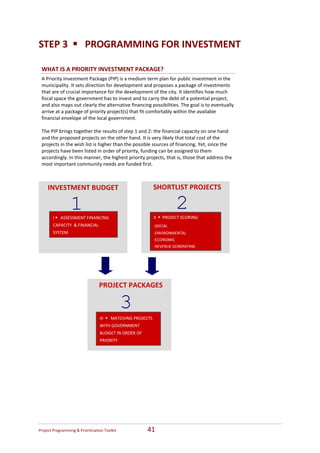
  WHAT IS A PRIORITY INVESTMENT PACKAGE?                            41 
  GUIDANCE FOR THE FACILITATOR                                      43 
 
EXAMPLE:  PROJECT CASE STUDIES IN NEPAL                             46 
 
GLOSSARY                                                            49 
REFERENCES                                                          50 
INTRODUCTION 


Project Programming & Prioritisation Toolkit       1 
INTRODUCTION  
  WHY THIS TOOLKIT? 

  The challenge of urbanisation in Asia is unprecedented. City governments are 
  hard pressed to provide clean water, sanitation, transportation, power and 
  housing to their million of residents everyday. Under decentralisation initiatives 
  more and more responsibility is being placed on cities to identify development 
  requirements and provide corresponding infrastructure.  
   
  On the other side of the equation are financing agencies that can help cities to 
  realise infrastructure projects. For them to commit funds under infrastructure 
  loan agreements, they require city governments to submit well formulated and 
  bankable investment projects and to demonstrate managerial and technical 
  capacity to ensure project viability. 
   
  Many city governments in Asia want to access infrastructure financing but are 
  not sufficiently equipped to undertake the task of programming and priortitising 
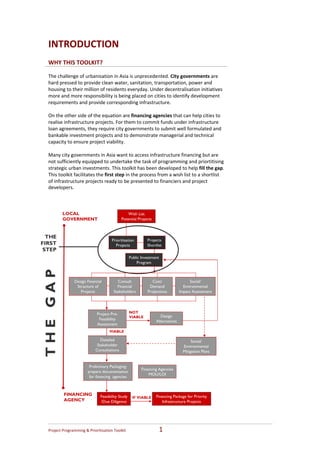
  strategic urban investments. This toolkit has been developed to help fill the gap.  
  This toolkit facilitates the first step in the process from a wish list to a shortlist 
  of infrastructure projects ready to be presented to financiers and project 
  developers.


          LOCAL                                  Wish List
          GOVERNMENT                         Potential Projects


  THE
                                       Prioritisation         Projects
FIRST                                    Projects             Shortlist
 STEP
                                                    Public Investment
                                                        Program
THE GAP


                 Design Financial         Consult               Cost/                   Social/
                  Structure of            Financial            Demand               Environmental
                    Projects            Stakeholders          Projections         Impact Assessment


                              Project Pre-          NOT
                                                    VIABLE            Design
                               Feasibility
                                                                   Alternatives
                              Assessment
                                     VIABLE

                                Detailed                                                Social/
                              Stakeholder                                          Environmental
                             Consultations                                         Mitigation Plans


                          Preliminary Packaging:
                                                           Financing Agencies
                         prepare documentation
                                                               MOU/LOI
                          for financing agencies


           FINANCING            Feasibility Study                  Financing Package for Priority
                                                     IF VIABLE
           AGENCY               /Due Diligence                         Infrastructure Projects


  Project Programming & Prioritisation Toolkit                       1 
WHAT DOES THE TOOLKIT DO?

It is a kit consisting of a spreadsheet (in excel) and a manual to assist local 
governments in the process of getting from a wish list of potential projects to a 
structured list of priority projects. The toolkit has three components: 


 1 Structure projects
              using a rational approach and 
              pre‐determined set of indicators 


 2 Prioritise projects
              according to city development 
              objectives, CDIA criteria and 
              financial support options 


 3 Program projects
              in a 5‐year investment plan matching 
              the fiscal space of the municipality 


The toolkit adds value to the prioritisation & programming process: 
 
- Uses a rational and systematic approach to prioritisation with a broad base 
    of criteria to form a basis for objective decision‐making and selection of 
    projects with a positive developmental outcome. 
- Analyses the impact of projects on the local government budget and 
    identifies the financing gap to ensure that requirements of potential 
    financiers are recognised in an early stage but also that available resources 
    are used as effectively as possible. 
- Guides the user through a programming exercise to include the projects in 
    an investment plan that matches the fiscal space of the municipality   


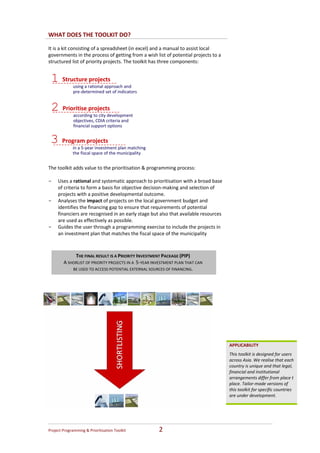
             THE FINAL RESULT IS A PRIORITY INVESTMENT PACKAGE (PIP) 
        A SHORLIST OF PRIORITY PROJECTS IN A  5‐YEAR INVESTMENT PLAN THAT CAN 
            BE USED TO ACCESS POTENTIAL EXTERNAL SOURCES OF FINANCING. 


                                                                                     APPLICABILITY  
                                                                                     This toolkit is designed for users 
                                                                                     across Asia. We realise that each 
                                                                                     country is unique and that legal, 
                                                                                     financial and institutional 
                                                                                     arrangements differ from place t 
                                                                                     place. Tailor‐made versions of 
                                                                                     this toolkit for specific countries 
                                                                                     are under development.  


Project Programming & Prioritisation Toolkit           2 
HOW DOES IT FIT IN THE LOCAL PLANNING PROCESS?
  
 The toolkit is meant for city governments that want to do a better and more 
 systematic job in infrastructure investment programming. 
  
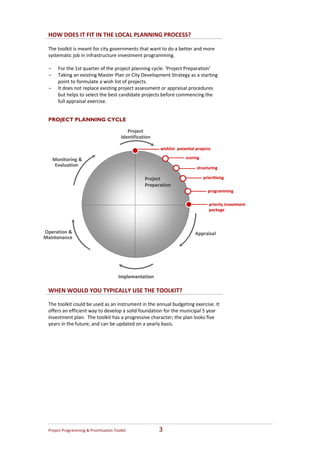
 - For the 1st quarter of the project planning cycle: ‘Project Preparation’  
 - Taking an existing Master Plan or City Development Strategy as a starting 
     point to formulate a wish list of projects.  
 - It does not replace existing project assessment or appraisal procedures 
     but helps to select the best candidate projects before commencing the 
     full appraisal exercise. 


 PROJECT PLANNING CYCLE

                                              Project 
                                           Identification

                                                             wishlist potential projects

   Monitoring &                                                           scoring
    Evaluation 
                                                                                structuring

                                                      Project                       prioritising 
                                                      Preparation
                                                                                      programming

                                                                                       priority investment 
                                                                                       package


Operation &                                                                    Appraisal
Maintenance 


                                         Implementation

 WHEN WOULD YOU TYPICALLY USE THE TOOLKIT?

 The toolkit could be used as an instrument in the annual budgeting exercise. It 
 offers an efficient way to develop a solid foundation for the municipal 5 year 
 investment plan.  The toolkit has a progressive character; the plan looks five 
 years in the future; and can be updated on a yearly basis.  


 Project Programming & Prioritisation Toolkit                3 
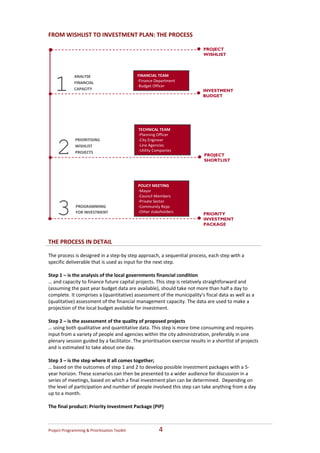
FROM WISHLIST TO INVESTMENT PLAN: THE PROCESS 

                                                                            PROJECT
                                                                            WISHLIST


   1
               ANALYSE                            FINANCIAL TEAM
               FINANCIAL                          ‐Finance Department
                                                  ‐Budget Officer
               CAPACITY                                                     INVESTMENT
                                                                            BUDGET


                                                  TECHNICAL TEAM


    2
                                                  ‐Planning Officer 
               PRIORITISING                       ‐City Engineer
               WISHLIST                           ‐Line Agencies
               PROJECTS                           ‐Utility Companies
                                                                            PROJECT
                                                                            SHORTLIST


                                                  POLICY MEETING 
                                                  ‐Mayor 


    3
                                                  ‐Council Members
                                                  ‐Private Sector
               PROGRAMMING                        ‐Community Reps
               FOR INVESTMENT                     ‐Other stakeholders 
                                                                            PRIORITY
                                                                            INVESTMENT
                                                                            PACKAGE


THE PROCESS IN DETAIL  

The process is designed in a step‐by step approach, a sequential process, each step with a 
specific deliverable that is used as input for the next step.  
 
Step 1 – is the analysis of the local governments financial condition  
… and capacity to finance future capital projects. This step is relatively straightforward and 
(assuming the past year budget data are available), should take not more than half a day to 
complete. It comprises a (quantitative) assessment of the municipality’s fiscal data as well as a 
(qualitative) assessment of the financial management capacity. The data are used to make a 
projection of the local budget available for investment.  
 
Step 2 – is the assessment of the quality of proposed projects  
… using both qualitative and quantitative data. This step is more time consuming and requires 
input from a variety of people and agencies within the city administration, preferably in one 
plenary session guided by a facilitator. The prioritisation exercise results in a shortlist of projects 
and is estimated to take about one day. 
 
Step 3 – is the step where it all comes together;  
… based on the outcomes of step 1 and 2 to develop possible investment packages with a 5‐
year horizon. These scenarios can then be presented to a wider audience for discussion in a 
series of meetings, based on which a final investment plan can be determined.  Depending on 
the level of participation and number of people involved this step can take anything from a day 
up to a month. 
 
The final product: Priority Investment Package (PIP)


Project Programming & Prioritisation Toolkit                 4 
SOPHISTICATION VERSUS SIMPLICITY

The starting point for the development of this toolkit was that it:  
 
- Must be applicable and if possible add value to the local planning process 
    in different size cities and among different countries   
- Must be generic enough to be applicable to different country context, 
    while also containing sufficient level of detail for use at the operational 
    level and allow for cross city and country comparison 
 
 
To meet these demands we adhered to the following design principles: 


KEEP IT SIMPLE            A study of prioritisation and programming initiatives in 
                          a variety of countries shows that for a model to be 
                          useful in its own right, it should be logical, transparent, 
                          largely self explanatory, not require hefty manuals or 
                          external consultants and not be too complex or time 
                          consuming.  
                           
USERFRIENDLY              Model should be computer‐based, using commonplace, 
FORMAT                    widely compatible software that is easy to understand 
                          and navigate, i.e. not require advanced financial, 
                          computer or programming skills.  
                           
INPUT:                    Model should add value to the local planning process, 
DO NOT                    not frustrate the planners. Therefore it should use 
FRUSTRATE                 readily available data, and have the right level of 
                          complexity to appeal to the local municipal planners, 
                          engineers and financial experts.  
                           
OUTPUT:                   Output should be visually attractive, easily 
EASY TO DIGEST            understandable to be useful as a basis for decision‐
                          making in a wider audience, incl. politicians and 
                          community representatives 
                           
INCLUDE                   Model should include default settings tailor‐made for 
DEFAULT                   country context, but also allow for manual adaptations 
SETTINGS                  to specific city context. 
                           
EXPLAIN WITH              The accompanying user manual should include country‐
EXAMPLES                  specific examples from signature urban infrastructure 
                          projects to provide a practical hands‐on guide how best 
                          to use the model and interpret the results.  


Project Programming & Prioritisation Toolkit              5 
LEARN HOW TO USE THE TOOLKIT
 
This manual refers to an excel workbook which is designed in three sections, 
corresponding with the three steps in the process.  
 
   RED TABS           STEP 1 – INVESTMENT CAPACITY ASSESSMENT 
   BLUE TABS          STEP 2 – PROJECT SCORING & STRUCTURING 
   GREEN TABS         STEP 3 – INVESTMENT PROGRAMMING 
 
This manual takes you through the process step‐by‐step and explains: 
  
- what date are required and where to find them 
- how to interpret the results 
- guidance to facilitate discussions and meetings 
- tips for the workbook user  
- glossary of terminology 


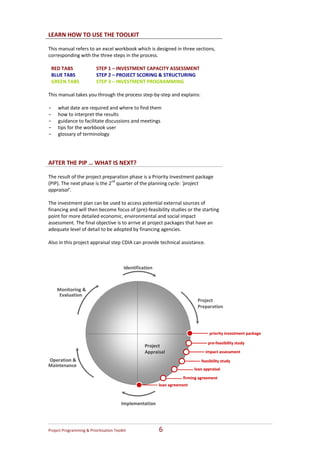
AFTER THE PIP … WHAT IS NEXT?
 
The result of the project preparation phase is a Priority Investment package 
(PIP). The next phase is the 2nd quarter of the planning cycle: ‘project 
appraisal’. 
 
The investment plan can be used to access potential external sources of 
financing and will then become focus of (pre)‐feasibility studies or the starting 
point for more detailed economic, environmental and social impact 
assessment. The final objective is to arrive at project packages that have an 
adequate level of detail to be adopted by financing agencies.  
 
Also in this project appraisal step CDIA can provide technical assistance.   


                                            Identification


     Monitoring & 
      Evaluation 
                                                                                Project 
                                                                                Preparation


                                                                                       priority investment package

                                                                                      pre‐feasibility study 
                                                      Project 
                                                      Appraisal                      impact assessment 
Operation &                                                                       feasibility study
Maintenance 
                                                                               loan appraisal 
                                                                         firming agreement  
                                                             loan agreement 


                                          Implementation


Project Programming & Prioritisation Toolkit                  6 
STEP 1   
                                                   ANALYSIS 
                                                  FINANCIAL  
                                                   CAPACITY
                                                                     
                                                                     
          ‘Borrowing one’s future income to increase 
                                  purchasing power of one’s present’ 


Project Programming & Prioritisation Toolkit       7 
STEP 1      ANALYSIS FINANCIAL CAPACITY 
Step 1 of the toolkit looks into the municipal budget and requires input from the 
Municipal Finance Department, typically the budget officer. We refer to them as the 
financial team. Almost all data in this fiscal assessment should be able to be 
obtained from regular fiscal statistics.  The assessment consists of three parts: 
 
  1.1 Local Government          This part is to gain more insight in the creditworthiness 
      Fiscal Assessment         of the local government. It consists of a series of 
                                quantitative data that gives an overview of the fiscal 
                                space of the local government and the capacity to 
                                leverage finance. In other words what is the local 
                                government’s room to manoeuvre to get infrastructure 
                                projects financed, from its own budget and how much is 
                                it able to access from external sources.  
                                 
  1.2 Local Government         This part is a qualitative assessment of the financial 
      Financial System         management structure that is in place to manage 
      Assessment               substantive capital investments within the city 
                               administration. It is evidence‐based, the scores are based 
                               on history and past investment experiences of the city.  
                                 
  1.3 Investment Budget   The last part is a projection of revenues and expenditures 
      Forecast                 and the available funds for investment in the years to 
                               come. A basic appraisal model is used that that projects 
                               the municipal investment budget based on data from 
                               earlier years as well as macro economic data.  
 
 
 NOTES FOR THE WORKBOOK USER: 
  
 - Step 1 refers to the section in the workbook with the red tabs: ‘CITY’ and 
    ‘BUDGET FORECAST’.   
  
 - Data input is required in the CITY sheet; data in the ‘BUDGET FORECAST SHEET’ is 
    calculated automatically.  
  
 - All amounts are in the local currency (which is selected on the Home page) minus 
    the appropriate number of zeros (as selected by the user). 
  
 - You only need to fill those boxes highlighted in green, and select answer choices 
    in boxes highlighted in blue; the information in the other boxes will be calculated 
    automatically.  
  
 - To discern changes on local fiscal revenue and to check for stability the program 
    suggests a minimum of four years data, starting with the last fiscal year for 
    which data are available. 
  
 - For the sake of simplicity, this fiscal budget is on a cash basis, revenues are 
    recorded when the cash is received and expenditures are recorded when the 
    disbursement is made. 
  
 - This manual refers interchangeably to different terms for local government 
    authorities. Among such terms are ‘municipality’, ‘local authority’, and ‘local 
    government’  


Project Programming & Prioritisation Toolkit            8 
1.1: FISCAL ASSESSMENT 

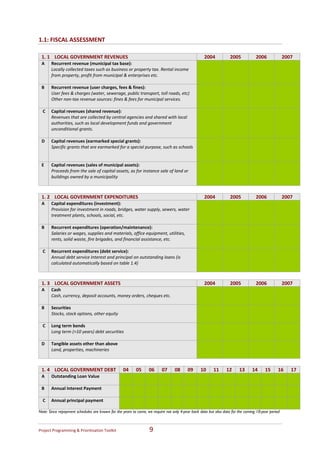
 1. 1    LOCAL GOVERNMENT REVENUES                                                                  2004            2005            2006            2007 
 A     Recurrent revenue (municipal tax base):                                                                                                  
       Locally collected taxes such as business or property tax. Rental income 
       from property, profit from municipal & enterprises etc.  
        
 B     Recurrent revenue (user charges, fees & fines):                                                                                          
       User fees & charges (water, sewerage, public transport, toll roads, etc) 
       Other non‐tax revenue sources: fines & fees for municipal services. 
        
  C    Capital revenues (shared revenue):                                                                                                       
       Revenues that are collected by central agencies and shared with local 
       authorities, such as local development funds and government 
       unconditional grants. 
        
 D     Capital revenues (earmarked special grants):                                                                                             
       Specific grants that are earmarked for a special purpose, such as schools 
        
        
 E     Capital revenues (sales of municipal assets):                                                                                            
       Proceeds from the sale of capital assets, as for instance sale of land or 
       buildings owned by a municipality  
        

 1. 2    LOCAL GOVERNMENT EXPENDITURES                                                              2004            2005            2006            2007 
 A     Capital expenditures (investment):                                                                                                       
       Provision for investment in roads, bridges, water supply, sewers, water 
       treatment plants, schools, social, etc.  
                                                  
 B     Recurrent expenditures (operation/maintenance):                                                                                          
       Salaries or wages, supplies and materials, office equipment, utilities, 
       rents, solid waste, fire brigades, and financial assistance, etc. 
        
  C    Recurrent expenditures (debt service):                                                                                                   
       Annual debt service Interest and principal on outstanding loans (is 
       calculated automatically based on table 1.4) 
        

 1. 3    LOCAL GOVERNMENT ASSETS                                                                    2004            2005            2006            2007 
 A     Cash                                                                                                                                     
       Cash, currency, deposit accounts, money orders, cheques etc. 
                  
 B     Securities                                                                                                                               
       Stocks, stock options, other equity  
        
  C    Long term bonds                                                                                                                          
       Long term (>10 years) debt securities  
        
 D     Tangible assets other than above                                                                                                         
       Land, properties, machineries 
        

 1. 4    LOCAL GOVERNMENT DEBT    04                      05      06      07     08      09      10      11     12      13      14      15      16     17 
 A     Outstanding Loan Value                                                                                                                           
                 
 B     Annual Interest Payment                                                                                                                          
        
  C    Annual principal payment                                                                                                                         
        
Note: Since repayment schedules are known for the years to come, we require not only 4-year back data but also data for the coming 10-year period


Project Programming & Prioritisation Toolkit                      9 
 
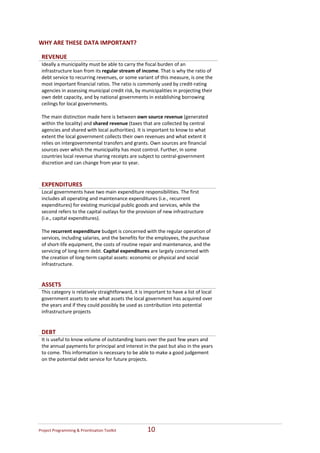
WHY ARE THESE DATA IMPORTANT? 

    REVENUE  
    Ideally a municipality must be able to carry the fiscal burden of an 
    infrastructure loan from its regular stream of income. That is why the ratio of 
    debt service to recurring revenues, or some variant of this measure, is one the 
    most important financial ratios. The ratio is commonly used by credit‐rating 
    agencies in assessing municipal credit risk, by municipalities in projecting their 
    own debt capacity, and by national governments in establishing borrowing 
    ceilings for local governments.  
     
    The main distinction made here is between own source revenue (generated 
    within the locality) and shared revenue (taxes that are collected by central 
    agencies and shared with local authorities). It is important to know to what 
    extent the local government collects their own revenues and what extent it 
    relies on intergovernmental transfers and grants. Own sources are financial 
    sources over which the municipality has most control. Further, in some 
    countries local revenue sharing receipts are subject to central‐government 
    discretion and can change from year to year.   
 
 
    EXPENDITURES  
    Local governments have two main expenditure responsibilities. The first 
    includes all operating and maintenance expenditures (i.e., recurrent 
    expenditures) for existing municipal public goods and services, while the 
    second refers to the capital outlays for the provision of new infrastructure 
    (i.e., capital expenditures). 
     
    The recurrent expenditure budget is concerned with the regular operation of 
    services, including salaries, and the benefits for the employees, the purchase 
    of short‐life equipment, the costs of routine repair and maintenance, and the 
    servicing of long‐term debt. Capital expenditures are largely concerned with 
    the creation of long‐term capital assets: economic or physical and social 
    infrastructure.  
 
 
    ASSETS  
    This category is relatively straightforward, it is important to have a list of local 
    government assets to see what assets the local government has acquired over 
    the years and if they could possibly be used as contribution into potential 
    infrastructure projects  
 
 
    DEBT  
    It is useful to know volume of outstanding loans over the past few years and 
    the annual payments for principal and interest in the past but also in the years 
    to come. This information is necessary to be able to make a good judgement 
    on the potential debt service for future projects. 


Project Programming & Prioritisation Toolkit            10 
1.2: FINANCIAL MANAGEMENT ASSESSMENT 

    This part is a qualitative assessment of the financial management structure 
    that is in place to manage substantive capital investments within the city 
    administration. Potential financiers, whether they are local banks, private 
    sector companies or international agencies, want to be assured that the 
    current administration has sufficient capacity to plan, prepare, develop and 
    manage the project. 
     
    Each question has three‐four possible answers to which a score is attached 
    rating from 0‐3. There are seven questions, a final score of the municipality’s 
    fiscal management structure will appear at the bottom as the Fiscal System 
    Assessment Score on a normalised scale of 1‐10. 


    NOTES FOR THE WORKBOOK USER: 
     
    -   You only need to fill in the cells in green and select 
        answers in the cells in blue. 
     
    -   All questions are multiple choice. When you click on a cell 
        a button will appear in the right had corner of that cell. 
        When you click on the button, possible answers will 
        appear. You can only select ONE ANSWER.   
     
    -   The answers are not cut in stone you can always go back 
        to a question and change the answer simply by clicking on 
        the button. 


Project Programming & Prioritisation Toolkit                11 
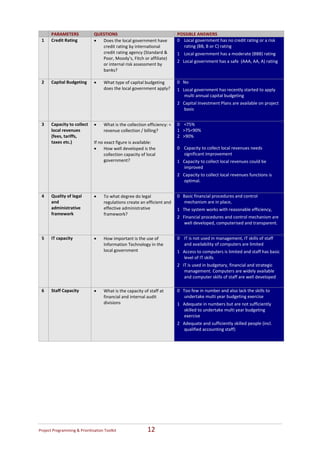
      PARAMETERS               QUESTIONS                                     POSSIBLE ANSWERS 
 1     Credit Rating            •  Does the local government have             0    Local government has no credit rating or a risk 
                                   credit rating by international                  rating (BB, B or C) rating  
                                   credit rating agency (Standard &           1    Local government has a moderate (BBB) rating 
                                   Poor, Moody’s, Fitch or affiliate) 
                                                                              2   Local government has a safe  (AAA, AA, A) rating  
                                   or internal risk assessment by 
                                   banks?                                      
                                 
 2     Capital Budgeting        •  What type of capital budgeting             0   No 
                                   does the local government apply?           1   Local government has recently started to apply 
                                                                                   multi annual capital budgeting  
                                                                              2   Capital Investment Plans are available on project 
                                                                                  basis   
                                                                               
 3     Capacity to collect      •     What is the collection efficiency: =    0    <75%   
       local revenues                 revenue collection / billing?           1   >75<90%  
       (fees, tariffs,                                                        2   >90% 
       taxes etc.)              If no exact figure is available:               
                                •     How well developed is the               0    Capacity to collect local revenues needs 
                                      collection capacity of local                 significant improvement  
                                      government?                             1   Capacity to collect local revenues could be 
                                                                                  improved  
                                                                              2   Capacity to collect local revenues functions is 
                                                                                  optimal.  
                                                                               
 4     Quality of legal         •     To what degree do legal                 0   Basic financial procedures and control 
       and                            regulations create an efficient and         mechanism are in place,  
       administrative                 effective administrative                1   The system works with reasonable efficiency,  
       framework                      framework? 
                                                                              2   Financial procedures and control mechanism are 
                                 
                                                                                   well developed, computerised and transparent. 
                                                                               
 5     IT capacity              •     How important is the use of             0    IT is not used in management, IT skills of staff 
                                      Information Technology in the                and availability of computers are limited  
                                      local government                        1   Access to computers is limited and staff has basic 
                                                                                  level of IT skills  
                                                                              2   IT is used in budgetary, financial and strategic 
                                                                                   management. Computers are widely available  
                                                                                   and computer skills of staff are well developed   
                                                                               
 6     Staff Capacity           •     What is the capacity of staff at        0   Too few in number and also lack the skills to 
                                      financial and internal audit                 undertake multi year budgeting exercise    
                                      divisions                               1   Adequate in numbers but are not sufficiently 
                                                                                  skilled to undertake multi year budgeting 
                                                                                  exercise    
                                                                              2   Adequate and sufficiently skilled people (incl. 
                                                                                  qualified accounting staff)  


Project Programming & Prioritisation Toolkit                 12 
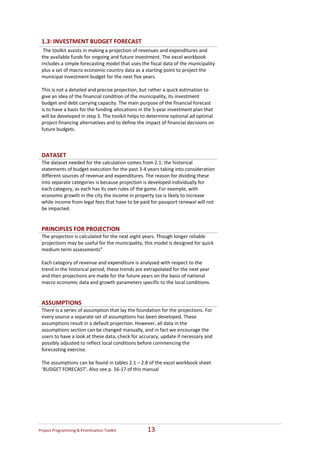
1.3: INVESTMENT BUDGET FORECAST 
     The toolkit assists in making a projection of revenues and expenditures and 
    the available funds for ongoing and future investment. The excel workbook 
    includes a simple forecasting model that uses the fiscal data of the municipality 
    plus a set of macro economic country data as a starting point to project the 
    municipal investment budget for the next five years. 
     
    This is not a detailed and precise projection, but rather a quick estimation to 
    give an idea of the financial condition of the municipality, its investment 
    budget and debt carrying capacity. The main purpose of the financial forecast 
    is to have a basis for the funding allocations in the 5‐year investment plan that 
    will be developed in step 3. The toolkit helps to determine optional ad optimal 
    project financing alternatives and to define the impact of financial decisions on 
    future budgets.


    DATASET  
    The dataset needed for the calculation comes from 2.1: the historical 
    statements of budget execution for the past 3‐4 years taking into consideration 
    different sources of revenue and expenditures. The reason for dividing these 
    into separate categories is because projection is developed individually for 
    each category, as each has its own rules of the game. For example, with 
    economic growth in the city the income in property tax is likely to increase 
    while income from legal fees that have to be paid for passport renewal will not 
    be impacted. 
 
 
    PRINCIPLES FOR PROJECTION  
    The projection is calculated for the next eight years. Though longer reliable 
    projections may be useful for the municipality, this model is designed for quick 
    medium term assessments” 
     
    Each category of revenue and expenditure is analysed with respect to the 
    trend in the historical period, these trends are extrapolated for the next year 
    and then projections are made for the future years on the basis of national 
    macro economic data and growth parameters specific to the local conditions.  
 
 
    ASSUMPTIONS   
    There is a series of assumption that lay the foundation for the projections. For 
    every source a separate set of assumptions has been developed. These 
    assumptions result in a default projection. However, all data in the 
    assumptions section can be changed manually, and in fact we encourage the 
    users to have a look at these data, check for accuracy, update if necessary and 
    possibly adjusted to reflect local conditions before commencing the 
    forecasting exercise.   
     
    The assumptions can be found in tables 2.1 – 2.8 of the excel workbook sheet 
    ‘BUDGET FORECAST’. Also see p. 16‐17 of this manual 


Project Programming & Prioritisation Toolkit          13 
 
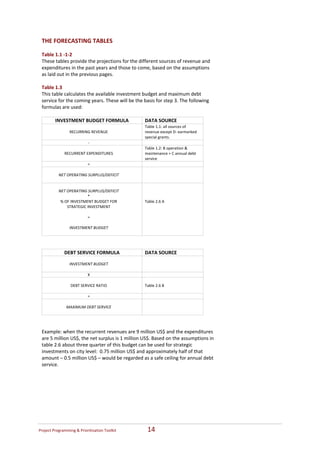
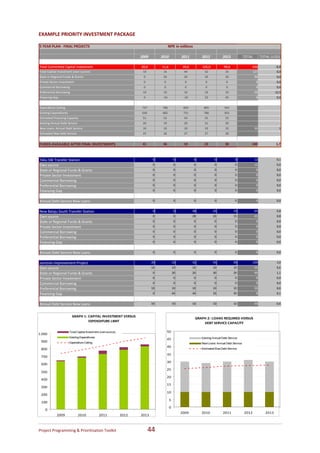
    THE FORECASTING TABLES  
     
    Table 1.1 ‐1‐2 
    These tables provide the projections for the different sources of revenue and 
    expenditures in the past years and those to come, based on the assumptions 
    as laid out in the previous pages.  
     
    Table 1.3 
    This table calculates the available investment budget and maximum debt 
    service for the coming years. These will be the basis for step 3. The following 
    formulas are used:   
     
           INVESTMENT BUDGET FORMULA                DATA SOURCE 
                                                    Table 1.1: all sources of 
                  RECURRING REVENUE                 revenue except D: earmarked 
                                                    special grants. 
                          ‐                          
                                                    Table 1.2: B operation & 
              RECURRENT EXPENDITURES                maintenance + C annual debt 
                                                    service  
                         =                           
                                                     
           NET OPERATING SURPLUS/DEFICIT 
                            
                                                     
           NET OPERATING SURPLUS/DEFICIT             
                         *                           
            % OF INVESTMENT BUDGET FOR              Table 2.6 A 
               STRATEGIC INVESTMENT  
                            
                         = 
                            
                INVESTMENT BUDGET  


              DEBT SERVICE FORMULA                  DATA SOURCE 
                                                     
                 INVESTMENT BUDGET                   
                            
                          X                          
                                                     
                  DEBT SERVICE RATIO                Table 2.6 B 
                            
                          =                          
                                                     
                MAXIMUM DEBT SERVICE  


    Example: when the recurrent revenues are 9 million US$ and the expenditures 
    are 5 million US$, the net surplus is 1 million US$. Based on the assumptions in 
    table 2.6 about three quarter of this budget can be used for strategic 
    investments on city level:  0.75 million US$ and approximately half of that 
    amount – 0.5 million US$ – would be regarded as a safe ceiling for annual debt 
    service. 


Project Programming & Prioritisation Toolkit          14 
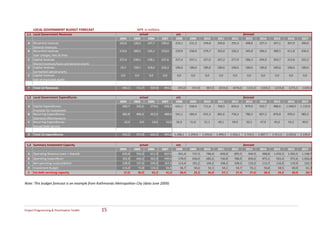
LOCAL GOVERNMENT BUDGET FORECAST                               NPR in millions
    1,1 Local Government Revenues                                        actual                        est.                                                 forecast
                                                           2004      2005      2006         2007      2008      2009       2010       2011       2012         2013      2014       2015       2016       2017
    A   Recurrent revenue:                                 163,6     126,4    147,7         196,4     214,1     231,2      249,8      269,8      291,4        308,8     327,4      347,1      367,9      390,0
        General revenues 
    B   Recurrent revenue:                                 219,6     189,5        226,1     233,0     239,8     258,9      279,7      302,0      326,2       345,8      366,5      388,5      411,8      436,5
        User charges, fees & fines 
    C   Capital revenue:                                   237,6     238,1        238,1     237,6     237,6     247,1      257,0      267,2      277,9       286,3      294,9      303,7      312,8      322,2
        Shared revenues/taxes and general grants
    D   Capital revenue:                                   19,3      158,7        318,0     226,3     180,6     180,6      180,6      180,6      180,6       180,6      180,6      180,6      180,6      180,6
        Earmarked special grants
    E   Capital revenue:                                    0,0       0,0          0,0       0,0       0,0        0,0        0,0        0,0        0,0        0,0         0,0        0,0        0,0        0,0
        Sale of municipal assets

    F   Total LG Revenues                                   640,1     712,7        929,9     893,3     872,0      917,8      967,0     1019,6     1076,0      1121,5     1169,3     1219,8     1273,1     1329,3

    1,2 Local Government Expenditures                                    actual                        est.                                                 forecast
                                                           2004      2005      2006         2007      2008      2009       2010       2011       2012         2013      2014       2015        2016       2017
    A   Capital Expenditures:                                200,7     165,6     279,6        445,6   610,1     658,9      711,6      768,5      830,0        879,9     932,7      988,6      1.048,0    1.110,9
        Provision for Investment 
    B   Recurring Expenditures:                             382,8     406,4        352,9     489,4    541,1     584,4      631,2      681,6      736,2       780,3      827,2      876,8      929,4      985,2
        Operation/Maintenance
    C   Recurring Expenditures:                               10,0          0,0      10,0      10,0   36,9       51,6       51,1       49,1       49,9        50,3       47,9       45,6       43,2       40,9
        Annual Debt Service 

    D   Total LG expenditures                               593,5     571,9        642,5     945,0 1.188,1      1.294,9    1.393,8    1.499,3    1.616,1    1.710,5     1.807,7    1.911,0    2.020,6    2.136,9


    1,3 Summary Investment Capacity                                      actual                       est.                                                  forecast
                                                           2004      2005      2006         2007      2008       2009       2010       2011       2012        2013       2014       2015       2016       2017
    A   Operating Revenue (own + shared)                     620,8     554,0     611,9        667,0     691,4      737,3      786,4      839,0      895,5       940,9      988,8    1.039,3    1.092,5    1.148,7
    B   Operating Expenditure                                392,8     406,4     362,9        499,4     578,0      636,0      682,2      730,8      786,0       830,6      875,1      922,4      972,6    1.026,0
    C   Net operating surplus/deficit                        228,0     147,6     249,0        167,6     113,4      101,2      104,2      108,3      109,5       110,3      113,7      116,9      119,9      122,7
    D   Investment Budget                                    114,0      73,8     124,5         83,8      56,7       50,6       52,1       54,1       54,7        55,1       56,8       58,5       60,0       61,3
    E   Est.debt servicing capacity                           57,0      36,9      62,2         41,9      28,4       25,3       26,0       27,1       27,4        27,6       28,4       29,2       30,0       30,7
 
Note: This budget forecast is an example from Kathmandu Metropolitan City (data June 2009)


Project Programming & Prioritisation Toolkit        15 
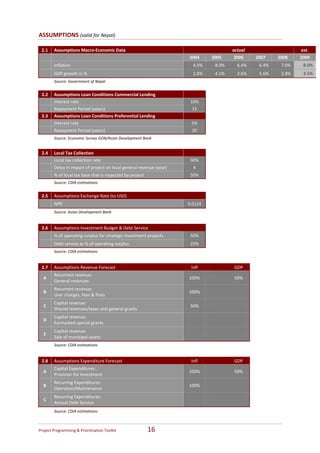
ASSUMPTIONS (valid for Nepal) 
 
    2.1    Assumptions Macro‐Economic Data                                                              actual                                   est. 
                                                                             2004          2005          2006         2007         2008         2009 
           Inflation                                                           4.5%         8.0%          6.4%         6.4%         7.0%         8.0% 
           GDP growth in %                                                     2.8%         4.1%          2.6%         5.6%         3.8%         3.5% 
           Source: Government of Nepal                                                                                                       
                                                                                                                                             
    2.2    Assumptions Loan Conditions Commercial Lending                                                                                    
           Interest rate                                                      10%                                                            
           Repayment Period (years)                                            15                                                            
    2.3    Assumptions Loan Conditions Preferential Lending                                                                                  
           Interest rate                                                      5%                                                             
           Repayment Period (years)                                            20                                                            
           Source: Economic Survey GON/Asian Development Bank                                                                                
                                                                                                                                             
    2.4    Local Tax Collection                                                                                                              
           Local tax collection rate                                          30%                                                            
           Delay in impact of project on local general revenue (year)          4                                                             
           % of local tax base that is impacted by project                    50%                                                            
           Source: CDIA estimations                                                                                                          
                                                                                                                                             
    2.5    Assumptions Exchange Rate (to USD)                                                                                                
           NPR                                                               0.0124                                                          
           Source: Asian Development Bank                                                                                                    
                                                                                                                                             
    2.6    Assumptions Investment Budget & Debt Service                                                                                      
           % of operating surplus for strategic investment projects           50%                                                            
           Debt service as % of operating surplus                             25%                                                            
           Source: CDIA estimations                                                                                                          
                                                                                                                                             
    2.7    Assumptions Revenue Forecast                                       Infl                       GDP                                 
           Recurrent revenue: 
    A                                                                        100%                        50%                                 
           General revenues  
           Recurrent revenue: 
    B                                                                        100%                                                            
           User charges, fees & fines  
           Capital revenue: 
    C                                                                         50%                                                            
           Shared revenues/taxes and general grants 
           Capital revenue: 
    D                                                                                                                                        
           Earmarked special grants 
           Capital revenue: 
     E                                                                                                                                       
           Sale of municipal assets 
           Source: CDIA estimations                                                                                                          
                                                                                                                                             
    2.8    Assumptions Expenditure Forecast                                   Infl                       GDP                                 
           Capital Expenditures: 
    A                                                                        100%                        50%                                 
           Provision for Investment  
           Recurring Expenditures: 
    B                                                                        100%                                                            
           Operation/Maintenance 
           Recurring Expenditures: 
    C                                                                                                                                        
           Annual Debt Service  
           Source: CDIA estimations                                                                                                          


Project Programming & Prioritisation Toolkit                   16 
 
 
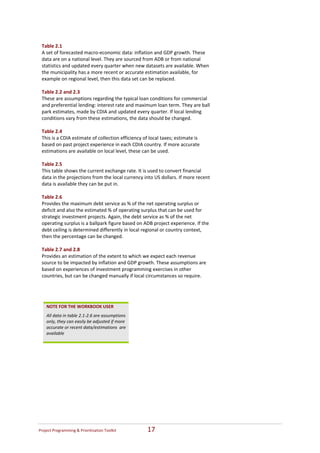
    Table 2.1  
    A set of forecasted macro‐economic data: inflation and GDP growth. These 
    data are on a national level. They are sourced from ADB or from national 
    statistics and updated every quarter when new datasets are available. When 
    the municipality has a more recent or accurate estimation available, for 
    example on regional level, then this data set can be replaced.  
     
    Table 2.2 and 2.3 
    These are assumptions regarding the typical loan conditions for commercial 
    and preferential lending: interest rate and maximum loan term. They are ball 
    park estimates, made by CDIA and updated every quarter. If local lending 
    conditions vary from these estimations, the data should be changed. 
     
    Table 2.4 
    This is a CDIA estimate of collection efficiency of local taxes; estimate is 
    based on past project experience in each CDIA country. If more accurate 
    estimations are available on local level, these can be used. 
      
    Table 2.5  
    This table shows the current exchange rate. It is used to convert financial 
    data in the projections from the local currency into US dollars. If more recent 
    data is available they can be put in.  
     
    Table 2.6  
    Provides the maximum debt service as % of the net operating surplus or 
    deficit and also the estimated % of operating surplus that can be used for 
    strategic investment projects. Again, the debt service as % of the net 
    operating surplus is a ballpark figure based on ADB project experience. If the 
    debt ceiling is determined differently in local regional or country context, 
    then the percentage can be changed.  
     
    Table 2.7 and 2.8  
    Provides an estimation of the extent to which we expect each revenue 
    source to be impacted by inflation and GDP growth. These assumptions are 
    based on experiences of investment programming exercises in other 
    countries, but can be changed manually if local circumstances so require.  


      NOTE FOR THE WORKBOOK USER  
      All data in table 2.1‐2.6 are assumptions 
      only, they can easily be adjusted if more 
      accurate or recent data/estimations  are 
      available  


Project Programming & Prioritisation Toolkit          17 
STEP 2  
                      PROJECT 
               PRIORITISATION 
                                                                             
                                                                             
                                      ‘The reason most major goals are 
                                     not achieved is that we spend our 
                                              time doing second things first’. 


Project Programming & Prioritisation Toolkit        18 
STEP 2      PROJECT PRIORITISATION 
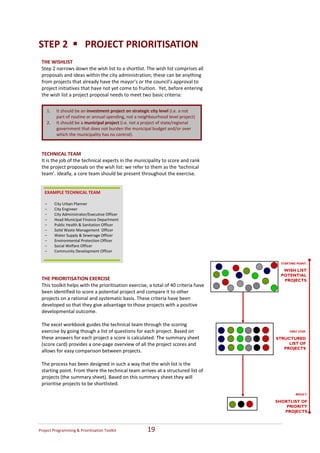
 THE WISHLIST 
 Step 2 narrows down the wish list to a shortlist. The wish list comprises all 
 proposals and ideas within the city administration; these can be anything 
 from projects that already have the mayor’s or the council’s approval to 
 project initiatives that have not yet come to fruition.  Yet, before entering 
 the wish list a project proposal needs to meet two basic criteria: 
  
  
     1. It should be an investment project on strategic city level (i.e. a not 
          part of routine or annual spending, not a neighbourhood level project) 
   2. It should be a municipal project (i.e. not a project of state/regional 
          government that does not burden the municipal budget and/or over 
          which the municipality has no control).   
  
  
 TECHNICAL TEAM 
 It is the job of the technical experts in the municipality to score and rank 
 the project proposals on the wish list: we refer to them as the ‘technical 
 team’. Ideally, a core team should be present throughout the exercise.  
  
  
   EXAMPLE TECHNICAL TEAM  
   
   -     City Urban Planner    
   - City Engineer 
   - City Administrator/Executive Officer  
   - Head Municipal Finance Department 
   - Public Health & Sanitation Officer 
   -     Solid Waste Management  Officer 
   - Water Supply & Sewerage Officer 
   - Environmental Protection Officer 
   - Social Welfare Officer 
   - Community Development Officer 
  
                                                                                       STARTING POINT:
  
                                                                                        WISH LIST
                                                                                       POTENTIAL
 THE PRIORITISATION EXERCISE                                                            PROJECTS
 This toolkit helps with the prioritisation exercise, a total of 40 criteria have 
 been identified to score a potential project and compare it to other 
 projects on a rational and systematic basis. These criteria have been 
 developed so that they give advantage to those projects with a positive 
 developmental outcome.  
  
 The excel workbook guides the technical team through the scoring 
 exercise by going though a list of questions for each project. Based on                    FIRST STEP:

 these answers for each project a score is calculated. The summary sheet             STRUCTURED
 (score card) provides a one‐page overview of all the project scores and                  LIST OF
                                                                                        PROJECTS
 allows for easy comparison between projects.  
  
 The process has been designed in such a way that the wish list is the 
 starting point. From there the technical team arrives at a structured list of 
 projects (the summary sheet). Based on this summary sheet they will 
 prioritise projects to be shortlisted. 
                                                                                                RESULT:

                                                                                     SHORTLIST OF
                                                                                         PRIORITY
                                                                                        PROJECTS


Project Programming & Prioritisation Toolkit         19 
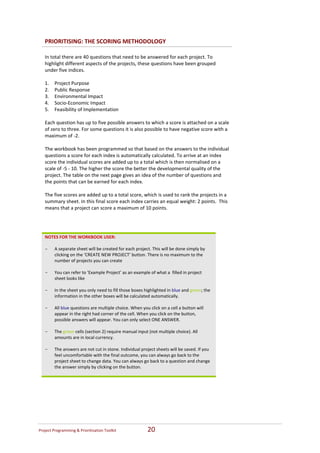
PRIORITISING: THE SCORING METHODOLOGY  
     
    In total there are 40 questions that need to be answered for each project. To 
    highlight different aspects of the projects, these questions have been grouped 
    under five indices.  
     
    1. Project Purpose  
    2. Public Response  
    3. Environmental Impact 
    4. Socio‐Economic Impact  
    5. Feasibility of Implementation 
      
    Each question has up to five possible answers to which a score is attached on a scale 
    of zero to three. For some questions it is also possible to have negative score with a 
    maximum of ‐2.   
     
    The workbook has been programmed so that based on the answers to the individual 
    questions a score for each index is automatically calculated. To arrive at an index 
    score the individual scores are added up to a total which is then normalised on a 
    scale of ‐5 ‐ 10. The higher the score the better the developmental quality of the 
    project. The table on the next page gives an idea of the number of questions and 
    the points that can be earned for each index. 
     
    The five scores are added up to a total score, which is used to rank the projects in a 
    summary sheet. In this final score each index carries an equal weight: 2 points.  This 
    means that a project can score a maximum of 10 points. 


    NOTES FOR THE WORKBOOK USER: 
     
    - A separate sheet will be created for each project. This will be done simply by 
       clicking on the ‘CREATE NEW PROJECT’ button. There is no maximum to the 
       number of projects you can create 
     
    - You can refer to ‘Example Project’ as an example of what a  filled in project 
       sheet looks like  
     
    - In the sheet you only need to fill those boxes highlighted in blue and green; the 
       information in the other boxes will be calculated automatically.  
     
    - All blue questions are multiple choice. When you click on a cell a button will 
       appear in the right had corner of the cell. When you click on the button, 
       possible answers will appear. You can only select ONE ANSWER.   
     
    - The green cells (section 2) require manual input (not multiple choice). All 
       amounts are in local currency.  
     
    - The answers are not cut in stone. Individual project sheets will be saved. If you 
       feel uncomfortable with the final outcome, you can always go back to the 
       project sheet to change data. You can always go back to a question and change 
       the answer simply by clicking on the button. 


Project Programming & Prioritisation Toolkit           20 
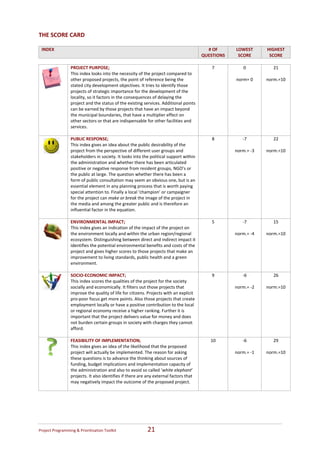
THE SCORE CARD

 INDEX                                                                                        # OF       LOWEST           HIGHEST  
                                                                                            QUESTIONS     SCORE            SCORE 
                                                                                                                       
                     PROJECT PURPOSE;                                                           7           0                21 
                     This index looks into the necessity of the project compared to                                            
                     other proposed projects, the point of reference being the                           norm= 0          norm.=10 
                     stated city development objectives. It tries to identify those 
                     projects of strategic importance for the development of the 
                     locality, so it factors in the consequences of delaying the 
                     project and the status of the existing services. Additional points 
                     can be earned by those projects that have an impact beyond 
                     the municipal boundaries, that have a multiplier effect on 
                     other sectors or that are indispensable for other facilities and 
                     services. 
                      
                     PUBLIC RESPONSE;                                                           8           ‐7               22 
                     This index gives an idea about the public desirability of the                                             
                     project from the perspective of different user groups and                           norm.= ‐3        norm.=10  
                     stakeholders in society. It looks into the political support within                                       
                     the administration and whether there has been articulated                                                 
                     positive or negative response from resident groups, NGO’s or 
                     the public at large. The question whether there has been a 
                     form of public consultation may seem an obvious one, but is an 
                     essential element in any planning process that is worth paying 
                     special attention to. Finally a local ‘champion’ or campaigner 
                     for the project can make or break the image of the project in 
                     the media and among the greater public and is therefore an 
                     influential factor in the equation.   
                      
                     ENVIRONMENTAL IMPACT;                                                      5           ‐7               15 
                     This index gives an indication of the impact of the project on                                            
                     the environment locally and within the urban region/regional                        norm.= ‐4        norm.=10 
                     ecosystem. Distinguishing between direct and indirect impact it 
                     identifies the potential environmental benefits and costs of the 
                     project and gives higher scores to those projects that make an 
                     improvement to living standards, public health and a green 
                     environment.   
                      
                     SOCIO‐ECONOMIC IMPACT;                                                     9           ‐6               26 
                     This index scores the qualities of the project for the society                                            
                     socially and economically. It filters out those projects that                       norm.= ‐2        norm.=10 
                     improve the quality of life for citizens. Projects with an explicit 
                     pro‐poor focus get more points. Also those projects that create 
                     employment locally or have a positive contribution to the local 
                     or regional economy receive a higher ranking. Further it is 
                     important that the project delivers value for money and does 
                     not burden certain groups in society with charges they cannot 
                     afford. 
                      
                     FEASIBILITY OF IMPLEMENTATION;                                            10           ‐6               29 
                     This index gives an idea of the likelihood that the proposed                                              
                     project will actually be implemented. The reason for asking                         norm.= ‐1        norm.=10  
              
                     these questions is to advance the thinking about sources of                                               
                     funding, budget implications and implementation capacity of                                               
                     the administration and also to avoid so called ‘white elephant’ 
                     projects. It also identifies if there are any external factors that 
                     may negatively impact the outcome of the proposed project.   


Project Programming & Prioritisation Toolkit                  21 
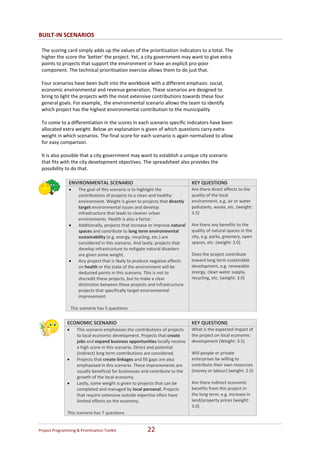
BUILT‐IN SCENARIOS

    The scoring card simply adds up the values of the prioritisation indicators to a total. The 
    higher the score the ‘better’ the project. Yet, a city government may want to give extra 
    points to projects that support the environment or have an explicit pro‐poor 
    component. The technical prioritisation exercise allows them to do just that.  
     
    Four scenarios have been built into the workbook with a different emphasis: social, 
    economic environmental and revenue generation. These scenarios are designed to 
    bring to light the projects with the most extensive contributions towards these four 
    general goals. For example,  the environmental scenario allows the team to identify 
    which project has the highest environmental contribution to the municipality 
     
    To come to a differentiation in the scores in each scenario specific indicators have been 
    allocated extra weight. Below an explanation is given of which questions carry extra 
    weight in which scenarios. The final score for each scenario is again normalized to allow 
    for easy comparison. 
     
    It is also possible that a city government may want to establish a unique city scenario 
    that fits with the city development objectives. The spreadsheet also provides the 
    possibility to do that.  

                    ENVIRONMENTAL SCENARIO                                             KEY QUESTIONS 
                    •       The goal of this scenario is to highlight the              Are there direct effects to the 
                            contributions of projects to a clean and healthy           quality of the local 
                            environment. Weight is given to projects that directly     environment, e.g. air or water 
                            target environmental issues and develop                    pollutants, waste, etc. (weight: 
                            infrastructure that leads to cleaner urban                 3.5) 
                            environments. Health is also a factor.                      
                    •       Additionally, projects that increase or improve natural    Are there any benefits to the 
                            spaces and contribute to long term environmental           quality of natural spaces in the 
                            sustainability (e.g. energy, recycling, etc.) are          city, e.g. parks, greenery, open 
                            considered in this scenario. And lastly, projects that     spaces, etc. (weight: 3.0) 
                            develop infrastructure to mitigate natural disasters        
                            are given some weight.                                     Does the project contribute 
                    •       Any project that is likely to produce negative effects     toward long term sustainable 
                            on health or the state of the environment will be          development, e.g. renewable 
                            deducted points in this scenario. This is not to           energy, clean water supply,  
                            discredit these projects, but to make a clear              recycling, etc. (weight: 3.0) 
                            distinction between these projects and infrastructure 
                            projects that specifically target environmental 
                            improvement. 
                         
                        This scenario has 5 questions 
 
                    ECONOMIC SCENARIO                                                  KEY QUESTIONS 
                    •      This scenario emphasises the contributions of projects      What is the expected impact of 
                           to local economic development. Projects that create         the project on local economic 
                           jobs and expand business opportunities locally receive      development (Weight: 3.5) 
                           a high score in this scenario. Direct and potential          
                           (indirect) long term contributions are considered.          Will people or private 
                    •      Projects that create linkages and fill gaps are also        enterprises be willing to 
                           emphasised in this scenario. These improvements are         contribute their own resources 
                           usually beneficial for businesses and contribute to the     (money or labour) (weight: 2.5) 
                           growth of the local economy.                                 
                    •      Lastly, some weight is given to projects that can be        Are there indirect economic 
                           completed and managed by local personal. Projects           benefits from this project in 
                           that require extensive outside expertise often have         the long term, e.g. increase in 
                           limited effects on the economy.                             land/property prices (weight: 
                                                                                       3.0) 
                    This scenario has 7 questions 


Project Programming & Prioritisation Toolkit                   22 
 
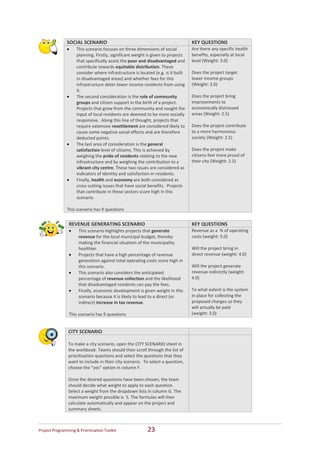
                   SOCIAL SCENARIO                                                    KEY QUESTIONS 
                   •    This scenario focuses on three dimensions of social           Are there any specific health 
                        planning. Firstly, significant weight is given to projects    benefits, especially at local 
                        that specifically assist the poor and disadvantaged and       level (Weight: 3.0) 
                        contribute towards equitable distribution. These               
                        consider where infrastructure is located (e.g. is it built    Does the project target 
                        in disadvantaged areas) and whether fees for this             lower income groups 
                        infrastructure deter lower income residents from using        (Weight: 3.0) 
                        it.                                                            
                   •    The second consideration is the role of community             Does the project bring 
                        groups and citizen support in the birth of a project.         improvements to 
                        Projects that grew from the community and sought the          economically distressed 
                        input of local residents are deemed to be more socially       areas (Weight: 2.5) 
                        responsive.  Along this line of thought, projects that         
                        require extensive resettlement are considered likely to       Does the project contribute 
                        cause some negative social effects and are therefore          to a more harmonious 
                        deducted points.                                              society (Weight: 2.5) 
                   •    The last area of consideration is the general                  
                        satisfaction level of citizens. This is achieved by           Does the project make 
                        weighing the pride of residents relating to the new           citizens feel more proud of 
                        infrastructure and by weighing the contribution to a          their city (Weight: 2.5) 
                        vibrant city centre. These two issues are considered as 
                        indicators of identity and satisfaction in residents. 
                   •    Finally, health and economy are both considered as 
                        cross cutting issues that have social benefits.  Projects 
                        that contribute in these sectors score high in this 
                        scenario. 
                    
                   This scenario has 9 questions 
 
                    REVENUE GENERATING SCENARIO                                       KEY QUESTIONS 
                    •    This scenario highlights projects that generate              Revenue as a  % of operating 
                         revenue for the local municipal budget, thereby              costs (weight: 5.0) 
                         making the financial situation of the municipality            
                         healthier.                                                   Will the project bring in 
                    •    Projects that have a high percentage of revenue              direct revenue (weight: 4.0) 
                         generation against total operating costs score high in        
                         this scenario.                                               Will the project generate 
                    •    This scenario also considers the anticipated                 revenue indirectly (weight: 
                         percentage of revenue collection and the likelihood          4.0) 
                         that disadvantaged residents can pay the fees.                
                    •    Finally, economic development is given weight in this        To what extent is the system 
                         scenario because it is likely to lead to a direct (or        in place for collecting the 
                         indirect) increase in tax revenue.                           proposed charges so they 
                                                                                      will actually be paid 
                    This scenario has 9 questions                                     (weight: 3.0) 
 
 
                   CITY SCENARIO                                                       
                                                                                       
                   To make a city scenario, open the CITY SCENARIO sheet in 
                   the workbook. Teams should then scroll through the list of 
                   prioritisation questions and select the questions that they 
                   want to include in their city scenario.  To select a question, 
                   choose the “yes” option in column F. 
                    
                   Once the desired questions have been chosen, the team 
                   should decide what weight to apply to each question. 
                   Select a weight from the dropdown lists in column G. The 
                   maximum weight possible is  5. The formulas will then 
                   calculate automatically and appear on the project and 
                   summary sheets. 


Project Programming & Prioritisation Toolkit                  23 
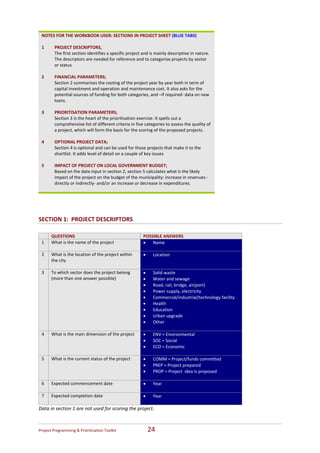
NOTES FOR THE WORKBOOK USER: SECTIONS IN PROJECT SHEET (BLUE TABS)                            
     
    1    PROJECT DESCRIPTORS,                                                                     
         The first section identifies a specific project and is mainly descriptive in nature. 
         The descriptors are needed for reference and to categorise projects by sector 
         or status   
                                                                                                  
          
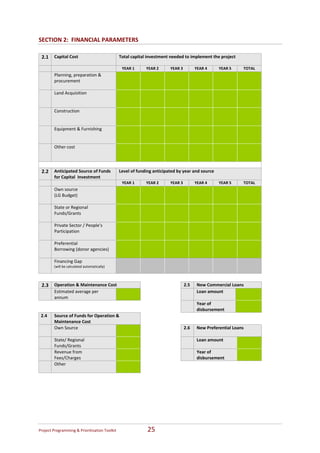
    2    FINANCIAL PARAMETERS;                                                                    
         Section 2 summarises the costing of the project year by year both in term of 
         capital investment and operation and maintenance cost. It also asks for the              
         potential sources of funding for both categories, and –if required‐ data on new 
         loans.   
                                                                                                  
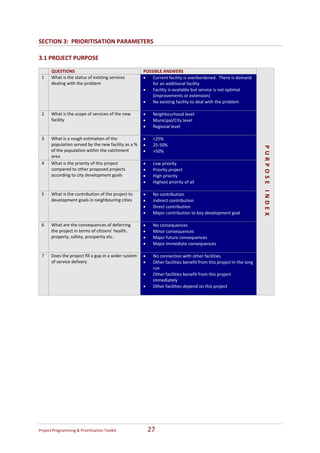
    3    PRIORITISATION PARAMETERS;  
         Section 3 is the heart of the prioritisation exercise. It spells out a                   
         comprehensive list of different criteria in five categories to assess the quality of 
         a project, which will form the basis for the scoring of the proposed projects. 
                                                                                                  
    4    OPTIONAL PROJECT DATA;  
         Section 4 is optional and can be used for those projects that make it to the             
         shortlist. It adds level of detail on a couple of key issues 
          
    5    IMPACT OF PROJECT ON LOCAL GOVERNMENT BUDGET;  
                                                                                                  
         Based on the data input in section 2, section 5 calculates what is the likely 
         impact of the project on the budget of the municipality: increase in revenues ‐          
         directly or indirectly‐ and/or an increase or decrease in expenditures.  


SECTION 1:  PROJECT DESCRIPTORS  

         QUESTIONS                                       POSSIBLE ANSWERS  
    1    What is the name of the project                 •   Name 
          
    2    What is the location of the project within      •     Location 
         the city 
          
    3    To which sector does the project belong         •     Solid waste 
         (more than one answer possible)                 •     Water and sewage 
                                                         •     Road, rail, bridge, air(port) 
                                                         •     Power supply, electricity 
                                                         •     Commercial/industrial/technology facility 
                                                         •     Health 
                                                         •     Education 
                                                         •     Urban upgrade 
                                                         •     Other 
                                                          
    4    What is the main dimension of the project       •     ENV = Environmental 
                                                         •     SOC = Social  
                                                         •     ECO = Economic  
                                                          
    5    What is the current status of the project       •     COMM = Project/funds committed 
                                                         •     PREP = Project prepared 
                                                         •     PROP = Project  idea is proposed 
                                                          
    6    Expected commencement date                      •     Year 
                                                          
    7    Expected completion date                        •     Year  
                                                          
Data in section 1 are not used for scoring the project.   


Project Programming & Prioritisation Toolkit                  24 
SECTION 2:  FINANCIAL PARAMETERS 

     2.1    Capital Cost                          Total capital investment needed to implement the project  
             
                                                      YEAR 1        YEAR 2        YEAR 3            YEAR 4         YEAR 5             TOTAL 
            Planning, preparation &                                                                                                
            procurement 
             
            Land Acquisition                                                                                                       
             
             
            Construction                                                                                                           
             
             
            Equipment & Furnishing                                                                                                 
             
             
            Other cost                                                                                                             


     2.2    Anticipated Source of Funds           Level of funding anticipated by year and source   
            for Capital  Investment 
                                                      YEAR 1        YEAR 2        YEAR 3            YEAR 4         YEAR 5             TOTAL 
            Own source                                                                                                             
            (LG Budget) 
             
            State or Regional                                                                                                      
            Funds/Grants 
             
            Private Sector / People’s                                                                                              
            Participation 
             
            Preferential                                                                                                           
            Borrowing (donor agencies) 
             
            Financing Gap                                                                                                          
            (will be calculated automatically) 
             
 
     2.3    Operation & Maintenance Cost                                                 2.5         New Commercial Loans 
            Estimated average per                                                                    Loan amount        
            annum  
                                                                                                     Year of                   
                                                                                                     disbursement 
     2.4    Source of Funds for Operation &                                                                                    
            Maintenance Cost  
            Own Source                                                                   2.6         New Preferential Loans  
                                            
            State/ Regional                                                                          Loan amount                   
            Funds/Grants 
            Revenue from                                                                             Year of                       
            Fees/Charges                                                                             disbursement 
            Other                                                                                                                  


Project Programming & Prioritisation Toolkit                         25 
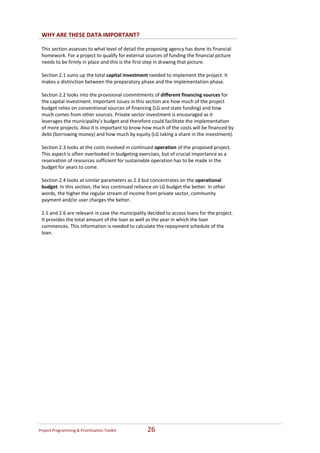
WHY ARE THESE DATA IMPORTANT?
     
    This section assesses to what level of detail the proposing agency has done its financial 
    homework. For a project to qualify for external sources of funding the financial picture 
    needs to be firmly in place and this is the first step in drawing that picture.   
     
    Section 2.1 sums up the total capital investment needed to implement the project. It 
    makes a distinction between the preparatory phase and the implementation phase. 
     
    Section 2.2 looks into the provisional commitments of different financing sources for 
    the capital investment. Important issues in this section are how much of the project 
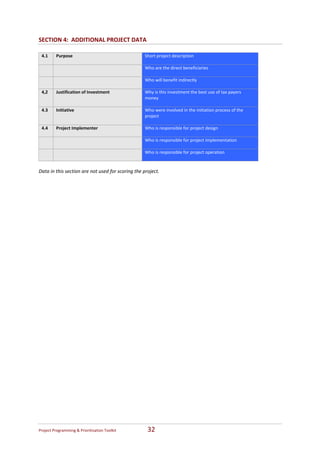
    budget relies on conventional sources of financing (LG and state funding) and how 
    much comes from other sources. Private sector investment is encouraged as it 
    leverages the municipality’s budget and therefore could facilitate the implementation 
    of more projects. Also it is important to know how much of the costs will be financed by 
    debt (borrowing money) and how much by equity (LG taking a share in the investment).  
     
    Section 2.3 looks at the costs involved in continued operation of the proposed project. 
    This aspect is often overlooked in budgeting exercises, but of crucial importance as a 
    reservation of resources sufficient for sustainable operation has to be made in the 
    budget for years to come.  
     
    Section 2.4 looks at similar parameters as 2.3 but concentrates on the operational 
    budget. In this section, the less continued reliance on LG budget the better. In other 
    words, the higher the regular stream of income from private sector, community 
    payment and/or user charges the better. 
     
    2.5 and 2.6 are relevant in case the municipality decided to access loans for the project. 
    It provides the total amount of the loan as well as the year in which the loan 
    commences. This information is needed to calculate the repayment schedule of the 
    loan.  


Project Programming & Prioritisation Toolkit         26 
SECTION 3:  PRIORITISATION PARAMETERS  

3.1 PROJECT PURPOSE  
       QUESTIONS                                        POSSIBLE ANSWERS  
 1     What is the status of existing services          •   Current facility is overburdened.  There is demand 
       dealing with the problem                             for an additional facility  
                                                        •   Facility is available but service is not optimal 
                                                            (improvements or extension) 
                                                        •   No existing facility to deal with the problem 
                                                         
 2     What is the scope of services of the new         •   Neighbourhood level 
       facility                                         •   Municipal/City level 
                                                        •   Regional level   
                                                         
 3     What is a rough estimation of the                •   <25% 
       population served by the new facility as a %     •   25‐50% 


                                                                                                                      PURPOSE INDEX 
       of the population within the catchment           •   >50% 
       area                                              
 4     What is the priority of this project             •   Low priority   
       compared to other proposed projects              •   Priority project 
       according to city development goals              •   High priority 
                                                        •   Highest priority of all  
                                                         
 5     What is the contribution of the project to       •   No contribution   
       development goals in neighbouring cities         •   Indirect contribution  
                                                        •   Direct contribution   
                                                        •   Major contribution to key development goal 
                                                         
 6     What are the consequences of deferring           •   No consequences    
       the project in terms of citizens’ health,        •   Minor consequences  
       property, safety, prosperity etc.                •   Major future consequences 
                                                        •   Major immediate consequences  
                                                         
 7     Does the project fill a gap in a wider system    •   No connection with other facilities   
       of service delivery                              •   Other facilities benefit from this project in the long 
                                                            run 
                                                        •   Other facilities benefit from this project 
                                                            immediately 
                                                        •   Other facilities depend on this project  


Project Programming & Prioritisation Toolkit              27 
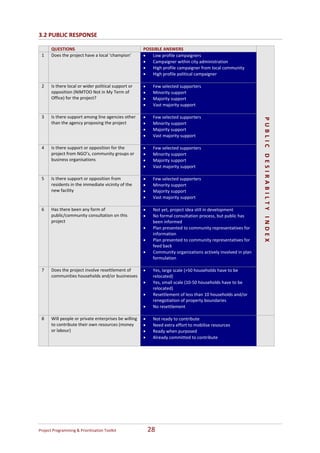
3.2 PUBLIC RESPONSE 

       QUESTIONS                                      POSSIBLE ANSWERS  
 1     Does the project have a local ‘champion’       •   Low profile campaigners  
                                                      •   Campaigner within city administration 
                                                      •   High profile campaigner from local community 
                                                      •   High profile political campaigner  
                                                       
 2     Is there local or wider political support or   •   Few selected supporters 
       opposition (NIMTOO Not in My Term of           •   Minority support 
       Office) for the project?                       •   Majority support 
                                                      •   Vast majority support 
                                                       
 3     Is there support among line agencies other  •      Few selected supporters 


                                                                                                                   PUBLIC DESIRABILTY INDEX
       than the agency proposing the project          •   Minority support 
                                                      •   Majority support 
                                                      •   Vast majority support 
                                                       
 4     Is there support or opposition for the         •   Few selected supporters 
       project from NGO’s, community groups or        •   Minority support 
       business organisations                         •   Majority support 
                                                      •   Vast majority support 
                                                       
 5     Is there support or opposition from            •   Few selected supporters 
       residents in the immediate vicinity of the     •   Minority support 
       new facility                                   •   Majority support 
                                                      •   Vast majority support 
                                                       
 6     Has there been any form of                     •   Not yet, project idea still in development 
       public/community consultation on this          •   No formal consultation process, but public has 
       project                                            been informed 
                                                      •   Plan presented to community representatives for 
                                                          information 
                                                      •   Plan presented to community representatives for 
                                                          feed back 


                                                      •   Community organizations actively involved in plan 
                                                          formulation 
                                                         
 7     Does the project involve resettlement of       •   Yes, large scale (>50 households have to be 
       communities households and/or businesses           relocated) 
                                                      •   Yes, small scale (10‐50 households have to be 
                                                          relocated) 
                                                      •   Resettlement of less than 10 households and/or 
                                                          renegotiation of property boundaries 
                                                      •   No resettlement 
                                                       
 8     Will people or private enterprises be willing  •   Not ready to contribute                               
       to contribute their own resources (money       •   Need extra effort to mobilise resources 
       or labour)                                     •   Ready when purposed 
                                                      •   Already committed to contribute 


Project Programming & Prioritisation Toolkit           28 
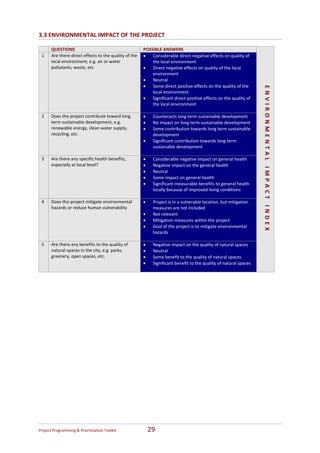
3.3 ENVIRONMENTAL IMPACT OF THE PROJECT 
 
         QUESTIONS                                         POSSIBLE ANSWERS  
    1    Are there direct effects to the quality of the    •   Considerable direct negative effects on quality of 
         local environment, e.g. air or water                  the local environment   
         pollutants, waste, etc.                           •   Direct negative effects on quality of the local 
                                                               environment  
                                                           •   Neutral  
                                                           •   Some direct positive effects on the quality of the 


                                                                                                                        ENVIRONMENTAL IMPACT INDEX
                                                               local environment 
                                                           •   Significant direct positive effects on the quality of 
                                                               the local environment  
                                                            
    2    Does the project contribute toward long           •   Counteracts long term sustainable development  
         term sustainable development, e.g.                •   No impact on long term sustainable development  
         renewable energy, clean water supply,             •   Some contribution towards long term sustainable 
         recycling, etc.                                       development  
                                                           •   Significant contribution towards long term 
                                                               sustainable development 
                                                            
    3    Are there any specific health benefits,           •   Considerable negative impact on general health  
         especially at local level?                        •   Negative impact on the general health 
                                                           •   Neutral 
                                                           •   Some impact on general health  
                                                           •   Significant measurable benefits to general health 
                                                               locally because of improved living conditions 
                                                            
    4    Does this project mitigate environmental          •   Project is in a vulnerable location, but mitigation 
         hazards or reduce human vulnerability                 measures are not included 
                                                           •   Not relevant  
                                                           •   Mitigation measures within the project 
                                                           •   Goal of the project is to mitigate environmental 
                                                               hazards 


    5    Are there any benefits to the quality of          •   Negative impact on the quality of natural spaces  
         natural spaces in the city, e.g. parks,           •   Neutral 
         greenery, open spaces, etc.                       •   Some benefit to the quality of natural spaces 
                                                           •   Significant benefit to the quality of natural spaces 


Project Programming & Prioritisation Toolkit                 29 
3.4 SOCIO‐ECONOMIC IMPACT OF THE PROJECT 
 
          QUESTIONS                                        POSSIBLE ANSWERS  
     1    What is the expected impact of the project       •   Decrease in local business/industry 
          on local economic development                    •   Neutral or no measurable effects 
                                                           •   Minor increase in the growth and expansion of small 
                                                               businesses 
                                                           •   Major increase in the growth and expansion of small 
                                                               businesses 
                                                           •   Potential to attract new large scale business/industry 
                                                            
     2    Are there indirect economic benefits from        •   Negative impact on the local economy  
          this project in the long term, e.g. increase in  •   Little or no long term economic development benefits 
          land/property prices, reduction to citizens      •   Downstream business generation with possible financial 
          expenditures, etc.                                   benefits and value transfer to citizens  
                                                           •   Additional investment in the area and increased wealth for 
                                                               citizens 
                                                           •   Significant competitive advantage to industry and boost to 
                                                               the local economy 


                                                                                                                                  SOCIO‐ECONOMIC IMPACT INDEX
     3    Does the project make use of locally             •   Majority of material and labour will need to be imported 
          available resources                              •   All labour can be sourced locally but some materials will 
                                                               have to be imported 
                                                           •   All materials can be sourced locally but some labour will 
                                                               have to be imported 
                                                           •   All material and labour will be sourced locally 
                                                            
     4    Does the project bring improvements to           •   Neutral/no measurable effect  
          economically distressed areas                    •   No specific objective but has positive impact on quality of 
                                                               life  
                                                           •   No specific objective but has positive impact on investment  
                                                           •   Specifically targeted at economically distressed area 
                                                            
     5    Does the project target lower income groups  •       No benefit for lower income groups from the new facility  
                                                           •   No specific pro‐poor focus but increased quality of life for 
                                                               lower income groups  
                                                           •   No specific pro‐poor focus but increased employment 
                                                               opportunities for lower income groups 
                                                           •   The project specifically targets lower income groups 
                                                            
     6    Are the proposed charges affordable for          •   Middle income groups can afford the proposed charges 
          those who need to pay them                       •   Lower and middle income groups can afford the proposed 
                                                               charges 
                                                           •   The poor can afford the proposed charges 


                                                           •   No charges for use of the facility 
                                                            
     7    Does the project contribute to a  more           •   No, side effects of the project will exclude certain groups  
          harmonious society                               •   Neutral 
                                                           •   Yes, side effects of the project will benefit minority groups 
                                                            
     8    Does the project contribute to a more            •   Neutral/no measurable effect 
          vibrant city centre                              •   No specific focus but positive impact on quality of life in the 
                                                               city centre  
                                                           •   No specific focus but will generate some investment in city 
                                                               centre 
                                                           •   Specifically targeted at revitalisation of city centre  
                                                            
     9    Does the project make citizens feel more         •   Neutral  
          proud of their city                              •   Yes 
                                                           •   Yes, very much 


Project Programming & Prioritisation Toolkit                30 
3.5 FEASIBILITY OF PROJECT IMPLEMENTATION 
 
    QUESTIONS                      POSSIBLE ANSWERS  
 1       Has funding been secured within the local    •   No allocation made in local government budget 
         government budget for this project           •   No need , all costs are covered by state/regional budget 
                                                      •   Yes, to cover part of the costs of the project     
                                                      •   Yes, to cover the complete costs of the project 
                                                       
 2       Has funding been secured from external       •   No need for external sources of funding 
         funding sources and/or is there potential    •   Potential for securing state/regional grant 
         for external funding                         •   Potential for preferential borrowing 
                                                      •   Potential for private sector investment 
                                                      •   State/regional grant already secured 
                                                      •   Preferential loan already secured 
                                                      •   Private sector already committed 


                                                                                                                          FEASIBILITY INDEX 
                                                       
 3       Will the project bring in direct revenue     •   No direct revenue 
                                                      •   Direct revenue is negligible 
                                                      •   Revenue meets operations and maintenance costs  
                                                      •   Revenue exceeds operations and maintenance costs 
                                                       
 4       Will the project generate revenue            •   No indirect revenue 
         indirectly                                   •   Minimal (Increase in local tax base of up to 5%) 
                                                      •   Moderate (Increase in local tax base of  5‐10%) 
                                                      •   Significant (Increase in local tax base of over 10%) 
                                                       
 5       Will the project decrease current budget     •   Increase in current cost 
         costs                                        •   No cost savings  
                                                      •   Contribution to cost savings in long term 
                                                      •   Immediate cost savings 
                                                       
 6     To what extent is the system in place for      •   <60 % of fees will be collected 
       collecting the proposed charges so they        •   60‐90% of fees will be collected 
       will actually be paid                          •   >90% of fees will be collected  
                                                      •   No fees will be charged for this facility 
                                                       
 7       Is there a capable system in place to        •   Outside expertise needed for construction, O&M 
         implement and operate this project or is     •   Outside expertise needed for construction phase only  
         external support needed                      •   Outside expertise needed for preparation phase i.e. 
                                                          feasibility studies  
                                                      •   No outside expertise needed 
                                                       
 8     Could financial/economic factors pose a        •   High risk                                                    
       risk to this project's                         •   Medium risk 
       completion/sustainability                      •   Low risk 
                                                      •   No risk 
                                                       
 9     Could political factors pose a risk to this    •   High risk                                                    
       project's completion                           •   Medium risk 
                                                      •   Low risk 
                                                      •   No risk 
                                                       
 10  If there is risk, does the project design        •   No strategy yet                                              
     include a risk mitigation strategy               •   Strategy in development 
                                                      •   Yes, strategy exists 
                                                      •   No risk 


Project Programming & Prioritisation Toolkit           31 
SECTION 4:  ADDITIONAL PROJECT DATA 
 
    4.1     Purpose                                 Short project description 
                                                     
                                                    Who are the direct beneficiaries 
                                                     
                                                    Who will benefit indirectly 
                                                     
    4,2     Justification of Investment             Why is this investment the best use of tax payers 
                                                    money 
                                                     
    4.3     Initiative                              Who were involved in the initiation process of the 
                                                    project 
                                                     
    4.4     Project Implementer                     Who is responsible for project design 
                                                     
                                                    Who is responsible for project implementation 
                                                     
                                                    Who is responsible for project operation 
                                                     
 
Data in this section are not used for scoring the project.   


Project Programming & Prioritisation Toolkit         32 
SECTION 5:  IMPACT OF PROJECT ON GOVERNMENT BUDGET   
 
    Section 5 is a set of tables that calculate the likely impact of each individual 
    project on the future municipal budget.  It looks into:  
    • increase in annual debt service as a result of news loans,  
    • increase in revenue as a result of direct income through fees charges as 
        well as indirect income through an increase in the tax base 
    • increase in expenditures as a result of higher operation & maintenance 
        costs 


    5.1    NEW COMMERCIAL LOANS                     est.                                forecast 
                                                   2008     2009   2010   2011   2012     2013 2014    2015    2016    2017
     A     Initial value of the loan                                                                       
     B     Nett value of the loan                                                                          
     C     Interest payment                                                                                
     D     Principal payment                                                                               

    5.2    NEW PREFERENTIAL LOANS                   est.                                forecast 
                                                   2008     2009   2010   2011   2012     2013 2014    2015    2016    2017
     A     Initial value of the loan                                                                       
     B     Net value of the loan                                                                           
     C     Interest payment                                                                                
     D     Principal payment                                                                               

    5.3  EST. ADDITIONAL REVENUE                    est.                                forecast 
                                                   2008     2009   2010   2011   2012     2013 2014    2015    2016    2017
     A  General revenue                                                                                    
     B  User charges & fees                                                                                

    5.4  EST. ADDITIONAL EXPENDITURES               est.                                forecast 
                                                   2008     2009   2010   2011   2012     2013 2014    2015    2016    2017
     A  Operation & Maintenance                                                                            
     B  Debt service                                                                                       


           ORIGINAL LOCAL GOVERNMENT BUDGET FORECAST (FROM FORECAST SHEET) 
    5.5    SUMMARY INVESTMENT CAPACITY              est.                                forecast 
                                                   2008     2009   2010   2011   2012     2013 2014    2015    2016    2017
     A     Projected Revenues                                                                              
     B     Projected Operating Expenditures                                                                
     C     Projected Operating surplus/deficit                                                             
     D     Projected Investment Budget                                                                     
     E     Estimated Debt Servicing Capacity                                                               

           IMPACT OF PROJECT ON BUDGET FORECAST                                                                         
    5.6    IMPACT ON INVESTMENT CAPACITY            est.                             forecast 
                                                   2008     2009   2010   2011   2012 2013 2014        2015    2016    2017
     A     Project Impact on Revenues                                                                      
     B     Project Impact on Expenditures                                                                  
     C     Project Impact on operating  surplus                                                            
     D     Project impact on investment budget                                                                              


Note:   ‐ All tables are calculated automatically, no need for new data input.  
        ‐ Graphs have been added in the workbook to make it easier for the user to interpret the data. 
        ‐ On the next two pages the content of each tables will be explained 


Project Programming & Prioritisation Toolkit                33 
Table 5.1 and 5.2 
 In case it is necessary to access loans to realise the project, these tables make 
 an estimation of what the likely annual repayment schedule will be in the years 
 to come. The repayment schedule is based on: 
 • total amount of the credit/loan  
 • year of disbursement (commencement of the loan) 
 • interest rate  
 • maximum term of the loan  
  
 The first two data are imported from table 2.5 and 2.6 (see page 20), while the 
 interest rate and the loan term are imported from the ASSUMPTIONS section 
 in the BUDGET FORECAST sheet, see page 16). The calculation is based on 
 linear repayment of the loan, assumed a fixed interest rate and does not take 
 into account any grace period. Annual interest payment is calculated as a 
 percentage of the average value of the loan outstanding (half of the loan 
 outstanding from the previous year plus loan outstanding from the year for 
 which the interest payment is calculated). 
  
 To determine the debt service, annual principal and interest payment are 
 summed up and automatically transferred to table 5.4. 
  
 Table 5.3 
 This table provides a rough estimation of the impact of each project on the 
 sources of revenue for the municipality on an annual basis. Two categories are 
 distinguished: 
 1. direct income from fees charged for the use of the new facility 
 2. indirect income through an increase in tax base. 
  
  
 1. DIRECT INCOME FROM FEES & CHARGES 
 The calculation is based on two assumptions that have been put in by the 
 technical team: the anticipated income from fees & charges and the collection 
 efficiency of those fees & charges:  
  
                FORMULA                              DATA SOURCE 
                                                               
          ANTICIPATED DIRECT INCOME               Imported from table 2.4, 
           FROM FEES AND CHARGES 
                        
                      X                                         
                                                                
         COLLECTION EFFICIENCY OF FEES            See question 6 in section 
                 AND CHARGES                        3.5  feasibility index, 
                                                                
                       =                                        
                                                                
            ANTICIPATED ADDITIONAL 
                DIRECT REVENUE 
                         
  
 Example: 
 If the expected revenue from a waste transfer station is 40.000 US$ and it is 
 estimated that the collection efficiency is 60%‐90% then the anticipated 
 additional direct revenue is 40.000 US$ * 75% = 30.000 US$  


Project Programming & Prioritisation Toolkit                     34 
2. INDIRECT INCOME THROUGH INCREASE IN TAX BASE 
 The calculation us based on a number of assumptions: 
 • only half of the locally collected taxes are impacted by the project  
 • there is a four year delay between the project completion and the impact 
      on the tax base 
 • the collection efficiency of local taxes is about 50% 
  
 Note:  If local conditions differ significantly from the above, these assumptions can be changed 
 manually in table 2.4 of the ASUMPTIONS section in the BUDGET FORECAST SHEET. 
  
                 FORMULA                          DATA SOURCE 
                                                   
            GENERAL REVENUE INCOME                Imported from BUGDET  FORECAST 
                                                  sheet, table 1.1 row A 
                        X                          
                                                   
             ANTICIPATED IMPACT ON                See question 4 in section 3.5  
                GENERAL REVENUE                   feasibility index 
                                                   
                        X                          
                                                   
              LOCAL TAX COLLECTION                Imported from table 2.4 
                   EFFICIENCY                     ASSUMPTIONS in BUDGET 
                                                  FORECAST sheet  
                       X                           
                                                   
         % OF LOCAL TAXES IMPACTED BY             Imported from table 2.4 
                 THE PROJECT                      ASSUMPTIONS in BUDGET 
                                                  FORECAST sheet  
                       =                           
                                                   
              ESTIMATED ADDITIONAL 
                GENERAL REVENUE 
                         
  
 Example: if the technical team estimates that new transport link (to be 
 completed in 2010) will result in the increase of the locally collected taxes of 5‐
 10%, the impact will only become noticeable from 2014 onwards. If the 
 forecasted general revenue in the year 2014 was 20.000 US$, the estimated 
 additional general revenue resulting from the project in 2015 will be 20.000 
 US$ X 7.5% x 50% X 50% =  375 US$. 
  
 Table 5.4 
 This table provides a rough estimation of the impact of each project on the 
 sources of expenditures of the municipality on an annual basis. This largely 
 concerns two categories: 
 1. Increase in operation & maintenance cost 
      The increase in operation & maintenance cost (transferred from table 2.3).
 2. Increase in debt service  
      The debt service is dependant on whether or not the municipality decides 
      to access loans to realise the project. If applicable, the estimated increase 
      in annual debt service is transferred from table 5.1 and 5.2. 
  
 Table 5.5 
 This table is a copied directly from the BUDGET FORECAST SHEET 
  
 Table 5.6 and graph 1 
 This table adds the additional sources of revenue and expenditures to the 
 budget forecast and calculates a new budget forecast as well as a new 
 projection of the available investment budget. Graph 1 shows the impact of 
 the project on the investment budget using data from table 5.5 and 5.6. 


Project Programming & Prioritisation Toolkit                  35 
GRAPH 1: IMPACT OF PROJECT ON INVESTMENT CAPACITY

   80
            Original Investment Budget
   70
            Project Impact on Investment Budget

   60

   50

   40

   30

   20

   10

    0
          2005 2006 2007 2008 2009 2010 2011 2012 2013 2014 2015 2016 2017 2018


    5.7     FUNDING SOURCE CAPITAL                                                    forecast 
            INVESTMENT 
                                                  2009    2010    2011    2012     2013    2014    2015    2016    2017    TOTAL 
     A      Own source                                                                                                        
     B      State/Regional Funds & Grants                                                                                     
     C      Private Sector/People’s  Contr.                                                                                   
     D      Preferential Borrowing                                                                                            
     E      Financing Gap                                                                                                     
            Total                                                                                                             


    5.8     CAPITAL EXPENDITURE                                                   forecast 
                                                  2009    2010    2011    2012      2013  2014     2015    2016    2017 
     A      Capital Investment                                                                                        
     B      Existing Expenditures                                                                                     
     C      Expenditure Limit                                                                                         


    5.9     CAPITAL EXPENDITURE                                                   forecast 
                                                  2009    2010    2011    2012      2013  2014     2015    2016    2017 
     A      New Loans                                                                                                 
     B      Existing Debt Service                                                                                     
     C      Est. Max. Debt Service Capacity                                                                           


 Table 5.7 
 This table shows the anticipated sources of funds of the project. It contains 
 essentially the same information as table 2.2 
  
 Table 5.8 and Graph 2 
 This table looks into the capital cost of the project in relation to the available 
 investment budget. The red line indicates the investment ceiling, so should the 
 purple part of the bar (the proposed project) hit the line, this indicates there is 
 no room available in the municipal investment budget. 
  
 Table 5.9 and Graph 3 
 This table looks at the volume of the anticipated loan in relation to the 
 estimated debt ceiling. The underlying assumption is that the municipality can 
 borrow up to 50% of the net operating surplus (see table 2.6 in ASSUMPTIONS 
 section in BUDGET FORECAST sheet). 


Project Programming & Prioritisation Toolkit                36 
GRAPH 2: CAPITAL INVESTMENT REQUIRED VERSUS 
                           EXPENDITURE LIMIT 
   800
                     Capital Investment

   700               Existing Expenditures

                     Expenditure Limit
   600

   500

   400

   300

   200

   100

      0
           2009     2010      2011        2012      2013     2014    2015    2016    2017


                            GRAPH 3: LOANS REQUIRED VERSUS 
                                DEBT SERVICE CAPACITY  
   100
                      New Loans
    90
                      Existing Debt Service
    80                Estimated Max. Debt Service Capacity
    70
    60
    50
    40
    30

    20
    10
     0
           2009     2010      2011           2012   2013     2014     2015    2016    2017


Project Programming & Prioritisation Toolkit                         37 
GUIDANCE FOR THE FACILITATOR 
  
 A: CHECK ASSUMPTIONS & BUILT‐IN SCENARIOS 
 Before commencing the prioritisation exercise the facilitator should: 
 • Check the assumptions that underpin the excel workbook. The assumptions include 
      data on inflation, GDP growth, interest and exchange rate, typical lending 
      conditions, debt ceiling, tax collection efficiency, % of operating surplus for 
      strategic investment projects etc. Each of these indicators has a default setting but 
      this can be adjusted easily to reflect local circumstances. If no changes are made 
      the default settings will be used.  
 • Study the weights allocation in the built‐in scenarios. In case these do not properly 
      reflect the city development objectives the facilitator should encourage the team 
      to develop CITY scenario  
  
 B: KEY IN DATA FOR EACH PROJECT  ON THE WISHLIST  
 First task is for the technical team to key in all data for each proposed project. Only 
 section 1, 2 and 3 require manual data‐input. Section 4 is optional and section 5 is 
 calculated automatically. This exercise is best done in a plenary session whereby the 
 excel workbook is displayed on a screen and the facilitator guides the discussion and 
 keys in the data. Depending on the availability of data and concurrence within the team 
 on the questions the input for each project should take approximately half an hour.  
 Remember that each proposal on the wish list must meet two basic criteria: 
 1. It should be an investment project  
 2. It should be a municipal project  
  
 C: REVIEW SUMMARY SHEET AND REVISE SCORES   
 The summary sheet provides a one‐page overview of the scores of each project on each 
 index and for each scenario. Because al scores have been normalized it is easy to 
 compare the scores of projects. The summary sheet also gives scores on a number of 
 financial parameters. When pressing the ‘SORT PROJECTS’ button on any column, the 
 projects are automatically sorted with the highest score in each category first. 
     
 The team now has the opportunity to discuss the scores of the projects. The scenarios 
 can help but the main point of reference should always be the city development goals. 
 If the team questions why a particular project has come out higher than another one, 
 they can simply go back to the project sheet and check if they’re comfortable the 
 selected answers. The answers can be adjusted. Only when the team is happy with the 
 scores of each individual project, it is time to move to the next step: short listing. 
  
 Note: It may help if the facilitator highlight highest and second highest scores in summary sheet   
  
 D: SHORTLIST PROJECTS FOR EACH CATEGORY    
 The team now has to decide on a ranking. This is best done in the plenary session with 
 the whole technical team present. This ranking session could also include a broader 
 audience with for example community representatives. There are several ways to do 
 this. The team could decide to follow one particular scenario and simply adopt the 
 ranking according to that scenario. Alternatively the ranking can be decided by voting. 
 Each individual team members can each submit their own ranking –which does not 
 necessarily have to correspond to the summary sheet ranking) to the facilitator who will 
 then calculate the ‘winning ‘projects based on the highest number of votes.  
  
 The facilitator will manually key in the ranking in column B of the summary sheet. When 
 pressing the SORT button, the projects will automatically be displayed with the highest 
 ranking one first. 
  
 Note: The excel sheet does not provide an automatic ranking. The ranking in column B is the result 
 of manual input   


Project Programming & Prioritisation Toolkit            38 
HOW TO INTERPRET THE SUMMARY SHEET? 
 
                                                                                            5‐year investment budget 
                            Sort by ranking                                                 (calculated automatically) 


          Project names                                  Index scores    Scenario scores           Financial parameters 


Project Programming & Prioritisation Toolkit       39 
STEP 3  
             PROGRAMMING 
                       FOR 
               INVESTMENT  
                                                                                 
                                                                                 
                    ‘Don’t tell me where your priorities are. 
                    Show me where you spend your money 
                                                  and I’ll tell you what they are’ 


Project Programming & Prioritisation Toolkit           40 
STEP 3      PROGRAMMING FOR INVESTMENT  

    WHAT IS A PRIORITY INVESTMENT PACKAGE? 
    A Priority Investment Package (PIP) is a medium term plan for public investment in the 
    municipality. It sets direction for development and proposes a package of investments 
    that are of crucial importance for the development of the city. It identifies how much 
    fiscal space the government has to invest and to carry the debt of a potential project, 
    and also maps out clearly the alternative financing possibilities. The goal is to eventually 
    arrive at a package of priority project(s) that fit comfortably within the available 
    financial envelope of the local government.    
     
    The PIP brings together the results of step 1 and 2: the financial capacity on one hand 
    and the proposed projects on the other hand. It is very likely that total cost of the 
    projects in the wish list is higher than the possible sources of financing. Yet, since the 
    projects have been listed in order of priority, funding can be assigned to them 
    accordingly. In this manner, the highest priority projects, that is, those that address the 
    most important community needs are funded first. 


      INVESTMENT BUDGET                                     SHORTLIST PROJECTS 

                  1                                                         2
                                                                II   PROJECT SCORING 
         I    ASSESSMENT FINANCING 
         CAPACITY  & FINANCIAL                                  ‐SOCIAL
         SYSTEM                                                 ‐ENVIRONMENTAL 
                                                                ‐ECONOMIC
                                                                ‐REVENUE GENERATING 


                                   PROJECT PACKAGES 

                                              3
                                   III     MATCHING PROJECTS 
                                   WITH GOVERNMENT  
                                   BUDGET IN ORDER OF 
                                   PRIORITY


Project Programming & Prioritisation Toolkit              41 
REACHING OUT: POLICY MEETING  
 The outcome of step 2 is taken as a starting point: a shortlist of priority projects. 
 Now these priority projects have to be translated into priority investment packages. 
 This packaging exercise ideally takes the shape of a policy meeting (or series of policy 
 meetings) whereby technical people, decision‐makers, council members, local 
 entrepreneurs, NGO’s and community representatives come together to jointly decide 
 on the best possible investment package.  
  
 To prepare for this meeting a number of alternative investment packages have to be 
 put together for the participants to choose from. These packages are best prepared in a 
 small group with key representatives of the financial and technical team together with 
 the facilitator.   
  
 In the excel workbook are three PROGRAMMING sheets that assist the teams in putting 
 together these investment packages. Simply by clicking a yes/no button in each project 
 sheet, data from these projects sheets are transferred into a FINAL sheet, which has the 
 format of 5‐year investment plan. Projects should be selected based on the order of 
 priority until the investment ceiling is reached. Now it is clear how many projects fit in 
 the financial envelope of the municipality.  
  
 This is the starting point for the programming exercise, a base to start a discussion to 
 see if other/more projects can be added by: 
 ‐ postponing projects or bring them forward in time 
 ‐ finding alternative sources of financing  
  
 The team then can start to make changes to the individual PROJECT sheets which are 
 automatically reflected in the PROGRAMMING sheets. As such the team can put 
 together a range of possible packages. The next pages provide a set of guidelines for the 
 facilitator to direct the team through the process.


                                                              STARTING POINT:

                                                              WISH LIST
                                                              POTENTIAL
                                                              PROJECTS


                                                              FIRST STEP:

                                                              STRUCTURED
                                                              LIST OF
                                                              PROJECTS


                                                              RESULT:

                                                              ALTERNATIVE
                            OR                    OR          INVESTMENT
                                                              PACKAGES


Project Programming & Prioritisation Toolkit            42 
GUIDANCE FOR THE FACILITATOR 

 A: SELECT PROJECTS  
 The first task is to import the data from the project sheets into the programming 
 sheets. This is done simply by clicking the button ‘INCLUDE PROJECT IN INVESTMENT 
 PLAN’ on the project sheet ranking list. The team starts with the COMITTED projects 
 than the PREPARED projects followed by the PROPOSED projects. Projects should be 
 added one by one in order of priority using the ranking list in the summary sheet.  
 Alternatively, all projects can be added to the FINAL sheet irrespective of their status. 
  
 The excel workbook automatically sums up the required investment for each project 
 and calculates the impact on investment budget available and the maximum debt 
 service. Graph 1& 2 help the team by visualising the impact. Graph 1 shows the capital 
 investment required for the projects versus the expenditure limit. If the bar hits the red 
 line it means that the investment ceiling has been reached.  Graph 2 shows the debt 
 ceiling, meaning that the bar indicating the annual debt service cannot go beyond the 
 red line.   
  
 After adding a new project the team should check the funds remaining after budget 
 allocation. If balance after investment is positive another project can be added, until 
 the budget is exhausted. This package is the standard investment package and this is 
 the time to save this file as INVESTMENT PACKAGE 1. 
  
 B: MODIFY PROJECT DATA   
 Now the team can start playing around with the package. The objective is to create 
 fiscal room for additional projects by changing the data in the individual project sheets: 
   
 • What happens if the loan amount for a particular project is increased? 
 • What happens if private sector funding is accessed for a particular project? 
 • What happens if we try to source alternative sources of funding? 
 • What happens if the starting date of a project is brought forward or is postponed? 
  
 Again the graphs in the spreadsheet help the team to put together a balanced package. 
 Graph 1 and 2 will send alarm bells ringing once the maximum value for investment or 
 loans has been reached in a particular year.  
  
  
 C: DEVELOP ALTERNATIVE PACKAGES    
 Once the team has put together a new possible package, the file should be saved as 
 INVESTMENT PACKAGE 2. In this way the team can create a number of packages each 
 with their own advantages disadvantages and consequences. Rather than relying on the 
 municipal budget for project funding, the team is encouraged to think creatively. As 
 much as possible the own sources should be considered as the municipality’s potential, 
 its own contribution in order to receive external funds. 


   NOTES FOR THE WORKBOOK USER: 
    
   - Step 3 ‘Programming for Investment’ refers to the section in the 
      workbook with the green tabs.  
    
   - There are three sheets: COMMITTED, PREPARED and PROPOSED. All 
      information in these sheets is calculated automatically, no need for 
      manual input.  


Project Programming & Prioritisation Toolkit          43 
EXAMPLE PRIORITY INVESTMENT PACKAGE

5 YEAR PLAN ‐ FINAL PROJECTS                                                               NPR in millions

                                                                        2009        2010            2011          2012            2013             TOTAL        TOTAL (USD)

Total Committed Capital Investment                                      20,0        11,6             39,6         105,0            99,6                326                4,0
Total Capital Investment (own source)                                    10          16              44             32              25                    127              0,0
State or Regional Funds & Grants                                         0           20              20             30              20                     90              0,0
Private Sector Investment                                                0           0                0              0               0                     0               0,0
Commercial Borrowing                                                     0           0                0              0               0                     0               0,0
Preferential Borrowing                                                   10          10              10             10              10                     50             12,5
Financing Gap                                                            0           ‐34             ‐34            33              45                     9               0,0


Expenditure Ceiling                                                     737         786              839           895              941
Existing Expenditures                                                   636         682              731           786              831
Estimated Financing Capacity                                             51          52              54             55              55
Existing Annual Debt Service                                             20          19              20             21              20
New Loans: Annual Debt Service                                           10          10              10             10              10                     50               1
Estimated Max Debt Service                                               25          26              27             27              28


FUNDS AVAILABLE AFTER FINAL INVESTMENTS                                  41          36              10             23              30                 140                1,7


Teku SW Transfer Station                                                       0               6             6              0               0              12              0,1
Own source                                                                     0               6             6              0               0              12              0,0
State or Regional Funds & Grants                                               0               0             0              0               0              0               0,0
Private Sector Investment                                                      0               0             0              0               0              0               0,0
Commercial Borrowing                                                           0               0             0              0               0              0               0,0
Preferential Borrowing                                                         0               0             0              0               0              0               0,0
Financing Gap                                                                  0               0             0              0               0              0               0,0


Annual Debt Service New Loans                                                  0               0             0              0               0              0               0,0


New Balaju South Transfer Station                                              0               0            28            22               15              65              0,8
Own source                                                                     0               0            28            22               15              65              0,8
State or Regional Funds & Grants                                               0               0             0              0               0              0               0,0
Private Sector Investment                                                      0               0             0              0               0              0               0,0
Commercial Borrowing                                                           0               0             0              0               0              0               0,0
Preferential Borrowing                                                         0               0             0              0               0              0               0,0
Financing Gap                                                                  0               0             0              0               0              0               0,0


Annual Debt Service New Loans                                                  0               0             0              0               0              0               0,0


Junction Improvement Project                                                   20              16           16            93               95             239              3,0
Own source                                                                     10              10           10            10               10              50              0,6
State or Regional Funds & Grants                                               0               20           20            30               20              90              1,1
Private Sector Investment                                                      0               0             0              0               0              0               0,0
Commercial Borrowing                                                           0               0             0              0               0              0               0,0
Preferential Borrowing                                                         10              10           10            10               10              50              0,6
Financing Gap                                                                  0            ‐34             ‐34           33               45              9               0,1


Annual Debt Service New Loans                                                  10              10           10            10               10              50              0,6


                           GRAPH 1: CAPITAL INVESTMENT VERSUS 
                                                                                                              GRAPH 2: LOANS REQUIRED VERSUS 
                                    EXPENDITURE LIMIT 
                                                                                                                  DEBT SERVICE CAPACITY  

                         Total Capital Investment (own source)                            50
1.000
                         Existing Expenditures                                                                    Existing Annual Debt Service
                                                                                          45
 900                     Expenditure Ceiling                                                                      New Loans: Annual Debt Service
                                                                                          40
 800                                                                                                              Estimated Max Debt Service

                                                                                          35
 700
                                                                                          30
 600
                                                                                          25
 500
                                                                                          20
 400
                                                                                          15
 300
                                                                                          10
 200
                                                                                           5
 100
                                                                                           0
    0
                                                                                                    2009          2010            2011             2012            2013
             2009               2010             2011            2012   2013


Project Programming & Prioritisation Toolkit                                  44 
EXAMPLE 
                                                         PROJECTS 


Project Programming & Prioritisation Toolkit       45 
EXAMPLE:  PROJECT CASE STUDIES IN NEPAL  
     
    The following pages give some background on example projects in Kathmandu. They are meant 
    to help illustrate the use of the toolkit in project prioritisation on local level. The information is 
    based on the summary report of the CDIA team in Kathmandu (June 2009). 


PROJECT: WASTE TRANSFER STATIONS  
                                                                                      Potential Sites for Additional Transfer Station
Historically waste was composted by each household, and 
used in their fields. Since then societal changes result in some 
of the city's waste being dumped along rivers. This has 
significantly contributed to the very poor state of the city’s 
main transport corridor and has narrowed the width of the 
river channel. The existing banks are mostly waste. 
 
Presently the city has only one waste transfer facility at Teku. 
Urban development now surrounds this facility and residents 
continually complain about the operations, citing bad smell 
and windblown waster as their major concerns.  
 
Three possible alternatives were proposed to deal with the 
city’s increasing waste problem: 
‐improvement of the existing facility at Teku 
‐establishment of a new station at Balaju South 
‐establishment of a new station at Balaju North   
 

    Total Estimated Project Cost:
    Teku                 11.5 milj NPR (US$ 151.000) 
    Balaju South         65.4 milj NPR (US$ 964.000) 
    Balaju North         73.8 milj NPR (US$ 854.000) 
     
    Total Estimated Annual O&M Cost:                                                  Waste Transfer Stations for KMC 
    Teku                 1 milj NPR 
    Balaju North         5 milj NPR 
    Balaju South         5 milj NPR 


     Index Scores:  
       
                                                        Balaju  N. 
                                          Balaju  S. 
                                  Teku 


      Project Purpose              7.1     8.1           7.1 
      Public Response              6.8     6.4           5.1                               Teku
      Environmental Impact         10      10            10 
      Socio‐Economic Impact        5.4     5.4           3.5 
      Feasibility                  6.2     5.5           4.5 
       
      Scenario Scores 


                                                        Balaju  N. 
                                          Balaju  S. 
                                  Teku 


      Environmental               10      10            10 
      Economic                    5.2     4.7           3.1 
      Revenue Generating          3.3     2.9           2.2 
      Social                      7.5     7.5           6.1 


Project Programming & Prioritisation Toolkit                           46 
SUGGESTED INTERVENTIONS   
   
                                                                              Waste dumped at the riverbanks 
  Teku: 
  The Teku transfer station has two functions:  
  Transfer:    daily waste is brought to the station and transferred in 
               large vehicles to carry to the landfill site in Sisdol. 
  Storage:     in case of landfill or access‐road closing, waste is stored 
               until normal operations can resume  
   
  The suggested improvements focus on:  
  - Turning the single transfer facility into a dual one to allow for 
       simultaneous processing of large and small volume vehicles.  
  - Increase efficiency by improving traffic circulation on the site 
       by providing routing for vehicle movement and adding access            Waste Pickers at Work in Sisdol Landfill Site
       gates.   
  - Increasing storage capacity by providing additional shielded 
       platforms to protect from birds and winds  
   
  Balaju South & North: 
  Construction of a new transfer stations; site layout is similar in 
  logic to Teku station. Both sites are on government land and hence 
  no problems with land acquisition. Both are ideally located to 
  improve waste collection in the Northern part of the city, 
  immediately next to the existing route used by solid waste 
  container and compactor trucks to reach the landfill site.   
   
   
  OUTCOME OF THE PRIORITISATION EXERCISE   
  The outcome of the prioritisation exercise was that of all proposed 
  projects the new transfer station at Balaju South got the highest 
  score followed by a narrow margin by the upgrading of Teku 
  Station. Both projects got full marks on environmental impact and 
  scored almost identical in the other categories. The investment 
  required for the new transfer station is more substantial but it has 
  a more profound effect when you look at economic and social 
  impact.   
   
  Balaju North received fewer points because of:  
  - Access to site is difficult for large vehicles 
  - Higher site development cost because of location on a slope 
  - Surrounding area is largely residential and close to 
       recreational area, so more public objections can be expected  
   
  The recommendation of the subsequent CDIA pre‐feasibility study 
  was to both upgrade Teku Station and build a new facility at Baluju 
  South. The Balaju North site was not recommended.  

  Cross Section of Possible Transfer Station at Balaju North


Project Programming & Prioritisation Toolkit                    47 
 
 PRIORITY INVESTMENT PACKAGE WORK SCHEDULE:

 Suggested format for a municipal PIP exercise under guidance of an external facilitator in the form of a 
 two‐day plenary workshop with city administrators concluded with a presentation of optional investment 
 packages to decision makers. One day of preparatory meetings is needed to check whether the data are 
 in good shape and to asses if additional data needed to be gathered prior to the workshop. Some of the 
 descriptive and financial project data could already be put in the workbook to save time in the plenary 
 discussion. 
  
 Following the two day plenary workshop a day is spent in a smaller group to work out optional 
 investment packages based on the outcome of the prioritisation exercise. 
  
 These optional packages can then be presented to decision makers to eventually arrive at a preferred 
 Priority Investment package for the Municipality.   
  
          TIME             TOPIC                                                WHO? 
          Day one:         PRE‐WORKSHOP MEETINGS                                 
                           •   Pre‐workshop meeting with financial experts      •  Facilitator with individual 
                               to agree on financial figures                       team‐members 
                           •   Pre‐workshop meeting with project officers to     
                               assess status of prepared project sheets and 
                               key in descriptive and financial data of each 
                               project 
                           •   Inspect facilities 
                            
          Day two          PLENARY PROJECT PRIORITISATION WORKSHOP               
                           •   Opening with presentation development            •   Official kick‐off ceremony 
                               vision for the city                               
                           •   Proposers present their projects and data are    •   Facilitator with technical 
                               being inputted in the excel workbook                 team 
                            
          Day three        PLENARY PROJECT PRIORITISATION WORKSHOP               
                           •   Final projects are being proposed                •   Facilitator with technical  
                           •   Review of results and                                team 
                           •   Financial programming exercise  
                            
          Day four         SMALL GROUP PROGRAMMING EXCERICE                      
                           •   Preparing alterative investment packages         •   Facilitator with individual 
                           •   Preparation of presentation based                    team‐members 
                            
          Day five         FINAL PRESENTATION                                    
                           •   Presentation to decision‐makers                  •   Facilitator, technical team 
                           •   Reflection & Discussion                              and decision makers 
                                                                                •   Facilitator with individual 
                                                                                    team‐members 


Project Programming & Prioritisation Toolkit             48 
GLOSSARY   
 
Bond                                   The paper evidence of a legal promise by the issuer to pay the investor 
                                       on the declared terms. Bonds are usually negotiable. Bonds are 
                                       customarily longer‐term (5‐25 years). Short‐term bonds are usually 
                                       referred to as notes. 
BOT                                    Build‐own‐transfer where the project is transferred back to the party 
                                       granting the concession. The transfer may be for value or at no cost. 
Capital Cost                           Total capital investment needed to implement the project 
Capital Expenditures                   Are generally concerned with the creation of long‐term capital assets: 
                                       economic or physical and social infrastructure. Also referred to as 
                                       Capital Outlay  
Capital Revenue                        Generally refers to the regular sources from the municipal taxes, local 
                                       service charges or user charges, fees and licenses, revenue from 
                                       penalties, as well as local government rental income from buildings 
                                       and facilities. 
Current Operating Surplus/  Difference between the “Total Recurrent Revenue” and the “Total 
(Deficit)                   Recurrent Expenditure.” It should never be negative, nor be 
                            substantially positive, except to allow reserves. 
Debt Service                           Local currency equivalent of annual debt service on both foreign and 
                                       domestic debt. Comprises principal repayments plus interest payable. 
                                       Usually expressed as the annual amount per calendar or financial year. 
Fiscal Space                           The availability of budgetary room that allows a government to provide 
                                       resources for a desired purpose without any prejudice to the 
                                       sustainability of a government’s financial position 
Grants                                 A contribution by a government or other organization to support a 
                                       particular function. Grants may be classified as either operational or 
                                       capital, depending upon the grantee. 
Intergovernmental                      Transferring money from one level of the government to the other 
Transfer 
Municipal Own‐Revenues                 Funds collected by the local government itself 
                                        
Property Tax                           Tax on land and buildings 
Recurrent Expenditures                 Generally refers to all operating and maintenance expenditures for 
                                       existing municipal public goods and services 
Recurrent Revenue                      Generally refers to the regular sources from the municipal taxes, local 
                                       service charges or user charges, fees and licenses, revenue from 
                                       penalties, as well as local government rental income from buildings 
                                       and facilities. 
Revenue‐sharing                        Refers to the central government transfers of a portion of its nationally 
                                       collected taxes to the municipal governments for their local needs. 
Operating Costs                        Annual operating and maintenance costs 
User Charge                            The payments of a fee for direct receipt of a public service by the party 
                                       who benefits from the service. 


Project Programming & Prioritisation Toolkit              49 
REFERENCES 
Bastin, J. & Hidayat, W. (1992) Financing the Integrated Urban Infrastructure Development Programme, in: 
v/d Hoff, Robert. & Steinberg, Florian (eds): Innovative Approaches to Urban Management, Avebury, Aldershot   
 
Guess, G, Tulea, M, Todor, C, (2005) Capital Investment Planning & Budgetting Toolkit, Governance Reform & 
Sustainable Partnerships Program (GRASP), USAID Romania 
 
Jefremienko, M. Wolkska, H. (2005) Capital Improvement Planning in Municipalities, Governance 
Accountability Project USAID, SIDA 
 
Municipal Infrastructure Support Programme (MISP), Serbia (2004): SLAP 2.0 Information System, European 
Agency for Reconstruction 
 
Mumtaz, B. & Wegelin, E. (2001) Guiding Cities: The Urban Management Programme, UNDP/UNCHS/WORLD 
BANK‐UMP 
 
Office of the National Economic and Social Development Board/The World Bank Thailand (1999) Urban 
Development under the 8th and 9th Plans, Regional Urban Development Fund, part 3,6,7: Operational Manual, 
Creditworthiness Analysis  and User Manual. 
 
Pandey, K. , Institute for Housing & Urban Development Studies, Karnataka Urban Infrastructure Development 
& Finance Corporation (1997), Capacity Building for Improved Infrastructure Development in Selected 
Muncipalites in Karnataka State, Asian Development Bank, India  
 
Peterson, G., Kingsley, T.G., Telgasrsky, J.P. (1994) Multi‐sectoral Investment Planning, Working Paper no. 3, 
UNDP/UNCHS/WORLD BANK‐UMP 
 
Regional Environmental Centre for Central and Eastern Europe (1999‐2002),  
PEPA/7; Project Characterisation Database  
PEPA/23; An Introduction to Project Prioritisation Criteria and Approaches,  
PEPA/24; An Introduction to Private Sector Involvement in Public Infrastructure Project,   
Priority Environmental Projects for Accession (PEPA) Programme, Directorate General for Environment (DG 
ENV) of the European Commission 
 
Research Triangle, DS Consultants (2004), Financial Analysis Model (FAM) for Croatian Municipalities, USAID 
Local Government Program, Zagreb 
 
Schiavo‐Campo, S, Tommasi, D, The Programming of Public Investment and the Management of External 
Assistance, in Managing Government Expenditure, chapter 12, Asian Development Bank, Manila. 
 
Schwörer, I, Rajbhandari, L, (2006) Urban Development through Local Efforts Programme (UDLE), GTZ, Nepal 
 
Singh, K., Steinberg, F., Einsiedel von, N. (eds) (1996) Integrated Urban Infrastructure Development in Asia, 
Oxford Publishing 
 
Suselo, H, Taylor, J. Wegelin, E. (eds) (1995), Indonesia’s Urban Infrastructure Development Experience: 
Critical Lessons of Good Practice, UN‐Habitat 
 
The Urban Institute,  
Introductory Guide: Capital Financing For Local Governments: A Short Guide on how to Manage the 
Investment Process Effectively (May 2006),  
Guidebook: Investment Project Packaging (March 2005),  
Quick Start Manual: Croatia: Local Self Government Investment Project Toolkit (Nov 2004), USAID Local 
Government Reform Project in Croatia 


Project Programming & Prioritisation Toolkit       50 

Project Programming & Prioritisation Toolkit September 2009

  • 1.
    Project Programming & Prioritisation Toolkit USER MANUAL FROM WISH LIST TO SHORT LIST:   PRIORITISING URBAN INFRASTRUCTURE   PROJECTS FOR LOCAL DEVELOPMENT   September 2009 CDIA Cities Development Initiative for Asia
  • 2.
    This toolkit hasbeen developed by the Cities Development Initiative for Asia (CDIA) to assist cities and municipalities throughout Asia to do a better and more structured job in urban infrastructure planning, prioritisation and programming. The toolkit consists of this manual and an excel workbook. Both can be downloaded free of charge from the CDIA website upon registration of the local government entity with CDIA. CDIA is a multi-donor initiative assisting medium size cities in Asia to meet the urban infrastructure investment challenge. CDIA offers pre-project preparation and capacity-building to turn existing city development strategies into an urban reality. For more information: www.cdia.asia Project Programming & Prioritisation Toolkit     2 
  • 3.
    Moving from  strategies to  bankable  investment  projects     Project Programming   & Prioritisation Toolkit    USER MANUAL      CDIA Cities Development Initiative for Asia Project Programming & Prioritisation Toolkit     3 
  • 4.
    TOOLKIT FOR PROJECT   PRORAMMING & PRIORITISATION Published in September 2009    Copyright © by the Cities Development Initiative for Asia (CDIA)    Consultant: Dr. Ester van Steekelenburg    Computer Modelling: Mr. Nguyen Huu Hoa    Note: Theexcel file that accompanies this manual is a computer based model for on-screen use. With the exception of the summary sheet it is NOT designed to be printed. Project Programming & Prioritisation Toolkit     4 
  • 5.
    TABLE OF CONTENTS                  INTRODUCTION  1    STEP 1      ANALYSIS FINANCIAL CAPACITY  8  1.1: FISCAL ASSESSMENT  9  1.2: FINANCIAL MANAGEMENT ASSESSMENT  11  1.3: INVESTMENT BUDGET FORECAST  13    STEP 2      PROJECT PRIORITISATION  19  PRIORITISING: THE SCORING METHODOLOGY  20  SECTION 1:  PROJECT DESCRIPTORS  24  SECTION 2:  FINANCIAL PARAMETERS  25  SECTION 3:  PRIORITISATION PARAMETERS  27  SECTION 4:  ADDITIONAL PROJECT DATA  32  SECTION 5:  IMPACT OF PROJECT ON GOVERNMENT BUDGET  33  GUIDANCE FOR THE FACILITATOR  38    STEP 3      PROGRAMMING FOR INVESTMENT  41  WHAT IS A PRIORITY INVESTMENT PACKAGE?  41  GUIDANCE FOR THE FACILITATOR  43    EXAMPLE:  PROJECT CASE STUDIES IN NEPAL  46    GLOSSARY  49  REFERENCES  50 
  • 6.
    INTRODUCTION        Project Programming & Prioritisation Toolkit     1 
  • 7.
    INTRODUCTION   WHY THIS TOOLKIT?  The challenge of urbanisation in Asia is unprecedented. City governments are  hard pressed to provide clean water, sanitation, transportation, power and  housing to their million of residents everyday. Under decentralisation initiatives  more and more responsibility is being placed on cities to identify development  requirements and provide corresponding infrastructure.     On the other side of the equation are financing agencies that can help cities to  realise infrastructure projects. For them to commit funds under infrastructure  loan agreements, they require city governments to submit well formulated and  bankable investment projects and to demonstrate managerial and technical  capacity to ensure project viability.    Many city governments in Asia want to access infrastructure financing but are  not sufficiently equipped to undertake the task of programming and priortitising  strategic urban investments. This toolkit has been developed to help fill the gap.   This toolkit facilitates the first step in the process from a wish list to a shortlist  of infrastructure projects ready to be presented to financiers and project  developers. LOCAL Wish List GOVERNMENT Potential Projects THE Prioritisation Projects FIRST Projects Shortlist STEP Public Investment Program THE GAP Design Financial Consult Cost/ Social/ Structure of Financial Demand Environmental Projects Stakeholders Projections Impact Assessment Project Pre- NOT VIABLE Design Feasibility Alternatives Assessment VIABLE Detailed Social/ Stakeholder Environmental Consultations Mitigation Plans Preliminary Packaging: Financing Agencies prepare documentation MOU/LOI for financing agencies FINANCING Feasibility Study Financing Package for Priority IF VIABLE AGENCY /Due Diligence Infrastructure Projects Project Programming & Prioritisation Toolkit     1 
  • 8.
    WHAT DOES THE TOOLKIT DO? It is a kit consisting of a spreadsheet (in excel) and a manual to assist local  governments in the process of getting from a wish list of potential projects to a  structured list of priority projects. The toolkit has three components:  1 Structure projects using a rational approach and  pre‐determined set of indicators  2 Prioritise projects according to city development  objectives, CDIA criteria and  financial support options  3 Program projects in a 5‐year investment plan matching  the fiscal space of the municipality  The toolkit adds value to the prioritisation & programming process:    - Uses a rational and systematic approach to prioritisation with a broad base  of criteria to form a basis for objective decision‐making and selection of  projects with a positive developmental outcome.  - Analyses the impact of projects on the local government budget and  identifies the financing gap to ensure that requirements of potential  financiers are recognised in an early stage but also that available resources  are used as effectively as possible.  - Guides the user through a programming exercise to include the projects in  an investment plan that matches the fiscal space of the municipality    THE FINAL RESULT IS A PRIORITY INVESTMENT PACKAGE (PIP)  A SHORLIST OF PRIORITY PROJECTS IN A  5‐YEAR INVESTMENT PLAN THAT CAN  BE USED TO ACCESS POTENTIAL EXTERNAL SOURCES OF FINANCING.  APPLICABILITY   This toolkit is designed for users  across Asia. We realise that each  country is unique and that legal,  financial and institutional  arrangements differ from place t  place. Tailor‐made versions of  this toolkit for specific countries  are under development.   Project Programming & Prioritisation Toolkit     2 
  • 9.
    HOW DOES IT FIT IN THE LOCAL PLANNING PROCESS?   The toolkit is meant for city governments that want to do a better and more  systematic job in infrastructure investment programming.    - For the 1st quarter of the project planning cycle: ‘Project Preparation’   - Taking an existing Master Plan or City Development Strategy as a starting  point to formulate a wish list of projects.   - It does not replace existing project assessment or appraisal procedures  but helps to select the best candidate projects before commencing the  full appraisal exercise.  PROJECT PLANNING CYCLE Project  Identification wishlist potential projects Monitoring &  scoring Evaluation  structuring Project  prioritising  Preparation programming priority investment  package Operation &  Appraisal Maintenance  Implementation WHEN WOULD YOU TYPICALLY USE THE TOOLKIT? The toolkit could be used as an instrument in the annual budgeting exercise. It  offers an efficient way to develop a solid foundation for the municipal 5 year  investment plan.  The toolkit has a progressive character; the plan looks five  years in the future; and can be updated on a yearly basis.   Project Programming & Prioritisation Toolkit     3 
  • 10.
    FROM WISHLIST TO INVESTMENT PLAN: THE PROCESS  PROJECT WISHLIST 1 ANALYSE   FINANCIAL TEAM FINANCIAL  ‐Finance Department ‐Budget Officer CAPACITY  INVESTMENT BUDGET TECHNICAL TEAM 2 ‐Planning Officer  PRIORITISING     ‐City Engineer WISHLIST  ‐Line Agencies PROJECTS ‐Utility Companies PROJECT SHORTLIST POLICY MEETING  ‐Mayor  3 ‐Council Members ‐Private Sector PROGRAMMING  ‐Community Reps FOR INVESTMENT ‐Other stakeholders  PRIORITY INVESTMENT PACKAGE THE PROCESS IN DETAIL   The process is designed in a step‐by step approach, a sequential process, each step with a  specific deliverable that is used as input for the next step.     Step 1 – is the analysis of the local governments financial condition   … and capacity to finance future capital projects. This step is relatively straightforward and  (assuming the past year budget data are available), should take not more than half a day to  complete. It comprises a (quantitative) assessment of the municipality’s fiscal data as well as a  (qualitative) assessment of the financial management capacity. The data are used to make a  projection of the local budget available for investment.     Step 2 – is the assessment of the quality of proposed projects   … using both qualitative and quantitative data. This step is more time consuming and requires  input from a variety of people and agencies within the city administration, preferably in one  plenary session guided by a facilitator. The prioritisation exercise results in a shortlist of projects  and is estimated to take about one day.    Step 3 – is the step where it all comes together;   … based on the outcomes of step 1 and 2 to develop possible investment packages with a 5‐ year horizon. These scenarios can then be presented to a wider audience for discussion in a  series of meetings, based on which a final investment plan can be determined.  Depending on  the level of participation and number of people involved this step can take anything from a day  up to a month.    The final product: Priority Investment Package (PIP) Project Programming & Prioritisation Toolkit     4 
  • 11.
    SOPHISTICATION VERSUS SIMPLICITY The starting point for the development of this toolkit was that it:     - Must be applicable and if possible add value to the local planning process  in different size cities and among different countries    - Must be generic enough to be applicable to different country context,  while also containing sufficient level of detail for use at the operational  level and allow for cross city and country comparison      To meet these demands we adhered to the following design principles:  KEEP IT SIMPLE    A study of prioritisation and programming initiatives in  a variety of countries shows that for a model to be  useful in its own right, it should be logical, transparent,  largely self explanatory, not require hefty manuals or  external consultants and not be too complex or time  consuming.     USERFRIENDLY  Model should be computer‐based, using commonplace,  FORMAT   widely compatible software that is easy to understand  and navigate, i.e. not require advanced financial,  computer or programming skills.     INPUT:   Model should add value to the local planning process,  DO NOT  not frustrate the planners. Therefore it should use  FRUSTRATE    readily available data, and have the right level of  complexity to appeal to the local municipal planners,  engineers and financial experts.     OUTPUT:   Output should be visually attractive, easily  EASY TO DIGEST   understandable to be useful as a basis for decision‐ making in a wider audience, incl. politicians and  community representatives    INCLUDE  Model should include default settings tailor‐made for  DEFAULT  country context, but also allow for manual adaptations  SETTINGS  to specific city context.    EXPLAIN WITH  The accompanying user manual should include country‐ EXAMPLES   specific examples from signature urban infrastructure  projects to provide a practical hands‐on guide how best  to use the model and interpret the results.     Project Programming & Prioritisation Toolkit     5 
  • 12.
    LEARN HOW TO USE THE TOOLKIT   This manual refers to an excel workbook which is designed in three sections,  corresponding with the three steps in the process.     RED TABS     STEP 1 – INVESTMENT CAPACITY ASSESSMENT  BLUE TABS    STEP 2 – PROJECT SCORING & STRUCTURING  GREEN TABS  STEP 3 – INVESTMENT PROGRAMMING    This manual takes you through the process step‐by‐step and explains:     - what date are required and where to find them  - how to interpret the results  - guidance to facilitate discussions and meetings  - tips for the workbook user   - glossary of terminology    AFTER THE PIP … WHAT IS NEXT?   The result of the project preparation phase is a Priority Investment package  (PIP). The next phase is the 2nd quarter of the planning cycle: ‘project  appraisal’.    The investment plan can be used to access potential external sources of  financing and will then become focus of (pre)‐feasibility studies or the starting  point for more detailed economic, environmental and social impact  assessment. The final objective is to arrive at project packages that have an  adequate level of detail to be adopted by financing agencies.     Also in this project appraisal step CDIA can provide technical assistance.    Identification Monitoring &  Evaluation  Project  Preparation priority investment package pre‐feasibility study  Project  Appraisal impact assessment  Operation &  feasibility study Maintenance  loan appraisal  firming agreement   loan agreement  Implementation Project Programming & Prioritisation Toolkit     6 
  • 13.
    STEP 1    ANALYSIS  FINANCIAL   CAPACITY     ‘Borrowing one’s future income to increase  purchasing power of one’s present’  Project Programming & Prioritisation Toolkit     7 
  • 14.
    STEP 1      ANALYSIS FINANCIAL CAPACITY  Step 1 of the toolkit looks into the municipal budget and requires input from the  Municipal Finance Department, typically the budget officer. We refer to them as the  financial team. Almost all data in this fiscal assessment should be able to be  obtained from regular fiscal statistics.  The assessment consists of three parts:    1.1 Local Government  This part is to gain more insight in the creditworthiness  Fiscal Assessment   of the local government. It consists of a series of  quantitative data that gives an overview of the fiscal  space of the local government and the capacity to  leverage finance. In other words what is the local  government’s room to manoeuvre to get infrastructure  projects financed, from its own budget and how much is  it able to access from external sources.     1.2 Local Government  This part is a qualitative assessment of the financial  Financial System  management structure that is in place to manage  Assessment   substantive capital investments within the city  administration. It is evidence‐based, the scores are based  on history and past investment experiences of the city.     1.3 Investment Budget   The last part is a projection of revenues and expenditures  Forecast  and the available funds for investment in the years to  come. A basic appraisal model is used that that projects  the municipal investment budget based on data from  earlier years as well as macro economic data.       NOTES FOR THE WORKBOOK USER:    - Step 1 refers to the section in the workbook with the red tabs: ‘CITY’ and  ‘BUDGET FORECAST’.      - Data input is required in the CITY sheet; data in the ‘BUDGET FORECAST SHEET’ is  calculated automatically.     - All amounts are in the local currency (which is selected on the Home page) minus  the appropriate number of zeros (as selected by the user).    - You only need to fill those boxes highlighted in green, and select answer choices  in boxes highlighted in blue; the information in the other boxes will be calculated  automatically.     - To discern changes on local fiscal revenue and to check for stability the program  suggests a minimum of four years data, starting with the last fiscal year for  which data are available.    - For the sake of simplicity, this fiscal budget is on a cash basis, revenues are  recorded when the cash is received and expenditures are recorded when the  disbursement is made.    - This manual refers interchangeably to different terms for local government  authorities. Among such terms are ‘municipality’, ‘local authority’, and ‘local  government’     Project Programming & Prioritisation Toolkit     8 
  • 15.
    1.1: FISCAL ASSESSMENT  1. 1    LOCAL GOVERNMENT REVENUES  2004  2005  2006  2007  A  Recurrent revenue (municipal tax base):          Locally collected taxes such as business or property tax. Rental income  from property, profit from municipal & enterprises etc.     B  Recurrent revenue (user charges, fees & fines):          User fees & charges (water, sewerage, public transport, toll roads, etc)  Other non‐tax revenue sources: fines & fees for municipal services.     C  Capital revenues (shared revenue):          Revenues that are collected by central agencies and shared with local  authorities, such as local development funds and government  unconditional grants.    D  Capital revenues (earmarked special grants):          Specific grants that are earmarked for a special purpose, such as schools      E  Capital revenues (sales of municipal assets):          Proceeds from the sale of capital assets, as for instance sale of land or  buildings owned by a municipality     1. 2    LOCAL GOVERNMENT EXPENDITURES   2004  2005  2006  2007  A  Capital expenditures (investment):           Provision for investment in roads, bridges, water supply, sewers, water  treatment plants, schools, social, etc.       B  Recurrent expenditures (operation/maintenance):            Salaries or wages, supplies and materials, office equipment, utilities,  rents, solid waste, fire brigades, and financial assistance, etc.     C  Recurrent expenditures (debt service):           Annual debt service Interest and principal on outstanding loans (is  calculated automatically based on table 1.4)    1. 3    LOCAL GOVERNMENT ASSETS    2004  2005  2006  2007  A  Cash           Cash, currency, deposit accounts, money orders, cheques etc.       B  Securities            Stocks, stock options, other equity      C  Long term bonds           Long term (>10 years) debt securities     D  Tangible assets other than above           Land, properties, machineries    1. 4    LOCAL GOVERNMENT DEBT    04  05  06  07  08  09  10  11  12  13  14  15  16  17  A  Outstanding Loan Value                                    B  Annual Interest Payment                                    C  Annual principal payment                                 Note: Since repayment schedules are known for the years to come, we require not only 4-year back data but also data for the coming 10-year period Project Programming & Prioritisation Toolkit     9 
  • 16.
      WHY ARE THESE DATA IMPORTANT?  REVENUE   Ideally a municipality must be able to carry the fiscal burden of an  infrastructure loan from its regular stream of income. That is why the ratio of  debt service to recurring revenues, or some variant of this measure, is one the  most important financial ratios. The ratio is commonly used by credit‐rating  agencies in assessing municipal credit risk, by municipalities in projecting their  own debt capacity, and by national governments in establishing borrowing  ceilings for local governments.     The main distinction made here is between own source revenue (generated  within the locality) and shared revenue (taxes that are collected by central  agencies and shared with local authorities). It is important to know to what  extent the local government collects their own revenues and what extent it  relies on intergovernmental transfers and grants. Own sources are financial  sources over which the municipality has most control. Further, in some  countries local revenue sharing receipts are subject to central‐government  discretion and can change from year to year.        EXPENDITURES   Local governments have two main expenditure responsibilities. The first  includes all operating and maintenance expenditures (i.e., recurrent  expenditures) for existing municipal public goods and services, while the  second refers to the capital outlays for the provision of new infrastructure  (i.e., capital expenditures).    The recurrent expenditure budget is concerned with the regular operation of  services, including salaries, and the benefits for the employees, the purchase  of short‐life equipment, the costs of routine repair and maintenance, and the  servicing of long‐term debt. Capital expenditures are largely concerned with  the creation of long‐term capital assets: economic or physical and social  infrastructure.       ASSETS   This category is relatively straightforward, it is important to have a list of local  government assets to see what assets the local government has acquired over  the years and if they could possibly be used as contribution into potential  infrastructure projects       DEBT   It is useful to know volume of outstanding loans over the past few years and  the annual payments for principal and interest in the past but also in the years  to come. This information is necessary to be able to make a good judgement  on the potential debt service for future projects.  Project Programming & Prioritisation Toolkit     10 
  • 17.
    1.2: FINANCIAL MANAGEMENT ASSESSMENT  This part is a qualitative assessment of the financial management structure  that is in place to manage substantive capital investments within the city  administration. Potential financiers, whether they are local banks, private  sector companies or international agencies, want to be assured that the  current administration has sufficient capacity to plan, prepare, develop and  manage the project.    Each question has three‐four possible answers to which a score is attached  rating from 0‐3. There are seven questions, a final score of the municipality’s  fiscal management structure will appear at the bottom as the Fiscal System  Assessment Score on a normalised scale of 1‐10.            NOTES FOR THE WORKBOOK USER:    - You only need to fill in the cells in green and select  answers in the cells in blue.    - All questions are multiple choice. When you click on a cell  a button will appear in the right had corner of that cell.  When you click on the button, possible answers will  appear. You can only select ONE ANSWER.      - The answers are not cut in stone you can always go back  to a question and change the answer simply by clicking on  the button.    Project Programming & Prioritisation Toolkit     11 
  • 18.
      PARAMETERS  QUESTIONS  POSSIBLE ANSWERS  1  Credit Rating   • Does the local government have  0    Local government has no credit rating or a risk  credit rating by international  rating (BB, B or C) rating   credit rating agency (Standard &  1    Local government has a moderate (BBB) rating  Poor, Moody’s, Fitch or affiliate)  2   Local government has a safe  (AAA, AA, A) rating   or internal risk assessment by  banks?      2  Capital Budgeting   • What type of capital budgeting  0   No  does the local government apply?  1   Local government has recently started to apply    multi annual capital budgeting   2   Capital Investment Plans are available on project  basis      3  Capacity to collect  • What is the collection efficiency: =  0    <75%    local revenues  revenue collection / billing?  1   >75<90%   (fees, tariffs,    2   >90%  taxes etc.)  If no exact figure is available:    • How well developed is the  0    Capacity to collect local revenues needs  collection capacity of local  significant improvement   government?  1   Capacity to collect local revenues could be  improved   2   Capacity to collect local revenues functions is  optimal.     4  Quality of legal  • To what degree do legal  0   Basic financial procedures and control  and  regulations create an efficient and  mechanism are in place,   administrative  effective administrative  1   The system works with reasonable efficiency,   framework  framework?  2   Financial procedures and control mechanism are    well developed, computerised and transparent.    5  IT capacity  • How important is the use of  0    IT is not used in management, IT skills of staff  Information Technology in the  and availability of computers are limited   local government   1   Access to computers is limited and staff has basic    level of IT skills   2   IT is used in budgetary, financial and strategic  management. Computers are widely available   and computer skills of staff are well developed      6  Staff Capacity  • What is the capacity of staff at  0   Too few in number and also lack the skills to  financial and internal audit  undertake multi year budgeting exercise     divisions  1   Adequate in numbers but are not sufficiently      skilled to undertake multi year budgeting  exercise     2   Adequate and sufficiently skilled people (incl.  qualified accounting staff)     Project Programming & Prioritisation Toolkit     12 
  • 19.
    1.3: INVESTMENT BUDGET FORECAST   The toolkit assists in making a projection of revenues and expenditures and  the available funds for ongoing and future investment. The excel workbook  includes a simple forecasting model that uses the fiscal data of the municipality  plus a set of macro economic country data as a starting point to project the  municipal investment budget for the next five years.    This is not a detailed and precise projection, but rather a quick estimation to  give an idea of the financial condition of the municipality, its investment  budget and debt carrying capacity. The main purpose of the financial forecast  is to have a basis for the funding allocations in the 5‐year investment plan that  will be developed in step 3. The toolkit helps to determine optional ad optimal  project financing alternatives and to define the impact of financial decisions on  future budgets. DATASET   The dataset needed for the calculation comes from 2.1: the historical  statements of budget execution for the past 3‐4 years taking into consideration  different sources of revenue and expenditures. The reason for dividing these  into separate categories is because projection is developed individually for  each category, as each has its own rules of the game. For example, with  economic growth in the city the income in property tax is likely to increase  while income from legal fees that have to be paid for passport renewal will not  be impacted.      PRINCIPLES FOR PROJECTION   The projection is calculated for the next eight years. Though longer reliable  projections may be useful for the municipality, this model is designed for quick  medium term assessments”    Each category of revenue and expenditure is analysed with respect to the  trend in the historical period, these trends are extrapolated for the next year  and then projections are made for the future years on the basis of national  macro economic data and growth parameters specific to the local conditions.       ASSUMPTIONS    There is a series of assumption that lay the foundation for the projections. For  every source a separate set of assumptions has been developed. These  assumptions result in a default projection. However, all data in the  assumptions section can be changed manually, and in fact we encourage the  users to have a look at these data, check for accuracy, update if necessary and  possibly adjusted to reflect local conditions before commencing the  forecasting exercise.      The assumptions can be found in tables 2.1 – 2.8 of the excel workbook sheet  ‘BUDGET FORECAST’. Also see p. 16‐17 of this manual        Project Programming & Prioritisation Toolkit     13 
  • 20.
      THE FORECASTING TABLES     Table 1.1 ‐1‐2  These tables provide the projections for the different sources of revenue and  expenditures in the past years and those to come, based on the assumptions  as laid out in the previous pages.     Table 1.3  This table calculates the available investment budget and maximum debt  service for the coming years. These will be the basis for step 3. The following  formulas are used:      INVESTMENT BUDGET FORMULA  DATA SOURCE    Table 1.1: all sources of  RECURRING REVENUE   revenue except D: earmarked  special grants.  ‐      Table 1.2: B operation &  RECURRENT EXPENDITURES    maintenance + C annual debt    service   =        NET OPERATING SURPLUS/DEFICIT        NET OPERATING SURPLUS/DEFICIT    *    % OF INVESTMENT BUDGET FOR  Table 2.6 A  STRATEGIC INVESTMENT     =    INVESTMENT BUDGET         DEBT SERVICE FORMULA  DATA SOURCE      INVESTMENT BUDGET      X        DEBT SERVICE RATIO     Table 2.6 B    =        MAXIMUM DEBT SERVICE         Example: when the recurrent revenues are 9 million US$ and the expenditures  are 5 million US$, the net surplus is 1 million US$. Based on the assumptions in  table 2.6 about three quarter of this budget can be used for strategic  investments on city level:  0.75 million US$ and approximately half of that  amount – 0.5 million US$ – would be regarded as a safe ceiling for annual debt  service.    Project Programming & Prioritisation Toolkit     14 
  • 21.
    LOCAL GOVERNMENT BUDGET FORECAST NPR in millions 1,1 Local Government Revenues  actual est. forecast 2004 2005 2006 2007 2008 2009 2010 2011 2012 2013 2014 2015 2016 2017 A Recurrent revenue: 163,6 126,4 147,7 196,4 214,1 231,2 249,8 269,8 291,4 308,8 327,4 347,1 367,9 390,0 General revenues  B Recurrent revenue: 219,6 189,5 226,1 233,0 239,8 258,9 279,7 302,0 326,2 345,8 366,5 388,5 411,8 436,5 User charges, fees & fines  C Capital revenue: 237,6 238,1 238,1 237,6 237,6 247,1 257,0 267,2 277,9 286,3 294,9 303,7 312,8 322,2 Shared revenues/taxes and general grants D Capital revenue: 19,3 158,7 318,0 226,3 180,6 180,6 180,6 180,6 180,6 180,6 180,6 180,6 180,6 180,6 Earmarked special grants E Capital revenue: 0,0 0,0 0,0 0,0 0,0 0,0 0,0 0,0 0,0 0,0 0,0 0,0 0,0 0,0 Sale of municipal assets F Total LG Revenues 640,1 712,7 929,9 893,3 872,0 917,8 967,0 1019,6 1076,0 1121,5 1169,3 1219,8 1273,1 1329,3 1,2 Local Government Expenditures  actual est. forecast 2004 2005 2006 2007 2008 2009 2010 2011 2012 2013 2014 2015 2016 2017 A Capital Expenditures: 200,7 165,6 279,6 445,6 610,1 658,9 711,6 768,5 830,0 879,9 932,7 988,6 1.048,0 1.110,9 Provision for Investment  B Recurring Expenditures: 382,8 406,4 352,9 489,4 541,1 584,4 631,2 681,6 736,2 780,3 827,2 876,8 929,4 985,2 Operation/Maintenance C Recurring Expenditures: 10,0 0,0 10,0 10,0 36,9 51,6 51,1 49,1 49,9 50,3 47,9 45,6 43,2 40,9 Annual Debt Service  D Total LG expenditures  593,5 571,9 642,5 945,0 1.188,1 1.294,9 1.393,8 1.499,3 1.616,1 1.710,5 1.807,7 1.911,0 2.020,6 2.136,9 1,3 Summary Investment Capacity  actual est. forecast 2004 2005 2006 2007 2008 2009 2010 2011 2012 2013 2014 2015 2016 2017 A Operating Revenue (own + shared) 620,8 554,0 611,9 667,0 691,4 737,3 786,4 839,0 895,5 940,9 988,8 1.039,3 1.092,5 1.148,7 B Operating Expenditure 392,8 406,4 362,9 499,4 578,0 636,0 682,2 730,8 786,0 830,6 875,1 922,4 972,6 1.026,0 C Net operating surplus/deficit  228,0 147,6 249,0 167,6 113,4 101,2 104,2 108,3 109,5 110,3 113,7 116,9 119,9 122,7 D Investment Budget 114,0 73,8 124,5 83,8 56,7 50,6 52,1 54,1 54,7 55,1 56,8 58,5 60,0 61,3 E Est.debt servicing capacity  57,0 36,9 62,2 41,9 28,4 25,3 26,0 27,1 27,4 27,6 28,4 29,2 30,0 30,7   Note: This budget forecast is an example from Kathmandu Metropolitan City (data June 2009) Project Programming & Prioritisation Toolkit     15 
  • 22.
    ASSUMPTIONS (valid for Nepal)    2.1  Assumptions Macro‐Economic Data   actual  est.        2004  2005  2006  2007  2008  2009     Inflation  4.5%  8.0%  6.4%  6.4%  7.0%  8.0%     GDP growth in %  2.8%  4.1%  2.6%  5.6%  3.8%  3.5%    Source: Government of Nepal                              2.2  Assumptions Loan Conditions Commercial Lending                   Interest rate   10%               Repayment Period (years)  15            2.3  Assumptions Loan Conditions Preferential Lending                   Interest rate   5%               Repayment Period (years)  20              Source: Economic Survey GON/Asian Development Bank                               2.4  Local Tax Collection                  Local tax collection rate   30%               Delay in impact of project on local general revenue (year)  4               % of local tax base that is impacted by project  50%              Source: CDIA estimations                               2.5  Assumptions Exchange Rate (to USD)                  NPR  0.0124              Source: Asian Development Bank                              2.6  Assumptions Investment Budget & Debt Service                   % of operating surplus for strategic investment projects  50%               Debt service as % of operating surplus  25%              Source: CDIA estimations                               2.7  Assumptions Revenue Forecast  Infl    GDP        Recurrent revenue:  A  100%    50%        General revenues   Recurrent revenue:  B  100%             User charges, fees & fines   Capital revenue:  C  50%             Shared revenues/taxes and general grants  Capital revenue:  D                Earmarked special grants  Capital revenue:  E                Sale of municipal assets    Source: CDIA estimations                               2.8  Assumptions Expenditure Forecast  Infl    GDP        Capital Expenditures:  A  100%    50%        Provision for Investment   Recurring Expenditures:  B  100%             Operation/Maintenance  Recurring Expenditures:  C                Annual Debt Service     Source: CDIA estimations               Project Programming & Prioritisation Toolkit     16 
  • 23.
        Table 2.1   A set of forecasted macro‐economic data: inflation and GDP growth. These  data are on a national level. They are sourced from ADB or from national  statistics and updated every quarter when new datasets are available. When  the municipality has a more recent or accurate estimation available, for  example on regional level, then this data set can be replaced.     Table 2.2 and 2.3  These are assumptions regarding the typical loan conditions for commercial  and preferential lending: interest rate and maximum loan term. They are ball  park estimates, made by CDIA and updated every quarter. If local lending  conditions vary from these estimations, the data should be changed.    Table 2.4  This is a CDIA estimate of collection efficiency of local taxes; estimate is  based on past project experience in each CDIA country. If more accurate  estimations are available on local level, these can be used.     Table 2.5   This table shows the current exchange rate. It is used to convert financial  data in the projections from the local currency into US dollars. If more recent  data is available they can be put in.     Table 2.6   Provides the maximum debt service as % of the net operating surplus or  deficit and also the estimated % of operating surplus that can be used for  strategic investment projects. Again, the debt service as % of the net  operating surplus is a ballpark figure based on ADB project experience. If the  debt ceiling is determined differently in local regional or country context,  then the percentage can be changed.     Table 2.7 and 2.8   Provides an estimation of the extent to which we expect each revenue  source to be impacted by inflation and GDP growth. These assumptions are  based on experiences of investment programming exercises in other  countries, but can be changed manually if local circumstances so require.   NOTE FOR THE WORKBOOK USER   All data in table 2.1‐2.6 are assumptions  only, they can easily be adjusted if more  accurate or recent data/estimations  are  available   Project Programming & Prioritisation Toolkit     17 
  • 24.
    STEP 2   PROJECT  PRIORITISATION      ‘The reason most major goals are  not achieved is that we spend our  time doing second things first’.  Project Programming & Prioritisation Toolkit     18 
  • 25.
    STEP 2      PROJECT PRIORITISATION  THE WISHLIST  Step 2 narrows down the wish list to a shortlist. The wish list comprises all  proposals and ideas within the city administration; these can be anything  from projects that already have the mayor’s or the council’s approval to  project initiatives that have not yet come to fruition.  Yet, before entering  the wish list a project proposal needs to meet two basic criteria:      1. It should be an investment project on strategic city level (i.e. a not    part of routine or annual spending, not a neighbourhood level project)    2. It should be a municipal project (i.e. not a project of state/regional    government that does not burden the municipal budget and/or over    which the municipality has no control).        TECHNICAL TEAM  It is the job of the technical experts in the municipality to score and rank  the project proposals on the wish list: we refer to them as the ‘technical  team’. Ideally, a core team should be present throughout the exercise.         EXAMPLE TECHNICAL TEAM      - City Urban Planner       - City Engineer    - City Administrator/Executive Officer     - Head Municipal Finance Department    - Public Health & Sanitation Officer  - Solid Waste Management  Officer    - Water Supply & Sewerage Officer    - Environmental Protection Officer    - Social Welfare Officer    - Community Development Officer    STARTING POINT:     WISH LIST POTENTIAL THE PRIORITISATION EXERCISE   PROJECTS This toolkit helps with the prioritisation exercise, a total of 40 criteria have  been identified to score a potential project and compare it to other  projects on a rational and systematic basis. These criteria have been  developed so that they give advantage to those projects with a positive  developmental outcome.     The excel workbook guides the technical team through the scoring  exercise by going though a list of questions for each project. Based on  FIRST STEP: these answers for each project a score is calculated. The summary sheet  STRUCTURED (score card) provides a one‐page overview of all the project scores and  LIST OF PROJECTS allows for easy comparison between projects.     The process has been designed in such a way that the wish list is the  starting point. From there the technical team arrives at a structured list of  projects (the summary sheet). Based on this summary sheet they will  prioritise projects to be shortlisted.  RESULT: SHORTLIST OF PRIORITY PROJECTS Project Programming & Prioritisation Toolkit     19 
  • 26.
    PRIORITISING: THE SCORING METHODOLOGY     In total there are 40 questions that need to be answered for each project. To  highlight different aspects of the projects, these questions have been grouped  under five indices.     1. Project Purpose   2. Public Response   3. Environmental Impact  4. Socio‐Economic Impact   5. Feasibility of Implementation     Each question has up to five possible answers to which a score is attached on a scale  of zero to three. For some questions it is also possible to have negative score with a  maximum of ‐2.      The workbook has been programmed so that based on the answers to the individual  questions a score for each index is automatically calculated. To arrive at an index  score the individual scores are added up to a total which is then normalised on a  scale of ‐5 ‐ 10. The higher the score the better the developmental quality of the  project. The table on the next page gives an idea of the number of questions and  the points that can be earned for each index.    The five scores are added up to a total score, which is used to rank the projects in a  summary sheet. In this final score each index carries an equal weight: 2 points.  This  means that a project can score a maximum of 10 points.       NOTES FOR THE WORKBOOK USER:    - A separate sheet will be created for each project. This will be done simply by  clicking on the ‘CREATE NEW PROJECT’ button. There is no maximum to the  number of projects you can create    - You can refer to ‘Example Project’ as an example of what a  filled in project  sheet looks like     - In the sheet you only need to fill those boxes highlighted in blue and green; the  information in the other boxes will be calculated automatically.     - All blue questions are multiple choice. When you click on a cell a button will  appear in the right had corner of the cell. When you click on the button,  possible answers will appear. You can only select ONE ANSWER.      - The green cells (section 2) require manual input (not multiple choice). All  amounts are in local currency.     - The answers are not cut in stone. Individual project sheets will be saved. If you  feel uncomfortable with the final outcome, you can always go back to the  project sheet to change data. You can always go back to a question and change  the answer simply by clicking on the button.    Project Programming & Prioritisation Toolkit     20 
  • 27.
    THE SCORE CARD INDEX  # OF  LOWEST    HIGHEST   QUESTIONS  SCORE  SCORE              PROJECT PURPOSE;  7  0  21  This index looks into the necessity of the project compared to      other proposed projects, the point of reference being the  norm= 0  norm.=10  stated city development objectives. It tries to identify those  projects of strategic importance for the development of the  locality, so it factors in the consequences of delaying the  project and the status of the existing services. Additional points  can be earned by those projects that have an impact beyond  the municipal boundaries, that have a multiplier effect on  other sectors or that are indispensable for other facilities and  services.      PUBLIC RESPONSE;    8  ‐7   22  This index gives an idea about the public desirability of the      project from the perspective of different user groups and  norm.= ‐3  norm.=10   stakeholders in society. It looks into the political support within    the administration and whether there has been articulated    positive or negative response from resident groups, NGO’s or  the public at large. The question whether there has been a  form of public consultation may seem an obvious one, but is an  essential element in any planning process that is worth paying  special attention to. Finally a local ‘champion’ or campaigner  for the project can make or break the image of the project in  the media and among the greater public and is therefore an  influential factor in the equation.      ENVIRONMENTAL IMPACT;   5  ‐7   15  This index gives an indication of the impact of the project on      the environment locally and within the urban region/regional  norm.= ‐4  norm.=10    ecosystem. Distinguishing between direct and indirect impact it  identifies the potential environmental benefits and costs of the  project and gives higher scores to those projects that make an  improvement to living standards, public health and a green  environment.      SOCIO‐ECONOMIC IMPACT;  9  ‐6   26  This index scores the qualities of the project for the society        socially and economically. It filters out those projects that  norm.= ‐2  norm.=10  improve the quality of life for citizens. Projects with an explicit  pro‐poor focus get more points. Also those projects that create  employment locally or have a positive contribution to the local  or regional economy receive a higher ranking. Further it is  important that the project delivers value for money and does  not burden certain groups in society with charges they cannot  afford.    FEASIBILITY OF IMPLEMENTATION;   10  ‐6   29  This index gives an idea of the likelihood that the proposed      project will actually be implemented. The reason for asking  norm.= ‐1  norm.=10     these questions is to advance the thinking about sources of    funding, budget implications and implementation capacity of    the administration and also to avoid so called ‘white elephant’  projects. It also identifies if there are any external factors that  may negatively impact the outcome of the proposed project.      Project Programming & Prioritisation Toolkit     21 
  • 28.
    BUILT‐IN SCENARIOS The scoring card simply adds up the values of the prioritisation indicators to a total. The  higher the score the ‘better’ the project. Yet, a city government may want to give extra  points to projects that support the environment or have an explicit pro‐poor  component. The technical prioritisation exercise allows them to do just that.     Four scenarios have been built into the workbook with a different emphasis: social,  economic environmental and revenue generation. These scenarios are designed to  bring to light the projects with the most extensive contributions towards these four  general goals. For example,  the environmental scenario allows the team to identify  which project has the highest environmental contribution to the municipality    To come to a differentiation in the scores in each scenario specific indicators have been  allocated extra weight. Below an explanation is given of which questions carry extra  weight in which scenarios. The final score for each scenario is again normalized to allow  for easy comparison.    It is also possible that a city government may want to establish a unique city scenario  that fits with the city development objectives. The spreadsheet also provides the  possibility to do that.   ENVIRONMENTAL SCENARIO  KEY QUESTIONS  • The goal of this scenario is to highlight the  Are there direct effects to the    contributions of projects to a clean and healthy  quality of the local  environment. Weight is given to projects that directly  environment, e.g. air or water  target environmental issues and develop  pollutants, waste, etc. (weight:  infrastructure that leads to cleaner urban  3.5)  environments. Health is also a factor.     • Additionally, projects that increase or improve natural  Are there any benefits to the  spaces and contribute to long term environmental  quality of natural spaces in the  sustainability (e.g. energy, recycling, etc.) are  city, e.g. parks, greenery, open  considered in this scenario. And lastly, projects that  spaces, etc. (weight: 3.0)  develop infrastructure to mitigate natural disasters    are given some weight.  Does the project contribute  • Any project that is likely to produce negative effects  toward long term sustainable  on health or the state of the environment will be  development, e.g. renewable  deducted points in this scenario. This is not to  energy, clean water supply,   discredit these projects, but to make a clear  recycling, etc. (weight: 3.0)  distinction between these projects and infrastructure  projects that specifically target environmental  improvement.    This scenario has 5 questions    ECONOMIC SCENARIO  KEY QUESTIONS  • This scenario emphasises the contributions of projects  What is the expected impact of    to local economic development. Projects that create  the project on local economic  jobs and expand business opportunities locally receive  development (Weight: 3.5)  a high score in this scenario. Direct and potential    (indirect) long term contributions are considered.   Will people or private  • Projects that create linkages and fill gaps are also  enterprises be willing to  emphasised in this scenario. These improvements are  contribute their own resources  usually beneficial for businesses and contribute to the  (money or labour) (weight: 2.5)  growth of the local economy.    • Lastly, some weight is given to projects that can be  Are there indirect economic  completed and managed by local personal. Projects  benefits from this project in  that require extensive outside expertise often have  the long term, e.g. increase in  limited effects on the economy.   land/property prices (weight:    3.0)  This scenario has 7 questions  Project Programming & Prioritisation Toolkit     22 
  • 29.
      SOCIAL SCENARIO  KEY QUESTIONS  • This scenario focuses on three dimensions of social  Are there any specific health    planning. Firstly, significant weight is given to projects  benefits, especially at local  that specifically assist the poor and disadvantaged and  level (Weight: 3.0)  contribute towards equitable distribution. These    consider where infrastructure is located (e.g. is it built  Does the project target  in disadvantaged areas) and whether fees for this  lower income groups  infrastructure deter lower income residents from using  (Weight: 3.0)  it.     • The second consideration is the role of community  Does the project bring  groups and citizen support in the birth of a project.   improvements to  Projects that grew from the community and sought the  economically distressed  input of local residents are deemed to be more socially  areas (Weight: 2.5)  responsive.  Along this line of thought, projects that    require extensive resettlement are considered likely to  Does the project contribute  cause some negative social effects and are therefore  to a more harmonious  deducted points.  society (Weight: 2.5)  • The last area of consideration is the general    satisfaction level of citizens. This is achieved by  Does the project make  weighing the pride of residents relating to the new  citizens feel more proud of  infrastructure and by weighing the contribution to a  their city (Weight: 2.5)  vibrant city centre. These two issues are considered as  indicators of identity and satisfaction in residents.  • Finally, health and economy are both considered as  cross cutting issues that have social benefits.  Projects  that contribute in these sectors score high in this  scenario.    This scenario has 9 questions    REVENUE GENERATING SCENARIO  KEY QUESTIONS  • This scenario highlights projects that generate  Revenue as a  % of operating    revenue for the local municipal budget, thereby  costs (weight: 5.0)    making the financial situation of the municipality    healthier.  Will the project bring in  • Projects that have a high percentage of revenue  direct revenue (weight: 4.0)  generation against total operating costs score high in    this scenario.   Will the project generate  • This scenario also considers the anticipated  revenue indirectly (weight:  percentage of revenue collection and the likelihood  4.0)  that disadvantaged residents can pay the fees.    • Finally, economic development is given weight in this  To what extent is the system  scenario because it is likely to lead to a direct (or  in place for collecting the  indirect) increase in tax revenue.  proposed charges so they    will actually be paid  This scenario has 9 questions  (weight: 3.0)      CITY SCENARIO           To make a city scenario, open the CITY SCENARIO sheet in  the workbook. Teams should then scroll through the list of  prioritisation questions and select the questions that they  want to include in their city scenario.  To select a question,  choose the “yes” option in column F.    Once the desired questions have been chosen, the team  should decide what weight to apply to each question.  Select a weight from the dropdown lists in column G. The  maximum weight possible is  5. The formulas will then  calculate automatically and appear on the project and  summary sheets.  Project Programming & Prioritisation Toolkit     23 
  • 30.
    NOTES FOR THE WORKBOOK USER: SECTIONS IN PROJECT SHEET (BLUE TABS)      1  PROJECT DESCRIPTORS,     The first section identifies a specific project and is mainly descriptive in nature.  The descriptors are needed for reference and to categorise projects by sector  or status        2  FINANCIAL PARAMETERS;     Section 2 summarises the costing of the project year by year both in term of  capital investment and operation and maintenance cost. It also asks for the    potential sources of funding for both categories, and –if required‐ data on new  loans.        3  PRIORITISATION PARAMETERS;   Section 3 is the heart of the prioritisation exercise. It spells out a    comprehensive list of different criteria in five categories to assess the quality of  a project, which will form the basis for the scoring of the proposed projects.      4  OPTIONAL PROJECT DATA;   Section 4 is optional and can be used for those projects that make it to the    shortlist. It adds level of detail on a couple of key issues    5  IMPACT OF PROJECT ON LOCAL GOVERNMENT BUDGET;     Based on the data input in section 2, section 5 calculates what is the likely  impact of the project on the budget of the municipality: increase in revenues ‐   directly or indirectly‐ and/or an increase or decrease in expenditures.         SECTION 1:  PROJECT DESCRIPTORS     QUESTIONS  POSSIBLE ANSWERS   1  What is the name of the project  • Name    2  What is the location of the project within  • Location  the city    3  To which sector does the project belong  • Solid waste  (more than one answer possible)  • Water and sewage    • Road, rail, bridge, air(port)  • Power supply, electricity  • Commercial/industrial/technology facility  • Health  • Education  • Urban upgrade  • Other    4  What is the main dimension of the project  • ENV = Environmental    • SOC = Social   • ECO = Economic     5  What is the current status of the project  • COMM = Project/funds committed  • PREP = Project prepared  • PROP = Project  idea is proposed    6  Expected commencement date  • Year    7  Expected completion date  • Year     Data in section 1 are not used for scoring the project.    Project Programming & Prioritisation Toolkit     24 
  • 31.
    SECTION 2:  FINANCIAL PARAMETERS  2.1 Capital Cost  Total capital investment needed to implement the project         YEAR 1  YEAR 2  YEAR 3   YEAR 4   YEAR 5   TOTAL    Planning, preparation &              procurement      Land Acquisition                    Construction                    Equipment & Furnishing                    Other cost                    2.2 Anticipated Source of Funds  Level of funding anticipated by year and source    for Capital  Investment      YEAR 1  YEAR 2  YEAR 3   YEAR 4   YEAR 5   TOTAL    Own source               (LG Budget)      State or Regional              Funds/Grants      Private Sector / People’s              Participation      Preferential               Borrowing (donor agencies)      Financing Gap              (will be calculated automatically)      2.3 Operation & Maintenance Cost    2.5  New Commercial Loans    Estimated average per        Loan amount    annum             Year of    disbursement   2.4  Source of Funds for Operation &          Maintenance Cost   Own Source        2.6  New Preferential Loans     State/ Regional         Loan amount    Funds/Grants  Revenue from         Year of    Fees/Charges  disbursement  Other                Project Programming & Prioritisation Toolkit     25 
  • 32.
    WHY ARE THESE DATA IMPORTANT?   This section assesses to what level of detail the proposing agency has done its financial  homework. For a project to qualify for external sources of funding the financial picture  needs to be firmly in place and this is the first step in drawing that picture.      Section 2.1 sums up the total capital investment needed to implement the project. It  makes a distinction between the preparatory phase and the implementation phase.    Section 2.2 looks into the provisional commitments of different financing sources for  the capital investment. Important issues in this section are how much of the project  budget relies on conventional sources of financing (LG and state funding) and how  much comes from other sources. Private sector investment is encouraged as it  leverages the municipality’s budget and therefore could facilitate the implementation  of more projects. Also it is important to know how much of the costs will be financed by  debt (borrowing money) and how much by equity (LG taking a share in the investment).     Section 2.3 looks at the costs involved in continued operation of the proposed project.  This aspect is often overlooked in budgeting exercises, but of crucial importance as a  reservation of resources sufficient for sustainable operation has to be made in the  budget for years to come.     Section 2.4 looks at similar parameters as 2.3 but concentrates on the operational  budget. In this section, the less continued reliance on LG budget the better. In other  words, the higher the regular stream of income from private sector, community  payment and/or user charges the better.    2.5 and 2.6 are relevant in case the municipality decided to access loans for the project.  It provides the total amount of the loan as well as the year in which the loan  commences. This information is needed to calculate the repayment schedule of the  loan.       Project Programming & Prioritisation Toolkit     26 
  • 33.
    SECTION 3:  PRIORITISATION PARAMETERS   3.1 PROJECT PURPOSE     QUESTIONS  POSSIBLE ANSWERS   1  What is the status of existing services  • Current facility is overburdened.  There is demand  dealing with the problem  for an additional facility     • Facility is available but service is not optimal  (improvements or extension)  • No existing facility to deal with the problem    2  What is the scope of services of the new  • Neighbourhood level  facility   • Municipal/City level    • Regional level      3  What is a rough estimation of the  • <25%  population served by the new facility as a %  • 25‐50%  PURPOSE INDEX  of the population within the catchment  • >50%  area    4  What is the priority of this project  • Low priority    compared to other proposed projects  • Priority project  according to city development goals  • High priority  • Highest priority of all     5  What is the contribution of the project to  • No contribution    development goals in neighbouring cities  • Indirect contribution   • Direct contribution    • Major contribution to key development goal    6  What are the consequences of deferring  • No consequences     the project in terms of citizens’ health,  • Minor consequences   property, safety, prosperity etc.  • Major future consequences  • Major immediate consequences     7  Does the project fill a gap in a wider system  • No connection with other facilities    of service delivery  • Other facilities benefit from this project in the long    run  • Other facilities benefit from this project  immediately  • Other facilities depend on this project     Project Programming & Prioritisation Toolkit     27 
  • 34.
    3.2 PUBLIC RESPONSE    QUESTIONS  POSSIBLE ANSWERS   1  Does the project have a local ‘champion’  • Low profile campaigners   • Campaigner within city administration  • High profile campaigner from local community  • High profile political campaigner     2  Is there local or wider political support or  • Few selected supporters  opposition (NIMTOO Not in My Term of  • Minority support  Office) for the project?  • Majority support    • Vast majority support    3  Is there support among line agencies other  • Few selected supporters  PUBLIC DESIRABILTY INDEX than the agency proposing the project  • Minority support    • Majority support  • Vast majority support    4  Is there support or opposition for the  • Few selected supporters  project from NGO’s, community groups or  • Minority support  business organisations  • Majority support    • Vast majority support    5  Is there support or opposition from  • Few selected supporters  residents in the immediate vicinity of the  • Minority support  new facility      • Majority support    • Vast majority support    6  Has there been any form of  • Not yet, project idea still in development  public/community consultation on this  • No formal consultation process, but public has  project  been informed    • Plan presented to community representatives for  information  • Plan presented to community representatives for  feed back     • Community organizations actively involved in plan  formulation      7  Does the project involve resettlement of  • Yes, large scale (>50 households have to be  communities households and/or businesses  relocated)  • Yes, small scale (10‐50 households have to be  relocated)  • Resettlement of less than 10 households and/or  renegotiation of property boundaries  • No resettlement    8  Will people or private enterprises be willing  • Not ready to contribute    to contribute their own resources (money  • Need extra effort to mobilise resources  or labour)  • Ready when purposed  • Already committed to contribute    Project Programming & Prioritisation Toolkit     28 
  • 35.
    3.3 ENVIRONMENTAL IMPACT OF THE PROJECT      QUESTIONS  POSSIBLE ANSWERS   1  Are there direct effects to the quality of the  • Considerable direct negative effects on quality of  local environment, e.g. air or water  the local environment    pollutants, waste, etc.  • Direct negative effects on quality of the local  environment   • Neutral   • Some direct positive effects on the quality of the  ENVIRONMENTAL IMPACT INDEX local environment  • Significant direct positive effects on the quality of  the local environment     2  Does the project contribute toward long  • Counteracts long term sustainable development   term sustainable development, e.g.  • No impact on long term sustainable development   renewable energy, clean water supply,   • Some contribution towards long term sustainable  recycling, etc.  development   • Significant contribution towards long term  sustainable development    3  Are there any specific health benefits,  • Considerable negative impact on general health   especially at local level?   • Negative impact on the general health    • Neutral  • Some impact on general health   • Significant measurable benefits to general health  locally because of improved living conditions    4  Does this project mitigate environmental  • Project is in a vulnerable location, but mitigation  hazards or reduce human vulnerability  measures are not included  • Not relevant   • Mitigation measures within the project  • Goal of the project is to mitigate environmental  hazards      5  Are there any benefits to the quality of  • Negative impact on the quality of natural spaces   natural spaces in the city, e.g. parks,  • Neutral  greenery, open spaces, etc.  • Some benefit to the quality of natural spaces  • Significant benefit to the quality of natural spaces        Project Programming & Prioritisation Toolkit     29 
  • 36.
    3.4 SOCIO‐ECONOMIC IMPACT OF THE PROJECT      QUESTIONS  POSSIBLE ANSWERS   1  What is the expected impact of the project  • Decrease in local business/industry  on local economic development  • Neutral or no measurable effects    • Minor increase in the growth and expansion of small  businesses  • Major increase in the growth and expansion of small  businesses  • Potential to attract new large scale business/industry    2  Are there indirect economic benefits from  • Negative impact on the local economy   this project in the long term, e.g. increase in  • Little or no long term economic development benefits  land/property prices, reduction to citizens  • Downstream business generation with possible financial  expenditures, etc.  benefits and value transfer to citizens   • Additional investment in the area and increased wealth for  citizens  • Significant competitive advantage to industry and boost to  the local economy    SOCIO‐ECONOMIC IMPACT INDEX 3  Does the project make use of locally  • Majority of material and labour will need to be imported  available resources  • All labour can be sourced locally but some materials will    have to be imported  • All materials can be sourced locally but some labour will  have to be imported  • All material and labour will be sourced locally    4  Does the project bring improvements to  • Neutral/no measurable effect   economically distressed areas  • No specific objective but has positive impact on quality of  life   • No specific objective but has positive impact on investment   • Specifically targeted at economically distressed area    5  Does the project target lower income groups  • No benefit for lower income groups from the new facility   • No specific pro‐poor focus but increased quality of life for  lower income groups   • No specific pro‐poor focus but increased employment  opportunities for lower income groups  • The project specifically targets lower income groups    6  Are the proposed charges affordable for  • Middle income groups can afford the proposed charges  those who need to pay them  • Lower and middle income groups can afford the proposed  charges  • The poor can afford the proposed charges    • No charges for use of the facility    7  Does the project contribute to a  more  • No, side effects of the project will exclude certain groups   harmonious society  • Neutral    • Yes, side effects of the project will benefit minority groups    8  Does the project contribute to a more  • Neutral/no measurable effect  vibrant city centre  • No specific focus but positive impact on quality of life in the  city centre   • No specific focus but will generate some investment in city  centre  • Specifically targeted at revitalisation of city centre     9  Does the project make citizens feel more  • Neutral   proud of their city    • Yes  • Yes, very much       Project Programming & Prioritisation Toolkit     30 
  • 37.
    3.5 FEASIBILITY OF PROJECT IMPLEMENTATION     QUESTIONS  POSSIBLE ANSWERS   1  Has funding been secured within the local  • No allocation made in local government budget  government budget for this project  • No need , all costs are covered by state/regional budget    • Yes, to cover part of the costs of the project      • Yes, to cover the complete costs of the project    2  Has funding been secured from external  • No need for external sources of funding  funding sources and/or is there potential  • Potential for securing state/regional grant  for external funding  • Potential for preferential borrowing    • Potential for private sector investment  • State/regional grant already secured  • Preferential loan already secured  • Private sector already committed  FEASIBILITY INDEX    3  Will the project bring in direct revenue  • No direct revenue  • Direct revenue is negligible  • Revenue meets operations and maintenance costs   • Revenue exceeds operations and maintenance costs    4  Will the project generate revenue  • No indirect revenue  indirectly  • Minimal (Increase in local tax base of up to 5%)  • Moderate (Increase in local tax base of  5‐10%)  • Significant (Increase in local tax base of over 10%)    5  Will the project decrease current budget  • Increase in current cost  costs  • No cost savings   • Contribution to cost savings in long term  • Immediate cost savings    6  To what extent is the system in place for  • <60 % of fees will be collected  collecting the proposed charges so they  • 60‐90% of fees will be collected  will actually be paid  • >90% of fees will be collected     • No fees will be charged for this facility    7  Is there a capable system in place to  • Outside expertise needed for construction, O&M  implement and operate this project or is  • Outside expertise needed for construction phase only   external support needed  • Outside expertise needed for preparation phase i.e.    feasibility studies   • No outside expertise needed    8  Could financial/economic factors pose a  • High risk    risk to this project's  • Medium risk  completion/sustainability  • Low risk  • No risk    9  Could political factors pose a risk to this  • High risk    project's completion  • Medium risk    • Low risk  • No risk    10  If there is risk, does the project design  • No strategy yet    include a risk mitigation strategy  • Strategy in development  • Yes, strategy exists  • No risk    Project Programming & Prioritisation Toolkit     31 
  • 38.
    SECTION 4:  ADDITIONAL PROJECT DATA    4.1  Purpose  Short project description        Who are the direct beneficiaries        Who will benefit indirectly    4,2   Justification of Investment  Why is this investment the best use of tax payers  money    4.3  Initiative   Who were involved in the initiation process of the  project    4.4  Project Implementer  Who is responsible for project design        Who is responsible for project implementation        Who is responsible for project operation      Data in this section are not used for scoring the project.    Project Programming & Prioritisation Toolkit     32 
  • 39.
    SECTION 5:  IMPACT OF PROJECT ON GOVERNMENT BUDGET      Section 5 is a set of tables that calculate the likely impact of each individual  project on the future municipal budget.  It looks into:   • increase in annual debt service as a result of news loans,   • increase in revenue as a result of direct income through fees charges as  well as indirect income through an increase in the tax base  • increase in expenditures as a result of higher operation & maintenance  costs  5.1  NEW COMMERCIAL LOANS   est. forecast        2008 2009 2010 2011 2012 2013 2014  2015  2016 2017 A  Initial value of the loan       B  Nett value of the loan        C  Interest payment        D  Principal payment        5.2  NEW PREFERENTIAL LOANS   est. forecast        2008 2009 2010 2011 2012 2013 2014  2015  2016 2017 A  Initial value of the loan       B  Net value of the loan        C  Interest payment        D  Principal payment        5.3  EST. ADDITIONAL REVENUE  est. forecast        2008 2009 2010 2011 2012 2013 2014  2015  2016 2017 A  General revenue        B  User charges & fees         5.4  EST. ADDITIONAL EXPENDITURES   est. forecast        2008 2009 2010 2011 2012 2013 2014  2015  2016 2017 A  Operation & Maintenance         B  Debt service                               ORIGINAL LOCAL GOVERNMENT BUDGET FORECAST (FROM FORECAST SHEET)  5.5  SUMMARY INVESTMENT CAPACITY  est. forecast        2008 2009 2010 2011 2012 2013 2014  2015  2016 2017 A  Projected Revenues         B  Projected Operating Expenditures        C  Projected Operating surplus/deficit         D  Projected Investment Budget      E  Estimated Debt Servicing Capacity        IMPACT OF PROJECT ON BUDGET FORECAST           5.6  IMPACT ON INVESTMENT CAPACITY  est. forecast        2008 2009 2010 2011 2012 2013 2014  2015  2016 2017 A  Project Impact on Revenues         B  Project Impact on Expenditures         C  Project Impact on operating  surplus        D  Project impact on investment budget                      Note:   ‐ All tables are calculated automatically, no need for new data input.   ‐ Graphs have been added in the workbook to make it easier for the user to interpret the data.  ‐ On the next two pages the content of each tables will be explained  Project Programming & Prioritisation Toolkit     33 
  • 40.
    Table 5.1 and 5.2  In case it is necessary to access loans to realise the project, these tables make  an estimation of what the likely annual repayment schedule will be in the years  to come. The repayment schedule is based on:  • total amount of the credit/loan   • year of disbursement (commencement of the loan)  • interest rate   • maximum term of the loan     The first two data are imported from table 2.5 and 2.6 (see page 20), while the  interest rate and the loan term are imported from the ASSUMPTIONS section  in the BUDGET FORECAST sheet, see page 16). The calculation is based on  linear repayment of the loan, assumed a fixed interest rate and does not take  into account any grace period. Annual interest payment is calculated as a  percentage of the average value of the loan outstanding (half of the loan  outstanding from the previous year plus loan outstanding from the year for  which the interest payment is calculated).    To determine the debt service, annual principal and interest payment are  summed up and automatically transferred to table 5.4.    Table 5.3  This table provides a rough estimation of the impact of each project on the  sources of revenue for the municipality on an annual basis. Two categories are  distinguished:  1. direct income from fees charged for the use of the new facility  2. indirect income through an increase in tax base.      1. DIRECT INCOME FROM FEES & CHARGES  The calculation is based on two assumptions that have been put in by the  technical team: the anticipated income from fees & charges and the collection  efficiency of those fees & charges:     FORMULA  DATA SOURCE      ANTICIPATED DIRECT INCOME  Imported from table 2.4,  FROM FEES AND CHARGES    X        COLLECTION EFFICIENCY OF FEES  See question 6 in section  AND CHARGES  3.5  feasibility index,    =        ANTICIPATED ADDITIONAL  DIRECT REVENUE      Example:  If the expected revenue from a waste transfer station is 40.000 US$ and it is  estimated that the collection efficiency is 60%‐90% then the anticipated  additional direct revenue is 40.000 US$ * 75% = 30.000 US$   Project Programming & Prioritisation Toolkit     34 
  • 41.
    2. INDIRECT INCOME THROUGH INCREASE IN TAX BASE  The calculation us based on a number of assumptions:  •only half of the locally collected taxes are impacted by the project   • there is a four year delay between the project completion and the impact  on the tax base  • the collection efficiency of local taxes is about 50%    Note:  If local conditions differ significantly from the above, these assumptions can be changed  manually in table 2.4 of the ASUMPTIONS section in the BUDGET FORECAST SHEET.    FORMULA  DATA SOURCE      GENERAL REVENUE INCOME  Imported from BUGDET  FORECAST  sheet, table 1.1 row A  X        ANTICIPATED IMPACT ON  See question 4 in section 3.5   GENERAL REVENUE   feasibility index      X        LOCAL TAX COLLECTION  Imported from table 2.4  EFFICIENCY  ASSUMPTIONS in BUDGET  FORECAST sheet   X        % OF LOCAL TAXES IMPACTED BY  Imported from table 2.4  THE PROJECT  ASSUMPTIONS in BUDGET  FORECAST sheet   =        ESTIMATED ADDITIONAL  GENERAL REVENUE      Example: if the technical team estimates that new transport link (to be  completed in 2010) will result in the increase of the locally collected taxes of 5‐ 10%, the impact will only become noticeable from 2014 onwards. If the  forecasted general revenue in the year 2014 was 20.000 US$, the estimated  additional general revenue resulting from the project in 2015 will be 20.000  US$ X 7.5% x 50% X 50% =  375 US$.    Table 5.4  This table provides a rough estimation of the impact of each project on the  sources of expenditures of the municipality on an annual basis. This largely  concerns two categories:  1. Increase in operation & maintenance cost  The increase in operation & maintenance cost (transferred from table 2.3). 2. Increase in debt service   The debt service is dependant on whether or not the municipality decides  to access loans to realise the project. If applicable, the estimated increase  in annual debt service is transferred from table 5.1 and 5.2.    Table 5.5  This table is a copied directly from the BUDGET FORECAST SHEET    Table 5.6 and graph 1  This table adds the additional sources of revenue and expenditures to the  budget forecast and calculates a new budget forecast as well as a new  projection of the available investment budget. Graph 1 shows the impact of  the project on the investment budget using data from table 5.5 and 5.6.  Project Programming & Prioritisation Toolkit     35 
  • 42.
    GRAPH 1: IMPACT OF PROJECT ON INVESTMENT CAPACITY 80 Original Investment Budget 70 Project Impact on Investment Budget 60 50 40 30 20 10 0 2005 2006 2007 2008 2009 2010 2011 2012 2013 2014 2015 2016 2017 2018 5.7  FUNDING SOURCE CAPITAL  forecast  INVESTMENT        2009  2010  2011  2012  2013  2014  2015  2016  2017  TOTAL  A  Own source                      B  State/Regional Funds & Grants                      C  Private Sector/People’s  Contr.                      D  Preferential Borrowing                      E  Financing Gap                         Total                       5.8  CAPITAL EXPENDITURE   forecast        2009  2010  2011  2012  2013  2014  2015  2016  2017  A  Capital Investment                      B  Existing Expenditures                     C  Expenditure Limit                    5.9  CAPITAL EXPENDITURE   forecast        2009  2010  2011  2012  2013  2014  2015  2016  2017  A  New Loans                    B  Existing Debt Service                    C  Est. Max. Debt Service Capacity                    Table 5.7  This table shows the anticipated sources of funds of the project. It contains  essentially the same information as table 2.2    Table 5.8 and Graph 2  This table looks into the capital cost of the project in relation to the available  investment budget. The red line indicates the investment ceiling, so should the  purple part of the bar (the proposed project) hit the line, this indicates there is  no room available in the municipal investment budget.    Table 5.9 and Graph 3  This table looks at the volume of the anticipated loan in relation to the  estimated debt ceiling. The underlying assumption is that the municipality can  borrow up to 50% of the net operating surplus (see table 2.6 in ASSUMPTIONS  section in BUDGET FORECAST sheet).  Project Programming & Prioritisation Toolkit     36 
  • 43.
    GRAPH 2: CAPITAL INVESTMENT REQUIRED VERSUS  EXPENDITURE LIMIT  800 Capital Investment 700 Existing Expenditures Expenditure Limit 600 500 400 300 200 100 0 2009 2010 2011 2012 2013 2014 2015 2016 2017 GRAPH 3: LOANS REQUIRED VERSUS  DEBT SERVICE CAPACITY   100 New Loans 90 Existing Debt Service 80 Estimated Max. Debt Service Capacity 70 60 50 40 30 20 10 0 2009 2010 2011 2012 2013 2014 2015 2016 2017 Project Programming & Prioritisation Toolkit     37 
  • 44.
    GUIDANCE FOR THE FACILITATOR    A: CHECK ASSUMPTIONS & BUILT‐IN SCENARIOS  Before commencing the prioritisation exercise the facilitator should:  • Check the assumptions that underpin the excel workbook. The assumptions include  data on inflation, GDP growth, interest and exchange rate, typical lending  conditions, debt ceiling, tax collection efficiency, % of operating surplus for  strategic investment projects etc. Each of these indicators has a default setting but  this can be adjusted easily to reflect local circumstances. If no changes are made  the default settings will be used.   • Study the weights allocation in the built‐in scenarios. In case these do not properly  reflect the city development objectives the facilitator should encourage the team  to develop CITY scenario     B: KEY IN DATA FOR EACH PROJECT  ON THE WISHLIST   First task is for the technical team to key in all data for each proposed project. Only  section 1, 2 and 3 require manual data‐input. Section 4 is optional and section 5 is  calculated automatically. This exercise is best done in a plenary session whereby the  excel workbook is displayed on a screen and the facilitator guides the discussion and  keys in the data. Depending on the availability of data and concurrence within the team  on the questions the input for each project should take approximately half an hour.   Remember that each proposal on the wish list must meet two basic criteria:  1. It should be an investment project   2. It should be a municipal project     C: REVIEW SUMMARY SHEET AND REVISE SCORES    The summary sheet provides a one‐page overview of the scores of each project on each  index and for each scenario. Because al scores have been normalized it is easy to  compare the scores of projects. The summary sheet also gives scores on a number of  financial parameters. When pressing the ‘SORT PROJECTS’ button on any column, the  projects are automatically sorted with the highest score in each category first.       The team now has the opportunity to discuss the scores of the projects. The scenarios  can help but the main point of reference should always be the city development goals.  If the team questions why a particular project has come out higher than another one,  they can simply go back to the project sheet and check if they’re comfortable the  selected answers. The answers can be adjusted. Only when the team is happy with the  scores of each individual project, it is time to move to the next step: short listing.    Note: It may help if the facilitator highlight highest and second highest scores in summary sheet      D: SHORTLIST PROJECTS FOR EACH CATEGORY     The team now has to decide on a ranking. This is best done in the plenary session with  the whole technical team present. This ranking session could also include a broader  audience with for example community representatives. There are several ways to do  this. The team could decide to follow one particular scenario and simply adopt the  ranking according to that scenario. Alternatively the ranking can be decided by voting.  Each individual team members can each submit their own ranking –which does not  necessarily have to correspond to the summary sheet ranking) to the facilitator who will  then calculate the ‘winning ‘projects based on the highest number of votes.     The facilitator will manually key in the ranking in column B of the summary sheet. When  pressing the SORT button, the projects will automatically be displayed with the highest  ranking one first.    Note: The excel sheet does not provide an automatic ranking. The ranking in column B is the result  of manual input    Project Programming & Prioritisation Toolkit     38 
  • 45.
    HOW TO INTERPRET THE SUMMARY SHEET?      5‐year investment budget  Sort by ranking (calculated automatically)              Project names  Index scores  Scenario scores  Financial parameters  Project Programming & Prioritisation Toolkit     39 
  • 46.
    STEP 3   PROGRAMMING  FOR  INVESTMENT       ‘Don’t tell me where your priorities are.  Show me where you spend your money  and I’ll tell you what they are’  Project Programming & Prioritisation Toolkit     40 
  • 47.
    STEP 3      PROGRAMMING FOR INVESTMENT   WHAT IS A PRIORITY INVESTMENT PACKAGE?  A Priority Investment Package (PIP) is a medium term plan for public investment in the  municipality. It sets direction for development and proposes a package of investments  that are of crucial importance for the development of the city. It identifies how much  fiscal space the government has to invest and to carry the debt of a potential project,  and also maps out clearly the alternative financing possibilities. The goal is to eventually  arrive at a package of priority project(s) that fit comfortably within the available  financial envelope of the local government.       The PIP brings together the results of step 1 and 2: the financial capacity on one hand  and the proposed projects on the other hand. It is very likely that total cost of the  projects in the wish list is higher than the possible sources of financing. Yet, since the  projects have been listed in order of priority, funding can be assigned to them  accordingly. In this manner, the highest priority projects, that is, those that address the  most important community needs are funded first.      INVESTMENT BUDGET  SHORTLIST PROJECTS  1 2 II   PROJECT SCORING  I  ASSESSMENT FINANCING  CAPACITY  & FINANCIAL  ‐SOCIAL SYSTEM ‐ENVIRONMENTAL  ‐ECONOMIC ‐REVENUE GENERATING  PROJECT PACKAGES  3 III   MATCHING PROJECTS  WITH GOVERNMENT   BUDGET IN ORDER OF  PRIORITY Project Programming & Prioritisation Toolkit     41 
  • 48.
    REACHING OUT: POLICY MEETING   The outcome of step 2 is taken as a starting point: a shortlist of priority projects.  Now these priority projects have to be translated into priority investment packages.  This packaging exercise ideally takes the shape of a policy meeting (or series of policy  meetings) whereby technical people, decision‐makers, council members, local  entrepreneurs, NGO’s and community representatives come together to jointly decide  on the best possible investment package.     To prepare for this meeting a number of alternative investment packages have to be  put together for the participants to choose from. These packages are best prepared in a  small group with key representatives of the financial and technical team together with  the facilitator.      In the excel workbook are three PROGRAMMING sheets that assist the teams in putting  together these investment packages. Simply by clicking a yes/no button in each project  sheet, data from these projects sheets are transferred into a FINAL sheet, which has the  format of 5‐year investment plan. Projects should be selected based on the order of  priority until the investment ceiling is reached. Now it is clear how many projects fit in  the financial envelope of the municipality.     This is the starting point for the programming exercise, a base to start a discussion to  see if other/more projects can be added by:  ‐ postponing projects or bring them forward in time  ‐ finding alternative sources of financing     The team then can start to make changes to the individual PROJECT sheets which are  automatically reflected in the PROGRAMMING sheets. As such the team can put  together a range of possible packages. The next pages provide a set of guidelines for the  facilitator to direct the team through the process. STARTING POINT: WISH LIST POTENTIAL PROJECTS FIRST STEP: STRUCTURED LIST OF PROJECTS RESULT: ALTERNATIVE OR OR INVESTMENT PACKAGES Project Programming & Prioritisation Toolkit     42 
  • 49.
    GUIDANCE FOR THE FACILITATOR  A: SELECT PROJECTS   The first task is to import the data from the project sheets into the programming  sheets. This is done simply by clicking the button ‘INCLUDE PROJECT IN INVESTMENT  PLAN’ on the project sheet ranking list. The team starts with the COMITTED projects  than the PREPARED projects followed by the PROPOSED projects. Projects should be  added one by one in order of priority using the ranking list in the summary sheet.   Alternatively, all projects can be added to the FINAL sheet irrespective of their status.    The excel workbook automatically sums up the required investment for each project  and calculates the impact on investment budget available and the maximum debt  service. Graph 1& 2 help the team by visualising the impact. Graph 1 shows the capital  investment required for the projects versus the expenditure limit. If the bar hits the red  line it means that the investment ceiling has been reached.  Graph 2 shows the debt  ceiling, meaning that the bar indicating the annual debt service cannot go beyond the  red line.      After adding a new project the team should check the funds remaining after budget  allocation. If balance after investment is positive another project can be added, until  the budget is exhausted. This package is the standard investment package and this is  the time to save this file as INVESTMENT PACKAGE 1.    B: MODIFY PROJECT DATA    Now the team can start playing around with the package. The objective is to create  fiscal room for additional projects by changing the data in the individual project sheets:     • What happens if the loan amount for a particular project is increased?  • What happens if private sector funding is accessed for a particular project?  • What happens if we try to source alternative sources of funding?  • What happens if the starting date of a project is brought forward or is postponed?    Again the graphs in the spreadsheet help the team to put together a balanced package.  Graph 1 and 2 will send alarm bells ringing once the maximum value for investment or  loans has been reached in a particular year.       C: DEVELOP ALTERNATIVE PACKAGES     Once the team has put together a new possible package, the file should be saved as  INVESTMENT PACKAGE 2. In this way the team can create a number of packages each  with their own advantages disadvantages and consequences. Rather than relying on the  municipal budget for project funding, the team is encouraged to think creatively. As  much as possible the own sources should be considered as the municipality’s potential,  its own contribution in order to receive external funds.    NOTES FOR THE WORKBOOK USER:    - Step 3 ‘Programming for Investment’ refers to the section in the  workbook with the green tabs.     - There are three sheets: COMMITTED, PREPARED and PROPOSED. All  information in these sheets is calculated automatically, no need for  manual input.     Project Programming & Prioritisation Toolkit     43 
  • 50.
    EXAMPLE PRIORITY INVESTMENT PACKAGE 5 YEAR PLAN ‐ FINAL PROJECTS  NPR in millions 2009 2010 2011 2012 2013 TOTAL TOTAL (USD) Total Committed Capital Investment  20,0 11,6 39,6 105,0 99,6 326 4,0 Total Capital Investment (own source) 10 16 44 32 25 127 0,0 State or Regional Funds & Grants 0 20 20 30 20 90 0,0 Private Sector Investment 0 0 0 0 0 0 0,0 Commercial Borrowing 0 0 0 0 0 0 0,0 Preferential Borrowing 10 10 10 10 10 50 12,5 Financing Gap 0 ‐34 ‐34 33 45 9 0,0 Expenditure Ceiling 737 786 839 895 941 Existing Expenditures  636 682 731 786 831 Estimated Financing Capacity 51 52 54 55 55 Existing Annual Debt Service  20 19 20 21 20 New Loans: Annual Debt Service 10 10 10 10 10 50 1 Estimated Max Debt Service  25 26 27 27 28 FUNDS AVAILABLE AFTER FINAL INVESTMENTS 41 36 10 23 30 140 1,7 Teku SW Transfer Station 0 6 6 0 0 12 0,1 Own source 0 6 6 0 0 12 0,0 State or Regional Funds & Grants 0 0 0 0 0 0 0,0 Private Sector Investment 0 0 0 0 0 0 0,0 Commercial Borrowing 0 0 0 0 0 0 0,0 Preferential Borrowing 0 0 0 0 0 0 0,0 Financing Gap 0 0 0 0 0 0 0,0 Annual Debt Service New Loans 0 0 0 0 0 0 0,0 New Balaju South Transfer Station 0 0 28 22 15 65 0,8 Own source 0 0 28 22 15 65 0,8 State or Regional Funds & Grants 0 0 0 0 0 0 0,0 Private Sector Investment 0 0 0 0 0 0 0,0 Commercial Borrowing 0 0 0 0 0 0 0,0 Preferential Borrowing 0 0 0 0 0 0 0,0 Financing Gap 0 0 0 0 0 0 0,0 Annual Debt Service New Loans 0 0 0 0 0 0 0,0 Junction Improvement Project 20 16 16 93 95 239 3,0 Own source 10 10 10 10 10 50 0,6 State or Regional Funds & Grants 0 20 20 30 20 90 1,1 Private Sector Investment 0 0 0 0 0 0 0,0 Commercial Borrowing 0 0 0 0 0 0 0,0 Preferential Borrowing 10 10 10 10 10 50 0,6 Financing Gap 0 ‐34 ‐34 33 45 9 0,1 Annual Debt Service New Loans 10 10 10 10 10 50 0,6 GRAPH 1: CAPITAL INVESTMENT VERSUS  GRAPH 2: LOANS REQUIRED VERSUS  EXPENDITURE LIMIT  DEBT SERVICE CAPACITY   Total Capital Investment (own source) 50 1.000 Existing Expenditures Existing Annual Debt Service 45 900 Expenditure Ceiling New Loans: Annual Debt Service 40 800 Estimated Max Debt Service 35 700 30 600 25 500 20 400 15 300 10 200 5 100 0 0 2009 2010 2011 2012 2013 2009 2010 2011 2012 2013 Project Programming & Prioritisation Toolkit     44 
  • 51.
    EXAMPLE  PROJECTS  Project Programming & Prioritisation Toolkit     45 
  • 52.
    EXAMPLE:  PROJECT CASE STUDIES IN NEPAL     The following pages give some background on example projects in Kathmandu. They are meant  to help illustrate the use of the toolkit in project prioritisation on local level. The information is  based on the summary report of the CDIA team in Kathmandu (June 2009).        PROJECT: WASTE TRANSFER STATIONS   Potential Sites for Additional Transfer Station Historically waste was composted by each household, and  used in their fields. Since then societal changes result in some  of the city's waste being dumped along rivers. This has  significantly contributed to the very poor state of the city’s  main transport corridor and has narrowed the width of the  river channel. The existing banks are mostly waste.    Presently the city has only one waste transfer facility at Teku.  Urban development now surrounds this facility and residents  continually complain about the operations, citing bad smell  and windblown waster as their major concerns.     Three possible alternatives were proposed to deal with the  city’s increasing waste problem:  ‐improvement of the existing facility at Teku  ‐establishment of a new station at Balaju South  ‐establishment of a new station at Balaju North      Total Estimated Project Cost: Teku     11.5 milj NPR (US$ 151.000)  Balaju South   65.4 milj NPR (US$ 964.000)  Balaju North   73.8 milj NPR (US$ 854.000)    Total Estimated Annual O&M Cost:   Waste Transfer Stations for KMC  Teku     1 milj NPR  Balaju North  5 milj NPR  Balaju South   5 milj NPR   Index Scores:     Balaju  N.  Balaju  S.  Teku  Project Purpose   7.1  8.1  7.1  Public Response  6.8  6.4  5.1  Teku Environmental Impact  10  10  10  Socio‐Economic Impact  5.4  5.4  3.5  Feasibility   6.2  5.5  4.5    Scenario Scores          Balaju  N.  Balaju  S.  Teku  Environmental  10  10  10  Economic  5.2  4.7  3.1  Revenue Generating  3.3  2.9  2.2  Social  7.5  7.5  6.1  Project Programming & Prioritisation Toolkit     46 
  • 53.
    SUGGESTED INTERVENTIONS      Waste dumped at the riverbanks  Teku:  The Teku transfer station has two functions:   Transfer:    daily waste is brought to the station and transferred in  large vehicles to carry to the landfill site in Sisdol.  Storage:     in case of landfill or access‐road closing, waste is stored  until normal operations can resume     The suggested improvements focus on:   - Turning the single transfer facility into a dual one to allow for  simultaneous processing of large and small volume vehicles.   - Increase efficiency by improving traffic circulation on the site  by providing routing for vehicle movement and adding access  Waste Pickers at Work in Sisdol Landfill Site gates.    - Increasing storage capacity by providing additional shielded  platforms to protect from birds and winds     Balaju South & North:  Construction of a new transfer stations; site layout is similar in  logic to Teku station. Both sites are on government land and hence  no problems with land acquisition. Both are ideally located to  improve waste collection in the Northern part of the city,  immediately next to the existing route used by solid waste  container and compactor trucks to reach the landfill site.        OUTCOME OF THE PRIORITISATION EXERCISE    The outcome of the prioritisation exercise was that of all proposed  projects the new transfer station at Balaju South got the highest  score followed by a narrow margin by the upgrading of Teku  Station. Both projects got full marks on environmental impact and  scored almost identical in the other categories. The investment  required for the new transfer station is more substantial but it has  a more profound effect when you look at economic and social  impact.      Balaju North received fewer points because of:   - Access to site is difficult for large vehicles  - Higher site development cost because of location on a slope  - Surrounding area is largely residential and close to  recreational area, so more public objections can be expected     The recommendation of the subsequent CDIA pre‐feasibility study  was to both upgrade Teku Station and build a new facility at Baluju  South. The Balaju North site was not recommended.   Cross Section of Possible Transfer Station at Balaju North Project Programming & Prioritisation Toolkit     47 
  • 54.
      PRIORITY INVESTMENTPACKAGE WORK SCHEDULE: Suggested format for a municipal PIP exercise under guidance of an external facilitator in the form of a  two‐day plenary workshop with city administrators concluded with a presentation of optional investment  packages to decision makers. One day of preparatory meetings is needed to check whether the data are  in good shape and to asses if additional data needed to be gathered prior to the workshop. Some of the  descriptive and financial project data could already be put in the workbook to save time in the plenary  discussion.    Following the two day plenary workshop a day is spent in a smaller group to work out optional  investment packages based on the outcome of the prioritisation exercise.    These optional packages can then be presented to decision makers to eventually arrive at a preferred  Priority Investment package for the Municipality.      TIME  TOPIC  WHO?  Day one:   PRE‐WORKSHOP MEETINGS    • Pre‐workshop meeting with financial experts  • Facilitator with individual  to agree on financial figures  team‐members  • Pre‐workshop meeting with project officers to    assess status of prepared project sheets and  key in descriptive and financial data of each  project  • Inspect facilities    Day two  PLENARY PROJECT PRIORITISATION WORKSHOP    • Opening with presentation development  • Official kick‐off ceremony  vision for the city    • Proposers present their projects and data are  • Facilitator with technical  being inputted in the excel workbook  team    Day three  PLENARY PROJECT PRIORITISATION WORKSHOP    • Final projects are being proposed  • Facilitator with technical   • Review of results and   team  • Financial programming exercise     Day four  SMALL GROUP PROGRAMMING EXCERICE    • Preparing alterative investment packages  • Facilitator with individual  • Preparation of presentation based   team‐members    Day five  FINAL PRESENTATION    • Presentation to decision‐makers   • Facilitator, technical team  • Reflection & Discussion  and decision makers    • Facilitator with individual  team‐members      Project Programming & Prioritisation Toolkit     48 
  • 55.
    GLOSSARY      Bond   The paper evidence of a legal promise by the issuer to pay the investor    on the declared terms. Bonds are usually negotiable. Bonds are  customarily longer‐term (5‐25 years). Short‐term bonds are usually  referred to as notes.  BOT  Build‐own‐transfer where the project is transferred back to the party  granting the concession. The transfer may be for value or at no cost.  Capital Cost  Total capital investment needed to implement the project  Capital Expenditures  Are generally concerned with the creation of long‐term capital assets:  economic or physical and social infrastructure. Also referred to as  Capital Outlay   Capital Revenue  Generally refers to the regular sources from the municipal taxes, local  service charges or user charges, fees and licenses, revenue from  penalties, as well as local government rental income from buildings  and facilities.  Current Operating Surplus/  Difference between the “Total Recurrent Revenue” and the “Total  (Deficit)  Recurrent Expenditure.” It should never be negative, nor be  substantially positive, except to allow reserves.  Debt Service  Local currency equivalent of annual debt service on both foreign and  domestic debt. Comprises principal repayments plus interest payable.  Usually expressed as the annual amount per calendar or financial year.  Fiscal Space  The availability of budgetary room that allows a government to provide  resources for a desired purpose without any prejudice to the  sustainability of a government’s financial position  Grants  A contribution by a government or other organization to support a  particular function. Grants may be classified as either operational or  capital, depending upon the grantee.  Intergovernmental  Transferring money from one level of the government to the other  Transfer  Municipal Own‐Revenues  Funds collected by the local government itself    Property Tax  Tax on land and buildings  Recurrent Expenditures  Generally refers to all operating and maintenance expenditures for  existing municipal public goods and services  Recurrent Revenue  Generally refers to the regular sources from the municipal taxes, local  service charges or user charges, fees and licenses, revenue from  penalties, as well as local government rental income from buildings  and facilities.  Revenue‐sharing  Refers to the central government transfers of a portion of its nationally  collected taxes to the municipal governments for their local needs.  Operating Costs  Annual operating and maintenance costs  User Charge  The payments of a fee for direct receipt of a public service by the party  who benefits from the service.    Project Programming & Prioritisation Toolkit     49 
  • 56.
    REFERENCES  Bastin, J. & Hidayat, W. (1992) Financing the Integrated Urban Infrastructure Development Programme, in:  v/d Hoff, Robert. & Steinberg, Florian (eds): Innovative Approaches to Urban Management, Avebury, Aldershot      Guess, G, Tulea, M, Todor, C, (2005) Capital Investment Planning & Budgetting Toolkit, Governance Reform &  Sustainable Partnerships Program (GRASP), USAID Romania    Jefremienko, M. Wolkska, H. (2005) Capital Improvement Planning in Municipalities, Governance  Accountability Project USAID, SIDA    Municipal Infrastructure Support Programme (MISP), Serbia (2004): SLAP 2.0 Information System, European  Agency for Reconstruction    Mumtaz, B. & Wegelin, E. (2001) Guiding Cities: The Urban Management Programme, UNDP/UNCHS/WORLD  BANK‐UMP    Office of the National Economic and Social Development Board/The World Bank Thailand (1999) Urban  Development under the 8th and 9th Plans, Regional Urban Development Fund, part 3,6,7: Operational Manual,  Creditworthiness Analysis  and User Manual.    Pandey, K. , Institute for Housing & Urban Development Studies, Karnataka Urban Infrastructure Development  & Finance Corporation (1997), Capacity Building for Improved Infrastructure Development in Selected  Muncipalites in Karnataka State, Asian Development Bank, India     Peterson, G., Kingsley, T.G., Telgasrsky, J.P. (1994) Multi‐sectoral Investment Planning, Working Paper no. 3,  UNDP/UNCHS/WORLD BANK‐UMP    Regional Environmental Centre for Central and Eastern Europe (1999‐2002),   PEPA/7; Project Characterisation Database   PEPA/23; An Introduction to Project Prioritisation Criteria and Approaches,   PEPA/24; An Introduction to Private Sector Involvement in Public Infrastructure Project,    Priority Environmental Projects for Accession (PEPA) Programme, Directorate General for Environment (DG  ENV) of the European Commission    Research Triangle, DS Consultants (2004), Financial Analysis Model (FAM) for Croatian Municipalities, USAID  Local Government Program, Zagreb    Schiavo‐Campo, S, Tommasi, D, The Programming of Public Investment and the Management of External  Assistance, in Managing Government Expenditure, chapter 12, Asian Development Bank, Manila.    Schwörer, I, Rajbhandari, L, (2006) Urban Development through Local Efforts Programme (UDLE), GTZ, Nepal    Singh, K., Steinberg, F., Einsiedel von, N. (eds) (1996) Integrated Urban Infrastructure Development in Asia,  Oxford Publishing    Suselo, H, Taylor, J. Wegelin, E. (eds) (1995), Indonesia’s Urban Infrastructure Development Experience:  Critical Lessons of Good Practice, UN‐Habitat    The Urban Institute,   Introductory Guide: Capital Financing For Local Governments: A Short Guide on how to Manage the  Investment Process Effectively (May 2006),   Guidebook: Investment Project Packaging (March 2005),   Quick Start Manual: Croatia: Local Self Government Investment Project Toolkit (Nov 2004), USAID Local  Government Reform Project in Croatia    Project Programming & Prioritisation Toolkit     50