Chapter 3
Effective Financing
Responses


2   Managing Asian Cities
Seeking investment finance
for cities: how to start
A lack of financing to develop infrastructure is a major
constraint on city governments everywhere. Some have
more resources than others because they are better able to
access funds, either by improving own-source revenues or by
raising money from higher levels of government, the private
sector, or through borrowing. But all cities are short of money.
This chapter responds to issues raised earlier and suggests
ways in which infrastructure can be funded in Asia’s cities. It
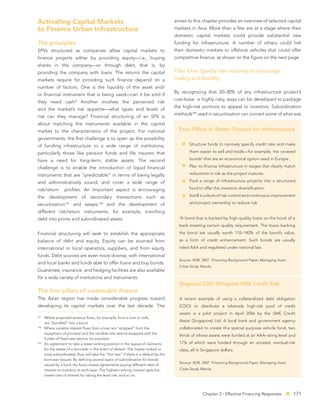
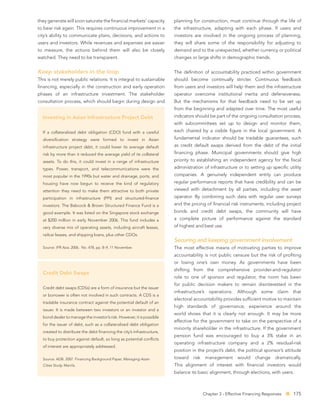
starts by outlining a financing and development framework.
Special-purpose vehicles (SPVs) are recommended as an
appropriate institutional structure for implementing the
plans of special investment organizations (SIOs) described
in the previous chapter. Own-source revenues are unlikely          generation, for national governments to move toward
ever to be sufficient to finance the capital investments             incentive-based transfer systems, and for local governments
needed in today’s fast-expanding Asian megacities, but             to take specific measures to improve their creditworthiness.
considerable amounts of money are available on local               City governments have assets and these can be used more
capital markets and the international capital markets.             effectively to raise resources also. Similarly, communities
They are seeking investment opportunities.                         too can be encouraged to contribute to infrastructure
                                                                   improvements. Lastly, governments need to prepare more
Activating capital markets to finance urban infrastructure is       commercially viable projects, where development finance
recommended and four pathways for governments to access            can be raised and secured through SPVs and other
sustainable new sources of finance are outlined. Not all cities     mechanisms based on future revenue streams. Measures
will be able to access capital markets immediately through         that national government should take to encourage such
more sophisticated channels such as bonds. Many are not            action are also described.
ready and the capital market is not able to respond in these
circumstances. But as a basis for developing alternatives for      An infrastructure financing
investment finance, local governments need to increase their        and development framework
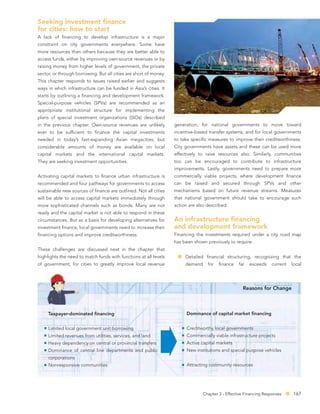
financing options and improve creditworthiness.                     Financing the investments required under a city road map
                                                                   has been shown previously to require:
These challenges are discussed next in the chapter that
highlights the need to match funds with functions at all levels         Detailed financial structuring, recognizing that the
of government, for cities to greatly improve local revenue              demand     for   finance    far   exceeds    current   local


                                                                                                     Reasons for Change


     Taxpayer-dominated financing                                         Dominance of capital market financing


     Limited local government unit borrowing                             Creditworthy local governments
     Limited revenues from utilities, services, and land                 Commercially viable infrastructure projects
     Heavy dependency on central or provincial transfers                 Active capital markets
     Dominance of central line departments and public                    New institutions and special purpose vehicles
     corporations
     Nonresponsive communities                                           Attracting community resources


                                                                                 Chapter 3 - Effective Financing Responses    167
government revenue-raising capacity and that private                      private sector, this does not reflect real project risks of
      finance and community resources need to be encouraged                      design, construction, and ongoing operations and finance.
      to fund infrastructure development. But the range                         Where a government project has cost overruns, these are
      of financing sources has never been wider. Financial                       passed on to the community through higher taxes. Under
      structures need to be tailored to the requirements of                     these circumstances, the lower borrowing rate provides no
      the capital market and those of a particular project.                     benefit to the community. Cost overruns are common on
      Maximizing own-source revenue and funding options                         public projects,166 especially those in developing countries.
      for local governments, recognizing that they need                         But the private sector has an incentive to bring projects in on
      both the mandate and tools to raise revenue for local                     time and under budget if they are structured well.
      projects, establishing national enabling frameworks
      to provide this mandate, and the incentives to use                        At present, the financial vehicles needed to structure and
      it. Support for local governments is necessary to                         attract the additional funding required to manage a city’s
      develop capacity in initiating and controlling financial                   growth are lacking. Despite large savings held by financial
      structuring,     in    maximizing        their       own   revenues,      organizations, money for infrastructure is often ad hoc, with
      and in efficiently using national transfers.                               no or inadequate systems to channel long-term funding—
                                                                                through infrastructure bonds, for example, which are currently
Under current systems of intergovernmental fiscal relations,                     constrained by restrictions on eligible investments for holders
most decentralized local governments cannot fund needed                         of long-term savings. There are no incentives for the trustees
city region infrastructure, even if they maximize their                         of funds to invest in longer-term, riskier, higher-return assets
own-source revenues. Current arrangements often offer                           such as infrastructure. Foreign participation, which could
no incentives to maximize own-source revenues. While                            reduce perceived risk, provide longer-term, lower-cost funds,
governments are able to borrow at a lower cost than the                         and supply larger amounts of funding, is restricted—both


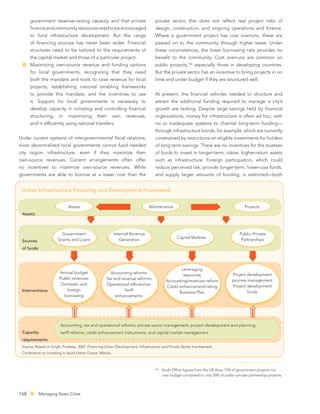
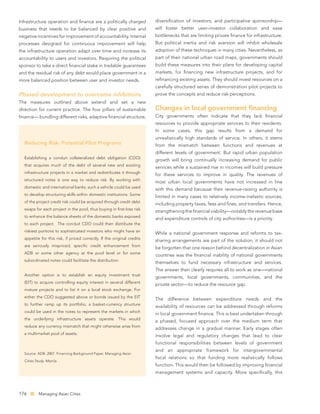
 Urban Infrastructure Financing and Development Framework


                             Assets                                           Maintenance                                              Projects
 Assets:


                         Government                        Internal Revenue                                                         Public–Private
                                                                                              Capital Markets
 Sources               Grants and Loans                       Generation                                                             Partnerships

 of funds:


                                                                                                Leveraging
                        Annual budget                 Accounting reforms                                                        Project development
                                                                                                 resources
                        Public revenues             Tax and revenue reforms                                                     process management
                                                                                        Accounting/revenues reform
                         Domestic and               Operational efficiencies                                                     Project development
                                                                                        Credit enhancement/rating
 Interventions:             foreign                           Tariff                                                                    funds
                                                                                               Business Plan
                          borrowing                      enhancements


                        Accounting, tax and operational reforms; private sector management; project development and planning;
 Capacity               tariff reforms; credit enhancement instruments; and capital market management
 requirements:
 Source: Based on Singh, Pradeep. 2007. Financing Urban Development, Infrastructure and Private Sector Involvement.
 Conference on Investing in Asia’s Urban Future. Manila.


                                                                                166
                                                                                      Audit Office figures from the UK show 73% of government projects run
                                                                                      over budget compared to only 20% of public–private partnership projects.


168        Managing Asian Cities
debt and equity, either formally or informally. There is no                 define the relationships between the project proponents,
structure for catering for the diverse risk return profiles of the           owners or implementers, and project financiers. SPVs
variety of participants in the local and international capital              may and, in many cases, should have private sector
markets. Change is needed. New institutions and financing                    participation in the financing structure through providing
instruments must be established that are tailored to the                    either the equity or taking on debt as a project proponent
needs of Asia’s cities. But before this can happen, cities must             or providing the equity or debt as a financier.
put their own houses in order with improvements in local
government finances and in asset management.                                 For such institutions to function, the national government
                                                                            needs to ensure that there are appropriate enabling
Financing institutions for our cities                                       frameworks. These should:


Creating new agencies to mobilize funds                                          Allow local, provincial, and state governments to
Financial structures should be tailored to the requirements of                   establish SPVs and to participate in them. This requires
the capital market and the needs of a particular project. The                    that governments have the legal basis to set up SPVs.
proposal made earlier to establish SIOs for key sectors within                   Provide incentives, usually in the form of tax breaks,
a city would require that each SIO has one or more SPVs that                     for such entities to access local capital markets and to
would be structured according to whether the SIO is dealing                      encourage financial innovation to meet needs.
with a diverse portfolio of investments, one major project, or
a program of similar projects. SPVs are the legal entities that


  Special Purpose Vehicles:                                                   These include securitizing loan portfolios of a bank and
  The new “It” organization                                                   securitizing financial assets such as car loans, credit card and
                                                                              hire-purchase receivables, finance leases, aircraft operating
  Special purpose vehicles (SPVs) or entities are companies                   leases, and real estate mortgages.
  established for a specific activity with powers limited to those
  required to attain its purpose and a life span that ends when               SPVs are incorporated as companies whose articles of association
  this has been achieved. When a government or a company—                     limit business to the particular purpose, such as providing
  commonly called the sponsor of the SPV—wants to achieve a                   an infrastructure asset or service or the issue of securities. To
  particular purpose, it separates an asset, activity, or operation           maintain the integrity of the structure, the directors, officers,
  by forming an SPV. SPVs normally have three participants: (i)               and the administrators of the SPV should be independent of
  the transferor, originator, or sponsor that transfers the assets,           the originator. The use of SPVs has spread to all sectors of the
  liabilities, or rights that creates the SPV; (ii) the transferee, which     economy. In the financial services industry, the most common
  is the newly created SPV that receives the transferred assets,              application is found in the asset-backed securities market,
  liabilities, or rights; and (iii) the investors that provide funding        including collateralized debt obligations and mortgage-
  for the activities through loans to the SPV, often through the              backed securities. In the public sector, the activities of SPVs are
  issuance of marketable securities. As legal devices, SPVs are               often undertaken through public–private partnerships, build-
  relatively cheap to create and maintain while offering possible             own-operate-transfer (BOOT) schemes, and joint ventures to
  taxation, regulatory burden, and confidentiality benefits.                    construct infrastructure, manage financial assets or liabilities,
                                                                              or deliver services on behalf of government. In addition,
  Asset swaps and structured finance have developed rapidly                    securitization also exists with regard to assets expected to arise
  over the past 10–15 years. Starting in the United States in the             in the future, such as future receivables and expected income
  early 1980s, the use and development of such structured finance              flows, that are often referred to as future flows securitization.
  transactions have become common in most of the world’s major
  financial markets. From the initial use of the SPV to enhance tax            Source: Dipplelsmana, R. 2004. Special Purpose Entities and Holding
                                                                              Companies. Washington, DC: International Monetary Fund.
  efficiency, SPVs are now used for many transactions as financial
  markets become more sophisticated.


                                                                                           Chapter 3 - Effective Financing Responses            169
Enable       and     encourage    superannuation       and   life
                                                                          insurance companies to invest a significant part of their
                                                                          portfolio in infrastructure finance by eliminating the
                                                                          restrictions on their eligible investments.
                                                                          Improve civil service incentives for the development of
                                                                          skills in designing and structuring such SPVs.


                                                                     How the special purpose vehicle functions
                                                                     Examples of SPVs in the development of city infrastructure
                                                                     are public-private partnerships (PPPs) or private finance
                                                                     initiatives (PFIs). These SPVs vary in form and detail but
                                                                     usually involve a private sector company or consortium
                                                                     that finances and operates a company whose purpose is to
                                                                     deliver, operate, and manage new public infrastructure or
  Suzhou City Infrastructure Investment Company                      services, often for more than 20 years. The company receives
                                                                     a payment that recognizes the cost and risk of the business.
  In 2001, Suzhou Infrastructure Investment Company (SIIC)           In most cases, the created asset is eventually returned
  was established. Its mission was to manage the construction,       to government ownership, having being maintained and
  financing, and operation of infrastructure in Suzhou. SIIC          handed back “as new.” The payments by government
  had a registered capital of 0.4 billion renminbi (RMB) but         can be toll fees or revenues on infrastructure, such as
  by 2006, its total assets had reached RMB18 billion, with a        roads or water supply systems, or an agreed service fee
  net worth of RMB5 billion and RMB13 billion in liabilities.        on social infrastructure, such as schools or hospitals. The
  The city government, according to its 5-year plan, plans its       approach enables the private sector to innovate through
  infrastructure. SIIC raises financing and develops infrastructure   better design, technology, and service delivery that help
  projects. Financing is raised from a number of sources including   mitigate risk and provide higher-quality service. Some
  loans from the China Development Bank and local commercial         SPVs raise funds for infrastructure development by others,
  banks, trust fund financing, project financing including build       including government.
  and transfer, land rent revenue, and project revenues.

  Source: ADB. 2007. Financing Background Paper, Managing Asian        Philippine Infrastructure Company
  Cities Study. Manila.

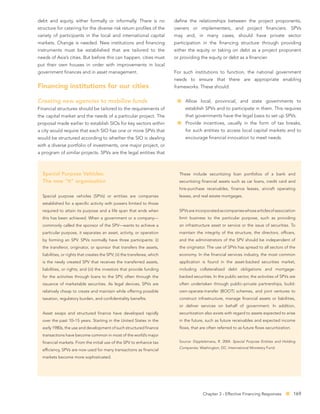
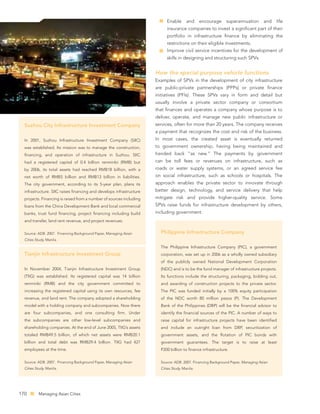
                                                                       The Philippine Infrastructure Company (PIC), a government
  Tianjin Infrastructure Investment Group                              corporation, was set up in 2006 as a wholly owned subsidiary
                                                                       of the publicly owned National Development Corporation
  In November 2004, Tianjin Infrastructure Investment Group            (NDC) and is to be the fund manager of infrastructure projects.
  (TIIG) was established. Its registered capital was 14 billion        Its functions include the structuring, packaging, bidding out,
  renminbi (RMB) and the city government committed to                  and awarding of construction projects to the private sector.
  increasing the registered capital using its own resources, fee       The PIC was funded initially by a 100% equity participation
  revenue, and land rent. The company adopted a shareholding           of the NDC worth 80 million pesos (P). The Development
  model with a holding company and subcompanies. Now there             Bank of the Philippines (DBP) will be the financial advisor to
  are four subcompanies, and one consulting firm. Under                 identify the financial sources of the PIC. A number of ways to
  the subcompanies are other low-level subcompanies and                raise capital for infrastructure projects have been identified
  shareholding companies. At the end of June 2005, TIIG’s assets       and include an outright loan from DBP, securitization of
  totaled RMB49.5 billion, of which net assets were RMB20.1            government assets, and the flotation of PIC bonds with
  billion and total debt was RMB29.4 billion. TIIG had 427             government guarantees. The target is to raise at least
  employees at the time.                                               P200 billion to finance infrastructure.

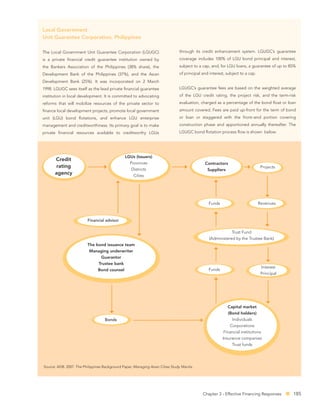
  Source: ADB. 2007. Financing Background Paper, Managing Asian        Source: ADB. 2007. Financing Background Paper, Managing Asian
  Cities Study. Manila.                                                Cities Study. Manila.


170        Managing Asian Cities
Activating Capital Markets                                                              annex to this chapter provides an overview of selected capital
to Finance Urban Infrastructure                                                         markets in Asia. More than a few are at a stage where their
                                                                                        domestic capital markets could provide substantial new
The principles                                                                          funding for infrastructure. A number of others could link
SPVs structured as companies allow capital markets to                                   their domestic markets to offshore vehicles that could offer
finance projects either by providing equity—i.e., buying                                 competitive finance, as shown on the figure on the next page.
shares in the company—or through debt, that is, by
providing the company with loans. The returns the capital                               Pillar One: Specify risks narrowly to encourage
markets require for providing such finance depend on a                                   trading and liquidity
number of factors. One is the liquidity of the asset and/
                                                                                        By recognizing that 20–30% of any infrastructure project’s
or financial instrument that is being used—can it be sold if
                                                                                        cost-base is highly risky, ways can be developed to package
they need cash? Another involves the perceived risk
                                                                                        the high-risk portions to appeal to investors. Subordination
and the market’s risk appetite—what types and levels of
                                                                                        methods169 used in securitization can convert some of what was
risk can they manage? Financial structuring of an SPV is
about matching the instruments available in the capital
market to the characteristics of the project. For national                                Four Pillars of Better Finance for Infrastructure
governments, the first challenge is to open up the possibility
of funding infrastructure to a wide range of institutions,                                      Structure funds to narrowly specify credit risks and make

particularly those like pension funds and life insurers that                                    them easier to sell and trade—for example, the covered

have a need for long-term, stable assets. The second                                            bondsa that are an economical option used in Europe.

challenge is to enable the introduction of liquid financial                                      Plan to finance infrastructure in stages that clearly match

instruments that are “predictable” in terms of being legally                                    reductions in risk as the project matures.

and administratively sound, and cover a wide range of                                           Pool a range of infrastructure projects into a structured

risk/return        profiles. An important aspect is encouraging                                  fund to offer the investors diversification.

the development of secondary transactions such as                                               Instill a culture of risk control and continuous improvement

securitization     167
                         and swaps,      168
                                               and the development of                           and project ownership to reduce risk.

different risk/return instruments, for example, tranching
                                                                                          a
debt into prime and subordinated assets.                                                   A bond that is backed by high-quality loans on the book of a
                                                                                          bank meeting certain quality requirement. The loans backing
Financial structuring will seek to establish the appropriate                              the bond are usually worth 110–140% of the bond’s value,
balance of debt and equity. Equity can be sourced from                                    as a form of credit enhancement. Such bonds are usually
international or local operators, suppliers, and from equity                              rated AAA and regulated under national law.
funds. Debt sources are even more diverse, with international
                                                                                          Source: ADB. 2007. Financing Background Paper, Managing Asian
and local banks and funds able to offer loans and buy bonds.
                                                                                          Cities Study. Manila.
Guarantee, insurance, and hedging facilities are also available
for a wide variety of institutions and instruments.
                                                                                          Regional CDO Mitigates SME Credit Risk
The four pillars of sustainable finance
The Asian region has made considerable progress toward                                    A recent example of using a collateralized debt obligation
developing its capital markets over the last decade. The                                  (CDO) to distribute a relatively high-risk pool of credit
                                                                                          assets is a pilot project in April 2006 by the SME Credit
167
      Where projected revenue flows, for example, from a loan or tolls,
                                                                                          Assist (Singapore) Ltd. A local bank and government agency
      are “bundled” into a bond.
168
      Where variable interest flows from a loan are “stripped” from the                    collaborated to create this special purpose vehicle fund, two
      repayment of principal and the variable rate returns swapped with the
                                                                                          thirds of whose assets were funded at an AAA-rating level and
      holder of fixed rate returns, for example.
169
      An agreement to take a lower-ranking position in the queue of claimants             17% of which were funded through an unrated, residual-risk
      for the assets of a borrower in the event of default. The lowest ranked or          class, all in Singapore dollars.
      most subordinated, thus, will take the “first loss” if there is a default by the
      borrower (issuer). By defining several layers of subordination for bonds
                                                                                          Source: ADB. 2007. Financing Background Paper, Managing Asian
      issued by a fund, the fund creates agreements paying different rates of
      interest to investors at each layer. The highest-ranking investor gets the          Cities Study. Manila.
      lowest rate of interest for taking the least risk, and so on.


                                                                                                         Chapter 3 - Effective Financing Responses        171
an untraded asset (project equity or a guarantee) into several                       is only during the early stages of development and regulatory
tradable securities (junior and equity classes of a credit-asset                     stabilization, while the asset is still proving itself as a viable
pool and the related credit default swaps). As tradable                              service to the community, that it should pay a risk premium to
credit, these securities could give investors more confidence                         its initial debt and equity investors.
to buy into new projects.
                                                                                     As the initial high-yield debt is refinanced at a lower rate 3–5
Restructuring the loans issued by infrastructure projects                            years into the operating life of an asset, the infrastructure
into a combination of subordinated bonds and credit-                                 should be running above its break-even capacity level and
enhanced bonds170 can lower the average cost of capital to                           planning for expansion may have begun.
the project. By narrowly specifying project risks according
to the probability of default, these securities can be sold to                       It may then shift from relying entirely on subordinated
a much wider range of investors and develop new channels                             financing structures and operator equity to refinance itself
of finance. If structured funds are arranged under national                           with direct bond issues from the operating company. Within
covered-bond legislation rather than simply as collateralized                        another 2–5 years, the cash-flow risk will be lower and the
debt obligations (CDOs), they can be produced very cheaply                           equity of the operating company may be ready for listing
and regularly, thus supporting greater liquidity in the market.                      on a local exchange. It could be listed either by itself or
                                                                                     bundled together with similar infrastructure providers in
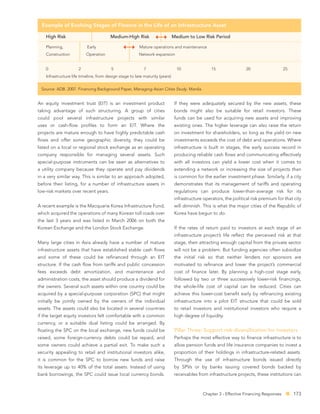
Pillar Two: Plan finance around the asset’s life cycle to                             a holding company. The figure on the next page illustrates
lower funding costs as risk declines                                                 how the time line of this financial structure might look.
A staged approach to finance avoids burdening the operating
infrastructure with a high cost of finance throughout its life. It

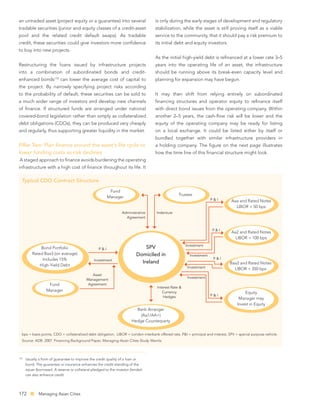
  Typical CDO Contract Structure
                                                            Fund
                                                                                                   Trustee
                                                           Manager
                                                                                                                       P&I        Aaa and Rated Notes
                                                                                                                                    LIBOR + 50 bps
                                                                    Administrative   Indenture
                                                                      Agreement


                                                                                                                       P&I
                                                                                                                                  Aa2 and Rated Notes
                                                                                                                                    LIBOR + 100 bps
                                                                                                        Investment
               Bond Portfolio                        P&I                         SPV
          Rated Baa3 (on average)                                            Domiciled in                 Investment
                Includes 15%                      Investment                                                            P&I
                                                                               Ireland                                           Baa2 and Rated Notes
              High-Yield Debt                                                                            Investment                LIBOR + 350 bps
                                                Asset
                                                                                                         Investment
                                             Management
                    Fund                      Agreement
                                                                                      Interest Rate &
                   Manager                                                               Currency                                         Equity
                                                                                          Hedges                       P&I
                                                                                                                                       Manager may
                                                                                                                                      Invest in Equity
                                                                            Bank Arranger
                                                                              (Aa1/AA+)
                                                                          Hedge Counterparty


  bps = basis points, CDO = collateralized debt obligation, LIBOR = London interbank offered rate, P&I = principal and interest, SPV = special purpose vehicle.
  Source: ADB. 2007. Financing Background Paper, Managing Asian Cities Study. Manila.


170
      Usually a form of guarantee to improve the credit quality of a loan or
      bond. The guarantee or insurance enhances the credit standing of the
      issuer (borrower). A reserve or collateral pledged to the investor (lender)
      can also enhance credit.


172           Managing Asian Cities
Example of Evolving Stages of Finance in the Life of an Infrastructure Asset

    High Risk                            Medium-High Risk                      Medium to Low Risk Period

    Planning,              Early                         Mature operations and maintenance
    Construction           Operation                     Network expansion


    0                 2                  5                  7                    10                15                20                   25
    Infrastructure life timeline, from design stage to late maturity (years)


 Source: ADB. 2007. Financing Background Paper, Managing Asian Cities Study. Manila.


An equity investment trust (EIT) is an investment product                       If they were adequately secured by the new assets, these
taking advantage of such structuring. A group of cities                         bonds might also be suitable for retail investors. These
could pool several infrastructure projects with similar                         funds can be used for acquiring new assets and improving
uses or cash-flow profiles to form an EIT. Where the                              existing ones. The higher leverage can also raise the return
projects are mature enough to have highly predictable cash                      on investment for shareholders, so long as the yield on new
flows and offer some geographic diversity, they could be                         investments exceeds the cost of debt and operations. Where
listed on a local or regional stock exchange as an operating                    infrastructure is built in stages, the early success record in
company responsible for managing several assets. Such                           producing reliable cash flows and communicating effectively
special-purpose instruments can be seen as alternatives to                      with all investors can yield a lower cost when it comes to
a utility company because they operate and pay dividends                        extending a network or increasing the size of projects than
in a very similar way. This is similar to an approach adopted,                  is common for the earlier investment phase. Similarly, if a city
before their listing, for a number of infrastructure assets in                  demonstrates that its management of tariffs and operating
low-risk markets over recent years.                                             regulations can produce lower-than-average risk for its
                                                                                infrastructure operators, the political risk premium for that city
A recent example is the Macquarie Korea Infrastructure Fund,                    will diminish. This is what the major cities of the Republic of
which acquired the operations of many Korean toll roads over                    Korea have begun to do.
the last 3 years and was listed in March 2006 on both the
Korean Exchange and the London Stock Exchange.                                  If the rates of return paid to investors at each stage of an
                                                                                infrastructure project’s life reflect the perceived risk at that
Many large cities in Asia already have a number of mature                       stage, then attracting enough capital from the private sector
infrastructure assets that have established stable cash flows                    will not be a problem. But funding agencies often subsidize
and some of these could be refinanced through an EIT                             the initial risk so that neither lenders nor sponsors are
structure. If the cash flow from tariffs and public concession                   motivated to refinance and lower the project’s commercial
fees exceeds debt amortization, and maintenance and                             cost of finance later. By planning a high-cost stage early,
administration costs, the asset should produce a dividend for                   followed by two or three successively lower-risk financings,
the owners. Several such assets within one country could be                     the whole-life cost of capital can be reduced. Cities can
acquired by a special-purpose corporation (SPC) that might                      achieve this lower-cost benefit early by refinancing existing
initially be jointly owned by the owners of the individual                      infrastructure into a pilot EIT structure that could be sold
assets. The assets could also be located in several countries                   to retail investors and institutional investors who require a
if the target equity investors felt comfortable with a common                   high degree of liquidity.
currency, or a suitable dual listing could be arranged. By
floating the SPC on the local exchange, new funds could be                       Pillar Three: Support risk diversification for investors
raised, some foreign-currency debts could be repaid, and                        Perhaps the most effective way to finance infrastructure is to
some owners could achieve a partial exit. To make such a                        allow pension funds and life insurance companies to invest a
security appealing to retail and institutional investors alike,                 proportion of their holdings in infrastructure-related assets.
it is common for the SPC to borrow new funds and raise                          Through the use of infrastructure bonds issued directly
its leverage up to 40% of the total assets. Instead of using                    by SPVs or by banks issuing covered bonds backed by
bank borrowings, the SPC could issue local currency bonds.                      receivables from infrastructure projects, these institutions can


                                                                                              Chapter 3 - Effective Financing Responses        173
acquire long maturity assets that match their long-term funds.
                                                                       The box provides examples of funds that raise such long-term
  Infrastructure Funds
                                                                       finance for infrastructure investments.

  Over a dozen private-sector funds are now focused on
                                                                       The use of structured finance vehicles such as CDOs, credit
  infrastructure in Asia, mostly organized as private-equity funds.
                                                                       debt swaps, and EITs can provide various means of risk
  They have committed funds in excess of $6 billion. While this
                                                                       spreading and specialization. These modalities can produce
  amount is considerable, some of these funds were launched
                                                                       a large amount of low-risk bonds by transferring the risk that
  over 15 years ago and most have spanned a period of relatively
                                                                       investors must face for the majority of the financing needed.
  slow infrastructure growth in Asia. As this growth quickens,
                                                                       More importantly, they can convert a majority of reserved
  much greater funding will be needed to provide the partial exit
                                                                       financing into a liquid, tradable form. Liquidity opens the
  that private-sector developers will require if they are to fund
                                                                       door wider to the most appropriate risk mitigation–technique
  the equity for projects demanded. In the mid-1990s, private
                                                                       diversification. In particular, structuring vehicles placed
  participation in infrastructure (PPI) accounted for up to 22%
                                                                       between users and investors can help diversify the investors’
  of the cost of new infrastructure, according to figures from
                                                                       portfolio risk and can build confidence for other institutional
  the World Bank. This fell below 6% in 1998. Even in lower-risk
                                                                       investors in the reliability of risk pricing. Two requirements for
  markets such as the Republic of Korea, the PPI participation
                                                                       diversification are a sufficiently large number and a variety
  level has only come back to 15%.
                                                                       of assets. If the cash flows of two assets respond differently
                                                                       to the economic and political cycles, then their investment
  Some     governments     have    started   to   develop   focused
                                                                       returns are likely to have a low correlation with each other.
  institutions to refine and encourage use of PPI and capital
                                                                       This creates the diversification benefit—an improvement in
  market techniques to attract more capital to infrastructure
                                                                       the amount of risk taken for a given investment return.
  development. There are also several domestic funds and
  investment facilitation agencies in the region with portfolios
                                                                       Another way to diversify a fund is to spread its investment
  of infrastructure project debt or equity. These entities seek to
                                                                       across more than one country or across widely separated
  act as catalysts for investment, usually drawing in PPI partners.
                                                                       cities. Both add to the cost of managing the collateral pool
  The Private Infrastructure Investment Center of Korea (PICKO),
                                                                       of the fund because of different regulations and operating
  formed in 1998, the India Infrastructure Finance Company
                                                                       economics but they lower the probability of a large default
  (IIFCL), approved in November 2005, and the Indonesian
                                                                       within the pool. The resulting improvement in the risk-return
  Government’s Committee for Acceleration of Infrastructure
                                                                       tradeoff makes it easier to sell the securitized notes to a wider
  Development (KKPPI) are three examples.
                                                                       audience of investors, further lowering the cost of finance for
                                                                       the infrastructure. Pooling infrastructure assets of the same
  PICKO is more of a concession arranger than IIFCL and the
                                                                       kind, such as urban bus systems, from a variety of cities across
  related guarantees are handled by other public agencies,
                                                                       a country or region would facilitate capacity building but its
  under PICKO coordination. The IIFCL intends to provide
                                                                       biggest benefit would be in risk diversification. This would
  public capital through guarantees for up to 20% of project
                                                                       make shares in a fund or bonds from a related CDO or asset-
  cost to fill identified financing gaps. While it is a new agency
                                                                       backed security more attractive than those of a single project
  and still defining its policies, there is a risk that a supply-side
                                                                       within the pool. A much larger number and variety of investors
  approach may displace some higher-risk capital rather than
                                                                       could buy these securities. This would produce a lower cost of
  address the risk-pricing and risk-sharing concerns of potential
                                                                       finance through both increased scale and diversification.
  private investors. A previous catalyst, the Infrastructure Leasing
  & Financial Services Limited, began operations in 1988 as an
                                                                       Pillar Four: Employ accountability, adaptability,
  investment manager and deal arranger, bringing private sector
                                                                       and learning mechanisms
  skills for financing to the public sector without using the public
                                                                       On their own, the three pillars of more precisely specifying risk,
  budget. Indonesia’s KKPPI fills a similar role as PICKO does in
                                                                       of adapting the financial structure behind the infrastructure
  the Republic of Korea.
                                                                       over its lifetime, and of diversification can only spread and
  Source: ADB. 2007. Financing Background Paper, Managing Asian        reduce risk to a certain degree. If political sponsors and asset
  Cities Study. Manila.                                                operators are not strictly accountable to users and investors
                                                                       and if they fail to adapt to a changing environment, the risk


174        Managing Asian Cities
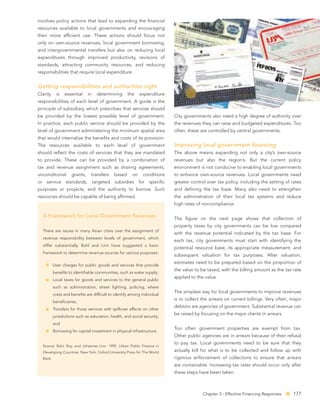
they generate will soon saturate the financial markets’ capacity        planning for construction, must continue through the life of
to bear risk again. This requires continuous improvement in a          the infrastructure, adapting with each phase. If users and
city’s ability to communicate plans, decisions, and actions to         investors are involved in the ongoing process of planning,
users and investors. While revenues and expenses are easier            they will share some of the responsibility for adjusting to
to measure, the actions behind them will also be closely               demand and to the unexpected, whether currency or political
watched. They need to be transparent.                                  changes or large shifts in demographic trends.


Keep stakeholders in the loop                                          The definition of accountability practiced within government
This is not merely public relations. It is integral to sustainable     should become continually stricter. Continuous feedback
financing, especially in the construction and early operation           from users and investors will help them and the infrastructure
phases of an infrastructure investment. The stakeholder                operator overcome institutional inertia and defensiveness.
consultation process, which should begin during design and             But the mechanisms for that feedback need to be set up
                                                                       from the beginning and adapted over time. The most useful
  Investing in Asian Infrastructure Project Debt                       indicators should be part of the ongoing consultation process,
                                                                       with subcommittees set up to design and monitor them,
  If a collateralized debt obligation (CDO) fund with a careful        each chaired by a visible figure in the local government. A
  diversification strategy were formed to invest in Asian               fundamental indicator should be tradable guarantees, such
  infrastructure project debt, it could lower its average default      as credit default swaps derived from the debt of the initial
  risk by more than it reduced the average yield of its collateral     financing phase. Municipal governments should give high
  assets. To do this, it could invest in a range of infrastructure     priority to establishing an independent agency for the fiscal
  types. Power, transport, and telecommunications were the             administration of infrastructure or to setting up specific utility
  most popular in the 1990s but water and drainage, ports, and         companies. A genuinely independent entity can produce
  housing have now begun to receive the kind of regulatory             regular performance reports that have credibility and can be
  attention they need to make them attractive to both private          viewed with detachment by all parties, including the asset
  participation in infrastructure (PPI) and structured-finance          operator. By combining such data with regular user surveys
  investors. The Babcock & Brown Structured Finance Fund is a          and the pricing of financial risk instruments, including project
  good example. It was listed on the Singapore stock exchange          bonds and credit debt swaps, the community will have
  at $200 million in early November 2006. This fund includes a         a complete picture of performance against the standard
  very diverse mix of operating assets, including aircraft leases,     of highest and best use.
  railcar leases, and shipping loans, plus other CDOs.
                                                                       Securing and keeping government involvement
  Source: IFR Asia. 2006. No. 478, pp. 8–9, 11 November.               The most effective means of motivating parties to improve
                                                                       accountability is not public censure but the risk of profiting
                                                                       or losing one’s own money. As governments have been
                                                                       shifting from the comprehensive provider-and-regulator
  Credit Debt Swaps
                                                                       role to one of sponsor and regulator, the norm has been
                                                                       for public decision makers to remain disinterested in the
  Credit debt swaps (CDSs) are a form of insurance but the issuer
                                                                       infrastructure’s operations. Although some claim that
  or borrower is often not involved in such contracts. A CDS is a
                                                                       electoral accountability provides sufficient motive to maintain
  tradable insurance contract against the potential default of an
                                                                       high standards of governance, experience around the
  issuer. It is made between two investors or an investor and a
                                                                       world shows that it is clearly not enough. It may be more
  bond dealer to manage the investor’s risk. However, it is possible
                                                                       effective for the government to take on the perspective of a
  for the issuer of debt, such as a collateralized debt obligation
                                                                       minority shareholder in the infrastructure. If the government
  created to distribute the debt financing the city’s infrastructure,
                                                                       pension fund was encouraged to buy a 3% stake in an
  to buy protection against default, so long as potential conflicts
                                                                       operating infrastructure company and a 2% residual-risk
  of interest are appropriately addressed.
                                                                       position in the project’s debt, the political sponsor’s attitude
  Source: ADB. 2007. Financing Background Paper, Managing Asian        toward   risk    management       would    change    dramatically.
  Cities Study. Manila.                                                This alignment of interest with financial investors would
                                                                       balance its basic alignment, through elections, with users.


                                                                                       Chapter 3 - Effective Financing Responses     175
Infrastructure operation and finance are a politically charged            diversification of investors, and participative sponsorship—
business that needs to be balanced by clear positive and                 will foster better user–investor collaboration and ease
negative incentives for improvement of accountability. Internal          bottlenecks that are limiting private finance for infrastructure.
processes designed for continuous improvement will help                  But political inertia and risk aversion will inhibit wholesale
the infrastructure operation adapt over time and increase its            adoption of these techniques in many cities. Nevertheless, as
accountability to users and investors. Requiring the political           part of their national urban road maps, governments should
sponsor to take a direct financial stake in tradable guarantees           build these measures into their plans for developing capital
and the residual risk of any debt would place government in a            markets, for financing new infrastructure projects, and for
more balanced position between user and investor needs.                  refinancing existing assets. They should invest resources on a
                                                                         carefully structured series of demonstration pilot projects to
Phased development to overcome inhibitions                               prove the concepts and reduce risk perceptions.
The measures outlined above extend and set a new
direction for current practice. The four pillars of sustainable          Changes in local government financing
finance— bundling different risks, adaptive financial structure,           City governments often indicate that they lack financial
                                                                         resources to provide appropriate services to their residents.
                                                                         In some cases, this gap results from a demand for
                                                                         unrealistically high standards of service. In others, it stems
  Reducing Risk: Potential Pilot Programs                                from the mismatch between functions and revenues at
                                                                         different levels of government. But rapid urban population
  Establishing a conduit collateralized debt obligation (CDO)
                                                                         growth will bring continually increasing demand for public
  that acquires much of the debt of several new and existing
                                                                         services while a sustained rise in incomes will build pressure
  infrastructure projects in a market and redistributes it through
                                                                         for these services to improve in quality. The revenues of
  structured notes is one way to reduce risk. By working with
                                                                         most urban local governments have not increased in line
  domestic and international banks, such a vehicle could be used
                                                                         with this demand because their revenue-raising authority is
  to develop structuring skills within domestic institutions. Some
                                                                         limited in many cases to relatively income-inelastic sources,
  of the project credit risk could be acquired through credit debt
                                                                         including property taxes, fees and fines, and transfers. Hence,
  swaps for each project in the pool, thus buying in first-loss risk
                                                                         strengthening the financial viability—notably the revenue base
  to enhance the balance sheets of the domestic banks exposed
                                                                         and expenditure controls of city authorities—is a priority.
  to each project. The conduit CDO could then distribute the
  riskiest portions to sophisticated investors who might have an
                                                                         While a national government response and reforms to tax-
  appetite for this risk, if priced correctly. If the original credits
                                                                         sharing arrangements are part of the solution, it should not
  are seriously mispriced, specific credit enhancement from
                                                                         be forgotten that one reason behind decentralization in Asian
  ADB or some other agency at the pool level or for some
                                                                         countries was the financial inability of national governments
  subordinated notes could facilitate the distribution.
                                                                         themselves to fund necessary infrastructure and services.
                                                                         The answer then clearly requires all to work as one—national
  Another option is to establish an equity investment trust
                                                                         governments, local governments, communities, and the
  (EIT) to acquire controlling equity interest in several different
                                                                         private sector—to reduce the resource gap.
  mature projects and to list it on a local stock exchange. For
  either the CDO suggested above or bonds issued by the EIT
                                                                         The difference between expenditure needs and the
  to further ramp up its portfolio, a basket-currency structure
                                                                         availability of resources can be addressed through reforms
  could be used in the notes to represent the markets in which
                                                                         in local government finance. This is best undertaken through
  the underlying infrastructure assets operate. This would
                                                                         a phased, focused approach over the medium term that
  reduce any currency mismatch that might otherwise arise from
                                                                         addresses change in a gradual manner. Early stages often
  a multimarket pool of assets.
                                                                         involve legal and regulatory changes that lead to clear
                                                                         functional responsibilities between levels of government
                                                                         and an appropriate framework for intergovernmental
  Source: ADB. 2007. Financing Background Paper, Managing Asian
                                                                         fiscal relations so that funding more realistically follows
  Cities Study. Manila.
                                                                         function. This would then be followed by improving financial
                                                                         management systems and capacity. More specifically, this


176        Managing Asian Cities
involves policy actions that lead to expanding the financial
resources available to local governments and encouraging
their more efficient use. These actions should focus not
only on own-source revenues, local government borrowing,
and intergovernmental transfers but also on reducing local
expenditures through improved productivity, revisions of
standards, attracting community resources, and reducing
responsibilities that require local expenditure.


Getting responsibilities and authorities right
Clarity    is   essential     in   determining       the    expenditure
responsibilities of each level of government. A guide is the
principle of subsidiary, which prescribes that services should
be provided by the lowest possible level of government.                   City governments also need a high degree of authority over
In practice, each public service should be provided by the                the revenues they can raise and budgeted expenditures. Too
level of government administering the minimum spatial area                often, these are controlled by central governments.
that would internalize the benefits and costs of its provision.
The resources available to each level of government                       Improving local government financing
should reflect the costs of services that they are mandated                The above means expanding not only a city’s own-source
to provide. These can be provided by a combination of                     revenues but also the region’s. But the current policy
tax and revenue assignment such as sharing agreements,                    environment is not conducive to enabling local governments
unconditional       grants,     transfers    based     on    conditions   to enhance own-source revenues. Local governments need
or service standards, targeted subsidies for specific                      greater control over tax policy, including the setting of rates
purposes or projects, and the authority to borrow. Such                   and defining the tax base. Many also need to strengthen
resources should be capable of being affirmed.                             the administration of their local tax systems and reduce
                                                                          high rates of noncompliance.

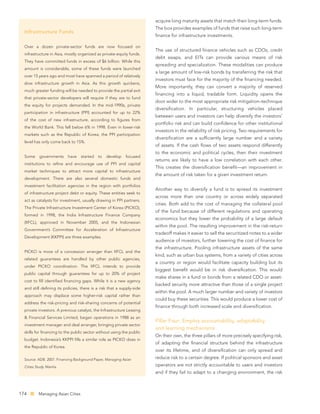
  A Framework for Local Government Revenues                               The figure on the next page shows that collection of
                                                                          property taxes by city governments can be low compared
  There are issues in many Asian cities over the assignment of
                                                                          with the revenue potential indicated by the tax base. For
  revenue responsibility between levels of government, which
                                                                          each tax, city governments must start with identifying the
  differ substantially. Bahl and Linn have suggested a basic
                                                                          potential resource base, its appropriate measurement, and
  framework to determine revenue sources for various purposes:
                                                                          subsequent valuation for tax purposes. After valuation,
                                                                          estimates need to be prepared based on the proportion of
          User charges for public goods and services that provide
                                                                          the value to be taxed, with the billing amount as the tax rate
          benefits to identifiable communities, such as water supply;
                                                                          applied to the value.
          Local taxes for goods and services to the general public
          such as administration, street lighting, policing, where
                                                                          The simplest way for local governments to improve revenues
          costs and benefits are difficult to identify among individual
                                                                          is to collect the arrears on current billings. Very often, major
          beneficiaries;
                                                                          debtors are agencies of government. Substantial revenue can
          Transfers for those services with spillover effects on other
                                                                          be raised by focusing on the major clients in arrears.
          jurisdictions such as education, health, and social security;
          and
                                                                          Too often government properties are exempt from tax.
          Borrowing for capital investment in physical infrastructure.
                                                                          Other public agencies are in arrears because of their refusal
                                                                          to pay tax. Local governments need to be sure that they
  Source: Bahl, Roy, and Johannes Linn. 1992. Urban Public Finance in
  Developing Countries. New York: Oxford University Press for The World   actually bill for what is to be collected and follow up with
  Bank.                                                                   rigorous enforcement of collections to ensure that arrears
                                                                          are containable. Increasing tax rates should occur only after
                                                                          these steps have been taken.


                                                                                        Chapter 3 - Effective Financing Responses     177
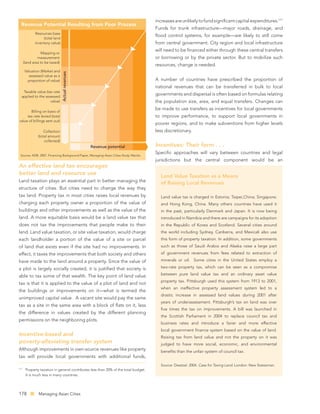
increases are unlikely to fund significant capital expenditures.171
  Revenue Potential Resulting from Poor Process
                                                                                       Funds for trunk infrastructure—major roads, drainage, and
             Resources base
                                                                                       flood control systems, for example—are likely to still come
                  (total land
             inventory value)                                                          from central government. City region and local infrastructure
                                                                                       will need to be financed either through these central transfers
                 Mapping or
               measurement                                                             or borrowing or by the private sector. But to mobilize such
      (land area to be taxed)
                                                                                       resources, change is needed.
      Valuation (Market and
                                Actual revenues

        assessed value as a
        proportion of value)                                                           A number of countries have prescribed the proportion of
                                                                                       national revenues that can be transferred in bulk to local
   Taxable value (tax rate
  applied to the assessed
                                                                                       governments and dispersal is often based on formulas relating
                    value)                                                             the population size, area, and equal transfers. Changes can
                                                                                       be made to use transfers as incentives for local governments
       Billing on basis of
     tax rate levied (total                                                            to improve performance, to support local governments in
value of billings sent out)
                                                                                       poorer regions, and to make subventions from higher levels
                   Collection                                                          less discretionary.
               (total amount
                   collected)
                                                  Revenue potential                    Incentives: Their form . . .
                                                                                       Specific approaches will vary between countries and legal
 Source: ADB. 2007. Financing Background Paper, Managing Asian Cities Study. Manila.
                                                                                       jurisdictions but the central component would be an
An effective land tax encourages
better land and resource use                                                             Land Value Taxation as a Means
Land taxation plays an essential part in better managing the                             of Raising Local Revenues
structure of cities. But cities need to change the way they
tax land. Property tax in most cities raises local revenues by                           Land value tax is charged in Estonia; Taipei,China; Singapore;
charging each property owner a proportion of the value of                                and Hong Kong, China. Many others countries have used it
buildings and other improvements as well as the value of the                             in the past, particularly Denmark and Japan. It is now being
land. A more equitable basis would be a land value tax that                              introduced in Namibia and there are campaigns for its adoption
does not tax the improvements that people make to their                                  in the Republic of Korea and Scotland. Several cities around
land. Land value taxation, or site value taxation, would charge                          the world including Sydney, Canberra, and Mexicali also use
each landholder a portion of the value of a site or parcel                               this form of property taxation. In addition, some governments
of land that exists even if the site had no improvements. In                             such as those of Saudi Arabia and Alaska raise a large part
effect, it taxes the improvements that both society and others                           of government revenues from fees related to extraction of

have made to the land around a property. Since the value of                              minerals or oil. Some cities in the United States employ a

a plot is largely socially created, it is justified that society is                       two-rate property tax, which can be seen as a compromise

able to tax some of that wealth. The key point of land value                             between pure land value tax and an ordinary asset value
                                                                                         property tax. Pittsburgh used this system from 1913 to 2001,
tax is that it is applied to the value of a plot of land and not
                                                                                         when an ineffective property assessment system led to a
the buildings or improvements on it—what is termed the
                                                                                         drastic increase in assessed land values during 2001 after
unimproved capital value. A vacant site would pay the same
                                                                                         years of underassessment. Pittsburgh’s tax on land was over
tax as a site in the same area with a block of flats on it, less
                                                                                         five times the tax on improvements. A bill was launched in
the difference in values created by the different planning
                                                                                         the Scottish Parliament in 2004 to replace council tax and
permissions on the neighboring plots.
                                                                                         business rates and introduce a fairer and more effective
                                                                                         local government finance system based on the value of land.
Incentive-based and                                                                      Raising tax from land value and not the property on it was
poverty-alleviating transfer system                                                      judged to have more social, economic, and environmental
Although improvements in own-source revenues like property                               benefits than the unfair system of council tax.
tax will provide local governments with additional funds,
                                                                                         Source: Dwetzel. 2004. Case for Taxing Land. London: New Statesman.
171
       Property taxation in general contributes less than 20% of the total budget.
       It is much less in many countries.


178            Managing Asian Cities
adjustment of the enabling environments for urban                     revenue-generating projects because of public sector
management      to     provide   incentives    to    improve   city   borrowing limits set by a central financial agency. As a
management. Many aspects of the Indian Government’s                   result, local governments have little incentive to become
National Urban Renewal Mission reflect this approach.                  more entrepreneurial and to work with the private
Providing incentives requires that standards be set and               sector to develop key infrastructure and other capacity-
that performance be measured against them. The types of               building projects. While non or semi-financially viable
standards would depend on the country and circumstances,              local authorities are never going to be able to access
range across wide areas—from financial to environmental,               capital markets in their own right, those that are viable can.
for example—and involve matters as diverse as the return              Strengthening financial viability, which comprises the revenue
on assets for government trading enterprises, tax collection          base and expenditure controls of city authorities, is essential
efficiency, and the quality and quantity of water supply.              for local governments throughout the region.
Reforms like introducing accrual accounting or preparing
city road maps may also be a mandatory requirement for                National governments need to transfer financial risks to
local governments seeking assistance.                                 local governments and to make them more responsible
                                                                      and    accountable     for   financial    management.      Many
. . . and how to make them work                                       local governments in Asia now simply pass off loan-risk
To be successful, this system must focus on a small number            responsibility to central governments and feel they have no
of key, measurable, monitorable variables and keep                    obligation to repay debt or to improve the efficiency and
administrative costs down. The form and structure of the              effectiveness of their own financial management systems.
incentives are also important. For achieving or surpassing            Improving the capability of local government to borrow
standards, for example, local governments could gain                  requires financially sound entities, improved revenue streams,
increased financing provided directly by central governments           and more commercially viable investment projects. It also
or through greater access to markets, or specific or general           requires credit ratings.
purpose grants. There could be one-off incentives or
ones that moved the local government to a new category                Credit risk: Difficult to determine in Asia’s cities
for ongoing assistance. The aim is to create a culture of             Any financing system relies on the ability of lenders and
constant performance improvement within city government               borrowers to assess credit risk. Municipal credit markets
and management. The effects will be enhanced if national              have developed slowly in Asia mainly because the
governments collect and publish comparative information on            risks have been difficult to identify and control, except
the performance of cities and their governance institutions.          through government guarantees. Many loans to local
One form of consultation that resonates strongly in local             government—including those through public municipal
politics is simply the wide dissemination of information on           development funds—have high loan–loss rates, while
local government performance.                                         lenders have had problems in assessing local government
                                                                      creditworthiness on account of insufficient information on
Incremental    local   finance    reforms      that   have   proven    financial performance. A municipality is creditworthy when its
successful include the creation of special districts for capital      borrowing meets the risk standards of the lender. However,
cities with more powers to raise revenues and spend;                  no definitive level of credit risk determines creditworthiness.
expansion of enlarging metropolitan jurisdictions through             Governments and lenders decide what risk to tolerate.
the absorption of surrounding local government areas; and
phased implementation of new sources of revenues and the              The job of improving local government creditworthiness
reform of existing ones. This suggests that municipal finance          rests with both national and local governments and requires
reform should start with the larger cities.                           changes within the lending community. At the national
                                                                      level, governments must improve the enabling environment
Boosting the financial                                                 for municipal credit. At the local level, it demands specific
responsibility of local government                                    actions to improve financial performance and is directly
We have shown that local government borrowing limits are              related to enhancing local government capacity and local
restricted by the level of grants they receive from central           revenue generation.
government. Furthermore, most local governments in Asia
do not have the authority to raise local capital for


                                                                                    Chapter 3 - Effective Financing Responses    179
includes funding for privatized utility investments in water
                                                                        supply and public transport. In these cases, both the lender
  Local Government Credit Risk
                                                                        and borrower have an interest in the performance of the
                                                                        investment. Hence, a project’s financial and economic viability
  Risk is expressed in the rate of interest charged on borrowing—
                                                                        requires assessment. Due diligence of the operating agency
  the higher the risk, the greater the rate of interest. Credit risk
                                                                        and project financial viability—usually expressed as the
  is that a borrower will not make full and timely payment of a
                                                                        financial rate of return—become the prime determinants of
  debt. Normally, it is measured on a scale that sets risk against
                                                                        creditworthiness.
  that of other similar borrowing within a country. In the developed
  world, independent rating agencies use alphabetic or numerical
                                                                        The Government of India provides tax-free status for
  scales to classify such risk. Local government creditworthiness
                                                                        municipal bonds. Several urban local bodies and utility
  depends on default rates and the borrowing capacity.
                                                                        organizations have mobilized over $200 million through
                                                                        municipal bonds, about 55% of which were tax-free bonds,
  Much of the experience with publicly released municipal credit
                                                                        including pooled financing. The India Securities Exchange
  ratings is from the United States, which has had extensive
                                                                        Board in 2000 issued guidelines for private placement of
  experience of credit risk analysis for local governments. But risks
                                                                        corporate bonds. These guidelines were issued to provide
  are different in Asia, where they derive from central government
                                                                        greater transparency to such issuances and to protect the
  policy toward financing local governments and to national rules
                                                                        interest of investors. Municipal bonds issued through private
  that determine municipal borrowing. Asia’s local governments
                                                                        placement have yet to be listed on stock exchanges. Political
  rely heavily on central transfers, where formula-based funding
                                                                        risk is important too and has three facets: the chance that
  is often the largest revenue source. The levels of transfers are
                                                                        the regulators will not allow the tariff increases that make
  often subject to national government discretion, even where
                                                                        a project financially viable; the possibility that competing
  they are mandated by law. Hence, it is difficult to compute local
                                                                        projects will be approved or subsidized by government
  government capacity to repay general obligation debt secured
                                                                        and undercut demand for the proposed investment; and
  against the municipality. This uncertainty translates in to risk,
                                                                        the danger that that government will expropriate at some
  which becomes higher when local governments have limited
                                                                        stage and take over the assets of a project or terminate the
  capacity to raise taxes and charges and set local rates.
                                                                        operating concession.

  Risk also relates to the prevailing municipal loan culture in a
                                                                        To reduce such risks, a legally binding agreement is needed
  country, reflecting the overall status of debt repayment. The
                                                                        to govern the terms of project financing. This would include:
  tolerance by national governments of high default rates by
  municipalities is detrimental to the creditworthiness of the
                                                                               A requirement that the public agency operating the
  market. The ease at which money can be recovered in case of
                                                                               project is legally separated from the local government
  default is critical, too.
                                                                               as a stand-alone body with the revenues ring-fenced to

  Source: Peterson, G.E. 1998. Measuring Local Government Credit Risk
                                                                               the project.
  and Improving Creditworthiness. Washington, DC: World Bank.                  Assurances that tariffs will be automatically adjusted
                                                                               periodically to maintain a minimum debt service ratio.
                                                                               A clause that would prohibit the government from
Making urban infrastructure projects                                           building directly competing investments.
commercially attractive                                                        Clauses that set maintenance and performance standards
Projects must be designed to attract debt financing. In                         and empower government to change the management
particular, the project components that must be subsidized,                    or call in the credit if these are not met.
such as community service obligations or environmental
components, need to be clearly differentiated from                      Attracting community resources
commercial components. Most major local government                      Over     the    past   few   years,   many    governments     and
investment projects that have a guaranteed revenue stream               international     agencies    have     supported     participatory,
are candidates for credit financing. Debt can be issued                  demand-led projects. These seek to establish sustainability
against the revenue stream and the assets of the project.               at the local level through institutional mechanisms that
This kind of financing is common in the private sector and               encourage community control of decisions and resources


180        Managing Asian Cities
during development. These projects include such local
infrastructure as water supply and sanitation, electrification,
drainage and local roads, day-care centers, schools, and
health posts or centers. They can also cover livelihood
activities   such   as    training,   production      centers,   and
communal assets or equipment. Such projects involve
partnerships between a community and a funding agency.
Communities receive funds directly from either a funding
agency, central government, local government, or a
nongovernment organization (NGO). They then procure
materials, hire contractors and consultants or technical
experts, employ skilled and unskilled labor, and ultimately
manage the overall implementation of the project. Often
communities are required to contribute matching resources
in either cash or kind.                                                local government. There are currently no internationally
                                                                       accepted indicators to measure default rates. But those that
Role of national government                                            measure one or the other of the flows—debt service
in regulation and oversight                                            payments—or stock—principal outstanding—should be used,
National government must establish more appropriate                    rather than those that mix the two on municipal budget and
regulations and guidelines on municipal debt. These will               debt ratios (see box on the next page). The routine monitoring
differ across the region according to current formulation              of default rates is required to assess credit risk. Supporting
of borrowing rules and regulations and depending on the                this, the national government must set targets for the
sophistication of the local capital market.                            maximum acceptable problem loans.


Determining appropriate structures                                     Appropriate assessment of borrowing capacity
for municipal borrowing                                                National and local governments need to agree on a suitable
The nature and extent of borrowing by local governments                methodology for determining borrowing capacities for non-
will vary between nations. National governments should                 project-specific lending. This should always be based on the
first define appropriate measures of required solvency                   amount that a potential borrower can afford to repay that
and of default and then routinely monitor these across                 relates to the revenues that a local government has, including


  Community-led Development

  Local governments that act as a sponsoring agency become                    Field appraisal, by assessing the technical, social, and
  a facilitator for development by providing funds and technical              environmental aspects of a project and the capability of
  support and guidance to the community. The roles a city                     the community to implement.
  government can play include:                                                Financing, by developing a contract and financing
                                                                              agreement with the community, with release of funds in
        Preparation, by conducting an information and education               tranches.
        campaign to communities and other stakeholders                        Implementation,            by   training   communities   in
        throughout the implementation process.                                implementation, including accounting, procurement, and
        Facilitation, by employing field workers or contracting                operation and maintenance.
        nongovernment organizations (NGOs) who facilitate the                 Monitoring and evaluation, by preparing the plan and
        local planning process.                                               undertaking the financial audits of community accounts,
        Appraisal, through review of community applications to                technical audits, and beneficiary assessments.
        ensure they satisfy objectives and meet the guidelines
        and criteria set out by the funding agency.                        Source: ADB. 2007. Financing Background Paper, Managing
                                                                           Asian Cities Study. Manila.


                                                                                       Chapter 3 - Effective Financing Responses       181
begin with a country’s largest cities and work progressively
                                                                      down through the hierarchy of local governments. To be
                                                                      effective, the credit rating should be undertaken by an
                                                                      independent agency, preferably from outside the national
                                                                      government. The scope would be nationwide. Such an agency
                                                                      could be owned by a consortium of banks and other financial
                                                                      institutions.


                                                                      Ensure predictability and stability of central
                                                                      transfers and maximize local revenue potential
                                                                      Local governments cannot realistically project their borrowing
                                                                      limits unless they are sure of their revenue sources. The
                                                                      high dependence on central transfers and the periodic
                                                                      unpredictability of the amounts released are problematic.
those from the assets acquired or developed as a result of the        National or provincial government should ensure the stability
borrowing, and to the cost and tenure of the potential loan.          of central or provincial transfers through a firm guarantee
Realistic computations of capacities to pay would establish           to honor and enforce commitments made under current
clear borrowing limits for local governments. Enabling                legislation. However, long-term commitments are more difficult
guidelines should be promulgated at the national level                when such transfers are to be disbursed on an incentive or
and applied nationwide.                                               performance basis. Local governments need more discretion
                                                                      over their own-source revenues so that they have maximum
Projecting finances into the future                                    control over key local taxes and the determination of the tax
Local authorities must be able to prepare long-term financial          base and rates levied for all taxes and charges.
projections so that their borrowing requirements can be
adequately assessed and the impact of debt on financial
performance deduced. A 3–5 year business plan is one way
                                                                         Municipal budget and debt ratios
to do this, with the capital investment programs determined
from the city development strategy or road map. Projections
                                                                         Operating budget
of local government cash flows, revenues and expenditures,
                                                                         Current revenues (own sources, shared taxes,
and balance sheets would be prepared and set alongside
                                                                         operating transfers)
performance over the past 5 years.
                                                                         Less: Operating expenditures
                                                                         Equals Operating surplus
Establish credit-rating mechanics
                                                                         Less: Debt service
for municipal borrowing
                                                                               Capital investment
All local governments that contemplate borrowing need
                                                                         Plus: Capital receipts
credit ratings. A program to obtain these ratings could
                                                                               (asset sales, capital grants)
                                                                         Equals Total (deficit) surplus
                                                                         [Borrowing requirement if deficit]

  Measures of default
                                                                         Measures of credit risk

  Ratio of the principal value of loans in default to the principal      Debt service/recurring revenues

  value of all outstanding loans.                                        Debt service/operating surplus

                                    Or                                   Debt service/total revenue

  Ratio of the value of debt service in default to annual debt           Debt outstanding/local tax base

  service due.                                                           Outstanding debt/population

  Source: Peterson, George. 1998. Measuring Local Government Credit      Source: ADB. 2007. Financing Background Paper, Managing Asian
  Risk and Improving Creditworthiness. Washington, DC: World Bank.       Cities Study. Manila.


182       Managing Asian Cities
Most national governments in Asia today conduct the
                                                                      audits of      local government accounts but the findings
                                                                      are seldom of use in assessing performance. There is
Developing a Municipal Credit
                                                                      also little public disclosure of information. This must
Rating System in India
                                                                      change. Independent audit of the accounts of local
                                                                      governments should be a goal. This could be introduced
The city of Ahmedabad received India’s first municipal credit
                                                                      first for local governments that have adopted commercial
rating in February 1996 and by 2006, more than 30 cities had
                                                                      accounting principles. Local governments must themselves
followed its example. The ratings are now recognized as
                                                                      fully disclose to the public           their annual accounts and
important indicators of urban competitiveness. The Financial
                                                                      audit findings. An annual performance report should
Institution Reform and Expansion Project—Debt/Infrastructure
                                                                      also be produced, and these documents should be
Component (FIRE [D]) Project is facilitating the development of
                                                                      posted on the local authority website. Such reports
a municipal credit rating system in India, supporting both cities
                                                                      should be completed on time and published within
and rating agencies. A rating methodology was developed
                                                                      3 months of year-end at the latest.
under the project by Credit Rating Information Services of
India, Ltd. (CRISIL).
                                                                      Rationalizing security demands
                                                                      Credit risk is reduced if it can be shown that investment
In 1995, the Ahmedabad Municipal Corporation (AMC)
                                                                      can be easily recovered should a local government default.
requested a credit rating, and CRISIL, with the support of the
                                                                      National governments must have legal rules that govern
FIRE (D) project, developed a methodology based on the study
                                                                      default procedures and are enforceable by the courts, if
of urban local bodies in India and international experience
                                                                      necessary. National government can also ensure that there are
in rating municipal bonds. Credit rating has evolved and it
                                                                      automatic procedures for intercepting revenues should
examines the municipality’s profile and existing operations, its
                                                                      a local government default on debt repayments. Many
financial and managerial performance, and the specific project
                                                                      countries have such intercepts but these generally do not
for financing. The National Institute of Urban Affairs, a FIRE
(D) project partner, contracted with Investment Information
and Credit Rating Agency (ICRA) to develop a credit-rating
methodology. Over 30 cities have now asked for credit ratings           Accrual Accounting at Local Level
from CRISIL, ICRA, and Credit Analysis and Research Limited
(CARE), India’s other leading rating agency. In addition, the           On 1 April 2000, Tamil Nadu became the first state in India
states of Andhra Pradesh and Kerala are considering plans to            to introduce an accrual-based accounting system in all
have all their major cities rated.                                      municipalities and municipal corporations. Tamil Nadu officials
                                                                        provided key inputs in preparing the Institute of Chartered
Because of a low tax base, lack of credit histories, and problems       Accountants of India (ICAI) technical guide on accounting
with cost recovery in India, especially for water and sewerage,         and financial reporting (October 2004). The institute and the
the FIRE (D) Project, in association with CRISIL and Infrastructure     Financial Institution Reform and Expansion (FIRE) project also
Learning and Financial Services (IL&FS), have designed                  provided technical assistance to those developing Tamil Nadu’s
structured debt obligations (SDO) for municipal authorities. The        accounting system. Hence, Tamil Nadu and ICAI complemented
primary benefit of an SDO is to raise credit quality by attaching        each other in developing the state’s accounting system manual
reliable and predictable streams of revenue from specific tax            and the institute’s technical guide. The FIRE project was the
and/or nontax sources of the municipal body. These earmarked            catalyst and supported both ICAI and Tamil Nadu in setting the
cash flows, which are the primary source of debt payment, are            overall framework for change and being a practical example
separated from the issuer’s general funds and are monitored by          for other states to follow. Karnataka, Maharashtra, Gujarat,
an independent trustee. The cities of Ahmedabad, Vijayawada,            Rajasthan, Andhra Pradesh, Madhya Pradesh, and Punjab are
and Nasik, for example, have adopted the SDO approach.                  all making efforts at the state and city levels to improve their
                                                                        urban financial accounting systems.
Source: ADB. 2007. India Background Paper, Managing Asian Cities
Study. Manila.                                                          Source: ADB. 2007. India Background Paper, Managing Asian Cities
                                                                        Study. Manila.


                                                                                         Chapter 3 - Effective Financing Responses    183
cover private sector credit. Here debt service payments                           of assets, and provisions for doubtful debts. Quite clearly,
would be collected from higher levels of government when                          this cannot happen everywhere overnight and experience
local government obligations are not met. The intercept                           has shown that too rapid change can set back outcomes
would be offset by reducing the level of central transfers.                       rather than accelerate them. The initial focus should be on
                                                                                  the larger cities.
Property owned by a local government can be used as
collateral       for    credit.      For   instance,    in   many       central   A better approach is to create special-purpose authorities to
Asian countries and in the People’s Republic of China                             guarantee municipal credit. The Netherlands has a pooled
(PRC), cities have a tradition of property ownership or                           guarantee fund for local governments. Financial guarantee
have had other property transferred from the national                             insurance is also common in developed countries—in the
government             as    their     economies        were      liberalized.    US, for example, where municipal bonds often have third-
Such property has been used as security in the past but                           party guarantees of principal and interest payments from
lenders are becoming more selective. They consider only                           insurers. But credit insurance in developing countries is
property that can be easily transferred to private ownership                      risky, expensive, and requires high skill levels to determine
and is relatively liquid as appropriate security. This is often                   premiums and remedies for default. The attractiveness
local government-owned land and commercial buildings                              of such an approach will depend on the cost of insurance.
in good locations. Collateral can take other forms. The                           If the premium cost is high, then this could offset any
borrowing local government can maintain its accounts                              interest rate savings from more secure borrowing.
with the lender and/or an automatic debit for debt
repayments             can   be      established.      Predated     payment       Ensure appropriate funding
instruments are also possible.                                                    for community service obligations
                                                                                  Community           service    obligations       (CSOs)     occur     when
Finally,     a    national        government        guarantee      is    often    government requires a public enterprise to undertake
considered an appropriate way to reduce credit risk for local                     activities that it would not normally do commercially, and
governments. They are costly, however, and they can remove                        that the government does not require other businesses
the incentive for both borrower and lender to properly                            in the public or private sector to undertake, or that it
assess the viability of the project for which the proceeds                        would only do commercially at higher prices.172 CSOs are
will be used or to evaluate the appropriate corporate                             crucial to ensure that the poor have appropriate access to
risks. Government guarantees, if widely used, can also                            utilities and services, including water, electricity, and public
hinder the development of a municipal credit market.                              transport at costs they can afford.


Conforming to financial reporting,                                                 Such obligations are funded through cross subsidies,
disclosure, and audit requirements                                                budgetary appropriations,            accepting lower rates of return
Asian national governments seldom impose strict time                              from public providers, vouchers, or direct cash payments to
limits on the production and submittal of annual reports                          users to pay for services.
from local governments. Where reports are produced,
the data is seldom in the form required to assess their                           Cross subsidies between different users mean that higher
creditworthiness. Many contain figures based on a mixture                          prices are charged to other users to recover the losses
of cash and accrual accounting principles. Identifying                            incurred in providing the CSO. Examples are common in
capital investment expenditures is often difficult and many                        Asia through stepped tariffs for water supply and electricity,
misclassify borrowing. National governments should ensure                         where lower levels of consumption are priced below cost.
that all local governments produce annual financial reports                        This distorts prices, however, and can lead to production and
and that the reporting format is uniform and designed to                          consumption inefficiencies. Cross subsidies also may require
make them easily understood and to conform with data                              market restrictions to prevent competitors from entering the
requirements of potential lenders. Over time, all local                           high-margin markets and undercutting the provider. A better
governments should be mandated to adopt national                                  approach is by direct funding from general government
accounting standards that are consistent with international
                                                                                  172
practice. This would mean adopting commercial accounting                                Industry Commission. 1997. Community Service Obligations, Policies and
                                                                                        Practices of Australian Government. Canberra: Australian Government
principles—including full accrual—the proper valuation                                  Publishing Service.


184          Managing Asian Cities
Local Government
Unit Guarantee Corporation, Philippines

The Local Government Unit Guarantee Corporation (LGUGC)                         through its credit enhancement system. LGUGC’s guarantee
is a private financial credit guarantee institution owned by                     coverage includes 100% of LGU bond principal and interest,
the Bankers Association of the Philippines (38% share), the                     subject to a cap, and, for LGU loans, a guarantee of up to 85%
Development Bank of the Philippines (37%), and the Asian                        of principal and interest, subject to a cap.
Development Bank (25%). It was incorporated on 2 March
1998. LGUGC sees itself as the lead private financial guarantee                  LGUGC’s guarantee fees are based on the weighted average
institution in local development. It is committed to advocating                 of the LGU credit rating, the project risk, and the term-risk
reforms that will mobilize resources of the private sector to                   evaluation, charged as a percentage of the bond float or loan
finance local development projects, promote local government                     amount covered. Fees are paid up-front for the term of bond
unit (LGU) bond flotations, and enhance LGU enterprise                           or loan or staggered with the front–end portion covering
management and creditworthiness. Its primary goal is to make                    construction phase and apportioned annually thereafter. The
private financial resources available to creditworthy LGUs                       LGUGC bond flotation process flow is shown below:


                                                LGUs (Issuers)
      Credit
                                                  Provinces                                   Contractors
       rating                                                                                                                   Projects
                                                   Districts                                   Suppliers
      agency                                        Cities


                                                                                                Funds                          Revenues


                          Financial advisor

                                                                                                             Trust Fund
                                                                                                 (Administered by the Trustee Bank)
                          The bond issuance team
                           Managing underwriter
                                Guarantor
                               Trustee bank
                                                                                                                                Interest
                               Bond counsel                                                     Funds
                                                                                                                                Principal


                                                                                                           Capital market
                                                                                                            (Bond holders)
                                    Bonds                                                                     Individuals
                                                                                                             Corporations
                                                                                                         Financial institutions
                                                                                                        Insurance companies
                                                                                                              Trust funds


Source: ADB. 2007. The Philippines Background Paper, Managing Asian Cities Study. Manila.


                                                                                             Chapter 3 - Effective Financing Responses      185
revenues, which ensures that the costs of the noncommercial              for community needs and the best means of delivering them.
objectives of government enterprises are more transparent                The continuing effectiveness of CSO delivery also should be
through the annual budget process. Such approaches are                   encouraged by better performance monitoring.
common in public transport franchises. Direct funding of CSOs
often allows for competition in provision through tendering of           Better financing: a summary
services. The funds and responsibility for service delivery will         Key actions needed to promote effective financing responses
be mainly with the relevant government agency dealing with               to urban development by national and provincial governments
welfare and community needs. Relevant ministers will have                and by the local governments are summarized below.
an incentive to determine which CSOs are most appropriate


      Key Actions
      At the local government level

        Improve city financial management and performance to                 Enable and encourage superannuation and life insurance
        bolster creditworthiness:                                           companies to invest a significant part of their portfolio in
                                                                            infrastructure finance.
          Revenue generation—know and collect what is due;
                                                                            Civil   service     incentives      for   developing     skills   in
          effective valuation, billing, and collection systems;
                                                                            designing     and    structuring     SPVs   and    for   proactive
          efficient financial management and reporting systems;
                                                                            participation in coordination structures and for building
          property tax improvements
                                                                            their capacity.
          Operations       and    maintenance—develop       an   asset
                                                                            Investment grants for projects prepared in line with a
          management system
                                                                            defined road map process and for effective implementation
          Coordination—facilitate the creation of sectoral or all
                                                                            structures.
          embracing special purpose vehicles (SPVs) to mobilize
                                                                            Intergovernmental       transfers     contingent    on    efficient
          resources and implement investments
                                                                            performance in implementation—both investment and
          Develop least cost approaches for provision of public goods.
                                                                            operations; and in support of local governments in poorer
        Encourage and engage in the establishment of special                or depressed regions.
        investment organizations (SIOs) and SPVs.                           Sponsor necessary enabling legislation and administrative
                                                                            arrangements for the above.
      At the national government level

        Enabling   local    and    provincial/state   governments   to
        establish SPVs and to participate in them.
        Providing incentives, usually tax breaks, for such entities to
        utilize local capital markets to the extent currently possible
        and to encourage financial innovation to meet needs.


186      Managing Asian Cities
The priorities for action for the different types of communities,
the nation or the province, self-reliant and dependent cities
and smaller towns and villages, are set out below.


 Matrix of Priorities for Action: Effective Financing


  Classification               Institutions                     Capital Market Access                 Local Government Financing
  Nation or Province          Enable legislation,              Repeal legislation that hinders       Enact legislation and guidelines for
                              guidelines, and regulatory       local government borrowing.           matching resources and functions to
                              framework for special                                                  levels of government.
                              investment organizations.        Encourage investment of public
                                                               funds in infrastructure.              Design an incentive-based transfer
                              Enable framework for                                                   system to promote efficiency and
                              private sector participation     Regulation and oversight              ensure transfers go to local
                              and public-private               of local government borrowing.        governments in poor regions.
                              partnerships.
                                                               Enabling frameworks to identify       Legislate community service
                                                               structures for pooled financing.       obligations.
  Self Reliant Urban Areas    Establish cross-jurisdictional   Main funding source for new           Provide measures to improve own-
                              strategic development            infrastructure and megaprojects.      source revenues (tariffs and land tax).
                              company.
                                                               Obtain credit rating.                 Decide priorities for community
                              Encourage establishment                                                service obligations.
                              of special investment            Use assets to lever
                              organizations and financing       additional resources.                 Prepare commercially viable projects.
                              vehicles.
                                                               Mechanisms to maximize
                              Encourage public-private         liquidity, including securitization
                              partnerships.                    structures (covered bonds).
  Dependent Urban Areas       Establish special purpose        Pool financing vehicles.               As above.
                              vehicles where possible.
                                                               Design and implement measures         Focus on ensuring efficient
                              Strengthen existing systems.     to improve creditworthiness.          use is made of transfers.


                              Improve efficiency of             Use credit guarantees.                Encourage community resources for
                              operations.                                                            local improvements.
  Towns and Villages          Strengthen local                 Limit access.                         As above.
                              government delivery systems.


                              Cluster provision where
                              possible or link to urban area
                              to gain scale economies.


                                                                                         Chapter 3 - Effective Financing Responses             187
Capital Markets and Infrastructure Finance
 PRC             Description
 Demand         Infrastructure responsibilities have been substantially decentralized to provincial and municipal levels. Local projects accounted
                for about 85% of fixed asset investment in 2004. Subnational governments are barred from borrowing from banks by law but
                may issue bonds through the Ministry of Finance. Borrowing is undertaken through special state-owned companies, banks,
                and municipal enterprises (operating under enterprise law) for items such as infrastructure projects, often with a letter of
                comfort (or guarantee). The status of these at the local government level is uncertain. Local government and state-owned
                enterprises (SOEs) have access to on-lending from central government (and from international financial institutions).
                The infrastructure needs of the People’s Republic of China (PRC) are estimated at $83.6 billion per annum from 2006 to 2010.
 Supply         China Development Bank (CDB) is a key infrastructure financier with a total loan portfolio of $172 billion. CDB provides
                about 50% of PRC’s infrastructure lending requirements. Local government special purpose vehicles (SPVs) issue bonds.
                Bonds must be issued with the guarantee of a third party asset-owning company or financial enterprise. SPV bonds must
                not exceed 30% of project costs. Cumulative outstanding bonds must not exceed 40% of the issuing institutions assets. In
                the area of transportation, funds have been raised from an array of private and public sources including the stock markets
                and foreign investors. Joint ventures and asset-based financings are seen as models for self-liquidating projects. Pension
                funds and insurance companies are not yet very active, lacking appropriate investment channels.
 India          Description
 Demand         India has a three-tier government structure comprising the center, 28 states, and about 3,700 urban local bodies (ULBs); an
                estimated 50 ULBs are considered creditworthy enough to access domestic capital markets. Tax shares, grants, and loans
                are primarily formula-based, reflecting either the recommendations of the State Finance Commission or decisions of the
                Planning Commission. There is considerable degree of fiscal decentralization to states, but not to local bodies. States raise
                about one third of their own revenues. States and ULBs have little flexibility in spending special-purpose transfers. ULBs
                may borrow under conditions presented by respective municipal acts with authorization from respective state governments.
                Expenditures on core services (roads, sanitation, water supply, and street lighting) by ULBs account for approximately 12%
                of gross domestic product (GDP), of which only 62% are covered from ULB own-resources. While state governments have
                the constitutional authority to borrow, the central government exercised control over their borrowing until recently. Local
                governments, except municipal corporations, are not vested with borrowing powers by the constitution. Local governments
                have historically been solely dependent on state governments (or increasingly municipal development funds) for capital
                investment loans. The Local Authorities Act (1914) allows municipal corporations to borrow. Nevertheless, municipal
                corporations must ask permission from state governments. Municipal utilities and ULBs may borrow from commercial
                lenders. Commercial lenders require credit ratings from such organizations as Credit Rating Information Services of India,
                Ltd. (CRISIL) or Moody/Fitch of India. There are about 140 national level SOEs, of which 100 have credit ratings.
                India’s infrastructure needs remain substantial and are estimated at $21.1 billion per annum over the medium term.
 Supply         There are 41 national and state-level development finance institutions (DFIs), of which 13 have credit ratings. Two DFIs
                specialize in infrastructure lending: Infrastructure Development Finance Corporation (IDFC) and Infrastructure Leasing
                and Financial Services (IL&FS). Commercial banks actively pursue opportunities to lend to local governments. For
                example, Thane Municipal Corporation has borrowed 500 million rupees (Rs) from ICICI Bank in 2001. Most bank loans
                to municipalities have been used to fund short- to medium-term liquidity gaps rather than fund infrastructure growth.
                Longer-term borrowing has typically required credit support from the state government or a pledge of state transfers to
                municipalities. Twelve creditworthy ULBs issued $156 million in bonds at an average tenor of 7 years at 8.5% (through 2005).
                Longest maturity is the Tamil Nadu Urban Development Fund (pooled finance bond). Upper-end parastatals have bond
                tenor of 7–16 years with 7.5–14.5% interest rate. Restrictions stipulated to DFIs’ bond issues include: maturity more than
                5 years with interest rate below 200 basis points (bps) over the yield on Government of India securities of equal residual
                maturity along with prior approval. In 2001, India announced guidelines for ULBs tax-free municipal bonds. Pension funds
                and insurance companies are not yet very active, lacking appropriate investment channels.


188       Managing Asian Cities
Indonesia    Description
Demand       In Indonesia, meaningful political and fiscal decentralization is just beginning. Despite some earlier efforts by local
             governments to enter private credit markets, almost all funds that subnational entities have borrowed over the past 20 years
             have passed through central government mechanisms (e.g., regional development account, subsidiary loan agreements).
             SOEs pervade across all sectors, particularly sea, air, general transportation, railways, and electricity. While devolving
             considerable authority and autonomy to local governments, decentralization—as it relates to infrastructure development—
             is very complex. There is still a lack of clarity in the roles (expenditure assignments) of government in providing services.
             Local governments have not been provided with offsetting revenue-generation assignments to compensate them for
             devolved expenditures. An additional constraint is the lack of clarity in the role of local government-owned enterprises.
             Local government borrowing is subject to regulatory rules and central government approval. Domestic credit agency has
             rated 12 subnational bonds.
             Indonesia infrastructure needs are estimated at $7.3 billion per annum for roads, sanitation, water supply, and streetlighting.
Supply       The banking sector plays a dominant role in the Indonesian financial system, accounting for 82% of overall assets. Issuance
             of corporate bonds has grown to about $6 billion in 2005. Only a small portion of bonds originated from SOEs operating in
             the infrastructure sector. The Indonesian government has indicated that domestic financial institutions can meet about 20% of
             infrastructure financing requirements. The advantage of domestic financing is that it reduces currency mismatches. Indonesian
             institutional investment sector is relatively small, with combined assets of about 7% of GDP in 2003. Pension funds and insurance
             companies are not yet very active, lacking appropriate investment channels.
Kazakhstan   Description
Demand       The central government establishes the rules for subnational government borrowing. The delegation of expenditure
             assignments—as laid out by the Law on the Budget System—distributes duties, programs, and subprograms between
             the national and local budgets, but does not specify the distribution of functions between the oblast and rayon budgets.
             Instead, the Law on the Budget System outlines general approaches to the distribution of expenditure assignment that
             lack clarity. Local government revenues are highly dependent on intergovernmental transfers. These transfers are highly
             restricted with respect to use. Over the past decade, many SOEs have been established by local ministries to provide
             services at a fee. As of early 2006, there were over 1,700 SOEs. Only the local administration of oblasts can borrow money
             (including Almaty and Astana). Local administrations can borrow from the Republican budget (short- and long-term
             borrowing) for implementing local investment programs. Local governments may not borrow in the international market
             place or in a foreign currency. Borrowed funds may only be used to finance regional investment programs or the budget
             deficit. The Ministry of Finance calculates the borrowing quota for local administrations and recommends a permissible
             amount of debt.
             The infrastructure needs are estimated at around $0.8 billion per annum over the medium term for roads, sanitation,
             water supply, etc.
Supply       Commercial bank lending is restricted. Local government units (LGUs) can borrow from state-owned banks. To date, banks
             have no real experience of direct lending to municipalities. National policy prohibits municipalities from incurring debt from
             commercial sources. Municipal bonds can be issued, with permission of the central government. However, opportunities to
             issue bonds are limited. As of 2004, 15 bonds have been issued with maturities between 1 and 4 years; bond yield varies,
             9.8–14.7%. Prospects for enhancing bond market remain limited.
Malaysia     Description
Demand       The extent of financial autonomy of subnational government is determined by the Local Government Act. While federal
             grants to states are constitutionally determined, grants to local governments are not guaranteed and are at federal and state
             discretion. A subnational government receives small grants averaging less than 10% of total revenues. Local governments
             receive five types of grants: two from the state government and three from the federal government. Local governments borrow
             almost exclusively from government financial institutions. State governments can issue guarantees on local government loans
             only with permission of federal government. State government–guarantee restriction is part of the Constitution’s Article 111.
             The federal government has the absolute power to determine the aggregate guarantees provided by the state government.
             The federal government prescribes the terms and conditions that apply to all loans raised by the state government and


                                                                                         Chapter 3 - Effective Financing Responses           189
state-guaranteed loans. The state government can borrow only from the federal government or from a bank or other financial
               sources approved for that purpose by the federal government for no more than 5 years. Local Government Act 1976 allows
               local governments to obtain loans to cover special expenditures from any financial institution. Every loan needs approval from
               the state government. Total local government borrowing should not be more than five times the current balance sheet value
               of the local government and repayment period restricted to 6 years. Before any borrowing can take place, local governments
               required to submit annual audited financial statements to the state government. Full information disclosure as required by
               rating agencies may be difficult to fulfill.
               Infrastructure needs are estimated at $1.5 billion per annum over the medium term. Expenditures on core services
               (roads, sanitation, water supply, etc.).
 Supply        State-owned banks are the primary financiers to subnational infrastructure project development. In addition, the Malaysian
               ringgit bond market has developed significantly since 2000. Fixed-term government bonds and Islamic private debt securities
               (PDS) are the most popular forms of funding within the local debt market. Thirty-five percent of PDS are medium term (5–7
               years) bonds, 65% are long-term bonds (7 years). Privatized water and power projects have been financed by Islamic PDS. The
               issuance of bonds with warrants and convertible bonds is small. Utilities and infrastructure companies are among the largest
               issuers of debt securities; they account for more than 30% of all bonds issued. Much of the debt is purchased by the national
               pension fund, the Employees Provident Fund. Debt restructuring of a few large and strategic corporations is reflected in
               higher new bond issues earlier in the decade. Bond issues made by SPVs as part of the federal government’s commitment to
               accelerate corporate restructuring. Of the total debt securities issued over the past 5 years, 40% were for new issues, 38% for
               refinancing, and 22% for restructuring.
 Pakistan      Description
 Demand        Pakistan has a total of 92 districts, 4 city districts, 307 tehsils, and 30 city towns/councils. Subnational governments now provide
               a wide range of public services, including primary education, health, sanitation, drinking water, law and order, agricultural
               extension, and district roads. Local governments are also expected to perform regulatory functions. Along with devolved
               functions, funds expended by provincial governments to provide services have been transferred to district governments.
               District governments are responsible for primary and secondary education, dispensaries and local hospitals, district roads, and
               water and sanitation agencies. The Constitution allows provincial governments to borrow against the provincial consolidated
               fund. However, this is constrained by the local government ordinance and a local government’s ability to carry additional debt
               is limited unless fiscal space can be created within the budget. Financing of infrastructure is confined to budgetary support
               and funds from funding agencies. Domestic credit ratings are just starting to emerge. Only Karachi, Lahore, and perhaps
               Faisalabad have any sort of rating attached to them or could issue any kind of security.
               Pakistan infrastructure needs remain substantial and are estimated at $1.9 billion per annum over the medium term.
 Supply        Domestic banks have not been allowed to lend to LGUs. Public utility agencies have floated bonds to raise funds for infrastructure
               investments. Initially bonds were backed by government guarantees. Many of these infrastructure bonds have been replaced
               with term finance certificates (TFCs) first issued in 1995. Lack of market-makers for corporate debt and bonds has constrained
               growth of a secondary market. Subnational government financial capacity is highly dependent on intergovernmental transfers.
               The Government of Pakistan is actively pursuing a decentralization strategy, enabling subnational governments to expand their
               revenue base. Neither pension fund nor life insurance industries are currently in a position to finance infrastructure.
 Philippines   Description
 Demand        Subnational governments (LGUs) in the Philippines comprise four levels: 80 provinces; 114 cities; 1,496 municipalities;
               and about 42,000 barangays. The 1991 Local Government Code reassigned infrastructure responsibilities to LGUs, which
               include roads, bridges, fishing ports, water supply, and sanitation. The local government code allows LGUs to issue
               taxable, revenue-based bonds, and other securities to finance infrastructure investments. There are eight infrastructure-
               related government-owned and operated corporations of which only National Power Corporation (NPC) has an
               international credit rating and access to domestic and financial markets. NPC’s debt is approximately 10% of GDP. Other
               SOEs include the Light Rail Transit Authority, Local Water Utilities Administration, Metropolitan Waterworks and Sewerage


190       Managing Asian Cities
System, Philippine National Railways, and Philippine Ports Authority. The 1991 Local Government Code allows LGUs to
              borrow from banks for capital projects without prior approval from the national government. LGUs have not fully exercised
              their borrowing power. LGU bank loans account for less than 5% of revenues. The Philippines has a domestic rating agency,
              but it does not rate LGUs. The Local Government Unit Guarantee Corporation (LGUGC) has established a rating system for
              LGUs. Of the 1,680 LGUs, 435 have preliminary credit ratings, 19 have final ratings.
              The infrastructure needs of the Philippines remain substantial and are estimated at $3.5 billion per annum over the
              medium term.
Supply        Although commercial banks engage in direct lending to LGUs, the Land Bank of Philippines (LBP) and Development Bank of
              Philippines (DBP) are the major infrastructure financiers. Both DFIs have international credit ratings with local currency (BB) and foreign
              currency (BB+) ratings. The LBP has the largest exposure to LGUs, accounting for 70% of total Philippine LGU lending. The domestic
              bond market is largely dominated by national government securities. LGU bonds are still relatively uncommon. LGU average bond
              tenors include 7 years with an average issue size of about $3.5 million. LGU bond pricing is based on a benchmark of either 182-day
              T-bill rate or Money Market Association of the Philippines (6-month) rate. LBP plans to issue $100 million–$150 million 3–5 year bonds
              over the near term. The LGUGC was established in 1998 to add liquidity and credibility to the domestic LGU bond market. All LGU
              bonds to date have been guaranteed by LGUGC. The availability of concessionary loans through the municipal development fund of
              various concessionary loan programs hinders the development of a private sector market for subnational entities. In the mid-1990s,
              the Philippine government foresaw government financial institutions limiting their lending to short-term financing and small projects
              that did not qualify for municipal bonds or private commercial financing. However, various DFIs have found local government loans,
              backed by the assignment of intergovernmental transfers, to be profitable.
Thailand      Description
Demand        Thailand is a unitary state with a highly centralized fiscal system. The public administration structure has three levels: central,
              provincial, and local governments. Municipalities are the most important local governments and have the greatest degree of
              autonomy. Many services have been devolved to subnational government entities, but tight controls remain. For example,
              every local borrowing must be approved by the Ministry of Interior (MOI). All local governments are required by local budget
              regulations to set their expenditure at not more than 97% of the 3-year average of previous total revenue. Total amount of
              surplus is accumulated under the trust fund, which the local government can use for contingency purposes. The criteria for
              allocating intergovernmental grants are not standardized, but work is underway to establish a formula-based equalization
              grant. MOI monitors subnational borrowing from local development funds and public revolving funds. Local governments
              may legally borrow to finance their investment expenditures but are prohibited from borrowing from private financial
              institutions, except from trust funds. Domestic bond rating agency has rated the Financial Institution Development Fund
              and Property Loan Management Fund debt. SOE debt has also been rated by a domestic rating agency. Thailand has two
              such credit agencies—Thai Rating and Information Services, and Fitch Ratings.
              Thailand infrastructure needs remain substantial and are estimated at $3.6 billion per annum over the medium term.
Supply        Municipalities borrow mostly from the Municipal Development Fund sourced from a portion of the annual budget surplus of
              local governments. The formula used by the MOI requires that 10% of excess budget be transferred to the fund. The fund may
              be used to invest in public utilities or other municipal public services with a payback period of 15 years. Local governments
              cannot go directly to capital markets. Bond financing has been limited to revenue bonds (self-liquidating projects) only.
              Regulatory and institutional frameworks for any local government bond market exist, preventing local governments from
              accessing private institutions for funds. Wholesale institutions such as pension funds and life insurance companies have no

Source: ADB. 2007. Sub Sovereign Finance Working Paper (unpublished). Manila.


                                                                                              Chapter 3 - Effective Financing Responses             191

Effective Financing Responses Chapter 3

  • 1.
  • 2.
    Seeking investment finance forcities: how to start A lack of financing to develop infrastructure is a major constraint on city governments everywhere. Some have more resources than others because they are better able to access funds, either by improving own-source revenues or by raising money from higher levels of government, the private sector, or through borrowing. But all cities are short of money. This chapter responds to issues raised earlier and suggests ways in which infrastructure can be funded in Asia’s cities. It starts by outlining a financing and development framework. Special-purpose vehicles (SPVs) are recommended as an appropriate institutional structure for implementing the plans of special investment organizations (SIOs) described in the previous chapter. Own-source revenues are unlikely generation, for national governments to move toward ever to be sufficient to finance the capital investments incentive-based transfer systems, and for local governments needed in today’s fast-expanding Asian megacities, but to take specific measures to improve their creditworthiness. considerable amounts of money are available on local City governments have assets and these can be used more capital markets and the international capital markets. effectively to raise resources also. Similarly, communities They are seeking investment opportunities. too can be encouraged to contribute to infrastructure improvements. Lastly, governments need to prepare more Activating capital markets to finance urban infrastructure is commercially viable projects, where development finance recommended and four pathways for governments to access can be raised and secured through SPVs and other sustainable new sources of finance are outlined. Not all cities mechanisms based on future revenue streams. Measures will be able to access capital markets immediately through that national government should take to encourage such more sophisticated channels such as bonds. Many are not action are also described. ready and the capital market is not able to respond in these circumstances. But as a basis for developing alternatives for An infrastructure financing investment finance, local governments need to increase their and development framework financing options and improve creditworthiness. Financing the investments required under a city road map has been shown previously to require: These challenges are discussed next in the chapter that highlights the need to match funds with functions at all levels Detailed financial structuring, recognizing that the of government, for cities to greatly improve local revenue demand for finance far exceeds current local Reasons for Change Taxpayer-dominated financing Dominance of capital market financing Limited local government unit borrowing Creditworthy local governments Limited revenues from utilities, services, and land Commercially viable infrastructure projects Heavy dependency on central or provincial transfers Active capital markets Dominance of central line departments and public New institutions and special purpose vehicles corporations Nonresponsive communities Attracting community resources Chapter 3 - Effective Financing Responses 167
  • 3.
    government revenue-raising capacityand that private private sector, this does not reflect real project risks of finance and community resources need to be encouraged design, construction, and ongoing operations and finance. to fund infrastructure development. But the range Where a government project has cost overruns, these are of financing sources has never been wider. Financial passed on to the community through higher taxes. Under structures need to be tailored to the requirements of these circumstances, the lower borrowing rate provides no the capital market and those of a particular project. benefit to the community. Cost overruns are common on Maximizing own-source revenue and funding options public projects,166 especially those in developing countries. for local governments, recognizing that they need But the private sector has an incentive to bring projects in on both the mandate and tools to raise revenue for local time and under budget if they are structured well. projects, establishing national enabling frameworks to provide this mandate, and the incentives to use At present, the financial vehicles needed to structure and it. Support for local governments is necessary to attract the additional funding required to manage a city’s develop capacity in initiating and controlling financial growth are lacking. Despite large savings held by financial structuring, in maximizing their own revenues, organizations, money for infrastructure is often ad hoc, with and in efficiently using national transfers. no or inadequate systems to channel long-term funding— through infrastructure bonds, for example, which are currently Under current systems of intergovernmental fiscal relations, constrained by restrictions on eligible investments for holders most decentralized local governments cannot fund needed of long-term savings. There are no incentives for the trustees city region infrastructure, even if they maximize their of funds to invest in longer-term, riskier, higher-return assets own-source revenues. Current arrangements often offer such as infrastructure. Foreign participation, which could no incentives to maximize own-source revenues. While reduce perceived risk, provide longer-term, lower-cost funds, governments are able to borrow at a lower cost than the and supply larger amounts of funding, is restricted—both Urban Infrastructure Financing and Development Framework Assets Maintenance Projects Assets: Government Internal Revenue Public–Private Capital Markets Sources Grants and Loans Generation Partnerships of funds: Leveraging Annual budget Accounting reforms Project development resources Public revenues Tax and revenue reforms process management Accounting/revenues reform Domestic and Operational efficiencies Project development Credit enhancement/rating Interventions: foreign Tariff funds Business Plan borrowing enhancements Accounting, tax and operational reforms; private sector management; project development and planning; Capacity tariff reforms; credit enhancement instruments; and capital market management requirements: Source: Based on Singh, Pradeep. 2007. Financing Urban Development, Infrastructure and Private Sector Involvement. Conference on Investing in Asia’s Urban Future. Manila. 166 Audit Office figures from the UK show 73% of government projects run over budget compared to only 20% of public–private partnership projects. 168 Managing Asian Cities
  • 4.
    debt and equity,either formally or informally. There is no define the relationships between the project proponents, structure for catering for the diverse risk return profiles of the owners or implementers, and project financiers. SPVs variety of participants in the local and international capital may and, in many cases, should have private sector markets. Change is needed. New institutions and financing participation in the financing structure through providing instruments must be established that are tailored to the either the equity or taking on debt as a project proponent needs of Asia’s cities. But before this can happen, cities must or providing the equity or debt as a financier. put their own houses in order with improvements in local government finances and in asset management. For such institutions to function, the national government needs to ensure that there are appropriate enabling Financing institutions for our cities frameworks. These should: Creating new agencies to mobilize funds Allow local, provincial, and state governments to Financial structures should be tailored to the requirements of establish SPVs and to participate in them. This requires the capital market and the needs of a particular project. The that governments have the legal basis to set up SPVs. proposal made earlier to establish SIOs for key sectors within Provide incentives, usually in the form of tax breaks, a city would require that each SIO has one or more SPVs that for such entities to access local capital markets and to would be structured according to whether the SIO is dealing encourage financial innovation to meet needs. with a diverse portfolio of investments, one major project, or a program of similar projects. SPVs are the legal entities that Special Purpose Vehicles: These include securitizing loan portfolios of a bank and The new “It” organization securitizing financial assets such as car loans, credit card and hire-purchase receivables, finance leases, aircraft operating Special purpose vehicles (SPVs) or entities are companies leases, and real estate mortgages. established for a specific activity with powers limited to those required to attain its purpose and a life span that ends when SPVs are incorporated as companies whose articles of association this has been achieved. When a government or a company— limit business to the particular purpose, such as providing commonly called the sponsor of the SPV—wants to achieve a an infrastructure asset or service or the issue of securities. To particular purpose, it separates an asset, activity, or operation maintain the integrity of the structure, the directors, officers, by forming an SPV. SPVs normally have three participants: (i) and the administrators of the SPV should be independent of the transferor, originator, or sponsor that transfers the assets, the originator. The use of SPVs has spread to all sectors of the liabilities, or rights that creates the SPV; (ii) the transferee, which economy. In the financial services industry, the most common is the newly created SPV that receives the transferred assets, application is found in the asset-backed securities market, liabilities, or rights; and (iii) the investors that provide funding including collateralized debt obligations and mortgage- for the activities through loans to the SPV, often through the backed securities. In the public sector, the activities of SPVs are issuance of marketable securities. As legal devices, SPVs are often undertaken through public–private partnerships, build- relatively cheap to create and maintain while offering possible own-operate-transfer (BOOT) schemes, and joint ventures to taxation, regulatory burden, and confidentiality benefits. construct infrastructure, manage financial assets or liabilities, or deliver services on behalf of government. In addition, Asset swaps and structured finance have developed rapidly securitization also exists with regard to assets expected to arise over the past 10–15 years. Starting in the United States in the in the future, such as future receivables and expected income early 1980s, the use and development of such structured finance flows, that are often referred to as future flows securitization. transactions have become common in most of the world’s major financial markets. From the initial use of the SPV to enhance tax Source: Dipplelsmana, R. 2004. Special Purpose Entities and Holding Companies. Washington, DC: International Monetary Fund. efficiency, SPVs are now used for many transactions as financial markets become more sophisticated. Chapter 3 - Effective Financing Responses 169
  • 5.
    Enable and encourage superannuation and life insurance companies to invest a significant part of their portfolio in infrastructure finance by eliminating the restrictions on their eligible investments. Improve civil service incentives for the development of skills in designing and structuring such SPVs. How the special purpose vehicle functions Examples of SPVs in the development of city infrastructure are public-private partnerships (PPPs) or private finance initiatives (PFIs). These SPVs vary in form and detail but usually involve a private sector company or consortium that finances and operates a company whose purpose is to deliver, operate, and manage new public infrastructure or Suzhou City Infrastructure Investment Company services, often for more than 20 years. The company receives a payment that recognizes the cost and risk of the business. In 2001, Suzhou Infrastructure Investment Company (SIIC) In most cases, the created asset is eventually returned was established. Its mission was to manage the construction, to government ownership, having being maintained and financing, and operation of infrastructure in Suzhou. SIIC handed back “as new.” The payments by government had a registered capital of 0.4 billion renminbi (RMB) but can be toll fees or revenues on infrastructure, such as by 2006, its total assets had reached RMB18 billion, with a roads or water supply systems, or an agreed service fee net worth of RMB5 billion and RMB13 billion in liabilities. on social infrastructure, such as schools or hospitals. The The city government, according to its 5-year plan, plans its approach enables the private sector to innovate through infrastructure. SIIC raises financing and develops infrastructure better design, technology, and service delivery that help projects. Financing is raised from a number of sources including mitigate risk and provide higher-quality service. Some loans from the China Development Bank and local commercial SPVs raise funds for infrastructure development by others, banks, trust fund financing, project financing including build including government. and transfer, land rent revenue, and project revenues. Source: ADB. 2007. Financing Background Paper, Managing Asian Philippine Infrastructure Company Cities Study. Manila. The Philippine Infrastructure Company (PIC), a government Tianjin Infrastructure Investment Group corporation, was set up in 2006 as a wholly owned subsidiary of the publicly owned National Development Corporation In November 2004, Tianjin Infrastructure Investment Group (NDC) and is to be the fund manager of infrastructure projects. (TIIG) was established. Its registered capital was 14 billion Its functions include the structuring, packaging, bidding out, renminbi (RMB) and the city government committed to and awarding of construction projects to the private sector. increasing the registered capital using its own resources, fee The PIC was funded initially by a 100% equity participation revenue, and land rent. The company adopted a shareholding of the NDC worth 80 million pesos (P). The Development model with a holding company and subcompanies. Now there Bank of the Philippines (DBP) will be the financial advisor to are four subcompanies, and one consulting firm. Under identify the financial sources of the PIC. A number of ways to the subcompanies are other low-level subcompanies and raise capital for infrastructure projects have been identified shareholding companies. At the end of June 2005, TIIG’s assets and include an outright loan from DBP, securitization of totaled RMB49.5 billion, of which net assets were RMB20.1 government assets, and the flotation of PIC bonds with billion and total debt was RMB29.4 billion. TIIG had 427 government guarantees. The target is to raise at least employees at the time. P200 billion to finance infrastructure. Source: ADB. 2007. Financing Background Paper, Managing Asian Source: ADB. 2007. Financing Background Paper, Managing Asian Cities Study. Manila. Cities Study. Manila. 170 Managing Asian Cities
  • 6.
    Activating Capital Markets annex to this chapter provides an overview of selected capital to Finance Urban Infrastructure markets in Asia. More than a few are at a stage where their domestic capital markets could provide substantial new The principles funding for infrastructure. A number of others could link SPVs structured as companies allow capital markets to their domestic markets to offshore vehicles that could offer finance projects either by providing equity—i.e., buying competitive finance, as shown on the figure on the next page. shares in the company—or through debt, that is, by providing the company with loans. The returns the capital Pillar One: Specify risks narrowly to encourage markets require for providing such finance depend on a trading and liquidity number of factors. One is the liquidity of the asset and/ By recognizing that 20–30% of any infrastructure project’s or financial instrument that is being used—can it be sold if cost-base is highly risky, ways can be developed to package they need cash? Another involves the perceived risk the high-risk portions to appeal to investors. Subordination and the market’s risk appetite—what types and levels of methods169 used in securitization can convert some of what was risk can they manage? Financial structuring of an SPV is about matching the instruments available in the capital market to the characteristics of the project. For national Four Pillars of Better Finance for Infrastructure governments, the first challenge is to open up the possibility of funding infrastructure to a wide range of institutions, Structure funds to narrowly specify credit risks and make particularly those like pension funds and life insurers that them easier to sell and trade—for example, the covered have a need for long-term, stable assets. The second bondsa that are an economical option used in Europe. challenge is to enable the introduction of liquid financial Plan to finance infrastructure in stages that clearly match instruments that are “predictable” in terms of being legally reductions in risk as the project matures. and administratively sound, and cover a wide range of Pool a range of infrastructure projects into a structured risk/return profiles. An important aspect is encouraging fund to offer the investors diversification. the development of secondary transactions such as Instill a culture of risk control and continuous improvement securitization 167 and swaps, 168 and the development of and project ownership to reduce risk. different risk/return instruments, for example, tranching a debt into prime and subordinated assets. A bond that is backed by high-quality loans on the book of a bank meeting certain quality requirement. The loans backing Financial structuring will seek to establish the appropriate the bond are usually worth 110–140% of the bond’s value, balance of debt and equity. Equity can be sourced from as a form of credit enhancement. Such bonds are usually international or local operators, suppliers, and from equity rated AAA and regulated under national law. funds. Debt sources are even more diverse, with international Source: ADB. 2007. Financing Background Paper, Managing Asian and local banks and funds able to offer loans and buy bonds. Cities Study. Manila. Guarantee, insurance, and hedging facilities are also available for a wide variety of institutions and instruments. Regional CDO Mitigates SME Credit Risk The four pillars of sustainable finance The Asian region has made considerable progress toward A recent example of using a collateralized debt obligation developing its capital markets over the last decade. The (CDO) to distribute a relatively high-risk pool of credit assets is a pilot project in April 2006 by the SME Credit 167 Where projected revenue flows, for example, from a loan or tolls, Assist (Singapore) Ltd. A local bank and government agency are “bundled” into a bond. 168 Where variable interest flows from a loan are “stripped” from the collaborated to create this special purpose vehicle fund, two repayment of principal and the variable rate returns swapped with the thirds of whose assets were funded at an AAA-rating level and holder of fixed rate returns, for example. 169 An agreement to take a lower-ranking position in the queue of claimants 17% of which were funded through an unrated, residual-risk for the assets of a borrower in the event of default. The lowest ranked or class, all in Singapore dollars. most subordinated, thus, will take the “first loss” if there is a default by the borrower (issuer). By defining several layers of subordination for bonds Source: ADB. 2007. Financing Background Paper, Managing Asian issued by a fund, the fund creates agreements paying different rates of interest to investors at each layer. The highest-ranking investor gets the Cities Study. Manila. lowest rate of interest for taking the least risk, and so on. Chapter 3 - Effective Financing Responses 171
  • 7.
    an untraded asset(project equity or a guarantee) into several is only during the early stages of development and regulatory tradable securities (junior and equity classes of a credit-asset stabilization, while the asset is still proving itself as a viable pool and the related credit default swaps). As tradable service to the community, that it should pay a risk premium to credit, these securities could give investors more confidence its initial debt and equity investors. to buy into new projects. As the initial high-yield debt is refinanced at a lower rate 3–5 Restructuring the loans issued by infrastructure projects years into the operating life of an asset, the infrastructure into a combination of subordinated bonds and credit- should be running above its break-even capacity level and enhanced bonds170 can lower the average cost of capital to planning for expansion may have begun. the project. By narrowly specifying project risks according to the probability of default, these securities can be sold to It may then shift from relying entirely on subordinated a much wider range of investors and develop new channels financing structures and operator equity to refinance itself of finance. If structured funds are arranged under national with direct bond issues from the operating company. Within covered-bond legislation rather than simply as collateralized another 2–5 years, the cash-flow risk will be lower and the debt obligations (CDOs), they can be produced very cheaply equity of the operating company may be ready for listing and regularly, thus supporting greater liquidity in the market. on a local exchange. It could be listed either by itself or bundled together with similar infrastructure providers in Pillar Two: Plan finance around the asset’s life cycle to a holding company. The figure on the next page illustrates lower funding costs as risk declines how the time line of this financial structure might look. A staged approach to finance avoids burdening the operating infrastructure with a high cost of finance throughout its life. It Typical CDO Contract Structure Fund Trustee Manager P&I Aaa and Rated Notes LIBOR + 50 bps Administrative Indenture Agreement P&I Aa2 and Rated Notes LIBOR + 100 bps Investment Bond Portfolio P&I SPV Rated Baa3 (on average) Domiciled in Investment Includes 15% Investment P&I Ireland Baa2 and Rated Notes High-Yield Debt Investment LIBOR + 350 bps Asset Investment Management Fund Agreement Interest Rate & Manager Currency Equity Hedges P&I Manager may Invest in Equity Bank Arranger (Aa1/AA+) Hedge Counterparty bps = basis points, CDO = collateralized debt obligation, LIBOR = London interbank offered rate, P&I = principal and interest, SPV = special purpose vehicle. Source: ADB. 2007. Financing Background Paper, Managing Asian Cities Study. Manila. 170 Usually a form of guarantee to improve the credit quality of a loan or bond. The guarantee or insurance enhances the credit standing of the issuer (borrower). A reserve or collateral pledged to the investor (lender) can also enhance credit. 172 Managing Asian Cities
  • 8.
    Example of EvolvingStages of Finance in the Life of an Infrastructure Asset High Risk Medium-High Risk Medium to Low Risk Period Planning, Early Mature operations and maintenance Construction Operation Network expansion 0 2 5 7 10 15 20 25 Infrastructure life timeline, from design stage to late maturity (years) Source: ADB. 2007. Financing Background Paper, Managing Asian Cities Study. Manila. An equity investment trust (EIT) is an investment product If they were adequately secured by the new assets, these taking advantage of such structuring. A group of cities bonds might also be suitable for retail investors. These could pool several infrastructure projects with similar funds can be used for acquiring new assets and improving uses or cash-flow profiles to form an EIT. Where the existing ones. The higher leverage can also raise the return projects are mature enough to have highly predictable cash on investment for shareholders, so long as the yield on new flows and offer some geographic diversity, they could be investments exceeds the cost of debt and operations. Where listed on a local or regional stock exchange as an operating infrastructure is built in stages, the early success record in company responsible for managing several assets. Such producing reliable cash flows and communicating effectively special-purpose instruments can be seen as alternatives to with all investors can yield a lower cost when it comes to a utility company because they operate and pay dividends extending a network or increasing the size of projects than in a very similar way. This is similar to an approach adopted, is common for the earlier investment phase. Similarly, if a city before their listing, for a number of infrastructure assets in demonstrates that its management of tariffs and operating low-risk markets over recent years. regulations can produce lower-than-average risk for its infrastructure operators, the political risk premium for that city A recent example is the Macquarie Korea Infrastructure Fund, will diminish. This is what the major cities of the Republic of which acquired the operations of many Korean toll roads over Korea have begun to do. the last 3 years and was listed in March 2006 on both the Korean Exchange and the London Stock Exchange. If the rates of return paid to investors at each stage of an infrastructure project’s life reflect the perceived risk at that Many large cities in Asia already have a number of mature stage, then attracting enough capital from the private sector infrastructure assets that have established stable cash flows will not be a problem. But funding agencies often subsidize and some of these could be refinanced through an EIT the initial risk so that neither lenders nor sponsors are structure. If the cash flow from tariffs and public concession motivated to refinance and lower the project’s commercial fees exceeds debt amortization, and maintenance and cost of finance later. By planning a high-cost stage early, administration costs, the asset should produce a dividend for followed by two or three successively lower-risk financings, the owners. Several such assets within one country could be the whole-life cost of capital can be reduced. Cities can acquired by a special-purpose corporation (SPC) that might achieve this lower-cost benefit early by refinancing existing initially be jointly owned by the owners of the individual infrastructure into a pilot EIT structure that could be sold assets. The assets could also be located in several countries to retail investors and institutional investors who require a if the target equity investors felt comfortable with a common high degree of liquidity. currency, or a suitable dual listing could be arranged. By floating the SPC on the local exchange, new funds could be Pillar Three: Support risk diversification for investors raised, some foreign-currency debts could be repaid, and Perhaps the most effective way to finance infrastructure is to some owners could achieve a partial exit. To make such a allow pension funds and life insurance companies to invest a security appealing to retail and institutional investors alike, proportion of their holdings in infrastructure-related assets. it is common for the SPC to borrow new funds and raise Through the use of infrastructure bonds issued directly its leverage up to 40% of the total assets. Instead of using by SPVs or by banks issuing covered bonds backed by bank borrowings, the SPC could issue local currency bonds. receivables from infrastructure projects, these institutions can Chapter 3 - Effective Financing Responses 173
  • 9.
    acquire long maturityassets that match their long-term funds. The box provides examples of funds that raise such long-term Infrastructure Funds finance for infrastructure investments. Over a dozen private-sector funds are now focused on The use of structured finance vehicles such as CDOs, credit infrastructure in Asia, mostly organized as private-equity funds. debt swaps, and EITs can provide various means of risk They have committed funds in excess of $6 billion. While this spreading and specialization. These modalities can produce amount is considerable, some of these funds were launched a large amount of low-risk bonds by transferring the risk that over 15 years ago and most have spanned a period of relatively investors must face for the majority of the financing needed. slow infrastructure growth in Asia. As this growth quickens, More importantly, they can convert a majority of reserved much greater funding will be needed to provide the partial exit financing into a liquid, tradable form. Liquidity opens the that private-sector developers will require if they are to fund door wider to the most appropriate risk mitigation–technique the equity for projects demanded. In the mid-1990s, private diversification. In particular, structuring vehicles placed participation in infrastructure (PPI) accounted for up to 22% between users and investors can help diversify the investors’ of the cost of new infrastructure, according to figures from portfolio risk and can build confidence for other institutional the World Bank. This fell below 6% in 1998. Even in lower-risk investors in the reliability of risk pricing. Two requirements for markets such as the Republic of Korea, the PPI participation diversification are a sufficiently large number and a variety level has only come back to 15%. of assets. If the cash flows of two assets respond differently to the economic and political cycles, then their investment Some governments have started to develop focused returns are likely to have a low correlation with each other. institutions to refine and encourage use of PPI and capital This creates the diversification benefit—an improvement in market techniques to attract more capital to infrastructure the amount of risk taken for a given investment return. development. There are also several domestic funds and investment facilitation agencies in the region with portfolios Another way to diversify a fund is to spread its investment of infrastructure project debt or equity. These entities seek to across more than one country or across widely separated act as catalysts for investment, usually drawing in PPI partners. cities. Both add to the cost of managing the collateral pool The Private Infrastructure Investment Center of Korea (PICKO), of the fund because of different regulations and operating formed in 1998, the India Infrastructure Finance Company economics but they lower the probability of a large default (IIFCL), approved in November 2005, and the Indonesian within the pool. The resulting improvement in the risk-return Government’s Committee for Acceleration of Infrastructure tradeoff makes it easier to sell the securitized notes to a wider Development (KKPPI) are three examples. audience of investors, further lowering the cost of finance for the infrastructure. Pooling infrastructure assets of the same PICKO is more of a concession arranger than IIFCL and the kind, such as urban bus systems, from a variety of cities across related guarantees are handled by other public agencies, a country or region would facilitate capacity building but its under PICKO coordination. The IIFCL intends to provide biggest benefit would be in risk diversification. This would public capital through guarantees for up to 20% of project make shares in a fund or bonds from a related CDO or asset- cost to fill identified financing gaps. While it is a new agency backed security more attractive than those of a single project and still defining its policies, there is a risk that a supply-side within the pool. A much larger number and variety of investors approach may displace some higher-risk capital rather than could buy these securities. This would produce a lower cost of address the risk-pricing and risk-sharing concerns of potential finance through both increased scale and diversification. private investors. A previous catalyst, the Infrastructure Leasing & Financial Services Limited, began operations in 1988 as an Pillar Four: Employ accountability, adaptability, investment manager and deal arranger, bringing private sector and learning mechanisms skills for financing to the public sector without using the public On their own, the three pillars of more precisely specifying risk, budget. Indonesia’s KKPPI fills a similar role as PICKO does in of adapting the financial structure behind the infrastructure the Republic of Korea. over its lifetime, and of diversification can only spread and Source: ADB. 2007. Financing Background Paper, Managing Asian reduce risk to a certain degree. If political sponsors and asset Cities Study. Manila. operators are not strictly accountable to users and investors and if they fail to adapt to a changing environment, the risk 174 Managing Asian Cities
  • 10.
    they generate willsoon saturate the financial markets’ capacity planning for construction, must continue through the life of to bear risk again. This requires continuous improvement in a the infrastructure, adapting with each phase. If users and city’s ability to communicate plans, decisions, and actions to investors are involved in the ongoing process of planning, users and investors. While revenues and expenses are easier they will share some of the responsibility for adjusting to to measure, the actions behind them will also be closely demand and to the unexpected, whether currency or political watched. They need to be transparent. changes or large shifts in demographic trends. Keep stakeholders in the loop The definition of accountability practiced within government This is not merely public relations. It is integral to sustainable should become continually stricter. Continuous feedback financing, especially in the construction and early operation from users and investors will help them and the infrastructure phases of an infrastructure investment. The stakeholder operator overcome institutional inertia and defensiveness. consultation process, which should begin during design and But the mechanisms for that feedback need to be set up from the beginning and adapted over time. The most useful Investing in Asian Infrastructure Project Debt indicators should be part of the ongoing consultation process, with subcommittees set up to design and monitor them, If a collateralized debt obligation (CDO) fund with a careful each chaired by a visible figure in the local government. A diversification strategy were formed to invest in Asian fundamental indicator should be tradable guarantees, such infrastructure project debt, it could lower its average default as credit default swaps derived from the debt of the initial risk by more than it reduced the average yield of its collateral financing phase. Municipal governments should give high assets. To do this, it could invest in a range of infrastructure priority to establishing an independent agency for the fiscal types. Power, transport, and telecommunications were the administration of infrastructure or to setting up specific utility most popular in the 1990s but water and drainage, ports, and companies. A genuinely independent entity can produce housing have now begun to receive the kind of regulatory regular performance reports that have credibility and can be attention they need to make them attractive to both private viewed with detachment by all parties, including the asset participation in infrastructure (PPI) and structured-finance operator. By combining such data with regular user surveys investors. The Babcock & Brown Structured Finance Fund is a and the pricing of financial risk instruments, including project good example. It was listed on the Singapore stock exchange bonds and credit debt swaps, the community will have at $200 million in early November 2006. This fund includes a a complete picture of performance against the standard very diverse mix of operating assets, including aircraft leases, of highest and best use. railcar leases, and shipping loans, plus other CDOs. Securing and keeping government involvement Source: IFR Asia. 2006. No. 478, pp. 8–9, 11 November. The most effective means of motivating parties to improve accountability is not public censure but the risk of profiting or losing one’s own money. As governments have been shifting from the comprehensive provider-and-regulator Credit Debt Swaps role to one of sponsor and regulator, the norm has been for public decision makers to remain disinterested in the Credit debt swaps (CDSs) are a form of insurance but the issuer infrastructure’s operations. Although some claim that or borrower is often not involved in such contracts. A CDS is a electoral accountability provides sufficient motive to maintain tradable insurance contract against the potential default of an high standards of governance, experience around the issuer. It is made between two investors or an investor and a world shows that it is clearly not enough. It may be more bond dealer to manage the investor’s risk. However, it is possible effective for the government to take on the perspective of a for the issuer of debt, such as a collateralized debt obligation minority shareholder in the infrastructure. If the government created to distribute the debt financing the city’s infrastructure, pension fund was encouraged to buy a 3% stake in an to buy protection against default, so long as potential conflicts operating infrastructure company and a 2% residual-risk of interest are appropriately addressed. position in the project’s debt, the political sponsor’s attitude Source: ADB. 2007. Financing Background Paper, Managing Asian toward risk management would change dramatically. Cities Study. Manila. This alignment of interest with financial investors would balance its basic alignment, through elections, with users. Chapter 3 - Effective Financing Responses 175
  • 11.
    Infrastructure operation andfinance are a politically charged diversification of investors, and participative sponsorship— business that needs to be balanced by clear positive and will foster better user–investor collaboration and ease negative incentives for improvement of accountability. Internal bottlenecks that are limiting private finance for infrastructure. processes designed for continuous improvement will help But political inertia and risk aversion will inhibit wholesale the infrastructure operation adapt over time and increase its adoption of these techniques in many cities. Nevertheless, as accountability to users and investors. Requiring the political part of their national urban road maps, governments should sponsor to take a direct financial stake in tradable guarantees build these measures into their plans for developing capital and the residual risk of any debt would place government in a markets, for financing new infrastructure projects, and for more balanced position between user and investor needs. refinancing existing assets. They should invest resources on a carefully structured series of demonstration pilot projects to Phased development to overcome inhibitions prove the concepts and reduce risk perceptions. The measures outlined above extend and set a new direction for current practice. The four pillars of sustainable Changes in local government financing finance— bundling different risks, adaptive financial structure, City governments often indicate that they lack financial resources to provide appropriate services to their residents. In some cases, this gap results from a demand for unrealistically high standards of service. In others, it stems Reducing Risk: Potential Pilot Programs from the mismatch between functions and revenues at different levels of government. But rapid urban population Establishing a conduit collateralized debt obligation (CDO) growth will bring continually increasing demand for public that acquires much of the debt of several new and existing services while a sustained rise in incomes will build pressure infrastructure projects in a market and redistributes it through for these services to improve in quality. The revenues of structured notes is one way to reduce risk. By working with most urban local governments have not increased in line domestic and international banks, such a vehicle could be used with this demand because their revenue-raising authority is to develop structuring skills within domestic institutions. Some limited in many cases to relatively income-inelastic sources, of the project credit risk could be acquired through credit debt including property taxes, fees and fines, and transfers. Hence, swaps for each project in the pool, thus buying in first-loss risk strengthening the financial viability—notably the revenue base to enhance the balance sheets of the domestic banks exposed and expenditure controls of city authorities—is a priority. to each project. The conduit CDO could then distribute the riskiest portions to sophisticated investors who might have an While a national government response and reforms to tax- appetite for this risk, if priced correctly. If the original credits sharing arrangements are part of the solution, it should not are seriously mispriced, specific credit enhancement from be forgotten that one reason behind decentralization in Asian ADB or some other agency at the pool level or for some countries was the financial inability of national governments subordinated notes could facilitate the distribution. themselves to fund necessary infrastructure and services. The answer then clearly requires all to work as one—national Another option is to establish an equity investment trust governments, local governments, communities, and the (EIT) to acquire controlling equity interest in several different private sector—to reduce the resource gap. mature projects and to list it on a local stock exchange. For either the CDO suggested above or bonds issued by the EIT The difference between expenditure needs and the to further ramp up its portfolio, a basket-currency structure availability of resources can be addressed through reforms could be used in the notes to represent the markets in which in local government finance. This is best undertaken through the underlying infrastructure assets operate. This would a phased, focused approach over the medium term that reduce any currency mismatch that might otherwise arise from addresses change in a gradual manner. Early stages often a multimarket pool of assets. involve legal and regulatory changes that lead to clear functional responsibilities between levels of government and an appropriate framework for intergovernmental Source: ADB. 2007. Financing Background Paper, Managing Asian fiscal relations so that funding more realistically follows Cities Study. Manila. function. This would then be followed by improving financial management systems and capacity. More specifically, this 176 Managing Asian Cities
  • 12.
    involves policy actionsthat lead to expanding the financial resources available to local governments and encouraging their more efficient use. These actions should focus not only on own-source revenues, local government borrowing, and intergovernmental transfers but also on reducing local expenditures through improved productivity, revisions of standards, attracting community resources, and reducing responsibilities that require local expenditure. Getting responsibilities and authorities right Clarity is essential in determining the expenditure responsibilities of each level of government. A guide is the principle of subsidiary, which prescribes that services should be provided by the lowest possible level of government. City governments also need a high degree of authority over In practice, each public service should be provided by the the revenues they can raise and budgeted expenditures. Too level of government administering the minimum spatial area often, these are controlled by central governments. that would internalize the benefits and costs of its provision. The resources available to each level of government Improving local government financing should reflect the costs of services that they are mandated The above means expanding not only a city’s own-source to provide. These can be provided by a combination of revenues but also the region’s. But the current policy tax and revenue assignment such as sharing agreements, environment is not conducive to enabling local governments unconditional grants, transfers based on conditions to enhance own-source revenues. Local governments need or service standards, targeted subsidies for specific greater control over tax policy, including the setting of rates purposes or projects, and the authority to borrow. Such and defining the tax base. Many also need to strengthen resources should be capable of being affirmed. the administration of their local tax systems and reduce high rates of noncompliance. A Framework for Local Government Revenues The figure on the next page shows that collection of property taxes by city governments can be low compared There are issues in many Asian cities over the assignment of with the revenue potential indicated by the tax base. For revenue responsibility between levels of government, which each tax, city governments must start with identifying the differ substantially. Bahl and Linn have suggested a basic potential resource base, its appropriate measurement, and framework to determine revenue sources for various purposes: subsequent valuation for tax purposes. After valuation, estimates need to be prepared based on the proportion of User charges for public goods and services that provide the value to be taxed, with the billing amount as the tax rate benefits to identifiable communities, such as water supply; applied to the value. Local taxes for goods and services to the general public such as administration, street lighting, policing, where The simplest way for local governments to improve revenues costs and benefits are difficult to identify among individual is to collect the arrears on current billings. Very often, major beneficiaries; debtors are agencies of government. Substantial revenue can Transfers for those services with spillover effects on other be raised by focusing on the major clients in arrears. jurisdictions such as education, health, and social security; and Too often government properties are exempt from tax. Borrowing for capital investment in physical infrastructure. Other public agencies are in arrears because of their refusal to pay tax. Local governments need to be sure that they Source: Bahl, Roy, and Johannes Linn. 1992. Urban Public Finance in Developing Countries. New York: Oxford University Press for The World actually bill for what is to be collected and follow up with Bank. rigorous enforcement of collections to ensure that arrears are containable. Increasing tax rates should occur only after these steps have been taken. Chapter 3 - Effective Financing Responses 177
  • 13.
    increases are unlikelyto fund significant capital expenditures.171 Revenue Potential Resulting from Poor Process Funds for trunk infrastructure—major roads, drainage, and Resources base flood control systems, for example—are likely to still come (total land inventory value) from central government. City region and local infrastructure will need to be financed either through these central transfers Mapping or measurement or borrowing or by the private sector. But to mobilize such (land area to be taxed) resources, change is needed. Valuation (Market and Actual revenues assessed value as a proportion of value) A number of countries have prescribed the proportion of national revenues that can be transferred in bulk to local Taxable value (tax rate applied to the assessed governments and dispersal is often based on formulas relating value) the population size, area, and equal transfers. Changes can be made to use transfers as incentives for local governments Billing on basis of tax rate levied (total to improve performance, to support local governments in value of billings sent out) poorer regions, and to make subventions from higher levels Collection less discretionary. (total amount collected) Revenue potential Incentives: Their form . . . Specific approaches will vary between countries and legal Source: ADB. 2007. Financing Background Paper, Managing Asian Cities Study. Manila. jurisdictions but the central component would be an An effective land tax encourages better land and resource use Land Value Taxation as a Means Land taxation plays an essential part in better managing the of Raising Local Revenues structure of cities. But cities need to change the way they tax land. Property tax in most cities raises local revenues by Land value tax is charged in Estonia; Taipei,China; Singapore; charging each property owner a proportion of the value of and Hong Kong, China. Many others countries have used it buildings and other improvements as well as the value of the in the past, particularly Denmark and Japan. It is now being land. A more equitable basis would be a land value tax that introduced in Namibia and there are campaigns for its adoption does not tax the improvements that people make to their in the Republic of Korea and Scotland. Several cities around land. Land value taxation, or site value taxation, would charge the world including Sydney, Canberra, and Mexicali also use each landholder a portion of the value of a site or parcel this form of property taxation. In addition, some governments of land that exists even if the site had no improvements. In such as those of Saudi Arabia and Alaska raise a large part effect, it taxes the improvements that both society and others of government revenues from fees related to extraction of have made to the land around a property. Since the value of minerals or oil. Some cities in the United States employ a a plot is largely socially created, it is justified that society is two-rate property tax, which can be seen as a compromise able to tax some of that wealth. The key point of land value between pure land value tax and an ordinary asset value property tax. Pittsburgh used this system from 1913 to 2001, tax is that it is applied to the value of a plot of land and not when an ineffective property assessment system led to a the buildings or improvements on it—what is termed the drastic increase in assessed land values during 2001 after unimproved capital value. A vacant site would pay the same years of underassessment. Pittsburgh’s tax on land was over tax as a site in the same area with a block of flats on it, less five times the tax on improvements. A bill was launched in the difference in values created by the different planning the Scottish Parliament in 2004 to replace council tax and permissions on the neighboring plots. business rates and introduce a fairer and more effective local government finance system based on the value of land. Incentive-based and Raising tax from land value and not the property on it was poverty-alleviating transfer system judged to have more social, economic, and environmental Although improvements in own-source revenues like property benefits than the unfair system of council tax. tax will provide local governments with additional funds, Source: Dwetzel. 2004. Case for Taxing Land. London: New Statesman. 171 Property taxation in general contributes less than 20% of the total budget. It is much less in many countries. 178 Managing Asian Cities
  • 14.
    adjustment of theenabling environments for urban revenue-generating projects because of public sector management to provide incentives to improve city borrowing limits set by a central financial agency. As a management. Many aspects of the Indian Government’s result, local governments have little incentive to become National Urban Renewal Mission reflect this approach. more entrepreneurial and to work with the private Providing incentives requires that standards be set and sector to develop key infrastructure and other capacity- that performance be measured against them. The types of building projects. While non or semi-financially viable standards would depend on the country and circumstances, local authorities are never going to be able to access range across wide areas—from financial to environmental, capital markets in their own right, those that are viable can. for example—and involve matters as diverse as the return Strengthening financial viability, which comprises the revenue on assets for government trading enterprises, tax collection base and expenditure controls of city authorities, is essential efficiency, and the quality and quantity of water supply. for local governments throughout the region. Reforms like introducing accrual accounting or preparing city road maps may also be a mandatory requirement for National governments need to transfer financial risks to local governments seeking assistance. local governments and to make them more responsible and accountable for financial management. Many . . . and how to make them work local governments in Asia now simply pass off loan-risk To be successful, this system must focus on a small number responsibility to central governments and feel they have no of key, measurable, monitorable variables and keep obligation to repay debt or to improve the efficiency and administrative costs down. The form and structure of the effectiveness of their own financial management systems. incentives are also important. For achieving or surpassing Improving the capability of local government to borrow standards, for example, local governments could gain requires financially sound entities, improved revenue streams, increased financing provided directly by central governments and more commercially viable investment projects. It also or through greater access to markets, or specific or general requires credit ratings. purpose grants. There could be one-off incentives or ones that moved the local government to a new category Credit risk: Difficult to determine in Asia’s cities for ongoing assistance. The aim is to create a culture of Any financing system relies on the ability of lenders and constant performance improvement within city government borrowers to assess credit risk. Municipal credit markets and management. The effects will be enhanced if national have developed slowly in Asia mainly because the governments collect and publish comparative information on risks have been difficult to identify and control, except the performance of cities and their governance institutions. through government guarantees. Many loans to local One form of consultation that resonates strongly in local government—including those through public municipal politics is simply the wide dissemination of information on development funds—have high loan–loss rates, while local government performance. lenders have had problems in assessing local government creditworthiness on account of insufficient information on Incremental local finance reforms that have proven financial performance. A municipality is creditworthy when its successful include the creation of special districts for capital borrowing meets the risk standards of the lender. However, cities with more powers to raise revenues and spend; no definitive level of credit risk determines creditworthiness. expansion of enlarging metropolitan jurisdictions through Governments and lenders decide what risk to tolerate. the absorption of surrounding local government areas; and phased implementation of new sources of revenues and the The job of improving local government creditworthiness reform of existing ones. This suggests that municipal finance rests with both national and local governments and requires reform should start with the larger cities. changes within the lending community. At the national level, governments must improve the enabling environment Boosting the financial for municipal credit. At the local level, it demands specific responsibility of local government actions to improve financial performance and is directly We have shown that local government borrowing limits are related to enhancing local government capacity and local restricted by the level of grants they receive from central revenue generation. government. Furthermore, most local governments in Asia do not have the authority to raise local capital for Chapter 3 - Effective Financing Responses 179
  • 15.
    includes funding forprivatized utility investments in water supply and public transport. In these cases, both the lender Local Government Credit Risk and borrower have an interest in the performance of the investment. Hence, a project’s financial and economic viability Risk is expressed in the rate of interest charged on borrowing— requires assessment. Due diligence of the operating agency the higher the risk, the greater the rate of interest. Credit risk and project financial viability—usually expressed as the is that a borrower will not make full and timely payment of a financial rate of return—become the prime determinants of debt. Normally, it is measured on a scale that sets risk against creditworthiness. that of other similar borrowing within a country. In the developed world, independent rating agencies use alphabetic or numerical The Government of India provides tax-free status for scales to classify such risk. Local government creditworthiness municipal bonds. Several urban local bodies and utility depends on default rates and the borrowing capacity. organizations have mobilized over $200 million through municipal bonds, about 55% of which were tax-free bonds, Much of the experience with publicly released municipal credit including pooled financing. The India Securities Exchange ratings is from the United States, which has had extensive Board in 2000 issued guidelines for private placement of experience of credit risk analysis for local governments. But risks corporate bonds. These guidelines were issued to provide are different in Asia, where they derive from central government greater transparency to such issuances and to protect the policy toward financing local governments and to national rules interest of investors. Municipal bonds issued through private that determine municipal borrowing. Asia’s local governments placement have yet to be listed on stock exchanges. Political rely heavily on central transfers, where formula-based funding risk is important too and has three facets: the chance that is often the largest revenue source. The levels of transfers are the regulators will not allow the tariff increases that make often subject to national government discretion, even where a project financially viable; the possibility that competing they are mandated by law. Hence, it is difficult to compute local projects will be approved or subsidized by government government capacity to repay general obligation debt secured and undercut demand for the proposed investment; and against the municipality. This uncertainty translates in to risk, the danger that that government will expropriate at some which becomes higher when local governments have limited stage and take over the assets of a project or terminate the capacity to raise taxes and charges and set local rates. operating concession. Risk also relates to the prevailing municipal loan culture in a To reduce such risks, a legally binding agreement is needed country, reflecting the overall status of debt repayment. The to govern the terms of project financing. This would include: tolerance by national governments of high default rates by municipalities is detrimental to the creditworthiness of the A requirement that the public agency operating the market. The ease at which money can be recovered in case of project is legally separated from the local government default is critical, too. as a stand-alone body with the revenues ring-fenced to Source: Peterson, G.E. 1998. Measuring Local Government Credit Risk the project. and Improving Creditworthiness. Washington, DC: World Bank. Assurances that tariffs will be automatically adjusted periodically to maintain a minimum debt service ratio. A clause that would prohibit the government from Making urban infrastructure projects building directly competing investments. commercially attractive Clauses that set maintenance and performance standards Projects must be designed to attract debt financing. In and empower government to change the management particular, the project components that must be subsidized, or call in the credit if these are not met. such as community service obligations or environmental components, need to be clearly differentiated from Attracting community resources commercial components. Most major local government Over the past few years, many governments and investment projects that have a guaranteed revenue stream international agencies have supported participatory, are candidates for credit financing. Debt can be issued demand-led projects. These seek to establish sustainability against the revenue stream and the assets of the project. at the local level through institutional mechanisms that This kind of financing is common in the private sector and encourage community control of decisions and resources 180 Managing Asian Cities
  • 16.
    during development. Theseprojects include such local infrastructure as water supply and sanitation, electrification, drainage and local roads, day-care centers, schools, and health posts or centers. They can also cover livelihood activities such as training, production centers, and communal assets or equipment. Such projects involve partnerships between a community and a funding agency. Communities receive funds directly from either a funding agency, central government, local government, or a nongovernment organization (NGO). They then procure materials, hire contractors and consultants or technical experts, employ skilled and unskilled labor, and ultimately manage the overall implementation of the project. Often communities are required to contribute matching resources in either cash or kind. local government. There are currently no internationally accepted indicators to measure default rates. But those that Role of national government measure one or the other of the flows—debt service in regulation and oversight payments—or stock—principal outstanding—should be used, National government must establish more appropriate rather than those that mix the two on municipal budget and regulations and guidelines on municipal debt. These will debt ratios (see box on the next page). The routine monitoring differ across the region according to current formulation of default rates is required to assess credit risk. Supporting of borrowing rules and regulations and depending on the this, the national government must set targets for the sophistication of the local capital market. maximum acceptable problem loans. Determining appropriate structures Appropriate assessment of borrowing capacity for municipal borrowing National and local governments need to agree on a suitable The nature and extent of borrowing by local governments methodology for determining borrowing capacities for non- will vary between nations. National governments should project-specific lending. This should always be based on the first define appropriate measures of required solvency amount that a potential borrower can afford to repay that and of default and then routinely monitor these across relates to the revenues that a local government has, including Community-led Development Local governments that act as a sponsoring agency become Field appraisal, by assessing the technical, social, and a facilitator for development by providing funds and technical environmental aspects of a project and the capability of support and guidance to the community. The roles a city the community to implement. government can play include: Financing, by developing a contract and financing agreement with the community, with release of funds in Preparation, by conducting an information and education tranches. campaign to communities and other stakeholders Implementation, by training communities in throughout the implementation process. implementation, including accounting, procurement, and Facilitation, by employing field workers or contracting operation and maintenance. nongovernment organizations (NGOs) who facilitate the Monitoring and evaluation, by preparing the plan and local planning process. undertaking the financial audits of community accounts, Appraisal, through review of community applications to technical audits, and beneficiary assessments. ensure they satisfy objectives and meet the guidelines and criteria set out by the funding agency. Source: ADB. 2007. Financing Background Paper, Managing Asian Cities Study. Manila. Chapter 3 - Effective Financing Responses 181
  • 17.
    begin with acountry’s largest cities and work progressively down through the hierarchy of local governments. To be effective, the credit rating should be undertaken by an independent agency, preferably from outside the national government. The scope would be nationwide. Such an agency could be owned by a consortium of banks and other financial institutions. Ensure predictability and stability of central transfers and maximize local revenue potential Local governments cannot realistically project their borrowing limits unless they are sure of their revenue sources. The high dependence on central transfers and the periodic unpredictability of the amounts released are problematic. those from the assets acquired or developed as a result of the National or provincial government should ensure the stability borrowing, and to the cost and tenure of the potential loan. of central or provincial transfers through a firm guarantee Realistic computations of capacities to pay would establish to honor and enforce commitments made under current clear borrowing limits for local governments. Enabling legislation. However, long-term commitments are more difficult guidelines should be promulgated at the national level when such transfers are to be disbursed on an incentive or and applied nationwide. performance basis. Local governments need more discretion over their own-source revenues so that they have maximum Projecting finances into the future control over key local taxes and the determination of the tax Local authorities must be able to prepare long-term financial base and rates levied for all taxes and charges. projections so that their borrowing requirements can be adequately assessed and the impact of debt on financial performance deduced. A 3–5 year business plan is one way Municipal budget and debt ratios to do this, with the capital investment programs determined from the city development strategy or road map. Projections Operating budget of local government cash flows, revenues and expenditures, Current revenues (own sources, shared taxes, and balance sheets would be prepared and set alongside operating transfers) performance over the past 5 years. Less: Operating expenditures Equals Operating surplus Establish credit-rating mechanics Less: Debt service for municipal borrowing Capital investment All local governments that contemplate borrowing need Plus: Capital receipts credit ratings. A program to obtain these ratings could (asset sales, capital grants) Equals Total (deficit) surplus [Borrowing requirement if deficit] Measures of default Measures of credit risk Ratio of the principal value of loans in default to the principal Debt service/recurring revenues value of all outstanding loans. Debt service/operating surplus Or Debt service/total revenue Ratio of the value of debt service in default to annual debt Debt outstanding/local tax base service due. Outstanding debt/population Source: Peterson, George. 1998. Measuring Local Government Credit Source: ADB. 2007. Financing Background Paper, Managing Asian Risk and Improving Creditworthiness. Washington, DC: World Bank. Cities Study. Manila. 182 Managing Asian Cities
  • 18.
    Most national governmentsin Asia today conduct the audits of local government accounts but the findings are seldom of use in assessing performance. There is Developing a Municipal Credit also little public disclosure of information. This must Rating System in India change. Independent audit of the accounts of local governments should be a goal. This could be introduced The city of Ahmedabad received India’s first municipal credit first for local governments that have adopted commercial rating in February 1996 and by 2006, more than 30 cities had accounting principles. Local governments must themselves followed its example. The ratings are now recognized as fully disclose to the public their annual accounts and important indicators of urban competitiveness. The Financial audit findings. An annual performance report should Institution Reform and Expansion Project—Debt/Infrastructure also be produced, and these documents should be Component (FIRE [D]) Project is facilitating the development of posted on the local authority website. Such reports a municipal credit rating system in India, supporting both cities should be completed on time and published within and rating agencies. A rating methodology was developed 3 months of year-end at the latest. under the project by Credit Rating Information Services of India, Ltd. (CRISIL). Rationalizing security demands Credit risk is reduced if it can be shown that investment In 1995, the Ahmedabad Municipal Corporation (AMC) can be easily recovered should a local government default. requested a credit rating, and CRISIL, with the support of the National governments must have legal rules that govern FIRE (D) project, developed a methodology based on the study default procedures and are enforceable by the courts, if of urban local bodies in India and international experience necessary. National government can also ensure that there are in rating municipal bonds. Credit rating has evolved and it automatic procedures for intercepting revenues should examines the municipality’s profile and existing operations, its a local government default on debt repayments. Many financial and managerial performance, and the specific project countries have such intercepts but these generally do not for financing. The National Institute of Urban Affairs, a FIRE (D) project partner, contracted with Investment Information and Credit Rating Agency (ICRA) to develop a credit-rating methodology. Over 30 cities have now asked for credit ratings Accrual Accounting at Local Level from CRISIL, ICRA, and Credit Analysis and Research Limited (CARE), India’s other leading rating agency. In addition, the On 1 April 2000, Tamil Nadu became the first state in India states of Andhra Pradesh and Kerala are considering plans to to introduce an accrual-based accounting system in all have all their major cities rated. municipalities and municipal corporations. Tamil Nadu officials provided key inputs in preparing the Institute of Chartered Because of a low tax base, lack of credit histories, and problems Accountants of India (ICAI) technical guide on accounting with cost recovery in India, especially for water and sewerage, and financial reporting (October 2004). The institute and the the FIRE (D) Project, in association with CRISIL and Infrastructure Financial Institution Reform and Expansion (FIRE) project also Learning and Financial Services (IL&FS), have designed provided technical assistance to those developing Tamil Nadu’s structured debt obligations (SDO) for municipal authorities. The accounting system. Hence, Tamil Nadu and ICAI complemented primary benefit of an SDO is to raise credit quality by attaching each other in developing the state’s accounting system manual reliable and predictable streams of revenue from specific tax and the institute’s technical guide. The FIRE project was the and/or nontax sources of the municipal body. These earmarked catalyst and supported both ICAI and Tamil Nadu in setting the cash flows, which are the primary source of debt payment, are overall framework for change and being a practical example separated from the issuer’s general funds and are monitored by for other states to follow. Karnataka, Maharashtra, Gujarat, an independent trustee. The cities of Ahmedabad, Vijayawada, Rajasthan, Andhra Pradesh, Madhya Pradesh, and Punjab are and Nasik, for example, have adopted the SDO approach. all making efforts at the state and city levels to improve their urban financial accounting systems. Source: ADB. 2007. India Background Paper, Managing Asian Cities Study. Manila. Source: ADB. 2007. India Background Paper, Managing Asian Cities Study. Manila. Chapter 3 - Effective Financing Responses 183
  • 19.
    cover private sectorcredit. Here debt service payments of assets, and provisions for doubtful debts. Quite clearly, would be collected from higher levels of government when this cannot happen everywhere overnight and experience local government obligations are not met. The intercept has shown that too rapid change can set back outcomes would be offset by reducing the level of central transfers. rather than accelerate them. The initial focus should be on the larger cities. Property owned by a local government can be used as collateral for credit. For instance, in many central A better approach is to create special-purpose authorities to Asian countries and in the People’s Republic of China guarantee municipal credit. The Netherlands has a pooled (PRC), cities have a tradition of property ownership or guarantee fund for local governments. Financial guarantee have had other property transferred from the national insurance is also common in developed countries—in the government as their economies were liberalized. US, for example, where municipal bonds often have third- Such property has been used as security in the past but party guarantees of principal and interest payments from lenders are becoming more selective. They consider only insurers. But credit insurance in developing countries is property that can be easily transferred to private ownership risky, expensive, and requires high skill levels to determine and is relatively liquid as appropriate security. This is often premiums and remedies for default. The attractiveness local government-owned land and commercial buildings of such an approach will depend on the cost of insurance. in good locations. Collateral can take other forms. The If the premium cost is high, then this could offset any borrowing local government can maintain its accounts interest rate savings from more secure borrowing. with the lender and/or an automatic debit for debt repayments can be established. Predated payment Ensure appropriate funding instruments are also possible. for community service obligations Community service obligations (CSOs) occur when Finally, a national government guarantee is often government requires a public enterprise to undertake considered an appropriate way to reduce credit risk for local activities that it would not normally do commercially, and governments. They are costly, however, and they can remove that the government does not require other businesses the incentive for both borrower and lender to properly in the public or private sector to undertake, or that it assess the viability of the project for which the proceeds would only do commercially at higher prices.172 CSOs are will be used or to evaluate the appropriate corporate crucial to ensure that the poor have appropriate access to risks. Government guarantees, if widely used, can also utilities and services, including water, electricity, and public hinder the development of a municipal credit market. transport at costs they can afford. Conforming to financial reporting, Such obligations are funded through cross subsidies, disclosure, and audit requirements budgetary appropriations, accepting lower rates of return Asian national governments seldom impose strict time from public providers, vouchers, or direct cash payments to limits on the production and submittal of annual reports users to pay for services. from local governments. Where reports are produced, the data is seldom in the form required to assess their Cross subsidies between different users mean that higher creditworthiness. Many contain figures based on a mixture prices are charged to other users to recover the losses of cash and accrual accounting principles. Identifying incurred in providing the CSO. Examples are common in capital investment expenditures is often difficult and many Asia through stepped tariffs for water supply and electricity, misclassify borrowing. National governments should ensure where lower levels of consumption are priced below cost. that all local governments produce annual financial reports This distorts prices, however, and can lead to production and and that the reporting format is uniform and designed to consumption inefficiencies. Cross subsidies also may require make them easily understood and to conform with data market restrictions to prevent competitors from entering the requirements of potential lenders. Over time, all local high-margin markets and undercutting the provider. A better governments should be mandated to adopt national approach is by direct funding from general government accounting standards that are consistent with international 172 practice. This would mean adopting commercial accounting Industry Commission. 1997. Community Service Obligations, Policies and Practices of Australian Government. Canberra: Australian Government principles—including full accrual—the proper valuation Publishing Service. 184 Managing Asian Cities
  • 20.
    Local Government Unit GuaranteeCorporation, Philippines The Local Government Unit Guarantee Corporation (LGUGC) through its credit enhancement system. LGUGC’s guarantee is a private financial credit guarantee institution owned by coverage includes 100% of LGU bond principal and interest, the Bankers Association of the Philippines (38% share), the subject to a cap, and, for LGU loans, a guarantee of up to 85% Development Bank of the Philippines (37%), and the Asian of principal and interest, subject to a cap. Development Bank (25%). It was incorporated on 2 March 1998. LGUGC sees itself as the lead private financial guarantee LGUGC’s guarantee fees are based on the weighted average institution in local development. It is committed to advocating of the LGU credit rating, the project risk, and the term-risk reforms that will mobilize resources of the private sector to evaluation, charged as a percentage of the bond float or loan finance local development projects, promote local government amount covered. Fees are paid up-front for the term of bond unit (LGU) bond flotations, and enhance LGU enterprise or loan or staggered with the front–end portion covering management and creditworthiness. Its primary goal is to make construction phase and apportioned annually thereafter. The private financial resources available to creditworthy LGUs LGUGC bond flotation process flow is shown below: LGUs (Issuers) Credit Provinces Contractors rating Projects Districts Suppliers agency Cities Funds Revenues Financial advisor Trust Fund (Administered by the Trustee Bank) The bond issuance team Managing underwriter Guarantor Trustee bank Interest Bond counsel Funds Principal Capital market (Bond holders) Bonds Individuals Corporations Financial institutions Insurance companies Trust funds Source: ADB. 2007. The Philippines Background Paper, Managing Asian Cities Study. Manila. Chapter 3 - Effective Financing Responses 185
  • 21.
    revenues, which ensuresthat the costs of the noncommercial for community needs and the best means of delivering them. objectives of government enterprises are more transparent The continuing effectiveness of CSO delivery also should be through the annual budget process. Such approaches are encouraged by better performance monitoring. common in public transport franchises. Direct funding of CSOs often allows for competition in provision through tendering of Better financing: a summary services. The funds and responsibility for service delivery will Key actions needed to promote effective financing responses be mainly with the relevant government agency dealing with to urban development by national and provincial governments welfare and community needs. Relevant ministers will have and by the local governments are summarized below. an incentive to determine which CSOs are most appropriate Key Actions At the local government level Improve city financial management and performance to Enable and encourage superannuation and life insurance bolster creditworthiness: companies to invest a significant part of their portfolio in infrastructure finance. Revenue generation—know and collect what is due; Civil service incentives for developing skills in effective valuation, billing, and collection systems; designing and structuring SPVs and for proactive efficient financial management and reporting systems; participation in coordination structures and for building property tax improvements their capacity. Operations and maintenance—develop an asset Investment grants for projects prepared in line with a management system defined road map process and for effective implementation Coordination—facilitate the creation of sectoral or all structures. embracing special purpose vehicles (SPVs) to mobilize Intergovernmental transfers contingent on efficient resources and implement investments performance in implementation—both investment and Develop least cost approaches for provision of public goods. operations; and in support of local governments in poorer Encourage and engage in the establishment of special or depressed regions. investment organizations (SIOs) and SPVs. Sponsor necessary enabling legislation and administrative arrangements for the above. At the national government level Enabling local and provincial/state governments to establish SPVs and to participate in them. Providing incentives, usually tax breaks, for such entities to utilize local capital markets to the extent currently possible and to encourage financial innovation to meet needs. 186 Managing Asian Cities
  • 22.
    The priorities foraction for the different types of communities, the nation or the province, self-reliant and dependent cities and smaller towns and villages, are set out below. Matrix of Priorities for Action: Effective Financing Classification Institutions Capital Market Access Local Government Financing Nation or Province Enable legislation, Repeal legislation that hinders Enact legislation and guidelines for guidelines, and regulatory local government borrowing. matching resources and functions to framework for special levels of government. investment organizations. Encourage investment of public funds in infrastructure. Design an incentive-based transfer Enable framework for system to promote efficiency and private sector participation Regulation and oversight ensure transfers go to local and public-private of local government borrowing. governments in poor regions. partnerships. Enabling frameworks to identify Legislate community service structures for pooled financing. obligations. Self Reliant Urban Areas Establish cross-jurisdictional Main funding source for new Provide measures to improve own- strategic development infrastructure and megaprojects. source revenues (tariffs and land tax). company. Obtain credit rating. Decide priorities for community Encourage establishment service obligations. of special investment Use assets to lever organizations and financing additional resources. Prepare commercially viable projects. vehicles. Mechanisms to maximize Encourage public-private liquidity, including securitization partnerships. structures (covered bonds). Dependent Urban Areas Establish special purpose Pool financing vehicles. As above. vehicles where possible. Design and implement measures Focus on ensuring efficient Strengthen existing systems. to improve creditworthiness. use is made of transfers. Improve efficiency of Use credit guarantees. Encourage community resources for operations. local improvements. Towns and Villages Strengthen local Limit access. As above. government delivery systems. Cluster provision where possible or link to urban area to gain scale economies. Chapter 3 - Effective Financing Responses 187
  • 23.
    Capital Markets andInfrastructure Finance PRC Description Demand Infrastructure responsibilities have been substantially decentralized to provincial and municipal levels. Local projects accounted for about 85% of fixed asset investment in 2004. Subnational governments are barred from borrowing from banks by law but may issue bonds through the Ministry of Finance. Borrowing is undertaken through special state-owned companies, banks, and municipal enterprises (operating under enterprise law) for items such as infrastructure projects, often with a letter of comfort (or guarantee). The status of these at the local government level is uncertain. Local government and state-owned enterprises (SOEs) have access to on-lending from central government (and from international financial institutions). The infrastructure needs of the People’s Republic of China (PRC) are estimated at $83.6 billion per annum from 2006 to 2010. Supply China Development Bank (CDB) is a key infrastructure financier with a total loan portfolio of $172 billion. CDB provides about 50% of PRC’s infrastructure lending requirements. Local government special purpose vehicles (SPVs) issue bonds. Bonds must be issued with the guarantee of a third party asset-owning company or financial enterprise. SPV bonds must not exceed 30% of project costs. Cumulative outstanding bonds must not exceed 40% of the issuing institutions assets. In the area of transportation, funds have been raised from an array of private and public sources including the stock markets and foreign investors. Joint ventures and asset-based financings are seen as models for self-liquidating projects. Pension funds and insurance companies are not yet very active, lacking appropriate investment channels. India Description Demand India has a three-tier government structure comprising the center, 28 states, and about 3,700 urban local bodies (ULBs); an estimated 50 ULBs are considered creditworthy enough to access domestic capital markets. Tax shares, grants, and loans are primarily formula-based, reflecting either the recommendations of the State Finance Commission or decisions of the Planning Commission. There is considerable degree of fiscal decentralization to states, but not to local bodies. States raise about one third of their own revenues. States and ULBs have little flexibility in spending special-purpose transfers. ULBs may borrow under conditions presented by respective municipal acts with authorization from respective state governments. Expenditures on core services (roads, sanitation, water supply, and street lighting) by ULBs account for approximately 12% of gross domestic product (GDP), of which only 62% are covered from ULB own-resources. While state governments have the constitutional authority to borrow, the central government exercised control over their borrowing until recently. Local governments, except municipal corporations, are not vested with borrowing powers by the constitution. Local governments have historically been solely dependent on state governments (or increasingly municipal development funds) for capital investment loans. The Local Authorities Act (1914) allows municipal corporations to borrow. Nevertheless, municipal corporations must ask permission from state governments. Municipal utilities and ULBs may borrow from commercial lenders. Commercial lenders require credit ratings from such organizations as Credit Rating Information Services of India, Ltd. (CRISIL) or Moody/Fitch of India. There are about 140 national level SOEs, of which 100 have credit ratings. India’s infrastructure needs remain substantial and are estimated at $21.1 billion per annum over the medium term. Supply There are 41 national and state-level development finance institutions (DFIs), of which 13 have credit ratings. Two DFIs specialize in infrastructure lending: Infrastructure Development Finance Corporation (IDFC) and Infrastructure Leasing and Financial Services (IL&FS). Commercial banks actively pursue opportunities to lend to local governments. For example, Thane Municipal Corporation has borrowed 500 million rupees (Rs) from ICICI Bank in 2001. Most bank loans to municipalities have been used to fund short- to medium-term liquidity gaps rather than fund infrastructure growth. Longer-term borrowing has typically required credit support from the state government or a pledge of state transfers to municipalities. Twelve creditworthy ULBs issued $156 million in bonds at an average tenor of 7 years at 8.5% (through 2005). Longest maturity is the Tamil Nadu Urban Development Fund (pooled finance bond). Upper-end parastatals have bond tenor of 7–16 years with 7.5–14.5% interest rate. Restrictions stipulated to DFIs’ bond issues include: maturity more than 5 years with interest rate below 200 basis points (bps) over the yield on Government of India securities of equal residual maturity along with prior approval. In 2001, India announced guidelines for ULBs tax-free municipal bonds. Pension funds and insurance companies are not yet very active, lacking appropriate investment channels. 188 Managing Asian Cities
  • 24.
    Indonesia Description Demand In Indonesia, meaningful political and fiscal decentralization is just beginning. Despite some earlier efforts by local governments to enter private credit markets, almost all funds that subnational entities have borrowed over the past 20 years have passed through central government mechanisms (e.g., regional development account, subsidiary loan agreements). SOEs pervade across all sectors, particularly sea, air, general transportation, railways, and electricity. While devolving considerable authority and autonomy to local governments, decentralization—as it relates to infrastructure development— is very complex. There is still a lack of clarity in the roles (expenditure assignments) of government in providing services. Local governments have not been provided with offsetting revenue-generation assignments to compensate them for devolved expenditures. An additional constraint is the lack of clarity in the role of local government-owned enterprises. Local government borrowing is subject to regulatory rules and central government approval. Domestic credit agency has rated 12 subnational bonds. Indonesia infrastructure needs are estimated at $7.3 billion per annum for roads, sanitation, water supply, and streetlighting. Supply The banking sector plays a dominant role in the Indonesian financial system, accounting for 82% of overall assets. Issuance of corporate bonds has grown to about $6 billion in 2005. Only a small portion of bonds originated from SOEs operating in the infrastructure sector. The Indonesian government has indicated that domestic financial institutions can meet about 20% of infrastructure financing requirements. The advantage of domestic financing is that it reduces currency mismatches. Indonesian institutional investment sector is relatively small, with combined assets of about 7% of GDP in 2003. Pension funds and insurance companies are not yet very active, lacking appropriate investment channels. Kazakhstan Description Demand The central government establishes the rules for subnational government borrowing. The delegation of expenditure assignments—as laid out by the Law on the Budget System—distributes duties, programs, and subprograms between the national and local budgets, but does not specify the distribution of functions between the oblast and rayon budgets. Instead, the Law on the Budget System outlines general approaches to the distribution of expenditure assignment that lack clarity. Local government revenues are highly dependent on intergovernmental transfers. These transfers are highly restricted with respect to use. Over the past decade, many SOEs have been established by local ministries to provide services at a fee. As of early 2006, there were over 1,700 SOEs. Only the local administration of oblasts can borrow money (including Almaty and Astana). Local administrations can borrow from the Republican budget (short- and long-term borrowing) for implementing local investment programs. Local governments may not borrow in the international market place or in a foreign currency. Borrowed funds may only be used to finance regional investment programs or the budget deficit. The Ministry of Finance calculates the borrowing quota for local administrations and recommends a permissible amount of debt. The infrastructure needs are estimated at around $0.8 billion per annum over the medium term for roads, sanitation, water supply, etc. Supply Commercial bank lending is restricted. Local government units (LGUs) can borrow from state-owned banks. To date, banks have no real experience of direct lending to municipalities. National policy prohibits municipalities from incurring debt from commercial sources. Municipal bonds can be issued, with permission of the central government. However, opportunities to issue bonds are limited. As of 2004, 15 bonds have been issued with maturities between 1 and 4 years; bond yield varies, 9.8–14.7%. Prospects for enhancing bond market remain limited. Malaysia Description Demand The extent of financial autonomy of subnational government is determined by the Local Government Act. While federal grants to states are constitutionally determined, grants to local governments are not guaranteed and are at federal and state discretion. A subnational government receives small grants averaging less than 10% of total revenues. Local governments receive five types of grants: two from the state government and three from the federal government. Local governments borrow almost exclusively from government financial institutions. State governments can issue guarantees on local government loans only with permission of federal government. State government–guarantee restriction is part of the Constitution’s Article 111. The federal government has the absolute power to determine the aggregate guarantees provided by the state government. The federal government prescribes the terms and conditions that apply to all loans raised by the state government and Chapter 3 - Effective Financing Responses 189
  • 25.
    state-guaranteed loans. Thestate government can borrow only from the federal government or from a bank or other financial sources approved for that purpose by the federal government for no more than 5 years. Local Government Act 1976 allows local governments to obtain loans to cover special expenditures from any financial institution. Every loan needs approval from the state government. Total local government borrowing should not be more than five times the current balance sheet value of the local government and repayment period restricted to 6 years. Before any borrowing can take place, local governments required to submit annual audited financial statements to the state government. Full information disclosure as required by rating agencies may be difficult to fulfill. Infrastructure needs are estimated at $1.5 billion per annum over the medium term. Expenditures on core services (roads, sanitation, water supply, etc.). Supply State-owned banks are the primary financiers to subnational infrastructure project development. In addition, the Malaysian ringgit bond market has developed significantly since 2000. Fixed-term government bonds and Islamic private debt securities (PDS) are the most popular forms of funding within the local debt market. Thirty-five percent of PDS are medium term (5–7 years) bonds, 65% are long-term bonds (7 years). Privatized water and power projects have been financed by Islamic PDS. The issuance of bonds with warrants and convertible bonds is small. Utilities and infrastructure companies are among the largest issuers of debt securities; they account for more than 30% of all bonds issued. Much of the debt is purchased by the national pension fund, the Employees Provident Fund. Debt restructuring of a few large and strategic corporations is reflected in higher new bond issues earlier in the decade. Bond issues made by SPVs as part of the federal government’s commitment to accelerate corporate restructuring. Of the total debt securities issued over the past 5 years, 40% were for new issues, 38% for refinancing, and 22% for restructuring. Pakistan Description Demand Pakistan has a total of 92 districts, 4 city districts, 307 tehsils, and 30 city towns/councils. Subnational governments now provide a wide range of public services, including primary education, health, sanitation, drinking water, law and order, agricultural extension, and district roads. Local governments are also expected to perform regulatory functions. Along with devolved functions, funds expended by provincial governments to provide services have been transferred to district governments. District governments are responsible for primary and secondary education, dispensaries and local hospitals, district roads, and water and sanitation agencies. The Constitution allows provincial governments to borrow against the provincial consolidated fund. However, this is constrained by the local government ordinance and a local government’s ability to carry additional debt is limited unless fiscal space can be created within the budget. Financing of infrastructure is confined to budgetary support and funds from funding agencies. Domestic credit ratings are just starting to emerge. Only Karachi, Lahore, and perhaps Faisalabad have any sort of rating attached to them or could issue any kind of security. Pakistan infrastructure needs remain substantial and are estimated at $1.9 billion per annum over the medium term. Supply Domestic banks have not been allowed to lend to LGUs. Public utility agencies have floated bonds to raise funds for infrastructure investments. Initially bonds were backed by government guarantees. Many of these infrastructure bonds have been replaced with term finance certificates (TFCs) first issued in 1995. Lack of market-makers for corporate debt and bonds has constrained growth of a secondary market. Subnational government financial capacity is highly dependent on intergovernmental transfers. The Government of Pakistan is actively pursuing a decentralization strategy, enabling subnational governments to expand their revenue base. Neither pension fund nor life insurance industries are currently in a position to finance infrastructure. Philippines Description Demand Subnational governments (LGUs) in the Philippines comprise four levels: 80 provinces; 114 cities; 1,496 municipalities; and about 42,000 barangays. The 1991 Local Government Code reassigned infrastructure responsibilities to LGUs, which include roads, bridges, fishing ports, water supply, and sanitation. The local government code allows LGUs to issue taxable, revenue-based bonds, and other securities to finance infrastructure investments. There are eight infrastructure- related government-owned and operated corporations of which only National Power Corporation (NPC) has an international credit rating and access to domestic and financial markets. NPC’s debt is approximately 10% of GDP. Other SOEs include the Light Rail Transit Authority, Local Water Utilities Administration, Metropolitan Waterworks and Sewerage 190 Managing Asian Cities
  • 26.
    System, Philippine NationalRailways, and Philippine Ports Authority. The 1991 Local Government Code allows LGUs to borrow from banks for capital projects without prior approval from the national government. LGUs have not fully exercised their borrowing power. LGU bank loans account for less than 5% of revenues. The Philippines has a domestic rating agency, but it does not rate LGUs. The Local Government Unit Guarantee Corporation (LGUGC) has established a rating system for LGUs. Of the 1,680 LGUs, 435 have preliminary credit ratings, 19 have final ratings. The infrastructure needs of the Philippines remain substantial and are estimated at $3.5 billion per annum over the medium term. Supply Although commercial banks engage in direct lending to LGUs, the Land Bank of Philippines (LBP) and Development Bank of Philippines (DBP) are the major infrastructure financiers. Both DFIs have international credit ratings with local currency (BB) and foreign currency (BB+) ratings. The LBP has the largest exposure to LGUs, accounting for 70% of total Philippine LGU lending. The domestic bond market is largely dominated by national government securities. LGU bonds are still relatively uncommon. LGU average bond tenors include 7 years with an average issue size of about $3.5 million. LGU bond pricing is based on a benchmark of either 182-day T-bill rate or Money Market Association of the Philippines (6-month) rate. LBP plans to issue $100 million–$150 million 3–5 year bonds over the near term. The LGUGC was established in 1998 to add liquidity and credibility to the domestic LGU bond market. All LGU bonds to date have been guaranteed by LGUGC. The availability of concessionary loans through the municipal development fund of various concessionary loan programs hinders the development of a private sector market for subnational entities. In the mid-1990s, the Philippine government foresaw government financial institutions limiting their lending to short-term financing and small projects that did not qualify for municipal bonds or private commercial financing. However, various DFIs have found local government loans, backed by the assignment of intergovernmental transfers, to be profitable. Thailand Description Demand Thailand is a unitary state with a highly centralized fiscal system. The public administration structure has three levels: central, provincial, and local governments. Municipalities are the most important local governments and have the greatest degree of autonomy. Many services have been devolved to subnational government entities, but tight controls remain. For example, every local borrowing must be approved by the Ministry of Interior (MOI). All local governments are required by local budget regulations to set their expenditure at not more than 97% of the 3-year average of previous total revenue. Total amount of surplus is accumulated under the trust fund, which the local government can use for contingency purposes. The criteria for allocating intergovernmental grants are not standardized, but work is underway to establish a formula-based equalization grant. MOI monitors subnational borrowing from local development funds and public revolving funds. Local governments may legally borrow to finance their investment expenditures but are prohibited from borrowing from private financial institutions, except from trust funds. Domestic bond rating agency has rated the Financial Institution Development Fund and Property Loan Management Fund debt. SOE debt has also been rated by a domestic rating agency. Thailand has two such credit agencies—Thai Rating and Information Services, and Fitch Ratings. Thailand infrastructure needs remain substantial and are estimated at $3.6 billion per annum over the medium term. Supply Municipalities borrow mostly from the Municipal Development Fund sourced from a portion of the annual budget surplus of local governments. The formula used by the MOI requires that 10% of excess budget be transferred to the fund. The fund may be used to invest in public utilities or other municipal public services with a payback period of 15 years. Local governments cannot go directly to capital markets. Bond financing has been limited to revenue bonds (self-liquidating projects) only. Regulatory and institutional frameworks for any local government bond market exist, preventing local governments from accessing private institutions for funds. Wholesale institutions such as pension funds and life insurance companies have no Source: ADB. 2007. Sub Sovereign Finance Working Paper (unpublished). Manila. Chapter 3 - Effective Financing Responses 191