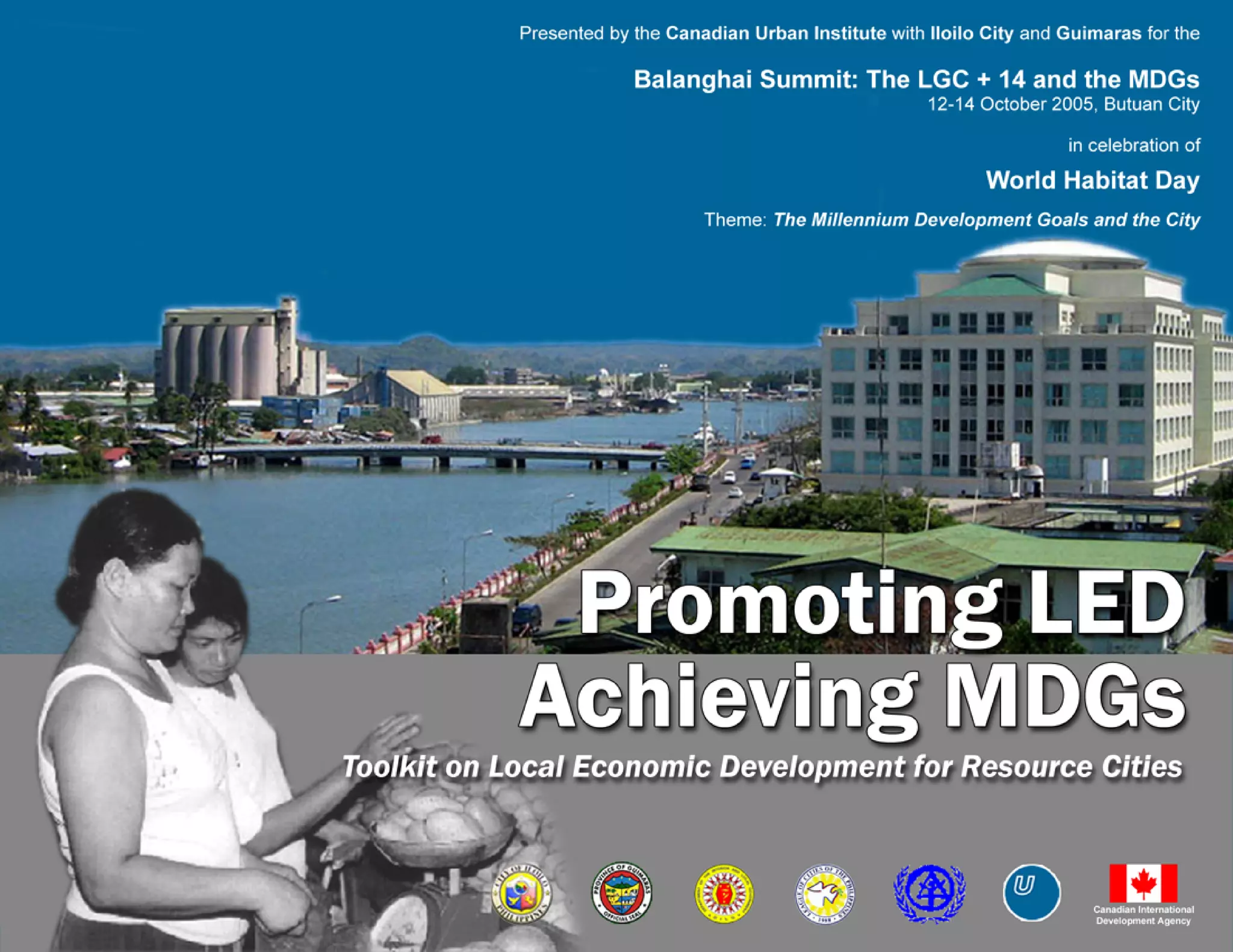
Promoting LED
         Achieving MDGs
                     Toolkit on Local Economic Development for Resource Cities
                                               Dev         for Resource


IMPORTANT
IMPORT

This is a first draft publication produced purposely for the
Balanghai Summit: The LGC + 14 and the MDGs
                            LGC 14
12-14 October 2005, Butuan City, Philippines
held in celebration of World Habitat Day

If you find errors –– may they be typographical, grammatical or whatsoever ––
please notify the Canadian Urban Institute Philippines.

You may contact us at:
                                   Urban Institute
                      Canadian Urban Institute
                      2F Mary Mart Mall, Valeria Street
                      Iloilo City 5000 Philippines
                      Telfax: +63 33 3367827
                      Tel. No.: +63 33 3363541
                      Email: cuiphils@canurb.com
This report was published with funding support from the

                Canadian International
                Development Agency
Table of Contents
                                     Promoting LED, Achieving MDGs
                                     Promo
                                       omoting      Achie
                                                     chieving                    1
      Framework for Local Economic Development Strategic Planning
       ramework for                Dev         Strategic                         3
                                Unleashing LED Through Partnership
                                               Through Partnership
                                                        artner                  14
             Case 1: Local Action on Public-Private Partnership in LED
Jumpstarting Local Economic Development Through Dinagyang Festival             20
    Case 2: Local Action on Multi-Stakeholder Implementation Groups
               Multi-Stakeholder Participation in Economic Promotion           22
                    Case 3: Local Action on Marketing and Promotion
                    Cooperation in Investment and Tourism Promotion             24
                            Case 4: Local Action on Rural-Urban Links
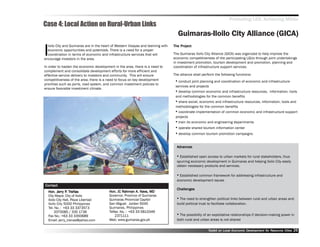
                                   Guimaras-Iloilo City Alliance (GICA)        26
                   Case 5: Local Action on Investing in Natural Capital
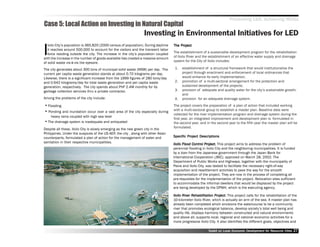
                         Investing in Environmental Initiatives for LED         27
                                 Reducing Poverty, Reaping Progress
                                          Po erty Reaping Progress
                                               ty,                             29
          Case 6: Local Action on Organizational Development for LED
                              Provincial Economic Development Office           36
                         Case 7: Local Action on Attracting Investment
                   Attracting Outside Investment for the Guimaras GIS          38
                          Case 8: Local Action on Sustainable Tourism
                      Guisi Community-based Heritage Tourism Project           40
                       Case 9: Local Action on Partnerships in Tourism
          Public-Private Partnership in Guimaras Tourism Development           42
                   Case 10: Local Action on ““Buy Local”” Campaigns
Farm Marketing Support Through GTIC and Panindahan sa Manggahan                44
                                                      About CPPPGUG            46

                                                     Toolkit on Local Economic Development for Resource Cities
                                                                               Dev         for Resource
Promoting LED, Achieving MDGs

P
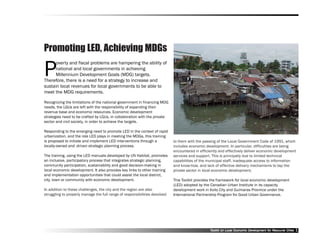
      overty and fiscal problems are hampering the ability of
     national and local governments in achieving
     Millennium Development Goals (MDG) targets.
Therefore, there is a need for a strategy to increase and
sustain local revenues for local governments to be able to
meet the MDG requirements.

Recognizing the limitations of the national government in financing MDG
needs, the LGUs are left with the responsibility of expanding their
revenue base and economic resources. Economic development
strategies need to be crafted by LGUs, in collaboration with the private
sector and civil society, in order to achieve the targets.

Responding to the emerging need to promote LED in the context of rapid
urbanization, and the role LED plays in meeting the MDGs, this training
is proposed to initiate and implement LED interventions through a           to them with the passing of the Local Government Code of 1991, which
locally-owned and -driven strategic planning process.                       includes economic development. In particular, difficulties are being
                                                                            encountered in efficiently and effectively deliver economic development
The training, using the LED manuals developed by UN Habitat, promotes       services and support. This is principally due to limited technical
an inclusive, participatory process that integrates strategic planning,     capabilities of the municipal staff, inadequate access to information
community participation, sustainability and good decision-making in         and know-how, and lack of effective delivery mechanisms to tap the
local economic development. It also provides key links to other training    private sector in local economic development.
and implementation opportunities that could assist the local district,
city, town or community with economic development.                          This Toolkit provides the framework for local economic development
                                                                            (LED) adopted by the Canadian Urban Institute in its capacity
In addition to these challenges, the city and the region are also           development work in Iloilo City and Guimaras Province under the
struggling to properly manage the full range of responsibilities devolved   International Partnership Program for Good Urban Governance.


                                                                                                 Toolkit on Local Economic Development for Resource Cities
                                                                                                                           Dev         for Resource          1
Promoting LED, Achieving MDGs


The Toolkit contains the following sections aside from the Introduction

    1. Framework for LED: describes the LED process utilized by Iloilo
       City and Province of Guimaras in developing and implementing
       local actions to enhance their local economies.

    2. Iloilo City: Building Partnerships for LED. Contains the
       description of the city’’s economic context, LED process and
       gains in LED. It also include sample local actions implemented
       by Iloilo City to build public-private partnerships.

    3. Guimaras: Reducing Poverty, Reaping Progress: Contains the
       descriptions of the provincial economic profile, LED process
       and gains in LED. It also include sample local actions
       implemented by the province to develop and promote its key
       industries.

    4. CPPPGUG: In Pursuit of Good Urban Governance: Describes
       the capacity development project implemented by CUI in
       Metropolitan Iloilo Development Council, Province of Guimaras
       and Municipality of Malay in pursuit of good governance. It also
       describes the mandate and programming of CUI.


                                                                          Toolkit on Local Economic Development for Resource Cities
                                                                                                    Dev         for Resource          2
Promoting LED, Achieving MDGs


Framework for Local Economic Development Strategic Planning
                   Dev                 Promo
                                         omotion       endeav to
Local Economic Development and Promotion is an endeavor to
                                                              order to
substantially increase economic and business activities in order to
impr
   pro                                         gov              (LGU).
improve the living conditions within a local government unit (LGU). It is
                                               progress,
concerned with the accelerating economic progress, attraction of
appropriat
     opriate           inv            production     mark
appropriate outside investments, production and marketing of local
products;                      commercial                 enter
                                                             erprises;
products; establishment of commercial and industrial enterprises; and
dev                      entrepreneurship.            for concert
development of local entrepreneurship. LED calls for a concer ted
effort various sector   ors                   gov                 ov
effor t of various sectors helping the local governments in the overall
dev             effort      locality.
development ef for t of a locality.

In the course of capacity development activities under the Canada-Philippines
Partnership Program for Good Urban Governance (CPPPGUG), we have found
ourselves asking the following:

         How do we get started in LED?
         What are the steps and tools needed to develop a LED strategy?

LED is now recognized as a key component in broader efforts to reduce poverty.
There is also an emerging consensus that LED cannot bring about effective
poverty reduction without incorporating explicit poverty reduction actions.

Therefore, a key challenge is to ensure the pursuit of inclusive economic
development that provides for both the promotion of local wealth creation and
poverty reduction; this ensures that those traditionally left out are active
participants and have access to opportunities resulting from development.
Inclusive means recognizing formal as well as informal economies.

In addition to reducing poverty, formalizing the informal economy might form a       The question is how we can make LED a reality in our Trousdale, EcoPlan International, Inc.
                                                                                                                                   Source: W.
                                                                                                                                              communities. This
long-term goal for health and safety reasons, better public management or            requires firmly placing LED within the broader framework of local sustainable
increased revenues through taxation. However, abrupt attempts to regulate the        development.
informal economy prematurely might lead to more poverty and marginalization.
Rather, local authorities might want to consider actions that tolerate and support   A strategic approach to LED implies careful consideration of the various trade-
the informal economy while they seek to strengthen the skills and resources of       offs. It demands the need for harnessing and mobilizing the local human,
people engaged in the informal economy.                                              social, financial and natural capital towards the common vision, goals and
                                                                                     objectives that the community aspires to achieve. This is possible only when the


                                                                                                                Toolkit on Local Economic Development for Resource Cities
                                                                                                                                          Dev         for Resource            3
Promoting LED, Achieving MDGs


various stakeholders and actors join forces to make a difference in quality of          2.   Where do we want to go?
life in their cities, towns and settlements                                             3.   How are we going to get there?
                                                                                        4.   How do we know when we have arrived?
The need for a framework that will guide our capacity development activities to
support LED was really a big challenge on our Canada-Philippines partnership
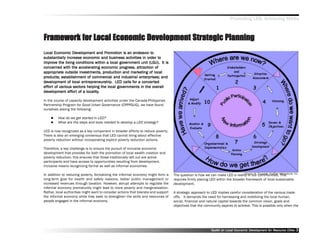
initiatives. We found an answer through a LED framework on strategic planning       The LED framework is divided into 4 modules with 10 steps distributed among the
produced by UN Habitat and Vancouver-based Ecoplan International, the idea of       4 modules. Examples are provided in the boxes corresponding to the module or
which germinated from the earlier work done by EcoPlan International with the       steps discussed.
Canadian urban Institute.
                                                                                                        we now?
                                                                                    Module 1: Where are we now?
        Frame ork
         ramew
The LED Framework
                                                                                             Step 1: Getting Started
Local economic development (LED) is a participatory process in which local                   Step 2: Stakeholders and Participation
people from all sectors work together to stimulate local commercial activity,                Step 3: Situation Analysis.
resulting in a resilient and sustainable economy. It is a way to help create
decent jobs and improve the quality of life for everyone, including the poor and                       we want to
                                                                                    Module 2: Where do we want to go?
marginalized.
                                                                                             Step 4: Visioning
A LED strategy is a process-oriented and non-prescriptive endeavor                           Step 5: Setting Objectives
incorporating:
                                                                                              How    we get
                                                                                    Module 3: How do we get there?
         Local values (poverty reduction, basic needs, local jobs, integrating
         social and environmental values);                                                   Step 6: Identifying & Evaluating Strategy Options
         Economic drivers (value-added resource use, local skills training, local            Step 7: Action Planning and Strategy Documentation
         income retention, regional co-operation); and                                       Step 8: Plan Implementation.
         Development (the role of structural change, quality of development).
                                                                                    Module 4: Have We Arrived?
                                                                                              Hav We Arrived?
Strategic planning is a systematic decision-making process that focuses
attention on important issues and on how to resolve them. Strategic planning                 Step 9: Monitor and Evaluate
provides a general framework for action: a way to determine priorities, make                 Step 10: Adjust and Modify
wise choices and allocate scarce resources (e.g., time, money, skills) to achieve
agreed-upon objectives.

Strategic planning for local economic development can be viewed as a series of
four basic questions:
     1. Where are we now?


                                                                                                           Toolkit on Local Economic Development for Resource Cities
                                                                                                                                     Dev         for Resource          4
Promoting LED, Achieving MDGs


Module 1: Where are we now?
Step 1: Getting Star ted
Step Getting Start                                                                                                     Step 2: Stakeholders and
                                                                                                                       Step     Stakeholder
                                                                                                                                     eholders
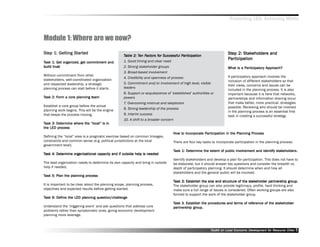
                                                   Table 2: Ten Factors for Successful Participation
                                                            Ten Factors for
                                                                 actor                 Par
                                                                                        articipation
                                                                                                                        articipation
                                                                                                                       Par ticipation
Task 1: Get organized, get commitment and
         Get           get                         1. Good timing and clear need
build trust                                        2. Strong stakeholder groups                                                  Participator Approach?
                                                                                                                                  articipatory
                                                                                                                       What is a Par ticipator y Approach?
                                                   3. Broad-based involvement
Without commitment from other                                                                                          A participatory approach involves the
                                                   4. Credibility and openness of process
stakeholders, well-coordinated organization                                                                            inclusion of different stakeholders so that
and respected leadership, a strategic              5. Commitment and/or involvement of high level, visible
                                                                                                                       their views, concerns and issues can be
planning process can stall before it starts.       leaders
                                                                                                                       included in the planning process. It is also
                                                   6. Support or acquiescence of ’’established’’ authorities or        important because it is here that networks,
Task 2: Form a core planning team
        Form                 team                  powers                                                              partnerships and information sharing occur
                                                   7. Overcoming mistrust and skepticism                               that make better, more practical, strategies
Establish a core group before the actual                                                                               possible. Reviewing who should be involved
planning work begins. This will be the engine      8. Strong leadership of the process
                                                                                                                       in the planning process is an essential first
that keeps the process moving.                     9. Interim success                                                  task in creating a successful strategy
                                                   10. A shift to a broader concern
Task 3: Determine where the ““local”” is in
        Det
         process
the LED process
                                                                                    How to Incorporate Par ticipation in the Planning Process
                                                                                    How to Incorporat Par
                                                                                                porate articipation                   Process
Defining the ““local”” area is a pragmatic exercise based on common linkages,
constraints and common sense (e.g. political jurisdictions at the local             There are four key tasks to incorporate participation in the planning process:
government level).
                                                                                    Task 1: Determine the extent of public involvement and identify stakeholders.
                                                                                            Det           ext
                                                                                                           xtent           involvement              stakeholder
                                                                                                                                                        eholders.
Task 4: Determine organizational capacity and if outside help is needed
        Det
                                                                                    Identify stakeholders and develop a plan for participation. This does not have to
The lead organization needs to determine its own capacity and bring in outside      be elaborate, but it should answer key questions and consider the breadth vs.
help if needed.                                                                     depth of participatory planning. It should determine when and how all
                                                                                    stakeholders and the general public will be involved.
Task 5: Plan the planning process
                          process
                                                                                    Task 2: Establish the size and structure of the stakeholder par tnership group.
                                                                                                                                     stakeholder partner
                                                                                                                                                      tnership group.
It is important to be clear about the planning scope, planning process,             The stakeholder group can also provide legitimacy, profile, hard thinking and
objectives and expected results before getting started.                             make sure a full range of issues is considered. Often working groups are also
                                                                                    formed to support the work of the stakeholder group.
Task 6: Define the LED planning question/challenge
        Define                  question/challenge
                                                                                    Task 3. Establish the procedures and terms of reference of the stakeholder
                                                                                                          procedures     terms reference           stakeholder
Understand the ‘‘triggering event’’ and ask questions that address core             partner
                                                                                        tnership group.
                                                                                    par tnership group.
problems rather than symptomatic ones, giving economic development
planning more leverage.


                                                                                                            Toolkit on Local Economic Development for Resource Cities
                                                                                                                                      Dev         for Resource          5
Promoting LED, Achieving MDGs


Step 3: Situation Analysis
Step
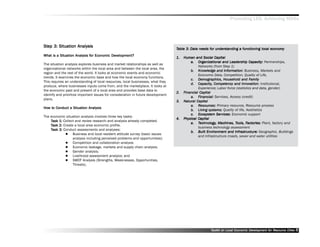
                                                                                   Table 3: Data needs for understanding a functioning local economy
                                                                                                       for unders                            economy
                             for          Dev
What is a Situation Analysis for Economic Development?
                                                                                   1.   Human and Social Capital
                                                                                            a. Organizational and Leadership Capacity: Partnerships,
                                                                                                                       Leadership
The situation analysis explores business and market relationships as well as
                                                                                                 Networks (from Step 1)
organizational networks within the local area and between the local area, the
                                                                                            b. Knowledge and Information: Business, Markets and
                                                                                                 Knowledge         Information:
region and the rest of the world. It looks at economic events and economic
                                                                                                 Economic Data, Competition, Quality of Life,
trends. It examines the economic base and how the local economy functions.
                                                                                            c. Demographics, Household and Family  Family
This requires an understanding of local resources, local businesses, what they
                                                                                            d. Capacity, Competency and Innovation: Institutional,
                                                                                                 Capacity, Compepet            Innov
produce, where businesses inputs come from, and the marketplace. It looks at
                                                                                                 Experience; Labor force (statistics and data, gender)
the economic past and present of a local area and provides base data to
                                                                                   2.   Financial Capital
identify and prioritize important issues for consideration in future development
                                                                                            a. Financial: Services, Access (credit)
plans.
                                                                                   3.   Natural Capital
                                                                                            a. Resources: Primary resource, Resource process
How to Conduct a Situation Analysis
How to
                                                                                            b. Living systems: Quality of life, Aesthetics
                                                                                                        syst
                                                                                            c. Ecosystem Ser vices: Economic support
                                                                                                 Ecosyst      Services:
The economic situation analysis involves three key tasks:
                                                                                   4.   Physical
                                                                                        Physical Capital
    Task 1: Collect and review research and analysis already completed.
                                                                                            a. Technology, Machines, Tools, Factories: Plant, factory and
                                                                                                  echnology Machines, Tools, Fact
                                                                                                    hnology,                      actories:
    Task 2: Create a local area economic profile.
                                                                                                 business technology assessment
    Task 3: Conduct assessments and analyses:
                                                                                            b. Built Environment and Infrastructure: Geographic, Buildings
                                                                                                      Envir
                                                                                                          vironment       Infrastructure:
                  Business and local resident attitude survey (basic issues
                                                                                                 and Infrastructure (roads, sewer and water utilities
                  analysis including perceived problems and opportunities);
                  Competition and collaboration analysis
                  Economic leakage, markets and supply chain analysis;
                  Gender analysis;
                  Livelihood assessment analysis; and
                  SWOT Analysis (Strengths, Weaknesses, Opportunities,
                  Threats).


                                                                                                        Toolkit on Local Economic Development for Resource Cities
                                                                                                                                  Dev         for Resource          6
Promoting LED, Achieving MDGs


Module 2: Where do we want to go?
Step 4: Visioning
Step                                                                                   Example of Vision
                                                                                       Exam
                                                                                         ample

What is in a Vision?                                                                   AMIGU (Allied Metro Iloilo Guimaras Union) is the agri-tourism capital of
                                                                                       Western Visayas composed of highly educated, god-loving healthy families
The economic vision begins to answer the question: ““Where do we want to go?””         working together for a progressive economy, self-reliance, and sustainable
It is a snapshot of the desired future. It makes clear the core values and             development.
principles that are central to what the local area wants to become. The vision is
informed by the current situation and looks to the future to alter the current
into the desired. Objectives and actions are then based on this vision, thereby
connecting the vision to practical decision-making.                                  Task 3: Collect and group similar ideas.

Why develop a vision?
Why dev                                                                              Task 4: Get agreement on themes and have someone from the group
                                                                                     ‘‘wordsmith’’ one or two vision statements for approval at later workshops/
Visions are an important way to harness the power of the mind. By imagining          meetings.
an ideal future while considering the current reality, tension is created. As
human beings, we respond to this tension with an impulsive desire to close the
gap. A clearly articulated vision statement provides a continuous point of
reference to keep closing the gap and keep the process heading in a desirable
direction. As a general expression of values, visioning provides an opportunity      Step 5: Setting Objectives
                                                                                     Step Setting Objectives
for the local area to think in broad terms about the future. Developing the
vision also provides the opportunity for dialogue, learning, relationship building            Objectives?
                                                                                     What are Objectives?
and awareness raising. Finally, insight from the visioning process supports
development objectives, the decision-making framework (discussed in Step 5).         The four points below discuss objectives:
                                                                                             Objectives answer the question: ““What matters?”” and ask: ““What is
How to Develop a Vision for Local Economic Development
How to Dev              for                Dev                                                important about local economic development?””
                                                                                             Objectives are the basis for generating and designing strategy options.
There are many ways to generate a vision statement, and the five tasks below                  They act as a checklist, or design criteria, to address local area
describe one method:                                                                          values.
                                                                                             Objectives clarify directions of preference that can be compared and
Task 1: Review the SWOT Analysis and other work done previously.                              traded off (a little more of this for a little less of that).
                                                                                             Objectives provide decision criteria for evaluating strategy options.
Task 2: In a workshop setting, with focus groups or through surveys (a good
chance for public participation), ask the following:                                 An objective is formed by converting issues and concerns into a succinct
     What would you like the local area’’s future to become?                         statement that describes a direction of preference (more/less) and includes a
     What are the most important economic aspects of the desired future              noun; two examples are: ““Expand Employment Opportunities”” or ““Reduce
      (e.g., jobs, income, poverty reduction, etc.)?                                 Poverty.”” Identifying a full range of objectives helps to avoid making
     What is different about your vision of the future from what you see today?      unbalanced or poor decisions.


                                                                                                             Toolkit on Local Economic Development for Resource Cities
                                                                                                                                       Dev         for Resource          7
Promoting LED, Achieving MDGs


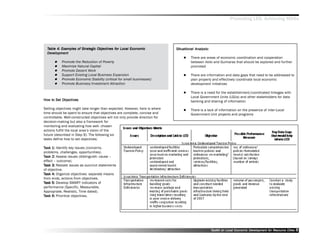
  Table 4: Examples of Strategic Objectives for Local Economic
           Exam
             amples Strat
                        trategic Objectives for                                 Situational Analysis:
  Dev
  Development
                                                                                         There are areas of economic coordination and cooperation
           Promote the Reduction of Poverty                                              between Iloilo and Guimaras that should be explored and further
           Maximize Natural Capital                                                      promoted
           Promote Decent Work
           Support Existing Local Business Expansion                                     There are information and data gaps that need to be addressed to
           Promote Economic Stability (critical for small businesses)                    plan properly and effectively coordinate local economic
           Promote Business/Investment Attraction                                        development initiatives

                                                                                         There is a need for the establishment/coordinated linkages with
                                                                                         Local Government Units (LGUs) and other stakeholders for data
How to Set Objectives
How to Set Objectives                                                                    banking and sharing of information

Setting objectives might take longer than expected. However, here is where               There is a lack of information on the presence of inter-Local
time should be spent to ensure that objectives are complete, concise and                 Government Unit projects and programs
controllable. Well-constructed objectives will not only provide direction for
decision-making but also a framework for
monitoring and evaluating how well- chosen
actions fulfill the local area’’s vision of the
future (described in Step 9). The following six
tasks define how to set objectives:

Task 1: Identify key issues (concerns,
problems, challenges, opportunities).
Task 2: Assess issues (distinguish: cause ––
effect –– outcome).
Task 3: Restate issues as succinct statements
of objective.
Task 4: Organize objectives: separate means
from ends, actions from objectives.
Task 5: Develop SMART indicators of
performance (Specific, Measurable,
Appropriate, Realistic, Time dated).
Task 6: Prioritize objectives.


                                                                                                        Toolkit on Local Economic Development for Resource Cities
                                                                                                                                  Dev         for Resource          8
Promoting LED, Achieving MDGs


Module 3: How do we get there?
Step 6: Identifying and Evaluating Strategy Options
Step                    Evaluating Strategy

How are strategy options designed?
How     strategy

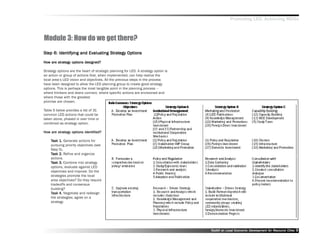
Strategy options are the heart of strategic planning for LED. A strategy option is
an action or group of actions that, when implemented, can help realize the
local area’’s LED vision and objectives. All the previous steps in the process
have been designed to allow the LED planning group to create good strategy
options. This is perhaps the most tangible point in the planning process ––
where thinkers and doers connect, where specific actions are envisioned and
where those with the greatest
promise are chosen.

Table 5 below provides a list of 31
common LED actions that could be
taken alone, phased in over time or
combined as strategy option.

How are strategy options identified?
How     strategy         identified?

    Task 1. Generate actions for
          1.
    pursuing priority objectives (see
    Step 5).
    Task 2. Refine and organize
    actions.
    Task 3. Combine into strategy
    options, evaluate against LED
    objectives and improve. Do the
    strategies promote the local
    area objectives? Do they require
    tradeoffs and consensus
    building?
    Task 4. Negotiate and redesign
    the strategies; agree on a
    strategy


                                                                                     Toolkit on Local Economic Development for Resource Cities
                                                                                                               Dev         for Resource          9
Promoting LED, Achieving MDGs


                      Step 7: Action Planning and
                      Step 7: Action
                      Strategy
                      Strategy Documentation

                              Action
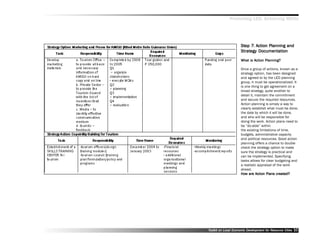
                      What is Action Planning?

                      Once a group of actions, known as a
                      strategy option, has been designed
                      and agreed to by the LED planning
                      group, it must be operationalized. It
                      is one thing to get agreement on a
                      broad strategy, quite another to
                      detail it, maintain the commitment
                      and secure the required resources.
                      Action planning is simply a way to
                      clearly establish what must be done,
                      the date by which it will be done,
                      and who will be responsible for
                      doing the work. Action plans need to
                      be ““do-able”” within
                      the existing limitations of time,
                      budgets, administrative capacity
                      and political resources. Good action
                      planning offers a chance to double
                      check the strategy option to make
                      sure the strategy is practical and
                      can be implemented. Specifying
                      tasks allows for clear budgeting and
                      a realistic appraisal of the work
                      ahead.
                      How        Action       created?
                      How are Action Plans created?


Toolkit on Local Economic Development for Resource Cities
                          Dev         for Resource          10
Promoting LED, Achieving MDGs


                                                                                         Chapter 4: How are we now? This is the strategy and the action plan. It
An action plan contains a description of the specific tasks and activities               represents priority programs and projects for implementation. Here is
necessary to implement the chosen strategy option. The key tasks involved in             where coordination of funding sources and partnerships/organizations for
action planning are as follows:                                                          economic development are highlighted.

    Task 1. Clearly understand the tasks and actions involved in the chosen
          1.                                                                             Chapter 5: How do we know when we have arrived?
    strategy option (Step 6).
    Task 2. Determine who needs to be involved and specific roles and                    Finally, the LED strategic planning document should describe the process
    responsibilities.                                                                    for evaluation and periodic update.
    Task 3. Determine time frames, resources, funding and preconditions.
    Task 4. Identify risks, gaps and weak links in the action plan and how they
    will be addressed (e.g., actions or tasks in which there is no clear leader,
    no funding or other key resources identified, capacity limitations).             Step 8: Plan Implementation
                                                                                     Step         Implementation
    Task 5. Reconfirm commitments of each partner.
    Task 6. Agree on a coordination mechanism.                                       Following Through
                                                                                      ollowing Through
    Task 7. Agree on a monitoring mechanism (Step 9).
          7.
                                                                                     At this point of the process, a written Local Economic Development Strategy
                                                                                     Document should have been produced. This document should outline
                                                                                     commitment of resources and establish a clear path of action. But beware! LED
Strategy Documentation: Preparing the Strategic Plan
Strategy                              Strategic                                      strategies often become derailed here. Developing the plan is not the end of
                                                                                     the process; it requires good implementation management.
The best LED strategic planning document is brief and easy to use. The LED
strategic planning document will be unique in content, but will likely contain the                                           Dev
                                                                                     Institutionalization and Organizational Development
same summary information –– information derived from the Ten Steps of
Planning Excellence process. A typical LED strategic document will contain the       New ways of thinking about LED and utilizing a participatory approach will take
following chapters:                                                                  time to be understood, accepted and routinely applied. Research indicates that
                                                                                     the full impact of implementing a LED will also take time, especially if
    Chapter 1: Introduction                                                          institutional adaptations and adjustments are required. Developing new
    Background information and document organization                                 organizations or adapting existing ones are two possible ways to institutionalize
                                                                                     and sustain the LED effort. For example, LED could be institutionalized by
    Chapter 2: Where are we now?                                                     giving an existing staff member responsibility for LED, or by creating a new
    This provides the overview of the stakeholders and the situation. It is an       position within an existing department. Another way is through the
    analysis of the local economy’’s strengths and weaknesses, and the               establishment of a Local Economic Development Agency (LEDA), composed of
    opportunities and threats, as well as the availability of partners and           public and private institutions, representatives of political and economic
    resources for economic development.                                              spheres, and civil society (see Training Resource Link 6). LEDAs have
                                                                                     demonstrated their effectiveness, especially in institutionally poor
    Chapter 3: Where do we want to go?                                               environments. In institutionally rich environments, some kind of ““officialized””
    This contains the final vision and objectives that set the strategic direction   LED forum might be more appropriate, ensuring continuity in consultations,
    for the action plan, which is also included.                                     dialogue, strategic planning as well as monitoring and evaluation.


                                                                                                           Toolkit on Local Economic Development for Resource Cities
                                                                                                                                     Dev         for Resource          11
Promoting LED, Achieving MDGs


                                                                                     Module 4: Have we arrived?
How is institutionalization done?
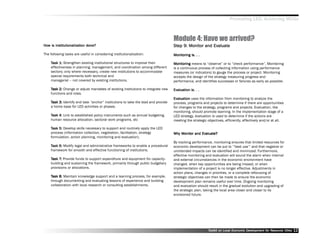
How                                                                                  Step 9: Monitor and Evaluate
                                                                                     Step Monitor        Evaluat
                                                                                                           aluate
The following tasks are useful in considering institutionalization:                  Monitoring is. . .
                                                                                     Monitoring

    Task 1: Strengthen existing institutional structures to improve their            Monitoring means to ““observe”” or to ““check performance””. Monitoring
                                                                                     Monitoring
    effectiveness in planning, management, and coordination among different          is a continuous process of collecting information using performance
    sectors; only where necessary, create new institutions to accommodate            measures (or indicators) to gauge the process or project. Monitoring
    special requirements both technical and                                          accepts the design of the strategy measuring progress and
    managerial –– not covered by existing institutions.                              performance, and identifies successes or failures as early as possible.

    Task 2: Change or adjust mandates of existing institutions to integrate new      Evaluation is. . .
                                                                                     Evaluation
    functions and roles.
                                                                                     Evaluation uses the information from monitoring to analyze the
                                                                                     Evaluation
    Task 3: Identify and task ““anchor”” institutions to take the lead and provide   process, programs and projects to determine if there are opportunities
    a home base for LED activities or phases.                                        for changes to the strategy, programs and projects. Evaluation, like
                                                                                     monitoring, should promote learning. In the implementation stage of a
    Task 4: Link to established policy instruments such as annual budgeting,         LED strategy, evaluation is used to determine if the actions are
    human resource allocation, sectoral work programs, etc                           meeting the strategic objectives, efficiently, effectively and/or at all.

    Task 5: Develop skills necessary to support and routinely apply the LED
    process (information collection, negotiation, facilitation, strategy             Why Monitor and Evaluate?
                                                                                     Why Monitor     Evaluat
                                                                                                       aluate?
    formulation, action planning, monitoring and evaluation).
                                                                                     By tracking performance, monitoring ensures that limited resources for
    Task 6: Modify legal and administrative frameworks to enable a procedural        economic development can be put to ‘‘““best use’’”” and that negative or
    framework for smooth and effective functioning of institutions.                  unintended impacts can be identified and minimized. Furthermore,
                                                                                     effective monitoring and evaluation will sound the alarm when internal
    Task 7: Provide funds to support expenditure and equipment for capacity-
          7:                                                                         and external circumstances in the economic environment have
    building and sustaining the framework, primarily through public budgetary        changed, when key opportunities are being missed, or when
    provisions or allocations.                                                       implementation of a project is no longer effective. Adjustments in
                                                                                     action plans, changes in priorities, or a complete refocusing of
    Task 8: Maintain knowledge support and a learning process, for example,          strategic objectives can then be made to ensure the economic
    through documenting and evaluating lessons of experience and building            development plan remains useful over time. Ongoing monitoring
    collaboration with local research or consulting establishments.                  and evaluation should result in the gradual evolution and upgrading of
                                                                                     the strategic plan, taking the local area closer and closer to its
                                                                                     envisioned future.


                                                                                                           Toolkit on Local Economic Development for Resource Cities
                                                                                                                                     Dev         for Resource          12
Promoting LED, Achieving MDGs


How to Monitor and Evaluate Project Implementation
How to Monitor     Evaluat Project Implementation
                     aluate

    Task 1: Prepare the monitoring or evaluation plan and framework: use
    project objectives and performance measures (Step 5), determine what will
    be monitored and what information is required and how it will be collected.
    Task 2: Determine who will be involved.
    Task 3: Determine when, where, how to monitor and evaluate.
    Task 4: Determine documentation and reporting protocol.


Step 10: Adjust and Modify
Step 10: Adjust

The monitoring and evaluation process is designed to track performance and
identify where and when adjustments in plan implementation at the project
level need to be made or where more fundamental changes to the plan vision
or objectives might need to occur. Adjustments and modifications should occur
throughout the strategic planning process whenever new information arises or
new priorities for direction or action are identified. And, of course, on a regular
basis (every 5-10 years), the strategy needs to be completely revisited. At this
time, go back to Step One.


                                                                                      Toolkit on Local Economic Development for Resource Cities
                                                                                                                Dev         for Resource          13
Promoting LED, Achieving MDGs


Unleashing LED Through Partnership
P
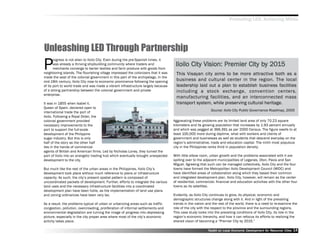
       rogress is not alien to Iloilo City. Even during the pre-Spanish times, it
       was already a thriving shipbuilding community where traders and               Iloilo City Vision: Premier City by 2015
                                                                                                                      by 201
       merchants converge to barter textiles and farm produce with goods from
neighboring islands. The flourishing village impressed the colonizers that it was     This Visayan city aims to be more attractive both as a
made the seat of the colonial government in this part of the archipelago. In the
mid-19th century, Iloilo City rose to economic prominence following the opening       business and cultural center in the region. The local
of its port to world trade and was made a vibrant infrastructure largely because      leadership laid out a plan to establish business facilities
of a strong partnership between the colonial government and private                   including a stock exchange, convention centers,
enterprise.
                                                                                      manufacturing facilities, and an interconnected mass
It was in 1855 when Isabel II,                                                        transport system, while preserving cultural heritage.
Queen of Spain, declared open to
                                                                                                             Source: Iloilo City Public Governance Roadmap, 2005
international trade the port of
Iloilo. Following a Royal Order, the
colonial government provided                                                        Aggravating these problems are its limited land area of only 70.23 square
necessary improvements to the                                                       kilometers and its growing population that increases by 1.93 percent annually
port to support the full-scale                                                      and which was pegged at 366,391 as per 2000 Census. The figure swells to at
development of the Philippine                                                       least 100,000 more during daytime, what with workers and clients of
sugar industry. But this is only                                                    government and businesses as well as students that descend everyday on the
half of the story as the other half                                                 region’’s administrative, trade and education capital. The ninth most populous
lies in the hands of commercial                                                     city in the Philippines ranks third in population density.
agents of British and American firms. Led by Nicholas Loney, they turned the
port of Iloilo into an energetic trading hub which eventually brought unexpected    With little elbow room, urban growth and the problems associated with it are
development to the city.                                                            spilling over to the adjacent municipalities of Leganes, Oton, Pavia and San
                                                                                    Miguel. Agreeing that such can be managed collectively, Iloilo City and the four
But much like the rest of the urban areas in the Philippines, Iloilo City’’s        towns have formed the Metropolitan Iloilo Development Council (MIDC) and
development took place without much reference to plans or infrastructure            have identified areas of collaboration along which they based their common
capacity. As such, the city’’s present spatial pattern is composed of               and integrated development plan. Iloilo City, however, will remain as the center
uncoordinated packets of development. Further, efforts to integrate the various     of residential, commercial, financial and education activities with the other four
land uses and the necessary infrastructure facilities into a coordinated            towns as its satellites.
development plan have been futile, as the implementation of land use plans
and zoning ordinances have been very lax.                                           Evidently, as Iloilo City continues to grow, its physical, economic and
                                                                                    demographic structures change along with it. And in light of the prevailing
As a result, the problems typical of urban or urbanizing areas such as traffic      trends in the nation and the rest of the world, there is a need to re-examine the
congestion, pollution, overcrowding, proliferation of informal settlements and      role of the city with the respect to the province and the surrounding regions.
environmental degradation are turning the image of progress into depressing         This case study looks into the prevailing conditions of Iloilo City, its role in the
picture, especially in the city proper area where most of the city’’s economic      region’’s economic hierarchy, and how it can refocus its efforts to realizing the
activity takes place.                                                               shared vision of becoming a ““Premier City by 2015.””

                                                                                                           Toolkit on Local Economic Development for Resource Cities
                                                                                                                                     Dev         for Resource          14
Promoting LED, Achieving MDGs

Economy
Economy                                                                                Infrastructure

The economy of Iloilo City is driven by the following sectors:                         The development of
                                                                                       Iloilo’’s role as a
Trade and Ser vices Iloilo City’’s economy is dominated by businesses involved
            Services
               vices.                                                                  commercial center is
in trade and services. In particular, employment in wholesale and retail trade,        buoyed by the city’’s
finance, insurance, real estate and business services top the list. In spite of its    transport infrastructure
being one of the country’’s traditional economic centers, the growth of Iloilo         network, which provides
City’’s economy has been relatively sluggish. Classification of businesses by          the necessary links with
industry shows that almost 75 percent of the city’’s commercial establishments         the local and national
fall under the category of micro-enterprises, or firms with a capitalization of only   markets. The city’’s road
PhP 150,000 and below. The decreasing number of registered business                    network facilitates the
establishments also points toward a downward trend in investment.                      transport of agricultural
                                                                                       products from the
Tourism. Iloilo City has great potential                                               surrounding region to
as a heritage tourist site due to its                                                  other parts of the country. However, traffic congestion is becoming an
wealth of historic buildings and colorful                                              increasing problem at the city proper due to the large volume of vehicles
festivals celebrated to honor the city’’s                                              converging within the small area.
patron saints. Over a two-year period
alone, receipts from the tourism                                                       The Iloilo City Port Complex is considered the leading trade and commercial hub
industry amounted to close to PhP                                                      for Western Visayas, as well as one of the safest natural seaports in the
100,000,000. However, insufficient                                                     country. Seventy-two foreign vessels and 10,471 domestic vessels docked at
infrastructure facilities, as well as the                                              the port of Iloilo in 2000, all with a gross registered tonnage of 12,076,649
lack of maintenance of its heritage sites                                              tons. On the same year, the port of Iloilo registered a passenger traffic figure of
hamper the further development of this                                                 1,933,964, of which 1,003,909 disembarked and 930,055 embarked there.
sector.
                                                                                       Its airport handles at least 15 flights a day, serving three commercial airlines
Industr y . Manufacturing in Iloilo City is
Industr
      try
                                                                                       and had a passenger traffic figure of 702,995 in 2001. In the same year, it
practically non-existent when compared to the booming trade and services
                                                                                       handled 5,670,565.7 kilos of incoming cargo and 3,793,870.5 kilos of
sector. In the period between 1990 and 1997, the growth of the manufacturing
                                                                                       outgoing cargo. With a 2,100 m. x 45 m. runway and a modern terminal
sector did not veer too far away from its average of 6.4 percent annually. The
                                                                                       equipped with computerized facilities to accommodate flights from key cities in
small number of industries –– primarily agro processing firms –– is also
                                                                                       the country, the airport has a total land area of 52,635 sq. m.
diminishing, as companies have been moving out to less populated areas. The
absence of land zoned specifically for industrial uses has also resulted in the
                                                                                       The provision of basic utility services in Iloilo City has so far been satisfactory.
establishment of factories in incompatible areas.
                                                                                       The power sector has been very efficient, with only less than 30 percent of the
Agriculture The development of Iloilo City’’s agricultural sector is compromised
 griculture.                                                                           urban households having no electrical connections. Problems, however, arise
by the spatial demands of urbanization. Agricultural lands have been reduced           during the peak load hours where demand exceeds supply, therefore resulting
significantly from 1,751 hectares in 1995, to only 987.16 hectares in 1997. In         in power interruptions. The water sector, on the other hand, suffers from
addition, the cost related to irrigating agricultural lands have also limited the      insufficient water supply and low water pressure.
city’’s investment in this sector. Aquaculture in the city is also on the decline
with the continued degradation of the Iloilo River. The proliferation of squatter      Iloilo City is probably among the few cities in the country where there is actually
settlements along its banks has been identified as the primary source of               an oversupply of telephone lines. The combined switching capacity of the local
pollution.                                                                             service providers –– Globelines and the Philippine Long Distance Telephone Co.
                                                                                       (PLDT) –– is 72,982. As of 1998, there were still 21, 625 unused lines.


                                                                                                              Toolkit on Local Economic Development for Resource Cities
                                                                                                                                        Dev         for Resource          15
Promoting LED, Achieving MDGs

                                                                                        Solid waste is also a major problem in Iloilo City where at least 300 tons is
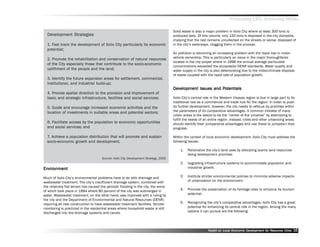
  Development Strategies
  Dev         Strategies                                                                produced daily. Of this volume, only 150 tons is disposed in the city dumpsite,
                                                                                        implying that the rest remains uncollected on the streets or worse, disposed of
  1. Fast track the development of Iloilo City par ticularly its economic
     Fast           dev                        particularly                             in the city’’s waterways, clogging them in the process.
  pot
  potential;
                                                                                        Air pollution is becoming an increasing problem with the rapid rise in motor
     Promo
        omot                         conserv                  resources
  2. Promote the rehabilitation and conservation of natural resources                   vehicle ownership. This is particularly an issue in the major thoroughfares
                                                                                        located in the city proper where in 1998 the annual average particulate
                                    contribute to
  of the City especially those that contribute to the socio-economic
                                                                                        concentrations exceeded the acceptable DENR standards. Water quality and
  upliftment
  uplif tment of the people and the land;                                               water supply in the city is also deteriorating due to the indiscriminate disposal
                                                                                        of waste coupled with the rapid rate of population growth.
                         expansion        for settlement, commercial,
  3. Identify the future expansion areas for settlement, commercial,
  institutional, and industrial build-up;
                                                                                        Development Issues and Potentials
                                                                                        Dev                    Po
     Pro                       to     pro            impr
                                                       pro
  4. Provide spatial direction to the provision and improvement of
             strategic                 facilities           services;
  basic and strategic infrastructure, facilities and social services;                   Iloilo City’’s central role in the Western Visayas region is due in large part to its
                                                                                        traditional role as a commercial and trade hub for the region. In order to push
  5. Guide and encourage increased economic activities and the                          its further development, however, the city needs to refocus its priorities within
              inv                               pot       sector
                                                              ors;
  location of investments in suitable areas and potential sectors;                      the parameters of its comparative advantages. A common mistake of many
                                                                                        urban areas is the desire to be the ““center of the universe”” by attempting to
                                                                                        fulfill the needs of an entire region. Instead, cities and other urbanizing areas
     Facilitat
      acilitate          by              to          opportunities
  6. Facilitate access by the population to economic oppor tunities                     should identify their comparative advantages and use these to jumpstart their
               services;
  and social ser vices; and                                                             progress.

  7. Achieve a population distribution that will promote and sustain
     Achie
      chiev                                      promo
                                                   omot                                 Within the context of local economic development, Iloilo City must address the
                  gro          dev
  socio-economic growth and development.                                                following issues:

                                                                                             1.   Rationalize the city’’s land uses by allocating scarce land resources
                                                                                                  along development priorities.
                                       Source: Iloilo City Development Strategy, 2005
                                                                                             2.   Upgrading infrastructure systems to accommodate population and
Environment
Envir
  vironment                                                                                       industrial growth.

Much of Iloilo City’’s environmental problems have to do with drainage and                   3.   Institute stricter environmental policies to minimize adverse impacts
wastewater treatment. The city’’s insufficient drainage system, combined with                     of urbanization on the environment.
the relatively flat terrain has caused the periodic flooding in the city, the worst
of which took place in 1994 where 80 percent of the city was submerged in                    4.   Promote the preservation of its heritage sites to enhance its tourism
water. Wastewater treatment, on the other hand, was improved with a ruling by                     potential.
the city and the Department of Environmental and Natural Resources (DENR)
requiring all new construction to have wastewater treatment facilities. Stricter             5.   Recognizing the city’’s comparative advantages, Iloilo City has a great
monitoring is practiced in the residential areas where household waste is still                   potential for enhancing its central role in the region. Among the many
discharged into the drainage systems and canals.                                                  options it can pursue are the following:


                                                                                                                Toolkit on Local Economic Development for Resource Cities
                                                                                                                                          Dev         for Resource          16
Promoting LED, Achieving MDGs

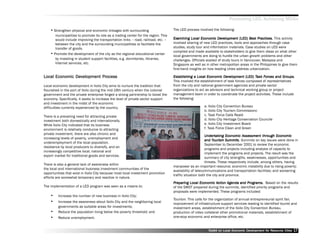
    •• Strengthen physical and economic linkages with surrounding                       The LED process involved the following:
          municipalities to promote its role as a trading center for the region. This
          would include improving the transportation links –– road, railroad, etc. ––   Examining Local Economic Development (LED) Best Practices. This activity
                                                                                        Examining                     Dev                  Best
          between the city and the surrounding municipalities to facilitate the         involved sharing of new LED practices, tools and approaches through case
          transfer of goods.                                                            studies, study tour and information materials. Case studies on LED were
                                                                                        compiled and made available to stakeholders to give them ideas on what other
    ••   Promote the development of the city as the regional educational center
                                                                                        local governments are doing to hurdle the urban growth problems and other
          by investing in student support facilities, e.g. dormitories, libraries,      challenges. Officials availed of study tours in Vancouver, Malaysia and
          Internet services, etc.                                                       Singapore as well as in other metropolitan areas in the Philippines to give them
                                                                                        first-hand insights on how leading cities address urbanization.

               Dev         Process
Local Economic Development Process                                                      Establishing a Local Economic Development (LED) Task Forces and Groups.
                                                                                        Establishing                    Dev                 Task Forces       Groups.
                                                                                        This involved the establishment of task forces composed of representatives
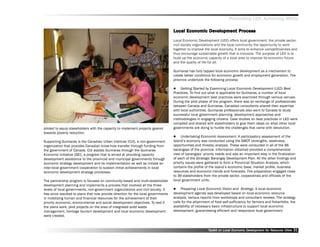
Local economic development in Iloilo City aims to nurture the tradition that            from the city and national government agencies and private sector
flourished in the port of Iloilo during the mid-19th century when the colonial          organizations to act as advisors and technical working group or project
government and the private enterprise forged a strong partnership to boost the          management team in order to coordinate the project activities. These include
economy. Specifically, it seeks to increase the level of private sector support         the following:
and investment in the midst of the economic
difficulties currently experienced by the country.                                                          a. Iloilo City Convention Bureau
                                                                                                            b. Iloilo City Tourism Commissionc
There is a prevailing need for attracting private                                                           c. Task Force Calle Reald
investment both domestically and internationally.                                                           d. Iloilo City Heritage Conservation Councile
While Iloilo City indicated that its business                                                               e. Iloilo City Investment Board
environment is relatively conducive to attracting                                                           f. Task Force Clean and Green
private investment, there are also chronic and
                                                                                                              Undertaking Economic Assessment through Economic
                                                                                                                ndertaking                          through
increasing levels of poverty, unemployment and
                                                                                                              and Tourism Summits Summits on key issues were done in
                                                                                                                  Tourism Summits.
underemployment of the local population,
                                                                                                              September to December 2001 to review the economic
resistance by local producers to diversify, and an
                                                                                                              programs and projects including analysis of capacity to
increasingly competitive local, national and
                                                                                                              implement the programs and projects. The result was the
export market for traditional goods and services.
                                                                                                              summary of city strengths, weaknesses, opportunities and
                                                                                                              threats. These respectively include, among others, having
There is also a general lack of awareness within
                                                                                        manpower as an important resource; economic instability due to rising poverty;
the local and international business investment communities of the
                                                                                        availability of telecommunications and transportation facilities; and worsening
opportunities that exist in Iloilo City because most local investment promotion
                                                                                        traffic situation both the city and province.
efforts are somewhat temporary and reactive in nature.
                                                                                        Preparing Local Economic Action Agenda and Programs. Based on the results
                                                                                                                  Action Agenda      Programs.
The implementation of a LED program was seen as a means to:                             of the SWOT prepared during the summits, identified priority programs and
                                                                                        proposals were implemented. These programs included:
    ••     Increase the number of new business in Iloilo City;
                                                                                        Tourism. This calls for the organization of annual entrepreneurial spirit fair,
    ••     Increase the awareness about Iloilo City and the neighboring local
                                                                                        improvement of infrastructure support services leading to identified tourist and
           governments as suitable areas for investments;                               investment areas, establishment of the Iloilo City Convention Bureau,
    ••     Reduce the population living below the poverty threshold; and                production of video collateral other promotional materials, establishment of
    ••     Reduce unemployment.                                                         one-stop economic and enterprise office, etc.


                                                                                                              Toolkit on Local Economic Development for Resource Cities
                                                                                                                                        Dev         for Resource          17
Promoting LED, Achieving MDGs

                                                                                    Identifying Appropriate Organizational Structure for LED. One of the
                                                                                                 Appropriat
                                                                                                       opriate               Structure for
                                                                                    mechanisms identified to ensure multi-stakeholder participations in LED was
                                                                                    the establishment of an investment promotion center, and by providing
                                                                                    technical support to the establishment of the Iloilo City Convention Bureau and
                                                                                    Iloilo City Cultural Heritage Conservation Council. This also included the revival
                                                                                    of the Iloilo City Tourism Commission. Organizational improvement workshops
                                                                                    on marketing and promotion, investment promotion planning, project
                                                                                    development and strategic planning were conducted.

                                                                                    Developing Local Capacity. Capacity development activities were carried out
                                                                                    Dev               Capacity.
                                                                                    through the local economic development planning, project management,
                                                                                    investment promotion, tourism promotion and development. The Iloilo City
                                                                                    Convention Bureau (ICCB), for example, was assisted through a workshop in
                                                                                    developing a strategic plan to chart the group’’s direction and equip the
                                                                                    organization in building its capacity to successfully to fulfill its mandate.

                                                                                    Implementing Local Economic Development Projects. A number of projects
                                                                                    Implementing                Dev           Projects.
                                                                                    have been implemented which are producing some results (see case studies).

                                                                                    Monitoring and Evaluation (on-going). Seeing to it that programs and projects
                                                                                    Monitoring      Evaluation
                                                                                    are continuously assessed for further improvements, key personnel involved in
Food security. This calls for launching of education and family planning            project development and implementation were trained on monitoring and
campaigns, setting up of research centers, strengthening of cooperatives, and       evaluation. Through workshops, stakeholders were then equipped with the tools
improvements of infrastructures like farm-to-market roads, fishing ports,           and process of economic monitoring system.
irrigation systems, warehouses and solar dryers.

Infrastructure. This calls for strict enforcement of road construction standards,   Gains
introduction of heavy mass transport system, improvement of drainage
systems, dredging of major waterways and port facilities, expansion of the          After some years of facilitating the LED process, the following gains were
international port, development of alternative ports, development of alternative    achieved:
water sources, expansion of the water system, strengthening of
telecommunication services, and introduction of alternative power plants.           Increased tourist arrivals. Tourist arrivals in Iloilo City increased by 123 percent
                                                                                                touris arrivals.
                                                                                                 ourist
                                                                                    in 2004 over the 2003 figure. The tourism industry had benefited from the
Environment. This calls for actions that would prevent air and water pollution,     professional management of Dinagyang Festival. With increasing tourist
forest denudation and degradation of marine environments, as well as address        arrivals, the economic benefits of the festival have trickled down to other
the worsening solid waste problem like massive information campaigns, strict        sectors like transportation, food, retail and even the lowly street traders. The
enforcement of environmental laws, provision of livelihood opportunities to         new investments in the tourism industry (two new hotels in Iloilo City) has
marginal sectors.                                                                   generated more investments and attracted more visitors and investors to the
                                                                                    city.
Governance. This calls for political solutions to problems on squatting, traffic,
garbage disposal, taxation, sidewalk vendors and underground economy, street        Established public-private par tnership. The city has organized the following
                                                                                    Established public-privat partner
                                                                                                           ate     tnership.
people and lack of coordination among and between local government units            functioning multi-stakeholder councils whose tasks are to support the LED
and national government agencies on matters pertaining to economic                  efforts of the city:
development.


                                                                                                           Toolkit on Local Economic Development for Resource Cities
                                                                                                                                     Dev         for Resource          18
Promoting LED, Achieving MDGs

 1. Iloilo City Convention Bureau The ICCB is the official destination-
                 Conv        Bureau.                                                  Lessons
    marketing organization not only for the tourism industry in Iloilo but also in
    Guimaras. It focuses on promotion and selling Iloilo and Guimaras as a            Iloilo City is among the urban centers in the country that has effectively
    remarkable destination for tourists, convention delegates and business            addressed its economic problems through partnerships and collaboration with
    travelers.                                                                        the private sector and NGOs. This is well-documented fact as shown in the
 2. Iloilo City Tourism Commission This body is tasked for formulate
                 Tourism Commission.                                                  ““State of the Philippine Population Report 2004,”” which was released last
    regulations and policies relative to tourism in the city.                         month. The report said: ““Iloilo City’’s recognition of the importance of
 3. Task Force Calle Real Organized to revive business activities in and
           Force       Real
                        eal.                                                          participation and cooperation has helped the city stay afloat amid problems
    preserve heritage buildings at the city’’s Central Business District (popularly   regarding urban growth.”” It also cited the efforts of the alliance that Iloilo City
    known as Calle Real), this task force planted the seed for heritage               built with neighboring towns, which ““proved to be a wise move in facing the
    conservation in Iloilo City.                                                      complicated pressures of urbanization.””
 4. Iloilo City Cultural Heritage Conser vation Council Created in April 2000
                                   Conserv       Council.
    under Ordinance No. 00-054 or the Local Cultural Heritage Conservation            Partnership in Iloilo City ““is at the heart of the LED efforts in Iloilo City”” as
    Ordinance, the council is responsible in advancing cultural heritage              ““many of the city’’s economic projects and programs involve the participation of
    conservation and promotion. It composed of individuals from the arts and          various sectors.”” Iloilo City is able to grab the opportunities brought about by
    culture community.                                                                the active participation of the various sectors. Partnership has played a big
 5. Iloilo City Investment and Incentive Board. This body is tasked to oversee
                Investment       Incentive Board                                      role in helping it meet the needs of its populace despite limited resources. This
    investment generation for Iloilo City and the grant of incentives to new          strategy of governance has also helped the city address the challenges
    business locators.                                                                associated with urban growth.
 6.. Task Force Clean and Green In charge of cleanliness and sanitation
            Force            Green.
    campaigns and projects, this serves as advisory and monitoring body on
    solid waste management issues.

Attracted funding for projects. As a result of creation of multi-stakeholder
  ttracted        for projects.
implementation groups, one of the key groups, the Iloilo City Convention Bureau
(ICCB) has generated of PhP 1 million seed money from the Department of
Tourism (DOT) to be used to market Iloilo and its cluster under the Visit Iloilo
and Guimaras 2006 project.

Organized alliances. The Guimaras-Iloilo City Alliance (GICA) was organized to
help improve the economic competitiveness of the participating LGUs through
joint undertakings in investment promotion, tourism development and
promotion, planning and coordination of infrastructure support services.

Attracted more investments. Iloilo City is becoming more attractive to investors.
 ttracted        investments.
After offering a one-year tax holiday for investments between PhP 1 million and
PhP 5 million, two-year tax holiday for investments worth P20 million, and three-
year tax holiday for companies which have invested P40 million and above, the
city has attracted call centers firms in Metro Manila to invest in the city.

Improved deliver y of services. The enhanced private sector participation in city
Impr
  pro    deliver
              ery services.
governance has improved delivery of tourism, heritage conservation, economic
promotion, environmental services


                                                                                                              Toolkit on Local Economic Development for Resource Cities
                                                                                                                                        Dev         for Resource          19
Promoting LED, Achieving MDGs
Case 1: Local Action on Public-Private Partnership in LED
      Jumpstarting Local Economic Development Through Dinagyang Festival

I
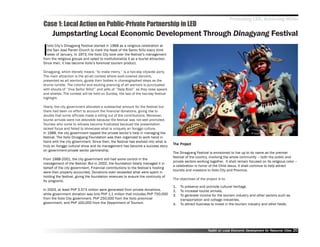
   loilo City’’s Dinagyang Festival started in 1968 as a religious celebration at
   the San Jose Parish Church to mark the feast of the Santo Niño every third
   week of January. In 1973, the Iloilo City took over the festival’’s management
from the religious groups and opted to institutionalize it as a tourist attraction.
Since then, it has become Iloilo’’s foremost tourism product.

Dinagyang, which literally means ‘‘’’to make merry,’’’’ is a two-day citywide party.
The main attraction is the ati-ati contest where soot-covered dancers,
presented as ati warriors, gyrate their bodies in choreographed steps as the
drums rumble. The colorful and exciting prancing of ati warriors is punctuated
with shouts of ‘‘’’Viva Señor Niño!’’’’ and yells of ‘‘’’Hala Bira!’’’’ as they raise spears
and shields. The contest will be held on Sunday, the last of the two-day festival
highlight.

Yearly, the city government allocates a substantial amount for the festival but
there had been no effort to account the financial donations, giving rise to
doubts that some officials made a killing out of the contributions. Moreover,
tourist arrivals were not desirable because the festival was not well promoted.
Tourists who come to witness become frustrated because the presentation
lacked focus and failed to showcase what is uniquely an Ilonggo culture.
In 1988, the city government tapped the private sector’’s help in managing the
festival. The Iloilo Dinagyang Foundation was then organized to work hand in
hand with the city government. Since then, the festival has evolved into what is
                                                                                                   Project
                                                                                               The Project
truly an Ilonggo cultural show and its management has become a success story
on government-private sector partnership.
                                                                                               The Dinagyang Festival is envisioned to live up to its name as the premier
                                                                                               festival of the country, involving the whole community –– both the public and
From 1988-2001, the city government still had some control in the
                                                                                               private sectors working together. It shall remain focused on its religious color ––
management of the festival. But in 2002, the foundation totally managed it in
                                                                                               a celebration in honor of the Child Jesus. It shall continue to help attract
behalf of the city government. Financial contributions to the festival’’s hosting
                                                                                               tourists and investors to Iloilo City and Province.
were then properly accounted. Donations even exceeded what were spent in
holding the festival, giving the foundation revenues to ensure the continuity of
                                                                                               The objectives of the project is to:
its programs.
                                                                                               1.   To preserve and promote cultural heritage.
In 2003, at least PhP 3.573 million were generated from private donations,                     2.   To increase tourist arrivals.
while government donation was only PhP 1.1 million that includes PhP 750,000                   3.   To generate income for the tourism industry and other sectors such as
from the Iloilo City government, PhP 250,000 from the Iloilo provincial                             transportation and cottage industries.
government, and PhP 100,000 from the Department of Tourism.                                    4.   To attract business to invest in the tourism industry and other fields.


                                                                                                                      Toolkit on Local Economic Development for Resource Cities
                                                                                                                                                Dev         for Resource          20
Promoting LED, Achieving MDGs

The management of the Dinagyang Festival is under the Iloilo Dinagyang                Advances
                                                                                       dvances
Foundation. Every time the Dinagyang season would draw near, the city mayor
issues an executive order creating the organizational Committee, executive            •• The tourism industry benefited a lot from the Dinagyang. With increasing
committee and the working committees. The executive committee is headed by            tourist arrivals, i.e. 159,888 in 2001 to 207,780, the economic benefits of
the foundation with representatives of various groups and offices like the City       the festival surely trickled down to other industries like transportation, food,
Tourism Office, the chairperson of City Council’’s committee on tourism, the San      retail and even the lowly street traders. The new investments in the tourism
Jose Parish priests and national agencies, among others, as members. The              industry (two new hotels in Iloilo City) are expected to generate more
working committees include the finance, program, religious and marketing,             investments and attract more visitors and investors to the city.
support and publicity committees. All these were mandated to ensure the
success of the festival.                                                              •• The lowly street vendors benefited from the Dinagyang. The brisk sale of
                                                                                      souvenir items and festival paraphernalia is enough indicator of its impact to
The various committees then conduct their respective planning and budgeting           communities. Tourism is a market for all kinds of goods and the increasing
conferences, and submit an accomplished activity plan and budget proposal to          number of tourists coming to Iloilo-159,885 in 2001 and 207, 780 in 2002-
the executive board. Once an overall budget for the festival is arrived, the          means more income for any enterprising Ilonggo, with the tourism-oriented
executive committee conducts a fund-raising campaign by soliciting                    establishments gaining more.
sponsorship to meet the budgetary requirements of each committee. It is the
committees that implement their respective activities, ensuring that these are        Challenges
carried out successfully.
                                                                                      •• Due to the limited financial assistance from the City of Iloilo, The IDFI took
In the city government’’s annual budget, there is always an allocation for the        charge of looking for funds from other sources. The Festival committee created
Dinagyang, which then becomes the city’’s contribution to the festival. The           a marketing group to undertake solicitation from various business entities and
finance and marketing committees then work to raise additional funds. There is        individuals by offering media mileage and promotional collaterals. Exchange
then massive promotion for the festival while the program committee prepares          deals and advertising packages were designed to fit the particular needs of
a list of special events. The religious committee is in charge of ensuring that the   the target sponsors. This year, at least Php 3.573 million were generated from
religiosity of the Dinagyang remains intact. An executive director oversees the       private donations, while government donation was only Php 1.1. million that
entire conduct of the festival. There is also the secretariat that does all the so-   includes Php 750,000 from Iloilo City Government, Php 250,000 from the Iloilo
called dirty works.                                                                   provincial government, and Php 100,000 from the Department of tourism.

Program structure
Program                                                                               •• Festival as an attraction is not a year-long activity. Besides, innovation is
                                                                                      critical to sustain interest.
The honorary committee is composed of the city mayor, the congressman of the
lone district of Iloilo City and the provincial governor. The oversight committee
includes the city mayor, the chair of the city council’’s committee on tourism and    Contact
the executive assistant of the mayor. The executive committee is composed of
the officers of the Iloilo Dinagyang Foundation, the head of the City Tourism and     Mr. Benito Jimena
                                                                                      Mr. Benito                                   Hon. Jerry P. Treñas
                                                                                                                                          Jerry P. Treñas
Development Office, the chair of the city council’’s committee on tourism, the        Executive Director                           City Mayor
mayor’’s executive assistant, the San Jose parish priest, the head of the working     Iloilo Dinagyang Foundation, Inc.            City of Iloilo
committees, the regional directors of the Department of Trade and Industry and        Iloilo City Hall, Plaza Libertad             Iloilo City Hall, Plaza Libertad
the Department of Tourism, the representative of the provincial government of         Iloilo City 5000 Philippines                 Iloilo City 5000 Philippines
Iloilo and the Philippine National Police. An executive director oversees the         Tel. No. +63 33 3372760                      Tel. No. : +63 33 3373573
entire conduct of the festival. There is also the secretariat that does all the so-   Fax No. +63 33 3375268                            3370085 / 335 1736
called dirty works.                                                                   Web: www.dinagyangfoundation.com             Fax No.: +63 33 3350689
                                                                                      Email: benitojimena@yahoo.com                Email: jerry_trenas@yahoo.com


                                                                                                            Toolkit on Local Economic Development for Resource Cities
                                                                                                                                      Dev         for Resource          21
Promoting LED, Achieving MDGs
Case 2: Local Action on Multi-Stakeholder Implementation Groups:
                                          Multi-Stakeholder Participation in Economic Promotion
                                                                                         Project
                                                                                     The Project

                                                                                     The project is a strategy of enhancing participation in LED through the creation
                                                                                     of task forces and councils to assist Iloilo City achieve its key LED thrusts in
                                                                                     economic promotion, tourism, environmental and social programs. The project
                                                                                     involves:

                                                                                       1. Stakeholder identification. Key industry players were identified and,
                                                                                          through an executive order from the mayor, designated as members of
                                                                                          task forces and councils.

                                                                                       2. Crafting of council/committee vision and plan of action. The task forces
                                                                                          and other similar bodies meet to come up with strategic plans to serve as
                                                                                          guides in the fulfillment of their respective mandates.

                                                                                       3. Development and recommending policies, ordinances and guidelines.
                                                                                          Policy recommendations emanating from the task forces were adopted into
                                                                                          local legislations to for institutionalize them and make the programs
                                                                                          sustainable.

                                                                                       4. Meetings to build commitment among members. Task force and council
                                                                                          members regularly meet to ensure full participation and cooperation.


I
   loilo City is the center of activity for the Islands of Panay and Guimaras, as
   well as the entire Western Visayas region. Not only is it the seat of               5. Work planning and budgeting sessions. Task force and council members
   government for the entire province, but it also pays a pivotal role as the             conduct strategic planning, which includes tasking and budgeting, to
traditional center for trade and commerce of Panay Island and the surrounding             guarantee fulfillment of their respective mandates.
areas.
                                                                                       6. Education and communication campaigns on certain critical issues. Public
The demands of globalization and urbanization however, have taken its toll on             support is necessary for proposals emanating from task forces and
the city. The problems typical of urban or urbanizing areas such as traffic               councils, thus, education and communication campaigns are essential not
congestion, pollution, overcrowding, proliferation of informal settlements and            only in raising awareness and also to generate their acceptance.
environmental degradation are evident in the city, particularly in the city proper
area where most of the city’’s economic activity takes place. As Iloilo City
continues to grow, its physical, economic and demographic structure will
change along with it. And in light of the prevailing trends in the nation and the
rest of the world, there is a need to re-examine the role of the city with the
respect to the province and the surrounding regions.

Partnership between public and private sector and the community are often
effective and efficient approach to implement LED strategies in cities


                                                                                                           Toolkit on Local Economic Development for Resource Cities
                                                                                                                                     Dev         for Resource          22
Promoting LED, Achieving MDGs


Advances
 dvances                                                                             Contact

•• Built multi-stakeholder councils and task forces on the following:
                                                                                            Jerry P. Treñas
                                                                                     Hon. Jerry P. Treñas                      Dr. Teresa Sarabia
                                                                                                                               Dr. Teresa
                                                                                     City Mayor, City of Iloilo                President, Iloilo City Convention Bureau
                                                                                     Iloilo City Hall, Plaza Libertad          c/o La Fiesta Hotel
 1. Iloilo City Convention Bureau The ICCB is the official destination-
                Conv        Bureau.
                                                                                     Iloilo City 5000 Philippines              M. H. del Pilar Street, Molo
    marketing organization not only for the tourism industry in Iloilo but also
                                                                                     Tel. No. : +63 33 3373573                 Iloilo City 5000 Philippines
    in Guimaras. It focuses on promotion and selling Iloilo and Guimaras as
                                                                                          3370085 / 335 1736                   Tel. No. : +63 33 3380044/3379508
    a remarkable destination for tourists, convention delegates and
                                                                                     Fax No.: +63 33 3350689                   Mobile: +63 919 8240785
    business travelers.
                                                                                     Email: jerry_trenas@yahoo.com
 2. Iloilo City Tourism Commission This body is tasked for formulate
                Tourism Commission.
    regulations and policies relative to tourism in the city.
 3. Task Force Calle Real Organized to revive business activities in and
           Force       Real
                         eal.
                                                                                            Mercy Drilon-Garcia
                                                                                     Hon. Mercy Drilon-Garcia                  Arch. Antonio Sagrador
                                                                                                                               Arch. Antonio
                                                                                     Councilor, City of Iloilo                 Chairperson, Iloilo City Cultural Heritage
    preserve heritage buildings at the city’’s Central Business District
                                                                                     Chairperson, Iloilo City Tourism          Conservation Council
    (popularly known as Calle Real), this task force planted the seed for
                                                                                     Commission                                City Planning and Development Office
    heritage conservation in Iloilo City.
                                                                                     Iloilo Terminal Market                    Iloilo City Hall Annex
 4. Iloilo City Cultural Heritage Conser vation Council Created in April 2000
                                   Conserv      Council.
                                                                                     Iloilo City 5000 Philippines              Iloilo City 5000 Philippines
    under Ordinance No. 00-054 or the Local Cultural Heritage Conservation
                                                                                     Tel. No.: +63 33 3360699                  Tel. No.: 3373159
    Ordinance, the council is responsible in advancing cultural heritage
    conservation and promotion. It composed of individuals from the arts
    and culture community.                                                           Engr. Jose Roni Peñalosa
                                                                                     Engr.        Roni Peñalosa                Mrs. Marilen Locsin
                                                                                                                               Mrs.
                                                                                     City Planning and Development Officer     Chairperson, Task Force Clean and
 5. Iloilo City Investment and Incentive Board . This body is tasked to
                Investment       Incentive Board
                                                                                     Chairperson, Iloilo City Investment and   Green
    oversee investment generation for Iloilo City and the grant of incentives
                                                                                     Incentive Board                           c/o City Environment and Natural
    to new business locators.
                                                                                     City Planning and Development Office      Resources Office
 6. Task Force Clean and Green In charge of cleanliness and sanitation
           Force              Green.
                                                                                     Iloilo City Hall Annex                    M. H. del Pilar Street, Molo
    campaigns and projects, this serves as advisory and monitoring body on
                                                                                     Iloilo City 5000 Philippines              Iloilo City 5000 Philippines
    solid waste management issues.
                                                                                     Tel. No.: 3373159                         Tel. No.: +63 33 3362879
•• Improved delivery of tourism, heritage conservation, economic promotion,
environmental services.

•• Enhanced private sector capacity in city governance.


Challenges

•• Lack of commitment to fulfill agreed responsibilities.
•• Poorly defined roles and expectations.
•• Seeking participation of multi-stakeholders require incentives and motivational
tools.


                                                                                                            Toolkit on Local Economic Development for Resource Cities
                                                                                                                                      Dev         for Resource          23
Promoting LED, Achieving MDGs
Case 3: Local Action on Marketing and Promotion
                                                       Cooperation in Investment and Tourism Promotion
                                                                                          Projects
                                                                                      The Projects

                                                                                      These projects consist of the Experience Iloilo Guimaras Marketing Program
                                                                                      and the establishment of Iloilo Investment Promotion Center.

                                                                                      •• Experience Iloilo Guimaras
                                                                                      The proposed Experience Iloilo Guimaras Marketing Program is prepared to
                                                                                      support the accelerated development of Iloilo and Guimaras as a vibrant and
                                                                                      successful convention and individual travelers’’ destination in the Philippines.

                                                                                      This is to:

                                                                                      1.   Develop and implement marketing and communication strategies in order
                                                                                           to build awareness and desire to visit Iloilo and Guimaras;
                                                                                      2.   Increase tourist arrivals of Iloilo and Guimaras
                                                                                      3.   communicate effectively the ““Experience Iloilo and Guimaras”” brand with
                                                                                           Industry, government and the general public.

                                                                                      This marketing program is implemented by the Iloilo City Convention Bureau
                                                                                      (ICCB) Inc., the official destination-marketing organization for Iloilo and


W
                                                                                      Guimaras’’ tourism industry, in coordination with the Department of Tourism and
         hile Iloilo City continues to be the center of activity for the islands of
                                                                                      the local governments of Iloilo City and the provinces of Iloilo and Guimaras.
         Panay and Guimaras, as well as the entire Western Visayas region, it
                                                                                      ICCB focuses on promoting and selling Iloilo and Guimaras as a remarkable
         must double its efforts in promoting its potentials as a business
                                                                                      destination for tourists, convention delegates and business travelers.
location and at the same time as a destination for tourists. The vibrancy of the
tourism industry in a given locality is a handy tool in attracting investments. An
                                                                                      The program is a collective undertaking among sectors in Iloilo City, Iloilo and
investment boom in a certain locality, which would indicate an encouraging
                                                                                      Guimaras provinces and adjacent destinations, to promote these sites as
peace and order condition, would also make it attractive to tourists who are
                                                                                      potential tourism, trade and investment destinations. It was conceptualized in
becoming security-conscious amid threats of terrorism elsewhere in the world.
                                                                                      2001 and finalized in 2005 after a discussion with former DOT Secretary
                                                                                      Narzalina Lim. Iloilo City Mayor Jerry Trenas then requested the ICCB to look
Iloilo City may have lots to offer both as an investment hub and as a tourist
                                                                                      into organizing the said promotion event.
destination but other areas in the country are also scampering to get their slice
of outside capital and spendthrift visitors. It must therefore do a lot of sales
                                                                                      The activities include:
pitching.
                                                                                           1.   Convention Marketing Generate meeting and convention business
                                                                                                Conv           Mark ting:
As a tourist destination, Iloilo City boasts of its festivals and other heritage
                                                                                                for Iloilo City and Guimaras’’s hotel and resorts, travel operators and
sites. But beyond that lies more which if also marketed with its own, can make
                                                                                                other key tourism stakeholders.
the offer pretty much attractive. Thus, the sites and sights in the Iloilo province
                                                                                           2.   Destination Marketing Promote Iloilo and Guimaras’’s positive
                                                                                                Destination Mark ting:
and in nearby Guimaras enhances the appeal. However, what is needed is a
                                                                                                tourism image as a destination and gateway to Western Visayas.
collaborative effort to ease the burden and intensify the work. The same is true
in attracting investments where offers must be much tempting over the others.
                                                                                                                Toolkit on Local Economic Development for Resource Cities
                                                                                                                                          Dev         for Resource          24
Promoting LED, Achieving MDGs

     3.   Par tnership Building Strengthen collaboration and partnership with
            artner
              tnership Building:                                                      Advances
                                                                                       dvances
          key stakeholders and strategic partners.
     4.   Membership Development Provide members with wide range of
          Membership Development:                                                     ••    Fosters a more productive local economy by attracting investors, thus
          business opportunities to market their products and services.                     creating more job opportunities;
     5.   Institutional Development Strengthen long-term competitive
          Institutional Development:                                                  ••    Increased tourist arrivals;
          capabilities of ICCB.
                                                                                      ••    Improved communication between LGU and private sectors in diverse
                                                                                            aspects of marketing and promotion; and
•• The Iloilo Investment Promotion Center
              Investment Promo
                           omotion Center
                                                                                      ••    Increased funding for capital and operating re requirements
The Iloilo Investment Promotion Center is responsible for investment and
tourism promotion in order to:                                                        Challenges

     1.   project Iloilo as premier agricultural and tourism center;
                                                                                      ••    Expecting much too soon——marketing pay-offs usually take some time.
     2.   promote agriculture and tourism investments                                       There is a need to constantly motivate the players for long-term gains
     3.   fast-track implementation of infrastructures projects                       ••    Marketing behavior is unpredictable and demanding. Marketing plans
     4.   strengthen partnerships for investment and tourism promotion                      should be adapted to respond to these changes
     5.   establish central business information support services to investors
                                                                                                                                    Contact
The center provides a two-pronged service –– investment and promotion, and                 ••   conducts training and
business support.                                                                                                                           Jerry P. Treñas
                                                                                                                                     Hon. Jerry P. Treñas
                                                                                                education programs to promote
                                                                                                                                     City Mayor, City of Iloilo
                                                                                                entrepreneurship, small
1. Investment and Tourism Promotion:                                                                                                 Iloilo City Hall, Plaza Libertad
                                                                                                business development and
                                                                                                                                     Iloilo City 5000 Philippines
                                                                                                promotion and tourism
                                                                                                                                     Tel. No. : +63 33 3373573
     ••   adopts long and short-term investment promotion and tourism plans                     development
                                                                                                                                          3370085 / 335 1736
          specifying priority areas and activities                                         ••   offers free consultation with        Fax No.: +63 33 3350689
     ••   provides incentives and support measures to attract tourists and                      experienced and                      Email: jerry_trenas@yahoo.com
          investors to Iloilo                                                                   knowledgeable business
                                                                                                advisor/volunteers                   Dr. Teresa Sarabia
     ••   establishes and maintains networks and contacts for investment and                                                         Dr. Teresa
          tourism promotion;                                                               ••   provides assistance on               President, Iloilo City Convention
                                                                                                enterprise planning and              Bureau
     ••   secures financial assistance for the operation of the organizations and
                                                                                                                                     c/o La Fiesta Hotel
                                                                                                preparation of Industry studies,
          programs that support investment and tourism promotion;                                                                    M. H. del Pilar Street, Molo
                                                                                                financing, business
     ••   fosters coordination of institutions, programs and initiatives around a               registration, exporting and          Iloilo City 5000 Philippines
          shared vision for economic development of Iloilo City and Iloilo Province             importing                            Tel. No. : +63 33 3380044/
     ••   recommends ordinances, rules and regulations for the implementation                                                        3379508
          of investment and tourism promotion programs and projects                   A Technical Secretariat plans,                 Mobile: +63 919 8240785
                                                                                      implements, and coordinates the
2.    Business Support Services                                                       activities of its committees. It serves as     Engr. Diosdado P. Cadena, Jr.
                                                                                                                                     Engr.            P.       Jr.
                                                                                      the technical arm in exercising its            Provincial Director
                                                                                      functions on linkage building and              Department of Trade and Industry
     ••   provides key business information on demographic information,
                                                                                                                                     Tel. No.: +63 33 3370392
                                                                                      legislative support, and on offering
          pricing schemes, and competitive assessment through access to                                                                   3350149/ 5099942
                                                                                      business support services.
          library and on-line resources                                                                                              Telfax No. : +63 33 3370392


                                                                                                            Toolkit on Local Economic Development for Resource Cities
                                                                                                                                      Dev         for Resource           25
Promoting LED, Achieving MDGs
Case 4: Local Action on Rural-Urban Links
                                                                                   Guimaras-Iloilo City Alliance (GICA)

I
  loilo City and Guimaras are in the heart of Western Visayas and teeming with       Project
                                                                                 The Project
  economic opportunities and potentials. There is a need for a proper
  coordination in terms of economic and infrastructure services that will        The Guimaras Iloilo City Alliance (GICA) was organized to help improve the
encourage investors in the area.                                                 economic competitiveness of the participating LGUs through joint undertakings
                                                                                 in investment promotion, tourism development and promotion, planning and
In order to hasten the economic development in the area, there is a need to      coordination of infrastructure support services.
complement and consolidate development efforts for more efficient and
effective service delivery to investors and community. This will ensure          The alliance shall perform the following functions:
competitiveness of the area, there is a need to focus on key development          •• conduct joint planning and coordination of economic and infrastructure
priorities such as ports, road system, and common investment policies to
                                                                                  services and projects
ensure favorable investment climate.
                                                                                  •• develop common economic and infrastructure resources, information, tools
                                                                                  and methodologies for the common benefits
                                                                                  •• share social, economic and infrastructure resources, information, tools and
                                                                                  methodologies for the common benefits
                                                                                  •• coordinate implementation of common economic and infrastructure support
                                                                                  projects
                                                                                  •• train its economic and engineering departments
                                                                                  •• operate shared tourism information center
                                                                                  •• develop common tourism promotion campaigns

                                                                                   Advances
                                                                                    dvances

                                                                                   •• Established open access to urban markets for rural stakeholders, thus
                                                                                   spurring economic development in Guimaras and helping Iloilo City easily
                                                                                   obtain necessary products and services.

                                                                                   •• Established common framework for addressing infrastructure and
                                                                                   economic development issues
Contact
                                                                                   Challenges
         Jerry P. Treñas
  Hon. Jerry P. Treñas                                     A. Nav
                                         Hon. JC Rahman A. Nava, MD
  City Mayor, City of Iloilo             Governor, Province of Guimaras
  Iloilo City Hall, Plaza Libertad       Guimaras Provincial Capitol               •• The need to strengthen political links between rural and urban areas and
  Iloilo City 5000 Philippines           San Miguel, Jordan 5045                   build political trust to facilitate collaboration.
  Tel. No. : +63 33 3373573              Guimaras, Philippines
       3370085 / 335 1736                Telfax. No. : +63 33 5813349
  Fax No.: +63 33 3350689                    2371111                               •• The possibility of an exploitative relationships if decision-making power in
  Email: jerry_trenas@yahoo.com          Web: www.guimaras.gov.ph                  both rural and urban areas is not shared

                                                                                                         Toolkit on Local Economic Development for Resource Cities
                                                                                                                                   Dev         for Resource          26
Promoting LED, Achieving MDGs
Case 5: Local Action on Investing in Natural Capital
                                                                  Investing in Environmental Initiatives for LED

I
   loilo City’’s population is 365,820 (2000 census of population). During daytime       Project
                                                                                     The Project
   it reaches around 500,000 to account for the visitors and the transient labor
   force residing outside the city. The increase in the city’’s population coupled   The establishment of a sustainable development program for the rehabilitation
with the increase in the number of goods available has created a massive amount      of Iloilo River and the establishment of an effective water supply and drainage
of solid waste vis-à-vis the eyesore.                                                system for the City of Iloilo includes:

The city generates about 300 tons of municipal solid waste (MSW) per day. The         1.   establishment of a structural framework that would institutionalize the
current per capita waste generation stands at about 0.70 kilograms per day.                project through enactment and enforcement of local ordinances that
Likewise, there is a significant increase from the 1999 figures of 280 tons/day            would enhance its early implementation,
and 0.642 kilograms/day for total waste generation and per capita waste               2.   promotion of a multi-sectoral arrangement for the protection and
generation, respectively. The city spends about PhP 2.4M monthly for its                   sustained development of the projects;
garbage collection services thru a private contractor.                                3.   provision of adequate and quality water for the city’’s sustainable growth;
                                                                                           and
Among the problems of the city include:                                               4.   provision for an adequate drainage system.
•• Flooding                                                                          The project covers the preparation of a plan of action that included working
•• Ponding and inundation occur over a vast area of the city especially during       with a multi-sectoral group to establish a master plan. Baseline data were
                                                                                     collected for the river implementation program and drainage system during the
       heavy rains coupled with high sea level
                                                                                     first year, an integrated improvement and development plan is formulated in
••   The drainage system is inadequate and antiquated                                the second year, and in the second year to the fifth year the master plan will be
Despite all these, Iloilo City is slowly emerging as the new green city in the       formulated.
Philippines. Under the auspices of the US-AEP, the city , along with other Asian
counterparts, formulated a plan of action for the management of water and            Specific Project Descriptions
                                                                                     Specific Project
sanitation in their respective municipalities.
                                                                                     Iloilo Flood Control Project. This project aims to address the problem of
                                                                                                  Control Project
                                                                                                             oject.
                                                                                     perennial flooding in Iloilo City and the neighboring municipalities. It is funded
                                                                                     by a loan from the Japanese government through the Japan Bank for
                                                                                     International Cooperation (JBIC), approved on March 28, 2002. The
                                                                                     Department of Public Works and Highways, together with the municipality of
                                                                                     Pavia and Iloilo City, was tasked to facilitate the necessary right-of-way
                                                                                     acquisition and resettlement activities to pave the way for the smooth
                                                                                     implementation of the project. They are now in the process of completing all
                                                                                     pre-requisites for the implementation of the project. Relocation sites sufficient
                                                                                     to accommodate the informal dwellers that would be displaced by the project
                                                                                     are being developed by the DPWH, which is the executing agency.

                                                                                     Iloilo River Rehabilitation Project. This project calls for the rehabilitation of the
                                                                                            River Rehabilitation Project
                                                                                                                    oject.
                                                                                     10-kilometer Iloilo River, which is actually an arm of the sea. A master plan has
                                                                                     already been completed which envisions the watercourse to be a community
                                                                                     river that promotes ecological balance, develop society’’s total well being and
                                                                                     quality life, displays harmony between constructed and natural environments
                                                                                     and above all, supports local, regional and national economic activities for a
                                                                                     more progressive Iloilo City. It also identifies the different goals, objectives and

                                                                                                             Toolkit on Local Economic Development for Resource Cities
                                                                                                                                       Dev         for Resource          27
Promoting LED, Achieving MDGs

                                                                                     Advances
                                                                                      dvances
strategies in the aspect of
land use, environment,                                                                   ••   Inclusion of the Iloilo River rehabilitation in the list priority projects
social, economic,                                                                             and the creation of a multi-sectoral ad-hoc body to prepare initial
infrastructure and                                                                            preparation for river improvement planning.
transportation that will                                                                 ••   Preparation of the Iloilo River development master plan by the Iloilo
encourage local and
                                                                                              River Development Council and the Iloilo Business Club.
foreign investors.
                                                                                         ••   Attraction of the US-AEP and The Asia Foundation’’s assistance to
Iloilo Solid Waste
              Was
               ast                                                                            help facilitate the preparation of the Iloilo River Development
Management Project. The
                Project
                   oject.                                                                     Master Plan and Urban Design.
Iloilo City government                                                                   ••   Establishment of the City Environment and Natural Resources
intends to operate a sanitary landfill in order to properly address the mounting              Office.
garbage disposal problem and to ward off imminent environmental and health               ••   Introduction of development measures that included the partial
problems that may occur due to the open dumpsite found in Mandurriao
                                                                                              relocation of informal settlers around the river, enforcement of
district. The law of solid waste management, also known as the Ecological Solid
                                                                                              protective zoning, organization of Barangay Fisheries and Aquatic
Waste Management Act 2000, requires local government units to convert open
                                                                                              Resources Management Councils and construction of the
or controlled dumpsites into sanitary landfills that should be operational by
                                                                                              promenade.
2007. The city has already made a preliminary design for the sanitary landfill as
supported by Iloilo Flood Control Project. It will be located in the existing            ••   Finalization of the City Environment Code which partly deals with
Calajunan dumpsite in Mandurriao that is about five to eight hectares. The                    waste management and pollution control along the critical water
project composed of four phases, with the first phase alone costing P48 million.              resource.
Part of the plan for the realization of this landfill is to apply a build-operate-       ••   IEC campaigns, dredging activities, annual river clean-ups, and
transfer scheme.                                                                              removal of sunken debris, fish corrals and other obstructions have
                                                                                              also been made to arrest the deterioration of the river and its
 Contact                                                                                      immediate environs.
         Jerry P. Treñas
  Hon. Jerry P. Treñas                 Engr. Noel Z. Hechanova
                                       Engr.          Hechanov                           ••   The community pride as a high economic, environmental and social
  City Mayor                           City Environment and                                   performer stimulates a sense of achievement.
  City of Iloilo                          Natural Resources Officers
  Iloilo City Hall, Plaza Libertad     CENRO Iloilo City                             Challenges
  Iloilo City 5000 Philippines         M. H. Del Pilar Street, Molo
  Tel. No. : +63 33 3373573            Iloilo City 5000 Philippines                      ••   While natural capital LED projects can generate profits, initial
       3370085 / 335 1736              Tel. No. +63 33 3378262/ 3362879                       capital is required to establish these infrastructures
  Fax No.: +63 33 3350689              Email: midcenvironment@skyinet.net
  Email: jerry_trenas@yahoo.com                 noel_hechanova@yahoo.com                 ••   There is a need to build consensus among stakeholders on the
                                                                                              range of options and actions to be undertaken
  Engr. Raul Gallo
  Engr.                                Engr. Jose Roni Peñalosa
                                       Engr.        Roni Peñalosa                        ••   The investments and management of natural capital LED projects
  City Public Services Officer         City Planning and Development Officer                  require technical expertise to achieve improvements and changes
  Iloilo City Hall Annex               City Planning and Development Office              ••   It can be difficult to judge the success of natural capital projects in
  Iloilo City 5000 Philippines         Iloilo City Hall Annex                                 terms of economic development especially when environmental,
  Tel. No.: +63 33 3377052             Iloilo City 5000 Philippines                           economic and social interests conflict with each other.
  Mobile: +63 916 5283144              Tel. No.: 3373159


                                                                                                          Toolkit on Local Economic Development for Resource Cities
                                                                                                                                    Dev         for Resource          28
Promoting LED, Achieving MDGs


Reducing Poverty, Reaping Progress
I                     to believ
   am rather inclined to believe that this is the land
           gav to
  that God gave to Cain.””
A decade ago, one poor man from Guimaras could be grumbling with a similar
line to deplore the widespread poverty that was gripping the island. Today
though, that may no longer apply –– in the same manner that it does not
anymore fit the now prosperous Canada when its shores failed to impress
French explorer Jacques Cartier in 1534, prompting him to write that historical
lamentation.

Truly, Guimaras was in dismal state then when it became a full-fledged province
in 1992. Most of its inhabitants were poor. There were not much investments to
create jobs for the people and income for local governments, making the latter
unable to deliver basic services. It was even included in the so-called ““Club 20,””
that infamous list of 20 poorest provinces in the Philippines during the onset of
decentralization, as identified under the Social Reform Agenda of then
President Fidel Ramos.

In 1990, Guimaras had an unemployment rate of 15.4 percent, much higher
than the regional (Western Visayas) and the national rates of 11.7 and 8.5
percent, respectively. The picture of poverty was much grimmer in the homes.
According to a 1999 joint report by the United National Population Fund and the        Having to fend for itself and with little resources, Guimaras was in a quandary
National Statistics Office, 67.6 percent of households in the island had no            on how to survive and at the same time address the basic needs of its people.
access to safe drinking water while 74.3 percent had no sanitary toilets,              There was clear dependence on national government for funds. Less than 14
resulting to diseases and redirection of hard-earned income for medicines and          percent of financial resources are raised locally, and close to 86 percent of
hospitalization.                                                                       external funds are in the form of Internal Revenue Allotments (IRA) for the three
                                                                                       towns that then comprise the province –– Buenavista, Jordan and Nueva
The provincehood of Guimaras came shortly after the passage of the Local               Valencia. (The two other towns of San Lorenzo and Sibunag were created later).
Government Code of 1991, the law that transferred to local government units
the responsibility of delivering basic services, which was before a function of        In 1995, Guimaras only earned PhP 65.2 million. It has gone helpless as there
the national government. The law also devolved personnel, assets, equipment,           were less funds to propel the economy. Poverty persisted. That same year, the
and the though task of economic survival. Sadly, the new local governments             Census on Population showed that the poverty incidence in Guimaras based on
that were installed did not have the appropriate structures, leadership and            the food threshold was pegged at 75 percent, the highest in the region. The
technical competence and resources to handle the demands of ““devolved                 data meant 75 percent of its people could not afford the minimum food
governance.””                                                                          requirement to sustain their well-being.


                                                                                                             Toolkit on Local Economic Development for Resource Cities
                                                                                                                                       Dev         for Resource          29
Promoting LED, Achieving MDGs

Poor But Rich
         Rich                                                                         8,000 hectares of mango orchards, the island produced 11,182.72 metric tons
                                                                                      of mangoes in 2003.
The 60,465-hectare island is mainly an agricultural province growing rice,
coconut and mango, its signature crop. The total area devoted to agriculture is       Other important crops include Philippine lime (kalamansi), cashew, camote,
48,378 hectares. However, most of the individual farms in Guimaras (68                vegetables, corn, cassava and legumes. There are about 1,312 kalamansi
percent) are less than two hectares, giving less room for productivity. Further,      farms in the province, with a total of 555,302 trees producing 1,924.63 metric
only half of it belongs to the farmers themselves. In the coastal villages, on the    tons in 2003. At least 434 hectares of land in the island is also planted with
other hand, marginal fisherfolks could not compete with commercial fishing            cashew, which yielded 851 metric tons in 1991.
vessels scouring the waters off the island, which leaves them with little catch.
Workers, for their part, had to go to nearby Iloilo City to find jobs due to the      Guimaras is surrounded by rich fishing grounds, which include the Guimaras
absence of employment opportunities in the island.                                    Strait, Iloilo Strait, Panay Gulf and the Visayan Sea. Fishing is a major economic
                                                                                      activity in 54 barangays, with at least 2,840 fishers who principally use non-
However, like the land that Cartier                                                   motorized fishing crafts and gears consisting of hook and line and gill nets.
named ““Kanata”” which he later                                                       From July 1995 to October 1996, the estimated catch in the province was
realized to be rich in natural resources,                                             8,604 metric tons. Meanwhile, its fishpond area totaled 1,658 hectares,
Guimaras is teeming with economic                                                     yielding an average of 625 kilos per hectare per harvest. With milkfish as the
drivers that it can readily tap to hurdle                                             dominant species cultured, production reached 2,410 metric tons in 1988.
the challenges that came with its new
provincial status. Given the right                                                                                          The island has become synonymous with
framework and support for their                                                                                             picturesque beaches, alluring shore islets,
development, they can serve as                                                                                              panoramic farms, rustic countryside and
vehicles to progress.                                                                                                       culturally based festivals. Travel
                                                                                                                            magazines have featured spots like Isla
In agriculture, the island beams with                                                                                       Naburot, Costa Aguada and Raymen
fertile soil growing high-value crops like mangoes, coconut, cashew and                                                     Beach. The Pagtaltal sa Guimaras and the
Philippine lime (kalamansi). In fishery, it is fringed with a wealthy fishing                                               Manggahan Festival highlight its rich
ground yielding marine life enough to sustain a sizable population.                                                         heritage. It also boasts with historical and
Above all, it boasts of its tourism potentials, with its rich physical and                                                  religious destinations like Camp Jossman,
cultural heritage providing postcard-perfect sceneries, exceptional                                                         Trappist Monastery and Balaan Bukid. In
events and exciting festivities.                                                                                            1993, the tourist arrival figure in
                                                                                                                            Guimaras was 2,247. It jumped to 5,756
Like any province in the Philippines, Guimaras grow rice. Of its agricultural land,   the following year and further to 12,394 in 1995. By 1996, it experienced a
67.6 percent are planted with the staple food. Coconut comes next, where at           tremendous increase of 67.4 percent, reaching 20,753.
least 954,200 trees tower across its length and breath. The average coconut
production is 28 per tree per year with an estimated total production of                  Innov
                                                                                      The Innovation
42,146,080 per year. Copra production in 1995 was 5,591 metric tons.
                                                                                      With its various challenges, the provincial government of Guimaras has been
Mango is however the most important commercial crop in the province. The
                                                                                      aggressive in its economic development initiatives. However, ineffective
Guimaras carabao mango is one of the best in the world and is renowned for its
                                                                                      coordination of local economic development programs result to inefficient
sweetness and superior eating quality. In 1995, there were 3,996 mango
                                                                                      utilization of resources and capabilities. In answer, an economic development
growers, attending to 155,860 trees, 61 percent of them were fruit bearing.
                                                                                      strategy for the island was prepared, which identified three priority sectors ––
Certified by the US Department of Agriculture as free from mango pulp-weevil,
                                                                                      agriculture, fisheries and tourism. Local economic development practices were
Guimaras started to export mangoes to the United States in 2001. With at least


                                                                                                             Toolkit on Local Economic Development for Resource Cities
                                                                                                                                       Dev         for Resource          30
Promoting LED, Achieving MDGs

                                                                                                  Dev
                                                                                   Local Economic Development Process
                                                                                   Local Economic Development (LED) offers local government, the private sector,
                                                                                   civil society organizations and the local community the opportunity to work
                                                                                   together to improve the local economy. It aims to enhance competitiveness and
                                                                                   thus encourage sustainable growth that is inclusive. The purpose of LED is to
                                                                                   build up the economic capacity of a local area to improve its economic future
                                                                                   and the quality of life for all.

                                                                                   Guimaras has fully tapped local economic development as a mechanism to
                                                                                   create better conditions for economic growth and employment generation. The
                                                                                   province undertook the following process:

                                                                                        Getting Started by Examining Local Economic Development (LED) Best
                                                                                   Practices. To find out what is applicable for Guimaras, a number of local
                                                                                   economic development best practices were examined through various venues.
                                                                                   During the pilot phase of the program, there was an exchange of professionals
                                                                                   between Canada and Guimaras. Canadian consultants shared their expertise
                                                                                   with local authorities. Guimaras professionals also went to Canada to study
                                                                                   successful local government planning, development approaches and
                                                                                   methodologies in engaging citizens. Case studies on best practices in LED were
                                                                                   compiled and shared with stakeholders to give them ideas on what other local
piloted to equip stakeholders with the capacity to implement projects geared       governments are doing to hurdle the challenges that came with devolution.
towards poverty reduction.
                                                                                        Undertaking Economic Assessment. A participatory assessment of the
Supporting Guimaras is the Canadian Urban Institute (CUI), a non-government        island’’s economy was conducted using the SWOT (strengths, weakness,
organization that provides Canadian know-how transfer through funding from         opportunities and threats) analysis. These were conducted in all of the 96
the government of Canada. CUI assists Guimaras through the Guimaras                barangays of the province. Information obtained provided a comprehensive
Economic Initiative (GEI), a program that is aimed at providing capacity           view of barangays’’ priority needs and was an important step in the finalization
development assistance to the provincial and municipal governments through         of each of the Strategic Barangay Development Plan. All the other findings and
economic strategy development and its implementation as well as initiate an        priority issues were gathered to form a Provincial Situation Analysis, which
inter-local government cooperation to sustain initial achievements in local        contains the profile of the island’’s economic base, market profile, business
economic development strategy processes.                                           resources and economic trends and forecasts. The preparation engaged close
                                                                                   to 39 stakeholders from the private sector, cooperatives and officials of the
The partnership program is focused on community-based and multi-stakeholder        local government units.
development planning and implements a process that involved all the three
levels of local governments, non-government organizations and civil society. It         Preparing Local Economic Vision and Strategy. A local economic
has since resulted to plans that now provide direction for the local governments   development agenda was developed based on local economic resource
in mobilizing human and financial resources for the achievement of their           analysis, various reports from workshops and consultant reviews. The strategy
priority economic, environmental and social development objectives. To test if     calls for the attainment of food self-sufficiency for farmers and fisherfolks, the
the plans work, pilot projects on the area of integrated solid waste               availability of necessary basic infrastructure to support local economic
management, heritage tourism development and local economic development            development, guaranteeing efficient and responsive local government
were created.


                                                                                                          Toolkit on Local Economic Development for Resource Cities
                                                                                                                                    Dev         for Resource          31
Promoting LED, Achieving MDGs

decisions in business development approvals                                                                           Promotion Planning, Industry Study Analysis,
process and promotion of community-based                                                                              and Tourism Planning and Management,
tourism enterprises. The plan was then                                                                                among others. The services of Canadian
presented to stakeholders for validation and                                                                          experts were tapped to provide technical
approval. The strategy provided a framework for                                                                       support and on-site trainings to
coordinated focus for economic development                                                                            stakeholders. Workshops also involved
efforts in Guimaras. A project approach for                                                                           government agencies like the Department of
strategic economic planning has been designed,                                                                        Trade and Industry and the Bureau of
leading to the formation of a multi-stakeholder                                                                       Investment. There were also study tours
team –– the Provincial Implementation Task Force                                                                      within the Philippines (Cebu and Bohol in the
on Economic Development (PITF) –– established                                                                         Visayas, and Davao and Samal Island in
by the provincial government to coordinate                                                                            Mindanao) to look at successful economic
implementation of economic development                                                                                initiatives in these areas and learn how
strategy. It is composed of representatives from                                                                      these were carried out with the intent of
key provincial departments, five municipalities                                                                       echoing them back in Guimaras. Officials
and the business and private sectors. The role                                                                        also visited Singapore and Malaysia to learn
and functions of the PITF was clearly defined. A                                                                      from the experiences of other Asian
complementation workshop was conducted to                                                                             countries not only in the area of economic
review economic plans and develop coordinated                                                                         development but also in urban planning,
economic strategy on investment promotion and marketing. Subsequently, the         tourism promotion, infrastructure management, environmental sustainability
““Guimaras Provincial Economic Agenda”” was born –– a document that contained      and social service delivery.
sectoral plans for agriculture, fishery and tourism. The agenda was later
integrated in the Guimaras Medium Term Provincial Development Plan                      Implementing Actions and Demonstration Projects. The implementation of
(GMTPDP) of 1998-2004.                                                             demonstration projects sought to test acquired capacity of stakeholders in
                                                                                   implementing projects geared towards poverty reduction, enhancement of the
     Identifying Appropriate Organizational Structure for LED. The SWOT analysis   provincial revenue base, upgrading local services, increasing the ability of local
on Guimaras found the need for an appropriate organizational and structural        governments to offer greater opportunities for local investments and give
machinery for economic development and investment promotions. Eventually, it       support to social and environment services. These include:
was recommended that an organizational model for Guimaras that will take
charge of the implementation of the local economic plans, investment                   The Provincial Economic Development Office (PEDO)
promotion and related initiatives would be created. The organization is a
                                                                                       Created in January 2004, PEDO is tasked ““to provide strategic direction,
sustainable mechanism for the local economic development programs of the
                                                                                       leadership and action to strengthen the Guimaras economy to support the
province. Thus, the Guimaras Provincial Economic Agenda and the Guimaras
                                                                                       province’’s poverty reduction goals.”” The office is guided by the vision of
Medium Term Provincial Development Plan pushed for the creation of the
                                                                                       making Guimaras ““the preferred tourism and investment destination for
Provincial Economic Development Office (PEDO) that will coordinate economic
                                                                                       agriculture, fishery and tourism in the country.”” The creation of PEDO
development efforts in order to maximize human and financial resources to
                                                                                       seeks to foster a supportive and competitive investment climate in
effectively achieve the province’’s economic goals and targets. The office
                                                                                       Guimaras, retain and expand existing business in agriculture, fishery and
became operational in January 2004, after a reorganization was undertaken in
                                                                                       tourism, attract new investments in priority sectors of agri-tourism,
the provincial government.
                                                                                       agriculture and fisheries to the island, manage provincial government
                                                                                       enterprises and ensure effective business support policies and services,
    Developing Local Capacity. To promote local economic development, the
                                                                                       benchmark progress in Guimaras and best practices nationwide, and
capacities of local governments were enhanced through training-workshops and
                                                                                       strengthen the entrepreneurial capacity of cooperatives, associations and
coaching. These include those in Economic Strategy Development, Investment
                                                                                       groups.


                                                                                                          Toolkit on Local Economic Development for Resource Cities
                                                                                                                                    Dev         for Resource          32
Promoting LED, Achieving MDGs

Guisi Community-based Heritage Tourism                                               Agri-Fishery Development Program

The Guisi Community-based                                                            The Agri-Fishery Development Program aims to contribute security and
Heritage Tourism is designed                                                         improved standard of living of marginal fisherfolks, sustenance fisherfolks
develop and promote the cultural,                                                    and small processors through increased income. It also intends to develop
historical, natural, livelihood and                                                  productive and replicable agri-fishery development models, promote agri-
religious heritage of the province.                                                  fishery processing that support agri-fishery development and intensify
One of its aims is to launch an                                                      marketing and institutional support to agri-fishery development. These
environmentally sensitive and                                                        were carried out through the integration of duplicating services to ensure
cooperative form of community                                                        efficiency and effectiveness in service delivery.
economic development. The project
is being implemented by the                                                           Monitoring and Evaluation. Seeing to it that programs and demonstration
tourism division of PEDO, the                                                    projects are continuously assessed for further improvements, key personnel
municipality of Nueva Valencia and the Barangay Council of Dolores, the          involved in project development and implementation were trained for
village where the project in being piloted. The Barangay Dolores Tourism         monitoring and evaluation. An economic monitoring system for Guimaras was
Council (BDTC) is managing it. Guisi is a sitio or a hamlet that boasts of its   developed to serve as the economic barometer for the provincial economy.
natural, cultural and historical heritage.                                       Through a workshop, stakeholders were then equipped with the tools and
                                                                                 process of economic monitoring system. An economic monitoring plan was also
Panindahan sa Manggahan                                                          completed based on the outputs of the workshop. The economic monitoring
                                                                                 system serves as guide in tracking the economic health of the province key
The Panindahan sa Manggahan, first implemented in 2003 during the                indicators such as agriculture, fishery, tourism, trade and industry, and
celebration of the Manggahan Festival, showcased how simple coaching             business support services. Results were then shared with stakeholders for
can develop the capacity of local government personnel in organizing,            purposes of learning and of further improving project implementation.
promoting and managing a local activity like a farm market day tour. Held
at the Jordan (Alibhon) Food Terminal Market, it was aimed to highlight the
market’’s role in the town’’s economy. Posting record sales of PhP 700,777       Guimaras Gains
in just one day, the activity drew domestic tourists from Iloilo City. Every
year since then, the Panindahan sa Manggahan has become a regular                By utilizing local economic development to answer its needs, Guimaras has
feature of the Manggahan Festival, an annual celebration marking the             made a number of inroads. Its economic agenda has been formulated and
provincehood of Guimaras.                                                        adopted in the provincial development plan. Characterized by a community-
                                                                                 based ““bottom-up”” approach to planning, it was carefully crafted, taking into
Public-Private Partnership in Guimaras Tourism Development                       considerations various aspects of the province’’s economy. Considering that the
                                                                                 features of the agenda were contributions of various stakeholders, it was not
A Galing Pook awardee, the Public-Private Partnership in Guimaras Tourism        difficult to push for its adoption.
Development is an innovative approach that sought to facilitate the
participatory planning and development of the tourism industry in the            The capacity of its stakeholders have been developed and strengthened by
province to increase tourism arrivals and receipts, thereby contributing to      series of workshops and trainings as well as by study tours and on-the-job
the poverty reduction efforts of the provincial government. It uses four         coaching. Stakeholders are now equipped with necessary skills and knowledge
approaches –– participatory planning, marketing and promotion,                   in investment promotion, proposal writing, strategic planning, business process
community-based initiatives and tourism support services. All these              improvement, industry analysis and economic monitoring. The organization and
undertakings were witnesses to a close collaboration between the                 operationalization of the Provincial Economic Development
provincial government and national government agencies, and non-
government organizations and communities.


                                                                                                       Toolkit on Local Economic Development for Resource Cities
                                                                                                                                 Dev         for Resource          33
Promoting LED, Achieving MDGs

Office (PEDO) also spelled a lot in building up the economic capacity of
Guimaras. Providing strategic direction, leadership and action to strengthen the
local economy and to support the province’’s poverty reduction goals, PEDO also
fosters a supportive and competitive investment climate in Guimaras. It also
operates the Guimaras Trade and Information Center (GTIC), a showroom of all
Guimaras products and services that also serves as a one-stop information
center for tourists, investors, existing businesses, and business associations
responding to investment inquiries with data and advices.

Tourism is gaining grounds, as can be gleaned from the data on tourist arrivals.
In 2002, 1,223 foreign tourist and excursionists came to Guimaras. By 2003, it
rose by 33.2 percent to 1,629 and nearly doubled at 2,994 by 2004. Domestic
tourists and excursionists continue to come in droves to Guimaras. From
108,206 in 2002, in went up to 122,429 in 2003, and further up to 133,638
in 2004. Total tourist receipts experienced the same trend from 2002 to 2004.
Last year’’s receipts totaled PhP 159.1 million, an increase of 24 percent over
the 2003 figure of PhP 128.3 million. Of late, Guimaras has partnered with
Iloilo City in creating the Guimaras-Iloilo City Alliance (GICA) to improve the
economic competitiveness of the two places through joint undertakings, one of
which is in the area of tourism development and planning. The ““Visit Iloilo-
Guimaras”” project was also launched to market the two areas as tourism
destinations.

GICA also called for the joint undertakings in investment promotion and
coordination of infrastructure support services, both of which are part of the
economic development thrusts of Guimaras. Specifically, the agreement called
for the strengthening of investment policies and improvement of road systems
to ensure favorable business climate. Iloilo City agreed to upgrade its port
facilities that serve as jump-off point to the island-province. This complements
the RORO (Roll-on Roll-off) Sea Transport System that is already in place. It
enabled the easy transport of heavy and light vehicles, freight and passengers
between Iloilo and Guimaras.

Guimaras has also acquired a Geographic Information System (GIS), a                 real-time exchange of business information between the provincial government
technology that has been acknowledged to improve local governance, since            and each municipality.
majority of the government’’s day-to-day activities involve the use of spatial
data. It can specifically be used for effective land use planning; zoning; socio-   Telecommunications has dawned in the island. It is already linked to the world
economic profiling; design, implementation and monitoring of government             by telephone and mobile services is available. In 2003, at least 9,520
facilities and infrastructure; site planning and development; resource              telephones lines have been installed in the towns of Jordan and Buenavista. A
management; environmental monitoring; and mapping of government land-               PhP 115-million, 3.4-megawatt bunker oil-fired Guimaras Power Plant was
based assets, among others. The Guimaras GIS project is considered a                recently inaugurated to address a decade-old problem in the island’’s power
landmark effort in the country, making it the only province implementing this       supply. The project was a result of the electricity supply agreement signed in
system using microwave communication technology to achieve real-time or near        November 2003 between Guimaras Electric Cooperative (Guimelco) and the


                                                                                                          Toolkit on Local Economic Development for Resource Cities
                                                                                                                                    Dev         for Resource          34
Promoting LED, Achieving MDGs

Trans-Asia Oil and Energy Development Corporation, the firm that will construct,
finance, operate and maintain the power plant. Currently, Guimelco provides          Guimaras is looking at the future as it wishes to see more achievements for the
electricity throughout the island, sourcing its power from the National Power        island. Foremost in its mind is to sustain and coordinate provincial and
Corp. (Napocor) through a 2.5-km submarine cable.                                    municipal economic planning, be it long-term or short-term, to better harmonize
                                                                                     strategies and objectives. The improvements and coordination of support
Efficient and effective delivery of services is a major thrust of the local          infrastructures through partnership agreements and institutional organizations
leadership in Guimaras, which continuously seeks to develop and strengthen its       ensure the sustainability of the program. The comprehensive investment
governance capacity and policies, and improve its systems. Responsive                ordinance and institutionalized policies that were put in place also work in the
governance is considered an economic driver. Guimaras recognizes that the            same vein.
island’’s potentials as well as the development assistance that it has been
receiving can never trickle down to the poorest of the poor if it does not have      Guimaras will give focus on the development of its key industries to show how
responsive governance. As such, the local leadership readily adopts                  LED impacts on them. Agricultural research capacities of local governments will
recommendations made in multi-stakeholder consultations and workshops.               be improved to better guide them in planning and implementation of
                                                                                     agricultural endeavors. It intends to support employment and manpower
                                                                                     training to assure investors of a sure supply of qualified workers for industries
         Sust
Ensuring Sustainability                                                              that may relocate in Guimaras. It will seek to intensify marketing and promotion
                                                                                     activities to serve as catalysts for investment generation.
To ensure sustainability of programs beyond the change of political leadership,
structures were set up through the enactment of ordinances. The Provincial           Local economic development paints a bright picture over a gloomy canvass that
Economic Development Office (PEDO) was created under an ordinance re-                once enveloped Guimaras Island.
organizing the provincial government of Guimaras. The Local Government Code
of 1991 allows every local government unit in the Philippines to design and
implement its own organizational structure and staffing pattern based on its
priority needs and service requirements.

The same law also allowed Guimaras to explore cooperative arrangement with
other local government units to pursue common development agenda. In this
light, Guimaras partnered with neighboring Iloilo City to form the Guimaras-Iloilo
City Alliance (GICA) to improve the economic competitiveness of the two places
through joint undertakings in investment promotion, tourism development and
planning and coordination of infrastructure support services. The Guimaras
Provincial Investment Code, now in its final draft, will outline policies for
investors and business in the province in anticipation of capital influx that may
come as support infrastructures and services are being strengthened.

Future Concerns


                                                                                                           Toolkit on Local Economic Development for Resource Cities
                                                                                                                                     Dev         for Resource          35
Promoting LED, Achieving MDGs
Case 6: Local Action on Organizational Development for LED
                                                                          Provincial Economic Development Office

G
       uimaras was a poor island when it became a province in 1992, a year            Project
                                                                                  The Project
       after the Local Government Code was enacted. The people agonize over
       poverty and unemployment. By 1995, its poverty incidence based on the      The Provincial Economic Development Office (PEDO) provides strategic
food threshold was a high of 75 percent, which meant most of its people could     direction, leadership and action in strengthening the Guimaras economy and
not afford the minimum food requirement to sustain their well-being. The          supports the province’’s poverty reduction goals. PEDO is tasked to coordinate
provincial revenue was relatively low due to the absence of investments,          the implementation of all economic activities and provide technical and
rendering the local government incapable of delivering basic services.            administrative support to municipal governments in the area of trade and
                                                                                  investment, tourism, enterprise development and cooperative development.
With vast resources that can provide the much-needed impetus for growth, the
local government found it needed an arm that would coordinate economic            The mandate of PEDO is as follows:
development efforts to effectively achieve economic goals and targets. Turning        Foster a supportive and competitive investment climate in Guimaras;
to the Local Government Code of 1991 for help, it also found it has the liberty       Retain and expand existing businesses in agriculture, fishery and tourism;
to design and implement its own organizational structure and staffing pattern         Attracting new investments in priority sectors of agri-tourism, agriculture
based on its priority needs and service requirements. Thus, in January 2004,          and fisheries;
the Provincial Economic Development Office (PEDO) was born.                           Manage provincial government enterprises and ensure effective business
                                                                                      support policies and services;
                                                                                      Benchmark progress in Guimaras and best practices nationwide;
                                                                                      Strengthen the entrepreneurial capacity of cooperatives, associations and
                                                                                      other groups.

                                                                                  The head of PEDO reports directly to the governor. The key staffs are in-charge
                                                                                  of tourism promotion, investment promotion, employment generation and
                                                                                  enterprise management. The office is also tasked to build partnerships and
                                                                                  linkages with other provincial departments, municipal governments, national
                                                                                  government agencies and business sector to implement various economic
                                                                                  projects and programs.

                                                                                  PEDO has three divisions:
                                                                                     Tourism Development –– in charge of tourism planning and implementation,
                                                                                     monitoring, evaluation and promotion and marketing;
                                                                                     Cooperative Development –– takes care of cooperative, farmer and
                                                                                     fishermen organization development and training, linkage building and
                                                                                     networking and technical assistance to cooperative management; and
                                                                                     Trade, Investment and Employment Promotion –– handles investment
                                                                                     promotion, trade and development and networking and marketing
                                                                                     employment assistance, enterprise planning and business development,
                                                                                     support services development and management, as well as resource
                                                                                     mobilization.


                                                                                                        Toolkit on Local Economic Development for Resource Cities
                                                                                                                                  Dev         for Resource          36
Promoting LED, Achieving MDGs


 Advances
  dvances

          Improved organizational capacity to focus on economic
          priorities of the province
          Venue for facilitating information exchange, policy
          development and enterprise training
          Available support for existing and prospective enterprises in
          the province

 Challenges

          Businesss development alone will not ensure poverty
          reduction. It should be coupled with measures to address
          equity problems in economic development
          There is a need to build staff capacity in key functional
          areas
          Too few resources considering more demand for PEDO
          services

Contact
Mr. Ruben Corpuz
Mr. Ruben Corpuz                                            A. Nav
                                          Hon. JC Rahman A. Nava, MD
Provincial Economic Development Officer   Governor, Province of Guimaras
Provincial Economic Development Office    Guimaras Provincial Capitol
Province of Guimaras                      San Miguel, Jordan 5045
San Miguel, Jordan 5045                   Guimaras, Philippines
Guimaras Philippines                      Telfax. No. : +63 33 5813349
Tel. No. +63 33 2371134                       2371111
Mobile: +63 917 3026920                   Web: www.guimaras.gov.ph


                                                                           Toolkit on Local Economic Development for Resource Cities
                                                                                                     Dev         for Resource          37
Promoting LED, Achieving MDGs
Case 7: Local Action on Attracting Investment
                                                  Attracting Outside Investment for the Guimaras GIS

S
       ince Guimaras became a province, it has relentlessly pursued local
       economic development programs to better its fiscal standing as a local
       government. A major source of income of local government units is real
property taxes. To increase their tax collection base, local governments
traditionally increase tax rates. But Guimaras is faced with the dilemma
between increasing tax rates and the capacity of its populace to pay higher
taxes amid economic difficulties. Instead of increasing tax rates, it worked to
make its collection more efficient.

Guimaras believe that it is better to efficiently collect taxes than pass on to
taxpayers the burden of offsetting shortfalls by increasing taxes. Putting in
place a system that will expedite the assessment and processing of real
property valuation can carry this out. Such a system can be provided by a GIS-
based tax mapping technology that can accurately process and update data,
reducing the time of LGU personnel in doing assessment works and eliminating
red tapes.


    Project
The Project

The Geographic Information System (GIS) for Guimaras Project has the following
objectives:

         To establish a geographic                                                GIS has been acknowledged to improve local governance, since majority of the
         database;                                                                government’’s day-to-day activities involve the use of spatial data. This
         To improve mapping system                                                technology can specifically be used for effective land use planning; zoning;
         To develop a multi-purpose                                               socio-economic profiling; design, implementation and monitoring of government
         parcel data through                                                      facilities and infrastructure; site planning and development; resource
         Coordinate Geometry (COGO)                                               management; environmental monitoring; and mapping of government land-
         and Technical Description                                                based assets, among others.
         (TD) Mapping;
         To generate updated tax                                                  Three different GIS applications were developed for Guimaras province: the
         maps;                                                                    Real Property Tax Administration System, the Business Permits and Licensing
         To improve local capabilities                                            System, and the Billing and Collection System. Having a good database of the
         through GIS training.                                                    resources of the province can make Guimaras more attractive to investors.


                                                                                                       Toolkit on Local Economic Development for Resource Cities
                                                                                                                                 Dev         for Resource          38
Promoting LED, Achieving MDGs


Considering that the
establishment of a GIS-based                                                           Advances
                                                                                        dvances
system requires large financial
investment, Guimaras searched                                                                    In many instances, the GIS for Tax Mapping has generated
for investors or partners in                                                                     information on the tax base of the province and thus indicate some
implementing the project. F. F.                                                                  economic opportunities in terms of areas for investments
Cruz and Co. that has been                                                                       The local staff of the provincial governments have discovered new
operating in the island for                                                                      knowledge and skills that will guide tem in revenue generation
several years through its                                                                        The project provided opportunity to exchange technical knowledge
shipping industry has been                                                                       on financing options which was used in establishing the project
identified as a possible partner
following its recent                                                                   Challenges
advancement in GIS through its Survey Geomatics Division.
                                                                                                 There are many potential problems with developing and revising tax
Owing to the pioneering nature of the project, F. F. Cruz is likewise in search of a             ordinances as results of GIS technology
partner LGU to work with in order to showcase the benefits of the technology.                    There is a need to balance the interest of investors in funding the
For Guimaras project, a soft financial arrangement has been proposed; only 35                    project and the needs and the ability of the provincial government
percent initial payment was required and the remaining 65 percent will be                        to ““repay”” the value of GIS technology.
spread over years of equal installments with the first payment to be made one
year after full operationalization of the project.                                     Contact

The Guimaras GIS project is considered a landmark effort in the country, based                             A. Nav
                                                                                         Hon. JC Rahman A. Nava, MD            Mr. Jimmy S. Baban
                                                                                                                               Mr. Jimmy
on the component activities and the approach used. Guimaras is a pioneer in              Governor, Province of Guimaras        Provincial Planning and
terms of the technology known as datasets, where geo-rectified aerial                    Guimaras Provincial Capitol             Development Coordinator
photographs (orthophoto maps) and parcel data generated through technical                San Miguel, Jordan 5045               Province of Guimaras
description mapping, are linked and fitted together. Furthermore, Guimaras is            Guimaras, Philippines                 San Miguel, Jordan 5045
the only province implementing this system using microwave communication                 Telfax. No. : +63 33 5813349          Guimaras, Philippines
technology to achieve real-time or near real-time exchange of business                       2371111                           Tel. No.: +63 33 2371384
information between the provincial government and each municipality.                     Web: www.guimaras.gov.ph              Mobile: +63 917 3026920

The project comprised the conduct of aerial photography and ground control
survey using Global Positioning System technology, the generation of
orthophoto maps, geographic database development, technical description
mapping, GIS applications development, the provision of hardware and
software, microwave radio networking of the provincial capitol and municipal
halls, and capability building through training and technology transfer.


                                                                                                           Toolkit on Local Economic Development for Resource Cities
                                                                                                                                     Dev         for Resource          39
Promoting LED, Achieving MDGs
Case 8: Local Action on Sustainable Tourism
                                                        Guisi Community-based Heritage Tourism Project

G
       uimaras identified three economic drivers that can propel its economy ––          Project
                                                                                     The Project
       agriculture, fishery and tourism. The island has numerous tourism
       potentials that can generate much-needed investments. It boasts of            The Guisi Community-based Heritage Tourism
natural, cultural, historical and religious attractions. But aside from attracting   Project is designed to assists current efforts in
outside capital to develop the tourism industry, it also encouraged communities      Guimaras in developing and implementing
to invest on their own assets so they can directly reap the benefits.                tourism in order to develop and promote the
                                                                                     natural, cultural, historical and religious
One such community is Guisi, a coastal hamlet in Barangay Dolores in Nueva           heritage of province. It is being implemented by
Valencia town with a rich natural, historical and                                                           the Provincial Tourism
cultural heritage. It is home to a Spanish-era                                                              Office, the Municipality of
lighthouse, a white-sand beach, a cave, a waterfall and                                                     Nueva Valencia and the
people that have preserved their indigenous culture. It                                                     Barangay Council of
was found to be a perfect spot to pilot an                                                                  Dolores and being
environmentally sensitive and cooperative form of                                                           managed by the Barangay
community economic development endeavor.                                                                    Dolores Tourism Council,
                                                                                                            Inc.

                                                                                                          The project offers a 2-day 1-night tour package. Developed
                                                                                                          by the Project Management Team, it highlights the culture
                                                                                                          of Barangay Dolores being related to the preservation of
                                                                                                          the Guisi lighthouse and promoting awareness and
                                                                                     protection of marine resources around the area. As part of the package, guests
                                                                                     will experience a karosa ride, welcome songs by children, a welcome drink, and
                                                                                     boating around Dolores Strait and other nearby barangays.

                                                                                     Guided by members of the Kapisanan ng mga Maliliit na Mangingisda ng
                                                                                     Dolores (KAMAMADO), one could also experience varied methods of catching
                                                                                     fish used by the fishermen like using nets, hook and line and others. These
                                                                                     methods help in preserving the dwindling marine resources of the municipality.
                                                                                     Crystal clear waters also offer a view of the corals below.

                                                                                     In the afternoon, one could experience local barangay life such as tuba
                                                                                     gathering from the coconut trees together with the local people. After dinner,
                                                                                     guests will be presented with a dance drama featuring the students of the
                                                                                     Dolores Elementary School and the elderly as they relate Dolores’’ history and
                                                                                     cultural heritage using local instruments.


                                                                                                            Toolkit on Local Economic Development for Resource Cities
                                                                                                                                      Dev         for Resource          40
Promoting LED, Achieving MDGs


                                                                                 Advances
                                                                                  dvances

                                                                                           Supported local economic development by creating entrepreneurs
                                                                                           fro informal sector
                                                                                           Builds local tax base from additional income derived from the
                                                                                           heritage tourism packages
                                                                                           Supported the preservation of environmental and economic health
                                                                                           of the barangay.

                                                                                 Challenges

                                                                                           Expensive infrastructure upgrades——there is a need for more basic
                                                                                           infrastructure like access roads, markets and water facilities
                                                                                           The cost of managing the project using cooperative structure will
                                                                                           likely be expensive considering the start up expenses of
                                                                                           establishment


                                                                                 Contact
                                                                                 Mr. Ruben Corpuz
                                                                                 Mr. Ruben Corpuz                             Hon. Diosdado Gonzaga
                                                                                 Provincial Economic Development Officer      Municipal Mayor
The second day of the package will lead the guests to a scenic trek to           Provincial Economic Development Office       Municipality of Nueva Valencia
Panaloron Falls offering a magnificent view of Guimaras Strait. With the         Province of Guimaras                         Nueva Valencia, Guimaras
assistance of the Barangay Tanods as tour guides, one could also experience      San Miguel, Jordan 5045
hill climbing around 150 meters above sea level and witness the scenic view of   Guimaras, Philippines                        Mr. Allan Gaitan
                                                                                                                              Mr.
Dolores and its environs. Guests could enjoy swimming on a clean and pristine    Tel. No. +63 33 2371134                      Manager
water of Guisi.                                                                  Mobile: +63 917 3026920                      Guisi Heritage Tourism Project
                                                                                                                              Barangay Dolores
The tour package cost varies depending on the number of guests. An average                         A. Nav
                                                                                 Hon. JC Rahman A. Nava, MD                   Nueva Valencia, Guimaras
of P1,450.00 per individual for a group of six (6) persons will be charged       Governor, Province of Guimaras               Mobile: +63 916 9746983
covering the karosa ride, boating, trekking, meals (2 lunch, 1 dinner and 1      Guimaras Provincial Capitol
breakfast), accommodation, tour guide services, cultural presentation,           San Miguel, Jordan 5045                          Ampar
                                                                                                                                      paro
                                                                                                                              Ms. Amparo Buncad
roundtrip transfer from Iloilo City to Guisi.                                    Guimaras, Philippines                        Municipal Tourism Officer
                                                                                 Telfax. No. : +63 33 5813349                 Municipality of Nueva Valencia
                                                                                     2371111                                  Nueva Valencia, Guimaras
                                                                                 Web: www.guimaras.gov.ph                     Mobile: +63 926 3317404


                                                                                                     Toolkit on Local Economic Development for Resource Cities
                                                                                                                               Dev         for Resource          41
Promoting LED, Achieving MDGs
Case 9: Local Action on Partnerships in Tourism
                            Public-Private Partnership in Guimaras Tourism Development

T
      ourism has been identified as the cornerstone of the economic develop            Marketing and Promotion. To tap the vast market of tourism and make
      ment of Guimaras. The rationale for the choice was obvious and needs no          Guimaras competitive, new festivals and events were organized and
      lengthy explanation. The 60,457-hectare island-province is teeming with          promotional materials were developed. Tour destinations were upgraded
tourism potentials –– from pristine beaches and scenic landscapes to colorful          and facilities improved to make them more attractive. Participation in
festivals and rich cultural traditions. In short, tourism promises a lot for           tourism fairs was encouraged to expose Guimaras products.
Guimaras.
                                                                                                      Community-based Initiatives. Community-based tourism
However, its tourism industry was                                                              projects were encouraged by assisting locals in planning and
in disarray due to uncoordinated                                                               implementing their own initiatives. This was carried out by raising
developments, low community                                                                    their awareness on the impacts and benefits of tourism and by
awareness, low capital invest-                                                                 developing their capacities in ensuring the sustainability of their
ments and poor quality of tourism                                                              respective initiatives.
products. Developers did not take
into consideration specific land                                                                     Tourism Support Services. The provincial government helped
uses and environmental impacts.                                                                set up guest assistance centers and turned these over to the
Community participation was poor                                                               municipalities for management. The Guimaras Trade and
because they were uninformed of                                                                               Information Center (GTIC) was opened to showcase
ongoing programs. As a result,                                                                                products and services. Tourism groups were
investors shy away.                                                                                           strengthened and provided with capacity-building
                                                                                                              supports.

    Project
The Project                                                                                                   New products have been developed and established
                                                                                                              ones have been improved. Farmers and fishers have
To fully develop the industry,                                                                                been formed not only for agriculture and fishery
Guimaras encourage public-private partnership or 3Ps, an innovative approach                                  productivity but also to support tourism-related
that sought to facilitate the participatory planning and development of the                                   activities. Industry groups like tour guides, jeepney
tourism industry in the province to increase tourism arrivals and receipts,                                   and tricycle drivers, pumpboat operators, resort
thereby contributing to its poverty reduction efforts. Four approaches were                                   owners and producers were strengthened, making
used:                                                                                                         them effective tourism front-liners. These made
                                                                                                              Guimaras more competitive and attractive, a can be
    Participatory Planning. Stakeholders were brought together to draw up a        gleaned from the steady increase in tourist arrivals. This resulted to the
    tourism master plan, develop new programs, and install monitoring and          expansion of the revenue base of local governments and more economic
    evaluation systems for the tourism industry. This gave them a sense of         opportunities for the people.
    ownership over plans and projects, thus generating their full cooperation to
    ensure its success.                                                            Public-Private Partnerships in Guimaras Tourism Development is a Galing Pook
                                                                                   awardee in 2004.


                                                                                                         Toolkit on Local Economic Development for Resource Cities
                                                                                                                                   Dev         for Resource          42
Promoting LED, Achieving MDGs


Advances
 dvances

The results of the intervention introduced by CUI are remarkable. Foreign
tourist and excursionist arrival figures showed that from 1,223 in 2002, it
rose to 1,629 in 2003. Last year, the figure was a high 2,994. Domestic
tourists and excursionists continue to come in droves to Guimaras. From
108,206 in 2002, in went up to 122,429 in 2003, and further up to
133,638 in 2004. Gleaning from the numbers, it is obvious that tourism
spelled good business for Guimaras. What is more remarkable is the fact
that Guimaras has been trimming down its tourism budget over the past
three years but continues to experience growth in tourism arrivals as well
as in tourism receipts in the same period.

In 2004, for example, Guimaras only allocated 1.6 million pesos for
tourism but by the end of the year, it recorded a total tourism receipts of a
high 159.1 million pesos! The latter figure was 24-percent hike over the
2003 receipts of 128.3 million pesos, where the tourism budget was 2.98
million pesos. In 2002, tourist receipts totaled 53.3 million pesos while the
budget was 4.08 million pesos. From a meager budgetary allocation for
tourism that goes slimmer each year, the provincial government has
recorded not only huge but also increasing returns in its investments.

The increase in tourist arrivals also spelled more jobs and employment
opportunities in the province. In 2004, resorts in Guimaras employed 421
personnel, 111 were permanent and 191 were seasonal workers. The rest
worked as tour guides.

Challenges

To sustain the gains of Public-Private Partnerships in Tourism Development       Contact
in Guimaras, organizational structures and systems were institutionalized.       Mr. Ruben Corpuz
                                                                                 Mr. Ruben Corpuz                                             A. Nav
                                                                                                                            Hon. JC Rahman A. Nava, MD
These include the creation of the Provincial Economic Development Office
                                                                                 Provincial Economic Development Officer    Governor, Province of Guimaras
(PEDO) whose mandate is to support the promotion and marketing of the
provincial tourism program. Municipal Tourism Offices, which regulates           Provincial Economic Development Office     Guimaras Provincial Capitol
tourism activities in the municipal level, and Barangay Tourism Councils,        Province of Guimaras                       San Miguel, Jordan 5045
which help implement community-based projects, were strengthened and             San Miguel, Jordan 5045                    Guimaras, Philippines
made fully functional. Tourism ordinances were enacted to provide support        Guimaras, Philippines                      Telfax. No. : +63 33 5813349
mechanisms for programs and projects.                                            Tel. No. +63 33 2371134                        2371111
                                                                                 Mobile: +63 917 3026920                    Web: www.guimaras.gov.ph
Communities and private sector collaboration must be maximized. Without
a strong collaboration, there could never be effective partnership anyway.
Moreover, partnership is achievable when the motivation is economics, a
clear proof to a wisecrack that says ““money is not the problem but it is the
solution.”” Lastly, it is clear that education and training are a must to turn
stakeholders into partners for development.


                                                                                                    Toolkit on Local Economic Development for Resource Cities
                                                                                                                              Dev         for Resource          43
Promoting LED, Achieving MDGs
Case 10: Local Action on ““Buy Local”” Campaigns
      Farm Marketing Support Through GTIC and Panindahan sa Manggahan

T
     he absence of employment opportunities in
     Guimaras and the little earning derived from
     traditional farming and fishing compelled its
people to process fruits and vegetables, plant high-
value crops and develop novelty products to
augment their income. However, no matter how
saleable they can be, their production could not be
sustained because of the absence of marketing
opportunities and services.

To support these endeavors, the local government
of Guimaras introduced mechanisms that can serve
as venue for small-scale entrepreneurs in marketing
and promoting their products to generate returns,
and at the same time encourage them to improve
product quality for further sustainability of their    GTIC’’s goal is to promote a supportive and             First implemented in 2003 during the celebration of
endeavor. Among these mechanisms are the               competitive climate that will enable Guimaras to        the Manggahan Festival, it highlight the important
establishment of the Guimaras Trade and                attract new investments on fishery, agriculture and     role of the market in boosting the local economy.
Information Center (GTIC) and the initiation of the    tourism. Managed by the Provincial Economic
Panindahan sa Manggahan.                               Development Office (PEDO), it also serves as the        Held at the Jordan (Alibhon) Food Market, it
                                                       body responsible to promote linkages among small        provides economic opportunities for farmers and
                                                       and medium enterprises (SMEs) with the national         fishermen, local craftsmen and artists to showcase
    Project
The Project                                            and local governments. GTIC plays a vital role as a     their produce and subsequently earn income from
                                                       venue to coordinate efforts in achieving the goal of    the event. It also creates awareness on the
The Guimaras Trade and Information Center (GTIC)       economic development for the province. GTIC’’s          agricultural and fishery and tourism potentials of
is a showroom of all Guimaras products and             construction was undertaken with funding                the province.
services that also serves as a one-stop information    assistance from the Canadian Urban Institute (CUI).
center for tourists, investors, existing businesses,                                                           It also relives the role of the Alibhon public market
and business associations responding to                The Panindahan sa Manggahan is a farm market            as the major trading center of the province which
investment inquiries with data and advices. It also    day tour event directed to attract domestic tourists    has traditionally been the main buying center for
works with site selectors to promote new               of Iloilo City and Western Visayas, as a means of       agricultural produce, fish and local delicacies and
investments in Guimaras and conducts trainings         promoting the agricultural, fishery, industries and     handicrafts in the past, attracting traders and
and provides business development services. GTIC       local culture and traditions of Guimaras.               consumers from Iloilo City and province of Iloilo.
supports small entrepreneurs in trade and
investment promotion, provides business and
economic information, promotes Guimaras tourism
and expedites investment generation for the island.


                                                                                                          Toolkit on Local Economic Development for Resource Cities
                                                                                                                                    Dev         for Resource          44
Promoting LED, Achieving MDGs


 Advances
  dvances

 The first Panindahan sa Manggahan posted a record sales of PhP 700,777
 in just one day. It also drew domestic tourists from Iloilo City. Every year
 since then, the Panindahan has become a regular feature of the
 Manggahan Festival, an annual celebration marking the provincehood of
 Guimaras.

 The total sales of GTIC from January to September 2005 is PhP 1.295
 million.

 Challenges

     Sellers from other local governments might complain that selection
     of products for sale in the GTIC favor only members
     Product quality and availability is not consistent for some items.
     Forecasting us important activity in ensuring constant supply
     Lack of budget for center infrastructures like display counters, tables,
     etc to ensure the excellent product presentation
     Sustainability of Panindahan rests on the motivation of local vendors
     association since the bulk of the responsibilities rests on them


Contact
Mr. Ruben Corpuz
Mr. Ruben Corpuz                                         Gabinet
                                           Ms. Angeles Gabinete
Provincial Economic Development Officer    Tourism Section
Provincial Economic Development Office     Provincial Economic Development
Province of Guimaras                         Office
San Miguel, Jordan 5045                    Province of Guimaras
Guimaras Philippines                       San Miguel, Jordan 5045
Tel. No. +63 33 2371134                    Guimaras, Philippines
Mobile: +63 917 3026920                    Mobile: +63 927 4185523


                                                                                Toolkit on Local Economic Development for Resource Cities
                                                                                                          Dev         for Resource          45
Promoting LED, Achieving MDGs


About CPPPGUG                                                                          The Canadian Urban Institute (CUI) is a non-profit organization dedicated to
                                                                                                       Urban Institute
                                                                                       providing solutions to important issues that have an impact on the quality of
                                                                                       life in urban areas and communicating those solutions to a wide audience


T
                                                                                       through a variety of media.
      he Canada-Philippines Par tnership Project for Good Urban
                               Partnership Project for
                                artner                      Urban
     Governance is a four-phase initiative funded by the Canadian
     Gov
                                                                                       The CUI brings together experts from different disciplines to connect people,
     International Development Agency (CIDA) under the International
                                                                                       money and ideas to build strong communities and equitable and
Partnership Program for Good Urban Governance that supports the Philippines’’
                                                                                       competitive urban areas in Canada and internationally. The CUI was
continued thrust towards decentralization of power to local authorities and
                                                                                       established in 1990 by the City of Toronto and the Municipality of
empowerment of communities in local decision-making, as set forth in the
                                                                                       Metropolitan Toronto with a mandate to:
1991 Local Government Code.
The geographic focus of the project is the Western Visayas Region, one of the               Connect urban decision-makers at all levels of government, the
priority areas for intervention under CIDA’’s Country Development Framework.             corporate and community sectors to enhance policy making and
                                                                                         management of urban areas.
The Canadian Urban Institute (CUI) works with several local and regional
government units in the region, as well as with national level agencies with a               Convene groups of decision-makers throughout Canada and abroad to
local development mandate. The project is strengthening the capacity of local            facilitate the exchange of information between urban areas within Canada
authorities to promote sustainable development, good governance and                      and internationally.
community involvement in decision-making. The project aims to assist the
selected local government institutions in Western Visayas to achieve more                    Communicate the results of applied research and provide training in
efficient and equitable delivery of economic, environmental and social services          order to foster co-operative approaches to urban issues.
through the promotion of inter-local governmental cooperation and good urban
governance.
                                                                                     The project consists of three activity components:

Major initiatives currently underway include:                                        Par ticipator y strategy development with involvement of civil society and the
                                                                                      articipatory strategy dev
                                                                                         ticipator
                                                                                     private sector to assist in the development, coordination and implementation of
Metropolitan Iloilo Initiative (MII) which is assisting five local governments in
Metrtropolitan      Initiative (MII),                                                strategic program plans. This is accomplished through establishing multi-
this medium-sized urban region to pursue intermunicipal cooperation, regional        stakeholder project steering committees and implementing demonstration
planning, growth management and improvements to regional service delivery            projects.
through the establishment of a metropolitan governance body known as the
Metro Iloilo Development Council.                                                    Capacity development and strengthening of the management and financial
                                                                                               dev
                                                                                     capabilities of local and regional institutions in order for them to effectively
Guimaras Economic Initiative (GEI) which is aimed at developing the
                      Initiative (GEI),                                              plan, implement and evaluate collaborative strategies addressing common
capacities of the provincial and municipal governments to bring about                urban development issues. This is accomplished through conducting baseline
economic development and poverty reduction, as well as to sustain earlier            assessments, formulating capacity development plans, facilitating participatory
environmental protection undertakings.                                               planning processes and strengthening capabilities in the areas of project and
                                                                                     financial management.
Malay Local Social Ser vice Deliver y Enhancement Initiative (MLSSDEI) which
Malay                Service Deliverery               Initiative (MLSSDEI),
is assisting this municipality to improve the coordination and sustain the quality   Communication and dissemination among local and regional partners and
of the delivery of social services for the disadvantaged groups through broad-       other stakeholders of project processes, lessons learned and best practices
based inter-agency coordination and partnerships.                                    resulting from the project.


                                                                                                           Toolkit on Local Economic Development for Resource Cities
                                                                                                                                     Dev         for Resource          46

Led toolkit

  • 2.
    Promoting LED Achieving MDGs Toolkit on Local Economic Development for Resource Cities Dev for Resource IMPORTANT IMPORT This is a first draft publication produced purposely for the Balanghai Summit: The LGC + 14 and the MDGs LGC 14 12-14 October 2005, Butuan City, Philippines held in celebration of World Habitat Day If you find errors –– may they be typographical, grammatical or whatsoever –– please notify the Canadian Urban Institute Philippines. You may contact us at: Urban Institute Canadian Urban Institute 2F Mary Mart Mall, Valeria Street Iloilo City 5000 Philippines Telfax: +63 33 3367827 Tel. No.: +63 33 3363541 Email: cuiphils@canurb.com
  • 3.
    This report waspublished with funding support from the Canadian International Development Agency
  • 4.
    Table of Contents Promoting LED, Achieving MDGs Promo omoting Achie chieving 1 Framework for Local Economic Development Strategic Planning ramework for Dev Strategic 3 Unleashing LED Through Partnership Through Partnership artner 14 Case 1: Local Action on Public-Private Partnership in LED Jumpstarting Local Economic Development Through Dinagyang Festival 20 Case 2: Local Action on Multi-Stakeholder Implementation Groups Multi-Stakeholder Participation in Economic Promotion 22 Case 3: Local Action on Marketing and Promotion Cooperation in Investment and Tourism Promotion 24 Case 4: Local Action on Rural-Urban Links Guimaras-Iloilo City Alliance (GICA) 26 Case 5: Local Action on Investing in Natural Capital Investing in Environmental Initiatives for LED 27 Reducing Poverty, Reaping Progress Po erty Reaping Progress ty, 29 Case 6: Local Action on Organizational Development for LED Provincial Economic Development Office 36 Case 7: Local Action on Attracting Investment Attracting Outside Investment for the Guimaras GIS 38 Case 8: Local Action on Sustainable Tourism Guisi Community-based Heritage Tourism Project 40 Case 9: Local Action on Partnerships in Tourism Public-Private Partnership in Guimaras Tourism Development 42 Case 10: Local Action on ““Buy Local”” Campaigns Farm Marketing Support Through GTIC and Panindahan sa Manggahan 44 About CPPPGUG 46 Toolkit on Local Economic Development for Resource Cities Dev for Resource
  • 5.
    Promoting LED, AchievingMDGs P overty and fiscal problems are hampering the ability of national and local governments in achieving Millennium Development Goals (MDG) targets. Therefore, there is a need for a strategy to increase and sustain local revenues for local governments to be able to meet the MDG requirements. Recognizing the limitations of the national government in financing MDG needs, the LGUs are left with the responsibility of expanding their revenue base and economic resources. Economic development strategies need to be crafted by LGUs, in collaboration with the private sector and civil society, in order to achieve the targets. Responding to the emerging need to promote LED in the context of rapid urbanization, and the role LED plays in meeting the MDGs, this training is proposed to initiate and implement LED interventions through a to them with the passing of the Local Government Code of 1991, which locally-owned and -driven strategic planning process. includes economic development. In particular, difficulties are being encountered in efficiently and effectively deliver economic development The training, using the LED manuals developed by UN Habitat, promotes services and support. This is principally due to limited technical an inclusive, participatory process that integrates strategic planning, capabilities of the municipal staff, inadequate access to information community participation, sustainability and good decision-making in and know-how, and lack of effective delivery mechanisms to tap the local economic development. It also provides key links to other training private sector in local economic development. and implementation opportunities that could assist the local district, city, town or community with economic development. This Toolkit provides the framework for local economic development (LED) adopted by the Canadian Urban Institute in its capacity In addition to these challenges, the city and the region are also development work in Iloilo City and Guimaras Province under the struggling to properly manage the full range of responsibilities devolved International Partnership Program for Good Urban Governance. Toolkit on Local Economic Development for Resource Cities Dev for Resource 1
  • 6.
    Promoting LED, AchievingMDGs The Toolkit contains the following sections aside from the Introduction 1. Framework for LED: describes the LED process utilized by Iloilo City and Province of Guimaras in developing and implementing local actions to enhance their local economies. 2. Iloilo City: Building Partnerships for LED. Contains the description of the city’’s economic context, LED process and gains in LED. It also include sample local actions implemented by Iloilo City to build public-private partnerships. 3. Guimaras: Reducing Poverty, Reaping Progress: Contains the descriptions of the provincial economic profile, LED process and gains in LED. It also include sample local actions implemented by the province to develop and promote its key industries. 4. CPPPGUG: In Pursuit of Good Urban Governance: Describes the capacity development project implemented by CUI in Metropolitan Iloilo Development Council, Province of Guimaras and Municipality of Malay in pursuit of good governance. It also describes the mandate and programming of CUI. Toolkit on Local Economic Development for Resource Cities Dev for Resource 2
  • 7.
    Promoting LED, AchievingMDGs Framework for Local Economic Development Strategic Planning Dev Promo omotion endeav to Local Economic Development and Promotion is an endeavor to order to substantially increase economic and business activities in order to impr pro gov (LGU). improve the living conditions within a local government unit (LGU). It is progress, concerned with the accelerating economic progress, attraction of appropriat opriate inv production mark appropriate outside investments, production and marketing of local products; commercial enter erprises; products; establishment of commercial and industrial enterprises; and dev entrepreneurship. for concert development of local entrepreneurship. LED calls for a concer ted effort various sector ors gov ov effor t of various sectors helping the local governments in the overall dev effort locality. development ef for t of a locality. In the course of capacity development activities under the Canada-Philippines Partnership Program for Good Urban Governance (CPPPGUG), we have found ourselves asking the following: How do we get started in LED? What are the steps and tools needed to develop a LED strategy? LED is now recognized as a key component in broader efforts to reduce poverty. There is also an emerging consensus that LED cannot bring about effective poverty reduction without incorporating explicit poverty reduction actions. Therefore, a key challenge is to ensure the pursuit of inclusive economic development that provides for both the promotion of local wealth creation and poverty reduction; this ensures that those traditionally left out are active participants and have access to opportunities resulting from development. Inclusive means recognizing formal as well as informal economies. In addition to reducing poverty, formalizing the informal economy might form a The question is how we can make LED a reality in our Trousdale, EcoPlan International, Inc. Source: W. communities. This long-term goal for health and safety reasons, better public management or requires firmly placing LED within the broader framework of local sustainable increased revenues through taxation. However, abrupt attempts to regulate the development. informal economy prematurely might lead to more poverty and marginalization. Rather, local authorities might want to consider actions that tolerate and support A strategic approach to LED implies careful consideration of the various trade- the informal economy while they seek to strengthen the skills and resources of offs. It demands the need for harnessing and mobilizing the local human, people engaged in the informal economy. social, financial and natural capital towards the common vision, goals and objectives that the community aspires to achieve. This is possible only when the Toolkit on Local Economic Development for Resource Cities Dev for Resource 3
  • 8.
    Promoting LED, AchievingMDGs various stakeholders and actors join forces to make a difference in quality of 2. Where do we want to go? life in their cities, towns and settlements 3. How are we going to get there? 4. How do we know when we have arrived? The need for a framework that will guide our capacity development activities to support LED was really a big challenge on our Canada-Philippines partnership initiatives. We found an answer through a LED framework on strategic planning The LED framework is divided into 4 modules with 10 steps distributed among the produced by UN Habitat and Vancouver-based Ecoplan International, the idea of 4 modules. Examples are provided in the boxes corresponding to the module or which germinated from the earlier work done by EcoPlan International with the steps discussed. Canadian urban Institute. we now? Module 1: Where are we now? Frame ork ramew The LED Framework Step 1: Getting Started Local economic development (LED) is a participatory process in which local Step 2: Stakeholders and Participation people from all sectors work together to stimulate local commercial activity, Step 3: Situation Analysis. resulting in a resilient and sustainable economy. It is a way to help create decent jobs and improve the quality of life for everyone, including the poor and we want to Module 2: Where do we want to go? marginalized. Step 4: Visioning A LED strategy is a process-oriented and non-prescriptive endeavor Step 5: Setting Objectives incorporating: How we get Module 3: How do we get there? Local values (poverty reduction, basic needs, local jobs, integrating social and environmental values); Step 6: Identifying & Evaluating Strategy Options Economic drivers (value-added resource use, local skills training, local Step 7: Action Planning and Strategy Documentation income retention, regional co-operation); and Step 8: Plan Implementation. Development (the role of structural change, quality of development). Module 4: Have We Arrived? Hav We Arrived? Strategic planning is a systematic decision-making process that focuses attention on important issues and on how to resolve them. Strategic planning Step 9: Monitor and Evaluate provides a general framework for action: a way to determine priorities, make Step 10: Adjust and Modify wise choices and allocate scarce resources (e.g., time, money, skills) to achieve agreed-upon objectives. Strategic planning for local economic development can be viewed as a series of four basic questions: 1. Where are we now? Toolkit on Local Economic Development for Resource Cities Dev for Resource 4
  • 9.
    Promoting LED, AchievingMDGs Module 1: Where are we now? Step 1: Getting Star ted Step Getting Start Step 2: Stakeholders and Step Stakeholder eholders Table 2: Ten Factors for Successful Participation Ten Factors for actor Par articipation articipation Par ticipation Task 1: Get organized, get commitment and Get get 1. Good timing and clear need build trust 2. Strong stakeholder groups Participator Approach? articipatory What is a Par ticipator y Approach? 3. Broad-based involvement Without commitment from other A participatory approach involves the 4. Credibility and openness of process stakeholders, well-coordinated organization inclusion of different stakeholders so that and respected leadership, a strategic 5. Commitment and/or involvement of high level, visible their views, concerns and issues can be planning process can stall before it starts. leaders included in the planning process. It is also 6. Support or acquiescence of ’’established’’ authorities or important because it is here that networks, Task 2: Form a core planning team Form team powers partnerships and information sharing occur 7. Overcoming mistrust and skepticism that make better, more practical, strategies Establish a core group before the actual possible. Reviewing who should be involved planning work begins. This will be the engine 8. Strong leadership of the process in the planning process is an essential first that keeps the process moving. 9. Interim success task in creating a successful strategy 10. A shift to a broader concern Task 3: Determine where the ““local”” is in Det process the LED process How to Incorporate Par ticipation in the Planning Process How to Incorporat Par porate articipation Process Defining the ““local”” area is a pragmatic exercise based on common linkages, constraints and common sense (e.g. political jurisdictions at the local There are four key tasks to incorporate participation in the planning process: government level). Task 1: Determine the extent of public involvement and identify stakeholders. Det ext xtent involvement stakeholder eholders. Task 4: Determine organizational capacity and if outside help is needed Det Identify stakeholders and develop a plan for participation. This does not have to The lead organization needs to determine its own capacity and bring in outside be elaborate, but it should answer key questions and consider the breadth vs. help if needed. depth of participatory planning. It should determine when and how all stakeholders and the general public will be involved. Task 5: Plan the planning process process Task 2: Establish the size and structure of the stakeholder par tnership group. stakeholder partner tnership group. It is important to be clear about the planning scope, planning process, The stakeholder group can also provide legitimacy, profile, hard thinking and objectives and expected results before getting started. make sure a full range of issues is considered. Often working groups are also formed to support the work of the stakeholder group. Task 6: Define the LED planning question/challenge Define question/challenge Task 3. Establish the procedures and terms of reference of the stakeholder procedures terms reference stakeholder Understand the ‘‘triggering event’’ and ask questions that address core partner tnership group. par tnership group. problems rather than symptomatic ones, giving economic development planning more leverage. Toolkit on Local Economic Development for Resource Cities Dev for Resource 5
  • 10.
    Promoting LED, AchievingMDGs Step 3: Situation Analysis Step Table 3: Data needs for understanding a functioning local economy for unders economy for Dev What is a Situation Analysis for Economic Development? 1. Human and Social Capital a. Organizational and Leadership Capacity: Partnerships, Leadership The situation analysis explores business and market relationships as well as Networks (from Step 1) organizational networks within the local area and between the local area, the b. Knowledge and Information: Business, Markets and Knowledge Information: region and the rest of the world. It looks at economic events and economic Economic Data, Competition, Quality of Life, trends. It examines the economic base and how the local economy functions. c. Demographics, Household and Family Family This requires an understanding of local resources, local businesses, what they d. Capacity, Competency and Innovation: Institutional, Capacity, Compepet Innov produce, where businesses inputs come from, and the marketplace. It looks at Experience; Labor force (statistics and data, gender) the economic past and present of a local area and provides base data to 2. Financial Capital identify and prioritize important issues for consideration in future development a. Financial: Services, Access (credit) plans. 3. Natural Capital a. Resources: Primary resource, Resource process How to Conduct a Situation Analysis How to b. Living systems: Quality of life, Aesthetics syst c. Ecosystem Ser vices: Economic support Ecosyst Services: The economic situation analysis involves three key tasks: 4. Physical Physical Capital Task 1: Collect and review research and analysis already completed. a. Technology, Machines, Tools, Factories: Plant, factory and echnology Machines, Tools, Fact hnology, actories: Task 2: Create a local area economic profile. business technology assessment Task 3: Conduct assessments and analyses: b. Built Environment and Infrastructure: Geographic, Buildings Envir vironment Infrastructure: Business and local resident attitude survey (basic issues and Infrastructure (roads, sewer and water utilities analysis including perceived problems and opportunities); Competition and collaboration analysis Economic leakage, markets and supply chain analysis; Gender analysis; Livelihood assessment analysis; and SWOT Analysis (Strengths, Weaknesses, Opportunities, Threats). Toolkit on Local Economic Development for Resource Cities Dev for Resource 6
  • 11.
    Promoting LED, AchievingMDGs Module 2: Where do we want to go? Step 4: Visioning Step Example of Vision Exam ample What is in a Vision? AMIGU (Allied Metro Iloilo Guimaras Union) is the agri-tourism capital of Western Visayas composed of highly educated, god-loving healthy families The economic vision begins to answer the question: ““Where do we want to go?”” working together for a progressive economy, self-reliance, and sustainable It is a snapshot of the desired future. It makes clear the core values and development. principles that are central to what the local area wants to become. The vision is informed by the current situation and looks to the future to alter the current into the desired. Objectives and actions are then based on this vision, thereby connecting the vision to practical decision-making. Task 3: Collect and group similar ideas. Why develop a vision? Why dev Task 4: Get agreement on themes and have someone from the group ‘‘wordsmith’’ one or two vision statements for approval at later workshops/ Visions are an important way to harness the power of the mind. By imagining meetings. an ideal future while considering the current reality, tension is created. As human beings, we respond to this tension with an impulsive desire to close the gap. A clearly articulated vision statement provides a continuous point of reference to keep closing the gap and keep the process heading in a desirable direction. As a general expression of values, visioning provides an opportunity Step 5: Setting Objectives Step Setting Objectives for the local area to think in broad terms about the future. Developing the vision also provides the opportunity for dialogue, learning, relationship building Objectives? What are Objectives? and awareness raising. Finally, insight from the visioning process supports development objectives, the decision-making framework (discussed in Step 5). The four points below discuss objectives: Objectives answer the question: ““What matters?”” and ask: ““What is How to Develop a Vision for Local Economic Development How to Dev for Dev important about local economic development?”” Objectives are the basis for generating and designing strategy options. There are many ways to generate a vision statement, and the five tasks below They act as a checklist, or design criteria, to address local area describe one method: values. Objectives clarify directions of preference that can be compared and Task 1: Review the SWOT Analysis and other work done previously. traded off (a little more of this for a little less of that). Objectives provide decision criteria for evaluating strategy options. Task 2: In a workshop setting, with focus groups or through surveys (a good chance for public participation), ask the following: An objective is formed by converting issues and concerns into a succinct What would you like the local area’’s future to become? statement that describes a direction of preference (more/less) and includes a What are the most important economic aspects of the desired future noun; two examples are: ““Expand Employment Opportunities”” or ““Reduce (e.g., jobs, income, poverty reduction, etc.)? Poverty.”” Identifying a full range of objectives helps to avoid making What is different about your vision of the future from what you see today? unbalanced or poor decisions. Toolkit on Local Economic Development for Resource Cities Dev for Resource 7
  • 12.
    Promoting LED, AchievingMDGs Table 4: Examples of Strategic Objectives for Local Economic Exam amples Strat trategic Objectives for Situational Analysis: Dev Development There are areas of economic coordination and cooperation Promote the Reduction of Poverty between Iloilo and Guimaras that should be explored and further Maximize Natural Capital promoted Promote Decent Work Support Existing Local Business Expansion There are information and data gaps that need to be addressed to Promote Economic Stability (critical for small businesses) plan properly and effectively coordinate local economic Promote Business/Investment Attraction development initiatives There is a need for the establishment/coordinated linkages with Local Government Units (LGUs) and other stakeholders for data How to Set Objectives How to Set Objectives banking and sharing of information Setting objectives might take longer than expected. However, here is where There is a lack of information on the presence of inter-Local time should be spent to ensure that objectives are complete, concise and Government Unit projects and programs controllable. Well-constructed objectives will not only provide direction for decision-making but also a framework for monitoring and evaluating how well- chosen actions fulfill the local area’’s vision of the future (described in Step 9). The following six tasks define how to set objectives: Task 1: Identify key issues (concerns, problems, challenges, opportunities). Task 2: Assess issues (distinguish: cause –– effect –– outcome). Task 3: Restate issues as succinct statements of objective. Task 4: Organize objectives: separate means from ends, actions from objectives. Task 5: Develop SMART indicators of performance (Specific, Measurable, Appropriate, Realistic, Time dated). Task 6: Prioritize objectives. Toolkit on Local Economic Development for Resource Cities Dev for Resource 8
  • 13.
    Promoting LED, AchievingMDGs Module 3: How do we get there? Step 6: Identifying and Evaluating Strategy Options Step Evaluating Strategy How are strategy options designed? How strategy Strategy options are the heart of strategic planning for LED. A strategy option is an action or group of actions that, when implemented, can help realize the local area’’s LED vision and objectives. All the previous steps in the process have been designed to allow the LED planning group to create good strategy options. This is perhaps the most tangible point in the planning process –– where thinkers and doers connect, where specific actions are envisioned and where those with the greatest promise are chosen. Table 5 below provides a list of 31 common LED actions that could be taken alone, phased in over time or combined as strategy option. How are strategy options identified? How strategy identified? Task 1. Generate actions for 1. pursuing priority objectives (see Step 5). Task 2. Refine and organize actions. Task 3. Combine into strategy options, evaluate against LED objectives and improve. Do the strategies promote the local area objectives? Do they require tradeoffs and consensus building? Task 4. Negotiate and redesign the strategies; agree on a strategy Toolkit on Local Economic Development for Resource Cities Dev for Resource 9
  • 14.
    Promoting LED, AchievingMDGs Step 7: Action Planning and Step 7: Action Strategy Strategy Documentation Action What is Action Planning? Once a group of actions, known as a strategy option, has been designed and agreed to by the LED planning group, it must be operationalized. It is one thing to get agreement on a broad strategy, quite another to detail it, maintain the commitment and secure the required resources. Action planning is simply a way to clearly establish what must be done, the date by which it will be done, and who will be responsible for doing the work. Action plans need to be ““do-able”” within the existing limitations of time, budgets, administrative capacity and political resources. Good action planning offers a chance to double check the strategy option to make sure the strategy is practical and can be implemented. Specifying tasks allows for clear budgeting and a realistic appraisal of the work ahead. How Action created? How are Action Plans created? Toolkit on Local Economic Development for Resource Cities Dev for Resource 10
  • 15.
    Promoting LED, AchievingMDGs Chapter 4: How are we now? This is the strategy and the action plan. It An action plan contains a description of the specific tasks and activities represents priority programs and projects for implementation. Here is necessary to implement the chosen strategy option. The key tasks involved in where coordination of funding sources and partnerships/organizations for action planning are as follows: economic development are highlighted. Task 1. Clearly understand the tasks and actions involved in the chosen 1. Chapter 5: How do we know when we have arrived? strategy option (Step 6). Task 2. Determine who needs to be involved and specific roles and Finally, the LED strategic planning document should describe the process responsibilities. for evaluation and periodic update. Task 3. Determine time frames, resources, funding and preconditions. Task 4. Identify risks, gaps and weak links in the action plan and how they will be addressed (e.g., actions or tasks in which there is no clear leader, no funding or other key resources identified, capacity limitations). Step 8: Plan Implementation Step Implementation Task 5. Reconfirm commitments of each partner. Task 6. Agree on a coordination mechanism. Following Through ollowing Through Task 7. Agree on a monitoring mechanism (Step 9). 7. At this point of the process, a written Local Economic Development Strategy Document should have been produced. This document should outline commitment of resources and establish a clear path of action. But beware! LED Strategy Documentation: Preparing the Strategic Plan Strategy Strategic strategies often become derailed here. Developing the plan is not the end of the process; it requires good implementation management. The best LED strategic planning document is brief and easy to use. The LED strategic planning document will be unique in content, but will likely contain the Dev Institutionalization and Organizational Development same summary information –– information derived from the Ten Steps of Planning Excellence process. A typical LED strategic document will contain the New ways of thinking about LED and utilizing a participatory approach will take following chapters: time to be understood, accepted and routinely applied. Research indicates that the full impact of implementing a LED will also take time, especially if Chapter 1: Introduction institutional adaptations and adjustments are required. Developing new Background information and document organization organizations or adapting existing ones are two possible ways to institutionalize and sustain the LED effort. For example, LED could be institutionalized by Chapter 2: Where are we now? giving an existing staff member responsibility for LED, or by creating a new This provides the overview of the stakeholders and the situation. It is an position within an existing department. Another way is through the analysis of the local economy’’s strengths and weaknesses, and the establishment of a Local Economic Development Agency (LEDA), composed of opportunities and threats, as well as the availability of partners and public and private institutions, representatives of political and economic resources for economic development. spheres, and civil society (see Training Resource Link 6). LEDAs have demonstrated their effectiveness, especially in institutionally poor Chapter 3: Where do we want to go? environments. In institutionally rich environments, some kind of ““officialized”” This contains the final vision and objectives that set the strategic direction LED forum might be more appropriate, ensuring continuity in consultations, for the action plan, which is also included. dialogue, strategic planning as well as monitoring and evaluation. Toolkit on Local Economic Development for Resource Cities Dev for Resource 11
  • 16.
    Promoting LED, AchievingMDGs Module 4: Have we arrived? How is institutionalization done? How Step 9: Monitor and Evaluate Step Monitor Evaluat aluate The following tasks are useful in considering institutionalization: Monitoring is. . . Monitoring Task 1: Strengthen existing institutional structures to improve their Monitoring means to ““observe”” or to ““check performance””. Monitoring Monitoring effectiveness in planning, management, and coordination among different is a continuous process of collecting information using performance sectors; only where necessary, create new institutions to accommodate measures (or indicators) to gauge the process or project. Monitoring special requirements both technical and accepts the design of the strategy measuring progress and managerial –– not covered by existing institutions. performance, and identifies successes or failures as early as possible. Task 2: Change or adjust mandates of existing institutions to integrate new Evaluation is. . . Evaluation functions and roles. Evaluation uses the information from monitoring to analyze the Evaluation Task 3: Identify and task ““anchor”” institutions to take the lead and provide process, programs and projects to determine if there are opportunities a home base for LED activities or phases. for changes to the strategy, programs and projects. Evaluation, like monitoring, should promote learning. In the implementation stage of a Task 4: Link to established policy instruments such as annual budgeting, LED strategy, evaluation is used to determine if the actions are human resource allocation, sectoral work programs, etc meeting the strategic objectives, efficiently, effectively and/or at all. Task 5: Develop skills necessary to support and routinely apply the LED process (information collection, negotiation, facilitation, strategy Why Monitor and Evaluate? Why Monitor Evaluat aluate? formulation, action planning, monitoring and evaluation). By tracking performance, monitoring ensures that limited resources for Task 6: Modify legal and administrative frameworks to enable a procedural economic development can be put to ‘‘““best use’’”” and that negative or framework for smooth and effective functioning of institutions. unintended impacts can be identified and minimized. Furthermore, effective monitoring and evaluation will sound the alarm when internal Task 7: Provide funds to support expenditure and equipment for capacity- 7: and external circumstances in the economic environment have building and sustaining the framework, primarily through public budgetary changed, when key opportunities are being missed, or when provisions or allocations. implementation of a project is no longer effective. Adjustments in action plans, changes in priorities, or a complete refocusing of Task 8: Maintain knowledge support and a learning process, for example, strategic objectives can then be made to ensure the economic through documenting and evaluating lessons of experience and building development plan remains useful over time. Ongoing monitoring collaboration with local research or consulting establishments. and evaluation should result in the gradual evolution and upgrading of the strategic plan, taking the local area closer and closer to its envisioned future. Toolkit on Local Economic Development for Resource Cities Dev for Resource 12
  • 17.
    Promoting LED, AchievingMDGs How to Monitor and Evaluate Project Implementation How to Monitor Evaluat Project Implementation aluate Task 1: Prepare the monitoring or evaluation plan and framework: use project objectives and performance measures (Step 5), determine what will be monitored and what information is required and how it will be collected. Task 2: Determine who will be involved. Task 3: Determine when, where, how to monitor and evaluate. Task 4: Determine documentation and reporting protocol. Step 10: Adjust and Modify Step 10: Adjust The monitoring and evaluation process is designed to track performance and identify where and when adjustments in plan implementation at the project level need to be made or where more fundamental changes to the plan vision or objectives might need to occur. Adjustments and modifications should occur throughout the strategic planning process whenever new information arises or new priorities for direction or action are identified. And, of course, on a regular basis (every 5-10 years), the strategy needs to be completely revisited. At this time, go back to Step One. Toolkit on Local Economic Development for Resource Cities Dev for Resource 13
  • 18.
    Promoting LED, AchievingMDGs Unleashing LED Through Partnership P rogress is not alien to Iloilo City. Even during the pre-Spanish times, it was already a thriving shipbuilding community where traders and Iloilo City Vision: Premier City by 2015 by 201 merchants converge to barter textiles and farm produce with goods from neighboring islands. The flourishing village impressed the colonizers that it was This Visayan city aims to be more attractive both as a made the seat of the colonial government in this part of the archipelago. In the mid-19th century, Iloilo City rose to economic prominence following the opening business and cultural center in the region. The local of its port to world trade and was made a vibrant infrastructure largely because leadership laid out a plan to establish business facilities of a strong partnership between the colonial government and private including a stock exchange, convention centers, enterprise. manufacturing facilities, and an interconnected mass It was in 1855 when Isabel II, transport system, while preserving cultural heritage. Queen of Spain, declared open to Source: Iloilo City Public Governance Roadmap, 2005 international trade the port of Iloilo. Following a Royal Order, the colonial government provided Aggravating these problems are its limited land area of only 70.23 square necessary improvements to the kilometers and its growing population that increases by 1.93 percent annually port to support the full-scale and which was pegged at 366,391 as per 2000 Census. The figure swells to at development of the Philippine least 100,000 more during daytime, what with workers and clients of sugar industry. But this is only government and businesses as well as students that descend everyday on the half of the story as the other half region’’s administrative, trade and education capital. The ninth most populous lies in the hands of commercial city in the Philippines ranks third in population density. agents of British and American firms. Led by Nicholas Loney, they turned the port of Iloilo into an energetic trading hub which eventually brought unexpected With little elbow room, urban growth and the problems associated with it are development to the city. spilling over to the adjacent municipalities of Leganes, Oton, Pavia and San Miguel. Agreeing that such can be managed collectively, Iloilo City and the four But much like the rest of the urban areas in the Philippines, Iloilo City’’s towns have formed the Metropolitan Iloilo Development Council (MIDC) and development took place without much reference to plans or infrastructure have identified areas of collaboration along which they based their common capacity. As such, the city’’s present spatial pattern is composed of and integrated development plan. Iloilo City, however, will remain as the center uncoordinated packets of development. Further, efforts to integrate the various of residential, commercial, financial and education activities with the other four land uses and the necessary infrastructure facilities into a coordinated towns as its satellites. development plan have been futile, as the implementation of land use plans and zoning ordinances have been very lax. Evidently, as Iloilo City continues to grow, its physical, economic and demographic structures change along with it. And in light of the prevailing As a result, the problems typical of urban or urbanizing areas such as traffic trends in the nation and the rest of the world, there is a need to re-examine the congestion, pollution, overcrowding, proliferation of informal settlements and role of the city with the respect to the province and the surrounding regions. environmental degradation are turning the image of progress into depressing This case study looks into the prevailing conditions of Iloilo City, its role in the picture, especially in the city proper area where most of the city’’s economic region’’s economic hierarchy, and how it can refocus its efforts to realizing the activity takes place. shared vision of becoming a ““Premier City by 2015.”” Toolkit on Local Economic Development for Resource Cities Dev for Resource 14
  • 19.
    Promoting LED, AchievingMDGs Economy Economy Infrastructure The economy of Iloilo City is driven by the following sectors: The development of Iloilo’’s role as a Trade and Ser vices Iloilo City’’s economy is dominated by businesses involved Services vices. commercial center is in trade and services. In particular, employment in wholesale and retail trade, buoyed by the city’’s finance, insurance, real estate and business services top the list. In spite of its transport infrastructure being one of the country’’s traditional economic centers, the growth of Iloilo network, which provides City’’s economy has been relatively sluggish. Classification of businesses by the necessary links with industry shows that almost 75 percent of the city’’s commercial establishments the local and national fall under the category of micro-enterprises, or firms with a capitalization of only markets. The city’’s road PhP 150,000 and below. The decreasing number of registered business network facilitates the establishments also points toward a downward trend in investment. transport of agricultural products from the Tourism. Iloilo City has great potential surrounding region to as a heritage tourist site due to its other parts of the country. However, traffic congestion is becoming an wealth of historic buildings and colorful increasing problem at the city proper due to the large volume of vehicles festivals celebrated to honor the city’’s converging within the small area. patron saints. Over a two-year period alone, receipts from the tourism The Iloilo City Port Complex is considered the leading trade and commercial hub industry amounted to close to PhP for Western Visayas, as well as one of the safest natural seaports in the 100,000,000. However, insufficient country. Seventy-two foreign vessels and 10,471 domestic vessels docked at infrastructure facilities, as well as the the port of Iloilo in 2000, all with a gross registered tonnage of 12,076,649 lack of maintenance of its heritage sites tons. On the same year, the port of Iloilo registered a passenger traffic figure of hamper the further development of this 1,933,964, of which 1,003,909 disembarked and 930,055 embarked there. sector. Its airport handles at least 15 flights a day, serving three commercial airlines Industr y . Manufacturing in Iloilo City is Industr try and had a passenger traffic figure of 702,995 in 2001. In the same year, it practically non-existent when compared to the booming trade and services handled 5,670,565.7 kilos of incoming cargo and 3,793,870.5 kilos of sector. In the period between 1990 and 1997, the growth of the manufacturing outgoing cargo. With a 2,100 m. x 45 m. runway and a modern terminal sector did not veer too far away from its average of 6.4 percent annually. The equipped with computerized facilities to accommodate flights from key cities in small number of industries –– primarily agro processing firms –– is also the country, the airport has a total land area of 52,635 sq. m. diminishing, as companies have been moving out to less populated areas. The absence of land zoned specifically for industrial uses has also resulted in the The provision of basic utility services in Iloilo City has so far been satisfactory. establishment of factories in incompatible areas. The power sector has been very efficient, with only less than 30 percent of the Agriculture The development of Iloilo City’’s agricultural sector is compromised griculture. urban households having no electrical connections. Problems, however, arise by the spatial demands of urbanization. Agricultural lands have been reduced during the peak load hours where demand exceeds supply, therefore resulting significantly from 1,751 hectares in 1995, to only 987.16 hectares in 1997. In in power interruptions. The water sector, on the other hand, suffers from addition, the cost related to irrigating agricultural lands have also limited the insufficient water supply and low water pressure. city’’s investment in this sector. Aquaculture in the city is also on the decline with the continued degradation of the Iloilo River. The proliferation of squatter Iloilo City is probably among the few cities in the country where there is actually settlements along its banks has been identified as the primary source of an oversupply of telephone lines. The combined switching capacity of the local pollution. service providers –– Globelines and the Philippine Long Distance Telephone Co. (PLDT) –– is 72,982. As of 1998, there were still 21, 625 unused lines. Toolkit on Local Economic Development for Resource Cities Dev for Resource 15
  • 20.
    Promoting LED, AchievingMDGs Solid waste is also a major problem in Iloilo City where at least 300 tons is Development Strategies Dev Strategies produced daily. Of this volume, only 150 tons is disposed in the city dumpsite, implying that the rest remains uncollected on the streets or worse, disposed of 1. Fast track the development of Iloilo City par ticularly its economic Fast dev particularly in the city’’s waterways, clogging them in the process. pot potential; Air pollution is becoming an increasing problem with the rapid rise in motor Promo omot conserv resources 2. Promote the rehabilitation and conservation of natural resources vehicle ownership. This is particularly an issue in the major thoroughfares located in the city proper where in 1998 the annual average particulate contribute to of the City especially those that contribute to the socio-economic concentrations exceeded the acceptable DENR standards. Water quality and upliftment uplif tment of the people and the land; water supply in the city is also deteriorating due to the indiscriminate disposal of waste coupled with the rapid rate of population growth. expansion for settlement, commercial, 3. Identify the future expansion areas for settlement, commercial, institutional, and industrial build-up; Development Issues and Potentials Dev Po Pro to pro impr pro 4. Provide spatial direction to the provision and improvement of strategic facilities services; basic and strategic infrastructure, facilities and social services; Iloilo City’’s central role in the Western Visayas region is due in large part to its traditional role as a commercial and trade hub for the region. In order to push 5. Guide and encourage increased economic activities and the its further development, however, the city needs to refocus its priorities within inv pot sector ors; location of investments in suitable areas and potential sectors; the parameters of its comparative advantages. A common mistake of many urban areas is the desire to be the ““center of the universe”” by attempting to fulfill the needs of an entire region. Instead, cities and other urbanizing areas Facilitat acilitate by to opportunities 6. Facilitate access by the population to economic oppor tunities should identify their comparative advantages and use these to jumpstart their services; and social ser vices; and progress. 7. Achieve a population distribution that will promote and sustain Achie chiev promo omot Within the context of local economic development, Iloilo City must address the gro dev socio-economic growth and development. following issues: 1. Rationalize the city’’s land uses by allocating scarce land resources along development priorities. Source: Iloilo City Development Strategy, 2005 2. Upgrading infrastructure systems to accommodate population and Environment Envir vironment industrial growth. Much of Iloilo City’’s environmental problems have to do with drainage and 3. Institute stricter environmental policies to minimize adverse impacts wastewater treatment. The city’’s insufficient drainage system, combined with of urbanization on the environment. the relatively flat terrain has caused the periodic flooding in the city, the worst of which took place in 1994 where 80 percent of the city was submerged in 4. Promote the preservation of its heritage sites to enhance its tourism water. Wastewater treatment, on the other hand, was improved with a ruling by potential. the city and the Department of Environmental and Natural Resources (DENR) requiring all new construction to have wastewater treatment facilities. Stricter 5. Recognizing the city’’s comparative advantages, Iloilo City has a great monitoring is practiced in the residential areas where household waste is still potential for enhancing its central role in the region. Among the many discharged into the drainage systems and canals. options it can pursue are the following: Toolkit on Local Economic Development for Resource Cities Dev for Resource 16
  • 21.
    Promoting LED, AchievingMDGs •• Strengthen physical and economic linkages with surrounding The LED process involved the following: municipalities to promote its role as a trading center for the region. This would include improving the transportation links –– road, railroad, etc. –– Examining Local Economic Development (LED) Best Practices. This activity Examining Dev Best between the city and the surrounding municipalities to facilitate the involved sharing of new LED practices, tools and approaches through case transfer of goods. studies, study tour and information materials. Case studies on LED were compiled and made available to stakeholders to give them ideas on what other •• Promote the development of the city as the regional educational center local governments are doing to hurdle the urban growth problems and other by investing in student support facilities, e.g. dormitories, libraries, challenges. Officials availed of study tours in Vancouver, Malaysia and Internet services, etc. Singapore as well as in other metropolitan areas in the Philippines to give them first-hand insights on how leading cities address urbanization. Dev Process Local Economic Development Process Establishing a Local Economic Development (LED) Task Forces and Groups. Establishing Dev Task Forces Groups. This involved the establishment of task forces composed of representatives Local economic development in Iloilo City aims to nurture the tradition that from the city and national government agencies and private sector flourished in the port of Iloilo during the mid-19th century when the colonial organizations to act as advisors and technical working group or project government and the private enterprise forged a strong partnership to boost the management team in order to coordinate the project activities. These include economy. Specifically, it seeks to increase the level of private sector support the following: and investment in the midst of the economic difficulties currently experienced by the country. a. Iloilo City Convention Bureau b. Iloilo City Tourism Commissionc There is a prevailing need for attracting private c. Task Force Calle Reald investment both domestically and internationally. d. Iloilo City Heritage Conservation Councile While Iloilo City indicated that its business e. Iloilo City Investment Board environment is relatively conducive to attracting f. Task Force Clean and Green private investment, there are also chronic and Undertaking Economic Assessment through Economic ndertaking through increasing levels of poverty, unemployment and and Tourism Summits Summits on key issues were done in Tourism Summits. underemployment of the local population, September to December 2001 to review the economic resistance by local producers to diversify, and an programs and projects including analysis of capacity to increasingly competitive local, national and implement the programs and projects. The result was the export market for traditional goods and services. summary of city strengths, weaknesses, opportunities and threats. These respectively include, among others, having There is also a general lack of awareness within manpower as an important resource; economic instability due to rising poverty; the local and international business investment communities of the availability of telecommunications and transportation facilities; and worsening opportunities that exist in Iloilo City because most local investment promotion traffic situation both the city and province. efforts are somewhat temporary and reactive in nature. Preparing Local Economic Action Agenda and Programs. Based on the results Action Agenda Programs. The implementation of a LED program was seen as a means to: of the SWOT prepared during the summits, identified priority programs and proposals were implemented. These programs included: •• Increase the number of new business in Iloilo City; Tourism. This calls for the organization of annual entrepreneurial spirit fair, •• Increase the awareness about Iloilo City and the neighboring local improvement of infrastructure support services leading to identified tourist and governments as suitable areas for investments; investment areas, establishment of the Iloilo City Convention Bureau, •• Reduce the population living below the poverty threshold; and production of video collateral other promotional materials, establishment of •• Reduce unemployment. one-stop economic and enterprise office, etc. Toolkit on Local Economic Development for Resource Cities Dev for Resource 17
  • 22.
    Promoting LED, AchievingMDGs Identifying Appropriate Organizational Structure for LED. One of the Appropriat opriate Structure for mechanisms identified to ensure multi-stakeholder participations in LED was the establishment of an investment promotion center, and by providing technical support to the establishment of the Iloilo City Convention Bureau and Iloilo City Cultural Heritage Conservation Council. This also included the revival of the Iloilo City Tourism Commission. Organizational improvement workshops on marketing and promotion, investment promotion planning, project development and strategic planning were conducted. Developing Local Capacity. Capacity development activities were carried out Dev Capacity. through the local economic development planning, project management, investment promotion, tourism promotion and development. The Iloilo City Convention Bureau (ICCB), for example, was assisted through a workshop in developing a strategic plan to chart the group’’s direction and equip the organization in building its capacity to successfully to fulfill its mandate. Implementing Local Economic Development Projects. A number of projects Implementing Dev Projects. have been implemented which are producing some results (see case studies). Monitoring and Evaluation (on-going). Seeing to it that programs and projects Monitoring Evaluation are continuously assessed for further improvements, key personnel involved in Food security. This calls for launching of education and family planning project development and implementation were trained on monitoring and campaigns, setting up of research centers, strengthening of cooperatives, and evaluation. Through workshops, stakeholders were then equipped with the tools improvements of infrastructures like farm-to-market roads, fishing ports, and process of economic monitoring system. irrigation systems, warehouses and solar dryers. Infrastructure. This calls for strict enforcement of road construction standards, Gains introduction of heavy mass transport system, improvement of drainage systems, dredging of major waterways and port facilities, expansion of the After some years of facilitating the LED process, the following gains were international port, development of alternative ports, development of alternative achieved: water sources, expansion of the water system, strengthening of telecommunication services, and introduction of alternative power plants. Increased tourist arrivals. Tourist arrivals in Iloilo City increased by 123 percent touris arrivals. ourist in 2004 over the 2003 figure. The tourism industry had benefited from the Environment. This calls for actions that would prevent air and water pollution, professional management of Dinagyang Festival. With increasing tourist forest denudation and degradation of marine environments, as well as address arrivals, the economic benefits of the festival have trickled down to other the worsening solid waste problem like massive information campaigns, strict sectors like transportation, food, retail and even the lowly street traders. The enforcement of environmental laws, provision of livelihood opportunities to new investments in the tourism industry (two new hotels in Iloilo City) has marginal sectors. generated more investments and attracted more visitors and investors to the city. Governance. This calls for political solutions to problems on squatting, traffic, garbage disposal, taxation, sidewalk vendors and underground economy, street Established public-private par tnership. The city has organized the following Established public-privat partner ate tnership. people and lack of coordination among and between local government units functioning multi-stakeholder councils whose tasks are to support the LED and national government agencies on matters pertaining to economic efforts of the city: development. Toolkit on Local Economic Development for Resource Cities Dev for Resource 18
  • 23.
    Promoting LED, AchievingMDGs 1. Iloilo City Convention Bureau The ICCB is the official destination- Conv Bureau. Lessons marketing organization not only for the tourism industry in Iloilo but also in Guimaras. It focuses on promotion and selling Iloilo and Guimaras as a Iloilo City is among the urban centers in the country that has effectively remarkable destination for tourists, convention delegates and business addressed its economic problems through partnerships and collaboration with travelers. the private sector and NGOs. This is well-documented fact as shown in the 2. Iloilo City Tourism Commission This body is tasked for formulate Tourism Commission. ““State of the Philippine Population Report 2004,”” which was released last regulations and policies relative to tourism in the city. month. The report said: ““Iloilo City’’s recognition of the importance of 3. Task Force Calle Real Organized to revive business activities in and Force Real eal. participation and cooperation has helped the city stay afloat amid problems preserve heritage buildings at the city’’s Central Business District (popularly regarding urban growth.”” It also cited the efforts of the alliance that Iloilo City known as Calle Real), this task force planted the seed for heritage built with neighboring towns, which ““proved to be a wise move in facing the conservation in Iloilo City. complicated pressures of urbanization.”” 4. Iloilo City Cultural Heritage Conser vation Council Created in April 2000 Conserv Council. under Ordinance No. 00-054 or the Local Cultural Heritage Conservation Partnership in Iloilo City ““is at the heart of the LED efforts in Iloilo City”” as Ordinance, the council is responsible in advancing cultural heritage ““many of the city’’s economic projects and programs involve the participation of conservation and promotion. It composed of individuals from the arts and various sectors.”” Iloilo City is able to grab the opportunities brought about by culture community. the active participation of the various sectors. Partnership has played a big 5. Iloilo City Investment and Incentive Board. This body is tasked to oversee Investment Incentive Board role in helping it meet the needs of its populace despite limited resources. This investment generation for Iloilo City and the grant of incentives to new strategy of governance has also helped the city address the challenges business locators. associated with urban growth. 6.. Task Force Clean and Green In charge of cleanliness and sanitation Force Green. campaigns and projects, this serves as advisory and monitoring body on solid waste management issues. Attracted funding for projects. As a result of creation of multi-stakeholder ttracted for projects. implementation groups, one of the key groups, the Iloilo City Convention Bureau (ICCB) has generated of PhP 1 million seed money from the Department of Tourism (DOT) to be used to market Iloilo and its cluster under the Visit Iloilo and Guimaras 2006 project. Organized alliances. The Guimaras-Iloilo City Alliance (GICA) was organized to help improve the economic competitiveness of the participating LGUs through joint undertakings in investment promotion, tourism development and promotion, planning and coordination of infrastructure support services. Attracted more investments. Iloilo City is becoming more attractive to investors. ttracted investments. After offering a one-year tax holiday for investments between PhP 1 million and PhP 5 million, two-year tax holiday for investments worth P20 million, and three- year tax holiday for companies which have invested P40 million and above, the city has attracted call centers firms in Metro Manila to invest in the city. Improved deliver y of services. The enhanced private sector participation in city Impr pro deliver ery services. governance has improved delivery of tourism, heritage conservation, economic promotion, environmental services Toolkit on Local Economic Development for Resource Cities Dev for Resource 19
  • 24.
    Promoting LED, AchievingMDGs Case 1: Local Action on Public-Private Partnership in LED Jumpstarting Local Economic Development Through Dinagyang Festival I loilo City’’s Dinagyang Festival started in 1968 as a religious celebration at the San Jose Parish Church to mark the feast of the Santo Niño every third week of January. In 1973, the Iloilo City took over the festival’’s management from the religious groups and opted to institutionalize it as a tourist attraction. Since then, it has become Iloilo’’s foremost tourism product. Dinagyang, which literally means ‘‘’’to make merry,’’’’ is a two-day citywide party. The main attraction is the ati-ati contest where soot-covered dancers, presented as ati warriors, gyrate their bodies in choreographed steps as the drums rumble. The colorful and exciting prancing of ati warriors is punctuated with shouts of ‘‘’’Viva Señor Niño!’’’’ and yells of ‘‘’’Hala Bira!’’’’ as they raise spears and shields. The contest will be held on Sunday, the last of the two-day festival highlight. Yearly, the city government allocates a substantial amount for the festival but there had been no effort to account the financial donations, giving rise to doubts that some officials made a killing out of the contributions. Moreover, tourist arrivals were not desirable because the festival was not well promoted. Tourists who come to witness become frustrated because the presentation lacked focus and failed to showcase what is uniquely an Ilonggo culture. In 1988, the city government tapped the private sector’’s help in managing the festival. The Iloilo Dinagyang Foundation was then organized to work hand in hand with the city government. Since then, the festival has evolved into what is Project The Project truly an Ilonggo cultural show and its management has become a success story on government-private sector partnership. The Dinagyang Festival is envisioned to live up to its name as the premier festival of the country, involving the whole community –– both the public and From 1988-2001, the city government still had some control in the private sectors working together. It shall remain focused on its religious color –– management of the festival. But in 2002, the foundation totally managed it in a celebration in honor of the Child Jesus. It shall continue to help attract behalf of the city government. Financial contributions to the festival’’s hosting tourists and investors to Iloilo City and Province. were then properly accounted. Donations even exceeded what were spent in holding the festival, giving the foundation revenues to ensure the continuity of The objectives of the project is to: its programs. 1. To preserve and promote cultural heritage. In 2003, at least PhP 3.573 million were generated from private donations, 2. To increase tourist arrivals. while government donation was only PhP 1.1 million that includes PhP 750,000 3. To generate income for the tourism industry and other sectors such as from the Iloilo City government, PhP 250,000 from the Iloilo provincial transportation and cottage industries. government, and PhP 100,000 from the Department of Tourism. 4. To attract business to invest in the tourism industry and other fields. Toolkit on Local Economic Development for Resource Cities Dev for Resource 20
  • 25.
    Promoting LED, AchievingMDGs The management of the Dinagyang Festival is under the Iloilo Dinagyang Advances dvances Foundation. Every time the Dinagyang season would draw near, the city mayor issues an executive order creating the organizational Committee, executive •• The tourism industry benefited a lot from the Dinagyang. With increasing committee and the working committees. The executive committee is headed by tourist arrivals, i.e. 159,888 in 2001 to 207,780, the economic benefits of the foundation with representatives of various groups and offices like the City the festival surely trickled down to other industries like transportation, food, Tourism Office, the chairperson of City Council’’s committee on tourism, the San retail and even the lowly street traders. The new investments in the tourism Jose Parish priests and national agencies, among others, as members. The industry (two new hotels in Iloilo City) are expected to generate more working committees include the finance, program, religious and marketing, investments and attract more visitors and investors to the city. support and publicity committees. All these were mandated to ensure the success of the festival. •• The lowly street vendors benefited from the Dinagyang. The brisk sale of souvenir items and festival paraphernalia is enough indicator of its impact to The various committees then conduct their respective planning and budgeting communities. Tourism is a market for all kinds of goods and the increasing conferences, and submit an accomplished activity plan and budget proposal to number of tourists coming to Iloilo-159,885 in 2001 and 207, 780 in 2002- the executive board. Once an overall budget for the festival is arrived, the means more income for any enterprising Ilonggo, with the tourism-oriented executive committee conducts a fund-raising campaign by soliciting establishments gaining more. sponsorship to meet the budgetary requirements of each committee. It is the committees that implement their respective activities, ensuring that these are Challenges carried out successfully. •• Due to the limited financial assistance from the City of Iloilo, The IDFI took In the city government’’s annual budget, there is always an allocation for the charge of looking for funds from other sources. The Festival committee created Dinagyang, which then becomes the city’’s contribution to the festival. The a marketing group to undertake solicitation from various business entities and finance and marketing committees then work to raise additional funds. There is individuals by offering media mileage and promotional collaterals. Exchange then massive promotion for the festival while the program committee prepares deals and advertising packages were designed to fit the particular needs of a list of special events. The religious committee is in charge of ensuring that the the target sponsors. This year, at least Php 3.573 million were generated from religiosity of the Dinagyang remains intact. An executive director oversees the private donations, while government donation was only Php 1.1. million that entire conduct of the festival. There is also the secretariat that does all the so- includes Php 750,000 from Iloilo City Government, Php 250,000 from the Iloilo called dirty works. provincial government, and Php 100,000 from the Department of tourism. Program structure Program •• Festival as an attraction is not a year-long activity. Besides, innovation is critical to sustain interest. The honorary committee is composed of the city mayor, the congressman of the lone district of Iloilo City and the provincial governor. The oversight committee includes the city mayor, the chair of the city council’’s committee on tourism and Contact the executive assistant of the mayor. The executive committee is composed of the officers of the Iloilo Dinagyang Foundation, the head of the City Tourism and Mr. Benito Jimena Mr. Benito Hon. Jerry P. Treñas Jerry P. Treñas Development Office, the chair of the city council’’s committee on tourism, the Executive Director City Mayor mayor’’s executive assistant, the San Jose parish priest, the head of the working Iloilo Dinagyang Foundation, Inc. City of Iloilo committees, the regional directors of the Department of Trade and Industry and Iloilo City Hall, Plaza Libertad Iloilo City Hall, Plaza Libertad the Department of Tourism, the representative of the provincial government of Iloilo City 5000 Philippines Iloilo City 5000 Philippines Iloilo and the Philippine National Police. An executive director oversees the Tel. No. +63 33 3372760 Tel. No. : +63 33 3373573 entire conduct of the festival. There is also the secretariat that does all the so- Fax No. +63 33 3375268 3370085 / 335 1736 called dirty works. Web: www.dinagyangfoundation.com Fax No.: +63 33 3350689 Email: benitojimena@yahoo.com Email: jerry_trenas@yahoo.com Toolkit on Local Economic Development for Resource Cities Dev for Resource 21
  • 26.
    Promoting LED, AchievingMDGs Case 2: Local Action on Multi-Stakeholder Implementation Groups: Multi-Stakeholder Participation in Economic Promotion Project The Project The project is a strategy of enhancing participation in LED through the creation of task forces and councils to assist Iloilo City achieve its key LED thrusts in economic promotion, tourism, environmental and social programs. The project involves: 1. Stakeholder identification. Key industry players were identified and, through an executive order from the mayor, designated as members of task forces and councils. 2. Crafting of council/committee vision and plan of action. The task forces and other similar bodies meet to come up with strategic plans to serve as guides in the fulfillment of their respective mandates. 3. Development and recommending policies, ordinances and guidelines. Policy recommendations emanating from the task forces were adopted into local legislations to for institutionalize them and make the programs sustainable. 4. Meetings to build commitment among members. Task force and council members regularly meet to ensure full participation and cooperation. I loilo City is the center of activity for the Islands of Panay and Guimaras, as well as the entire Western Visayas region. Not only is it the seat of 5. Work planning and budgeting sessions. Task force and council members government for the entire province, but it also pays a pivotal role as the conduct strategic planning, which includes tasking and budgeting, to traditional center for trade and commerce of Panay Island and the surrounding guarantee fulfillment of their respective mandates. areas. 6. Education and communication campaigns on certain critical issues. Public The demands of globalization and urbanization however, have taken its toll on support is necessary for proposals emanating from task forces and the city. The problems typical of urban or urbanizing areas such as traffic councils, thus, education and communication campaigns are essential not congestion, pollution, overcrowding, proliferation of informal settlements and only in raising awareness and also to generate their acceptance. environmental degradation are evident in the city, particularly in the city proper area where most of the city’’s economic activity takes place. As Iloilo City continues to grow, its physical, economic and demographic structure will change along with it. And in light of the prevailing trends in the nation and the rest of the world, there is a need to re-examine the role of the city with the respect to the province and the surrounding regions. Partnership between public and private sector and the community are often effective and efficient approach to implement LED strategies in cities Toolkit on Local Economic Development for Resource Cities Dev for Resource 22
  • 27.
    Promoting LED, AchievingMDGs Advances dvances Contact •• Built multi-stakeholder councils and task forces on the following: Jerry P. Treñas Hon. Jerry P. Treñas Dr. Teresa Sarabia Dr. Teresa City Mayor, City of Iloilo President, Iloilo City Convention Bureau Iloilo City Hall, Plaza Libertad c/o La Fiesta Hotel 1. Iloilo City Convention Bureau The ICCB is the official destination- Conv Bureau. Iloilo City 5000 Philippines M. H. del Pilar Street, Molo marketing organization not only for the tourism industry in Iloilo but also Tel. No. : +63 33 3373573 Iloilo City 5000 Philippines in Guimaras. It focuses on promotion and selling Iloilo and Guimaras as 3370085 / 335 1736 Tel. No. : +63 33 3380044/3379508 a remarkable destination for tourists, convention delegates and Fax No.: +63 33 3350689 Mobile: +63 919 8240785 business travelers. Email: jerry_trenas@yahoo.com 2. Iloilo City Tourism Commission This body is tasked for formulate Tourism Commission. regulations and policies relative to tourism in the city. 3. Task Force Calle Real Organized to revive business activities in and Force Real eal. Mercy Drilon-Garcia Hon. Mercy Drilon-Garcia Arch. Antonio Sagrador Arch. Antonio Councilor, City of Iloilo Chairperson, Iloilo City Cultural Heritage preserve heritage buildings at the city’’s Central Business District Chairperson, Iloilo City Tourism Conservation Council (popularly known as Calle Real), this task force planted the seed for Commission City Planning and Development Office heritage conservation in Iloilo City. Iloilo Terminal Market Iloilo City Hall Annex 4. Iloilo City Cultural Heritage Conser vation Council Created in April 2000 Conserv Council. Iloilo City 5000 Philippines Iloilo City 5000 Philippines under Ordinance No. 00-054 or the Local Cultural Heritage Conservation Tel. No.: +63 33 3360699 Tel. No.: 3373159 Ordinance, the council is responsible in advancing cultural heritage conservation and promotion. It composed of individuals from the arts and culture community. Engr. Jose Roni Peñalosa Engr. Roni Peñalosa Mrs. Marilen Locsin Mrs. City Planning and Development Officer Chairperson, Task Force Clean and 5. Iloilo City Investment and Incentive Board . This body is tasked to Investment Incentive Board Chairperson, Iloilo City Investment and Green oversee investment generation for Iloilo City and the grant of incentives Incentive Board c/o City Environment and Natural to new business locators. City Planning and Development Office Resources Office 6. Task Force Clean and Green In charge of cleanliness and sanitation Force Green. Iloilo City Hall Annex M. H. del Pilar Street, Molo campaigns and projects, this serves as advisory and monitoring body on Iloilo City 5000 Philippines Iloilo City 5000 Philippines solid waste management issues. Tel. No.: 3373159 Tel. No.: +63 33 3362879 •• Improved delivery of tourism, heritage conservation, economic promotion, environmental services. •• Enhanced private sector capacity in city governance. Challenges •• Lack of commitment to fulfill agreed responsibilities. •• Poorly defined roles and expectations. •• Seeking participation of multi-stakeholders require incentives and motivational tools. Toolkit on Local Economic Development for Resource Cities Dev for Resource 23
  • 28.
    Promoting LED, AchievingMDGs Case 3: Local Action on Marketing and Promotion Cooperation in Investment and Tourism Promotion Projects The Projects These projects consist of the Experience Iloilo Guimaras Marketing Program and the establishment of Iloilo Investment Promotion Center. •• Experience Iloilo Guimaras The proposed Experience Iloilo Guimaras Marketing Program is prepared to support the accelerated development of Iloilo and Guimaras as a vibrant and successful convention and individual travelers’’ destination in the Philippines. This is to: 1. Develop and implement marketing and communication strategies in order to build awareness and desire to visit Iloilo and Guimaras; 2. Increase tourist arrivals of Iloilo and Guimaras 3. communicate effectively the ““Experience Iloilo and Guimaras”” brand with Industry, government and the general public. This marketing program is implemented by the Iloilo City Convention Bureau (ICCB) Inc., the official destination-marketing organization for Iloilo and W Guimaras’’ tourism industry, in coordination with the Department of Tourism and hile Iloilo City continues to be the center of activity for the islands of the local governments of Iloilo City and the provinces of Iloilo and Guimaras. Panay and Guimaras, as well as the entire Western Visayas region, it ICCB focuses on promoting and selling Iloilo and Guimaras as a remarkable must double its efforts in promoting its potentials as a business destination for tourists, convention delegates and business travelers. location and at the same time as a destination for tourists. The vibrancy of the tourism industry in a given locality is a handy tool in attracting investments. An The program is a collective undertaking among sectors in Iloilo City, Iloilo and investment boom in a certain locality, which would indicate an encouraging Guimaras provinces and adjacent destinations, to promote these sites as peace and order condition, would also make it attractive to tourists who are potential tourism, trade and investment destinations. It was conceptualized in becoming security-conscious amid threats of terrorism elsewhere in the world. 2001 and finalized in 2005 after a discussion with former DOT Secretary Narzalina Lim. Iloilo City Mayor Jerry Trenas then requested the ICCB to look Iloilo City may have lots to offer both as an investment hub and as a tourist into organizing the said promotion event. destination but other areas in the country are also scampering to get their slice of outside capital and spendthrift visitors. It must therefore do a lot of sales The activities include: pitching. 1. Convention Marketing Generate meeting and convention business Conv Mark ting: As a tourist destination, Iloilo City boasts of its festivals and other heritage for Iloilo City and Guimaras’’s hotel and resorts, travel operators and sites. But beyond that lies more which if also marketed with its own, can make other key tourism stakeholders. the offer pretty much attractive. Thus, the sites and sights in the Iloilo province 2. Destination Marketing Promote Iloilo and Guimaras’’s positive Destination Mark ting: and in nearby Guimaras enhances the appeal. However, what is needed is a tourism image as a destination and gateway to Western Visayas. collaborative effort to ease the burden and intensify the work. The same is true in attracting investments where offers must be much tempting over the others. Toolkit on Local Economic Development for Resource Cities Dev for Resource 24
  • 29.
    Promoting LED, AchievingMDGs 3. Par tnership Building Strengthen collaboration and partnership with artner tnership Building: Advances dvances key stakeholders and strategic partners. 4. Membership Development Provide members with wide range of Membership Development: •• Fosters a more productive local economy by attracting investors, thus business opportunities to market their products and services. creating more job opportunities; 5. Institutional Development Strengthen long-term competitive Institutional Development: •• Increased tourist arrivals; capabilities of ICCB. •• Improved communication between LGU and private sectors in diverse aspects of marketing and promotion; and •• The Iloilo Investment Promotion Center Investment Promo omotion Center •• Increased funding for capital and operating re requirements The Iloilo Investment Promotion Center is responsible for investment and tourism promotion in order to: Challenges 1. project Iloilo as premier agricultural and tourism center; •• Expecting much too soon——marketing pay-offs usually take some time. 2. promote agriculture and tourism investments There is a need to constantly motivate the players for long-term gains 3. fast-track implementation of infrastructures projects •• Marketing behavior is unpredictable and demanding. Marketing plans 4. strengthen partnerships for investment and tourism promotion should be adapted to respond to these changes 5. establish central business information support services to investors Contact The center provides a two-pronged service –– investment and promotion, and •• conducts training and business support. Jerry P. Treñas Hon. Jerry P. Treñas education programs to promote City Mayor, City of Iloilo entrepreneurship, small 1. Investment and Tourism Promotion: Iloilo City Hall, Plaza Libertad business development and Iloilo City 5000 Philippines promotion and tourism Tel. No. : +63 33 3373573 •• adopts long and short-term investment promotion and tourism plans development 3370085 / 335 1736 specifying priority areas and activities •• offers free consultation with Fax No.: +63 33 3350689 •• provides incentives and support measures to attract tourists and experienced and Email: jerry_trenas@yahoo.com investors to Iloilo knowledgeable business advisor/volunteers Dr. Teresa Sarabia •• establishes and maintains networks and contacts for investment and Dr. Teresa tourism promotion; •• provides assistance on President, Iloilo City Convention enterprise planning and Bureau •• secures financial assistance for the operation of the organizations and c/o La Fiesta Hotel preparation of Industry studies, programs that support investment and tourism promotion; M. H. del Pilar Street, Molo financing, business •• fosters coordination of institutions, programs and initiatives around a registration, exporting and Iloilo City 5000 Philippines shared vision for economic development of Iloilo City and Iloilo Province importing Tel. No. : +63 33 3380044/ •• recommends ordinances, rules and regulations for the implementation 3379508 of investment and tourism promotion programs and projects A Technical Secretariat plans, Mobile: +63 919 8240785 implements, and coordinates the 2. Business Support Services activities of its committees. It serves as Engr. Diosdado P. Cadena, Jr. Engr. P. Jr. the technical arm in exercising its Provincial Director functions on linkage building and Department of Trade and Industry •• provides key business information on demographic information, Tel. No.: +63 33 3370392 legislative support, and on offering pricing schemes, and competitive assessment through access to 3350149/ 5099942 business support services. library and on-line resources Telfax No. : +63 33 3370392 Toolkit on Local Economic Development for Resource Cities Dev for Resource 25
  • 30.
    Promoting LED, AchievingMDGs Case 4: Local Action on Rural-Urban Links Guimaras-Iloilo City Alliance (GICA) I loilo City and Guimaras are in the heart of Western Visayas and teeming with Project The Project economic opportunities and potentials. There is a need for a proper coordination in terms of economic and infrastructure services that will The Guimaras Iloilo City Alliance (GICA) was organized to help improve the encourage investors in the area. economic competitiveness of the participating LGUs through joint undertakings in investment promotion, tourism development and promotion, planning and In order to hasten the economic development in the area, there is a need to coordination of infrastructure support services. complement and consolidate development efforts for more efficient and effective service delivery to investors and community. This will ensure The alliance shall perform the following functions: competitiveness of the area, there is a need to focus on key development •• conduct joint planning and coordination of economic and infrastructure priorities such as ports, road system, and common investment policies to services and projects ensure favorable investment climate. •• develop common economic and infrastructure resources, information, tools and methodologies for the common benefits •• share social, economic and infrastructure resources, information, tools and methodologies for the common benefits •• coordinate implementation of common economic and infrastructure support projects •• train its economic and engineering departments •• operate shared tourism information center •• develop common tourism promotion campaigns Advances dvances •• Established open access to urban markets for rural stakeholders, thus spurring economic development in Guimaras and helping Iloilo City easily obtain necessary products and services. •• Established common framework for addressing infrastructure and economic development issues Contact Challenges Jerry P. Treñas Hon. Jerry P. Treñas A. Nav Hon. JC Rahman A. Nava, MD City Mayor, City of Iloilo Governor, Province of Guimaras Iloilo City Hall, Plaza Libertad Guimaras Provincial Capitol •• The need to strengthen political links between rural and urban areas and Iloilo City 5000 Philippines San Miguel, Jordan 5045 build political trust to facilitate collaboration. Tel. No. : +63 33 3373573 Guimaras, Philippines 3370085 / 335 1736 Telfax. No. : +63 33 5813349 Fax No.: +63 33 3350689 2371111 •• The possibility of an exploitative relationships if decision-making power in Email: jerry_trenas@yahoo.com Web: www.guimaras.gov.ph both rural and urban areas is not shared Toolkit on Local Economic Development for Resource Cities Dev for Resource 26
  • 31.
    Promoting LED, AchievingMDGs Case 5: Local Action on Investing in Natural Capital Investing in Environmental Initiatives for LED I loilo City’’s population is 365,820 (2000 census of population). During daytime Project The Project it reaches around 500,000 to account for the visitors and the transient labor force residing outside the city. The increase in the city’’s population coupled The establishment of a sustainable development program for the rehabilitation with the increase in the number of goods available has created a massive amount of Iloilo River and the establishment of an effective water supply and drainage of solid waste vis-à-vis the eyesore. system for the City of Iloilo includes: The city generates about 300 tons of municipal solid waste (MSW) per day. The 1. establishment of a structural framework that would institutionalize the current per capita waste generation stands at about 0.70 kilograms per day. project through enactment and enforcement of local ordinances that Likewise, there is a significant increase from the 1999 figures of 280 tons/day would enhance its early implementation, and 0.642 kilograms/day for total waste generation and per capita waste 2. promotion of a multi-sectoral arrangement for the protection and generation, respectively. The city spends about PhP 2.4M monthly for its sustained development of the projects; garbage collection services thru a private contractor. 3. provision of adequate and quality water for the city’’s sustainable growth; and Among the problems of the city include: 4. provision for an adequate drainage system. •• Flooding The project covers the preparation of a plan of action that included working •• Ponding and inundation occur over a vast area of the city especially during with a multi-sectoral group to establish a master plan. Baseline data were collected for the river implementation program and drainage system during the heavy rains coupled with high sea level first year, an integrated improvement and development plan is formulated in •• The drainage system is inadequate and antiquated the second year, and in the second year to the fifth year the master plan will be Despite all these, Iloilo City is slowly emerging as the new green city in the formulated. Philippines. Under the auspices of the US-AEP, the city , along with other Asian counterparts, formulated a plan of action for the management of water and Specific Project Descriptions Specific Project sanitation in their respective municipalities. Iloilo Flood Control Project. This project aims to address the problem of Control Project oject. perennial flooding in Iloilo City and the neighboring municipalities. It is funded by a loan from the Japanese government through the Japan Bank for International Cooperation (JBIC), approved on March 28, 2002. The Department of Public Works and Highways, together with the municipality of Pavia and Iloilo City, was tasked to facilitate the necessary right-of-way acquisition and resettlement activities to pave the way for the smooth implementation of the project. They are now in the process of completing all pre-requisites for the implementation of the project. Relocation sites sufficient to accommodate the informal dwellers that would be displaced by the project are being developed by the DPWH, which is the executing agency. Iloilo River Rehabilitation Project. This project calls for the rehabilitation of the River Rehabilitation Project oject. 10-kilometer Iloilo River, which is actually an arm of the sea. A master plan has already been completed which envisions the watercourse to be a community river that promotes ecological balance, develop society’’s total well being and quality life, displays harmony between constructed and natural environments and above all, supports local, regional and national economic activities for a more progressive Iloilo City. It also identifies the different goals, objectives and Toolkit on Local Economic Development for Resource Cities Dev for Resource 27
  • 32.
    Promoting LED, AchievingMDGs Advances dvances strategies in the aspect of land use, environment, •• Inclusion of the Iloilo River rehabilitation in the list priority projects social, economic, and the creation of a multi-sectoral ad-hoc body to prepare initial infrastructure and preparation for river improvement planning. transportation that will •• Preparation of the Iloilo River development master plan by the Iloilo encourage local and River Development Council and the Iloilo Business Club. foreign investors. •• Attraction of the US-AEP and The Asia Foundation’’s assistance to Iloilo Solid Waste Was ast help facilitate the preparation of the Iloilo River Development Management Project. The Project oject. Master Plan and Urban Design. Iloilo City government •• Establishment of the City Environment and Natural Resources intends to operate a sanitary landfill in order to properly address the mounting Office. garbage disposal problem and to ward off imminent environmental and health •• Introduction of development measures that included the partial problems that may occur due to the open dumpsite found in Mandurriao relocation of informal settlers around the river, enforcement of district. The law of solid waste management, also known as the Ecological Solid protective zoning, organization of Barangay Fisheries and Aquatic Waste Management Act 2000, requires local government units to convert open Resources Management Councils and construction of the or controlled dumpsites into sanitary landfills that should be operational by promenade. 2007. The city has already made a preliminary design for the sanitary landfill as supported by Iloilo Flood Control Project. It will be located in the existing •• Finalization of the City Environment Code which partly deals with Calajunan dumpsite in Mandurriao that is about five to eight hectares. The waste management and pollution control along the critical water project composed of four phases, with the first phase alone costing P48 million. resource. Part of the plan for the realization of this landfill is to apply a build-operate- •• IEC campaigns, dredging activities, annual river clean-ups, and transfer scheme. removal of sunken debris, fish corrals and other obstructions have also been made to arrest the deterioration of the river and its Contact immediate environs. Jerry P. Treñas Hon. Jerry P. Treñas Engr. Noel Z. Hechanova Engr. Hechanov •• The community pride as a high economic, environmental and social City Mayor City Environment and performer stimulates a sense of achievement. City of Iloilo Natural Resources Officers Iloilo City Hall, Plaza Libertad CENRO Iloilo City Challenges Iloilo City 5000 Philippines M. H. Del Pilar Street, Molo Tel. No. : +63 33 3373573 Iloilo City 5000 Philippines •• While natural capital LED projects can generate profits, initial 3370085 / 335 1736 Tel. No. +63 33 3378262/ 3362879 capital is required to establish these infrastructures Fax No.: +63 33 3350689 Email: midcenvironment@skyinet.net Email: jerry_trenas@yahoo.com noel_hechanova@yahoo.com •• There is a need to build consensus among stakeholders on the range of options and actions to be undertaken Engr. Raul Gallo Engr. Engr. Jose Roni Peñalosa Engr. Roni Peñalosa •• The investments and management of natural capital LED projects City Public Services Officer City Planning and Development Officer require technical expertise to achieve improvements and changes Iloilo City Hall Annex City Planning and Development Office •• It can be difficult to judge the success of natural capital projects in Iloilo City 5000 Philippines Iloilo City Hall Annex terms of economic development especially when environmental, Tel. No.: +63 33 3377052 Iloilo City 5000 Philippines economic and social interests conflict with each other. Mobile: +63 916 5283144 Tel. No.: 3373159 Toolkit on Local Economic Development for Resource Cities Dev for Resource 28
  • 33.
    Promoting LED, AchievingMDGs Reducing Poverty, Reaping Progress I to believ am rather inclined to believe that this is the land gav to that God gave to Cain.”” A decade ago, one poor man from Guimaras could be grumbling with a similar line to deplore the widespread poverty that was gripping the island. Today though, that may no longer apply –– in the same manner that it does not anymore fit the now prosperous Canada when its shores failed to impress French explorer Jacques Cartier in 1534, prompting him to write that historical lamentation. Truly, Guimaras was in dismal state then when it became a full-fledged province in 1992. Most of its inhabitants were poor. There were not much investments to create jobs for the people and income for local governments, making the latter unable to deliver basic services. It was even included in the so-called ““Club 20,”” that infamous list of 20 poorest provinces in the Philippines during the onset of decentralization, as identified under the Social Reform Agenda of then President Fidel Ramos. In 1990, Guimaras had an unemployment rate of 15.4 percent, much higher than the regional (Western Visayas) and the national rates of 11.7 and 8.5 percent, respectively. The picture of poverty was much grimmer in the homes. According to a 1999 joint report by the United National Population Fund and the Having to fend for itself and with little resources, Guimaras was in a quandary National Statistics Office, 67.6 percent of households in the island had no on how to survive and at the same time address the basic needs of its people. access to safe drinking water while 74.3 percent had no sanitary toilets, There was clear dependence on national government for funds. Less than 14 resulting to diseases and redirection of hard-earned income for medicines and percent of financial resources are raised locally, and close to 86 percent of hospitalization. external funds are in the form of Internal Revenue Allotments (IRA) for the three towns that then comprise the province –– Buenavista, Jordan and Nueva The provincehood of Guimaras came shortly after the passage of the Local Valencia. (The two other towns of San Lorenzo and Sibunag were created later). Government Code of 1991, the law that transferred to local government units the responsibility of delivering basic services, which was before a function of In 1995, Guimaras only earned PhP 65.2 million. It has gone helpless as there the national government. The law also devolved personnel, assets, equipment, were less funds to propel the economy. Poverty persisted. That same year, the and the though task of economic survival. Sadly, the new local governments Census on Population showed that the poverty incidence in Guimaras based on that were installed did not have the appropriate structures, leadership and the food threshold was pegged at 75 percent, the highest in the region. The technical competence and resources to handle the demands of ““devolved data meant 75 percent of its people could not afford the minimum food governance.”” requirement to sustain their well-being. Toolkit on Local Economic Development for Resource Cities Dev for Resource 29
  • 34.
    Promoting LED, AchievingMDGs Poor But Rich Rich 8,000 hectares of mango orchards, the island produced 11,182.72 metric tons of mangoes in 2003. The 60,465-hectare island is mainly an agricultural province growing rice, coconut and mango, its signature crop. The total area devoted to agriculture is Other important crops include Philippine lime (kalamansi), cashew, camote, 48,378 hectares. However, most of the individual farms in Guimaras (68 vegetables, corn, cassava and legumes. There are about 1,312 kalamansi percent) are less than two hectares, giving less room for productivity. Further, farms in the province, with a total of 555,302 trees producing 1,924.63 metric only half of it belongs to the farmers themselves. In the coastal villages, on the tons in 2003. At least 434 hectares of land in the island is also planted with other hand, marginal fisherfolks could not compete with commercial fishing cashew, which yielded 851 metric tons in 1991. vessels scouring the waters off the island, which leaves them with little catch. Workers, for their part, had to go to nearby Iloilo City to find jobs due to the Guimaras is surrounded by rich fishing grounds, which include the Guimaras absence of employment opportunities in the island. Strait, Iloilo Strait, Panay Gulf and the Visayan Sea. Fishing is a major economic activity in 54 barangays, with at least 2,840 fishers who principally use non- However, like the land that Cartier motorized fishing crafts and gears consisting of hook and line and gill nets. named ““Kanata”” which he later From July 1995 to October 1996, the estimated catch in the province was realized to be rich in natural resources, 8,604 metric tons. Meanwhile, its fishpond area totaled 1,658 hectares, Guimaras is teeming with economic yielding an average of 625 kilos per hectare per harvest. With milkfish as the drivers that it can readily tap to hurdle dominant species cultured, production reached 2,410 metric tons in 1988. the challenges that came with its new provincial status. Given the right The island has become synonymous with framework and support for their picturesque beaches, alluring shore islets, development, they can serve as panoramic farms, rustic countryside and vehicles to progress. culturally based festivals. Travel magazines have featured spots like Isla In agriculture, the island beams with Naburot, Costa Aguada and Raymen fertile soil growing high-value crops like mangoes, coconut, cashew and Beach. The Pagtaltal sa Guimaras and the Philippine lime (kalamansi). In fishery, it is fringed with a wealthy fishing Manggahan Festival highlight its rich ground yielding marine life enough to sustain a sizable population. heritage. It also boasts with historical and Above all, it boasts of its tourism potentials, with its rich physical and religious destinations like Camp Jossman, cultural heritage providing postcard-perfect sceneries, exceptional Trappist Monastery and Balaan Bukid. In events and exciting festivities. 1993, the tourist arrival figure in Guimaras was 2,247. It jumped to 5,756 Like any province in the Philippines, Guimaras grow rice. Of its agricultural land, the following year and further to 12,394 in 1995. By 1996, it experienced a 67.6 percent are planted with the staple food. Coconut comes next, where at tremendous increase of 67.4 percent, reaching 20,753. least 954,200 trees tower across its length and breath. The average coconut production is 28 per tree per year with an estimated total production of Innov The Innovation 42,146,080 per year. Copra production in 1995 was 5,591 metric tons. With its various challenges, the provincial government of Guimaras has been Mango is however the most important commercial crop in the province. The aggressive in its economic development initiatives. However, ineffective Guimaras carabao mango is one of the best in the world and is renowned for its coordination of local economic development programs result to inefficient sweetness and superior eating quality. In 1995, there were 3,996 mango utilization of resources and capabilities. In answer, an economic development growers, attending to 155,860 trees, 61 percent of them were fruit bearing. strategy for the island was prepared, which identified three priority sectors –– Certified by the US Department of Agriculture as free from mango pulp-weevil, agriculture, fisheries and tourism. Local economic development practices were Guimaras started to export mangoes to the United States in 2001. With at least Toolkit on Local Economic Development for Resource Cities Dev for Resource 30
  • 35.
    Promoting LED, AchievingMDGs Dev Local Economic Development Process Local Economic Development (LED) offers local government, the private sector, civil society organizations and the local community the opportunity to work together to improve the local economy. It aims to enhance competitiveness and thus encourage sustainable growth that is inclusive. The purpose of LED is to build up the economic capacity of a local area to improve its economic future and the quality of life for all. Guimaras has fully tapped local economic development as a mechanism to create better conditions for economic growth and employment generation. The province undertook the following process: Getting Started by Examining Local Economic Development (LED) Best Practices. To find out what is applicable for Guimaras, a number of local economic development best practices were examined through various venues. During the pilot phase of the program, there was an exchange of professionals between Canada and Guimaras. Canadian consultants shared their expertise with local authorities. Guimaras professionals also went to Canada to study successful local government planning, development approaches and methodologies in engaging citizens. Case studies on best practices in LED were compiled and shared with stakeholders to give them ideas on what other local piloted to equip stakeholders with the capacity to implement projects geared governments are doing to hurdle the challenges that came with devolution. towards poverty reduction. Undertaking Economic Assessment. A participatory assessment of the Supporting Guimaras is the Canadian Urban Institute (CUI), a non-government island’’s economy was conducted using the SWOT (strengths, weakness, organization that provides Canadian know-how transfer through funding from opportunities and threats) analysis. These were conducted in all of the 96 the government of Canada. CUI assists Guimaras through the Guimaras barangays of the province. Information obtained provided a comprehensive Economic Initiative (GEI), a program that is aimed at providing capacity view of barangays’’ priority needs and was an important step in the finalization development assistance to the provincial and municipal governments through of each of the Strategic Barangay Development Plan. All the other findings and economic strategy development and its implementation as well as initiate an priority issues were gathered to form a Provincial Situation Analysis, which inter-local government cooperation to sustain initial achievements in local contains the profile of the island’’s economic base, market profile, business economic development strategy processes. resources and economic trends and forecasts. The preparation engaged close to 39 stakeholders from the private sector, cooperatives and officials of the The partnership program is focused on community-based and multi-stakeholder local government units. development planning and implements a process that involved all the three levels of local governments, non-government organizations and civil society. It Preparing Local Economic Vision and Strategy. A local economic has since resulted to plans that now provide direction for the local governments development agenda was developed based on local economic resource in mobilizing human and financial resources for the achievement of their analysis, various reports from workshops and consultant reviews. The strategy priority economic, environmental and social development objectives. To test if calls for the attainment of food self-sufficiency for farmers and fisherfolks, the the plans work, pilot projects on the area of integrated solid waste availability of necessary basic infrastructure to support local economic management, heritage tourism development and local economic development development, guaranteeing efficient and responsive local government were created. Toolkit on Local Economic Development for Resource Cities Dev for Resource 31
  • 36.
    Promoting LED, AchievingMDGs decisions in business development approvals Promotion Planning, Industry Study Analysis, process and promotion of community-based and Tourism Planning and Management, tourism enterprises. The plan was then among others. The services of Canadian presented to stakeholders for validation and experts were tapped to provide technical approval. The strategy provided a framework for support and on-site trainings to coordinated focus for economic development stakeholders. Workshops also involved efforts in Guimaras. A project approach for government agencies like the Department of strategic economic planning has been designed, Trade and Industry and the Bureau of leading to the formation of a multi-stakeholder Investment. There were also study tours team –– the Provincial Implementation Task Force within the Philippines (Cebu and Bohol in the on Economic Development (PITF) –– established Visayas, and Davao and Samal Island in by the provincial government to coordinate Mindanao) to look at successful economic implementation of economic development initiatives in these areas and learn how strategy. It is composed of representatives from these were carried out with the intent of key provincial departments, five municipalities echoing them back in Guimaras. Officials and the business and private sectors. The role also visited Singapore and Malaysia to learn and functions of the PITF was clearly defined. A from the experiences of other Asian complementation workshop was conducted to countries not only in the area of economic review economic plans and develop coordinated development but also in urban planning, economic strategy on investment promotion and marketing. Subsequently, the tourism promotion, infrastructure management, environmental sustainability ““Guimaras Provincial Economic Agenda”” was born –– a document that contained and social service delivery. sectoral plans for agriculture, fishery and tourism. The agenda was later integrated in the Guimaras Medium Term Provincial Development Plan Implementing Actions and Demonstration Projects. The implementation of (GMTPDP) of 1998-2004. demonstration projects sought to test acquired capacity of stakeholders in implementing projects geared towards poverty reduction, enhancement of the Identifying Appropriate Organizational Structure for LED. The SWOT analysis provincial revenue base, upgrading local services, increasing the ability of local on Guimaras found the need for an appropriate organizational and structural governments to offer greater opportunities for local investments and give machinery for economic development and investment promotions. Eventually, it support to social and environment services. These include: was recommended that an organizational model for Guimaras that will take charge of the implementation of the local economic plans, investment The Provincial Economic Development Office (PEDO) promotion and related initiatives would be created. The organization is a Created in January 2004, PEDO is tasked ““to provide strategic direction, sustainable mechanism for the local economic development programs of the leadership and action to strengthen the Guimaras economy to support the province. Thus, the Guimaras Provincial Economic Agenda and the Guimaras province’’s poverty reduction goals.”” The office is guided by the vision of Medium Term Provincial Development Plan pushed for the creation of the making Guimaras ““the preferred tourism and investment destination for Provincial Economic Development Office (PEDO) that will coordinate economic agriculture, fishery and tourism in the country.”” The creation of PEDO development efforts in order to maximize human and financial resources to seeks to foster a supportive and competitive investment climate in effectively achieve the province’’s economic goals and targets. The office Guimaras, retain and expand existing business in agriculture, fishery and became operational in January 2004, after a reorganization was undertaken in tourism, attract new investments in priority sectors of agri-tourism, the provincial government. agriculture and fisheries to the island, manage provincial government enterprises and ensure effective business support policies and services, Developing Local Capacity. To promote local economic development, the benchmark progress in Guimaras and best practices nationwide, and capacities of local governments were enhanced through training-workshops and strengthen the entrepreneurial capacity of cooperatives, associations and coaching. These include those in Economic Strategy Development, Investment groups. Toolkit on Local Economic Development for Resource Cities Dev for Resource 32
  • 37.
    Promoting LED, AchievingMDGs Guisi Community-based Heritage Tourism Agri-Fishery Development Program The Guisi Community-based The Agri-Fishery Development Program aims to contribute security and Heritage Tourism is designed improved standard of living of marginal fisherfolks, sustenance fisherfolks develop and promote the cultural, and small processors through increased income. It also intends to develop historical, natural, livelihood and productive and replicable agri-fishery development models, promote agri- religious heritage of the province. fishery processing that support agri-fishery development and intensify One of its aims is to launch an marketing and institutional support to agri-fishery development. These environmentally sensitive and were carried out through the integration of duplicating services to ensure cooperative form of community efficiency and effectiveness in service delivery. economic development. The project is being implemented by the Monitoring and Evaluation. Seeing to it that programs and demonstration tourism division of PEDO, the projects are continuously assessed for further improvements, key personnel municipality of Nueva Valencia and the Barangay Council of Dolores, the involved in project development and implementation were trained for village where the project in being piloted. The Barangay Dolores Tourism monitoring and evaluation. An economic monitoring system for Guimaras was Council (BDTC) is managing it. Guisi is a sitio or a hamlet that boasts of its developed to serve as the economic barometer for the provincial economy. natural, cultural and historical heritage. Through a workshop, stakeholders were then equipped with the tools and process of economic monitoring system. An economic monitoring plan was also Panindahan sa Manggahan completed based on the outputs of the workshop. The economic monitoring system serves as guide in tracking the economic health of the province key The Panindahan sa Manggahan, first implemented in 2003 during the indicators such as agriculture, fishery, tourism, trade and industry, and celebration of the Manggahan Festival, showcased how simple coaching business support services. Results were then shared with stakeholders for can develop the capacity of local government personnel in organizing, purposes of learning and of further improving project implementation. promoting and managing a local activity like a farm market day tour. Held at the Jordan (Alibhon) Food Terminal Market, it was aimed to highlight the market’’s role in the town’’s economy. Posting record sales of PhP 700,777 Guimaras Gains in just one day, the activity drew domestic tourists from Iloilo City. Every year since then, the Panindahan sa Manggahan has become a regular By utilizing local economic development to answer its needs, Guimaras has feature of the Manggahan Festival, an annual celebration marking the made a number of inroads. Its economic agenda has been formulated and provincehood of Guimaras. adopted in the provincial development plan. Characterized by a community- based ““bottom-up”” approach to planning, it was carefully crafted, taking into Public-Private Partnership in Guimaras Tourism Development considerations various aspects of the province’’s economy. Considering that the features of the agenda were contributions of various stakeholders, it was not A Galing Pook awardee, the Public-Private Partnership in Guimaras Tourism difficult to push for its adoption. Development is an innovative approach that sought to facilitate the participatory planning and development of the tourism industry in the The capacity of its stakeholders have been developed and strengthened by province to increase tourism arrivals and receipts, thereby contributing to series of workshops and trainings as well as by study tours and on-the-job the poverty reduction efforts of the provincial government. It uses four coaching. Stakeholders are now equipped with necessary skills and knowledge approaches –– participatory planning, marketing and promotion, in investment promotion, proposal writing, strategic planning, business process community-based initiatives and tourism support services. All these improvement, industry analysis and economic monitoring. The organization and undertakings were witnesses to a close collaboration between the operationalization of the Provincial Economic Development provincial government and national government agencies, and non- government organizations and communities. Toolkit on Local Economic Development for Resource Cities Dev for Resource 33
  • 38.
    Promoting LED, AchievingMDGs Office (PEDO) also spelled a lot in building up the economic capacity of Guimaras. Providing strategic direction, leadership and action to strengthen the local economy and to support the province’’s poverty reduction goals, PEDO also fosters a supportive and competitive investment climate in Guimaras. It also operates the Guimaras Trade and Information Center (GTIC), a showroom of all Guimaras products and services that also serves as a one-stop information center for tourists, investors, existing businesses, and business associations responding to investment inquiries with data and advices. Tourism is gaining grounds, as can be gleaned from the data on tourist arrivals. In 2002, 1,223 foreign tourist and excursionists came to Guimaras. By 2003, it rose by 33.2 percent to 1,629 and nearly doubled at 2,994 by 2004. Domestic tourists and excursionists continue to come in droves to Guimaras. From 108,206 in 2002, in went up to 122,429 in 2003, and further up to 133,638 in 2004. Total tourist receipts experienced the same trend from 2002 to 2004. Last year’’s receipts totaled PhP 159.1 million, an increase of 24 percent over the 2003 figure of PhP 128.3 million. Of late, Guimaras has partnered with Iloilo City in creating the Guimaras-Iloilo City Alliance (GICA) to improve the economic competitiveness of the two places through joint undertakings, one of which is in the area of tourism development and planning. The ““Visit Iloilo- Guimaras”” project was also launched to market the two areas as tourism destinations. GICA also called for the joint undertakings in investment promotion and coordination of infrastructure support services, both of which are part of the economic development thrusts of Guimaras. Specifically, the agreement called for the strengthening of investment policies and improvement of road systems to ensure favorable business climate. Iloilo City agreed to upgrade its port facilities that serve as jump-off point to the island-province. This complements the RORO (Roll-on Roll-off) Sea Transport System that is already in place. It enabled the easy transport of heavy and light vehicles, freight and passengers between Iloilo and Guimaras. Guimaras has also acquired a Geographic Information System (GIS), a real-time exchange of business information between the provincial government technology that has been acknowledged to improve local governance, since and each municipality. majority of the government’’s day-to-day activities involve the use of spatial data. It can specifically be used for effective land use planning; zoning; socio- Telecommunications has dawned in the island. It is already linked to the world economic profiling; design, implementation and monitoring of government by telephone and mobile services is available. In 2003, at least 9,520 facilities and infrastructure; site planning and development; resource telephones lines have been installed in the towns of Jordan and Buenavista. A management; environmental monitoring; and mapping of government land- PhP 115-million, 3.4-megawatt bunker oil-fired Guimaras Power Plant was based assets, among others. The Guimaras GIS project is considered a recently inaugurated to address a decade-old problem in the island’’s power landmark effort in the country, making it the only province implementing this supply. The project was a result of the electricity supply agreement signed in system using microwave communication technology to achieve real-time or near November 2003 between Guimaras Electric Cooperative (Guimelco) and the Toolkit on Local Economic Development for Resource Cities Dev for Resource 34
  • 39.
    Promoting LED, AchievingMDGs Trans-Asia Oil and Energy Development Corporation, the firm that will construct, finance, operate and maintain the power plant. Currently, Guimelco provides Guimaras is looking at the future as it wishes to see more achievements for the electricity throughout the island, sourcing its power from the National Power island. Foremost in its mind is to sustain and coordinate provincial and Corp. (Napocor) through a 2.5-km submarine cable. municipal economic planning, be it long-term or short-term, to better harmonize strategies and objectives. The improvements and coordination of support Efficient and effective delivery of services is a major thrust of the local infrastructures through partnership agreements and institutional organizations leadership in Guimaras, which continuously seeks to develop and strengthen its ensure the sustainability of the program. The comprehensive investment governance capacity and policies, and improve its systems. Responsive ordinance and institutionalized policies that were put in place also work in the governance is considered an economic driver. Guimaras recognizes that the same vein. island’’s potentials as well as the development assistance that it has been receiving can never trickle down to the poorest of the poor if it does not have Guimaras will give focus on the development of its key industries to show how responsive governance. As such, the local leadership readily adopts LED impacts on them. Agricultural research capacities of local governments will recommendations made in multi-stakeholder consultations and workshops. be improved to better guide them in planning and implementation of agricultural endeavors. It intends to support employment and manpower training to assure investors of a sure supply of qualified workers for industries Sust Ensuring Sustainability that may relocate in Guimaras. It will seek to intensify marketing and promotion activities to serve as catalysts for investment generation. To ensure sustainability of programs beyond the change of political leadership, structures were set up through the enactment of ordinances. The Provincial Local economic development paints a bright picture over a gloomy canvass that Economic Development Office (PEDO) was created under an ordinance re- once enveloped Guimaras Island. organizing the provincial government of Guimaras. The Local Government Code of 1991 allows every local government unit in the Philippines to design and implement its own organizational structure and staffing pattern based on its priority needs and service requirements. The same law also allowed Guimaras to explore cooperative arrangement with other local government units to pursue common development agenda. In this light, Guimaras partnered with neighboring Iloilo City to form the Guimaras-Iloilo City Alliance (GICA) to improve the economic competitiveness of the two places through joint undertakings in investment promotion, tourism development and planning and coordination of infrastructure support services. The Guimaras Provincial Investment Code, now in its final draft, will outline policies for investors and business in the province in anticipation of capital influx that may come as support infrastructures and services are being strengthened. Future Concerns Toolkit on Local Economic Development for Resource Cities Dev for Resource 35
  • 40.
    Promoting LED, AchievingMDGs Case 6: Local Action on Organizational Development for LED Provincial Economic Development Office G uimaras was a poor island when it became a province in 1992, a year Project The Project after the Local Government Code was enacted. The people agonize over poverty and unemployment. By 1995, its poverty incidence based on the The Provincial Economic Development Office (PEDO) provides strategic food threshold was a high of 75 percent, which meant most of its people could direction, leadership and action in strengthening the Guimaras economy and not afford the minimum food requirement to sustain their well-being. The supports the province’’s poverty reduction goals. PEDO is tasked to coordinate provincial revenue was relatively low due to the absence of investments, the implementation of all economic activities and provide technical and rendering the local government incapable of delivering basic services. administrative support to municipal governments in the area of trade and investment, tourism, enterprise development and cooperative development. With vast resources that can provide the much-needed impetus for growth, the local government found it needed an arm that would coordinate economic The mandate of PEDO is as follows: development efforts to effectively achieve economic goals and targets. Turning Foster a supportive and competitive investment climate in Guimaras; to the Local Government Code of 1991 for help, it also found it has the liberty Retain and expand existing businesses in agriculture, fishery and tourism; to design and implement its own organizational structure and staffing pattern Attracting new investments in priority sectors of agri-tourism, agriculture based on its priority needs and service requirements. Thus, in January 2004, and fisheries; the Provincial Economic Development Office (PEDO) was born. Manage provincial government enterprises and ensure effective business support policies and services; Benchmark progress in Guimaras and best practices nationwide; Strengthen the entrepreneurial capacity of cooperatives, associations and other groups. The head of PEDO reports directly to the governor. The key staffs are in-charge of tourism promotion, investment promotion, employment generation and enterprise management. The office is also tasked to build partnerships and linkages with other provincial departments, municipal governments, national government agencies and business sector to implement various economic projects and programs. PEDO has three divisions: Tourism Development –– in charge of tourism planning and implementation, monitoring, evaluation and promotion and marketing; Cooperative Development –– takes care of cooperative, farmer and fishermen organization development and training, linkage building and networking and technical assistance to cooperative management; and Trade, Investment and Employment Promotion –– handles investment promotion, trade and development and networking and marketing employment assistance, enterprise planning and business development, support services development and management, as well as resource mobilization. Toolkit on Local Economic Development for Resource Cities Dev for Resource 36
  • 41.
    Promoting LED, AchievingMDGs Advances dvances Improved organizational capacity to focus on economic priorities of the province Venue for facilitating information exchange, policy development and enterprise training Available support for existing and prospective enterprises in the province Challenges Businesss development alone will not ensure poverty reduction. It should be coupled with measures to address equity problems in economic development There is a need to build staff capacity in key functional areas Too few resources considering more demand for PEDO services Contact Mr. Ruben Corpuz Mr. Ruben Corpuz A. Nav Hon. JC Rahman A. Nava, MD Provincial Economic Development Officer Governor, Province of Guimaras Provincial Economic Development Office Guimaras Provincial Capitol Province of Guimaras San Miguel, Jordan 5045 San Miguel, Jordan 5045 Guimaras, Philippines Guimaras Philippines Telfax. No. : +63 33 5813349 Tel. No. +63 33 2371134 2371111 Mobile: +63 917 3026920 Web: www.guimaras.gov.ph Toolkit on Local Economic Development for Resource Cities Dev for Resource 37
  • 42.
    Promoting LED, AchievingMDGs Case 7: Local Action on Attracting Investment Attracting Outside Investment for the Guimaras GIS S ince Guimaras became a province, it has relentlessly pursued local economic development programs to better its fiscal standing as a local government. A major source of income of local government units is real property taxes. To increase their tax collection base, local governments traditionally increase tax rates. But Guimaras is faced with the dilemma between increasing tax rates and the capacity of its populace to pay higher taxes amid economic difficulties. Instead of increasing tax rates, it worked to make its collection more efficient. Guimaras believe that it is better to efficiently collect taxes than pass on to taxpayers the burden of offsetting shortfalls by increasing taxes. Putting in place a system that will expedite the assessment and processing of real property valuation can carry this out. Such a system can be provided by a GIS- based tax mapping technology that can accurately process and update data, reducing the time of LGU personnel in doing assessment works and eliminating red tapes. Project The Project The Geographic Information System (GIS) for Guimaras Project has the following objectives: To establish a geographic GIS has been acknowledged to improve local governance, since majority of the database; government’’s day-to-day activities involve the use of spatial data. This To improve mapping system technology can specifically be used for effective land use planning; zoning; To develop a multi-purpose socio-economic profiling; design, implementation and monitoring of government parcel data through facilities and infrastructure; site planning and development; resource Coordinate Geometry (COGO) management; environmental monitoring; and mapping of government land- and Technical Description based assets, among others. (TD) Mapping; To generate updated tax Three different GIS applications were developed for Guimaras province: the maps; Real Property Tax Administration System, the Business Permits and Licensing To improve local capabilities System, and the Billing and Collection System. Having a good database of the through GIS training. resources of the province can make Guimaras more attractive to investors. Toolkit on Local Economic Development for Resource Cities Dev for Resource 38
  • 43.
    Promoting LED, AchievingMDGs Considering that the establishment of a GIS-based Advances dvances system requires large financial investment, Guimaras searched In many instances, the GIS for Tax Mapping has generated for investors or partners in information on the tax base of the province and thus indicate some implementing the project. F. F. economic opportunities in terms of areas for investments Cruz and Co. that has been The local staff of the provincial governments have discovered new operating in the island for knowledge and skills that will guide tem in revenue generation several years through its The project provided opportunity to exchange technical knowledge shipping industry has been on financing options which was used in establishing the project identified as a possible partner following its recent Challenges advancement in GIS through its Survey Geomatics Division. There are many potential problems with developing and revising tax Owing to the pioneering nature of the project, F. F. Cruz is likewise in search of a ordinances as results of GIS technology partner LGU to work with in order to showcase the benefits of the technology. There is a need to balance the interest of investors in funding the For Guimaras project, a soft financial arrangement has been proposed; only 35 project and the needs and the ability of the provincial government percent initial payment was required and the remaining 65 percent will be to ““repay”” the value of GIS technology. spread over years of equal installments with the first payment to be made one year after full operationalization of the project. Contact The Guimaras GIS project is considered a landmark effort in the country, based A. Nav Hon. JC Rahman A. Nava, MD Mr. Jimmy S. Baban Mr. Jimmy on the component activities and the approach used. Guimaras is a pioneer in Governor, Province of Guimaras Provincial Planning and terms of the technology known as datasets, where geo-rectified aerial Guimaras Provincial Capitol Development Coordinator photographs (orthophoto maps) and parcel data generated through technical San Miguel, Jordan 5045 Province of Guimaras description mapping, are linked and fitted together. Furthermore, Guimaras is Guimaras, Philippines San Miguel, Jordan 5045 the only province implementing this system using microwave communication Telfax. No. : +63 33 5813349 Guimaras, Philippines technology to achieve real-time or near real-time exchange of business 2371111 Tel. No.: +63 33 2371384 information between the provincial government and each municipality. Web: www.guimaras.gov.ph Mobile: +63 917 3026920 The project comprised the conduct of aerial photography and ground control survey using Global Positioning System technology, the generation of orthophoto maps, geographic database development, technical description mapping, GIS applications development, the provision of hardware and software, microwave radio networking of the provincial capitol and municipal halls, and capability building through training and technology transfer. Toolkit on Local Economic Development for Resource Cities Dev for Resource 39
  • 44.
    Promoting LED, AchievingMDGs Case 8: Local Action on Sustainable Tourism Guisi Community-based Heritage Tourism Project G uimaras identified three economic drivers that can propel its economy –– Project The Project agriculture, fishery and tourism. The island has numerous tourism potentials that can generate much-needed investments. It boasts of The Guisi Community-based Heritage Tourism natural, cultural, historical and religious attractions. But aside from attracting Project is designed to assists current efforts in outside capital to develop the tourism industry, it also encouraged communities Guimaras in developing and implementing to invest on their own assets so they can directly reap the benefits. tourism in order to develop and promote the natural, cultural, historical and religious One such community is Guisi, a coastal hamlet in Barangay Dolores in Nueva heritage of province. It is being implemented by Valencia town with a rich natural, historical and the Provincial Tourism cultural heritage. It is home to a Spanish-era Office, the Municipality of lighthouse, a white-sand beach, a cave, a waterfall and Nueva Valencia and the people that have preserved their indigenous culture. It Barangay Council of was found to be a perfect spot to pilot an Dolores and being environmentally sensitive and cooperative form of managed by the Barangay community economic development endeavor. Dolores Tourism Council, Inc. The project offers a 2-day 1-night tour package. Developed by the Project Management Team, it highlights the culture of Barangay Dolores being related to the preservation of the Guisi lighthouse and promoting awareness and protection of marine resources around the area. As part of the package, guests will experience a karosa ride, welcome songs by children, a welcome drink, and boating around Dolores Strait and other nearby barangays. Guided by members of the Kapisanan ng mga Maliliit na Mangingisda ng Dolores (KAMAMADO), one could also experience varied methods of catching fish used by the fishermen like using nets, hook and line and others. These methods help in preserving the dwindling marine resources of the municipality. Crystal clear waters also offer a view of the corals below. In the afternoon, one could experience local barangay life such as tuba gathering from the coconut trees together with the local people. After dinner, guests will be presented with a dance drama featuring the students of the Dolores Elementary School and the elderly as they relate Dolores’’ history and cultural heritage using local instruments. Toolkit on Local Economic Development for Resource Cities Dev for Resource 40
  • 45.
    Promoting LED, AchievingMDGs Advances dvances Supported local economic development by creating entrepreneurs fro informal sector Builds local tax base from additional income derived from the heritage tourism packages Supported the preservation of environmental and economic health of the barangay. Challenges Expensive infrastructure upgrades——there is a need for more basic infrastructure like access roads, markets and water facilities The cost of managing the project using cooperative structure will likely be expensive considering the start up expenses of establishment Contact Mr. Ruben Corpuz Mr. Ruben Corpuz Hon. Diosdado Gonzaga Provincial Economic Development Officer Municipal Mayor The second day of the package will lead the guests to a scenic trek to Provincial Economic Development Office Municipality of Nueva Valencia Panaloron Falls offering a magnificent view of Guimaras Strait. With the Province of Guimaras Nueva Valencia, Guimaras assistance of the Barangay Tanods as tour guides, one could also experience San Miguel, Jordan 5045 hill climbing around 150 meters above sea level and witness the scenic view of Guimaras, Philippines Mr. Allan Gaitan Mr. Dolores and its environs. Guests could enjoy swimming on a clean and pristine Tel. No. +63 33 2371134 Manager water of Guisi. Mobile: +63 917 3026920 Guisi Heritage Tourism Project Barangay Dolores The tour package cost varies depending on the number of guests. An average A. Nav Hon. JC Rahman A. Nava, MD Nueva Valencia, Guimaras of P1,450.00 per individual for a group of six (6) persons will be charged Governor, Province of Guimaras Mobile: +63 916 9746983 covering the karosa ride, boating, trekking, meals (2 lunch, 1 dinner and 1 Guimaras Provincial Capitol breakfast), accommodation, tour guide services, cultural presentation, San Miguel, Jordan 5045 Ampar paro Ms. Amparo Buncad roundtrip transfer from Iloilo City to Guisi. Guimaras, Philippines Municipal Tourism Officer Telfax. No. : +63 33 5813349 Municipality of Nueva Valencia 2371111 Nueva Valencia, Guimaras Web: www.guimaras.gov.ph Mobile: +63 926 3317404 Toolkit on Local Economic Development for Resource Cities Dev for Resource 41
  • 46.
    Promoting LED, AchievingMDGs Case 9: Local Action on Partnerships in Tourism Public-Private Partnership in Guimaras Tourism Development T ourism has been identified as the cornerstone of the economic develop Marketing and Promotion. To tap the vast market of tourism and make ment of Guimaras. The rationale for the choice was obvious and needs no Guimaras competitive, new festivals and events were organized and lengthy explanation. The 60,457-hectare island-province is teeming with promotional materials were developed. Tour destinations were upgraded tourism potentials –– from pristine beaches and scenic landscapes to colorful and facilities improved to make them more attractive. Participation in festivals and rich cultural traditions. In short, tourism promises a lot for tourism fairs was encouraged to expose Guimaras products. Guimaras. Community-based Initiatives. Community-based tourism However, its tourism industry was projects were encouraged by assisting locals in planning and in disarray due to uncoordinated implementing their own initiatives. This was carried out by raising developments, low community their awareness on the impacts and benefits of tourism and by awareness, low capital invest- developing their capacities in ensuring the sustainability of their ments and poor quality of tourism respective initiatives. products. Developers did not take into consideration specific land Tourism Support Services. The provincial government helped uses and environmental impacts. set up guest assistance centers and turned these over to the Community participation was poor municipalities for management. The Guimaras Trade and because they were uninformed of Information Center (GTIC) was opened to showcase ongoing programs. As a result, products and services. Tourism groups were investors shy away. strengthened and provided with capacity-building supports. Project The Project New products have been developed and established ones have been improved. Farmers and fishers have To fully develop the industry, been formed not only for agriculture and fishery Guimaras encourage public-private partnership or 3Ps, an innovative approach productivity but also to support tourism-related that sought to facilitate the participatory planning and development of the activities. Industry groups like tour guides, jeepney tourism industry in the province to increase tourism arrivals and receipts, and tricycle drivers, pumpboat operators, resort thereby contributing to its poverty reduction efforts. Four approaches were owners and producers were strengthened, making used: them effective tourism front-liners. These made Guimaras more competitive and attractive, a can be Participatory Planning. Stakeholders were brought together to draw up a gleaned from the steady increase in tourist arrivals. This resulted to the tourism master plan, develop new programs, and install monitoring and expansion of the revenue base of local governments and more economic evaluation systems for the tourism industry. This gave them a sense of opportunities for the people. ownership over plans and projects, thus generating their full cooperation to ensure its success. Public-Private Partnerships in Guimaras Tourism Development is a Galing Pook awardee in 2004. Toolkit on Local Economic Development for Resource Cities Dev for Resource 42
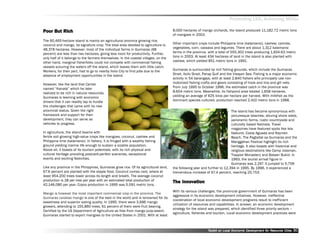
  • 47.
    Promoting LED, AchievingMDGs Advances dvances The results of the intervention introduced by CUI are remarkable. Foreign tourist and excursionist arrival figures showed that from 1,223 in 2002, it rose to 1,629 in 2003. Last year, the figure was a high 2,994. Domestic tourists and excursionists continue to come in droves to Guimaras. From 108,206 in 2002, in went up to 122,429 in 2003, and further up to 133,638 in 2004. Gleaning from the numbers, it is obvious that tourism spelled good business for Guimaras. What is more remarkable is the fact that Guimaras has been trimming down its tourism budget over the past three years but continues to experience growth in tourism arrivals as well as in tourism receipts in the same period. In 2004, for example, Guimaras only allocated 1.6 million pesos for tourism but by the end of the year, it recorded a total tourism receipts of a high 159.1 million pesos! The latter figure was 24-percent hike over the 2003 receipts of 128.3 million pesos, where the tourism budget was 2.98 million pesos. In 2002, tourist receipts totaled 53.3 million pesos while the budget was 4.08 million pesos. From a meager budgetary allocation for tourism that goes slimmer each year, the provincial government has recorded not only huge but also increasing returns in its investments. The increase in tourist arrivals also spelled more jobs and employment opportunities in the province. In 2004, resorts in Guimaras employed 421 personnel, 111 were permanent and 191 were seasonal workers. The rest worked as tour guides. Challenges To sustain the gains of Public-Private Partnerships in Tourism Development Contact in Guimaras, organizational structures and systems were institutionalized. Mr. Ruben Corpuz Mr. Ruben Corpuz A. Nav Hon. JC Rahman A. Nava, MD These include the creation of the Provincial Economic Development Office Provincial Economic Development Officer Governor, Province of Guimaras (PEDO) whose mandate is to support the promotion and marketing of the provincial tourism program. Municipal Tourism Offices, which regulates Provincial Economic Development Office Guimaras Provincial Capitol tourism activities in the municipal level, and Barangay Tourism Councils, Province of Guimaras San Miguel, Jordan 5045 which help implement community-based projects, were strengthened and San Miguel, Jordan 5045 Guimaras, Philippines made fully functional. Tourism ordinances were enacted to provide support Guimaras, Philippines Telfax. No. : +63 33 5813349 mechanisms for programs and projects. Tel. No. +63 33 2371134 2371111 Mobile: +63 917 3026920 Web: www.guimaras.gov.ph Communities and private sector collaboration must be maximized. Without a strong collaboration, there could never be effective partnership anyway. Moreover, partnership is achievable when the motivation is economics, a clear proof to a wisecrack that says ““money is not the problem but it is the solution.”” Lastly, it is clear that education and training are a must to turn stakeholders into partners for development. Toolkit on Local Economic Development for Resource Cities Dev for Resource 43
  • 48.
    Promoting LED, AchievingMDGs Case 10: Local Action on ““Buy Local”” Campaigns Farm Marketing Support Through GTIC and Panindahan sa Manggahan T he absence of employment opportunities in Guimaras and the little earning derived from traditional farming and fishing compelled its people to process fruits and vegetables, plant high- value crops and develop novelty products to augment their income. However, no matter how saleable they can be, their production could not be sustained because of the absence of marketing opportunities and services. To support these endeavors, the local government of Guimaras introduced mechanisms that can serve as venue for small-scale entrepreneurs in marketing and promoting their products to generate returns, and at the same time encourage them to improve product quality for further sustainability of their GTIC’’s goal is to promote a supportive and First implemented in 2003 during the celebration of endeavor. Among these mechanisms are the competitive climate that will enable Guimaras to the Manggahan Festival, it highlight the important establishment of the Guimaras Trade and attract new investments on fishery, agriculture and role of the market in boosting the local economy. Information Center (GTIC) and the initiation of the tourism. Managed by the Provincial Economic Panindahan sa Manggahan. Development Office (PEDO), it also serves as the Held at the Jordan (Alibhon) Food Market, it body responsible to promote linkages among small provides economic opportunities for farmers and and medium enterprises (SMEs) with the national fishermen, local craftsmen and artists to showcase Project The Project and local governments. GTIC plays a vital role as a their produce and subsequently earn income from venue to coordinate efforts in achieving the goal of the event. It also creates awareness on the The Guimaras Trade and Information Center (GTIC) economic development for the province. GTIC’’s agricultural and fishery and tourism potentials of is a showroom of all Guimaras products and construction was undertaken with funding the province. services that also serves as a one-stop information assistance from the Canadian Urban Institute (CUI). center for tourists, investors, existing businesses, It also relives the role of the Alibhon public market and business associations responding to The Panindahan sa Manggahan is a farm market as the major trading center of the province which investment inquiries with data and advices. It also day tour event directed to attract domestic tourists has traditionally been the main buying center for works with site selectors to promote new of Iloilo City and Western Visayas, as a means of agricultural produce, fish and local delicacies and investments in Guimaras and conducts trainings promoting the agricultural, fishery, industries and handicrafts in the past, attracting traders and and provides business development services. GTIC local culture and traditions of Guimaras. consumers from Iloilo City and province of Iloilo. supports small entrepreneurs in trade and investment promotion, provides business and economic information, promotes Guimaras tourism and expedites investment generation for the island. Toolkit on Local Economic Development for Resource Cities Dev for Resource 44
  • 49.
    Promoting LED, AchievingMDGs Advances dvances The first Panindahan sa Manggahan posted a record sales of PhP 700,777 in just one day. It also drew domestic tourists from Iloilo City. Every year since then, the Panindahan has become a regular feature of the Manggahan Festival, an annual celebration marking the provincehood of Guimaras. The total sales of GTIC from January to September 2005 is PhP 1.295 million. Challenges Sellers from other local governments might complain that selection of products for sale in the GTIC favor only members Product quality and availability is not consistent for some items. Forecasting us important activity in ensuring constant supply Lack of budget for center infrastructures like display counters, tables, etc to ensure the excellent product presentation Sustainability of Panindahan rests on the motivation of local vendors association since the bulk of the responsibilities rests on them Contact Mr. Ruben Corpuz Mr. Ruben Corpuz Gabinet Ms. Angeles Gabinete Provincial Economic Development Officer Tourism Section Provincial Economic Development Office Provincial Economic Development Province of Guimaras Office San Miguel, Jordan 5045 Province of Guimaras Guimaras Philippines San Miguel, Jordan 5045 Tel. No. +63 33 2371134 Guimaras, Philippines Mobile: +63 917 3026920 Mobile: +63 927 4185523 Toolkit on Local Economic Development for Resource Cities Dev for Resource 45
  • 50.
    Promoting LED, AchievingMDGs About CPPPGUG The Canadian Urban Institute (CUI) is a non-profit organization dedicated to Urban Institute providing solutions to important issues that have an impact on the quality of life in urban areas and communicating those solutions to a wide audience T through a variety of media. he Canada-Philippines Par tnership Project for Good Urban Partnership Project for artner Urban Governance is a four-phase initiative funded by the Canadian Gov The CUI brings together experts from different disciplines to connect people, International Development Agency (CIDA) under the International money and ideas to build strong communities and equitable and Partnership Program for Good Urban Governance that supports the Philippines’’ competitive urban areas in Canada and internationally. The CUI was continued thrust towards decentralization of power to local authorities and established in 1990 by the City of Toronto and the Municipality of empowerment of communities in local decision-making, as set forth in the Metropolitan Toronto with a mandate to: 1991 Local Government Code. The geographic focus of the project is the Western Visayas Region, one of the Connect urban decision-makers at all levels of government, the priority areas for intervention under CIDA’’s Country Development Framework. corporate and community sectors to enhance policy making and management of urban areas. The Canadian Urban Institute (CUI) works with several local and regional government units in the region, as well as with national level agencies with a Convene groups of decision-makers throughout Canada and abroad to local development mandate. The project is strengthening the capacity of local facilitate the exchange of information between urban areas within Canada authorities to promote sustainable development, good governance and and internationally. community involvement in decision-making. The project aims to assist the selected local government institutions in Western Visayas to achieve more Communicate the results of applied research and provide training in efficient and equitable delivery of economic, environmental and social services order to foster co-operative approaches to urban issues. through the promotion of inter-local governmental cooperation and good urban governance. The project consists of three activity components: Major initiatives currently underway include: Par ticipator y strategy development with involvement of civil society and the articipatory strategy dev ticipator private sector to assist in the development, coordination and implementation of Metropolitan Iloilo Initiative (MII) which is assisting five local governments in Metrtropolitan Initiative (MII), strategic program plans. This is accomplished through establishing multi- this medium-sized urban region to pursue intermunicipal cooperation, regional stakeholder project steering committees and implementing demonstration planning, growth management and improvements to regional service delivery projects. through the establishment of a metropolitan governance body known as the Metro Iloilo Development Council. Capacity development and strengthening of the management and financial dev capabilities of local and regional institutions in order for them to effectively Guimaras Economic Initiative (GEI) which is aimed at developing the Initiative (GEI), plan, implement and evaluate collaborative strategies addressing common capacities of the provincial and municipal governments to bring about urban development issues. This is accomplished through conducting baseline economic development and poverty reduction, as well as to sustain earlier assessments, formulating capacity development plans, facilitating participatory environmental protection undertakings. planning processes and strengthening capabilities in the areas of project and financial management. Malay Local Social Ser vice Deliver y Enhancement Initiative (MLSSDEI) which Malay Service Deliverery Initiative (MLSSDEI), is assisting this municipality to improve the coordination and sustain the quality Communication and dissemination among local and regional partners and of the delivery of social services for the disadvantaged groups through broad- other stakeholders of project processes, lessons learned and best practices based inter-agency coordination and partnerships. resulting from the project. Toolkit on Local Economic Development for Resource Cities Dev for Resource 46