DBM – DILG – DSWD – NAPC Joint Memorandum Circular No. 3 series of 2012
dated December 20, 2012
DEFINITION:
An approach to formulating the budget
proposal of national gov’t agencies,
taking
into
consideration
the
development needs of poor cities /
municipalities as identified in their
respective local poverty reduction action
plans that shall be formulated with
strong participation of basic sectors
and civil society organizations.

DBM – DILG – DSWD – NAPC Joint Memorandum Circular No. 3 series of 2012 dated December 20, 2012
OBJECTIVES:
To make the planning and budgeting
processes of both local and national
governments more participatory;
To strengthen the convergence of the
delivery of national services in the
community;
Provide a balance in the identification of
priorities;
DBM – DILG – DSWD – NAPC Joint Memorandum Circular No. 3 series of 2012 dated December 20, 2012
FOCUS LGUs:
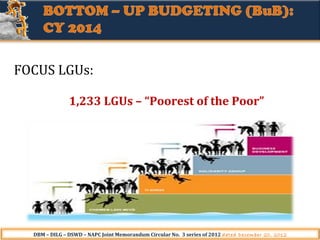
1,233 LGUs – “Poorest of the Poor”

DBM – DILG – DSWD – NAPC Joint Memorandum Circular No. 3 series of 2012 dated December 20, 2012
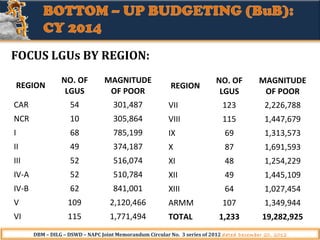
FOCUS LGUs BY REGION:
NO. OF
LGUS

MAGNITUDE
OF POOR

CAR

54

301,487

NCR

10

I

NO. OF
LGUS

MAGNITUDE
OF POOR

VII

123

2,226,788

305,864

VIII

115

1,447,679

68

785,199

IX

69

1,313,573

II

49

374,187

X

87

1,691,593

III

52

516,074

XI

48

1,254,229

IV-A

52

510,784

XII

49

1,445,109

IV-B

62

841,001

XIII

64

1,027,454

V

109

2,120,466

ARMM

107

1,349,944

VI

115

1,771,494

TOTAL

1,233

19,282,925

REGION

REGION

DBM – DILG – DSWD – NAPC Joint Memorandum Circular No. 3 series of 2012 dated December 20, 2012
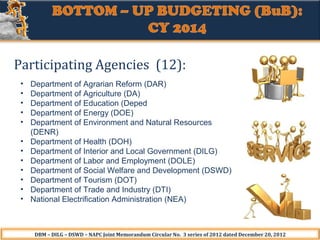
Participating Agencies (12):
•
•
•
•
•
•
•
•
•
•
•
•

Department of Agrarian Reform (DAR)
Department of Agriculture (DA)
Department of Education (Deped
Department of Energy (DOE)
Department of Environment and Natural Resources
(DENR)
Department of Health (DOH)
Department of Interior and Local Government (DILG)
Department of Labor and Employment (DOLE)
Department of Social Welfare and Development (DSWD)
Department of Tourism (DOT)
Department of Trade and Industry (DTI)
National Electrification Administration (NEA)

DBM – DILG – DSWD – NAPC Joint Memorandum Circular No. 3 series of 2012 dated December 20, 2012
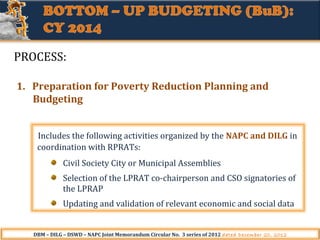
PROCESS:
1. Preparation for Poverty Reduction Planning and
Budgeting
Includes the following activities organized by the NAPC and DILG in
coordination with RPRATs:
Civil Society City or Municipal Assemblies
Selection of the LPRAT co-chairperson and CSO signatories of
the LPRAP
Updating and validation of relevant economic and social data

DBM – DILG – DSWD – NAPC Joint Memorandum Circular No. 3 series of 2012 dated December 20, 2012
PROCESS:
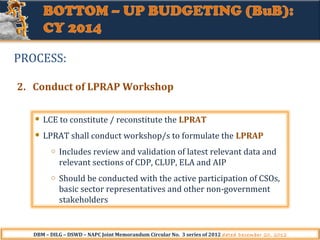
2. Conduct of LPRAP Workshop
LCE to constitute / reconstitute the LPRAT
LPRAT shall conduct workshop/s to formulate the LPRAP
o

Includes review and validation of latest relevant data and
relevant sections of CDP, CLUP, ELA and AIP

o

Should be conducted with the active participation of CSOs,
basic sector representatives and other non-government
stakeholders

DBM – DILG – DSWD – NAPC Joint Memorandum Circular No. 3 series of 2012 dated December 20, 2012
PROCESS:
2. Conduct of LPRAP Workshop
Considerations in the Preparation of the LPRAP:
o

Formulated with the technical assistance from the RPRAT

o

Should incorporate specific poverty reduction strategies to
be undertaken by the LGU and other stakeholders, including
NGAs

o

Should also incorporate good governance, gender
mainstreaming and climate change mitigation/
adaptation strategies

DBM – DILG – DSWD – NAPC Joint Memorandum Circular No. 3 series of 2012 dated December 20, 2012
PROCESS:
2. Conduct of LPRAP Workshop
Considerations in the Preparation of the LPRAP:
o

Should reflect priority poverty reduction projects
that will submitted to the NG for funding (using
format under Annex B-1)

o

Priority projects are identified through a vote
among members of the LPRAT

DBM – DILG – DSWD – NAPC Joint Memorandum Circular No. 3 series of 2012 dated December 20, 2012
PROCESS:
2. Conduct of LPRAP Workshop
Considerations in the Preparation of the LPRAP:
o

All projects submitted to the NG must contribute to the following:
1.

Provision of Basic Social Services and Attainment of the
Millennium Development Goals, including poverty reduction;

2.

Hunger Mitigation and Elimination;

3.

Job Generation and Inclusive Local Economic Development; and

4.

Climate Change
Preparedness

Adaptation

/

Mitigation

and

Disaster

DBM – DILG – DSWD – NAPC Joint Memorandum Circular No. 3 series of 2012 dated December 20, 2012
PROCESS:
2. Conduct of LPRAP Workshop
Considerations in the Preparation of the LPRAP:
o

The following projects may not be proposed as BuB Projects:
1.
2.
3.
4.
5.
6.

Expansion of Pantawid Pamilya Program beneficiaries
Housing Projects
Major Flood Control Projects
Vaccination Program
National Health Insurance Program
Projects related to Law Enforcement, Fire
Protection and Jail Management

DBM – DILG – DSWD – NAPC Joint Memorandum Circular No. 3 series of 2012 dated December 20, 2012
PROCESS:
2. Conduct of LPRAP Workshop
Considerations in the Preparation of the LPRAP:
o

The following projects may not be proposed as BuB Projects:
7. Construction of City/Municipal Halls and other Multi-purpose
Buildings
8. Construction of new school buildings and classrooms and
teacher deployment

DBM – DILG – DSWD – NAPC Joint Memorandum Circular No. 3 series of 2012 dated December 20, 2012
PROCESS:
2. Conduct of LPRAP Workshop
Considerations in the Preparation of the LPRAP:
o

The following projects may not be proposed as BuB Projects:
9. Procurement of Furniture and Fixtures
10. Purchase of Motor Vehicles
11. International Trainings / Scholarships

DBM – DILG – DSWD – NAPC Joint Memorandum Circular No. 3 series of 2012 dated December 20, 2012
PROCESS:
2. Conduct of LPRAP Workshop
Considerations in the Preparation of the LPRAP:
o

LPRAT must allocate 80% of their budget cap for
projects included in the Menu (Annex C)

o

Remaining 20% may be allocated for new programs
proposed by the LPRAT consistent with the NG
priorities and the projects not allowed as BuB
projects

DBM – DILG – DSWD – NAPC Joint Memorandum Circular No. 3 series of 2012 dated December 20, 2012
PROCESS:
3. Endorsement of CSOs

List of priority projects must be approved by the three CSO
members of the LPRAT

DBM – DILG – DSWD – NAPC Joint Memorandum Circular No. 3 series of 2012 dated December 20, 2012
PROCESS:
4. Adoption of the priority projects by the Sanggunian
List of priority poverty reduction projects must be adopted by
the Local Sanggunian before submitted to NG.

DBM – DILG – DSWD – NAPC Joint Memorandum Circular No. 3 series of 2012 dated December 20, 2012
PROCESS:
5. Submission of the List of Priority Poverty Reduction
Projects
List of priority poverty reduction projects duly
endorsed by the CSOs and approved by the Sanggunian
shall be submitted to the RPRAT, through the DILG RO
By February 15, 2013

DBM – DILG – DSWD – NAPC Joint Memorandum Circular No. 3 series of 2012 dated December 20, 2012
PROCESS:
5. Submission of the List of Priority Poverty Reduction
Projects
Submission should include:
o

Cover letter signed by the LCE

o

List of Priority Projects using format (Annex B-1)

o

Project Brief using template in Annex B-2

o

Copy of Sanggunian Resolution approving the List of
Priority Poverty Reduction Projects

DBM – DILG – DSWD – NAPC Joint Memorandum Circular No. 3 series of 2012 dated December 20, 2012
PROCESS:
6. Consolidation of the List of Priority Poverty Reduction
Projects by Region
List of priority poverty reduction projects will be consolidated
by the RPRAT
Provide consolidated list to RPRAT members and NAPC

DBM – DILG – DSWD – NAPC Joint Memorandum Circular No. 3 series of 2012 dated December 20, 2012
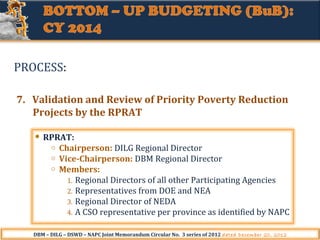
PROCESS:
7. Validation and Review of Priority Poverty Reduction
Projects by the RPRAT
RPRAT:
o Chairperson: DILG Regional Director
o Vice-Chairperson: DBM Regional Director
o Members:
1. Regional Directors of all other Participating Agencies
2. Representatives from DOE and NEA
3. Regional Director of NEDA
4. A CSO representative per province as identified by NAPC
DBM – DILG – DSWD – NAPC Joint Memorandum Circular No. 3 series of 2012 dated December 20, 2012
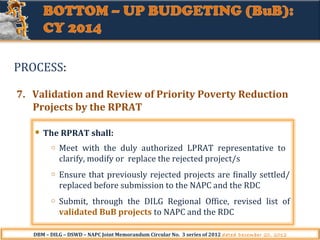
PROCESS:
7. Validation and Review of Priority Poverty Reduction
Projects by the RPRAT
The RPRAT shall:
o

Meet with the duly authorized LPRAT representative to
clarify, modify or replace the rejected project/s

o

Ensure that previously rejected projects are finally settled/
replaced before submission to the NAPC and the RDC

o

Submit, through the DILG Regional Office, revised list of
validated BuB projects to NAPC and the RDC

DBM – DILG – DSWD – NAPC Joint Memorandum Circular No. 3 series of 2012 dated December 20, 2012
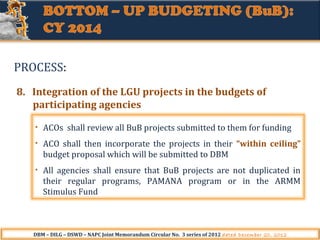
PROCESS:
8. Integration of the LGU projects in the budgets of
participating agencies
•

ACOs shall review all BuB projects submitted to them for funding

•

ACO shall then incorporate the projects in their “within ceiling”
budget proposal which will be submitted to DBM

•

All agencies shall ensure that BuB projects are not duplicated in
their regular programs, PAMANA program or in the ARMM
Stimulus Fund

DBM – DILG – DSWD – NAPC Joint Memorandum Circular No. 3 series of 2012 dated December 20, 2012
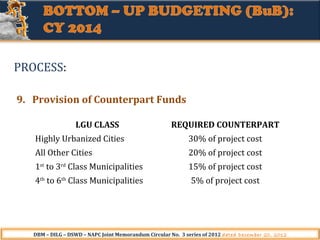
PROCESS:
9. Provision of Counterpart Funds
LGU CLASS

REQUIRED COUNTERPART

Highly Urbanized Cities

30% of project cost

All Other Cities

20% of project cost

1st to 3rd Class Municipalities

15% of project cost

4th to 6th Class Municipalities

5% of project cost

DBM – DILG – DSWD – NAPC Joint Memorandum Circular No. 3 series of 2012 dated December 20, 2012
PROCESS:
9. Provision of Counterpart Funds
Counterpart must be sourced from LGU Funds.
Counterpart must be included in the 2014 AIP and Annual
Budget
“No Counterpart, No Release of NG Funds.”

DBM – DILG – DSWD – NAPC Joint Memorandum Circular No. 3 series of 2012 dated December 20, 2012
PROCESS:
10. Project Implementation
Only the LGUs that meet the following
requirements can implement their BuB projects
in 2014:
o

Recipient of the DILG’s Seal of Good
Housekeeping (SGH) based on the 2013
Assessment

o

Substantial progress in implementing its PFM
Improvement Plan as determined by DBM

DBM – DILG – DSWD – NAPC Joint Memorandum Circular No. 3 series of 2012 dated December 20, 2012
PROCESS:
10. Project Implementation
Only the LGUs that meet the following
requirements can implement their BuB projects
in 2014:
o

Technical capability to implement the project, as
determined by the concerned participating
agency (per project basis)

o

No
unliquidated
cash
advances
from
participating agencies based on existing auditing
rules and regulations (per agency basis)

DBM – DILG – DSWD – NAPC Joint Memorandum Circular No. 3 series of 2012 dated December 20, 2012
PROCESS:
10. Project Implementation
If LGU is ineligible to implement a BuB Project,
the project will be implemented by the concerned
NGA
LGUs that poorly implement their BuB projects in
2013 will not be provided funding for their
priority projects under the 2014 BuB Program

DBM – DILG – DSWD – NAPC Joint Memorandum Circular No. 3 series of 2012 dated December 20, 2012
FUND SOURCE:

Funding for the implementation of BuB projects shall
be incorporated by the participating agencies and
DBM into the FY 2014 National Expenditure Program

DBM – DILG – DSWD – NAPC Joint Memorandum Circular No. 3 series of 2012 dated December 20, 2012
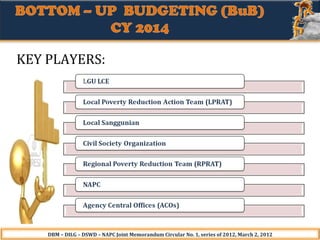
KEY PLAYERS:

DBM – DILG – DSWD – NAPC Joint Memorandum Circular No. 1, series of 2012, March 2, 2012
ROLES & RESPONSIBILITIES:
Local Chief Executive (LCE):
o

Organize and convene the LPRAT

o

Ensure availability of relevant data

o

Ensure conduct of LPRAT workshops and meetings

o

Ensure that only projects prioritized by the LPRAT are
submitted to the RPRAT

o

Ensure conduct of quarterly LPRAT meetings

o

Mobilize LGU to ensure compliance with SGH and
implementation of PFM Improvement Plan (PFMIP)

DBM – DILG – DSWD – NAPC Joint Memorandum Circular No. 3 series of 2012 dated December 20, 2012
ROLES & RESPONSIBILITIES:
Local Poverty Reduction Action Team (LPRAT):
o

Organize and facilitate the conduct of LPRAP workshops

o

Agree on the a list of priority poverty reduction projects
for 2014 based on the LPRAP

o

Conduct quarterly meetings to monitor status of the
approval and integration of priority poverty reduction
projects into the budgets of participating agencies

DBM – DILG – DSWD – NAPC Joint Memorandum Circular No. 3 series of 2012 dated December 20, 2012
ROLES & RESPONSIBILITIES:
Local Sanggunian:
o

Review and approve List of Priority Poverty Reduction
Projects to be submitted to NAPC

o

Pass the pertinent Sanggunian Resolution

DBM – DILG – DSWD – NAPC Joint Memorandum Circular No. 3 series of 2012 dated December 20, 2012
ROLES & RESPONSIBILITIES:
CSO Representatives:
o

Actively participate in the formulation of the LPRAP
and identification of priority poverty reduction projects

o

Endorse the LPRAP and list of priority poverty reduction
projects for approval of the Local Sanggunian

o

Monitor implementation of the projects through LPRAP

DBM – DILG – DSWD – NAPC Joint Memorandum Circular No. 3 series of 2012 dated December 20, 2012
ROLES & RESPONSIBILITIES:
Regional Poverty Reduction Action Team (RPRAT):
o

Assign a permanent and alternate representative

o

Conduct orientation workshops for the LPRAT of focus LGUs

o

Engage DSWD Municipal Links and Pantawid Pamilya parent
leaders and provide municipal-level NHTS data

o

Provide data from participating agencies and technical
assistance in LPRAP preparation

o

Monitor activities of LGUs and progress in submission of
proposals and LPRAPs

DBM – DILG – DSWD – NAPC Joint Memorandum Circular No. 3 series of 2012 dated December 20, 2012
ROLES & RESPONSIBILITIES:
Regional Poverty Reduction Action Team (RPRAT):
o

Ensure compliance with budget cap and consolidate, review and
validate proposed LPRAPs

o

Inform LCEs and RDCs on the final LPRAP projects

o

Monitor and evaluate performance of the LPRAT and
implementation of BuB projects

DBM – DILG – DSWD – NAPC Joint Memorandum Circular No. 3 series of 2012 dated December 20, 2012
ROLES & RESPONSIBILITIES:
National Anti-Poverty Commission:
o

Lead in the conduct of regional orientation for RPRATs

o

Ensure visibility and access to information on BuB projects
through the empowerment portal

o

Set-up web-based software for automation of planning and
consolidation of LPRAP projects, and web-based monitoring
system

o

Facilitate overall monitoring and evaluation of the BuB
initiative

DBM – DILG – DSWD – NAPC Joint Memorandum Circular No. 3 series of 2012 dated December 20, 2012
ROLES & RESPONSIBILITIES:
Agency Central Offices (ACOs):
o

Incorporate list of priority projects submitted by
NAPC in their 2014 within the ceiling budget

o

Submit to DBM the Department’s budget proposal
for FY 2014 (including proposals from
BuB LGUs) by April 8, 2013

o

Give feedback to the RDC and LGUs
on the status of proposals

DBM – DILG – DSWD – NAPC Joint Memorandum Circular No. 3 series of 2012 dated December 20, 2012
DBM – DILG – DSWD – NAPC Joint Memorandum Circular No. 3 series of 2012
dated December 20, 2012

Bottom up Budgeting

  • 1.
    DBM – DILG– DSWD – NAPC Joint Memorandum Circular No. 3 series of 2012 dated December 20, 2012
  • 2.
    DEFINITION: An approach toformulating the budget proposal of national gov’t agencies, taking into consideration the development needs of poor cities / municipalities as identified in their respective local poverty reduction action plans that shall be formulated with strong participation of basic sectors and civil society organizations. DBM – DILG – DSWD – NAPC Joint Memorandum Circular No. 3 series of 2012 dated December 20, 2012
  • 3.
    OBJECTIVES: To make theplanning and budgeting processes of both local and national governments more participatory; To strengthen the convergence of the delivery of national services in the community; Provide a balance in the identification of priorities; DBM – DILG – DSWD – NAPC Joint Memorandum Circular No. 3 series of 2012 dated December 20, 2012
  • 4.
    FOCUS LGUs: 1,233 LGUs– “Poorest of the Poor” DBM – DILG – DSWD – NAPC Joint Memorandum Circular No. 3 series of 2012 dated December 20, 2012
  • 5.
    FOCUS LGUs BYREGION: NO. OF LGUS MAGNITUDE OF POOR CAR 54 301,487 NCR 10 I NO. OF LGUS MAGNITUDE OF POOR VII 123 2,226,788 305,864 VIII 115 1,447,679 68 785,199 IX 69 1,313,573 II 49 374,187 X 87 1,691,593 III 52 516,074 XI 48 1,254,229 IV-A 52 510,784 XII 49 1,445,109 IV-B 62 841,001 XIII 64 1,027,454 V 109 2,120,466 ARMM 107 1,349,944 VI 115 1,771,494 TOTAL 1,233 19,282,925 REGION REGION DBM – DILG – DSWD – NAPC Joint Memorandum Circular No. 3 series of 2012 dated December 20, 2012
  • 6.
    Participating Agencies (12): • • • • • • • • • • • • Departmentof Agrarian Reform (DAR) Department of Agriculture (DA) Department of Education (Deped Department of Energy (DOE) Department of Environment and Natural Resources (DENR) Department of Health (DOH) Department of Interior and Local Government (DILG) Department of Labor and Employment (DOLE) Department of Social Welfare and Development (DSWD) Department of Tourism (DOT) Department of Trade and Industry (DTI) National Electrification Administration (NEA) DBM – DILG – DSWD – NAPC Joint Memorandum Circular No. 3 series of 2012 dated December 20, 2012
  • 7.
    PROCESS: 1. Preparation forPoverty Reduction Planning and Budgeting Includes the following activities organized by the NAPC and DILG in coordination with RPRATs: Civil Society City or Municipal Assemblies Selection of the LPRAT co-chairperson and CSO signatories of the LPRAP Updating and validation of relevant economic and social data DBM – DILG – DSWD – NAPC Joint Memorandum Circular No. 3 series of 2012 dated December 20, 2012
  • 8.
    PROCESS: 2. Conduct ofLPRAP Workshop LCE to constitute / reconstitute the LPRAT LPRAT shall conduct workshop/s to formulate the LPRAP o Includes review and validation of latest relevant data and relevant sections of CDP, CLUP, ELA and AIP o Should be conducted with the active participation of CSOs, basic sector representatives and other non-government stakeholders DBM – DILG – DSWD – NAPC Joint Memorandum Circular No. 3 series of 2012 dated December 20, 2012
  • 9.
    PROCESS: 2. Conduct ofLPRAP Workshop Considerations in the Preparation of the LPRAP: o Formulated with the technical assistance from the RPRAT o Should incorporate specific poverty reduction strategies to be undertaken by the LGU and other stakeholders, including NGAs o Should also incorporate good governance, gender mainstreaming and climate change mitigation/ adaptation strategies DBM – DILG – DSWD – NAPC Joint Memorandum Circular No. 3 series of 2012 dated December 20, 2012
  • 10.
    PROCESS: 2. Conduct ofLPRAP Workshop Considerations in the Preparation of the LPRAP: o Should reflect priority poverty reduction projects that will submitted to the NG for funding (using format under Annex B-1) o Priority projects are identified through a vote among members of the LPRAT DBM – DILG – DSWD – NAPC Joint Memorandum Circular No. 3 series of 2012 dated December 20, 2012
  • 11.
    PROCESS: 2. Conduct ofLPRAP Workshop Considerations in the Preparation of the LPRAP: o All projects submitted to the NG must contribute to the following: 1. Provision of Basic Social Services and Attainment of the Millennium Development Goals, including poverty reduction; 2. Hunger Mitigation and Elimination; 3. Job Generation and Inclusive Local Economic Development; and 4. Climate Change Preparedness Adaptation / Mitigation and Disaster DBM – DILG – DSWD – NAPC Joint Memorandum Circular No. 3 series of 2012 dated December 20, 2012
  • 12.
    PROCESS: 2. Conduct ofLPRAP Workshop Considerations in the Preparation of the LPRAP: o The following projects may not be proposed as BuB Projects: 1. 2. 3. 4. 5. 6. Expansion of Pantawid Pamilya Program beneficiaries Housing Projects Major Flood Control Projects Vaccination Program National Health Insurance Program Projects related to Law Enforcement, Fire Protection and Jail Management DBM – DILG – DSWD – NAPC Joint Memorandum Circular No. 3 series of 2012 dated December 20, 2012
  • 13.
    PROCESS: 2. Conduct ofLPRAP Workshop Considerations in the Preparation of the LPRAP: o The following projects may not be proposed as BuB Projects: 7. Construction of City/Municipal Halls and other Multi-purpose Buildings 8. Construction of new school buildings and classrooms and teacher deployment DBM – DILG – DSWD – NAPC Joint Memorandum Circular No. 3 series of 2012 dated December 20, 2012
  • 14.
    PROCESS: 2. Conduct ofLPRAP Workshop Considerations in the Preparation of the LPRAP: o The following projects may not be proposed as BuB Projects: 9. Procurement of Furniture and Fixtures 10. Purchase of Motor Vehicles 11. International Trainings / Scholarships DBM – DILG – DSWD – NAPC Joint Memorandum Circular No. 3 series of 2012 dated December 20, 2012
  • 15.
    PROCESS: 2. Conduct ofLPRAP Workshop Considerations in the Preparation of the LPRAP: o LPRAT must allocate 80% of their budget cap for projects included in the Menu (Annex C) o Remaining 20% may be allocated for new programs proposed by the LPRAT consistent with the NG priorities and the projects not allowed as BuB projects DBM – DILG – DSWD – NAPC Joint Memorandum Circular No. 3 series of 2012 dated December 20, 2012
  • 16.
    PROCESS: 3. Endorsement ofCSOs List of priority projects must be approved by the three CSO members of the LPRAT DBM – DILG – DSWD – NAPC Joint Memorandum Circular No. 3 series of 2012 dated December 20, 2012
  • 17.
    PROCESS: 4. Adoption ofthe priority projects by the Sanggunian List of priority poverty reduction projects must be adopted by the Local Sanggunian before submitted to NG. DBM – DILG – DSWD – NAPC Joint Memorandum Circular No. 3 series of 2012 dated December 20, 2012
  • 18.
    PROCESS: 5. Submission ofthe List of Priority Poverty Reduction Projects List of priority poverty reduction projects duly endorsed by the CSOs and approved by the Sanggunian shall be submitted to the RPRAT, through the DILG RO By February 15, 2013 DBM – DILG – DSWD – NAPC Joint Memorandum Circular No. 3 series of 2012 dated December 20, 2012
  • 19.
    PROCESS: 5. Submission ofthe List of Priority Poverty Reduction Projects Submission should include: o Cover letter signed by the LCE o List of Priority Projects using format (Annex B-1) o Project Brief using template in Annex B-2 o Copy of Sanggunian Resolution approving the List of Priority Poverty Reduction Projects DBM – DILG – DSWD – NAPC Joint Memorandum Circular No. 3 series of 2012 dated December 20, 2012
  • 20.
    PROCESS: 6. Consolidation ofthe List of Priority Poverty Reduction Projects by Region List of priority poverty reduction projects will be consolidated by the RPRAT Provide consolidated list to RPRAT members and NAPC DBM – DILG – DSWD – NAPC Joint Memorandum Circular No. 3 series of 2012 dated December 20, 2012
  • 21.
    PROCESS: 7. Validation andReview of Priority Poverty Reduction Projects by the RPRAT RPRAT: o Chairperson: DILG Regional Director o Vice-Chairperson: DBM Regional Director o Members: 1. Regional Directors of all other Participating Agencies 2. Representatives from DOE and NEA 3. Regional Director of NEDA 4. A CSO representative per province as identified by NAPC DBM – DILG – DSWD – NAPC Joint Memorandum Circular No. 3 series of 2012 dated December 20, 2012
  • 22.
    PROCESS: 7. Validation andReview of Priority Poverty Reduction Projects by the RPRAT The RPRAT shall: o Meet with the duly authorized LPRAT representative to clarify, modify or replace the rejected project/s o Ensure that previously rejected projects are finally settled/ replaced before submission to the NAPC and the RDC o Submit, through the DILG Regional Office, revised list of validated BuB projects to NAPC and the RDC DBM – DILG – DSWD – NAPC Joint Memorandum Circular No. 3 series of 2012 dated December 20, 2012
  • 23.
    PROCESS: 8. Integration ofthe LGU projects in the budgets of participating agencies • ACOs shall review all BuB projects submitted to them for funding • ACO shall then incorporate the projects in their “within ceiling” budget proposal which will be submitted to DBM • All agencies shall ensure that BuB projects are not duplicated in their regular programs, PAMANA program or in the ARMM Stimulus Fund DBM – DILG – DSWD – NAPC Joint Memorandum Circular No. 3 series of 2012 dated December 20, 2012
  • 24.
    PROCESS: 9. Provision ofCounterpart Funds LGU CLASS REQUIRED COUNTERPART Highly Urbanized Cities 30% of project cost All Other Cities 20% of project cost 1st to 3rd Class Municipalities 15% of project cost 4th to 6th Class Municipalities 5% of project cost DBM – DILG – DSWD – NAPC Joint Memorandum Circular No. 3 series of 2012 dated December 20, 2012
  • 25.
    PROCESS: 9. Provision ofCounterpart Funds Counterpart must be sourced from LGU Funds. Counterpart must be included in the 2014 AIP and Annual Budget “No Counterpart, No Release of NG Funds.” DBM – DILG – DSWD – NAPC Joint Memorandum Circular No. 3 series of 2012 dated December 20, 2012
  • 26.
    PROCESS: 10. Project Implementation Onlythe LGUs that meet the following requirements can implement their BuB projects in 2014: o Recipient of the DILG’s Seal of Good Housekeeping (SGH) based on the 2013 Assessment o Substantial progress in implementing its PFM Improvement Plan as determined by DBM DBM – DILG – DSWD – NAPC Joint Memorandum Circular No. 3 series of 2012 dated December 20, 2012
  • 27.
    PROCESS: 10. Project Implementation Onlythe LGUs that meet the following requirements can implement their BuB projects in 2014: o Technical capability to implement the project, as determined by the concerned participating agency (per project basis) o No unliquidated cash advances from participating agencies based on existing auditing rules and regulations (per agency basis) DBM – DILG – DSWD – NAPC Joint Memorandum Circular No. 3 series of 2012 dated December 20, 2012
  • 28.
    PROCESS: 10. Project Implementation IfLGU is ineligible to implement a BuB Project, the project will be implemented by the concerned NGA LGUs that poorly implement their BuB projects in 2013 will not be provided funding for their priority projects under the 2014 BuB Program DBM – DILG – DSWD – NAPC Joint Memorandum Circular No. 3 series of 2012 dated December 20, 2012
  • 29.
    FUND SOURCE: Funding forthe implementation of BuB projects shall be incorporated by the participating agencies and DBM into the FY 2014 National Expenditure Program DBM – DILG – DSWD – NAPC Joint Memorandum Circular No. 3 series of 2012 dated December 20, 2012
  • 30.
    KEY PLAYERS: DBM –DILG – DSWD – NAPC Joint Memorandum Circular No. 1, series of 2012, March 2, 2012
  • 31.
    ROLES & RESPONSIBILITIES: LocalChief Executive (LCE): o Organize and convene the LPRAT o Ensure availability of relevant data o Ensure conduct of LPRAT workshops and meetings o Ensure that only projects prioritized by the LPRAT are submitted to the RPRAT o Ensure conduct of quarterly LPRAT meetings o Mobilize LGU to ensure compliance with SGH and implementation of PFM Improvement Plan (PFMIP) DBM – DILG – DSWD – NAPC Joint Memorandum Circular No. 3 series of 2012 dated December 20, 2012
  • 32.
    ROLES & RESPONSIBILITIES: LocalPoverty Reduction Action Team (LPRAT): o Organize and facilitate the conduct of LPRAP workshops o Agree on the a list of priority poverty reduction projects for 2014 based on the LPRAP o Conduct quarterly meetings to monitor status of the approval and integration of priority poverty reduction projects into the budgets of participating agencies DBM – DILG – DSWD – NAPC Joint Memorandum Circular No. 3 series of 2012 dated December 20, 2012
  • 33.
    ROLES & RESPONSIBILITIES: LocalSanggunian: o Review and approve List of Priority Poverty Reduction Projects to be submitted to NAPC o Pass the pertinent Sanggunian Resolution DBM – DILG – DSWD – NAPC Joint Memorandum Circular No. 3 series of 2012 dated December 20, 2012
  • 34.
    ROLES & RESPONSIBILITIES: CSORepresentatives: o Actively participate in the formulation of the LPRAP and identification of priority poverty reduction projects o Endorse the LPRAP and list of priority poverty reduction projects for approval of the Local Sanggunian o Monitor implementation of the projects through LPRAP DBM – DILG – DSWD – NAPC Joint Memorandum Circular No. 3 series of 2012 dated December 20, 2012
  • 35.
    ROLES & RESPONSIBILITIES: RegionalPoverty Reduction Action Team (RPRAT): o Assign a permanent and alternate representative o Conduct orientation workshops for the LPRAT of focus LGUs o Engage DSWD Municipal Links and Pantawid Pamilya parent leaders and provide municipal-level NHTS data o Provide data from participating agencies and technical assistance in LPRAP preparation o Monitor activities of LGUs and progress in submission of proposals and LPRAPs DBM – DILG – DSWD – NAPC Joint Memorandum Circular No. 3 series of 2012 dated December 20, 2012
  • 36.
    ROLES & RESPONSIBILITIES: RegionalPoverty Reduction Action Team (RPRAT): o Ensure compliance with budget cap and consolidate, review and validate proposed LPRAPs o Inform LCEs and RDCs on the final LPRAP projects o Monitor and evaluate performance of the LPRAT and implementation of BuB projects DBM – DILG – DSWD – NAPC Joint Memorandum Circular No. 3 series of 2012 dated December 20, 2012
  • 37.
    ROLES & RESPONSIBILITIES: NationalAnti-Poverty Commission: o Lead in the conduct of regional orientation for RPRATs o Ensure visibility and access to information on BuB projects through the empowerment portal o Set-up web-based software for automation of planning and consolidation of LPRAP projects, and web-based monitoring system o Facilitate overall monitoring and evaluation of the BuB initiative DBM – DILG – DSWD – NAPC Joint Memorandum Circular No. 3 series of 2012 dated December 20, 2012
  • 38.
    ROLES & RESPONSIBILITIES: AgencyCentral Offices (ACOs): o Incorporate list of priority projects submitted by NAPC in their 2014 within the ceiling budget o Submit to DBM the Department’s budget proposal for FY 2014 (including proposals from BuB LGUs) by April 8, 2013 o Give feedback to the RDC and LGUs on the status of proposals DBM – DILG – DSWD – NAPC Joint Memorandum Circular No. 3 series of 2012 dated December 20, 2012
  • 39.
    DBM – DILG– DSWD – NAPC Joint Memorandum Circular No. 3 series of 2012 dated December 20, 2012