ORGANIZATIONAL DEVELOPMENT
INTERNAL STRENGTHENING STRATEGIES
DR RAYJIV THEVENDRAM
MD, MCHS (HOSPITAL MANAGEMENT & HEALTH
ECONOMICS)
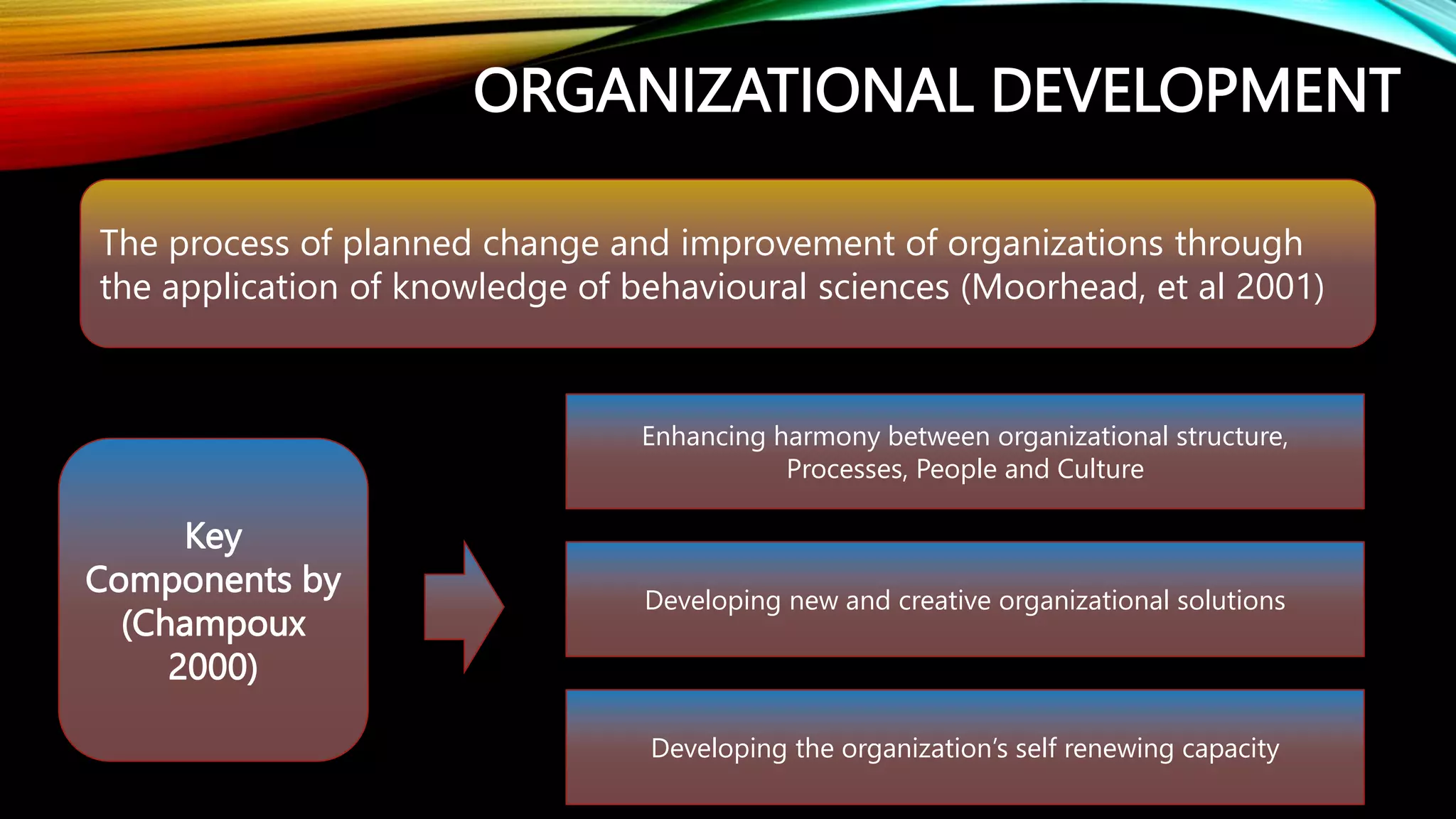
ORGANIZATIONAL DEVELOPMENT
The process of planned change and improvement of organizations through
the application of knowledge of behavioural sciences (Moorhead, et al 2001)
Key
Components by
(Champoux
2000)
Enhancing harmony between organizational structure,
Processes, People and Culture
Developing new and creative organizational solutions
Developing the organization’s self renewing capacity
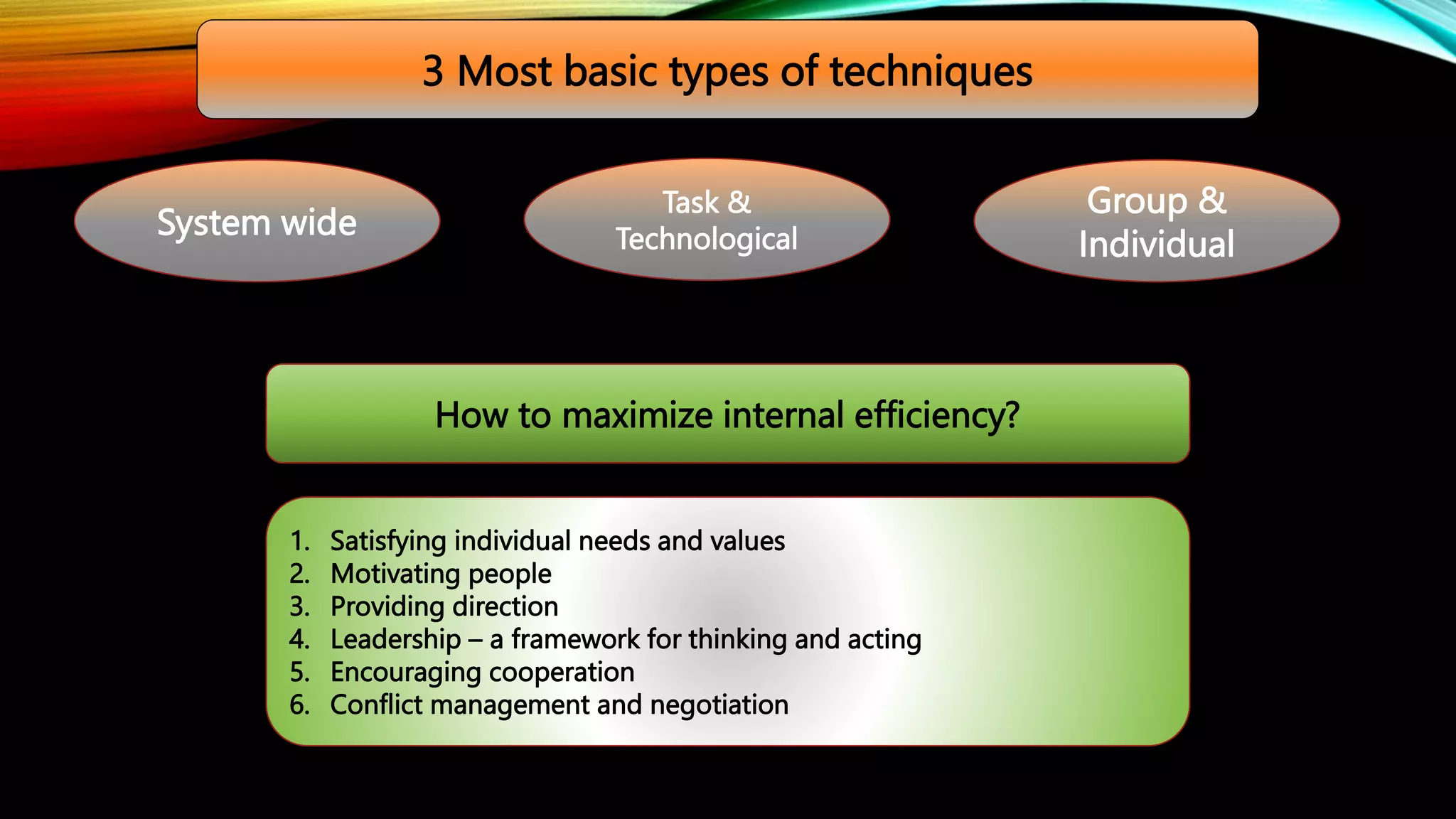
3 Most basic types of techniques
System wide
Task &
Technological
Group &
Individual
How to maximize internal efficiency?
1. Satisfying individual needs and values
2. Motivating people
3. Providing direction
4. Leadership – a framework for thinking and acting
5. Encouraging cooperation
6. Conflict management and negotiation
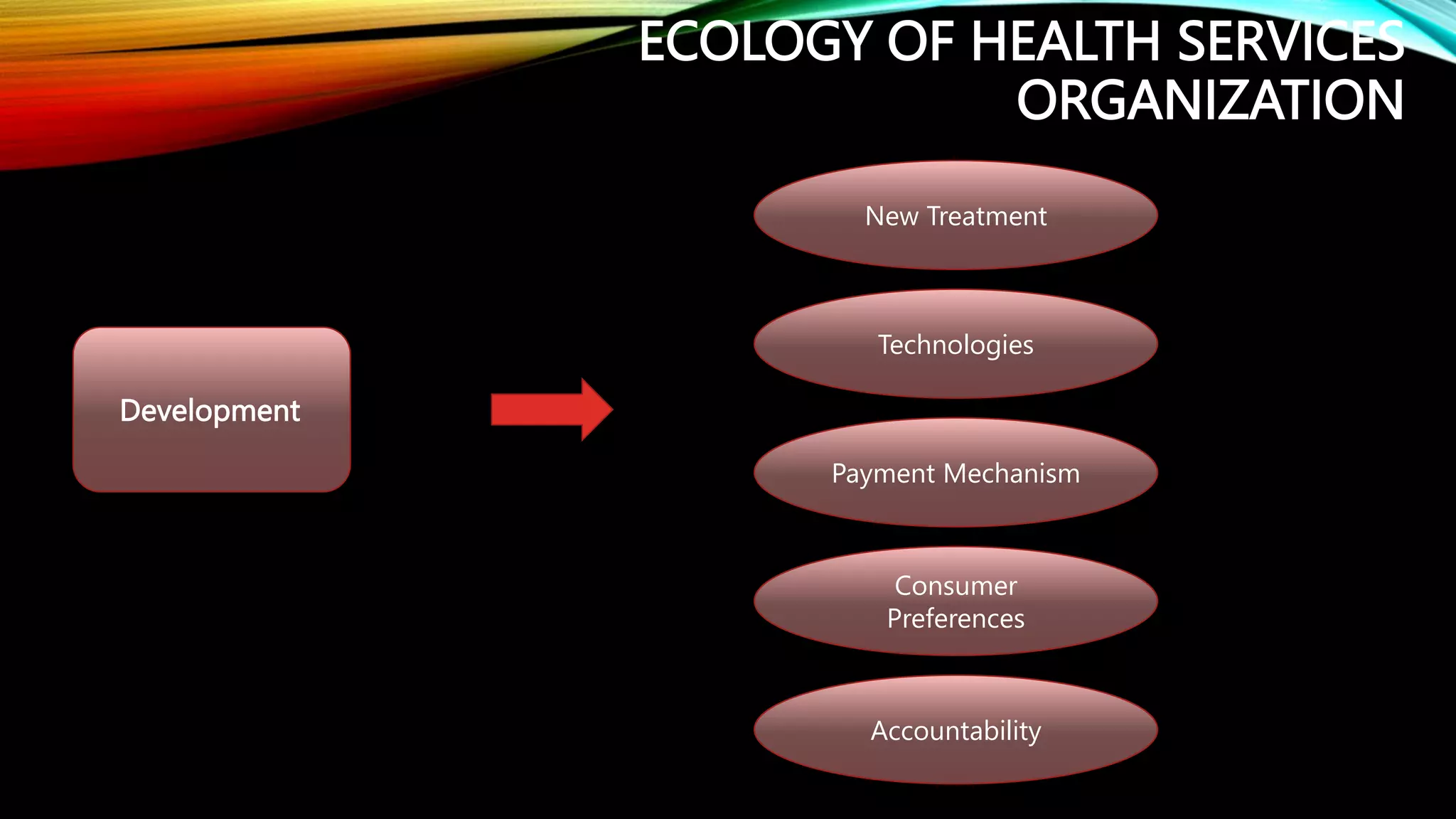
ECOLOGY OF HEALTH SERVICES
ORGANIZATION
Development
New Treatment
Technologies
Payment Mechanism
Consumer
Preferences
Accountability
PHASES OF ORGANIZATIONAL
DEVELOPMENT
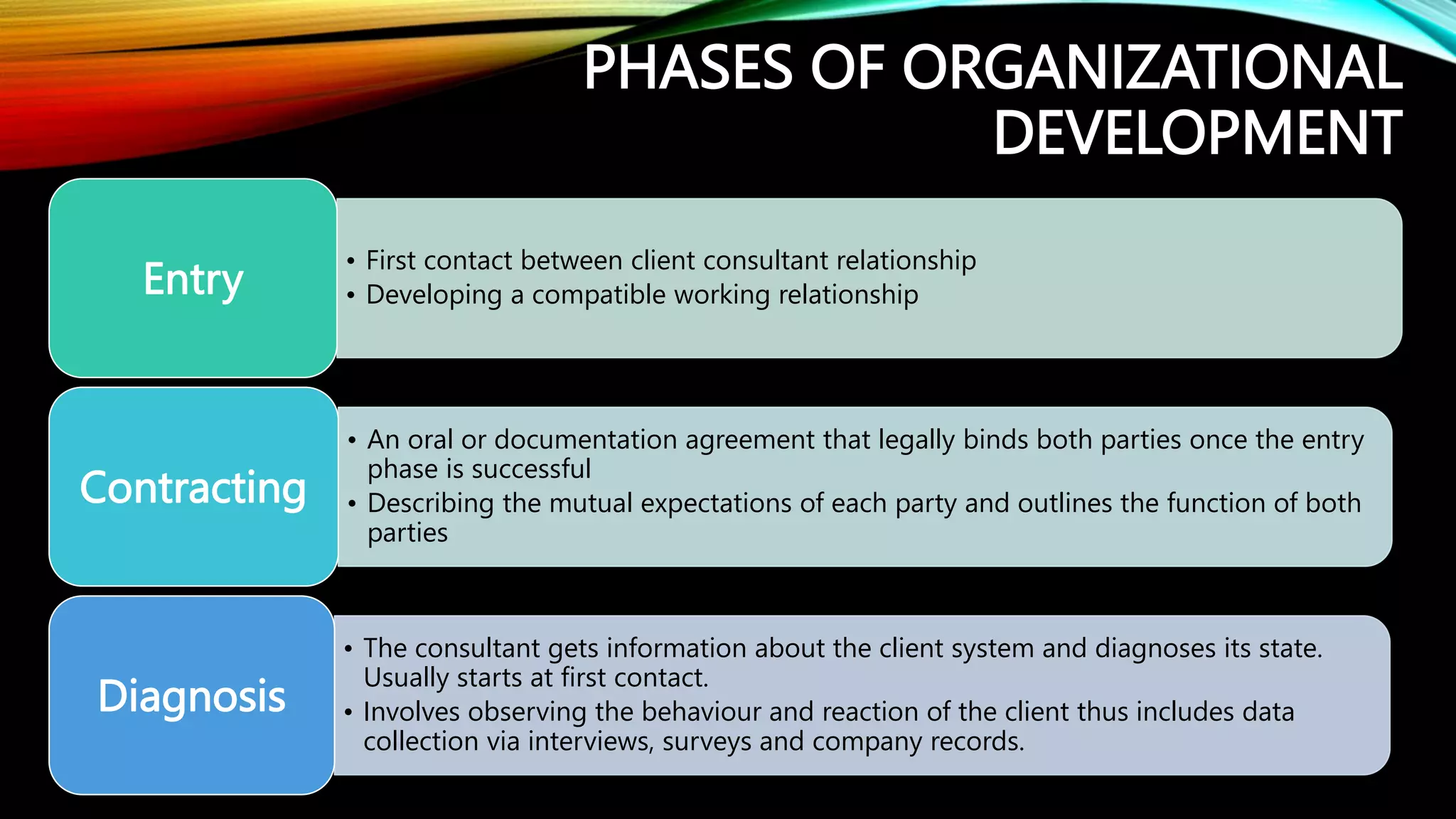
• First contact between client consultant relationship
• Developing a compatible working relationship
Entry
• An oral or documentation agreement that legally binds both parties once the entry
phase is successful
• Describing the mutual expectations of each party and outlines the function of both
parties
Contracting
• The consultant gets information about the client system and diagnoses its state.
Usually starts at first contact.
• Involves observing the behaviour and reaction of the client thus includes data
collection via interviews, surveys and company records.
Diagnosis
• The consultant summarizes the results of analysis and diagnosis and prepares a
feedback for the client and then has a series of feedback meetings with client
Feedback
• When the diagnosis and feedback done well, it will lead to planning the change which
is required. The client and consultant will identify alternative courses of action and
effects of each alternative. The client’s decision.
Planning
The Change
• The consultant and the client collaboratively intervene in the client system to move it to
the desirable state. The consultant helps the client interpret the resistance and develops
methods to reduce it.
Interventio
n
• The evaluation focuses on whether the organizational development had the effect the client
wanted. It should give the client system information about the next steps to take.
Evaluation
Phase
• If the intervention did not move the client system to the desired end state, then the
consultant’s relationship may be terminated. If it is successful, then the client system
changes and develops
Terminatio
n Phase
INTERNAL ORGANIZATIONAL
DEVELOPMENT INTERVENTIONS
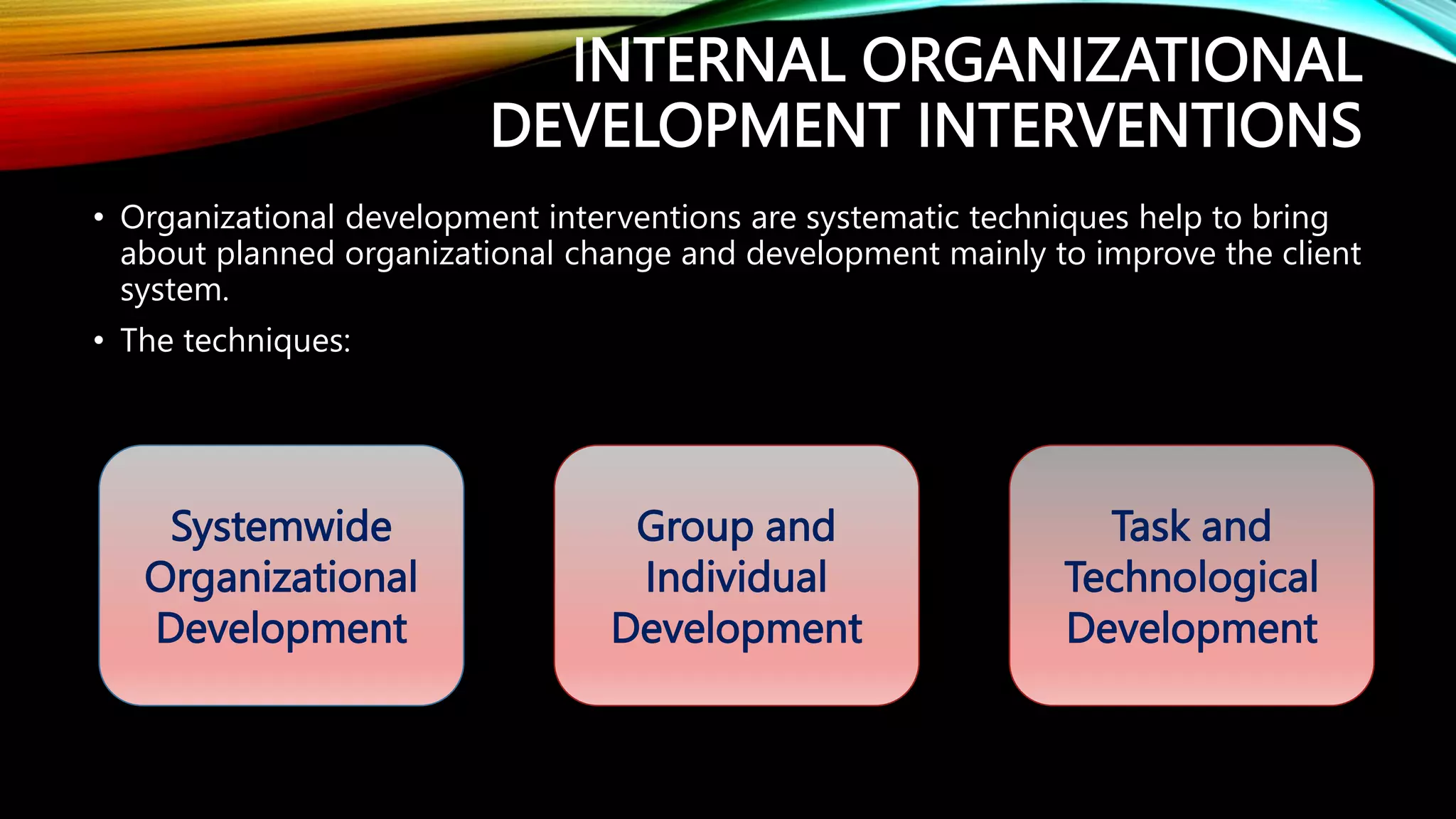
• Organizational development interventions are systematic techniques help to bring
about planned organizational change and development mainly to improve the client
system.
• The techniques:
Systemwide
Organizational
Development
Group and
Individual
Development
Task and
Technological
Development
SYSTEMWIDE ORGANIZATIONAL
DEVELOPMENT
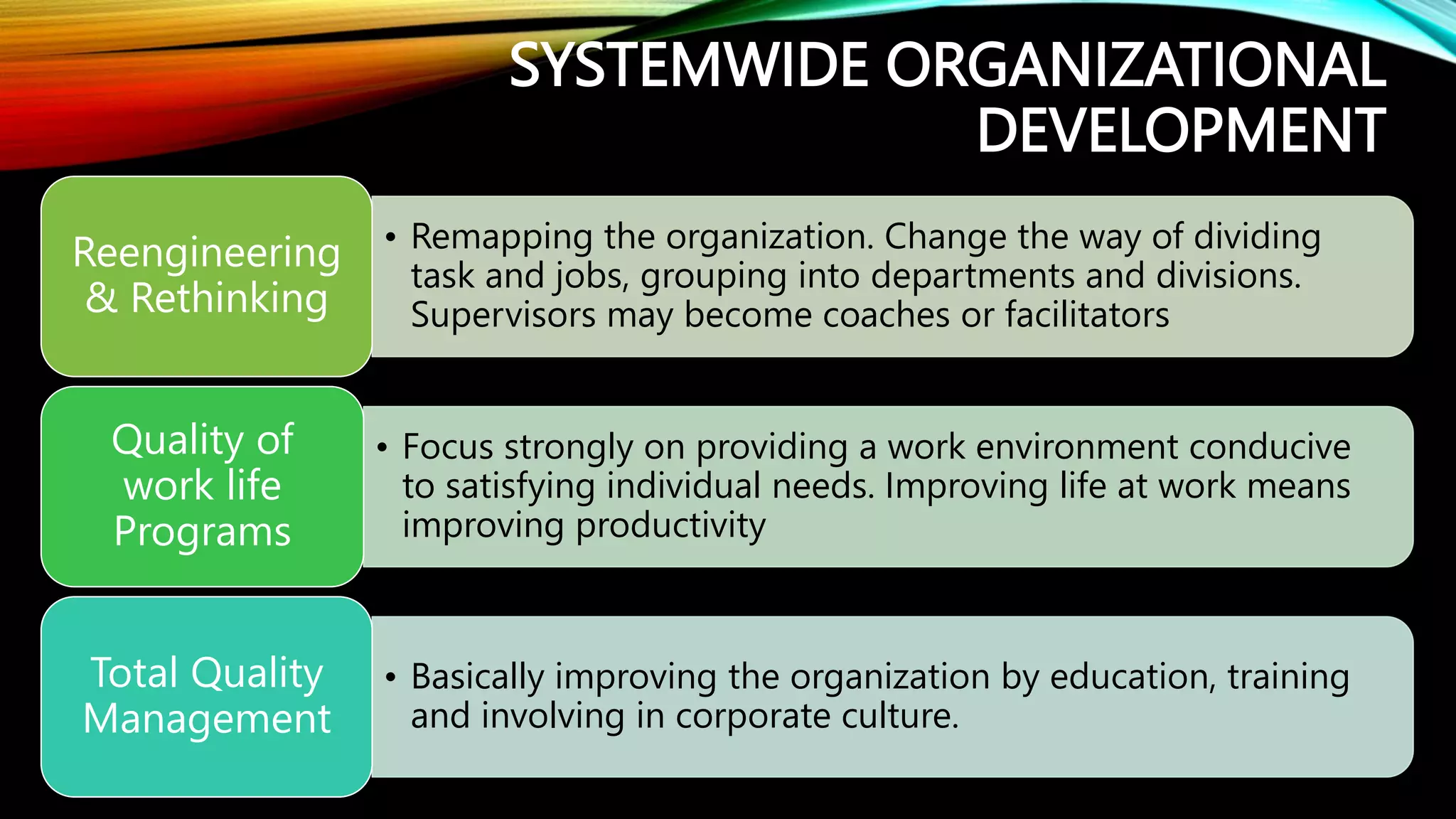
• Remapping the organization. Change the way of dividing
task and jobs, grouping into departments and divisions.
Supervisors may become coaches or facilitators
Reengineering
& Rethinking
• Focus strongly on providing a work environment conducive
to satisfying individual needs. Improving life at work means
improving productivity
Quality of
work life
Programs
• Basically improving the organization by education, training
and involving in corporate culture.
Total Quality
Management
GROUP AND INDIVIDUAL
DEVELOPMENT
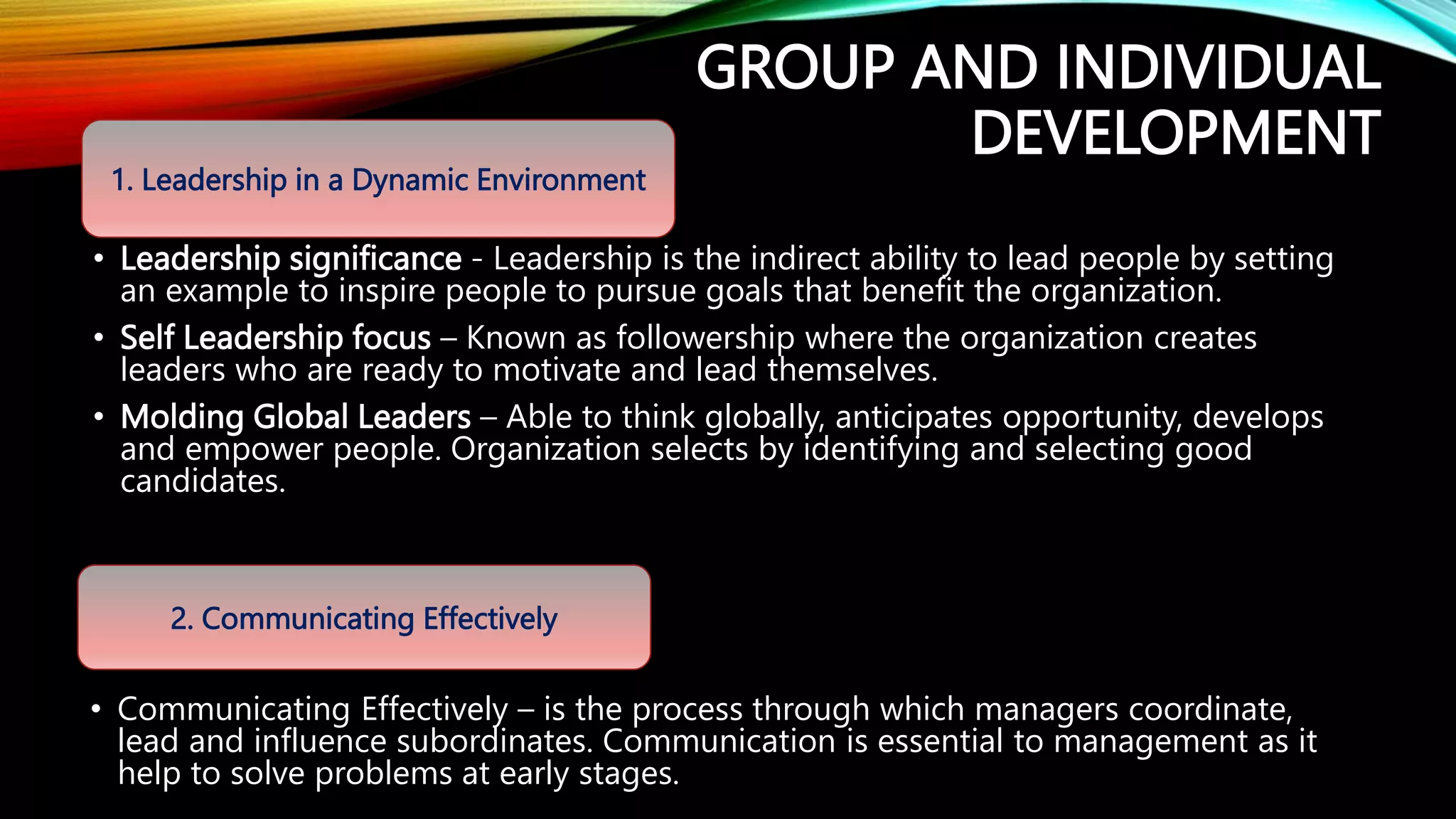
• Leadership significance - Leadership is the indirect ability to lead people by setting
an example to inspire people to pursue goals that benefit the organization.
• Self Leadership focus – Known as followership where the organization creates
leaders who are ready to motivate and lead themselves.
• Molding Global Leaders – Able to think globally, anticipates opportunity, develops
and empower people. Organization selects by identifying and selecting good
candidates.
1. Leadership in a Dynamic Environment
2. Communicating Effectively
• Communicating Effectively – is the process through which managers coordinate,
lead and influence subordinates. Communication is essential to management as it
help to solve problems at early stages.
• Individual Differences – Are determined by several internal elements such as
personality, perception, attitudes and abilities.
• Global Teams – Addresses certain problems that are fundamentally different from
the ways individuals approach the same situation. Teams compose individuals from
different background, culture and countries thus increasing challenge
3. Individual Deference, Team
and Group Dynamics
• Need based approach of Employees Motivation – Emphasizes on specific human
needs or factors within a person that energize, direct and stop behaviour.
• Needs includes power, money, constant praise, and etc
4. Motivating Organizational
Behaviours
• Structural and technological intervention focuses on the design of the organization
and has a goal of improving individual human productivity and organization
effectiveness
• The direct alteration of jobs usually is called a task redesign as input and outputs
known as technological change.
• Task redesign is always preferred than Technological Change.
TASK AND TECHNOLOGICAL
DEVELOPMENT
MANAGING A SUCCESSFUL
ORGANIZATIONAL DEVELOPMENT
• If concerns both, self and other’s
outcomes are low
Avoidance
Strategy
• If concerns own outcome is high and
the other’s outcome is low
Pressing Strategy
• If concerns own outcome is low and
the other’s outcome is high
Accommodation
Strategy
Managing a Conflict
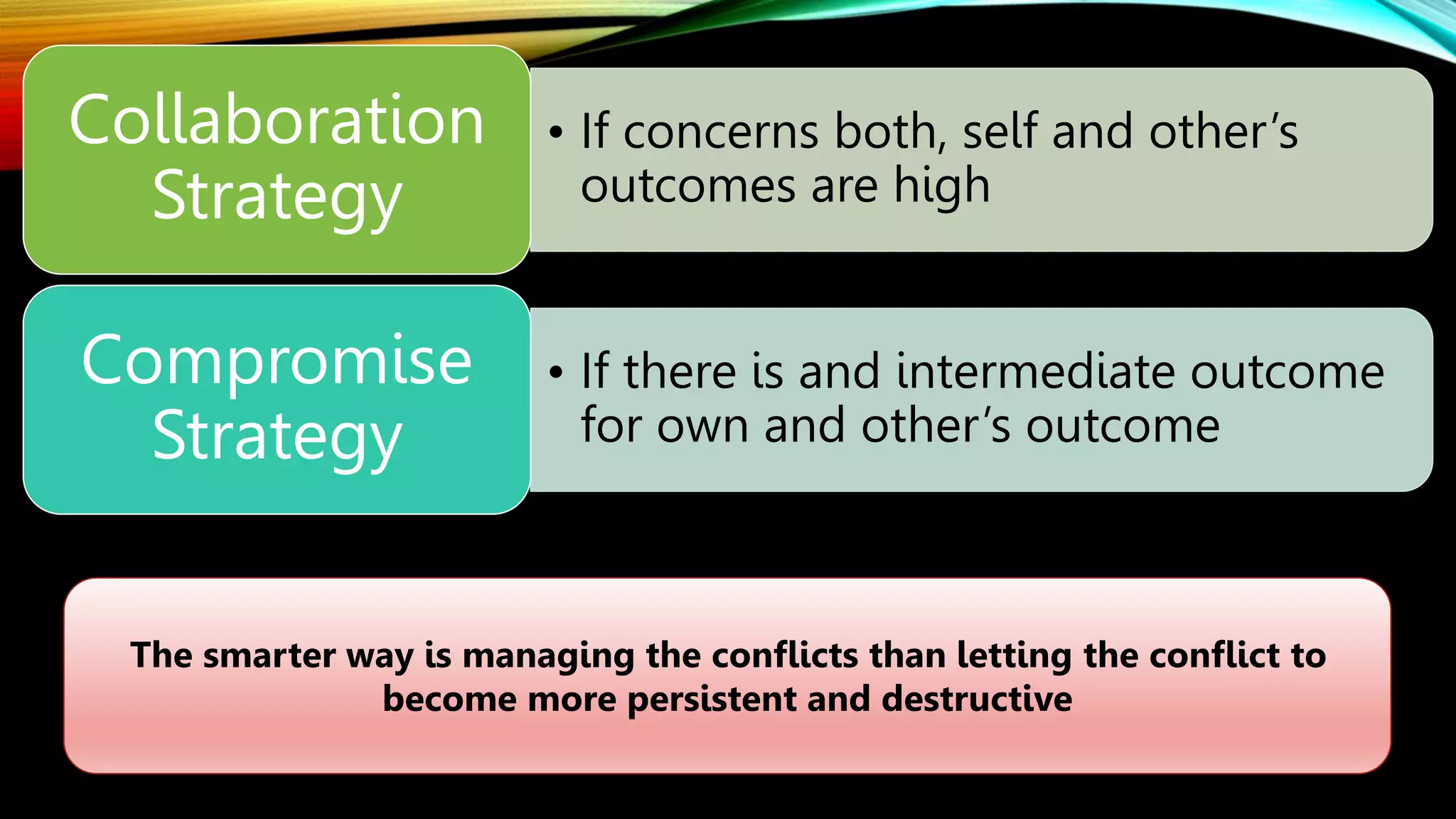
• If concerns both, self and other’s
outcomes are high
Collaboration
Strategy
• If there is and intermediate outcome
for own and other’s outcome
Compromise
Strategy
The smarter way is managing the conflicts than letting the conflict to
become more persistent and destructive
CONCLUSION
Organizational development will create an organization with enough flexibility to
change its design according to nature of its tasks and external environment which
forms a feedback mechanism and thus directs it to continuous improvement
Organizational development efforts using multiple interventions often gets the most
change. Combination of team building, structural interventions and workers
involvement in goal settings will have positive impacts.
Conflicts in organizational development are unavoidable, so it should be positively
managed to reach the organizational goals.

ORGANIZATIONAL DEVELOPMENT & INTERNAL STRENGTHENING STRATEGIES.pptx

  • 1.
    ORGANIZATIONAL DEVELOPMENT INTERNAL STRENGTHENINGSTRATEGIES DR RAYJIV THEVENDRAM MD, MCHS (HOSPITAL MANAGEMENT & HEALTH ECONOMICS)
  • 2.
    ORGANIZATIONAL DEVELOPMENT The processof planned change and improvement of organizations through the application of knowledge of behavioural sciences (Moorhead, et al 2001) Key Components by (Champoux 2000) Enhancing harmony between organizational structure, Processes, People and Culture Developing new and creative organizational solutions Developing the organization’s self renewing capacity
  • 3.
    3 Most basictypes of techniques System wide Task & Technological Group & Individual How to maximize internal efficiency? 1. Satisfying individual needs and values 2. Motivating people 3. Providing direction 4. Leadership – a framework for thinking and acting 5. Encouraging cooperation 6. Conflict management and negotiation
  • 4.
    ECOLOGY OF HEALTHSERVICES ORGANIZATION Development New Treatment Technologies Payment Mechanism Consumer Preferences Accountability
  • 5.
    PHASES OF ORGANIZATIONAL DEVELOPMENT •First contact between client consultant relationship • Developing a compatible working relationship Entry • An oral or documentation agreement that legally binds both parties once the entry phase is successful • Describing the mutual expectations of each party and outlines the function of both parties Contracting • The consultant gets information about the client system and diagnoses its state. Usually starts at first contact. • Involves observing the behaviour and reaction of the client thus includes data collection via interviews, surveys and company records. Diagnosis
  • 6.
    • The consultantsummarizes the results of analysis and diagnosis and prepares a feedback for the client and then has a series of feedback meetings with client Feedback • When the diagnosis and feedback done well, it will lead to planning the change which is required. The client and consultant will identify alternative courses of action and effects of each alternative. The client’s decision. Planning The Change • The consultant and the client collaboratively intervene in the client system to move it to the desirable state. The consultant helps the client interpret the resistance and develops methods to reduce it. Interventio n • The evaluation focuses on whether the organizational development had the effect the client wanted. It should give the client system information about the next steps to take. Evaluation Phase • If the intervention did not move the client system to the desired end state, then the consultant’s relationship may be terminated. If it is successful, then the client system changes and develops Terminatio n Phase
  • 7.
    INTERNAL ORGANIZATIONAL DEVELOPMENT INTERVENTIONS •Organizational development interventions are systematic techniques help to bring about planned organizational change and development mainly to improve the client system. • The techniques: Systemwide Organizational Development Group and Individual Development Task and Technological Development
  • 8.
    SYSTEMWIDE ORGANIZATIONAL DEVELOPMENT • Remappingthe organization. Change the way of dividing task and jobs, grouping into departments and divisions. Supervisors may become coaches or facilitators Reengineering & Rethinking • Focus strongly on providing a work environment conducive to satisfying individual needs. Improving life at work means improving productivity Quality of work life Programs • Basically improving the organization by education, training and involving in corporate culture. Total Quality Management
  • 9.
    GROUP AND INDIVIDUAL DEVELOPMENT •Leadership significance - Leadership is the indirect ability to lead people by setting an example to inspire people to pursue goals that benefit the organization. • Self Leadership focus – Known as followership where the organization creates leaders who are ready to motivate and lead themselves. • Molding Global Leaders – Able to think globally, anticipates opportunity, develops and empower people. Organization selects by identifying and selecting good candidates. 1. Leadership in a Dynamic Environment 2. Communicating Effectively • Communicating Effectively – is the process through which managers coordinate, lead and influence subordinates. Communication is essential to management as it help to solve problems at early stages.
  • 10.
    • Individual Differences– Are determined by several internal elements such as personality, perception, attitudes and abilities. • Global Teams – Addresses certain problems that are fundamentally different from the ways individuals approach the same situation. Teams compose individuals from different background, culture and countries thus increasing challenge 3. Individual Deference, Team and Group Dynamics • Need based approach of Employees Motivation – Emphasizes on specific human needs or factors within a person that energize, direct and stop behaviour. • Needs includes power, money, constant praise, and etc 4. Motivating Organizational Behaviours
  • 11.
    • Structural andtechnological intervention focuses on the design of the organization and has a goal of improving individual human productivity and organization effectiveness • The direct alteration of jobs usually is called a task redesign as input and outputs known as technological change. • Task redesign is always preferred than Technological Change. TASK AND TECHNOLOGICAL DEVELOPMENT
  • 12.
    MANAGING A SUCCESSFUL ORGANIZATIONALDEVELOPMENT • If concerns both, self and other’s outcomes are low Avoidance Strategy • If concerns own outcome is high and the other’s outcome is low Pressing Strategy • If concerns own outcome is low and the other’s outcome is high Accommodation Strategy Managing a Conflict
  • 13.
    • If concernsboth, self and other’s outcomes are high Collaboration Strategy • If there is and intermediate outcome for own and other’s outcome Compromise Strategy The smarter way is managing the conflicts than letting the conflict to become more persistent and destructive
  • 14.
    CONCLUSION Organizational development willcreate an organization with enough flexibility to change its design according to nature of its tasks and external environment which forms a feedback mechanism and thus directs it to continuous improvement Organizational development efforts using multiple interventions often gets the most change. Combination of team building, structural interventions and workers involvement in goal settings will have positive impacts. Conflicts in organizational development are unavoidable, so it should be positively managed to reach the organizational goals.