Strategic Doing 101:  An Introduction Ed Morrison Strategy-Nets [email_address]
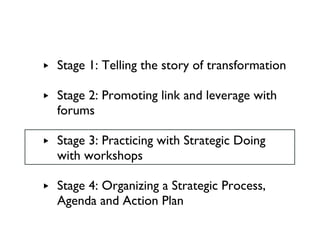
Stage 1: Telling the story of transformation Stage 2: Promoting link and leverage with forums Stage 3: Practicing with Strategic Doing with workshops Stage 4: Organizing a Strategic Process, Agenda and Action Plan
Now we must shift to a path for creating prosperity Every few hundred years in Western history, there occurs a sharp transformation.  Peter Drucker, The New Realities (1989)
Our Grandchildren’s economy is emerging with wealth created by networks...
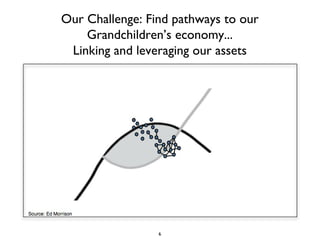
Our Challenge: Find pathways to our Grandchildren’s economy... Linking and leveraging our assets
The transformation involves a deep change in mindsets and a new set of habits Grandfather’s Economy Grandchildren’s  Economy Hierarchies Networks Command and control Link and leverage Vertically integrate Horizontally connect Transactions Relationships Protect boundaries Strengthen cores Strategic Planning Strategic Doing
How regions functioned in a  Pre-Networked World Counties Cities and  Towns Federal Agencies State Agencies K-12 Schools Higher Education Institutions Workforce Boards Social Service Organizations Chambers of  Commerce Economic Development Organizations Foundations Regional Planning  Organizations
Counties Cities and  Towns Federal Agencies State Agencies K-12 Schools Higher Education Institutions Workforce Boards Social Service Organizations Chambers of  Commerce Economic Development Organizations Foundations Regional Planning  Organizations How regions functioned in a  Today’s Networked World
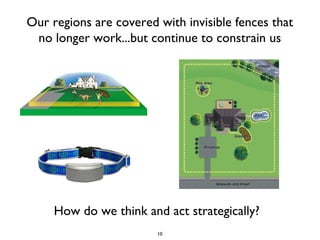
Our regions are covered with invisible fences that no longer work...but continue to constrain us How do we think and act strategically?
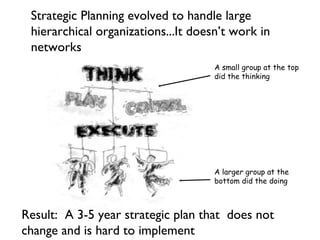
Strategic Planning evolved to handle large hierarchical organizations...It doesn’t work in networks A small group at the top did the thinking A larger group at the bottom did the doing Result:  A 3-5 year strategic plan that  does not change and is hard to implement
Strategic planning doesn’t work because networks have no tops or bottoms
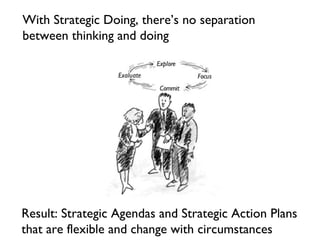
With Strategic Doing, there’s no separation between thinking and doing  Result: Strategic Agendas and Strategic Action Plans that are flexible and change with circumstances
In Stage 1, regions are: Changing the mindsets from hierarchies to networks; Starting new conversations and ending the “blame games”; Learning the power of appreciative conversations; Refocusing on our responsibilities to the next generation; Building new habits of “closing triangles”
Stage 1: Telling the story of transformation Stage 2: Promoting link and leverage with forums Stage 3: Practicing with Strategic Doing with workshops Stage 4: Organizing a Strategic Process, Agenda and Action Plan
In a network, people move in the direction of their conversations. Our job is to guide these conversations.
Guiding conversations in a network involves both open participation and leadership direction.
In a network, we build conversations from the core...Consolidate your base and then move off the high ground...
Charleston Digital Corridor: fridays @ the corridor Youngstown Business Incubator:  Third Thursday at 3 Regular forums introduce people to the possibilities of link and leverage
As trust and collaboration grow, so does the sense of possibility and the opportunity
In Stage 2, regions are: Strengthening habits of civility Mapping assets Uncovering networks and gaps Participating in powerful learning experiences Finding “warm spots” of potential  innovation Discovering the power of “linking” assets to define new opportunities
Stage 1: Telling the story of transformation Stage 2: Promoting link and leverage with forums Stage 3: Practicing with Strategic Doing with workshops Stage 4: Organizing a Strategic Process, Agenda and Action Plan
Strategic Doing produces alignments, links and leverage Strategic Doing quickly generates “link and leverage” strategies
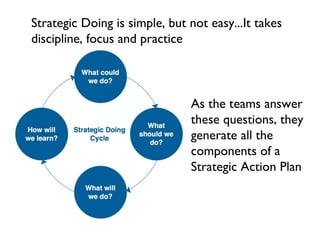
Strategic Doing focuses on answering four  strategic questions: What could we do together? What should we do together? What will we do together? How will we learn together?
Strategic Doing is simple, but not easy...It takes discipline, focus and practice As the teams answer these questions, they generate all the components of a  Strategic Action Plan
We introduce Strategic Doing through workshops that keep conversations focused.  We use workshop exercises.  Strategic Doing Pack Strategic Doing Short Form
In Stage 3, regions are: Continuing to map assets and close triangles Continuing to uncover networks and gaps Learning the disciplines of Strategic Doing with worksheets Learning how to define strategic outcomes, metrics and pathways Starting to understand the power of the Internet Making decisions that define a Strategic Agenda and Strategic Action Plan
Stage 1: Telling the story of transformation Stage 2: Promoting link and leverage with forums Stage 3: Practicing with Strategic Doing with workshops Stage 4: Organizing a Strategic Process, Agenda and Action Plan
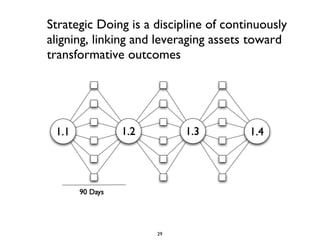
Strategic Doing is a discipline of continuously aligning, linking and leveraging assets toward transformative outcomes
In North Central Indiana, we have over 50 initiatives in four focus areas each with metrics Core Group Focus 1 Focus 2 Focus 3 Focus 4 Initiatives Initiatives
In Stage 4, regions are: Continuing to map assets and close triangles;  Continuing to uncover networks and gaps;  Mastering the disciplines of Strategic Doing; Developing strong connections between face-to-face and on-line collaboration Expanding the power of their networks to get complex projects done
Next Steps: Let’s answer some questions Resources:  http://strategicdoing.net/wiki/webinar- resources http://strategy-nets.com Peggy Hosea Purdue Center for Regional Development [email_address]

Strategic Doing Webinar 101

  • 1.
    Strategic Doing 101: An Introduction Ed Morrison Strategy-Nets [email_address]
  • 2.
    Stage 1: Tellingthe story of transformation Stage 2: Promoting link and leverage with forums Stage 3: Practicing with Strategic Doing with workshops Stage 4: Organizing a Strategic Process, Agenda and Action Plan
  • 3.
    Stage 1: Tellingthe story of transformation Stage 2: Promoting link and leverage with forums Stage 3: Practicing with Strategic Doing with workshops Stage 4: Organizing a Strategic Process, Agenda and Action Plan
  • 4.
    Now we mustshift to a path for creating prosperity Every few hundred years in Western history, there occurs a sharp transformation. Peter Drucker, The New Realities (1989)
  • 5.
    Our Grandchildren’s economyis emerging with wealth created by networks...
  • 6.
    Our Challenge: Findpathways to our Grandchildren’s economy... Linking and leveraging our assets
  • 7.
    The transformation involvesa deep change in mindsets and a new set of habits Grandfather’s Economy Grandchildren’s Economy Hierarchies Networks Command and control Link and leverage Vertically integrate Horizontally connect Transactions Relationships Protect boundaries Strengthen cores Strategic Planning Strategic Doing
  • 8.
    How regions functionedin a Pre-Networked World Counties Cities and Towns Federal Agencies State Agencies K-12 Schools Higher Education Institutions Workforce Boards Social Service Organizations Chambers of Commerce Economic Development Organizations Foundations Regional Planning Organizations
  • 9.
    Counties Cities and Towns Federal Agencies State Agencies K-12 Schools Higher Education Institutions Workforce Boards Social Service Organizations Chambers of Commerce Economic Development Organizations Foundations Regional Planning Organizations How regions functioned in a Today’s Networked World
  • 10.
    Our regions arecovered with invisible fences that no longer work...but continue to constrain us How do we think and act strategically?
  • 11.
    Strategic Planning evolvedto handle large hierarchical organizations...It doesn’t work in networks A small group at the top did the thinking A larger group at the bottom did the doing Result: A 3-5 year strategic plan that does not change and is hard to implement
  • 12.
    Strategic planning doesn’twork because networks have no tops or bottoms
  • 13.
    With Strategic Doing,there’s no separation between thinking and doing Result: Strategic Agendas and Strategic Action Plans that are flexible and change with circumstances
  • 14.
    In Stage 1,regions are: Changing the mindsets from hierarchies to networks; Starting new conversations and ending the “blame games”; Learning the power of appreciative conversations; Refocusing on our responsibilities to the next generation; Building new habits of “closing triangles”
  • 15.
    Stage 1: Tellingthe story of transformation Stage 2: Promoting link and leverage with forums Stage 3: Practicing with Strategic Doing with workshops Stage 4: Organizing a Strategic Process, Agenda and Action Plan
  • 16.
    In a network,people move in the direction of their conversations. Our job is to guide these conversations.
  • 17.
    Guiding conversations ina network involves both open participation and leadership direction.
  • 18.
    In a network,we build conversations from the core...Consolidate your base and then move off the high ground...
  • 19.
    Charleston Digital Corridor:fridays @ the corridor Youngstown Business Incubator: Third Thursday at 3 Regular forums introduce people to the possibilities of link and leverage
  • 20.
    As trust andcollaboration grow, so does the sense of possibility and the opportunity
  • 21.
    In Stage 2,regions are: Strengthening habits of civility Mapping assets Uncovering networks and gaps Participating in powerful learning experiences Finding “warm spots” of potential innovation Discovering the power of “linking” assets to define new opportunities
  • 22.
    Stage 1: Tellingthe story of transformation Stage 2: Promoting link and leverage with forums Stage 3: Practicing with Strategic Doing with workshops Stage 4: Organizing a Strategic Process, Agenda and Action Plan
  • 23.
    Strategic Doing producesalignments, links and leverage Strategic Doing quickly generates “link and leverage” strategies
  • 24.
    Strategic Doing focuseson answering four strategic questions: What could we do together? What should we do together? What will we do together? How will we learn together?
  • 25.
    Strategic Doing issimple, but not easy...It takes discipline, focus and practice As the teams answer these questions, they generate all the components of a Strategic Action Plan
  • 26.
    We introduce StrategicDoing through workshops that keep conversations focused. We use workshop exercises. Strategic Doing Pack Strategic Doing Short Form
  • 27.
    In Stage 3,regions are: Continuing to map assets and close triangles Continuing to uncover networks and gaps Learning the disciplines of Strategic Doing with worksheets Learning how to define strategic outcomes, metrics and pathways Starting to understand the power of the Internet Making decisions that define a Strategic Agenda and Strategic Action Plan
  • 28.
    Stage 1: Tellingthe story of transformation Stage 2: Promoting link and leverage with forums Stage 3: Practicing with Strategic Doing with workshops Stage 4: Organizing a Strategic Process, Agenda and Action Plan
  • 29.
    Strategic Doing isa discipline of continuously aligning, linking and leveraging assets toward transformative outcomes
  • 30.
    In North CentralIndiana, we have over 50 initiatives in four focus areas each with metrics Core Group Focus 1 Focus 2 Focus 3 Focus 4 Initiatives Initiatives
  • 31.
    In Stage 4,regions are: Continuing to map assets and close triangles; Continuing to uncover networks and gaps; Mastering the disciplines of Strategic Doing; Developing strong connections between face-to-face and on-line collaboration Expanding the power of their networks to get complex projects done
  • 32.
    Next Steps: Let’sanswer some questions Resources: http://strategicdoing.net/wiki/webinar- resources http://strategy-nets.com Peggy Hosea Purdue Center for Regional Development [email_address]