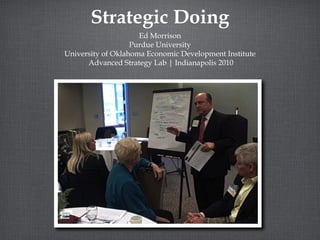
Strategic Doing Ed Morrison Purdue University University of Oklahoma Economic Development Institute Advanced Strategy Lab | Indianapolis 2010
We are moving from our Grandfather’s to our Grandchildren’s Economy Our economic transformation requires new approaches to strategy Strategic Doing provides the discipline to to generate “swarm innovation” Here’s Strategic Doing in a Nutshell
 
Here’s how our Grandfather’s created wealth
Here’s how our Grandfather’s created wealth Coal dumper video available on YouTube
Here’s what happened to our Grandfather’s economy Global markets integrated Costs collapsed  The Internet exploded
Name a company in your region that has been caught in the downdraft of our Grandfather’s economy. What do you know about its strategy?  How could you use these insights in your business retention program? Questions:
Here’s how wealth will be created in our Grandchildren’s economy
Here’s how wealth will be created in our Grandchildren’s economy Cisco video available on YouTube
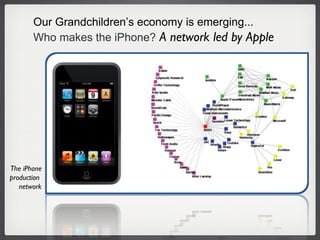
The iPhone production  network Our Grandchildren’s economy is emerging... Who makes the iPhone?  A network led by Apple
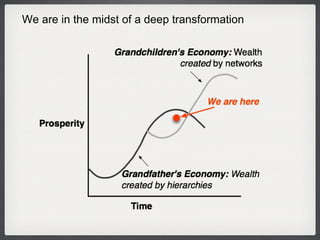
We are in the midst of a deep transformation
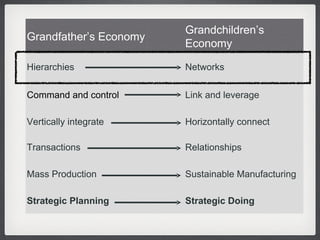
Grandfather’s Economy Grandchildren’s  Economy Hierarchies Networks Command and control Link and leverage Vertically integrate Horizontally connect Transactions Relationships Mass Production Sustainable Manufacturing Strategic Planning Strategic Doing
Questions: Name a company in your region that is catching the wave of our Grandchildren’s economy. What do you know about its strategy?  How could you use these insights in your business retention program? What would features of a strategy would you look for?
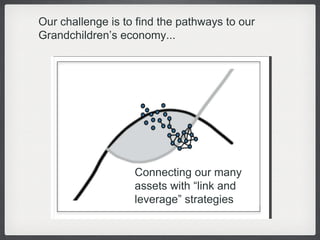
Our challenge is to find the pathways to our Grandchildren’s economy...  Connecting our many assets with “link and leverage” strategies
In our Grandchildren’s economy, we will need to find ways to align 5 types of networks
The 5 factor model of regional economic development Ed Morrison, Purdue Center for Regional Development
Tom Peters: “It’s the firm” Michael Porter: “It’s the cluster” New urbanists: “It’s the place” Richard Florida: “It’s the Creative Class”
Questions: What are the current components of your ED strategy and how would you map them? How would you map your current levels of investment? Do you gain any insights from mapping your strategy?  What patterns do you see? What gaps and disconnects?
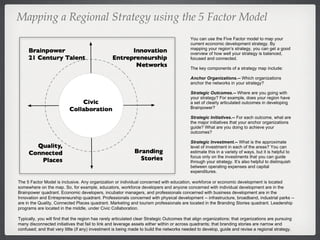
Mapping a Regional Strategy using the 5 Factor Model You can use the Five Factor model to map your current economic development strategy. By mapping your region’s strategy, you can get a good overview of how well your strategy is balanced, focused and connected. The key components of a strategy map include: Anchor Organizations.--  Which organizations anchor the networks in your strategy?  Strategic Outcomes.--  Where are you going with your strategy? For example, does your region have a set of clearly articulated outcomes in developing Brainpower? Strategic Initiatives.--  For each outcome, what are the major initiatives that your anchor organizations guide? What are you doing to achieve your outcomes?  Strategic Investment.--  What is the approximate level of investment in each of the areas? You can estimate this in a variety of ways, but it is helpful to focus only on the investments that you can guide through your strategy. It’s also helpful to distinquish between operating expenses and capital expenditures.  The 5 Factor Model is inclusive. Any organization or individual concerned with education, workforce or economic development is located somewhere on the map. So, for example, educators, workforce developers and anyone concerned with individual development are in the Brainpower quadrant. Economic developers, incubator managers, and professionals concerned with business development are in the Innovation and Entrepreneurship quadrant. Professionals concerned with physical development -- infrastructure, broadband, industrial parks -- are in the Quality, Connected Places quadrant. Marketing and tourism professionals are located in the Branding Stories quadrant. Leadership programs are located in the middle, under Civic Collaboration.  Typically, you will find that the region has rarely articulated clear Strategic Outcomes that align organizations; that organizations are pursuing many disconnected initiatives that fail to link and leverage assets either within or across quadrants; that branding stories are narrow and confused; and that very little (if any) investment is being made to build the networks needed to develop, guide and revise a regional strategy.
Mapping a Strategy ANCHOR ORGANIZATIONS STRATEGIC OUTCOMES (Where are you going?) STRATEGIC INITIATIVES (How will you get there?) APPROXIMATE ANNUAL INVESTMENT  Brainpower Networks Innovation and Entrepreneurship Networks Quality, Connected Place Networks Branding, Story-Telling, Identity Networks Collaboration, Leadership Networks
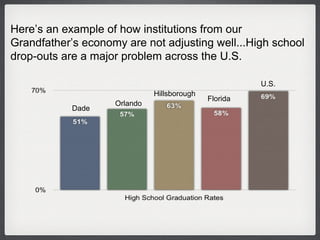
Here’s an example of how institutions from our Grandfather’s economy are not adjusting well...High school drop-outs are a major problem across the U.S.  Dade Orlando Hillsborough Florida U.S.
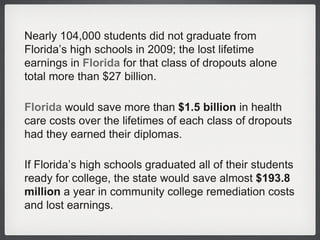
Nearly 104,000 students did not graduate from Florida’s high schools in 2009; the lost lifetime earnings in  Florida  for that class of dropouts alone total more than $27 billion. Florida  would save more than  $1.5 billion  in health care costs over the lifetimes of each class of dropouts had they earned their diplomas. If Florida’s high schools graduated all of their students ready for college, the state would save almost  $193.8 million  a year in community college remediation costs and lost earnings.
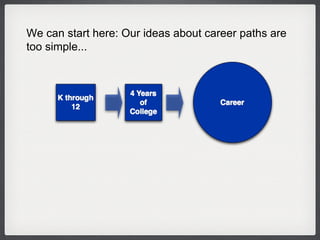
We can start here: Our ideas about career paths are too simple...
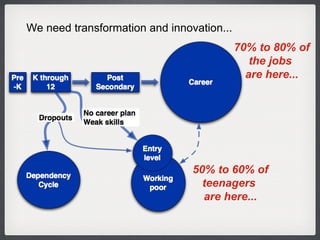
We need transformation and innovation... 50% to 60% of teenagers  are here... 70% to 80% of the jobs  are here...
We are moving from our Grandfather’s to our Grandchildren’s Economy Our economic transformation requires new approaches to strategy Strategic Doing provides the discipline to to generate “swarm innovation” Here’s Strategic Doing in a Nutshell
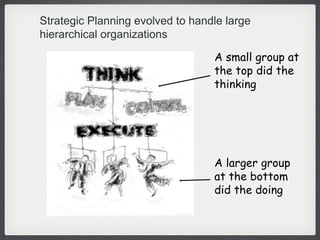
Strategic Planning evolved to handle large hierarchical organizations A small group at the top did the thinking A larger group at the bottom did the doing
Strategic planning doesn’t work because networks have no tops or bottoms
Our strategy challenge is like paddling a kayak in the ocean The task requires quick strategic assessments and continuous “doing”
We are moving from our Grandfather’s to our Grandchildren’s Economy Our economic transformation requires new approaches to strategy Strategic Doing provides the discipline to to generate “swarm innovation” Here’s Strategic Doing in a Nutshell
Strategic Doing guides a loosely connected network with a series of disciplined conversations
Strategic Doing keeps us focused on the big issues Nextel video available on YouTube
Strategic Doing guides conversations...The key insight: People move in the directions of their conversations
We guide these conversations with workshop exercises....Strategic Doing Packs
Strategic Doing produces alignments, links and leverage
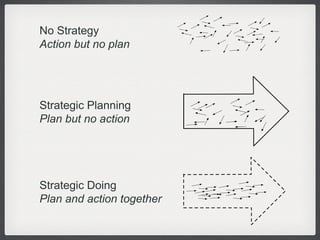
Str Most Strategic Doing Plan and action together Strategic Planning Plan but no action No Strategy Action but no plan
As we guide these conversations and make decisions, we generate all the components of a Strategic Action Plan...It is simple, but not easy. Strategic Action Plan v. 0.1 beta
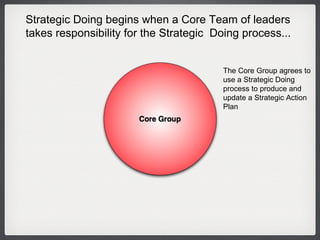
Strategic Doing begins when a Core Team of leaders takes responsibility for the Strategic  Doing process... The Core Group agrees to use a Strategic Doing process to produce and update a Strategic Action Plan
The Core Team identifies focus areas of opportunities to produce dramatically better results....
Within each focus area, teams start with initiatives or projects  Projects need to be:  Replicable Scalable Sustainable
30 Days The process of shaping a strategy is continuous
With Strategic Doing, there’s no separation between thinking and doing..the strategic conversations (driven by the four questions) are continuous
[email_address] Peggy Hosea
Strategic Doing generates Swarm Innovation...Many innovations that link and leverage a region’s assets Disruptive Innovation Swarm Innovation
At Purdue, we have used Strategic Doing to generate over 50 initiatives (each with metrics) in four focus areas...with one administrator Core Group Focus 1 Focus 2 Focus 3 Focus 4 Initiatives Initiatives
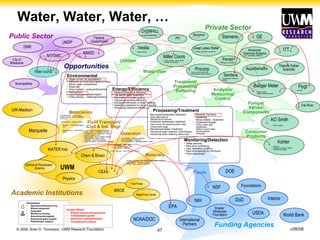
© 2008, Brian D. Thompson, UWM Research Foundation 10/6/08 Funding Agencies Academic Institutions Private Sector Public Sector Water, Water, Water, … Opportunities Funds Fluid Transport/ Civil & Ind. Engr. Detection Materials Bioscience Pumps/ Valves/ Components Analysis/ Measuring/ Control Water User Consumer Products Treatment/ Processing/ Softening Utilities DOE EPA NSF USDA DoD NOAA/DOC Interior World Bank Foundations International Partners NIH Greater  Milwaukee Foundation UWM Marquette UW-Madison WATER Inst. Chem & Biosci School of Freshwater  Science CEAS Physics MSOE Fluid Power Rapid Proto Center M7/GMC MMSD City of Milwaukee DNR UNDP Federal  Government Municipalities Water Council Pentair Filtering & purification GE Badger Meter Water meters Meter reading systems Procorp Water reuse & softening  Phosphate & radium removal AO Smith Water heaters Kohler Faucets Materials, coatings, plating Casting technology Miller Coors Intake quality, output quality Energy consumption AquaSensors Thermo Fisher Scientific Fall River Great Lakes Water Water treatment equipment Advanced  Chemical Systems Ind. wastewater treatment CH2MHILL Engineering services ITT Sanitarie Wastewater treatment design Flygt pumps Siemens Joy Bucyrus Veolia Water utilities Environmental Algae control (& exploitation) Removal of PCBs from lakes & rivers Storm water containment,  Road salt Ship’s ballast – policy/enforcement Aquaculture Lake Michigan contamination Policy issues – metering/incentives Energy/Efficiency Ethanol production efficiency Tar sands water treatment Elimination of boiler scaling Increasing brewing efficiency Increased efficiency of water heating Speeding treatment for large volumes Increasing treatment efficiency  Processing/Treatment Municipal wastewater treatment Storm water treatment Reduced use of chemicals Industrial wastewater treatment Farm manure, food processing waste, metals Utilizing sewer sludge Residential Water Treatment Residential water treatment, home filtration Residential Water softening without salt Reverse Osmosis Softening Ships ballast - treatment Treatment targets PCBs in sewer pieps Desalinzation Radium in ground water Pharmaceuticals Phosphate Monitoring/Detection Water security Real time monitoring  User detection systems Real time sensing for life forms Pharmaceuticals
© 2008, Brian D. Thompson, UWM Research Foundation 10/6/08 Funding Agencies Academic Institutions Private Sector Public Sector Water, Water, Water, … Opportunities Funds Fluid Transport/ Civil & Ind. Engr. Detection Materials Bioscience Pumps/ Valves/ Components Analysis/ Measuring/ Control Water User Consumer Products Treatment/ Processing/ Softening Utilities DOE EPA NSF USDA DoD NOAA/DOC Interior World Bank Foundations International Partners NIH Greater  Milwaukee Foundation UWM Marquette UW-Madison WATER Inst. Chem & Biosci School of Freshwater  Science CEAS Physics MSOE Fluid Power Rapid Proto Center M7/GMC MMSD City of Milwaukee DNR UNDP Federal  Government Municipalities Water Council Pentair Filtering & purification GE Badger Meter Water meters Meter reading systems Procorp Water reuse & softening  Phosphate & radium removal AO Smith Water heaters Kohler Faucets Materials, coatings, plating Casting technology Miller Coors Intake quality, output quality Energy consumption AquaSensors Thermo Fisher Scientific Fall River Great Lakes Water Water treatment equipment Advanced  Chemical Systems Ind. wastewater treatment CH2MHILL Engineering services ITT Sanitarie Wastewater treatment design Flygt pumps Siemens Joy Bucyrus Veolia Water utilities Environmental Algae control (& exploitation) Removal of PCBs from lakes & rivers Storm water containment,  Road salt Ship’s ballast – policy/enforcement Aquaculture Lake Michigan contamination Policy issues – metering/incentives Energy/Efficiency Ethanol production efficiency Tar sands water treatment Elimination of boiler scaling Increasing brewing efficiency Increased efficiency of water heating Speeding treatment for large volumes Increasing treatment efficiency  Processing/Treatment Municipal wastewater treatment Storm water treatment Reduced use of chemicals Industrial wastewater treatment Farm manure, food processing waste, metals Utilizing sewer sludge Residential Water Treatment Residential water treatment, home filtration Residential Water softening without salt Reverse Osmosis Softening Ships ballast - treatment Treatment targets PCBs in sewer pieps Desalinzation Radium in ground water Pharmaceuticals Phosphate Monitoring/Detection Water security Real time monitoring  User detection systems Real time sensing for life forms Pharmaceuticals Joe Aldstadt – analytical methods Peter Geissinger – detection Alan Schwabacher– pharmaceuticals in water Carmen Aguilar – microbiology David Petering –metal metabolism  Val Klump Rohatgi, Pradeep – adv. castings, lightweight, lead-free  Aita, Carolyn – advanced coatings Gong, Sarah – polymer materials  Chen, Junhong – nano materials, sensors Li, Jin – pollutant transport modeling Bravo, Hector – hydraulic modeling Christensen, Erik – pollutants in water Amano, Ryoichi - CFD Pillia, Krisna – porous media modeling Kevin Renken- mass transfer Sobolvev – biproducts utilization Doug Cherkauer – groundwater hydrology Jim Waples – water aging Tom Consi – aquatic robots Tom Grundle - harbors Tim Ehlinger – aquatic systems Burlage – PCR environmental test Shangping Xu – safe drinking water Partnerships Sponsored Research Proj. Shared equipment Graduates Workforce training Subcontractor/supplier Extramural grant support Philanthropic support Cluster Effects Shared resources/equipment Collaborative grants Improved competitiveness Translational science
As we connect assets, something funny happens...Our opportunities actually expand
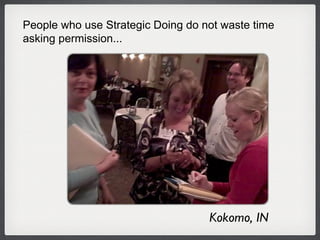
People who use Strategic Doing do not waste time asking permission... Kokomo, IN
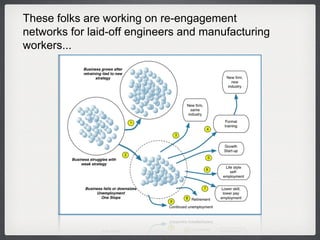
These folks are working on re-engagement networks for laid-off engineers and manufacturing workers...
Here’s an example of an initiative that’s part of “swarm innovation”
Here’s an example of an initiative that’s part of “swarm innovation”  Purdue guitar video available on Vimeo
Cape Girardeau, MO Southeast Missouri used Strategic Doing to shape a strategy for its P-20 Council
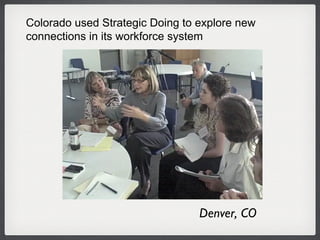
Denver, CO Colorado used Strategic Doing to explore new connections in its workforce system
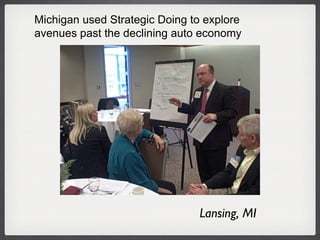
Michigan used Strategic Doing to explore avenues past the declining auto economy Lansing, MI
Boise, ID Idaho used Strategic Doing in their Governor’s Workforce Development Summit
If your actions inspire others to dream more, learn more, do more and become more, you are a leader. John Quincy Adams We need leaders willing to step up...now
 
Where we are:  In a major economic transformation Where we are heading:  To our Grandchildren’s economy and a world of open networks How we will get there: Building action-oriented networks with Strategic Doing What you can do:  Choose to lead
Where we are:  In a major economic transformation Where we are heading:  To our Grandchildren’s economy and a world of open networks How we will get there:  Building action-oriented networks with Strategic Doing What you can do:  Choose to lead
Strategic Doing Pack Describe your focus area for conversation: What brings you together? Strategic Doing Pack Completed By:  Today’s Date:  Team Members Name Organization e-mail
Strategic Doing Question 1:  What could we do together? Map your asserts...Connect them to define new opportunities What assets do we have in our networks? People? Organizations? Resources? Experience? What opportunities emerge when we connect these assets in new and different ways? Guide the conversation toward connections...What opportunities emerge that connect and align our assets? List as many as five opportunities that emerge from your conversation Opportunity 1 Opportunity 2 Opportunity 3 Opportunity 4 Opportunity 5
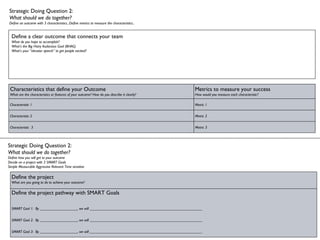
Strategic Doing Question 2:  What should we do together? Define an outcome with 3 characteristics...Define metrics to measure the characteristics... Define a clear outcome that connects your team What do you hope to accomplish?  What’s the Big Hairy Audacious Goal (BHAG) What’s your “elevator speech” to get people excited? Strategic Doing Question 2:  What should we do together? Define how you will get to your outcome Decide on a project with 3 SMART Goals Simple Measurable Aggressive Relevant Time sensitive Characteristics that define your Outcome What are the characteristics or features of your outcome? How do you describe it clearly? Metrics to measure your success How would you measure each characteristic? Characteristic 1 Metric 1 Characteristic 2 Metric 2 Characteristic  3 Metric 3 Define the project What are you going to do to achieve your outcome? Define the project pathway with SMART Goals SMART Gaol 1:  By ____________________, we will ____________________________________________________________ SMART Gaol 2:  By ____________________, we will ____________________________________________________________ SMART Gaol 3:  By ____________________, we will ____________________________________________________________
Strategic Doing Question 3:  What will we do together? Draft an action plan Strategic Doing Question 4:  How will we learn together? Decide how you will follow -up Who Action Step By When Follow-up Meeting Date Time Place Internet Details How will you use the Internet to stay connected?
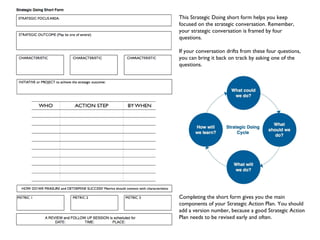
This Strategic Doing short form helps you keep focused on the strategic conversation. Remember, your strategic conversation is framed by four questions.  If your conversation drifts from these four questions, you can bring it back on track by asking one of the questions.  Completing the short form gives you the main components of your Strategic Action Plan. You should add a version number, because a good Strategic Action Plan needs to be revised early and often.
 
Thank you! Ed Morrison [email_address] Purdue Center for Regional Development www.purdue.edu/pcrd

EDI Strategy Lab Mar 2010

  • 1.
    Strategic Doing EdMorrison Purdue University University of Oklahoma Economic Development Institute Advanced Strategy Lab | Indianapolis 2010
  • 2.
    We are movingfrom our Grandfather’s to our Grandchildren’s Economy Our economic transformation requires new approaches to strategy Strategic Doing provides the discipline to to generate “swarm innovation” Here’s Strategic Doing in a Nutshell
  • 3.
    We are movingfrom our Grandfather’s to our Grandchildren’s Economy Our economic transformation requires new approaches to strategy Strategic Doing provides the discipline to to generate “swarm innovation” Here’s Strategic Doing in a Nutshell
  • 4.
  • 5.
    Here’s how ourGrandfather’s created wealth
  • 6.
    Here’s how ourGrandfather’s created wealth Coal dumper video available on YouTube
  • 7.
    Here’s what happenedto our Grandfather’s economy Global markets integrated Costs collapsed The Internet exploded
  • 8.
    Name a companyin your region that has been caught in the downdraft of our Grandfather’s economy. What do you know about its strategy? How could you use these insights in your business retention program? Questions:
  • 9.
    Here’s how wealthwill be created in our Grandchildren’s economy
  • 10.
    Here’s how wealthwill be created in our Grandchildren’s economy Cisco video available on YouTube
  • 11.
    The iPhone production network Our Grandchildren’s economy is emerging... Who makes the iPhone? A network led by Apple
  • 12.
    We are inthe midst of a deep transformation
  • 13.
    Grandfather’s Economy Grandchildren’s Economy Hierarchies Networks Command and control Link and leverage Vertically integrate Horizontally connect Transactions Relationships Mass Production Sustainable Manufacturing Strategic Planning Strategic Doing
  • 14.
    Questions: Name acompany in your region that is catching the wave of our Grandchildren’s economy. What do you know about its strategy? How could you use these insights in your business retention program? What would features of a strategy would you look for?
  • 15.
    Our challenge isto find the pathways to our Grandchildren’s economy... Connecting our many assets with “link and leverage” strategies
  • 16.
    In our Grandchildren’seconomy, we will need to find ways to align 5 types of networks
  • 17.
    The 5 factormodel of regional economic development Ed Morrison, Purdue Center for Regional Development
  • 18.
    Tom Peters: “It’sthe firm” Michael Porter: “It’s the cluster” New urbanists: “It’s the place” Richard Florida: “It’s the Creative Class”
  • 19.
    Questions: What arethe current components of your ED strategy and how would you map them? How would you map your current levels of investment? Do you gain any insights from mapping your strategy? What patterns do you see? What gaps and disconnects?
  • 20.
    Mapping a RegionalStrategy using the 5 Factor Model You can use the Five Factor model to map your current economic development strategy. By mapping your region’s strategy, you can get a good overview of how well your strategy is balanced, focused and connected. The key components of a strategy map include: Anchor Organizations.-- Which organizations anchor the networks in your strategy? Strategic Outcomes.-- Where are you going with your strategy? For example, does your region have a set of clearly articulated outcomes in developing Brainpower? Strategic Initiatives.-- For each outcome, what are the major initiatives that your anchor organizations guide? What are you doing to achieve your outcomes? Strategic Investment.-- What is the approximate level of investment in each of the areas? You can estimate this in a variety of ways, but it is helpful to focus only on the investments that you can guide through your strategy. It’s also helpful to distinquish between operating expenses and capital expenditures. The 5 Factor Model is inclusive. Any organization or individual concerned with education, workforce or economic development is located somewhere on the map. So, for example, educators, workforce developers and anyone concerned with individual development are in the Brainpower quadrant. Economic developers, incubator managers, and professionals concerned with business development are in the Innovation and Entrepreneurship quadrant. Professionals concerned with physical development -- infrastructure, broadband, industrial parks -- are in the Quality, Connected Places quadrant. Marketing and tourism professionals are located in the Branding Stories quadrant. Leadership programs are located in the middle, under Civic Collaboration. Typically, you will find that the region has rarely articulated clear Strategic Outcomes that align organizations; that organizations are pursuing many disconnected initiatives that fail to link and leverage assets either within or across quadrants; that branding stories are narrow and confused; and that very little (if any) investment is being made to build the networks needed to develop, guide and revise a regional strategy.
  • 21.
    Mapping a StrategyANCHOR ORGANIZATIONS STRATEGIC OUTCOMES (Where are you going?) STRATEGIC INITIATIVES (How will you get there?) APPROXIMATE ANNUAL INVESTMENT Brainpower Networks Innovation and Entrepreneurship Networks Quality, Connected Place Networks Branding, Story-Telling, Identity Networks Collaboration, Leadership Networks
  • 22.
    Here’s an exampleof how institutions from our Grandfather’s economy are not adjusting well...High school drop-outs are a major problem across the U.S. Dade Orlando Hillsborough Florida U.S.
  • 23.
    Nearly 104,000 studentsdid not graduate from Florida’s high schools in 2009; the lost lifetime earnings in Florida for that class of dropouts alone total more than $27 billion. Florida would save more than $1.5 billion in health care costs over the lifetimes of each class of dropouts had they earned their diplomas. If Florida’s high schools graduated all of their students ready for college, the state would save almost $193.8 million a year in community college remediation costs and lost earnings.
  • 24.
    We can starthere: Our ideas about career paths are too simple...
  • 25.
    We need transformationand innovation... 50% to 60% of teenagers are here... 70% to 80% of the jobs are here...
  • 26.
    We are movingfrom our Grandfather’s to our Grandchildren’s Economy Our economic transformation requires new approaches to strategy Strategic Doing provides the discipline to to generate “swarm innovation” Here’s Strategic Doing in a Nutshell
  • 27.
    Strategic Planning evolvedto handle large hierarchical organizations A small group at the top did the thinking A larger group at the bottom did the doing
  • 28.
    Strategic planning doesn’twork because networks have no tops or bottoms
  • 29.
    Our strategy challengeis like paddling a kayak in the ocean The task requires quick strategic assessments and continuous “doing”
  • 30.
    We are movingfrom our Grandfather’s to our Grandchildren’s Economy Our economic transformation requires new approaches to strategy Strategic Doing provides the discipline to to generate “swarm innovation” Here’s Strategic Doing in a Nutshell
  • 31.
    Strategic Doing guidesa loosely connected network with a series of disciplined conversations
  • 32.
    Strategic Doing keepsus focused on the big issues Nextel video available on YouTube
  • 33.
    Strategic Doing guidesconversations...The key insight: People move in the directions of their conversations
  • 34.
    We guide theseconversations with workshop exercises....Strategic Doing Packs
  • 35.
    Strategic Doing producesalignments, links and leverage
  • 36.
    Str Most StrategicDoing Plan and action together Strategic Planning Plan but no action No Strategy Action but no plan
  • 37.
    As we guidethese conversations and make decisions, we generate all the components of a Strategic Action Plan...It is simple, but not easy. Strategic Action Plan v. 0.1 beta
  • 38.
    Strategic Doing beginswhen a Core Team of leaders takes responsibility for the Strategic Doing process... The Core Group agrees to use a Strategic Doing process to produce and update a Strategic Action Plan
  • 39.
    The Core Teamidentifies focus areas of opportunities to produce dramatically better results....
  • 40.
    Within each focusarea, teams start with initiatives or projects Projects need to be: Replicable Scalable Sustainable
  • 41.
    30 Days Theprocess of shaping a strategy is continuous
  • 42.
    With Strategic Doing,there’s no separation between thinking and doing..the strategic conversations (driven by the four questions) are continuous
  • 43.
  • 44.
    Strategic Doing generatesSwarm Innovation...Many innovations that link and leverage a region’s assets Disruptive Innovation Swarm Innovation
  • 45.
    At Purdue, wehave used Strategic Doing to generate over 50 initiatives (each with metrics) in four focus areas...with one administrator Core Group Focus 1 Focus 2 Focus 3 Focus 4 Initiatives Initiatives
  • 46.
    © 2008, BrianD. Thompson, UWM Research Foundation 10/6/08 Funding Agencies Academic Institutions Private Sector Public Sector Water, Water, Water, … Opportunities Funds Fluid Transport/ Civil & Ind. Engr. Detection Materials Bioscience Pumps/ Valves/ Components Analysis/ Measuring/ Control Water User Consumer Products Treatment/ Processing/ Softening Utilities DOE EPA NSF USDA DoD NOAA/DOC Interior World Bank Foundations International Partners NIH Greater Milwaukee Foundation UWM Marquette UW-Madison WATER Inst. Chem & Biosci School of Freshwater Science CEAS Physics MSOE Fluid Power Rapid Proto Center M7/GMC MMSD City of Milwaukee DNR UNDP Federal Government Municipalities Water Council Pentair Filtering & purification GE Badger Meter Water meters Meter reading systems Procorp Water reuse & softening Phosphate & radium removal AO Smith Water heaters Kohler Faucets Materials, coatings, plating Casting technology Miller Coors Intake quality, output quality Energy consumption AquaSensors Thermo Fisher Scientific Fall River Great Lakes Water Water treatment equipment Advanced Chemical Systems Ind. wastewater treatment CH2MHILL Engineering services ITT Sanitarie Wastewater treatment design Flygt pumps Siemens Joy Bucyrus Veolia Water utilities Environmental Algae control (& exploitation) Removal of PCBs from lakes & rivers Storm water containment, Road salt Ship’s ballast – policy/enforcement Aquaculture Lake Michigan contamination Policy issues – metering/incentives Energy/Efficiency Ethanol production efficiency Tar sands water treatment Elimination of boiler scaling Increasing brewing efficiency Increased efficiency of water heating Speeding treatment for large volumes Increasing treatment efficiency Processing/Treatment Municipal wastewater treatment Storm water treatment Reduced use of chemicals Industrial wastewater treatment Farm manure, food processing waste, metals Utilizing sewer sludge Residential Water Treatment Residential water treatment, home filtration Residential Water softening without salt Reverse Osmosis Softening Ships ballast - treatment Treatment targets PCBs in sewer pieps Desalinzation Radium in ground water Pharmaceuticals Phosphate Monitoring/Detection Water security Real time monitoring User detection systems Real time sensing for life forms Pharmaceuticals
  • 47.
    © 2008, BrianD. Thompson, UWM Research Foundation 10/6/08 Funding Agencies Academic Institutions Private Sector Public Sector Water, Water, Water, … Opportunities Funds Fluid Transport/ Civil & Ind. Engr. Detection Materials Bioscience Pumps/ Valves/ Components Analysis/ Measuring/ Control Water User Consumer Products Treatment/ Processing/ Softening Utilities DOE EPA NSF USDA DoD NOAA/DOC Interior World Bank Foundations International Partners NIH Greater Milwaukee Foundation UWM Marquette UW-Madison WATER Inst. Chem & Biosci School of Freshwater Science CEAS Physics MSOE Fluid Power Rapid Proto Center M7/GMC MMSD City of Milwaukee DNR UNDP Federal Government Municipalities Water Council Pentair Filtering & purification GE Badger Meter Water meters Meter reading systems Procorp Water reuse & softening Phosphate & radium removal AO Smith Water heaters Kohler Faucets Materials, coatings, plating Casting technology Miller Coors Intake quality, output quality Energy consumption AquaSensors Thermo Fisher Scientific Fall River Great Lakes Water Water treatment equipment Advanced Chemical Systems Ind. wastewater treatment CH2MHILL Engineering services ITT Sanitarie Wastewater treatment design Flygt pumps Siemens Joy Bucyrus Veolia Water utilities Environmental Algae control (& exploitation) Removal of PCBs from lakes & rivers Storm water containment, Road salt Ship’s ballast – policy/enforcement Aquaculture Lake Michigan contamination Policy issues – metering/incentives Energy/Efficiency Ethanol production efficiency Tar sands water treatment Elimination of boiler scaling Increasing brewing efficiency Increased efficiency of water heating Speeding treatment for large volumes Increasing treatment efficiency Processing/Treatment Municipal wastewater treatment Storm water treatment Reduced use of chemicals Industrial wastewater treatment Farm manure, food processing waste, metals Utilizing sewer sludge Residential Water Treatment Residential water treatment, home filtration Residential Water softening without salt Reverse Osmosis Softening Ships ballast - treatment Treatment targets PCBs in sewer pieps Desalinzation Radium in ground water Pharmaceuticals Phosphate Monitoring/Detection Water security Real time monitoring User detection systems Real time sensing for life forms Pharmaceuticals Joe Aldstadt – analytical methods Peter Geissinger – detection Alan Schwabacher– pharmaceuticals in water Carmen Aguilar – microbiology David Petering –metal metabolism Val Klump Rohatgi, Pradeep – adv. castings, lightweight, lead-free Aita, Carolyn – advanced coatings Gong, Sarah – polymer materials Chen, Junhong – nano materials, sensors Li, Jin – pollutant transport modeling Bravo, Hector – hydraulic modeling Christensen, Erik – pollutants in water Amano, Ryoichi - CFD Pillia, Krisna – porous media modeling Kevin Renken- mass transfer Sobolvev – biproducts utilization Doug Cherkauer – groundwater hydrology Jim Waples – water aging Tom Consi – aquatic robots Tom Grundle - harbors Tim Ehlinger – aquatic systems Burlage – PCR environmental test Shangping Xu – safe drinking water Partnerships Sponsored Research Proj. Shared equipment Graduates Workforce training Subcontractor/supplier Extramural grant support Philanthropic support Cluster Effects Shared resources/equipment Collaborative grants Improved competitiveness Translational science
  • 48.
    As we connectassets, something funny happens...Our opportunities actually expand
  • 49.
    People who useStrategic Doing do not waste time asking permission... Kokomo, IN
  • 50.
    These folks areworking on re-engagement networks for laid-off engineers and manufacturing workers...
  • 51.
    Here’s an exampleof an initiative that’s part of “swarm innovation”
  • 52.
    Here’s an exampleof an initiative that’s part of “swarm innovation” Purdue guitar video available on Vimeo
  • 53.
    Cape Girardeau, MOSoutheast Missouri used Strategic Doing to shape a strategy for its P-20 Council
  • 54.
    Denver, CO Coloradoused Strategic Doing to explore new connections in its workforce system
  • 55.
    Michigan used StrategicDoing to explore avenues past the declining auto economy Lansing, MI
  • 56.
    Boise, ID Idahoused Strategic Doing in their Governor’s Workforce Development Summit
  • 57.
    If your actionsinspire others to dream more, learn more, do more and become more, you are a leader. John Quincy Adams We need leaders willing to step up...now
  • 58.
  • 59.
    Where we are: In a major economic transformation Where we are heading: To our Grandchildren’s economy and a world of open networks How we will get there: Building action-oriented networks with Strategic Doing What you can do: Choose to lead
  • 60.
    Where we are: In a major economic transformation Where we are heading: To our Grandchildren’s economy and a world of open networks How we will get there: Building action-oriented networks with Strategic Doing What you can do: Choose to lead
  • 61.
    Where we are: In a major economic transformation Where we are heading: To our Grandchildren’s economy and a world of open networks How we will get there: Building action-oriented networks with Strategic Doing What you can do: Choose to lead
  • 62.
    Strategic Doing PackDescribe your focus area for conversation: What brings you together? Strategic Doing Pack Completed By: Today’s Date: Team Members Name Organization e-mail
  • 63.
    Strategic Doing Question1: What could we do together? Map your asserts...Connect them to define new opportunities What assets do we have in our networks? People? Organizations? Resources? Experience? What opportunities emerge when we connect these assets in new and different ways? Guide the conversation toward connections...What opportunities emerge that connect and align our assets? List as many as five opportunities that emerge from your conversation Opportunity 1 Opportunity 2 Opportunity 3 Opportunity 4 Opportunity 5
  • 64.
    Strategic Doing Question2: What should we do together? Define an outcome with 3 characteristics...Define metrics to measure the characteristics... Define a clear outcome that connects your team What do you hope to accomplish? What’s the Big Hairy Audacious Goal (BHAG) What’s your “elevator speech” to get people excited? Strategic Doing Question 2: What should we do together? Define how you will get to your outcome Decide on a project with 3 SMART Goals Simple Measurable Aggressive Relevant Time sensitive Characteristics that define your Outcome What are the characteristics or features of your outcome? How do you describe it clearly? Metrics to measure your success How would you measure each characteristic? Characteristic 1 Metric 1 Characteristic 2 Metric 2 Characteristic 3 Metric 3 Define the project What are you going to do to achieve your outcome? Define the project pathway with SMART Goals SMART Gaol 1: By ____________________, we will ____________________________________________________________ SMART Gaol 2: By ____________________, we will ____________________________________________________________ SMART Gaol 3: By ____________________, we will ____________________________________________________________
  • 65.
    Strategic Doing Question3: What will we do together? Draft an action plan Strategic Doing Question 4: How will we learn together? Decide how you will follow -up Who Action Step By When Follow-up Meeting Date Time Place Internet Details How will you use the Internet to stay connected?
  • 66.
    This Strategic Doingshort form helps you keep focused on the strategic conversation. Remember, your strategic conversation is framed by four questions. If your conversation drifts from these four questions, you can bring it back on track by asking one of the questions. Completing the short form gives you the main components of your Strategic Action Plan. You should add a version number, because a good Strategic Action Plan needs to be revised early and often.
  • 67.
  • 68.
    Thank you! EdMorrison [email_address] Purdue Center for Regional Development www.purdue.edu/pcrd

Editor's Notes

  • #47 What is the grand vision for the Foundation’s future? How can it better support the University? In this day and age, UWM does not expect to build the critical infrastructure to become a world-class research university the way it was done in Madison. It cannot rely almost exclusively on the State to grow its academic and research enterprise. At UWM we need to create a public/private infrastructure that leverages the best of both worlds. At the Foundation, we have an opportunity to: [read slide] This is a bold vision. It is different from what we have done in the past. It will not be easy, but it is possible. And it is the only way the campus will realistically be able to reach its goals in the long term.
  • #48 What is the grand vision for the Foundation’s future? How can it better support the University? In this day and age, UWM does not expect to build the critical infrastructure to become a world-class research university the way it was done in Madison. It cannot rely almost exclusively on the State to grow its academic and research enterprise. At UWM we need to create a public/private infrastructure that leverages the best of both worlds. At the Foundation, we have an opportunity to: [read slide] This is a bold vision. It is different from what we have done in the past. It will not be easy, but it is possible. And it is the only way the campus will realistically be able to reach its goals in the long term.