Strategic Doing
Guiding Measurable Outcomes Through
Action-Oriented Collaboration
The basics
01
Table of contents
Case studies & testimonials
02
The backstory
03
Our university network
04
Training options
05
How you can engage
06
What is Strategic Doing?
How does it work?
Why does it work?
Who uses Strategic Doing?
the
basics
4
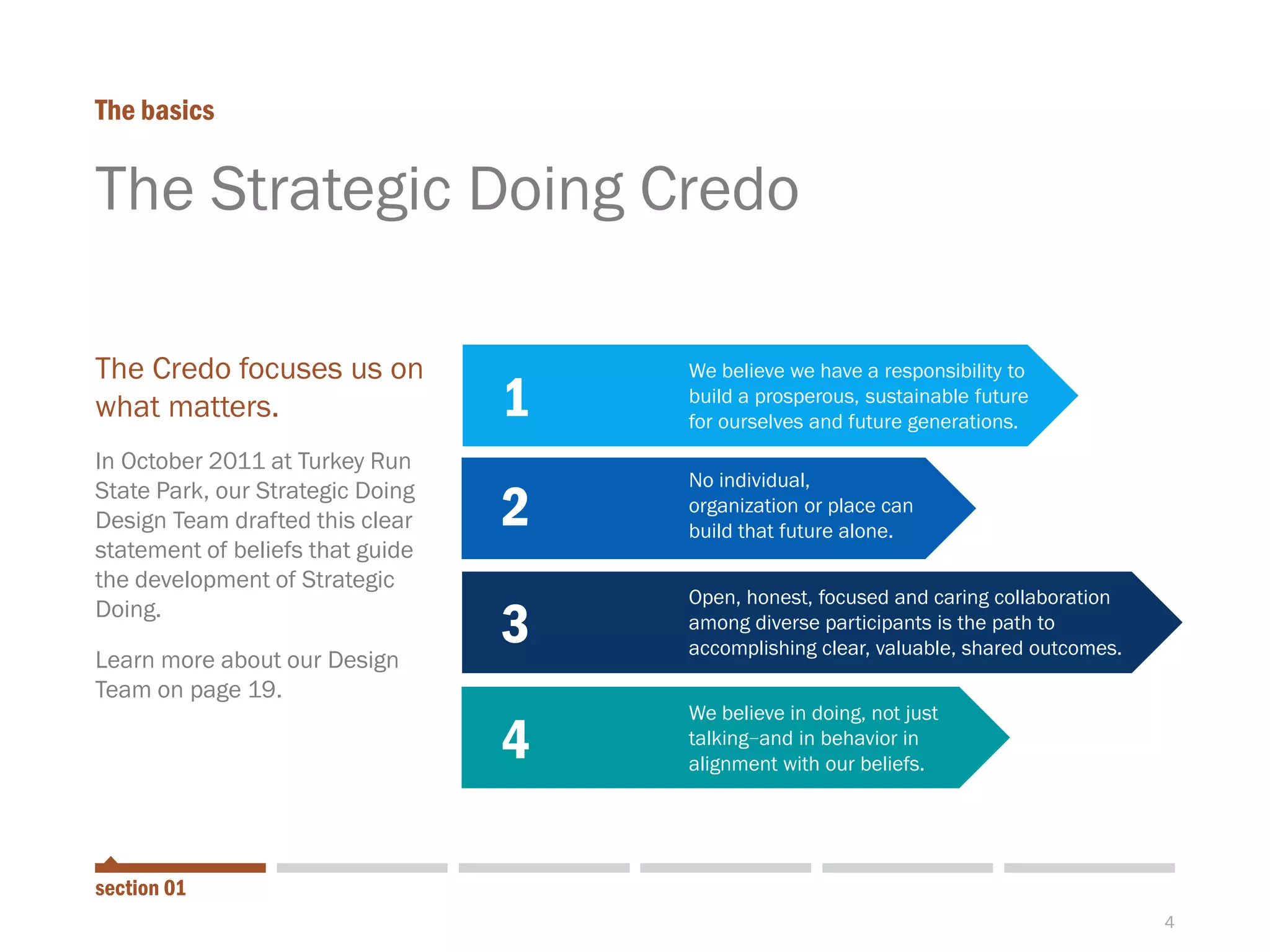
The Strategic Doing Credo
The basics
section 01
The Credo focuses us on
what matters.
In October 2011 at Turkey Run
State Park, our Strategic Doing
Design Team drafted this clear
statement of beliefs that guide
the development of Strategic
Doing.
Learn more about our Design
Team on page 19.
4
3
2
1
We believe we have a responsibility to
build a prosperous, sustainable future
for ourselves and future generations.
No individual,
organization or place can
build that future alone.
Open, honest, focused and caring collaboration
among diverse participants is the path to
accomplishing clear, valuable, shared outcomes.
We believe in doing, not just
talking-and in behavior in
alignment with our beliefs.
5
What is Strategic Doing?
Strategic Doing enables people to form action-oriented collaborations quickly, guide them
toward measurable outcomes and make adjustments along the way.
The basics
Nearly everywhere we turn these days,
people talk about the importance of
collaboration. But how do we design
these collaborations? How do we
manage them? Strategic Doing
provides a simple set of rules to
answer these questions.
With Strategic Doing, people:
 Link and leverage their assets to
create new opportunities
 Convert high-priority opportunities
into measurable outcomes
 Define pathfinder projects that
move toward these outcomes
Strategic Doing is designed for
open, loosely connected networks-
the common situation in which
nobody can tell anyone else what to
do.
Managing complexity requires
simple rules. We have designed
Strategic Doing to be intuitive and
concise. In a matter of hours, a
loosely organized network of people
can generate a sophisticated
strategic action plan and begin
implementing their ideas.
Watch a video introduction.
In today’s world we need
strategic thinking more than ever,
but we cannot rely on slow,
cumbersome traditional
approaches.
Strategic Doing is designed for
today’s world.
section 01
6
How does it work?
Collaborations are born and live in conversation.
The basics
section 01
How will we
get there?
By keeping our conversations focused on these critical questions,
Strategic Doing generates all the components we need for practical
strategic action plans. Over time, we make continuous adjustments
to these plans, as we learn by doing.
Strategic Doing focuses our
conversation on the two
critical questions of strategy:
Where are
we going?
Strategic Doing works by
focusing intensively and
relentlessly on the critical
questions of strategy for
collaborations.
7
Why does it work?
Strategic Doing works because it is intuitive and stimulates learning by doing.
The basics
section 01
Intuitive
Each of us is experienced in making
strategic decisions in our personal
lives. Yet, we rarely bring this
experience into our collaborations.
Strategic Doing builds off of these
personal experiences.
FunInductive
At the same time, most of us
recognize that we cannot forecast the
future. We often do not know what
will work. By stimulating a spirit of
experimentation, Strategic Doing
encourages us to learn continuously.
Finally, Strategic Doing promotes the
deeper conversations, as well as the
collaborative action, that most of us
find fun and engaging. Strategy
sessions are focused, short and
pragmatic.
8
As a lean, agile strategy discipline,
Strategic Doing has applications in a
wide range of situations.
Dealing with messy challenges in
communities and regions
We are increasingly confronting
complex, messy problems. In these
situations, multiple organizations,
each with a unique set of assets, need
a practical approach to designing and
guiding collaborations.
Focusing an organization
As organizations become flatter and
more networked, traditional
approaches to strategy no longer work
as well. Strategic Doing fills a void.
University engagement
Alongside teaching and research,
university engagement represents the
Third Mission of higher education.
Increasingly, universities are being
called upon to improve engagement
with their regional economy. Strategic
Doing delivers a lean and scalable
solution to leveraging university assets
in new and different ways.
University transformations
An increasing number of universities
are turning to Strategic Doing to guide
the complex moves needed to
transform the student experience.
Strategic Doing provides a simple
discipline to guide these
transformations.
Moving a professional association
forward
Guiding an association forward can be
difficult without a simple process to
engage and align members.
Building clusters
Clusters are an important feature of
dynamic regional economies, and
Strategic Doing is a fast way to build
these networks.
The basics
section 01
Who uses Strategic Doing?
Strategic Doing is designed for strategy and open, loosely connected networks.
Strategic Doing can be
applied to any complex
situation in which
collaboration represents the
only practical alternative.
Workforce innovations in
Indiana
Rebuilding neighborhoods in
Flint
Launching a clean energy
cluster in Florida
Filling the manufacturing
skills gap in Indiana
case
studies &
testimonials
10
Workforce innovations in Indiana
In 2006, Purdue received a $15 million federal grant to
design new workforce innovations in a 14-county region
surrounding its flagship campus. The U.S. Department
of Labor selected 13 regions nationally to experiment
with new workforce collaborations.
Fast forward four years…
Case studies & testimonials
In four strategic focus areas, we initiated over 60 new
collaborations and 80 percent of these initiatives
continued past the initial funding.
Among the initiatives:
 A guitar summer camp to teach manufacturing
skills to high school students, which is now a
national model
 The nation’s first green collar manufacturing
certification
 The Energy Systems Network
The team also responded quickly to a deep and
unexpected layoff of engineers in Kokomo, Indiana.
Watch a video that explains the story.
section 02
With 8 percent of the money
awarded nationally, Purdue
generated 40 percent of the
national results.
11
Rebuilding neighborhoods in Flint,
Michigan
Case studies & testimonials
section 02
Bob Brown
Michigan State University
In the wake of a failed federal grant application, a group
of neighborhood leaders in Flint, Michigan, turned to
Strategic Doing. After working so hard on the grant
application, they wanted to stay together and actually do
something. With the support of Michigan State
University, the neighborhood leaders launched
Neighborhoods Without Borders.
The core team continues to come together and build
new networks with practical collaborations. Although it
is impossible to say for certain, the work of these leaders
has likely contributed to the dramatic reduction of
violent crime in Flint.
More important, perhaps, the neighborhood leaders
have, according to one, "broken their grant addiction.”
They are focused on mobilizing the many assets they
have within their neighborhood.
In neighborhoods besieged by complex,
wicked problems, Strategic Doing creates
hope through the power of taking action
with the assets or gifts that we already
possess.
In that moment when we combine assets,
we begin to tell a new story of opportunity
and possibility. Strategic Doing gives us the
power to change our lives, our
neighborhoods and our communities.
12
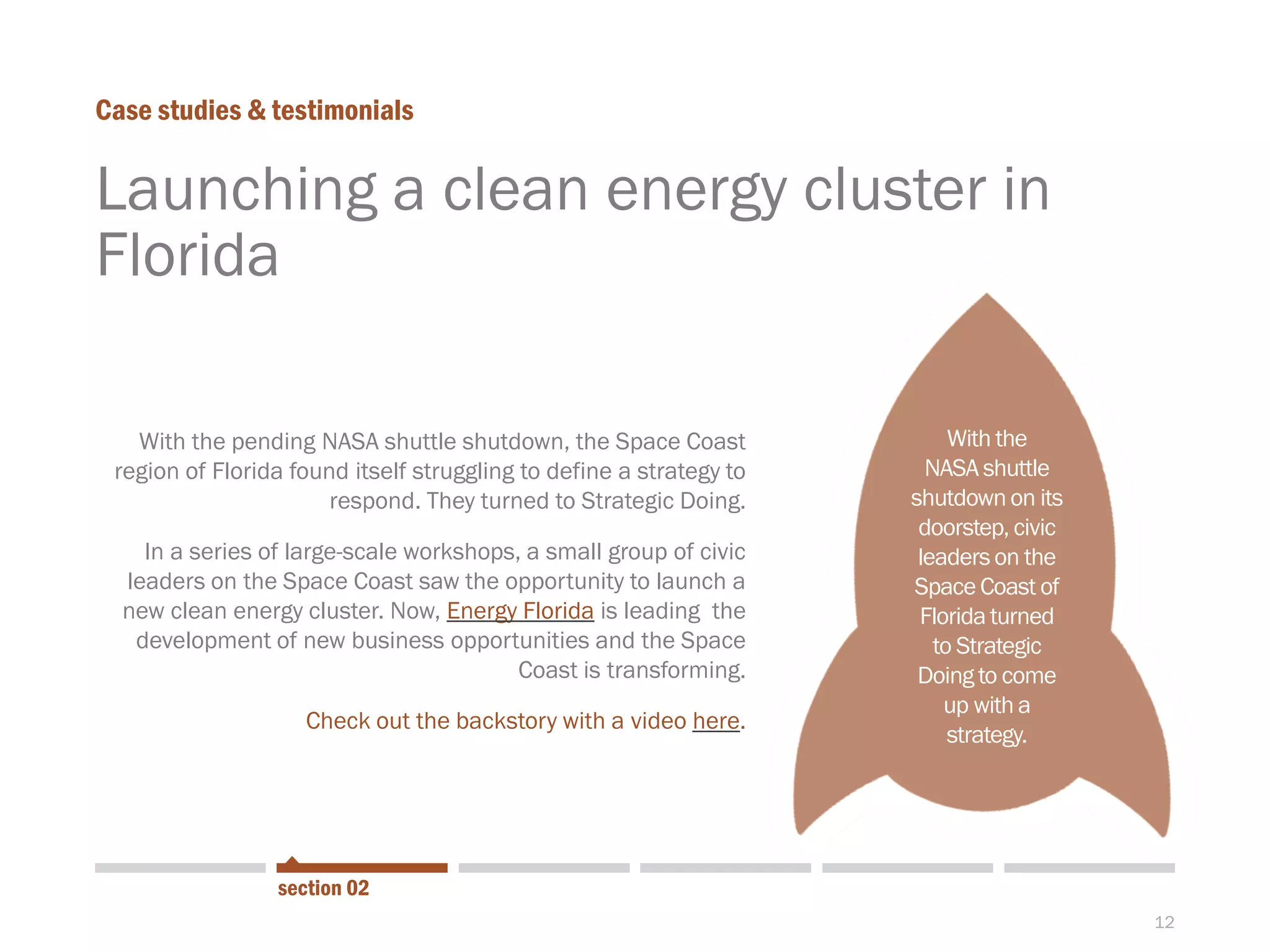
Launching a clean energy cluster in
Florida
Case studies & testimonials
section 02
With the pending NASA shuttle shutdown, the Space Coast
region of Florida found itself struggling to define a strategy to
respond. They turned to Strategic Doing.
In a series of large-scale workshops, a small group of civic
leaders on the Space Coast saw the opportunity to launch a
new clean energy cluster. Now, Energy Florida is leading the
development of new business opportunities and the Space
Coast is transforming.
Check out the backstory with a video here.
With the
NASA shuttle
shutdownon its
doorstep, civic
leaders on the
Space Coast of
Florida turned
to Strategic
Doing to come
up with a
strategy.
13
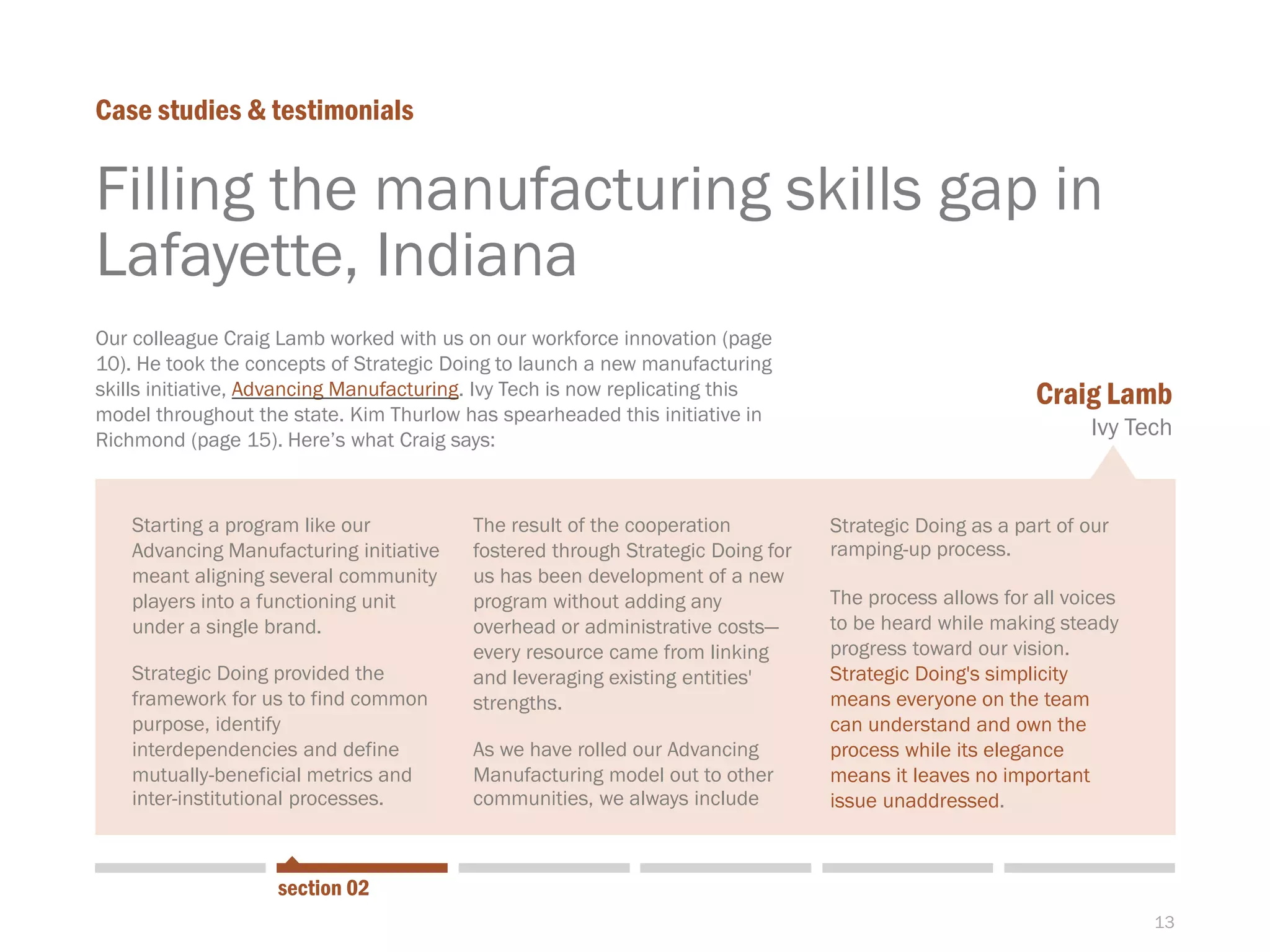
Starting a program like our
Advancing Manufacturing initiative
meant aligning several community
players into a functioning unit
under a single brand.
Strategic Doing provided the
framework for us to find common
purpose, identify
interdependencies and define
mutually-beneficial metrics and
inter-institutional processes.
Filling the manufacturing skills gap in
Lafayette, Indiana
Case studies & testimonials
section 02
Our colleague Craig Lamb worked with us on our workforce innovation (page
10). He took the concepts of Strategic Doing to launch a new manufacturing
skills initiative, Advancing Manufacturing. Ivy Tech is now replicating this
model throughout the state. Kim Thurlow has spearheaded this initiative in
Richmond (page 15). Here’s what Craig says:
The result of the cooperation
fostered through Strategic Doing for
us has been development of a new
program without adding any
overhead or administrative costs—
every resource came from linking
and leveraging existing entities'
strengths.
As we have rolled our Advancing
Manufacturing model out to other
communities, we always include
Strategic Doing as a part of our
ramping-up process.
The process allows for all voices
to be heard while making steady
progress toward our vision.
Strategic Doing's simplicity
means everyone on the team
can understand and own the
process while its elegance
means it leaves no important
issue unaddressed.
Craig Lamb
Ivy Tech
I appreciate and utilize the concepts of Strategic
Doing every time I am faced with aligning
resources in the civic space and encouraging the
concepts of shared vision and shared value among
our partners.
Craig Lamb
Ivy Tech
15
Filling the manufacturing skills gap in
Richmond, Indiana
Case studies & testimonials
section 02
With the NASA
shuttle shutdown
on its doorstep,
civic leaders on
the Space Coast
of Florida turned
to StrategicDoing
to come up with a
strategy.
Manufacturers in the region surrounding Richmond,
Indiana, faced a common problem: available jobs with
not enough people to fill them.
Manufacturers came to Ivy Tech, the community college, and asked, “Why
can’t we fix this problem?”
It turns out that fixing a workforce problem is not easy. It’s another one of
the really messy problems that our civic leaders are facing. Ivy Tech took the
lead and, partnering with Purdue, conducted a Strategic Doing workshop to
identify potential collaborations and get them moving.
In a few months, Manufacturing Matters launched with a new certification
initiative, and the region has responded. Learn more. The Manufacturing
Matters initiative is a replication of the Advancing Manufacturing initiative in
Lafayette, Indiana.
Kim Thurlow
Ivy Tech
Strategic Doing is
the tool that had
the greatest impact
in really being
something that we
could activate.
16
Building an aerospace cluster in
Rockford, Illinois
Case studies & testimonials
Northern Illinois University
(NIU) and the City of Rockford
have embraced Strategic
Doing as a valuable way to
build the collaborations
needed to transform their
economy.
Rena Cotsones, assistant vice
president for regional
engagement at NIU, leads a
core team that has built a
dynamic aerospace cluster.
You can learn more about the
Rockford Area Aerospace
Network here.
Decision-making in higher education institutions is
infamously slow, with multiple layers of approvals
and an emphasis on the need for new resources.
Strategic Doing's focus on what we could, should
and will do with the existing talents, resources and
authority of the people in the room at the time
breaks people free of that limited thinking and
helps them move forward in real time.
RenaCotsones
NorthernIllinois University
section 02
Where did Strategic Doing
come from?
What is the Strategic Doing
Design Team?
the
backstory
18
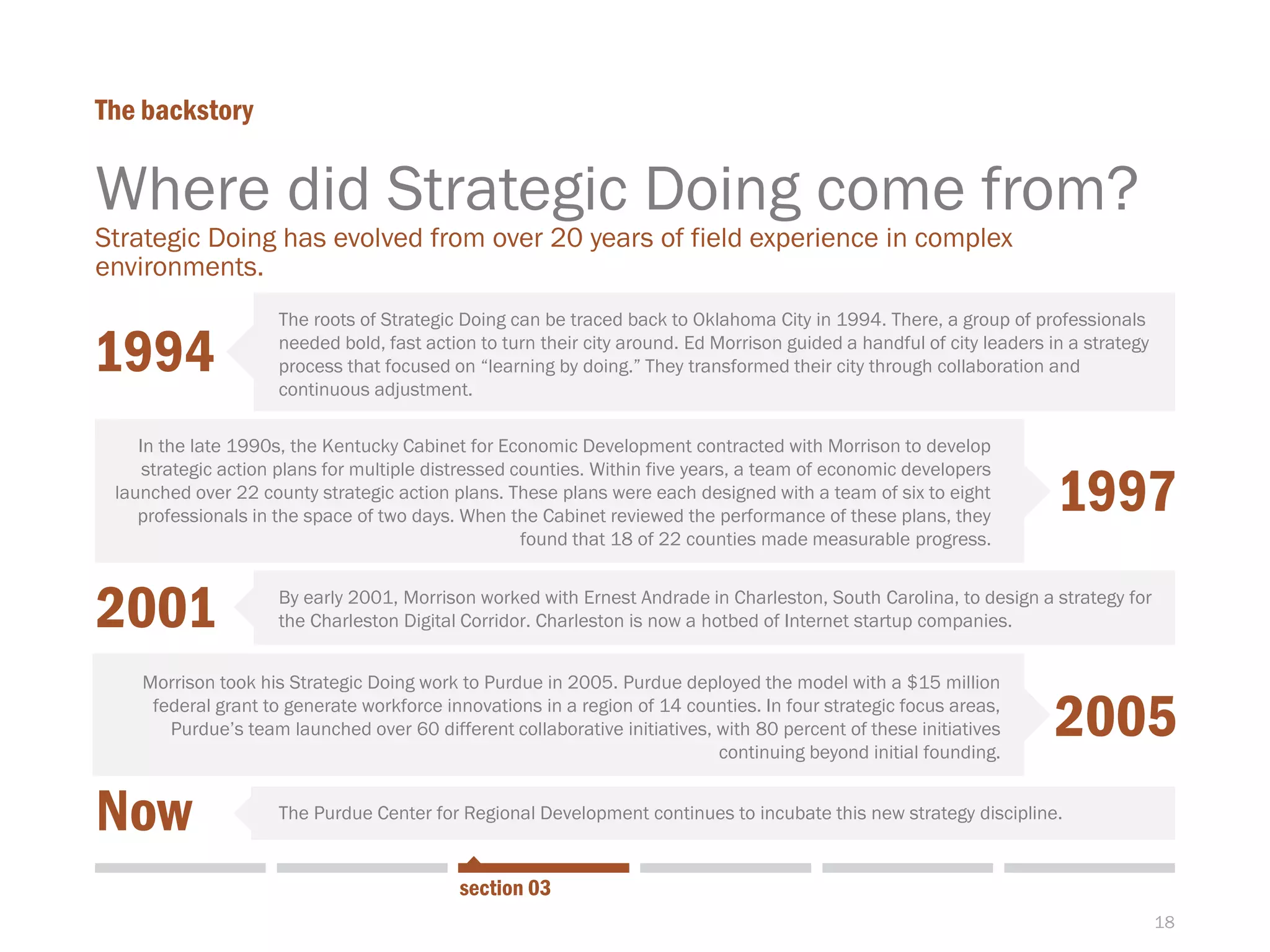
Where did Strategic Doing come from?
Strategic Doing has evolved from over 20 years of field experience in complex
environments.
The backstory
section 03
The roots of Strategic Doing can be traced back to Oklahoma City in 1994. There, a group of professionals
needed bold, fast action to turn their city around. Ed Morrison guided a handful of city leaders in a strategy
process that focused on “learning by doing.” They transformed their city through collaboration and
continuous adjustment.
1994
In the late 1990s, the Kentucky Cabinet for Economic Development contracted with Morrison to develop
strategic action plans for multiple distressed counties. Within five years, a team of economic developers
launched over 22 county strategic action plans. These plans were each designed with a team of six to eight
professionals in the space of two days. When the Cabinet reviewed the performance of these plans, they
found that 18 of 22 counties made measurable progress.
1997
2001 By early 2001, Morrison worked with Ernest Andrade in Charleston, South Carolina, to design a strategy for
the Charleston Digital Corridor. Charleston is now a hotbed of Internet startup companies.
2005
Morrison took his Strategic Doing work to Purdue in 2005. Purdue deployed the model with a $15 million
federal grant to generate workforce innovations in a region of 14 counties. In four strategic focus areas,
Purdue’s team launched over 60 different collaborative initiatives, with 80 percent of these initiatives
continuing beyond initial founding.
The Purdue Center for Regional Development continues to incubate this new strategy discipline.
Now
19
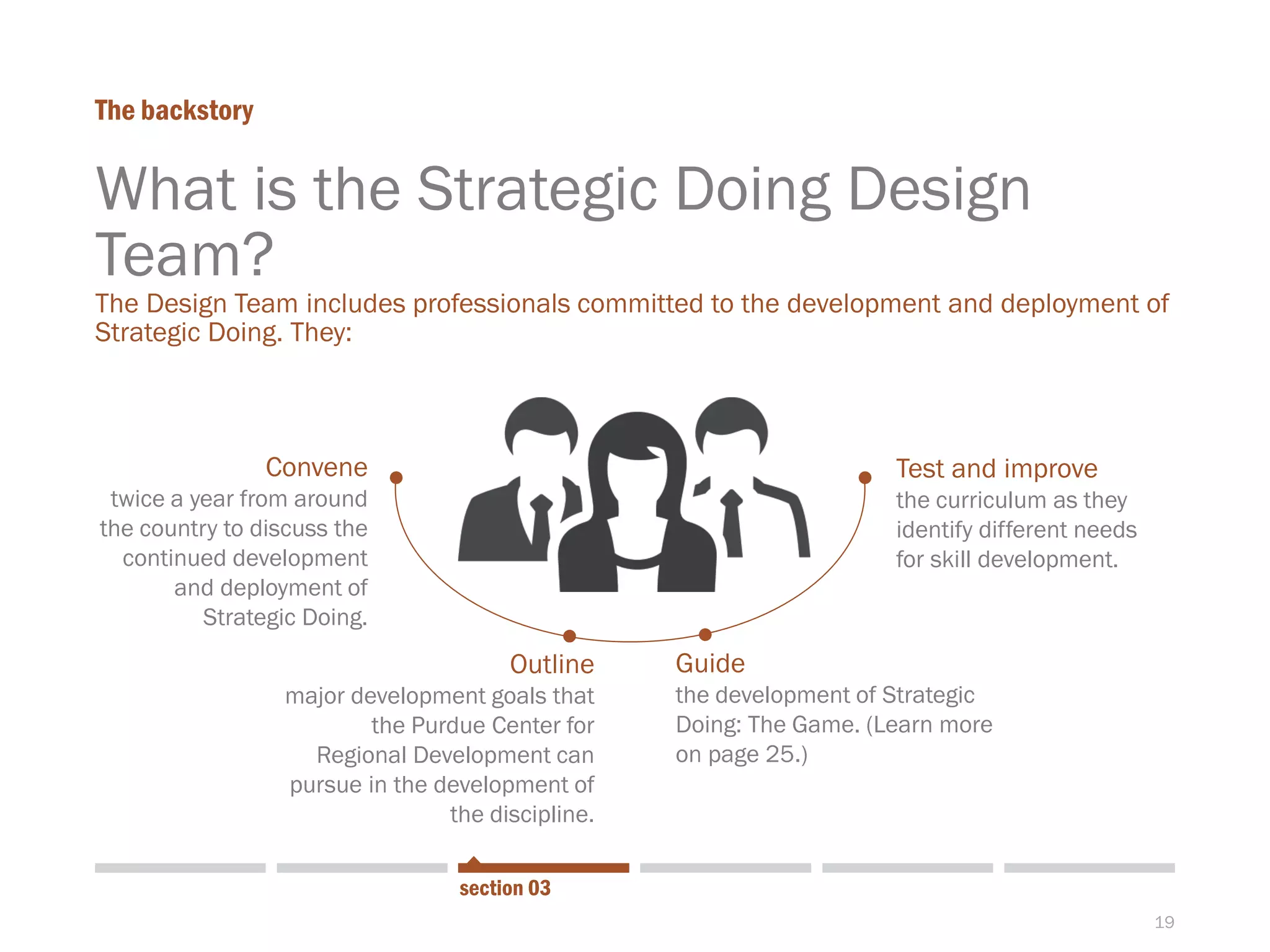
What is the Strategic Doing Design
Team?
The Design Team includes professionals committed to the development and deployment of
Strategic Doing. They:
The backstory
section 03
Test and improve
the curriculum as they
identify different needs
for skill development.
Convene
twice a year from around
the country to discuss the
continued development
and deployment of
Strategic Doing.
Outline
major development goals that
the Purdue Center for
Regional Development can
pursue in the development of
the discipline.
Guide
the development of Strategic
Doing: The Game. (Learn more
on page 25.)
The Strategic Doing university
network
our
university
network
21
The Strategic Doing University Network
Our university network
section 04
The Memorandum of Understanding is designed to encourage
the sharing of Strategic Doing training materials and
curriculum within the university network.
Purdue is building an international network of colleges and
universities to support the continued development and
deployment of Strategic Doing.
Organizations affiliated with a college or university join the
network by signing a Memorandum of Understanding (MOU). This
MOU encourages the sharing of intellectual property related to
Strategic Doing among members of the network.
Initial members of the network include Purdue University,
Michigan State University, The University of Akron, the University
of Alaska and the University of Missouri.
For colleges and
universities interested
in the Strategic Doing
Network, please contact
Ed Morrison at
edmorrison@purdue.edu
Introduction to Strategic
Doing
Strategic Doing: The Game
Practitioner training
Certification and faculty
training
options
23
Training options
Training options
section 05
Introduction to
Strategic Doing
Incorporate Strategic
Doing into your work
Time
Skills
Strategic Doing
Practitioner
Design and guide
new collaborations
using Strategic Doing
workshops
Strategic Doing
Certification
Teach Introduction
to Strategic Doing
Courses and
Strategic Doing:
The Game
Strategic Doing
Faculty
Develop new
curriculum, teach
practitioners and
guide certification
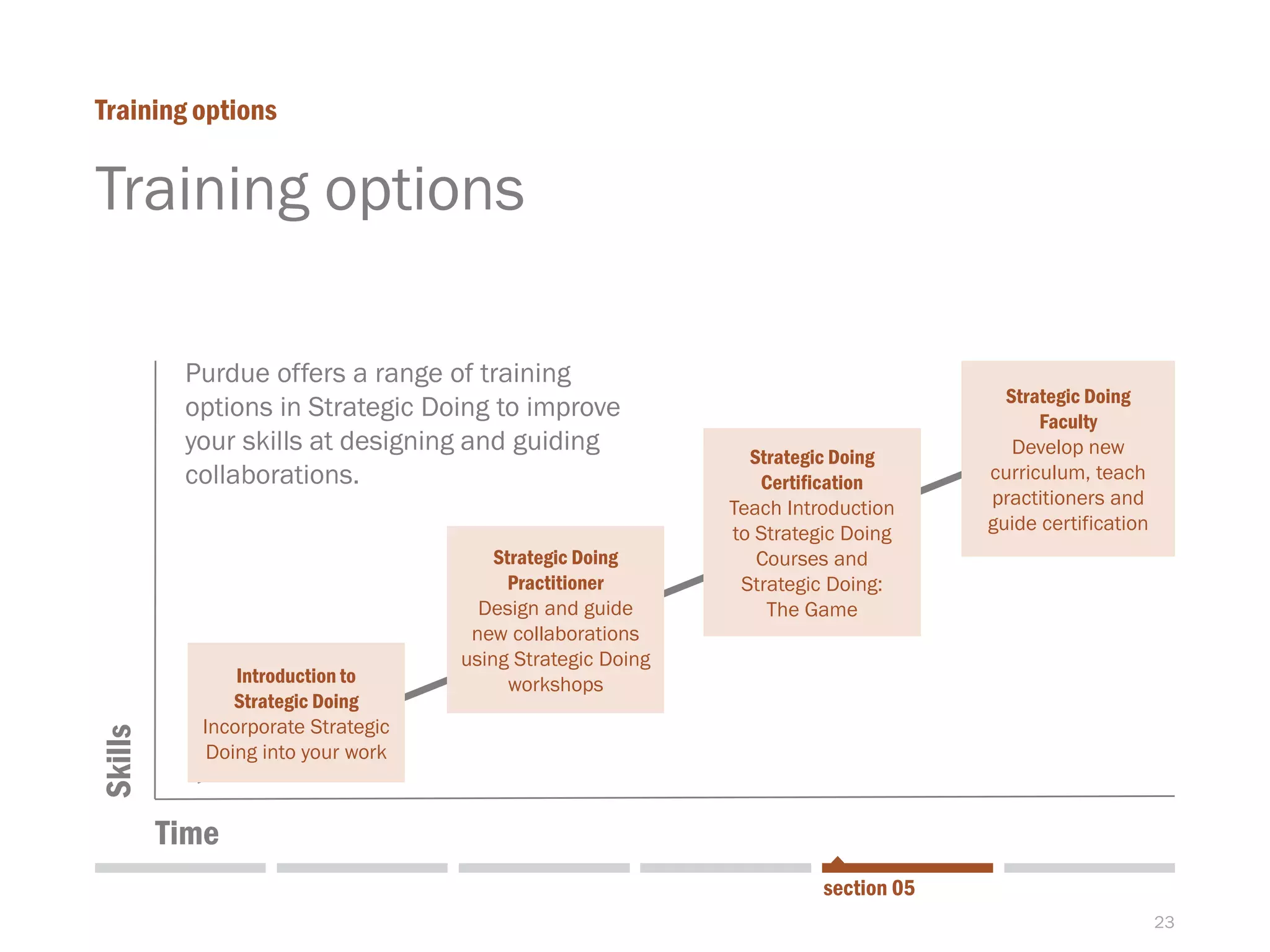
Purdue offers a range of training
options in Strategic Doing to improve
your skills at designing and guiding
collaborations.
24
Training prices
Training options
section 05
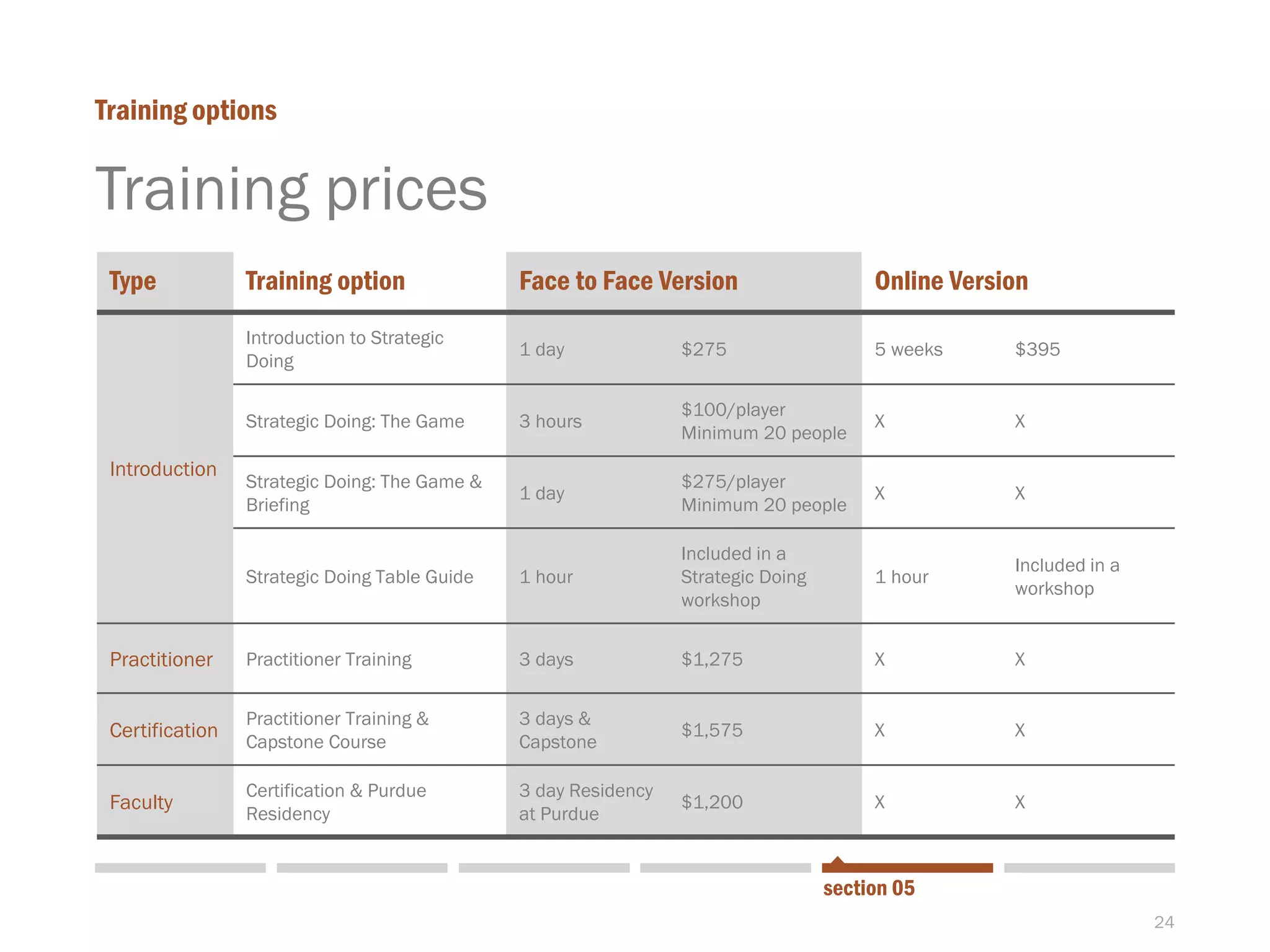
Type Training option Face to Face Version Online Version
Introduction
Introduction to Strategic
Doing
1 day $275 5 weeks $395
Strategic Doing: The Game 3 hours
$100/player
Minimum 20 people
X X
Strategic Doing: The Game &
Briefing
1 day
$275/player
Minimum 20 people
X X
Strategic Doing Table Guide 1 hour
Included in a
Strategic Doing
workshop
1 hour
Included in a
workshop
Practitioner Practitioner Training 3 days $1,275 X X
Certification
Practitioner Training &
Capstone Course
3 days &
Capstone
$1,575 X X
Faculty
Certification & Purdue
Residency
3 day Residency
at Purdue
$1,200 X X
25
Introduction to Strategic Doing
workshop
Training options
section 05
An introductory workshop in Strategic
Doing provides participants with an
overview of how strategy gets done in
open, loosely connected networks.
The workshop introduces the basic concepts
of Strategic Doing and illustrates how others
are using the discipline.
After you complete Introduction
to Strategic Doing, you will be able
to apply these principles to your
professional and personal life.
The workshop concludes by exploring your “next
steps” in developing the skills needed to design
and guide collaborations.
26
Strategic Doing: The Game
Training options
section 05
Participants in
The Game learn that
they can develop
sophisticated strategies
quickly if they keep their
conversation focused on
answering strategic
questions.
Strategic Doing: The Game introduces
the skills of designing and guiding
collaborations through a simulations.
Participants gain some valuable insights by focusing on the
challenges of transforming the economy of a fictional
Midwestern city.
Purdue is developing other versions of the game, and we can
work with you to customize a version that meets your needs.
27
Practitioner training: 3 day deep dive
Training options
section 05
Practitioner training is geared for professionals who need
a deeper grounding in the theory and practice of
collaboration in open networks.
In this three day training program, participants learn by doing.
They learn how to incorporate Strategic Doing into their own work
and collaborations.
With this training,
professionals will be
able to design and
guide collaboration
using Strategic Doing
workshops.
28
Certification: practitioner training &
capstone experience
Training options
section 05
Strategic Doing certification enables professionals to
teach Strategic Doing workshops and conduct Strategic
Doing: The Game.
The capstone experience includes field work that is supervised
by a member of the Strategic Doing faculty. During this fieldwork,
professionals learn to design and guide Strategic Doing
workshops.
29
Faculty: certification & Purdue
residency
Training options
section 05
Strategic Doing faculty design new curriculum and they
lead the development of Strategic Doing in anchor
universities.
Certified professionals are eligible to join the Strategic Doing
faculty. In order to take that step, the professional participates in a
residency at Purdue.
During this experience, the professional develops a plan for
contributing to the Strategic Doing curriculum. In addition, the
existing faculty provide suggestions for improving presentations
and teaching styles.
Keep up with our work
how you
can engage
31
Keep up with our work
How you can engage
section 06
On Facebook On Twitter On the web
For more information
please contact Peggy
Hosea at
phosea@purdue.edu
765-236-0955
888-750-7277
The Purdue Center for Regional Development (PCRD) seeks to pioneer
new ideas and strategies that contribute to regional collaboration,
innovation and prosperity.

Strategic Doing Overview

  • 1.
    Strategic Doing Guiding MeasurableOutcomes Through Action-Oriented Collaboration
  • 2.
    The basics 01 Table ofcontents Case studies & testimonials 02 The backstory 03 Our university network 04 Training options 05 How you can engage 06
  • 3.
    What is StrategicDoing? How does it work? Why does it work? Who uses Strategic Doing? the basics
  • 4.
    4 The Strategic DoingCredo The basics section 01 The Credo focuses us on what matters. In October 2011 at Turkey Run State Park, our Strategic Doing Design Team drafted this clear statement of beliefs that guide the development of Strategic Doing. Learn more about our Design Team on page 19. 4 3 2 1 We believe we have a responsibility to build a prosperous, sustainable future for ourselves and future generations. No individual, organization or place can build that future alone. Open, honest, focused and caring collaboration among diverse participants is the path to accomplishing clear, valuable, shared outcomes. We believe in doing, not just talking-and in behavior in alignment with our beliefs.
  • 5.
    5 What is StrategicDoing? Strategic Doing enables people to form action-oriented collaborations quickly, guide them toward measurable outcomes and make adjustments along the way. The basics Nearly everywhere we turn these days, people talk about the importance of collaboration. But how do we design these collaborations? How do we manage them? Strategic Doing provides a simple set of rules to answer these questions. With Strategic Doing, people:  Link and leverage their assets to create new opportunities  Convert high-priority opportunities into measurable outcomes  Define pathfinder projects that move toward these outcomes Strategic Doing is designed for open, loosely connected networks- the common situation in which nobody can tell anyone else what to do. Managing complexity requires simple rules. We have designed Strategic Doing to be intuitive and concise. In a matter of hours, a loosely organized network of people can generate a sophisticated strategic action plan and begin implementing their ideas. Watch a video introduction. In today’s world we need strategic thinking more than ever, but we cannot rely on slow, cumbersome traditional approaches. Strategic Doing is designed for today’s world. section 01
  • 6.
    6 How does itwork? Collaborations are born and live in conversation. The basics section 01 How will we get there? By keeping our conversations focused on these critical questions, Strategic Doing generates all the components we need for practical strategic action plans. Over time, we make continuous adjustments to these plans, as we learn by doing. Strategic Doing focuses our conversation on the two critical questions of strategy: Where are we going? Strategic Doing works by focusing intensively and relentlessly on the critical questions of strategy for collaborations.
  • 7.
    7 Why does itwork? Strategic Doing works because it is intuitive and stimulates learning by doing. The basics section 01 Intuitive Each of us is experienced in making strategic decisions in our personal lives. Yet, we rarely bring this experience into our collaborations. Strategic Doing builds off of these personal experiences. FunInductive At the same time, most of us recognize that we cannot forecast the future. We often do not know what will work. By stimulating a spirit of experimentation, Strategic Doing encourages us to learn continuously. Finally, Strategic Doing promotes the deeper conversations, as well as the collaborative action, that most of us find fun and engaging. Strategy sessions are focused, short and pragmatic.
  • 8.
    8 As a lean,agile strategy discipline, Strategic Doing has applications in a wide range of situations. Dealing with messy challenges in communities and regions We are increasingly confronting complex, messy problems. In these situations, multiple organizations, each with a unique set of assets, need a practical approach to designing and guiding collaborations. Focusing an organization As organizations become flatter and more networked, traditional approaches to strategy no longer work as well. Strategic Doing fills a void. University engagement Alongside teaching and research, university engagement represents the Third Mission of higher education. Increasingly, universities are being called upon to improve engagement with their regional economy. Strategic Doing delivers a lean and scalable solution to leveraging university assets in new and different ways. University transformations An increasing number of universities are turning to Strategic Doing to guide the complex moves needed to transform the student experience. Strategic Doing provides a simple discipline to guide these transformations. Moving a professional association forward Guiding an association forward can be difficult without a simple process to engage and align members. Building clusters Clusters are an important feature of dynamic regional economies, and Strategic Doing is a fast way to build these networks. The basics section 01 Who uses Strategic Doing? Strategic Doing is designed for strategy and open, loosely connected networks. Strategic Doing can be applied to any complex situation in which collaboration represents the only practical alternative.
  • 9.
    Workforce innovations in Indiana Rebuildingneighborhoods in Flint Launching a clean energy cluster in Florida Filling the manufacturing skills gap in Indiana case studies & testimonials
  • 10.
    10 Workforce innovations inIndiana In 2006, Purdue received a $15 million federal grant to design new workforce innovations in a 14-county region surrounding its flagship campus. The U.S. Department of Labor selected 13 regions nationally to experiment with new workforce collaborations. Fast forward four years… Case studies & testimonials In four strategic focus areas, we initiated over 60 new collaborations and 80 percent of these initiatives continued past the initial funding. Among the initiatives:  A guitar summer camp to teach manufacturing skills to high school students, which is now a national model  The nation’s first green collar manufacturing certification  The Energy Systems Network The team also responded quickly to a deep and unexpected layoff of engineers in Kokomo, Indiana. Watch a video that explains the story. section 02 With 8 percent of the money awarded nationally, Purdue generated 40 percent of the national results.
  • 11.
    11 Rebuilding neighborhoods inFlint, Michigan Case studies & testimonials section 02 Bob Brown Michigan State University In the wake of a failed federal grant application, a group of neighborhood leaders in Flint, Michigan, turned to Strategic Doing. After working so hard on the grant application, they wanted to stay together and actually do something. With the support of Michigan State University, the neighborhood leaders launched Neighborhoods Without Borders. The core team continues to come together and build new networks with practical collaborations. Although it is impossible to say for certain, the work of these leaders has likely contributed to the dramatic reduction of violent crime in Flint. More important, perhaps, the neighborhood leaders have, according to one, "broken their grant addiction.” They are focused on mobilizing the many assets they have within their neighborhood. In neighborhoods besieged by complex, wicked problems, Strategic Doing creates hope through the power of taking action with the assets or gifts that we already possess. In that moment when we combine assets, we begin to tell a new story of opportunity and possibility. Strategic Doing gives us the power to change our lives, our neighborhoods and our communities.
  • 12.
    12 Launching a cleanenergy cluster in Florida Case studies & testimonials section 02 With the pending NASA shuttle shutdown, the Space Coast region of Florida found itself struggling to define a strategy to respond. They turned to Strategic Doing. In a series of large-scale workshops, a small group of civic leaders on the Space Coast saw the opportunity to launch a new clean energy cluster. Now, Energy Florida is leading the development of new business opportunities and the Space Coast is transforming. Check out the backstory with a video here. With the NASA shuttle shutdownon its doorstep, civic leaders on the Space Coast of Florida turned to Strategic Doing to come up with a strategy.
  • 13.
    13 Starting a programlike our Advancing Manufacturing initiative meant aligning several community players into a functioning unit under a single brand. Strategic Doing provided the framework for us to find common purpose, identify interdependencies and define mutually-beneficial metrics and inter-institutional processes. Filling the manufacturing skills gap in Lafayette, Indiana Case studies & testimonials section 02 Our colleague Craig Lamb worked with us on our workforce innovation (page 10). He took the concepts of Strategic Doing to launch a new manufacturing skills initiative, Advancing Manufacturing. Ivy Tech is now replicating this model throughout the state. Kim Thurlow has spearheaded this initiative in Richmond (page 15). Here’s what Craig says: The result of the cooperation fostered through Strategic Doing for us has been development of a new program without adding any overhead or administrative costs— every resource came from linking and leveraging existing entities' strengths. As we have rolled our Advancing Manufacturing model out to other communities, we always include Strategic Doing as a part of our ramping-up process. The process allows for all voices to be heard while making steady progress toward our vision. Strategic Doing's simplicity means everyone on the team can understand and own the process while its elegance means it leaves no important issue unaddressed. Craig Lamb Ivy Tech
  • 14.
    I appreciate andutilize the concepts of Strategic Doing every time I am faced with aligning resources in the civic space and encouraging the concepts of shared vision and shared value among our partners. Craig Lamb Ivy Tech
  • 15.
    15 Filling the manufacturingskills gap in Richmond, Indiana Case studies & testimonials section 02 With the NASA shuttle shutdown on its doorstep, civic leaders on the Space Coast of Florida turned to StrategicDoing to come up with a strategy. Manufacturers in the region surrounding Richmond, Indiana, faced a common problem: available jobs with not enough people to fill them. Manufacturers came to Ivy Tech, the community college, and asked, “Why can’t we fix this problem?” It turns out that fixing a workforce problem is not easy. It’s another one of the really messy problems that our civic leaders are facing. Ivy Tech took the lead and, partnering with Purdue, conducted a Strategic Doing workshop to identify potential collaborations and get them moving. In a few months, Manufacturing Matters launched with a new certification initiative, and the region has responded. Learn more. The Manufacturing Matters initiative is a replication of the Advancing Manufacturing initiative in Lafayette, Indiana. Kim Thurlow Ivy Tech Strategic Doing is the tool that had the greatest impact in really being something that we could activate.
  • 16.
    16 Building an aerospacecluster in Rockford, Illinois Case studies & testimonials Northern Illinois University (NIU) and the City of Rockford have embraced Strategic Doing as a valuable way to build the collaborations needed to transform their economy. Rena Cotsones, assistant vice president for regional engagement at NIU, leads a core team that has built a dynamic aerospace cluster. You can learn more about the Rockford Area Aerospace Network here. Decision-making in higher education institutions is infamously slow, with multiple layers of approvals and an emphasis on the need for new resources. Strategic Doing's focus on what we could, should and will do with the existing talents, resources and authority of the people in the room at the time breaks people free of that limited thinking and helps them move forward in real time. RenaCotsones NorthernIllinois University section 02
  • 17.
    Where did StrategicDoing come from? What is the Strategic Doing Design Team? the backstory
  • 18.
    18 Where did StrategicDoing come from? Strategic Doing has evolved from over 20 years of field experience in complex environments. The backstory section 03 The roots of Strategic Doing can be traced back to Oklahoma City in 1994. There, a group of professionals needed bold, fast action to turn their city around. Ed Morrison guided a handful of city leaders in a strategy process that focused on “learning by doing.” They transformed their city through collaboration and continuous adjustment. 1994 In the late 1990s, the Kentucky Cabinet for Economic Development contracted with Morrison to develop strategic action plans for multiple distressed counties. Within five years, a team of economic developers launched over 22 county strategic action plans. These plans were each designed with a team of six to eight professionals in the space of two days. When the Cabinet reviewed the performance of these plans, they found that 18 of 22 counties made measurable progress. 1997 2001 By early 2001, Morrison worked with Ernest Andrade in Charleston, South Carolina, to design a strategy for the Charleston Digital Corridor. Charleston is now a hotbed of Internet startup companies. 2005 Morrison took his Strategic Doing work to Purdue in 2005. Purdue deployed the model with a $15 million federal grant to generate workforce innovations in a region of 14 counties. In four strategic focus areas, Purdue’s team launched over 60 different collaborative initiatives, with 80 percent of these initiatives continuing beyond initial founding. The Purdue Center for Regional Development continues to incubate this new strategy discipline. Now
  • 19.
    19 What is theStrategic Doing Design Team? The Design Team includes professionals committed to the development and deployment of Strategic Doing. They: The backstory section 03 Test and improve the curriculum as they identify different needs for skill development. Convene twice a year from around the country to discuss the continued development and deployment of Strategic Doing. Outline major development goals that the Purdue Center for Regional Development can pursue in the development of the discipline. Guide the development of Strategic Doing: The Game. (Learn more on page 25.)
  • 20.
    The Strategic Doinguniversity network our university network
  • 21.
    21 The Strategic DoingUniversity Network Our university network section 04 The Memorandum of Understanding is designed to encourage the sharing of Strategic Doing training materials and curriculum within the university network. Purdue is building an international network of colleges and universities to support the continued development and deployment of Strategic Doing. Organizations affiliated with a college or university join the network by signing a Memorandum of Understanding (MOU). This MOU encourages the sharing of intellectual property related to Strategic Doing among members of the network. Initial members of the network include Purdue University, Michigan State University, The University of Akron, the University of Alaska and the University of Missouri. For colleges and universities interested in the Strategic Doing Network, please contact Ed Morrison at edmorrison@purdue.edu
  • 22.
    Introduction to Strategic Doing StrategicDoing: The Game Practitioner training Certification and faculty training options
  • 23.
    23 Training options Training options section05 Introduction to Strategic Doing Incorporate Strategic Doing into your work Time Skills Strategic Doing Practitioner Design and guide new collaborations using Strategic Doing workshops Strategic Doing Certification Teach Introduction to Strategic Doing Courses and Strategic Doing: The Game Strategic Doing Faculty Develop new curriculum, teach practitioners and guide certification Purdue offers a range of training options in Strategic Doing to improve your skills at designing and guiding collaborations.
  • 24.
    24 Training prices Training options section05 Type Training option Face to Face Version Online Version Introduction Introduction to Strategic Doing 1 day $275 5 weeks $395 Strategic Doing: The Game 3 hours $100/player Minimum 20 people X X Strategic Doing: The Game & Briefing 1 day $275/player Minimum 20 people X X Strategic Doing Table Guide 1 hour Included in a Strategic Doing workshop 1 hour Included in a workshop Practitioner Practitioner Training 3 days $1,275 X X Certification Practitioner Training & Capstone Course 3 days & Capstone $1,575 X X Faculty Certification & Purdue Residency 3 day Residency at Purdue $1,200 X X
  • 25.
    25 Introduction to StrategicDoing workshop Training options section 05 An introductory workshop in Strategic Doing provides participants with an overview of how strategy gets done in open, loosely connected networks. The workshop introduces the basic concepts of Strategic Doing and illustrates how others are using the discipline. After you complete Introduction to Strategic Doing, you will be able to apply these principles to your professional and personal life. The workshop concludes by exploring your “next steps” in developing the skills needed to design and guide collaborations.
  • 26.
    26 Strategic Doing: TheGame Training options section 05 Participants in The Game learn that they can develop sophisticated strategies quickly if they keep their conversation focused on answering strategic questions. Strategic Doing: The Game introduces the skills of designing and guiding collaborations through a simulations. Participants gain some valuable insights by focusing on the challenges of transforming the economy of a fictional Midwestern city. Purdue is developing other versions of the game, and we can work with you to customize a version that meets your needs.
  • 27.
    27 Practitioner training: 3day deep dive Training options section 05 Practitioner training is geared for professionals who need a deeper grounding in the theory and practice of collaboration in open networks. In this three day training program, participants learn by doing. They learn how to incorporate Strategic Doing into their own work and collaborations. With this training, professionals will be able to design and guide collaboration using Strategic Doing workshops.
  • 28.
    28 Certification: practitioner training& capstone experience Training options section 05 Strategic Doing certification enables professionals to teach Strategic Doing workshops and conduct Strategic Doing: The Game. The capstone experience includes field work that is supervised by a member of the Strategic Doing faculty. During this fieldwork, professionals learn to design and guide Strategic Doing workshops.
  • 29.
    29 Faculty: certification &Purdue residency Training options section 05 Strategic Doing faculty design new curriculum and they lead the development of Strategic Doing in anchor universities. Certified professionals are eligible to join the Strategic Doing faculty. In order to take that step, the professional participates in a residency at Purdue. During this experience, the professional develops a plan for contributing to the Strategic Doing curriculum. In addition, the existing faculty provide suggestions for improving presentations and teaching styles.
  • 30.
    Keep up withour work how you can engage
  • 31.
    31 Keep up withour work How you can engage section 06 On Facebook On Twitter On the web
  • 32.
    For more information pleasecontact Peggy Hosea at phosea@purdue.edu 765-236-0955 888-750-7277 The Purdue Center for Regional Development (PCRD) seeks to pioneer new ideas and strategies that contribute to regional collaboration, innovation and prosperity.