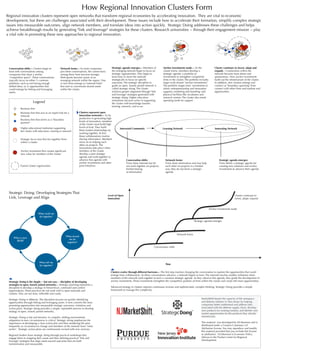
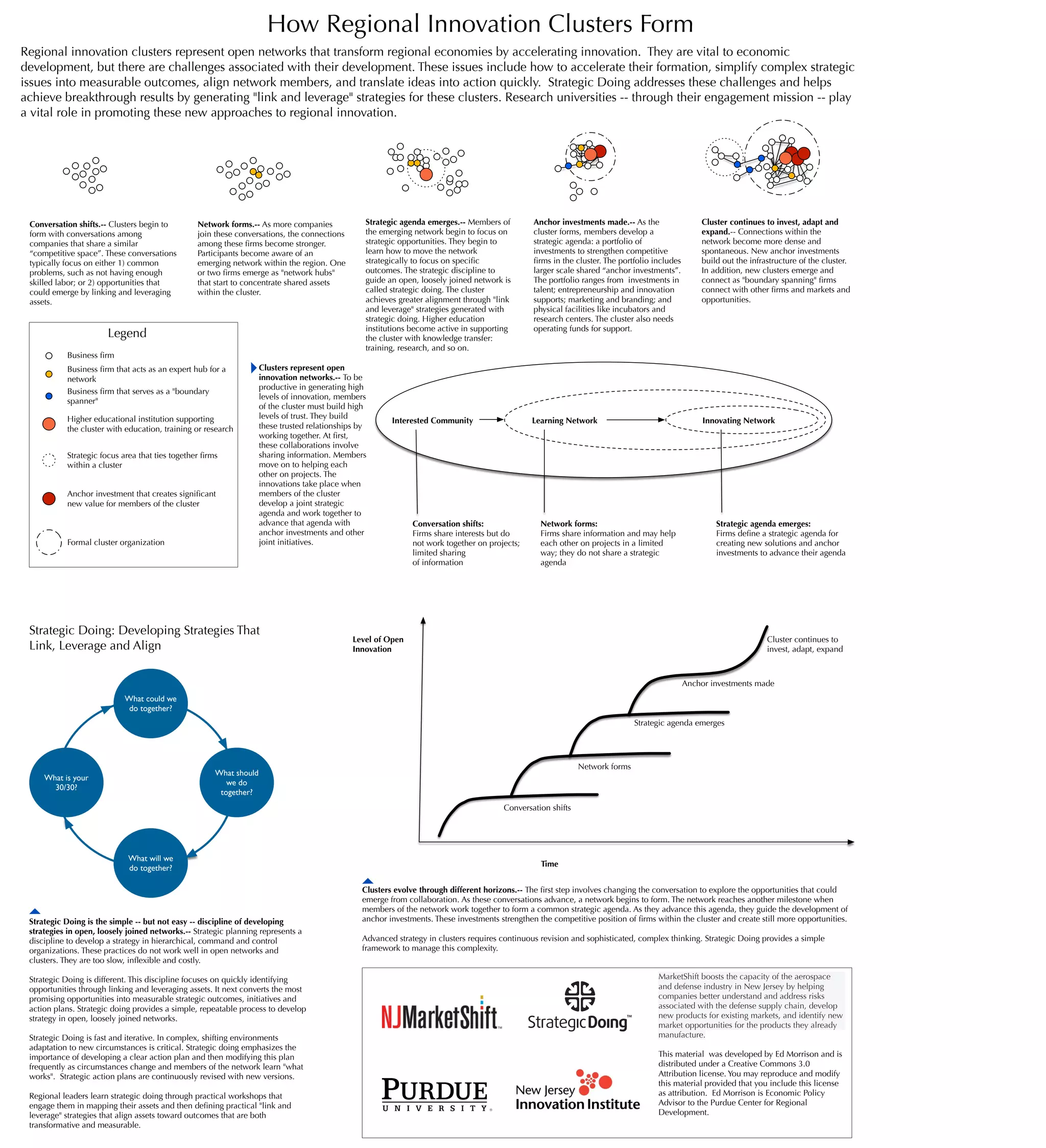
Conversation shifts.-- Clusters begin to
form with conversations among
companies that share a similar
“competitive space”. These conversations
typically focus on either 1) common
problems, such as not having enough
skilled labor; or 2) opportunities that
could emerge by linking and leveraging
assets.
Network forms.-- As more companies
join these conversations, the connections
among these firms become stronger.
Participants become aware of an
emerging network within the region. One
or two firms emerge as "network hubs"
that start to concentrate shared assets
within the cluster.
Strategic agenda emerges.-- Members of
the emerging network begin to focus on
strategic opportunities. They begin to
learn how to move the network
strategically to focus on specific
outcomes. The strategic discipline to
guide an open, loosely joined network is
called strategic doing. The cluster
achieves greater alignment through "link
and leverage" strategies generated with
strategic doing. Higher education
institutions become active in supporting
the cluster with knowledge transfer:
training, research, and so on.
Anchor investments made.-- As the
cluster forms, members develop a
strategic agenda: a portfolio of
investments to strengthen competitive
firms in the cluster. The portfolio includes
larger scale shared “anchor investments”.
The portfolio ranges from investments in
talent; entrepreneurship and innovation
supports; marketing and branding; and
physical facilities like incubators and
research centers. The cluster also needs
operating funds for support.
Cluster continues to invest, adapt and
expand.-- Connections within the
network become more dense and
spontaneous. New anchor investments
build out the infrastructure of the cluster.
In addition, new clusters emerge and
connect as "boundary spanning" firms
connect with other firms and markets and
opportunities.
Business firm
Business firm that acts as an expert hub for a
network
Business firm that serves as a "boundary
spanner"
Higher educational institution supporting
the cluster with education, training or research
Strategic focus area that ties together firms
within a cluster
Anchor investment that creates significant
new value for members of the cluster
Formal cluster organization
Legend
Interested Community Learning Network Innovating Network
Conversation shifts:
Firms share interests but do
not work together on projects;
limited sharing
of information
Network forms:
Firms share information and may help
each other on projects in a limited
way; they do not share a strategic
agenda
Strategic agenda emerges:
Firms define a strategic agenda for
creating new solutions and anchor
investments to advance their agenda
Time
Level of Open
Innovation
Conversation shifts
Network forms
Strategic agenda emerges
Anchor investments made
Cluster continues to
invest, adapt, expand
How Regional Innovation Clusters Form
Regional innovation clusters represent open networks that transform regional economies by accelerating innovation. They are vital to economic
development, but there are challenges associated with their development. These issues include how to accelerate their formation, simplify complex strategic
issues into measurable outcomes, align network members, and translate ideas into action quickly. Strategic Doing addresses these challenges and helps
achieve breakthrough results by generating "link and leverage" strategies for these clusters. Research universities -- through their engagement mission -- play
a vital role in promoting these new approaches to regional innovation.
MarketShift boosts the capacity of the aerospace
and defense industry in New Jersey by helping
companies better understand and address risks
associated with the defense supply chain, develop
new products for existing markets, and identify new
market opportunities for the products they already
manufacture.
This material was developed by Ed Morrison and is
distributed under a Creative Commons 3.0
Attribution license. You may reproduce and modify
this material provided that you include this license
as attribution. Ed Morrison is Economic Policy
Advisor to the Purdue Center for Regional
Development.
Strategic Doing: Developing Strategies That
Link, Leverage and Align
Strategic Doing is the simple -- but not easy -- discipline of developing
strategies in open, loosely joined networks.-- Strategic planning represents a
discipline to develop a strategy in hierarchical, command and control
organizations. These practices do not work well in open networks and
clusters. They are too slow, inflexible and costly.
Strategic Doing is different. This discipline focuses on quickly identifying
opportunities through linking and leveraging assets. It next converts the most
promising opportunities into measurable strategic outcomes, initiatives and
action plans. Strategic doing provides a simple, repeatable process to develop
strategy in open, loosely joined networks.
Strategic Doing is fast and iterative. In complex, shifting environments
adaptation to new circumstances is critical. Strategic doing emphasizes the
importance of developing a clear action plan and then modifying this plan
frequently as circumstances change and members of the network learn "what
works". Strategic action plans are continuously revised with new versions.
Regional leaders learn strategic doing through practical workshops that
engage them in mapping their assets and then defining practical "link and
leverage" strategies that align assets toward outcomes that are both
transformative and measurable.
Clusters represent open
innovation networks.-- To be
productive in generating high
levels of innovation, members
of the cluster must build high
levels of trust. They build
these trusted relationships by
working together. At first,
these collaborations involve
sharing information. Members
move on to helping each
other on projects. The
innovations take place when
members of the cluster
develop a joint strategic
agenda and work together to
advance that agenda with
anchor investments and other
joint initiatives.
Clusters evolve through different horizons.-- The first step involves changing the conversation to explore the opportunities that could
emerge from collaboration. As these conversations advance, a network begins to form. The network reaches another milestone when
members of the network work together to form a common strategic agenda. As they advance this agenda, they guide the development of
anchor investments. These investments strengthen the competitive position of firms within the cluster and create still more opportunities.
Advanced strategy in clusters requires continuous revision and sophisticated, complex thinking. Strategic Doing provides a simple
framework to manage this complexity.
What could we
do together?
What will we
do together?
What should
we do
together?
What is your
30/30?

How Regional Innovation Clusters Form

  • 1.
    Conversation shifts.-- Clustersbegin to form with conversations among companies that share a similar “competitive space”. These conversations typically focus on either 1) common problems, such as not having enough skilled labor; or 2) opportunities that could emerge by linking and leveraging assets. Network forms.-- As more companies join these conversations, the connections among these firms become stronger. Participants become aware of an emerging network within the region. One or two firms emerge as "network hubs" that start to concentrate shared assets within the cluster. Strategic agenda emerges.-- Members of the emerging network begin to focus on strategic opportunities. They begin to learn how to move the network strategically to focus on specific outcomes. The strategic discipline to guide an open, loosely joined network is called strategic doing. The cluster achieves greater alignment through "link and leverage" strategies generated with strategic doing. Higher education institutions become active in supporting the cluster with knowledge transfer: training, research, and so on. Anchor investments made.-- As the cluster forms, members develop a strategic agenda: a portfolio of investments to strengthen competitive firms in the cluster. The portfolio includes larger scale shared “anchor investments”. The portfolio ranges from investments in talent; entrepreneurship and innovation supports; marketing and branding; and physical facilities like incubators and research centers. The cluster also needs operating funds for support. Cluster continues to invest, adapt and expand.-- Connections within the network become more dense and spontaneous. New anchor investments build out the infrastructure of the cluster. In addition, new clusters emerge and connect as "boundary spanning" firms connect with other firms and markets and opportunities. Business firm Business firm that acts as an expert hub for a network Business firm that serves as a "boundary spanner" Higher educational institution supporting the cluster with education, training or research Strategic focus area that ties together firms within a cluster Anchor investment that creates significant new value for members of the cluster Formal cluster organization Legend Interested Community Learning Network Innovating Network Conversation shifts: Firms share interests but do not work together on projects; limited sharing of information Network forms: Firms share information and may help each other on projects in a limited way; they do not share a strategic agenda Strategic agenda emerges: Firms define a strategic agenda for creating new solutions and anchor investments to advance their agenda Time Level of Open Innovation Conversation shifts Network forms Strategic agenda emerges Anchor investments made Cluster continues to invest, adapt, expand How Regional Innovation Clusters Form Regional innovation clusters represent open networks that transform regional economies by accelerating innovation. They are vital to economic development, but there are challenges associated with their development. These issues include how to accelerate their formation, simplify complex strategic issues into measurable outcomes, align network members, and translate ideas into action quickly. Strategic Doing addresses these challenges and helps achieve breakthrough results by generating "link and leverage" strategies for these clusters. Research universities -- through their engagement mission -- play a vital role in promoting these new approaches to regional innovation. MarketShift boosts the capacity of the aerospace and defense industry in New Jersey by helping companies better understand and address risks associated with the defense supply chain, develop new products for existing markets, and identify new market opportunities for the products they already manufacture. This material was developed by Ed Morrison and is distributed under a Creative Commons 3.0 Attribution license. You may reproduce and modify this material provided that you include this license as attribution. Ed Morrison is Economic Policy Advisor to the Purdue Center for Regional Development. Strategic Doing: Developing Strategies That Link, Leverage and Align Strategic Doing is the simple -- but not easy -- discipline of developing strategies in open, loosely joined networks.-- Strategic planning represents a discipline to develop a strategy in hierarchical, command and control organizations. These practices do not work well in open networks and clusters. They are too slow, inflexible and costly. Strategic Doing is different. This discipline focuses on quickly identifying opportunities through linking and leveraging assets. It next converts the most promising opportunities into measurable strategic outcomes, initiatives and action plans. Strategic doing provides a simple, repeatable process to develop strategy in open, loosely joined networks. Strategic Doing is fast and iterative. In complex, shifting environments adaptation to new circumstances is critical. Strategic doing emphasizes the importance of developing a clear action plan and then modifying this plan frequently as circumstances change and members of the network learn "what works". Strategic action plans are continuously revised with new versions. Regional leaders learn strategic doing through practical workshops that engage them in mapping their assets and then defining practical "link and leverage" strategies that align assets toward outcomes that are both transformative and measurable. Clusters represent open innovation networks.-- To be productive in generating high levels of innovation, members of the cluster must build high levels of trust. They build these trusted relationships by working together. At first, these collaborations involve sharing information. Members move on to helping each other on projects. The innovations take place when members of the cluster develop a joint strategic agenda and work together to advance that agenda with anchor investments and other joint initiatives. Clusters evolve through different horizons.-- The first step involves changing the conversation to explore the opportunities that could emerge from collaboration. As these conversations advance, a network begins to form. The network reaches another milestone when members of the network work together to form a common strategic agenda. As they advance this agenda, they guide the development of anchor investments. These investments strengthen the competitive position of firms within the cluster and create still more opportunities. Advanced strategy in clusters requires continuous revision and sophisticated, complex thinking. Strategic Doing provides a simple framework to manage this complexity. What could we do together? What will we do together? What should we do together? What is your 30/30?