Strategic Doing
September 5, 2013
Bob Brown
Michigan State University
The Big Picture
In Battle Creek, People Are Working to:
•
•
•
•
•
•

Improve education and cut dropout rates
Create a zero tolerance for violence
Eliminate blight and create healthy green spaces
Help people achieve financial stability
Promote healthy behaviors
Reclaim neighborhoods and increase their
vitality
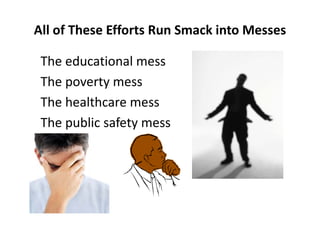
All of These Efforts Run Smack into Messes
The educational mess
The poverty mess
The healthcare mess
The public safety mess
What’s a Mess?
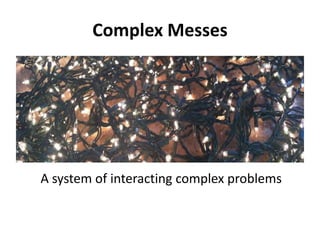
Complex Messes

A system of interacting complex problems
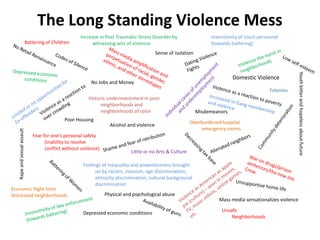
The Long Standing Violence Mess
Battering of Children

Increase in Post Traumatic Stress Disorder by
witnessing acts of violence

Insensitivity of court personnel
(towards battering)

Sense of isolation

Felonies
Historic underinvestment in poor
neighborhoods and
neighborhoods of color

Rape and sexual assault

Poor Housing
Fear for one’s personal safety
(inability to resolve
conflict without violence)

Economic flight from
distressed neighborhoods

Alcohol and violence

Misdemeanors
Overburdened hospital
emergency rooms

Little or no Arts & Culture

Feelings of inequality and powerlessness brought
on by racism, classism, age discrimination,
ethnicity discrimination, cultural background
discrimination
Physical and psychological abuse
Depressed economic conditions

Mass media sensationalizes violence
Unsafe
Neighborhoods

Youth bitter and hopeless about future

Domestic Violence

No Jobs and Money
New Understandings:
Complex problems behave in ways that make more
straightforward programmatic solutions less
effective
The past does not necessarily predict the future.
Small changes can create large and sometimes
unanticipated effects
Preskill and Tanya, 2012
New Understandings:
Producing specific outcomes at a pre-determined
time (a grant period) is difficult
Predicting all possible outcomes that might occur
(United Way funding proposals) is difficult
Sequencing outcomes in the same way that a welltested, stable program intervention can (Logic
Model) is difficult
Preskill and Tanya, 2012
A Challenge However Remains
Even with this increased understanding,
the challenge of working in messes
remains: Getting from here to there
without getting lost or overwhelmed
along the way
But Here Where It Gets Tricky
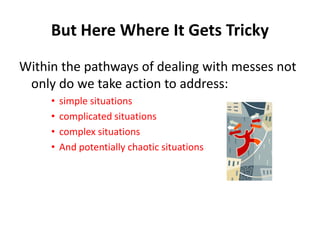
Within the pathways of dealing with messes not
only do we take action to address:
•
•
•
•

simple situations
complicated situations
complex situations
And potentially chaotic situations
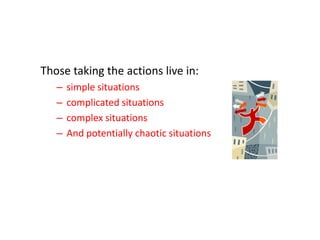
Those taking the actions live in:
–
–
–
–

simple situations
complicated situations
complex situations
And potentially chaotic situations
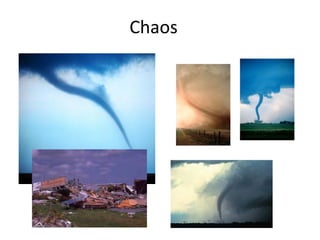
Chaos
In chaotic situations people
are just trying to survive,
we do whatever it takes
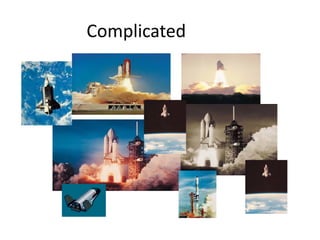
Complicated
In complicated situations things are either
socially complicated or technically
complicated
When things are socially complicated we build
relationships and create common ground to
increase our social agreement
When things are technically complicated we
experiment and coordinate expertise to
increase our technical certainty
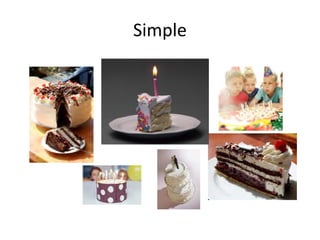
Simple
In simple situations we just trying to follow
the recipe – evidence-based practices.
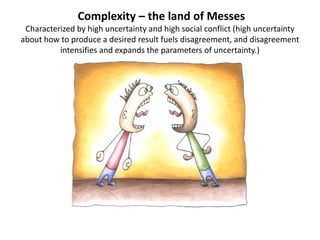
Complexity – the land of Messes
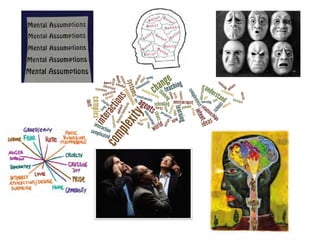
Characterized by high uncertainty and high social conflict (high uncertainty
about how to produce a desired result fuels disagreement, and disagreement
intensifies and expands the parameters of uncertainty.)
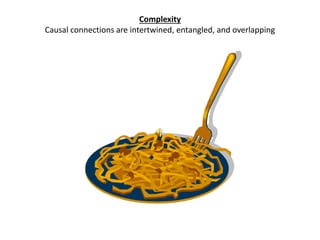
Complexity
Causal connections are intertwined, entangled, and overlapping
Complex Situations
cause-effect relations are unknown and, in principle, unknowable before
effects have emerged.
Complexity
Uncertainty and unpredictability are part of the innovation process

•
Living in the Land of Complex
Messes: Flint, Mi
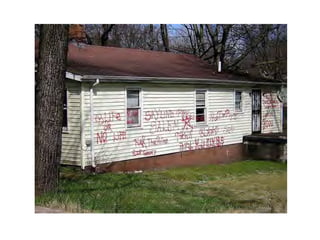
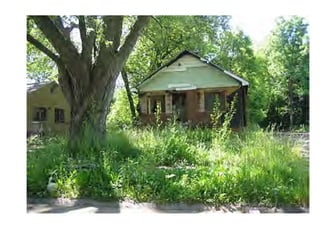
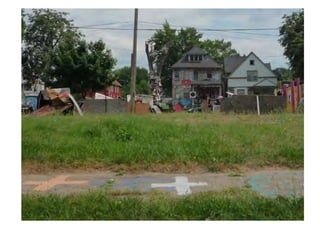
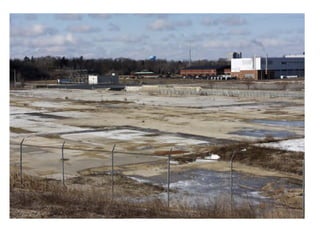
The Zone of Complexity in Flint
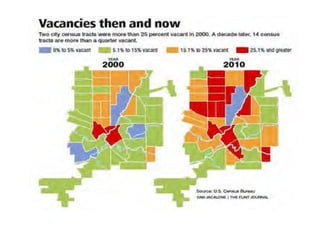
Starting in the late 1960s Flint has
suffered from 50 years of disinvestment,
deindustrialization, depopulation and
urban decay, as well as high rates of
crime, unemployment and poverty.
The Zone of Complexity in Flint

• 1978: 80,000 GM
employees
• 2010: 8,000 GM
employees
The Zone of Complexity in Flint

• May 2002, Ed Kurtz
appointed as the city’s
st Emergency Financial
1
Manager
The Zone of Complexity in Flint

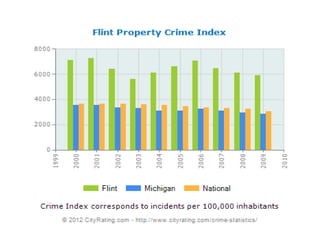
•2010 Headline:
Flint still is number one
for violent crime in the
nation
The Zone of Complexity in Flint

• November 2011: Governor
Snyder appointed Michael
nd
Brown as the city's 2
Emergency Financial
Manager
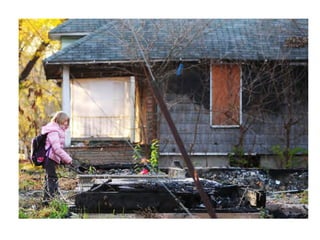
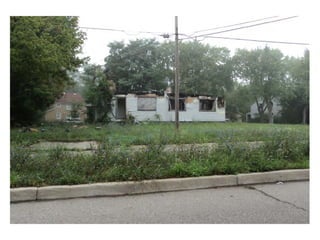
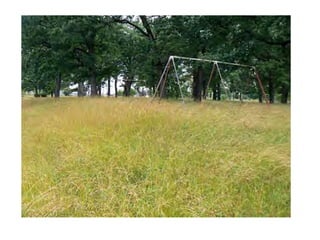
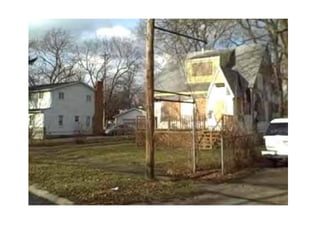
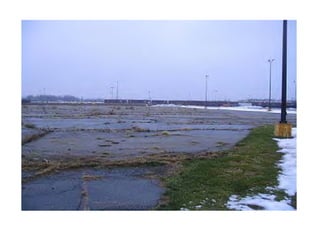
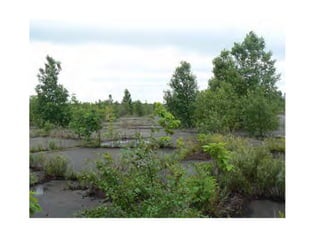
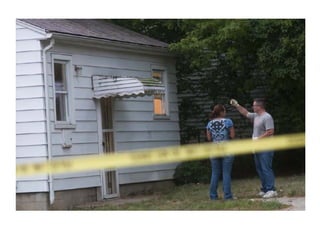
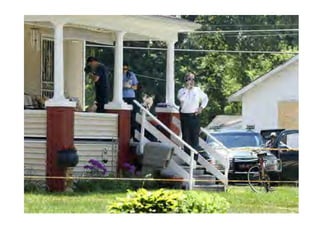
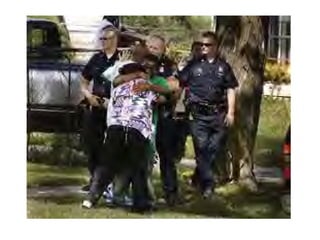
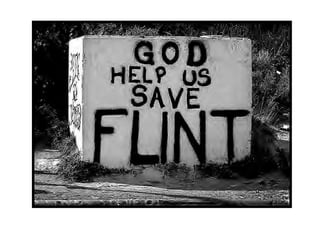
• But we are numb to words
and stats
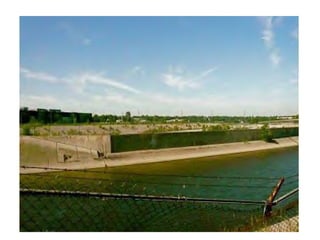
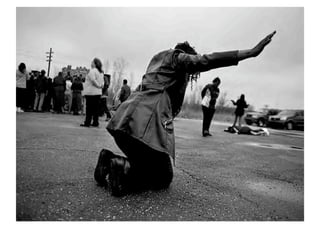
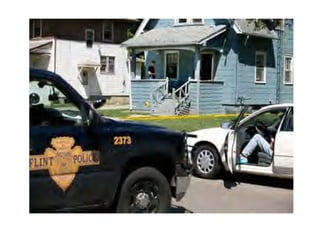
• Here is the Zone of
Complexity in Flint – my city
in pictures
But Most of Us Are Overwhelmed With
the Sheer Scope and Complexities of
These Issues
So we fall back on a set of rules and standard
operating procedures that predetermine what we
will do
Effectively short circuits our ability to work across
simple to complicated to complex situations or
messes

Patton, Developmental Evaluation, 2011
So What’s the Response – Is There a
Key?
• We can address messes
• But traditional programmatic approaches aren’t
creating impact
• We need Social Innovation to impact messes
Preskill and Tanya, 2012
What is Social Innovation?
Novel solutions to social problems that:
• Are more effective, efficient, sustainable, or just than
present solutions
• Creates value that accrues primarily to society as a
whole rather than individuals
• Crosses sectors,
• Involves changing the dynamics, roles, and
relationships between many players,
• Challenges conventional wisdom about the nature of
the problem and its solutions
Preskill and Tanya, 2012
Your Social Innovation: Project 2020
• Working together, we champion ideas and
initiatives that move this community toward
excellence.
• We exist to create a coalition of groups and
individuals who are connected, coordinated,
mutually supportive and working toward the
greater good.
Project 2020 – a network of people
• Getting on the Same Page
• Moving Levers
• Changing Outcomes
Achieving Your Vision Will Require:
• Thinking Differently
• Behaving Differently
• Doing Differently
Strategic Doing
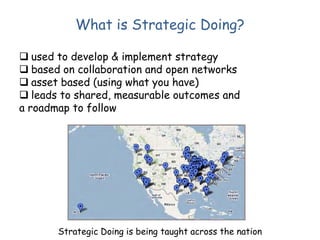
What is Strategic Doing?
used to develop & implement strategy
based on collaboration and open networks
asset based (using what you have)
leads to shared, measurable outcomes and
a roadmap to follow

Strategic Doing is being taught across the nation
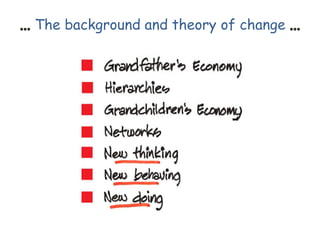
The background and theory of change
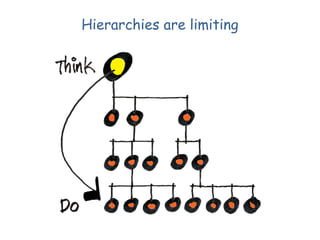
Hierarchies are limiting
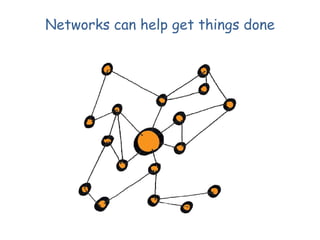
Networks can help get things done
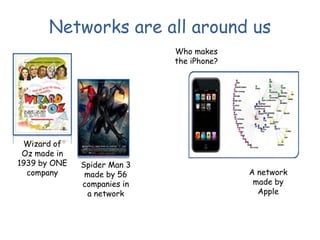
Networks are all around us
Who makes
the iPhone?

Wizard of
Oz made in
1939 by ONE
company

Spider Man 3
made by 56
companies in
a network

A network
made by
Apple
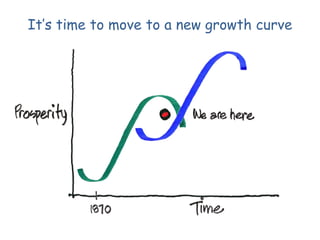
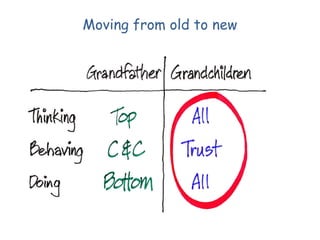
Moving from old to new
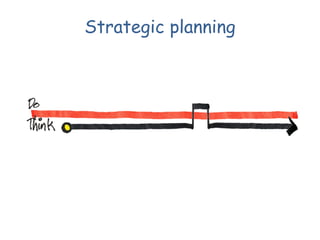
Strategic planning
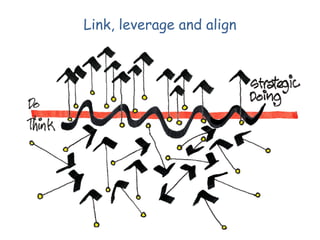
Link, leverage and align
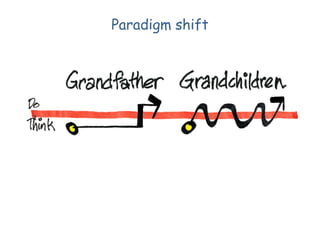
Paradigm shift
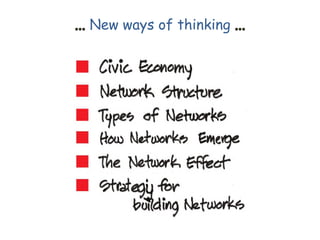
New ways of thinking
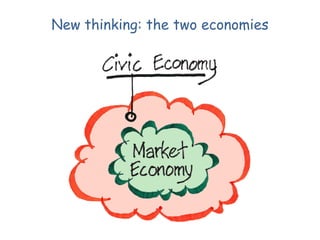
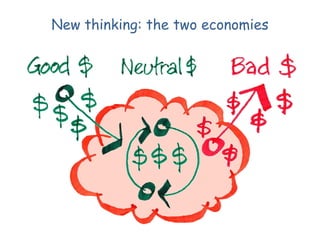
New thinking: the two economies
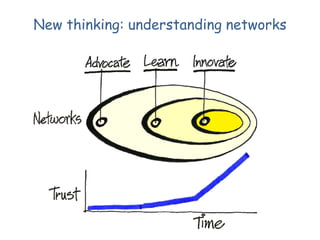
New thinking: understanding networks
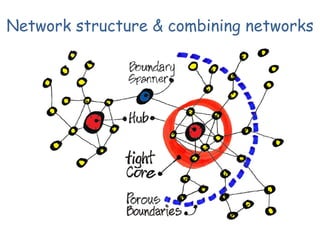
Network structure & combining networks
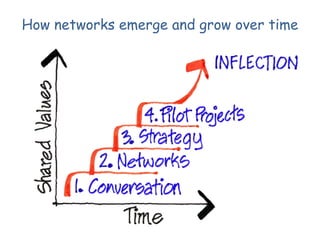
How networks emerge and grow over time
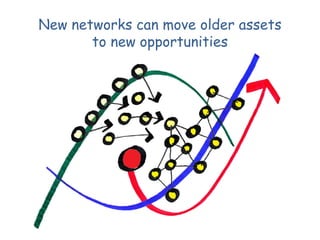
New networks can move older assets
to new opportunities
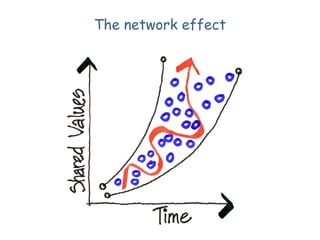
The network effect
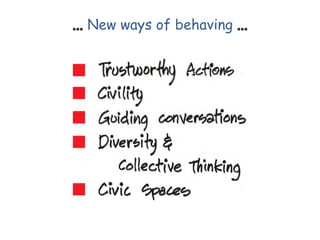
New ways of behaving
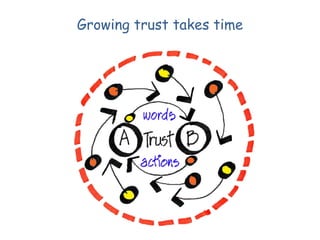
Growing trust takes time
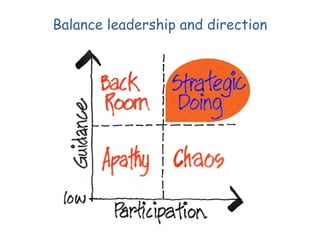
Balance leadership and direction
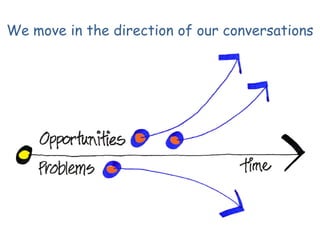
We move in the direction of our conversations
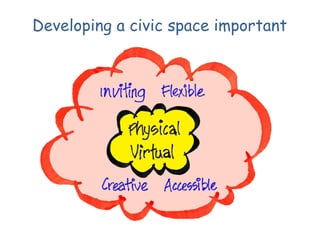
Developing a civic space important
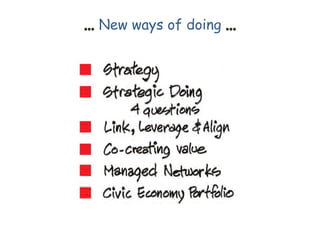
New ways of doing
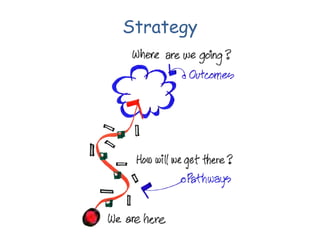
Strategy
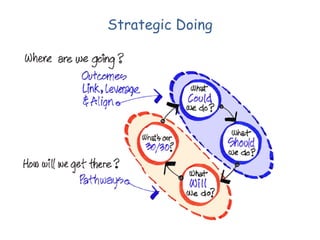
Strategic Doing
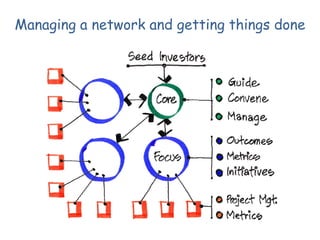
Managing a network and getting things done
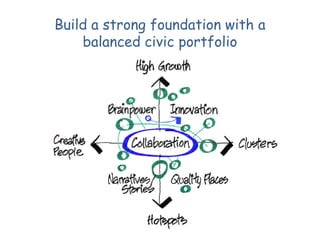
Build a strong foundation with a
balanced civic portfolio
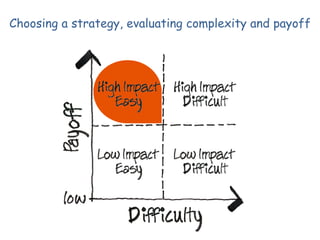
Choosing a strategy, evaluating complexity and payoff
Using Networks in Flint
“A

partial solution to a whole
system of problems is better than
whole solutions of each of its
parts taken separately.” (Ackoff,
1999, p. 324)
Elements of Healthy Neighborhoods
• According to the Institute for Comprehensive
Community Development, “Neighborhoods
are complex systems that require many
elements to work well, from decent housing
and safe streets to employment opportunities,
good schools and access to shopping, health
care and other services.
Responding to the Mess of Flint
Neighborhoods
• Use a new, more holistic approach to community and
neighborhood development.
– Blends human, community, and economic development
– Provides the supports needed for healthy transitions from birth
to adulthood
– Is grounded in research
– Acknowledges the natural challenges to healthy development
but recognizes that these challenges are more difficult without
the proper supports
– Offers guidelines for realigning investments for collective wellbeing

• Facilitate a process that creates action based on available
resources and assets
Goals
1.Improve communication among and between stakeholders at all levels.
2.Proactively address conditions in Flint neighborhoods that give rise to crime,
social disorder and fear of crime.
1.Re-establish a city-wide sense of community with a shared responsibility.
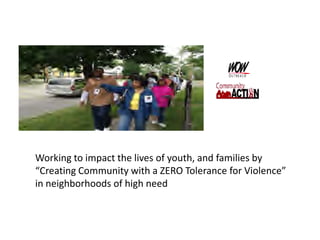
Working to impact the lives of youth, and families by
“Creating Community with a ZERO Tolerance for Violence”
in neighborhoods of high need
Neighborhoods
Without Borders
(NWB)
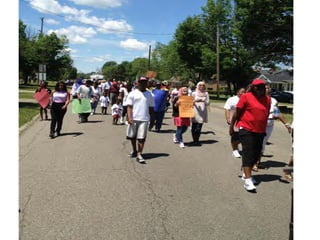
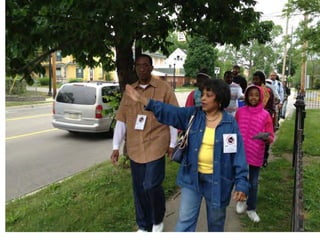
We are mothers and fathers, sons and daughters,
grandmothers and grandfathers, business people and
pastors, educators and students, administrators and
workers coming together in a grassroots and
community effort to significantly improve the overall quality of life in Flint neighborhoods.
Flint Lifelines
Building
Neighborhood
Capacity
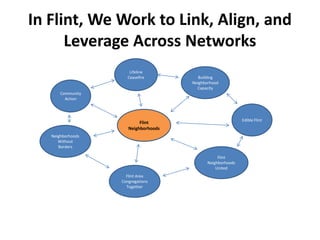
In Flint, We Work to Link, Align, and
Leverage Across Networks
Lifeline
Ceasefire

Building
Neighborhood
Capacity

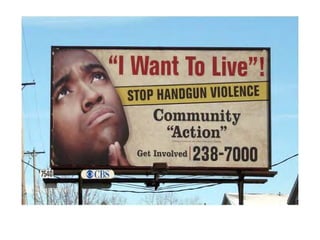
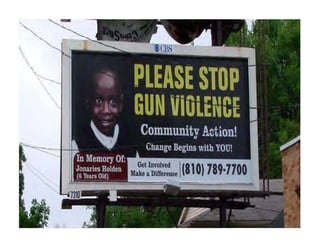
Community
Action

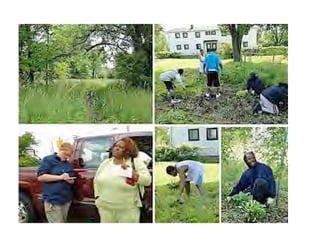
Edible Flint

Flint
Neighborhoods
Neighborhoods
Without
Borders
Flint
Neighborhoods
United
Flint Area
Congregations
Together

Strategic Doing in Flint 2013

  • 1.
    Strategic Doing September 5,2013 Bob Brown Michigan State University
  • 3.
  • 4.
    In Battle Creek,People Are Working to: • • • • • • Improve education and cut dropout rates Create a zero tolerance for violence Eliminate blight and create healthy green spaces Help people achieve financial stability Promote healthy behaviors Reclaim neighborhoods and increase their vitality
  • 5.
    All of TheseEfforts Run Smack into Messes The educational mess The poverty mess The healthcare mess The public safety mess
  • 6.
  • 7.
    Complex Messes A systemof interacting complex problems
  • 9.
    The Long StandingViolence Mess Battering of Children Increase in Post Traumatic Stress Disorder by witnessing acts of violence Insensitivity of court personnel (towards battering) Sense of isolation Felonies Historic underinvestment in poor neighborhoods and neighborhoods of color Rape and sexual assault Poor Housing Fear for one’s personal safety (inability to resolve conflict without violence) Economic flight from distressed neighborhoods Alcohol and violence Misdemeanors Overburdened hospital emergency rooms Little or no Arts & Culture Feelings of inequality and powerlessness brought on by racism, classism, age discrimination, ethnicity discrimination, cultural background discrimination Physical and psychological abuse Depressed economic conditions Mass media sensationalizes violence Unsafe Neighborhoods Youth bitter and hopeless about future Domestic Violence No Jobs and Money
  • 10.
    New Understandings: Complex problemsbehave in ways that make more straightforward programmatic solutions less effective The past does not necessarily predict the future. Small changes can create large and sometimes unanticipated effects Preskill and Tanya, 2012
  • 11.
    New Understandings: Producing specificoutcomes at a pre-determined time (a grant period) is difficult Predicting all possible outcomes that might occur (United Way funding proposals) is difficult Sequencing outcomes in the same way that a welltested, stable program intervention can (Logic Model) is difficult Preskill and Tanya, 2012
  • 12.
    A Challenge HoweverRemains Even with this increased understanding, the challenge of working in messes remains: Getting from here to there without getting lost or overwhelmed along the way
  • 13.
    But Here WhereIt Gets Tricky Within the pathways of dealing with messes not only do we take action to address: • • • • simple situations complicated situations complex situations And potentially chaotic situations
  • 14.
    Those taking theactions live in: – – – – simple situations complicated situations complex situations And potentially chaotic situations
  • 15.
  • 16.
    In chaotic situationspeople are just trying to survive, we do whatever it takes
  • 17.
  • 18.
    In complicated situationsthings are either socially complicated or technically complicated When things are socially complicated we build relationships and create common ground to increase our social agreement When things are technically complicated we experiment and coordinate expertise to increase our technical certainty
  • 19.
  • 20.
    In simple situationswe just trying to follow the recipe – evidence-based practices.
  • 21.
    Complexity – theland of Messes Characterized by high uncertainty and high social conflict (high uncertainty about how to produce a desired result fuels disagreement, and disagreement intensifies and expands the parameters of uncertainty.)
  • 22.
    Complexity Causal connections areintertwined, entangled, and overlapping
  • 23.
    Complex Situations cause-effect relationsare unknown and, in principle, unknowable before effects have emerged.
  • 24.
    Complexity Uncertainty and unpredictabilityare part of the innovation process •
  • 25.
    Living in theLand of Complex Messes: Flint, Mi
  • 26.
    The Zone ofComplexity in Flint Starting in the late 1960s Flint has suffered from 50 years of disinvestment, deindustrialization, depopulation and urban decay, as well as high rates of crime, unemployment and poverty.
  • 27.
    The Zone ofComplexity in Flint • 1978: 80,000 GM employees • 2010: 8,000 GM employees
  • 28.
    The Zone ofComplexity in Flint • May 2002, Ed Kurtz appointed as the city’s st Emergency Financial 1 Manager
  • 29.
    The Zone ofComplexity in Flint •2010 Headline: Flint still is number one for violent crime in the nation
  • 30.
    The Zone ofComplexity in Flint • November 2011: Governor Snyder appointed Michael nd Brown as the city's 2 Emergency Financial Manager
  • 31.
    • But weare numb to words and stats • Here is the Zone of Complexity in Flint – my city in pictures
  • 52.
    But Most ofUs Are Overwhelmed With the Sheer Scope and Complexities of These Issues So we fall back on a set of rules and standard operating procedures that predetermine what we will do Effectively short circuits our ability to work across simple to complicated to complex situations or messes Patton, Developmental Evaluation, 2011
  • 53.
    So What’s theResponse – Is There a Key?
  • 54.
    • We canaddress messes • But traditional programmatic approaches aren’t creating impact • We need Social Innovation to impact messes Preskill and Tanya, 2012
  • 55.
    What is SocialInnovation? Novel solutions to social problems that: • Are more effective, efficient, sustainable, or just than present solutions • Creates value that accrues primarily to society as a whole rather than individuals • Crosses sectors, • Involves changing the dynamics, roles, and relationships between many players, • Challenges conventional wisdom about the nature of the problem and its solutions Preskill and Tanya, 2012
  • 56.
    Your Social Innovation:Project 2020 • Working together, we champion ideas and initiatives that move this community toward excellence. • We exist to create a coalition of groups and individuals who are connected, coordinated, mutually supportive and working toward the greater good.
  • 57.
    Project 2020 –a network of people • Getting on the Same Page • Moving Levers • Changing Outcomes
  • 58.
    Achieving Your VisionWill Require: • Thinking Differently • Behaving Differently • Doing Differently
  • 59.
  • 60.
    What is StrategicDoing? used to develop & implement strategy based on collaboration and open networks asset based (using what you have) leads to shared, measurable outcomes and a roadmap to follow Strategic Doing is being taught across the nation
  • 61.
    The background andtheory of change
  • 63.
  • 64.
    Networks can helpget things done
  • 65.
    Networks are allaround us Who makes the iPhone? Wizard of Oz made in 1939 by ONE company Spider Man 3 made by 56 companies in a network A network made by Apple
  • 66.
  • 67.
  • 68.
  • 69.
  • 70.
    New ways ofthinking
  • 71.
    New thinking: thetwo economies
  • 72.
    New thinking: thetwo economies
  • 73.
  • 74.
    Network structure &combining networks
  • 75.
    How networks emergeand grow over time
  • 76.
    New networks canmove older assets to new opportunities
  • 77.
  • 78.
    New ways ofbehaving
  • 79.
  • 81.
  • 82.
    We move inthe direction of our conversations
  • 83.
    Developing a civicspace important
  • 84.
  • 85.
  • 86.
  • 88.
    Managing a networkand getting things done
  • 89.
    Build a strongfoundation with a balanced civic portfolio
  • 90.
    Choosing a strategy,evaluating complexity and payoff
  • 91.
    Using Networks inFlint “A partial solution to a whole system of problems is better than whole solutions of each of its parts taken separately.” (Ackoff, 1999, p. 324)
  • 100.
    Elements of HealthyNeighborhoods • According to the Institute for Comprehensive Community Development, “Neighborhoods are complex systems that require many elements to work well, from decent housing and safe streets to employment opportunities, good schools and access to shopping, health care and other services.
  • 101.
    Responding to theMess of Flint Neighborhoods • Use a new, more holistic approach to community and neighborhood development. – Blends human, community, and economic development – Provides the supports needed for healthy transitions from birth to adulthood – Is grounded in research – Acknowledges the natural challenges to healthy development but recognizes that these challenges are more difficult without the proper supports – Offers guidelines for realigning investments for collective wellbeing • Facilitate a process that creates action based on available resources and assets
  • 102.
    Goals 1.Improve communication amongand between stakeholders at all levels. 2.Proactively address conditions in Flint neighborhoods that give rise to crime, social disorder and fear of crime. 1.Re-establish a city-wide sense of community with a shared responsibility.
  • 103.
    Working to impactthe lives of youth, and families by “Creating Community with a ZERO Tolerance for Violence” in neighborhoods of high need
  • 104.
    Neighborhoods Without Borders (NWB) We aremothers and fathers, sons and daughters, grandmothers and grandfathers, business people and pastors, educators and students, administrators and workers coming together in a grassroots and community effort to significantly improve the overall quality of life in Flint neighborhoods.
  • 105.
  • 106.
    In Flint, WeWork to Link, Align, and Leverage Across Networks Lifeline Ceasefire Building Neighborhood Capacity Community Action Edible Flint Flint Neighborhoods Neighborhoods Without Borders Flint Neighborhoods United Flint Area Congregations Together