Reducing
costs
Prepared by: Trisha Jhoy M. Almario, LPT
LEARNING OBJECTIVES:
• identify the main cost drivers
• understand the relationship between a price strategy and a
cost leadership strategy
• understand what is meant by a focused cost leadership
strategy
• understand the nature of a technological system and its
relationship to the organization of an enterprise
• realize how short-lived any cost or price leadership can be
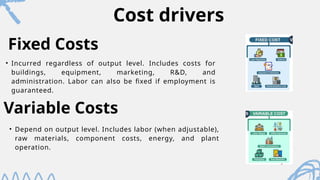
Cost drivers
• Incurred regardless of output level. Includes costs for
buildings, equipment, marketing, R&D, and
administration. Labor can also be fixed if employment is
guaranteed.
Fixed Costs
Variable Costs
• Depend on output level. Includes labor (when adjustable),
raw materials, component costs, energy, and plant
operation.
The Seven Cost Drivers
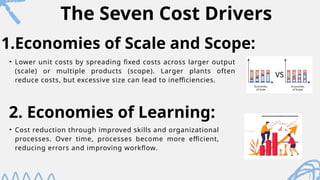
• Lower unit costs by spreading fixed costs across larger output
(scale) or multiple products (scope). Larger plants often
reduce costs, but excessive size can lead to inefficiencies.
1.Economies of Scale and Scope:
2. Economies of Learning:
• Cost reduction through improved skills and organizational
processes. Over time, processes become more efficient,
reducing errors and improving workflow.
The Seven Cost Drivers
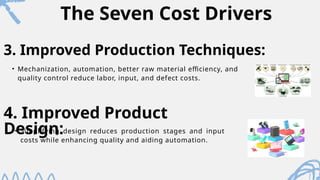
• Mechanization, automation, better raw material efficiency, and
quality control reduce labor, input, and defect costs.
3. Improved Production Techniques:
4. Improved Product
Design:
• Simplifying design reduces production stages and input
costs while enhancing quality and aiding automation.
The Seven Cost Drivers
• Lowering costs through location, ownership of raw materials,
bargaining power, and cooperation with suppliers.
5. Reduced Input Costs:
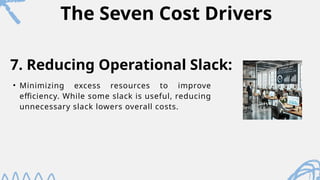
6. Increased Capacity Utilization:
• High capacity utilization spreads fixed costs effectively.
Matching capacity with demand avoids under- or over-
utilization.
The Seven Cost Drivers
• Minimizing excess resources to improve
efficiency. While some slack is useful, reducing
unnecessary slack lowers overall costs.
7. Reducing Operational Slack:
Aims and Uses of Pricing Strategy
• Focus on either short-term or long-term
profitability, considering the relevant time
horizon.
Maximize Profit:
Defend Market Share:
• Sacrifice short-term profit to increase or
protect market share, especially for larger
enterprises.
Aims and Uses of Pricing Strategy
• Set prices based on future cost reductions
from increased output, which may appear as
underpricing to competitors.
Leverage Experience Curve:
Align with Marketing Strategy:
• Pricing should reflect the brand’s quality. Low
prices may signal inferior quality, misleading
consumers.
Aims and Uses of Pricing Strategy
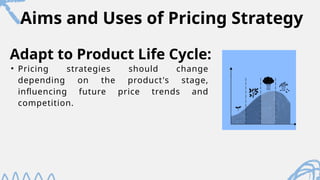
• Pricing strategies should change
depending on the product's stage,
influencing future price trends and
competition.
Adapt to Product Life Cycle:
Pricing strategy
• Penetration pricing involves setting a low initial price to quickly gain
market share and attract customers. This strategy is often used when
entering a competitive market to establish brand presence.
Penetration Pricing
Price Skimming:
• Price skimming sets a high initial price for a new or innovative product to
maximize profits from early adopters. Prices are gradually lowered as
competition increases or demand decreases.
Pricing strategy
• Competitive pricing involves setting prices based on competitors’ rates to
maintain market position. This strategy ensures that a company remains
attractive to price-sensitive consumers.
Competitive Pricing
Bundle Pricing
• Bundle pricing offers multiple products or services together at a
discounted price. It encourages customers to buy more by creating a
perception of value and convenience.
Pricing strategy
• Psychological pricing uses pricing techniques, such as setting prices
slightly below round numbers, to create a perception of lower cost and
influence buying decisions.
Psychological Pricing
Discount/Promotional Pricing
• Discount or promotional pricing temporarily reduces prices to boost sales,
attract customers, or clear out inventory. It is often used during seasonal
sales or special events.
Using the Value Chain for Cost
Leadership
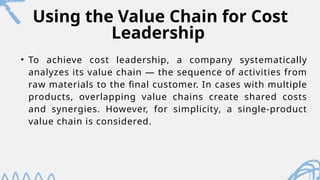
• To achieve cost leadership, a company systematically
analyzes its value chain — the sequence of activities from
raw materials to the final customer. In cases with multiple
products, overlapping value chains create shared costs
and synergies. However, for simplicity, a single-product
value chain is considered.
Steps to Minimize Costs Through Value
Chain Analysis:
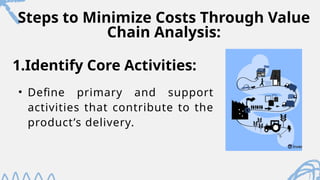
• Define primary and support
activities that contribute to the
product’s delivery.
1.Identify Core Activities:
Steps to Minimize Costs Through Value
Chain Analysis:
• Estimate total costs across
these activities to identify
areas with the highest
potential for cost reduction.
2. Allocate Costs:
Steps to Minimize Costs Through Value
Chain Analysis:
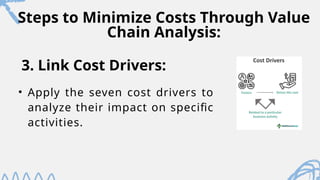
• Apply the seven cost drivers to
analyze their impact on specific
activities.
3. Link Cost Drivers:
Steps to Minimize Costs Through Value
Chain Analysis:
• Identify connections between
activities where reducing costs
in one may affect another.
4. Analyze Activity Linkages:
Steps to Minimize Costs Through Value
Chain Analysis:
• Decide on the most effective
approach to minimize costs and
recommend actionable
strategies.
5. Develop a Cost Strategy:
DO YOU HAVE
ANY
QUESTION?
THANK YOU FOR LISTENING TO
ME!!!
WEEK 10: SEATWORK # 10
Identify the correct cost driver described in each scenario
statement.
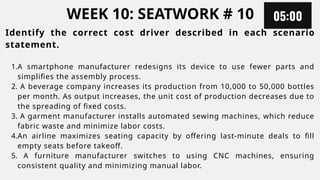
1.A smartphone manufacturer redesigns its device to use fewer parts and
simplifies the assembly process.
2. A beverage company increases its production from 10,000 to 50,000 bottles
per month. As output increases, the unit cost of production decreases due to
the spreading of fixed costs.
3. A garment manufacturer installs automated sewing machines, which reduce
fabric waste and minimize labor costs.
4.An airline maximizes seating capacity by offering last-minute deals to fill
empty seats before takeoff.
5. A furniture manufacturer switches to using CNC machines, ensuring
consistent quality and minimizing manual labor.
WEEK 10: SEATWORK # 10
Identify the correct cost driver described in each scenario
statement.
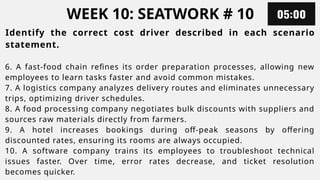
6. A fast-food chain refines its order preparation processes, allowing new
employees to learn tasks faster and avoid common mistakes.
7. A logistics company analyzes delivery routes and eliminates unnecessary
trips, optimizing driver schedules.
8. A food processing company negotiates bulk discounts with suppliers and
sources raw materials directly from farmers.
9. A hotel increases bookings during off-peak seasons by offering
discounted rates, ensuring its rooms are always occupied.
10. A software company trains its employees to troubleshoot technical
issues faster. Over time, error rates decrease, and ticket resolution
becomes quicker.
1. Improved Product Design
2. Economies of Scale and Scope
3. Improved Production Techniques
4. Increased Capacity Utilization
5. Improved Production Techniques
6. Economies of Learning
7. Reducing Operational Slack
8. Reduced Input Costs
9. Increased Capacity Utilization
10. Economies of Learning
WEEK 10: ASSESSMENT # 10
Scenario-Based Pricing Game: Adapting to the Product Life
Cycle
Round 1: Introduction Stage – Launching a new product.
Round 2: Growth Stage – Rapid market acceptance and increasing sales.
round 3: Maturity Stage – Sales peak, and competition intensifies.
round 4: Decline Stage – Sales drop, and product relevance decreases.
• Groups discuss for 2 minutes and select the most suitable pricing
strategy.
• Groups also explain why they chose that strategy.
• Each group presents its chosen pricing strategy and justification.
Round 1: Introduction Stage Scenarios
GROUP 1: Your company has developed an innovative electric
bike with AI-powered navigation. Since it’s a unique product, the
company aims to maximize early profits while targeting high-
end consumers.
GROUP 2: A new eco-friendly detergent enters the market
with minimal competition. The company wants to quickly
gain market share before competitors emerge.
Round 2: Growth Stage Scenarios
GROUP 1: A fast-growing meal subscription service is gaining
popularity. Competitors are entering the market, and the
company wants to remain competitive while maximizing profits.
GROUP 2: Sales of a fitness app with new features are
increasing. The company wants to maximize its growing
customer base by offering special deals.
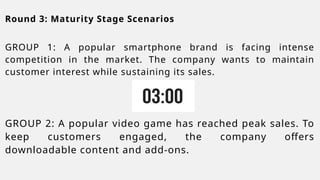
Round 3: Maturity Stage Scenarios
GROUP 1: A popular smartphone brand is facing intense
competition in the market. The company wants to maintain
customer interest while sustaining its sales.
GROUP 2: A popular video game has reached peak sales. To
keep customers engaged, the company offers
downloadable content and add-ons.
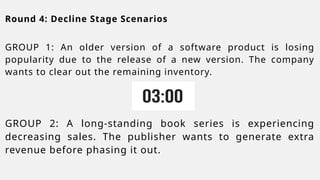
Round 4: Decline Stage Scenarios
GROUP 1: An older version of a software product is losing
popularity due to the release of a new version. The company
wants to clear out the remaining inventory.
GROUP 2: A long-standing book series is experiencing
decreasing sales. The publisher wants to generate extra
revenue before phasing it out.
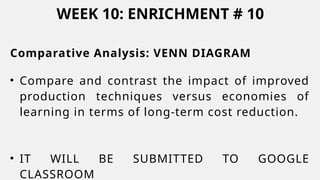
WEEK 10: ENRICHMENT # 10
Comparative Analysis: VENN DIAGRAM
• Compare and contrast the impact of improved
production techniques versus economies of
learning in terms of long-term cost reduction.
• IT WILL BE SUBMITTED TO GOOGLE
CLASSROOM
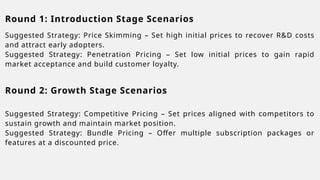
Round 1: Introduction Stage Scenarios
Suggested Strategy: Price Skimming – Set high initial prices to recover R&D costs
and attract early adopters.
Suggested Strategy: Penetration Pricing – Set low initial prices to gain rapid
market acceptance and build customer loyalty.
Suggested Strategy: Competitive Pricing – Set prices aligned with competitors to
sustain growth and maintain market position.
Suggested Strategy: Bundle Pricing – Offer multiple subscription packages or
features at a discounted price.
Round 2: Growth Stage Scenarios
Round 3: Maturity Stage Scenarios
Suggested Strategy: Psychological Pricing – Use charm pricing (e.g., $999 instead
of $1,000) to influence consumer perception.
Suggested Strategy: Bundle Pricing – Encourage continued purchases through
bundled offers and extended features.
Suggested Strategy: Discount/Promotional Pricing – Offer heavy discounts to
encourage last-minute purchases.
Suggested Strategy: Bundle Pricing – Package older editions with new ones at a
discounted price.
Round 4: Decline Stage Scenarios
REFERENCE:
Giddens, A. (1990). The Consequences of Modernity. Cambridge: Polity Press.

WEEK-10-BME-1. identify the main cost drivers Reducing costs pptx

  • 1.
  • 2.
    LEARNING OBJECTIVES: • identifythe main cost drivers • understand the relationship between a price strategy and a cost leadership strategy • understand what is meant by a focused cost leadership strategy • understand the nature of a technological system and its relationship to the organization of an enterprise • realize how short-lived any cost or price leadership can be
  • 3.
    Cost drivers • Incurredregardless of output level. Includes costs for buildings, equipment, marketing, R&D, and administration. Labor can also be fixed if employment is guaranteed. Fixed Costs Variable Costs • Depend on output level. Includes labor (when adjustable), raw materials, component costs, energy, and plant operation.
  • 4.
    The Seven CostDrivers • Lower unit costs by spreading fixed costs across larger output (scale) or multiple products (scope). Larger plants often reduce costs, but excessive size can lead to inefficiencies. 1.Economies of Scale and Scope: 2. Economies of Learning: • Cost reduction through improved skills and organizational processes. Over time, processes become more efficient, reducing errors and improving workflow.
  • 5.
    The Seven CostDrivers • Mechanization, automation, better raw material efficiency, and quality control reduce labor, input, and defect costs. 3. Improved Production Techniques: 4. Improved Product Design: • Simplifying design reduces production stages and input costs while enhancing quality and aiding automation.
  • 6.
    The Seven CostDrivers • Lowering costs through location, ownership of raw materials, bargaining power, and cooperation with suppliers. 5. Reduced Input Costs: 6. Increased Capacity Utilization: • High capacity utilization spreads fixed costs effectively. Matching capacity with demand avoids under- or over- utilization.
  • 7.
    The Seven CostDrivers • Minimizing excess resources to improve efficiency. While some slack is useful, reducing unnecessary slack lowers overall costs. 7. Reducing Operational Slack:
  • 8.
    Aims and Usesof Pricing Strategy • Focus on either short-term or long-term profitability, considering the relevant time horizon. Maximize Profit: Defend Market Share: • Sacrifice short-term profit to increase or protect market share, especially for larger enterprises.
  • 9.
    Aims and Usesof Pricing Strategy • Set prices based on future cost reductions from increased output, which may appear as underpricing to competitors. Leverage Experience Curve: Align with Marketing Strategy: • Pricing should reflect the brand’s quality. Low prices may signal inferior quality, misleading consumers.
  • 10.
    Aims and Usesof Pricing Strategy • Pricing strategies should change depending on the product's stage, influencing future price trends and competition. Adapt to Product Life Cycle:
  • 11.
    Pricing strategy • Penetrationpricing involves setting a low initial price to quickly gain market share and attract customers. This strategy is often used when entering a competitive market to establish brand presence. Penetration Pricing Price Skimming: • Price skimming sets a high initial price for a new or innovative product to maximize profits from early adopters. Prices are gradually lowered as competition increases or demand decreases.
  • 12.
    Pricing strategy • Competitivepricing involves setting prices based on competitors’ rates to maintain market position. This strategy ensures that a company remains attractive to price-sensitive consumers. Competitive Pricing Bundle Pricing • Bundle pricing offers multiple products or services together at a discounted price. It encourages customers to buy more by creating a perception of value and convenience.
  • 13.
    Pricing strategy • Psychologicalpricing uses pricing techniques, such as setting prices slightly below round numbers, to create a perception of lower cost and influence buying decisions. Psychological Pricing Discount/Promotional Pricing • Discount or promotional pricing temporarily reduces prices to boost sales, attract customers, or clear out inventory. It is often used during seasonal sales or special events.
  • 14.
    Using the ValueChain for Cost Leadership • To achieve cost leadership, a company systematically analyzes its value chain — the sequence of activities from raw materials to the final customer. In cases with multiple products, overlapping value chains create shared costs and synergies. However, for simplicity, a single-product value chain is considered.
  • 15.
    Steps to MinimizeCosts Through Value Chain Analysis: • Define primary and support activities that contribute to the product’s delivery. 1.Identify Core Activities:
  • 16.
    Steps to MinimizeCosts Through Value Chain Analysis: • Estimate total costs across these activities to identify areas with the highest potential for cost reduction. 2. Allocate Costs:
  • 17.
    Steps to MinimizeCosts Through Value Chain Analysis: • Apply the seven cost drivers to analyze their impact on specific activities. 3. Link Cost Drivers:
  • 18.
    Steps to MinimizeCosts Through Value Chain Analysis: • Identify connections between activities where reducing costs in one may affect another. 4. Analyze Activity Linkages:
  • 19.
    Steps to MinimizeCosts Through Value Chain Analysis: • Decide on the most effective approach to minimize costs and recommend actionable strategies. 5. Develop a Cost Strategy:
  • 20.
    DO YOU HAVE ANY QUESTION? THANKYOU FOR LISTENING TO ME!!!
  • 21.
    WEEK 10: SEATWORK# 10 Identify the correct cost driver described in each scenario statement. 1.A smartphone manufacturer redesigns its device to use fewer parts and simplifies the assembly process. 2. A beverage company increases its production from 10,000 to 50,000 bottles per month. As output increases, the unit cost of production decreases due to the spreading of fixed costs. 3. A garment manufacturer installs automated sewing machines, which reduce fabric waste and minimize labor costs. 4.An airline maximizes seating capacity by offering last-minute deals to fill empty seats before takeoff. 5. A furniture manufacturer switches to using CNC machines, ensuring consistent quality and minimizing manual labor.
  • 22.
    WEEK 10: SEATWORK# 10 Identify the correct cost driver described in each scenario statement. 6. A fast-food chain refines its order preparation processes, allowing new employees to learn tasks faster and avoid common mistakes. 7. A logistics company analyzes delivery routes and eliminates unnecessary trips, optimizing driver schedules. 8. A food processing company negotiates bulk discounts with suppliers and sources raw materials directly from farmers. 9. A hotel increases bookings during off-peak seasons by offering discounted rates, ensuring its rooms are always occupied. 10. A software company trains its employees to troubleshoot technical issues faster. Over time, error rates decrease, and ticket resolution becomes quicker.
  • 23.
    1. Improved ProductDesign 2. Economies of Scale and Scope 3. Improved Production Techniques 4. Increased Capacity Utilization 5. Improved Production Techniques 6. Economies of Learning 7. Reducing Operational Slack 8. Reduced Input Costs 9. Increased Capacity Utilization 10. Economies of Learning
  • 24.
    WEEK 10: ASSESSMENT# 10 Scenario-Based Pricing Game: Adapting to the Product Life Cycle Round 1: Introduction Stage – Launching a new product. Round 2: Growth Stage – Rapid market acceptance and increasing sales. round 3: Maturity Stage – Sales peak, and competition intensifies. round 4: Decline Stage – Sales drop, and product relevance decreases. • Groups discuss for 2 minutes and select the most suitable pricing strategy. • Groups also explain why they chose that strategy. • Each group presents its chosen pricing strategy and justification.
  • 25.
    Round 1: IntroductionStage Scenarios GROUP 1: Your company has developed an innovative electric bike with AI-powered navigation. Since it’s a unique product, the company aims to maximize early profits while targeting high- end consumers. GROUP 2: A new eco-friendly detergent enters the market with minimal competition. The company wants to quickly gain market share before competitors emerge.
  • 26.
    Round 2: GrowthStage Scenarios GROUP 1: A fast-growing meal subscription service is gaining popularity. Competitors are entering the market, and the company wants to remain competitive while maximizing profits. GROUP 2: Sales of a fitness app with new features are increasing. The company wants to maximize its growing customer base by offering special deals.
  • 27.
    Round 3: MaturityStage Scenarios GROUP 1: A popular smartphone brand is facing intense competition in the market. The company wants to maintain customer interest while sustaining its sales. GROUP 2: A popular video game has reached peak sales. To keep customers engaged, the company offers downloadable content and add-ons.
  • 28.
    Round 4: DeclineStage Scenarios GROUP 1: An older version of a software product is losing popularity due to the release of a new version. The company wants to clear out the remaining inventory. GROUP 2: A long-standing book series is experiencing decreasing sales. The publisher wants to generate extra revenue before phasing it out.
  • 29.
    WEEK 10: ENRICHMENT# 10 Comparative Analysis: VENN DIAGRAM • Compare and contrast the impact of improved production techniques versus economies of learning in terms of long-term cost reduction. • IT WILL BE SUBMITTED TO GOOGLE CLASSROOM
  • 30.
    Round 1: IntroductionStage Scenarios Suggested Strategy: Price Skimming – Set high initial prices to recover R&D costs and attract early adopters. Suggested Strategy: Penetration Pricing – Set low initial prices to gain rapid market acceptance and build customer loyalty. Suggested Strategy: Competitive Pricing – Set prices aligned with competitors to sustain growth and maintain market position. Suggested Strategy: Bundle Pricing – Offer multiple subscription packages or features at a discounted price. Round 2: Growth Stage Scenarios
  • 31.
    Round 3: MaturityStage Scenarios Suggested Strategy: Psychological Pricing – Use charm pricing (e.g., $999 instead of $1,000) to influence consumer perception. Suggested Strategy: Bundle Pricing – Encourage continued purchases through bundled offers and extended features. Suggested Strategy: Discount/Promotional Pricing – Offer heavy discounts to encourage last-minute purchases. Suggested Strategy: Bundle Pricing – Package older editions with new ones at a discounted price. Round 4: Decline Stage Scenarios
  • 32.
    REFERENCE: Giddens, A. (1990).The Consequences of Modernity. Cambridge: Polity Press.