ELECTRICAL
TOOLS, AND
EQUIPMENT
TOOLS
•Implement used to
modify raw materials
for human use.
•Extension of human
hand thereby
increasing its speed,
power, and
accuracy.
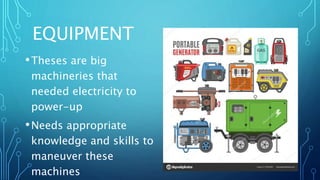
EQUIPMENT
•Theses are big
machineries that
needed electricity to
power-up
•Needs appropriate
knowledge and skills to
maneuver these
machines
IMPORTANCE OF TOOLS
ADVANTAGES DISADVANTAGES
ADVANTAGES OF USING PROPER
TOOLS
•Efficiency of the
work
•High quality of the
work
•Speed of
accomplishment
•accuracy
DISADVANTAGES
•Availability and sufficiency of the
materials
•Experience and skills of the workers
in their respective fields
•Tools and equipment of good quality
TYPES OF TOOLS AND
EQUIPMENT
Hand tool
Machine/ Power tools
Measuring tools
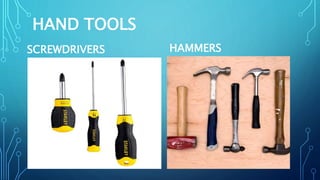
HAND TOOLS
SCREWDRIVERS HAMMERS
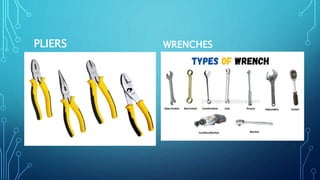
PLIERS WRENCHES
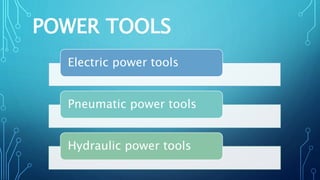
POWER TOOLS
Electric power tools
Pneumatic power tools
Hydraulic power tools
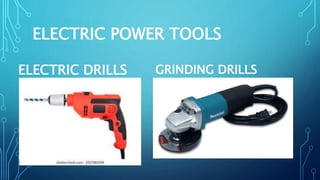
ELECTRIC POWER TOOLS
ELECTRIC DRILLS GRINDING DRILLS
VACUUM CLEANER
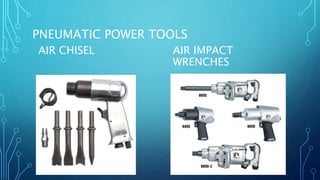
PNEUMATIC POWER TOOLS
AIR CHISEL AIR IMPACT
WRENCHES
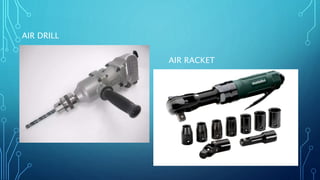
AIR DRILL
AIR RACKET
PNEUMATIC FLOOR JACK
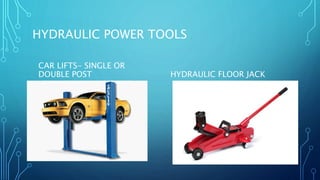
HYDRAULIC POWER TOOLS
CAR LIFTS- SINGLE OR
DOUBLE POST HYDRAULIC FLOOR JACK
PORTABLE CRANE
HYDRAULIC PRESS
MEASURING TOOLS
TWO FOOT FOUR FOLDING
RULE EXTENSION RULE
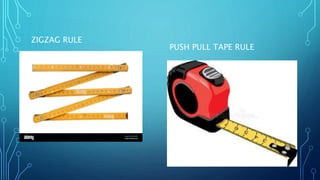
ZIGZAG RULE
PUSH PULL TAPE RULE
SLIDE CALIPER
MARKING GAUGE
ELECTRICAL SAFETY
PRACTICES
CAUSES OF ELECTRICAL
ACCIDENTS
1.Work involving unsafe equipment and
installations;
2.Workplaces made unsafe by the
environment;
3.Unsafe work performance
WORK INVOLVING UNSAFE EQUIPMENT AND
INSTALLATIONS;
• Faulty insulation
• Improper grounding
• Loose connections
• Defective parts
• Ground faults
• Unguarded live parts
• Underrated equipment
WORKPLACES MADE UNSAFE BY THE
ENVIRONMENT
•Flammable vapors,
liquids or gasses
•Areas having
corrosive
atmospheres
•Wet and damp
locations
UNSAFE WORK
PERFORMANCE
• Failure to de- energized
electric equipment when
it is being repaired or
inspected
• Using obviously defective
and unsafe tools; and
• Using tools and
equipment too close to
energized parts.
SAFE WORK PRACTICES
THE WRONG WAY
• Repetitious hand work
may cause pain and
result in permanent
injury, limiting your
ability to use your hands
to any kind of work.
THE RIGHT WAY
• Use hand tools or power
tools whenever possible
• Keep tools close to your
body to reduce fatigue
and to increase
productivity.
WRONG
• The force and awkward
posture and to pull wire
by hands is hard and
tiring
RIGHT
• Avoid manual wire pulling
and use a tugger or a hand
tool whenever possible
• Communication between the
puller and feeder to
coordinate movements will
make the job easier and
safer.
• Use lighter- weight tools
SAFETY TIPS
PROTECT
YOURSELF
LIGHTEN YOUR LOAD
SELECT THE RIGHT TOOL
PRACTICE GOOD
HOUSEKEEPING
CHANGE YOUR BODY POSITION
IDENTIFICATION OF NON-
FUNCTIONAL TOOLS AND
EQUIPMENT
I. METHODS OF IDENTIFYING NON-
FUNCTIONAL TOOLS AND EQUIPMENT
1.Visual inspection
2.Functionality
3.Performance
4.Power supply (electrically operated only)
5.Person’s involve
II. CLASSIFICATION OF TOOLS, AND
EQUIPMENT ACCORDING TO THEIR
USES:
1. Measuring tools
2. Holding tools
3. Cutting tools
4. Driving tools
5. Boring tools
6. Electrical equipment
7. Miscellaneous tools/ instrument/ equipment
III. PERFORM THE SEGREGATION OF
NON FUNCTIONAL OR DEFECTIVE
HAND TOOLS AND EQUIPMENT
ACCORDINGLY
SAFETY PRACTICES
•Always check you’re the tools/ instrument and
equipment before using.
•Use appropriate materials, tools, instrument and
equipment as per job or task requirement.
•Always wear personal protective equipment like
gloves, googles, hard hat etc., at all times
•Wait for the final instruction before doing the job or
task
•Report to the person in authority whenever
PERSONAL
PROTECTIVE
EQUIPMENT
KIND, USES AND
PROPERTIES OF CLEANING
SOLVENTS
Kinds of cleaning solvents
•Solutions are homogeneous mixture of two or
more components; can be gaseous, liquid or
solid;
•Solvents is a components of a solution that
dissolves solute and usually present in large
proportion or amount.
2 CLASSIFICATION OF
SOLVENT
•Polar solvent- can be dissolve/ are
water soluble
•Nonpolar solvent- cannot be dissolve/
are insoluble in water
ASSIGNMENT:
1.Why do we lubricates the electrical
tools and equipment
2.What are the types of lubricants in
electrical tools and tools and
equipment
BASIC LUBRICATIONS
OF ELECTRICAL
TOOLS, AND
EQUIPMENT
•. It reduces friction between moving metal
surfaces. A lubricant coats surfaces and resists
being displaced by the pressure, keeping the
metal parts separated. Lubricants also prevent

corrosion, block contaminants and can serve
as a coolant
TYPES OF
LUBRICANTS
OILS
•a broad class of fluid lubricants
which has particular physical
properties and characteristics
•It contains little wax, which
makes them useful for
hydraulic equipment and other
machineries.

•E.g. petroleum oils
GREASES
•consist of an oil or synthetic
fluid (80%), a thickening
agents (10%) and additives
(10%). Best used in bearings,
gaskets, seals and other
moving parts.
SOLID LUBRICANTS
•Usually fine powders, such
as molybdenum disulfide
(Moly), graphite and Teflon
(PTFE) it can be used
alone, or as additives in
grease or dispersion or as
dry film bonded lubricants.
It can last longer than the
unfortified oils and
RUST REMOVER
•used mainly to
dissolve rust. An
excellent cleaner. It
can be prayed on bolt
to remove rust
quickly.
•Example of this is
DRY LUBRICANT
•a product that,
although greasy
when applied,
dries in few
minutes and
leaves a
PENETRATING LUBRICANT
•It is deal for
door hinges,
even the fridge,
hard to open
pliers
SYNTHETIC LUBRICANTS
•Cover a broad
category of oils,
greases, and
pastes of varied
properties.
SILICONES
•Very stable and inert
lubricating materials.
Which provide a wider
range of operating
temperatures than
non- silicone synthetic
lubricants
CLEANING
SORTING
LABELING
PREVENTIVE
MAINTENANCE OF
TOOLS AND
EQUIPMENT
PRACTICE OF 5’S OF GOOD
HOUSEKEEPING TECHNIQUES
PREVENTIVE
MAINTENANCE
SCHEDULE OF
TOOLS AND
EQUIPMENT
ACTIVITY/ PERFORMANCE:
•Inventory of tools
and equipment
PREPARE
ELECTRICAL
POWER
TOOLS
ADVANTAGES OF USING
THE PROPER TOOLS
•Efficiency of the work is met
•High quality of work is achieved
•Speed of accomplishment is
faster
•Accuracy is obtained
THESE ADVANTAGES DEPEND
UPON THE THREE FACTORS
NAMELY:
•Availability and sufficiency of materials
•Experience and skills of the workers in
their respective fields
•Quality of tools and equipment
DIFFERENT KINDS OF
CONSTRUCTION TOOLS
•Carpentry tools
•Masonry tools
•Tinsmith tools
•Painters tools
•Plumbing tools
•Electrical tools
GENERAL SAFETY RULES FOR
USING POWER EQUIPMENT
•Always follow manufacturer’s operating
instructions
•Never place hands and a pinch point
•Use eye protection
•Wear gloves when working with hot
•Always secure loose clothing such as shirt
sleeves and shirttails
•Tie back long hair and do not wear dangling
jewelry
•Never exceed rated capacity of the
equipment
•Never remove protective guards from the
equipment

EIM-9-10 final.pptx