Urinary tract
Infections
(UTI’s)
1
What is a
Urinary Tract
Infection?
2
Bladder
What is a UTI?
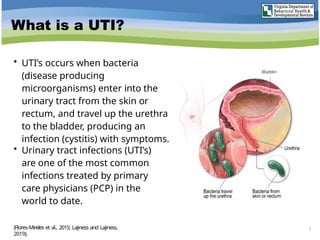
• UTI’s occurs when bacteria
(disease producing
microorganisms) enter into the
urinary tract from the skin or
rectum, and travel up the urethra
to the bladder, producing an
infection (cystitis) with symptoms.
• Urinary tract infections (UTI’s)
are one of the most common
infections treated by primary
care physicians (PCP) in the
world to date.
5
(Flores-Mireles et al., 2015; Lajiness and Lajiness,
2019).
Introduction continued…
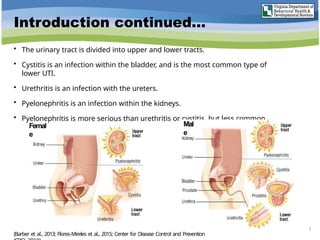
• The urinary tract is divided into upper and lower tracts.
• Cystitis is an infection within the bladder, and is the most common type of
lower UTI.
• Urethritis is an infection with the ureters.
• Pyelonephritis is an infection within the kidneys.
• Pyelonephritis is more serious than urethritis or cystitis, but less common.
6
(Barber et al., 2013; Flores-Mireles et al., 2015; Center for Disease Control and Prevention
Femal
e
Mal
e
7
Types of UTI’s
Types of UTI’s
• Uncomplicated.
• Complicated.
• Recurrent.
• Relapse.
• Catheter-associated
(CAUTI’s).
6
(Flores-Mireles et al., 2015; Lajiness and Lajiness,
2019).
Types of UTI’s
• Uncomplicated UTI’s occur in healthy individuals with no known physical
and or functional defects within their urinary tract.
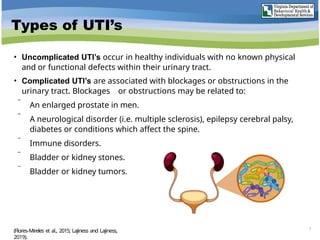
• Complicated UTI’s are associated with blockages or obstructions in the
urinary tract. Blockages or obstructions may be related to:
 An enlarged prostate in men.
 A neurological disorder (i.e. multiple sclerosis), epilepsy cerebral palsy,
diabetes or conditions which affect the spine.
 Immune disorders.
 Bladder or kidney stones.
 Bladder or kidney tumors.
7
(Flores-Mireles et al., 2015; Lajiness and Lajiness,
2019).
Types of UTI’s
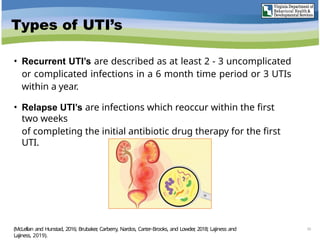
• Recurrent UTI’s are described as at least 2 - 3 uncomplicated
or complicated infections in a 6 month time period or 3 UTIs
within a year.
• Relapse UTI’s are infections which reoccur within the first
two weeks
of completing the initial antibiotic drug therapy for the first
UTI.
(McLellan and Hunstad, 2016; Brubaker
, Carberry, Nardos, Carter-Brooks, and Lowder
, 2018; Lajiness and
Lajiness, 2019).
10
Types of UTI’s
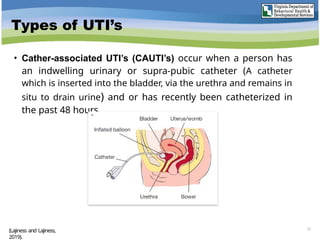
• Cather-associated UTI’s (CAUTI’s) occur when a person has
an indwelling urinary or supra-pubic catheter (A catheter
which is inserted into the bladder, via the urethra and remains in
situ to drain urine) and or has recently been catheterized in
the past 48 hours.
11
(Lajiness and Lajiness,
2019).
Risk Factors
for UTI’s
12
Risk Factors
Related to All Types of UTI’s
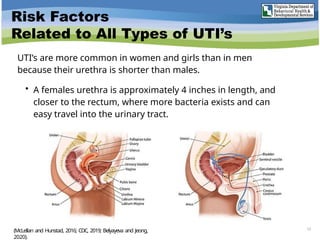
UTI’s are more common in women and girls than in men
because their urethra is shorter than males.
• A females urethra is approximately 4 inches in length, and
closer to the rectum, where more bacteria exists and can
easy travel into the urinary tract.
13
(McLellan and Hunstad, 2016; CDC, 2019; Belyayeva and Jeong,
2020).
Risk Factors Related to All Types
of UTIs continued…
• Previous UTI’s.
• Family-related risk (a mother, sister, aunt,
or grandmother with history of UTI’s).
• Changes in a female’s bacterial growth
caused by medication used
for vaginal infections, or during
menopause.
• Diabetes (impaired insulin processing
within the body).
• Neuropathy (incomplete emptying of the bladder due to
diabetic- related nerve damage).
14
(Flores-Mireles et al., 2015; Nitzan, Elias, Chazan, and Saliba, 2015 McLellan and Hunstad, 2016; Cortes-Penfield et al., 2017;
CDC, 2019).
Risk Factors Related to All Types
of UTI’s continued…
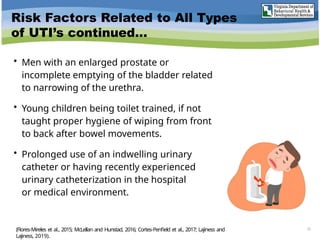
• Men with an enlarged prostate or
incomplete emptying of the bladder related
to narrowing of the urethra.
• Young children being toilet trained, if not
taught proper hygiene of wiping from front
to back after bowel movements.
• Prolonged use of an indwelling urinary
catheter or having recently experienced
urinary catheterization in the hospital
or medical environment.
15
(Flores-Mireles et al., 2015; McLellan and Hunstad, 2016; Cortes-Penfield et al., 2017; Lajiness and
Lajiness, 2019).
Causes of
UTI’s
17
Causes of UTI’s
• UTI’s are caused when bacteria enters the urinary tract.
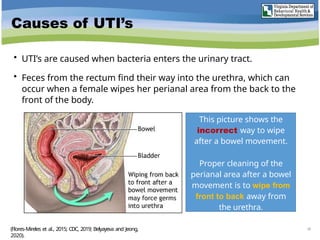
• Feces from the rectum find their way into the urethra, which can
occur when a female wipes her perianal area from the back to the
front of the body.
18
(Flores-Mireles et al., 2015; CDC, 2019; Belyayeva and Jeong,
2020).
This picture shows the
incorrect way to wipe
after a bowel movement.
Proper cleaning of the
perianal area after a bowel
movement is to wipe from
front to back away from
the urethra.
Causes of UTI’s continued…
• Escherichia coli (E. coli) is the most common
bacteria found to cause UTI’s in the
community, accounting for greater than 80%
of all diagnoses.
• Other pathogens such as Staphylococcus, Klebsiella,
Proteus, and Enterococcus have mostly been identified in
hospital acquired CAUTI’s.
19
(McLellan and Hunstad, 2016; Mazzriol et al., 2017; Lajiness and Lajiness, 2019;Belyayeva and Jeong,
2020).
Causes of UTI’s continued…
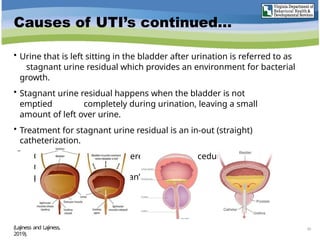
• Urine that is left sitting in the bladder after urination is referred to as
stagnant urine residual which provides an environment for bacterial
growth.
• Stagnant urine residual happens when the bladder is not
emptied completely during urination, leaving a small
amount of left over urine.
• Treatment for stagnant urine residual is an in-out (straight)
catheterization.
 Catheterization is considered a sterile procedure requiring a
nurse to
perform under a physician’s order.
20
(Lajiness and Lajiness,
2019).
21
Signs and
Symptoms UTI’s
Typical Signs and Symptoms
of UTIs
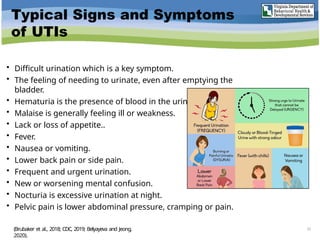
• Difficult urination which is a key symptom.
• The feeling of needing to urinate, even after emptying the
bladder.
• Hematuria is the presence of blood in the urine.
• Malaise is generally feeling ill or weakness.
• Lack or loss of appetite..
• Fever.
• Nausea or vomiting.
• Lower back pain or side pain.
• Frequent and urgent urination.
• New or worsening mental confusion.
• Nocturia is excessive urination at night.
• Pelvic pain is lower abdominal pressure, cramping or pain.
22
(Brubaker et al., 2018; CDC, 2019; Belyayeva and Jeong,
2020).
Identifying
UTI
24
Diagnosing UTI
• If UTI is suspected an individual should be seen by a
physician right away, either by the primary care physician
(PCP) or in the hospital emergency room, based on the
increased risk of the infection developing into sepsis.
 Urinary tract infections are the second leading cause of
sepsis, which if not treated immediately can
quickly lead to death.
• Verification of UTI is based on the presence of bacteria
and white blood cells in the urinary tract with the
presents of physical symptoms.
• A person can have increased bacteria in their urine
without having any physical symptoms.
 This is referred to as Asymptomatic Bacteriuria
(ASB), which
is at times confused with UTI.
25
(Bonnici and Lentini, 2014; Givler and Givler,
2020).
Identifying UTI’s
• Collection of a mid-stream clean catch urine specimen is the first
step in properly diagnosing and treating UTI’s.
• It is important not to contaminate the urine specimen with bacteria
from outside
of the body when collecting a urine specimen.
• If time will allow, the best time to collect urine is in the morning, when
the urine has been in the bladder for several hours.
Male clean catch urine sample
(Vorvick and Zieve,
2020).
22
Identifying UTI’s continued…
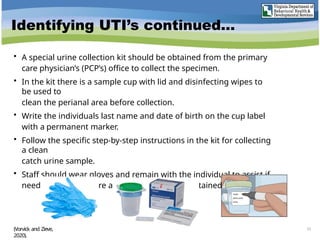
• A special urine collection kit should be obtained from the primary
care physician’s (PCP’s) office to collect the specimen.
• In the kit there is a sample cup with lid and disinfecting wipes to
be used to
clean the perianal area before collection.
• Write the individuals last name and date of birth on the cup label
with a permanent marker.
• Follow the specific step-by-step instructions in the kit for collecting
a clean
catch urine sample.
• Staff should wear gloves and remain with the individual to assist if
needed, and to ensure a clean catch urine is obtained.
(Vorvick and Zieve,
2020).
23
Identifying UTI’s continued…
30
• After the urine is collected, it should be returned to the primary
care
physician’s (PCP) office or lab immediately if possible.
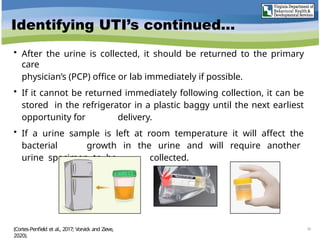
• If it cannot be returned immediately following collection, it can be
stored in the refrigerator in a plastic baggy until the next earliest
opportunity for delivery.
• If a urine sample is left at room temperature it will affect the
bacterial growth in the urine and will require another
urine specimen to be collected.
(Cortes-Penfield et al., 2017; Vorvick and Zieve,
2020).
Identifying UTI’s continued…
• Complicated UTIs may involve more extensive
testing to
pinpoint the physical issue adding to the infection.
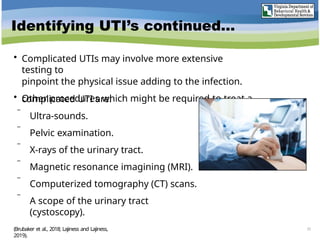
• Other procedures which might be required to treat a
complicated UTI are:
 Ultra-sounds.
 Pelvic examination.
 X-rays of the urinary tract.
 Magnetic resonance imagining (MRI).
 Computerized tomography (CT) scans.
 A scope of the urinary tract
(cystoscopy).
(Brubaker et al., 2018; Lajiness and Lajiness,
2019).
25
Identifying UTI’s continued…
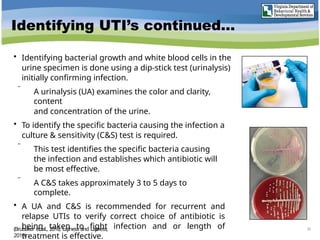
• Identifying bacterial growth and white blood cells in the
urine specimen is done using a dip-stick test (urinalysis)
initially confirming infection.
 A urinalysis (UA) examines the color and clarity,
content
and concentration of the urine.
• To identify the specific bacteria causing the infection a
culture & sensitivity (C&S) test is required.
 This test identifies the specific bacteria causing
the infection and establishes which antibiotic will
be most effective.
 A C&S takes approximately 3 to 5 days to
complete.
• A UA and C&S is recommended for recurrent and
relapse UTIs to verify correct choice of antibiotic is
being taken to fight infection and or length of
treatment is effective.
(Brubaker et al., 2018; Lajiness and Lajiness,
2019).
26
33
Care and
Treatment of UTI
Care of UTI’s
• Antibiotics are prescribed to treat bacterial infections which
cause UTIs with symptoms.
• Other medications such as Ibuprofen (Advil) and Pyridium
(phenazopyridine) maybe prescribed to treat symptoms of
pain, burning and itching
• Pyridium causes the urine to become bright orange to gold
in color,
and can stain bedsheets or clothing.
34
(Center for Disease Control and Prevention (CDC),
2020).
Care of UTIs continued…
• Antibiotic treatment will be started immediately by the PCP based on
the UA confirmation of infection and symptoms.
• If the UTI persists once the initial treatment has started, another
antibiotic may
be needed.
• The results of the C&S might indicate another antibiotic choice would be
more effective.
• Antibiotic treatment can range from between 3 – 10 days depending on
the
individual’s infection and the physician’s prescription.
• It is so important to give antibiotic as soon as the medication is acquired.
 Antibiotic medications should be taken exactly as prescribed until all
of the medication is gone.
 If a dose is missed, for whatever reason, it should be taken as soon as
it is
remembered, or skipped if it is close to time for the next dose.

 If unsure, contact the pharmacy where the medication was obtained, 35
(Brubaker et al, 2018; CDC,
2020).
Care of UTI’s continued…
• Within 24 – 48 hours of taking antibiotics signs and symptoms of UTI
should begin to improve and the UTI should be completely gone after
finishing the medication.
• If the UTI is not gone after taking the initial antibiotic treatment it is
very important to notify the diagnosing physician for reevaluation
immediately.
• If symptoms worsen or new symptoms appear such as:
 Fever.
 Chills.
 Fast breathing or panting (tachypnea).
 Fast heartbeat >100 (tachycardia).
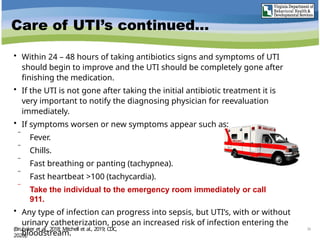
 Take the individual to the emergency room immediately or call
911.
• Any type of infection can progress into sepsis, but UTI’s, with or without
urinary catheterization, pose an increased risk of infection entering the
bloodstream.
36
(Brubaker et al., 2018; Mitchell et al., 2019; CDC,
2020).
Care of UTIs continued…
• Treatment of complicated UTIs may require surgical
intervention, such as needle drainage and ultrasound
shockwaves to clear obstructions like bladder stones.
• Antibiotic bladder irrigation is a treatment option
available to individual’s experiencing server recurrent
UTIs.
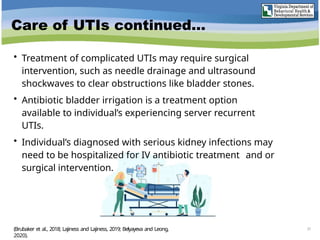
• Individual’s diagnosed with serious kidney infections may
need to be hospitalized for IV antibiotic treatment and or
surgical intervention.
37
(Brubaker et al., 2018; Lajiness and Lajiness, 2019; Belyayeva and Leong,
2020).
38
UTI
Complications
UTI Complications
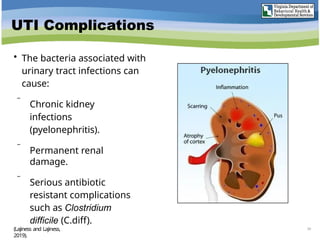
• The bacteria associated with
urinary tract infections can
cause:
 Chronic kidney
infections
(pyelonephritis).
 Permanent renal
damage.

 Serious antibiotic
resistant complications
such as Clostridium
difficile (C.diff).
39
(Lajiness and Lajiness,
2019).
UTI Complications continued…
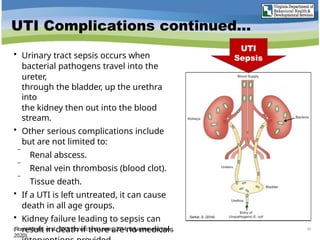
• Urinary tract sepsis occurs when
bacterial pathogens travel into the
ureter,
through the bladder, up the urethra
into
the kidney then out into the blood
stream.
• Other serious complications include
but are not limited to:
 Renal abscess.
 Renal vein thrombosis (blood clot).
 Tissue death.
• If a UTI is left untreated, it can cause
death in all age groups.
• Kidney failure leading to sepsis can
result in death if there are no medical 40
(Flores-Mireles et al., 2015; Bonnici and Lentini, 2014; Belyayeva and Jeong,
2020).
UTI
Sepsis
41
Prevention
UTI Prevention
• Educating individual’s and caregivers regarding
proper perianal hygiene is most effective in
reducing UTIs.
• Staying well hydrated flushes bacteria from the
body when urinating.
• Drinking adequate amounts of non-caffeinated
fluids assists the bladder muscles in remaining
firm and healthy to evacuate urine from the body
completely.
• Low dose preventative antibiotics have been
shown to lower risk of future UTIs.
• Preventative antibiotics are usually prescribed
for three months to one year for individuals
who suffer from chronic recurrent UTIs.
42
(Hooton, 2012; Brubaker et al., 2018; Lajiness and Lajiness, 2019; Belyayeva and Jeong,
2020).
UTI Prevention continued…
• Women who have low estrogen levels are sometimes prescribed
vaginal estrogen cream to decrease UTI reoccurrence.
• Performing proper catheter care hygiene on a regular basis as
prescribed by a physician, and maintaining scheduled
replacement appointments has been shown to lowers the risk
of CAUTI in individuals with indwelling urinary and or
suprapubic catheters.
• Regular review of the individual’s underlying health conditions
requiring an indwelling catheter, with a possible treatment
change to periodic catheterization, if possible, may be the best
way to reduce risk of CAUTI’s.
• Pharmacy research is working on developing a vaccine, currently
in clinical trials, which would target and reduce E.coli bacteria
growth in the urinary tract.
43
(Flores-Mireles et al., 2015; McLellan et al., 2016; Cortes-Penfield et al., 2017; Lajiness and
Lajiness, 2019).

Urinary-tract-Infeeeeeeeeeeections-.pptx

  • 1.
  • 2.
    What is a UrinaryTract Infection? 2
  • 3.
    Bladder What is aUTI? • UTI’s occurs when bacteria (disease producing microorganisms) enter into the urinary tract from the skin or rectum, and travel up the urethra to the bladder, producing an infection (cystitis) with symptoms. • Urinary tract infections (UTI’s) are one of the most common infections treated by primary care physicians (PCP) in the world to date. 5 (Flores-Mireles et al., 2015; Lajiness and Lajiness, 2019).
  • 4.
    Introduction continued… • Theurinary tract is divided into upper and lower tracts. • Cystitis is an infection within the bladder, and is the most common type of lower UTI. • Urethritis is an infection with the ureters. • Pyelonephritis is an infection within the kidneys. • Pyelonephritis is more serious than urethritis or cystitis, but less common. 6 (Barber et al., 2013; Flores-Mireles et al., 2015; Center for Disease Control and Prevention Femal e Mal e
  • 5.
  • 6.
    Types of UTI’s •Uncomplicated. • Complicated. • Recurrent. • Relapse. • Catheter-associated (CAUTI’s). 6 (Flores-Mireles et al., 2015; Lajiness and Lajiness, 2019).
  • 7.
    Types of UTI’s •Uncomplicated UTI’s occur in healthy individuals with no known physical and or functional defects within their urinary tract. • Complicated UTI’s are associated with blockages or obstructions in the urinary tract. Blockages or obstructions may be related to:  An enlarged prostate in men.  A neurological disorder (i.e. multiple sclerosis), epilepsy cerebral palsy, diabetes or conditions which affect the spine.  Immune disorders.  Bladder or kidney stones.  Bladder or kidney tumors. 7 (Flores-Mireles et al., 2015; Lajiness and Lajiness, 2019).
  • 8.
    Types of UTI’s •Recurrent UTI’s are described as at least 2 - 3 uncomplicated or complicated infections in a 6 month time period or 3 UTIs within a year. • Relapse UTI’s are infections which reoccur within the first two weeks of completing the initial antibiotic drug therapy for the first UTI. (McLellan and Hunstad, 2016; Brubaker , Carberry, Nardos, Carter-Brooks, and Lowder , 2018; Lajiness and Lajiness, 2019). 10
  • 9.
    Types of UTI’s •Cather-associated UTI’s (CAUTI’s) occur when a person has an indwelling urinary or supra-pubic catheter (A catheter which is inserted into the bladder, via the urethra and remains in situ to drain urine) and or has recently been catheterized in the past 48 hours. 11 (Lajiness and Lajiness, 2019).
  • 10.
  • 11.
    Risk Factors Related toAll Types of UTI’s UTI’s are more common in women and girls than in men because their urethra is shorter than males. • A females urethra is approximately 4 inches in length, and closer to the rectum, where more bacteria exists and can easy travel into the urinary tract. 13 (McLellan and Hunstad, 2016; CDC, 2019; Belyayeva and Jeong, 2020).
  • 12.
    Risk Factors Relatedto All Types of UTIs continued… • Previous UTI’s. • Family-related risk (a mother, sister, aunt, or grandmother with history of UTI’s). • Changes in a female’s bacterial growth caused by medication used for vaginal infections, or during menopause. • Diabetes (impaired insulin processing within the body). • Neuropathy (incomplete emptying of the bladder due to diabetic- related nerve damage). 14 (Flores-Mireles et al., 2015; Nitzan, Elias, Chazan, and Saliba, 2015 McLellan and Hunstad, 2016; Cortes-Penfield et al., 2017; CDC, 2019).
  • 13.
    Risk Factors Relatedto All Types of UTI’s continued… • Men with an enlarged prostate or incomplete emptying of the bladder related to narrowing of the urethra. • Young children being toilet trained, if not taught proper hygiene of wiping from front to back after bowel movements. • Prolonged use of an indwelling urinary catheter or having recently experienced urinary catheterization in the hospital or medical environment. 15 (Flores-Mireles et al., 2015; McLellan and Hunstad, 2016; Cortes-Penfield et al., 2017; Lajiness and Lajiness, 2019).
  • 14.
  • 15.
    Causes of UTI’s •UTI’s are caused when bacteria enters the urinary tract. • Feces from the rectum find their way into the urethra, which can occur when a female wipes her perianal area from the back to the front of the body. 18 (Flores-Mireles et al., 2015; CDC, 2019; Belyayeva and Jeong, 2020). This picture shows the incorrect way to wipe after a bowel movement. Proper cleaning of the perianal area after a bowel movement is to wipe from front to back away from the urethra.
  • 16.
    Causes of UTI’scontinued… • Escherichia coli (E. coli) is the most common bacteria found to cause UTI’s in the community, accounting for greater than 80% of all diagnoses. • Other pathogens such as Staphylococcus, Klebsiella, Proteus, and Enterococcus have mostly been identified in hospital acquired CAUTI’s. 19 (McLellan and Hunstad, 2016; Mazzriol et al., 2017; Lajiness and Lajiness, 2019;Belyayeva and Jeong, 2020).
  • 17.
    Causes of UTI’scontinued… • Urine that is left sitting in the bladder after urination is referred to as stagnant urine residual which provides an environment for bacterial growth. • Stagnant urine residual happens when the bladder is not emptied completely during urination, leaving a small amount of left over urine. • Treatment for stagnant urine residual is an in-out (straight) catheterization.  Catheterization is considered a sterile procedure requiring a nurse to perform under a physician’s order. 20 (Lajiness and Lajiness, 2019).
  • 18.
  • 19.
    Typical Signs andSymptoms of UTIs • Difficult urination which is a key symptom. • The feeling of needing to urinate, even after emptying the bladder. • Hematuria is the presence of blood in the urine. • Malaise is generally feeling ill or weakness. • Lack or loss of appetite.. • Fever. • Nausea or vomiting. • Lower back pain or side pain. • Frequent and urgent urination. • New or worsening mental confusion. • Nocturia is excessive urination at night. • Pelvic pain is lower abdominal pressure, cramping or pain. 22 (Brubaker et al., 2018; CDC, 2019; Belyayeva and Jeong, 2020).
  • 20.
  • 21.
    Diagnosing UTI • IfUTI is suspected an individual should be seen by a physician right away, either by the primary care physician (PCP) or in the hospital emergency room, based on the increased risk of the infection developing into sepsis.  Urinary tract infections are the second leading cause of sepsis, which if not treated immediately can quickly lead to death. • Verification of UTI is based on the presence of bacteria and white blood cells in the urinary tract with the presents of physical symptoms. • A person can have increased bacteria in their urine without having any physical symptoms.  This is referred to as Asymptomatic Bacteriuria (ASB), which is at times confused with UTI. 25 (Bonnici and Lentini, 2014; Givler and Givler, 2020).
  • 22.
    Identifying UTI’s • Collectionof a mid-stream clean catch urine specimen is the first step in properly diagnosing and treating UTI’s. • It is important not to contaminate the urine specimen with bacteria from outside of the body when collecting a urine specimen. • If time will allow, the best time to collect urine is in the morning, when the urine has been in the bladder for several hours. Male clean catch urine sample (Vorvick and Zieve, 2020). 22
  • 23.
    Identifying UTI’s continued… •A special urine collection kit should be obtained from the primary care physician’s (PCP’s) office to collect the specimen. • In the kit there is a sample cup with lid and disinfecting wipes to be used to clean the perianal area before collection. • Write the individuals last name and date of birth on the cup label with a permanent marker. • Follow the specific step-by-step instructions in the kit for collecting a clean catch urine sample. • Staff should wear gloves and remain with the individual to assist if needed, and to ensure a clean catch urine is obtained. (Vorvick and Zieve, 2020). 23
  • 24.
    Identifying UTI’s continued… 30 •After the urine is collected, it should be returned to the primary care physician’s (PCP) office or lab immediately if possible. • If it cannot be returned immediately following collection, it can be stored in the refrigerator in a plastic baggy until the next earliest opportunity for delivery. • If a urine sample is left at room temperature it will affect the bacterial growth in the urine and will require another urine specimen to be collected. (Cortes-Penfield et al., 2017; Vorvick and Zieve, 2020).
  • 25.
    Identifying UTI’s continued… •Complicated UTIs may involve more extensive testing to pinpoint the physical issue adding to the infection. • Other procedures which might be required to treat a complicated UTI are:  Ultra-sounds.  Pelvic examination.  X-rays of the urinary tract.  Magnetic resonance imagining (MRI).  Computerized tomography (CT) scans.  A scope of the urinary tract (cystoscopy). (Brubaker et al., 2018; Lajiness and Lajiness, 2019). 25
  • 26.
    Identifying UTI’s continued… •Identifying bacterial growth and white blood cells in the urine specimen is done using a dip-stick test (urinalysis) initially confirming infection.  A urinalysis (UA) examines the color and clarity, content and concentration of the urine. • To identify the specific bacteria causing the infection a culture & sensitivity (C&S) test is required.  This test identifies the specific bacteria causing the infection and establishes which antibiotic will be most effective.  A C&S takes approximately 3 to 5 days to complete. • A UA and C&S is recommended for recurrent and relapse UTIs to verify correct choice of antibiotic is being taken to fight infection and or length of treatment is effective. (Brubaker et al., 2018; Lajiness and Lajiness, 2019). 26
  • 27.
  • 28.
    Care of UTI’s •Antibiotics are prescribed to treat bacterial infections which cause UTIs with symptoms. • Other medications such as Ibuprofen (Advil) and Pyridium (phenazopyridine) maybe prescribed to treat symptoms of pain, burning and itching • Pyridium causes the urine to become bright orange to gold in color, and can stain bedsheets or clothing. 34 (Center for Disease Control and Prevention (CDC), 2020).
  • 29.
    Care of UTIscontinued… • Antibiotic treatment will be started immediately by the PCP based on the UA confirmation of infection and symptoms. • If the UTI persists once the initial treatment has started, another antibiotic may be needed. • The results of the C&S might indicate another antibiotic choice would be more effective. • Antibiotic treatment can range from between 3 – 10 days depending on the individual’s infection and the physician’s prescription. • It is so important to give antibiotic as soon as the medication is acquired.  Antibiotic medications should be taken exactly as prescribed until all of the medication is gone.  If a dose is missed, for whatever reason, it should be taken as soon as it is remembered, or skipped if it is close to time for the next dose.  If unsure, contact the pharmacy where the medication was obtained, 35 (Brubaker et al, 2018; CDC, 2020).
  • 30.
    Care of UTI’scontinued… • Within 24 – 48 hours of taking antibiotics signs and symptoms of UTI should begin to improve and the UTI should be completely gone after finishing the medication. • If the UTI is not gone after taking the initial antibiotic treatment it is very important to notify the diagnosing physician for reevaluation immediately. • If symptoms worsen or new symptoms appear such as:  Fever.  Chills.  Fast breathing or panting (tachypnea).  Fast heartbeat >100 (tachycardia).  Take the individual to the emergency room immediately or call 911. • Any type of infection can progress into sepsis, but UTI’s, with or without urinary catheterization, pose an increased risk of infection entering the bloodstream. 36 (Brubaker et al., 2018; Mitchell et al., 2019; CDC, 2020).
  • 31.
    Care of UTIscontinued… • Treatment of complicated UTIs may require surgical intervention, such as needle drainage and ultrasound shockwaves to clear obstructions like bladder stones. • Antibiotic bladder irrigation is a treatment option available to individual’s experiencing server recurrent UTIs. • Individual’s diagnosed with serious kidney infections may need to be hospitalized for IV antibiotic treatment and or surgical intervention. 37 (Brubaker et al., 2018; Lajiness and Lajiness, 2019; Belyayeva and Leong, 2020).
  • 32.
  • 33.
    UTI Complications • Thebacteria associated with urinary tract infections can cause:  Chronic kidney infections (pyelonephritis).  Permanent renal damage.  Serious antibiotic resistant complications such as Clostridium difficile (C.diff). 39 (Lajiness and Lajiness, 2019).
  • 34.
    UTI Complications continued… •Urinary tract sepsis occurs when bacterial pathogens travel into the ureter, through the bladder, up the urethra into the kidney then out into the blood stream. • Other serious complications include but are not limited to:  Renal abscess.  Renal vein thrombosis (blood clot).  Tissue death. • If a UTI is left untreated, it can cause death in all age groups. • Kidney failure leading to sepsis can result in death if there are no medical 40 (Flores-Mireles et al., 2015; Bonnici and Lentini, 2014; Belyayeva and Jeong, 2020). UTI Sepsis
  • 35.
  • 36.
    UTI Prevention • Educatingindividual’s and caregivers regarding proper perianal hygiene is most effective in reducing UTIs. • Staying well hydrated flushes bacteria from the body when urinating. • Drinking adequate amounts of non-caffeinated fluids assists the bladder muscles in remaining firm and healthy to evacuate urine from the body completely. • Low dose preventative antibiotics have been shown to lower risk of future UTIs. • Preventative antibiotics are usually prescribed for three months to one year for individuals who suffer from chronic recurrent UTIs. 42 (Hooton, 2012; Brubaker et al., 2018; Lajiness and Lajiness, 2019; Belyayeva and Jeong, 2020).
  • 37.
    UTI Prevention continued… •Women who have low estrogen levels are sometimes prescribed vaginal estrogen cream to decrease UTI reoccurrence. • Performing proper catheter care hygiene on a regular basis as prescribed by a physician, and maintaining scheduled replacement appointments has been shown to lowers the risk of CAUTI in individuals with indwelling urinary and or suprapubic catheters. • Regular review of the individual’s underlying health conditions requiring an indwelling catheter, with a possible treatment change to periodic catheterization, if possible, may be the best way to reduce risk of CAUTI’s. • Pharmacy research is working on developing a vaccine, currently in clinical trials, which would target and reduce E.coli bacteria growth in the urinary tract. 43 (Flores-Mireles et al., 2015; McLellan et al., 2016; Cortes-Penfield et al., 2017; Lajiness and Lajiness, 2019).