


Alga-Culture

A Solution for Power, Poverty and Pollution


                Presented by

             Mr. GNS PATNAIK
             Founder- President
           Anand Bharthi Foundation
Contents

What is Alga-Culture?
What are its applications?
What are its benefits?
Present scenario in India.
Problems.
Actions.
What is Alga-Culture?


Alga-culture is a form of aquaculture in which different species of algae
are grown.


Algae are simple autotrophic organisms that grow in fresh waters as well
as marine waters. There are more than 5000 species of algae like green
algae, red algae, brown algae etc. The algae range is large and diverse
that varies from unicellular to multi-cellular forms, micro algae to macro
algae, simple forms to most complex marine forms called sea-weeds
The culture…
Algae can be grown in..

1.Fresh water
2.Salt water

Alga-Culture may be done as..

1.Mono-Culture (Single species)
2.Multi-Culture (Different species)

Alga-culture can be done in following methods..

1.Open-Ponds
2.Raceways
3.Photo bio-reactors
4.Plastic membranes
While the simplest and cheapest of above is open-pond system,
        it is prone to contamination and subject to weather.

 More scientific methods may be adopted as is economical for
   given product specifications, desired quality and quantity.

            Process details discussed separately.
Importance of Alga-Culture
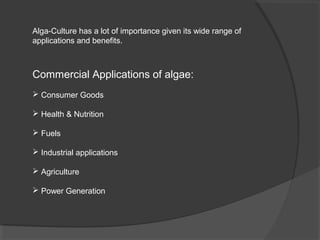
Alga-Culture has a lot of importance given its wide range of
applications and benefits.


Commercial Applications of algae:
 Consumer Goods

 Health & Nutrition

 Fuels

 Industrial applications

 Agriculture

 Power Generation
Social Benefits of Alga-Culture:
Not withstanding diverse applications and commercial uses of

algae, the alga-culture also offers following social benefits.

 Pollution Control

 Poverty alleviation
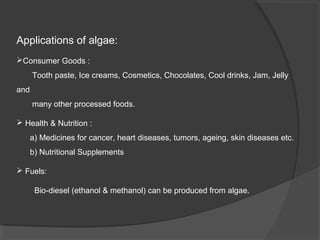
Applications of algae:
Consumer Goods :
      Tooth paste, Ice creams, Cosmetics, Chocolates, Cool drinks, Jam, Jelly
and
      many other processed foods.

 Health & Nutrition :
      a) Medicines for cancer, heart diseases, tumors, ageing, skin diseases etc.
      b) Nutritional Supplements

 Fuels:

       Bio-diesel (ethanol & methanol) can be produced from algae.
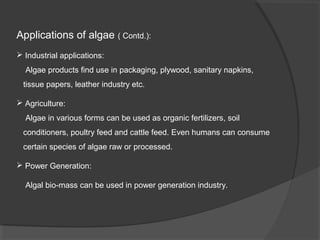
Applications of algae ( Contd.):
 Industrial applications:
  Algae products find use in packaging, plywood, sanitary napkins,
 tissue papers, leather industry etc.

 Agriculture:
  Algae in various forms can be used as organic fertilizers, soil
 conditioners, poultry feed and cattle feed. Even humans can consume
 certain species of algae raw or processed.

 Power Generation:

  Algal bio-mass can be used in power generation industry.
Alga-Culture offers a solution for power shortage:


 While most of the electrical power produced is from the conventional

sources like hydel, thermal, nuclear etc., developing economies have
recognized the need and importance of non-convention, renewable energy
sources.


 Algal bio-mass the   product of alga-culture   is a potential source of
renewable energy.
Alga-Culture offers a solution for power shortage:


 Algal bio-mass can be used for power generation in following ways:


1.Direct Combustion (Solid):   Algal bio-mass can be used to run generator
turbines in bio-mass power plants by generating heat through direct combustion.
2.Bio-fuels (Liquid): The bio-diesel extracted from algae can be used to run
diesel-generator sets.
3.Bio-gas: Through fermentation / anaerobic digestion process bio-gas can be
produced from algae and used in combined heat and power plants.
Social Benefits of Alga-Culture:
 Pollution Control :


  1. Water Pollution:
   Algae while growing in water absorb poisonous chemicals like phosphorus &


   nitrogen from agriculture run-off, and other chemicals for sewage waters and
   industrial effluents.


  2. Air Pollution :
   Algae has great potential for green house gas abatement. It absorbs more
   quantity of carbon-dioxide from air than absorbed by terrestrial plants and
   trees during photosynthesis.
Social Benefits of Alga-Culture:
 Poverty alleviation:
    Poor people can be provided an opportunity to overcome their poverty by
gaining handful income through alga-culture.
    The open-pond cultivation is very simple and cheap such that people can
easily adopt and practice. They need not own lands. They can resort to
cultivation in sea. Plenty of water is available. Market is also large.
     Hence, this low-tech, low-cost option can chosen for employment which
alleviates poverty among uneducated, unskilled labor.
Its time for us to examine..


Present scenario in India.
Problems.
Actions.
Present scenario in India
Alga-culture is extensively practiced in foreign countries.
It is a billion dollar industry there.
For instance, over 10000 families are employed in this field in
Philippines alone.

In India the picture is completely different.

India has a large coastal belt and a potential to produce 10lakhs tons
of algal bio-mass per year employing around 2lakhs people. But here
the commercial production has not yet begun is sufficient volume as
against its capacity.

People like Dr. Deenabandu Sahoo, a research scientist and Professor
in Botany are promoting alga culture by propagating its importance in
the context of generating income to poor people.

A few self help groups are cultivating algae at Chilika, but not in
commercial scale.
There are problems.

1.Most people are ignorant about the size and scale of opportunities in
alga-culture industry.

2.The financiers and bankers are not aware of this industry and hence
do not provide financial assistance easily.

3. Production quality and quantity in open pond method is subject to
environmental conditions.

4. There is no sufficient infrastructure to adopt and practice commercial
methods of production.

5. There are no capacity building attempts in the context of large scale
alga-culture, and value-addition

6. There are no processing units in access to marginal producers.
We need actions..

1. More scientific & commercial procedures need to be adopted to
achieve higher volumes of output.

2. Organizational back up is needed to effectively manage supply chain.

3. More investments are needed to expand the culture and harness the
potential to its maximum.

4. Greater efforts are needed to train and induct people in to this field.

5. Sufficient infra is to be created to protect the crop against odd weather
conditions.

6. Social entrepreneurs who are willing to take up this job are to be
encouraged and supported to extend the benefits to more & more people
in the society.
Conclusion


There is a huge scope for development of Alga-Culture in India, given the
presence of long coastal belt.
This inherently brings with it ample employment opportunities benefiting
many of the unprivileged people in rural areas. This boosts the rural
economy with its commercial uses, and benefits society in the context of
fighting air and water pollution. Peak season power demands can be met
developing algal bio-mass power plants.
Therefore, it is strongly recommended that alga-culture is practiced in
commercial scale to reap its benefits to the society.

Str2 algaculture

  • 1.
    Alga-Culture A Solution forPower, Poverty and Pollution Presented by Mr. GNS PATNAIK Founder- President Anand Bharthi Foundation
  • 2.
    Contents What is Alga-Culture? Whatare its applications? What are its benefits? Present scenario in India. Problems. Actions.
  • 3.
    What is Alga-Culture? Alga-cultureis a form of aquaculture in which different species of algae are grown. Algae are simple autotrophic organisms that grow in fresh waters as well as marine waters. There are more than 5000 species of algae like green algae, red algae, brown algae etc. The algae range is large and diverse that varies from unicellular to multi-cellular forms, micro algae to macro algae, simple forms to most complex marine forms called sea-weeds
  • 4.
    The culture… Algae canbe grown in.. 1.Fresh water 2.Salt water Alga-Culture may be done as.. 1.Mono-Culture (Single species) 2.Multi-Culture (Different species) Alga-culture can be done in following methods.. 1.Open-Ponds 2.Raceways 3.Photo bio-reactors 4.Plastic membranes
  • 5.
    While the simplestand cheapest of above is open-pond system, it is prone to contamination and subject to weather. More scientific methods may be adopted as is economical for given product specifications, desired quality and quantity. Process details discussed separately.
  • 6.
  • 7.
    Alga-Culture has alot of importance given its wide range of applications and benefits. Commercial Applications of algae:  Consumer Goods  Health & Nutrition  Fuels  Industrial applications  Agriculture  Power Generation
  • 8.
    Social Benefits ofAlga-Culture: Not withstanding diverse applications and commercial uses of algae, the alga-culture also offers following social benefits.  Pollution Control  Poverty alleviation
  • 9.
    Applications of algae: ConsumerGoods : Tooth paste, Ice creams, Cosmetics, Chocolates, Cool drinks, Jam, Jelly and many other processed foods.  Health & Nutrition : a) Medicines for cancer, heart diseases, tumors, ageing, skin diseases etc. b) Nutritional Supplements  Fuels: Bio-diesel (ethanol & methanol) can be produced from algae.
  • 10.
    Applications of algae( Contd.):  Industrial applications: Algae products find use in packaging, plywood, sanitary napkins, tissue papers, leather industry etc.  Agriculture: Algae in various forms can be used as organic fertilizers, soil conditioners, poultry feed and cattle feed. Even humans can consume certain species of algae raw or processed.  Power Generation: Algal bio-mass can be used in power generation industry.
  • 11.
    Alga-Culture offers asolution for power shortage:  While most of the electrical power produced is from the conventional sources like hydel, thermal, nuclear etc., developing economies have recognized the need and importance of non-convention, renewable energy sources.  Algal bio-mass the product of alga-culture is a potential source of renewable energy.
  • 12.
    Alga-Culture offers asolution for power shortage:  Algal bio-mass can be used for power generation in following ways: 1.Direct Combustion (Solid): Algal bio-mass can be used to run generator turbines in bio-mass power plants by generating heat through direct combustion. 2.Bio-fuels (Liquid): The bio-diesel extracted from algae can be used to run diesel-generator sets. 3.Bio-gas: Through fermentation / anaerobic digestion process bio-gas can be produced from algae and used in combined heat and power plants.
  • 13.
    Social Benefits ofAlga-Culture:  Pollution Control : 1. Water Pollution: Algae while growing in water absorb poisonous chemicals like phosphorus & nitrogen from agriculture run-off, and other chemicals for sewage waters and industrial effluents. 2. Air Pollution : Algae has great potential for green house gas abatement. It absorbs more quantity of carbon-dioxide from air than absorbed by terrestrial plants and trees during photosynthesis.
  • 14.
    Social Benefits ofAlga-Culture:  Poverty alleviation: Poor people can be provided an opportunity to overcome their poverty by gaining handful income through alga-culture. The open-pond cultivation is very simple and cheap such that people can easily adopt and practice. They need not own lands. They can resort to cultivation in sea. Plenty of water is available. Market is also large. Hence, this low-tech, low-cost option can chosen for employment which alleviates poverty among uneducated, unskilled labor.
  • 15.
    Its time forus to examine.. Present scenario in India. Problems. Actions.
  • 16.
    Present scenario inIndia Alga-culture is extensively practiced in foreign countries. It is a billion dollar industry there. For instance, over 10000 families are employed in this field in Philippines alone. In India the picture is completely different. India has a large coastal belt and a potential to produce 10lakhs tons of algal bio-mass per year employing around 2lakhs people. But here the commercial production has not yet begun is sufficient volume as against its capacity. People like Dr. Deenabandu Sahoo, a research scientist and Professor in Botany are promoting alga culture by propagating its importance in the context of generating income to poor people. A few self help groups are cultivating algae at Chilika, but not in commercial scale.
  • 17.
    There are problems. 1.Mostpeople are ignorant about the size and scale of opportunities in alga-culture industry. 2.The financiers and bankers are not aware of this industry and hence do not provide financial assistance easily. 3. Production quality and quantity in open pond method is subject to environmental conditions. 4. There is no sufficient infrastructure to adopt and practice commercial methods of production. 5. There are no capacity building attempts in the context of large scale alga-culture, and value-addition 6. There are no processing units in access to marginal producers.
  • 18.
    We need actions.. 1.More scientific & commercial procedures need to be adopted to achieve higher volumes of output. 2. Organizational back up is needed to effectively manage supply chain. 3. More investments are needed to expand the culture and harness the potential to its maximum. 4. Greater efforts are needed to train and induct people in to this field. 5. Sufficient infra is to be created to protect the crop against odd weather conditions. 6. Social entrepreneurs who are willing to take up this job are to be encouraged and supported to extend the benefits to more & more people in the society.
  • 19.
    Conclusion There is ahuge scope for development of Alga-Culture in India, given the presence of long coastal belt. This inherently brings with it ample employment opportunities benefiting many of the unprivileged people in rural areas. This boosts the rural economy with its commercial uses, and benefits society in the context of fighting air and water pollution. Peak season power demands can be met developing algal bio-mass power plants. Therefore, it is strongly recommended that alga-culture is practiced in commercial scale to reap its benefits to the society.