BIOFLOC FISH FARMING
Presented By:-Joynal Abedin
Abstract
“Biofoc may be referred as a new
economical way of culture system
where proteinaceous feed are being
feed to fishes and shellfishes formed
from the harmful components of
their excreta, viz;Nitrate,Nitrite and
Ammonia.This is achieved by “Zero
Water Exchange” with strong
areation high density stocks can be
cultured within, and for maximum
outputs are observed when culture
tanks are exposed to sun.”
The scenario
THE COUNTRY HAS VAST POTENTIAL FOR
FISHERIES IN VIEW OF OUR LONG COASTLINE
OF ABOUT 8,118 KMS APART FROM THE
INLAND WATER RESOURCES. DURING THE
FINANCIAL YEAR 2016-17, INDIA HAS
EXPORTED RS. 37870.90 CRORE WHICH IS
ABOUT 0.92% OF THE NATIONAL GROSS VALUE
ADDED (GVA) AND 5.23% TO THE AGRICULTURE
GV A (2015-16). INDIA IS THE SECOND LARGEST
PRODUCER OF FISH AND ALSO SECOND
LARGEST PRODUCER OF FRESH WATER FISH IN
THE WORLD. FISH PRODUCTION HAS
INCREASED FROM
41.57 LAKH TONNES (24.47 LAKH
TONNES FOR MARINE AND 17.10
LAKH TONNES FOR INLAND
FISHERIES) IN 1991-92 TO 114.10
LAKH TONNES (36.41 LAKH TONNES
FOR MARINE AND 77.69 LAKH
TONNES FOR INLAND FISHERIES) IN
2016-17(PROVISIONAL). DURING
THE FIRST TWO QUARTERS OF
2017-18 THE FISH PRODUCTION IS
ESTIMATED AT 5.80 MILLION
TONNES (P).
The solution
 But with growing population demand is also increasing day to day, and
the major constrain faced now a days is with the space, culture period, and
cost of production. That’s where biofloc comes into play as it is a boon for
all the basic production problems with minimal constrains. It consist of
developing microbial aggregates formed from carbon:nitrogen ratio (C:N)
in water, with low or zero exchange and high oxygenation, diets with low
crude protein content and external carbon source like molasse (sugar cane),
rice bran, wheat bran, among others.
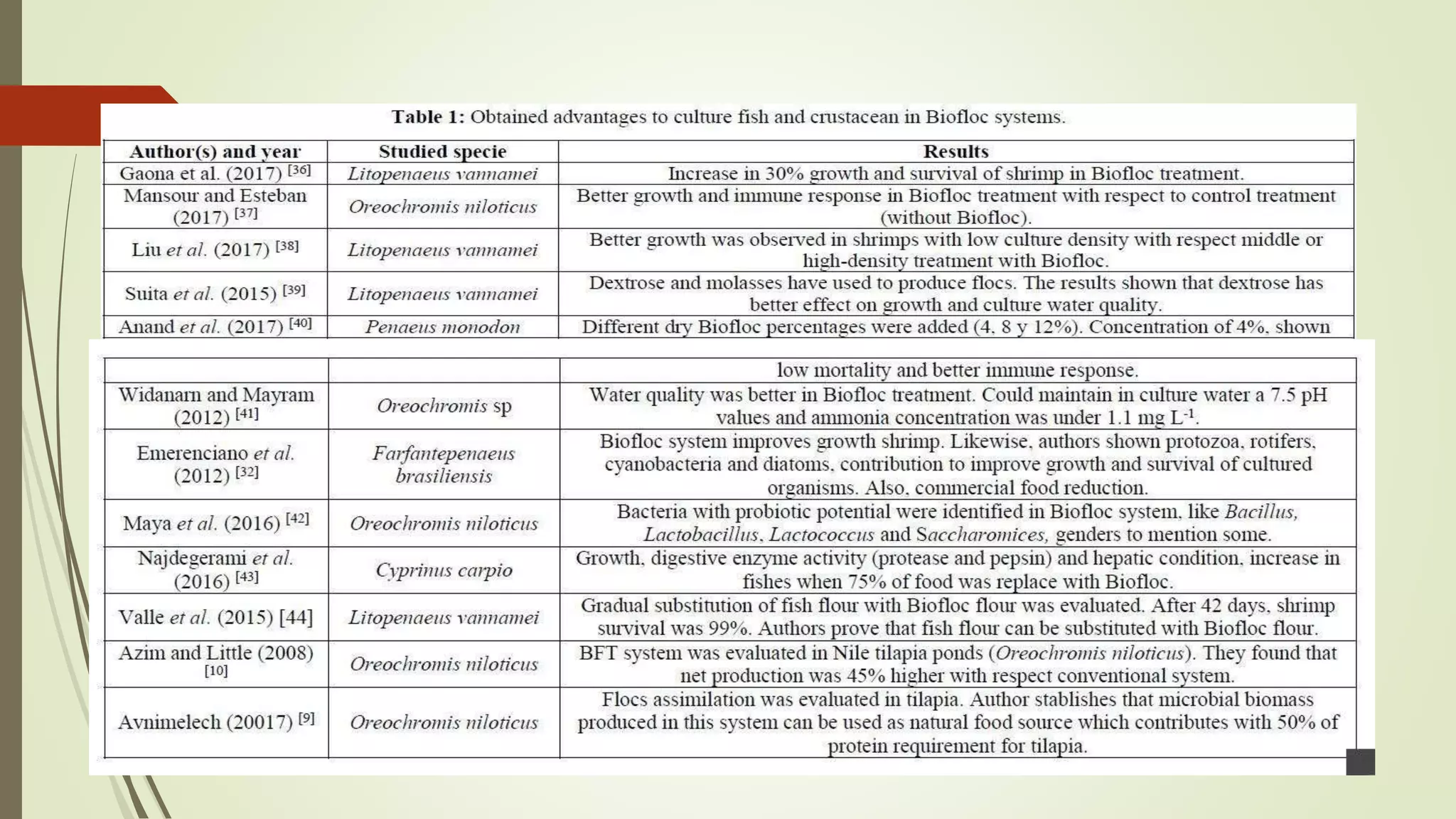
 With passage of time different benefits of biofloc culture system has
been
 demonstrated and documented by different Authors some of our
intrests are listed bellow
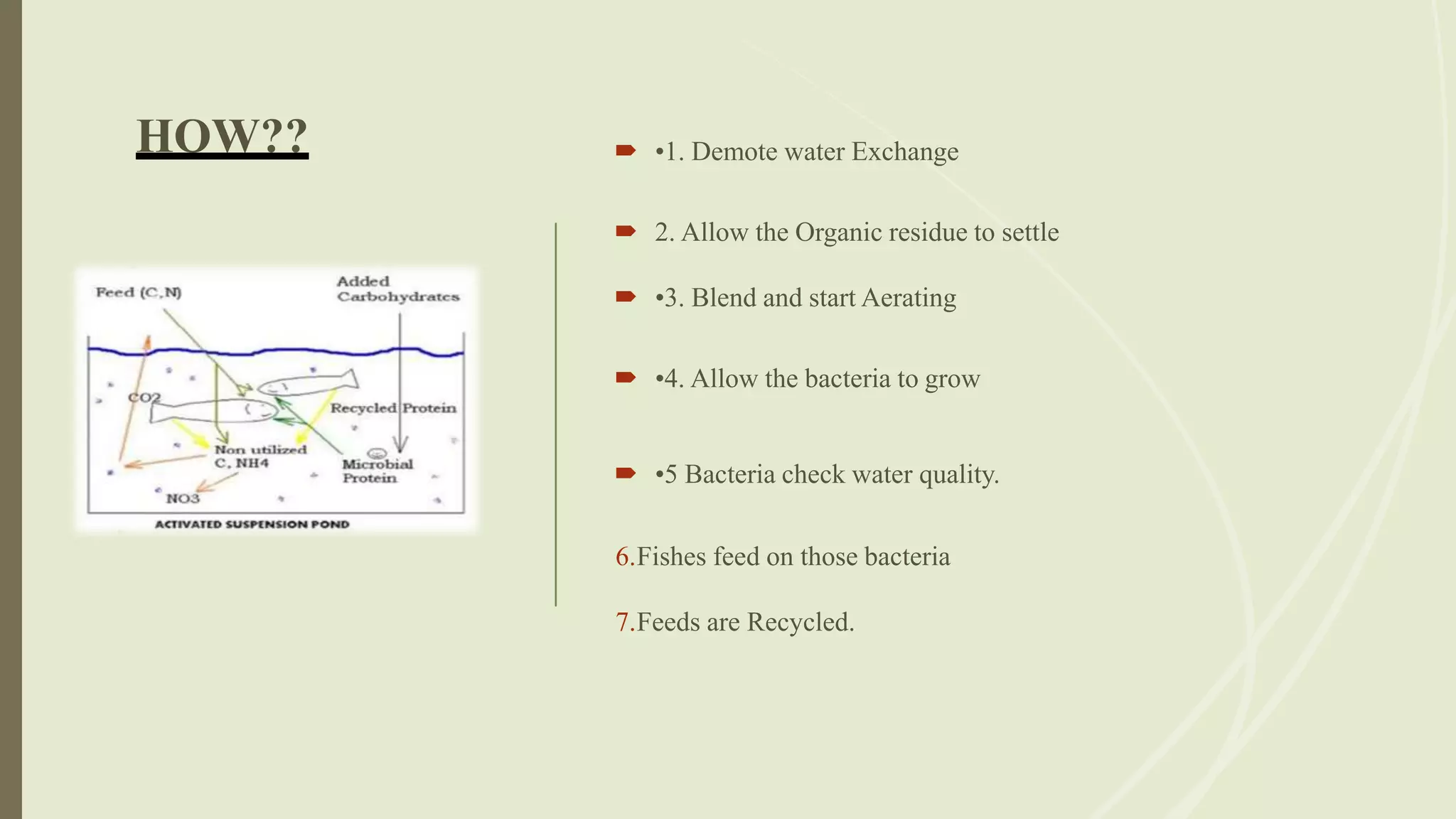
HOW??  •1. Demote water Exchange
 2. Allow the Organic residue to settle
 •3. Blend and start Aerating
 •4. Allow the bacteria to grow
 •5 Bacteria check water quality.
6.Fishes feed on those bacteria
7.Feeds are Recycled.
Suitable culture species
 . Species such as shrimp and tilapia have physiological adaptations that allow them to
consume biofloc and digest microbial protein, thereby taking advantage of biofloc as a food
resource.
 Nearly all biofloc systems are used to grow shrimp, tilapia, or carps. Channel catfish and
hybrid striped bass are examples of fish that are not good candidates for biofloc systems
because they do not tolerate water with very high solids
 concentrations and do not have adaptations to filter solids from water.
 •Air breathing fishes like singhi, magur, padba, anabas, pangasius
 •Non air-breathing fishes like common carp, rohu, tilapia, milkfish
 •Shellfishes like vannamei and tiger shrimp
Floc
FEED
 We allow heterotrophic bacteria to grow in our culture system, which grow due the Accumulation
of organic matters, which will eventually feed upon the organic matter present in the culture
system. BASICALLY “C6H12O6 + 6O 2 6 CO2+ Energy”. But the bacteria are heterotrophic
which means they are made up
 from protein therefore they would need nitrogen. They use chemical energy in organic substance of
the culture system, consumes Oxygen(though some of the population is of anaerobic bacteria)
 Normally, there is enough nitrogen in ponds for new cell production.
• BUT we can add carbon rich and protein poor material (carbo-hydrate, CHO), such as
starch or cellulose (flour, molasses, cassawa etc.
• Then, there is a need for nitrogen.
• The way to do it: Keep C/N ratio higher than 10
• The bacteria now take the nitrogen from the water and control water quality
Aeration
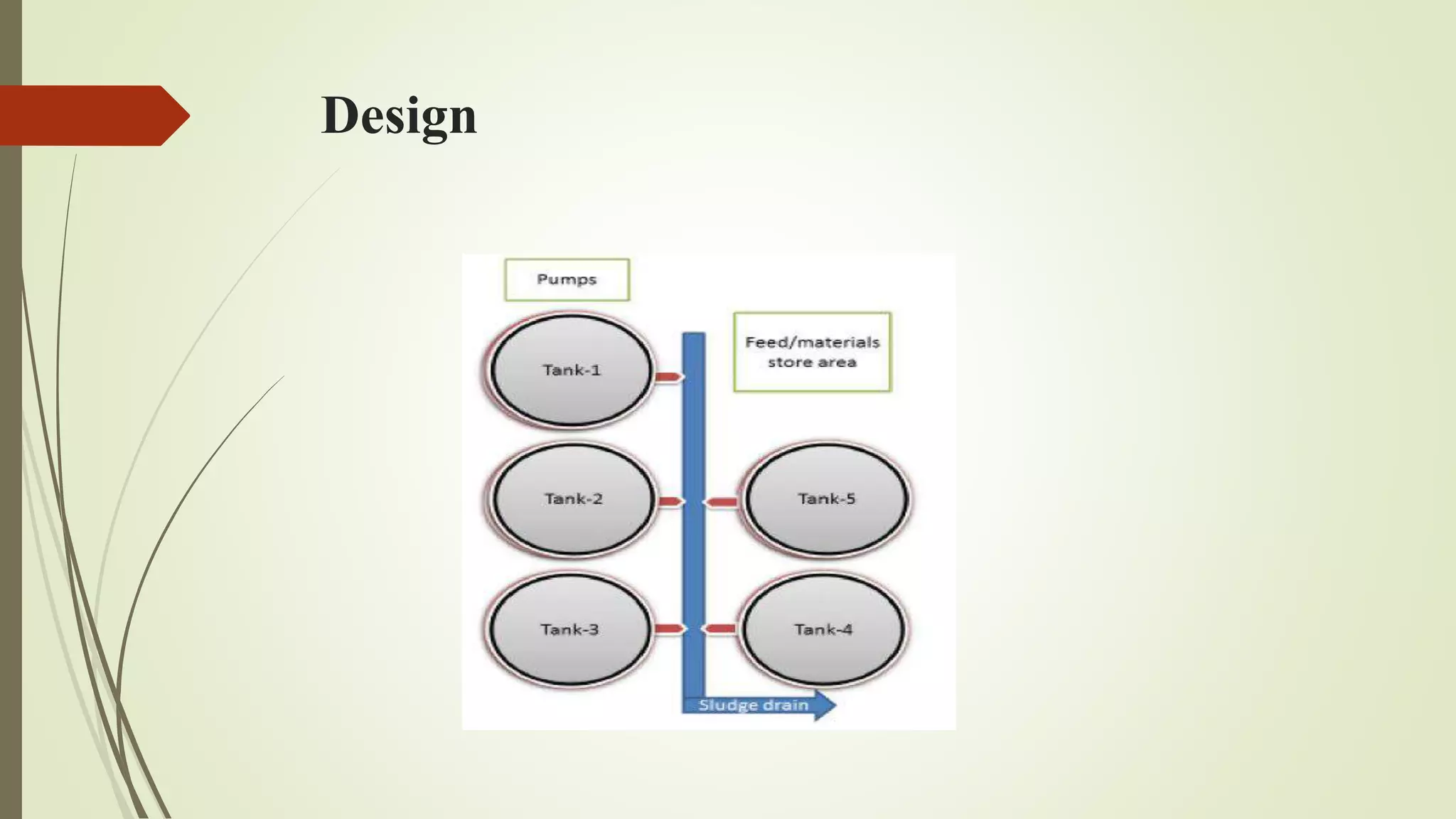
Design
Starting
 •Goal: Develop the biofloc system.
 •In lined ponds, you start from almost zero.
 •Before stocking, add organic matter (old feed, molasses, etc.) Add N fertilizers, 0.5-2.5 mgN/l (5-25 kg/ha)
 INOCULUM?
 Often, just some soil from pond is enough (~50 kg/ha).
 If Commercial inuculum: Be careful
Development of biofloc system
 •It may take a few weeks, depends on the biomass.
 •First algae develop. Transition, foam formation then it get brown.
 •Transition is fast with tilapia, longer with shrimp
 •Add carbon if TAN is above ~2 mg/l
•Adding clay, wheat bran etc. serves as seeding for biofloc formation.
•Best: Recycles water from good biofloc pond!!!!!!
 Check Water Quality Parameter –Daily
 Check Feed Intake- Daily
 Check fish health- Daily
 Check Working Performance of aerator – Daily
 Check Fish Bio mass- Weekly
 Calculate FCR- Weekly
“Thank you”
Everyone for your patience Listening

Biofloc farming (1)

  • 1.
  • 2.
    Abstract “Biofoc may bereferred as a new economical way of culture system where proteinaceous feed are being feed to fishes and shellfishes formed from the harmful components of their excreta, viz;Nitrate,Nitrite and Ammonia.This is achieved by “Zero Water Exchange” with strong areation high density stocks can be cultured within, and for maximum outputs are observed when culture tanks are exposed to sun.”
  • 3.
    The scenario THE COUNTRYHAS VAST POTENTIAL FOR FISHERIES IN VIEW OF OUR LONG COASTLINE OF ABOUT 8,118 KMS APART FROM THE INLAND WATER RESOURCES. DURING THE FINANCIAL YEAR 2016-17, INDIA HAS EXPORTED RS. 37870.90 CRORE WHICH IS ABOUT 0.92% OF THE NATIONAL GROSS VALUE ADDED (GVA) AND 5.23% TO THE AGRICULTURE GV A (2015-16). INDIA IS THE SECOND LARGEST PRODUCER OF FISH AND ALSO SECOND LARGEST PRODUCER OF FRESH WATER FISH IN THE WORLD. FISH PRODUCTION HAS INCREASED FROM 41.57 LAKH TONNES (24.47 LAKH TONNES FOR MARINE AND 17.10 LAKH TONNES FOR INLAND FISHERIES) IN 1991-92 TO 114.10 LAKH TONNES (36.41 LAKH TONNES FOR MARINE AND 77.69 LAKH TONNES FOR INLAND FISHERIES) IN 2016-17(PROVISIONAL). DURING THE FIRST TWO QUARTERS OF 2017-18 THE FISH PRODUCTION IS ESTIMATED AT 5.80 MILLION TONNES (P).
  • 4.
    The solution  Butwith growing population demand is also increasing day to day, and the major constrain faced now a days is with the space, culture period, and cost of production. That’s where biofloc comes into play as it is a boon for all the basic production problems with minimal constrains. It consist of developing microbial aggregates formed from carbon:nitrogen ratio (C:N) in water, with low or zero exchange and high oxygenation, diets with low crude protein content and external carbon source like molasse (sugar cane), rice bran, wheat bran, among others.  With passage of time different benefits of biofloc culture system has been  demonstrated and documented by different Authors some of our intrests are listed bellow
  • 5.
    HOW??  •1.Demote water Exchange  2. Allow the Organic residue to settle  •3. Blend and start Aerating  •4. Allow the bacteria to grow  •5 Bacteria check water quality. 6.Fishes feed on those bacteria 7.Feeds are Recycled.
  • 6.
    Suitable culture species . Species such as shrimp and tilapia have physiological adaptations that allow them to consume biofloc and digest microbial protein, thereby taking advantage of biofloc as a food resource.  Nearly all biofloc systems are used to grow shrimp, tilapia, or carps. Channel catfish and hybrid striped bass are examples of fish that are not good candidates for biofloc systems because they do not tolerate water with very high solids  concentrations and do not have adaptations to filter solids from water.  •Air breathing fishes like singhi, magur, padba, anabas, pangasius  •Non air-breathing fishes like common carp, rohu, tilapia, milkfish  •Shellfishes like vannamei and tiger shrimp
  • 7.
  • 8.
    FEED  We allowheterotrophic bacteria to grow in our culture system, which grow due the Accumulation of organic matters, which will eventually feed upon the organic matter present in the culture system. BASICALLY “C6H12O6 + 6O 2 6 CO2+ Energy”. But the bacteria are heterotrophic which means they are made up  from protein therefore they would need nitrogen. They use chemical energy in organic substance of the culture system, consumes Oxygen(though some of the population is of anaerobic bacteria)  Normally, there is enough nitrogen in ponds for new cell production. • BUT we can add carbon rich and protein poor material (carbo-hydrate, CHO), such as starch or cellulose (flour, molasses, cassawa etc. • Then, there is a need for nitrogen. • The way to do it: Keep C/N ratio higher than 10 • The bacteria now take the nitrogen from the water and control water quality
  • 9.
  • 11.
  • 12.
    Starting  •Goal: Developthe biofloc system.  •In lined ponds, you start from almost zero.  •Before stocking, add organic matter (old feed, molasses, etc.) Add N fertilizers, 0.5-2.5 mgN/l (5-25 kg/ha)  INOCULUM?  Often, just some soil from pond is enough (~50 kg/ha).  If Commercial inuculum: Be careful Development of biofloc system  •It may take a few weeks, depends on the biomass.  •First algae develop. Transition, foam formation then it get brown.  •Transition is fast with tilapia, longer with shrimp  •Add carbon if TAN is above ~2 mg/l •Adding clay, wheat bran etc. serves as seeding for biofloc formation. •Best: Recycles water from good biofloc pond!!!!!!
  • 13.
     Check WaterQuality Parameter –Daily  Check Feed Intake- Daily  Check fish health- Daily  Check Working Performance of aerator – Daily  Check Fish Bio mass- Weekly  Calculate FCR- Weekly
  • 15.
    “Thank you” Everyone foryour patience Listening