Aquaculture
Communication 344- Sustainability, Communication, and Culture
Spring 2017
Group Aqua: Leilua, Barbara, Saysha, and Ashley
Table of Contents
● What is aquaculture?
● Types of Aquaculture Methods (Marine and Freshwater based)
● Why choose aquaculture?
● Importance of Aquaculture
● Sustainability Point of View
● Issues with Aquaculture
● Aquaculture species
● Stakeholders
● Conclusion
What is Aquaculture?
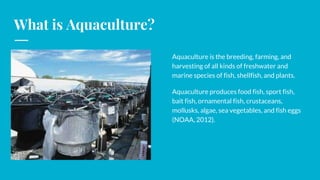
Aquaculture is the breeding, farming, and
harvesting of all kinds of freshwater and
marine species of fish, shellfish, and plants.
Aquaculture produces food fish, sport fish,
bait fish, ornamental fish, crustaceans,
mollusks, algae, sea vegetables, and fish eggs
(NOAA, 2012).
Types of Aquaculture
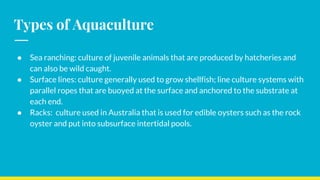
● Sea ranching: culture of juvenile animals that are produced by hatcheries and
can also be wild caught.
● Surface lines: culture generally used to grow shellfish; line culture systems with
parallel ropes that are buoyed at the surface and anchored to the substrate at
each end.
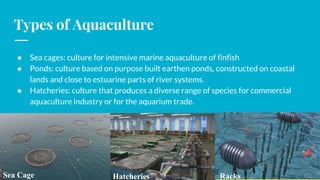
● Racks: culture used in Australia that is used for edible oysters such as the rock
oyster and put into subsurface intertidal pools.
Types of Aquaculture
● Sea cages: culture for intensive marine aquaculture of finfish
● Ponds: culture based on purpose built earthen ponds, constructed on coastal
lands and close to estuarine parts of river systems.
● Hatcheries: culture that produces a diverse range of species for commercial
aquaculture industry or for the aquarium trade.
Sea Cage Hatcheries Racks
Why aquaculture?
● Raising fish is said to be seven times more efficient compared to raising cattle
● With the demand of fish worldwide, between 2010 and 2050 the production of
fish farming and shellfish production will greatly rise
● With the major concerns of fish stock and maintaining the health of the ocean,
aquaculture will play a significant role in making this concern less severe
● As the population grows drastically and overfishing is lessening our wild fish
production, aquaculture will play a key role in meeting the demands for these
foods
Importance/Benefits
Three types of benefits of the importance of aquaculture is health, economic and
environment
● Health- All over the entire world seafood has played an important factor of
regular diets. The seafood diet has been proven throughout the world that it has
fought cardiovascular disease , cancer, alzheimer's ,and many more illnesses.
● Economic- With the poor economy we live in it gives the regions with poor soils
and farming lands an opportunity to engage in the aquaculture as a form of
agriculture.
● Environment- With the use of unsustainable fishing it has reduced and helped
improve the disease transfer in the oceans and waters our sea creatures live in.
Sustainability
In order for an aquaculture system to be sustainable it
needs:
● Environmental sustainability: state in which the
demands placed on the environment can be met without
reducing its capacity to allow all people to live well
today and in the future.
● Economic sustainability: the ability of an economy to
support a defined level of economic production
indefinitely.
● Social sustainability: the process within a community
to form positive conditions. The quality of societies.
Issues
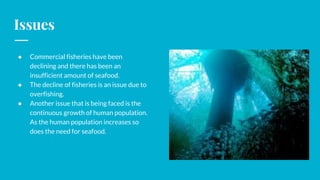
● Commercial fisheries have been
declining and there has been an
insufficient amount of seafood.
● The decline of fisheries is an issue due to
overfishing.
● Another issue that is being faced is the
continuous growth of human population.
As the human population increases so
does the need for seafood.
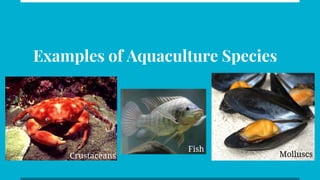
Examples of Aquaculture Species
Crustaceans
Fish
Molluscs
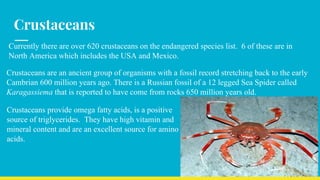
Crustaceans
Crustaceans provide omega fatty acids, is a positive
source of triglycerides. They have high vitamin and
mineral content and are an excellent source for amino
acids.
Currently there are over 620 crustaceans on the endangered species list. 6 of these are in
North America which includes the USA and Mexico.
Crustaceans are an ancient group of organisms with a fossil record stretching back to the early
Cambrian 600 million years ago. There is a Russian fossil of a 12 legged Sea Spider called
Karagassiema that is reported to have come from rocks 650 million years old.
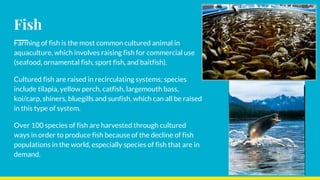
Fish
Farming of fish is the most common cultured animal in
aquaculture, which involves raising fish for commercial use
(seafood, ornamental fish, sport fish, and baitfish).
Cultured fish are raised in recirculating systems; species
include tilapia, yellow perch, catfish, largemouth bass,
koi/carp, shiners, bluegills and sunfish, which can all be raised
in this type of system.
Over 100 species of fish are harvested through cultured
ways in order to produce fish because of the decline of fish
populations in the world, especially species of fish that are in
demand.
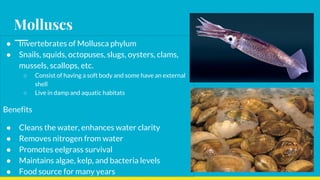
Molluscs
● Invertebrates of Mollusca phylum
● Snails, squids, octopuses, slugs, oysters, clams,
mussels, scallops, etc.
○ Consist of having a soft body and some have an external
shell
○ Live in damp and aquatic habitats
Benefits
● Cleans the water, enhances water clarity
● Removes nitrogen from water
● Promotes eelgrass survival
● Maintains algae, kelp, and bacteria levels
● Food source for many years
Crustaceans cont.
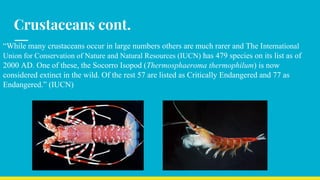
“While many crustaceans occur in large numbers others are much rarer and The International
Union for Conservation of Nature and Natural Resources (IUCN) has 479 species on its list as of
2000 AD. One of these, the Socorro Isopod (Thermosphaeroma thermophilum) is now
considered extinct in the wild. Of the rest 57 are listed as Critically Endangered and 77 as
Endangered.” (IUCN)
Who are the stakeholders & the role they play?
Community
Hawaii Aquaculture and Aquaponics Association
International Union for Conservation of Nature and Natural Resources (IUCN)
NAAFE Economics of Fisheries, Aquaculture and Seafood
NOAA, and many more
The International Union for Conservation of Nature and Natural Resources (IUCN) is an international
organization working in the field of nature conservation and sustainable use of natural resources. It is
involved in data gathering and analysis, research, field projects, advocacy, lobbying and education.
NOAA holds bi-monthly public forums that everyone interested in Aquaculture can and should attend.
It is important that we partner with our stakeholders and participate in public forums to share our ideas, provide feedback
and receive feedback from the community as stakeholders. We propose a joint mission to help fill the need of seafood
locally and perhaps grow to be a supplier and create new employment opportunities.
Stakeholders Continuation
According to the State of Hawaii Animal Industry Division
(https://hdoa.hawaii.gov/ai/aquaculture-and-livestock-support-services-branch/)
“63% of seafood is consumed in Hawaii is imported from the U.S. mainland according
to their study in 2010.”
Here in Hawaii seafood holds a cultural meaning and foundation as well as the
importance for sustenance.
Conclusion
After a conversation with Professor Garcia-Ortega at UH Hilo’s Pacific Aquaculture & Coastal
Resource Center (PACRC), it is stated that there is a definite gap between priorities among
citizens concern of depletion of our food sources. With the possible reason being the easiness
of simply purchasing what you need at a local store rather than needing to gather it yourself.
PACRC’s current initial focus is ornamental fish and pearl oysters while also raising a variety of
fish like the Red Snapper, Yellowtail Kohala, and shrimp.
With the rate of our growth population, along with overfishing, we will most likely run out of
seafood and species. As the rate of aquaculture grows we will be able to successfully reproduce
and fulfill the needs and high demand for seafoods and species for generations to come.
Volunteer Opportunities in Aquaculture
Hawaii Wildlife Fund: http://wildhawaii.org/volunteer.html
HPU Oceanic Institute: http://www.oceanicinstitute.org/research/finfish/finfish-training.html
NOAA Fisheries Pacific Islands Regional Office:
http://www.fpir.noaa.gov/PRD/prd_volunteer_opps.html
Preserve Hawaii: https://preservehawaii.org/volunteer/
Want to learn more about Aquaculture?
If you are interested in learning more about aquaculture, the importance of it, where
we are today in the process of it as well as the visioning future of it follow the
workshops available online at:
http://www.aquaculturehub.org
http://www.fpir.noaa.gov/SFD/SFD_aq.htmlwebsite: www.pacificAQUA.org
http://hdoa.hawaii.gov/ai/aquaculture-and-livestock-support-services-branch/aqua
culture-in-hawaii/
Want to learn more about Aquaculture?
FAO: http://www.fao.org/fishery/aquaculture/en
National Institute of Food and Agriculture USDA: www.nifa.usda.gov
National Marine Fisheries Service NOAA: www.nmfs.noaa.gov
National Oceanic and Atmospheric Administration FishWatch: www.fishwatch.gov
State of Hawaii Department of Agriculture: Aquaculture Opportunities
http://hdoa.hawaii.gov/ai/aquaculture-and-livestock-support-services-branch/aqua
culture-growth/
USDA: https://www.usda.gov/topics/farming/aquaculture
References
http://www.earthsendangered.com/search-groups2.asp?search=1&sgroup=CR
http://www.ecsga.org/Page/Sustainability/CultureBenefits.htm
https://hdoa.hawaii.gov/ai/aquaculture-and-livestock-support-services-branch/
http://www.healthy-foods/meat-and-seafood/crustaceans/
https://www.iucn.org/commissions/commission-ecosystem-management/our-work/cems-task-forces/ecos
ystem-based-aquaculture
https://seekingalpha.com/article/3980033-7-reasons-aquaculture-big-opportunity
http://www.talkingfish.org/2012/did-you-know/all-about-aquaculture-environmental-risks-and-benefits
http://www.thefishsite.com/fish-species/
http://www.worldbank.org/en/topic/environment/brief/sustainable-aquaculturelture
More References
https://www.daf.qld.gov.au/fisheries/aquaculture/overview/types
http://www.earthsendangered.com/search-groups2.asp?search=1&sgroup=CR
http://www.healthy-foods/meat-and-seafood/crustaceans/
http://www.nmfs.noaa.gov/aquaculture/what_is_aquaculture.html
http://pacrc.uhh.hawaii.edu
http://www.agmrc.org/commodities-products/aquaculture/aquaculture-fin-fish-species/
Thank you for looking through this presentation. I hope you learned something new.