Dr Evangelia Gantidou
School Advisor
Digital storytelling for the development
of productive and collaborative skills
1
What is story telling?
“Storytelling is the conveying of events in words,
and images, often by improvisation or
embellishment”
http://en.wikipedia.org/wiki/Storytelling
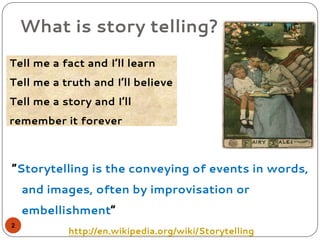
Tell me a fact and I’ll learn
Tell me a truth and I’ll believe
Tell me a story and I’ll
remember it forever
2
Why do people engage in
storytelling?
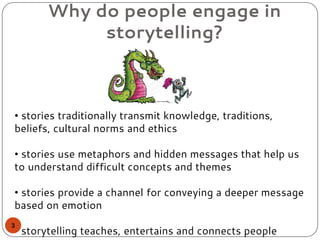
• stories traditionally transmit knowledge, traditions,
beliefs, cultural norms and ethics
• stories use metaphors and hidden messages that help us
to understand difficult concepts and themes
• stories provide a channel for conveying a deeper message
based on emotion
• storytelling teaches, entertains and connects people
3
Storytelling in education
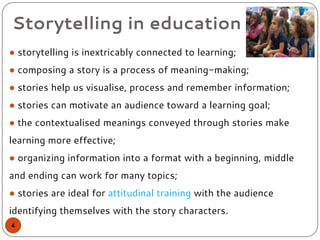
● storytelling is inextricably connected to learning;
● composing a story is a process of meaning-making;
● stories help us visualise, process and remember information;
● stories can motivate an audience toward a learning goal;
● the contextualised meanings conveyed through stories make
learning more effective;
● organizing information into a format with a beginning, middle
and ending can work for many topics;
● stories are ideal for attitudinal training with the audience
identifying themselves with the story characters.
4
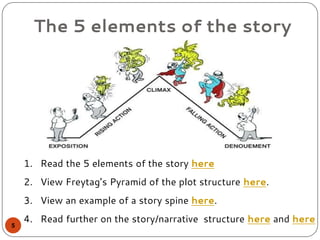
The 5 elements of the story
1. Read the 5 elements of the story here
2. View Freytag’s Pyramid of the plot structure here.
3. View an example of a story spine here.
4. Read further on the story/narrative structure here and here
5
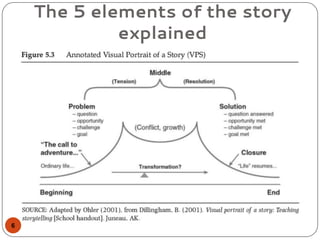
The 5 elements of the story
explained
6
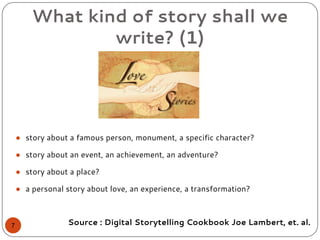
What kind of story shall we
write? (1)
● story about a famous person, monument, a specific character?
● story about an event, an achievement, an adventure?
● story about a place?
● a personal story about love, an experience, a transformation?
Source : Digital Storytelling Cookbook Joe Lambert, et. al.7
● personal, autobiographical story, memoir?
● family story about relations, generations, etc.?
● personal narration of thoughts, feelings, aspirations, etc;
● myth, legend, story about the past, the present or the future;
● argumentative story, story that affect or shape others;
● beyond words story, reflecting our own views on a subject;
● docudrama, story that brings ALIVE a highly fact-based,
insightful experience;
● moral story;
● story about the future, science fiction story.
What kind of story shall we write?
(2)
Source : DIGITALES Bernajean Porter8
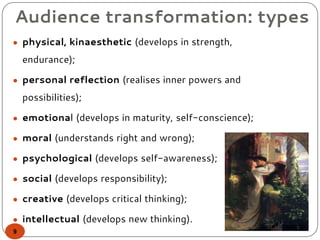
Audience transformation: types
● physical, kinaesthetic (develops in strength,
endurance);
● personal reflection (realises inner powers and
possibilities);
● emotional (develops in maturity, self-conscience);
● moral (understands right and wrong);
● psychological (develops self-awareness);
● social (develops responsibility);
● creative (develops critical thinking);
● intellectual (develops new thinking).
9
Digital Storytelling: an outline
✓ digital storytelling was created out of the work of Joe Lambert and
Dana Atchley at the Centre for Digital Storytelling at U.C.
Berkeley in 1993;
✓ a “digital story” is any narrative that is “told” using digital media;
✓ digital storytelling is the art of telling stories combined with
multimedia, including graphics, audio, video, and Web publishing;
✓ digital stories usually contain some mixture of computer-based
images, text, recorded audio narration, video clips, and/or music;
✓ digital stories are actually personal narratives which make
learning a real life experience.
10
Types of digital stories
The topics used in digital storytelling range from personal
tales to the recounting of historical events, from exploring
life in one’s own community to the search for life in other
corners of the universe.
Digital stories are not only stories
● digital documentaries,
● computer-based narratives,
● digital essays,
● electronic memoirs,
● interactive storytelling11
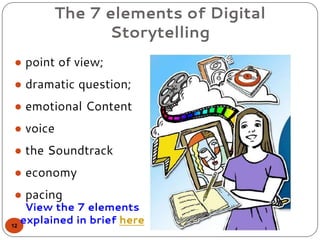
The 7 elements of Digital
Storytelling
● point of view;
● dramatic question;
● emotional Content
● voice
● the Soundtrack
● economy
● pacing
12
View the 7 elements
explained in brief here
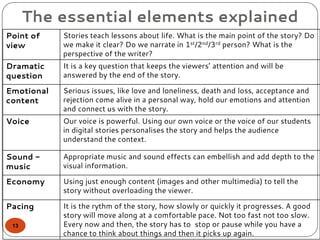
The essential elements explained
Point of
view
Stories teach lessons about life. What is the main point of the story? Do
we make it clear? Do we narrate in 1st/2nd/3rd person? What is the
perspective of the writer?
Dramatic
question
It is a key question that keeps the viewers’ attention and will be
answered by the end of the story.
Emotional
content
Serious issues, like love and loneliness, death and loss, acceptance and
rejection come alive in a personal way, hold our emotions and attention
and connect us with the story.
Voice Our voice is powerful. Using our own voice or the voice of our students
in digital stories personalises the story and helps the audience
understand the context.
Sound -
music
Appropriate music and sound effects can embellish and add depth to the
visual information.
Economy Using just enough content (images and other multimedia) to tell the
story without overloading the viewer.
Pacing It is the rythm of the story, how slowly or quickly it progresses. A good
story will move along at a comfortable pace. Not too fast not too slow.
Every now and then, the story has to stop or pause while you have a
chance to think about things and then it picks up again.
13
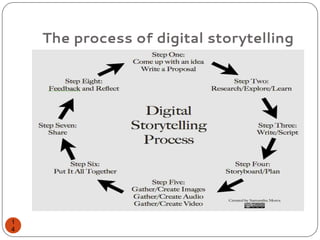
The process of digital storytelling
1
4
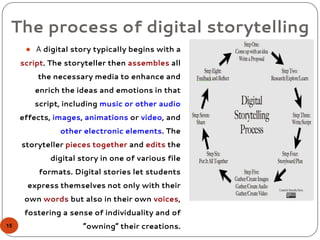
The process of digital storytelling
● A digital story typically begins with a
script. The storyteller then assembles all
the necessary media to enhance and
enrich the ideas and emotions in that
script, including music or other audio
effects, images, animations or video, and
other electronic elements. The
storyteller pieces together and edits the
digital story in one of various file
formats. Digital stories let students
express themselves not only with their
own words but also in their own voices,
fostering a sense of individuality and of
“owning” their creations.15
Steps to create a digital story
1. decide on the type of story;
2. write the script;
3. collect the assets;
4. create the storyboard;
5. make a draft of the story;
6. edit and finalize the story;
7. publish and share the story;
1
6
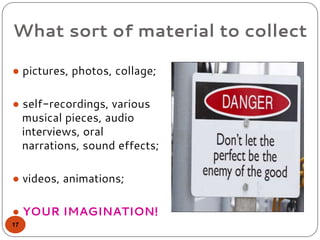
What sort of material to collect
● pictures, photos, collage;
● self-recordings, various
musical pieces, audio
interviews, oral
narrations, sound effects;
● videos, animations;
● YOUR IMAGINATION!
17
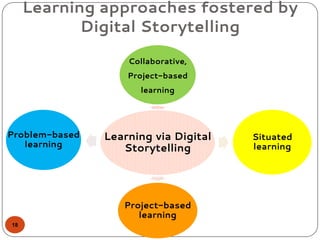
Learning approaches fostered by
Digital Storytelling
Learning via Digital
Storytelling
Collaborative,
Project-based
learning
Situated
learning
Project-based
learning
Problem-based
learning
18
Digital Storytelling for skills
development
● writing skills;
● speaking skills;
● listening skills;
● communicating skills;
● collaborating skills;
● digital literacy skills;
● presentation skills;
● problem-solving skills.
19
Digital Storytelling is teaching, not
playing with ICT tools
20
● sharing examples of Digital Stories creates expectations and sets
models to the students;
● the focus is on WRITING, not using technology. The written
script is the foundation of the digital story, so it needs
practice and shared editing.
● just like writing, assembling the components of the story needs
good organization;
● students need to get familiarised with the resources they will
need to create their story;
● the process of writing and creating needs a considerable amount of
time. Students need to plan ahead to achieve good results within
the set time limits.
Becoming transliterate storytellers
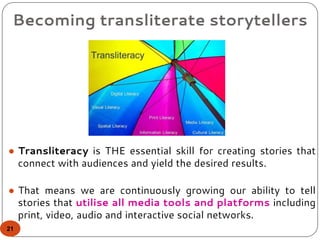
● Transliteracy is THE essential skill for creating stories that
connect with audiences and yield the desired results.
● That means we are continuously growing our ability to tell
stories that utilise all media tools and platforms including
print, video, audio and interactive social networks.
21
Examples of good practice
1. Fee Fi Fo Fum...I Smell the Story of a Scottish Man: a Greek prize-awarded
digital story project. View it at
https://www.youtube.com/watch?v=1o-uZ1HvVwg
2. http://anatolia.edu.glogster.com/england: A Glog on Britain.
3. Alice in Euroland and other sample projects using Glogster. View them at
http://anatolia.edu.glogster.com/glogs
4. William Shakespeare as a Glogster story. View it at
http://www.curriculumbits.com/prodimages/details/english/william-
shakespeare.html
5. The unknown children of the Holocaust: a sample digital story. View it at
http://digitalstorytelling.coe.uh.edu/view_story.cfm?vid=409&otherid=feat
ured&d_title=Featured%20Digital%20Stories
5. Δώρα από τη χώρα των παραμυθιών: ψηφιακό παραμύθι. View it at
https://www.youtube.com/watch?v=VvnZ_7rE85A
22
More sophisticated digital stories
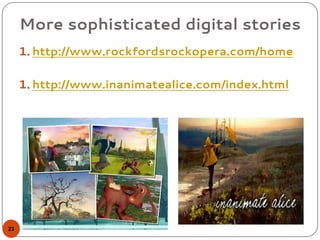
1. http://www.rockfordsrockopera.com/home
1. http://www.inanimatealice.com/index.html
23

STORYTELLING

  • 1.
    Dr Evangelia Gantidou SchoolAdvisor Digital storytelling for the development of productive and collaborative skills 1
  • 2.
    What is storytelling? “Storytelling is the conveying of events in words, and images, often by improvisation or embellishment” http://en.wikipedia.org/wiki/Storytelling Tell me a fact and I’ll learn Tell me a truth and I’ll believe Tell me a story and I’ll remember it forever 2
  • 3.
    Why do peopleengage in storytelling? • stories traditionally transmit knowledge, traditions, beliefs, cultural norms and ethics • stories use metaphors and hidden messages that help us to understand difficult concepts and themes • stories provide a channel for conveying a deeper message based on emotion • storytelling teaches, entertains and connects people 3
  • 4.
    Storytelling in education ●storytelling is inextricably connected to learning; ● composing a story is a process of meaning-making; ● stories help us visualise, process and remember information; ● stories can motivate an audience toward a learning goal; ● the contextualised meanings conveyed through stories make learning more effective; ● organizing information into a format with a beginning, middle and ending can work for many topics; ● stories are ideal for attitudinal training with the audience identifying themselves with the story characters. 4
  • 5.
    The 5 elementsof the story 1. Read the 5 elements of the story here 2. View Freytag’s Pyramid of the plot structure here. 3. View an example of a story spine here. 4. Read further on the story/narrative structure here and here 5
  • 6.
    The 5 elementsof the story explained 6
  • 7.
    What kind ofstory shall we write? (1) ● story about a famous person, monument, a specific character? ● story about an event, an achievement, an adventure? ● story about a place? ● a personal story about love, an experience, a transformation? Source : Digital Storytelling Cookbook Joe Lambert, et. al.7
  • 8.
    ● personal, autobiographicalstory, memoir? ● family story about relations, generations, etc.? ● personal narration of thoughts, feelings, aspirations, etc; ● myth, legend, story about the past, the present or the future; ● argumentative story, story that affect or shape others; ● beyond words story, reflecting our own views on a subject; ● docudrama, story that brings ALIVE a highly fact-based, insightful experience; ● moral story; ● story about the future, science fiction story. What kind of story shall we write? (2) Source : DIGITALES Bernajean Porter8
  • 9.
    Audience transformation: types ●physical, kinaesthetic (develops in strength, endurance); ● personal reflection (realises inner powers and possibilities); ● emotional (develops in maturity, self-conscience); ● moral (understands right and wrong); ● psychological (develops self-awareness); ● social (develops responsibility); ● creative (develops critical thinking); ● intellectual (develops new thinking). 9
  • 10.
    Digital Storytelling: anoutline ✓ digital storytelling was created out of the work of Joe Lambert and Dana Atchley at the Centre for Digital Storytelling at U.C. Berkeley in 1993; ✓ a “digital story” is any narrative that is “told” using digital media; ✓ digital storytelling is the art of telling stories combined with multimedia, including graphics, audio, video, and Web publishing; ✓ digital stories usually contain some mixture of computer-based images, text, recorded audio narration, video clips, and/or music; ✓ digital stories are actually personal narratives which make learning a real life experience. 10
  • 11.
    Types of digitalstories The topics used in digital storytelling range from personal tales to the recounting of historical events, from exploring life in one’s own community to the search for life in other corners of the universe. Digital stories are not only stories ● digital documentaries, ● computer-based narratives, ● digital essays, ● electronic memoirs, ● interactive storytelling11
  • 12.
    The 7 elementsof Digital Storytelling ● point of view; ● dramatic question; ● emotional Content ● voice ● the Soundtrack ● economy ● pacing 12 View the 7 elements explained in brief here
  • 13.
    The essential elementsexplained Point of view Stories teach lessons about life. What is the main point of the story? Do we make it clear? Do we narrate in 1st/2nd/3rd person? What is the perspective of the writer? Dramatic question It is a key question that keeps the viewers’ attention and will be answered by the end of the story. Emotional content Serious issues, like love and loneliness, death and loss, acceptance and rejection come alive in a personal way, hold our emotions and attention and connect us with the story. Voice Our voice is powerful. Using our own voice or the voice of our students in digital stories personalises the story and helps the audience understand the context. Sound - music Appropriate music and sound effects can embellish and add depth to the visual information. Economy Using just enough content (images and other multimedia) to tell the story without overloading the viewer. Pacing It is the rythm of the story, how slowly or quickly it progresses. A good story will move along at a comfortable pace. Not too fast not too slow. Every now and then, the story has to stop or pause while you have a chance to think about things and then it picks up again. 13
  • 14.
    The process ofdigital storytelling 1 4
  • 15.
    The process ofdigital storytelling ● A digital story typically begins with a script. The storyteller then assembles all the necessary media to enhance and enrich the ideas and emotions in that script, including music or other audio effects, images, animations or video, and other electronic elements. The storyteller pieces together and edits the digital story in one of various file formats. Digital stories let students express themselves not only with their own words but also in their own voices, fostering a sense of individuality and of “owning” their creations.15
  • 16.
    Steps to createa digital story 1. decide on the type of story; 2. write the script; 3. collect the assets; 4. create the storyboard; 5. make a draft of the story; 6. edit and finalize the story; 7. publish and share the story; 1 6
  • 17.
    What sort ofmaterial to collect ● pictures, photos, collage; ● self-recordings, various musical pieces, audio interviews, oral narrations, sound effects; ● videos, animations; ● YOUR IMAGINATION! 17
  • 18.
    Learning approaches fosteredby Digital Storytelling Learning via Digital Storytelling Collaborative, Project-based learning Situated learning Project-based learning Problem-based learning 18
  • 19.
    Digital Storytelling forskills development ● writing skills; ● speaking skills; ● listening skills; ● communicating skills; ● collaborating skills; ● digital literacy skills; ● presentation skills; ● problem-solving skills. 19
  • 20.
    Digital Storytelling isteaching, not playing with ICT tools 20 ● sharing examples of Digital Stories creates expectations and sets models to the students; ● the focus is on WRITING, not using technology. The written script is the foundation of the digital story, so it needs practice and shared editing. ● just like writing, assembling the components of the story needs good organization; ● students need to get familiarised with the resources they will need to create their story; ● the process of writing and creating needs a considerable amount of time. Students need to plan ahead to achieve good results within the set time limits.
  • 21.
    Becoming transliterate storytellers ●Transliteracy is THE essential skill for creating stories that connect with audiences and yield the desired results. ● That means we are continuously growing our ability to tell stories that utilise all media tools and platforms including print, video, audio and interactive social networks. 21
  • 22.
    Examples of goodpractice 1. Fee Fi Fo Fum...I Smell the Story of a Scottish Man: a Greek prize-awarded digital story project. View it at https://www.youtube.com/watch?v=1o-uZ1HvVwg 2. http://anatolia.edu.glogster.com/england: A Glog on Britain. 3. Alice in Euroland and other sample projects using Glogster. View them at http://anatolia.edu.glogster.com/glogs 4. William Shakespeare as a Glogster story. View it at http://www.curriculumbits.com/prodimages/details/english/william- shakespeare.html 5. The unknown children of the Holocaust: a sample digital story. View it at http://digitalstorytelling.coe.uh.edu/view_story.cfm?vid=409&otherid=feat ured&d_title=Featured%20Digital%20Stories 5. Δώρα από τη χώρα των παραμυθιών: ψηφιακό παραμύθι. View it at https://www.youtube.com/watch?v=VvnZ_7rE85A 22
  • 23.
    More sophisticated digitalstories 1. http://www.rockfordsrockopera.com/home 1. http://www.inanimatealice.com/index.html 23