Keeping Food
Safe in Storage
Group Members:
Athea Mae Gonzales
Angel Marie Geroche
Geline Jacome
Grace Ann Gumawa
Vince Harvey Codico
STORAGE PRINCIPLES
TYPES OF STORAGE
Refrigeration
Deep Chilling
Freezer Storage
Dry Storage
STORAGE SPECIFIC ITEMS
Meat
Poultry and Eggs
Seafood
Dairy Products
Fruits
Vegetables
Canned Goods
New Generation Refrigerated Foods
Baking Supplies and Grain Products
SUMMARY
In any, HACCP-based or conventional system, proper storage
is another line of defense from microbial growth and
contamination. While storage is necessary, the quality
of most food does not improve over time, and incorrect
storage practices have the potential to cause serious
and costly problems
This chapter will discuss methods for preventing the
contamination and spoilage of foods in storage.
We will cover the following main topics:
Fundamental principles of storage in foodservice facilities
through flow-charting.
Elementary rules for the use of refrigerators, freezers
and dry-storage facilities.
Appropriate storage proocedures for most common food.
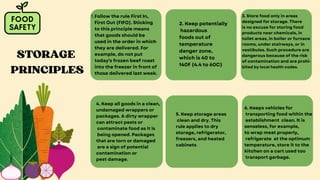
STORAGE
PRINCIPLES
Follow the rule First In,
First Out (FIFO). Sticking
to this principle means
that goods should be
used in the order in which
they are delivered. For
example, do not put
today's frozen beef roast
into the freezer in front of
those delivered last week.
1.
2. Keep potentially
hazardous
foods out of
temperature
danger zone,
which is 40 to
140F (4.4 to 60C)
3. Store food only in areas
designed for storage. There
is no excuse for storing food
products near chemicals, in
toilet areas, in boiler or furnace
rooms, under stairways, or in
vestibules. Such procedure are
dangerous because of the risk
of contamination and are prohi-
bited by local health codes.
4. Keep all goods in a clean,
undamaged wrappers or
packages. A dirty wrapper
can attract pests or
contaminate food as it is
being opened. Packages
that are torn or damaged
are a sign of potential
contamination or
pest damage.
5. Keep storage areas
clean and dry. This
rule applies to dry
storage, refrigerator,
freezers, and heated
cabinets.
6. Keeps vehicles for
transporting food within the
establishment clean. It is
senseless, for example,
to wrap meat properly,
refrigerate at the optimum
temperature, store it to the
kitchen on a cart used too
transport garbage.
TYPES OF STORAGE
Storage involves four major areas: (1) refrigerated storage for short-term holding of perishable and
potentially hazardous food items; (2) freezer storage for longer-term storage; (3) deep chilling on specially
designated units for short periods of time; and (4) dry storage for somewhat longer holding of less
perishable items. Each storage area has it's own particular sanitation requirements.
Refrigeration
The failure to properly cool hot food leftovers, and store cold food items out of the temperature danger
zone, at or below 40 F (4.4 C) is often a major factor in foodborne illness outbreaks. To prevent procedural
mistakes, you should anticipate problems and establish controls to ensure proper refrigerated storage.
No food can last forever even in refrigerated storage. Some deterioration eventually will occur with
bacteria. Refrigerators should not be used for long-term storage.
Operating Practices
The most efficient refrigerator can become a hazard or fail to hold foods at the proper temperature if
employees do not follow standard operating practices.
Refrigerators should not be over-loaded. This practice not only makes cleaning difficult but it prevents air
circulation needed to maintain proper temperatures. Opening and closing the door of a refrigerated unit
too often allows warm kitchen air to flood the interior, which can affect temperature and food safety.
Dairy items in particular should be tightly covered to prevent odor absorption. It is much safer to store
ready-to-serve food in separate units from raw foods. However, where it is not feasible to store ready-to-
serve food separately, prepared foods are required to be stored above, not below, raw foods to prevent
cross-contamination.
Refrigerator Temperature
A maximun refrigerator air temperature of 38°F (3.3°C) or lower must be maintained to keep the food
at or below 40°F (4.4°C). The unit should be regularly checked with a reliable thermometer. Ideally,
foods should be kept at the coldest temperature possible to maintain safety and quality.
The optimum range for air temperatures and humidity factors for quality control should be as follows;
Meat and Poultry: 32° to 38°F (0° to 3.3°C); 75 to 85 percent relative humidity.
Fish 30° to 34°F (-1.1° to 1.1°C); 75 to 85 percent relative humidity
Live Shellfish: 35° to 45°F (1.7° to 7.2°C); 75 to 85 percent relative humidity
Eggs: 36° to 38°F (2.2° to 3.3°C); 75 to 85 percent relative humidity
Dairy Products: 36° to 38°F (2.2° to 3.3°C); 75 to 85 percent relative humidity
Most Fruits and Vegetables: 40° to 45°F (4.4° to 7.2°C); 85 to 95 percent relative humidity
Temperature should be monitored and checked regularly in all refrigerators. There should be a
hanging thermometer for each temperature zone of the refrigerator. One should be in a the warmest
part of the unit, near the door, and one in the coolest part, near the back, to make sure that the
proper minimum temperature are maintained.
Deep Chilling
Deep or super chilling can be used to safely hold foods for short periods of time without damaging
quality. Deep chilling differs from regular freezing and refrigeration
Freezer Storage
Freezers are not substitutes for good advance planning of menus and food purchases. Storage freezers
should not be used for freezing chilled foods. Slow freezing can damage the quality of perishable items, and
lenghty freezer storage means increased opportunities for contamination and spoilage.
Freezing will not improve the culinary quality of foods; with most products, the reverse may be true. Among
items that may deteriorate in freezer storage over time are hamburger, fatty fish, (mackerel, salmon,
bluefish), turkey, pork, creamed foods, custards, gravies, sauces, and puddings.
Guidelines
The foodservice manager should make certain that both the freezer unit and frozen foods are handled with
care. The following recommended guidelines should be puth into practices:
Freezers must be maintained at an air temperature of 0°F (-17.8°C) or lower. Many experts recommend that the
freezer temperature be kept between -10° and 0°F (-23.3° and -17.8°C). Even the slight variations above 0°F
(-17.8°) can damage food quality, especially for meat and fish.
1.
2. Frozen food products should be placed in frozen storage facilities of approved design immediately after delivery
and inspection, and removed from storage only in quantities that can be used immediately.
3. Only frozen or pre-chilled foods should be put into the freezer unit Warm food products will raise the temperature
the unit.
4. Frozen food inventories should be rotated on a First In, First Out (FIFO) basis. Labeling each product with its
description, date of entry, and noting the manufacturer's expiration date can make this process fairly
straightforward.
6. An easily visible thermometer or other device to record temperature should be present in each freezer unit. As with
refrigerators, it may be useful to have more than one thermometer in order to check for hot spots and temperature
variations.
7. Foods should be placed in a freezer in a way that provides spaces for cold air to move around and through the food.
5. Reach-in freezer units should be defrosted as frequently as necessary to maintain efficiency. The operator's
manual for the freezer should give some indication for proper frequency. To maintain food safety and quality, frozen
food items should be used up first or moved to another freezer during the defrosting of a freezer unit.
Operating Practices
Foods intended for frozen-food storage should be wrapped or packaged in moisture-proof material or
containers. This practice minimizes loss of flavor, discoloration, dehydration, and odor absorption.
Whenever circumstances permit, frozen-food products should be stored in the original cartons in which
they were shipped. If the carton is broken or the original cartons take up too much space, food items
should be repackaged in air- tight containers for storage.
Employees should be trained to open freezer doors only when necessary and to remove as many items
as possible that they need at one time. Freezer cold- curtains can be used to guard against heat gain.
Dry Storage
The amount of storage space required for dry food items, such as rice and canned goods, varies with the
type of operation, the menu, the number of customers served, the purchasing policies, the delivery
frequency, and so on. What ever the dimensions of the space allotted, the area should be well-ventilated.
well-lighted, clean, and protected from pests and excessive moisture and heat.
Environmental Control
Temperatures of 60 to 70F (15.6 to 21.1°C) are adequate for most goods placed in dry storage. A
temperature of 50°F (10°C), however, is ideal and increases the shelf life of virtually all dry products. A
relative humidity of 50 to 60 percent is satisfactory for the storage of most goods. Adequate ventilation
pre- serves dry products and hinders infestation by certain insects. A thermometer, and possibly a
hygrometer, should be prominently displayed in all storage locations. A hygrometer, is an instrument
used to measure the humidity. The accuracy of these devices should be verified from time to time and
the temperature and humidity checked often.
Operating Practices
The rules to follow in relation to dry- storage areas include.
Practice the FIFO rotation method. Keep all containers of food tightly covered.
Clean up all spills immediately.
Do not place any food items on the floor.
Do not store trash or garbage cans in food storage areas.
Storage of Specific Item
Up to this point we have considered the general rules for refrigerator, freezer, and dry storage. Now let's
take a look some of the correct storage procedure for specific items of food. Appendix C lists the
recommended storage times cabinet air temperatures, and procedure for food stored on a short-term
basis. Not all refrigerators are capable of pro ducing the 32 to 36°F (0° to 2.2°C idea holding temperature.
However, refrigerators and freezers should be capable o the following operating air temperatures.
Refrigerators, short-term: 38°F (3.3°C or below!
Storage freezers: 0°F (-178°C) or be low.
Meat
Meats should be placed in storage immediately after delivery to the foodservice operation. For meat
placed under refrigeration, 32 to 38°F (0° to 33°C) is the recommended unit temperature range.
Quarters and sides of beef, which are used in larger operations, may be hung in refrigerated storage
without a covering provided that nothing is stored un- der them and that the hook on which they are
hung is cleaned and sanitized. Raw cuts of meat should be wrapped loosely to allow for air circulation,
except for ground beef, which turns brown when it is exposed to air. In addition, these operations will
have a separate walk-in, which maintains colder temperatures for this meat.
Frozen meats should be held at temperature of 0°F (-17.8°C) or below They should be wrapped and
sealed in moisture proof paper or containers be fore being placed in the freezer. Faulty wrapping or long
storage may result in freezer burn.
Unless processed meats are delivered in the frozen state, they should not be frozen Products such as
ham, bacon and luncheon meats deteriorate quickly when frozen.
Poultry and Eggs
In general, poultry is more perishable than meat. Whole birds should be wrapped loosely, refrigerated at
a unit temperature of 32 to 38°F (0° to 3.3°C). Refrigerated poultry should be used within three days of
receipt. Giblets and cooked, cut-up pieces of poultry should be kept no more than one or two days in the
refrigerator.
Fresh eggs should be stored in their original containers in a refrigerator. Until they are needed, keep
eggs at a refrigerator air temperature of no more than 38°F (3.3°C), Washing eggs may reduce their
quality, wholesomeness, and safety and should not be done in the foodservice establishment. Washing
is unnecessary because eggs are washed and sanitized during processing
Dry eggs in their reconstituted forms are considered potentially hazardous products and should be
treated with the time and temperature controls that apply to liquid eggs. Dried egg products should be
refrigerated or kept in a cool, dry place away from light. When packages are opened, the products
should be stored in the refrigerator. Keep frozen products frozen and thaw in the refrigerator as
needed. Liquid egg products should be refrigerated before and after the package is opened.
Seafood
If refrigerated at a product temperature of 32°F (0°C) and covered with self- draining ice fresh whole
fish may be stored up to three days after delivery. Only crushed or flaked ice should be used in icing fish.
Cubes or large pieces of ice can damage the fish, therefore encouraging spoilage.
When stored, fish should always be wrapped in order to prevent possible damage from waterlogging.
Fillets, steaks, and other retail cuts of fish should be kept in air tight, moisture-proof packaging and
stored embedded in self-draining, flaked or crushed ice. It kept at 32°F (0°C) but not iced, the fish should
be used within 48 hours. Live shellfish should be stored in their original container at 45°F (720).
Dairy Products
Most dairy foods readily absorb strong odors, including flavors from other foodskept in the ana. For this
reason, dairy products should be kept tightly covered and stored away from sources of strong odors,
such as fish, peaches, onions, or cabbage. An air temperature below 40°F (4.4°C) is necessary Milk,
cottage cheese. and cream should not be used after the date marked self by or good until on the carton
or delivery container.
Dairy products should not be held at room temperature, except when they are being served Dairy
products being used in cooking should not be at room tem perature for more than two hours Milk that
has been held at room temperature should never be poured back into a re- frigerated carton
Fruits
Most fruits keep best in the refrigerator though apples, avocados, bananas, and pears ripen best at room
temperature. Berries, cherries, and plums should not be washed before refrigeration, since moisture
increases the likelihood that mold will grow. Wash these fruits before preparation and/or serving.
Contrary to common opinion, citrus fruits are best stored at a cool room temperature. The USDA
recommends that uncut citrus fruits be stored at product temperatures of 60 to 70°F (15.6 to 21.1°C). For
fruits that are refrigerated, a humidity of 85 to 95 percent is ideal.
Vegetables
Most fresh vegetables are best kept under refrigeration. The air temperature range should be about 40
to 45°F (44 to 72°C), with the same relative humidity as fruits, 85 to 95 percent.
Vegetables that quickly spoil or le flavor include lima beans, cauliflower and cucumbers. Vegetables
need some exposure to air, but too much air will cause them to lose necessary moisture. Onions should
not be stored with pots toes or moist vegetables that may absorb odors.
The best way to store potatoes is at an air temperature of 45° to 50°F (72 to 10C)in ventilated containers
in a dry, dark place. Potatoes will, however, keep for two weeks after delivery at an a temperature of 70 F
(21.1°C). Sweet potatoes, mature onions, hard-rind squashes, eggplants, and rutabagas should not be
refrigerated, but held at air temperatures of about 60ºF (15.6°C)
Modified Atmosphere Packaged food
Modified atmosphere packaging (MAP), such as vacuum-packaging, can help extend the shelf life and
quality of food products under proper storage conditions However, improperly used, it could cause
foodborne illness. These special processes reinforce the need for proper storage.
Vacuum Packaging
Vacuum packaging will not stop the growth of bacteria in food. In fact, it may mask potentially lethal
consequences of anaerobic growth by Clostridium botulinum.
When used in a retail operation vacuum-packaged foods must be maintained at temperatures
recommended by the manufacturer at all times. Vacuum packaged fish must be strictly maintained at a
product temperature of 38°F (3.3°C) or below, Shelf life must not exceed the date indicated on the
processor's packaging. In addition, consumer packages must be labeled prominently and conspicuously
with temperature requirements and clear instructions as to shelf life.
Sous Vide
Sous Vide is the French term for under vacuum. Sous-vide cooking entails vacuum-packaging raw, fresh
foods in impermeable plastic pouches and sealing them with special equipment. The sealing results in
air being forced from the pouches, placing them under vacuum The foods are then fully or partially
cooked, rapidly cooled, and stored under refrigeration until further preparation is needed. At that time,
the food in the pouches is reheated for service.
The FDA states that only licensed food processing operations are allowed to use the sous-vide process
on-site. They allow a foodservice operation to purchase sous- vide products only from a reputable,
reliable supplier that has a verified HACCP system. The storage temperature of sous-vide products is
product-specific, but generally 32" to 38°F (0° to 3.3°C). Since sous-vide cooking presents certain
conditions for survival and growth of some micro-organisms (see Chapter 2), it is extremely important
to follow manufacturers' storage and preparation guidelines.
New-Generation Refrigerated Foods
New generation refrigerated foods, such as fresh pasta, meat, and vegetable salads, may not show the
typical characteristics of spoilage. But factors such as improper temperature control, exceeding the
recommended shelf life, and partial processing can facilitate the growth of hazardous micro-organisms.
When storing new-generation refrigerated foods, the upper-limit product temperature of 40°F (4.4°C) at
which traditionally packaged foods can be stored does not apply. Pathogenic bacteria that grow at
refrigeration temperatures, such as C. botulinum and Listeria monocytogenes are potential dangers.
These foods should be stored at a refrigerator temperature of 38°F 63°C) or lower.
Canned Goods
Storage of canned goods should meet all the general requirements for dry storage. It is important to
remember that canned goods are subject to spoilage and deterioration in quality over long periods of
time.
The optimum storage temperature for canned goods is 50 to 70°F (10 to 21.1°C) with a relative humidity
of 50 to 60 percent. Higher temperatures are likely to accelerate bacterial growth and food
deterioration. Too much moisture may cause rusting of the cans.
The storage times listed in Appendix E are based on ideal conditions. Note that acidic canned foods such
as tomatoes and berries keep for a shorter period of time than nonacidic foods. Acidic canned goods
also can cause pinholes in containers.
Canned goods should always be wiped with a clean cloth before opening to prevent external soil and
debris from getting into the contents.
Baking Supplies and Grain Products
Salt and sugar stored under proper humidity and temperature are the only foodstuffs that can be stored
almost indefinitely. Other dry goods deteriorate over time, with cereals and noodles being especially
subject to loss of quality. Many cereal and grain products are favorite targets of vermin and can easily
become moldy or musty
Summary
Improper storage of food is a potential source of contamination and spoilage within the foodservice
establishment. Although different kinds of food have different storage requirements, all food should
be kept in areas that are clean and used only for the storage of food. In addition, all food stocks should
be rotated an the First In, First Out (FIFO) principle. Refrigerators are used for short-term storage of
potentially hazardous a some perishable foods. There are two types: walk-ins and reach-ins. To
maintain ideal food temperatures two separate refrigerators should be used for meat and poultry,
fish, dairy products and eggs and one for fruits and vegetables. A close watch should be kept on the
temperatures of all refrigerated storage areas and food products .Raw food products should never be
stored above ready-to-serve products. Freezers are useful for long term storage of many food items.
The foodservice manager should know which foods deteriorate quickly when frozen. Normal
foodservice freezers should not be used to freeze volumes of food, only to hold already frozen foods.
Temperature, ventilation, absence of insects and rodents, and dryness are al important factors in
evaluating a dry storage area. The recommendations for maximum storage periods in refrigerators
and freezers should be followed carefully. Although dry goods generally have a longer shelf life than
goods that are refrigerated or frozen, it should be remembered that they, too, eventually lose quality,
even if kept under proper conditions.
Thank You! :)

GROUP-3-thc-1202.pdf

  • 1.
    Keeping Food Safe inStorage Group Members: Athea Mae Gonzales Angel Marie Geroche Geline Jacome Grace Ann Gumawa Vince Harvey Codico
  • 2.
    STORAGE PRINCIPLES TYPES OFSTORAGE Refrigeration Deep Chilling Freezer Storage Dry Storage STORAGE SPECIFIC ITEMS Meat Poultry and Eggs Seafood Dairy Products Fruits Vegetables Canned Goods New Generation Refrigerated Foods Baking Supplies and Grain Products SUMMARY In any, HACCP-based or conventional system, proper storage is another line of defense from microbial growth and contamination. While storage is necessary, the quality of most food does not improve over time, and incorrect storage practices have the potential to cause serious and costly problems This chapter will discuss methods for preventing the contamination and spoilage of foods in storage. We will cover the following main topics: Fundamental principles of storage in foodservice facilities through flow-charting. Elementary rules for the use of refrigerators, freezers and dry-storage facilities. Appropriate storage proocedures for most common food.
  • 3.
    STORAGE PRINCIPLES Follow the ruleFirst In, First Out (FIFO). Sticking to this principle means that goods should be used in the order in which they are delivered. For example, do not put today's frozen beef roast into the freezer in front of those delivered last week. 1. 2. Keep potentially hazardous foods out of temperature danger zone, which is 40 to 140F (4.4 to 60C) 3. Store food only in areas designed for storage. There is no excuse for storing food products near chemicals, in toilet areas, in boiler or furnace rooms, under stairways, or in vestibules. Such procedure are dangerous because of the risk of contamination and are prohi- bited by local health codes. 4. Keep all goods in a clean, undamaged wrappers or packages. A dirty wrapper can attract pests or contaminate food as it is being opened. Packages that are torn or damaged are a sign of potential contamination or pest damage. 5. Keep storage areas clean and dry. This rule applies to dry storage, refrigerator, freezers, and heated cabinets. 6. Keeps vehicles for transporting food within the establishment clean. It is senseless, for example, to wrap meat properly, refrigerate at the optimum temperature, store it to the kitchen on a cart used too transport garbage.
  • 4.
    TYPES OF STORAGE Storageinvolves four major areas: (1) refrigerated storage for short-term holding of perishable and potentially hazardous food items; (2) freezer storage for longer-term storage; (3) deep chilling on specially designated units for short periods of time; and (4) dry storage for somewhat longer holding of less perishable items. Each storage area has it's own particular sanitation requirements. Refrigeration The failure to properly cool hot food leftovers, and store cold food items out of the temperature danger zone, at or below 40 F (4.4 C) is often a major factor in foodborne illness outbreaks. To prevent procedural mistakes, you should anticipate problems and establish controls to ensure proper refrigerated storage. No food can last forever even in refrigerated storage. Some deterioration eventually will occur with bacteria. Refrigerators should not be used for long-term storage. Operating Practices The most efficient refrigerator can become a hazard or fail to hold foods at the proper temperature if employees do not follow standard operating practices. Refrigerators should not be over-loaded. This practice not only makes cleaning difficult but it prevents air circulation needed to maintain proper temperatures. Opening and closing the door of a refrigerated unit too often allows warm kitchen air to flood the interior, which can affect temperature and food safety. Dairy items in particular should be tightly covered to prevent odor absorption. It is much safer to store ready-to-serve food in separate units from raw foods. However, where it is not feasible to store ready-to- serve food separately, prepared foods are required to be stored above, not below, raw foods to prevent cross-contamination.
  • 5.
    Refrigerator Temperature A maximunrefrigerator air temperature of 38°F (3.3°C) or lower must be maintained to keep the food at or below 40°F (4.4°C). The unit should be regularly checked with a reliable thermometer. Ideally, foods should be kept at the coldest temperature possible to maintain safety and quality. The optimum range for air temperatures and humidity factors for quality control should be as follows; Meat and Poultry: 32° to 38°F (0° to 3.3°C); 75 to 85 percent relative humidity. Fish 30° to 34°F (-1.1° to 1.1°C); 75 to 85 percent relative humidity Live Shellfish: 35° to 45°F (1.7° to 7.2°C); 75 to 85 percent relative humidity Eggs: 36° to 38°F (2.2° to 3.3°C); 75 to 85 percent relative humidity Dairy Products: 36° to 38°F (2.2° to 3.3°C); 75 to 85 percent relative humidity Most Fruits and Vegetables: 40° to 45°F (4.4° to 7.2°C); 85 to 95 percent relative humidity Temperature should be monitored and checked regularly in all refrigerators. There should be a hanging thermometer for each temperature zone of the refrigerator. One should be in a the warmest part of the unit, near the door, and one in the coolest part, near the back, to make sure that the proper minimum temperature are maintained. Deep Chilling Deep or super chilling can be used to safely hold foods for short periods of time without damaging quality. Deep chilling differs from regular freezing and refrigeration
  • 6.
    Freezer Storage Freezers arenot substitutes for good advance planning of menus and food purchases. Storage freezers should not be used for freezing chilled foods. Slow freezing can damage the quality of perishable items, and lenghty freezer storage means increased opportunities for contamination and spoilage. Freezing will not improve the culinary quality of foods; with most products, the reverse may be true. Among items that may deteriorate in freezer storage over time are hamburger, fatty fish, (mackerel, salmon, bluefish), turkey, pork, creamed foods, custards, gravies, sauces, and puddings. Guidelines The foodservice manager should make certain that both the freezer unit and frozen foods are handled with care. The following recommended guidelines should be puth into practices: Freezers must be maintained at an air temperature of 0°F (-17.8°C) or lower. Many experts recommend that the freezer temperature be kept between -10° and 0°F (-23.3° and -17.8°C). Even the slight variations above 0°F (-17.8°) can damage food quality, especially for meat and fish. 1. 2. Frozen food products should be placed in frozen storage facilities of approved design immediately after delivery and inspection, and removed from storage only in quantities that can be used immediately. 3. Only frozen or pre-chilled foods should be put into the freezer unit Warm food products will raise the temperature the unit. 4. Frozen food inventories should be rotated on a First In, First Out (FIFO) basis. Labeling each product with its description, date of entry, and noting the manufacturer's expiration date can make this process fairly straightforward.
  • 7.
    6. An easilyvisible thermometer or other device to record temperature should be present in each freezer unit. As with refrigerators, it may be useful to have more than one thermometer in order to check for hot spots and temperature variations. 7. Foods should be placed in a freezer in a way that provides spaces for cold air to move around and through the food. 5. Reach-in freezer units should be defrosted as frequently as necessary to maintain efficiency. The operator's manual for the freezer should give some indication for proper frequency. To maintain food safety and quality, frozen food items should be used up first or moved to another freezer during the defrosting of a freezer unit. Operating Practices Foods intended for frozen-food storage should be wrapped or packaged in moisture-proof material or containers. This practice minimizes loss of flavor, discoloration, dehydration, and odor absorption. Whenever circumstances permit, frozen-food products should be stored in the original cartons in which they were shipped. If the carton is broken or the original cartons take up too much space, food items should be repackaged in air- tight containers for storage. Employees should be trained to open freezer doors only when necessary and to remove as many items as possible that they need at one time. Freezer cold- curtains can be used to guard against heat gain. Dry Storage The amount of storage space required for dry food items, such as rice and canned goods, varies with the type of operation, the menu, the number of customers served, the purchasing policies, the delivery frequency, and so on. What ever the dimensions of the space allotted, the area should be well-ventilated. well-lighted, clean, and protected from pests and excessive moisture and heat.
  • 8.
    Environmental Control Temperatures of60 to 70F (15.6 to 21.1°C) are adequate for most goods placed in dry storage. A temperature of 50°F (10°C), however, is ideal and increases the shelf life of virtually all dry products. A relative humidity of 50 to 60 percent is satisfactory for the storage of most goods. Adequate ventilation pre- serves dry products and hinders infestation by certain insects. A thermometer, and possibly a hygrometer, should be prominently displayed in all storage locations. A hygrometer, is an instrument used to measure the humidity. The accuracy of these devices should be verified from time to time and the temperature and humidity checked often. Operating Practices The rules to follow in relation to dry- storage areas include. Practice the FIFO rotation method. Keep all containers of food tightly covered. Clean up all spills immediately. Do not place any food items on the floor. Do not store trash or garbage cans in food storage areas. Storage of Specific Item Up to this point we have considered the general rules for refrigerator, freezer, and dry storage. Now let's take a look some of the correct storage procedure for specific items of food. Appendix C lists the recommended storage times cabinet air temperatures, and procedure for food stored on a short-term basis. Not all refrigerators are capable of pro ducing the 32 to 36°F (0° to 2.2°C idea holding temperature. However, refrigerators and freezers should be capable o the following operating air temperatures. Refrigerators, short-term: 38°F (3.3°C or below! Storage freezers: 0°F (-178°C) or be low.
  • 9.
    Meat Meats should beplaced in storage immediately after delivery to the foodservice operation. For meat placed under refrigeration, 32 to 38°F (0° to 33°C) is the recommended unit temperature range. Quarters and sides of beef, which are used in larger operations, may be hung in refrigerated storage without a covering provided that nothing is stored un- der them and that the hook on which they are hung is cleaned and sanitized. Raw cuts of meat should be wrapped loosely to allow for air circulation, except for ground beef, which turns brown when it is exposed to air. In addition, these operations will have a separate walk-in, which maintains colder temperatures for this meat. Frozen meats should be held at temperature of 0°F (-17.8°C) or below They should be wrapped and sealed in moisture proof paper or containers be fore being placed in the freezer. Faulty wrapping or long storage may result in freezer burn. Unless processed meats are delivered in the frozen state, they should not be frozen Products such as ham, bacon and luncheon meats deteriorate quickly when frozen. Poultry and Eggs In general, poultry is more perishable than meat. Whole birds should be wrapped loosely, refrigerated at a unit temperature of 32 to 38°F (0° to 3.3°C). Refrigerated poultry should be used within three days of receipt. Giblets and cooked, cut-up pieces of poultry should be kept no more than one or two days in the refrigerator. Fresh eggs should be stored in their original containers in a refrigerator. Until they are needed, keep eggs at a refrigerator air temperature of no more than 38°F (3.3°C), Washing eggs may reduce their quality, wholesomeness, and safety and should not be done in the foodservice establishment. Washing is unnecessary because eggs are washed and sanitized during processing
  • 10.
    Dry eggs intheir reconstituted forms are considered potentially hazardous products and should be treated with the time and temperature controls that apply to liquid eggs. Dried egg products should be refrigerated or kept in a cool, dry place away from light. When packages are opened, the products should be stored in the refrigerator. Keep frozen products frozen and thaw in the refrigerator as needed. Liquid egg products should be refrigerated before and after the package is opened. Seafood If refrigerated at a product temperature of 32°F (0°C) and covered with self- draining ice fresh whole fish may be stored up to three days after delivery. Only crushed or flaked ice should be used in icing fish. Cubes or large pieces of ice can damage the fish, therefore encouraging spoilage. When stored, fish should always be wrapped in order to prevent possible damage from waterlogging. Fillets, steaks, and other retail cuts of fish should be kept in air tight, moisture-proof packaging and stored embedded in self-draining, flaked or crushed ice. It kept at 32°F (0°C) but not iced, the fish should be used within 48 hours. Live shellfish should be stored in their original container at 45°F (720). Dairy Products Most dairy foods readily absorb strong odors, including flavors from other foodskept in the ana. For this reason, dairy products should be kept tightly covered and stored away from sources of strong odors, such as fish, peaches, onions, or cabbage. An air temperature below 40°F (4.4°C) is necessary Milk, cottage cheese. and cream should not be used after the date marked self by or good until on the carton or delivery container. Dairy products should not be held at room temperature, except when they are being served Dairy products being used in cooking should not be at room tem perature for more than two hours Milk that has been held at room temperature should never be poured back into a re- frigerated carton
  • 11.
    Fruits Most fruits keepbest in the refrigerator though apples, avocados, bananas, and pears ripen best at room temperature. Berries, cherries, and plums should not be washed before refrigeration, since moisture increases the likelihood that mold will grow. Wash these fruits before preparation and/or serving. Contrary to common opinion, citrus fruits are best stored at a cool room temperature. The USDA recommends that uncut citrus fruits be stored at product temperatures of 60 to 70°F (15.6 to 21.1°C). For fruits that are refrigerated, a humidity of 85 to 95 percent is ideal. Vegetables Most fresh vegetables are best kept under refrigeration. The air temperature range should be about 40 to 45°F (44 to 72°C), with the same relative humidity as fruits, 85 to 95 percent. Vegetables that quickly spoil or le flavor include lima beans, cauliflower and cucumbers. Vegetables need some exposure to air, but too much air will cause them to lose necessary moisture. Onions should not be stored with pots toes or moist vegetables that may absorb odors. The best way to store potatoes is at an air temperature of 45° to 50°F (72 to 10C)in ventilated containers in a dry, dark place. Potatoes will, however, keep for two weeks after delivery at an a temperature of 70 F (21.1°C). Sweet potatoes, mature onions, hard-rind squashes, eggplants, and rutabagas should not be refrigerated, but held at air temperatures of about 60ºF (15.6°C) Modified Atmosphere Packaged food Modified atmosphere packaging (MAP), such as vacuum-packaging, can help extend the shelf life and quality of food products under proper storage conditions However, improperly used, it could cause foodborne illness. These special processes reinforce the need for proper storage.
  • 12.
    Vacuum Packaging Vacuum packagingwill not stop the growth of bacteria in food. In fact, it may mask potentially lethal consequences of anaerobic growth by Clostridium botulinum. When used in a retail operation vacuum-packaged foods must be maintained at temperatures recommended by the manufacturer at all times. Vacuum packaged fish must be strictly maintained at a product temperature of 38°F (3.3°C) or below, Shelf life must not exceed the date indicated on the processor's packaging. In addition, consumer packages must be labeled prominently and conspicuously with temperature requirements and clear instructions as to shelf life. Sous Vide Sous Vide is the French term for under vacuum. Sous-vide cooking entails vacuum-packaging raw, fresh foods in impermeable plastic pouches and sealing them with special equipment. The sealing results in air being forced from the pouches, placing them under vacuum The foods are then fully or partially cooked, rapidly cooled, and stored under refrigeration until further preparation is needed. At that time, the food in the pouches is reheated for service. The FDA states that only licensed food processing operations are allowed to use the sous-vide process on-site. They allow a foodservice operation to purchase sous- vide products only from a reputable, reliable supplier that has a verified HACCP system. The storage temperature of sous-vide products is product-specific, but generally 32" to 38°F (0° to 3.3°C). Since sous-vide cooking presents certain conditions for survival and growth of some micro-organisms (see Chapter 2), it is extremely important to follow manufacturers' storage and preparation guidelines.
  • 13.
    New-Generation Refrigerated Foods Newgeneration refrigerated foods, such as fresh pasta, meat, and vegetable salads, may not show the typical characteristics of spoilage. But factors such as improper temperature control, exceeding the recommended shelf life, and partial processing can facilitate the growth of hazardous micro-organisms. When storing new-generation refrigerated foods, the upper-limit product temperature of 40°F (4.4°C) at which traditionally packaged foods can be stored does not apply. Pathogenic bacteria that grow at refrigeration temperatures, such as C. botulinum and Listeria monocytogenes are potential dangers. These foods should be stored at a refrigerator temperature of 38°F 63°C) or lower. Canned Goods Storage of canned goods should meet all the general requirements for dry storage. It is important to remember that canned goods are subject to spoilage and deterioration in quality over long periods of time. The optimum storage temperature for canned goods is 50 to 70°F (10 to 21.1°C) with a relative humidity of 50 to 60 percent. Higher temperatures are likely to accelerate bacterial growth and food deterioration. Too much moisture may cause rusting of the cans. The storage times listed in Appendix E are based on ideal conditions. Note that acidic canned foods such as tomatoes and berries keep for a shorter period of time than nonacidic foods. Acidic canned goods also can cause pinholes in containers. Canned goods should always be wiped with a clean cloth before opening to prevent external soil and debris from getting into the contents.
  • 14.
    Baking Supplies andGrain Products Salt and sugar stored under proper humidity and temperature are the only foodstuffs that can be stored almost indefinitely. Other dry goods deteriorate over time, with cereals and noodles being especially subject to loss of quality. Many cereal and grain products are favorite targets of vermin and can easily become moldy or musty Summary Improper storage of food is a potential source of contamination and spoilage within the foodservice establishment. Although different kinds of food have different storage requirements, all food should be kept in areas that are clean and used only for the storage of food. In addition, all food stocks should be rotated an the First In, First Out (FIFO) principle. Refrigerators are used for short-term storage of potentially hazardous a some perishable foods. There are two types: walk-ins and reach-ins. To maintain ideal food temperatures two separate refrigerators should be used for meat and poultry, fish, dairy products and eggs and one for fruits and vegetables. A close watch should be kept on the temperatures of all refrigerated storage areas and food products .Raw food products should never be stored above ready-to-serve products. Freezers are useful for long term storage of many food items. The foodservice manager should know which foods deteriorate quickly when frozen. Normal foodservice freezers should not be used to freeze volumes of food, only to hold already frozen foods. Temperature, ventilation, absence of insects and rodents, and dryness are al important factors in evaluating a dry storage area. The recommendations for maximum storage periods in refrigerators and freezers should be followed carefully. Although dry goods generally have a longer shelf life than goods that are refrigerated or frozen, it should be remembered that they, too, eventually lose quality, even if kept under proper conditions.
  • 15.