Canadian Fertilizer
Industry Storage
And
Handling Guidelines
2001
Table of Contents
Canadian Fertilizer Storage and Handling Guidelines
1.0 INTRODUCTION
1.1 Executive Steering Committee
1.2 Working Groups
1.3 General Approach
1.4 Recommendations on How to Use the Guidelines
2.0 SOLID FERTILIZER
2.1 Siting
2.1.1 Recommendations
2.2 Facility and Equipment Design and Construction
2.2.1 Recommendations
2.2.2 Ammonium Nitrate Storage
2.3 Facility and Equipment Inspections
2.3.1 Recommendations
3.0 ANHYDROUS AMMONIA
3.1 Siting
3.1.1 Recommendations
3.2 Facility Design and Construction
3.3 Facility and Equipment Inspections
3.3.1 Recommendations
4.0 LIQUID FERTILIZER
4.1 Siting
4.1.1 Recommendations
4.2 Facility Equipment Design and Construction
4.2.1 Recommendations
4.3 Inspections
4.3.1 Recommendations
5.0 EMPLOYEE TRAINING AND DOCUMENTATION
5.1 Employee Training
5.1.1 Recommendations
5.2 Documentation Requirements
5.2.1 Recommendations
6.0 EMERGENCY RESPONSE PLANNING AND PRACTICE
6.1 Recommendations
REFERENCES
APPENDICES
Appendix A-1 Solid Fertilizer Siting Distances
Appendix A-2 Anhydrous Ammonia Siting Distances
Appendix A-3 Liquid Fertilizer Siting Distances
Appendix B-1 Solid Fertilizer Site Layout
Appendix B-2 Bagged/Bulk Fertilizer Warehouse Layout
Appendix B-3 Anhydrous Ammonia Site Layout
Appendix B-4 Liquid Fertilizer Site Layout
Appendix C-1 Solid Fertilizer Daily Inspection Checklist
Appendix C-2 Solid Fertilizer Annual Inspection
Appendix C-3 Anhydrous Ammonia Fertilizer Daily Inspection Checklist
Appendix C-4 Anhydrous Ammonia Annual Inspection
Appendix C-5 Liquid Fertilizer Daily Inspection Checklist
Appendix C-6 Liquid Fertilizer Annual Inspection
Appendix C-7 Liquid Tank Inspection Report
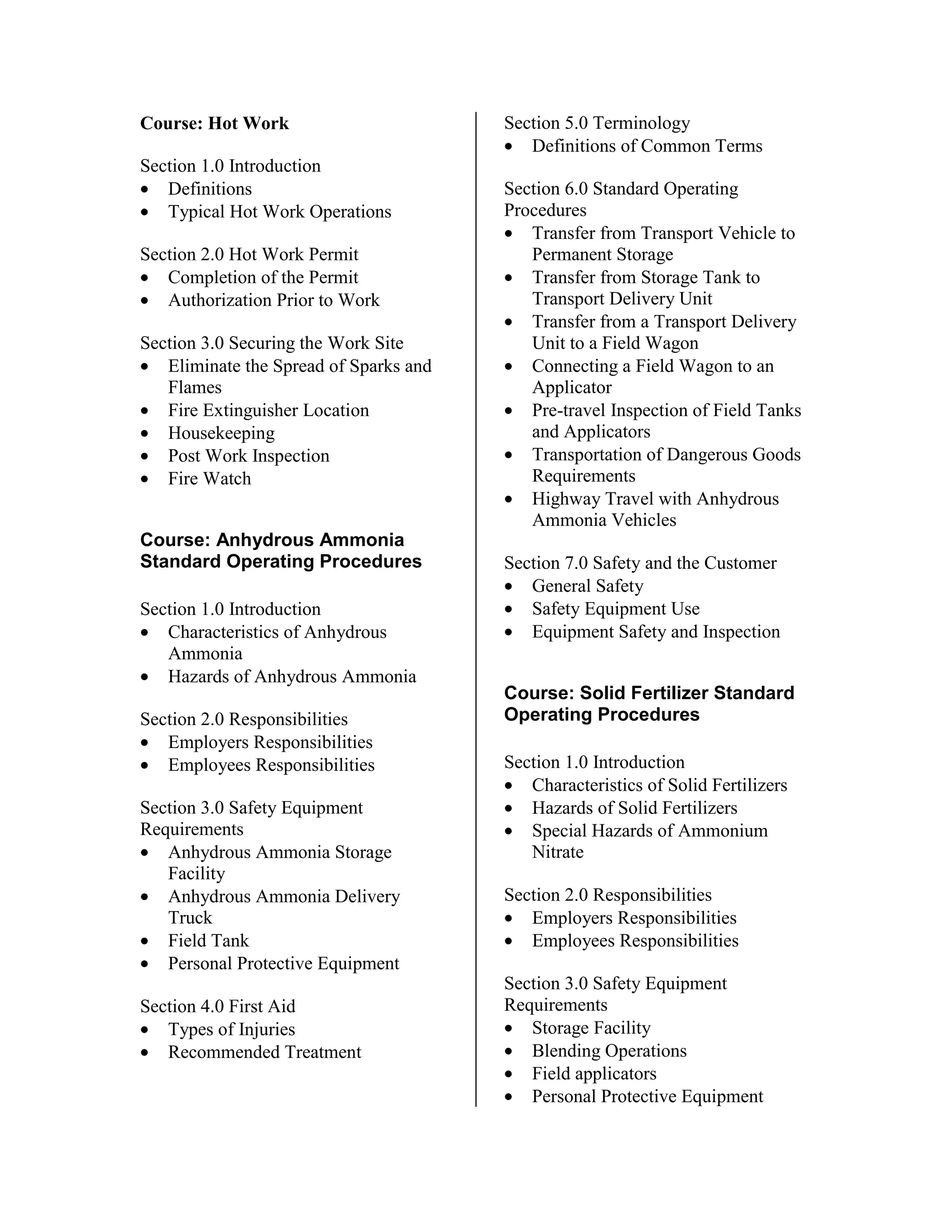
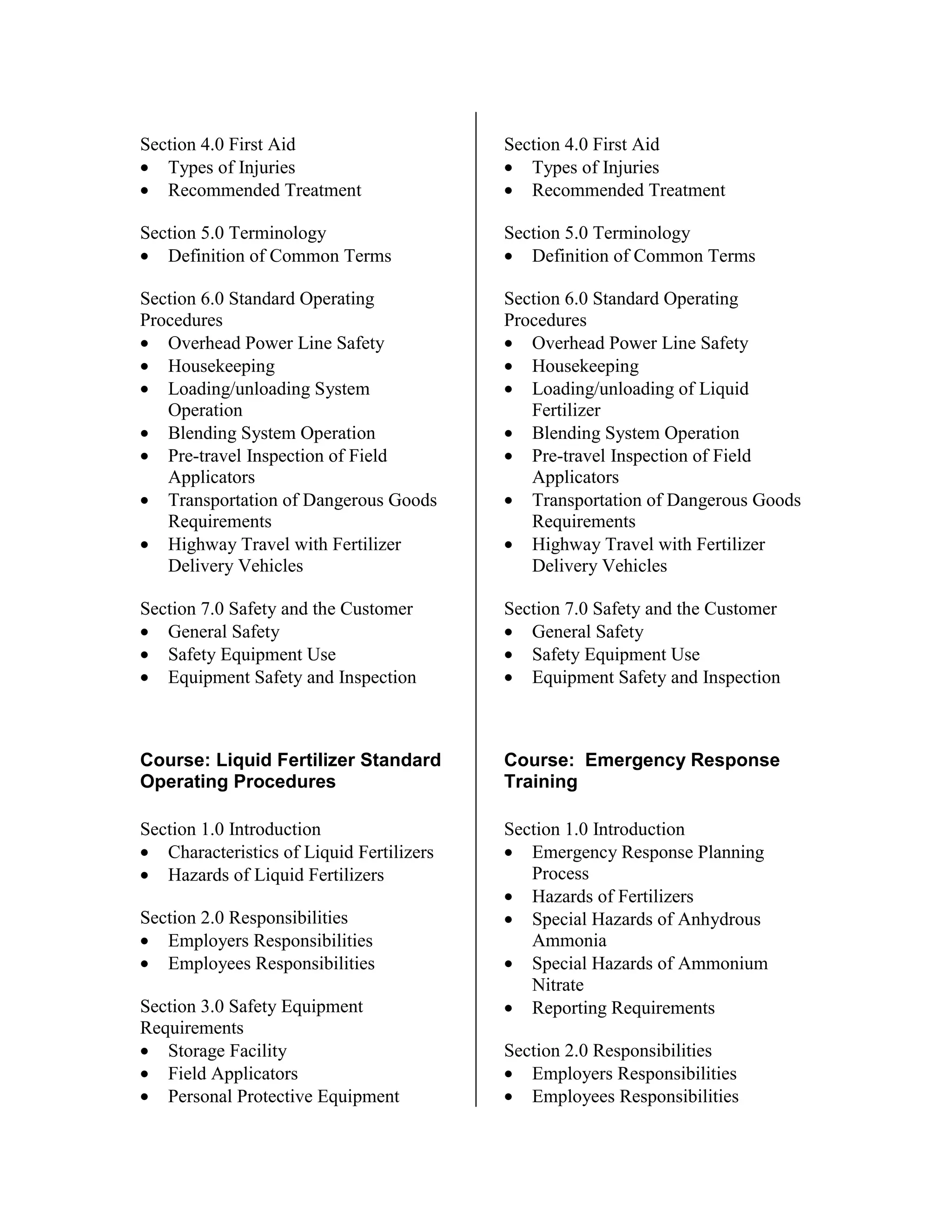
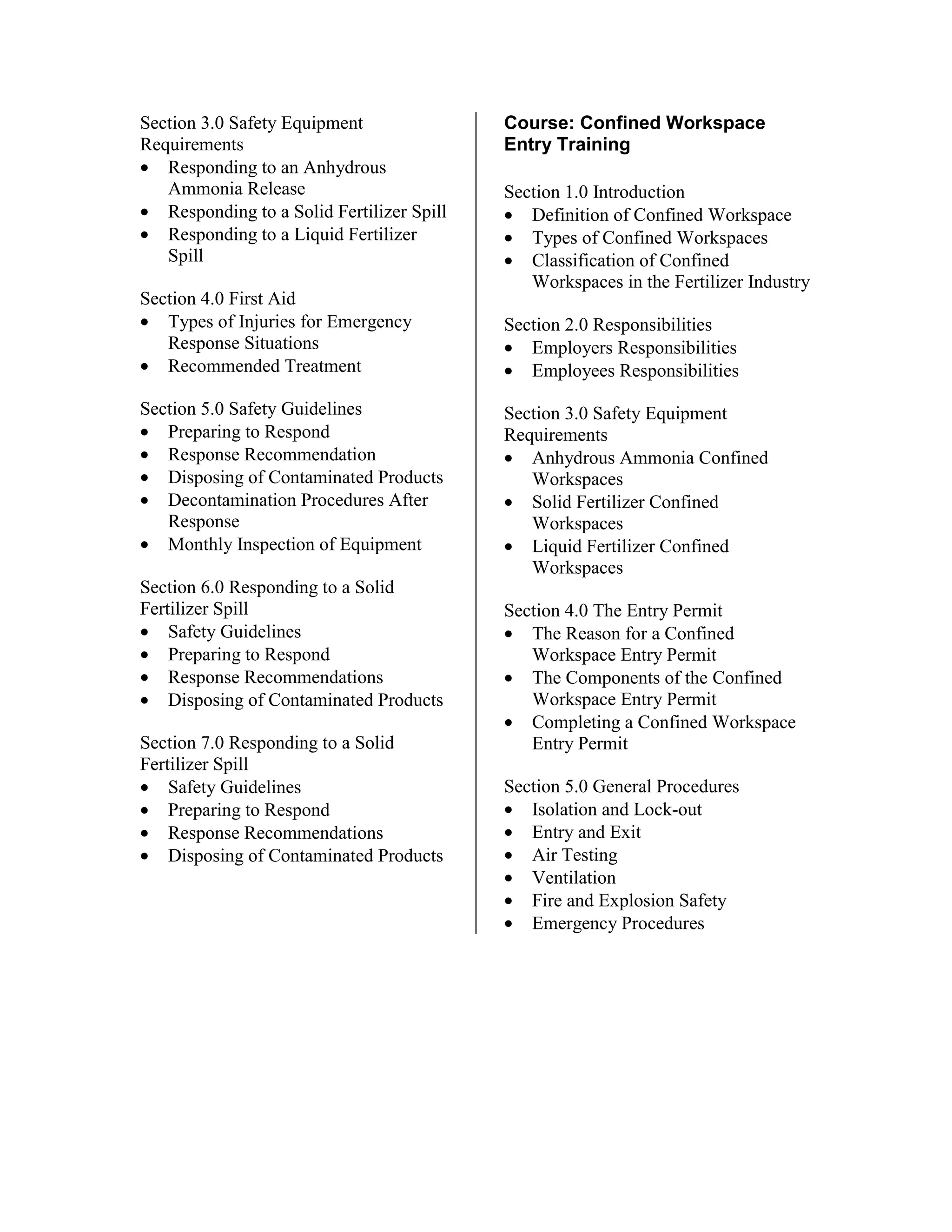
Appendix D Suggested Training and Course Contents
Appendix E Emergency Response Plan Template
1.0 INTRODUCTION
The following document contains the
Canadian Fertilizer Industry Storage and
Handling Guidelines. These guidelines were
developed to provide information and
guidance to members of the industry on the
measures they can take at their facilities to
maintain or improve the level of safety
associated with the storage and handling of
fertilizers. This initiative was driven by the
industry’s responsibility to continuously
improve the stewardship of its products to
meet society's demand for protecting the
environment, human health and safety. The
guidelines are based upon existing regulatory
requirements and industry best practices.
1.1 Executive Steering Committee
The overall initiative was driven by an
Executive Steering Committee comprised of
representatives from all segments of the
industry. The members of the steering
committee were:
Donald Côté - Quebec Fertilizer
Manufacturers’ Association
Percy Crossman - Saskatchewan Wheat Pool
Jim Farrell - Canadian Fertilizer Institute
Bill McEwen – Agrium
Tom Sawyer - The Fertilizer Institute of
Ontario
John Scales - Atlantic Fertilizer Institute
Bernie Tiessen - Canadian Association of
Agri-Retailers
The Executive Steering Committee was
responsible for representing the interests of
manufacturers, distributors and retailers of
fertilizer. It was also responsible for defining
the overall process by which the guidelines
were developed
Working Groups
Three working groups were established to
develop the guidelines for each major
fertilizer industry segment. The working
groups and their members were:
Solid Fertilizer – Percy Crossman (Chair),
Malcolm Parker, Glen Dixon, Donald Côté,
John Scales.
Liquid Fertilizer – Bernie Tiessen (Co-
Chair), Tom Sawyer (Co-Chair), Jim Farrell,
Tony Bouw, Oleh Ilnyckyj.
Anhydrous Ammonia – Al Petkau (Co-
Chair), Neil Jorgenson (Co-Chair), Don
Henderson, Frank Vidalin, Reg Helwer.
1.2 General Approach
The major principle for the entire initiative
was to ensure recommendations were cost
effective based upon the actual
safety/environmental risks in the industry. To
assess the risks, a risk assessment survey was
developed and sent to industry members. The
survey asked each recipient to rank the level
of risk associated with various parameters
according to a four-point scale. Once the
surveys were returned, all the parameters were
analyzed to determine the highest ranked
risks. Any risk parameter that was ranked as a
moderate to high risk by greater than 50% of
respondents was selected as an area of focus
in the development of the guidelines.
Each identified risk was then investigated by
one of the specific working groups to
determine the level of risk and the
recommended approach to minimizing the
risk. The guidelines were based upon
existing regulations, corporate standards and
industry best practices.
1.3 Recommendations on How to Use
the Guidelines
These guidelines should be considered at the
early design stages for any new fertilizer
facility.
It is recognized that in many cases, existing
facilities will not meet all of the
recommendations, specifically for siting or
facility design and construction. Existing
facilities should consider all of the
recommendations made in this document and
work towards meeting the recommendations
in a timeframe that is economically viable.
The development of the guidelines considered
existing laws and regulations in general. It is
strongly recommended that local authorities
be consulted to determine any specific
requirements that may be over and above
these guidelines.
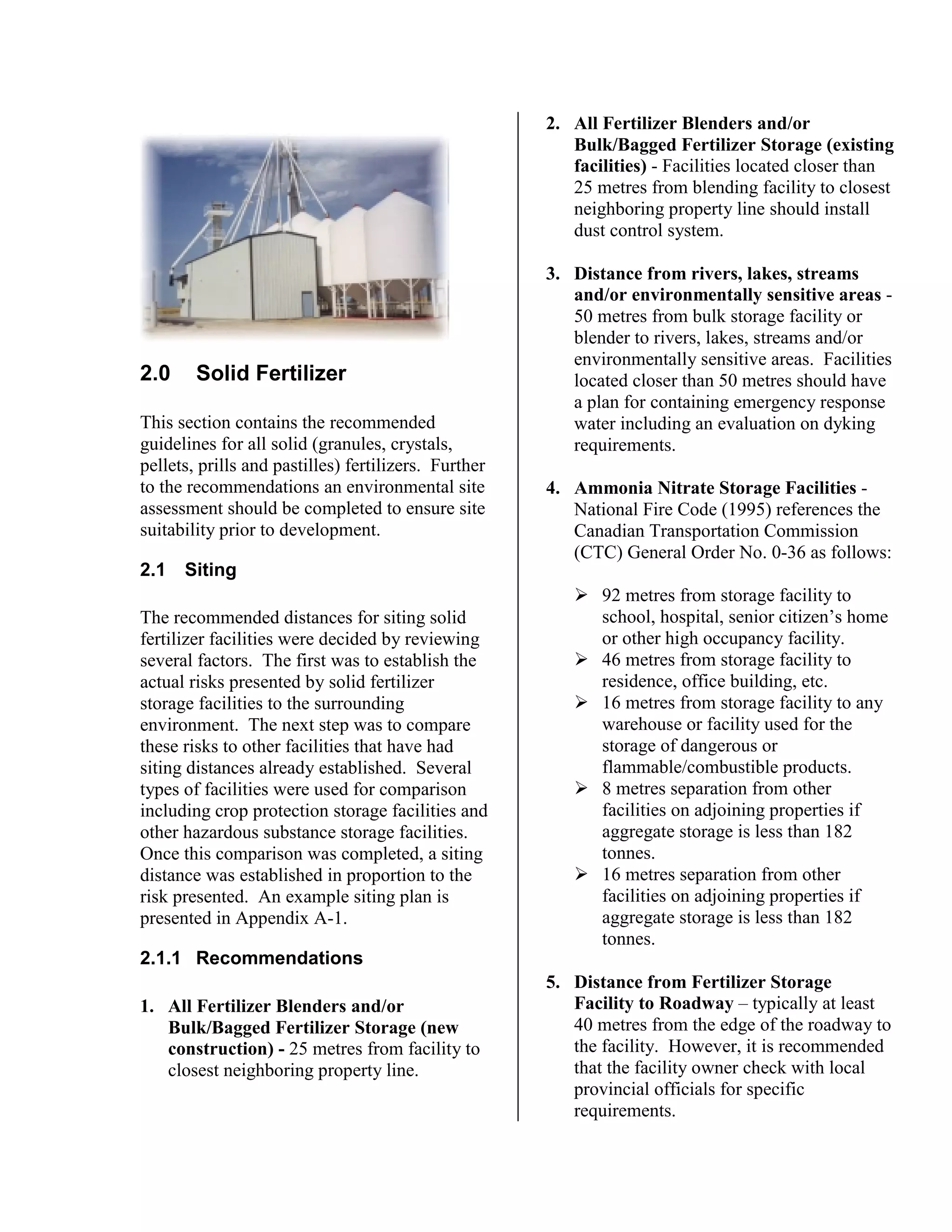
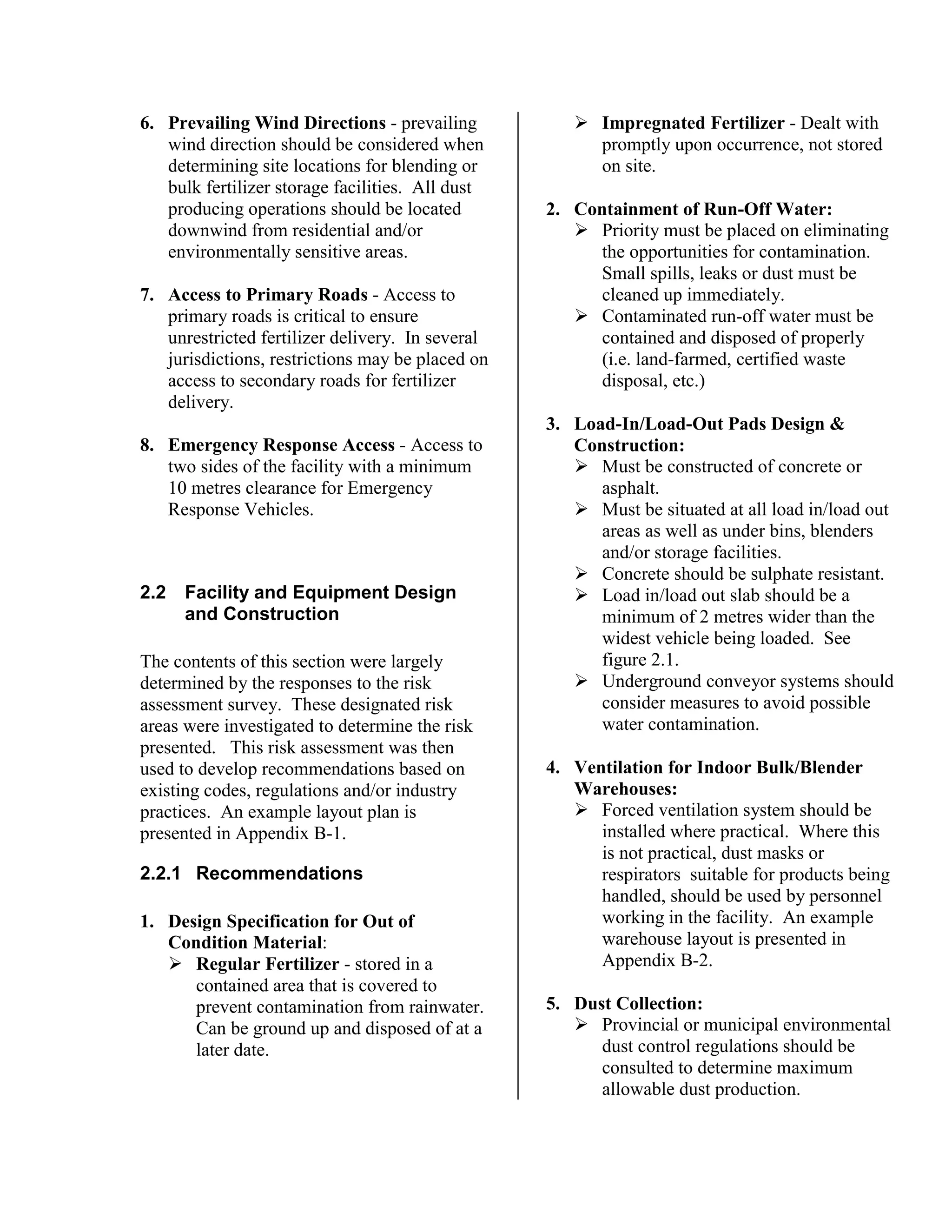
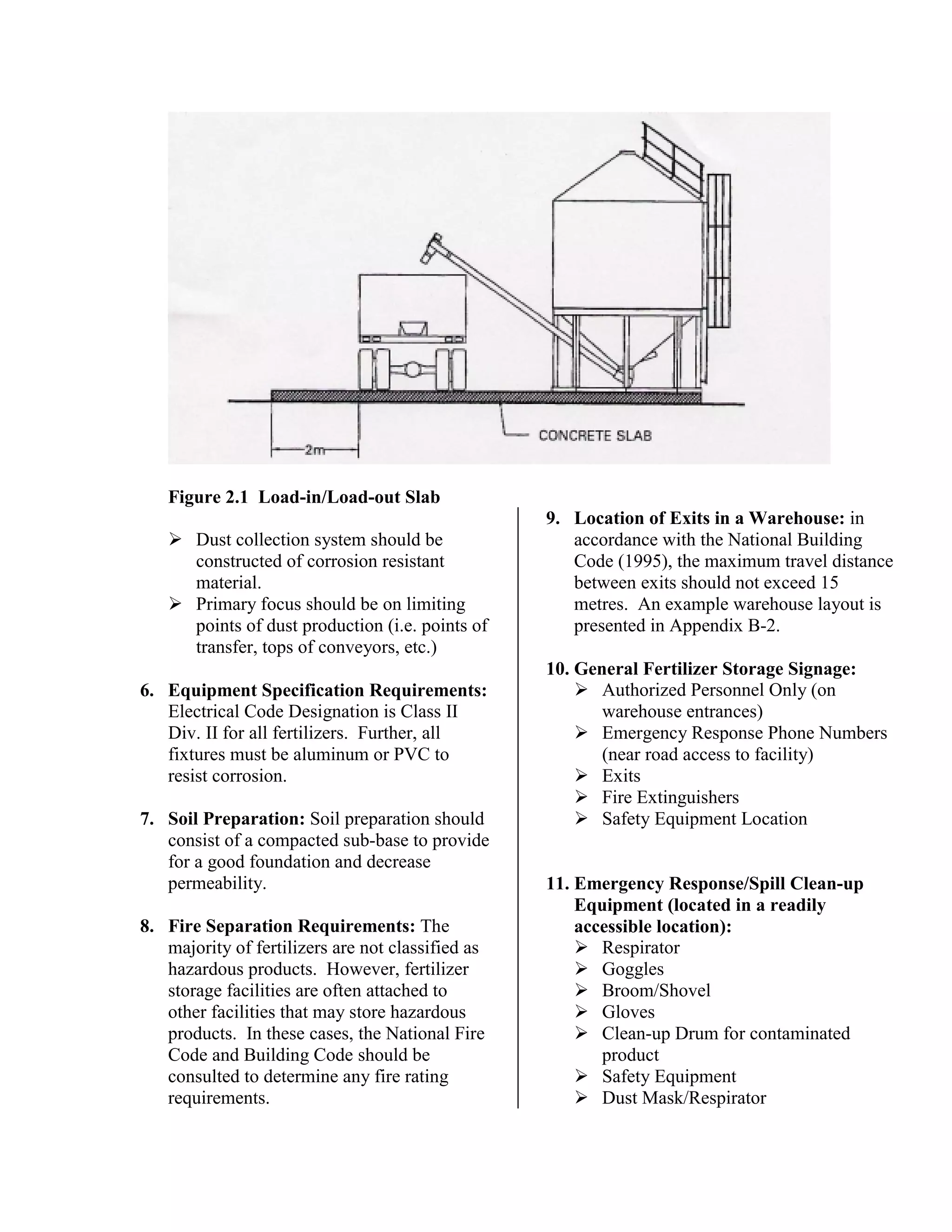
2.0 Solid Fertilizer
This section contains the recommended
guidelines for all solid (granules, crystals,
pellets, prills and pastilles) fertilizers. Further
to the recommendations an environmental site
assessment should be completed to ensure site
suitability prior to development.
2.1 Siting
The recommended distances for siting solid
fertilizer facilities were decided by reviewing
several factors. The first was to establish the
actual risks presented by solid fertilizer
storage facilities to the surrounding
environment. The next step was to compare
these risks to other facilities that have had
siting distances already established. Several
types of facilities were used for comparison
including crop protection storage facilities and
other hazardous substance storage facilities.
Once this comparison was completed, a siting
distance was established in proportion to the
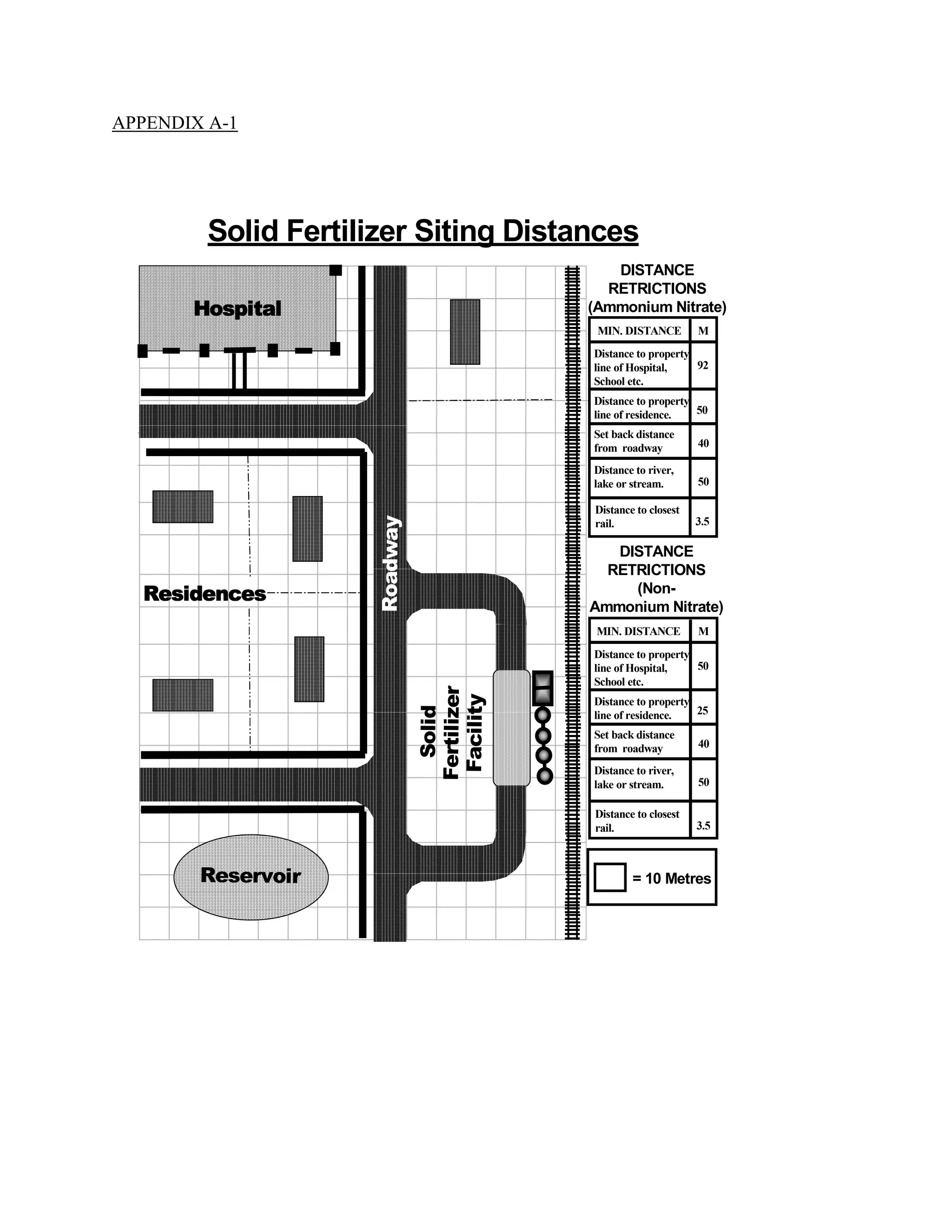
risk presented. An example siting plan is
presented in Appendix A-1.
2.1.1 Recommendations
1. All Fertilizer Blenders and/or
Bulk/Bagged Fertilizer Storage (new
construction) - 25 metres from facility to
closest neighboring property line.
2. All Fertilizer Blenders and/or
Bulk/Bagged Fertilizer Storage (existing
facilities) - Facilities located closer than
25 metres from blending facility to closest
neighboring property line should install
dust control system.
3. Distance from rivers, lakes, streams
and/or environmentally sensitive areas -
50 metres from bulk storage facility or
blender to rivers, lakes, streams and/or
environmentally sensitive areas. Facilities
located closer than 50 metres should have
a plan for containing emergency response
water including an evaluation on dyking
requirements.
4. Ammonia Nitrate Storage Facilities -
National Fire Code (1995) references the
Canadian Transportation Commission
(CTC) General Order No. 0-36 as follows:
!"92 metres from storage facility to
school, hospital, senior citizen’s home
or other high occupancy facility.
!"46 metres from storage facility to
residence, office building, etc.
!"16 metres from storage facility to any
warehouse or facility used for the
storage of dangerous or
flammable/combustible products.
!"8 metres separation from other
facilities on adjoining properties if
aggregate storage is less than 182
tonnes.
!"16 metres separation from other
facilities on adjoining properties if
aggregate storage is less than 182
tonnes.
5. Distance from Fertilizer Storage
Facility to Roadway – typically at least
40 metres from the edge of the roadway to
the facility. However, it is recommended
that the facility owner check with local
provincial officials for specific
requirements.
6. Prevailing Wind Directions - prevailing
wind direction should be considered when
determining site locations for blending or
bulk fertilizer storage facilities. All dust
producing operations should be located
downwind from residential and/or
environmentally sensitive areas.
7. Access to Primary Roads - Access to
primary roads is critical to ensure
unrestricted fertilizer delivery. In several
jurisdictions, restrictions may be placed on
access to secondary roads for fertilizer
delivery.
8. Emergency Response Access - Access to
two sides of the facility with a minimum
10 metres clearance for Emergency
Response Vehicles.
2.2 Facility and Equipment Design
and Construction
The contents of this section were largely
determined by the responses to the risk
assessment survey. These designated risk
areas were investigated to determine the risk
presented. This risk assessment was then
used to develop recommendations based on
existing codes, regulations and/or industry
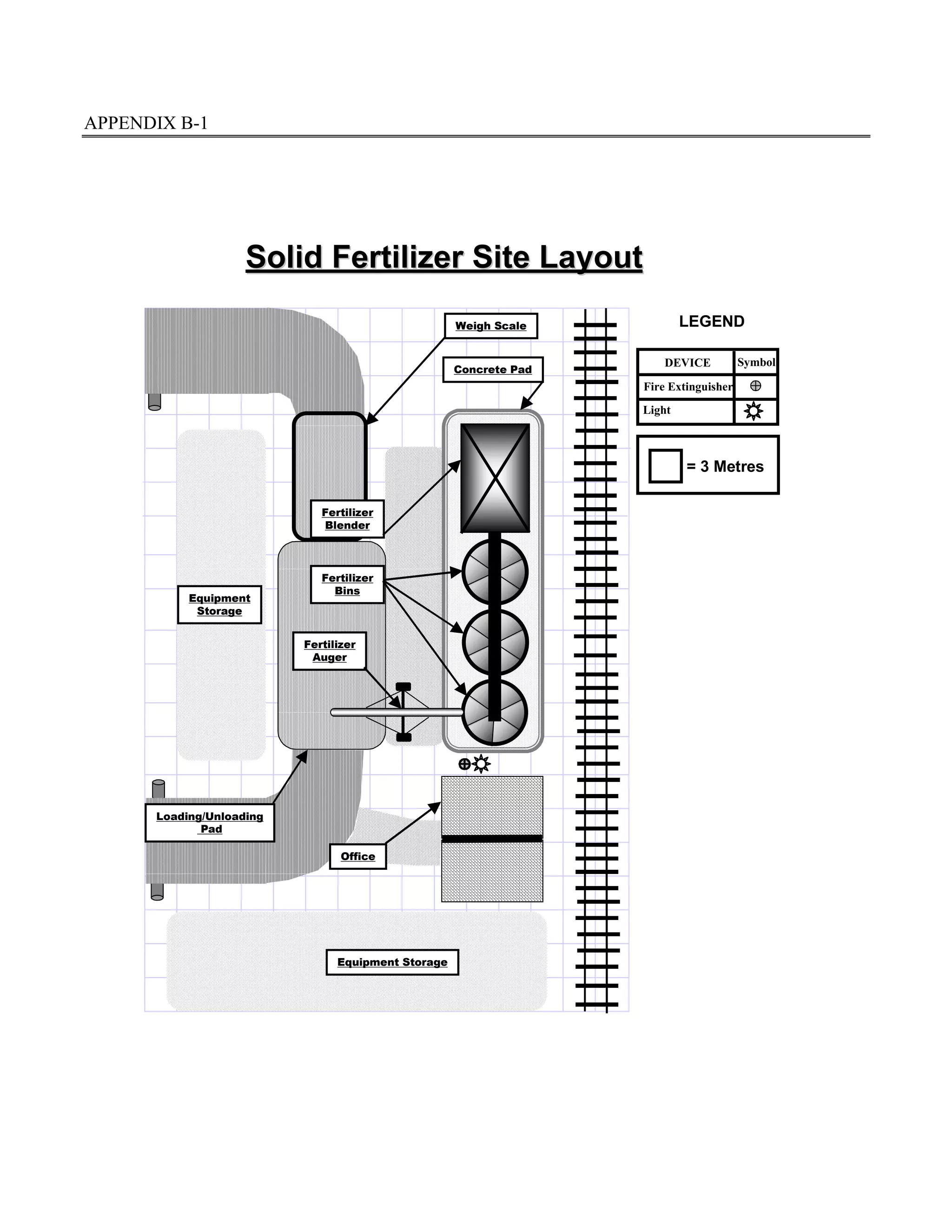
practices. An example layout plan is
presented in Appendix B-1.
2.2.1 Recommendations
1. Design Specification for Out of
Condition Material:
!"Regular Fertilizer - stored in a
contained area that is covered to
prevent contamination from rainwater.
Can be ground up and disposed of at a
later date.
!"Impregnated Fertilizer - Dealt with
promptly upon occurrence, not stored
on site.
2. Containment of Run-Off Water:
!"Priority must be placed on eliminating
the opportunities for contamination.
Small spills, leaks or dust must be
cleaned up immediately.
!"Contaminated run-off water must be
contained and disposed of properly
(i.e. land-farmed, certified waste
disposal, etc.)
3. Load-In/Load-Out Pads Design &
Construction:
!"Must be constructed of concrete or
asphalt.
!"Must be situated at all load in/load out
areas as well as under bins, blenders
and/or storage facilities.
!"Concrete should be sulphate resistant.
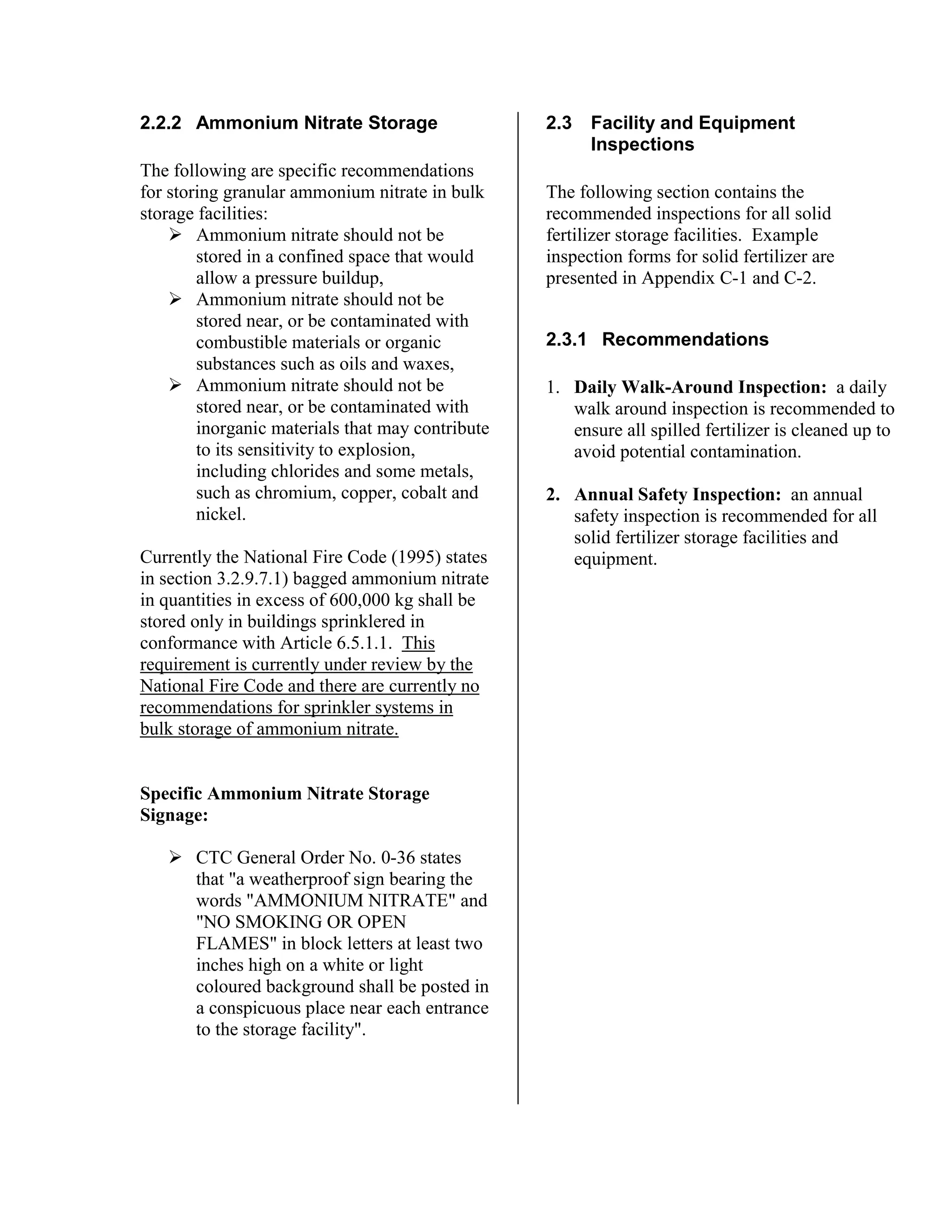
!"Load in/load out slab should be a
minimum of 2 metres wider than the
widest vehicle being loaded. See
figure 2.1.
!"Underground conveyor systems should
consider measures to avoid possible
water contamination.
4. Ventilation for Indoor Bulk/Blender
Warehouses:
!"Forced ventilation system should be
installed where practical. Where this
is not practical, dust masks or
respirators suitable for products being
handled, should be used by personnel
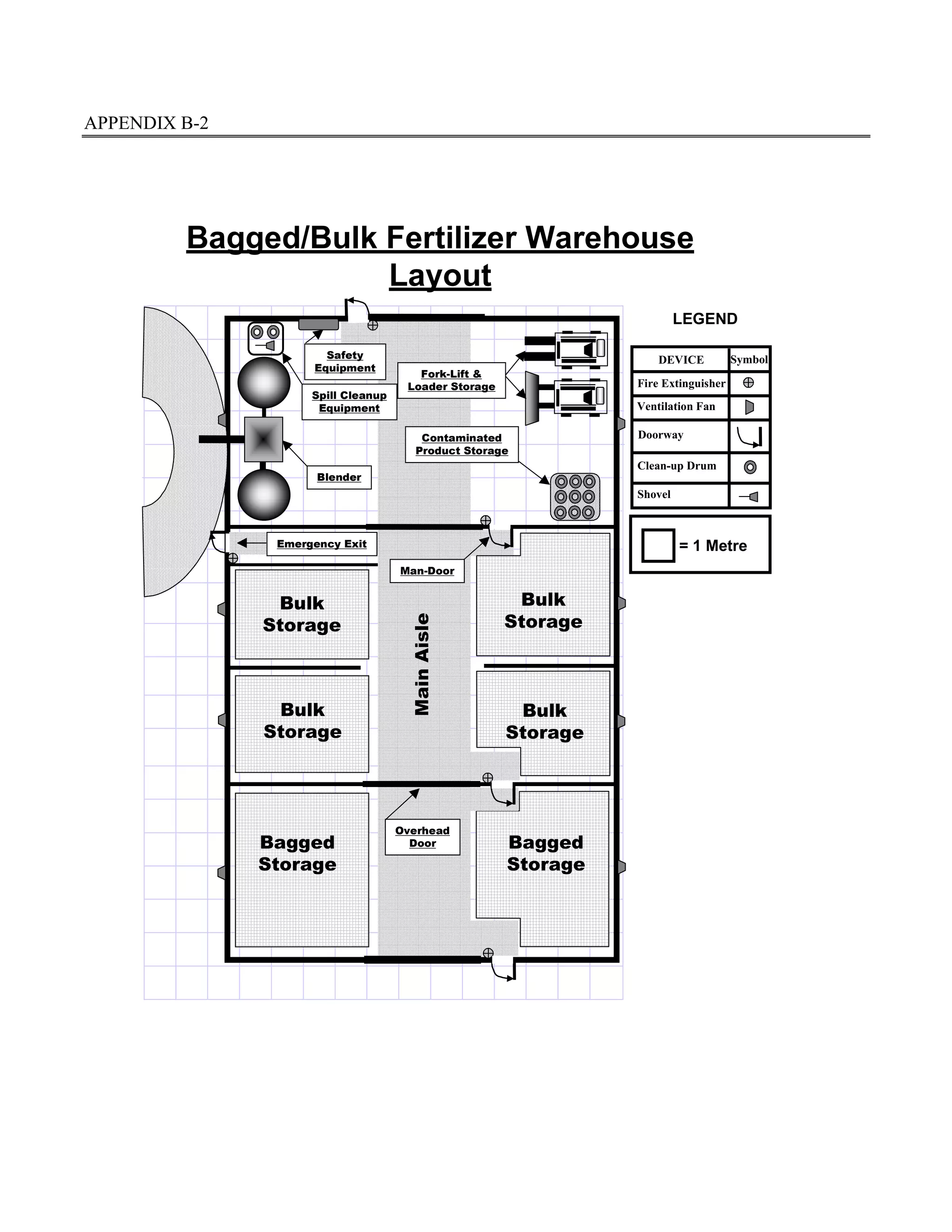
working in the facility. An example
warehouse layout is presented in
Appendix B-2.
5. Dust Collection:
!"Provincial or municipal environmental
dust control regulations should be
consulted to determine maximum
allowable dust production.
Figure 2.1 Load-in/Load-out Slab
!"Dust collection system should be
constructed of corrosion resistant
material.
!"Primary focus should be on limiting
points of dust production (i.e. points of
transfer, tops of conveyors, etc.)
6. Equipment Specification Requirements:
Electrical Code Designation is Class II
Div. II for all fertilizers. Further, all
fixtures must be aluminum or PVC to
resist corrosion.
7. Soil Preparation: Soil preparation should
consist of a compacted sub-base to provide
for a good foundation and decrease
permeability.
8. Fire Separation Requirements: The
majority of fertilizers are not classified as
hazardous products. However, fertilizer
storage facilities are often attached to
other facilities that may store hazardous
products. In these cases, the National Fire
Code and Building Code should be
consulted to determine any fire rating
requirements.
9. Location of Exits in a Warehouse: in
accordance with the National Building
Code (1995), the maximum travel distance
between exits should not exceed 15
metres. An example warehouse layout is
presented in Appendix B-2.
10. General Fertilizer Storage Signage:
!"Authorized Personnel Only (on
warehouse entrances)
!"Emergency Response Phone Numbers
(near road access to facility)
!"Exits
!"Fire Extinguishers
!"Safety Equipment Location
11. Emergency Response/Spill Clean-up
Equipment (located in a readily
accessible location):
!"Respirator
!"Goggles
!"Broom/Shovel
!"Gloves
!"Clean-up Drum for contaminated
product
!"Safety Equipment
!"Dust Mask/Respirator
2.2.2 Ammonium Nitrate Storage
The following are specific recommendations
for storing granular ammonium nitrate in bulk
storage facilities:
!"Ammonium nitrate should not be
stored in a confined space that would
allow a pressure buildup,
!"Ammonium nitrate should not be
stored near, or be contaminated with
combustible materials or organic
substances such as oils and waxes,
!"Ammonium nitrate should not be
stored near, or be contaminated with
inorganic materials that may contribute
to its sensitivity to explosion,
including chlorides and some metals,
such as chromium, copper, cobalt and
nickel.
Currently the National Fire Code (1995) states
in section 3.2.9.7.1) bagged ammonium nitrate
in quantities in excess of 600,000 kg shall be
stored only in buildings sprinklered in
conformance with Article 6.5.1.1. This
requirement is currently under review by the
National Fire Code and there are currently no
recommendations for sprinkler systems in
bulk storage of ammonium nitrate.
Specific Ammonium Nitrate Storage
Signage:
!"CTC General Order No. 0-36 states
that "a weatherproof sign bearing the
words "AMMONIUM NITRATE" and
"NO SMOKING OR OPEN
FLAMES" in block letters at least two
inches high on a white or light
coloured background shall be posted in
a conspicuous place near each entrance
to the storage facility".
2.3 Facility and Equipment
Inspections
The following section contains the
recommended inspections for all solid
fertilizer storage facilities. Example
inspection forms for solid fertilizer are
presented in Appendix C-1 and C-2.
2.3.1 Recommendations
1. Daily Walk-Around Inspection: a daily
walk around inspection is recommended to
ensure all spilled fertilizer is cleaned up to
avoid potential contamination.
2. Annual Safety Inspection: an annual
safety inspection is recommended for all
solid fertilizer storage facilities and
equipment.
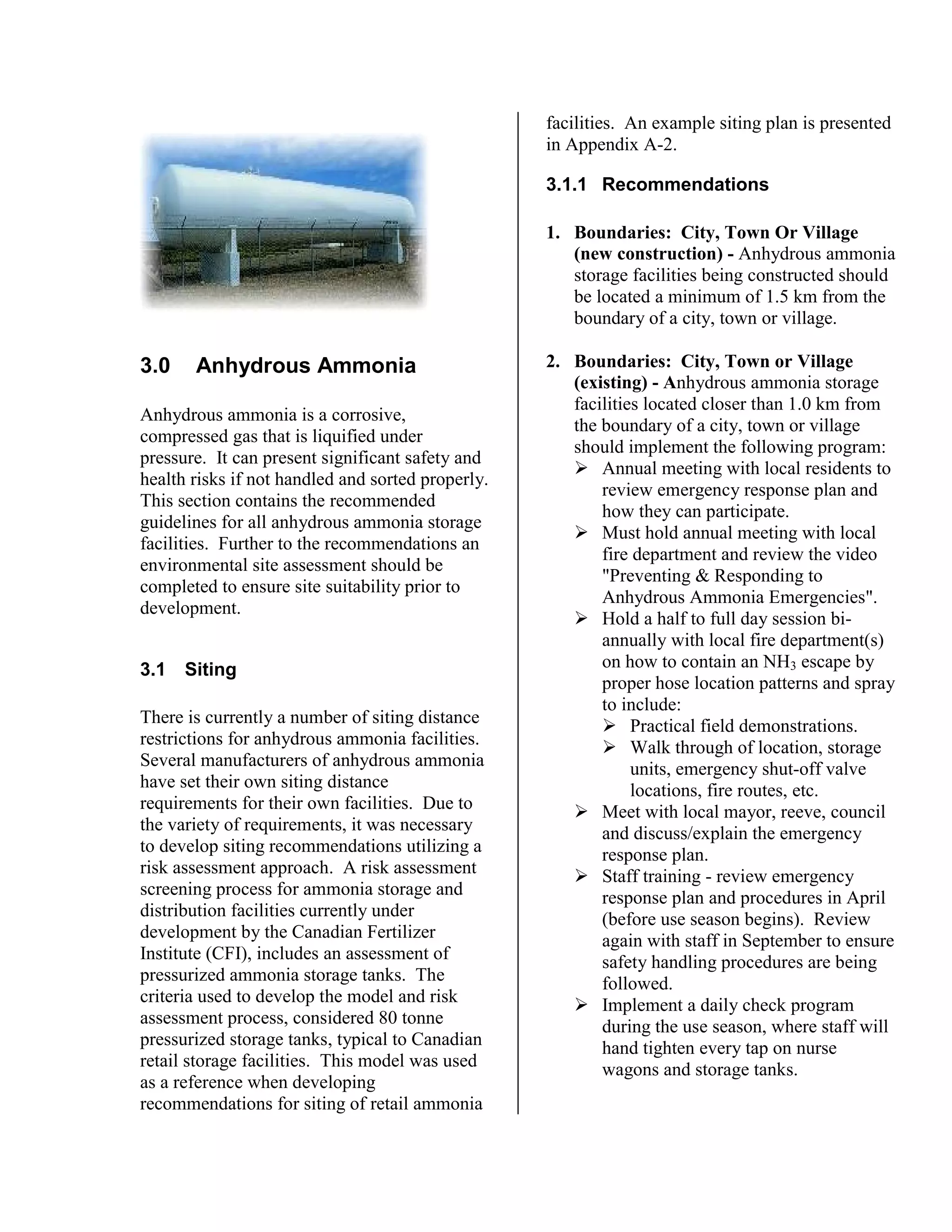
3.0 Anhydrous Ammonia
Anhydrous ammonia is a corrosive,
compressed gas that is liquified under
pressure. It can present significant safety and
health risks if not handled and sorted properly.
This section contains the recommended
guidelines for all anhydrous ammonia storage
facilities. Further to the recommendations an
environmental site assessment should be
completed to ensure site suitability prior to
development.
3.1 Siting
There is currently a number of siting distance
restrictions for anhydrous ammonia facilities.
Several manufacturers of anhydrous ammonia
have set their own siting distance
requirements for their own facilities. Due to
the variety of requirements, it was necessary
to develop siting recommendations utilizing a
risk assessment approach. A risk assessment
screening process for ammonia storage and
distribution facilities currently under
development by the Canadian Fertilizer
Institute (CFI), includes an assessment of
pressurized ammonia storage tanks. The
criteria used to develop the model and risk
assessment process, considered 80 tonne
pressurized storage tanks, typical to Canadian
retail storage facilities. This model was used
as a reference when developing
recommendations for siting of retail ammonia
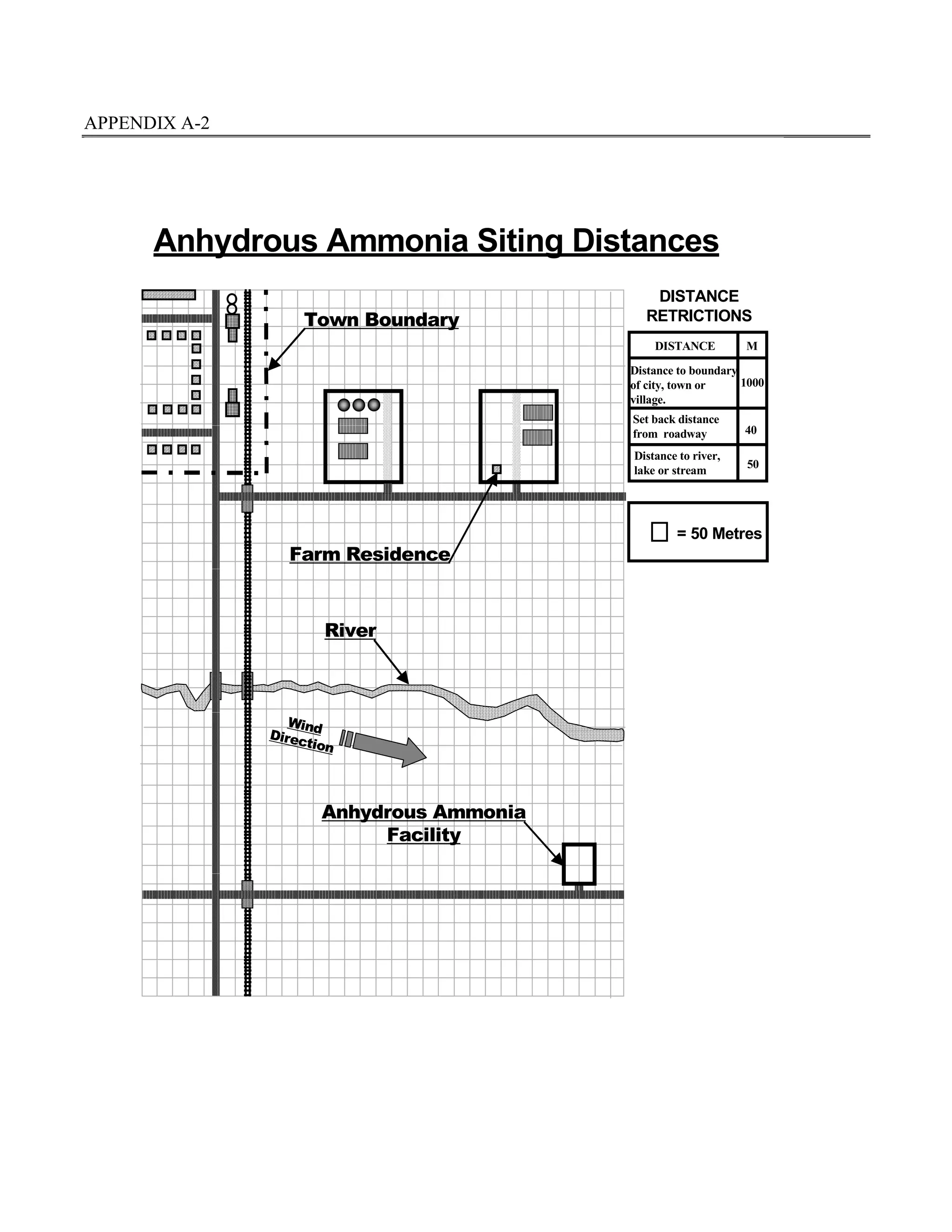
facilities. An example siting plan is presented
in Appendix A-2.
3.1.1 Recommendations
1. Boundaries: City, Town Or Village
(new construction) - Anhydrous ammonia
storage facilities being constructed should
be located a minimum of 1.5 km from the
boundary of a city, town or village.
2. Boundaries: City, Town or Village
(existing) - Anhydrous ammonia storage
facilities located closer than 1.0 km from
the boundary of a city, town or village
should implement the following program:
!"Annual meeting with local residents to
review emergency response plan and
how they can participate.
!"Must hold annual meeting with local
fire department and review the video
"Preventing & Responding to
Anhydrous Ammonia Emergencies".
!"Hold a half to full day session bi-
annually with local fire department(s)
on how to contain an NH3 escape by
proper hose location patterns and spray
to include:
!"Practical field demonstrations.
!"Walk through of location, storage
units, emergency shut-off valve
locations, fire routes, etc.
!"Meet with local mayor, reeve, council
and discuss/explain the emergency
response plan.
!"Staff training - review emergency
response plan and procedures in April
(before use season begins). Review
again with staff in September to ensure
safety handling procedures are being
followed.
!"Implement a daily check program
during the use season, where staff will
hand tighten every tap on nurse
wagons and storage tanks.
Please note: All the program elements listed
here should be considered for new facilities as
well.
3. Environmentally Sensitive Areas:
Anhydrous ammonia storage facilities
should be located a minimum of 50 metres
from areas such as rivers, lakes, streams
and other environmentally sensitive areas
provided the dyking is installed to contain
emergency response water.
4. General Site Recommendation:
Anhydrous ammonia facilities should be
located downwind of residences according
to prevailing wind direction.
5. Emergency Response Access: Access to
two sides of the facility with a minimum
10 metres clearance for Emergency
Response Vehicles.
3.2 Facility Design & Construction
The contents of this section were largely
determined by the responses to the risk
assessment survey. These designated risk
areas were investigated to determine the risk
presented. This risk assessment was then
used to develop recommendations based on
existing codes, regulations and/or industry
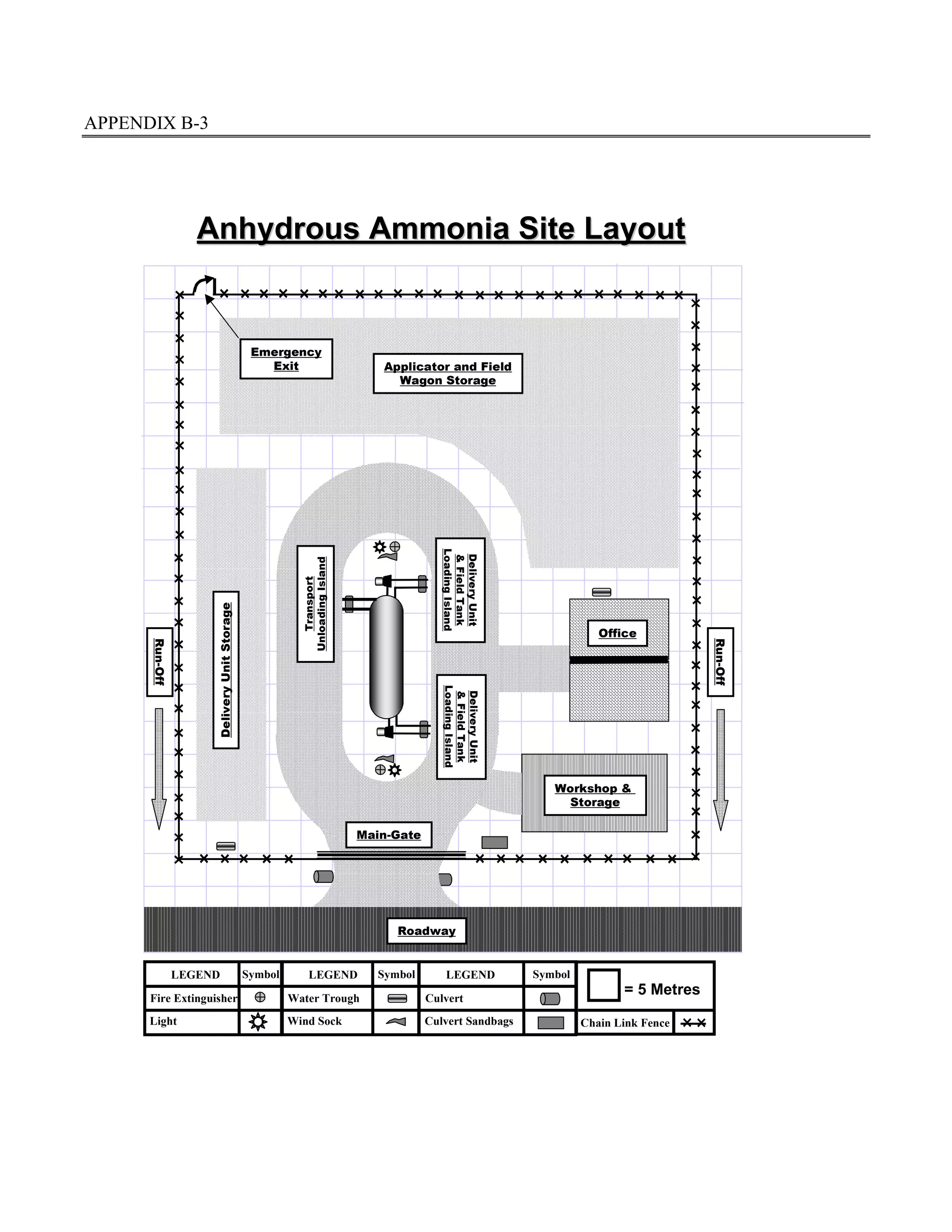
practices. An example facility layout is
presented in Appendix B-3.
1. Tank Construction: Anhydrous
ammonia storage tanks should be
constructed of SA-516-70 Fine Grained
Steel that has been fully stress relieved at
the time of construction.
2. Site Fencing & Security: A 2 metre high
fence is recommended around entire
anhydrous ammonia storage site to prevent
unauthorized access.
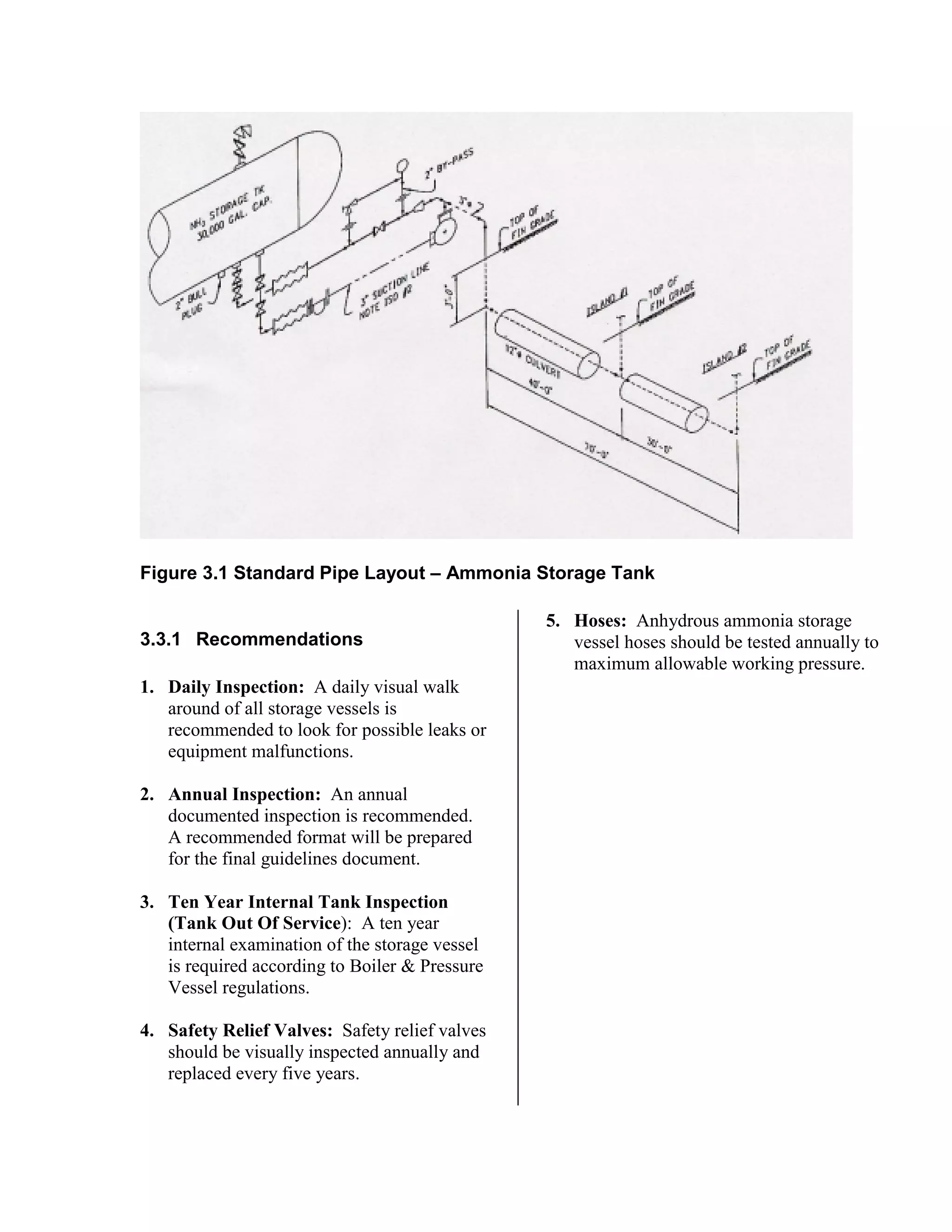
3. Standard Pipe Layout: A typical pipe
layout is shown in figure 3.1.
4. Facility Signage: The recommended
standard signage and location is:
!"Caution Ammonia (on tank)
!"Product Identification Number (PIN
#1005) (on tank)
!"Liquid Lines (on tank line)
!"Vapour Line (on tank line)
!"Twenty Four Hour Emergency Contact
Phone List (entrance to Facility)
5. Safety Equipment: The recommended
safety equipment for an anhydrous
ammonia operation is:
!"200 Gallon Water Trough (heated)
!"Wind Sock
!"One Self Contained Breathing
Apparatus
!"Full Face Canister Gas Mask (Delivery
Vehicle)
!"Personal Protective Equipment -
Goggles, Gloves, Turn Out Gear and
Water Bottle
!"Fire Extinguisher
!"First Aid Kit
6. Site Preparation/Soil Profile:
Anhydrous ammonia storage facility site
should be graded to minimize surface
water run-off and provide emergency
containment in the case of a major release.
3.3 Facility and Equipment
Inspections
The following section contains the
recommended inspections for all anhydrous
ammonia storage facilities. Example
inspection forms are presented in Appendix
C-3 and C-4.
Figure 3.1 Standard Pipe Layout – Ammonia Storage Tank
3.3.1 Recommendations
1. Daily Inspection: A daily visual walk
around of all storage vessels is
recommended to look for possible leaks or
equipment malfunctions.
2. Annual Inspection: An annual
documented inspection is recommended.
A recommended format will be prepared
for the final guidelines document.
3. Ten Year Internal Tank Inspection
(Tank Out Of Service): A ten year
internal examination of the storage vessel
is required according to Boiler & Pressure
Vessel regulations.
4. Safety Relief Valves: Safety relief valves
should be visually inspected annually and
replaced every five years.
5. Hoses: Anhydrous ammonia storage
vessel hoses should be tested annually to
maximum allowable working pressure.
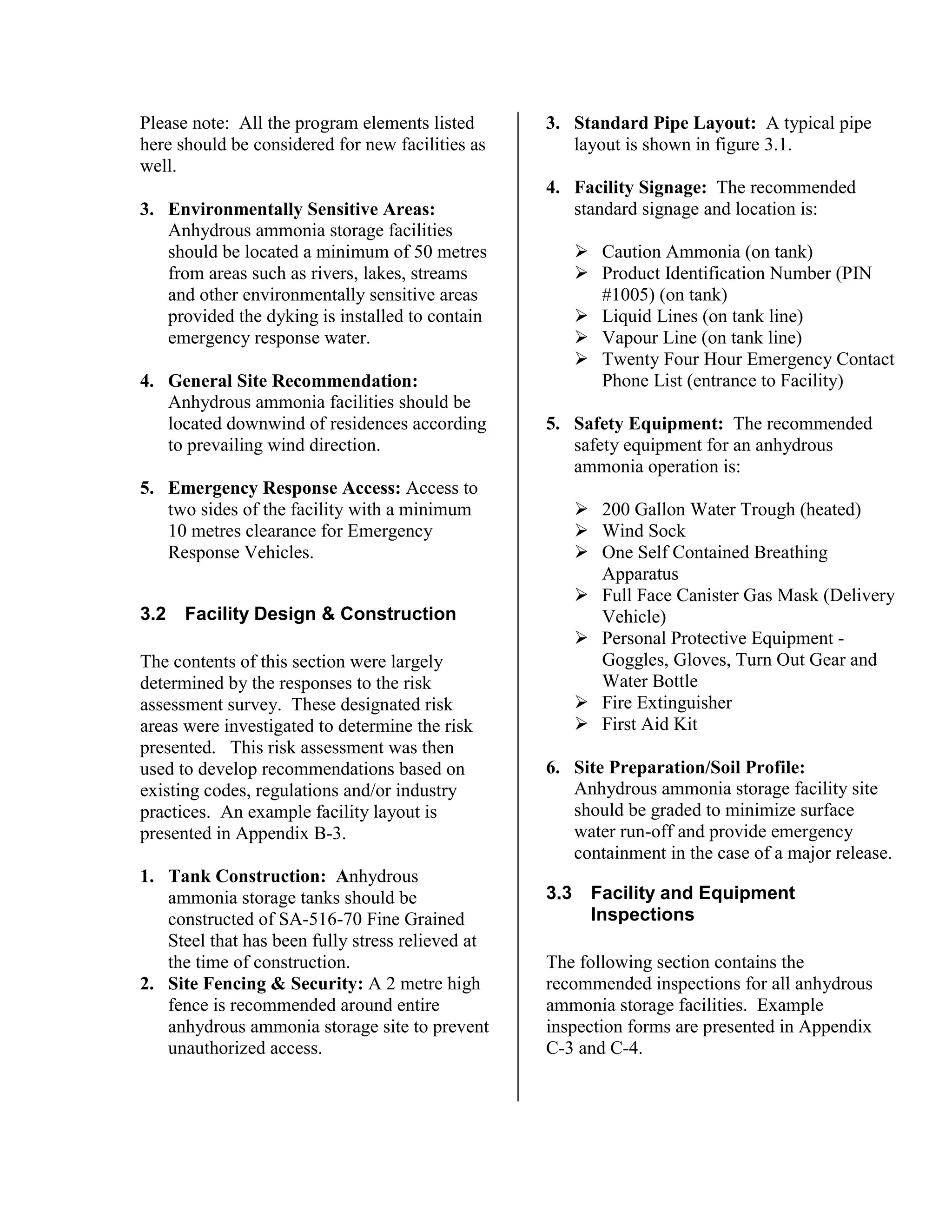
4.0 Liquid Fertilizer
This section outlines the recommendations
and technical guidelines for the storage and
handling of the following types of liquid
fertilizers:
• urea ammonium nitrate solutions
• ammonium polyphosphate
• ammonium thiosulphate
• muriate of potash
• fertilizers in suspension (various)
Further to the recommendations, an
environmental site assessment should be
completed to ensure site suitability prior to
development.
4.1 Siting
Liquid fertilizer storage facilities do not
generally represent a risk to surrounding land
uses in terms of health and safety.
Environmental impacts of a storage tank
failure are the primary concern with respect to
siting and it is recommended that secondary
containment of the storage tank contents be
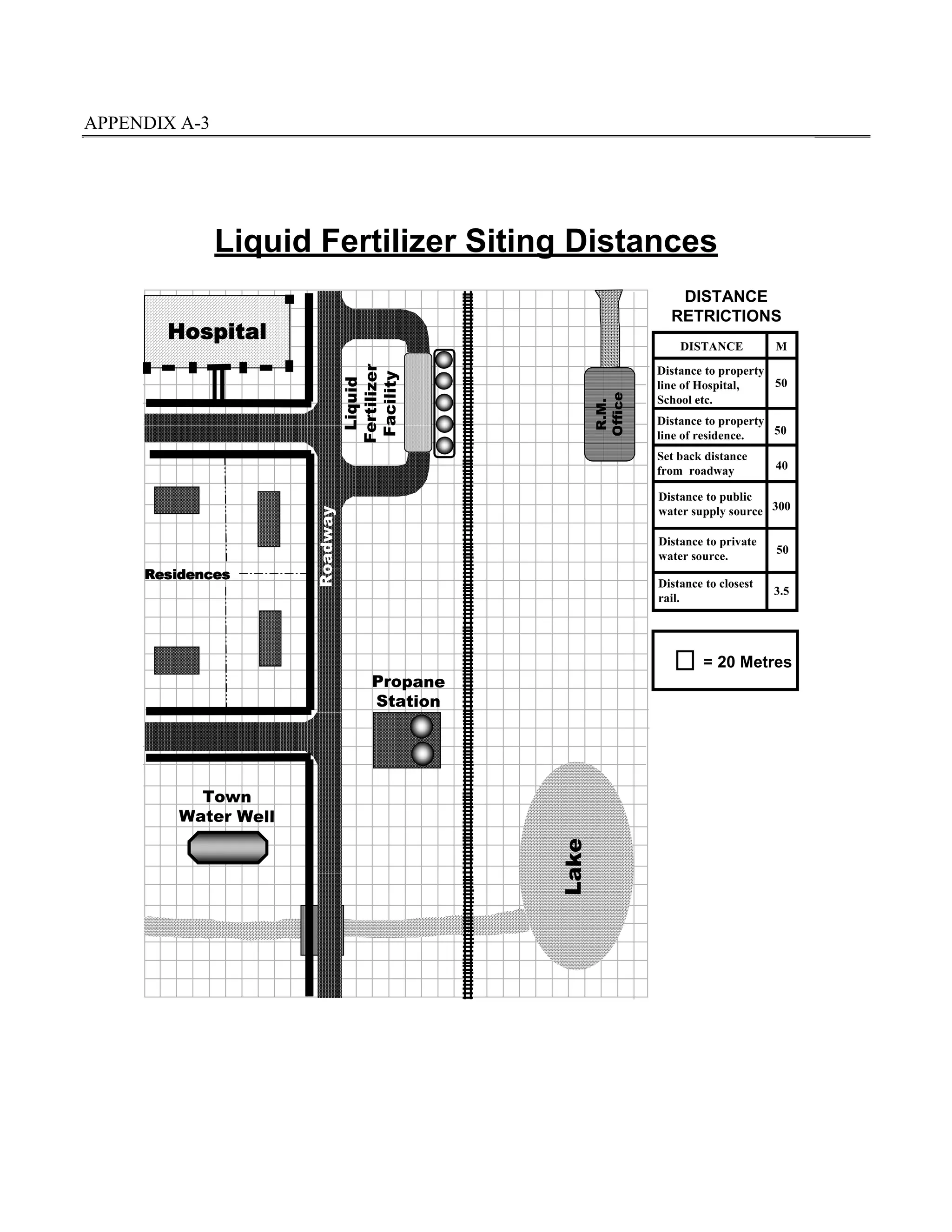
provided in all cases. An example siting plan
is provided in Appendix A-3.
4.1.1 Recommendations
1. Water sources: Liquid fertilizer storage
facilities should be a minimum of 50
metres from private wells and 300 metres
from a source of public water supply.
(Facilities located closer than these
recommended distances should examine
the hydro-geological conditions to
determine potential for contamination of
the water source and establish whether or
not additional containment measures are
required).
2. Environmentally Sensitive areas:
Liquid storage facilities should be a
minimum of 50 metres from rivers, lakes,
streams and environmentally sensitive
areas.
3. Emergency Response Access: Access to
two sides of the facility with a minimum
10 metres clearance for Emergency
Response Vehicles.
4. Distance from Liquid Storage Facility to
Roadway: Typically at least 40 metres
from the edge of the roadway to the
facility. However, it is recommended that
the facility owner check with local
provincial officials for specific
requirements.
4.2 Facility Equipment Design &
Construction
This section covers several items that should
be considered when designing or renovating
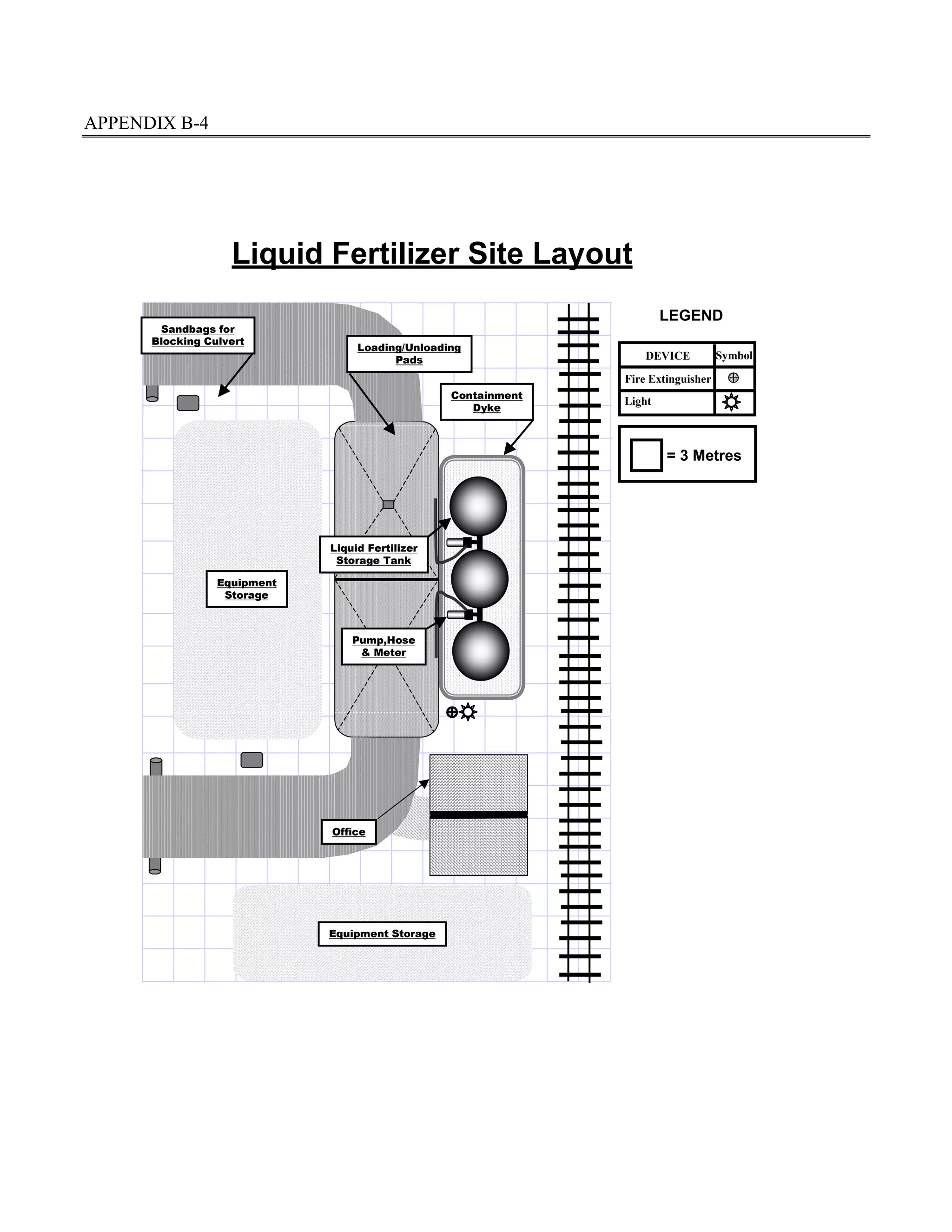
existing liquid fertilizer facilities. An example
facility layout is presented in Appendix B-4.
4.2.1 Recommendations
1. Site Preparation/Soil Profile: Sound
engineering principles should be applied
when choosing a site or a location within a
site and when designing a facility and
preparing for construction. Consideration
of floodlines and high water tables should
guide the decision for location of the
facility within the site. Ensure that the site
is graded to minimize surface water flow
onto the property and also ensure the
ability to capture surface water flow from
the site in the event of a spill. Frost
conditions and soil load bearing capacity
should also be factored into design
process.
2. Containment: All sites should be
graded/curbed to ensure spills in areas
where liquid fertilizer is handled will be
contained and drained to a collection point
(sump). Grades recommended for areas
draining to sumps range from 1 to 2 %.
3. Site Fencing and Security: Site security
is required to prevent accidents and to
minimize unauthorized access resulting in
spills or vandalism. A secure lock system
on all valves should be provided as a
minimum. Fencing around the entire site
is suggested as a good business practice
although it is recognized that this is not
practical or desirable in many operations.
If sight gauges are used they should be
lockable and be installed downstream of
the outlet valves.
4. Facility Layout for Delivery and Pick-
up: There should be adequate space to
allow for uninterrupted traffic flow and
allow for the safe movement of vehicles.
It is recommended that load-out facilities
be designed to allow for circular
movement of vehicles, but that will
depend on individual operations. In a
facility that requires the trucks, such as 5
axle semi trailers, A and B trains, a turning
radius should be provided to allow for:
- 42 metres minimum turning radius
- 50 metres preferred turning radius
5. Access to Site - Public Roadways:
Roads that experience high traffic increase
the potential for accidents and therefore
access roads with low traffic are most
desirable. Traffic routes with load
restrictions could restrict supplier and
customer and may have an impact on the
business. Discussion with the local
authorities should be initiated very early in
the planning process to ensure that site
access during peak times will not be a
problem.
6. Signage: A sign should be posted on the
storage tanks that clearly identifies the
product contained in the tank by text (i.e.
Nitrogen Solution) and numerical (i.e. 28-
0-0) description. Supplier MSDS sheets
will indicate whether or not there is a
Workplace Hazardous Materials
Information System (WHMIS)
requirement for product labeling.
For the overall site, signage is
recommended as follows: A sign shall be
placed that is legible from the primary
entrance to the property which indicates
the owner or operator of the site and/or the
emergency phone number(s) that will
initiate the site E/R plan. The sign shall be
of a permanent, weatherproof
construction.
7. Equipment Specification Requirements
(pipes, valves, fittings): It is
recommended that flexible connections at
the tank be made to a stainless steel nipple
and valve using stainless steel braid rubber
hose to allow for shifting of the tank. As a
minimum Schedule 80 piping is
recommended and it should be installed so
that it is self-draining. Pipe runs should be
marked (in/out) for safety purposes. Tank
piping should be compatible with material
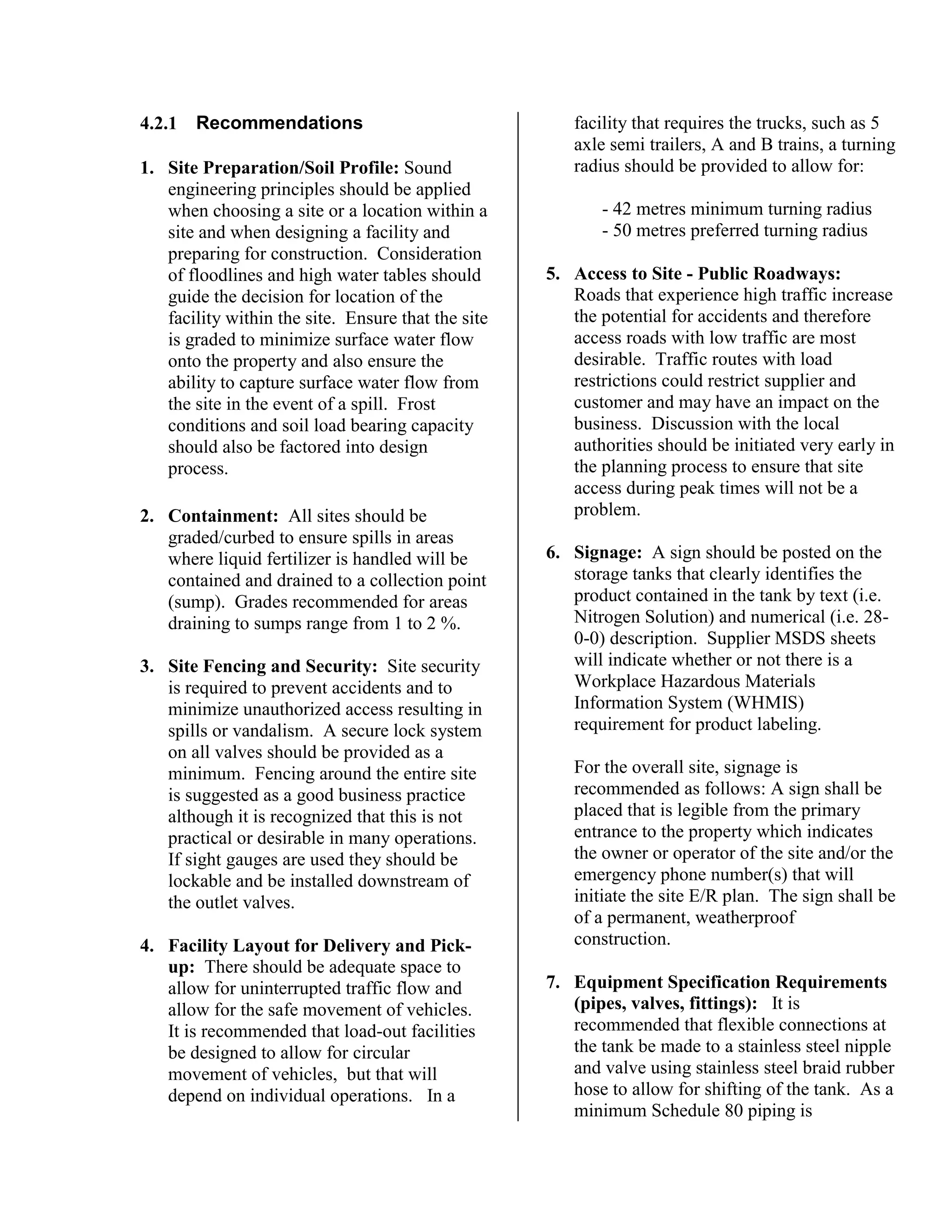
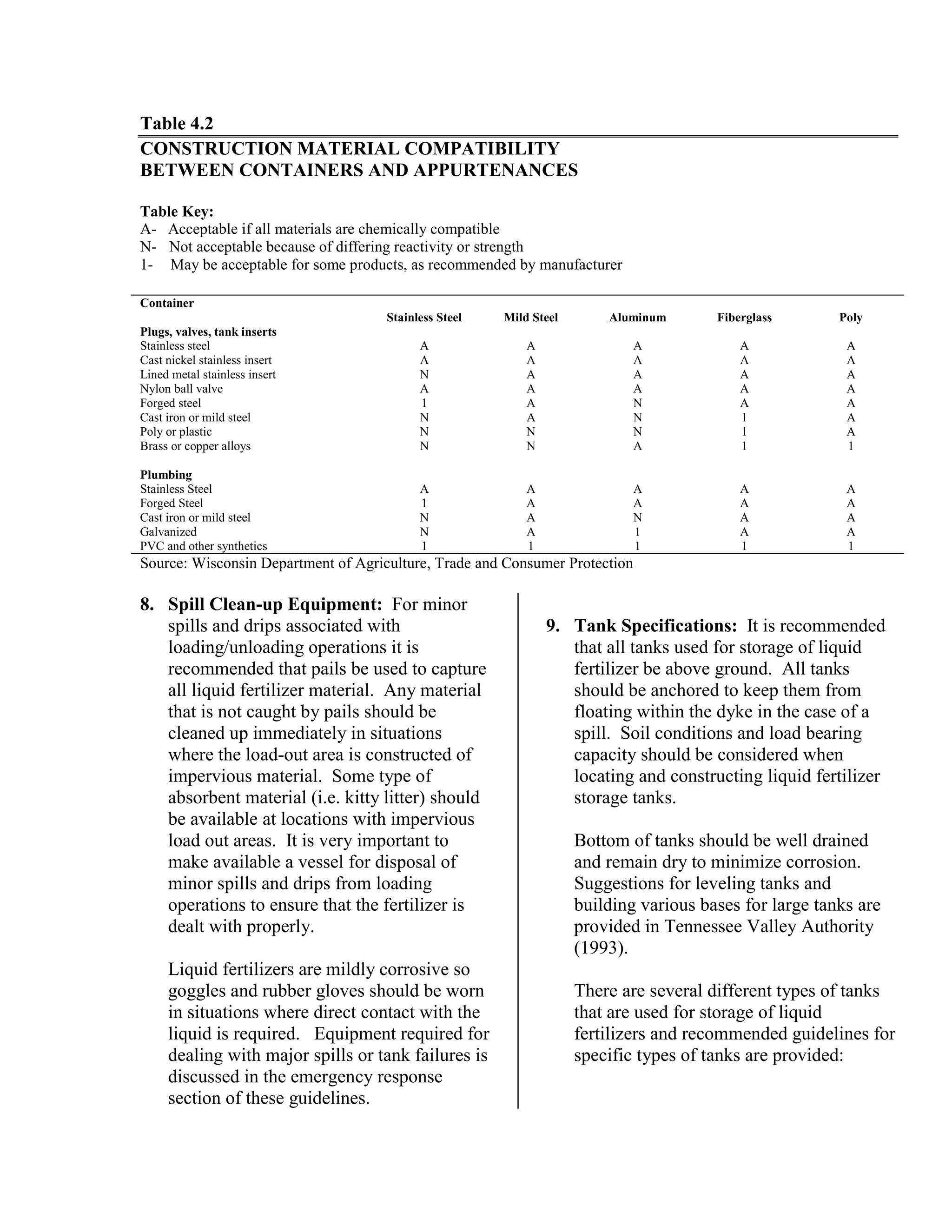
stored within the tanks. Table 4.1 lists the
chemical compatibility for several liquid
fertilizer compounds and various
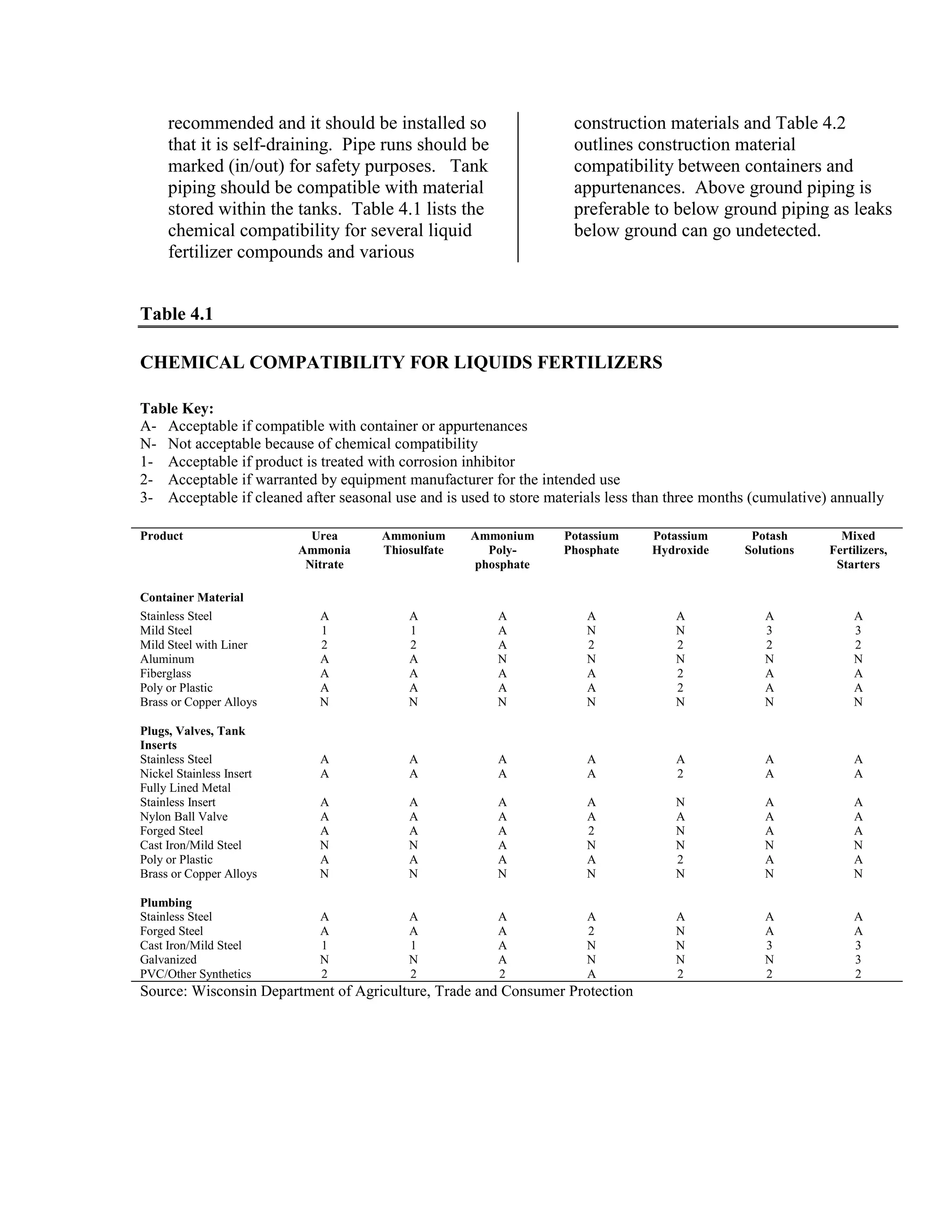
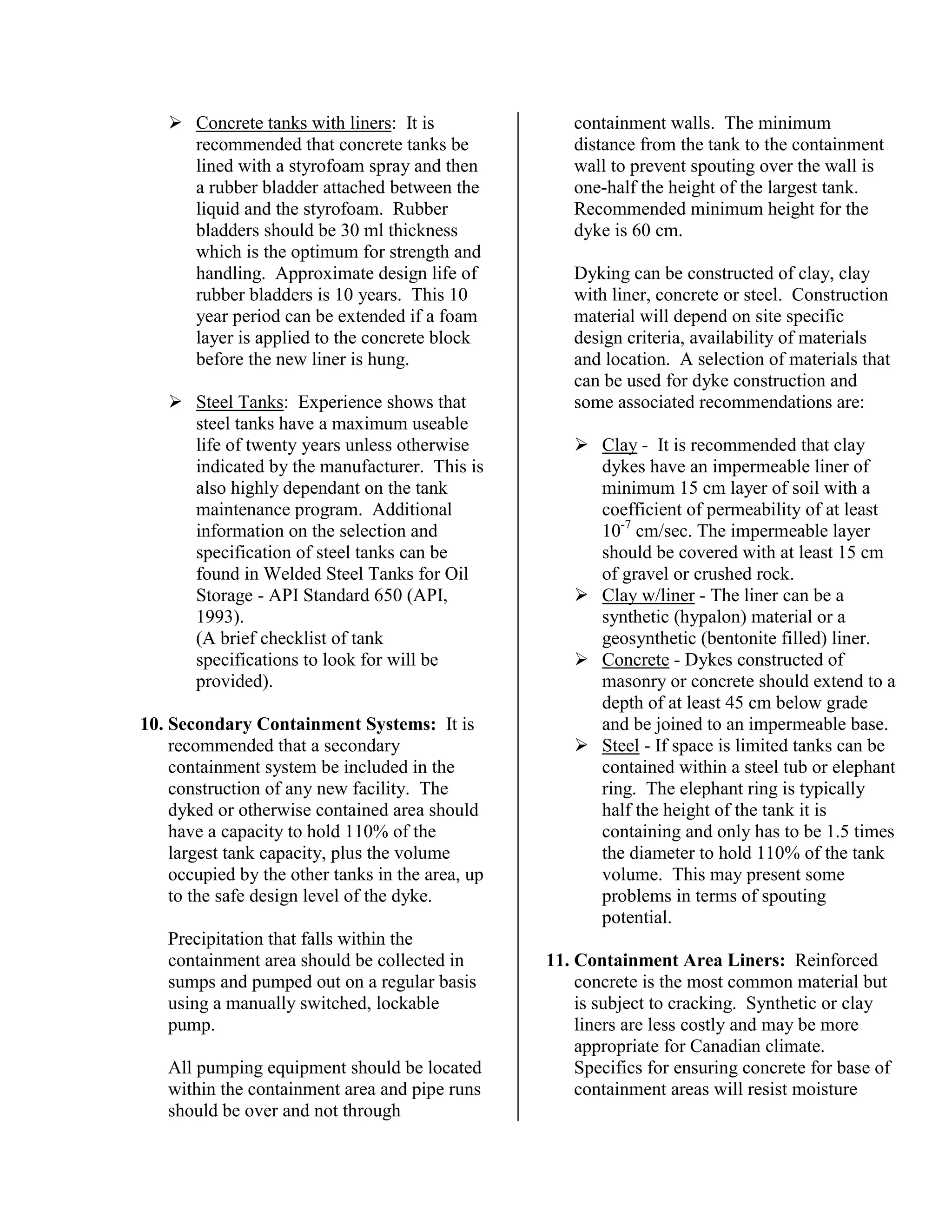
construction materials and Table 4.2
outlines construction material
compatibility between containers and
appurtenances. Above ground piping is
preferable to below ground piping as leaks
below ground can go undetected.
Table 4.1
CHEMICAL COMPATIBILITY FOR LIQUIDS FERTILIZERS
Table Key:
A- Acceptable if compatible with container or appurtenances
N- Not acceptable because of chemical compatibility
1- Acceptable if product is treated with corrosion inhibitor
2- Acceptable if warranted by equipment manufacturer for the intended use
3- Acceptable if cleaned after seasonal use and is used to store materials less than three months (cumulative) annually
Product Urea
Ammonia
Nitrate
Ammonium
Thiosulfate
Ammonium
Poly-
phosphate
Potassium
Phosphate
Potassium
Hydroxide
Potash
Solutions
Mixed
Fertilizers,
Starters
Container Material
Stainless Steel A A A A A A A
Mild Steel 1 1 A N N 3 3
Mild Steel with Liner 2 2 A 2 2 2 2
Aluminum A A N N N N N
Fiberglass A A A A 2 A A
Poly or Plastic A A A A 2 A A
Brass or Copper Alloys N N N N N N N
Plugs, Valves, Tank
Inserts
Stainless Steel A A A A A A A
Nickel Stainless Insert A A A A 2 A A
Fully Lined Metal
Stainless Insert A A A A N A A
Nylon Ball Valve A A A A A A A
Forged Steel A A A 2 N A A
Cast Iron/Mild Steel N N A N N N N
Poly or Plastic A A A A 2 A A
Brass or Copper Alloys N N N N N N N
Plumbing
Stainless Steel A A A A A A A
Forged Steel A A A 2 N A A
Cast Iron/Mild Steel 1 1 A N N 3 3
Galvanized N N A N N N 3
PVC/Other Synthetics 2 2 2 A 2 2 2
Source: Wisconsin Department of Agriculture, Trade and Consumer Protection
Table 4.2
CONSTRUCTION MATERIAL COMPATIBILITY
BETWEEN CONTAINERS AND APPURTENANCES
Table Key:
A- Acceptable if all materials are chemically compatible
N- Not acceptable because of differing reactivity or strength
1- May be acceptable for some products, as recommended by manufacturer
Container
Stainless Steel Mild Steel Aluminum Fiberglass Poly
Plugs, valves, tank inserts
Stainless steel A A A A A
Cast nickel stainless insert A A A A A
Lined metal stainless insert N A A A A
Nylon ball valve A A A A A
Forged steel 1 A N A A
Cast iron or mild steel N A N 1 A
Poly or plastic N N N 1 A
Brass or copper alloys N N A 1 1
Plumbing
Stainless Steel A A A A A
Forged Steel 1 A A A A
Cast iron or mild steel N A N A A
Galvanized N A 1 A A
PVC and other synthetics 1 1 1 1 1
Source: Wisconsin Department of Agriculture, Trade and Consumer Protection
8. Spill Clean-up Equipment: For minor
spills and drips associated with
loading/unloading operations it is
recommended that pails be used to capture
all liquid fertilizer material. Any material
that is not caught by pails should be
cleaned up immediately in situations
where the load-out area is constructed of
impervious material. Some type of
absorbent material (i.e. kitty litter) should
be available at locations with impervious
load out areas. It is very important to
make available a vessel for disposal of
minor spills and drips from loading
operations to ensure that the fertilizer is
dealt with properly.
Liquid fertilizers are mildly corrosive so
goggles and rubber gloves should be worn
in situations where direct contact with the
liquid is required. Equipment required for
dealing with major spills or tank failures is
discussed in the emergency response
section of these guidelines.
9. Tank Specifications: It is recommended
that all tanks used for storage of liquid
fertilizer be above ground. All tanks
should be anchored to keep them from
floating within the dyke in the case of a
spill. Soil conditions and load bearing
capacity should be considered when
locating and constructing liquid fertilizer
storage tanks.
Bottom of tanks should be well drained
and remain dry to minimize corrosion.
Suggestions for leveling tanks and
building various bases for large tanks are
provided in Tennessee Valley Authority
(1993).
There are several different types of tanks
that are used for storage of liquid
fertilizers and recommended guidelines for
specific types of tanks are provided:
!"Concrete tanks with liners: It is
recommended that concrete tanks be
lined with a styrofoam spray and then
a rubber bladder attached between the
liquid and the styrofoam. Rubber
bladders should be 30 ml thickness
which is the optimum for strength and
handling. Approximate design life of
rubber bladders is 10 years. This 10
year period can be extended if a foam
layer is applied to the concrete block
before the new liner is hung.
!"Steel Tanks: Experience shows that
steel tanks have a maximum useable
life of twenty years unless otherwise
indicated by the manufacturer. This is
also highly dependant on the tank
maintenance program. Additional
information on the selection and
specification of steel tanks can be
found in Welded Steel Tanks for Oil
Storage - API Standard 650 (API,
1993).
(A brief checklist of tank
specifications to look for will be
provided).
10. Secondary Containment Systems: It is
recommended that a secondary
containment system be included in the
construction of any new facility. The
dyked or otherwise contained area should
have a capacity to hold 110% of the
largest tank capacity, plus the volume
occupied by the other tanks in the area, up
to the safe design level of the dyke.
Precipitation that falls within the
containment area should be collected in
sumps and pumped out on a regular basis
using a manually switched, lockable
pump.
All pumping equipment should be located
within the containment area and pipe runs
should be over and not through
containment walls. The minimum
distance from the tank to the containment
wall to prevent spouting over the wall is
one-half the height of the largest tank.
Recommended minimum height for the
dyke is 60 cm.
Dyking can be constructed of clay, clay
with liner, concrete or steel. Construction
material will depend on site specific
design criteria, availability of materials
and location. A selection of materials that
can be used for dyke construction and
some associated recommendations are:
!"Clay - It is recommended that clay
dykes have an impermeable liner of
minimum 15 cm layer of soil with a
coefficient of permeability of at least
10-7
cm/sec. The impermeable layer
should be covered with at least 15 cm
of gravel or crushed rock.
!"Clay w/liner - The liner can be a
synthetic (hypalon) material or a
geosynthetic (bentonite filled) liner.
!"Concrete - Dykes constructed of
masonry or concrete should extend to a
depth of at least 45 cm below grade
and be joined to an impermeable base.
!"Steel - If space is limited tanks can be
contained within a steel tub or elephant
ring. The elephant ring is typically
half the height of the tank it is
containing and only has to be 1.5 times
the diameter to hold 110% of the tank
volume. This may present some
problems in terms of spouting
potential.
11. Containment Area Liners: Reinforced
concrete is the most common material but
is subject to cracking. Synthetic or clay
liners are less costly and may be more
appropriate for Canadian climate.
Specifics for ensuring concrete for base of
containment areas will resist moisture
penetration are provided in Tennessee
Valley Authority (1993) (page 4-19).
4.3 Inspections
Most instances of product loss resulting in
environmental damage and/or economic losses
are from minor leaks that go unnoticed for
extended periods of time. The set of
recommendations for inspections includes a
daily, annual and 3 to 5 year inspection
regime. Example inspection forms are
presented in Appendix C-5, C-6 and C-7.
4.3.1 Recommendations
1. Daily Inspections: It is recommended
that on a daily basis, or as a minimum
twice weekly, a very simple walk around
inspection is made which looks at the
storage tanks, sumps and ponding areas
and easily visible pipes and pumps. This
is a recommended good management
practice that will help identify problems at
the earliest possible stage. The regular
inspection should be a simple procedure
that is documented so that it can be
monitored to ensure it is being completed.
2. Annual Inspection (Tank in service):
The recommended annual inspection for
various liquid fertilizer tanks in service
are:
!"Steel Tanks - A thorough inspection of
the storage tanks, containment
systems, piping, valves and pumps
should be undertaken on an annual
basis. For further reference a sample
liquid tank inspection report is
provided in Appendix B. The
American Petroleum Institute (API)
Standard 653 - Tank Inspection,
Repair, Alteration and Reconstruction
provides a detailed checklist for
inspection of steel storage tanks,
including examination of tank
foundation, shell, appurtenances, and
roofs if they exist.
3. Three to Five Year Inspection (Tank
out of service):
!"Steel Tanks - It is recommended that
on a three to five year cycle, steel
tanks be drained and sludge that builds
up in the bottom of the tank be
removed.
5.0 Employee Training and
Documentation
The following section outlines the
recommended training programs and
documentation requirements for all fertilizer
operations.
5.1 Employee Training
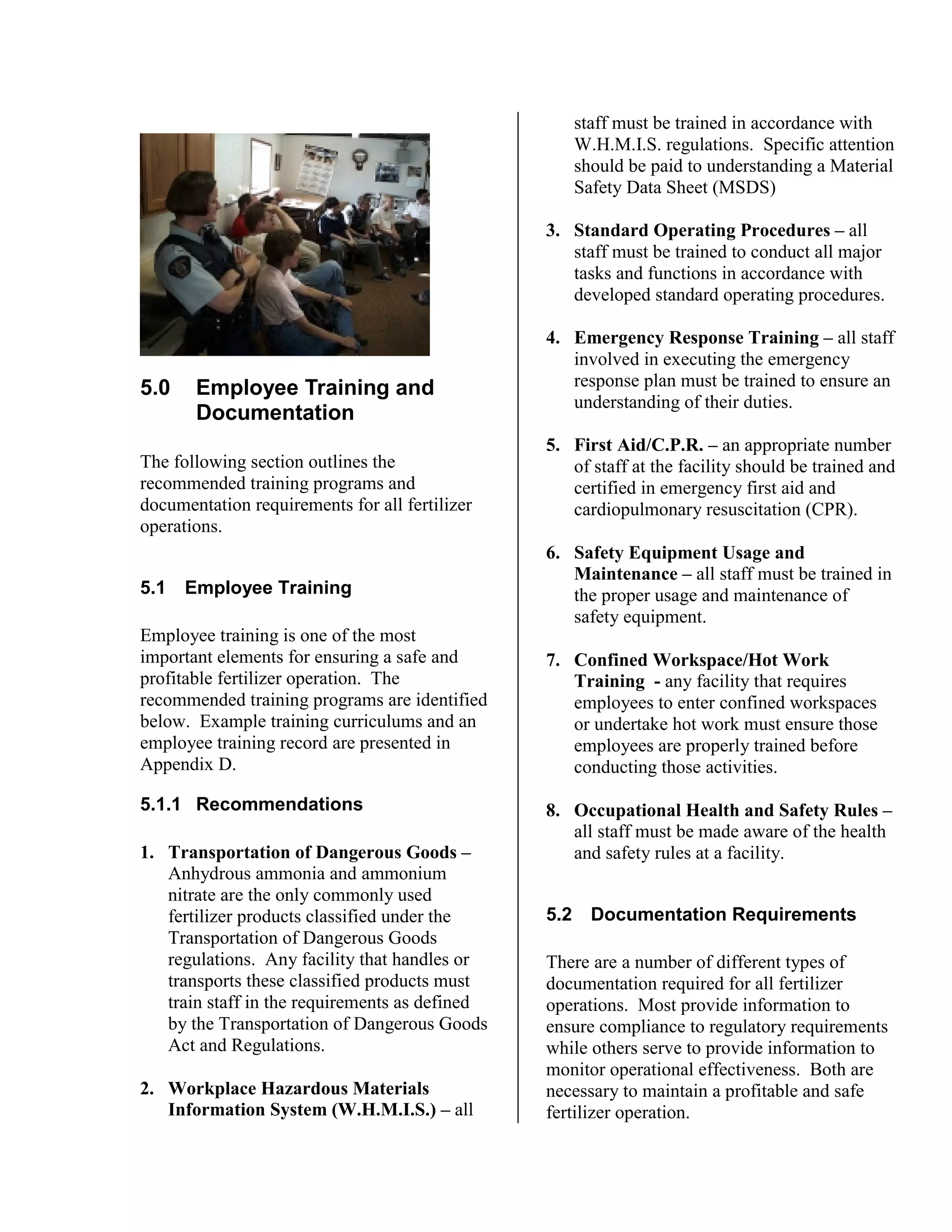
Employee training is one of the most
important elements for ensuring a safe and
profitable fertilizer operation. The
recommended training programs are identified
below. Example training curriculums and an
employee training record are presented in
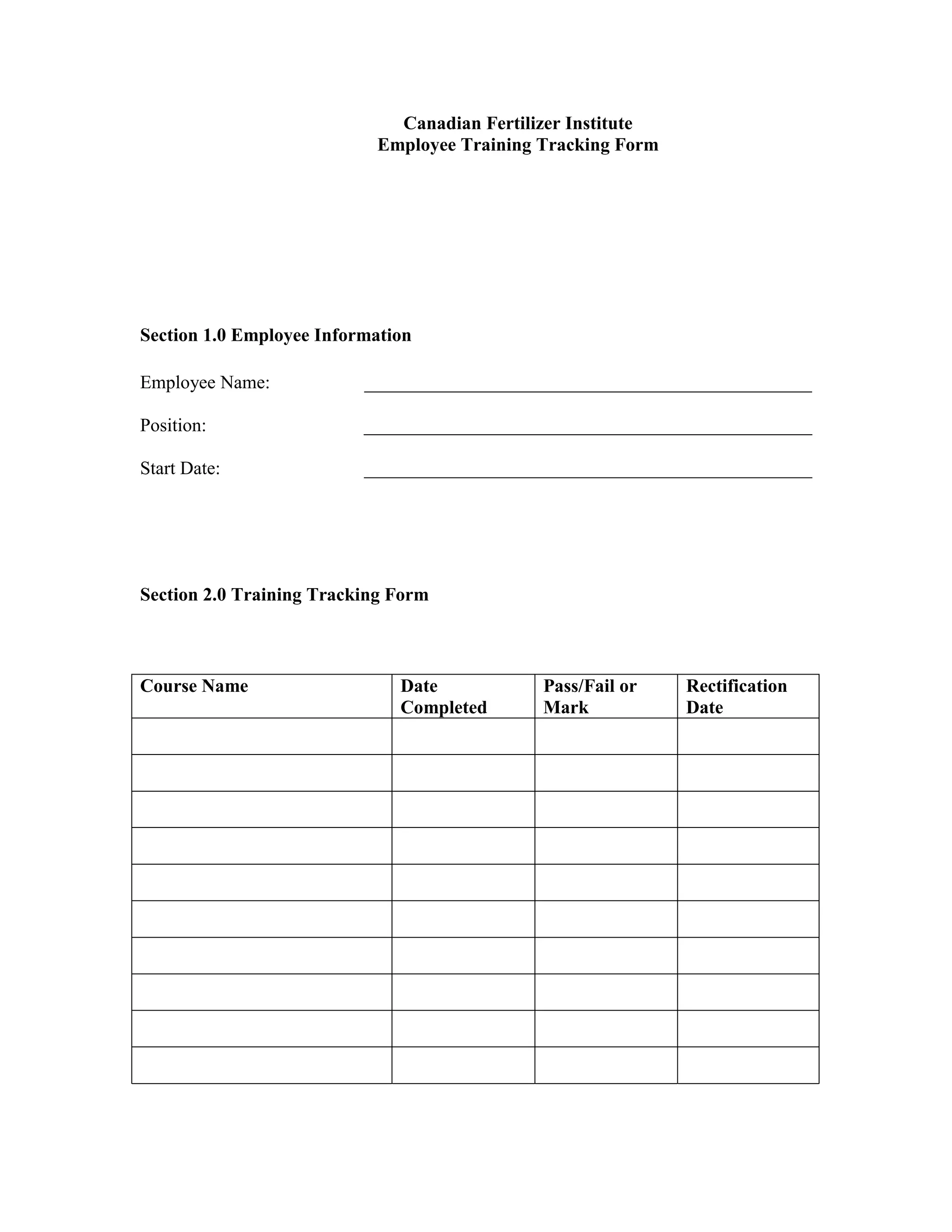
Appendix D.
5.1.1 Recommendations
1. Transportation of Dangerous Goods –
Anhydrous ammonia and ammonium
nitrate are the only commonly used
fertilizer products classified under the
Transportation of Dangerous Goods
regulations. Any facility that handles or
transports these classified products must
train staff in the requirements as defined
by the Transportation of Dangerous Goods
Act and Regulations.
2. Workplace Hazardous Materials
Information System (W.H.M.I.S.) – all
staff must be trained in accordance with
W.H.M.I.S. regulations. Specific attention
should be paid to understanding a Material
Safety Data Sheet (MSDS)
3. Standard Operating Procedures – all
staff must be trained to conduct all major
tasks and functions in accordance with
developed standard operating procedures.
4. Emergency Response Training – all staff
involved in executing the emergency
response plan must be trained to ensure an
understanding of their duties.
5. First Aid/C.P.R. – an appropriate number
of staff at the facility should be trained and
certified in emergency first aid and
cardiopulmonary resuscitation (CPR).
6. Safety Equipment Usage and
Maintenance – all staff must be trained in
the proper usage and maintenance of
safety equipment.
7. Confined Workspace/Hot Work
Training - any facility that requires
employees to enter confined workspaces
or undertake hot work must ensure those
employees are properly trained before
conducting those activities.
8. Occupational Health and Safety Rules –
all staff must be made aware of the health
and safety rules at a facility.
5.2 Documentation Requirements
There are a number of different types of
documentation required for all fertilizer
operations. Most provide information to
ensure compliance to regulatory requirements
while others serve to provide information to
monitor operational effectiveness. Both are
necessary to maintain a profitable and safe
fertilizer operation.
5.2.1 Recommendations
1. Regulatory Information – regulatory
information should include the
Transportation of Dangerous Goods Act &
Regulations, the Workplace Hazardous
Materials Information System Act &
Regulations, the Occupational Health and
Safety Regulations and any other
regulations applicable to the operation.
2. Standard Operating Procedures – a set
of up-to-date standard operating
procedures should be available at the
facility that defines in a step-by-step
manner how each major task or function is
to be safely and effectively conducted.
3. Emergency Response Plans – a
document detailing the plan for responding
to emergencies such as a fire or major spill
must be developed and updated regularly.
4. Material Safety Data Sheets (MSDS) –
Material Safety Data Sheets must be
available for each type of fertilizer stored
and handled at the facility.
5. Licenses & Permits – all licenses and
permits required to legally operate a
fertilizer operation must be obtained and
maintained.
6. Inspections – a copy of all inspections
should be kept including any copies of
follow-up on identified action items.
7. Training Records – copies of employee
training records should be kept to
adequately monitor and maintain training
requirements.
6.0 Emergency Response
Planning & Practice
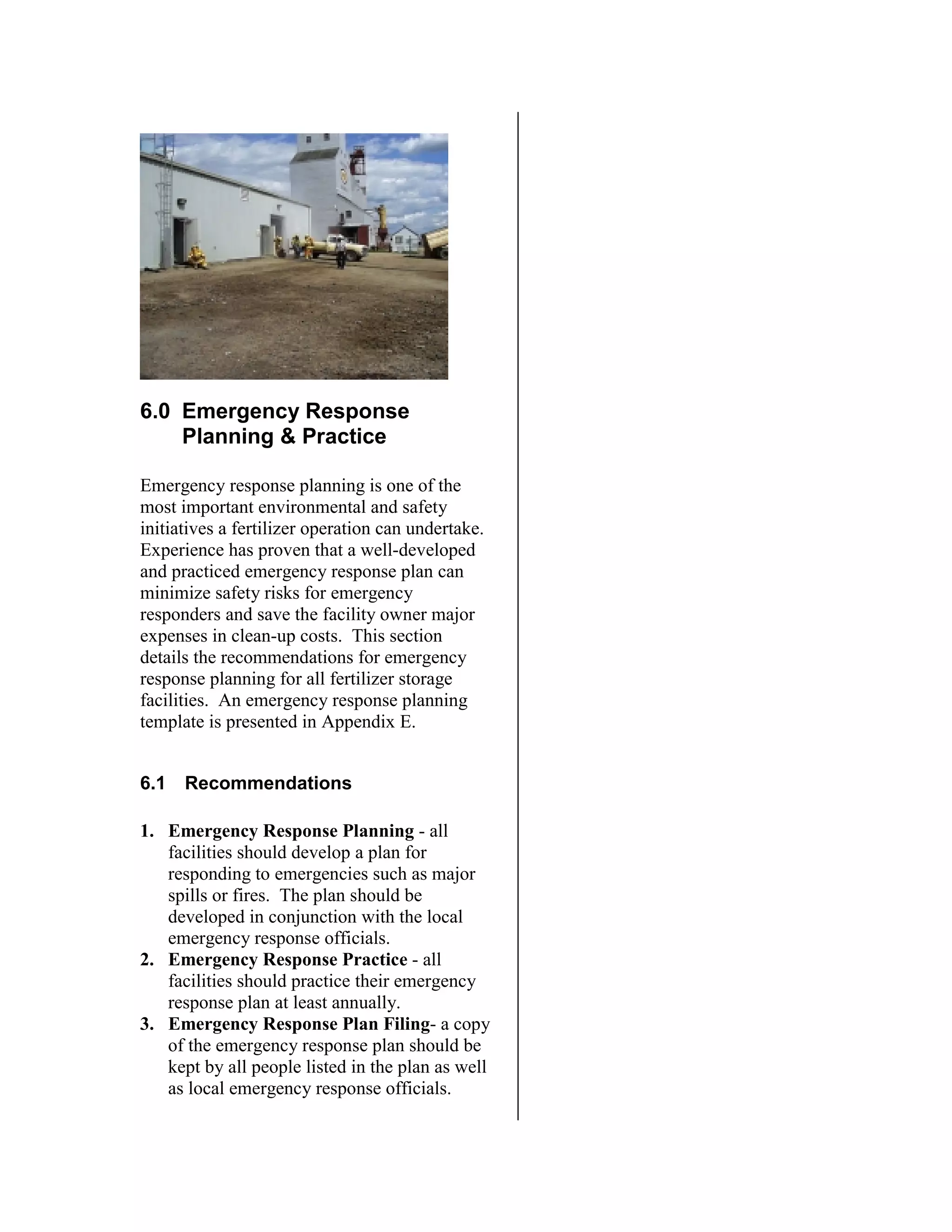
Emergency response planning is one of the
most important environmental and safety
initiatives a fertilizer operation can undertake.
Experience has proven that a well-developed
and practiced emergency response plan can
minimize safety risks for emergency
responders and save the facility owner major
expenses in clean-up costs. This section
details the recommendations for emergency
response planning for all fertilizer storage
facilities. An emergency response planning
template is presented in Appendix E.
6.1 Recommendations
1. Emergency Response Planning - all
facilities should develop a plan for
responding to emergencies such as major
spills or fires. The plan should be
developed in conjunction with the local
emergency response officials.
2. Emergency Response Practice - all
facilities should practice their emergency
response plan at least annually.
3. Emergency Response Plan Filing- a copy
of the emergency response plan should be
kept by all people listed in the plan as well
as local emergency response officials.
References
1. American Petroleum Institute, 1995. Tank Inspection, Repair, Alteration, and Reconstruction
2. Canada Transportation Act, (no date). Ammonia Nitrate Storage Facilities Regulations, Canadian
Transport Commission – General Order No. 0-36.
3. National Building Code (1995)
4. National Fire Code (1995)
5. Tennessee Valley Authority (1993). Environmental Handbook for Fertilizer and Agrichemical
Dealers.
6. Transport Canada. Transportation of Dangerous Act and Regulations.
APPENDIX A-1
Solid Fertilizer Siting Distances
= 10 Metres
HospitalHospitalHospitalHospital
Roadway
ResidencesResidencesResidencesResidences
Solid
Fertilizer
Facility
DISTANCE
RETRICTIONS
(Ammonium Nitrate)
Distance to property
line of Hospital,
School etc.
Distance to property
line of residence.
Set back distance
from roadway
Distance to river,
lake or stream.
92
MIN. DISTANCE M
50
40
50
DISTANCE
RETRICTIONS
(Non-
Ammonium Nitrate)
Distance to property
line of Hospital,
School etc.
Distance to property
line of residence.
Set back distance
from roadway
Distance to river,
lake or stream.
50
MIN. DISTANCE M
25
40
50
Reservoir
Distance to closest
rail. 3.5
Distance to closest
rail. 3.5
APPENDIX A-2
= 50 Metres
DISTANCE
RETRICTIONS
Distance to boundary
of city, town or
village.
Set back distance
from roadway
Distance to river,
lake or stream
1000
DISTANCE M
40
50
Anhydrous Ammonia Siting Distances
Town Boundary
Anhydrous Ammonia
Facility
Farm Residence
River
Wind
Direction
APPENDIX A-3
Liquid Fertilizer Siting Distances
= 20 Metres
DISTANCE
RETRICTIONS
Distance to property
line of Hospital,
School etc.
Distance to property
line of residence.
Set back distance
from roadway
Distance to public
water supply source
50
DISTANCE M
50
40
300
HospitalHospitalHospitalHospital Roadway
LakeResidencesResidencesResidencesResidences
Liquid
Fertilizer
Facility
Town
Water Well
R.M.
Office
Distance to private
water source.
50
Distance to closest
rail.
3.5
Propane
Station
APPENDIX B-1
Solid Fertilizer Site LayoutSolid Fertilizer Site Layout
= 3 Metres
LEGEND
Fire Extinguisher
DEVICE Symbol
Light
Weigh Scale
Office
Equipment Storage
Equipment
Storage
Concrete Pad
Fertilizer
Blender
Fertilizer
Bins
Fertilizer
Auger
Loading/Unloading
Pad
APPENDIX B-2
Bagged/Bulk Fertilizer Warehouse
Layout
= 1 Metre
LEGEND
Fire Extinguisher
Clean-up Drum
Shovel
DEVICE
Bulk
Storage
Bulk
Storage
Bulk
Storage
Bulk
Storage
Bagged
Storage
Bagged
Storage
Blender
Spill Cleanup
Equipment
Safety
Equipment
Fork-Lift &
Loader Storage
Contaminated
Product Storage
Overhead
Door
MainAisle
Man-Door
Emergency Exit
Symbol
Ventilation Fan
Doorway
APPENDIX B-3
Anhydrous Ammonia Site LayoutAnhydrous Ammonia Site Layout
= 5 MetresFire Extinguisher
LEGEND Symbol
Light
Applicator and Field
Wagon Storage
DeliveryUnitStorage
Office
Workshop &
Storage
Main-Gate
DeliveryUnit
&FieldTank
LoadingIsland
DeliveryUnit
&FieldTank
LoadingIsland
Transport
UnloadingIsland
Water Trough
LEGEND Symbol
Wind Sock
Culvert
LEGEND Symbol
Culvert Sandbags Chain Link Fence
Emergency
Exit
Roadway
Run-Off
Run-Off
APPENDIX B-4
Liquid Fertilizer Site Layout
= 3 Metres
LEGEND
Fire Extinguisher
DEVICE Symbol
Light
Loading/Unloading
Pads
Containment
Dyke
Sandbags for
Blocking Culvert
Liquid Fertilizer
Storage Tank
Pump,Hose
& Meter
Office
Equipment Storage
Equipment
Storage
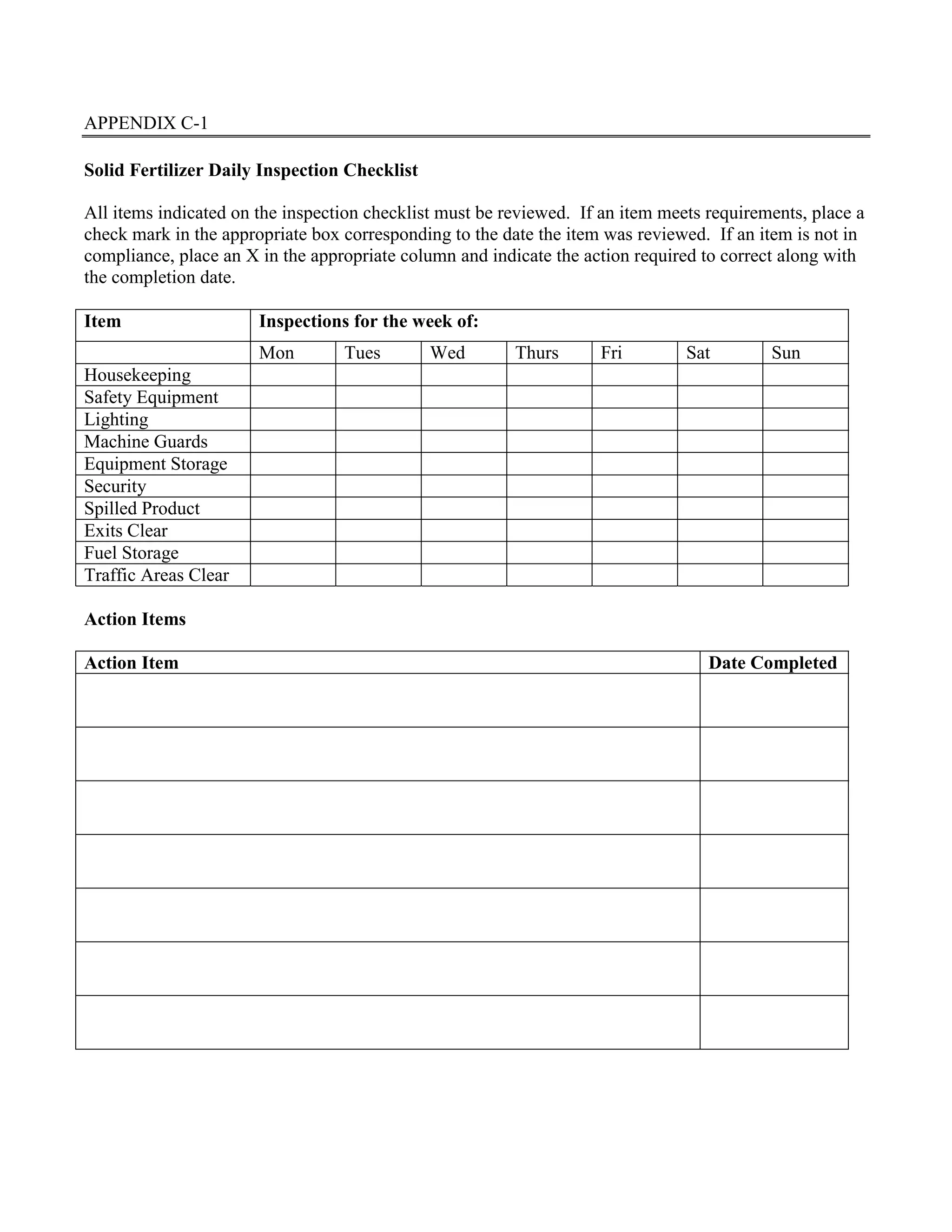
APPENDIX C-1
Solid Fertilizer Daily Inspection Checklist
All items indicated on the inspection checklist must be reviewed. If an item meets requirements, place a
check mark in the appropriate box corresponding to the date the item was reviewed. If an item is not in
compliance, place an X in the appropriate column and indicate the action required to correct along with
the completion date.
Item Inspections for the week of:
Mon Tues Wed Thurs Fri Sat Sun
Housekeeping
Safety Equipment
Lighting
Machine Guards
Equipment Storage
Security
Spilled Product
Exits Clear
Fuel Storage
Traffic Areas Clear
Action Items
Action Item Date Completed
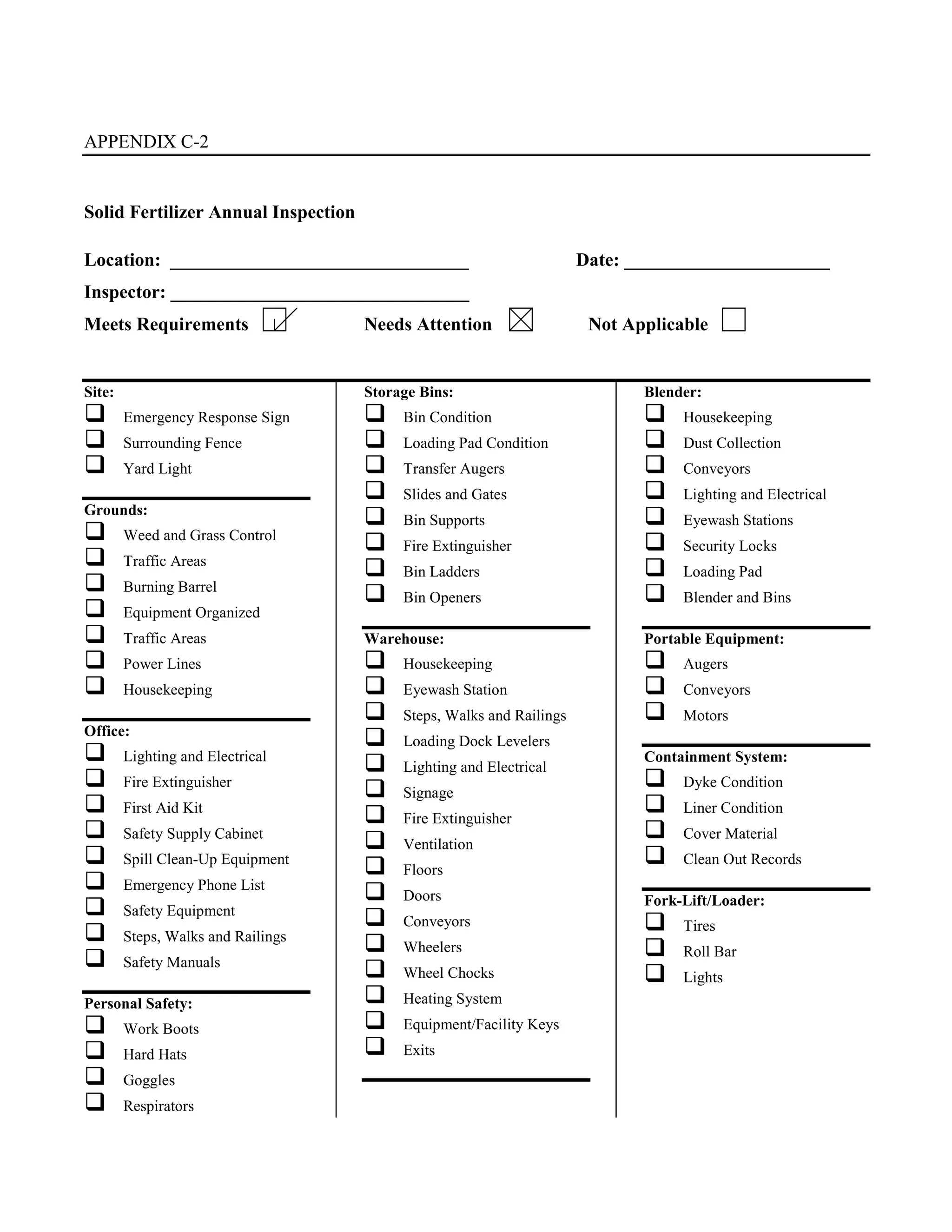
APPENDIX C-2
Solid Fertilizer Annual Inspection
Location: ________________________________ Date: ______________________
Inspector: ________________________________
Meets Requirements Needs Attention Not Applicable
Site:
#"Emergency Response Sign
#"Surrounding Fence
#"Yard Light
Grounds:
#"Weed and Grass Control
#"Traffic Areas
#"Burning Barrel
#"Equipment Organized
#"Traffic Areas
#"Power Lines
#"Housekeeping
Office:
#"Lighting and Electrical
#"Fire Extinguisher
#"First Aid Kit
#"Safety Supply Cabinet
#"Spill Clean-Up Equipment
#"Emergency Phone List
#"Safety Equipment
#"Steps, Walks and Railings
#"Safety Manuals
Personal Safety:
#"Work Boots
#"Hard Hats
#"Goggles
#"Respirators
Storage Bins:
#"Bin Condition
#"Loading Pad Condition
#"Transfer Augers
#"Slides and Gates
#"Bin Supports
#"Fire Extinguisher
#"Bin Ladders
#"Bin Openers
Warehouse:
#"Housekeeping
#"Eyewash Station
#"Steps, Walks and Railings
#"Loading Dock Levelers
#"Lighting and Electrical
#"Signage
#"Fire Extinguisher
#"Ventilation
#"Floors
#"Doors
#"Conveyors
#"Wheelers
#"Wheel Chocks
#"Heating System
#"Equipment/Facility Keys
#"Exits
Blender:
#"Housekeeping
#"Dust Collection
#"Conveyors
#"Lighting and Electrical
#"Eyewash Stations
#"Security Locks
#"Loading Pad
#"Blender and Bins
Portable Equipment:
#"Augers
#"Conveyors
#"Motors
Containment System:
#"Dyke Condition
#"Liner Condition
#"Cover Material
#"Clean Out Records
Fork-Lift/Loader:
#"Tires
#"Roll Bar
#"Lights
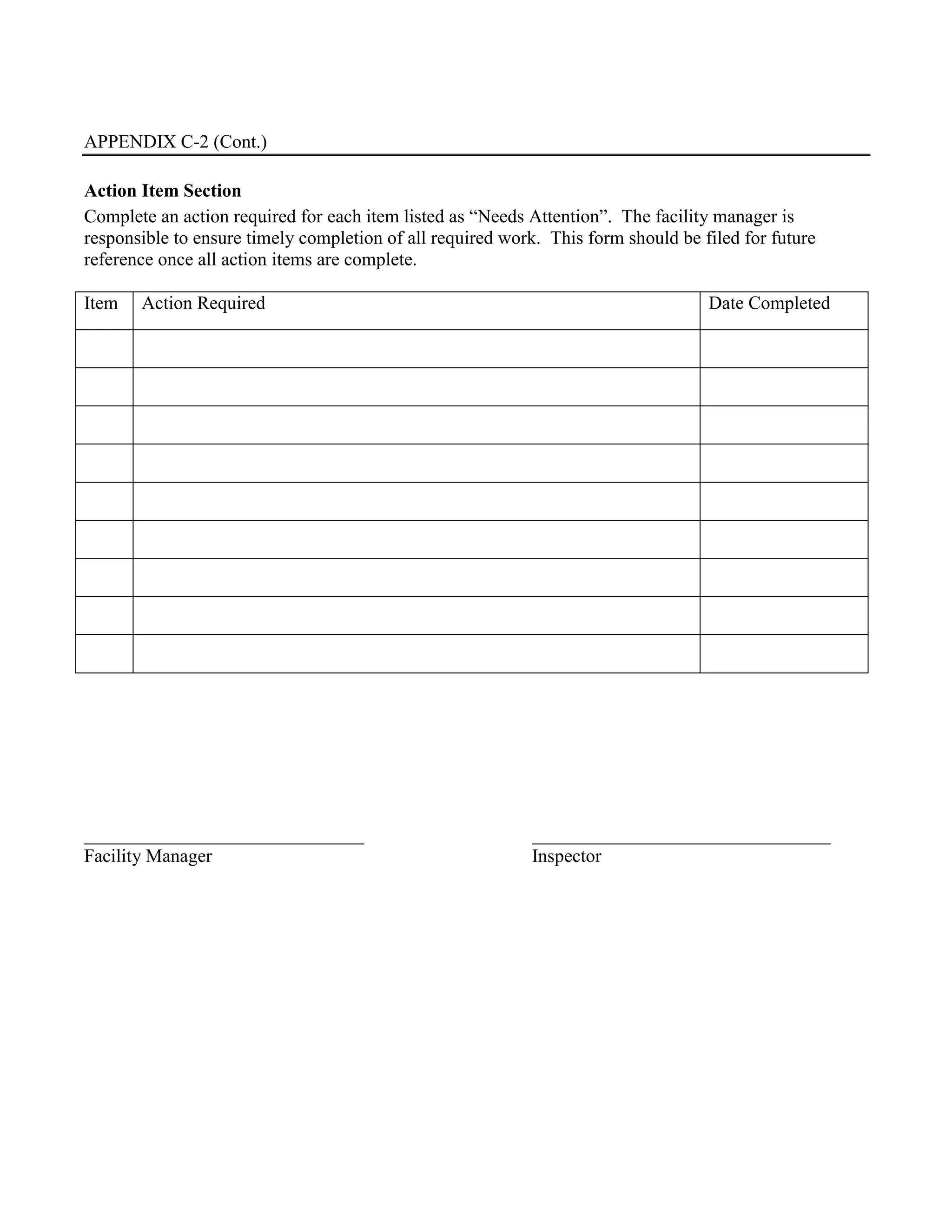
APPENDIX C-2 (Cont.)
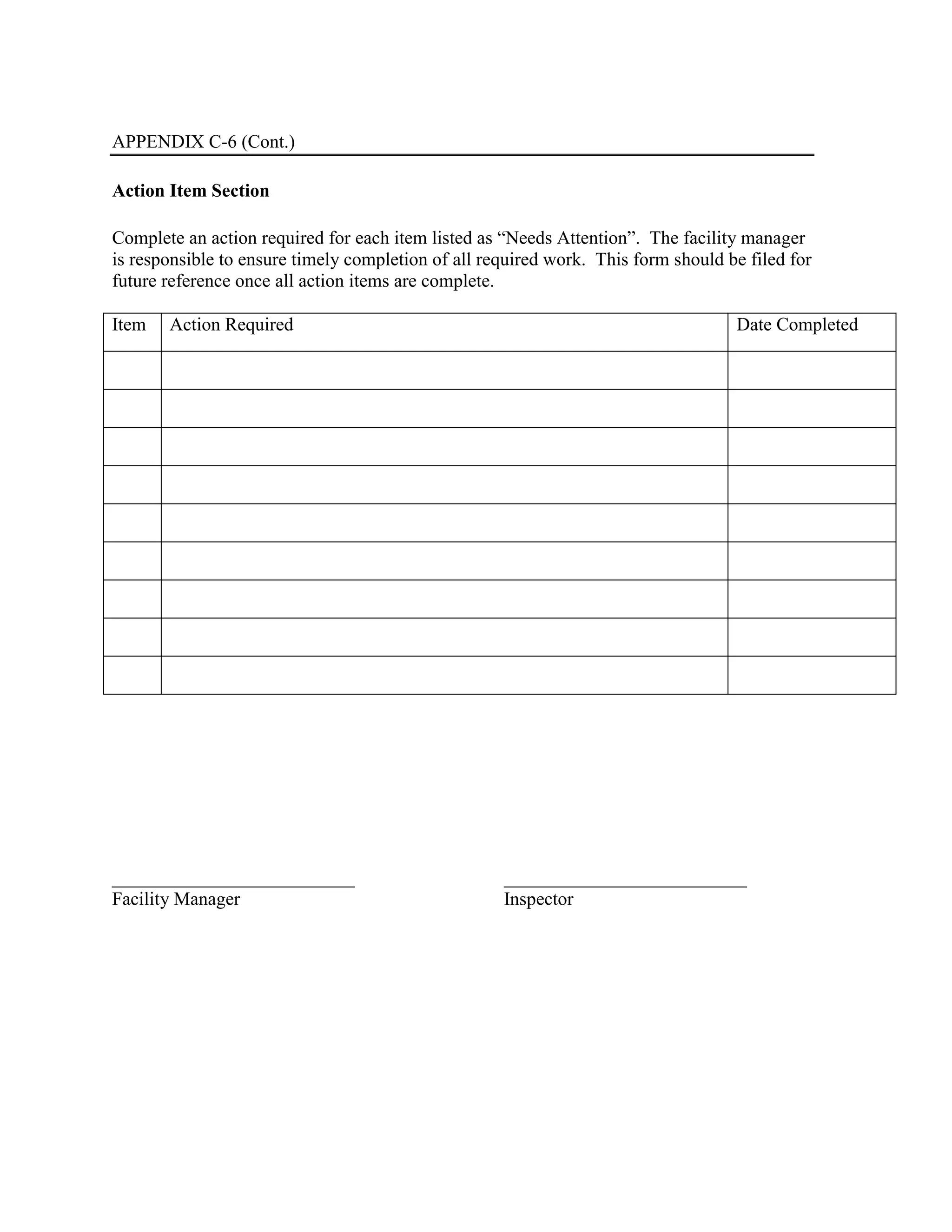
Action Item Section
Complete an action required for each item listed as “Needs Attention”. The facility manager is
responsible to ensure timely completion of all required work. This form should be filed for future
reference once all action items are complete.
Item Action Required Date Completed
______________________________ ________________________________
Facility Manager Inspector
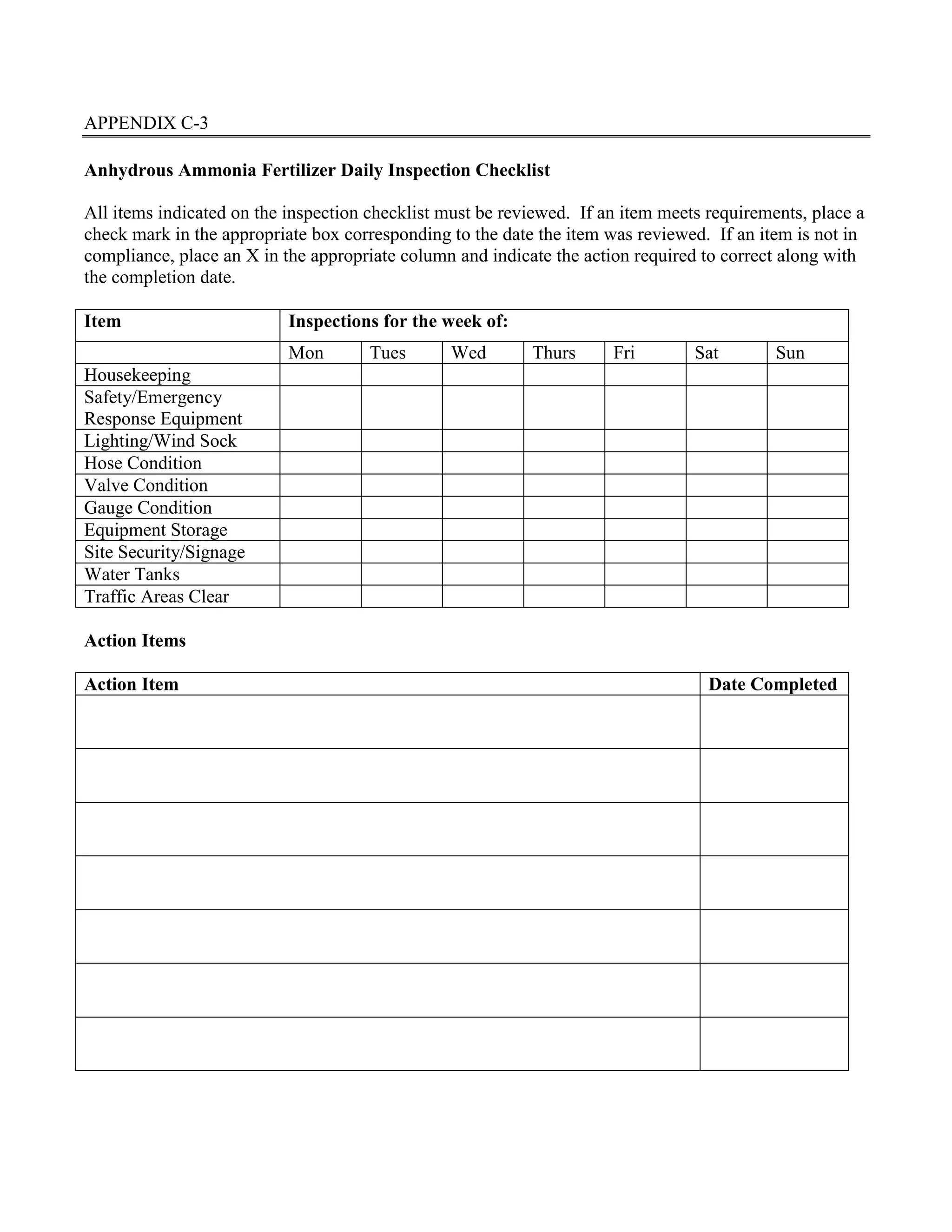
APPENDIX C-3
Anhydrous Ammonia Fertilizer Daily Inspection Checklist
All items indicated on the inspection checklist must be reviewed. If an item meets requirements, place a
check mark in the appropriate box corresponding to the date the item was reviewed. If an item is not in
compliance, place an X in the appropriate column and indicate the action required to correct along with
the completion date.
Item Inspections for the week of:
Mon Tues Wed Thurs Fri Sat Sun
Housekeeping
Safety/Emergency
Response Equipment
Lighting/Wind Sock
Hose Condition
Valve Condition
Gauge Condition
Equipment Storage
Site Security/Signage
Water Tanks
Traffic Areas Clear
Action Items
Action Item Date Completed
APPENDIX C-4
Anhydrous Ammonia Annual Inspection
Location: ________________________________ Date: ______________________
Inspector: ________________________________
Meets Requirements Needs Attention Not Applicable
Site:
#"Emergency Response Sign
#"Surrounding Fence
#"Yard Light
#"Emergency Water Tank
#"Wind Sock
Grounds:
#"Weed and Grass Control
#"Traffic Areas
#"Burning Barrel
#"Equipment Organized
#"Power Lines
#"Housekeeping
Office:
#"Lighting and Electrical
#"Fire Extinguisher
#"First Aid Kit
#"Safety Supply Cabinet
#"Emergency Response
Equipment
#"Emergency Response Plan
#"Emergency Phone List
#"Safety Equipment
#"Steps, Walks and Railings
#"Safety Manuals
Personal Safety:
#"Work Boots
#"Hard Hats
#"Goggles
#"Respirators
#"Protective Suit
Transport Delivery Unit:
#"CVSA Inspection
#"Fire Extinguisher
#"First Aid Kit
#"Placards
#"Safe Operating Procedures
Manual
#"Hoses and Valves
#"Emergency Roadside Kit
#"Wheel Chock Blocks
#"Communication Equipment
#"Eyewash Equipment
#"Canister Gas Mask
#"Emergency Water Supply
#"Multiple Delivery Sheets
#"Pressure Relief Valves
#"Gauges
Tow Vehicle:
#"Fire Extinguisher
#"First Aid Kit
#"Canister Gas Mask
#"Signage and Placards
#"Water Supply for Field
Tanks
#"Safe Operating Procedures
Manual
#"Emergency Road Side Kit
#"Wheel Chock Blocks
#"Communication Equipment
Applicators:
#"Quick Coupler
#"Hoses
#"Gauges
Field Application Tanks:
#"Signage and Placards
#"Colour Coding
#"Emergency Water Supply
#"Safety Kit
#"Hoses and Valves
#"Safety Chains
#"Tire Condition
#"Gauges
#"Pressure Relief Valves
Storage Tank:
#"Signage
#"Colour Coding
#"Breakaway Connections
#"Hoses and Valves
#"Gauges
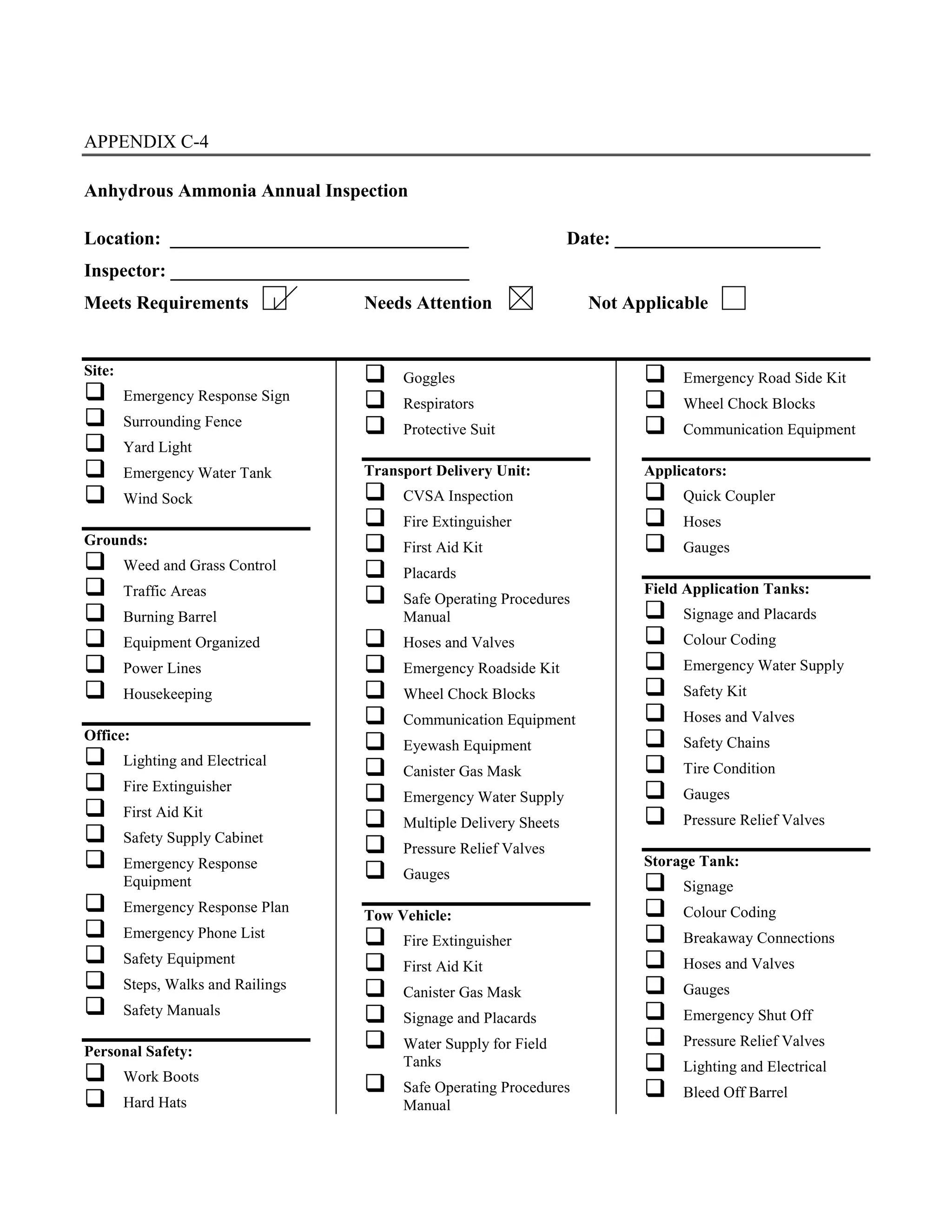
#"Emergency Shut Off
#"Pressure Relief Valves
#"Lighting and Electrical
#"Bleed Off Barrel
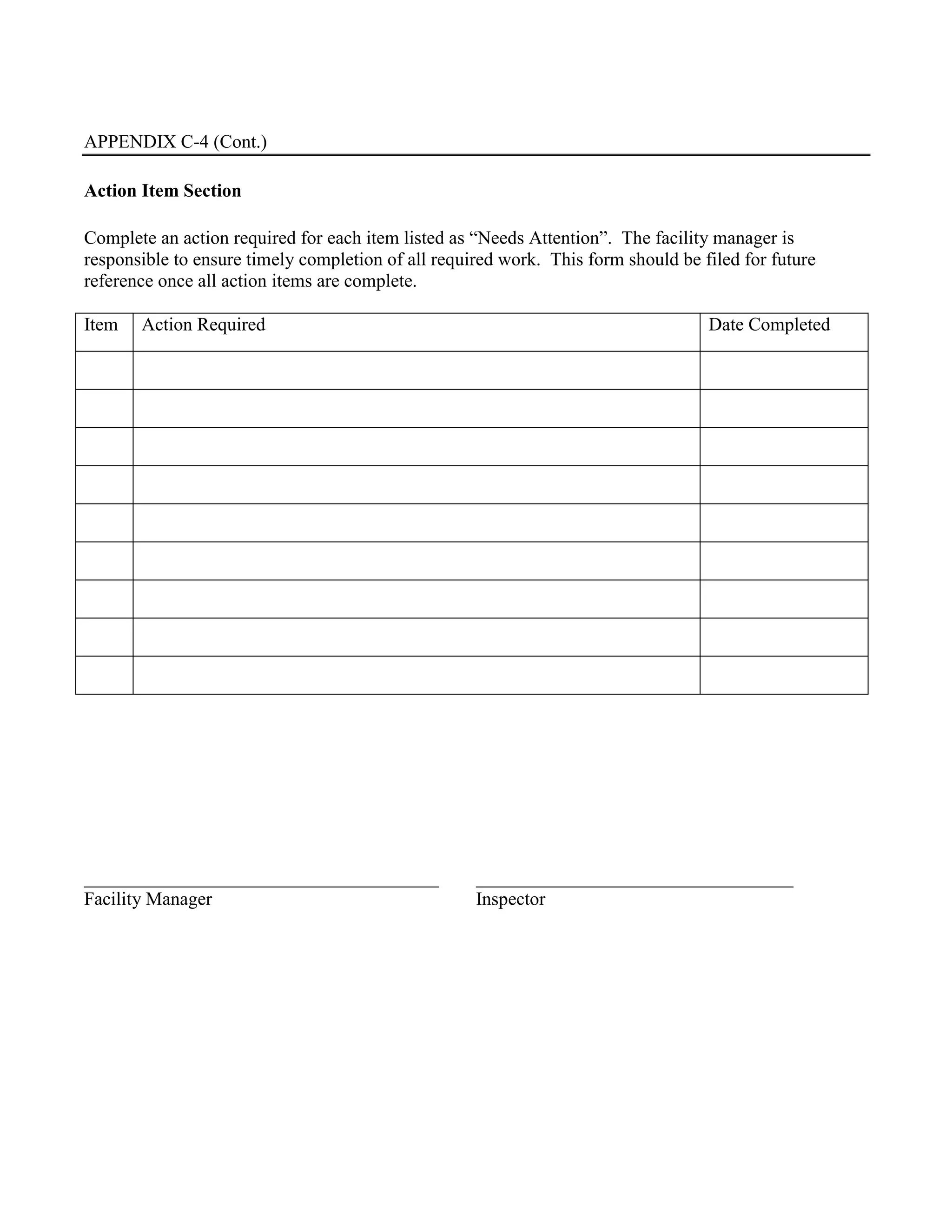
APPENDIX C-4 (Cont.)
Action Item Section
Complete an action required for each item listed as “Needs Attention”. The facility manager is
responsible to ensure timely completion of all required work. This form should be filed for future
reference once all action items are complete.
Item Action Required Date Completed
______________________________________ __________________________________
Facility Manager Inspector
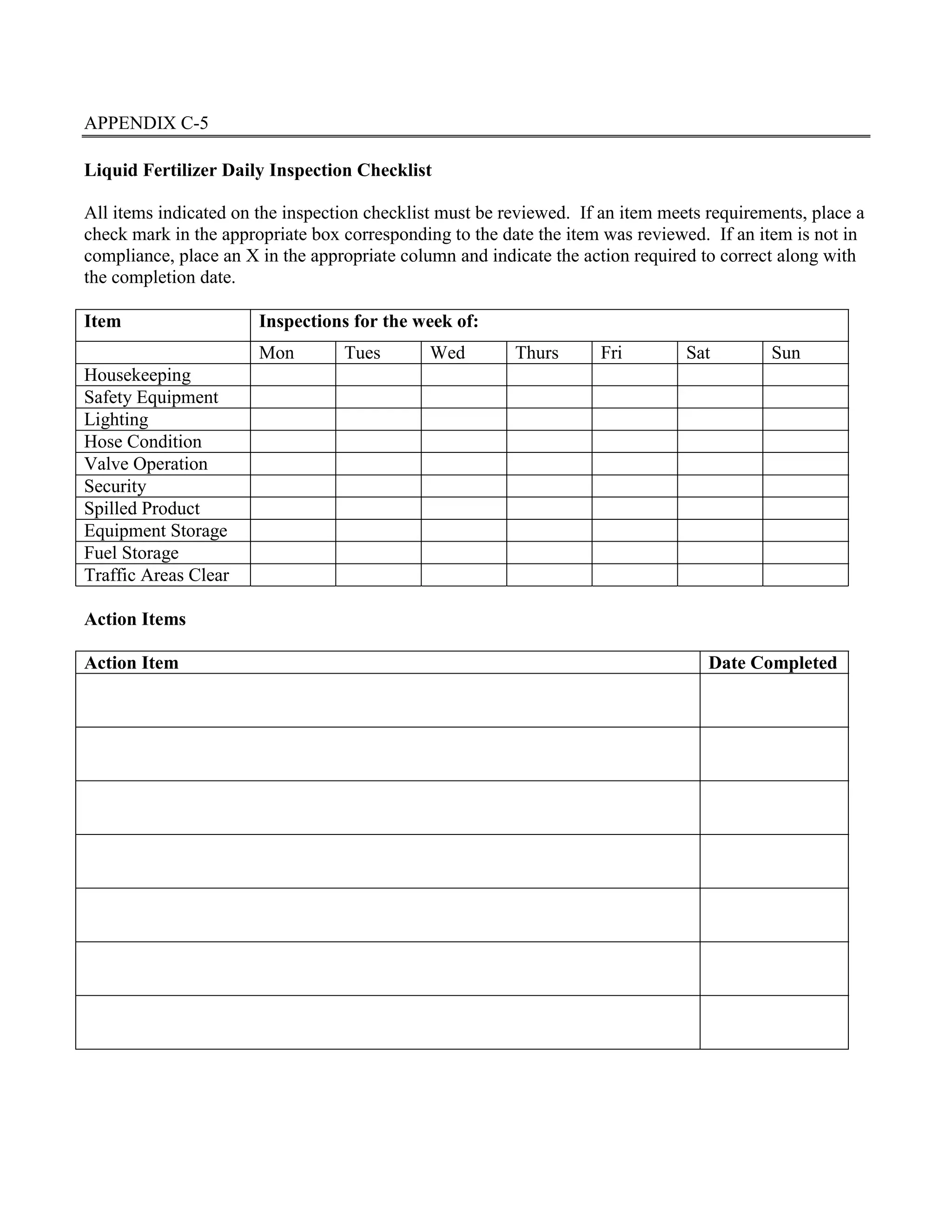
APPENDIX C-5
Liquid Fertilizer Daily Inspection Checklist
All items indicated on the inspection checklist must be reviewed. If an item meets requirements, place a
check mark in the appropriate box corresponding to the date the item was reviewed. If an item is not in
compliance, place an X in the appropriate column and indicate the action required to correct along with
the completion date.
Item Inspections for the week of:
Mon Tues Wed Thurs Fri Sat Sun
Housekeeping
Safety Equipment
Lighting
Hose Condition
Valve Operation
Security
Spilled Product
Equipment Storage
Fuel Storage
Traffic Areas Clear
Action Items
Action Item Date Completed
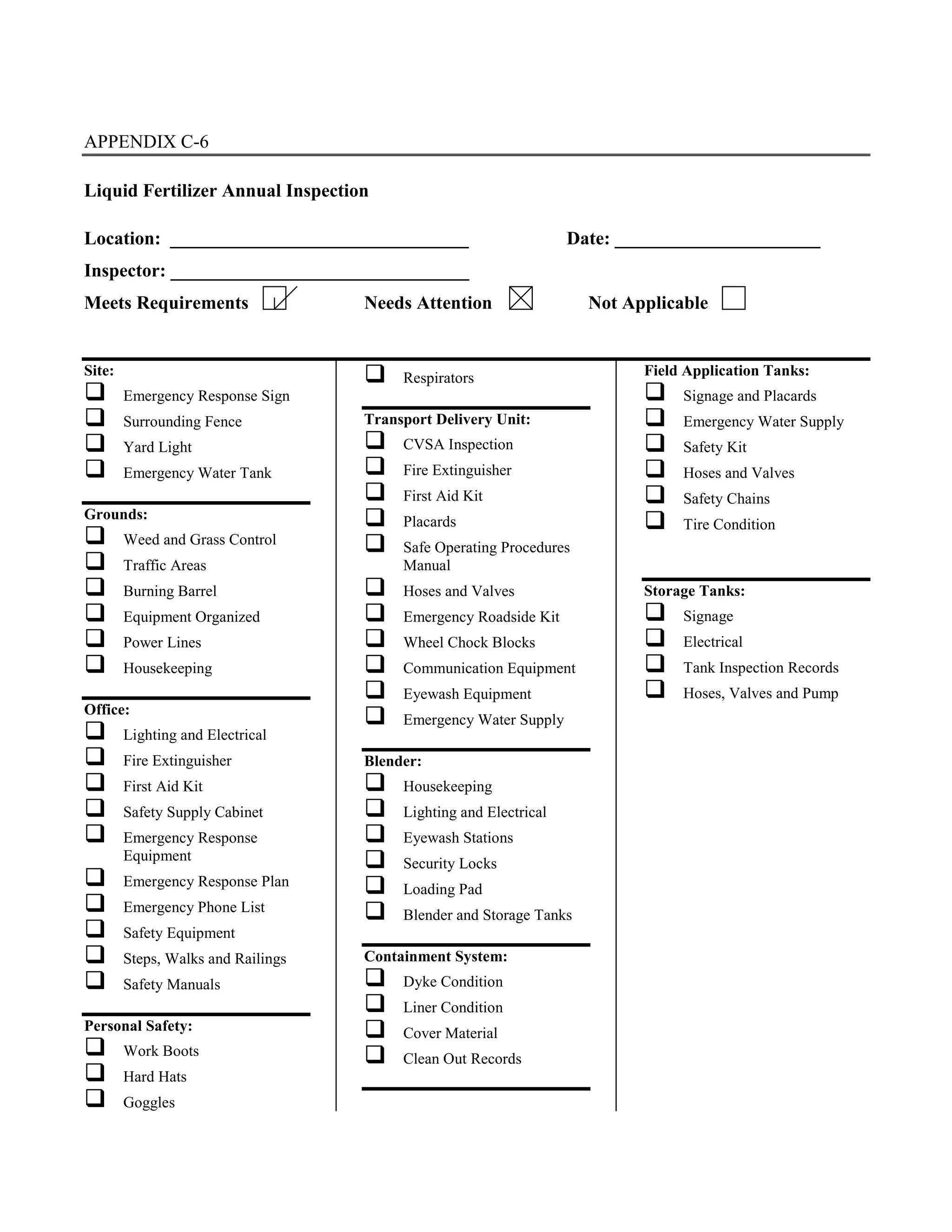
APPENDIX C-6
Liquid Fertilizer Annual Inspection
Location: ________________________________ Date: ______________________
Inspector: ________________________________
Meets Requirements Needs Attention Not Applicable
Site:
#"Emergency Response Sign
#"Surrounding Fence
#"Yard Light
#"Emergency Water Tank
Grounds:
#"Weed and Grass Control
#"Traffic Areas
#"Burning Barrel
#"Equipment Organized
#"Power Lines
#"Housekeeping
Office:
#"Lighting and Electrical
#"Fire Extinguisher
#"First Aid Kit
#"Safety Supply Cabinet
#"Emergency Response
Equipment
#"Emergency Response Plan
#"Emergency Phone List
#"Safety Equipment
#"Steps, Walks and Railings
#"Safety Manuals
Personal Safety:
#"Work Boots
#"Hard Hats
#"Goggles
#"Respirators
Transport Delivery Unit:
#"CVSA Inspection
#"Fire Extinguisher
#"First Aid Kit
#"Placards
#"Safe Operating Procedures
Manual
#"Hoses and Valves
#"Emergency Roadside Kit
#"Wheel Chock Blocks
#"Communication Equipment
#"Eyewash Equipment
#"Emergency Water Supply
Blender:
#"Housekeeping
#"Lighting and Electrical
#"Eyewash Stations
#"Security Locks
#"Loading Pad
#"Blender and Storage Tanks
Containment System:
#"Dyke Condition
#"Liner Condition
#"Cover Material
#"Clean Out Records
Field Application Tanks:
#"Signage and Placards
#"Emergency Water Supply
#"Safety Kit
#"Hoses and Valves
#"Safety Chains
#"Tire Condition
Storage Tanks:
#"Signage
#"Electrical
#"Tank Inspection Records
#"Hoses, Valves and Pump
APPENDIX C-6 (Cont.)
Action Item Section
Complete an action required for each item listed as “Needs Attention”. The facility manager
is responsible to ensure timely completion of all required work. This form should be filed for
future reference once all action items are complete.
Item Action Required Date Completed
__________________________ __________________________
Facility Manager Inspector
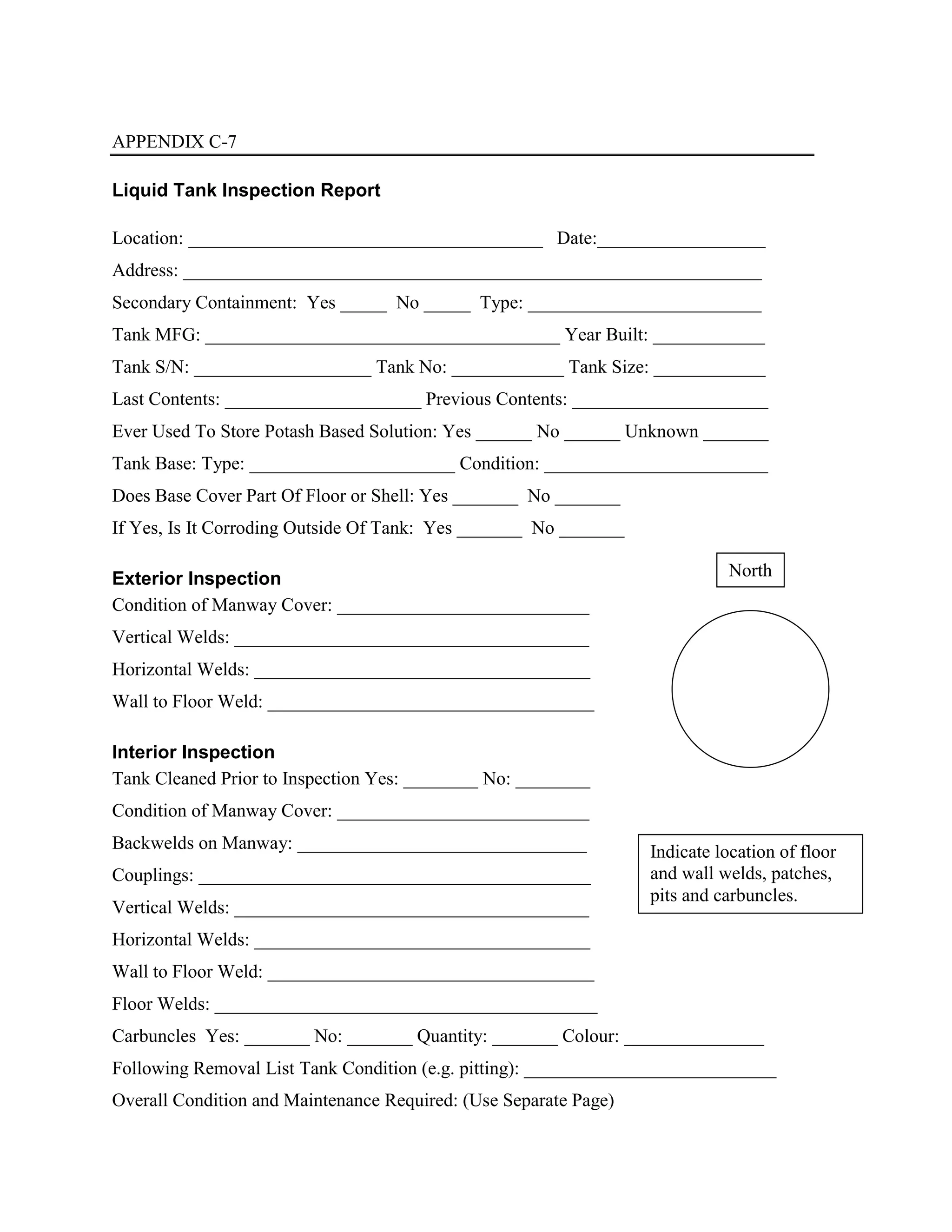
APPENDIX C-7
Liquid Tank Inspection Report
Location: ______________________________________ Date:__________________
Address: ______________________________________________________________
Secondary Containment: Yes _____ No _____ Type: _________________________
Tank MFG: ______________________________________ Year Built: ____________
Tank S/N: ___________________ Tank No: ____________ Tank Size: ____________
Last Contents: _____________________ Previous Contents: _____________________
Ever Used To Store Potash Based Solution: Yes ______ No ______ Unknown _______
Tank Base: Type: ______________________ Condition: ________________________
Does Base Cover Part Of Floor or Shell: Yes _______ No _______
If Yes, Is It Corroding Outside Of Tank: Yes _______ No _______
Exterior Inspection
Condition of Manway Cover: ___________________________
Vertical Welds: ______________________________________
Horizontal Welds: ____________________________________
Wall to Floor Weld: ___________________________________
Interior Inspection
Tank Cleaned Prior to Inspection Yes: ________ No: ________
Condition of Manway Cover: ___________________________
Backwelds on Manway: _______________________________
Couplings: __________________________________________
Vertical Welds: ______________________________________
Horizontal Welds: ____________________________________
Wall to Floor Weld: ___________________________________
Floor Welds: _________________________________________
Carbuncles Yes: _______ No: _______ Quantity: _______ Colour: _______________
Following Removal List Tank Condition (e.g. pitting): ___________________________
Overall Condition and Maintenance Required: (Use Separate Page)
Indicate location of floor
and wall welds, patches,
pits and carbuncles.
North
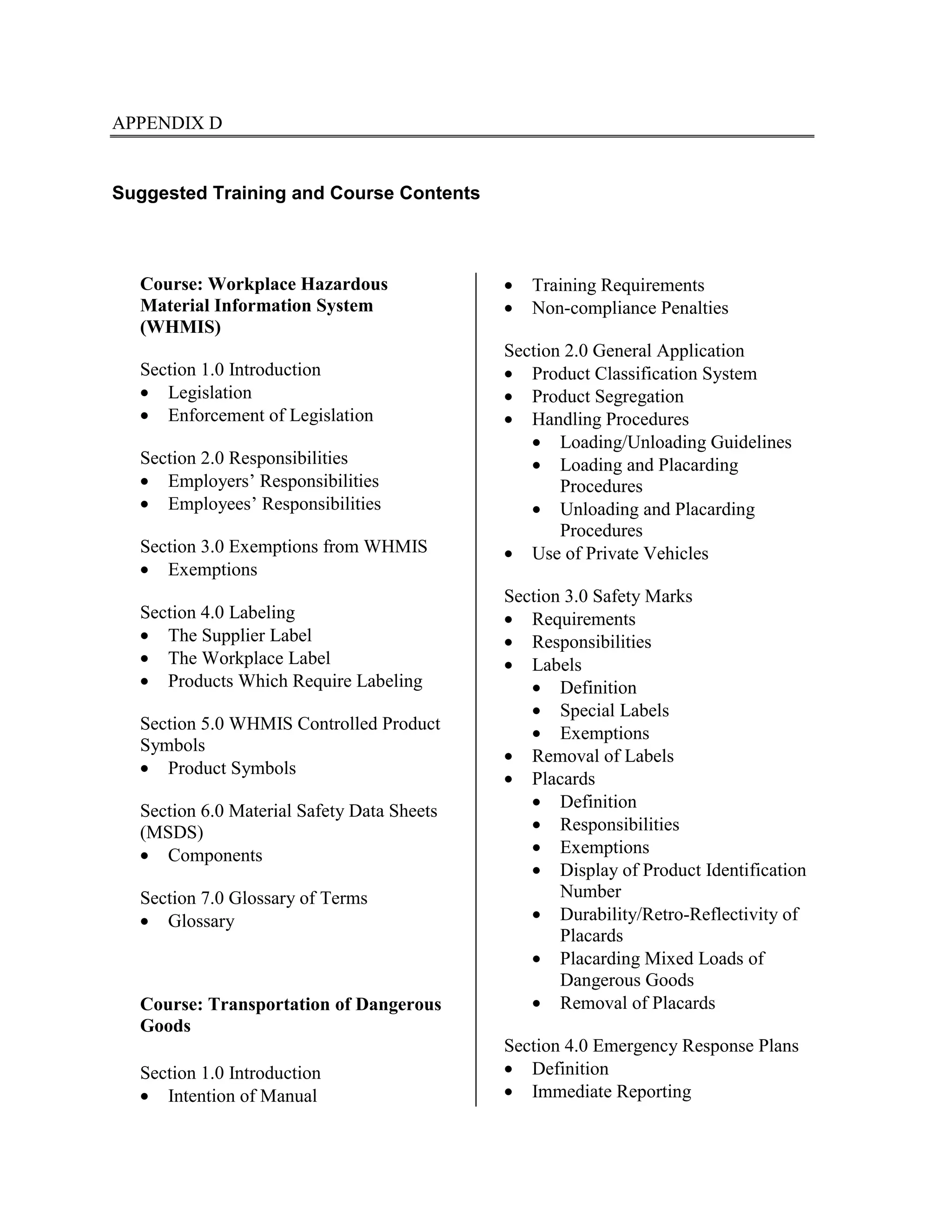
APPENDIX D
Suggested Training and Course Contents
Course: Workplace Hazardous
Material Information System
(WHMIS)
Section 1.0 Introduction
• Legislation
• Enforcement of Legislation
Section 2.0 Responsibilities
• Employers’ Responsibilities
• Employees’ Responsibilities
Section 3.0 Exemptions from WHMIS
• Exemptions
Section 4.0 Labeling
• The Supplier Label
• The Workplace Label
• Products Which Require Labeling
Section 5.0 WHMIS Controlled Product
Symbols
• Product Symbols
Section 6.0 Material Safety Data Sheets
(MSDS)
• Components
Section 7.0 Glossary of Terms
• Glossary
Course: Transportation of Dangerous
Goods
Section 1.0 Introduction
• Intention of Manual
• Training Requirements
• Non-compliance Penalties
Section 2.0 General Application
• Product Classification System
• Product Segregation
• Handling Procedures
• Loading/Unloading Guidelines
• Loading and Placarding
Procedures
• Unloading and Placarding
Procedures
• Use of Private Vehicles
Section 3.0 Safety Marks
• Requirements
• Responsibilities
• Labels
• Definition
• Special Labels
• Exemptions
• Removal of Labels
• Placards
• Definition
• Responsibilities
• Exemptions
• Display of Product Identification
Number
• Durability/Retro-Reflectivity of
Placards
• Placarding Mixed Loads of
Dangerous Goods
• Removal of Placards
Section 4.0 Emergency Response Plans
• Definition
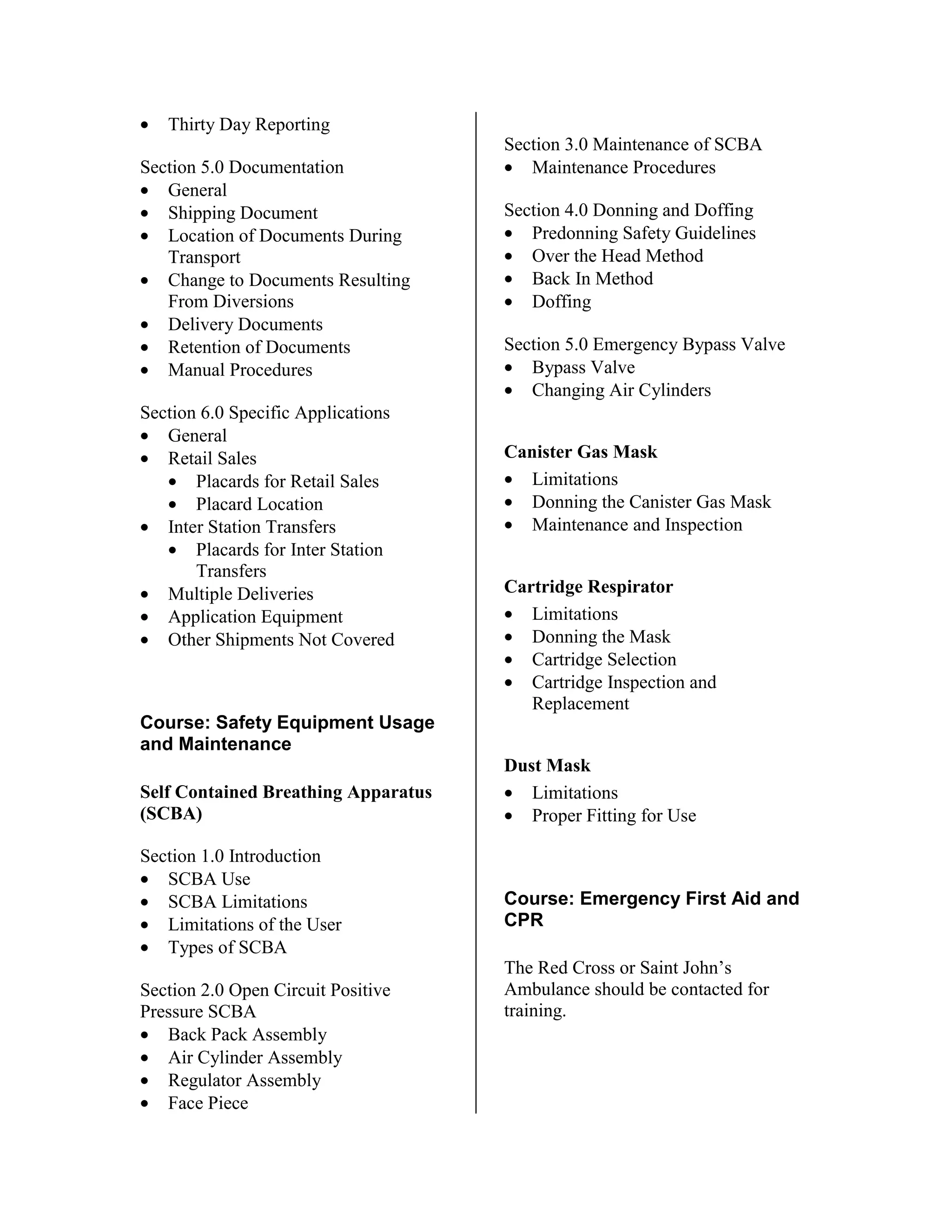
• Immediate Reporting
• Thirty Day Reporting
Section 5.0 Documentation
• General
• Shipping Document
• Location of Documents During
Transport
• Change to Documents Resulting
From Diversions
• Delivery Documents
• Retention of Documents
• Manual Procedures
Section 6.0 Specific Applications
• General
• Retail Sales
• Placards for Retail Sales
• Placard Location
• Inter Station Transfers
• Placards for Inter Station
Transfers
• Multiple Deliveries
• Application Equipment
• Other Shipments Not Covered
Course: Safety Equipment Usage
and Maintenance
Self Contained Breathing Apparatus
(SCBA)
Section 1.0 Introduction
• SCBA Use
• SCBA Limitations
• Limitations of the User
• Types of SCBA
Section 2.0 Open Circuit Positive
Pressure SCBA
• Back Pack Assembly
• Air Cylinder Assembly
• Regulator Assembly
• Face Piece
Section 3.0 Maintenance of SCBA
• Maintenance Procedures
Section 4.0 Donning and Doffing
• Predonning Safety Guidelines
• Over the Head Method
• Back In Method
• Doffing
Section 5.0 Emergency Bypass Valve
• Bypass Valve
• Changing Air Cylinders
Canister Gas Mask
• Limitations
• Donning the Canister Gas Mask
• Maintenance and Inspection
Cartridge Respirator
• Limitations
• Donning the Mask
• Cartridge Selection
• Cartridge Inspection and
Replacement
Dust Mask
• Limitations
• Proper Fitting for Use
Course: Emergency First Aid and
CPR
The Red Cross or Saint John’s
Ambulance should be contacted for
training.
Course: Hot Work
Section 1.0 Introduction
• Definitions
• Typical Hot Work Operations
Section 2.0 Hot Work Permit
• Completion of the Permit
• Authorization Prior to Work
Section 3.0 Securing the Work Site
• Eliminate the Spread of Sparks and
Flames
• Fire Extinguisher Location
• Housekeeping
• Post Work Inspection
• Fire Watch
Course: Anhydrous Ammonia
Standard Operating Procedures
Section 1.0 Introduction
• Characteristics of Anhydrous
Ammonia
• Hazards of Anhydrous Ammonia
Section 2.0 Responsibilities
• Employers Responsibilities
• Employees Responsibilities
Section 3.0 Safety Equipment
Requirements
• Anhydrous Ammonia Storage
Facility
• Anhydrous Ammonia Delivery
Truck
• Field Tank
• Personal Protective Equipment
Section 4.0 First Aid
• Types of Injuries
• Recommended Treatment
Section 5.0 Terminology
• Definitions of Common Terms
Section 6.0 Standard Operating
Procedures
• Transfer from Transport Vehicle to
Permanent Storage
• Transfer from Storage Tank to
Transport Delivery Unit
• Transfer from a Transport Delivery
Unit to a Field Wagon
• Connecting a Field Wagon to an
Applicator
• Pre-travel Inspection of Field Tanks
and Applicators
• Transportation of Dangerous Goods
Requirements
• Highway Travel with Anhydrous
Ammonia Vehicles
Section 7.0 Safety and the Customer
• General Safety
• Safety Equipment Use
• Equipment Safety and Inspection
Course: Solid Fertilizer Standard
Operating Procedures
Section 1.0 Introduction
• Characteristics of Solid Fertilizers
• Hazards of Solid Fertilizers
• Special Hazards of Ammonium
Nitrate
Section 2.0 Responsibilities
• Employers Responsibilities
• Employees Responsibilities
Section 3.0 Safety Equipment
Requirements
• Storage Facility
• Blending Operations
• Field applicators
• Personal Protective Equipment
Section 4.0 First Aid
• Types of Injuries
• Recommended Treatment
Section 5.0 Terminology
• Definition of Common Terms
Section 6.0 Standard Operating
Procedures
• Overhead Power Line Safety
• Housekeeping
• Loading/unloading System
Operation
• Blending System Operation
• Pre-travel Inspection of Field
Applicators
• Transportation of Dangerous Goods
Requirements
• Highway Travel with Fertilizer
Delivery Vehicles
Section 7.0 Safety and the Customer
• General Safety
• Safety Equipment Use
• Equipment Safety and Inspection
Course: Liquid Fertilizer Standard
Operating Procedures
Section 1.0 Introduction
• Characteristics of Liquid Fertilizers
• Hazards of Liquid Fertilizers
Section 2.0 Responsibilities
• Employers Responsibilities
• Employees Responsibilities
Section 3.0 Safety Equipment
Requirements
• Storage Facility
• Field Applicators
• Personal Protective Equipment
Section 4.0 First Aid
• Types of Injuries
• Recommended Treatment
Section 5.0 Terminology
• Definition of Common Terms
Section 6.0 Standard Operating
Procedures
• Overhead Power Line Safety
• Housekeeping
• Loading/unloading of Liquid
Fertilizer
• Blending System Operation
• Pre-travel Inspection of Field
Applicators
• Transportation of Dangerous Goods
Requirements
• Highway Travel with Fertilizer
Delivery Vehicles
Section 7.0 Safety and the Customer
• General Safety
• Safety Equipment Use
• Equipment Safety and Inspection
Course: Emergency Response
Training
Section 1.0 Introduction
• Emergency Response Planning
Process
• Hazards of Fertilizers
• Special Hazards of Anhydrous
Ammonia
• Special Hazards of Ammonium
Nitrate
• Reporting Requirements
Section 2.0 Responsibilities
• Employers Responsibilities
• Employees Responsibilities
Section 3.0 Safety Equipment
Requirements
• Responding to an Anhydrous
Ammonia Release
• Responding to a Solid Fertilizer Spill
• Responding to a Liquid Fertilizer
Spill
Section 4.0 First Aid
• Types of Injuries for Emergency
Response Situations
• Recommended Treatment
Section 5.0 Safety Guidelines
• Preparing to Respond
• Response Recommendation
• Disposing of Contaminated Products
• Decontamination Procedures After
Response
• Monthly Inspection of Equipment
Section 6.0 Responding to a Solid
Fertilizer Spill
• Safety Guidelines
• Preparing to Respond
• Response Recommendations
• Disposing of Contaminated Products
Section 7.0 Responding to a Solid
Fertilizer Spill
• Safety Guidelines
• Preparing to Respond
• Response Recommendations
• Disposing of Contaminated Products
Course: Confined Workspace
Entry Training
Section 1.0 Introduction
• Definition of Confined Workspace
• Types of Confined Workspaces
• Classification of Confined
Workspaces in the Fertilizer Industry
Section 2.0 Responsibilities
• Employers Responsibilities
• Employees Responsibilities
Section 3.0 Safety Equipment
Requirements
• Anhydrous Ammonia Confined
Workspaces
• Solid Fertilizer Confined
Workspaces
• Liquid Fertilizer Confined
Workspaces
Section 4.0 The Entry Permit
• The Reason for a Confined
Workspace Entry Permit
• The Components of the Confined
Workspace Entry Permit
• Completing a Confined Workspace
Entry Permit
Section 5.0 General Procedures
• Isolation and Lock-out
• Entry and Exit
• Air Testing
• Ventilation
• Fire and Explosion Safety
• Emergency Procedures
Canadian Fertilizer Institute
Employee Training Tracking Form
Section 1.0 Employee Information
Employee Name: ________________________________________________
Position: ________________________________________________
Start Date: ________________________________________________
Section 2.0 Training Tracking Form
Course Name Date
Completed
Pass/Fail or
Mark
Rectification
Date
APPENDIX E
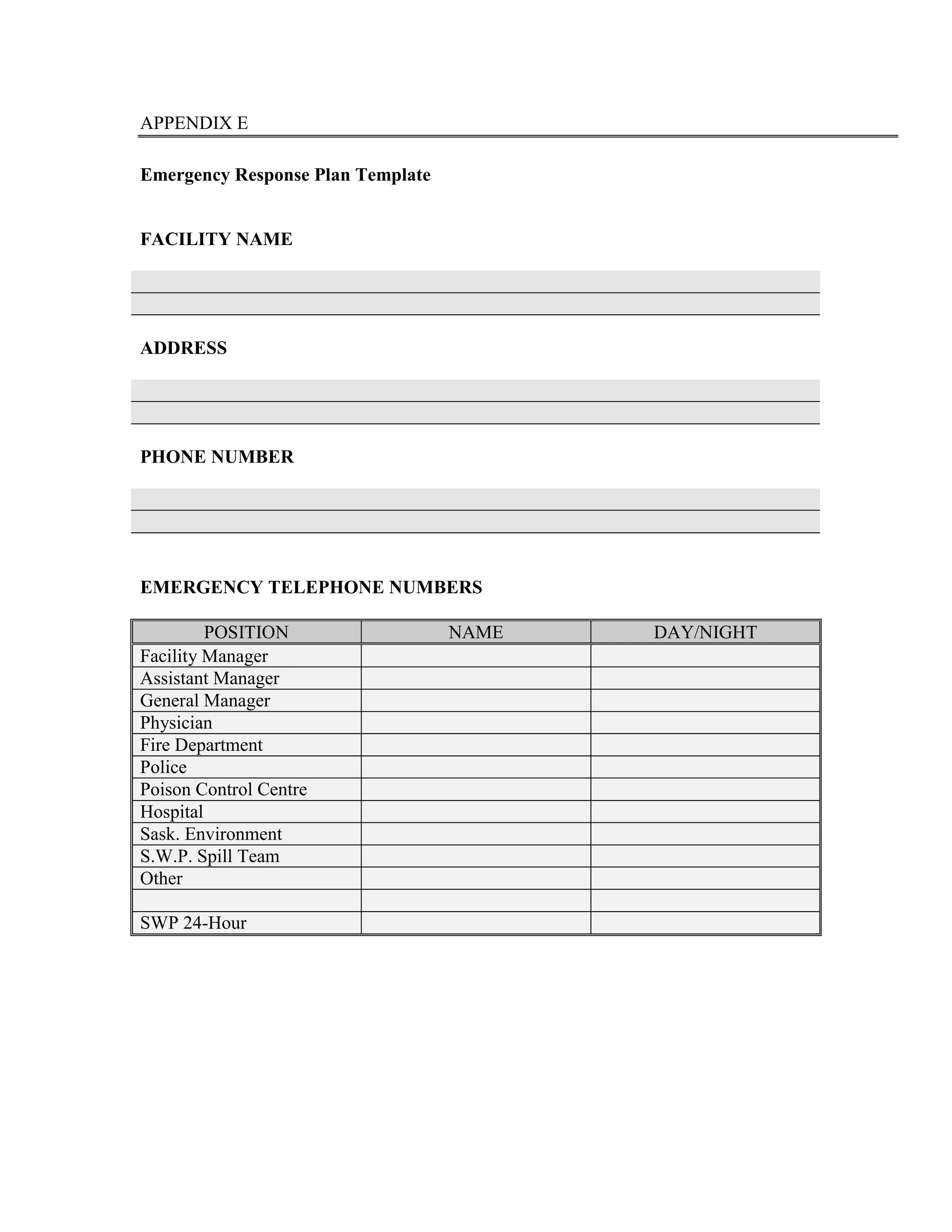
Emergency Response Plan Template
FACILITY NAME
ADDRESS
PHONE NUMBER
EMERGENCY TELEPHONE NUMBERS
POSITION NAME DAY/NIGHT
Facility Manager
Assistant Manager
General Manager
Physician
Fire Department
Police
Poison Control Centre
Hospital
Sask. Environment
S.W.P. Spill Team
Other
SWP 24-Hour
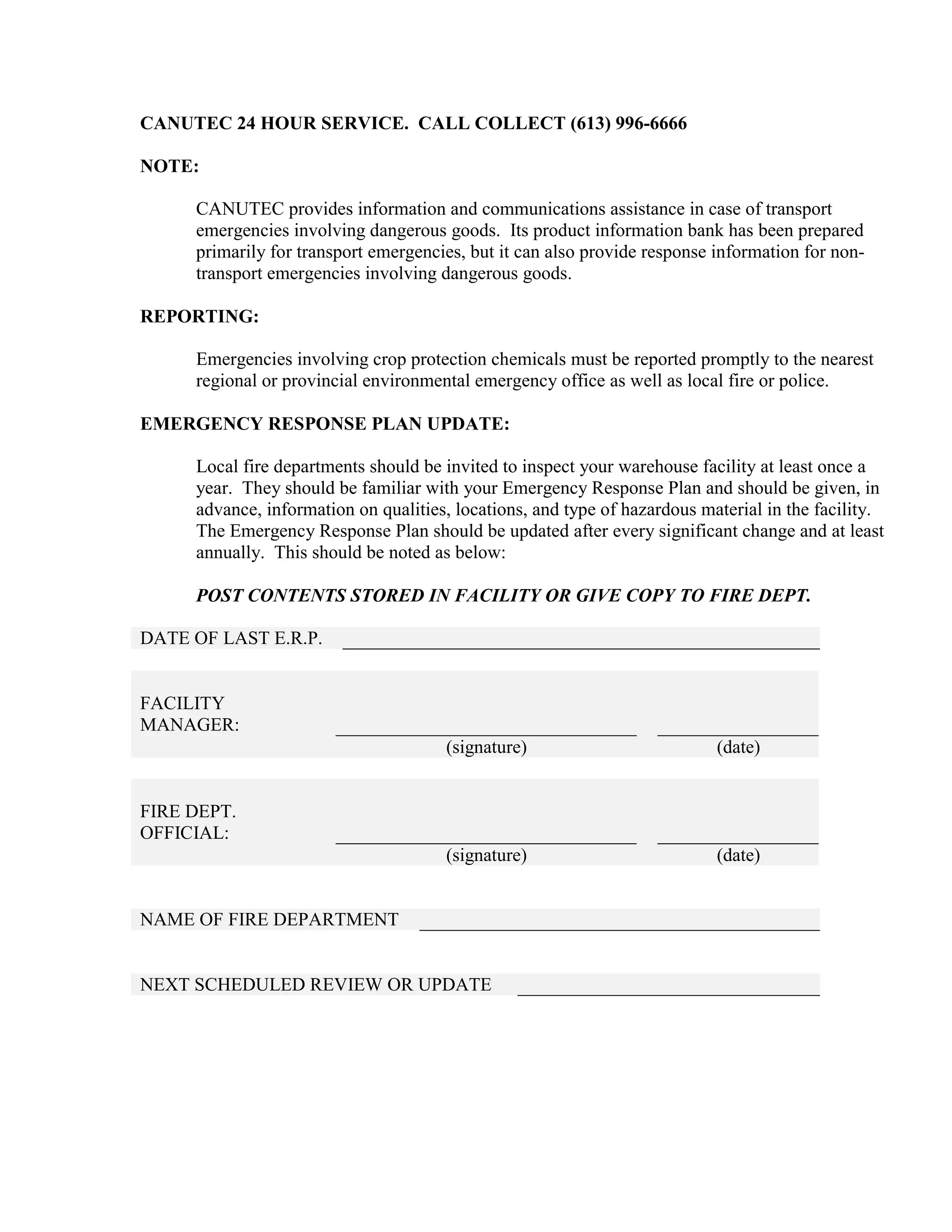
CANUTEC 24 HOUR SERVICE. CALL COLLECT (613) 996-6666
NOTE:
CANUTEC provides information and communications assistance in case of transport
emergencies involving dangerous goods. Its product information bank has been prepared
primarily for transport emergencies, but it can also provide response information for non-
transport emergencies involving dangerous goods.
REPORTING:
Emergencies involving crop protection chemicals must be reported promptly to the nearest
regional or provincial environmental emergency office as well as local fire or police.
EMERGENCY RESPONSE PLAN UPDATE:
Local fire departments should be invited to inspect your warehouse facility at least once a
year. They should be familiar with your Emergency Response Plan and should be given, in
advance, information on qualities, locations, and type of hazardous material in the facility.
The Emergency Response Plan should be updated after every significant change and at least
annually. This should be noted as below:
POST CONTENTS STORED IN FACILITY OR GIVE COPY TO FIRE DEPT.
DATE OF LAST E.R.P.
FACILITY
MANAGER:
(signature) (date)
FIRE DEPT.
OFFICIAL:
(signature) (date)
NAME OF FIRE DEPARTMENT
NEXT SCHEDULED REVIEW OR UPDATE
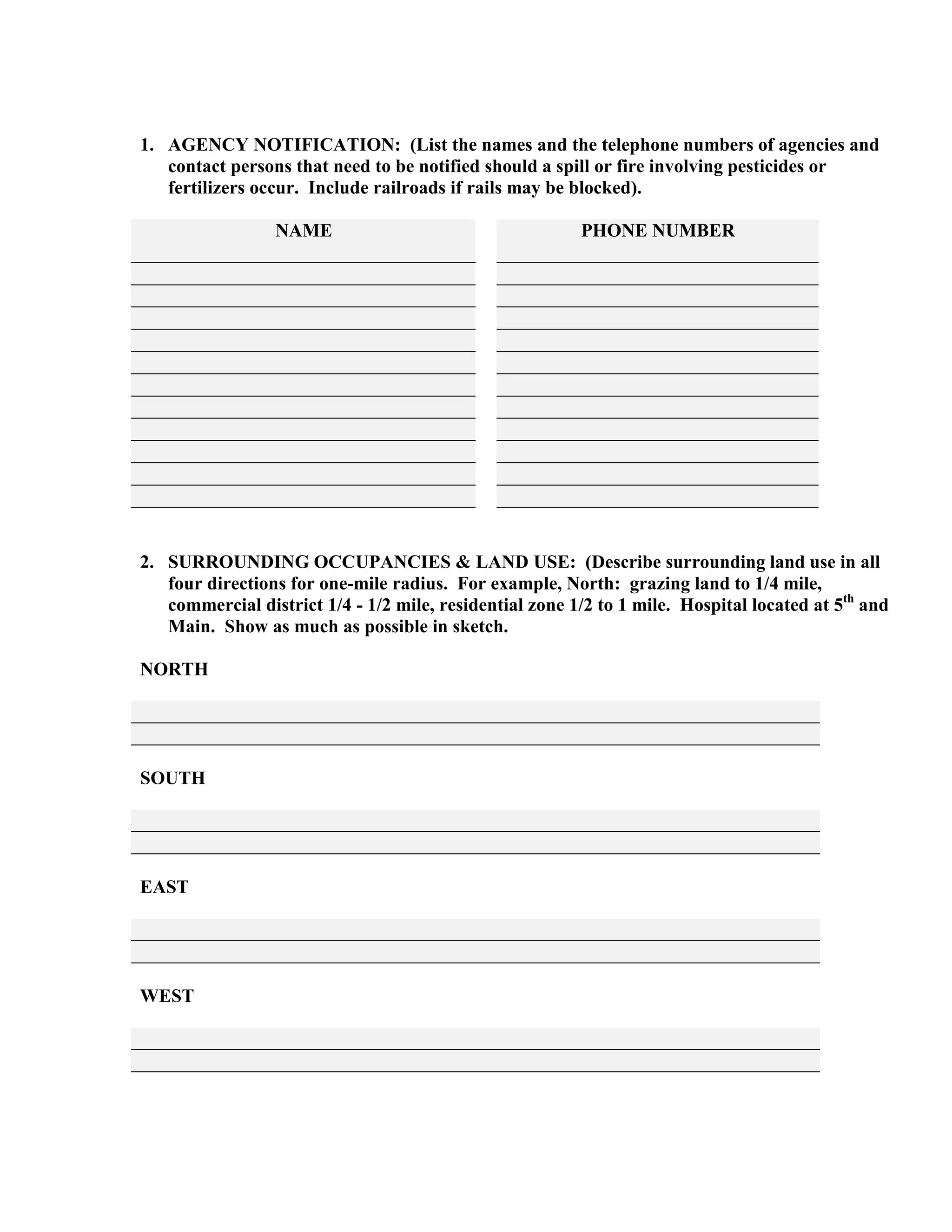
1. AGENCY NOTIFICATION: (List the names and the telephone numbers of agencies and
contact persons that need to be notified should a spill or fire involving pesticides or
fertilizers occur. Include railroads if rails may be blocked).
NAME PHONE NUMBER
2. SURROUNDING OCCUPANCIES & LAND USE: (Describe surrounding land use in all
four directions for one-mile radius. For example, North: grazing land to 1/4 mile,
commercial district 1/4 - 1/2 mile, residential zone 1/2 to 1 mile. Hospital located at 5th
and
Main. Show as much as possible in sketch.
NORTH
SOUTH
EAST
WEST
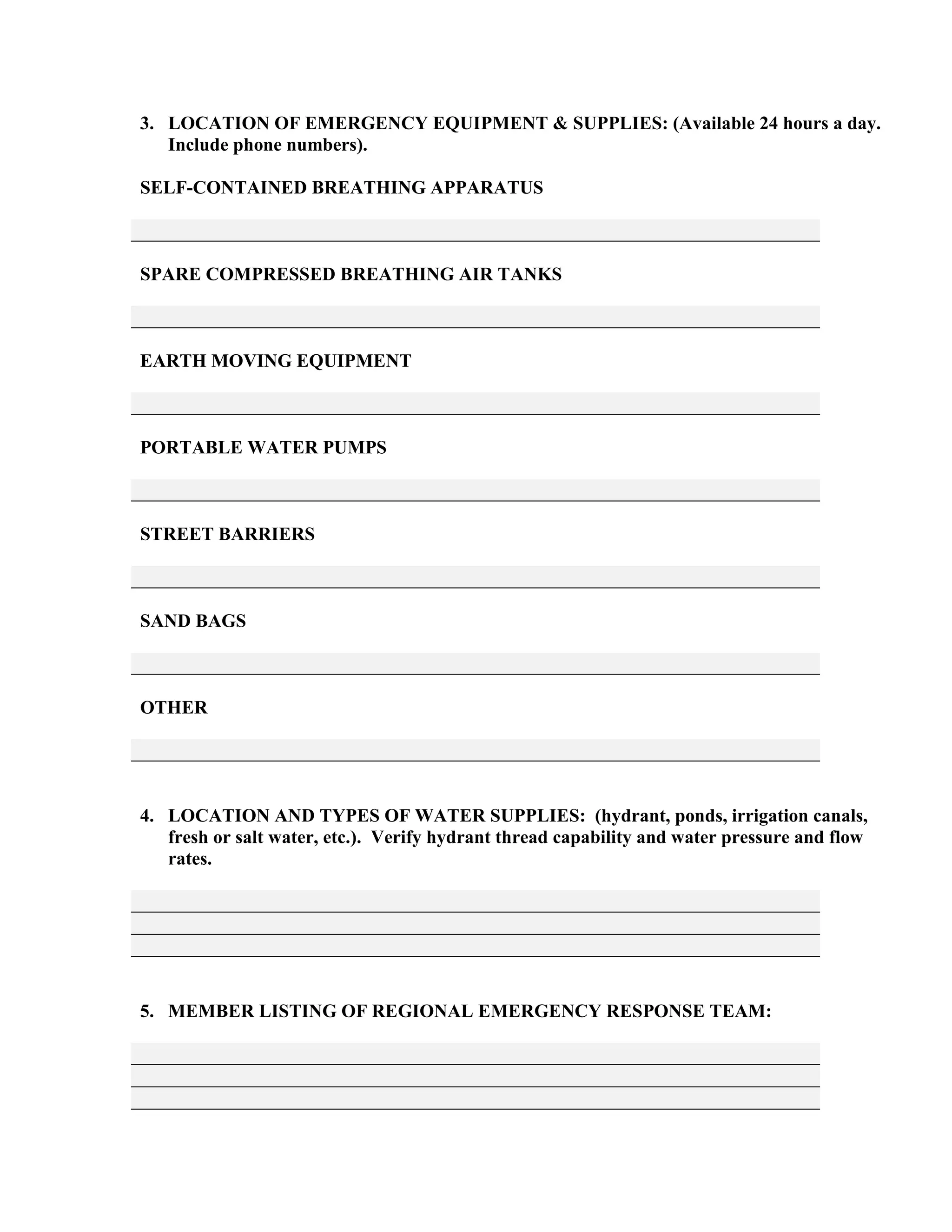
3. LOCATION OF EMERGENCY EQUIPMENT & SUPPLIES: (Available 24 hours a day.
Include phone numbers).
SELF-CONTAINED BREATHING APPARATUS
SPARE COMPRESSED BREATHING AIR TANKS
EARTH MOVING EQUIPMENT
PORTABLE WATER PUMPS
STREET BARRIERS
SAND BAGS
OTHER
4. LOCATION AND TYPES OF WATER SUPPLIES: (hydrant, ponds, irrigation canals,
fresh or salt water, etc.). Verify hydrant thread capability and water pressure and flow
rates.
5. MEMBER LISTING OF REGIONAL EMERGENCY RESPONSE TEAM:
RISK ANALYSIS
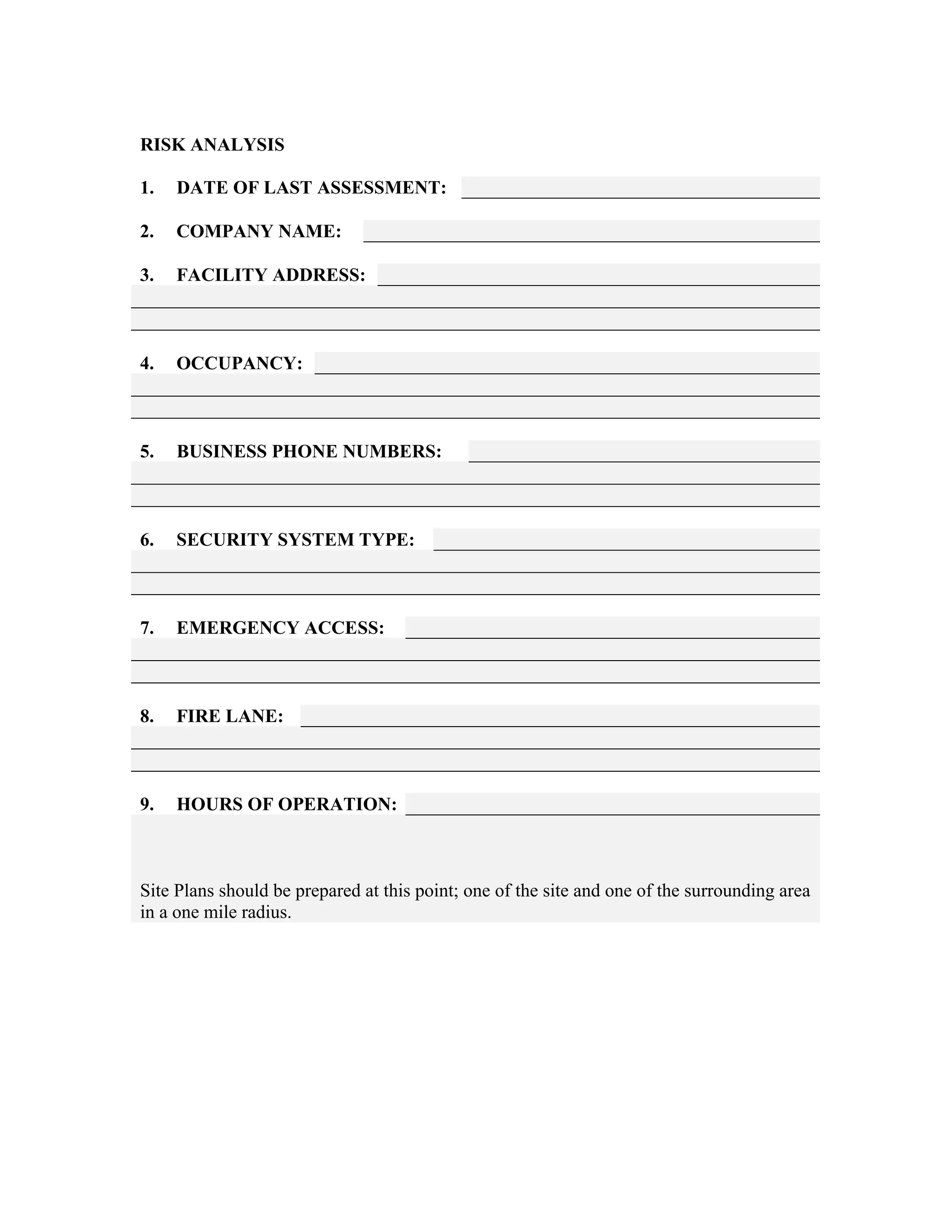
1. DATE OF LAST ASSESSMENT:
2. COMPANY NAME:
3. FACILITY ADDRESS:
4. OCCUPANCY:
5. BUSINESS PHONE NUMBERS:
6. SECURITY SYSTEM TYPE:
7. EMERGENCY ACCESS:
8. FIRE LANE:
9. HOURS OF OPERATION:
Site Plans should be prepared at this point; one of the site and one of the surrounding area
in a one mile radius.
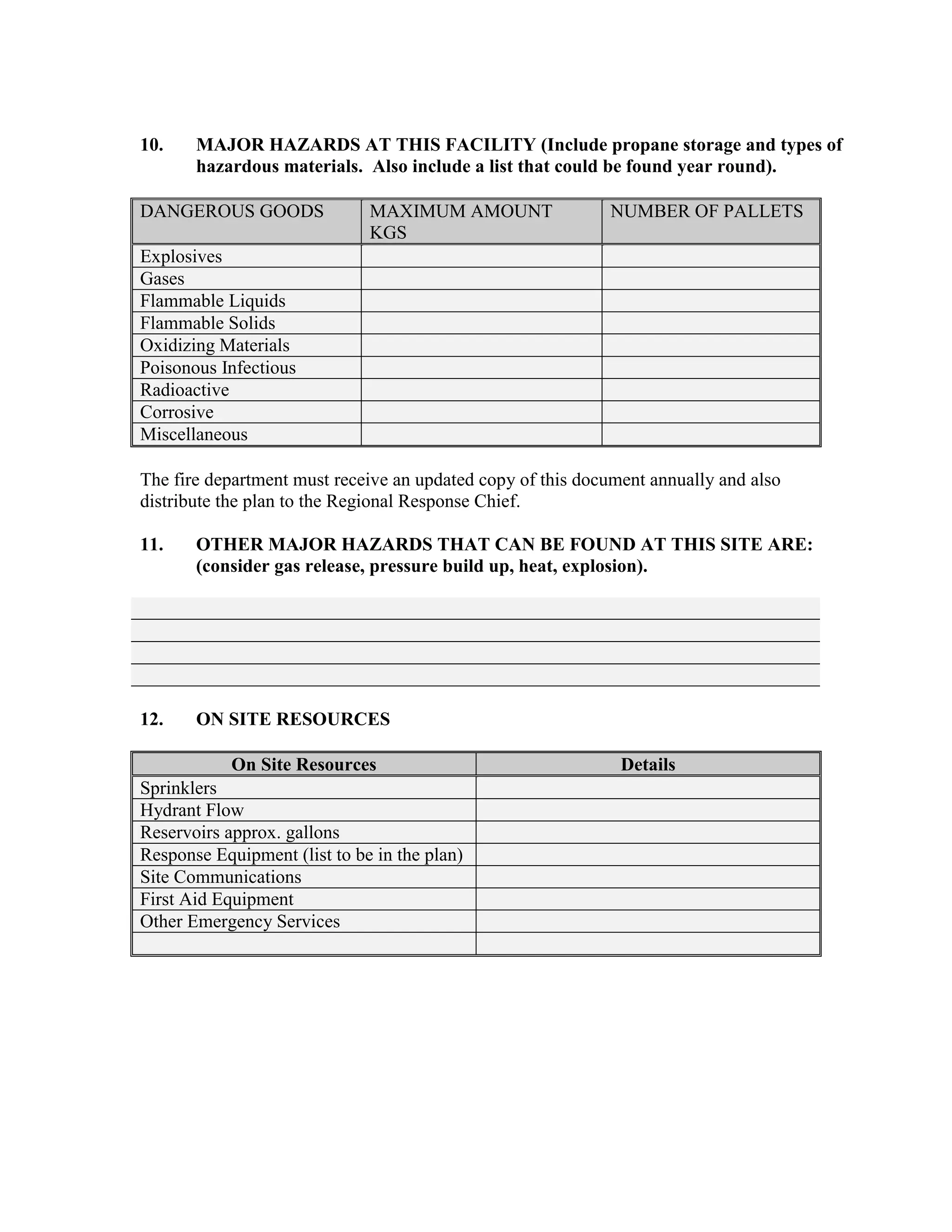
10. MAJOR HAZARDS AT THIS FACILITY (Include propane storage and types of
hazardous materials. Also include a list that could be found year round).
DANGEROUS GOODS MAXIMUM AMOUNT
KGS
NUMBER OF PALLETS
Explosives
Gases
Flammable Liquids
Flammable Solids
Oxidizing Materials
Poisonous Infectious
Radioactive
Corrosive
Miscellaneous
The fire department must receive an updated copy of this document annually and also
distribute the plan to the Regional Response Chief.
11. OTHER MAJOR HAZARDS THAT CAN BE FOUND AT THIS SITE ARE:
(consider gas release, pressure build up, heat, explosion).
12. ON SITE RESOURCES
On Site Resources Details
Sprinklers
Hydrant Flow
Reservoirs approx. gallons
Response Equipment (list to be in the plan)
Site Communications
First Aid Equipment
Other Emergency Services
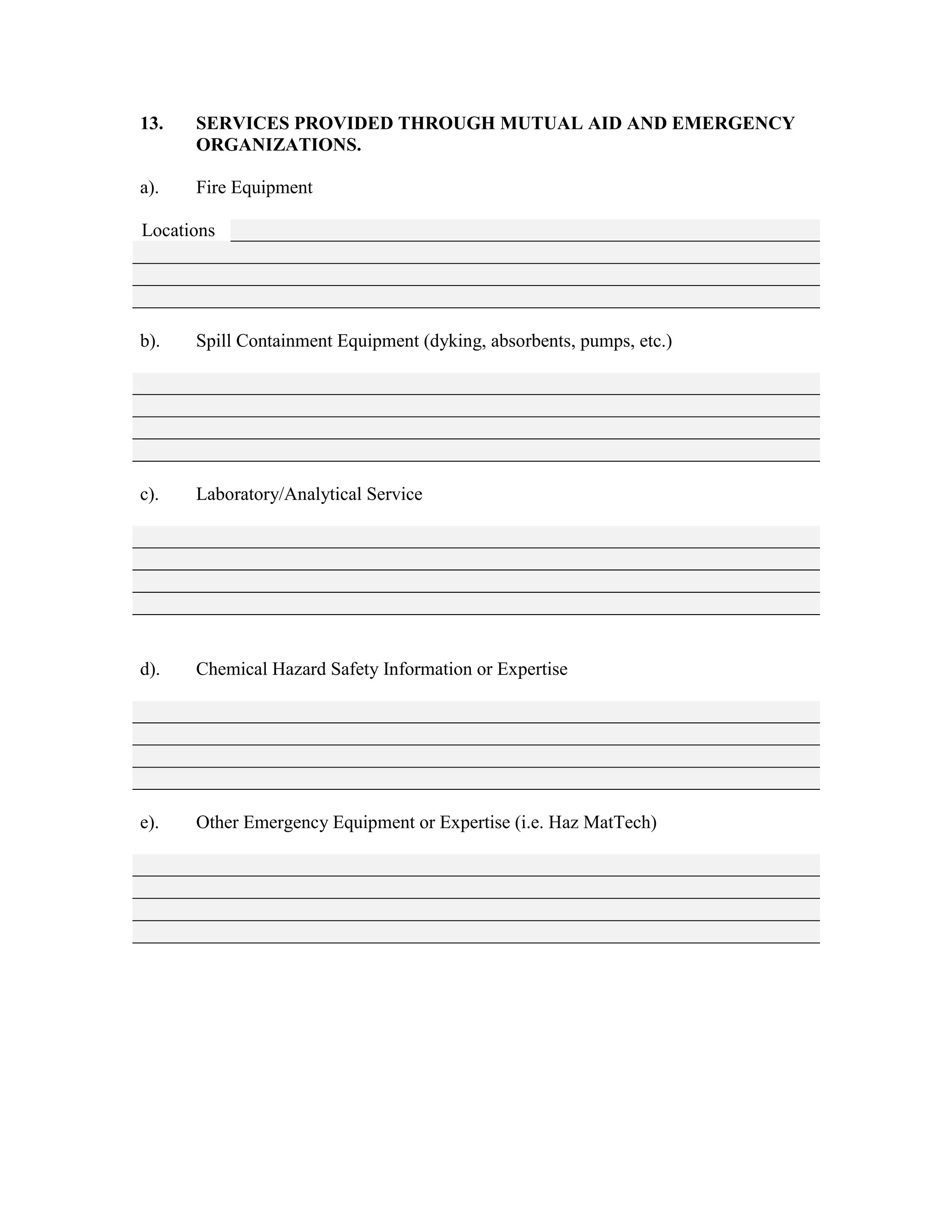
13. SERVICES PROVIDED THROUGH MUTUAL AID AND EMERGENCY
ORGANIZATIONS.
a). Fire Equipment
Locations
b). Spill Containment Equipment (dyking, absorbents, pumps, etc.)
c). Laboratory/Analytical Service
d). Chemical Hazard Safety Information or Expertise
e). Other Emergency Equipment or Expertise (i.e. Haz MatTech)
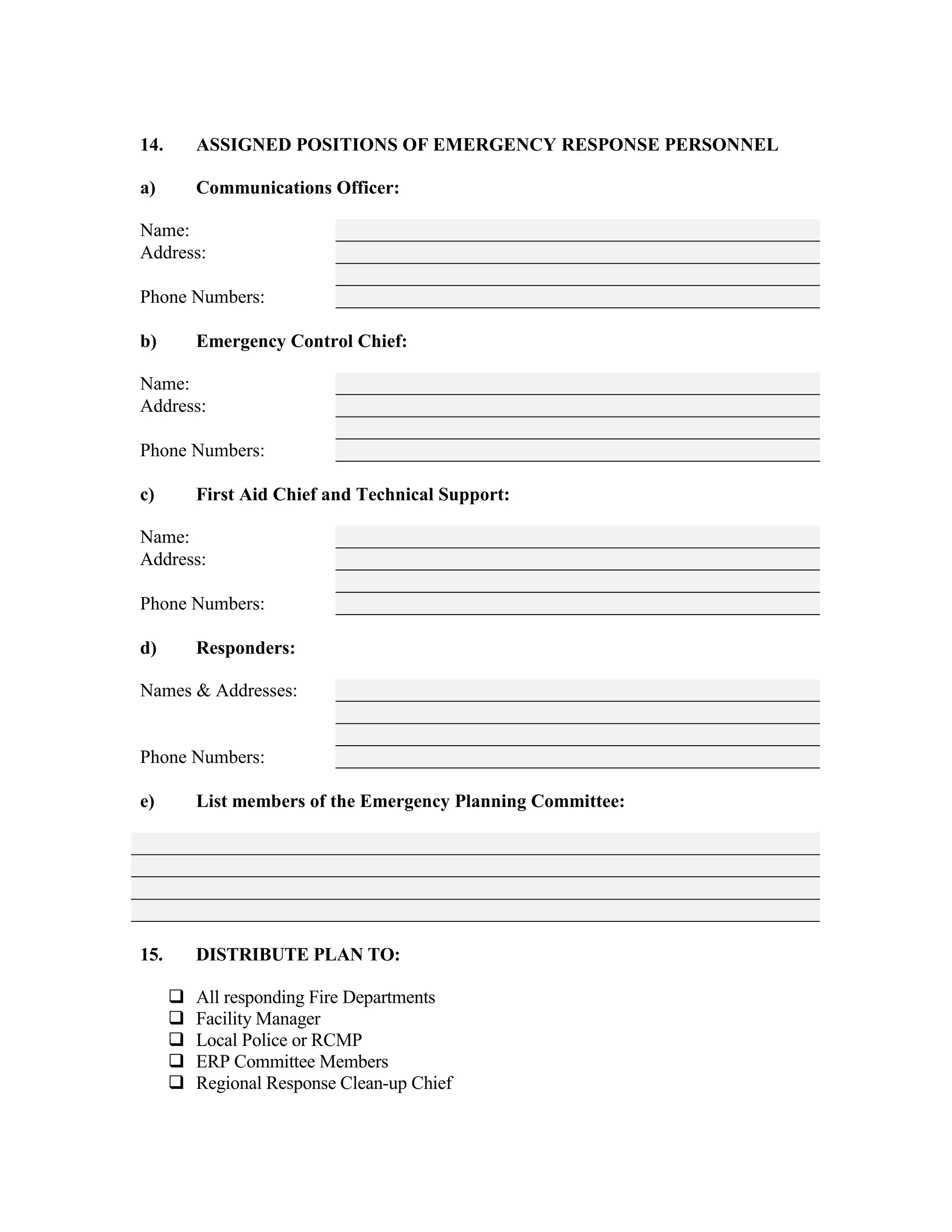
14. ASSIGNED POSITIONS OF EMERGENCY RESPONSE PERSONNEL
a) Communications Officer:
Name:
Address:
Phone Numbers:
b) Emergency Control Chief:
Name:
Address:
Phone Numbers:
c) First Aid Chief and Technical Support:
Name:
Address:
Phone Numbers:
d) Responders:
Names & Addresses:
Phone Numbers:
e) List members of the Emergency Planning Committee:
15. DISTRIBUTE PLAN TO:
#"All responding Fire Departments
#"Facility Manager
#"Local Police or RCMP
#"ERP Committee Members
#"Regional Response Clean-up Chief

Storage handling

  • 1.
  • 2.
    Table of Contents CanadianFertilizer Storage and Handling Guidelines 1.0 INTRODUCTION 1.1 Executive Steering Committee 1.2 Working Groups 1.3 General Approach 1.4 Recommendations on How to Use the Guidelines 2.0 SOLID FERTILIZER 2.1 Siting 2.1.1 Recommendations 2.2 Facility and Equipment Design and Construction 2.2.1 Recommendations 2.2.2 Ammonium Nitrate Storage 2.3 Facility and Equipment Inspections 2.3.1 Recommendations 3.0 ANHYDROUS AMMONIA 3.1 Siting 3.1.1 Recommendations 3.2 Facility Design and Construction 3.3 Facility and Equipment Inspections 3.3.1 Recommendations 4.0 LIQUID FERTILIZER 4.1 Siting 4.1.1 Recommendations 4.2 Facility Equipment Design and Construction 4.2.1 Recommendations 4.3 Inspections 4.3.1 Recommendations 5.0 EMPLOYEE TRAINING AND DOCUMENTATION 5.1 Employee Training 5.1.1 Recommendations 5.2 Documentation Requirements 5.2.1 Recommendations 6.0 EMERGENCY RESPONSE PLANNING AND PRACTICE 6.1 Recommendations REFERENCES APPENDICES Appendix A-1 Solid Fertilizer Siting Distances Appendix A-2 Anhydrous Ammonia Siting Distances Appendix A-3 Liquid Fertilizer Siting Distances Appendix B-1 Solid Fertilizer Site Layout Appendix B-2 Bagged/Bulk Fertilizer Warehouse Layout Appendix B-3 Anhydrous Ammonia Site Layout Appendix B-4 Liquid Fertilizer Site Layout Appendix C-1 Solid Fertilizer Daily Inspection Checklist Appendix C-2 Solid Fertilizer Annual Inspection Appendix C-3 Anhydrous Ammonia Fertilizer Daily Inspection Checklist Appendix C-4 Anhydrous Ammonia Annual Inspection Appendix C-5 Liquid Fertilizer Daily Inspection Checklist Appendix C-6 Liquid Fertilizer Annual Inspection Appendix C-7 Liquid Tank Inspection Report Appendix D Suggested Training and Course Contents Appendix E Emergency Response Plan Template
  • 3.
    1.0 INTRODUCTION The followingdocument contains the Canadian Fertilizer Industry Storage and Handling Guidelines. These guidelines were developed to provide information and guidance to members of the industry on the measures they can take at their facilities to maintain or improve the level of safety associated with the storage and handling of fertilizers. This initiative was driven by the industry’s responsibility to continuously improve the stewardship of its products to meet society's demand for protecting the environment, human health and safety. The guidelines are based upon existing regulatory requirements and industry best practices. 1.1 Executive Steering Committee The overall initiative was driven by an Executive Steering Committee comprised of representatives from all segments of the industry. The members of the steering committee were: Donald Côté - Quebec Fertilizer Manufacturers’ Association Percy Crossman - Saskatchewan Wheat Pool Jim Farrell - Canadian Fertilizer Institute Bill McEwen – Agrium Tom Sawyer - The Fertilizer Institute of Ontario John Scales - Atlantic Fertilizer Institute Bernie Tiessen - Canadian Association of Agri-Retailers The Executive Steering Committee was responsible for representing the interests of manufacturers, distributors and retailers of fertilizer. It was also responsible for defining the overall process by which the guidelines were developed Working Groups Three working groups were established to develop the guidelines for each major fertilizer industry segment. The working groups and their members were: Solid Fertilizer – Percy Crossman (Chair), Malcolm Parker, Glen Dixon, Donald Côté, John Scales. Liquid Fertilizer – Bernie Tiessen (Co- Chair), Tom Sawyer (Co-Chair), Jim Farrell, Tony Bouw, Oleh Ilnyckyj. Anhydrous Ammonia – Al Petkau (Co- Chair), Neil Jorgenson (Co-Chair), Don Henderson, Frank Vidalin, Reg Helwer. 1.2 General Approach The major principle for the entire initiative was to ensure recommendations were cost effective based upon the actual safety/environmental risks in the industry. To assess the risks, a risk assessment survey was developed and sent to industry members. The survey asked each recipient to rank the level of risk associated with various parameters according to a four-point scale. Once the surveys were returned, all the parameters were analyzed to determine the highest ranked risks. Any risk parameter that was ranked as a moderate to high risk by greater than 50% of respondents was selected as an area of focus in the development of the guidelines. Each identified risk was then investigated by one of the specific working groups to determine the level of risk and the recommended approach to minimizing the risk. The guidelines were based upon existing regulations, corporate standards and industry best practices.
  • 4.
    1.3 Recommendations onHow to Use the Guidelines These guidelines should be considered at the early design stages for any new fertilizer facility. It is recognized that in many cases, existing facilities will not meet all of the recommendations, specifically for siting or facility design and construction. Existing facilities should consider all of the recommendations made in this document and work towards meeting the recommendations in a timeframe that is economically viable. The development of the guidelines considered existing laws and regulations in general. It is strongly recommended that local authorities be consulted to determine any specific requirements that may be over and above these guidelines.
  • 5.
    2.0 Solid Fertilizer Thissection contains the recommended guidelines for all solid (granules, crystals, pellets, prills and pastilles) fertilizers. Further to the recommendations an environmental site assessment should be completed to ensure site suitability prior to development. 2.1 Siting The recommended distances for siting solid fertilizer facilities were decided by reviewing several factors. The first was to establish the actual risks presented by solid fertilizer storage facilities to the surrounding environment. The next step was to compare these risks to other facilities that have had siting distances already established. Several types of facilities were used for comparison including crop protection storage facilities and other hazardous substance storage facilities. Once this comparison was completed, a siting distance was established in proportion to the risk presented. An example siting plan is presented in Appendix A-1. 2.1.1 Recommendations 1. All Fertilizer Blenders and/or Bulk/Bagged Fertilizer Storage (new construction) - 25 metres from facility to closest neighboring property line. 2. All Fertilizer Blenders and/or Bulk/Bagged Fertilizer Storage (existing facilities) - Facilities located closer than 25 metres from blending facility to closest neighboring property line should install dust control system. 3. Distance from rivers, lakes, streams and/or environmentally sensitive areas - 50 metres from bulk storage facility or blender to rivers, lakes, streams and/or environmentally sensitive areas. Facilities located closer than 50 metres should have a plan for containing emergency response water including an evaluation on dyking requirements. 4. Ammonia Nitrate Storage Facilities - National Fire Code (1995) references the Canadian Transportation Commission (CTC) General Order No. 0-36 as follows: !"92 metres from storage facility to school, hospital, senior citizen’s home or other high occupancy facility. !"46 metres from storage facility to residence, office building, etc. !"16 metres from storage facility to any warehouse or facility used for the storage of dangerous or flammable/combustible products. !"8 metres separation from other facilities on adjoining properties if aggregate storage is less than 182 tonnes. !"16 metres separation from other facilities on adjoining properties if aggregate storage is less than 182 tonnes. 5. Distance from Fertilizer Storage Facility to Roadway – typically at least 40 metres from the edge of the roadway to the facility. However, it is recommended that the facility owner check with local provincial officials for specific requirements.
  • 6.
    6. Prevailing WindDirections - prevailing wind direction should be considered when determining site locations for blending or bulk fertilizer storage facilities. All dust producing operations should be located downwind from residential and/or environmentally sensitive areas. 7. Access to Primary Roads - Access to primary roads is critical to ensure unrestricted fertilizer delivery. In several jurisdictions, restrictions may be placed on access to secondary roads for fertilizer delivery. 8. Emergency Response Access - Access to two sides of the facility with a minimum 10 metres clearance for Emergency Response Vehicles. 2.2 Facility and Equipment Design and Construction The contents of this section were largely determined by the responses to the risk assessment survey. These designated risk areas were investigated to determine the risk presented. This risk assessment was then used to develop recommendations based on existing codes, regulations and/or industry practices. An example layout plan is presented in Appendix B-1. 2.2.1 Recommendations 1. Design Specification for Out of Condition Material: !"Regular Fertilizer - stored in a contained area that is covered to prevent contamination from rainwater. Can be ground up and disposed of at a later date. !"Impregnated Fertilizer - Dealt with promptly upon occurrence, not stored on site. 2. Containment of Run-Off Water: !"Priority must be placed on eliminating the opportunities for contamination. Small spills, leaks or dust must be cleaned up immediately. !"Contaminated run-off water must be contained and disposed of properly (i.e. land-farmed, certified waste disposal, etc.) 3. Load-In/Load-Out Pads Design & Construction: !"Must be constructed of concrete or asphalt. !"Must be situated at all load in/load out areas as well as under bins, blenders and/or storage facilities. !"Concrete should be sulphate resistant. !"Load in/load out slab should be a minimum of 2 metres wider than the widest vehicle being loaded. See figure 2.1. !"Underground conveyor systems should consider measures to avoid possible water contamination. 4. Ventilation for Indoor Bulk/Blender Warehouses: !"Forced ventilation system should be installed where practical. Where this is not practical, dust masks or respirators suitable for products being handled, should be used by personnel working in the facility. An example warehouse layout is presented in Appendix B-2. 5. Dust Collection: !"Provincial or municipal environmental dust control regulations should be consulted to determine maximum allowable dust production.
  • 7.
    Figure 2.1 Load-in/Load-outSlab !"Dust collection system should be constructed of corrosion resistant material. !"Primary focus should be on limiting points of dust production (i.e. points of transfer, tops of conveyors, etc.) 6. Equipment Specification Requirements: Electrical Code Designation is Class II Div. II for all fertilizers. Further, all fixtures must be aluminum or PVC to resist corrosion. 7. Soil Preparation: Soil preparation should consist of a compacted sub-base to provide for a good foundation and decrease permeability. 8. Fire Separation Requirements: The majority of fertilizers are not classified as hazardous products. However, fertilizer storage facilities are often attached to other facilities that may store hazardous products. In these cases, the National Fire Code and Building Code should be consulted to determine any fire rating requirements. 9. Location of Exits in a Warehouse: in accordance with the National Building Code (1995), the maximum travel distance between exits should not exceed 15 metres. An example warehouse layout is presented in Appendix B-2. 10. General Fertilizer Storage Signage: !"Authorized Personnel Only (on warehouse entrances) !"Emergency Response Phone Numbers (near road access to facility) !"Exits !"Fire Extinguishers !"Safety Equipment Location 11. Emergency Response/Spill Clean-up Equipment (located in a readily accessible location): !"Respirator !"Goggles !"Broom/Shovel !"Gloves !"Clean-up Drum for contaminated product !"Safety Equipment !"Dust Mask/Respirator
  • 8.
    2.2.2 Ammonium NitrateStorage The following are specific recommendations for storing granular ammonium nitrate in bulk storage facilities: !"Ammonium nitrate should not be stored in a confined space that would allow a pressure buildup, !"Ammonium nitrate should not be stored near, or be contaminated with combustible materials or organic substances such as oils and waxes, !"Ammonium nitrate should not be stored near, or be contaminated with inorganic materials that may contribute to its sensitivity to explosion, including chlorides and some metals, such as chromium, copper, cobalt and nickel. Currently the National Fire Code (1995) states in section 3.2.9.7.1) bagged ammonium nitrate in quantities in excess of 600,000 kg shall be stored only in buildings sprinklered in conformance with Article 6.5.1.1. This requirement is currently under review by the National Fire Code and there are currently no recommendations for sprinkler systems in bulk storage of ammonium nitrate. Specific Ammonium Nitrate Storage Signage: !"CTC General Order No. 0-36 states that "a weatherproof sign bearing the words "AMMONIUM NITRATE" and "NO SMOKING OR OPEN FLAMES" in block letters at least two inches high on a white or light coloured background shall be posted in a conspicuous place near each entrance to the storage facility". 2.3 Facility and Equipment Inspections The following section contains the recommended inspections for all solid fertilizer storage facilities. Example inspection forms for solid fertilizer are presented in Appendix C-1 and C-2. 2.3.1 Recommendations 1. Daily Walk-Around Inspection: a daily walk around inspection is recommended to ensure all spilled fertilizer is cleaned up to avoid potential contamination. 2. Annual Safety Inspection: an annual safety inspection is recommended for all solid fertilizer storage facilities and equipment.
  • 9.
    3.0 Anhydrous Ammonia Anhydrousammonia is a corrosive, compressed gas that is liquified under pressure. It can present significant safety and health risks if not handled and sorted properly. This section contains the recommended guidelines for all anhydrous ammonia storage facilities. Further to the recommendations an environmental site assessment should be completed to ensure site suitability prior to development. 3.1 Siting There is currently a number of siting distance restrictions for anhydrous ammonia facilities. Several manufacturers of anhydrous ammonia have set their own siting distance requirements for their own facilities. Due to the variety of requirements, it was necessary to develop siting recommendations utilizing a risk assessment approach. A risk assessment screening process for ammonia storage and distribution facilities currently under development by the Canadian Fertilizer Institute (CFI), includes an assessment of pressurized ammonia storage tanks. The criteria used to develop the model and risk assessment process, considered 80 tonne pressurized storage tanks, typical to Canadian retail storage facilities. This model was used as a reference when developing recommendations for siting of retail ammonia facilities. An example siting plan is presented in Appendix A-2. 3.1.1 Recommendations 1. Boundaries: City, Town Or Village (new construction) - Anhydrous ammonia storage facilities being constructed should be located a minimum of 1.5 km from the boundary of a city, town or village. 2. Boundaries: City, Town or Village (existing) - Anhydrous ammonia storage facilities located closer than 1.0 km from the boundary of a city, town or village should implement the following program: !"Annual meeting with local residents to review emergency response plan and how they can participate. !"Must hold annual meeting with local fire department and review the video "Preventing & Responding to Anhydrous Ammonia Emergencies". !"Hold a half to full day session bi- annually with local fire department(s) on how to contain an NH3 escape by proper hose location patterns and spray to include: !"Practical field demonstrations. !"Walk through of location, storage units, emergency shut-off valve locations, fire routes, etc. !"Meet with local mayor, reeve, council and discuss/explain the emergency response plan. !"Staff training - review emergency response plan and procedures in April (before use season begins). Review again with staff in September to ensure safety handling procedures are being followed. !"Implement a daily check program during the use season, where staff will hand tighten every tap on nurse wagons and storage tanks.
  • 10.
    Please note: Allthe program elements listed here should be considered for new facilities as well. 3. Environmentally Sensitive Areas: Anhydrous ammonia storage facilities should be located a minimum of 50 metres from areas such as rivers, lakes, streams and other environmentally sensitive areas provided the dyking is installed to contain emergency response water. 4. General Site Recommendation: Anhydrous ammonia facilities should be located downwind of residences according to prevailing wind direction. 5. Emergency Response Access: Access to two sides of the facility with a minimum 10 metres clearance for Emergency Response Vehicles. 3.2 Facility Design & Construction The contents of this section were largely determined by the responses to the risk assessment survey. These designated risk areas were investigated to determine the risk presented. This risk assessment was then used to develop recommendations based on existing codes, regulations and/or industry practices. An example facility layout is presented in Appendix B-3. 1. Tank Construction: Anhydrous ammonia storage tanks should be constructed of SA-516-70 Fine Grained Steel that has been fully stress relieved at the time of construction. 2. Site Fencing & Security: A 2 metre high fence is recommended around entire anhydrous ammonia storage site to prevent unauthorized access. 3. Standard Pipe Layout: A typical pipe layout is shown in figure 3.1. 4. Facility Signage: The recommended standard signage and location is: !"Caution Ammonia (on tank) !"Product Identification Number (PIN #1005) (on tank) !"Liquid Lines (on tank line) !"Vapour Line (on tank line) !"Twenty Four Hour Emergency Contact Phone List (entrance to Facility) 5. Safety Equipment: The recommended safety equipment for an anhydrous ammonia operation is: !"200 Gallon Water Trough (heated) !"Wind Sock !"One Self Contained Breathing Apparatus !"Full Face Canister Gas Mask (Delivery Vehicle) !"Personal Protective Equipment - Goggles, Gloves, Turn Out Gear and Water Bottle !"Fire Extinguisher !"First Aid Kit 6. Site Preparation/Soil Profile: Anhydrous ammonia storage facility site should be graded to minimize surface water run-off and provide emergency containment in the case of a major release. 3.3 Facility and Equipment Inspections The following section contains the recommended inspections for all anhydrous ammonia storage facilities. Example inspection forms are presented in Appendix C-3 and C-4.
  • 11.
    Figure 3.1 StandardPipe Layout – Ammonia Storage Tank 3.3.1 Recommendations 1. Daily Inspection: A daily visual walk around of all storage vessels is recommended to look for possible leaks or equipment malfunctions. 2. Annual Inspection: An annual documented inspection is recommended. A recommended format will be prepared for the final guidelines document. 3. Ten Year Internal Tank Inspection (Tank Out Of Service): A ten year internal examination of the storage vessel is required according to Boiler & Pressure Vessel regulations. 4. Safety Relief Valves: Safety relief valves should be visually inspected annually and replaced every five years. 5. Hoses: Anhydrous ammonia storage vessel hoses should be tested annually to maximum allowable working pressure.
  • 12.
    4.0 Liquid Fertilizer Thissection outlines the recommendations and technical guidelines for the storage and handling of the following types of liquid fertilizers: • urea ammonium nitrate solutions • ammonium polyphosphate • ammonium thiosulphate • muriate of potash • fertilizers in suspension (various) Further to the recommendations, an environmental site assessment should be completed to ensure site suitability prior to development. 4.1 Siting Liquid fertilizer storage facilities do not generally represent a risk to surrounding land uses in terms of health and safety. Environmental impacts of a storage tank failure are the primary concern with respect to siting and it is recommended that secondary containment of the storage tank contents be provided in all cases. An example siting plan is provided in Appendix A-3. 4.1.1 Recommendations 1. Water sources: Liquid fertilizer storage facilities should be a minimum of 50 metres from private wells and 300 metres from a source of public water supply. (Facilities located closer than these recommended distances should examine the hydro-geological conditions to determine potential for contamination of the water source and establish whether or not additional containment measures are required). 2. Environmentally Sensitive areas: Liquid storage facilities should be a minimum of 50 metres from rivers, lakes, streams and environmentally sensitive areas. 3. Emergency Response Access: Access to two sides of the facility with a minimum 10 metres clearance for Emergency Response Vehicles. 4. Distance from Liquid Storage Facility to Roadway: Typically at least 40 metres from the edge of the roadway to the facility. However, it is recommended that the facility owner check with local provincial officials for specific requirements. 4.2 Facility Equipment Design & Construction This section covers several items that should be considered when designing or renovating existing liquid fertilizer facilities. An example facility layout is presented in Appendix B-4.
  • 13.
    4.2.1 Recommendations 1. SitePreparation/Soil Profile: Sound engineering principles should be applied when choosing a site or a location within a site and when designing a facility and preparing for construction. Consideration of floodlines and high water tables should guide the decision for location of the facility within the site. Ensure that the site is graded to minimize surface water flow onto the property and also ensure the ability to capture surface water flow from the site in the event of a spill. Frost conditions and soil load bearing capacity should also be factored into design process. 2. Containment: All sites should be graded/curbed to ensure spills in areas where liquid fertilizer is handled will be contained and drained to a collection point (sump). Grades recommended for areas draining to sumps range from 1 to 2 %. 3. Site Fencing and Security: Site security is required to prevent accidents and to minimize unauthorized access resulting in spills or vandalism. A secure lock system on all valves should be provided as a minimum. Fencing around the entire site is suggested as a good business practice although it is recognized that this is not practical or desirable in many operations. If sight gauges are used they should be lockable and be installed downstream of the outlet valves. 4. Facility Layout for Delivery and Pick- up: There should be adequate space to allow for uninterrupted traffic flow and allow for the safe movement of vehicles. It is recommended that load-out facilities be designed to allow for circular movement of vehicles, but that will depend on individual operations. In a facility that requires the trucks, such as 5 axle semi trailers, A and B trains, a turning radius should be provided to allow for: - 42 metres minimum turning radius - 50 metres preferred turning radius 5. Access to Site - Public Roadways: Roads that experience high traffic increase the potential for accidents and therefore access roads with low traffic are most desirable. Traffic routes with load restrictions could restrict supplier and customer and may have an impact on the business. Discussion with the local authorities should be initiated very early in the planning process to ensure that site access during peak times will not be a problem. 6. Signage: A sign should be posted on the storage tanks that clearly identifies the product contained in the tank by text (i.e. Nitrogen Solution) and numerical (i.e. 28- 0-0) description. Supplier MSDS sheets will indicate whether or not there is a Workplace Hazardous Materials Information System (WHMIS) requirement for product labeling. For the overall site, signage is recommended as follows: A sign shall be placed that is legible from the primary entrance to the property which indicates the owner or operator of the site and/or the emergency phone number(s) that will initiate the site E/R plan. The sign shall be of a permanent, weatherproof construction. 7. Equipment Specification Requirements (pipes, valves, fittings): It is recommended that flexible connections at the tank be made to a stainless steel nipple and valve using stainless steel braid rubber hose to allow for shifting of the tank. As a minimum Schedule 80 piping is
  • 14.
    recommended and itshould be installed so that it is self-draining. Pipe runs should be marked (in/out) for safety purposes. Tank piping should be compatible with material stored within the tanks. Table 4.1 lists the chemical compatibility for several liquid fertilizer compounds and various construction materials and Table 4.2 outlines construction material compatibility between containers and appurtenances. Above ground piping is preferable to below ground piping as leaks below ground can go undetected. Table 4.1 CHEMICAL COMPATIBILITY FOR LIQUIDS FERTILIZERS Table Key: A- Acceptable if compatible with container or appurtenances N- Not acceptable because of chemical compatibility 1- Acceptable if product is treated with corrosion inhibitor 2- Acceptable if warranted by equipment manufacturer for the intended use 3- Acceptable if cleaned after seasonal use and is used to store materials less than three months (cumulative) annually Product Urea Ammonia Nitrate Ammonium Thiosulfate Ammonium Poly- phosphate Potassium Phosphate Potassium Hydroxide Potash Solutions Mixed Fertilizers, Starters Container Material Stainless Steel A A A A A A A Mild Steel 1 1 A N N 3 3 Mild Steel with Liner 2 2 A 2 2 2 2 Aluminum A A N N N N N Fiberglass A A A A 2 A A Poly or Plastic A A A A 2 A A Brass or Copper Alloys N N N N N N N Plugs, Valves, Tank Inserts Stainless Steel A A A A A A A Nickel Stainless Insert A A A A 2 A A Fully Lined Metal Stainless Insert A A A A N A A Nylon Ball Valve A A A A A A A Forged Steel A A A 2 N A A Cast Iron/Mild Steel N N A N N N N Poly or Plastic A A A A 2 A A Brass or Copper Alloys N N N N N N N Plumbing Stainless Steel A A A A A A A Forged Steel A A A 2 N A A Cast Iron/Mild Steel 1 1 A N N 3 3 Galvanized N N A N N N 3 PVC/Other Synthetics 2 2 2 A 2 2 2 Source: Wisconsin Department of Agriculture, Trade and Consumer Protection
  • 15.
    Table 4.2 CONSTRUCTION MATERIALCOMPATIBILITY BETWEEN CONTAINERS AND APPURTENANCES Table Key: A- Acceptable if all materials are chemically compatible N- Not acceptable because of differing reactivity or strength 1- May be acceptable for some products, as recommended by manufacturer Container Stainless Steel Mild Steel Aluminum Fiberglass Poly Plugs, valves, tank inserts Stainless steel A A A A A Cast nickel stainless insert A A A A A Lined metal stainless insert N A A A A Nylon ball valve A A A A A Forged steel 1 A N A A Cast iron or mild steel N A N 1 A Poly or plastic N N N 1 A Brass or copper alloys N N A 1 1 Plumbing Stainless Steel A A A A A Forged Steel 1 A A A A Cast iron or mild steel N A N A A Galvanized N A 1 A A PVC and other synthetics 1 1 1 1 1 Source: Wisconsin Department of Agriculture, Trade and Consumer Protection 8. Spill Clean-up Equipment: For minor spills and drips associated with loading/unloading operations it is recommended that pails be used to capture all liquid fertilizer material. Any material that is not caught by pails should be cleaned up immediately in situations where the load-out area is constructed of impervious material. Some type of absorbent material (i.e. kitty litter) should be available at locations with impervious load out areas. It is very important to make available a vessel for disposal of minor spills and drips from loading operations to ensure that the fertilizer is dealt with properly. Liquid fertilizers are mildly corrosive so goggles and rubber gloves should be worn in situations where direct contact with the liquid is required. Equipment required for dealing with major spills or tank failures is discussed in the emergency response section of these guidelines. 9. Tank Specifications: It is recommended that all tanks used for storage of liquid fertilizer be above ground. All tanks should be anchored to keep them from floating within the dyke in the case of a spill. Soil conditions and load bearing capacity should be considered when locating and constructing liquid fertilizer storage tanks. Bottom of tanks should be well drained and remain dry to minimize corrosion. Suggestions for leveling tanks and building various bases for large tanks are provided in Tennessee Valley Authority (1993). There are several different types of tanks that are used for storage of liquid fertilizers and recommended guidelines for specific types of tanks are provided:
  • 16.
    !"Concrete tanks withliners: It is recommended that concrete tanks be lined with a styrofoam spray and then a rubber bladder attached between the liquid and the styrofoam. Rubber bladders should be 30 ml thickness which is the optimum for strength and handling. Approximate design life of rubber bladders is 10 years. This 10 year period can be extended if a foam layer is applied to the concrete block before the new liner is hung. !"Steel Tanks: Experience shows that steel tanks have a maximum useable life of twenty years unless otherwise indicated by the manufacturer. This is also highly dependant on the tank maintenance program. Additional information on the selection and specification of steel tanks can be found in Welded Steel Tanks for Oil Storage - API Standard 650 (API, 1993). (A brief checklist of tank specifications to look for will be provided). 10. Secondary Containment Systems: It is recommended that a secondary containment system be included in the construction of any new facility. The dyked or otherwise contained area should have a capacity to hold 110% of the largest tank capacity, plus the volume occupied by the other tanks in the area, up to the safe design level of the dyke. Precipitation that falls within the containment area should be collected in sumps and pumped out on a regular basis using a manually switched, lockable pump. All pumping equipment should be located within the containment area and pipe runs should be over and not through containment walls. The minimum distance from the tank to the containment wall to prevent spouting over the wall is one-half the height of the largest tank. Recommended minimum height for the dyke is 60 cm. Dyking can be constructed of clay, clay with liner, concrete or steel. Construction material will depend on site specific design criteria, availability of materials and location. A selection of materials that can be used for dyke construction and some associated recommendations are: !"Clay - It is recommended that clay dykes have an impermeable liner of minimum 15 cm layer of soil with a coefficient of permeability of at least 10-7 cm/sec. The impermeable layer should be covered with at least 15 cm of gravel or crushed rock. !"Clay w/liner - The liner can be a synthetic (hypalon) material or a geosynthetic (bentonite filled) liner. !"Concrete - Dykes constructed of masonry or concrete should extend to a depth of at least 45 cm below grade and be joined to an impermeable base. !"Steel - If space is limited tanks can be contained within a steel tub or elephant ring. The elephant ring is typically half the height of the tank it is containing and only has to be 1.5 times the diameter to hold 110% of the tank volume. This may present some problems in terms of spouting potential. 11. Containment Area Liners: Reinforced concrete is the most common material but is subject to cracking. Synthetic or clay liners are less costly and may be more appropriate for Canadian climate. Specifics for ensuring concrete for base of containment areas will resist moisture
  • 17.
    penetration are providedin Tennessee Valley Authority (1993) (page 4-19). 4.3 Inspections Most instances of product loss resulting in environmental damage and/or economic losses are from minor leaks that go unnoticed for extended periods of time. The set of recommendations for inspections includes a daily, annual and 3 to 5 year inspection regime. Example inspection forms are presented in Appendix C-5, C-6 and C-7. 4.3.1 Recommendations 1. Daily Inspections: It is recommended that on a daily basis, or as a minimum twice weekly, a very simple walk around inspection is made which looks at the storage tanks, sumps and ponding areas and easily visible pipes and pumps. This is a recommended good management practice that will help identify problems at the earliest possible stage. The regular inspection should be a simple procedure that is documented so that it can be monitored to ensure it is being completed. 2. Annual Inspection (Tank in service): The recommended annual inspection for various liquid fertilizer tanks in service are: !"Steel Tanks - A thorough inspection of the storage tanks, containment systems, piping, valves and pumps should be undertaken on an annual basis. For further reference a sample liquid tank inspection report is provided in Appendix B. The American Petroleum Institute (API) Standard 653 - Tank Inspection, Repair, Alteration and Reconstruction provides a detailed checklist for inspection of steel storage tanks, including examination of tank foundation, shell, appurtenances, and roofs if they exist. 3. Three to Five Year Inspection (Tank out of service): !"Steel Tanks - It is recommended that on a three to five year cycle, steel tanks be drained and sludge that builds up in the bottom of the tank be removed.
  • 18.
    5.0 Employee Trainingand Documentation The following section outlines the recommended training programs and documentation requirements for all fertilizer operations. 5.1 Employee Training Employee training is one of the most important elements for ensuring a safe and profitable fertilizer operation. The recommended training programs are identified below. Example training curriculums and an employee training record are presented in Appendix D. 5.1.1 Recommendations 1. Transportation of Dangerous Goods – Anhydrous ammonia and ammonium nitrate are the only commonly used fertilizer products classified under the Transportation of Dangerous Goods regulations. Any facility that handles or transports these classified products must train staff in the requirements as defined by the Transportation of Dangerous Goods Act and Regulations. 2. Workplace Hazardous Materials Information System (W.H.M.I.S.) – all staff must be trained in accordance with W.H.M.I.S. regulations. Specific attention should be paid to understanding a Material Safety Data Sheet (MSDS) 3. Standard Operating Procedures – all staff must be trained to conduct all major tasks and functions in accordance with developed standard operating procedures. 4. Emergency Response Training – all staff involved in executing the emergency response plan must be trained to ensure an understanding of their duties. 5. First Aid/C.P.R. – an appropriate number of staff at the facility should be trained and certified in emergency first aid and cardiopulmonary resuscitation (CPR). 6. Safety Equipment Usage and Maintenance – all staff must be trained in the proper usage and maintenance of safety equipment. 7. Confined Workspace/Hot Work Training - any facility that requires employees to enter confined workspaces or undertake hot work must ensure those employees are properly trained before conducting those activities. 8. Occupational Health and Safety Rules – all staff must be made aware of the health and safety rules at a facility. 5.2 Documentation Requirements There are a number of different types of documentation required for all fertilizer operations. Most provide information to ensure compliance to regulatory requirements while others serve to provide information to monitor operational effectiveness. Both are necessary to maintain a profitable and safe fertilizer operation.
  • 19.
    5.2.1 Recommendations 1. RegulatoryInformation – regulatory information should include the Transportation of Dangerous Goods Act & Regulations, the Workplace Hazardous Materials Information System Act & Regulations, the Occupational Health and Safety Regulations and any other regulations applicable to the operation. 2. Standard Operating Procedures – a set of up-to-date standard operating procedures should be available at the facility that defines in a step-by-step manner how each major task or function is to be safely and effectively conducted. 3. Emergency Response Plans – a document detailing the plan for responding to emergencies such as a fire or major spill must be developed and updated regularly. 4. Material Safety Data Sheets (MSDS) – Material Safety Data Sheets must be available for each type of fertilizer stored and handled at the facility. 5. Licenses & Permits – all licenses and permits required to legally operate a fertilizer operation must be obtained and maintained. 6. Inspections – a copy of all inspections should be kept including any copies of follow-up on identified action items. 7. Training Records – copies of employee training records should be kept to adequately monitor and maintain training requirements.
  • 20.
    6.0 Emergency Response Planning& Practice Emergency response planning is one of the most important environmental and safety initiatives a fertilizer operation can undertake. Experience has proven that a well-developed and practiced emergency response plan can minimize safety risks for emergency responders and save the facility owner major expenses in clean-up costs. This section details the recommendations for emergency response planning for all fertilizer storage facilities. An emergency response planning template is presented in Appendix E. 6.1 Recommendations 1. Emergency Response Planning - all facilities should develop a plan for responding to emergencies such as major spills or fires. The plan should be developed in conjunction with the local emergency response officials. 2. Emergency Response Practice - all facilities should practice their emergency response plan at least annually. 3. Emergency Response Plan Filing- a copy of the emergency response plan should be kept by all people listed in the plan as well as local emergency response officials.
  • 21.
    References 1. American PetroleumInstitute, 1995. Tank Inspection, Repair, Alteration, and Reconstruction 2. Canada Transportation Act, (no date). Ammonia Nitrate Storage Facilities Regulations, Canadian Transport Commission – General Order No. 0-36. 3. National Building Code (1995) 4. National Fire Code (1995) 5. Tennessee Valley Authority (1993). Environmental Handbook for Fertilizer and Agrichemical Dealers. 6. Transport Canada. Transportation of Dangerous Act and Regulations.
  • 22.
    APPENDIX A-1 Solid FertilizerSiting Distances = 10 Metres HospitalHospitalHospitalHospital Roadway ResidencesResidencesResidencesResidences Solid Fertilizer Facility DISTANCE RETRICTIONS (Ammonium Nitrate) Distance to property line of Hospital, School etc. Distance to property line of residence. Set back distance from roadway Distance to river, lake or stream. 92 MIN. DISTANCE M 50 40 50 DISTANCE RETRICTIONS (Non- Ammonium Nitrate) Distance to property line of Hospital, School etc. Distance to property line of residence. Set back distance from roadway Distance to river, lake or stream. 50 MIN. DISTANCE M 25 40 50 Reservoir Distance to closest rail. 3.5 Distance to closest rail. 3.5
  • 23.
    APPENDIX A-2 = 50Metres DISTANCE RETRICTIONS Distance to boundary of city, town or village. Set back distance from roadway Distance to river, lake or stream 1000 DISTANCE M 40 50 Anhydrous Ammonia Siting Distances Town Boundary Anhydrous Ammonia Facility Farm Residence River Wind Direction
  • 24.
    APPENDIX A-3 Liquid FertilizerSiting Distances = 20 Metres DISTANCE RETRICTIONS Distance to property line of Hospital, School etc. Distance to property line of residence. Set back distance from roadway Distance to public water supply source 50 DISTANCE M 50 40 300 HospitalHospitalHospitalHospital Roadway LakeResidencesResidencesResidencesResidences Liquid Fertilizer Facility Town Water Well R.M. Office Distance to private water source. 50 Distance to closest rail. 3.5 Propane Station
  • 25.
    APPENDIX B-1 Solid FertilizerSite LayoutSolid Fertilizer Site Layout = 3 Metres LEGEND Fire Extinguisher DEVICE Symbol Light Weigh Scale Office Equipment Storage Equipment Storage Concrete Pad Fertilizer Blender Fertilizer Bins Fertilizer Auger Loading/Unloading Pad
  • 26.
    APPENDIX B-2 Bagged/Bulk FertilizerWarehouse Layout = 1 Metre LEGEND Fire Extinguisher Clean-up Drum Shovel DEVICE Bulk Storage Bulk Storage Bulk Storage Bulk Storage Bagged Storage Bagged Storage Blender Spill Cleanup Equipment Safety Equipment Fork-Lift & Loader Storage Contaminated Product Storage Overhead Door MainAisle Man-Door Emergency Exit Symbol Ventilation Fan Doorway
  • 27.
    APPENDIX B-3 Anhydrous AmmoniaSite LayoutAnhydrous Ammonia Site Layout = 5 MetresFire Extinguisher LEGEND Symbol Light Applicator and Field Wagon Storage DeliveryUnitStorage Office Workshop & Storage Main-Gate DeliveryUnit &FieldTank LoadingIsland DeliveryUnit &FieldTank LoadingIsland Transport UnloadingIsland Water Trough LEGEND Symbol Wind Sock Culvert LEGEND Symbol Culvert Sandbags Chain Link Fence Emergency Exit Roadway Run-Off Run-Off
  • 28.
    APPENDIX B-4 Liquid FertilizerSite Layout = 3 Metres LEGEND Fire Extinguisher DEVICE Symbol Light Loading/Unloading Pads Containment Dyke Sandbags for Blocking Culvert Liquid Fertilizer Storage Tank Pump,Hose & Meter Office Equipment Storage Equipment Storage
  • 29.
    APPENDIX C-1 Solid FertilizerDaily Inspection Checklist All items indicated on the inspection checklist must be reviewed. If an item meets requirements, place a check mark in the appropriate box corresponding to the date the item was reviewed. If an item is not in compliance, place an X in the appropriate column and indicate the action required to correct along with the completion date. Item Inspections for the week of: Mon Tues Wed Thurs Fri Sat Sun Housekeeping Safety Equipment Lighting Machine Guards Equipment Storage Security Spilled Product Exits Clear Fuel Storage Traffic Areas Clear Action Items Action Item Date Completed
  • 30.
    APPENDIX C-2 Solid FertilizerAnnual Inspection Location: ________________________________ Date: ______________________ Inspector: ________________________________ Meets Requirements Needs Attention Not Applicable Site: #"Emergency Response Sign #"Surrounding Fence #"Yard Light Grounds: #"Weed and Grass Control #"Traffic Areas #"Burning Barrel #"Equipment Organized #"Traffic Areas #"Power Lines #"Housekeeping Office: #"Lighting and Electrical #"Fire Extinguisher #"First Aid Kit #"Safety Supply Cabinet #"Spill Clean-Up Equipment #"Emergency Phone List #"Safety Equipment #"Steps, Walks and Railings #"Safety Manuals Personal Safety: #"Work Boots #"Hard Hats #"Goggles #"Respirators Storage Bins: #"Bin Condition #"Loading Pad Condition #"Transfer Augers #"Slides and Gates #"Bin Supports #"Fire Extinguisher #"Bin Ladders #"Bin Openers Warehouse: #"Housekeeping #"Eyewash Station #"Steps, Walks and Railings #"Loading Dock Levelers #"Lighting and Electrical #"Signage #"Fire Extinguisher #"Ventilation #"Floors #"Doors #"Conveyors #"Wheelers #"Wheel Chocks #"Heating System #"Equipment/Facility Keys #"Exits Blender: #"Housekeeping #"Dust Collection #"Conveyors #"Lighting and Electrical #"Eyewash Stations #"Security Locks #"Loading Pad #"Blender and Bins Portable Equipment: #"Augers #"Conveyors #"Motors Containment System: #"Dyke Condition #"Liner Condition #"Cover Material #"Clean Out Records Fork-Lift/Loader: #"Tires #"Roll Bar #"Lights
  • 31.
    APPENDIX C-2 (Cont.) ActionItem Section Complete an action required for each item listed as “Needs Attention”. The facility manager is responsible to ensure timely completion of all required work. This form should be filed for future reference once all action items are complete. Item Action Required Date Completed ______________________________ ________________________________ Facility Manager Inspector
  • 32.
    APPENDIX C-3 Anhydrous AmmoniaFertilizer Daily Inspection Checklist All items indicated on the inspection checklist must be reviewed. If an item meets requirements, place a check mark in the appropriate box corresponding to the date the item was reviewed. If an item is not in compliance, place an X in the appropriate column and indicate the action required to correct along with the completion date. Item Inspections for the week of: Mon Tues Wed Thurs Fri Sat Sun Housekeeping Safety/Emergency Response Equipment Lighting/Wind Sock Hose Condition Valve Condition Gauge Condition Equipment Storage Site Security/Signage Water Tanks Traffic Areas Clear Action Items Action Item Date Completed
  • 33.
    APPENDIX C-4 Anhydrous AmmoniaAnnual Inspection Location: ________________________________ Date: ______________________ Inspector: ________________________________ Meets Requirements Needs Attention Not Applicable Site: #"Emergency Response Sign #"Surrounding Fence #"Yard Light #"Emergency Water Tank #"Wind Sock Grounds: #"Weed and Grass Control #"Traffic Areas #"Burning Barrel #"Equipment Organized #"Power Lines #"Housekeeping Office: #"Lighting and Electrical #"Fire Extinguisher #"First Aid Kit #"Safety Supply Cabinet #"Emergency Response Equipment #"Emergency Response Plan #"Emergency Phone List #"Safety Equipment #"Steps, Walks and Railings #"Safety Manuals Personal Safety: #"Work Boots #"Hard Hats #"Goggles #"Respirators #"Protective Suit Transport Delivery Unit: #"CVSA Inspection #"Fire Extinguisher #"First Aid Kit #"Placards #"Safe Operating Procedures Manual #"Hoses and Valves #"Emergency Roadside Kit #"Wheel Chock Blocks #"Communication Equipment #"Eyewash Equipment #"Canister Gas Mask #"Emergency Water Supply #"Multiple Delivery Sheets #"Pressure Relief Valves #"Gauges Tow Vehicle: #"Fire Extinguisher #"First Aid Kit #"Canister Gas Mask #"Signage and Placards #"Water Supply for Field Tanks #"Safe Operating Procedures Manual #"Emergency Road Side Kit #"Wheel Chock Blocks #"Communication Equipment Applicators: #"Quick Coupler #"Hoses #"Gauges Field Application Tanks: #"Signage and Placards #"Colour Coding #"Emergency Water Supply #"Safety Kit #"Hoses and Valves #"Safety Chains #"Tire Condition #"Gauges #"Pressure Relief Valves Storage Tank: #"Signage #"Colour Coding #"Breakaway Connections #"Hoses and Valves #"Gauges #"Emergency Shut Off #"Pressure Relief Valves #"Lighting and Electrical #"Bleed Off Barrel
  • 34.
    APPENDIX C-4 (Cont.) ActionItem Section Complete an action required for each item listed as “Needs Attention”. The facility manager is responsible to ensure timely completion of all required work. This form should be filed for future reference once all action items are complete. Item Action Required Date Completed ______________________________________ __________________________________ Facility Manager Inspector
  • 35.
    APPENDIX C-5 Liquid FertilizerDaily Inspection Checklist All items indicated on the inspection checklist must be reviewed. If an item meets requirements, place a check mark in the appropriate box corresponding to the date the item was reviewed. If an item is not in compliance, place an X in the appropriate column and indicate the action required to correct along with the completion date. Item Inspections for the week of: Mon Tues Wed Thurs Fri Sat Sun Housekeeping Safety Equipment Lighting Hose Condition Valve Operation Security Spilled Product Equipment Storage Fuel Storage Traffic Areas Clear Action Items Action Item Date Completed
  • 36.
    APPENDIX C-6 Liquid FertilizerAnnual Inspection Location: ________________________________ Date: ______________________ Inspector: ________________________________ Meets Requirements Needs Attention Not Applicable Site: #"Emergency Response Sign #"Surrounding Fence #"Yard Light #"Emergency Water Tank Grounds: #"Weed and Grass Control #"Traffic Areas #"Burning Barrel #"Equipment Organized #"Power Lines #"Housekeeping Office: #"Lighting and Electrical #"Fire Extinguisher #"First Aid Kit #"Safety Supply Cabinet #"Emergency Response Equipment #"Emergency Response Plan #"Emergency Phone List #"Safety Equipment #"Steps, Walks and Railings #"Safety Manuals Personal Safety: #"Work Boots #"Hard Hats #"Goggles #"Respirators Transport Delivery Unit: #"CVSA Inspection #"Fire Extinguisher #"First Aid Kit #"Placards #"Safe Operating Procedures Manual #"Hoses and Valves #"Emergency Roadside Kit #"Wheel Chock Blocks #"Communication Equipment #"Eyewash Equipment #"Emergency Water Supply Blender: #"Housekeeping #"Lighting and Electrical #"Eyewash Stations #"Security Locks #"Loading Pad #"Blender and Storage Tanks Containment System: #"Dyke Condition #"Liner Condition #"Cover Material #"Clean Out Records Field Application Tanks: #"Signage and Placards #"Emergency Water Supply #"Safety Kit #"Hoses and Valves #"Safety Chains #"Tire Condition Storage Tanks: #"Signage #"Electrical #"Tank Inspection Records #"Hoses, Valves and Pump
  • 37.
    APPENDIX C-6 (Cont.) ActionItem Section Complete an action required for each item listed as “Needs Attention”. The facility manager is responsible to ensure timely completion of all required work. This form should be filed for future reference once all action items are complete. Item Action Required Date Completed __________________________ __________________________ Facility Manager Inspector
  • 38.
    APPENDIX C-7 Liquid TankInspection Report Location: ______________________________________ Date:__________________ Address: ______________________________________________________________ Secondary Containment: Yes _____ No _____ Type: _________________________ Tank MFG: ______________________________________ Year Built: ____________ Tank S/N: ___________________ Tank No: ____________ Tank Size: ____________ Last Contents: _____________________ Previous Contents: _____________________ Ever Used To Store Potash Based Solution: Yes ______ No ______ Unknown _______ Tank Base: Type: ______________________ Condition: ________________________ Does Base Cover Part Of Floor or Shell: Yes _______ No _______ If Yes, Is It Corroding Outside Of Tank: Yes _______ No _______ Exterior Inspection Condition of Manway Cover: ___________________________ Vertical Welds: ______________________________________ Horizontal Welds: ____________________________________ Wall to Floor Weld: ___________________________________ Interior Inspection Tank Cleaned Prior to Inspection Yes: ________ No: ________ Condition of Manway Cover: ___________________________ Backwelds on Manway: _______________________________ Couplings: __________________________________________ Vertical Welds: ______________________________________ Horizontal Welds: ____________________________________ Wall to Floor Weld: ___________________________________ Floor Welds: _________________________________________ Carbuncles Yes: _______ No: _______ Quantity: _______ Colour: _______________ Following Removal List Tank Condition (e.g. pitting): ___________________________ Overall Condition and Maintenance Required: (Use Separate Page) Indicate location of floor and wall welds, patches, pits and carbuncles. North
  • 39.
    APPENDIX D Suggested Trainingand Course Contents Course: Workplace Hazardous Material Information System (WHMIS) Section 1.0 Introduction • Legislation • Enforcement of Legislation Section 2.0 Responsibilities • Employers’ Responsibilities • Employees’ Responsibilities Section 3.0 Exemptions from WHMIS • Exemptions Section 4.0 Labeling • The Supplier Label • The Workplace Label • Products Which Require Labeling Section 5.0 WHMIS Controlled Product Symbols • Product Symbols Section 6.0 Material Safety Data Sheets (MSDS) • Components Section 7.0 Glossary of Terms • Glossary Course: Transportation of Dangerous Goods Section 1.0 Introduction • Intention of Manual • Training Requirements • Non-compliance Penalties Section 2.0 General Application • Product Classification System • Product Segregation • Handling Procedures • Loading/Unloading Guidelines • Loading and Placarding Procedures • Unloading and Placarding Procedures • Use of Private Vehicles Section 3.0 Safety Marks • Requirements • Responsibilities • Labels • Definition • Special Labels • Exemptions • Removal of Labels • Placards • Definition • Responsibilities • Exemptions • Display of Product Identification Number • Durability/Retro-Reflectivity of Placards • Placarding Mixed Loads of Dangerous Goods • Removal of Placards Section 4.0 Emergency Response Plans • Definition • Immediate Reporting
  • 40.
    • Thirty DayReporting Section 5.0 Documentation • General • Shipping Document • Location of Documents During Transport • Change to Documents Resulting From Diversions • Delivery Documents • Retention of Documents • Manual Procedures Section 6.0 Specific Applications • General • Retail Sales • Placards for Retail Sales • Placard Location • Inter Station Transfers • Placards for Inter Station Transfers • Multiple Deliveries • Application Equipment • Other Shipments Not Covered Course: Safety Equipment Usage and Maintenance Self Contained Breathing Apparatus (SCBA) Section 1.0 Introduction • SCBA Use • SCBA Limitations • Limitations of the User • Types of SCBA Section 2.0 Open Circuit Positive Pressure SCBA • Back Pack Assembly • Air Cylinder Assembly • Regulator Assembly • Face Piece Section 3.0 Maintenance of SCBA • Maintenance Procedures Section 4.0 Donning and Doffing • Predonning Safety Guidelines • Over the Head Method • Back In Method • Doffing Section 5.0 Emergency Bypass Valve • Bypass Valve • Changing Air Cylinders Canister Gas Mask • Limitations • Donning the Canister Gas Mask • Maintenance and Inspection Cartridge Respirator • Limitations • Donning the Mask • Cartridge Selection • Cartridge Inspection and Replacement Dust Mask • Limitations • Proper Fitting for Use Course: Emergency First Aid and CPR The Red Cross or Saint John’s Ambulance should be contacted for training.
  • 41.
    Course: Hot Work Section1.0 Introduction • Definitions • Typical Hot Work Operations Section 2.0 Hot Work Permit • Completion of the Permit • Authorization Prior to Work Section 3.0 Securing the Work Site • Eliminate the Spread of Sparks and Flames • Fire Extinguisher Location • Housekeeping • Post Work Inspection • Fire Watch Course: Anhydrous Ammonia Standard Operating Procedures Section 1.0 Introduction • Characteristics of Anhydrous Ammonia • Hazards of Anhydrous Ammonia Section 2.0 Responsibilities • Employers Responsibilities • Employees Responsibilities Section 3.0 Safety Equipment Requirements • Anhydrous Ammonia Storage Facility • Anhydrous Ammonia Delivery Truck • Field Tank • Personal Protective Equipment Section 4.0 First Aid • Types of Injuries • Recommended Treatment Section 5.0 Terminology • Definitions of Common Terms Section 6.0 Standard Operating Procedures • Transfer from Transport Vehicle to Permanent Storage • Transfer from Storage Tank to Transport Delivery Unit • Transfer from a Transport Delivery Unit to a Field Wagon • Connecting a Field Wagon to an Applicator • Pre-travel Inspection of Field Tanks and Applicators • Transportation of Dangerous Goods Requirements • Highway Travel with Anhydrous Ammonia Vehicles Section 7.0 Safety and the Customer • General Safety • Safety Equipment Use • Equipment Safety and Inspection Course: Solid Fertilizer Standard Operating Procedures Section 1.0 Introduction • Characteristics of Solid Fertilizers • Hazards of Solid Fertilizers • Special Hazards of Ammonium Nitrate Section 2.0 Responsibilities • Employers Responsibilities • Employees Responsibilities Section 3.0 Safety Equipment Requirements • Storage Facility • Blending Operations • Field applicators • Personal Protective Equipment
  • 42.
    Section 4.0 FirstAid • Types of Injuries • Recommended Treatment Section 5.0 Terminology • Definition of Common Terms Section 6.0 Standard Operating Procedures • Overhead Power Line Safety • Housekeeping • Loading/unloading System Operation • Blending System Operation • Pre-travel Inspection of Field Applicators • Transportation of Dangerous Goods Requirements • Highway Travel with Fertilizer Delivery Vehicles Section 7.0 Safety and the Customer • General Safety • Safety Equipment Use • Equipment Safety and Inspection Course: Liquid Fertilizer Standard Operating Procedures Section 1.0 Introduction • Characteristics of Liquid Fertilizers • Hazards of Liquid Fertilizers Section 2.0 Responsibilities • Employers Responsibilities • Employees Responsibilities Section 3.0 Safety Equipment Requirements • Storage Facility • Field Applicators • Personal Protective Equipment Section 4.0 First Aid • Types of Injuries • Recommended Treatment Section 5.0 Terminology • Definition of Common Terms Section 6.0 Standard Operating Procedures • Overhead Power Line Safety • Housekeeping • Loading/unloading of Liquid Fertilizer • Blending System Operation • Pre-travel Inspection of Field Applicators • Transportation of Dangerous Goods Requirements • Highway Travel with Fertilizer Delivery Vehicles Section 7.0 Safety and the Customer • General Safety • Safety Equipment Use • Equipment Safety and Inspection Course: Emergency Response Training Section 1.0 Introduction • Emergency Response Planning Process • Hazards of Fertilizers • Special Hazards of Anhydrous Ammonia • Special Hazards of Ammonium Nitrate • Reporting Requirements Section 2.0 Responsibilities • Employers Responsibilities • Employees Responsibilities
  • 43.
    Section 3.0 SafetyEquipment Requirements • Responding to an Anhydrous Ammonia Release • Responding to a Solid Fertilizer Spill • Responding to a Liquid Fertilizer Spill Section 4.0 First Aid • Types of Injuries for Emergency Response Situations • Recommended Treatment Section 5.0 Safety Guidelines • Preparing to Respond • Response Recommendation • Disposing of Contaminated Products • Decontamination Procedures After Response • Monthly Inspection of Equipment Section 6.0 Responding to a Solid Fertilizer Spill • Safety Guidelines • Preparing to Respond • Response Recommendations • Disposing of Contaminated Products Section 7.0 Responding to a Solid Fertilizer Spill • Safety Guidelines • Preparing to Respond • Response Recommendations • Disposing of Contaminated Products Course: Confined Workspace Entry Training Section 1.0 Introduction • Definition of Confined Workspace • Types of Confined Workspaces • Classification of Confined Workspaces in the Fertilizer Industry Section 2.0 Responsibilities • Employers Responsibilities • Employees Responsibilities Section 3.0 Safety Equipment Requirements • Anhydrous Ammonia Confined Workspaces • Solid Fertilizer Confined Workspaces • Liquid Fertilizer Confined Workspaces Section 4.0 The Entry Permit • The Reason for a Confined Workspace Entry Permit • The Components of the Confined Workspace Entry Permit • Completing a Confined Workspace Entry Permit Section 5.0 General Procedures • Isolation and Lock-out • Entry and Exit • Air Testing • Ventilation • Fire and Explosion Safety • Emergency Procedures
  • 44.
    Canadian Fertilizer Institute EmployeeTraining Tracking Form Section 1.0 Employee Information Employee Name: ________________________________________________ Position: ________________________________________________ Start Date: ________________________________________________ Section 2.0 Training Tracking Form Course Name Date Completed Pass/Fail or Mark Rectification Date
  • 45.
    APPENDIX E Emergency ResponsePlan Template FACILITY NAME ADDRESS PHONE NUMBER EMERGENCY TELEPHONE NUMBERS POSITION NAME DAY/NIGHT Facility Manager Assistant Manager General Manager Physician Fire Department Police Poison Control Centre Hospital Sask. Environment S.W.P. Spill Team Other SWP 24-Hour
  • 46.
    CANUTEC 24 HOURSERVICE. CALL COLLECT (613) 996-6666 NOTE: CANUTEC provides information and communications assistance in case of transport emergencies involving dangerous goods. Its product information bank has been prepared primarily for transport emergencies, but it can also provide response information for non- transport emergencies involving dangerous goods. REPORTING: Emergencies involving crop protection chemicals must be reported promptly to the nearest regional or provincial environmental emergency office as well as local fire or police. EMERGENCY RESPONSE PLAN UPDATE: Local fire departments should be invited to inspect your warehouse facility at least once a year. They should be familiar with your Emergency Response Plan and should be given, in advance, information on qualities, locations, and type of hazardous material in the facility. The Emergency Response Plan should be updated after every significant change and at least annually. This should be noted as below: POST CONTENTS STORED IN FACILITY OR GIVE COPY TO FIRE DEPT. DATE OF LAST E.R.P. FACILITY MANAGER: (signature) (date) FIRE DEPT. OFFICIAL: (signature) (date) NAME OF FIRE DEPARTMENT NEXT SCHEDULED REVIEW OR UPDATE
  • 47.
    1. AGENCY NOTIFICATION:(List the names and the telephone numbers of agencies and contact persons that need to be notified should a spill or fire involving pesticides or fertilizers occur. Include railroads if rails may be blocked). NAME PHONE NUMBER 2. SURROUNDING OCCUPANCIES & LAND USE: (Describe surrounding land use in all four directions for one-mile radius. For example, North: grazing land to 1/4 mile, commercial district 1/4 - 1/2 mile, residential zone 1/2 to 1 mile. Hospital located at 5th and Main. Show as much as possible in sketch. NORTH SOUTH EAST WEST
  • 48.
    3. LOCATION OFEMERGENCY EQUIPMENT & SUPPLIES: (Available 24 hours a day. Include phone numbers). SELF-CONTAINED BREATHING APPARATUS SPARE COMPRESSED BREATHING AIR TANKS EARTH MOVING EQUIPMENT PORTABLE WATER PUMPS STREET BARRIERS SAND BAGS OTHER 4. LOCATION AND TYPES OF WATER SUPPLIES: (hydrant, ponds, irrigation canals, fresh or salt water, etc.). Verify hydrant thread capability and water pressure and flow rates. 5. MEMBER LISTING OF REGIONAL EMERGENCY RESPONSE TEAM:
  • 49.
    RISK ANALYSIS 1. DATEOF LAST ASSESSMENT: 2. COMPANY NAME: 3. FACILITY ADDRESS: 4. OCCUPANCY: 5. BUSINESS PHONE NUMBERS: 6. SECURITY SYSTEM TYPE: 7. EMERGENCY ACCESS: 8. FIRE LANE: 9. HOURS OF OPERATION: Site Plans should be prepared at this point; one of the site and one of the surrounding area in a one mile radius.
  • 50.
    10. MAJOR HAZARDSAT THIS FACILITY (Include propane storage and types of hazardous materials. Also include a list that could be found year round). DANGEROUS GOODS MAXIMUM AMOUNT KGS NUMBER OF PALLETS Explosives Gases Flammable Liquids Flammable Solids Oxidizing Materials Poisonous Infectious Radioactive Corrosive Miscellaneous The fire department must receive an updated copy of this document annually and also distribute the plan to the Regional Response Chief. 11. OTHER MAJOR HAZARDS THAT CAN BE FOUND AT THIS SITE ARE: (consider gas release, pressure build up, heat, explosion). 12. ON SITE RESOURCES On Site Resources Details Sprinklers Hydrant Flow Reservoirs approx. gallons Response Equipment (list to be in the plan) Site Communications First Aid Equipment Other Emergency Services
  • 51.
    13. SERVICES PROVIDEDTHROUGH MUTUAL AID AND EMERGENCY ORGANIZATIONS. a). Fire Equipment Locations b). Spill Containment Equipment (dyking, absorbents, pumps, etc.) c). Laboratory/Analytical Service d). Chemical Hazard Safety Information or Expertise e). Other Emergency Equipment or Expertise (i.e. Haz MatTech)
  • 52.
    14. ASSIGNED POSITIONSOF EMERGENCY RESPONSE PERSONNEL a) Communications Officer: Name: Address: Phone Numbers: b) Emergency Control Chief: Name: Address: Phone Numbers: c) First Aid Chief and Technical Support: Name: Address: Phone Numbers: d) Responders: Names & Addresses: Phone Numbers: e) List members of the Emergency Planning Committee: 15. DISTRIBUTE PLAN TO: #"All responding Fire Departments #"Facility Manager #"Local Police or RCMP #"ERP Committee Members #"Regional Response Clean-up Chief