Presented by :
RN Ankita Ashok Kadam
PGDHA II (2019-2020)
Roll no. 04
Garware Institute of Career Education & Development
STOCK VERIFICATION
Material Management
Store verification is a process
of physically counting &
checking inventory in the unit,
against its book balance at
least once in a year
DEFINITION
• Reconcile the physical & book balances are of prime
importance.
• Identify the weaknesses in the operations.
• To ensure the input, output & stock on hand accounted for
accuracy.
• Ensure proper placement of materials.
• It also helps to identify slow, non-moving & reduce obsolete
items.
• The chances of collusion amongst the various staff members.
• In order to avoid discrepancy in stocks.
• Constant review of orders.
OBJECTIVES
• better management &
control over various
activities of production.
• goods in process &
finished goods.
• basis of inventory control
by value.
• Accounting of all materials
received.
• Tally of accounts- physical
v/s accounting
• Determining ordering
quality
• Stock taking- physical
inventory/ stock
verification
Value of Stocks Items of Stock
STORES& ACCOUNTING
Physical verification is necessary since
they are the assets of the organization
• Correctness of stocks & values of stocks.
• Detection of frauds, thefts, loss & damage
– deviation from procedure etc.
• Examines the process of storage for any
weaknesses.
• Moral check on the staff.
PURPOSES
1. Spot Verification
2. Routine Verification
3. Annual or Periodical Verification
4. Perpetual/ Continuous Stock Verification
5. Low Point or Out-of-Stock Verification
KIND OF PHYSICALVERIFICATIONS OF
STOCKS
• While issuing or receiving
• Voluntary, simple, good,
regular
• No official recognition
• Serves as self check
mechanism for internal
procedures of stores
• Always in addition to other
methods
SPOT VERIFICATION
• By store staff for own
satisfaction
• No official recognition
• Mechanism for internal
control
Objectives
• Check store records
• Accuracy of store records &
quantity of stocks
• Detecting theft, wastage etc in
time
• Moral check on staff
• Prepare staff for inspection &
internal audit
ROUTINE VERIFICATION
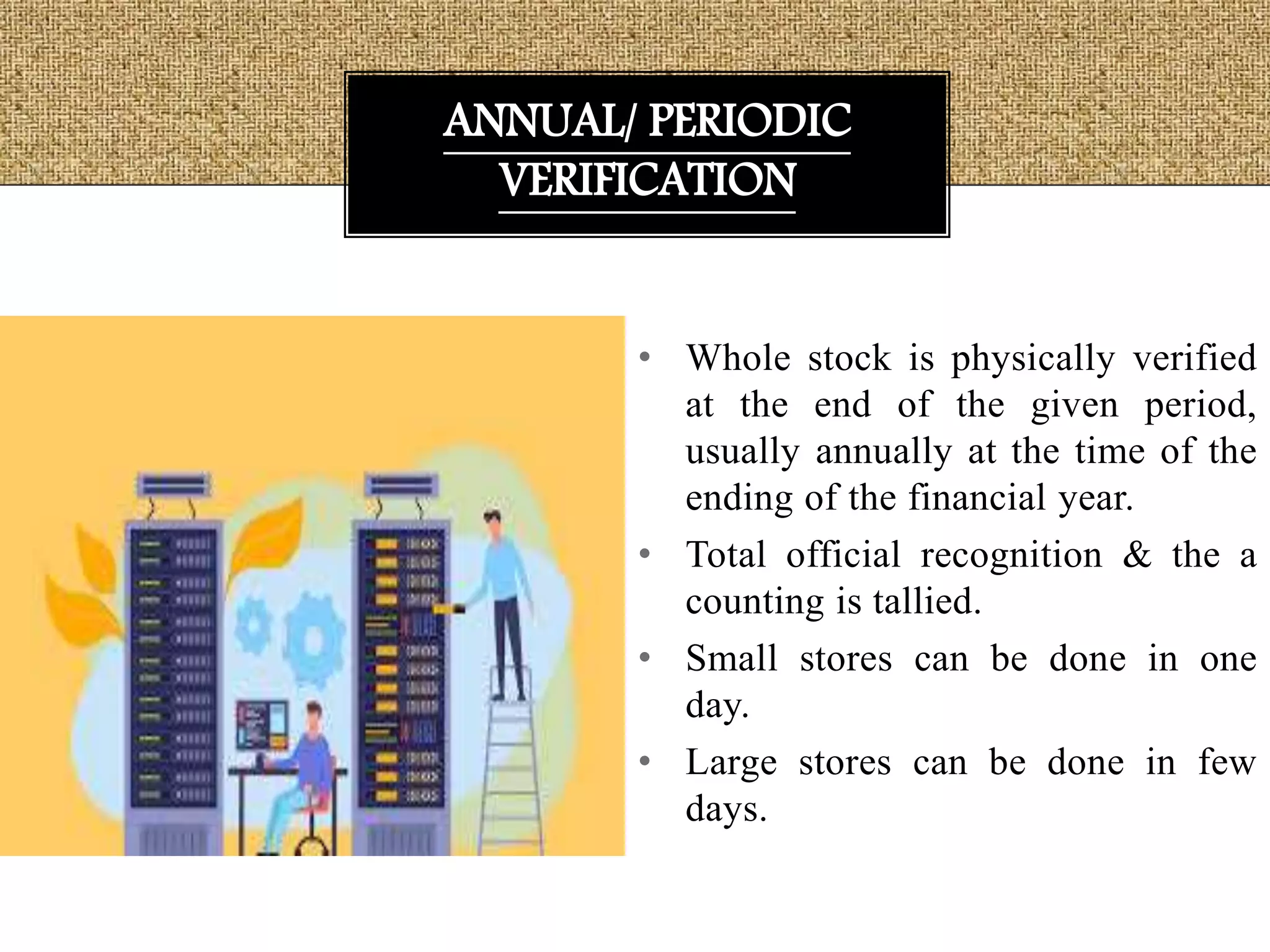
• Whole stock is physically verified
at the end of the given period,
usually annually at the time of the
ending of the financial year.
• Total official recognition & the a
counting is tallied.
• Small stores can be done in one
day.
• Large stores can be done in few
days.
ANNUAL/ PERIODIC
VERIFICATION
• Simple, convenient &
satisfactory.
• Value of closing stock is
taken into account
• No extra shelf is required
in small stores.
• Authentic verification of
stores.
• Extra staff required for extra
large stores.
• If staff is disinterested or
inexperienced the results are
not satisfactory.
• Discrepancy detected only
once in a given period. Proper
investigation not possible.
• Delay in preparing of final
accounts due to formalities.
Merits Demerits
ANNUAL/ PERIODIC VERIFICATION
• An advanced chalked out program is set.
• No deviation is allowed.
• All items physically checked at least once
a year & certain items checked daily.
• Few well trained verifiers, directly under
the control of the materials control
department or account department.
• Detailed stock records are maintained.
• Stores may not be closed for the store
checking.
PERPETUAL/ CONTINUOUS STOCK
VERIFICATION
• When particular stock items are on a low point & needs
replenishment.
• When the particular item is out of stock.
Method :
• Done by store staff.
• Records are kept by storekeeper & are used in annual
accounting.
• Records sent to accounts & purchase department.
• Requires greater c-ordination between stores & accounts.
LOW POINT / OUT-OF-STOCK
VERIFICATION
• Appointment of a team of verifiers(internal & external)
• Provision of stocktaking sheets which are numbered & dated when
used
• Verification of sheets with stock types
• Physical verification of stock
• Noting of discrepancies, expired goods, damage goods etc.
• Investigating into the discrepancies & reporting to the designated
authority.
• Preparation of internal discrepancies resolution report as well as
stock written report after approval of higher authorities.
• Preparation of stock valuation sheet/ inventory valuation sheet
incorporating details of all the stocks taking sheets.
PROCEDURESFOR STOCK
VERIFICATION
• Difference in quantity,
complimentary items.
• No record of an item
purchase which physically
exists.
• No stocks but records
present.
• Batch number discrepancy
TYPES OF DISCREPANCIES
• Stock is less due to theft
• Pilferage
• Natural loss
• Loss stock due to changing in temperature
• Errors in counting
• Loss due to careless handling & careless
measurement
• Any other losses may be the nature of
avoidable or unavoidable.
RESULTS OF STOCK
VERIFICATION
Stock verification

Stock verification

  • 1.
    Presented by : RNAnkita Ashok Kadam PGDHA II (2019-2020) Roll no. 04 Garware Institute of Career Education & Development STOCK VERIFICATION Material Management
  • 2.
    Store verification isa process of physically counting & checking inventory in the unit, against its book balance at least once in a year DEFINITION
  • 3.
    • Reconcile thephysical & book balances are of prime importance. • Identify the weaknesses in the operations. • To ensure the input, output & stock on hand accounted for accuracy. • Ensure proper placement of materials. • It also helps to identify slow, non-moving & reduce obsolete items. • The chances of collusion amongst the various staff members. • In order to avoid discrepancy in stocks. • Constant review of orders. OBJECTIVES
  • 4.
    • better management& control over various activities of production. • goods in process & finished goods. • basis of inventory control by value. • Accounting of all materials received. • Tally of accounts- physical v/s accounting • Determining ordering quality • Stock taking- physical inventory/ stock verification Value of Stocks Items of Stock STORES& ACCOUNTING
  • 5.
    Physical verification isnecessary since they are the assets of the organization • Correctness of stocks & values of stocks. • Detection of frauds, thefts, loss & damage – deviation from procedure etc. • Examines the process of storage for any weaknesses. • Moral check on the staff. PURPOSES
  • 6.
    1. Spot Verification 2.Routine Verification 3. Annual or Periodical Verification 4. Perpetual/ Continuous Stock Verification 5. Low Point or Out-of-Stock Verification KIND OF PHYSICALVERIFICATIONS OF STOCKS
  • 7.
    • While issuingor receiving • Voluntary, simple, good, regular • No official recognition • Serves as self check mechanism for internal procedures of stores • Always in addition to other methods SPOT VERIFICATION
  • 8.
    • By storestaff for own satisfaction • No official recognition • Mechanism for internal control Objectives • Check store records • Accuracy of store records & quantity of stocks • Detecting theft, wastage etc in time • Moral check on staff • Prepare staff for inspection & internal audit ROUTINE VERIFICATION
  • 9.
    • Whole stockis physically verified at the end of the given period, usually annually at the time of the ending of the financial year. • Total official recognition & the a counting is tallied. • Small stores can be done in one day. • Large stores can be done in few days. ANNUAL/ PERIODIC VERIFICATION
  • 10.
    • Simple, convenient& satisfactory. • Value of closing stock is taken into account • No extra shelf is required in small stores. • Authentic verification of stores. • Extra staff required for extra large stores. • If staff is disinterested or inexperienced the results are not satisfactory. • Discrepancy detected only once in a given period. Proper investigation not possible. • Delay in preparing of final accounts due to formalities. Merits Demerits ANNUAL/ PERIODIC VERIFICATION
  • 11.
    • An advancedchalked out program is set. • No deviation is allowed. • All items physically checked at least once a year & certain items checked daily. • Few well trained verifiers, directly under the control of the materials control department or account department. • Detailed stock records are maintained. • Stores may not be closed for the store checking. PERPETUAL/ CONTINUOUS STOCK VERIFICATION
  • 12.
    • When particularstock items are on a low point & needs replenishment. • When the particular item is out of stock. Method : • Done by store staff. • Records are kept by storekeeper & are used in annual accounting. • Records sent to accounts & purchase department. • Requires greater c-ordination between stores & accounts. LOW POINT / OUT-OF-STOCK VERIFICATION
  • 13.
    • Appointment ofa team of verifiers(internal & external) • Provision of stocktaking sheets which are numbered & dated when used • Verification of sheets with stock types • Physical verification of stock • Noting of discrepancies, expired goods, damage goods etc. • Investigating into the discrepancies & reporting to the designated authority. • Preparation of internal discrepancies resolution report as well as stock written report after approval of higher authorities. • Preparation of stock valuation sheet/ inventory valuation sheet incorporating details of all the stocks taking sheets. PROCEDURESFOR STOCK VERIFICATION
  • 14.
    • Difference inquantity, complimentary items. • No record of an item purchase which physically exists. • No stocks but records present. • Batch number discrepancy TYPES OF DISCREPANCIES
  • 15.
    • Stock isless due to theft • Pilferage • Natural loss • Loss stock due to changing in temperature • Errors in counting • Loss due to careless handling & careless measurement • Any other losses may be the nature of avoidable or unavoidable. RESULTS OF STOCK VERIFICATION