STIMULUS:
Stimulus refers toan agent, action or
condition that elicits accelerates or rouses to
Physiological or Psychological action, activity
or responses.
STIMULUS VARIATION:
Theset of teacher behaviors that tend to
secure and sustain pupils attention in the
skill of stimulus variation.
Skill of stimulus variation implies attracting
and focusing pupils attention by changing
stimuli in the environment for securing and
sustaining pupils attention.
5.
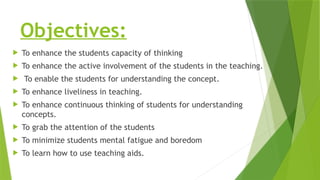
Objectives:
To enhancethe students capacity of thinking
To enhance the active involvement of the students in the teaching.
To enable the students for understanding the concept.
To enhance liveliness in teaching.
To enhance continuous thinking of students for understanding
concepts.
To grab the attention of the students
To minimize students mental fatigue and boredom
To learn how to use teaching aids.
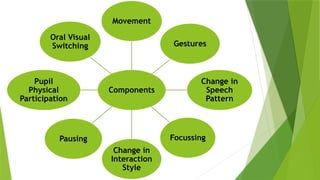
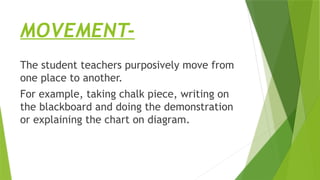
MOVEMENT-
The student teacherspurposively move from
one place to another.
For example, taking chalk piece, writing on
the blackboard and doing the demonstration
or explaining the chart on diagram.
8.
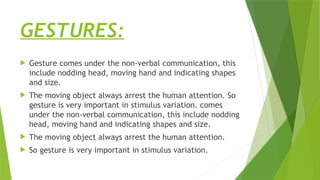
GESTURES:
Gesture comesunder the non-verbal communication, this
include nodding head, moving hand and indicating shapes
and size.
The moving object always arrest the human attention. So
gesture is very important in stimulus variation. comes
under the non-verbal communication, this include nodding
head, moving hand and indicating shapes and size.
The moving object always arrest the human attention.
So gesture is very important in stimulus variation.
9.
Change in SpeechPattern:
When the teacher want to say very important points
or show his/her emotional feelings. We have to
change the voice then and there, even if students
are not listening in the class room when the teacher
voice increase to say important point, then students
automatically listen in the subject.
10.
FOCUSSING:
When theteacher want to highlight the important
points through verbal focusing, while taking class
says look at me, note this points or underline this
points and listen to me etc.
The teacher writes important points on the
blackboard, and highlights the point in color
chalks. This way is increase the students attention
in the class room.
11.
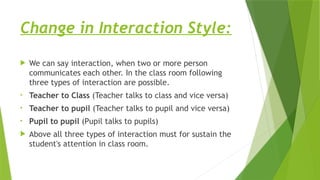
Change in InteractionStyle:
We can say interaction, when two or more person
communicates each other. In the class room following
three types of interaction are possible.
• Teacher to Class (Teacher talks to class and vice versa)
• Teacher to pupil (Teacher talks to pupil and vice versa)
• Pupil to pupil (Pupil talks to pupils)
Above all three types of interaction must for sustain the
student's attention in class room.
12.
PAUSING:
This means"stop talking" by the teacher for a moment. When the
teacher becomes silent during teaching, it at once draws the attention
of the pupils with curiosity towards the teacher.
To emphasize an important point
To create suspense & arouse thinking
To provide time for students to think for something before they respond
To promote student participation by providing encouragement and
opportunity to comment or question.
To draw attention by contrasting speech with silence
To give students time to make notes before continuing with the lecture
or dictation. To show disapproval for student misbehavior.
13.
Pupil Physical Participation:
Physicalparticipation is very essential among
student teachers, we may allow students to do
demonstration, and allow the students to write the
important points on the blackboard.
14.
Oral Visual Switching:
1.Oral to oral-visual- when the teacher while speaking shows objects,
charts and models and explains their various parts. It is switching from
oral to oral- visual.
2. Oral to visual- when the teacher while speaking, shows objects,
maps, charts, globe etc. It is switching form oral to visual.
3. Visual to oral- visual when the teacher demonstrates the experiment
silently and then explains the phenomenon with the help of charts,
maps, diagram etc. It is visual-oral switching.
These devices are used interchangeably to secure and sustain pupils'
attention to the lesson.