B Y
D R . S M I T A S R I V A S T A V A ( A S S T T . P R O F . E D U C A T I O N )
I N T E G R A L U N I V E R S I T Y , L U C K N O W
MEANING
• Reinforcement is a term used in operant conditioning to refer to anything that increases the
likelihood that a response will occur.
• Psychologist B.F. Skinner is considered the father of this theory.
• Reinforcement is defined by the effect that it has on behaviour—it increases or strengthens
the response.
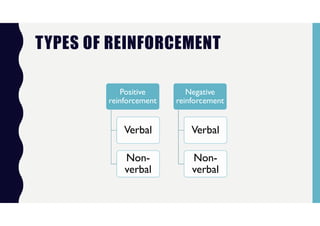
TYPES OF REINFORCEMENT
Positive
reinforcement
Verbal
Non-
verbal
Negative
reinforcement
Verbal
Non-
verbal
POSITIVE VERBAL REINFORCEMENT
Any positive word in appreciation to the answer like:
• Good
• Excellent
• O.K.
• Yes you are right
• Well done
• Very good
• I agree with you
• correct
POSITIVE NON-VERBAL
REINFORCEMENT
Any positive non-verbal reactions in appreciation to the answer like:
• Nodding in approval
• Expression of approval
• Pat on back
• Writing student’s response on the black-board
• Proximity
• Asking students to clap
• Smile
NEGATIVE VERBAL REINFORCEMENT
Any negative words like:
• No
• Stop it
• Never
• Wrong
NEGATIVE NON-VERBAL
REINFORCEMENT
Any negative reactions like
• Raising eyebrows
• Beating
• Showing disagreement by facial expression
MICRO-PLAN ( SAMPLE)
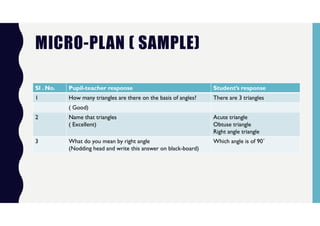
Sl . No. Pupil-teacher response Student’s response
1 How many triangles are there on the basis of angles? There are 3 triangles
( Good)
2 Name that triangles
( Excellent)
Acute triangle
Obtuse triangle
Right angle triangle
3 What do you mean by right angle
(Nodding head and write this answer on black-board)
Which angle is of 90˚
REFERENCE/MORE READINGS
• http://esaiva2013.blogspot.com/2016/11/skillof-reinforcement-introduction.html
• THANKS

Reinforcement skill pdf