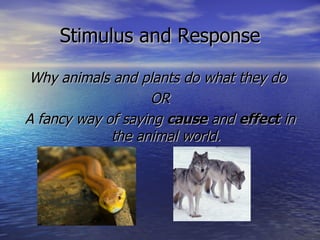
Stimulus and Response Why animals and plants do what they do  OR A fancy way of saying  cause  and  effect  in the animal world.
Catalyst 1.  Describe a situation in which you were immediately scared and/or  reacted quickly to something.  Write at least 1 paragraph with 4 sentences describing your experience. 2. Take out your vocab books and your colors. 3. Take out your dry erase board.
After today you will be able to: 1.  Identify and classify stimuli as internal or external 2.  Define a response. 3.  Identify behavior as learned behavior or instinct.
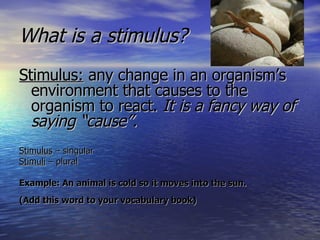
What is a stimulus? Stimulus:  any change in an organism’s environment that causes to the organism to react.  It is a fancy way of saying “cause”. Stimulus  – singular  Stimuli  – plural Example: An animal is cold so it moves into the sun. (Add this word to your vocabulary book)
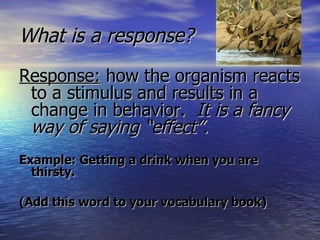
What is a response? Response:  how the organism reacts to a stimulus and results in a change in behavior.   It is a fancy way of saying “effect”. Example: Getting a drink when you are thirsty. (Add this word to your vocabulary book)
Examples of stimuli and their responses: You are hungry so you eat some food A rabbit gets scared so it runs away You are cold so you put on a jacket A dog is hot so lies in the shade It starts raining so you take out an umbrella
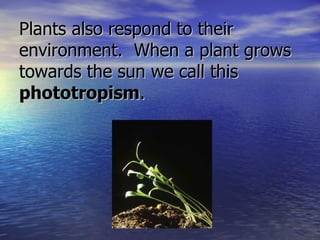
Plants also respond to their environment.  When a plant grows towards the sun we call this  phototropism .
Think – Pair - Share Turn to your partner and share two other stimuli and their responses.
There are two types of stimuli: External Stimuli and Internal Stimuli
External Stimulus External stimulus: a stimulus that comes from outside an organism. Examples:  1.  You feel cold so you put on a jacket. 2.  A snake lunges at a rabbit so it runs away. 3.  A dog feels hot so it goes to lay in the shade. Add this word to your vocabulary book.
Internal Stimulus Internal stimulus:  a stimulus that comes from inside an organism. Examples:  1.  You feel hungry so you eat some food. 2.  A cat feels thirsty so it drinks water. 3.  A dog feels hot so it goes to lay in the shade. Add this word to your vocabulary book.
Make a T-chart on your dry erase board and label the columns  internal  and  external .  Put the letter of each stimulus in the proper column.  You have a stomach ache and decide to lay down. A bird is thirsty and drinks some water. A squirrel sees a cat and runs up a tree. A lion gets hungry and eats a gazelle. You see a spider and scream.
Animals can respond to stimuli in two ways: 1.  In a way that they learned.  We call this  learned behavior. OR 2.  In a way that they were just born knowing how to do. We call this  instinct.
Learned behavior:  a response to a stimulus that an animal was taught.   Add this word to your vocabulary book
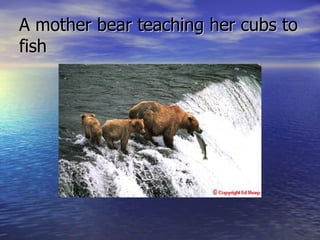
A mother bear teaching her cubs to fish
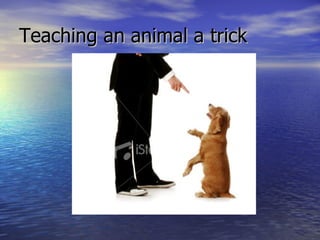
Teaching an animal a trick
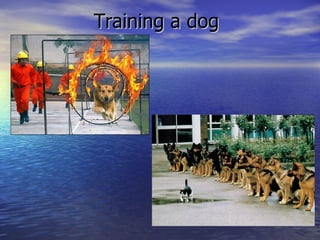
Training a dog
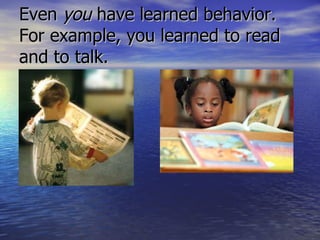
Even  you  have learned behavior.  For example, you learned to read and to talk.
Instinct:  an animal’s natural reaction to a stimulus.  It is an automatic reaction that the animal was not taught to do.   Add this word to your vocabulary book
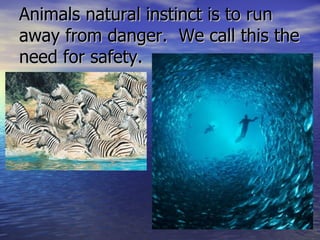
Animals natural instinct is to run away from danger.  We call this the need for safety.
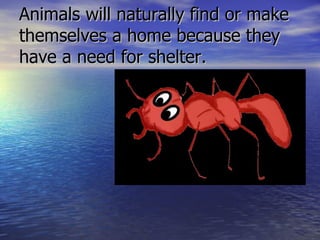
Animals will naturally find or make themselves a home because they have a need for shelter.
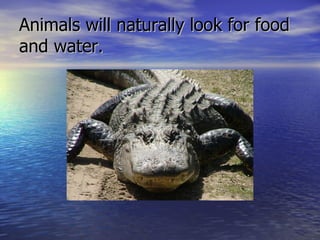
Animals will naturally look for food and water.
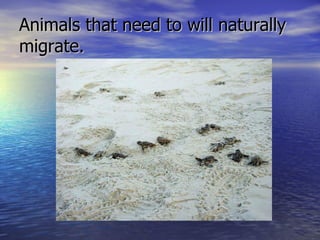
Animals that need to will naturally migrate.
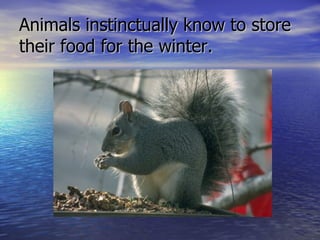
Animals instinctually know to store their food for the winter.
Think – Write - Share On your board write down one learned behavior that you have an one instinct that you have.
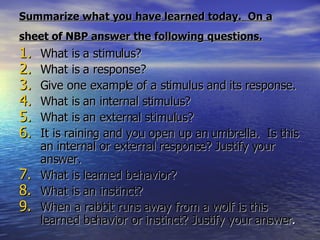
Summarize what you have learned today.  On a sheet of NBP answer the following questions.   What is a stimulus? What is a response? Give one example of a stimulus and its response. What is an internal stimulus? What is an external stimulus? It is raining and you open up an umbrella.  Is this an internal or external response? Justify your answer.  What is learned behavior? What is an instinct? When a rabbit runs away from a wolf is this learned behavior or instinct? Justify your answer .

Stimulus And Response

  • 1.
    Stimulus and ResponseWhy animals and plants do what they do OR A fancy way of saying cause and effect in the animal world.
  • 2.
    Catalyst 1. Describe a situation in which you were immediately scared and/or reacted quickly to something. Write at least 1 paragraph with 4 sentences describing your experience. 2. Take out your vocab books and your colors. 3. Take out your dry erase board.
  • 3.
    After today youwill be able to: 1. Identify and classify stimuli as internal or external 2. Define a response. 3. Identify behavior as learned behavior or instinct.
  • 4.
    What is astimulus? Stimulus: any change in an organism’s environment that causes to the organism to react. It is a fancy way of saying “cause”. Stimulus – singular Stimuli – plural Example: An animal is cold so it moves into the sun. (Add this word to your vocabulary book)
  • 5.
    What is aresponse? Response: how the organism reacts to a stimulus and results in a change in behavior. It is a fancy way of saying “effect”. Example: Getting a drink when you are thirsty. (Add this word to your vocabulary book)
  • 6.
    Examples of stimuliand their responses: You are hungry so you eat some food A rabbit gets scared so it runs away You are cold so you put on a jacket A dog is hot so lies in the shade It starts raining so you take out an umbrella
  • 7.
    Plants also respondto their environment. When a plant grows towards the sun we call this phototropism .
  • 8.
    Think – Pair- Share Turn to your partner and share two other stimuli and their responses.
  • 9.
    There are twotypes of stimuli: External Stimuli and Internal Stimuli
  • 10.
    External Stimulus Externalstimulus: a stimulus that comes from outside an organism. Examples: 1. You feel cold so you put on a jacket. 2. A snake lunges at a rabbit so it runs away. 3. A dog feels hot so it goes to lay in the shade. Add this word to your vocabulary book.
  • 11.
    Internal Stimulus Internalstimulus: a stimulus that comes from inside an organism. Examples: 1. You feel hungry so you eat some food. 2. A cat feels thirsty so it drinks water. 3. A dog feels hot so it goes to lay in the shade. Add this word to your vocabulary book.
  • 12.
    Make a T-charton your dry erase board and label the columns internal and external . Put the letter of each stimulus in the proper column. You have a stomach ache and decide to lay down. A bird is thirsty and drinks some water. A squirrel sees a cat and runs up a tree. A lion gets hungry and eats a gazelle. You see a spider and scream.
  • 13.
    Animals can respondto stimuli in two ways: 1. In a way that they learned. We call this learned behavior. OR 2. In a way that they were just born knowing how to do. We call this instinct.
  • 14.
    Learned behavior: a response to a stimulus that an animal was taught. Add this word to your vocabulary book
  • 15.
    A mother bearteaching her cubs to fish
  • 16.
  • 17.
  • 18.
    Even you have learned behavior. For example, you learned to read and to talk.
  • 19.
    Instinct: ananimal’s natural reaction to a stimulus. It is an automatic reaction that the animal was not taught to do. Add this word to your vocabulary book
  • 20.
    Animals natural instinctis to run away from danger. We call this the need for safety.
  • 21.
    Animals will naturallyfind or make themselves a home because they have a need for shelter.
  • 22.
    Animals will naturallylook for food and water.
  • 23.
    Animals that needto will naturally migrate.
  • 24.
    Animals instinctually knowto store their food for the winter.
  • 25.
    Think – Write- Share On your board write down one learned behavior that you have an one instinct that you have.
  • 26.
    Summarize what youhave learned today. On a sheet of NBP answer the following questions. What is a stimulus? What is a response? Give one example of a stimulus and its response. What is an internal stimulus? What is an external stimulus? It is raining and you open up an umbrella. Is this an internal or external response? Justify your answer. What is learned behavior? What is an instinct? When a rabbit runs away from a wolf is this learned behavior or instinct? Justify your answer .