Centro de Sensoriamento RemotoUNIVERSIDADE FEDERAL DE MINAS GERAISModelling spatially explicit forward-looking baselinesClaudia SticklerREDDex, July 13-15, 2010
Applications of the Amazon Scenarios modeling system in Amazon REDD projectsJuma (Amazonas State)**
Surui (Rondonia indigenous land project)**
State of Acre
Northwestern MatoGrosso project**
Xingu Social-environmental Carbon
Brazilian Amazon** Used model results not developed for reference level estimation
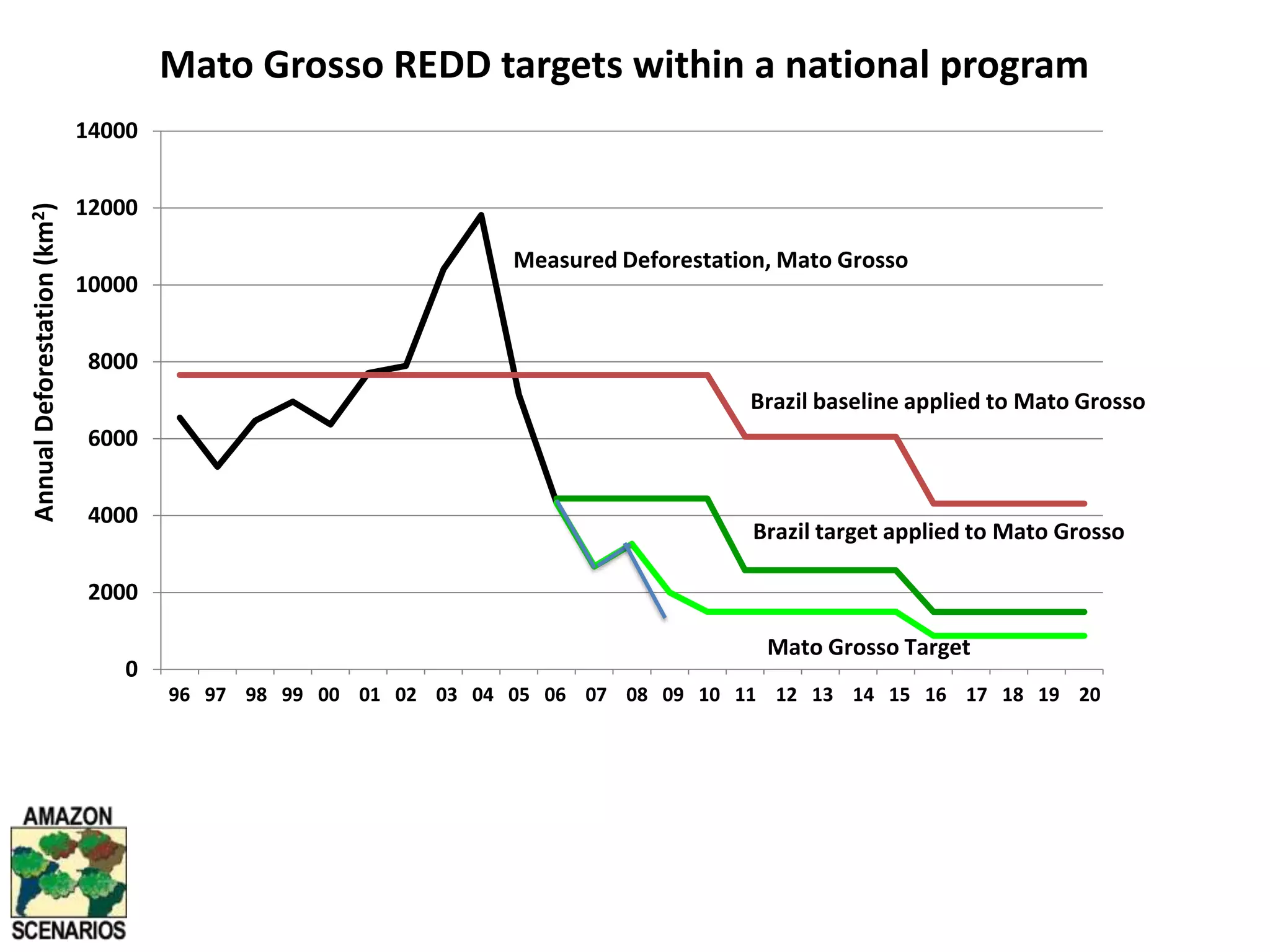
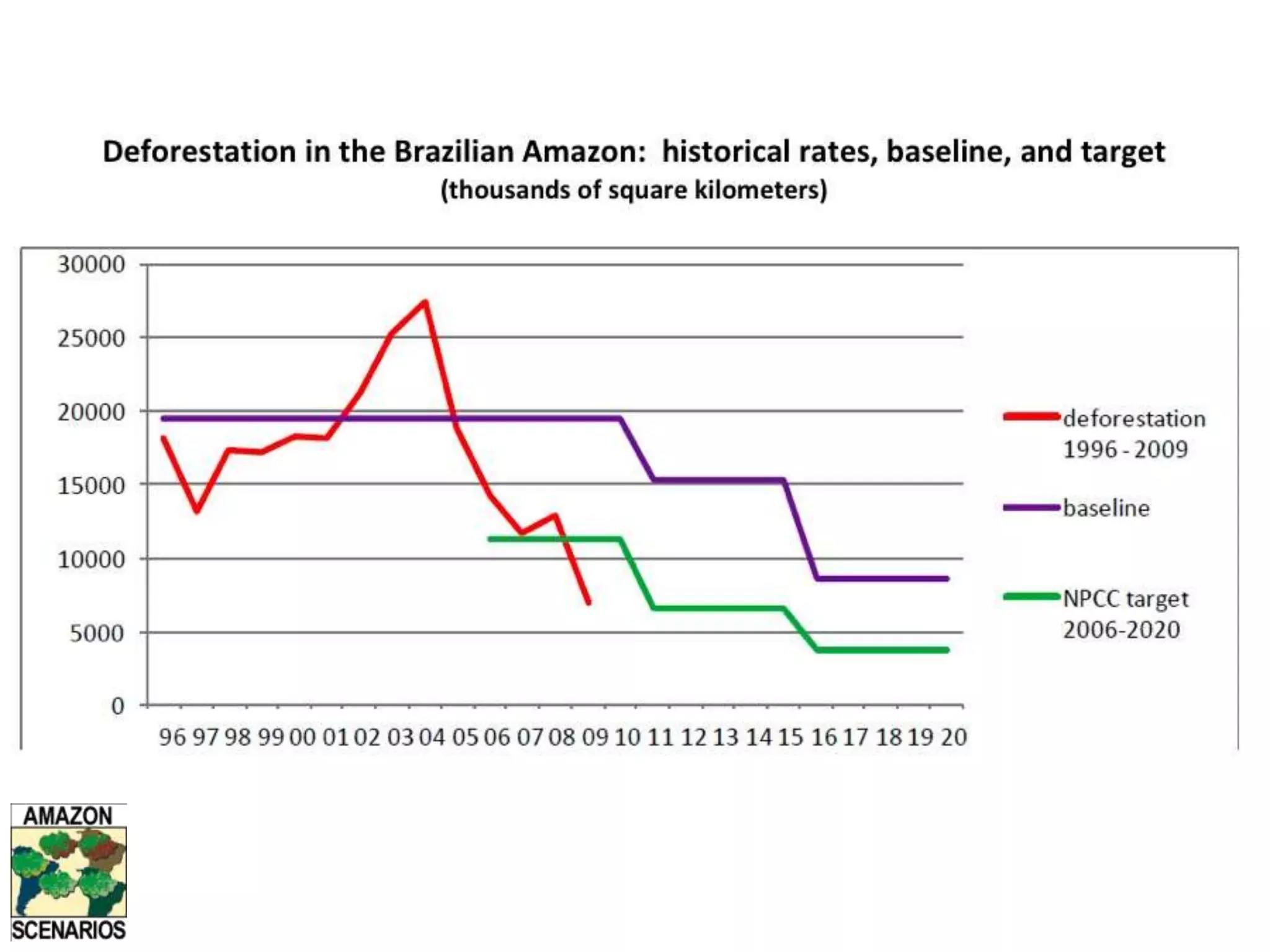
MatoGrosso REDD targets within a national programAnnual Deforestation (km2)
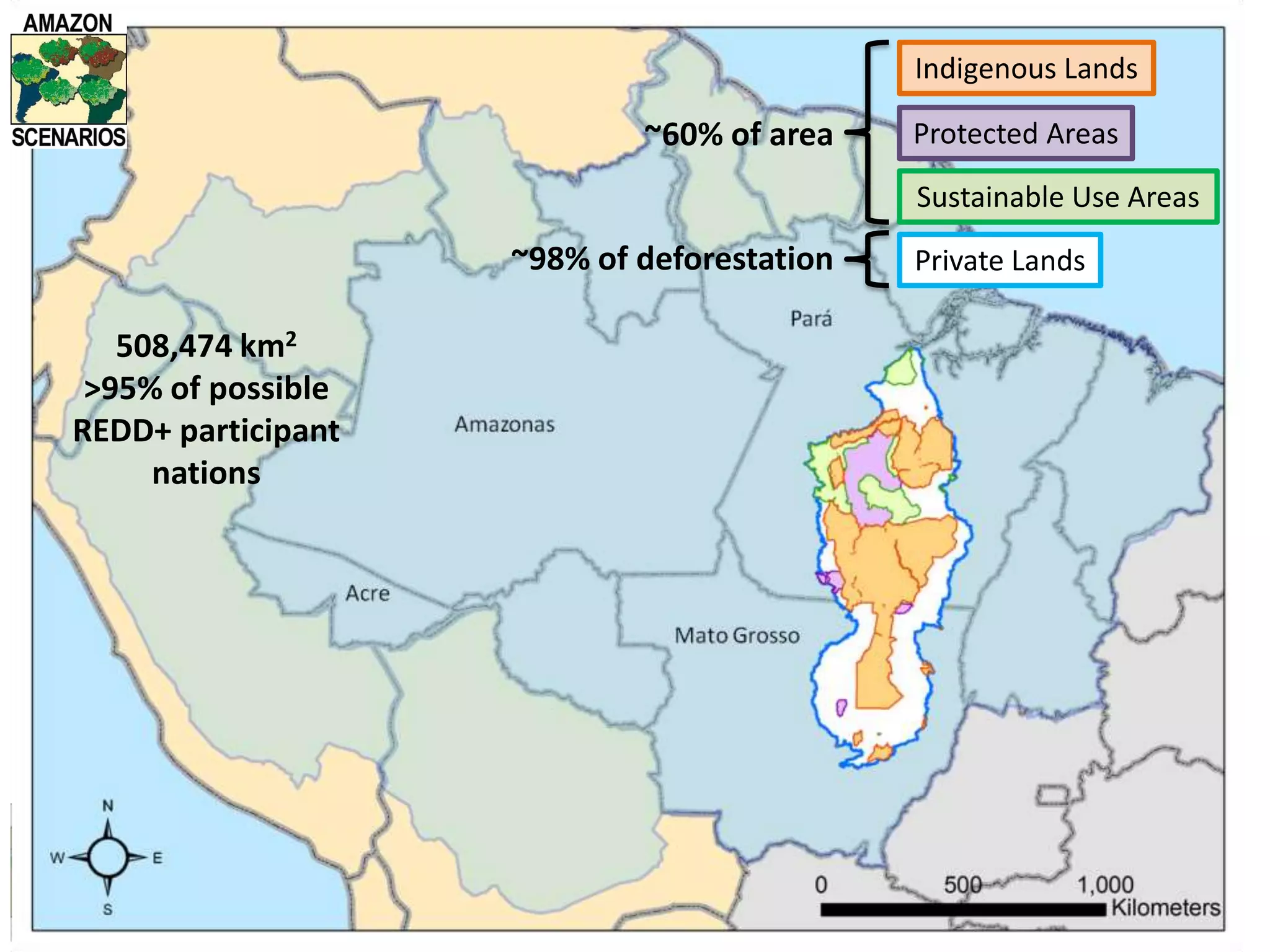
Indigenous Lands~60% of areaProtected AreasSustainable Use Areas~98% of deforestationPrivate Lands508,474 km2>95% of possible REDD+ participant nations
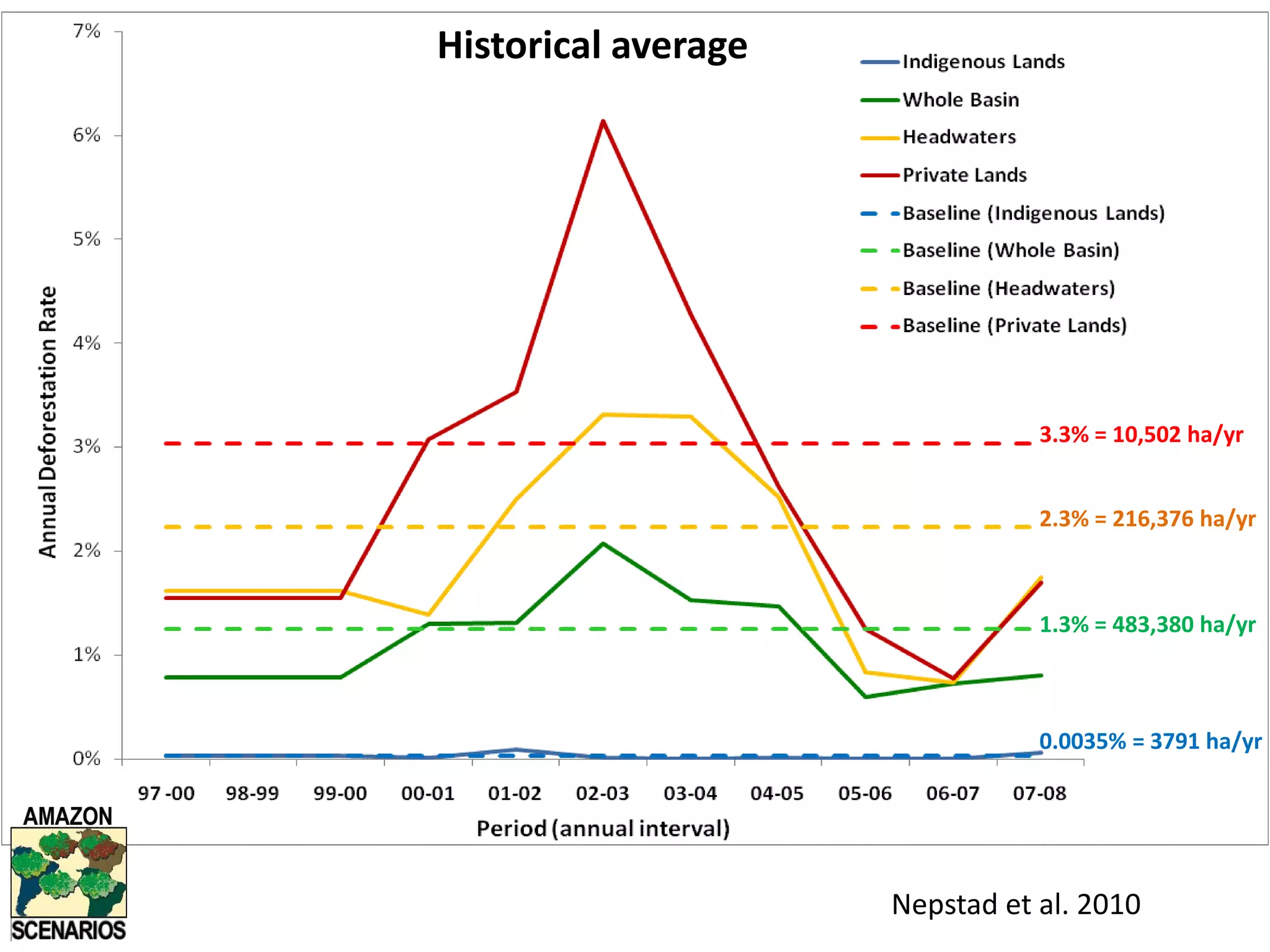
Historical average3.3% = 10,502 ha/yr2.3% = 216,376 ha/yr1.3% = 483,380 ha/yr0.0035% = 3791 ha/yrNepstad et al. 2010
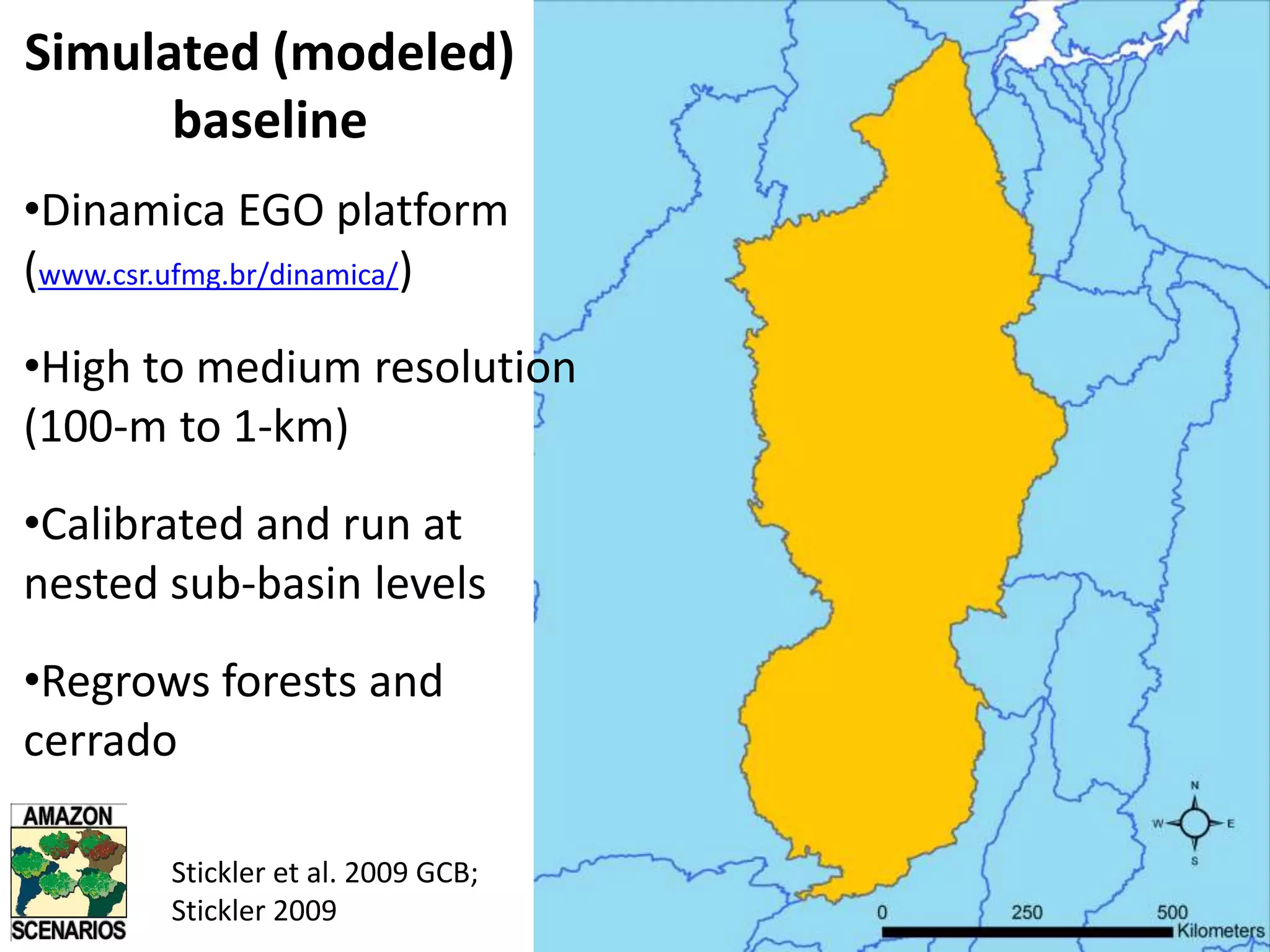
Simulated (modeled) baselineDinamica EGO platform (www.csr.ufmg.br/dinamica/)
High to medium resolution (100-m to 1-km)
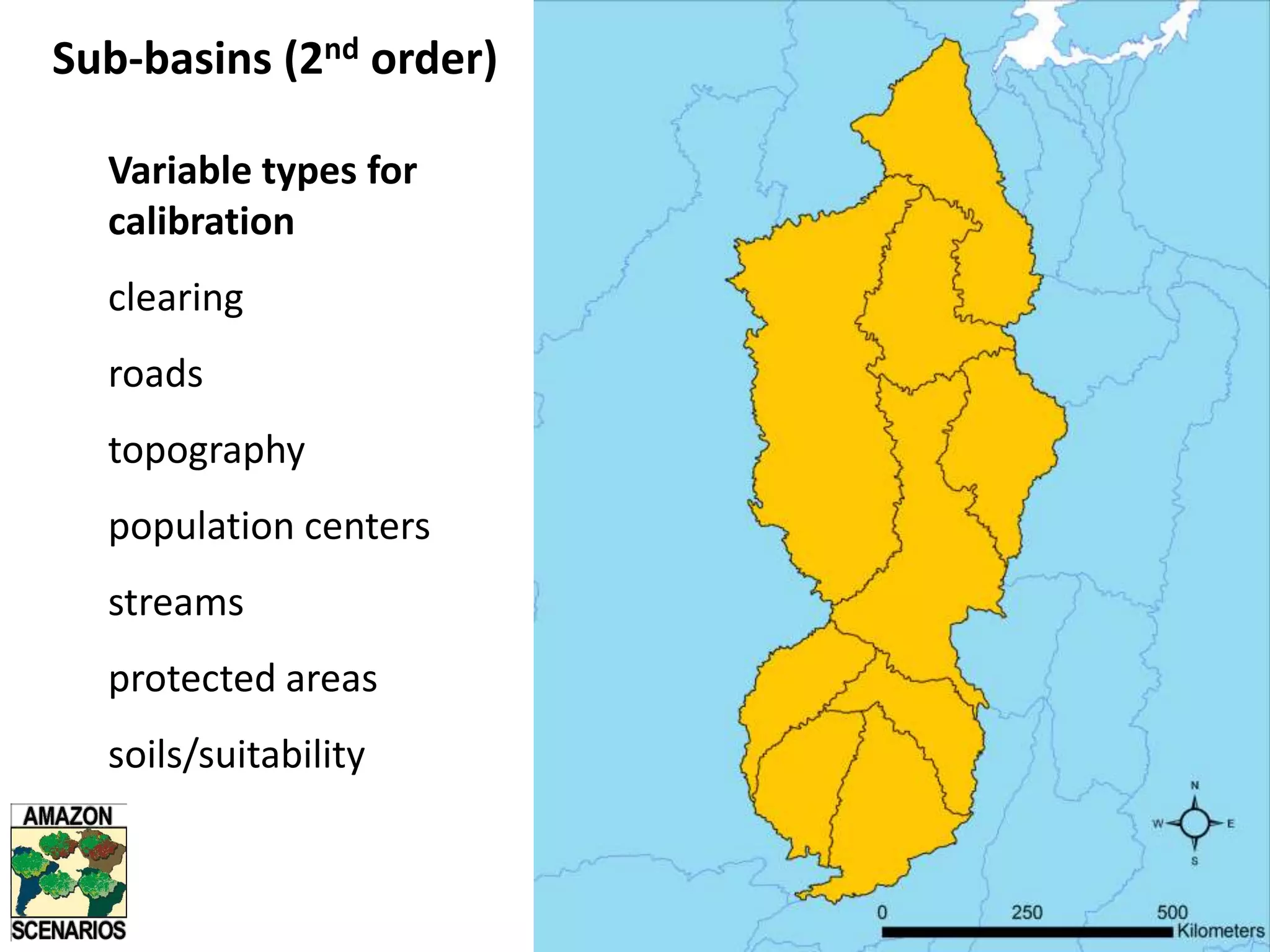
Calibrated and run at nested sub-basin levels
Regrows forests and cerradoStickler et al. 2009 GCB; Stickler 2009
Sub-basins (2nd order)Variable types for calibrationclearingroadstopographypopulation centersstreamsprotected areassoils/suitability
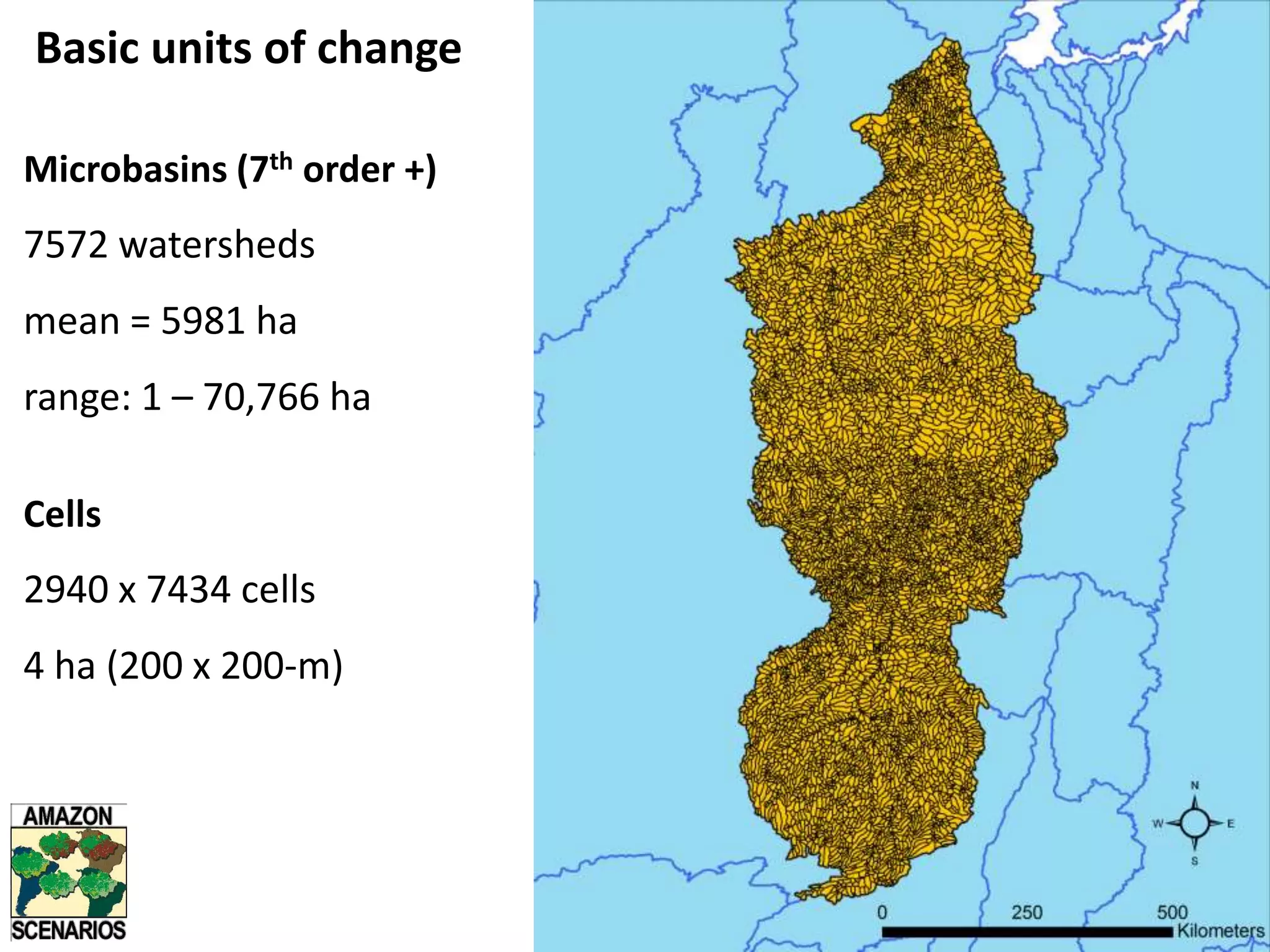
Basic units of changeMicrobasins (7th order +)7572 watershedsmean = 5981 harange: 1 – 70,766 haCells2940 x 7434 cells4 ha (200 x 200-m)
ScenariosBusiness as Usualhistorical rate and pattern of deforestation continueshistorical level of compliance with environmental legislation continueslow, high, averagevarying weight of historical protection of PAs, ILs, etc.Current Forest Code 80% “legal reserve” (RL) in forest biome; 35% RL in cerrado; 100% forest in riparian zoneVarying protection of indigenous lands, protected areasState Zoning Plans4 zones: 80% forest RL in 2 zones; 50% forest RL in 1 zone; 35% cerrado RL in 3 zones; 100% forest in riparian zoneVarying protection of indigenous lands, protected areas Stickler 2009; Nepstad et al. 2010
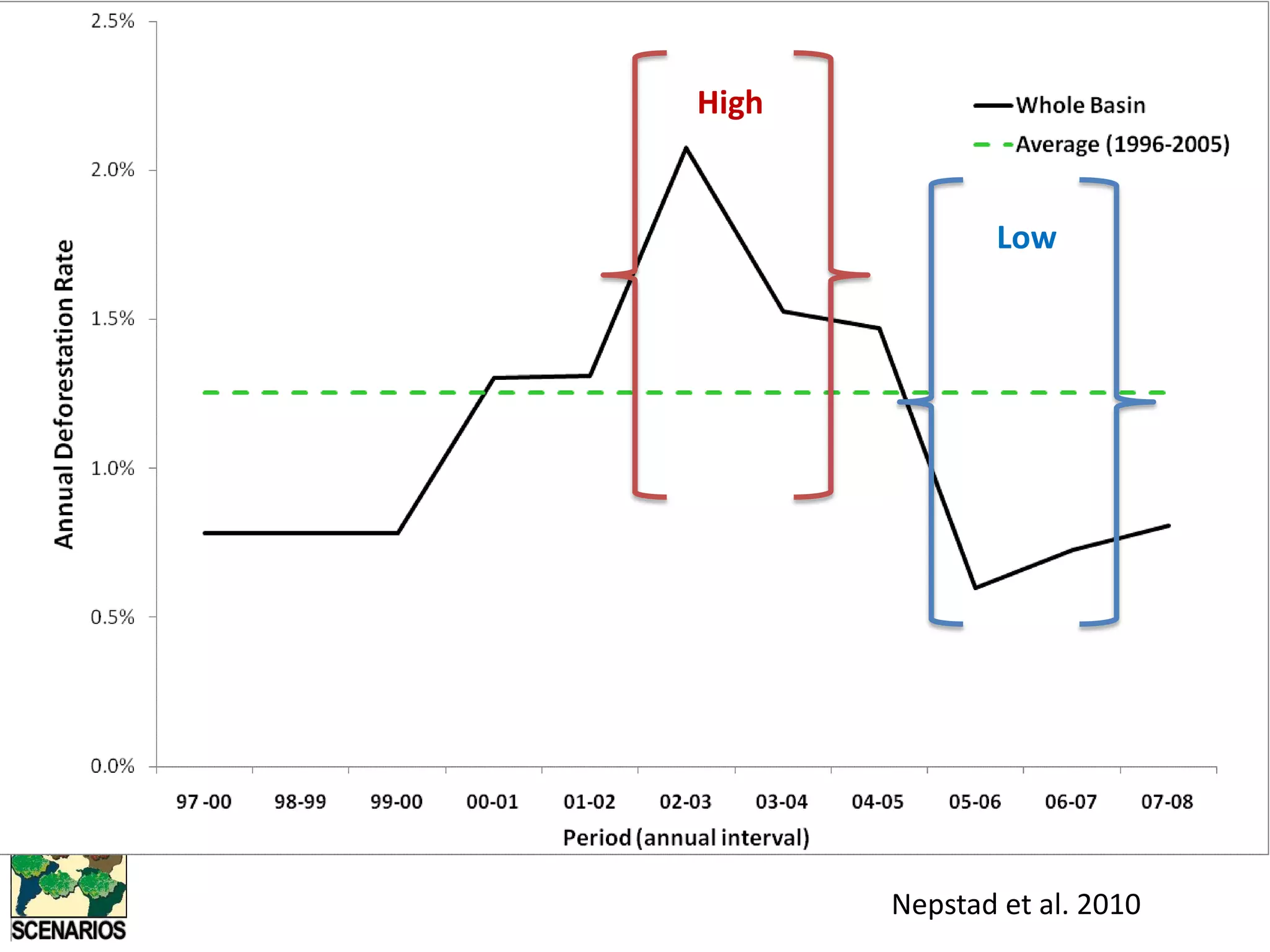
HighLowNepstad et al. 2010
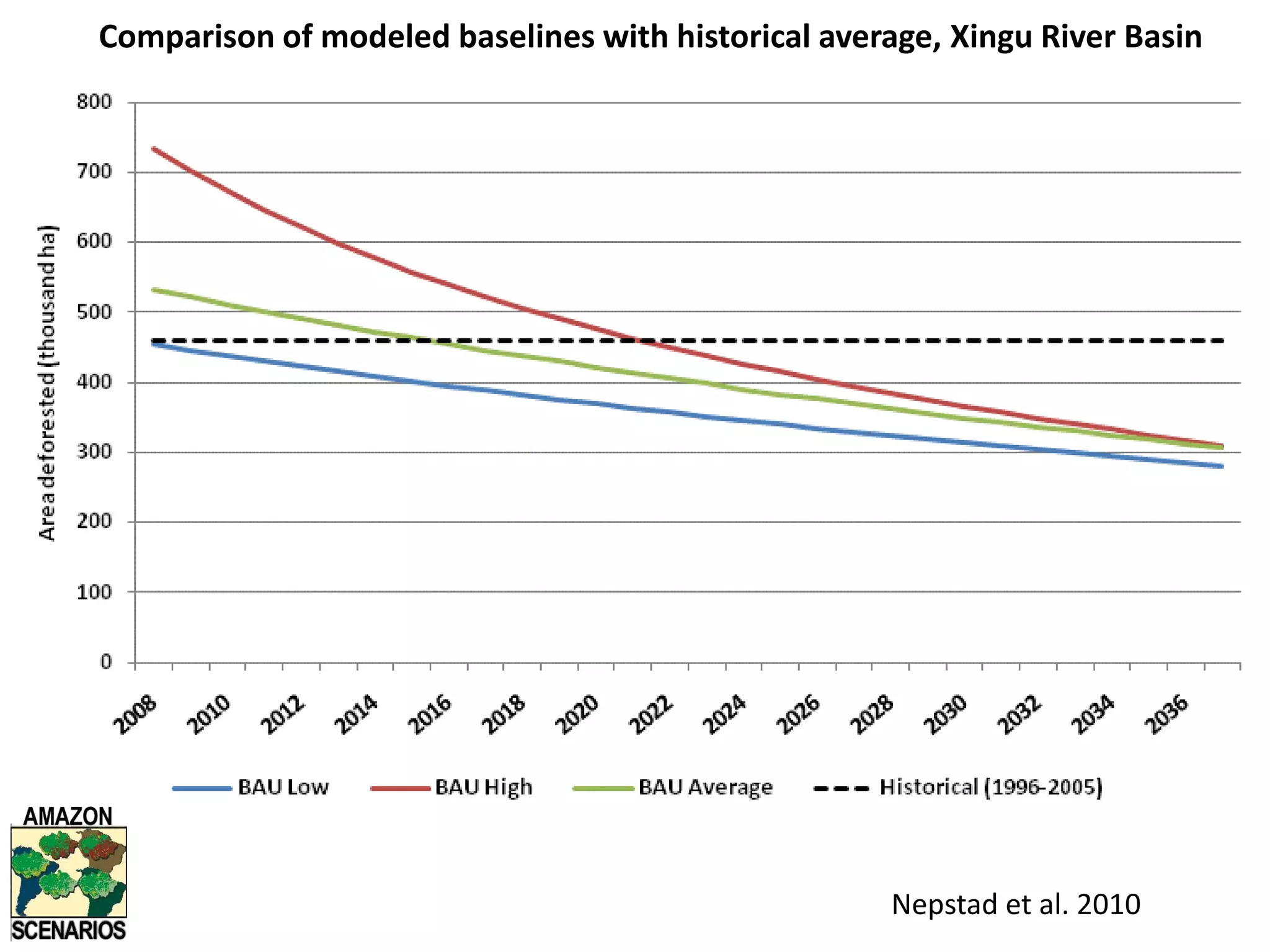
Comparison of modeled baselines with historical average, Xingu River BasinNepstad et al. 2010
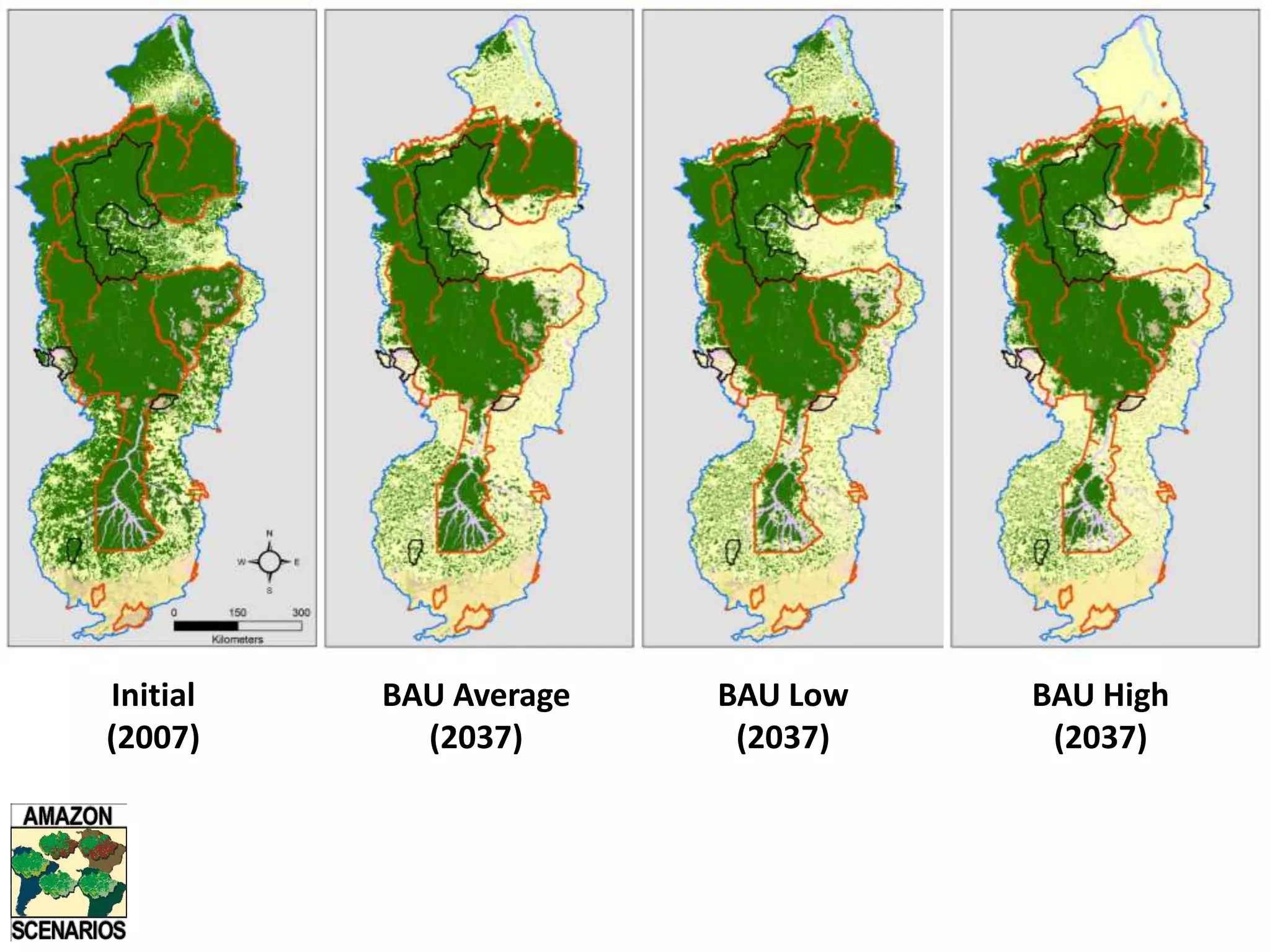
Initial(2007)BAU Average(2037)BAU Low(2037)BAU High(2037)
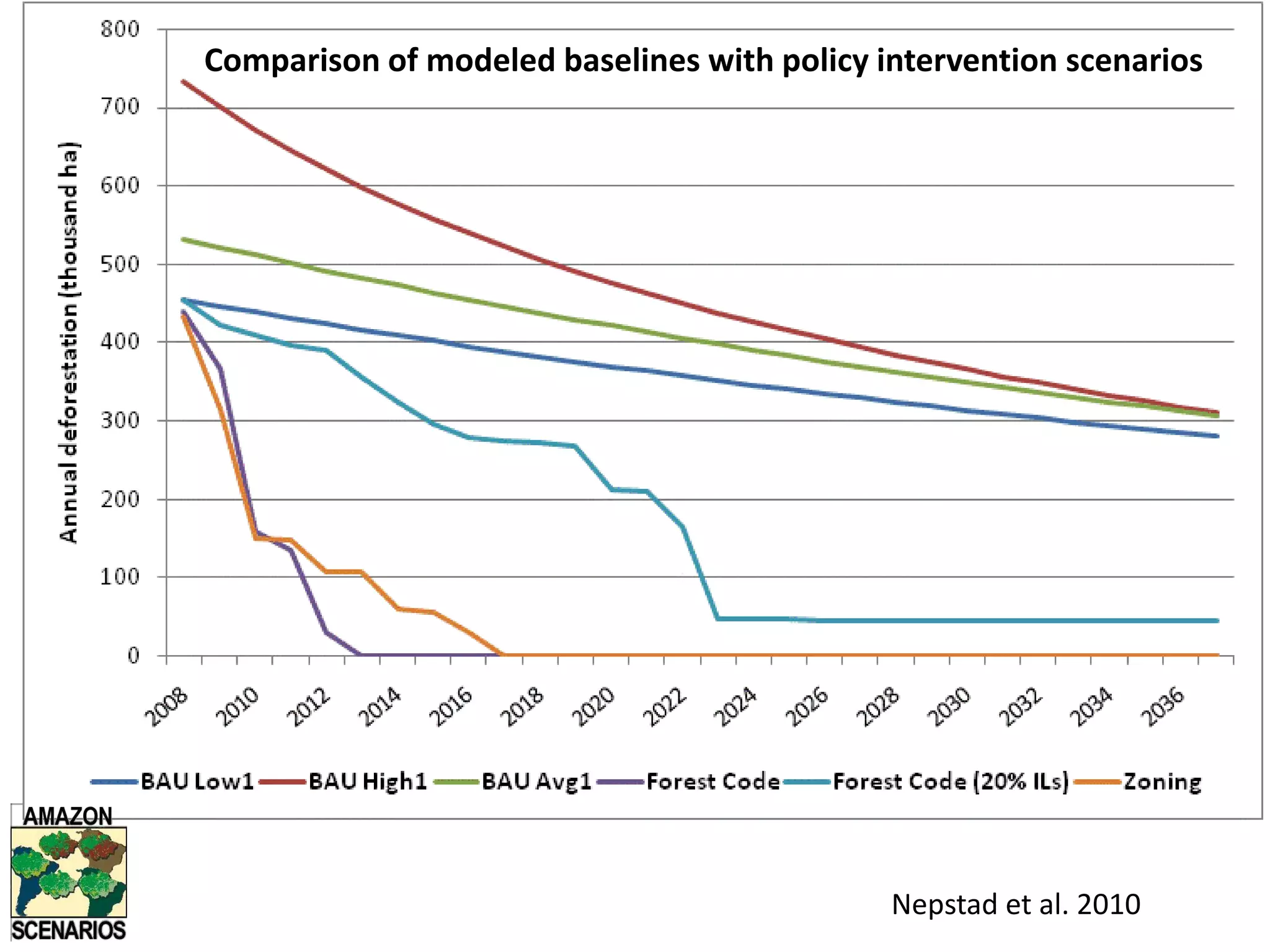
Comparison of modeled baselines with policy intervention scenariosNepstad et al. 2010
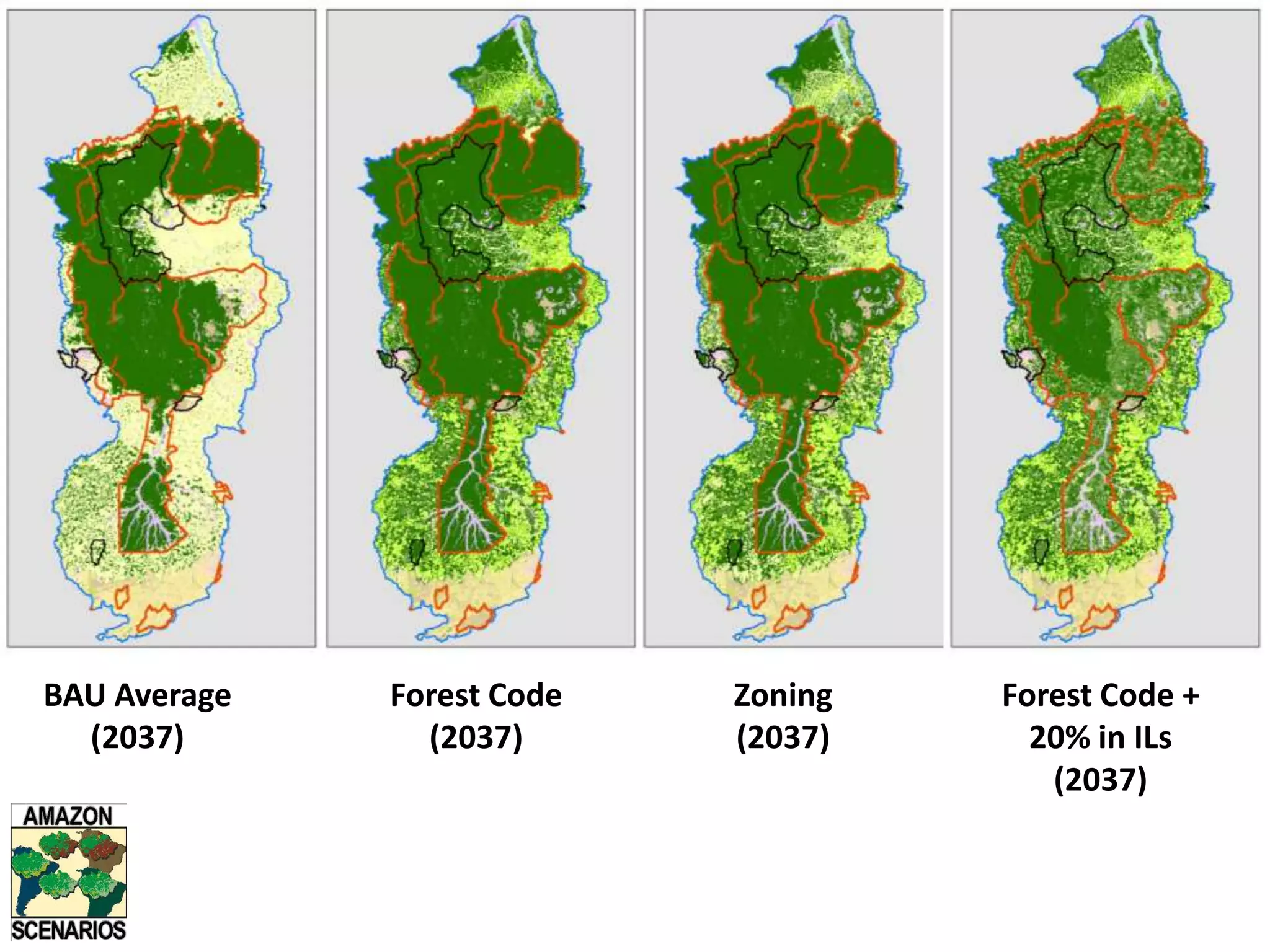
BAU Average(2037)Forest Code(2037)Zoning(2037)Forest Code + 20% in ILs(2037)
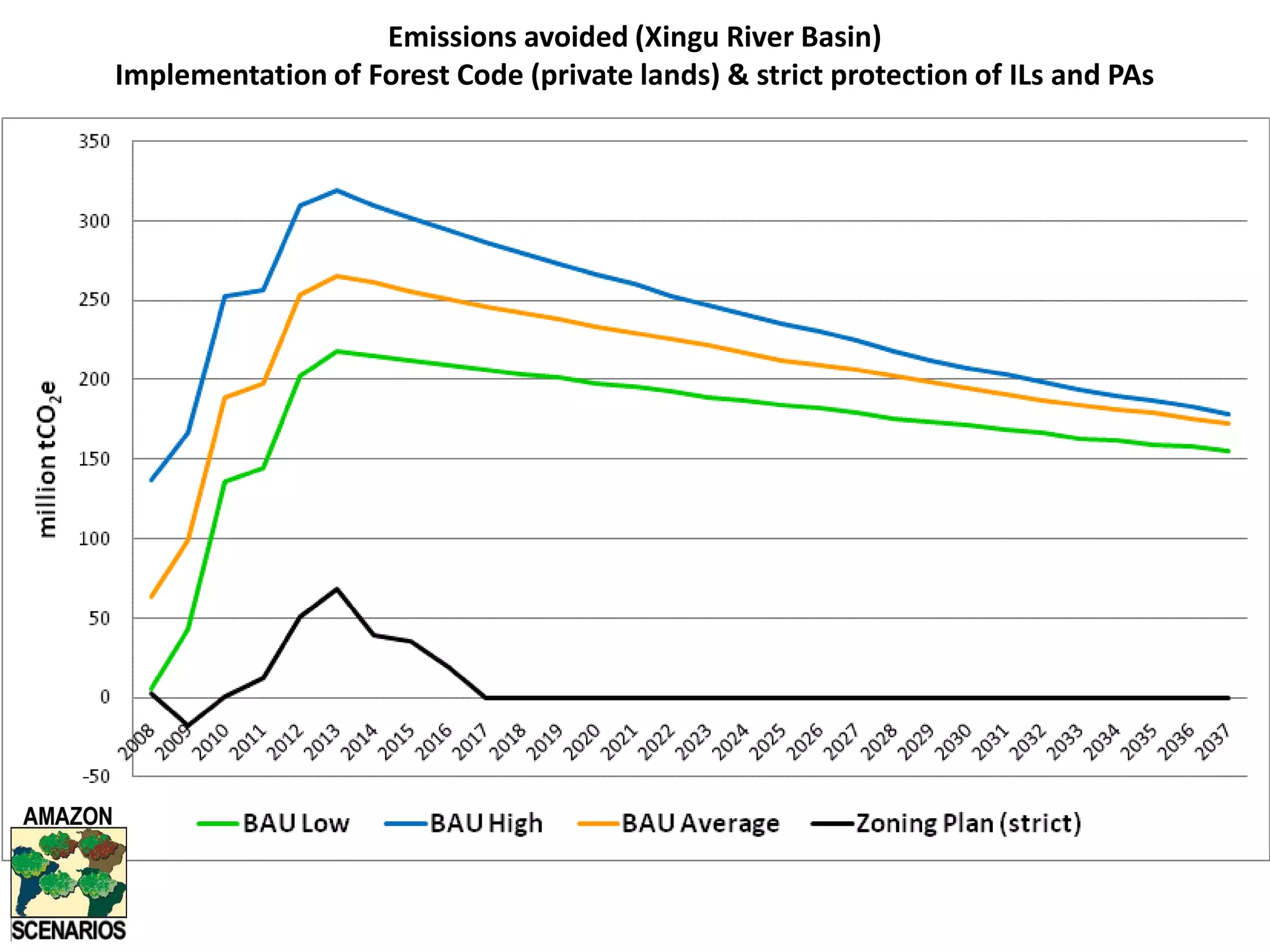
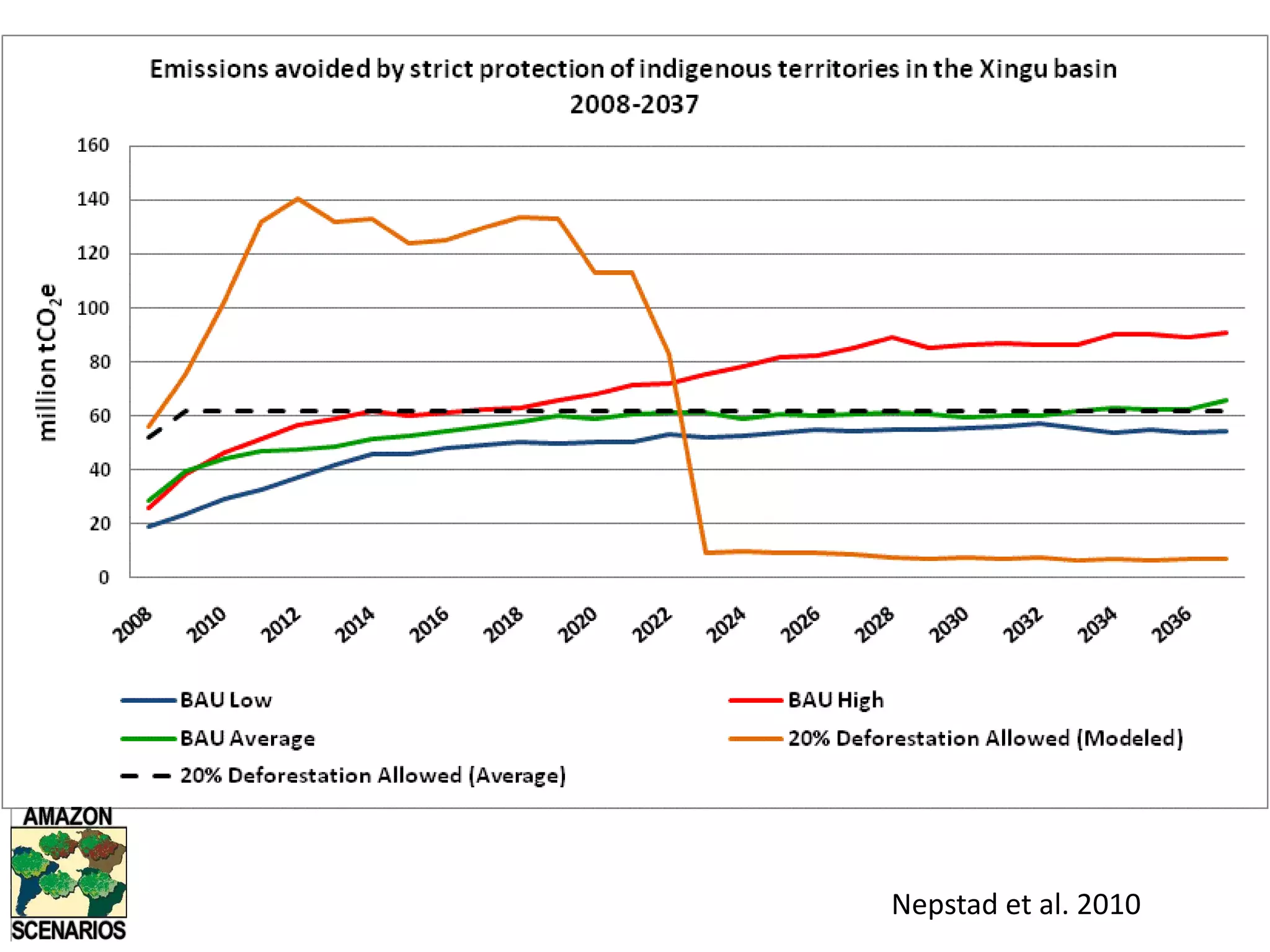
Emissions avoided (Xingu River Basin)Implementation of Forest Code (private lands) & strict protection of ILs and PAs
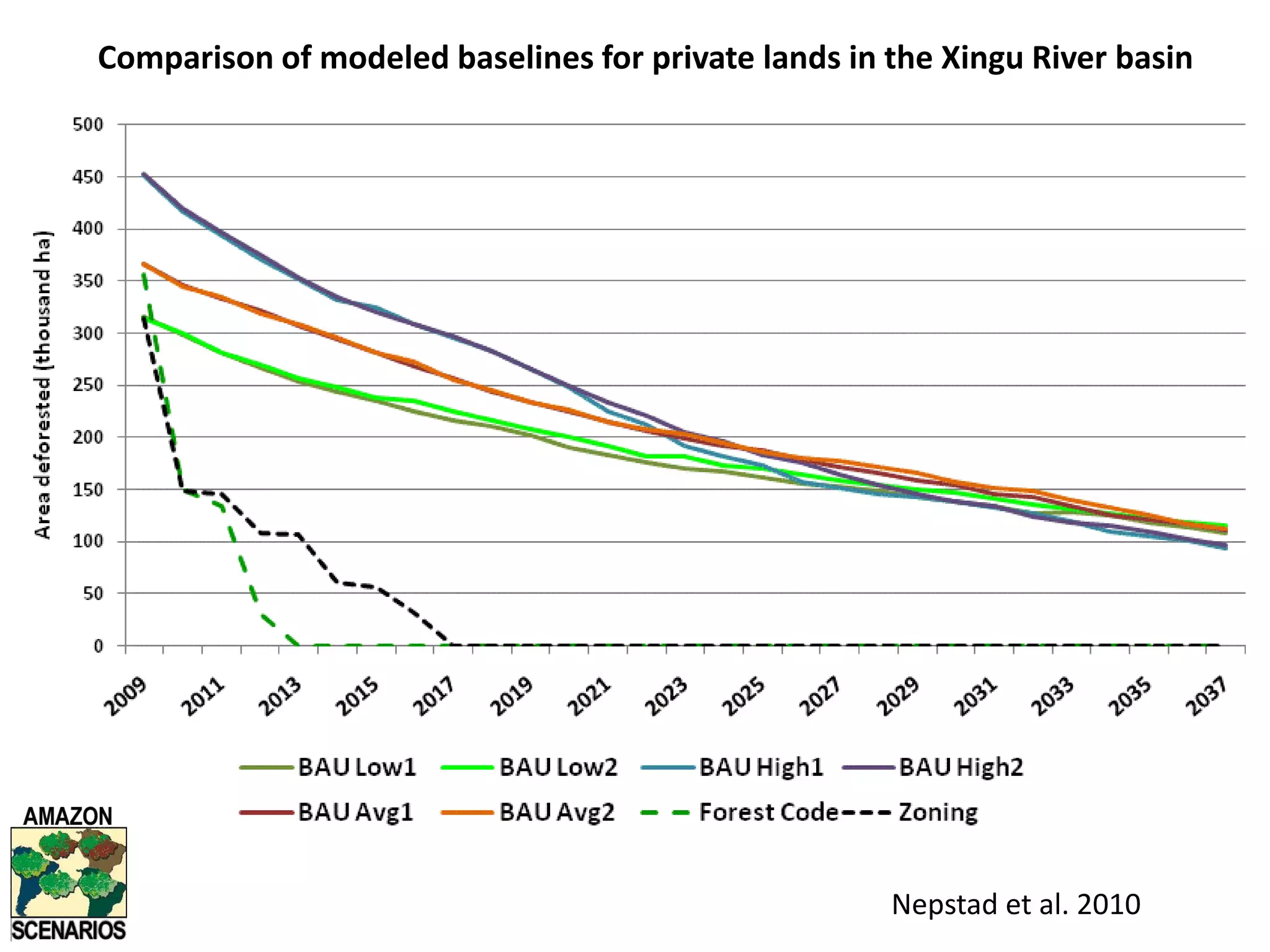
Comparison of modeled baselines for private lands in the Xingu River basinNepstad et al. 2010
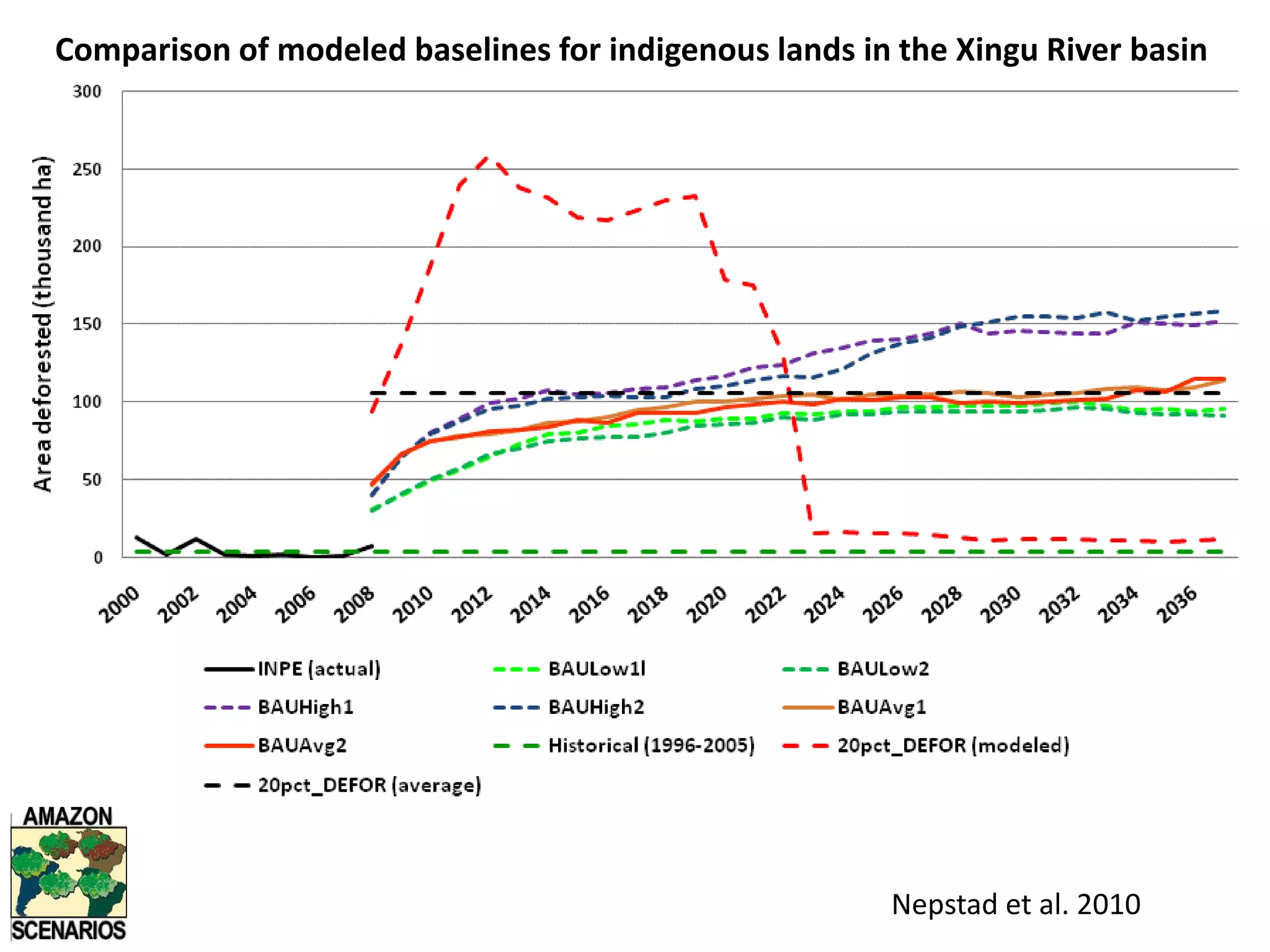
Comparison of modeled baselines for indigenous lands in the Xingu River basinNepstad et al. 2010
Nepstad et al. 2010
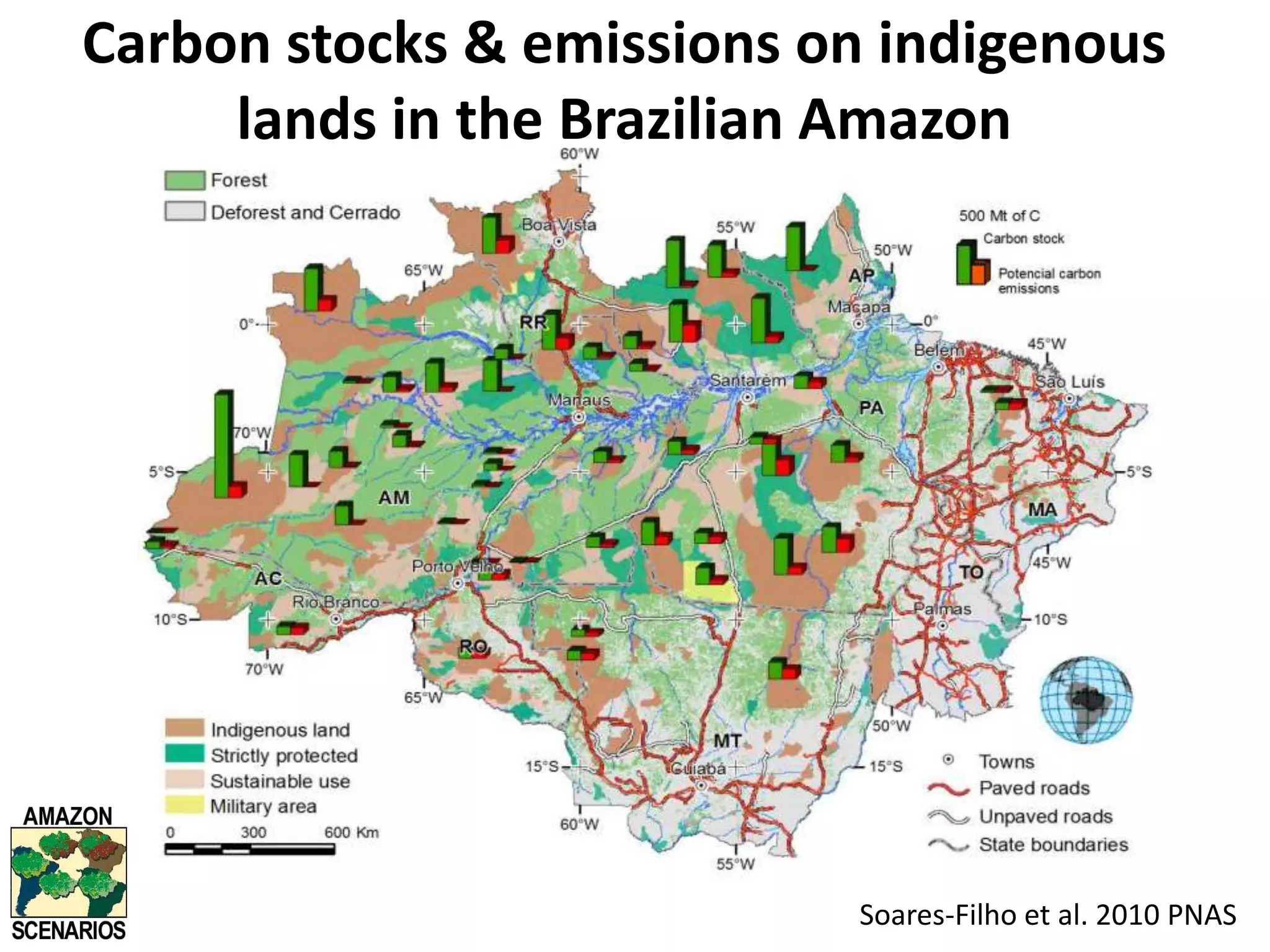
Carbon stocks & emissionsonindigenouslands in theBrazilian AmazonNivel de amenazaPriorización de áreas protegidasSoares-Filho et al. 2010 PNAS
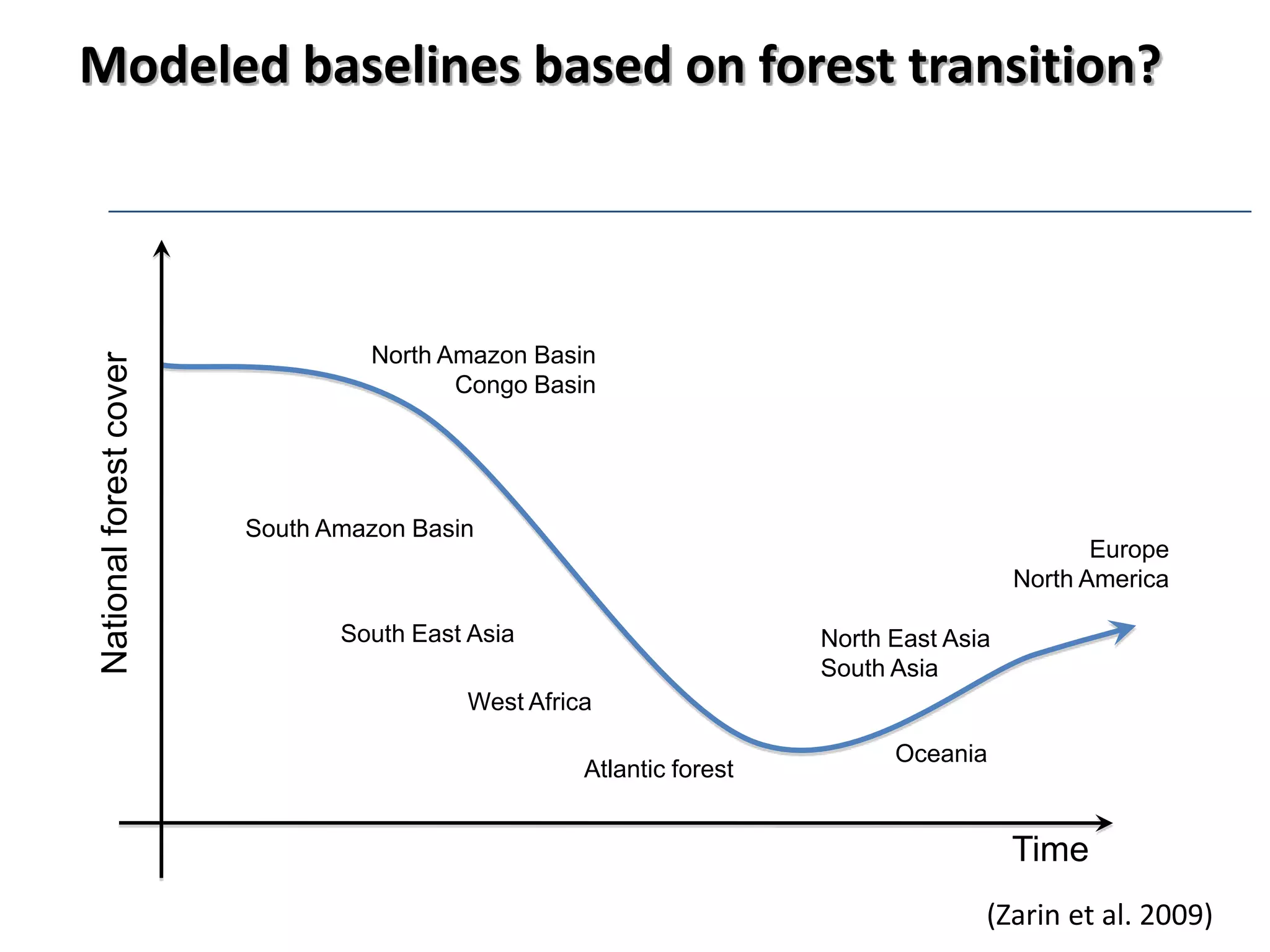
Modeledbaselinesbased on forest transition?North Amazon BasinCongo Basin South Amazon BasinNational forest coverEurope North AmericaSouth East AsiaNorth East AsiaSouth AsiaWest AfricaOceaniaAtlantic forestTime(Zarin et al. 2009)

stickler_modeling_baselines

  • 1.
    Centro de SensoriamentoRemotoUNIVERSIDADE FEDERAL DE MINAS GERAISModelling spatially explicit forward-looking baselinesClaudia SticklerREDDex, July 13-15, 2010
  • 2.
    Applications of theAmazon Scenarios modeling system in Amazon REDD projectsJuma (Amazonas State)**
  • 3.
  • 4.
  • 5.
  • 6.
  • 7.
    Brazilian Amazon** Usedmodel results not developed for reference level estimation
  • 9.
    MatoGrosso REDD targetswithin a national programAnnual Deforestation (km2)
  • 10.
    Indigenous Lands~60% ofareaProtected AreasSustainable Use Areas~98% of deforestationPrivate Lands508,474 km2>95% of possible REDD+ participant nations
  • 11.
    Historical average3.3% =10,502 ha/yr2.3% = 216,376 ha/yr1.3% = 483,380 ha/yr0.0035% = 3791 ha/yrNepstad et al. 2010
  • 12.
    Simulated (modeled) baselineDinamicaEGO platform (www.csr.ufmg.br/dinamica/)
  • 13.
    High to mediumresolution (100-m to 1-km)
  • 14.
    Calibrated and runat nested sub-basin levels
  • 15.
    Regrows forests andcerradoStickler et al. 2009 GCB; Stickler 2009
  • 16.
    Sub-basins (2nd order)Variabletypes for calibrationclearingroadstopographypopulation centersstreamsprotected areassoils/suitability
  • 17.
    Basic units ofchangeMicrobasins (7th order +)7572 watershedsmean = 5981 harange: 1 – 70,766 haCells2940 x 7434 cells4 ha (200 x 200-m)
  • 18.
    ScenariosBusiness as Usualhistoricalrate and pattern of deforestation continueshistorical level of compliance with environmental legislation continueslow, high, averagevarying weight of historical protection of PAs, ILs, etc.Current Forest Code 80% “legal reserve” (RL) in forest biome; 35% RL in cerrado; 100% forest in riparian zoneVarying protection of indigenous lands, protected areasState Zoning Plans4 zones: 80% forest RL in 2 zones; 50% forest RL in 1 zone; 35% cerrado RL in 3 zones; 100% forest in riparian zoneVarying protection of indigenous lands, protected areas Stickler 2009; Nepstad et al. 2010
  • 19.
  • 20.
    Comparison of modeledbaselines with historical average, Xingu River BasinNepstad et al. 2010
  • 21.
  • 22.
    Comparison of modeledbaselines with policy intervention scenariosNepstad et al. 2010
  • 23.
  • 24.
    Emissions avoided (XinguRiver Basin)Implementation of Forest Code (private lands) & strict protection of ILs and PAs
  • 25.
    Comparison of modeledbaselines for private lands in the Xingu River basinNepstad et al. 2010
  • 26.
    Comparison of modeledbaselines for indigenous lands in the Xingu River basinNepstad et al. 2010
  • 27.
  • 28.
    Carbon stocks &emissionsonindigenouslands in theBrazilian AmazonNivel de amenazaPriorización de áreas protegidasSoares-Filho et al. 2010 PNAS
  • 29.
    Modeledbaselinesbased on foresttransition?North Amazon BasinCongo Basin South Amazon BasinNational forest coverEurope North AmericaSouth East AsiaNorth East AsiaSouth AsiaWest AfricaOceaniaAtlantic forestTime(Zarin et al. 2009)
  • 30.
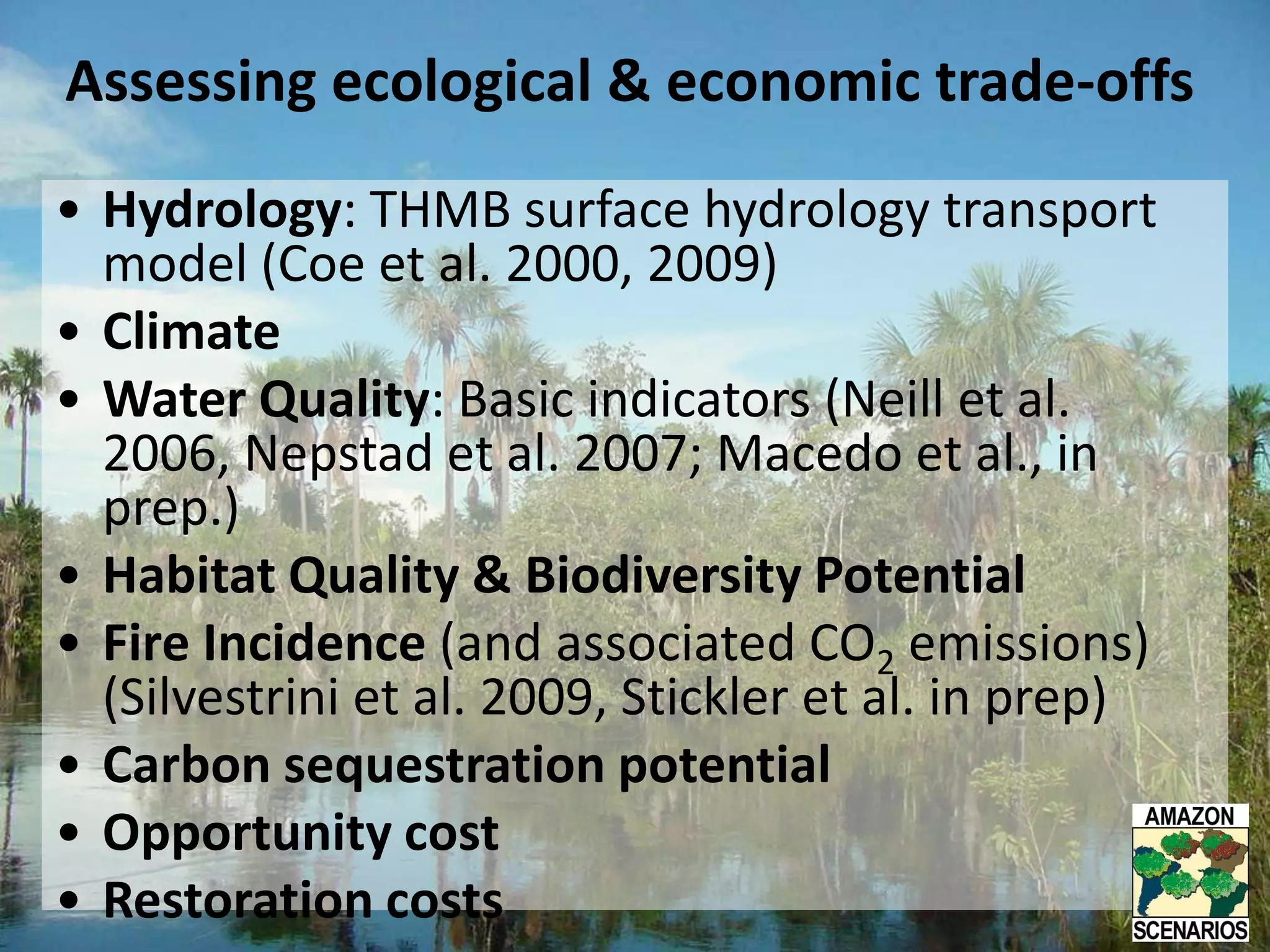
    Assessing ecological &economic trade-offsHydrology:THMB surface hydrology transport model (Coe et al. 2000, 2009)
  • 31.
  • 32.
    Water Quality: Basicindicators (Neill et al. 2006, Nepstad et al. 2007; Macedo et al., in prep.)
  • 33.
    Habitat Quality &Biodiversity Potential
  • 34.
    Fire Incidence (andassociated CO2 emissions) (Silvestrini et al. 2009, Stickler et al. in prep)
  • 35.
  • 36.
  • 37.
    Restoration costsCollaboratorsAne Alencar(IPAM)Oriana Almeida (IPAM, UFPa)Alessandro Baccini (WHRC)Paulo Brando (IPAM)Oswaldo Carvalho (IPAM)Andrea Cattaneo (OECD)Mike Coe (WHRC)Laura Dietzsch (IPAM)Josef Kellndorfer (WHRC)Andre Lima (IPAM)Marcia Macedo (Columbia U)Paulo Moutinho (IPAM)Daniel Nepstad (IPAM)Hermann Rodrigues (UFMG)Britaldo Soares Filho (UFMG)Osvaldo Stella (IPAM)Wayne Walker (WHRC)Toby McGrath (WHRC, IPAM)Frank Merry (Moore)Maria Bowman (UCB, WHRC)John Carter (AT)Sergio Rivero (UFPa)UNIVERSIDADE FEDERAL DE MINAS GERAIS
  • 39.
    Sample of REDD-RelevantPublications from Amazon Scenarios ProgramMerry, F., B. Soares-Filho, D. Nepstad, G. Amacher, and H. Rodrigues. 2009. Balancing conservation and economic stability: the future of the Amazon timber industry. Environmental ManagementNepstad, D., B. Soares-Filho, F. Merry, A. Lima, P. Moutinho, et al. 2009. The end of deforestation in the Brazilian Amazon. Science 326: 1350-1351.Nepstad, D, A. Veríssimo, A. Alencar, etal. 1999. Large-scale impoverishment of Amazonian forests by logging and fire. Nature. 398:505-508.Soares-Filho, B. S., P. Moutinho, D. Nepstad, et al. 2010. Role of Brazilian Amazon protected areas in climate mitigation. Proc. Nat. Acad. Sci.Soares-Filho, B., D. Nepstad, L. Curran, et al. 2006. Modeling Amazon conservation. Nature 440: 520-523.Stickler, C.M., D.C. Nepstad, M.T. Coe, D.G. McGrath, H.O. Rodrigues, et al. 2009. The potential ecological costs and cobenefits of REDD: a critical review and case study from the Amazon region. Global Change Biology 15:2803–2824 Vera-Diaz, M. del C., R. K. Kaufmann, D. C. Nepstad, P. Schlesinger. 2007. An interdisciplinary model of soybean yield in the Amazon Basin: the climatic,edaphic, and economic determinants. Ecological Economics
  • 41.
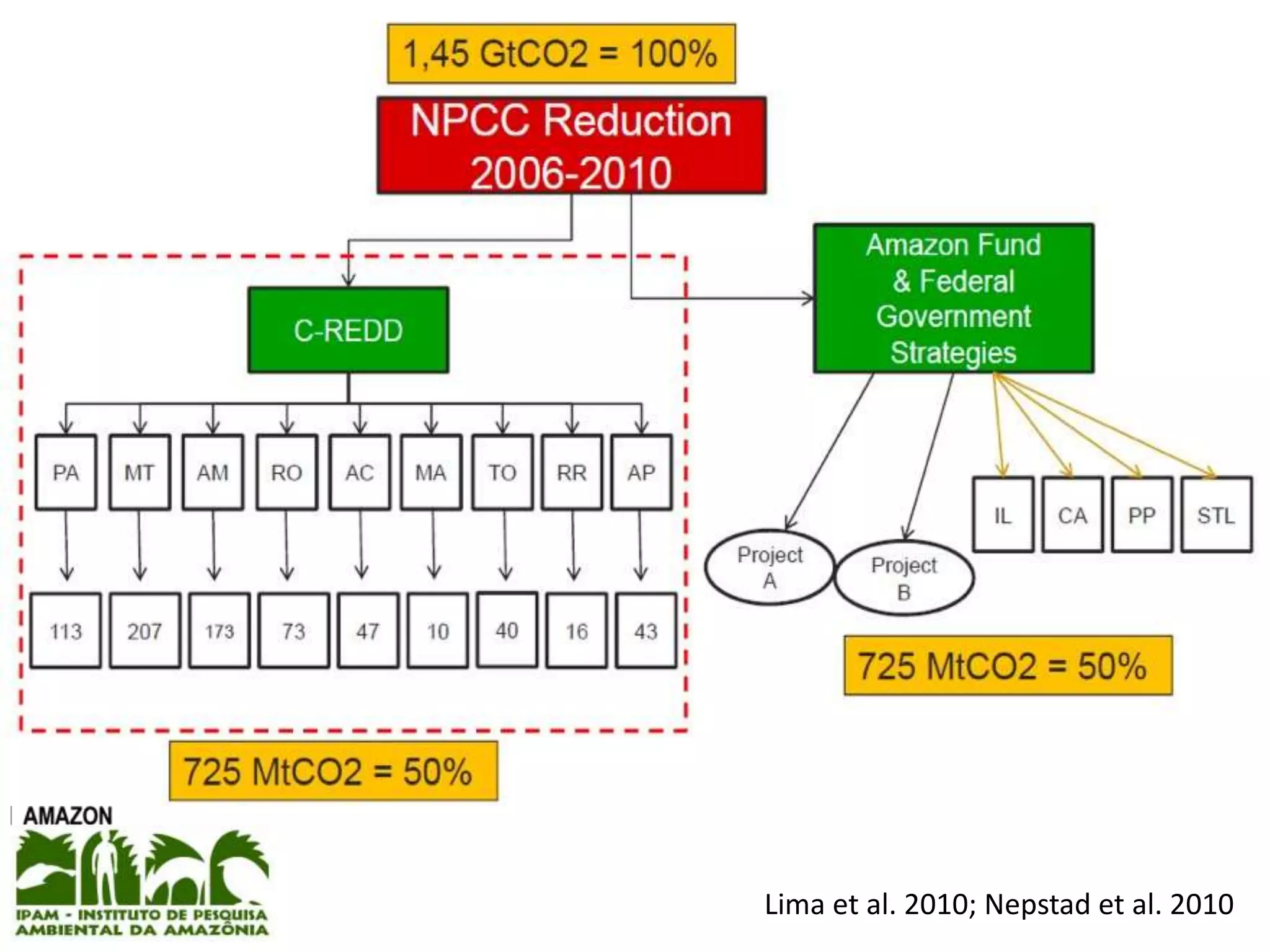
    Lima et al.2010; Nepstad et al. 2010
  • 42.
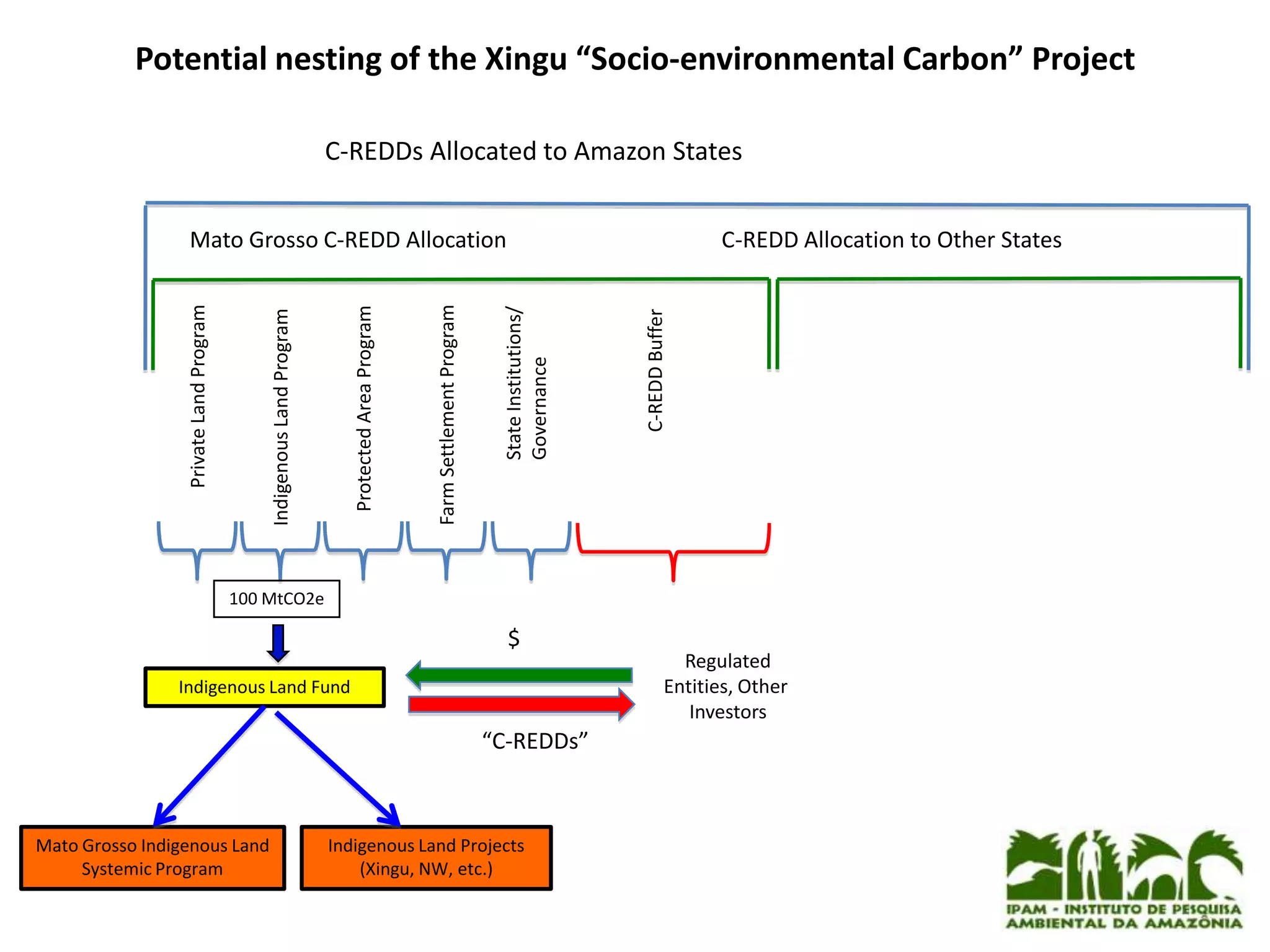
    Potential nesting ofthe Xingu “Socio-environmental Carbon” ProjectC-REDDs Allocated to Amazon StatesMato Grosso C-REDD Allocation C-REDD Allocation to Other StatesState Institutions/GovernanceC-REDD BufferPrivate Land ProgramProtected Area ProgramFarm Settlement ProgramIndigenous Land Program100 MtCO2e$RegulatedEntities, Other InvestorsIndigenous Land Fund“C-REDDs”Indigenous Land Projects (Xingu, NW, etc.)Mato Grosso Indigenous Land Systemic Program
  • 43.
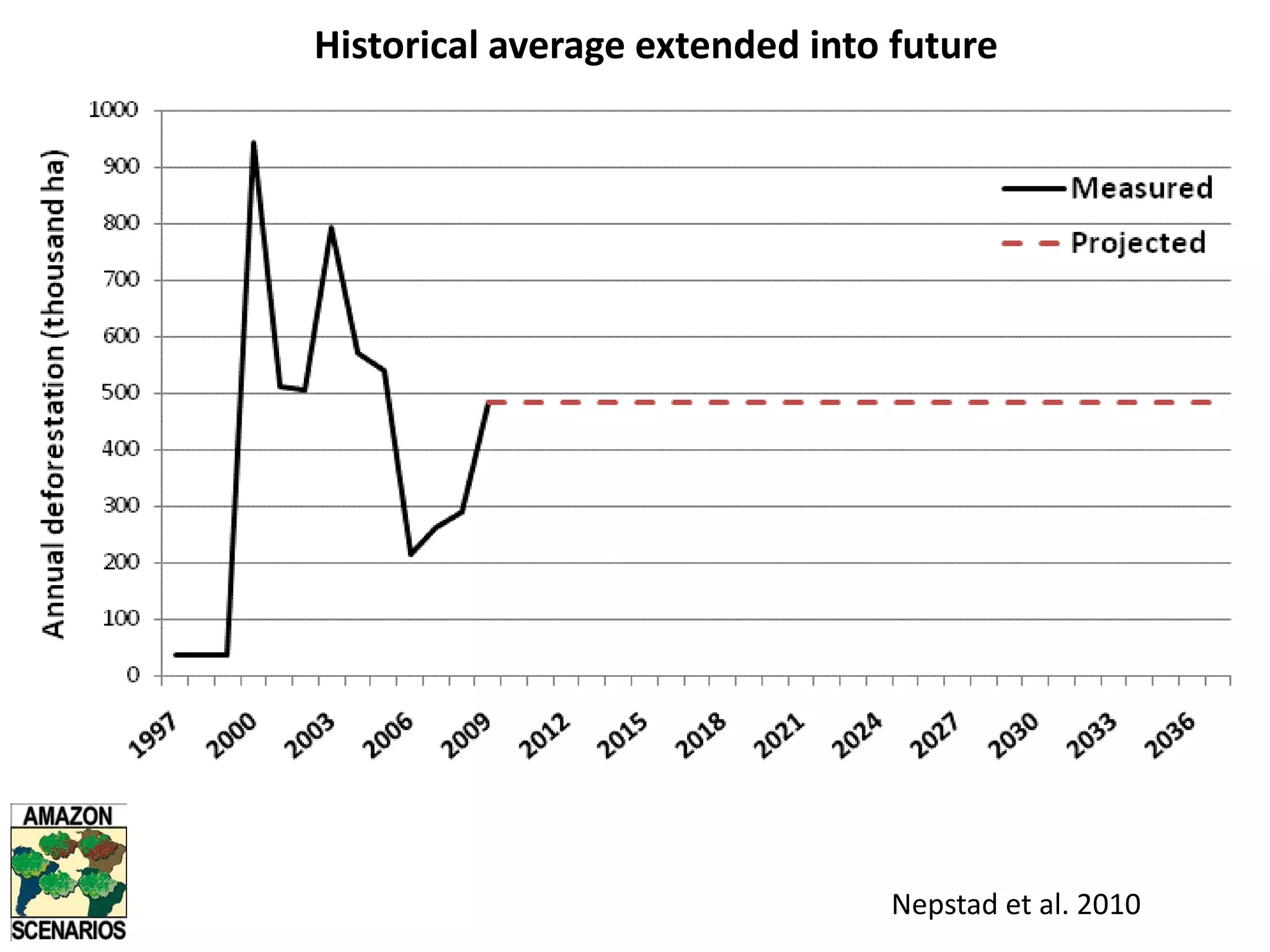
    Historical average extendedinto futureNepstad et al. 2010