WWF Forest Carbon Strategy TNC REDDex July 13th, 2010 Liliana Dávila Stern WWF – México
WWF’s work on REDD+:   The Forest Carbon Initiative (FCI)
In 2008 WWF recognised that REDD+  offers a chance to dramatically alter the landscape of forest conservation … REDD+ and WWF
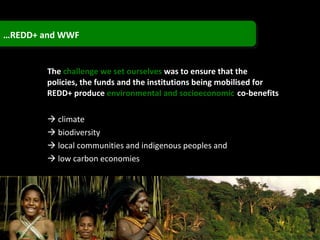
The  challenge we set ourselves  was to ensure that the policies, the funds and the institutions being mobilised for REDD+ produce  environmental and socioeconomic   co-benefits    climate    biodiversity    local communities and indigenous peoples and     low carbon economies … REDD+ and WWF
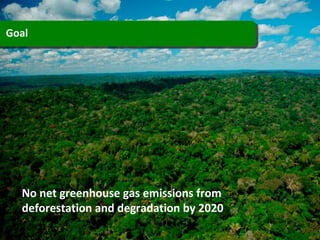
Goal  No net greenhouse gas emissions from deforestation and degradation by 2020
… WWF focuses on five niches … Advocating  high standards in global REDD+ policy Influencing  national REDD+ policy Initiating  large REDD+ projects and programmes in high biodiversity landscapes with indigenous and forest dwelling communities Convening  communities of interest in financing Innovating  technical solutions for REDD+
Three years to shape REDD+ …   FCI Strategy 2010-2013
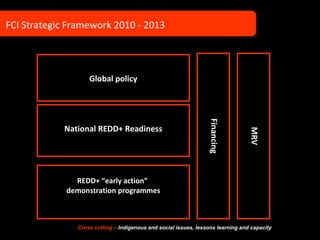
REDD+ “early action”  demonstration programmes Global policy National REDD+ Readiness Financing FCI Strategic Framework 2010 - 2013 MRV Cross cutting –  Indigenous and social issues, lessons learning and capacity
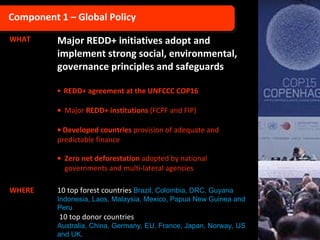
Component 1 – Global Policy WHAT Major REDD+ initiatives adopt and implement strong social, environmental, governance principles and safeguards REDD+ agreement at the UNFCCC COP16   Major  REDD+ institutions  (FCPF and FIP) Developed countries  provision of adequate and predictable finance  Zero net deforestation  adopted by national    governments and multi-lateral agencies WHERE 10 top forest countries  Brazil, Colombia, DRC, Guyana Indonesia, Laos, Malaysia, Mexico, Papua New Guinea and Peru 10 top donor countries Australia, China, Germany, EU, France, Japan, Norway, US and UK.
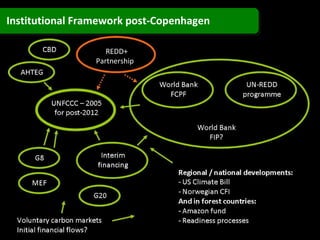
Institutional Framework post-Copenhagen REDD+  Partnership
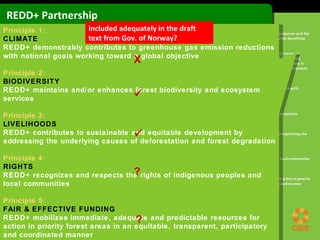
REDD+ Partnership Principle 1:  CLIMATE  REDD+ demonstrably contributes to greenhouse gas emission reductions with national goals working toward a global objective Principle 2:  BIODIVERSITY  REDD+ maintains and/or enhances forest biodiversity and ecosystem services Principle 3:  LIVELIHOODS  REDD+ contributes to sustainable and equitable development by addressing the underlying causes of deforestation and forest degradation  Principle 4:  RIGHTS  REDD+ recognizes and respects the rights of indigenous peoples and local communities  Principle 5:  FAIR & EFFECTIVE FUNDING  REDD+ mobilizes immediate, adequate and predictable resources for action in priority forest areas in an equitable, transparent, participatory and coordinated manner X   ? ? Included adequately in the draft text from Gov. of Norway?
Component 2 – National and Sub-national REDD+ Readiness WHAT National REDD+ strategies and architectures are in place in six countries with effective institutional and governance capacity in line with WWF Principles six national and/or sub-national REDD+  have been  convened six national participation plans are developed and   implemented WHERE Brazil, DRC, Indonesia, PNG, Peru, Mexico, Malaysia
Component 3 – REDD+ Early Actions Programmes and Projects WHAT At lease 4 subnational programmes contribute reductions in annual carbon emissions from deforestation across a total of over 10+ million ha and demostrate important lessons for REDD+   n etwork guidance on project development and credit    management a “flying squad” of REDD+ experts and peer review    group to assist in project and programme    development implementation in at least four subnational REDD+   programmes linked to national REDD+ framework Voluntary and compliance standards for REDD+ project meet WWF’s Principles WHERE Initial focus on Peru, Indonesia, DRC, Brazil
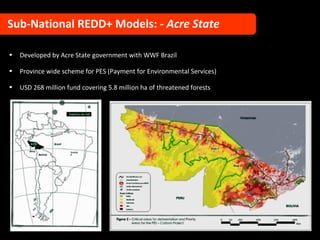
Developed by Acre State government with WWF Brazil Province wide scheme for PES (Payment for Environmental Services) USD 268 million fund covering 5.8 million ha of threatened forests  Sub-National REDD+ Models:  - Acre State
Program for Sustainable Property Certification Currently voluntary Focuses on small-scale producers: ca. 2000 families to date  Payments for adoption of sustainable land uses: US$200-300/yr per  property plus technical assistance for production & marketing Requirements for participation: 9-year contract Forest conservation No deforestation No burning Restoration of degraded lands Separate programme for indigenous communities Sub-National REDD+ Models:  - Acre State
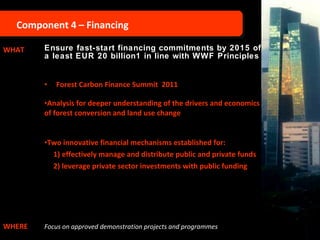
Component 4 – Financing WHAT Ensure fast-start financing commitments by 2015 of a least EUR 20 billion1 in line with WWF Principles Forest Carbon Finance Summit  2011 Analysis for deeper understanding of the drivers and economics of forest conversion and land use change  Two innovative financial mechanisms established for: 1) effectively manage and distribute public and private funds  2) leverage private sector investments with public funding WHERE Focus on approved demonstration projects and programmes
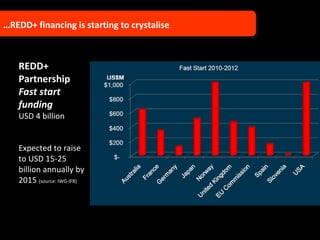
… REDD+ financing is starting to crystalise  REDD+ Partnership Fast start  funding USD 4 billion Expected to raise to USD 15-25 billion annually by 2015  (source: IWG-IFR)
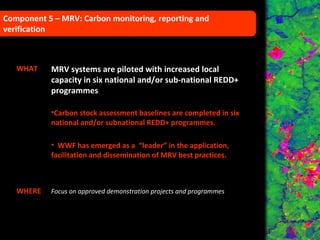
Component 5 – MRV: Carbon monitoring, reporting and verification WHAT MRV systems are piloted with increased local capacity in six national and/or sub-national REDD+ programmes Carbon stock assessment baselines are completed in six national and/or subnational REDD+ programmes. WWF has emerged as a  “leader” in the application,  facilitation and dissemination of MRV best practices.  WHERE Focus on approved demonstration projects and programmes
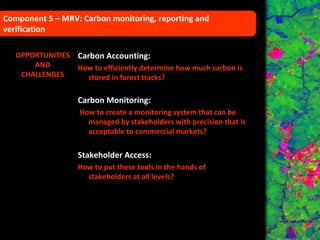
Component 5 – MRV: Carbon monitoring, reporting and verification OPPORTUNITIES AND CHALLENGES Carbon Accounting:  How to efficiently determine how much carbon is stored in forest tracks? Carbon Monitoring: How to create a monitoring system that can be managed by stakeholders with precision that is acceptable to commercial markets?  Stakeholder Access:   How to put these tools in the hands of  stakeholders at all levels?
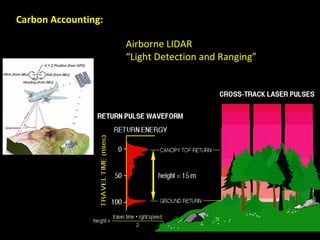
Airborne LIDAR “ Light Detection and Ranging” Carbon Accounting:
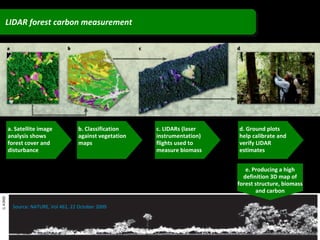
a. Satellite image analysis shows forest cover and disturbance   b. Classification against vegetation maps c. LIDARs (laser instrumentation) flights used to measure biomass d. Ground plots help calibrate and verify LIDAR estimates Source: NATURE, Vol 461, 22 October 2009 e. Producing a high definition 3D map of forest structure, biomass and carbon LIDAR forest carbon measurement
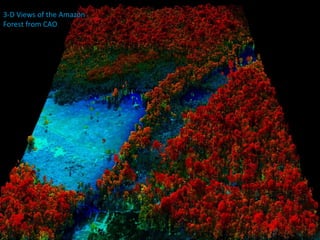
3-D Views of the Amazon Forest from CAO
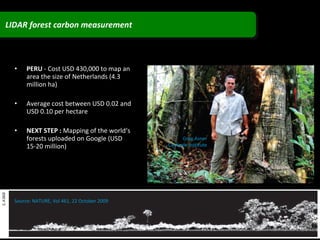
PERU  - Cost USD 430,000 to map an area the size of Netherlands (4.3 million ha) Average cost between USD 0.02 and USD 0.10 per hectare NEXT STEP :  Mapping of the world‘s forests uploaded on Google (USD 15-20 million) Greg Asner Carnegie Institute Source: NATURE, Vol 461, 22 October 2009 LIDAR forest carbon measurement
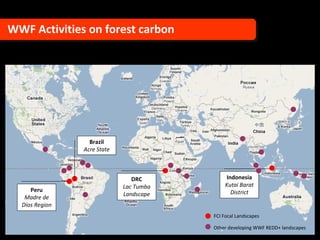
WWF Activities on forest carbon  Peru Madre de Dios Region DRC Lac Tumba Landscape Indonesia Kutai Barat District Brazil Acre State FCI Focal Landscapes Other developing WWF REDD+ landscapes
Five principles – push for Cancun. 1 to 3 specific target that we all go after. Build together a simple learning system that can be embedded in the agreement. Big role as a network of NGO Get a very simple methodology  to guarantee the carbon is stored - tested in a couple of years.   Things to take away…
WWF Forest Carbon Initiative www.panda.org/forestcarbon

WWF Forest Carbon (Liliana)

  • 1.
    WWF Forest CarbonStrategy TNC REDDex July 13th, 2010 Liliana Dávila Stern WWF – México
  • 2.
    WWF’s work onREDD+: The Forest Carbon Initiative (FCI)
  • 3.
    In 2008 WWFrecognised that REDD+ offers a chance to dramatically alter the landscape of forest conservation … REDD+ and WWF
  • 4.
    The challengewe set ourselves was to ensure that the policies, the funds and the institutions being mobilised for REDD+ produce environmental and socioeconomic co-benefits  climate  biodiversity  local communities and indigenous peoples and  low carbon economies … REDD+ and WWF
  • 5.
    Goal Nonet greenhouse gas emissions from deforestation and degradation by 2020
  • 6.
    … WWF focuseson five niches … Advocating high standards in global REDD+ policy Influencing national REDD+ policy Initiating large REDD+ projects and programmes in high biodiversity landscapes with indigenous and forest dwelling communities Convening communities of interest in financing Innovating technical solutions for REDD+
  • 7.
    Three years toshape REDD+ … FCI Strategy 2010-2013
  • 8.
    REDD+ “early action” demonstration programmes Global policy National REDD+ Readiness Financing FCI Strategic Framework 2010 - 2013 MRV Cross cutting – Indigenous and social issues, lessons learning and capacity
  • 9.
    Component 1 –Global Policy WHAT Major REDD+ initiatives adopt and implement strong social, environmental, governance principles and safeguards REDD+ agreement at the UNFCCC COP16 Major REDD+ institutions (FCPF and FIP) Developed countries provision of adequate and predictable finance Zero net deforestation adopted by national governments and multi-lateral agencies WHERE 10 top forest countries Brazil, Colombia, DRC, Guyana Indonesia, Laos, Malaysia, Mexico, Papua New Guinea and Peru 10 top donor countries Australia, China, Germany, EU, France, Japan, Norway, US and UK.
  • 10.
  • 11.
    REDD+ Partnership Principle1: CLIMATE REDD+ demonstrably contributes to greenhouse gas emission reductions with national goals working toward a global objective Principle 2: BIODIVERSITY REDD+ maintains and/or enhances forest biodiversity and ecosystem services Principle 3: LIVELIHOODS REDD+ contributes to sustainable and equitable development by addressing the underlying causes of deforestation and forest degradation Principle 4: RIGHTS REDD+ recognizes and respects the rights of indigenous peoples and local communities Principle 5: FAIR & EFFECTIVE FUNDING REDD+ mobilizes immediate, adequate and predictable resources for action in priority forest areas in an equitable, transparent, participatory and coordinated manner X   ? ? Included adequately in the draft text from Gov. of Norway?
  • 12.
    Component 2 –National and Sub-national REDD+ Readiness WHAT National REDD+ strategies and architectures are in place in six countries with effective institutional and governance capacity in line with WWF Principles six national and/or sub-national REDD+ have been convened six national participation plans are developed and implemented WHERE Brazil, DRC, Indonesia, PNG, Peru, Mexico, Malaysia
  • 13.
    Component 3 –REDD+ Early Actions Programmes and Projects WHAT At lease 4 subnational programmes contribute reductions in annual carbon emissions from deforestation across a total of over 10+ million ha and demostrate important lessons for REDD+ n etwork guidance on project development and credit management a “flying squad” of REDD+ experts and peer review group to assist in project and programme development implementation in at least four subnational REDD+ programmes linked to national REDD+ framework Voluntary and compliance standards for REDD+ project meet WWF’s Principles WHERE Initial focus on Peru, Indonesia, DRC, Brazil
  • 14.
    Developed by AcreState government with WWF Brazil Province wide scheme for PES (Payment for Environmental Services) USD 268 million fund covering 5.8 million ha of threatened forests Sub-National REDD+ Models: - Acre State
  • 15.
    Program for SustainableProperty Certification Currently voluntary Focuses on small-scale producers: ca. 2000 families to date Payments for adoption of sustainable land uses: US$200-300/yr per property plus technical assistance for production & marketing Requirements for participation: 9-year contract Forest conservation No deforestation No burning Restoration of degraded lands Separate programme for indigenous communities Sub-National REDD+ Models: - Acre State
  • 16.
    Component 4 –Financing WHAT Ensure fast-start financing commitments by 2015 of a least EUR 20 billion1 in line with WWF Principles Forest Carbon Finance Summit 2011 Analysis for deeper understanding of the drivers and economics of forest conversion and land use change Two innovative financial mechanisms established for: 1) effectively manage and distribute public and private funds 2) leverage private sector investments with public funding WHERE Focus on approved demonstration projects and programmes
  • 17.
    … REDD+ financingis starting to crystalise REDD+ Partnership Fast start funding USD 4 billion Expected to raise to USD 15-25 billion annually by 2015 (source: IWG-IFR)
  • 18.
    Component 5 –MRV: Carbon monitoring, reporting and verification WHAT MRV systems are piloted with increased local capacity in six national and/or sub-national REDD+ programmes Carbon stock assessment baselines are completed in six national and/or subnational REDD+ programmes. WWF has emerged as a “leader” in the application, facilitation and dissemination of MRV best practices. WHERE Focus on approved demonstration projects and programmes
  • 19.
    Component 5 –MRV: Carbon monitoring, reporting and verification OPPORTUNITIES AND CHALLENGES Carbon Accounting: How to efficiently determine how much carbon is stored in forest tracks? Carbon Monitoring: How to create a monitoring system that can be managed by stakeholders with precision that is acceptable to commercial markets? Stakeholder Access: How to put these tools in the hands of stakeholders at all levels?
  • 20.
    Airborne LIDAR “Light Detection and Ranging” Carbon Accounting:
  • 21.
    a. Satellite imageanalysis shows forest cover and disturbance b. Classification against vegetation maps c. LIDARs (laser instrumentation) flights used to measure biomass d. Ground plots help calibrate and verify LIDAR estimates Source: NATURE, Vol 461, 22 October 2009 e. Producing a high definition 3D map of forest structure, biomass and carbon LIDAR forest carbon measurement
  • 22.
    3-D Views ofthe Amazon Forest from CAO
  • 23.
    PERU -Cost USD 430,000 to map an area the size of Netherlands (4.3 million ha) Average cost between USD 0.02 and USD 0.10 per hectare NEXT STEP : Mapping of the world‘s forests uploaded on Google (USD 15-20 million) Greg Asner Carnegie Institute Source: NATURE, Vol 461, 22 October 2009 LIDAR forest carbon measurement
  • 24.
    WWF Activities onforest carbon Peru Madre de Dios Region DRC Lac Tumba Landscape Indonesia Kutai Barat District Brazil Acre State FCI Focal Landscapes Other developing WWF REDD+ landscapes
  • 25.
    Five principles –push for Cancun. 1 to 3 specific target that we all go after. Build together a simple learning system that can be embedded in the agreement. Big role as a network of NGO Get a very simple methodology to guarantee the carbon is stored - tested in a couple of years. Things to take away…
  • 26.
    WWF Forest CarbonInitiative www.panda.org/forestcarbon

Editor's Notes

  • #3 SECTION 1: Introduction to concept of forest carbon (Paul)
  • #8 SECTION 1: Introduction to concept of forest carbon (Paul)
  • #11 We are not going to cover any one properly, so we ngos we need to push them together, who can cover ther rest and share information. If we can agree on certain things make us much stronger.
  • #12 Notes: An upcoming key opportunity to do this is through the REDD+ Partnership Process, which kicked off with a Ministerial meeting in Paris in March and concludes in May with a meeting in Oslo. This Partnership aims to maintain the momentum for REDD coming out of the UNFCCC negotiations and improve co-ordination of financial flows for REDD. Why does it matter? There is now $4.5 billion pledged coming out of the Paris meeting for 2010-2012. If countries in the REDD+ Partnership can agree on key principles and criteria for how this substantial fast-start funding for REDD should flow, this could help set the long-term shape of REDD+ and ensure it addresses not only the dire consequences of ongoing forest loss and forest degradation, but also benefits the planet's climate, biodiversity and people.
  • #17 Harvand forest carbon finance summit get the resullt and papers. How to influence economic flows that are causing destruction, low carbon high growth stategy, Guyana and east kalamantan from mckinsey to test what investment is destructing and protecting the forest. Economics and land use planning causes forest land and propose. Make a holistic change instread of changing one step at time. More strategic. 50 and 100 of top investors and financial analysis, if they are interested. Appetite for forest carbon, a much stonger simpler methodology takes place.
  • #20 As you are all aware, REDD probably represents both the greatest opportunity and challenge to confront WWF since its inception Implementing REDD involves a huge set of political and scientific challenges Fortunately, On the science side at least, emerging technologies are offering solutions to the challenges. But selecting and positioning ourselves with these technologies to have the greatest positive impact on REDD is also a challenge. I have been asked to briefly mention some of the new opportunities so we can gain your insights and initial feedback into how the organization and CSP might integrate these technologies into WWFs REDD tool kit. The 3 scientific aspects of REDD that I would like to explore are
  • #22 Notes: Building effective national programs in key countries with results that are reported, monitored and verified is essential to REDD. The Forest Carbon Initiative has been supporting efforts in key forest countries to strengthen capacity in the design and implementation of programs for REDD.  Projects focus on developing tools and methodologies for REDD implementation and for building national REDD capacity.  Projects also focus on training priority countries in the use of tools and approaches that can enable informed REDD policymaking and project design.  An exciting result of this program includes the development and testing of LiDAR laser instrumentation which produces high definition, 3D maps of forest structure, biomass and carbon.  This enables more effective measurement of not only deforestation, but also of forest degradation – a key to establishing effective monitoring and verification of REDD programs.
  • #24 Notes: This technology could significantly reduce the cost of measuring forest carbon and make this data available through a world forest map on Google.