Getting ready for REDDThe REDD Countries database of the REDD Desk
About the GCPTropical forest think tank with work acrossScience: Ecosystems Services for Poverty AlleviationCommunity MRV in GuyanaPolicyLittle Book SeriesThe REDD deskFinanceForest Footprint Disclosure project
overviewWhat is REDD+?What is REDD Readiness?How does the REDD desk help?Brazil: Ready or not?Questions
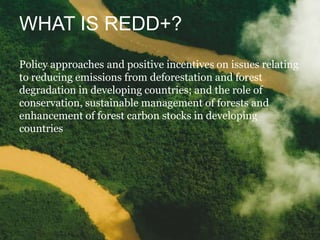
What is REDD+?Policy approaches and positive incentives on issues relating to reducing emissions from deforestation and forest degradation in developing countries; and the role of conservation, sustainable management of forests and enhancement of forest carbon stocks in developing countries
What is REDD+?Changed policy focus from forest conservation to climate protectionIncreased the level of political commitmentPotentially also increases the scale of financeBut:Underlying problems are still the sameStopping deforestation will require a comprehensive approach outside the forest sector
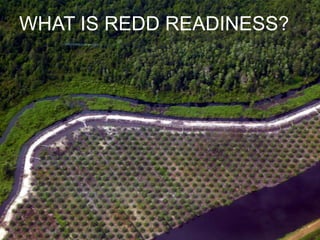
What is REDD Readiness?
What is REDDReadiness?Being defined in various arenaPreconditions for being able to reduce deforestationNo real definition for when a country is REDD readyOften principle or outcome based
Under the Cancun agreements developing countries are requested to developA national strategy or action planA national forest reference levelA robust and transparent national forest monitoring systemA system for providing information on how the safeguards are being addressed and  respectedThe Cancun AgreementsReadiness in the UNFCCC
Phase 1 (Readiness): Development of national plan, PAM and capacity buildingPhase 2 (Implementation): Implementation of national plan, PAM and demonstration activitiesPhase 3 (Performance): Results-based actions with full measurement, reporting and verificationThe phased approachReadiness in the UNFCCC
Multilateral initiativesUN-REDDEst. 2008 as collaboration of UNDP, UNEP and FAOActive in 29 countries (9 pilot countries) Forest Carbon Partnership FacilityOperational since 2008 under the World Bank GroupActive across 37 countriesForest Investment ProgrammePart of the SCF of Climate Investment FundsActive in
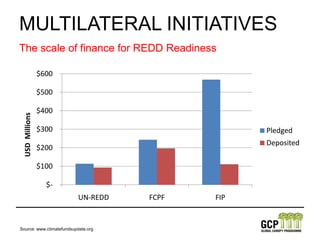
Source: www.climatefundsupdate.orgThe scale of finance for REDD ReadinessMultilateral initiatives
UN-REDD programmeMRV and monitoring (FAO)National REDD governance (UNDP)Engagement of Indigenous Peoples, Local Communities and Other Relevant Stakeholders (UNDP)Ensuring multiple benefits of forests and REDD(UNEP)Transparent, equitable and accountable management (UNDP)REDD+ as a Catalyst for Transformations to a Green Economy (UNEP)
“REDD+ readiness requires cross-sectoral coordination within multiple government agencies”UN-REDD Programme Strategic Review
World Bank FCPFOrganise and consultNational management and stakeholder consultationPrepare the REDD+ strategyForest assessment, strategy options, EIADevelop Reference Emission Level and Reference LevelsDesign a Monitoring systemMRV systemOther benefits and impacts
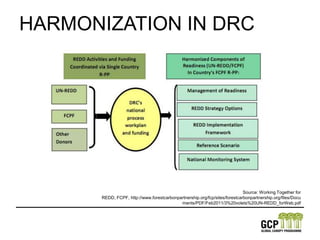
harmonization in drcSource: Working Together for REDD, FCPF, http://www.forestcarbonpartnership.org/fcp/sites/forestcarbonpartnership.org/files/Documents/PDF/Feb2011/3%20volets%20UN-REDD_forWeb.pdf
Bilateral initiativesNorwayFunding ‘Readiness’ activities in Tanzania, Indonesia, Brazil and Guyana (USD 3 billion)Germany International Climate Initiative (USD 80 million)AustraliaInternational Forest Carbon Initiative (USD 216 million)UK, France, Japan, Voluntary carbon marketsSource: www.climatefundsupdate.org
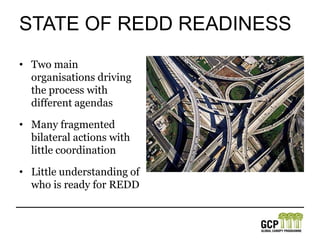
state of REDD ReadinessTwo main organisations driving the process with different agendasMany fragmented bilateral actions with little coordinationLittle understanding of who is ready for REDD
The REDD Desk A collaborative platform on REDD Readiness
The ChallengeFragmented and rapidly evolving sources of relevant informationUNREDD, FCPF, bilateral, unilateral, carbon marketsDiverse audience of stakeholdersdivided by language and geography.from different sectors starting at different levels of understandingDiverse and evolving definitions of REDD readiness
The ResponseA collaborative platform of REDD readiness run by stakeholders at international, national and local level, focused onComprehensive gathering and managing of REDD+ informationPresenting information in a clear, consistent way and making it widely accessibleFacilitating sharing and collaboration among stakeholdersUsing in country experience to collect information
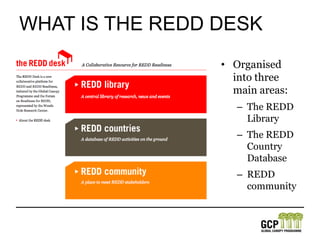
What is The redd deskOrganised into three main areas:The REDD LibraryThe REDD Country DatabaseREDD community
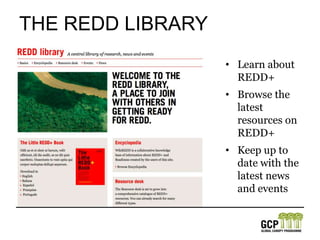
The REDD LibraryLearn about REDD+Browse the latest resources on REDD+Keep up to date with the latest news and events
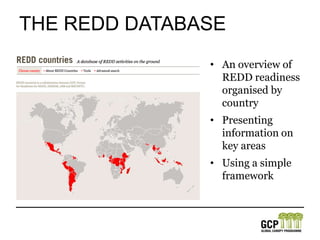
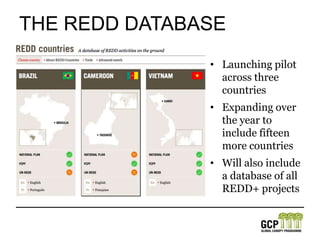
The REDD databaseAn overview of REDD readiness organisedby countryPresenting information on key areasUsing a simple framework
The REDD databaseLaunching pilot across three countriesExpanding over the year to include fifteen more countriesWill also include a database of all REDD+ projects
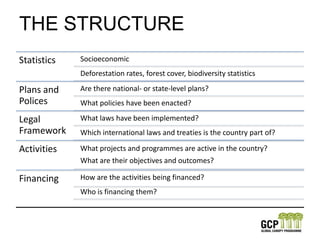
The structure
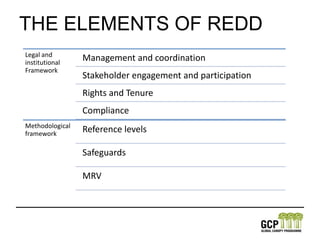
The elements of REDDA simplifying lensAt the national and project level what are the key data?Aligned with plans under UNREDD and FCPF as well as emerging policy agenda under UNFCCCWhat do you need to be REDD ready?
The elements of REDD
REDD+ in Brazil
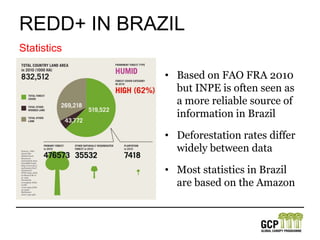
REDD+ in brazilThe Brazilian Amazoncovers an area of 410 million hectares more than half of the country’s total area Brazil lost nearly 15 million hectares of forest between 2000 and 2006 (an area the size of the England)Deforestation in the Amazon has already dropped by nearly 70%Statistics
Based on FAO FRA 2010 but INPE is often seen as a more reliable source of information in BrazilDeforestation rates differ widely between dataMost statistics in Brazil are based on the AmazonStatisticsREDD+ in brazil
REDD+ in brazilStatisticsDeforestation is being driven by commodity prices
REDD+ in brazilThe National Policy on Climate Changeestablished in 2009, is Brazil’s most significant climate change lawEstablished a series of mechanisms:National Plan on Climate change, Plan for Prevention and Control of Deforestation in the AmazonInternationally Brazil has ratified UNFCCC, CBD, and UNDRIPLegal Framework
REDD+ in brazilBrazil is neither a member of the UN-REDD+ nor FCPF programmes but recently joined FIP. National Plan on Climate Changein 2008 aimed to reduce deforestation by 72% by 2017.Under Brazil’s $43 billion Program for the Acceleration of Growth (PAC), large areas of the Amazon will be opened to development, improving the viability of soy, oil palm, logging, and beef production in once remote areas.Plans and Policies
Brazil uses a rolling average historical deforestation rate Reference LevelsREDD+ in brazil
REDD+ in brazilTo date there are 16 ongoing activities in BrazilSeveral state-led activities, including:BolsaFlorestaProgramme launched in 2007 in the State of Amazonas MoU between California and the State of Acre as part of the Governor’s Climate and Forests Task ForceAround 10 REDD projectsJuma Reserve Project, CCBA approvedActivities
REDD+ in brazilMajority of finance for REDD in Brazil has been delivered through bilateral sourcesIn 2008, Brazil received USD 1 billion from Norway for the Amazon Fund to be disbursed over 7 yearsThe Amazon Fund has contracted six projects collectively worth around USD 50 millionBrazil can receive up to USD 70 million from FIP to finance REDD implementation phase.Financing

Ready for redd

  • 1.
    Getting ready forREDDThe REDD Countries database of the REDD Desk
  • 2.
    About the GCPTropicalforest think tank with work acrossScience: Ecosystems Services for Poverty AlleviationCommunity MRV in GuyanaPolicyLittle Book SeriesThe REDD deskFinanceForest Footprint Disclosure project
  • 3.
    overviewWhat is REDD+?Whatis REDD Readiness?How does the REDD desk help?Brazil: Ready or not?Questions
  • 5.
    What is REDD+?Policyapproaches and positive incentives on issues relating to reducing emissions from deforestation and forest degradation in developing countries; and the role of conservation, sustainable management of forests and enhancement of forest carbon stocks in developing countries
  • 6.
    What is REDD+?Changedpolicy focus from forest conservation to climate protectionIncreased the level of political commitmentPotentially also increases the scale of financeBut:Underlying problems are still the sameStopping deforestation will require a comprehensive approach outside the forest sector
  • 7.
    What is REDDReadiness?
  • 8.
    What is REDDReadiness?Beingdefined in various arenaPreconditions for being able to reduce deforestationNo real definition for when a country is REDD readyOften principle or outcome based
  • 9.
    Under the Cancunagreements developing countries are requested to developA national strategy or action planA national forest reference levelA robust and transparent national forest monitoring systemA system for providing information on how the safeguards are being addressed and respectedThe Cancun AgreementsReadiness in the UNFCCC
  • 10.
    Phase 1 (Readiness):Development of national plan, PAM and capacity buildingPhase 2 (Implementation): Implementation of national plan, PAM and demonstration activitiesPhase 3 (Performance): Results-based actions with full measurement, reporting and verificationThe phased approachReadiness in the UNFCCC
  • 11.
    Multilateral initiativesUN-REDDEst. 2008as collaboration of UNDP, UNEP and FAOActive in 29 countries (9 pilot countries) Forest Carbon Partnership FacilityOperational since 2008 under the World Bank GroupActive across 37 countriesForest Investment ProgrammePart of the SCF of Climate Investment FundsActive in
  • 12.
    Source: www.climatefundsupdate.orgThe scaleof finance for REDD ReadinessMultilateral initiatives
  • 13.
    UN-REDD programmeMRV andmonitoring (FAO)National REDD governance (UNDP)Engagement of Indigenous Peoples, Local Communities and Other Relevant Stakeholders (UNDP)Ensuring multiple benefits of forests and REDD(UNEP)Transparent, equitable and accountable management (UNDP)REDD+ as a Catalyst for Transformations to a Green Economy (UNEP)
  • 14.
    “REDD+ readiness requirescross-sectoral coordination within multiple government agencies”UN-REDD Programme Strategic Review
  • 15.
    World Bank FCPFOrganiseand consultNational management and stakeholder consultationPrepare the REDD+ strategyForest assessment, strategy options, EIADevelop Reference Emission Level and Reference LevelsDesign a Monitoring systemMRV systemOther benefits and impacts
  • 16.
    harmonization in drcSource:Working Together for REDD, FCPF, http://www.forestcarbonpartnership.org/fcp/sites/forestcarbonpartnership.org/files/Documents/PDF/Feb2011/3%20volets%20UN-REDD_forWeb.pdf
  • 17.
    Bilateral initiativesNorwayFunding ‘Readiness’activities in Tanzania, Indonesia, Brazil and Guyana (USD 3 billion)Germany International Climate Initiative (USD 80 million)AustraliaInternational Forest Carbon Initiative (USD 216 million)UK, France, Japan, Voluntary carbon marketsSource: www.climatefundsupdate.org
  • 18.
    state of REDDReadinessTwo main organisations driving the process with different agendasMany fragmented bilateral actions with little coordinationLittle understanding of who is ready for REDD
  • 19.
    The REDD DeskA collaborative platform on REDD Readiness
  • 20.
    The ChallengeFragmented andrapidly evolving sources of relevant informationUNREDD, FCPF, bilateral, unilateral, carbon marketsDiverse audience of stakeholdersdivided by language and geography.from different sectors starting at different levels of understandingDiverse and evolving definitions of REDD readiness
  • 21.
    The ResponseA collaborativeplatform of REDD readiness run by stakeholders at international, national and local level, focused onComprehensive gathering and managing of REDD+ informationPresenting information in a clear, consistent way and making it widely accessibleFacilitating sharing and collaboration among stakeholdersUsing in country experience to collect information
  • 22.
    What is Theredd deskOrganised into three main areas:The REDD LibraryThe REDD Country DatabaseREDD community
  • 23.
    The REDD LibraryLearnabout REDD+Browse the latest resources on REDD+Keep up to date with the latest news and events
  • 24.
    The REDD databaseAnoverview of REDD readiness organisedby countryPresenting information on key areasUsing a simple framework
  • 25.
    The REDD databaseLaunchingpilot across three countriesExpanding over the year to include fifteen more countriesWill also include a database of all REDD+ projects
  • 26.
  • 27.
    The elements ofREDDA simplifying lensAt the national and project level what are the key data?Aligned with plans under UNREDD and FCPF as well as emerging policy agenda under UNFCCCWhat do you need to be REDD ready?
  • 28.
  • 29.
  • 30.
    REDD+ in brazilTheBrazilian Amazoncovers an area of 410 million hectares more than half of the country’s total area Brazil lost nearly 15 million hectares of forest between 2000 and 2006 (an area the size of the England)Deforestation in the Amazon has already dropped by nearly 70%Statistics
  • 31.
    Based on FAOFRA 2010 but INPE is often seen as a more reliable source of information in BrazilDeforestation rates differ widely between dataMost statistics in Brazil are based on the AmazonStatisticsREDD+ in brazil
  • 32.
    REDD+ in brazilStatisticsDeforestationis being driven by commodity prices
  • 33.
    REDD+ in brazilTheNational Policy on Climate Changeestablished in 2009, is Brazil’s most significant climate change lawEstablished a series of mechanisms:National Plan on Climate change, Plan for Prevention and Control of Deforestation in the AmazonInternationally Brazil has ratified UNFCCC, CBD, and UNDRIPLegal Framework
  • 34.
    REDD+ in brazilBrazilis neither a member of the UN-REDD+ nor FCPF programmes but recently joined FIP. National Plan on Climate Changein 2008 aimed to reduce deforestation by 72% by 2017.Under Brazil’s $43 billion Program for the Acceleration of Growth (PAC), large areas of the Amazon will be opened to development, improving the viability of soy, oil palm, logging, and beef production in once remote areas.Plans and Policies
  • 35.
    Brazil uses arolling average historical deforestation rate Reference LevelsREDD+ in brazil
  • 36.
    REDD+ in brazilTodate there are 16 ongoing activities in BrazilSeveral state-led activities, including:BolsaFlorestaProgramme launched in 2007 in the State of Amazonas MoU between California and the State of Acre as part of the Governor’s Climate and Forests Task ForceAround 10 REDD projectsJuma Reserve Project, CCBA approvedActivities
  • 37.
    REDD+ in brazilMajorityof finance for REDD in Brazil has been delivered through bilateral sourcesIn 2008, Brazil received USD 1 billion from Norway for the Amazon Fund to be disbursed over 7 yearsThe Amazon Fund has contracted six projects collectively worth around USD 50 millionBrazil can receive up to USD 70 million from FIP to finance REDD implementation phase.Financing

Editor's Notes

  • #6 Those who think about REDD+ can be split into two groups. Those who think that REDD+ is about providing positive incentives to reduce emissions from deforestation and forest degradation. And those that think that to solve REDD+ you must address the multiple pressures facing forests.REDD+ played an important role bringing forests back onto the international agenda by making the argument that if we don’t solve the issue of tropical deforestation then we wont solve the issue of climate change but it is dangerous to think that paying for emissions reductions alone will solve the issue of tropical deforestation.
  • #7 REDD+ changed the policy focus from forest conservation to climate protection and in doing so it Important distinction to make is that whilst it’s important to solve REDD+ and the issue of tropical deforestation because of the importance for climate change it is not helpful to think of forests in only this light. Forests provide multiple benefits and also are threatened by multiple drivers of deforestation.
  • #9 Start by looking at the various places that REDD readiness is being discussed
  • #11 This leaves questions though – what are results based actions? How much emphasis is being placed on developing countries?Recognising countries different circumstances
  • #12 This leaves questions though – what are results based actions? How much emphasis is being placed on developing countries?
  • #13 This leaves questions though – what are results based actions? How much emphasis is being placed on developing countries?
  • #14 This leaves questions though – what are results based actions? How much emphasis is being placed on developing countries?
  • #15 This leaves questions though – what are results based actions? How much emphasis is being placed on developing countries?
  • #16 This leaves questions though – what are results based actions? How much emphasis is being placed on developing countries?
  • #17 This leaves questions though – what are results based actions? How much emphasis is being placed on developing countries?
  • #18 This leaves questions though – what are results based actions? How much emphasis is being placed on developing countries?
  • #23 This leaves questions though – what are results based actions? How much emphasis is being placed on developing countries?
  • #24 This leaves questions though – what are results based actions? How much emphasis is being placed on developing countries?
  • #25 This leaves questions though – what are results based actions? How much emphasis is being placed on developing countries?
  • #26 This leaves questions though – what are results based actions? How much emphasis is being placed on developing countries?
  • #28 The previous publications we have produced have sought to present information through a simplyfying lens
  • #30 Brazil is perhaps the most ‘REDD Ready’ country
  • #32 National Institute on Space Research