LEGAL FRAMEWORKS FOR SUSTAINABLE DEVELOPMENT

 Legal Best Practices from the National and local
 Levels in Brazil


FUNDAÇÃO GETÚLIO VARGAS
PRAIA DE BOTAFOGO, N. 190, 12. ANDAR, RIO DE JANEIRO

RIO+20 - JUNE 20, 2012
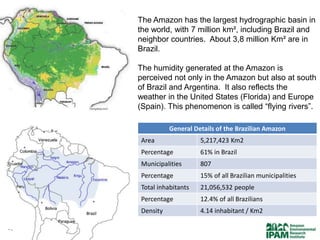
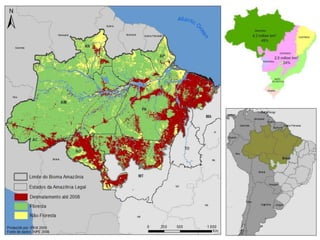
The Amazon has the largest hydrographic basin in
the world, with 7 million km², including Brazil and
neighbor countries. About 3,8 million Km² are in
Brazil.

The humidity generated at the Amazon is
perceived not only in the Amazon but also at south
of Brazil and Argentina. It also reflects the
weather in the United States (Florida) and Europe
(Spain). This phenomenon is called “flying rivers”.

          General Details of the Brazilian Amazon
Area                5,217,423 Km2
Percentage          61% in Brazil
Municipalities      807
Percentage          15% of all Brazilian municipalities
Total inhabitants   21,056,532 people
Percentage          12.4% of all Brazilians
Density             4.14 inhabitant / Km2
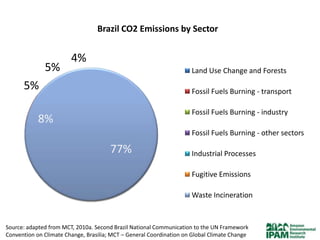
Brazil CO2 Emissions by Sector


                        4%
              5%                                                     Land Use Change and Forests

      5%                                                             Fossil Fuels Burning - transport

                                                                     Fossil Fuels Burning - industry
            8%
                                                                     Fossil Fuels Burning - other sectors

                                       77%                           Industrial Processes

                                                                     Fugitive Emissions

                                                                     Waste Incineration


Source: adapted from MCT, 2010a. Second Brazil National Communication to the UN Framework
Convention on Climate Change, Brasilia; MCT – General Coordination on Global Climate Change
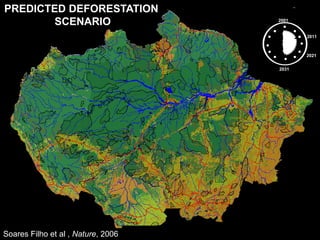
PREDICTED DEFORESTATION
        SCENARIO                    2001


                                           2011


                                           2021


                                    2031


Soares Filho et al , Nature, 2006
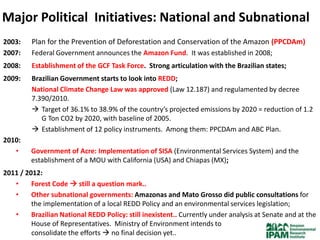
Major Political Initiatives: National and Subnational
2003:    Plan for the Prevention of Deforestation and Conservation of the Amazon (PPCDAm)
2007:    Federal Government announces the Amazon Fund. It was established in 2008;
2008:    Establishment of the GCF Task Force. Strong articulation with the Brazilian states;
2009:    Brazilian Government starts to look into REDD;
         National Climate Change Law was approved (Law 12.187) and regulamented by decree
         7.390/2010.
          Target of 36.1% to 38.9% of the country’s projected emissions by 2020 = reduction of 1.2
            G Ton CO2 by 2020, with baseline of 2005.
          Establishment of 12 policy instruments. Among them: PPCDAm and ABC Plan.
2010:
   •     Government of Acre: Implementation of SISA (Environmental Services System) and the
         establishment of a MOU with California (USA) and Chiapas (MX);
2011 / 2012:
   •     Forest Code  still a question mark..
   •     Other subnational governments: Amazonas and Mato Grosso did public consultations for
         the implementation of a local REDD Policy and an environmental services legislation;
   •     Brazilian National REDD Policy: still inexistent.. Currently under analysis at Senate and at the
         House of Representatives. Ministry of Environment intends to
         consolidate the efforts  no final decision yet..
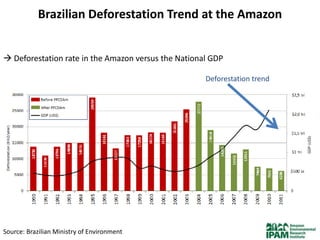
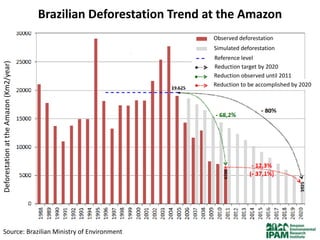
Brazilian Deforestation Trend at the Amazon


 Deforestation rate in the Amazon versus the National GDP

                                                     Deforestation trend


Source: Brazilian Ministry of Environment
Brazilian Deforestation Trend at the Amazon
                                                                       Observed deforestation
                                                                        Simulated deforestation
                                                                       Reference level
Deforestation at the Amazon (Km2/year)


                                                                       Reduction target by 2020
                                                                       Reduction observed until 2011
                                                                       Reduction to be accomplished by 2020


Source: Brazilian Ministry of Environment
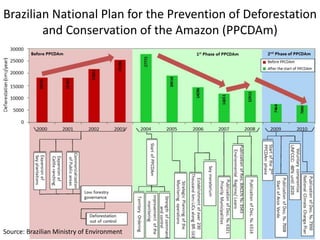
Brazilian National Plan for the Prevention of Deforestation
        and Conservation of the Amazon (PPCDAm)


Source: Brazilian Ministry of Environment
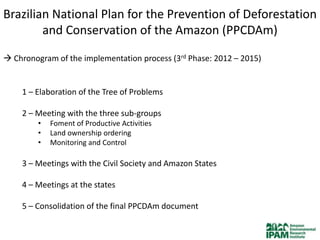
Brazilian National Plan for the Prevention of Deforestation
        and Conservation of the Amazon (PPCDAm)

 Chronogram of the implementation process (3rd Phase: 2012 – 2015)


    1 – Elaboration of the Tree of Problems

    2 – Meeting with the three sub-groups
         •   Foment of Productive Activities
         •   Land ownership ordering
         •   Monitoring and Control

    3 – Meetings with the Civil Society and Amazon States

    4 – Meetings at the states

    5 – Consolidation of the final PPCDAm document
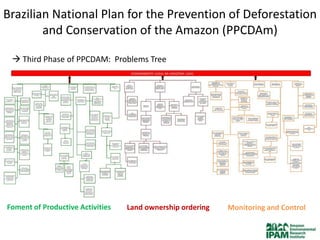
Brazilian National Plan for the Prevention of Deforestation
        and Conservation of the Amazon (PPCDAm)

  Third Phase of PPCDAM: Problems Tree


Foment of Productive Activities   Land ownership ordering   Monitoring and Control
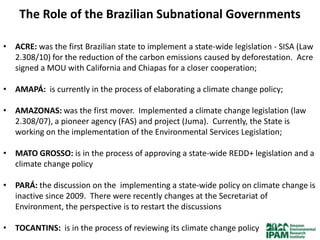
The Role of the Brazilian Subnational Governments

• ACRE: was the first Brazilian state to implement a state-wide legislation - SISA (Law
  2.308/10) for the reduction of the carbon emissions caused by deforestation. Acre
  signed a MOU with California and Chiapas for a closer cooperation;

• AMAPÁ: is currently in the process of elaborating a climate change policy;

• AMAZONAS: was the first mover. Implemented a climate change legislation (law
  2.308/07), a pioneer agency (FAS) and project (Juma). Currently, the State is
  working on the implementation of the Environmental Services Legislation;

• MATO GROSSO: is in the process of approving a state-wide REDD+ legislation and a
  climate change policy

• PARÁ: the discussion on the implementing a state-wide policy on climate change is
  inactive since 2009. There were recently changes at the Secretariat of
  Environment, the perspective is to restart the discussions

• TOCANTINS: is in the process of reviewing its climate change policy
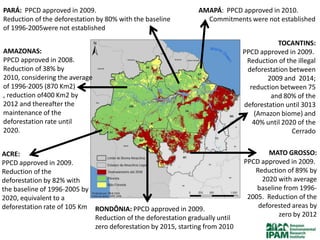
PARÁ: PPCD approved in 2009.                                   AMAPÁ: PPCD approved in 2010.
Reduction of the deforestation by 80% with the baseline          Commitments were not established
of 1996-2005were not established

                                                                                         TOCANTINS:
AMAZONAS:                                                                     PPCD approved in 2009.
PPCD approved in 2008.                                                         Reduction of the illegal
Reduction of 38% by                                                            deforestation between
2010, considering the average                                                         2009 and 2014;
of 1996-2005 (870 Km2)                                                          reduction between 75
, reduction of400 Km2 by                                                               and 80% of the
2012 and thereafter the                                                       deforestation until 3013
maintenance of the                                                               (Amazon biome) and
deforestation rate until                                                         40% until 2020 of the
2020.                                                                                         Cerrado


ACRE:                                                                                MATO GROSSO:
PPCD approved in 2009.                                                        PPCD approved in 2009.
Reduction of the                                                                 Reduction of 89% by
deforestation by 82% with                                                          2020 with average
the baseline of 1996-2005 by                                                      baseline from 1996-
2020, equivalent to a                                                          2005. Reduction of the
deforestation rate of 105 Km RONDÔNIA: PPCD approved in 2009.                     deforested areas by
                             Reduction of the deforestation gradually until              zero by 2012
                             zero deforestation by 2015, starting from 2010
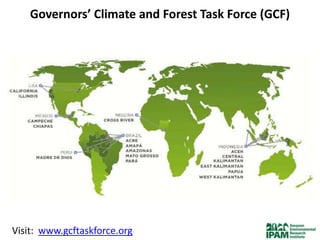
Governors’ Climate and Forest Task Force (GCF)


Visit: www.gcftaskforce.org
REDD+
 What is REDD+?
“Reducing Emissions from Deforestation and forest
degradation in Developing countries.”
• Basic concept: Compensate countries / subnational governments that
  are able to reduce CO2 emissions from deforestation and forest
  degradation


 What can REDD+ generate?
• Voluntary contributions to reduce global CO2 emmissions
• Change to the economic model
• Historic justice to the population that have been living at the
  forests, preserving it
• Reduce poverty
• Preserve the forest
Critical Aspects

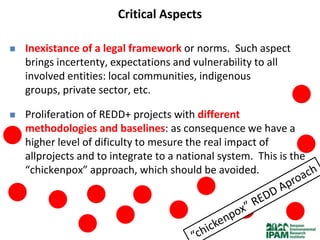
   Inexistance of a legal framework or norms. Such aspect
    brings incertenty, expectations and vulnerability to all
    involved entities: local communities, indigenous
    groups, private sector, etc.

   Proliferation of REDD+ projects with different
    methodologies and baselines: as consequence we have a
    higher level of dificulty to mesure the real impact of
    allprojects and to integrate to a national system. This is the
    “chickenpox” approach, which should be avoided.
The Challenges of Integrating National and
                   Subnational Policies

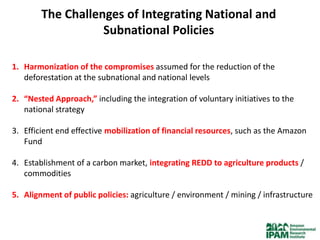
1. Harmonization of the compromises assumed for the reduction of the
   deforestation at the subnational and national levels

2. “Nested Approach,” including the integration of voluntary initiatives to the
   national strategy

3. Efficient end effective mobilization of financial resources, such as the Amazon
   Fund

4. Establishment of a carbon market, integrating REDD to agriculture products /
   commodities

5. Alignment of public policies: agriculture / environment / mining / infrastructure
REDD+ Strategy for the Amazon Region


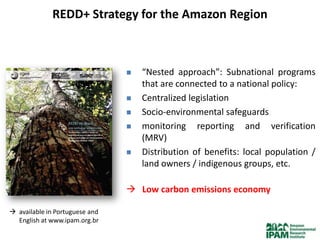
                                   “Nested approach”: Subnational programs
                                    that are connected to a national policy:
                                   Centralized legislation
                                   Socio-environmental safeguards
                                   monitoring reporting and verification
                                    (MRV)
                                   Distribution of benefits: local population /
                                    land owners / indigenous groups, etc.

                                 Low carbon emissions economy

 available in Portuguese and
  English at www.ipam.org.br
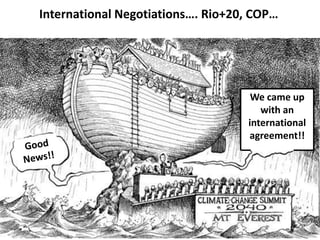
International Negotiations…. Rio+20, COP…


                                    We came up
                                      with an
                                   international
                                   agreement!!
Thank you.
Bernhard J. Smid


Instituto de Pesquisa Ambiental da Amazônia – IPAM
Amazon Environmental Research Institute – IPAM

www.IPAM.org.br
Twitter: IPAM_Amazonia

BJSmid@ipam.org.br
Twitter: BSmid

Legal Frameworks for Sustainable Development: Legal Best Practices from the National and Local Levels in Brazil

  • 1.
    LEGAL FRAMEWORKS FORSUSTAINABLE DEVELOPMENT Legal Best Practices from the National and local Levels in Brazil FUNDAÇÃO GETÚLIO VARGAS PRAIA DE BOTAFOGO, N. 190, 12. ANDAR, RIO DE JANEIRO RIO+20 - JUNE 20, 2012
  • 2.
    The Amazon hasthe largest hydrographic basin in the world, with 7 million km², including Brazil and neighbor countries. About 3,8 million Km² are in Brazil. The humidity generated at the Amazon is perceived not only in the Amazon but also at south of Brazil and Argentina. It also reflects the weather in the United States (Florida) and Europe (Spain). This phenomenon is called “flying rivers”. General Details of the Brazilian Amazon Area 5,217,423 Km2 Percentage 61% in Brazil Municipalities 807 Percentage 15% of all Brazilian municipalities Total inhabitants 21,056,532 people Percentage 12.4% of all Brazilians Density 4.14 inhabitant / Km2
  • 3.
    Brazil CO2 Emissionsby Sector 4% 5% Land Use Change and Forests 5% Fossil Fuels Burning - transport Fossil Fuels Burning - industry 8% Fossil Fuels Burning - other sectors 77% Industrial Processes Fugitive Emissions Waste Incineration Source: adapted from MCT, 2010a. Second Brazil National Communication to the UN Framework Convention on Climate Change, Brasilia; MCT – General Coordination on Global Climate Change
  • 8.
    PREDICTED DEFORESTATION SCENARIO 2001 2011 2021 2031 Soares Filho et al , Nature, 2006
  • 10.
    Major Political Initiatives:National and Subnational 2003: Plan for the Prevention of Deforestation and Conservation of the Amazon (PPCDAm) 2007: Federal Government announces the Amazon Fund. It was established in 2008; 2008: Establishment of the GCF Task Force. Strong articulation with the Brazilian states; 2009: Brazilian Government starts to look into REDD; National Climate Change Law was approved (Law 12.187) and regulamented by decree 7.390/2010.  Target of 36.1% to 38.9% of the country’s projected emissions by 2020 = reduction of 1.2 G Ton CO2 by 2020, with baseline of 2005.  Establishment of 12 policy instruments. Among them: PPCDAm and ABC Plan. 2010: • Government of Acre: Implementation of SISA (Environmental Services System) and the establishment of a MOU with California (USA) and Chiapas (MX); 2011 / 2012: • Forest Code  still a question mark.. • Other subnational governments: Amazonas and Mato Grosso did public consultations for the implementation of a local REDD Policy and an environmental services legislation; • Brazilian National REDD Policy: still inexistent.. Currently under analysis at Senate and at the House of Representatives. Ministry of Environment intends to consolidate the efforts  no final decision yet..
  • 11.
    Brazilian Deforestation Trendat the Amazon  Deforestation rate in the Amazon versus the National GDP Deforestation trend Source: Brazilian Ministry of Environment
  • 12.
    Brazilian Deforestation Trendat the Amazon Observed deforestation Simulated deforestation Reference level Deforestation at the Amazon (Km2/year) Reduction target by 2020 Reduction observed until 2011 Reduction to be accomplished by 2020 Source: Brazilian Ministry of Environment
  • 13.
    Brazilian National Planfor the Prevention of Deforestation and Conservation of the Amazon (PPCDAm) Source: Brazilian Ministry of Environment
  • 14.
    Brazilian National Planfor the Prevention of Deforestation and Conservation of the Amazon (PPCDAm)  Chronogram of the implementation process (3rd Phase: 2012 – 2015) 1 – Elaboration of the Tree of Problems 2 – Meeting with the three sub-groups • Foment of Productive Activities • Land ownership ordering • Monitoring and Control 3 – Meetings with the Civil Society and Amazon States 4 – Meetings at the states 5 – Consolidation of the final PPCDAm document
  • 15.
    Brazilian National Planfor the Prevention of Deforestation and Conservation of the Amazon (PPCDAm)  Third Phase of PPCDAM: Problems Tree Foment of Productive Activities Land ownership ordering Monitoring and Control
  • 16.
    The Role ofthe Brazilian Subnational Governments • ACRE: was the first Brazilian state to implement a state-wide legislation - SISA (Law 2.308/10) for the reduction of the carbon emissions caused by deforestation. Acre signed a MOU with California and Chiapas for a closer cooperation; • AMAPÁ: is currently in the process of elaborating a climate change policy; • AMAZONAS: was the first mover. Implemented a climate change legislation (law 2.308/07), a pioneer agency (FAS) and project (Juma). Currently, the State is working on the implementation of the Environmental Services Legislation; • MATO GROSSO: is in the process of approving a state-wide REDD+ legislation and a climate change policy • PARÁ: the discussion on the implementing a state-wide policy on climate change is inactive since 2009. There were recently changes at the Secretariat of Environment, the perspective is to restart the discussions • TOCANTINS: is in the process of reviewing its climate change policy
  • 17.
    PARÁ: PPCD approvedin 2009. AMAPÁ: PPCD approved in 2010. Reduction of the deforestation by 80% with the baseline Commitments were not established of 1996-2005were not established TOCANTINS: AMAZONAS: PPCD approved in 2009. PPCD approved in 2008. Reduction of the illegal Reduction of 38% by deforestation between 2010, considering the average 2009 and 2014; of 1996-2005 (870 Km2) reduction between 75 , reduction of400 Km2 by and 80% of the 2012 and thereafter the deforestation until 3013 maintenance of the (Amazon biome) and deforestation rate until 40% until 2020 of the 2020. Cerrado ACRE: MATO GROSSO: PPCD approved in 2009. PPCD approved in 2009. Reduction of the Reduction of 89% by deforestation by 82% with 2020 with average the baseline of 1996-2005 by baseline from 1996- 2020, equivalent to a 2005. Reduction of the deforestation rate of 105 Km RONDÔNIA: PPCD approved in 2009. deforested areas by Reduction of the deforestation gradually until zero by 2012 zero deforestation by 2015, starting from 2010
  • 18.
    Governors’ Climate andForest Task Force (GCF) Visit: www.gcftaskforce.org
  • 19.
    REDD+  What isREDD+? “Reducing Emissions from Deforestation and forest degradation in Developing countries.” • Basic concept: Compensate countries / subnational governments that are able to reduce CO2 emissions from deforestation and forest degradation  What can REDD+ generate? • Voluntary contributions to reduce global CO2 emmissions • Change to the economic model • Historic justice to the population that have been living at the forests, preserving it • Reduce poverty • Preserve the forest
  • 20.
    Critical Aspects  Inexistance of a legal framework or norms. Such aspect brings incertenty, expectations and vulnerability to all involved entities: local communities, indigenous groups, private sector, etc.  Proliferation of REDD+ projects with different methodologies and baselines: as consequence we have a higher level of dificulty to mesure the real impact of allprojects and to integrate to a national system. This is the “chickenpox” approach, which should be avoided.
  • 21.
    The Challenges ofIntegrating National and Subnational Policies 1. Harmonization of the compromises assumed for the reduction of the deforestation at the subnational and national levels 2. “Nested Approach,” including the integration of voluntary initiatives to the national strategy 3. Efficient end effective mobilization of financial resources, such as the Amazon Fund 4. Establishment of a carbon market, integrating REDD to agriculture products / commodities 5. Alignment of public policies: agriculture / environment / mining / infrastructure
  • 22.
    REDD+ Strategy forthe Amazon Region  “Nested approach”: Subnational programs that are connected to a national policy:  Centralized legislation  Socio-environmental safeguards  monitoring reporting and verification (MRV)  Distribution of benefits: local population / land owners / indigenous groups, etc.  Low carbon emissions economy  available in Portuguese and English at www.ipam.org.br
  • 23.
    International Negotiations…. Rio+20,COP… We came up with an international agreement!!
  • 24.
    Thank you. Bernhard J.Smid Instituto de Pesquisa Ambiental da Amazônia – IPAM Amazon Environmental Research Institute – IPAM www.IPAM.org.br Twitter: IPAM_Amazonia BJSmid@ipam.org.br Twitter: BSmid