The Woods Hole
                      Research Center


The Forum on Readiness for REDD

              and

Update on UNFCCC REDD Process
The Forum on Readiness
       for REDD
A multi-stakeholder forum focused on practical
  multi-
approaches for building REDD readiness through:
  cross-
  cross-stakeholder dialogue and priority-setting
                                    priority-
  South-
  South-South collaboration
  linking local and international expertise with country
  goals to support readiness activities
Advisory Committee
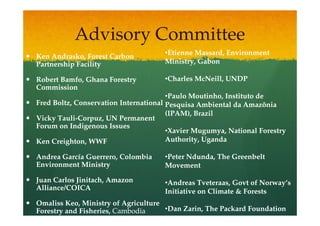
                                     •Etienne Massard, Environment
Ken Andrasko, Forest Carbon
Partnership Facility                 Ministry, Gabon

Robert Bamfo, Ghana Forestry         •Charles McNeill, UNDP
Commission
                                       •Paulo Moutinho, Instituto de
Fred Boltz, Conservation International Pesquisa Ambiental da Amazônia
                                       (IPAM), Brazil
Vicky Tauli-Corpuz, UN Permanent
      Tauli-
Forum on Indigenous Issues
                                       •Xavier Mugumya, National Forestry
Ken Creighton, WWF                     Authority, Uganda

Andrea García Guerrero, Colombia     •Peter Ndunda, The Greenbelt
Environment Ministry                 Movement

Juan Carlos Jinitach, Amazon         •Andreas Tveteraas, Govt of Norway’s
Alliance/COICA                       Initiative on Climate & Forests
Omaliss Keo, Ministry of Agriculture
Forestry and Fisheries, Cambodia     •Dan Zarin, The Packard Foundation
Advisory Committee Role
Committee will:
  Decide among options for Forum activities and direction
  Guide Secretariat in carrying out the administration of the
  Forum
  Take advantage of synergies and avoid duplication with many
  organizations represented to maximize Forum effectiveness
    First Advisory Committee meeting April 5 in Bonn
       Agenda will include: review and finalize governance structure,
       review and select activities for 2009, discuss scope of activities for
       2010
Forum Readiness Workshop,
    Accra, August 2008
Hosted jointly by Ghana Ministry of Lands, Forestry
and Mines and the Ghana Forestry Commission

Over 80 international participants

Regional Breakout groups identified readiness
priorities for their region

Workshop report at http://whrc.org/reddready
Critical Elements identified
in African Breakout Groups
Define stakeholders and their roles and responsibilities in order to
strengthen participation, especially of Indigenous  Peoples and
local communities

Integrate REDD strategies into existing social, environmental, and
economic objectives and frameworks

Create networks for generating awareness, sharing information,
and educating stakeholders

Coordinate information on opportunities for REDD pilot projects

Develop in-country capacities for measuring, monitoring, and
         in-
accounting for carbon stocks and fluxes from deforestation and
forest degradation
Practical Steps
Near-
Near-Term (2009)
   Inventory financial, technical, and institutional needs that must be met for
   a successful REDD strategy

   Develop structures and support for regular meetings and information-
                                                           information-
   sharing among stakeholders

Develop mechanisms to share information, data, and experiences at the national
                            information,
  and regional levels

Mid- Long-
Mid- to Long-Term

   Develop long-term REDD vision and how it fits with development strategy
           long-

   Determine social and economic incentives for avoiding deforestation and
   forest degradation

   Determine baselines for forest carbon stocks and fluxes
Overview of Readiness
       Activities

A background document prepared by WHRC on
readiness activities around the world

Highlights specific programs, projects, and pilot
activities – NOT comprehensive

“Living document” – update for Copenhagen

Available at
Film on Introduction to REDD

Development by INCEF ( International Conservation and
Education Fund) (www.incef.org)
                (www.incef.org)
Film will be designed for use by grassroots networks,
civil society groups and NGOs to introduce indigenous
and forest-dependent communities and networks to
     forest-
REDD
  Local language
  Local voices on forests, deforestation, climate change
  Basic concepts and process of REDD and how to get
  involved
  We welcome input!
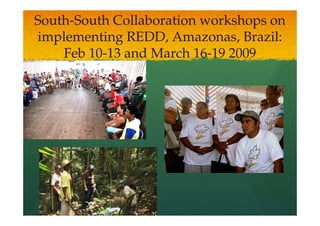
South-
South-South Collaboration workshops on
implementing REDD, Amazonas, Brazil:
    Feb 10-13 and March 16-19 2009
        10-              16-
Indicative Guidance
          (FCCC/CP/2007/6/Add.1* )

1. Demonstration activities should be undertaken with
   approval of host Party;
2. Estimates of reductions or increases of emissions should
   be results based, demonstrable, transparent, verifiable,
   and estimated consistently over time;
3. Emission reductions from national demonstration
   activities should be assessed on the basis of national
   emissions from deforestation and forest degradation;
4. Subnational demonstration activities should be assessed
   within the boundary used for the demonstration, and
   assessed for associated displacement of emissions;
Indicative Guidance cont’d
           (FCCC/CP/2007/6/Add.1* )
5. Reductions in emissions or increases resulting from the
   demonstration activity should be based on historical emissions,
   taking into account national circumstances;
6. Subnational approaches, where applied, should constitute a
   step towards the development of national approaches,
   reference levels and estimates;
7. Demonstration activities should be consistent with sustainable
   forest management
8. Experiences in implementing activities should be reported and
   made available via the Web platform;
9. Independent expert review is encouraged
Poznan 2008
SBSTA conclusions highlights
      (FCCC/SBSTA/2008/L.23)
Promoting the readiness of developing countries

Recognizing the need to promote the full and
effective participation of indigenous people and
local communities

launch by the secretariat of the Web Platform on the
UNFCCC website


http://unfccc.int/methods_science/redd/items/45
31.php
Poznan 2008
SBSTA conclusions highlights cont’d
             (FCCC/SBSTA/2008/L.23)
The use of the Revised 1996 IPCC Guidelines For National
Greenhouse Inventories and encouraging the use of the Good
Practice Guidance For Land Use, Land-Use Change and
                                Land-
Forestry as appropriate

The need to establish robust and transparent national forest
monitoring systems, following consideration of their
requirements

If appropriate, the need to establish robust and transparent sub-
                                                             sub-
national forest monitoring systems, following consideration of
their requirements
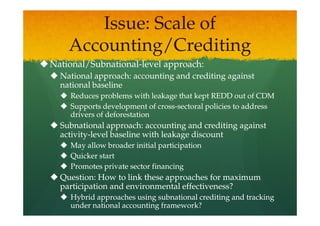
Issue: Scale of
    Accounting/Crediting
National/Subnational-
National/Subnational-level approach:
  National approach: accounting and crediting against
  national baseline
    Reduces problems with leakage that kept REDD out of CDM
    Supports development of cross-sectoral policies to address
                             cross-
    drivers of deforestation
  Subnational approach: accounting and crediting against
  activity-
  activity-level baseline with leakage discount
    May allow broader initial participation
        allow
    Quicker start
    Promotes private sector financing
  Question: How to link these approaches for maximum
  participation and environmental effectiveness?
    Hybrid approaches using subnational crediting and tracking
    under national accounting framework?
Issue: Baselines

National historical reference period based on emissions

Forward-
Forward-looking baseline modeling future „business as
usual“ emissions

Baseline of carbon stocks

Global average emissions baseline

Hybrid approach
  Using combination of historical emissions and carbon
  stocks
Issue: Scope

Include degradation?
Include maintenance of carbon stocks?
Include regrowth/increase in carbon stocks?

  Costa Rica – declining deforestation
  Congo Basin – limited degradation
  Brazil – extensive historical deforestation
Issue: Financing Mechanism


Market:
  Credits created for emissions reduced, which can be sold to
  industrialized countries to meet emission reduction targets

Non-
Non-market approach:
  Annex I countries contribute voluntarily to a fund not
  linked to market
  Levy on emissions trading to fund REDD

Hybrid approaches
  Separate market for REDD credits

And many others....
REDD negotiations in 2009

Bonn, 29 March-8 April
         March-
Bonn, 1-12 June
      1-
Bangkok, 28 September-9 October
            September-
Arrangements for additional meetings
before Copenhagen if necessary
Copenhagen, 7 -18 December
Thanks for your attention
Tracy Johns, The Woods Hole Research Center

tjohns@whrc.org

Tracy johns update unfccc redd process

  • 1.
    The Woods Hole Research Center The Forum on Readiness for REDD and Update on UNFCCC REDD Process
  • 2.
    The Forum onReadiness for REDD A multi-stakeholder forum focused on practical multi- approaches for building REDD readiness through: cross- cross-stakeholder dialogue and priority-setting priority- South- South-South collaboration linking local and international expertise with country goals to support readiness activities
  • 3.
    Advisory Committee •Etienne Massard, Environment Ken Andrasko, Forest Carbon Partnership Facility Ministry, Gabon Robert Bamfo, Ghana Forestry •Charles McNeill, UNDP Commission •Paulo Moutinho, Instituto de Fred Boltz, Conservation International Pesquisa Ambiental da Amazônia (IPAM), Brazil Vicky Tauli-Corpuz, UN Permanent Tauli- Forum on Indigenous Issues •Xavier Mugumya, National Forestry Ken Creighton, WWF Authority, Uganda Andrea García Guerrero, Colombia •Peter Ndunda, The Greenbelt Environment Ministry Movement Juan Carlos Jinitach, Amazon •Andreas Tveteraas, Govt of Norway’s Alliance/COICA Initiative on Climate & Forests Omaliss Keo, Ministry of Agriculture Forestry and Fisheries, Cambodia •Dan Zarin, The Packard Foundation
  • 4.
    Advisory Committee Role Committeewill: Decide among options for Forum activities and direction Guide Secretariat in carrying out the administration of the Forum Take advantage of synergies and avoid duplication with many organizations represented to maximize Forum effectiveness First Advisory Committee meeting April 5 in Bonn Agenda will include: review and finalize governance structure, review and select activities for 2009, discuss scope of activities for 2010
  • 5.
    Forum Readiness Workshop, Accra, August 2008 Hosted jointly by Ghana Ministry of Lands, Forestry and Mines and the Ghana Forestry Commission Over 80 international participants Regional Breakout groups identified readiness priorities for their region Workshop report at http://whrc.org/reddready
  • 6.
    Critical Elements identified inAfrican Breakout Groups Define stakeholders and their roles and responsibilities in order to strengthen participation, especially of Indigenous Peoples and local communities Integrate REDD strategies into existing social, environmental, and economic objectives and frameworks Create networks for generating awareness, sharing information, and educating stakeholders Coordinate information on opportunities for REDD pilot projects Develop in-country capacities for measuring, monitoring, and in- accounting for carbon stocks and fluxes from deforestation and forest degradation
  • 7.
    Practical Steps Near- Near-Term (2009) Inventory financial, technical, and institutional needs that must be met for a successful REDD strategy Develop structures and support for regular meetings and information- information- sharing among stakeholders Develop mechanisms to share information, data, and experiences at the national information, and regional levels Mid- Long- Mid- to Long-Term Develop long-term REDD vision and how it fits with development strategy long- Determine social and economic incentives for avoiding deforestation and forest degradation Determine baselines for forest carbon stocks and fluxes
  • 8.
    Overview of Readiness Activities A background document prepared by WHRC on readiness activities around the world Highlights specific programs, projects, and pilot activities – NOT comprehensive “Living document” – update for Copenhagen Available at
  • 9.
    Film on Introductionto REDD Development by INCEF ( International Conservation and Education Fund) (www.incef.org) (www.incef.org) Film will be designed for use by grassroots networks, civil society groups and NGOs to introduce indigenous and forest-dependent communities and networks to forest- REDD Local language Local voices on forests, deforestation, climate change Basic concepts and process of REDD and how to get involved We welcome input!
  • 10.
    South- South-South Collaboration workshopson implementing REDD, Amazonas, Brazil: Feb 10-13 and March 16-19 2009 10- 16-
  • 11.
    Indicative Guidance (FCCC/CP/2007/6/Add.1* ) 1. Demonstration activities should be undertaken with approval of host Party; 2. Estimates of reductions or increases of emissions should be results based, demonstrable, transparent, verifiable, and estimated consistently over time; 3. Emission reductions from national demonstration activities should be assessed on the basis of national emissions from deforestation and forest degradation; 4. Subnational demonstration activities should be assessed within the boundary used for the demonstration, and assessed for associated displacement of emissions;
  • 12.
    Indicative Guidance cont’d (FCCC/CP/2007/6/Add.1* ) 5. Reductions in emissions or increases resulting from the demonstration activity should be based on historical emissions, taking into account national circumstances; 6. Subnational approaches, where applied, should constitute a step towards the development of national approaches, reference levels and estimates; 7. Demonstration activities should be consistent with sustainable forest management 8. Experiences in implementing activities should be reported and made available via the Web platform; 9. Independent expert review is encouraged
  • 13.
    Poznan 2008 SBSTA conclusionshighlights (FCCC/SBSTA/2008/L.23) Promoting the readiness of developing countries Recognizing the need to promote the full and effective participation of indigenous people and local communities launch by the secretariat of the Web Platform on the UNFCCC website http://unfccc.int/methods_science/redd/items/45 31.php
  • 14.
    Poznan 2008 SBSTA conclusionshighlights cont’d (FCCC/SBSTA/2008/L.23) The use of the Revised 1996 IPCC Guidelines For National Greenhouse Inventories and encouraging the use of the Good Practice Guidance For Land Use, Land-Use Change and Land- Forestry as appropriate The need to establish robust and transparent national forest monitoring systems, following consideration of their requirements If appropriate, the need to establish robust and transparent sub- sub- national forest monitoring systems, following consideration of their requirements
  • 15.
    Issue: Scale of Accounting/Crediting National/Subnational- National/Subnational-level approach: National approach: accounting and crediting against national baseline Reduces problems with leakage that kept REDD out of CDM Supports development of cross-sectoral policies to address cross- drivers of deforestation Subnational approach: accounting and crediting against activity- activity-level baseline with leakage discount May allow broader initial participation allow Quicker start Promotes private sector financing Question: How to link these approaches for maximum participation and environmental effectiveness? Hybrid approaches using subnational crediting and tracking under national accounting framework?
  • 16.
    Issue: Baselines National historicalreference period based on emissions Forward- Forward-looking baseline modeling future „business as usual“ emissions Baseline of carbon stocks Global average emissions baseline Hybrid approach Using combination of historical emissions and carbon stocks
  • 17.
    Issue: Scope Include degradation? Includemaintenance of carbon stocks? Include regrowth/increase in carbon stocks? Costa Rica – declining deforestation Congo Basin – limited degradation Brazil – extensive historical deforestation
  • 18.
    Issue: Financing Mechanism Market: Credits created for emissions reduced, which can be sold to industrialized countries to meet emission reduction targets Non- Non-market approach: Annex I countries contribute voluntarily to a fund not linked to market Levy on emissions trading to fund REDD Hybrid approaches Separate market for REDD credits And many others....
  • 19.
    REDD negotiations in2009 Bonn, 29 March-8 April March- Bonn, 1-12 June 1- Bangkok, 28 September-9 October September- Arrangements for additional meetings before Copenhagen if necessary Copenhagen, 7 -18 December
  • 20.
    Thanks for yourattention Tracy Johns, The Woods Hole Research Center tjohns@whrc.org