OUTLINE
• Summarizing the study
• Critical appraisal:
• Validity
• Results
• Applicability of the study
• Conclusion
Trial Overview
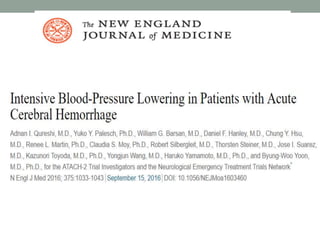
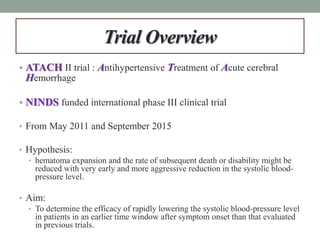
• ATACH II trial : Antihypertensive Treatment of Acute cerebral
Hemorrhage
• NINDS funded international phase III clinical trial
• From May 2011 and September 2015
• Hypothesis:
• hematoma expansion and the rate of subsequent death or disability might be
reduced with very early and more aggressive reduction in the systolic blood-
pressure level.
• Aim:
• To determine the efficacy of rapidly lowering the systolic blood-pressure level
in patients in an earlier time window after symptom onset than that evaluated
in previous trials.
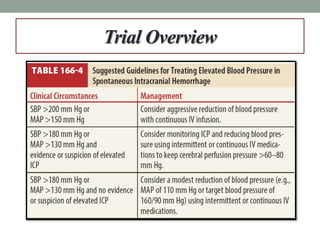
Trial Overview
Goals
• Primary:
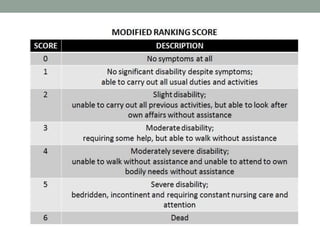
• Death or disability [Modified Rankin Scale (mRS) 4-6] at 90 days
• Secondary:
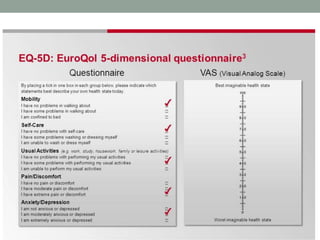
• European Quality of Life–5 Dimensions (EQ-5D) questionnaire at 3
months
• > 33% expansion of hematoma at 24 hours
Literature Review
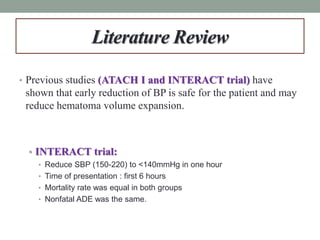
• Previous studies (ATACH I and INTERACT trial) have
shown that early reduction of BP is safe for the patient and may
reduce hematoma volume expansion.
• INTERACT trial:
• Reduce SBP (150-220) to <140mmHg in one hour
• Time of presentation : first 6 hours
• Mortality rate was equal in both groups
• Nonfatal ADE was the same.
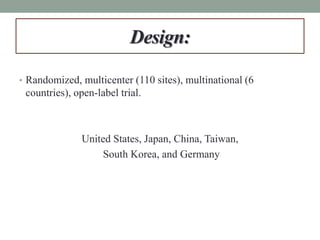
Design:
• Randomized, multicenter (110 sites), multinational (6
countries), open-label trial.
United States, Japan, China, Taiwan,
South Korea, and Germany
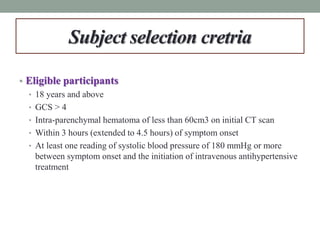
Subject selection cretria
• Eligible participants
• 18 years and above
• GCS > 4
• Intra-parenchymal hematoma of less than 60cm3 on initial CT scan
• Within 3 hours (extended to 4.5 hours) of symptom onset
• At least one reading of systolic blood pressure of 180 mmHg or more
between symptom onset and the initiation of intravenous antihypertensive
treatment
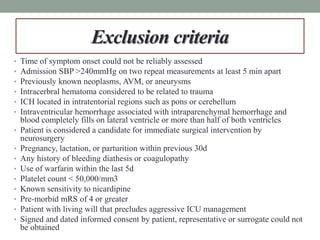
Exclusion criteria
• Time of symptom onset could not be reliably assessed
• Admission SBP >240mmHg on two repeat measurements at least 5 min apart
• Previously known neoplasms, AVM, or aneurysms
• Intracerbral hematoma considered to be related to trauma
• ICH located in intratentorial regions such as pons or cerebellum
• Intraventricular hemorrhage associated with intraparenchymal hemorrhage and
blood completely fills on lateral ventricle or more than half of both ventricles
• Patient is considered a candidate for immediate surgical intervention by
neurosurgery
• Pregnancy, lactation, or parturition within previous 30d
• Any history of bleeding diathesis or coagulopathy
• Use of warfarin within the last 5d
• Platelet count < 50,000/mm3
• Known sensitivity to nicardipine
• Pre-morbid mRS of 4 or greater
• Patient with living will that precludes aggressive ICU management
• Signed and dated informed consent by patient, representative or surrogate could not
be obtained
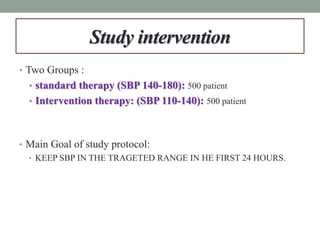
Study intervention
• Two Groups :
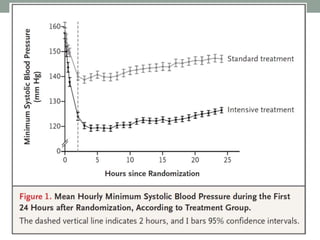
• standard therapy (SBP 140-180): 500 patient
• Intervention therapy: (SBP 110-140): 500 patient
• Main Goal of study protocol:
• KEEP SBP IN THE TRAGETED RANGE IN HE FIRST 24 HOURS.
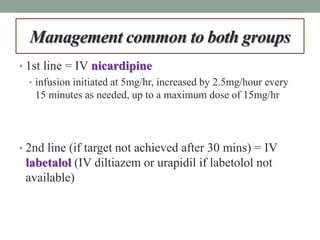
Management common to both groups
• 1st line = IV nicardipine
• infusion initiated at 5mg/hr, increased by 2.5mg/hour every
15 minutes as needed, up to a maximum dose of 15mg/hr
• 2nd line (if target not achieved after 30 mins) = IV
labetalol (IV diltiazem or urapidil if labetolol not
available)
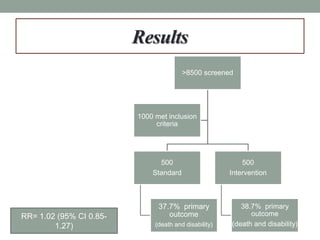
Results
>8500 screened
500
Standard
37.7% primary
outcome
(death and disability)
500
Intervention
38.7% primary
outcome
(death and disability)
1000 met inclusion
criteria
RR= 1.02 (95% CI 0.85-
1.27)
CRITICALAPPRAISAL
PICO
• P:
• Patients > 18 years with intracerebral hemorrhage (< 60 cm3) and a GCS ≥5 who
presented within 4.5 hours of symptom onset and at least one blood pressure reading
with an SBP ≥180 mm Hg
• I:
• Aggressively lowering blood pressure to an SBP = 110-139 mmHg for 24 hours using
nicardipine (1st line) and labetalol, diltiazem or urapidil (2nd line)
• C:
• Standard treatment guided at a SBP = 140 – 179 mm Hg for 24 hours using nicardipine
(1st line) and labetalol, diltiazem or urapidil (2nd line)
• O:
• Primary: Death or disability [Modified Rankin Scale (mRS) 4-6] at 90 days
• Secondary: EQ-5D utility index score at 3 months, > 33% expansion of hematoma at
24 hours
STUDY VALIDITY
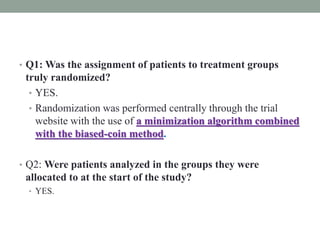
• Q1: Was the assignment of patients to treatment groups
truly randomized?
• YES.
• Randomization was performed centrally through the trial
website with the use of a minimization algorithm combined
with the biased-coin method.
• Q2: Were patients analyzed in the groups they were
allocated to at the start of the study?
• YES.
Continue Validity
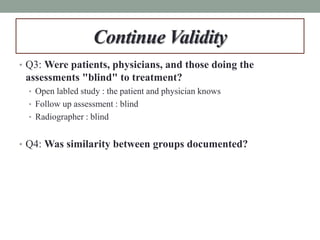
• Q3: Were patients, physicians, and those doing the
assessments "blind" to treatment?
• Open labled study : the patient and physician knows
• Follow up assessment : blind
• Radiographer : blind
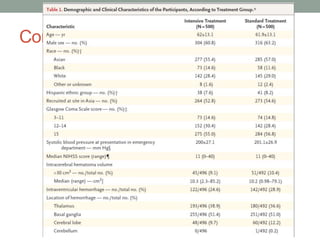
• Q4: Was similarity between groups documented?
Continue Validity
• Q5: Aside from the intervention, were the groups treated in
the same way?
• Both groups were randomized before 4.5 hours
• Treated by ED and neurology staff
• Same antihypertensive medications
• Same follow up
RESULTS
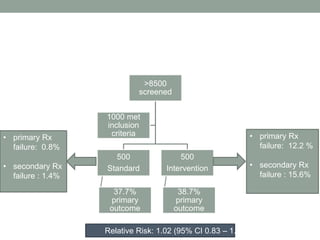
>8500
screened
500
Standard
37.7%
primary
outcome
500
Intervention
38.7%
primary
outcome
1000 met
inclusion
criteria • primary Rx
failure: 12.2 %
• secondary Rx
failure : 15.6%
• primary Rx
failure: 0.8%
• secondary Rx
failure : 1.4%
Relative Risk: 1.02 (95% CI 0.83 – 1.25)
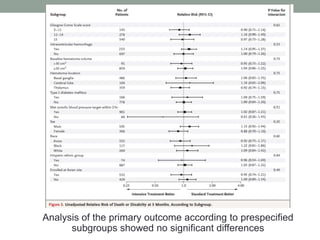
Analysis of the primary outcome according to prespecified
subgroups showed no significant differences
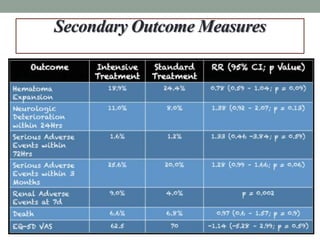
Secondary Outcome Measures
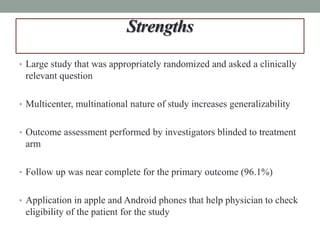
Strengths
• Large study that was appropriately randomized and asked a clinically
relevant question
• Multicenter, multinational nature of study increases generalizability
• Outcome assessment performed by investigators blinded to treatment
arm
• Follow up was near complete for the primary outcome (96.1%)
• Application in apple and Android phones that help physician to check
eligibility of the patient for the study
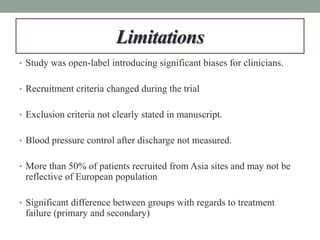
Limitations
• Study was open-label introducing significant biases for clinicians.
• Recruitment criteria changed during the trial
• Exclusion criteria not clearly stated in manuscript.
• Blood pressure control after discharge not measured.
• More than 50% of patients recruited from Asia sites and may not be
reflective of European population
• Significant difference between groups with regards to treatment
failure (primary and secondary)
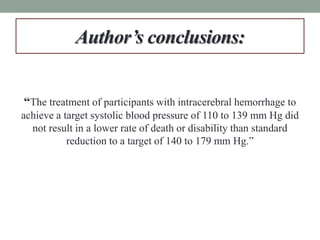
Author’s conclusions:
“The treatment of participants with intracerebral hemorrhage to
achieve a target systolic blood pressure of 110 to 139 mm Hg did
not result in a lower rate of death or disability than standard
reduction to a target of 140 to 179 mm Hg.”
Potential Impact to Current Practice:
This study confirms the negative findings seen in the
INTERACT-2 trial that aggressive control of blood pressure in
patients with intracerebral hemorrhage does not improve
outcomes. Based on current evidence, intensive blood pressure
reduction should not be pursued.
Home message
There does not appear to be a benefit to aggressive blood pressure
reduction in patients with intracerebral hemorrhage. Standard
therapy aimed at SBP < 180 mm Hg should be pursued in most
patients.
Thanks

ATACH II trial

  • 2.
    OUTLINE • Summarizing thestudy • Critical appraisal: • Validity • Results • Applicability of the study • Conclusion
  • 4.
    Trial Overview • ATACHII trial : Antihypertensive Treatment of Acute cerebral Hemorrhage • NINDS funded international phase III clinical trial • From May 2011 and September 2015 • Hypothesis: • hematoma expansion and the rate of subsequent death or disability might be reduced with very early and more aggressive reduction in the systolic blood- pressure level. • Aim: • To determine the efficacy of rapidly lowering the systolic blood-pressure level in patients in an earlier time window after symptom onset than that evaluated in previous trials.
  • 5.
  • 6.
    Goals • Primary: • Deathor disability [Modified Rankin Scale (mRS) 4-6] at 90 days • Secondary: • European Quality of Life–5 Dimensions (EQ-5D) questionnaire at 3 months • > 33% expansion of hematoma at 24 hours
  • 9.
    Literature Review • Previousstudies (ATACH I and INTERACT trial) have shown that early reduction of BP is safe for the patient and may reduce hematoma volume expansion. • INTERACT trial: • Reduce SBP (150-220) to <140mmHg in one hour • Time of presentation : first 6 hours • Mortality rate was equal in both groups • Nonfatal ADE was the same.
  • 10.
    Design: • Randomized, multicenter(110 sites), multinational (6 countries), open-label trial. United States, Japan, China, Taiwan, South Korea, and Germany
  • 11.
    Subject selection cretria •Eligible participants • 18 years and above • GCS > 4 • Intra-parenchymal hematoma of less than 60cm3 on initial CT scan • Within 3 hours (extended to 4.5 hours) of symptom onset • At least one reading of systolic blood pressure of 180 mmHg or more between symptom onset and the initiation of intravenous antihypertensive treatment
  • 12.
    Exclusion criteria • Timeof symptom onset could not be reliably assessed • Admission SBP >240mmHg on two repeat measurements at least 5 min apart • Previously known neoplasms, AVM, or aneurysms • Intracerbral hematoma considered to be related to trauma • ICH located in intratentorial regions such as pons or cerebellum • Intraventricular hemorrhage associated with intraparenchymal hemorrhage and blood completely fills on lateral ventricle or more than half of both ventricles • Patient is considered a candidate for immediate surgical intervention by neurosurgery • Pregnancy, lactation, or parturition within previous 30d • Any history of bleeding diathesis or coagulopathy • Use of warfarin within the last 5d • Platelet count < 50,000/mm3 • Known sensitivity to nicardipine • Pre-morbid mRS of 4 or greater • Patient with living will that precludes aggressive ICU management • Signed and dated informed consent by patient, representative or surrogate could not be obtained
  • 13.
    Study intervention • TwoGroups : • standard therapy (SBP 140-180): 500 patient • Intervention therapy: (SBP 110-140): 500 patient • Main Goal of study protocol: • KEEP SBP IN THE TRAGETED RANGE IN HE FIRST 24 HOURS.
  • 15.
    Management common toboth groups • 1st line = IV nicardipine • infusion initiated at 5mg/hr, increased by 2.5mg/hour every 15 minutes as needed, up to a maximum dose of 15mg/hr • 2nd line (if target not achieved after 30 mins) = IV labetalol (IV diltiazem or urapidil if labetolol not available)
  • 16.
    Results >8500 screened 500 Standard 37.7% primary outcome (deathand disability) 500 Intervention 38.7% primary outcome (death and disability) 1000 met inclusion criteria RR= 1.02 (95% CI 0.85- 1.27)
  • 17.
  • 18.
    PICO • P: • Patients> 18 years with intracerebral hemorrhage (< 60 cm3) and a GCS ≥5 who presented within 4.5 hours of symptom onset and at least one blood pressure reading with an SBP ≥180 mm Hg • I: • Aggressively lowering blood pressure to an SBP = 110-139 mmHg for 24 hours using nicardipine (1st line) and labetalol, diltiazem or urapidil (2nd line) • C: • Standard treatment guided at a SBP = 140 – 179 mm Hg for 24 hours using nicardipine (1st line) and labetalol, diltiazem or urapidil (2nd line) • O: • Primary: Death or disability [Modified Rankin Scale (mRS) 4-6] at 90 days • Secondary: EQ-5D utility index score at 3 months, > 33% expansion of hematoma at 24 hours
  • 19.
  • 20.
    • Q1: Wasthe assignment of patients to treatment groups truly randomized? • YES. • Randomization was performed centrally through the trial website with the use of a minimization algorithm combined with the biased-coin method. • Q2: Were patients analyzed in the groups they were allocated to at the start of the study? • YES.
  • 21.
    Continue Validity • Q3:Were patients, physicians, and those doing the assessments "blind" to treatment? • Open labled study : the patient and physician knows • Follow up assessment : blind • Radiographer : blind • Q4: Was similarity between groups documented?
  • 22.
  • 23.
    • Q5: Asidefrom the intervention, were the groups treated in the same way? • Both groups were randomized before 4.5 hours • Treated by ED and neurology staff • Same antihypertensive medications • Same follow up
  • 24.
  • 25.
    >8500 screened 500 Standard 37.7% primary outcome 500 Intervention 38.7% primary outcome 1000 met inclusion criteria •primary Rx failure: 12.2 % • secondary Rx failure : 15.6% • primary Rx failure: 0.8% • secondary Rx failure : 1.4% Relative Risk: 1.02 (95% CI 0.83 – 1.25)
  • 26.
    Analysis of theprimary outcome according to prespecified subgroups showed no significant differences
  • 27.
  • 28.
    Strengths • Large studythat was appropriately randomized and asked a clinically relevant question • Multicenter, multinational nature of study increases generalizability • Outcome assessment performed by investigators blinded to treatment arm • Follow up was near complete for the primary outcome (96.1%) • Application in apple and Android phones that help physician to check eligibility of the patient for the study
  • 29.
    Limitations • Study wasopen-label introducing significant biases for clinicians. • Recruitment criteria changed during the trial • Exclusion criteria not clearly stated in manuscript. • Blood pressure control after discharge not measured. • More than 50% of patients recruited from Asia sites and may not be reflective of European population • Significant difference between groups with regards to treatment failure (primary and secondary)
  • 30.
    Author’s conclusions: “The treatmentof participants with intracerebral hemorrhage to achieve a target systolic blood pressure of 110 to 139 mm Hg did not result in a lower rate of death or disability than standard reduction to a target of 140 to 179 mm Hg.”
  • 31.
    Potential Impact toCurrent Practice: This study confirms the negative findings seen in the INTERACT-2 trial that aggressive control of blood pressure in patients with intracerebral hemorrhage does not improve outcomes. Based on current evidence, intensive blood pressure reduction should not be pursued.
  • 32.
    Home message There doesnot appear to be a benefit to aggressive blood pressure reduction in patients with intracerebral hemorrhage. Standard therapy aimed at SBP < 180 mm Hg should be pursued in most patients.
  • 33.

Editor's Notes

  • #11 Open label study: both the researchers and participants know which treatment is being administered unavoidable under some circumstances, such as comparing the effectiveness of a medication to intensive physical therapy sessions.
  • #19 Management of BP in Intervention and Control Arms: 1st Line Agent = IV nicardipine infusion initiated at 5mg/hr, increased by 2.5mg/hr every 15min as needed up to a maximum dose of 15mg/hr 2nd Line Agent = If target BP not achieved after 30 minutes
  • #26 - Primary treatment failure was defined as not reaching the target systolic blood pressure of less than 140 mm Hg in the intensive-treatment group and less than 180 mm Hg in the standardtreatment group within 2 hours after randomization. Secondary treatment failure was defined as the hourly minimum systolic blood pressure remaining higher than the upper limit of the target range for 2 consecutive hours during the period of 2 to 24 hours after randomization
  • #31 Our Conclusion: Intensive blood pressure control (SBP 110-139 mm Hg) in patients with intracerebral hemorrhage does not improve 90 day death or disability (mRS 4-6) in comparison to standard management.