Surgery versus Conservative Treatment for Spontaneous
Supratentorial Intracerebral Hemorrhage in Spot Sign
Positive Patients
Presentor - Dr.S.K.Ghintala
Moderator-Dr. A. Swami
1. Intracerebral hemorrhage (ICH) is the most disabling form
of stroke. ICH is subtype of stroke with high morbidity and
mortality accounting for 10–17% of all deaths from stroke.
2. Approximately 40% of patients with intracerebral hemorrhage
die within 30 days, and the majority of survivors are left with
severe disability
3. Hematoma expansion has been identified as one of the most
important determinants of early neurological deterioration and poor
outcome in primary ICH.
4. Recently advanced surgical techniques, neuroanaesthesia,
neuronavigation system, and improved perioperative management
have led to improved outcomes from surgery in many conditions.
INTRODUCTION
5. There is no clear indication of the optimal treatment of
these patients, surgical or otherwise. There are currently 6
published randomized trials that have studied the surgical
evacuation of spontaneous ICH
6. All randomized trials are carefully analyzed; there is no net
benefit from surgery.
7. The presence of active contrast extravasations into the
hematoma at the time of multidetector CT angiography
(MDCTA), the spot sign, is an indicator of active hemorrhage
and has been associated with an increased risk of hematoma
expansion and mortality in patients with ICH
Materials and methods
1.Study used institutional medical data search system to identify
all adult patients who admitted for treatment of ICH between
January 1 ,2007 and January 31, 2012.
2. Study conducted a retrospective review of all consecutive
patients who admitted to the department of neurosurgery.
Inclusion criteria :
1) Evidence of nontraumatic ICH on a noncontrast CT examination
of the head.
2) Evaluation with a CTA of the intracranial circulation within 24
hours of presentation
3) Only patients with spot sign positive in MDCTA
4) ICH volume is over 20 ml
5) age between 20 and 80 years.
Exclusion criteria
1) Patients with poor or good neurologic status [Glasgow Coma Scale (GCS) 3–5, or
15]
2) Brain stem hemorrhage and cerebellar hemorrhage.
3) A previous stroke history with neurological deficits.
4) Pure intraventricular hemorrhage (IVH)
5) Secondary intracerebral hemorrhage such as arteriovenous malformation,
moyamoya disease, tumor bleeding, and venous sinus thrombosis.
6) Incompletion of a standard CT protocol including noncontrast CT (NCCT) and
MDCTA.
7) Cortical hemorrhage
8) Refuse surgical treatment despite of surgical indication.
Clinical data
1.Clinical data of patients with ICH were collected by neurosurgeon
blinded to the radiological data and at the 90-day follow-up. The
collected demographic and clinical variables included sex, age,
alcohol, and smoking use, history of hypertension,diabetes mellitus,
chronic renal failure, liver disease (liver cirrhosis and hepatocellular
carcinoma), and medications (antihypertensive and antiplatelet
agents).
2. Stroke severity on admission was evaluated by GCS and National
Institutes of Health Stroke Scale (NIHSS).
3. The patients’ clinical outcome was assessed by Glasgow Outcome
Scale (GOS) and modified Rankin Scale (mRS) on discharge and 90-
day follow-up. Poor clinical outcome was defined as GOS <4 and mRS
>2.
4. Intensive care unit (ICU) length of stay and in-hospital
length of stay was recorded.
The variables subgroups were : age ≥65 vs. <65 years);
hematoma volume (≥40 mL vs. <40 mL); GCS (9 to 12 vs.
≥13); or antiplatelet treatment (any vs. none).
Radiological data
1.NCCT and MDCTA acquisitions were performed according to
standard departmental protocols on 64-section General Electric
helical CT scanners (Lightspeed; GE Medical Systems,Waukesha,
WI, USA).
2. Imaging was performed as follows : initial and 24-hour follow-
up NCCT scans were performed using 4.5 mm contiguous axial
sections from skull base to vertex parallel to the inferior
orbitomeatal line.
3. The reviewer was measure the volume of hemorrhage in
milliliters by using the ABC/2 method.
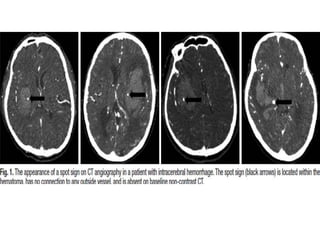
The spot sign was defined according to four criteria :
1.) Serpiginous or spot-like appearance within the margin of a
parenchymal hematoma without connection to an out hematomaside
vessel
2) Contrast density greater than 1.5 mm in diameter in at least one
dimension
3) Contrast density (Hounsfield units, HU) at least double that of the
background hematoma
4) No hyperdensity at the corresponding location on non-contrast CT
4.An increase of hematoma volume >33% or >12.5 mL was
considered as hematoma expansion.
5. The surgical approach was individualized on the basis of the site
and size of the ICH because of the lack of standardized guidelines for
allocation of operative treatment.
6.Allowed techniques included open craniotomy and
neuronavigation-guided placement of a catheter for evacuation of
supratentorial ICH.
7. Surgery was performed in patients with impending cerebral
herniation, as indicated by abnormal pupil response, abnormal
posture, or CT findings of absence of ambient cistern or severe
midline shifting (>5 mm). Surgery was performed at least 24 hours
after onset in all cases.
8. Stereotactic aspiration of the hematomas was performed in the
acute phase between 6 to 24 hours after onset of stroke. Patients
underwent repeat CT scan with a stereotactic protocol that utilized
1.5 mm slices that were then loaded onto a Stealth Station.
Statistical analysis
1.Statistical analysis was performed using the Statistical Package for
the Social Sciences for Microsoft Windows (Version 12.0; SPSS, Inc.,
Chicago, IL, USA). Patients were classified according to survival
versus dead and good versus poor clinical outcome (GOS 4–5 vs. 1–
3 and mRS 0–2 vs. 3–6) on discharge and at 90-day follow-up.
2. The associations of surgical treatment with clinical outcomes and
mortality were examined by the chisquare test for categorical
variables or Mann-Whitney U-test for continuous variables.
3. Univariate analyses were performed for association of
demographic, clinical, laboratory, and imaging variables with
respect to surgical treatment.
4. Categorical variables were compared between groups
with the chi-square test for significance.
5. The Mann-Whitney U test was used for continuous
variables.
6. The multivariate logistic regression analysis was
repeated for the prediction of surgical treatment.
7. Adjusted odds ratios (OR) and their 95% confidence
intervals (95% CI) were calculated. Significance was set
at a p value of less than 0.05.
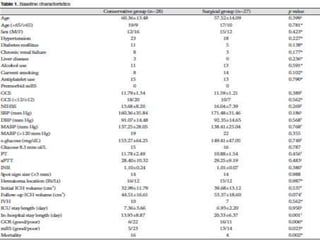
1.There were 55 patients diagnosed with primary ICH fulfilled the
study inclusion criteria, and analyzed.
2.Surgery included open craniotomy and stereotactic hematoma
aspiration, but excluded extraventricular drainage.
3. Thirty-one hematomas (56.4%) were located on the right side,
whereas twenty-four hematomas (43.6%) were located on the left
side.
4. The surgical and the medical groups were comparable with respect
to baseline characteristics (age, sex, diabetes mellitus, NIHSS score,
GCS score, blood pressure, glucose, coagulation profiles, hematoma
volume, outcome, mortality, ICU stay, and in-hospital stay).
RESULTS
5. In multivariate logistic analysis, there was a significant
difference in mortality (odds ratio, 0.211; 95% confidence interval,
0.049–0.906; p=0.036) between the groups at 90-day follow-up.
6. However, there was no difference in GOS (odds ratio, 0.371; 95%
confidence interval, 0.031–4.446; p=0.434) and mRS (odds ratio,
1.041; 95% confidence interval, 0.086–12.637; p= 0.975) between
the groups at 90-day follow-up.
7. In this series, outcome at 90 day follow-up measures showed no
significant trend toward a better outcome in the surgical group
than the medical treatment group for GOS and mRS.
1.This study show that mortality at 90 day follow-up in patients with
spot sign positive ICH treated with conservative treatment versus
surgery do differ significantly, but clinical outcomes do not differ
significantly. Controversy continues to surround the appropriate
treatment of ICH.
2. In our series, there was a positive effect of the surgical treatment
in reducing mortality at 90 days (p=0.002), GOS (p=0.006), and mRS
(p=0.023) in univariate analysis.
3. In multivariate analysis, present study show significant difference
in mortality and we failed to show that clinical outcome benefit of
surgical treatment compared with conservative treatment in patients
with spot sign positive ICH.
DISCUSSION
Journal club new

Journal club new

  • 1.
    Surgery versus ConservativeTreatment for Spontaneous Supratentorial Intracerebral Hemorrhage in Spot Sign Positive Patients Presentor - Dr.S.K.Ghintala Moderator-Dr. A. Swami
  • 2.
    1. Intracerebral hemorrhage(ICH) is the most disabling form of stroke. ICH is subtype of stroke with high morbidity and mortality accounting for 10–17% of all deaths from stroke. 2. Approximately 40% of patients with intracerebral hemorrhage die within 30 days, and the majority of survivors are left with severe disability 3. Hematoma expansion has been identified as one of the most important determinants of early neurological deterioration and poor outcome in primary ICH. 4. Recently advanced surgical techniques, neuroanaesthesia, neuronavigation system, and improved perioperative management have led to improved outcomes from surgery in many conditions. INTRODUCTION
  • 3.
    5. There isno clear indication of the optimal treatment of these patients, surgical or otherwise. There are currently 6 published randomized trials that have studied the surgical evacuation of spontaneous ICH 6. All randomized trials are carefully analyzed; there is no net benefit from surgery. 7. The presence of active contrast extravasations into the hematoma at the time of multidetector CT angiography (MDCTA), the spot sign, is an indicator of active hemorrhage and has been associated with an increased risk of hematoma expansion and mortality in patients with ICH
  • 4.
    Materials and methods 1.Studyused institutional medical data search system to identify all adult patients who admitted for treatment of ICH between January 1 ,2007 and January 31, 2012. 2. Study conducted a retrospective review of all consecutive patients who admitted to the department of neurosurgery.
  • 5.
    Inclusion criteria : 1)Evidence of nontraumatic ICH on a noncontrast CT examination of the head. 2) Evaluation with a CTA of the intracranial circulation within 24 hours of presentation 3) Only patients with spot sign positive in MDCTA 4) ICH volume is over 20 ml 5) age between 20 and 80 years.
  • 6.
    Exclusion criteria 1) Patientswith poor or good neurologic status [Glasgow Coma Scale (GCS) 3–5, or 15] 2) Brain stem hemorrhage and cerebellar hemorrhage. 3) A previous stroke history with neurological deficits. 4) Pure intraventricular hemorrhage (IVH) 5) Secondary intracerebral hemorrhage such as arteriovenous malformation, moyamoya disease, tumor bleeding, and venous sinus thrombosis. 6) Incompletion of a standard CT protocol including noncontrast CT (NCCT) and MDCTA. 7) Cortical hemorrhage 8) Refuse surgical treatment despite of surgical indication.
  • 7.
    Clinical data 1.Clinical dataof patients with ICH were collected by neurosurgeon blinded to the radiological data and at the 90-day follow-up. The collected demographic and clinical variables included sex, age, alcohol, and smoking use, history of hypertension,diabetes mellitus, chronic renal failure, liver disease (liver cirrhosis and hepatocellular carcinoma), and medications (antihypertensive and antiplatelet agents). 2. Stroke severity on admission was evaluated by GCS and National Institutes of Health Stroke Scale (NIHSS). 3. The patients’ clinical outcome was assessed by Glasgow Outcome Scale (GOS) and modified Rankin Scale (mRS) on discharge and 90- day follow-up. Poor clinical outcome was defined as GOS <4 and mRS >2.
  • 8.
    4. Intensive careunit (ICU) length of stay and in-hospital length of stay was recorded. The variables subgroups were : age ≥65 vs. <65 years); hematoma volume (≥40 mL vs. <40 mL); GCS (9 to 12 vs. ≥13); or antiplatelet treatment (any vs. none).
  • 9.
    Radiological data 1.NCCT andMDCTA acquisitions were performed according to standard departmental protocols on 64-section General Electric helical CT scanners (Lightspeed; GE Medical Systems,Waukesha, WI, USA). 2. Imaging was performed as follows : initial and 24-hour follow- up NCCT scans were performed using 4.5 mm contiguous axial sections from skull base to vertex parallel to the inferior orbitomeatal line. 3. The reviewer was measure the volume of hemorrhage in milliliters by using the ABC/2 method.
  • 10.
    The spot signwas defined according to four criteria : 1.) Serpiginous or spot-like appearance within the margin of a parenchymal hematoma without connection to an out hematomaside vessel 2) Contrast density greater than 1.5 mm in diameter in at least one dimension 3) Contrast density (Hounsfield units, HU) at least double that of the background hematoma 4) No hyperdensity at the corresponding location on non-contrast CT
  • 12.
    4.An increase ofhematoma volume >33% or >12.5 mL was considered as hematoma expansion. 5. The surgical approach was individualized on the basis of the site and size of the ICH because of the lack of standardized guidelines for allocation of operative treatment. 6.Allowed techniques included open craniotomy and neuronavigation-guided placement of a catheter for evacuation of supratentorial ICH. 7. Surgery was performed in patients with impending cerebral herniation, as indicated by abnormal pupil response, abnormal posture, or CT findings of absence of ambient cistern or severe midline shifting (>5 mm). Surgery was performed at least 24 hours after onset in all cases.
  • 13.
    8. Stereotactic aspirationof the hematomas was performed in the acute phase between 6 to 24 hours after onset of stroke. Patients underwent repeat CT scan with a stereotactic protocol that utilized 1.5 mm slices that were then loaded onto a Stealth Station.
  • 14.
    Statistical analysis 1.Statistical analysiswas performed using the Statistical Package for the Social Sciences for Microsoft Windows (Version 12.0; SPSS, Inc., Chicago, IL, USA). Patients were classified according to survival versus dead and good versus poor clinical outcome (GOS 4–5 vs. 1– 3 and mRS 0–2 vs. 3–6) on discharge and at 90-day follow-up. 2. The associations of surgical treatment with clinical outcomes and mortality were examined by the chisquare test for categorical variables or Mann-Whitney U-test for continuous variables. 3. Univariate analyses were performed for association of demographic, clinical, laboratory, and imaging variables with respect to surgical treatment.
  • 15.
    4. Categorical variableswere compared between groups with the chi-square test for significance. 5. The Mann-Whitney U test was used for continuous variables. 6. The multivariate logistic regression analysis was repeated for the prediction of surgical treatment. 7. Adjusted odds ratios (OR) and their 95% confidence intervals (95% CI) were calculated. Significance was set at a p value of less than 0.05.
  • 16.
    1.There were 55patients diagnosed with primary ICH fulfilled the study inclusion criteria, and analyzed. 2.Surgery included open craniotomy and stereotactic hematoma aspiration, but excluded extraventricular drainage. 3. Thirty-one hematomas (56.4%) were located on the right side, whereas twenty-four hematomas (43.6%) were located on the left side. 4. The surgical and the medical groups were comparable with respect to baseline characteristics (age, sex, diabetes mellitus, NIHSS score, GCS score, blood pressure, glucose, coagulation profiles, hematoma volume, outcome, mortality, ICU stay, and in-hospital stay). RESULTS
  • 17.
    5. In multivariatelogistic analysis, there was a significant difference in mortality (odds ratio, 0.211; 95% confidence interval, 0.049–0.906; p=0.036) between the groups at 90-day follow-up. 6. However, there was no difference in GOS (odds ratio, 0.371; 95% confidence interval, 0.031–4.446; p=0.434) and mRS (odds ratio, 1.041; 95% confidence interval, 0.086–12.637; p= 0.975) between the groups at 90-day follow-up. 7. In this series, outcome at 90 day follow-up measures showed no significant trend toward a better outcome in the surgical group than the medical treatment group for GOS and mRS.
  • 19.
    1.This study showthat mortality at 90 day follow-up in patients with spot sign positive ICH treated with conservative treatment versus surgery do differ significantly, but clinical outcomes do not differ significantly. Controversy continues to surround the appropriate treatment of ICH. 2. In our series, there was a positive effect of the surgical treatment in reducing mortality at 90 days (p=0.002), GOS (p=0.006), and mRS (p=0.023) in univariate analysis. 3. In multivariate analysis, present study show significant difference in mortality and we failed to show that clinical outcome benefit of surgical treatment compared with conservative treatment in patients with spot sign positive ICH. DISCUSSION