Dr. Shahnawaz Alam
Guided by: Dr. Vikas Chandra Jha
HOD, Dept. of Neurosurgery
Moderated by: Dr. Saraj kumar Singh
Faculty, Dept. of Neurosurgery
Hemostats In Neurosurgery
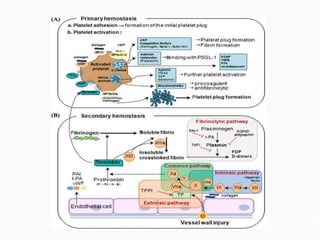
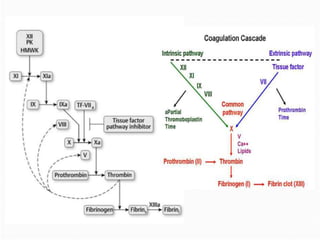
Hemostasis in
neurosurgery
● One of the most important aspects of surgery.
● Control of bleeding without ligature unlike in
abdominal and other surgeries ligatures and packs
rarely useful.
● Many hours lost in bleeding control
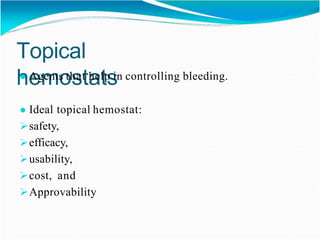
Topical
hemostats
● Agents that help in controlling bleeding.
● Ideal topical hemostat:
safety,
efficacy,
usability,
cost, and
Approvability
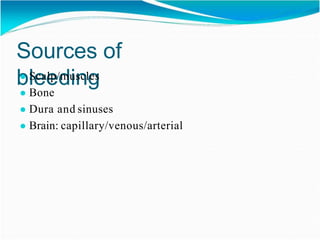
Sources of
bleeding
● Scalp/muscles
● Bone
● Dura and sinuses
● Brain: capillary/venous/arterial
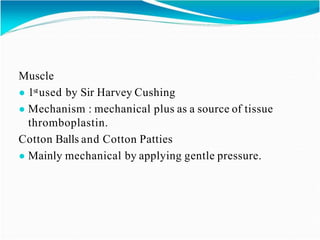
Muscle
● 1stused by Sir Harvey Cushing
● Mechanism : mechanical plus as a source of tissue
thromboplastin.
Cotton Balls and Cotton Patties
● Mainly mechanical by applying gentle pressure.
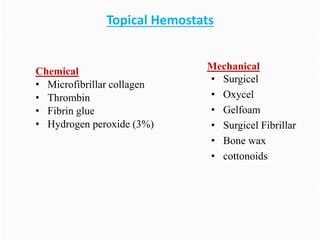
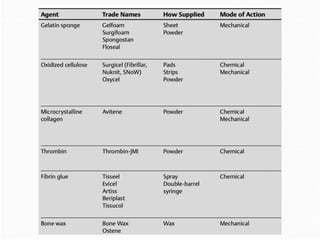
Chemical
• Microfibrillar collagen
• Thrombin
• Fibrin glue
• Hydrogen peroxide (3%)
Mechanical
• Surgicel
• Oxycel
• Gelfoam
• Surgicel Fibrillar
• Bone wax
• cottonoids
Topical Hemostats
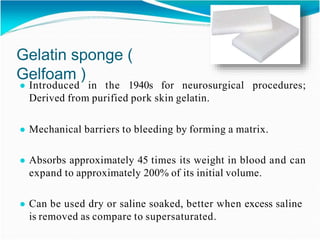
Gelatin sponge (
Gelfoam )
● Introduced in the 1940s for neurosurgical procedures;
Derived from purified pork skin gelatin.
● Mechanical barriers to bleeding by forming a matrix.
● Absorbs approximately 45 times its weight in blood and can
expand to approximately 200% of its initial volume.
● Can be used dry or saline soaked, better when excess saline
is removed as compare to supersaturated.
Microfibrillar collagen
(Avitene)
● Collagen which is derived from bovine skin binds tightly to
blood surfaces.
● Causes minimal swelling especially when compared to
Gelfoam .
● serving as a matrix for clot formation and enhancing
platelet aggregation, degranulation, and release of
clotting factors which then combine with plasma factors to
produce fibrin clot
● May reduce the number of free platelets in normal
individuals .
● Loses effectiveness in thrombocytopenia(<10,000).
● It is absorbed in 3 months and needs to be applied dry.
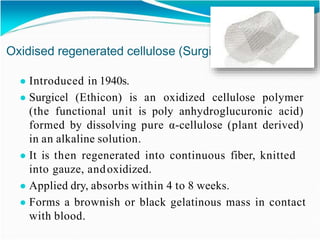
Oxidised regenerated cellulose (Surgicel)
● Introduced in 1940s.
● Surgicel (Ethicon) is an oxidized cellulose polymer
(the functional unit is poly anhydroglucuronic acid)
formed by dissolving pure α-cellulose (plant derived)
in an alkaline solution.
● It is then regenerated into continuous fiber, knitted
into gauze, andoxidized.
● Applied dry, absorbs within 4 to 8 weeks.
● Forms a brownish or black gelatinous mass in contact
with blood.
● Acts as a physical matrix to which platelets can adhere
which, in turn, aids in clot formation
● Additional pressure of the mass also contributes to the
haemostatic process.
● They create an acidic environment and are bactericidal.
● Cellulosic acid facilitates hemostasis by denaturing blood
proteins.
● Needs to be applied dry.
● They can be best removed by gentle irrigation with saline.
● Oxycel (Becton Dickinson) is another oxidized
cellulose polymer product that is similar.
● Surgicel is composed of solid fibers with irregular
contours on cross-section, whereas Oxycel is
composedof hollow “twisted tubule” fibers.
● Oxidised regenerated cellulose as a cause of
paraplegia after thoracotomy: case report and
review of the literature.Spinal Cord. 2005
Jul;43(7):445-7.
Activ
e
Thrombin
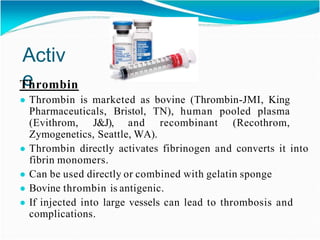
● Thrombin is marketed as bovine (Thrombin-JMI, King
Pharmaceuticals, Bristol, TN), human pooled plasma
(Evithrom, J&J), and recombinant (Recothrom,
Zymogenetics, Seattle, WA).
● Thrombin directly activates fibrinogen and converts it into
fibrin monomers.
● Can be used directly or combined with gelatin sponge
● Bovine thrombin is antigenic.
● If injected into large vessels can lead to thrombosis and
complications.
● The three commercially available thrombins are functionally
equivalent in terms of efficacy with 95 percent or greater of
patients achieving hemostasis within 10minutes of application
and approximately two-thirds of patients achieving hemostasis
within 3 minutes. Chapman WC, Singla N, Genyk Y, McNeil JW,
Renkens KL Jr,Reynolds TC, Murphy A, Weaver FA. A phase 3,
randomized, double-blind comparative study of the efficacy and
safety of topical recombinant human thrombin and bovine
thrombin in surgical hemostasis. JAm Coll Surg 2007;205: 256-65
Complication
s
● Nidus of infection
● Inflammatory reaction(esp. avitene)
● Antigenicity (animal products)
● Mass effect (esp.gelatin)
● Gossipiboma
Bone
wax
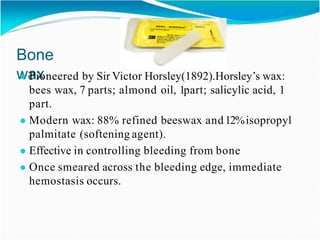
● Pioneered by Sir Victor Horsley(1892).Horsley’s wax:
bees wax, 7 parts; almond oil, 1part; salicylic acid, 1
part.
● Modern wax: 88% refined beeswax and12%isopropyl
palmitate (softening agent).
● Effective in controlling bleeding from bone
● Once smeared across the bleeding edge, immediate
hemostasis occurs.
Complication
s
● Bone wax inhibits osteogenesis.
● Increases infection rates (the number of bacteria
needed to produce osteomyelitis is reduced by a factor
of 10,000).
● Remains as a foreign body for many years.
Osten
e
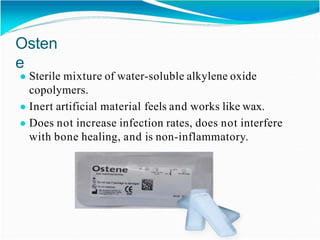
● Sterile mixture of water-soluble alkylene oxide
copolymers.
● Inert artificial material feels and works like wax.
● Does not increase infection rates, does not interfere
with bone healing, and is non-inflammatory.
Flowable
s
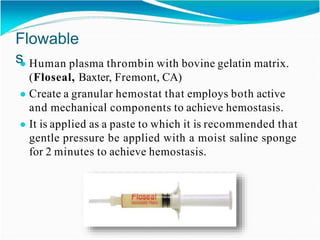
● Human plasma thrombin with bovine gelatin matrix.
(Floseal, Baxter, Fremont, CA)
● Create a granular hemostat that employs both active
and mechanical components to achieve hemostasis.
● It is applied as a paste to which it is recommended that
gentle pressure be applied with a moist saline sponge
for 2 minutes to achieve hemostasis.
● Hemostatic matrix sealant in neurosurgery: a clinical and
imaging study. Roberto Gazzeri &Marcelo Galarza &Massimiliano Neroni
&Alex Alfieri &Marco Giordano. Acta Neurochir(2011)153:148–155.Effective
hemostasis, defined as cessation of bleeding, was achieved no later than 3 min
after topical agent application in all patients except in 1
1cases out of 214 cases
it was used.
● The role of FloSeal in reducing epidural fibrosis in a rat
laminectomy model.. Dogulu F, Durdag E, Cemil B, Kurt
G, Ozgun G Neurol Neurochir Pol. 2009 Jul-Aug;43(4):346-51.
Application of FloSeal at a laminectomy site may be useful
to decrease adhesion at the interface between the dura
mater and epidural fibrosis.
Fibrin
sealent
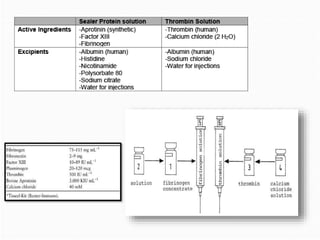
● Human plasma derived fibrin sealent
● Fibrin glue(Tisseel/evicel)
● Commercially available/autologous.
● 2 components:
a)fibrinogen, factor13, fibronectin, aprotinin,
plasminogen, cryoprecipitate
b)thrombin and calcium
● After mixing, fibrinogen is converted to fibrin
● Aprotinin inhibits premature fibrin degradation
● Supply a source of fibrinogen to the site of injury and
do not need active bleeding or blood-derived
fibrinogen to polymerize.
Us
e
● For hemostasis and tissue sealing
● To reinforce dural closure and prevent CSF leak.
● In anastomosis of nerves and nerve grafts
(Micro neural anastomosis with fibrin glue : an experimental study. Suri A,
Mehta VS, Sarkar C .Neurology India.2002)
● Fixation of bone fragments to repair skull defects.
Hydrogen peroxide
● 3% solution is used inneurosurgery
● Use is verycontroversial
● Mechanism : mechanical obstruction of the
microvasculature, mechanical removal of tissue debris,
and vasoconstriction. Exact mechanism is not known.
● Primarily used to achieve hemostasis after complete
tumor removal of the surrounding arachnoidal
surface of the brain.
● Recent evidence suggest significant tissue damage in
surrounding functional brain.
● Intratumoral hydrogen peroxide injection during meningioma resection.
Roger Lichtenbaum,M.D. Neurosurgery 59[ONS Suppl 4.]:ONS-470–
ONS-473, 2006.
● Hydrogen peroxide–induced stroke: elucidation of the mechanism in vivo.
Melike Mut, M.D., Ph.D JNeurosurg 110:94–100,2009
● Comparative safety and efficacy of topical hemostatic agents in a rat
neurosurgical model Neurosurgery. 2008 Oct;63(4 Suppl 2):369-
72.
● Avitene, FloSeal, and Surgicel performed better (defined as
complete hemostasis within 1 minute) than control (no
treatment). Residual material was not present at any time
with Arista, markedly contrasting with the presence of
residual material in 100% of lesions in the Avitene, FloSeal,
and Surgicel groups on Day 14. Avitene and FloSeal also
demonstrated a propensity for causing granuloma
formation, whereas Arista and Surgicel showed no such
evidence
● The use of local agents: Surgicel and Surgifoam.
Eur Spine J(2004) 13(Suppl. 1) :S97–S10.
● The use of absorbable porcine gelatine and regenerated, oxidised
cellulose as haemostats in intraspinal surgery must be
considered safe and beneficial. However, the appropriate use of
haemostats requires a certain understanding of their advantages,
limitations and the nature of complications associated with their
application
Conclusio
n
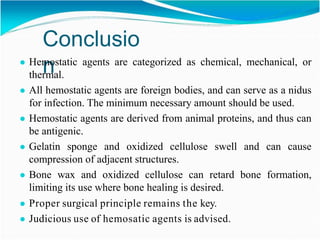
● Hemostatic agents are categorized as chemical, mechanical, or
thermal.
● All hemostatic agents are foreign bodies, and can serve as a nidus
for infection. The minimum necessary amount should be used.
● Hemostatic agents are derived from animal proteins, and thus can
be antigenic.
● Gelatin sponge and oxidized cellulose swell and can cause
compression of adjacent structures.
● Bone wax and oxidized cellulose can retard bone formation,
limiting its use where bone healing is desired.
● Proper surgical principle remains the key.
● Judicious use of hemosatic agents is advised.
Thank You

Hemostats in neurosurgery

  • 1.
    Dr. Shahnawaz Alam Guidedby: Dr. Vikas Chandra Jha HOD, Dept. of Neurosurgery Moderated by: Dr. Saraj kumar Singh Faculty, Dept. of Neurosurgery Hemostats In Neurosurgery
  • 4.
    Hemostasis in neurosurgery ● Oneof the most important aspects of surgery. ● Control of bleeding without ligature unlike in abdominal and other surgeries ligatures and packs rarely useful. ● Many hours lost in bleeding control
  • 5.
    Topical hemostats ● Agents thathelp in controlling bleeding. ● Ideal topical hemostat: safety, efficacy, usability, cost, and Approvability
  • 6.
    Sources of bleeding ● Scalp/muscles ●Bone ● Dura and sinuses ● Brain: capillary/venous/arterial
  • 7.
    Muscle ● 1stused bySir Harvey Cushing ● Mechanism : mechanical plus as a source of tissue thromboplastin. Cotton Balls and Cotton Patties ● Mainly mechanical by applying gentle pressure.
  • 8.
    Chemical • Microfibrillar collagen •Thrombin • Fibrin glue • Hydrogen peroxide (3%) Mechanical • Surgicel • Oxycel • Gelfoam • Surgicel Fibrillar • Bone wax • cottonoids Topical Hemostats
  • 9.
    Gelatin sponge ( Gelfoam) ● Introduced in the 1940s for neurosurgical procedures; Derived from purified pork skin gelatin. ● Mechanical barriers to bleeding by forming a matrix. ● Absorbs approximately 45 times its weight in blood and can expand to approximately 200% of its initial volume. ● Can be used dry or saline soaked, better when excess saline is removed as compare to supersaturated.
  • 10.
    Microfibrillar collagen (Avitene) ● Collagenwhich is derived from bovine skin binds tightly to blood surfaces. ● Causes minimal swelling especially when compared to Gelfoam . ● serving as a matrix for clot formation and enhancing platelet aggregation, degranulation, and release of clotting factors which then combine with plasma factors to produce fibrin clot ● May reduce the number of free platelets in normal individuals . ● Loses effectiveness in thrombocytopenia(<10,000). ● It is absorbed in 3 months and needs to be applied dry.
  • 11.
    Oxidised regenerated cellulose(Surgicel) ● Introduced in 1940s. ● Surgicel (Ethicon) is an oxidized cellulose polymer (the functional unit is poly anhydroglucuronic acid) formed by dissolving pure α-cellulose (plant derived) in an alkaline solution. ● It is then regenerated into continuous fiber, knitted into gauze, andoxidized. ● Applied dry, absorbs within 4 to 8 weeks. ● Forms a brownish or black gelatinous mass in contact with blood.
  • 12.
    ● Acts asa physical matrix to which platelets can adhere which, in turn, aids in clot formation ● Additional pressure of the mass also contributes to the haemostatic process. ● They create an acidic environment and are bactericidal. ● Cellulosic acid facilitates hemostasis by denaturing blood proteins. ● Needs to be applied dry. ● They can be best removed by gentle irrigation with saline.
  • 13.
    ● Oxycel (BectonDickinson) is another oxidized cellulose polymer product that is similar. ● Surgicel is composed of solid fibers with irregular contours on cross-section, whereas Oxycel is composedof hollow “twisted tubule” fibers.
  • 14.
    ● Oxidised regeneratedcellulose as a cause of paraplegia after thoracotomy: case report and review of the literature.Spinal Cord. 2005 Jul;43(7):445-7.
  • 15.
    Activ e Thrombin ● Thrombin ismarketed as bovine (Thrombin-JMI, King Pharmaceuticals, Bristol, TN), human pooled plasma (Evithrom, J&J), and recombinant (Recothrom, Zymogenetics, Seattle, WA). ● Thrombin directly activates fibrinogen and converts it into fibrin monomers. ● Can be used directly or combined with gelatin sponge ● Bovine thrombin is antigenic. ● If injected into large vessels can lead to thrombosis and complications.
  • 16.
    ● The threecommercially available thrombins are functionally equivalent in terms of efficacy with 95 percent or greater of patients achieving hemostasis within 10minutes of application and approximately two-thirds of patients achieving hemostasis within 3 minutes. Chapman WC, Singla N, Genyk Y, McNeil JW, Renkens KL Jr,Reynolds TC, Murphy A, Weaver FA. A phase 3, randomized, double-blind comparative study of the efficacy and safety of topical recombinant human thrombin and bovine thrombin in surgical hemostasis. JAm Coll Surg 2007;205: 256-65
  • 17.
    Complication s ● Nidus ofinfection ● Inflammatory reaction(esp. avitene) ● Antigenicity (animal products) ● Mass effect (esp.gelatin) ● Gossipiboma
  • 18.
    Bone wax ● Pioneered bySir Victor Horsley(1892).Horsley’s wax: bees wax, 7 parts; almond oil, 1part; salicylic acid, 1 part. ● Modern wax: 88% refined beeswax and12%isopropyl palmitate (softening agent). ● Effective in controlling bleeding from bone ● Once smeared across the bleeding edge, immediate hemostasis occurs.
  • 19.
    Complication s ● Bone waxinhibits osteogenesis. ● Increases infection rates (the number of bacteria needed to produce osteomyelitis is reduced by a factor of 10,000). ● Remains as a foreign body for many years.
  • 20.
    Osten e ● Sterile mixtureof water-soluble alkylene oxide copolymers. ● Inert artificial material feels and works like wax. ● Does not increase infection rates, does not interfere with bone healing, and is non-inflammatory.
  • 21.
    Flowable s ● Human plasmathrombin with bovine gelatin matrix. (Floseal, Baxter, Fremont, CA) ● Create a granular hemostat that employs both active and mechanical components to achieve hemostasis. ● It is applied as a paste to which it is recommended that gentle pressure be applied with a moist saline sponge for 2 minutes to achieve hemostasis.
  • 22.
    ● Hemostatic matrixsealant in neurosurgery: a clinical and imaging study. Roberto Gazzeri &Marcelo Galarza &Massimiliano Neroni &Alex Alfieri &Marco Giordano. Acta Neurochir(2011)153:148–155.Effective hemostasis, defined as cessation of bleeding, was achieved no later than 3 min after topical agent application in all patients except in 1 1cases out of 214 cases it was used.
  • 23.
    ● The roleof FloSeal in reducing epidural fibrosis in a rat laminectomy model.. Dogulu F, Durdag E, Cemil B, Kurt G, Ozgun G Neurol Neurochir Pol. 2009 Jul-Aug;43(4):346-51. Application of FloSeal at a laminectomy site may be useful to decrease adhesion at the interface between the dura mater and epidural fibrosis.
  • 24.
    Fibrin sealent ● Human plasmaderived fibrin sealent ● Fibrin glue(Tisseel/evicel) ● Commercially available/autologous. ● 2 components: a)fibrinogen, factor13, fibronectin, aprotinin, plasminogen, cryoprecipitate b)thrombin and calcium ● After mixing, fibrinogen is converted to fibrin ● Aprotinin inhibits premature fibrin degradation
  • 26.
    ● Supply asource of fibrinogen to the site of injury and do not need active bleeding or blood-derived fibrinogen to polymerize.
  • 27.
    Us e ● For hemostasisand tissue sealing ● To reinforce dural closure and prevent CSF leak. ● In anastomosis of nerves and nerve grafts (Micro neural anastomosis with fibrin glue : an experimental study. Suri A, Mehta VS, Sarkar C .Neurology India.2002) ● Fixation of bone fragments to repair skull defects.
  • 28.
    Hydrogen peroxide ● 3%solution is used inneurosurgery ● Use is verycontroversial ● Mechanism : mechanical obstruction of the microvasculature, mechanical removal of tissue debris, and vasoconstriction. Exact mechanism is not known. ● Primarily used to achieve hemostasis after complete tumor removal of the surrounding arachnoidal surface of the brain.
  • 29.
    ● Recent evidencesuggest significant tissue damage in surrounding functional brain. ● Intratumoral hydrogen peroxide injection during meningioma resection. Roger Lichtenbaum,M.D. Neurosurgery 59[ONS Suppl 4.]:ONS-470– ONS-473, 2006. ● Hydrogen peroxide–induced stroke: elucidation of the mechanism in vivo. Melike Mut, M.D., Ph.D JNeurosurg 110:94–100,2009
  • 30.
    ● Comparative safetyand efficacy of topical hemostatic agents in a rat neurosurgical model Neurosurgery. 2008 Oct;63(4 Suppl 2):369- 72. ● Avitene, FloSeal, and Surgicel performed better (defined as complete hemostasis within 1 minute) than control (no treatment). Residual material was not present at any time with Arista, markedly contrasting with the presence of residual material in 100% of lesions in the Avitene, FloSeal, and Surgicel groups on Day 14. Avitene and FloSeal also demonstrated a propensity for causing granuloma formation, whereas Arista and Surgicel showed no such evidence
  • 31.
    ● The useof local agents: Surgicel and Surgifoam. Eur Spine J(2004) 13(Suppl. 1) :S97–S10. ● The use of absorbable porcine gelatine and regenerated, oxidised cellulose as haemostats in intraspinal surgery must be considered safe and beneficial. However, the appropriate use of haemostats requires a certain understanding of their advantages, limitations and the nature of complications associated with their application
  • 33.
    Conclusio n ● Hemostatic agentsare categorized as chemical, mechanical, or thermal. ● All hemostatic agents are foreign bodies, and can serve as a nidus for infection. The minimum necessary amount should be used. ● Hemostatic agents are derived from animal proteins, and thus can be antigenic. ● Gelatin sponge and oxidized cellulose swell and can cause compression of adjacent structures. ● Bone wax and oxidized cellulose can retard bone formation, limiting its use where bone healing is desired. ● Proper surgical principle remains the key. ● Judicious use of hemosatic agents is advised.
  • 34.