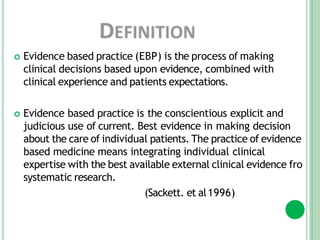
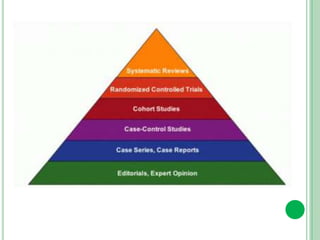
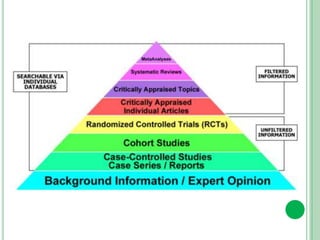
 Evidence based practice (EBP) is the process of making
clinical decisions based upon evidence, combined with
clinical experience and patients expectations.
 Evidence based practice is the conscientious explicit and
judicious use of current. Best evidence in making decision
about the care of individual patients. The practice of evidence
based medicine means integrating individual clinical
expertise with the best available external clinical evidence fro
systematic research.
(Sackett. et al1996)
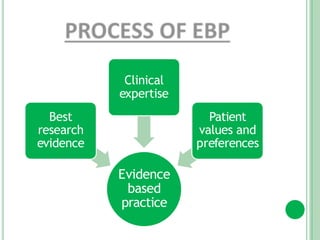
Evidence
based
practice
Best
research
evidence
Clinical
expertise
Patient
values and
preferences
 To provide the high quality and most cast efficient
nursing carepossible.
 To advance quality of care provided b health worker.
 To increase satisfaction among patients.
 To focus on nursing practice away from habits and
tradition to evidence and research.
 It results in better patient outcomes.
 It contributes to the science of nursing.
 It keeps practice current and relevant.
 It increases confidence is decision making.
 For making sure that each client get the best possible
services.
 Update knowledge and is essential for lifelong learning.
 Provide clinicaljudgment.
 Improvement care provided and save lives
 To provide framework for understanding the evidence
based practiceprocess.
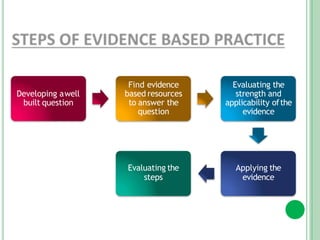
Developing awell
built question
Find evidence
based resources
to answer the
question
Evaluating the
strength and
applicability ofthe
evidence
Applying the
evidence
Evaluating the
steps
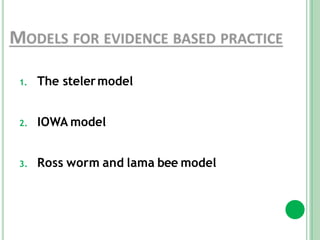
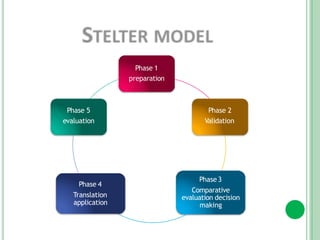
1. The stelermodel
2. IOWA model
3. Ross worm and lama bee model
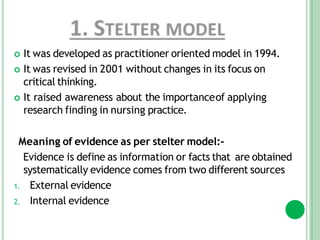
 It was developed as practitioner oriented model in 1994.
 It was revised in 2001 without changes in its focus on
critical thinking.
 It raised awareness about the importanceof applying
research finding in nursing practice.
Meaning of evidence as per stelter model:-
Evidence is define as information or facts that are obtained
systematically evidence comes from two different sources
1. External evidence
2. Internal evidence
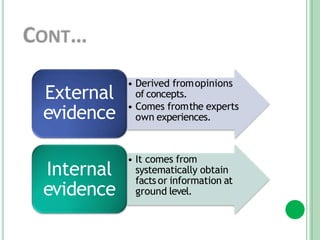
• Derived fromopinions
of concepts.
• Comes fromthe experts
own experiences.
• It comes from
systematically obtain
facts or information at
ground level.
External
evidence
Internal
evidence
Phase 1
preparation
Phase 2
Validation
Phase 3
Comparative
evaluation decision
making
Phase 4
Translation
application
Phase 5
evaluation
 Successfully implanted since 1994 intervention ally.
 Infuses research into practice to improve quality of care.
 Planned change principles integrated research and
practice.
 Utilizes a multidisciplinary team approach.
Highlights of the models :-
 it incorporates the use of research and other forms of
evidence.
 Interference to support research use might involve every
level of theorganization.
 Evidence based practice is linked to quality assurance.
CONT
…
 Staff are given recognition for researchwork.
 Clinicians are given time and resources for research work.
 This model explains how organizations changes practice
based on research.
 It gives a systemic design.
 It includes both the practitioner and organizational
perceptive.
 It provides guide for regarding implementation of evidence
based practice.
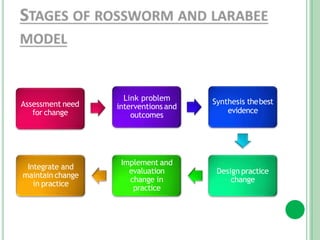
 Develop by rossworm and larabee in 1999. it is based
on theoretical and research literature.
 It begins with the assessment of need and integration
of an evidence based protocol.
 Focuses on the use of change theory, principles of
research and standardizations nursing nomenclature.
Assessment need
for change
Link problem
interventions and
outcomes
Synthesis thebest
evidence
Design practice
change
Implement and
evaluation
change in
practice
Integrate and
maintain change
in practice
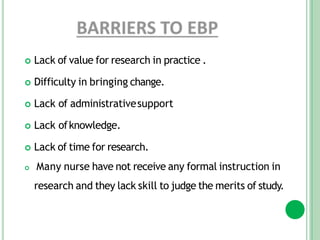
 Lack of value for research in practice .
 Difficulty in bringing change.
 Lack of administrativesupport
 Lack ofknowledge.
 Lack of time for research.
 Many nurse have not receive any formal instruction in
research and they lack skill to judge the merits of study.
 Information explores
 Provide better patientoutcomes.
 Ebp increases the efficiency of nurses.
 Making decision based on knowledge that is backed by
research.
 It keeps nursing practice current to the new trends and
updated guidelines ofcare.
 It provides variations in practice because it can help
determine high quality cast effectiveintervention that
actually work.
 It promotes high quality and cast effective
intervention andtreatment.
 Using EBP to provide care to patients increases the
nurses confidence.
evidencebasedpractice-190912083548.pptx

evidencebasedpractice-190912083548.pptx

  • 2.
     Evidence basedpractice (EBP) is the process of making clinical decisions based upon evidence, combined with clinical experience and patients expectations.  Evidence based practice is the conscientious explicit and judicious use of current. Best evidence in making decision about the care of individual patients. The practice of evidence based medicine means integrating individual clinical expertise with the best available external clinical evidence fro systematic research. (Sackett. et al1996)
  • 3.
  • 4.
     To providethe high quality and most cast efficient nursing carepossible.  To advance quality of care provided b health worker.  To increase satisfaction among patients.  To focus on nursing practice away from habits and tradition to evidence and research.  It results in better patient outcomes.  It contributes to the science of nursing.  It keeps practice current and relevant.  It increases confidence is decision making.
  • 5.
     For makingsure that each client get the best possible services.  Update knowledge and is essential for lifelong learning.  Provide clinicaljudgment.  Improvement care provided and save lives  To provide framework for understanding the evidence based practiceprocess.
  • 6.
    Developing awell built question Findevidence based resources to answer the question Evaluating the strength and applicability ofthe evidence Applying the evidence Evaluating the steps
  • 7.
    1. The stelermodel 2.IOWA model 3. Ross worm and lama bee model
  • 8.
     It wasdeveloped as practitioner oriented model in 1994.  It was revised in 2001 without changes in its focus on critical thinking.  It raised awareness about the importanceof applying research finding in nursing practice. Meaning of evidence as per stelter model:- Evidence is define as information or facts that are obtained systematically evidence comes from two different sources 1. External evidence 2. Internal evidence
  • 9.
    • Derived fromopinions ofconcepts. • Comes fromthe experts own experiences. • It comes from systematically obtain facts or information at ground level. External evidence Internal evidence
  • 10.
    Phase 1 preparation Phase 2 Validation Phase3 Comparative evaluation decision making Phase 4 Translation application Phase 5 evaluation
  • 11.
     Successfully implantedsince 1994 intervention ally.  Infuses research into practice to improve quality of care.  Planned change principles integrated research and practice.  Utilizes a multidisciplinary team approach. Highlights of the models :-  it incorporates the use of research and other forms of evidence.  Interference to support research use might involve every level of theorganization.  Evidence based practice is linked to quality assurance.
  • 12.
    CONT …  Staff aregiven recognition for researchwork.  Clinicians are given time and resources for research work.  This model explains how organizations changes practice based on research.  It gives a systemic design.  It includes both the practitioner and organizational perceptive.  It provides guide for regarding implementation of evidence based practice.
  • 13.
     Develop byrossworm and larabee in 1999. it is based on theoretical and research literature.  It begins with the assessment of need and integration of an evidence based protocol.  Focuses on the use of change theory, principles of research and standardizations nursing nomenclature.
  • 14.
    Assessment need for change Linkproblem interventions and outcomes Synthesis thebest evidence Design practice change Implement and evaluation change in practice Integrate and maintain change in practice
  • 15.
     Lack ofvalue for research in practice .  Difficulty in bringing change.  Lack of administrativesupport  Lack ofknowledge.  Lack of time for research.  Many nurse have not receive any formal instruction in research and they lack skill to judge the merits of study.
  • 16.
     Information explores Provide better patientoutcomes.  Ebp increases the efficiency of nurses.  Making decision based on knowledge that is backed by research.  It keeps nursing practice current to the new trends and updated guidelines ofcare.
  • 17.
     It providesvariations in practice because it can help determine high quality cast effectiveintervention that actually work.  It promotes high quality and cast effective intervention andtreatment.  Using EBP to provide care to patients increases the nurses confidence.