apm risk SIG 24 October 2013
Uncertainty or risk - is there a difference?

Performance uncertainty management is a more
effective approach than risk management
Stephen Ward
Southampton Management School
University of Southampton
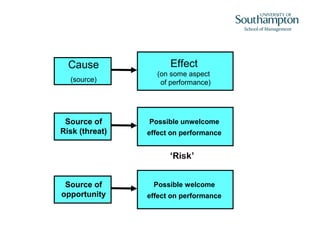
Cause
(source)

Source of
Risk (threat)

Effect
(on some aspect
of performance)

Possible unwelcome
effect on performance

‘Risk’
Source of
opportunity

Possible welcome
effect on performance
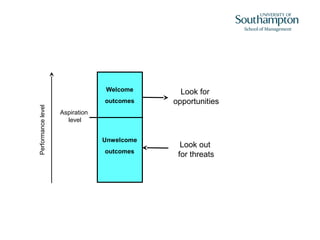
Welcome
Performance level

outcomes

Look for
opportunities

Aspiration
level
Unwelcome
outcomes

Look out
for threats
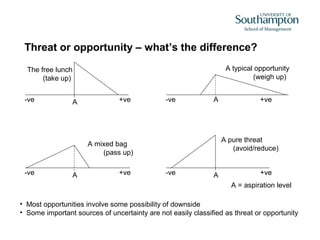
Threat or opportunity – what’s the difference?
A typical opportunity
(weigh up)

The free lunch
(take up)
-ve

A

+ve

-ve

A

A pure threat
(avoid/reduce)

A mixed bag
(pass up)
-ve

A

+ve

+ve

-ve

A

+ve
A = aspiration level

• Most opportunities involve some possibility of downside
• Some important sources of uncertainty are not easily classified as threat or opportunity
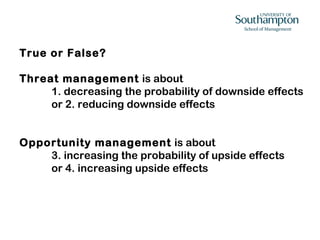
True or False?
Threat management is about
1. decreasing the probability of downside effects
or 2. reducing downside effects
Opportunity management is about
3. increasing the probability of upside effects
or 4. increasing upside effects
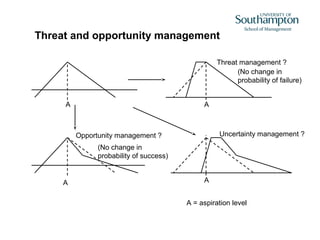
Threat and opportunity management
Threat management ?
(No change in
probability of failure)
A

A

Uncertainty management ?

Opportunity management ?
(No change in
probability of success)

A

A
A = aspiration level
Observations
1.

Opportunity and threat management may be separable,
but it is inefficient to use separate processes.

2. A combined approach should increase the scope
of improvements obtainable.
3. There is no need for separate processes focused on
threats or opportunities. Management of uncertainty is
the key issue - explore and understand the origins of
performance related uncertainty, before seeking to
manage it.
Some obvious implications about
uncertainty, objectives, and risk
1. Setting objectives (aspiration levels) drives risk.
2. If performance is multi-dimensional, so is risk.
3. Uncertainty management (and risk management) should
recognise trade-offs between performance objectives
4. Different stakeholders may have different views of project
uncertainty, objectives, associated risk, opportunities, and
their management.
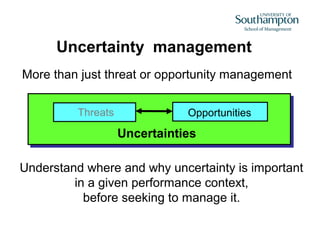
Uncertainty management
More than just threat or opportunity management
Threats

Opportunities

Uncertainties
Understand where and why uncertainty is important
in a given performance context,
before seeking to manage it.
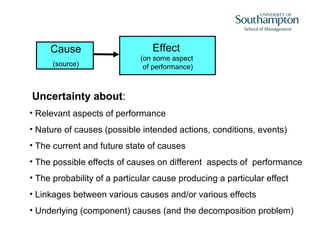
Cause
(source)

Effect
(on some aspect
of performance)

Uncertainty about:
• Relevant aspects of performance
• Nature of causes (possible intended actions, conditions, events)
• The current and future state of causes
• The possible effects of causes on different aspects of performance
• The probability of a particular cause producing a particular effect
• Linkages between various causes and/or various effects
• Underlying (component) causes (and the decomposition problem)
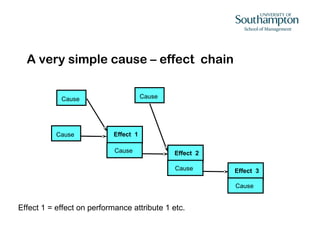
A very simple cause – effect chain
Cause

Cause

Cause

Effect 1
Cause

Effect 2
Cause

Effect 3
Cause

Effect 1 = effect on performance attribute 1 etc.
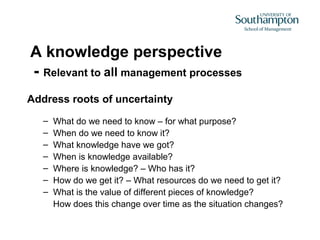
A knowledge perspective
- Relevant to all management processes
Address roots of uncertainty
–
–
–
–
–
–
–

What do we need to know – for what purpose?
When do we need to know it?
What knowledge have we got?
When is knowledge available?
Where is knowledge? – Who has it?
How do we get it? – What resources do we need to get it?
What is the value of different pieces of knowledge?
How does this change over time as the situation changes?
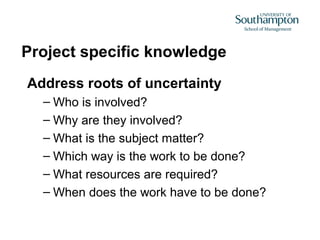
Project specific knowledge
Address roots of uncertainty
– Who is involved?
– Why are they involved?
– What is the subject matter?
– Which way is the work to be done?
– What resources are required?
– When does the work have to be done?
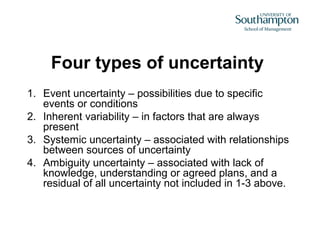
Four types of uncertainty
1. Event uncertainty – possibilities due to specific
events or conditions
2. Inherent variability – in factors that are always
present
3. Systemic uncertainty – associated with relationships
between sources of uncertainty
4. Ambiguity uncertainty – associated with lack of
knowledge, understanding or agreed plans, and a
residual of all uncertainty not included in 1-3 above.
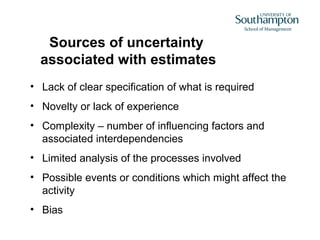
Sources of uncertainty
associated with estimates
• Lack of clear specification of what is required
• Novelty or lack of experience
• Complexity – number of influencing factors and
associated interdependencies
• Limited analysis of the processes involved
• Possible events or conditions which might affect the
activity
• Bias
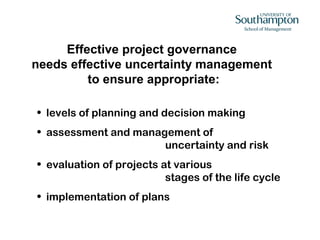
Effective project governance
needs effective uncertainty management
to ensure appropriate:
• levels of planning and decision making
• assessment and management of
uncertainty and risk
• evaluation of projects at various
stages of the life cycle
• implementation of plans
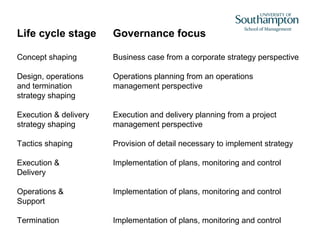
Life cycle stage

Governance focus

Concept shaping

Business case from a corporate strategy perspective

Design, operations
and termination
strategy shaping

Operations planning from an operations
management perspective

Execution & delivery
strategy shaping

Execution and delivery planning from a project
management perspective

Tactics shaping

Provision of detail necessary to implement strategy

Execution &
Delivery

Implementation of plans, monitoring and control

Operations &
Support

Implementation of plans, monitoring and control

Termination

Implementation of plans, monitoring and control
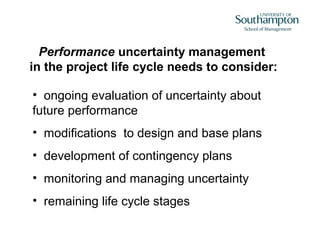
Performance uncertainty management
in the project life cycle needs to consider:
• ongoing evaluation of uncertainty about
future performance
• modifications to design and base plans
• development of contingency plans
• monitoring and managing uncertainty
• remaining life cycle stages
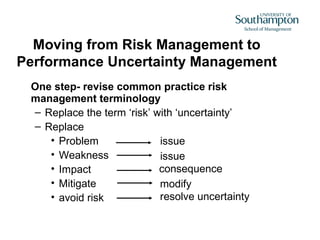
Moving from Risk Management to
Performance Uncertainty Management
One step- revise common practice risk
management terminology
– Replace the term ‘risk’ with ‘uncertainty’
– Replace
• Problem
issue
• Weakness
issue
• Impact
consequence
• Mitigate
modify
resolve uncertainty
• avoid risk
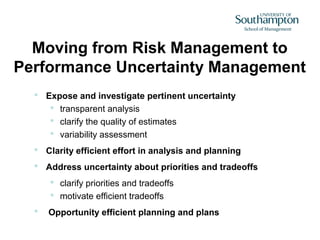
Moving from Risk Management to
Performance Uncertainty Management
 Expose and investigate pertinent uncertainty
 transparent analysis
 clarify the quality of estimates
 variability assessment
 Clarity efficient effort in analysis and planning
 Address uncertainty about priorities and tradeoffs
 clarify priorities and tradeoffs
 motivate efficient tradeoffs


Opportunity efficient planning and plans
Recommended reading!
Chris Chapman and Stephen Ward (2011) How to manage project
opportunity and risk – why uncertainty management can be a
much better approach than risk management. Wiley
David Cleden (2009) Managing project uncertainty. Gower Publishing
Douglas Hubbard (2009) The failure of risk management - why its
broken and how to fix it. Wiley
Professor Stephen Ward
Southampton Management School,
University of Southampton, Highfield, Southampton, SO17 1BJ
scw@soton.ac.uk
www.management.soton.ac.uk
Appendices
Some definitions of ‘risk’
Something happening that may have an impact on the achievement of
objectives….
(National Audit Office , 2000)
An uncertain event or condition that, if it occurs, has a positive or negative
effect on a project objective.
(Project Management Institute, A guide to the project management body of
knowledge, 2000 edition. USA: project management institute, 2000, p127)

The implications of significant uncertainty about the level of project
performance achievable.
(C Chapman and S Ward , Project risk management: processes, techniques and
insights. Wiley, 2003)
Some initial thoughts about threats
Threats - unwelcome things that might happen to us (bad luck?).
- mostly don’t need to do anything, or omit to do something,
to create a threat
Threat management – avoid or reduce circumstances that
could generate losses relative to aspirations.

A key question: Are aspirations too ambitious?
Some initial thoughts about opportunities
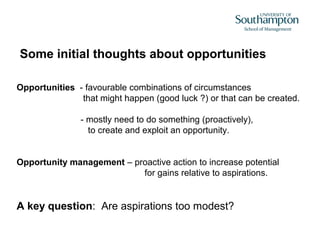
Opportunities - favourable combinations of circumstances
that might happen (good luck ?) or that can be created.
- mostly need to do something (proactively),
to create and exploit an opportunity.
Opportunity management – proactive action to increase potential
for gains relative to aspirations.

A key question: Are aspirations too modest?
Implications of a focus on threats
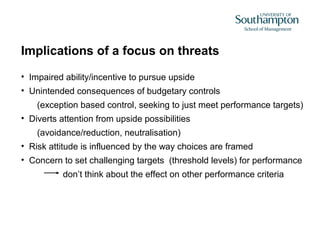
• Impaired ability/incentive to pursue upside
• Unintended consequences of budgetary controls
(exception based control, seeking to just meet performance targets)
• Diverts attention from upside possibilities
(avoidance/reduction, neutralisation)
• Risk attitude is influenced by the way choices are framed
• Concern to set challenging targets (threshold levels) for performance
don’t think about the effect on other performance criteria
Identifying opportunities
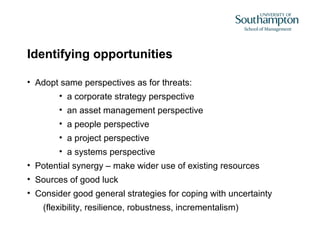
• Adopt same perspectives as for threats:
• a corporate strategy perspective
• an asset management perspective
• a people perspective
• a project perspective
• a systems perspective
• Potential synergy – make wider use of existing resources
• Sources of good luck
• Consider good general strategies for coping with uncertainty
(flexibility, resilience, robustness, incrementalism)
Identifying opportunities via threats
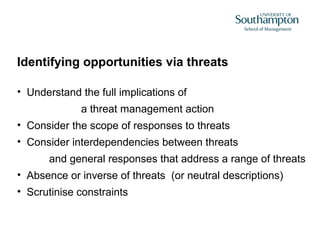
• Understand the full implications of
a threat management action
• Consider the scope of responses to threats
• Consider interdependencies between threats
and general responses that address a range of threats
• Absence or inverse of threats (or neutral descriptions)
• Scrutinise constraints
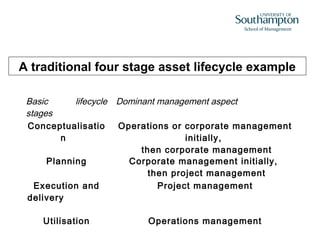
A traditional four stage asset lifecycle example
Basic
lifecycle Dominant management aspect
stages
Conceptualisatio
Operations or corporate management
n
initially,
then corporate management
Planning
Corporate management initially,
then project management
Execution and
Project management
delivery
Utilisation

Operations management
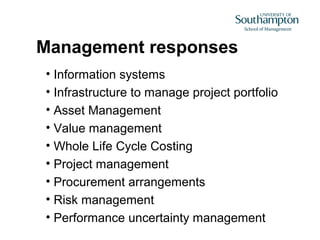
Management responses
• Information systems
• Infrastructure to manage project portfolio
• Asset Management
• Value management
• Whole Life Cycle Costing
• Project management
• Procurement arrangements
• Risk management
• Performance uncertainty management
Stephen Ward: Performance uncertainty management is a more effective approach than risk management

Editor's Notes