PREPARATION & SAFETY
              STARTERS
M O D U L E 1 : P R E S E N T I N G H O W TO P R E PA R E H O T W O R K S
A R E A S , I D E N T I F Y H A Z A R D S , & P E R M I S S I B L E L O C AT I O N S
PREPARATION
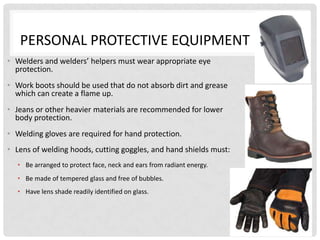
PERSONAL PROTECTIVE EQUIPMENT
• Welders and welders’ helpers must wear appropriate eye
  protection.
• Work boots should be used that do not absorb dirt and grease
  which can create a flame up.
• Jeans or other heavier materials are recommended for lower
  body protection.
• Welding gloves are required for hand protection.
• Lens of welding hoods, cutting goggles, and hand shields must:
  • Be arranged to protect face, neck and ears from radiant energy.
  • Be made of tempered glass and free of bubbles.
  • Have lens shade readily identified on glass.


                                                                      3
PREPARATION

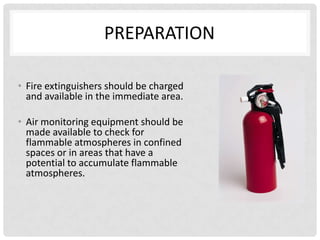
• Fire extinguishers should be charged
  and available in the immediate area.

• Air monitoring equipment should be
  made available to check for
  flammable atmospheres in confined
  spaces or in areas that have a
  potential to accumulate flammable
  atmospheres.
PREPARATION
  Fire Prevention & Protection
• NFPA 51 B – “Standard for Fire
  Prevention in Use of Cutting and
  Welding Processes.”
• Move all fire hazards away from
  work area.
• Use guards (fire blankets, etc.) if fire
  hazards cannot be moved.
PREPARATION

• Equipment must be in good condition and appropriate to
  the task.
• Fire resistive tarpaulins, noncombustible screens, metal
  shields, and fire stop material for wall or floor openings
  should be provided as needed.
PREPARATION
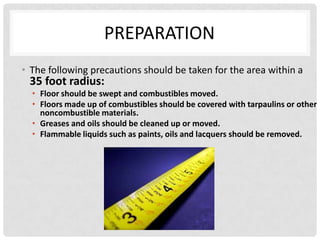
• The following precautions should be taken for the area within a
 35 foot radius:
  • Floor should be swept and combustibles moved.
  • Floors made up of combustibles should be covered with tarpaulins or other
    noncombustible materials.
  • Greases and oils should be cleaned up or moved.
  • Flammable liquids such as paints, oils and lacquers should be removed.
PREPARATION

All wall openings and floor openings must be covered.

• Ductwork and duct openings must be sealed with metal covers or covered
  with fire resistant tarpaulins.

• All doors must be closed or covered to prevent sparks from escaping

 * Exception - If the Hot Work area can be completely screened off with
 noncombustible materials to prevent sparks from escaping, the 35 foot
 area would be reduced to the area within the protective barriers.
HOT WORK HAZARDS
HOT WORK HAZARDS
Flying sparks are the main cause of fires and explosions
in welding and cutting. Sparks can travel up to 35 feet
from the work area. Sparks and molten metal can travel
greater distances when falling.

Sparks can pass through or become lodged in
cracks, clothing, pipe holes, and other small openings in
floors, walls, or partitions which can cause fires to start.
HOT WORK HAZARDS
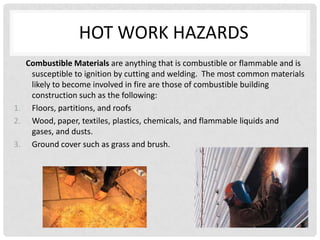
  Combustible Materials are anything that is combustible or flammable and is
   susceptible to ignition by cutting and welding. The most common materials
   likely to become involved in fire are those of combustible building
   construction such as the following:
1. Floors, partitions, and roofs
2. Wood, paper, textiles, plastics, chemicals, and flammable liquids and
   gases, and dusts.
3. Ground cover such as grass and brush.
HOT WORK HAZARDS
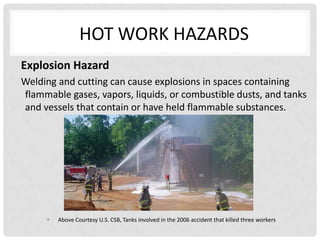
Explosion Hazard
Welding and cutting can cause explosions in spaces containing
flammable gases, vapors, liquids, or combustible dusts, and tanks
and vessels that contain or have held flammable substances.


        Above Courtesy U.S. CSB, Tanks involved in the 2006 accident that killed three workers
HOT WORK HAZARDS
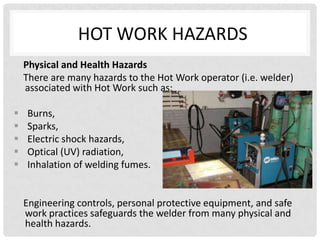
    Physical and Health Hazards
    There are many hazards to the Hot Work operator (i.e. welder)
    associated with Hot Work such as:

   Burns,
   Sparks,
   Electric shock hazards,
   Optical (UV) radiation,
   Inhalation of welding fumes.


    Engineering controls, personal protective equipment, and safe
    work practices safeguards the welder from many physical and
    health hazards.
HOT WORK HAZARDS SUMMARY
  Hot Work can be dangerous because the tools used are highly
  portable sources of ignition that can be introduced into areas
  where ignition sources do not usually exist.

 Sparks, flame, or heat can travel great distances by various
  means and ignite combustibles in other areas far away from the
  Hot Work.

 There are also explosion, fire, and physical and health hazards
  associated with Hot Work as previously reviewed.

 The goal of Hot Work safety practices is to avoid bringing
  sparks, flame, or heat produced by the tool into contact with a
  source of fuel.
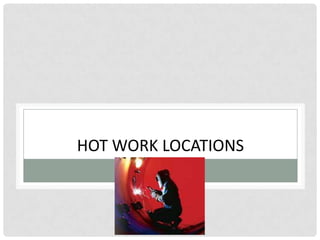
HOT WORK LOCATIONS
HOT WORK LOCATIONS
 Hot Work is allowed in two types of locations:
1) Designated area is a permanent location approved
   for routine Hot Work operations made safe by
   removal of all possible sources of ignition that could
   be ignited by the Hot Work tool.
2) Controlled Area is one in which safe conditions for
   Hot Work exist or where safe conditions can be
   created by moving or protecting combustibles.
3) Non permissible location: Hot Work is never
   permitted in certain types of locations where safe
   conditions do not exist and cannot be created.
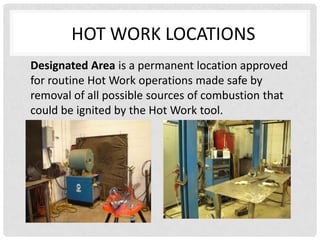
HOT WORK LOCATIONS
Designated Area is a permanent location approved
for routine Hot Work operations made safe by
removal of all possible sources of combustion that
could be ignited by the Hot Work tool.
HOT WORK LOCATIONS
 Controlled Area is a work area in which safe conditions for
 Hot Work exist or where safe conditions can be created by
 moving or protecting combustibles.

 A Hot Work permit is required in a controlled area.

 An example of a controlled area is in a building
  construction area where welding must take place and the
  work area has been made safe by removing all
  combustibles and implementing the requirements of the
  Hot Work permit in order to make it safe.
HOT WORK LOCATIONS
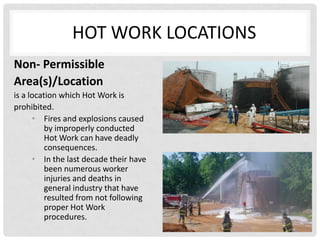
Non- Permissible
Area(s)/Location
is a location which Hot Work is
prohibited.
      • Fires and explosions caused
          by improperly conducted
          Hot Work can have deadly
          consequences.
      • In the last decade their have
          been numerous worker
          injuries and deaths in
          general industry that have
          resulted from not following
          proper Hot Work
          procedures.
HOT WORK LOCATIONS
 Non-permissible welding areas:

    areas not authorized by management;
    sprinklered buildings while such protection is impaired;
    in the presence of an explosive atmosphere, including improperly
    prepared drums that once contained flammable materials and;
    areas near storage of large quantities of exposed, readily ignitable
    materials.
HOT WORK LOCATIONS
 Hot Work shall not be attempted on:

    a partition, wall, ceiling or roof that has a combustible covering or
    insulation, or on walls or partitions of combustible sandwich-type panel
    construction and;
    pipes or other metal that is in contact with combustible
    walls, partitions, ceilings or roofs shall not be done if the work is close
    enough to cause ignition by conduction.
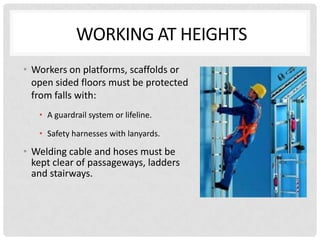
• Workers on platforms, scaffolds or
  open sided floors must be protected
  from falls with:
   • A guardrail system or lifeline.

   • Safety harnesses with lanyards.

• Welding cable and hoses must be
  kept clear of passageways, ladders
  and stairways.
CONFINED SPACES
CONFINED SPACES
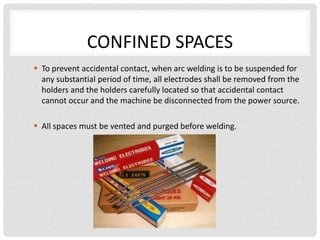
 To prevent accidental contact, when arc welding is to be suspended for
  any substantial period of time, all electrodes shall be removed from the
  holders and the holders carefully located so that accidental contact
  cannot occur and the machine be disconnected from the power source.

 All spaces must be vented and purged before welding.
CONFINED SPACES
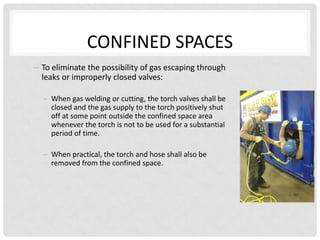
To eliminate the possibility of gas escaping through
leaks or improperly closed valves:

  When gas welding or cutting, the torch valves shall be
  closed and the gas supply to the torch positively shut
  off at some point outside the confined space area
  whenever the torch is not to be used for a substantial
  period of time.

  When practical, the torch and hose shall also be
  removed from the confined space.
CONFINED SPACES
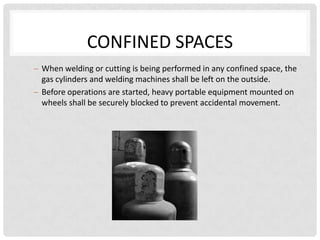
When welding or cutting is being performed in any confined space, the
gas cylinders and welding machines shall be left on the outside.
Before operations are started, heavy portable equipment mounted on
wheels shall be securely blocked to prevent accidental movement.
IMPORTANT
• This is the end of the slideshow

• Please do the following:
  1.   Click the back button on your browser to return to the Module.
  2.   Complete the test for this module.

Step 2 preparation & safety starters

  • 1.
    PREPARATION & SAFETY STARTERS M O D U L E 1 : P R E S E N T I N G H O W TO P R E PA R E H O T W O R K S A R E A S , I D E N T I F Y H A Z A R D S , & P E R M I S S I B L E L O C AT I O N S
  • 2.
  • 3.
    PERSONAL PROTECTIVE EQUIPMENT •Welders and welders’ helpers must wear appropriate eye protection. • Work boots should be used that do not absorb dirt and grease which can create a flame up. • Jeans or other heavier materials are recommended for lower body protection. • Welding gloves are required for hand protection. • Lens of welding hoods, cutting goggles, and hand shields must: • Be arranged to protect face, neck and ears from radiant energy. • Be made of tempered glass and free of bubbles. • Have lens shade readily identified on glass. 3
  • 4.
    PREPARATION • Fire extinguishersshould be charged and available in the immediate area. • Air monitoring equipment should be made available to check for flammable atmospheres in confined spaces or in areas that have a potential to accumulate flammable atmospheres.
  • 5.
    PREPARATION FirePrevention & Protection • NFPA 51 B – “Standard for Fire Prevention in Use of Cutting and Welding Processes.” • Move all fire hazards away from work area. • Use guards (fire blankets, etc.) if fire hazards cannot be moved.
  • 6.
    PREPARATION • Equipment mustbe in good condition and appropriate to the task. • Fire resistive tarpaulins, noncombustible screens, metal shields, and fire stop material for wall or floor openings should be provided as needed.
  • 7.
    PREPARATION • The followingprecautions should be taken for the area within a 35 foot radius: • Floor should be swept and combustibles moved. • Floors made up of combustibles should be covered with tarpaulins or other noncombustible materials. • Greases and oils should be cleaned up or moved. • Flammable liquids such as paints, oils and lacquers should be removed.
  • 8.
    PREPARATION All wall openingsand floor openings must be covered. • Ductwork and duct openings must be sealed with metal covers or covered with fire resistant tarpaulins. • All doors must be closed or covered to prevent sparks from escaping * Exception - If the Hot Work area can be completely screened off with noncombustible materials to prevent sparks from escaping, the 35 foot area would be reduced to the area within the protective barriers.
  • 9.
  • 10.
    HOT WORK HAZARDS Flyingsparks are the main cause of fires and explosions in welding and cutting. Sparks can travel up to 35 feet from the work area. Sparks and molten metal can travel greater distances when falling. Sparks can pass through or become lodged in cracks, clothing, pipe holes, and other small openings in floors, walls, or partitions which can cause fires to start.
  • 11.
    HOT WORK HAZARDS Combustible Materials are anything that is combustible or flammable and is susceptible to ignition by cutting and welding. The most common materials likely to become involved in fire are those of combustible building construction such as the following: 1. Floors, partitions, and roofs 2. Wood, paper, textiles, plastics, chemicals, and flammable liquids and gases, and dusts. 3. Ground cover such as grass and brush.
  • 12.
    HOT WORK HAZARDS ExplosionHazard Welding and cutting can cause explosions in spaces containing flammable gases, vapors, liquids, or combustible dusts, and tanks and vessels that contain or have held flammable substances.  Above Courtesy U.S. CSB, Tanks involved in the 2006 accident that killed three workers
  • 13.
    HOT WORK HAZARDS Physical and Health Hazards There are many hazards to the Hot Work operator (i.e. welder) associated with Hot Work such as:  Burns,  Sparks,  Electric shock hazards,  Optical (UV) radiation,  Inhalation of welding fumes. Engineering controls, personal protective equipment, and safe work practices safeguards the welder from many physical and health hazards.
  • 14.
    HOT WORK HAZARDSSUMMARY Hot Work can be dangerous because the tools used are highly portable sources of ignition that can be introduced into areas where ignition sources do not usually exist.  Sparks, flame, or heat can travel great distances by various means and ignite combustibles in other areas far away from the Hot Work.  There are also explosion, fire, and physical and health hazards associated with Hot Work as previously reviewed.  The goal of Hot Work safety practices is to avoid bringing sparks, flame, or heat produced by the tool into contact with a source of fuel.
  • 15.
  • 16.
    HOT WORK LOCATIONS Hot Work is allowed in two types of locations: 1) Designated area is a permanent location approved for routine Hot Work operations made safe by removal of all possible sources of ignition that could be ignited by the Hot Work tool. 2) Controlled Area is one in which safe conditions for Hot Work exist or where safe conditions can be created by moving or protecting combustibles. 3) Non permissible location: Hot Work is never permitted in certain types of locations where safe conditions do not exist and cannot be created.
  • 17.
    HOT WORK LOCATIONS DesignatedArea is a permanent location approved for routine Hot Work operations made safe by removal of all possible sources of combustion that could be ignited by the Hot Work tool.
  • 18.
    HOT WORK LOCATIONS Controlled Area is a work area in which safe conditions for Hot Work exist or where safe conditions can be created by moving or protecting combustibles.  A Hot Work permit is required in a controlled area.  An example of a controlled area is in a building construction area where welding must take place and the work area has been made safe by removing all combustibles and implementing the requirements of the Hot Work permit in order to make it safe.
  • 19.
    HOT WORK LOCATIONS Non-Permissible Area(s)/Location is a location which Hot Work is prohibited. • Fires and explosions caused by improperly conducted Hot Work can have deadly consequences. • In the last decade their have been numerous worker injuries and deaths in general industry that have resulted from not following proper Hot Work procedures.
  • 20.
    HOT WORK LOCATIONS Non-permissible welding areas: areas not authorized by management; sprinklered buildings while such protection is impaired; in the presence of an explosive atmosphere, including improperly prepared drums that once contained flammable materials and; areas near storage of large quantities of exposed, readily ignitable materials.
  • 21.
    HOT WORK LOCATIONS Hot Work shall not be attempted on: a partition, wall, ceiling or roof that has a combustible covering or insulation, or on walls or partitions of combustible sandwich-type panel construction and; pipes or other metal that is in contact with combustible walls, partitions, ceilings or roofs shall not be done if the work is close enough to cause ignition by conduction.
  • 22.
    • Workers onplatforms, scaffolds or open sided floors must be protected from falls with: • A guardrail system or lifeline. • Safety harnesses with lanyards. • Welding cable and hoses must be kept clear of passageways, ladders and stairways.
  • 23.
  • 24.
    CONFINED SPACES  Toprevent accidental contact, when arc welding is to be suspended for any substantial period of time, all electrodes shall be removed from the holders and the holders carefully located so that accidental contact cannot occur and the machine be disconnected from the power source.  All spaces must be vented and purged before welding.
  • 25.
    CONFINED SPACES To eliminatethe possibility of gas escaping through leaks or improperly closed valves: When gas welding or cutting, the torch valves shall be closed and the gas supply to the torch positively shut off at some point outside the confined space area whenever the torch is not to be used for a substantial period of time. When practical, the torch and hose shall also be removed from the confined space.
  • 26.
    CONFINED SPACES When weldingor cutting is being performed in any confined space, the gas cylinders and welding machines shall be left on the outside. Before operations are started, heavy portable equipment mounted on wheels shall be securely blocked to prevent accidental movement.
  • 27.
    IMPORTANT • This isthe end of the slideshow • Please do the following: 1. Click the back button on your browser to return to the Module. 2. Complete the test for this module.

Editor's Notes

  • #5 A fire extinguisher will be provided in the immediate area of the Hot Work and be available for use at any time while the Hot Work is being conducted and during the watch time after the work is completed. Mounted fire extinguishers will serve as a backup should they be needed. 
  • #11 Photo: MS Clip Art
  • #12 Photos: courtesy MS Clip Art